

FEDERAL COURT OF AUSTRALIA
KD Kanopy Australasia Pty Ltd v Insta Image Pty Ltd [2007] FCA 481
WORDS & PHRASES – skilled person – exclusive licensee – purposive – ‘pith and marrow’
Statutes
Patents Act 1990 (Cth) ss7, 18(1), 40(3), 120, 195(1)
Cases
Adhesives Pty Ltd v Aktieselskabet Dansk Gaerings-Industri (1935) 55 CLR 523 Cited
Aktiebolaget Hassle v Alphapharm Pty Ltd (2003) 212 CLR 411 Applied
Breville Pty Ltd v Warehouse Group (Australia) Pty Ltd (2005) 67 IPR 576; [2005] FCA 1893 Cited
Catnic Components Ltd v Hill & Smith Ltd [1982] RPC 183 Followed
Clarke v Adie (1875) LR 10 Ch App 667 Discusssed
Commissioner of Patents v Emperor Sports Pty Ltd [2006] FCAFC 26 Considered
Fresenius Medical Care Australia Pty Ltd v Gambro Pty Ltd [2005] FCAFC 220 Followed
GEC Marconi Systems Pty Ltd v BHP Information Technology Pty Ltd [2003] FCA 688 Considered
Hill v Evans (1962) 31 LJ Ch 456 Cited
Improver Corporation v Remmington Consumer Products Ltd [1990] FSR 181 Cited
Innovative Agriculture Products Pty Ltd v Cranshaw (1996) 35 IPR 643 Cited
Jupiters Ltd v Neurizon Pty Ltd (2005) 65 IPR 86; [2005] FCAFC 90 Cited
Kimberly Clark Australia Pty Ltd v Arico Trading International Pty Ltd (2001) 207 CLR 1; [2001] HCA 8 Cited
Kirin-Amgen Inc v Hoechst Marion Roussel Ltd (2004) 64 IPR 444; [2004] UKHL 46 Considered
Lockwood Security Products Pty Ltd v Doric Products Pty Ltd (2004) 217 CLR 274 Cited
Merck & Co Inc v Arrow Pharmaceuticals Ltd (2006) 58 IPR 511; [2006] FCAFC 91 Cited
Meyers Taylor Pty Ltd v Vicarr Industries Ltd (1977) 137 CLR 228 Cited
Nicaro Holdings Pty Ltd v Martin Engineering Co (1990) 161 IPR 545 Referred to
Olin Corporation v Super Cartridge Co Pty Ltd (1977) 180 CLR 236 Considered
Pharmacia Italian SpA v Mayne Pharmaceuticals Pty Ltd (2005) 661 IPR 84 Cited
PhotoCure ASA v Queen’s University at Kingston (2005) 216 ALR 41; 64 IPR 314; [2005] FCA 344 Cited
Populin v HB Nominees Pty Ltd (1982) 41 ALR 471 Followed
Radiation Ltd v Galliers & Klaerr Pty Ltd (1938) 60 CLR 36 Considered
Rehm Pty Ltd v Websters Security Systems (International) Pty Ltd (1988) 81 ALR 79 Cited
Root Quality Pty Ltd v Root Control Technologies Pty Ltd (2000) 177 ALR 231; 49 IPR 225; [2000] FCA 980 Considered
Sachtler GmbH & Co KG v RE Miller Pty Ltd (2005) 65 IPR 605 Cited
Sartas No 1 Pty Ltd v Koukourou & Partners Pty Ltd (1994) 30 IPR 479 Cited
Stanway Oyster Cylinders Pty Ltd v Marks (1996) 66 FCR 577 Cited
Synthetic Turf Development Pty v Sports Technology International Pty Ltd (2005) 67 IPR 475; [2005] FCAFC 270 Cited
Tallerman & Co Pty Ltd v Nathan’s Merchandise (Vic) Pty Ltd (1957) 98 CLR 93 Cited
Welch Perrin & Co Pty Ltd v Worrel (1961) 106 CLR 588 Cited
QUD18 OF 2004
KIEFEL J
3 april 2007
BRISBANE
|
IN THE FEDERAL COURT OF AUSTRALIA |
|
|
QUEENSLAND DISTRICT REGISTRY |
QUD18 OF 2004 |
|
BETWEEN: |
KD KANOPY AUSTRALASIA PTY LTD First Applicant/Cross Respondent
TREVOR HUDSON DAND Second Applicant
KD KANOPY INC Third Applicant
INSTANT MARQUEE SYSTEMS PTY LTD Fourth Applicant
|
|
AND: |
INSTA IMAGE PTY LTD First Respondent/Cross Claimant
RICHARD WALDEN WALLACE AND BRENDA MARGARET WALLACE Second Respondent/Cross Claimants
|
|
KIEFEL J |
|
|
DATE OF ORDER: |
3 april 2007 |
|
WHERE MADE: |
BRISBANE |
THE COURT ORDERS THAT:
1. The respondents’ cross-claim is dismissed.
2. The respondents pay the applicants’ costs on the cross-claim.
3. The proceedings are adjourned to a date to be fixed for submissions as to the forms of declarations as to infringement by the respondents, the costs associated with that issue and directions as to the hearing of the assessment of damages for infringement.
Note: Settlement and entry of orders is dealt with in Order 36 of the Federal Court Rules.
|
IN THE FEDERAL COURT OF AUSTRALIA |
|
|
QUEENSLAND DISTRICT REGISTRY |
QUD18 OF 2004 |
|
BETWEEN: |
KD KANOPY AUSTRALASIA PTY LTD First Applicant/Cross Respondent
TREVOR HUDSON DAND Second Applicant
KD KANOPY INC Third Applicant
INSTANT MARQUEE SYSTEMS PTY LTD Fourth Applicant
|
|
AND: |
INSTA IMAGE PTY LTD First Respondent/Cross Claimant
RICHARD WALDEN WALLACE AND BRENDA MARGARET WALLACE Second Respondent/Cross Claimants
|
|
JUDGE: |
KIEFEL J |
|
DATE: |
3 april 2007 |
|
PLACE: |
BRISBANE |
REASONS FOR JUDGMENT
1 In these proceedings the applicants allege that the respondents have infringed Australian Patent No 656757 which is entitled ‘Collapsible Canopy Framework having Captured Scissor Ends with Non-Compressive Pivots’. Its priority date is 4 January 1991. The alleged infringements involve two versions of a product called ‘Caravan Instant Shelter’ which the respondents imported into and sold in Australia at various times.
2 The third applicant, KD Kanopy Inc, is a company incorporated in the United States of America and the assignee of the patent pursuant to an Assignment Agreement with the personal representative of the inventor, James Lynch (deceased), dated 19 October 2001. It is the registered proprietor of the Australian patent. The second applicant, Mr Dand, is a director of the first applicant (KD Kanopy Australasia) and he and that company claim to have been the exclusive licensees of the patent in Australia at all relevant times.
3 From about September 2000 one or more the respondents imported and sold a product called ‘Caravan Instant Shelter’. A later version of this product was imported and sold from about May 2002. The respondents admit that the earlier version of the product has all of the essential features of, and may infringe, the claims of the patent in suit, but deny that the later version has those features. They contend that, to the extent that there has been infringement, there can be no liability to the first, second and fourth applicants. They deny that they are the exclusive licensees and able to maintain a claim for infringement. The focus of this aspect of their defence is upon a Distribution Agreement entered into between the first, second and third applicants on 24 December 1997.
4 The respondents also attack the validity of the patent in question on the grounds that it was not novel; that it lacks any inventive step and the claims in question are not fairly based and lack clarity. They cross-claim for an order revoking the claims the subject of the proceedings.
The complete patent specification
5 The collapsible canopy the subject of the patent is portable in its folded state. Scissor assemblies allow it to expand into a canopy which provides shade or shelter. The author of the patent points out that structures such as this have been used for a very long time. The scissor assemblies are fastened to upright support members by mounts. The patent is concerned with these mounts. It is explained in the specification that:
‘The present invention generally relates to improvements in collapsible shelters such as shelters described in my earlier disclosed scissor canopy structures referenced above. Specifically, the present invention relates to a structural device, in the form of a non-compressible mount having sockets, which capture end portions of scissor assemblies so as to connect scissor assemblies to each other and to other structural components of a canopy structure. The mounts are structured to provide free pivots while at the same time resisting lateral and torsional deflections. Accordingly, the present invention generally relates to the attachment of pivoting structural members in an integrated canopy system.’
6 The inventor advises that the patent is related to the structure of the inventions disclosed in three U.S. patents granted to him. US Patent No 4 641 676 is said to disclose a portable canopy structure which has a framework that may be collapsed into a stored state and yet may be expanded and erected for use. The framework includes a plurality of upright support members the adjacent ones of which are connected by means of scissor assemblies comprising either single or dual scissor units connected in end-to-end relation. A problem experienced by that structure (and that shown in US Patent No 4 607 656 issued to one Carter) is that the edge scissor assemblies which extend between adjacent support members are often subjected to lateral forces which tend to decrease their stability. That structure was improved by his US Patent No 4 779 635 (referred to as ‘Lynch 3’ in these proceedings). The canopy structure there referred to biased its corner support members so that the framework was placed in tension, as opposed to compression. The structure shown in his U.S. Patent No 4 947 884 (‘Lynch 2’), whilst workable, also had the disadvantages indicated. In an effort to further stabilise the structure and meet those problems he developed a stabilisation bar, but it added complexity to the structure and increased its weight and manufacturing costs. He identified a need to simplify:
‘the mounting of the scissor bar elements, one to another into scissor units and the resulting scissor units into interconnected scissor or truss assemblies, and in the connection of such truss assemblies in a pivotal expandable/collapsible manner to respective corner and intermediate supports. There is further a recognized need for interconnections which would be more resistive to shear and bending moments.’
7 The stated objects of the invention are consistent with the explanations to this point. The consistory clauses follow:
‘According to the present invention, then, an expandable framework structure is provided. This framework structure is adapted to be folded and stored and in a collapsed state and erected in an expanded state on a support surface in order to support a canopy covering above the support surface. The expandable framework broadly includes a plurality of upright support members each having a bottom end positionable on the support surface and a top end opposite the bottom end. In the collapsed state, the support members are oriented alongside one another but are moveable outwardly apart from one another towards the expanded state.
A plurality of edge scissor assemblies form truss members for the expandable framework with there being an edge scissor assembly interconnecting adjacent ones of the support members. Each edge scissor assembly has a pair of outer upper ends and a pair of outer lower ends, a plurality of novel mounts are disposed on the upright support members to fasten the edge scissor assemblies thereto. To this end, each of the mounts have sockets formed therein by spaced-apart facing sidewall portions so that the outer ends of the edge scissor assemblies may be captured in respective one of the sockets in close fitted engagement between the facing sidewall portions thereof. A fastening pin pivotally secures each outer end portion of each edge scissor assembly in its respective socket …’.
8 It is then explained that the mounts are moveable with respect to each other; where a pair of mounts are positioned on an upright support member, one mount is stationary while the other is slideable (a sliding mount). The sockets and mounts provide pivotal connections for the scissor bars, without being compressive; the sidewalls act to resist lateral and torsional deflections of the outer end portions of the edge scissor assemblies and thus the scissor assemblies themselves. In the preferred structure a floating mount, also having the sockets and fastening pins referred to, is used to connect the scissor units together. In its collapsed state the stationary and floating mounts at the framework end create an uninterrupted first rim and the sliding and floating mounts at the other end create a second rim. There follows drawings and a detailed description of the preferred embodiment. It is said in conclusion:
‘Accordingly, the present invention has been described with some degree of particularity directed to the preferred embodiment of the present invention. It should be appreciated, though, that the present invention is defined by the following claims construed in light of the prior art so that modifications or changes may be made to the preferred embodiment of the present invention without departing from the inventive concepts contained herein.’
9 These proceedings concern claims 1, 2 and 8 to 23 of the patent. The independent claims are claims 1, 18, and 23:
‘1. An expandable framework structure adapted to be folded and stored in a collapsed state and erected in an expanded state on a support surface whereby said framework structure may support a canopy covering above said support surface, comprising:
(a) a plurality of upright support members each having a bottom end positionable on the support surface and a top end opposite said bottom end, said support members oriented alongside one another in the collapsed state and movable outwardly apart from one another toward the expanded state;
(b) a plurality of edge scissor assemblies with there being an edge scissor assembly interconnecting adjacent ones of said support members, each said edge scissor assembly having a pair of outer upper ends and a pair of outer lower ends, said edge scissor assemblies operative to open and close whereby said framework structure may move between the expanded and contracted states;
(c) a plurality of mounts disposed on said upright supports and operative to fasten said edge scissor assemblies thereto, said mounts each having sockets formed therein by spaced-apart, parallel sidewall portions, said edge scissor assemblies each having outer end portions of rectangular cross-section received in a respective one of said sockets in a close-fitted engagement between the parallel facing sidewall portions thereof thereby forming planar contact surfaces with said parallel sidewall portions; and
(d) a fastening pin pivotally securing each outer end of said edge scissor assemblies in the respective socket, said mounts being relatively movable with respect to one another to allow said edge scissor assemblies to open and close as said framework structure expands and contracts while the parallel sidewalls of the sockets may act on the outer end portions along the planar contact surfaces to resist lateral and torsional deflections of said edge scissor assemblies.’
10 Claims 2 to 14 are dependent upon claim 1. I will refer to features of the dependant claims generally in connexion with the issue of novelty. The focus in these proceedings is upon the references in claim 1, to parallel sidewall portions; the close-fitted engagement; the planar contact surfaces formed and how they act together ‘to resist lateral and torsional deflections’ of the edge scissor assemblies. These references are repeated in claim 18, which adds the word ‘mated’ to the term close-fitted engagement. That claim is in these terms:
‘18. An expandable framework structure adapted to be folded and stored in a collapsed state and erected in an expanded state on a support surface whereby said framework structure may support a canopy covering above said support surface, comprising:
(a) a plurality of upright corner support members each having a bottom end positionable on the support surface and a top end opposite said bottom end, said corner support members oriented alongside one another in the collapsed state and movable outwardly apart from one another toward the expanded state;
(b) a stationary mount secured to each of said corner support members between its respective said stationary mount and the bottom end thereof;
(c) a slide mount slideably received on each of said corner support members between its respective said stationary mount and the bottom end thereof;
(d) an edge scissor assembly interconnecting adjacent ones of said corner support members, each said edge scissor assembly having a pair of outer upper end portions and a pair of outer lower end portions, said outer upper end portions and said outer lower end portions having a rectangular cross-section;
(e) each of said stationary mounts having a plurality of first sockets, each said first socket having a pair of spaced-apart, parallel first sidewalls and including a first fastening pin disposed therein, each said first socket sized to receive an outer upper end portion of a respective edge scissor assembly with the respective outer upper end portion pivotally journaled on the respective fastening pin thereof, each said first socket and each respective said outer upper end portion sized for close-fitted, mated engagement with one another whereby said first sidewalls may act on the outer upper end along planar contact surfaces to resist lateral and torsional deflections thereof; and
(f) each of said slide mounts having a plurality of second sockets, each said second socket having a pair of spaced-apart, facing second sidewalls and including a second fastening pin disposed therein, each said second socket sized to receive an outer lower end portion of a respective edge scissor assembly with the respective outer lower end portion pivotally journaled on the respective fastening pin thereof, each said second socket and each respective outer lower end portion sized for close-fitted, mated engagement with one another whereby said second sidewalls may act on the outer lower end portion along planar contact surfaces to resist lateral and torsional deflections thereof.’
11 Claims 19, 20, 21 and 22 are dependent upon claim 18.
12 Claim 23 refers to a structure similar to that in claim 1 but includes the feature that the fastening pin pivotally securing the edge of the scissor assemblies to the support members is non-compressive. This feature is also found in claim 17. It may be noted however that the word ‘parallel’ is not used in connection with the sidewalls referred to in claim 23. They are referred to as ‘facing’:
‘23. An expandable framework structure adapted to be folded and stored in a collapsed state and erected in an expanded state on a support surface whereby said framework structure may support a canopy covering above said support surface, comprising:
(a) a plurality of upright support members each having a bottom end positionable on the support surface and a top end opposite said bottom end, said support members oriented alongside one another in the collapsed state and movable outwardly apart from one another toward the expanded state;
(b) a plurality of edge scissor assemblies with there being an edge scissor assembly interconnecting adjacent ones of said support members, each said edge scissor assembly having a pair of outer upper ends and a pair of outer lower ends, said edge scissor assemblies operative to open and close whereby said framework structure may move between the expanded and contracted states;
(c) a plurality of mounts disposed on said upright supports and operative to fasten said edge scissor assemblies thereto, said mounts each having sockets formed therein by spaced-apart, facing sidewall portions, the outer ends of said edge scissor assemblies each being received in a respective one of said sockets in close-fitted engagement between the facing sidewall portions thereof;and
(d) a non-compressive fastening pin pivotally securing each outer end of said edge scissor assemblies in the respective socket, said mounts being relatively movable with respect to one another to allow said edge scissor assemblies to open and close as said framework structure expands and contracts while the sidewalls of the sockets resist lateral and torsional deflections of said edge scissor assemblies.’
13 Claims 15, 16 and 17 are dependent upon claim 23. It was suggested by the applicants’ patent attorney that claim 15 should not be said to be dependent upon later claims and claims 16 and 17 should be renumbered to follow claim 23. No amendment was sought.
The skilled person
14 The applicant called two engineers: Dr Kneen, a structural engineer, who has experience in the design of collapsible shade and other structures and Dr Gilmore, a mechanical engineer who has experience in the design of various mechanisms and structures. That experience includes the design of a collapsible shade structure. Dr Kneen’s evidence was referrable to the issue of infringement of the applicant’s patent and Dr Gilmore’s to issues relating to invalidity. The evidence of another witness sought to be relied on by the applicants, their patent attorney, was not accepted as relevant to the understanding of a skilled person, so far as it was relevant to the question of construction of the patent. Dr Kneen in any event adopted much of this evidence as accurate. The respondent called Mr McKinnon, whose background included a business which sold awnings and shade structures. He also conceived of a collapsible shade structure and manufactured and sold a version of it from 1987. It and its prototype are relevant to the issues of novelty and obviousness. The respondent also called an engineer experienced in product design, Mr Kennard. Mr Kennard is also the author of some inventions. Of itself this is not a disqualifying factor.
15 The identification of the skilled reader, to whom the patent is addressed, (being a hypothetical, skilled but non-inventive, worker in the field covered by the patent to whom the invention would be of interest) was discussed in the joint expert report. It was said that there was general agreement that such a person would include a person in the blind, awning and/or tent industries with a practical knowledge of installation and manufacture. The respondents submit that this is too wide and that a person interested in the mount, the subject of the patent, and the problems they sought to overcome, would be a person involved in their design and manufacture. This was the initial position taken by Drs Kneen and Gilmore. The respondents add that Mr McKinnon is a person within this description, relying upon his experience in designing his canopy.
16 The hypothetical skilled person is a person acquainted with the surrounding circumstances of the state of the art and manufacture at the relevant time: Kimberly Clark Australia Pty Ltd v Arico Trading International Pty Ltd (2001) 207 CLR 1; [2001] HCA 8 at [24]. They are likely to have a ‘practical interest in the subject matter of the invention’: Catnic Components Ltd v Hill & Smith Ltd [1982] RPC 183 at 242 and may often work in the art with which the invention is connected. Persons working in the awning, tent and shade structure business might be said to be interested in the method of attachment to the structure identified in the patent. It seems to me however that it is more clearly addressed to a person concerned with the particular problem it identifies. Such a person would be someone called upon to design such a structure and its components. Mr McKinnon’s own use of an engineer to refine his prototype for production tends to confirm this. I accept however that there may be persons, not necessarily qualified as engineers, whose experience would provide them with the necessary knowledge and understanding. As the Full Court pointed out in Jupiters Ltd v Neurizon Pty Ltd (2005) 65 IPR 86; [2005] FCAFC 90 at [67], much evidence is admissible from persons who do not precisely answer the description of the hypothetical skilled person. Some may be more skilled in the relevant art than others. It is for the court, having admitted relevant evidence, to come to a conclusion.
Infringement
17 The invention the subject of the patent is for a new combination. The applicants must show that the two products which the respondents imported and sold have taken ‘each and every one of the essential integers’ of the claims, in order to establish infringement: Olin Corporation v Super Cartridge Co Pty Ltd (1977) 180 CLR 236 at 246; Populin v HB Nominees Pty Ltd (1982) 41 ALR 471 at 475.
18 It would appear that the first of the two versions of the ‘Caravan Instant Shelter’ (‘Product A’) was imported and sold by the second respondents in a period from about September 2000 to mid November 2002 and by the first respondent from some time prior to May 2002 to February 2003. The respondents admit that Product A has all of the essential integers of the claims in question, as earlier mentioned.
19 The second version (‘Product B’) is said to have been imported and sold by the first respondent from May 2002 and by the second respondent from 15 October 2002. It has all the features of Product A, and therefore of the relevant claims, except that one of the sidewalls of the brackets on the fixed and sliding mounts is inclined away from the other sidewall and it has a rib. The general consensus is that the extent of the inclination is about 8 degrees.
20 The respondents’ principal contention is that these features of Product B mean that the integers of parallel facing sidewall portions of the mounts and planar contact surfaces are missing. The two integers cannot be taken separately, for claims 1 and 18 make plain that the parallel sidewalls are to form planar contact surfaces for the purpose of resisting lateral and torsional deflections. There does not appear to be any dispute about this. Claim 23 does not have these integers, but does require that there be a close-fitted engagement between the sidewall and the end of the member of the scissor assembly that is inserted into the socket. The respondents contend this produces a similar requirement and is not met.
21 The other aspect of the invention is the use of a non-compressive pin. The respondents’ Product B uses a screw. I shall refer to the respondents’ argument in connection with this point of difference after dealing with the main issue.
22 The question whether there has been infringement is determined by the construction of the claims: Olin v Super Cartridge 180 CLR at 246. The claims are construed in the context of the specification as a whole, but that does not permit the limits of the monopoly claimed to be expanded by adding to the words of a claim glosses drawn from other parts of the specification: Welch Perrin & Co Pty Ltd v Worrel (1961) 106 CLR 588 at 610.
23 In construing the patent specification the court is to place itself in the position of the person to whom it is addressed: Kimberly-Clark v Arico [2001] HCA at [24]. The specification is to be read in the light of common general knowledge before the priority date. It is accepted that experts can give evidence as to the meaning which those skilled in the art would give to technical terms and phrases and unusual or special meanings which would be given by them to words which might otherwise bear their ordinary meaning. It is however the court’s task to construe the specification: Sartas No 1 Pty Ltd v Koukourou & Partners Pty Ltd (1994) 30 IPR 479 at 485-486; Jupiters v Neurizon 65 IPR at [67].
24 The respondents submit that, in determining the question whether there has been infringement, regard should be had to the words of the claims alone, following the ‘purposive’ approach to the construction of patents suggested by Lord Diplock in Catnic [1982] RPC 183. It is not correct, and contrary to such an approach, to identify the ‘substance’ or the pith and marrow of the invention and determine the issue of infringement on that basis, it is submitted. The respondents view such an approach as non-textual. That approach, drawn from Clarke v Adie (1875) LR 10 Ch App 667 at 675, is not consistent with Catnic [1982] RPC 183, which changed the law in this area, it is submitted. This latter fact was recognised by Finkelstein J in Root Quality Pty Ltd v Root Control Technologies Pty Ltd (2000) 177 ALR 231; 49 IPR 225; [2000] FCA 980 and more recently by Hoffman LJ in Kirin-Amgen Inc v Hoechst Marion Roussel Ltd (2004) 64 IPR 444; [2004] UKHL 46 (at [42]), it was submitted. In each case it was considered that a purposive construction, particularly one given effect to by the questions posed in Improver Corporation v Remmington Consumer Products Ltd [1990] FSR 181 at 189, leaves no area of operation for a pith and marrow approach (see also PhotoCure ASA v Queen’s University at Kingston (2005) 216 ALR 41; 64 IPR 314; [2005] FCA 344). The respondents also point to the recognition by Lindgren J of the ‘tension’ between two ideas in the construction of patent claims: the idea that a person should be able to take the substance of the invention and avoid infringement by side-stepping the language of the claims and the idea that the language of patent claims sets the boundaries of the monopoly and ought not to be extended by the courts to catch that which the patentee has left open: Breville Pty Ltd v Warehouse Group (Australia) Pty Ltd (2005) 67 IPR 576; [2005] FCA 1893 at [40]. It would follow from the respondents’ submission that the first mentioned idea reflects the ‘pith and marrow’ approach but that the latter is the correct approach.
25 Two recent decisions of this Court confirm that the identification of the substance, or essence, of an invention and its use in connection with allegations of infringement to be an incorrect method: Sachtler GmbH & Co KG v RE Miller Pty Ltd (2005) 65 IPR 605 at [55] per Bennett J; Fresenius Medical Care Australia Pty Ltd v Gambro Pty Ltd [2005] FCAFC 220 at [38]-[43] and [92]. As the Full Court explained in Fresenius [2005] FCAFC 220, it is an error of principle to ascertain the ‘essence’ of the invention to determine whether infringement has occurred. Fresenius [2005] FCAFC 220 reiterated that the correct approach is to identify the essential integers and that the form and wording of the claim are determinative. The two decisions also make plain that the incorrect approach reflects a misunderstanding of what was envisaged by the doctrine of pith and marrow. That doctrine has not been regarded by Australian courts as inconsistent with a proper approach to the construction of patent claims.
26 The decision in Fresenius [2005] FCAFC 220 also confirms as correct the explanation of the course the law has taken in this area in Populin v HB Nominees 41 ALR 471, which was confirmed in Nicaro Holdings Pty Ltd v Martin Engineering Co (1990) 161 IPR 545. Populin v HB Nominees 41 ALR at 475 stressed the importance of a patentee distinguishing essential and inessential integers and claiming only the former, because it must be shown that the alleged infringee has taken each and every one of the essential integers of the claim. If one essential integer is omitted that person will escape liability. At the same time, it is explained, the courts sought to avoid too technical or narrow a construction. Accordingly they held that the omission of an inessential step or part, or the substitution of an equivalent (an immaterial variation) would not provide an escape from infringement. Considerations such as this led to the pith and marrow test, expressed in the classic statement in Clarke v Adie (1875) LR 10 Ch App at 675. After commenting that a patent for a new combination is entitled to the same protection as every other patent James LJ said:
‘…The patent is for the entire combination, but there is, or may be, an essence or substance of the invention underlying the mere accident of form; and that invention, like every other invention, may be pirated by a theft in a disguised or mutilated form, and it will be in every case a question of fact whether the alleged piracy is the same in substance and effect, or is a substantially new or different combination.’
27 The doctrine has continued to be recognised by the High Court, Populin v HB Nominees 41 ALR 471 observes at 476 (and see Olin v Super Cartridge 180 CLR 236 at 246 per Gibbs J). It has its limitations, however. As Gibbs J said in Olin v Super Cartridge 180 CLR 236, the doctrine does not mean that there will be an infringement where the patentee has, in the form of the claim, left open that which the alleged infringee has done; and it does not affect the fundamental rule that there will be no infringement unless all of the essential features or integers of the claim were taken.
28 Turning to the reading of the complete specification, the Full Court in Populin v HB Nominees 41 ALR 471 pointed out that the essential integers are to be determined not by an abstract and uninformed construction, but by a common sense assessment of what the words used convey in the context of the then existing published knowledge. It is in this connection that the Court referred (at 476-477) to the decision in Catnic [1982] PRC 183and in particular the statement by Lord Diplock (at 242-243):
‘…a patent specification is a unilateral statement by the patentee, in words of his own choosing, addressed to those likely to have a practical interest in the subject matter of his invention (ie ‘skilled in the art’), by which he informs them what he claims to be the essential features of the new product or process for which the letters patent grant him a monopoly. It is those novel features only that he claims to be essential that constitute the so-called ‘pith and marrow’ of the claim. A patent specification should be given a purposive construction rather than a purely literal one derived from applying to it the kind of meticulous verbal analysis in which lawyers are too often tempted by their training to indulge …’.
29 In Nicaro Holdings 161 IPR 545 Gummow J observed (at 560) that the point at issue in Catnic [1982] PRC 183was an integer which spoke of a rear support member, in building construction, ‘extending vertically’. The alleged infringer had the member inclined at 6 or 8 degrees from the vertical. The reduction had a negligible effect on function and the House of Lords found infringement, as would an Australian court. His Honour did not consider that Catnic [1982] PRC 183propounded any novel principle or created a new category of ‘non-textual infringement’ (see also Fresenius v Gambro [2005] FCAFC at [91]; Pharmacia Italian SpA v Mayne Pharmaceuticals Pty Ltd (2005) 661 IPR 84 at 98 and see the cases there cited).
30 In Catnic [1982] PRC 183the solution proposed by Lord Diplock was a construction which gave effect to what the skilled addressee would understood to be the protection claimed. The question identified by Lord Diplock (at 243) was whether a skilled addressee would understand that strict compliance with a word or phrase was intended to be an essential requirement, so that any variant would fall outside the claim, even though it could have no material effect upon the way the invention works. That question did not however arise if the variation had a material effect or if that would have been obvious to the informed reader.
31 The views expressed by Lord Diplock, that the essential features of a claim are what is referred to as the ‘pith and marrow’ and that they are to be determined by reference to the words of the claim, and not by some intuitive process, may also be seen as reflected in the statement of the High Court in Radiation Ltd v Galliers & Klaerr Pty Ltd (1938) 60 CLR 36 at 51 that, in connection with infringement, consideration must be given to ‘the substantial idea disclosed by the specification and made the subject of a definite claim’ (emphasis added, as it was by the Full Court in Fresenius v Gambro [2005] FCAFC at [50]).
32 The decision in Fresenius v Gambro [2005] FCAFC at [91]confirms that both Populin v HB Nominees 41 ALR 471 and Catnic [1982] RPC 183 stand for the proposition that the essential integers of claims are determined by a common sense assessment of what the words of the claims convey in the context of then-existing knowledge. The cases show that the principle of the pith and marrow is concerned with the identification of what is essential and inessential. Where the omission or substitution in the alleged infringing article is not of an essential feature, the variation is immaterial and a conclusion of infringement may follow.
33 It is convenient at this point to refer to the drawing by Dr Kneen of the mount on Product B, absent his explanations noted on it:
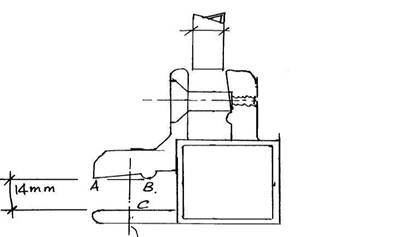
34 The square space to the right of the letters is identified by Dr Kneen as that for the vertical corner post. The focus here is upon the socket where A and B, on the one hand, and C, on the other, are the sidewalls. The inclined sidewall with rib is shown at A and B. The outer end portion of the scissor assemblies (or truss as it is also referred to) is inserted into the socket and held in place with a screw.
35 Claim 1 of the patent in suit envisages the sockets of the mounts being formed by sidewalls which are spaced apart and parallel. The outer end portions of the scissor assemblies are held closely in the socket between the sidewalls which are ‘parallel facing’ in a ‘close-fitted engagement’. The end portions of the scissor assemblies ‘thereby’ form ‘planar contact surfaces’ with the sidewalls. The sidewalls, it is said, ‘may act’ on the outer end portions ‘along the planar contact surfaces’ to ‘resist lateral and torsional deflections’ of the scissor assemblies. Claim 18 repeats the reference to the sockets having spaced-apart parallel sidewalls in connection with both the stationary and sliding mounts, the close-fitted engagement and the sidewalls acting along the planar contact surfaces in order to resist deflections.
36 The respondents concede that the word ‘parallel’ in the claims would not be understood by a person skilled to refer to the sidewalls being precisely geometrically parallel, but rather parallel within manufacturing tolerances. Dr Gilmore, in dealing with the issue of fair basing, said that a geometric parallel sidewall could not be achieved. The claim would be understood to say ‘reasonably parallel’ and consistent with the structure working as described.
37 The applicants’ witnesses did not attempt to put a figure upon what would be ‘reasonably parallel’. Mr McKinnon suggested that anything more than an inclination of 5 degrees from the other sidewall could not be considered to be parallel and could not function as such. It may easily be inferred from the claims that the requirement of parallelism is not to be read on its own and without reference to function. The focus then shifts to the formation of the planar contact surfaces and what is necessary to achieve this. The respondents did not deny such an approach, but submitted that the function of forming planar contact surfaces reinforces the meaning of parallel as being as close to parallel as can be achieved in manufacturing.
38 Dr Kneen gave evidence as to the importance of the contact sought to be achieved. He explained that the improvement sought in the behaviour of the mount, as seen in the specifications, the resistance of lateral and torsional deflection, is to be achieved by restraining the rectangular end portions of the scissor assemblies against rotation. This involves the end coming into contact with the sidewalls. The essential element is claimed to be the presence of planar contact surfaces on the sidewalls.
39 Mr McKinnon did not consider that the inclined side and rib of Product B provided a planar contact surface. Although he conceded that the end portion of the scissor assemblies would sit straight in the socket of Product B, and that it would be parallel with the other sidewall, he did not see this as achieving the same effect as a socket having sidewalls which were both parallel. Mr McKinnon pointed out that, if the gap between the two points of contact (A and B on Dr Kneen’s drawing) was too great, it would allow for lateral and torsional deflection. He did not say however that this variation in Product B had the result that its function was different. I infer that it does not. Mr McKinnon’s point was that the inclined wall and rib provided for contact points, not contact surfaces. He considered that the latter required the contact to be continuous.
40 Dr Gilmore was of the view that the gaps created by the angle of the sidewall in Product B maintained a reasonably planar surface. The applicants’ case as to this feature, as with that of parallel sidewalls, was that there is a tolerance permitted by the claims when regard was had to their function.
41 Dr Kneen pointed out that the contact surface between the end member of the scissor assemblies and the sidewall in the specification will not always be over the whole of the plane as it moves. It may be at isolated points. The claim may imply that it is over a significant surface, but it does not say that it has to be over the whole plane. He would define a planar contact surface as a series of points that form a plane on which contact can be made. Dr Gilmore considered that the angle of the sidewall in Product B maintained a reasonably planar surface.
42 Dr Kneen observed that the claim did not require the planar contact surfaces to be the parallel sidewalls of the sockets. The claims suggest that the planar surfaces could be the sides of the ends of the scissor members. The patent itself says that the sidewalls may act on the end portions along the planar contact surfaces. I note that Mr McKinnon appears to have been alert to this question, but was not confident about the conclusion. It seems to me that Dr Kneen’s view is borne out by the language of the claim. Dr Gilmore also referred to what the claims have to say about the end portion of the scissor assembly. It is not likely that it was predicted that it would always be entirely smooth and providing one continuous plane. If it is, its surface, which is the point of contact, may come into contact at a number of points. The claims refer to contact surfaces. The plane may then be the side of the end portion itself. The respondents submitted that if this were the case it is even more important that the sidewalls be as close to true parallel as possible. The evidence did not however suggest that a substantially parallel wall would act differently upon the end of the scissor assemblies in any significant way.
43 In reality the respondents’ argument not only linked the requirements of the sidewall being parallel with the function of planar contact surfaces, it equated them. Once it is accepted that the claims see the end portion end of the scissor assembly providing the plane on which contact surfaces or points are provided, the remaining question is whether the sidewalls have to be as close to true parallel as possible. This is not necessary for the behaviour of the mount sought to be achieved. Substantially parallel will suffice. That is how the skilled addressee would understand the patent to require which regard was had to the function of the mount. The variation in Product B has no effect upon the function of the sidewall upon the end portion of the scissor assembly.
44 Claim 23 does not contain a requirement that the sidewalls be parallel. The respondents sought to resist a finding of infringement because there is only contact at two points. It was submitted that the integer, that there be a close-fitted engagement, is therefore missing. There is however nothing which suggests Product B failed to achieve this objective.
45 The respondents’ approach to the requirement that there be a non-compressive fastening pin was curious. There was no dispute that it was an essential integer of claim 23. The respondents’ witnesses accepted that the screw in Product B had the features of the pin referred to in the claim. Nevertheless the respondents in submissions reserved their position on infringement on the basis of the view expressed by Dr Gilmore, in connexion with the issue of anticipation, that the bolt utilised in Mr McKinnon’s Original canopy did not anticipate the patent. The weight of the evidence however was that the screw in Product B functioned in the same way as the non-compressive pin in the claim.
46 Infringement of the independent claims 1, 18 and 23 has been made out. The respondents did not suggest that there was any feature of the dependant claims which excepted them from a finding of infringement. The applicants have therefore established infringement of claims 1, 2 and 8 to 23 inclusive by each of Products A and B.
Invalidity
Fair Basis and Clarity
47 Section 40(3) of the Patents Act 1990 (Cth) (‘the Act’) requires the patent claims to be clear and succinct and fairly based upon the matter described in the specification. These requirements are often bound up with the question of infringement. In the latter respect the respondents argue that if the claims are to be interpreted as including walls that are reasonably parallel, but not as parallel as technically possible, and do not create one planar surface between the inclined sidewall and the end portion of the scissor assembly, they travel beyond, and are not fairly based upon, the matter described in the specification: Kimberly Clark v Arico [2001] HCA at [15]; Lockwood Security Products Pty Ltd v Doric Products Pty Ltd (2004) 217 CLR 274 at [57]. For this purpose an overly meticulous and verbal analysis is to be avoided: Synthetic Turf Development Pty v Sports Technology International Pty Ltd (2005) 67 IPR 475; [2005] FCAFC 270 at [26]. The question is whether there is a real and reasonably clear disclosure in the body of the specification of what is then claimed, so that the alleged invention as claimed can be said, in a general sense, to be described in the body of the specification: Rehm Pty Ltd v Websters Security Systems (International) Pty Ltd (1988) 81 ALR 79 at 95 per Gummow J.
48 The respondents submit that it is clear from the patent specification that the invention contemplates continuous contact over the entire plane between each inside wall and the side of the end portion of the assembly. It is this feature that is described in the specification as providing the resistance against lateral and torsional deflection. The specification does not contemplate one sidewall parallel with the end portion and having planar contact with it but, on the other side, contact at only two points and not over the planar surface of the sidewall.
49 The respondents rely upon the preferred embodiment described in the specification (pages 12-15) in their particulars of invalidity. It is submitted that it is there made clear that the sidewalls are required to be parallel so that there are planar contact surfaces between the sidewalls and the outer ends of the assembly in order to resist deflection. A reference to the preferred embodiments in this regard shows that they are concerned with floating and central mounts having parallel sidewalls. The end portions of the scissor assemblies are said to fit into a socket having ‘spaced-apart’ sidewalls. It is said that it is due to the close fitted engagement with the end portions in the sockets that planar contact surfaces are formed. The latter feature is not attributed to the sidewalls being parallel.
50 In any event the specification should not be construed as disclosing an invention limited to the preferred embodiment where there is a statement that it is not so limited. In such a case the consistory clause may be treated as disclosing the invention: Rehm v Websters Security 81 ALR at 94-95; Lockwood Security v Doric Products 217 CLR at [93]. The specification in the patent in suit contains such a statement. The consistory clause describes the sockets of the mounts as having ‘spaced-apart facing sidewall portions’ so that the end portions of the scissor assemblies may be captured in close-fitted engagement. The invention so described does not have geometrically parallel-sided sockets.
51 The respondents also allege that claims 1, 8, 12 and 18 are invalid because two phrases lack clarity: ‘close-fitted engagement’ and ‘planar contact surfaces’. If ‘planar contact surfaces’ is to be interpreted to include contact at discrete points, then the phrase is not clear, it is submitted. With regard to ‘close-fitted engagement’ (and ‘close-fitted mated engagement’) the phrases are said not to be clear because there is no limitation on how far apart the components can be.
52 The applicants point out that mere generality of language in a claim is not fatal, so long as the claim indicates the territory which is forbidden: Adhesives Pty Ltd v Aktieselskabet Dansk Gaerings-Industri (1935) 55 CLR 523 at 546. A claim is not ambiguous if a skilled addressee, applying common sense and common knowledge, can resolve it: Innovative Agriculture Products Pty Ltd v Cranshaw (1996) 35 IPR 643.
53 In reality the respondents’ argument concerning ‘planar contact surfaces’ was that it was capable of bearing a meaning which did not imply unbroken contact. This does not establish a lack of clarity. There is nothing unclear about an engagement between the sidewalls of the socket and the end portion of a scissor assembly being close-fitted. This is particularly so when regard is had to the purpose, namely that contact surfaces be provided in order to resist deflection. Clearly enough a gap which would cut across that objective is to be avoided. An engagement which is ‘mated’ is one which would be well understood to a skilled addressee, as it would to almost any person in a mechanical workshop.
Novelty
54 Whether an invention is novel requires comparison with the prior art base: ss 18(1) and 7(1) of the Act. (The amendments of s 7 and the dictionary definition of ‘prior art base’ effected by Act No 160 of 2001 do not apply to this patent). The respondents rely upon four prior patents as anticipating the patent in suit: the two Lynch patents referred to in the patent in suit (‘Lynch 2’ and ‘Lynch 3’) and another, US Patent No 4 885 891 (‘Lynch 1’), together with US Patent 402 755 (‘Lyon’). They also pleaded two instances of prior use in Australia before the priority date: the use of a collapsible canopy designed by Mr McKinnon (referred to as his ‘Original’ canopy), that use including its use at public events such as motocross races and jetski races; and the commercial sale and use of a collapsible canopy under the trademark Quikshade by the company with which Mr McKinnon and his father were associated, Summercraft Blind & Awning Company Pty Ltd. I did not understand the respondents to press reliance upon the Quikshade canopy, however, since it does not employ a two-sided socket such as that shown in the patent. It may remain relevant to the question of common general knowledge, particularly in connection with obviousness.
55 The test for anticipation, or want of novelty, is ‘reverse infringement’: Meyers Taylor Pty Ltd v Vicarr Industries Ltd (1977) 137 CLR 228 at 235. It enquires whether the alleged anticipation would infringe the patent, assuming for that purpose that it is valid. The prior publication or use must disclose or embody all of the essential integers of the claims in question, and do so in ‘clear, unequivocal and unmistakeable terms’: Nicaro Holdings 161 IPR at 549. A person skilled in the art must be able to perceive, understand and be able to practically apply the discovery by reference to the information in the prior art without further experimentation: Nicaro Holdings 161 IPR at 549; Hill v Evans (1962) 31 LJ Ch 456 at 443; Merck & Co Inc v Arrow Pharmaceuticals Ltd (2006) 58 IPR 511; [2006] FCAFC 91 at [105]-[107], [111].
56 Section 7(1) of the Act provides that prior art information in the nature of a single act which was made ‘publicly available’ may be used for the comparison required in connection with novelty. In the present case the information contained in Mr McKinnon’s Original canopy must have been made available to any one member of the public in a way which left them free, in law and equity, to make use of the information: Stanway Oyster Cylinders Pty Ltd v Marks (1996) 66 FCR 577.
Lynch 1 – (US Patent No. 4 885 891)
57 There was general agreement that this patent did not clearly disclose non-compressive pins for use in the sockets. These pins are referred to in claims 15, 16, 17 and 23. There was a further issue as to whether sliding mount 55 in Figure 8 disclosed sockets formed by spaced-apart parallel sidewall portions (claims 1, 18 and 23 and dependant claims). Dr Gilmore did not consider that it was possible to reach any conclusion regarding the structure of the mount. Both Mr Kennard and Mr McKinnon agreed that it was difficult to determine its structure. Mr McKinnon’s statement that it was ‘clear enough’ to him does not provide sufficient certainty. Mr Kennard deduced that they might be parallel by reference to other, unnumbered, mounts which he thought had inside walls. He inferred that what was depicted was an apparatus with a U-shaped socket. Clearly enough Mr Kennard has made an assumption which a skilled addressee would not make without a more specific drawing or explanation, as Dr Gilmore points out.
Lynch 2 - (US Patent No 4 947 884)
58 At issue with respect to this patent was whether parallel sidewall portions were disclosed by a pair of ears (col 6, l 30-40; fig 6). There was general agreement, disclosed in the joint expert report, about whether mount 70 on Figure 6 had two ears, but disagreement about how the drawing should be interpreted. Mr McKinnon thought that it had two ears, but Mr Kennard thought that one pair of ears was disclosed at right angles – in essence and L-shaped socket. Mr Kennard also observed that the figure showed a socket (74) where the front wall and part of the back wall can be seen. These are referred to in the specifications as ‘pairs of ears’. He reads the drawing as showing the front and back walls as parallel. He also understands the patent, in describing other sockets as pairs of ears, to suggest that they too comprise parallel-facing sidewalls. Dr Gilmore agreed that the description of the socket was of facing sidewalls, but did not consider that it was sufficiently clear for a conclusion that they were parallel. It seems to me, again, that Mr Kennard and Mr McKinnon may have expected this to be the case that this is not sufficient. The patent refers only to a ‘pair of ears’ and goes no further. It follows, in Dr Gilmore’s view, that planar contact surfaces are not disclosed. It seems to me that Dr Gilmore is correct; and that Mr Kennard’s reading of the patents requires assumptions that a skilled addressee would not make without more.
59 Two other features are absent from Lynch 2: the structure disclosed is not a roof support assembly extending between and connected to at least one pair of facing edge scissor assemblies (claim 10); and it does not have an edge scissor assembly including a ‘pair of scissor units connected’ by floating mounts (claim 8). Dr Gilmore also suggested, at one point in his evidence, that the feature of a non-compressive fastening pin was not present in the Lynch 2 patent. The other evidence however makes plain that bolts, which are clearly disclosed, can operate in the same way.
Lynch 3 – (US Patent 4 779 635)
60 The principal issue here was whether the sliding mounts shown as connected to the end scissor assemblies with ‘L-shaped’ sockets are the same as disclosed in the specification of the patent in suit, which are in the nature of U-shaped brackets having parallel facing sidewalls. Lynch 3 does not disclose a roof support assembly which includes an internal scissor assembly extending between and connected to at least one pair of facing edge scissor assemblies (claim 10).
61 The specification on Lynch 3 (col 5, l55) refers to a U-shaped bracket mounted to a corner support member and an L-shaped socket (which is taken to be effectively one-sided) to a corner. Mr Kennard understood the specification to convey that the socket on the mount used to attach the scissor end has only one side and the socket on the mount used to attach the roof truss has two sides. Whilst the sockets used to attach the ends of the scissor assemblies do not have parallel sidewalls, as the patent in suit requires, but only a single sidewall, he considers that, because Lynch 3 discloses sockets having two sidewalls for use in attaching the roof truss, it would be a matter of routine to adapt the sockets for attaching the scissor assembly to be two-sided as well. Mr Kennard has not addressed the correct question. As Dr Gilmore points out, it is not whether, in an engineering sense, this other application could be deduced. Application of the mount used for attaching the roof truss represents a different engineering feature of the structure and, importantly, is not taught by this patent.
Lyon – (US Patent No 402 755)
62 This discloses slots (L) which are described as receiving cross-bars or other connecting parts. It is difficult therefore to understand that the slots did not function as sockets, as Dr Gilmore suggested. There was general agreement that the slots had parallel sides. The document does not however disclose a pin, as referred to in claims 1 and 23, passing through the slots and end portions inserted into them. It utilises wires or chords which lie in grooves at the end of the brackets. The wires are said to constitute axes upon which intersecting parts are to hinge. That is the only description provided. The respondents submit that it must be inferred that the wire must go through the cross-bar or other connecting part which is inserted into the slots and then pivot in the same way as the pin, which passes through the sockets and the end of the scissor assembly. This is not however apparent from the Lyon patent and Dr Gilmore did not accept that it was disclosed. The patent is dated 1889 and contains a limited description. He suggested another way in which the wire could have been threaded, namely on a groove on the inserted connecting part, utilising umbrella technology. This would not necessarily involve the wire acting as a pivot. There is not a clear disclosure.
63 It was also accepted that the features of upper and floating mounts (claim 8) and the internal scissor assembly connected to at least one pair of facing edge scissor assemblies (claim 10), were not anticipated by this patent. There was general agreement that the requirement of claim 23, that the pin be non-compressive, was not met.
The Original Canopy
64 In the early 1980’s Summercraft Blind & Awning Co began to sell and install an awning which attached to the side of a house. It folded, concertina style, and had a scissor arrangement which enabled it to expand. At this time Mr McKinnon was involved in motocross and jetski racing events and needed a shelter for his equipment and tools. From 1984 he made a number of prototypes of a collapsible canopy with four upright metal posts and scissor trusses between each post. There are no copies of the Original in existence and the only photographs said to be of it do not show how the scissor assembly was attached to the uprights.
65 The applicants submit that Mr McKinnon’s evidence needs to be closely scrutinized in these circumstances. So much may be accepted. It does not however entirely lack corroboration. Mr McKinnon’s earlier evidence about how he made U-shaped brackets which attached the scissor truss ends to each post was somewhat unclear. He suggested that they were formed by a piece of metal shaped into a ‘U’ by fitting it around a post and that the bracket extended beyond the upright posts. His methods may have changed because of the number of prototypes he made. In any event he eventually went to Mr Soward, a metal fabricator, to weld the parts to the posts. Mr Soward does not now recall their shape. His employee, Mr Forster, recalls them being made from U-shaped channels. It may be inferred from Mr McKinnon’s evidence that one was added to the top of the upright post to form a stationary mount. Mr Forster recalls a sliding mount on the post which was comprised of a U-shaped bracket which he welded to a piece of square hollow section of metal which slid along the post. The brackets had holes in either sides, through which a bolt could be threaded. It appears elsewhere from the evidence that the bolt was threaded only part of the way. This has an effect upon its function to which reference shall be made. Mr McKinnon’s evidence was that he used a nylon washer on either side of the end of the scissor end because the two sides of the socket were slightly larger than the width of the end and to ‘take up the slack’. He thinks that the washers were about 1 mm thick.
66 Mr Forster gave evidence that he worked only on a section of the canopy but that Mr McKinnon showed him the final product, of which there is a photograph. He does not recall how the components were utilised.
67 Mr McKinnon believes that he started taking the canopy to races in 1987, and possibly before. In his initial evidence he spoke of other competitors, friends and members of the public seeing the canopy and expressing interest in it, indeed being intrigued by it. He loaned the prototype to friends when he was not attending the races himself. He identified one family to whom he loaned the canopy, the McPhersons, and gave evidence that a photograph in evidence was of the canopy that he had loaned to them. He says that he was asked to make and sell copies of the canopy but he was busy and did not think that it was worth his while. In 1987 a friend returned from the United States of America with a copy of an advertisement made by another company. He then became interested in manufacturing his canopy. He took his prototype to a product engineer, Mr Dawes. Mr Dawes designed a system which clipped together and had injected moulded plastic mounts different in shape from his prototype. He applied for a patent in November 1987. The Quikshade canopy was manufactured and sold from 1988. Neither it nor the patent are relied upon as anticipating the patent in suit but as forming part of common general knowledge in connexion with the issue of obviousness. Despite its commercial success Mr McKinnon was not satisfied with its strength and stability. In 1995 he redesigned the brackets to have a single wall on each side of the bracket. He sold the Quikshade business but remained as an employee until June 2004. He no longer has any interest in it.
68 Clearly enough Mr McKinnon’s structure utilised U-shaped brackets which could be said to have parallel facing sidewalls. A number of points of difference between the patent claims and his Original canopy were initially identified by the applicants, but it seemed to me that only two features remained in issue at the conclusion of the evidence – whether a close-fitted engagement between the scissor truss ends and the U-shaped bracket was achieved when nylon washers were inserted between them; and whether the Original canopy collapses so that the stationary and floating mounts abut one another to form an uninterrupted rim. The feature of the non-compressive pin was met because the bolt utilised on the Original canopy operated in the same way. It compressed only to the extent of its thread.
69 The respondents submitted that the claims of the patent in suit could not be got around by the use of a small washer. Dr Gilmore’s evidence was to the effect that it could prevent a close-fitted engagement, depending on the size of the gap it was meant to take up. I did not however understand him to say that a gap of 1 mm would prevent that engagement. That was the extent of the gap on the Original canopy and equates with what the patent discloses. It may be that the washer was unnecessary. It does not in any event alter the function of the socket.
70 The Original canopy may be said to anticipate the claims of the patent in suit, save in one respect. Mr McKinnon conceded that it did not collapse in such a way that an uninterrupted rim was formed (claim 14). Dr Gilmore identified it as a unique feature of the structure. I did not understand the respondents to contend that it was not essential. They contended that it was obvious at the priority date. This contention is however only based upon the possibility that it might have been achieved on the Original by countersinking bolts once the idea was known. In any event it was not pleaded in connection with the issue of obviousness, to which I shall shortly turn. It remains to consider whether the Original canopy was made available to the public in the way required, on the footing that it did anticipate the patent’s claims.
71 Mr McKinnon’s earlier evidence may have established the availability of the canopy for inspection by members of the public. His later evidence does not however make such a conclusion possible. He accepted that the photograph taken at the races of the canopy loaned to the McPhersons was of the later Quikshade canopy and conceded that he may never have loaned an Original canopy to them. When Mr McKinnon was reminded that he applied for a patent of the Original in late 1987 he retreated from his earlier evidence about making the canopy available at the races in the period prior to that. He said that he had attempted to keep it from the public; that he erected it at the back of the pits and out of public view; that he sought to do so until it was patented and because he was conscious of the prospect of people taking his ideas; and that he was guarded about lending it. The possibility that he might have continued to use it after his application for the patent was not rendered more certain by evidence. The Quikshade canopy which he did use appears to have been produced shortly afterwards, in 1988.
72 The only other evidence of disclosure upon which the respondents relied was of the Original canopy to Mr Forster. It could not however be inferred that he was at liberty to make use of it, as is required. The circumstances in which he was placed, and his or his employer’s relationship with Mr McKinnon, suggest strongly that the information contained in it was confidential and could not be imparted to others or utilised by him.
Obviousness
73 Section 18(1) of the Act, which commenced on 30 April 1991 requires a patentable invention to involve an inventive step. The patent was applied for on 23 December 1991. The effect of s 7(2) is that it does not involve such a step if it would have been obvious to person skilled in the relevant art, in the light of common general knowledge as it existed before the priority date of the relevant claim, whether that knowledge is considered separately or together with the information referred to in subs (3). That subsection refers to one piece or two or a combination of pieces, of prior art information that the skilled person could reasonably be expected to have ascertained, understood and regarded as relevant. The skilled person for these purposes is assumed to be non-inventive.
74 As the High Court pointed out in Aktiebolaget Hassle v Alphapharm Pty Ltd (2003) 212 CLR 411 at 423 at [21], in seeking to discharge the onus upon them, the party alleging invalidity must lead evidence looking back to the priority date, sometimes many years prior to trial. The authorities are replete with warnings about the misuse of hindsight. This danger is particularly acute where there is a new combination.
75 The respondents’ case on obviousness had two approaches: it was assumed that common general knowledge extended to what was disclosed in the three prior Lynch patents. Features of them, such as the use of scissor assemblies connected to vertical upright supports, could also be seen in the Lyon patent and the Quikshade canopy. Viewed from that perspective it would have been obvious to the skilled person that the attachment means could be changed to mounts having L-shaped or U-shaped sockets, the argument proceeds. They would provide greater strength and stability. The other approach relied upon Mr Kennard’s consideration of how he might design a component to connect an upright post and a horizontal post in such a way as to enable the latter to be free to slide along the upright post. He had been instructed that the area for design concerned a problem with a collapsible canopy. The application of what he termed ‘engineering principle’ led him to a choice between a bracket with a U-shaped or L-shaped socket.
76 Mr Kennard’s evidence was that all of the features of the Lynch patents were known to skilled persons before the priority date. In particular scissor assemblies, vertical support posts for canopy roofs, the combination of stationary and sliding mounts, of U-shaped and L-shaped sockets in brackets used for attachment and the use of floating mounts and the use of non-compressive pins were all known. Dr Gilmore accepted that the discrete technologies which comprised the structure as described in these patents would have been common general knowledge. However, the knowledge that the specific types of discrete technology would combine well to make a practical and useable device would not be common general knowledge and would need to be ‘taught’. Discrete technologies were put together in a particular and a unique way in each of the prior patents. There were a wide range of possibilities open to a person designing a structure such as this and that person would need to research and use their skill in design, he said. The assumption that all collapsible canopies would use scissor assemblies was incorrect, as some prior art documents confirm. Scissor mechanisms could be expected to be observed in various applications, but specific knowledge of how to apply them to advantage in making collapsible structures would not have been readily observed. The use of sockets with parallel sidewalls to accommodate bars with ends of rectangular cross-section were known to help to prevent lateral and rotational distortion of the socket relative to the bar; but whether this assist in preventing distortion of a collapsible structure, while allowing the bar to pivot freely, would depend upon the details and geometry of the design of that structure. The respondents’ case, it will be recalled, assumes that structure has been designed.
77 Mr Kennard’s evidence was also strongly suggestive of hindsight. It appeared to me that he was prepared to assume a greater knowledge of the type of structure in question than may have been the case at the relevant time. His starting point was his awareness ‘for many years’ of collapsible canopies used in Australia, at market stalls for example. Whilst he was directed to knowledge as it existed at the relevant date, it could not safely be concluded from his evidence that he took his mind back to that point. By the time he turned his mind to the question of available knowledge he had had regard to the patents and prior art.
78 No reason is shown for rejecting the evidence of Dr Gilmore. There is a basis for doubting the accuracy of Mr Kennard on this question. It follows that common general knowledge as it existed at the priority date should not be taken to have extended to the structures disclosed in the prior Lynch patents, nor the use of scissor assemblies as shown in the Lyon patent and the Quikshade canopy.
79 In addition to what was commonly known, s 7(3) also enquires whether the skilled person could reasonably be expected to have ascertained the prior art information in question. Mr McKinnon said that the Quikshade canopy was sold mostly to motocross competitors in the period 1987 to the end of 1990 and he did not advertise it very much. There is nothing to suggest that a person, such as an engineer undertaking the research to which Dr Gilmore refers, would have been alerted to its existence. There were no journals in the awning and canopy industry and Dr Gilmore’s evidence suggests that information of this kind was not likely to appear in engineering design journals. In any event an inspection and observation of the canopy would have shown only the use of a scissor assembly connected to upright posts as one possibility.
80 The Lyon patent also shows the use of a scissor assembly, but as Dr Gilmore explains this does not take one far towards the patent in suit. There is much to be determined in the detail of the design and its geometry before the design of the brackets is considered. The question which in any event arises with respect to it and the Lynch patents is whether they were available to be searched, and would have been searched, online by a design engineer at a time before the priority date. To the extent that the skilled person includes someone within the industry, it may be taken that they would not have routinely undertaken such a search. In Commissioner of Patents v Emperor Sports Pty Ltd [2006] FCAFC 26 the question posed by the statute, and in particular that of ascertainability, was discussed. In many areas it may be assumed that the relevantly skilled person would be familiar with professional journals or other technical information. Unless an inference could be drawn, evidence would generally be required about what that person may reasonably be expected to have done. There is no such evidence in the present case.
81 The respondents’ case on obviousness is based upon an assumption that the skilled person proceeds to design the attachment means of the edges of a scissor assembly to upright posts holding a canopy roof, on the basis that they are acquainted with the structures disclosed in the Lynch patents. That assumption is invalid. If that assumption was correct they would in any event have failed to establish that the use of parallel-facing sidewalls, having the function and purpose disclosed in the patent, would have been obvious. Applying the test propounded in Aktiebolaget Hassel v Alphapharm 212 CLR at 433, at [53], the question is whether the skilled person, armed with the information provided by those patents would have been directly led, as a matter of course, to try a bracket having a socket with parallel facing sidewalls and using a non-compressive pin. The latter assumes little importance if the socket is obvious. In this regard it may be accepted that brackets having L-shaped and U-shaped sockets were part of common general knowledge at the time.
82 Dr Gilmore accepted that a person seeking to refine the structure in the prior Lynch patents might consider the use of brackets of this type. That however assumes that knowledge of the structure so disclosed would mean that they would pursue that course. They might consider other possible structures. There are many possibilities and that in the Lynch patents is not mandated by design principle. The choice of other structures might lead the skilled person away from the brackets. The choice of the means of attachment depends so much on the geometry of the structure, as earlier mentioned. I also infer from Dr Gilmore’s evidence that the prospect of a choice being presented assumes an identification of the problem of stability as the deficiency necessary to be addressed. It is not said how this would be apparent to a skilled person upon reading them.
83 Dr Gilmore gave evidence that there were other means available if it was desired to resist deflection of the scissor assemblies. He identified one such method. Even if the skilled person understood the Lynch patents to be suggesting the use of the brackets having either L-shaped or U-shaped sockets, that did not mean that a non-inventive step was involved, in his view. He saw the choice as itself inventive. It may also be observed that if the skilled person thought that each of them were ‘worth a try’ it may beg the question posed by the statute: see Aktiebolaget Hassel v Alphapharm 212 CLR at [72].
84 Mr Kennard was given his design task by the respondent’s lawyers prior to his seeing the patent in suit and the prior art. The description of the task and the questions arising in its course were however such that he was effectively directed to the use of brackets with sockets having parallel facing sidewalls. He was asked to design a ‘component’ to connect an upright post to the horizontal post in such a way as to enable the latter to be free to slide along the upright post. He was asked to consider a socket connection which might pivot about a bolt. He was then asked to consider ways to strengthen the connection. At that point he was asked to ‘explain the general engineering principles behind using parallel facing sidewalls in sockets’. If they improved strength he was asked to explain how. The questions may have put the focus upon the strength and not stability but Mr Kennard was alert to this. In these circumstances I do not consider that his evidence in response to these instructions can carry any weight.
85 The respondents’ case on obviousness fails.
Exclusive Licensee
86 Section 120 of the Act provides that infringement proceedings may be commenced by the patentee or an exclusive licensee. An ‘exclusive licensee’ is defined in Sch 1 to mean a licensee under a licence granted by the patentee which confers upon the licensee, or persons authorised by them, the right to exploit the patented invention throughout the patent area to the exclusion of the patentee and all other persons. In their statement of claim the first, second and third applicants alleged that the third applicant, KD Kanopy Inc, is the legal assignee of the patent and that the first and second applicants, KD Kanopy Australasia and Mr Dand, were at all relevant times the exclusive licensee from KD Kanopy Inc. This was not admitted by the respondents. The issue has grown incrementally since the respondents were given leave to amend their defence to raise a positive case that KD Kanopy Australasia and Mr Dand did not have an exclusive licence.
87 Section 195(1) of the Act provides that the register is prima facie evidence of any particular noted upon it. KD Kanopy Australasia and Mr Dand have been noted upon the register as exclusive licensees, pursuant to an agreement dated 24 December 1997, since 31 July 2003. The respondents contend that the terms of that agreement deny the necessary exclusivity in the first and second applicant.
88 The Distribution Agreement of 24 December 1997 was for a term of five years. By cl 1, KD Kanopy Inc granted to KD Kanopy Australasia and Mr Dand the sole exclusive right to manufacture and distribute products known as the KD Majestic and KD Starshade in Australia and New Zealand. Those products are manufactured in accordance with the patent. The right was expressed to include the grant of sub-licences. An exception to the sole and exclusive right created by cl 1 was provided by cl 21.7. It preserved the right of KD Kanopy Inc to continue to deal directly with Alishan Pty Ltd in New South Wales and any other customer as may be agreed. Clause 21 was expressed to prevail over cl 1. Clause 19(f) provided that the agreement was not to be amended, altered, changed, modified, supplemented or rescinded in any manner except by a written agreement executed and acknowledged by the parties to it. Clause 13 provided the distributor an option to renew. The terms of each renewal were to be the same as those contained in the agreement.
89 The option to renew the agreement was exercised by KD Kanopy Australasia and Mr Dand on 8 November 2002.
90 There was a history to cl 21.7, as explained by Mr Dand and the representative of KD Kanopy Inc, Mr Matthews. The KD Kanopy products had earlier been imported by the company Alishan and KD Kanopy Australasia purchased products from that company. In 1995 Mr Dand and Mr Matthews discussed the prospect of KD Kanopy Australasia manufacturing the products in Australia. The first agreement between the parties concerning the manufacture and distribution of the products was entered into on 24 January 1996. Clause 9 of that agreement permitted KD Kanopy Inc to fulfil its existing contractual obligations to Alishan, although KD Kanopy Australasia and Mr Dand became its suppliers after production commenced. At the time cl 21.7 was written Mr Matthews had in mind relinquishing sales to Alishan when it was obvious that Alishan was comfortable in its dealings with them.
91 On 24 March 1998 KD Kanopy Australasia and Mr Dand entered into a licence agreement for the distribution of the products with Kanopy Co, which is now the fourth applicant, Instant Marquee Systems Pty Ltd. That agreement recites that a licence is given to market, promote and distribute the products in Australia and New Zealand, but not in New South Wales. License agreements subsequently entered into by the first and second applicants, with other distributors or franchisees, do not extend to New South Wales, where it is said that the first and second applicants have a non-exclusive right.
92 Mr Dand explained that their agreement merely reflected the 1997 Distribution Agreement. Subsequent to that agreement a further agreement was reached in a conversation with Mr Matthews sometime in 1998 or 1999. That conversation concerned KD Kanopy Australasia and himself having the sole and exclusive rights of distributorship of the products and KD Kanopy Inc discontinuing its sales to Alishan or any one else. At that point Alishan was already ordering nearly all of its products from KD Kanopy Australasia, Mr Matthews says. Mr Dand says that he was motivated to make the request because he and KD Kanopy Australasia were about to expend considerable monies on further plant and equipment and he wished the security of exclusivity. Mr Matthews agreed to his request. He and Mr Dand say that the companies have honoured that agreement, despite it not being reflected in the written Distribution Agreement.
93 It is fair to say that this aspect of the case has taken some turns. In the end however it was reduced to a relatively narrow compass. Clearly the first, second and third applicants were able to vary the agreement of December 1997 in the way they did, notwithstanding a clause such as cl 21.7 and the requirement of formality. The determining factor in such a circumstance is always the intention of the parties: Tallerman & Co Pty Ltd v Nathan’s Merchandise (Vic) Pty Ltd (1957) 98 CLR 93 at 144. GEC Marconi Systems Pty Ltd v BHP Information Technology Pty Ltd [2003] FCA 688 involved a similar clause, which provided that there was to be no oral modification of the agreement. The question which arose was whether it rendered ineffective an oral or implied variation. Justice Finn held that it did not. His Honour observed that the usual objection raised in allowing oral modification, and the alteration of the variation clause, is that it involves a failure to give effect to what the parties had agreed (at [220]). The question for the court however, as a United States commentator had observed, was whether to enforce the first or the second agreement. Common law courts chose the second. His Honour considered that this was of particular application to contracts which might be evolutionary in character.
94 The respondents do not now contend to the contrary of these views. Their case is that the Court should not accept the evidence of the later agreements. They suggest that Mr Dand’s evidence should be treated as unreliable because the oral agreement was not referred to until the respondents had identified the difficulty with the terms of cl 21; and because he did not volunteer the license agreement with the fourth applicant and those with other distributors at an earlier point. These submissions overlook the way in which the matter developed. Mr Dand also explained that he and his wife, who found the document, had overlooked the existence of the agreement. I do not find it difficult to accept that documents relating to entities controlled by a person may assume a lesser significance to them than other documents might.
95 The respondents submit that the objective evidence strongly suggests that cl 2.17 remained operative. The terms of the sub-license agreements, which excluded distribution in New South Wales, remained the same throughout 2002 and 2003. Further, KD Kanopy Inc sold some products to the first respondent on two or three occasions in those years. It appears that the goods were ordered by the first respondent directly from KD Kanopy Inc and shipped to it in New South Wales. They also submit that some inference adverse to the applicants should be drawn because Mr Matthews has not further commented upon these sales, or given evidence that there have been no others.
96 Mr Dand has explained, and I accept, that the license agreements were of a proforma type and no thought was given to whether they reflected the current state of affairs agreed to between the first, second and third applicants and put into effect by them. The evidence relating to the sales by KD Kanopy Inc to the first respondent is consistent with an oversight on its part. The evidence is insufficient to permit an inference of conduct inconsistent with the oral agreement. Moreover, Mr Dand’s electronic communications to Mr Matthews, when he realised that a competitor had KD Kanopy products, supports a conclusion that he and KD Kanopy Australasia held an exclusive license. The terms of his communications may be polite, but his concerns are clearly consistent with them having that right and KD Kanopy Inc no longer having the right to sell. Mr Matthews gave his evidence some months prior to reference being made to these sales. The respondents had not earlier referred to them despite being within their knowledge. On the state of the evidence I do not think it could be said to have been incumbent upon the applicants to have Mr Matthews provide a general rebuttal or further comment upon the two or three sales which had occurred.
97 The first and second applicants had the exclusive licence to manufacture and distribute from some time after March 1998, prior to the dates of the alleged infringements. They may therefore sue for infringement. The grant of the sub-licence is an incident of those rights and does not detract from it. It was unnecessary to join the fourth applicant to the proceedings on the alternative basis that they may have obtained the exclusive license.
Conclusion
98 The respondents have not established a ground for holding the patent in suit invalid. Their cross-claim will be dismissed with costs. They have conceded infringement of the patent by reference to their product A and the applicants have made out a case that the respondents’ Product B also infringes. The respondents should pay the applicant’s costs of the proceedings for infringement. I will hear the parties as to the form of the orders, including that as to costs and as to directions necessary for the assessment of damages for infringement.
|
I certify that the preceding ninety-eight (98) numbered paragraphs are a true copy of the Reasons for Judgment herein of the Honourable Justice Kiefel. |
Associate:
Dated: 3 April 2007
|
Counsel for the First applicant/cross-Respondent, second, third and fourth Applicants: |
Mr D J Logan |
|
|
|
|
Solicitor for the First applicant/cross-Respondent, second, third and fourth Applicants: |
Macrossans Lawyers |
|
|
|
|
Counsel for the First and Second Respondents/Cross Claimants: |
Mr A Franklin SC |
|
|
|
|
Solicitor for the First and Second Respondents/Cross Claimants: |
Maxwell IP |
|
|
|
|
Date of Hearing: |
6,7,8,9,10 February 2006; 10, 11 April 2006; 5, 6 September 2006 |
|
|
|
|
Date of Judgment: |
3 April 2007 |


