

FEDERAL COURT OF AUSTRALIA
Ranbaxy Australia Pty Ltd v Warner-Lambert Company LLC (No 2)
[2006] FCA 1787
PATENTS - revocation of later patent – selection patent - whether patent obtained by false suggestion or misrepresentation - whether claimed invention is a patentable invention - whether claimed invention is a manner of manufacture within the meaning of Statute of Monopolies - whether claimed invention is useful
Patents Act 1990 (Cth) ss 3, 18(1), 18(1)(a), 18(1)(c), 138(3)(b), 234, Sch 1
Patents Act 1952 (Cth) ss 100(1)(d), 100(1)(e), 100(1)(h)
Patents Act 1903 (Cth)
Welch Perrin & Co Pty Ltd v Worrel (1961) 106 CLR 588 applied
Interlego AG v Toltoys Pty Ltd (1973) 130 CLR 461 applied
Décor Corp Pty Ltd v Dart Industries Inc (1988) 13 IPR 385 applied
Fisher & Paykel Healthcare Pty Ltd v Avion Engineering Pty Ltd (1991) 22 IPR 1 cited
Fresenius Medical Care Australia Pty Ltd v Gambro Pty Ltd (2005) 67 IPR 230 cited
Pfizer Overseas Pharmaceuticals v Ely Lilly & Co (2005) 68 IPR 1 applied
Kirin-Amgen Inc v Hoechst Marion Roussel Ltd (2004) 64 IPR 444 applied
PhotoCure ASA v Queen’s University at Kingston (2005) 216 ALR 41 applied
Sachtler GmbH & Co KG v RE Miller Pty Ltd (2005) 221 ALR 373 applied
Clorox Australia Pty Ltd v International Consolidated Business Pty Ltd (2006) 68 IPR 254 applied
Nesbit Evans Group Australia Pty Ltd v Impro Ltd (1997) 39 IPR 56 cited
Root Quality Pty Ltd v Root Control (2000) 49 IPR 225 approved
The General Tire & Rubber Company v The Firestone Tyre and Rubber Company Limited [1972] RPC 457 cited
NSI Dental Pty Ltd v University of Melbourne (2006) 69 IPR 542 approved
Aktiebolaget Hassle v Alphapharm Pty Ltd (2002) 212 CLR 411 cited
Minnesota Mining & Manufacturing Co v Beiersdorf (Aust) Ltd (1980) 144 CLR 253 approved
W R Grace & Co v Asahi Kasei Kogyo Kabushiki Kaisha (1993) 25 IPR 481 approved
Asahi Kasei Kogyo Kabushiki Kaisha v W R Grace & Co (1991) 22 IPR 491 cited
NutraSweet Australia Pty Ltd v Ajinomoto Co Inc (2005) 67 IPR 381 cited
Ranbaxy (UK) Ltd v Warner-Lambert Company [2006] EWCA 876 considered
Houssein v Under Secretary, Department of Industrial Relations and Technology (NSW) (1982) 148 CLR 88 cited
Wentworth v NSW Bar Association (1992) 176 CLR 239 cited
Bristol-Myers Squibb Company v FH Faulding and Co Limited (2000) 97 FCR 524 explained
FAI Traders Insurance Co Ltd v Savoy Plaza Pty Ltd [1993] 2 VLR 437 cited
Pfizer Inc v Ranbaxy Laboratories Limited 457 F3d 1284 (2006) considered
Ranbaxy UK Limited v Warner-Lambert Company [2005] EWHC 2142 cited
Pfizer Inc v Ranbaxy Laboratories Ltd 405 FSupp2d 495 (D Del 2005) cited
Pfizer Canada Inc v The Minister of Health [2006] FC 1471 cited
Commissioner of Patents v Microcell Ltd (1959) 102 CLR 232 applied
NV Philips Gloeilampenfabrieken v Mirabella International Pty Ltd (1995) 183 CLR 655 applied
NV Philips Gloeilampenfabrieken v Mirabella International Pty Ltd (1993) 44 FCR 239 applied
ICI Chemicals & Polymers Ltd v The Lubrizol Corporation Inc (2000) 106 FCR 214 cited
Advanced Building Systems Pty Limited v Ramset Fasteners (Aust) Pty Limited (1998) 194 CLR 171 considered
National Research Development Corporation v Commissioner of Patents (1959) 102 CLR 252 applied
Sunbeam Corporation v Morphy-Richards (Aust) Pty Ltd (1961) 180 CLR 98 considered
Merck & Co Inc v Arrow Pharmaceuticals Ltd (2006) 68 IPR 511 considered
Wm Wrigley Jr Company v Cadbury Schweppes Pty Ltd (2005) 66 IPR 298 considered
Prestige Group (Australia) Pty Ltd v Dart Industries Inc (1990) 19 IPR 275 approved
JMVB Enterprises Pty Ltd v Camoflag Pty Ltd (2005) 67 IPR 68 approved
Rehm Pty Ltd v Webster’s Security Systems (International) Pty Ltd (1981) 81 ALR 79 applied
Old Digger Pty Ltd v Azuko Pty Ltd [2000] FCA 676 approved
Alsop’s Patent (1907) 24 RPC 733 approved
Lane-Fox v Kensington & Knightsbridge Electric Lighting Co Ltd [1892] 3 Ch 424 cited
Hatmaker v Joseph Nathan Co Ltd (1919) 36 RPC 231 cited
IG Farbenindustrie AG’s Patents (1930) 47 RPC 289 applied
May & Baker Ltd v Boots Pure Drug Co Ltd(1948) 65 RPC 255 approved
E.I. Du Pont Nemours & Co (Witsiepe’s) Application [1982] FSR 303 cited
Badische Anilin Und & Soda Fabrik v Levinstein(1887) 4 RPC 449 approved
TA Blanco White, Patents for Inventions, 5th edn, Stevens & Sons, London, 1983
Terrell on the Law of Patents, 14th edn, ed D Young et al, Sweet & Maxwell, London, 1994
RANBAXY AUSTRALIA PTY LTD (ACN 110 871 826) v WARNER-LAMBERT COMPANY LLC AND COMMISSIONER OF PATENTS
VID 926 OF 2005
YOUNG J
20 DECEMBER 2006
MELBOURNE
| IN THE FEDERAL COURT OF AUSTRALIA |
|
| VICTORIA DISTRICT REGISTRY | VID 926 OF 2005 |
| BETWEEN: | RANBAXY AUSTRALIA PTY LTD (ACN 110 871 826) Applicant/Cross-Respondent
|
| AND: | WARNER-LAMBERT COMPANY LLC First Respondent/Cross-Claimant
COMMISSIONER OF PATENTS Second Respondent
|
| YOUNG J | |
| DATE OF ORDER: | 20 DECEMBER 2006 |
| WHERE MADE: |
THE COURT ORDERS THAT:
1. Australian Letters Patent No 628198 be revoked.
2. The cross-respondent, Ranbaxy Australia Pty Ltd, whether by itself, its directors, officers, servants or agents or otherwise, be restrained during the term of Australian Letters Patent No 601981, and any extension of that term, from infringing claims 1 to 4 (inclusive), 8 and 9 of that patent by importing into Australia, or selling or supplying in Australia, any pharmaceutical product containing atorvastatin calcium as its active ingredient.
Note: Settlement and entry of orders is dealt with in Order 36 of the Federal Court Rules.
| IN THE FEDERAL COURT OF AUSTRALIA |
|
| VICTORIA DISTRICT REGISTRY | VID 926 OF 2005 |
| BETWEEN: | RANBAXY AUSTRALIA PTY LTD (ACN 110 871 826) Applicant/Cross-Respondent
|
| AND: | WARNER-LAMBERT COMPANY LLC First Respondent/Cross-Claimant
COMMISSIONER OF PATENTS Second Respondent
|
| JUDGE: | YOUNG J |
| DATE: | 20 DECEMBER 2006 |
| PLACE: | MELBOURNE |
REASONS FOR JUDGMENT
1 The first respondent, Warner-Lambert Company LCC (‘Warner-Lambert’) is the owner of two Australian patents: patent number 601981 (‘the 981 Patent’) which commenced on 18 May 1987, with a priority date of 30 May 1986; and patent number 628198 (‘the Enantiomer Patent’) which commenced on 23 July 1990, with a priority date of 21 July 1989. The named inventor in each patent is Bruce Roth.
2 Warner-Lambert is part of the Pfizer group of companies. Both the 981 Patent and the Enantiomer Patent profess to claim patent protection over ‘atorvastatin calcium’, the active ingredient in the prescription drug marketed in Australia by the Pfizer group of companies under the pharmaceutical product name ‘Lipitor’.
3 Lipitor is prescribed to patients suffering from hypercholesterolemia (high levels of cholesterol in the blood) to lower the level of cholesterol in the blood and thereby reduce the incidence of cardiovascular disease. It does this by inhibiting the activity of HMG-CoA reductase, an enzyme which is instrumental in the natural synthesis of cholesterol in the body.
4 Cardiovascular disease is a leading cause of death in Australia and, according to statistics published in 2004, accounted for 38 per cent of all deaths in Australia for that year. It is estimated that the incidence of cardiovascular disease today is at a similar level to that in 2004. Lipitor is the most widely prescribed cholesterol inhibiting drug in Australia.
5 The applicant, Ranbaxy Australia Pty Ltd (‘Ranbaxy’), is the Australian subsidiary of a pharmaceutical company based in India. In 2004, Ranbaxy applied to the Therapeutic Goods Administration (‘TGA’) to register in Australia a pharmaceutical product for the treatment of hypercholesterolemia, the active ingredient of which is atorvastatin calcium (‘the Ranbaxy Product’). TGA registration has not yet been obtained and the Ranbaxy Product is not yet on the market in Australia.
6 Warner-Lambert seeks a permanent injunction restraining Ranbaxy, during the term of the 981 Patent as extended, from infringing the 981 Patent, and during the term of the Enantiomer Patent as extended, from infringing the Enantiomer Patent.
7 Ranbaxy has agreed to undertakings by which it will refrain from importing into Australia and selling any pharmaceutical composition containing as its active ingredient the compound known as ‘atorvastatin calcium’ until the final decision of the Court in this matter.
8 The Commissioner of Patents did not seek to be heard in these proceedings.
the issues
The 981 Patent
9 There is no challenge to the validity of the 981 Patent. The issue is essentially one of construction.
10 Ranbaxy contends that structural formula I, which appears in claim 1 of the patent, when properly construed refers only to the racemate form of the compounds of the invention. A racemate is an equal mixture of right (R) and left (S) enantiomers. The parties agree that, as a matter of common general scientific knowledge, an individual enantiomer can have a very different interaction with a biological system than its enantiomeric pair, or the racemate which contains both the R and S enantiomers. A detailed explanation of these terms is given below.
11 It follows, so Ranbaxy contends, that all claims of the 981 Patent should be restricted to the racemate form of the compounds of the invention. In contrast, the Enantiomer Patent claims only the R enantiomer. Accordingly, Ranbaxy contends that the Ranbaxy Product, which is the R enantiomer of atorvastatin calcium, will not infringe the 981 Patent.
12 Warner-Lambert, on the other hand, argues for a wider construction of structural formula I. It contends that structural formula I, and therefore the claims of the 981 Patent, refers to all of the following forms of the compounds of the invention:
· the racemate (or racemic mixture);
· the R-trans enantiomer, individually;
· the S-trans enantiomer, individually; and
· unequal mixtures of the R-trans and S-trans enantiomers.
13 On the basis of this wider construction, Warner-Lambert alleges by its amended defence and cross claim dated 17 May 2006, that Ranbaxy’s intended importation and sale of the Ranbaxy Product will infringe claims 1 to 4, 8 and 9 of the 981 Patent.
The Enantiomer Patent
14 Ranbaxy challenges the validity of the Enantiomer Patent, and seeks revocation of the patent under s 138(3) of the Patents Act 1990 (Cth) (‘the 1990 Act’) on the following grounds:
· the alleged invention as claimed in each claim of the Enantiomer Patent is not a patentable invention within the meaning of s 18(1) of the 1990 Act because it is not a manner of manufacture within the meaning of s 6 of the Statute of Monopolies 1623;
· the Enantiomer Patent was obtained by false suggestion or misrepresentation and is therefore liable to be revoked pursuant to s 138(3)(d) of the 1990 Act;
· the alleged invention as claimed in each claim of the Enantiomer Patent is not a patentable invention within the meaning of s 18(1)(c) of the 1990 Act because it is not useful.
15 In its amended statement of claim dated 26 April 2006, and in its particulars of invalidity dated 10 August 2005, Ranbaxy also raised issues of novelty, inventive step and fair basis as grounds of invalidity of the Enantiomer Patent. However, in its opening submissions to this Court, Ranbaxy abandoned those grounds. The narrowed grounds of invalidity are reflected in amended particulars of invalidity dated 9 October 2006.
16 By its amended defence and cross claim dated 17 May 2006, Warner-Lambert alleges that Ranbaxy’s intended importation and sale of the Ranbaxy Product will infringe claim 6 of the Enantiomer Patent.
Background Chemistry
17 Fundamental principles of stereochemistry lie at the heart of the technical terms that appear in the patents which are the subject of these proceedings. These principles require some explanation. The terminology, and the visual conventions that I have used in representing structural formulae, are the same as those appearing in the 981 Patent and the Enantiomer Patent. My summary of the relevant principles is based on the Agreed Technical Primer prepared by the parties and the evidence given by the expert witnesses in this case.
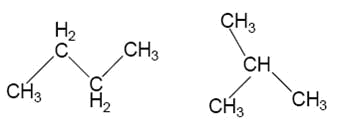
18 Stereochemistry is the study of the three-dimensional structure of molecules, the smallest unit of a compound. Isomers are compounds that have the same chemical formula (that is, the same number and type of atoms) but differ in the connection or arrangement of atoms in the molecule. Isomers that differ in the way they are connected are known as ‘structural isomers’. This can be illustrated figuratively by an example that depicts structural isomers for C4H10, where ‘C’ denotes the element carbon, and ‘H’ the element hydrogen.
Figure 1
19 Stereoisomers are another type of isomer. They are compounds with the same chemical formula but they differ in the precise arrangement of the atoms in space. The three-dimensional structure of molecules can be represented by structural formula in which a series of symbols are used to represent the orientation of the atoms in space: — (dash) refers to bonds in the plane of the page;  (wedge) refers to bonds coming out of the plane of the page; and
  or ---- (broken lines/hashed lines) refer to bonds that go behind the plane of the page.
20 When a carbon atom bonds with four non-identical atoms or groups of atoms it forms a tetrahedral shape and can be arranged three-dimensionally in two different ways. These three-dimensional arrangements are non-superimposable mirror images of each other, in the same way that a left hand and a right hand are non-superimposable mirror images. Any physical object that exists in left and right-handed forms, that is, whose mirror image is not identical with itself, is said to be ‘chiral’ (which derives from the Greek word for ‘hand’).
Chirality and enantiomers
21 Taking the example of a carbon atom bonded with four non-identical atoms or groups of atoms to form a tetrahedral shape, the carbon atom is said to be the chiral centre of the molecule. The mirror images of the chiral centre are not superimposable. Stereoisomers which are non-superimposable mirror images are called enantiomers. This is shown in Figure 2 below:
Figure 2
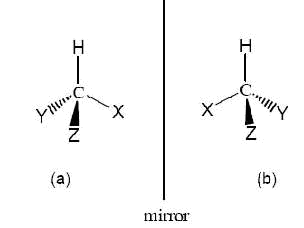
In Figure 2, (a) and (b) are enantiomers as they are non-superimposable mirror images. In each enantiomer, the carbon atom is the chiral centre.
22 Pairs of enantiomers have many of the same chemical and physical properties, such as identical melting points and the same solubilities and colours. However, they can be differentiated from one another based on the effect they have on the rotation of polarised light. When polarised light is passed through a solution containing only one enantiomer of a compound, the plane of polarised light is rotated either in a clockwise direction (right, denoted with a ‘(+)’ or ‘d-’) or in an anti-clockwise direction (left, denoted with a ‘(-)’ or
‘l-’). Because of their ability to rotate the plane of polarised light, enantiomers are said to be ‘optically active’. They are sometimes referred to as ‘optical isomers’.
23 To distinguish between different enantiomers of the same compound, chemists assign absolute stereochemistry at the chiral centre according to a naming system, known as the Cahn-Ingold-Prelog priority rules. For the purpose of these reasons for judgment, it is sufficient to say that these priority rules require the atoms attached to the carbon centre to be ranked according to their atomic number: the higher the atomic number, the larger the atom in three-dimensional space, and therefore the higher the priority. It is this ranking which will ultimately determine whether the chiral centre has an ‘R’ configuration (from the Latin word ‘rectus’), which has a clockwise arrangement of atoms from highest to lowest priority, or an ‘S’ configuration (from the Latin word ‘sinister’) which signifies an anti-clockwise arrangement of atoms.
Figure 3
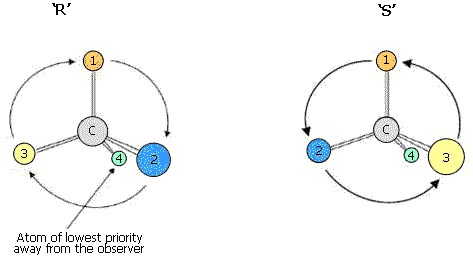
In Figure 3,absolute stereochemistry has been assigned according to the Cahn-Ingold-Prelog priority rules, where atom ‘1’ has the highest priority (highest atomic number) and atom ‘4’ the lowest priority (and therefore the lowest atomic number).
24 An enantiomer with absolute stereochemistry or configuration of ‘R’ will not necessarily rotate polarised light in a clockwise direction. Likewise, an enantiomer with absolute stereochemistry of ‘S’ will not necessarily rotate polarised light in an anti-clockwise direction. The designation of (+) or (-) must be determined through testing the enantiomer. There is no correlation between the absolute stereochemistry or configuration of an enantiomer and the (+) or (-) designations.
25 Another way in which enantiomers can be distinguished from one another is the manner in which they interact with other chiral molecules. As noted above at [10], an individual enantiomer may have a different interaction with other chiral molecules when compared to a racemate or racemic mixture which contains both the R and S enantiomers. The importance of chirality in biological systems is discussed below.
Racemates or racemic mixtures
26 A chemical reaction normally produces a mixture of equal amounts of enantiomers. This equal mixture of R and S enantiomers is called a ‘racemate’ or ‘racemic mixture’. These expressions are now regarded as synonyms. The physical properties of a racemic mixture can vary significantly from the individual enantiomers that make it up. A racemic mixture may be denoted by ‘(±)’, ‘dl’ or ‘(rac)’. The naming conventions for racemates and their diagrammatical representations are discussed in more detail below.
27 A chemist may obtain a product containing only the R or S enantiomer by one of two methods. First, the chemist may undertake a method known as ‘chiral synthesis’. In chiral synthesis, chiral starting materials or reagents (that is, starting materials or reagents that are R or S) are used in the reaction to produce a product with a predominance for one hand of the enantiomeric pair. Secondly, the chemist may undertake a synthesis without using chiral reagents to produce a racemate or racemic mixture (this type of synthesis is known as ‘achiral synthesis’), and then separate the racemate into its two optically active enantiomers by ‘resolving’ each of the enantiomers.
28 A racemate can be resolved into its individual enantiomers by a laboratory technique known generally as ‘column chromatography’. For present purposes, it is sufficient to describe column chromatography as a technique whereby a vertical glass or metal column is filled with some form of solid support, and the racemate solution to be separated is placed on top of this support. The rest of the column is filled with a solvent which, under the influence of gravity, moves the racemate solution through the column. The solid support causes the individual enantiomers to pass through the column at different speeds, or can retain one enantiomer on the column while allowing the other enantiomer to pass through the column. In this way, the individual enantiomers can be isolated and separated from one another. By then testing each eluted solution for the rotation of polarised light, the enantiomers can be identified as either the (+) or (-) enantiomer.
29 Column chromatography encompasses a number of laboratory techniques including ‘flash column chromatography’ and ‘high pressure liquid chromatography’, also known by its abbreviation ‘HPLC’. For the purposes of this decision, it is not necessary for me to give any further description of these techniques beyond identifying them.
30 The products obtained from chiral synthesis, or from the resolution of racemate solutions, may not be enantiomerically pure, ie they may contain contamination of the other enantiomer. The level of impurity will vary depending on the synthesis method employed and/or the technical laboratory skills of the chemist.
Molecules which have more than one chiral centre
31 Where a molecule has two chiral centres there are four possible isomers. Relative stereochemistry describes the position of substituents of a compound relative to each other. Where both the major substituents lie on the same side of the plane of reference this is called a ‘cis’ arrangement. Where the major substituents appear on the opposite sides of the ring, this is called a ‘trans’arrangement. This is best set out in diagrammatic form:
Figure 4
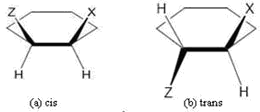
In Figure 4(a), groups ‘Z’ and ‘X’ are on the same side of the ring; whereas in Figure 4(b) they are on opposite sides of the ring. A carbon ring containing two chiral centres, as in Figure 4, gives rise to four possible isomers. If the isomers are not mirror images of one another, then the isomers are called ‘diastereomers’. The isomers depicted in (a) and (b) are diastereomers, that is, they are notmirror images of each other.
32 Where both chiral centres are mirror images of one another, the isomers form an enantiomeric pair:
Figure 5
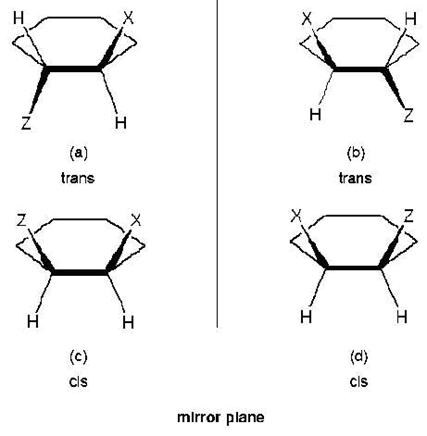
In Figure 5, (a) and (b) have the same relative stereochemistry (that is, both enantiomers are in the transform), but different absolute stereochemistry. Likewise, (c) and (d) have the same relative stereochemistry (that is, both enantiomers are in the cis form), but different absolute stereochemistry.
The importance of chirality
33 Many molecules in biological systems are chiral. Enzymes are an example of a chiral molecule occurring in a biological system. While enantiomers share many identical physical and chemical properties with their enantiomeric pair, they may interact with other chiral molecules, such as enzymes, in very different ways.
34 Enzymes, such as 3-hydroxy-3-methylglutaryl coenzyme A reductase (HMG-CoA reductase), are capable of ‘selecting’ one enantiomer for biological interaction or, at the least, can display a preference for activity with one enantiomer of an enantiomeric pair over the other. During re-examination, one of the expert witnesses explained the particular relevance of enzyme chirality:
‘An enzyme is a particular sort of protein and it has an active site that has a function and we are dealing in this case with an enzyme target. So the enzyme site is very specifically designed… it has a very specific shape that will generally only accurately recognise what it’s designed to react with.’
35 As a consequence of this ‘selective’ activity or preference for activity, one enantiomer of an enantiomer pair may have most or all of the biological activity when interacting with enzymes, while the other has little activity or in some cases no biological activity. In other cases, the other (less active or inactive) enantiomer may have a very different type of biological activity altogether. This point is commonly illustrated by giving the example of thalidomide, as one expert witness did:
‘Thalidomide is an example of a drug where the two enantiomeric forms of the compound have different and unpredictable activities. Thalidomide is a sedative drug that was produced and sold in the 1950’s and 1960’s as a racemic mixture (ie an equal mixture of two enantiomers). A side effect, not detected in the course of testing and clinical trials, was that the drug acted as a teratogen and caused birth defects when it was taken by pregnant women. After the drug was withdrawn from market, it was discovered that only one of the two enantiomers had teratogenic activity. The other was an effective and (unless some interconversion occurred, which in practice did occur) a theoretically safe sedative.’
Nomenclature
36 There are a number of ways to describe the R-trans and S-trans enantiomers in stereochemistry nomenclature. Taking the R enantiomer as an example, witnesses and documents variously referred to ‘RR’, ‘R-trans’ and simply ‘R’. On occasions, the evidence contains terms such as ‘4R,6R’. The numerals refer to the position of the groups on the ring. In these reasons for judgment, I have used the words ‘RR’ wherever the context permits, but in some places the use of other expressions is unavoidable, such as where the evidence under discussion uses the terminology of ‘R-trans’ or simply ‘R’.
Structural formulae
37 Chemists sometimes use shorthand to draw the structure of molecules. In shorthand, hydrogen atoms are not shown at all, and the structure is reduced to the linkage of carbon atoms. The carbon atoms are represented by points at which each of the line segments meet or terminate. The line segments represent the bonds between carbon atoms. This shorthand is illustrated in Figure 6.
Figure 6
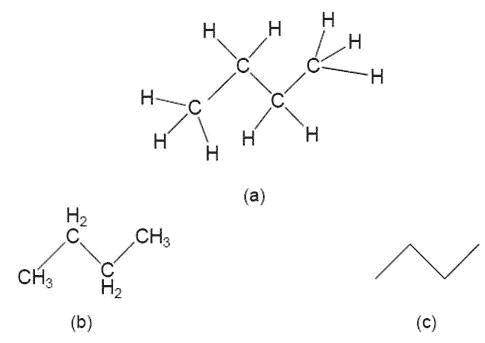
38 This figure shows three ways of drawing the structure for the same molecule. Structure (a) shows a complete representation of the molecular structure. Structure (b) shows a ‘condensed’ version of the molecular structure showing the ‘groups’ at each carbon. The bonds with the hydrogen atoms are not shown but are implicit from their grouping with the respective carbon. Structure (c) shows the simplest shorthand version of the structure.
Atorvastatin
39 Atorvastatin is a member of a class of drugs known by the generic term ‘statin’. Other members of the ‘statin’ class include simvastatin, pravastatin, lovastatin and fluvastatin. The drawing in Figure 7 below depicts the lactone form of atorvastatin.
Figure 7
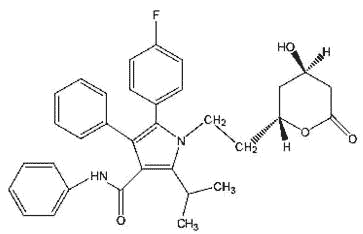
The lactone is the six-membered ring at the right-hand side of Figure 7 where one of the six members is oxygen.
40 The lactone is shown in more detail in Figure 8. The members identified in the ring from ‘2’ to ‘6’ are all carbon atoms. Position 1 is an oxygen atom. The groups attached to the pyrrole ring (the five-membered ring where four of the members are carbon and one of the members is nitrogen ‘N’) are simplified to ‘R1’, ‘R2’, ‘R3’, and ‘R4’ for ease of reference.
Figure 8
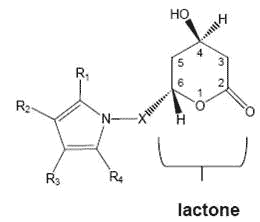
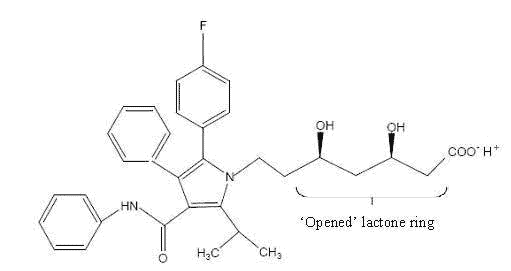
41 The active ingredient in Lipitor, atorvastatin calcium, is the calcium salt of the atorvastatin hydroxy acid. Atorvastatin hydroxy acid is formed by opening the lactone ring. This is achieved by hydrolysis, ie by adding water. The opened structure is shown in Figure 9.
Figure 9
The 981 Patent Specification
42 The 981 Patent is entitled ‘TRANS-[2–(3–OR 4–CARBOXAMIDO–SUBSTITUTED PYRROL–1–YL)ALKYL]–4–HYDROXYPYRAN–2–ONE INHIBITORS OF CHOLESTEROL SYNTHESIS’. It discloses a class of compounds that have the ability to inhibit HMG-CoA reductase, which is the rate-controlling enzyme involved in biosynthesis of cholesterol.
43 In the summary of the invention in the specification, the class of compounds is described as certain trans–6–[2–(3–or 4–carboxamido-substituted pyrrol-1-yl)alkyl]-4-hydroxypyran–2–ones and the corresponding ring-opened hydroxy acids derived therefrom which are potent inhibitors of the enzyme HMG-CoA reductase, pharmaceutical compositions containing such compounds, and a method of inhibiting the biosynthesis of cholesterol by employing such pharmaceutical compositions.
44 The structural formula for the class of compounds is set out diagrammatically at pg 3 and other places in the specification, including claim 1:
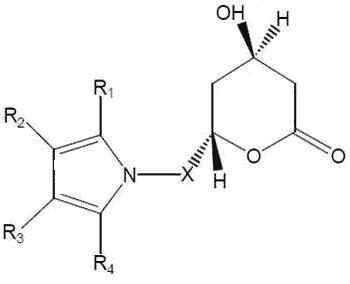
Structural formula I is a partial structure in which annotations X, R1, R2, R3 and R4 are used to denote positions on the compound where a range of substitutions may occur. The annotations R1, R2 etc have no relationship to the system of assigning absolute stereochemistry at a chiral centre.
45 The molecule depicted in structural formula I consists of two structural parts: a heterocyclic moiety in the form of a five-membered pyrrole ring at the left-hand side of the diagram which includes a number of possible substituents (R1, R2, R3 and R4); and a six-membered lactone ring on the right-hand side of the diagram. The two moieties are joined by a ‘linkage’ group (shown as X).
46 The lactone ring has two major substituents, a hydroxy group (the OH group shown at the top of the ring); and the linkage group (X attached to the pyrrole ring). These two major substituents are in a trans relationship, that is to say, the hydroxy group is above the plane of the lactone ring (denoted by ) and the linkage group is below the plane of the lactone ring (denoted by ).
47 The specification concludes with ten claims that define the invention. Claim 1 is a claim for a compound of structural formula I ‘or a hydroxy acid or pharmaceutically acceptable salts thereof, derived from the opening of the lactone ring of the compounds of structural formula I ...’. Claims 2 to 7 are dependent product claims. Claim 8 is for a pharmaceutical composition containing as its active ingredient a compound of claim 1. Claim 9 is for a method of inhibiting cholesterol biosynthesis by administering a pharmaceutical composition of claim 8. Claim 10 is for a method of preparation of a compound having structural formula I.
48 The claims alleged to be infringed are claims 1, 2, 3, 4, 8 and 9. As the claims are limited by reference to structural formula I, the dispute on infringement of the 981 Patent turns on the construction of claim 1.
49 The specification commences with a discussion of the background of the invention:
‘The present invention is related to compounds and pharmaceutical compositions useful as hypocholesterolemic and hypolipidemic agents. More particularly, this invention concerns certain trans-6-[2-(3- or 4-carbox-amidosubstituted pyrrol-1-yl)alkyl]-4-hydroxypyran-2-ones and the corresponding ring-opened acids derived therefrom which are potent inhibitors of the enzyme 3-hydroxy-3-methylglutaryl-coenzyme A reductase (HMG CoA reductase), pharmaceutical compositions containing such compounds, and a method of inhibiting the biosynthesis of cholesterol employing such pharmaceutical compositions.’
The specification then adds that high levels of blood cholesterol and blood lipids are conditions involved in the onset of arteriosclerosis and that it is well known that inhibitors of HMG-CoA reductase are effective in lowering the level of blood plasma cholesterol, especially low density lipoprotein cholesterol, so as to afford protection from cardiovascular disease.
50 The specification describes certain known inhibitors of the biosynthesis of cholesterol, including mevalonic acid and the corresponding ring-closed lactone form, mevalonolactone, and a natural product, now called compactin, which was disclosed in several United States patents. The specification describes compactin as having a complex structure which includes a mevalonolactone moiety.
51 The specification then refers to several other United States patents and a patent application. The United States patents to Oka and Mitsue are said to disclose derivatives of mevalonolactone having antilipidemic activity and are useful in the treatment of hyperlipidemia. United States Patent 4,375,475 to Willard et al (‘the Willard Patent’) is said to disclose certain substituted 4-hydroxytetrahydropyran-2-ones which, in the 4(R)-trans-stereoisomeric form, are inhibitors of cholesterol biosynthesis.
52 Published PCT application WO 84/02131 (which subsequently resulted in the grant of a patent to Kathawala) is said to disclose certain derivatives of mevalonolactone having utility as hypolipoproteinemic and antiatherosclerotic agents.
53 Under the heading ‘Summary of the Invention’, the specification states:
‘In accordance with the present invention, there are provided certain trans-6-[2-(3- or 4-carboxamido-substituted pyrrol-1-yl)alkyl]-4-hydroxypyran-2-ones and the corresponding ring-opened hydroxy-acids derived therefrom which are potent inhibitors of cholesterol biosynthesis by virtue of their ability to inhibit the enzyme 3-hydroxy- 3-methylglutaryl coenzyme A reductase (HMG-CoA reductase).
In particular, in its broadest aspect the present invention provides compounds of structural formula I…’.
Structural formula I is then set out. The specification adds that the hydroxy acids, and pharmaceutically acceptable salts thereof, derived from the opening of the lactone ring of the compounds of structural formula I are also contemplated as falling within the scope of the invention.
54 The specification then turns to three other aspects of the invention. First, at pg 4, the specification describes a method of preparing the compounds of structural formula I. Secondly, the specification says that the invention provides pharmaceutical compositions useful as hypolipidemic or hypocholesterolemic agents comprising a hypolipidemic or hypocholesterolemic effective amount of a compound in accordance with the invention, in combination with a pharmaceutically acceptable carrier. The third aspect is that the invention provides a method of inhibiting cholesterol biosynthesis in a patient in need of such treatment by administering an effective amount of the pharmaceutical composition.
55 The next section of the specification contains a detailed description of the invention. It commences as follows:
‘The compounds of the present invention comprise a class of trans-6-[2-(3- or 4-carboxamidosubstituted pyrrol-1-yl)alkyl]-4-hydroxypyran-2-ones in which the pyran-2-one moiety is attached, through an alkyl chain, to the substituted pyrrole nucleus at the nitrogen, or 1-position, of the pyrrole. The alkyl group may be methylene, ethylene, propylene, or methylethylene. The preferred alkyl chain linking the substituted pyrrole nucleus and the 4-hydroxypyran-2-one ring is ethylene.
The compounds of structural formula I above possess two asymmetric carbon centers, one at the 4-hydroxy position of the pyran-2-one ring, and the other at the 6-position of the pyran-2-one ring where the alkylpyrrole group is attached. This asymmetry gives rise to four possible isomers, two of which are the R-cis- and S-cis-isomers and the other two of which are the R-trans- and S-trans- isomers. This invention contemplates only the trans- form of the compounds of formula I above.
In the compounds of the present invention, position 2 of the substituted pyrrole nucleus is substituted with 1-naphthyl; 2-naphthyl; cyclohexyl; norbornenyl; 2-, 3-, or 4-pyridinyl; phenyl, phenyl substituted with fluorine, chlorine, bromine, hydroxyl; trifluoromethyl; alkyl of from one to four carbon atoms, alkoxy of from one to four carbon atoms, or alkanoyloxy of from two to eight carbon atoms. Preferred substituent groups at the 2-position of the pyrrole nucleus are phenyl and substituted phenyl.
In the compounds of this invention, position 5 of the pyrrole nucleus is substituted with alkyl of from one to six carbon atoms; cyclopropyl; cyclobutyl; cyclopentyl; cyclohexyl; or trifluoromethyl. Preferred substituents are alkyl or trifluoromethyl with isopropyl being particularly preferred.’
The specification then describes the preferred reaction sequence which is used to prepare compounds of the invention. Between pg 7 and pg 12, reaction sequence 1 and reaction sequence 2 are described diagrammatically and in the text.
56 At pg 12, the specification describes the formation of salts from ring-opened hydroxy acids of the compounds:
‘The ring-opened hydroxy acids of structural formula II above are intermediates in the synthesis of the lactone compounds of formula I and may be used in their free acid form or in the form of a pharmaceutically acceptable metal or amine salt in the pharmaceutical method of the present invention. These acids react to form pharmaceutically acceptable metal and amine salts. The term “pharmaceutically acceptable metal salt” contemplates salts formed with the sodium, potassium, calcium, magnesium, aluminium, iron, and zinc ions. The term “pharmaceutically acceptable amine salt” contemplates salts with ammonia and organic nitrogenous bases strong enough to form salts with carboxylic acids. Bases useful for the formation of pharmaceutically acceptable nontoxic base addition salts of compounds of the present invention form a class whose limits are readily understood by those skilled in the art.’
57 The specification states that the base addition salts may differ from the free acid forms of the compounds of the invention in such physical characteristics as solubility and melting point, but are otherwise considered equivalent to the free acid form for the purposes of the invention.
58 The specification then turns to discuss the effectiveness of the compounds of the invention as inhibitors of the biosynthesis of cholesterol through inhibition of the HMG-CoA reductase enzyme. It is said that the ability of compounds of the invention to inhibit the biosynthesis of cholesterol is measured by two methods: a designated Cholesterol Synthesis Inhibition screen and a designated CoA Reductase Inhibition screen. The activity of several representative examples of compounds in accordance with the invention is set out in Table 1 and compared with the prior art compound, compactin. Table 1 provides:
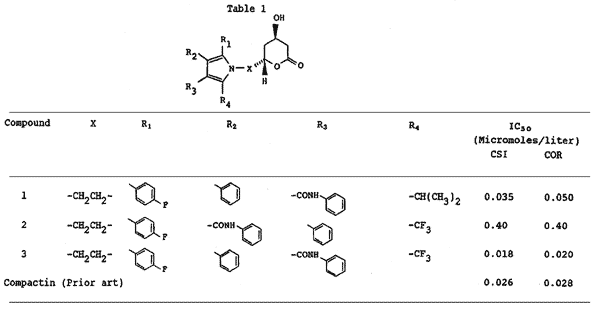
I interpolate that the lower the IC50 value in this table, the more effective the compound. According to the table, therefore, compound 3 was the most effective, followed by compactin, and then compound I and lastly compound 2.
59 Pages 14 to 17 of the specification discuss various excipients in pharmaceutical preparations containing compounds of the invention as well as means for making such preparations and recommended dosage levels.
60 Commencing at pg 17, the specification sets out four examples which are said to ‘illustrate particular methods for preparing compounds in accordance with this invention’. The specification states that the examples ‘are illustrative and are not to be read as limiting the scope of the invention as it is defined by the appended claims’.
61 The specification concludes with the ten claims defining the invention which I have already summarised. It is helpful to set out claim 5 as it is relied upon as an aid to the construction of claim 1. It provides:
‘A compound as defined by Claim 1 having the name trans-(±)-5-(4-fluorophenyl)-2-(1-methylethyl)-N,4-diphenyl-1-[2-(tetrahydro-4-hydroxy-6-oxo-2H-pyran-2-yl)ethyl]-1H-pyrrole-3-carboxamide.’
Principles of Construction
62 The parties were not in dispute as to the principles that apply to the construction of the 981 Patent. I was referred to numerous authorities in which these principles have been clearly articulated, including Welch Perrin & Co Pty Ltd v Worrel (1961) 106 CLR 588 (‘Welch Perrin’) at 610; Interlego AG v Toltoys Pty Ltd (1973) 130 CLR 461 (‘Interlego’) at 478 (see also Stephen J at first instance at 466); Décor Corp Pty Ltd v Dart Industries Inc (1988) 13 IPR 385 at 400; Fisher & Paykel Healthcare Pty Ltd v Avion Engineering Pty Ltd (1991) 22 IPR 1 at 18-19; Fresenius Medical Care Australia Pty Ltd v Gambro Pty Ltd (2005) 67 IPR 230 at 236 [39], 238 [52] and 245-246 [91]-[94]; Pfizer Overseas Pharmaceuticals v Ely Lilly & Co (2005) 68 IPR 1 (‘Pfizer’) at 52-54 [247]-[250]; Kirin-Amgen Inc v Hoechst Marion Roussel Ltd (2004) 64 IPR 444 (‘Kirin-Amgen’) at 452-457 [27]-[35]; PhotoCure ASA v Queen’s University at Kingston (2005) 216 ALR 41 (‘PhotoCure’) at 85 [172] and 85-86 [168]-[174]; Sachtler GmbH & Co KG v RE Miller Pty Ltd (2005) 221 ALR 373 (‘Sachtler’) at 380-382 [39]-[42]; Clorox Australia Pty Ltd v International Consolidated Business Pty Ltd (2006) 68 IPR 254 (‘Clorox’) at 260-262 [13]-[22].
63 I do not propose to summarise all of the guiding principles that emerge from these authorities. That task has already been undertaken, most helpfully, by Bennett J in Sachtler at 380-382 [39]-[42] and Stone J in Clorox at 260-262 [13]-[22]. I gratefully adopt their Honours’ summaries of the relevant principles.
64 For present purposes, however, it is helpful to refer specifically to several principles that have particular resonance with the circumstances of this case:
(1) The underlying consideration in the construction of the patent is that it is a public instrument, conferring a public monopoly, that is meant to define the monopoly in such a way that it is not capable of being misunderstood: see eg Pfizer at 52 [247]. The patentee must define the invention with sufficient precision to permit the monopoly to be determined and to allow the general public to identify from the words of the claims the conduct that is prohibited: see eg Clorox at 261 [18].
(2) The claims define the invention which is the subject of the patent. They must be construed according to their terms by applying the ordinary rules of construction that apply to any written instrument: see eg Décor at 400; Clorox at 260 [15].
(3) The claims must be construed in the context of the specification as a whole. The rest of the specification may explain the background to the claims, assist in ascertaining the meaning of technical terms, or aid in resolving ambiguities in the construction of the claims: Clorox at 260 [16]; Sachtler at 381 [42].
(4) Although the claims are to be construed in the context of the specification as a whole, ‘the settled rule is that it is not permissible to vary or qualify the plain or unambiguous meaning of the claim by reference to the body of the specification’: see Interlego per Barwick CJ and Mason J at 478. Further, ‘it is not legitimate to narrow or expand the boundaries of monopoly as fixed by the words of a claim by adding to those words glosses drawn from other parts of the specification. Similarly, if a claim be clear it is not to be made obscure simply because obscurities can be found in particular sentences in other parts of the document’: Welch Perrin at 610 per Dixon CJ, Kitto and Windeyer JJ; see also Clorox at 261 [17].
(5) A patent specification must be given a purposive rather than a purely literal construction. This involves construing the claims in a practical, commonsense manner, avoiding too technical or narrow a construction of the claims, and preferring a construction under which the invention will work to one where it may not work: Pfizer at 53-54, citing Nesbit Evans Group Australia Pty Ltd v Impro Ltd (1997) 39 IPR 56. It also means construing the claims in light of what a reasonable person to whom the patent was addressed would have understood the language of the claim to mean: Kirin-Amgen at 453-454 [30], [32] and [34] per Lord Hoffman.
(6) The hypothetical addressee of the patent specification is the non-inventive person skilled in the art before the priority date. The words used in the specification and the claim are to be given the meaning that the skilled addressee would attach to them, both in the light of his or her own general knowledge and what is disclosed in the body of the specification: Clorox at 261-262 [20]; Décor at 391; PhotoCure at 85 [170].
(7) The proper construction of the specification is a matter of law for the Court to determine. However, evidence can be given by experts on the meaning which those skilled in the art would give to technical or scientific terms and phrases and on unusual or special meanings given by such persons to words that might otherwise bear their ordinary meaning: see Clorox at 262 [21]; see also Root Quality Pty Ltd v Root Control (2000) 49 IPR 225 (‘Root Quality’) at 237 [49].
The Skilled Addressee
65 As patent specifications and claims must be construed in light of the common general knowledge of a person skilled in the art before the priority date, it is necessary to ask: who is the skilled addressee? Various descriptions have been given to the skilled addressee, including the ‘notional skilled addressee’, the ‘uninventive skilled worker in the particular field’, the ‘non-inventive worker in the field’, the ‘person skilled in the art’, the ‘non-inventive hypothetical skilled addressee’, and ‘those likely to have a particular interest in the subject matter of the invention’: Root Quality at 241 [70]-[71] per Finkelstein J. The person skilled in the art is a ‘relative expression which does not identify any specific person’ and may consist of a team of persons with combined skills: Root Quality at 242 [71]; see also The General Tire & Rubber Company v The Firestone Tyre and Rubber Company Limited [1972] RPC 457 (‘General Tire’)at 485.
66 In NSI Dental Pty Ltd v University of Melbourne (2006) 69 IPR 542 (‘NSI Dental’) Tamberlin J said at 570 [151]:
‘At the outset, it is necessary to describe the attributes of the skilled addressee and the relevant patent area. The skilled addressee is a legal construct and is assumed to be a person, or team, who is “not ‘particularly imaginative or inventive’”: Pfizer Overseas Pharmaceuticals v Eli Lilly and Co [2005] FCAFC 224 at [288] per French and Lindgren JJ. This does not mean that the addressee is a technician or person with only practical and non-academic qualifications. In fields such as chemistry, the addressee can be a person or group with high level qualifications and a capacity for original research: Aktiebolaget Hassle v Alphapharm Pty Ltd (2002) 212 CLR 411 at [30].’
67 Axiomatically, the identity of the person who is skilled in the art will vary with the nature of the invention and the field with which it is concerned. The level of skill which can properly be attributed to the skilled addressee will be an important determinant of his or her common general knowledge. The qualifications of the skilled addressee, the setting in which and the resources with which he or she operates, and the practices and techniques that he or she regards as commonplace and known will also be important considerations: see Aktiebolaget Hassle v Alphapharm Pty Ltd (2002) 212 CLR 411 (‘Alphapharm’) at 465 [153] per Kirby J.
68 In Minnesota Mining & Manufacturing Co v Beiersdorf (Aust) Ltd (1980) 144 CLR 253 (‘Minnesota’) at 292, Aickin J described ‘common general knowledge’ as:
‘… that which is known or used by those in the relevant trade. It forms the background knowledge and experience which is available to all in the trade in considering the making of new products, or the making of improvements in old, and it must be treated as being used by an individual as a general body of knowledge.’
Aickin J went on to add that those working or studying in some fields of endeavour may make themselves familiar with all patent specifications as they become available for inspection, in one or in many countries, so that their contents become common general knowledge in that particular trade or field of manufacture in the country in question. But that is not so in all fields or in all countries. There must be evidence that the content of a patent specification has become part of the common general knowledge of those working in the relevant field before it can be regarded as part of the background knowledge and experience of the skilled addressee: at 294-295. The High Court confirmed this analysis in Alphapharm at 426-427 [31], 430-431 [44]-[45] and 434 [55].
69 There is, accordingly, an important distinction between common general knowledge and public knowledge. In General Tire at 482, the Court of Appeal illustrated the distinction by saying that each and every patent specification of the last 50 years would form part of relevant public knowledge if it is resting anywhere in the shelves of the patent office, whereas common general knowledge is a different concept derived from a commonsense approach to the practical question of what would in fact be known to an appropriately skilled addressee – the sort of person good at his or her job that could be found in real life. The Court then observed at 482 that:
‘… individual patent specifications and their contents do not normally form part of the relevant common general knowledge, though there may be specifications which are so well known amongst those versed in the art that upon evidence of that state of affairs they form part of such knowledge, and also there may occasionally be particular industries (such as that of colour photography) in which the evidence may show that all specifications form part of the relevant knowledge.’
The Full Federal Court referred to this distinction, with approval, in W R Grace & Co v Asahi Kasei Kogyo Kabushiki Kaisha (1993) 25 IPR 481 at 492; see also Heerey J at first instance: Asahi Kasei Kogyo Kabushiki Kaisha v W R Grace & Co (1991) 22 IPR 491 at 523.
70 In PhotoCure at 52 [31], Merkel J said:
‘The common general knowledge will encompass not only information that is retained in the memory of the skilled person, but also information that the person knows of, and to which he or she might refer as a matter of course, or habitually consult: see ICI Chemicals & Polymers Ltd v Lubrizol Corp Inc (1999) 45 IPR 577 at [112] and Aktiebolaget Hässle v Alphapharm Pty Ltd (2000) 51 IPR 375; [2000] FCA 1303 at [73]. However, common general knowledge does not include information merely because it would have been able to be found if a routine literature search was conducted: see Alphapharm (HCA) at [31], [44]-[45] and [55]. Nor does it follow from the fact that a publication “may have been held in a library readily accessible to a particular formulator” that such a publication formed part of the common general knowledge: see Aktiebolaget Hässle v Alphapharm Pty Ltd (1999) 44 IPR 593; [1999] FCA 628 at [105] … per Lehane J.’
71 In Root Quality at 241-242 [71], Finkelstein J observed that, generally speaking, the skilled addressee is the person who works in the art or science with which the invention is connected. He or she is a person, or team, likely to have a practical interest in the subject matter of the invention: at 241-242 [71].
72 In an international field such as drug discovery and development, the Court may have regard to evidence given by experts from outside Australia in assessing the state of common general knowledge of a skilled addressee or a skilled team working in Australia at the priority date: Pfizer at 63 [293]-[295]. Evidence from such witnesses may support the inference of a global pool of common general knowledge on issues relevant to the invention which would have been known to the skilled addressee in Australia: at 63 [294]; see also NutraSweet Australia Pty Ltd v Ajinomoto Co Inc (2005) 67 IPR 381 at 387-388 [29]-[32] per Finkelstein J.
73 Both Warner-Lambert and Ranbaxy called evidence from expert witnesses as to the identity of the skilled addressee in the relevant field, and as to the matters that would fall within the common general knowledge of the skilled addressee immediately before the priority dates of the 981 Patent (30 May 1986) and the Enantiomer Patent (21 July 1989). Neither party, nor any witness, suggested that the nature of the relevant field, or the identity of the skilled addressee, differed between May 1986 and July 1989.
The expert witnesses
74 Professor Christopher Easton gave evidence on behalf of Warner-Lambert. He is a professor at the Research School of Chemistry, Institute of Advanced Studies, Australian National University. He was awarded the Degree of Doctor of Philosophy by the University of Adelaide in 1981. His PhD involved research in the area of organic chemistry. In 1982, he was a Research Fellow in the Research School of Chemistry at the Australian National University, working on projects relating to organic and biological chemistry including reactions involving the biosynthesis of penicillin. From 1983 to 1986, he was a Lecturer and Senior Lecturer in the Department of Chemistry at the University of Canterbury, New Zealand. From 1986 to 1988 he was a Lecturer in the Department of Organic Chemistry at the University of Adelaide and on 1 January 1992 he was appointed a Reader in the Department of Organic Chemistry. Since 1995, he has held the positions of a Senior Fellow, Professor and Distinguished Professor at the Research School of Chemistry. From 1988, he has also been involved in numerous research projects in the field of medicinal chemistry and drug research.
75 The inventor named in both patents, Dr Bruce Roth, gave evidence on behalf of Warner-Lambert. He currently holds the position of Vice President of Chemistry, Pfizer Global Research and Development. At all relevant times, he was in charge of the drug discovery team at Warner-Lambert that developed Lipitor. One difference between his evidence, and that given by other expert witnesses, was that he said he would not expect medicinal chemists in the field to be aware of particular information relating to HMG-CoA reductase inhibitors, including statins, without conducting a search and careful review of the relevant literature in that area. This is a matter to which I will need to return.
76 Professor Peter Scammells gave evidence on behalf of Warner-Lambert. He is a Professor of Medicinal Chemistry in the Department of Medicinal Chemistry, Victorian College of Pharmacy, Monash University. He was not qualified as a medicinal chemist at either of the relevant priority dates of 30 May 1986 or 21 July 1989. In May 1986, he was an undergraduate science student and in July 1989 he was studying for his doctorate which was awarded in 1991. Between 1994 and 2001, he was a Lecturer and Senior Lecturer in the School of Biological and Chemical Sciences, Deakin University, Melbourne. He was appointed Professor of Medicinal Chemistry at Monash University in 2001.
77 Professor Scammells did not have relevant qualifications and experience at the priority dates of the patents, which has a bearing on the weight that should be attributed to his evidence. However, I accept that Professor Scammells has, by virtue of his professional experience, a detailed understanding of medicinal chemistry, that is to say synthetic organic chemistry and the interaction of chemical compounds with biological systems. He has worked on projects related to the synthesis and testing of chemical compounds in order to maximise (in terms of activity and selectivity) the interaction of drugs with biological molecules. He is, I accept, in a position to give evidence as to what was generally known by workers of ordinary skill in the field of synthetic organic chemistry concerned with drug identification and development as at the relevant priority dates.
78 The remaining expert witness called by Warner-Lambert was Professor William Charman, a Professor of Pharmaceutics at the Victorian College of Pharmacy, Monash University. Professor Charman is not a medicinal chemist. He graduated with a degree of Bachelor of Pharmacy in 1981 and studied for his Masters of Science Degree from the University of Kansas in the USA between 1983 and 1985. He was awarded a PhD with Honours from the University of Kansas in May 1986 in the area of pharmaceutical chemistry. Between 1986 and 1989, he was employed at the Department of Pharmaceutical Sciences at Sterling-Winthrop Research Institute in New York State. He returned to Australia in 1989 to take up the position of Senior Lecturer at the Department of Pharmaceutics at the Victorian College of Pharmacy and was appointed Professor of Pharmaceutics in 1995. His practical experience has been in the process side of drug development work, rather than in the design and synthesis of compounds with high biological activity.
79 Ranbaxy called evidence from three experts: Dr Terence Scallen, Dr Keith Watson and Dr Ian Cunningham.
80 Dr Scallen obtained his PhD in biochemistry and organic chemistry in 1965, and devoted much of his career to cholesterol biosynthesis inhibition. He obtained a patent for an HMG-CoA reductase inhibitor in 1979 and was then appointed as a consultant to Sandoz Pharmaceutical to oversee all of the HMG-CoA reductase assays for Sandoz’s statin project which eventually led to the development of fluvastatin. He worked as a consultant to Sandoz for a period of 14 years, including the whole of the 1980s. During this period he also held professorial positions at the University of New Mexico School of Medicine. In his evidence, Dr Scallen tended to identify the relevant field of art with which the patents were concerned somewhat more precisely than Warner-Lambert’s witnesses, namely synthetic organic chemistry as applicable to the discovery and development of drugs directed towards the regulation of the cholesterol biosynthesis pathway, including HMG-CoA reductase inhibitors.
81 Dr Watson is currently a Special Fellow at the Walter and Eliza Hall Institute in Victoria. He obtained his PhD in 1973 and after post-doctoral research in London he was employed by the CSIRO from 1975 to 1977 and at ICI Australia between 1977 and 1991. His work at these organisations largely involved the application of synthetic organic chemistry to the preparation of small molecules with biological activity. He described his primary interest as the relationship between chemical structure and biological activity and the creation of new molecules with potentially beneficial properties, particularly as drugs or chemicals for industrial or agricultural application. While working at ICI, he assisted in the development of two new selective herbicides and a new method of synthesis of a heart disease drug known as ‘Diltiazem’. He returned to work with the CSIRO’s Division of Chemicals and Polymers between 1991 and 1994 and in 1994 he was employed as Head, Biota Chemistry Laboratory, in the Chemistry Department of Monash University. He remained in that position until 2001.
82 Dr Cunningham currently works as an independent consultant to the pharmaceutical and fine chemical industries. He obtained his PhD in 1973 and after post-doctoral studies he was employed by ICI Pharmaceuticals (which later became AstraZeneca) from 1975 to 1990. Between 1975 and 1983 he worked as a team leader in medicinal chemistry and between 1983 and 1985 he worked as a team leader in process development. From 1985 to 1990 he led eight teams of chemists seeking to discover new antibacterials and was the antibacterials project manager. At the relevant priority dates, he had industry experience both as a medicinal chemist and as a process chemist. In 1990, he joined ICI Agrochemicals and in 1991 was appointed Head of Chemistry in that business. In 1994, he took up employment with GlaxoSmithKline (‘Glaxo’) and eventually became Senior Vice-President of Chemical Development at Glaxo.
The composition of the skilled team
83 The evidence from the experts concerning the identity of the skilled addressee of the 981 Patent and the Enantiomer Patent was broadly to the same effect. All of the experts considered that the patents were addressed to a team involved in drug discovery and development. The team would include medicinal chemists responsible for designing and making compounds with high biological activity, assisted by biologists, clinical researchers and technicians. The medicinal chemists would have the skill to undertake work designed to determine the relationship between the structure and biological activity of compounds, ie the structure activity relationship. The team would include highly qualified team leaders assisted by a number of research associates (including PhD students and post-doctoral researchers). It would also include biologists and/or biochemists who would be consulted in connection with creating and developing biological assays in which to test compounds.
84 The size and composition of the team would vary depending on the project being undertaken and the focus of its work would be directly related to the particular drug discovery process being pursued. Where relevant, the team would also include other chemists or pharmaceutical scientists with expertise in relation to relevant disease mechanisms and therapeutic opportunities. Physical chemists and pharmacologists may be required to test the physiochemical and pharmacokinetic properties of the most promising new molecules, and it is likely that formulation and process chemists would be retained during the development phase of the project. Toxicologists may also have been required to carry out in vivo testing of any compounds which show sufficient promise to be considered for further development. It is possible that, as Dr Watson suggested, a computer molecular modeller, with qualifications in science and information technology, may have been engaged to suggest new molecular structures which could inhibit the target biological system but the weight of evidence was that this would not have been common in the 1980s.
85 Accordingly, I find that the skilled addressee of the patents was a skilled team constituted in the manner described above.
The relevant field of art
86 It is unrealistic to identify the relevant field of art as broadly as the whole field of synthetic organic chemistry as applicable to the discovery and development of new pharmaceutical drugs, as Professor Easton, Professor Scammells and Professor Charman tended to suggest in their evidence. The 981 Patent, and the subsequent Enantiomer Patent, disclose classes of compounds that have the ability to inhibit HMG-CoA reductase. In my opinion, the relevant field is that of synthetic organic chemistry as applicable to the discovery and development of drugs directed towards the regulation of the cholesterol biosynthetic pathway, including HMG-CoA reductase inhibitors, as suggested by Dr Scallen and Dr Cunningham in their evidence. Accordingly, I prefer, and accept, the evidence of Dr Scallen and Dr Cunningham as to the identification of the relevant field of art to which the patents are directed.
Common General Knowledge
87 It was common ground between Warner-Lambert and Ranbaxy that the basic principles of stereochemistry described at [17] to [38] above formed part of the common general knowledge that should be attributed to the skilled addressee before the priority dates of the 981 Patent and the Enantiomer Patent. Further, I accept Dr Watson’s evidence that there were no material differences in the fundamental principles of stereochemistry between 30 May 1986 and 21 July 1989.
The drug discovery process
88 It was also common ground that the skilled addressee would be aware of the way in which drug discovery and development was customarily undertaken. Professor Easton described the broad nature of the drug discovery process in his affidavit sworn 28 August 2006 at paras 3.4 to 3.12:
‘Drug discovery typically involves three major aspects - identification of a disease state, identification of a therapeutic target (such as a protein, enzyme or receptor), and identification of compounds which have biological activity relevant to the therapeutic target. Drug discovery is not necessarily carried out in these progressive stages. The first stage of drug discovery may, for example, involve identifying a compound having a certain biological activity - before identification of a therapeutic target or disease state. This was how taxol, a cancer treatment, was discovered.
Typically however, pharmaceutical companies, advised by medical researchers or clinicians, identify a disease state for which a treatment is required and, in some cases, also a therapeutic target for that treatment.
I am, and others in the Field are, then responsible for identifying compounds to be screened for biological activity relevant to that therapeutic target. Those working in the Field have expertise in both the design and synthesis of compounds with biological activity. Usually, I have a number of research associates (including PhD students and post-doctoral researchers) assisting me in the design and synthesis of such compounds.
Sometimes very little is known about the therapeutic target and the initial screening process involves a range of diverse compounds. Sometimes more is known, and the range of compounds selected for screening at the outset will be more specific. For example, if it is known that a particular compound has the desired inhibitory activity at a target enzyme, the range of compounds initially synthesised and then screened will more likely be those having a chemical structure similar to that of the known inhibitor.
The compounds to be screened are then tested in in vitro biological assays in order to identify those compounds having the highest activity relevant to the target. An ‘in vitro’ assay is carried out using isolated cells or enzymes rather than a living animal. In some cases, where the assay is complex, the compounds are sent to collaborators (usually biologists), who are responsible for performing the assay. In cases where the assay is less complex, I and others in the Field perform the in vitro assays and/or supervise the performance of those assays in our own laboratories.
I am, and others in the Field are, then responsible for the interpretation of the structure activity relationship based on the results of in vitro assays. The most active compounds are selected for further investigation. In that investigation, new compounds having small modifications over those that show promising activity are synthesised and screened in in vitro assays in an attempt to obtain improved activity at the target. Through successive rounds of synthesising and screening of new compounds, the parts of the compound's molecular structure that are important to its activity at the target can be identified. This work is referred to as determining ‘the structure activity relationship (SAR)’ of the compound at or in relation to a particular target. This is commonly described as ‘SAR’ work.
The people with the skills and expertise required to carry out the matters described in paragraphs 3.4 to 3.9 are, working in combination, an example of the ‘team’ involved in the initial stage of drug discovery.
The usual experience in drug discovery is that many hundreds or thousands of compounds will be synthesised and screened in the course of a drug discovery program before even a single compound is identified and selected for pre-clinical and clinical (human) trials on the ground that it has sufficient activity in an in vitro assay.
The determination of what to synthesise, the carrying out of the synthesis of the compounds to be tested and discovery of activity by screening of those compounds leading to the identification of a compound or compounds for pre-clinical and clinical trials (or failure to do so), is only the first step in the drug discovery process. The development and selection of a final drug for therapeutic use depends on many other factors, such as its selectivity for the target, absorption, distribution, bioavailability, stability, metabolism, excretion and toxicity (including side effects) in a human. Such development work also involves determining whether and if so how a compound can be manufactured on a commercial scale and whether it can be suitably formulated.’
Similar evidence was given by Dr Roth and Professor Scammells.
89 In his affidavit evidence, Dr Roth expanded on the way in which medicinal chemists pursue a structure activity relationship (‘SAR’). He said that the work of medicinal chemists in designing and making compounds with high biological activity involves the determination of the relationship between the structure and the biological activity of compounds. This determination is pursued by making incremental changes to the structure of a compound and then studying any resulting change in biological activity. SARs are used to plan modifications to a compound in order to improve its biological activity at the therapeutic target. Medicinal chemists consult with biologists and clinical researchers in relation to the biology of the therapeutic target for the drug, and biologists create and develop assays in which the activity of the compounds can be tested.
90 It may be helpful to give a brief outline of the way in which Warner-Lambert pursued its drug discovery research in relation to HMG-CoA reductase inhibitors, not because those matters were generally known in the relevant field, but because it illustrates the drug discovery process. In his affidavit evidence, Dr Roth said that he initially examined the different parts of compactin and considered other kinds of molecular structures that might mimic those parts in a biological system, such that the modified compound would still demonstrate biological activity. Based on the relative stereochemistry of compactin, he concluded that he wanted a lactone ring with trans relative stereochemistry to mimic that of compactin. After the publication of the Willard Patent in March 1983 by the researchers at Merck Sharpe & Dohme (‘Merck’), he compared the structures of compactin and the preferred compound in the Willard Patent. From this comparison, he developed the hypothesis that it was important for the biological activity of the compound to have the lactone ring in the right relationship in space to a large lipophilic group, using a template that would serve to hold the lactone and the lipophilic group in that spatial relationship. Thereafter he pursued compounds that used a pyrrole ring as the template, and introduced symmetrical substituents on the pyrrole ring at the three and four positions. He found that placing a carboxamido group at either the three or four position on the pyrrole ring resulted in very good biological activity. This work led to his synthesis in June 1985 of the compound that later became known as racemic atorvastatin lactone.
Other aspects of common general knowledge
91 In many other respects, the expert witnesses agreed about the matters that would fall within the scope of the common general knowledge of the skilled addressee. The main issue in contention concerned the extent to which specific information concerning HMG-CoA reductase inhibitors, including knowledge derived from several important patent specifications and published articles, should be attributed to the skilled team as part of its common general knowledge.
92 Ranbaxy submitted that for a skilled team working in drug discovery in, or for, pharmaceutical companies, it was imperative to keep up to date with what competitors were doing. Therefore, skilled teams of this kind were continually updated in-house with patent documents and journal articles relating to their competitors’ work. Members of the team would also carry out their own programs of reading, such as reading and reviewing leading journals and patent documents. It also submitted that patent documents were regarded as an important source of information, since much of the work undertaken by competitors went unpublished in scientific journals for many years for reasons of commercial secrecy. It said that major pharmaceutical companies, such as ICI, circulated patent information and other documents relating to competitors’ drug discovery projects to its drug discovery teams.
93 Ranbaxy submitted that the evidence was that skilled teams working in the field of HMG-CoA reductase inhibitors prior to May 1986 kept up to date, so far as possible, concerning drug discovery work being undertaken by competitors at other pharmaceutical companies.
94 Once the relevant field of art is identified as synthetic organic chemistry as applicable to the discovery and development of drugs directed to the regulation of the cholesterol biosynthetic pathway, including HMG-CoA reductase inhibitors, and the skilled addressee is identified as a drug discovery team working in, or having an interest in, that field, I see no reason to doubt that the skilled team would have been aware of several landmark papers and patent specifications that were published in the field of HMG-CoA reductase inhibitors before 30 May 1986. Those publications were referred to in some detail in the evidence and it is appropriate to summarise the significant matters that they disclosed:
(1) The Alberts Paper
In July 1980, Alberts et al, who were members of the drug discovery team at Merck working on HMG-CoA reductase inhibitors, published an article in the proceedings of the National Academy of Science, USA, entitled ‘Mevinolin: A highly potent competitive inhibitor of hydroxymethylglutaryl-coenzyme A reductase and a cholesterol-lowering agent’. The paper reported that mevinolin in the hydroxy acid form, mevinolinic acid, is a potent competitive inhibitor of HMG-CoA reductase. In the paper, the authors determined the absolute configuration of mevinolin and mevinolinic acid and reported that each contained a trans-substituted lactone ring with a 4R configuration.
(2) Stokker I
The article by Stokker et al, entitled ‘3-Hydroxy-3-methylglutaryl-coenzyme A Reductase Inhibitors. 1. Structural Modification of 5-Substituted 3,5-Dihydroxypentanoic Acids and Their Lactone Derivatives’, was published in the Journal of Medicinal Chemistry in 1985. Stokker was a member of the Merck team that included Alberts and Willard. The article reported on various compounds which had been prepared and tested in vitro for inhibition of HMG-CoA reductase. The compounds tested were compactin-like mimics and afforded a series of moderately effective HMG-CoA reductase inhibitors typified by the ring-opened form of the lactone. Separation of the lactone into the racemic cis and trans lactones showed that activity resided principally in the racemic trans lactone. Further, resolution of the trans lactone afforded enantiomers which, when evaluated, showed that the activity displayed by the racemate resulted solely from the (+) or d- isomer.
(3) Stokker II
A second paper by Stokker, Alberts, Willard et al, entitled ‘3-Hydroxy-3-methylglutaryl-coenzyme A Reductase Inhibitors. 3. 7-(3,5-Disubstituted [1,1¢-biphenyl]-2-yl)-3,5-dihydroxy-6-heptenoic Acids and Their Lactone Derivatives’, was published in the Journal of Medicinal Chemistry in February 1986. The paper reported on the HMG-CoA reductase inhibitory activity of various compounds. It confirmed the conclusion of the first Stokker paper that all of the activity in the compounds resided in one enantiomer. The paper reported on the activity of the racemates and the individual enantiomers of the various compounds, as follows:
‘The contribution of the lactone moiety stereochemistry to intrinsic inhibitory activity was shown earlier to be very important in that all of the activity resides in one of the enantiomers of the trans isomer. This observation was extended and confirmed in this study by resolving lactones 100 and 110 to afford enantiomers 100(+) and 110(+), each of which had about 2.8 times the intrinsic inhibitory potency of compactin.
Two independent chiral syntheses of 110(+) have recently been published and the in vivo activity will be described elsewhere.
Conclusion
Analysis of the intrinsic inhibitory potencies of the compounds evaluated in this study suggests that inhibitory binding to HMG-CoA reductase is augmented by (a) a 3- and 5-chloro or –methyl group on the central phenyl ring and (b) a 3¢-methyl and 4¢-halo group on the external phenyl ring, while binding is decreased by (c) increasing the distance between the two phenyl rings, (d) saturation of the ethenyl bridge between the biphenyl an lactone moieties, and (e) introduction of a methyl at the 4-position of the lactone ring. The absolute stereochemistry of the lactone ring must be the same as in compactin and mevinolin; in the present case, 4R,6S.’
In relation to the absolute configuration of the more potent (+) or d- enantiomer of the trans lactone 100(±), the paper reported that this enantiomer was found to have 4R, 6S chirality in the lactone portion, corresponding to the analogous centres in compactin or mevinolin. The authors also reported that any activity which was apparently referable to the opposite enantiomer was probably due to trace elements of the active enantiomer.
(4) The Willard Patent
The Willard Patent was sealed on 1 March 1983. This patent is referred to in the 981 Patent at pg 3 under the heading ‘Background of the Invention’, where it is described as a patent that discloses certain compounds which, in the 4(R)-trans-stereoisomeric form, are inhibitors of cholesterol biosynthesis. The invention arose from the work done by the research team at Merck responsible for the publication of the Stokker I and Stokker II papers. The Willard Patent claims compounds of a specified structural formula, all of which are enantiomers having a 4(R) configuration of the trans racemate. The patent only describes activity in respect of the R enantiomer and only claims the R enantiomer. It contains no description of the S enantiomer and there is no claim to the S enantiomer or to the racemate itself. At column 3, the patent specification states:
‘The designation 4R with respect to these compounds indicates that the absolute configuration in space at the 4-carbon of the pyranone ring is believed to be the Rectus (R) series. All the compounds synthesized in the (R) series have been found to be dextrorotatory [(+) or d-, ie they rotate the plane of polarised light to the right].’
The specification does not set out the grounds for this belief.
(5) The Kathawala Patent application
The 981 Patent also refers to patent application WO 84/02131 which was published on 7 June 1984. This is the application for United States Patent 4,739,073 that was granted to Kathawala as inventor on 19 April 1988. The patent application describes research done at Sandoz as part of its drug discovery program. It relates to a class of compounds which are analogues of mevalonolactone and derivatives thereof and which are useful as hypolipoproteinemic and antiatherosclerotic agents. The application states that ‘as is self evident to those in the art’ each compound of formula I (which defines claim 1) has at least two centres of asymmetry and these lead to four stereoisomeric forms (enantiomers) of each compound (2 racemates or pairs of diastereoisomers). The application specifically states that all four stereoisomers are within the scope of the invention. According to Professor Easton’s evidence, which I accept, the application expresses a preference for the equivalent of the R-trans enantiomer of the compounds in the 981 Patent. One of the synthetic compounds described in the patent application was subsequently commercialised as fluvastatin.
95 Ranbaxy relied upon this literature as providing a very strong line of data going back to 1980 indicating that the R enantiomer was the active enantiomer and that a skilled person reading the 981 Patent would have expected that the S enantiomer did not have any activity.
96 There is a convincing body of evidence that the five publications described above had been absorbed into the common general knowledge of the skilled addressee of the 981 Patent by 30 May 1986. Before May 1986, Professor Easton regularly scanned 20 to 30 journals in the field of medicinal and organic chemistry to keep abreast of developments that were relevant to his work. He also read literally hundreds of patents in the context of his work. As a result, he was generally aware before 30 May 1986 that cholesterol biosynthesis and cholesterol absorption, including HMG-CoA reductase inhibitors, were major areas of interest to pharmaceutical companies and researchers generally. He also said that it was generally known that a number of major pharmaceutical companies, including Merck and Sandoz, were working in this area.
97 Professor Easton’s evidence was that he expected that he may have scanned the Stokker I article before May 1986. He said that the important conclusion for those in the field from Stokker I was that it showed that the biological activity of compactin may be retained when the hexahydronapthalene moiety is replaced by some simpler synthetic structures and that the ring-opened lactone was important for HMG-CoA reductase inhibitory activity.
98 Professor Easton did not suggest that he actually read or scanned the Alberts article or the Stokker II article before 30 May 1986. He observed in evidence that the Alberts article described the discovery of a natural HMG-CoA reductase inhibitor, lovastatin, in which the absolute stereochemistry of the lactone was reported to be R-trans and the active form was reported to be the hydroxy acid (open lactone) structure. Professor Easton said that this literature confirmed that the more active enantiomer of other HMG-CoA reductase inhibitors was the RR enantiomer. Consequently, he said it would have been expected by the skilled addressee of the 981 Patent that the RR enantiomer was likely to be the more active enantiomer in the compounds of the 981 Patent. However, he said this could not be known with certainty without isolating the individual enantiomers of the particular HMG-CoA reductase inhibitor and testing them.
99 Generally speaking, Professor Scammells and Professor Charman did not read or access patent specifications to the same extent or in the same routine way as those experts who worked in pharmaceutical companies in the field of drug research and development, such as Dr Scallen, Dr Cunningham and Dr Roth.
100 Professor Scammells gave evidence that he reviewed the contents of eight prominent scientific journals on a regular basis, reading those articles which were of particular interest to him, so as to keep abreast of developments in his field. As for patents, Professor Scammells said his experience was that patents and patent applications were not regularly scanned by people in the field before May 1986. Personally, he said he did not regularly read patents, but would have placed an order for a patent and read it if it were identified through a literature search to be of interest to him. Professor Scammells did not suggest that he would have read or reviewed any of the five publications in the ordinary course before May 1986 or 21 July 1989. However, he said that the following information about HMG-CoA reductase inhibitors was generally known in the field as at 21 July 1989:
(a) HMG-CoA reductase is one of the enzymes in the pathway to cholesterol biosynthesis. As it is the rate limiting enzyme (that is, the enzyme responsible for controlling the rate of the reaction responsible for cholesterol biosynthesis), a compound that could inhibit that enzyme would be useful in preventing cholesterol biosynthesis (and therefore in treating hypercholesterolemia).
(b) Statins are a class of drugs being investigated as they had been found to be potent inhibitors of HMG-CoA reductase.
(c) Statins exist both as natural products and analogues of the natural products (ie synthetic and semi-synthetic products). Compactin and mevinolin are natural statins. They were discovered in the late 1970s and in the early 1980s respectively.
101 Professor Scammells did not separately address the question whether these matters were generally known in the field as at 30 May 1986. It is apparent, however, that these facts do not depend on disclosures that occurred for the first time between 30 May 1986 and 27 July 1989.
102 Professor Charman scanned numerous scientific journals on a regular basis for articles that related to his work. Like Professor Scammells, he did not routinely read or access patents. He regarded patents as part of the broader scientific literature which a person in the field might have found by a literature search carried out in pursuit of a particular line of research to which the patents were relevant.
103 Dr Watson did not specifically address the publications by Alberts, Stokker I or Stokker II, the Willard Patent or the Kathawala Patent application. However, he regularly read well known publications such as the Journal of Medicinal Chemistry, as well as patent specifications, to keep up to date in his field. He also said that he, and others working as synthetic organic chemists in Australia, routinely travelled to national and occasionally to international conferences to obtain further knowledge and experience in synthetic organic chemistry and its applications.
104 In his evidence, Dr Roth did not describe the extent to which he and other medicinal chemists at Warner-Lambert kept up to date with the work of competitors in the field of HMG-CoA reductase inhibitors. But it is clear from the whole of the evidence that Dr Roth and his team regularly reviewed published articles and patent documents to keep up to date with developments in the field. For instance, Dr Roth was aware of the structure of the statins being developed by competitive firms and tested them for comparative purposes alongside the Warner-Lambert compounds. In his affidavit evidence, Dr Roth said that the work being done by the teams at Merck (including that described in the Willard Patent) and Sandoz was of particular interest to him and to others working on HMG-CoA reductase inhibitors. He said that these companies were publishing widely on the development of improved HMG-CoA reductase inhibitors and that this work was cited by many others working in the area.
105 In his affidavit evidence, Dr Roth said that on or before 30 May 1986 he expected that most medicinal chemists would have adopted the practice of regularly reviewing leading journals in the field, such as the Journal of Medicinal Chemistry, the Journal of the American Chemical Society, the Journal of Organic Chemistry, Tetrahedron Letters and Bioorganic and Medicinal Chemistry, so as to keep abreast of developments in medicinal chemistry. He said that he would not expect other medicinal chemists in general to be aware of specific developments in the field of HMG-CoA reductase inhibitors without conducting a search and careful review of the relevant literature in that field. The specific developments to which Dr Roth referred included the following:
(a) The identification of compactin as a potent inhibitor of HMG-CoA reductase in the late 1970s and the determination of its relative stereochemistry.
(b) The publication of the absolute stereochemistry of compactin, which has the R-trans configuration in the lactone, by Sato et al in 1984.
(c) The publication in around 1980 by Merck of the structure of a second natural HMG-CoA reductase inhibitor, mevinolin, which subsequently came to be called ‘lovastatin’. The absolute stereochemistry of lovastatin, which has the R-trans configuration in the lactone, was published in 1980.
(d) The Willard Patent, published in March 1983, was the first publication to indicate that the complex structure of the natural HMG-CoA reductase inhibitors could be replaced with a simple structure without loss of biological activity.
(e) In the early 1980s, drug discovery teams at Merck and Sandoz were publishing widely on the development of improved HMG-CoA reductase inhibitors and that work was cited by many others working in the field. At that time other statins under development included pravastatin, simvastatin (produced by Merck), and fluvastatin which had been discovered by Sandoz and which was in a fairly advanced state of development.
Nonetheless, Dr Roth accepted that medicinal chemists generally may have been aware, at a high level, of some of these developments.
106 In his evidence, Dr Cunningham disagreed with Dr Roth’s opinion that these matters would not have fallen within the scope of the common general knowledge of a drug discovery team which had an interest in the field of HMG-CoA reductase inhibitors in the period leading up to 30 May 1986. His evidence was that medicinal chemists working in the drug discovery field in the early 1980s would read much more widely than Dr Roth described. He said that medicinal chemists in pharmaceutical companies, such as ICI, were encouraged to keep up to date with all fields of medicinal chemistry through wider reading, which included the reading of patents on a regular basis.
107 Dr Cunningham was not personally working on inhibitors of cholesterol biosynthesis in the 1980s, but he was aware at the time that a significant amount of research was being conducted in that area. In his view, a skilled team to whom the 981 Patent was addressed would have been aware of the publications by the Merck team in leading peer reviewed journals, eg the Alberts paper and Stokker I and Stokker II papers. Dr Cunningham directed this observation to the state of knowledge possessed by the skilled team prior to July 1989, but I infer from the whole of his evidence that the skilled team would have become aware of those articles on or soon after their publication. Dr Cunningham said that it had been widely reported and was well known to him since the Alberts paper of 1980 that mevinolin (later known as lovastatin) contained a trans-substituted lactone ring with the 4R-configuration. Dr Cunningham also said that the Alberts paper had been published in a prestigious journal that he and other medicinal chemists would have read on a regular basis. It was Dr Cunningham’s evidence that as a result of the publication of the Alberts paper in 1980, the absolute stereochemistry of the natural substrate was known to him and to others in the field.
108 When Dr Cunningham summarised his views as to the common general knowledge that would be possessed by the skilled team, he did so by reference to the priority date of the Enantiomer Patent of 21 July 1989. In his affidavit sworn 23 June 2006, he said at paras 70 and 76:
‘Thus, independent of the disclosures in the Racemate Patent, by July 1989 it would have been expected by the skilled team that the beneficial biological activity of HMG-CoA reductase inhibitors resides in one enantiomer of the hydroxy acid versions derived from hydrolysis of lactones with a 4R-trans configuration.
…
For the reasons set out above, it is my opinion that by July 1989 the skilled team would have known that:
(a) there was a class of compounds commonly known as HMG-CoA reductase inhibitors, which were inhibitors of cholesterol biosynthesis by inhibition of the HMG-CoA reductase enzyme;
(b) there were routine methods available for resolving racemates of HMG-CoA reductase inhibitors into their individual enantiomers;
(c) the active enantiomer of the known HMG-CoA reductase inhibitors in the ring-closed lactone version was the 4R-trans enantiomer;
(d) the biological activity of HMG-CoA reductase inhibitors is expressed through the open chain dihydroxy acid version (if tested in the ring closed lactone version, conversion to the ring opened dihydroxy acid version occurs in situ);
(e) in the open chain dihydroxy acid version, compounds with an R-trans configuration at the corresponding hydroxy substituent exhibited virtually all the target inhibitory activity, compared to those with an S-trans configuration which exhibited virtually no such activity at all;
(f) resolution of the R-trans enantiomer from its racemate would most likely result in a two-fold increase in HMG-CoA reductase inhibitory activity;
(g) salts of the dihydroxy acid form of a particular HMG-CoA reductase inhibitor could be made by standard routine processes;
(h) the most common pharmaceutical salts of acidic drug substances are the sodium, potassium and calcium salts;
(i) salt screening to measure the properties of salts and hence find a salt with preferred properties was a routine and ordinary process;
(j) the compounds described in the Racemate Patent are HMG-CoA reductase inhibitors in racemic form.’
Dr Cunningham and Ranbaxy’s other witnesses referred to the 981 Patent as the Racemate Patent.
109 In the context of the whole of Dr Cunningham’s evidence, however, I infer that he also considered that the matters described in para 70 and in paras 76(a) to (f) would have formed part of the stock of common general knowledge of the skilled addressee of the 981 Patent as at 30 May 1986. For present purposes, I have omitted subparas (g), (h) and (i) as they are not relevant to the construction of the 981 Patent. Subparagraph (j) sets out Dr Cunningham’s opinion as to the proper construction of the 981 Patent.
110 Dr Scallen was working in the field of HMG-CoA reductase inhibitors as a consultant to Sandoz in the period leading up to 30 May 1986. He kept up to date with literature and published patent specifications in this field. Not surprisingly, his evidence as to the state of common general knowledge in the field reflected, at least to some extent, his intense involvement in the investigation of HMG-CoA reductase inhibitors. He was intimately aware of all major developments in the field during the 1970s and 1980s as and when they were disclosed. He was aware that Endo and his team in Japan isolated a compound, subsequently known as compactin, which was a potent inhibitor of the HMG-CoA reductase enzyme. He closely followed the publications by the group from Merck concerning the discovery of mevinolin and its stereochemical structure. In particular, he knew that the Merck researchers had reported that the hydroxy acid ring-opened lactone structure was the most active in terms of its ability to inhibit HMG-CoA reductase. In his affidavit evidence, Dr Scallen said that by July 1989 it was well known to him and to others working in the field that the ring-opened form was significantly more active than the lactone form in respect of HMG-CoA reductase activity. He also said that it was known to him and had been widely published prior to July 1989 that the 4R-trans enantiomer was the active enantiomer in terms of HMG-CoA reductase inhibition, and that there were no reported laboratory experiments that had shown any significant HMG-CoA reductase inhibition by the S-trans enantiomer of a statin. While these statements were directed towards the state of general knowledge by July 1989, the tenor of all of his evidence was that these matters were also well known to scientists working in the field as at 30 May 1986.
111 In his evidence, Dr Scallen included the paper by Alberts and the Stokker I and Stokker II papers amongst the most significant publications concerning research into HMG-CoA reductase inhibitors. As these articles were published before 30 May 1986, I am satisfied from the whole of Dr Scallen’s evidence that he and others in the field would have read those publications when they were first published. Later in his evidence, Dr Scallen said that the two Stokker papers and the Willard Patent were well known to him by the mid 1980s.
112 On the question of the common general knowledge that should be attributed to the skilled addressee of the 981 Patent before 30 May 1986, I attach greater weight to the evidence given by those independent experts who had significant industry experience prior to 30 May 1986, that is to say Professor Easton, Dr Scallen, Dr Watson and Dr Cunningham. Professors Scammells and Charman were not working directly in industry in the relevant field at that time. Having regard to all of the evidence, I find that the skilled team to whom the 981 Patent was addressed would have been aware of, and would have possessed, knowledge derived from the five publications described above at [94].
113 Weighing up the whole of the evidence, I also find that, as at 30 May 1986, the common general knowledge of the skilled addressee of the 981 Patent would include the following matters:
(1) The skilled team would be aware of the biological pathway for the synthesis of cholesterol and that HMG-CoA reductase was the enzyme that determined how much cholesterol is produced. Further, the team would be aware that HMG-CoA reductase exists as a 3R stereoisomer.
(2) In the decade leading up to 30 May 1986, statins were under investigation as a class of drugs that were potent inhibitors of HMG-CoA reductase. In 1976, Akira Endo and his team in Japan isolated a compound that was a potent inhibitor of the HMG-CoA reductase enzyme. A patent was obtained by Endo for this discovery and the compound became known as compactin. Compactin was a natural HMG-CoA reductase inhibitor that was known to exist as a single enantiomer.
(3) In 1980, a group from Merck isolated another potent inhibitor of HMG-CoA reductase named mevinolin, which later became known as lovastatin. It was known that the structures of compactin and mevinolin were very similar. It was generally known in the field before May 1986 that the absolute stereochemistry of compactin and lovastatin was similar in that each had the R-trans configuration in the lactone.
(4) It was known that teams at several pharmaceutical companies were working to develop improved HMG-CoA reductase inhibitors. Researchers were investigating simpler analogues of mevinolin and other HMG-CoA reductase inhibitors, retaining the upper lactone portion but seeking to replace the bottom portion of the natural compounds with a structurally simpler moiety.
(5) Before 30 May 1986, it was generally known that the ring-opened form of the upper lactone portion of the natural compounds had been found to be significantly more active than the lactone form, in terms of HMG-CoA reductase inhibitory activity.
(6) HMG-CoA reductase inhibitors, such as the class of compounds referred to in the structural formula in claim 1 of the 981 Patent, are enantiomeric and one enantiomer is likely to be more active than the other.
(7) The biological activity of a racemate in a biological system can be quite different from that of a single enantiomer. The physical and biological properties of a racemate differ from that of an individual enantiomer in various respects: for example, there may be differences in solubility between the racemate and its enantiomers and differences in pharmacological properties.
(8) The normal expectation is that there would be one enantiomer that is approximately twice as active as the racemate in terms of its operation in the target biological system.
(9) Before 30 May 1986, the skilled team would expect that the R enantiomer was very likely to be the active, or more active, enantiomer, but this could not be known with certainty without isolating and testing the enantiomer.
(10) Conversely, it was very likely to be the case that the S enantiomer was inactive, or substantially less active, than the R enantiomer, but this could not be known with certainty until the enantiomers had been isolated and tested.
(11) Well before 30 May 1986, it was common general knowledge amongst medicinal chemists that racemic mixtures could be separated into the individual enantiomers by well-known methods of resolution. Indeed, undergraduate chemical students were taught procedures to resolve enantiomers. It was also generally known before May 1986 that enantiomers could be obtained by chiral synthesis.
(12) As at 30 May 1986, it was feasible to use resolution or chiral synthesis to obtain a single enantiomer drug. Pharmaceutical companies had produced single enantiomer synthetic drugs either by way of resolution from the corresponding racemic mixture or by way of chiral synthesis prior to May 1986.
(13) As at May 1986, it was known that enantiomers could have different biological properties and that it may be desirable to separate and remove the less active enantiomer.
(14) As at May 1986, those working in the field commonly published on new chiral compounds without determining the absolute stereochemistry of the compounds.
(15) It was common practice amongst medicinal chemists and others working in the drug discovery field to use a single structural formula to represent each enantiomer individually and mixtures of them.
(16) The question whether, in any particular case, a diagram depicting the structural form for a molecule or class of molecules shows relative or absolute stereochemistry depends on the context in which the diagram appears.
(17) If a diagram of a single enantiomer was intended to depict a racemate, to the exclusion of the enantiomer, it was possible to add an additional descriptor, such as (±) or (‘rac’), which would make it clear that the structure represented only a racemate.
The evidence supporting the last three matters is discussed in the next section.
The 981 Patent is not confined to racemic mixtures
114 In isolation from the text of the 981 Patent, structural formula I in claim 1 could depict absolute stereochemistry or relative stereochemistry. Relative stereochemistry describes the position of substituents of a compound relative to each other, that is, either both on the same side or on opposite sides of a plane of reference. If structural formula I were intended to depict absolute stereochemistry, the parties and the expert witnesses were in agreement that it would depict the R-trans enantiomer of the class of compounds referred to in the formula. However, neither party contended that structural formula I on its proper construction should be confined to the R-trans enantiomer of the compounds of structural formula I. On the contrary, the parties and the expert witnesses agreed that structural formula I was intended to depict relative stereochemistry.
115 The short issue, therefore, is whether structural formula I, in the context of the specification as a whole, would be understood by the skilled addressee of the patent as a formula which is to be confined to trans racemates and which excludes the R-trans enantiomer and S-trans enantiomer of the compounds of the invention.
116 For the reasons set out below, I do not accept that claim 1 should be construed in this way. In my opinion, the compounds of claim 1 are not confined to trans racemates but also include the R-trans enantiomer and the S-trans enantiomer.
117 Both in the title of the 981 Patent and in the body of the specification, the class of compounds claimed by the patent is referred to by the chemical name ‘trans…’. The term trans denoted relative stereochemistry to a person skilled in the art as at 30 May 1986. There are two trans enantiomers. The use of the term trans does not discriminate between them. Consequently, it tends to indicate that both enantiomers of any compound of the class defined by structural formula I are included within the scope of the claims.
118 The skilled addressee of the patent would know, as at 30 May 1986, that it was common practice amongst medicinal chemists and others working in the drug discovery field to use a single structural formula to represent each enantiomer individually and mixtures of them. The skilled addressee would also know that those working in the field commonly published on new chiral compounds without determining the absolute stereochemistry of the compounds. Before 30 May 1986 it was common practice in publications on chiral compounds, where absolute stereochemistry was not intended to be specified, to depict relative stereochemistry by drawing one enantiomer. In such a case, the drawing of the enantiomer was arbitrary and was understood by those in the field as a conventional way of representing the two enantiomers and mixtures of them having that relative stereochemistry.
119 The skilled addressee of the 981 Patent would also be aware, as at 30 May 1986, that if a diagram of a single enantiomer was intended to depict a racemate, to the exclusion of the enantiomers, it was common practice to add an additional descriptor, such as (±), RS or (rac), to make it clear that the structure, although drawn as a single enantiomer, represented only a racemate. In the absence of such a descriptor, or some other textual indication, the drawing of a single enantiomer in a way that represented relative stereochemistry would be taken as a reference to both enantiomers and mixtures of them, including racemates.
120 Claim 5 of the 981 Patent uses the (±) sign so as clearly to indicate that claim 5 was confined to racemic mixtures. That descriptor is not applied to claim 1 or other claims. Arguably, this provides a slight indication that claim 1 was not intended to be limited to racemic mixtures. It also shows that the patentee was aware of particular means by which claims could be limited to a claim to a racemic mixture. This factor is not irrelevant because it is consistent with other indicators that the patent does not exclude the individual enantiomers. However, I am not disposed to attach significant weight to it: see Ranbaxy (UK) Ltd v Warner-Lambert Company [2006] EWCA 876 (‘Ranbaxy UK’) at [30] per Jacob LJ; see also the warnings given about the incautious use of the expressio unius maxim of construction in Houssein v Under Secretary, Department of Industrial Relations and Technology (NSW) (1982) 148 CLR 88 at 94 and Wentworth v NSW Bar Association (1992) 176 CLR 239 at 250.
121 Perhaps the most important background consideration against which the claims of the 981 Patent must be construed is that the skilled addressee would know that HMG-CoA reductase inhibitors, such as the class of compounds referred to in claim 1, are enantiomeric and that one enantiomer is very likely to be more active than the other. The skilled addressee would also know that the biological activity of a racemate will be different from that of the single enantiomers, and that the active or more active enantiomer will be approximately twice as active as the racemate. In these circumstances, confronted by a structural formula in claim 1 that shows relative stereochemistry, the skilled reader would consider that the structural formula was intended to claim both enantiomers, as well as racemic mixtures. I do not think that the skilled addressee would read the structural formula as one that was intended to exclude the more active enantiomer.
122 Reading the specification as a whole, the skilled addressee would discern that the patentee had not isolated the individual enantiomers and that the absolute stereochemistry of the more active enantiomer, and that of the less active enantiomer, had not been defined. The skilled addressee would also know that, while it had not yet been done by the patentee, it was a routine step to obtain the individual enantiomers by resolving the racemic mixture, and that it was also possible to make the individual enantiomers by chiral synthesis. In those circumstances, the skilled addressee would expect, in the absence of a clear indication to the contrary, that claim 1 of the patent was intended to include the more active enantiomer.
123 A construction of claim 1 that includes the two trans enantiomers is strongly supported by the passage that appears at pg 6 of the specification. After referring to the class of trans compounds comprising the invention and the two asymmetric carbon centres which the compounds of structural formula I possess, the specification states:
‘This asymmetry gives rise to four possible isomers, two of which are the R-cis- and S-cis- isomers and the other two of which are the R-trans- and S-trans- isomers. This invention contemplates only the trans- form of the compounds of formula I above.’
The passage specifically refers to the R-trans and S-trans isomers, distinguishing them from the R-cis and S-cis isomers. The passage draws this distinction in order to include the R-trans and S-trans isomers within the compounds of formula I above, while excluding the R-cis and S-cis isomers from the class of compounds contemplated by the invention. In other words, when the last sentence in the passage refers to ‘the trans form’, it is referring to the R-trans and S-trans isomers referred to in the previous sentence, both as individual isomers and as the components of a racemic mixture.
124 In my view, this is the plain and natural meaning of the language used in the passage. It is the way in which Professor Easton and Professor Scammells said that the passage would be read, and I consider that it is the way in which the passage would be read and understood by the skilled addressee as at 30 May 1986.
125 I do not accept Ranbaxy’s submission that this passage only intended to convey to a skilled addressee the fact that trans racemates fall within the scope of structural formula I, but that cis racemates do not. This submission was based upon Dr Cunningham’s evidence at para 4.58 of his affidavit sworn 27 July 2006:
‘This passage means no more than that the compounds of structural formula I possess two asymmetric centres on the mevalonolactone moiety, and thus exist in four stereoisomeric forms; two of them are trans and two are cis. It is a simple principle of chemistry that a compound with two asymmetric centres has 4 isomers. This passage in the patent tells the reader that the compounds of Structural Formula I are in the trans form and not the cis form. However, this is already clear from the rest of the patent – all disclosures are directed to the desired trans form rather than cis form. It is clearly the trans form (trans racemates not cis racemates) that are the compounds of Structural Formula I.’
This explanation does not grapple with the specific distinction which the passage draws between the R-cis and S-cis isomers on the one hand and the R-trans and S-trans isomers on the other. The passage does not refer in terms to trans racemates or cis racemates. It does not draw any distinction between trans racemates on the one hand and the R-trans and S-trans isomers on the other. It would distort the plain meaning of the words used in the last sentence of the passage to read it as saying that the invention contemplates only trans racemates of the compounds of formula I and so excludes the R-trans and S-trans isomers individually as well as the R-cis and S-cis isomers individually and in racemic mixture.
126 Claim 1 must be construed in a practical, commonsense manner, with an eye to the utility of the invention, and avoiding a construction which is overly meticulous or unduly technical. In my opinion, there is real force in Warner-Lambert’s submission that it is neither a practical nor a commonsense construction of structural formula I to confine it to trans racemates and to interpret it as excluding the R-trans enantiomer.
127 The construction of claim 1 and structural formula I that I prefer is supported by my findings as to the common general knowledge that should be attributed to the skilled addressee as at May 1986. Because of the major developments that had been published in the field of HMG-CoA reductase inhibitors, including the Alberts paper, the Stokker I and Stokker II papers, the Willard Patent, and the Kathawala Patent application, it was generally known that the RR enantiomer was very likely to be the active, or more active, enantiomer, and that conversely it was very likely that the S enantiomer would be inactive or substantially less active. It was also generally known that the ring-opened form of the upper lactone portion of the natural compounds had been found to be significantly more active than the lactone form. The 981 Patent itself provides some confirmation of this. The statement in the 981 Patent that the Willard Patent disclosed certain compounds which, in the 4R-trans isomeric form, are inhibitors of cholesterol biosynthesis forms part of the context in which the claims of the 981 Patent must be construed. The Full Federal Court’s decision in Bristol-Myers Squibb Company v FH Faulding and Co Limited (2000) 97 FCR 524 (‘Bristol-Myers’) at 536 [30] indicates that this statement in the patent specification is to be regarded as an admission by the patentee that it forms part of the common general knowledge existing in the relevant field as at the priority date of the patent.
128 In these circumstances, in the absence of any clear indication or language to the contrary, the skilled addressee as at May 1986 would read claim 1 as encompassing both individual enantiomers, as well as mixtures of them. As Warner-Lambert submitted, it would make no sense to exclude patent protection for the more active enantiomer. The point was well made by Professor Easton in the course of his affidavit evidence when he said that to confine the subject of the 981 Patent to racemic mixtures would exclude the thing (the active or more active enantiomer) that he, and any person working in the field as at May 1986, would know to be the key to the useful activity of the compounds disclosed by the patent.
129 It is not in dispute that structural formula I would be construed by the skilled addressee as including a trans racemate of the compounds of the formula. But there is no reason why the skilled reader would construe the formula as meaning only the trans racemate, thereby excluding both the R-trans and the S-trans enantiomers. In the absence of a clear indication to the contrary, it offends common sense to construe structural formula I in that way.
130 Ranbaxy attempted to turn this argument around and use it against Warner-Lambert’s construction. It argued that the literature available to the skilled addressee of the 981 Patent at May 1986 had widely reported that the 4S-trans enantiomers of HMG-CoA reductase inhibitors were essentially inactive, and consequently it would make no sense at all to the skilled addressee that the 981 Patent should be read as claiming the inactive enantiomer. The argument is unconvincing at several levels. First, even if the premise could be made good, it does not address the lack of sense in construing claim 1 so that it fails to claim the active enantiomer. Put another way, it makes sense to claim both enantiomers as well as the racemate, if that is the simplest way of ensuring that claim 1 extends to the active enantiomer. Secondly, the evidence does not make good the proposition that the skilled addressee of the 981 Patent would know or assume that the S-trans enantiomer was entirely inactive. My finding based on the expert evidence given by Professor Easton, Dr Roth and Professor Scammells is that it was generally known in the relevant field at 30 May 1986 that it was very likely that the active or more active enantiomer was the R-trans enantiomer, and that the S-trans enantiomer was inactive or less active; but the skilled addressee would not have ruled out the proposition that the S-trans enantiomer had some level of activity.
131 I have expressed my finding in these terms because the evidence as a whole does not support the more absolute terms in which Dr Scallen expressed his expectations in his affidavit evidence. Dr Scallen said that even before the US equivalent to the 981 Patent was published in 1987, he knew from general principles of medicinal chemistry that only one enantiomer of any compound that was synthesised as a potential HMG-CoA reductase inhibitor would be expected to be active in the target biological system. In addition, he said that from journal articles and patents he had read, together with his own laboratory experience of HMG-CoA reductase inhibitors, he knew that ‘it was almost a certainty’ that the inhibitory activity of any new HMG-CoA reductase inhibitors that were developed would lie essentially in the R-trans enantiomer rather than the S-trans enantiomer. Dr Scallen said that his views in this respect were similar to those recorded in an internal Warner-Lambert document, entitled ‘Minutes of the Atherosclerosis Project Team Meeting of May 28 1987’ in which it was stated that ‘the team, based on literature precedent, has assumed that all the biological activity resided in the RR enantiomer (same absolute configuration as lovastatin)’. I consider that the strength of Dr Scallen’s views reflect his exceptionally detailed knowledge of, and involvement in, the development of HMG-CoA reductase inhibitors. It is noteworthy that, in cross-examination, Dr Scallen expressed his view a little less dogmatically: he said it could be put as a very high probability, although he accepted that he would wish to confirm it by doing laboratory experiments.
132 Dr Cunningham did not express his expectations as absolutely as Dr Scallen. As I have already mentioned, he spoke in terms of a common expectation by the skilled team that the biological activity of HMG-CoA reductase inhibitors would reside in one enantiomer with a 4R-trans configuration. He also expressed his evidence by saying that virtually all of the target inhibitory activity would rest in the R-trans configuration, with the S-trans configuration exhibiting virtually no activity at all. In his affidavit evidence, Dr Cunningham conceded that the S-trans enantiomer may also have had some slight ability to bind with perhaps one site in the target enzyme. In the course of cross-examination, Dr Cunningham said it was very likely that the compounds the subject of the 981 Patent would be compounds in which the R-trans enantiomer would be the active enantiomer. He said that was his expectation but one would not know until one had isolated the enantiomers and tested them. He also said that there was a very high probability that the S enantiomer would be inactive. But again he accepted that until the SS enantiomer was tested, one could not be absolutely certain that it was inactive, although all of the indications from the literature were that it would be inactive.
133 Ranbaxy pointed to various factors in support of its construction of claim 1. The relevant factors can be divided into those appearing within the four corners of the specification, and those arising extrinsically.
134 Ranbaxy relied heavily on the fact that the specification describes only the preparation of racemates, reports biological activity only in relation to racemates and does not provide any methods for obtaining the individual enantiomers or unequal mixtures of them. The argument is encapsulated in paras 4.7 to 4.10 of Dr Cunningham’s affidavit sworn 27 July 2006:
‘Taken in context, Structural Formula I, either when appearing in the body of the specification of the Racemate Patent, or in the claims, represents trans racemates and nothing else.
In summary, this is because the methods of synthesis described in the Racemate Patent produce only trans racemates and there is no reference anywhere in the Racemate Patent to anything other than trans racemates. There is no reference in the Racemate patent to any of (i) resolution of trans racemates to obtain single enantiomers, (ii) asymmetric synthesis of single enantiomers, or (iii) single enantiomers in general.
If Structural Formula I was intended to represent a single enantiomer, then somewhere in the Racemate Patent I would expect to find a reference to resolution of trans racemates to obtain single enantiomers, or asymmetric synthesis of single enantiomers. There are no such references.
(i) Methods of Synthesis
In my first affidavit, I have stated that the Racemate Patent discloses and claims processes to produce racemates. The only methods or processes disclosed and claimed are those which produce racemates.’
Dr Cunningham’s observation that there is no reference anywhere in the patent to anything other than trans racemates depends on his very narrow reading of the passage at pg 6 of the specification, which I have already rejected.
135 Ranbaxy pointed out that the summary of the invention in the specification describes four aspects of the invention, the second of which is a method of preparing the compounds of structural formula I. Ranbaxy then made the following points. The method of the invention is described both textually and diagrammatically by reference to a number of reaction steps. Those reaction steps produce only racemates. The method does not produce the R-trans enantiomer individually, the S-trans enantiomer individually, or unequal mixtures of the S-trans and R-trans enantiomers. In order to produce the RR enantiomer and SS enantiomer individually, it would be necessary to resolve the racemic mixture or to take some sort of stereoselective step. The specification contains no reference to a resolution step or any other stereoselective step and there is no direction to employ such steps. In Table 1 in the specification, each of the compounds whose biological activity is recorded is a racemate. Table 1 does not report on the biological activity of the R-trans enantiomer, the S-trans enantiomer or unequal mixtures of the S-trans and R-trans enantiomers.
136 The examples are illustrative only, as the text of the specification states, but Ranbaxy contends that it is significant that they produce only racemates. The reactions of example 1 produce racemic atorvastatin lactone; example 2 produces racemic atorvastatin sodium salt; and the reactions of examples 3 and 4 produce racemates which according to structural formula I are not atorvastatin.
137 The body of the specification uses the notation R*R* on several occasions. In the abstract, the notation signifies relative stereochemistry. But, in the context in which notation is used at pgs 10, 22, 23 and 24 of the specification, it refers to a trans racemate on each occasion. Ranbaxy contends that this is another indication that the invention claimed is confined to trans racemates of the compounds of structural formula I.
138 Warner-Lambert submitted that the plain meaning of claim 1 is not to be read down or glossed by any implications drawn from the parts of the specification that I have just mentioned. In my opinion, the features of the specification to which Ranbaxy points are outweighed by the other considerations I have mentioned. The examples are illustrative only. Further, I do not attach any weight to the fact that the specification does not specifically address the resolution of racemates into separate enantiomers. On the evidence before me, that was a matter of routine chemistry that formed part of the common general knowledge of the skilled addressee of the patent.
139 Relying on Dr Cunningham’s evidence, Ranbaxy also submitted that there was a standard practice of representing the structure of a racemate, to the exclusion of the enantiomers, by depicting the enantiomer having the same absolute configuration as the naturally occurring substances (in this case compactin and mevinolin which are both active in the form of the 4R-trans enantiomer).
140 In his evidence, Dr Cunningham said it is difficult to represent a racemate graphically without additional text: it would require the drawing of the two enantiomers side by side. As at 30 May 1986, Dr Cunningham in his affidavit sworn 27 July 2006 said that the following methods were used in publications to refer to racemates with two or more chiral centres:
‘(a) A graphical representation of one enantiomer of a racemate with a statement in the accompanying text of the document that the graphical representation is intended to refer to the racemate rather than the depicted enantiomer.
(b) A graphical representation of one enantiomer of a racemate with an attached notation such as racemic (rac), dl or (±) adjacent to the name of the compound to indicate that the graphical representation is intended to refer to the racemate rather than the depicted enantiomer.
(c) A graphical representation of one enantiomer of a racemate in a document which discusses only racemates indicates that the graphical representation is intended to refer to the racemate rather than the depicted enantiomer.
(d) A graphical representation of one enantiomer of a racemate in a document which describes a product or products obtained in an achiral environment is intended to refer to the racemate rather than the depicted enantiomer.
(e) By default, in some software packages over the last 20-25 years (eg the MDL family of software – ChemBase, MACCS, ISIS/Draw, ISIS/Base and others) the absolute configuration of one enantiomer was drawn, but the diagram was assumed to represent a racemate unless an additional chiral “flag” was added explicitly…
(f) A graphical representation of both enantiomers of a racemate. (As discussed above, for practical reasons, this method was not commonly employed).’
Dr Cunningham added that the use of a notation such as (±) or (rac) adjacent to the name of the compound has always been very common.
141 In my opinion, the evidence before the Court does not establish that there was any standard practice as at 30 May 1986 of depicting the racemate, and only the racemate, by drawing an enantiomer that has the same absolute configuration as the naturally occurring substance. In his evidence, Dr Cunningham did not refer to any material that established the existence of such a practice. The suggested practice is, moreover, rejected by the evidence given by other experts.
142 In his affidavit evidence, Professor Easton said that a structural formula depicting relative stereochemistry represents the enantiomers individually and in mixtures, including racemic and scalemic (unequal) mixtures. In his affidavit evidence, Dr Roth said that it was common for medicinal chemists, including himself, to use a single structural formula to represent each enantiomer individually and mixtures of them. Professor Scammells said in his affidavit evidence that as at May 1986 it was common practice in publications on chiral compounds, where the absolute stereochemistry was not intended, to be specified to depict relative stereochemistry by drawing one enantiomer: in such a case the drawing of one enantiomer was arbitrary and was understood by those in the field to represent the two enantiomers and mixtures of them having that relative stereochemistry. Dr Scallen did not give any evidence to support the practice suggested by Dr Cunningham. On this point, I accept the evidence given by Professor Easton, Dr Roth and Professor Scammells.
143 Ranbaxy also argued that its construction of claim 1 should be preferred because in May 1986 there were practical difficulties in resolving enantiomers on a commercial scale. There were two standard methods for preparing enantiomers in May 1986: resolution of a racemate and chiral synthesis. While resolution was a well known technique used extensively in the laboratory, Ranbaxy contended that it would have been difficult and not economically viable to produce a complex molecule like atorvastatin on a commercial scale. It said that resolution is an extremely wasteful process in that yields cannot exceed 50 per cent. It relied on Dr Watson’s affidavit evidence that resolution was a process that was quite well known in Australia prior to 1986 although generally it gave a poor yield of the desired enantiomer and may not be suitable for the production of commercial quantities of one particular enantiomer. Ranbaxy also said that chiral synthesis of single enantiomers involved a high degree of practical difficulty, even if it could be used in theory to produce a single enantiomeric compound for use as the active ingredient in a drug product. In contrast, Ranbaxy said that racemates were more readily and cheaply prepared than single enantiomers. In particular, it said that many drugs, including HMG-CoA reductase inhibitors, were produced as racemic mixtures as at May 1986, and it relied on evidence from Dr Watson and Dr Cunningham that up to at least 1986 most new compounds would have been commonly produced in racemic form.
144 Ranbaxy relied principally on Dr Cunningham’s evidence to support these contentions. In paras 4.37 and 4.38 of his affidavit sworn 27 July 2006, Dr Cunningham said:
‘… It would not have been feasible to use the methods of resolution available to me in May 1986 to obtain quantities of the R-trans enantiomer sufficient for commercial sale as the active ingredient in a drug product. I do not know of any significant commercial drug product produced anywhere in the world prior to May 1986 where the synthetic active ingredient was a single enantiomer produced by resolution from the racemate.
From my knowledge (including knowledge I obtained from my peers working in other pharmaceutical companies and from my reading of the literature) I believe that by May 1986 few, if any, totally synthetic drugs were produced as pure enantiomers. They were all or nearly all racemates or were achiral. As at May 1986 (and today) synthetic racemates were and are more readily and cheaply prepared than single enantiomers. The methods of production of pure enantiomers generally require more complex synthesis and the use of more expensive raw materials or reagents in what is often a longer synthesis. The costs associated with production of pure enantiomers could be more than twice the costs associated with production of the racemate. As the active enantiomer would be expected to have only about twice the activity of the racemate in vitro, and this increase may not translate in vivo then production of the enantiomer would often not be an attractive option from a commercial perspective.’
Dr Cunningham retreated somewhat from this evidence in cross-examination, accepting that resolution or chiral synthesis could be used to obtain a single enantiomer drug. In my view, the evidence before the Court establishes that it would have been feasible to produce a single enantiomer drug as at 30 May 1986. There was evidence that pharmaceutical companies had been able to produce single enantiomer synthetic drugs either by way of resolution from the corresponding racemic mixture or by chiral synthesis prior to May 1986. Numerous single enantiomeric drugs were on the market prior to May 1986. Dr Cunningham was aware of 50 of them in the mid 1980s.
145 As at 30 May 1986, there was in fact some incentive to produce single enantiomeric drugs. In the United States, the Food and Drug Administration (‘FDA’) published a ‘Guideline for submitting supporting documentation in drug applications for the manufacture of drug substances’ in February 1987. The Guideline indicated that where the new compound contained one or more chiral centres, the sponsor should ideally have separated the various potential stereoisomers or synthesised them independently. The Guideline was circulated in draft prior to 30 May 1986 and, when it was eventually published, it reflected matters of which people in the field were well aware, including the fact that enantiomers and racemates could display vastly different biological properties (recall the thalidomide example I have given above at [35]).
146 Ranbaxy argued that the actions that Warner-Lambert had to take after 30 May 1986 to develop and market a single enantiomeric drug showed that the practical difficulties to which it pointed were very real. In particular, Ranbaxy referred to the fact that Warner-Lambert encountered difficulties with racemic atorvastatin lactone in mid 1987; at that point it decided to resolve the racemate into its individual enantiomers; and on 1 February 1989 Warner-Lambert filed a United States patent application directed to the process it had developed for the chiral synthesis of enantiomers of atorvastatin lactone. Assuming that it is appropriate on a question of construction to have regard to these subsequent events, these matters do not affect my conclusion as to the proper construction of the 981 Patent. On the evidence before me, there was a common expectation prior to 30 May 1986 that single enantiomeric drugs could be commercially produced whether by way of resolution or chiral synthesis. The fact that there were numerous single enantiomeric drugs on the market by that stage confirmed this expectation. The possibility that difficulties may be encountered in developing an enantomeric drug for commercial sale does not have the consequence, in my view, that the 981 Patent should be read down so that it only claims racemic mixtures. It must be borne in mind that the patent is concerned with the grant of a monopoly in respect of the claimed compounds for a period of 20 years. There is no reason to doubt that there was a general expectation that means could be found to develop methods of synthesising single enantomeric drugs for commercial sale over that time frame. To my mind, it is unreasonable to suppose that the patent was intended to be confined to racemates simply because difficulties might arise in the near term in producing a single enantiomeric drug on a commercial scale. In any event, I have grave doubts that subsequent conduct of the kind to which Ranbaxy refers in this argument (as distinct from the surrounding commercial circumstances at 30 May 1986) can properly be used as an extrinsic aid to the proper construction of the 981 Patent: cf FAI Traders Insurance Co Ltd v Savoy Plaza Pty Ltd [1993] 2 VLR 437; see also Kirin-Amgen at 452 [28].
147 Ranbaxy’s remaining argument focused on one aspect of Warner-Lambert’s construction of the 981 Patent. As already noted, Warner-Lambert argued that structural formula I encompasses the racemate, the R-trans enantiomer individually, the S-trans enantiomer individually and unequal mixtures of the S-trans and R-trans enantiomers. Ranbaxy criticised the inclusion of the last category of compounds within the scope of structural formula I. It submitted that there is no reference in the 981 Patent to any unequal mixtures or how to achieve them. It said that it is highly unlikely that, for the purposes of producing a final pharmaceutical product, one would produce an unequal mixture of enantiomers where each enantiomer is present in a substantial proportion. Moreover, it contended that producing an unequal mixture is impractical: it would require a manufacturer to first obtain the two enantiomers and then recombine them in unequal proportions, or alternatively one enantiomer could be added to a racemate. Either way, Ranbaxy said that this would involve much greater expense and difficulty than simply making the racemate.
148 I am not persuaded that these matters should have the consequence that unequal mixtures are excluded from the scope of structural formula I if it is otherwise capable of applying to them. The patentee may have had its own reasons for expressing claim 1 by reference to a structural formula that extends to unequal mixtures of enantiomers. More importantly, Ranbaxy’s argument is aimed at a peripheral issue. Even if its criticisms had some substance, they do not mean that structural formula I should be interpreted as excluding the individual enantiomers and as being limited to the racemate.
Decisions in other jurisdictions
149 I am fortified in my construction of the 981 Patent by decisions in England and the United States which have adopted a similar construction of patents equivalent to the 981 Patent.
150 In Ranbaxy UK, the Court of Appeal held that Warner-Lambert’s European Patent EP (UK) 0247633, on its proper construction, claimed both the individual enantiomers and the racemate of structural formula I of claim 1. In doing so, the Court of Appeal affirmed the decision of Pumfrey J: [2005] EWHC 2142 (Patents). The patent in suit was relevantly identical to the 981 Patent. Ranbaxy’s construction arguments were also very similar to the arguments advanced in this case. The Court rejected all of those arguments.
151 In the leading judgment, Jacob LJ said at [19]:
‘… Overshadowing everything is the fact that the skilled reader would know that the R,R-enantiomer was the form which had all or by far the preponderance of the pharmaceutical activity. He would expect the patentee to know that too. And he would know that the patent claim was drafted by someone who knew what its function was – to “demarcate the invention” (per Lord Hoffmann in Kirin-Amgen at p.185). There simply is no rational basis for supposing that the patentee would want to exclude the pure enantiomer which he would have known was the substance which really mattered.’
A little later in his judgment, his Lordship said at [22]:
‘Moreover the actual drawing of formula I and of X shows what is, strictly speaking, just the R,R enantiomer (compare drawing A on Annex A with Formula I). It was common ground that in practice chemists are not precise: that a figure showing a particular structure may mean, in context, a racemate. The Judge held that, in the context of the patent, Formula I would have been understood to show the racemate. However, I can think of no rational reason why it should mean only the racemate in the context of this patent. It is a patent whose big idea is not about stereochemistry but about a novel substitution. The only reference to stereochemistry excludes the “cis-form” of the compounds (which would be both cis-enantiomers) but not the trans- form (which would be both trans-enantiomers). And above all the skilled reader would know that the form giving most if not all activity was the R,R form.’
152 Neuberger LJ reasoned along similar lines at [49]:
‘Subject to the point considered in the next paragraph but one, it seems to me clear that the formula in claim 1 must be a reference to the enantiomers as well as the racemic mixture. As the notional addressee of the patent, the relevantly skilled person, would appreciate, it would have been absurd for the patentee to have limited his claim to the racemic mixture. Given that one of its two constituent enantiomers would have been, at best less effective than, or, at worst, ineffective and detrimental to the effectiveness of, the other enantiomer, it would make no practical sense to construe the formula as extending only to the racemic mixture and not to the latter enantiomer.
In this connection, I should refer to the Judge's finding that the relevantly skilled person would know how to resolve the racemate (i.e. how to isolate the (more) effective enantiomer) and he would know that this would be generally appreciated by those skilled in the art. That may well be of crucial significance. First, in terms of teaching, the patent is thereby not rendered insufficient if it claims the enantiomers, notwithstanding any express teaching as to how to resolve the racemic mixture. Secondly, the finding underlines the commercial unreality, actual and as perceived by the skilled person, of the contention that the claim does not extend to the enantiomers.’
153 Jacob LJ also construed the passage that refers to the four possible isomers of the compounds of structural formula I (which appears at pg 6 of the specification of the 981 Patent) as providing a clear indication that the patentee is concerned with the trans-form of the compounds of formula I, of which there are two, RR and SS: at [14] and [15].
154 Chadwick LJ agreed with the other judgments.
155 Both Warner-Lambert and Ranbaxy accepted that this decision was persuasive authority in this Court. Senior counsel for Ranbaxy sought to distinguish the case on the basis that it was critical to the decision that no explanation or possible reasons had been advanced as to why the patentee would wish to exclude the individual enantiomers from the scope of claim 1 in the specification. In this regard, senior counsel pointed to the question that Pumfrey J posed in [39] of his reasons: ‘a proper approach to construction of this claim is to ask why the patentee, who has covered a two-element composition for use in a drug, would wish not to cover one element of that combination which any reader would know was the effective element and which could be isolated using routine techniques’. Pumfrey J then drew a distinction between an omission that was surprising but for which the patentee might have reasons, and on the other hand an omission that is both surprising and would in the eye of the reader immediately deprive the patent of any commercial effect. Senior counsel for Ranbaxy argued that on this point there was an important distinction between the evidence advanced in the English proceedings and the evidence before this Court. He submitted that Ranbaxy had identified a number of possible reasons why the specification and claims had been drafted so as to exclude the individual enantiomers, in particular the fact that Warner-Lambert proposed to go to market with a racemate and may have contemplated practical difficulties in producing a single enantiomeric drug on a commercial scale. He did not point to any other significant differences in the evidence before the English Court.
156 The suggested distinction between the two cases is illusory. It is clear from the judgment in the Court of Appeal that Ranbaxy argued that there were reasons why the patentee would want to limit the monopoly to the racemate, including the fact that the patentee had done no work with the enantiomer, had no data on it, at the date of the patent many chiral pharmaceuticals were in racemic form, and the perception of a skilled man would be that the SS enantiomer had little or no effect: at [18] and [19]. In my opinion, the Court of Appeal’s decision strongly supports the construction which I have adopted of the 981 Patent.
157 The United States Court of Appeals for the Federal Circuit adopted a similar construction of the US equivalent of the 981 Patent in Pfizer Inc v Ranbaxy Laboratories Limited 457 F3d 1284 (2006). Like the Court of Appeal in England, the Court of Appeals read the passage in the specification which specifically referred to the four possible isomers as meaning that the invention would otherwise encompass all four isomers of the compounds of structural formula I but for the patentee’s express disclaimer of the R-cis and S-cis isomers: at 1289.
Infringement
158 The 1990 Act governs the issue of the infringement of the 981 Patent and the grant of relief.
159 Ranbaxy has acknowledged that the question of infringement of the 981 Patent will be resolved by a determination of the proper scope of claim 1 of the patent. Specifically, Ranbaxy has admitted that the Ranbaxy Product has the active ingredient atorvastatin calcium. Ranbaxy has also conceded that if claim 1 of the 981 Patent encompasses the R-trans enantiomer of the compounds of structural formula I, its proposed importation and sale of the Ranbaxy Product would infringe claims 1 to 4 and 8 to 9 of the 981 Patent.
160 In view of my conclusions as to the proper construction of the 981 Patent, Warner-Lambert is entitled to a permanent injunction restraining Ranbaxy, during the term of the 981 Patent, and any extension of that term, from infringing the 981 Patent.
The Enantiomer Patent
161 The Enantiomer Patent is entitled ‘[R–(R*R*)]–2–(4–FLUOROPHENYL) –ß, δ–DIHYDROXY–5–(1–METHYLETHYL–3–PHENYL–4–(PHENYLAMINO)CARBONYL]–1H–PYRROLE–1–HEPTANOIC ACID, ITS LACTONE FORM AND SALTS THEREOF’. The term R-(R*R*) refers to the absolute stereochemistry of the compounds claimed by the Enantiomer Patent, that is to say that it refers to the RR enantiomer, to the exclusion of the SS enantiomer and mixtures of the RR and SS enantiomers. R-trans is one way of describing this absolute stereochemistry in the lactone form. Claim 1 of the Enantiomer Patent claims compounds in accordance with the formula referred to in the title, together with pharmaceutically acceptable salts thereof. The Enantiomer Patent specification states that ‘the most preferred embodiment of the present invention is the [R-(R*R*)]-2-(4-fluorophenyl)-b,d-dihydroxy-5-(1-methylethyl)-3-phenyl-4-[(phenylamino)-carbonyl)-1H-pyrrole-1-heptanoic acid, hemicalcium salt’. That preferred embodiment is the hemicalcium salt of the hydroxy acid of the compounds of formula I. The term hemicalcium salt means that two molecules of atorvastatin are associated with each atom of calcium in the calcium salt.
162 Ranbaxy has admitted that its product, with its active ingredient atorvastatin calcium, falls within the scope of claim 6 of the Enantiomer Patent. Therefore, the only matters in dispute between the parties in relation to the Enantiomer Patent are as to its validity. The validity of patents that are equivalent to the Enantiomer Patent has been litigated in England, the United States and Canada. However, the decisions in these jurisdictions do not shed any light on the invalidity issues that were contested before me: see Ranbaxy UK at [32] and [40]-[41] per Jacob LJ; Ranbaxy UK Limited v Warner-Lambert Company [2005] EWHC 2142, at [62] per Pumfrey J; Pfizer Inc v Ranbaxy Laboratories Limited, supra; Pfizer Inc v Ranbaxy Laboratories Ltd 405 FSupp2d 495 (D Del 2005) at 512-513 [22]-[27], 518 [32], 519 [35] and 520-525 [36]-[43]; see also Pfizer Canada Inc v The Minister of Health [2006] FC 1471.
163 There is, as I have already observed, very little difference in the common general knowledge of the skilled addressee of the two patents between 30 May 1986 and 21 July 1989. On the evidence, the major events appear to be the grant and publication of Kathawala Patent, as distinguished from the patent application; the publication of an article by Lynch et al, entitled ‘Synthesis of an HMG-CoA Reductase Inhibitor; A Diastereoselective Aldol Approach’ Tetrahedron Letters, (1987) 28 (No 13) at 1385-1388 (‘the Lynch article’); and the publication and grant of the 981 Patent. The Lynch article stated that the structural formula for lovastatin and compactin, in its correct absolute configuration, is essential for enzyme inhibition.
164 The specification for the Enantiomer Patent refers to several matters which were and are known in the field. Shortly summarised, they are that HMG-CoA exists as a 3R-stereoisomer; Stokker I had reported that essentially all of the biological activity resided in the trans-diastereomer of (E)-6-[2-(2,4-dichlorophenyl)ethenyl]-3,4,5,6-tetrahydro-4-hydroxy-2H-pyranone having a positive rotation (trans-lactones with 4R stereochemistry); and the absolute configuration for the b-hydroxy-d-lactone moiety common to mevinolin and compactin apparently is required for inhibition of HMG-CoA reductase.
165 The matters disclosed by the 981 Patent are directly relevant to Ranbaxy’s argument concerning ‘manner of manufacture’. Otherwise, any differences between the state of common general knowledge as at 21 July 1989 and 30 May 1986 do not, in my view, have any material bearing upon the proper construction of the Enantiomer Patent.
Manner of Manufacture
166 The first ground upon which Ranbaxy challenged the validity of the Enantiomer Patent was that the alleged invention, as claimed in each claim of the Enantiomer Patent, is not a patentable invention within the meaning of s 18(1) of the 1990 Act because it is not an invention as defined in Sch 1 of the 1990 Act or a manner of manufacture within s 6 of the Statute of Monopolies 1623. The factual basis for this contention was that the compounds disclosed in the 981 Patent and the equivalent US Patent No 4,681,893 (‘the US Patent’) were already known to be suitable as HMG-CoA reductase inhibitors. There was no invention, so Ranbaxy argued, in merely claiming the R-trans enantiomer of such known compounds and applying such compounds to a use for which they were already known to be suitable. More specifically, Ranbaxy submitted that the alleged invention is no more than the R-trans enantiomer of the known racemic atorvastatin (and salts) disclosed in the 981 Patent and the US Patent.
167 In advancing this argument, Ranbaxy did not go beyond matters which were apparent on the face of the complete specification for the Enantiomer Patent. The specification specifically refers to and incorporates the US Patent. It also refers to the 981 Patent as relevant prior art. In this sense, Ranbaxy based its argument squarely on the ground of invalidity that was recognised in Commissioner of Patents v Microcell Ltd (1959) 102 CLR 232 (‘Microcell’) and NV Philips Gloeilampenfabrieken v Mirabella International Pty Ltd (1995) 183 CLR 655 (‘Philips’).
168 Ranbaxy’s reference to s 18(1)(a) of the 1990 Act does not convey the full dimensions of the ground of invalidity upon which it relies. The application for the Enantiomer Patent was filed on 23 July 1990 pursuant to the provisions of the Patents Act 1952 (Cth) (‘the 1952 Act’). The patent was advertised and accepted on 10 September 1992 and granted on 5 February 1993, long after the commencement of the 1990 Act on 1 May 1991. The Enantiomer Patent was therefore granted under the 1990 Act on an application lodged under the 1952 Act.
169 In these circumstances, the transitional provisions in s 234 of the 1990 Act apply. Section 234(2) and (5) provide:
‘(2) Where, before the commencing day:
(a) a patent application had been lodged under the 1952 Act; and
(b) a complete specification, or a petty patent specification, had been lodged under that Act in respect of the application; and
(c) the application had not been withdrawn or finally dealt with;
then, subject to this Chapter and the regulations, this Act applies on and after that day:
(d) in relation to the application as if it were a complete application made under this Act; and
(e) in relation to the petty patent specification as if it were a complete specification filed under this Act in respect of the application.
…
(5) Objection cannot be taken to:
(a) an application mentioned in subsection (2); or
(b) a patent granted on such an application;
and such a patent is not invalid, so far as the invention is claimed in any claim, on any ground that would not have been available against the application or patent, as the case may be, under the 1952 Act.’
The effect of these provisions is that the Enantiomer Patent can only be revoked under the 1990 Act on a ground of invalidity that would also have been available under the 1952 Act. Where the relevant ground of invalidity under the 1952 Act is narrower than the corresponding ground under the 1990 Act, the patentee has the benefit of the narrower ground. Thus, an applicant for a patent under the 1952 Act is not to be worse off than if the 1952 Act had continued to operate: NV Philips Gloeilampenfabrieken v Mirabella International Pty Ltd (1993) 44 FCR 239 at 253-254 per Lockhart J; and ICI Chemicals & Polymers Ltd v The Lubrizol Corporation Inc (2000) 106 FCR 214 at 224 [23] per Lee, Heerey and Lehane JJ.
170 Section 138(3)(b) of the 1990 Act provides that a Court may revoke a patent on the ground that the invention is not a ‘patentable invention’. In combination, s 3 and Sch 1 to the 1990 Act define the terms ‘invention’ and ‘patentable invention’. ‘Invention’ means ‘any manner of new manufacture the subject of letters patent and grant of privilege within section 6 of the Statute of Monopolies, and includes an alleged invention’. ‘Patentable invention’ means an invention of the kind mentioned in s 18. Section 18(1) provides:
‘Subject to subsection (2), an invention is a patentable invention for the purposes of a standard patent if the invention, so far as claimed in any claim:
(a) is a manner of manufacture within the meaning of section 6 of the Statute of Monopolies; and
(b) when compared with the prior art base as it existed before the priority date of that claim:
(i) is novel; and
(ii) involves an inventive step; and
(c) is useful; and
(d) was not secretly used in the patent area before the priority date of that claim by, or on behalf of, or with the authority of, the patentee or nominated person or the patentee’s or nominated person’s predecessor in title to the invention.’
171 The corresponding provisions of the 1952 Act appeared in s 100. So far as relevant, s 100 provided:
‘(1) A standard patent may be revoked, either wholly or in so far as it relates to any claim of the complete specification, and a petty patent may be revoked, on one or more of the following grounds, but on no other ground:
…
(d) that the invention, so far as claimed in any claim of the complete specification or in the claim of the petty patent specification, as the case may be, is not an invention within the meaning of this Act;
(e) that the invention, so far as claimed in any claim of the complete specification or in the claim of the petty patent specification, as the case may be, was obvious and did not involve an inventive step having regard to what was known or used in Australia on or before the priority date of that claim;
…
(g) that the invention, so far as claimed in any claim of the complete specification or in the claim of the petty patent specification, as the case may be, was not novel in Australia on the priority date of that claim;
(2) For the purposes of paragraph (1)(e) or (g), account shall not be taken for any secret use.’
The definition of ‘invention’ in s 6 of the 1952 Act is identical to that contained in Sch 1 of the 1990 Act.
172 On the face of these provisions, it is difficult to discern any substantive difference between s 100(1)(d) of the 1952 Act on the one hand, and the combined effect of the opening words of s 18(1), the definition of invention in Sch 1, and para (a) of s 18(1) of the 1990 Act on the other hand. This is, however, an issue to which I will need to return in the context of a fuller discussion of the decisions in Advanced Building Systems Pty Limited v Ramset Fasteners (Aust) Pty Limited (1998) 194 CLR 171 (‘Ramset’) and Bristol-Myers.
173 Warner-Lambert submitted that Ranbaxy’s case on ‘manner of manufacture’ is foreclosed by the High Court’s decision in Ramset. It pointed out that Ranbaxy had abandoned the grounds of obviousness and lack of inventive step in s 18(1)(b) of the 1990 Act and in the corresponding provision in s 100(1)(e) of the 1952 Act. Against this background, it argued that Ranbaxy’s contention that the Enantiomer Patent claimed nothing but a new use of an old substance, and therefore lacked the quality of inventiveness, ought to be regarded as an argument based on obviousness and the lack of an inventive step. It contended that under the 1952 Act such an argument could only be raised under s 100(1)(e) and not under s 100(1)(d).
174 In advancing this argument, Warner-Lambert appeared to accept that, were it not for the transitional provision in s 234 of the 1990 Act, Ranbaxy’s argument could have been advanced under the opening words of s 18(1) or possibly under s 18(1)(a) of the 1990 Act, in accordance with the High Court’s decision in Philips. However, Warner-Lambert submitted that there is a distinction between revocation under s 100(1)(d) of the 1952 Act and revocation under s 18(1)(a) of the 1990 Act. Relying on Ramset at 190 [34], it submitted that the doctrinal content of s 100(1)(d) is confined to alleged inventions which are ‘contrary to law’ or ‘generally inconvenient’, categories which were excluded from the field covered by the expression ‘any manner of new manufacture’ in s 6 of the Statute of Monopolies. In contrast, it said that the reference to ‘invention’ in the opening words of s 18(1) is not so confined.
175 For the reasons elaborated below, I do not accept that Ranbaxy’s case on ‘manner of manufacture’ is foreclosed by the High Court’s decision in Ramset. In my opinion, Ranbaxy’s argument falls squarely within the framework of the High Court’s decision in Philips. In Ramset, the High Court did not question the authority of Philips and, as the Full Court of this Court said in Bristol-Myers, nothing in Ramset detracts from the binding effect of Philips in this Court. As to merits of the argument, I have reached the conclusion that Ranbaxy has not established on the facts that the Enantiomer Patent claims ‘nothing but … a new use of an old substance’. Consequently, Ranbaxy has failed to establish that the Enantiomer Patent is invalid, and liable to revocation, on the ground that was recognised and applied in Microcell and Philips. My detailed reasons for this conclusion are also set forth below.
Philips
176 In Philips, the patent in question was granted under the 1952 Act. However, the proceedings were commenced on 5 July 1991, after the commencement of the 1990 Act, and sought revocation of the patent under s 138 of the 1990 Act. In those circumstances, s 233 of the 1990 Act operated in much the same way as s 234 operates in the present case. Section 233(1) provides that the 1990 Act applies to a standard patent granted under the 1952 Act as if the patent had been granted under the 1990 Act. Section 233(4) provides that objection cannot be taken to such a patent, and such a patent is not invalid, so far as the invention is claimed in any claim, on any ground that would not have been available against the patent under the 1952 Act. As Lockhart J explained in the Full Court, this meant that the elements of each ground of revocation under the 1990 Act applied only to the extent that they replicated in substance the elements that previously constituted a ground of revocation under the 1952 Act: (1993) 44 FCR 239 at 253-254 per Lockhart J, and also at 268 per Burchett J.
177 Another similarity between Philips and the present case is that the respondent, Mirabella, abandoned the ground of obviousness but persisted with the argument that the subject of the patent was not an invention amounting to a manner of manufacture within the meaning of s 6 of the Statute of Monopolies. At trial, Hill J held that the 1990 Act required that the subject matter of a patent be an invention as defined by that Act, that is to say it must be a manner of new manufacture within the meaning of s 6 of the Statute of Monopolies, and that this requirement did not differ in substance from that pertaining under the 1952 Act. His Honour found that the invention lacked inventiveness on the basis that it was no more than a use of a selection of known phosphors, in known compact fluorescent globes, being a purpose for which the known properties of the phosphors indicated suitability. All of this information was apparent on the face of the specification. Accordingly, the trial judge made an order revoking the patent under s 138(3)(b) of the 1990 Act.
178 The Full Federal Court reached the same conclusion. Lockhart J (with whom Northrop J agreed) said that the combination of s 18(1)(a) of the 1990 Act and Sch 1 thereto continued in force the notion of ‘manner of new manufacture’ present in s 100(1)(d) of the 1952 Act: at 263. His Honour also said at 263 that the requirement that a patentable invention be a manner of new manufacture is inherently distinct from the requirements of novelty, lack of obviousness, involving an inventive step and utility as required by s 18 of the 1990 Act. Although Burchett J reached a different conclusion on the facts, he also considered that the language of s 18, read in the light of the definition of invention, imposes a threshold test of patentability by reference to the expression ‘manner of new manufacture’. The test requires that the subject matter of the patent must not fall outside the whole scope of what is known as an invention: at 269-270.
179 A majority of the High Court affirmed the Full Court’s decision. In their joint majority judgment, Brennan, Deane and Toohey JJ said at 663-664:
‘The effect of those opening words of s 18(1) is that the primary or threshold requirement of a “patentable invention” is that it be an “invention”. Read in the context of s 18(1) as a whole and the definition of “invention” in the Dictionary in Sch 1, that clearly means “an alleged invention”, that is to say, an “alleged” “manner of new manufacture the subject of letters patent and grant of privilege within s 6 of the Statute of Monopolies”. In the light of what has been said above about what is involved in an alleged manner of new manufacture, that threshold requirement of “an alleged invention” will, notwithstanding an assertion of “newness”, remain unsatisfied if it is apparent on the face of the relevant specification that the subject matter of the claim is, by reason of absence of the necessary quality of inventiveness, not a manner of new manufacture for the purposes of the Statute of Monopolies. That does not mean that the threshold requirement of “an alleged invention” corresponds with or renders otiose the more specific requirements of novelty and inventive step (when compared with the prior art base) contained in s 18(1)(b). It simply means that, if it is apparent on the face of the specification that the quality of inventiveness necessary for there to be a proper subject of letters patent under the Statute of Monopolies is absent, one need go no further.’
In reaching this conclusion, their Honours expressly rejected Philips’ argument that s 18(1)(b) was exclusive and exhaustive insofar as inventiveness is concerned and that, as a result, there was no scope to raise an argument under s 18(1)(a) or any other part of s 18(1) that the subject matter of the claim as identified in the specification lacks the quality of inventiveness required by s 6 of the Statute of Monopolies. More particularly, they rejected Philips’ argument that, aside from s 18(1)(b), there was no scope to argue that a claimed use is ‘nothing but … a new use of an old substance’ so that it falls outside the whole scope of what is known as an invention: at 663.
180 Although it was strictly unnecessary for their decision, Brennan, Deane and Toohey JJ also said that they would reach the same conclusion under s 18(1)(a). In their view, the preferable construction of s 18(1)(a) is that the phrase ‘manner of manufacture’ within the meaning of s 6 of the Statute of Monopolies should be understood as referring to a process which is a proper subject matter of letters patent according to traditional principle: at 667. The Court endorsed the factual conclusion reached by the trial judge and the Full Court that the relevant process was no more than a new use of a particular known product. It therefore followed that the claimed invention was not a manner of manufacture for the purposes of s 18(1)(a) and consequently not a ‘patentable invention’: at 668.
181 In the course of their reasons, Brennan, Deane and Toohey JJ discussed and approved the earlier High Court decisions in Microcell and National Research Development Corporation v Commissioner of Patents (1959) 102 CLR 252 (‘NRDC’). There is no doubt that their Honours considered that Microcell (a decision under the Patents Act 1903 (Cth)) and NRDC (a decision under the 1952 Act) applied with equal force to s 100(1)(d) of the 1952 Act and to the threshold requirement of ‘invention’ in s 18(1) of the 1990 Act.
182 The High Court’s decision, like that of the Full Court and Hill J, did not depend solely upon a construction of s 18 of the 1990 Act. As the patent in suit in Philips was granted under the 1952 Act, the decision also depended, critically, on a finding that the manner of manufacture ground of invalidity under s 18(1) would also have been available under the 1952 Act. The majority judgment makes it clear, in my view, that the Court considered that the manner of manufacture ground was fully available under the 1952 Act and that s 18(1) had not altered that position. There are several relevant passages. Immediately following the key passage that I have extracted from their judgment, Brennan CJ, Deane and Toohey JJ said that the position under s 18(1) of the 1990 Act remains that indicated in NRDC, namely that under the 1952 Act the Commissioner could reject an application if it was apparent on the face of the specification that the alleged invention fell outside the scope of what is known as an invention: at 663-664. Later in their reasons, Brennan, Deane and Toohey JJ said at 665:
‘More important, it seems to us to be highly unlikely that it was the legislative intent that there should be a significant alteration of the law as explained in Microcell by extending the ambit of a patentable invention so as to include what is “nothing more” than “the use of a known material in the manufacture of known articles for the purpose of which its known properties make that material suitable”. In that regard, we do not accept the argument on behalf of Philips that Microcell was decided on the question of newness and not on manner of manufacture. It is true that, in Microcell, “counsel for the applicants argued that ... they were required to show no more than that the specification described a manner of manufacture and that it was alleged to be new”. But it is clear that the decision of the Court was that “[t]he specification in the present case does not, in our opinion, disclose a patentable invention”. Rather, the deliberate retention of the established definition of “invention” in the Dictionary in Sch 1 strongly supports the view that it was the legislative intent that the threshold requirement of “an invention” would continue to exclude from a “patentable invention” any claimed process, method or use which was not, on the face of the specification, a proper subject of letters patent according to traditional principles.’
Lastly, when Brennan, Deane and Toohey JJ turned from the introductory words of s 18(1) to consider the proper construction of s 18(1)(a), they noted that NRDC was decided under the 1952 Act and said that the phrase ‘manner of manufacture’ in s 18(1)(a) should be construed in accordance with the decision in NRDC and earlier judicial decisions about the content of that phrase as used in the saving clause of s 6 of the Statute of Monopolies. They expressly endorsed Lockhart J’s statement in the Full Court that the combination of s 18(1)(a) of the 1990 Act and Sch 1 thereto had continued in force the notion of ‘manner of new manufacture’ present in s 100(1)(d) of the 1952 Act: see also Burchett J’s judgment at 270, 278 and 282; and Kirby J’s dissenting judgment in Ramset at 194 [42].
Ramset
183 The patent in suit in Ramset was granted under the 1952 Act. The proceedings were instituted under the 1952 Act, prior to its repeal on 30 April 1991 by the 1990 Act. Accordingly, the 1990 Act had no application to the litigation.
184 At trial, the grounds of obviousness or lack of inventive step, based upon s 100(1)(e) of the 1952 Act, had been abandoned. Hill J held that none of the prior publications relied upon by the respondent was sufficient to make out a case for revocation under s 100(1)(g) of the 1952 Act on the ground that, on the priority date of the claims, the invention was not novel in Australia.
185 In the High Court, in their joint majority judgment, Brennan CJ, Gaudron, McHugh and Gummow JJ said that the issue was whether the Full Court, in purported reliance upon s 100(1)(d), had strayed into a consideration of issues that would have arisen if the ground of revocation in question had been obviousness (which had been abandoned) or lack of novelty (which the Full Court had put to one side): Ramset at 182 [13]. In the result, the majority held that by going beyond the text of the specification and placing decisive weight upon the prior publications, the Full Court had erred. Prior publications of that kind could not be relied upon in considering the ground of revocation in s 100(1)(d); those matters could only have arisen under other grounds, namely obviousness and lack of novelty, which in the circumstances of the case either did not arise or were to put to one side: at 193 [40].
186 The majority distinguished Philips as a case in which the absence of the quality of inventiveness necessary for there to be a proper subject of letters patent under the Statute of Monopolies was apparent on the face of the specification: at 192-193 [39] and [40].
The effect of Philips and Ramset
187 Warner-Lambert relied on several passages in the majority judgment in Ramset for its contention that Ranbaxy’s manner of manufacture argument was legally unavailable. Its contention that the doctrinal content of s 100(1)(d) of the 1952 Act did not extend to the manner of manufacture argument recognised and applied by the High Court in Microcell was based on the following passage at 190 [33] and [34]:
‘In particular, s 100(2) assumes that issues of obviousness and lack of novelty are extracted by pars (e) and (g) of s 100(1) from what otherwise may have been their inclusion (by means of par (d)) in the general concept of invention within the ambit of s 6 of the Statute of Monopolies. Novelty and obviousness are dealt with specifically and exhaustively in pars (e) and (g). There remains no scope for the doctrine of secret use, as a qualification to obviousness and novelty, in par (d), and in s 100(2), no occasion to refer to par (d).
What then was left to provide the doctrinal content of par (d)? Section 6 of the Statute of Monopolies excluded any manner of new manufacture which was “contrary to the Law” or “generally inconvenient”. The classification of certain methods of treatment of the human body as an inappropriate subject for grants under the Act appears to rest on this footing. Further, it has long been established that “a clear distinction will be drawn between the discovery of one of nature's laws, and of its application to some new and useful purpose”. Whilst discovery adds to the sum of human knowledge, s 6 of the Statute of Monopolies is concerned with a manner of new manufacture. Thus, in Neilson v Minister of Public Works (NSW), Isaacs J, speaking of a discovery which might be applied in the improved treatment of sewage, said:
“Assuming, therefore, the idea is original that the best conditions are fermentation short of putrefaction, still without some practical means of carrying out that idea so as to add to the sum of human art -- not merely human discovery -- the idea is not patentable.”
On the other hand, “manufacture” in s 6 is not restricted to vendible processes or their products and may include agricultural and horticultural processes involving the selective use of herbicides.’
In my opinion, this passage does not go so far as to support Warner-Lambert’s contention, and ultimately it is inconclusive.
188 The proposition that novelty and obviousness are dealt with specifically and exhaustively in s 100(1)(e) and (g), and not in s 100(1)(d), does not deny Ranbaxy’s proposition that the ground of invalidity discussed in Microcell, NRDC and Philips falls squarely within s 100(1)(d) and s 18(1). The remainder of the passage poses, but does not definitively answer, the question of what is left to provide the doctrinal content of s 100(1)(d). Some examples are given, but they do not address the question whether the ground of invalidity recognised in Microcell, NRDC and Philips would fall within s 100(1)(d). So far as it goes, the distinction that is drawn between discovery and any manner of new manufacture tends to suggest that, if revocation were sought, cases like Microcell and NRDC would fall for consideration under s 100(1)(d). Earlier in their reasons at 183 [15], the majority in Ramset said that the right question when applying the definition of invention and the expression ‘any manner of new manufacture’ under the 1952 Act is:
‘“Is this a proper subject of letters patent according to the principles which have been developed for the application of s 6 of the Statute of Monopolies?”’
The majority’s endorsement of this test also tends to suggest that cases like Microcell and NRDC would have fallen within s 100(1)(d) of the 1952 Act, had revocation been sought on that ground.
189 Warner-Lambert also relied on the following passage from the majority reasons in Ramset at 192 [38]:
‘Under that law, as the doctrine with respect to obviousness and lack of inventive step developed in the nineteenth century, it was decided that a claim for “nothing but” a new use of an old substance lacked the quality of inventiveness. There also were instances in which this lack of inventive step was admitted on the face of the specification. If so, a grant might properly be refused in the first instance on the footing that the admission of the lack of an inventive step itself disentitled the applicant to argue that even an alleged invention was disclosed. If such an application had proceeded to grant, the grant would be liable to revocation under s 100(1)(e).’
Again, I do not think this passage goes so far as to support Warner-Lambert’s submission that the argument that a claim lacked the quality of inventiveness because it was for nothing but a new use of an old substance could only be raised under s 100(1)(e), and not under s 100(1)(d), of the 1952 Act. The last sentence of the passage addresses the case where the lack of an inventive step is admitted on the face of the specification; in terms, a case of that kind would fall within para (e). It does not explicitly address the other cases mentioned earlier in the passage, viz, where it appears from the face of the specification that the claim is not for ‘a manner of new manufacture’, and where the claim is for nothing but a new use of an old substance so that it lacks the quality of inventiveness required by the 1952 Act. The majority do not say that, in cases like those, revocation is only available under s 100(1)(e), or that there can never be any overlap between the grounds in paras (d) and (e) of s 100(1). The possibility that grounds for revocation may overlap in particular cases is well recognised: see Sunbeam Corporation v Morphy-Richards (Aust) Pty Ltd (1961) 180 CLR 98 at 112-113 per Windeyer J; see also Ramset at 189 [31] in the majority judgment, and at 198 [50] and 200 [55] in Kirby J’s dissenting judgment.
190 The use that Warner-Lambert seeks to make of the passage at 192 [38] is contradicted by the majority’s acceptance of the decision in Philips. Immediately before the passage in question, the majority referred to the holding in Philips that the introductory words of s 18(1) import a requirement that a manner of new manufacture for the purposes of the Statute of Monopolies should appear on the face of the specification: at 192 [38]. And in the next paragraph of their reasons at 192 [39], the majority described the decision in Philips in these terms:
‘In Philips, the appellant failed in its attempt to establish that although a claimed use was nothing but a new use of an old substance this could still be a proper subject of letters patent under the 1990 Act where this character of the claimed use was apparent on the face of the specification. Rather, Brennan, Deane and Toohey JJ decided that “if it is apparent on the face of the specification that the quality of inventiveness necessary for there to be a proper subject of letters patent under the Statute of Monopolies is absent, one need go no further.” It was unnecessary to adduce evidence of the prior art base and to compare the invention claimed with the prior art base for the purposes of s 18(1)(b) if the absence of inventiveness appeared on the face of the specification. Their Honours also said that “it would border upon the irrational if a process which was in fact but a new use of an old substance could be a ‘patentable invention’ under s 18 if, but only if, that fact were not disclosed by the specification”.’
The majority then proceeded to distinguish Philips by saying that the case before them was not in that category of cases, considered in Philips, where the lack of an inventive step appears on the face of the specification: at 192-193 [40].
191 More generally, Warner-Lambert submitted that the majority judgment in Ramset draws a distinction between the grounds that can be relied upon for revocation under s 100(1)(d) of the 1952 Act and those that can be relied upon under the introductory words and/or para (a) of s 18(1) of the 1990 Act. It is correct that the majority drew attention to the significant differences in structure between s 100 of the 1952 Act and the provisions of s 138(3)(b), s 18(1) and Sch 1 of the 1990 Act. The majority also observed that Philips was decided upon a construction of the introductory words of s 18(1) of the 1990 Act. It is unclear, however, where these observations go. With great respect, I doubt that it is entirely correct to say, as Black CJ and Lehane J did in Bristol-Myers at 531 [20], that the Court in Ramset distinguished Philips on the basis that there were significant differences between the 1990 Act and its predecessors. While these differences were noted, the majority ultimately did not rely upon them to distinguish Philips. Rather, as I have already observed, the express basis for distinguishing Philips was that it was a case in which the absence of inventiveness appeared on the face of the specification, rather than emerging from prior publications of the kind that might have supported an objection of obviousness or lack of novelty under s 100(1)(e) or (g). It also needs to be borne in mind that the observed differences between the 1952 Act and the 1990 Act would not have constituted a valid or sufficient basis for distinguishing Philips, given that the case attracted the transitional provisions in s 233(4) of the 1990 Act.
Other cases
192 In the present case, Ranbaxy based its argument on Microcell and Philips. The majority decision in Ramset does not cast any doubt on the soundness of Microcell. It also expressly approved the High Court’s decision in NRDC, which in turn endorsed the principles discussed in Mircocell.
193 Microcell concerned an appeal from a decision of the Deputy Commissioner of Patents to refuse to accept a patent application in the exercise of powers conferred by s 46 of the Patents Act 1903. The High Court considered that, if it appeared manifest that a valid patent could not be granted, the Commissioner had not merely the power but the duty to reject the application pursuant to s 46. The alleged invention concerned the use of synthetic resinous plastics reinforced with mineral fibres in the manufacture of self-propelled rocket projectors. The Court rejected an argument that the specification need do no more than claim an alleged invention. The Court concluded that a claim for the use of a known material in the manufacture of known articles for the purpose of which its known properties make that material suitable cannot be subject matter for a patent. It is not a claim for an invention as defined in the Act. The position cannot be affected by the fact that nobody had thought of doing the thing before or by the fact that it was found to be a good thing to do: at 246-247, 249, 250-251.
194 The question in NRDC was whether the claimed process fell within the category of inventions to which, by definition, the application of the 1952 Act was confined. In applying the definition of invention in s 6 of the 1952 Act, Dixon CJ, Kitto and Windeyer JJ said that the correct approach is not to ask whether the claim is for a manner or kind of manufacture, but to ask whether it is a proper subject of letters patent according to the principles which have been developed in the application of s 6 of the Statute of Monopolies.
195 In NRDC, Dixon CJ, Kitto and Windeyer JJ said at 261-262:
‘The principles which govern the power to refuse a patent have been discussed recently in the case of Commissioner of Patents v. Microcell Ltd. It is shown in that case that in the portion of the definition of invention which includes in the meaning of the word an alleged invention, the word “alleged” goes only to the epithet “new” in the expression “a manner of new manufacture”, and that accordingly the Commissioner may properly reject a claim for a process which is not within the concept of a “manufacture”. But the case cited shows also that even if the process is within the concept the Commissioner is not bound to accept the allegation of the applicant that it is new, if it is apparent on the face of the specification, when properly construed, that the allegation is unfounded: see also Re Johnson's Patent. It is therefore open to the Commissioner in a proper case to direct the deletion of a claim for a process which may be seen from the specification, considered as a whole, to be “outside the whole scope of what is known as invention” because, in the words of Lord Buckmaster, when Solicitor-General, in Re B.A.’s Application it is “nothing but a claim for a new use of an old substance”. But, as the Microcell Case emphasizes, it must always be remembered how much is wrapped up in the “nothing but”. Lord Buckmaster did not use the words without explanation:-- “ ... when once a substance is known,” he said, “its methods of production ascertained, its characteristics and its constituents well defined, you cannot patent the use of that for a purpose which was hitherto unknown”. And why? Because in the postulated state of knowledge the new purpose is no more than analogous to the purposes for which the utility of the substance is already known, and therefore your suggestion of the new purpose lacks the quality of inventiveness: see per Bowen L.J. in Elias v. Grovesend Tinplate Co. Unless invention is found in some new method of using the material or some new adaptation of it so as to serve the new purpose, no valid patent can be granted: see Moser v. Marsden; Pirrie v. York Street Flax Spinning Co., Ltd. If, however, the new use that is proposed consists in taking advantage of a hitherto unknown or unsuspected property of the material, the situation is not that to which Lord Buckmaster's language refers. In that case there may be invention in the suggestion that the substance may be used to serve the new purpose; and then, provided that a practical method of so using it is disclosed and that the process comes within the concept of patent law ultimately traceable to the use in the Statute of Monopolies of the words “manner of manufacture,” all the elements of a patentable invention are present: see the Microcell Case. It is not necessary that in addition the proposed method should itself be novel or involve any inventive step: Hickton's Patent Syndicate v. Patents and Machine Improvements Co. Ltd.’
196 The majority in Ramset agreed that NRDC sets out the correct way of approaching the definition of invention in the 1952 Act. As s 100(1)(d) provides for revocation where the claimed invention is not an invention within the meaning of the Act, there is no reason to suppose that the application of s 100(1)(d) should be approached in any different fashion from that explained in Microcell and NRDC.
197 The holding and the rationale of Philips were recently applied in Merck & Co Inc v Arrow Pharmaceuticals Ltd (2006) 68 IPR 511 (‘Merck’). At 529 [63], the Full Court (comprising Heerey, Kiefel and Dowsett JJ) said that Microcell, NRDC and Philips established the following propositions:
‘1. The opening words of s 18(1) (“a patentable invention is an invention that”) impose a threshold requirement that the “patentable invention” be an “invention”, that is to say an “alleged” “manner of new manufacture” within s 6 of the Statute of Monopolies (Philips at CLR 663; ALR 121; IPR 453).
2. That requirement will not be met if, on the face of the specification, the subject matter:
(a) lacks the necessary quality of inventiveness under the Statute of Monopolies (Phillips at CLR 664; ALR 122; IPR 454)
(b) is not new (NRDC at CLR 262, ALR 115; IPR 65, Philips at CLR 664; ALR 122; IPR 454)
3. A new use of an old substance is not an invention if its known properties make it suitable for that use – in such a case the new purpose is “no more than analogous to the purposes for which the utility of the substance is already known” (NRDC at CLR 262; ALR 115; IPR 65)
4. But there will be an invention if the new use consists in taking advantage of a hitherto unknown or unsuspected property of the substance (NRDC at CLR 262; ALR 115; IPR 65).’
Subject to one matter, I consider these propositions are equally applicable to s 100(1)(d) of the 1952 Act. The qualification is that I am not sure what is meant by proposition 2(b) or that it adds anything to proposition 2(a).
198 In Wm Wrigley Jr Company v Cadbury Schweppes Pty Ltd (2005) 66 IPR 298 (‘Wrigley’) at 314-315 [87]-[93], Heerey J held that a manner of manufacture argument could be advanced under s 100(1)(d) of the 1952 Act so long as the ground in s 100(1)(d) was established on the face of the specification. His Honour expressly stated that this was the effect of the decision in Ramset. Furthermore, his Honour considered that the question whether or not the ground in s 100(1)(d) was established on the face of the specification was to be determined by considering and applying the principles discussed in Microcell.
Summary
199 In light of the foregoing authorities, I would sum up the position as follows. There is nothing in the majority judgment in Ramset that casts any doubt on the actual decision in Philips. Ranbaxy’s argument on manner of manufacture is not foreclosed by any of the reasoning in Ramset, which does not go nearly as far as Warner-Lambert contends.
200 In the present case, Warner-Lambert did not dispute that the US Patent is incorporated into the specification for the Enantiomer Patent. Ranbaxy’s argument therefore does not require me to look beyond the face of the specification. This view is supported by the decisions of the Full Court in Merck at 518-523 [27]-[39] and Bristol-Myers at 536 [30] and Heerey J in Wrigley at 314 [87]-[93].
201 As the US Patent is substantially identical to the 981 Patent I do not need to consider whether the citation of the 981 Patent as prior art would be sufficient for it to be characterised as information that appears on the face of the specification: see Bristol-Myers at 536 [30]; Microcell at 250; cf Ramset at 192-193 [40]. Nor do I need to consider the additional observations made by the majority in Philips (which were unnecessary for the decision) to the effect that s 18(1)(a) of the 1990 Act would permit the Court to look beyond the face of the specification in determining whether a claimed invention is nothing more than a new use of an old substance, and whether those observations can be reconciled with the reasoning in Ramset. My task is to apply the principles that were enunciated in Microcell, NRDC and Philips to the claims of the Enantiomer Patent.
The merits of the argument
202 The immediate difficulty that Ranbaxy confronts is that a wide class of compounds falls within the scope of structural formula I in claim 1 of the 981 Patent. The Enantiomer Patent claims a much narrower class of compounds, all of which are in the RR enantiomeric form. According to the specification for the Enantiomer Patent, the most preferred embodiment of the invention it claims is the RR hemicalcium salt of atorvastatin. Claim 6 of the Enantiomer Patent claims the hemicalcium salt of the compound of claim 2 which is [R-(R*R*)]-2-(4-fluorophenyl)-b,d-dihydroxy-5-((1-methylethyl)-3-phenyl-4-[(phenylamino)carbonyl]-1H-pyrrole-1-heptanoic acid. As I have already noted, Ranbaxy admits that its product will infringe claim 6 if the Enantiomer Patent is valid.
203 It therefore cannot be said, at least not strictly, that the Enantiomer Patent claims ‘nothing but a claim for a new use of an old substance’. In Microcell and NRDC, the High Court stressed that a lot is wrapped up in the expression ‘nothing but’: it contemplates a case where the substance is known, its methods of production ascertained, and its characteristics and constituents are well defined: NRDC at 261-262; Microcell at 249-251. Here, the question is whether the Enantiomer Patent claims a different class of compounds having characteristics and constituents that were identified by the US Patent and the 981 Patent; or whether it is nothing but a claim for a known compound with known properties. No question arises of the kind that was considered in NRDC: the compounds of the Enantiomer Patent are not being applied to a new use that takes advantage of hitherto unknown or unsuspected properties. Like the compounds of the 981 Patent, the compounds of the Enantiomer Patent are to be applied to the inhibition of the synthesis of cholesterol.
204 Ranbaxy attempts to meet these points by arguing that entirely routine steps, including the resolution of a racemate into its enantiomers and the selection of a preferred pharmaceutically acceptable salt, can be employed to narrow the class of compounds from those claimed in the 981 Patent to those claimed in the Enantiomer Patent. There are numerous difficulties with this argument, both at the level of principle and when one turns to the evidence.
205 In my view, Ranbaxy’s argument requires an extension of the principles that the High Court applied in Microcell, NRDC, Philips and Ramset. Ranbaxy did not accept that this was so. It contended that racemic atorvastatin lactone was a known compound with known properties that were reported in Table 1 (compound 1) of the 981 Patent specification, and that the activity of this racemate is, and was, known to be due to the RR enantiomer. In closing submissions, however, senior counsel for Ranbaxy could not identify any case on ‘manner of manufacture’ that deals with a situation that is analogous to the present case where a selection process forms the basis of the compounds claimed by the later patent.
206 The decisions in Philips and Ramset do not leave room for the kind of extension that is necessary to accommodate Ranbaxy’s argument. My earlier discussion of those cases makes it plain that one of the reasons why the manner of manufacture ground of invalidity has, relevantly, been limited to cases where the lack of inventiveness appears on the face of the specification is to ensure that it does not render otiose the more specific requirements of novelty and inventive step: see Philips at 663-664 and Ramset at 190 [33]-[34] and 192 [38]. Ranbaxy abandoned arguments based on lack of novelty, obviousness and inventive step and it would be inappropriate to allow the manner of manufacture argument to be used as a de facto attack based on obviousness or lack of inventive step. It is also relevant to note that Ranbaxy does not seek to go, and indeed cannot go, behind the claim in the Enantiomer Patent specification that the R-trans enantiomer achieved surprising and unexpected inhibition of the biosynthesis of cholesterol, in the way that it does when pursuing its arguments based on false suggestion and inutility.
207 Later in these reasons, I discuss the authorities on selection patents in the context of the ground of inutility. Those authorities clearly show that a compound selected from a large range of possible compounds can be the subject of a patent, provided special properties are identified through the process of selection.
208 At a factual level, the evidence does not make good Ranbaxy’s contention that the gap between the compounds of the 981 Patent and those claimed by the Enantiomer Patent can be dismissed as so routine as to be inconsequential. The expert evidence as a whole establishes that a number of real choices or important selection steps separate the two patents.
209 In assessing the manner of manufacture ground, the appropriate starting point is a skilled addressee who is familiar with the information in the 981 Patent and the US Patent. I do not accept Warner-Lambert’s submission that it should be assumed that the skilled addressee would start from scratch by investigating compounds other than statins or by undertaking SAR work without regard to any of the matters disclosed in the 981 Patent.
210 There are potentially thousands of compounds that fall within the scope of the 981 Patent. This multiplicity arises because of the different combinations that can be attached to each of the groups attached to the pyrrole ring in structural formula I. The best of the compounds identified in the 981 Patent specification (compound 3) did not suggest significantly better activity than compactin. The skilled addressee would also know that pyrroles are potentially reactive and unstable compounds. The skilled addressee may have considered that the compounds identified in the Kathawala Patent were a better place to start. Professor Easton indicated that the preferred compound disclosed in that patent had recorded activity relative to compactin that was much greater than any of the compounds reported on in Table 1 of the 981 Patent specification.
211 I see no reason to doubt that a person skilled in the art, considering the information in the 981 Patent, would have to make a decision whether to pursue the compounds disclosed by the 981 Patent, or other compounds in the statin field such as those identified by the Kathawala Patent. While it was quite possible that the person skilled in the art would pursue the compounds described in the 981 Patent, it could not be said that such a person would automatically do so.
212 In his affidavit evidence, Professor Easton said that the compounds disclosed in the 981 Patent did not stand out for further investigation for a number of reasons. He said that other compounds showed substantially better HMG-CoA reductase inhibitory activity, and that the pyrrole group and the phenylaminocarbonyl group in the compounds of the 981 Patent were not groups of choice for use in a pharmaceutical composition. Professor Scammells and Professor Charman gave evidence to similar effect in their affidavits. In his affidavit, Professor Scammells said that he, and other persons in the field in Australia, would not have been drawn to investigate the compounds of the 981 Patent, except as part of a research project involving numerous compounds, as they were less active than other compounds that were available for investigation as HMG-CoA reductase inhibitors.
213 It was common ground between the experts that the resolution of a racemate was a routine and well-understood technique. It does not follow, however, that a skilled addressee of the 981 Patent would necessarily have proceeded with a resolution of the compounds of the invention. There were other options that might have been pursued. On the evidence, there would have been a real chance that a skilled addressee who focused his or her efforts on the compounds of the 981 Patent would have chosen to undertake further SAR work, rather than resolve the compounds into their enantiomers. This might have occurred if the skilled addressee took the view that the compounds were not sufficiently active to be worthy of development and that SAR work might significantly improve activity levels. Professor Easton said that Table 1 of the 981 Patent specification indicated that small structural modifications to the compounds encompassed in claim 1 could substantially increase HMG-CoA reductase inhibitory activity. Similarly, Professor Scammells in his affidavit evidence stated there was potential to obtain much greater activity by SAR work.
214 Dr Scallen considered that most of the SAR work had already been done by Sandoz and Warner-Lambert, although he accepted that one is never at the end of the road with SAR work. But as a great deal was known about SAR by 1989 from the published literature, he thought the other direction, that is resolution of the racemate compounds into the enantiomers, was a reasonable direction to go. In his affidavit evidence, Dr Cunningham said the two options confronting a drug discovery team in July 1989 who were aware of the information in the 981 Patent would have been to achieve an improvement in activity by a factor of two by resolving the racemates described in the 981 Patent, or alternatively to embark upon a long program of SAR work to try and find more active compounds. He would have chosen the first option because it was not as costly and arduous as the second.
215 The evidence given by Dr Scallen and Dr Cunningham does not deny the proposition that a skilled addressee of the 981 Patent would have to make an important choice between the pursuit of further SAR work in relation to the compounds of the 981 invention and the resolution of those compounds into their enantiomers with a view to developing a single enantiomeric drug.
216 If the skilled addressee of the 981 Patent were to focus on the compounds in Table 1 of the specification, there would have been real prospects that compound 3 would have been preferred to compound 1. It was the most active compound by a significant margin.
217 Dr Roth stated in his affidavit evidence that he pursued compound 1 rather than compound 3 after the publication of the 981 Patent because it was easier to purify compound 1. However, the skilled addressee of the 981 Patent would not necessarily have made the same decision. Professor Easton gave affidavit evidence that, other things being equal, he would as a matter of course select compound 3, ahead of compound 1, as a starting point for further work. On the face of the specification, he thought that the methods for the synthesis of compounds 1 and 3 were of similar complexity, and that it was not apparent that the synthesis of compound 1 would be more difficult. Professor Scammells also said that he would choose compound 3 over compound 1 for further development. In his view, a compound promising greater activity would not ordinarily be discarded in favour of pursuing a compound with less activity merely because it had a more lengthy method of synthesis. In his first affidavit, Dr Cunningham said that a skilled team working in the field would chose compound 1 for further testing, particularly as the methods of synthesis indicated that compound 1 might be more readily accessible than compound 3. In cross-examination, Dr Cunningham moved away from this position, in that he agreed that a medicinal chemist would not be too concerned with the difficulty of synthesis provided that a sufficient quantity could be made for testing. In my view, the evidence as a whole confirms that a skilled addressee would have to make decisions as to which of the compounds of the 981 Patent should be pursued, including decisions whether compound 1 or compound 3 in Table 1 should be pursued. Those decisions were not pre-ordained.
218 Decisions would also have to be made as to whether the compounds of interest should be targeted in their lactone form or through the open chain dihydroxy acid version. In his affidavit evidence, Professor Charman said that a suitable formulation for any of the compounds would depend on the results of testing of the selected compound: if the lactone form were adequately stable and active, then consideration would be given to preparing pharmaceutical formulations in that form; but if the ring-opened form were more stable and pharmaceutically acceptable, then the compound would be formulated using the optimal salt form. Professor Charman added that he would also investigate whether the compound could be formulated as a free acid. Dr Scallen gave evidence that both lovastatin and simvastatin had been developed in the lactone form.
219 The 981 Patent contains no information about what salt form might be most suitable; it simply sets out a list of pharmaceutically acceptable salts, including sodium, potassium, calcium, magnesium, aluminium, iron and zinc. On the other hand, particular claims in the Enantiomer Patent, including claim 6, depend on decisions as to the selection and formulation of an appropriate pharmaceutically acceptable salt. Professor Scammells gave evidence that the processes of salt selection and formulation are not routine; each involves trial and error and a substantial risk of failure. These issues fell squarely within Professor Charman’s expertise. He gave evidence that it cannot be predicted whether a particular salt form of a drug candidate is capable of being prepared. He recognised that there are a range of relatively standard methods to follow in selecting and formulating an appropriate salt, but he said it is not known at the outset which, if any, of those methods will work. To determine what formulation, salt or otherwise, of any of the compounds of the 981 Patent to use, Professor Charman said he would have to design a series of comparative studies and then determine the profile of the different compounds and any salts thereof. It would also be necessary to evaluate that salt form which conferred the most advantageous characteristics on the drug, such as stability, solubility and hygroscopicity. A skilled addressee of the 981 Patent would have to make decisions about these matters.
220 Both Dr Scallen and Dr Cunningham described salt selection as routine. Dr Cunningham said it was inevitable that a skilled team having the benefit of the 981 Patent would have made and tested common salts. He also said that, in his opinion as an experienced medicinal and process chemist, making and testing salts would provide the best chance of finding the desired combination of physical form and properties for the new drug candidate. Consequently, he thought it inevitable that the skilled team would have made and tested the most common salts of the dihydroxy acid, starting with the sodium, potassium and calcium salts, and would have selected the version and form with the best overall combination of properties for development.
221 Salt selection and formulation are steps that are commonly undertaken in the drug discovery field. The fact that it is a common procedure, and in that sense a matter of routine, does not mean that there are no important decisions and choices to be made in the salt screening process. The evidence shows that important selection steps are required, and that it cannot be predicted at the outset whether one particular salt form, rather than another, is capable of being prepared, or has the most desirable characteristics.
222 In summary, the evidence establishes that numerous important choices and selections would have to be made for a skilled addressee of the 981 Patent to move to the point of identifying, and then claiming, the compounds of the Enantiomer Patent. In these circumstances, I am satisfied that Ranbaxy’s manner of manufacture argument must fail. It has not established that the Enantiomer Patent claims nothing but a new use of an old substance in the sense required by the authorities, or that any lack of inventiveness is manifest on the face of the specification.
False Suggestion or Misrepresentation
223 This challenge to the validity of the Enantiomer Patent arises under s 138(3)(d) of the 1990 Actwhich states that:
‘(3) After hearing the application, the court may, by order, revoke the patent, either wholly or so far as it relates to a claim, on one or more of the following grounds, but on no other ground:
…
(d) that the patent was obtained by fraud, false suggestion or misrepresentation;…’
224 The corresponding ground of invalidity contained in the 1952 Actis narrower, excluding a reference to fraud. Nothing turns on this difference as no allegation of fraud is made in these proceedings.
225 Ranbaxy alleges that the relevant misrepresentations were made in the specification for the Enantiomer Patent and in correspondence that passed between Warner-Lambert’s patent attorneys and the Australian Commissioner of Patents. Ranbaxy submits that the misrepresentations materially contributed to the Commissioner’s decision to grant the patent.
226 This submission correctly identifies the causal connection that is required. It is not necessary to show that ‘but for’ the suggestion or representation no grant would have been made. In Prestige Group (Australia) Pty Ltd v Dart Industries Inc (1990) 19 IPR 275 (‘Prestige’), Lockhart J said at 279-280:
‘I agree in substance with the statement in Blanco White [Patents for Inventions, 5th ed] that conduct “calculated substantially to influence the [Commissioner's] decision under the [1952] Act whether or not to grant the patent” is the proper test. I would state the test, however, in different terms, namely, whether the conduct constituting the false suggestion or representation materially contributed to the Commissioner's decision to grant the patent even if other circumstances or causes also played a part in the making of that decision. It is sufficient if the conduct is a material inducing factor which led to the grant. It goes too far to say that the false suggestion or representation must be material in the sense that without it the patent would not have proceeded to grant.’
See also Gummow J at 296.
227 This test was approved by the Full Court in Pfizer at 80-83 [394]-[403] and by Crennan J in JMVB Enterprises Pty Ltd v Camoflag Pty Ltd (2005) 67 IPR 68 at 94 [134]-[136]. There is no requirement of a deliberate intent to deceive: Pfizer at 80 [394]. Insofar as the representation is based on belief, it is relevant to consider whether the belief is false or not reasonably held: see NSI Dental at 579 [207] per Tamberlin J.
228 These principles were applied by Heerey J in Wrigley where he made the following observation at 321 [125]:
‘If a representation was made which was objectively likely to contribute to a decision to grant a patent, and a patent is granted, it may be inferred that the representation in fact contributed to that decision; cf the common law position on inducement in the context of fraud and misrepresentation discussed in Gould v Vaggelas (1985) 157 CLR 215 at 219, 236, 250 and 262...’
The Enantiomer Patent specification
229 Under the heading, ‘Background of the Invention’, the patent specification states:
‘It is now unexpectedly found that the enantiomer having the R form of the ring-opened acid of trans-5–(4–fluorophenyl)–2–(1–methylethyl)–N,4–diphenyl–1–[2–tetrahydro–4–hydroxy–6–oxo–2H–pyran–2–yl)–ethyl]–1H–pyrrole–3–carboxamide; that is [R–(R*,R*)]–2–(4–fluorophenyl) –ß, δ–dihydroxy–5–(1–methylethyl)–3–phenyl–4–[(phenylamino)carbonyl]–1H–pyrrole–1–heptanoic acid, provides surprising inhibition of the biosynthesis of cholesterol.’
230 On the next page, after referring to what was generally known in the field concerning the inhibition of HMG-CoA reductase, the specification states:
‘However, an ordinarily skilled artisan may not predict the unexpected and surprising inhibition of cholesterol biosynthesis of the present invention in view of these disclosures.’
231 Later, at pg 8, the specification states:
‘The compounds according to present invention and especially according to the compound of the formula I inhibit the biosynthesis of cholesterol as found in the CSI screen that is disclosed in U.S. Patent No. 4,681,893 which is now also incorporated by reference therefor. The CSI data of the compound I, its enantiomer the compound II and the racemate of these two compounds are as follows:
| IC50 | |
| Compound | (micromoles/liter) |
| [R–(R*R*)] isomer | 0.0044 |
| [S–(R*R*)] isomer | 0.44 |
| Racemate | 0.045 |
Accordingly, the present invention is the pharmaceutical composition prepared from the compound of the formula I or II or pharmaceutically acceptable salts thereof.
These compositions are prepared as described in U.S. Patent No. 4,681,893 which is, therefore, again incorporated by reference here.’
232 Ranbaxy contends that the data in this table (‘the CSI Table’) misrepresents, and materially overstates, the magnitude of the increase in the levels of inhibition of cholesterol biosynthesis achieved by the R-trans enantiomeric forms of atorvastatin when compared with racemic atorvastatin.
The correspondence with the Australian Patent Office
233 In the patent examiner’s first report on Warner-Lambert’s patent application dated 14 October 1991, the examiner raised the following objection:
‘… [Warner-Lambert] is probably relying on the present application as a “selection patent” by providing the comparative results of the tests on the compound of the present invention over the prior art at page 8 of the specification. However, it is not clear what the “racemate” at page 8 line 17 refers to. If the “racemate of these two compounds” refers to a mixture containing the [R-(R*R*)] isomer, then it is not entirely clear if the comparative “CSI” data given on page 8 establishes any advantage of the present invention over the prior art because it appears that the citation specifically excludes the [S-(R*R*)] isomer. Therefore it is submitted that the present specification does not clearly establish any advantage of the present application over the compounds disclosed in the citation.’
234 The patent attorneys for Warner-Lambert responded to the examiner’s objections by letter dated 26 June 1992. The letter expressly referred to and relied upon the data at pg 8 of the patent specification:
‘In relation to the second part of Objection 1, [Warner-Lambert] has found that the optically active R-trans isomer is 100 times more active that [sic] the optically active S-trans isomer and 10 times more active that [sic] its racemic mixture. Thus, we submit that the data given on page 8 of the present invention establishes a clear advantage of the optically active R(R*R*)-isomer over the corresponding S-(R*R*)-isomer.’
The representations conveyed by the specification
235 Ranbaxy argued that the skilled addressee reading the patent specification would link together the claims of unexpected and surprising inhibition with the CSI data. It submitted that when the specification is read as a whole, the CSI Table quantifies or indicates the level of unexpected and surprising inhibition of HMG-CoA reductase that had been found by Warner-Lambert. Accordingly, Ranbaxy submitted that the patent specification conveys that the R-trans enantiomer exhibits an increase in activity in the order of ten-fold when compared with the corresponding racemate.
236 Warner-Lambert submitted that the skilled addressee of the patent would not link the statements concerning the unexpected and surprising inhibition of the biosynthesis of cholesterol with the CSI Table. It contended that the only material representation in the specification is that the level of inhibition displayed by the RR enantiomer is surprising and unexpected, which simply means more than twice the level of inhibition of the racemic mixture. Warner-Lambert, in its opening written submissions, said that the CSI Table exemplifies the proposition that Warner-Lambert had made an unexpected finding that the RR enantiomer provides surprising inhibition of the biosynthesis of cholesterol. In its closing written submissions, Warner-Lambert said that a person skilled in the art reading the specification would not have looked to the CSI Table as doing anything more than illustrating the representation of unexpected activity. Further, the skilled addressee certainly would not understand the CSI Table to represent a ten-fold ratio of activity for the RR enantiomer compared to the racemic mixture, in any CSI test conducted at any time under any conditions: still less would he or she expect the data to represent a precisely ten-fold ratio of activity in other types of tests such as an in vivo AICS test.
237 These arguments do not directly confront Ranbaxy’s case. Ranbaxy never contended that a skilled addressee would read the CSI Table as representing that a ten-fold level of activity for the RR enantiomer over the racemic mixture would be recorded in any CSI test conducted at any time and under any conditions, or that the CSI tests conducted by Warner-Lambert established a precise ten-fold ratio of activity for the RR enantiomer over the racemic mixture. Ranbaxy did not dispute that CSI tests do not offer that level of precision. Rather, Ranbaxy’s case was that the CSI Table was not a fair representation of the data obtained by Warner-Lambert through its CSI tests, or for that matter other tests, and hence misrepresented what had been found by Warner-Lambert.
238 For the reasons set forth hereunder, I reject Warner-Lambert’s arguments concerning the construction of the patent specification for the Enantiomer Patent and what it conveyed to the skilled addressee.
239 In reading the specification, the skilled addressee would have an understanding of the nature and limitations of CSI testing. In his affidavit of 10 August 2006 at paras 5.11 to 5.14, Dr Watson explained the nature of CSI testing and the results in the CSI Table:
‘The CSI screen (or “assay”) referred to at page 8 of the Enantiomer Patent is an acronym for Cholesterol Synthesis Inhibition screen. The CSI screen is an in vitro screen used by Warner-Lambert to measure the ability of a test compound to inhibit cholesterol biosynthesis.
… The CSI screen measures the rate of conversion of [14C] acetate to radioactive cholesterol employing rat liver homogenate… Compactin was the control used in these tests.
The CSI screen measures the inhibition of cholesterol biosynthesis along the entire cholesterol biosynthesis pathway. It is not a test that is specific to the enzyme HMG-CoA reductase.
The results of the CSI screen are reported as an IC50 value. This refers to the concentration of test compound that produces 50 percent inhibition of the conversion of [14C] acetate to radioactive cholesterol.’
240 Later, at para 5.19, Dr Watson explained the use of compactin, a natural product capable of inhibiting HMG-CoA reductase, as a control in CSI testing:
‘…Compactin was an internal control used in each in vitro test by Warner-Lambert … [C]ompactin has been routinely used as a control in in vitro testing of potential new HMG-CoA reductase inhibitors, because compactin was acknowledged at an early date (from the late 1970s) to be a powerful HMG-CoA reductase inhibitor.’
241 The lower the IC50 value the lower the concentration of test compound required to produce a 50 per cent inhibition of the conversion of [14C] acetate to radioactive cholesterol and therefore the more active the test compound. Consequently, a skilled addressee would read the CSI Table in the following manner: the [R–(R*R*)] isomer is the most active, followed by the racemate, and the [S–(R*R*)] isomer is the least active of the three compounds listed.
242 The skilled addressee of the Enantiomer Patent would also know that the CSI Screen is a rapid and indicative in vitro tool used in drug discovery for screening and ranking new drug candidates. It has intrinsic variability as the screen uses crude liver homogenate preparations that are produced from the livers of individual animals. Dr Scallen described in vitro tests as relatively simple tests used when the researcher has many potential new compounds to assess and screen. As the name suggests, they are carried out ‘in glass’, ie in the test tube. The two major in vitro tests are CSI and the CoA reductase inhibition screen, commonly known as a COR assay. The latter is specifically designed to test the inhibition of HMG-CoA reductase.
243 In vitro testing is an important tool for the screening and evaluation of activity for large numbers of compounds. In vivo testing, which is carried out on living animals, is not a practical option when screening large numbers of compounds for their ability to inhibit HMG-CoA reductase activity. The reason for this is the large number of animals (approximately 25 rats in total for the screening of each compound) that would be needed to carry out in vivo testing on a large scale. As a consequence, in vivo tests are used further along the path of drug research and development after the compound has passed the initial in vitro screening tests. However, according to both Dr Scallen and Dr Roth, both in vitro and in vivo testing have important roles to play in drug discovery programs such as that undertaken by Warner-Lambert in relation to its testing for new HMG-CoA reductase inhibitors.
244 Because of the variability of in vitro tests, Dr Scallen said that if a drug discovery team has both in vitro and in vivo data available for a compound, then it would consider both types of data and would not draw conclusions based on one type of data alone. Likewise, Dr Cunningham said that he always considered the results of any in vivo testing, as well as any in vitro testing, that was available to him. As a medicinal chemist, he said it was important to have regard to the totality of all data that is available on a new compound. Dr Scallen also said that if he had a good result from the first in vitro screen, he would mark that compound for repeat in vitro screening to confirm the initial result, and then repeat the in vitro screen at least twice over the course of several days. Warner-Lambert’s own internal reports show that it compared results from CSI, COR and in vivo assays.
245 Dr Roth said that the CSI screen was used as the primary assay for the SAR work that resulted in the 981 Patent and the Enantiomer Patent. His team used the COR assay as a secondary assay to confirm that the compound was inhibiting the target HMG-CoA reductase.
246 Based on the foregoing evidence, I find that the skilled addressee of the Enantiomer Patent would be aware of the intrinsic variability of CSI screen results. That does not mean, however, that the skilled addressee would dismiss the CSI Table as not affording a reliable indication of the established level of activity of the RR enantiomer compared to the racemate. As Dr Scallen pointed out, the skilled addressee’s knowledge of the variability of CSI assays would lead him or her to the conclusion that the patentee would not have included the CSI Table in the specification in the unqualified way that it did unless that data had been confirmed by a number of repeat assays. In the course of cross-examination, Dr Scallen gave the following evidence:
‘I am asking you, professor, about the way this [the CSI Table] would be understood by the reader. The reader would understand that this is the data from assays done in the ordinary course of discovery work; correct?---No.
Why not? Because that is what is done in the ordinary course of discovery work, is it not?---Yes, but there is no evidence here to support that a number of assays were done or how many were done or what the accuracy of the numbers is vis-à-vis a standard error of the mean or anything like that. There is nothing like that here. If anything, the ordinary understanding by one skilled in the field would be that in fact there were a number of repetitions of each of these compounds and in fact there was some statistics on the accuracy of each of these numbers. That would be the normal expectation of a skilled person in the 1980s.
Yes. The addressee would know that if single assays were signified, then variability was inherent in Csi data?---Perhaps you could rephrase that. I’m having trouble following that.
I asked you earlier this morning, do you recall, about the likelihood of variability between assays done by Csi tests?---Yes.
I thought you accepted that there was a prospect of variability?---There is some variability.
Yes, and so a person reading this data would read it in the light of that knowledge, would he not?---They would realise there was variability which would be all the more for them to expect repetition of experiments in order to determine these numbers with some precision.’
247 Dr Scallen also said that repeated head-to-head tests were the standard in the 1980s for giving numbers of the kind found in the CSI Table. He said that the reader of the specification would normally expect a repetition of a number of head-to-head tests, as he or she would expect that data of the kind in the CSI Table would be backed up and would be scientifically sound.
248 With the exception of Dr Roth, each of the expert witnesses who addressed the question said that a skilled reader of the patent specification would link the claims of surprising and unexpected activity with the CSI Table. In his affidavit evidence, Professor Easton said that he understood that the point of the CSI Table was to show the surprising activity of the RR enantiomer over the racemic mixture of atorvastatin. Dr Scallen in his affidavit evidence said that he read the CSI Table as asserting that the R-trans enantiomer was approximately ten times as active as the racemate, and that the reason for including it was to lay some foundation for the claims of unexpected and surprising inhibition of cholesterol synthesis. On his reading of the specification, he considered that the data and the associated description claiming unexpected and surprising inhibition were essential to identifying the alleged invention. Dr Watson also read the CSI Table as being to the effect that the R-trans enantiomer was approximately ten times as active as the racemate.
249 In the course of cross-examination, Professor Easton said that he would prefer to get reproducible results before including data such as the CSI Table in a patent specification; indeed, he said he would want to be pretty sure that the method used to get those results was accurate and reproducible in terms of showing the same trend as reported in the patent specification. He also said that if someone found a result that was surprising, it would be usual scientific practice to explore the result in more detail to eliminate the possibility that it was simply an artifice produced by experimental circumstances, provided there was an opportunity of doing so. He agreed that the CSI assay results could be repeated with a further few days work. The confirmatory tests that would be carried out would be head-to-head tests that exposed the RR enantiomer and the racemate to the same tests on the same day in accordance with ordinary and good laboratory practice. Professor Easton also said that if there was no opportunity to check results, they would be published in a way that allowed readers to understand the context (and I infer the limitations) of those results. It was implicit in Professor Easton’s evidence that results which had not been confirmed by repeat tests would be published in a context that made that fact very clear.
250 In his affidavit evidence, Dr Roth said that the CSI Table demonstrated that the RR enantiomer had an unexpectedly high level of cholesterol biosynthesis compared to the racemic mixture. During cross-examination, Dr Roth stated:
‘And so you allowed the representation that there was a surprising increase in the level of activity to go out without carrying out a confirmatory test?---The biological data that was included in the patent I felt demonstrated and supported a surprising level of biological activity. And, yes, it is true that that went out without any subsequent tests being asked for by me to repeat that data.
Well, the surprising level of activity was said in your patent specification to be a ten-fold difference in activity between the enantiomer and the Racemate; is that correct?---Where does it say that?
Could we look at page 8 of the enantiomer patent; do you see those data?---I see what the numbers are. I don’t believe we say anywhere in the patent that there is a ten-fold difference in activity. I think we simply state that there is a surprising level of activity.
A surprising level of difference in activity. Well, look at those figures under the IC50 column. Don’t they tell you that there is a ten-fold difference?---The numbers suggest that. The reality is that anything more than a two-fold level of activity would be deemed surprising. We didn’t state that it was a ten-fold difference, simply that it was surprising. The data suggests it may be something as much as ten-fold but, frankly, anything more than two-fold would be surprising.
But that wasn’t what you put in the patent specification, was it?---What I put in the patent specification was simply the data. I didn’t interpret the data beyond saying that it demonstrated a surprising level of activity.
…
So it was put in to demonstrate this surprising level of activity for the purpose of obtaining a patent, was it not? --- Yes, I guess you would say that that would be true. I mean, the data supported a surprising level of activity, which we thought would be novel and surprising and therefore would support patentability.’
251 Later in his cross-examination, Dr Roth conceded that the data in the specification suggests a ten-fold increase in activity, and that it was included in the specification for that reason:
‘I suggest to you that you either do or do not rely on those figures. If you want to put out a merely qualitative statement that you have surprising activity you can put it in words. If you put it out in figures that suggests that it is a very surprising level of activity, being a 10-fold difference?---But I believe the words we used were a surprising level of activity. We didn’t say that it was surprising because it was a 10-fold difference. We simply said that it was surprising, the numbers suggest 10-fold. But frankly, again, anything more than twofold would be surprising. We didn’t claim 10-fold in the patent. We said it was surprising.
You didn’t put a qualification to the numbers that you give in the patent to say “beware of these numbers. We’re only really saying that we get a better than two-fold improvement”; no mention of that, was there?---What we say is that the compound has surprising activity and then we put data into the patent which supported the surprising level of activity. I don’t think we actually comment on the data except to say that it’s surprising. The data is what the data is.
The data on its face quantify that is surprising level of activity, does it not, Dr Roth?---There are numbers given, yes.
So it quantifies that surprising level of activity?---What do you mean by that?
Do you know what the meaning of the word “quantifies” is?---There are numbers that are given. Again, we don’t make any claims; all we say is that it’s surprising. The numbers are what the numbers are.
…
And you wanted those numbers to be taken at face value, did you not?---I’m not sure I know what you mean?
What---?---The data is what the data is. The data was included to support the surprising level of activity. What the numbers suggest is that it’s something like 10-fold, but we don’t state that. We simply – what we simply do is we say it’s surprising.
Isn’t it a fair reading of this passage on page 8 that having said it’s surprising you are saying now here is why and you set out figures which show a 10-fold increase and you don’t provide any qualification at all to those numbers?---That is true. We simply report the data.’
I find that Warner-Lambert intended that the CSI Table should be read as suggesting a ten-fold increase in activity.
252 In my view, it is tenuous, to say the least, to attempt to argue that a person skilled in the art, who would be expecting a twofold increase in activity of the RR enantiomer over the racemate, would not link the CSI Table with the claims in the specification that the patentee had found that the RR enantiomer provides surprising and unexpected inhibition of cholesterol biosynthesis. The CSI Table is the only data provided in the specification that measures the comparative ability of the RR enantiomer and the racemate to inhibit the biosynthesis of cholesterol. That data would be of specific interest to the skilled addressee of the patent. In my opinion, the skilled addressee would read the CSI Table as data that demonstrated, or at least indicated, the level of increased activity that the RR enantiomer achieved, in comparison to the racemate, in the inhibition of the biosynthesis of cholesterol. In this regard, I accept the evidence given by Professor Easton and Dr Scallen as to the way in which the specification would be read. I reject Dr Roth’s evidence. In this and in other respects, I consider that Dr Roth was disposed towards arguing Warner-Lambert’s case, rather than giving detached and objective evidence.
253 Accordingly, I find that by the statements in the specification Warner-Lambert represented that it had found that the RR enantiomer achieved surprising and unexpected inhibition of the biosynthesis of cholesterol in the order of a ten-fold increase above the activity levels of the racemate.
254 In addition, the specification conveys certain representations about the CSI Table. The specification says that the table sets out ‘the CSI data of the compound I, its enantiomer, the compound II and the racemate of these two compounds’. The reference to ‘compound I, its enantiomer, the compound II and the racemate’ is somewhat clumsy. The specification defines compound I and compound II as, respectively, the hydroxy acid form of the compounds of the invention and pharmaceutically acceptable salts thereof, and the lactone form of the compounds of the invention. Ultimately it was common ground between the experts that this passage refers to the respective RR and SS enantiomers of those compounds, and the racemate of the two enantiomers.
255 The passage is not qualified in any way. It refers to the CSI data; not a selection from it, and certainly not an unrepresentative selection. The number of CSI assays is not identified. There is no reference to standard error. The passage does not suggest that there were any problems with the CSI data or difficulties of interpretation. There is no explanation that the CSI Table is based on some kind of averaging exercise. There is no explanation that the CSI Table is not based on repeatable head-to-head assays of the kind that Dr Scallen and Professor Easton said might be expected in accordance with ordinary good laboratory practice. Moreover, the passage links back to the earlier statement that the patentee had unexpectedly ‘found’ that the RR enantiomer provides surprising inhibition of the biosynthesis of cholesterol.
256 It must be remembered that the CSI Table, and the claims about it, are found in a patent specification – an important public document. Moreover, the claims of surprising and unexpected inhibition of the biosynthesis of cholesterol, as demonstrated by the CSI Table, are central to the claimed invention. In these circumstances, I consider that the skilled addressee of the specification would read the passage at pg 8 as a representation that the results in the table fairly reflected all of the CSI data available to Warner-Lambert for the relevant compounds, and that the data as a whole provided reasonable grounds for the findings set forth in the CSI Table.
257 The evidence given by Professor Easton and Dr Scallen to which I have already referred provides an indication of what would constitute reasonable grounds for the findings set forth in the CSI Table. In his affidavit evidence, Professor Easton assumed that the CSI Table sets out the results of a single head-to-head assay. I infer from his evidence that he made this assumption because it would be ordinary laboratory practice for findings of that kind to be based on head-to-head tests that exposed both the RR enantiomer and the racemate to the same test on the same day. Similarly, Dr Scallen said that the skilled addressee of the patent would expect that the CSI Table was based upon a repetition of head-to-head tests because that would be standard in the 1980s for giving findings of that kind.
258 I agree with Warner-Lambert that the representations in the specification would not be read by the skilled addressee as a representation that in any CSI test conducted at any time under any conditions the activity of the RR enantiomer over the racemic mixture would be precisely that indicated by the CSI Table, that is to say a precise ten-fold ratio. But this proposition does not deny the fact that the specification conveyed the representations that I have found.
259 In my view, Warner-Lambert’s case is not assisted by its contention that the CSI Table is illustrative only. Even if I were to construe the specification in this way, it would be necessary to identify the way in which the CSI Table is said to be illustrative. To be illustrative, it would have to fairly represent all of the data held by Warner-Lambert. It would not be illustrative, for instance, if it were based on an unrepresentative selection of the data. Senior counsel for Warner-Lambert conceded that this must be so. Furthermore, the CSI Table would only be illustrative if it provides an accurate indication of the general or approximate level of activity of the R-trans enantiomer compared to the racemate.
260 The representations in the Enantiomer Patent specification were first made when the specification was lodged with the Australian Patent Office on 23 July 1990, and continued to be made while the patent application was being prosecuted and until the patent was granted on 5 February 1993. Ranbaxy submitted, correctly in my view, that the falsity and misleading nature of the representations is to be assessed by reference to the information that was available to Warner-Lambert during the prosecution of the application for the Enantiomer Patent. Warner-Lambert did not take issue with this submission.
The representations to the Australian Patent Office
261 Warner-Lambert did not dispute that it expressly represented to the Patent Office that the R-trans isomer was ten times more active than its racemic mixture. The representation that it is also 100 times more active than the S-trans isomer is not relevant for present purposes. It is not relied upon by Ranbaxy as a misrepresentation. It is consistent with the fact that the S-trans isomer was found to be largely, if not wholly, inactive, in line with common expectations.
262 Warner-Lambert argued that the patent attorney’s letter of 26 June 1992 did no more, in substance, than direct the examiner to data that the examiner would then have read and understood as merely illustrative and not as providing any content to the claim that the level of inhibition displayed by the RR enantiomer was surprising and unexpected. For the reasons set forth above, I do not accept this submission.
263 Warner-Lambert also submitted that the patent attorney’s letter was not material to the grant of the patent, since it was answering queries or objections concerning novelty and obviousness, which are grounds that Ranbaxy has now abandoned. I do not agree with this submission. In my view, the representations by the patent attorney materially contributed to the grant of the patent.
The source of the CSI Table
264 Between 24 July 1985 and 12 June 1989, Warner-Lambert conducted 13 CSI screens. The results of those screens are summarised in the following table:
CSI SCREEN RESULTS – IC50 VALUES [Micromole/litre]
* This result has been corrected to eliminate a transcription error, as explained below.
265 The CSI Table is based on a subset of this data, as selected by Dr Roth. In his affidavit evidence, Dr Roth explained his selection in the following way. He reviewed the binder in which assay results were summarised. He looked at data from the CSI assays because this was the data he had relied upon in developing the SAR work in the program that led to the 981 Patent and the Enantiomer Patent. At the time he made the selection, the last CSI result was for CSI 120. He also explained that the first four assays (CSI 92, 93, 95 and 102) started with the lactone form of racemic atorvastatin. The biologist treated the lactones with sodium hydroxide to open the lactone ring, producing the sodium salt in situ (ie in the assay). The process differed in relation to CSI 118 where the sodium salt of racemic atorvastatin was prepared by a medicinal chemist and then subjected to the assay. Dr Roth said that he did not find any head-to-head comparison of the sodium salts of the RR enantiomer and the SS enantiomer in highly purified form. He elected not to use the results of CSI 107 for reasons examined below.
266 At para 13.7 of his 25 August 2006 affidavit, Dr Roth explained how he arrived at the figures in the CSI Table:
'As I did not find a head-to-head test of the individual enantiomers and the racemic mixture in the binder, I did what I considered to be the next best thing. I collected and averaged all of the available CSI data generated on the sodium salt of racemic atorvastatin, summarized in Table 2 below. I did this for the purpose of comparing the average activity of the sodium salt of the racemic mixture with the activity of sodium salts of each of the RR and SS enantiomers (as measured in the head-to-head comparison in CSI 120).
Table 2
| ASSAY NUMBER | IC50 VALUE (mM) |
| CSI 92 | 0.0346 |
| CSI 93 | 0.0275 |
| CSI 95 | 0.0631 |
| CSI 102 | 0.0912 |
| CSI 118 | 0.0097 |
| AVERAGE | 0.045’ |
267 Dr Roth elaborated on his selection of data in the course of cross-examination. The following exchange in Dr Roth’s cross-examination is telling:
‘When you were doing the work which was put into the enantiomer patent specification, preparing those numbers, it was open to you, was it not, to decide to have tests performed which would check those numbers?---In principle, yes. I was asked to go search for whether there was data available that would support surprising activity for the enantiomer, not to generate new data necessarily. But, in principle, we can have gone and done much more testing. If I was in an academic environment, I am sure that is exactly what we would have done.
Do I take from your last answer that your aim was to find something surprising, and the moment you found something surprising to stop?---It wasn't my aim to stop. It was simply that if I found something surprising I would provide that. And what I did do was I provided that information to the patent attorney for Warner-Lambert and asked if that was sufficient, and it was and so that was the data that was used.
Sufficient for the purpose of producing a surprise, is that the position?---The question was was the data surprising, and the answer was, yes, and so that was the data that was used.
When you used the expression “sufficient”, was the data sufficient for the purpose of producing something surprising?---The data demonstrated a surprising level of activity, yes.
And your aim was to find something surprising in the data, was it not?---I was asked to see whether there was any data that supported any surprising activity of any sort with the pure enantiomer, and I searched for data. When I found the data, then that was the data that I provided to the patent department.
So your task was to find data which were surprising; is that correct?---Yes. I was asked by senior management at a meeting whether there was anything surprising about the activity for the pure enantiomer, and at the meeting it was suggested that there was some biological data, and I was tasked to go search to see if this was true. And that was when I found the data, that is the data I provided.
The purpose of finding the surprising data was to give such data to the patent attorneys acting for your employers; is that correct?---That is correct.
They would then file a patent application?---Yes.
So your purpose in trying to obtain surprising data was to obtain a patent; is that correct?---I was not trying to obtain surprising data. I was simply searching to see whether such data existed. I didn't go generate data or manufacture data. I simply sought out data to see whether it existed.
You sought out data to see whether it existed, and you were looking for data which was (a) surprising and (b) could be used to support a patent application; is that the position?---That is true.’
The representations were false and misleading
268 Ranbaxy contended that the representations in the patent specification and the representation to the Patent Office were false and misleading. It submitted that a fair assessment of all the data available to Warner-Lambert, whether the available CSI data is taken alone or in combination with COR assays and in vivo AICS data, does not support the representations; rather it shows that the claimed ten-fold increase in activity materially overstated the activity of the RR enantiomer in comparison with the racemate.
269 Although Ranbaxy said it was not necessary to go so far to establish that the representations were false or misleading, it also submitted that a fair assessment of all of the data confirmed the expected twofold enhancement in activity by the RR enantiomer when compared with the racemate.
270 The evidence given by Dr Scallen, Dr Watson and Dr Cunningham supports Ranbaxy’s submission.
271 In his affidavit evidence, Dr Scallen said that he did not accept that the CSI Table accurately depicts the magnitude of the increase in the levels of inhibition of cholesterol biosynthesis of the R-trans enantiomeric forms of atorvastatin over the racemic form, having regard to the data held by Warner-Lambert. Dr Scallen carried out a careful review and assessment of all of Warner-Lambert’s data for its CSI, COR and AICS tests. He also reviewed Warner-Lambert’s own internal records and memoranda. He summarised his overall opinion in para 96 of his affidavit as follows:
‘(a) The records of testing do not support the R-trans enantiomer of atorvastatin as being approximately 10 times as active as the Racemate.
(b) The records of testing do not establish any unexpected activity of the R-trans enantiomer of atorvastatin in comparison to the Racemate.
(c) The CSI in vitro data in the records of testing is not scientifically reliable, yet does not support any more than expected approximately two-fold increase in activity of the R-trans enantiomer of atorvastatin in comparison to the Racemate.
(d) The AICS in vivo data in the records of testing confirms the expected approximately two-fold increase in activity of the R-trans enantiomer of atorvastatin in comparison to the Racemate.’
Dr Scallen’s evidence is examined in more detail below.
272 Dr Watson also concluded that the CSI Table did not accurately reflect the totality of the CSI data available to Warner-Lambert as at 21 July 1989. In his affidavit evidence, Dr Watson said that there was relatively little CSI data, and it showed great variability. He also identified clear problems with some of the CSI data. As a result, Dr Watson concluded that:
(a) because of its extensive variability, it was impossible to draw any scientifically statistically valid conclusions from the CSI data as a whole;
(b) the CSI data taken as a whole does not support a ten-fold difference in activity between the racemic and the R-trans enantiomeric forms of atorvastatin; and
(c) the CSI data is consistent with his expectation that the R-trans enantiomeric forms of atorvastatin are approximately twofold more active than the racemic forms in terms of their ability to inhibit the biosynthesis of cholesterol.
Dr Watson also said that the totality of the CSI, COR and AICS data is consistent with his expectation that the R-trans enantiomeric forms of atorvastatin would be approximately twice as active as the racemic forms.
273 In his affidavit sworn 15 September 2006, Dr Cunningham said that in comparing the R-trans enantiomer of atorvastatin and the racemate, he would have had regard to the totality of the data that was available to Warner-Lambert, including all in vitro and in vivo data. In his view, the CSI data available to Warner-Lambert did not support the statements in the specification for the Enantiomer Patent. Nor did the CSI Table accurately present the data that was available to Dr Roth. He also expressed the opinion that the CSI data as a whole was consistent with his expectation that the R-trans enantiomer is approximately twofold more active than racemic atorvastatin; therefore it did not support any unexpected or surprising result.
274 On the other hand, Dr Roth repeatedly said in evidence that he felt the CSI Table was ‘perfectly fine’, and that there was no reason to think there was any problem with his selection of data for the patent specification. He also said that he was collecting data to see whether a surprising level of activity existed, and the selected data seemed sufficient to demonstrate a surprising level of activity. Consequently, Dr Roth said he did not ask for repeat experiments. Nor did he think it was appropriate to include any warning or other statement in the specification to the effect that the assays relied upon for the data in the CSI Table had not been repeated.
275 It is noteworthy that the data presented in the CSI Table was only defended by Dr Roth. Neither Professor Scammells nor Professor Charman addressed the sufficiency or accuracy of the data in the CSI Table. Professor Easton touched upon the CSI Table very briefly in his affidavit of 28 August 2006. Professor Easton assumed that the CSI Table described a single head-to-head assay. He said that as no standard error was reported, the data was unlikely to be a precise measure of the inhibitory activity of the compounds. Otherwise, he simply read the CSI Table as suggesting that the RR enantiomer has surprising activity, that is to say greater than twofold the activity of the racemic mixture. He did not address the accuracy or sufficiency of the CSI Table in the light of the whole of the data held by Warner-Lambert.
276 For the reasons set forth hereunder, I accept the evidence given by Dr Scallen, Dr Watson and Dr Cunningham. In my opinion, the CSI Table does not contain a fair representation of all of the data available to Warner-Lambert, whether attention is focused on the CSI tests alone or whether that data is assessed in combination with the COR assays and AICS data. Further, the whole of the data available to Warner-Lambert is such that, in my view, there were no reasonable grounds for Warner-Lambert to make the representations that were conveyed by the specification and in the letter to the Patent Office.
277 Dr Roth’s evidence that the CSI data was perfectly fine and he saw no problems with it is not credible. I reject it. I carefully observed Dr Roth in the course of his evidence. I formed the opinion that in relation to the CSI Table he was defending his own choice of data and, in effect, arguing Warner-Lambert’s case rather than giving frank evidence. Moreover, the evidence he gave was not consistent with Warner-Lambert’s own internal records, as detailed below.
Incomplete hydrolysis of the lactones
278 To obtain the IC50 value of 0.045mM for the racemate that he included in the CSI Table, Dr Roth averaged five results: the results for the racemic lactone in CSI 92, 93, 95 and 102 and the result for the racemic sodium salt in CSI 118.
279 The sodium salt prepared from the racemic lactone in the first four tests should have given substantially identical, or at least very similar, values to the racemic sodium salt that was separately prepared for CSI 118. However, this is not the case: the result for the racemic sodium salt in CSI 118 differs from the other results by a factor of ten or so.
280 Dr Scallen said that this discrepancy indicates that there was a problem with the technician’s attempt to open the lactone rings completely in the first four screens. In his affidavit, Dr Scallen said at paras 166 and 167 under the heading ‘Lactone Conversion Problems’:
‘After reviewing Warner-Lambert’s records of testing in relation to the CSI screen, I also formed the opinion that incomplete hydrolysis (opening) of the lactones tested was also a source of variability in the CSI screen. If the procedure used by the technician to hydrolyse the lactones had been successful, the values for the hydrolysed racemic lactones tested should have yielded similar values to the values for the chemically synthesised racemic sodium salts. However, the racemic lactones tested in CSI experiments Nos. 92, 93, 95 and 102 produced much larger values than the chemically synthesised racemic sodium salts tested in CSI experiments Nos. 118 and 124. The dramatic difference in these values makes it apparent to me that the procedure used by the technician was unsuccessful in opening the lactones to convert them to racemic sodium salts.
It would also not be legitimate to combine the values for the partly hydrolysed racemic lactones tested in CSI experiments Nos 92, 93, 95 and 102 with the values for the chemically synthesised racemic sodium salts tested in either or both of CSI experiments Nos 118 and 124 to arrive at an overall IC50 value for the racemic sodium salts. Although there might have been some sodium salts in the partly hydrolysed racemic lactones tested, the IC50 values for the lactones and sodium salts were so different that it is clear to me that the lactones were never completely opened up in experiments Nos 92, 93, 95 and 102.’
281 In his affidavit evidence, Dr Scallen also criticised the protocol that the Warner-Lambert technician followed to convert the racemic lactone to racemic sodium salt. He said it was not a published peer reviewed method and was not scientifically correct.
282 The procedure adopted by Warner-Lambert’s technician for hydrolysing the lactones used toluene to dissolve the lactone and then incubated it with an aqueous solution of sodium hydroxide. The procedure involved a modification of a method published by Kaneko, Hazama-Shimada and Endo which did not use organic solvents. Dr Scallen said that as an organic solvent, toluene does not mix well with water and thus the lactones would not be properly hydrolysed and converted to the sodium salts. He said he had never used such a procedure because it is scientifically incorrect; he would have used the established procedure set forth in the literature which, in summary, requires the sodium hydroxide to be properly dissolved with a test compound in a single solvent.
283 To some extent, the laboratory notes confirm the points made by Dr Scallen. The technician recorded that the solution in these tests was ‘cloudy’, indicating that the lactones had not completely dissolved in solution.
284 Warner-Lambert acknowledged that the protocol for the CSI screens was a modification of a peer reviewed method. In cross-examination, it was put to Dr Scallen that it should be inferred that the protocol permits a suspension, having regard to the following statement in the protocol:
‘On the day of the screen, drugs were dissolved in 1ml of 0.1 M KOH and then diluted with 1% ml of homogenizing buffer to make a 2mM stock. If necessary, sonication was used to achieve a solution, or in some cases, a suspension of drug.’
Dr Scallen did not accept the proposition put to him: he said that rather than allowing a suspension, the protocol says what is to be done if a suspension occurs. In any event, Dr Scallen said that the drug compounds need to be dissolved in order to do scientifically reliable assays; otherwise the technician performing the assay will not really know the concentration of the drug in any of the serial dilutions that are tested in the course of the CSI screen.
285 Another problem with the racemic lactones in the first four CSI tests is that they came from a single lot, and were not re-crystallised prior to testing. As a result, they could not be described as pure; they were racemic mixtures consisting of a mix of trans-racemates and cis-racemates in the order of 9:1 or 10:1. In cross-examination, Dr Roth initially asserted that the lactones were re-crystallised, but withdrew this assertion when shown the relevant entries in the laboratory notebooks.
286 Dr Roth used one value from CSI 118 in his averaging exercise. Quite independently of the problems with the racemic lactones, CSI 118 is open to question. The results for the racemic sodium salt and the racemic calcium salt should be fairly similar, but this is not the case for CSI 118. The two results in CSI 118, namely 0.00977mM for the racemic sodium salt and 0.257mM for the racemic calcium salt, differ by a factor greater than 25. The deficiencies in CSI 118 are considered more fully below.
287 Dr Roth did not accept that any of these problems invalidated his process of averaging the results for the racemic lactones in CSI 92, 93, 95 and 102 and the vastly different result for the racemic sodium salt in CSI 118. He did not agree that the variability in the lactone values was wide, either for a drug discovery program or in the very different context of including data in a patent specification. In cross-examination, Dr Roth said that he never took any steps to ensure complete conversion of the lactone to the sodium salt. He relied on the biologists and never reviewed the protocols. He said that the difference between the racemic lactone values in the first four tests and the racemic sodium salt value in CSI 118 never set alarm bells ringing for him. He did not consider that the results were so different as to preclude them being added together and averaged. When it was put to him in cross-examination that the results in CSI 102 and CSI 118 differed by almost a factor of ten, and that this difference created a risk in averaging the figures, he said he didn’t see an issue with it – ‘I think its fine’.
288 I prefer, and accept, the evidence given by Dr Scallen, Dr Watson and Professor Easton, where it differs from that given by Dr Roth. Given the matters discussed above, I am satisfied that it was not a scientifically sound approach to average the five results as Dr Roth did, or to include the averaged figure in the CSI Table as the activity that had been found to exist for the racemate.
CSI 107
289 Dr Roth disregarded the results of CSI 107 in selecting the data that he would use to generate the CSI Table. It was common ground between the parties that if the results of CSI 107 were taken into account, the CSI Table would only show, as expected, a twofold increase in the activity of the RR enantiomer compared to the racemate. In cross-examination, Dr Roth agreed that if CSI 107 were to be included in the calculation, there would be no unexpected or surprising result and the numbers would fall outside the range of surprising activity.
290 The reason Dr Roth gave for disregarding the results of CSI 107 was that the compounds it tested were not enantiomerically pure: each enantiomer was contaminated by a small amount (3 per cent or 4 per cent) of the opposite enantiomer.
291 A Warner-Lambert internal report dated 15 December 1987 summarised the results of CSI 107 in the following table:
| | | IC50 | (mM) | % inhibition |
| PD | Stereochemistry | CSI | COR | AICS (1.5 mg/kg) |
| CI-971 | racemic | 0.035 | 0.050 | 55 |
| PD 130,694 | 4R,6R (3% S,S) | 0.036 | 0.170 | 48 |
| PD 130,695 | 4S,6S (4% R,R) | 0.630 | 0.630 | 11 |
292 Dr Roth said that the resolution that provided the enantiomeric compounds for CSI 107 was completed by one of his colleagues, Dr Sliskovic, in June 1987. He said that from February 1988 to September 1988 Dr Sliskovic repeated the resolution, this time obtaining highly purified enantiomers. He also said that the RR enantiomer tested in CSI 120 was made in accordance with the procedures of examples 6 and 7 of the Enantiomer Patent specification.
293 In cross-examination, Dr Roth said that he only used the most recent data on highly purified enantiomers when he provided the data for the CSI Table, as he did not want to combine data for pure and impure enantiomers. For that reason, he never searched out the data from CSI 107. He also said that he knew with certainty that the presence of 3 per cent or 4 per cent of the R enantiomer in the S enantiomer would have a very significant effect on the activity of the S enantiomer, but he did not know what effect a 3 per cent or 4 per cent impurity of the S enantiomer in the R enantiomer would have.
294 Dr Roth described the compounds that were tested in CSI 120 as virtually pure and said that there was HPLC evidence that the purity of the R sodium salt tested in CSI 120 was greater than 99 per cent.
295 Ranbaxy disputed Dr Roth’s evidence about the enantiomeric purity of the compounds tested in CSI 120. It submitted that there was no material difference between the enantiomeric purity of the compounds tested in CSI 107 and those tested in CSI 120 and that there was no scientific justification for the exclusion of CSI 107 from the field of relevant CSI data.
296 In the Enantiomer Patent specification, examples 6 and 7 describe the resolution procedures that Warner-Lambert followed to obtain the R-trans enantiomer and the S-trans enantiomer. The first step in these procedures is described in example 6. It involves resolving the trans racemate into its two diastereomers. In the second step, the RR enantiomer is separated from diastereomer 1 by the procedures described in example 7. The SS enantiomer is separated from diastereomer 2 by the procedures described in example 8.
297 In example 6, (R)-(+)-a-methylbenzylamine (which is described as ‘98% Aldrich’) is used as a resolving agent. A solution of the trans racemate and the resolving agent is created and the solution is injected on to an HPLC column. Example 6 states:
‘Fractions are collected by UV monitor. Diastereomer 1 elutes at 41 minutes. Diastereomer 2 elutes at 49 minutes. Center cut fractions are collected. This procedure is repeated three times and the like fractions are combined and concentrated. Examination of each by analytical HPLC indicates that diastereomer 1 is 99.84% pure and diastereomer 2 is 96.53% pure. Each isomer is taken on separately to following Examples.’
298 In example 7, a solution of diastereomer 1 is subjected to chromatography. Example 7 states:
‘Flash chromatography on silica gel eluting with 40% EtOAc/Hexane gives 0.42 g of a white solid which still contains impurities. This is rechromatographed to give 0.1 g of essentially pure R,R, enantiomer, 2R-trans-5-(4-fluorophenyl)-2-(1-methylethyl)-N,4-diphenyl-1-[2-(tetrahydro-4-hydroxy-6-oxo-2H-pyran-2-yl)ethyl)-1H-pyrrole-3-carboxamide, as a white foam. HPLC shows this material to be 94.6% chemically pure [a]23D:0.51% in CHCl3 = 25.5°. The peak at room temperature = 53.46 minutes is tentatively assigned to an unknown diastereomer resulting from the 2% (S)-
(-)-a-methylbenzylamine present in the Aldrich a-methylbenzylamine.’
299 There was a good deal of expert evidence about the meaning of these passages in examples 6 and 7.
300 Dr Watson said that when example 6 refers to ‘99.84% pure’, it is not referring to the purity of the RR enantiomer. It is simply saying that diastereomer 1 is 99.84 per cent pure of diastereomer 2. It then goes on to say that diastereomer 2 is 96.35 per cent pure, that is to say pure of diastereomer 1. He also said that example 6 starts with a resolving agent which is 98 per cent R enantiomer and 2 per cent S enantiomer. He described the consequence as follows:
‘Well, I go back to example 6 that if there is 2 per cent impurity in the alpha benzylamine [the resolving agent], so two per cent of the S enantiomer there, then you are going to get not just your two diastereomers drawn on in scheme 1 you are going to get 2 per cent of two other diastereomers. So you will have RRS and SSS as well as what is drawn there, RRR and SSR. So you have then got to think about will they separate in the chromatography.’
As for the statement in example 7 that the RR enantiomer is 94.6 per cent chemically pure, Dr Watson said that the 5.4 per cent impurity might include an unknown diastereomer arising from the resolving agent that was used in example 6.
301 Dr Cunningham’s evidence was to similar effect. He said that the reference in example 6 to the resolving agent being ‘98% Aldrich’ means that it was 98 per cent R enantiomer and 2 per cent S enantiomer. As a result, he said that the best one can achieve in the resolution process described in examples 6 and 7, in the absence of other chiral influences, is to achieve individual enantiomers that will be 98 per cent enantiomerically pure. He explained why this is so in the following passage:
‘Why do you say that, Dr Cunningham?---Because [example 6] has started with a resolving agent which is only 98 per cent R, it means that diastereomer 1 will itself be a mixture of enantiomers. And that mixture of enantiomers would have a maximum RR content, if I can express it that way, of 98 per cent. So that figure of 99.84 per cent can only be, in my judgment of the procedure as described here, a reference to the purity with respect to the other diastereomer isomer. In other words, I would read this as diastereomer 1 is 99.84 per cent diastereomer 1, the presumption being that the .16 per cent, short of the 100, comes from diastereomer 2. But, as I have said, both diasteriomer 1 and diastereomer 2 will themselves be mixtures of enantiomers, and the enantiomeric content of diastereomer 1 will be 98 to 2. If I can sum up, I would read that diastereomer 1 as being a 99.84 per cent pure sample of a mixture of enantiomers in a ratio of 98 to 2. It is however – you have always got to be cautious when looking at HPLC data, because unless the HPLC has been adequately established, it’s quite possible that some impurities may not be resolved by the method, and so 99.84 is the best possible view of the purity of the diastereomers.’
Dr Cunningham said that the references in example 7 to ‘essentially pure RR enantiomer’ and to the enantiomer being ‘94.6% chemically pure’ described a 94.6 per cent chemically pure sample of a mixture that comprised 98 per cent RR and 2 per cent SS. He said that the process of chromatography described in example 7 would not enrich the enantiomeric purity of the sample. He accepted that there may be specific cases in which enantiomeric enrichment can occur, but he said there was no evidence of it in examples 6 and 7. He said that example 6 is a very simple preparation of 2 diastereomers using a chiral resolving agent which is 98 per cent enantiomerically pure. The process described in example 6 allows the separation of the diastereomers but does not change their enantiomeric composition.
302 In his evidence Dr Scallen said that none of the CSI tests were on enantiomerically pure compounds. Most of the compounds were in the range of about 2 per cent to 3 per cent impurity and, in Dr Scallen’s view, the R lactone tested in CSI 107 was at least as pure as the R sodium salt tested in CSI 120.
303 Dr Roth’s evidence about examples 6 and 7 and the level of purity of the R sodium salt in CSI 120 was shifting and unconvincing. Initially, Dr Roth said that the compound tested in CSI 120 was known to be 100 per cent pure by HPLC, uncontaminated with other stereoisomers. When taken to the patent specification, Dr Roth said that the R sodium salt in CSI 120 was made in accordance with the process at example 6 of the patent and it was 99.84 per cent enantiomerically pure. Later Dr Roth accepted that the figure of 99.84 per cent referred to the purity of diastereomer 1 that was separated in example 6. He accepted that when the diastereomers are resolved by the process described in example 6 there is 2 per cent of the S stereoisomer that emanates from the resolving agent. In relation to the reference to 5.4 per cent chemical impurity in example 7, Dr Roth said that, while there was an unknown diastereomer present, it would have to be the SR or the RS stereoisomer which are known to be biologically inactive. He said that it would not be the SS stereoisomer. In another passage, Dr Roth said that while it was not known what the 5.4 per cent impurity was, it was very likely to be the SR or RS stereoisomer and not the SS stereoisomer. Dr Roth rejected the proposition that if it was scientifically sound to reject the results of CSI 107 because of contamination from the SS enantiomer, then on analogous principles the results of CSI 120 should have been rejected because of the unknown impurity of 5.4 per cent that was present. In the end, Dr Roth agreed that the RR enantiomer was not 100 per cent pure; there were other contaminants, although Dr Roth maintained that there was no contamination with the SS enantiomer.
304 In any event, even if the R lactone in CSI 107 was less pure than the R sodium salt in CSI 120, the difference was marginal. On the evidence before me, I am satisfied that the small degree of contamination of the RR enantiomer by the SS enantiomer in CSI 107 did not justify Dr Roth’s decision to exclude CSI 107 from the CSI Table. Dr Scallen said that it was known that the S enantiomer had little or no activity, so its presence in the R enantiomer would have little effect on the test result. Likewise, Dr Watson said that the 3 per cent impurity in the R lactone in CSI 107 was very low and would not affect the test result, given that the SS enantiomer is inactive. As Dr Watson did not accept that the material tested in CSI 107 was relatively impure, he thought that the test results in CSI 107 were valid and should not have been disregarded. He said that this was borne out by the fact that the results of CSI 107 were in line with expectations.
305 Dr Roth accepted that the RR enantiomer has most of the activity. When it was put to him that the contamination of the RR enantiomer by 3 per cent impurity of the SS enantiomer is likely to have only a small effect, he said he thought ‘we wouldn’t know that’. Yet he was dogmatic that contamination by a 5.4 per cent impurity that contained the SR and/or RS stereoisomer would have no effect. To my mind, Dr Roth did not satisfactorily explain the difference in his approach to these contaminants.
306 Dr Roth’s evidence concerning CSI 107 sits uncomfortably alongside his published papers. In his 1991 paper entitled ‘Inhibitors of Cholesterol Biosynthesis. 3. Tetrahydro-4-hydroxy-6-[2-(1H-pyrrol-1-yl)ethyl]-2H-pyran-2-one Inhibitors of HMG-CoA Reductase. 2. Effects of Introducing Substituents at Positions Three and Four of the Pyrrole Nucleus’, which was published in the Journal of Medicinal Chemistry, Volume 34 No 1, Dr Roth speculated that the activity found in the S enantiomer was derived from a 2 per cent contamination by the R enantiomer. In his 2002 paper, entitled ‘The Discovery and Development of Atorvastatin, a Potent Novel Hypolipidemic Agent’, published in Progress in Medicinal Chemistry, Volume 40, Dr Roth stated at Table 1.4 that each enantiomer was contaminated with 3 per cent of the opposite enantiomer. At pg 13 of the paper, Dr Roth stated that, as expected, all of the biological activity resided in one stereoisomer.
307 I accept the evidence given by Dr Scallen, Dr Watson and Dr Cunningham. I do not accept Dr Roth’s evidence. Accordingly, I find that there was no scientifically valid basis for excluding the results of CSI 107 from the relevant field of CSI data.
Solubility problems: CSI 118 and other assays
308 CSI 118 recorded values (in mM) of 0.00977 for the racemic sodium salt, 0.257 for the racemic calcium salt and 0.0251 for the R calcium salt, compared to the compactin control of 0.0155. CSI 120 recorded values of 0.00498 and 0.444 for the R sodium salt and the S sodium salt respectively, compared to a compactin control of 0.0154.
309 In selecting data for the CSI Table, Dr Roth used CSI 120 as the sole data point for the RR enantiomer. He used one value from CSI 118 in his averaging of results for the racemate, but not the other values from CSI 118. His evidence was that he somehow missed those other two values in CSI 118 in paging through the laboratory notebooks at the time he made his selection of data. I might have found this explanation a little curious but for Dr Roth’s explanation about how and why he selected the data. It is unnecessary for me to question his explanation as it was not challenged in cross-examination.
310 Before me, Warner-Lambert contended that CSI 118 provides the best available data as to the relative activity of the RR enantiomer and racemate. This is said to be because it involves a head-to-head comparison of the racemate, the RR enantiomer and the SS enantiomer, all treated in the same experiment as a calcium salt. Warner-Lambert submits that the test demonstrated a ten-fold difference in activity between the RR enantiomer and the racemic mixture.
311 In reliance on the evidence given by Dr Scallen, Dr Watson, Dr Cunningham and Professor Easton, Ranbaxy contended that there are manifest problems with the results in CSI 118, especially the result for the racemic calcium salt. It says that these problems invalidate CSI 118 as a reliable head-to-head comparison of the racemic mixture and the RR enantiomer.
312 It was accepted by all the witnesses that the best possible comparison would be a head-to-head comparison of the same salt form of the RR enantiomer, the SS enantiomer and the racemic mixture in the same assay. A head-to-head comparison minimises the variability that can occur in measuring the activity of test compounds in biological systems from day-to-day.
313 The results for the racemic calcium salt in CSI 112, CSI 118 and CSI 119 (when corrected) were 0.0776mM, 0.257mM and 0.0324mM. I have put CSI 111 to one side, as the experts did, because there were problems with that experiment and it was repeated in CSI 112. I have also corrected the result in CSI 119 for an agreed transcription error – the result for racemic calcium salt was recorded as 0.00324mM, whereas the parties and all the experts agreed that it should have been recorded as 0.0324mM. After these corrections are made, it remains the case that the result in CSI 118 is extreme when compared to the other two results for the racemic calcium salt.
314 As I have already mentioned, a CSI test that is properly conducted should record similar results for the racemic sodium salt and the racemic calcium salt. In CSI 118, the results for the two racemic salts are vastly different. Both Dr Scallen and Dr Watson said that this showed there was something wrong with the screen, most probably arising from the insolubility of the test compounds. Professor Easton said that it was not something that he would expect, and he would want to repeat the test if he had the opportunity. He said he would prefer to get better data. Dr Scallen also observed in his affidavit evidence that, in contrast, the R sodium salt and the R calcium salt showed good agreement in CSI 122, as would be expected.
315 After some equivocation, Dr Roth said that, in general, the results for the racemic sodium salt and the racemic calcium salt should be equivalent or similar. In cross-examination, Dr Roth accepted that there was a large difference between the racemic sodium salt and the racemic calcium salt in CSI 118, but said it did not necessarily set alarm bells ringing; it simply suggests that if one was going to make comparisons one should compare calcium salts with calcium salts, and sodium salts with sodium salts. The other witnesses did not agree with this explanation.
316 A comparison with the compactin control in CSI 118 also suggests problems with the screen. There is a very large difference between the result for the racemic calcium salt and the compactin control in CSI 118, which is not apparent when the same comparison is made in CSI 112 and CSI 119.
317 The results for the R calcium salts in CSI 118, 122 and 123 showed approximately an eight-fold variance, which Dr Scallen said was unacceptable. It is obvious that this variance is due in large part to the substantially different result achieved for the R calcium salt in CSI 118. In cross-examination Dr Roth said that the differences did ‘not necessarily’ cast doubt on CSI 118 or suggest that the tests should be repeated.
318 The racemic sodium salt showed a variance of approximately ten-fold between CSI 118 and CSI 124, which Dr Scallen, in his affidavit evidence, described as unacceptable.
319 In Dr Scallen’s view, it is very likely that problems with the solubility of the test compounds were the cause of the anomalous results in CSI 118 and the other variances described above. He said that if the test compound is not in solution the results can show extreme variability. The laboratory notebooks and data books for CSI 118 described the calcium salts as being insoluble. In para 162 of his affidavit, Dr Scallen said:
‘In fact, in CSI experiment No 118 the technician noted that the racemic calcium salt, the R-trans enantiomeric calcium salt and the S-trans enantiomeric calcium salt were all insoluble. The racemic sodium salt and the racemic calcium salt should have given fairly similar values in CSI experiment No 118, given that the same liver homogenate was being used for each. However, the large difference between the values for racemic sodium salt and racemic calcium salt in this experiment points to significant solubility problems. I believe that in this experiment, the insolubility problem lay with the calcium salts.’
Dr Scallen also noted that solubility problems were noted in the laboratory notebook for other tests. In CSI 112 and CSI 119, the laboratory notebook referred to insoluble chunks of material in the stock solution of the racemic calcium salt. In the notebook, the technician used various descriptions to describe the stock solutions such as ‘insoluble’, ‘milky’ or having ‘chunks’, which conveyed to Dr Scallen in each case that the test compound had not fully dissolved in the stock solution.
320 More generally, Dr Scallen explained that in order to conduct the in vitro screen correctly, it is necessary to get the compounds to be tested into a uniform solution as that is the only way to deliver an accurate amount of test compound. If the test compound does not dissolve, the concentration of stock solution and all subsequent serial dilutions is unknown, which presents serious difficulties for accurate testing. Dr Scallen said that in his work at Sandoz he used a solvent control and at any sign of cloudiness the experiment was stopped and steps were taken to ensure that the compound was dissolved.
321 Dr Watson considered that the results in CSI 118 were very suspect and that it would be inaccurate to use the data from CSI 118 in isolation. In paras 5.25 and 5.26 of his affidavit, Dr Watson said:
‘When I compare assay results across a row I observe more than a twenty-five fold difference in CSI 118 between the racemic sodium salt and racemic calcium salt. I would not expect there to be significant differences in activity in an in vitro test between salts. The results in CSI 122 in columns E and F are more typical. In this experiment the differences in activity [0.00313 and 0.00359] are not significant.
My review of the CSI data suggests to me that there may, for example, be a solubility problem in the testing of the calcium salt in CSI 118 that led to the extremely low value of [0.257]. I also note that in CSI 118 the racemic calcium salt has only 6% of the activity of the internal control, compactin. This further indicates a problem with CSI 118 …’.
322 In cross-examination, Dr Watson also said that the results for the racemic calcium and the racemic sodium salt in CSI 118 should not be so different, given that in the assay they both equilibrate and form the acid. He said that in a CSI asssy there should not be much difference between salts as the assay aims to get everything into solution creating a brew of the compounds. Consequently, it does not really matter much what salt form one starts with and there should not be much difference in activity levels between different salts.
323 Dr Cunningham said that CSI 118 was seriously flawed. In para 2.41 of his affidavit sworn 15 September 2006, he said:
‘The problem with CSI 118, however, and not mentioned by Dr Roth, is that the racemic sodium salt exhibits a remarkably better IC50 value than any other compound tested in CSI 118, and far better than the value shown for the racemic calcium salt. Further, the R-trans calcium salt had a worse result than the racemic sodium salt. I refer to the extracts from the “Central Binder” at Exhibit BDR-11. If CSI 118 correctly represented the IC50 value for the compounds tested, then Warner-Lambert should have developed the racemic sodium salt as it was far more active than the R trans calcium salt (Lipitor) and it might reasonably be expected to be more soluble in vivo (as sodium salts are generally more soluble than calcium salts). The racemic sodium salt had a reported value of 0.0097mM and the racemic calcium salt had a reported value of 0.26mM. As the IC50 values for these two compounds should have been very similar, it is clear that there was something badly wrong with this test. The reported value for the R-trans calcium salt was 0.025mM which can be seen shows far less potency than the racemic sodium salt. It is clear to me that CSI 118 was seriously flawed.’
324 Dr Roth was isolated in his defence of CSI 118. While he noted the large differences in CSI 118 between the results for the racemic sodium salt and the racemic calcium salt, he said it is inappropriate to compare between salts. He refused to admit any problem with CSI 118. This was despite the evidence given by the other witnesses, and despite his agreement that the calcium salt in CSI 118 is much less active than the compactin control, whereas in the other tests that is not the case.
325 Warner-Lambert also submitted that the Court should feel comfortable in accepting the results of CSI 118, notwithstanding the criticisms of it by Ranbaxy’s witnesses, because Ranbaxy had not relied on its own testing or called evidence based on any tests it commissioned. I do not agree with this submission. No adverse inference is to be drawn because Ranbaxy chose to rely on Warner-Lambert’s own data. It was fully entitled to make this choice.
326 I prefer, and accept, the evidence given by Dr Scallen, Dr Watson, Dr Cunningham and Professor Easton concerning solubility problems and the deficiencies in CSI 118. I do not accept Dr Roth’s evidence. In my opinion, the evidence establishes that the results in CSI 118 were not scientifically sound, and that those results do not support a claim of surprising difference in activity between the RR enantiomer and the racemate, let alone a ten-fold difference in activity.
Other CSI test results: CSI 111, 112 and 124
327 On the evidence, I accept Warner-Lambert’s submission that no account should be taken of CSI 111 which was repeated in CSI 112. Dr Watson’s evidence was that it was probably appropriate to delete CSI 111 from any analysis on the basis that there was a dilution error. Dr Scallen agreed that this experiment, like others, should have been repeated, but he preferred to err on the side of caution by including the result in his analysis rather than being selective. However, I consider that the better course is to exclude the result in making an assessment of what constitutes a fair assessment of all relevant CSI data.
328 I have already noted that the correct value for CSI 119, after correcting the transcription error, is 0.0324mM.
329 Warner-Lambert contended that no account should be taken of CSI 124 which reported a value of 0.001mM for the racemic sodium salt. It submitted that it was an ‘outlier’ that differed greatly from the result for the racemic sodium salt in CSI 118 and that it should be disregarded.
330 In my opinion, the weight of expert evidence is against the exclusion of CSI 124. Dr Scallen rejected the suggestion that it should be excluded, pointing out that the result is not so different from that in CSI 118. Dr Watson agreed that the figure in CSI 124 could be regarded as an outlier but he would not rule it out any more than some of the other CSI test results.
In vivo AICS assays
331 Warner-Lambert’s laboratory records of testing revealed that Warner-Lambert had three different types of assay tests available to assess the activity of new compounds with respect to the inhibition of cholesterol biosynthesis. Aside from the CSI assays, which have already been discussed, the other tests were in vivo Acute Inhibition of Cholesterol Synthesis assay (commonly known as an ‘AICS’ assay) and in vitro COR assays. The latter are discussed at [350]-[354] below.
332 It was not in dispute that Warner-Lambert conducted in vivo AICS assays to test potential HMG-CoA reductase inhibitors. The AICS assays were carried out according to a protocol whereby four groups of rats (five animals per group to account for biological variability between animals) were given a test compound in different concentrations, and the fifth group remained as a control and did not receive the test substance. After 50 minutes blood samples were taken and the level of [14C] cholesterol was measured. In this manner, four different test amount concentrations were assessed against a control.
333 Dr Roth gave evidence that in vivo assays were not used in SAR work by medicinal chemists because the results were affected by factors that might be inherent in the particular animal under testing, such as the rate of the drug’s dissolution in the stomach, absorption of the drug across the intestinal wall, the time taken for the drug to reach the target, and metabolism of the drug in the animal. For these reasons, he said that in vivo assays cannot be used validly as a direct measure of the intrinsic activity of the compound. This evidence does not sit very comfortably with other passages in Dr Roth’s evidence or with Warner-Lambert’s internal records concerning the use which it made of in vivo assays as indicators of the intrinsic activity of the compound.
334 In his affidavit, Dr Roth made the following observations at paras 8.13 and 8.15 regarding Warner-Lambert’s use of in vivo and in vitro assays:
‘The intrinsic activity of a compound measured in an in vitro assay and its in vivo efficacy and toxicity are both important considerations when selecting lead compounds for development. Senior management are particularly interested in the results of in vivo assays, and that information is often presented to them, because it indicates whether a compound may be suitable for development as a drug in terms of its bioavailability at the target and toxicity in an animal.
…
There was a lot of excitement within Warner-Lambert when the AICS assay was developed because this assay was a rapid way of determining if a test compound was bioavailable and resulted in inhibition of cholesterol biosynthesis in a live animal (a rat).’
335 In his oral evidence, Dr Roth said:
‘I am not suggesting they [in vivo assays] are useless at all. They have value. In fact, if you are going to take a compound forward, you would want to get a sense that it has some in vivo activity. However, the in vivo data tells you many things. It tells you something about whether the drug is absorbed, it tells you something about metabolism. Only one of the things that is measured is the intrinsic activity. You do need to have intrinsic activity in order to see an effect in vivo. So you want that, clearly. One of the things that we did was to test compounds in this AICS model. We had other in vivo models as well. Again, the importance of that is that it tells you that in a whole animal your drug is being absorbed, it is getting to the target and having an effect. Obviously, what is important is what happens in humans, but it gives you an indication that you get oral absorption, and, clearly, oral absorption is something that is important.’
336 On the other hand, Dr Scallen commented on the usefulness and importance of in vivo AICS assays in assessing the activity of potential HMG-CoA reductase inhibitors in the following way:
‘I think because of the short-term nature of the AICS single dose one hour only for the drug to act, followed by labelling of cholesterol from C14 acetate, that is such a short-term intervention that, indeed, by doing a dose response curve with different amounts of the compound you can get at least an estimate of intrinsic activity under circumstances of the live animal. I think that’s very, very valuable. You don’t have to have drug metabolism going on to an appreciable degree during those 60 minutes, and it is an extraordinarily valuable determination.’
337 The results of Warner-Lambert’s AICS assays on racemic and chiral forms of the calcium salts of atorvastatin are reported in numerous internal reports of Warner-Lambert. One such report is dated 31 May 1989 and entitled ‘Research Report No: RR-740-02620, Acute Inhibition of Cholesterol Synthesis in the Rat by the Calcium Salts (Racemic and Chiral) of CI-971’. The document reports on the repeated head-to-head AICS testing in rats of the control (lovastatin, another HMG-CoA reductase inhibitor), the racemic calcium salt of atorvastatin (PD 124,488-38A) and the R-trans enantiomeric calcium salt of atorvastatin (PD 134,298-38A). The report states as follows:
‘RESULTS
In two separate experiments… the chiral [R,R] calcium salt of CI-971 (PD 134298-38A) was approximately twofold more active at inhibiting cholesterol synthesis acutely in vivo compared to the racemic mixture (PD 124488-38A). This is to be expected if 50% of the racemic salt is the inactive [S,S] isomer…
CONCLUSION
The chiral calcium salt of CI-971 (PD 134298-38A) is twofold more active than the racemic calcium salt (PD 124,488-38A) and equal in activity to lovastatin for acutely inhibiting cholesterol synthesis in vivo in rats.’
338 The report was signed by Dr Sliskovic, a chemist who worked under Dr Roth’s direction and in close liaison with him in carrying out the CSI testing of atorvastatin.
339 Another memorandum prepared by Warner-Lambert dated 1 June 1989 also reported a twofold increase in activity of the active enantiomer over the racemate:
‘Animal Efficacy Conclusions
Unlike the racemic lactone (CI-971), PD 134298-38A [R-calcium salt] inhibited cholesterol synthesis in vivo in rats when gavaged as an aqueous suspension… The ED50 for inhibition was 0.89 mg/kg, which is identical to that for lovastatin. As expected, PD 134298-38A was twofold more potent than PD 124488-38A, the racemic calcium salt, which contains 50% inactive isomer.’
340 The 1 June 1989 report was signed by Dr Roth together with a Dr Roger Newton.
341 Later internal memoranda of Warner-Lambert dated 28 September 1989 and 5 December 1989 make the same comparison with the racemic mixture – ie twofold more potent as expected.
342 In Dr Scallen’s opinion, the in vivo assay is the most important form of testing of the two (in vivo and in vitro), and he considered it to be ‘the ultimate test’. In his affidavit at para 112, he attached particular importance to the results of the AICS tests that were reported in Warner-Lambert’s report of 31 May 1989 as:
‘…this is the only data from Warner-Lambert, whether in vivo or in vitro, which involved two repeated paired, or head to head, experiments, in which the repeated experiment confirmed the first paired experiment. They are head to head in the sense that the racemate of atorvastatin calcium is going head to head (or is paired) against the R-trans enantiomer of atorvastatin calcium. Therefore this particular data has great scientific strength.’
In cross-examination, he said that these two experiments provided results which are in excellent agreement, and none of the in vitro data provided numbers which were anywhere near as close. Further, it is the only example of two head-to-head experiments where one confirms the other: the data is therefore reliable and reproducible.
343 Dr Watson also considered that these two head-to-head AICS tests were important data that should be taken into account before drawing conclusions as to the activity levels of potential new compounds. More generally, Dr Cunningham also considered it necessary to ‘have had regard to the totality of the data that was available in order to carry out a proper comparison’. He disagreed with Dr Roth’s evidence that in vivo assays are not used in SAR work by a medicinal chemist.
344 These internal reports were put to Dr Roth during cross-examination. Dr Roth sought to distance himself from the conclusions contained in the 1 June 1989 report that he signed:
‘Do I take it that although you signed that memorandum, you didn't agree with it?--- Sir, I wrote the chemistry part, Roger [Dr Newton] wrote the biology part. Basically what Roger - he has an interpretation of the in vivo data. However, without knowing the detailed pharmacokinetics of the compound, you really can’t draw this conclusion that it’s twofold more potent, but – so I would disagree with the conclusion. But frankly, it's not a significant conclusion to senior management. All they care about is: is the compound active? How does it compare with compactin?
You were prepared nevertheless to sign a statement to the effect that a twofold increase was to be expected?--- I didn't sign in agreement to that statement necessarily. My name is on the front.
But it has not only got your name, it has got - you actually signed it?--- I signed it. Again, it doesn't necessarily mean that I agreed with Roger's interpretation of the biology data.
Would you agree that it reflects the general view of the correct interpretation of the biology data?--- It reflects Roger's interpretation.
Did you raise any objection to the statement we have just been looking at, Dr Roth?--- To Dr Newton?
I mean, here is your name on the document. It states a conclusion with which you say you disagree. Did you make your disagreement clear?--- I don't recall what discussions Roger and I had about the data, if any. His responsibility was the biology section, mine was the chemistry section. Frankly, whether it was twofold more active in the in vivo experiment and whether Roger expected that or not is really his opinion. I would not - again, unless you know the detailed pharmacokinetics, you don't know what you’re testing in an in vivo experiment. You don’t know whether absorption is the same, whether you are testing active metabolites, and so it’s really difficult to draw that conclusion unless you understand the pharmacokinetics of your compound, which we did not at that time. So Roger's conclusion there is inaccurate. Did we dispute it? Was it worth disputing about? I don't [know] that it was worth arguing about one way or another at the time.
In any event, so far as you remember, you didn't dispute it at the time?--- I don't recall what conversations Roger and I had about the data.’
345 At the time of signing the report, Dr Roth did not voice any disagreement with Dr Newton’s findings, or attempt to have the statement of twofold increase in activity corrected. Nor did he do so at any time thereafter. In my opinion, Dr Roth consciously sought to downplay the importance and usefulness of the AICS assay data to this Court. There was no proper justification for doing so. I do not accept that he had any genuine issue or disagreement with these reports or the results contained therein.
346 The reports were directed to Warner-Lambert’s senior management and treated the AICS data as important data of great scientific strength that afforded direct evidence of the activity levels of the RR enantiomer of atorvastatin.
347 The AICS assays contradict the claim of ten-fold increased activity. Instead, they confirm the normal expectation of a person skilled in the art of a twofold increase in activity of the active RR enantiomer over the racemate.
348 The AICS assay results reported in the internal reports pre-date the application for the Enantiomer Patent, which was lodged on 23 July 1990. Dr Roth’s knowledge of these AICS assay results is confirmed by his signature on the 1 June 1989 memo. I reject Dr Roth’s evidence about the usefulness of the AICS assays generally, and his attempt to distance himself from the AICS assay results as reported in the internal memos.
349 I have no doubt that Dr Roth was aware of the AICS assay results at the time he was asked by senior management to find data that would support ‘surprising’ activity for the active enantiomer. I find that Dr Roth chose not to include the AICS assay results in the patent specification of the Enantiomer Patent. Those results were ‘as expected’ and did not meet senior management’s request or suit his objective of selecting data that supported ‘surprising’ activity.
In vitro COR assay
350 In his affidavit evidence, Dr Roth explained that while the CSI screen measured the ability of a test compound to inhibit overall cholesterol biosynthesis (without indicating which specific step in the cholesterol biosynthetic pathway was being inhibited), the COR assay measured the ability of a test compound to inhibit HMG-CoA reductase specifically. He said that the COR test became available at the end of 1982 but after approximately six months was found to produce some ‘false positive’ results, that is it wrongly recorded some compounds as having biological activity. The CSI screen was introduced in the middle of 1983 and it produced more reliable results and became the primary assay for testing the cholesterol inhibition activity of compounds. Dr Roth stated that in early 1984 a modified COR assay was introduced. However, as noted at [245] above, Dr Roth said that his team continued to use the CSI screen as the primary assay. He used the COR ‘as a secondary assay to confirm that the compound was inhibiting the target HMG-CoA reductase enzyme’. This approach of using COR assay results as a secondary confirmation of activity is consistent with Table 1 of 981 Patent specification.
351 Contemporaneous internal reports of Warner-Lambert reveal that Warner-Lambert presented comparative CSI, COR and AICS assay results for HMG-CoA reductase inhibitors, eg the ‘Atherosclerosis Drug Discovery Team Report’ dated 12 December 1989 at pg 28.
352 On the COR assay results, Dr Scallen had this to say in his affidavit at para 129:
‘After having examined all Warner-Lambert’s COR data on atorvastatin, I have formed the opinion that there was tremendous variability between the various experiments conducted. This variability was of such a kind that it is impossible for me to draw any scientifically valid conclusions when looking at the COR data as a whole. However, the COR data is entirely consistent with my expectation that the R-trans enantiomer of atorvastatin would be approximately twice as active in inhibition of HMG-CoA reductase activity than the racemate of atorvastatin. It certainly does not support a ten fold difference in HMG-CoA reductase inhibitory activity between the R-trans enantiomer and the racemate.’
353 This evidence was not challenged in cross-examination. Nor did Dr Roth assert that the COR assay results confirmed a ten-fold activity increase.
354 Warner-Lambert’s approach to the Enantiomer Patent application differs from its 981 Patent application, and its own comparative internal reporting, in that COR assay data is not included. On the evidence, I find that there was no valid reason for excluding the AICS and COR assays from the field of relevant data when reporting on the activity of the RR enantiomer in the Enantiomer Patent specification. Further, I find that the results from the COR assays do not support the claim of ten-fold increased activity. Rather, the results are consistent with the normal expectation of a person skilled in the art of a twofold increase in activity of the active RR enantiomer over the racemate.
The claim of ten-fold activity
355 On any view of the expert evidence, Warner-Lambert’s alleged finding that the RR enantiomer had ten-fold greater activity than the racemate would amount to a very significant finding. It is remarkable, therefore, that this finding is not referred to in any of Warner-Lambert’s internal documents, or in any of the literature published by Dr Roth and his team concerning their discovery of atorvastatin.
356 The claimed finding of ten-fold increased activity is not referred to by Dr Roth in either his 1991 or 2002 papers concerning the development of atorvastatin. The Warner-Lambert internal reports dating from 1989 concerning the results of AICS tests state that the R-trans enantiomer demonstrated activity that was two times greater than the racemic mixture, as expected. If Warner-Lambert truly had CSI data that established that the RR enantiomer was ten times more active than the racemate, as claimed in the Enantiomer Patent specification, one would expect to find some commentary or explanation as to the different outcomes of the earlier CSI testing and the later AICS testing. There is no such commentary.
357 The clear inference is that the claim of surprising and unexpected inhibition of the synthesis of cholesterol by the RR enantiomer, in the order of ten times greater activity than the racemate, is an artificial and unsupported claim that was generated by Dr Roth’s search for data that could be used selectively to support the Enantiomer Patent application. I so find.
The data shows the expected twofold level of activity
358 On any fair assessment, the whole of the data that was available to Warner-Lambert at the date of its application for the Enantiomer Patent and at all times up to the date when the Enantiomer Patent was granted, did not support a claim that the RR enantiomer was about ten times more active than the racemate. On the contrary, I consider that the data available to Warner-Lambert, taken as a whole, established on the balance of probabilities, that the RR enantiomer had an activity level that is approximately two times greater than the racemate.
359 Both Dr Scallen and Dr Watson said that the totality of the CSI data, the COR data and the AICS data, taken as a whole, is consistent with the expectation that the R-trans enantiomeric forms of atorvastatin would be approximately twice as active as the racemic forms of atorvastatin. I accept this evidence.
360 Dr Scallen and Dr Watson also separately considered what conclusions, if any, could be founded upon the CSI data when it was taken as a whole, bearing in mind its variability and the other difficulties they identified with it. Both witnesses reached the conclusion that the CSI data was consistent with the normal expectation of a level of activity twofold greater than the racemate.
361 Dr Scallen noted that the CSI tests showed slightly more than a seven-fold variation for compactin, which might be due to the use of a new batch of rat liver homogenate for each CSI experiment. To reduce the variability between the tests on account of this factor, Dr Scallen normalised the test results. This means that compactin was arbitrarily assigned a value of 100 in each of the CSI experiments, and the potency of the test compound relative to compactin was calculated. I accept Dr Scallen’s evidence that normalisation is routinely used by scientists as a technique to minimise variability between tests. There was evidence that it was in fact used in this way by Dr Scallen and Dr Roth. When normalised, the CSI tests 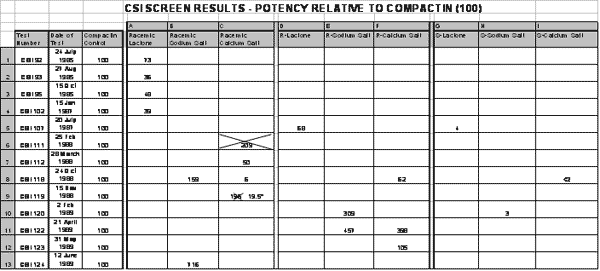 results were restated as follows:
*transcription error corrected
362 Dr Scallen concluded that the restated data is consistent with the potency of the RR enantiomer being no more than the expected twofold potency of the racemate.
363 Relying on this table of normalised data, Ranbaxy submitted that the appropriate comparison was to take all of the values for the racemate in columns A, B and C (ie lactone + sodium + calcium) and compare them with all of the values for the R enantiomer in columns D, E and F (ie lactone + sodium + calcium). Using the figures in the restated table, this comparison produces a figure of 183 per cent, that is to say the R enantiomer is in the order of 1.83 times the potency of the racemate.
364 Dr Watson also said that the normalised results were consistent with the conclusion that the potency of the R enantiomer is no more than the expected 200 per cent of the potency of the racemate.
365 In final address, Warner-Lambert also presented various comparisons based on normalised data from the CSI tests which suggested that the RR enantiomer was between four and eight times more potent than the racemate. None of these comparisons included all of the CSI data. Moreover, each comparison excluded the results of CSI 107 which, of itself, renders the comparisons invalid and inappropriate.
366 I am satisfied that the CSI data, taken as a whole, is consistent with the view that the potency of the RR enantiomer is in the order of two times the potency of the racemate, in accordance with normal expectations. When account is taken of the other evidence discussed above, including the COR assays and the AICS assays, I am satisfied on the balance of probabilities that the potency of the RR enantiomer is in the order of two times the potency of the racemate, in accordance with normal expectations.
Conclusion
367 Having regard to all of the foregoing matters, I have reached the following conclusions:
(a) The statements in the specification for the Enantiomer Patent that represented that Warner-Lambert had found that the R-trans enantiomer achieved surprising and unexpected inhibition of the biosynthesis of cholesterol in the order of a ten-fold increase above the activity levels of the racemate were false and misleading.
(b) The representation in the specification for the Enantiomer Patent that the results in the CSI Table reflected all of the CSI data available to Warner-Lambert for the relevant compounds, and that the data as a whole provided reasonable grounds for the findings set forth in the CSI Table, were false and misleading.
(c) The representation by Warner-Lambert to the Patent Office in its patent attorney’s letter of 26 June 1992 that the R-trans isomer was ten times more active than its racemic mixture was false and misleading.
Utility
368 The final ground of invalidity relied upon by Ranbaxy is that the alleged invention, as claimed in each claim of the Enantiomer Patent, is not a patentable invention within s 18(1)(c) of the 1990 Act because it is not useful. There is no material difference between this provision and s 100(1)(h) of the 1952 Act, and neither party suggested that there was.
369 These provisions are directed to the question whether the invention enables the addressee to attain the result promised by the patentee in the patent specification: see Rehm Pty Ltd v Webster’s Security Systems (International) Pty Ltd (1981) 81 ALR 79 (‘Rehm’) at 96; NV Philips Gloeilampenfabrieken v Mirabella International Pty Ltd (1993) 44 FCR 239 at 267 per Lockhart J; Old Digger Pty Ltd v Azuko Pty Ltd [2000] FCA 676 (‘Old Digger’) at [216]; Wrigley at [134]-[141]. Want of utility in this sense is different from want of utility in the broader commercial sense that the invention is useless for any purpose whatsoever: see Alsop’s Patent (1907) 24 RPC 733 at 752; and Lane-Fox v Kensington & Knightsbridge Electric Lighting Co Ltd [1892] 3 Ch 424 at 431.
370 In Rehm, Gummow J explained the governing principles at 96, as follows:
‘The basic principle has been formulated as follows in Fawcett v Homan (1896) 13 RPC 398 at 405 per Lindley LJ: “If an invention does what it is intended by the patentee to do, and the end attained is itself useful, the invention is a useful invention.”
What the invention is intended to do is a matter to be gathered from the title and the whole of the specification: Blanco White, Patents For Inventions, § 4–403. A distinction may be drawn between a case where a patentee claims a result and bases his claim on the production of that result and the case where a patentee merely points to certain advantages that will accrue from the use of his invention: Fox H G, Canadian Patent Law and Practice, 4th ed, pp 152–4.’
See also TA Blanco White, Patents for Inventions, 5th edn, Stevens & Sons, London, 1983 (‘Blanco White’) at [4-402] and [4-403]; and Terrell on the Law of Patents, 14th edn, ed D Young et al, Sweet & Maxwell, London, 1994 at [5.121]-[5.128].
371 As the latter part of the passage from Rehm suggests, the grounds of utility and false suggestion or misrepresentation can overlap. False suggestion or misrepresentation is a wider concept; it extends to representations that are extraneous to the specification and representations that do not attract the inutility ground. Blanco White states at [4-405]:
‘It is not easy to distinguish between the sort of failure to fulfil a promise of results made in the specification that will amount to lack of utility and the sort that merely amounts to a false representation and accordingly will invalidate only if the patent has been “obtained” upon it. The distinction has been phrased as one between a promise of results and a mere wrong statement of the purposes for which that which is attained can be used; also as one between a promise of results and a “mere puff”, or between a false representation of the attributes of the product claimed and an accurate representation as to its attributes coupled with an expression of an “over-sanguine and erroneous view of its character.”’
See also Hatmaker v Joseph Nathan Co Ltd (1919) 36 RPC 231 at 239 and Old Digger at [216].
372 In this case, the overlap between the two grounds of invalidity is substantial. I have already held that, on its proper construction, the Enantiomer Patent specification represents that Warner-Lambert had found that the R-trans enantiomer achieved surprising and unexpected inhibition of the biosynthesis of cholesterol in the order of a ten-fold increase above the activity levels of the racemate, and that this representation was false and misleading: at [253] and [367]. Ranbaxy contends that, on the proper construction of the Enantiomer Patent specification, this representation constituted a promise by Warner-Lambert, as patentee, that the compounds of the invention had achieved, and were capable of achieving, surprising and unexpected inhibition of the biosynthesis of cholesterol in the order of a ten-fold increase above the activity levels of the corresponding racemate. In these circumstances, Ranbaxy submitted that inutility was made out by the same matters as it advanced in support of its case of false suggestion or misrepresentation.
373 Warner-Lambert did not dispute that the specification promised that the compounds of the invention would achieve surprising and unexpected inhibition of cholesterol biosynthesis. Its case on utility depended essentially upon the same construction issue that I considered in dealing with the arguments concerning false suggestion or misrepresentation. In its closing written submissions, Warner-Lambert submitted that the invention claimed by the Enantiomer Patent is based on identifying from amongst a large number of compounds a single enantiomer with surprising and unexpected inhibition of cholesterol biosynthesis, and that the promise in the specification is that of unexpected activity, which Lipitor fulfils. In his final address, senior counsel for Warner-Lambert acknowledged that what is being promised in the specification is ‘activity which is substantially better than twofold’.
374 Warner-Lambert’s submission depends on a construction of the specification which I reject. As I have said, the person skilled in the art reading the specification would link the CSI Table at pg 8 of the specification with the claims that the R-trans enantiomer provides surprising and unexpected inhibition of cholesterol biosynthesis: at [252] above. On the proper construction of the specification, Warner-Lambert promised that the compounds of the invention were capable of achieving a particular result, namely surprising and unexpected inhibition of cholesterol biosynthesis in the order of ten times that of the corresponding racemate.
375 This construction of the specification is consistent with the character of the Enantiomer Patent. It is, in effect, a selection patent: ie the compounds of the Enantiomer Patent have been selected from the broad class of compounds disclosed by the 981 Patent on the ground that those compounds have unexpected properties. The criteria for the grant of a selection patent were considered in IG Farbenindustrie AG’s Patents (1930) 47 RPC 289 (‘IG Farbenindustrie’) at 322-323 and are quite stringent: the selection must be based on some substantial advantage gained or some substantial disadvantage avoided; the whole of the selected members must possess the advantage in question; and the selection must be in respect of a quality of a special character which may fairly be said to be peculiar to the selected group. The authorities also require that the advantages gained, or disadvantages avoided, by the selection must be expressly identified in the body of the specification. Blanco White states at [4-511]:
‘Where the patent is a “selection patent,” there is an additional requirement for sufficiency that the special advantage obtained from the selection must be stated in the specification. More generally, the advantage resulting from the invention must be stated whenever failure to do so leaves the invention inadequately defined.’
In IG Farbenindustrie at 323, Maugham J said:
‘“I must add a word on the subject of the drafting of the specification of such a patent. It should be obvious, after what I have said as to the essence of the inventive step, that it is necessary for the patentee to define in clear terms the nature of the characteristic which he alleges to be possessed by the selection for which he claims a monopoly. He has in truth disclosed no invention whatever if he merely says that the selected group possesses advantages. Apart altogether from the questions of what is called sufficiency, he must disclose an invention; he fails to do this in the case of a selection for special characteristics, if he does not adequately define them”.’
In the Enantiomer Patent specification, Warner-Lambert has defined the claims of unexpected and surprising inhibition of cholesterol biosynthesis by means of the CSI Table at pg 8 of the specification.
376 The decision in May & Baker Ltd v Boots Pure Drug Co Ltd(1948) 65 RPC 255 provides a useful illustration of the application of these principles in circumstances which are not unlike this case: see also E.I. Du Pont Nemours & Co (Witsiepe’s) Application [1982] FSR 303.
377 As to whether the results promised by the Enantiomer Patent specification are capable of being achieved, I have reviewed the relevant evidence in the previous section of this judgment. Based on this evidence, I find that the compounds of the Enantiomer Patent have not achieved, and are not capable of achieving, the promised results, that is to say a surprising and unexpected inhibition of cholesterol biosynthesis in the order of ten times that of the corresponding racemate. The evidence before me also establishes that the potency of the RR enantiomer is in the order of two times the potency of the racemate, in accordance with normal expectations. Accordingly, I have concluded that the invention claimed by the Enantiomer Patent is not useful within the meaning of s 18(1)(c) of the 1990 Act and s 100(1)(h) of the 1952 Act.
378 Warner-Lambert submitted that Lipitor’s commercial success demonstrates that the compounds claimed by the Enantiomer Patent (including claim 6) are undoubtedly useful. It also submitted that Ranbaxy’s intention to market its own version of atorvastatin calcium in Australia supports the view that the compound has surprising activity and consequently utility. These submissions are misdirected. Utility in patent law is directed to the results promised by the specification, and not to the broader question of commercial or financial success: see Terrell on the Law of Patents at [5.128]; Badische Anilin Und & Soda Fabrik v Levinstein (1887) 4 RPC 449 at 462.
Orders
379 Ranbaxy has succeeded in its challenge to the validity of the Enantiomer Patent. Accordingly, it is entitled to an order revoking the Enantiomer Patent.
380 Warner-Lambert has succeeded in its cross claim that Ranbaxy’s intended importation and sale of its product will infringe the 981 Patent. It is entitled to a permanent injunction restraining Ranbaxy during the term of the 981 Patent, and any extension of that term, from infringing the 981 Patent.
381 I will hear submissions on the question of costs.
| I certify that the preceding three hundred and eighty-one (381) numbered paragraphs are a true copy of the Reasons for Judgment herein of the Honourable Justice Young. |
Associate:
Dated: 20 December 2006
| Counsel for the Applicant/Cross-Respondent: | Dr J Emmerson QC, B Caine SC and L Duncan |
|
|
|
| Solicitor for the Applicant/Cross-Respondent: | Norman Waterhouse |
|
|
|
| Counsel for the First Respondent/Cross-Claimant: | R Macaw QC and A Ryan |
|
|
|
| Solicitor for the First Respondent/Cross-Claimant: | Allens Arthur Robinson |
|
|
|
| Counsel for the Second Respondent: | The Second Respondent did not appear |
|
|
|
| Date of Hearing: | 9, 10, 11, 12, 13, 16, 17, 18, 19, 20 and 23 October 2006 |
|
|
|
| Date of Judgment: | 20 December 2006 |


