

FEDERAL COURT OF AUSTRALIA
Hadgkiss v Sunland Construction (Qld) Pty Ltd [2006] FCA 1566
QUD 546 OF 2005
DOWSETT J
25 OCTOBER 2006
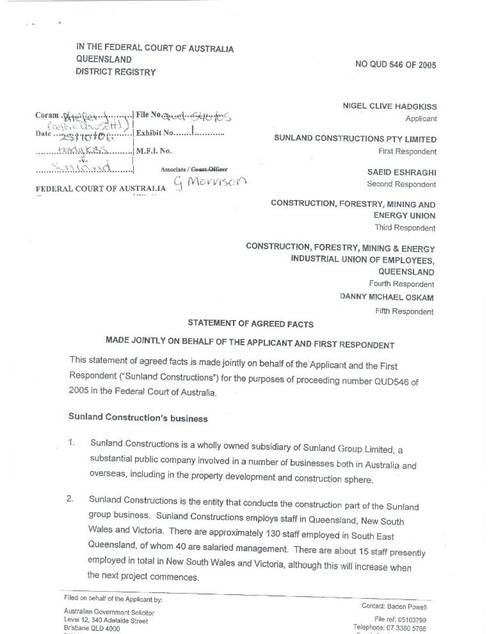
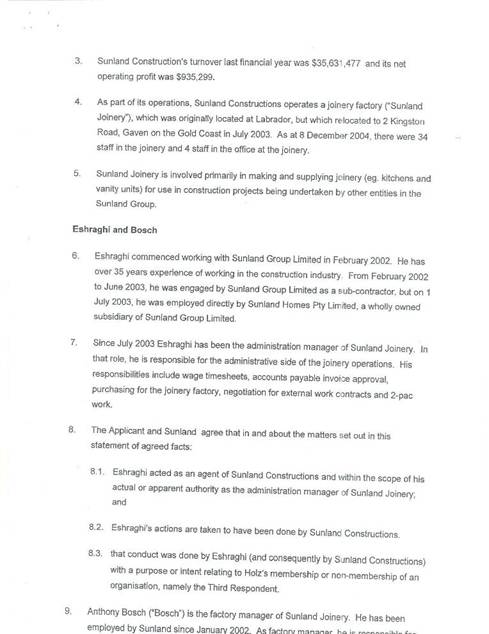
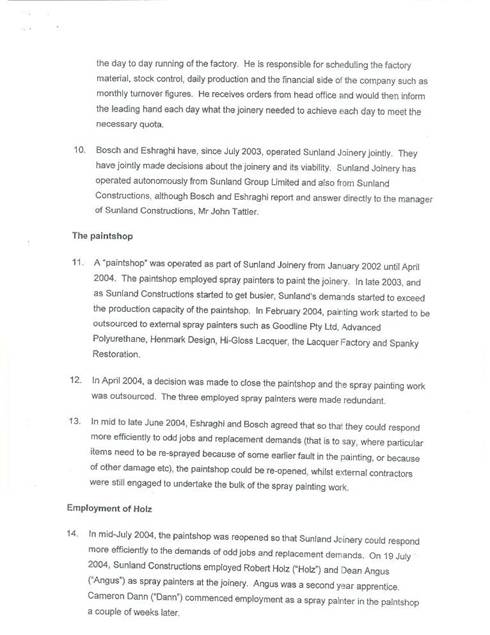
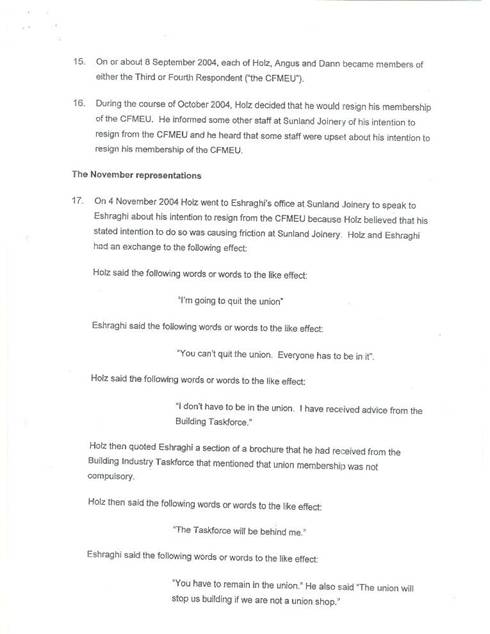
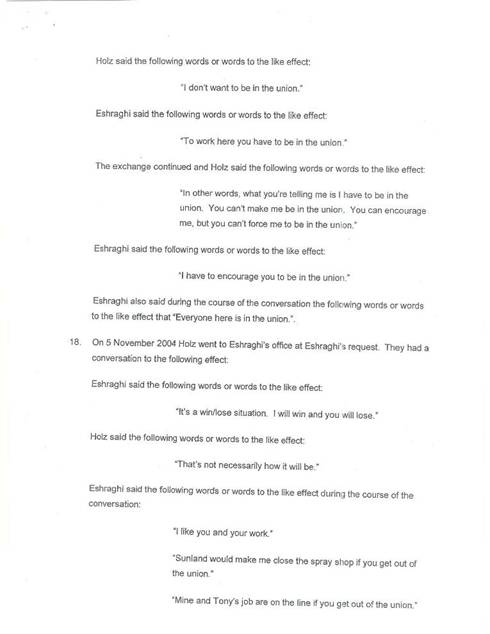
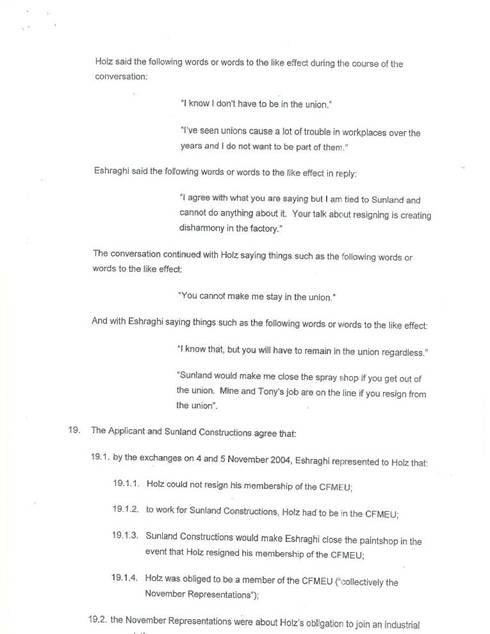
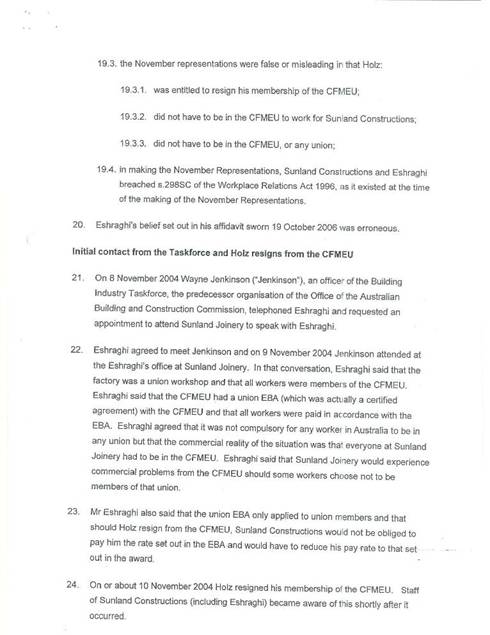
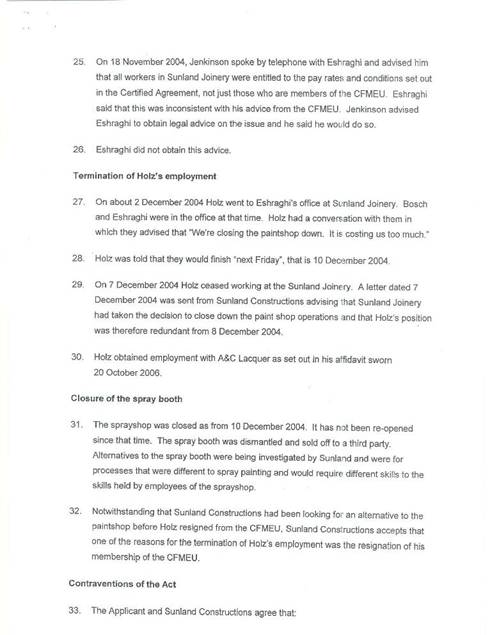
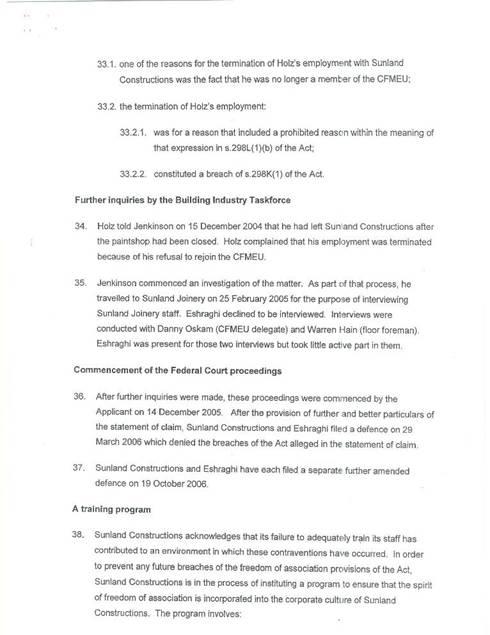
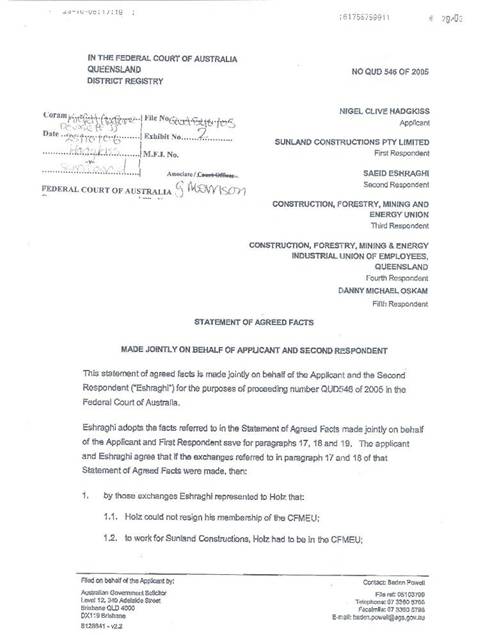
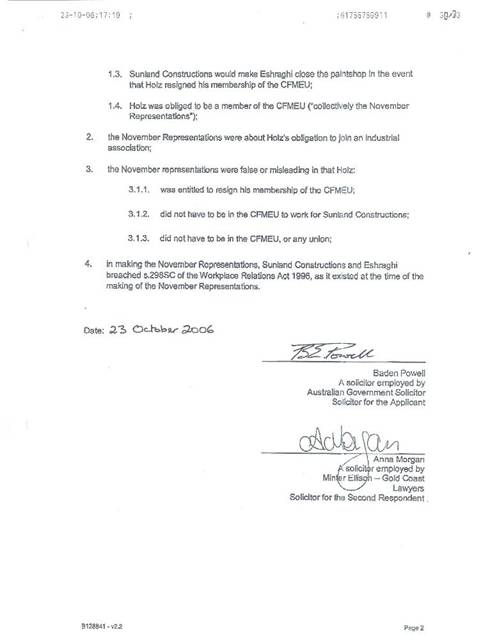
BRISBANE
|
IN THE FEDERAL COURT OF AUSTRALIA |
|
|
QUEENSLAND DISTRICT REGISTRY |
QUD 546 OF 2005 |
|
BETWEEN: |
NIGEL CLIVE HADGKISS Applicant
|
|
AND: |
SUNLAND CONSTRUCTIONS (QLD) PTY LTD First Respondent
SAEID ESHRAGHI Second Respondent
CONSTRUCTION FORESTRY MINING AND ENERGY UNION Third Respondent
CONSTRUCTION FORESTRY MINING AND ENERGY INDUSTRIAL UNION OF EMPLOYEES QUEENSLAND Fourth Respondent
DANNY MICHAEL OSKAM Fifth Respondent
|
|
DOWSETT J |
|
|
DATE OF ORDER: |
25 OCTOBER 2006 |
|
WHERE MADE: |
BRISBANE |
THE COURT DECLARES THAT:
1. The first and second respondents each engaged in conduct in contravention of s 2.298SC of the Workplace Relations Act 1996 (as in force in November and December 2004) (the “Act”) in representing to Robert Holz on or about 4 November 2004 that Holz was obliged to be a member of the third and/or fourth respondents;
2. The first respondent engaged in conduct in contravention of s 298K(1) of the Act in dismissing Robert Holz from his employment with the first respondent in or about December 2004 for reasons that included the reason that Robert Holz was not a member of the third or fourth respondents;
THE COURT ORDERS THAT:
3. The appellant have leave to amend the name of the first respondent to Sunland Constructions (Qld) Pty Ltd;
4. Pursuant to s 298U of the Act:
4.1 the first respondent pay to the Commonwealth of Australia a pecuniary penalty of $3 000 in respect of the first respondent’s contravention of the Act described in par 1 hereof;
4.2 the second respondent pay to the Commonwealth of Australia a pecuniary penalty of $1 000 in respect of the second respondent’s contravention of the Act described in par 1 hereof;
4.3 the first respondent pay to the Commonwealth of Australia a pecuniary penalty of $12 000 in respect of the first respondent’s contravention of the Act described in par 2 hereof;
5. The pecuniary penalties referred to in par 3 hereof be paid into the Consolidated Revenue Fund;
6. Each sum referred to in Order 4 be paid within 28 days.
AND FURTHER:
7. The Court accepts the undertaking of the first respondent to use its beset endeavours to implement the compliance programme described in the document exhibited to these orders and marked “A”.
Note: Settlement and entry of orders is dealt with in Order 36 of the Federal Court Rules.
ANNEXURE A
UNDERTAKING
Sunland Constructions (Qld) Pty Ltd:
(1) Undertake for a period of 2 years from the date of this order, to implement a programme to ensure that the spirit of freedom of association is incorporated into the corporate culture of Sunland Constructions (Qld) Pty Ltd. This programme will be approached from both a policy revision and educational perspective.
(2) The policy revision limb will incorporate a written policy on freedom of association that will be:
(a) Incorporated into the contract of employment for staff employed under a contract of employment, being all salaried management staff;
(b) Included in part of the induction process for all new employees; and
(c) Signed off by all existing salaried management staff.
(3) The education limb will provide:
(a) Training to existing salaried management staff by Mark Byunch, a qualified employment lawyer from Minter Ellison Lawyers;
(b) Training to wages staff by salaried management staff; and
(c) Training to new salaried management staff by the National Construction Manager during induction.
(4) The scope of the education will cover:
(a) The statutory regime of freedom of association;
(b) Individual’s rights in relation to freedom of association;
(c) The company’s responsibilities in relation to freedom of association;
(d) The consequence for unlawful breach of the freedom of association regime;
(e) The scope of application of the applicable certified agreement;
(f) Role of union delegates;
(g) Right of entry entitlement if union officials; and
(h) Role of the Office of the Australian Building and Construction Commission.
(5) Sunland Constructions will meet the associated costs to complete this programme;
(6) The programme contained in this undertaking will be implemented and completed by 31 December 2006;
(7) To provide information and documentation to the Office of the Australian Building and Construction Commissioner (“ABCC”) evidencing the implementation of the matters contained in this undertaking within seven days of receipt of the request from ABCC.
|
IN THE FEDERAL COURT OF AUSTRALIA |
|
|
QUEENSLAND DISTRICT REGISTRY |
QUD 546 OF 2005 |
|
BETWEEN: |
NIGEL CLIVE HADGKISS Applicant
|
|
AND: |
SUNLAND CONSTRUCTIONS (QLD) PTY LTD First Respondent
SAEID ESHRAGHI Second Respondent
CONSTRUCTION FORESTRY MINING AND ENERGY UNION Third Respondent
CONSTRUCTION FORESTRY MINING AND ENERGY INDUSTRIAL UNION OF EMPLOYEES QUEENSLAND Fourth Respondent
DANNY MICHAEL OSKAM Fifth Respondent
|
|
JUDGE: |
DOWSETT J |
|
DATE: |
25 OCTOBER 2006 |
|
PLACE: |
BRISBANE |
REASONS FOR JUDGMENT
1 The applicant brings these proceedings as a delegate of the Employment Advocate appointed under Pt IVA of the Workplace Relations Act 1996 (Cth) (the “Act”). The proceedings are for declaratory and other relief arising out of alleged breaches by the first and second respondents of ss 298K and 298SC of the Act. Proceedings against the Construction Forestry Mining and Energy Union and the Construction Forestry Mining and Energy Industrial Union of Employees Queensland were commenced by the same application. However, those proceedings have been severed from those with which I am presently concerned.
2 Section 298K relevantly provides:
‘(1) An employer must not, for a prohibited reason, or for reasons that include a prohibited reason, do or threaten to do any of the following:
(a) dismiss an employee.’
3 One of the prohibited reasons, according to s 298L, is that the relevant employee is not, or does not propose to become, a member of an industrial association.
4 Section 298SC provides that:
‘A person must not make a false or misleading statement about:
…
(c) another person’s obligation to join an industrial association.’
5 The facts of the case are succinctly set out in two documents, each entitled ‘Statement of Agreed Facts’, one agreed on behalf of the first respondent and the other on behalf of the second respondent. It is not necessary or even useful for me to set out the facts of the case again. I will rather attach the two statements to these reasons as attachments A and B. It is sufficient to say that on 4 November 2004 Mr Holz, an employee of the first respondent, said to the second respondent, who was his supervisor that he intended to resign from the union of which he was a member. He was told that he could not quit the union and that everybody had to be in it. Various other conversations followed, to similar effect. On 5 November there was a further conversation, again to the same effect.
6 Early in the conversation on 4 November Mr Holz indicated to the second respondent that he had taken advice and knew that he had no legal obligation to join the union. This led me to wonder whether or not the subsequent conversations could in any sense constitute misrepresentations for the purposes of s 298SC, notwithstanding the concession made by the first respondent. In the end I am content to accept that the statements made on 4 November 2004 constituted misrepresentations as to the obligation to join the union. However I am not satisfied that the statements made on 5 November were of that kind. They seem to have related to the employment policy of the first respondent rather than the obligations of the employee.
7 The first respondent, by the statement of agreed facts, has conceded that the various events occurred and, with the exception to which I have referred, that they constituted breaches of the Act. The second respondent has not expressly admitted that the relevant statements occurred. However there is evidence from Mr Holz to that effect, and no contradictory evidence. In those circumstances I am willing to draw the appropriate inference, namely that the statements were made and that they constituted breaches of s 298SC, again subject to the one exception.
8 Some time later the first respondent terminated Mr Holz’s employment. This coincided with a decision to close the operation in which he was engaged so that he became redundant. Nonetheless it has been admitted that one of the reasons for terminating his employment at that time was the fact that he had chosen to resign from the union.
9 The applicant alleges breaches of s 298K by the first respondent and breaches of s 298SC by both respondents. I declare that the first and second respondents each engaged in conduct in contravention of s 298SC of the Act in representing to Robert Holz on or about 4 November 2004 that he was obliged to be a member of the third or fourth respondent. I also declare that the first respondent engaged in conduct in contravention of s 298K(1) of the Act in dismissing Robert Holz from his employment with the first respondent in or about December 2004 for reasons that included the reason that Robert Holz was not a member of either the third or fourth respondent.
10 The applicant seeks pecuniary penalties against both respondents and asks that I record an undertaking offered by the first respondent to the Court concerning the conduct of awareness programmes dealing with freedom of association. Details of the proposal appear in a draft undertaking which will be attached to the order. I note and accept the undertaking of the first respondent to use its best endeavours to implement the compliance program described in the document which will be attachment C to these reasons.
11 I turn to the question of pecuniary penalties. In the case of the first respondent, the maximum penalty is $33 000 for each infringement. In the case of the second respondent, the maximum penalty is $6 600. These maxima reflect substantial increases enacted quite recently. The parties generally agree as to the relevant considerations to be taken into account in fixing the pecuniary penalties. They include:
· the circumstances in which the conduct took place;
· any previous similar misconduct;
· the number of contraventions and whether they are properly seen as distinct or separate occurrences;
· the consequences of the conduct;
· the need in the circumstances for the protection of industrial freedom of association (which I take to be the purpose of the legislation);
· the need for a deterrent;
· the capacity of the relevant persons to pay;
· in the case of the first respondent, whether the contravention arose out of the conduct of senior management or at a lower level;
· whether the first respondent has a corporate culture conducive to compliance; and
· whether the first respondent has shown a disposition to co-operate with the authorities,
12 This conduct was in no way trivial. It is appropriate to recognise the circumstances in which the legislation has come into existence at this point in the history of industrial relations. Trade unions have performed a significant function in the development of Western democracies over more than a century. Many countries may not have enjoyed stability to the extent which they have, had trade unions not led campaigns concerning the distribution of wealth and wage justice. For most of that history a matter of grave concern has been attempts by employers to impede employees in becoming members of unions. In recent years, however, circumstances have changed. Trade unions have, historically, been closely aligned with one side of politics. They have adopted wider social agendas. Tactics have changed, and society has, generally, become more concerned with individual rights. Concerns have arisen that workers not be compelled or persuaded, using inappropriate methods, to join trade unions. It is in those circumstances that the present legislation has emerged. It is a serious matter that an employer should seek to pressure an employee into joining or remaining in a union, just as it has traditionally been treated as a serious matter that an employer should seek to dissuade an employee from joining a union using inappropriate methods of persuasion. It is, of course, also important that employers who, by their position, are more likely to be aware of the law than are their employees, not mislead them as to their legal obligations.
13 A number of factors about this case dictate that a serious view be taken of it. The first is that the second respondent’s immediate reaction to the suggestion that Mr Holz proposed to resign from the union was to seek to convince him that he was obliged to do otherwise. I do not accept the assertion made on behalf of the respondents that this reflected some ‘muddle-headed’ approach to industrial obligations. It seems to me quite clear that the second respondent was fully aware of the fact that it was in his interests, and perhaps his employer’s, to ensure that all employees remained in the union. Whether or not this was attributable to pressure applied to the employer by one or other of the unions I do not know. I do not propose to speculate about it. Nonetheless it seems quite clear that self-interest motivated that conduct. The second aspect which I consider to be quite serious is that the respondents persisted in this conduct even after the second respondent had an opportunity to reconsider his position. Thirdly, the employee was eventually dismissed, albeit for a combination of reasons. It also seems that his conduct was a little on the provocative side in that he waited until the end of his probation period before indicating his intention to resign from the union. The employee was not in any sense misled by the statements that were made. He was fully aware of his rights.
14 There is no suggestion that either respondent has previously been involved in any relevant infringement. I am inclined to think that the conduct in question amounted to a continuing course of conduct rather than two separate and distinct incidents. However that leads me to take a more serious view of the ultimate dismissal. It was in no sense an act done in the heat of the moment. The consequences for Mr Holz of the misleading conduct were virtually nil. As a consequence of his dismissal, he probably suffered some loss of remuneration, but for a relatively short period of time. No evidence before me suggests that either of the respondents will be incapable of paying the penalties which I have in mind. The first respondent’s conduct occurred at the level of middle management. The second respondent’s statements in response to Mr Holtz’s indication of his intentions to resign suggest the absence of any culture of compliance. As to the question of co-operation, the first respondent indicated some weeks ago its intention to submit to judgment. I am inclined to treat that as a matter of some importance. The first respondent co-operated, to some extent, in the investigation. The second respondent did not co-operate to the same extent. His eventual submission was not entirely unqualified. Nonetheless it would be unfair to distinguish between them in that regard. I am willing to accept, there being no evidence to the contrary, that the first respondent’s higher management was not aware of the second respondent’s actions. However they must accept responsibility for the fact that such actions occurred and for the fact that there was, apparently, no mechanism in place for ensuring that they did not occur.
15 To my mind, however, the primary issue in this case is the need to provide a deterrent to employers in connection with conduct of this kind. The need for a deterrent should be reflected in the penalty imposed on the first respondent, rather than the second. Workplace culture was probably a major factor in the causation of these events. In those circumstances, no significant deterrent purpose will be served by imposing a substantial penalty on the second respondent.
16 Imposing deterrent penalties on corporations is notoriously difficult, largely because of the resources to which most trading corporations have access. The range of penalties here is not great. I have been referred to a number of cases, which are of some assistance. In Communications, Electrical, Electronic, Energy, Information, Postal, Plumbing and Allied Services Union of Australia v ACI Operations Pty Ltd [2006] FCA 7, Marshall J imposed a penalty of $16 500 for a contravention which involved the termination of employment of an employee for reason of his position as a union delegate. However that penalty was imposed after a trial. In those circumstances the case offers an upper limit to the appropriate penalty in the present case. Two other cases were cited. One is the decision of Branson J, in Employment Advocate v Barclay Mowlem Construction Limited [2005] FCA 431 where her Honour imposed a penalty of $6 000. At that time the maximum was $10 000. In Australian Nursing Federation v Alcheringa Hostel Inc. (2004) 136 FCR 530, Ryan J dealt with a case in which eight employees had been dismissed in the course of a retrenchment for financial reasons. They had been selected for dismissal for reasons which were prohibited, primarily, membership of a union and associated conduct. His Honour imposed a total penalty of $3 400: $400 for each of the eight contraventions. At that time the maximum penalty was $10 000. It is not clear whether there were eight different counts in respect of which the maximum might have been imposed. The relevant employer in that case was a charitable organisation. It may be that the penalty was reduced to reflect that fact.
17 It is also necessary that I have regard to the totality of the effect of the orders made. In this respect, the fact that both incidents were part of one transaction is of some significance. I propose to fix the pecuniary penalties in such a way as to ensure that the totality reflects the seriousness of the overall course of conduct.
18 I fix the pecuniary penalty as against the first respondent in connection with the breach of s 298SC in the sum of $3 000. In the case of the second respondent I fix the penalty at $1 000. In the case of the breach by the first respondent of s 298K, I fix the penalty in the sum of $12 000. I order that each sum be paid to the consolidated revenue within 28 days.
|
I certify that the preceding eighteen (18) numbered paragraphs are a true copy of the Reasons for Judgment herein of the Honourable Justice Dowsett. |
Associate:
Dated: 28 November 2006
|
Counsel for the Applicant: |
Mr M T Brady |
|
|
|
|
Solicitor for the Applicant: |
Australian Government Solicitor |
|
|
|
|
Counsel for the First and Second Respondents: |
Mr J E Murdoch SC |
|
|
|
|
Solicitor for the First and Second Respondents: |
Minter Ellison |
|
|
|
|
Date of Hearing: |
25 October 2006 |
|
|
|
|
Date of Judgment: |
25 October 2006 |
ANNEXURE A

ANNEXURE B
ANNEXURE C
UNDERTAKING
Sunland Constructions (Qld) Pty Ltd:
(1) Undertake for a period of 2 years from the date of this order, to implement a programme to ensure that the spirit of freedom of association is incorporated into the corporate culture of Sunland Constructions (Qld) Pty Ltd. This programme will be approached from both a policy revision and educational perspective.
(2) The policy revision limb will incorporate a written policy on freedom of association that will be:
(a) Incorporated into the contract of employment for staff employed under a contract of employment, being all salaried management staff;
(b) Included in part of the induction process for all new employees; and
(c) Signed off by all existing salaried management staff.
(3) The education limb will provide:
(a) Training to existing salaried management staff by Mark Byunch, a qualified employment lawyer from Minter Ellison Lawyers;
(b) Training to wages staff by salaried management staff; and
(c) Training to new salaried management staff by the National Construction Manager during induction.
(4) The scope of the education will cover:
(a) The statutory regime of freedom of association;
(b) Individual’s rights in relation to freedom of association;
(c) The company’s responsibilities in relation to freedom of association;
(d) The consequence for unlawful breach of the freedom of association regime;
(e) The scope of application of the applicable certified agreement;
(f) Role of union delegates;
(g) Right of entry entitlement if union officials; and
(h) Role of the Office of the Australian Building and Construction Commission.
(5) Sunland Constructions will meet the associated costs to complete this programme;
(6) The programme contained in this undertaking will be implemented and completed by 31 December 2006;
(7) To provide information and documentation to the Office of the Australian Building and Construction Commissioner (“ABCC”) evidencing the implementation of the matters contained in this undertaking within seven days of receipt of the request from ABCC.


