

FEDERAL COURT OF AUSTRALIA
Seymour v Saint-Gobain Abrasives Pty Ltd [2006] FCA 1452
UNION DELEGATES – Redundancy and retrenchment – Dismissal for prohibited reasons – Reverse onus of proof – Presumption not displaced – Reinstatement.
Workplace Relations Ac 1996 (Cth) s 792, s 807, s 809.
Maritime Union of Australia & Ors v Geraldton Port Authority & Ors (1999) 93 FCR 34 referred to
R v GK (2001) 53 NSWLR 317 distinguished
TONY SEYMOUR AND JEFF GEARIN v SAINT-GOBAIN ABRASIVES PTY LTD
NSD 1923 OF 2006
BUCHANAN J
8 NOVEMBER 2006
SYDNEY
|
IN THE FEDERAL COURT OF AUSTRALIA |
|
|
NEW SOUTH WALES DISTRICT REGISTRY |
NSD 1923 OF 2006 |
|
BETWEEN: |
TONY SEYMOUR First Applicant
JEFF GEARIN Second Applicant
|
|
AND: |
SAINT-GOBAIN ABRASIVES PTY LTD Respondent
|
|
BUCHANAN J |
|
|
DATE OF ORDER: |
8 NOVEMBER 2006 |
|
WHERE MADE: |
SYDNEY |
THE COURT ORDERS THAT:
1. It is declared that on 27 September 2006 the respondent, Saint-Gobain Abrasives Pty Ltd (ACN 068 931420) contravened s 792 of the Workplace Relations Act 1996 (Cth) by dismissing the applicants, Mr Tony Seymour and Mr Jeff Gearin, from their employment with the respondent.
2. The respondent reinstate the applicants in their employment on and from 27 September 2006.
3. Service of the applicants with the respondent be regarded as continuous with the earlier period of their employment.
4. The respondent pay to the applicants the wages which they would have earnt in accordance with the rosters being worked by them at 27 September 2006.
5. Order 2 is conditional upon the applicants repaying to the respondent the net amount paid to them as severance pay as a result of the dismissal on 27 September 2006, less the net amount of any wages due to them under order 4 above.
6. The hearing is adjourned to a date to be fixed to hear evidence and submissions as to whether a penalty should be imposed upon the respondent under s 807 of the Workplace Relations Act 1996 (Cth) and, if so, the amount of such penalty.
Note: Settlement and entry of orders is dealt with in Order 36 of the Federal Court Rules.
|
IN THE FEDERAL COURT OF AUSTRALIA |
|
|
NEW SOUTH WALES DISTRICT REGISTRY |
NSD 1923 OF 2006 |
|
BETWEEN: |
TONY SEYMOUR First Applicant
JEFF GEARIN Second Applicant
|
|
AND: |
SAINT-GOBAIN ABRASIVES PTY LTD Respondent
|
|
JUDGE: |
BUCHANAN J |
|
DATE: |
8 NOVEMBER 2006 |
|
PLACE: |
SYDNEY |
REASONS FOR JUDGMENT
BUCHANAN J:
Two Union Delegates are Retrenched
1 Until 27 September 2006 Mr Tony Seymour and Mr Jeff Gearin (the applicants) were employed by Saint-Gobain Abrasives Pty Ltd (the respondent). On that day they were each compulsorily retrenched. They were the delegates, at the respondent’s site at Lidcombe, of the National Union of Workers’ (‘the NUW’). They were the only union delegates at the site.
2 Mr Seymour had been employed by the respondent for 30 years. He became a site delegate in the mid 1980s. Mr Gearin had been employed by the respondent for 18 years. He became a site delegate in 1988 at about the time, or shortly after, he commenced employment.
3 It was common ground that, as union delegates, the applicants had, over the years, been involved in negotiations with the management of the respondent. Moreover, in recent years, they had been involved in the organisation of industrial action. Some of the negotiations in earlier years, and more recently since March 2006, had been hard fought, even heated.
4 Both the applicants and the respondent drew attention in their evidence to the prior history, although for different reasons. The applicants wished to suggest that they had become a thorn in the side of management and that things came to a head during 2006. The respondent relied upon the prior history to displace the suggestion that it was predisposed against the applicants by reason of their role as union delegates, being accustomed to deal with them in that capacity.
5 The evidence about these matters is consistent with either view and ultimately does not provide much assistance in the resolution of the present matter.
6 Mr Wayne Meaney is Assistant State Secretary of the NSW Branch of the NUW and is the NUW official responsible for the respondent’s site at Lidcombe. His evidence was that the NUW had, at September 2006, 40 members out of about 50 workers employed at the site.
7 Terms and conditions of employment at the site are regulated by the ‘Saint-Gobain Ltd Certified Agreement 2004 for Lidcombe and Wetherall Park, Production and Warehouse Employees’ (‘Certified Agreement’). This Agreement was certified on 27 July 2004 under the Workplace Relations Act 1996 (Cth) (‘the WRAct’) and remained in force until 29 June 2006 and thereafter in accordance with the provisions of that Act.
8 Mr Meaney said that a handful of employees are covered by Australian Workplace Agreements (‘AWAs’). AWAs are also registered under the WR Act.
9 Negotiations for a new Certified Agreement commenced in March 2006. Over the following five months, until 8 August 2006, representatives of the NUW (including the applicants and Mr Meaney) met with Ms Catherine Hobbs, the Human Resources Manager – Pacific, for the respondent. The parties are agreed that there were eight or nine such meetings. Negotiations broke down at a meeting on 8 August 2006.
10 Meanwhile, on 26 July 2006 the NUW initiated a ‘bargaining period’ under s 423 of the WR Act. The significance of this step is that it put in train a process whereby, in due course and subject to meeting certain statutory requirements, industrial action might be taken which was ‘protected’ under the WR Act.
11 One statutory requirement to be satisfied arose under Part 9, Division 4 of the WR Act – namely the need to obtain an order from the Australian Industrial Relations Commission (‘AIRC’) for a secret ballot to be held to authorise industrial action. To that end the NUW applied, on 1 September 2006, to the AIRC for such a ballot. The application was opposed. It was heard by Senior Deputy President Marsh on 4, 11 and 26 September 2006. As at 27 September 2006 (the date of the applicants’ dismissals) her Honour was reserved on the question whether a ballot should be held.
12 During the course of the negotiations Ms Hobbs was asked whether the respondent was considering redundancies. She said it was not. Ms Hobbs thought this conversation occurred in June or July. Despite the fact that, before the final meeting on 8 August, Ms Hobbs knew that redundancies were, in fact, proposed she did not correct the information she had imparted to the applicants in their role as delegates.
13 The plant manager of the respondent, Mr Slavko Grbic, said he began to give active consideration to a reduction of the workforce in July. There is some evidence from the respondent that the exercise was prompted by statements by the applicants in the negotiations of an under-utilisation of workers in the ‘Maker Division’, the area in which they both worked. Whether the review was prompted by any such remark is unclear but the review which was carried out by Mr Grbic was not confined, as will be seen, to that area of operations.
14 A report was sent to the respondent’s senior management in Paris seeking approval to incur the cost of redundancy payments arising from the retrenchment of ten employees, suggesting that the cost would be recovered in about a year-and-a-half and there would be on-going savings. It will be necessary to discuss the contents of this report in greater detail.
15 Approval to the position redundancies and consequent retrenchments was given on about Friday, 15 September. The workforce was informed on Monday, 18 September. Volunteers were sought. Employees were told they would need to apply in writing by 22 September.
16 At about the same time that the impending redundancies were announced the respondent sent a letter to members of the workforce, including the applicants, offering employment pursuant to an AWA. Ms Hobbs’ evidence was that AWAs had been available since July but only to employees who had sought them. The letters, which were sent on 19 September 2006, were, she said, the first occasion on which offers of AWAs were made to employees. Neither of the applicants accepted the offer.
17 On 27 September 2006 a meeting was held between Ms Hobbs and Mr Grbic and, sequentially, the supervisor in each of the three areas in which redundancies and retrenchments were to occur. According to the respondent’s evidence selections were made at that meeting of persons to be retrenched according to the possession or non-possession of particular skills in various parts of the operations and on various pieces of equipment.
18 In the selection process a number of volunteers were rejected and some who had not volunteered, including the applicants, were selected to be retrenched. Shortly after the meeting each of the applicants was informed that he was to be retrenched.
19 Mr Meaney gave uncontradicted evidence that each of the persons selected for retrenchment was a union member. To put the matter another way, none of the ten or so non-members were retrenched.
20 The applicants each received severance pay at the rate of four weeks pay for each year of service to a maximum of 72 weeks, a payment for notice of four or five weeks depending on age (5 weeks if older than 45) and a payment for unused sick leave. Mr Seymour was paid $98,186.75 and Mr Gearin $82,568.56.
21 At this time neither the NUW nor the applicants had seen the material which emerged during the proceedings by way of explanation of the respondent’s actions, including Mr Grbic’s report referred to earlier.
22 The retrenchment of the applicants, and others, occurred in circumstances where the NUW and the applicants were embarked upon a course designed to authorise industrial action at the respondent’s Lidcombe operations. There had been no consultation about redundancies. The two union delegates at the site who had been had been intimately involved in the negotiations were removed from the scene. The respondent, at the same time, seemed to be embarking on a program of altering the nature of style or industrial negotiations from a collective to an individual basis.
23 These circumstances provided the foundation for the proceedings, as commenced.
Nature of Proceedings
24 The proceedings were commenced two days after the applicants were retrenched, on 29 September 2006. The Application alleges contravention of s 792 of the WR Act in that the respondent dismissed the applicants from their employment because they were delegates or members of an industrial organisation.
25 The applicants seek relief under s 807 of the WR Act. They seek, by way of final relief, reinstatement in their employment and payment of wages lost due to their dismissal. In addition but, as became clear, in the alternative, compensation is sought. Further orders are sought restraining the respondent from further contravention of s 792 and the imposition of a penalty for the contravention alleged to have occurred.
26 Pending final hearing an interim order of reinstatement was sought. However, on 4 October 2006 Gyles J ordered that the matter be listed instead for urgent final hearing. The hearing before me commenced on 19 October and continued on 20, 27 and 30 October 2006, with some extended sitting hours being used to complete the hearing.
27 Section 809 of the WR Act erects a statutory presumption which is of considerable importance to the applicants’ case. It provides:
‘(1) If:
(a) in an application under section 807 relating to a person’s conduct, it is alleged that the conduct was, or is being, carried out for a particular reason or with a particular intent; and
(b) for the person to carry out the conduct for that reason or with that intent would constitute a contravention of this Part;
it is presumed, in proceedings under this Division arising from the application, that the conduct was, or is being, carried out for that reason or with that intent, unless the person proves otherwise.
(2) This section does not apply in relation to the granting of an interim injunction.’
28 The effect of this provision is that the respondent bears the onus, on the balance of probabilities, of excluding a conclusion that the applicants were dismissed because they were delegates or members of the NUW. As will be seen the effect of this provision is central to my reasoning in the present matter.
29 Because the respondent must exclude delegateship and membership as a reason for termination, normally sworn evidence denying any such reason is necessary and, in most cases, an explanation of the real reason for dismissal consistent with the absence of delegateship or membership as a reason is, in a practical sense, also necessary. An instructive example of the interaction between the two categories of evidence and the consequence of partial acceptance only of the explanations proffered may be seen in Maritime Union of Australia & Ors v Geraldton Port Authority & Ors (1999) 93 FCR 34 esp at [313], [325], [332], [338], [339], [345], [350] and [351].
30 Where more than one person contributes to a decision to dismiss it may be necessary to lead appropriate evidence from each such person. In the present case, for reasons which appear later, it was necessary for Ms Hobbs and Mr Grbic, in particular, to persuade me that neither delegateship nor membership was a reason for the dismissal of the applicants.
31 The respondents did not contend that the applicants had failed to make out any element of their own case. Properly, in the circumstances, the respondent accepted that the onus fell to it to displace the legislative presumption arising from s 809 of the WR Act. The case therefore centred on this issue.
The Respondent’s Case
32 The respondent’s case was based on two foundations: first, an explicit denial from relevant decision makers that the retrenchment of either of the applicants was for the reason that he was a delegate or member of an industrial organisation; and, secondly, an explanation of the ‘real reason’ for dismissal.
33 The real reason, on the respondent’s case, was that on 27 September 2006 the process followed to select persons, including the applicants, to be retrenched was:-
• pay regard to volunteers but refuse to release any volunteer whose skills were important to retain;
• thereafter select the least skilled employees to make up the numbers required to be retrenched.
34 This process, it was contended, led inevitably to the retrenchment of the applicants. No part of the process involved the reason that either applicant was a delegate or member of the NUW. Accordingly, so the argument went, the presumption was displaced.
Redundancies Under the Certified Agreement
35 The Certified Agreement, in clause 22, made provision for the procedure to be followed in the event of the respondent determining upon redundancies. It prescribed, in particular, as follows:
‘Redundancy Procedure:
In the event of the Company having to make redundancies, the company in the first instance shall call for volunteers across the organisation. Redundancy packages will be offered subject to the need to retain the skills required to maintain the company’s future commercial viability.
Should there be a need to compulsorily retrench employees, the primary factor to be considered are the skills required to maintain the company future viability. Where all things are equal, retrenchments will also take into account the “last on first off” principle.’
36 The present case is not concerned with allegations of breach of the Certified Agreement and it is not necessary for me to form or express a view about whether, on the explanation offered by the respondent’s witnesses, the requirements of clause 22 were met. Such a matter, if it ever arises, would do so in other proceedings. However, it is apparent from the evidence that the provisions quoted above influenced some of the processes followed by the respondent in managing the selection process for redundancies.
The Respondent’s Operations
37 The respondent manufactures abrasive products including sandpaper. The operations are organised into four divisions – Maker, Bonded, Conversion and Maintenance.
38 Ms Hobbs provided a summary of the work in the different divisions.
39 The Maker Division, in which the applicants were employed, is involved in the electrostatic attaching of grains on to cloth or paper to form an abrasive product. The Bonded Division work involves forming abrasive materials into shapes for particular purposes. Work in the Conversion Division involves converting ‘jumbo’ sized rolls of abrasive product into various sized disks, sheets and rolls. The Maintenance Division is involved with the maintenance and service of machinery used in the other three divisions.
40 Prior to 27 September 2006 there were 13 full-time employees in each of the Maker and Bonded Divisions, 19 full-time employees in the Conversion Division and 3 full-time employees in the Maintenance Division.
The Coater and Off-line Printer
41 The selection of persons in the Maker Division for retention or retrenchment turned on whether they were assessed as having proficiency in the operation of two machines in that division, the Coater and Off-line Printer.
42 The Coater is the more complex of the two machines. It was described as a pressure-sensitive laminating and stearating machine.
43 Mr Rajesh Kumar is a leading hand in the Maker Division. He deposed that it took two to three months to train an employee to learn all the skills required to operate the Coater machine.
44 By contrast, in his view, the Off-line Printer was not a very complex piece of machinery. He said it would take about two to three hours to train an employee in how to use it and after about a day or two an employee should be proficient in its use.
45 The Off-line Printer was described to me as having two main functions. It is called the Off-line Printer because one of the functions is to print grit numbers or bar codes on imported material and material earlier manufactured on site. This printing may also be done during the manufacturing process (i.e. ‘on-line’) but, if that does not occur it is done ‘off-line’ on this machine. The work requires some familiarity with different category codes and bar codes. It can take some time to become familiar with all of them but the work is performed to an extent under supervision. The supervisor of the Maker Division, Mr Davis, or one of the leading hands checks what is to be done.
46 The other function of the Off-line Printer is to re-roll manufactured product. This might occur if rolls are to be joined together, shortened or straightened. In this circumstance the product itself is not altered.
47 Work on this machine is not rostered, unlike other machines. It arises irregularly and unpredictably in response to information from the Planning Department in Melbourne. Typically a day’s notice or two is provided but the work may need to be done fairly urgently.
48 Mr Kumar described training Mr Batten on the Off-line Printer the day before he [Mr Kumar] gave evidence – i.e. 18 October 2006. He said that it took two hours to show Mr Batten how to operate the printer to perform the re-rolling function and 15 minutes to show him how to print. There was no challenge to this evidence.
49 A formal admission was made by the applicants’ solicitors before the hearing began that neither of them was trained or competent to operate the Coater or the Off-line Printer. Each of them confirmed the admission in his oral evidence.
Retrenchments in the Maker Division
50 The identification of persons to be retained or retrenched was accomplished, in each of the three divisions, by reference to what was described as a ‘Skills Matrix’. The Skills Matrix for the Maker Division appears hereunder.
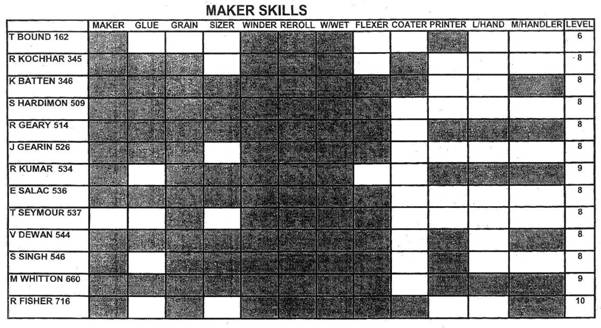
51 The Skills Matrix is a simple representation of whether or not a person was regarded as competent in a particular operation. If competent, the relevant box is shaded, otherwise it is clear. The Coater and Off-line Printer boxes are the fourth last and third last in the table.
52 Prior to 27 September 2006 there were 13 employees in the Maker Division. Three were leading hands. Three persons (none of them leading hands) were competent to operate the Coater. The process of selecting retrenchees in the Maker Division, regardless of who had volunteered, was first to identify persons who were competent to operate either the Coater or the Printer. Excluding those persons from consideration, along with each of the leading hands, restricted the possible retrenchees to four. They were Mr Scott Hardimon, the two applicants (Mr Gearin and Mr Seymour) and Mr Emmanuel Salac.
53 The applicants did not contest that it was legitimate to retain persons competent to operate the Coater. Similarly no issue was taken with the decision to retain leading hands.
54 Three persons volunteered for retrenchment in the Maker Division. They were Mr Kumar, a leading hand, Mr Tony Bound, a level 6 employee and Mr Salac, a level 8 employee. Generally speaking a higher level denoted more experience or training but there was evidence that this was not necessarily so.
55 Mr Bound, it may be seen from the Skills Matrix, lacked skills in 7 areas, as did Mr Seymour. Mr Gearin lacked skills in 5 areas and Mr Salac in 4.
56 Mr Kumar was rejected as a volunteer because he was a leading hand. Mr Bound was rejected as a volunteer in part, at least, because he had competence in the operation of the Off-line Printer. Those selected to be retrenched were Mr Salac and the applicants.
57 The applicants took issue with the use of competence on the Off-line Printer as a criterion for excluding persons, including volunteers, from possible retrenchment. In addition the applicants contested that it was appropriate to make a decision on the basis of a simple checklist of skills without any examination of the quality or depth of skills possessed.
The Respondent’s Evidentiary Case
58 As I mentioned in paragraph 31 above it was not contested that the applicants’ evidence established the elements of their case which fell to them to prove. It is therefore not necessary to deal in detail with the evidence in their case beyond the description of events given earlier.
59 Evidence was given in the proceedings for the respondent by Ms Hobbs, Mr Christopher Davis, the supervisor in the Maker Division, Mr Grbic and Mr Arthur Zafiriou. They each gave evidence by affidavit and orally. Because the respondent had the task of displacing the statutory presumption in s 809 of the WR Act and because the difficulties for its attempts to do so arose in large part from the evidence in its own case it is necessary to refer to the evidence of the respondent’s witnesses in more detail.
Ms Hobbs
60 Ms Hobbs is the respondent’s Human Resources Manager - Pacific. She was present at the meetings on 27 September 2006 during which the applicants were selected for retrenchment. She had earlier conducted the negotiations for a new Certified Agreement which broke down on 8 August 2006.
61 Ms Hobbs denied that the fact the applicants were delegates or members of the NUW played any part in the decision to dismiss them. She traced the history of negotiations. She stated that the respondent was indifferent to the prospect that agreement might not be reached.
62 In preparation for the meeting Ms Hobbs directed that calculations be made of the redundancy entitlements of volunteers. She took the calculations to the meeting with her. Her evidence was that she entered the meeting upon the preliminary assumption that volunteers would be made redundant unless there was a good reason to make a different selection. The direction to make up the redundancy pay of volunteers was contained in an email which became an exhibit in the proceedings.
63 She described the process of the meetings which occurred on 27 September 2006 with respect to each of the divisions. Ms Hobbs did not play any part, on her evidence, in the identification of the criteria to be used to select employees to be retrenched. She depended upon the supervisors in each division and Mr Grbic in that respect.
64 She confirmed that the selection in the Maker Division had been made with the aid of the Skills Matrix prepared and kept by Mr Davis which provided a quick and easy identification of existing skills. The exercise was no more sophisticated than counting up the number of skills possessed, after excluding from retrenchment anybody who had a skill on the Coater or the Off-line Printer.
65 She initially said, in her affidavit, that Mr Salac was the third least skilled person in the Maker Division and in this respect the same as Mr Scott Hardimon, but in her oral evidence she conceded that Mr Hardimon would in fact have been next in line for retrenchment after the applicants.
66 This was one of a number of departures from the affidavit evidence during the course of oral evidence. The significance, for the credit of the witnesses concerned, was not fully explored. However, the possibility that the affidavit evidence was prepared and adopted with insufficient care presented itself on more than one occasion.
67 In her affidavit Ms Hobbs used the term ‘Critical Skills’ on a number of occasions in describing the process of selection that was followed – e.g. ‘To ensure that the company retained the skills needed for viable operations, I met with the relevant supervisors to identify critical skills (Critical Skills)’. The term ‘Critical Skills’ was thereafter used repeatedly. It emerged in her oral evidence that the term ‘critical skill’ was used for the first time in the affidavit. It is not to be found in the Certified Agreement and it was not, apparently, used in the selection process.
68 I regard the technique employed in the affidavit as unsatisfactory. There can be little justification for introducing into an affidavit a term which conveys a highly descriptive meaning when the term is not to be found in the legal instrument which was under consideration (the Certified Agreement) and was not, on the evidence, used in any of the discussions which led to the redundancies. The position is made worse when the term is then adopted as a definition and used repeatedly. The use of such a technique offers a conclusion or judgement which obscures, whether intentionally or not, examination of the real and underlying issues. It is a form of advocacy. It is unsubtle, to say the least.
69 Ms Hobbs had no independent basis for thinking that skills on the Coater or Off-line Printer were critical or even important. She was asked during her evidence whether a skill would be regarded as critical if it could be acquired within a day or two but was unable to say. Her evidence was that she accepted what the supervisor and plant manager said about the importance of particular skills and did not personally know what the position was. She deposed to not even having seen the Skills Matrix before 27 September 2006.
Mr Davis
70 Mr Davis was told by Mr Grbic on 15 September that there would be redundancies. On 18 September Mr Grbic had a meeting with each division in which he informed supervisors that selections for redundancies would be based on skills. However, Mr Davis said that when he entered the meeting on 27 September to select people to be made redundant he didn’t know anything about what restructure was to happen in his division. Mr Grbic had not told him. Neither was there discussion at the meeting itself about what the restructure would involve.
71 At one point in his evidence Mr Davis said that he nominated both the Coater and Off-line Printer skills as ones necessary to retain. Later in his evidence he said he could not recall whether it was he or Mr Grbic who had nominated the Off-line Printer although he was sure that he had nominated the Coater. Ms Hobbs said that Mr Davis had nominated both skills. In his second affidavit Mr Grbic suggested Mr Davis had nominated both skills but in his oral evidence could not recall whether he or Mr Davis had in fact nominated the Off-line Printer, despite the fact that this evidence was given only a day after the second affidavit was sworn.
72 Although the evidence about this aspect was confused and ultimately inconclusive, there is no doubt, as appears later, that it was Mr Grbic who, in July/August, nominated the two skills, the absence of which, would later be used on 27 September 2006 to retrench the applicants.
73 Mr Davis’ acceptance of the use of the Off-line Printer skills as a criterion for retention appears to owe something to his recollection that Mr Grbic had said in an earlier meeting that there had been complaints from Melbourne about the service level and the running of the Off-line printer.
74 Mr Davis agreed with the estimate that training to run the Off-line Printer proficiently could be accomplished within one to two days. There were other aspects of its operation that would require longer to achieve familiarity but overall I understood his evidence to be broadly in accord with that of Mr Kumar so far as the complexity of the operation of the Off-line Printer was concerned – that is, not very complex.
75 As it happened, Mr Gearin, had, on 14 September, asked to be trained on the Off-line Printer on the following day. Mr Davis had deflected him. This request was made at a time shortly before the redundancies were announced. Announcement of the redundancies the following Monday put paid to any prospect that Mr Gearin would receive such training before the selection for retrenchments occurred.
76 Mr Davis in his evidence said that in the meeting on 27 September 2006 there was no discussion about the quality of the skills possessed by individuals. It was simply a matter of counting the boxes in the Skills Matrix. He confirmed, for example, that Mr Seymour was particularly skilled in one essential aspect of the operation. No regard was paid to that. Mr Davis was personally uncomfortable at the prospect that Mr Seymour would be retrenched. He had a high opinion of his skills in the areas in which Mr Seymour was competent.
Mr Grbic
77 Mr Grbic explicitly denied that the applicants were dismissed for any reason connected with the fact they were delegates or union members.
78 Mr Grbic deposed that in about July 2006 he began to prepare a report recommending a reduction in the number of full-time employees. He explained in some detail why he thought that was necessary although according to his evidence he was prompted to form a preliminary view by remarks attributed by Ms Hobbs to the applicants suggesting ‘under-utilisation in the Maker area’. Mr Grbic’s explanation for his preliminary view concentrated upon losses, excess capacity and the need for fewer staff for day to day operations in the Maker Division and his conclusion that a decline in the business of the Bonded Division would make it unable to absorb excess labour capacity of the Maker Division. As will appear, however, his proposal for redundancies ultimately extended across the three production divisions.
79 He said that although he prepared a draft report in July 2006 he no longer had a copy due to his practice of deleting superseded drafts to avoid confusion for himself. At first he proposed 13 redundancies. Finally he recommended ten redundancies, including three positions in the Maker Division.
80 He said the final report was completed in late August 2006. It was submitted to Mr Roger Freeman, the Managing Director of the respondent, for local approval. It was sent to senior executives in Paris for final approval. A copy of the final report and some accompanying and supporting material was annexed to the first of two affidavits which he swore. It bore no date. The report, however, was accompanied by a ‘Request for Authorisation’ which was subsequently countersigned in France by way of approval. The Request for Authorisation is dated 4 August 2006.
81 The report is as follows:
‘Headcount Reduction at the Lidcombe Manufacturing site
Maker Department
The current headcount in the Maker department is 13 operators. We propose to reduce this number by 3 to 10 operators. A new bi-flexer will be installed adjacent to the existing bi-flexer and run with one operator. Both bi-flexers will accommodate 70% of the volume coming off the Maker machine. The water wet machine will no longer have work. The re-roll machine will have greatly diminished workload, processing Nofil sheet material and Garnet material only. The inventory levels in curl correct area have dramatically reduced and thus the workload of the Material Handler role has also reduced. One operator will be able to accommodate the reduced tasks of the material handler and re-roll operator.
The maker operation currently has 8 operational roles. This will be reduced to 7, as we have a 2 roles handling grain. The grain prep man will no longer exist, and the tasks of the grain prep man will be taken up by the grain man and the leading hand of the maker which are in close proximity.
Logic for refusing voluntary redundancies and subsequent selection after voluntary options exhausted are:
• Least skilled operators first but with contingency that they do not leave a gap or minimal coverage in skills. No operator who has competent skills on the Coater and Off line printer should be selected for redundancies. This leaves 3 operators.
Overall reduction of 3 operators from the current 13 operators.
Conversion Department
The current headcount in the conversion department is 19 operators. Several operators are packers the majority of the time and this type of work is very seasonal. We will reduce the headcount by 5 operators, and accommodate peaks in volume throughout the year with casual packers.
Logic for refusing voluntary redundancies and subsequent selection after voluntary operations are exhausted are:
• Least skilled operators first but with contingency that they do not leave a gap or minimal coverage in skills.
Overall reduction of 4 operators from the current 19 operators.
Bonded Department
In 2005, Bonded had a headcount of 14 with approximately 2 casual operators required in short term periods where customer requirements were tight. In 2005 we achieved output of 614 tonne. In the first six months of this year we have only achieved 205 tonne and forecast the same volume in the second half of 2006 and 400 tonne in 2007. With volume decreased by a third we will reduce the headcount by one third to 9 operators.
Logic for refusing voluntary redundancies and subsequent selection after voluntary options are exhausted are:
• Currently we have two leading hands, and will only require one. Reduction of one leading hand.
• Least skilled operators first but with contingency that they do not leave a gap or minimal coverage in skills.
Overall reduction of 3 operators from the current 12 operators.’
(I have emphasised two sentences)
82 As may be seen, the report advances a justification for refusing voluntary redundancies. I infer that this accepts, and was prompted by, the requirement of the Certified Agreement that voluntary redundancies be offered in the first instance. Ms Hobbs confirmed in her evidence that the selection process was arranged with an eye to this requirement.
83 Other features of the report are:
• In each division a criterion for selection for compulsory retrenchments is:-
‘Least skilled operators first but with contingency that they do not leave a gap or minimal coverage in skills’.
• In each department the overall reduction is stated.
• Specific provision is made to accept a reduction of one leading hand in the Bonded Division.
• In the Maker Division specific criteria (which I emphasised in the full report set out above) are given to direct the selection process:-
‘No operator who has competent skills on the Coater and Off line printer should be selected for redundancies. This leaves three operators.’
84 On its face this suggests that after operators with skills on the Coater and Off-line Printer are retained there would be three operators left. That equates with the required reduction. Mr Grbic was asked in cross-examination on a number of occasions about the significance of the sentence – ‘This leave three operators.’ His explanation was that in the earlier draft (no copy of which was retained by him) it appeared in place of the sentence: ‘Overall reduction of three operators from the current 13 operators’. When the amendments were made which are reflected in the final version the earlier sentence was inadvertently retained, out of position, instead of being deleted. I did not understand how this editing process could explain the meaning attributed to this sentence by Mr Grbic.
85 A confusing element is that in fact there were four operators who did not possess skills on either the Coater or the Off-line Printer. Counsel for the respondent relied upon this to suggest that the sentence did not bear the apparent meaning suggested above. The inconsistency must be acknowledged. However, this is not the only place in the report where a numerical inconsistency appears. In the discussion of reductions in the Conversion Division there is firstly a mention of reduction by five operators and subsequently a statement of overall reduction of four operators. In the Bonded Division the proposal to reduce from 12 operators to 9 is described as reducing the headcount by one third, rather than a quarter.
86 Doing the best that I can with the lack of precision in the report I do not accept Mr Grbic’s explanation. In combination with the matters yet to be discussed my view is that Mr Grbic had made at least a preliminary assessment of the result of applying the criteria which he specified and had identified those upon whom the burden of retrenchment would fall as the least skilled operators possessing no skill on the Coater or Off-line Printer. Those operators were the applicants and Mr Scott Hardimon. Mr Hardimon was not retrenched but the reason for that requires explanation and is given later.
87 The reasonableness of Mr Grbic’s nomination, in his report, of skills in the operation of the Off-line Printer as a criterion for retention, and its use later on 27 September when people were actually selected for redundancy, was the subject of some attention in the proceedings. It was urged upon me by counsel for the respondent that it was not the function of the Court to pass upon the adequacy of a reason for dismissal, or factors which contributed to it, provided those reasons or factors were real ones. I accept that in many cases this might be an appropriate position to take. However, in the present case, one possibility which arises is that the use of the Off-line Printer criterion was not genuine but, rather, calculated to produce a selection of persons for retrenchment which included the applicants.
88 Attached to Mr Grbic’s report was some supporting material. A small amount of it was prepared by him and set out the current employees in each division and a statement of proposed roles after redundancies had been effected. Some of the material was prepared by, or for, Mr Arthur Zafiriou, the General Manager, Commercial Operations for the respondent based in Victoria. A good deal of the extra material concerned expected costs and returns consequent upon the proposed restructure. Prudently, Mr Zafiriou stated the assumptions upon which many of the calculations and estimates were made. The calculations enabled him to project annual savings of $520,921. When compared to an overall capital cost of the restructure of $733,509 they yielded a further calculation that the costs would be met in 1.408 years. It was accepted by him and by Mr Grbic that those approving the proposal would regard such matters as important.
89 A large proportion of the total capital cost – $603,509 – was attributed to the cost of redundancy payments. The figure is precise. The calculations which produced it were, if anything, even more precise. They were not accompanied by any statement that they were estimates or approximations or were based on assumptions.
90 The calculation of the figure of $603,509 was made in a table attached immediately beneath Mr Grbic’s report. It was the first supporting document. The table calculated the entitlements of ten employees. Although the employees are not named and nor is their employee number given it became apparent in the proceedings that it is possible, by reference to their years of service, salary and accrued sick leave (all of which were set out in the table), to identify who they are.
91 As mentioned, the table calculated redundancy payments for ten employees. It was accepted by the respondent that the table definitely identified eight of the persons who were retrenched on 27 September 2006. A ninth was said to be incapable of precise identification because there were two persons with the identified years of service. However, counsel for the applicants argued that by reference to other exhibits it was possible to match years of service and sick leave entitlements to one person only and to demonstrate a mismatch of salary with respect to the other. Accordingly, they argued, the ninth person could also be identified. The analysis appears to be sound. The ninth person so identified was also retrenched.
92 The tenth person, who may also be identified precisely from the table, is Mr Hardimon but he was not retrenched. Counsel for the respondent suggested that invalidated the proposition there was an unexplained coincidence between the table and the retrenchments. I do not agree.
93 Mr Hardimon was identified in the meeting on 27 September 2006 as the person next in line for retrenchment after Mr Seymour and Mr Gearin according to the criteria which had been identified by Mr Grbic in his report and which were used on 27 September 2006. However Mr Salac, a fourth person with neither Coater nor Off-line Printer skills, volunteered for redundancy and, satisfying the criteria, was allowed to depart with his redundancy package. Had that not been allowed to happen Mr Hardimon would have been retrenched.
94 In the Maker Division, therefore, putting aside Mr Salac’s voluntary departure, the table prepared by Mr Zafiriou produced an accurate prediction in early August of selection criteria actually implemented on 27 September 2006.
95 A similar position arose in the other divisions. In the Bonded Division 3 positions were to become redundant. John Woodyatt and Ivan Jagessar volunteered for redundancy. Mr Jagessar was not accepted. Mr Woodyatt and Aisake Bukailidi were identified as the two least skilled employees in the division. In his report Mr Grbic had forecast a reduction of one leading hand. Mr Steve Crandell was selected. These three employees, each in their own categories the least skilled, were the same employees whose entitlements were calculated by Mr Zafiriou in his table.
96 In the Conversion Department there were a number of volunteers including Ms Gayle Eades. Ms Eades was medically unfit to work on machines and, according to Mr Grbic’s evidence, did only packing work. She was allowed to go. The next three employees selected as least skilled were Luz Roberto, Zora Cerovac and Madhu Jagessar. They were not volunteers. They were retrenched in preference to the other volunteers. Each of the four persons selected for retrenchment correspond to those whose entitlements were calculated in Mr Zafiriou’s table.
97 Clearly, Mr Zafiriou, in early August, analysed and calculated the entitlements of ten persons who either were (or in the case of Mr Hardimon would have been) selected for redundancy on 27 September 2006. The resulting calculation was used as an exact dollar figure in presenting the cost of the restructure to executives in Paris. No suggestion was made that the figure was uncertain or subject to any qualification or based on assumptions.
98 Mr Grbic’s second affidavit was sworn after the first two days of hearing and the day before the matter resumed on 27 October 2006. Amongst other things he set out to deal with the issues which had been raised about Mr Zafiriou’s table. He denied providing to Mr Zafiriou any data or material which might have formed the basis for the preparation of the table. He said that he did not turn his mind to who the employees depicted in the table might be. The effect of his evidence is that it was simply coincidence that the table so accurately forecast those who would be selected for retrenchment or, in the case of Mr Hardimon, escape that fate by a narrow margin.
99 Mr Grbic also gave evidence about why no account was taken of the possibility that employees might within a short time, acquire skills such as those required for the Off-line Printer.
100 In his second affidavit he said: ‘If the test was not the skills that employees actually had, but was instead the skills that they had or might by training acquire in the future, then the test would be robbed of any practical significance – because every employee could obtain the skills that they did not then have.’
101 He deposed to saying to Mr Meaney, on 27 September 2006, after the selections had been made: - ‘we selected employees on the basis of the current skills, not on the skills that might be obtained in the future. It was a snapshot of what we had right now – here and now.’
102 The reasonableness of this position was, as I indicated earlier, submitted to be outside the matters for my consideration.
Mr Zafiriou
103 Mr Zafiriou prepared his affidavit to explain the circumstances in which the financial material attached to Mr Grbic’s report was prepared. That was done after the first two days of hearing. He said that he did not have regard to the identity of any particular employee. Rather, he selected a few employees with more than 30 years service, one with a very low period of service and the remainder with ten to 20 years service to give a reasonably representative picture across the whole of the workforce. According to his evidence the fact that the employees selected by him corresponded so closely to those who were considered for and largely selected for retrenchment on 27 September 2006, almost two months later, was pure coincidence.
104 When I drew his attention to the assumptions which he had stated in connection with a good deal of the financial material and asked him why no such assumptions, or indeed qualifications of any sort, appeared in relation to the precise calculations that had yielded his figure of $603,509 I found his answers confusing and unhelpful. The lack of any indication to the reader of the financial material accompanying Mr Grbic’s report that the table was merely representative, the precision of the figure advanced as the total cost of redundancy payments and the fact that the material was being submitted to senior management in Paris as a foundation for the authorisation of expenditure reinforced in my mind the possibility, at least, that Mr Zafiriou’s selections were much more deliberately and advisedly made than he was prepared to disclose.
Probability Theory
105 Faced with the emerging difficulty of the unexplained coincidence between Mr Zafiriou’s table and the identity of those actually selected for retrenchment, counsel for the respondent urged upon me that Mr Zafiriou’s evidence, referred to earlier, about the representative sample explained how it was not impossible that a selection could be made which corresponded with the final outcome. It was submitted that I should avoid dabbling in probability theory or statistical analysis. The submission was, in the circumstances, not surprising. It was a legitimate attempt to quarantine the area of greatest danger for the respondent’s case. I was referred in support of the submission to R v GK (2001) 53 NSWLR 317 and, in particular, to observations by Mason P in [24] to [28] at pages 323-4.
106 I do not find the passages cited by counsel to be of much assistance in the present case although they touch upon an interesting aspect of the requirements of proof, particularly in criminal trials.
107 R v GK was a case concerning evidence in relation to DNA analysis. The two specific questions in the case concerned whether a trial judge had been correct to leave to a jury expert evidence about paternity index and relative chance of paternity. In the result the New South Wales Court of Criminal Appeal found that the trial judge had erred in not allowing the first category of evidence to be put before the jury but had correctly concluded that evidence in the second category should be kept from the jury. There are interesting discussions of the reason for the rejection of Bayes Theorem and of the ‘prosecutor’s fallacy’. Underpinning discourse in this area is a concern that juries may not understand the non-inclusionary nature of statistical evidence, particularly DNA statistics.
108 In the present case the problem for the respondent is in persuading me that the striking concurrence between the calculations in Mr Zafiriou’s table and the selection of those who were ultimately retrenched (or almost retrenched) should have no bearing upon my conclusion whether the respondent has displaced the legislative presumption.
109 Counsel for the applicants suggested that common sense denied the likelihood of such a close correspondence as a pure coincidence. I agree. I cannot accept the submission that I should simply put the matter aside and am bound to accept the bland assertions from Mr Grbic and Mr Zafiriou that it was just coincidence.
The Selection Criteria in the Maker Division
110 One possible view of the procedure required under clause 22 of the Certified Agreement is that redundancy packages should normally be available to volunteers unless their retrenchment may legitimately be denied by a real need to retain their individual skills. Accommodating the wishes of the volunteers also has benefits for those who risk being retrenched in their place.
111 The exception to accommodating the wishes of volunteers depends upon a value judgement about the ‘skills required to maintain the company’s future commercial viability’ (clause 22). Similarly, in the event that compulsory retrenchments are required, the judgement to be made concerns ‘skills required to maintain the company’s future viability’ (clause 22).
112 A simple counting of listed competencies, conducted on a ‘snap shot’ basis, without regard to the depth of particular skill, may be argued not to meet either requirement.
113 More specifically, it may be doubted whether rejection of volunteers or selection of retrenchees by reference to the possession or non-possession of a skill which takes only a matter of days to acquire, so far as the essential operational aspects are concerned, meets the test posited by clause 22 of the Certified Agreement.
114 As observed earlier, the question of compliance with the Certified Agreement does not directly arise for resolution in the present proceedings. Had there been no other issue which threw the respondent’s explanation of its reasons into doubt I would have been inclined to accept that it was not destructive of the respondent’s case that a basis for selection for dismissal appeared, to an outsider at least, to be in some respects capricious and unsubstantial if it otherwise appeared to be genuine. The context in which the use of the Off-line Printer criterion is viewed changes, however, when the use of that criterion is considered together with other matters which cast doubt upon the veracity of the respondent’s explanation.
115 One curiosity, arises from the fact that Mr Grbic had decided by July that the Off-line Printer skill would be important in the redundancy process. He said in his evidence that he had earlier encouraged Mr Davis to train more persons on the Off-line Printer but there is no suggestion that he communicated to Mr Davis the connection between that encouragement and the use which might be made of Off-line Printer skills in a selection process for redundancy. If it was necessary to be discreet, an accelerated training program on a machine which is not complex in its operation could readily have been explained by reference to Mr Grbic’s concerns that turn-around times were inadequate and leading to complaints from Melbourne.
116 The existence of a larger pool of persons with skills on the Off-line Printer, apart from being operationally beneficial regardless of whether retrenchments were carried out, would have allowed some greater level of discrimination about the quality of skills possessed and perhaps, as the Certified Agreement contemplated, some reference to length of service. Objectively speaking, despite Mr Grbic’s evidence, the lack of any real urgency about training persons on the Off-line Printer seems to be indicated by the fact that, in a training program being discussed as part of the Certified Agreement negotiations, dates were fixed for training of individuals on the Off-line Printer as far away as 2008.
117 Although the question of compliance with the Certified Agreement does not arise, the arbitrary and simplistic nature of this criterion, and of the use of the Skills Matrix, does not assist the respondent in any endeavour to suggest an objective and realistic foundation for the selection process which excludes union-based prejudice against the applicants. Indeed in the context of the uncertainty generated by the matters discussed earlier, it adds to the doubts and my lack of conviction about the respondent’s position.
Who were the Decision-Makers?
118 I am satisfied that the decision-makers in this case were Ms Hobbs and Mr Grbic.
119 Although Ms Hobbs gave evidence that Mr Freeman, the Managing Director of the respondent, was kept informed of the progress of the retrenchment procedures and gave final approval for the retrenchments themselves, there is no evidence that he was involved in the selection of those retrenched – that was left to local management with Ms Hobbs’ assistance.
120 Ms Hobbs said in her evidence that she was the person with the authority to make the decision to dismiss. I am satisfied that she was one of the decision-makers and that her concurrence was required to the retrenchments of the applicants.
121 However, it was clear that she relied on the judgements of Mr Grbic and Mr Davis in the discussion about who to retrench. She had no personal knowledge of the suggested skill requirements or the skills possessed by individuals. She had entered the meeting with the preliminary view that the volunteers would be first in line to be retrenched. She had directed that the final pays of the volunteers in the Maker Division be made up the day before the meeting.
122 Despite my concerns about the way Mr Hobbs’ affidavit evidence was prepared I accept her evidence that when she contributed to the decision to dismiss the applicants she did not do so for the reason that they were either delegates or union members. Directing the calculation of entitlements of Messrs Bound and Kumar, along with Mr Salac, before the meeting would have been quite unnecessary if Ms Hobbs had a predetermined position about the selection issue.
123 Mr Davis did not explicitly depose that the fact that the applicants were delegates and members of the NUW played no part in their dismissal. However, in my view Mr Davis was not a decision-maker in the relevant sense. Although he contributed to the selection of the applicants for retrenchments by reference to the Skills Matrix which he had prepared, in my view he did not set the parameters of the discussion. He responded to questions by Ms Hobbs and Mr Grbic. His acceptance of the outcome was a recognition of the inevitable.
124 In any event, I do not think any contribution he made was influenced by the fact that the applicants were union delegates or union members. I do not regard the fact that he did not explicitly deny delegateship or membership as a reason for dismissal as critical in the circumstances.
125 I am satisfied that Mr Grbic was an active participant in the decision to retrench the applicants and that his reasons for doing so are to be attributed to the respondent. The respondent needed to prove that those reasons did not include the fact that the applicants were delegates and members of the NUW. His evidence does not achieve that result, despite his sworn denial.
The Presumption is not Displaced
126 The respondent’s task, in the light of s 809, is to displace the legislative presumption that it has acted for a reason which contravenes the WR Act. In my view the presumption has not been displaced in this case.
127 I am not persuaded that there is no relationship between the financial analysis carried out on Mr Grbic’s proposed basis for selection in July/August 2006 and the subsequent selection of persons for retrenchment on 27 September 2006. Neither have I been persuaded that the possibility of such a relationship is irrelevant to the matter under consideration.
128 I am conscious of the fact that Mr Grbic and Mr Zafiriouo each swore that there was no relationship between the contents of documents prepared by them for Mr Grbic’s report and the retrenchments which were carried out on 27 September, 2006. They said it was just coincidence that Mr Zafiriou’s table so accurately forecast the retrenchments (and Mr Hardimon’s near miss). I am not persuaded that is so.
129 In the light of these reservations I am not prepared to accept the balance of Mr Grbic’s evidence at face value. His explicit denial of delegateship or membership as a reason for retrenchment is insufficient to prove this aspect of the respondent’s case.
130 Furthermore, it becomes much more difficult to accept that the nomination of the Off-line Printer Skill and the use of the Skills Matrix to assess what was necessary for the respondent’s future operations is beyond question.
131 Having regard to my concerns about the respondent’s explanation of its ‘real reasons’ questions arise with a much sharper focus about whether the apparently flimsy selection of Off-line Printer skills as a vital determinant should be accepted by me as simply a business judgement regardless of lack of apparent substance. Questions more readily arise about whether the nomination of Off-line Printer skills may have served, from the beginning, as a convenient mechanism to achieve the selection of, at least, the applicants for retrenchment.
132 Similarly questions arise about the use of the Skills Matrix as a tool for the assessment of skills in place of a more discerning examination of the depth of particular skills and the way in which they contribute to the efficient discharge of the company’s business including the question of its future commercial viability.
133 It is ultimately not necessary to attempt to say where the truth really lies on each of these issues. Had the applicants borne the onus in this case of positively establishing a prohibited reason for dismissal it is doubtful that they could have discharged it notwithstanding the matters to which I have referred. But they do not. It is the respondent which must discharge the presumption directed by the WR Act by proving that the fact that the applicants were delegates or members of an industrial organisation was not a reason for their dismissal. It need only be proved on the balance of probabilities but it must be proved at least to that standard.
134 In the end, the doubts raised in my mind by the matters to which I have referred do not permit me to conclude that the respondent has proved its case and the presumption has been rebutted.
135 It is not necessary to make a distinction in this case between membership and delegateship. Even though there is scant material available to the applicants, if they bore the onus, to suggest that union membership as such played any part in their dismissal, there is some. The respondent has failed to displace the legislative presumption as to the reason for dismissal of the applicants. The consequence flows equally to the issue of union membership as it does to delegateship.
136 In all the circumstances I find that the respondent has not proved, as required by s 809 of the WR Act, that the applicants were not dismissed because they were delegates or members of an industrial organisation. The applicants are, as a result, entitled to relief.
Relief
137 During the course of the proceedings I raised with counsel for the applicants the interaction between the various claims for relief contained in the Application. It was made clear to me that the applicants, first and foremost, sought reinstatement to their former positions and payment of wages lost by them as a result of their dismissal. They each gave unchallenged evidence that they remain unemployed.
138 As an alternative to reinstatement the applicants seek some form of compensation but their primary desire is the return of their employment. I can see no reason why that should be denied to them.
139 The respondent gave some evidence that it did not have room in its workforce for the applicants to return. If that is so, then the respondent will be able to address that issue in a proper way if the applicants return. It does not provide a reason why an order for reinstatement should be withheld as a matter of discretion.
140 The applicants must understand of course that, in the event they take up their former employment, the respondent’s position is that there is not enough work for an expanded workforce. Somebody may have to go. It may be them. Reinstatement is not a guarantee of continuing employment.
141 Counsel for the respondents suggested that any order for reinstatement should be conditional upon repayment of the severance pay to each applicant. Counsel for the applicants accepted that such a condition was appropriate and I will include it in the orders to be made.
142 One of the claims for relief made in the Application is for an order that there be no contravention or further contravention of s 792 of the WR Act. I am not prepared to make such an order in this case, the effect of which would be to graft onto the requirements in the WR Act the possibility of proceedings for contempt upon breach of an order of the Court.
143 A further order which is sought is the imposition of penalties. It is accepted that, if a contravention is proved, it would be appropriate to have a further hearing at which the respondent could, if it wishes, lead evidence about the question of penalty.
Resulting orders
144 In this case I find that the respondent has contravened s 792 of the WR Act. I will make a declaration to that effect.
145 I will order that the applicants be reinstated to their employment with effect on and from the date of their dismissal conditional upon repaying to the respondent the net amount of severance pay which each received. They are to receive credit for the net amount of wages which would have been due to them in accordance with the rosters being worked by them at the time of their dismissal. The respondent will need to make an appropriate adjustment of tax. Service is to be regarded as continuing and unbroken.
146 The hearing will be adjourned to a date to be fixed to hear evidence and submissions on the question of whether, in the light of these Reasons, a penalty should be imposed and, if so, the amount of such penalty.
|
I certify that the preceding one hundred and forty-six (146) numbered paragraphs are a true copy of the Reasons for Judgment herein of the Honourable Justice Buchanan. |
Associate:
Dated: 8 November 2006
|
Counsel for the Applicant: |
Mr R Reitano and Mr A Joseph |
|
|
|
|
Solicitor for the Applicant: |
Slater & Gordon |
|
|
|
|
Counsel for the Respondent: |
Mr I M Neil SC and Mr T Saunders |
|
|
|
|
Solicitor for the Respondent: |
Deacons |
|
|
|
|
Date of Hearing: |
19, 20, 27 & 30 October 2006 |
|
|
|
|
Date of Judgment: |
8 November 2006 |


