FEDERAL COURT OF AUSTRALIA
Elbe Shipping SA v The Ship “Global Peace” [2006] FCA 954
ADMIRALTY AND MARITIME JURISDICTION – Jurisdiction to hear in rem proceeding – discussion of s 15 of the Admiralty Act (proceeding on a maritime lien), of the nature of the general maritime claim in s 4(3)(a), (b), (d), (j) and (k) of the Admiralty Act, of jurisdiction under ss 9 and 10 of the Admiralty Act, and of the associated jurisdiction in s 12 of the Admiralty Act
Constitution s 76(iii)
Admiralty Act 1988 (Cth) Part, II & III, ss 4, 5, 9 to 13, 14 to 19
Protection of the Sea (Civil Liability) Act 1981 (Cth) ss 7 and 8
Admiralty Rules rule 18
Australian Securities and Investments Commission v Edensor Nominees Pty Ltd (2001) 204 CLR 559 referred to
Baltic Shipping Co Ltd v Pegasus Lines SA [1996] 3 NZLR 641 referred to
Blunden v Commonwealth (2003) 218 CLR 330 referred to
Braverus Maritime Inc v Port Kembla Coal Terminal Ltd (2005) 148 FCR 68 referred to
Bray v F Hoffman-La Roche Ltd (2003) 130 FCR 317 referred to
Burrard Towing Co v Reed Stenhouse Ltd (1996) 19 BCLR (3d) 391 referred to
City of Charleroy v Bittern (1923) 14 LlL Rep 302 referred to
Currie v McKnight [1897] AC 97 discussed
Cyber Sea Technologies Inc v Underwater Harvester Remotely Operated Vehicle Serial (2000) 1 FC 569 referred to
De Lovio v Boit 7 F.Cas 218 (1815) discussed
Fournier v The Ship ‘Margaret Z’ [1999] 3 NZLR 111 referred to
Good v The London Steamship Owners’ Mutual Protecting Association (1871) LR 6 CP 563 referred to
Hayn v Culliford (1878) 3 CPD 410 referred to
John Sharp and Sons Ltd v Ship ‘Katherine Mackall’ (1924)34 CLR 420 referred to
McIlwraith McEachern Ltd v Shell Co of Australia Limited (1945) 70 CLR 175 referred to
Nagrint v The Ship ‘Regis’ (1939) 61 CLR 688 discussed
Owners of ‘Shin Kobe Maru’ v Empire Shipping Co Inc (1994) 181 CLR 404 discussed
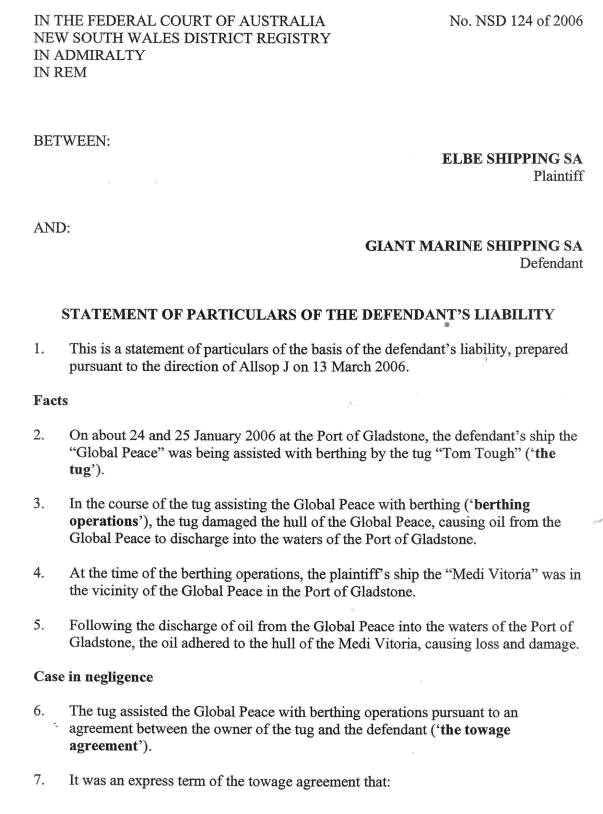
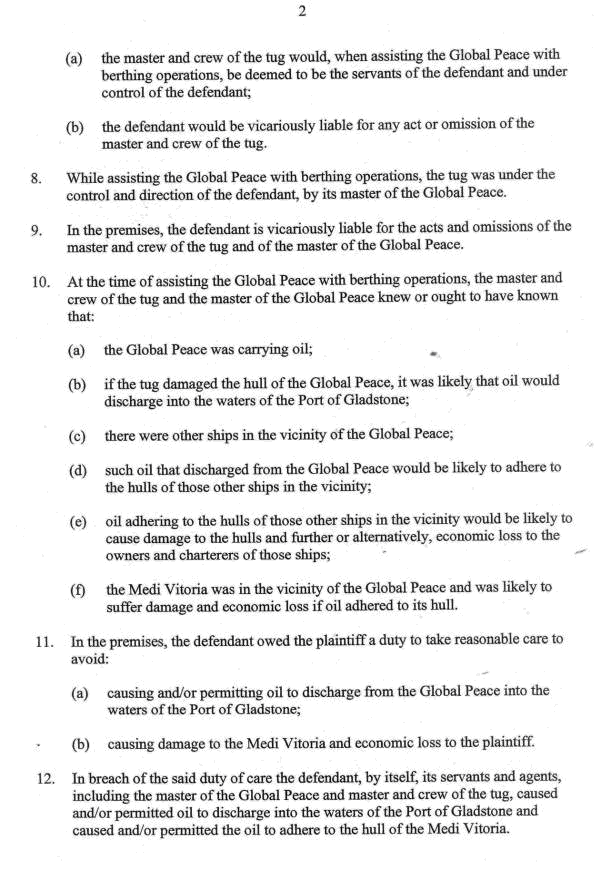
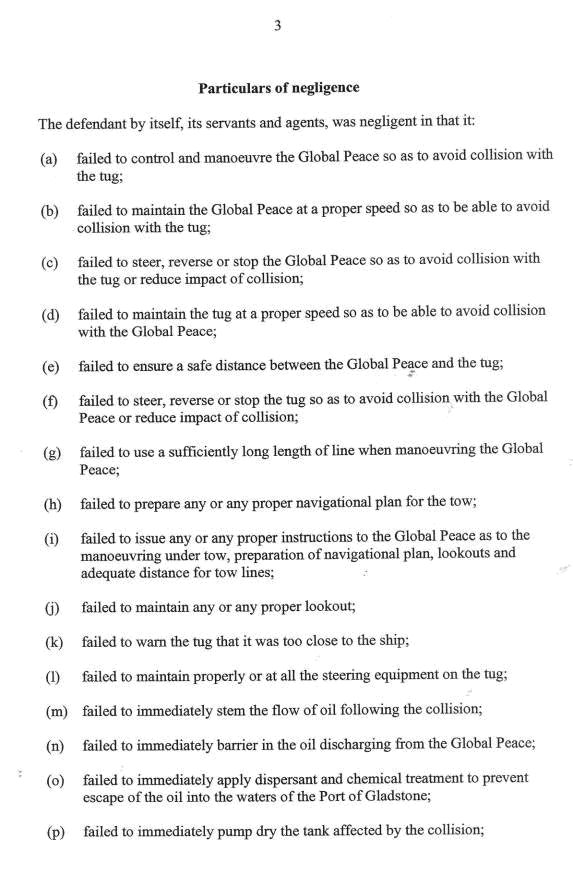
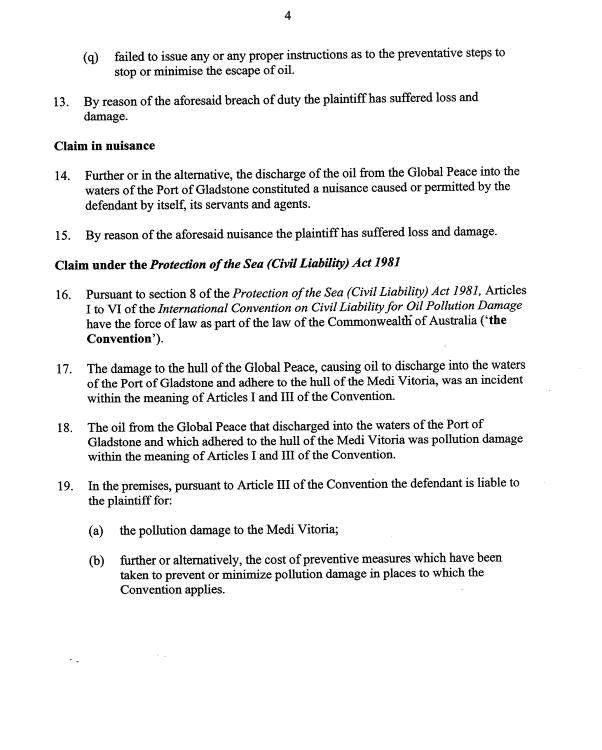
Owners of SS Kalibia v Wilson (1910) 11 CLR 689 referred to
Parisienne Basket Shoes Pty Ltd v Whyte (1938) 59 CLR 369 discussed
PCS Operations Pty Ltd v Maritime Union of Australia (1998) 153 ALR 520 referred to
Philip Morris Inc v Adam P Brown Male Fashions (1981) 148 CLR 457 referred to
Polpen Shipping Co v Commercial Union Assurance Co Ltd [1943] 1 KB 151 referred to
Scandinavian Bunkering AS v The Bunkers on Board the Ship FV ‘Taruman’ [2006] FCAFC 75 referred to
State Government Insurance Office (Qld) v Crittenden (1966) 117 CLR 412 referred to
State Government Insurance Office (Qld) v Rees (1979) 144 CLR 549 referred to
The ‘Acrux’ [1965] P 391 referred to
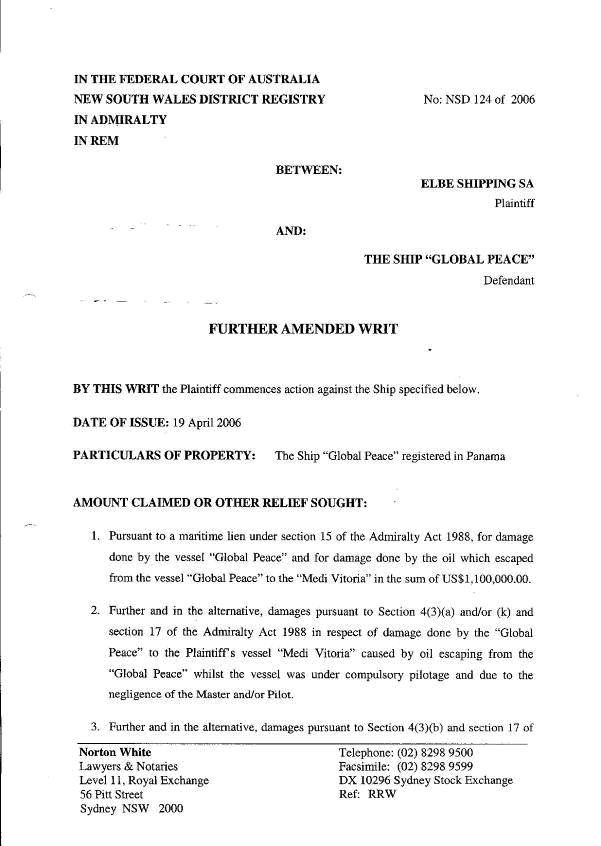
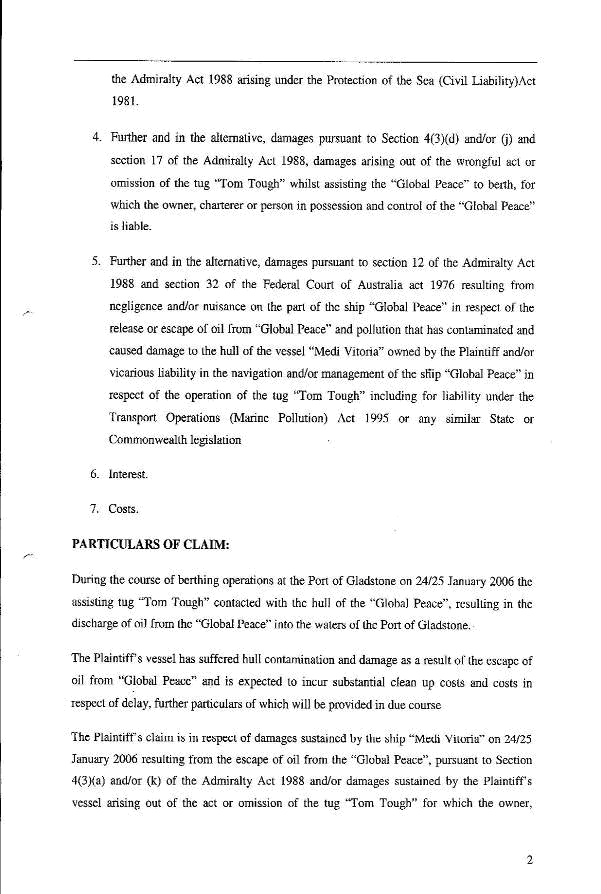
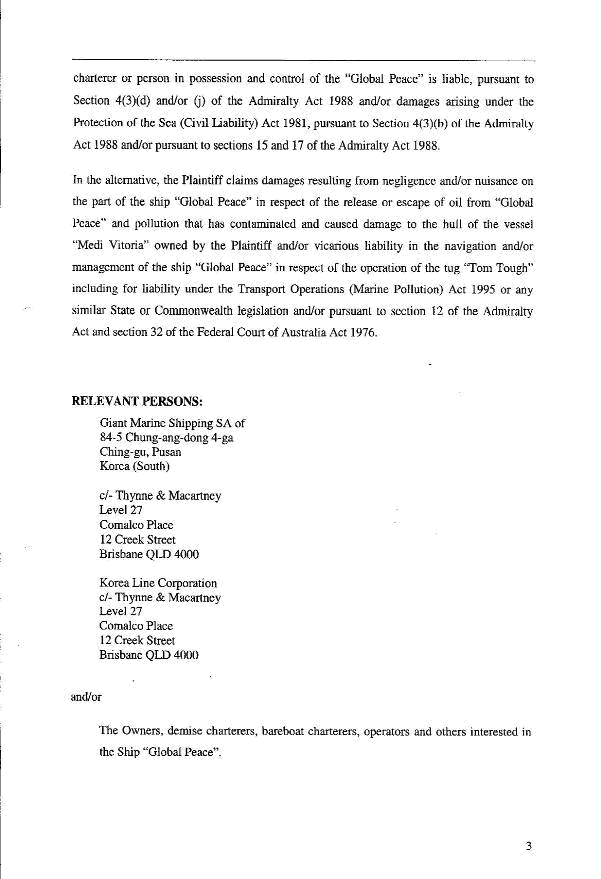
The ‘Alexandrea’ [2002] 3 SLR 56 referred to
The ‘Antonis P Lemos’ [1983] 2 Lloyd’s Rep 310 referred to
The ‘Bass Reefer’ (1992) 37 FCR 375 referred to and doubted in one respect
The’Champion’ [1932] P 1 referred to
The ‘Edinburgh Castle’ [1999] 2 Lloyds Rep 362 referred to
The ‘Eschersheim’ [1976] 2 Lloyd’s Rep 1 discussed
The ‘Halcyon Isle’ [1981] AC 221 referred to
The ‘Harlow’ [1922] P 175 referred to
The ‘Lord’ v Newsum Sons & Co [1920] 1 KB 846 referred to
The ‘Mac’ (1882) 7 PD 126 referred to
The ‘Minerva’ [1933] P 224 referred to
The ‘Oceanic Grandeur’ (1972) 127 CLR 312 referred to
The ‘Princess Alice’ (1849) Wm Rob 138; 166 ER 914 cited
The ‘Rama’ [1996] 2 Lloyd’s Rep 281 discussed
The ‘Shin Kobe Maru’ (1991) 32 FCR 78 discussed
The ‘Shin Kobe Maru’ (1992) 38 FCR 227 discussed
The ‘St Elefterio’ [1957] P 179 referred to
The ‘St Merriel’ [1963] P 247 referred to
The ‘Sydney Sunset’ [2001] FCA 210 referred to
The ‘Tian Sheng No 8’ [2000] 2 Lloyd’s Rep 430 referred to
The ‘Vera Cruz’ (No 2) (1884) 9 PD 96 discussed
The ‘Warkworth’ (1884) 9 PD 145 referred to
The Owners of the Motor Vessel ‘Iran Amanat’ v KMP Coastal Oil Pte Limited (1999) 196 CLR 130 referred to
The Queen v Gray: Ex parte Marsh (1985) 157 CLR 351 referred to
Tisand Pty Ltd v the Owners of the Ship MV Cape Moreton (Ex Freya) (2005) 143 FCR 43 referred to
The ‘Moschanthy’ [1971] 1 Lloyd’s Rep 37 applied
Westpac Banking Corporation v Paterson (2001) 187 ALR 168 referred to
International Convention for the Unification of Certain Rules Relating to the Arrest of Sea-Going Ships
International Convention on Civil Liability for Oil Pollution Damage
Australian Law Reform Commission Report on Civil Admiralty Jurisdiction Report No 33
Harrison Moore The Constitution of Australia
Lugenbuhl, C and Sharpe, D “The Law of Towage at the Millenium: What Changes Are Needed” (1999) 73 Tulane Law Review 181
Price, G The Law of Maritime Liens (Sweet & Maxwell 1940)
Toh, KS Admiralty Law and Practice (Butterworths Asia, 1998)
Zines Cowen and Zines’s Federal Jurisdiction in Australia (Federation Press, 3rd Ed 2003)
Zelling J 1981 FS Dethridge Memorial Address “Of Admiralty and Maritime Jurisdiction” Dethridge Memorial Addresses 1977-1988 (Maritime Law Association of Australia and New Zealand, 1989) also found in (1982) 56 ALJ 101
ELBE SHIPPING SA v THE SHIP “GLOBAL PEACE”
NSD 124 OF 2006
SQ MARINE SA v THE SHIP “GLOBAL PEACE”
NSD 125 OF 2006
ALLSOP J
2 AUGUST 2006
SYDNEY
| IN THE FEDERAL COURT OF AUSTRALIA |
|
| NEW SOUTH WALES DISTRICT REGISTRY | NSD 124 of 2006 |
| BETWEEN: | ELBE SHIPPING SA PLAINTIFF
|
| AND: | THE SHIP “GLOBAL PEACE” DEFENDANT
|
| JUDGE: | ALLSOP J |
| DATE OF ORDER: | 2 AUGUST 2006 |
| WHERE MADE: | SYDNEY |
THE COURT ORDERS THAT:
The motion of the defendant filed on 22 March 2006, including the question of the costs to date be adjourned for further hearing to a date to be fixed.
Note: Settlement and entry of orders is dealt with in Order 36 of the Federal Court Rules.
| IN THE FEDERAL COURT OF AUSTRALIA |
|
| NEW SOUTH WALES DISTRICT REGISTRY | NSD 125 of 2006 |
| BETWEEN: | SQ MARINE SA PLAINTIFF
|
| AND: | THE SHIP “GLOBAL PEACE” DEFENDANT
|
| JUDGE: | ALLSOP J |
| DATE OF ORDER: | 2 AUGUST 2006 |
| WHERE MADE: | SYDNEY |
THE COURT ORDERS THAT:
The motion of the defendant filed on 22 March 2006, including the question of the costs to date be adjourned for further hearing to a date to be fixed.
Note: Settlement and entry of orders is dealt with in Order 36 of the Federal Court Rules.
| IN THE FEDERAL COURT OF AUSTRALIA |
|
| NEW SOUTH WALES DISTRICT REGISTRY | NSD 124 of 2006 |
| BETWEEN: | ELBE SHIPPING SA PLAINTIFF
|
| AND: | THE SHIP “GLOBAL PEACE” DEFENDANT
|
| IN THE FEDERAL COURT OF AUSTRALIA |
|
| NEW SOUTH WALES DISTRICT REGISTRY | NSD 125 of 2006 |
| BETWEEN: | SQ MARINE SA PLAINTIFF
|
| AND: | THE SHIP “GLOBAL PEACE” DEFENDANT
|
| JUDGE: | ALLSOP J |
| DATE: | 2 AUGUST 2006 |
| PLACE: | SYDNEY |
REASONS FOR JUDGMENT
Introduction
1 On 27 January 2006, three writs were filed in the Court commencing in rem actions against the ship Global Peace under Part III of the Admiralty Act 1988 (Cth) (the ‘Act’).
2 The three writs were commenced by three different, and unrelated foreign entities (except as to the coincidence of factual circumstance giving rise to the claims): Elbe Shipping SA, the owner of the ship Medi Vitoria; SQ Marine SA, the owner of the ship Nord Stream; and Thor Nereus Shipping Co Ltd, the owner of the ship Chengtu. I will refer to these three proceedings as the Elbe Shipping proceeding (being NSD 124/2006), the SQ Marine proceeding (being NSD 125/2006) and the Thor Nereus proceeding (being NSD 126/2006).
3 On 26 April 2006, I granted leave to discontinue the Thor Nereus proceeding and I ordered that the plaintiff pay the defendant’s costs up to and including 17 March 2006. I also released the security that had been provided after the arrest of Chengtu. (It may be of no moment, but the transcript of that day records that the proceeding was “dismissed”. The motion filed by the plaintiff was for discontinuance. That was what was intended in the order that I made.)
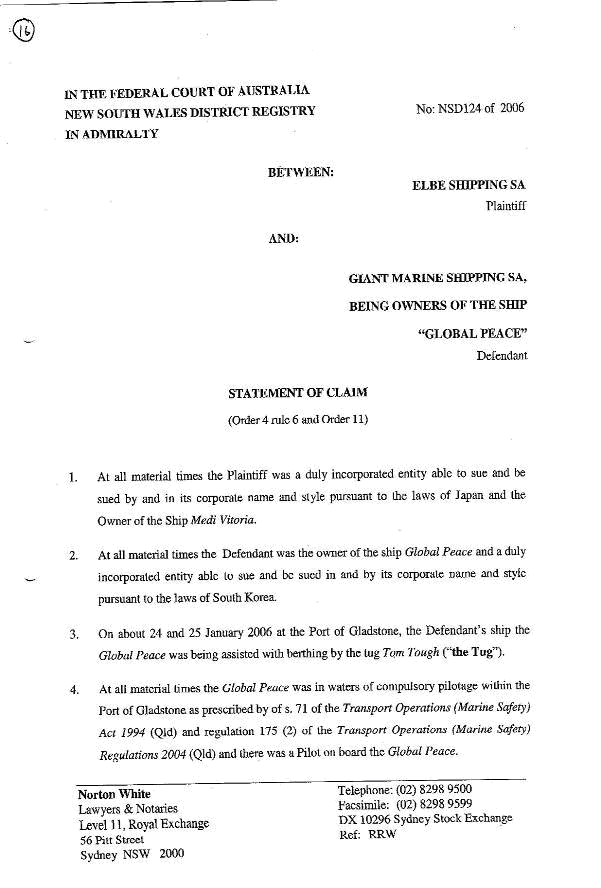
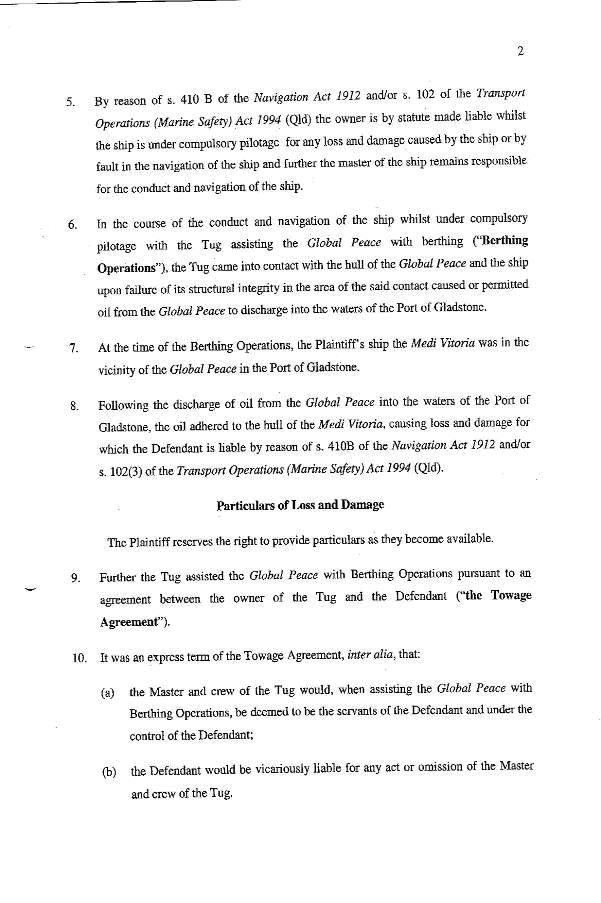
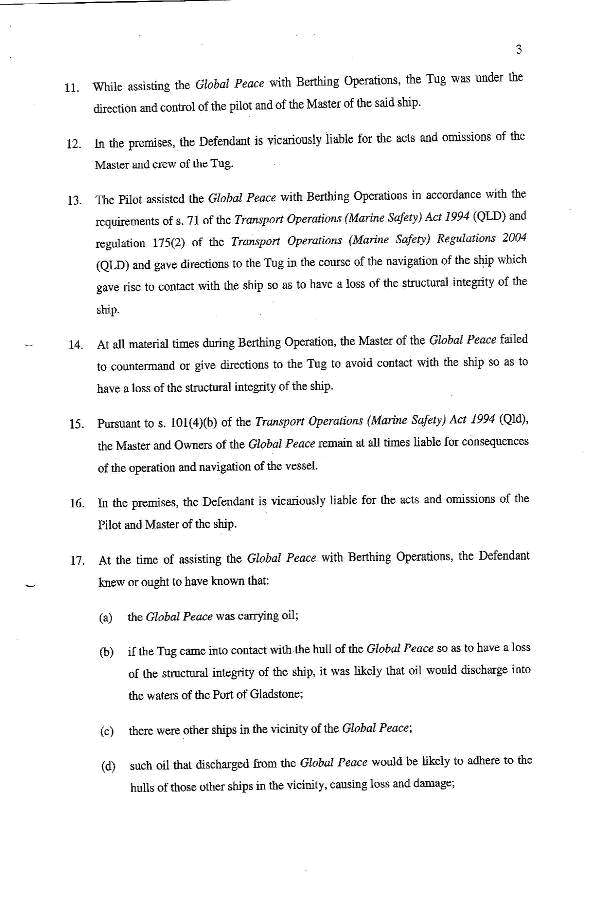
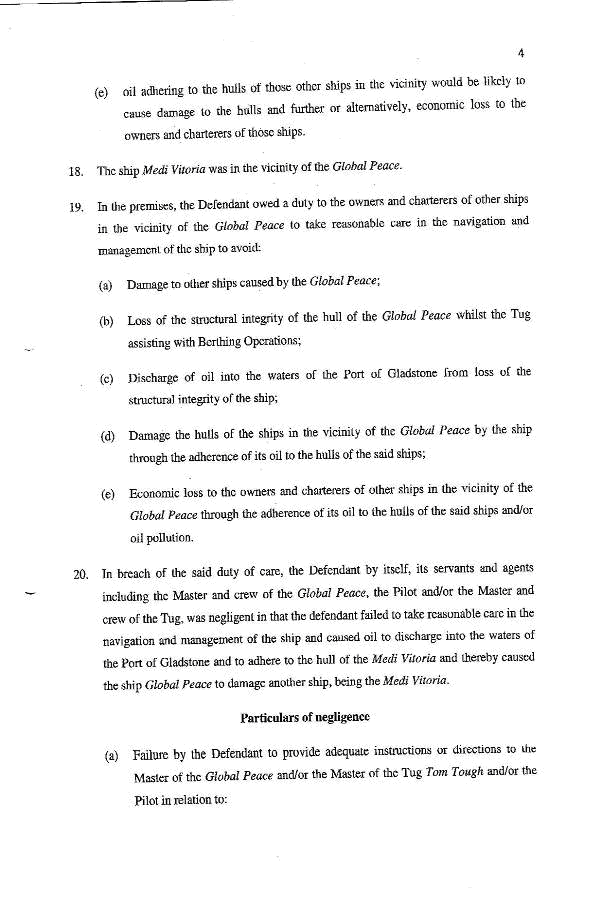
4 The three (now two) proceedings arose out of events that occurred at about midnight on 24 January 2006 or a little thereafter. The following is taken from the affidavit of Mr Robert Wilson, the solicitor for the respective plaintiffs, in support of an application for an arrest warrant in the Elbe Shipping proceeding. All four ships, Global Peace, Medi Vitoria, Nord Stream and Chengtu are ships that were at the port of Gladstone at the time. For present purposes, the details of the respective commercial arrangements concerning the ships are irrelevant. At about midnight on 24 January, Global Peace was being assisted to berth by a tug, Tom Tough. Some part of Tom Tough came into contact with the hull of Global Peace and as a result of that contact the hull or side-plating of Global Peace was damaged causing approximately 25 tonnes of oil to escape from Global Peace into the waters of the Port of Gladstone. Medi Vitoria was berthed adjacent to, and astern of, Global Peace whenthe escape of oil occurred. Medi Vitoria’s hull was fouled with oil. Nord Stream was also at an adjacent berth and is also said to have suffered contamination of her hull by the oil that escaped from Global Peace. I do not understand the above description of events to be controversial.
5 The defendant and those interested in her moved the Court by a notice of motion in each proceeding for the action to be dismissed. An attack was made both at the level of jurisdiction, that is the legitimacy of the invocation of Part III of the Act dealing with in rem actions, and by reference to the apparent baselessness, or at least weakness, of the plaintiffs’ cases. Written submissions were filed, oral argument took place on 26 April 2006, and further submissions were filed in May. The issues raised are not without their complexity, and importance. Global Peace has been released from arrest on the provision of a P & I club letter in each action.
6 By reason of the issues, it is necessary to examine in some detail, the procedural course of events. For simplicity, I will deal with the Elbe Shipping proceeding, though, from time to time it will be convenient to refer to aspects of the other proceedings. There are no relevant differences between the proceedings and the conclusions drawn about the Elbe Shipping proceeding applying to the SQ Marine proceeding.
The procedural history up to the hearing of the defendant’s notice of motion to dismiss the action
7 The original writ claimed relief on four bases. The first basis was s 4(3)(a) of the Act. The claim was expressed as follows:
Damages in respect of damage done by the “Global Peace” to the Plaintiff’s vessel “Medi Vitoria” caused by oil escaping from the “Global Peace”
8 The second basis was s 4(3)(b) of the Act. The claim was expressed as follows:
Damages arising under the Protection of the Sea (Civil liability) Act 1981
9 The third basis was s 4(3)(d) of the Act. The claim was expressed as follows:
Damages arising out of the wrongful act or omission of the tug “Tom Tough” whilst assisting the “Global Peace” to berth, for which the owner, charterer or person in possession and control of the “Global Peace” is liable.
10 The fourth basis was not expressly limited to any maritime claim (proprietary or general) defined in s 4(2) or (3) of the Act and was stated to be as follows:
Damages resulting from negligence and/or nuisance on the part of the ship “Global Peace” in respect of the release or escape of oil from “Global Peace” and pollution that has contaminated and caused damage to the hull of the vessel “Medi Vitoria” owned by the Plaintiff and/or vicarious liability in the navigation and/or management of the ship “Global Peace” in respect of the operation of the tug “Tom Tough” including for liability under the Transport Operations (Marine Pollution) Act 1995 or any similar State or Commonwealth legislation.
11 The writ then contained what were said to be “Particulars of Claim Under Paragraph (2)”. (Form 6 of the Admiralty Rules, which is provided for by Rule 19 of the Admiralty Rules, requires “enough short particulars of the claim to identify the cause of action”.) These particulars were expressed as follows:
The Plaintiff’s claim is in respect of damages sustained by the ship “Medi Vitoria” on 24/25 January 2006 resulting from the escape of oil from the “Global Peace” and/or damages sustained by the Plaintiff’s vessel arising out of the act or omission of the tug “Tom Tough” for which the owner, charterer or person in possession and control of the “Global Peace” is liable.
During the course of berthing operations at the Port of Gladstone on 24/25 January 2006 the assisting tug “Tom Tough” contacted with the hull of the “Global Peace’, resulting in the discharge of oil from the “Global Peace” into the waters of the Port of Gladstone.
The Plaintiff’s vessel has suffered hull contamination and damage as a result of the escape of oil from “Global Peace” and is expected to incur substantial clean up costs and costs in respect of delay, particulars of which will be provided in due course.
The quantum of the Plaintiff’s claims are to be assessed.
12 The writ named “Giant Marine Shipping” an entity said to have an address in Pusan in the Republic of Korea as the relevant person for the purposes of ss 3 and 17 of the Act, together with other interested persons.
13 On the same day that the writ was filed, an application was made to arrest Global Peace. The affidavit in support of the arrest gave no more detail of the cause of action, the background facts and the constituent factual elements to the claim than I have already described. An arrest warrant was issued on 27 January 2006. A request not to execute the arrest warrant (as contemplated in Rule 43(5) and (6) of the Admiralty Rules) was also filed on 27 January 2006. On the following day, 28 January 2006, (presumably the last mentioned request having been withdrawn) an Admiralty Marshal of the Court served the writ and executed the arrest warrant on Global Peace. Global Peace was released from arrest on 31 January 2006 by order of Tamberlin J made with the consent of the plaintiff, security having been provided.
14 On 31 January 2006, the plaintiff filed in Court an amended writ. This amended writ claimed relief on five bases. The first basis was a claim for a maritime lien, in the following terms:
Pursuant to a maritime lien under section 15 of the Admiralty Act 1988, for damage done by the vessel “Global Peace” and for damage done by the oil which escaped from the vessel “Global Peace” to the “Medi Vitoria” in the sum of US$1.1m.
15 The second basis was, once again, s 4(3)(a) of the Act (combined with s 17 of the Act – dealing with owner’s liabilities) and was couched in the same terms as expressed in the original writ (see [7] above).
16 The third basis was, once again, s 4(3)(b) of the Act (combined with s 17 of the Act) and was couched in the same terms as expressed in the original writ (see [8] above).
17 The fourth basis was, once again, s 4(3)(d) of the Act (combined with s 17 of the Act) and was couched in the same terms as expressed in the original writ (see [9] above).
18 The fifth basis was couched in the same terms as expressed in the original writ (see [10] above); but, importantly, this basis of claim was now prefaced with an assertion that the claim for damages was pursuant to s 12 of the Act and s 32 of the Federal Court of Australia Act 1976 (Cth) dealing with associated jurisdiction.
19 The particulars to the claims in the amended writ were somewhat more fully set out and were stated to be “Particulars of Claim”, without the confusing reference to “Paragraph (2)” that had appeared in the original writ. Though the particulars were somewhat longer than had appeared in the original writ (see [11] above), they essentially repeated what had been asserted up to that point. They were in the following terms:
During the course of berthing operations at the Port of Gladstone on 24/25 January 2006 the assisting tug “Tom Tough” contacted with the hull of the “Global Peace”, resulting in the discharge of oil from the “Global Peace” into the waters of the Port of Gladstone.
The Plaintiff’s vessel has suffered hull contamination and damage as a result of the escape of oil from “Global Peace” and is expected to incur substantial clean up costs and costs in respect of delay, further particulars of which will be provided in due course.
The Plaintiff’s claim is in respect of damages sustained by the ship “Medi Vitoria” on 24/25 January 2006 resulting from the escape of oil from the “Global Peace”, pursuant to Section 4(3)(a) of the Admiralty Act 1988 and/or damages sustained by the Plaintiff’s vessel arising out of the act or omission of the tug “Tom Tough” for which the owner, charterer or person in possession and control of the “Global Peace” is liable, pursuant to Section 4(3)(d) of the Admiralty Act 1988 and/or damages arising under the Protection of the Sea (Civil Liability) Act 1981, pursuant to Section 4(3)(b) of the Admiralty Act 1988 and/or pursuant to sections 15 and 17 of the Admiralty Act 1988.
In the alternative, the Plaintiff claims damages resulting from negligence and/or nuisance on the part of the ship “Global Peace” in respect of the release or escape of oil from “Global Peace” and pollution that has contaminated and caused damage to the hull of the vessel “Medi Vitoria” owned by the Plaintiff and/or vicarious liability in the navigation and/or management of the ship “Global Peace” in respect of the operation of the tug “Tom Tough” including for liability under the Transport Operations (Marine Pollution) Act 1995 or any similar State or Commonwealth legislation and/or pursuant to section 12 of the Admiralty Act and section 32 of the Federal Court of Australia Act 1976.
20 The amended writ identified “Giant Marine Shipping SA” of the address in Pusan ascribed to “Giant Marine Shipping” in the original writ, and another entity, “Korea Line Corporation”, as relevant persons, together with others interested in Global Peace.
21 On 3 February 2006, after a directions hearing on 31 January 2006, Tamberlin J made orders for the conduct of the then three proceedings. Pursuant to those orders, any challenge to jurisdiction and any evidence in support thereof was to be filed by 14 February 2006. A timetable was laid down for evidence and other matters for such an application. Orders 6 and 7 dealing with a notice of appearance and a statement of claim were in the following terms:
6. That in the event that there is no challenge to jurisdiction any unconditional notice of appearance be filed by 14 February 2006.
7. That the plaintiffs file and serve a statement of claim within 28 days of the date of the unconditional notice of appearance.
22 Notwithstanding order 6 above, on the previous day, 2 February 2006, Thynne & Macartney filed an appearance stating, relevantly, that Giant Marine Shipping SA appeared and that its relationship with Global Peace was as owner. The notice was in accordance with Form 9 of the Admiralty Rules, that is, simply entitled “Appearance”. No conditions or qualifications were purported to be placed on the appearance. In an affidavit referred to below, Mr Frank Turner, a partner of Thynne & Macartney, which firm acts for Giant Marine Shipping SA, referred to the appearance (correctly) as “unconditional”.
23 Also on 2 February 2006, an affidavit sworn 30 January 2006, of Mr Michael Fisher, another partner of Thynne & Macartney, was filed. It dealt with the inter partes history of the three actions and arrests, and the communications between solicitors in respect thereof. It revealed that his instructions were that the tug Tom Tough “drove into” Global Peace causing a hole in a bunker fuel tank, allowing a quantity of bunker fuel to escape.
24 The matter came before me as the Sydney Admiralty and Maritime Procedure Judge in March 2006. By 13 March 2006, on which day I listed the matter before me, no statement of claim had been filed by the plaintiff. More than 28 days had passed since the orders of Tamberlin J on 3 February 2006. No notice of motion reflecting any challenge to jurisdiction had been filed by the defendant. On 13 March 2006, I made an order that on or before noon on Friday of that week (17 March 2006) the plaintiff provide me and the defendant’s solicitors with a statement of particulars identifying the asserted basis of liability of the defendant. On 17 March 2006, a document was so provided which gave particulars of the plaintiff’s claims. It is annexed and marked A.
25 On the same day, 17 March 2006, the matter came before me again for directions. Discussion with counsel took place. After the directions hearing, and still on 17 March 2006, the parties provided consensual draft orders to bring the anticipated jurisdictional challenge to a hearing. Orders were then made by me in chambers on 17 March 2006 based on that draft. Those orders required the filing of a fully particularised statement of claim, the filing of the defendant’s motion, the making clear by the defendant the basis of the attack on the action – whether jurisdictional or other, and the direction of the parties in submissions to the engagement of the associated jurisdiction of the Court and the effect (if any) of such engagement.
26 On 22 March 2006, a notice of motion, dated 21 March 2006, was filed on behalf of the defendant seeking an order that “the action be dismissed.”
27 On the same day, 22 March 2006, an affidavit of a marine surveyor, Richard Brooks White was filed on behalf of the defendant. That affidavit was directed to showing that Global Peace was a 67,000 gross tonne Capesize bulk carrier, not suited for carriage of oil and that the damage to her hull which caused the escape of oil was in the port fuel oil deep tank which holds heavy fuel oil for consumption in the engines of Global Peace.
28 Meanwhile, on 10 March 2006, there had been filed on behalf to the defendant an affidavit of Mr Turner sworn on 10 March 2006. It recounted the history of the proceeding, forming the foundation for the defendant’s then legitimate complaints about the plaintiff’s tardiness in the proceeding thusfar.
29 The matter was listed before me for directions on 19 April 2006. On that day, I granted the plaintiff leave to file in court a statement of claim in purported compliance with my directions on 17 March 2006. (The document had been ordered to be filed by 27 March 2006.) A copy of the document is annexed and marked B. Prior to the directions hearing on 19 April 2006, the parties had provided brief outlines of submissions on the motion.
30 One of the reasons that I put the matter in the list for directions on 19 April 2006 was the request made on behalf of the plaintiff for leave to issue subpoenas for production to third parties, the Australian Transport Safety Board (the ‘ATSB’) and Maritime Safety Queensland, to be returnable on the day of the hearing of the defendant’s motion, which was at 2.15 pm on the following Wednesday, 26 April 2006. The subpoenas sought documents which the plaintiffs apparently hoped would throw light on what had caused the incident. It struck me that such subpoenas, if issued, would raise serious questions of their own (in particular given the provisions of the Transport Safety Investigation Act 2003 (Cth) (the ‘TSIA Act’) regarding the non-disclosure and limited use of investigation documents, see in particular ss 53, 56 and 60 of the TSIA Act). It seemed to me that the limited time that I had available on the afternoon of 26 April 2006 (when it was intended to hear the motion) should be devoted to argument as to relevant principle. This was so, in particular, since, in communication with my chambers, the plaintiffs’ representatives foreshadowed a constitutional issue about the TSIA Act in relation to any use of it by the third party in resisting production, and in those circumstances, the need for notices under s 78B of the Judiciary Act 1903 (Cth) to be served on all Attorneys-General.
31 After discussion on 19 April 2006 involving senior counsel on both sides, I refused to allow subpoenas to be issued to third parties, reserving the use of the time on the afternoon of 26 April to debate about matters of principle and about matters that could be dealt with before any need for production of documents or information by third parties. Recognising that this approach would not necessarily deal with all issues on the motion, in particular factual ones which might arise, I nevertheless allowed the motion to come on for argument on 26 April 2006.
32 On 26 April 2006, I received further written submissions filed on behalf of the defendant. After the hearing on 5 and 10 May, respectively, the defendant and plaintiff filed further written submissions.
The hearing on 26 April 2006
33 Before argument commenced, Mr Street, senior counsel for the plaintiff, sought to file a further amended writ. I marked this further amended writ in the Elbe Shipping proceeding MFI 1 and in the SQ Marine proceeding MFI 2. I indicated that I would rule on the amendments at the same time as dealing with the defendant’s motion. The bases of the claims were expanded in two respects. Previously, in the amended writ filed in court on 31 January 2006, the second basis was said to be under ss 4(3)(a) and 17: see [7] above. In the further amended writ, this basis was expanded to include a reference to s 4(3)(k) of the Act dealing with pilotage. Also, previously, in the amended writ, the third basis of the claim was ss 4(3)(b) and 17: see [8] above. In the further amended writ, the basis was expanded to include a reference to s 4(3)(j) of the Act dealing with towage. These changes can be seen in paragraphs 2 and 3 of the further amended writ in the Elbe Shipping proceeding which is annexed and marked C.
34 I then dealt with various evidential matters. I had marked as Exhibits C and D (being initially marked MFI 3 and MFI 4, respectively) two notices to produce (in the two proceedings) that the plaintiffs would seek to call on should the plaintiffs be allowed to invoke compulsory interlocutory procedures in defence of the motion. (It should be noted that Exhibit D is a notice to produce in the Thor Nereus proceeding, that is the discontinued proceeding. That was no doubt an oversight. Since I am dealing at the moment with the Elbe Shipping proceeding, only Exhibit C is relevant.)
35 I also had marked as Exhibit E and Exhibit F (being originally marked MFI 5 and MFI 6, respectively) a notice of motion dated 26 April 2006 in the Elbe Shipping proceeding in which the plaintiff would seek orders for preliminary discovery or a subpoena against the ATSB, and an affidavit of Mr Robert Wilson sworn on 26 April 2006 which the plaintiff would read in support of that motion. These documents were marked as evidence of the steps the plaintiff wished to take in the Elbe Shipping proceeding if it be allowed to invoke the compulsory interlocutory procedures of the Court in furtherance of its defence of the motion.
36 With that background, the defendant moved on its notice of motion filed on 22 March 2006. The affidavit of Mr Richard Brookes White of the same date was read. The affidavit was dealt with in the following fashion:
… The affidavit of Richard Brookes White of 21 March 2006 is taken as read. Cross examination will be dispensed with on the basis that I do not propose at this stage to decide questions of disputed facts which go to jurisdiction on the hearing this afternoon.
37 I then gave leave to the defendant to amend the notice of motion by adding a second paragraph to the prayer that “the action be dismissed” as follows:
Further or alternatively, that the writ and service thereof be set aside.
38 Mr Street then read the affidavit of Mr Turner sworn 10 March 2006. This was read to support the plaintiffs’ argument that the defendant had waived any jurisdictional point.
39 Various photographs of the hulls of the two vessels (Medi Vitoria and Nord Stream) showing oil fouling were marked as Exhibits A and B.
40 An affidavit of Robert Wilson sworn 21 April 2006 in the Elbe Shipping proceeding was read and allowed as evidence (at least as to paragraphs 2 and 3) only of the basis on which the plaintiff currently seeks to maintain its claim. These paragraphs were as follows:
2. On 24/25 January 2006 the “Medi Vitoria” was berthed at No 2 Clinton Coal Facility Berth directly astern of the “Global Peace”. As a result of the incident the subject of these proceedings the hull of “Medi Vitoria” had a band of oil from the “Global Peace” extending around the vessel. The band of contamination extended from approximately the 5 metre draft mark to the 12 metre draft mark of the “Medi Vitoria”.
3. I am informed by Mr Keiichiro Matsubara and verily believe that the costs and expenses incurred by the Plaintiff as a result of the damage sustained to the “Medi Vitoria” are US$293,170.87.
[emphasis in original]
41 Another affidavit of Mr Wilson also sworn on 21 April 2006 in the SQ Marine proceeding was read and allowed on the same basis.
42 It was agreed that the events took place in a compulsory pilotage area.
43 It was agreed that Giant Marine Shipping SA, the nominated relevant person, was “the owner” of Global Peace within the meaning of that phrase in s 17 of the Act.
Summary of the relevant task
44 Given the course of the motion taken thusfar, it is necessary to deal with the submissions that have been made. A number of tasks are at hand: First, should any parts of the amended writ and statement of claim be dismissed or struck out on the basis that there is no authority to be derived from the Act to commence an action in rem in that regard? Secondly, if that conclusion cannot necessarily be drawn without giving the plaintiff an opportunity to adduce further facts, should that opportunity be given? Thirdly, should any part of the amended writ and statement of claim be dismissed or struck out on the basis of the apparent weakness or insubstantialness of the claim? Fourthly, and related to the second and third matters, does the Court have power, and if it does, should it exercise such power in the circumstances, to make available interlocutory processes of the Court ancillary to the resolution of such factual matters? Fifthly, after the agitation of any such factual issues should any part of the amended writ and statement of claim be struck out? Sixthly, what is the relevant operation of s 12 of the Act in the circumstances here, including the question whether all claims that have been made in the amended writ were able to be commenced in the one originating process? Seventhly, what is the consequence of the filing of an unconditional appearance by Giant Marine Shipping SA and has Giant Marine Shipping SA waived any ability to contest or challenge the jurisdiction of the Court?
Introductory comments
45 Before turning to the parties’ submissions it is necessary to state some basal considerations about the structure and terms of the Act, its background and the proper approach to its interpretation.
46 The primary foundation for the Act is s 76(iii) of the Constitution, which is in the following terms:
The Parliament may make laws conferring original jurisdiction on the High Court in any matter:
…
(iii) of Admiralty and maritime jurisdiction;
…
Of course, s 77 of the Constitution authorises Parliament to define the jurisdiction of any federal court other than the High Court, and to invest any State court with federal jurisdiction.
47 In Owners of ‘Shin Kobe Maru’ v Empire Shipping Co Inc (1994) 181 CLR 404 (The ‘Shin Kobe Maru’ (HC)), the High Court, in a unanimous joint judgment, made clear the broad Constitutional scope of s 76(iii). It was not limited by English and colonial history; it was not tied to the state of Admiralty jurisdiction in England or the local colonies as at 1900 or 1890. Rather, it was stated (at 424) that s 76(iii):
extends to matters of the kind generally accepted by maritime nations as falling within a special jurisdiction, sometimes called Admiralty and sometimes called maritime jurisdiction, concerned with the resolution of controversies relating to marine commerce and navigation.
48 This view swept away the doubts and hesitations about the scope or reach of s 76(iii) that had been expressed by Isaacs J in John Sharp and Sons Ltd v Ship ‘Katherine Mackall’ (1924)34 CLR 420 at 427-428 and passed over the caution (if I may put it that way without any intended disrespect) of Dixon J in McIlwraith McEachern Ltd v Shell Co of Australia Limited (1945) 70 CLR 175 at 208-209. This view vindicated the submission of Sir Owen Dixon, when he had been senior counsel for the Commonwealth, in The ‘Katherine Mackall’ at 424, the views of Gibbs J in China Ocean Shipping Co v South Australia (1979) 145 CLR 172 at 204, the views of Zelling J in the 1981 FS Dethridge Memorial Address “Of Admiralty and Maritime Jurisdiction” FS Dethridge Memorial Addresses 1977-1988 (Maritime Law Association of Australia and New Zealand, 1989) also found in (1982) 56 ALJ 101, and the views of the authors of the Australian Law Reform Commission Report on Civil Admiralty Jurisdiction Report No 33 (the ‘ALRC Report’) at [70]. This had been the view of the Full Court of this Court in the decision under appeal in The ‘Shin Kobe Maru’ (1992) 38 FCR 227 (The ‘Skin Kobe Maru’ (FCFC)) at 235 and 245-47, and of Gummow J at first instance in The ‘Shin Kobe Maru’ (1991) 32 FCR 78 (The ‘Shin Kobe Maru’ (FC)) at 100-111.
49 This view had its roots in the seminal decision of Story J sitting as a Circuit Judge in De Lovio v Boit 7 F.Cas 218 (1815) in rejecting the view that had up to that point been expressed as to the linkage of the phrase “of admiralty and maritime jurisdiction” in Article III section 2 of the United States Constitution to the character and content of English jurisdiction at the time of Independence: see for example United States v McGill 4 US 426 (1806) at 429-30 (Washington J sitting as a Circuit Judge). Nevertheless, as can be seen from all the judgments in the Federal Court and the High Court in The ‘Shin Kobe Maru’, the discerned width and scope of s 76(iii) was a product of the liberal construction of a provision of the Australian Constitution, though set against a context of the recognised international character of the jurisdiction amongst maritime nations of the world as incorporated in the United States Constitution, from which source (Article III Section 2) the words of s 76(iii) were taken.
50 The rich international character of the jurisdiction can be seen in the expression of the scope of the jurisdiction by Story J in De Lovio v Boit at 442-43:
The clause however of the Constitution not only confers Admiralty jurisdiction, but the word `maritime' is superadded, seemingly ex industria, to remove every latent doubt. `Cases of maritime jurisdiction' must include all maritime contracts, torts and injuries, which are in the understanding of the common law, as well as of the Admiralty, `causae civiles et maritimae'. In this view there is a peculiar propriety in the incorporation of the term `maritime' into the Constitution. The disputes and discussions, respecting what the Admiralty jurisdiction was, could not but be well known to the framers of that instrument ... One party sought to limit it by locality; another by the subject matter. It was wise, therefore, to dissipate all question by giving cognisance of all `cases of maritime jurisdiction', or, what is precisely equivalent, of all maritime cases. Upon any other construction, the word `maritime' would be mere tautology; but in this sense it has a peculiar and appropriate force ... The language of the constitution will therefore warrant the most liberal interpretation; and it may not be unfit to hold, that it had reference to that maritime jurisdiction, which commercial convenience, public policy, and national rights, have contributed to establish, with slight local differences, over all Europe; that jurisdiction, which under the name of consular courts, first established itself upon the shores of the Mediterranean, and, from the general equity and simplicity of its proceedings, soon commended itself to all the maritime states; that jurisdiction, in short, which collecting the wisdom of the civil law, and combining it with the customs and usages of the sea, produced the venerable Consolato del Mare, and still continues in its decisions to regulate the commerce, the intercourse and the warfare of mankind.
…
At all events, there is no solid reason for construing the terms of the Constitution in a narrow and limited sense, or for ingrafting upon them the restrictions of English statutes, or decisions at common law founded on those statutes, which were sometimes dictated by jealousy, and sometimes by misapprehension, which are often contradictory, and rarely supported by any consistent principle. The advantages resulting to the commerce and navigation of the United States, from a uniformity of rules and decisions in all maritime questions, authorise us to believe that national policy, as well as juridical logic, require the clause of the Constitution to be so construed as to embrace all maritime contracts, torts and injuries, or, in other words, to embrace all those causes, which originally and inherently belonged to the Admiralty, before any statutable restriction.
51 The recognition of this international character of the jurisdiction (and so the law which the judges ascertain and declare in the exercise of such jurisdiction) does not elevate the resolution of such controversies (or the applicable law governing their resolution) above the municipal context or above municipal law: American and Ocean Insurance Co v 356 Bales of Cotton 26 US 511 (1828) at 545-46, The ‘Lottawanna’ 88 US 558 (1875) at 573-75, The ‘Western Maid’ 257 US 419 (1922) at 432, Moragne v States Marine Lines Inc 398 US 375 (1970) at 386-88, The ‘Tojo Maru’ [1972] AC 242 at 290-91 and Blunden v Commonwealth (2003) 218 CLR 330 at 337-78 [13]; but it does illuminate the broad source and scope of the jurisdiction. Further, of course, the fundamental place of ss 79 and 80 of the Judiciary Act 1903 (Cth) in the resolution of controversies in the exercise of federal jurisdiction is to be recognised: see the discussion by Gummow J in this respect in The ‘Shin Kobe Maru’ (FC) at 87.
52 For present purposes, it is unnecessary to explore the boundaries of s 76(iii). It is sufficient to recognise that the ALRC, in recommending, as it did, a defined list of maritime claims in s 4 of the draft legislation (which became s 4 of the Act), was not intending to exhaust the field of the jurisdiction encompassed within s 76(iii): see ALRC Report at [193]-[195]. There is, therefore, jurisdiction encompassed within the reach of s 76(iii) which Parliament has not conferred on federal courts and invested in State courts as federal jurisdiction under the Act. This is important to recognise in the operation of the Act, in particular in respect of the associated jurisdiction contemplated by s 12, to which I will come.
The Act and its interpretation
53 The Act deals with “jurisdiction” in Part II (ss 9 to 13). The conferral and investiture of jurisdiction effected by ss 9 and 10 is by reference to actions in personam and actions in rem. Sections 9 and 10 are in the following terms:
s 9
(1) Jurisdiction is conferred on the Federal Court, the Federal Magistrates Court and on the courts of the Territories, and the courts of the States are invested with federal jurisdiction, in respect of proceedings commenced as actions in personam :
(a) on a maritime claim; or
(b) on a claim for damage done to a ship.
(2) Subsection (1) does not confer on a court other than the Federal Court or a Supreme Court of a Territory, or invest a court of a State other than the Supreme Court of a State with, jurisdiction in respect of limitation proceedings.
s 10
Jurisdiction is conferred on the Federal Court and on the Supreme Courts of the Territories, and the Supreme Courts of the States are invested with federal jurisdiction, in respect of proceedings that may, under this Act, be commenced as actions in rem .
54 Section 13 of the Act reminds one that jurisdiction is conferred (or invested) in respect of “matters”: The ‘Shin Kobe Maru’ (FC) at 83. Section 13 is in the following terms:
This Act does not confer jurisdiction on a court, or invest a court with jurisdiction, in a matter that is not of a kind mentioned in paragraph 76(ii) or (iii) of the Constitution.
55 In this context, the notion of “jurisdiction” is the authority to hear and decide – to adjudicate: Australian Securities and Investments Commission v Edensor Nominees Pty Ltd (2001) 204 CLR 559 at 570 [2]. One needs, of course, to recognise that within, and bound up with, that notion of authority to adjudicate there is the authority to adjudicate the kind of controversy involved (what might be said to be the subject matter of any proceeding) and also the authority to deal with the particular respondent involved. The second aspect of the question may depend on presence within the jurisdiction (the word “jurisdiction” being used here in a territorial or locality sense) or whether relevant local law entitles the service of process outside the jurisdiction: see the comments of Branson J in Bray v F Hoffman-La Roche Ltd (2003) 130 FCR 317 at 349 [149]. In Edensor Gleeson CJ, Gaudron J and Gummow J said at 570 [2]:
It is convenient to begin with the word "jurisdiction". This is a "generic term" generally signifying authority to adjudicate. It is used in various senses. The jurisdiction of a court to hear and determine a personal action and to grant relief may depend upon no more than effective service of that court's process upon the defendant within the territorial bounds of its competence or pursuant to the exercise of a "long-arm" jurisdiction; or it may depend also upon the proceeding being with respect to a particular subject matter.
[footnotes omitted]
56 Central to understanding the scope of the express conferral (and investiture) by ss 9 and 10 is the phrase “maritime claim”. It is a phrase defined exhaustively between “proprietary maritime claim” and “general maritime claim” in s 4 of the Act which is in the following terms:
(1) A reference in this Act to a maritime claim is a reference to a proprietary maritime claim or a general maritime claim.
(2) A reference in this Act to a proprietary maritime claim is a reference to:
(a) a claim relating to:
(i) possession of a ship;
(ii) title to, or ownership of, a ship or a share in a ship;
(iii) a mortgage of a ship or of a share in a ship; or
(iv) a mortgage of a ship’s freight;
(b) a claim between co‑owners of a ship relating to the possession, ownership, operation or earnings of the ship;
(c) a claim for the satisfaction or enforcement of a judgment given by a court (including a court of a foreign country) against a ship or other property in a proceeding in rem in the nature of a proceeding in Admiralty; or
(d) a claim for interest in respect of a claim referred to in paragraph (a), (b) or (c).
(3) A reference in this Act to a general maritime claim is a reference to:
(a) a claim for damage done by a ship (whether by collision or otherwise);
(b) a claim in respect of the liability of the owner of a ship arising under Part II or IV of the Protection of the Sea (Civil Liability) Act 1981or under a law of a State or Territory that makes provision as mentioned in subsection 7(1) of that Act;
(c) a claim for loss of life, or for personal injury, sustained in consequence of a defect in a ship or in the apparel or equipment of a ship;
(d) a claim (including a claim for loss of life or personal injury) arising out of an act or omission of:
(i) the owner or charterer of a ship;
(ii) a person in possession or control of a ship; or
(iii) a person for whose wrongful acts or omissions the owner, charterer or person in possession or control of a ship is liable;
being an act or omission in the navigation or management of the ship, including an act or omission in connection with:
(iv) the loading of goods on to, or the unloading of goods from, the ship;
(v) the embarkation of persons on to, or the disembarkation of persons from, the ship; and
(vi) the carriage of goods or persons on the ship;
(e) a claim for loss of, or damage to, goods carried by a ship;
(f) a claim arising out of an agreement that relates to the carriage of goods or persons by a ship or to the use or hire of a ship, whether by charterparty or otherwise;
(g) a claim relating to salvage(including life salvage and salvage of cargo or wreck found on land);
(h) a claim in respect of general average;
(j) a claim in respect of towage of a ship;
(k) a claim in respect of pilotage of a ship;
(m) a claim in respect of goods, materials or services (including stevedoring and lighterage services) supplied or to be supplied to a ship for its operation or maintenance;
(n) a claim in respect of the construction of a ship (including such a claim relating to a vessel before it was launched);
(o) a claim in respect of the alteration, repair or equipping of a ship;
(p) a claim in respect of a liability for port, harbour, canal or light tolls, charges or dues, or tolls, charges or dues of a similar kind, in relation to a ship;
(q) a claim in respect of a levy in relation to a ship, including a shipping levy imposed by the Protection of the Sea (Shipping Levy) Act 1981, being a levy in relation to which a power to detain the ship is conferred by a law in force in Australia or in a part of Australia;
(r) a claim by a master, shipper, charterer or agent in respect of disbursements on account of a ship;
(s) a claim for an insurance premium, or for a mutual insurance call, in relation to a ship;
(t) a claim by a master, or a member of the crew, of a ship for:
(i) wages; or
(ii) an amount that a person, as employer, is under an obligation to pay to a person as employee, whether the obligation arose out of the contract of employment or by operation of law, including the operation of the law of a foreign country;
(u) a claim for the enforcement of, or a claim arising out of, an arbitral award(including a foreign award within the meaning of the Arbitration(Foreign Awards and Agreements) Act (1974) made in respect of a proprietary maritime claim or a claim referred to in one of the preceding paragraphs;
(w) a claim for interest in respect of a claim referred to in one of the preceding paragraphs.
57 It will be necessary to return to aspects of s 4. For present purposes, it is only necessary to emphasise that it was not intended that the closed lists in s 4(2) and (3) would exhaust the scope of s 76(iii). Rather, the lists of claims were those which, conformably with the International Convention for the Unification of Certain Rules Relating to the Arrest of Sea-Going Ships done at Brussels on 10 May 1952 (the “1952 Arrest Convention”) and with comparative international admiralty practice of major trading partners, were seen to be appropriate to found the procedure central to Admiralty practice, the action in rem, and the consequential availability of arrest. (For instance, there would seem little doubt that one class of maritime contracts concerned with maritime commerce is marine insurance. Indeed, De Lovio v Boit itself is authority for the proposition, never doubted thereafter in the United States, that a policy of marine insurance is a maritime contract and therefore “of admiralty jurisdiction”. Claims concerning disputes about marine insurance claims are not, however (with the exception of premiums or calls in s 4(3)(s) of the Act) general maritime claims.)
58 It is also important to understand the international or world-wide nature of the reach of the Act effected by s 5 which is in the following terms:
(1) Subject to the succeeding provisions of this section, this Act applies in relation to:
(a) all ships, irrespective of the places of residence or domicile of their owners; and
(b) all maritime claims, wherever arising.
(2) This Act does not apply in relation to a proceeding commenced before the commencement of this Act.
(3) This Act does not apply in relation to a cause of action that arose:
(a) in respect of an inland waterways vessel; or
(b) in respect of the use or intended use of a ship on inland waters.
(4) Paragraph (3)(b) does not have effect in relation to a cause of action if, at the time when the cause of action arose, the ship concerned was a foreign ship.
59 Section 12 of the Act deals with “associated jurisdiction”. It is in the following terms:
The jurisdiction that a court has under this Act extends to jurisdiction in respect of a matter of Admiralty and maritime jurisdiction not otherwise within its jurisdiction that is associated with a matter in which the jurisdiction of the court under this Act is invoked.
60 In [193] to [195], [227] and [228] of the ALRC Report, there was discussion of both accrued jurisdiction and associated jurisdiction. Accrued jurisdiction is another way of referring to the whole of a matter or controversy beyond the element of identifiably federal law: that is, apparently otherwise non-federal elements which are part of the one controversy which, for a reason or reasons having its or their source or sources in s 75 or s 76 of the Constitution, is in federal jurisdiction: see especially Re Wakim; Ex parte McNally (1999) 198 CLR 511 and Fencott v Muller (1983) 152 CLR 570. Provisions such as s 12 of the Act and s 32 of the Federal Court of Australia Act 1976 (Cth) dealing with associated jurisdiction confer (or invest) jurisdiction in a matter which, by reference to ss 75 and 76 of the Constitution, could be (but has not been) conferred (or invested), if it is “associated” with a matter in respect of which jurisdiction has been conferred (or invested) and which has been invoked. See generally Philip Morris Inc v Adam P Brown Male Fashions (1981) 148 CLR 457, PCS Operations Pty Ltd v Maritime Union of Australia (1998) 153 ALR 520 and Zines Cowen and Zines’s Federal Jurisdiction in Australia (Federation Press, 3rd Ed 2003) at 148-49. For reasons that will become apparent, it is unnecessary to explore the relationship between accrued and associated jurisdiction any further, or to discuss the content of the relationship of matters which leads to a conclusion that they are “associated”. It is, however, important to recognise that s 12 deals with associated matters of Admiralty and maritime jurisdiction (and not other kinds of matters contemplated by s 75 or 76 of the Constitution).
61 Part III of the Act is entitled “Rights to proceed in Admiralty”. Sections 14 to 19 deal with the circumstances in which proceedings may be commenced as an action in rem against a ship or other property. These provisions are in the following terms:
s 14
In a matter of Admiralty or maritime jurisdiction, a proceeding shall not be commenced as an action in rem against a ship or other property except as provided by this Act.
s 15
(1) A proceeding on a maritime lien or other charge in respect of a ship or other property subject to the lien or charge may be commenced as an action in rem against the ship or property.
(2) A reference in subsection(1) to a maritime lien includes a reference to a lien for:
(a) salvage;
(b) damage done by a ship;
(c) wages of the master, or of a member of the crew, of a ship; or
(d) master’s disbursements.
s 16
A proceeding on a proprietary maritime claim concerning a ship or other property may be commenced as an action in rem against the ship or property.
s 17
Where, in relation to a general maritime claim concerning a ship or other property, a relevant person:
(a) was, when the cause of action arose, the owner or charterer of, or in possession or control of, the ship or property; and
(b) is, when the proceeding is commenced, the owner of the ship or property;
a proceeding on the claim may be commenced as an action in rem against the ship or property.
s 18
Where, in relation to a maritime claim concerning a ship, a relevant person:
(a) was, when the cause of action arose, the owner or charterer, or in possession or control, of the ship; and
(b) is, when the proceeding is commenced, a demise charterer of the ship;
a proceeding on the claim may be commenced as an action in rem against the ship.
s 19
A proceeding on a general maritime claim concerning a ship may be commenced as an action in rem against some other ship if:
(a) a relevant person in relation to the claim was, when the cause of action arose, the owner or charterer of, or in possession or control of, the first‑mentioned ship; and
(b) that person is, when the proceeding is commenced, the owner of the second‑mentioned ship.
62 The legislative command in s 14 is that the identified action – the action in rem against a ship or other property – is not to be (“shall not be”) commenced except as provided by this Act. (Section 3(2) of the Act provides that a reference to the time when a proceeding is commenced is a reference to the time when the initiating process is filed in, or issued by, a court.) Sections 15 to 19 contain the extent of the express permission in the Act to commence a proceeding as an action in rem. These sections deal with different types of claims. All, except s 15, deal with “maritime claims”, as defined – s 16 with proprietary maritime claims, s 17 with general maritime claims, s 18 with both proprietary and general maritime claims and s 19 with general maritime claims. Section 15 deals with maritime liens or charges in respect of the ship or other property and is defined inclusively: see s 15(2). Also, each section refers to a proceeding on, either a maritime lien or other charge (s 15), or the relevant maritime claim. It is only the proceeding on that claim that can be commenced as an action in rem. It is not the whole controversy or matter which might involve as one element the relevant lien, charge or maritime claim that can be commenced as an action in rem – it is the proceeding on the maritime lien, on the charge or on the relevant maritime claim that can so be commenced. Section 15 to 19 are dealing with the availability of the special Admiralty remedy (the action in rem): see The ‘Shin Kobe Maru’ (HC) at 420.
63 Section 10 is expressed in terms of conferral (or investiture) of jurisdiction in respect of proceedings that may be commenced as an action in rem. That way of putting the matter may mask a circumstance where the court has jurisdiction over a maritime claim, but the relevant preconditions for the engagement of any of ss 15 to 19 are not present. The court will then have jurisdiction to hear and determine (adjudicate) a claim by reason of s 9, but there is no permission in the Act to commence a proceeding to vindicate the claim as an action in rem, and so the court will not have jurisdiction to hear and determine a claim against the res.
64 This much may be seen as straightforward. If jurisdiction of the court is extended to an associated matter by the operation of s 12, the authority of the court is widened (“extended”) to hear such a matter, not otherwise within its jurisdiction (for present purposes I will take this as meaning not otherwise conferred or invested). Section 12 does not deal, in terms, or in subject matter, with the permission to bring a proceeding as an action in rem. It is dealing with the authority of the court to adjudicate, not the statutory permission to commence a proceeding as a certain, and special, type of action. This is so notwithstanding the drafting technique used in s 10 of the Act.
65 Thus, if there is a maritime lien, charge or maritime claim on whicha proceeding is permitted by ss 15 to 19 to be commenced as an action in rem, a matter of Admiralty and maritime jurisdiction that is associated therewith is not thereby made the subject of any statutory permission to be commenced as an action in rem. Though the court has jurisdiction to hear and determine such a matter (by s 12), there is no statutory permission to commence a proceeding in vindication thereof as an action in rem. Such as a matter is to be commenced as an action in personam.
66 The same position obtains in relation to claims that may be seen to be “accrued” to the claim for a lien or charge or maritime claim. If a proceeding on any such claim is not a proceeding on a maritime lien or charge or maritime claim, the Act does not give permission for it to be commenced as an action in rem.
67 There are important procedural consequences to the identification of what can, and what cannot, be commenced as an action in rem. An action in rem cannot be served out of Australia or its territorial sea: s 22 of the Act. A proceeding commenced as an action in personam shall not be commenced by the same initiating process as that by which a proceeding is commenced as an action in rem: Rule 18 of the Admiralty Rules. Thus, if the ship is within Australian waters, but the relevant person is not, the in rem process may be served on the ship, but the in personam process will have to await service on the person, either within Australia, if there is presence in Australia, or outside Australia pursuant to relevant authority from local legislation for service ex juris.
68 When a challenge is made to the entitlement of the plaintiff to commence a proceeding as an action in rem, that is often said to be a challenge to “jurisdiction”. In particular given the terms of s 10 of the Act, that can be seen as an apt expression, certainly if, as in The ‘Shin Kobe Maru’ (and as here), the challenge is based on a denial of the existence of any relevant maritime claim. If the challenge is based not on the absence of a relevant claim, but on the absence of one of the connecting factual circumstances such as the existence of the relationships in paragraphs (a) and (b) of ss 17 , 18 and 19 between the relevant person and the ship or other property, the challenge is to the entitlement or permission to commence the proceedings as an action in rem and, so, upon the jurisdiction conferred (or invested) by s 10, but not by s 9 of the Act. In this case, the phrase “challenge to jurisdiction” is still legitimate, but in that more limited respect.
69 The right to proceed in rem here is said to be based on s 17 of the Act in respect of the asserted maritime claims and on s 15 in respect of the claimed maritime lien. In a challenge to the entitlement to commence proceedings as an action in rem thereunder, it is important to be clear about what needs to be shown and by whom. The High Court in The ‘Shin Kobe Maru’ (HC) at 426-27 said:
Where jurisdiction depends on particular facts or a particular state of affairs, a challenge to jurisdiction can only be resisted by establishing the facts on which it depends. And, of course, they must be established on the balance of probabilities in the light of all the evidence advanced in the proceedings held to determine whether there is jurisdiction.
In this case, Empire asserts jurisdiction on two bases. So far as jurisdiction is asserted by reason of s 4(2)(a), it does not depend on any factual precondition but, rather, on the claim having the legal character required by that paragraph, namely, "a claim relating to ... possession of [or] ... title to, or ownership of, a ship". The position is somewhat different with s 4(2)(b) in that ownership is a question of mixed fact and law and there may well be cases where facts must be established before a claim can be characterized, in terms of that paragraph, as "a claim between co-owners". However, the issue in this case, so far as s 4(2)(b) is concerned, seems not to be whether Empire has established facts proving co-ownership, but whether the facts give rise to a relationship which is recognized in law as co-ownership. These issues were not fully developed in argument and, as earlier indicated, it is not necessary to determine whether s 4(2)(b) applies in this case. That being so, it is convenient to consider this aspect of YSL's argument solely by reference to s 4(2)(a).
The question whether Empire's claim bears the legal character of a proprietary maritime claim as defined in s 4(2)(a) of the Act does not depend on findings of fact and, thus, cannot involve any consideration of the balance of probabilities. That being so, there is no basis for the application of the principle in The "Aventicum" in relation to Empire's claim that there is jurisdiction by reason of s 4(2)(a).
70 In The ‘Shin Kobe Maru’ the only “fact” that needed to be shown was the existence of a claim that bore “the legal character” of the kind referred to in s 4(2)(a)(i) and (ii) of the Act. The claim might fail for any number of reasons, but as a claim, that is as a body of assertions, it bore the legal character or answered the description of “a claim relating to possession of, or title to or ownership of a ship”.
71 In the passage set out above, the High Court discussed, but did not decide, the question whether in a proceeding based on a claim under s 4(2)(b) of the Act it would be necessary for the plaintiff to prove, in any challenge to the jurisdiction, that the claim relating to the possession, ownership, operation or earnings of the ship was one between parties who were, as a matter of proven fact, co-owners (that is as a particular factual circumstance proof of which was required to establish jurisdiction, or entitlement to proceed as an action in rem).
72 If the question is whether, for the purposes of paragraphs (a) and (b) of s 17 or s 18 or s 19, there is the necessary relationship between the ship or other property and the relevant person, that is whether at the specified times the relevant person was the owner or charterer or in possession or control of the ship or other property, that must be established as a state of affairs or as a fact upon which jurisdiction or authority to commence the proceedings as an action in rem depends: The Owners of the Motor Vessel ‘Iran Amanat’ v KMP Coastal Oil Pte Limited (1999) 196 CLR 130, 138 and the cases there cited by way of example.
73 This kind of distinction – between a limitation relevant to the jurisdiction of a court which goes to the existence of jurisdiction (that is as a condition which must exist before authority to adjudicate arises) and which goes to the exercise of jurisdiction – was discussed by Dixon J in Parisienne Basket Shoes Pty Ltd v Whyte (1938) 59 CLR 369 at 391 as follows:
It cannot be denied that, if the legislature see fit to do it, any event or fact or circumstance whatever may be made a condition upon the occurrence or existence of which the jurisdiction of a court shall depend. But, if the legislature does make the jurisdiction of a court contingent upon the actual existence of a state of facts, as distinguished from the court's opinion or determination that the facts do exist, then the validity of the proceedings and orders must always remain an outstanding question until some other court or tribunal, possessing power to determine that question, decides that the requisite state of facts in truth existed and the proceedings of the court were valid. Conceding the abstract possibility of the legislature adopting such a course, nevertheless it produces so inconvenient a result that no enactment dealing with proceedings in any of the ordinary courts of justice should receive such an interpretation unless the intention is clearly expressed.
See also The Queen v Gray: Ex parte Marsh (1985) 157 CLR 351 at 374-75 per Mason J (as he then was), and in an Admiralty context, see The ‘Tian Sheng No 8’ [2000] 2 Lloyd’s Rep 430 at 443 per Sir Anthony Mason sitting in the Hong Kong Court of Final Appeal.
74 In Tisand Pty Ltd v the Owners of the Ship MV Cape Moreton (Ex Freya) (2005) 143 FCR 43, the Full Court discussed the approach to interpretation of the Act at [59] to [65]. I need not set out those passages here. To those comments, only two matters need be added for emphasis, for the purposes of this case. First, provisions conferring jurisdiction or granting powers to a court should be interpreted liberally and without imposing limitations not found in the express words: The ‘Shin Kobe Maru’ (HC)at 421. Secondly, a particular aspect of the importance of the context provided by the ALRC Report (otherwise discussed in The ‘Cape Moreton’ above) is the consideration referred to by the High Court in The ‘Iran Amanat’ at 138, as follows:
The Australian legislation having been enacted against the background of English legislation and authority set out above, the definition of "relevant person" should be understood as having the same meaning as the courts had given to the corresponding words in the English statute. When the Parliament has enacted legislation, affecting the subject of international shipping, and followed a statutory precedent from overseas which has by then received a settled construction, there is every reason to construe the statutory language in the same way in this country unless such construction is unreasonable or inapplicable to Australian circumstances.
75 As the High Court said in The ‘Shin Kobe Maru’ the question is whether a claim made bears a certain legal character. The High Court in that case also said (at 422) that the word “claim”:
…would ordinarily be construed as the assertion of a right or interest recognized by the law and carrying an entitlement to relief.
This analysis must be undertaken “by reference to the nature of the plaintiff’s case as put forward, without reference to … whether it is likely to succeed or not”: The ‘Moschanthy’ [1971] 1 Lloyd’s Rep 37 at 42. See also Baltic Shipping Co Ltd v Pegasus Lines SA [1996] 3 NZLR 641 at 647-48. Statements in some of the cases of the necessity to show some strength in the case before the jurisdiction of the court is attracted (that is before the court is legitimately seized of authority to adjudicate) appear impermissibly to combine the attraction of jurisdiction with its exercise: cf The ‘Bass Reefer’ (1992) 37 FCR 375. See generally, Toh, KS Admiralty Law and Practice (Butterworths Asia, 1998) p 40 and the cases there discussed.
76 Whether or not a claim bears the requisite legal character in any given case may not be straightforward. In a number of cases the courts have examined the assertions made in, and facts proven in relation to, the writ and accompanying documents to answer the question whether the claim, as made, answers the description of the words of the relevant paragraph as an appropriate enquiry as to the jurisdiction of the court: see, for example, The ‘Bass Reefer’, The ‘Acrux’ [1965] P 391; and The ‘Antonis P Lemos’ [1983] 2 Lloyd’s Rep 310. How, in any given case, the plaintiff chooses to discharge the responsibility on it to satisfy the court of the jurisdiction of the court is a matter for it. The plaintiff may choose to lead evidence of the underlying claim. But it should always be borne in mind that it is the claim, that is the relevant assertions, that must bear the requisite legal character. Care should be taken not to invest this task with a function or requirement of proving the claim at some prefatory level or to some preliminary standard of satisfaction. To do so would raise difficulties of a character similar, indeed related to, those that Willmer J saw posed by the defendant’s unsuccessful argument in The ‘St Elefterio’ [1957] P 179 at 185-87.
77 Further discussion of this issue is best left to be undertaken by reference to a specific dispute about a claim being put forward as a maritime claim.
The attack on jurisdiction
(1) Is there a general maritime claim of the legal character described in s 4(3)(a) of the Act?
78 The answer to this is, yes, for the following reasons.
79 Applying the considerations referred to above, there must be sufficient material put forward in the case as it is formulated to answer the description of “damage done by a ship (whether by collision or otherwise)”. One must examine what is asserted as the claim and its elements in order to assess whether the claim, as put forward, answers the description in question: that is whether it bears the legal character of such a claim.
80 Bearing in mind the passage referred to by the High Court in The ‘Iran Amanat’ at [74] above, and [165] of the ALRC Report, as a single judge, I should view the phrase “damage done by a ship” as a well-known phrase with an understood and accepted meaning. The ALRC Report referred to it as a figurative phrase which was a term of art.
81 As can be seen by the words of s 4(3)(a), the damage done is not limited to collision. With that in mind, Thomas in Maritime Liens (1980) (referred to in [165] of the ALRC Report) said at [175]:
Although there existed an early but ephemeral inclination to construe the phrase “damage done by a ship” as confined to damage directly caused by a ship in physical collision with another, the phrase is now construed unrestrictively and with the statutory words treated as bearing their ordinary and literal meaning. The corresponding provision in the Convention Relating to the Arrest of Seagoing Ships, 1952, refers to “damage caused by any ship either in collision or otherwise.” This enlarged phrase well reflects the broad contemporary construction given to the more succinct form of words set out in paragraph (d).
[footnotes omitted]
82 A convenient description of the phrase and its contents can be taken from the judgment of Lord Diplock (in whose reasons all members of the House of Lords concurred) in The ‘Eschersheim’ [1976] 2 Lloyd’s Rep 1 at 8:
The figurative phrase "damage done by a ship" is a term of art in maritime law whose meaning is well settled by authority: see The Vera Cruz (1884) 9 P.D. 96; Currie v. M'Knight, [1897] A.C. 97. To fall within the phrase not only must the damage be the direct result or natural consequence of something done by those engaged in the navigation of the ship but the ship itself must be the actual instrument by which the damage was done. The commonest case is that of collision, which is specifically mentioned in the convention: but physical contact between the ship and whatever object sustains the damage is not essential-a ship may negligently cause a wash by which some other vessel or some property on shore is damaged.
83 In The ‘Eschersheim’ there was a challenge to jurisdiction and a stay application. The tug Rotesand took in tow the ship Erkowit, which had been holed in a collision with a third vessel. A salvage agreement was signed between those on Rotesand and Erkowit’s master. The tug beached Erkowit in a sinking condition. No particular damage to Erkowit or her cargo was caused by the beaching, but extensive pollution damage later occurred to surrounding areas from oil in Erkowit, and the cargo and the crew’s possessions on Erkowit were later damaged and lost. The claims were against the salvors for negligent salvage. The owners claimed for loss of the ship; the master, crew and cargo owners claimed for the loss of possessions and cargo. Brandon J at first instance said the claims thus made were not for damage done by a ship, that is Rotesand; the Court of Appeal disagreed. The House of Lords agreed with the Court of Appeal. The following parts of Lord Diplock’s judgment at 8 reveal the fineness of the distinctions involved and the difficulty of resolving these issues entirely satisfactorily on a motion about jurisdiction by reference to the “character” of the claim:
In the instant case the act of casting off the Erkowit in such a way as to beach her upon an exposed shore was something done by those engaged in the navigation of the Rotesand, as a result of which the Erkowit and her cargo were left exposed to the risk of being damaged by wind and wave if the weather worsened before she could be removed to a more sheltered position.
I do not understand it to be claimed that the actual beaching caused any physical damage to ship or cargo, but for the purposes of this appeal it must be assumed that the chain of causation is unbroken between the beaching of the Erkowit and her subsequent breaking-up by wind and wave. Had the damage been caused by the beaching, there could in my view have been no question but that the Rotesand could properly be regarded as the actual instrument by which that damage was done. Although for my part I find this a borderline case, I do not think that the intervening failure of the appellants to take steps to avert the risk of damage, which forms the subject of the alternative grounds of negligence, prevents the Rotesand from remaining the actual instrument by which the damage subsequent to the beaching was done. I accordingly agree with the Court of Appeal that the shipowners' and cargo-owners' claims also fall under par. (d) of s. 1(1).
84 In Nagrint v The Ship ‘Regis’ (1939) 61 CLR 688 at 698, Dixon J commented on the artificiality of the distinction based on the need for the ship to be an active agent, but recognised the importance of it in the jurisprudence: see the discussion of the cases at 698-700. A helpful passage is at 700:
It is true that these cases are no more than illustrations of the manner in which the test has been applied. But they show that when the injury arises from some defect in the condition of the ship considered as premises or as a structure upon which the person injured is standing, walking or moving, the ship is treated as no more than a potential danger of a passive kind, a danger to the user, whose use is the active cause of the injury. But where the injury is the result of the management or navigation of the ship as a moving object or of the working of the gear or of some other operation, then the damage is to be regarded as done by the ship as an active agent or as the "noxious instrument."
In the present case, according to the allegations, the improper navigation of the ship caused her so to behave that she capsized. Her behaviour as an active agent was the direct cause of the harm, and in that sense she was the noxious instrument.
85 In The ‘Rama’ [1996] 2 Lloyd’s Rep 281, Clarke J discussed The ‘Eschersheim’ and concluded at 293 that to be “damage done by a ship” three criteria must be satisfied:
(a) the damage must be caused by something done by those engaged in the navigation or management of the ship in a physical sense;
(b) the ship must be the actual or noxious instrument by which the damage is done; and
(c) the damage must be sustained by a person or property external to the ship.
86 The early cases such as The ‘Vera Cruz’ (No 2) (1884) 9 PD 96 and Currie v McKnight [1897] AC 97 appear on their own facts to require a close and direct connection between the damage and the ship as an instrument. Lord Diplock approved these cases in The ‘Eschersheim’, but factually applied the phrase more broadly than perhaps was done in those cases. A similarly somewhat broader approach can also be found in The ‘Industrie’ (1871) LR 3 A & E 303, The ‘Chr Knudsen’ [1932] P 153 and the The ‘Minerva’ [1933] P 224.
87 The need in the cases for the direct connection and for the ship to be somehow the instrument of the damage can be seen in Currie v McKnight where damage was caused to a ship by the crew of another ship cutting the mooring lines linking two ships in order to allow their ship to depart. The first ship, after the mooring lines were cut, was unable to get a head of steam up in time and was driven ashore. The court said that the damage to that ship was caused by the human acts of the crew of the other ship alone and not by the ship on which they were aboard when they cut the lines. This was so, even though what they did was in connection with the operation of taking that other ship to sea. One can see both closer notions of causation than perhaps are current today and the echo of the personification theory in the need for the ship itself to be the active or noxious instrument to be operative considerations – see for instance Lord Halsbury LC in Currie v McKnight at 101:
The phrase that it must be the fault of the ship itself is not a mere figurative expression, but it imports, in my opinion, that the ship against which a maritime lien for damages is claimed is the instrument of mischief, and that in order to establish the liability of the ship itself to the maritime lien claimed some act of navigation of the ship itself should either mediately or immediately be the cause of the damage.
[footnotes omitted]
In this respect, see Toh, K S op cit at 18.
88 What then is claimed here? One goes to the statement of claim which supports the amended writ. The oil came from Global Peace. The defendant says that it was the ship’s bunker fuel. That can be seen for various purposes, including the operation of the arrest provisions to be part of the ship: Scandinavian Bunkering AS v The Bunkers on Board the Ship FV ‘Taruman’ [2006] FCAFC 75. It is alleged that those in charge of Global Peace, the pilot and master, failed in their duties in the navigation or management of the ship, in respect of its handling in the berthing operation. It is also alleged that those in charge of the tug were negligent for which the owner of Global peace was responsible. The propositions by way of assertions are that the ship was mishandled by, in part, those on board the ship. Thus, if these allegations are made good Medi Vitoria has had her hull fouled by the oil that has escaped from Global Peace by, in part, the faulty navigation or management or handling of Global Peace in manoeuvring the ship in the berthing operation. To paraphrase the words of Dixon J in Nagrint v The Ship ‘Regis’ at 200, the injury to Medi Vitoria is claimed to be the result of the navigation or management of Global Peace as a moving object in her berthing or some other operation in her berthing.
89 That is a claim which, in my view, answers the description of damage done by a ship. Whether or not it is a claim that should be struck out or dismissed, within jurisdiction, because of its weakness is another issue. Whether or not it is ultimately successful or not is another issue. There is a claim which answers the description of a general maritime claim referred to in s 4(3)(a) of the Act. If, ultimately, the facts as they fall out in the adjudication (authorised by the making of a relevant claim) are that Global Peace was entirely the passive recipient of force applied by the tug such that, after argument, it is concluded there was no damage to Medi Vitoria by Global Peace the claim will fail, within jurisdiction, the jurisdiction having been attracted by the claim answering the description in s 4(3)(a).
(2) Is there a general maritime claim of the legal character described in s 4(3)(j) or (k) of the Act?
90 The answer to this is, yes to both, for the following reasons.
91 Section 4(3)(j) and (k) is in the following terms:
A reference in this Act to a general maritime claim is a reference to:
…
(j) a claim in respect of towage of a ship;
(k) a claim in respect of pilotage of a ship;
…
92 Recalling that such a provision conferring jurisdiction on a superior court is to be interpreted liberally and without imposing or reading in limitations not found in the express words, what do these paragraphs mean? The words “in respect of” provide for a wide relational connection and should be given their ordinary broad meaning: The ‘Sydney Sunset’ [2001] FCA 210 at [12] per Tamberlin J which was applied by Belinda Ang JC in The ‘Alexandrea’ [2002] 3 SLR 56 at 61 [25] and [26]; The Kommunar’ [1997] 1 Lloyd’s Rep 1 at 5; and The ‘Edinburgh Castle’ [1999] 2 Lloyds Rep 362 and 363. The phrase has been said to “have the widest possible meaning of any expression intended to convey some connexion or relation between the two subject matters to which the words refer”: Trustees Executors & Agency Co Ltd v Reilly [1941] VLR 110 at 111, cited in State Government Insurance Office (Qld) v Crittenden (1966) 117 CLR 412 at 416. However, of course, the meaning of the phrase, in any given case, is to be derived substantially from context: State Government Insurance Office (Qld) v Rees (1979) 144 CLR 549 at 561 and Workers Compensation Board (Qld) v Technical Products Pty Ltd (1988) 165 CLR 642 at 646-47.
93 The defendant referred to paragraphs of the ALRC Report dealing with towage and pilotage and sought to use them to limit the scope of s 4(3)(j) and (k) to a claim concerning the service in question, either against the actor who provided it or to enforce or claim the fees for the rendering of it. The defendant also referred to the 1952 Arrest Convention to support the proposition that the types of claims falling within these heads were limited to claims by or against the pilot or tug. None of the paragraphs referred to point to any legitimately clear or accepted limitation on the broad words used by Parliament. They were not used as a term of art in the manner of the phrase used in s 4(3)(a). They are wide and general: Is the claim a claim in respect of pilotage or towage of Global Peace?
94 As to pilotage, the claim is one which complains of the faulty undertaking of the pilot. Global Peace was under compulsory pilotage. The owner of Global Peace was thereby answerable for any loss or damage caused by the ship, or by a fault of the navigation of the ship in the same manner as the owner would be if pilotage were not compulsory: s 410B(2) of the Navigation Act 1912 (Cth) and/or the Queensland equivalent provision, s 102 of the Transport Operations (Maritime Safety) Act 1994 (Qld). In this regard, see Braverus Maritime Inc v Port Kembla Coal Terminal Ltd (2005) 148 FCR 68. Using plain language, to the extent (as it does) that the claim against the defendant is based on assertions that the pilot was at fault, it is a claim in respect of the pilotage that was carried out by the pilot. The claim can be directed at the ship because it is a claim against the relevant person who is asserted to be responsible by law for the pilot’s default. The direction of the claim against the defendant does not make the claim any less in respect of the pilotage of the ship that was undertaken, than it would have been if made against the pilot personally.
95 As to towage, subject to the concept of towage extending to the activities of the tug here, all the above would support the conclusion that this is a claim in respect of the towage of Global Peace.
96 Towage is not merely (though it includes) the assistance given to one vessel (the tow) by another (the tug) to move through the water by pulling on a rope or hawser linking tug and tow. It can be seen also to include any operation in connection with the holding, pushing, pulling, moving, escorting or guiding of or standing by a vessel: Burrard Towing Co v Reed Stenhouse Ltd (1996) 19 BCLR (3d) 391 referring to the United Kingdom Standard Conditions for Towage.
97 The conventional and shorter definition expressed in The ‘Princess Alice’ (1849) Wm Rob 138 at 139-40; 166 ER 914 at 915 by Dr Lushington that towage is the employment of one vessel to expedite the voyage of another when nothing more is required than the acceleration of her progress, is not to be limited to activity requiring a line on board. As Benedict on Admiralty (5th Ed, Banks & Co 1925) said at 166 [100]:
Countless vessels, such as barges and canal boats, have no motive power of their own and are built with a view to receiving their propelling force from other sources. Other vessels with motive power of their own yet employ auxiliary power to hasten their progress or to assist in working about harbours or into docks. To supply such power to another vessel is towage and the towage contract is in all its features within the cognizance of the admiralty for such a contract is in its nature maritime.
[footnotes omitted]
See also Australian Coastal Shipping Commission v P V Wyuna (1965) 111 CLR 303; The ‘Oceanic Grandeur’ (1972) 127 CLR 312 at 332; The ‘Sacramento’ 273 US 326 at 328 and Lugenbuhl, C and Sharpe, D “The Law of Towage at the Millenium: What Changes Are Needed” (1999) 73 Tulane Law Review 181.
98 If the claims fail because, for instance, the pilot was not at fault or because the owner is found not to be responsible for the tug’s default, the claim will fail, but after a hearing, within jurisdiction. The jurisdiction has been attracted by the claim answering the description of a claim in respect of the pilotage or towage of Global Peace.
99 I thus reject the submission of the defendant that I should disallow the amendment in the further amended writ on the ground of futility.
(3) Is there a general maritime claim of the legal character described in s 4(3)(d) of the Act?
100 The answer to this question is, yes, for the following reasons.
101 Section 4(3)(d) of the Act is in the following terms:
A reference in this Act to a general maritime claim is a reference to:
…
(d) a claim (including a claim for loss of life or personal injury) arising out of an act or omission of:
(i) the owner or charterer of a ship;
(ii) a person in possession or control of a ship; or
(iii) a person for whose wrongful acts or omissions the owner, charterer or person in possession or control of a ship is liable;
being an act or omission in the navigation or management of the ship, including an act or omission in connection with:
(iv) the loading of goods on to, or the unloading of goods from, the ship;
(v) the embarkation of persons on to, or the disembarkation of persons from, the ship; and
(vi) the carriage of goods or persons on the ship;
…
102 The plaintiff says that the claim is one arising out of the act or omission of a person (being the person in charge of the tug) for whose wrongful acts or omissions the owner of Global Peace is liable. This way of putting the claim invokes s 4(3)(d)(iii). The plaintiff also says that the claim is one arising out of an act or omission of the owner (through the asserted default of the master), thereby invoking s 4(3)(d)(i). This much can be accepted. However, more is required. The act or omission must be in the navigation or management of the ship.
103 In the present context, the general maritime claim must concern the ship for the purposes of s 17. The ship for s 17 is the same ship as for s 4(3)(d). However, whilst it is undoubted that the act or omission (as asserted) of the tugmaster was an act or omission in the navigation or management of the tug, that does not mean that it was not also in the navigation or management of the tow, Global Peace. If the events (as asserted) occurred in the towage operation, it can be said that the acts or omissions took place in the navigation or management of Global Peace as well as of Tom Tough. This arises out of the nature of the towage operation: the tug is in the course of navigation and its operation is effecting or is part of the navigation or management of Global Peace.
104 “Navigation” is a word capable of wide meaning. It is used, sometimes in the phrase “navigation or management”, in a number of maritime contexts, including article IV of the Hague Rules and Hague-Visby Rules dealing with the distinction between care of cargo and navigation or management of the ship. It has been said that a ship need not be in a state of motion to be in a state of navigation: Hayn v Culliford (1878) 3 CPD 410 at 417. One definition is the science or art of conducting a ship from place to place through the water: The ‘Warkworth’ (1884) 9 PD 145 at 148. However the word is apt to encompass, if the context permits, the controlled movement of a ship to berth with the assistance of tugs: see generally The ‘Lord’ v Newsum Sons & Co [1920] 1 KB 846 at 849; Cyber Sea Technologies Inc v Underwater Harvester Remotely Operated Vehicle Serial (2000) 1 FC 569 at [6] and [7]; Good v The London Steamship Owners’ Mutual Protecting Association (1871) LR 6 CP 563 at 569; Whistler International Limited v Kawasaki Kisen Kaisha Ltd [2001] 1 AC 638 at 643-44; The ‘Glenochil’ [1896] P 10 at 15-16; City of Charleroy v Bittern (1923) 14 Ll L Rep 302; The ‘Mac’ (1882) 7 PD 126 at 130; The ‘Harlow’ [1922] P 175 at 181; and The ‘Champion’ [1932] P1 at 10 and 15-16. Some cases require the planned or ordered movement from one place to another: see Polpen Shipping Co v Commercial Union Assurance Co Ltd [1943] 1 KB 161 at 167 and Steedman v Scofield [1992] 2 Lloyd’s Rep 163.
105 Here, the terms of s 4(3)(d) read broadly or liberally as a jurisdictional provision, are clear that what is referred to is the movement of the ship from place to place and the activity of the ship at the two places.
106 To the extent that more than movement is required and to the extent that there must be planned or ordered movement, that can be seen from the assertions as made with the use of tugs under the pilot and master in the berthing of the ship. That is either the navigation or management of Global Peace.
(4) Is there a general maritime claim of the legal character described in s 4(3)(b) of the Act?
107 The answer is, yes, for the following reasons.
108 The statement of claim asserts an escape of oil from Global Peace. There is no issue about this. It is asserted in [23] of the statement of claim that, in the circumstances pleaded, and on the proper construction of s 7 of the Protection of the Sea (Civil Liability) Act 1981 (Cth) (the ‘PS(CL) Act’), Global Peace is a ship to which Article III of the International Convention on Civil Liability for Oil Pollution Damage done at Brussels on 29 November 1969 and the Protocol of 1992 thereto done at London 27 November 1992 (the ‘Pollution Convention’) applies.
109 The defendant submitted that based on the evidence of Mr White it should be concluded that Global Peace was not carrying oil in bulk, was not suitable so to do and that the oil that escaped came from the bunker fuel tank. Thus, the defendant submitted, Global Peace was not a ship within the meaning of the Pollution Convention and so the claim did not meet the description of that set out in s 4(3)(b).
110 The plaintiff submitted that the paragraph of the writ ([3] of both the amended writ and the further proposed amended writ) and [23] of the statement of claim assert that it is a claim described in s 4(3)(b).
111 The parties also disagreed as to the proper context of this debate. The defendant submitted that the debate went to determining whether the Court had jurisdiction to hear the claim (in the sense earlier discussed). The plaintiff said that the jurisdiction of the Court was attracted by the terms and character of the claim as pleaded.
112 The starting point is the meaning of s 4(3)(b). The notion of “liability” takes its meaning from “claim”. It must, in my view, be a claim in respect of the asserted liability described.
113 Part III of the PS (CL) Act deals with claims for compensation under the Pollution Convention. Section 7 of the PS (CL) Act accommodates the multiple legislative authorities (Commonwealth, State and Territory) involved: see relevantly s 7(1) and (4).
114 The meaning of the word “ship” in s 7 of the PS (CL) Act is to be understood by reference to whether she is proceeding on an overseas or inter-state voyage or is an Australian fishing vessel. The meanings of these phrases are as in the Navigation Act: s 7(5) of the PS (CL) Act.
115 Section 8 of the PS (CL) Act provides that certain provisions of the Pollution Convention have the force of law as part of the law of the Commonwealth. These provisions include Articles I to VI of the Pollution Convention. The Pollution Convention (including the 1992 Protocol) provides in Article III the following (which is, as referred to above, part of the law of the Commonwealth):
1. Except as provided in paragraphs 2 and 3 of the Article, the owner of a ship at the time of an incident, or, where the incident consists of a series of occurrences, at the time of the first such occurrence, shall be liable for any pollution damage caused by the ship as a result of the incident.
2. No liability for pollution damage shall attach to the owner if he proves that the damage:
(a) resulted from an act of war, hostilities, civil war, insurrection or a natural phenomenon of an exceptional, inevitable and irresistible character, or
(b) was wholly caused by an act or omission done with intent to cause damage by a third party or
(c) was wholly caused by the negligence or other wrongful act of any Government or other authority responsible for the maintenance of lights or other navigational aids in the exercise of that function.
3. If the owner proves that the pollution damage resulted wholly or partially either from an act or omission done with intent to cause damage by the person who suffered the damage or from the negligence of that person, the owner may be exonerated wholly or partially from his liability to such person.
4. No claim for compensation for pollution damage may be made against the owner otherwise than in accordance with this Convention. Subject to paragraph 5 of this Article, no claim for compensation for pollution damage under this Convention or otherwise may be made against:
(a) the servants or agents of the owner or the members of the crew;
(b) the pilot or any other person who, without being a member of the crew, performs services for the ship;
(c) any charterer (howsoever described, including a bareboat charterer), manager or operator of the ship;
(d) any person performing salvage operations with the consent of the owner or on the instructions of a competent public authority;
(e) any person taking preventive measures;
(f) all servants or agents of persons mentioned in subparagraphs (c), (d) and (e);
unless the damage resulted from their personal act or omission, committed with the intent to cause such damage, or recklessly and with knowledge that such damage would probably result.
116 The word “ship” is defined in Article II as follows (being a replacement definition in the 1992 Protocol):
"Ship" means any sea-going vessel and seaborne craft of any type whatsoever constructed or adapted for the carriage of oil in bulk as cargo, provided that a ship capable of carrying oil and other cargoes shall be regarded as a ship only when it is actually carrying oil in bulk as cargo and during any voyage following such carriage unless it is proved that it has no residues of such carriage of oil in bulk aboard.
117 The word “oil” is also defined in Article II as follows (also being a replacement definition in the 1992 Protocol):
"Oil" means any persistent hydrocarbon mineral oil such as crude oil, fuel oil, heavy diesel oil and lubricating oil, whether carried on board a ship as cargo or in the bunkers of such a ship.
118 Thus, it can be seen that for liability to arise under Article III of the Pollution Convention, through s 8 of the PS (CL) Act, the ship must be one described in Article II, although the oil spilt which may have caused the damage may have come from the fuel tanks of such a ship. The terms of the definition of “ship” reveal that some factual questions may need to be resolved to enable a conclusion whether the ship is one to which the Pollution Convention applies. For example, was the craft constructed or adapted for the carriage of oil in bulk? Was the craft actually carrying oil in bulk? Was there residue of oil from a prior voyage? These are the kinds of questions which may be seen as unsuitable to be resolved at a preliminary hearing on jurisdiction and proved, in all likelihood, by a party who may have little information about those matters. Also, the definition of ship appears to contemplate (though I need not decide) an onus upon the owner (“unless it is proven”) proving that no residues from a prior voyage are aboard.
119 Conformably with the approach described in Parisienne Basket, The Queen v Gray ; Ex parte Marsh and the The ‘Tien Sheng No 8’ these are questions which should be seen as to be resolved within jurisdiction, if the assertions made are that there is liability under the PS (CL) Act and the Pollution Convention.
120 Section 4(3)(b) of the Act should be read with ss 7 and 8 of the PS (CL) Act and the Pollution Convention. By doing so, I conclude that the claim described in s 4(3)(b) is to be characterised by the assertions made and not by reference to the evidence which would see the claim under the Pollution Convention succeed or fail.
121 Thus, the Court has jurisdiction to hear and adjudicate this claim. It is another question, however, whether it should now be dismissed. Mr Street said that he wanted to cross-examine Mr White on this issue. I will hear the parties as to the proper conduct of the motion insofar as it seeks to dismiss this claim summarily.
(5) Is there a proceeding on a maritime lien in respect of Global Peace for the purposes of s 15 of the Act?
122 The answer is, yes, for the following reasons.
123 It is important to recall that the enquiry is as to the authority of the court to adjudicate by reference to the relevant provisions (ss 10, 13 and 15 of the Act). These require a proceeding on a maritime lien. The nature and character of the proceeding is to be assessed by reference to its constituent documents understood against Australian Admiralty and maritime law as part of the common law of Australia. This is not an argument about construing a pleading. It does not concern what might be termed “a pleading point”. Rather, it is a basal question of the authority of the court to adjudicate upon a matter: s 13 and The ‘Shin Kobe Maru’ (FC) at 83. That authority exists if there is a proceeding that can be described as a proceeding on a maritime lien. That is a question of substance and not mere form.
124 Here, by the time the question is to be assessed (the hearing of the motion) the proceeding was constituted by the amended writ, the application to further amend the writ and the statement of claim. The jurisdiction of the court is not to be assessed frozen at an anterior point of time: Westpac Banking Corporation v Paterson (2001) 187 ALR 168. Whilst the authority given in s 15 is to commence a proceeding, it is legitimate (at least so long as there is no fundamental change in the identity of the claim in the proceeding, as there is not here in any of the amendments) to have regard to documents (such as the statement of claim) filed after the commencement of the proceeding which illuminate its nature and character.
125 Here, the plaintiff’s claim is that there is a maritime lien arising from all the circumstances pleaded: see [31] of the statement of claim. These circumstances include an assertion that there has been damage done by a ship. This, of course, is a recognised basis of a lien: s 15(2)(b).
126 Though [1] of the amended writ has an ambiguity arising from the second half of the paragraph, reading the amended writ and statement of claim together, the assertions therein amount to a proceeding on a maritime lien for damage done by a ship. Once this conclusion is drawn the Court has authority to hear the proceeding.
127 Some of the argument ranged more broadly than this. At times, the parties debated whether there was a maritime lien recognised in Australian law arising from a tort on the high seas. I do not need to decide this.
128 For the Court to have jurisdiction it cannot be that the lien must be proven to exist at the point of the challenge to jurisdiction. That this is so is demonstrated by positing a writ for a lien based on salvage or master’s wages. There may be no lien because there may be no entitlement to salvage (for instance, there may have been no cure, or the “salvors” were the crew simply doing their pre-existing duties); or there may be no lien because there are no wages owed. But those are matters to be resolved by resort to the exercise of jurisdiction. In such cases, the maritime lien is plainly one that only has to be asserted to attract jurisdiction. This degree of assertion can be seen as provided for in the word “proceeding”. The plaintiff, however, went further than this and submitted that the Court had jurisdiction to hear a proceeding in which it was asserted that a lien arose by reason of the commission of a tort on the high seas. It can be accepted that this claim can be described as novel by Australian law. The plaintiff said such a proceeding was a proceeding on a maritime lien and that such a maritime lien should be recognised by Australian law; the plaintiff submitted that it was sufficient to assert the claim so identified and the question of the existence of such a maritime lien under Australian law should be determined at the hearing, within jurisdiction. The defendant said that no such lien is recognised by Australian law. The defendant submitted that the consequence of that conclusion was that the Court had no jurisdiction on such a proceeding.
129 Thus, the parties were at issue as to the existence of such a lien under Australian law and as to whether that issue was to be decided at the point of deciding whether the court has jurisdiction or at the final hearing within jurisdiction, the relevant claim to a maritime lien having been made to attract jurisdiction. This latter question can be expressed as whether one construes s 15 as meaning a proceeding on an asserted maritime lien of a kind that arises in circumstances recognised by law, or whether one construes s 15 as meaning simply a proceeding on an asserted maritime lien.
130 For the reasons that I have identified, it is unnecessary to decide either of these questions. Given the restrictive approach to maritime liens in Anglo-Australian law, there are significant obstacles in the way of the first question, being an argument that a new class of maritime lien should be recognised: see for example, The ‘Acrux’, The ‘Halcyon Isle’ [1981] AC 221; and Fournier v The Ship ‘Margaret Z’ [1999] 3 NZLR 111 [22]-[23].
131 The second question raises an important issue about the approach to s 15, and it is appropriate to say something about this. As a matter of construction of s 15 a number of considerations are relevant. First, the approach enunciated by Dixon J in Parisienne Basket and discussed in The Queen v Gray; Ex parte Marsh and The ‘Tieng Sheng (No 8)’ to which I have already referred must be borne in mind. Secondly, the word “includes” in s 15(2) reflects the fact that the Act leaves open the possibility of other maritime liens being recognised beyond those listed. This might occur by reference to the development of Australian maritime law in this respect, or by the recognition of foreign maritime liens by reference to principles of private international law different to those expressed by the majority of the Privy Council in The ‘Halcyon Isle’; and see Price, G The Law of Maritime Liens (Sweet & Maxwell 1940) at Ch 20. The defendant submitted (as is the case) that s 6 of the Act provides that the Act does not have the effect of creating a new maritime lien, and that this assists the conclusion that the court should not extend the categories of maritime liens. That, however, was an approach to the formulation of the whole Act on the basis of the perceived limitation of the legislative power of the Commonwealth found in Owners of SS Kalibia v Wilson (1910) 11 CLR 689 to the effect that the Commonwealth Parliament does not have implied power to legislate for Admiralty and maritime substantive law. It is unnecessary and inappropriate to discuss whether The ‘Kalibia’ reflects the current Constitutional position given the emergence of Australia as a fully independent nation state: cf The ‘Shin Kobe Maru’ (FC) at 86-7; The ‘Genessee Chief’ 53 US 263 (1851); The ‘Lottawanna’; Butler v Boston and Savannah Steamship Co 130 US 527 (1889); In re Garnett 141 US 1 (1891); Southern Pacific Co v Jensen 244 US 205 (1917); Panama Railroad Co v Johnson 264 US 375 (1924); and Harrison Moore The Constitution of Australia at 562. It is sufficient to say that s 76(iii) provides for Parliament to confer or invest Admiralty and maritime jurisdiction. The absence (according to The ‘Kalibia’) of a coterminous legislative power to deal with substantive law matching the reach of judicial authority over Admiralty and maritime controversies does not limit the full import and implication of the grant of judicial power. The conferral of jurisdiction is not a matter of mere procedure. It is the conferral of a species of governmental power to quell controversies. Subject to limited circumstances that may exist by way of exception, courts have a duty to exercise the power if jurisdiction is invoked. Thus, judges have a responsibility to ascertain and declare the general maritime law of Australia, as part of the common law of Australia. If that includes ascertaining and declaring the law of maritime liens, that is part of the task.
132 When one has recourse to the ALRC Report, it appears clear that the intention was to leave the determination of the extent or scope of the maritime lien to the courts. The non-exhaustive list in s 15(2) was placed in the Act for educative or information purposes: see [122] of the ALRC Report. There was no intention, for instance, to eliminate bottomry or respondentia as bases for liens on the ship or cargo. The Report recognised that the Act was to be jurisdictional in scope, but made no attempt to define the nature and extent of the maritime lien.
133 The text of s 15 is important, indeed, controlling. It refers to “A proceeding on a maritime lien”. That is to be distinguished from s 16 to 19 which refer to maritime claims which are defined, through s 4, as various types of claims. Section 15 does not say “a claim to or for a maritime lien”. It says “a proceeding on a maritime lien”. True it is that there must be room at this level of decision-making, as to whether the court has authority to entertain the in rem action, for the court to work on the legitimate assertion of the plaintiff. As I earlier said, one does not undertake the task at the jurisdictional level of deciding whether the lien exists. That degree of permissible assertion comes from the use of the word “proceeding”, which contemplates justiciable contested assertions. The importance of the phrase “on a maritime lien” is that it requires the proceeding to be on a maritime lien of a character recognised by Australian law, including Australian rules of private international law. That question, whether what is asserted in the proceeding is recognised in Australian law as a maritime lien, is a part of deciding whether there is “a proceeding on a maritime lien”, and so is part of deciding whether there is authority to commence an in rem action under s 15.
134 Taking into account the text and structure of the Act, the context of the ALRC Report and the proper approach to provisions providing for jurisdiction, it is necessary to decide at the point of deciding upon jurisdiction whether or not by Australian law (including its rules of private international law) what is asserted in the proceeding can found a maritime lien.
135 This approach accords with comparative practice in other jurisdictions: see for example, The ‘Acrux’ and The ‘St Merriel’ [1963] P 247.
136 In any event, in circumstances here, where there is a proceeding on a maritime lien (by reason of the assertions answering the description of a claim in s 4(3)(a)) the Court has authority to hear the proceeding commenced as an action in rem. This authority arises under ss 4(3)(a), 17 and s 15, there being a proceeding on a lien of a kind recognised by Australian law. That authority will encompass the resolution of the whole of that proceeding.
137 Thus the attack on jurisdiction fails.
The maritime tort claim
138 There is a difficulty with [5] of the amended writ and further amended writ. For the reasons outlined earlier this is an in personam claim within the jurisdiction of the Court by reason of s 12. That does not give permission to bring it as an in rem action . The underlying facts may, as pleaded, support, or be relevant to, the proceeding on a maritime lien for damage done by a ship. But it is really a separate tort claim not framed in terms of s 4(2) or (3). It is plainly a maritime cause within s 76(iii). It may therefore be commenced in the Court as an in personam claim. It should not have been included in the amended writ.
Answers to the questions posed by the motion
139 Looking at the tasks referred to at [44] above, the relevant answers are: First, the attack on jurisdiction fails. Secondly, there is no necessity for further factual debate about jurisdiction. Thirdly, I consider the claim under s 4(3)(b) liable to be struck out on the present information, but I will give the plaintiff an opportunity to deal with this further, in particular factually. The fourth issue does not arise in respect of the assessment of jurisdiction. As to summary disposal, the Court plainly has power. The fifth issue awaits any further factual agitation of the PS(CL) Act claim. Sixthly, one aspect of the writ should not have been commenced as part of an in rem action. The seventh issue does not arise.
Conduct hereafter
140 I will need to be persuaded why the claim under s 4(3)(b) of the Act should not be summarily dismissed. Mr Street may want to deal with this issue factually. But on the material presently before the Court that claim appears to be liable to be dismissed as hopeless or lacking any reasonable prospects of success.
141 The defendant will need to consider why I should not allow the balance of the statements of claim to proceed to a hearing after any appropriate interlocutory steps. Claims within jurisdiction have been pleaded. They should, subject to any further argument, be allowed to proceed in the usual way.
142 It is unnecessary to deal with the argument that the defendant waived any jurisdictional challenge. It only needs be said that the difficulty with this argument was that the parties cannot confer jurisdiction on this Court in circumstances not provided by statute.
143 Given that the claim for the maritime tort ([5] of the amended writ) was included in the amended writ contrary to Rule 18 of the Admiralty Rules, there has been an appearance filed to a writ which includes a claim not properly propounded. I would strike out that claim with leave to recommence in proper form (and thereafter to be served). The tort, if it be such, was committed in Australia’s territorial sea. Plainly service ex juris would be available. I would consider an application for substituted service.
144 One important consequence of the in personam claim being removed from the writ is that the substitute for the res, the P & I club letter, would not (subject to the drafting of the letter) be available directly for the satisfaction of the in personam claim.
145 Another course would be to waive compliance with Rule 18 on condition that the security is not to be taken as available directly as security for judgment on that claim.
146 I should give the parties an opportunity to address me on the course that I should follow.
147 The parties should consider my reasons and formulate orders conformable therewith, in the light of their intended courses.
148 I should say that the oral argument was brief, although careful and helpful written submissions were filed. My reasons have extended beyond the cases referred to in argument. If any party wishes to take up any issue that it considers it should address, I am prepared to receive such submissions. That is not an invitation for re-argument generally or for repetition.
149 It is also unnecessary to deal with the question of whether the Court has power, in, or in connection with, deciding whether it has jurisdiction, to invoke its compulsory interlocutory processes.
150 I am indebted to counsel and solicitors for their assistance to date.
| I certify that the preceding one hundred and fifty (150) numbered paragraphs are a true copy of the Reasons for Judgment herein of the Honourable Justice Allsop. |
Associate:
Dated: 2 August 2006
NSD 124 and 125 of 2006
| Counsel for the Plaintiff: | Mr A W Street SC with Mr D A McLure |
| Solicitor for the Plaintiff: | Norton White |
| Counsel for the Defendant: | Mr G A Thompson SC with Dr S Derrington |
| Solicitor for the Defendant: | Thynne & Macartney |
| Date of Hearing: | 26 April 2006 |
| Date of last Submissions: | 10 May 2006 |
| Date of Judgment: | 2 August 2006 |
Annexure A