FEDERAL COURT OF AUSTRALIA
Griffiths v Northern Territory of Australia [2006] FCA 903
SUMMARY
ALAN GRIFFITHS and WILLIAM GULWIN on behalf of the NGALIWURRU and NUNGALI PEOPLES v NORTHERN TERRITORY OF AUSTRALIA
NTD6016 OF 1999
ALAN GRIFFITHS and WILLIAM GULWIN on behalf of the NGALIWURRU AND NUNGALI PEOPLES v NORTHERN TERRITORY OF AUSTRALIA
NTD6008 OF 2000
ALAN GRIFFITHS and WILLIAM GULWIN on behalf of the NGALIWURRU and NUNGALI PEOPLES v NORTHERN TERRITORY OF AUSTRALIA and AMATEUR FISHERMEN’S ASSOCIATION OF NORTHERN TERRITORY
NTD6012 OF 2000
WEINBERG J
17 JULY 2006
MELBOURNE (HEARD IN DARWIN)
1. In accordance with the practice of the Federal Court in some cases of public interest, importance or complexity, the following summary has been prepared to accompany the orders made today. This summary is intended to assist in understanding the outcome of these proceedings and is not a complete statement of the conclusions reached by the Court. The only authoritative statement of the Court’s reasons is that contained in the published reasons for judgment which will be available on the internet at together with this summary.
2. These proceedings involve three separate, but related, applications for determination of native title under the Native Title Act 1993 (Cth) (“the NT Act”). The area claimed is the town of Timber Creek, located approximately midway between Kununurra and Katherine, in the Northern Territory. Each application is brought on behalf of the Ngaliwurru and Nungali Peoples.
3. The hearing took place on site at Timber Creek, and also at the Supreme Court in Darwin. The evidence was extensive and the documentary evidence in particular was voluminous. The main issues for determination were, first, whether the claimants, according to the traditional laws acknowledged, and the traditional customs observed, have a connection with the claim area that gives rise to native title rights and interests recognised by the common law of Australia, and second, whether any extinguishment of such native title rights and interests is to be disregarded by reason of the operation of s 47B of the NT Act.
4. In these proceedings, both of those issues were contested by the Northern Territory and the Amateur Fishermen’s Association of the Northern Territory (“AFANT”).
5. In relation to the first issue, s 223(1) of the NT Act required the Ngaliwurru and Nungali Peoples to show:
· that they are a society united in, and by, their acknowledgement and observance of a body of accepted laws and customs;
· that the present body of accepted laws and customs is, in substance, the same body of accepted laws and customs as was acknowledged and observed by the ancestors of the Ngaliwurru and Nungali Peoples, adapted to modern circumstances; and
· that the acknowledgement and observance of those laws and customs has continued substantially uninterrupted by each generation since sovereignty in 1825, and that the society has continued to exist throughout that period as a body united in and by its acknowledgement and observance of those laws and customs.
6. I have concluded that, at sovereignty, there was a society of indigenous persons who had rights and interests possessed under traditional laws and customs, giving them a connection to the land and waters of the claim area. I have also concluded that that society continued to exist throughout the 20th century, and that it continued to enjoy rights and interests under the same and substantially similar traditional laws and customs as those that existed at sovereignty. I have found that the society was the Ngaliwurru and Nungali Peoples, and not some other indigenous group.
7. I have rejected the contention by the Northern Territory and AFANT that the Ngaliwurru and Nungali Peoples no longer acknowledge and observe the same traditional laws and customs as did their ancestors because of a shift from what are termed “principles of patrilineal descent” to “principles of cognatic descent”. I have concluded that this shift represents a change of emphasis, but does not give rise to a new normative system, such as would deny the claimants their native title rights.
8. I have also rejected the contention by the Northern Territory and AFANT that any native title rights and interests that may otherwise have existed have been extinguished by pastoral leases, all of which expired long ago. I have concluded that s 47B of the NT Act requires such acts of extinguishment to be disregarded, save in relation to five lots which the claimants themselves accept involve land that has been subject to extinguishment. The extent of that extinguishment remains to be determined.
9. Ultimately, the Ngaliwurru and Nungali Peoples have largely succeeded in their claim to native title. It should be noted, however, that the determination of native title that they sought encompassed exclusive rights to possession, occupation, use and enjoyment. I have rejected their claim in that wider form, but have concluded instead that they have established narrower, non-exclusive native title rights to use and enjoy the land and waters of the claim area. This finding of non-exclusivity means that members of AFANT, and anyone else who wishes to fish in the waters of Timber Creek, whether tidal or not, may continue freely to do so.
10. It will be necessary to consider further the final form of any determination of native title that will be made in consequence of my findings. That determination will be made at a later date, after the parties have had an opportunity to consider these reasons for judgment, and make further submissions.
FEDERAL COURT OF AUSTRALIA
Griffiths v Northern Territory of Australia [2009] FCA 903
NATIVE TITLE – application for determination of native title in and around town of Timber Creek by the Ngaliwurru and Nungali Peoples – society of Ngaliwurru and Nungali Peoples existed at sovereignty in 1825 – whether same society continues to exist – whether shift from patrilineal system of descent to cognatic system of descent constitutes fundamental change of normative system – whether current society of Ngaliwurru and Nungali Peoples continues to enjoy native title rights and interests under traditional laws and customs – whether traditional system of laws and customs has continued essentially uninterrupted since sovereignty
NATIVE TITLE – nature and extent of native title rights and interests – whether native title rights exclusive or non-exclusive
NATIVE TITLE – extinguishment – consideration of s 47B of Native Title Act 1993 (Cth) – consideration of occupation sufficient to satisfy requirements of section – whether s 47B can apply within a proclaimed township having regard to proclamation
NATIVE TITLE – native title rights over tidal and non-tidal waters
Held: the Ngaliwurru and Nungali Peoples have established the existence of non-exclusive
native title rights over the land and waters of Timber Creek
Aboriginal Land Rights (Northern Territory) Act 1976 (Cth), s 3(1)
Native Title Act 1993 (Cth) ss 23B, 47B, 56, 61, 86, 211(3)(d), 223, 225, 253
Amodu Tijani v The Secretary, Southern Nigeria [1921] 2 AC 399 referred to
Arnhemland Aboriginal Land Trust v Director of Fisheries (NT) (2000) 170 ALR 1 cited
Attorney-General (NSW) v Homebush Flour Mills Ltd (1937) 56 CLR 390 cited
Attorney-General (NT) v Ward (2003) 134 FCR 16 discussed
Attorney-General of British Columbia v Attorney-General of Canada [1914] AC 153 referred to
Australian Tape Manufacturers Association Ltd v Commonwealth (1993) 176 CLR 480 cited
Billy (on behalf of the Poruma People) v Queensland (2005) 223 ALR 447 referred to
Commonwealth v Yarmirr (2001) 208 CLR 1 discussed
Daniel v State of Western Australia [2003] FCA 666 discussed
Daniel v State of Western Australia (No 2) [2003] FCA 1425 cited
De Rose v South Australia (2003) 133 FCR 325 discussed
De Rose v South Australia (No 2) (2005) 145 FCR 290 discussed
Fejo v Northern Territory (1998) 195 CLR 96 cited
Gawirrin Gumana v Northern Territory of Australia (No 2) [2005] FCA 1425 discussed
Griffiths v Northern Territory of Australia [2003] FCA 1177 referred to
Gumana v Northern Territory(2005) 141 FCR 457 discussed
Harper v Minister for Sea Fisheries (1989) 168 CLR 314 cited
Hayes v Northern Territory (1999) 97 FCR 32 discussed
Jango v Northern Territory of Australia [2006] FCA 318 discussed
Kenyon v Northern Territory of Australia [2003] FCA 1178 referred to
Lota Warria (on behalf of the Poruma and Masig Peoples) v Queensland (2005) 223 ALR 62 referred to
Mabo v Queensland (No 2) (1992) 175 CLR 1 discussed
Mason v Tritton (1994) 34 NSWLR 572 cited
Members of the Yorta Yorta Aboriginal Community v Victoria (2002) 214 CLR 422 discussed
Milirrpum v Nabalco Pty Ltd (1971) 17 FLR 141 cited
Neowarra v State of Western Australia [2003] FCA 1402 cited
New South Wales v Commonwealth (1975) 135 CLR 337 cited
Northern Land Council v Aboriginal Land Commissioner (1992) 105 ALR 539 referred to
Northern Territory v Alyawarr (2005) 145 FCR 135
Risk v Northern Territory of Australia [2006] FCA 404 cited
Rubibi Community v State of Western Australia (No 6) [2006] FCA 82 referred to
Rubibi Community v Western Australia (No 4) (2004) 138 FCR 536 referred to
Strickland v Native Title Registrar (1999) 168 ALR 242 referred to
The Lardil Peoples v State of Queensland [2004] FCA 298 referred to
The Wik Peoples v Queensland (1996) 187 CLR 1 discussed
Wandarang People v Northern Territory (2000) 104 FCR 380 referred to
Ward v Western Australia (1998) 159 ALR 483 referred to
Western Australia v Ward (2000) 99 FCR 316 discussed
Western Australia v Ward (2002) 213 CLR 1 applied
ALAN GRIFFITHS and WILLIAM GULWIN on behalf of the NGALIWURRU and NUNGALI PEOPLES v NORTHERN TERRITORY OF AUSTRALIA
NTD6016 OF 1999
ALAN GRIFFITHS and WILLIAM GULWIN on behalf of the NGALIWURRU AND NUNGALI PEOPLES v NORTHERN TERRITORY OF AUSTRALIA
NTD6008 OF 2000
ALAN GRIFFITHS and WILLIAM GULWIN on behalf of the NGALIWURRU and NUNGALI PEOPLES v NORTHERN TERRITORY OF AUSTRALIA and AMATEUR FISHERMEN’S ASSOCIATION OF NORTHERN TERRITORY
NTD6012 OF 2000
WEINBERG J
17 JULY 2006
MELBOURNE (HEARD IN DARWIN)
INDEX
Para nos:
INTRODUCTION [1]
THE PROCEEDINGS BEFORE THIS COURT [7]
THE CLAIMANTS’ CASE AS FINALLY PLEADED [15]
HISTORY OF THE CLAIM AREA [31]
THE ABORIGINAL LAND COMMISSIONERS [70]
The Timber Creek Land Claim Report No 21
(19 April 1985) [76]
Kidman Springs/Jasper Gorge Land Claim Report
No 30 (31 March 1989) [95]
Stokes Range Land Claim Report No 36 (28 June 1990) [102]
Ngaliwurru/Nungali (Fitzroy Pastoral Lease)
Land Claim No 137 and Victoria River (Bed and Banks)
Land Claim No 140 Report No 47 (22 December 1993) [111]
THE KEY REQUIREMENTS FOR ESTABLISHING NATIVE TITLE [124]
SECTION 47B [147]
THE CLAIMANTS’ EVIDENCE – GENERAL OVERVIEW [150]
THE EVIDENCE GIVEN ON SITE AT TIMBER CREEK [153]
Alan Griffiths [155]
Evidence of Links to Makalamayi [188]
Traditional Laws and Customs [229]
Language [247]
THE CLAIMANTS’ ANTHROPOLOGICAL EVIDENCE [257]
Background to the Report [266]
Review of Anthropological Research [270]
The Claimant Community [294]
Taking Country [316]
Countries and Members of the Country Groups [324]
Rights and Duties of Members of Country Groups [361]
Continuity of Connection to Country [371]
THE NORTHERN TERRITORY’S ANTHROPOLOGICAL
EVIDENCE [380]
Professor Sansom’s Qualifications [381]
Introduction to the Report [385]
Shifts in Customary or Traditional Practice [392]
Oral Tradition [398]
A Diachronic Analysis [399]
The Myth of Eternal Recurrence [403]
Land Claim Proceedings [404]
The Shift to Cognation [406]
Professor Stanner [410]
The Reasons for the Shift to Cognation [420]
Aboriginal Genealogy and Related Matters [428]
Professor Sansom’s Conclusions [437]
DR PALMER’S REBUTTAL [439]
AFANT’S EVIDENCE [457]
SECRET MEN’S BUSINESS – RESTRICTED [459]
FINDINGS OF FACT [468]
NATIVE TITLE – GENERAL PRINCIPLES [502]
BACKGROUND TO THE NT ACT [519]
THE NATURE OF NATIVE TITLE [548]
THE CLAIMANTS [556]
THE REQUIREMENT OF CONNECTION [561]
ARE THE ELEMENTS OF S 223(1) MET? [564]
THE CLAIMANTS’ NATIVE TITLE RIGHTS AND INTERESTS [586]
EXTINGUISHMENT BY PASTORAL LEASE [621]
EXISTENCE OF NATIVE TITLE RIGHTS AND INTERESTS [636]
CAN S 47B BE INVOKED TO OVERCOME EXTINGUISHMENT? [656]
Cases dealing with s 47B [662]
Submissions and Conclusions in relation to s 47B [677]
NATURE AND EXTENT OF NATIVE TITLE RIGHTS
AND INTERESTS [707]
THE SPECIAL POSITION OF THE WATERS OF TIMBER CREEK [721]
FINDINGS REGARDING WATERS OF TIMBER CREEK [772]
SUMMARY OF FINDINGS [782]
Schedule A1: Map of the General Area Surrounding Timber Creek
Schedule A2: Map of Timber Creek
Schedule B: Map of Timber Creek Showing Lots Claimed
Schedule C: Outline of Site Visits
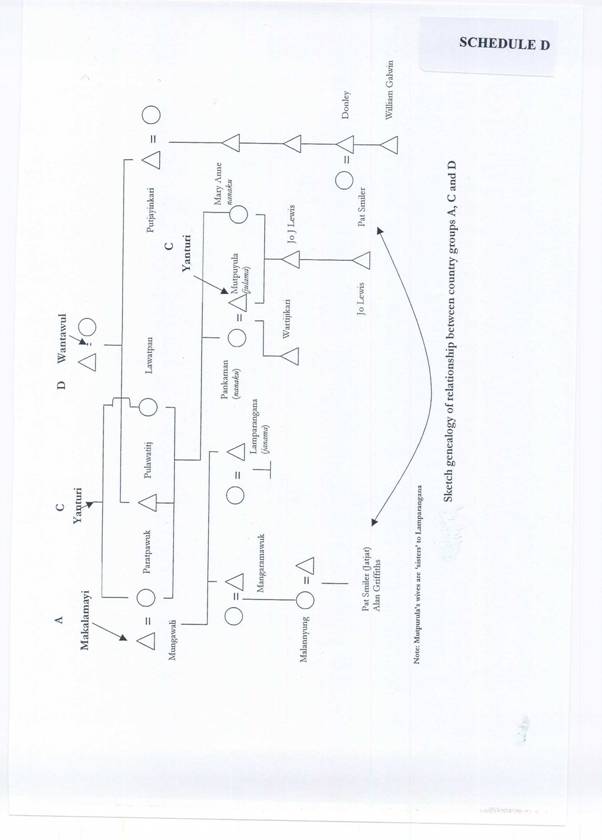
Schedule D: Sketch Genealogy of Relationship Between Country Groups
Makalamayi, Yanturi and Wantawul
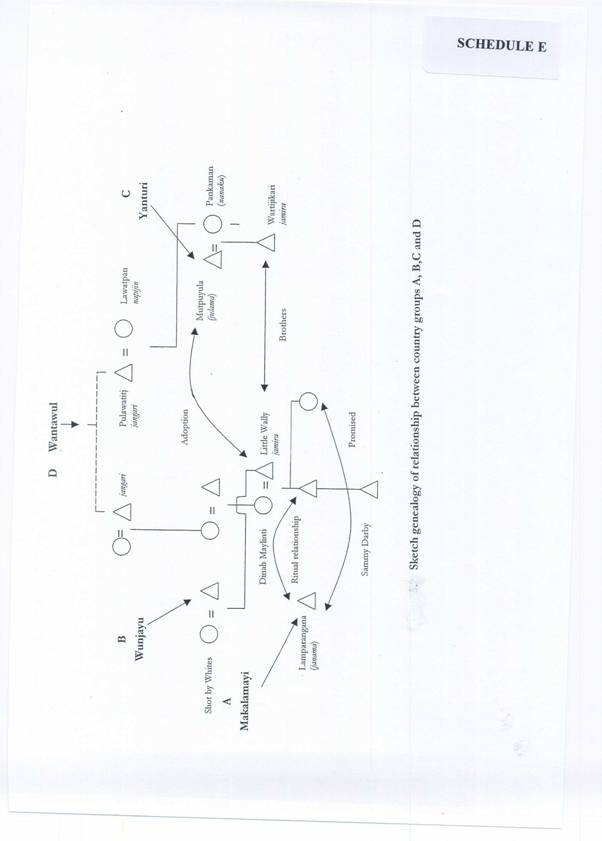
Schedule E: Sketch Genealogy of Relationship Between Country Groups Makalamayi,
Wunjayu, Yanturi and Wantawul
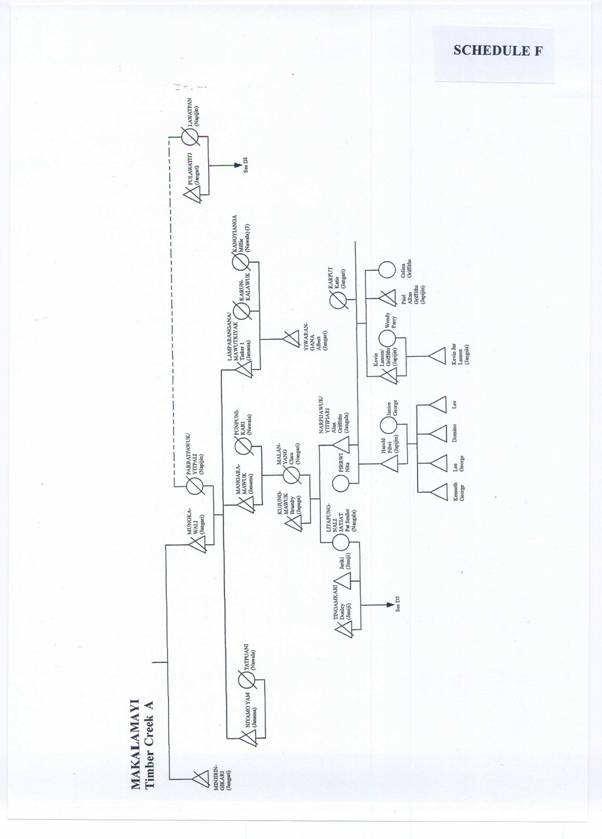
Schedule F: Partial Summary of Genealogy Relating to Makalamayi
| IN THE FEDERAL COURT OF AUSTRALIA |
|
| NORTHERN TERRITORY DISTRICT REGISTRY | NTD6016 OF 1999 |
| BETWEEN: | ALAN GRIFFITHS and WILLIAM GULWIN on behalf of the NGALIWURRU and NUNGALI PEOPLES APPLICANTS
|
| AND: | NORTHERN TERRITORY OF AUSTRALIA RESPONDENT
|
|
| NTD6008 OF 2000 |
| BETWEEN: | ALAN GRIFFITHS and WILLIAM GULWIN on behalf of the NGALIWURRU and NUNGALI PEOPLES APPLICANTS
|
| AND: | NORTHERN TERRITORY OF AUSTRALIA RESPONDENT
|
|
| NTD6012 OF 2000 |
| BETWEEN: | ALAN GRIFFITHS and WILLIAM GULWIN on behalf of the NGALIWURRU and NUNGALI PEOPLES APPLICANTS
|
| AND: | NORTHERN TERRITORY OF AUSTRALIA FIRST RESPONDENT
AMATEUR FISHERMEN’S ASSOCIATION OF NORTHERN TERRITORY THIRD RESPONDENT
|
| JUDGE: | WEINBERG J |
| DATE OF ORDER: | 17 JULY 2006 |
| WHERE MADE: | MELBOURNE (HEARD IN DARWIN) |
THE COURT ORDERS THAT:
1. On a date to be fixed, the parties file and serve contentions regarding:
(a) the form that any determination of native title in these proceedings should take, in order to give effect to these reasons for judgment; and
(b) any consequential orders.
2. The matter be listed for further hearing on a date to be fixed.
Note: Settlement and entry of orders is dealt with in Order 36 of the Federal Court Rules.
| IN THE FEDERAL COURT OF AUSTRALIA |
|
| NORTHERN TERRITORY DISTRICT REGISTRY | NTD6016 OF 1999 |
| BETWEEN: | ALAN GRIFFITHS and WILLIAM GULWIN on behalf of the NGALIWURRU and NUNGALI PEOPLES APPLICANTS
|
| AND: | NORTHERN TERRITORY OF AUSTRALIA RESPONDENT
|
|
| NTD6008 OF 2000 |
| BETWEEN: | ALAN GRIFFITHS and WILLIAM GULWIN on behalf of the NGALIWURRU and NUNGALI PEOPLES APPLICANTS
|
| AND: | NORTHERN TERRITORY OF AUSTRALIA RESPONDENT
|
|
| NTD6012 OF 2000 |
| BETWEEN: | ALAN GRIFFITHS and WILLIAM GULWIN on behalf of the NGALIWURRU and NUNGALI PEOPLES APPLICANTS
|
| AND: | NORTHERN TERRITORY OF AUSTRALIA FIRST RESPONDENT
AMATEUR FISHERMEN’S ASSOCIATION OF NORTHERN TERRITORY THIRD RESPONDENT
|
| JUDGE: | WEINBERG J |
| DATE: | 17 JULY 2006 |
| PLACE: | MELBOURNE (HEARD IN DARWIN) |
REASONS FOR JUDGMENT
introduction
1 Timber Creek, a small township in the north-western corner of the Northern Territory, lies on the Victoria Highway, a major road route across Australia. It is located approximately half way between Katherine and Kununurra. The Ngaliwurru and Nungali Peoples, represented in these proceedings by Alan Griffiths and William Gulwin, have lodged an application for a native title determination in respect of certain land and waters located within the town boundaries. The application is opposed by the Northern Territory of Australia, and by the Amateur Fishermen’s Association of the Northern Territory (“AFANT”).
2 For the purposes of this judgment, the town of Timber Creek must be distinguished from the creek which flows within the town, after which the town is named. All references hereafter to Timber Creek will be to the town, while references to “the Creek” will be to the waterway that runs through it.
3 Timber Creek lies along the south bank of the Victoria River. The Creek is a tributary of that river, and joins it near the head of the tidal reach. A map of the general area surrounding Timber Creek is appended to these reasons for judgment as Schedule A1. A closer view of that area is appended as Schedule A2.
4 Much of the terrain surrounding Timber Creek is spectacular. Escarpments and gorges are carved into sediments from the many rivers and creeks in the area. The landscape has been shaped by volcanic activity and erosion.
5 The Victoria River area is generally described as a “mecca” for fishing. It has some of the best and biggest barramundi to be found in the Northern Territory. Barramundi can be caught all year round, though the best time is said to be between late March and late May, coinciding with the end of the monsoon season. There are also a number of other tourist attractions in the area. These include river cruises, wildlife parks, scenic flights, lookouts and walks.
6 This case concerns a claim for a determination of native title relating to a very small area, the entirety of which falls within the boundaries of what is by now an established town. It raises for consideration a number of the issues that frequently arise in native title cases, but also the operation of s 47B of the Native Title Act 1993 (Cth) (“the NT Act”). That section has recently been the subject of judicial consideration, but its limits have yet to be fully explored. It has the potential to overcome the effect of any acts that might otherwise have extinguished native title.
the proceedingS before this court
7 These are in fact three separate, but related, applications for determination of native title. Each application is brought pursuant to s 61(1) of the NT Act.
8 The first application, D6016 of 1999 (Alan Griffiths on behalf of the Ngaliwurru and Nungali Peoples v Northern Territory) was filed on 10 December 1999. The area claimed was Lot 47 Timber Creek, being described as an area proposed for compulsory acquisition by notice dated 3 September 1999. The application was brought as a defensive measure, in anticipation of an act by the Northern Territory government that might otherwise have defeated any claim to that land.
9 The second application, D6008 of 2000 (Alan Griffiths and William Gulwin on behalf of the Ngaliwurru and Nungali Peoples v Northern Territory) was filed on 11 May 2000. The area claimed comprised Lots 97-100, 109 and 114 Timber Creek, being described as areas proposed for compulsory acquisition by notices dated 2 February 2000. This application too was brought as a defensive measure.
10 The third, and most comprehensive application, D6012 of 2000 (Alan Griffiths and William Gulwin on behalf of the Ngaliwurru and Nungali Peoples v Northern Territory and Anor) was filed on 18 July 2000. The area claimed was described as other claimable land within the town boundaries of the town of Timber Creek, specified to be Lots 1-9, 22, 33, 35, 37, 49, 56-57, 65-74, 80, 87, 101-108, 110-113, the waterway of Timber Creek including its beds and banks, and Special Purposes Lease 00494 (Lot 16), owned by the Conservation Land Corporation.
11 As initially formulated, the third application included a claim to that part of the Victoria River, and its bed and banks, which lay within the town boundaries. However, shortly before this trial began, the claimants were granted leave to exclude the Victoria River from the ambit of their claim.
12 Although the three native title determination applications presently before the Court have never, at any stage, been consolidated, they were, with the consent of the parties, heard together. By agreement, the evidence in each application was treated as evidence in the others.
13 Initially, the Commonwealth was joined as a respondent to each application. However, in August 2003 it withdrew from D6016 of 1999 and D6008 of 2000 once it was satisfied that it had no interest in the land claimed in those proceedings. In January 2005, the Commonwealth withdrew from D6012 of 2000 after the claimants made it clear that they no longer proposed to pursue a claim to the Victoria River, or its bed and banks.
14 AFANT is a body that represents the interests of amateur fishermen in the Northern Territory in pursuing their recreational and sporting activities. It was joined as the third respondent to proceeding D6012 of 2000. With the withdrawal of the Commonwealth from that proceeding there is no longer any designated second respondent. For convenience, AFANT is still named as the third respondent.
THE CLAIMANTS’ CASE AS FINALLY PLEADED
15 The Further Amended Application, as filed on 18 March 2005 may be treated as a “template” for all three applications. As previously indicated, it is brought in the names of two senior representatives of the Ngaliwurru and Nungali Peoples, Alan Griffiths and William Gulwin.
16 The Further Amended Application was amended pursuant to leave granted well into the course of the trial. Nothing of any consequence turns upon these amendments. In substance, what occurred was simply that the description of the apical ancestors of the “native title claim group” was altered in order to reflect the evidence that had been given in the trial.
17 Section 61(2)(a) of the NT Act provides that an application for a native title determination may be made by a person or persons authorised to make that application by a “native title claim group”. Section 61(2)(c) provides that the person, or persons who are so authorised are jointly designated, in the singular, as “the applicant”.
18 In the present case neither Mr Griffiths’ nor Mr Gulwin’s authority to make this application as the persons authorised by the native title claim group to do so is disputed.
19 Invoking s 223(1) of the NT Act, the claimants say that, according to the traditional laws acknowledged, and the traditional customs observed, the Ngaliwurru and Nungali Peoples have, by those laws and customs, a connection with the claim area that gives rise to native title rights and interests recognised by the common law of Australia. They say that the connection of the claimants with the claim area arises through spiritual, religious, physical and historical associations, through biological, classificatory or adoptive descent through the four grandparental lines, and through processes of succession. They say that the claimants have communal rather than individual rights and interests in relation to the claim area.
20 The native title claim group is described in the Further Amended Application as comprised by the Ngaliwurru and Nungali Peoples who are descended from six apical Ngaliwurru persons identified as:
· Punitjkula (whose children include Takawuk and Jarapil, and whose grandchildren include Violet Paliti);
· Mangarmawuk, or Mungaramawuk (whose brother was Lamparangana, and who was Alan Griffiths’ and Pat Jatjat’s maternal grandfather);
· Tiyawatulwan (whose children include Little Wally Wanampura, and whose grandchildren include Darby Tiyawatulwan);
· Tiyawakatak (whose children include Mutpurula, whose grandchildren include Jo Lewis Nyapat, and whose great grandchildren include Josie Jones Tatpung, Stephen Jones Yawunula, and his sister Lorraine Jones Purrungurungali);
· Pulawatitj (whose children include Walamawuk and Tinker Kananji/Lalamak, and whose grandchildren include Larry Johns Mungkawali); and
· Puijayinkari (whose grandchildren include Dinah Maylinti, and whose great grandchildren include Darby Tiyawatulwan).
21 The claim area is described as land located in the town of Timber Creek, within the Timber Creek town boundary in the Northern Territory (Northern Territory Government Gazette No. 24, 20 June 1975). A map of Timber Creek showing each Lot claimed is appended to these reasons for judgment as Schedule B. The claim area is said to include:
· vacant Crown land and waters, Lot numbers 1, 2, 3, 4, 5, 6, 7, 8, 9, 22, 33, 35, 37, 49, 56, 57, 65, 66, 67, 68, 69, 70, 71, 72, 73, 74, 80, 87, 101, 102, 103, 104, 105, 106, 107, 108, 109, 110, 111, 112 and 113;
· the creek named Timber Creek (including its bed and banks) as delineated on a map attached to the Further Amended Application; and
· Special Purposes Lease 00494, granted to the Conservation Land Corporation for the purpose of carrying out its functions in accordance with the Conservation Commission Act 1980 (NT) (subsequently renamed the Parks and Wildlife Commission Act 1980 (NT)) consisting of Lot 16 of the Town of Timber Creek.
22 The Further Amended Application makes clear that any area in relation to which a “previous exclusive possession act” under s 23B of the NT Act has been done is excluded from the claim. That is said to be subject only to “Schedule U of this application”. However, for reasons that are not immediately apparent, no such schedule is in fact appended to the application.
23 The Further Amended Application states that title searches have been made in relation to Lots 6, 33 and 49, and that there were no titles issued in relation to any of those Lots.
24 Under the heading “Description of Native Title Rights and Interests”, the claimants assert that the Ngaliwurru and Nungali Peoples are entitled, under traditional laws acknowledged and traditional customs observed, to exercise native title rights and interests in relation to the claim area which include the following:
“(a) to possess, occupy, use and enjoy the area claimed to the exclusion of all others;
(b) to speak for and to make decisions about the use and enjoyment of the application area;
(c) to reside upon and otherwise to have access to and within the application area;
(d) to control the access of others to the application area;
(e) to use and enjoy the resources of the application area;
(f) to control the use and enjoyment of others of the resources of the application area;
(g) to share, exchange and/or trade resources derived and from the application area;
(h) to maintain and protect places of importance under traditional laws, customs and practices in the application area;
(i) to maintain, protect, prevent the misuse of and transmit to others their cultural knowledge, customs and practices associated with the application area;
(j) to determine and regulate membership of, and recruitment to, a landholding group.”
25 The pleading then outlines the factual basis upon which the claimants assert their native title rights and interests. It alleges that the Ngaliwurru and Nungali Peoples were, and are, traditionally, the owners of the land and waters that are the subject of these proceedings. It asserts that the Ngaliwurru and Nungali Peoples have exercised the native title rights and interests described in the preceding paragraph “from time immemorial”. It says that they, and their ancestors, have, by their traditional laws acknowledged, and their traditional customs observed, maintained a connection with the claim area from well before the date on which the Crown acquired sovereignty. In relation to the Northern Territory, the year of sovereignty was 1825.
26 The pleading states that the claim area is merely part of a much larger area of land and waters owned and occupied by the Ngaliwurru and Nungali Peoples since before the acquisition of sovereignty. It states that a number of important sites both within and surrounding the claim area have been recorded and/or registered under the Northern Territory Aboriginal Sacred Sites Act 1989 (NT). It says that the claimants’ traditional connection with the land, going back to the time of their ancestors, is demonstrated by archaeological findings that establish long standing habitation of the area. It asserts that some of this evidence goes back to a time well before the first Europeans came into contact with local indigenous people.
27 The pleading then sets out detailed particulars of the traditional laws and customs that the claimants say the Ngaliwurru and Nungali Peoples have long observed. These include a common kinship system, observance of common laws relating to land tenure, and traditional usage of land and waters. In addition, it provides particulars of activities currently undertaken by the claimants within the claim area. Apart from occupying the land, they are said to hunt and collect animals, fish and other food, to share, trade and exchange resources, to conduct ceremonies, to restrict the access of outsiders, and to care for the land and waters in accordance with spiritual and social obligations. They are also said to bury the dead on the land, to maintain traditional knowledge of the land and waters, and to pass that knowledge on to younger generations.
28 It is important to note, as the pleading recognises, that Timber Creek, and much of the surrounding countryside was, at one time, subject to pastoral leases. The terms upon which those leases were granted varied somewhat. Some might be regarded as “exclusive” while others would perhaps be characterised as “non-exclusive”, in the sense in which those expressions are used in the NT Act.
29 Irrespective of whether the pastoral leases were exclusive or non-exclusive, they would normally have extinguished any native title rights and interests that might otherwise be held by the claimants. However, the claimants contend, in their pleading, that s 47B of the NT Act applies to the claim area. If that is so, any extinguishment of their native title rights and interests that might otherwise result from the creation of any prior interest through pastoral leases is required, by that section, to be “disregarded”.
30 In this judgment, by reason of s 47B, questions of extinguishment will be addressed against a different statutory background than might otherwise be the case.
history of the CLAim area
31 A large folder of what the claimants termed “History Documents” was tendered before me. There are over one hundred such documents. A number of them are quite lengthy, and copiously footnoted.
32 It may be useful, at this stage, to provide a brief overview of the type of material contained within this folder.
33 For example, Document 1, “Hidden Histories”, written in 1991, contains what its author, Professor Deborah Bird Rose (“Professor Rose”), Professor of Prehistory and Anthropology at the Australian National University, describes as “Black Stories from Victoria River Downs, Humbert River and Wave Hill Stations”.
34 Document 2 is described as a “Log Book of Bradshaw’s Run”. It contains a number of extracts from hand written notes regarding the activities of Mr Fred Bradshaw, a pastoralist, contemporaneously made in 1894.
35 Document 4, “Dingo Makes Us Human – Life and Land in an Aboriginal Australian Culture”, by Professor Rose, contains endnotes from her valuable account of the life of aboriginal people in the Victoria River area prior to, and after, initial contact with Europeans in the latter part of the nineteenth century.
36 Document 7 is of particular significance to these proceedings. It consists of extracts from the field notes of a renowned anthropologist, Professor W E H Stanner (“Professor Stanner”), written in 1935, after had undertaken an expedition to the country around Victoria River Downs in 1934. Professor Stanner is, even today, regarded as one of the leading figures in indigenous anthropology, and his work features heavily in the anthropological reports prepared by the experts who gave evidence before me.
37 Also featured in the folder of History Documents were a number of papers on different subjects written by Darrell Lewis. Mr Lewis is a graduate in pre-history from the Australian National University, having graduated with honours in archaeology in 1983. He then enrolled in a Masters degree in archaeology at the same university, and completed a thesis on the rock art of the Victoria River district. He prepared as report based upon field and archival research into the history of that region which he had carried out over a 27 year period. He is married to Professor Rose, and assisted her in the preparation of her book “Hidden Histories”. He has, since the early 1970s, carried out research into the ethnography and rock art of the Victoria River district, and has written extensively on the history of the region.
38 Of particular importance, given the issues in this case, are the earliest extant records of European explorers, namely those of Augustus Gregory dating back to his expedition in 1855. There are a total of twenty-one separate extracts from Gregory’s notes, and they shed considerable light upon conditions in the area at the time. His discussion of his contacts with the “blacks” around Stokes Range near the eastern banks of the Victoria River is particularly illuminating.
39 There are many other primary sources, old and new, contained in the folder of History Documents. I have read them all, and had regard to them in preparing these reasons for judgment. I do not think that it is necessary to refer to them in any detail. The historical record is not, of itself, a focal point of dispute between the parties. Broadly speaking, the history of the area is uncontentious.
40 European knowledge of the Victoria River district was gained gradually, over a period of time, from the earliest explorations until settlement. The first European contact occurred in the early 1500s, when Portuguese seafarers compiled what was known as “the Dieppe map”. In 1644, Abel Tasman sailed the northern coastline, but left no records of significance so far as these proceedings are concerned. In 1819, Phillip King was sent on a mission to explore the Victoria River. However, he failed in that endeavour, and there is nothing to be gleaned from any records of that mission.
41 In 1839, Captain John Wickham and Lieutenant John Stokes explored the lower Victoria River, in the course of their survey of the northern Australian coast. However, they did not remain in the area for long, and left no records that are of any great utility to this case. However, there is recorded, in Stokes’ notes, an account of a native village located one mile southwest of the Victoria River containing “thirteen huts of paper bark”. In addition, Stokes recorded a party of aborigines crossing the river, heading downstream. He said that there was a “large local population”. He saw other signs of indigenous occupation, including the remains of a fire, and burnt off areas.
42 Captain Wickham’s reports led to the expedition of Augustus Gregory in 1855, to which I have already referred. During that expedition, a depot camp was established on the southern bank of the Victoria River, just below where Timber Creek is now located. The expedition paved the way for the arrival of the pastoralists that was to follow.
43 Gregory’s expedition is interesting in other ways. He sailed from Queensland to the Northern Territory, and along the Victoria River. He was shipwrecked in the area now known as Timber Creek. Legend has it that Timber Creek was given that name because Gregory had to cut down a large amount of timber in order to make repairs. The site of Gregory’s camp can still be visited, and some of his carvings can be seen on one of the Boab trees in Timber Creek. Over an eight month period he explored much of the region, and helped to open it up to others. He left a detailed published account of his expedition in his journal. It described indigenous people as having frequently visited his camp, and on one occasion as having displayed hostility. Shots were fired, and one man was slightly wounded. In addition, there are diaries and letters of expedition members who record contact with indigenous people at the camp.
44 The major result of Gregory’s exploration was to make known the tremendous extent of prime grazing land in the region. Lewis comments that one of the ensuring mysteries of European settlement is that this “pastoralists’ bonanza” remained untouched for almost 30 years thereafter. That is not to say that there was no significant European contact before the arrival of the pastoralists. In 1865, Captain Hutchinson, on behalf of the South Australian Government, explored the northern coast in search of a suitable location for a settlement. In 1867, Captain Francis Cadell visited the Victoria River area. However, neither he, nor Captain Hutchinson, saw any advantage in attempting permanent settlement in this region. Indeed, Captain Cadell was scathing in his description of the region, stating:
“owing to the numerous dangers of that rapid and shoal-encumbered river, also taking into consideration the 100-mile belt of the most wretched, rocky, barren and waterless country, a perfect Tierra del Fuego, that if the Elysian fields had been beyond it I should have felt it to have been a duty to report against its selection.”
45 In 1879, Alexander Forrest led the last significant exploration before the arrival of the first European settlers. Forrest came overland from the Kimberley region. By the time he and his men reached the Victoria River district they were starving, and many were ill. They had little or no contact with the local indigenous inhabitants. They left no records that are of any great assistance in this case.
46 It was at about the time of Forrest’s expedition that the first pastoral leases in this area were granted. However, the actual stocking of any of the various holdings did not commence until several years later. The first permanent European settlement occurred with the establishment of several cattle stations. These included Delamere in 1881; Wave Hill and Victoria River Downs (“VRD”) in 1883; Ord River in 1884; Auvergne in 1886; Newry in 1888; Bradshaw in 1894 and Inverway in either 1894 or 1895.
47 After the arrival of the first permanent European settlers, Timber Creek became an important port. It served that purpose until some time in the 1930s when the construction of roads in the region made the port redundant.
48 In 1890 a local store was opened at a place known as Gregory’s Depot, upstream from Victoria River Depot. This was the closest source of supply to the surrounding cattle stations, and provided a stopover point for travellers to replenish their supplies.
49 Indigenous inhabitants of the area soon found themselves being excluded from their traditional lands by various cattle station owners. Initially, cattle grazed on only a relatively small portion of the total leasehold areas. However, as herds grew and pastoralists become more familiar with the country, the area under their control widened. This increased pressure upon local indigenous groups. Within a few years, those aboriginal persons who had not been killed, in a hopeless conflict with white settlers, were forced out of their traditional lands, and into the bush.
50 During these early years of settlement, relations between the local indigenous groups and the European settlers ranged from open warfare, and massacres, to what was at times friendly cooperation. However, the unstable relations between the indigenous groups and the pastoralists soon made it obvious that there was a need to maintain law and order. In 1897 the Timber Creek police station was first built. It remains in place today.
51 In the early 1900s, some station managers began to encourage aboriginal people to settle at the various homesteads and outstations. A number made the transition. However, while the open conflict may have ended, cattle spearing and theft from station stores and unoccupied camps continued. This situation quickly degenerated into a kind of guerrilla warfare, with aborigines striking opportunistically and then retreating into rough range country.
52 For the first decade or so after settlement (“post-contact”) there was little, if any, peaceful interchange between pastoralists and aborigines. Most station work was done by whites, or by indigenous persons brought in from distant regions. Eventually things began to change. The general level of hostility decreased, and was replaced by conflict of a more sporadic nature. Peaceful contact became more regular, and by 1905 most stations had established aboriginal camps at homesteads and outstations. Gradually local aborigines mastered the various skills required for cattle work.
53 During the period when aboriginal people were “coming in”, they were employed variously as station hands, domestics, or as labourers whose job it was to transfer stores from ships that came along the Victoria River to shallow-draught vessels. They were also employed as teamsters, responsible for taking supplies to the various stations.
54 It must be remembered that throughout this period, all aboriginal people were under the control of a Chief Protector of Aborigines. See generally, The Northern Territory Aboriginals Act 1910 (SA). This resulted in laws such as the right to remove ‘half caste’ children. It also meant that indigenous persons were subjected to restricted travel and forced labour. They had no right to vote, and no right to receive an education. Although these laws provided that the Chief Protector (and under him, the police), were responsible for the welfare of aborigines, in practice it was usually the station manager or other white station employees who exercised day to day control over their lives.
55 The police were also responsible for issuing rations to those indigenous persons who regularly camped near the police station. While the records regarding this practice were not always well kept, it is believed that it continued until approximately 1979.
56 As indigenous people became increasingly involved in station work, the station economies became gradually more dependent on their labour. The period from roughly 1920 to 1960 saw little change in their conditions. The stations operated on the open range system of cattle grazing. During the dry season cattle were mustered for ear marking, branding, and other tasks. At the beginning of the wet season the stock camps closed down and most station employees were laid off. Aboriginal workers usually returned their clothes to the station store, were provided with basic provisions, and returned to the bush, walking across country to visit relatives and engage in traditional ceremonies.
57 Mr Lewis, who appears to have put together the folder of History Documents, and who produced the “History Report” upon which much of this summary is based, also wrote a short introductory history of the region in 1997. It is entitled “A Shared History – Aborigines and White Australians in the Victoria River District Northern Territory”. He comments, in relation to the indigenous inhabitants of the area:
“They inherited the intimate knowledge of country developed over untold generations and added to it through their own experience.”
58 By the 1930s, the vast majority of indigenous persons living in the Victoria River district resided in station camps, and worked alongside white men and women. Some refused ever to “come in”, living out their lives in the rough back country of the stations. Others spent time in station camps, or in station employment and then returned to the bush, moving freely between the two modes of life.
59 Many of the stations in the Victoria River district were large and, for much of their history, owned by overseas operators, such as Vesteys. These overseas based owners were, for years, reluctant to invest in fencing, or other improvements. Without fencing, it was difficult to control cattle, or to improve bloodstock. Consequently, cattle on the stations were more like wild animals than domestic beasts. Stock work resembled hunting rather more than husbandry.
60 World War II impacted only slightly on the Victoria River district. Although the town of Katherine was bombed by the Japanese, no homesteads in the vicinity of the Victoria River were attacked. Nonetheless, there was a small military presence at Timber Creek. Trenches were dug, and the local police hid important records and stores, in case of invasion.
61 One effect of the war was that many white station employees and drovers enlisted in the armed forces. This left a shortage of stockmen. Indigenous persons began to play a greater role in the cattle station economy, and some were put in charge of stock camps for the first time. Victoria River district aborigines became aware that improved work conditions were possible, and aspired to a greater degree of equality than had hitherto been the case. However, when the war ended, station life for aborigines reverted, more or less, to what it had been in earlier times.
62 In 1966, local dissatisfaction on the part of indigenous persons finally came to a head at Wave Hill. Aboriginal employees walked off the job, and camped in the Victoria River bed. Initially they demanded full wages and improved conditions before returning to work. However, these demands were soon overtaken by others, including in particular a demand for land rights. By 1972, aborigines from other stations had joined the strike.
63 This action caused turmoil in the regional station economy. Ultimately, indigenous persons gained independence from the stations, and began to receive full wages. The stations themselves reorganised their economies, spending more on fencing and other infrastructure, and relying increasingly on technological advances rather than on large numbers of low paid stockmen. Consequently, far fewer aborigines came to be employed than had previously been the case.
64 Until the 1970s, all land in the Victoria River district had been held under some form of European title, generally pastoral leases or, annual pastoral permits. In addition, some of the land was Crown land, in the form of town commons, stock routes and stock reserves. In 1973, the Commonwealth Government acquired Kildurk Station, which was later renamed Amanbidji. It subsequently turned over that land to the indigenous community as aboriginal freehold land.
65 The Wave Hill strikes also contributed to the enactment of the Aboriginal Land Rights (Northern Territory) Act 1976 (Cth) (“the Land Rights Act”). This resulted in some indigenous groups gaining grants of land in the northern Victoria River region. For example, Fitzroy Station, Innesvale Station, the Stokes Range north of Jasper Gorge, and Jasper Gorge itself, Mistake Creek, part of Wave Hill, and the Hooker Creek Aboriginal Reserve all came under aboriginal control. Gaining title to this land enabled the local community to avail itself of infrastructure which included housing, electricity and schools.
66 Mr Lewis, upon whose work I have based a good deal of this brief historical account, comments that the strikes of the late 1960s and early 1970s, and the rise a of land rights movement, led to resentment by white cattlemen towards aborigines. In some instances, indigenous persons found that they were no longer able to live on the stations, and that they were forced to move to the nearest town. Alternatively, they moved to aboriginal living areas such as Daguragu and Yarralin. Ultimately a generation of young indigenous persons grew up with little or no experience of station work, few prospects of meaningful employment, and the attendant social and economic problems that this entailed.
67 According to Mr Lewis, conditions began to improve after the mid-1980s. Old resentments began to die away, and the number of indigenous persons working on the stations steadily increased. In addition, education standards began to improve. By 1997, indigenous health workers, teaching aides, and police aides were being employed in the region. Indeed, in that year, four of the eight Timber Creek Town Councillors were indigenous persons. That made Timber Creek the only town in Australia that was governed by a council with an equal number of indigenous and non-indigenous representatives.
68 In 1983, a primary school was established at Timber Creek. Initially only indigenous children attended. Local non-indigenous children undertook their studies through other means. The first non-indigenous child was enrolled in 1992. By 1997 virtually all local non-indigenous children attended the school. In addition, an Aboriginal Community Police Officer was assigned to the local police station.
69 Mr Lewis concludes that the historical record clearly shows that aborigines have been associated with the Timber Creek area from the time of the first European explorers and during the entire period of European settlement. He says that there is no reason to believe that the aborigines encountered by the explorers and early settlers were not the ancestors of the aboriginal people living in the area today. He notes that indigenous people strongly identify with particular tracts of country, and that Stanner recorded a long standing connection between the Nungali and Ngaliwurru peoples with Timber Creek as far back as 1934. He says that the association of these people with Timber Creek has been maintained throughout in spite of early violent contact with Europeans. He also comments that since the successful land claim over Timber Creek in 1985, strong communities have developed in the area. He adds that despite over 100 years of European settlement, traditional languages are still spoken, ceremonies performed and traditional foods and medicines harvested. People know where the travelling and localised Dreamings are active, and have taken steps to map and register sacred sites. Traditional trade links still operate. As well, people remember and recount their history. Young men’s initiation ceremonies are performed regularly. In his view, there is much about the manner in which the local community goes about its daily life that reflects long standing traditional law and custom.
the ABORIGINAL land commissioners
70 The claimants base their case in large measure upon findings made by various Aboriginal Land Commissioners who exercised powers under the Land Rights Act, between 1985 and 1992. Those findings relate to land that immediately surrounds Timber Creek, but not the town itself. That is so because the Land Rights Act does not encompass claims to land situated within towns. The findings are said to be of particular importance not merely because of the proximity of the areas concerned, but also because they relate basically to the same indigenous groups as are claimants in the proceedings before me.
71 The claimants acknowledge that any findings made by the Aboriginal Land Commissioners must be qualified having regard to the fact that they were made under the Land Rights Act, a statutory regime that differs significantly from that of the NT Act. Under the Land Rights Act the primary issue is whether a particular claimant, or claimants, can demonstrate “traditional Aboriginal ownership”, as that expression is defined in s 3(1) of that Act. That section provides, in substance, that unless the contrary intention appears “traditional Aboriginal owners” in relation to land means a “local descent group” of aboriginals. That group must have common spiritual affiliations to a site on the land that places the group under a primary spiritual responsibility for that site, and for the land. The group must be entitled by aboriginal tradition to forage as a right over the land.
72 The key term, “traditional Aboriginal owners” is not a term of art. It is rather a creature of statute. The meaning of the term is influenced to some extent by the definition in s 3(1) of “Aboriginal tradition” which is:
“the body of traditions, observances, customs and beliefs of Aboriginals or of a community or group of Aboriginals, and includes those traditions, observances, customs and beliefs as applied in relation to particular persons, sites, areas of land, things or relationships.”
73 There is one key distinction between the Land Rights Act and the NT Act. Under the Land Rights Act, claimants are not required to establish either continuity or historical links with the land. Indeed, it has been held that by reason of the definition of “Aboriginal tradition” in s 3(1), the Land Rights Act deals not so much with “traditions”, in the sense of immutable customs handed down from ancestors, but rather with the observances, customs and beliefs actually practised by a particular community at the time of the relevant inquiry.
74 The position under the NT Act stands in sharp contrast. The claimants must show that they are a society united in and by their acknowledgment and observance of a body of laws and customs; that the present day body of accepted laws and customs is, in essence, the same body of laws and customs acknowledged and observed by their ancestors (adapted to modern circumstances); and that the acknowledgment and observance of those laws and customs has continued substantially uninterrupted by each generation since sovereignty in 1825.
75 There are four determinations under the Land Rights Act that are of particular significance so far as the claimants are concerned. Those findings were all generally favourable to the indigenous groups that instituted the land claims. Section 86 of the NT Act renders them admissible in these proceedings as “the transcript of evidence in any other proceedings before … any other person or body”: Risk v Northern Territory of Australia [2006] FCA 404 per Mansfield J (at [431]-[432]) (“Risk”). The four determinations are as follows, in chronological order:
· Timber Creek Land Claim Report No 21 (19 April 1985) – Commissioner Maurice
- Kidman Springs/Jasper Gorge Land Claim Report No 30 (31 March 1989) – Justice Olney
- Stokes Range Land Claim Report No 36 (28 June 1990) – Justice Olney
- Ngaliwurru/Nungali (Fitzroy Pastoral Lease) Land Claim No 137 and Victoria River (Bed and Banks) Land Claim No 140 Report No 47 (22 December 1993) – Justice Gray
The Timber Creek Land Claim Report No 21 (19 April 1985)
76 This land claim arose out of an application by the Northern Land Council in 1981. Its original intention was to claim only the Timber Creek Commonage Reserve (“the Reserve”). However, before the inquiry commenced the application was twice amended so as to include all those parts of the bed and banks of the Victoria River between the eastern and western boundaries of the Reserve which did not form part of the town of Timber Creek. At a later stage of the inquiry, the claimants withdrew so much of the claim as related to the bed of the river, and its northern bank. However, they maintained the claim to the southern bank, immediately adjoining the Reserve.
77 There were 163 claimants in all. They were presented as one group, comprising six sub-groups, each of which was associated with a separate tract of land. During the course of the proceeding, the senior members of the sub-group identified the country with which that sub-group was associated by referring to a focal site, and by associating that tract of land with a named male person.
78 Commissioner Maurice noted that it appeared from the genealogies and evidence associating past generations with one tract or another that the predominant, if not exclusive, principle for recruitment to the sub-group was patrilineal descent. The only exception was that of a single sub-group, designated sub-group A, whose patriline had died out in comparatively recent times.
79 An anthropologist with considerable experience in land claims, Dr Ian Keen, described the claimants in that land claim as a “cognatic kin group”. Commissioner Maurice accepted that description as apt, but considered it unnecessary to rely upon any such concept to arrive at the conclusion that the claimants now formed a “local descent group” within the meaning of the Land Rights Act. The Commissioner said (at [34]):
“It is enough for me to say that up until the generations constituted by the children and grandchildren of the senior generations of claimants, there was operating a principle of patrilineal descent to which all persons born up to then appeal to legitimise their membership of the total group. The two senior members of sub-group A can, and to my mind do, rely in part upon succession to the country of their deceased mother’s father. All those in the succeeding generations can point to descent through the patriline or the matriline or both, and that, I am satisfied, is the principle of descent which has been operating for two or three generations among this group.”
80 Sub-group A was the key sub-group. The tract of land with which it was traditionally associated included the western three-quarters of the claim area, and the whole of the land comprised within the boundaries of Timber Creek. When the claimants referred to that tract of land, they invariably described it as “Lamparangana’s country”. Its focal site was described as “Makalamayi”, in the north-east corner of the town area. The Commissioner described this as an important site, associated with the Snake, Stingray, Shark and Barramundi Dreamings.
81 The evidence before the Commissioner was that Lamparangana had died about 30 or 40 years prior to the hearing. That meant that he probably died some time in the late 1940s or the early 1950s. This was within the living memory of at least the more senior claimants, many of whom appeared to have known him. The genealogies prepared for the purpose of the hearing showed some four generations below Lamparangana. He was said to have had only one child, a son, who had been killed whilst still young. He was also said to have had a brother, Mangaramawuk who had a daughter, Clara. She in turn had two children, Alan Griffiths and Pat Jatjat. They were both claimants in the Timber Creek Land Claim as were their children and grandchildren.
82 Alan Griffiths was the only member of sub-group A to give evidence in the course of the Timber Creek Land Claim. He said that he was born and raised on his father’s country, at VRD. As a young boy, he had regularly visited Timber Creek with his parents. By the 1980s, he and his family lived in Kununurra, and had done so for some years. However, he maintained that it was his custom to visit Timber Creek annually, with his sons.
83 Mr Griffiths’ claim was based substantially on his direct genealogical links to Mangaramawuk, his maternal grandfather. The other claimants clearly regarded him as one of the traditional owners of Lamparangana’s country and, so it appeared to Commissioner Maurice, to the rest of the claim area as well.
84 The Commissioner observed (at [38]):
“As the hearing progressed it became evident that Allan (sic) has played and continues to play a major role in ceremony and ritual, not only at Timber Creek but also at places like Kununurra, Port Keats, Daly River, Pulumpa and Peppimentari.”
85 Commissioner Maurice then referred to Mr Griffiths’ sister, Pat Jatjat. He noted that she lived at Yarralin, an Aboriginal community located on VRD, about 150 kilometres by road from Timber Creek. She was married to a patrilineal descendant of sub-group D, which had its focal site at Wantawul. Although she had spent a good part of her life on VRD, she was well known to most of the other adult claimants. Indeed, she had lived at Timber Creek until about a year or so before the Timber Creek Land Claim Report was completed. Her husband had been employed as a tracker by the Timber Creek police.
86 The Commissioner observed (at [40]):
“What did emerge clearly from the evidence was that senior members of other sub-groups had a detailed knowledge of and demonstrated strong spiritual affiliations with the sites and dreamings on Lamparangana’s country.”
87 The Commissioner also identified the members of sub-group B, its focal site being Wunjayi, linked to Little Wally, the “now deceased father of Darby Tiyawatulwan”. He said that there was a strong affinity between Little Wally and Lamparangana. Before he died Lamparangana was reputed to have asked Little Wally to take over his, Lamparangana’s, country. Darby also gave evidence before the Commissioner, and was regarded as an impressive witness. The Commissioner found Darby to be a man who strongly identified with the claim area, and its still rich mythology. Apart from Darby and his children, the only other member of sub-group B was his deceased sister’s son, Georgie Jones.
88 The Commissioner then turned to sub-group C. Its focal site was Yanturi, on the Victoria River. Two members of that sub-group gave evidence, saying that they took Yanturi country from their father. One of them, Jo Kulpitala, when tested as to his knowledge of places on his “Yakpali” (father country) was able to demonstrate an extensive knowledge of the sites and Dreamings in the claim area. The Commissioner concluded that the members of this sub-group had strong spiritual affiliations to the various sites and the surrounding country, and that they played a leading role in the ritual and ceremonial life of the claimant group.
89 Sub-group D had as its focal site Wantawul, which was east of the claim area. There was evidence that Wantawul was associated with the Caterpillar Dreaming, itself a manifestation of the rainbow snake. Evidence was given by Paddy Bullita, the senior spokesman for the sub-group, who said that his country was Yanturi. He said that members of his generation traced their membership of the sub-group through the patriline. He said that he took country from Lamparangana, who had taught him the Dreamings. The other main witness was Darby’s mother, Dinah Maylinti, Little Wally’s wife. She said that she took country through both her father and mother and, in relation to Timber Creek, through Little Wally.
90 Sub-group E had as its focal site Maiyalaniwung, well to the south of the claim area. It had as its main speakers two sisters, Violet and Nida. Violet described Maiyalaniwung as her father country. Their father, Takawuk, eventually came to live at Timber Creek where Nida was born. The sisters said they came into contact with members of the other sub-groups, including Lamparangana. It was he who had taught Violet about his country. Violet said that all the claimants looked after Lamparangana’s country. In her case that was because she had grown up there.
91 The last of the sub-groups was sub-group F. The father country for this sub-group was Kuwang, better known as Stokes Range. It lay well to the east and south of the claim area. Three patrilineal members of that sub-group spoke during the hearing. They were Big Mick, Little Mick and Bardi. They were all the sons of Big Wally. The Commissioner described Big Mick’s knowledge of the sites and mythology, not only of the claim area but of the entire region, as “unsurpassed”.
92 The Commissioner visited many sites in the claim area that were said to be of historical significance. He noted that there were marked concentrations of sites in the valleys associated with the Victoria River, Timber Creek and, to a lesser extent, Line Creek. He concluded that the narratives conveyed by the senior claimants showed that they believed that various mythological creatures of the Dreamtime had passed through various locations, and left something of their essence behind in the places they had visited. They also believed that the spirits of these Dreamings still inhabited the land, and that they were most powerful at those places where they had stopped.
93 The claimants were questioned about their personal Dreamings. These were described as kuning and ngulu, the former being inherited patrilineally, and the latter inherited matrilineally. Ultimately, the Commissioner considered the evidence regarding these matters to be somewhat obscure. He did not find it necessary to come to any firm conclusions regarding this evidence. Importantly, he observed (at [97]):
“I am unable to discern any structural differentiation between one sub-group or another with respect to affiliation for sites on the claim area, be it Lamparangana’s, Little Wally’s or Takawuk’s country. The same seems to apply to the distant country centred on Yanturi, but no clear picture emerged for that centred on Wantawul or Kuwang”.
94 The Commissioner noted that, over and over again, the senior claimants described the responsibility of the whole group for the claim area. He said that he could not find any smaller collection of the claimants who might rightly be identified as having responsibilities of a higher order than the rest of them. He explained (at [101]-[103]):
“To understand how I arrived at this conclusion, I think it is helpful to state my impression of how the senior claimants perceive and conceptualise the events of the recent past. Firstly, they do identify particular tracts of land with six identifiable patriclans. Secondly, because of the influences and constraints placed upon them over the past 100 years or so by European settlement, Lamparangana’s country must have developed outstanding economic and religious significance for them. Thirdly, at least in that period, secondary rights in and responsibility for country traditionally derived from mother or her male relatives, for co-residence, from marriage and possibly from other sources must have had great significance. Dr Keen’s categorisation of the six sub-groups as together constituting a cognatic kin group serves to emphasise the underlying familial ties that justified the oft made assertion that all the family – meaning all the six sub-groups – were looking after the country now. Fourthly, people asserted a right to Lamparangana’s country in common with other claimants, not by asserting their membership of a group, but by calling upon blood or affinal connections with him. Fifthly, Lamparangana was the last of the line. From what I can gather of the nature of the man, he too must have been very concerned about who would look after the country when he was gone. Sixthly, Little Wally and Takawuk were short on patrilineal descendants to ensure the survival and continuity of the group. Seventh, eminent men like the fathers of Jo and Duncan, the two Micks, and Paddy Bullita had been dispossessed in the sense that their father country had been taken over by the pastoralists and was now no longer as accessible to them.
What I think has happened is that during, if not before, Lamparangana’s time, there was begun a gradual blurring of the distinction between the responsibilities of those who were patrilineally associated with the claim area and those who were not. For their culture to survive it was necessary to accord equal status to the larger cognative kin group. I strongly suspect that the catalyst for this was the need to recognise a successor to Lamparangana’s country.
Whatever the precise dynamics, we now have a group made up of the patrilineal and matrilineal descendants of six old-world patriclans who together constitute the local descent group and as such have undifferentiated, and hence primary, spiritual responsibility for the claim area.”
Kidman Springs/Jasper Gorge Land Claim Report No 30 (31 March 1989)
95 This claim under the Land Rights Act related to a parcel of land comprising an area of approximately 370 square kilometres (later expanded to include some areas not initially claimed) near VRD bounded by the Auvergne stock route, and the former pastoral lease known as Delamere. Alan Griffiths was among the claimants.
96 Justice Olney indicated in his report that he had avoided the temptation to enter upon a critical analysis of the anthropological evidence presented to him. He said that to have done so would have produced a layman’s opinion of issues about which the professionals were unable to reach unanimity, and thus tend to clothe with authority valueless and irrelevant conclusions. He focussed instead upon the evidence of the claimants themselves, observing in the course of doing so (at para 5.14) that:
“Experience in this and other land claims has demonstrated that the process of proving the necessary affiliation of claimants to a site on the land is generally assisted by the ability of the claimants to take the Commissioner to the site and to speak about their spiritual responsibilities towards it and surrounding land.”
97 The Commissioner noted that he had been denied access by the owner of VRD to that property. He observed that this had materially prejudiced the presentation of the claimants’ case.
98 In summarising the claim, Justice Olney said that it had been particularised in a report prepared jointly by Professor Rose and Mr Lewis, (to whose various works I have previously referred). He cited, in particular, those parts of the report that had been prepared by Mr Lewis which provided an historical perspective of the area in question.
99 Justice Olney then set out the evidence concerning the claimants’ relationship to the land which was the subject of the claim. He noted that the claimants (and other indigenous persons in this region) perceived the geographical landscape as a living entity with which they were in daily and life-long interaction and communication. They accepted willingly the obligation to care for the land, and believed that their relationships with country involved mutual rights and responsibilities. At the same time, they believed that this relationship was reciprocal. Country had an obligation to care for its people. The claimants said, for instance, that in their own country they would not go hungry. They also said that their country would not harm them provided they took proper care. They saw themselves as caretakers of a relationship of trust deriving from the Dreaming and passed on to them by their immediate forbears.
100 After setting out several fundamental aspects of the “Dreaming”, as the claimants used that term, Justice Olney distinguished between the patrilineally inherited relationship, or kuning, and the wider “Dreaming” frequently used by the claimants which encompassed matrilineal identities as well. He summarised the local descent groups that together made up the claimant group, noting that within a number of those local descent groups, the senior men had demonstrated an extensive knowledge of the country, and a willingness themselves to take responsibility for mythology, ritual, ceremonial life, and the protection of the sacred sites.
101 Justice Olney concluded that the claimants had established that they were the traditional Aboriginal owners of the land, and that the strength of their attachment to that land and their common spiritual affiliations to various sites had been cogently demonstrated in a number of different ways.
Stokes Range Land Claim Report No 36 (28 June 1990)
102 This was a claim in relation to land that was formerly part of Fitzroy Station (Pastoral Lease 674). The claim was brought in 1986. It was determined by Justice Olney, as Aboriginal Land Commissioner, on 28 June 1990.
103 The claim area included most of Stokes Range, known by the claimants as Kuwang. The claimants’ language identity was described as Ngaliwurru, although the land under claim did not constitute the full extent of Ngaliwurru country. According to Justice Olney, the Ngaliwurru people had maintained extensive ties with neighbouring language groups. Their country was said to be adjacent to that of the Nungali to the north, and to the Jaminjung to the north-west.
104 After outlining the history of the area, Justice Olney stated that the Ngaliwurru distinguished four types of kin at the grandparent level. These were:
· father’s father (FF) or kakung;
· mother’s father (MF) or jawajing;
· mother’s mother (MM) or jayiyn (jaju); and
· father’s mother (FM) or ngapupu (ngapuju).
105 These kin terms were often used by the claimants in describing their affiliations to country. Certain kin were classified together. For example, a person’s mother’s sister was classed as “mother” (rather than aunt), and a father’s brother as “father” (rather than uncle). All claimants were related through marriage and descent.
106 Justice Olney analysed in some detail the matrilineal and patrilineal affiliations in the area, known as ngulu and kuning respectively. He noted that there were three claimant groups, Kuwang, Wanimiyn-Yiritjpinti and Maiyalaniwung. The members of these groups all had common spiritual affiliations to, and responsibility for, sites of significance on three corresponding countries within the land claimed. Each group also had secondary responsibilities for, and affiliations to, the whole of the area. The three countries in the claim area were not, however, strictly bounded.
107 Recruitment to the claimant groups was via descent through any of the four types of kin at the grandparent level. Intermarriage between groups meant that claimants were often members of more than one group. Children who were members of groups at the lower levels of genealogy were frequently spoken of as “coming in” as claimants through their mother or father. Recruitment by adoption was also valid.
108 Justice Olney observed that the term “Yakpali mululu” was frequently used to describe members of the group. It applied to individuals with seniority, and could also be used to include all group members affiliated to specific areas of country in a primary spiritual way.
109 Justice Olney concluded that the claimants had a responsibility to care for and protect sites in the claim area. They were expected to perform ritual to keep the country strong, and to seek knowledge about country and how to impart that knowledge. All members of the local descent group had the right to speak for country. This involved discussing the Dreamings, talking about the history of the country and calling the names of places within the country. Only those with the proper relationship to country could speak for it. All members of the local descent groups had the right to forage over their respective countries. What distinguished some of them as “Yakpali mululu” was their right to deny others access to certain foraging areas. Foraging also involved the collection of materials required to make goods such as boomerangs, hardwood shields, and ochres which formed part of the “Winan” or trade, which moved goods along clearly authorised paths through the claim area. The Commissioner went on to observe that only claimants had the right to water the heads of strangers, ensuring their proper introduction to the country, and to its ancestors.
110 Ultimately, Justice Olney concluded that there was overwhelming evidence to support a finding in favour of the three groups of claimants who were said to be the traditional Aboriginal owners of the claim area. He said that these three groups could, for practical purposes, be regarded as a single coherent group having common affiliations and common aspirations. The claimants had demonstrated a strong attachment to the land, and ought to be recognised, under the Land Rights Act, as traditional owners.
Ngaliwurru/Nungali (Fitzroy Pastoral Lease) Land Claim No 137 and Victoria River (Bed and Banks) Land Claim No 140 Report No 47 (22 December 1993)
111 These two land claims were filed separately, but heard together, by Justice Gray who was, at that time, the Aboriginal Land Commissioner.
112 The land the subject of claim No 137 was Northern Territory Portion 785. Its northern boundary was the Victoria River, on the opposite side of which was Northern Territory Portion 3686 (Bradshaw Station), the subject of a pastoral lease. In the north-west, the subject land was bounded by Northern Territory Portion 3122 which was vested in the Myatt Aboriginal Land Trust. To the west and south-west were two Portions known as Gregory National Park.
113 The land the subject of claim No 140 was the bank of the Victoria River adjacent to the land the subject of claim No 137, together with the bed of the river to the mid line.
114 Justice Gray carefully noted the requirement under s 3(1) of the Land Rights Act that that in order to meet the definition of a “traditional Aboriginal owner”, the claimants had to establish the existence of “a local descent group of Aboriginals …”. He referred to what Mr Justice Toohey had said regarding the meaning of that expression, when his Honour was Aboriginal Land Commissioner:
“In essence my view was and is that a local descent group is a collection of people related by some principle of descent, possessing ties to land who may be recruited … on a principle of descent deemed relevant by the claimants. That description is apt to include the instances of patrilineal descent, patrifiliation and matrifiliation among the Kungarakany claimants.”
115 Justice Gray noted that this passage had been cited with approval by the Full Court of the Federal Court in Northern Land Council v Aboriginal Land Commissioner (1992) 105 ALR 539 (at 553). The Full Court observed (at 553-4):
“In the present case … the views expressed by the Commissioners in their later reports coincide with the ordinary meaning of the expression “local descent group” and correctly state the law, subject to two matters which call for comment. The first is, as was indeed recognised in a number of reports, although the underlying principle of recruitment to a group must be some form of descent, that need not be seen in a biological sense, and persons not claiming biological affiliation may be adopted into and become part of the group. Thus the principle of descent should be interpreted not solely in a biological sense. Secondly, the words “deemed to be relevant by the claimants” may be misinterpreted by some. What has to be found is the existence of a group, recruited by descent, possessing ties to the land and otherwise satisfying the criteria set out in the definition of “traditional Aboriginal owners”. The particular principle of descent in operation will depend upon the circumstances of the particular case. It may be that, in a particular area, the Aboriginal people of that area have adopted the principle of matrilineal descent; in another area, there may have been adopted some other principle of descent. The point is that the principle of descent will be one that is recognised as applying in respect of the particular group. Further, there is no reason the particular principle of descent traditionally operating may not change over time. That is what Toohey J meant when his Honour used the words: “… a principle of descent deemed relevant by the claimants.”
It should not be thought that the words are to be taken to suggest that the governing descent principle in operation in a particular group could be changed by them at whim so as to fit the circumstances of a land claim.
116 Justice Gray then dealt with the notion of “descent criteria”. He said:
“3.2.1 In the present claim, the evidence is strong that the claimants recognise a dual principle of descent. A person is recognised as taking country from both his or her father’s father (‘kakung country’) and his or her mother's father (‘jawajing country’). Responsibility and rights for kakung country and jawajing country are generally considered to be of equal importance. Sometimes, there are assertions of rights and responsibilities to father's mother's country (‘ngapuju country’) and mother’s mother’s country (‘jaju country’). This is particularly so when strict adherence to rights to kakung and jawajing country alone would give rise to a risk of a descent group becoming extinct, or so vestigial as to leave too few people to exercise proper responsibility for country. It is also the case when the actual attachment of people to ngapuju or jaju country is so strong as to result in the acceptance of those people as part of the group with traditional responsibilities for, and rights to, that country.
3.2.2 In considering the claim, I have been prepared to accept as members of a local descent group people who claim through their fathers’ fathers and people who claim through their mothers’ fathers. In some circumstances, I have regarded it as appropriate to recognise as members of a local descent group those who claim through their fathers’ mothers and those who claim through their mothers’ mothers. There are cases, however, in which the evidence does not support the proposition that these wider claims should be upheld, usually because the circumstances in which they would be recognised by the claimants generally as having sufficient strength are not present. It is plain that the recognition of the rights of people to the country of all four grandparents as a matter of course would result in the disappearance within a relatively short time of any notion of separate groups with responsibility for different areas of land. The way in which the claim was put indicates that the claimants have not been so generous in affording recognition of traditional rights.”
117 Justice Gray observed that the claim before him was put primarily on the basis that there were seven separate but overlapping local descent groups, each with its own attachments to, and responsibilities for, a part of the land claim. After identifying these groups (some of which coincide broadly with the various claimant groups in the proceeding before me, including Makalamayi, Wunjayi, Yanturi and Wantawul), he found that although there were seven identifiable areas of land, each associated with a descent group, the reality was that responsibilities were viewed as shared on a much less strict basis. There was considerable overlapping of the areas of land associated with the different groups, and a sharing of Dreamings.
118 In relation to the group described as Makalamayi, Justice Gray observed that there were no living patrilineal descendants of those whose country was claimed by members of that group. He found that Lamparangana had been a highly respected and active custodian of the country to which that group laid claim. Indeed, it was often referred to by the claimants as “Lamparangana’s country”.
119 Justice Gray found that Lamparangana had no living descendents. His brother, Mangaramawuk, was survived by two grandchildren, Alan Griffiths and Pat Jatjat. He concluded that both were entitled to membership of the Makalamayi group through their jawaji. He said that he was conscious of the strength of the connection which other descent groups had to Lamparangana’s country.
120 Justice Gray described Makalamayi country as being based heavily on the town of Timber Creek, and the land held by the Myatt Land Trust. Its major Dreaming was the Wirip, or Dingo. He found that the evidence established clearly that the members of each of the seven descent groups identified earlier in his report had spiritual affiliations to sites both on and near portions of the land claimed. Those affiliations were common to the members of each group. In many cases, they were also held in common with members of other groups.
121 Justice Gray found that members of the groups ranked equally in their obligations and rights, whether they had acquired membership through their fathers, or through their mothers. He found that the claimants possessed a high degree of knowledge of the sites on the land claimed, and the Dreamings relating to them. That knowledge was at its strongest among the more senior claimants, but it was clear that they regarded it as important to pass on the knowledge to younger members of the group.
122 Justice Gray also found that the claimants demonstrated continued commitment to ceremony and ritual. A number of the senior claimants had maintained strong connections with the land the subject of the claim during their working lives. Some of the claimants desired to live on the land that was the subject of claim No 137. However, whether they lived in the claim area or not, a substantial number visited it on a regular basis, and camped there whenever they were able to do so. Justice Gray assessed the claimants’ attachment to the land as “very strong indeed”.
123 In his overall summary of the claim, Justice Gray considered it important to note at [1.11] that counsel for the Northern Territory, in his closing remarks at the hearing, had volunteered that both he, and those instructing him, could not have failed to be impressed with the evidence which had been adduced from the claimants regarding their ownership of the land under claim.
THE KEY REQUIREMENTS FOR ESTABLISHING NATIVE TITLE
124 Before I summarise the evidence led on behalf of each of the parties to these proceedings, it may be useful to set out in general terms the legislative framework within which this case must be considered.
125 Section 223 of the NT Act is the critical provision. The section defines both native title, and native title rights and interests. It relevantly provides:
“Common law rights and interests
(1) The expression native title or native title rights and interests means the communal, group or individual rights and interests of Aboriginal peoples or Torres Strait Islanders in relation to land or waters, where:
(a) the rights and interests are possessed under the traditional laws acknowledged, and the traditional customs observed, by the Aboriginal peoples or Torres Strait Islanders; and
(b) the Aboriginal peoples or Torres Strait Islanders, by those laws and customs, have a connection with the land or waters; and
(c) the rights and interests are recognised by the common law of Australia.
Hunting, gathering and fishing covered
(2) Without limiting subsection (1), rights and interests in that subsection includes hunting, gathering or fishing, rights and interests.”
126 The other major section that needs to be considered at this point is s 225. It states the requirements for the determination of a claim:
“A determination of native title is a determination whether or not native title exists in relation to a particular area (the determination area) of land or waters and, if it does exist, a determination of:
(a) who the persons, or each group of persons, holding the common or group rights comprising the native title are; and
(b) the nature and extent of the native title rights and interests in relation to the determination area; and
(c) the nature and extent of any other interests in relation to the determination area; and
(d) the relationship between the rights and interests in paragraphs (b) and (c) (taking into account the effect of this Act); and
(e) to the extent that the land or waters in the determination area are not covered by a non-exclusive agricultural lease or a non-exclusive pastoral lease - whether the native title rights and interests confer possession, occupation, use and enjoyment of that land or waters on the native title holders to the exclusion of all others.”
127 There are now a number of authorities that bear upon the construction of these, and other key provisions. I shall consider their effect upon the issues raised in these proceedings later in these reasons for judgment. It is useful, however, at this stage, to refer to several leading cases that must be understood in order to appreciate the significance of the evidence, both lay and expert, that was presented before me.
128 In Western Australia v Ward (2002) 213 CLR 1 (“Ward HC”) the High Court dealt with a claim for a determination of native title in relation to an area of approximately 7900 km2 within the East Kimberley region. The claim area included land and waters in the north of Western Australia and some adjacent land in the Northern Territory. The application included a claim to the right to maintain, protect and prevent the misuse of cultural knowledge. Some of the land within the claim area was subject to existing pastoral leases, but most was previously the subject of pastoral leases which had been abandoned, forfeited for non-payment of rent or non-compliance with lease conditions.
129 The High Court made it plain that where claims are made under the NT Act for rights defined in that Act, the determination of native title rights and interests was to be governed solely by the Act, and not by loose analogy with concepts developed from the common law.
130 On the question of extinguishment, the High Court held that the NT Act provided for the partial extinguishment or suspension of native title rights. Native title rights and interests could usefully be seen as a “bundle of rights”, the individual components of which might be extinguished separately. The use of that metaphor had the advantage of drawing attention to the fact that there may be more than one right or interest, and also that there may be more than one type of right or interest. Not all rights and interests were capable of full or accurate expression as rights to control what others may do on or with the land. Questions of extinguishment first required the identification of the native title rights and interests alleged to exist. Whether rights defined in the NT Act have been extinguished by a grant of rights to third parties or an assertion of rights by the executive government required a comparison to be made between the legal nature and incidents of the right granted or asserted and the native title right asserted.
131 Relevantly for present purposes, the High Court held that s 225 of the NT Act, which provided that a determination of native title should include “the nature and extent of any other interests in relation to the claim area” required “the public right to fish” recognised by the common law to be recorded as an “other interest” within s 225(c). In that case any exclusive right under traditional law and custom to fish in tidal waters had been extinguished because such a right was inconsistent with public rights of navigation over and fishing in those waters.
132 The High Court said at [89] that the expression “possession, occupation, use and enjoyment … to the exclusion of all others” in s 225(e) of the NT Act was “a composite expression directed to describing a particular measure of control over access to land”. It went on to observe that to break the expression into its constituent elements was apt to mislead. In particular, to speak of “possession” of the land, as distinct from possession “to the exclusion of all others” would invite attention to the common law content of the concept of possession, and whatever notions of control over access might be thought to be attached to that concept. Instead, the relevant task was described as being:
“to identify how rights and interests possessed under traditional law and custom can properly find expression in common law terms”.
133 Even without recourse to Ward HC, it seems obvious that the relevant starting point, when considering a claim for determination of native title, is to focus upon the “rights and interests” that are said to exist in relation to the claim area. As the High Court noted in Ward HC at [52], the “rights and interests” so described are those that find their origin in law and custom that predates sovereignty. In other words, they owe their origin to a normative system that is separate and distinct from the legal system of the power acquiring sovereignty. That normative system is constituted by the traditional laws acknowledged, and the traditional customs observed, by the indigenous peoples concerned. Such rights and interests do not necessarily correspond with rights and interests familiar to lawyers today. It will generally be preferable to express those rights and interests by reference to the activities that may be conducted, as of right, on or in relation to the land or waters.
134 It is of course necessary to ensure that a determination of native title complies with the requirements of s 225. In particular, s 225(b) provides that it must state the nature and extent of the native title rights and interests in relation to the claim area.
135 In Ward HC, the High Court held that where in relation to some parts of the claim area, native title rights and interests that were found to exist did not amount to a right (as against the whole world), to possession, occupation, use and enjoyment of land or waters, it would seldom be appropriate, or sufficient, to express the nature and extent of the relevant native title rights and interests by using those terms. That of course is a matter that must be borne in mind in the event that a finding of native title is made in the present case.
136 In Members of the Yorta Yorta Aboriginal Community v Victoria(2002) 214 CLR 442(“Yorta Yorta”), the High Court made it plain at [33] that all elements of the definition of native title in s 223(1) must be given effect.
137 In Ward HC,Gleeson CJ, Gaudron, Gummow and Hayne JJ said in relation to s 223(1) (at [17]):
“Several points should be made here. First, the rights and interests may be communal, group or individual rights and interests. Secondly, the rights and interests consist “in relation to land or waters”. Thirdly, the rights and interests must have three characteristics: (a) they are rights and interests which are “possessed under the traditional laws acknowledged, and the traditional customs observed”, by the relevant peoples; (b) by those traditional laws and customs, the peoples “have a connection with” the land or waters in question; and (c) the rights and interests must be “recognised by the common law of Australia”.”
Their Honours continued in relation to s 223(1)(a) (at [18]):
“The question in a given case whether (a) is satisfied presents a question of fact. It requires not only the identification of the laws and customs said to be traditional laws and customs, but, no less importantly, the identification of the rights and interests in relation to land or waters which are possessed under those laws or customs. These inquiries may well depend upon the same evidence as is used to establish connection of the relevant peoples with the land or waters. This is because the connection that is required by par (b) of s 223(1) is a connection with the land or waters “by those laws and customs”. Nevertheless, it is important to notice that there are two inquiries required by the statutory definition: in the one case for the rights and interests possessed under traditional laws and customs and, in the other, for connection with land or waters by those laws and customs.”
138 Finally, their Honours said in relation to s 223(1)(b), (at [64]):
“In its terms, s 223(1)(b) is not directed to how Aboriginal peoples use or occupy land or waters. Section 223(1)(b) requires consideration of whether, by the traditional laws acknowledged and the traditional customs observed by the peoples concerned, they have a “connection”’ with the land or waters. That is, it requires first an identification of the content of traditional laws and customs and, secondly, the characterisation of the effect of those laws and customs as constituting a “connection” of the peoples with the land or waters in question. No doubt there may be cases where the way in which land or waters are used will reveal something about the kind of connection that exists under traditional law or custom between Aboriginal peoples and the land or waters concerned. But the absence of evidence of some recent use of the land or waters does not, of itself, require the conclusion that there can be no relevant connection. Whether there is a relevant connection depends, in the first instance, upon the content of traditional law and custom and, in the second, upon what is meant by “connection” by those laws and customs. This latter question was not the subject of submissions in the present matters, the relevant contention being advanced in the absolute terms we have identified and without examination of the particular aspects of the relationship found below to have been sufficient. We, therefore, need express no view, in these matters, on what is the nature of the “connection” that must be shown to exist. In particular, we need express no view on when a ‘spiritual connection’ with the land (an expression often used in the Western Australian submissions and apparently intended as meaning any form of asserted connection without evidence of continuing use or physical presence) will suffice.”
139 In Yorta Yorta Gleeson CJ, Gummow and Hayne JJ identified the requirements of s 223(1). Their Honours focused, in particular upon the need for evidence of “connection”. They said (at [37]):
“First, it follows from Mabo [No 2] that the Crown’s acquisition of sovereignty over the several parts of Australia cannot be challenged in an Australian municipal court. Secondly, upon acquisition of sovereignty over a particular part of Australia, the Crown acquired a radical title to the land in that part, but native title to that land survived the Crown’s acquisition of sovereignty and radical title. What survived were rights and interests in relation to land or waters. Those rights and interests owed their origin to a normative system other than the legal system of the new sovereign power; they owed their origin to the traditional laws acknowledged and the traditional customs observed by the indigenous peoples concerned.”
140 Their Honours went on to state, at [38]-[40], and again at [43]-[45], that the rights and interests that are the subject of the NT Act are those that derive from traditional laws and customs forming a body of norms that existed before sovereignty. They said in relation to the meaning of “traditional” (at [46]-[47]):
“That being so, the references, in pars (a) and (b) of the definition of native title, to “traditional” law or custom must be understood in the light of the considerations that have been mentioned. As the claimants submitted, “traditional” is a word apt to refer to a means of transmission of law or custom. A traditional law or custom is one which has been passed from generation to generation of a society, usually by word of mouth and common practice. But in the context of the Native Title Act, “traditional” carries with it two other elements in its meaning. First, it conveys an understanding of the age of the traditions: the origins of the content of the law or custom concerned are to be found in the normative rules of the Aboriginal and Torres Strait Islander societies that existed before the assertion of sovereignty by the British Crown. It is only those normative rules that are “traditional” laws and customs.
Secondly, and no less importantly, the reference to rights or interests in land or waters being possessed under traditional laws acknowledged and traditional customs observed by the peoples concerned, requires that the normative system under which the rights and interests are possessed (the traditional laws and customs) is a system that has had a continuous existence and vitality since sovereignty. If that normative system has not existed throughout that period, the rights and interests which owe their existence to that system will have ceased to exist. And any later attempt to revive adherence to the tenets of that former system cannot and will not reconstitute the traditional laws and customs out of which rights and interests must spring if they are to fall within the definition of native title.”
141 In Daniel v State of Western Australia [2003] FCA 666, (“Daniel”), RD Nicholson J summarised the principles that underlie ss 223 and 225 of the NT Act (at [137]-[141]). His Honour noted, inter alia, that the reference to “communal, group or individual rights and interests” required attention to be focussed upon whether there existed a “society” out of which a body of laws and customs could be said to be acknowledged and observed. The reference to “traditional laws acknowledged and traditional customs observed” was intended to be understood as meaning rules having normative content and not just observable patterns of behaviour. A traditional law or custom was one that would have passed from generation to generation of a society, usually by word of mouth and common practice. The normative system under which the rights and interests were possessed had to be a system that had a continuous existence and vitality since sovereignty. Demonstrating the content of traditional law and custom might well present difficult problems of proof, and much might turn on the evidence led. However, the demonstration of some change to, or adaptation of, traditional law or custom, or some interruption of enjoyment or exercise of native title rights or interests between sovereignty and the present, would not necessarily be fatal to a native title claim.
142 RD Nicholson J went on to say, with respect to the reference to “connection”, this might well depend upon the same evidence as was used to establish rights and interests in relation to land or waters which were possessed under traditional laws and customs. However, the NT Act required two separate inquiries. A right or interest possessed under traditional laws and customs, but unrelated to land or waters could not assist a claimant for native title. In some cases, the way in which the land or waters were used would reveal something about the kind of connection that existed under traditional law or custom between indigenous persons and the land or waters concerned. It was wrong to see indigenous connection with land as reflected only in concepts of control of access to that land.
143 Finally, his Honour noted that the reference in s 223(1)(c)(2) “recognised by the common law of Australia” was to be understood as serving two purposes. The first was a requirement for refusal of recognition to rights or interests which, in some way, were antithetical to fundamental tenets of the common law. The second was to emphasise the fact that there was an intersection between legal systems, and that the intersection occurred at the time of sovereignty. Thus, the native title rights and interests that were the subject of the NT Act were those which existed at sovereignty, survived that fundamental change in legal regime, and now, by resort to the processes of the new legal order, could be enforced and protected.
144 In Risk,Mansfield J observed that the High Court’s decision in Yorta Yorta imposed a requirement of continuity on both the aboriginal society, and on the acknowledgement and observance of the traditional laws and customs that are claimed to give rise to the rights and interests under the NT Act. His Honour stated (at [56]):
“Laws and customs do not exist in a vacuum – they ‘arise out of and, in important respects, go to define a particular society’: Yorta Yortaat [49], [55]. In this context, ‘society’ is to be ‘understood as a body of persons united in and by its acknowledgment and observance of a body of laws and customs’: at [49]. If the society ceases to exist, then so too do its traditional laws and customs, from which rights and interests arise: at [50]. Once a society has ceased to exist, it is not possible for descendants of that society to take up again the ‘traditional’ laws and customs as those expressions are used in the NT Act: [51]-[52]. As the majority said in Yorta Yorta at [53]:
‘When the society whose laws or customs existed at sovereignty ceases to exist, the rights and interests in land to which these laws and customs gave rise, cease to exist. If the content of the former laws and customs is later adopted by some new society, those laws and customs will then owe their new life to that other, later, society and they are the laws acknowledged by, and customs observed by, that later society, they are not laws and customs which can now properly now be described as being the existing laws and customs of the earlier society. The rights and interests in land to which the re-adopted laws and customs give rise are rights and interests which are not rooted in pre-sovereignty traditional law and custom but in the laws and customs of the new society.’”
145 His Honour went on to make clear that the requirement for continuity of connection is not absolute. He cited the following passage from the judgment of the majority in Yorta Yorta (at [83]):
“...demonstrating some change to, or adaptation of, traditional law or custom or some interruption of enjoyment or exercise of native title rights or interests in the period between the Crown asserting sovereignty and the present will not necessarily be fatal to a native title claim. ... The key question is whether the law and custom can still be seen to be traditional law and traditional custom. Is the change or adaptation of such a kind that it can no longer be said that the rights or interests asserted are possessed under the traditional laws acknowledged and the traditional customs observed by the relevant peoples when that expression is understood in the sense earlier identified?”
146 His Honour went on to say that the acknowledgement and observance of the traditional laws and customs must have continued “substantially uninterrupted” since sovereignty. He concluded that, in the case of the Larrakia people, in the Darwin area, a combination of circumstances had, in various ways, interrupted or disturbed their continued observance of, and enjoyment of, the traditional laws and customs of the Larrakia people that existed at sovereignty. Accordingly, the current Larrakia society, with its laws and customs, had not carried forward the traditional laws and customs of the Larrakia people so as to support the conclusion that those traditional laws and customs have had a continued existence and vitality since sovereignty.
SECTION 47b
147 As previously indicated, a key provision in these proceedings is s 47B of the NT Act. That section relevantly provides:
“When section applies
(1) This section applies if:
(a) a claimant application is made in relation to an area; and
(b) when the application is made, the area is not:
(i) covered by a freehold estate or a lease; or
(ii) covered by a reservation, proclamation, dedication, condition, permission or authority, made or conferred by the Crown in any capacity, or by the making, amendment or repeal of legislation of the Commonwealth, a State or a Territory, under which the whole or a part of the land or waters in the area is to be used for public purposes or for a particular purpose; or
(iii) subject to a resumption process (see paragraph (5)(b)); and
(c) when the application is made, one or more members of the native title claim group occupy the area.
Prior extinguishment to be disregarded
(2) For all purposes under this Act in relation to this application, any extinguishment, of the native title rights and interests in relation to the area that are claimed in the application, by the creation of any prior interest in relation to the area must be disregarded.
Effect of determination
(3) If the determination on the application is that the native title claim group hold the native title rights and interests claimed:
(a) the determination does not affect:
(i) the validity of the creation of any prior interest in relation to the area; or
(ii) any interest of the Crown in any capacity, or of any statutory authority, in any public works on the land or waters concerned; and
(b) the non-extinguishment principle applies to the creation of any prior interest in relation to the area.”
148 Section 47B was recently considered by a Full Court of this Court in Northern Territory v Alyawarr (2005) 145 FCR 135 (“Alyawarr”). That case, which adopted a construction of the section that was favourable to the claimants, was the subject of an application by the Northern Territory for special leave to appeal to the High Court. On 19 May 2006, special leave was refused.
149 Because s 47B negates the effect of prior acts of extinguishment if the section is applicable, it is of fundamental importance in a case involving past pastoral leases, such as the present. I shall return to the interpretation to be accorded to the section later in these reasons for judgment.
tHE CLAIMANTS’ EVIDENCE – GENERAL OVERVIEW
150 It is important to observe, at the outset, that neither the Northern Territory nor AFANT mounted any real challenge to the credibility of the witnesses called on site at Timber Creek on behalf of the claimants. Some of those witnesses were cross-examined on minor matters of detail. Others were questioned with a view to eliciting material thought likely to assist the respondents when they later came to deal with the anthropological evidence.
151 A total of fourteen witnesses gave evidence on site at Timber Creek. Some evidence was given in confidential session. That evidence concerned men only, and was given on a restricted basis. For that reason, it will be necessary to refer to it in only the most general of terms.
152 A sealed transcript of the restricted evidence has been retained pending any appeal against this judgment.
The evidence GIVEN ON SITE AT TIMBER CREEK
153 Hearings were conducted on site at Timber Creek over a number of days. During the course of these hearings, several site visits were undertaken. A detailed outline of those site visits is set out at Schedule C to these reasons for judgment.
154 The witnesses called on behalf of the claimants were, essentially, elders of the Ngaliwurru and Nungali Peoples. Their evidence is summarised below, on a thematic basis. The only exception to that is Alan Griffiths, whose evidence was by far the most important in support of the claimants’ case. His evidence is set out in some detail in its own right.
Alan Griffiths
155 It will be recalled that Mr. Griffiths’ maternal grandfather was Lamparangana’s brother, Mangaramawuk.
156 Mr Griffiths was born in 1933 at VRD. His father was Old Brumby or Kajungmawuk. His mother was Clara, Mangaramawuk’s daughter. Mr Griffiths was raised at both VRD and Timber Creek.
157 Mr Griffiths said that every year, during the wet season, Lamparangana (or on occasion, Violet Paliti), would bring him to Timber Creek from VRD so that he could meet up with his relatives. As they passed various sites along the way, his paternal grandfather, Old Jabiru, and his father, Old Brumby, would name those sites and explain their significance.
158 Mr Griffiths named some of the people who lived at Timber Creek when he was a young boy. They included Old Takawuk (Violet Paliti’s father), Old Wanampuru (Darby’s father), George Mawadgap (Jerry Jones’ father), Old Wajaka (Violet’s husband), Old Jungarijin (Lamparangana’s sister), and Mutpuyula (Jo Lewis’ grandfather). Some of these people lived at the homestead, some at the shop, and some at the stock camp nearby.
159 Mr Griffiths described a number of the traditional skills that he had been taught as a child. He said that had been taught how to make a boomerang, and a didgeridoo. He spoke of corroborees at the Old Depot, and of the practice of Winan (“exchange of goods”) that was prevalent at the time. He described Winan as “a hard law” that had to be done correctly, through “the right people”. He said that the practice continued right up to the present time, going through the senior man for each group. He explained Winan in the following terms:
“Boomerang comes from Laurie Roberts (for Ngaringman Wuli) to me (for Makalamayi) then to Jerry Jones (for Wanimyn), then to Bradshaw and Daly River.”
160 Mr Griffiths further explained that boomerangs were brought along the river from the general direction of VRD. They came from Mutpura to Karangpuru to Makalamayi. Stone spears were brought along the same track from the “Gulugulu mob”, while bamboo spears were brought from Daly River.
161 Mr Griffiths said that he was responsible for organising Winan in his country. In his absence, either Jo Lewis, or Jerry Jones, or one of Mr Griffiths’ sons, Chris or Kenny, would act in his place.
162 Mr Griffiths said that he had taught his children how to make didgeridoos. He had also taught them to hunt in the traditional manner, spearing kangaroo, catching porcupine, and diving for turtle. He had taught them how to draw their country. He himself was an accomplished artist, having been taught the art of Aboriginal painting by his grandfather, Mangaramawuk. Indeed, one of his paintings, depicting Timber Creek, was tendered in evidence before me.
163 Mr Griffiths said that he had never been to “white fellow school”. As a young man he had worked at VRD, and later at other stations in the area. In about 1980 he moved to Kununurra, where he now lived, and featured as a commercially successful artist. The reason that he had settled in Kununurra was because his wife, Peggy, an accomplished artist in her own right, was Gadjerrong, and Kununurra was close to her country. He insisted, however, that he visited Timber Creek regularly, in his own words, “to check up on country”.
164 Mr Griffiths said that he had married “the right way” by which he meant “the right skin”. His was an arranged marriage, made at VRD. He outlined some of the customs associated with traditional relationships. For example, he said:
“You have to keep away from your mother-in-law. You keep sideways or you might have someone between you if you are both sitting down. If you are giving something to her you pass with two hands but don’t look directly at her.”
165 Mr Griffiths said that his children and grandchildren all had aboriginal names. He described his country as Makalamayi, and said that it went up to King Billabong, and out to Gilwi. Beyond King Billabong was Jamijung country, near Bradshaw. He said that Maiyalaniwung and Makalamayi joined up at Nine Mile (not far from Gilwi). Maiyalaniwung was Violet’s father’s country, and Wunjaiyi joined up at Line Creek. He described Timber Creek as a junction for people, and referred in that context to Yanturi and Wantuwul.
166 Mr Griffiths said that if he wanted to go to Yanturi country he would first speak to Jo Lewis or Josie Jones. He said that he could fish there, but would not catch any fish unless he “sang out”. He could sing out to that country because he knew the old people there, and because Jo Lewis’ father had been married to his sister, Pat’s, daughter. For that reason Jo Lewis could come to Makalamayi, sing out, and camp there.
167 In Mr Griffiths’ own words:
“We (Makalamayi) are together 50/50 with Jo Lewis (Yanturi) and Wunjayi mob.”
168 Mr Griffiths said that Timber Creek was his mother, Clara’s, country. She took that country from her father, who had died when Mr Griffiths was about ten years old.
169 Mr Griffiths said that under traditional laws and customs, he could neither sell the land at Makalamayi, nor give it away. The country belonged to the people. It had to be passed on to the children. He said that Lamparangana had taught him these laws and customs, and that he was responsible for ensuring that they were maintained. In his absence, Jerry Jones was in charge. Mr Jones would telephone him if any problems arose that required his attention.
170 Mr Griffiths said:
“It does not matter Aboriginal way that I live at Kununurra. Aboriginal law means it’s always my country and I come back for meetings whenever they talk about the country. If I don’t come back, I send someone from my family to represent me.”
171 Mr Griffiths reiterated that he visited Timber Creek regularly to check upon the sites, and to ensure that everything was in order. He said that he was responsible for protecting the Dreamings in the area. He described some sites as dangerous, and said that they had to be avoided. He explained again, as he had done during the earlier site visits, the importance of the head wetting ceremony. He said that other members of his family, including Jo Lewis, Josie Jones and Jerry Jones, were also able to carry out that ceremony.
172 Mr Griffiths next explained funeral customs in the area. He said that when someone died their name would not be spoken for anything up to five or six years. He said that this was a law from the Dreamtime. He made it plain, however, that he could not speak openly about these matters as there were women present.
173 Mr Griffiths explained initiation ceremonies (“young man business”), and pointed out that these ceremonies, which had been conducted by his people for generations, were still held today in and around Timber Creek.
174 Mr Griffiths then spoke of the various sites to which the Court had previously been taken. He said that Lamparangana had shown him the various Dreamings at those sites, and explained again their significance. He also spoke of the traditional foods that were available in the area.
175 With regard to the languages used at Makalamayi, Mr Griffiths said that he was fluent in Ngaliwurru. He said that he could speak only a few words of Nungali, though he maintained that he could understand that language. He described Nungali as a “heavy” language, and Ngaliwurru as “light”. He said that he spoke Jamijung at Bradshaw, and that he spoke various other languages at other locales. He said that “the special language” for Makalamayi was Nungali, and that the Shark had “made that language”. He attributed Ngaliwurru to the Barramundi.
176 Mr Griffiths said that merely because a person could speak a particular language did not make that person “Yakpali mululu”. By that he meant that if an indigenous person came to Timber Creek, say from Alice Springs, and happened to speak Ngaliwurru that did not mean that he owned country.
177 Under cross-examination, Mr Griffiths identified on a map the rough boundaries of the different country groups that together make up the claimants in these proceedings. He was taken to his witness statement, and asked about the language used in each of the countries to which he had referred. For example, Violet Paliti’s father’s country was Maiyalaniwung. The language for that country was Ngaliwurru. Old Darby’s country was Line Creek. Its language was also Ngaliwurru. So too was the language of Wanimiyn, the country of Jerry Jones and his father.
178 Mr Griffiths said that Lamparangana’s sister’s country was Makalamayi. Its language was Ngaliwurru/Nungali. He said that Jo Lewis’ father’s country was Mutpuyula. Its language too was Ngaliwurru/Nungali.
179 Mr Griffiths was then asked about the evidence he had given in the Kidman Springs hearing. As previously indicated, Justice Olney, found that he was a “traditional Aboriginal owner” of the land in question, as were his children, and his sons’ children. However, Justice Olney found that his daughters’ children were not “traditional Aboriginal owners”. That was because grandchildren could take country from their father’s father, but not from their mother’s father. I should indicate that this line of questioning was of no real assistance, so far as the present proceedings are concerned, given that the test of a “traditional Aboriginal owner” differs so markedly from what must be established under the NT Act.
180 Mr Griffiths then said that he believed he was about 15 or 16 years of age when Lamparangana died. He said that after that, neither he nor his family came to Timber Creek for a number of years. He acknowledged that he had never, at any stage, actually lived in Timber Creek. He also acknowledged that his sons had all been initiated at Kununurra. When asked whether the “business” was done differently at Kununurra, he replied “same mob, same business”.
181 Mr Griffiths said that he had left VRD in about 1957. His said that his grandfather (by which by which he plainly meant Lamparangana) had told him to look after Timber Creek, and to protect it against sickness.
182 Mr Griffiths said that he and other members of his family had received compensation when a bridge was built over the Victoria River which damaged the Dingo Dreaming site. He also said that a young man who had bought the causeway (to which the Court had been taken on a site visit) had subsequently died.
183 When questioned at some length about the languages that he spoke, Mr Griffiths accepted that he knew only a little Nungali. He said he spoke some Nungali to Josie Jones, and to Jo Lewis. He said that Lamparangana had spoken both Ngaliwurru and Nungali fluently.
184 Mr Griffiths was then questioned in more detail about Lamparangana. He confirmed that Lamparangana was actually his great uncle, his grandfather Mangaramawuk’s older brother. He said that he had obtained his Dreamings from Mangaramawuk.
185 Mr Griffiths acknowledged that, shortly before the Timber Creek Land Claim in 1985, he had checked the names of some of the Dreamings with Old Jo Lewis. He accepted that this was because he was uncertain about several of them. He maintained, however, that he had never forgotten the Dreamings themselves, merely the locations of some of them. He said that his mother’s Dreaming was Wirip (the Dingo). This was his Dreaming as well.
186 Mr Griffiths was questioned at some length about a meeting that took place some time after Lamparangana’s death. The meeting concerned who would take responsibility for Makalamayi. He said that under traditional law, when someone in Lamparangana’s position died, there had to be discussions about who would succeed him in looking after country. He said that he recalled one meeting in Kununurra, and possibly another at Timber Creek, on this subject. Those who attended included people from Bradshaw, Yanturi, Gulugulu, Wantawul, Kuwang and Maiyalaniwung. He said that it was agreed by those who attended that he and his sister, Pat would take over the care of Makalamayi.
187 In re-examination, Mr Griffiths agreed that he had some difficulty in remembering exact dates. In part this was because he had never learned to count years or months. He confirmed that his grandfather, Mangaramawuk, was one of four brothers and that he had died when Mr Griffiths was still very young. His best recollection was that Lamparangana had had no children of his own.
Evidence of Links to Makalamayi
188 Each of the lay witnesses called at Timber Creek gave evidence of his or her family’s links by descent to Makalamayi. Josie Jones, who is the sister of Jo Lewis, and the wife of Jerry Jones, explained that she took Makalamayi through her connections with Myatt, which was Ngaliwurru land. However, her kakung country, from her father’s father, was Yanturi.
189 Mrs Jones said that if someone wished to build in Makalamayi, they would have to “seek permission”. They would have to ask Alan Griffiths, Jo Lewis, Jerry Jones, and herself
190 If Alan Griffiths was not around then he would be contacted, and generally come to Timber Creek to discuss the matter. In her own words:
“Makalamayi country is still Griffo’s even if he is not living in Timber Creek. It’s ok to live away from your country, it’s still your country, I can’t change that.”
191 Mrs Jones confirmed Mr Griffiths’ account of what had transpired when the bridge over the Victoria River was built. She said that the bridge had been moved to a different location to protect the Frog Dreaming. She agreed that she had been paid compensation in relation to this matter, and that she was one of a small group, including Alan Griffiths, Jo Lewis and Larry Johns, who had decided how much everyone should receive.
192 Under cross-examination, Mrs Jones agreed that she followed Yanturi, and that it was to that country that she was strongly connected. Indeed, she accepted that in both the Timber Creek Land Claim, and in the Fitzroy Land Claim she had been found to be a traditional owner of Yanturi, but not of Makalamayi.
193 She described Mr Griffiths and his sister Pat as having “a great say” over Makalamayi. They took that country as their jawajing, or mother’s father’s country. Their mother, Clara, had taken Makalamayi as her kakung country. Mrs Jones did not know whether any of the old people, still alive, took Makalamayi as their kakung country.
194 Mrs Jones acknowledged that her connection with Timber Creek arose principally through language. She agreed that had never met Lamparangana. She understood that Lamparangana had had one son, but believed that that son had not had any children of his own.
195 Lorraine Jones is the daughter of Jerry and Josie Jones. She was born in 1974 and brought up at Bradshaw. She later moved to Timber Creek, and was educated there. She subsequently moved to Myatt, and worked for three years as an assistant teacher at the school at Timber Creek. In 1996 she joined the police force, and in 1999 she became a community police officer based in Timber Creek.
196 Lorraine Jones said that she took country from both her mother and her father. Yanturi was her jawajing, or mother’s father’s country. Her mother and her uncle (Jo Lewis) were the “main people”, still alive, responsible for Yanturi. She said that she assisted her mother in looking after country, and that she passed on her learning about tradition to the younger people in the area. She described her mother as a “senior ceremony woman”.
197 Ms Jones said that the traditional owners among the Ngaliwurru people were the Darby clan, the Griffiths family, Jo Japati (her grandfather) and Duncan McDonald. She said that by “traditional owners” she meant that these people’s families and elders regarded them as such.
198 Christopher Griffiths is Alan Griffiths’ son. He said that his father’s country was Makalamayi, and his mother’s country was Miriuwung. He said that his father had told him that VRD would be his country. However, he knew that his father often had meetings in Timber Creek, and that Makalamayi was also his country. He said that he had a “sense of feeling” that he belonged to both VRD and Makalamayi, but acknowledged that he knew little about the area around Timber Creek. He said that he had attended five meetings at Timber Creek in the previous year. He said that his community expected him to take a greater role, in the future in looking after his country, and that he intended to move to Timber Creek at some stage soon.
199 Pat Jatjat is Alan Griffiths’ half sister. She lives at Yarralin, an outstation at VRD. She is older than her brother but does not know her exact age. She said that she took VRD as her country from Old Brumby who, though not her father, had raised her. She said that Makalamayi was Lamparangana’s country, and that he stayed there all the time. She did not know whether it was his kakung country. She agreed that VRD was her “number one country”, but said that she came to Makalamayi on a regular basis. When she was very young, Old Darby had told her that she took Timber Creek as her country through her mother, Clara. She remembered Lamparangana well, as she already had three children when he died. She described him as having been blind.
200 Sammy Darby said that he lived at Muruning (One Mile), just outside Timber Creek. He said that his kakung country was Wunjaiyi. The language there was Ngaliwurru. He said that he could not sell, or give either his Dreaming, or his country, away. He said that before his father (Old Darby) had died, about four years earlier, he had taught him about “50-50”. Lamparangana and Old Darby “were in Winan together 50-50”. Lamparangana had assisted Old Darby in ceremony, and they each shared the same Dingo Dreaming. Lamparangana had said to Old Darby that they should “go 50-50 for this country”, and had asked Old Darby to look after Makalamayi after he died.
201 Mr Darby said that the Dingo Dreaming stopped in Makalamayi, and did not extend into Wunjaiyi country. He said that Old Darby had spoken Ngaliwurru, while Lamparangana spoke only Nungali. Asked more about “50-50”, he agreed that Lamparangana had meant this to imply that they would jointly look after the country. He acknowledged that neither he, nor Old Darby, were traditional owners of Makalamayi, though he said that their countries were located close by each other.
202 Mr Darby was questioned in some detail about his use of the term “country”. In his statement he had said:
“Georgie Jones comes into this country through his mother for Wunjaiyi. I should be brought in when matters are discussed about the country. In the same way that Lamparangana and Darby were 50/50, I go with Jerry and Alan but because they are a bit older and know the country well they might speak up first but I have to still be included. That’s important.”
203 By “country” he meant “Wunjaiyi”. Jerry Jones’ country was Wanimiyn. Mr Darby’s grandmother’s country was Wanimiyn but he was not a traditional owner of that country. Jerry Jones and Alan Griffiths came for meetings about Wunjaiyi country. He said, “everyone comes” for meetings. But he acknowledged that this did not mean that they shared that country.
204 In re-examination, Mr Darby said that he recalled having attended a meeting about the bridge over the Victoria River. He had done so because Old Darby would have attended any such meetings. Old Darby had told him that their countries were “joining together”, and that Lamparangana had said this. He said that those who attended the meeting were the “Ngaliwurru people”. If the army wanted to build a bridge at Wunjaiyi, the “Ngaliwurru mob” would attend the meeting to discuss it. When asked who constituted the “Ngaliwurru mob” he said “the Makalamayi mob, the Yanturi mob, Wantawul mob, Wanimiyn mob and Violet’s mob”.
205 Jerry Jones is the husband of Josie Jones. He was born in 1939, and brought up at Timber Creek. He said Stoke Ranges (Wanimiyn) was his kakung country. Ngaliwurru was the language for Wanimiyn. It was also the language for Violet’s country, and for Kuwang. He said that they were “the same mob”.
206 Mr Jones said that Alan Griffiths had asked him to look after Makalamayi. That was because he had grown up in Timber Creek, and knew the place well. His own Dreaming country was Wanimiyn. He said that he had been raised by Old Darby, whose country was Wunjaiyi.
207 Mr Jones said that he had known Lamparangana. He said that he was about ten years old when Lamparangana died. That would have been in about 1949. He knew that Lamparangana had told Old Darby “to go 50-50” on Makalamayi country. Old Wally had told him that Old Wally’s daughter, Lily, was Lamparangana’s wife. Through the marriage of Lamparangana and Lily, the two countries had been brought together. Old Darby had looked after Makalamayi while he was alive in much the same way as Mr Jones did for Alan Griffiths.
208 Georgie Jones is Jerry Jones’ half brother. His kakung country is Wanimiyn, and his own country is Wunjaiyi. Little Wally was his mother’s father. Old Darby was his mother’s older brother.
209 Mr Jones said that Sammy Darby’s kakung country was Wunjaiyi, and so he spoke first for that country. Mr Jones was “back up”. He said that he could not give his country away, and that it would pass to his children. He said that he conducted head wetting ceremonies at Wunjaiyi, and that he spoke to the various Dreamings in the language for their particular country. He said that both Wanimiyn and Wunjaiyi were Jaminjung country, and described Jaminjung and Ngaliwurru as being “the same”. He said:
“Makalamayi and Wunjaiyi come together through culture. We are the same mob. We are not too far out for country, we are close up country. Wantawul mob close up. I have family with Wantawul. We have all the same dreaming like barramundi dreaming. We have all same dreaming that keeps us mob together.”
210 Under cross-examination, Mr Jones said there was one other country (Violet’s country) that was “part of the same mob”. He said that the Barramundi Dreaming passed through all those countries, and finished at Yanturi. Those four countries got together for meetings because they were connected by that Dreaming, and they all wanted to make sure that the Dreaming was not hurt, even if it was on someone else’s country.
211 Deborah Jones is Jerry Jones’ daughter. She was born in 1971, and brought up at Fitzroy station. She then moved to Bradshaw, and later to Timber Creek. She was taught about Timber Creek by old Jo Lewis, who was her mother’s father, and also by a cousin, Duncan McDonald. She said that Timber Creek and Yanturi were both her country, and that she took Wanimyn from her father. She took Makalamayi as her jawajing country through her mother’s father, Jo Japati. She also took Yanturi as her jawajing country. Wanimyn, on the other hand, was her kakung country. She said there was nothing unusual about a person having three countries. Accordingly, she took Wanimyn, and looked after and protected Makalamayi and Yanturi.
212 Jo Lewis Nyapat was born at Coolibah Station some time between 1942 and 1945. His father, Old Jo Lewis, took as his country Yanturi. Nungali was the language for Yanturi. His jawajing was north-west Bradshaw. Jaminjung was the language for Bradshaw. He took Wantawul from his father’s mother.
213 Mr Lewis said that Yanturi was his country because it was his father’s country. He was “for that country”, and could not sell it or give it away. He said that there were five mobs that came together for Timber Creek. They all followed the same rule for the Dreaming. Together with his sister, he “backed up” Alan Griffiths. He also referred to the Eleven Mile mob, Violet, the Darbys, the Paddys and William Gulwin. He said that Alan Griffiths could not talk without the others, though it was Alan Griffiths who owned Makalamayi and took it from the Dreaming.
214 Doris Roberts (also known as Doris Paddy) was born at VRD in 1955. She came to Timber Creek as a young child. Her father, Old Tracker George, was a police tracker at Timber Creek. Her brother was Roy Herrington.
215 Ms Roberts said that she and her husband, Laurie, had lived at Timber Creek since 1987. Her children and grandchildren were all educated at Timber Creek. Her kakung country was Wantawul, of which she was Yakpali mululu. Her jawajing was Top Springs. She said that she was “with Josie’s mob”, Yanturi, because they were “close up country”. She said they were “50-50”. She said they came in for family, and for Dreaming. She described Alan Griffiths as her “boss”, and said that he was “in front for Makalamayi”. She said that Wantawul came in with Makalamayi because of their shared family, and Dreaming. She said that Wunjayi was Old Darby’s country, and was now Sammy Darby’s country. She went behind Sammy Darby for that country.
216 Ms Roberts said that she collected bush tucker. She also gave a detailed description of the traditional customs that she still followed. She fished at Timber Creek, and described various Dreamings in the area. She had been through women’s business, and continued to teach young girls the various ceremonies involved. She said that she had basically stopped at Timber Creek all her life, and that she could walk around that country without having to ask permission. She had backed Alan Griffiths up regarding the bridge over the Victoria River. She had to be there because she was for Wantawul, and Mr Griffiths was her cousin’s brother, her family. She spoke Ngaliwurru, Jaminjung, Kriol, English and Ngarinman and understood Nungali.
217 Under cross-examination, Ms Roberts described kakung country as the “highest country”, and jawajing as “a bit lower”. She said that her family “came in for Makalamayi” because of her grandfather’s second brother. She could not state his name because her brother had the same name, and culturally a sister could not state the name of her brother.
218 William Gulwin is Pat Jatjat’s son and Alan Griffiths’ nephew. He was born at VRD in 1947. He said that Wantawul was his kakung country which he took from his father’s father. Makalamayi was his jawajing country which he took from his mother’s father. VRD was his mother’s country, through her mother, Clara.
219 Mr Gulwin said that Roy Harrington, his brothers and sisters, and Larry Johns were all “for” Wantawul country. Wantawul had come in for Makalamayi because of family. He described Yanturi and Wantawul as “50-50”. He said Jo Lewis was for Yanturi, as was the mob at Myatt. They were “a big mob”, and Wantawul was “close up with them” because they were “the same river”.
220 Mr Gulwin said that if no one else was around he could also speak for Makalamayi. He could do so because his uncle, Alan Griffiths, took Makalamayi through his mother’s father. He knew the dangerous places because Alan Griffiths had pointed them out. He could perform head wetting at Makalamayi if neither Alan Griffiths nor Jerry Jones was available. He could also call out to the spirits. He did so in Ngaliwurru/Nungali.
221 Mr Gulwin said that he had received compensation when the bridge over Victoria River was built. His children had received payment as well. He said that he could recall a meeting regarding a diamond mine. Alan Griffiths had said that the mine could not proceed because it was too close to a particular site. The mine did not proceed.
222 Roy Harrington is Doris Roberts’ brother. He was born in 1951 at Mululu, an out station on VRD. His father was Tracker George. He said that his kakung country was Wantawul, through his father’s father. He said he was a Yakpali mululu for that country. He said that he came in for Makalamayi through Lamparangana, his grandfather’s brother. He said:
“We go in for country because we got family and dreaming … we connect up through the river. All the time people meet together and claim as one because dreaming close up. We share ceremony all together. We have winan with each other right through. Nungali/Nungalwurri [Ngaliwurru] all joined up with one winan, no fence.”
223 Mr Harrington said that those who had to be consulted in relation to any activities at Timber Creek were Darby’s mob, Alan Griffiths, Jo Lewis, William Gulwin, Larry Johns and himself.
224 Violet Paliti was born at Timber Creek. She is older than Alan Griffiths but does not know her exact age. Her mother was Ruby Katang, and her father was Jacky Jacky.
225 Mrs Paliti grew up at Timber Creek. She married Tiger Wajaka. As a young woman she worked at the Timber Creek Depot as a domestic, and later was employed in that capacity at the Timber Creek police station.
226 She said that Alan Griffiths took Makalamayi through Clara, and her father. She said that she was together with Alan Griffiths’ country because of Winan and also through their shared Ngaliwurru/Nungali language. She had been through women’s business, and had attended ceremonies at Kununurra, Timber Creek, and Gilwi (Eleven Mile). She had received compensation resulting from the construction of the bridge over the Victoria River. She said that as a young girl she was shown the Centipede Dreaming, and told not to touch that place. She recalled that old Lamparangana himself had given her that warning. She had also been told about the Wirip Dreaming and the Shark Dreaming by Lamparangana, whom she described as “Alan’s granddaddy”. She said that Lamparangana was “the boss one for Timber Creek”.
227 She said that she spoke Jamijung, Ngaliwurru, Ngaringman, English and Kriol, and could understand Nungali. She identified various berries, and other bush tucker, she had collected and used over the years.
228 Under cross-examination, Mrs Paliti said that Lamparangana had taken Makalamayi from his kakung. She had known him well, as she was already an adult while he was still alive. She had also known Mr Griffiths’ mother, Clara, well. She insisted that Ngaliwurru and Nungali were the same language, and that Lamparangana had been “boss” for the Ngaliwurru and Nungali people.
Traditional Laws and Customs
229 Josie Jones was born in 1949 at Coolibah Station. She is the sister of Jo Lewis, and as previously indicated, is married to Jerry Jones. Her daughters, Lorraine and Deborah also gave evidence before me.
230 Mrs Jones said that she regularly fished at Timber Creek, and in the Victoria River. She caught shark, catfish, barramundi, salt fish and stingray. She also went to the water hole to catch bream and bait. She collected bush tucker around Timber Creek. During the wet season she would gather gungaberry, which she described as a sweet berry. She spoke of eating the flower of the water lily, and of gathering bush yam, sugarbag (honey) and fruit off the trees.
231 Mrs Jones said that she hunted goanna, bush turkey and kangaroo. She said that she could fish at Timber Creek at any time she wished. If, however, a white person wanted to go on to the land, he or she should ask permission first so that the important sites could be pointed out. She said that she collected white ochre from near the burial site. That ochre was used at ceremony time.
232 She said that she had been taught by both her father and her grandfather that prior to initiation boys were not allowed to eat barramundi. She had passed this on to her children as well. She said that under traditional law, she could not get too close to her brother. She could talk to him, but had to maintain a safe distance from him.
233 Mrs Jones also spoke of burial customs. She said that when she approached the graves, she was required to sing out in Ngaliwurru to tell the spirits that she was coming. Her grandfather, Sandy, was buried in the burial ground which had been the subject of a site visit. She said that Lamparangana was also buried there, as was Lamparangana’s sister. She knew the Centipede Dreaming. She and Jerry had helped erect the fence around that site after the land claim. It was a registered site. If anyone touched the stone, a big mob of centipedes would descend upon them. She said that anyone whose picture was painted on that stone, and whose name was spoken, would die.
234 Mrs Jones said that her ngurlu (totem spirit) was the sugarbag which she took from her mother. She described in some detail a women’s ceremony that she had attended. She said that she also attended those parts of men’s ceremonies that were open to women. She said that she regarded it as her responsibility to look after all of the sites in the area, and to teach the children about the various Dreamings. She said that some places were dangerous, while others were not.
235 Lorraine Jones said that her Dreamings were Possum and Sugarbag. She had received them from the Dreamtime, through her father. They were Dreamings for her father’s country. She knew that the special Dreaming for Yanturi was the Barramundi. This was her mother’s Dreaming. She had no special Dreaming for Makalamayi. She knew that the Wirip had travelled through Timber Creek, but did not know whether it came from another country.
236 Christopher Griffiths said that he had been initiated at Kununurra, after he finished primary school. He said that, in due course, his own sons would be initiated as well. He had been taught about the Dreamings, but had neglected these teachings while at school. However, he had returned to them recently. He acknowledged that his first marriage had not been in accordance with traditional custom. His first wife was not “promised”, but rather someone he had met himself. Indeed, he agreed that his first marriage had been “wrong way” and that he had been required to do ceremonial payback. This involved sitting with and showing respect to various elders. However, his second marriage had been “right way”.
237 Mr Griffiths said that he had been through a head wetting ceremony at the Humpyback Dreaming Site in November 2004.
238 Pat Jatjat said that her special Dreamings were “egg belong snake” and “jiriki” (wind).
239 Jerry Jones spoke about “jamaran”, which he described as being “like an oath on the bible”. He said that every person had a jamaran. He gave an example of one in what he termed “heavy” language. He then gave a further example, and sang Lamparangana’s jamaran, which he described as “the noise made by the shark”. He said that Sammy Darby’s jamaran was shark.
240 Regarding fishing, Mr Jones said that “whitefellas” caught fish, and often threw them away. This was not the “blackfella” way. There was a rule from the Dreaming that said that you had to eat what you caught. However, this was not a major problem, provided the fishermen stayed away from special sacred sites, and did the right thing.
241 Deborah Jones said that she knew about the Dingo Dreaming. She described how the dingo travelled along the hill in Timber Creek and stopped at the waterhole near the Wayside Inn. She said that the name “Wirip” was Ngaliwurru, and that she was permitted to go to that site because she had to protect it.
242 Ms Jones also knew about the Centipede Dreaming. Old Darby had warned her not to touch that Dreaming because “big mob centipede come out even if you dust with leaf”. She spoke of the Spider Dreaming, the Shark Dreaming and the Barramundi Dreaming. She described the bush tucker that she ate and how she fished, and hunted in traditional ways. She said that she could do head wetting, and had done it in her mother’s country. She said that her father had been born at Timber Creek, and that it was her desire to help look after it. Her mother, Josie, and Alan Griffiths had told her that she would have to look after Timber Creek if they were to become sick.
243 Jo Lewis said that he had been through an initiation ceremony when young, and that such ceremonies were still held. There had been one at Kununurra the previous year at which Alan Griffiths had presided. He described the various Dreamings that he had been taught. These included the Barramundi and Dingo Dreamings. He also knew about the fight between the Shark and the Stingray that had taken place at Makalamayi.
244 Mr Gulwin said that he had gone through an initiation ceremony at VRD. All of his children had been through similar ceremonies. He had attended a ceremony at Myatt several years before. He said that Alan Griffiths was the main person for ceremonies in that area. He knew the ceremony area at Timber Creek, near the burial ground.
245 He said that he had been taught about the Dingo Dreaming at Makalamayi by Alan Griffiths, and by Old Darby. He also knew about the Centipede Dreaming. He fished and hunted in the area.
246 Roy Harrington described the various Dreamings at Makalamayi, noting that the Barramundi Dreaming was shared with Wantawul and Yanturi. He said that his relatives were buried behind the Timber Creek police station. He said that Lamparangana was buried there as well. Sometimes he fished at Timber Creek. He was entitled to fish or hunt at any time on his own country.
Language
247 Josie Jones said that although she spoke Ngaliwurru and understood Nungali, and although she described them as “the same language”, there were in fact differences between them. The impression that she conveyed was that a number of words in each language were pronounced differently, though the words themselves were the same.
248 In addition to Ngaliwurru and Nungali, Mrs Jones said that she spoke Kriol, English, and Jamijung, and that she understood Ngaringman, and Murrinpatha. She said:
“Nungali and Ngaliwurru are special language for Wantawul and they are the same words, the same language and the same mob.”
249 Lorraine Jones said that Ngaliwurru was the language for Timber Creek. When asked whether she had ever heard anyone speak Nungali she replied that her parents had spoken it, though not to her. She said that she understood Nungali, and that she regarded Ngaliwurru and Nungali as the same language, though spoken with different accents.
250 Pat Jatjat said that she spoke Ngaliwurru, Ngaringman and English. She could also speak and understand a little Jaminjung. She described Nungali as “too rough”.
251 Jerry Jones acknowledged that some words in Nungali differed from those in Ngaliwurru. For example, sugarbag was “wanjagan” in Ngaliwurru, and “janunitjbari” in Nungali. However, he maintained that both Ngaliwurru and Nungali were essentially the one language.
252 Georgie Jones described Jaminjung and Ngaliwurru as “the same”.
253 Jo Lewis spoke Nungali, Ngaliwurru, English and Kriol. He said that he and Jerry Jones could speak to each other in Nungali. He described Nungali and Ngaliwurru as “heavy” and Jaminjung ‘a bit lighter”. However, he said there were no real differences between them.
254 William Gulwin said he could speak Ngaringman, Mudpurra, and Ngaliwurru, and that he could understand a little bit of Nungali. He said that if one person spoke Nungali, and the other Ngaliwurru, they would be able to understand each other.
255 Roy Harrington said he could speak Jaminjung, Ngaringman and English, and understand Ngaliwurru and Mudpurra. He said Ngaliwurru was “plain talk” while Nungali was “a bit heavy”.
256 Violet Paliti spoke Jaminjung, Ngaliwurru, Ngaringman, English and Kriol. She said she could understand Nungali.
The claimants’ anthropological evidence
257 A central feature of the claimants’ case was the evidence given on their behalf by two anthropologists, Dr Kingsley Palmer and Ms Wendy Asche.
258 Dr Palmer is a consultant with Appleby Consulting Pty Ltd. He holds a PhD in Anthropology from the University of Western Australia, and also has several other degrees. He is a Member of the Australian Institute of Aboriginal and Torres Strait Islander Studies, a Fellow of the Australian Anthropological Society, and was between 2001 and 2003 an Executive Committee Member of that body. He is the author of six books and approximately fifty articles dealing with indigenous matters. He has presented numerous papers at conferences relating to indigenous people.
259 Dr Palmer was previously employed by the Northern Land Council between 1982 and 1985. Throughout that period, he visited Timber Creek on a number of occasions. He also assisted the Northern Land Council from 1996 to 1998 in relation to the Keep River National Park Native Title Claim, which was itself a part of the Miriuwung-Gajerrong Native Title Claim.
260 Neither the Northern Territory nor AFANT challenged Dr Palmer’s professional qualifications, or his capacity to comment upon anthropological issues involving indigenous people. Nor did they attack his credentials to speak as an expert on matters of law and custom that were of singular relevance to the Ngaliwurru and Nungali Peoples.
261 Ms Asche is employed as a Senior Project Officer Native Title in the Anthropology Branch of the Northern Land Council. She holds an MA in Anthropology from the Northern Territory University, as well as a number of other degrees. She is a Fellow of the Australian Anthropological Society. She has taught anthropology at the Northern Territory University, and been a Project and Research Officer with the Northern Land Council for some time. She has published at least one paper on the subject of aboriginal affiliations and land use patterns in the Timber Creek area. She has also written broadly on anthropological issues arising from Native Title Claims.
262 Dr Palmer and Ms Asche prepared a report dated October 2004 in support of the claimants in these proceedings. Although described as a “joint report”, Dr Palmer was acknowledged to be the senior anthropologist, and the major contributor. He took particular responsibility for collecting data on matters relating to spiritual life, sites, ritual and belief. He also took the lead role regarding questions of land ownership and the way in which rights to country “were articulated through social processes”.
263 Ms Asche nonetheless played a significant role in the preparation of the report. She took primary responsibility for those chapters dealing with genealogical data, and also focused upon the connection which the claimants maintained with the claim area.
264 Dr Palmer and Ms Asche said that they took joint responsibility for all aspects of the report, and that they agreed in all of its conclusions.
265 As indicated, the anthropological evidence in this case was the major area of contention between the parties. It is useful, therefore, to set out in some detail the conclusions reached by Dr Palmer and Ms Asche.
Background to the Report
266 Dr Palmer and Ms Asche spent some one hundred and twenty-two days in field work before preparing their report. A good deal of that time was spent at Timber Creek. However, the authors also visited surrounding communities at Kununurra, Bulla, Yarralin and Pigeon Hole. In addition, Dr Palmer spent approximately thirty-eight days undertaking archival research. Ms Asche then undertook an additional thirty days of field work in preparation for her particular areas of responsibility. Obviously, an enormous amount of time and effort was put into the preparation of the report.
267 The authors acknowledge the immense assistance gained from earlier anthropological work carried out in the context of the various land claims brought under the Land Rights Act between 1985 and 1992. They utilise the data gathered for those earlier cases, and expressly state that they have built upon it, with a view to updating it, and checking its currency and integrity.
268 The authors discuss in some detail their methodology. They say that they carried out many interviews in order to check genealogical data and collect materials relevant to the culture, laws and customs of the Ngaliwurru and Nungali Peoples. In addition they say that they visited various sites and areas of importance within or adjacent to the claim area. They carried out these visits in order to check the location of places of importance to the claimants, and to document their significance further.
269 Dr Palmer and Ms Asche say that, having been based in Timber Creek for some weeks, they were also able to participate in other activities. These included fishing or going on expeditions which were described as “characteristic of participant observation techniques employed by anthropologists in attempting to gain insights into a culture”. The work of Ms Asche in and around Timber Creek meant that she was well-known to the claimants. She said that this had been particularly advantageous in developing her understanding of kinship and consanguineal links which she regarded as providing one of the principal structures that characterised the community.
Review of Anthropological Research
270 The report contains a detailed summary of much of the anthropological research that has been carried out over the years in the Timber Creek area. The authors refer to the journals left by the early European explorers, and to the historical material (contained in the folder of History Documents discussed earlier in these reasons for judgment). They note, in particular, the work of the first anthropologist to visit Timber Creek, the Reverend J.R.B. Love, who spent time in the area between 1912 and 1914. They conclude, however, that his work is of little utility because he did not engage in research that was sustained and rigorous.
271 Of greater significance was the work of Professor Stanner who has previously been mentioned. Professor Stanner was the first anthropologist to carry out detailed empirical research in the area. As a young man he visited Timber Creek for about a week in August or September 1934. As previously indicated, his field notes were included in the folder of History Documents tendered before me. Those field notes assume considerable importance in this case.
272 In Professor Stanner’s account, he described both the Ngaliwurru and Ngaringman communities, attributing the country of the former to the area “roughly between the Depot [Timber Creek] and Victoria River Downs, inside the great left-hand curve of the Victoria River in this area”.
273 The Depot to which he referred was established in the early 1890s. It consisted of a store, and hotel, adjacent to a jetty that provided a landing from the Victoria River. The Depot was located approximately five kilometres north-west of Timber Creek, not far from the present airstrip.
274 Professor Stanner worked with the Ngaliwurru at VRD. However, he cut short his field work there in order to visit Timber Creek. He said that he did so because “the bulk of the Ngarinman were at Victoria River”. Dr Palmer and Ms Asche point out that the reference to “the Ngarinman” was plainly erroneous. In context, Professor Stanner undoubtedly meant the Ngaliwurru.
275 Professor Stanner also gave a detailed account of the Jaminjung. Dr Palmer and Ms Asche say that Professor Stanner was likely to have carried out his research into the Jaminjung while he was at Timber Creek.
276 Professor Stanner wrote two important articles resulting from his field work. The first, in 1936, dealt with “kinship and totemism”. The second, in 1937, set out in detail the names of those whom he had interviewed during his visit to the region. It appears that most of his data was taken from the Port Keats area but there were some references to the Jaminjung in the context of his discussion of Timber Creek.
277 Professor Stanner discussed the division of “tribal territories” into “countries” (Yakpali). He employed two terms in this context, “local group” and “horde”. Dr Palmer and Ms Asche criticize that analysis as incomplete. They conclude that his use of the term “horde” was intended to encompass more than one local descent group.
278 Professor Stanner acknowledged that his field work had been less than satisfactory. Nonetheless, he recorded a tenurial system amongst the Jaminjung whereby sets of individuals comprising descent groups were attached to country through “totemic principles”. He concluded that the groups that used the country (and so might be assumed to have had rights to do so) were made up of several local or sub-groups.
279 According to Dr Palmer and Ms Asche, Professor Stanner’s analysis of totemism among the Jaminjung represents the most obscure aspect of his work. I have read this material, and I agree. It would be pointless, for present purposes, to attempt to synthesise his views upon this subject. The significance of his work on this issue, so far as this case is concerned, lies in the fact that he visited Timber Creek fifty or so years after European settlers first occupied this region. By the time Professor Stanner arrived, the lifestyles of the indigenous inhabitants must already have undergone considerable change. Yet his work disclosed some key aspects of indigenous culture that offered a view into the traditional pre-contact systems of law and belief that probably held sway not just among the Jaminjung, but also among their close neighbours, the Ngaliwurru and Nungali Peoples.
280 Dr Palmer and Ms Asche next analyse the linguistic research that has been undertaken in relation to Jaminjung, Ngaliwurru and Nungali. They note that all three languages are regarded, linguistically, as part of the same language family. They refer in particular to a leading paper upon this subject, JE Bolt, WG Hoddinott and FM Kofod, “An Elementary Grammar of the Ngaliwurru Language of the Northern Territory”(unpublished manuscript, AIATSIS, Canberra 1971). They observe that the three “languages” are described, in one study, as mere “dialects” of the one broader language: JR Cleverly, “A Preliminary Study of the Phonology and Grammar of Djamindjung” (MA thesis, University of New England 1968).
281 Dr Palmer and Ms Asche rely heavily upon a more recent linguistic study by EF Schultze-Berndt, “Simple and Complex Verb in Jaminjung. A Study of Event Categorisation in an Australian Language” (PhD. thesis (2000), Catholic University of Nijmegen, Nijmegen, The Netherlands). In their view, this thesis confirms that Jaminjung and Ngaliwurru are “closely related” being part of the Jaminjungan language family, and “more distantly” related to Nungali, which is said to be “almost extinct”.
282 Turning again to the previous anthropological research undertaken in the region, Dr Palmer and Ms Asche say that, in their opinion, much of this work is relevant to the present case. A number of the claimants in the various land rights claims dealt with between 1985 and 1992 happen also to be claimants in the proceedings now before me. Moreover, the land the subject of those claims surrounds, or is at least closely proximate to, Timber Creek.
283 Dr Palmer and Ms Asche note that the Kidman Springs/Jasper Gorge Land claim concerned an area some forty-five kilometres south-east of Timber Creek. The anthropological submission filed in support of that claim, (which was prepared by Professor Rose and Mr Lewis, both acknowledged experts in their field), identified six country groups (one of which, Kuwang, extended into the Stokes Range claim), whose members had been found to have rights as traditional Aboriginal owners in the earlier Timber Creek Land Claim.
284 Professor Rose and Mr Lewis described what they termed “primary” rights to country. These rights rested with those who claimed rights to country “through the principle of cognatic descent”, a concept that will feature heavily in these reasons for judgment, and to which I shall return. Senior members of this group had responsibility for “speaking” for country. They also had the right to grant or withhold permission for others to use the country.
285 The implication of what Professor Rose and Mr Lewis had to say was that there existed also “secondary” rights, which regrettably they neither described, nor defined. However, according to Dr Palmer and Ms Asche, it was significant that Justice Olney, as Land Commissioner, concluded that a number of individuals were traditional owners of more than one country. Dr Palmer and Ms Asche regard that conclusion, involving as it does the recognition of overlapping interests, as the natural consequence of a system that recognised cognatic descent.
286 Dr Palmer and Ms Asche say that in their opinion the most substantial piece of anthropological research relevant to the Timber Creek region is that undertaken by Professor Rose. She worked at Yarralin between 1980 and 1982, and returned to the area on many occasions thereafter.
287 In her book Dingo Makes Us Human (to which I have previously referred), Professor Rose cites ethnographic material that Dr Palmer and Ms Asche regard as relevant not just to Yarralin, but also to Timber Creek. Her book includes sections on Aboriginal spirituality, the Dreamings, and relations with the natural world. It provides a detailed account of kinship, and the duty to look after country, as well as a duty to have regard for the wellbeing of visitors.
288 Importantly for present purposes, Professor Rose concludes that rights to country in the Victoria River region are, and have for many years been, inherited cognatically. Dr Palmer and Ms Asche describe a cognatic system of descent as one where there may be “multiple affiliations” to country. Indeed, indigenous people may have ownership rights in “a number of different countries”. They may be “fifty” or “50/50” (share equally), especially where there is a shared Dreaming affiliation.
289 Dr Palmer and Ms Asche note Professor Rose’s comment that, usually, a person can live in, hunt in, and take active care of, only one country at a time. Professor Rose observes that this principle has been modified somewhat by the greater access that indigenous people now have to modern transportation.
290 Professor Rose describes marriage as a mechanism whereby countries may be linked. She concludes that since countries in the Victoria River district are, and have been, exogamous (exogamy is the custom of marrying outside the tribe or other social unit, and should be contrasted with endogamy), and rights to country pass by cognatic descent, control and direction of marriage choices is a key means by which subsequent rights to country can be constrained.
291 After carefully considering the past anthropological research at Timber Creek, Dr Palmer and Ms Asche conclude that there is a basic consistency between Professor Stanner’s early work, and the work of later anthropologists such as Professor Rose. They conclude that Professor Stanner’s research, though undertaken some fifty years or so after European settlement, indicated that traditional beliefs and practices remained strongly in place. In their view, the anthropological data, and the ethnography, indicate an enduring continuity of belief and practice which developed from a fundamental cultural system that underpinned the society in question.
292 Dr Palmer and Ms Asche recognise that there are no contemporaneous records to which they can turn in order to obtain a comprehensive account of the pre-contact cultural practices followed by earlier indigenous inhabitants of the region. They say that it would be unrealistic to expect any such records to exist. Certainly, the early explorers of the region said little that survives about the lifestyle and customs of the indigenous inhabitants at the time. However, such snippets of information as are available from this period paint a picture that is broadly consistent with that described by Professor Stanner during the course of his visit to the region.
293 In summary, Dr Palmer and Ms Asche are of the view that that the claimants observe the same, or substantially similar, customs, laws and practices, as did the indigenous inhabitants of the region at the time of, and prior to the acquisition of sovereignty. Dr Palmer and Ms Asche are also of the view that they share essentially the same beliefs.
The Claimant Community
294 Dr Palmer and Ms Asche next deal specifically with the claimant community. They see the claimants as people who regard themselves as having certain important things in common. Many live in, or close to, Timber Creek. Some live in the town itself while others live on adjacent outstations and settlements. These include One Mile (one mile south of Timber Creek police station), Myatt (six kilometres south of the town), and Gilwi (fifteen kilometres south-east of the town). Dr Palmer and Ms Asche recognise that a number of the claimants live well away from Timber Creek, for example at Yarralin, Pigeon Hole, Bulla and even Kununurra. However, in their view, Timber Creek remains the focal point for all of the claimants. It is to Timber Creek that people travel when attending meetings of any consequence regarding land rights or native title. In addition, Timber Creek is itself an important centre for religious practices.
295 Dr Palmer and Ms Asche describe the claimants as a “social formation”, the members of which identify themselves by use of a range of referents. The community is “bounded”, with rules for recruitment and exclusion. As with all social units, its membership will change over time. However, the “originating referential criteria for its existence are constant, being founded in religious belief, and concomitant practice”.
296 For the claimants, identification is typically by reference to one of several named areas of country, or “estates”. These areas are commonly called Yakpali. A person is linked to a particular country by descent. Those who trace common descent and common affiliation to the same country together comprise “a group”. Anthropologists generally call these groups “descent groups”.
297 Dr Palmer and Ms Asche say that, at Timber Creek, a descent group member generally cites both matrifiliation and patrifiliation as a source of spiritual attachment to country. Therefore, in their view the system can be characterised as a “cognatic descent system”.
298 As previously indicated, in a cognatic descent system people often claim affiliation with several countries. A person might also demonstrate attachment to country by referring to matters other than descent. For example, an association with country can be reinforced by reference to spiritual beings of the Dreaming who are thought to be connected with the country in question. These spiritual beings, or “Dreamings”, perform actions that result in both physical and spiritual modification to the countryside. A member of a country group will have a special spiritual tie with that country’s Dreaming. Since some Dreamings range widely over the landscape, their spirituality can encompass more than one country.
299 Dr Palmer and Ms Asche say that shared Dreamings and ties of kinship are also complemented by exchange relationships developed through the practice of a ritualised trade known as Winan. This creates a particular relationship between trading partners, often of neighbouring countries, characterised by reciprocal obligations.
300 According to Dr Palmer and Ms Asche, there is an ideology that responsibility for and use of a grouping of countries is a matter for the members of a social unit consisting of an amalgamation of a number of country groups. They describe this social unit as “the applicant community”. However, they recognise that members of that community use a number of different names when referring to themselves, depending upon the circumstances, and the context of the discussion.
301 Their reasons for concluding that the claimants share a culture and identify with each other include the common understandings regarding their relationship with the natural world, and their participation in activities founded upon a shared spiritual belief. The claimants have characteristics that are similar to those of other indigenous communities in the Victoria River district. However, aspects of their beliefs can also be found in varying forms throughout indigenous societies in many parts of Australia.
302 The authors say that, for the claimants, a belief in the Dreaming is fundamental to any discussions about land, human relationships and customary practices. At Timber Creek, the concept of the Dreaming is expressed by the term “puwaraj”. That term has a number of meanings, depending on context. It refers in one sense to a period of time, long ago, when things were different to the way they now are. During that time, super beings roamed the earth and performed numerous activities now recounted in narrative and song, and rehearsed in ritual. The Dreaming beings often metamorphosed, and became places or sites. However, they could also be understood to have continued their travels. Their spirituality remains potent, and the areas with which they were directly associated are regarded as inviolable.
303 Dr Palmer and Ms Asche also say that the Dreamings are supernatural forces that cannot be altered, directed or controlled by humans. They have about them the immutable quality of law. That is why the rules and ways of doing things that are believed to have been ordained during the Dreaming are often referred to as “the Law”. Social institutions, including principles of descent, are believed to be the product of the Dreamings. So too, it is said, is the very language used within the claim area.
304 Puwaraj is manifest not only at sites in the landscape, but also through the reproduction of certain designs used in ritual. In that context, these are described as “photographs” indicating that they are both reproductions of something real (the Dreaming) and a way of representing it symbolically. In substance, the system of rights relating to puwaraj indicates that within the cognatic descent system there is, at least in ritual dealings, a priority accorded to country claimed through patrifiliation (whether father’s father or mother’s father).
305 Dr Palmer and Ms Asche say that they can discern other features that link the claimants to each other, and to various places and things. These include the practice of exchanging or adopting the same name. They observe, from the genealogical data, that the use of ancestral names is common among the claimants. So too is the allocation of country names. Another set of common referents is the shared totemic beliefs among the group. For example, Alan Griffiths’ ngulu is a small bird called ninipi. That happened to also be his mother, Clara’s mother’s ngulu. At one time it was considered that people of the same ngulu should not marry. Though that prohibition was no longer regarded as absolute, respect for ngulu animals remains important.
306 Similarly, the authors conclude that the claimants all regard themselves as having inherited from their fathers, and from their father’s fathers, a kuning. Alan Griffiths’ kuning is a goanna. Jerry Jones’ kuning is a sugarbag. Though a person can eat his or her kuning, they might “feel sorry” for it, and choose not to do so. The authors note that this kuning lore was documented as far back as the 1930s by Professor Stanner.
307 All the claimants interviewed by Dr Palmer and Ms Asche spoke a form of English that one linguist had classified as “Creole” (commonly spelt ‘Kriol”). Indigenous languages that were typically associated with a particular area or region were, however, an important means of establishing an identity.
308 Earlier research at Timber Creek had identified the local indigenous community as speaking one or more of three languages, Jaminjung, Ngaliwurru and Nungali. As previously indicated, some linguists regard these merely as dialects, and part of a single language group. However, Ngaliwurru is said to have more in common with Jaminjung than with Nungali. The claimants themselves recognise the three languages as simply different ways of speaking, but regard Ngaliwurru and Nungali as “the same”. Ngaliwurru is described as “light” and Nungali as “heavy”, “a bit rough”, and “a bit deep”. However, regardless of what language the claimants speak, the people are said to be “all the same”.
309 Dr Palmer and Ms Asche note that, according to the claimants, all three languages were brought to the area by “Dreaming beings”. The attribution of language to place by Dreaming is encapsulated in song. Language goes with country, consistent with the Dreaming narrative. For example, Nungali is said to have originated at Yanturi, north-east of Timber Creek, and to have progressed down towards Gilwi. Jaminjung is said to be located primarily north of the Victoria River. Generally, Makalamayi is believed to be associated with Nungali. Indeed, Lamparangana and his brothers were often described as “the Nungali mob”.
310 When asked by Dr Palmer and Ms Asche about the difference between Ngaliwurru and Nungali, Mr Griffiths’ response was that they were “all the same”. Indeed, the facility with which almost all of those who were interviewed rolled the two languages into one was a feature of their discussions. The conflation of the two languages led to some confusion over the identity of country. In essence, these languages are understood to be different, but at the same time to be the same. At the very least, they are closely linked.
311 Given the few remaining people who can speak Nungali, Dr Palmer and Ms Asche regard any distinction between it and Ngaliwurru as essentially devoid of practical utility. It is entirely apt, in their view, to describe the claimants in this case as the “Ngaliwurru and Nungali Peoples”. Nothing of any consequence turns upon the subtleties of linguistic differentiation. That is because a person’s status as “owner”, or Yakpali mululu, is not dependent upon that person’s capacity to speak the language with which that person’s country is formally identified.
312 The authors recognise that there are parts of Australia where language groups are so closely linked to particular territory that it is appropriate to classify the members of those groups as something akin to “tribes”. However, in their view, this does not hold true for Timber Creek. Given the looseness of linguistic analysis in the area, and recalling Professor Stanner’s accounts of the country as being associated with the three languages typically used, they conclude that language can only be regarded as a broad indicium of social grouping.
313 Dr Palmer and Ms Asche note that modern linguists have concluded that the language spoken at Timber Creek was a:
“synthesis of Nungali, Ngaliwurru and Jaminjung, with some English which formed a Creole and was used as a distinctive identifier of the applicant community”.
314 These linguists stress that Ngaliwurru and Nungali are seldom differentiated, and that the country traditionally associated with each is now shared among all those who make up the claimant group.
315 In any event, as Dr Palmer and Ms Asche emphasise, language is but one of a number of ways by which the claimants identify themselves.
Taking Country
316 The most important aspect of the evidence of Dr Palmer and Ms Asche, at least for present purposes, is their discussion of ancestral and genealogical ties. In their report, they note that the claimants live in households comprising extended family groups. They say that, in their opinion, there is a recognised system of kinship, and shared ancestry, whereby every individual is assigned one of eight subsection terms (also known as the “skin system”) at birth. That system operates in conjunction with the kinship system. When the two are combined, they enable all known members of a community to understand their relationships to one another.
317 The report comments upon the specific ways in which people are expected to act towards particular kin. For example, an open and jocular relationship is acceptable with the mother of one’s mother. However, a brother and sister cannot look at each other, speak directly to each other, or sit together. Neither can speak the other’s name, even to a third party. There is also a prohibition upon looking at, or speaking directly with, one’s mother in-law.
318 Dr Palmer and Ms Asche note that all of the claimants with whom they had spoken knew their subsection term and regarded the system as vital to their being. They accepted what they were told, largely on the basis that, while checking genealogies, the claimants were able, without exception, to provide their own subsection terms, those of their forbears, and of their children and other relatives. They regarded the use of kinship relationships, and subsection terms in this way as consolidating the homogeneity of the community.
319 Dr Palmer and Ms Asche regard Winan as the next unifying characteristic of the claimant group. They see it as involving more than simply the exchange of needed items. Rather, Winan is said to be founded upon spiritual principles. They note that Timber Creek is regarded, even today, as an important centre for this ritual trade. According to Jo Lewis, Winan was formerly conducted at the Old Depot, currently the site of the Timber Creek airstrip. The area where Timber Creek now stands was in a strategic position, on the banks of a major river, relatively close to desert environments to the south, and tropical coastal areas to the north. Myatt too was said to be a centre for Winan activity, and that remains the case. As recently as 2003, spears were still being traded down from the north (presumably from Daly River).
320 According to Dr Palmer and Ms Asche, the Winan route is not a matter of choice. It was ordained in the Dreaming. In Timber Creek it was the Dingo (Wirip) that first carried the commodities now characteristically traded along this route. The movement of goods along the “Winan road” was not a matter of traversing distance, but of cementing relationships.
321 It should be noted that there is a good deal more to Winan than this cursory description, drawn from the joint report, can explain. There are ritual and ceremonial aspects that were the subject of the restricted evidence led before me, and to which I cannot refer openly in these reasons for judgment.
322 In conclusion, on this aspect of “taking country”, Dr Palmer and Ms Asche observe that the areas of land identified by the claimants as Yakpali, are often rendered in English as “countries”. Some anthropologists, including Professor Stanner, prefer to adopt the term “estates”. In the area of Timber Creek, it is often the case that particular countries will be named, for convenience, after a spiritually important, though not necessarily very central, site.
323 Dr Palmer and Ms Asche note that the term “Yakpali” is often used in conjunction with a possessive form, for example, “Lamparangana’s country”. They conclude that the indigenous inhabitants of Timber Creek understand the land to belong to a particular group whose members are all related through consanguinity. Those inhabitants regard rights to land as being gained principally by descent. However, they recognise that a senior member of the group will often be nominated as a point of reference for the group as a whole.
Countries and Members of the Country Groups
324 Dr Palmer and Ms Asche say that, in ordinary parlance, “country” or “estate” are terms which imply clear boundaries. However, this is not the case at Timber Creek. There a “country” tends not to be defined with precision. Indeed, the authors are at pains to point out that there is no word in Ngaliwurru for “boundary”. Limits of country are defined by reference to both a place (meaning a site), and the knowledge of spiritual matters over which an owner has legitimate authority that relates to that place. Such rights stem from the Dreamings. For example, the right to use a Dreaming design, to recount a narrative, or to sing the songs about the country, is the prerogative of those affiliated to the country, pursuant to the normative system that operates in the particular area.
325 The authors emphasise, therefore, that at least with regard to Timber Creek, the concept of “country” should not be confused with the idea of a bounded estate. Ownership of country cannot be understood in any isolated geographic spatial way. Those who exercise the rights of owners do so in a broader context.
326 It is for that reason, according to the report, that the claimants listed five countries, and their constituent country groups, when they identified their rights to the Timber Creek town site, and adjacent areas. As a consequence, they identified the members of these five country groups as, together, making up the native title claim group.
327 The authors single out one country, Makalamayi, for detailed consideration. As previously noted, Timber Creek falls entirely within Makalamayi. Indeed, Makalamayi is named after a significant site at the junction of Timber Creek and the Victoria River.
328 The authors say that, according to tradition, Makalamayi is associated with three brothers: Niyamo Yam, Mangaramawuk and Lamparangana. They say that it is hardly surprising that the accounts of Lamparangana’s life vary greatly. They note that there is some evidence to suggest that he had a son, Albert Yiwarangana, who was shot and killed long before Lamparangana died. However, as previously mentioned, other accounts suggest that Lamparangana had no children.
329 The authors say that it seems clear that Niyamo Yam had no children. However, Mangaramawuk had a daughter, Clara, who was, of course, the mother of Alan Griffiths and Pat Jatjat. Alan Griffiths’ rights to Makalamayi pass to his children. Pat Jatjat’s son, William Gulwin, is linked to Makalamayi through his mother, and then through her mother. However, Mr Gulwin generally emphasises his links to Wantawul, rather than Makalamayi. Wantawul is his country through his father, Donley Tingiamkari.
330 Though the claimants focus heavily upon Makalamayi, they identify four other countries, in relation to which they claim native title rights and interests.
331 Dr Palmer and Ms Asche say that, to the immediate east of Makalamayi is Wunjaiyi, named after an important site at the junction of Line Creek and the Victoria River. The senior claimants from Wunjaiyi are the children of Old Darby, including in particular, Sammy Darby and Georgie Jones. Without labouring the evidence concerning matters of genealogy, the links between Wunjaiyi and Makalamayi are clear. Old Darby’s sister was married to Lamparangana. After Lamparangana’s death, she married George Tajpajani, who was Georgie Jones’ father.
332 East from Wunjaiyi is Yanturi – named after an important site in the Victoria River. The senior claimants connected with Yanturi include Jo Lewis and Josie Jones. She, of course, is married to Jerry Jones. They have direct patrilineal links to a man called Mutpuyula.
333 Many members of this same group are also genealogical members of Wantawul, which is located further east of Yanturi. Wantawul is named after a large hill which is located a short distance north west of Fitzroy Station. The authors note that the senior claimants from Wantawul include Larry Johns, Roy Harrington, Doris Paddy and William Gulwin.
334 There is little point in going through the elaborate detail of the genealogies prepared by Dr Palmer and Ms Asche on behalf of the claimants. Two sketch genealogies were included in the report itself, and a number of others were tendered as an appendix to that report. The two sketch genealogies and a partial summary of at least some key aspects of the genealogy relating to Makalamayi are appended to these reasons for judgment, as Schedules D, E and F.
335 There was no objection by the respondents to the tender of this genealogical material, though its accuracy was not conceded. However, the evidence given by a number of the older claimants suggests that the genealogies are, broadly speaking, reliable. That conclusion is also supported by the evidence given in the four land claims brought under the Land Rights Act, transcripts of which were also tendered in these proceedings.
336 Dr Palmer and Ms Asche say that it is clear that Yanturi and Wantawul are closely linked. Indeed, Justice Gray in his report as Land Commissioner concluded that these two countries, or estates, had been essentially amalgamated.
337 Dr Palmer and Ms Asche note that there is a history of Wantawul women having married Yanturi men. Both Yanturi and Wantawul are adjoined, along the Victoria River, and at Bradshaw Station. They are linked by the same Dreamings, and assert affiliations to ancestral beings that are common to both countries. The importance of this, so far as the present proceedings are concerned, is that Yanturi and Wantawul are linked through those Dreamings to Makalamayi and Wunjaiyi.
338 South and south-west of Makalamayi is Maiyalaniwung, sometimes known as “Violet’s country”. The country name comes from a particular site located south of Makalamayi. The senior claimants from Maiyalaniwung are Violet Paliti and Nida Kalikari. Maiyalaniwung is linked to Wunjaiyi through Sammy Darby’s mother.
339 As previously mentioned, these five countries, Makalamayi, Wunjaiyi, Yanturi, Wantawul and Maiyalaniwung have all featured in earlier land claims. There was a good deal of evidence before Commissioner Maurice in the Timber Creek Land Claim regarding the links between them. His characterisation of each country, drawn from the evidence given in that proceeding, is broadly consistent with the views expressed by the authors of the joint report in the present case.
340 One thing that Dr Palmer and Ms Asche are firmly convinced of is that the only way in which indigenous persons can take country at Timber Creek is via the principle of descent. They say that no one can be regarded as a Yakpali mululu except in accordance with that principle.
341 They point out, however, that Timber Creek may be unusual in that the custom among the indigenous inhabitants of the area is to recognise descent through either the patrilineal or matrilineal line.
342 In other words, according to Dr Palmer and Ms Asche, affiliation to country in Timber Creek can be established in one of four distinct ways. A person can take country through his or her paternal grandfather, paternal grandmother, maternal grandfather or maternal grandmother. They characterise the first two principles of descent as “patrilineal”, and the second two principles of descent as “matrilineal”. It should be noted that they regard an adoptive relationship as equivalent to one that is consanguineal, provided, of course, that the adoption is socially sanctioned.
343 Dr Palmer and Ms Asche say that a system such as this, whereby land passes through either the male or female line is usually described by anthropologists as a cognatic descent system, or in short, a cognatic system. They say that during the course of their extensive fieldwork, however, the majority of the indigenous persons that they interviewed spoke of their father’s father’s country, which they termed their “kakung”, and their mother’s father’s country, in relation to which they used the term “jawajing”. Alan Griffiths told them that, for him, his jawajing country “comes first”, but that there was a choice and that “no one way was right”. They described claims to jawajing as “indirectly patrilineal”, filation being via the female line for, potentially, only one generation. This is somewhat confusing, given that this relationship is in fact matrilineal. It should be noted that not all of the claimants agree with Alan Griffiths. For example, Jo Lewis and Josie Jones told Dr Palmer and Ms Asche that they regarded jawajing country as being in some respects subsidiary to kakung country. They tended to name their father’s country when asked for their country, putting it first when enumerating their ties to land.
344 Dr Palmer and Ms Asche note that although some claimants, initially at least, appear to be reluctant to describe their rights and interests as having passed to them through the matrilineal line, they also state that matrilineal inheritance is recognised, and that an interest in country can be gained by reference to one or more of a number of other principles.
345 The authors observe that Alan Griffiths, for whom Makalamayi is his jawajing country, acknowledges that his claim, in that capacity, has to be inferior to any claim that might be brought by an indigenous person for whom Makalamayi would be their kakung country. However, there was no one who could make any such claim. Accordingly, a jawajing claim, which was patrilineal, being the highest extant claim, and recognised as such by all those with an interest in the claim area, would ordinarily prevail.
346 A number of the indigenous persons who gave evidence before Commissioner Maurice referred to their countries by reference to male ancestry only. They listed themselves, and members of their patriline, first, when responding to questions about responsibilities for sites, and their links with country. However, according to Dr Palmer and Ms Asche it was significant that these same witnesses also recognised matrilineal inheritance, and indeed, recognised that an interest in country might be able to be gained by other means as well.
347 The anthropological evidence before Commissioner Maurice in the Timber Creek Land Claim was that the country groups in relation to Timber Creek were patrilineal “in their upper levels”. However, that evidence went on to suggest that these country groups included the offspring of women, as well as men, at least at “the middle and lower levels”. The evidence suggested that, in general, a patrilineal bias existed, but a wider cognatic descent principle was also recognised. Indeed, that wider cognatic system was said by the claimants who gave evidence in that proceeding to have been operating for at least two or three generations.
348 Commissioner Maurice concluded that, there had been a gradual breakdown of the patrilineal descent system, in its pure sense, at Timber Creek. He considered that, over time, equal status had been accorded to the “larger cognatic kin group”. Whatever the precise dynamics of that process, he was satisfied that there was a group made up of the patrilineal and matrilineal descendants of six old world patriclans who, together, constituted the local descent group and, as such, had undifferentiated, and hence primary, spiritual responsibility in relation to the claim area.
349 Dr Palmer and Ms Asche say that a series of questions developed from Commissioner Maurice’s findings which, together, raised the issue of whether there had been a significant change in the way in which country groups were now recruited. In the authors’ terms:
“Put at its most simple, were country groups pre-contact recruited patrilineally? Is there evidence that this was so? Does the change to a cognatic system indicate a fundamental alteration to the manner of recruitment to the country group? Does ‘patrilineal bias’ indicate a preference for claiming patrifiliation founded upon historical principles?”
350 Dr Palmer and Ms Asche say that neither the anthropological evidence, nor the scholarly literature upon the subject, provides a concluded or agreed view on these questions. They say that until approximately twenty or so years ago, there was undoubtedly an assumption among anthropologists that country groups were patrilineally recruited. However, evidence produced as a result of extensive research into land claims has shown that this may not in fact have been the case. In addition, it is now clear that rights to country can be gained in a number of ways, patrilineal descent being but one.
351 For Dr Palmer and Ms Asche it is particularly significant to note that the evidence presented in the various land claims concerning the area around Timber Creek was consistent, and supported the view that cognatic descent had become a common principle by which people expressed affiliation to country. They consider that it is possible that demographic, social and economic changes resulted in a change to the way in which patrifiliation was regarded. None of the Land Commissioners who considered the evidence relating to descent in those cases, with the possible exception of Commissioner Maurice, had concluded that there was anything unusual, or untoward, about the notion that a cognatic system had developed, and been recognised, at some point prior to sovereignty, and certainly prior to European contact.
352 Dr Palmer and Ms Asche emphasise that patrifilial descent was, and still is, an important means whereby people in Timber Creek affiliate to country. For men, at least, knowledge of country is gained through ritual induction and instruction. These are the prerogatives of a father, and not of a mother. Having said that, however, it is also possible that a young man can gain knowledge about his mother’s country from his mother’s brother. Indeed, there are recorded instances of this having occurred. In other words, though the operating principle in relation to gaining rights to country is that of descent, this can operate either through the patriline or the matriline.
353 In any event, the principle of descent must be complemented with the requisite knowledge of country to enable any rights to country to be realised. Critically, Dr Palmer and Ms Asche say:
“There may have been a shift over time, and the number of patrifiliates has decreased while the number of matrifiliates has increased. However, and in our view, the normative system underpinning the acquisition of rights to land has not changed, only its emphasis.”
354 The authors disagree with Commissioner Maurice’s observation, in the Timber Creek Land Claim, that the original “patriclans” had collapsed into a single group that made up the claimant community. They say that the data that they have collected, as well as the material that was been put before the Commissioner, suggests that the integrity of the country groups remains strong, and is a fundamental component in any characterisation of the land owning system in the area. More specifically, they reject any notion of a collapse of an earlier traditional system where country groups operated independently into some different, more cohesive, social group, operating under a new normative system.
355 Dr Palmer and Ms Asche point out that in a cognatic system there is, theoretically, an ever increasing range of countries available for claim through filiation, as each generation succeeds its predecessor. That is because, in a cognatic system, a child can claim filiation to each of the four countries of his or her grandparents. Theoretically, each grandparent would also be able to claim filiation to the country of each of his or her grandparents. In other words, the number of countries would increase exponentially with each generation.
356 The authors stress, however, that the possibility of such exponential growth is more apparent than real. In practical terms, although people can claim rights to more than one country, the number of countries they can assert as their own is severely constrained. Genealogical memory is shallow, so it is unlikely that anyone will remember the country filiations of forbears higher than four generations above themselves. Moreover, most people tend to stress the country of one forbear, generally, though not always, their kakung country, and to neglect others. The reason is simple. It involves little more than the recognition of the practical reality that filiation to country involves more than just an assertion of a relationship. It requires relevant knowledge of the country in question. A person has a finite capacity to gain such knowledge, given that it has to be accompanied by at least some period of residence, and familiarity with relevant sites. There is a limit to the amount of knowledge of this kind that can, in practice, be absorbed. This explains why people tend to focus upon the area where they live, or at least upon the area that adjoining it, when they make claims to country. More distant regions, which can be linked through filiational attribution only, therefore become less important. It follows that a cognatic system, though more likely to be flexible than a patrilineal system, will nonetheless still not be entirely open ended.
357 Dr Palmer and Ms Asche emphasise that in matters relating to country, not all are equal. While cognation might be a sine qua non of ownership, it is by no means sufficient. In particular, knowledge of ritual practice, leading to standing within the community, is essential when considering any claim to take country. Since it will normally take many years to attain the relevant knowledge, status within an indigenous community is often a reflection of age. An example proffered was William Gulwin’s reluctance to speak about matters relating to Makalamayi, deferring to his mother and his uncle because of their vastly greater status.
358 Dr Palmer and Ms Asche observe that claimants sometimes rest their affiliation to country on a number of other referents apart from cognation. For example, those who share Dreamings, or engage in Winan, or have an alliance developed through name exchange, may call upon their relationship to legitimate the adoption of a role in the affairs of a country to which they have no ancestral connection through descent. Such claims will not earn the attribution of Yakpali mululu, which is reserved for those who gain country though descent. Nonetheless, they may give rise to native title rights and interests.
359 The authors say that Jerry Jones provides a useful example of this principle in operation. As previously indicated, he is regarded as an important person at Timber Creek. However, Timber Creek is not his kakung country. Rather, Wanimiyn, which is situated south of Coolibah Station, near Stokes Range, fulfils that role. Mr Jones is not filiated to any of the forbears belonging to the five countries that are the subject of focus in the report. Nonetheless, he has considerable standing within the Timber Creek community, based upon his knowledge of ritual and spiritual matters. In that regard, he follows his father who was also a ritual leader at Timber Creek. As previously noted, Alan Griffiths has appointed him his deputy, relying on him to look after Makalamayi in Mr Griffiths’ absence.
360 Of course, Jerry Jones lives at Myatt and is married to Josie Jones. Her kakung country is Yanturi. As previously noted Yanturi and Wanimiyn are closely associated. Jerry Jones has a connection to Yanturi through Dreamings, and through his marriage. His children claim Yanturi through their mother, and Wanimiyn through him. His connections with Yanturi and Wanimiyn, and his detailed knowledge of ritual practice in Makalamayi, taken together, explain why Mr Jones has attained the status that he has at Timber Creek.
Rights and Duties of Members of Country Groups
361 From an anthropological perspective, Dr Palmer and Ms Asche say that the members of the various country groups that they identify can be said to have various gradations of rights of ownership. These include access rights, exclusion rights, rights that relate to intellectual property, and “use and benefit rights”. The authors identify various duties as well. These include a duty to protect country, a duty to care for country, and a duty to care for visitors.
362 Dr Palmer and Ms Asche note that Alan Griffiths referred to the Ngaliwurru and Nungali people “sharing” Makalamayi. Mr Griffiths said that the members of each of the five country groups in question could enter the other countries freely, without asking permission of anyone. The only constraint applied to women who would have to ask first in order to make sure that they did not contravene any secret ritual business. Members of other groups, including, for example, the Ngaringman, would need to ask first, unless they were travelling for Winan, in which case, they could enter Ngaliwurru and Nungali country freely.
363 The authors point out that Sammy Darby said that he could go anywhere in Makalamayi without asking permission. He said that he was free to hunt, fish and gather food. When asked about other countries, such as Yanturi, he said that, as a courtesy, he would let the senior owners know, but that he might do so only after he had been there. Dr Palmer and Ms Asche conclude that Mr Darby’s reticence had more to do with protocols, and respect for the spirituality of the countryside, than with any actual requirement to ask permission.
364 Jerry Jones told Dr Palmer and Ms Asche that he regarded himself as being entitled to fish, camp, hunt, take ochre, and induct strangers in Makalamayi. He said that those who were not members of the Nungali-Ngaliwurru community were expected to ask permission before doing any of these things.
365 In the authors’ view, all members of the claimant group were entitled to use the resources of the claim area. However, that entitlement was tempered by “a spiritual reality” which explained why some people were reluctant to venture too far into country without the guidance of others. For strangers, such guidance was essential. In effect, asking permission was irrelevant because to go somewhere unknown, without that guidance, would be to court disaster.
366 The report concludes that the claimants share a belief that many places in the countryside are dangerous. The authors provide a number of examples of this. In their words, the countryside is “a minefield of deadly spirituality”.
367 When it comes to the claimants’ right to control intellectual property relating to Makalamayi, this is said, in the report, to be best illustrated by the use of body designs (often referred to as “photographs”), songs and narratives. These are seen as the property of the countrymen. They have the right to use them, and to allocate or licence their use to others.
368 So far as resources are concerned, these are considered to belong communally to the members of the country group in whose country they are found. Use of these resources requires the permission of the owners. Any activity that has a potentially deleterious impact on the land is expected to result in some form of compensation for the members of the country groups with an interest in the relevant area. A typical example was said to be the funding made available as a result of the building by the Australian Army of the bridge over the Victoria River.
369 A concomitant of the right to use the land is the duty to protect it. Protecting the land is seen as a way of protecting oneself. The authors say that the ability to discharge that duty has been facilitated, in recent years, by Territory and Commonwealth legislation regarding the safeguarding of sites. Similarly, although the protection of places is important, there is also a separate requirement that areas be cared for in accordance with traditional customs. For example, it is expected that there will be regular burning off thereby ensuring that the country remains open, easy to traverse, and that food and animals can be seen, thus facilitating hunting. I should interpolate that it is plain that burning off is a regular occurrence at Timber Creek, normally carried out at the end of the wet season.
370 The final duty identified by Dr Palmer and Ms Asche is that of ensuring the safety of visitors. This means that strangers must be inducted into the country so that its spirituality will not harm them. This process of induction through the ritual of head wetting has already been discussed.
Continuity of Connection to Country
371 The final part of the joint report deals with continuity of connection. The authors conclude that the claimants have had a continuous and ongoing relationship with Makalamayi that long predates sovereignty.
372 Dr Palmer and Ms Asche state several bases for this conclusion. They note that many of the sites that they were shown by the claimants were recorded by earlier researchers. They refer to maps and site lists compiled for earlier land claims, and observe that these sites demonstrate a pivotal Dreaming reference. They say that the sites are more than mere places, or lists of named locations. They are to be regarded as symbolising a range of spiritual and associated imperatives. A very important part of the claimant community’s culture continues to be a belief in the manifestation of Dreaming spirituality.
373 According to the report, the area around Timber Creek features three major Dreamings. These are Dingo (Wirip), a composite of different fish including barramundi, shark, stingray and catfish, and finally a hunchback figure (Humpyback or Wuguru). In addition to these Dreamings, there are several localised beings, most notable of which is the Centipede, which gives its name to the particular site mentioned earlier in these reasons for judgment. The tracks of the principal Dreamings, as they relate to the claim area, are shown in a map that is appended to the joint report.
374 Other sites are also significant. They include burial places, where the “old people” have been interred. These are described as having a continuing importance, not only out of respect for the dead, common to most cultures, but because the spirits of the dead are considered still to reside there.
375 Dr Palmer and Ms Asche comment upon what they observed of the hunting and gathering in the area. At one point, they set out various plants or other resources identified by their Nungali or Ngaliwurru names, and then discuss the current use of these products. From this analysis, they conclude that the use and knowledge of bush resources have continued to be part of the claimants’ customary beliefs and practices. In the authors’ opinion, the claimants have gained their understanding and knowledge of traditional matters from their elders, through oral transmission. The claimants believe that this knowledge derives ultimately from the Dreaming. They consider it to be “unchanging”. This provides for a social context where knowledge is transmitted with some regard for continuity.
376 Dr Palmer and Ms Asche see further evidence of continuity in custom and tradition in the ethnographic data that emerged in the land claims of the 1980s, and as far back as the earlier work of Professor Stanner, more than 70 years ago. In the authors’ own words:
“We conclude two things from these propositions and data. First the applicants assert that continuity of cultural transmission is an important aspect of the interaction between young and old. This is demonstrated in their behaviour as well as in their comments. Second, there is evidence, documented in the preceding paragraphs, that there is a continuity in the transmission of traditional knowledge and that this relates to normative values and rules which continue to provide the basis upon which the applicants frame their social interactions, their view of the world and the proprietorial interests in country.”
377 Dr Palmer and Ms Asche summarise their conclusions at [9.1]-[9.7] of their report. I propose to set those paragraphs out in full.
“In this report we have set out our understandings of how the applicant community is constituted. It comprises five country groups whose members consider themselves to be affiliated to named areas, which are often called ‘countries’. We have set down how individuals are recruited to country groups, through descent. We have indicated that, in our view, descent at Timber Creek is reckoned as cognatic, although there would appear to be some preference for claiming country via patrifiliation. One possible interpretation of this is that there has been a move away from patrifiliation over the last two or three generations, presumably as a result of the major social, economic and demographic changes that have occurred. However, the evidence from the literature is not conclusive in relation to the universality of patrifiliation for country groups. Regardless of what the situation was prior to contact with Europeans, it is reasonable, in our view, to conclude that cognation was always a part of traditional reckonings of the descent of rights in country. We have noted how matrifiliation was always accommodated within Aboriginal societies. We have argued that descent is the primary principle for reckoning membership of country groups and from all the evidence available to us, this would have been the case also prior contact. At Timber Creek today descent remains the first principle whereby membership of country groups is reckoned.
Fundamental to the applicants’ culture is a belief in the spirituality of the Dreaming. We have set out the beliefs, practices, concepts and ways of doing things which we have observed and been told about during our field work. These we have identified as forming a distinctive culture that characterises the applicant community. The culture we have described is believed to have been the product of the Dreaming and is considered to be inviolable. That is to say, the traditional practices are considered to be the product of rules and are referenced to an ideal manner of conduct which was set out in the Dreaming. This is considered to be unchanging and not to be altered. It is, then, a normative system whereby contemporary action is predicated on an acceptance of prescriptive rules for action, inter-action, belief and practice. These are considered to be constant and to have their origins beyond the here and now.
The applicants understand themselves to be related through the spirituality of the Dreaming to the land of their forbears. The five country groups are identified with five countries. This relationship is founded upon filiation by reference to descent and is articulated and brought to daily notice by reference to a range of activities which are underpinned by asserted spiritual connectedness. These include the exercise of rights and duties. The relationship between a man and woman and his or her country is identified (subject to the acquisition of certain knowledge) in terms of that person being an owner and a ‘boss’ for the country. It is a relationship that requires that such a person be fully acknowledged and taken into account in any dealings that eventuate with respect to that country. However, we have also shown how a quite complex set of relationships, some founded upon belief, some on kinship, some on other developed relationships, mean that an individual’s relationship to his or her country is also mediated by relationships with others. Consequently, ownership of country is neither absolute or unqualified. It exists in a social context that serves to emphasise the relationship of owners and countries. The result, in our view, is that countries and country groups operate as sets, here identified as the applicant community. It is for this reason that the applicants have chosen to put forward a claim for native title, not just as one country group, but as members in common of five.
Given the complex and rich nature of the social relationships that underpin the commensality of the country groups discussed here, it appears unlikely to us that this represents an innovation. It is unlikely to be the product of some form of social collapse of a society that was characterised by autonomous and hermetic patrilineal groups. We have shown by reference to other writers that local group autonomy has not been shown to be the case elsewhere in Aboriginal Australia. We have also noted that traditionally the use of country required rights to a domain of country that exceeded individual estates. Residence groups were made up of several (or many) country groups, therefore corporately they had representatives from owners of a set of individual estates.
The ways in which the applicants consider themselves to be owners of areas of country (which includes, but is not limited to) the application area, furnishes them with rights to that country. The exercise of these rights is observable in practice and includes access rights, the right to control the access of others, rights to the resources of the country, rights to the intellectual property associated with the country and the assumption of roles in ritual. Exercise of these rights is hedged round with rules and requirements, which are considered to be imbedded within the applicants’ culture. This includes certain duties with respect to the land which we have set out. Consistent with these understandings rights and duties are exercised by members of the applicant community in relation to their land, in differing ways, depending on their qualifications and standing in the community.
Dreaming and spirituality are considered to be contemporary manifestations of past events during which culture was ordained. The applicants believe that the Dreaming origins of their culture and the spirituality upon which their relationship to land is predicated is, then, both past and present. It has its origins in the distant past in a time before imagining. Knowledge of these things has been handed down from generation to generation. Its contemporary spirituality is a part of lived experience and cultural practices are a part of the way of life of the applicants. From the applicants’ perspective then, the rules, the ways of doing things and their whole cultural universe are based on ancient practice. They are from time immemorial.
We have reviewed some of the early literature which is available for the Timber Creek area. We have concluded that there is insufficient material available to demonstrate conclusively from it whether the system of laws and cultural rules which we have described were those that would have been found in the community at the time of first contact with Europeans, or prior to 1825. However, it is our view that their culture and the rules that mould it are, in all probability, based upon a traditional system that predates sovereignty. Our reasons for reaching this conclusion are that the nature of the material we have presented relating to customs and rules which characterise this community are consistent with what is likely to have been traditional practice. In this we have cited, where possible, other ethnographic data in support of that we have presented. We have also shown there to be substantial correlation between our research and that presented by other research in the land claims process, up to twenty years ago. This too would support the view that there has been a continuity of belief and custom in this community.”
378 In short, the key points that arise out of this summary are as follows:
· descent is the primary principle for reckoning membership of country groups, and this has been so since before European contact;
· descent at Timber Creek is cognatic, though there is some preference for claiming country via patrifiliation;
· it is likely that there has been a move away from patrifiliation to cognatic descent over the past two or three generations;
· the claimants share a belief in the spirituality of the Dreaming, and have traditional beliefs, practices, concepts and ways of doing things that render them a distinctive culture, and a homogenous community;
· given the complexity, and rich nature of the social relationships that exist, it is unlikely that these have emerged in recent times;
· Dreaming and spirituality are considered to be contemporary manifestations of past events during which culture was ordained. Knowledge of these things has been handed down from generation to generation; and
· though the early literature available for the Timber Creek area does not demonstrate conclusively that the system of laws and cultural rules that applies today would have been found in the community at the time of first contact, still less in 1825, it is the authors’ view that the claimants’ “culture and the rules that mould it are, in all probability, based upon a traditional system that predates sovereignty”.
379 As will be seen, Professor Basil Sansom, the anthropologist called by the Northern Territory, rejects many, if not all, of these conclusions.
The Northern Territory’s anthropological evidence
380 The Northern Territory relied upon Professor Basil Sansom, a distinguished anthropologist, to rebut the joint report and the evidence given by Dr Palmer and Ms Asche.
Professor Sansom’s Qualifications
381 Professor Sansom was educated in South Africa, where he studied English, Psychology and Social Anthropology. He gained his doctorate at the University of Manchester, in 1970. He has had a long and successful academic career. It commenced with his appointment in 1961 as a research assistant at the University of Witwatersrand. He was subsequently appointed to a lectureship at Rhodes University in Grahamstown. From 1963 to 1973, he lectured in social anthropology at the University of Manchester. Between 1974 and 1977, he was a Research Fellow at the Australian Institute of Aboriginal Studies. From 1978 to 1994, he was Professor of Anthropology at the University of Western Australia. He was made an Emeritus Professor of that University in 1994. From 1995 to 1999, he was Honorary Senior Research Fellow. From 2000 to 2002, he was a sessional lecturer at Edith Cowan University, in Perth, specialising in Aboriginal anthropology.
382 Professor Sansom has, at various times, undertaken extensive anthropological fieldwork in South Africa, Libya and Lebanon. In 1974 and 1975, he undertook an 18 month study of aborigines in Darwin fringe camps and the hinterland. In 1988, he returned to that study, and spent a further seven and a half months engaged in additional field work.
383 Professor Sansom has published many papers dealing with aboriginal land rights, and has acted as a consultant in various land claims. These include claims at Utopia, Finniss River and Upper Daly. He also assisted the Warai claimants in the Wagait dispute, and has acted as a consultant anthropologist on behalf of the Northern Territory in the Ben Ward litigation (involving Keep River), the Croker Island claim, and the Murchison and Davenport Ranges claim. He was retained on behalf of the Commonwealth in relation to the Blue Mud Bay claim.
384 Professor Sansom prepared a lengthy report responding to, and critically evaluating, the report jointly prepared by Dr Palmer and Ms Asche. What follows is simply my attempt to summarise, in broad terms, what is obviously a complex, and heavily nuanced document.
Introduction to the Report
385 Professor Sansom commences his report by emphasising the need for applicants in native title claims to establish the extent to which “the traditions acknowledged and customs observed” by them today match those that were acknowledged and observed by their forbears at the time of sovereignty. He confronts, directly, the conclusions reached by Dr Palmer and Ms Asche regarding the constancy, and long history of the rules of the claimants’ normative system. He characterises their conclusions as “the usual ideological position encountered in Aboriginal Australia”. Professor Sansom’s use of the term “ideological”, in this context, is no accident. He repeats that adjective on a number of occasions. He questions whether “the expert anthropologists” (by which he means anthropologists other than Dr Palmer and Ms Asche) concur with “the ideological view” that Dr Palmer and Ms Asche put forward.
386 According to Professor Sansom, the opinion expressed by Dr Palmer and Ms Asche that the claimants’ culture, and the rules that mould it, are in all probability, based upon a system that predates sovereignty is, in truth, little more than a restatement of an “ideological” position.
387 Professor Sansom takes Dr Palmer and Ms Asche to task for glossing over the shift from a patrilineal system to a cognatic system, which they acknowledge has occurred, but regard as nothing more than an adaptation of an existing normative system. Professor Sansom strongly disagrees. He sees that shift as reflecting a quite fundamental change to an entirely different normative system. In other words, he sees the shift as revolutionary, rather than evolutionary, and as involving a change from one operating principle to another.
388 Professor Sansom ascribes to Dr Palmer and Ms Asche a thesis that asserts continuity in the transmission of relevant custom and tradition from 1825 to 2004. In his own terms:
“The experts [Palmer and Asche] seem to hold that there have been 179 years of stasis.”
389 Professor Sansom acknowledges the depth of Dr Palmer and Ms Asche’s research, noting that they:
“have not, in general, neglected publications that pertain to the matters of anthropology and ethnography that have a bearing on Tennant Creek [sic]”.
390 Indeed, he acknowledges that his own report relies, to a great extent, upon the same materials as are listed in the bibliography to the report prepared by Dr Palmer and Ms Asche. He adds, however, that he has had regard to several sources that were not available to them. He says that he regards these additional sources as important.
391 Professor Sansom’s interpretation of the anthropological literature differs somewhat from that of Dr Palmer and Ms Asche. He concludes that there have been significant “shifts and changes in customary practice and traditions” in the region about Timber Creek. If his conclusion regarding this matter were to be accepted, the claimants’ case would be detrimentally affected.
Shifts in Customary or Traditional Practice
392 Professor Sansom identifies two major shifts in customary or traditional practice. He says that these shifts bear directly upon the ways in which members of the claimant community assert rights and interests in land. In his opinion:
· there has been a shift from patrilineal inheritance to cognation as the basis for “taking country”; and
· there has been a shift from the position whereby each separate language group (or “tribe”) in the region of Timber Creek was associated with a distinct territory of its own. There has been a merger between two language groups, Ngaliwurru and Nungali, and a concomitant combination of what has traditionally been two separate and distinct language countries. This merger was accompanied by an amalgamation of territory. The merger was part and parcel of a general amalgamation in which land and people, and ways of speaking, had combined to provide a new and inclusive social and political identity.
393 Professor Sansom sees these shifts as “far reaching”, and as having significant legal implications when the Court comes to consider the “community of native title holders” and the continuity of principles for recruitment of persons to this group over time.
394 As Professor Sansom notes, the notion that there has been a shift from a patrilineal system to a cognatic system at Timber Creek is not new. This very proposition was canvassed at length before Commissioner Maurice during the course of the Timber Creek Land Claim. The Commissioner concluded that the system that operated in 1985 was not simply to be described as cognatic, but rather one that was in the course of adaptation from a system that had been patrilineal.
395 As previously indicated, Dr Palmer and Ms Asche regard the kinship system that presently operates in and around Timber Creek as being almost, though not quite, unambiguously cognatic. The one qualification that they are prepared to make is that there appears to be some preference, on the part of the inhabitants, for claiming country via patrifiliation. Professor Sansom regards that “preference”, as characterised by Dr Palmer and Ms Asche, as the last vestige of traditional patriliny.
396 Professor Sansom criticises Dr Palmer and Ms Asche for having elided a distinction between cognation as always having been a part of traditional reckonings (a proposition that he accepts might be true), and their contention that the kinship system at Timber Creek had always been cognatic. That latter contention he rejects entirely. In Professor Sansom’s view, the system of kinship that prevailed at Timber Creek at the time of sovereignty was patrilineal, nothing more and nothing less. He says that that system has radically altered over time.
397 Throughout the balance of his report, Professor Sansom documents the shift to cognation, and offers various explanations for that shift. He argues that the shift is occurring “very generally” in the “Top End” and, more particularly, that it is commonly encountered in the central-north region in which Timber Creek is located. He maintains that the principle of patrilineal descent has gradually been eroded, and that cognation has given rise to a new set of norms that destroy continuity and connection with tradition and custom relating to land.
Oral Tradition
398 Professor Sansom is highly sceptical of the extent to which aboriginal recall can be relied upon as an accurate basis for drawing historical conclusions. He cautions against what he describes as Dr Palmer and Ms Asche’s use of the “ethnographic present”. By that, he means a tendency to assume that what is observed at any given time can readily be translated back, and projected forward, even if there is no empirical basis for doing so. He criticises anthropologists who present accounts of normative systems that are “self-sustaining and self-perpetuating”. He is particularly critical of Professor Rose’s interpretation of the cultural system of Yarralin people (upon which Dr Palmer and Ms Asche place great reliance) for just this reason.
A Diachronic Analysis
399 Professor Sansom observes that the claimants’ case must be assessed, at least from an anthropological point of view, on the basis of a “diachronic” rather than a “synchronic” analysis. It appears that the notion of a “diachronic” analysis derives from an essay written by Professor Lévi-Stauss, the celebrated anthropologist, in 1953. By “diachronic” Professor Sansom means something akin to “historical”, with the additional gloss being that diachronic studies are those concerned with the alteration of systems of action and systems of norms from one identifiable state to another. To produce a diachronic analysis the anthropologist usually proceeds by comparing successive states of a social system as these are expressed in succeeding moments of time.
400 Professor Sansom’s view, in relation to a diachronic analysis of Timber Creek, is that there are three main moments for comparison:
· Professor Stanner’s survey (1934-5);
· Timber Creek Land Claim (1985, Commissioner Maurice); and
· Professor Rose on Yarralin (1992).
401 Professor Sansom argues that a careful study of these three “moments” yields a story of progressive shifts in practice which, over time, become normative in nature. In other words, in his opinion, a statistical shift, once manifest, leads ultimately to a normative shift, or a change in the rules.
402 The shifts that Professor Sansom discerns involve the movement from detailed, onerous and restrictive rules to more flexible, inclusive and variable rules regarding the recruitment of groupings whose members may claim entitlements. As he notes, in the absence of any legislative rule-making body, changes in customary rules can only come about as a result of the gradual accumulation of contrary practices. In other words, considerable numbers of people no longer do things in accordance with the old ways, and these “rule breakers” get away with what might previously have been characterised as “deviant practice”.
The Myth of Eternal Recurrence
403 Professor Sansom argues that any history of a normative shift of this type is likely to be suppressed and denied so that the basic, and fundamental, tenet of the Dreaming can be maintained. He describes this as the “myth of eternal recurrence”. In his opinion, anthropologists are likely to view the process differently from the participants in the relevant “jural community”. Where those participants see continuity, the anthropologist will see change.
Land Claim Proceedings
404 Professor Sansom warns of the danger of simply adapting anthropological evidence given in earlier land claim proceedings, under different legislative regimes, when considering a native title claim. Native title requires attention to history, and this puts the evidence given by contemporary indigenous witnesses into a particular timeframe. Claims of traditional ownership in land claim proceedings lack this historical emphasis. Those claims focus heavily on concepts such as “caring for country”, whereas the emphasis in native title claims is on rights and interests, in relation to land or waters, possessed under traditional laws and customs. There is also the requirement to establish that those laws and customs have a connection with the land or waters, and that those rights and interests are recognised by the common law of Australia.
405 It is for these reasons that Professor Sansom regards notions such as the principle of descent as central to native title claims, but merely peripheral when it comes to claims of traditional ownership. In his terms, the discourse of “rights”, which is the language of native title claims, is qualitatively different from the discourse of “responsibilities”, which lies at the heart of land right claims.
The Shift to Cognation
406 Professor Sansom observes that where there is a shift from patrilineal endowment to cognation, people take country from either father, or from mother. He characterises this shift to cognation as an equalisation between “father-right and mother-right”. He describes it as a radical modification of the composition of the local group. People come to country not directly by “agnatic” inheritance, but rather by choosing among the four lines of descent that are now available at the grandparental level, or even the eight lines of descent that can be called in at the great-grandparental level.
407 Professor Sansom attaches to his report an appendix that is devoted to a consideration of social arrangements in the Western Desert. As he notes, indigenous people in that region came to land, not on the basis of patrilineal descent, but by way of cognatic connection to ancestors. He describes the Western Desert as a home to cognatic systems of kinship. Moreover, he says that in the Western Desert, cognation takes what he describes as a classic form. He says that in aboriginal studies, the Western Desert provides the exception to the rule that, in general, kinship in aboriginal Australia was patrilineal.
408 Professor Samson says that if the ancestors of the Timber Creek claimants had a cognatic kinship system in earlier times, the classic Timber Creek system would be “like that of the Western Desert”. He says that in the context of the present claim, the Western Desert example could be cited in an attempt to show that cognatic kinship systems were not exceptional in aboriginal Australia. Cognation could be presented as one of the randomly occurring varieties of aboriginal kinship, and therefore as supporting the possibility that the kinship system at Timber Creek was, as Dr Palmer and Ms Asche suggest, cognatic.
409 Professor Sansom’s thesis appears to be that at least in desert areas of great privation there is a need for greater flexibility in acquiring interests to land. Otherwise, tribes will simply die out. However, Timber Creek is well-watered, lush and fertile. It ought therefore to fall within the general picture of purely patrilineal descent.
Professor Stanner
410 For Professor Sansom, Professor Stanner is the doyen of anthropologists regarding the indigenous inhabitants of Timber Creek. In his own words, Professor Stanner “provides essential facts” and “supplies the necessary theory”.
411 According to Professor Sansom, Professor Stanner’s findings, based upon his contact with the people of the Victoria River region in 1934 and 1935, were straightforward. Professor Stanner concluded that they were all peoples of the patrilineal totemic clan. In Professor Sansom’s view, that finding remains unassailable. Indeed, it is said to have been supported by Professor Stanner’s later research, published in 1965, which concluded that ownership of land in aboriginal Australia vested in the “patrilineal totemic clan”.
412 Professor Sansom acknowledges that Professor Stanner qualified that finding by noting that the groups of people who moved about country together, and camped together at nightfall (the “hordes”) were made up of people who would be drawn from several clans. Each would have its own agnatic core, and would move over and exploit lands held in ownership by more than one patrilineal group.
413 Professor Sansom’s summary of Professor Stanner’s theory, is as follows:
“Individuals would have access to their own clan estate by virtue of father-right which was a primary right; they gained access to other estates by virtue of secondary rights derived from kinship and affinity and, finally, land-owners could grant permission for access (whether conditional or unconditional) to the stranger.”
414 In other words, Professor Stanner contemplated a hierarchy of proprietary interests with patrilineal rights at the apex, but other rights derived from cognation and other sources nonetheless being recognised.
415 Professor Sansom is, however, critical of Professor Stanner’s failure to appreciate that principles of succession could, and did, operate in the Victoria River region. In circumstances where a clan dies out leaving no surviving holders of primary rights in the clan estate, persons who hold secondary rights can, by due process, succeed to that estate. However, they do so by succession, and not by virtue of their secondary rights per se.
416 Professor Sansom also attacks Professor Stanner’s knowledge and understanding of the Western Desert. In that regard, it should perhaps be noted that in 1934, when Professor Stanner visited the Victoria River district, he was a young man who had recently graduated in Arts, and was undertaking post-graduate research. He was not, at that time, an experienced, or particularly well-qualified, anthropologist. He could not, by then, have had any extensive contact with the indigenous inhabitants of the Victoria River district. Indeed, he would have been something of a novice when it came to fieldwork. Nonetheless, Professor Sansom regards Professor Stanner’s early work as being particularly significant. He prefers Professor Stanner’s conclusions to those of later anthropologists (who are less deferential towards Professor Stanner).
417 Dr Palmer and Ms Asche regard it as somewhat odd that Professor Sansom accords so much weight to Professor Stanner’s views about the indigenous inhabitants of Timber Creek. They point out that Professor Stanner himself conceded that he knew less about those inhabitants than he would have liked. Indeed, he made it clear, in his early writings that he was disappointed with the lack of information that he was able to gather from the local inhabitants. He complained repeatedly of a lack of cooperation on their part.
418 Dr Palmer and Ms Asche, though they acknowledge the value of Professor Stanner’s work, are critical of his analysis of the Ngaliwurru people. They regard that analysis as cursory. They are also critical of Professor Stanner’s treatment of the Jaminjung which they describe as “inconclusive” and “provisional”. Professor Sansom largely rejects their criticisms of Professor Stanner. He regards Professor Stanner’s account of the indigenous community at Timber Creek as inherently likely to be reliable because it accords generally with what he sees as the correct regional pattern.
419 Professor Sansom is highly critical of at least some of Professor Rose’s work in this area. Nonetheless, he draws upon that work, in relation to ngulu and kuning, as further support for the validity of Professor Stanner’s conclusions. He also calls in aid, in support of Professor Stanner’s work, the conclusions of other anthropologists who have engaged in research in parts of Australia that are somewhat removed from Timber Creek, such as East Arnhem Land.
The Reasons for the Shift to Cognation
420 In Professor Sansom’s view, the shift to cognation at Timber Creek, which he regards as having gone on for many years, was a reactive adjustment to population loss, displacement, relocation, and the “mixing” together of Aboriginal populations on an unprecedented scale. In addition, aboriginal people had been required to develop strategies of survival in the face of an overwhelming settler presence, and the takeover by settlers of their lands.
421 It should be noted that the debate between Dr Palmer and Ms Asche on the one hand, and Professor Sansom on the other, regarding the importance of the shift from patrilineal descent to cognation is by no means confined to these proceedings. Professor Sansom has been grappling with this issue for many years, as is demonstrated by the evidence that he gave to the Land Commissioner in the Upper Daly Land Claims. That evidence is discussed at [161]-[163] of Professor Sansom’s report. He comments further upon this subject in connection with the Larrakia people at [164].
422 Professor Sansom refers extensively to a recent work by Professor Peter Sutton, “Native Title in Australia: An Ethnographic Perspective”(2003). Professor Sutton’s thesis was that the emergence of cognatic descent groups constituted an aspect of “post-classical social organisation”, and represented a revised normative system of “post-classical kinship”. Professor Sansom says that, with the emergence of cognatic kinships, two things tend to happen amongst previously patrilineal peoples. First, there is a collapse of the clan structure. Next there is a tendency for distinctly defined estate groups to disappear, and for there to be a revision of the sacred and totemic geography of a grouping identified as a “tribe” or language-owning group. Ownership comes to be claimed, not on an estate basis, but rather as ownership of a “language country” or “tribal territory”. This happens because cognation diversifies and generalises interests in country, while traditional patriliny concentrates rights and interests in estates.
423 However, having made these points, Professor Sansom does not identify any factors that might indicate that such revolutionary changes have occurred at Timber Creek. Rather, he gives as examples of this process, Darwin and Katherine, both large towns, and vastly different in that respect to Timber Creek.
424 Professor Sansom first presented his thesis as to why people “go cognatic” in the Upper Daly cases of the 1980s. He notes that that thesis is now supported by Professor Sutton, whose own work cites extensively from Professor Sansom’s earlier reports.
425 Put simply, Professor Sansom argues that the shift to cognation around Timber Creek was brought about, at least in part, by the “killing times” which led to a dramatic reduction in the indigenous population of the area during the forty years or so after initial contact with European settlers. Professor Stanner had commented upon that phenomenon. Professor Rose herself estimated that, over the years, somewhere between approximately 85 and 95 per cent of the aboriginal population of the Victoria River district had been lost. She noted that some of this population loss had been brought about by internecine warfare among the indigenous community, while smallpox, introduced from Indonesia by Macassans prior to sovereignty, may also have had an impact.
426 Professor Sansom concludes that the massive depletion of population suffered by the northern aborigines threatened social and human survival. Some groups were extinguished, while others survived with local social organisation much modified. In many instances, this involved disappearance of the patrilineal clan as the distinctive local group.
427 A second factor in the shift to cognation is what Professor Rose and Mr Lewis describe as a “refuge thesis”. This is said to account for different death rates among the “tribes” of the Victoria River district. The peoples who survived tended to be those for whom the sandstone country of their respective homelands served as a “refuge”. Sandstone country was inaccessible, and offered graziers no pasturage.
Aboriginal Genealogy and Related Matters
428 Professor Sansom says that one of his aims is to document three phenomena:
· the indigenous relegation of the past;
· the suppression of accounts of irregularity or matters that cast doubt upon continuity and uniformity of practice; and
· the indigenous calculation of the onset of “time immemorial”.
429 In Professor Sansom’s opinion, Aboriginal genealogies are “shallow”. People tend to remember ancestors only as far back as their grandparents, or perhaps occasionally, a single great-grandparent. Native title proceedings are distorted by the ban on recalling the names of the dead, especially those who have died in recent times. Unlike some oral cultures, there is no tradition among indigenous people of memorising lengthy genealogies, stretching back many generations.
430 The contrast between the approach of Dr Palmer and Ms Asche to indigenous oral history, and that of Professor Sansom, could hardly be greater. Dr Palmer and Ms Asche readily acknowledge that there are dangers in acting upon unsupported oral tradition. However, they have a very different view about what can provide such support.
431 Professor Sansom, on the other hand, seems to favour the consignment of oral history to the periphery. As he puts it:
“In the absence of total and reliable outside documentation of the history of a local group since sovereignty, it is not possible to say of any contemporary local group that it was represented by the antecedents of present members in 1825.”
432 Of course, if this statement were taken literally, no native title claim could ever succeed in the Northern Territory, or perhaps in any other part of Australia.
433 Professor Sansom is perhaps on stronger ground when he outlines a number of the particular dangers associated with historical recall in evidence given by indigenous persons. These include the ban on calling the names of the dead, which is always respected in native title cases, the anthropologically accepted observation regarding the “shallowness” of genealogical recall in Aboriginal societies, and the operation of what he describes as the “hearsay rule”. I should explain that this has nothing to do with the hearsay rule as an exclusionary rule of evidence, but rather proscribes the telling of stories about a person or persons that one has never met.
434 Professor Sansom argues that there exist a set of conventions that require history to be revised so as to skate over irregularities in consequential matters. These include succession to land, and the takeover by one tribe of the country of another. He claims that this set of conventions eliminates such matters from collective memory.
435 It is not entirely clear whether Professor Sansom, in speaking of “the manipulation of history”, is ascribing to indigenous people a conscious desire to embellish the truth. There are indications in some of his language to just that effect. His thesis is that anything that does not fit within the template of traditional lore regarding continuity and uniformity of custom and practice, such as irregular succession to land, or immigration, or the takeover by one group of the land of another, will be expunged from the record of oral history. He goes on to say that, similarly, any major shift in the rules of kinship that may have occurred will be expunged from memory. He claims that present day indigenous persons will assert that what is in fact a reformed kinship system is no new creation, but simply an eternal endowment of law ordained in the Dreaming.
436 Finally Professor Sansom deals with calibrating “time immemorial”. He accepts Professor Rose’s proposition that aboriginal cultural conceptions yield an historical present of about 100 years. Anything before that is allocated to the time of the Dreamings, and is “past recall”.
Professor Sansom’s Conclusions
437 Applying his various theoretical constructs to Timber Creek, Professor Sansom argues that a number of historical shifts have been obscured. First is the revision of the system of kinship and descent. Second is the complex merger of two previously separate language groups, their languages amalgamated, and their historically separate language countries combined into a single territory. In his view, inevitably, and in accordance with culturally enjoined tendency, things that are probably new developments are, and will be, characterised by indigenous witnesses as realities that have existed “from time immemorial”.
438 Professor Sansom’s conclusions, if accepted, would cast doubt upon the existence of the native title claim group, as pleaded, and therefore upon whether there are communal native title rights and interests of the type alleged. They would also cast doubt upon whether any rights and interests that are shown to exist are possessed under “the traditional laws acknowledged, and the traditional customs observed” by the claimants. Finally, they would at least substantially weaken the contention that the claimants, “by those laws and customs, have a connection with the land or waters” claimed.
Dr Palmer’s rebuttal
439 Dr Palmer received a copy of Professor Sansom’s revised report on 26 February 2005. Dr Palmer received that report after he had gone to Timber Creek in preparation for the on-site hearing of these proceedings. By that stage he had already begun his consideration of Professor Sansom’s original report, which was filed in January 2005.
440 Dr Palmer was strongly critical of Professor Sansom’s report. He concluded that none of the matters raised by Professor Sansom had caused him to alter any of the views that he had earlier expressed in the joint report with Ms Asche. However, he considered it useful to set out in greater detail than he had previously done just how much time he had spent undertaking field work in the western areas of the Top End.
441 Dr Palmer pointed out that as far back as 1984 he had undertaken field work in and around Timber Creek as part of his involvement in the Timber Creek Land Claim. He had met, and worked with, a number of the senior claimants in the present case. He had also become acquainted with, and worked with, other senior men and women who had since died.
442 At about that time, Dr Palmer had also engaged in research in relation to the Amanbigji (Kildurk) Land Claim. That involved a pastoral lease some 130 kilometres south-west of Timber Creek. Dr Palmer undertook field work at Amanbigji, collecting data on the laws and customs of the claimants, and recording genealogies and sites of significance in the claim area. He estimated that he had spent a total of approximately thirty days engaged in that fieldwork.
443 Between 1996 and 1998, Dr Palmer was the senior anthropological advisor for the applicants in the Miriuwung–Gajerrong native title claim. He spent about thirty days undertaking fieldwork in the Keep River National Park, located approximately 150 kilometres west of Timber Creek.
444 In 1999, Dr Palmer conducted a series of field visits to aboriginal communities in the Victoria River district as part of a regional review of outstation resource agencies. In 2002 and again in 2003 he provided advice to the Kimberly Land Council in relation to an anthropological report prepared for a native title claim involving land in the vicinity of the Argyle diamond mine.
445 The point of all this was, no doubt, to establish that, unlike Professor Sansom, Dr Palmer had spent an enormous amount of time in the Timber Creek region over many years, undertaking extensive field studies. He had lived and worked closely with the indigenous people of the area.
446 Dr Palmer pointed out that Professor Sansom’s fieldwork had been confined to studies of urban dwelling people in the Darwin region, and an involvement in three land claims as an anthropologist assisting the Land Commissioner. In none of those three claims had Professor Sansom undertaken any fieldwork. In Dr Palmer’s terms, the criticisms levelled by Professor Sansom at the joint report that he and Ms Asche had prepared were all theoretically based, and derived from a grasp of relevant literature. However, Professor Sansom had no first hand study or experience of the people living at Timber Creek, or even in any of the surrounding areas.
447 In relation to the views of Professor Stanner regarding patrilineal descent, Dr Palmer accepted that the inhabitants of Timber Creek generally preferred to state their connection to country in patrilineal terms rather than through the matrilineal line. However, he repeated his earlier view that, although links to father’s country were important, it was also essential to recognise that the system of descent that applied in this area was flexible. There had indeed been a shift from patrilineal to cognatic descent. However, in Dr Palmer’s opinion, the normative system that underpinned the acquisition of rights to land in the area had not changed. Descent was still the key to that system.
448 Dr Palmer appeared quite irritated by Professor Sansom’s suggestion that he and Ms Asche he had in some way rejected the notion that there had been a shift from patriliny to cognation. As previously noted, Professor Sansom had accused Dr Palmer and Ms Asche of believing that that there had been “179 years of stasis”. That charge was emphatically denied. All that they had said was that, in Timber Creek, recruitment to a country group was by cognation. There was still a preference for patrilineal descent, whether direct or indirect. It was true that in the Timber Creek Land Claim Commissioner Maurice had interpreted this shift to cognation as symptomatic of a “breakdown” of patrilineally recruited groups. That was a view that Dr Palmer and Ms Asche did not share.
449 Dr Palmer challenged Professor Sansom’s view that cognation was an altogether new way of gaining “primary rights in land”, and therefore represented a fundamental change in normative system. His own opinion was that an appeal to cognation did not represent a departure from the normative system, but was, and always had been, a necessary part of that system.
450 While acknowledging the importance of Professor Stanner’s work, Dr Palmer noted that it had generated intense academic debate. It is unnecessary, for the purpose of this judgment, to refer to the many papers that Dr Palmer identified as having contributed to that debate. Indeed, even Professor Sansom, one of Professor Stanner’s strongest admirers, conceded that Professor Stanner had been wrong in relation to two key aspects of his work, the first relating to succession, and the second his notion that patrilineal descent operated universally throughout Australia. Professor Sansom also acknowledged that cognation was a traditional normative principle in relation to recruitment to certain country groups. However, he regarded cognation as being confined to the harsh Western Desert environment.
451 In Dr Palmer’s own words, the differences between Professor Sansom and himself were largely those of emphasis and degree. Professor Sansom insisted upon seeing a shift to cognation as a fundamental departure from traditional norms. Dr Palmer saw a shift to cognation as nothing more than a change of emphasis in a normative system that remained fundamentally the same, based as it was upon descent. Dr Palmer was strongly of the view that this normative system had existed since well before sovereignty. To his mind, calling in aid Professor Stanner could not really resolve this debate.
452 I will not go through the detail of all of Dr Palmer’s many responses to Professor Sansom’s report. There is one response, however, that is of particular importance. Dr Palmer takes strong objection to Professor Sansom’s view that oral traditions that claim to establish original or traditional practices are inherently suspect.
453 Dr Palmer acknowledges that Professor Sansom has some legitimate points to make regarding the shallowness of aboriginal genealogical recall. However, he points out that both he and Ms Asche were well aware of the research that had been done into this phenomenon when they prepared their joint report. For that reason, they had carefully scrutinised the genealogical evidence that had been presented to them, and wherever possible, sought to verify it.
454 Dr Palmer rejected Professor Sansom’s notion that much of the oral history given by the claimants in these proceedings should be rejected as a form of “revisionism”. He said that the accounts that the claimants had given him and Ms Asche were at least consistent with those recorded by earlier researchers. Moreover, those accounts were remarkably consistent over more than two decades. Even if there was an element of “re-writing of history” as Professor Sansom suggested, this would not negate the existence of an on-going and continuous system of normative rules. On the contrary, such a process might support the existence of such a system. It might reflect a desire by the claimants to ensure that the rules of the system were validated, despite deviations.
455 In Dr Palmer’s own words, at [76] and [77] of his supplementary report:
“The oral traditions at Timber Creek (narratives, song and ritual performances) are, in my understanding, a principal means by which owners of tracts of country assert their rights in their country …. This oral tradition is practised in the company of others who usually have senior status either in the same country that is being celebrated or in a neighbouring area. In my experience, individuals are generally unwilling to talk about country without others being present to witness the account. Again, in my experience, these discussions are often accompanied by an interplay between individuals which provides for a means of ensuring that accounts are correct – that is consistent with corporate memory. In ritual performance, such commensuality is a significant feature of interactions. Without the presence of others, ritual performance could not take place. Oral knowledge is thus not individuated. Its presentation is subject to group correction and validation. Performance and transmission is regulated by a jural public, ensuring continuity of content. Ritual instruction is characterised as vigorous and attention is paid to ensuring that an initiate learns fully and correctly. ‘Getting to wrong’ is subject to sanction and is not tolerated.
In my view, such a process of oral tradition works toward the maintenance of continuity of accounts and limits the possibility for revisionism or innovation. While oral accounts will, perhaps inevitably, suffer transmutation over time, transformation is not facilitated by the process I have here outlined. In my view, Professor Sansom has somewhat overstated the case for discontinuity when the ethnography reveals robust mechanisms that work toward continuity.”
456 Finally, Dr Palmer was strongly critical of Professor Sansom’s approach to language. Part of what he had to say in this regard was set out in an appendix to his supplementary report which addressed the men’s restricted evidence that had been given on site on 9 March 2005. It is unnecessary at this stage to say anything further about that evidence, or Dr Palmer’s observations concerning it. The evidence is summarised in Appendix B to the supplementary report.
AFANT’S evidence
457 AFANT, whose only real interest in these proceedings was to ensure that its members maintained their access to the waters of the Victoria River, and the Creek, led evidence from a number of individuals, including residents of Timber Creek, and regular visitors to the area. The witnesses whose statements were tendered were not required for cross-examination. All gave evidence concerning fishing in these waterways. Some spoke of fishing in the tidal areas of the Creek. Their evidence may be summarised as follows:
Neville Fogarty
“I’ve seen most of (my) family members fishing around where I do, down at Policeman’s point.”
“When the river drops down from the floodwater, you might see white people flicking lures from the bank and also Aboriginals with lures and bait fishing off the bank.”
Wayne Fogarty
“I go down to the claim area all the time. It doesn’t matter if it’s the wet season or whether it’s the dry. Before I go fishing I go down to Timber Creek to catch the live bait by standing on the bank and throwing in my cast net.”
“During the wet season when the river is running everyone goes upstream to Policeman’s Point … Sometime I trawl up and down the river in my boat and at other times I stop and catch bait. I do this by pulling up alongside the bank. I then throw the anchor out onto the bank, jump out onto the bank myself and then walk along the bank and catch the bait.”
“At the same time, there is always someone camped along the banks at Policeman’s Point and fishing off the banks. During the tourist season you could almost see that every day.”
“When fishing at the claim area (the Rocks or Policeman’s Point) …”
Max Pike
“… we would pull up at the banks and tie our boat to a tree, jump out and use a cast net from the bank.”
Gavin Wright
“… or I might run my boat up on a sand bar. I then jump out on the bank and throw my cast net in the water and try and catch live bait as there is big mullet up there.”
“At other times, I will use Timber Creek to catch live bait.”
Newton Hobbs
“During the dry season I go fishing about once a month and fish off the bank … That’s right up in the application area at a point known as Policeman’s Point.”
“I’d either walk down to the Point or drive, stand on the bank and fish or chuck my net in the water.”
“When I go down to the claim area, depending on what time of year you go down, I might see four or five people fishing off the banks or from the boats. During the time when the competitions are on there would be at least 20-30 people casting off the banks and others in boats along the river in the application area.”
Greg Wright
“In order to catch the live bait I have to park or anchor the boat, jump out onto the bank, walk along the bank and cast our throw nets into the water.”
458 A number of these witnesses gave evidence of fishing in the non-tidal areas of the Creek as well. In substance, they spoke mainly of catching bait in those waters. They spoke of catching yabbies, also known as cherapin, by the use of pots. Their evidence regarding non-tidal fishing may be summarised as follows:
Wayne Fogarty
“I catch yabbies by standing on the bank with a hook and a piece of meat. I then throw the cast net over them.”
“I used to go down at night-time with my two sons down behind the police station with a net and catch yabbies. It was something I used to do with the boys and really enjoyed it. It was a great time that we spent together.”
Max Pike
“Sometimes I go to into the actual Timber Creek and use opera house pots which are a bait trap. I just bait them up with a bit of meat and chuck them into Timber Creek just behind the homes. When using the opera house pots, we’d chuck them in the river and they’d sink to the bottom of the creek. We occasionally leave them in overnight to catch cherapin for our own food. I love it because it’s great fun for the kids, as the claim area of Timber Creek is within 50 metres of my house to the water’s edge.”
Gavin Wright
“I also go into Timber Creek to catch cherapin by using an opera house pot which sinks to the bottom of the creek. Other times I chuck in chook pellets and spear the cherapin from the bank.”
Newton Hobbs
“On other occasions I will also put pots in Timber Creek to catch yabbies. I will leave the pots in overnight and pick them up the next day. The yabbies I catch in Timber Creek are great to eat.”
Greg Wright
“On other occasions … I go to the creek known as Timber Creek and I set dilly pots or yabby pots in the actual Timber Creek itself or go water fishing for food within Timber Creek.
John Murden
“Quite often I will put down dilly pots into the water in Timber Creek down near the caravan park to try and catch yabbies. I will do this in Timber Creek almost every time that I go and fish in the claim area.”
Secret Men’s Business - Restricted
459 With the consent of all parties, orders were made that enabled the evidence of Alan Griffiths and Jerry Jones that related to “high order ritual practice” to be given on site, in closed court, at Timber Creek. That evidence was given on 9 March 2005 in the presence of a number of male claimants, and male Court staff. It was recorded by a male transcript recorder, and only male counsel and solicitors were permitted to be present.
460 It is difficult to convey the flavour of what was said during the course of the restricted evidence without revealing the matters that required that evidence to be given in confidence. It is sufficient, for present purposes, to give only the broadest outline of what took place, and simply to set out the transcript references that contain the full details of what was said.
461 The transcript-in-confidence appears at pages 825-862. Dr Palmer later commented upon that evidence in evidence that he gave in closed court at pages 1228-1244.
462 In substance, the restricted evidence painted a somewhat different picture of the claimants’ adherence to ceremonial and ritual practice than had previously been adduced. Alan Griffiths and Jerry Jones spoke mainly about initiation ceremonies (“the business”), various Dreamings (knowledge of which was confined to men), and traditional customs already discussed, such as Winan.
463 The Court was told of locations which women were not permitted to know anything about, and of the use of sacred objects that were secret, and kept from them. The Court was taken to various sites that had not been the subject of the earlier site visits. Evidence was given of the consequences that would befall anyone who revealed these secrets to women. The various rituals and ceremonies were said to date back to the Dreamtime. No objection was taken to any of this evidence. Neither Mr Griffiths nor Mr Jones was challenged, in any way, about this evidence.
464 Dr Palmer said in relation to the restricted evidence that he had had personal experience of high order rituals of the type discussed. He said that there were substantial similarities between a “second order or higher order ritual” that he had previously attended, in the Pilbara region of Western Australia and the Timber Creek ceremonies that were described. He commented upon the various rituals which young men went through before gaining adult status. He said that there was nothing in the culture of indigenous persons that was more important than the content of the initiation ritual, and the need to keep it secret from women.
465 Dr Palmer’s general conclusion regarding the restricted evidence was as follows:
“The evidence… is that this ritual continues to be a very important, a central part of the religious observances of the applicants, … I’m saying it is something which is regarded as a contemporary matter and … it has been an ongoing tradition in the claimants’ understanding, of course, for as long as memory can recall.”
466 Dr Palmer was asked how far back, in historical terms, the various rituals and ceremonies that had been described in evidence actually went. He said that based upon the “high seriousness” that was placed on their content, and the rigour with which the oral tradition was pursued in its transmission, it was likely that there had been few changes in what took place “over a very long period of time”. Indeed, his opinion was that the practices that had been described had not changed significantly since well before the first white men came to this region. By that, I understood him to mean that these practices dated back to before sovereignty.
467 Dr Palmer was cross-examined regarding these matters. However, it is fair to say that the cross-examination was largely perfunctory. My firm impression was that no serious challenge was mounted to the opinions that he expressed regarding the restricted evidence.
FINDINGS OF FACT
468 As previously indicated, there was no challenge to the credibility of any of the indigenous witnesses who gave evidence on behalf of the claimants on site at Timber Creek. That means that I can proceed upon the assumption that they were truthful witnesses, and that any weaknesses in their evidence stemmed from problems associated with memory or powers of narration. I bear in mind, however, the possibility that there has been an element of reconstruction, albeit subconscious, in some of what they had to say.
469 Alan Griffiths, in particular, was a most impressive witness. He seemed to me to be knowledgeable, and a person whose beliefs were genuine, and deeply held. Much the same can be said of a number of the older claimants, including in particular Josie Jones, and her husband Jerry.
470 I am satisfied, on the basis of the evidence of these witnesses, supported as it is by such historical material as exists, and also by the findings of the various Land Commissioners, that the claimants in these proceedings constitute a society bound together by adherence to traditional laws and customs. I am also satisfied that the members of this claim group are relevantly linked to the claim area through ancestral ties that go back to Lamparangana, and well before his time.
471 I find that the members of the claim group continue to acknowledge traditional laws, and to observe traditional customs in much the same way as their ancestors did over many generations. I find that they continue to practise important ceremonial rites, including initiation and burial customs, in ways similar to those that were followed long ago. I find that they follow traditional practices regarding hunting and gathering of food. I find that they maintain cultural and spiritual beliefs relating to the Dreamings associated with the claim area. I find that they share a common language, Ngaliwurru, and that Nungali is, and always was, part of that language, or that it was a dialect, spoken with a different accent. I find that the practice of Winan continues, and plays an important role in their cultural and religious ties.
472 The Ngaliwurru and Nungali Peoples are an indigenous community that has traditionally been associated with one of the more remote parts of the Northern Territory. Its history is one of privation. Not surprisingly, it has not escaped the many serious social problems that afflict similar indigenous communities elsewhere.
473 Nonetheless, real progress has been made. There is much to commend in the way in which the elders seek to inculcate traditional values in the younger members of this community, balancing those values against modern needs. Important strides have been taken, in particular, in relation to education.
474 It is important to guard against viewing traditional aboriginal culture, as manifested through ceremonies and other practices, through a prism that creates an idealised picture of a society that does not, and probably never has, existed. Professor Sansom rightly cautions against such naivety. I have endeavoured to give full weight to his warning. I nonetheless remain firm in my conclusions. In my view, the claimants have satisfied the requirements necessary to overcome the first of a series of hurdles that they must overcome in order to obtain a determination of native title in their favour.
475 The real factual dispute in this case turns not upon the primary facts adduced through the indigenous witnesses, but rather upon what interpretation should be placed upon those facts. Each side relied heavily upon anthropological evidence in support of its case. In the end, I am required to decide, as between Dr Palmer and Ms Asche, and Professor Sansom, whose interpretation of those primary facts I prefer. For the reasons that follow, I accept the evidence of Dr Palmer and Ms Asche in preference to that of Professor Sansom.
476 The starting point, in my view, lies in the very real advantage that both Dr Palmer and Ms Asche have over Professor Sansom, having regard to their extensive involvement with the members of the claimant group over many years, and the empirical foundations for their joint report. Professor Sansom has had considerable experience in dealing with indigenous people in other parts of Australia, but seems to me to have had little direct involvement with those who inhabit the region around Timber Creek. His analysis is largely theoretical, and extrapolated from his work in other communities.
477 Another important advantage that Dr Palmer has over Professor Sansom is that he speaks Ngaliwurru. Professor Sansom does not.
478 Dr Palmer and Ms Asche both struck me as highly credible witnesses. Their evidence seemed to be both intelligible, and cogent. They withstood cross-examination well, and made concessions where appropriate. In particular, they seemed to me to be well aware of their duties to the Court as experts whose evidence should be given impartially.
479 My overall impression of Professor Sansom was also quite favourable, subject to several qualifications. He seemed to me at times to attribute to Dr Palmer and Ms Asche views that they plainly did not hold. This may have been because he had not considered their report as carefully as he might have done.
480 I was troubled by Professor Sansom’s repeated references to the system of descent that developed in the Western Desert. That system, essentially cognatic in nature, may have resulted from the need to adapt to the rigours of perhaps the harshest environment in Australia, as he suggests. However, it does not follow that elements of cognation within a broadly patrilineal system did not also exist at Timber Creek. It should also be noted that there may be other features of traditional law and custom that are peculiar to the Western Desert. For example, in Jango v Northern Territory of Australia [2006] FCA 318, Sackville J rejected a native title claim over land in that region, largely on the basis that the claimants failed to articulate their case in a manner congruent with the evidence they presented. His Honour commented that the traditional laws and customs of the Western Desert recognised that in certain circumstances a person could become a member of a local group, normally consisting of people recruited on the basis of common patrilineal descent, simply by being born at a place of significance to the group, at least where the person’s claim was acknowledge or accepted by other members of the group. No evidence of that kind was led before me.
481 In my view, Dr Palmer and Ms Asche are justified in their criticism of Professor Sansom for according undue deference to the early work of Professor Stanner. As Professor Stanner himself observed, his research was significantly hampered by a lack of cooperation on the part of white station owners in the region. Moreover, Professor Stanner’s methodology in 1934 and 1935 appears from his notes to have been essentially to work from a central location, using paid informants as the basis of his findings. It is known, for example, that the maps that he prepared were drawn on the basis of what he was told, rather than on the basis of what he observed.
482 I also have difficulties with Professor Sansom’s repeated references, in his report, to work that he had previously carried out in parts of Australia far removed from Timber Creek. For example, he frequently cites his report regarding Humpty Doo, in 1974. That concerned a land claim not far from Darwin, near the East Alligator River. He regards the analysis adopted in that report as being applicable to the indigenous community at Yarralin, though it is not clear to me why that should be so. He then further extrapolates from his postulates at Yarralin to a possible scenario at Timber Creek. That further step also needs to be justified.
483 Professor Sansom’s scepticism regarding the reliability of indigenous oral history (which he describes at one point as “the revisionist treatment of history that belongs to Aboriginal Australia”) constitutes a serious attack upon what inferences might properly be drawn in this case. His contention is that oral history is essentially worthless (unless it is supported by contemporaneous records, necessarily produced by Europeans, or at least by anthropological findings). If that contention were to be accepted, there would be little point in bringing native title determination applications in the Northern Territory. Paradoxically, it is in the Northern Territory (where European settlement took place much later than it did in other parts of Australia, and where the impact of that settlement was mostly confined to contact with pastoralists) that the prospects of claimants being able to establish a continuous connection with the land, of the kind required by the NT Act, ought to be greatest.
484 In my view, Dr Palmer and Ms Asche are also justifiably critical of Professor Sansom for overstating the weaknesses of oral tradition in indigenous culture. The fact that the members of an indigenous community all adhere to the same basic tradition, and observe customs passed on to them by their forbears, is, of itself, significant. It tends to suggest continuity and long-standing connection. In appropriate circumstances, as where narrative is memorised in song, and therefore passed on from one generation to another largely verbatim, or where “photographs” in the form of drawings exist, a court will be entitled to infer that oral tradition is both long-standing, and, within limits, reliable.
485 Professor Sansom’s largely dismissive treatment of oral tradition is not supported by any data, in the evidence before me, apart from his own assertions, and some references to other anthropological writing. To allege that the indigenous claimants who gave evidence before me had “righteously edited and manipulated” their oral histories, in circumstances where no such suggestion was ever put to them by counsel for the Northern Territory, seems to me to have been inappropriate.
486 I note that Professor Sansom did not give evidence in closed court regarding the restricted evidence that was led before me.
487 Dr Palmer, in particular, was an impressive witness. His evidence regarding the matters discussed in confidential session was powerful, and carried with it particular conviction.
488 That is not to say that I agree with everything that Dr Palmer and Ms Asche say in the joint report. As will be seen, there are parts of that report that are not supported by the evidence, and that I reject.
489 It may be convenient, at this point, to set out my findings regarding the restricted evidence led before me.
490 I am satisfied that the restricted evidence supports my conclusion that ritual observances continue to be an important part of adult life experiences among the claimants in these proceedings.
491 I find that their spiritual beliefs are both genuine and deeply held. Those beliefs and associated ritual observances provide a means whereby senior men, in particular, assert their rights to country. Ritual induction and subsequent ritual instruction provide a means whereby younger men are educated by their elders in spiritual matters, thereby ensuring continuity of belief and custom over generations.
492 It is obvious that I cannot go into detail regarding the nature of the higher order ritual practice that was the subject of the evidence. It has a secret name that is set out in the transcript of that evidence. It also involves elaborate features that cannot be discussed here. There are secret locations associated with the practices that are described, and these are conveniently set out in the restricted submission on this subject filed on behalf of the claimants. I infer that this submission was prepared by Dr Palmer.
493 I find, on the basis of the restricted evidence, that the spiritual beliefs and religious observances of the claimants remain vibrant. Mr Griffiths’ sons and grandsons and Mr Jones’ sons have either been inducted into the high order ritual, or soon will be. Aspects of that ritual have been passed on to the present generation of older men at least from the time of Lamparangana, and I infer, from well before that time.
494 I also accept that the oral tradition that was the subject of restricted evidence before me is subject to stringent rules for its transmission. This reduces the potential for transformation, and ensures the continuity of the normative system that it represents.
495 I conclude that Mr Griffiths is regarded by the Ngaliwurru and Nungali Peoples as a leading figure in Timber Creek in matters of ritual and ceremony. The evidence establishes that in that area, local proprietorial interests determine what a man may legitimately do in the performance of such ritual and ceremonial matters. I find that there is a normative system in place in relation to those matters, and that substantially the same normative system has existed for generations. Mr Griffiths described this as “our law”. I am content to accept that as an accurate description.
496 I find that the restricted evidence, in particular, points to a link between the symbols of the higher order ritual, and proprietary interests in land. The rituals and ceremonies signal a right to a country which stems from the Dreamings. There is in place, in Timber Creek, a system of normative rules that governs a continuing ritual tradition which articulates an “owner’s” rights to country. In essence, these rights pass through descent. The laws and customs upon which this normative system rests are part of a conservative oral tradition that would be unlikely to be amenable to significant change.
497 I note that Mr Griffiths gave evidence about the abundance of Dreamings in his country. Each site was said to have its own “photograph” and each was different, even though it might be associated with the same Dreaming. Each Dreaming was related to a site through narrative, song and body design and other ritual attributes. In Dr Palmer’s view there was nothing to suggest that such an arrangement had not been in place for many years. He believed that it long predated sovereignty. I accept his evidence on that point.
498 I note that it was submitted on behalf of the Northern Territory that the restricted evidence in fact supported some of Professor Sansom’s opinions. The central point was that patrilineal descent was an important feature of traditional custom in this region. This was said to be in stark contrast with the asserted liberal cognatic rules that now apply with respect to the transmission of land. It was submitted that this issue had been obfuscated by the claimants, and that a disjunction between the spiritual and the secular, through the “shift to cognation”, as found by Professor Sansom, could be discerned.
499 It was also submitted on behalf of the Northern Territory that the restricted evidence provided some support for the contention that Winan was not a right or interest in relation to land for the purposes of s 223(1) of the NT Act.
500 I am puzzled by these submissions. They do not seem to me accurately to reflect the content of the evidence led in restricted session. In my view, that evidence provided powerful support for the claimants’ case in almost all its aspects. I see no disjunction of the kind described in Professor Sansom’s report. Rather, I see a deeply felt and long standing commitment on the part of the claimants to traditional laws and customs. These laws and customs have the closest possible connection to “country”, and are tied geographically to the very land that is the subject of this claim.
501 In short, I reject the notion that there has been a fundamental change in the normative system that governs rights to “country” in the claim area. I find that there has been a gradual shift from a patrilineal to a cognatic system, and that this shift continues today. However, the crucial point is that rights to “country” in Timber Creek are and always have been based upon principles of descent. The shift to cognation is one of emphasis and degree. It is not a revolutionary change, giving rise to a new normative system.
native title – GENERAL PRINCIPLES
502 The judgment of the Full Court in Alyawarr, to which I have already referred, contains a helpful discussion of recent developments in the law of native title. As the Full Court observed (at [61]-[93]), the primary questions to be decided upon an application for a native title determination are:
· whether or not native title exists in relation to a particular area;
· if so, who holds that title; and
· what is the nature and extent of the rights and interests in relation to that area.
503 A useful starting point, when considering the first of these questions may be the Preamble to the NT Act. It sets out the considerations that the Commonwealth Parliament took into account in enacting the NT Act. These include:
· the acknowledgement of the Aboriginal and Torres Strait Islander People as the original inhabitants of Australia before European settlement;
· their dispossession of their lands, largely without compensation; and
· their comprehensive social disadvantage in Australian society.
504 The Preamble declares that the NT Act was intended to rectify the consequences of past injustices by the “special measures” it contained, and to ensure that indigenous people receive the full recognition and status within this nation to which their history, prior rights and interests and rich and diverse culture entitle them to aspire.
505 In Alyawarr the Full Court said (at [63]):
“The Preamble declares the moral foundation upon which the NT Act rests. It makes explicit the legislative intention to recognise, support and protect native title. That moral foundation and that intention stand despite the inclusion in the NT Act of substantive provisions, which are adverse to native title rights and interests and provide for their extinguishment, permanent and temporary, for the validation of past acts and for the authorisation of future acts affecting native title. The first of the main objects of the NT Act set out in s 3(a) is:
“… to provide for the recognition and protection of native title;”
The overview of the NT Act, in s 4(1) states:
“This Act recognises and protects native title. It provides that native title cannot be extinguished contrary to the Act.”
506 The Full Court went on to say (at [64]):
“The idea of recognition is central to the common law of native title and of the NT Act. The common law and the NT Act define the circumstances in which recognition will be accorded to native title rights and interests and the conditions upon which it will be withheld or withdrawn. It is a concept which operates in a universe of legal discourse. It derives from the human act by which one people recognises and thereby respects another. By the process, which it names, aspects of an indigenous society’s relationship to land and waters are translated into a set of rights and interests existing under non-indigenous laws. The choice of the term “recognition” links it to the normative framework established by the common law and by the Act itself as evidenced in the Preamble. Recognition is not a process which has any transforming effect upon traditional laws and customs or the rights and interests to which, in their own terms, they give rise. The term “extinguishment” merely refers to the withholding or withdrawal of recognition of native title rights and interests where the exercise of non-indigenous sovereignty is reflected in legislative or executive acts inconsistent with such recognition. Extinguishment, like recognition, is silent on the rights and interests which arise under traditional law and custom and the relationship which they may reflect between an indigenous society and its country.”
507 The judgment of the Full Court then provides (at [66]), a useful summary of the rules which govern the recognition of native title rights and interests at common law, as formulated in Mabo v Queensland (No 2) (1992) 175 CLR 1 (“Mabo (No 2)”):
“1. The colonisation of Australia by Great Britain did not extinguish rights and interests in land held by Aboriginal and Torres Strait Islander people according to their own law and custom.
2. The native title of Aboriginal and Torres Strait Islander people under their law and custom will be recognised by the common law of Australia and can be protected under that law.
3. When the Crown acquired each of the Australian colonies it acquired sovereignty over the land within them. In the exercise of that sovereignty native title could be extinguished by laws or executive grants that indicated a plain and clear intention to do so – eg, grants of freehold title.
4. To secure the recognition of native title it is necessary to show that the Aboriginal or Torres Strait Islander group said to hold the native title:
(a) has a continuing connection with the land in question and the rights and interests in the land under Aboriginal or Torres Strait Islander traditional law and custom, as the case may be; and
(b) continues to observe laws and customs which define the ownership of rights and interests in the land.
5. Under common law, native title has the following characteristics:
(a) it is communal in character although it may give rise to individual rights;
(b) it cannot be bought or sold but can be surrendered to the Crown;
(c) it may be transmitted from one group to another according to traditional law and customs;
(d) the traditional law and custom under which native title arises can change over time and in response to historical circumstances;
(e) native title is subject to existing valid laws and rights created under such laws.”
508 In Commonwealth v Yarmirr (2001) 208 CLR 1 at [7] (“Yarmirr”), in Ward HC at [16] and [25], and in Yorta Yorta at [32], the High Court held that, when determining a native title claim, attention must focus upon the statutory definition of “native title” and “native title rights and interests”, in ss 223(1)(a) and (b) rather than the language used by Brennan J in Mabo (No 2). That is so notwithstanding the fact that those paragraphs were plainly based upon his Honour’s judgment.
509 In Yarmirr, s 223(1) was broken up into its component parts, and was said to require the rights and interests claimed under the NT Act to meet three requirements. It is worth repeating those requirements:
· they must be possessed under the traditional laws acknowledged and traditional customs observed by the people concerned;
· the people, by those laws and customs, must have a “connection” with the land or waters; and
· the rights and interests must be recognised by the common law of Australia.
510 In Ward HC, the High Court observed that s 223(1)(b) required consideration of whether, by the traditional laws acknowledged, and the traditional customs observed, by the peoples concerned, they had a “connection” with the land or waters. In other words, there had to be first an identification of the traditional laws and customs, and next a characterisation of the effect of those laws and customs as constituting a “connection” of the peoples with the land or waters in question.
511 In Alyawarr the Full Court referred to Ward HC at some length. The Full Court said (at [73]):
“It also emerges from their Honours’ judgment that while the use to which land or waters are put may indicate the kind of connection that exists under traditional law or custom between Aboriginal peoples and the land or waters concerned, the absence of evidence of recent use does not lead necessarily to the conclusion that there can be no relevant connection. That depends upon the content of the traditional law and custom and what is meant by “connection” by those laws and customs. As to that, their Honours expressed no view on the nature of the connection that must be shown to exist or when a “spiritual connection” would suffice.”
512 The Full Court then summarised the effect of Yorta Yorta . It said (at [74]-[77]):
“In Yorta Yorta the centrality of the statutory definition of native title rights and interests and “determination of native title” was emphasised. A determination under the NT Act was said to be “a creature of that Act, not the common law” (per Gleeson CJ, Gummow and Hayne JJ at [32]). Three characteristics of native title rights and interests which can be the subject of a determination under the NT Act were stated thus:
1. They must be possessed under the traditional laws acknowledged and the traditional customs observed by the people concerned. That is they must find their source in traditional law and custom, not in the common law.
2. The rights and interests must have the characteristic that by the traditional laws acknowledged and the traditional customs observed by the relevant peoples, those people have a “connection with” the land or waters. The source of the connection is traditional law and custom, not the common law.
3. The rights and interests in relation to land must be recognised by the common law of Australia.
The traditional laws or customs which are the source of the native title rights and interests must have a “normative content”. They must derive “from a body of norms or normative system - the body of norms or normative system that existed before sovereignty” (Yorta Yorta at [38]). This does not require fine distinctions to be drawn between legal rules and moral obligations. The interests may arise under both law and custom. There nevertheless must be some kind of “rules” which have a “normative content”. Absent such rules there may merely be observable behaviour patterns but no rights or interests in relation to the land.
In order to be cognisable by the common law any rights and interests in the land must have their origin in the system of traditional law and custom in existence at the time of the acquisition of sovereignty by the Crown. After sovereignty that system of traditional law and custom could not validly create new rights or interests cognisable by the common law (Yorta Yorta at [43]). That does not prevent the recognition of rights and interests transmitted according to rules of transmission which existed at sovereignty. Nor does it prevent the significant adaptation of traditional law and custom post-sovereignty. The joint judgment in Yorta Yorta required that (at [46]):
the origins of the content of the law or custom concerned are to be found in the normative rules of the Aboriginal and Torres Strait Islander societies that existed before the assertion of sovereignty by the British Crown.
The normative system must have had “a continuous existence and vitality since sovereignty” (at [47]). Any interregnum in its existence would cause the rights and interests derived from it to cease beyond revival in the eyes of the common law (at [47]).
The laws and customs, from which the native title rights and interests derive their existence, must necessarily be those of a society or group. This proposition was derived from the general observation of Professor Honore that “all laws are laws of a society or group” ([49]-[50]). It followed that the rights and interests possessed under a body of laws and customs are the creatures of the laws and customs of a particular society that exists as a group which acknowledges and observes them. If that society ceases to exist so too do the laws and customs which it observed. When a society that existed at sovereignty ceases to exist and its laws and customs are adopted post-sovereignty by some new society the rights and interests to which they give rise would not be rooted in post-sovereignty laws and customs ([52] and [55]). The Court said (at [55]):
laws and customs and the society which acknowledges and observes them are inextricably interlinked.
The consequence of these considerations is that the inquiry in relation to native title rights and interests under s 223 requires consideration of the relationship between traditional laws and customs now acknowledged and observed and those which were acknowledged and observed at the time of the acquisition of sovereignty by the Crown. It must be shown that the society under whose laws and customs the native title rights and interests are said to be possessed has continued to exist from sovereignty to the present day “as a body united by its acknowledgment and observance of the laws and customs” (at [89]). However, change or adaptation in traditional law and custom or some interruption of enjoyment or exercise of native title rights is not necessarily fatal to that continuity (at [83]).”
513 In Alyawarr the Full Court next turned its attention to s 225. It observed that this section required consideration of whether the persons said to be native title holders were members of a society or community that had existed from sovereignty to the present time as a group, united by its acknowledgement of the laws and customs under which the native title rights and interests claimed were said to be possessed. This involved two separate inquiries. The first was whether such a society existed today. The second was whether it had existed since sovereignty. The judgment of the Full Court continued (at [78]):
“The concept of a “society” in existence since sovereignty as the repository of traditional laws and customs in existence since that time derives from the reasoning in Yorta Yorta. The relevant ordinary meaning of society is “a body of people forming a community or living under the same government” - Shorter Oxford English Dictionary. It does not require arcane construction. It is not a word which appears in the NT Act. It is a conceptual tool for use in its application. It does not introduce, into the judgments required by the NT Act, technical, jurisprudential or social scientific criteria for the classification of groups or aggregations of people as “societies”. The introduction of such elements would potentially involve the application of criteria for the determination of native title rights and interests foreign to the language of the NT Act and confining its application in a way not warranted by its language or stated purposes.”
514 As the Full Court observed, a number of native title claims have focussed attention upon the rights and interests of members of different groups, sometimes in competition with each other. On occasion, as in Yarmirr these are described as “estate groups”, though it is recognised that they are linked by ancestral connection. At other times they are described as “language groups”. See for example Wandarang People v Northern Territory (2000) 104 FCR 380, and Neowarra v State of Western Australia [2003] FCA 1402 (“Neowarra”).
515 There have been cases where separate groups have asserted traditional rights in respect of discrete areas of land and sea, though perceiving themselves to be part of a broader community. Sometimes, as in The Lardil Peoples v Queensland [2004] FCA 298, native title has been found to exist severally, in each of the groups identified in respect of discrete defined areas of land. On other occasions there have been native title determinations in favour of a composite community of estate holding, or language groups with appropriate territorial, economic and social links; see for example Ward v Western Australia (1998) 159 ALR 483 (“Ward first instance”), Daniel v State of Western Australia (No 2) [2003] FCA 1425, Neowarra, and Alyawarr itself.
516 The final point of general principle to be considered at this stage is the requirement pursuant to s 223(1)(b) that the native title holders, by their traditional laws and customs, have a “connection” with the land and waters.
517 In Alyawarr the Full Court observed (at [87]-[93]):
“It is a requirement of s 223(1)(b) that the native title holders, by their traditional laws and customs, gave a “connection” with the land and waters. That requirement operates in two ways. It declares, as a condition of the existence of native title rights and interests under the NT Act, that their putative holders have “a connection with the land or waters”. It also requires that the connection be “by” the traditional laws and customs under which the claimed rights and interests are possessed. The drafting is opaque because the word “connection” is taken from a judgment and appears to have been applied in the statute somewhat out of context. It comes from the judgment of Brennan J in Mabo (No 2). The word appeared in his Honour’s judgment at 59, when he referred to the fact that since European settlement of Australia many clans or groups of indigenous people had been “physically separated from their traditional land and have lost their connexion with it”. This is consistent with a view of connection as something wider than physical presence on the land, albeit loss of connection could be a consequence of physical separation. His Honour went on to say (at 59-60):
Where a clan or group has continued to acknowledge the laws (and so far as practicable) to observe the customs based on the traditions of that clan or group, whereby their traditional connexion with the land has been substantially maintained, the traditional community title of that clan or group can be said to remain in existence.
His Honour contrasted that situation with the case in which “the tide of history has washed away any real acknowledgment of traditional law and any real observance of traditional customs the foundation of native title has disappeared”.
From the preceding it can be seen that “connection” is descriptive of the relationship to the land and waters which is, in effect, declared or asserted by the acknowledgment of laws and observance of customs which concern the land and waters in various ways. To observe laws and acknowledge customs which tell the stories of the land and define the rules for its protection and use in ways spiritual and material is to keep the relevant connection to the land. There is inescapably an element of continuity involved which derives from the necessary character of the relevant laws and customs as “traditional”. The acknowledgment and observance, and thereby the connection, is not transient but continuing.
The joint judgment of the majority in Ward HC at [64] observed that s 223(1)(b) requires consideration of whether, by the traditional laws acknowledged and the traditional customs observed by the peoples concerned, they had a “connection” with the land or waters:
That is, it requires first an identification of the content of the traditional laws and customs and, secondly, the characterisation of the effect of those laws and customs as constituting a “connection” of the people with the land or waters in question.
While evidence of uses might say something about connection, “absence of evidence of some recent use ... does not, of itself require the conclusion that there can be no relevant connection”. The question of what is meant by “connection” by traditional laws and customs was not the subject of submissions in Ward HC. The majority therefore expressed no view on the nature of connection and in particular whether a spiritual connection would suffice.
In Yorta Yorta, in the joint judgment of Gleeson CJ, Gummow and Hayne JJ, emphasis was placed upon the need to consider the present possession of rights and interests and the present connection of claimants with the land or waters. But that was not to say that continuity of the chain of possession and continuity of connection was irrelevant: [85].
The “connection” requirement of s 223(1)(b) of the NT Act was recently referred to by the Full Court in De Rose (No 2). Their Honours relied upon the passage cited earlier from [64] of the joint judgment in Ward HC. They identified the content of the traditional laws and customs on the evidence before them which included rights and obligations relating to the use of the land in the claim area. They said (at [113]):
In view of these findings as to the content of the traditional laws and customs of the Western Desert Bloc, the effect of those laws and customs is, in our opinion, plainly to constitute a “connection” between Peter De Rose ... and the claim area. The traditional laws and customs confer rights and responsibilities on Peter De Rose over the claim area. They establish that he is inextricably linked to his country in a variety of ways. The “connection” required to satisfy s 223(1)(b) of the NTA is present.
It may be that not enough emphasis has been placed on the idea of continuity of observance as a manifestation of connection. The usage in Mabo (No 2) can constitute extrinsic material to aid in the construction of the statute. The use of “connection” as emphasising a requirement to show continuity of association with the land by observance and acknowledgment of traditional law and custom relating to it gives proper recognition to its origins in the Mabo judgment. It involves the continuing assertion by the group of its traditional relationship to the country defined by its laws and customs. This relationship may be evidenced by its physical presence there but also in other ways involving the maintenance of the stories and allocation of responsibilities and rights in relation to it.
The word “connection” should not be taken as qualifying or limiting the range of rights and interests arising under traditional law and custom which are native title rights and interests for the purposes of the NT Act. The existence of connection, in the sense explained, is a condition of their existence for the purposes of the NT Act. It does not limit their content. Their content is limited by the requirement that they be rights and interests “in relation to land or waters”. The words “in relation to” are words of wide import. The content of native title rights and interests may also be limited by the requirement, imposed by s 223(1)(c) that they “are recognised by the common law of native title”.”
518 Before turning to the application of these statements of principle to the facts of the present case, some background to the NT Act may be helpful.
BACKGROUND TO THE NT ACT
519 The common law of Australia has, since Mabo (No 2), recognised a form of native title which, in cases where it has not been extinguished, reflects the entitlement of indigenous inhabitants, in accordance with their laws and customs, to their traditional lands.
520 The NT Act in its present form was, of course, enacted largely as a response to the decision of the High Court in Wik Peoples v Queensland (1996) 187 CLR 1 (“Wik”). In that case the High Court held that the grant of pastoral leases in Queensland did not “necessarily extinguish all incidents of Aboriginal title”. The significance of that decision went far beyond the question of the relationship of pastoral leases to native title. It had profound implications for the concept of native title, and the notion of extinguishment generally.
521 The leases under consideration in Wik were all located in far north Queensland. Use of the land was limited to pastoral purposes only. There were no express reservations in favour of Aboriginal people. The importance of the decision lay in the criteria of extinguishment declared applicable to all forms of extinguishment. The majority (Toohey, Gaudron, Gummow and Kirby JJ) stressed the need for a clear and plain intention in order to extinguish native title. This requirement was seen as simply an application of the more general rule whereby there was a presumption against expropriation of existing rights, especially without compensation. In other words, native title was regarded as being protected by universal principles relating to the respect to be accorded to property rights. Native title could not be extinguished without a manifestation of unequivocal intent. In order to manifest such an intent, there would have to be an inconsistency between the native title rights and the rights of the grantee, of such a stark nature, that those rights could not co-exist.
522 The dissentients in Wik, Brennan CJ, Dawson and McHugh JJ, rejected this approach. Brennan CJ stated (at 86) that:
“it would erroneous, after identifying the relevant act as the grant of a pastoral lease … to enquire whether the grant of the lease exhibited a clear and plain intention to extinguish native title”.
523 His Honour did not explain what degree of inconsistency would result in extinguishment. However, he did observe that a finding of exclusive possession would give rise to such inconsistency.
524 The majority in Wik viewed pastoral leases as having created only the rights and obligations contemplated by the legislation under which they were granted. Accordingly, they rejected any notion that a pastoral lease could be equated with a common law leasehold interest. The minority, however, regarded the use in a statute of a term such as “lease”, that had acquired a technical legal meaning, as prima facie evidence that the legislature intended the rights conferred under that instrument to bear that meaning. Thus, a pastoral lease would normally be regarded as conferring a right to “exclusive possession”. Such a right was manifestly inconsistent with native title.
525 Much of the reasoning in Wik is now of historical interest only. It has been overtaken by the enactment of the Native Title Amendment Act 1998 (Cth). That Act came into effect on 30 September 1998. It amended the NT Act, with a view to validating certain grants, providing certainty for pastoralists and confirming the extinguishment of native title by freehold and most leases. Regrettably, it has also rendered the NT Act, already highly complex in its original form, extraordinarily difficult to apply.
526 The NT Act in its present form deals with the past extinguishment of native title rights and interests. It provides for the validation of all grants made between 1 January 1994 and 23 December 1996 (when judgment in Wik was handed down) over land which was formerly the subject of a freehold estate or any lease, including pastoral leases, but excluding mining leases. This validation would, in most cases, extinguish native title. It was justified on the basis that, prior to Wik, it was always assumed that native title had been extinguished by pastoral leases.
527 However, no such assumption could be made in Western Australia. Pastoral leases granted in that State differed from those in other parts of the country. For example, they generally contained an express reservation in favour of the rights of indigenous people.
528 Division 2B of the NT Act is founded upon a distinction between “exclusive possession” and “non-exclusive possession” acts. The adoption of exclusive possession as a criterion of extinguishment was criticised in both Wik and Ward HC as “obscuring” the central issue regarding extinguishment.
529 In Ward HC, the requirement of a “clear and plain” legislative intention to extinguish native title, favoured in Wik, was rejected. The test under the NT Act in its present form was said to be whether rights granted to third parties are inconsistent with native title rights and interests. This entails “an objective inquiry which requires identification of and comparison between the two sets of rights”, and rejects the notion that there can be degrees of inconsistency.
530 In the language of the joint judgment (at [82]) it was:
“… a false premise, that there can be degrees of inconsistency of rights, only some of which can be described as “total”, “fundamental” or “absolute”. Two rights are inconsistent or they are not. If they are inconsistent, there will be extinguishment to the extent of the inconsistency; if they are not, there will not be extinguishment. …”
531 As previously noted, Ward HC makes it clear that the starting point when determining a native title claim under the NT Act is the Act itself, and not the common law. To that extent, both Mabo (No 2) and Wik have become sidelined. The only present relevance of those decisions is the light they cast upon the NT Act.
532 However, it must be remembered that one of the elements of a valid claim to native title under s 223(1) is that the rights and interests be “recognised by the common law of Australia”. Nonetheless, native title does not originate from the common law: Fejo v Northern Territory (1998) 195 CLR 96 at [46]. Its origins lie in the connection that exists between the indigenous inhabitants and the land, in accordance with their traditional laws and customs.
533 In Mabo (No 2), Brennan J observed (at 57):
“The term “native title” conveniently describes the interests and rights of indigenous inhabitants in land, whether communal, group or individual, possessed under the traditional laws acknowledged by and the traditional customs observed by the indigenous inhabitants.”
534 The “bundle of rights” which make up native title rights and interests will vary from case to case. That is because native title rights and interests are determined by the particular traditional laws and customs of the indigenous inhabitants. In other words, native title draws its content from the traditional laws and customs of the native title holders: Ward HC at [85].
535 It has long been recognised that the connection that indigenous people have with their country is essentially spiritual: Milirrpum v Nabalco Pty Ltd (1971) 17 FLR 141 at 167 per Blackburn J, cited with approval in Ward HC at [14].
536 In Mabo (No 2) Brennan J said (at 59-60):
“Where a clan or group has continued to acknowledge the laws and (so far as practicable) to observe the customs based on the traditions of that clan or group, whereby their traditional connexion with the land has been substantially maintained, the traditional community title of that clan or group can be said to remain in existence. The common law can, by reference to the traditional laws and customs of an indigenous people, identify and protect the native rights and interests to which they give rise. However, when the tide of history has washed away any real acknowledgment of traditional law and any real observance of traditional customs, the foundation of native title has disappeared.”
537 His Honour’s reference to the “tide of history” having been washed away was applied by Olney J, at first instance, in Yorta Yorta. There the application for a determination of native title failed because the evidence did not establish possession of tribal lands, or an observation of laws and customs based on tradition, that could provide a basis for a native title claim. In other words, the particular claimants had ceased to be a traditional indigenous community. Likewise, in Risk, Mansfield J found that the current laws and customs of the Larrakia people were not “traditional” in the sense required by s 223(1), as explained by the High Court in Yorta Yorta.
538 As previously indicated, “native title” and “native title rights and interests” are expressions defined in s 223(1) of the NT Act. The definition contained therein is largely a reflection of how native title had been characterised in Mabo (No 2).
539 Paragraph (c) of the definition in s 223(1) has the effect of incorporating the common law concept of native title, which may evolve, into the statutory definition. By doing so, the legislature has recognised that the law in this area will continue to be developed by the courts, and that the common law of native title will continue to be relevant in Australia.
540 In Ward HC, it was held that the first element that had to be met under s 223(1)(a), namely that the rights and interests of the claimants are possessed under the traditional laws acknowledged, and the traditional customs observed, by the aboriginal peoples, involved a question of fact. That principle was adopted in Gumana v Northern Territory of Australia (2005) 141 FCR 457 (“Gumana”), the case involving Blue Mud Bay in north-east Arnhem Land, at [189] per Selway J. It required identification of the laws and customs said to be “traditional laws acknowledged” and “traditional customs observed”, and identification of the rights and interests in relation to land or waters possessed under those laws and customs.
541 The High Court then noted that the second element, namely that the claimants, by those laws and customs, have a connection with the land or waters, bore a number of similarities with the first element. That was because the connection with the land or waters required by s 223(1)(b) had to be “by those laws and customs”. However, the joint judgment emphasised that there were, nonetheless, two distinct enquiries required by the statutory definition. As previously noted at [517], in relation to the first element, the inquiry was as to the rights and interests possessed under traditional laws and customs. In relation to the second element the inquiry was into the connection with land or waters by those laws and customs.
542 Section 223(2) of the statutory definition sheds some light upon the meaning of “rights and interests” under s 223(1)(a). It does so by expressly providing, without limiting sub-s (1), that native title rights and interests in that sub-section include “hunting, gathering or fishing, rights and interests”.
543 It has been suggested that the NT Act includes cultural or spiritual activities within the definition of native title. Section 211 provides for the protection of native title holders carrying on certain classes of activity. In addition to hunting, gathering and fishing, s 211(3)(d) refers to “a cultural or spiritual activity” as a class of activity that is specifically protected under the NT Act. This class of activity must, however, be done for the purpose of satisfying personal, domestic or non-domestic communal needs, and in exercising enjoyment of native rights and interests.
544 In Ward first instance, Lee J concluded that the claimants had a right to maintain, protect and prevent the misuse of the cultural knowledge of the native title holders associated with the claim area.
545 On appeal (Western Australia v Ward (2000) 99 FCR 316 (“Ward first Full Court”)) in the joint judgment of the majority, Beaumont and von Doussa JJ said at [666] that a right of this type was not a right in relation to land of a kind that could be the subject of a determination of native title. Rather, it was a personal right residing in the custodians of the cultural knowledge in question.
546 In Ward HC, the High Court rejected a challenge to this aspect of the Full Court’s reasoning. In substance, it held that the right that Lee J had identified was more akin to an incorporeal right to a new species of intellectual property than an interest in land that would be recognised by the common law under s 223(1)(c).
547 It is instructive to note the final orders made by the Full Court in Ward when the case was remitted for further hearing and determination. See generally Attorney-General (NT) v Ward (2003) 134 FCR 16 (“A-G (NT) v Ward”). Those orders were made by consent, but after careful consideration of what Ward HC had held to be the law. They identified the land and waters of the native title determination area, the members of the “estate groups” that held native title, and the nature and extent of the native title rights and interests of the native title holders. Importantly, they were expressed as “non-exclusive rights to use and enjoy the land and waters” in accordance with the estate group members’ traditional laws and customs. The word “possess” was not used, and was deliberately avoided. So too was the word “occupy”. It should be noted, however, that the Court accepted, in the determination, an express right to “live on the land, to camp, to erect shelters, and to move about the land”. This may be tantamount to occupation, at least in a general sense.
THE NATURE OF NATIVE TITLE
548 The existence of native title, and its content, must be determined in accordance with the evidence on a case by case basis. In some cases, as in Mabo (No 2), the courts have suggested that the content of native title may “approach the rights flowing from full ownership under common law”. In other cases it has been suggested that native title may involve little more than a right to come on to land for ceremonial or related purposes.
549 There is a debate as to whether native title rights should properly be regarded as proprietary. In part, this may be because native title rights cannot be assigned or sold. That may suggest that such rights are personal, or perhaps should be viewed as sui generis. In Mabo (No 2), Brennan J observed that even usufructuary rights, which are clearly not proprietary, can be accorded recognition within the ambit of proprietary community title. However, Deane and Gaudron JJ indicated that they regarded native title rights as purely personal, and not proprietary. That was because, not only were those rights inalienable, they could not constitute a legal or beneficial estate or interest in land.
550 In Wik, Gummow J said (at 169):
“… the content of native title is to be reached by determination of matters of fact, ascertained by evidence.”
551 In Mabo (No 2), Toohey J observed that the use of the word “title” in the composite expression “native title” was artificial, and potentially misleading. Often the rights claimed would not correspond with “ownership” as that term was generally understood. Rather, what was at issue was a “special collective right” vested in a particular indigenous group by virtue of its long standing connection with and use of the land or its resources.
552 In that sense, it may not be particularly fruitful to inquire closely into whether native title is, in truth, best characterised as “proprietary” or “personal”.
553 Dawson J characterised native title as “a permissive occupancy” in Mabo (No 2), while in Wik, Kirby J observed (at 215):
“… Aboriginal rights are sui generis, difficult if not impossible to describe in the terminology of traditional property law, being communal, personal and usufructuary.”
See also Yarmirr (at [12]) and Ward HC (at [14]).
554 On any view, native title lies outside common law doctrines of tenure and estates.
555 Native title cannot be alienated outside the native title holding group. It can, of course, be surrendered to the Crown. Within the holding group native title can be transmitted in accordance with traditional rules, including those applicable to death and marriage.
THE CLAIMANTS
556 In some native title determination applications, the claimants are in dispute among themselves as to which of them is entitled to hold native title. See for example Rubibi Community v State of Western Australia (No 6) [2006] FCA 82.
557 Fortunately, no issue of that kind arises in the present case. The claimants are united in asserting an identifiable community entitled to enjoy native title rights and interests in accordance with traditional laws and customs as currently acknowledged and observed. The Northern Territory, supported by AFANT, challenges their claim to be an identifiable community or group. However, it does so notso as to ensure that the correct persons are identified in any determination, as it did in Ward HC, but rather because it maintains that there is no group that meets the requirements of s 223(1). The Northern Territory relies principally upon the evidence of Professor Sansom to make good that contention.
558 When determining who, if anyone, holds native title it is useful to recall the following observation of Brennan J in Mabo (No 2):
“Membership of the indigenous people depends on biological descent from the indigenous people and on mutual recognition of a particular person’s membership by that person and by the elders or other persons enjoying traditional authority among those people.”
559 On one view, this statement of principle suggests that native title can only exist in those who can establish biological descent from the original group in occupation, as at the date of acquisition of sovereignty. However, the statement needs some qualification. There have been instances where native title has been recognised after transference from one group to another, in accordance with traditional laws and customs. It is also possible, as the anthropological evidence in the present case makes clear, for one group to succeed to the estate of another.
560 In any event there is no real dispute in this case as to the ancestral connection between what might be termed “the original native title holders”, and the present claimants. In Ward first Full Court, it was said (at [234]) that biological descent need not be patrilineal. Biological descent is plainly established in the present case. The issue that divides the parties is simply whether there has been a fundamental change in the normative system that underlies the acquisition of native title, from a patrilineal descent system to a cognatic descent system, and if so, whether that prevents the present claimants from maintaining a traditional connection with the land, in accordance with traditional laws and customs. I have already indicated why I would resolve that issue in favour of the claimants.
THE REQUIREMENT OF CONNECTION
561 The next element that the claimants must establish is the existence of a connection, by the traditional laws and customs acknowledged and observed, with the land or waters claimed. In some cases, the question has arisen as to whether the “connection” of which s 223(1)(b) speaks must be physical, or whether some form of spiritual link will suffice.
562 This issue does not loom large in the present case. The evidence establishes that the claimants occupy the area in and around Timber Creek not randomly, or because they have happened onto it recently, but because their forbears occupied the region generations ago. The land was, and still is, a major part of their economic, cultural and spiritual life. The presence of their ancestors may not have amounted to possession at common law. It seems, on the evidence, to have been, at least in part, nomadic. However, it certainly qualified as “occupancy”, in a broad sense, even allowing for the fact that other indigenous groups frequently came onto the land for ceremonial and other purposes. Although traditional connection to land can be lost by forcible removal, the evidence does not suggest that this occurred in or near Timber Creek.
563 In Ward HC, Western Australia submitted that proof of continued use of land or waters was essential to the establishment of “connection with the land or waters”. The High Court rejected that contention. The joint judgment observed (at [64]) that s 223(1)(b) is not directed at how indigenous people use or occupy land or waters. Whether there is a relevant connection under traditional law or custom with the land or waters will depend, to some degree, upon the content of traditional law and custom. It will also depend upon what is meant by connection “by” those laws and customs.
ARE THE ELEMENTS OF S 223(1) MET?
564 As is apparent, I am satisfied that the claimants have established that they possess native title rights and interests in the claim area, as defined in s 223(1). They have demonstrated that they are a society united in and by their acknowledgment and observance of a body of accepted laws and customs. They have also demonstrated that this body of accepted laws and customs is, in essence, the same body of laws and customs acknowledged and observed by their ancestors, adapted to modern circumstances.
565 The final question to be determined is whether the acknowledgment and observance of those laws and customs has continued substantially uninterrupted by each generation since sovereignty in 1825, and whether the society has continued to exist throughout that period as a body united in and by its acknowledgment and observance of those laws and customs.
566 Native title cases are almost always fact specific. Whatever the position may be in other parts of Australia, the Ngaliwurru and Nungali Peoples who make up the claimants in this case continue to observe the ritual and ceremonial practices of their ancestors in much the same way as they always have. Those ritual and ceremonial practices are largely and inextricably bound up with the land and waters in and around Timber Creek.
567 There are many examples of this. Even putting to one side high order ritual practice, these examples include initiation rites, head wetting ceremonies, protection of sacred and Dreaming sites, traditional methods of hunting, fishing and gathering food, and the ongoing practice of Winan.
568 I am satisfied that, in 1825, the Ngaliwurru and Nungali Peoples were a society united in and by their acknowledgment and observance of accepted laws and customs. That society survived early European settlement, and continued into and throughout the 20th Century. The claimants are the direct descendents of indigenous persons who made up that society.
569 I am further satisfied that the claimants are the direct descendents of indigenous persons who maintained a connection to the land and waters in and around Timber Creek, not just since the time of initial European contact, but at least as far back as 1825.
570 It is hardly surprising that there is no direct evidence pointing to the claimants’ ancestors having occupied and used this land prior to sovereignty. Given that the first significant European contact did not occur until 1839, and that the area was not settled until the 1880s, it is scarcely likely that there would be written records relating to the indigenous inhabitants of the region that reflect conditions prior to 1825.
571 Nonetheless, as Mr Lewis has demonstrated, there are some references in the historical documents dating back to the middle of the nineteenth century which refer to the indigenous inhabitants of the area. These documents suggest that the indigenous people who occupied the Victoria River district maintained a continuing presence in the area, and were not merely transient.
572 Evidence given in the Timber Creek Land Claim in 1985, and also in the other land claims involving adjacent areas, establishes a direct connection between the claimants, and their direct ancestors, in relation to Makalamayi. That connection can easily be traced back at least as far as the latter part of the nineteenth century. If, as the evidence suggests, Lamparangana was the central figure in and around that area (to the extent that it was even known as “Lamparangana’s country”), there is a clear link, along ancestral lines, between the senior claimants in these proceedings and at least the early years of Lamparangana’s life. Bearing in mind that he probably died in the late 1940s, and that he seems to have lived to an old age, it may reasonably be inferred that his connection with the land goes back to 1880, or perhaps earlier.
573 For present purposes, this evidence goes some way towards satisfying the requirement of connection under s 223(1)(b). It is easily forgotten that the elderly, when they recall the events of their childhood, and what they may have been told by their grandparents, are in effect, recounting events that go back perhaps as far as a century and a half.
574 Of course what they were told will be hearsay, but it is hearsay of a kind that has been readily admitted in native title cases. In Gumana, the relevant date for sovereignty was 1788, and not 1825. Selway J concluded that the evidence tendered by the applicants of genealogies and linguistics was sufficient to establish that some of the ancestors of persons who were currently claimants were members of Yolngu society in 1788 and, indeed, well before then.
575 His Honour said (at [194]):
“Ultimately the evidence of the existence of the relevant Aboriginal tradition and custom as at 1788, and of the rights held by the particular clans in 1788 and thereafter pursuant to that tradition and custom, is based upon evidence derived from what the Yolngu claimants currently do and from what they have observed their parents and elders do and from what they were told by their parents and elders …”
576 His Honour continued (at [195]):
“As already discussed, there is nothing peculiar or unique about this sort of evidence. It is oral evidence of a custom. It is evidence of fact, not opinion. To the extent that it consists of what Mr Gumana was told by his father and by other old people it constitutes a recognised exception to the rule against hearsay.”
577 It is reasonable to infer that the indigenous people who inhabited the Timber Creek region in about the middle of the nineteenth century, and who acknowledged and observed essentially the same laws and customs as do the present claimants did not simply invent them. There is nothing in the evidence to suggest that the ritual and ceremonial practices observed by the inhabitants of this area since about that time, in a largely unbroken pattern, were suddenly created, or radically transformed from what had gone immediately before. The ethnography, and the few contemporary records that are available, support the conclusion that this pattern has evolved over hundreds of years.
578 In Gumana, Selway J adopted precisely the same approach. Referring to the difficulty that the evidence could not literally take the Court back as far as 1788, his Honour observed (at [197]):
“This problem is one that is well known to the common law. There are a number of circumstances where it was necessary at common law to establish proof of custom dating back not just to the 18th century, but to ‘time immemorial’. Proof of copyhold was one example … Another, … was the proof of ancient custom as a means of establishing either prescription or ancient lost grant ‘from time immemorial’.”
579 His Honour noted that, like the evidence called to prove aboriginal custom, the evidence called to prove the existence of a custom from “time immemorial” for the purposes of the common law was often oral evidence and it was subject to the same difficulties in relating that evidence back – although not just to the eighteenth century, but to the twelfth and thirteenth centuries. In practice, those difficulties were ameliorated by the readiness of the common law courts to infer from proof of the existence of a current custom that that custom had continued from time immemorial. The inference was a strong one: Hammerton v Honey (1876) 24 WR 603 at 604 per Jessell MR.
580 There is no reason why the same evidentiary inference is not available for the purpose of proving the existence of aboriginal custom and tradition at the date of sovereignty. As Selway J noted in Gumana (at [201]), there are a number of cases where such inferences have been drawn, although without expressly acknowledging the common law authorities which support that course.
581 In arriving at my finding that the claimants have essentially the same system of traditions, laws and customs as their ancestors did in 1825, and that those traditions and customs have been observed continuously since that date, I have had regard to the genealogies prepared by Dr Palmer and Ms Asche appended to their joint report. If those genealogies are reliable, and I have no reason to believe that they are not, they identify Lamparangana’s father, Mungkawali, and his mother, Parratpawuk/Yitpali. They also identify Lamparangana’s uncles and aunts.
582 Assuming that Lamparangana was taught the laws and customs associated with Makalamayi by his father, Mungkawali, or perhaps by his uncle, Minjiringikari, in accordance with the normal cultural and spiritual precepts applicable, those individuals would have had to gain their knowledge of “country” a generation or so prior to Lamparangana’s birth. That takes the position back to around 1850. Those who imparted that knowledge to Lamparangana’s father or uncle would have had to have gained their knowledge at or about the time of sovereignty.
583 I accept that there will be some cases where the need to go back thirty or forty years beyond the earliest extant genealogy would render the process too speculative to permit an inference of continuity or connection to be drawn. However, in the present case, the position seems to me to be different. It is known that indigenous people occupied the Timber Creek region at least as far back as the time of the earliest explorers. It is also known that inhabitants of that area adopted laws and customs that were, ethnographically, very similar to the laws and customs that indigenous people in other parts of Australia followed. A number of the ritual practices that are documented at least as far back as the latter part of the nineteenth century are, in significant respects, similar to those followed by aboriginal people since well before European settlement in this country. It would be wrong, in my view, to approach the issue of connection by turning a blind eye to these historical realities.
584 It follows in my view that the senior claimants in these proceedings have established that they are the direct descendants of a group of indigenous inhabitants of the area around Timber Creek, and that they observe essentially the same rituals and ceremonies as were practised by their ancestors more than a century ago. I infer that those same rituals and ceremonies have been followed by indigenous people who are the direct ancestors of the claimants since before sovereignty. The rights and interests that have passed on through this system of descent are, in my view, recognised by the common law of Australia, and are therefore properly to be characterised as native title.
585 Subject to determining whether the native title rights and interests that have been established are to be characterised as “exclusive” or “non-exclusive”, and subject also to resolving any questions of extinguishment, the claimants have succeeded in demonstrating the elements necessary under s 223(1) of the NT Act.
the claimants’ native title rights and interests
586 As already indicated, I am satisfied that the land and waters of the claim area occupy an important role in the claimants’ belief system. Many claimants reside in the area itself. Others visit it frequently. They use the land for hunting, fishing, and gathering food, and for ceremonial activities and they acknowledge and observe a body of traditional laws and customs which connect them to the land. Their ancestors acknowledged and observed essentially that same body of laws and customs. The evidence suggests that these laws and customs have been in existence for generations, since well before sovereignty.
587 The claimants share a set of beliefs that govern the rights and obligations of indigenous persons who wish to have access to, and use, the land and waters of the region.
588 These findings do not of themselves resolve the question whether the claimants’ native title is, as they contend, a right to “possession, occupation, use and enjoyment of the determination area to the exclusion of all others”. Both the Northern Territory and AFANT submit that even if native title is found to exist, the nature and extent of the native title rights and interests in relation to the claim area should not be “exclusive”, but rather akin to rights that are usufructuary in nature.
589 If, as the Northern Territory and AFANT contend, the past grant of pastoral leases in the claim area means native title has been wholly extinguished, it would be entirely pointless to proceed to consider the nature and extent of the native title rights and interests that might have been found to exist, but for extinguishment. If, however, as the claimants contend, s 47B of the NT Act operates to require any extinguishment of native title rights and interests in the area to be disregarded, s 225(b) requires any determination of native title to include a determination as to the nature and extent of the native title rights and interests in relation to the claim area.
590 It will often be difficult to determine whether native title rights and interests are to be regarded as “exclusive”, or as “non-exclusive”.
591 In Mabo (No 2), the High Court held that, on acquiring sovereignty, the Crown acquired the “radical”, or “ultimate” title to land. This empowered the Crown to deal with the land, but did not of itself confer full beneficial ownership to the exclusion of native title rights and interests. In Ward HC, the High Court described native title (at [91]) as “legally fragile”. It could be impaired, or even extinguished, by the Crown and, when colonial legislatures ultimately came into existence, by them exercising their sovereign rights to deal with land within their territory.
592 The NT Act, in its original form, dealt exhaustively with most aspects of native title. It made provision for the establishment of its existence, and how it might be extinguished.
593 The decision in Wik signalled an end to the comparatively straightforward regime created under the original version of the NT Act. After the amendments came into force in 1998, the process became more complex.
594 Notwithstanding the strictures in Ward HC regarding the need to focus primarily upon the provisions of the NT Act in native title cases (rather than the common law), native title, as developed by the common law, remains important when construing the Act. As previously mentioned, s 223(1)(c) provides that native title rights and interests, in order to be established under the NT Act, must be “recognised by the common law of Australia”. At common law, the nature and extent of native title is essentially a question of fact to be determined from such evidence as is available regarding the traditional laws and customs associated with the claimants. Exactly the same is true under the NT Act.
595 Native title is usually communal. However, in some circumstances a claim to group or individual native title rights and interests may be brought: see Mabo (No 2) at 52, 85, 88, and 109-110.
596 In De Rose v South Australia (No 2) (2005) 145 FCR 290 (“De Rose No 2”), the Full Court observed (at [38]):
“If it is necessary for the purposes of proceedings under the NT Act to distinguish between a claim to communal native title and a claim to group or individual native title rights and interests, the critical point appears to be that communal native title presupposes that the claim is made on behalf of a recognisable community of people, whose traditional laws and customs constitute the normative system under which rights and interests are created and acknowledged. That is, the traditional laws and customs are those of the very community which claims native title rights and interests. By contrast, group and individual native title rights and interests derive from a body of traditional laws and customs observed by a community, but are not necessarily claimed on behalf of the whole community. Indeed, they may not be claimed on behalf of any recognisable community at all, but on behalf of individuals who themselves have never constituted a cohesive, functioning community.”
597 Traditional laws may also recognise the entitlement of individuals or groups from other areas to exercise customary hunting or ceremonial rights within the claim area.
598 It seems clear that at the heart of native title lie principles of descent. Professor Peter Butt, whose text “Land Law” (5th ed, 2006) provides a helpful overview of this area, comments at 934, footnote 54:
“Where traditional descent rules can no longer operate – for example, through diminution of the primary native title-holding group – neighbouring or related groups may operate as custodians for the area until the proper line of descent can be re-established or until they assume primary responsibility for the area themselves: see generally Re Waanyi People’s Native Title Application (1954) 129 ALR 118 at 133-134 (Tribunal President, French J); Wandarang, Alawa, Marra and Ngalakan Peoples v Northern Territory (2000) 104 FCR 380 at 400, 406, 410-11; De Rose v South Australia (2003) 133 FCR 325 at 339-342.”
599 Clearly, as Professor Butt observes, native title may possess characteristics that are not generally known under Australian common law. That of itself is no bar to recognition. There is no particular reason why native title should not be recognised where the evidence suggests that the incidents of that title are less extensive than rights held by the Crown, or granted to others. An example is a usufructuary right, which is generally classified as personal, rather than proprietary. However, if the incidents are more extensive than rights that the Crown holds, or can grant to others, the common law may not be able to recognise native title. In any such case, s 223(1)(c) will operate to prevent any determination in those terms.
600 Professor Butt cites an important illustration of this principle. He says that the common law rights of the Crown do not permit it to interfere with the free navigation of offshore waters or, as he puts it, the “public right to fish”. Accordingly, he contends that the common law cannot recognise an “exclusive” indigenous right to fish, or for that matter an “exclusive” right of navigation in offshore waters. Nor, of course, can it recognise rights that are inconsistent with the underlying structure of the common law. He refers, in that regard to Mabo (No 2) (at 43 per Brennan J), and to Ward HC (at [21]-[22]).
601 For the same reason the common law cannot recognise rights that concern a purely spiritual relationship between indigenous people and the land. Such a relationship can provide evidence of a connection with the land, but is not itself a right that the common law can accommodate. See generally Ward HC (at [57]-[61]).
602 Having found, as I have, that the claimants have met the requirements of s 223(1) of the NT Act, it is now necessary to determine whether the incidents of the native title rights and interests that have been demonstrated are “exclusive”. In other words, have the claimants established that they are entitled, as they contend, “to possess, occupy, use and enjoy the area claimed to the exclusion of all others”? A related question is whether they have established, as they contend, that they have the right to control “the access of others to the application area”, and “the use and enjoyment of others of the resources of the application area”.
603 If the native title rights and interests of the claimants are “exclusive”, in the sense discussed above, the potential for conflict between native title and any acts of extinguishment will be greater than if those rights and interests are “non-exclusive”. That is so because of the way in which the principles of extinguishment operate under the NT Act.
604 It is worth pausing for a moment to remember that at common law, extinguishment occurred when the Crown did an act that evinced a “clear and plain intention” to extinguish native title: Mabo (No 2) at 64, 111 and 196. Once native title was extinguished, it was extinguished for all time. It must be remembered, however, that there was a presumption in relation to common law extinguishment that the Crown did not intend native title to cease to exist merely through the act of acquiring sovereignty: Mabo (No 2) at 57, 82 and 184.
605 Under the NT Act, extinguishment can only take place in accordance with the requirements of the statute. The question is whether the legislature granted, or authorised the grant of, interests that were inconsistent with native title. The test is objective, and has nothing to do with any actual intent on the legislature’s part.
606 As previously indicated, s 223(1) requires that the native title rights and interests that are claimed be communal, group or individual. They must be rights and interests in relation to “land” or “waters”. Both terms are defined in s 253, which relevantly provides:
“land includes the airspace over, or subsoil under, land, but does not include waters.
…
waters includes:
(a) sea, a river, a lake, a tidal inlet, a bay, an estuary, a harbour or subterranean waters; or
(b) the bed or subsoil under, or airspace over, any waters (including waters mentioned in paragraph (a)); or
(c) the shore, or subsoil under or airspace over the shore, between high water and low water.”
607 Ward HC held, on the basis of these definitions, that an asserted right to control representations or depictions of land, expressed as a right to maintain cultural knowledge about land or waters, was not a right that could properly be protected under the NT Act. Such a right related to information, and not to land, as that term is defined. See also Alyawarr (at [134]).
608 In some circumstances, native title will be found to be “exclusive”. In such cases, the “bundle of rights and interests” that make up native title may be expressed as including “a right to possession, occupation, use, and enjoyment of the land or waters to the exclusion of all others”. Recent examples include the consent determinations made by Black CJ in both Lota Warria (on behalf of the Poruma and Masig Peoples) v Queensland (2005) 223 ALR 62(at 65), and Billy (on behalf of the Poruma People) v Queensland (2005) 223 ALR 447 (at 450).
609 In cases where there has been partial (though not total) extinguishment it is necessary to specify with some care the nature and extent of the native title rights and interests that have been established. This is often done by referring, in a native title determination, to those activities that may be carried out on the land or waters.
610 Some examples of these more limited forms of native title rights and interests may include:
· rights to live on the land (Alyawarr);
· rights to conserve the natural resources of the land for the benefit of the native title holders (Ward HC);
· rights to hunt, gather or fish for the purpose of satisfying personal, domestic or non-commercial communal needs (Billy v Queensland);
· rights to maintain, use and manage the land by protecting significant sites, inheriting or passing on native title rights, determining who are the native title holders, resolving disputes about native title rights, and conducting social, religious, cultural and spiritual activities on the land (Alyawarr);
· rights to control the disclosure of spiritual practices and beliefs which relate to the land or waters (Alyawarr); and
· rights to use and enjoy natural resources for traditional and customary purposes.
611 Rights of this character, expressed in this way, seem not to be relevantly “exclusive”. They can, however, be enforced in order to prevent others from infringing them. They may also confer upon their holders a limited entitlement to control access to the land or waters in question. That limited entitlement exists essentially only for the purpose of ensuring that the primary right can be properly exercised. Such rights fall short of conferring what would normally be described as “ownership” of the land, and perhaps also any proprietary interest akin thereto.
612 In Amodu Tijani v The Secretary, Southern Nigeria [1921] 2 AC 399, Viscount Haldane said (at 403):
“A very usual form of native title is that of a usufructuary right, which is a mere qualification of or burden on the radical or final title of the sovereign where that exists.”
613 In Mabo (No 2), Brennan J referred to native title “whether classified by the common law as proprietary, usufructuary or otherwise”. A usufruct has been described as “a personal servitude not annexed to land”. It includes rights to hunt and fish on the land or in the waters over which one does not necessarily have dominion. The term “usufructuary right” commonly conveys the entitlement of an individual to use and take benefit from land belonging to another.
614 The question to be determined in these proceedings is whether the native title rights and interests of the claimants that have been established rise significantly above the level of usufructuary rights. In my view, that question should be answered both “yes” and “no”. The evidence in this case establishes both usufructuary and proprietary rights. However, it falls short of establishing native title rights and interests in relation to the claim area “to the exclusion of all others”. It also falls short of establishing an unfettered right on the part of the claimants to control others’ access to that area, or to control others’ use and enjoyment of the resources of that area.
615 It is true that some of the indigenous witnesses who gave evidence on site characterised a “Yakpali mululu” as someone who could “deny others access to certain foraging areas”. For example, Josie Jones said that if someone wanted to build in Makalamayi “they would have to ask permission”. She added that if a white person wished to go on to the land, that person would be expected to ask permission first. The purpose of that request would be to enable important sites to be identified, presumably so that those sites might be protected.
616 I note that Mrs Jones acknowledged that she had never told anyone not to fish in the waters of Timber Creek, or indeed in the Victoria River. She said, however, that if she had been asked, she would have pointed out to them which sites were sacred, and also which sites were dangerous.
617 Mr Harrington gave evidence regarding those who had to be consulted in relation to any activities at Timber Creek. A number of other witnesses also gave evidence about the process of consultation that had been followed in relation to a proposed mine that did not proceed because it was too close to a particular site of significance.
618 Jerry Jones told Dr Palmer and Ms Asche that he regarded himself as entitled to fish, camp, hunt, take ochre and induct strangers. He said that indigenous persons who were not members of the Ngaliwurru-Nungali community were expected to “ask permission” before doing any of these things. However, he added that he regarded seeking permission as irrelevant because, in practice, no indigenous person would wander about on the land without the guidance of a member of that community. To do so would be to court disaster.
619 There are scattered references in some of the anthropological material which hint at the need to obtain permission before going onto the land. However, in my view, these few references do not justify a finding that the rights and interests of the claimants operate “to the exclusion of all others”. Rather, they suggest that there is an ingrained belief on the part of the claimants that those who come to Timber Creek will, without anything having to be said, respect the claimants’ “rights to country”. It is almost as if “permission” will be sought as a matter of courtesy, or form, because this is expected when a stranger passes through someone else’s land. If for some reason permission is not sought, then guidance at least will be requested.
620 The evidence supporting the claimants’ right to exclude others from using the waters of Timber Creek is, if anything, even weaker than that in relation to land. There is very little evidence directed to that issue. There was nothing to suggest that any attempt had ever been made to restrict access to the Creek by fishermen. There was little, if any, evidence to suggest that traditional law and custom, acknowledged and observed, would operate to restrict such access. The evidence was largely directed to use of the land, rather than the waters of the Creek. It follows that any native title rights that exist in relation to those waters will be non-exclusive. It also follows that, as a practical matter, there is little need to consider what effect, if any, the so-called “public right to fish” might have upon native title rights.
Extinguishment by pastoral lease
621 It is common ground between the parties that the claim area was, at one time, in its entirety, the subject of pastoral leases. A detailed folder setting out the tenure history was tendered by consent, but it is not necessary to spell out in detail what it contains.
622 It is sufficient for present purposes to summarise briefly one particular pastoral lease granted in this area. That lease is typical of all others.
623 The particular lease that I have singled out is headed “Crown Lease Northern Territory Pastoral 2189”. It was granted on 14 December 1901. The lessees were Connor Doherty and Durack Limited of Fremantle, Western Australia. The lease recited that the Governor of South Australia, acting pursuant to the Northern Territory Land Act 1899, and in the name of King Edward VII, demised some 850 square miles set forth in a plan annexed to the indenture (which included the area south of the Victoria River, near “Gregorys Principal Camp”), subject to certain reservations, for a term of forty-two years, for an annual rent of sixty-three pounds, fifteen shillings. The lessees covenanted that they would, during the lease, pay the rent, and within the first three years stock the land with at least five head of sheep or one head of cattle for every square mile. They further covenanted that they would keep the land so stocked, and before the end of the seventh year of the lease increase the stocking to at least ten head of sheep or two head of cattle for every square mile. There were other covenants of a similar nature.
624 It is significant to note that among the reservations in the lease, there was a right in favour of the “Aboriginal Inhabitants of the State and their descendants” to:
“full and free right of ingress egress and regress into upon and over the said lands and every part thereof and in and to the springs and natural surface water thereon and to make and erect such wurlies and other dwellings as the said Aboriginal Natives have been heretofore accustomed to make and erect and to take and use for food birds and animals ferae naturae in such manner as they would have been entitled to do if this lease had not been made.”
625 There is no question in the present case of extinguishment by necessary implication, whether partial or whole, through legislation regulating the use or occupation of Crown lands. It appears that the claim area has not been the subject of any fee simple grants. Nor has it been the subject of any common law leases. A grant in fee simple, or a common law lease, will normally extinguish native title because the holder in fee simple has the right, essentially, to use the land as that person sees fit. That right is incompatible with the exercise of any native title right. Similarly, the grant of a leasehold interest confers upon a tenant the legal right to exclusive possession. That right, too, is inconsistent with the continued existence of native title.
626 Pastoral leases of the type that feature in this case present special difficulties. Wik considered whether extinguishment followed automatically from the grant of such leases. The High Court noted that the term “pastoral lease” described a variety of statutory tenures in which the Crown grants rights to occupy land for pastoral purposes. The pastoral leases in Wik were expressed in the traditional language of common law leases, and the legislation under which they were granted used similar terms. The “leases” in that case, unlike those in the present case, contained no specific reservation in favour of indigenous people. In addition, the properties over which they were granted were very large, far greater in area than, for example, Pastoral Lease 2189. They were also located in a remote part of Queensland, and not in or near a township within the Northern Territory.
627 As is well known, the High Court in Wik divided four to three on the result. The minority (Brennan CJ, with whom Dawson and McHugh JJ agreed), held that the pastoral lease under consideration conferred a right of exclusive possession. The legislation used terms of art such as “demise”, “rent”, “surrender” and “forfeiture”, all consistent with the creation of a common law lease. Not only that, but the legislation also distinguished between a “lease”, and a “licence” granted under it: Wik (at 76 and 80). In those circumstances, to recognise any interest, such as native title, not derived from the Crown, would “fracture a skeletal principle of land law”, namely the doctrine of tenures and estates: Wik (at 92-93).
628 The majority in Wik (Toohey, Gaudron, Gummow and Kirby JJ), held that the grant of pastoral leases would not necessarily extinguish native title. Despite the use of technical terms characteristic of ordinary leases, pastoral leases were not to be equated with leasehold interests at common law. In particular, pastoral leases did not confer a right of exclusive possession: Wik (at 118, 152, 176 and 224).
629 In arriving at this conclusion, the majority considered not only the terms used in the grants, but also the historical background to the legislation authorising them, and the limited “pastoral purposes” for which the lessees had the right to occupy the land. In their view, the relevant question was whether any statutory rights that were conferred were so inconsistent with the continued existence of native title as to lead to the conclusion that such title had been extinguished. That question could be answered in the negative.
630 The decision in Wik was subsequently approved in Ward HC, a case concerning pastoral leases granted under analogous legislation in Western Australia. Once again, the High Court held that these statutory interests did not extinguish all native title rights and interests even though they were granted without the benefit of a reservation in favour of aboriginal peoples: Ward HC (at [186]).
631 As the law now stands, whether an interest granted under a pastoral lease extinguishes native title requires a comparison to be undertaken of the legal nature and incidents of the native title with the rights conferred on the lessee. This is sometimes described as the “inconsistency of incidents” test. If the incidents of the respective rights are such that native title could not be exercised without abrogating the statutory right, native title is extinguished, (at least to the extent of the inconsistency). This approach accords with the view that native title consists essentially of a “bundle of rights”. If pastoral leases do not extinguish native title completely, they may nonetheless impair any native title rights that would otherwise amount to incidents of full ownership. They may thereby abrogate any “exclusive” native title rights and interests: Ward HC (at [308]).
632 It is important to remember that native title is not extinguished merely by the enactment of legislation under which rights may be granted in the future, or by conditions which deprive a grant of legal effect until they are fulfilled: see Ward HC (at [149]-[151]). Inconsistency will not be readily inferred if the grant contains qualifications or reservations that preserve the entitlement of indigenous people to continue to carry out their traditional activities on the land, as is the case with the pastoral leases granted in the Timber Creek region. Finally, it should be noted that the question of inconsistency must be determined at the date the grant takes effect. As at that date, rights are either inconsistent, or they are not.
633 Given the fact-specific nature of native title, the question of inconsistency can rarely be determined in the abstract. The nature and content of native title, and that of any statutory interests that are said to be inconsistent with that title, will vary from case to case.
634 In Mabo (No 2), Brennan J provided some helpful examples of just how native title would be extinguished at common law. His Honour noted (at 68 and 70) that extinguishment would result from Crown or legislative vesting of land for a road, railway, or any other purpose that necessarily precluded continued enjoyment of native title to the land.
635 Ward HC held (at [214] and [217]) that a statutory dedication or reservation of land for an intended purpose, short of vesting title in the Crown or a statutory authority, did not of itself extinguish native title. However, such a dedication or reservation would certainly extinguish any native title rights that were equivalent to ownership. That was because the exercise of the power to dedicate or reserve land was inconsistent with any continuing native title right to control access to land. In other words, in such circumstances there would be partial extinguishment, which would not, however, prevent native title holders from using the land according to traditional law and custom.
existence of NATIVE TITLE RIGHTS AND INTERESTS
636 In arriving at any native title determination, in accordance with s 225 of the NT Act, it is necessary to have regard to the traditional laws acknowledged and the traditional customs observed by the claimants. I am satisfied that these traditional laws and traditional customs have their source in a coherent social system that has existed, in a largely continuous form, since before sovereignty. They have been passed down from generation to generation. As one would expect, they have evolved, and adapted to new circumstances, but that has not altered their substance.
637 I am conscious of the fact that there has been some loss of language by the claimants. Nungali is no longer widely spoken, and is well on the way to becoming extinct. It is, however, closely related to Ngaliwurru, and on one view is merely a dialect of a broader indigenous language peculiar to the Ngaliwurru-Nungali people.
638 I am also conscious of the fact that adherence to ritual is no longer as strict as it once was. That is hardly surprising. In Mabo (No 2), it was recognised that, at common law, modification of laws and customs over the years did not necessarily mean the loss of native title. The position is no different, in that regard, under the provisions of the NT Act.
639 As long as the claimants continue to observe their traditions and customs, and maintain their links with and use of the land, and waters, native title will continue to exist. It is only if the society as a whole ceases to adhere to that traditional law, particularly in relation to the use or occupation of the land, that native title will be lost.
640 Of course, the claimants are not required under s 223 to establish patrilineal descent, in its pure form, from the indigenous groups that exercised traditional rights over the claim area at the time of sovereignty. Indeed, at least in a formal sense, they need not even establish strict biological descent: De Rose v South Australia (2003) 133 FCR 325 (“De Rose No 1”)(at [200] and [236]). They must, however, demonstrate a commonality of interest, based upon traditional laws and customs, and a connection with the land or waters of a relevant kind.
641 There is little direct evidence linking the laws and customs observed by the current claimants with the practices followed by their forbears at or before sovereignty. In Yorta Yorta, this proved fatal to the applicants’ claim. That was because there was a significant break, over a number of years, in the proven connection between any indigenous persons and the land in question.
642 It is well established, however, that if traditional use can be traced back a long way, though not as far back as 1825, then use back to that date may be inferred: Mason v Tritton (1994) 34 NSWLR 572 (at 583, and 588-9 per Kirby P), and Neowarra (at [48] per Sundberg J).
643 There is, however, one discrete matter that still needs to be addressed. Throughout the whole of these proceedings, the Northern Territory argued that the claimants had to demonstrate not only a “connection” with the land or waters in question, but also what may loosely be described as a “causal” link. The basis for that submission was the use of the word “by” ahead of “those laws and customs” in s 223(1)(b).
644 Ward HC made clear (at [93]) that evidence that the ancestors of the claimant group occupied the land does not, of itself, establish the required connection. It also made clear, however, that s 223(1)(b) does not require proof of continuous physical presence on the land. The section is not directed to how indigenous people may have used or occupied land or waters. Rather, it focuses upon whether, the claimants, by the traditional laws acknowledged and the traditional customs observed, can demonstrate a “connection” with the land or waters.
645 It follows that s 223(1)(b) requires first an identification of the content of traditional laws and customs, and next an analysis of the effect of those laws and customs as constituting a “connection” of the peoples with the land or waters in question. Although evidence of historical presence on the land is relevant when considering “connection”, native title can be found even though the physical presence on the land is neither continuous nor contemporary.
646 In Yarmirr, the High Court made it clear (at [16]) that it is not necessary that the laws and customs by which the connection occurs themselves contain mechanisms for enforcing that connection, or that they contain sanctions for breach. That is important, so far as this case is concerned, because there is a paucity of evidence before me regarding such matters.
647 In Alyawarr the Full Court observed (at [93]) that although “connection” is a prerequisite to the recognition of native title rights and interests, it does not limit or qualify the content of any rights and interests arising under traditional laws and customs. Rather, the content of those rights and interests is marked out by the requirement that they be rights or interests “in relation to land or waters”.
648 Nonetheless, evidence led to demonstrate the existence of a traditional system of laws and customs may also be relevant when determining whether the requisite “connection” has been established. As Professor Butt notes in his text (at 949):
“… evidence of site-specific activities such as holding ceremonies, transmitting sacred or secular knowledge, seasonal occupation of places, and use of land to obtain traditional food, may be given in the context of the rules that establish or maintain kinship or totemic relationships between people and land. In this sense, although certain rights in traditional law (such as purely spiritual rights) cannot be recognised as native title rights, evidence of those rights may go to prove the existence of continuing traditional laws, or connection to the land or waters.”
649 Yorta Yorta makes clear that once a connection with the land is lost, native title cannot be restored. The question under s 223(1)(b) is whether “connection” has relevantly persisted through the retention and transmission of law and custom concerning the land or waters.
650 In De Rose No 1,the Full Court (at [326]) referred to Yorta Yorta (at [90]) as having established that if continuity of acknowledgment and observance of traditional laws and customs has been interrupted, the reasons for the interruption are irrelevant. The Full Court went on to say that Yorta Yorta also established that the reasons why acknowledgment and observance had been affected might influence the fact-finder’s decision as to whether there was an absence of continuity. The same applied in relation to the question of connection. If the requisite connection did not exist, or had ended, it did not matter why that had occurred. However, in determining whether there was a connection for the purposes of s 223(1)(b), the reason why the claimants had not sought to maintain a physical association with the land might be relevant.
651 Professor Butt observes, in relation to connection (at 949-950):
“Because Aboriginal and Torres Strait Islander societies are so diverse, no single activity or form of relationship between people and place can determine the question of connection. Ultimately, a finding of connection by traditional law and custom reflects a conclusion drawn from all the evidence of relationship between the claimants and the land or waters in question. Early accounts of settlement and occupation of the continent will be relevant in establishing connection, where they point to historical occupation from which an inference of continuity can be drawn.”
652 Applying these principles to the evidence before me, the claimants have established a connection with the claim area. The evidence points strongly to a long-standing link between the Ngaliwurru and Nungali Peoples and the claim area. That relationship is grounded in traditional law and custom. It is manifested in almost every facet of life among the claimants, and in the ritual and ceremonial practices that play such a prominent role in their existence. Their connection to the land is “by” the traditional laws that they acknowledge, and “by” the traditional customs that they observe. The evidence establishes that they have maintained the necessary connection with the claim area since the time the Crown first asserted sovereignty.
653 As previously indicated, s 223(1)(c) requires that the rights and interests claimed as native title must be “recognised” by the common law of Australia. In other words, those rights and interests must fall, somehow, within the framework of the common law. On this basis, as Ward HC holds, rights to control the depiction or representation of the land cannot be recognised under the NT Act. To the extent that any such rights are claimed in these proceedings, that claim must be rejected.
654 In Yarmirr,the High Court held that a claim to native title (over the coastal seas and offshore areas) need not have been capable of recognition by the common law at the time that sovereignty was acquired, provided that the common law would recognise the rights in question now. In other words, s 223(1)(c) operates contemporaneously, and does not look to the past.
655 In summary, I am satisfied that some, but not all, of the native title rights and interests claimed in these proceedings are, relevantly, “recognised” by Australian common law. Any native title rights and interests that are not so recognised will, of course, be excluded from any native title determination that the Court ultimately makes.
Can s 47B be invoked to OVERCOME EXTINGUISHMENT?
656 The tenure history of the claim area, and in particular the fact that it was all previously subject to pastoral leases, makes it plain that, subject to the possible operation of s 47B of the NT Act, native title has been extinguished. If s 47B has the effect for which the claimants contend, it is unnecessary to resolve the question whether such extinguishment would otherwise be total, or only partial. The reason is that, pursuant to s 47B, extinguishment will simply be disregarded.
657 In order to invoke s 47B a series of conditions must be met. In particular it must be shown that at the time the claimant application was made:
· the area was not covered by a freehold estate or a lease; and
· the area was not covered by a reservation, proclamation, dedication, condition, permission or authority, made or conferred by the Crown in any capacity, or by the making, amendment or repeal of legislation under which the whole or a part of the land or waters in the area was to be used for public purposes or for a particular purpose; and
· the area was not subject to a resumption process.
658 In addition, s 47B requires the claimants to show that at the time the native title application was made one or more of their number occupied the area.
659 In the event that the relevant conditions are met, s 47B(2) provides that for all purposes under the NT Act, any extinguishment of the native title rights and interests in relation to the area that are claimed in the application by the creation of any prior interest in relation to the area must be “disregarded”. A note to s 47B(2) states explicitly that an applicant:
“… will still need to show the existence of any connection with the land or waters concerned that may be required by the common law concept of native title”.
660 It is common ground that when the application for a determination of native title in the present case was made, Timber Creek was not covered by a freehold estate or lease. Nor was it subject to any resumption process.
661 Two issues arise for determination. First, was the area in question was covered by a proclamation under which the whole, or a part, of the land or waters was to be used for public purposes, or for a particular purpose? Second, did one or more members of the native title claim group occupy the area when the application was made?
Cases dealing with s 47B
662 In Hayes v Northern Territory (1999) 97 FCR 32 (“Hayes”),Olney J discussed the requirement that members of the native title claim group “occupy” the relevant area for the purposes of s 47B(1)(c). His Honour observed (at [125]) that “occupation” of land should be understood in the sense that indigenous people have traditionally occupied land, rather than according to common law principles. He indicated that judicial authority relating to freehold and leasehold estates, and other statutory rights, might not be of great assistance in resolving this issue. He said that the use of “country” by members of a claim group in a way that was neither random nor coincidental, but accorded with the traditional way of life, habits, customs and usages of the group was sufficient to indicate occupation of the land.
663 Section 47B and its requirements were also discussed in Daniel per RD Nicholson J (at [958]-[973]), Griffiths v Northern Territory of Australia [2003] FCA 1177 per Mansfield J and Kenyon v Northern Territory of Australia [2003] FCA 1178 per Mansfield J.
664 More recently, the Full Court in Alyawarr considered in some detail the operation of s 47B. The issue arose in the context of a proclamation of a town site. The area in question concerned Hatches Creek, a proposed town site which occupied some twenty-seven hectares. The land was vacant Crown land. Although it had been set aside for a proposed town in 1953, no town had ever been established there.
665 The Hatches Creek area had been the subject of pastoral lease and grazing licence grants in the 1890s, and subsequently. It was common ground that this meant that, subject to s 47B, any native title rights that might otherwise have existed would be extinguished.
666 In relation to the issue of occupation at the time the application was made, the evidencewas that Hatches Creek had no physical features or significance to suggest that it was continually occupied, in the sense of having permanent residents, at the time the application was brought. Mansfield J, the judge at first instance, referred with approval to what Olney J had said in Hayes regarding the concept of occupation. Mansfield J found that members of the native title claim group had occupied Hatches Creek, in the relevant sense, at the time the application was made. His Honour’s conclusion was based largely on inference, drawing on the fact that members of the claim group lived nearby, and that they hunted on and traversed the land. For that reason, he concluded that s 47B applied to Hatches Creek, and that extinguishment was therefore to be disregarded.
667 On appeal to the Full Court, the Northern Territory contended that no finding of occupation could be made on the basis of inference alone. It submitted that such a finding could only be made if there were direct evidence to support it. The Full Court rejected that contention.
668 The Northern Territory submitted in the alternative that the inference that his Honour drew was insufficiently supported by the primary facts, as found. That submission too was rejected.
669 The Full Court had this to say about the meaning of the term “occupation” in the context of s 47B (at [193]-[196]):
“The requirement of occupation in s 47A of the NT Act, which is the same as that in s 47B, was considered by Beaumont and von Doussa JJ in Ward FC 1. Their Honours considered that a broad view should be taken of the word (at [449]):
We think this requirement is met where a claimant member is one of many people who share occupancy, and that the land may be relevantly occupied even though the person is rarely present on the lands so long as the person makes use of the land for the reserved purpose as and when that person wishes to do so.
In Rubibi Community v Western Australia (2001) 112 FCR 409, Merkel J found the following activities to evidence occupation of an area of land for the purposes of s 47A(1)(c) of the NT Act:
· continuing supervisory and protective activities of the senior Yawuru men in relation to the claim area;
· the holding of traditional ceremonies on the claim area as and when the senior lawmen authorised those activities;
· continued storage of sacred objects on the claim area;
· occupancy of the Leregon structures constructed on the claim area by members of the Lee family who are acknowledged to be members of the Rubibi claim group
In Passi v Queensland [2001] FCA 697 Black CJ, on a consent determination, said that although the islands the subject of that determination were not permanently inhabited the evidence showed that the Meriam people used the land as and when they wished. Its use was consistent with its reserved purpose. His Honour was satisfied that the people occupied the relevant islands. In Daniel at [973] Nicholson J also applied what Beaumont and von Doussa JJ had said in Ward FC 1. He equated “connection” and “occupation”.
As Toohey J said in Mabo (No 2) at 188 presence on land does not have to be possession at law to amount to occupancy. He referred to United States and Canadian cases which established occupancy by reference to the demands of the land and society in question “in accordance with the way of life, habits, customs and usages of the [indigenous people] who are its users and occupiers”: Sac and Fox Tribe of Indians of Oklahoma v United States 383 F 2d 991 (1967) at 998. His Honour observed in particular that “a nomadic lifestyle is not inconsistent with occupancy”: (at 189).
It was not disputed that Hatches Creek was part of the applicants’ traditional country. Nor was it suggested that there were no native title rights or interests subsisting in it. Given that background and the evidence of activity in its vicinity, to which he referred, his Honour was entitled to draw the conclusion that the applicants occupied it in the broad sense relevant to s 47B. His Honour cannot be said to have erred in his determination as it affected Hatches Creek.”
670 The Full Court next dealt with a submission by the Northern Territory that Mansfield J had erred by not finding that, at the time when the application was made, the area of Hatches Creek township was covered by a proclamation such that it did not fall within s 47B(1)(b)(ii).
671 The Full Court set out in some detail the history surrounding the proclamation of the Hatches Creek town site in 1953. The proclamation was made pursuant to s 111 of the Crown Lands Ordinance 1931 (NT) (“the Ordinance”). That section provided that the Governor-General could, by proclamation, constitute and define the boundaries of, inter alia, new towns, and distinguish each by a name. However, the proclamation of a township had no operative legal effect beyond satisfying a condition precedent for the grant of various types of leases contemplated by other provisions of the Ordinance.
672 The Northern Territory submitted in the appeal to the Full Court that the proclamation of Hatches Creek was a “proclamation” made “by the Crown in any capacity” within the meaning of s 47B(1)(b)(ii). The constitution of the land as a town was said to fall within both “public purposes” and to be “a particular purpose” within that section.
673 The Full Court noted the submissions of the respondents to the appeal regarding this issue (at [182]):
“The applicants pointed out that although the Crown land within the area described had been set apart as town lands there was no evidence of any leases ever being issued in the town. At the time of the application all of the land was unalienated vacant Crown land. The proclamation was said not to be in the nature of a reservation or dedication which would be expected if the use of the land for public purposes were involved. Nor was use of the land for a particular purpose prescribed. A town area could be used for any number of purposes by any number of people and entities. As the Hatches Creek case illustrated, the mere fact that an area was constituted as a town, its boundaries defined and the land within it set apart as town lands did not mean that the land would be used for any purpose, let alone a particular purpose. The constitution of a town with defined boundaries might have consequences for local government administrative powers but it had no direct effect on land ownership or existing tenures. Nor did the constitution of a town mean that lands within the area so constituted would be used either for public or private purposes. On this basis it was submitted that the effect of the proclamation was not to provide that any identified area was to be used for a public purpose or for a particular purpose.”
674 The Full Court went on to say (at [185]-[187]):
“The operation of s 47B(1)(b)(ii) falls to be considered at the time the application for a native title determination is made. The collocation “reservation, proclamation, dedication etc” is of wide import. There is no doubt that the proclamation made on 22 July 1953 was a “proclamation” within the meaning of s 47B(1)(b)(ii). To satisfy the exclusionary condition in that subparagraph however the proclamation had to be one of which it could be said that, at the date of the application, it was a proclamation “under which the whole or a part of the land ... in the area is to be used for public purposes or a particular purpose”. The terms of the condition raises two issues. The first is as to the nature of the purposes for which the land is to be used. The second is whether an intention to use the land for those purposes must be shown, as a matter of fact, to exist at the time the native title determination application is made or whether it is to be ascertained by reference to the terms of the proclamation and the legislation under which it is made.
The definition of a townsite and the setting aside of land within the townsite as “town lands” under the Crown Lands Ordinance embraced a variety of potential subsequent uses none of which was defined at the point of proclamation. The proclamation enlivened powers to grant leases for a variety of purposes.
The purpose of s 47B is beneficial. The qualification on its application in s 47B(1)(b)(ii) is no doubt intended to minimise the impact of native title determination applications on areas set aside by proclamation or otherwise under statutory authority for public or particular purposes. That limitation should not be construed more widely than is necessary to achieve its purpose. A proclamation for a broadly expressed purpose which encompasses a variety of potential but unascertained uses is not a proclamation for a particular purpose. The term “public purposes” may arguably encompass a land use planning purpose which is met by establishing a framework or condition for the allocation of private rights such as the grant of residential or commercial leases in a township. Alternatively, it may be construed as referring to purposes of a public nature such as the creation of reserves for public works or recreation or environmental protection. A narrower construction accords with a comprehensible policy that, in the public interest, prior extinguishment which might obviate public exposure to compensation claims or a future act process should be continued in force. It is not necessary in aid of the narrower construction to define its outer limits here. It is sufficient to say that the mere proclamation of a townsite, which might comprise largely private property holdings by lease or otherwise, does not define public purposes or a particular purpose within the meaning of s 47B(1)(b)(ii).”
675 Finally, the Full Court considered the meaning to be given to the expression “is to be used” in s 47B(1)(b). It said (at [188]-[189]):
“The second constructional question turns on the requirement that to attract the exemption from the operation of s 47B the proclamation must be one under which the land or waters which it covers “is to be used” for the specified purposes. The words “is to be used” import the need to identify some intention to use the subject land for the requisite purpose or purposes. The question that arises is whether that intention is to be gleaned by reference to the terms of the proclamation and its constating legislation as an intention fixed for the duration of the proclamation or whether it is to be ascertained as a matter of fact at the time of the application for a native title determination. The evidence suggests that there is little or no prospect of the Hatches Creek townsite ever becoming a town. The proclamation is in effect a dead letter even though it was said by the Northern Territory to have the effect of defeating the beneficial operation of s 47B in this case. Nevertheless although the first interpretation can yield artificial results, it does provide an objective basis for determining the question of the imputed intention associated with the proclamation. The alternative approach would require factual inquiry into whether there has been, at the time of the application, an effective abandonment, attributable to the Crown, of any intention to implement the proposed purposes of the proclamation. The latter construction is not to be preferred.
There was evidence of a public plan prepared for the Hatches Creek townsite in 1977. The plan showed provision for a recreation area, government offices, tennis courts, a school site and what appear to be residential lots and roads. There is no suggestion that this plan had any statutory significance or legal effect. The Northern Territory could not point to evidence about its provenance. It does not impact upon the characterisation of the proclamation for the purposes of s 47B.”
676 It followed that each of the Northern Territory’s contentions regarding the applicability of s 47B was rejected.
Submissions and Conclusions in relation to s 47B
677 The factual matrix under which s 47B must be considered in the present case differs somewhat from that which applied in Alyawarr. The proclamation constituting and defining the boundaries of Timber Creek, and setting aside Crown lands within the town boundaries so declared as town lands, was dated 10 May 1975. It was made under s 111 of the Ordinance,the same provision that authorised the proclamation of Hatches Creek. The Timber Creek proclamation was published in the Commonwealth Government Gazette on 10 June 1975.
678 As the Full Court noted in Alyawarr, judges at first instance have differed on the application of s 47B to areas within the boundaries of towns constituted by proclamation. In Hayes, Olney J was content to apply the section to unalienated and unreserved Crown land in the town of Alice Springs. In Daniel, however, RD Nicholson J observed that the section would not apply to the town site of Karratha because the proclamation of a site for a town would involve “a public purpose”, as well as “a particular purpose”. However, because there was no claim to the town site in Daniel (which was, in any event, covered by a reserve) his Honour’s comments regarding s 47B were dicta.
679 The claimants submitted before me that s 47B applied to Timber Creek because the area in relation to which the claimant application was made was not (as required by s 47B(1)(b)(ii)) covered by a “proclamation … under which the whole or a part of the land or waters is to be used for public purposes or for a particular purpose”. They argued that, as in Alyawarr, the constitution of an area as a town and the designation of Crown lands within that area as “town lands” did not give rise, in any relevant sense, to any “use” (whether intended, proposed or actual) of any part of the land or waters within the area for any purpose.
680 The claimants submitted that the Timber Creek proclamation did two things. First, it constituted the town of Timber Creek by identifying the boundaries for the new town, within which there would be both Crown land, and private land. Next, it set apart Crown lands within those boundaries as town lands. That submission followed the structure of the enabling power, as discussed in Alyawarr.
681 It was next submitted that the bare proclamation of a town could hardly be characterised as having a “purpose”, at least as that term was used in s 47B. The argument was that the making of a proclamation, pursuant to the statutory framework within which the power to do so was found, made it clear that the mere declaration of an area as a town, or the designation of Crown lands in the declared area as town lands, did not mean that the declared area, or the designated Crown lands, were to be used for any public purposes, or any particular purpose.
682 The claimants submitted that s 47B is, as its title suggests, concerned with vacant Crown land. As the Attorney-General observed in the second reading speech when the section was introduced, it was designed to:
“...enable indigenous people who are in occupation of an area where there are no longer any competing third party rights to claim native title and have the court disregard the tenure history of the area in determining that claim.”
683 This submission was supported by reference to the history of Crown lands legislation in the Northern Territory. It was submitted that the exception to s 47B found in s 47B(1)(b)(ii) was plainly directed to the problem identified by the majority in Ward HC in relation to the reservation and dedication of Crown land. It was submitted that their Honours had provided an explanation for the scope of the exception (at [209]-[261]).
684 It was next submitted that the expression “is to be used” had to be given some meaningful operation. That expression implied a form of vesting control and management in reserve land, or some act by which the Crown has bound itself in some way to keep land for public use. Merely identifying an area of the town, and setting apart Crown land within that area as “town lands”, was not comprehended by the exception.
685 Finally, the claimants submitted that the requirement in s 47B(1)(c) that one or more members of the native title claim group “occupy the area” at the time the application for a determination of native title is made was readily satisfied in these proceedings. Indeed, it was submitted that the evidence in support of “occupation” was far stronger in this case than the evidence led in relation to that issue in respect of Hatches Creek. Unlike the position in Alyawarr, there was unchallenged evidence before me that a significant number of members of the native title claim group resided in Timber Creek, or at least within its immediate vicinity. There was also unchallenged evidence that members of the native title claim group have used, and continue to use the land and waters within the claim area for traditional purposes. The claimants referred to the evidence of Lorraine Jones, and particularly her evidence regarding bush tucker in that regard. They also noted that a number of sacred sites are located within Timber Creek itself, and that those sites are continually visited. In Hayes, Olney Jheld that evidence of this kind was itself sufficient to satisfy the requirements of s 47B(1)(c).
686 The Northern Territory responded by noting that the lots claimed in the present proceeding all lie within Timber Creek, a town declared by proclamation in 1975. It submitted that by virtue of that proclamation, s 47B could not be invoked to cause acts of extinguishment to be disregarded.
687 The Northern Territory’s argument focused upon the structure of s 47, and the provisions that immediately follow.
688 In broad terms, s 47 provides for prior extinguishment to be disregarded in relation to pastoral leases held by native title applicants.
689 Section 47A provides for prior extinguishment to be disregarded in relation to freehold estates and leases vested under legislation for the benefit of Aboriginal people or Torres Strait Islanders, provided that at the time the application for a native title determination is made, members of the native title claim group occupy the area.
690 Section 47B is simply the analogue of s 47A, but directed towards vacant Crown land occupied, at the time of the application, by members of the native title claim group. See generally: Strickland v Native Title Registrar (1999) 168 ALR 242 at [54] per French J, cited with apparent approval by Merkel J in Rubibi Community v Western Australia (No 4) (2004) 138 FCR 536 at [1].
691 Section 47 was contained in the original Native Title Act as enacted in 1993. Sections 47A and 47B, along with many other amendments, came into effect on 30 September 1998. Like s 47, these provisions require certain acts of extinguishment to be “disregarded”. These amendments were introduced, in part, as a response to Wik. That case revealed the anomalous situation that could occur if aboriginal people have been living in a particular area for some time, but could not obtain a determination of native title because of some extinguishing event that may have occurred only briefly, and a long time ago. As a result, since the 1998 amendments, claims can be made to, and determinations of native title made in respect of, areas which were formerly the subject of a “previous exclusive possession act”. Such an act would ordinarily have extinguished native title, but for the operation of ss 47, 47A or 47B.
692 The Explanatory Memorandum to the Native Title Amendment Bill 1997 included under the heading “Provisions relating to certain reserves or vacant Crown land” the following statement in relation to s 47B:
“5.56 Section 47B is a statutory mechanism designed to allow native title claimants who are in occupation of vacant Crown land to overcome the effect of past extinguishment and have their claim determined by the court. The current section 47 allows a claim for pastoral lease land, notwithstanding past extinguishment, where the claimants hold the pastoral lease. This provision will allow a claim for vacant Crown land where the claimants are in occupation of that land, notwithstanding possible extinguishment by any historical act.”
693 The Explanatory Memorandum recognised that the amendment followed a recommendation of the Majority Report of the Parliamentary Joint Committee on Native Title that:
“Governments should deal sensitively and on a case by case basis with those situations where indigenous people continue to live on reserves but are unable to register native title applications”
694 It was submitted that in referring to “a reservation, proclamation, dedication, condition, permission or authority” in s 47B(1)(b)(ii), the legislature intended to cast a wide net to capture the various different mechanisms or terminologies used in connection with executive acts or legislation, by which Crown land was designated to be used for public purposes or for a particular purpose. Counsel focussed upon the word “under” in s 47B(1)(b)(ii) as meaning “in pursuance of” or “under the authority of”, the same meaning given to that word in s 3 of the Administrative Decisions (Judicial Review) Act 1977 (Cth).
695 It was further submitted that the word “used” in s 47B(1)(b)(ii) was a word of wide ambit, whose meaning was to be distilled from context. It was submitted that, by proclamation (and by declaration), the land in question in these proceedings had been set apart as the site for a town to be called the Town of Timber Creek. By making that proclamation (and declaration) the Crown had indicated the intended “use” of the area as a town.
696 Turning to the phrase “for public purposes” it was submitted that this too was an expression of wide ambit. It would be sufficient if the purpose which was designated was one which benefited a select group or groups, in the public interest. The Northern Territory relied upon Attorney-General (NSW) v Homebush Flour Mills Ltd (1937) 56 CLR 390 (at 412-3) and Australian Tape Manufacturers Association Ltd v Commonwealth (1993) 176 CLR 480 (at 505) as support for that proposition.
697 Finally, with regard to the expression “for a particular purpose”, the Northern Territory submitted that this meant nothing more than a purpose that was definite, rather than one that was indeterminate.
698 The Northern Territory supported these submissions by reference to a number of observations by RD Nicholson J in Daniel. As previously indicated, in that case his Honour considered that s 47B would have no application within the defined boundaries of a town site which had been set apart by declaration for that purpose.
699 Counsel for the Northern Territory did not have the benefit of the considered views of the Full Court in Alyawarr at the time these submissions were made. Plainly, they are at odds with the reasoning of the Full Court. As previously mentioned, Alyawarr was the subject of an unsuccessful application for special leave to appeal to the High Court. Hayne J described the reasoning of the Full Court as “not attended by sufficient doubt to warrant a grant of special leave to appeal to this Court”.
700 I am of course bound by the decision of the Full Court in Alyawarr. As I was a member of that Full Court, it is hardly surprising that I regard the decision as correct. To the extent that Daniel reflects a different approach to the construction of s 47B, I must respectfully decline to follow that decision. It follows that s 47B(1)(b)(ii) is no impediment to the operation of s 47B in these proceedings.
701 Another point raised by the Northern Territory with regard to s 47B concerned the scope of any benefit that might be claimed in reliance upon that section. It should be noted that, for reasons that will be discussed later, the claimants do not rely upon that section in relation to Lots 16, 22, 33, 35 and 37.
702 The Northern Territory also challenged the claim that one or more members of the native title claim group “occupied” the specific lots identified as making up the claim area at the time each of the three applications presently before the Court was made. It submitted that it is was not sufficient simply to state, as the claimants had done, that “occupation” was established on the basis of residence in, or near, Timber Creek, and that some (unidentified) land was used for traditional purposes. It submitted that the fact that sacred sites may be located within the township in no way altered that position.
703 In my view, the claimants have clearly established that when the present applications were made, one or more members of the native title claim group “occupied” the claim area. I adopt what Olney J said in Hayes in relation to that matter.Accordingly, I find that s 47B(1)(c) is satisfied.
704 As previously indicated, there is no dispute that the requirements of s 47B(1)(b)(i) and (iii) are met.
705 It follows that, subject to the lots identified in [701] of these reasons for judgment, any extinguishment brought about by pastoral leases in relation to the claim area is to be disregarded.
706 It also follows that it is not necessary to determine whether any such extinguishment, brought about by pastoral leases, if it did operate, would do so by extinguishing native title rights and interests in their entirety, or whether it would do so merely by extinguishing them in part.
NATURE AND EXTENT OF NATIVE TITLE RIGHTS AND INTERESTS
707 This does not absolve me of the duty, pursuant to s 225, of determining the nature and extent of the native title rights and interests in relation to the claim area. In particular, I am required to determine whether those native title rights and interests are what is sometimes characterised as “exclusive” or whether they take some lesser, “non-exclusive” form.
708 Ward HC held that native title should be characterised as a “bundle of rights” rather than an underlying “title to land”. In other words, it should be seen as a bundle of separate and separable, distinct rights and interests that can be exercised in relation to a particular area (and also extinguished separately and distinctly). Thus, the legal recognition of native title gives native title holders the right to exercise the particular rights that are proved, and no others.
709 In a given case, those rights may include rights to hunt and fish, conduct ceremonies, take water and so forth. In other words, the rights may be essentially usufructuary in nature.
710 By contrast, “title to land”, had that been the approach endorsed in Ward HC, would see native title as a right to the land itself, and would regard recognition of native title as giving the holders something akin to exclusive use and occupation of the land, and then simply as a normal incident of such title.
711 There is plainly scope for some rights, within the “bundle of rights” that constitutes native title, to be of a proprietary character, while others are personal, and do not entail any capacity to enforce those rights against third parties. It should of course be understood that many text writers regard the division between proprietary and personal interests as being grounded in the fact that the holder of a proprietary interest can enforce it against a person other than the grantor of the interest, whereas the holder of a personal interest can enforce it only against the grantor of that interest. See, for example DC Jackson, “Principles of Property Law”(1967) at 10.
712 It is necessary to consider the claimants’ evidence in its entirety, and to determine whether it establishes as an incident of their native title rights and interests, a right not merely to use and enjoy the land in traditional ways, but also a general right to exclude others. If a right of that character exists, the native title rights and interests in this case would be relevantly “exclusive”.
713 In some instances, native title claimants have succeeded in demonstrating a right to possession, occupation, use and enjoyment of the claim area to the exclusion of all others. On other occasions, native title has been found to exist, but it has not been of an “exclusive” kind. The rights in question have been held to be personal, and largely usufructuary in nature.
714 As I have already indicated, the evidence in the present case goes no further, in my view, than to establish that the claimants have been asked, on occasion, by other indigenous people wishing to come upon their land for “permission” to do so. The evidence is somewhat obscure, but suggests that these requests are made as a matter of prudence, because visitors would be at risk if they were simply to go upon the land without seeking permission, and without obtaining guidance and assistance.
715 The ongoing normative system regarding relationship to country that the evidence before me discloses does not fit the template of a right to possess “to the exclusion of all others”. Nor does it suggest a general right to “control access” to the land in any relevantly proprietorial sense. In reality, the claimants seem to me to assert a right, under their traditional laws and customs, to be consulted about matters that might harm the land, and a right to veto any activity which might be detrimental. This falls well short of the broader claim that is pleaded, to possess the land to the exclusion of all others.
716 It follows that, subject to what I will shortly say regarding the special position of the waters of the Creek itself, the determination of native title that I will ultimately make will be essentially in the form of a declaration that the Ngaliwurru and Nungali Peoples hold native title, and that the incidents of that title include various rights in relation to the claim area that are “non-exclusive”. I will not declare that these rights can be exercised to the exclusion of all others.
717 The claimants have clearly established that they are entitled to a determination of native title that specifies rights of a usufructuary nature. These include the right to hunt and forage in or on the land, and the right to fish in the waters of the Creek. They also include the right to engage in rituals and ceremonies upon the land, and to be appropriately consulted about, and protect particular sites located within the claim area. These rights do not operate “to the exclusion of all others”. However, in the case of ritual and ceremonial practices, they may entail some limited rights to control access to the particular area being used while these activities take place.
718 My findings in this regard are intended to accord with the approach taken by the Full Court in A-G (NT) v Ward. As previously indicated, that was a consent determination in relation to the Miriuwung Gajerrong native title claim. In that case the Full Court made orders that non-exclusive rights and interests could not include a right to “occupy” the land in question.
719 My findings are also intended to accord with the approach taken by the Full Court in De Rose (No 2). There the Full Court, having earlier concluded that the trial judge had erred in finding that native title did not exist in the claim area, held that the native title rights and interests in that area were non-exclusive rights to use and enjoy the land and waters in accordance with traditional law and custom.
720 Likewise, my findings are intended to accord with the approach taken by the Full Court in Alyawarr. There the Court affirmed the existence of native title rights over the Hatches Creek “town” area, but rejected a right to control access where possession and occupation were not exclusive. The Full Court also rejected findings by the primary judge that the right to trade existed as a distinct native title right, on the basis that there was insufficient evidence of a right of that character. Finally, it held that the right to control the disclosure of spiritual beliefs and practices should be excised from the determination because it was not a right in relation to land or waters.
The special position of the waters of TIMBER Creek
721 For reasons that will soon become apparent, the claimants’ position regarding the waters of Timber Creek is somewhat obscure. This issue is contentious, given the importance that AFANT places upon preserving access to those waters so that its members can continue to enjoy their long standing pastime of recreational fishing.
722 There is a preliminary question to be determined. The claimants say that although they expressly abandoned their claim to native title over the waters of Victoria River prior to the commencement of this trial, they have at all times maintained their claim to native title over the bed and banks of the Creek. The only exception to that claim which they arguably acknowledge (and even this is uncertain) is the small section of the Creek that is tidal. On one view, they accept that native title cannot be claimed over tidal waters.
723 The Northern Territory and AFANT on the other hand contend that during the course of closing submissions the claimants, through their counsel, abandoned any claim to native title over the non-tidal waters of the Creek. They say that the claimants should not now be permitted to re-agitate that claim.
724 It is necessary therefore to give consideration to both the oral and written submissions made on behalf of the claimants during the course of senior counsel’s closing submissions.
725 In his written submission, senior counsel for the claimants noted that the portion of the Victoria River that was originally within the claim area was withdrawn from the claim on 7 February 2005. He made no mention of any similar concession in relation to the waters of Timber Creek.
726 The written submission went on to say that the first two applications (numbers D6016 of 1999 and D6008 of 2000) had been filed in response to a proposed compulsory acquisition of native title for the purpose of private development. Those applications covered only the portions of land subject to the proposed compulsory acquisition. The third application (number D6012 of 2000) was said to cover:
“… all other claimable land within the town boundary of Timber Creek, and which is vacant and predominately undeveloped crown land.”
No mention was made at this point of the waters of Timber Creek.
727 The written submission next said:
“In this matter the Applicants claim not only that native title exists in relation to certain crown land located within the town boundary of Timber Creek, but that the native title rights and interests are exclusive.”
728 There then followed a number of paragraphs which dealt at some length with the evidence of Dr Palmer and Ms Asche. These paragraphs discussed various matters such as the system of descent that has prevailed in the claim area, recruitment to the “country group”, membership of the claimant community, language, the spiritual relationship to country, Professor Sansom’s thesis, the shift from patrilineality to cognation, the reliability of oral accounts, and the on-site evidence adduced in support of the claimants.
729 Paragraph 80 is important. It refers to the evidence adduced on behalf of AFANT. That paragraph reads as follows:
“Apart from expert evidence only the third respondent tendered evidence, which rather than contradict the Applicant’s evidence, gave an account of the use of the Victoria River and Timber Creek by members of AFANT. Very little of the third respondent’s statements are of direct relevance to the amended claim area following the removal of the Victoria River from the claim area on 7 February 2005. Generally the picture obtained from the statements that is of relevance to the claim area is confined to the use of the mouth of Timber Creek (which we say is tidal) and those areas of Timber Creek behind the police station and the caravan park.”
730 This paragraph seems to me to suggest a continuing intention on the part of the claimants to assert a right to native title in relation to the non-tidal waters of the Creek, away from its mouth. However, the point is not spelt out with any precision.
731 After a detailed analysis of the general principles governing native title, and a recapitulation of the evidence regarding the laws and customs of the claimant group, there are references in paragraphs 126 to 130, and in paragraph 133 to ties with “land and waters”. There is then a discussion of the effect of s 47B.
732 Towards the end of the written submission paragraph 179 is in the following terms:
“In summary, we say there are 5 lots (Lots 16, 22, 33, 35 and 37) that may be subject to previous acts that affect native title and are precluded from the benefit of s 47B. Otherwise the remaining lots claimed are vacant crown land.”
733 It can be seen that the written submission filed on behalf of the claimants pays scant regard to any native title rights involving the actual waters of the Creek.
734 The order of oral submissions had counsel for AFANT addressing the Court before senior counsel for the claimants. Not surprisingly, counsel for AFANT focussed almost exclusively upon what he understood to be an extant claim to native title over the non-tidal waters of the Creek, and its bed and banks. He submitted that even if some form of native title were found to exist in relation to those waters, his client’s members should not be prevented from continuing to engage in their favourite pastime of recreational fishing in the waters of the Creek. He drew no distinction, in that regard, between tidal and non-tidal waters.
735 When senior counsel for the claimants commenced his oral submissions, I raised with him his clients’ attitude to the submission that had been made on behalf of AFANT. His immediate response was that none of the amateur fishermen, whether members of AFANT or not, had any right to fish in, and around, the waters of Timber Creek. The fact that amateur fishermen had engaged in this pastime for many years was of no consequence. All that AFANT could reasonably submit was that the evidence did not support a finding that the claimants had exclusive possession of the bed and banks, as alleged by them in the pleading.
736 Senior counsel reminded me that at the point at which we had crossed the Creek heading from west to east during the course of the onsite hearings the water could be seen to be flowing. However, at other points, the water had been still. He acknowledged that at the confluence of the Victoria River and the Creek, the waters were tidal, and that Yarmirr had determined that there could be no native title right to exclusive possession over tidal waters.
737 Senior counsel then submitted that if a creek flowed through an area over which the claimants had exclusive rights, it would follow that they had exclusive rights to the bed and banks of that creek as well. He then indicated that he had arranged for his junior to conduct some urgent research in order to ascertain what the leading authorities dealing with native title had to say about “the notion of flowing water”.
738 After a short break, senior counsel indicated that he could find no authority dealing specifically with this point. However, he did refer to several consent determinations in which there had been some reference to tidal waters in the context of native title.
739 The discussion ended at that point. The following day I returned to the question of access by amateur fishermen to the waters of the Creek and asked whether, on the claimants’ case, their native title rights extended to closing off any fishing by anyone in those waters. Shortly thereafter, I again asked senior counsel whether he wished to say anything further about the tidal waters of the Creek. The transcript is instructive:
“HIS HONOUR: Do you want to say anything further about flowing waters, running waters, or tidal waters?
MR PARSONS: I just turned to the Control of Waters Act, and Sites in Water, and so forth, your Honour. No, your Honour, as my learned junior reminds me, our claim doesn't extend to waters of any kind.
HIS HONOUR: I thought it extended to Timber Creek?
MR PARSONS: To its beds and banks. We don't make a claim to the running waters.
HIS HONOUR: I see.
MR PARSONS: If that’s of assistance to your Honour, and my learned friends, and my instructions that we make no claim to running waters.
HIS HONOUR: I misunderstood, because I had assumed that you had originally made a claim to go for the Victoria River and Timber Creek, but you abandoned the claim in relation to Victoria River, but that you maintained a claim in relation to Timber Creek, then in your submissions, you excluded from the claim that part of Timber Creek that involved, on the evidence, tidal water.
MR PARSONS: Tidal water, yes.
HIS HONOUR: And in fact, we had a long dialogue with Mr Johnson yesterday about precisely that point. Is this a new position you’ve taken, Mr Parsons? I mean, have you reflected on the matter, or is it -? We’ve wasted a lot of time.
MR PARSONS: Yes, I think perhaps we ought to - I understand your Honour’s - - -
HIS HONOUR: You might get some instructions over lunch?
MR PARSONS: Yes, I’ll get those instructions again, your Honour, but I indeed perhaps ought to talk to - yes, indeed. We’ll talk a bit further about that, and I’ll be much clearer about that.
HIS HONOUR: Mr Johnson, are you taken by surprise by what Mr Parson’s is saying?
MR JOHNSON: Rather, your Honour, yes. I just noticed - my junior is actually just checking, and noticed the application refers to the - - -
HIS HONOUR: It might need an amendment to the application, and the proposed determination, if you are now abandoning any - - -
MR JOHNSON: Sorry, “to the land and waters” was actually what was in the application.
HIS HONOUR: You’d better have a think about this over lunch, Mr Parsons.
MR PARSONS: Yes, I’m sorry, your Honour. In fact, I did have the application that my learned junior is reminding me, yes, the claim I think here refers to as Timber Creek and its beds and banks. So, yes, I do apologise. Of course, I’ve moved on a bit, but anyway, we ought to – I’ll talk to - - -
HIS HONOUR: Well, reflect on that over lunch. We’ll resume at 2.15, and
you can tell me what your final position with regard to the actual waters at Timber Creek is, and do any final tidying up that you might wish to do, and then I’ll hear from Ms Webb and Mr Johnson, if necessary.
MR PARSONS: Thank you, your Honour.
HIS HONOUR: In Mr Johnson’s case, if you abandon Timber Creek, I suspect he won’t have very much to say. I might be wrong. Alright, we’ll adjourn until a quarter past two.”
740 After the luncheon break, senior counsel returned to this issue. The transcript reads as follows:
MR PARSONS: “I’ve sought instructions over lunch. My instructions are, your Honour, that we’ve never sought by claiming the Timber Creek, and its beds and banks, to maintain a claim of exclusivity to the H2O. Now, the reason for that is - - -
HIS HONOUR: Normally, when there’s a - when somebody says they have property over a creek or river or whatever, what they really mean is they have property over the land that's underneath the flowing water. That’s the historical, common law view of the matter, isn’t it?
MR PARSONS: Yes, I understand so, and more particularly, the reason – Mr Levy instructs that this is a matter that’s been agitated for some time, that in fact, Ward, in the, I think, certainly the Full Court, probably the High Court, the Full Court judgment, talked of the Ord River above the dam, which is demonstrably not tidal, but found in respect of it non-exclusive Native Title rights. So we would - - -
HIS HONOUR: What’s the content of those rights?
MR PARSONS: I presume there would be rights to - frankly, I don’t know. I mean, it’s in the - I would only be guessing.
HIS HONOUR: But how do they differ from anybody else’s rights.
MR PARSONS: The rights to the H2O don’t differ from any one else’s rights. I think that’s the essential point.
HIS HONOUR: In other words, the right to fish is the same right to fish that everyone’s got.
MR PARSONS: I believe so, yes.
HIS HONOUR: There’s no right to stop anybody else from fishing?
MR PARSONS: There is no right to prevent any one else from fishing, that is there’s no claim of an exclusive right in the H2O by the Native Title applicants.
HIS HONOUR: Well, what is the claim in relation to Timber Creek?
MR PARSONS: So, the Timber Creek claim is to the beds and banks of the river, the exclusive rights in effect of that. And to the - those rights to the H20, which would include the harvesting of fish, the drinking water - - -
HIS HONOUR: Do you mean fishing?
MR PARSONS: Yes, fishing, drinking, using it - - -
HIS HONOUR: But they're no different to anybody else’s rights.
MR PARSONS: They’re using it for ceremonial purposes - no, in the sense that it’s using the water. No, I can’t see - I mean, we can use it for - - -
HIS HONOUR: I just don’t understand this. I’m sorry, Mr Parsons, I’m trying to understand it. I’m required under the Act to identify the nature and kind and extent of Native Title interests that you claim. I don’t understand what you’re claiming in relation to the H2O, as it were.
MR PARSONS: I suspect the answer is, your Honour, nothing more than that which we already have.
HIS HONOUR: What do you already have?
MR PARSONS: The rights of any other person to use the waters.
HIS HONOUR: So, you want to be treated like everybody else?
MR PARSONS: Well, your Honour, can I answer in this way. What I haven’t got access to at the moment is what, in fact, the formulation of words by the, I presume, the Full Court in Ward were with respect to the Native Title rights in the Ord River above the dam.
HIS HONOUR: But whatever they were, you want?
MR PARSONS: Yes, indeed. And - - -
HIS HONOUR: Assuming they’re different from what everybody else can do?
MR PARSONS: Indeed, if there’s anything other than that which is precisely that which everybody else can do, then, yes, that's what we claim, but the difficulty I have is that, as Mr Levy tells me over lunch, not only is it the Ward Full Court judgment in respect to that particular river, there’s also apparently a recent determination in front of your Honour, and the rest of the Full Court in Ward with respect to the Keep River, which is also a similar determination, and there’s also another judgment of - - -
HIS HONOUR: Consent determinations fall into a different category, don’t they?
MR PARSONS: Indeed, indeed.
HIS HONOUR: Because, although one has to be satisfied that the statutory criteria are met, there’s no debate about any of the issues. There’s no dispute. There’s no evidence. There’s nothing to worry about.
MR PARSONS: Sorry, I understand that was simply doing nothing more than taking up that which was, by law, permitted by the first judgment, so the answer to my problem, I’m sorry, your Honour, is in that judgment.
HIS HONOUR: Why don’t I give you the chance to reflect on that aspect a little bit further, and you can, when you’ve thought about, and looked at any cases and so forth, let counsel for the other side have a short note, and let me have a note about it.
MR PARSONS: Most grateful for that indulgence, your Honour, and we’ll certainly take that up, and can I just - two other matters that occurred to me over lunch is, in the judgment of Justice Selway in Gumana, the Blue Mud Bay case, His Honour spoke in paragraph 70, and paragraph 185 of the rights of access to free flowing water, birds and fish and so forth.
So, His Honour actually talks in there - and I’ve just been referred to these. Perhaps if I can read it, it might be of some assistance. Again, I’m grateful to your Honour’s invitation, and I’ll certainly take up, but for example, His Honour said in paragraph 70:
If Land Rights Act did confer upon the applicants the power to exclude from the intertidal zone, that right would not include the ownership of the water or of the fish within it.
In the ordinary course a grant (including statutory grant) over an area of land includes the right to the exclusive use of the air space above it, and the land below it. See Thomas reference, and see noted the law journal.
But this does not mean that the owner of the land owns everything physically on it. In the normal course, a person cannot sensibly be said to own free flowing water. What the owner has is a right to control access to that water, and to use it for his or her own purposes, similarly in relation to fish and other ferae naturae, Goodman reference.
So, yes, indeed, we’ll take your Honour’s invitation up that we can see that Justice Selway had examined issues of relevance, and I’m sorry we have to detain your Honour further, but given we’re going to in any event set up the two - - -
HIS HONOUR: I really would like this question of the precise nature of the claim, if any, to Timber Creek, be clarified. At the moment, I’m a state of confusion about it.
MR PARSONS: Indeed.
HIS HONOUR: So if it’s to be abandoned, then there should be an amended application. If it’s not to be abandoned, then I need to know exactly what you say the incidents of the right in question are.
MR PARSONS: Indeed, and just so that the fundamental approach of the Land Council is clear, those instructing me, is that they’re not seeking to challenge the - or set that aspect of it up as test case in any other way. It’s doing nothing other than complying with the law as we apparently understand it from Ward, so what we need to do is establish that.
HIS HONOUR: Do I understand from what you’ve said also that your clients have no intention whatsoever of preventing, or placing limitations upon, those who fish in and around Timber Creek from continuing to do so, or is that not their position?
MR PARSONS: That would be exceeding my instructions, I think, your Honour. I simply don’t have instructions as to those who fish there, and what, if anything, my clients say about it. I’m just not in that position to be instructed about it, and I think in the normal course, I think these things would be worked out over time.
HIS HONOUR: Alright, thank you.”
741 It seems plain from the transcript that senior counsel for the claimants was somewhat uncertain as to precisely what his clients’ position was regarding the waters of Timber Creek. That is regrettable. It is clear that both senior counsel for the Northern Territory, and counsel for AFANT understood Mr Parsons to have resiled entirely from any claim to the waters of Timber Creek that would have enabled his clients to prevent access to those waters by anyone seeking to fish in them. It seemed to them, and it seemed to me as well, that the distinction between tidal and non-tidal waters, which had featured heavily in the earlier submissions, had been all but abandoned, and that the claimants were now no longer certain of their true position.
742 The next step in this unfortunate saga was the filing of further written submissions by the claimants regarding what they described as “the non-tidal waters” of Timber Creek. Curiously, it took some four and a half months for those further submissions to be filed. They were prepared by counsel other than Mr Parsons. The author of those submissions had not been participated in the trial of these proceedings and, it may be inferred, was retained in order to carry out this specific task.
743 The further written submissions are dated 13 September 2005. They are lengthy, and prolix. They range over a number of matters, some of which were not the subject of evidence before me. They also raise a number of issues that had not previously been addressed in oral or written submissions.
744 Put simply, the further written submissions contend that the position taken by the respondents, that the existence of riparian rights in others in relation to the flowing waters of a river, stream or creek precludes recognition of a native title right to exclusive possession, cannot be sustained.
745 After a short excursus into Blackstone’s treatment of riparian rights, the further written submissions seek to resile from any concession that Mr Parsons may have made that no native title rights to exclusive possession can be maintained over flowing water. The submissions then introduce into the case a discussion of the effects of statutory intervention in relation to rights in water, ranging back to the Control of Waters Ordinance 1938 (NT) and the Water Act 1992 (NT). It goes without saying that none of this legislative material had been referred to, in any significant degree, during the course of oral submissions.
746 The further written submissions argue that the respondents’ case assumes the existence of riparian rights in others, as had been the case in Yarmirr. These riparian rights derive from common law, and encompass both rights to fish, and rights to navigate the sea freely. According to the respondents, such rights are inconsistent with any possible native title right to control access to the tidal waters of the Creek.
747 The further written submissions challenge this contention. They argue that, for the claimants’ native title rights to be affected by the riparian rights of others, there first have to be riparian owners, whether upstream or downstream, in the claim area. They say, correctly, that there is no evidence of the existence of any such owners in the present case. For that reason, they contend that the Court can, and should, find that the claimants have exclusive rights to the waters of the Creek, both tidal and non-tidal.
748 The further written submissions then argue that any acts of extinguishment arising out of past pastoral leases should be disregarded in relation to the waters of the Creek by reason of the operation of s 47B.
749 They next deal with an argument put on behalf of the respondents that the public right to fish (and, it might be said, freely to navigate tidal waters) precludes recognition of a native title right to exclusive possession over at least that part of the Creek that is tidal. Indeed, they go further, and challenge the very existence of a public right to fish in tidal waters.
750 The further written submissions refer to Gumana (at [61]-[69]). In that case, the principal claim was for a determination of native title in respect of an area in and around Blue Mud Bay in northeast Arnhem Land. The second claim involved a challenge to the power of the Northern Territory to issue commercial fishing licences in relation to the inter-tidal zone, and the adjacent sea within two kilometres of the low water mark of land that had been granted to the applicants under the Land Rights Act.
751 As to these two claims, Selway J found that the applicants had a native title right of exclusive possession in relation to the “land” other than the inter-tidal zone (by which his Honour meant, in essence, tidal waters), and a “non-exclusive” native title right in relation to the sea and the inter-tidal zone. Selway J followed Yarmirr, as explained in The Lardil Peoples v State of Queensland [2004] FCA 298 per Cooper J. In Gawirrin Gumana v Northern Territory of Australia (No 2) [2005] FCA 1425 (“Gumana (No 2)”), Mansfield J, after the death of Selway J, gave effect to his Honour’s judgment by making appropriate orders, and formulating the determination of native title consequent upon Selway J’s reasons.
752 The further written submissions filed in the present case append a copy of the applicants’ written submissions in Gumana. Those Gumana submissions contain what purports to be a general account of the common law, including a reference to the significance, or otherwise, of the restraint in Magna Carta on the King’s writ of defensione riparia as being somehow connected to the protection given to rights to fish as a constraint on prerogative power. However, they note that in Attorney-General of British Columbia v Attorney-General of Canada [1914] AC 153, Viscount Haldane LC observed that this was perhaps “a matter of historical and antiquarian interest only”.
753 The further written submissions filed in these proceedings continue:
“39. In answer to both questions, however, in Attorney-General (British Columbia) v Attorney-General (Canada) Viscount Haldane LC explained that the right to navigate and the right to fish both have their origin in common practice from time immemorial to navigate the seas and to use a navigable river as a highway. Thus, in Harper v Minister for Sea Fisheries Brennan J, after reviewing the authorities, spoke of “the right of fishing in the sea and in tidal navigable rivers”.
40. Hence, it is not correct to assume, as the respondents do, that a public right to fish applies wherever waters are tidal. The better view is that the geographic reach of each of the right to fish and the right to navigate is one and the same, and if a body of water is not navigable, in the sense that it not the sea or an arm of the sea, it cannot be subject to a public right of fishing.
41. When the authorities speak of a public right to fish in tidal waters of a river, the right is said to operate so far up the river as the tide in the ordinary course of things flow and reflows, and it will be a question of fact whether there is a real perceptible and sufficient ebb and flow of the tide so as to render waters tidal. If, in the ordinary course, the tide flows and reflows, that gives rise to a rebuttable presumption that the waters are navigable, and as Bayley J explained in R v Montague:
The strength of this prima facie evidence arising from the flux and reflux of the tide, must depend upon the situation and nature of the channel. If it is a broad and deep channel, calculated for the purposes of commerce, it would be natural to conclude that it has been a public navigation; but if it is a petty stream, navigable only at certain periods of the tide, and then only for a very short time, and by very small boats, it is difficult to suppose that it ever has been a public navigable channel.
Again, the evidence may not be conclusive as to whether any part of Timber Creek is tidal and navigable in order to decide that the common law public rights have relevance.
42. If it is possible to conclude that the common law rights of the public to fish and navigate have application in relation to any part of Timber Creek, on the authority of Commonwealth v Yarmirr the existence of those rights is inconsistent with the continuation of a right in the holders of native title to say who may enter the area where those rights have applied.
43. On that basis, a question arises as to whether s 47B requires the consequence identified in Yarmirr to be disregarded.” (footnotes omitted)
754 The further written submissions conclude:
“50. In summary:
(1) The respondent’s first argument that common law riparian rights afford a basis for denying recognition of a native title right to exclusive possession of a river, stream or creek does not direct one to the proper inquiry as to inconsistency between rights under traditional law and custom and other rights in respect of an area of land and waters.
(2) When that inquiry is undertaken, there is no relevant inconsistency between riparian rights, whether those rights arise under common law or statute, and a right under traditional law and custom to exclusive possession of a river, stream or creek but, in any event, the question does not arise on the evidence in this case.
(3) Even if statutory regimes relating to the management or regulation of water resources extinguished a right under traditional law and custom to exclusive possession of a river, stream or creek, the extinguishment is of no different character to that brought about by the grant of pastoral leases, and in each case the extinguishment is required to be disregarded under s 47B.
(4) The second argument advanced by the respondents assumes the existence of common law rights of the public to fish and navigate the waters, or part of the waters, of Timber Creek. The assumption depends on establishing that the relevant part is tidal and navigable.
(5) If that assumption can be made good, a question arises whether the consequence of the inconsistency between those public rights and a right under traditional law and custom of exclusive possession in respect of that part of the Creek is required to be disregarded under s 47B. While the answer given by Selway J in Gumana v Northern Territory is that the consequence is not to be disregarded, that answer is, with respect, wrong.
Both legal arguments advanced by the respondents must fail. If it is accepted that the rights of the applicants under traditional law and custom include the right to be asked permission and speak for country, the determination of their native title rights may be expressed as a right to possession, occupation, use and enjoyment to the exclusion of all others, and there is no basis for qualification of that right where that country includes land covered by water.”
755 Not surprisingly, the further written submissions were objected to in the strongest terms by the respondents. The Northern Territory complained that they departed radically from the way in which the claimants had presented their case throughout these proceedings. It noted that even as late as the applicants’ closing submissions, senior counsel had insisted that the claimants “make no claim to running waters”. Indeed, he had stated even more emphatically, “we have never sought by claiming Timber Creek, and its bed and banks, to maintain a claim of exclusivity to the H2O”. That was said to be the very antithesis of what the further written submissions now sought.
756 Regrettably, the heated responses of the respondents led to two further lengthy submissions being filed on behalf of the claimants. In the first, counsel denied that the claimants had in any way modified their position. He said:
“No claim is made for a right in flowing waters to the exclusion of others. What the applicants claim is a right to exclusive possession of the bed and banks on either side of the Creek. That carries with it a right to control access to the Creek.”
757 In the second of the two submissions, described as a “Revised Note on Draft Determination of Native Title Rights in the View of the Operation of Section 47B”, counsel asserted a “right to possession, occupation, use and enjoyment of the waters of Timber Creek to the exclusion of all others”. On this occasion, he acknowledged both a public right to fish, and a right to navigate in tidal waters, which, he submitted, should be dealt with as “other interests” to which the non-extinguishment principle applied.
758 The “Revised Note” states:
“E INCIDENTS OF NATIVE TITLE: TIMBER CREEK
1. The applicants do not contend that they have exclusive rights in waters flowing in Timber Creek, but rather, that:
(a) where an area of land is covered by water, and there is a right to exclusive possession of the land, no relevant qualification is, by virtue of that circumstance, required in respect of the statement of the right; and
(b) if there is a right to possession of the bed and banks on each side of Timber Creek, that carries with it a right to control access to the land and waters of the Creek.
2. The incidents of a native title right to exclusive possession of the bed and banks on each side of a waterway, or the activities that may be done under that right, are:
(a) an exclusive right to fish in non-tidal waters, and a non-exclusive right to fish in tidal waters, subject to valid regulation by laws such as the Fisheries Act 1988 (NT);
(b) a non-exclusive right to access, take and use water subject to valid regulation by laws such as the Water Act 1992 (NT);
(c) the right to decide who else may access the waterway, subject to:
(i) the rights of members of the public to exercise rights of fishing and navigation in tidal waters, subject to valid regulation by laws such as the Fisheries Act 1988 (NT);
(ii) valid rights of access conferred on others by law, such as the power conferred on the Controller of Water Resources by s 20 of the Water Act 1992 (NT).
If there is a right to exclusive possession of the bed and banks, and the proposition at 1(a) is accepted, it is not necessary to delineate what may be done under that right, and the native title rights may be expressed in the manner suggested for at A.1.” (Footnotes omitted.)
759 It should be noted that counsel acknowledged, in the Revised Note, that the result for which he contended would require the Court to decline to follow both Gumana, and Gumana (No 2).
760 These further written submissions provoked an even lengthier, more detailed, and extremely hostile response from the Northern Territory, and a similarly terse written submission on behalf of AFANT.
761 The Northern Territory submitted with, I think, considerable force, that the claimants’ submissions regarding native title over the waters of Timber Creek had been “dominated by confusion”. It pointed out that during closing submissions, Mr Parsons had initially suggested that there was now no longer any claim to the waters of Timber Creek, and that the only rights sought were those similar to those contained in the Ward “consent determination” (A-G (NT) v Ward). That consent determination expressly eschewed any right to exclusive possession of tidal waters, and did not suggest that such a right could be gained “through the back door” by claiming exclusive possession of the bed and banks of any rivers or creeks, and the right to control access to them.
762 That position cannot easily be reconciled with the later submissions filed on behalf of the claimants where they seemed to be asserting exclusive rights to the waters of the Creek, both tidal and non-tidal, albeit indirectly.
763 The Northern Territory submitted that the claimants had assumed, wrongly, that a body of general evidence led in relation to their connection with, and activities upon, the land in the claim area would automatically apply to a proprietary claim to tidal waters. Though the claimants had led evidence of their own fishing activities in the Victoria River (which, as has been seen, was excluded from the claim area), and of some significant sites in the waters near the mouth of the Creek itself, there was almost no evidence of any traditional law and custom that might give rise to a finding of exclusive possession of tidal water. Indeed, it was submitted that this may be because the notion of property over flowing water would be as difficult to reconcile with Ngaliwurru and Nungali traditional law and custom, as it would be with the common law.
764 The Northern Territory’s second major point in answer to the claimants’ revised case regarding the waters of the Creek was that s 47B could not be called in aid in relation to those waters. That was because the section required “occupation” of the area in relation to which the application was made as a precondition to its operation. The Northern Territory submitted that tidal water could not be “occupied”, at least in the ordinary meaning of that term.
765 Finally, the Northern Territory submitted that it was not a question of whether the public right to fish in, and to navigate, tidal waters brought about an “extinguishment” of native title, but rather whether the existence of such rights prevented native title from being recognised in the first place. In the absence of any indication that the rights now asserted by the claimants in relation to the tidal waters of the Creek would have been recognised by the common law of Australia, or that such rights existed at the time of sovereignty, no such rights could be recognised under the NT Act.
766 The Northern Territory’s submission relied upon the following passage from Gumana (No 2) (at [41]-[43], per Mansfield J):
“In Attorney-General (NT) v Ward (2003) 134 FCR 16 at 25 (Attorney-General (NT) v Ward), the Full Court (Wilcox, North and Weinberg JJ) recognised that native title holders cannot obtain exclusive water rights with respect to free flowing or subterranean waters. Their Honours felt it appropriate to make explicit reference to water rights to avoid any possible dispute. In this matter the applicants contend that it is unnecessary to do so given the findings in the reasons for judgment to which I have referred.
In determining the appropriate form of determination, it is important to recognise, as his Honour intended, that the native title rights and interests over the land and inland waters, should be expressed so as to include the exclusive right to control access to water on that part of the claim area (it being contained within the claim area over which there is such an exclusive right) and to use and enjoy that water. The factual issue as to the existence of such exclusive rights was ventilated by the pleadings and in the course of evidence, and resulted in the findings to which I have referred.
In my view, his Honour’s intentions as discernable from the reasons for judgment are consistent with the expression of par 4 of the applicants’ proposed determination. It does not mean that they have some additional or unique form of right in respect of subterranean or flowing water on that part of the claim area within the defined section ‘land and inland waters’. It means simply that, in respect of that part of the claim area they have the exclusive right to control access to the water within that part of the claim area and to use and enjoy it. It is apparent from the reasons for judgment that his Honour was not seeking to create some new or additional right to ‘possess’ flowing or subterranean water in a way which extended beyond that recognised in other authorities. I do not think the proposed par 4 of the proposed determination has that meaning. The term ‘the land and inland waters’ is defined by par 1(a) of Schedule A as a geographical area but not in terms indicating some special and peculiar interest in the waters on that part of the claim area. In my view par 4 appropriately reflects the reasons for judgment.”
767 To make the Northern Territory’s position absolutely clear, it was submitted that if, contrary to its primary contention, native title were found to exist in relation to the claim area, (and at least in relation to land, the rights and interests possessed included a right to exclude others), the most that could be said in relation to tidal water, was that any native title rights would be non-exclusive.
768 The Northern Territory also relied upon the following passage from Gumana (No 2) (at [28]-[31]):
“His Honour’s reasoning on this topic firstly recognised that the prerogative rights of the Crown with respect to the foreshore (the area between the mean high and low water marks) were subject to the separate common law rights of the public to fish and to navigate in the water above that land (at [61]-[65]), and to the arms of the sea (at [66]). The next step was to reach the provisional view that the public rights to fish and to navigate in the foreshore and in the rivers and estuaries of Blue Mud Bay were abrogated by the land grants under the Land Rights Act [67]-[73]. However, as noted above, his Honour then felt bound by Yarmirr FC to conclude at [80]-[87] that the grants under the Land Rights Act did not abrogate the public rights to fish or to navigate. In all that discussion, his Honour recognised that the public right to fish and the public right to navigate in the foreshore and the arms of the sea were separate public rights. That is also apparent in his Honour’s consideration of whether the licences under the Fisheries Act 1988 (NT) are different in nature from the public right to fish (at [90]-[92]). That being so, there is no reason to think that his Honour intended to limit the public right to fish by reference to the navigable waters of the foreshore or of the arms of the sea simply because, by definition, the public right to navigate is confined to the navigable waters of the foreshore or of the arms of the sea.
I do not find in the reasons for judgment cause to conclude that the common law public right to fish in tidal waters was confined to tidal navigable waters. His Honour at [63] relied upon four authorities for the proposition that the prerogative rights of the Crown were subject to the common law public right to fish (and the common law public right to navigate). The first of those cases was Harper v Minister of Sea Fisheries (1989) 168 CLR 314 where Brennan J at 329-331 described the public right to fish as extending to tidal waters generally, although at one point his Honour used the expression ‘tidal navigable waters’. His Honour’s views were agreed with generally by Mason CJ, Deane and Gaudron JJ at 325, and by Dawson, Toohey and McHugh JJ generally at 336. In New South Wales v Commonwealth (1975) 135 CLR 337, Stephen J at 423 referred to Hale’s De Jure Maris as stating that the shore between ‘the flux and reflux of the tide’ was subject to the public right of fishing, and Jacobs J at 489 also referred to the ‘public rights of fishing in tidal waters’. Anderson v Alnwick District Council [1993] 1 WLR 1156 at 1166-1170 also referred to the public right to fish as extending to ‘areas of tidal waters’ without confining that right to navigable tidal waters. So too did Burchett J in Minister for Primary Industry and Energy v Davey (1993) 47 FCR 151 at 168.
It is correct, as counsel for the applicants pointed out, that the public right to fish is said to have resembled in origin the right to navigate the sea and navigable rivers (see e.g. Attorney-General for British Columbia v Attorney-General for Canada [1914] AC 153 at 169). It is also correct to point out that his Honour in the reasons for judgment did not seek to distinguish between the extent of tidal waters affected by the public right to fish and those affected by the public right to navigate. Counsel put that, if there is a coincidence in their extent, because by definition the public right to navigate can only be in tidal navigable waters, the public right to fish was intended also equally to be so confined.
However, for the reasons given, in my view the reasons for judgment indicate that the public right to fish as identified by his Honour was exercisable in the inter-tidal zone, including tidal waters, whether those waters are navigable or not. The public right to navigate is necessarily confined to tidal waters which are navigable.”
769 AFANT joined with the Northern Territory in submitting that this case had been conducted throughout upon the footing that it was critically important to ascertain to what extent the waters of Timber Creek are tidal. During the course of evidence given on site, the Court had been taken to the bank of the Creek near an area known as Policeman’s Point. That area was at the northern end of the Creek, very near its junction with the Victoria River. It had been obvious that at least part of the Creek was subject to the ebb and flow of tides, and that the tidal area extended a distance of at least 200 to 300 metres from that junction. AFANT submitted that it should be inferred that the Creek was a flowing waterway, at least during certain parts of the year.
770 AFANT further submitted that the discussion in the Revised Note regarding riparian rights was “essentially nonsensical”. This was because such rights, by definition, would have to enure to those who had access to the Victoria River. It was submitted that there was no principle that confined the “public right to fish” to tidal waters that were also navigable. The only requirement was that the waters be “tidal”.
771 Alternatively, AFANT submitted that the evidence in this case made it clear that amateur fishermen often used their boats to travel along the lower (northern) parts of the Creek, in the course of fishing, and looking for bait. It followed that the relevant parts of the Creek were not merely tidal, but also navigable, if that additional element were necessary.
FINDINGS REGARDING WATERS OF TIMBER CREEK
772 The claimants’ case regarding the waters of Timber Creek was presented in a manner that was not altogether helpful. As the Northern Territory submitted, the position taken by Mr Parsons, in his closing address, cannot readily be reconciled with the later submissions filed on their behalf. Those later submissions contained a good deal of irrelevant material, and introduced arguments that were not based upon any evidence led before me.
773 I confess that I am still far from certain as to what Mr Parsons intended to convey when he said, repeatedly, in his closing submissions that the claimants did not maintain any claim in relation to what he called the “H2O”. I am confident, however, that Mr Parsons intended to posit that a distinction should be drawn between tidal and non-tidal waters. He at all times acknowledged that there is a public right to fish in tidal waters, and that native title cannot impinge upon that right. He submitted that native title can exist over non-tidal waters, and seemed to be saying that native title over such waters can be “exclusive”.
774 The question whether the claimants have in fact resiled from that position, and now seek exclusive native title over the waters of the Creek might be significant if I had concluded that their native title rights and interests exist to the exclusion of others. However, as previously indicated, the evidence does not support a finding of exclusivity. That makes much of the debate surrounding this issue somewhat sterile.
775 That said, the evidence supports a finding that the claimants have native title, under their traditional laws and customs, which allow them the right to fish, and to gather and take resources from the waters of Timber Creek. Insofar as those waters are tidal, these rights go no further than would be encompassed by the public right to fish in such waters. Insofar as those waters are non-tidal, the rights are non-exclusive, just as they are in relation to the land component of the claim area. The claimants have no right to prevent others from exercising similar rights in those waters. Members of AFANT, and others, can continue to fish in the non-tidal waters of the Creek because the native title rights and interests that exist in relation to those waters are non-exclusive.
776 In effect, therefore, the claimants’ right to fish in the tidal waters of the Creek is coextensive with the public right to fish. It may be slightly different in relation to the non-tidal waters of the Creek, though the right does not enable the claimants to control access to those waters in any general sense. It might, however, permit the claimants to control access during specific times, as for example when undertaking any ceremonial or ritual activities in relation to those waters. However, that right exists only to the extent necessary to enable such activities to be carried out.
777 I should perhaps add, for the sake of completeness, that contrary to the claimants’ later submissions, I accept that the public right to fish in tidal waters exists as part of the common law of this country. That right appears to have been guaranteed at least since Magna Carta. See generally: New South Wales v Commonwealth (1975) 135 CLR 337 (“Seas and Submerged Lands Case”) (at 419-20, per Stephen J). I also accept that being a public, and not a proprietary right, it is amenable to abrogation or regulation by a competent legislature: Harper v Minister for Sea Fisheries (1989) 168 CLR 314 (at 330, per Brennan J).
778 If it were necessary to consider the effect upon native title over the waters of the Creek of pastoral leases granted in the claim area, I would conclude that such acts of extinguishment would not necessarily be inconsistent with the exercise by indigenous people of their ordinary activities in relation to those waters: Arnhemland Aboriginal Land Trust v Director of Fisheries (NT) (2000) 170 ALR 1 (at [31], [52]-[53], per Mansfield J). The same would be true of any supposed inconsistency between a public right to fish, and a non-exclusive native title right to do so.
779 If my conclusion that any native title rights over the waters of the Creek are “non-exclusive” is wrong, and that the true position is that these rights are properly to be regarded as operating to the exclusion of all others, the end result, so far as the claimants are concerned, will nonetheless be no different. In that event, the pastoral leases that were granted over the claim area will have extinguished those rights, at least insofar as they are exclusive. The reason is simple. Section 47B will not be available because the condition that the waters of the Creek be shown to have been “occupied” at the time that the claimant application was made will not have been satisfied. There is a difficulty with the notion that the waters of a creek can be “occupied”. However, even if one takes a broader view of that term, as required by the Full Court in Alyawarr, and accepts the possibility that in some cases there may be sufficient “use” of the waters, in the ways described in Rubibi Community v Western Australia (2001) 112 FCR 409, to constitute “occupation”, the evidence in the present proceedings does not go far enough to meet those requirements. Occasional fishing, whether from the banks of the Creek, or from a boat on the Creek, and infrequent head wetting ceremonies, do not, in my view, connote “occupation” in any relevantly acceptable sense.
780 Accordingly, whatever analysis is adopted in relation to the waters of the Creek, members of the public have a right to fish in those waters. Insofar as the waters are tidal, that right was initially conceded by the claimants, but the concession was later retracted. Having regard to the authorities, the concession was properly made. In relation to the non-tidal waters of the Creek, the right to fish exists on a different basis. No claimant, despite their native title rights in relation to those waters, can exercise those rights to the exclusion of others.
781 I find, therefore, that AFANT’s members are in no way precluded by any native title determination that this Court may make from continuing to enjoy unrestricted access to recreational fishing in the waters of Timber Creek, whether by boat or from the banks of the Creek.
SUMMARY OF FINDINGS
782 The claimants have established that, at the time these applications were brought, the land in the claim area was “occupied”, in the sense contemplated by s 47B of the NT Act, by one or more of their number. They have also established that the land was not covered by an existing freehold estate or a lease, or by a proclamation under which it was to be used for public purposes, or for a particular purpose. They have therefore satisfied the requirements of s 47B, save in relation to the waters of the Creek, and Lots 16, 22, 33, 35 and 37, each of which was acknowledged to be outside the ambit of that section.
783 Lot 16 is “Special Purposes Lease 00494” owned by the Conservation Land Corporation. Lot 22 is “Crown Lease Term 01923” owned by MR Millwood Pty Ltd. Lot 33 is “Occupation Licence 03317” owned by the Timber Creek Community Government Council. Lots 35 and 37 are each described in the Tenure History Folder as “Administrative Parcel[s]” and are owned by the Northern Territory Department of Lands, Housing and Local Government. It is for these reasons that these five Lots do not fall within the scope of s 47B.
784 It follows that any acts of extinguishment that would otherwise have been brought about by past pastoral leases must be disregarded save in relation to the five Lots just discussed. The position in relation to those five Lots is complicated, but it seems that native title in relation to them has been extinguished by past pastoral leases. However, it may be that the extinguishment will be only partial. It will be necessary, unless the parties can reach agreement, to hear further argument regarding these Lots before any final native title determination is made.
785 I find that (subject to the five Lots referred to above) there should be a determination of native title in favour of the Ngaliwurru and Nungali Peoples. All of the elements necessary to ground such a determination have been established. The three applications before the Court name the persons on whose behalf each application is made, or otherwise describe them sufficiently clearly so that whether or not a particular person is a member of the native title claim group can readily be ascertained. Each application therefore meets the requirements of s 61(4) of the NT Act. I also find that each application is made with the authority of the native title claim group.
786 I find that none of the applications is made in respect of any area where a determination of native title has already been made. None of the applications is therefore precluded by s 61A(1).
787 As foreshadowed, I find that none of the applications is made in respect of an area where a “previous exclusive possession act” has been done, such that a claimant application must not be made that covers any of the area: see s 61A(2). I find that s 47B operates to overcome any restriction, based upon any such “previous exclusive possession act”, upon the making of any such application.
788 I find that, to the extent that the claims related to areas subject to any “previous non-exclusive possession act”, and each application nonetheless asserts rights of “possession, occupation, use and enjoyment … to the exclusion of all others”, those applications are not barred by s 61A(3) because any such “previous non-exclusive possession act” must similarly be disregarded.
789 These findings do not enable me, at this stage, to proffer a draft determination of native title in these proceedings.
790 An application for a determination of native title must adequately define the native title group. Section 225 provides that any determination of native title must set out the persons or group of persons who are to hold the common or group rights comprising the native title. Both these requirements raise the difficulty of identifying the members of the group.
791 Section 56 of the NT Act overcomes this difficulty in the case of native title determinations by permitting the native title holders to nominate a prescribed body corporate to hold the land in trust for them. It is not always necessary to have native title held on trust by a body corporate. Section 56(2)(c) provides that the common law holders can elect to hold their native title personally. It will be a matter for the claimants, in this case, to determine whether they wish to proceed to nominate a prescribed body corporate.
792 In addition, having found that the claimants have established the existence of non-exclusive native title rights and interests in relation to the claim area, it will be necessary to hear the parties regarding the orders that should be made, and the precise form that any native title determination should take.
793 To assist the parties, I can indicate that I propose to make a determination that is broadly to the effect that native title exists in the areas of land and waters claimed to be depicted upon an agreed map, and described in an agreed schedule. In that determination, the terms “land” and “waters” should bear the meanings given by s 253 of the NT Act.
794 The persons who hold the communal, group and individual rights will be the indigenous persons identified as members of the native title claim group.
795 In relation to the land in the claim area, the nature and extent of the native title rights and interests of the native title holders that are possessed under the traditional laws and customs are, subject to the traditional laws and customs that govern the exercise of the native title rights and interests by the native title holders, non-exclusive rights to use and enjoy the land. As presently advised, I would prefer to avoid the use of terms such as “possess” and “occupy”, particularly having regard to the observations of the High Court in Ward HC about the difficulties associated with the use of terms such as “possession” in the context of non-exclusive rights. That would not preclude a determination in the form approved by the Full Court in A-G (NT) v Ward to which reference was previously made.
796 If that form were followed, the incidents of native title should then be spelt out. These would be expected to include the right to hunt on the land, to gather and use its natural resources, including food and medicinal plants, and to have access to and use natural water on the land. They would also be expected to include the right to live on the land, to camp, to erect shelters and to move about the land, and the right to engage in cultural activities on the land, to conduct ceremonies, to hold meetings and to participate in cultural practices relating to birth and death. They would include the right to have access to, maintain and protect sites of significance on the land, and the right to make decisions about the use and enjoyment of the land by other indigenous people who recognise themselves to be governed by aboriginal traditional laws and customs.
797 I emphasise that these native title rights and interests do not confer exclusive rights. They do not confer possession, occupation, use and enjoyment of the land or waters on the native title holders to the exclusion of all others.
798 In relation to the waters in the claim area, the native title rights and interests that are possessed under the traditional laws and customs are, subject to the traditional laws and customs that govern the exercise of the native title rights and interests by the native title holders, rights to use and enjoy those waters, though not to the exclusion of all others. The rights that can be spelt out more particularly will include the right to fish, and the right to gather and use resources within the area covered by those waters, as well as the right to engage in cultural activities and conduct ceremonies in or on those waters.
799 I should emphasise that these are merely preliminary thoughts as to the form that any final native title determination should take. A determination in that form would accord generally with the consent determination made in A-G NT v Ward, which also involved non-exclusive native title rights. It would also accord generally with the native title determination made by Mansfield J in Alyawarr at first instance, and subsequently varied by the Full Court. It must be remembered, however, that in Alyawarr, the evidence supported a finding of exclusive native title in relation to that part of the determination area identified as the Town of Hatches Creek, whereas in the present proceedings, the evidence is to the contrary. It is would also be useful to consider the native title determination ultimately made by the Full Court in De Rose (No 2), which involved non-exclusive native title, and avoided the use of terms such as “possess” and “occupy”.
800 I propose to direct that each party to these proceedings file and serve an outline of contentions regarding the orders that should be made to give effect to these reasons for judgment. It would be helpful if a draft native title determination, consistent with these reasons for judgment, were to be appended. If the parties are able to reach agreement on some aspects of the proposed determination that would obviously be of great assistance.
801 Finally, I should express my appreciation to the parties and their legal representatives for the helpful and cooperative spirit in which these proceedings were conducted. The case was handled in a highly professional manner, with all sides co-operating to ameliorate the challenges of taking evidence on site.
| I certify that the preceding eight hundred and one (801) numbered paragraphs are a true copy of the Reasons for Judgment herein of the Honourable Justice Weinberg. |
Associate: 
Dated: 17 July 2006
| Counsel for the Applicants: | Mr D Parsons SC with Ms C Pittman |
| | |
| Solicitor for the Applicants: | Northern Land Council |
| | |
| Counsel for the Northern Territory: | Ms R Webb QC with Mr M Storey |
| | |
| Solicitor for the Northern Territory: | Solicitor for the Northern Territory |
| | |
| Counsel for AFANT: | Mr M Johnson with Mr H Kostanjevec |
| | |
| Solicitor for AFANT: | Maleys |
| | |
| Dates of Hearing: | 1-3, 5, 7-9, 15-18 and 21 March, and 28-29 April 2005 |
| | |
| Dates of Filing of Additional Submissions: | 13 and 30 September 2005, 17 October 2005, 11 and 29 November 2005, and 8 December 2005 |
| | |
| Date of Judgment: | 17 July 2006 |
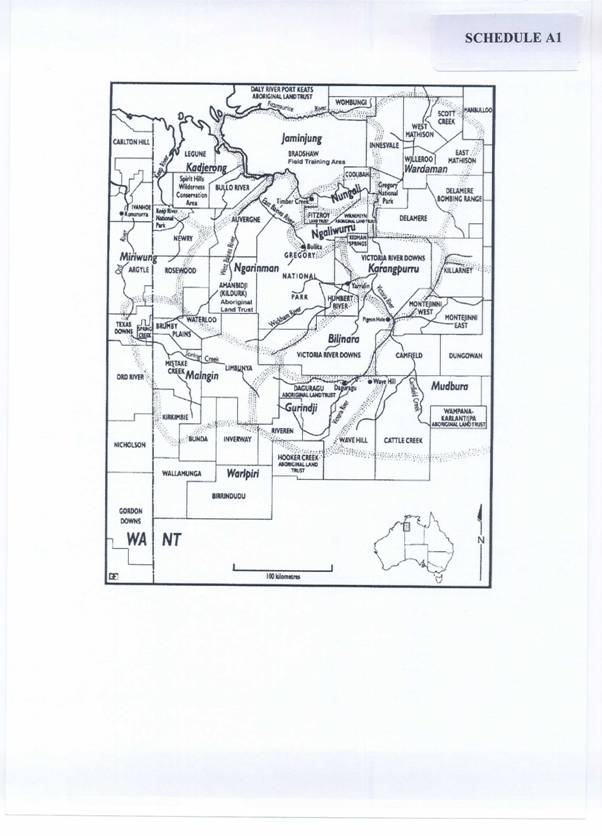
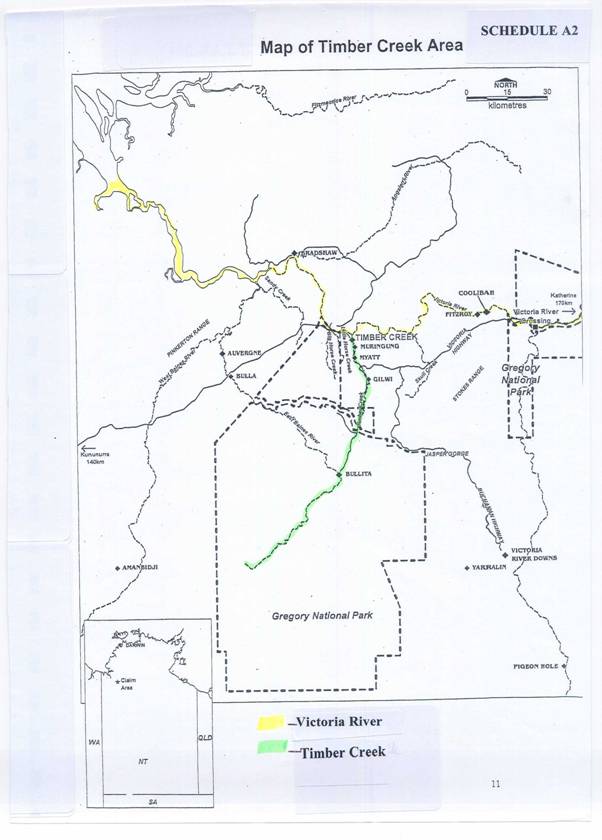
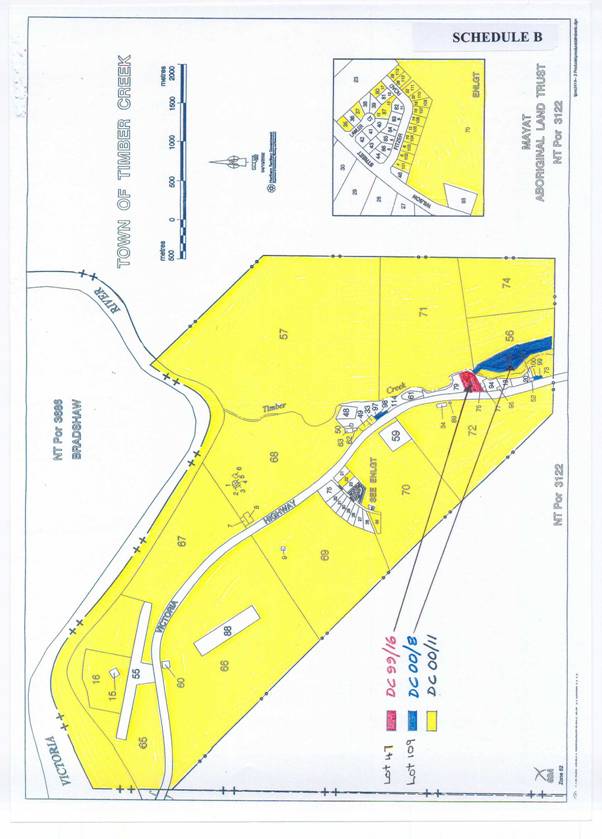
SCHEDULE C
SITE VISITS 1, 2 and 8 MARCH 2005
DAY 1, TUESDAY 1 MARCH 2005
The hearing commenced at the Timber Creek Community Government Council. After opening addresses, the Court adjourned for several site visits.
The procedure followed was that witnesses would give evidence at each site concerning its significance, and the relationship between the applicants and the area in question. The witnesses were then cross-examined by counsel for the Northern Territory and AFANT. The witnesses called on the first day were Alan Griffiths, Jerry Jones and Josie Jones.
Site 1: Wirip Ngalur Katpan (site behind Wayside camping ground “Dingo Dreaming”);
The first site visited, Wirip Ngalur Katpan, was a “Dingo Dreaming” location at Timber Creek, behind the Wayside Inn, which was the local camping ground. Alan Griffiths approached the creek and called out in the Nungali language. He then conducted a “head wetting” ceremony at the site. He explained that the ceremony took place at this spot because it was the place of the Dingo Dreaming. He then said that a “whitefella” had attempted to build a bridge here without permission. Jerry Jones said that if newcomers did not go through a head wetting ceremony, the Dingo Dreaming would cause death and illness. He said that this was what had happened to the man who built the bridge, Maxie Duncan. He explained that Mr Duncan had died suddenly.
Under cross-examination Mr Griffiths explained that the Dingo Dreaming was his mother’s father’s Dreaming. He said that the dingo had travelled Miriuwung country, near Kununurra, to that place. As the dingo moved through different countries, it spoke the language of whatever country it happened to be in.
Site 2: Karani – Missing rock behind the house
The Court and the parties drove west along the Victoria Highway for approximately 3.5 kilometres. Mr Griffiths indicated a place half way up the hillside. The Court Officer photographed the scene, and informed the Court that Mr Griffiths had said that this was the place where “a rock was missing, behind the house”.
Later, at site 5, Mr Griffiths told the Court that the rock had been part of the Spider Dreaming. It was now missing, but had formerly been located on the south side of the creek, next to the house.
Site 3: Karani – Spider Dreaming made hole in ground near tree
The convoy proceeded further west along the highway, and again stopped. Mr Griffiths then pointed to another place and told the Court that the site was a hole in the ground, near a tree, made by the Spider Dreaming.
Site 4: Wayatpayi – Wirip’s helmet
Once again, the convoy proceeded further west along the highway, and again Mr Griffiths stopped to point out a place he described as “Helmet Hill”.
Later, Mr Griffiths told the Court that this was the hat, or helmet, of the “Wirip”, or dingo. He said that he still used the hat for corroborees. He said that the ceremonies were not recorded in any written form. He tapped his head, and said that ceremonies were kept there, and passed on.
Site 5: Ridge / cleared area
The Court was then taken to a cleared ridge area twenty metres from the Victoria Highway turn off, towards the Telstra tower.
Mr Griffiths could not tell the Court the name of this site as it was his cousin’s sister’s place. He explained the Dreaming of the barramundi hunting the Wirip and the rock wallaby. He had learned this Dreaming from his “grandfather”, Old Lamparangana. He said that gravel had been scraped or cleared from this area on the site of the Wirip Dreaming. Mr Griffiths had been informed of this by Mr Jones who had telephoned him. Mr Griffiths told Mr Jones to tell the person removing the gravel to stop because he was disturbing the Wirip.
Mr Griffiths was asked who he consulted when decisions of that kind had to be made. He said Jerry Jones, Jo Lewis, Sammy Darby and “all the mob”.
Mr Griffiths then described the process of “Winan” and how bamboo spears and boomerangs were carried by foot across the country. He characterised winan as “fifty-fifty”, and showed the Court a yellow rock from which was derived paint for corroborees. He also produced a flint that could be used for a spear and demonstrated how he lit fires, a practice that he had learned from Lamparangana. He said that he had taught his grandsons that same practice.
Mr Jones then gave evidence. He said that he “grew up here”, and that he still did the same winan that had been done for generations. He said that he taught his grandsons that winan.
Under cross-examination, Mr Griffiths said that the Dingo Dreaming at this location involved the same dingo as had come from Miriuwung, and had been discussed at the head wetting ceremony. He said that a different dingo from Bullock had traversed a different part of the land, to which he pointed.
In re-examination, Mr Griffiths was asked who else he consulted when making decisions such as the one relating to the removal of gravel. He answered, “my mob” which he described as including his sons and grandsons, Jerry, Sammy, Jo and William.
Site 6: Kulungara
The Court was next taken to a vantage point overlooking the town a little further up the road on the way to the Telstra tower.
Mr Griffiths said that Winan came through here.
Mr Jones pointed out places of interest in both English and Nungali. For example, he said that Makalamayi was located at the juncture of Timber Creek and Victoria River.
Josie Jones, Mr Jones’ wife, gave evidence. She said that she knew all of the places that her husband had mentioned. She had learnt them when she was ten years old from “the first mob”, being her parents and her mother’s father. She said that she had passed on that knowledge. She pointed to a tree, which she said was used to make didgeridoos. She pointed to another tree, which she described as “billygoat plum” in Nungali, and to a third tree, which she said was ironwood. It was used for making fighting sticks, and digging yams. The roots were used for waxing the sticks.
Under cross-examination, Mrs Jones said that she was taught these stories for this country from the first mob. The languages used had been Nungali and Ngaliwurru. She was taught by Violet Paliti, her mother’s mother, and by her father’s mother and her grandmother’s sister.
Doris Robertsgave evidence. She said that at site 5, she had found a white stone used for making paint. That paint, she said, was used for dancing and painting. She still used the paint from stones such as these in the ways she described.
Finally, Mr Griffiths pointed to a tree, which he said was used to make marks on the skin of the chest. Young people still did this. George Jones came forward to show the markings on his chest that he said had been made in this way.
Site 7: Telstra tower lookout on point
On approaching this site, Mr Griffiths called out, in Nungali, the word “Yakpali”. He pointed out Kuminyiyung, a hill to which the Wirip had gone. He described the Dreaming of two snakes – a cheeky snake, and a quiet snake. They had fought over poison in their teeth. He said that his grandfather had told him that the hill, Kuminyiyung, had poison in it from the snakes. In this area, miners had mined for diamonds without permission. Mr Griffiths said that he had stopped them.
He was asked whether he told his children about the Dreamings. He replied, “yes, they already know.” He described another Dreaming, that of the humpyback monster.
Mr Jones pointed to various sites from the lookout including the Myatt community where he and his family lived. He said the Lewis family lived there, as did Roy Harrington. He pointed to another community, Kulardi. He said that he knew the same stories as Mr Griffiths, learnt them from his elders and taught them to his sons.
Under cross-examination, Mr Jones said that the humpyback monster spoke only Nungali, and no other languages.
Under cross-examination, Mr Griffiths explained in more detail about the cheeky and quiet snakes. He agreed that the snakes spoke Nungali but said that if they travelled to other countries, they could speak the language of the Dreamings of those countries too.
Mrs Jones gave evidence that she knew the same stories and the places that her husband had referred to at this site. She had learnt them from the old people. She pointed to places in the area where she used to hunt. She said that she obtained “tucker” from a palm she identified.
A little further back towards the convoy of cars, away from the edge of the ridge, Mr Griffiths described how he and his friends used to catch birds and kill them. They made a circle of stones, which was still visible. A man would lie under branches in the middle of the circle. He would have a stick and poke it up through the branches. On top of the stick would be a feather to attract attention. They would then make smoke from the stones, attracting the birds. When the birds arrived, the man underneath would reach up and grab them, breaking their necks for food. He said that this practice is not followed to anything like the same extent now. Somewhat sardonically he noted that the younger generation hunted with rifles.
DAY 2, WEDNESDAY 2 MARCH 2005
Site 1: Bridge across Victoria River
On approaching this site, Mr Griffiths called out “Yakpali” in Nungali. He said that this meant “country” in English. He said that this site was the place of the Dingo Dreaming. The dingo came to the river; the barramundi called out to him to “turn back, it’s my home”. The barramundi spoke Nungali. The dingo then went to the place that had been identified to the Court on the previous day.
Mr Griffiths said when the army had proposed building the bridge across the Victoria River, about three years earlier, it created a problem. However, he had allowed them to build it. Originally the army wanted to knock out the bank of the river at this site, but this was the place of the Dingo Dreaming. Mr Griffith’s said that “in the early days”, people did not ask permission to build on land that was the site of a Dreaming. He said that the army ought to ask permission to build structures like the bridge. In any case, he had allowed it to be built, and the army had paid him compensation. He said that he distributed the money to “all the Timber Creek mob and my mob”, who he named as Jerry Jones, Georgie Jones, Christopher Jones, Stephen Jones, Kenny Griffiths and Kim Griffiths, and others.
Under cross-examination, Mr Griffiths said the name of the barramundi was “Marna”. It came from Jaminjung, and travelled to Ngaliwurru country, finishing at Yanturi. He said that this was his Dreaming, given to him by his grandfather.
In re-examination, Mr Griffiths said that Old Lamparangana had brought him to this site and told him about the Dreaming. He said that he could not reveal the stories because there were women present, but that he would disclose them at a later hearing that would be attended by men only.
Mrs Jones then told the Court that the Griffiths and Jones families, Doris Roberts’ family, Larry’s family, “all them mob” had been involved in the decision about the bridge. She said that she knew the story of the dingo. She supported Mr Griffiths’ account of how the dingo had come to this place, and then to the site of the head wetting ceremony held on the previous day.
Mrs Jones then showed the Court some eucalyptus leaves, which she said were bush medicine. She demonstrated their use. She showed the Court other leaves, which she called “Manyanyi” in Nungali. These leaves were used for rubbing on skin. She said that she had shown her children how to use them.
Under cross-examination, Mrs Jones said that the Wirip Dreaming was not hers. However, she said that the Barramundi Dreaming was her Dreaming, and that it had been given to her by her father’s father.
Finally, Mrs Roberts showed the Court some wild rockmelon, which she called “Wanput” in Ngaliwurru. She said that she could tell the difference between those that were ready for eating, and those that were not. She said that when ripe, the fruit was eaten whole.
Site 2: Jalalawuti (flat rocks on banks of Victoria River)
Mr Griffiths said that this site was called “Jalalawuti”. He told the Court that the Dreaming for the site was the meeting of the shark, the stingray and the catfish from the east, and the barramundi from Makalamayi in the west. As the barramundi approached, the shark said to him, “this is my home. You go back where you came from.” However, the barramundi did not want to “go that way” so they started fighting. The flat rocks in this area were part of the Dreaming. In “early times”, people had tried to take some of the rocks from the site to build a pub.
Under cross-examination, Mr Griffiths said that the shark had come from Makalamayi and that it remained constantly at this site. He said that the Shark Dreaming was in Nungali. He said that he had acquired the Shark Dreaming from his mother’s father.
Mr Griffiths was then asked about “ngurlu” (totemic relationship or skin). He described his ngurlu as “ninipi”, a little bird. He said that he acquired it from his mother. He said that “kuning” had the same meaning as “ngurlu”.
Mr Griffiths then said that the stingray was from Yanturi and spoke Ngaliwurru. He said that the catfish had travelled along the same path as the stingray, and also spoke Ngaliwurru. However, the shark, the stingray and the catfish could all speak both Nungali and Ngaliwurru.
In re-examination, Mr Griffiths said that this site was a registered sacred site. He said that it had become registered following the major land claim in the area.
Sammy Darby gave evidence. He said that he could see a crocodile on the far bank of the river eating some food, possibly a kangaroo, or maybe a fish. He knew the stories that Mr Griffiths had just relayed. He had learnt those stories, and about the sites in question from Old Darby when he was about ten years old.
Jo Lewis then gave evidence. He too had heard all of the stories that Mr Griffiths had told. He had learnt them from his grandfather, Old Mutpuyula (Jo) and Old Jack Depot. He said that he had walked around Makalamayi, Kulmariniyung, Paralji, Jalalawuti, Turtpurinyi, Tilwarini, and Purumpirinyung with his grandfather. He said that there were many indigenous people in those parts.
Under cross-examination, Mr Lewis said that both his father’s father and his mother’s father used to take him walking. He said that he spoke both Nungali and Ngaliwurru. His mother’s father was from Jaminjung country. In the Timber Creek area, there were people from Nungali, Ngaliwurru and Jaminjung.
William Gulwin gave evidence. He said that he had been taught by his uncle, Mr Alan Griffiths, about the Dreamings when he was aged about nine.
Mrs Jones gave evidence to say that she too knew the stories from this place. She had learnt from the old people in Timber Creek about the barramundi, the shark, the Stingray and the Catfish Dreamings. The old people had shown her how to hunt and would tell her the stories. She had passed them on to her children and grandchildren.
Chris Griffiths gave evidence. He said that he was still learning the stories from his father, Alan. He did not fish in this spot regularly. He could see the crocodile on the other side of the river in the water. When asked how he could distinguish a crocodile from a log at that distance, he explained that he had learned how to do so from his father.
Site 3: Makalamayi
On approaching this site, Mr Griffiths called out something that was indecipherable. He said the name of the place was Makalamayi, and that the juncture of the Victoria River and Timber Creek was called Jalmin. He pointed to the middle of the river and said there had once been a long hollow log there. He had learnt about it from his grandfather and passed it on to his mob. He said that when his grandfather passed away the log had disappeared.
Under cross-examination, Mr Griffiths said that he had learnt about Makalamayi from his mother’s father.
Mrs Jones then confirmed that the name of the place was Makalamayi and that the name of the log was “Jalmin”. She said that she had learned about it from the old people. She said that from that point she could see the big hill called “Karnaryulumin”, “Turutpurinyi”, “Tilwarini”, a little creek that ran to the waterhole, and “Kuninkiyung”, which was a fishing spot. She said that old people used to fish there, on the other side of the creek. She said that the other side of the river was “Lawi country”. Makalamayi extended down to the crossing that used to be used for foot crossings to Bradshaw station before the bridge was built.
Under cross-examination, Mrs Jones said there was a Shark Dreaming at Karnaryulumin and also at Turutpurinyi. She had walked around there. There was also a Shark Dreaming in Kuninkiyung. She said that the name Lawi came from a Dreaming about a small wallaby. Both Ngaliwurru and Nungali were spoken in Lawi country. When asked whether the fishing spot had a Shark Dreaming, Mrs Jones replied that it did and that her people still fished there today. When asked how far up Timber Creek the tides went, she replied about two hundred metres from the juncture of Timber Creek and Victoria River. She said that Aboriginal people fished for turtles in Timber Creek, and that white men also fished there, but in their case, for bait fish and “tanyan” (cherrapin).
In re-examination, Mrs Jones said the tides went approximately as far as the police station.
The Court then moved down to the bank of Timber Creek, almost at the juncture with Victoria River. Mrs Roberts and Mrs Jones picked wild gooseberries and bush tomatoes. Mrs Jones said she first started eating bush tucker at about the age of six.
Mr Alan Griffiths then pointed to a paperbark tree, which he said was used for making traditional hats.
Site 4: Tilwarini (water hole with water lilies and head wetting ceremony)
Mr Griffiths conducted a second head wetting ceremony for all newcomers to this site. He said that it was called “Tilwarini”, and was the site of the humpyback monster. Head wetting was done here for the same reason as at the site of the first head wetting – for the Dreaming. The Dreaming had left something here, and head wetting had to be done “so country will know you”, otherwise a person could suffer illness or death. As a boy, Mr Griffiths had camped at this place, in order to get his head wet.
Under cross-examination, Mr Griffiths said that the Dreaming at this site differed from the Dingo Dreaming at the site of the first head wetting ceremony. He said that the humpyback had made a toilet here. He had conducted a head wetting ceremony for some of his grandchildren on this day because this was the first time they had been to this site.
Mr Griffiths said that it was unusual for members of his family to fish at this site. In the wet, there was sometimes more water at the water hole. Sometimes, they might catch small perch. In addition, cherrapin might be caught at this location.
Mr Jones then gave evidence. He was asked how he knew his way to this place and replied that he had known about it from the time that he was a child. His granddaughter had gone through a head wetting ceremony that day because she had never been to that site before. She was only four years old. His other grandchildren had been through a head wetting at this location. He said that he knew the Humpyback Dreaming. He said it was a very important Dreaming, and that he had learnt it from his elders. If Mr Griffiths had not been present, it would have been his role to call out to the monster.
Under cross-examination, Mr Jones told the Court of the path that the monster had travelled, finishing at Maiyalaniwung, Violet Paliti’s country. He said that if a person travelled to Maiyalaniwung for the first time, he or she would have to go through a head wetting ceremony there too because it was a different country. The country had to “get to know you”. Mr Jones said that he came to this area often to get honey from the cave, yam and water lily. He did not like whitefellas coming here from the town to get their bait. They got their cherrapin closer to the township. He said:
“If we don’t do it, why – you know, why have you been doing it?… you can’t just walk into any European’s little block of land and do what you want to do. And why they go onto Aboriginal land and do what they want to do?”
Mrs Roberts then collected some lily root, which she described as “nati”. She said that it could be eaten as is, boiled or roasted. The fruit from the lily flower could be eaten as is.
Mrs Jones showed the Court a fruit like a grape which she said was called “kiringiltji” or “kumpunyu” in Nungali. She had a smaller white version called “margarin”. She showed the Court a rock called “marta” in Nungali that she said made babies strong. She would burn the rock on a fire, smash it up into a powder, mix it with some water to make a paste, and put it on the baby.
Site 5: Lirimin (Centipede Dreaming)
Mr Griffiths approached a rectangular stone protruding from the ground by approximately a foot. He explained that this was a sacred site. An elder had told him that he was not allowed to touch the stone, otherwise he might get sick. He was not even permitted to put his hand on the stone.
Under cross-examination, Mr Griffiths said that he could mark a dead person’s name in charcoal. He said no one was buried at the site. It was simply a Dreaming. The stone had been put there in the dreamtime, and he had been shown it by his grandfather
Mr Jones gave a similar account of the significance of the stone. He explained that the barbed wire fence around the site had been erected by the Sacred Sites Authority five or six years earlier. This was because the cattle had damaged the area. Originally, there had been a grazing licence over the site.
Pat Jatjat, Mr Griffiths’ older sister, then gave evidence. She said that she had grown up on VRD and had heard the Centipede Dreaming from her grandfather.
William Gulwin said that he knew this place as “centipede” in English and “limirin” in Ngaliwurru.
The Court then moved several metres to a flatter rock embedded in the ground. Mr Griffiths said it was the head of the centipede. He pointed to two eyes in the rock to indicate the head. He said he was first shown this rock when aged about four. An elder had told him to look out for it. He said that when he died, his grandchildren would look after it. He explained that his wife was from Miriuwung country so he had been forced to leave Mr Jones in charge of Timber Creek.
Site 6: Ritual ground
The Court arrived at a place marked out by a rock which Mr Griffiths described as the “main ring place” used for a “ceremony for kids”. He said that people from pastoral leases such as Bradshaw, Daly River, Legune, Kildurk, Waterloo, VRD and Coolibah used this site. He noted that no women had gotten out of the cars to see this site because it was reserved for men. The boys who were initiated here were ten or eleven years of age. He pointed to his grandson, Sidney, who was ten years old, as an example of how old a boy would be at initiation. He said a corroboree was conducted here when Old Pankaman got sick. He had a photograph of a painting that he had painted. He said the rock had been there before he was born.
Under cross-examination, Mr Griffiths said that the people that he had named from the pastoral leases were from Jaminjung, Ngaringman, Karangpuru, Ngangomeri and Ngaliwurru. He also said that the last time a children’s ceremony had been conducted at this site was about thirty years ago. He elaborated further on the corroboree done for Old Pankaman. He said that this was not Pankaman’s country but that he had become sick in this area so that was where the corroboree was done. Then his spirit went away. However, he did not die. He was still alive and living at Stokes Range.
In re-examination, Mr Griffiths said that the fact that no kids ceremony had been done here for thirty years did not mean it was not an important site. He said that he and his family were still obliged to look after it. Indeed, he said the site was still used as a place for punishment.
Mr Griffiths was also asked whether he had a song for the Centipede Dreaming. He said that he did; and that his grandfather had given it to him. He sang it for the Court. He said “kudjingka” was the word for song, and “yarinti” was the song for the centipede “when he bite you”. He said he had kudjingka in his head, and that songs were not written down.
Finally, under further cross-examination, Mr Griffiths said that the Centipede Dreaming was his own, given to him by his mother’s father. His mother’s father had also given him the Dingo Dreaming. If anyone “had” those songs, they could sing them, provided they asked his permission.
Site 7: Old cemetery site
The last site to which the Court was taken was the old cemetery site. Mr Jones began by indicating a stone, which he said was his mother’s mother’s grave. Her name was Holly. He said that some stones could not be seen because of the grass. He said that about sixty to seventy people were buried at the site. He pointed out old tracks in and out of the area.
Further along, Mr Jones pointed to the grave of Tiger Wajaka from Stokes Range. He had been a police tracker, before Mr Jones’ time.
Mr Jones then pointed out an old mattress frame used for carrying the bodies to this site. He said the bodies were wrapped in calico for burial.
He pointed to a cave and said that Old Lamparangana was buried there. His said that Lamparangana’s skull was still in that cave.
Mr Jones next pointed to some glass embedded in the ground and said that women used glass to cut their legs to obtain blood that was painted onto the foreheads of the corpses.
The Court then arrived at a burial site. There were rocks in a ring shape. A billycan had been left there and Mr Jones explained that this was to give water to the dead. Only a son-in-law or a brother-in-law could dig a grave or bury a dead person. The same rule existed today.
Mr Jones gave the names of other people who were buried at this site: Johnny, Dina (Mrs Jones’ grandmother), Bullita Jack, Depot Jack, Polly (his grandmother), Sandy (Mrs Jones’ mother’s father), Jacky Jacky (Violet Paliti’s father) and others.
Mr Jones explained the term “poison cousin”. He said there were certain people in one’s family who you could not talk to or sit next to; for example, one’s mother-in-law.
He said that burials were still conducted at Myatt because burial had to take place at a registered site. He also said that burials had to be done at the “right” place – a person had to be buried to “go back” to his or her own country.
Mrs Jones confirmed that Old Lamparangana was buried at this site. She referred to him as her “mapiju”, her “father uncle”. She named other people buried here: Walamawuk and Pankaman, who were two sisters, Sandy (her mother’s father), Lapir, Old Tiger Wajaka, Old Charlie and others. When asked whether these people were relatives, Mrs Jones answered, “Yes, relation, all Nungali people.”
Mr Griffiths then said that he had been to the cave once.
DAY 6, TUESDAY 8 MARCH 2005
Site 1: Muruning (One Mile)
At the conclusion of Mrs Paliti’s evidence, the Court visited One Mile community, a short drive from the centre of Timber Creek. Evidence was given regarding this community, whose aboriginal name was “Muruning”. That name was taken from the Dingo Dreaming. Sammy Darby was among those who lived there.
He described some of the bush tucker around his home. He identified a green plum called “jamuru”. He said that by the trees on the creek, he could get bush apple when it turned orange. Women collected bush yam along the creek beds. Yams were from there from the beginning; they were left there in the dreamtime. He said there were also sugarbag trees by the creek.
Site 2: Murlun (Half Mile)
The Court then visited a smaller community, closer back towards the centre of Timber Creek. The name of the place was “Murlun”. Once again, the Court was shown bush tucker that was collected and eaten, and told about the fish that were available from the waters of Timber Creek. There was evidence that the creek ran all year round, even in the dry season.
Site 3: Kunuma (Blowfly Dreaming site at Boab Tree)
The Court was taken to a place at the rear of the caravan park in the centre of town, near the creek itself. Mr Griffiths explained how the little Blowfly Dreaming was near the big boab tree. That Dreaming continued even thought the tree was gone. He called the tree “kunama”.
Pointing out bush tucker, he identified a fig tree (“jalwa”) and flying fox (“warpa”), which he said he still ate. Whitefellas thought they were poison, but, in reality, they were really very tasty.
Explaining more about the Blowfly Dreaming, Mr Griffiths said that the fly had stopped the dingo at this site and told him it was his home, and that the dingo should turn back. He sang the “kudjingka”, or song, of the dingo. Thereafter, the dingo had run back to the site that the Court next visited.
Site 4: Wirip Ngalur Katpan (site where Dingo Dreaming ended at pool)
Mr Griffiths took the Court past the place where newcomers had undergone a head wetting on the first day of the trial at the site of the Dingo Dreaming. He said that this was the place to which the dingo had returned when the blowfly turned him back. It was still a part of Timber Creek. The water used to be clear before the bank was built up at the site of the head wetting. There had been a rock visible at this site, but when the bank was built, it backed up the water so that it covered the rock.
Mr Griffiths pointed out more bush tucker at this site. He said there were bush yam, fig trees and leichhardt trees. The leichhardt tree had yellow fruit in it. There was also a creeper that was good for eating. He said that the yam had been left by the humpyback.