

FEDERAL COURT OF AUSTRALIA
Bunnings Group Limited (formerly Bunnings Pty Ltd) v Laminex Group Limited [2006] FCA 682
TRADE PRACTICES – whether goods of a kind ordinarily acquired for personal, domestic or household use or consumption – application of Div 2A of Part V of Trade Practices Act 1974 (Cth) – where particular products not ordinarily acquired for personal, domestic or household use or consumption – whether goods of a kind so acquired
WORDS & PHRASES – goods of a kind ordinarily acquired for personal, domestic or household use or consumption
Trade Practices Act 1974 (Cth) s 74A(2)(a)
Theo Holdings Pty Ltd v Hockey (2000) 99 FCR 232 cited
Project Blue Sky Inc v Australian Broadcasting Association (1998) 194 CLR 355 cited
Accounting Systems 2000 (Developments) Pty Ltd v CCH Australia Ltd (1993) 42 FCR 470 cited
Webb Distributors (Aust) Pty Ltd v Victoria (1993) 179 CLR 15 cited
Devenish v Jewel Food Stores Pty Ltd (1991) 172 CLR 32 cited
Zaravinos v Diary Farmers Co-Operative Ltd (1985) 7 FCR 195 cited
Diethelm Manufacturing Pty Ltd v Commissioner of Taxation (1993) 44 FCR 450 considered
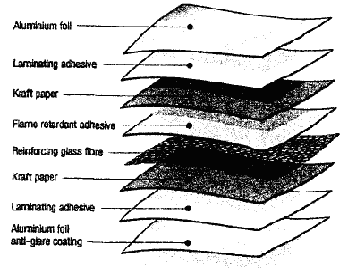
Commissioner of Taxation v Chubb Australia Ltd (1995) 56 FCR 557 considered
Clean Investments Pty Ltd v Commissioner of Taxation (2001) 105 FCR 248considered
Hygienic Lily Ltd v Deputy Commissioner of Taxation (1987) 13 FCR 396 considered
Crago v Multiquip Pty Ltd & Dunogan Farm Tech Pty Ltd (1998) ATPR 41-620 discussed
Minchillo v Ford Motor Company of Australia [1995] 2 VR 594 discussed
Jillawarra Grazing Co v John Shearer Ltd (1984) ATPR 40-441 discussed
Carpet Call Pty Ltd v Chan (1987) ASC 55-553 discussed
Westminster Properties Pty Ltd v Comco Constructions Pty Ltd (1991) 5 WAR 191 discussed
ICI Australia Operations Pty Ltd v Deputy Commissioner of Taxation (Vic) (1987) 82 ATC 5110 distinguished
Air International Pty Ltd v Chief Executive Officer of Customs (2002) 121 FCR 149 discussed
Commissioner of Taxation (Cth) v Newbound & Co Pty Ltd (1952) 10 ATD 59; 26 ALJR 386 cited
Commissioner of Taxation (Cth) v Sherwood Overseas Pty Ltd (1985) 75 FLR 474 cited
O R Cormack Pty Ltd v Commissioner of Taxation (Cth) (1992) 92 ATC 4121 cited
Commissioner of Taxation (Cth) v Hamersley Iron Pty Ltd (1981) 59 FLR 415 cited
Deputy Commissioner of Taxation v Stewart (1984) 154 CLR 385 cited
BUNNINGS PTY LTD (ACN 008 672 179) v LAMINEX GROUP LIMITED (ACN 004 093 092)
VID 941 of 2004
YOUNG J
2 JUNE 2006
MELBOURNE
| IN THE FEDERAL COURT OF AUSTRALIA |
|
| VICTORIA DISTRICT REGISTRY | VID 941 OF 2004 |
| BETWEEN: | BUNNINGS PTY LTD (ACN 008 672 179) APPLICANT
|
| AND: | LAMINEX GROUP LIMITED (ACN 004 093 092) RESPONDENT
|
| YOUNG J | |
| DATE OF ORDER: | 2 JUNE 2006 |
| WHERE MADE: | MELBOURNE |
THE COURT NOTES THAT:
1. On 22 April 2005, the Court ordered pursuant to O 29 r 2 of the Federal Court Rules that the following question (‘the separate question’) be heard and determined separately from and before the trial of any other question arising in the proceeding:
‘Assuming that Sisalation 496, Sisalation 498 and/or Permastop 496 was or were used in the construction of Bunnings Warehouses described in the Schedule to the statement of claim, at the time of the supply by the Respondent to the various builders or contractors involved in the construction of the Bunnings Warehouses alleged in paragraph 4 of the statement of claim, were:
(a) Sisalation 496;
(b) Sisalation 498;
(c) Permastop 496-
“goods” within the meaning of:
(a) section 74A(2)(a);
(b) section 74B(1)(a); and
(c) section 74D(1)(a)-
of the Trade Practices Act 1974 (Cth)?’
THE COURT ORDERS THAT:
2. The answer to parts (a) (b) and (c) of the preliminary question is in each case ‘yes’.
Note: Settlement and entry of orders is dealt with in Order 36 of the Federal Court Rules.
| IN THE FEDERAL COURT OF AUSTRALIA |
|
| VICTORIA DISTRICT REGISTRY | VID 941 OF 2004 |
| BETWEEN: | BUNNINGS PTY LTD (ACN 008 672 179) APPLICANT
|
| AND: | LAMINEX GROUP LIMITED (ACN 004 093 092) RESPONDENT
|
| JUDGE: | YOUNG |
| DATE: | 2 JUNE 2006 |
| PLACE: | MELBOURNE |
REASONS FOR JUDGMENT
INtroduction
1 On 22 April 2005, the Court ordered pursuant to O 29 r 2 of the Federal Court Rules that the following question (‘the separate question’) be heard and determined separately from and before the trial of any other question arising in the proceeding:
‘Assuming that Sisalation 496, Sisalation 498 and/or Permastop 496 was or were used in the construction of Bunnings Warehouses described in the Schedule to the statement of claim, at the time of the supply by the Respondent to the various builders or contractors involved in the construction of the Bunnings Warehouses alleged in paragraph 4 of the statement of claim, were:
(a) Sisalation 496;
(b) Sisalation 498;
(c) Permastop 496-
“goods” within the meaning of:
(a) section 74A(2)(a);
(b) section 74B(1)(a); and
(c) section 74D(1)(a)-
of the Trade Practices Act 1974 (Cth)?’
This order was made upon the respondent undertaking to the Court as follows:
‘The Respondent, by its Counsel, undertakes not to make an application for leave to appeal or an appeal to the Full Court of the Federal Court of Australia from an order or orders made by the Court in determining the separate question set out in order 1 below until the final hearing and determination of all issues in the proceedings.’
the alleged contraventions of sections 74b and 74d
2 In the proceedings, the applicant claims damages against the respondent for alleged contravention of ss 74B and 74D of the Trade Practices Act 1974 (Cth) (‘TPA’). These provisions are found in Div 2A of Part V of the TPA, which is entitled ‘Actions against Manufacturers and Importers of Goods’. Where a person acquires goods, as defined in Div 2A, from an intermediary who in turn acquired the goods from the manufacturer, ss 74B and 74D afford the person a right of action for compensation directly against the manufacturer. Section 74B applies where the goods were not reasonably fit for their indicated purpose. Section 74D applies where the goods were not of merchantable quality.
3 Section 74A(2)(a) provides:
‘A reference to goods shall, unless the contrary intention appears, be read as a reference to goods of a kind ordinarily acquired for personal, domestic or household use or consumption’.
4 For completeness, reference should be made to two other definitional provisions. First, s 74A(8) provides:
‘For the purposes of this Division, goods shall be taken to be supplied to a consumer notwithstanding that, at the time of the supply, they are affixed to land or premises.’
5 Secondly, there is a general definition of ‘goods’ in s 4(1). It provides that, unless a contrary intention appears, ‘goods’ includes:
‘(a) ships, aircraft and other vehicles;
(b) animals, including fish;
(c) minerals, trees and crops, whether on, under or attached to land or not; and
(d) gas and electricity’.
Neither the applicant nor the respondent suggested that the inclusive definition in s 4(1) provides any assistance in this case.
6 Sections 74B and 74D do not disclose any intention that the meaning of the term ‘goods’ in s 74A(2)(a) should not be applied in this case. Indeed, it is common ground between the applicant and the respondent that in its application to this case the term ‘goods’, where it is used in ss 74B and 74D, means ‘goods of a kind ordinarily acquired for personal, domestic or household use or consumption’.
7 The applicant alleges that at various dates between February 1994 and June 2001, the respondent supplied insulation products known as Sisalation 496, Sisalation 498 and Permastop 496 (collectively ‘the products’) to various builders or contractors involved in the construction of twenty warehouses. The products were incorporated into the structure of the warehouses. The applicant has either acquired or leased those warehouses.
8 The applicant alleges that the products were not fit for their purpose and/or were not of merchantable quality, in contravention of ss 74B and 74D. As a result, the applicant claims it suffered loss and damage in respect of which it is entitled to compensation from the respondent.
The respondent’s pRODUCTS
9 Prior to 1998, the respondent (then called ACI Australia Ltd) conducted a business of manufacturing and selling a range of insulation products under the business name ACI Insulation. Sisalation 496, Sisalation 498 and Permastop 496 were part of that product range. The respondent’s reflective foil insulation products were sold under the registered trade mark ‘SisalationTM’. It also sold a combined reflective foil laminate with a glass wool blanket adhered to it under the trade mark ‘PermastopTM’.
10 In 1998, ACI Insulation was renamed Insulation Solutions, but it remained a business conducted by ACI Australia Ltd until 2002. ACI Australia Ltd has had three changes of name. In May 1998, ACI Australia Ltd changed its name to Australian Building Materials Ltd; in August 1998, it changed its name to Amatek Ltd; and in September 2002, Amatek Ltd changed its name to Laminex Group Ltd.
11 It does not appear to be material to these proceedings, but it is convenient to note that from 2002 the business previously conducted under the names ACI Insulation and Insulation Solutions was conducted by Insulation Solutions Pty Ltd. Both the respondent, Laminex Group Ltd, and Insulation Solutions Pty Ltd are now owned by Fletcher Building Ltd.
the nature of REFLECTIVE FOIL INSULATION PRODUCTS
12 Reflective foil insulation products have been available commercially in Australia for approximately 50 years. In general terms, a reflective foil insulation product comprises a reflective foil facing adhered to a kraft paper backing that is reinforced in various ways, such as by the inclusion of a layer of fibreglass. Reflective foil insulation products of this type are also commonly referred to as ‘reflective foil laminates’. I will adopt that terminology in these reasons, unless I am referring to reflective foil insulation products more generally or the context requires me to be more specific.
13 One of the experts who gave evidence on behalf of the applicant, Dr Eilenberg, described the general make up of the product in the following way:
‘In summary, reflective foil laminates are generally made up of a core – of either fibre-glass strands or plastic reinforcement, with a kraft paper over this and coated with layers of aluminium foil and/or other coating, on one or both sides. An example of the composition of a foil laminate is set out in several Insulation Solutions’ Sisalation data sheets and shown as follows:
14 Reflective foil laminates are commonly produced in rolls approximately 1350mm wide and up to 60 lineal metres in length. They are also produced in a range of weights and strengths and with different finishes. Thus, reflective foil laminates can be graded as light duty, medium duty, heavy duty or extra heavy duty. These descriptions usually refer to the durability of the material.
15 Prior to the development of reflective foil laminates, ‘sarking’ was used in the building industry as a pliable water resistant membrane. The term ‘sarking membrane’ is described in The Glossary of Buildings Terms, Standards Australia, 1994, as follows:
‘Sarking membrane – a pliable, water-resistant membrane for use beneath the external roof or wall covering to collect and discharge any water that may penetrate or water vapour that may form. Now often combined with reflective foil to provide thermal insulation benefits.’
As this definition suggests, reflective foil insulation products operate as water and vapour resistant membranes and also provide thermal insulation benefits. The evidence indicates that the term ‘sarking’ is still sometimes used to describe reflective foil laminates.
16 Reflective foil laminates have three essential properties:
(1) Water barrier. When used in roofs and walls, reflective foil laminates operate as a barrier against water or wind-driven rain entering the building.
(2) Vapour barrier. Reflective foil laminates operate as a barrier to water vapour by preventing condensation from forming on the inside of the building.
(3) Thermal insulation. Reflective foil laminates provide a barrier against radiant heat and are often used in conjunction with a bulk insulation to provide the required insulation performance.
17 Some reflective foil insulation products have additional attributes. For example, when perforated, insulation foils can be used to provide an acoustic barrier. Some reflective foil insulation products have an anti-glare coating and/or a decorative (usually white) facing. The particular attributes of white-faced foil laminates are discussed in detail below.
18 The process of installing reflective foil laminates in commercial, industrial and residential buildings is generally very similar. Where the product is installed in a domestic roof, it is laid over the roof joists under the roof battens. This creates an air space between the roof tiles or other cladding and the reflective foil laminate which maximises the insulation effect. Similar installation techniques apply where sheet metal is used as a roofing product. Where the product is installed in domestic walls, it is generally affixed to timber studs with fixing plates. Reflective foil laminates are usually installed horizontally and joins in the material are sealed with a specialised tape. When installed in this way, the reflective foil laminate blocks any moisture that permeates through the external facing of the wall and allows any condensation to fall onto flashing at weephole level and so drain away. Again, this method of installation ensures an airspace between the product and the external wall (and to a lesser extent any internal cladding) which tends to maximise the thermal insulation effect. Reflective foil laminates are installed in commercial and industrial buildings in much the same fashion. One difference, however, is that in commercial applications the span between the ceiling or roof purlins may be greater and a layer of light metal mesh is often laid first as a safety measure for roof workers and to help support the foil. It is also more likely that reflective foil laminates will be left exposed in industrial applications, rather than being covered by plasterboard or the like so as to provide a more finished internal ceiling or wall.
19 Reflective foil laminates are commonly installed in conjunction with an insulation ‘blanket’ manufactured from spun fibres of glass or other material in order to enhance the thermal insulation of a building. The reflective foil laminate can be installed first and the blanket material laid adjacent to it. The blanket material can be purchased separately but manufacturers also offer a combined product consisting of a reflective foil laminate that has glass insulation material or another form of insulation blanket adhering to one face of the foil.
SISALATION 498
20 A product data sheet published by ACI Insulation in March 1996 described the features of Sisalation 498 as follows:
‘The gloss white polypropylene film provides an excellent resistance to corrosive environments, an hygienic cleanable surface and a decorative finish. The large number of reinforcing glass strands in combination with strong kraft paper provide Sisalation™ 498 with enhanced strength. Sisalation™ 498 is, therefore, most suitable for the support of bulk insulation or as an independent decorative lining wherever strength, hygiene, cleanability, corrosion resistance or aesthetics are important. For example:
· Indoor sports complexes such as gymnasiums and basketball courts.
· Poultry sheds and piggeries.
· Indoor swimming pools.
· General food and beverage processing areas.
Sisalation™ 498 also has very low water vapour permeance. Sheets of the material can be sealed together with a suitable low permeability pressure sensitive tape to prevent condensation damage to bulk insulation and structures.
The gloss white film enhances lighting in industrial, commercial and agricultural buildings.’
21 One face of Sisalation 498 was coated with a white polypropylene film, while the opposite foil face was treated with a blue anti-glare coating. This anti-glare coating was applied for safety reasons; it enabled roofers to install the material without exposure to reflected sunlight which may cause blinding glare. Sisalation 496 (discussed below) was essentially the same product as Sisalation 498 except for this blue anti-glare coating.
Permastop 496
22 Permastop 496 consisted of a glass wool blanket adhered to a reflective foil laminate where the exposed face had been coated with a white polypropylene film. It was manufactured using the same process as was previously used by ACI Insulation to adhere a glass wool blanket to its standard reflective foil laminate.
23 The product data sheet published by ACI Insulation described the features of Permastop 496 as follows:
‘Description:
Permastop 496 is a composite of ACI Building Blanket bonded to a white Sisalation facing. The ACI Building Blanket is a flexible and resilient thermal insulation material made of Glasswool bonded with a thermosetting resin. Support and vapour barrier for the Building Blanket is provided by a heavy duty Sisalation facing that has a unique corrosion resistant and aesthetically pleasing, white polypropylene face.
Applications:
Permastop 496 provides a convenient package for thermal insulation of metal and other sheet walls and roofs wherever an aesthetic white appearance and/or corrosion resistance are required.
For example:
· Indoor sports complexes such as gymnasiums and basketball courts.
· Poultry sheds and piggeries.
· Indoor swimming pools.
· General food and beverage processing areas.’
sisalation 496
24 Sisalation 496 was not separately marketed. In combination with a glass wool blanket, it was marketed as Permastop 496. There does not appear to be a product data sheet produced specifically for Sisalation 496 as it was only used to form Permastop 496.
Other white-faced foil laminate products
25 The previous white-faced foil laminate product manufactured by ACI Insulation was Sisalation 430WP. Sisalation 430WP was advertised and promoted by way of a product data sheet which included two other ACI Insulation reflective foil laminates, namely Sisalation 430 and Sisalation 433. The sole difference between Sisalation 430WP and the two other products was that Sisalation 430WP had a white facing on one surface. The description of Sisalation 430 WP in the product data sheet was that it ‘is similar to Sisalation 430 but in addition one surface is extrusion coated with white polyethylene’. The product data sheet stated that Sisalation 430 ‘is used for insulating roofs, walls and floors of houses, industrial, commercial and institutional buildings’.
26 Between 1993 and 1997, ACI Insulation also produced a number of other white-faced reflective foil insulation products. They included a lighter weight Sisalation 495, which had the same white facing as Sisalation 498. The contemporaneous marketing literature in relation to Sisalation 495 was essentially the same as that for Sisalation 498. ACI Insulation also produced a small quantity of white-faced Sisalation 960. It was manufactured using very heavy duty reflective foil insulation material.
27 In 1998, Sisalation 498 and Permastop 496 were replaced with new white-faced foil laminate products. These products were and continue to be marketed as ‘Sisalation 437/440’. The description of Sisalation 437 in the current product data sheet is similar in many respects to the description previously applied to Sisalation 498:
‘Product Application
Sisalation 437 is designed primarily for use as sarking and insulation under metal roofs and in walls in sports stadiums, manufacturing and warehousing facilities and generally in areas where a decorative finish is required. It is also suitable for livestock and agricultural buildings, where hygiene is maintained by regular cleaning with water and detergents. When installed as an exposed internal roof lining, the white reflective properties will enhance lighting. Sisalation 437 can be coated in a variety colours.’
28 The same product data sheet advertises and promotes Sisalation 440. It is not a white-faced foil laminate – it has one aluminium face that is coated blue to reduce problems with reflective glare during installation. In this respect, it is very like Sisalation 498. The data sheet also contains a single description of the function of both Sisalation 437 and Sisalation 440 that refers to their common insulation, energy efficiency, vapour barrier and fire performance properties.
29 The current Sisalation product range also includes Sisalation 465, 466 and 484, each of which has a polymer coating. The product data sheets for these products specify that they are designed for use in ‘demanding applications’ that require extra resistance to puncturing and tearing, and are ideally suited as sarking and insulation under roofs for residential buildings.
30 During the relevant period, ACI Insulation’s competitors also marketed white-faced reflective foil insulation products, and did so in a manner similar to ACI Insulation.
31 Since 1989, Bradford Insulation, a division of CSR Limited and ACI Insulation’s largest competitor during the relevant period, has manufactured white-faced foil laminates under the name ‘Thermoplast’. The 1990 product data sheet for ‘Thermoplast 980, 983 Medium Weight’ described the applications for the product as follows:
‘As a decorative facing, where finish is important, as a sarking or as a carrier sheet for bulk insulation requiring an hygienic cleanable surface. Typical applications are as a decorative finish on exposed roof and wall linings, environments requiring enhanced lighting characteristics and aesthetic appeal, as SPI facing, corrosive environments or environments requiring a cleanable chemically compatible surface. Ideal as a lining in sporting complexes such as basketball stadiums and gymnasiums.’
32 The current product sheet describes Thermoplast 983 more simply as ‘[a] decorative white polymeric sarking for use in exposed situations’. It describes Thermoplast 980 as ‘[a] polymeric surface for where a cleanable, corrosive resistant surface or decorative finish is required. Available in white. Also available in a perforated version for acoustic applications.’
33 The other major manufacturer, Insulco, manufactures a white-faced foil laminate product. The current product data sheet for Insulco’s ‘533W White Medium Duty Foil – Decorative Facing and Vapour Barrier’ describes the product and application as follows:
‘Production Description: Insulco 533W White Coated Medium Duty Foil is a flame retardant, white polypropylene, high tensile kraft paper and aluminium foil laminate. Also incorporated is a fibreglass reinforcing mesh for added strength. The aluminium outer face of Insulco 533W foil is coated blue to provide a safe anti-glare surface when working in direct sunlight.
Application: Insulco 533W White Coated Medium Duty Foil provides excellent resistance to corrosive elements and a decorative, aesthetically pleasing wall or ceiling finish. This product is recommended for use where the white surface is exposed as an internal lining.
The white surface has an 85% light reflectance, hence when exposed as an internal lining the efficiency of a well designed lighting systems [sic] is enhanced thus reducing energy costs.
The white polymeric surface of Insulco 533W foil provides excellent resistance to corrosive/chemical environments. For a full listing of the white surfaces chemical resistance please contact your local Insulco branch. When the product is to be installed in an unknown non-standard atmosphere Tasman Insulation recommend a sample be first tested for it’s [sic] chemical resistance to ensure product life.’
34 None of these descriptions suggest that the relevant white-faced foil laminate is unsuitable or inappropriate for use in residential applications.
the marketing of sisalation 498 and Permastop 496
35 As the product data sheets indicate, Sisalation 498 and Permastop 496 were advertised and promoted on the basis that they had particular applications in commercial and industrial buildings because of the white facing. The products provided an attractive internal lining material where there was no ceiling or wall lining to conceal the insulation material. Where the products were left exposed in industrial or commercial buildings, they were particularly suitable if requirements of hygiene, cleanability or corrosion resistance were important.
36 Sisalation 498 and Permastop 496 were mostly produced upon receipt of orders for construction of particular commercial or industrial buildings. Upon receiving an order, ACI Insulation would manufacture the requisite quantity to meet the order. At any particular time, ACI Insulation did not keep more than a small quantity of Sisalation 498 and Permastop 496 in stock.
37 During the relevant period from 1993 to 1997, the prices charged by ACI Insulation for Sisalation 498 and Permastop 496 were approximately 25 per cent to 50 per cent higher than the prices of other reflective foil laminates used in residential or domestic applications. The premium varied so widely because the price depended upon competition at the time that orders were placed for the manufacture of Sisalation 498 and Permastop 496. Mr D’Arcy, an experienced executive employed by the respondent, explained the pricing rationale for the products during cross examination:
‘MR COLLINS: And why is there such a discrepancy in the relative prices? In some instances, it’s 40 to 50 per cent, and then in the other two examples it seems to be 25 and 26 per cent?
MR D’ARCY: Project driven. These products were made - were not normal stock lines that we would stock in hardware stores. They were driven by large projects, whether it be a Bunnings store, or whether it be a supermarket, or a chicken shed, and that was really driven by competitive pressures. We would price project by project in order to get that order.’
It is unclear how much of the premium was attributable to the additional cost of the white facing on the products.
38 Between 1993 and late 1997 when production of the products stopped, ACI Insulation manufactured approximately 1.15 million square metres of Sisalation 498 and Permastop 496.
the use of sisalation 498 and permastop 496
39 In line with its pricing and the particular applications that were promoted and advertised, the evidence indicates that Sisalation 498 and Permastop 496 have in fact been used almost exclusively in commercial or industrial applications. Mr Kennedy, a plumber and roofing contractor called on behalf of the respondent, said that in his experience white-faced sarking is only specified or requested for the lining of commercial and industrial buildings in special circumstances. His personal experience was that no one had ever requested white-faced sarking for a residential project. He had never installed it in a domestic residence, and he had never seen white-faced sarking installed in a domestic residence. Mr D’Arcy said that he knew of no situation in which Permastop 496 had been installed in a domestic residential building. He was aware of only one situation in which Sisalation 498 was installed at domestic premises; it involved the use of the material under a carport and veranda at a residence in Western Australia. In Mr D’Arcy’s view, the products were neither designed nor intended for domestic residential use and were used in almost every instance in commercial or industrial buildings. Mr Quigley, an architect called by the respondent, gave evidence that foil laminates would not be a suitable lining for a residential building; if left exposed, it would not provide the standard of finish required by the occupier and it would not be durable enough to withstand general wear and tear. He had neither designed nor seen residential buildings which have used white-faced foil laminates. This was not unexpected, in his view, as white-faced foil laminates were used in industrial and commercial buildings where the product was exposed left inside the building as the wall lining.
40 The witnesses who gave evidence on behalf of the applicant were more inclined to think that white-faced foil laminates could be suitable for residential or household applications, such as use in an attic, wine cellar, garage, workshop or games room. Mr Mould, an architect, was aware of one instance in which a white-faced foil laminate product had been utilised in a residential garage in Flinders, Victoria. Dr Eilenberg, a building industry consultant and former university lecturer in building construction and technology, said that while white-faced foil laminates are primarily advertised for use in factories or warehouses, they can also be used in domestic garages or carports.
THE RIVAL CONTENTIONS
41 The contest between the applicant and the respondent is narrowly focused, and there is considerable common ground. There is no dispute between the parties about the facts set forth above. The area of contention lies in the significance that should be attached to those facts in the context of the statutory question posed by s 74A(2)(a).
42 The applicant accepts that the particular goods in issue in this proceeding, namely Sisalation 496, Sisalation 498 and Permastop 496, are not ordinarily acquired for personal, domestic or household use or consumption. The respondent accepts that reflective foil insulation products are used in a variety of buildings, including residential buildings, and may be regarded as goods of a kind ordinarily acquired for personal, domestic or household use or consumption. The case therefore turns on the question of how widely or narrowly the genus or kind of goods should be drawn, having regard to the evidence before the Court.
43 In a sense, the applicant’s contentions start from the respondent’s concession that reflective foil insulation products are goods of a kind ordinarily acquired for personal, domestic or household use or consumption. The applicant’s basic contention is that the products are of the same kind as other reflective foil insulation products (including various reflective foil laminates marketed under the Sisalation and Permastop trademarks), and they are all goods of a kind ordinarily acquired for personal, domestic or household use or consumption. In the applicant’s submission, all these goods have the same essential character: they are pliable building membranes that serve three key functions, in that they provide thermal insulation, operate as a water barrier, and operate as a vapour barrier. It submits that the evidence, including the product information and product descriptions published by ACI Insulation, support this characterisation.
44 The respondent’s written submissions, filed shortly before the hearing, contend that the products are white-faced foil laminates, not reflective foil insulation products, and that white-faced foil laminates are not goods of a kind ordinarily acquired for personal, domestic or household use or consumption. In oral submissions, the respondent broadened this characterisation slightly by speaking of ‘decorative foil laminates’ rather than white-faced foil laminates. This adjustment was made so as to include other types or colours of polymer coated foil laminates within the class in question. However, the basic approach to characterisation did not change.
45 The respondent’s characterisation of the products is essentially based on the contention that, by virtue of the special properties, functions and applications of the white facing, white-faced foil laminates are fundamentally different from other reflective foil laminates.
46 In summary, the special features or qualities of white-faced foil laminates relied upon by the respondent are as follows:
(1) aesthetic appeal;
(2) washability;
(3) corrosion resistance;
(4) suitability for bulk use; and
(5) suitability for use as an internal lining for walls and ceilings.
47 In answer to the respondent’s case, the applicant submitted that the narrower genus or kind of goods for which the respondent contends, namely decorative foil laminates, is not based on the essential character of the products but rather on a description of the particular products themselves. It submitted that the respondent’s approach, that is, to confine the kind of goods to which the products belong by reference to the particular quality or feature that they have a decorative (usually white) polypropylene facing, is contrary to legal principle and inconsistent with common sense.
48 In view of these contentions, it is necessary to examine the special features of white-faced foil laminates more closely.
special features of white-faced foil laminate products
49 The applicant relied on the evidence of Geoffrey Mould, an architect, and Dr Eilenberg, a consultant and former university lecturer in building construction and technology.
50 Mr Mould said that all reflective foil laminates, including those that have a white polymer coating over the reflective foil layer, have three basic properties: thermal insulation, a sarking or moisture barrier, and a vapour barrier. He said that reflective foil laminates are used in domestic and non-domestic construction. In non-domestic constructions, such as factories and warehouses, the reflective foil surface is often left exposed as the construction does not aesthetically require the reflective foil insulation to be concealed behind plasterboard or another wall lining. However, where the reflective foil insulation is exposed internally, there is an option of having the inside face of the material finished with a white coating for aesthetic purposes. This coating also improves the light reflectance, as the silver finish of the ordinary reflective foil laminate creates glare.
51 Dr Eilenberg said that the purpose and operation of reflective foil laminates is the same in domestic and commercial constructions, that is to say it operates as a vapour barrier, a barrier to water and as insulation material by reflecting infra-red heat back from its surface.
52 Dr Eilenberg said that various reflective foil laminates are available in Australia. The products differ in the thickness and/or strength of the materials and in the various treatments applied to the outer surface of the foil. The available variations include single-faced foil laminate, double-faced foil laminate, double-faced foil laminate which has a non-glare finish applied to one side, and laminates with special surfaces, such as white polymer or similar finish on one side.
53 Dr Eilenberg noted that a competitor of the respondent, Insulco, manufactures a reflective foil laminate with one aluminium foil and one black plastic side (‘553 Heavy Duty Foil’), as well as other colours. Dr Eilenberg also said that other specialised foil insulation products are available, such as a product which has a fire inhibitor built into the foil. Most types of reflective foil laminates are available in different grades or strengths. Despite the variations available on the market, Dr Eilenberg said that the actual function of the reflective foil laminate products stays basically the same.
54 In Dr Eilenberg’s view, white-faced foil laminates are simply one of these variations. Dr Eilenberg described the addition of the white face as an architectural feature. By this he meant that it improved the aesthetic appearance of the material without affecting its insulation or moisture controlling properties. Dr Eilenberg said that white-faced foil laminates are comprised of the same materials as the other reflective foil laminates, the only difference being that one side is coated white to reflect more light. They are primarily advertised for use in factories or warehouses where the white face gives an improved finish and light reflection, but in his view they can also be used in domestic applications, such as garages or carports. Dr Eilenberg concluded that the white-faced foil laminates are of the same nature, and are used to perform the same function, as other reflective foil laminates.
55 The evidence given by the respondent’s witnesses concerning the actual properties of reflective foil laminates and white-faced foil laminates did not differ in any significant respect from that given by the witnesses for the applicant. The principal point of distinction between the applicant’s evidence and that relied upon by the respondent was that the respondent’s witnesses had different views as to the intended use of white-faced foil laminate products.
56 The respondent relied upon the evidence given by Mr Kennedy, Mr D’Arcy and Mr Quigley for the contention that the additional features of a white-faced foil laminate mean that it is a fundamentally different product from other reflective foil laminates without a decorative facing.
57 Mr Kennedy referred to the entire range of reflective foil insulation products as ‘sarking’. His evidence was that white-faced sarking has additional features in that the white polymer surface (replacing the foil surface in standard sarking) serves as an internal lining, it is washable, and compared to an exposed foil surface it enhances the internal lighting of an industrial building or shed. In his experience, white-faced sarking is only specified or requested for the lining of commercial and industrial buildings in special circumstances.
58 In Mr D’Arcy’s opinion, white-faced foil laminates have a special design and marketing feature in that the white facing material is to remain exposed in the ceiling and walls of a commercial or industrial building in which it is installed. The white facing provides a hygienic surface that can be cleaned or washed down. It is also corrosion resistant, making it suitable for applications such as indoor swimming pools. When exposed in an industrial building such as a poultry breeding shed, the white surface provides an aesthetic appearance and improved light reflectance within the building compared with exposed aluminium foil. It still provides an effective thermal and vapour barrier, but the white facing means that this barrier is combined with a cost effective internal lining material.
59 Mr Quigley gave evidence that various grades of reflective foil laminates are available. He said that the criteria which determined the grade of the foil laminate, and which might influence its ultimate use, include the following:
· Tensile strength and tear resistance
· Water vapour transmission rate
· Flammability index
· Chemical resistance
· Liquid barrier performance
· Light reflectivity
· Cost
· Appearance
60 He added that foil laminates are marketed in various grades: light duty; medium duty; heavy duty; and extra heavy duty. The difference in grade usually depends on the layers which make up the laminate. For example, in extra heavy duty Sisalation 484, one layer of aluminium is replaced with a high-density polymer weave fabric. Mr Quigley also said that foil laminate products are available with various surface coatings or layers to suit specific requirements.
61 Mr Quigley said that, in many instances, reflective foil laminates will be covered by wall and ceiling linings. However, in industrial buildings reflective foil laminates are ordinarily exposed to view. Mr Quigley regarded it as commonplace for a reflective foil surface to be exposed on the inside of an industrial building, whereas he said that in his experience, this never occurs in the context of a residential building. He then went on to describe the use of white-faced foil laminates:
‘While the exposed foil is an acceptable finish in industrial buildings there is often a desire to create a more ‘finished’ appearance in buildings, which are to be used by the public. In these circumstances the white faced laminate provides an acceptable finish at a much lower cost than would be involved if the walls and the ceilings were lined. The white face also has the effect of diffusing the light from the light fittings or from the roof skylights to create a soft, diffuse light which avoids the bright spots and glare, which can occur when a foil surface is exposed.’
62 Mr Quigley agreed with Dr Eilenberg that the white coating was an architectural feature, but he added that its only application in practice is where it is exposed to view, which rarely, if ever, occurs in a domestic building. He said that white-faced foil laminates are well suited for swimming pools, as the white facing is made of polypropylene which is resistant to chemical attack. Like Mr Kennedy, Mr Quigley said that the white-faced products have a specific application in industrial, institutional or commercial buildings.
63 Mr Quigley also made the observation that:
‘Ordinarily the use of white-faced foil laminate would only be contemplated where the sarking was to be exposed to view and there was a desire to present a more finished appearance to the users of the building. Where it is not exposed to view the use of a foil faced product would be preferred as the reflective foil would offer a superior thermal performance to the less reflective white face.’
64 As to cost, Mr Quigley said that a white-faced product is more expensive than standard reflective foil insulation. But he added that cost is generally a minor consideration for the architect in specifying such products, as the insulation material is a very small component of the total cost of the building and a failure of the sarking or vapour barrier could have significant implications. He was of the view that architects specify particular foil laminates to serve the purpose for which they are intended. If the foil laminate was to be exposed internally, then the use of a white-faced foil might be considered. However, if the material were being used on its own as thermal insulation, then cost will be a factor in the selection and the additional cost for the white-faced product would be difficult to justify. In his view, which was shared by Mr D’Arcy, a white-faced foil laminate would not be as thermally efficient as a product which has the reflective foil left exposed.
65 For the sake of completeness, I should note that there was a minor disagreement between Dr Eilenberg and Mr Quigley as to whether the application of the white coating to the reflective foil surface reduced the ability of the foil to reflect radiant heat. Dr Eilenberg did not think that the white coating reduced the insulation properties of the foil, or at least did not do so to any significant extent. He did indicate, however, that the highest level of reflectance (95 per cent or better) was achieved by bright aluminium foil. On the other hand, Mr Quigley said that an uncoated reflective foil laminate would give a superior thermal performance to a product with the less reflective white coating. For this reason, he thought that the use of a white-faced foil laminate would only be contemplated where it was to be exposed to view and there was a desire to present a more finished appearance to users of the building. Mr Quigley did not attempt to quantify the difference in thermal efficiency between uncoated reflective foil laminates and white-faced foil laminates. He did not suggest that white-faced foil laminates ceased to provide significant thermal insulation. However, he did say that the use of a reflective foil laminate alone would not achieve the required thermal insulation of a wall or roof, and so an insulation blanket or some other form of bulk insulation was almost always used, in addition to the reflective foil material, to achieve the desired thermal performance.
66 It is far from clear that there is a real difference of opinion between Dr Eilenberg and Mr Quigley about the thermal performance of white-faced foil laminates. Any difference between them is, I think, more one of emphasis than substance. I am prepared to assume that the application of the white facing does have some limiting effect on the efficiency of the foil in reflecting radiant heat. But there was no evidence that this impact was substantial. Nor was there any evidence that the application of the white facing to the reflective foil had the consequence that the product ceased to perform one of its key functions, namely thermal insulation.
the statutory context
67 The phrase ‘goods of a kind ordinarily acquired for personal, domestic or household use or consumption’ (‘the statutory phrase’) appears in several contexts in the TPA.
68 Section 74A(2)(a) provides that in Div 2A of Part V of the TPA, a reference to goods shall, unless the contrary intention appears, be read as a reference to goods of a kind ordinarily acquired for personal, domestic or household use or consumption. The causes of action relied upon by the applicant in the present case are founded upon ss 74B and 74D, which are found in Div 2A.
69 The same phrase is used in s 4B of the TPA as part of the statutory definition of a ‘consumer’. Section 4B(1)(a) provides:
‘(1) For the purposes of this Act, unless the contrary intention appears:
(a) a person shall be taken to have acquired particular goods as a consumer if, and only if:
(i) the price of the goods did not exceed the prescribed amount; or
(ii) where that price exceeded the prescribed amount — the goods were of a kind ordinarily acquired for personal, domestic or household use or consumption or the goods consisted of a commercial road vehicle;
and the person did not acquire the goods, or hold himself or herself out as acquiring the goods, for the purpose of re‑supply or for the purpose of using them up or transforming them, in trade or commerce, in the course of a process of production or manufacture or of repairing or treating other goods or fixtures on land; …’
Section 4B(2)(a) provides that the prescribed amount for the purposes of subs (1)(a)(i) is $40,000.00.
70 The definition of ‘consumer’ in s 4B is important for many provisions of the TPA. The warranty provisions in Div 2 of Part V of the TPA (ss 69 to 74) are limited to dealings with consumers as defined in s 4B. Section 68A, which permits contracts to contain a clause limiting liability for breach of warranty, does not apply to contracts for the supply of goods or services of a kind ordinarily acquired for personal, domestic or household use or consumption. The definition of ‘consumer’ is also relevant to the offences relating to product safety and product information which are created by Div 3 of Part VC of the TPA.
71 Section 51AB(1) prohibits a corporation in trade or commerce engaging in conduct in connection with the supply or possible supply of goods or services that is in all the circumstances unconscionable. Section 51AB(5) provides that a reference in s 51AB to goods or services is a reference to goods or services of a kind ordinarily acquired for personal, domestic or household use or consumption. In contrast to the limitations which are thereby placed upon s 51AB, s 51AC prohibits a corporation engaging in unconscionable conduct in a business context and applies only where the supply or acquisition of goods or services is, or would be, for the purpose of trade or commerce: see s 51AC(7) and (8).
72 The statutory phrase that must be construed and applied in this case plays a crucial role in various parts of the TPA and, in all likelihood, the legislature intended that it should carry a consistent meaning wherever it is used in the TPA: see Theo Holdings Pty Ltd v Hockey (2000) 99 FCR 232 at 241 [21].
73 In Project Blue Sky Inc v Australian Broadcasting Association (1998) 194 CLR 355 at 381 [69]-[70], McHugh, Gummow, Kirby and Hayne JJ said:
‘The primary object of statutory construction is to construe the relevant provision so that it is consistent with the language and purpose of all the provisions of the statute. The meaning of the provision must be determined “by reference to the language of the instrument viewed as a whole”. In Commissioner for Railways (NSW) v Agalianos, Dixon CJ pointed out that “the context, the general purpose and policy of a provision and its consistency and fairness are surer guides to its meaning than the logic with which it is constructed”. Thus, the process of construction must always begin by examining the context of the provision that is being construed.
A legislative instrument must be construed on the prima facie basis that its provisions are intended to give effect to harmonious goals.’
74 The policy and purposes underpinning the TPA were examined by Lockhart and Gummow JJ in Accounting Systems 2000 (Developments) Pty Ltd v CCH Australia Ltd (1993) 42 FCR 470 at 503-504:
‘As is the case with Pt IV of the [TPA], the evident purpose and policy underlying Pt V, which includes s 52, recommends a broad construction of its constituent provisions, the legislation being of a remedial character so that it should be construed so as to give the fullest relief which the fair meaning of its language will allow: see the discussion of the authorities by Mason CJ in Devenish v Jewel Food Stores Pty Ltd (1991) 172 CLR 32 at 44. The precise boundaries of the territory within which s 52 operates remain undetermined: Concrete Constructions (NSW) Pty Ltd v Nelson (1990) 169 CLR 594 at 601.’
In Webb Distributors (Aust) Pty Ltd v Victoria (1993) 179 CLR 15 at 41, McHugh J said:
‘The Trade Practices Act is a fundamental piece of remedial and protectionist legislation. Such legislation should be construed broadlysoas “to give the fullest relief which the fair meaning of its language will allow”.’
Mason CJ expressed similar views concerning the provisions of Part IV of the TPA in Devenish v Jewel Food Stores Pty Ltd (1991) 172 CLR 32 at 44.
75 In Zaravinos v Diary Farmers Co-Operative Ltd (1985) 7 FCR 195 at 198, Lockhart J explained the particular statutory purposes of Div 2A somewhat more narrowly:
‘The rationale behind Div 2A is that liability for defects in goods should be borne by the manufacturer rather than the retailer because of modern methods of packaging, labelling, distribution and promotion of goods. Division 2A does not apply where there is a contract between the manufacturer and the consumer. It applies where the manufacturer supplies goods to another person, usually a distributor or retailer, who acquires the goods for the purposes of resupply. The Division applies to the supply of goods which are of a kind ordinarily acquired for personal, domestic or household use or consumption that is, consumer goods.’
76 Notwithstanding the more particular statutory purposes which underpin Div 2A, I consider that a uniform approach should be adopted when construing the definitional phrase found in s 74A(2)(a) and in other provisions of the TPA. Moreover, in my opinion, the statutory phrase should be construed broadly, wherever it appears in the TPA, so as to give the fullest relief which the fair meaning of its language will allow.
the proper construction of section 74a(2)(a)
77 In general terms, the authorities provide relatively clear guidance as to the way in which the phrase ‘goods of a kind ordinarily acquired for personal, domestic or household use or consumption’ should be construed and applied. Many of the relevant authorities, however, concern the meaning and application of similar but not identical expressions found in sales tax legislation or tariff classification legislation, and care must be exercised in translating what was said in those contexts to the present context.
78 The decisions in Diethelm Manufacturing Pty Ltd v Commissioner of Taxation (1993) 44 FCR 450 (‘Diethelm’), Commissioner of Taxation v Chubb Australia Ltd (1995) 56 FCR 557 (‘Chubb’), Clean Investments Pty Ltd v Commissioner of Taxation (2001) 105 FCR 248(‘Clean Investments’) and Hygienic Lily Ltd v Deputy Commissioner of Taxation (1987) 13 FCR 396 (‘Hygienic Lily’) all involved the construction and application of an expression found in Item 1 of the Third Schedule of the Sales Tax (Exemptions and Classifications) Act 1935 (Cth), namely ‘goods … of a kind ordinarily used for household purposes …’. I will not attempt to discuss every relevant aspect of these cases because they were reviewed at length by Lindgren J in Clean Investments at 260-274 [35]-[103].
79 Subject to the caveat just mentioned, the sales tax cases contain the most helpful discussion of the principles that should guide the construction of the statutory phrase in s 74A(2)(a). There are some relevant decisions in the trade practices area dealing directly with the construction of the statutory phrase or substantially similar expressions: see Crago v Multiquip Pty Ltd & Dunogan Farm Tech Pty Ltd (1998) ATPR 41-620 (‘Crago’); Minchillo v Ford Motor Company of Australia [1995] 2 VR 594 (‘Minchillo’); Jillawarra Grazing Co v John Shearer Ltd (1984) ATPR 40-441 (‘Jillawarra’); Carpet Call Pty Ltd v Chan (1987) ASC 55-553 (‘Carpet Call’); and Westminster Properties Pty Ltd v Comco Constructions Pty Ltd (1991) 5 WAR 191 (‘Westminster’). However, these cases tend to illustrate the application of the statutory phrase, rather than provide any illuminating discussion of the relevant principles of construction.
80 In my opinion, several propositions of relevance to this case can be extracted from the authorities.
81 First, the word ‘ordinarily’ means ‘commonly’ or ‘regularly’, not ‘principally’, ‘exclusively’ or ‘predominately’: see Clean Investments at 273 [97] per Lindgren J; Chubb at 560 per Burchett J, and at 57 per Hill J; Hygienic Lily at 399-400 per Gummow J. Counsel for the respondent invited me to depart from these authorities, and to hold that the word ‘ordinarily’ as used in s 74A(2)(a) means ‘predominately’. In view of the authorities to which I was referred, I doubt that I am free to adopt such a construction. In any event, I am not persuaded that the word ‘ordinarily’ in s 74A(2)(a) means ‘predominately’ rather than ‘commonly’ or ‘regularly’. On the contrary, I consider that the meaning which best accords with the policy and the purposes of the TPA is that of ‘commonly’ or ‘regularly’. I am conscious that the Full Court of the Victorian Supreme Court in ICI Australia Operations Pty Ltd v Deputy Commissioner of Taxation (Vic) (1987) 82 ATC 5110 said at 5112 that the concept of ‘ordinarily used for’ equals ‘whose primary but not necessarily exclusive purpose and customary use is’. However, I do not agree that the word ‘ordinarily’ should be given such a connotation in s 74A(2)(a) or elsewhere in the TPA.
82 Secondly, it is preferable to pose the statutory question (ie the question whether the goods in issue in the particular case are goods of a kind ordinarily acquired for personal, domestic or household use or consumption) as a single composite question: see Clean Investments at 273 [91]-[93] per Lindgren J; Diethelm at 472 per Hill J; and Chubb at 559[F] per Burchett J. This can be contrasted with a two-stage inquiry as to, first, the genus of goods in question, and secondly, whether that kind of goods is ordinarily acquired for personal, domestic or household use or consumption. As Lindgren J pointed out in Clean Investments,posing the genus question separately as a threshold one runs the risk of prejudging the answer to the statutory question. His Honour said at 273 [92]–[93]:
‘In some cases it may be misleading to address separately the question of identification of the “genus” to which the particular goods in question belong, and the question whether that genus meets the description “ordinarily used for household purposes”. The problem can be indicated by the question “What kind of goods is the Item speaking of?” Answering the genus question separately as a threshold one will assume, without making explicit, an answer to this question.
Goods and purposes can be equally correctly described in different ways, in particular, broadly or narrowly, yet the description selected may dictate the answer to the statutory question. For example, an architect’s stool, an office chair and a kitchen stool or chair may be described as “stools” or “chairs” and their purpose as being “to provide seating”. Yet it would be wrong to conclude that the architect's stool or the office chair is of a kind ordinarily used for household purposes for no other reason than that, like the kitchen chair, it is ordinarily used for the purpose of providing seating.’
French J drew attention to the same risk in Diethelm at 465:
‘It cannot be enough to say that because some goods fall into a genus wide enough to encompass goods ordinarily used for household purposes, they are therefore “goods of a kind ordinarily used for household purposes”. The mere fact that office chairs and domestic chairs both provide “seating”, which in some applications is a household purpose, is not sufficient to establish that office chairs are of a kind ordinarily used for household purposes.’
To my mind, the risk to which their Honours draw attention is a real one. I agree that it is preferable to pose the statutory question as a single composite question. On my reading, that was the course adopted by French J in Diethelm and, I think, by both Hill J and Tamberlin J in Chubb.
83 Thirdly, depending on the precise statutory question and the circumstances of the particular case,it will be relevant to inquire as to the essential character of the goods in question. In Diethelm, French J thought that the answer to the statutory inquiry depended critically on the essential character of the goods. Adopting what had been said by Gummow J in Hygienic Lily at 399, Hill J said that the question whether goods are of a particular kind was to be determined objectively, by reference to the nature, quality and adaptation of the goods in the class or genus in question. However, Hill J also expressed reservations about the essential character test, saying that the inquiry may be useful in some cases but in other cases it may suffer from a lack of precision: at 470. In Chubb, Burchett J doubted the usefulness of the essential character test: at 559. Hill J in Chubb looked beyond the essential character of the goods and took into account evidence that explained the attributes, the intended use and the cost of the goods; Tamberlin J adopted much the same approach as Hill J. In Clean Investments, Lindgren J said that the essential character test lacked sufficient precision to assist in answering the question whether the coin-operated washing machines under consideration in that case constituted goods of a kind ordinarily used for household purposes: at 273 [96]. Lindgren J added that there is a danger that the essential character test may serve simply to give an undeserved legitimacy to first impressions.
84 In Air International Pty Ltd v Chief Executive Officer of Customs (2002) 121 FCR 149, the Full Court considered whether imported fan assemblies, condensers and evaporators were goods ‘of a kind used as replacement components in passenger vehicles’ within the meaning of a particular item of the Customs Tariff Act 1995 (Cth). Tamberlin J adopted Gummow J’s approach to the classification of a genus of goods in Hygenic Lily and considered whether the components in their nature, adaptation or quality could properly be characterised as ‘replacement’ components. His Honour had regard to evidence of actual use of the goods in deciding whether the goods are ‘of a kind’, stating at 160 [53]:
‘It is helpful to look at actual use, if any, when deciding whether goods are of a kind used as replacement components. Where they are so used, then that points to a conclusion that they are “of a kind” so used. The words “of a kind” add a further level of generality to the expression “used” so that even if (to use the Tribunal’s expression) the goods are not so used but are within a range of goods of a type which are used, then they satisfy the required description.’
Tamberlin J considered that it was open to the Tribunal to find, as it did, that the goods were of a genus of goods that were used as replacement components. O’Loughlin J agreed with Tamberlin J. In his dissenting judgment, Hill J said at 158 [35]:
‘In my view the proper approach to the question of classification here, where it is obvious that the imported parts are capable of being used either as original parts for the assembly of motor vehicle air conditioning units or to replace parts that had previously been imported and used in the assembly of such motor vehicle air conditioning units is to consider what the essential character of the particular imported goods is. It can be accepted both from the language of the particular subheading and from the fact that customs duty will be payable on entry and before actual use, that the question how the particular parts are in fact used, will, subject to the comments below, be irrelevant to the question. That does not mean, however, that the purpose for which the goods are imported will be irrelevant.’
On the facts of the case, Hill J found that it was not possible to classify the goods by reference to their essential character and that, accordingly, it was necessary to classify the goods by reference to the exclusive or primary purpose for which they were imported. Hill J explained the reasons why that was so in the following passage, at 158-159 [37]:
‘… I am of the view that goods cannot, for customs classification, be treated as belonging to more than one “kind”. Further, where no distinction exists between articles which are of the kind used as replacement components, and those which are not, (and the present is such a case) the only way in which the relevant kind can be ascertained will be by ascertaining what the exclusive or primary purpose is for which the goods are imported. Subsequent use, may be the best evidence of that purpose. In my view it will generally be the case with goods of the present kind, that they will take their character from the purpose of the importing, rather than anything which is an inherent quality of the goods themselves.’
85 In contrast, Tamberlin J said that the intent or purpose of the manufacturer or importer is not the criterion to be applied: at 159 [46].
86 In my opinion, in the context of s 74A(2)(a) of the TPA, the essential character test is relevant, but the inquiry does not end there. The statutory question cannot be answered without a broader inquiry into the evidence concerning the design, marketing, pricing and potential uses of the type of goods in question.
87 Fourthly, the question posed by s 74A(2)(a) is ultimately a question of fact and degree. In Chubb at 559,Burchett J described the question which arose under Item 1 of the Third Schedule of the Sales Tax (Exemptions and Classifications) Act 1935 (Cth) in the following way:
‘That is a question of fact into which degree and impression must enter largely, but I do not think its resolution is assisted much by turning back to the essential character of the article. Rather, attention must be focused on the statutory question whether goods of that kind are ordinarily used for household purposes.’
In the same case, Hill J said at 572 that the trial judge’s finding that certain safes were of a kind ordinarily used for household purposes involved:
‘… a question of judgment based upon a consideration of the description and in some cases photos or drawings of the relevant safe. No error is apparent in her Honour’s judgment, although it is possible that minds could differ as to the outcome in a particular case.’
These assessments are borne out by the actual decisions in Diethelm and Chubb. Both cases ultimately turned on the sufficiency of the evidence to discharge the burden of proof which rested on the applicant for sales tax exemption.
88 Beyond endorsing a commonsense approach, the cases that have been decided under s 74A(2)(a) or s 52A(5) of the TPA do not take the analysis much further. In Crago, Lehane J considered whether an ostrich egg incubator and hatcher were goods falling within s 74A(2)(a). Lehane J concluded that they were not. In reaching this conclusion, he said that it was appropriate to ask whether the nature of particular goods is such that they are or are not of a kind ordinarily acquired for personal, domestic or household use or consumption, even in the absence of evidence of actual use: see at 40,798. Lehane J also placed weight on evidence that the goods were used in the ostrich egg ‘industry’ and that ostriches and their eggs were traded at high prices, and on the lack of evidence that the incubators were in fact acquired for personal, domestic or household use. His Honour drew a distinction between products which might be regarded as of a kind acquired for personal, domestic or household use ‘as a matter of common sense’ (such as a carpet, a washing machine or a television set) and an ostrich egg incubator.
89 In Jillawarra, Toohey J held that an air seeder purchased by the applicant for use in its farming business fell outside s 74A(2)(a). Toohey J rejected the applicant’s contention that goods of a kind acquired for a farmer’s personal, domestic and household purposes would encompass everything which is used on or in connexion with his farm: at 45,090.
90 In Minchillo, the Court of Appeal upheld the trial judge’s decision that a prime mover was not ‘goods’ to which Div 2A of Part V of the TPA applied. Ormiston J, with whose reasons Fullagher and Brooking JJ concurred, stated at 617:
‘The argument must be rejected, for it takes no proper account of the use of the words “ordinarily acquired”. Although the words “domestic or household” have a similar connotation, “personal” use is clearly intended to cover a wider field, but the primary contrast intended to be drawn is with commercial or business use, whatever other personal activities a vehicle may be used for. In the case of a prime mover it is hard to see that it would, in the ordinary understanding of those words, be “ordinarily acquired for personal … use.” The causes of action under ss 74B and 74D relied upon by the appellants were therefore rightly dismissed by the trial judge.’
91 In Westminster, the applicant brought a claim against the respondent pursuant to s 52A of the TPA, which prohibited a corporation from engaging in unconscionable conduct. By force of subs (5), s 52A only applied to goods or services of a kind ordinarily acquired for personal, domestic or household use or consumption. The Full Court held that building services provided by the respondent pursuant to a contract to erect a multi-storey office block were not services of a kind ordinarily acquired for personal, domestic or household use or consumption: at 206-207 per Kennedy J. Kennedy J also said that s 52A is directed essentially at consumer-type transactions, although the wording of the section is not such as to automatically exclude even substantial corporations from the category of consumer in every case: at 207.
92 In Carpet Call, Thomas J considered that carpet installed in a nightclub was within the scope of the statutory phrase. It was unnecessary for Thomas J to discuss the point at length as he decided the case on other grounds, but his Honour observed at 57,187:
‘In my view “carpet” is a commodity, or goods, ordinarily acquired for domestic consumption, and it does not lose that description by reason of a commercial rating, or some quality which makes it last longer than other carpet normally supplied for use in a domestic setting. In fact the carpet supplied (as to which the warranty is alleged to apply) was of a domestic rating. The point may deserve discussion at greater length, but for the purpose of noting the submissions and expressing a provisional view, it is not necessary to engage in such discussion here.’
what evidence is relevant in applying SECTION 74A(2)(a)?
93 Two aspects of the sales tax cases merit further discussion because they have influenced my approach to the construction and application of the phrase found in s 74A(2)(a) of the TPA. The first aspect concerns the significance that attaches to the statutory context and small differences in the language of the statutory phrase. The issue is whether the statutory context of s 74A(2)(a), and the slightly different language used in that section, requires an approach to characterisation that differs from that adopted in the sales tax and customs cases. The second and related aspect concerns the proper scope of the evidence that can be taken into account in answering the statutory question posed by s 74A(2)(a).
94 In Diethelm, both French J and Hill J emphasised that their approach to the construction and application of the sales tax exemption was heavily influenced by its statutory context.
95 The issue in Diethelm was whether a manufacturer of office furniture was entitled to a special concessionary rate of sales tax on its office chairs on the ground that they fell within the category of ‘goods of a kind ordinarily used for household purposes, namely furniture’. The trial judge found that, while all of the relevant chairs could be bought for use in a home, a high proportion were high quality chairs that were designed and bought for office use. French J dismissed the appeal, holding that the essential character of the chairs in issue was correctly identified as office furniture, reflecting the market in which the chairs were manufactured and sold having regard, inter alia, to their quality, cost, design and intended and actual purchasers: at 465. His Honour thought that the appropriateness of this characterisation was not altered by the fact that the chairs were sometimes used for household purposes, and obviously performed physical functions similar to such chairs, as they were not of a kind ordinarily so used. Hill J was less rigid about the characterisation of the chairs. In the case of some of the chairs, Hill J felt that the characterisation in question should be answered negatively to the manufacturer. For instance, he considered that the high back executive office chair is not a chair of the kind ordinarily used for household purposes; rather it is of a kind ordinarily used for office purposes. The proper characterisation of other chairs was more debatable. In the result, Hill J held that the manufacturer, who had the burden of proof, had not established on the evidence that any particular chair was of a kind ordinarily used for household purposes. In his Honour’s view, the evidence did not permit a conclusion on the balance of probabilities that any of the types of chairs sold by the manufacturer was of a kind ordinarily used for household purposes: at 473. Consequently, Hill J dismissed the appeal. Whitlam J agreed with the judgment of Hill J.
96 French J drew attention to the statutory context and the general principles that the classification of goods attracting exemptions or beneficial rates of tax should be liberally construed unless the text or context requires a narrower construction, and that words or phrases should be construed according to their popular meaning unless the evidence establishes that they carry a special commercial or trade meaning in their context: at 457 and 464. His Honour also noted that generalisations about the construction of statutory classifications are to be undertaken with caution, and that subtle changes in language can significantly alter the meaning and operation of a particular provision. French J contrasted the construction given by the authorities to the expression ‘ordinarily used for household purposes’ with the construction given to the expression ‘goods for use’ in some specified activity or by some specified person or entity. The former expression has attracted an objective test for characterisation of the goods said to fall within it: see Commissioner of Taxation (Cth) v Newbound & Co Pty Ltd (1952) 10 ATD 59; 26 ALJR 386 at 387 per Dixon CJ; Commissioner of Taxation (Cth) v Sherwood Overseas Pty Ltd (1985) 75 FLR 474 at 477; O R Cormack Pty Ltd v Commissioner of Taxation (Cth) (1992) 92 ATC 4121 at 4123; and Hygienic Lily at 399. In the light of these authorities, French J expressed the test as follows, at 460:
‘The question whether goods are “ordinarily used for household purposes” does not depend critically upon the use to which they are in fact put but on an assessment of their “essential character”. That assessment does not involve fine semantic distinctions but a judgment which pays regard to the commercial realities of their manufacture and sale.’
97 French J said that, in contrast, the expression ‘goods for use’ introduces more subjective considerations into the characterisation process. In Commissioner of Taxation (Cth) v Hamersley Iron Pty Ltd (1981) 59 FLR 415, the Full Court of the Victorian Supreme Court noted that the expression ‘for use in’ is purposive, and makes relevant facts such as the operations which the machines in question were intended to perform, built to order to perform, and did perform: at 426 per Lush J (Kaye and Brooking JJ agreeing). In Deputy Commissioner of Taxation v Stewart (1984) 154 CLR 385, the High Court was concerned with the expression ‘goods for use … and not for sale, by … a public benevolent institution’. Gibbs CJ (Dawson J agreeing) said that the words ‘for use’ indicate the purpose to which the goods are intended to be put, rather than the use for which the goods were designed: at 390. Deane J said at 401 that these words require an objective characterisation of the goods themselves in the light of all the relevant circumstances, including knowledge of the actual use which was subsequently made of the goods. French J in Diethelm summed up these authorities by saying, at 464:
‘Where design purposes are referred to in the classification by such phrases as “for use as”, the subjective intention of the manufacturer and purchaser and actual uses to which the goods are put may be taken into account in the process of characterisation.’
98 Hill J was influenced by the fact that the expression ‘goods of a kind ordinarily used for household purposes’ formed part of a sales tax regime imposing tax upon the last wholesale sale in the flow of commerce between manufacture and consumption. In the context of sales tax and customs legislation, Hill J suggested that the essential character test, rather than a test which took account of the purpose of the purchaser or the proposed destination of the goods in the mind of the manufacturer or importer, assumed prominence for the very practical reason that an assessment of the goods must be made either at the point of last wholesale sale or at the point of importation. In such a context, Hill J preferred a somewhat narrower approach to characterisation than that advocated by French J, at 470:
‘In each case, however, the precise language of the item must be borne in mind. If the item, as here, calls for a determination of whether the goods themselves are of a particular kind, that issue must, no doubt, be determined objectively but, with respect to what French J has said, is little assisted by a consideration of the particular “realities of their manufacture and sale”.
Once it is appreciated that the question for issue is concerned with the kind of goods in question rather than the actual goods, it is clear that evidence such as was given in the case as to the market into which the actual goods are sold will be of little relevance. The fact that a high proportion of the chairs in question were bought for office use would tell little as to the use of the kind of goods, the genus, of which the particular goods in question form a part. Similarly, it seems to me that a finding that the goods are of high quality making them too expensive for general sale for use in households will be of little or no significance. This will be particularly so if the class of goods in question is capable of encompassing goods of high quality as well as goods of lesser quality.’
99 The differences between French J and Hill J in Diethelm may bequestions of emphasis and degree. Nonetheless, in the context of the construction and application of the phrase ‘goods of a kind ordinarily used for household purposes’ in sales tax legislation, it seems that French J was prepared to allow a greater role for evidence concerning the commercial realities of the manufacture and sale of the goods in question, that is to say evidence concerning the quality, cost, design and the purpose of intended and actual purchasers of the goods in question, than Hill J would allow.
100 In Diethelm, Hill J observed that Gummow J adopted a similarly restricted approach to the characterisation of the goods in question in Hygienic Lily. However, the decision in Hygienic Lily reflects the very narrow basis on which the case was argued. The case concerned paper cups of different sizes that were manufactured for various customers and which were marked by the manufacturer with the various trade marks or designs employed by the relevant customers in their particular businesses. The applicant mounted its case by reference to evidence concerning cups ordered by one particular customer, McDonalds Restaurants. The sole argument advanced by the Commissioner of Taxation was that, as the cups in question were manufactured solely or substantially for the purpose of use in McDonalds Restaurants, they were not goods of a kind ordinarily used for household purposes within the meaning of the sales tax exemption: at 399.
101 The approach which Gummow J adopted to the construction of the relevant item is explained in the following passage, at 399:
‘This indicates, in my view, that goods are “ordinarily used for household purposes” within Item I even though they are not exclusively or principally so used: cf Nomad Industries of Aust. Pty Ltd v Federal Commissioner of Taxation (1986) 81 FLR 450; (1986) 86 ATC 4036 at 4042. Further, the setting in which the phrase “goods of a kind” appears suggests it is directed not to the use for which the particular goods in question were designed or manufactured, nor to the purpose to which it is intended those particular goods shall be put, but rather to the nature, quality and adaptation of goods in the class or genus in question. Thus, goods are “of a kind ordinarily used for household purposes” if they are to be recognised as members of a class or genus which commonly or regularly (albeit not necessarily exclusively or principally) is used for household purposes; cf Customs and Excise Commissioners v Mechanical Services (Trailer Engineers) Ltd (1979) 1 WLR 305 at 312-313, 315, 316-317.’
102 As to the application of these principles, Gummow J said at 400:
‘In my view, the cups involved in this case, are of a kind ordinarily used for household purposes because they are members of a class or genus (paper cups) which commonly or regularly (albeit not necessarily exclusively or principally) is used for household purposes (viz the carrying of beverages and the consumption thereof). In my view, a purpose may be a household purpose even if not exclusively or principally pursued in situ a dwelling.
In any event, even if one looks to the provenance of the particular goods and to the purpose for which they were manufactured, that does not, in my view, take them outside the genus of goods ordinarily used for household purposes. The cups have printed upon them “McDonald’s” and many stylised representations of the letter “M”; it readily may be conceded that these goods are manufactured to fill orders placed upon the Applicant to supply McDonald’s Restaurants for use in filling with beverages sold to customers. However, in my view, that does not deprive them of the character of goods of a kind ordinarily used for household purposes. Item I does not predicate the criteria for classification upon so single-faceted a method of characterisation.’
The reference to ‘so single-faceted a method of characterisation’ is a reference to the Commissioner’s argument that the cups should be characterised solely by reference to the purpose of manufacture, rather than by reference to the essential character of the goods in question.
103 The Court in Chubb considered whether any and which of the freestanding, wall-mounted or floor-mounted safes manufactured by Chubb fell within the same sales tax exemption. In the course of his judgment, Hill J returned to the question of what evidence is relevant in determining the statutory question. His Honour concluded, at 571:
‘It is clear that, in determining whether a particular safe is of a kind ordinarily used for household purposes, it could be relevant to take into account the intended contents of the safe, its security rating, its size or capacity and, related to these matters, its cost. The answer in a particular case may well be one on which minds may differ, for ultimately the determination whether a particular safe or cabinet falls within the Item is a matter of impression. A matter of degree is involved.’
104 Counsel for the respondent argued that this statement can be reconciled with the apparently more restrictive view which Hill J explained in Diethelm. Counsel pointed out that in Chubb, Hill J maintained the same two stage analysis that he adopted in Diethelm. The first stage involves the determination of the genus to which the goods belong, which is to be made in a common sense way and which may involve a consideration of evidence in borderline cases. The second stage requires a determination of whether the relevant kind of goods is ordinarily used for household purposes: see 569[G]-570[A]. Counsel submitted that Hill J’s statement in Diethelm concerning the limited role of evidence was directed to the first stage of the inquiry, whereas his Honour’s reference in Chubb to a broader range of evidence was directed towards the second stage of the inquiry.
105 I am not persuaded that the two passages can be reconciled in this way. The passage in Chubb is not seeking to distinguish between different steps or stages in the inquiry; rather it is addressing the composite statutory question whether a particular good is of a kind ordinarily used for household purposes.
106 In Chubb, Tamberlin J took broad view of the categories of evidence that might be relevant to the determination of the statutory question, at 576:
‘In making a determination it is clearly permissible to take into account matters such as intended contents, security rating, strength, materials, weight, height, breadth and depth, capacity, price and the value in a monetary sense of the items to be protected. None of these matters is determinative but they are matters against which the classification ought to be made. In particular instances of doubt it will be necessary to give greater weight to one or more of these considerations.
Because the exemption is concerned with the “kind” of goods it is not appropriate or necessary to limit the evidentiary material to that which relates solely to the particular products of a single manufacturer. It is permissible to consider products of a similar type made by other manufacturers in respect of size, dimensions, cost, capacity and security rating, for example. It will often be helpful to take into account the segment of the safe and security market at which the goods are targeted in advertising and promotional material.’
The determination to which Tamberlin J was referring in this passage was, I think, the determination of the question posed by the statutory language, and not merely the determination of the relevant kind or genus of goods to which the particular goods belong.
107 There is an obvious difference between these sales tax cases and s 74A(2)(a) of the TPA. Section 74A(2)(a) refers to ‘goods of a kind ordinarily acquired for personal, domestic or household use or consumption’ (my emphasis). Even more clearly than the words ‘ordinarily used for’, this language invites attention to design features and purposes, cost quality and pricing considerations, and the range of uses and applications for the goods which have been targeted in advertising and promotional material. I see no reason why the permissible range of evidence should not extend to what French J called ‘the commercial realities of [the] manufacture and sale’ of the relevant goods and, as Tamberlin J suggested, similar goods made by other manufacturers. Nor do I see any reason why the use of this evidence is to be confined to the ‘genus’ question (assuming it is to be addressed separately), rather than being used to assist more broadly in determining the composite statutory question.
108 I therefore accept that a broad range of evidence may be relevant and potentially useful in answering the statutory question. At the same time, I recognise the importance of bearing constantly in mind that the statutory question is whether the goods are of a kind ordinarily acquired for personal, domestic or household use or consumption. Care must be taken to ensure that the detail of the evidence does not blur this question, or distract the Court from the appropriate inquiry. It would, for example, be a mistake to become so focused on the properties, attributes and intended and advertised uses of the particular goods that the Court fails to address the statutory question. This risk would materialise if the kind of goods were to be identified so narrowly that it amounted to little more than a description of the particular goods.
THE PRODUCTS FALL WITHIN section 74a(2)(a)
109 The question to be answered is whether Sisalation 496, Sisalation 498 and Permastop 496 are goods of a kind ordinarily acquired for personal, domestic or household use or consumption within the meaning of s 74A(2)(a) of the TPA.
110 Both parties submitted that the question which I must answer is, in many respects, a matter of impression and degree. No doubt that is so, but I prefer to see the question as one that calls for an evaluative judgment that is informed by the language and context of s 74A(2)(a), the legal principles I have discussed, and the range of evidence and facts to which I have referred.
111 I have carefully considered all of the facts and evidence concerning the characteristics, use, marketing, pricing and history of the products and of similar products. I attach particular significance to the following facts:
(1) Reflective foil laminates and white-faced foil laminates have the same essential properties: they provide a water barrier, a vapour barrier and thermal insulation.
(2) A wide variety of reflective foil laminates are, and were during the relevant period, available on the market. Their particular attributes vary across a range of factors, including tensile strength and tear resistance, water vapour transmission rate, flammability index, chemical resistance, liquid barrier performance, light reflectivity, and appearance. The variations also include different surfaces, including single-faced foil, double-sided foil, double-sided foil with a non-glare finish applied to one side, and foil laminates that have special surfaces applied to them, such as a white polymer or similar decorative finish.
(3) The attributes of white-faced foil laminates comprise washability, corrosion resistance, aesthetic appeal and suitability for use as an internal wall lining in commercial and industrial applications. All reflective foil laminates are and were suitable for bulk use, so this cannot be regarded as a distinguishing feature of white-faced foil laminates.
(4) It is common for both uncoated reflective foil laminates and white-faced foil laminates to be left exposed to view in commercial and industrial buildings as the only form of roof or wall lining. However, if there are special needs for washability, corrosion resistance, light reflectivity, or simply a desire to present a more finished appearance, white-faced foil laminates can provide the extra feature or features at an additional cost.
(5) While the products were, at all relevant times, marketed as being ideally suited for use in commercial and industrial applications, their use in residential applications was left open. The product data sheets for Sisalation 498 and Permastop 496 emphasised that the products were suitable in each case for use in industrial, commercial and agricultural buildings. But the potential applications of the products were not confined solely to these uses; the product data sheets referred to the use of the products ‘wherever strength, hygiene, cleanability, corrosion resistance or aesthetics are important’ or ‘wherever an aesthetic white appearance and/or corrosion resistance are required’.
(6) More generally, white-faced foil laminates were marketed for use in a range of applications that included commercial, industrial and residential. The products were preceded in the market place by Sisalation 430, Sisalation 433 and Sisalation 430WP (the latter having a white polyethylene coating on one face). These products were marketed by a single data sheet which recommended applications in residential houses and in commercial and institutional buildings. The successor products, Sisalation 437 and Sisalation 440, were marketed by a single data sheet which states that they have the same functional properties of insulation, energy efficiency, vapour barrier and fire performance. The current polymer coated product range also includes Sisalation 465, 466 and 484 which are marketed for use in demanding applications, such as under the roofs of residential buildings. None of the white-faced foil laminates produced by rival manufacturers were marketed in a way that suggested that they were unsuitable or inappropriate for use in residential applications.
112 It is correct, as the respondent argues, that white-faced foil laminates have special attributes and applications. They are, and were at all relevant times, significantly more expensive than uncoated reflective foil laminates, and are in fact used almost exclusively in commercial and industrial applications. However, as the applicant’s experts said, there is nothing other than price that would make them unsuitable for use in residential applications. The respondent contends that the special attributes, special applications and greater cost of white-faced and other decorative foil laminates render them so distinctive that they must be regarded as goods of a different kind from reflective foil laminates. I do not accept this contention.
113 Having regard to the whole of the evidence, I am satisfied that the products are goods of a kind ordinarily acquired for personal, domestic or household use or consumption within the meaning of s 74A(2)(a). In reaching this conclusion, I have taken into account the differences in marketing, price, attributes and ordinary use of the products by end users upon which the respondent relies. I have also taken into account the common features and applications of reflective foil laminates and white-faced foil laminates. In my opinion, the proper characterisation of the products must give due weight to the three essential properties of the products. They are and were acquired and used in building constructions because they possess those essential properties. To classify the products narrowly on the basis of the particular feature that the foil face is coated with polypropylene would give undue weight to this single facet or characteristic of the particular products, and would misapply the statutory phrase.
114 In my opinion, the special features relied upon by the respondent do not mean that white-faced and other decorative foil laminates are goods of a kind different from reflective foil laminates. Rather, it indicates that white-faced and other decorative foil laminates are a product variant, amongst many different product variants, of standard reflective foil laminates. Nor can it be said that white-faced or decorative foil laminates are the only reflective foil laminates that function as a form of internal roof or wall lining. Both uncoated reflective foil laminates and white-faced foil laminates are and were commonly left exposed to view in commercial and industrial buildings as the only form of roof or wall lining. The relevant difference between the two variations is that if there are special needs for washability, corrosion resistance, light reflectivity, or simply a desire to present a more finished appearance, white-faced foil laminates can provide those extra features at an additional cost.
115 For the foregoing reasons, I have concluded that each of parts (a), (b) and (c) of the separate question posed by the Court’s order of 22 April 2005 should be answered ‘yes’.
| I certify that the preceding one hundred and fifteen (115) numbered paragraphs are a true copy of the Reasons for Judgment herein of the Honourable Justice Young. |
Associate:
Dated: 2 June 2006
| Counsel for the Applicant: | D Collins SC with D Klempfner |
|
|
|
| Solicitor for the Applicant: | Lander & Rogers |
|
|
|
| Counsel for the Respondent: | J Beach QC with D Star |
|
|
|
| Solicitor for the Respondent: | Peter Black & Associates |
|
|
|
| Date of Hearing: | 5 and 6 April 2006 |
|
|
|
| Date of Judgment: | 2 June 2006 |


