

FEDERAL COURT OF AUSTRALIA
Cadbury Schweppes Pty Ltd v Darrell Lea Chocolate Shops
Pty Ltd (No 4) [2006] FCA 446
TRADE PRACTICES – misleading and deceptive conduct – competitors in retail chocolate market - use of colour purple – whether applicant has exclusive reputation – use of colour in connection with trade names – marketing from different sorts of premises
Trade Practices Act 1974 (Cth) ss 52, 53(c), 53(d)
Federal Court Practice Note No 11
Australian Woollen Mills Limited v F S Walton & Co (1937) 58 CLR 641 at 657 cited
Jones v Dunkel (1959) 101 CLR 298 cited
Briginshaw v Briginshaw (1938) 60 CLR 336 cited
Cadbury Schweppes Pty Ltd v Darrell Lea Chocolate Shops Pty Ltd (No 3) [2006] FCA 364 cited
Royal Warrant Holders’ Association v Edward Deane & Beal Ltd [1912] 1 Ch 10 at 14-15 cited
Interlego AG v Croner Trading Pty Ltd (1992) 39 FCR 348 at 389 applied
BP plc v Woolworths Ltd (2005) 212 ALR 79 cited
Woolworths Ltd v BP plc [2006] FCAFC 52 cited
Cadbury Schweppes Pty Ltd v The Pub Squash Co Ltd [1981] RPC 429 at 460-461 cited
General Electric Co v General Electric Co Ltd [1972] 1 WLR 729 at 738 followed
Dalgety Spillers Foods Ltd v Food Brokers Ltd [1994] FSR 504 at 527 followed
Symonds Cider & English Wine Company Ltd v Showerings (Ireland) Ltd [1997] IEHC 1 at [20] followed
Cadbury Schweppes Pty Ltd v Darrell Lea Chocolate Shops Pty Ltd [2006] FCA 363 cited
Parkdale Custom Built Furniture Pty Ltd v Puxu Pty Ltd (1982) 149 CLR 191 at 208 cited
Campomar v Sociedad Limitadav Nike International Limited (2000) 202 CLR 45 at [102]-[105] applied
Victoria Park Racing and Recreation Grounds Co Ltd v Taylor (1937) 58 CLR 579 at 508 applied
Moorgate Tobacco Company Ltd v Philip Morris Ltd (No 2) (1984) 156 CLR 414 at 445 applied
Reckitt & Colman Ltd v Borden Inc (1990) 17 IPR 1 at 7 applied
Heydon, Cross on Evidence, 7th Australian ed, 2004 at 41
CADBURY SCHWEPPES PTY LTD V DARRELL LEA CHOCOLATE SHOPS PTY LTD
VID 555 OF 2005
HEEREY J
27 APRIL 2006
MELBOURNE
| IN THE FEDERAL COURT OF AUSTRALIA |
|
| VICTORIA DISTRICT REGISTRY | VID 555 OF 2005 |
| BETWEEN: | CADBURY SCHWEPPES PTY LTD APPLICANT
|
| AND: | DARRELL LEA CHOCOLATE SHOPS PTY LTD RESPONDENT
|
| HEEREY J | |
| DATE OF ORDER: | |
| WHERE MADE: | MELBOURNE |
THE COURT ORDERS THAT:
1. The application is dismissed.
2. The question of costs is adjourned to a date to be fixed.
Note: Settlement and entry of orders is dealt with in Order 36 of the Federal Court Rules.
| IN THE FEDERAL COURT OF AUSTRALIA |
|
| VICTORIA DISTRICT REGISTRY | VID 555 OF 2005 |
| BETWEEN: | CADBURY SCHWEPPES PTY LTD APPLICANT
|
| AND: | DARRELL LEA CHOCOLATE SHOPS PTY LTD RESPONDENT
|
| JUDGE: | |
| DATE: | |
| PLACE: | MELBOURNE |
REASONS FOR JUDGMENT
CONTENTS
Par
Cadbury’s history in Australia 3
Cadbury’s chocolate confectionery business 5
The Cadbury name 11
Use of purple by Cadbury 15
Darrell Lea history 30
Darrell Lea products 36
The Darrell Lea name 38
Darrell Lea use of colours 40
Darrell Lea use of purple Christmas 2000-2004 43
Use of purple by third party chocolate manufacturers 52
The Shelton survey 69
Evidence of actual misleading 80
The name and the colour 82
Contrasting Cadbury and Darrell Lea retail outlets 88
Contrasting Cadbury and Darrell Lea products 90
Buying chocolate 91
Summary of findings 95
Cadbury’s case 113
Conclusions 121
1 The applicant Cadbury Schweppes Pty Ltd (Cadbury) has brought this proceeding against the respondent Darrell Lea Chocolate Shops Pty Ltd (Darrell Lea) alleging contravention of ss 52, 53(c) and 53(d) of the Trade Practices Act 1974 (Cth) and passing off constituted by Darrell Lea’s use in its chocolate confectionery business of a shade of purple in which Cadbury claims it has a “substantial, exclusive and valuable reputation and good will”.
2 This case is concerned with the nature of Cadbury’s reputation in this particular shade of purple and whether Darrell Lea’s conduct, in all the circumstances, has misled, or is likely to mislead, consumers into thinking Darrell Lea’s products are those of Cadbury or that Darrell Lea itself or its products have some kind of association with Cadbury.
Cadbury’s history in Australia
3 Cadbury is a member of a worldwide group of companies of which the United Kingdom company Cadbury Schweppes plc is the ultimate parent. The business goes back to 1824 when John Cadbury opened a shop selling cocoa and drinking chocolate in Birmingham. The Cadbury group employs over 55,000 people and has manufacturing operations in 35 countries.
4 Cadbury has operated in Australia since the 1920s when the predecessor of its parent purchased a confectionery business from Thomas Edward Cooper and established a factory at Claremont, near Hobart in Tasmania. This factory remains the main manufacturing centre for Cadbury in Australia. The Cadbury business both worldwide and Australia has expanded through amalgamations. In 1969 there was a global merger between Cadbury and the Schweppes soft drink business. In the mid 1960s Cadbury acquired the Australian manufacturer MacRobertsons whose line of products included Cherry Ripe and Freddo Frog.
Cadbury’s chocolate confectionery business
5 Cadbury’s confectionery business is divided into chocolate, sugar and food segments. The largest of these is the chocolate segment which accounts for approximately 75 per cent. Cadbury holds 55 per cent of the chocolate confectionary market as a whole and Cadbury Dairy Milk holds 73 per cent of the market for block chocolate (both figures by value).
6 Cadbury is beyond doubt the dominant figure in the chocolate confectionery market in Australia. Its particular strength lies in moulded block chocolates and especially Cadbury Dairy Milk, which is Cadbury’s flagship brand. Cadbury’s Dairy Milk is a milk chocolate product. It is sold in plain form, with a dark purple wrapping. Other moulded block milk chocolate products include Fruit & Nut, Hazelnut, Snack, Crunchie, Caramello, Brazil Nut, Black Forest, Three Wishes, Malt Crisp, Cashew, Breakaway, Marble, Mousse, Nut Break, Top Deck, Roast Almond, Triple Decker, Turkish Delight and Peppermint. Cadbury’s Dairy Milk is available in different size blocks, 400g, 250g, 150g, 100g, 55g and also in rolls, special treat size, share packs and “chocettes” (bite size balls).
7 Other Cadbury chocolate brands are:
· Flake, Cherry Ripe and Crunchy (chocolate bars)
· Milk Tray (milk chocolate assortments)
· Favourites (a range of assortments of brands)
· Children’s products such as Freddo Frogs, Caramello and Chomp
· Cadbury Dream ( white chocolate)
· Old Gold and Old Jamaica (dark chocolate)
8 Cadbury also produces a number of chocolate confectionery products specifically for sale during traditional gift seasons such as Christmas and Easter. These include Easter eggs as well as seasonal assortment packages for Christmas stockings. Thirty per cent of all boxed chocolates are bought at Christmas, the largest chocolate giving season, and Easter eggs make up ten per cent of all chocolate sales.
9 Cadbury’s confectionery, and in particular its chocolate products, are primarily sold through retail outlets such as supermarkets, convenience stores, service stations, tobacconists, newsagents and milk bars. Cadbury chocolate products are also sold at fund raising and sporting events, cinemas, amusement parks, sporting venues and public vending machines. Subject to some very minor exceptions which will be mentioned hereafter, Cadbury does not sell its chocolate products from premises which are, or are seen to be, owned or occupied by Cadbury itself.
10 In 1998 there were approximately 86,000 outlets selling Cadbury confectionery products in Australia. Cadbury has a large dedicated sales force responsible for ensuring that its products are available at retail level and displayed to maximum effect at point of sale.
The Cadbury name
11 For very many years Cadbury has used as its brand its name in a cursive script, adopted from the signature of its founder, as follows:

12 From time to time there have been minor adjustments to the presentation of this brand, such as including it within an ellipse. As part of Cadbury’s marketing strategy, it was seen as desirable to “refresh” branding from time to time. However, the changes are subtle and the distinctive appearance remains essentially the same.
13 In Australia Cadbury can truly be said to be a household name identified with chocolate, comparable to Vegemite, Kodak and Ford in their own fields. It is hardly surprising therefore that this brand features prominently and consistently throughout Cadbury’s advertising, packaging, point of sale presentation and other aspects of its marketing.
14 Another very well known device used by Cadbury is the “glass and a half” symbol, that is to say a representation of two glasses from which milk is pouring. The contents of the glasses are not equal because they represent “a glass and a half of full cream milk”. Often the device shows the milk pouring directly into a block of Cadbury Dairy Milk chocolate.
Use of purple by Cadbury
15 Cadbury has used purple wrapping for its Dairy Milk product since the 1920s with the exception of the Second World War when austerity measures limited supplies of paper of that colour.
16 In 1990 an international meeting of Cadbury marketing directors held in Ireland agreed to adopt a strategy of developing common design principles to be applied to Cadbury’s products internationally, and to facilitate the progressive convergence of Cadbury’s marketing strategies and brand presentation in each of its key markets. Subsequent meetings have been held annually or bi-annually.
17 In 1992 the Cadbury Board in Australia resolved to extend the use of purple from Dairy Milk, which at that time was packaged predominantly in purple, to the rest of the moulded block chocolate range which until then used purple, if at all, only for the colour of the word “Cadbury”.
18 In 1995 Cadbury worldwide adopted a “Masterbrand strategy”. This involved having an umbrella role for the Cadbury brand, with the Cadbury Dairy Milk brand and its associated recipes e.g. Fruit & Nut, Hazelnut etc having a “Megabrand strategy”. In the words of Mr Alan Palmer, Managing Director South East Asia of an affiliated Cadbury company in Thailand, who has worked for Cadburys for 31 years:
“The idea was that the Cadbury branding, including use of the colour purple, the Cadbury cursive script and the glass and a half icon, would be applied to marketing material for the whole Cadbury chocolate range progressively over time, and internationally.
Gradually other leading Cadbury brands would be incorporated into this branding structure. Each product line would have a clear positioning but would live under the overall Cadbury Masterbrand umbrella. Our promotional efforts would focus on reinforcing distinct qualities for the Masterbrand for Cadbury and Megabrand for Cadbury Dairy Milk and its associated recipe variants. In this way I expected the brand equity associated with the Cadbury brand, and the main Cadbury branding icons, including purple, to strongly promote most of Cadbury’s chocolate range globally. I felt this branding architecture across the Cadbury chocolate range would reinforce the distinctiveness of the brand and build the reputation for quality that the Cadbury brand had with most consumers. By aligning the graphics, trademark, advertising and general get-up I believed we would further aid consumer recognition for Cadbury products.”
19 From about the mid 1990s Cadbury adopted this policy in Australia by, amongst other things, using significantly more purple in the packaging of its block milk chocolate products other than Dairy Milk. In addition, Cadbury began to incorporate a direction to its retail distributors that its moulded chocolate range be displayed on shelves in such a way as to create a “purple bullseye”, with Cadbury Dairy Milk in the centre or focal point of the layout.
20 Cadbury supplies what are called planograms to retailers such as supermarkets. Planograms are suggested layout plans for the shelving of both Cadbury and rival products. There is no evidence in this case that Cadbury buys shelf space in supermarkets or otherwise is in a position to dictate presentation of its products, although obviously enough supermarket proprietors have an interest in displaying a popular product such as Cadbury chocolate as attractively as possible.
21 In addition to packaging, the dark shade of purple has been used in point of sale material such as display units, dump bins and counter stands, in television, print, outdoor and cinema advertising, in promotional activities in uniforms, company vehicles, factories and offices, in manuals, reports, catalogues, stationery, letterheads and on the Cadbury website.
22 Notwithstanding all this, a majority (56 per cent) of Cadbury’s total sales for chocolate confectionery products is constituted by products which do not prominently feature, or are not promoted by reference to, the use of the dark purple shade.
23 Cadbury’s marketing budget in 2005 for chocolate confectionery products was almost $40 million. That includes media expenditure such as advertising on television, in magazines, press, outdoor and cinemas, promotions, sponsorship, point of sale materials, selling equipment and displays.
24 Cadbury sponsorships have included the 1996 Australian Olympic team, Australian Rules football (1997 and 1998 Mark of the Year), horse racing (1999 Cadbury Roses Stakes Day and 2002 Cadbury Guineas), Triathlon Australia and charitable foundations such as Ronald McDonald House. Cadbury was also a sponsor of the 2000 Sydney Olympics and undertook significant marketing activities in Sydney during this period. Each of these activities involved the use of the colour purple in connection with the name Cadbury.
25 Particular mention should be made of television advertising. For most of the 1980s Cadbury ran television commercials featuring Professor Julius Sumner Miller. The usual theme involved Professor Miller performing a basic physics experiment for admiring children and then relating the lesson of the experiment to the virtues of Cadbury Dairy Milk. There was heavy emphasis on the glass and a half element. Apart from the coloured wrapping of the chocolate itself, purple did not figure particularly noticeably.
26 For some years commencing in 1997 Mr Gerald Slater, a Marketing Consultant retained by Cadbury, devised the “Cadbury is …” advertising campaign, the purpose of which, in Mr Slater’s words, was to
“reinforce Cadbury’s leadership of the chocolate market in Australia with a campaign that was contemporary, iconic and featured all of the Cadbury marketing mandatories (Cadbury purple, chocolate, enjoyment, swirling chocolate and milk, the Cadbury name and the glass and a half symbol)”.
Three principal television commercials formed the basis for all Cadbury communications, including point of sale, merchandising and brochures.
27 These commercials, it would have to be said, are considerably more subtle and appealing than the rather evangelical tone of those starring Professor Miller. They feature a kind of mantra “Chocolate is Cadbury is chocolate is Cadbury…” and rather retro colouring with heavy purple emphasis. A striking image shows a man in between city skyscrapers being wafted aloft by purple balloons.
28 Other campaigns followed in 2001 and 2002 which also included the colour purple. The most recent one “Wouldn’t It Be Nice” featured animated cartoon figures in various adventures in a largely purple world.
29 In all of these commercials, with the exception of the Professor Miller ones, there is a lot of purple, but equally there is a lot of emphasis, both visually and aurally, on the name Cadbury.
Darrell Lea history
30 The Darrell Lea business commenced with the establishment in 1927 by Harry Lea and his sons of a store in the Haymarket, Sydney. By 1934 there were twelve stores in Sydney. Operations began in Melbourne in early 1940. From its commencement it was a family business that manufactured its own chocolates and other confectionery which it then sold through its own stores, as is recognised in the company’s name. Apart from the period 1967-1982 when it was publicly listed, it has remained family owned and operated. It is the largest privately owned confectionery manufacturer in Australia. Operations have extended into Victoria, Queensland and Tasmania.
31 In 2002 Darrell Lea’s share of the Australian confectionary market was 2.5 per cent. In peak seasons for chocolate sales that share increased to 4 per cent for Christmas and 6 per cent for Easter.
32 From the late 1970s use has been made of licensing and other agency arrangements where Darrell Lea products are sold through self-contained stands or presentation units located in newsagencies, pharmacies, florists and recently through a small number of independent supermarket (IGA) outlets. In 2001-2003 a small number of Darrell Lea Easter products were sold in Woolworths/Safeway supermarkets and Big W stores. Since then Darrell Lea has not sold to such supermarkets.
33 As at the present time Darrell Lea markets its products through approximately:
· 84 company operated stores;
· 42 full licensees;
· 260 “compact licensees”; and
· 432 “mini units”
34 The last two categories refer to free standing units placed in other shops such as newsagencies and pharmacies. These sell a substantially smaller range than the Darrell Lea retail stores.
35 The bulk (about 70 per cent) of Darrell Lea sales are through their shops, many of which are in major shopping centres, although sales through compact units and mini units are more profitable. Notwithstanding this cross-subsidisation, in the words of Ms Linda Hurst, Darrell Lea National Marketing Manager from 2003-2005, the company
“… was very protective of their shops because the shops were the things that generated the brand imagery for Darrell Lea. The brand imagery wasn’t developed by the compacts and so forth.”
Darrell Lea products
36 At the moment Darrell Lea has nearly 500 products in its range. As well as chocolate products Darrell Lea produces licorice and particularly Rocklea Road, a chocolate-coated marshmallow product. Its chocolate including bars, individually wrapped chocolate, chocolate in boxes, cartons or cellophane bags and specialty seasonal products such as Easter eggs. Darrell Lea does not produce moulded chocolate blocks.
37 Darrell Lea products usually have the name Darrell Lea printed on the box or wrapper or have a tag with the name attached.
The Darrell Lea name
38 Darrell Lea has for many years used a style as follows:
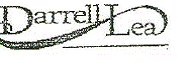
39 In its statement of claim Cadbury alleges that the style of the cursive corporate signature of Darrell Lea “has at all material times borne a striking and obvious likeness to the style of the distinctive cursive script used by Cadbury in the name”. This allegation was, understandably, not pursued at trial. The respective names Cadbury and Darrell Lea (whether with or without their distinctive script) look and sound quite differently, and are quite distinct from each other.
Darrell Lea use of colours
40 The sample in evidence of packaging used by Darrell Lea since the 1950s shows a variety of colours, various shades of blue and purple, pink, green, yellow and red. From at least 1991 Darrell Lea has used in exterior and interior fit outs as well as on price tickets, packaging and staff uniforms a light purple colour which it calls, by reference to a Dulux colour chart, “boysenberry” but may also be called a lilac. In mid 2004 Darrell Lea determined to update its brand image and started using a mid blue colour in its store, signage and packaging.
41 Between 2000 and 2004 Darrell Lea has used purple in a shade like that used by Cadbury, in various product categories including self-consumption chocolate, gift lines, Rocklea Road, Bo Peep, Pick and Mix, and Christmas products and on specific products including chocolate boxes, sticky labels, cartons of chocolate, bonbons and point of sale material.
42 Since Darrell Lea’s change to blue some purple continues to appear on dump bins in stores. A brochure for Christmas 2005 shows a purple background with a heading “Santa’s Favourite” and a picture of Santa Claus with reindeer flying over a city. His purple sleigh is loaded with chocolate boxes although none of them are coloured purple. The Darrell Lea brand name appears prominently.
Darrell Lea use of purple Christmas 2000-2004
43 Of particular importance in this case is the use by Darrell Lea of darker shades of purple in the packaging of its seasonal chocolate products at Christmas in the years 2000-2004. Darrell Lea used a purple and bronze copper theme in association with Darrell Lea signage and brand usage. The purple is like that used by Cadbury. It is distinct from the lighter shade boysenberry. This was the only evidence isolating a specific decision by Darrell Lea to use purple. If this decision were made with the intention of misleading consumers into thinking that Darrell Lea products were associated with Cadbury, that would be strong evidence that such misleading in fact occurred: Australian Woollen Mills Limited v F S Walton & Co (1937) 58 CLR 641 at 657.
44 The primary evidence as to this matter was given by Ms Anne McGlinchey who is currently an independent marketing and retail consultant but worked for Darrell Lea and an associated company from 1989 to 2003. In particular from January 2000, after returning from maternity leave, she was Darrell Lea’s Marketing Manager until she left the company in October 2003.
45 When Ms McGlinchey commenced her duties as Marketing Manager she reported to Mr Bruce Goldman the then General Manager of Retail and Marketing. At the time she believed that the Darrell Lea shops looked “tired and dowdy and needed to be freshened and updated”. There were too many different colours used, products were too difficult to find and the store layout was not clear. Each store presented its own range of in-store gifts which differed not only from one store to another but also within stores.
46 She reviewed Darrell Lea’s marketing approaches in previous years. The colour schemes were never static, different colour schemes were used for different seasonal events, for example St Valentine’s Day (red, white and blue), Easter (yellow) and Christmas (red and green). Ms McGlinchey considered that it was time to move away from the traditional colour themes. She wanted to select non-traditional colour themes and ensure that packaging, point of sale materials etc reflected these themes. On commencing with Darrell Lea in January 2000 she immediately began working on the Christmas theme for that year. She believed the red and green colours were dated and needed to be changed. She researched what colour themes other specialty retailers had implemented for Christmas over the last few years. This research revealed that many retailers were moving from the traditional red and green. For example Marks & Spencer in the United Kingdom were using purple and dark red with metallic copper. Thorntons, a chocolate manufacturer and retailer in the United Kingdom, were combining purple with raspberry red and mint green with a white and silver strip. Large Australian retailers such as Myer and David Jones had not used the traditional red and green for many years. Generally she thought Darrell Lea’s market position was too downmarket and she wished to move its market position more up to the Myer, Grace Bros, David Jones department store level.
47 Throughout the year Ms McGlinchey attended meetings of members of the Darrell Lea marketing team including Mr Goldman and Ms Samantha Shakespeare, the Seasonal Product Manager, to discuss the Christmas 2000 theme colour. Initially she and Ms Shakespeare thought of royal blue and silver for Christmas 2000 but rejected that scheme since it was being used by Myer. They considered purple and silver but ultimately decided on a warmer, richer colour and so determined to replace silver with copper. Ms McGlinchey believed the colours complemented the dark wood panelling which was used both on the outside of the stores and for counters on the interior of the stores. She deposed:
“In determining an appropriate colour scheme for Darrell Lea’s Christmas 2000 season I never once contemplated Cadbury’s use of purple.
…
Cadbury did not (and to my knowledge does not) have its own retail outlets but sold its products through supermarkets and convenience stores. Darrell Lea on the other hand was a vertical retailer and focussed on the indulgence and gift markets. I consider Darrell Lea to be far more focussed on gift giving than what Cadbury was.”
48 In cross-examination Ms McGlinchey agreed that she saw Cadbury as a competitor and had seen Cadbury’s advertisements and point of sale material. However she saw the Darrell Lea marketing of seasonal events as being totally different because it was focussed on gift giving. It was not really about competing with the supermarkets but more about competition with the department stores and speciality retail outlets like the Body Shop. She admitted that when deciding on a purple and copper scheme she knew that Cadbury sold its chocolate confectionery predominantly in purple. It was put to her that she was using purple to associate the Darrell Lea brands with “the good name of Cadbury” and that she “used purple to copy Cadbury”. She strongly denied both allegations. She agreed that some of the purple used by Darrell Lea would have been similar to the Cadbury’s purple. She agreed that the promotion at Christmas with the purple colour scheme was successful.
49 I accept Ms McGlinchey as a witness of truth. She was not directly challenged on her detailed account of her coming to a choice of purple and copper via her own research and experience of UK retailers. Her evidence on this point is not inherently implausible. It was corroborated by Ms Jennifer Ettia, an independent graphic designer and image specialist, who was retained by Darrell Lea in November 1989 and was involved with Ms McGlinchey in the design of the Christmas 2000 range. In her affidavit Ms Ettia said:
“The fact that Cadbury used purple in its packaging never at any stage came up in my conversations with Anne McGlinchey, nor did it cross my mind.”
50 Mr Goldman and the Managing Director at the time Mr Ian Tolmie were not called and are apparently available (in Sydney) but I do not think Cadbury gains any assistance from the rule in Jones v Dunkel (1959) 101 CLR 298. In Heydon, Cross on Evidence, 7th Australian ed, 2004 at 41 the learned author says:
“…while the rule in Jones v Dunkel permits an inference that the untendered evidence would not have helped the party who failed to tender it, and entitles the trier of fact to take that into account in deciding whether to accept any particular evidence which relates to a matter on which the absent witness could have spoken, and the more readily to draw any inference fairly to be drawn from the other evidence by reason of the opponent being able to prove the contrary had the party chosen to give or call evidence, the rule does not permit an inference that the untendered evidence would in fact have been damaging to the party not tendering it. The rule cannot be employed to fill gaps in the evidence, or to convert conjecture and suspicion into evidence.”
And as the learned author had earlier said (at 39) in formulating the basic rule, failure to call a witness “may, not must, in appropriate circumstances, lead to the inference that the uncalled evidence would not have assisted that party’s case” (emphasis added).
51 While Ms McGlinchey did not have the power to make the ultimate decision on colour choice, she was a key figure in the process and on her unchallenged evidence the genesis of the idea for the Christmas 2000 colour scheme was hers. Darrell Lea also called Ms Hurst, who took over Ms McGlinchey’s position, and Mr Michael Lea, one of the two directors of the company and who has had a lifetime’s experience in its business. Mr Jason Lea, Mr Michael Lea’s cousin, who was a director at the time of the 2000 Christmas planning, has recently died. If one accepts Ms McGlinchey, Ms Ettia and Ms Hurst, as I do, as truthful and reliable witnesses, it just seems inherently unlikely that Mr Goldman or Mr Tolmie would have harboured, unbeknowns to Ms McGlinchey, Ms Ettia and Ms Hurst, a secret purpose to misappropriate Cadbury’s business by deliberately misleading consumers. As Walton makes clear, this would be the act of a dishonest trader. An allegation of such a kind falls to be assessed in the light of the rule in Briginshaw v Briginshaw (1938) 60 CLR 336.
Use of purple by third party chocolate manufacturers
52 Mr Michael Lea, a member of the original Lea family, is now aged sixty. He first started working for the company when he was ten years old, part time during the school holidays, and became a full time employee in 1969. He was successively assistant accountant, head accountant and, since 1975, a director of the company. Although his chief responsibilities lay on the financial side, I am satisfied that in a business of this sort he has an intimate knowledge of all aspects of the company’s business and of the market in which it operates.
53 Mr Lea says that for many years a number of other manufacturers or wholesalers have used the colour purple on chocolate and chocolate confectionery products. In particular Violet Crumble chocolate bars, a chocolate coated honeycomb bar, initially manufactured by the firm Hoadley which has since been taken over by Nestlé, have been wrapped in a purple coloured wrapper for at least fifty years. It will be necessary to return to this product. Mr Lea also deposes that Nestlé used a shade of purple on the wrapping for its Polly Waffle bar and has done so for at least forty years, as well as more recently on the following products:
· Wonka Wicked Chocolate Mud Sludge bar
· Violet Crumble block chocolate
· Wonka Nerdalicious
· Wonka Chewy Gobstopper
· Club Rich Dark chocolate block
· Quality Street assorted filled chocolates
54 Other manufacturers and or wholesalers that to Mr Lea’s knowledge have used purple for many years are:
· Aliens - Jelly Beans 250g-;
· Alpha - Classic Plum 20g-;
· Ballantyne- Premium Fruit & Nut mix;
· Beacon- Summer Berries Sparkles;
· Candy Lane - Creamy Eclairs, individually wrapped;
· Candy Lane - Chocolate sultanas;
· Evans- Chocolate Eclairs, individually wrapped;
· Heritage - Impressions, individually wrapped;
· HunterValley Chocolates;
· Hahndorf Belgian specialty chocolates;
· Kenman- Harry Potter chocolate frog, Harry Potter acid pops and HarryPotter red liquorice wands;
· Mars - Milky Way;
· Merba - Chocolate Cookies;
· Milka- Lila Pause bar and range of block chocolate products;
· Patons- Macadamia Nuts;
· Perlege - Belgian Chocolates;
· Tasty - Old fashioned Liquorice Ropers;
· Walkers Grande Marnier liqueur chocolates and Turkish Delights;
· Nobby's nuts; and
· Soothers lozenges.
Mr Lea’s evidence on this issue was not challenged.
55 The Violet Crumble and other Nestlé products were the subject of a “Co-existence Agreement” made between the United Kingdom parent company of Cadbury and the parent company of Nestlé in Switzerland and executed by the Cadbury company on 9 December 2005. This agreement was tendered as a confidential exhibit. However Cadbury has waived confidentiality by its assertion in this case that it has exclusive reputation and goodwill in the use of the colour purple in relation to chocolate products. As will be seen, the agreement is inconsistent with such an assertion. In any case, a claim for commercial confidentiality must yield to the need for a Court to explain its reasoning for a decision. Moreover, the subject matter of the agreement does not appear to contain material the publication of which would damage the parties’ competitiveness, such as manufacturing formulae or internal costings.
56 The recitals to the agreement include the fact that the parties have applied for and registered and are using various marks in respect of chocolate and similar goods in Australia and New Zealand and that to “avoid confusion in the minds of the public and to settle the various oppositions to each other’s marks which the parties have filed” the parties wish to enter into a “trade mark co-existence agreement concerning their respective uses of certain of their marks in Australia and New Zealand”. Cadbury’s obligations include (cl 2.1.5) that it will
“…not object to the continued use by Nestlé in Australia of the Violet Crumble, Wonka, Quality Street and Polly Waffle Get Ups in respect of the Goods in Australia”
57 Mr Andrew Nowicki, Cadbury’s Director of Brand Marketing, said that where competitors
“have sought to leverage off the positive associations that consumers have with the Cadbury brand by adopting the use of similar shades of purple to Cadbury purple in a clear branding context, Cadbury has actively and aggressively sought to take action to protect its brand.”
58 Apart from the obvious inapplicability of that statement to Hoadley’s Violet Crumble Bar (which Mr Nowicki says “has its own heritage in using purple”, a view inconsistent with Cadbury’s claimed exclusive reputation in that colour) and other Nestlé brands, Mr Nowicki’s assertion is something of an overstatement. In fairness to him, however, it appears that although he was put forward as Cadbury’s witness on this issue, his knowledge was limited to a review of Cadbury’s files and the production of letters of demand. The conduct of litigation and threats of litigation was in the hands of Mr Rod McNeil, Cadbury’s General Counsel Asia Pacific, who was not called as a witness.
59 On 20 March 2002 Mr McNeil wrote to a company called Magic Chef Pty Ltd of North Balwyn, Victoria stating that it had recently come to his attention that the company was marketing in Australia chocolate under the name “Milk Choc Cooking Buds” in predominantly purple packaging. The letter stated:
“Many consumers would in fact believe that the use of Cadbury’s Purple (as referred to in evidence in the recent Federal Court case of Red Bull v Sydneywide Distributors) means that the chocolate used in ‘Milk Choc Cooking Buds’ chocolate emanates from Cadbury Schweppes. The Australian public will thus believe that you are marketing ‘Milk Chocolate Cooking Buds’ chocolate using high quality chocolate sourced from the world’s leading chocolatier.”
60 The letter went on to allege that such marketing constituted passing off and contravention of s 52 and 53 of the Trade Practices Act and that although Magic Chef might be acting in ignorance of the law, Cadbury would enforce its rights vigorously. Mr McNeil required Magic Chef to cease and desist from marketing such products, destroy all stock in its current packaging, provide Cadbury with a full list of all retail or trade outlets and forward details of the supplier to it of the Milk Choc Cooking Buds chocolate. Legal action in the event of non-compliance was threatened.
61 On 27 March 2002 Mr John Wilder, a director of Magic Chef, replied with a polite but firm and well-reasoned letter. Mr Wilder expressed surprise at Cadbury’s approach, particularly as in the past Magic Chef had worked in association with Cadbury, being a customer of various confectionery lines from the jelly and chocolate range which were subsequently repacked and marketed under the Magic Chef logo, with full knowledge and approval of Cadbury. At one stage Cadbury produced and packaged a bar line from its excess raw material known as “Magic Chef Chokky Plus” specifically for Magic Chef. Mr Wilder noted that Nestlé marketed chocolate lines in purple packaging which, he believed, pre-dated Cadbury’s use of purple packaging and that Nestlé had never written with concern about his company. The letter continued:
“We have never encountered any instance of confusion between ‘Magic Chef milk choc cooking buds’ and the products sold by Cadburys. From information received from end users and enquiries made to date, there does not appear to have ever been an instance where it has been apparent that customers or consumers have thought that Magic Chef or the product in question has or had any association with Cadbury. Our products have obtained a reputation in their own right and we are surprised by Cadbury’s concern that consumers may be confused between any of your products packaged in purple packaging and our ‘milk choc cooking buds’.”
62 Mr Wilder said that he was personally unfamiliar with the Red Bull case but from enquiries understood that the case centred around an ex-employee of Red Bull taking advantage of various marketing details to which he was privy and attempt to ride on the coat tails of Red Bull’s success in the market place. This was clearly not the case here. The letter concluded by stating that Magic Chef obviously did not wish to engage in litigation with Cadbury but asked that it reconsider its position.
63 Mr Nowicki said in cross-examination said that he had not seen Mr Wilder’s letter before. Such issues were “delegated to general counsel”. The inference appears reasonably open that Cadbury decided not to pursue any further action against Magic Chef after receipt of Mr Wilder’s letter.
64 On 4 April 2003 Mr McNeil on behalf of Cadbury wrote a similar letter of demand to Alpha Confectionery of Balaclava in Victoria complaining about that company’s “Alpha” 150 g dark chocolate Easter egg in predominantly purple packaging. The letter made substantially the same demands as the one to Magic Chef already quoted and was followed up by letters from Cadbury’s then solicitors, Corrs Chambers Westgarth, on 2 and 13 May 2003. Despite a call for production, Cadbury produced no further correspondence. The thrust of the Cadbury letters was that a positive response was called for from Alpha and in the absence of such response legal action would be taken. However, it seems that Alpha ignored the letter and nothing happened.
65 On 28 May 2003 Mr McNeil wrote a similar letter of demand to the Hunter Valley Chocolate Company of Pokolbin, New South Wales complaining of the use of a logo and brochure using purple. The company retained solicitors and a lengthy correspondence ensued which culminated in an agreement on 4 September 2003 in which the company agreed to cease using the colour purple after the end of the following month.
66 So the responses to Cadbury’s demands on third parties and Cadbury’s action in the light of such responses did not follow a consistent pattern. On one occasion (Hunter Valley Chocolate), after initial resistance and following negotiation, Cadbury eventually achieved its objective. On another occasion (Alpha) Cadbury’s demand was ignored and nothing happened. On another occasion (Magic Chef) Cadbury’s demand was firmly resisted and Cadbury backed off.
67 Mr Nowicki says that Federal Court proceedings were taken against Kenman Developments Pty Ltd and others concerning “Meadowsweet Fine Chocolate” (1990), Willow Confectionary Pty Ltd and others concerning Easter bunny products (1997) and Ontrack Pty Ltd concerning a Grand Marnier chocolate product (2003). However, there was no evidence as to what happened with those proceedings.
68 The issue of third party use of the colour purple in connection with chocolate was clearly raised in Darrell Lea’s defence: see par 15.
The Shelton survey
69 Cadbury tendered (over the objection of Darrell Lea: Cadbury Schweppes Pty Ltd v Darrell Lea Chocolate Shops Pty Ltd (No 3) [2006] FCA 364) a “Chocolate Sensory Study” consumer research report commissioned by it in August 2005 and conducted in October 2005 by Ms Caroline Shelton of National Field Services. The research methodology was provided by a firm called QBrand Consulting after consultation with Professor Roger Layton, Emeritus Professor of Marketing at the University of New South Wales.
70 Although by this time the trial date had already been fixed and the survey was obviously conducted for the purpose of the trial, Cadbury did not comply with Practice Note No 11, issued by the Chief Justice of the Federal Court in 1994, which provides:
“11. Survey evidence
There are many problems in obtaining acceptable survey evidence including the use of relevant and unambiguous questions and whether the actual conduct of the survey (including methodology) is satisfactory.
The admissibility of surveys is always a matter for the trial Judge to determine but the risk of the survey being rejected or given little, if any, weight at the trial may be diminished if the following procedure when a party seeks to have a survey conducted. Subject to other directions of the Court in the particular case, the Court expects that this practice will usually be followed:
1. Notice should be given in writing by the party seeking to have the survey conducted to the other parties to the proceeding.
2. The notice should give an outline of
a. the purpose of the proposed survey;
b. the issue to which it is to be directed;
c. the proposed form and methodology;
d. the particular questions that will be asked;
e. the introductory statements or instructions that will be given to the persons conducting the survey;
f. other controls to be used in the interrogation process.
3. The parties should attempt to resolve any disagreement concerning the manner in which the survey is to be conducted and any of the matters mentioned in 2 above.
4. The matter of the survey should be raised with the Court at the directions hearing as soon as possible after the steps mentioned above have been taken.”
No explanation was proffered for this non-compliance, which was obviously a deliberate choice by Cadbury and its advisors.
71 Ms Shelton arranged for 102 participants to attend at her firm’s premises. They were selected at random from the Melbourne Telephone Directory. Seventy-one per cent were female. They were screened to exclude, amongst other things, people who did not buy chocolate at all or who bought an excessive amount of chocolate. Participants were shown different forms of chocolate (blocks, Easter eggs etc) in batches with wrappings in different colours, one colour for each batch – blue, gold, purple, red and green. In fact, all chocolate was from Cadbury, although there was nothing to indicate that to participants.
72 The most significant of the questions asked recipients was:
“Looking at the range of chocolates in front of you, what brand do you think is best represented by the chocolates in front of you?”
73 Answers included the brands Cadbury, Nestlé, Darrell Lea, Lindt and Newmans. Other brands were mentioned and were collectively described as “Other Brands”. As it happened, in respect of each colour the “Other Brands” category scored within the first three answers given by participants. An abbreviated table of the results is as follows:
Cadbury Nestlé Other Brands Darrell Lea
Blue 52 16 14 nil
Gold 37 18 24 5
Purple 75 12 8 2
Red 31 29 17 4
Green 41 24 16 6
74 While Cadbury scored particularly well on purple it had a marked preponderance over its nearest rival in all other colours except red. With blue for example, the margin is more than three to one. With gold it is more than two to one against the nearest single competitor (Nestlé). Since Cadbury uses many colours other than purple in its marketing the explanation may be that the name Cadbury and chocolate are so dominant in the minds of consumers that with a number of colours there is a tendency to think “if it’s chocolate it must be Cadbury’s”. In other words there may be a leap from chocolate to Cadbury without paying too much attention to the colour.
75 Other questions were asked as to the range of chocolate the participant found appealing (on a scale of one to ten) and how much, considering taste and appearance, the participant liked a particular range (again using a scale of one to ten).
76 Overall while the Shelton survey was conducted professionally enough, it has its limitations. It was confined to the Melbourne metropolitan area. It seems to have an over weighting of female participants. No children under 18 were involved. The test itself was conducted in a rather clinical environment, unlike the setting in which actual consumer purchasing decisions are made.
77 However, a more serious deficiency emerged when Professor Layton gave evidence as to the interpretation of the test. He was asked at the conclusion of his cross-examination:
“You would agree, wouldn’t you, that there are no findings in the survey directed to perceptions of likeability or appeal when the colour purple is used and the goods are shown as branded either Cadbury or another brand?... The goods weren’t branded, it was only a question of what they thought the brand was. Care was taken to ensure that there was no indication of brand throughout the experiment.
So would you agree with this, that the survey doesn’t prompt any relevant conclusions in a case where goods actually bear a brand?...But none – my understanding is none of these actually had a brand in sight of the consumer.
No, so in other words the survey doesn’t assist to form conclusions about what consumers would say if the goods in fact bore a brand?...No, I think this is true.”
78 Then in re-examination Professor Layton was asked:
“Professor, in relation to the last question that was asked of you, does the survey assist in drawing any conclusions if the goods wear a brand and a colour?... Difficult to answer that question because the experiment as such was designed to not introduce brand except insofar as there was a perception on the part of the customer or respondent as to what that brand might be. It would require a separate experiment, perhaps with brand identification, to see whether in fact it changed the answers significantly or not.”
79 That passage, which took place on the ninth day of the trial, prompted an application by Cadbury on the morning of the following day. Cadbury sought an adjournment for a “short period of time” – subsequently identified as about five to seven days – to have a further survey conducted (this time in accordance with Practice Note 11) to investigate the issue identified in the previous day’s cross-examination as to the response of consumers where colour was used with the brand names. The application was refused.
Evidence of actual misleading
80 Neither the Trade Practices Act provisions, nor the tort of passing off, require, as an essential element of proof, evidence of actual misleading of consumers. Nevertheless such evidence is admissible and in appropriate circumstances can be “very material” and of “some importance”: Royal Warrant Holders’ Association v Edward Deane & Beal Ltd [1912] 1 Ch 10 at 14-15, cited with approval by Gummow J, with whom Black CJ and Lockhart J agreed, in Interlego AG v Croner Trading Pty Ltd (1992) 39 FCR 348 at 389. In the present case, it would be useful to have had evidence such as:
“I usually buy Cadbury chocolate. I know their chocolate from the purple wrappings and advertising. I saw some purple wrapped chocolate but when I got to the checkout I saw it was Darrell Lea’s. But I was in a hurry so I bought it anyway.”
or
“I saw Darrell Lea using purple so I thought they must have been taken over by Cadbury.”
81 Although Cadbury’s statement of claim alleges wrongful conduct by Darrell Lea from “approximately mid to late 2001”, it is obvious that what prompted Cadbury’s concern leading to this litigation was Darrell Lea’s use of purple and copper at Christmas 2000, repeated at each Christmas up until 2004, together with various other uses of purple, at more than 800 retail outlets. Cadbury was directed to file its evidence for trial in November 2005. So for almost five years Cadbury was aware of the need for obtaining evidence to support its case, which is all about confusion in the market place. It seems unlikely that Cadbury would have been unaware of the importance of evidence of actual misleading, or that it would not have made some effort to obtain it.
The name and the colour
82 An essential part of Cadbury’s case is that the shade of purple it uses, considered in isolation, distinguishes Cadbury from its competitors. In other words, the colour purple in the context of chocolate has a secondary meaning as an identifier of Cadbury chocolate products. Reference was made to a trade mark case BP plc v Woolworths Ltd (2005) 212 ALR 79 where Finkelstein J held that a shade of green could be registered as a trade mark for BP because customers identified BP service stations by the colour green alone (the Full Court has recently granted leave to appeal: Woolworths Ltd v BP plc [2006] FCAFC 5).
83 This is purely a question of fact. Thus in Cadbury Schweppes Pty Ltd v The Pub Squash Co Ltd [1981] RPC 429 at 460-461 Powell J, in a judgment upheld by the Privy Council, held that although the plaintiff’s soft drink “Solo” in a lemon coloured can had achieved a level of recognition and acceptance, it did not follow that the proprietor of “Solo” thereby became entitled to a monopoly in yellow coloured cans or that the mere fact the defendant adopted a yellow can for its product dictated a finding of passing off. In other words, it may not be enough that a particular colour is associated in the mind of consumers with a particular product. In the present case, purple may prompt in the reasonable consumers’ mind a remembrance that purple has been associated with Cadbury chocolate, but not necessarily the conclusion that the purple packaged product presented for sale to him or her therefore must be Cadbury’s.
84 In the present case Cadbury’s own evidence (see [18] above) speaks of the elements in the “brand architecture”: the name Cadbury, the colour purple, the glass and a half device etc. The architectural metaphor is apt. The architecture of a building involves the whole, not just one component such as a roof or wall. Cadbury’s marketing shows how the name Cadbury and the colour purple are inextricably intertwined, with each one reinforcing the other and creating a total impact more than the sum of the parts. This is particularly striking in the late 1990s commercials which had not only extensive use of purple but the repetitive mantra “Cadbury is chocolate is Cadbury is chocolate”. In any case, since Cadbury is without doubt one of the most well, and favourably, known names in all consumer marketing, and dominates the field of chocolate in Australia, it would be irrational in the extreme for Cadbury not to make the maximum use of the name.
85 In cross-examination Mr Nowicki was pressed to think of an example where the colour purple alone would be used for Cadbury with no indicia of branding such as the Cadbury name and the glass and a half device. There was a noticeable pause, perhaps upwards of half a minute. Eventually Mr Nowicki gave as an example the television show “Dancing with the Stars” on Channel 7 which he said
“integrated into that show is specific uses of the colour purple as brand indicia in areas that the production company would not enable us to use other elements of our branding.”
He was asked:
“There’s two indicia used, the show is brought to you by Cadbury and in the background is the is the purple colour?... No, within the show specifically, within the production itself there are components independently where we only use purple.”
Mr Nowicki had previously said that the “show itself is brought to you by Cadbury”. No program of “Dancing with the Stars” was in evidence, but if Cadbury were paying substantial amounts to sponsor a high-rating television show it is inconceivable that the name Cadbury would not be transmitted aurally and visually to viewers, even if some elements of the show, such as sets and costumes, contained only purple. If all that viewers saw in a program about dancing was some use of purple, why should they think of chocolate at all, let alone Cadbury chocolate? I am not satisfied that “Dancing with the Stars” is a true example of the purple colour alone used without the name Cadbury.
86 Shortly after that passage of evidence there was a mid-morning break. Upon resumption, Mr Nowicki volunteered that he had thought of another example where purple alone was used. The example he gave was the 2002 Manchester Commonwealth Games where the Queen’s baton was purple as part of the Cadbury marketing plan associated with the event. This would have been a transient use, in the most literal sense.
87 I conclude that, for all practical purposes, Cadbury’s use of the colour purple in marketing, promotion, advertising, packaging, and point of sale is always associated with the famous name Cadbury. What Cadbury said in its final submissions as to marketing and sponsorship activities (triathlons, Sydney Olympics etc) is true generally of Cadbury in the marketplace:
“Each of these activities involve the use of Cadbury purple in connection with ‘Cadbury’.”
Contrasting Cadbury and Darrell Lea retail outlets
88 As already mentioned, Cadbury products are sold essentially through retail outlets which it does not own or operate. The only exceptions have been the Cadbury shop at the Claremont factory and some stores at the Sydney 2000 Olympic Games. Darrell Lea did not have a presence at either place. There was some evidence of Cadbury show bags but no particular evidence as to the kind of premises from which the bags were sold at shows. By contrast, the major part of Darrell Lea’s sales come from its own stand alone shops. It has a very minor presence in some supermarkets and not in major supermarkets. Cadbury’s submission that its products and those of Darrell Lea “are distributed via the same trade channels” is quite inaccurate.
89 There was in evidence some photographs of Darrell Lea presentations in an affidavit of Peter Selvay exhibits 1 and 4 taken in 2005. The first is taken at the IGA Supermarket at Coldstream, Victoria and the second at a Video Ezy store at Noble Park, Victoria. The first shows Darrell Lea’s products on a different side of the aisle to Cadbury’s and a sign with a prominent Darrell Lea name, purple against a blue background, and at least 1m2 square as far as one can judge from a photograph. The second shows separate stalls. Again the Darrell Lea sign, this time in a blue, is on the opposite side of a passageway to a Cadbury stand. As far as the photographs show, there seems to be a clear differentiation. There were no photographs in evidence of Cadbury and Darrell Lea products displayed side by side in planogram style. The general impression from the evidence is that Cadbury and Darrell Lea products are not presented for retail sale in close proximity to each other (unlike Cadbury and Nestlé products side by side in planogram layouts).
Contrasting Cadbury and Darrell Lea products
90 Cadbury’s marketing is very much centred around particular identifiable recognisable products, in particular its flagship Cadbury Dairy Milk. With Darrell Lea there is not nearly the same sense of identifiable products. Looking at photographs of the presentations in their shops and smaller units, while jumble may be a too harsh a word, they do not have the forceful presentation of individual products that appears in Cadbury supermarket displays.
Buying chocolate
91 The likely behaviour of shoppers or consumers in relation to goods normally sold to the general public is a “jury question”, that is to say it is a question for the tribunal of fact, whether a jury or, as in the present case, a judge sitting alone: General Electric Co v General Electric Co Ltd [1972] 1 WLR 729 at 738 per Lord Diplock, cited by Gummow J in Interlego at 387-388, Dalgety Spillers Foods Ltd v Food Brokers Ltd [1994] FSR 504 at 527, Symonds Cider & English Wine Company Ltd v Showerings (Ireland) Ltd [1997] IEHC 1 at [20] and the cases discussed in my earlier ruling Cadbury Schweppes Pty Ltd v Darrell Lea Chocolate Shops Pty Ltd [2006] FCA 363.
92 Chocolate is often bought on impulse. But the fact that the purchase is impulsive, in the sense of sudden, quick or not premeditated, does not necessarily mean that rationality is abandoned. Take pricing for example. The bulk of Cadbury customers are blue collar working class and, in the words of Mr Michael Busutil, Cadbury’s Marketing Manager Moulded, “price is obviously a key consideration for them” and “the marketplace changes dramatically from year to year”. In the past, driven by competition from Nestlé in the moulded block sector, the price on a standard block has at times been discounted from $4.07 to $2.49. Some accounts run promotions for 40 weeks of the year.
93 This suggests that many consumers have made a choice that some other use for their $4 is more value to them than a block of Cadbury chocolate, and that they have made similar decisions until the price reaches $2.50. This is a perfectly rational choice. But another basic consideration in a consumer purchase decision, apart from price, is identity of subject matter. If consumers are capable of making a choice that chocolate is or is not worth buying at a given price, then why is it to be supposed that on seeing chocolate in a Darrell Lea shop with a Darrell Lea label they are likely to think it is Cadbury chocolate just because it has a purple wrapping?
94 Colour plays an important part in product recognition by consumers. But this is not the only aspect which triggers recognition. Brand, logos and particularly in the present case, the place from where the product is presented for sale all play a part.
Summary of findings
95 The evidence warrants the following findings.
96 There is wide awareness amongst Australian consumers of the use by Cadbury of a dark purple colour (i) in connection with the marketing, packaging and presentation of certain chocolate products particularly Cadbury Dairy Milk and other block milk chocolate products, and (ii) as a corporate colour.
97 Cadbury does not have an exclusive reputation in the use of this dark purple colour in connection with chocolate. Other traders have, with Cadbury’s knowledge, for many years used a similar shade of purple. Cadbury has not consistently enforced its alleged exclusive reputation. In relation to its chief competitor Nestlé, Cadbury has, for its own commercial reasons, permitted a use of purple in relation to popular chocolate products.
98 Cadbury markets many chocolate products which have little or no purple in their packaging.
99 Cadbury products, regardless of the presence or absence of purple in the packaging, always bear the Cadbury name in a distinctive script.
100 Cadbury’s use of purple in marketing advertising and promotion is, and is seen by consumers to be, inextricably bound up with the well known name Cadbury in its distinctive script. Cadbury never uses the colour purple in isolation as an indicium of trade.
101 Cadbury products, with insignificant exceptions, are not sold at retail level at premises owned or occupied by Cadbury.
102 Cadbury’s marketing of chocolate heavily emphasises specific products and in particular Cadbury Dairy Milk block chocolate.
103 Darrell Lea is a name well known in connection with chocolate in those parts of Australia where it operates, even though not as well known as Cadbury.
104 The names Darrell Lea and Cadbury are quite distinct in sound and appearance (especially with the respective scripts the parties have adopted) and not likely to be mistaken for each other.
105 Darrell has since at least Christmas 2000 used in its marketing, packaging, promotion and point of sale presentation a purple colour much like that used by Cadbury. There has been particular use at Christmas 2000 to 2004 inclusive and also uses at other times. Such usage has diminished and purple has been to a significant extent replaced by blue since 2004.
106 Darrell Lea did not adopt the colour purple with the intention of leading consumers to believe its products were Cadbury products or that it, or its products, had some kind of association with Cadbury.
107 Most of Darrell Lea’s retailing occurs in premises which its owns or occupies. Other retailing occurs from separate stands or displays in retail premises, such as newsagents, pharmacies, convenience stores and video stores. Darrell Lea has only a minor presence in supermarkets and only, in the past, to a very limited and transient extent in the major chains. Its products are not presented for sale in close proximity to Cadbury's.
108 Darrell Lea’s marketing gives less emphasis to particular products than does Cadbury.
109 Darrell Lea does not sell moulded block chocolate.
110 Darrell Lea uses its name in a distinctive script widely and consistently in marketing, packaging and point of sale presentation.
111 Colour recognition or attraction can play an important part in consumer decisions to purchase chocolate.
112 Consumer decisions to purchase chocolate are often made quickly and on impulse but not necessarily irrationally. Price and brand recognition can play an important part.
Cadbury’s case
113 As presented at trial, Cadbury’s case was based on alleged contraventions of ss 52 and 53(c) and (d) of the Trade Practices Act and the common law tort of passing off. Section 52 provides that a corporation shall not, in trade or commerce, engage in conduct that is misleading or deceptive or is likely to mislead or deceive. Section 53, a subset of s 52, relevantly for present purposes, provides that a corporation shall not, in connexion with the supply of goods (c) represent that goods have sponsorship or approval that they do not have or (d) represent that the corporation itself has sponsorship, approval or affiliation it does not have. Cadbury’s pleading can be summarized as follows.
114 Trade Practices Act (statement of claim pars 31-37): Darrell Lea by its use of a purple colouring in connection with the marketing of its chocolate products represented to consumers that
(a) its products were offered for sale with the license, sponsorship and approval of Cadbury or enjoyed a connection or affiliation with Cadbury
(b) Darrell Lea had entered into an association or arrangement with Cadbury or obtained the endorsement of Cadbury.
115 As a consequence of these contraventions of ss 52 and 53(c) and (d) consumers had been misled and deceived into purchasing Darrell Lea Chocolate products where, but for the contraventions, they would have purchased Cadbury chocolate products.
116 Passing off (par 40): Darrell Lea has passed off
(a) its chocolate products as Cadbury products and/or as having the sponsorship, affiliation and association in the course of trade with Cadbury;
(b) the Darrell Lea chocolate confectionery business as having the sponsorship, approval, connection, affiliation or association in the course of trade with Cadbury.
117 Although s 52 provides the public with a wider protection from deception than the common law of passing off (Parkdale Custom Built Furniture Pty Ltd v Puxu Pty Ltd (1982) 149 CLR 191 at 208), there is a considerable overlap between the two causes of action. In the present case neither side sought to draw any significant distinction between them. Realistically there is no basis on which Cadbury could succeed under the Trade Practices Act but fail on passing off, or vice versa.
118 Since it is common ground that Darrell Lea products in fact have no sponsorship, approval or connection with Cadbury or its products, and that Darrell Lea’s business is entirely unconnected with that of Cadbury, the critical issues in this case relate to the representations that, in all the circumstances, Darrell Lea by its conduct would convey to a hypothetical ordinary and reasonable member of the class constituted by prospective purchasers of chocolate products: Campomar v Sociedad Limitadav Nike International Limited (2000) 202 CLR 45 at [102]-[105].
119 In focusing on the representation alleged to be made by Darrell Lea it is important to keep in mind the consistent rejection by courts of the highest authority of any generalized notion of unfair trading. Attention must be confined to the statutory causes of action and the common law tort of passing off. (The present case is not concerned with the unconscionability sections of the Trade Practices Act.) In Victoria Park Racing and Recreation Grounds Co Ltd v Taylor (1937) 58 CLR 579 at 508 Dixon J said that in “British jurisdictions” courts of equity have not
“thrown at the protection of an injunction around all intangible elements of value, that is, value in exchange, which may flow from the exercise by an individual of his powers or resources whether in the organization of a business or undertaking or the use of ingenuity, knowledge, skill or labor. This is sufficiently evidenced by the history of the law of copyright and by the fact that the exclusive right to invention, trademarks, designs, trade name and reputation are dealt with in English law as special heads of protected interests and not under a wide generalization.”
That passage was endorsed by the High Court in Moorgate Tobacco Company Ltd v Philip Morris Ltd (No 2) (1984) 156 CLR 414 at 445 and Campomar at [4].
120 In relation to passing off, a statement by Lord Oliver in Reckitt & Colman Ltd v Borden Inc (1990) 17 IPR 1 at 7 is valuable not only for its statement of the law but for its reminder that these kinds of cases turn essentially on their own particular facts. His Lordship said:
“Although your Lordships were referred in the course of argument to a large number of reported cases, this is not a branch of the law in which reference to other cases is of any real assistance except analogically. It has been observed more than once that the questions which arise are in general questions of fact. Neither the appellants nor the respondents contend that the principles of law are in any doubt. The law of passing off can be summarised in one short general proposition - no man may pass off his goods as those of another. More specifically, it may be expressed in terms of the elements which the plaintiff in such an action has to prove in order to succeed. These are three in number. First, he must establish a goodwill or reputation attached to the goods or services which he supplies in the mind of the purchasing public by association with the identifying get up (whether it consists simply of a brand name or a trade description, or the individual features of labelling or packaging) under which his particular goods or services are offered to the public, such that the get up is recognised by the public as distinctive specifically of the plaintiff's goods or services. Secondly, he must demonstrate a representation by the defendant to the public (whether or not intentional) leading or likely to lead the public to believe that goods or services offered by him are the goods or services of the plaintiff. Whether the public is aware of the plaintiff's identity as the manufacturer or supplier of the goods or services is immaterial, as long as they are identified with a particular source which is in fact the plaintiff’s. For example, if the public is accustomed to rely upon a particular brand name in purchasing goods of a particular description, it matters not at all that there is little or no public awareness of the identity of the proprietor of the brand name. Thirdly, he must demonstrate that he suffers, or, in a quia timert action, that he is likely to suffer damage by reason of the erroneous belief engendered by the defendant's misrepresentation that the source of the defendant's goods or services is the same as the source of those offered by the plaintiff."
Conclusions
121 The findings above lead to these conclusions. Cadbury and Darrell Lea are competitors in the retail chocolate market, yet they each have distinctive product lines which are sold from different sorts of premises under distinctive trade names. They have distinct identities in the market place. Cadbury does not own the colour purple and does not have an exclusive reputation in purple in connection with chocolate. Darrell Lea is entitled to use purple, or any other colour, as long as it does not convey to the reasonable consumer the idea that it or its products have some connection with Cadbury. I am not satisfied that this has occurred, or is likely to occur.
122 There will be an order that the application be dismissed. Darrell Lea foreshadowed an application for indemnity costs. The question of costs will be adjourned to a date to be fixed. Outlines of submissions are to be filed by Darrell Lea seven days and by Cadbury three days before the adjourned date.
| I certify that the preceding one hundred and twenty-two (122) numbered paragraphs are a true copy of the Reasons for Judgment herein of the Honourable Justice Heerey . |
Associate:
Dated:
| Counsel for the Applicant: | A J Myers QC and MD Wyles |
| | |
| Solicitors for the Applicant: | Mallesons Stephen Jaques |
| | |
| Counsel for the Respondent: | C Golvan SC and S Ricketson |
| | |
| Solicitors for the Respondent: | Middletons Lawyers |
| | |
| Dates of Hearing: | 20,21,22,27,28,29,30,31 March, 3,4,5,6 April 2006 |
| | |
| Date of Judgment: | 27 April 2006 |


