

FEDERAL COURT OF AUSTRALIA
Australian Retailers Association v Reserve Bank of Australia [2005] FCA 1707
SUMMARY
AUSTRALIAN RETAILERS ASSOCIATION, AUSTRALIA POST, BP AUSTRALIA PTY LIMITED (ACN 004 085 616), BUNNINGS PTY LIMITED (ACN 008 672 179), CALTEX AUSTRALIAN PETROLEUM PTY LIMITED (ACN 000 032 128), COLES MYER LIMITED (ACN 004 089 936) and SPARKS SHOES PTY LIMITED (ACN 000 916 138) v RESERVE BANK OF AUSTRALIA
VID 1387 OF 2004
WEINBERG J
28 NOVEMBER 2005
MELBOURNE
1 In accordance with the practice of the Federal Court in some cases of public interest, importance or complexity, the following summary has been prepared to accompany the orders made today. This summary is intended to assist in understanding the outcome of this proceeding and is not a complete statement of the conclusions reached by the Court. The only authoritative statement of the Court’s reasons is that contained in the published reasons for judgment which will be available on the internet at <http://www.fedcourt.gov.au> together with this summary.
2 This is an application for review of a decision of the Reserve Bank of Australia (“the RBA”) to “designate” the EFTPOS system. These proceedings have been brought by a group of retail merchants who claim to be aggrieved by the decision (“the applicants”). The applicants argue that the decision to designate was not made according to law, and is therefore invalid.
3 Under the Payment Systems (Regulation) Act 1998 (Cth), the RBA has the power to “designate” a payment system if it considers it would be in the “public interest” to do so. Once a payment system has been “designated”, the RBA has the power to, amongst other things, make standards that must be complied with by participants in the payment system. In determining what is in the “public interest”, the RBA is required, under the Act, to have regard to payment systems being, in its opinion, “efficient” and “competitive”.
4 While the power to determine standards has not, at this stage, been exercised by the RBA, the applicants claim, with much force, that it is the clear intention of the RBA, now that EFTPOS has been designated, to use its powers to reduce or eliminate “interchange fees”.
5 “Interchange fees” are the fees paid by a cardholder’s financial institution to the merchant’s financial institution each time an EFTPOS transaction occurs. For example, if a customer with an ANZ card makes an EFTPOS transaction at Caltex (whose EFTPOS services are provided by the Commonwealth Bank), ANZ will pay a fee to the Commonwealth Bank for processing that transaction. The cardholder’s financial institution is called the “issuer” and the merchant’s institution is called the “acquirer”. The actual fee that is paid by the issuer to the acquirer is determined by the specific terms of an interchange agreement between the two. There are many of these bilateral interchange agreements between financial institutions.
6 The relationship between merchants and acquirers differs depending on whether the merchant is a large merchant, which provides its own infrastructure (for instance PINpads and other equipment), or a small merchant, which has this infrastructure provided by its acquiring institution. In the case of small merchants, they generally pay a fee to their acquirer for the provision of EFTPOS services. In the case of large merchants, many have negotiated to be paid by their acquirer for EFTPOS transactions. In effect, large merchants have negotiated to “share” the interchange fee their acquiring bank receives from issuers.
7 The RBA’s reason for designating the EFTPOS system is that it concluded that current interchange arrangements were not conducive to the efficiency of the overall payments system. It determined that current interchange arrangements contribute to the effective price that cardholders are charged for EFTPOS transactions being higher than for payments using credit cards. This was despite EFTPOS having relatively lower costs.
8 The applicants’ concern is that if the RBA reduces or eliminates interchange fees, acquirers will seek to recover that loss in revenue from merchants. Therefore, the applicants claim that smaller merchants will have to pay increased fees to their acquiring bank, and larger merchants will no longer receive fees from their acquirer, or at least will have those fees reduced. In turn, the applicants argue, this will affect investment in EFTPOS infrastructure and costs will be passed on to the merchants’ customers.
9 The applicants’ challenge to the RBA’s decision to designate is an action in judicial review. The applicants must therefore demonstrate that there was an error of law in the RBA’s decision. It is not enough to show that a different decision is preferable on the facts, or is preferable from a policy perspective.
10 I have concluded that the applicants have not succeeded in establishing any of the grounds upon which they say the RBA erred in law. In particular, I have rejected the applicants’ arguments that the form of the RBA’s designation was not consistent with the relevant legislative requirements, that the RBA failed to take into account various considerations it was bound to take into account, that it took into account various irrelevant considerations, that it pre-judged the matter and that there was no evidence to support the findings that formed the basis of the decision to designate.
11 In summary, it is plain that the discretion conferred upon the RBA under the relevant statutory regime is broad. Added to that is the fact that the applicants’ challenge to the exercise of that discretion must be viewed in the context of the decision in question being merely a decision to designate, and not a decision to impose specific regulations upon the EFTPOS system, at least at this stage. Having regard to these matters, the applicants set themselves a very “high bar” in terms of what they had to establish in order to make good their challenge to the RBA’s decision. Notwithstanding their best efforts, they have not succeeded in making good that challenge.
FEDERAL COURT OF AUSTRALIA
Australian Retailers Association v Reserve Bank of Australia [2005] FCA 1707
ADMINISTRATIVE LAW – decision by Reserve Bank of Australia to “designate” EFTPOS system pursuant to s 11 of the Payment Systems (Regulation) Act 1998 (Cth) (“PSR Act”) – whether excluding merchants as “participants” in EFTPOS system was an error of law – whether requisite opinions regarding efficiency and competition were formed – whether irrelevant considerations were taken into account – whether failure to take into account relevant considerations – whether ground of Wednesbury unreasonableness extends to reasoning process of decision-maker – whether the decision and reasoning underlying decision were unreasonable in the Wednesbury sense – whether no evidence for factual findings – whether Reserve Bank of Australia biased – conduct of judicial review litigation
STATUTORY INTERPRETATION – construction of ss 7, 8 and 11 of the Payment Systems (Regulation) Act 1998 (Cth) – construction of s 10B of the Reserve Bank Act 1959 (Cth)
EVIDENCE – expert economic evidence – admissibility and use of – meaning of “competition” and “efficiency” – relevance to judicial review
BANKING – payment systems – EFTPOS system
Administrative Decisions (Judicial Review) Act 1977 (Cth), s 5
Judiciary Act 1903 (Cth), s39B
Payment Systems (Regulation) Act 1998 (Cth), ss 7, 8, 11, 12, 18
Reserve Bank Act 1959 (Cth), s 8A, 10B, 25A
Abebe v Commonwealth of Australia (1999) 197 CLR 510 cited
Arnotts Limited v Trade Practices Commission (1990) 24 FCR 313 referred to
Australian Securities & Investments Commission v Rich [2005] NSWCA 152 referred to
Associated Provisional Picture Houses, Limited v Wednesbury Corporation [1948] 1 KB 223 discussed
Attorney-General (NSW) v Quin (1990) 170 CLR 1 cited
Attorney-General for the Northern Territory v Minister for Aboriginal Affairs (1989) 23 FCR 536 cited
Australian Broadcasting Tribunal v Bond (1990) 170 CLR 321 cited
Buck v Bavone (1976) 135 CLR 110 cited
Church of Scientology Inc v Woodward (1982) 154 CLR 25 cited
Collector of Customs v Agfa-Gevaert Limited (1996) 186 CLR 389 referred to
Corporation of the City of Enfield v Development Assessment Commission (2000) 199 CLR 135 cited
Craig v South Australia (1995) 184 CLR 163 cited
Cubillo v Commonwealth (2001) 112 FCR 455 cited
Curragh Queensland Mining Limited v Daniel (1992) 34 FCR 212 referred to
Ebner v Official Trustee in Bankruptcy (2000) 205 CLR 337 referred to
Elias v Commissioner of Taxation (2002) 123 FCR 499 cited
Foster v Minister for Customs and Justice (2000) 200 CLR 442 referred to
H G v The Queen (1999) 197 CLR 414referred to
Inglewood Olive Processors Limited v Chief Executive Officer of Customs [2005] FCAFC 101 cited
Luu v Renevier (1989) 91 ALR 39 referred to
Makita (Australia) Pty Ltd v Sprowles (2001) 52 NSWLR 705 cited
McCormack v Commissioner of Taxation (2001) 114 FCR 574 cited
Minister for Aboriginal Affairs v Peko-Wallsend Limited (1986) 162 CLR 24 referred to
Minister for Immigration and Ethnic Affairs v Wu Shan Liang (1996) 185 CLR 259 cited
Minister for Immigration and Multicultural Affairs v Jia Legeng (2001) 205 CLR 507 referred to
Minister for Immigration and Multicultural Affairs v Rajamanikkam (2002) 210 CLR 222 referred to
Minister for Immigration and Multicultural Affairs v Yusuf (2001) 206 CLR 323 cited
Minister for Immigration and Multicultural Affairs v Eshetu (1999) 197 CLR 611 cited
Minister for State and for Immigration and Ethnic Affairs v Teoh (1995) 183 CLR 273 referred to
Plaintiff S157/2002 v Commonwealth (2003) 211 CLR 476 cited
Prasad v Minister for Immigration and Ethnic Affairs (1985) 6 FCR 155 referred to
Price v Elder (2000) 97 FCR 218 referred to
Quick v Stoland Pty Ltd (1998) 87 FCR 371 referred to
R v Connell; Ex parte Hetton Bellbird Collieries Limited (1944) 69 CLR 407 cited
Randwick City Council v Minister for the Environment (1998) 54 ALD 682 cited
Randwick City Council v Minister for the Environment (1999) 167 ALR 115 cited
Re EFTPOS Interchange Fees Agreements [2004] A Comp T 7 discussed
Re Minister for Immigration and Multicultural Affairs; Ex parte Applicant S20/2002 (2003) 198 ALR 59 referred to
Sean Investments Pty Ltd v MacKellar (1981) 38 ALR 363 referred to
Short v Poole Corporation [1926] 1 Ch 66 cited
Singh v Minister for Immigration and Multicultural Affairs (2000) 105 FCR 453 cited
Singh v Minister for Immigration and Multicultural Affairs (2001) 109 FCR 152 cited
Sydneywide Distributors Pty Ltd v Red Bull Australia Pty Ltd (2002) 55 IPR 354 referred to
Taveli v Minister for Immigration, Local Government and Ethnic Affairs (1989) 86 ALR 435 referred to
Telstra Corporation Ltd v Seven Cable Television Pty Ltd (2000) 102 FCR 517 cited
Visa International Service Association v Reserve Bank of Australia (2003) 131 FCR 300 discussed
Williams v Giddy [1911] AC 381 referred to
M Aronson, B Dyer and M Groves, Judicial Review of Administrative Action (3rd ed, 2004)
Justice F Marks, “Expert Evidence” (2005) 7 The Judicial Review 329
C Beaton-Wells, “Judicial Review of Migration Decisions: Life After S157” (2005) 33 Federal Law Review 141
AUSTRALIAN RETAILERS ASSOCIATION, AUSTRALIA POST, BP AUSTRALIA PTY LIMITED (ACN 004 085 616), BUNNINGS PTY LIMITED (ACN 008 672 179), CALTEX AUSTRALIAN PETROLEUM PTY LIMITED (ACN 000 032 128), COLES MYER LIMITED (ACN 004 089 936) and SPARKS SHOES PTY LIMITED (ACN 000 916 138) v RESERVE BANK OF AUSTRALIA
VID 1387 OF 2004
WEINBERG J
28 NOVEMBER 2005
MELBOURNE
IN THE FEDERAL COURT OF AUSTRALIA |
|
|
VICTORIA DISTRICT REGISTRY |
VID 1387 OF 2004 |
|
BETWEEN: |
AUSTRALIAN RETAILERS ASSOCIATION FIRST APPLICANT
AUSTRALIA POST SECOND APPLICANT
BP AUSTRALIA PTY LIMITED (ACN 004 085 616) THIRD APPLICANT
BUNNINGS PTY LIMITED (ACN 008 672 179) FOURTH APPLICANT
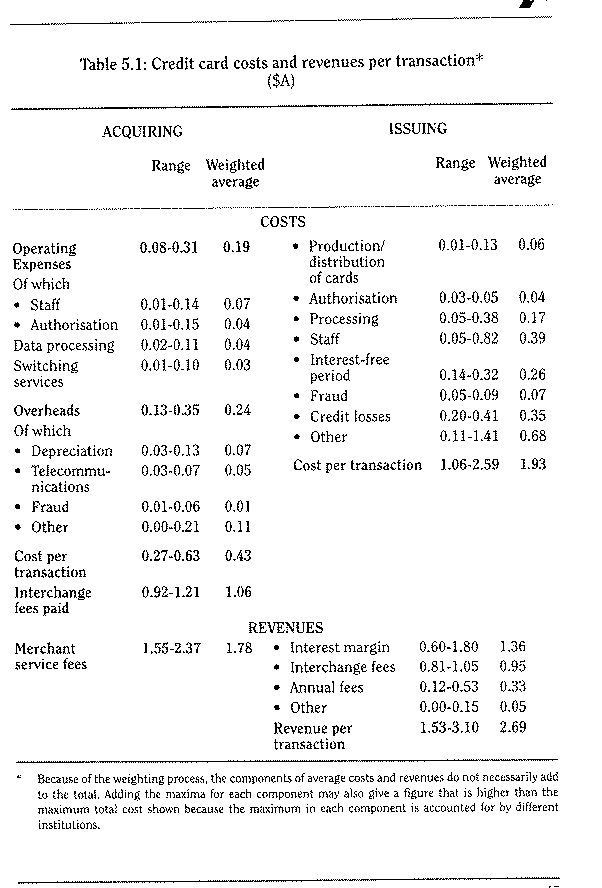
CALTEX AUSTRALIAN PETROLEUM PTY LIMITED (ACN 000 032 128) FIFTH APPLICANT
COLES MYER LIMITED (ACN 004 089 936) SIXTH APPLICANT
SPARKS SHOES PTY LIMITED (ACN 000 916 138) SEVENTH APPLICANT
|
|
AND: |
RESERVE BANK OF AUSTRALIA RESPONDENT
|
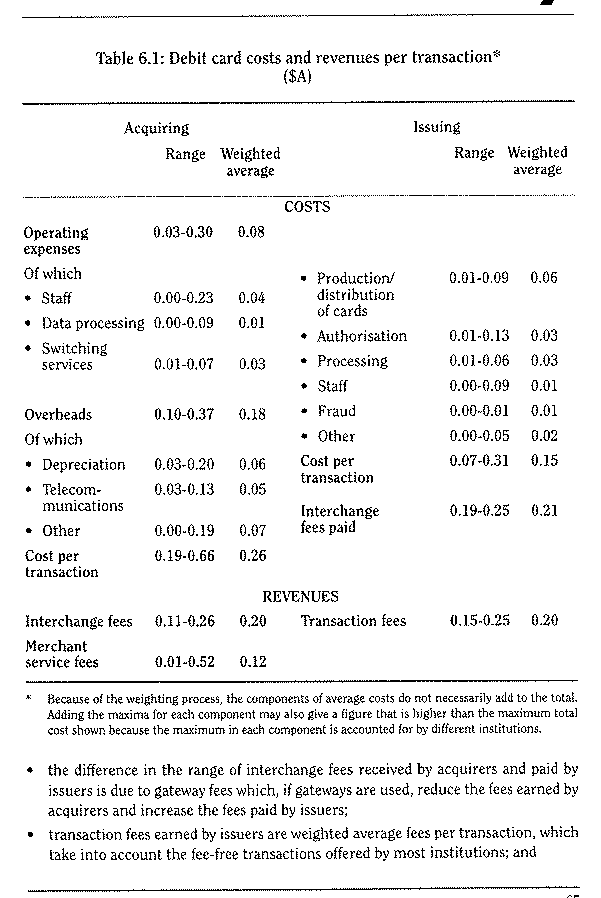
|
WEINBERG J |
|
|
DATE OF ORDER: |
28 NOVEMBER 2005 |
|
WHERE MADE: |
MELBOURNE |
THE COURT ORDERS THAT:
1. The application be dismissed.
2. The applicants pay the respondent’s costs of and incidental to the application, such costs to be taxed in default of agreement.
Note: Settlement and entry of orders is dealt with in Order 36 of the Federal Court Rules.
IN THE FEDERAL COURT OF AUSTRALIA |
|
|
VICTORIA DISTRICT REGISTRY |
VID 1387 OF 2004 |
|
BETWEEN: |
AUSTRALIAN RETAILERS ASSOCIATION FIRST APPLICANT
AUSTRALIA POST SECOND APPLICANT
BP AUSTRALIA PTY LIMITED (ACN 004 085 616) THIRD APPLICANT
BUNNINGS PTY LIMITED (ACN 008 672 179) FOURTH APPLICANT
CALTEX AUSTRALIAN PETROLEUM PTY LIMITED (ACN 000 032 128) FIFTH APPLICANT
COLES MYER LIMITED (ACN 004 089 936) SIXTH APPLICANT
SPARKS SHOES PTY LIMITED (ACN 000 916 138) SEVENTH APPLICANT
|
|
AND: |
RESERVE BANK OF AUSTRALIA RESPONDENT
|
TABLE OF CONTENTS
The legislative framework [6]
The EFTPOS system [22]
The application for review [36]
The Visa case [44]
Designation – the context in which the Decision was taken [57]
Designation – is the challenge premature? [58]
The applicants’ case – an overview [61]
The Joint Study [81]
The RBA’s reliance upon the Joint Study [113]
The RBA Consultation Document [123]
The August 2002 Document [138]
The banks and the authorisation application [149]
The ACT’s reasons for decision [154]
Additional RBA documents submitted to the ACCC, and the ACT[184]
The Statement [194]
The applicants’ detailed attack upon the PSB’s Statement [203]
The RBA’s case - an overview [226]
The memorandum of 11 August 2004 [255]
The minutes of the PSB meeting held on 17 August 2004 [260]
The memorandum of 1 September 2004 [262]
Other aspects of the RBA’s case [271]
The RBA’s outline of its evidence [274]
The RBA’s objections to the applicants’ evidence [275]
The applicants’ witnesses [284]
Mr Charles Gove [284]
Dr Phillip Williams [305]
Mr David Howell [332]
Mr Ian Nicol [352]
Mr Gary Lembit [363]
Mr Russell Zimmerman [369]
The applicants’ objections to the RBA’s evidence [373]
The RBA’s witnesses [380]
Professor Michael Katz [380]
Professor Joseph Farrell [406]
Dr Vincent Fitzgerald [422]
Professor William Dunsmuir [436]
Conclusions [439]
Ruling on objections to evidence [439]
Construction issues – section 7 of the PSR Act [488]
Construction issues – section 8 of the PSR Act [499]
Construction issues – section 10B of the RBA Act [503]
Taking into account irrelevant considerations [511]
Failure to take into account relevant considerations [520]
Wednesbury Unreasonableness [542]
No evidence ground [572]
Natural justice [586]
Remaining matters [604]
Final Observations [624]
Orders [638]
|
IN THE FEDERAL COURT OF AUSTRALIA |
|
|
VICTORIA DISTRICT REGISTRY |
VID 1387 OF 2004 |
|
BETWEEN: |
AUSTRALIAN RETAILERS ASSOCIATION FIRST APPLICANT
AUSTRALIA POST SECOND APPLICANT
BP AUSTRALIA PTY LIMITED (ACN 004 085 616) THIRD APPLICANT
BUNNINGS PTY LIMITED (ACN 008 672 179) FOURTH APPLICANT
CALTEX AUSTRALIAN PETROLEUM PTY LIMITED (ACN 000 032 128) FIFTH APPLICANT
COLES MYER LIMITED (ACN 004 089 936) SIXTH APPLICANT
SPARKS SHOES PTY LIMITED (ACN 000 916 138) SEVENTH APPLICANT
|
|
AND: |
RESERVE BANK OF AUSTRALIA RESPONDENT
|
|
JUDGE: |
WEINBERG J |
|
DATE: |
28 NOVEMBER 2005 |
|
PLACE: |
MELBOURNE |
REASONS FOR JUDGMENT
1 This is an application by the Australian Retailers Association, and six retail merchants, for review of a decision (“the Decision”) by the Payment Systems Board (“PSB”) of the Reserve Bank of Australia (“RBA”) made on 3 September 2004, and published in the Commonwealth Gazette on 9 September 2004. The Decision, taken pursuant to s 11 of the Payment Systems (Regulation) Act 1998 (Cth) (“PSR Act”) was to “designate” the debit card payment system known as the EFTPOS system. This would enable the RBA, pursuant to s 18 of that Act, to determine standards to be complied with by participants in that system. It would also enable the RBA to impose an access regime on those participants, pursuant to s 12. The application is brought pursuant to both s 5 of the Administrative Decisions (Judicial Review) Act 1977 (Cth) (“ADJR Act”) and s 39B of the Judiciary Act 1903 (Cth).
2 The applicants claim to be aggrieved by the Decision. There is no dispute about the fact that they are all participants in the EFTPOS system within the meaning of s 7 of the PSR Act or, alternatively, are directly involved in and participate in the operation of the system as a payment system pursuant to that section. More particularly, the applicants all operate EFTPOS terminals and related software and infrastructure at the point of sale, through which payments using EFTPOS are electronically processed.
3 According to the application for an order of review, the applicant retail merchants, apart from Australia Post and Sparks Shoes Pty Limited (the second and seventh applicants), dispense cash to customers of banks and other financial institutions at EFTPOS terminals.
4 In addition, Coles Myer Limited (“Coles Myer”), the sixth applicant, is what is described as a “merchant principal” within the Consumer Electronic Clearing System (“CECS”) managed by the Australian Payments Clearing Association Limited (“APCAL”). I shall return to the significance of this factor later in these reasons for judgment.
5 The reasons for the Decision were not published by the RBA and the PSB until 14 October 2004. They are contained in a twenty-seven page document which, for convenience, will be described as “the Statement”.
the legislative framework
6 In order to understand the nature of the applicants’ challenge to the Decision, it is necessary to set out in some detail the legislative framework under which it was taken.
7 There are two principal statutes to be considered.
8 The Reserve Bank Act 1959 (Cth) (“RBA Act”) provides, in s 8A that the RBA shall have two Boards, the Reserve Bank Board and the Payments System Board. The Reserve Bank Board is responsible for the RBA’s monetary and banking policy, and its policy on all other matters apart from its payments system policy. The PSB is responsible for the RBA’s payments system policy.
9 Section 10B of the RBA Act sets out the functions of the PSB. Relevantly, it provides:
“(1) The Payments System Board has power to determine the Bank's payments system policy.
(2) The Payments System Board has power to take whatever action is necessary to ensure that the Bank gives effect to the policy it determines.
(3) It is the duty of the Payments System Board to ensure, within the limits of its powers, that:
(a) the Bank's payments system policy is directed to the greatest advantage of the people of Australia; and
(b) the powers of the Bank under the Payment Systems (Regulation) Act 1998 and the Payment Systems and Netting Act 1998 are exercised in a way that, in the Board's opinion, will best contribute to:
(i) controlling risk in the financial system; and
(ii) promoting the efficiency of the payments system; and
(iii) promoting competition in the market for payment services, consistent with the overall stability of the financial system; …”
10 Section 25A of the RBA Act provides that the PSB shall consist of the Governor of the RBA, one representative of the RBA to be appointed by the Governor, one representative of the Australian Prudential Regulation Authority, and up to five other members appointed by the Treasurer.
11 The PSR Act provides, inter alia, for the regulation of payment systems and purchased payment facilities. Section 7 defines a “payment system” as:
“… a funds transfer system that facilitates the circulation of money, and includes any instruments and procedures that relate to the system.”
12 Section 7 also defines “participant in a payment system” as, inter alia:
“(a) a constitutional corporation that is a participant in the system in accordance with the rules governing the operation of the system”.
13 The expression “the rules governing the operation of the system” in s 7, is regarded by the RBA as a reference to the rules set out in a manual produced by CECS (“the CECS manual”), a copy of which was tendered before me.
14 The expression “designated payment system” is defined in s 7 as a payment system that is designated under s 11. That section confers upon the RBA the power to “designate” a payment system. The section is as follows:
“(1) The Reserve Bank may designate a payment system if it considers that designating the system is in the public interest. The designation is to be by notice in writing published in the Gazette.
(2) The designation has effect until it is revoked.
(3) The Reserve Bank may revoke the designation if it no longer considers that it is in the public interest that the system be designated. The revocation is to be by notice in writing published in the Gazette.”
15 Section 8 provides that, for the purposes of the PSR Act, the RBA, when determining whether a particular action is, or would be in, or contrary to, the “public interest”, shall have regard to the desirability of “payment systems”:
“…(a) being (in its opinion):
(i) financially safe for use by participants; and
(ii) efficient; and
(iii) competitive; and
(b) not (in its opinion) materially causing or contributing to increased risk to the financial system.”
16 Section 8 goes on to say that, in determining whether an action would be in, or contrary to, the public interest, the RBA “may have regard to other matters that it considers are relevant, but is not required to do so”.
17 Section 18, which allows the RBA to determine standards to be complied with by participants in a designated payment system, also provides that regard must be had to the public interest. It is in the following terms:
“(1) The Reserve Bank may, in writing, determine standards to be complied with by participants in a designated payment system if it considers that determining the standards is in the public interest.
Note: A failure to comply with a standard is not an offence, but it may lead to a direction being given under section 21.
(2) A standard:
(a) comes into force:
(i) unless subparagraph (ii) applies—on the day on which the determination of the standard is made; or
(ii) if that determination specifies a later day as the day on which the standard comes into force—on the day so specified; and
(b) continues in force until it is revoked.
(3) The Reserve Bank may, in writing, vary or revoke a standard.
(4) The Reserve Bank must not determine or vary a standard unless it has first consulted in accordance with section 28.
(5) The Reserve Bank may determine or vary a standard without complying with subsection (4) if:
(a) the Reserve Bank considers that there is an urgent need for the determination or variation of the standard; or
(b) in the case of a variation—the Reserve Bank considers that the variation is of a minor technical nature.
(6) If the Reserve Bank determines a standard, or varies or revokes a standard, it must, as soon as practicable, provide notification under section 29.
(7) A failure to comply with subsection (6) does not affect the validity of a standard or of the variation or revocation of a standard.”
18 Section 12 provides that the RBA may impose an access regime on the participants in a designated payment system. The access regime imposed must be one that the RBA considers appropriate, having regard to “the public interest”, the interests of the current participants in the system, the interests of people who, in the future, may want access to the system, and any other matters that the RBA considers relevant. The RBA cannot impose an access regime unless it has first consulted in accordance with s 28.
19 Section 28 provides that if the RBA is under an obligation to consult, as for example would be the case in relation to determining a standard under s 18, or imposing an access regime under s 12, it must cause a notice to be published in the Gazette, invite people to make submissions regarding the proposed action, and consider those submissions. It is important to note, by way of contrast, that the RBA is under no specific obligation to consult anyone before it makes a decision to designate a payment system under s 11.
20 Something should be said about the history and background to the PSR Act. That Act formed part of a package of legislation to implement the 1997 Final Report of the Financial System Inquiry (“the Wallis Committee”). The Explanatory Memorandum to the PSR Act identified the fundamental goals of the Government in introducing these reforms as being to increase competition and improve efficiency in the financial system, while preserving its integrity, security and fairness. The Explanatory Memorandum stated:
“1.3 The payments system covers the system of payment instruments (cash, cheques, smart cards among others), their delivery, the exchange of clearance of payment messages, and the final settlement of value between intermediaries providing payment services.
1.4 The payments system plays a central role in the financial system. The Government has decided to strengthen, and make more transparent and accountable, the regulation of the payments system undertaken by the Reserve Bank of Australia. Until now, the Reserve Bank has played a substantial regulatory role in the payments system as a direct participant and through the use of its banking powers. Regulation of the payments system is to be separated from the prudential regulation of banks because an increasing number of non-bank participants in the payments system are emerging to increase competition in the system. More direct means for achieving effective regulation are required for this purpose.
1.5 The Reserve Bank of Australia will be the regulator of the system, given the importance of the payments system to the overall stability of the financial system and given the central role of the Reserve Bank itself in the core areas of the payments system”
21 During the Second Reading Speech of the Bill in the House of Representatives, the Treasurer, the Hon Peter Costello MP, elaborated upon these matters. He observed that in future, payments system regulation was to be separated from the prudential regulation of banks because of the increase in number of non-bank participants in that system. The RBA was to be the regulator of the system, given its importance to the overall stability of the financial system, and its central role in core areas of the payments system. The Treasurer went on to say:
“This bill proposes a new regulatory framework for the payments system. While existing industry self-regulatory arrangements will be retained wherever these are performing satisfactorily, the bill provides powers to the Reserve Bank to enable it to undertake more direct regulation by designating payment systems as subject to the law where it is considered in the public interest to do so.”
the eftpos system
22 The Statement, at [12]-[17], contains a useful summary of the general operation of the EFTPOS system in Australia. There is nothing contentious about this summary, and accordingly I adopt it.
23 The Australian non-cash payments system is made up of a number of separate payment systems. These include:
· the debit and credit card systems predominately used for retail payments by consumers;
· the direct credit and debit payment systems used by both consumers and businesses; and
· the cheque payment system that, today, is mainly used by business.
24 It is clearly the case that, over time, and particularly over the last ten years or so, the use of these different payment systems has changed substantially. The use of credit cards has increased dramatically, as has the use of EFTPOS, albeit less rapidly than credit cards. By contrast, the use of cheques has declined. In the case of bill payments, direct credits, direct debits, credit cards and “BPay” have largely displaced cheques.
25 For many payments, consumers have a choice as to which method of payment to use. For example, credit cards, debit cards or cash can be used more or less interchangeably to pay for groceries. Similarly, cheques, credit cards, direct debit, direct credit and BPay can be used to pay most household bills.
26 The EFTPOS debit card system is but one of a number of card payment systems now generally available. It allows cardholders to make payments for the purchase of goods or services at participating merchants and, in some cases, to obtain cash as well. The cardholder authorises the transaction by entering a personal identification number (PIN) into a terminal at the point of sale. Transactions are debited electronically to cardholders’ accounts at authorised deposit taking institutions (“ADIs”).
27 More specifically, the EFTPOS system, as designated by the RBA, and as defined in the Gazette, is “the electronic funds transfer at point of sale payment system described in cl 1 of the CECS manual for the Consumer Electronic Clearing System”. The system is governed by the rules set out in that manual, supplemented or modified by contracts, arrangements or understandings between individual issuers, acquirers and merchants principal.
28 The EFTPOS system was created in the early 1980s as a series of bilateral linkages between institutions that issue EFTPOS cards (“issuers”), and institutions that provide payment services to merchants (“acquirers”). As the number of bilateral linkages grew, cardholders gained access to a large number of merchants, and merchants were able to accept cards from more issuers.
29 According to the RBA, by October 2004 there were 465,000 EFTPOS terminals in Australia, with over 980 million transactions processed each year. There were numerous banks, building societies and credit unions issuing debit cards that could be used in the EFTPOS system. However, there were only about ten financial institutions offering EFTPOS acquiring services to merchants. One retail merchant, Coles Myer, acts as its own acquirer. It is for that reason it is known as a “merchant principal”.
30 Currently, each time a cardholder makes a payment to a merchant using the EFTPOS system, the issuer pays an “interchange fee” to the acquirer. These interchange fees generally range between about 18 cents and 30 cents per transaction, and are said to average about 20 cents. Interchange fees are agreed between issuers and acquirers on a confidential basis. According to the RBA, they have remained at broadly the same levels for many years.
31 In Australia, there is a difference in the flow of fees between acquirers and merchants, depending upon the particular type of merchant and scale of activities involved. Large merchants, who install EFTPOS infrastructure at their own expense, recover part of the costs associated with doing so by being paid a fee by acquirers. Put another way, they receive part of the fee paid by issuers to acquirers, or “share” the interchange fee. Small merchants, on the other hand, generally pay a fee to their acquirers to meet the cost of this infrastructure and related services.
32 The interchange fees that are paid by issuers to acquirers under EFTPOS should not be confused with the interchange fees paid under credit card systems. Bankcard, MasterCard and Visa credit card systems also have interchange fees. However, acquirers pay these fees to issuers, and not the other way around.
33 Interchange fees in relation to credit cards (and in relation to Visa debit cards) are calculated as a percentage of the amount spent and not, as in the case of EFTPOS, as flat per transaction fees. While they vary across the three major credit card schemes in Australia, the average interchange fee for credit cards is now just below 0.55% of the transaction value, down from around 0.95% in 2000.
34 The RBA states that this reduction in interchange fees is the result of its earlier decision to designate the credit card system, and impose standards limiting the amount that can be charged as an interchange fee in relation to such transactions. In 2003, both Visa and MasterCard challenged the decision to limit interchange fees. That challenge ultimately failed: see Visa International Service Association v Reserve Bank of Australia (2003) 131 FCR 300 per Tamberlin J (“the Visa case”).
35 The RBA also notes that any new entrant seeking access to the EFTPOS system, whether as an issuer, or as an acquirer, would have to arrange bilateral linkages with around eight other participants. Alternatively, any such entrant might seek to establish gateway arrangements with existing participants. An important aspect of the RBA’s concerns regarding the current interchange fee system in EFTPOS is whether these arrangements are conducive to competition in the acquiring business. Competition among acquirers is considered desirable, and in the public interest. APCAL is said to be currently reviewing existing arrangements with the aim of improving access. The RBA says that it is closely monitoring that work.
the application for review
36 The applicants contend that the Decision is invalid, and should be set aside. Although all that has occurred until now is “designation”, pursuant to s 11 of the PSR Act, they submit that this is the inevitable forerunner to the determination of standards, under s 18, and that this in turn will lead to the elimination or reduction of EFTPOS interchange fees. The applicants say that if that were to occur, acquirers would inevitably seek to make up for losses in interchange fees. They would do so, in the case of small merchants, by increasing the merchant service fees that acquirers charge, or, in the case of large merchants, by reducing or eliminating the fees that acquirers currently pay. This loss of revenue would then either have to be absorbed by merchants, or passed on to consumers by way of higher prices. The applicants claim that the elimination or reduction of interchange fees in EFTPOS would do nothing to benefit consumers, and would only serve to protect banks and other financial institutions from competitive pressure.
37 The applicants identify a large number of errors which they say invalidate the Decision. In broad terms, they say in ground 8 of their application that the Decision was based upon or involved one or more errors of law. Under “particulars” marked (a) of this ground they say that the RBA misconstrued ss 7, 8 and 11 of the PSR Act. They identify eleven separate examples of such errors. They further say, under “particulars” marked (b) of this ground, that the RBA misconstrued and failed to comply with its duties under s 10B of the RBA Act. They identify four examples of such errors.
38 The applicants say, under ground 9, that the making of the Decision involved an improper exercise of the power conferred by s 11 of the PSR Act, and s 10B of the RBA Act. They say under “particulars” marked (a) of this ground, that the RBA took into account four irrelevant considerations, which they specify. They say under particulars marked (b) of this ground that the RBA failed to take into account a series of relevant and necessary considerations, and point to ten such matters. They claim under particulars marked (c) of that ground that the RBA exercised the power to designate in a manner that was unreasonable in the Wednesbury sense, and they provide 22 separate examples of such misuse of power.
39 The applicants say, in ground 10, that there was no evidence or other material to justify the making of the Decision, and under “particulars” they point to 17 separate findings that are alleged to have been made without any such support.
40 Finally, the applicants say in ground 11, that a breach of the rules of natural justice occurred in connection with the making of the Decision. They allege a reasonable apprehension of bias on the part of the RBA in connection with the making of the Decision, and provide two separate bases for that contention.
41 It can be seen, therefore, right from the outset, that the applicants have gone through the Statement with a fine tooth comb, and have identified no fewer than 77 separate errors which they say, either alone or in combination, vitiate the Decision. Even if one allows for the fact that a number of these alleged errors simply replicate points made under the rubric of earlier grounds, the attack upon the RBA’s reasons is both painstaking, and unrelenting.
42 In ordinary circumstances, an application for judicial review, whether under the ADJR Act or at common law, is based essentially upon the reasons for decision given by the decision-maker. It is an unusual feature of this proceeding that each side led a prodigious body of evidence in support of its case. In the Visa case a similar approach was taken.
43 It may be accepted that the very nature of the applicants’ challenge to the Decision warranted the reception of some such evidence. For example, their contention that the RBA misconstrued the terms “efficient” and “competitive” in s 8 of the PSR Act opened the door to expert economic opinion regarding the meaning of these words, as technical terms of art. Regrettably, the expert evidence was not merely exceedingly detailed, but also highly contentious. Each of the experts was cross-examined at considerable length. It will be necessary, in the course of these reasons for judgment, to summarise that evidence, both as set out in the voluminous reports tendered, and as given orally.
the visa case
44 The background to the Decision is important. As previously indicated, it is not the first designation decision taken by the RBA in response to a determination by the PSB. In the Visa case, applications were brought against the RBA to set aside five decisions in relation to what are known as four-party credit card schemes in Australia. Those schemes include issuers (financial institutions such as banks that issue credit cards and extend credit to their customers), cardholders (purchasers of goods and services from merchants and customers of the issuers), merchants (who accept the credit cards and claim on issuers for payment), and acquirers (financial institutions such as banks that “acquire” merchants’ claims against issuers) who agree to pay the merchant under the credit card schemes.
45 In one sense, the challenge that was mounted to the RBA’s actions under the PSR Act in the Visa case was even more extensive than the challenge to the Decision in the present case.
46 In the Visa case, the first two decisions challenged were both taken on 11 April 2001, and gazetted the following day. They involved decisions to designate, pursuant to s 11 of the PSR Act, each of the Visa and MasterCard schemes as “a payment system”. The consequence was to bring each of those schemes within the reach of the RBA’s powers to regulate under that Act.
47 The second set of decisions challenged in that case were made on 20 August 2002, and gazetted the following week. Those decisions were to determine an “Interchange Standard” which imposed a limit on “interchange fees”, sometimes described as “wholesale fees”, charged by issuers of four-party credit scheme cards to acquirers participating in the schemes.
48 The third set of decisions challenged were also made on 20 August 2002 and gazetted a week later. They involved a “Surcharge Standard” which permitted merchants using the schemes to impose a charge upon customers notwithstanding that the rules of Visa and MasterCard prohibited such a practice.
49 The fourth set of decisions challenged were also made on 20 August 2002. However, those decisions had not been gazetted at the time the proceedings in the Visa case were commenced, and were therefore not operative at the time those proceedings were heard. They imposed upon the applicants an “Access Regime” which provided for access to the schemes to be available to a greater number of potential participants.
50 The fifth decision challenged was the RBA’s decision not to revoke the designation of the applicants’ schemes. However, that challenge was not pressed, and was not an issue in the proceeding.
51 In the Visa case, interchange fees were defended by the applicants on the basis that they allowed the acquirer to recoup costs of the card infrastructure and processing. The merchant could then bear the interchange fee, or pass it on to its customers, both cardholders and non-cardholders, by way of general price increase. It was clear, in that case, that issuers and acquirers derived substantial income from interchange fees. It also emerged that these fees were set by financial institutions removed from the merchants and cardholders who ultimately had to bear them.
52 A number of the issues determined in the Visa case are of relevance to this proceeding. For example, it was contended in that case that the proposed access regime was manifestly unfair and unreasonable, in the Wednesbury sense. That was an argument that Tamberlin J rejected.
53 His Honour also gave careful consideration to the general principles that govern an application for judicial review of this type. He said, at [7]-[12]:
“7 In this case it is particularly important from the outset to keep in mind the function of the court on a judicial review application. This is because much of the subject matter includes controversial economic issues which, as the evidence demonstrates, are the subject of strong and sharp differences of opinion between economic experts. In such circumstances the danger of sliding into a consideration of the relative merits of economic theories is substantial, especially where, as is the case in these proceedings, claims of Wednesburyunreasonableness are raised: see Associated Provincial Picture Houses Ltd v Wednesbury Corporation[1948] 1 KB 223. It is therefore helpful to refer to those principles at this point.
Judicial Review
8 The nature of judicial review proceedings before the court has a bearing on the approach and the matters for consideration by the court and the limited scope of review. On judicial review the court does not reconsider the merits of the RBA decisions, but is confined to examining decisions sought to be challenged in order to determine whether the decision-maker complied with the required legal process for decision-making. That is to say that it is not for the court to perform the function assigned to the RBA by the legislation. The court on review must not substitute its own conclusion for that of the decision-maker simply because it would have been minded to reach a different conclusion in circumstances where it was reasonably open to the decision-maker to reach that conclusion.
9 The function of the court on an application for judicial review was described by Brennan J in Attorney-General (NSW) v Quin (1990) 170 CLR 1 at 35-36:
The duty and jurisdiction of the court to review administrative action do not go beyond the declaration and enforcing of the law which determines the limits and governs the exercise of the repository’s power. If, in so doing, the court avoids administrative injustice or error, so be it; but the court has no jurisdiction simply to cure administrative injustice or error. The merits of administrative action, to the extent that they can be distinguished from legality, are for the repository of the relevant power and, subject to political control, for the repository alone.
10 The focus by the court is directed to the legality of the decision-making process taken by the RBA and that must be distinguished from a re-examination of the merits of the decisions made. At 37, his Honour sounded the following caution:
If it be right to say that the court’s jurisdiction in judicial review goes no further than declaring and enforcing the law prescribing the limits and governing the exercise of power, the next question immediately arises: what is the law? And that question, of course, must be answered by the court itself. In giving its answer, the court needs to remember that the judicature is but one of the three co-ordinate branches of government and that the authority of the judicature is not derived from a superior capacity to balance the interests of the community against the interests of an individual. The repository of administrative power must often balance the interests of the public at large and the interests of minority groups or individuals. The courts are not equipped to evaluate the policy considerations which properly bear on such decisions, nor is the adversary system ideally suited to the doing of administrative justice: interests which are not represented as well as interests which are represented must often be considered. Moreover, if the courts were permitted to review the merits of administrative action whenever interested parties were prepared to risk the costs of litigation, the exercise of administrative power might be skewed in favour of the rich, the powerful, or the simply litigious.
11 To similar effect are the observations of Gleeson CJ, Gummow, Kirby and Hayne JJ in Corporation of the City of Enfield v Development Assessment Commission(2000) 199 CLR 135, especially at 152-153, which recently followed and applied the above remarks of Brennan J in Quin.
12 It is not a function of the court on judicial review to form its own independent opinion in relation to issues on which reasonable minds may differ. That consideration is equally applicable when the ground of unreasonableness is relied on in the application for review, where the court may be required to examine the decision-maker’s state of satisfaction in evaluating the opinions formed. To similar effect is the decision of the High Court in Minister for Immigration and Multicultural Affairs v Jia Legeng(2001) 205 CLR 507 at 532, where Gleeson CJ and Gummow J described the approach as follows:
The question then on judicial review is whether the decision‑maker could have attained that satisfaction reasonably, in the sense explained in numerous authorities in this Court. In Foley v Padley [(1984) 154 CLR 340], Brennan J emphasised that the question on judicial review is not whether the court would have formed the opinion in question, and that an allegation of unreasonableness in the formation of the opinion by the decision‑maker may prove to be no more than an impermissible attack on the merits of the decision.
By way of illustration, diametrically opposed views have been expressed by economists as to the advantages and disadvantages of the interchange fee in credit card transactions. It is not the function of the court in these proceedings to decide which of the two views is correct or preferable. That is a question for the RBA under the legislation.”
54 His Honour went on to discuss the relevant principles concerning judicial review in the present context at [589]-[604]. I shall return to these passages later in my reasons for judgment.
55 Tamberlin J ultimately concluded that no error of any material kind had been demonstrated such that it could have impacted on the validity of the RBA’s determinations in relation to access and standards. Having regard to that conclusion, it was hardly surprising that he found no reviewable error in relation to the earlier designation decision of April 2001.
56 It should be noted that, in February 2004, after the Visa case was decided, the RBA considered, and designated, the Visa Debit payment system. This is a matter to which several of the experts have adverted in their evidence before me, and to which I shall return.
designation – the context in which the decision was taken
57 It may be seen that the decision to designate the EFTPOS system is, in effect, the third stage of an ongoing process involving reform of card payment systems in Australia. In deciding to designate EFTPOS, the RBA concluded that current interchange arrangements in relation to that system were “not conducive to the efficiency of the overall payments system”. In particular, it determined that the current interchange arrangements contribute to the effective price that cardholders are charged for payments using EFTPOS being higher than for payments using credit cards, or scheme based debit cards such as Visa Debit. This was despite EFTPOS having relatively lower costs. In substance, the RBA judged that a narrowing of this differential in relative prices, and costs, would promote the efficiency of the “overall payments system”.
designation – is the challenge premature?
58 One issue that will have to be determined is whether, as the RBA contends, the applicants’ challenge to the Decision is premature since there is no certainty that the RBA will set standards for interchange fees, or impose an access regime.
59 At a formal level, there may be substance in this point. However, there are a number of factors that make it tolerably clear that designation will be followed by regulation in one form or another. Indeed, in its media release dated 9 September 2004, the RBA indicated that it would:
“… now proceed to consider the desirability of setting standards for interchange fees for both the EFTPOS debit card payment system and the Visa Debit payment system with the objective of improving the efficiency of Australia’s payments system.”
60 By way of contrast, at the same time as issuing this media release, the RBA said that after considering whether it would be in the public interest to designate the automatic teller machine (ATM) system, it had decided against doing so “at this stage”. The inference is plain. The RBA does not contend that there is no decision that would be amenable to review, or that the applicants are not persons aggrieved. It does submit, however, that the challenge to the designation decision should be approached upon a somewhat different basis than the challenge mounted in the Visa case to the decisions to determine standards taken in August 2002.
the applicants’ case – an overview
61 The applicants contend that the rationale and actuating purpose of the RBA emerged clearly from any fair reading of the Statement. They say that it is obvious that the RBA intends to eliminate or substantially reduce fees paid by issuers to acquirers within the framework of the EFTPOS system. They claim that the RBA’s object is precisely the same as that sought to be achieved by the banks when they entered into a price-fixing agreement to set EFTPOS interchange fees at zero, which the RBA supported subject to the authorisation of the Australian Competition and Consumer Commission (“the ACCC”). In due course, as will be seen, that price-fixing agreement was rejected by the Australian Competition Tribunal (“the ACT”) upon the grounds that it would lead to public detriment, with no countervailing benefits. The applicants say that the ACT was entirely correct in arriving at that conclusion.
62 The applicants say that the fees paid by issuers to acquirers, and in turn by acquirers to some merchants, are intended to compensate them for a range of functions they undertake, and services they provide, within the EFTPOS system. These include access to EFTPOS infrastructure installed at point of sale. The infrastructure is costly, both in terms of initial investment, and maintenance and operating costs. They say that the evidence shows that for the majority of transactions, both by value and by volume, the infrastructure is installed by merchants, and not by banks.
63 The applicants submit that these are costs of the EFTPOS system which, in the ordinary course, one would expect to be recoverable from parties engaged in that system who derive benefits from it. As previously indicated, the large merchants who install this infrastructure recover these costs from the banks out of the interchange fee. In other words, they receive part of the fee paid by issuers to acquirers (or share the interchange fee). The applicants say that if the Decision stands, and if the RBA then proceeds to impose standards that limit interchange fees, the effect will be to prevent merchants from recovering the costs incurred by them from the banks. Those costs will not be eliminated. They will simply be borne by the merchants or, more likely, passed on by them to consumers generally.
64 The applicants further submit that the Decision will have the effect of eliminating or reducing the competition currently faced by banks from merchants. Interchange fees in relation to EFTPOS are set by competitive bilateral negotiations. The Decision will ultimately insulate the banks from that competitive pressure.
65 As previously indicated, the applicants claim that the Decision involves a misuse, by the RBA, of its statutory powers, is based upon a misconstruction of the relevant statutory provisions, involves a failure to have regard to relevant evidence, and is based upon incorrect and outdated material, which the RBA is alleged to have “manipulated to produce a contrived result”.
66 More specifically, the applicants identify the infrastructure that lies behind the functioning EFTPOS system as including, at point of sale, a pin pad (an encrypting device used to swipe an EFTPOS card that contains coded information in a magnetic strip) and an associated security code. This infrastructure is expensive, must be maintained, and is regularly replaced. As a general rule, large merchants install their own equipment. They do so at a cost of many millions of dollars. That cost is currently recouped from fees charged by these merchants to acquiring banks.
67 In the case of smaller merchants, the equipment is often installed by acquiring banks. The merchants pay the acquiring banks a merchant service fee to cover the infrastructure costs.
68 Thus, depending upon whether the merchant owns the equipment, or whether the equipment is purchased by the acquiring bank, there will be a movement of funds to meet these costs.
69 Putting to one side the question of infrastructure, the applicants rely, in support of the continued existence of interchange fees, upon the competitive nature of those fees. The EFTPOS system is supported by bilateral agreements. These are agreements between issuers and acquirers and, in the case of merchants principal, between issuers and merchants. They are freely negotiated between participants in the system. They cover the communication links and access to the point of sale equipment, whether owned by the acquirer or the merchant. In substance, issuers pay a fee for access to that point of sale equipment.
70 The applicants say that an examination of the agreements discovered by the RBA in this proceeding shows that they have resulted in a wide range of negotiated fees payable by issuers to acquirers, or in some cases, by issuers to merchants. Some fees are subject to a CPI adjuster, while others provide for different forms of review. Some fees are tiered according to the level of transactions generated. Most agreements are for limited duration, one to three years being typical.
71 Another feature of the existing EFTPOS system is that banks charge their customers fees in relation to EFTPOS transactions. These fees are charged as part of the customers’ ordinary account fees. This is understandable, because the same card functions for ATM withdrawals as for EFTPOS transactions. The fees charged are normally bundled into account keeping fees, though in limited cases, there are separate transaction fees.
72 An important aspect of the applicants’ case is that most banks now have no limit on the number of fee free EFTPOS transactions. All transactions are free on payment of a small monthly fee. The RBA itself was aware, at the time of the Decision, that the number of accounts that attracted per transaction debit card fees was significantly less than 18%. That number had fallen steadily over many years, and was still falling at the time of the Decision. In essence, the banks used bundled pricing to recover costs associated with EFTPOS, and transaction fees were no longer being utilised.
73 The final feature of the EFTPOS system to which the applicants drew attention was its use as a method of cash distribution. Merchants frequently provide a cash withdrawal service to bank customers, at considerable cost to themselves. Banks actively promote that service to their cardholders. In 2004, 15% of EFTPOS transactions involved a cash-out service. That was 170 million transactions per annum, representing billions of dollars. These were transactions that would otherwise have to be serviced by a bank, either at a branch or an ATM. In other words, merchants operate as de facto bank branches, a situation that the banks entirely support, though they do not wish to be charged for it.
74 Merchants currently receive some recompense for providing this service where they charge acquiring banks a fee for the functions they perform. According to the applicants, the effect of the Decision, and the likely future elimination or reduction of interchange fees, will be to prevent merchants from doing so. They will be forced to absorb the cost themselves, or more likely, cast it upon the general consuming public by means of an increase in the price of goods and services. The applicants claim that this is the anthesis of a “user pays” principle, which lies at the heart of economic efficiency. Indeed, they claim that the thrust of the RBA’s reasoning is that of all the people involved in the EFTPOS system, merchants alone are to be denied the right to recover costs from other participants in that system who benefit from it.
75 Turning to the relevant legislative provisions, the applicants focus upon the PSB’s power to determine “the Bank’s payments system policy” (s 10B(3)(a) of the RBA Act), the duty of the PSB to ensure that the RBA’s powers are exercised in a way that, in the PSB’s opinion, will best contribute to “promoting the efficiency of the payments system”, and “promoting competition in the market for payment services” (s 10B(3)(b)(ii) and (iii) of the RBA Act). They note that these references are to the overall payments system, within Australia, which includes many different payment systems, such as cheques, cash, credit cards, debit cards, ATMs, BPay and internet payments. They say that “the market for payment services” is an even broader concept that plainly includes merchants who are both acquirers and suppliers in that market. They complain that despite that fact, the RBA excluded merchants from consideration in making the Decision.
76 The applicants distinguish between the broader concept of “payments system” in the RBA Act, and the concept of “a payment system”, in the singular, in s 11(1) of the PSR Act. As previously noted, the term “payment system” is defined in s 7 as a funds transfer system that facilitates the circulation of money, and includes any instruments and procedures that relate to the system. The applicants say that the reference to “a payment system” in the PSR Act is a reference to EFTPOS, and that it is not open to the RBA to designate merely part of an actual funds transfer system that is operational in the community. Rather, the RBA’s power is to designate the entirety of the system in question, including any instruments or procedures that relate to it. They say that this issue was resolved in their favour by Tamberlin J in the Visa casewhere his Honour concluded at [305] that, in the case of credit cards, merchants were part of the funds transfer system. They say the same must be true of debit cards.
77 The applicants then turn to s 8(a) of the PSR Act. They note that for the purposes of that Act, and when considering whether particular action is or would be in, or contrary to, the public interest, the RBA is to have regard to “the desirability of payment systems being … (in its opinion) … efficient … and … competitive”. They say that the expression “payment systems” in that context does not refer to the “overall payments system”, as the RBA concluded, but rather the particular payment system, being the specific payment system in question. In other words, the RBA is required to confine its consideration under s 8 to the EFTPOS system itself, and not have regard to other payment systems when considering matters of efficiency and competitiveness. They again rely upon the judgment of Tamberlin J in the Visa case in support of that conclusion.
78 In the applicants’ words, the RBA:
“… is required to consider in this case the desirability of the EFTPOS system in its actual functioning scope being, in its opinion, efficient and competitive as a result of the mooted changes.”
79 The applicants’ complaint is that the RBA failed to carry out that very function. Rather it looked past that issue to the payments system as a whole, and thereby failed to perform its statutory duty.
80 The applicants’ attack upon the Decision rested in part upon a detailed analysis of various documents that were before the RBA when it made the Decision. It is necessary, in order to understand the applicants’ case, to set out in some detail the nature and terms or these documents.
the joint study
81 The applicants’ acknowledged that their case depended to a considerable degree upon an analysis of the Statement in the light of the material that the RBA relied upon in arriving at the Decision. Of foremost importance was a document described as the “Joint Study”, which was produced jointly by the RBA and the ACCC in October 2000.
82 The full title of that document was “Debit and Credit Card Schemes in Australia – a Study of Interchange Fees and Access - October 2000”. It stated its objectives as being to:
“h obtain information on interchange fees paid by financial institutions;
· clarify the basis on which interchange fees are set, looking particularly at the role of costs;
· assess whether current interchange fees are encouraging efficient provision of debit and credit card services; and
· obtain information on current restrictions on credit card scheme membership.”
83 The Joint Study was confined to “one aspect of the Australian payments system“ – the networks for ATMs, credit cards and debit cards. It concentrated on two features of these card networks, namely interchange fees and conditions of entry into the industry. It was concerned with the economic efficiency of these networks. In particular, it focused upon the question whether they delivered the best possible service at the lowest cost to end users. It recognised that an expensive payments instrument would, at the margin, mean higher prices for goods and services, and a more cost effective one would mean lower prices. It postulated that the incentives in an economy should ensure that the lowest cost and most efficient payment instruments thrive at the expense of the more expensive or less efficient ones.
84 The Joint Study noted that the incentives in question were largely the fees and charges that consumers face when choosing a payment instrument. Some fees and charges were transparent. Others were less so but potentially just as important in influencing the payment instrument used, and the resulting cost to the economy. Interchange or “wholesale” fees, paid between financial institutions when customers of one institution are provided with card services by another, were described as an example of non-transparent fees.
85 Interchange fees were seen as unique to card networks. Such fees did not apply to payment by cheque, direct credit or direct debit. In those cases, financial institutions sought to recover their costs directly from their own customers.
86 The Joint Study saw the rationale for interchange fees as encouraging the growth of payment networks by redistributing revenues between participants to induce them to join. Australia’s card networks had grown strongly under that system, and received widespread public acceptance. However, pricing in those networks was said, at (ii), to still be based on interchange fees which were:
“… set by financial institutions at one remove from the cardholders and merchants that ultimately bear these fees. Hence, in contrast to most other markets, end-users of card services do not have any direct influence on the price-setting process. This reduction in the normal market discipline has potential implications for efficiency and equity which need to be weighed against potential network benefits.”
87 After dealing extensively with ATM networks and credit card networks, the Joint Study said this about debit card payment networks:
“16. In debit card payment networks, interchange fees are negotiated bilaterally and are paid by the card issuer to the merchant’s financial institution (the acquirer). These fees have been justified as a means by which the acquirer can recoup the costs of the debit card infrastructure from cardholders. Acquirers earn revenues from interchange fees of around $0.20 per transaction, and revenues from merchant service fees of around $0.12 per transaction. They incur costs of around $0.26 per transaction, giving a mark-up of revenues over costs of 23 per cent. This mark-up is much lower than in credit card acquiring although infrastructure and procedures are very similar. The major reason is that large merchants have invested in their own acquiring infrastructure and have negotiated arrangements to share interchange fees with their financial institution.
17. The payment of a debit card interchange fee to acquirers is an arrangement unique to Australia. In other countries, the payment is to the card issuer or there are no interchange fees at all. The study did not find a convincing case for an interchange fee in the debit card payment network in Australia, in either direction.”
88 The Joint Study then concluded:
“18. Competitive pressures in card payment networks in Australia have not been sufficiently strong to bring interchange fees into line with costs. The end-users of these services – cardholders and merchants – have no direct influence over the setting of interchange fees but must rely on their financial institutions to represent their interests. Large financial institutions have the dominant influence on interchange fee setting; however, since they are both issuers and acquirers and benefit from the revenue generated, they have little incentive to press for lower interchange fees. Where financial institutions can readily pass interchange fees onto their customers, as they can for ATM and credit card transactions, there is even less pressure for interchange fees to be lowered. As a consequence, the price signals and competitive responses that would be expected to put pressure on margins in card payments networks have not worked effectively. These difficulties are reinforced by restrictions on entry to the card networks, both explicit and informal, and by the ‘no surcharge’ rules in credit card schemes. In the debit card payment network, however, large merchants with their own acquiring infrastructure have provided a countervailing force to traditional acquirers.
19. Under current arrangements, cardholders are effectively being paid by card issuers to use a credit card as a payment instrument, but they face a transaction fee for using a debit card (after a number of fee-free transactions). This structure of incentives has encouraged the growth of the credit card network at the expense of other payment instruments, particularly debit cards and direct debits, that consume fewer resources. As a result, Australia has a higher cost retail payments system than necessary, and much of this cost is borne by consumers who did not use credit cards.
20. The study has concluded that the interests of end-users of card payment services need to be more directly engaged in the pricing process and conditions of entry to card payment networks need to be more open than at present.”
89 The focus of the Joint Study was on wholesale pricing structures in credit and debit card schemes. At the same time, it was recognised that interchange fees were important determinants of the charges facing merchants and cardholders, and that those relationships had to be explored. Importantly, however, the report made plain that retail fees and charges as such were not the focus of the study.
90 During the course of the study, the ACCC conducted a separate investigation into interchange fees in credit card schemes. Following that investigation, the ACCC wrote to various financial institutions, and to Visa, MasterCard and Bankcard, the three credit card schemes in Australia, informing them that, in its view, the joint setting of credit card interchange fees was a likely breach of s 45 of the Trade Practices Act 1974 (Cth). Indeed, the study noted that the ACCC had already instituted proceedings under that section against one major bank, which, it transpired, was the National Australia Bank (“NAB”).
91 The Joint Study concluded that a payment network could be said to operate efficiently if the net benefits it provided to society were being maximised. In practice, there were two main approaches used to determine an interchange fee. The first viewed such a fee as the means by which financial institutions recovered the costs of providing a card payment service from those who were the beneficiaries of the network. The alternative was to assess whether the revenues earned by issuers and acquirers from their own customers were adequate to recover costs for both parties. If not, an interchange fee might help by redistributing revenues.
92 Two additional comments were made in the Joint Study. First, the level of the interchange fee would determine whether the main incentive was to encourage acquiring or card issuance. In the case of credit cards, for example, the interchange fee – and therefore the merchant service fee – might be set lower for all transactions than a formal methodology would suggest, to encourage merchant acceptance of credit cards, or lower for certain classes of transactions to attract new categories of merchants into the card scheme. Alternatively, the interchange fee might be set higher to encourage card issuance. Second, interchange fees were normally calculated on the basis of average (or total) revenues and costs. This focus on average costs derived from the economic characteristics of most payment networks. Such networks tended to involve significant set-up costs. Once established, however, the per unit cost of providing payment services fell sharply as usage of the network increased. In electronic payment systems, for example, substantial fixed costs might be incurred initially, but the marginal cost of electronic messages was relatively low and constant. Moreover, where economies of scale existed, average costs were likely to exceed marginal costs. Cost recovery based on marginal cost calculations would produce revenue streams that did not cover total costs.
93 The Joint Study noted that interchange fees in credit card schemes were paid to the card issuer by the merchant’s financial institution (the acquirer) whenever the merchant accepted a credit card for payment. In Australia, such fees were agreed jointly by the financial institutions which were members of the card schemes. The interchange fees for Visa and MasterCard were 0.8% of the value of the transaction for transactions that qualified as electronic, and 1.2% for other transactions. The interchange fee for Bankcard was 1.2% for all transactions.
94 In 1999, the amount of interchange fees paid by acquirers to issuers in relation to credit cards was in the order of $550 million. Data on credit card costs and revenues, supplied by the major banks and some smaller institutions, showed that the average interchange fee for a transaction received by card issuers was $0.95. Acquirers passed that fee on in full to their merchants, together with a margin to cover the costs of providing acquiring services. The resulting merchant service fee averaged $1.78 per transaction.
95 Costs and revenues from the provision of credit card services were summarised in the Joint Study in a table that featured heavily as part of the applicants’ case before me:
TABLE 5.1 FOLLOWS
96 The data in this table included both paper and electronic transactions, and so the figures were an average of the two. The Joint Study concluded that credit card issuing and acquiring in Australia generated revenue well above costs.
97 In the case of credit card issuing, costs averaged $1.93 per transaction. However, total revenues averaged $2.69, a mark-up over costs of $0.76 or 39%. Loyalty schemes were not included in Table 5.1 because they were not a “resource cost”. Nonetheless, card issuers paid an average of $0.46 per transaction for benefits provided to cardholders in loyalty schemes.
98 In the case of credit card acquiring, costs averaged $0.43 per transaction. However, fee revenues, after interchange fees were passed on to issuers, averaged $0.72. This was a mark-up over costs of $0.29 or around 67%.
99 Turning to debit card networks, the Joint Study noted that when a cardholder used a debit card to make a purchase from a merchant, the card issuer paid an interchange fee to the merchant’s financial institution (the acquirer). This was the reverse of what took place in credit card systems. These interchange fees were negotiated bilaterally between card issuers and acquirers, and were fixed as a flat amount rather than a percentage of the value of the transaction.
100 There were 39 bilateral interchange agreements reported to the Joint Study, of which 34 had interchange fees falling within a range of $0.18 to $0.25. Interchange fees for debit card transactions were said to have “hardly changed” since they were introduced in the early 1990s. Newer agreements simply replicated earlier agreements, without regard for changes in costs that may have warranted a revision to those fees.
101 The Joint Study noted that merchants negotiated fees for accepting debit card transactions directly with their financial institutions. There were two distinct merchant segments in the debit card network:
· smaller merchants, who purchased the full range of acquiring services from their financial institution, and paid a merchant service fee. Although the Joint Study did not collect specific data on merchant fees, it inferred an average fee of $0.80 per transaction; and
· larger merchants, which took on some of the capturing, transmission, and processing of debit card transactions using their own facilities. Many of these merchants had negotiated arrangements under which they shared the interchange fee with their financial institution. For the acquirers, the amount of interchange fee revenue shared with merchants reduced the total revenue they received from merchants.
102 The Joint Study observed, at 63:
“Large merchants with their own acquiring infrastructure account for the majority of debit card payments accepted, in terms of both numbers and value. As a result of their investment in debit card infrastructure, and their market size, these merchants have had sufficient bargaining power with their acquirers to be able to share part of the interchange fee received from issuers.”
103 The Joint Study then set out a table containing data on debit card costs and revenues for 1999. That data had been supplied by a group of eight financial institutions, including the four major banks. Together that group accounted for around 80% of debit card transactions by issuer, and 99% of transactions by acquirer. The table is as follows:
TABLE 6.1 FOLLOWS
104 The data was said to be subject to certain caveats. On the acquiring side, many of the costs included were common to the acquiring of debit card transactions and electronic credit card transactions, and most institutions treated acquiring of these two types of transactions as one business. Where possible, costs specific to debit card acquiring had been identified, and common costs allocated between debit and credit card transactions on the basis of transaction volume. On the issuing side, many institutions found it difficult to isolate costs attributable to debit credit card transactions from other costs associated with transaction accounts.
105 The Joint Study’s observations regarding this data, at 66, were as follows:
“The evidence suggests that debit card acquiring generates revenues above costs, but the margin is well below that in credit card acquiring. Costs average $0.26 per transaction and total revenues, from both interchange fees and merchant service fees, average $0.32 per transaction. This is a mark-up over costs of $0.06 or 23 per cent. The lower cost of acquiring debit card transactions compared to credit card transactions ($0.43) appears to be due to the more complex electronic messages required for credit card transactions and to the continued existence of paper-based credit card transaction that are more expensive for acquirers to process than electronic transactions.
In the case of card issuing, interchange fees are paid largely by revenues from transaction fees on cardholders who use their debit cards beyond their fee-free limit each month. The average cost of $0.15 per transaction is recovered as part of the overall cost of providing a transaction account, through account maintenance fees and payment of below-market rates of interest on balances. The average issuing cost per transaction is substantially lower than those for credit card transaction ($1.93); most of the major costs incurred by credit card issuers (eg credit losses and the interest-free period) do not arise in debit card networks.
The margins between revenues and costs have not incorporated a return on the capital committed to debit card issuing and acquiring. As far as debit card issuing is concerned, a major difficulty in determining a return on capital is separating debit card services from the broader account relationship. Collecting information on the broad range of costs and revenues associated with the provision of transaction accounts was outside the scope of this study. The operational aspects of debit card acquiring are very similar to credit card acquiring, which was discussed in Chapter 5. On the same analysis, preliminary figuring would suggest that a margin over costs of only a few cents per transaction would provide a competitive rate of return for debit card acquiring.”
106 The Joint Study then turned to the rationale for an interchange fee. It observed, at 66:
“The direction of debit card interchange fee payments in Australia is unique. In other countries the payment is to the card issuer, or there are no interchange fees at all. None of the participants in the Australian debit card network could provide a formal methodology or empirical evidence to support either the existing direction and level of interchange fees, or a change in these arrangements.”
107 Finally, the Joint Study stated in its conclusions. It said that it had not found a convincing case for an interchange fee in the debit card network in Australia, in either direction. A debit card was simply a method of accessing a transaction account. It was an alternative to cheques, direct debits and direct credits, all other methods of accessing the same funds. None of these other payment instruments had an interchange fee. Each financial institution recovered its costs from its own customers. Consumers paid for the provision of payment services, increasingly through a direct charge, while merchants paid a fee for services associated with accepting and processing these payments. To the extent that merchants performed some processing themselves, these fees were reduced.
108 The absence of interchange fee revenues to issuers had not constrained the issuance of debit cards, and their use at point of sale in Australia. To the contrary, the use of debit cards had grown strongly. Financial institutions, to allow their customers access to ATMs, had issued the debit cards on which the network was based. There had been no need to provide further incentives for their issue.
109 In summary, the Joint Study found that the debit card network in Australia did not need an interchange fee. It saw no compelling reason why the viability of the network would be threatened if, as with other payment instruments which accessed a transaction account, each financial institution were to recover its debit card costs from its own customers.
110 The Joint Study’s economic analysis, reviewing the role of interchange fees in the ATM, credit card and debit card networks in Australia found, in relation to debit cards the interchange fees for debit card payments contributed to margins over costs of around 23% for acquirers, much lower than the margins of 39% for card issuers and 67% for acquirers in credit card acquiring. Notwithstanding this lower figure, the Joint Study concluded that current interchange fee arrangements, including those applicable to debit card transactions, did not contribute to efficient resource allocation. Rather they overcompensated financial institutions for the costs that they incurred. Although financial institutions “were generally unable to supply data in this area”, preliminary figuring by the Joint Study suggested that the margins over costs earned by acquirers were not needed by financial institutions to earn their required return on capital. In addition, the price signals and competitive responses that would be expected to put pressure on margins in card payment networks had not worked effectively. These difficulties were reinforced by restrictions on access to the card networks.
111 In the words of the Joint Study, at 76:
“In debit card acquiring, large merchants that have invested in acquiring infrastructure have had sufficient bargaining power with their acquirers to be able to share the interchange fee received from issuers. As a consequence, acquirers earn lower margins in debit card acquiring than in credit card acquiring. However, small financial institutions wishing to enter the debit card network as issuers or acquirers have limited bargaining power against established players and many need to use more expensive gateway arrangements.”
112 In summary, the Joint Study concluded, at 78-9:
“…the pricing of retail payment services in Australia, in which interchange fees play an integral role, is distorting the payment choices facing consumers. The beneficiaries are credit cardholders using the credit card purely as a payment instrument, who are not contributing fully to cost recovery, and financial institution which are members of the credit card schemes, which earn substantially higher margins from the provision of credit card services than from debit card services. Australia as a whole, however, has a higher cost retail payments system than is necessary, and much of this higher cost is borne by consumers who do not use credit cards.
Australia has well-established ATM, credit card and debit card networks. Each of these networks operates to a high standard of technical efficiency, and has widespread consumer acceptance. Interchange fees may have played an important part in the development of these networks, but by their nature they have done so by reducing the potency of the normal market mechanisms which determine consumer choice and resource allocation. While a pricing system based on interchange fees still seems to be the most practical arrangement for the credit card network, the levels of interchange fees are high relative to costs and fees of this magnitude are not essential to the continued viability of this network. For the other networks – ATMs and debit cards – alternative pricing arrangements exist under which providers of card services could recoup their costs directly from users, as they do with other payments instruments.”
the rba’s reliance upon the joint study
113 The applicants noted that the RBA relied heavily upon the findings in the Joint Study in arriving at the Decision. They challenged the relevance of those findings, given that the Joint Study was based on 1999 data, supplied by a limited number of institutions. They observed that, since 1999, there had been very many changes affecting costs, prices and revenues of both credit cards and debit cards. The Statement, however, made it plain that the RBA based its decision upon the original data, and gave little weight to the concern expressed by merchants, and also by the ACT, in its findings, that the Joint Study’s figures should not be accepted, or acted upon, because they were out of date.
114 The applicants further noted that the focus of the Joint Study had been on wholesale pricing structures. Indeed, it was stated specifically that retail fees and charges by banks had not been the focus of the study, but were rather matters for individual financial institutions.
115 The applicants pointed out that the position regarding credit card networks differed significantly from that applicable to debit card networks. At the time of the Joint Study, interchange fees in relation to credit cards were the subject of collective price-fixing agreements. These were never freely negotiated. That fact concerned both the RBA and the ACCC greatly.
116 This problem did not exist in relation to debit cards, where interchange fees were negotiated bilaterally. Moreover, there was a modest mark-up of revenues over costs. The major reason was that large merchants had invested in their own acquiring infrastructure, and had negotiated agreements to share interchange fees with their financial institutions.
117 The applicants attacked the accuracy of the tables which featured so prominently in the Joint Study. For example, Table 5.1, which dealt with credit cards, excluded merchant costs on the acquiring side. Credit card data was based on both paper and electronic transactions that had been arbitrarily averaged, making that data difficult to compare to EFTPOS. Some categories of costs, including loyalty points, had been excluded although the banks themselves regarded loyalty points as an integral part of their costs structure. Finally, Table 5.1 made it clear that the banks earned large profits from credit cards. The margin on credit, as at 1999, far exceeded the margin on debit cards with more than half the revenue being generated from interest. The fact that the banks did not charge transaction fees for credit cards was part of their strategy. Rather than charge a fee that might discourage use of a credit card, they chose to offer credit card transactions without transaction fees. However, the credit came at an enormous price – an annual rate of 16% to 18% interest. Of course, not everyone used credit. But the majority of users of credit cards would not, for one reason or another, be able to pay off their balance, and therefore have to pay exorbitant rates of interest.
118 The applicants commented that in none of this did the RBA propose to interfere with the way in which the banks set their pricing strategies.
119 When it came to debit cards, the applicants were equally critical of Table 6.1. They noted firstly, that the Joint Study reported a wide range of interchange fees for debit cards. They commented that it did not appear that the RBA had actually examined any interchange fee agreements, since none had been discovered in this proceeding. Notwithstanding that fact, the RBA referred to 39 bilateral interchange agreements, of which 34 had interchange fees falling within a range of $0.18 to $0.25. A $0.07 range between $0.18 and $0.25 amounted to a 30% variation. So, according to the applicants, there was a wide range of interchange fees in existence in 1999.
120 Table 6.1 was also criticised because, on the acquiring side, there was no provision for payments made to merchants to be treated as costs. Yet while some merchants paid fees, others received them. Large merchants were paid a fee, the source of which might well be the interchange fee paid by issuers to acquirers, though it might be euphemistic to describe them as “sharing” the interchange fee. The effect of the approach taken in Table 6.1 was said to be to understate costs.
121 There was also room for error on the issuing side of the ledger. Revenues did not include all revenues from debit cards. In contrast to the approach taken to credit cards, account fees were excluded when it came to debit cards. This was said to be “artificial” in the extreme. The only revenue included in the table comprised per transaction fees. However, banks priced debit cards in such a way that the bulk of their fees came from account fees, which, inexplicably, were excluded from the ledger.
122 In substance, the applicants contended that Tables 5.1 and 6.1 did not reflect an accurate or fair balance of costs and revenues. They could not therefore be used, in any rational way, as a basis for the RBA’s decision.
the rba consultation document
123 The next document referred to by the applicants was an RBA Consultation Document entitled “Reform of Credit Cards Schemes in Australia”, dated December 2001. The RBA itself referred to this document in its Statement.
124 The RBA Consultation Document observed that the credit card network in Australia was extremely well developed. It noted that credit cards were used for a wide variety of transactions. Over the preceding decade, the number of credit card transactions had risen four-fold. Credit cards overtook debit cards in 1999 as the main non-cash means of payment. Credit cards were widely used purely as a payment instrument by cardholders who settled their credit card account in full each time, and did not use the “revolving line of credit”.
125 Credit card services were seen as being more costly to provide than most other payment instruments. Credit card issuers incurred processing costs for each transaction, funding costs in providing credit – whether the interest-free period or the revolving line of credit – and costs of fraud and credit delinquencies. Credit card acquirers – the financial institutions that provided services to merchants – also incurred such processing and fraud costs.
126 In the words of the RBA Consultation Document, at [5]:
“Someone must ultimately meet these costs. Two groups do so in Australia, at least in the first instance. One group are those cardholders who use the revolving line of credit, who pay interest rates significantly above rates on other forms of unsecured lending. The other group are merchants, which pay an average of 1.8 per cent of the value of each credit card transaction – and as much as four per cent in the case of small merchants – in merchant service fees to their acquirers. Like other business inputs, these costs have to be covered by merchants, so they are passed onto all their customers, not just those who use credit cards, in the form of higher prices for goods and services. In this way, the costs of providing credit card services are ultimately borne by the community as a whole. Prices paid by users of lower-cost payment instruments are higher than would otherwise be the case, while prices paid by credit cardholders are lower than they would be if cardholders faced the costs of the credit card services they used. Within the latter group, there is a third group which directly contributes very little to the costs of credit card schemes – these are the cardholders (known as “transactors”) who settle their credit card account in full each month. Although they normally pay an annual fee, they pay no transactions fee, enjoy the benefit of an interest-free period and in many cases earn loyalty points for each transaction.”
127 The RBA Consultation Document observed that it was not surprising that credit card usage in Australia had increased strongly in recent years in view of the price incentives facing consumers. It said:
“6. … Consumers using a debit card (EFTPOS) pay a fee to their financial institution (beyond a fee-free threshold) for accessing their own funds: “transactors” using a credit card pay nothing, and may be paid in the form of loyalty points, for using the funds of their financial institution. Nor is it surprising that banks and other deposit-taking institutions are promoting most actively the credit card because it is the payment instrument for which they receive the highest return, and yet it is one of the most expensive for merchants to accept.
7. This unusual structure of incentives is not the result of normal competitive processes. It is the consequence of the regulatory framework established by the credit card schemes and the fact that it is the same group of banks and other deposit-taking institutions that sets the fee structures for credit cards and other main payment instruments in Australia.”
128 The RBA Consultation Document then traced the history of credit card scheme regulation. It noted that the Wallis Committee had highlighted interchange fee arrangements, which were collectively determined, and restrictions on access to credit card schemes, as areas of policy concern. It then referred to the Joint Study, and again stated that Australia had a higher costs retail payments system than was necessary, and that much of that cost was borne by consumers who did not use credit cards. The RBA had formally brought the Bankcard, MasterCard and Visa credit card schemes in Australia under its regulatory ambit in April 2001. Since then it had consulted widely on the issue of whether the regulations established by the credit card schemes were in the public interest. This was in fulfilment of the PSB’s mandate to promote efficiency and competition in the Australian payments system, consistent with overall financial stability.
129 After weighing all the competing arguments, the RBA Consultation Document concluded that the credit card schemes, as they operated in Australia, did not meet the public interest test. Rather, they suppressed or distorted normal market mechanisms in ways that worked against, rather than contributed to, the welfare of the community. The price of credit card services sent consumers a quite misleading signal about the cost to the community of different payment instruments, while barriers to entry quarantined credit card schemes from the competitive pressures that non-financial institutions of substance could bring to bear. Put simply, the community was paying a higher cost for its retail payments system than was necessary.
130 The RBA Consultation Document acknowledged that interchange fees could have a role in credit card schemes as a means of enabling issuers to recover the costs of providing specific credit card payment services that were a benefit to merchants. The RBA draft standard was said to provide an objective and transparent method for determining interchange fees. The credit card schemes, and the banks, had proposed a much wider range of costs for inclusion in interchange fees, but without convincing explanations of why these costs should be passed on to merchants. The proposed standards, and access regime, would apply to the three designated credit card schemes, also known as “four party” card schemes. The “three party” card schemes – American Express and Diners Club – did not have collectively set interchange fees, nor restrictions on entry enforced by existing members. It was for that reason that the RBA saw no case on public interest grounds to designate those schemes to deal with those issues.
131 It is important to understand, in the context of the RBA Consultation Document, that at the same time that the Joint Study was being undertaken, the ACCC was engaged in a lengthy investigation of interchange fees in credit card schemes. This was as a response to a particular complaint brought by a merchant. As previously mentioned, at [90] in these reasons for judgment, the ACCC concluded that the collective setting of interchange fees involved a breach of the price-fixing prohibitions of the Trade Practices Act. It advised Bankcard, MasterCard and Visa in March 2002, that they should seek authorisation of the interchange fee agreements if they could demonstrate that those agreements were in the public interest. Otherwise, the relevant conduct had to cease.
132 From that point, the ACCC began discussions with a group of banks about a possible application for authorisation, and the ACCC instituted legal proceedings against NAB. After a series of discussions, the ACCC concluded that the authorisation process was unlikely to meet the competition and efficiency concerns raised in the Joint Study, at least within an appropriate timeframe.
133 It was as a result of these factors that the Chairman of the ACCC wrote to the Governor of the Reserve Bank in March 2001, recommending that the PSB consider using the powers available to it, under the PSR Act, to achieve reform of credit card schemes in Australia in the public interest. After further consultation, the PSB determined to bring credit card schemes under the RBA’s regulatory oversight. In April 2001, the RBA formally designated the credit card systems operated by Bankcard, MasterCard and Visa as payment systems subject to its regulation under the PSR Act. Following that action, the ACCC discontinued its legal proceedings.
134 The RBA Consultation Document noted that designation was merely the first step that the RBA would have to take in order to exercise its powers under the PSR Act. After designation, the RBA could impose an access regime upon the participants of the designated payment system. In addition it could determine standards to be met by participants in such a system. The RBA Consultation Document dealt with the meaning and content of the public interest test, stating that its approach to that test was consistent with the broad objectives of competition policy in Australia. It identified the blueprint for that policy as being the report of the National Competition Policy Review (“the Hilmer Report”) in 1993. The Hilmer Report focussed upon allocative efficiency (resources being allocated to their highest valued uses), productive efficiency (firms producing goods and services at minimum costs) and dynamic efficiency (industries making timely changes to technology and products in response to changes in consumer tastes and in productive opportunities).
135 The RBA Consultation Document stressed that if the payments system in Australia were to meet the broad objectives of competition policy, there were a series of competition “benchmarks” that would have to be met. These included:
“h relative prices charged by financial institutions to consumers who use payment instruments should reflect the relative costs of providing these instruments as well as demand conditions;
h merchants should be free to set prices for customers that promote the competitiveness of their business;
h prices of payment instruments should be transparent;
h any restrictions on the entry of institutions to a payment system should be the minimum necessary for the safe operation of that system; and
h competition within the market for a payment instrument, and between different payment instruments, should be open and effective.”
136 Importantly, the RBA Consultation Document concluded that, viewed against these competition benchmarks, the regulations established by the designated credit card schemes raised three concerns from a public interest viewpoint. These were:
· collective setting of interchange fees – characterised by rigidity and lack of transparency;
· inefficiency of credit card pricing to which interchange fees significantly contributed. Aside from annual fees, credit cardholders who made no use of revolving credit facility did not contribute to the costs of providing credit card payment services; instead they received a substantial subsidy in that they were provided with these payment services at a price below cost. Instead credit cardholders who used the revolving credit facility, and merchants, through the interchange fee, covered the costs of credit card schemes. Merchants’ costs, in turn, were passed onto the community as a whole in the form of higher prices of goods and services. This involved a breach of the “user pays” principle; and
· lack of competition in the credit card market and between payment networks more generally.
137 The RBA Consultation Document predicted that its proposed standard on interchange fees would be likely to result in a significant reduction in the level of those fees, and lower merchant service fees. Competition should ensure that these lower fees were passed through to the final prices of goods and services. Merchants would be free to recover merchant service fees from cardholders on a “fee for service” basis. All this would conduce to a more efficient financial system because consumers would only pay for what they actually used.
the august 2002 document
138 The third, and final document that the RBA placed particular emphasis upon, in its Statement, was entitled “Reform of Credit Card Schemes in Australia IV – Final Reforms and Regulation Impact Statement” (“the August 2002 Document”). Both the RBA Consultation Document, and the August 2002 Document, followed the decision by the RBA, on 11 April 2001, to designate Bankcard, MasterCard and Visa as payment systems.
139 The August 2002 Document referred, by way of background, to the report of the Wallis Committee, the Joint Study, the decision of the RBA to designate credit card schemes, the gazettal by the RBA of draft standards dealing with the setting of interchange fees and restrictions on merchant pricing, and a draft access regime, and the RBA Consultation Document.
140 It identified the main problem with the operation of credit card schemes in Australia as being the failure of normal market mechanisms to work effectively in the retail payments system. This meant that the community was paying a higher cost for retail payments than was necessary. After identifying the range of instruments available to the community with which to make payments, the August 2002 Document observed that, with the exception of credit cards, prices charged by individual financial institutions to their customers on a “user pays” basis increasingly took account of the costs incurred in providing those instruments.
141 The August 2002 Document went on to say that the price signals facing consumers choosing between different payment instruments did not promote efficient resource use in Australia’s retail payments system. The typical price incentives for a consumer to use a debit card or credit card, compared to the costs which financial institutions incurred in providing these instruments (from information provided to the Joint Study) were shown in a table as follows:
Table 1: Debit and credit card costs *
$ per $100 transaction
Total cost Costs passed to
(issuer plus acquirer) cardholders
Debit card 0.41 0.50a
Credit card 2.01 -0.42 to 1.04b
a For transactions beyond the fee-free threshold.
b Includes costs of interest-fee period, as defined in the Joint Study (p78), and loyalty points.
* The table excludes annual fees for credit cards and monthly account-keeping fees for deposit accounts. These are fixed costs and not relevant to the decision about which card to use for an individual transaction.
Source: Reserve Bank of Australia and Australian Competition and Consumer Commission (2000) and Reserve Bank of Australia Bulletin, July 2001.
142 In many circumstances, a debit card was said to be a close substitute for a credit card, particulary for cardholders who had no cash constraint. Consumers using a debit card were said typically to face a transaction fee of around $0.50 for accessing their own funds. That fee was described as being broadly in line with the average cost of providing debit card services, namely around $0.41. The problem lay with credit cardholders who settled their account in full each month (“transactors”) and who therefore paid no transaction fees, and might receive benefits in the form of loyalty points for using the funds of their financial institution. In such cases, the benefits to a transactor of using a credit card could be as much as $1.04 for an average size transaction of around $100.00, compared to the average cost of $2.01 to provide that transaction (excluding the cost of the revolving credit facility). In response to these price incentives, and despite the fact that credit cards were one of the most expensive payment instruments provided in terms of resource costs involved, credit card usage in Australia continued to grow strongly.
143 In the words of the August 2000 Document:
“Financial institutions promote the credit card most actively because it is the payment instrument for which they receive the highest return. At the same time, it is one of the most costly instruments for financial institutions to provide and one of the most expensive for merchants to accept. Price incentives are therefore encouraging the use of a relatively high-cost payment instrument over lower cost alternatives.”
144 The point being made was that the structure of price incentives was not the result of normal competitive processes. It was, rather, a consequence of the regulatory framework established by the credit card schemes, and of the fact that the same group of banks set the fee structures for credit cards and the other main payment instruments in Australia. In particular, the problem lay in the fact that interchange fees were set collectively by banks that were otherwise competitors in providing credit card payment services to cardholders and merchants. Revenues from interchange fees allowed issuers, who received these fees, effectively to subsidise cardholders to use their credit cards. The burden of that subsidy was said to fall initially on merchants, but ultimately on the community as a whole.
145 The August 2002 Document went on to state that the RBA’s reforms were consistent with the broad objectives of the Government’s competition policy. They would allow normal market mechanisms to work more effectively in the Australian payments system, and reduce its overall cost to the community. This would be achieved by lower merchant service fees, more efficient and transparent pricing of credit card services to cardholders and merchants and greater competition in the provision of credit card services. It then observed:
“The reforms will have a direct impact on credit cardholders and are likely to result in some re-pricing of credit card payments services, but such a move towards “user pays” is the means by which the price mechanism directs users of the payments system towards the most efficient choice of payment instruments.”
146 It is clear, therefore, that a major impetus behind the credit card reforms was to promote the “user pays” principle, that is, to avoid the situation where costs are simply passed on to the general community. The costs of credit card usage should fall upon those who use the cards, rather than having a group of such users subsidised by the community at large.
147 The applicants’ submission regarding the August 2002 Document was quite simple. They contended that the credit card reforms were directed towards an entirely different situation than that which prevails under EFTPOS. Therefore, despite the fact that the RBA referred to this document as a basis for the Decision, it was, according to the applicants, irrelevant. In substance, the decision to designate the credit card system was taken in order to eliminate a collective price setting agreement. That agreement prevented competitive forces from operating. By eliminating that price-fixing arrangement, the RBA expected that the banks would be forced to reconsider their pricing strategies regarding credit cards, and to impose some additional portion of the costs of credit cards upon their users.
148 The applicants acknowledged that the credit card reforms had, to some extent, been successful in achieving their aims. However, they noted that these reforms had not resulted in the introduction of transaction fees for credit card holders. The interchange fees that were payable pursuant to the price-fixing agreement that formerly existed were assessed on a per transaction basis. These interchange fees had been relaced by increased annual account fees, and a diminution in loyalty programs. Nonetheless, banks had maintained their pricing strategies of loss leading, offering credit to almost everyone. Some credit card users (the transactors) availed themselves of a zero price for credit by ensuring that they were fully paid up at the end of each month. However, the vast majority of consumers ended up paying an enormous price for their credit, and the banks had continued to promote that system of pricing.
the banks and the authorisation application
149 After dealing with the three principal documents that the RBA had relied upon in its Statement, and criticising the Joint Study for being out of date, and the other two documents for being essentially irrelevant to EFTPOS, the applicants next turned their attention to the application, on the part of the banks, for authorisation of an agreement between them in relation to EFTPOS interchange fees.
150 As previously mentioned, the banks had sought authorisation from the ACCC to proceed with a collective price-fixing agreement relating to EFTPOS interchange fees. The RBA strongly supported the application for authorisation, which would have had the consequence of fixing interchange fees at zero.
151 In substance, this would have meant that for those merchants who currently received payments from acquiring banks (i.e. who “shared” the interchange fee received by acquiring banks from issuing banks), there would no longer be any fee to be “shared”. This would mean that merchants would not be paid by the banks for the infrastructure that they provided, or the operating costs, associated with EFTPOS. Merchants would be told that they would have to recoup these costs by passing them on to consumers in the form of higher prices.
152 The ACCC was initially reluctant to grant authorisation because it considered the price-fixing agreement that was contemplated to be anti-competitive. It also considered the detriments of that agreement to outweigh its benefits. It said as much in a draft authorisation document, which refused authorisation. However, after that document was issued, the RBA made submissions to the ACCC contending that authorisation should be granted. It argued that the ACCC’s concerns would be alleviated if the RBA announced, as it was prepared to do, that it would introduce access reforms by means of its statutory powers. In other words, the designation by the RBA of the EFTPOS system would open up the debit card system to other competitors.
153 In due course, the ACCC was persuaded to grant authorisation. That decision was challenged by the major retailers before the ACT. The RBA was a party to the proceeding in the ACT. Ultimately, as has been seen, the ACT refused the application for authorisation. Its reasons for doing so are important, given that they were rejected by the RBA when it eventually came to determine that the EFTPOS system should be designated.
the act’s reasons for decision
154 The ACT delivered its reasons for decision on 25 May 2004. It began by noting that on 20 February 2003, various issuers and acquirers had entered into a multi-lateral agreement, the effect of which was to abolish interchange fees. These interchange fees were described in the reasons for decision as “negative interchange fees” insofar as they involved payments by issuers to acquirers. Interchange fees flowing from acquirers to issuers were termed “positive”.
155 The multi-lateral agreement was expressed to be conditional on the grant of authorisation under s 88 of the Trade Practices Act. Pending such authorisation, it had no force or effect.
156 On 8 August 2003, the ACCC issued a draft determination refusing authorisation. However, on 11 December 2003 it reversed its position, and granted authorisation.
157 The ACT identified a critical factor underlying the ACCC’s change of position as being the RBA’s submission that it would seriously consider designating the EFTPOS system with a view to imposing an access regime under s 12 of the PSR Act. In the light of that submission, the ACCC was satisfied that access reform would occur in the short to medium term, and was able to attach less weight to the anti-competitive detriments that might otherwise arise as the result of the proposed agreement.
158 The ACT noted that under the proposed agreement, acquirers would lose some $170 million per annum. The banks conceded that the acquirers would seek to recoup that loss from merchants. Not surprisingly, many merchants vigorously opposed the authorisation.
159 The ACT then analysed certain key documents, including the Joint Study. It noted that initially the banks had strongly supported the current EFTPOS interchange fee, and opposed the recommendations of the Joint Study for a zero fee. For example, the Commonwealth Bank stated in its submission to the RBA and the ACCC in October 2000, reproduced at [15] of the ACT’s reasons:
“The interchange fee runs in the opposite direction [to credit card interchange fees] because merchants provide a service to bank customers to access their funds at the merchant (analogous to ATM services and interchange fee flows) ... The current structure of debit charge interchange payments clearly values the benefit received by different participants and has contributed to the investment necessary to foster the world class system that we enjoy today.”
160 In addition, the NAB had commissioned a report from two economists from the University of Melbourne, Professor Stephen King and Associate Professor Joshua Gans. That report criticised the methodology adopted in the Joint Study. A similar position was originally taken by the ANZ Bank, which described the proposal to set interchange fees at zero, as contained in the Joint Study as “highly arbitrary” or “distorting”. It had noted that international comparisons could be misleading. For example Australia had a single EFTPOS network, unlike the position in the United States where the debit card system was fragmented.
161 The ACT noted the banks’ change of position. By 20 February 2003, they had entered into the proposed agreement. In the words of the ACT, at [17]:
“The reason for this change of heart seems to have been the threat by the RBA to exercise its powers to designate the EFTPOS system under Pt 3 of the Payment Systems (Regulation) Act 1998 (Cth). In the case of the CBA for example, it told an EFTPOS industry working group that it was “cognizant of published regulatory positions.””
162 The ACT said that the banks’ case for authorisation was that the proposed agreement would remove a pricing distortion and lead to an increased use of EFTPOS, which was a lower cost payment system, and therefore more efficient. The banks also submitted that the proposed agreement would lower barriers to entry in the markets for issuing and acquiring, and thereby enhance competition. The RBA generally supported the banks’ position. The ACCC had seen the benefits and detriments as “finely balanced” but concluded that the “certainty” of access reform once designation had occurred made the difference.
163 It is of some importance to note that the evidence before the ACT was similar, in some respects, to that tendered before this Court in the current proceeding. Two of the principal witnesses called on behalf of the merchants were Dr Phillip Williams and Mr Charles Gove. They were also key witnesses before me. Mr Gove, an expert in payment systems, explained how, in the late 1980s, major merchants had decided to introduce their own equipment for EFTPOS to achieve improved levels of reliability. As a result, in the early 1990s EFTPOS gained momentum due to investment in infrastructure and strong marketing programs by a number of major retailers and oil companies. In the words of the ACT, at [41]:
“The commercial consequence of this was that once major retailers had committed to install their own networks they were in a position to negotiate what for ease of reference may be called a fee (sometimes it took the form of rebates or credits in relation to other transactions) from acquirers to compensate them for the investment in EFTPOS infrastructure and processing costs and the corresponding reduction in the acquirers’ costs. Acquirers also benefited from lower unit transaction costs for the existing transactions, due to the high volume of transactions being delivered to them.”
164 After summarising the contractual arrangements associated with EFTPOS, and describing certain technical features of the scheme, the ACT undertook a comparison of the benefits to cardholders of the credit card and debit card schemes in this country. It said:
“61 The holder of a credit card has access to a number of benefits not available to the holder of a debit card.
62 First, the credit card holder is not limited to his or her own funds but can use credit, which is interest free up to 55 days, depending on when a purchase is made in the billing cycle. Thereafter interest is payable, and at a high rate, substantially above overdraft rates. A credit card therefore can be seen as a standing offer of a personal loan.
63 Secondly, the credit card holder may be eligible to participate in a loyalty scheme and receive points which may be redeemed for goods or services and other benefits such as “free” travel insurance when the card is used to pay for an airfare.
64 Thirdly, a credit card can be used for purchases by telephone, mail or internet.
65 Fourthly, in the case of some credit cards there are extended warranties on the purchase of goods.
66 Fifthly, all credit cards provide for a refund of advance payments where goods or services are not received.
67 Sixthly, the financial limits imposed by credit cards are usually higher than for debit cards. Generally there was no limit on the transaction size that can be effected using a credit card, subject to the cardholder’s overall credit limit. By contrast there is usually a maximum limit imposed for any one EFTPOS transaction.
68 Seventhly, credit card statements provide more details of transactions.”
165 The ACT then compared the respective costs and revenues of debit and credit cards. It noted that the only evidence before it regarding these matters was that contained in the Joint Study, and particularly the data set out in Tables 5.1 and 6.1 therein. Those tables are replicated at [95] and [103] of these reasons for judgment).
166 The ACT noted that the merchants, in their submissions, had criticised the Joint Study for its reliance upon these figures, and argued that the conclusion in the Joint Study that the total resource costs of credit cards were higher than for EFTPOS was untenable. They had had also pointed out that credit card costs, in Table 5.1, included the costs associated with the provision of credit such as interest free periods and fraud. If the costs associated with the use of credit cards as a payment means were to be compared with EFTPOS costs, the costs would be almost identical. Since credit cards and debit cards were processed through the same electronic infrastructure, most of those costs would be common. However, as the Joint Study had allocated those costs between credit cards and EFTPOS based on the volume of transactions, that had the effect of weighting the costs towards credit cards.
167 The ACT was critical of the banks, the RBA, and the ACCC for not having called any person associated with the preparation of the Joint Study as a witness. It observed, at [70] that:
“… the figures were in any event a snapshot now almost four years out of date. Nor had any material been produced by the Banks.”
168 The ACT was also critical of the fact that no up-to-date evidence had been produced concerning the fees for credit cards charged by issuers to cardholders. It regarded as common knowledge the fact that cardholders frequently paid an annual fee for a credit card, but the size of that fee, and the extent to which it was waived by the banks in connection with the bundling of services to customers, was not known. Certainly, prior to the RBA reforms of credit card interchange fees, the combination of the interest-free period and loyalty awards made credit cards very attractive to cardholders. The banks promoted credit cards, which suggested to the ACT that they were also very profitable.
169 The ACT noted that the RBA had designated credit card systems, and imposed changes, in November 2003. The RBA did not impose a particular level of interchange fees in respect of credit cards, but set a “cost based standard” which prescribed the maximum that could be charged. The reforms also abolished the rules that prohibited merchants from imposing surcharges on credit card transactions. Finally, they made provision for an access regime. One overall effect of the reforms was to greatly reduce the provision of loyalty programs.
170 The ACT observed that until about 1997, the use of EFTPOS had been growing at a faster rate than that of credit cards. However, from 1997 until mid-2003, the position was reversed. The accelerated growth of credit card usage was said to be attributable, in part, to the introduction of loyalty programs by credit card issuers. There was evidence from merchants to suggest that, after the credit card reforms, the relative rate of growth of credit card use slowed compared with EFTPOS. This was supported by an RBA bulletin that showed that for the four month period November 2003 to February 2004 (as compared with the four month period November 2002 to February 2003) EFTPOS transactions grew by 11.1% in number, and 14.3% in value. In contrast, credit card transactions grew by only 9% in number, and 9.9% in value.
171 The ACT criticised the banks for what it perceived as their failure to provide “hard information”. It noted that there was little, if any, evidence as to the level of interchange fees paid, the breakdown of costs, the impact of a change to zero interchange fee, and what plans, if any, the banks had to pass on any savings in interchange fees to customers. The banks had elected to put forward one witness only who could speak of the current operation of the EFTPOS system. He was an employee of a regional bank, the Bank of Queensland, not one of the four majors, and his only knowledge of the workings of EFTPOS was in that limited context. Even within his own bank, he had no responsibility regarding pricing decisions. The ACT observed that there had to be people within the major banks with far more knowledge of these matters than this witness.
172 The ACT also criticised the banks’ contention that Australia was “unique” in having a negative interchange fee. Not only was this factually incorrect, but there was not a great deal of value in overseas comparisons. As the ACT put it, at [81]:
“The way a banking system operates in a given country is a result of a complex mix of historical, geographical, political, cultural and socio-economic factors. It is not likely to be a profitable exercise to engage in a detailed examination of these with a view to seeing what features are or are not replicated in the Australian experience.”
173 The ACT then expressed scepticism regarding the theoretical framework of a payment system apparently favoured by the proponents of authorisation. It also had doubts about the supposed benefits to competition associated with designation, and an improved access regime. It commented, at [92], as follows:
“One of the arguments in support of authorisation is that there has been, so to speak, an ossification of interchange fees; there has been little change over the years. Even if this be so, it seems an odd solution to a perceived problem of insufficient competitive activity to authorise an agreement deemed by law to be anti-competitive. It is said to be too hard for banks to move individually, therefore you have an agreement which means they will not be able to move at all.”
174 As the ACT noted, the Joint Study showed that issuers incurred higher costs in providing credit card services compared with debit cards because of the cost of the interest-free period, bad debts and fraud. Nevertheless, issuers earned more net revenue when their customers used credit cards rather than debit cards. Therefore, it was a fact of commercial life that banks would continue to have an incentive to encourage credit card use, as against debit card use. To the extent that a cost might be removed, the tendency, other things being equal, would be to apply the money saved in other profit generating activities, or to pass it on as dividends. More specifically, the banks had provided no concrete commitment to the ACT, or the ACCC, that they would “pass through” to cardholders any savings resulting from a zero interchange fee. When asked by the ACCC for such an assurance, the banks had responded with nothing more than “vague promises”.
175 The ACT noted that all economists who gave evidence in the proceeding before it agreed that the proposed change in interchange fees was likely to be passed on, at least to some extent, to cardholders. However, it regarded their evidence as tenuous, and the amount of any “pass through” as “problematic”. As regards cardholders, it observed that most of them currently paid no fees in any event.
176 The ACT then considered, and rejected, a different argument in support of authorisation, namely that more fee-free transactions for debit cardholders would cause more cardholders to switch from credit cards to debit cards. It considered any such change to be marginal at best. It commented on the fact that the key players, namely cardholders themselves, were not asked what effect, if any, a reduction in interchange fees for debit cards would have upon their use of payment systems. Rather, there was evidence from merchants, bank officers, economists, and “payment system experts” seeking to predict what cardholders might do. This was hardly a satisfactory basis upon which to form any such conclusions.
177 All economists agreed that the proposed agreement, for which authorisation was sought, was likely to increase the cost to merchants of accepting EFTPOS. They also substantially agreed that this increased cost was likely to discourage merchants, or at least some of them, from accepting EFTPOS for low value transactions.
178 In addition, acquirers would seek to recover from merchants the lost average cost of $0.21 per transaction if negative interchange fees were abolished. The ACT concluded that the evidence as to the likely consequences of this was broadly as follows. There was unlikely to be any significant abandonment of EFTPOS, a popular and well-recognised system that consumers expected merchants to provide. However, merchants were likely to pass on all, or a substantial part, of the increased fees they would be charged by their acquirers. This could take the form of a surcharge on EFTPOS transactions or, more likely, a general price increase across the merchants’ range of goods or services.
179 Turning to another other submission advanced in support of authorisation, the ACT said, at [124]:
“The Banks argued that those larger merchants which had installed their own infrastructure had by now recovered the costs and that therefore there was no longer any justification for a negative interchange fee (which currently in part funds the payments or allowances paid by acquirers to large merchants). We are not aware of any economic principle to the effect that where a firm has invested in a capital asset and rented that asset out, once the cost of the asset has been recovered the firm should continue to make the asset available to the tenant free of charge. Certainly the Banks themselves show no signs of applying such a principle with regard to the smaller merchants to whom they rent EFTPOS infrastructure.”
180 The ACT was concerned that the increased cost for merchants arising from the proposed agreement might operate as a disincentive to undertake future investment in the upgrading of the system. However, the evidence did not enable it to come to a firm conclusion on that issue.
181 The ACT summarised the alleged benefits of the proposed agreement as follows:
“148 The fundamental benefit claimed in support of the authorisation is that increased use of EFTPOS will mean greater use of a lower cost means of payment and therefore more efficient payment systems as a whole.
149 However, all five economists who gave evidence agreed with the proposition that in assessing the efficiency with which resources are allocated among products with different characteristics, one cannot say that all resources should be allocated to those products whose production involves the least cost. In any case, on the evidence we have, it is not even clear that EFTPOS has the lowest cost, as we have noted in relation to the Joint Study ([70] above). By the same token, the Banks’ argument that there are currently distorted price signals has not been established.
150 As Dr Williams points out, it should not be surprising that credit card transactions involve significantly more cost compared with debit card transactions. They have different characteristics, primarily caused by the credit card combining a loan with a payment mechanism. The extra costs identified in the Joint Study are incurred because of the difference in the characteristics of the product that is offered to the cardholder and the merchant. Moreover, those differing characteristics of credit transactions compared with debit transactions are likely to affect consumers’ choice and willingness to pay for the credit transaction.
151 Secondly, again accepting Dr William’s evidence, as a matter of allocative efficiency (as distinct from productive efficiency) one cannot assess relative efficiency simply by comparing costs. It is not necessarily more efficient to use a cheaper product as opposed to a more expensive product if they confer different benefits. One of the benefits of free markets is that they provide a range of products in accordance with the preferences of consumers, thus encouraging greater use of a less costly product at the expense of a more costly product where the two products have different characteristics. That the differing characteristics are likely to affect the relative value of the products to consumers does not encourage efficiency and is not necessarily a public benefit from an economic perspective.
152 The point may be illustrated by the reference to the use of cash as a payment system. Depending on the circumstances, cash is probably the cheapest, certainly from a merchant’s point of view. It is certainly cheaper from everyone’s point of view than credit cards or cheques. But would it be regarded as a public benefit if an otherwise anti-competitive agreement led to increased use of cash? Plainly not. Cash has obvious disadvantages, including the fact that sometimes people do not have any, and risks of robbery, embezzlement and the like”.
182 Finally, the ACT stated its conclusions:
“153 We do not agree with the ACCC that the public benefits and detriments of the Proposed Agreement are finely balanced. Any public benefits are clearly outweighed by the detriments.
154 We are not satisfied, on the evidence available to us, that the Proposed Agreement would result in significant increased use of EFTPOS. This is because there is no satisfactory evidence to show
(a) the extent of pass on of benefits to cardholders;
(b) signalling of any such benefits to cardholders; and
(c) resultant choice by cardholders of EFTPOS as against credit cards.
155 Encouraging a switch from credit cards to debit cards is not warranted on allocative efficiency grounds. They are simply different products.
156 In any event, a switch to debit cards is now occurring as a result of the RBA reforms.
157 There is real public detriment in the likelihood of a flow on of costs to consumers generally. The Proposed Agreement is likely to have the effect of passing on to the general body of consumers an annual cost of $170 million, or a substantial part thereof. This cost has up until now, following freely negotiated agreements, been incurred within the banking system and recovered from bank customers. We see little public benefit in allowing this change to come about by the means of a per se unlawful agreement.
158 In our opinion the authorisation should be set aside.”
183 It should be noted that the applicants submitted, before me, that as the RBA had been a party to the ACT proceeding, in the EFTPOS matter, it ought to be “bound” by the decision of the ACT. I shall deal with that submission later in these reasons for judgment.
additional rba documents submitted to the acCC, AND THE ACT
184 The applicants drew attention to several documents that had been provided by the RBA to the ACCC in an effort to persuade it to support authorisation. One was a diary note, dated 31 October 2003, prepared by a member of the RBA’s “Financial System Group”. The note recorded a meeting, the previous day, between the Chairman of the ACCC and the Governor of the RBA to discuss the application before the ACCC for authorisation of the zero interchange fee agreement.
185 According to the note, the Chairman of the ACCC indicated that he did not think that things had changed much from the time of an earlier meeting. At that meeting, the ACCC had made plain that it was not convinced that there was sufficient competition, in either issuing or acquiring, to ensure that issuers would pass on any reduction in interchange fees to cardholders. There were also concerns that acquirers would “overcompensate” when repricing to merchants.
186 The RBA made two points in response. First, efforts were being made to work on access, but some parties were not enthusiastic. If the application for authorisation were denied, any momentum to reform could be lost. Second, “it could look strange” if the ACCC denied an application from the banks to move to zero interchange fees for EFTPOS, and the RBA were later to insist upon it.
187 Following discussion, it was agreed that the RBA would write to the ACCC supporting zero interchange, but stating that it understood the ACCC’s concerns about the need for more competition in issuing and acquiring if the benefits were to be realised. Improved access was the way to achieve this. The RBA would be prepared to take on responsibility for ensuring that access was improved, if necessary by using its powers under the PSR Act to designate the EFTPOS payment system, and to impose an access regime. On this basis, the ACCC would reconsider whether it might authorise the move to zero interchange fees, on an interim basis.
188 The second document was dated 12 November 2003, and was prepared by the Payments Policy Department of the RBA as an information paper for the PSB. It was headed “Reform of ATM and EFTPOS Systems – An Update”. After referring to the application to the ACCC for authorisation, and noting that it was strongly opposed by retailers, the document discussed the ACCC’s draft determination of 8 August 2003. It will be recalled that at that stage the ACCC proposed to deny authorisation because it was not convinced that the benefits would be passed on to consumers. The document noted that since the draft determination, the ACCC had sought further submissions. However, no new information had been gleaned from this process. The issuers declined to provide any commitments on “pass through” of the reductions to cardholders, and the ACCC was said to be disappointed at the progress being made in improving access.
189 According to this information paper, there was not enough evidence, at that stage, in the ACCC’s view, to overturn its draft decision that a move to zero interchange fees would not result in a net public benefit.
190 This did not deter the RBA. In the words of the author of the information paper:
“This raised some issues for the Bank. If the application was denied, there was a substantial risk that the industry would withdraw the proposal and cease work on access reform. To achieve the desired reform would require the Bank to take over the process by designating the EFTPOS system and imposing a zero interchange fee. Such an outcome would look strange if the ACCC had just declined to authorize a move to zero interchange fees on public interest grounds.”
191 The applicants submitted that the author of the information paper had correctly evaluated the position. Indeed, they submitted that the whole exercise looked even stranger, given that the ACCC not only changed its view, but was ultimately overruled by the ACT, which found that there was no public benefit, but only detriment in moving to a zero interchange fee. In substance, the applicants submitted that what had occurred was obvious. The ACCC had succumbed to persistent RBA pressure, and granted authorisation, notwithstanding the fact that the evidence clearly showed that a zero interchange fee would not be in the public interest, and in circumstances where there was no evidence that any significant “pass through” to cardholders was likely in any event. The ACCC had been constrained to grant authorisation by the knowledge that irrespective of anything it might do, the RBA would step in, and designate. In other words, interchange fees would be abolished, or significantly reduced, one way or another, irrespective of whether such a change was relevantly in the public interest.
192 The applicants acknowledged that, strictly speaking, the issue before the ACT differed from that before the RBA. The ACT was required to consider whether authorisation under s 88 ought to be granted, and that question depended upon whether there was a public benefit that outweighed any detriment. The question before the RBA was whether designation was in the “public interest”. However, they submitted that although there was a semantic difference between the two tests, in substance they were the same. Both the ACT and RBA had to consider economic efficiency and competition.
193 The applicants singled out for special attention the ACT’s finding that the proposed agreement was likely to have the effect of passing on to consumers generally an annual cost of $170 million, or thereabouts. In the view of the ACT, that cost had, until that point, pursuant to freely negotiated agreements, been incurred within the banking system, and had been recovered from bank customers. The RBA, on the other hand, was not concerned at the prospect of that cost being shifted onto merchants, and therefore onto consumers generally. One response to this, proffered by the RBA, was that the merchants had benefited from the credit card reforms. The applicants criticised this response, submitting that even if this were the case, it in no way justified shifting the cost of EFTPOS from participants in that system onto consumers generally.
the statEment
194 This takes me to the Statement itself. As this document forms the basis of much the challenge to the Decision, it is necessary to refer to it at some length.
195 Having outlined the relevant legislative scheme governing the establishment of the PSB, and its powers under s 11 of the PSR Act to designate a payment system, the Statement says as follows:
“5. In determining whether designation of the EFTPOS system was in the public interest, the Board took account of analysis by the Bank staff, international experience, written and oral submissions to the Bank by industry participants and interested parties, submissions to the Australian Competition and Consumer Commission (ACCC) and the Australian Competition Tribunal (ACT) and the decisions by those bodies, and drew on the collective knowledge and experience of the members of the Board, who are listed in the Board’s Annual Report. Schedule A identifies the principal material taken into account by the Board.
6. In assessing whether to designate the EFTPOS system, the Board recognised its obligation to consider the overall payments system, and not just the EFTPOS system. It paid particular attention to the possible interactions between the EFTPOS system and the credit card and Visa Debit payment systems (as well as other prospective scheme-based debit cards).”
196 The Statement then identifies a number of separate payment systems that together make up the Australian non-cash payments system. These are said to include, at [9]:
“h the debit and credit card payment systems predominantly used for retail payments by consumers;
h the direct credit and debit payment systems used by both consumers and businesses;
h the cheque payment system that, today, is mainly used by businesses; and
h the RTGS system primarily used by banks for settlement of money market and foreign exchange transactions.”
197 The Statement notes, at [10], that over time, the use of these different payment systems has changed substantially. It observes that the use of credit cards has grown particularly strongly, as has the use of EFTPOS, albeit less rapidly than that of credit cards. In contrast, the use of cheques has declined. In the case of bill payments, cheques have been displaced by direct credits, direct debits, credit cards and BPay.
198 There is then a detailed description of the EFTPOS system, and its operation in Australia. There is also a discussion of other widely accepted card payment systems, including credit cards, charge cards and Visa Debit cards. The contrast between the flow of interchange fees in EFTPOS, and in these other systems, is highlighted. There is also a discussion of access to the EFTPOS system.
199 The Statement then sets out the PSB’s decision-making framework. It says:
“18. In reaching its decision to designate the EFTPOS system, the Board considered that, in order to allow it to form the opinions required under the relevant Acts, the appropriate framework in which to consider the issues was one based on micro economic principles regarding the relationship between prices and resource costs. This is the same framework that the Board has used in making other decisions, including the decisions to designate the credit card payment systems and to set standards and impose an access regime on those systems. The framework was first set out in detail in a paper for the Board’s second meeting dated November 1998. In order to assess efficiency under the framework, it is not necessary to explicitly calculate the benefits accruing to cardholders.
19. The Board considered, in the context of the payments system as a whole, the extent to which the relative prices that individuals face when choosing among payment methods reflect the relative costs to society of using those methods. When prices do not reflect costs it is often a sign that competitive forces are not working adequately or that, at least, analysis is needed to clarify whether the system is working competitively and efficiently. If the price charged is below the cost to society of providing a particular method of payment, that method is likely to be overused. Similarly, if the price is above cost, the payment method is likely to be underused.
20. In making its assessment, there were six primary issues that the Board took into account:
▪ the effective prices charged to cardholders for the different card-based payment systems;
▪ the relative cost of the resources needed to make a payment through the various card-based payment systems;
▪ the relationship between interchange fees and prices faced by cardholders and merchants;
▪ the competitive forces working on interchange fees;
▪ the impact of prices on cardholders’ choice about which payment method to use (i.e. substitutability); and
▪ evidence on the use of debit cards in other countries.”
200 The PSB then sets out its findings on each of these six issues.
“Effective prices to cardholders
21. Cardholders using the EFTPOS system face either a zero or positive price for each transaction.
22. As noted above, an EFTPOS card is linked to an account at a financial institution. An ADI typically charges a fixed monthly fee for this account, although the fee is sometimes waived for relationship or other reasons. Typically, the account offers a certain number of transactions, including EFTPOS transactions, for no charge (other than the fixed monthly fee) but then a per transaction fee is imposed once that number has been exceeded. In 2003, this charge averaged 45 cents for an EFTPOS transaction for the four largest banks. One of the Commonwealth Bank’s main transaction accounts, for example, provides 15 fee-free electronic transactions per month, and then charges a fee of 30 cents for each EFTPOS transaction, while Westpac has an account that allows 8 fee-free transactions (of any type) and then charges 50 cents per transaction. In contrast, ANZ has for some time offered accounts with unlimited free electronic transactions for a fixed monthly fee and NAB has recently done likewise.
23. Confidential data supplied to the Reserve Bank by the five largest banks in mid 2004 showed that, with the exception of ANZ, around 28 per cent of EFTPOS transactions incur transaction fees. ANZ’s unlimited free electronic transactions account means that a smaller proportion of its EFTPOS transactions incur fees. Overall, on an annual basis EFTPOS transaction fees total around $70 million for the five banks whose accounts were covered by the Reserve Bank’s survey.
24. In contrast to EFTPOS, users of the credit card system typically face either a zero or negative effective price for each transaction.
25. Credit card accounts, like deposit transaction accounts, typically have a fixed fee, but it is levied annually, not monthly. However, unlike EFTPOS, no Australian credit card issuer currently levies a per transaction charge. Indeed, for many cardholders, the effective per-transaction price is negative. This reflects the fact that issuers provide cardholders with the possibility of interest-free credit and reward points.
26. According to data collected by the Bank, around 30 per cent of credit card balances do not attract interest, with survey data from Roy Morgan indicating that around 60-65 per cent of credit cardholders pay off their balances each month. These cardholders receive the benefit of an interest-free loan from the issuing institution. On an account that offers up to 55 days free credit and where the cardholder spends evenly across the month, this benefit is equivalent to over half a per cent of the amount spent (at current interest rates).
27. In addition, reward points can be exchanged for a range of goods, services and shopping vouchers. Taking the Commonwealth Bank’s standard rewards program as a guide, a $100 shopping voucher can be obtained after spending $14,000. This amounts to a benefit of around 0.7 per cent of the amount spent. While the exact value of the reward points depends upon how they are redeemed, this figure is reasonably representative of their value.
28. While not all cardholders receive interest-free credit and earn reward points, for the many that do, the effective price of using a credit card to pay for a transaction can be minus 1.2 per cent, or even lower.
29. Like users of credit cards, cardholders using a Visa Debit card face no per transaction charge. They do not, however, receive an interest-free period and there are currently no reward schemes attached to the use of these cards. Whether a monthly account keeping charge applies depends on the features of the account to which the Visa Debit card is attached.
Resource Costs
30. The available data indicate that the resource costs associated with a credit card (or scheme debit card) payment exceed those associated with an EFTPOS payment. This reflects at least two factors.
31. The first is that payments made using four-party credit card and scheme debit cards are processed through the relevant proprietary infrastructure set up by the individual credit card systems to ensure worldwide acceptance of their cards. The global nature of this infrastructure means that there are additional expenses, relative to the domestically based EFTPOS system. Data collected by the Bank and the Australian Competition and Consumer Commission and published in Debit and Credit Card Schemes in Australia: Study of Interchange Fees and Access (the Joint Study) in 2000 show that the cost of acquiring a credit card transaction was $0.43 while for debit cards the acquiring cost was $0.26. The processing and authorisation costs on the issuing side were $0.21 for credit cards and $0.06 per transaction for debit cards.
32. The second is that the costs of fraud and fraud control are considerably higher for credit card and Visa Debit transactions due to the fact that they are signature based and can be used in situations where the merchant cannot check the signature. EFTPOS transactions, on the other hand, have low fraud costs due to the EFTPOS system being PIN based.
33. Data on the fraud costs of the systems can be found in Tables 5.1 and 6.1 of the Joint Study. In the credit card system these data show that fraud losses amount to around 0.07 per cent of the amount spent. Subsequent confidential data provided to the Bank by independent experts appointed by Bankcard, MasterCard and Visa in the course of implementing the interchange standard for credit cards show that once explicit account is taken of both fraud losses and the costs of preventing fraud, the figure for total fraud-related costs is around double this. By way of contrast, the Joint Study reported that fraud costs in the EFTPOS system were around 0.01 per cent of the amount spent. Confidential data from the Australian Payments Clearing Association confirm that fraud in the EFTPOS debit card system remains of this order.
34. The Board considered the Australian Merchant Payments Forum’s (AMPF) criticism, and the view of the ACT, that the data in the Joint Study cannot be relied upon because they do not include merchants’ costs and are out of date. The Board gave this view little weight for two primary reasons.
35. First, the Board recognised that in considering whether an interchange fee was necessary to make a payment system viable, it was widely accepted that it was the costs of issuers and acquirers that were relevant, not the costs of end users. This argument has been set out by the Bank publicly in a number of places, including its Consultation Document on credit card reforms in 2001 and its submission to the ACT in April 2004.
36. Second, the Board judged that it was unlikely that acquirers’ and issuers’ costs had changed so much since the Joint Study that an interchange fee was now necessary to make the EFTPOS system viable. While it recognised that costs may have changed somewhat over recent years, the data obtained during finalisation and implementation of the credit card standard on interchange fees show that, at least on the issuing side, any changes have been small. Accordingly, the Board concluded that it had sufficient information to reach a judgement on whether designation was in the public interest.
Interchange fees and prices charged to merchants and cardholders
37. Interchange fees affect merchants’ costs of accepting the various cards and the costs that cardholders face for using different cards.
38. These points are well illustrated by the effects of the recent changes to merchant service fees and credit card pricing following the Bank’s reforms of the credit card schemes. As noted above, these reforms have seen the average interchange fee across the Bankcard, MasterCard and Visa schemes fall by around 40 basis points to a little under 0.55 per cent. At current levels of credit card spending this represents a fall in acquirers’ annual costs of around $500 million and a reduction in issuers’ revenue of the same amount. Data collected by the Bank show that this fall in interchange fees was almost fully and immediately passed through into lower merchant service fees. As yet unpublished data suggest that, by the June quarter this year, merchant service fees had fallen by the full amount of the reduction in the average interchange fee.
39. There have also been changes on the issuing side. Most major banks have reduced the attractiveness of their reward schemes by increasing the amount that must be spent to achieve a given reward. The most recent example is Westpac, which increased the spending required to earn a $100 David Jones voucher from $12,500 to $14,000. It had earlier halved the conversion rate for frequent flyer points from $1 spent = 1 point to $2 spent = 1 point. Most banks have also introduced caps on the accumulation of reward points. ANZ, for example, has capped points accumulation at 3,250 points per month with a halved accrual rate for expenditure between $1,500 and $5,000 per month and no accrual above $5,000 per month on its Frequent Flyer Visa card. There have also been increases in annual fees and fees for being a member of a reward scheme.
40. The recent experience in the United States, where both PIN-based systems and signature-based debit card systems operated by MasterCard and Visa exist, provides further evidence. Interchange fees for the PIN-based system flow from acquirers to issuers (the opposite to Australia) but are flat fees and are relatively small. In contrast, interchange fees for the scheme debit cards are value based and, on average, provide the issuing bank with higher interchange revenue per transaction than the PIN-based system. This has had two effects on prices. First, some banks have offered rewards to customers using scheme debit cards, effectively making the price for using these cards negative. Second, an increasing number of banks are charging customers who make PIN-based transactions, encouraging them to use the system that provides the issuing banks with higher fees; in some cases the fees charged to cardholders are as high as US$1.50 per transaction. As a result, the scheme based debit card systems have grown more quickly than the PIN-based systems.
41. In Australia, as noted above, institutions offering Visa Debit do not impose a per transaction charge, while charges are imposed on some users of EFTPOS. In the Board’s view, an important reason for this is the difference in interchange fees in the two systems. When a cardholder spends $100 on a Visa Debit card, their financial institution receives around 50 cents from the merchant’s financial institution. If the same purchase is made by EFTPOS, the cardholder’s financial institution does not receive a payment, but instead has to make a payment of around 20 cents to the merchant’s acquirer. Given this difference in the issuers’ costs, it is not surprising that there is a difference in pricing.
42. In the Board’s view, lower interchange fees in the EFTPOS system would be likely to have two effects on prices.
43. First, acquirers would increase their merchant service fees on EFTPOS transactions to offset the reduction in their revenue.
44. Second, issuers of EFTPOS cards would offer cardholders lower prices, or more fee-free transactions, because lower interchange fees would reduce their costs of offering EFTPOS cards. In their submissions to the ACCC and ACT a number of banks indicated that they expected to reassess their pricing if interchange fees fell to zero, although they did not specify what changes would take place.
45. The Board considered the views of the AMPF and the ACT that ‘the vast majority of cardholders will not receive any reduction in EFTPOS transaction fees from lower interchange fees’. In considering this argument, the Board took account two factors. The first was that, as noted above, a significant number of EFTPOS transactions incur fees. The second was the more general developments in the Australian financial system over the past two decades. In particular, where institutions have offered services for less than the cost of providing those services, competition has, in many cases, forced a rationalisation of pricing. Again, overseas experience reinforces this assessment. In Europe, the viability of domestic EFTPOS systems is reported to be under pressure from scheme-based debit systems which yield higher revenue to issuers.
46. In the Board’s view, in the medium term, it is unlikely to be sustainable for financial institutions to offer a large number of free EFTPOS transactions while having to pay an interchange fee of around 20 cents on each of these transactions. Current products are likely to come under pressure to be restructured and/or issuers will face a strong incentive to steer customers to payment methods that are less costly for issuers. In particular, given the large difference in interchange fees, issuers will be encouraged to steer customers towards using Visa Debit, rather than EFTPOS. As discussed below, this currently occurs with those institutions that offer both products.
47. Accordingly, the Board concluded that lower EFTPOS interchange fees would not only lead to cardholders facing lower prices and/or higher fee-free limits, but also issuers being more likely than at present to encourage the use of EFTPOS.
Competition over interchange fees
48. Given the importance of interchange fees in determining prices, a relevant issue is whether these fees are subject to competitive pressure.
49. The Board’s judgement was that these fees are subject to little competitive pressure. When they are set multilaterally, as is the case with credit cards, all issuers in the scheme pay the same interchange fees and this is reflected in the fees that merchants face. Merchants cannot force interchange fees lower by the threat of moving from one bank to another for supply of the scheme’s credit card services. When the fees are bilaterally set, as is the case in the EFTPOS system, the dynamics of competition are different, but again, normal competitive forces tend to be weak. In general, neither acquirers nor issuers are willing, or able, to initiate a process of competition over interchange fees.
50. In the bilateral case, the main reason for little competition emanating from the issuing side is that in any negotiation with an acquirer over the interchange fee, an issuer cannot credibly threaten to end the current agreement if a lower fee is not agreed to. Ending the agreement would mean that the issuer’s cardholders were not able to use their cards at merchants serviced by the acquirer. For most issuers, this would be seen as unacceptable as it would effectively mean that they could not offer a full-service transaction account and would therefore hurt their competitive position. Similarly, an acquirer attempting to expand its business would have difficulty doing so if it were to offer, or agree to, a lower interchange fee. If the acquirer were receiving less revenue from interchange payments than its competitors, it would be unlikely to be able to offer merchants as competitive pricing as other acquirers. Accepting a lower fee can hurt, not improve, the competitive position of acquirers.
51. The one qualification to this arises from the possibility of large merchants bypassing their acquirers and connecting directly to issuers. Under such an arrangement both issuer and merchant can be better off by sharing any margin earned by the merchant’s existing acquirer. However, the gains to be achieved from this source are limited. Once the merchant has established a direct connection with the issuers, there is likely to be little further competitive pressure on interchange fees. Only one large merchant has been able to undertake such negotiations and smaller merchants are not in a position to do so.
52. These considerations suggested that bilaterally set interchange fees do not reflect normal competitive pressures. The rigidity of interchange fees in the EFTPOS payment system since the 1980s and 1990s supports this assessment.
Prices and the choice of payment method
53. A number of factors influence the choice of payment method. These include the convenience and security of the method, as well as whether a receipt is required. Another important factor is the price. If cardholders face a reduction in the price of a particular payment method, relative to other methods, they are likely to substitute that method for other means of payment and use that method more often. This assessment is supported by a number of developments in the Australian payments system over recent years.
54. The first is the growth of credit cards. Throughout much of the 1990s, spending on credit cards grew rapidly, outpacing that on debit cards. The Board recognised that one of the widely accepted explanations for this is that the spread of reward schemes effectively reduced the per transaction price of using a credit card, with cardholders responding by purchasing a much wider range of goods and services on their credit cards.
55. A second example is that of cheque usage. Since 1997, the number of cheques written in Australia per person has halved. An important reason for this is that financial institutions have increased the price they charge their customers for writing cheques.
56. A third example relates to EFTPOS and Visa Debit. Holders of Visa Debit cards can choose to have the transaction processed though the EFTPOS debit card system by pressing the ‘cheque’ or ‘savings’ button on the terminal. If they make this choice, they may be charged by their financial institution. Alternatively, if the ‘credit’ button is pressed, the payment goes through the Visa system, and no charge is applied. In addition to the price incentive to use the Visa Debit system, many issuers of Visa Debit cards actively encourage cardholders to press the ‘credit’ button in their promotional material (see, for example, the website of St George Bank).
57. Overseas experience was also seen to be instructive. In the United States, the relatively attractive pricing of signature based debit cards (discussed above) has resulted in a switch to these cards and away from PIN-based cards. Between 1993 and 2003, the share of PIN-based debit cards in total debit card transactions fell from 61 per cent to 40 per cent.
58. The AMPF and its members argued before the ACT that the fact that many cardholders did not pay transaction fees meant that a reduction in EFTPOS fees would not lead to an increase in EFTPOS use.
59. The Board gave little weight to this argument for the following reasons. First, a significant number of transactions do attract fees, and, based on the experience above, cardholders would be expected to adjust their behaviour in response to lower fees. Also, a lowering of fees, or an increase in the number of fee-free transactions, is likely to encourage those that do not currently use EFTPOS to do so. A second reason relates to the long-term viability of bundled transaction products with unlimited EFTPOS transactions. If interchange fees continue as they are, such products are ultimately likely to be relatively unattractive for issuers unless they are able to switch customers away from EFTPOS and towards other means of payment where interchange fees are either not paid or are paid to issuers. A reduction in interchange fees would likely lessen the eventual pressure on these products and see greater use of EFTPOS than would otherwise be the case.
60. On the basis of the available evidence, the Board concluded that debit cards and credit cards are economic substitutes.
International Evidence
61. In assessing the possible effect of reform on the payments system, the Board found that overseas experience provides a valuable benchmark. This experience allows the Board to view the outcomes of ‘experiments’ which cannot be undertaken domestically. While these experiments are not perfect, they do provide a rich source of empirical evidence. Although the ACT was of the view that there is not ‘a great deal of value in overseas comparisons’, the Board judged that the Bank’s extensive experience in policy making and its long-standing involvement in international policy debates and fora has shown such comparisons to be extremely valuable. Some examples where this evidence has been informative are noted above.
62. Most overseas EFTPOS systems have interchange fees that flow, as in credit card systems, from acquirer to issuer.
63. The Board considered that experience in two of the most widely used EFTPOS systems – those in Canada and the Netherlands – which have no interchange fees at all, was relevant. This can be seen in Graph 2 which shows the number of debit card transactions per inhabitant in 2002 against the average EFTPOS interchange fee in a number of countries. Australia, with an interchange fee that flows from issuer to acquirer is on the left side of the chart and the US, where interchange fees (averaging around $0.30) flow from acquirer to issuer, is on the right side of the chart. Australia’s average interchange fee is -$0.20 and there were a little over 40 debit card transactions per inhabitant in 2002. The Canadian system has an interchange fee of $0 (or equivalently no interchange fee) and had over 70 debit card transactions per inhabitant in 2002.
64. The graph shows that the countries with a relatively high number of debit card transactions per inhabitant (the Netherlands and Canada) are those countries with a zero interchange fee. Not surprisingly, the zero fee is reflected in the price structures. In the Netherlands there are no per transaction fees for the use of debit cards while in Canada the ‘fee-free’ limits are generally much higher than in Australia, with an interchange fee that flows from issuer to acquirer, has higher fees, lower fee-free limits and lower usage.
|
Graph 2 |
|
|

65. Not surprisingly given the direction that interchange fees flow in Australia, there is a very high merchant acceptance of EFTPOS. Australia has a relatively high number of terminals per inhabitant; in 2002 there were over 20,000 POS terminals per million inhabitants, compared with 12,000 in the United States (and most of these do not accept PIN based debit cards).
66. These two observations – relatively low use per capita and high merchant acceptance – are consistent with the direction of interchange fees in Australia. Merchants are strongly encouraged to accept EFTPOS transactions while consumers have less incentive to use the system than is the case in a number of other countries.
67. Another way of looking at these facts is that there are a relatively low number of transactions per terminal in Australia. Graph 3 shows transactions per terminal against the average interchange fee for a number of countries. While there are a large number of terminals installed in Australia, by international standards, each terminal processes relatively few EFTPOS transactions.
|
Graph 3 |
|
|

68. The Board’s view was that the relatively high price (compared with credit cards) of using EFTPOS, rather than the lack of merchant acceptance or merchant investment in terminals, is the main reason that EFTPOS is not more heavily used in Australia. There are around 2,000 transactions per terminal in Australia while in Canada and the Netherlands, the countries with zero interchange fees, there are around 5,000 to 6,000 transactions per terminal. In the UK and the US, which have interchange fees that flow from acquirers to issuers, there are around 4,000 transactions per terminal.” (footnotes omitted)
201 The Statement then sets out the PSB’s conclusions regarding the decision to designate. They are as follows:
69. In deciding whether designation of the EFTPOS system was in the public interest, the Board’s primary focus was on promoting the efficiency of the payments system and competition in the market for payment services in the context of Section 10B of the Reserve Bank Act and Section 11 of the Payment Systems (Regulation) Act. At an early stage in its deliberations, the Board judged that designation would have few, if any, implications for whether the payment system is financially safe for use by participants. None of the submissions received by the Bank argued otherwise. The Board also judged that the decision to designate would not contribute to risk in the financial system. Again, no submission argued otherwise.
70. In considering whether designation would promote efficiency in payment systems, the Board was of the view that it was necessary to take a system-wide perspective and consider efficiency in the payments system as a whole. As set out in paragraphs 9 to 11, the payments system is made up of a number of different payment systems. The Board therefore focussed on whether the prices that cardholders face in these different payment systems promote choices that are efficient from the perspective of the overall payments system.
71. As noted earlier, as a general proposition of economics, efficient outcomes are achieved when the relative prices that individuals face for goods and services reflect the relative (marginal) costs of producing those goods and services. On the available evidence, the Board concluded that this condition is not satisfied in the case of card payment systems in Australia. As discussed above, cardholders, on average, face higher prices for EFTPOS transactions than for credit card and Visa Debit transactions, while the costs of processing an EFTPOS transaction are lower than the costs of processing transactions through the other systems.
72. There may, of course, be exceptions to the above general principle. One of these could arise in payment systems in which acquiring or issuing institutions are not able to recover their costs through pricing to cardholders and merchants. In such situations the payment of an interchange fee – with the result that prices deviate from underlying costs – can make an otherwise unviable system, viable. In some, but not necessarily all, such situations the payment of this fee can enhance the overall efficiency of the payments system. As noted earlier, this rationale for interchange fees has been set out by the Bank in a number of publications.
73. The available data do not suggest that costs and revenues of EFTPOS issuers and acquirers are so out of balance that both issuing and acquiring would not be viable without an interchange fee. A comparison of the data in Tables 5.1 and 6.1 of the Joint Study shows that compared to credit cards, issuers’ and acquirers’ costs and revenues are relatively balanced. That both issuers and acquirers have sought to set interchange fees to zero is further evidence of this. International evidence cited above indicates that similar systems operate with larger transaction volumes per capita than in Australia with no interchange fee.
74. Accordingly, the Board found that the current arrangements are not conducive to the efficiency of the system, particularly given that they have led to EFTPOS being a relatively expensive payment option for a significant number of cardholders despite it having relatively low costs.
75. The designation of the EFTPOS and Visa Debit systems – and any consequent setting of standards to narrow the difference between the interchange fees in these two systems – could be expected to lead to a repricing of these products. As discussed above, there are a number of examples in which changes in interchange fees have affected the pricing of services by financial institutions to both merchants and cardholders. The Board expects that were the Bank to take action that led to a lowering of interchange fees, the same would apply in this case, with the average cost of EFTPOS transactions being lower than is now the case.
76. Given the evidence, discussed above, that cardholders respond to changes in relative prices, the Board’s opinion was that, were there to be a change in interchange arrangements, some substitution towards EFTPOS and away from the other forms of card based payments would take place. A consequence of this change would likely be a reduction in the overall cost of making card-based payments in Australia. It is important to note, however, that this is not an objective in itself. In the Board’s framework, as discussed earlier, an efficient system is not necessarily one in which cardholders use the lowest cost payment method. Instead, an efficient outcome can be one in which the high cost method is used extensively, provided that those using this method are paying a price consistent with the method’s high costs.
77. In making the above judgements, the Board took account not only of current pricing arrangements, but also of how these arrangements are likely to evolve over the medium term. This reflects the Board’s view that in assessing the efficiency of the system it is important to take a medium-term perspective - in particular, to take into account how the system is likely to evolve over coming years in response to the existing incentives facing cardholders and financial institutions. In the Board’s judgement, a continuation of current interchange arrangements would mean that over time financial institutions would face pressure to increase their per transaction EFTPOS fees and/or to steer customers away from EFTPOS towards other forms of payment. This outcome would be harmful to the efficiency of the overall payment system.
78. The Board also considered whether designation would promote competition in the market for payment services. On the basis of the evidence available to it outlined in paragraph 17, the Board was of the view that improvements in access to the EFTPOS system could be beneficial for competition in the payments system. The Bank continues to closely monitor work being undertaken by the Australian Payments Clearing Association to improve access arrangements. Designation provides the Bank with the option of considering whether to impose an access regime if that work were to falter.
79. In addition to the analysis above, the Board considered a number of other issues.
80. The first was the claim that a fall in interchange fees would result in reduced investment in the EFTPOS system, reducing its efficiency and security. In the Board’s opinion this argument warranted little weight. A change in interchange fees may well affect who pays for any investment, but it is unlikely to lead to degradation in the system over time. As noted above, internationally, EFTPOS debit card systems operate successfully without interchange fees and with fees flowing from acquirers to issuers.
81. The second was the claim that higher merchant service fees resulting from lower interchange fees would cause an increase in prices for goods and services. To the extent that cardholders substitute away from credit cards and Visa Debit cards to EFTPOS, merchants could actually face lower costs, even with higher merchant service costs for EFTPOS. Currently, the merchant service fee on a typical credit card payment is higher than the merchant service fee on an EFTPOS payment of the same value, and is likely to remain so. Any shift towards EFTPOS and away from credit cards will reduce the initial effect on merchants’ costs. The Board considered that, in the event that overall merchants’ costs increase as a result of lower EFTPOS interchange fees, this needs to be viewed in the context of the overall reform process. The earlier reforms to credit card interchange arrangements have seen a fall in merchants’ costs by an amount considerably in excess of any likely increase in their costs of accepting EFTPOS.
82. The third issue was the possibility that in the event that an interchange standard is determined, there may be less potential competition over interchange fees. The Board’s view was that this argument had little weight. As discussed above, interchange fees are currently subject to very little competition and there has been little change in them for over a decade.
83. A fourth issue was the claim that the credit card reform process has remedied any misalignment of costs and prices and that further changes are unnecessary. The reasoning set out above makes it clear that the Board does not share this view.
84. A fifth issue was the suggestion that merchants who provide banking services, in particular cash distribution, should be rewarded for doing so. Such an argument is not relevant to whether an interchange fee is needed to balance issuers’ and acquirers’ costs and revenues. In any case, data published in the Reserve Bank Bulletin show that: most cash dispensed by merchants is in conjunction with a purchase; that only 1.5 per cent of EFTPOS transactions are solely ‘cash out’ transactions; and that EFTPOS accounts for less than 6 per cent of the value of cash obtained by cardholders using electronic means.
85. Finally, the Board took into account the findings, comments and implications of the decision by the ACT. In considering them, the Board was guided by papers written by Bank staff dated 11 August 2004 and 1 September 2004, as well as some data that were not available to the ACT because they were either protected under the Reserve Bank Act or collected after the ACT’s decision. In particular, the Board noted a number of areas in which its views differed from those of the ACT including:
§ data collected from major banks after the ACT’s decision showed that the proportion of EFTPOS transactions incurring fees was not insignificant (paragraph 23);
§ the available data on the costs of EFTPOS and credit card transactions indicated that credit card transactions are more costly than EFTPOS transactions because of differences in processing and fraud-related costs (paragraphs 30 to 36);
§ data collected since the Joint Study gave the Board confidence that the data from the Joint Study were sufficiently reliable to form the basis of a decision to designate (paragraphs 33 to 36);
§ overseas comparisons are valuable as they provide “experimental evidence” that is unavailable from domestic sources. Economic agencies involved in applied economics, including the Bank, place considerable weight on such comparisons (paragraphs 61 to 68);
§ the Board concluded that there is little effective competition in the setting of interchange fees in the Australian EFTPOS system (paragraphs 48 to 52);
§ a reduction in the interchange fee paid by issuers would be likely to lead to a reduction in the price faced by EFTPOS users and will reduce the incentive for financial institutions to encourage the use of alternative payment instruments. The Board concluded that a reduction in issuers’ costs would be likely to be passed through to cardholders in some form (paragraphs 37 to 47);
§ the Board concluded that credit and debit cards are substitutes for many transactions (paragraphs 53 to 60); and
§ a shift by cardholders towards EFTPOS and away from credit cards will offset to some extent the rise in merchants’ costs due to higher merchant service fees on EFTPOS transactions. To the extent that an increase in merchants’ costs did occur it would be much smaller than the fall in merchants’ costs that has already occurred as a result of lower interchange fees for credit cards (paragraph 81).
86. Having regard to all of the above, the Board formed the opinion that, pursuant to Section 10B(3) of the Reserve Bank Act 1959 and Section 8 of the Payment Systems (Regulation) Act 1998, it considered it in the public interest that the EFTPOS payment system be designated as a payment system under Section 11 of the Payment Systems (Regulation) Act 1998.” (footnotes omitted)
202 Attached to the Statement is a schedule that contains the various references to which the PSB had regard in arriving at its conclusions. The applicants have challenged the Decision on the basis, inter alia, that various matters that the RBA was bound to take into account were ignored. The RBA has submitted that many of the matters identified as having been ignored were in fact taken into account. It is appropriate, in these circumstances, to set out the terms of the schedule in full:
“Schedule A
References
|
Confidential monthly transaction card statistics provided by financial institutions, published in aggregate form in Reserve Bank of Australia Bulletin
|
1994–2003 |
|
Papers and presentations for the Payments System Board on card payment systems and other relevant topics
|
August 1998–September 2004 |
|
Payments System Board Annual Reports
|
1999–2003 |
|
Committee on Payment and Settlement Systems, Retail payments in selected countries: a comparative study, Bank for International Settlements, Basel
|
September 1999 |
|
Committee on Payment and Settlement Systems, Clearing and settlement arrangements for retail payments in selected countries, Bank for International Settlements, Basel
|
September 2000 |
|
Australian Competition and Consumer Commission and Reserve Bank of Australia, Debit and credit card schemes in Australia: A study of interchange fees and access
|
October 2000 |
|
Confidential submissions received in response to the Joint Study
|
November 2000–November 2001
|
|
Confidential monthly retail payment statistics provided by individual financial institutions, published in aggregate form in Reserve Bank of Australia Bulletin
|
2001–August 2004 |
|
Reserve Bank of Australia, Reform of credit card schemes in Australia I A consultation document
|
December 2001 |
|
Reserve Bank of Australia, Reform of credit card schemes in Australia II Commissioned report
|
December 2001 |
|
Reserve Bank of Australia, Reform of credit card schemes in Australia III Submissions received, Volumes 1 and 2
|
December 2001 |
|
Submissions received in response to the Consultation Document
|
January–August 2002 |
|
EFTPOS Industry Working Group, Discussion paper: Options for interchange fee reform
|
July 2002 |
|
Reserve Bank of Australia, Reform of credit card schemes in Australia IV Final reforms and regulation impact statement
|
August 2002 |
|
Responses listed on the Reserve Bank’s website to ‘EFTPOS Industry Working Group, Discussion paper: Options for interchange fee reform’ by various parties
|
September 2002 |
|
Evidence admitted in the proceedings Visa International Service Association v Reserve Bank of Australia N973 of 2002 and MasterCard International Incorporated v Reserve Bank of Australia N987 of 2002 (other than evidence admitted subject to confidentiality orders) and the decision of Tamberlin J.
|
2002–2003 |
|
Various confidential Memoranda of the Australian Payments Clearing Association - Board, MC3, EFTPOS Access Working Group, Fraud Committee
|
2002–2004 |
|
EFTPOS Industry Working Group, Application for authorisation to reduce EFTPOS interchange fees to zero
|
21 February 2003 |
|
Submissions to the ACCC in response to application to set interchange fees to zero
|
March–July 2003 |
|
Australian Competition and Consumer Commission, Draft determination in respect of Applications for authorisation Nos A30224 and A30225 in relation to EFTPOS interchange fees
|
8 August 2003 |
|
Submissions to the ACCC in response to the draft determination, including the pre-decision conference
|
August–December 2003 |
|
Australian Competition and Consumer Commission, Determination in respect of Applications for authorisation Nos A30224 and A30225 in relation to EFTPOS interchange fees
|
11 December 2003 |
|
Responses, both written and oral, to letter of 19 December 2003 calling for views on the designation of Visa Debit
|
January–February 2004 |
|
Responses, written and oral, to letter of 23 December 2003 calling for views on the designation of EFTPOS
|
January–February 2004 |
|
Submission by the Reserve Bank of Australia to the Australian Competition Tribunal
|
April 2004 |
|
Submissions of parties, and evidence admitted in proceedings before the Australian Competition Tribunal (other than confidential information that the Bank was not entitled to use)
|
April 2004 |
|
Australian Competition Tribunal re EFTPOS Interchange Fees Agreement [2004] ACompT 7
|
25 May 2004 |
|
Reserve Bank of Australia Media Release, Reform of card payment systems (Possible designation of the EFTPOS system)
|
11 June 2004 |
|
Submissions, both formal and informal, to the Reserve Bank on designation of the EFTPOS payment system
|
July–August 2004 |
|
Confidential data provided by ANZ, Commonwealth Bank, National Australia Bank, St George Bank and Westpac on EFTPOS transactions attracting fees
|
July–August 2004 |
|
‘How Australians Withdraw Cash’, Reserve Bank of Australia Bulletin
|
July 2004 |
|
Confidential quarterly data on merchant service fees for credit and debit cards provided by ANZ, CBA, NAB, St George, Westpac, American Express and Diners Club, 2003 - August 2004, published in aggregate form in ‘Merchant service fees for credit cards’, Reserve Bank of Australia Bulletin
|
July 2004 |
|
Confidential bilateral interchange agreements between participants in the EFTPOS payment system
|
August 2004 |
|
Confidential information provided in consultations and subsequent to those consultations
|
August 2004 |
|
Consultations with interested parties on designation of the EFTPOS payment system
|
August 2004 |
|
Data on payments systems in other countries from the Bank for International Settlements and country sources
|
Various years |
|
Reports, working papers and media articles on relevant experience in payment systems in other countries
|
Various years |
|
Relevant academic articles on payment systems
|
Various years |
|
Information from various bank websites on product offerings
|
Various years |
|
Data from Bankchoice and Cannex on product offerings by financial institutions”
|
Various years |
the applicants’ detailed attack upon the psb’s statement
203 The applicants noted that the PSB, in the Statement, referred to the criticisms that had been levelled at the Joint Study by the merchants. In substance, the PSB offered two reasons for according little weight to these criticisms. The first was that, in considering whether an interchange fee was necessary to make a payment system “viable”, it was “widely accepted” that it was the costs of issuers and acquirers that were relevant, and not the costs of end users. The applicants challenged that proposition as “illogical”. They submitted that, firstly, there was no evidence to suggest that “viability” was in issue. Issuing banks had been paying interchange fees for close to twenty years with no threat to their viability. Those banks recovered their costs in a variety of ways through bundled pricing arrangements. Secondly, the proposition that the costs of end users were in some way irrelevant made no sense. Indeed, the RBA itself acknowledged, in the very next sentence of the Statement, that merchants, having installed the infrastructure, and having paid for its maintenance, operation, regular replacement and upgrading, provided “functions that put them at the centre of the payment system”.
204 The applicants also attacked, as “illogical”, the RBA’s willingness to rely upon the Joint Study given the many changes that had taken place in the overall payments system in Australia since 1999. For example, the entire pricing situation, as articulated in Table 6.1 of the Joint Study, had changed radically as a result of the credit card reforms. Between 1999 and 2004, credit card transactions had increased by 115%, and credit card expenditure by 177%. On the other hand, in the same period EFTPOS transaction volumes had increased by 99% and expenditure by 103%. The number of EFTPOS terminals had increased by 67% and substantial upgrading costs to meet what is described as the “DES security standard” were being incurred by merchants, and others.
205 The applicants observed that the RBA had prepared an information note dated 2 September 2004, to which the Statement referred, regarding EFTPOS fees charged by the five major banks to their customers. That information note, based on a survey of those five banks, suggested that banks charged a per transaction fee to only about 25% of EFTPOS transactions. The remaining 75% were not charged any per transaction fee. The costs of those transactions were included in monthly account-keeping fees. The survey also suggested that about 18% of transaction accounts were charged per transaction fees for EFTPOS transactions.
206 The information note went on to say that the proportion of EFTPOS transactions that were charged a per transaction fee ranged from about 9% at ANZ to almost 40% at Westpac. ANZ reported that most of their customers had an account that offered unlimited EFTPOS transactions for $5.00 per month. Westpac offered an account with unlimited EFTPOS transactions, but charged $15.00 per month. It also offered an account with a $5.00 monthly fee with eight free EFTPOS transactions, and an account with a $10.00 monthly fee and twenty-five free EFTPOS transactions. Importantly, from July 2004, NAB had introduced accounts that offered unlimited EFTPOS transactions for $3.00 and $5.00 a month, similar to the account offered by ANZ. The Commonwealth Bank charged $5.00 per month for accounts that offered fifteen free EFTPOS transactions.
207 The applicants noted that the figure of 18% of transaction accounts that did not attract per transaction fees did not take account of the NAB introduction of ANZ style fee arrangements from 5 July 2004. Accordingly, at the time the RBA made the Decision, on 3 September 2004, and published its reasons, on 14 October 2004, the 18% figure was actually likely to be much lower. In other words, EFTPOS transaction fees had declined substantially between 1999 and 2004, and at the same time, account-keeping fees had increased greatly. These changes were said to render the price data used by the Joint Study in Table 6.1, which assumed a significant impost of per transaction fees, obsolete.
208 The other major area of change said to have occurred since 1999 was the impact of the credit card reforms. In that context, average interchange fees had fallen. Loyalty schemes had been rendered less attractive, and there had been significant increases in annual fees. These changes in credit card payments had to affect the balance between credit cards and debit cards, as well as the absolute amounts of the figures in Tables 5.1 and 6.1 of the Joint Study.
209 The applicants contended that the Statement was replete with reviewable errors. They noted that the PSB had said that it would apply a particular framework of analysis. In the end, however, it was submitted that it had not done so. Under the PSR Act, the RBA was required to assess economic efficiency by considering the resource costs incurred in the operation of the EFTPOS system. An efficient payment system was one that minimised the resources needed to provide payment services. Relative prices of output should reflect relative costs. The framework that the PSB said it had adopted, in reaching its decision to designate EFTPOS, involved looking at all costs, including maintenance costs, operating costs, repair costs, replacement costs and administrative costs. The applicants’ submitted that this approach necessitated full consideration being given to merchants’ costs. Yet, despite the centrality of the merchants’ role in the EFTPOS system, and the significant costs incurred by them in making that system function, the Statement noted, at [35], that the PSB had regarded the costs of issuers and acquirers as relevant, and disregarded “the costs of end users”.
210 Curiously, as the applicants noted, merchants are not in fact “end users”. They provide EFTPOS equipment, install it, invest capital, and incur operating costs. However, according to the applicants, these costs were either ignored, or given virtually no weight by the PSB in its reasons.
211 The applicants further criticised the RBA, for having, in its Statement, adhered to the position that merchants’ costs were to be excluded from its efficiency analysis, despite the ACT having rejected that view entirely.
212 The applicants raised a different, and more contentious, point. They submitted that there was actually “some artifice” about the way in which the EFTPOS system had described the gazettal of the Decision. It will be recalled on 6 September 2004, the decision to designate EFTPOS under the PSR Act was gazetted. The EFTPOS system was defined as:
“… the electronic funds transfer at point of sale payment system described in cl 1 of the CECS manual for the Consumer Electronic Clearing System and governed by the rules of that system set out in that manual, supplement or modified by contracts, arrangements, or understandings between individual issuers, acquirers and merchant principals (as that latter term is defined in the CECS manual) in the system.”
213 The applicants submitted that that definition had been carefully worded in order to artificially limit the EFTPOS system that had been designated in such a way as to exclude merchants (apart from Coles Myer, which would qualify as a merchant principal). It was said to be significant that a definition pursuant to a CECS manual had been chosen. Such a manual simply contained standards for the operation of a secure communication system. Ordinary merchants, even if they were in reality installers and operators of EFTPOS infrastructure, would not be members of the kind described in the manual.
214 When pressed as to why such an artifice would be adopted, the applicants, through their Senior Counsel, responded, at 59-60 of the transcript:
“MR YOUNG: To support a decision that allows EFTPOS fees to be reduced and costs shifted on to merchants and from there on to the general public in circumstances where it can be said that if you ignore merchants’ costs, that kind of approach can, so the Reserve Bank would have it, be justified on a principle of efficiency.
The first point we make, your Honour, is legally, this course is not open to the Reserve Bank. Its powers are to designate a payment system as defined. Tamberlin J has held that the payment system, as defined in the act, is the real payment system that operates in the community, and such a payment system includes merchants. You can’t artificially define them out of the system. In other words, the power is to designate the whole of the real payment system, not some portion of it that excludes merchants. It’s either economically justifiable to designate the whole payment system or it's not.
HIS HONOUR: If that argument is right, one doesn’t need to go to the reasons at all.
MR YOUNG: No.
HIS HONOUR: The designation is invalid on its face.
MR YOUNG: That’s so. That’s our first point. But the reasons bear out that the approach the Reserve Bank took was to set to one side merchants’ costs and then talk about relativities within the system, comparing EFTPOS to credit cards but always ignoring the role of merchants and their costs.”
215 The applicants submitted that resource costs, that is, the costs to society of maintaining EFTPOS, must, on any rational view, include merchants’ costs. They submitted that this would be so even if merchants did not install their own infrastructure, as was the case with most small merchants. Where, however, merchants did invest in point of sale equipment, and maintained, operated, and upgraded it, the costs to society were exactly the same as the costs that acquirers themselves incurred in the case of small merchants. Yet when acquirers incurred those costs directly, the RBA treated them as costs of the system. When acquirers incurred those costs indirectly, by paying merchants to install and maintain the infrastructure, those costs were, for some inexplicable reason, excluded. In truth, as the PSB itself noted in its Annual Report for 2000, most large merchants undertook many of the acquiring functions themselves, having invested heavily in processing infrastructure.
216 The second major criticism of the reasoning contained in the Statement concerned the concept of efficiency. This argument was put in several different ways. The applicants noted that under the PSR Act, the RBA was required to form an opinion regarding the efficiency of EFTPOS as a payment system. They submitted that this had not been done. The RBA had not considered the efficiency of EFTPOS as a distinct and separate payment system. Instead, it had looked beyond EFTPOS, and paid regard to what it described as the efficiency of the “overall payments system” and, in particular, the comparative cost to the community of EFTPOS and credit cards. The applicants submitted that this approach had been misconceived. Had EFTPOS been considered as a stand-alone system, as it ought to have been, it would have passed any test of efficiency. The existence of interchange fees, an integral part of EFTPOS as it applies in Australia, would not have altered this conclusion.
217 In addition, the applicants submitted that even assuming that the Joint Study data was still, to some degree, relevant, EFTPOS, standing alone, was an efficient payment system. The average EFTPOS transaction fee, as identified in the Joint Study, was just over $0.11. The average cost of an EFTPOS transaction, even if merchants’ costs were excluded, was $0.42. It followed that the average price, being far below average costs, could not be regarded as excessive.
218 The applicants relied primarily upon the evidence of Dr Williams, an economist called on their behalf, in support of this proposition. The point was developed by Senior Counsel, at 63 of the transcript, in the following terms:
“MR YOUNG: … [Dr Williams’ report] simply takes the average cost per transaction figure that the Reserve Bank said it used; it takes the figures that the Reserve Bank referred to in its reasons, that is, the updated figures that said if you exclude the ANZ, 28 per cent of EFTPOS transactions incurred a fee. The consequence of applying that 28 per cent to 45 cents is that the average price of an EFTPOS transaction was no greater than 12.6 cents, and that figure is way below the costs. That only indicates that the banks are recovering costs from EFTPOS transactions in ways other than charging transaction fees per transaction and that was evident on the face of the joint study data anyway. But what it demonstrates is that there was no alleged efficiency if you just look at the Reserve Bank’s own EFTPOS figures. If you compare average resource costs per transaction to average revenues or average prices, there’s nothing that would suggest inefficiency.
Accordingly, if the Reserve Bank had carried out its statutory obligation and considered the efficiency of the EFTPOS payment system, it would have concluded that the payment system was currently efficient with interchange fees in place. Now, it never did that. What it did is to say, “We want to affect the levels of demand and we want to try and encourage EFTPOS usage at the expense of credit card usage,” regardless of the fact that in doing so, they were not promoting efficiency; that is a misuse of the power.”
219 The applicants then submitted, at 63-4 of the transcript:
“Then if we put aside that criticism, your Honour, and move to what the RBA reasons say in fact the RBA did, the RBA said that it considered the efficiency of the overall payment system and in particular that it prepared credit card relativities of costs and revenues to EFTPOS relativities. Now, in the first place, that comparison is not an examination of the efficiency of the overall payment system. It’s an artificial comparison of two types of payment system and a bad one at that, but that’s not our present point. But the Reserve Bank never looked at the overall payments - plural - system and the interaction of various payment methods.
For instance, it never examined in these reasons the ATM system, but cash out at point of sale is directly competitive with cash out at ATMs. Indeed, in the ATM system, as the joint study made clear, the owners of ATM equipment who installed the infrastructure charge banks a fee for doing so, just as merchants who install their infrastructure charge banks a fee. There is obviously an interconnection between the ATM system and the EFTPOS system; at root, it’s the same card used in your ATM as used at the point of sale and you can use the cards to get cash. But that was not examined, so contrary to what it said it was doing, the Reserve Bank did not examine the overall payments system.
Dr Williams makes the point that you can’t merely try and change demand levels for two different payment systems by comparing costs and prices of one with the other. If you don’t examine the entire payments system, your intervention is as likely to decrease economic efficiency as increase it. So at the threshold of the Reserve Bank’s approach, we would say again they didn’t do what they said they were going to set out to do, even if it were permissible.”
220 The applicants’ next step was to criticise the relativity comparison that the RBA undertook of credit cards and debits cards. Mr Young said, at 64-5 of the transcript:
“This gets back to the joint study data in tables 5.1 and 5.2. It was far from even-handed, the comparison that was undertaken, in the reasons. I’ve already pointed out, your Honour, that in the joint study data itself, that was unbalanced because in the case of credit cards, you looked at annual fees and you looked at interest charges.
In the case of debit cards, you ignored monthly fees, and in both, you ignored merchants’ costs. But the Reserve Bank, in its comparison in the reasons, took it a step further. In the case of credit cards, in making their comparison, the Reserve Bank ignored annual fees, late payment fees, interest charges, merchant surcharges, just ignored all those resource costs for credit cards, and in relation to debit cards, they ignored periodic account-keeping fees, the monthly fees that were escalating. So they ignored the most significant area by which the banks recovered their costs.
Having ignored those things, they engaged in an artificial comparison of what was left in EFTPOS to what was left in credit cards. They had moved by that stage far away from what they said their framework was. The comparison of total resource costs balanced against total revenues to debit cards and comparing that to credit cards. They had abandoned resource costs, they had abandoned any even-handed approach and they in effect started to engage in a simple exercise of trying to manipulate usage of debit cards in a very indirect way. That what in their framework they said would have nothing to do with economic efficiency.”
221 The applicants attacked numerous other aspects of the reasoning in the Statement. They submitted that there was no basis for the assumption that a reduction in the interchange fees paid by issuing banks to acquirers, in relation to EFTPOS, would flow through to a reduction in per transaction fees for EFTPOS. They submitted that this had not occurred in relation to credit cards. Notably, the banks had refused to give any commitment, or guarantee, that “pass through” would occur. They submitted that the RBA’s belief that there would be “pass through” was little more than an act of faith.
222 The applicants also submitted that the RBA’s conclusion that current pricing practices of the banks regarding EFTPOS were unlikely to be sustainable in the long term was unwarranted. It was based upon the unwarranted assumption that the revenue generated through account fees could be ignored. The banks themselves had not suggested that fee free EFTPOS transactions were unsustainable. In these circumstances, there was simply no basis upon which the RBA could have come to that conclusion.
223 Finally, the applicants submitted that if the Decision were permitted to stand, and if as was virtually certain this would lead to a reduction in EFTPOS interchange fees, the result would be merely to transfer costs from the banks, and their customers, onto merchants and consumers generally. The actual costs of operating the system would not change. The only question, therefore, was by whom those costs should be borne.
224 Under long standing practice, acquirers charged issuers for the functions they performed. This was done on a competitive basis. If acquirers were precluded by regulation from earning a return, they would simply turn to the merchants who would have to meet the costs. The merchants in turn would pass these costs onto general consumers. In substance, if the RBA’s decision stood, small merchants would have to pay a larger fee to acquirers than they presently do, and large merchants would receive a lesser fee, or no fee at all, from acquirers.
225 Critically, the result would be a departure from one of the cardinal principles of economic efficiency, namely “user pays”. Ironically, this was the very principle that drove the RBA’s approach to credit card reforms. All this would occur, without any beneficial consequences so far as competition was concerned.
the rba’s case - An overview
226 The RBA commenced its submissions by contending that it was important to bear in mind what this case was not about. It was not an application for judicial review of a decision to impose an interchange standard. No decision of that nature had been taken. Of course, the evidence made it plain that the RBA’s view was that it would be desirable to impose such a standard. However, there were still a number of steps to be taken before that could take place.
227 The RBA further submitted that there was no proposal, currently in train, to impose a zero interchange fee. What had been proposed was nothing more than a “cost base” interchange fee. Even that was a matter for future consultation.
228 The RBA submitted that it was important to remember that this was an application for judicial review. It did not involve merits review. Yet, according to the RBA, the breadth of the applicants’ attack upon the Decision, and the reasons in support, as contained in the Statement, suggested that this fact had eluded them.
229 The RBA noted that the decision under review was the decision, under s 11 of the PSR Act, to designate EFTPOS as a payment system. The power to designate a payment system is conferred by that section, if the RBA considers that designation is in the “public interest”. Section 8 requires the RBA, when considering whether to take such action, to have regard to whether designation would be warranted, given the desirability of “payment systems” being (in its opinion) “efficient” and “competitive”. However, neither efficiency nor competitiveness is defined. There is nothing in the PSR Act itself to suggest how questions of efficiency, or competitiveness, are to be resolved.
230 The RBA argued that the effect of designation was simply to bring EFTPOS within the purview of its regulatory umbrella. Once designation had occurred, the RBA would have power, under s 12, to impose an access regime, and under s 18, to determine standards. Although the same statutory criterion of “public interest” would apply at that stage of the process, the application of that criterion might be different given that it is being applied in a different context. That is, what might be in the public interest when considering whether to designate, might not be in the public interest when considering whether to take some other action.
231 The RBA emphasised that it had engaged in extensive consultation with interested parties before taking the decision to designate EFTPOS. As previously indicated, it had not been required to do so. By contrast, before the RBA could determine a standard under s 18, it would be required by s 28 to engage in such consultation. It followed, so it was submitted, that the very structure of the PSR Act suggested that designation should be viewed as nothing more that the first step along a lengthy path. It also followed that the Decision under challenge had to be seen in that light.
232 The RBA accepted that the applicants had standing to challenge the Decision. It accepted that they were persons “aggrieved” within the meaning of s 5(1) of the ADJR Act. It also accepted that the Decision was amenable to judicial review, and was a “decision” to which the ADJR Act applied, within the meaning of s 3(1) of that Act: see Australian Broadcasting Tribunal v Bond (1990) 170 CLR 321 (“Bond”) at 335-9 per Mason CJ. In effect, the RBA acknowledged that the Decision did operate to affect rights because, once it was taken, the arbitration power contained in s 10(2)(c) of the PSR Act was automatically engaged.
233 The RBA submitted that, despite the vast array of material tendered before this Court, the actual question for determination in this proceeding was, in truth, a narrow one. In determining to designate EFTPOS, did the RBA act lawfully, in accordance with the powers expressly conferred by s 11, or had it exceeded those powers? Because of the preliminary nature of the decision taken, the RBA submitted that there was a “lower threshold of legality” to be achieved.
234 More specifically, the RBA submitted that the applicants had to demonstrate, if they were to succeed, that the RBA had not, when deciding to designate EFTPOS, properly taken into account matters of efficiency and competitiveness. Yet it was plain, from all of the evidence, and not just the Statement, that these matters had been central to its deliberations. According to the RBA, the applicants’ contentions, reduced to their simplest form, alleged a series of solecisms, many of them of a quite trivial nature, and invited merits review of the Decision itself. Importantly, the PSR Act did not specify any particular methodology to be followed when determining whether the criteria in s 8 were satisfied. In the Visa case, Tamberlin J made precisely that point at [856] when his Honour observed, in answer to a claim in that case that the RBA had failed to carry out a cost-benefit analysis, that there was no requirement for such an analysis to be conducted. As his Honour put it, the way in which the decision was to be made was “expressly left to the RBA”.
235 Indeed, the RBA submitted that terms such as “efficiency” and “competitiveness” were, of their very nature, open-textured, and amenable to different interpretations. To underscore this point, and by way of contrast with the approach taken by the banks before the ACT, the RBA indicated that it would call a number of economists who agreed with the approach it had taken to this issue.
236 In support of its claim that there was no universally accepted methodology for resolving questions of efficiency and competitiveness, the RBA referred to a passage from the judgment of Tamberlin J in the Visa case. His Honour said, at [673]:
“A similar acknowledgement as to the lack of unanimity between economists in many areas was expressed by Professor Katz, who was called by the RBA. One common thread that emerged from the economic expert evidence in this case is that, at least in the area of credit card regulation of the type involved in this case, there is a lack of conclusive data, methodology and of consensus among economists on many of the central issues raised by the applicants.”
237 The next point made on behalf of the RBA was that the power to designate could be exercised lawfully even where it was recognised that there were strong arguments, at that stage, against the determination of a standard, or the imposition of an access regime. Designation could be undertaken with a view to then embarking upon a consultation process in order to see whether such action would be warranted, and if so, how best to implement any such proposal. It might be thought that there would be a benefit in conducting an investigation into these matters, even if, ultimately, they led nowhere.
238 It should be noted that the RBA joined issue with the applicants on one important legal matter. The RBA submitted that, insofar as the applicants based their claim on Wednesbury unreasonableness, they had to show that the Decision to designate was so unreasonable that no reasonable decision-maker could have arrived at it. The applicants, on the other hand, focused upon the manner in which the power to designate had been exercised. They claimed that Wednesbury unreasonableness extended to an attack upon an irrational exercise of power, in terms of process, and was not confined to an attack upon the final outcome of that process. That is a matter to which I shall return.
239 The RBA then submitted that none of the applicants’ many grounds of review were made out. It submitted that, contrary to the applicants’ contention, there was no error in treating merchants as falling outside the ambit of “participants” in the EFTPOS system. The term “participant” was defined in s 7 of the PSR Act as meaning a “constitutional corporation” that was “a participant in the system in accordance with the rules governing the operation of the system”. Putting to one side the fact that not all merchants who use EFTPOS are “constitutional corporations”, the reality is that save for Coles Myer, merchants do not participate “in accordance with the rules governing the operation” of the system. The reference to those “rules” was plainly a reference to the CECS rules which, it will be recalled, were specifically identified in the gazettal of the Decision.
240 The CECS rules were tendered in evidence. Those rules refer to merchants, describing them as “an important component of the EFTPOS payment system”, representing the ”final link” in the delivery of the service to a cardholder. The CECS rules do not, however, directly bind merchants, apart from merchants principal. The only merchant principal in Australia is Coles Myer. The role of merchants is essentially governed by the separate agreements that they enter into with acquirers.
241 The RBA then challenged the applicants’ alternative submission, namely that it had erred by failing to take into account merchants’ costs in arriving at the Decision. The RBA submitted that this contention was factually incorrect. However, before developing that submission, the RBA noted that there was no basis for the suggestion that merchants were, in some way, providing a service to the banks. The fact was that merchants invested in, and used, EFTPOS because it was in their interest to do so. Even after the credit card reforms, EFTPOS remained the cheapest form of payment to merchants, save for cash. It was true that the banks benefited from the merchants’ use of EFTPOS. However, so too did the merchants.
242 This analysis did not mean that merchants’ costs were to be ignored when considering the overall cost to society of different payment systems. Indeed, the RBA, in its lengthy and detailed submission to the ACT, when dealing with the social cost of payment systems, stated:
“The sections above have already presented some data on the costs incurred by issuers and acquirers in providing an EFTPOS transaction. To estimate the social costs, or total cost to society, of payment systems, the resource costs borne by the merchant and consumer in handling the particular payment method also need to be estimated.” (emphasis added)
243 The RBA went on to say, in that submission to the ACT, that there had not been an estimate of resource costs to merchants in Australia of accepting different payment methods. However, the Australian Retailers Association had provided some estimates that showed that the average cost of processing a cash payment for a merchant in Australia was $0.12, and the cost of processing an EFTPOS transaction $0.17. As an “upper bound”, the estimates suggested that the total cost to society of an EFTPOS transaction was around $0.58, that figure consisting of acquirer costs of $0.26, issuer costs of $0.15, and merchant costs of $0.17.
244 The RBA then set out, in the submission, a table with the estimated resource costs of cash, EFTPOS, and credit card usage. That table is as follows:
TABLE 4 FOLLOWS
Table 4: Estimated Resource Costs of Payments
(per $58 transaction)
|
|
Cash |
|
EFTPOS |
|
Credit Card |
|
Issuer |
0.17-0.40 |
|
0.15 |
|
≤ 1.47# |
|
Acquirer |
0.35-0.60 |
|
0.26 |
|
0.43 |
|
Consumer |
0 |
|
0 |
|
0 |
|
Merchant |
0.12 |
|
≤ 0.17 |
|
≤ 0.17* |
|
Total |
0.64-1.12 |
|
≤ 0.58 |
|
≤ 2.07 |
* Assuming the resource costs to merchants of accepting a credit card transaction is the same as for a debit card transaction
# An estimate of the resource costs of a $100 credit card payment is $1.58 from the Joint Study. This contains an amount of $0.26 for the cost of an interest-free period on $100. To obtain an estimate for the cost to issuers of a $58 credit card payment the interest-free period cost was reduced by applying a factor of 0.58 to the $0.26.
245 The significance of the figures set out above is that merchant costs of $0.17 per transaction were included in the RBA’s submission to the ACT as part of the resource costs of the EFTPOS system. That showed, according to the RBA, that it had always recognised, and had regard to, merchant costs when considering questions of efficiency. Indeed, the RBA’s submission to the ACT was one of the documents that the PSB said expressly it had taken into account when it decided in favour of designation.
246 The RBA dismissed the applicants’ challenge to the reasons based upon irrationality. It noted that when it made the Decision, it took into account updated material provided by the Australian Retailers Association that demonstrated that there had been little change in relation to essential matters since the time of the Joint Study. It referred, in that regard, to a document prepared in February 2005, some months after the Decision, in which the RBA stated:
“To obtain more recent data, the bank conducted a second survey of costs in the EFTPOS system in 2004. This survey covered issuers and acquirers accounting for 90 per cent of transactions in the system. It found that on the acquiring side, the average cost for financial institutions was about 20 cents compared with 26 cents in the previous study. The decline is accounted for by a fall in the average telecommunication costs and one acquirer reporting significant lower costs than the joint study.”
247 The second survey was conducted after the Decision. However, the RBA submitted that it at least showed that there was an ongoing process of information gathering throughout the latter part of 2004, and early 2005. Moreover, the RBA submitted that the second survey was relevant, notwithstanding that it was conducted after the Decision, because it reinforced and elaborated upon other, critical documents in the RBA’s possession at the time of the Decision. The fact that these documents were not referred to in terms by the PSB, in the Statement, was perhaps unfortunate. However, the documents spoke for themselves, and answered a number of the applicants’ claims.
248 The RBA also submitted that the economic evidence that it proposed to call would demonstrate that other experts did not share Dr Williams’ views regarding merchants’ costs. A good deal of the evidence of these economists was objected to on the basis that the views expressed did not follow the RBA’s process of reasoning. However, the RBA submitted that to the extent that the designation decision was attacked on the grounds of Wednesburyunreasonableness, the fact that other, independent, economists would have come to the same decision (even if by a different route), was relevant to meet that attack.
249 To the extent that the applicants’ case was based upon the contention that the RBA had taken into account irrelevant considerations by having regard to the efficiency and competitiveness of payment systems generally, the RBA replied by noting that s 8 of the PSR Act expressly permitted the PSB to take into account matters which it considered relevant, apart from efficiency and competitiveness.
250 The applicants’ submission that the designation decision was flawed because the PSB did not follow, or consider itself bound, by the ACT decision was rejected. The ACT decision was not binding upon the RBA. The RBA had its own statutory duties to perform, and neither the tests that were applicable, nor the facts to which those tests were to be applied, were the same in both cases.
251 Finally, the RBA invited attention to an information paper dated 21 March 2003 that was prepared for a meeting of the PSB in May 2003. This paper was said to illustrate how the RBA’s thinking was developing on the issue of designation after the Joint Study and the credit card reforms. Critically, the paper noted:
“Debit card acquirers can be expected to seek to recoup the loss of interchange fee revenue directly from merchants through increases in merchant service fees on EFTPOS transactions. Based on current transaction volumes, the loss of EFTPOS interchange fee revenue received by acquirers will be around $150 million per year. The extent to which this amount is recouped from merchants needs to be set against the reduction in merchant service fees from the Reserve Bank’s concomitant reforms to credit card schemes, which are expected to reduce credit card interchange fee amounts paid by acquirers by around $350 million per year. Merchants will therefore be significant direct beneficiaries of debit and credit card reform, taken together, in terms of the net costs they incur in accepting debit and credit cards; the impact will of court differ across merchants, depending on the mix of payment cards that they accept. Merchants will also see their costs reduced over time as a result of changes to price signals that provide consumers with greater incentives to use lower-cost payment methods. Competition will ensure that the lower costs incurred by merchants will pass through to consumers in the general level of prices.
The Reserve Bank recognises that some large merchants have made significant investments in their own EFTPOS terminals and related infrastructure, and have negotiated arrangements to share interchange fee revenue with their acquirer as a means of recovering costs. However, no evidence was presented to the Joint Study, or subsequently, that EFTPOS interchange fee revenue at rates largely set in the early 1990s continues to be required by merchants to recoup the costs of their initial investments, or any subsequent upgrades. If EFTPOS interchange fee revenues are eliminated, investment decisions by merchants would be determined by normal market mechanisms. Merchants would continue to invest in EFTPOS facilities if they perceive direct benefits in doing so, such as savings in merchant service fees by undertaking some acquiring services themselves, or greater customer satisfaction through improved transaction processing speeds.
Normal market mechanisms could also determine the pricing of banking-type services provided by merchants to their customers, particularly cash-back at point-of-sale. For many of the merchants that provide cash-back facilities, such a service reduces their total cash-handling costs and they would want to promote it; where this is not the case, merchants are free to charge customers directly for the service. Direct charging in these circumstances would provide a more efficient and transport set of price signals than current interchange fee arrangements; it would also be consistent with industry proposals to introduce direct charging for “foreign” ATM transactions, which have recently been released for public discussion.”
252 The significance of this paper was said to be that it showed that what ultimately emerged in the subsequent RBA Consultation Document had its genesis well before that time. Moreover, the effect on merchants, and questions of access, were being considered as early as May 2003.
253 The RBA acknowledged that the ACCC had changed its mind about authorisation after receiving the RBA’s own submission. However, it submitted that there was nothing untoward about that fact.
254 I have earlier referred, at [247] of these reasons for judgment, to several documents that the RBA had in its possession at the time of the Decision, but the contents of which were not addressed by the PSB in the Statement. There were three such documents. They are important, and I shall discuss them at some length. Before doing so I should note that in the Visa case, Tamberlin J at [772] expressly had regard to various documents and consultations, meetings and communications leading up to the decision to designate. There is no reason, in principle, why I should not follow the same approach.
the memorandum of 11 august 2004
255 The first of these documents was a memorandum dated 11 August 2004 prepared by the Payments Policy Department for the PSB’s August 2004 meeting. That memorandum addressed the issue whether it was in the public interest to designate the EFTPOS payment system. It discussed the then recent decision, taken by the ACT on 25 May 2004, setting aside the ACCC’s authorisation of the agreement between banks, building societies and credit unions that would have reduced existing interchange fees in the EFTPOS system to zero.
256 The memorandum observed that the RBA had for some time argued that a move from the current arrangement towards a zero interchange fee would improve the efficiency of the payments system. It cited the Joint Study in support of that position. However, given the ACT’s decision that “any public benefits [of the proposed agreement] are clearly outweighed by the detriments”, it was plainly necessary to revisit the matter.
257 The memorandum noted that the ACT’s conclusions were based on three principal elements. These were:
· there was little evidence that lower interchange fees would be reflected in lower charges to consumers for using EFTPOS. Even if charges did fall, there was little evidence that they would result in a significant change in consumer behaviour;
· encouraging a switch from credit cards to debit cards was not warranted on allocative efficiency grounds; and
· there was a real public detriment in the likelihood that zero interchange fees would lead to higher costs to purchasers of goods and services.
258 The memorandum stated:
“The ACT was clearly troubled by a lack of clear evidence presented to it or, what it saw as key areas. Also, its analysis of the economics and efficiency of the Australian payments system differed considerably from the analysis previously conducted by the Bank over several years. It also heavily discounted evidence that we believe is important.
Evidence
On the issue of evidence, the ACT identified a number of specific pieces of information that it would have found useful. The Bank has access to some of this information, but on a confidential basis. It has also obtained some additional relevant information from banks including the proportion of customers that actually pay per-transaction fees. In other areas, we are of the view that the ACT was seeking information that it would be unreasonable for banks to provide, including the likely details of the pricing of EFTPOS transactions under a zero interchange fee.
Notwithstanding the absence of a full set of information identified by the ACT, the Bank considers that it has sufficient information to make an assessment of the likely impact on the efficiency and competitiveness of the Australian payments system of a move towards zero interchange fees in the EFTPOS payment system. Given the competitive nature of retail banking, lower interchange fees for EFTPOS should ultimately lead to lower consumer charges, either in the form of higher fee-free limits or lower per-transaction charges. The merchants in particular have challenged this, arguing that very few customers currently pay EFTPOS fees, and so lower interchange fees would have little effect.
Currently. ANZ offers unlimited free transactions (including EFTPOS) for a fixed monthly fee and National Australia Bank has recently introduced a similar product, allowing unlimited free electronic transactions. Notwithstanding this, the information we have collected indicates that, with the exception of ANZ customers, between 20 and 30 per cent of bank customers pay excess transaction fees each month. In the case of ANZ, the figure is around 6 per cent. These data give no indication however of the number of customers that do not pay fees because they have made a conscious decision not to exceed the fee-free limit.
There are two interrelated reasons why we believe that the emergence of products with unlimited free transactions does not negate the argument that a zero interchange fee would promote a more efficient payment system. The first is that as long as issuers are paying 20 cents every time their customers use an EFTPOS card, they are unlikely to promote EFTPOS, instead preferring to promote the use of payment instruments where they receive a revenue flow, namely credit cards and scheme debit cards. The second is that a move to zero interchange fees would increase the long-term viability of bundled transaction products such as those offered by ANZ and NAB. If interchange fees continue as they are, such products may ultimately become uneconomic for issuers unless they are able to switch customers away from EFTPOS and towards other means of payment where interchange fees are either not paid or are paid to issuers.
The international evidence also appears to he consistent with the idea that ultimately interchange fees affect the choice of payment methods. While the ACT opined that “we do not see a great deal of value in overseas comparisons” the Bank is of the view that these comparisons support the idea that interchange fees affect the prices that account holders are charged and that these charges affect behaviour. The ACT was of the view that the use of EFTPOS is not very sensitive to changes in relative prices. Despite this, it argued that a shift towards debit cards is already occurring as a result of the Reserve Bank’s reforms to credit cards. This highlights that there are a number of ways of assessing the degree of substitutability of payment systems. The observation by the ACT of a shift towards debit cards is one. The Reserve Bank used similar analysis in its Joint Study with the ACCC when it analysed trends in the mid 1990s. Other possibilities are formal econometric studies and surveys of consumers. The available evidence shows strongly that credit cards and debit cards are close substitutes for a wide range of transactions. In consultation, a number of banks put this view based on their business experience. To provide an even broader range of` evidence, the Bank will undertake some survey work over the next few months prior to formulating recommendations on possible standards for EFTPOS (and Visa Debit).
Efficiency
The ACT’s view that encouraging a switch from credit cards to debit cards is not warranted on allocative efficiency grounds is at odds with the Bank’s view. The Tribunal saw credit and debit cards as different products and questioned whether EFTPOS has the lowest cost, and whether price signals are currently distorted. These are issues that the Bank has analysed in considerable detail over several years. Our view remains that, for many people, credit and debit cards have a high degree of substitutability as a means of payment; that a payment made by EFTPOS uses less of society’s scarce resources than one made by credit card; and that the relative charges facing consumers for using credit and debit cards do not reflect the relative resource costs of the two payment methods.
The ACT seemed to misunderstand the argument put by the Bank in its submission. The Tribunal claimed that “the fundamental benefit claimed in support of the authorisation is that increased use of EFTPOS will mean greater use of a lower cost means of payment and therefore more efficient payment systems as a whole.” This leaves out an important step. The Bank has never argued that lowest cost is necessarily most efficient. Rather, it has argued that the means of encouraging a more efficient payment system is for prices of different payment instruments to reflect costs. This is a subtle but important distinction. It is our view that current interchange fees in the EFTPOS system drive a wedge between prices and costs that results in relative prices that do not reflect relative costs.
The ACT expressed concern at the age of the Joint Study, questioning whether or not recent developments had made the data outdated. We are, however, confident that the data remain indicative of the general costs faced by acquirers and issuers. That this conclusion is warranted is supported by the data collected on the costs of issuing credit cards prior to finalisation of the credit card standards in 2002 and in compliance with the standard on interchange fees for credit cards, in 2003. These data showed similar costs to those reported to the Joint Study, despite the passing of four years. No reason has arisen to expect a different result on the costs associated with EFTPOS, and as with credit cards, we would collect further data to confirm the estimates prior to finalising any standards for interchange fees.
Public Detriment
The Bank also questions whether a public detriment would arise from higher prices of goods and services due to higher charges by acquirers flowing from a reduction in the interchange fee that they are paid. A switch from credit cards to debit cards following from lower interchange fees could actually lower the overall costs to merchants given the relatively high merchant service fees on credit cards. Even if a small increase in overall costs were to eventuate, we would not see this as a public detriment to the extent that the current arrangements effectively subsidise merchants’ acceptance of debit cards. If removing this subsidy is to be viewed as a detriment, then increasing it could be viewed as a public benefit, but no-one has sought to put that argument.
In addition, the Tribunal’s assessment of net public benefit seemed to start from the premise that there is currently competition in the setting of bilateral interchange fees and moving to a centrally determined fee reduces competition by definition. We disagree with this starting point. Evidence published it the Joint Study and in the bilateral agreements have demonstrated that bilaterally determined interchange fees do not seem to be subject to normal competitive pressures. There is, hence, no competitive detriment in moving to a multilaterally determined fee.”
259 The memorandum went on to recommend that the PSB resolve that the EFTPOS payment system be designated under s 11 of the PSR Act. Importantly, so far as the case before me is concerned, the figures relating to the EFTPOS system, to which the PSB’s attention was directed, were current figures, and not the supposedly outdated figures used in the Joint Study.
the minutes of the PSB meeting held on 17 august 2004
260 The second of the three documents upon which the RBA relied was a copy of the minutes of the meeting of the PSB held on 17 August 2004. Notwithstanding the detailed recommendations contained in the memorandum to the PSB, the minutes recorded the following entry:
“Supplementing the information and analysis in the Board paper, the Board received a detailed presentation on the structure and operation of the EFTPOS payment system in Australia, the recent decision by the Australian Competition Tribunal relating to EFTPOS interchange fees agreement authorised by the Australian Competition and Consumer Commission, and the various arguments put forward through the public consultation process following the invitation for interested parties to make submissions on whether designation of the EFTPOS payment system would be in the public interest.
In extensive discussion of this material, the Board focussed on whether a move towards zero interchange fees in the EFTPOS payment system would promote the overall efficiency of the Australian payments system and, therefore, whether it was in the public interest to designate the system under the Payment Systems (Regulation) Act 1998. The alternative option considered was that the board decide to do nothing at this time and rely on the development of a voluntary access regime, under the Australian Payments Clearing Association (APCA), to address the concerns that it had identified about the competitiveness and efficiency of the EFTPOS payment system. Form a general equilibrium perspective, major considerations for the Board were the interaction between the various card systems, including credit cards and scheme-based cards, and the implications for the overall development of the payments system over the medium term.
In the light of the discussions, and requests for further information identified by members during discussion, the Board resolved that the question of designation of the EFTPOS payment system be deferred for further consideration at a special Board meeting to be convened when appropriate.”
261 In other words, the minutes record that any decision in relation to designation was put off for further consideration because the members of the PSB required further information regarding a number of matters. The RBA submitted that this fact alone showed that the PSB did not pre-judge the matter, as the applicants alleged, or proceed with little care and attention, but rather took its statutory responsibilities seriously.
the memorandum of 1 september 2004
262 The deferral of any decision as to designation led to the preparation of the third document, a memorandum dated 1 September 2004, prepared by the Payments Policy Department for the PSB’s September Board meeting. This memorandum noted that the PSB had deferred a decision on whether it would be in the public interest to designate EFTPOS pending the receipt of three additional pieces of information. The version of the memorandum tendered before me identifies two of those additional items. They are:
· a more detailed analysis of the decision by the ACT; and
· finalisation of a recommended description of EFTPOS to be included in a notice to be published in the Gazette, should the PSB decide to designate this system.
263 The third additional piece of information that was sought was redacted, presumably on the basis of some head of privilege which was not challenged.
264 The memorandum set out in a lengthy attachment a comprehensive analysis of the ACT’s decision. The analysis runs for eight pages, and explains in painstaking detail why the Payments Policy Department disagreed with the ACT’s decision. In particular, the memorandum concluded that a lower interchange fee in EFTPOS would be in the public interest, and provided six reasons for that conclusion. They were as follows:
“1. The analysis of whether a particular change in interchange fees is in the public interest needs to take into account the totality of the payments system, and how the system is likely to evolve over the medium to long term. The current interchange arrangements are likely to promote credit cards and scheme-based debit cards in a way that is not consistent with the efficiency of the overall system.
2. Interchange fees ultimately affect the prices faced by merchants and cardholders. In the longer run, both suppliers of credit and debit cards and cardholders will respond to the incentives that they face. If one payment method is more profitable/less costly than others, financial institutions operating in a competitive environment are likely to promote that means of payment. An implication of this is that the analysis needs to consider not just current product offerings, but how those offerings may evolve through time.
3. Credit and debit cards are often highly substitutable as a means of payment. When paying electronically, many consumers are able to choose to pay by using their credit card or their debit card. The decision depends importantly on the relative price charged for using the two cards. And the relative prices depend, in part, on the relative interchange fees.
4. From a cardholder’s perspective, the price charged for using a debit card is higher than that for using a credit card (for which there is typically a negative effective price). In contrast, the social cost of debit card payments is less than the social cost of credit card payments. Narrowing this differential in relative prices and costs would promote the efficiency of the overall payments system.
5. An increase in merchants’ costs of accepting EFTPOS payments, and thus higher costs at the consumer level, does not constitute a public detriment. The high costs need to be assessed as part of a package of reforms that have seen merchants receive significant savings from the lowering of credit card interchange fees, and potentially, further savings from declines in interchange fees for scheme-based debit transactions.
6. In assessing the possible effect of reform on the payments system, overseas experience provides a valuable benchmark. This experience allows us to view the outcomes of “experiments” which cannot be undertaken domestically. While these experiments are not perfect, they do provide a rich source of empirical evidence. The experience in the United States, for example, confirms that debit card schemes with high interchange fees (in this case paid to the issuer) can drive out those with lower interchange fees as the higher interchange fee allows the issuer to subsidise the use of the scheme. Similarly in Europe, the often subsidised pricing of debit cards has come under pressure due to very strong growth in the use of these cards.”
265 In summary, the attachment to the memorandum concluded that a lowering of the interchange fee would be in the public interest as it would promote a more efficient payments system.
266 The attachment subjected the reasoning underlying the ACT’s decision to a meticulous and detailed analysis. It disagreed profoundly with the many of the ACT’s conclusions, both factual and legal.
267 It would not be appropriate, in reasons for judgment that are already lengthy, to canvass each of the criticisms levelled. There is also a difficulty regarding the detailed analysis because it contains information that was tendered on a confidential basis, and cannot be published. It is sufficient to illustrate the tenor of the document by noting some examples that cannot conceivably contain confidential material. It must be remembered, however, that the selection of these examples, in the light of confidentiality requirements, renders them less representative of the document as a whole than they might otherwise be.
268 Under the heading “Detailed Analysis”, the attachment states:
“1. In paragraph 2, the ACT states “EFTPOS facilities are available at some 430,000 retail outlets throughout Australia.”
In fact, the actual number of retail outlets with EFTPOS terminals is much less than this. The number of terminals is around 430,000, but since many merchants have more than one terminal, the number of merchants with EFTPOS facilities is much lower.
…
4. In paragraph 27, the ACT stated that “The Banks submitted that the Proposed Agreement would remove a pricing distortion and lead to an increased use of EFTPOS, which is a lower cost and therefore more efficient payment system. …. The RBA generally supported the Banks’ position.” In paragraph 148 it further stated that “The fundamental benefit claimed in support of the authorisation is that increased use of FFTPOS will mean greater use of a lower cost means of payment and therefore more efficient payment systems as a whole.”
This is not a fully accurate description of the RBA’s position. We have not argued that efficiency principles justify a switch to a payment method simply on the grounds that it is lower cost. Our argument is that if consumers are to make efficient choices, then prices should reflect costs. If consumers are happy to pay a higher price to use the more costly payment method, using the higher cost form of payment is perfectly consistent with efficiency. Currently, consumers face a higher price for using EFTPOS than for using a credit card, while the costs of an EFTPOS payment are lower than those for a credit card payment (see point 8 below).
5. In paragraphs 43 and 44, the ACT seemed to accept the argument that the growth of EFTPOS has allowed banks to reduce the number of bank branches. Given the savings that banks have obtained from branch closures, it could be argued that merchants deserve some compensation for the extra costs they have incurred.
It is likely that the decline in bank branches would have occurred even without the development of the EFTPOS system. Branch rationalisationhas occurred around the world, including in those countries in which the number of EFTPOS terminals has not increased by nearly as much as in Australia. In addition, the reduction in branch numbers has been partly driven by bank mergers, quite independently of the increase in the number of EFTPOS terminals.
…
8. In paragraph 70, the ACT seemed to accept the argument of senior counsel for the merchants that “if the costs associated with the use of credit cards as a payment means were to be compared with EFTPOS costs, the costs would be almost identical.”
The available data indicate that the costs associated with a credit card payment exceed those associated with a debit card payment. There are at least two reasons for this. First, processing costs are higher for credit card payments, because transactions are processed through the infrastructure set up by MasterCard and Visa to ensure world wide acceptance of their cards. The global nature of this infrastructure means that there are additional expenses, relative to the domestically based EFTPOS system. Second, the costs of fraud and fraud control are considerably higher for credit card transactions because they are signature based and can be used in situations where the cardholder is not present. EFTPOS transactions, on the other hand, have low fraud costs due to the EFTPOS system being PIN based.
…
11. In paragraph 81, the ACT stated that “Frankly we do not see a great deal of value in overseas comparisons.”
As discussed above, the RBA and other economic agencies involved in applied economics place considerable weight on international comparisons. These comparisons provide “experimental evidence” that is unavailable from domestic sources. The fact that countries have different histories and structural characteristics does not invalidate these experiments.
12. In paragraph 83, the ACT accepted Dr Philip Williams’ description of the theoretical role of the interchange fee.
Dr Williams’ description is not consistent with the analysis first set out by Baxter and now widely used in the literature. Baxter’s analysis was based on the proposition that, even if a system were beneficial to society as a whole, it may not come into existence in the absence of an interchange fee. This might happen, for example, if issuing banks’ costs were very high and cardholders were not prepared to meet these costs. Williams’ argument missed this point. He argued that an interchange fee is needed because a participant in the system (ie an issuer or acquirer) is not willing to bear all of the costs. In Baxter’s analysis the participants are willing to bear the costs provided they can recover then in some way.
…
20. In paragraph 155, the ACT concluded that “Encouraging a switch from credit cards to debit cards is not warranted on allocative efficiency grounds. They are simply different products.”
We do not agree with this assessment. As discussed in points 4 and 8 above, the effective price charged to consumers for using a credit card is lower than that for using a debit card, despite credit cards having higher costs. Given that we view credit and debit cards as often being highly substitutable, the distortion in relative prices is adversely affecting the efficiency of the overall payments system. Lessening this distortion would improve the efficiency of the system.
21. In paragraph 157, the ACT concluded that “there is a real public detriment in the likelihood of a flow on of costs to consumers generally”.
As noted in our previous Board Paper on this subject, our analysis suggests higher prices of goods and services due to higher charges by acquirers flowing from a reduction in EFTPOS interchange fees would not be contrary to the public interest. The impact of a change in EFTPOS interchange fees on merchant costs, and thus prices of goods and services, needs to be seen in the context of the overall reforms of the payments system. Merchants have already felt the effect on their costs of lower interchange fees in the credit card system. The increase in costs from reform of the EFTPOS system would be considerably smaller than these earlier reductions.”
269 It is apparent from these examples, and from the balance of the document, that those who prepared the attachment disagreed profoundly with the ACT’s conclusions, and criticised, in particular, the evidence given by two witnesses, Mr Gove and Dr Williams, both of whom also gave evidence before me.
270 The point made by the RBA, in the current proceeding, is that it can hardly be said, as the applicants claim, that the RBA failed to have regard to the views of the ACT, given the extraordinary measures taken by the PSB to have those views evaluated. The RBA may not have accepted the ACT’s reasoning, but it was not obliged to do so.
other aspects of the rba’s case
271 The RBA submitted that the minutes of the PSB meeting, held on 3 September 2004, made it plain that it was on the basis of the additional information provided, together with the earlier paper prepared for 17 August 2004 PSB meeting, that the PSB concluded that it was “fully briefed” for the purpose of deciding whether or not it was in the public interest to designate EFTPOS. It was further submitted, that read in their entirety, the minutes showed that the PSB arrived at its decision in favour of designating EFTPOS in the light of a considerable body of material beyond that which was specifically referred to in the Statement.
272 So far as the description of EFTPOS in the Gazette was concerned, the September memorandum explained that it followed “the analysis of a range of relevant documents” including the CECS manual administered by APCAL, bilateral interchange agreements between the principal participants in the system, a selection of operations manuals complementing the interchange agreements, and various other documents. The RBA submitted that the sinister gloss placed upon the description of EFTPOS in the Gazette by the applicants was not warranted, having regard to the detailed explanation as to how that description had been formulated, provided by the memorandum.
273 In general terms, the RBA’s case was that for the purposes of this application for judicial review, the Court should focus not just upon the Decision, and the reasons provided in the Statement, but should also have regard to the vast array of documents that the PSB took into account when making the Decision. The RBA submitted that the evidence showed that the PSB had, at one time or another, considered and rejected virtually every argument now propounded by the applicants before this Court. The RBA submitted that far from having acted arbitrarily or capriciously, the evidence made it plain that it had acted responsibly and diligently. More specifically, the evidence showed that the RBA had taken into account the very matters that the applicants now claimed it had ignored, including, for example, the position of merchants’ costs and the views of the ACT.
the rba’s outline of its evidence
274 The RBA noted that, to the extent that the applicants relied upon Wednesburyunreasonableness, it proposed to call three experts to rebut that claim, Professor Michael Katz, Professor Joseph Farrell and Dr Vincent Fitzgerald. These experts would all say that they agreed with the RBA that EFTPOS interchange fees should be reduced in the interests of promoting efficiency. In those circumstances, the RBA submitted, it could hardly be said that it had acted unreasonably, in the Wednesbury sense, in coming to the decision to designate EFTPOS. The RBA’s experts would also take issue with Mr Gove and Dr Williams in relation to their criticisms of the methodology employed in the Joint Study. It is unnecessary, for present purposes, to traverse the minutiae of this debate.
the rba’s objections to the applicants’ evidence
275 Before summarising the evidence led on behalf of the applicants, I should indicate that the RBA objected to each of the affidavits sought to be read, including exhibits containing any documents that were additional to those that were before the PSB.
276 The RBA submitted that, in judicial review proceedings, material not before the decision-maker at the time of the making of the decision will only be admissible in limited circumstances, none of which were applicable in the present proceedings. It referred, in that regard to Attorney General for the Northern Territory v Minister for Aboriginal Affairs (1989) 23 FCR 536 per Lockhart J at 539-540, and McCormack v Commissioner of Taxation (2001) 114 FCR 574 at 586-7.
277 In addition, the RBA objected to the affidavits of Mr Gove and Dr Williams, both sworn on 30 March 2005, on a series of quite specific grounds. These included ss 55 and 59 of the Evidence Act 1995 (Cth), which concern relevance and hearsay respectively, and s 79 which allows opinion evidence to be given in so far as the opinion in question is wholly or substantially based on the witnesses’ training, study or experience.
278 The RBA referred to Telstra Corporation Ltd v Seven Cable Television Pty Ltd (2000) 102 FCR 517 (“Seven Cable Television”) where Foxtel, an applicant for judicial review, had sought, unsuccessfully, to tender expert evidence from an economist (coincidentally Dr Williams) regarding the meaning of the terms “competition”, “markets for listed services” and economic “efficiency” in the context of a declaration made by the ACCC pursuant to Pt XIC of the Trade Practices Act.
279 In that case Dr Williams prepared a report to the effect that the tests adopted by the ACCC in making the declaration “were not the approach, analysis and tests which an economist would have adopted in making that decision”. Both the trial judge, Wilcox J, and on appeal, the Full Court (Beaumont, Moore and Gyles JJ), held that Dr Williams’ evidence was irrelevant, and inadmissible. Under the relevant statutory provisions, it was for the ACCC, and not an economist, to determine what steps it needed to undertake in order to consider these matters, and to achieve the requisite satisfaction.
280 Importantly, the Full Court accepted that in some cases economic evidence would be admissible, “especially if the meaning of a technical term is involved”. It held, however, at [124]:
“[T]he essential question for his Honour, as was explicitly recognised in his reasons, was whether the ACCC had erred in law (not fact) in addressing the statutory issue, namely whether the ACCC is satisfied that declaration will promote the [long term interests of end users], as they are defined. It is true that this definition picks up several concepts, for instance the notion of competition, which are complex. But none of them has any special technical meaning or trade usage that requires explication by an expert economist”
281 In the Visa case, Tamberlin J at [666] permitted expert economic evidence to be received in order more fully to understand the relevance and practical content of the concepts of “competition”, “efficiency” and “market”. It should be noted, however, that his Honour also rejected a great deal of the expert economic evidence on the grounds that it failed to disclose assumptions, travelled beyond the boundaries of expertise, and on occasion simply reflected intense economic debate focusing on the merits of the case, and not the issues raised on judicial review. See generally his Honour’s reasoning at [668].
282 The RBA submitted that Mr Gove’s evidence should be rejected because it contained legal submissions rather than expert economic evidence, proceeded upon an unwarranted assumption that the RBA was “required” to take into account the various matters he identified as a pre-condition to designation, and contained speculation, inference and reasoning that went beyond his field of expertise.
283 Under cover of these objections, the RBA agreed that the most appropriate course was to hear the evidence of Mr Gove and Dr Williams, deferring any decision as to its admissibility until I came to prepare my reasons for judgment. A similar course was adopted in relation to the applicants’ objections to the evidence to be led on behalf of the RBA.
the applicants’ witnesses
Mr Charles Gove
284 The first of two expert witnesses called on behalf of the applicants was Charles Gove. Mr Gove is a Director and co-founder of TransAction Resources Pty Ltd, an independent consultancy established in 1994, and specialising in payment card marketing, payment card processing, loyalty programs and associated technology. The company has offices in Melbourne and London. Its clients are mainly large retailers and merchants.
285 Mr Gove’s formal qualifications include an Associate Diploma in Geology, and a Fellowship Diploma in Geology from RMIT Melbourne. He has worked in the field of payment cards for some eighteen years. Between 1987 and 1992, he was in charge of Mobil Oil Australia’s move from a manual to an electronic card processing system. The Mobil system processed credit cards, charge cards, Mobil fuel cards and EFTPOS cards. In 1992, he left Mobil to set up his own consultancy. From that time, he worked extensively in the areas of card strategy, analysis of payment card markets, and the implementation of payment card processing systems. His work has taken him all over the world.
286 If an understanding of the general theory and practice of payment card systems can be regarded as a specialist area of knowledge, Mr Gove must certainly be acknowledged as an expert in that field. The applicants retained him to prepare a report that described the history and essential features of EFTPOS in Australia and, in particular, the role of merchants in that system. More specifically, he was asked to analyse the data relied upon by the RBA in the Statement, justifying the designation of EFTPOS, comparing it with available data concerning fees paid by debit and credit card holders, and the costs associated with those cards. He was also asked to consider the incentives that issuing banks might have to continue offering EFTPOS, in the absence of interchange fees, the use of EFTPOS in providing a cash out service to customers, and the reliability of the overseas data to which the PSB had regard in its reasons.
287 Mr Gove’s report, “Decision to Designate EFTPOS”, dated 29 March 2005, commenced with a discussion of the history and operation of the EFTPOS system. That discussion contains essentially uncontentious material. Importantly, he traced the introduction of interchange fees, in Australia, to the need to generate income to acquirers from all debit card issuers in order to achieve some return on the considerable investment required to implement and maintain the relevant infrastructure. He noted that this is the same rationale as the banks almost universally employ for ATM’s, where the owner of the ATM is paid a negative interchange fee by the card issuer. EFTPOS uses the same cards as the ATM system.
288 Mr Gove then observed:
“27. By the late 1980’s, despite the introduction of interchange, EFTPOS was still not meeting the bank’s expectations. The banks were concerned about its lack of success. Although EFTPOS transaction level were slowly increasing, such increases were only marginal and had little impact on reducing branch transaction levels.
28. The costs of providing card terminals, PIN Pads and communications networks to merchants had proven to be much more expensive than the banks had originally anticipated. The equipment was typically very expensive to purchase, unreliable and costly to maintain. The larger retailers all had different business requirements and wanted their card payment systems to be customised to meet their needs. Many merchants also wanted the card terminals integrated with their cash registers and point of sale system. The banks were not able to meet these differing requirements in a cost-effective or timely manner.
29. This problem was resolved when major merchants decided to introduce their own equipment to achieve improved levels of reliability, acceptable customer service levels and to gain some integration with their point of sale cash registers. Such integration allowed them to achieve reasonable transaction times, simplified cash drawer balancing and reduced transaction error rates.
30. In the early 1990’s EFTPOS gained momentum due to investment in EFTPOS infrastructure and strong marketing programs by a number of major retailers and oil companies.
31. Once the major retailers had committed to install their own card terminal networks they were in a position to negotiate a fee from acquirers to compensate them for the considerable investment they had made in EFTPOS infrastructure and proceedings costs, and in recognition of the corresponding reduction in the acquirer’s costs. Acquirers also benefited from lower unit transaction costs for their existing transactions, due to the high volume of transactions delivered to them.
32. Over time, it has become standard practice for acquirers to share the interchange fee with merchants who own their infrastructure and deliver significant transaction volumes.”
289 Mr Gove then stated:
“33. The next major growth in EFTPOS usage was triggered by CBA’s decision to target small merchants with a low cost card terminal and an integrated PIN Pad (known as the Comm2000). This strategy was very successful for CBA, who managed to roll out tens of thousands of additional EFTPOS terminals into the Australian market. This created a new merchant segment and, with the competitive response from other banks, led to the number of terminals in Australia increasing dramatically from 1995 …
34. The bank strategy of using EFTPOS to assist in moving customers across to electronic banking, and to therefore achieve major cost savings, has proven to be very successful.”
290 Mr Gove described credit cards as having been able to “leverage off” EFTPOS in Australia. He noted that the number of credit card transactions conducted on paper vouchers had dropped from almost 100% in 1984 when EFTPOS was introduced, to around 50% in 1993, and down to less than 7% by December 2002.
291 Mr Gove considered merchants to be an integral part of the EFTPOS system. He said:
“43. … The EFTPOS transaction is generated at the merchant’s POS. The financial process also commences at the merchant’s POS when the product is purchased and is not completed until the merchant is reimbursed for the value of the purchase made on the EFTPOS case.
44. The Payments System Board (PSB) of the RBA has previously acknowledged the role of merchants in the EFTPOS system:
“most large merchants undertake many of the acquiring functions themselves, having invested heavily in processing infrastructure, and have negotiated arrangements to share interchange fees with their financial institution.”
45. As noted earlier, large merchants typically invest in their own card processing infrastructure. They typically includes:
q card terminals,
q secure PIN pads,
q integrated point of sale systems,
q on-line communications networks, and
q front-end processors / switches (for some large merchants only).
46. In addition to capital investments in card processing hardware and software, these merchants also incur major recurring costs in operating and maintaining card processing systems. These costs include:
q data communications,
q retail support (help desk),
q equipment maintenance and upgrades,
q software maintenance and enhancements,
q replacement of broken or failed equipment,
q integration with new point of sale registers, and
q consumables such as receipt paper.
47. Historically, merchants, particularly oil companies and supermarkets, were instrumental in the widespread acceptance of cash out, assisting the movement of customers from branch transactions to electronic banking. As the report on Australia by the Bank for International Settlements (BIS) says:
“Many EFTPOS points offer a cash-back facility to cardholders making purchases. Terminals operate whenever the merchant is open; for some merchants, such as petrol stations, this is 24 hours a day, seven days a week.”
48. These merchants have played a key role in taking banking systems to the customers, replacing the traditional model of making customers go to bank branches for their point of access. This argument applies equally to EFTPOS and ATM access. This move has made payment systems considerably more convenient to customers. Not only do they not have to carry as much cash, they can now pay by card and/or obtain cash at a far wider range of locations at times convenient to the customer. If wanting to withdraw cash at night, customers can now do so in the safety of a well-lit retail outlet such as a petrol station, supermarket or convenience store (using either cash out or an ATM) rather than on a street outside a bank branch.
49. Major merchants have made a considerable investment in card processing infrastructure. This was not a one-off investment; it involves significant recurring costs, such as telecommunications costs, maintenance and repairs as well as on-going capital investment. For example, card terminals need to be replaced over time and need to be upgraded to cope with new security requirements, such as Triple-DES.
50. As a result of this merchant investment, around half of all EFTPOS transactions today are processed through card terminals and PIN Pads owned by merchants. I am aware of this from my own experience and it has also been recognised by the RBA in the Joint Study.
“Large merchants with their own acquiring infrastructure account for the majority of debit card payments accepted, in terms of both numbers and value.”” (footnotes omitted)
292 Mr Gove then commented upon the ACT’s finding that most consumers do not pay any EFTPOS fees today, contrasting that with the RBA’s focus on what it described as a “significant number” of EFTPOS transactions that incur fees. Indeed, the RBA referred to EFTPOS as a “relatively expensive payment option for a significant number of cardholders”. Mr Gove challenged several of the RBA’ s conclusions regarding these fees, stating:
“53. Following the ACT decision, the RBA collected data from five major banks relating to EFTPOS cardholder fees to determine the frequency with which they were applied and the magnitude of these fees. I have been provided with a copy of a confidential memo prepared by the Payments Policy Department of the RBA in September 2004 which summarises data for June 2004.
…
56. It is my opinion that NAB’s level of customer fees is likely to drop to levels similar to those of the ANZ over a period of time. Westpac has also now introduced a $5 per month account which has unlimited fee-free transactions like the ANZ and NAB products. Now three of the “Big Four” banks offer fee-free accounts, and I believe it is highly likely that cardholder fees will continue to reduce as a result of this.
….
58. Based on this finding, it is likely that of the 18% of EFTPOS cardholders who are currently paying fees, only a small number are aware that they are paying a fee and actually know the magnitude of that fee.
59. Assuming that the figures in the Joint Study regarding cardholder EFTPOS fees are reliable, it is significant to note that the average cardholder fee for EFTPOS has dropped dramatically since the Joint Study was released. According to the Joint Study, the average transaction fee across all EFTPOS transactions in 1999 was 20 cents and ranged between 15 cents and 25 cents depending on the Issuer. According to the June 2004 data on fees gathered by the RBA, the average fee across all transactions has now almost halved to … cents per transaction.
60. Despite the reduction in average fees, the Payment System Board of the RBA stated in its reasons for designating EFTPOS that
“In the [Payments System] Board’s view, in the medium term, it is unlikely to be sustainable for financial institutions to offer a large number of free EFTPOS transactions while having to pay an interchange fee of around 20 cents on each of these transactions.”
61. In my opinion, there is no evidence that the reductions are not sustainable. To the contrary, the evidence indicates that the banks have been actively reducing their income from cardholder fees of their own volition as a result of normal competitive pressures in the market.
62. The RBA has stated that it believes that a reduction in interchange fees will be passed on to cardholders in the form of reduced transaction fees and/or an increased threshold for fee-free transactions.
“issuers of EFTPOS cards would offer cardholders lower prices, or more fee-free transactions, because lower interchange fees would reduce their costs of offering EFTPOS cards.”
63. In my opinion, there is no evidence to support this belief. In connection with the application by the banks of authorisation of the proposed zero interchange fee agreement, the banks consistently advised the ACCC that they would not guarantee to pass on all the savings and that they would not commit to the form in which any savings may be passed on to cardholders. Some said they may offer value-added services rather than pass on the savings.
64. On the evidence that was presented to it by the banks in support of their application for authorisation of zero interchange, the ACT concluded that it was likely consumers would pay higher prices:
“All in all we find the most likely consequence [of a zero interchange fee] (without excluding at all the possibility of other consequences) is a general price increase.”
65. This general price increase would not only apply to EFTPOS cardholders, but to all consumers irrespective of their payment method.” (footnotes omitted)
293 Mr Gove was also critical of the RBA’s treatment of credit card fees:
“66. The RBA stated in its reasons for designation that credit card users effectively pay no fees for a credit card transaction.
“In contrast to EFTPOS, users of the credit card system typically face either a zero or negative effective price for each transaction.
Credit card accounts, like deposit transaction accounts, typically have a fixed fee, but it levied annually, not monthly. However, unlike EFTPOS, no Australia credit card issuer currently levies a per transaction charge. Indeed, for many cardholders, the effective per-transaction price is negative. This reflects the fact that issuers provide cardholders with the possibility of interest-free credit and reward points.”
67. It is true that “no Australian credit card issuer currently levies a per transaction charge” but this does not lead to the RBA’s conclusion that “the effective per-transaction price is negative”. The latter statement does not take into account annual card fees, fees for loyalty programs, revolving credit charges or a range of other fees (such as late payment fees and over-limit fees) which must all be considered when determining an effective price per transaction. The RBA makes mention of annual card fees, although not the other fees and charges, but has ignored these fees and charges when calculating the effective per transaction price.” (footnotes omitted)
294 Mr Gove next dealt with the PSB’s comment in the Statement that it was unlikely that issuers’ and acquirers’ costs had changed much since the Joint Study. The PSB concluded that this meant that an interchange fee was not necessary to make EFTPOS viable.
295 Mr Gove stated that, in his opinion, the PSB’s conclusion failed to take into account substantial changes in EFTPOS usage and services since 1999. It also failed to take into account the structural changes in the cards payment market that had occurred as a result of the RBA’s credit card reforms. He identified the changes affecting EFTPOS between 1999 and 2004 as follows:
· transaction volume had increased by 99%;
· spend had increased by 103%;
· average cardholder fee had almost halved;
· number of EFTPOS terminals had increased by 67%; and
· the cost of upgrading PINpads to meet the Triple DES (data encryption standard) now had to be factored in.
296 Mr Gove also claimed that the changes resulting from the credit card reforms could not be ignored. These included:
· increased credit card usage with transactions up 115%, and spend 177%.
· reduction in credit card interchange;
· increased cardholder fees for credit cards and associated loyalty programs combined with reduced benefits from those programs;
· introduction of surcharges on credit and charge cards by some merchants; and
· banks having entered into issuing arrangements with American Express and Diners Club.
297 Mr Gove concluded, at [89] of his report:
“I do not believe that the 1999 costs used in the Joint Study are a reliable estimate of the cost today given the substantial usage and structural changes noted above. There is potential for both the issuing and acquiring costs to have changed considerably.”
298 Mr Gove was particularly critical of the way in which the Statement had dealt with merchant costs. He said:
“90. Merchants incur substantial costs related to the processing of card transactions. But I believe that these costs have been excluded from the Joint Study data and from subsequent analysis of costs by the RBA.
91. The RBA responded to criticism by AMPF that the data in the Joint Study cannot be relied on because they do not include merchants’ costs by stating:
“it is widely accepted that it was the costs of issuers and acquirers that were relevant, not the costs of end users.”
92. Although the Joint Study recognised the investment by merchants and their involvement in sharing interchange, it did not collect data from merchants on the costs of investment.
“most large merchants take on some of the capturing, transmission and processing of debit card transactions using their own facilities, and many have negotiated arrangements under which they share the interchange fee with their financial institution.”
93. As noted earlier, more than 50% of EFTPOS transactions are processed via merchant owned terminals. Given this, the exclusion of merchant costs is a major omission from the Joint Study. It is inconsistent that the costs associated with terminals and card processing infrastructure owned by banks is included in the study whereas the same costs, when incurred by merchants have not been captured. The same applies for transaction-related costs such as telecommunications costs.” (footnotes omitted)
299 Mr Gove challenged the passage in the Statement that it was likely to be unsustainable for financial institutions to offer fee-free EFTPOS transactions while, at the same time, paying out an interchange fee of $0.20 per transaction. He claimed that it was quite sustainable for banks to continue to issue EFTPOS cards at current interchange levels for two reasons. First, moving customers to electronic banking had enabled banks to reduce the volume of transactions conducted through branches, thereby resulting in significant savings. Second, the banks could recover their costs from a wide range of sources other than cardholder fees. EFTPOS transactions had been a feature of the market for a number of years. There was no indication that the banks had been unwilling to offer accounts with fee-free EFTPOS transactions. Indeed, the evidence was to the contrary.
300 Finally, in his report, Mr Gove criticised the RBA for having failed to recognise the importance of cash out as a part of the EFTPOS service. He also criticised its treatment of data concerning debit card systems in other countries. He set out detailed reasons for his criticisms, noting that cultural, legal, regulatory and infrastructure differences in overseas debit card systems had to be recognised, and taken into account. He agreed with the ACT that there was not a great deal of value in overseas comparisons.
301 Mr Gove was extensively cross-examined. One of the matters put to him was the proposition, which he accepted, that the credit card reforms had led to a very significant reduction in merchants’ costs, amounting to about $600 million. Even after those reforms, debit remained cheaper, as far as merchants were concerned, than the use of credit cards.
302 It was also put to Mr Gove that the investment in card processing infrastructure made by merchants had been carried out because they regarded that as the cheapest and most effective form of being involved in EFTPOS. He replied that this was one of a number of factors, including speed, control of fraud and ability to switch transactions. When it was suggested to him that there was no justification for merchants to be subsidised by issuers or acquirers, bearing in mind that they were serving their own interests, Mr Gove strongly disagreed. He pointed out that EFTPOS was the cheapest payment method. Part of the reason for that was the interchange fees being the way they were. If those fees were removed, the whole structure would alter. Debit cards would become more expensive than some of the other payment methods currently utilised.
303 Mr Gove was challenged as to his expertise regarding his ability to comment on whether merchant costs should have been taken into account by the RBA when it came to make its Decision. He accepted that he had no formal qualifications in economics or accounting, and only limited knowledge of economic principles. He was calling simply upon his experience over many years in the payment cards systems market. He noted, however, that he had been invited recently by the RBA to speak at a seminar on this subject, and had been asked to be an expert witness in the European Commission. He had, of course, also given evidence previously before the ACT in the authorisation hearing.
304 When asked to explain the basis upon which he concluded that there was no evidence to suggest that a reduction in the interchange fee paid by issuers to acquirers would be passed through, Mr Gove replied that he formed that conclusion on the basis of the statements by some of the banks and building societies to that effect. He referred in particular to the Bank of Queensland in that regard. When it was put to him that what the banks had actually said was that though savings “might” be passed through to cardholders, those savings “may not be passed on in full”, Mr Gove accepted that this was a more accurate statement of his understanding of the position.
Dr Phillip williams
305 Dr Williams is currently Executive Chairman of Frontier Economics (Australia). Prior to taking up that appointment in 2002, he was Professor and Dean of Faculty at Melbourne Business School. He is currently a Professorial Fellow of the University of Melbourne, a member of the Board of Editors of the Australian Economic Review and the Journal of Business Law Education.
306 Dr Williams holds the degrees of Master of Economics from Monash University, and PhD from the University of London. His principal areas of research are the economics of regulation, the economic regulation of law, anti-trust economics and the cost of litigation. He is a member of the Trade Practices Committee of the Law Council of Australia.
307 Dr Williams was retained on behalf of the applicants to prepare a report on whether the reasons given by the RBA for its decision to designate EFTPOS under the PSR Act were consistent with economic principles of efficiency. He had previously given evidence on this subject before the ACT, in which he commented on the likelihood that reducing the EFTPOS interchange fee to zero would promote its use as a means of payment in comparison with other payment mechanisms.
308 It should be noted that Dr Williams is well known as an expert on a wide range of regulatory and legal issues. He has given evidence in this Court on a number of occasions. He has also been a regular adviser on access and competition issues to the ACCC. He is the author of several books and monographs, various chapters of books, and numerous journal articles.
309 In his report, dated 28 March 2005, Dr Williams began by identifying the task that he had been asked to undertake. He was to consider whether the reasons for the decision to designate EFTPOS published by the PSB on 14 October 2004 were consistent with economic principles of efficiency.
310 In the first part of his report, Dr Williams set out his methodology. He said that for the purpose of the report he had assumed that the object of designating EFTPOS was to reduce the interchange fee payable by debit card issuers to acquirers, and thereby seek to reduce the price payable for EFTPOS transactions by cardholders. That assumption was based upon statements made by the RBA, in a media release dated 9 September 2004, in connection with the decision to designate EFTPOS. He said that, in his report, he made no comment on whether a reduction in the amount of interchange fees as a result of designation was likely to result in a reduction in the price payable for EFTPOS transactions by cardholders.
311 Dr Williams noted that in the proceedings before the ACT, he had provided a report that commented on the likelihood that altering the EFTPOS interchange fees to zero would promote the use of EFTPOS as a means of payment in comparison with other payment mechanisms. He observed at that time that whether this occurred depended upon a number of matters, particularly whether the reduction in interchange fees was “passed on” to holders of debit cards in the form of reduced charges, whether the reduced charges would reduce the fees payable for EFTPOS transactions, and whether the effect on EFTPOS usage of this reduction in fees would outweigh any reduction in EFTPOS usage caused by an increased reluctance on the part of merchants to agree to use EFTPOS.
312 Dr Williams then turned to the meaning of economic efficiency. He said:
“7. One of the principal concerns of the literature of economics is the allocation of resources. Resources need to be allocated because they are scarce. Indeed, the most celebrated definition of economics is that it is the science of the allocation of scarce resources: “Economics is the science which studies human behaviour as a relationship between ends and scarce means which have alternative uses.”
8. In the literature of economics, the subject of economic efficiency falls within the sub-discipline of economics known as welfare economics. Welfare economics is the study of how the allocation of resources affects economic well-being. An improvement in the efficiency with which resources are allocated is said to represent an increase in economic welfare. An efficient allocation of resources is that which maximises economic welfare.
9. The effect on economic welfare of a change in the allocation of resources is assessed by the difference between the benefits and costs of that change. The benefit of any decision to allocate more resources to a particular activity is measured by the sum of the willingness to pay for that new allocation. The cost of any decision to allocate more resources to a particular activity is measured by the sum of the costs of the resources that are allocated to the particular activity.
10. The PSB stated that its decision to designate the EFTPOS payment based on considerations of economic efficiency:
In deciding whether designation of the EFTPOS system was in the public interest, the Board’s primary focus was on promoting the efficiency of the payments system and competition in the market for payment services in the context of Section 10B of the Reserve Bank Act and Section 11 of the Payment Systems (Regulation) Act.
11. The PSB’s reasoning was concerned with the efficiency with which resources are allocated among various means of payment. In particular, it claimed that designation would lead to a reallocation of resources among various means of payment in such a way as to improve economic welfare. The Reserve Bank of Australia’s Reform of the EFTPOS and Visa Debit Systems in Australia, A Consultation Document, February 2005 (The Consultation Document), states at p 25: “… the Bank’s view is that a switch to EFTPOS from credit cards is warranted on allocative efficiency grounds.”
12. The effect on economic efficiency of a reallocation of resources can be analysed in a variety of different ways. These methods of analysis can be classified according to a number of different criteria. In order to understand the process of reasoning of the RBA, it is necessary to understand some of the different models that economists use to analyse allocative efficiency. One choice that the analyst must make is whether to analyse the allocation of resources by considering merely one product or whether the analysis should be undertaken within a framework that allows for a number of products. Accordingly, I analyse the reasoning of the PSB by considering the efficiency of resource allocation in three different contexts:
a. in the context of a single product;
b. in the context of two products; and
c. in the context of more than two products.”
313 Dr Williams next observed that it was common to analyse allocative efficiency within the framework of a single product. He described this as a “partial equilibrium” approach. He said at [14]:
“The principal lesson from the single-product approach to allocative efficiency is that, for any good, efficiency is obtained when price equals marginal cost. If price is higher than this, too little of the good will be consumed, and if price is below marginal cost, too much of the good will be consumed - compared with the economically efficient quantity. This lesson can be illustrated with the aid of Figure One.” (footnotes omitted)
314 Dr Williams observed that the PSB did not adopt this single-product economic analysis in its decision to designate EFTPOS. He put forward three reasons for that conclusion. These were:
· the PSB did not base its decision on information about marginal costs, namely the value of the resources foregone as the result of a decision to use one more unit of a good or service. It had relied upon the Joint Study which presented data for average costs (total cost divided by the number of transactions) rather than marginal costs (the cost of one extra transaction);
· the cost data used by the PSB did not include all the costs borne by society as a result of the provision of debit card services. In particular, the costs borne by merchants were not included. A proper accounting of the costs foregone by society as a result of the provision of EFTPOS services would include not only the cost of infrastructure provided by merchants, but also all incremental costs, whether of a capital or operations nature, that merchants incurred as a result of effecting payments by means of EFTPOS; and
· the data used by the PSB indicated that the prices charged for use of EFTPOS were below unit costs. The data of the Joint Study suggested that the average cost of a debit card transaction was $0.41 cents. That was the value of the resources that the PSB took as being used up as the result of a transaction involving EFTPOS. However, that data did not include the full costs incurred in an EFTPOS transaction. Whichever way the relationship between the prices and costs of using EFTPOS was expressed, the data before the PSB showed that prices were significantly below costs for the majority of transactions. Yet the RBA proceeded on the basis that the price of using a debit card was roughly equal to the cost this imposed on the community.
315 Dr Williams challenged the reliability of the data on average costs, derived from the Joint Study, as the basis for the RBA’s decision to designate EFTPOS. He also challenged the PSB’s treatment of the price of using a credit card, describing it as incomplete, because it failed to include any transaction surcharges imposed by merchants for the use of credit cards. In effect, the PSB assumed that such charges were not part of the price that a potential purchaser would consider when deciding what method of payment should be used.
316 Dr Williams went on to consider an alternative theory of efficient resource allocation, involving two products rather than a single product. That theory is predicated upon the products in question being substitutes. He said that the rules for allocative efficiency under a single product approach would continue to apply in a two product model. That is, it is still efficient for prices to be set equal to marginal costs; and the analysis of efficient resource allocation is exactly the same. In other words it is necessary under this alternative model to gather data as to the prices and marginal costs of each of the two products. If the price of any product exceeds its marginal cost, economic efficiency can be improved by taking steps to reduce that price to bring it closer to its marginal cost. Alternatively, if the price of a product is less than its marginal cost, economic efficiency can be improved by taking steps to increase price so that it is closer to its marginal costs.
317 Dr Williams went on to say:
“49 However, sometimes these principles cannot be followed. It may not be possible to alter one of the prices such that it is equal to marginal cost. In these cases, a problem arises that has been extensively explored in the literature of welfare economics: in a two-product model, if one price cannot be made to equal marginal cost, is economic efficiency promoted by setting the other price at marginal cost, or is it preferable to alter the other price so that the ratio of prices to costs in both products are closer?
50. The answer to this question is important to an understanding of the reasoning of the PSB in its decision to designate the EFTPOS payment system. As I noted in section 3.2 above, the PSB did not designate EFTPOS in order to bring its price into line with its unit cost: the PSB’s data showed that the price of using EFTPOS was already significantly below the unit cost of using EFTPOS. Rather, its reasoning was that efficiency would be promoted if the price of EFTPOS were reduced further so that the difference in the ratio of prices to costs in both debit and credit were narrowed - because the price of using a credit card was below its unit cost.
51. The classic paper in the economics literature on this topic shows that economic efficiency will be promoted by reducing the difference between the ratio of prices to costs of two products if certain assumptions are met. That is, if:
a. there are only two goods;
b. these goods are substitutes - that is, the only substitutes;
c. one of these is priced above its marginal cost; and
d. this distortion cannot be corrected at its source,
then efficiency is likely to be enhanced by setting the price of the second good away from its marginal cost but to a lesser extent than the distortion in the pricing of the first good.
52. The intuition behind this reasoning maybe represented with the aid of Figure 2.
Figure 2: Hypothetical demand for two means of payment - credit card and EFTPOS
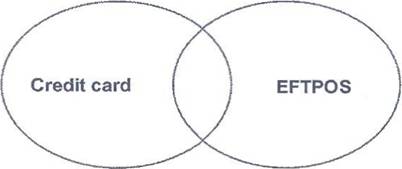
53 Figure 2 supposes that the use of credit cards depends on the characteristics of the prospective purchasers and the circumstances of their purchasing. There are some purchasers who have a strong preference for credit cards. This group is represented by the set of credit card use that does not intersect the EFTPOS set. The intersection of the credit card and the EFTPOS use sets shows that there are certain consumers in certain circumstances who are prepared to switch between the two alternative means of payment. Suppose that when the prices of using a credit card and the price of using EFTPOS are equal to their respective marginal costs, these purchasers are apportioned equally between the use of credit cards and the use of EFTPOS.
54. Now suppose that the price of using a credit card is way below its marginal cost and the price of using EFTPOS is equal to its marginal cost and, furthermore that the distortion in the price of using a credit card cannot be remedied. In that case the purchasers who are in the intersection of the two sets will no longer be apportioned equally between credit cards and EFTPOS. Many of them will switch from the use of EFTPOS to the use of credit cards. Assuming that this inefficiency cannot be remedied by moving the price of using a credit card, it may be best to move the price of EFTPOS below its marginal cost – but not so far below as is the price of using a credit card in relation to its marginal cost. In effect, the price of using EFTPOS should be reduced further below its marginal cost so as to counteract the effect of the low price of the use of a credit card.” (footnotes omitted)
318 Dr Williams next stated that the PSB’s reasons, as set out in the Statement, indicated that EFTPOS was not designated because of any distortion in the operation of the EFTPOS system. Indeed, the data on which the PSB relied suggested that the average price of an EFTPOS transaction was too low compared with its cost. Critically, Dr Williams stated:
“Rather, the PSB designated the EFTPOS payment system to deal with a distortion in the credit card payment system.”
319 Dr Williams added:
“56. This is clear from the PSB’s stress on patterns of substitution between the EFTPOS system, the credit card system and the Visa debit system:
In assessing whether to designate the EFTPOS system, the Board recognised its obligation to consider the overall payments system, and not just the EFTPOS system. It paid particular attention to the possible interactions between the EFTPOS system and the credit card and Visa Debit payment systems (as well as other prospective scheme-based debit cards).
57. The theme that designation of the EFTPOS system would assist in solving the inefficiency caused by the distortion in the credit card system is a recurring theme of the Reasons. It is repeatedly stated that the designation, in lowering the price of an EFTPOS transaction will bring the ratio of price to cost of an EFTPOS transaction closer to that of a credit card transaction and, thereby, improve the efficiency of the payments system as a whole:
As noted earlier, as a general proposition of economics, efficient outcomes are achieved when the relative prices that individuals face for goods and services reflect the relative (marginal) costs of producing those goods and services. On the available evidence, the Board concluded that this condition is not satisfied in the case of card payment systems in Australia. As discussed above, cardholders, on average, face higher prices for EFTPOS transactions than for credit card and Visa Debit transactions, while the costs of processing an EFTPOS transaction are lower than the costs of processing transactions through the other systems.
58. If there is a distortion in the credit card system, efficiency would best be promoted by removing that distortion at its source. However, the reasoning of the PSB seems to be based on the proposition that it is not possible to remove this distortion at its source. If:
a. there were only two means of payment;
b. the ratio of price to marginal cost of the use of credit card were significantly below the ratio of price to marginal cost of the use of a debit card; and
c. the distortion in the price of the use of credit card could not be removed at its source,
it is likely that economic efficiency would be promoted by reducing the ratio of the price of using a debit card in the direction of the price of using a credit card – but not so far as to make the ratios equal.”
320 Finally, in his report, Dr Williams considered the principle of allocative efficiency with more than two products. For that purpose, he took into account four means of payment, credit cards, charge cards, EFTPOS and cash. He assumed that all four were substitutes to some extent and that the use of a credit card was a much closer substitute for the use of a charge card than it was for the use of cash or EFTPOS, and that the use of EFTPOS was a much closer substitute for the use of cash than it was for the use of a credit card or a charge card. Proceeding upon that assumption, he concluded that any reduction in the price of EFTPOS was likely to make the allocation of resources less efficient. He criticised the reasoning of the PSB in the following terms:
“69. The PSB has claimed that it based its decision to designate the EFTPOS payment system on an analysis of the overall payments system. It did this because it judged that each different means of payment was, to some extent a substitute for every other means of payment:
In considering whether designation would promote efficiency in payment systems, the Board was of the view that it was necessary to take a system-wide perspective and consider efficiency in the payments system as a whole. As set out in paragraphs 9 to 11, the payments system is made up of a number of different payment systems. The Board therefore focussed on whether the prices that cardholders face in these different payment systems promote choices that are efficient from the perspective of the overall payments system.
70. Paragraphs 9 to 11 nominate the following means of payment as included within the payments system:
a. cash;
b. the credit card payment system;
c. the debit card payment system;
d. the direct credit payment system;
e. the direct debit payment system;
f. the cheque payment system;
g. BPay; and
h. the RTGS primarily used by banks for settlement of money market and foreign exchange transactions.
71. The PSB notes, that (with the exception of the RTGS) these various means of payments are economic substitutes. This is why the PSB elected (quite correctly) to analyse allocative efficiency by considering all those means of payments that are available to final consumers:
For many payments, individuals clearly have a choice about which payment method to use. For instance, to pay for a trolley of groceries at a supermarket checkout, credit cards and debit cards can be used along with cash, more or less interchangeably. Similarly, cheques, credit cards, direct debits, direct credits and BPay can all be used to pay most household bills.
72. The Reasons published by the PSB pointed to evidence of the extent to which these various methods of payment are substitutes:
A number of factors influence the choice of payment method. These include the convenience and security of the method, as well as whether a receipt is required. Another important factor is the price. If cardholders face a reduction in the price of a particular payment method, relative to other methods, they are likely to substitute that method for other means of payment and use that method more often. This assessment is supported by a number of developments in the Australian payments system over recent years.
73. The PSB lists these developments as:
a. the growth of use of credit cards;
b. the decline in the use of cheques as financial institutions have increased the price of using cheques; and
c. the methods by which Visa Debit transactions are processed.
74. In a world of multiple substitute products where there is a (unmoveable) distortion in the price of one product, the economically efficient pricing of the other products depends critically on the strength of substitution between the various pairs of products. The strength of these patterns of substitution are generally expressed as cross- elasticities of demand.
75. The Reserve Bank did not attempt to estimate the elasticities of demand and cross-elasticities of demand that would be necessary to estimate the set of prices that would be efficient if the distortion in the pricing of the use of credit cards could not be removed. It made this decision, in part at least, because of the difficulty of obtaining reliable estimates:
In reaching its opinion, the Bank also considered ... whether it was necessary to undertake further empirical work to determine the extent of substitutability between various forms of payment. It reviewed available evidence on reactions of Australian consumers to changes in the prices of payment and other financial services. It also reviewed evidence on the effects of interchange fees on prices and consumer behaviour in the United States and studies on reactions of consumers to price changes in other countries. The Bank also considered the practicalities of obtaining reliable estimates of substitution possibilities using empirical techniques. In considering this issue the Bank noted that no such results had been published in Australia, that estimates elsewhere were very limited, and that obtaining reliable estimates was inherently difficult. The Bank also assessed the value of existing survey evidence and considered whether further survey work was required for it to form its views about efficiency and competition. It concluded that the existing evidence was sufficiently strong and the further survey work would have limited value.
76. In the absence of this information, economics teaches us that in a world where (i) there are multiple substitute means of payment; and (ii) the price of one of those means of payment is significantly below its (marginal) cost, then reducing the price of one other of those means of payment further below its marginal cost is as likely to decrease economic efficiency as it is to increase it.
77. The world I was referring to in the preceding paragraph is the world that the PSB characterised in the Reasons for its decision to designate EFTPOS. The world was one of multiple means of payment - each of which was a substitute (to some extent) for each other. It decided to designate EFTPOS to reduce its price further below its unit cost in an attempt to counteract a distortion in the price of the use of credit cards. However, in a world of the kind that was characterised by the PSB, further reductions in the price of the use of EFTPOS are as likely to reduce economic efficiency as they are to enhance it. To put the matter briefly, the PSB has given no reason to suppose that declaration will enhance the economic efficiency of the overall payments system.”
321 It was for these reasons that Dr Williams concluded that the PSB’s conclusions, in the Statement, were not consistent with economic principles of efficiency. In other words, based on the PSB’s own analysis, as expressed in its reasons, it was not possible to predict whether designation, and a consequent reduction in the price of EFTPOS, was “likely to improve or harm economic efficiency”.
322 It is important to appreciate that Dr Williams did not say, in his report, that a reduction in the interchange fee would lessen economic efficiency. He merely concluded, as noted above, that, based on the PSB’s own reasons, it could not be demonstrated that such a reduction would improve economic efficiency.
323 Under cross-examination, Dr Williams was directed to the Statement, and, in particular, the documents that the PSB said it had taken into account in reaching its decision. He acknowledged that it was likely that he had not read all of them. The only ones to which he had paid detailed attention were those specifically mentioned in his report. He had not given detailed consideration to the confidential data provided by the major banks regarding EFTPOS transactions. He had made no reference whatsoever in his report to the potential desirability of an access regime, a matter that the PSB had plainly regarded as significant in the Statement. He agreed that designation for the purpose of giving further consideration to the imposition of an access regime, a matter that he had not addressed in his own report, might well be considered by reputable economists to be consistent with economic efficiency.
324 Nonetheless, Dr Williams adhered to his position that the reasons given by the PSB for designation were inadequate. That was so notwithstanding the fact that designation was merely a first step towards further consideration of whether to impose restrictions upon interchange fees, together with an access regime. He said that the decision to designate was undertaken in order to reduce the charges that cardholders paid for using EFTPOS. Yet, the reasons given were not sufficient to form a view that a reduction in the interchange fee would promote efficiency and competition. In other words, his position, put simply, was that neither the evidence, as expressed in the Statement, nor the process of reasoning employed, was insufficient to form a view as to whether designation, and the consequent reduction in the price of EFTPOS was likely to improve, or harm, economic efficiency.
325 Dr Williams went so far as to describe the PSB’s reasons as “illogical”. He said that if the RBA wanted to designate simply because it had not made up its mind about anything, and wanted to gather more information, he would have found its reasons unobjectionable. However, in his view, that was not the approach that the RBA had taken.
326 In an obvious, but telling statement, Dr Williams accepted that economists might disagree about almost anything. In considering what steps would promote competition and efficiency in payment systems, a broad spectrum of views could legitimately be held. Economists could also disagree as to how much empirical data might be required prior to reaching any decision on such issues.
327 Dr Williams was subjected to a searching cross-examination on various matters of economic theory. He was invited to comment upon the views of Professors Farrell and Katz, the experts who were to give evidence on behalf of the RBA. It is unnecessary, for present purposes, to set out the detail of that cross-examination, particularly when it descended into areas such as “Pareto efficiency”, “Pareto improvement”, “Pareto-efficient allocation”, and “Pareto optimality”. Dr Williams observed that while it was common for economists to adopt the “Pareto rules”, they were very rarely used in applied economics.
328 I interpolate that Vilfredo Pareto (1848-1932), whose work is described as the foundation upon which modern welfare economics is based, defined an increase in total welfare as occurring in those conditions in which some people are better off as a result of a particular change, without at the same time anyone else being worse off.
329 A major criticism levelled by Dr Williams at the PSB’s Statement was its failure to consider more than two payment systems, namely debit cards and credit cards, when it examined relative prices and costs. He considered that the PSB ought to have considered also direct payment systems, charge cards, and cash. He ultimately agreed, however, that the PSB had considered broad trends in the use of those systems. He explained that his point was, rather, that it had failed to consider the substitutability of each of those systems in the context of a proposed movement in the interchange fee for EFTPOS.
330 One final note regarding Dr William’s cross-examination. He agreed that “the payments system” was made up of a number of “different payment systems”. He also agreed that it was appropriate to focus on whether prices that cardholders faced in those different payment systems promoted choices that were efficient from the perspective of the “overall payments system”.
331 In re-examination, Dr Williams provided the following explanation of the meaning of the term “efficient” in the context of s 8 of the PSR Act. He said, at 205-6 of the transcript:
“Economists would nearly always use the term “efficient” in the sense of public policy to mean an efficient allocation of society’s resources. In particular, the type of efficiency that seems to be under consideration when you’re talking about relative prices is the efficiency to do with putting more resources in one use and fewer resources in another. For example, the key issue to do with the prices of relative costs of various means of payment would be interpreted by economists as having to do with the extent to which society allocates resources to one means of payment compared with others or among the various means of payment. The efficiency of that allocation would be assessed by economists on the basis of the net benefits of that allocation. Summing, by a benefit, we mean as judged by the willingness to pay of users of the payments system or prospective users of the payments system by their willingness to pay for that. By “net” I mean net of the resource costs that are used up in the process of providing that. I might say one more thing. Normally, we don’t add up in an aggregate sense all the costs and benefits of different allocations, rather we adopt the short‑cut, if I put it that way, of saying, providing users - and users is a little bit difficult, but I accept Prof Farrell’s notion that it’s best to concentrate perhaps in this case on the cardholders, it’s appropriate to concentrate on the cardholders - providing the users of the system are confronted with the true resource costs of the use of the system, in terms of the prices that they actually pay to use the system, then the costs that they incur when they use the system will be equal to the costs to society of using the system and the benefits they get from using the system will, in a rough sense, reflect the benefits to society as a whole, there are other people who are benefiting. So if consumers or users are confronted by the true resource costs to society of their use of the system then the decision that they make in maximising their own welfare will also be coincident with what is optimal from the point of view of society. That’s why economists are in favour of what we loosely call the “user pays” system, because the individual user - providing the prices do reflect the resource costs to society of the decision that the user is making, the user in making the decision will make a decision that’s coincident with the interests of society as a whole.”
Mr david howell
332 The next witness called on behalf of the applicants was Mr David Howell. Mr Howell is the General Manager Financial Services for Coles Myer, a position he has held since January 2005. His responsibilities include strategy, development and commercial negotiations for all Coles Myer consumer electronic payment transactions. He is also responsible for Coles Myer’s credit card program.
333 Mr Howell began working for Coles Myer in 1987 as Manager Planning and Development, Electronic Funds Transfer and Financial Services. He has had direct responsibility for electronic payments from that time until the present. He has also represented the Australian Retailers Association on the Australian Payments System Council, a body established in 1984 to oversee the development of the Australian payments system.
334 Mr Howell’s evidence was that Coles Myer had received a letter dated 23 December 2003 from the RBA informing it that the RBA was considering designating EFTPOS, and offering interested parties the opportunity to be heard. He said that Coles Myer, as part of the Australian Merchants Payment Forum, had made a submission to the RBA dated 9 July 2004. In addition, Coles Myer made its own submission regarding that subject on that same date.
335 Mr Howell explained how Coles Myer had developed its EFTPOS strategy. He said that from its early inception, that strategy had been to develop and own the point of sale component of the EFTPOS network rather than renting EFTPOS devices from a financial institution. He explained how, initially, EFTPOS in Australia comprised a number of proprietary networks that allowed customers to use debit cards only at retailers where the issuing bank and the acquiring bank were one and the same. However, Coles Myer believed that EFTPOS would not be effective, and attractive to customers as a means of payment, until at least most of the financial debit cards could be accepted at one point of sale terminal. For that reason, Coles Myer did not provide EFTPOS until that became possible, in the late 1980s.
336 Mr Howell said that in order for multiple financial institution debit cards to be accepted at one point of sale terminal, it was necessary for each of the network owners to reach agreement to exchange transaction messages to each card issuer, or its agent. These agreements were commonly referred to in the industry as “interchange agreements” and allowed cardholders of one institution to use the EFTPOS network of another. Mr Howell understood interchange agreements to have been negotiated between the four major banks in the late 1980s. These agreements typically involved a fee payable by the issuer to the acquirer for access to its network, similar to the flow of fees from issuer to acquirer already established in the ATM environment. This was to provide recognition and contribution to the network owners’ investment necessary to generate a return, and make the network financially viable.
337 Mr Howell described the development of Coles Myer EFTPOS strategy from early PINpad technology to the introduction of switching technology. He said that in developing its strategy, Coles Myer determined that the required investment would not be justified unless it received compensation from financial institutions whose cards would be used by customers making payment, and accessing cash through EFTPOS.
338 Mr Howell spoke of the development of Australian Standard AS2805, the standard that specifies a common basis for parties to exchange electronic funds transfer messages. That Standard comprised a suite of parts that had been developed to provide a high level of security for EFTPOS in Australia. Once it was adopted, the next step was for Coles Myer to provide PINpads and infrastructure itself, rather than rent devices from the financial institutions, and to enter into agreements with those institutions allowing them to use, on payment of a fee, the EFTPOS network that Coles Myer had developed.
339 After tracing the history of EFTPOS at Coles Myer, Mr Howell noted that as a participating merchant in the EFTPOS system, his company provided its customers with access to their bank accounts at the point of sale, to either purchase goods and services, to purchase goods and services and take “cash out”, or to take out “cash out” only. He described the way in which EFTPOS operated, at a mechanical level, and then noted that Coles Myer owned, operated and maintained more than 26,700 PINpads used to capture and encrypt transaction details and cardholders’ PINs. He said that for the financial year ending July 2004, Coles Myer processed 139,092,000 EFTPOS transactions, amounting to approximately 15 % of the total number of such transactions processed in the Australian payments system. He added that in that same financial year, Coles Myer provided in excess of $3.3 billion to customers by way of cash out requests. He said that the banks promoted the availability of this service to their customers.
340 Mr Howell then described how Coles Myer had made the decision to invest in its own switching technology, thereby undertaking its own processing, and switching, of EFTPOS transactions. This meant that it took on some of the processing aspects normally associated with the acquiring function. In that role, Coles Myer operated as a merchant principal.
341 In substance Coles Myer’s switch received transactions from its stores, and switched them to the card issuers. This allowed Coles Myer to interface directly with issuers, such as the major banks and industry bodies acting on behalf of financial institutions. Coles Myer operated and maintained its own security system for encrypting and decrypting PINs, and ensuring the security of transactions within its network. It also bore the counter-party risk, namely the risk of non-payment, in its EFTPOS transactions. Coles Myer was also a CECS member.
342 Importantly, Mr Howell said that Coles Myer had incurred, and continued to incur, substantial costs in connection with its participation in the EFTPOS system. These included costs associated with its original investment in the infrastructure, the operating costs of running the EFTPOS network, and on-going investment, including upgrades and systems improvements. He estimated PINpads to cost, on average, $800 each. He further estimated the total cost of the EFTPOS switch over a period of five years to be more than $26 million.
343 Mr Howell referred to the Joint Study. He said that, despite recognising the significant investment in EFTPOS that merchants make, it had collated detailed cost and revenue data from only eight financial institutions, and had not sought cost information from merchants. In addition, the Joint Study did not record payments made by acquirers to merchants who had invested in point of sale infrastructure as an acquiring cost, but deducted those payments from merchant service fees received. As a result, the Joint Study understated both acquirer costs, and acquirer revenues.
344 Mr Howell noted that there had been two major upgrades proposed to EFTPOS technology in recent times. The first was the Triple DES technology. The current security measures adopted by the Australian EFTPOS market were referred to as “Single DES”, but that was no longer regarded as adequate. The second was what he described as the EMV upgrade, a reference to the EuroPay MasterCard Visa technical specifications for integrated circuit cards or chip cards. Simply put, this technology would provide for the future introduction of cards that used a computer chip for security purposes, similar to a “smartcard”, rather than the existing magnetic stripe technology in use today. The costs of these two major upgrades were substantial, and in Mr Howell’s opinion, ought to have been taken into account when considering questions of efficiency in relation to the EFTPOS system.
345 Mr Howell said that over time, with increased volumes of EFTPOS transactions, Coles Myer had been able to negotiate higher EFTPOS transaction fees from financial institutions. Coles Myer had also felt the need to respond to competitive market forces in respect of the fees it charged for EFTPOS transactions. Mr Howell believed that Coles Myer’s participation in the EFTPOS system as a merchant principal had imposed competitive disciplines on the level of EFTPOS interchange and transaction fees. By entering into direct connection arrangements with Coles Myer under merchant principal agreements, issuers paid a transaction fee to Coles Myer instead of an interchange fee to an acquirer. Generally speaking, these transaction fees were lower than the interchange fees that the issuers would otherwise have had to pay.
346 Mr Howell said that the removal of interchange fees, as a consequence of designation, would have a negative impact upon Coles Myer in respect of EFTPOS transactions. The amount in question would be substantial. As Coles Myer’s EFTPOS volumes increased over time, so too would the shortfall. If instead of removing interchange fees, they were reduced to a maximum of about five cents, in accordance with the RBA’s gazetted draft standards of 24 February 2005, the impact would be less, but still significant. If such standards were imposed, it would be likely that the financial institutions would endeavour to recover any shortfall in their interchange revenue from Coles Myer. He stressed that, unlike other acquirers, Coles Myer was not an issuer of debit cards. Accordingly, it would not gain any benefit from a reduction in interchange fees. In contrast, the banks and other financial institutions, which were both acquirers of EFTPOS transactions and issuers of debit cards, would be able to make up the loss of acquirer revenue through their gains on the issuing side of their business.
347 According to Mr Howell, Coles Myer would have little choice but to pass on this loss of revenue to consumers, either directly, or in the form of price rises. Among the options that would have to be considered would be the recovery of lost income through higher prices to all consumers, the cessation of the cash out function at point of sale, the imposition of a surcharge for cash out, and the alteration of conditions of such service to introduce a minimum purchase requirement. Importantly, removal of interchange fees would be likely to have an adverse impact on Coles Myer’s investment in EFTPOS infrastructure and technology improvements over time.
348 Under cross-examination, Mr Howell accepted that Coles Myer had benefited from the introduction of EFTPOS through the elimination of paperwork, and the reduction of cash needs. It had also benefited in terms of its internal accounting systems. The introduction of switching technology had been undertaken in order to improve its competitive position, and had been based upon an assessment of the benefits that it would derive from this improved technology.
349 Mr Howell acknowledged that any improvements in security, through the introduction of upgraded technology, would be beneficial not merely to debit cards, but also credit cards. He agreed that Coles Myer received significant benefits from EFTPOS, and accepted the proposition that if the interchange reforms proposed were implemented, Coles Myer would still be likely to retain that system. Indeed, he said that Coles Myer had not given “the slightest consideration” to abandoning EFTPOS.
350 However, Mr Howell insisted that consideration had been given to not proceeding with any upgrade to the system if lower interchange fees were introduced. He acknowledged that APCA had mandated a Triple DES system, and that any failure by Coles Myer to upgrade to that level might make it difficult for it to continue as a merchant principal.
351 When it was suggested to Mr Howell that any reduction in the interchange fee would have only a “marginal” impact upon Coles Myer, he disagreed. He said that the impact would be “substantial” so as far as he was concerned. He agreed, however, that his own calculations had not taken into account any benefits that Coles Myer may have received as a result of the credit card reforms of 2003. He said that he did not believe that it was appropriate to consider netting credit and debit card changes, and explained that the credit card changes had resulted from the actions of regulators putting an end to illegal price-fixing activity, and should not therefore be factored into the equation. He agreed that even if interchange fees were reduced to zero, debit card transactions would still be a cheaper form of payment than credit cards so far as Coles Myer was concerned. Accordingly, a shift to debit cards would benefit Coles Myer. His difficulty with the proposal was that he did not think that such a shift would occur.
Mr IAN nicol
352 The next witness called on behalf of the applicants was Mr Ian Nicol, Marketing Systems Manager at Caltex Australia Petroleum Pty Ltd (“Caltex”) since 1992. Mr Nicol’s responsibilities include overall supervision of Caltex’s EFTPOS system. He has had nearly 20 years experience in the implementation and operation of card payment systems in the retail petroleum industry. His qualifications include a degree in economics, and he is a member of the Australian Society of Accountants.
353 Mr Nicol described Caltex’s role as a participant in the EFTPOS system. He said that under its agreement with the Commonwealth Bank, entered into in the late 1980s, Caltex provided point of sale infrastructure in both its own, and its franchisees’ sites. That infrastructure consisted of an EFTPOS terminal with an integrated PINpad, and imprinter to produce receipts for transactions, and an electronic payment server. Because transaction volumes were very low in 1989, the Commonwealth Bank was not prepared at that time to pay a transaction fee to Caltex for EFTPOS transactions. However, it agreed to meet the costs of communications lines, which previously had been a Caltex merchant cost.
354 After describing how an EFTPOS transaction typically takes place in a Caltex retail store, Mr Nicol outlined Caltex’s compliance with the rules of the EFTPOS system, as set out in the CECS manual. He then described, in confidence, a number of the features of the current agreement between Caltex and the Commonwealth Bank in respect of the EFTPOS system. As stated earlier, the original agreement did not involve payment of any transaction fee to Caltex. However, in May 1995, the petroleum refining and marketing assets of Caltex and Ampol Limited were merged. As a result, approximately 500 new petrol-retailing sites were added to the Caltex network. Between 1995 and 1997 Caltex rolled out integrated point of sale infrastructure, including electronic card processing facilities at each of its new sites.
355 In late 1995, or early 1996, the NAB approached some of Caltex’s high volume franchising sites and offered to pay them a certain amount (which is confidential) per debit card transaction if they appointed NAB to acquire EFTPOS transactions for them. Up to 20 of Caltex’s largest sites agreed to appoint NAB as the acquirer for EFTPOS transactions on that basis. Those sites added a NAB EFTPOS terminal at point of sale, and continued to use the integrated point of sale terminal linked to the Commonwealth Bank network to process other card transactions.
356 In early 1997, Caltex invited the four major banks, and one specialist card processing organisation, to tender for the acquisition of card transactions from the newly combined Ampol/Caltex network, for a period of three years. As a result of the tender process, and in order to retain Caltex’s business, the Commonwealth Bank agreed to pay Caltex sites a fee for each EFTPOS transaction acquired.
357 Mr Nicol described the costs incurred by Caltex as a merchant participating in the EFTPOS system. He noted that Caltex was responsible for all costs associated with delivering EFTPOS transactions to and from the Commonwealth Bank, including the provision and maintenance of the necessary point of sale software and hardware. He said that it was very difficult to calculate the exact amount that Caltex had invested in EFTPOS over time, given that those costs were incurred as part of the development of integrated point of sale systems, including credit card systems. However, as EFTPOS was the only part of the system that required PINpad encryption, complex technology not needed for other applications, a substantial percentage (the exact figure was confidential) of those costs was attributable to EFTPOS.
358 Mr Nicol said that processing EFTPOS transactions involved complex technology, and required considerable expenditure to keep the relevant infrastructure properly maintained. The life cycle of point of sale equipment was five to seven years, and a new hard drive was required every two to three years. Therefore, throughout the Caltex network, EFTPOS was in constant need of maintenance and replacement.
359 Mr Nicol said that if the current interchange fees were reduced, he believed that the Commonwealth Bank would seek to recover this lost revenue from Caltex sites from which it acquired EFTPOS transactions. He set out in detail the basis for that belief.
360 Mr Nicol then described the likely effects of a reduction of interchange fees on Caltex’s business. He said that since the time that the banks proposed the zero interchange fee agreement, in relation to which the ACT subsequently revoked the authorisation, Caltex had suspended all non-mandatory investment in its EFTPOS payment system and hardware. An example was its investment in card readers in pumps, known as CRIP technology. That technology effectively puts the point of sale at the petrol pump, and saves customers the time involved in coming to the traditional point of sale away from their vehicle. Its broader introduction would improve efficiencies significantly in respect of purchases of fuel by saving time, and the cost of card processing.
361 Mr Nicol also spoke of Caltex’s involvement in upgrading its EFTPOS terminals to allow Triple DES encryption in order to comply with the standard required by APCA. He believed that the removal or reduction of interchange fees would mean that Caltex would be unable to recoup from the banks the costs of installing in almost all of its sites EFTPOS terminals that are Triple DES compliant. He gave evidence, in confidence, of how much this was likely to cost.
362 Mr Nicol was cross-examined at some length. He agreed that he had based his predictions as to what would occur upon the assumption that interchange fees were to be entirely eliminated, rather than, for example, merely being reduced to 5 cents. He denied the suggestion that the credit card reforms introduced in 2003 had produced significant benefits for Caltex, though he acknowledged that there had been some reduction in merchant service fees.
Mr Gary Lembit
363 The next witness called on behalf of the applicants was Mr Gary Lembit, National Director, Finance and Business Services Research at Taylor Nelson Sofres Australia Pty Ltd, one of a group of companies that provides market measurement, analysis and research in approximately 70 countries.
364 Mr Lembit said that he had been commissioned by the Australian Merchant Payments Forum to undertake market research into the behaviour of consumers when making purchases at Australian retail outlets. The research was aimed at determining the reasons behind consumer choice of payment card used, and identifying consumer awareness of the costs associated with different types of cards. More particularly, it was aimed at identifying whether there was any difference in the awareness of the costs associated with EFTPOS relative to other card payment options. The methodology adopted was a market survey conducted by fully trained interviewers.
365 The results of the survey indicated that approximately 86% of consumers used debit cards, while 77% used credit cards, and only 7% used charge cards. Almost half of all consumers used both a credit card and a debit card. Of those who used credit cards, 75% claimed that they normally paid off all of their total credit card bills each month, while the remaining 25% said they normally paid off only part of those bills. Credit cards tended to be used more frequently than debit and charge cards. For those who preferred to use credit cards, loyalty points were the biggest driver, whilst with debit cards, the use of available funds, and not using credit, were the main drivers. Visa and American Express were the most frequently used credit and charge cards respectively. The majority of payments were for purchases, as opposed to, for example, bill payments.
366 The majority of card users either did not know that transaction fees were charged, or believed that they did not pay such fees. Almost half of those who used both credit cards and debit cards believed there were no transaction fees associated with their payment.
367 Although Mr Lembit was cross-examined at some length regarding his report, and challenged in relation to his compliance with the Guidelines for Expert Witnesses in Proceedings in the Federal Court of Australia, it is unnecessary for present purposes to set out in any detail his evidence before me. He agreed that the market survey had been conducted under time constraints.
368 It was put to Mr Lembit that Professor Dunsmuir, a witness to be called on behalf of the RBA, would criticise the methodology used in carrying out the market survey, in particular the choice of retail outlets surveyed. Mr Lembit rejected that criticism. He maintained that the selection of retail outlets that had been adopted, namely, fuel, grocery, department, liquor, hardware and Australia Post, had been both representative, and appropriate.
Mr Russell Zimmerman
369 The final witness whose evidence was led on behalf of the applicants was Mr Russell Zimmerman, Managing Director of Spark’s Shoes Pty Ltd (“Spark’s”). Mr Zimmerman was not required for cross-examination.
370 Mr Zimmerman said that he was responsible for the day to day running of various retail outlets situated in New South Wales. He said that Spark’s had been established in 1931, and sold men’s, women’s and children’s shoes. It provided EFTPOS facilities in all its stores. It did not offer customers the option of cash out when making an EFTPOS transaction. He produced a copy of Spark’s merchant agreement with the Commonwealth Bank.
371 In his affidavit, Mr Zimmerman set out what he claimed to be the costs incurred by Spark’s as a participant in the EFTPOS system. He said:
“12. As a participant in the EFTPOS system Spark’s must bear the following costs:
(a) the payment of EFTPOS transaction fees to CBA (which is an ad valorem fee of Item 1 of Tab 1 of Confidential Exhibit REEZ-2 per cent of the transaction value, and which averages approximately Item 2 of Tab 1 of Confidential exhibit REEZ-2 per transaction);
(b) $36.95 (including GST) per month per store for a telecommunication line for the EFTPOS terminal (paid to Telstra). (The telecommunication lines are also used by Spark’s stores for facsimiles);
(c) a terminal rental fee of $27.50 per terminal per month (paid to CBA);
(d) an administration fee of $24.00 per terminal per annum (paid to CBA);
(e) since December 2003, the purchase from the CBA of stationary required for processing EFTPOS transactions, such as rolls to print EFTPOS receipts; and
(f) since December 2003, an annual fee per terminal of $24.09 (paid to CBA).”
372 Mr Zimmerman then described the likely effects on Spark’s business of an increase in merchant service fees for EFTPOS transactions. He said:
“13. If the merchant service fee payable by Spark’s for EFTPOS transactions was increased I anticipate that Spark’s would seek to recoup the increase in fees by, where possible, raising the price of its products so it could retain its margins. These products would typically be items for which Spark’s is the only, or one of the few, retailers who sells the product and items for which there is no recommended retail price.
14. I do not envisage that Spark’s would impose a surcharge on EFTPOS transactions or impose a minimum spend per transaction as Spark’s main competitors, such as David Jones, do not impose surcharges on EFTPOS transactions. The retail show market is highly competitive and I do not believe that customers would tolerate a surcharge.”
the applicants’ objections to the rba’s evidence
373 Turning now to the evidence led on behalf of the RBA, the applicants objected, in particular, to the expert evidence that was tendered. Large portions of that evidence were said to be irrelevant. The applicants also objected to that evidence on the basis that the witnesses had failed to make explicit their underlying assumptions, and that in any event, there was no evidence to support a number of those assumptions.
374 The applicants prefaced their objections by submitting that, reduced to its essentials, their case was really quite straightforward. They said that the Decision, and the entire process that preceded it, were legally deficient. From their perspective, the central issues were whether the RBA had:
· properly complied with its duty under s 11 of the PSR Act to have regard to the desirability of the EFTPOS payment system being “efficient” and “competitive” within the meaning of s 8 of that Act;
· properly complied with its duty under s 10B of the RBA Act to exercise its power to designate EFTPOS, under s 11 of the PSR Act, in a way that would best contribute to promoting the efficiency of the payments system, and promoting competition in the market for payment services; and
· reached a decision on grounds, and by a reasoning process, that disclosed reviewable errors of the kind referred to in s 5 of the ADJR Act.
375 The applicants submitted that these questions were to be answered by considering the Decision itself, the Statement, and the evidence upon which the Statement was based, as well as the evidence that had been disregarded. To the extent that the terms “efficient” and “competitive” in s 8 were used in a technical, economic sense, it was appropriate to adduce expert evidence to explain those expressions. Beyond that, such evidence ought not be received.
376 The applicants relied upon the observations of Tamberlin J in the Visa case, as well asthe decision of the High Court in Collector of Customs v Agfa-Gevaert Limited (1996) 186 CLR 389 at 401-2 (“Agfa-Gevaert”) concerning the admission of expert evidence in relation to words which have a special and technical meaning. They submitted that this was precisely the basis upon which Dr William’s evidence was relevant and admissible.
377 By way of contrast, the applicants submitted that it was not relevant to adduce evidence from expert economists concerning their own analysis or determination of how or why the same decision might have been arrived at by a different process of reasoning from that followed by the RBA. Whether or not individual economists would arrive at, or could develop an argument justifying, the same conclusion as that arrived at by the RBA was said to be entirely irrelevant.
378 The applicants pointed to the fact that the solicitors for the RBA had instructed each of its economic experts to provide an opinion on whether “the decision” of the PSB to designate EFTPOS was consistent with economic principles of efficiency and competition. Those instructions stood in stark contrast to the instructions provided to Dr Williams who was asked to express an opinion as to whether “the Reasons” to designate EFTPOS, published by the PSB on 14 October 2004, “were consistent with economic principles of efficiency”. In effect, according to the applicants, the RBA had asked its experts to say whether they would have arrived at the same result as the RBA itself had, or at least whether they could justify arriving at the same result. That was not an appropriate task for any expert to undertake.
379 As previously indicated, it was agreed between the parties that I should defer any ruling upon the admissibility of the RBA’s expert evidence until after that evidence had been led. Accordingly, I shall now summarise that evidence, as it emerged before me.
the rba’s witnesses
Professor MICHAEL katz
380 Professor Michael Katz holds the Sarin Chair in Strategy and Leadership at the University of California, Berkeley. He holds a joint appointment in the Hass School of Business Administration and the Department of Economics. He has also been a member of the Department of Economics at Princeton University. He has degrees in economics from both Harvard University, and the University of Oxford. He specialises in the economics of industrial organisation, which includes the study of anti-trust and regulatory policies, and regularly teaches courses on microeconomics and business strategy in networks markets, such as payments systems. He previously gave evidence on behalf of the RBA in the Visa case.
381 On 1 May 2005, Professor Katz prepared a detailed report for the purpose of this proceeding. In that report, he considered whether the decision of the PSB to designate EFTPOS was consistent with economic principles of efficiency and competition, and analysed, from the perspective of the economics of efficiency and competition, the reports previously filed by Mr Gove and Dr Williams in this proceeding.
382 Professor Katz stressed the importance of distinguishing, right from the outset, between the act of designating EFTPOS, and the act of implementing standards, or imposing an access regime. The act of designation merely triggered the possibility of making standards, and/or imposing such a regime. It did not set those policies, or put them into effect. Thus, from the perspective of economics, the appropriate focus was on whether the decision to designate – understood in the context of the overall policy-making process – was economically sound.
383 Professor Katz ultimately concluded that the decision of the PSB to designate EFTPOS was consistent with economic principles of efficiency and competition. His reasons were summarised succinctly as follows:
“16. … Based on its study of pricing patterns and market conditions, the Reserve Bank’s Payments System Board identified a potential failure in the workings of competitive forces. The Reserve Bank also identified policies that represented potential solutions to the market failure with which it was concerned. Designation of the EFTPOS payment system was a step that allowed further investigation of possible policy responses. For instance, following designation, the Reserve Bank of Australia proposed a draft standard for public comment.
17. Neither the Gove Report nor the Williams Report presents a factual or logical analysis demonstrating that designation will harm competition or efficiency. And neither report identifies any errors in the economic logic that underlies the Reserve Bank of Australia’s central conclusion that, absent regulatory intervention, industry practices may lead to inefficiently low levels of use of debit cards relative to other payment instruments and, thus, further consideration of potential regulatory intervention is warranted.
18. The Reserve Bank of Australia’s economic logic has two main components. The first is that prices play a central role in guiding the efficient (or inefficient) use of alternative payment mechanisms. Specifically:
· The efficient use of EFTPOS depends on the benefits received and costs borne by consumers, merchants, and suppliers of EFTPOS payment services.
· An individual consumer’s choice of which payment mechanism to use for a particular transaction will depend on that consumer’s assessment of the costs and benefits to him or her of using alternative payment mechanisms. In addition to the characteristics of the transaction and the features of alternative payment mechanisms, consumer decisions are affected by: (a) the pricing, promotion, and issuance decisions made by financial institutions supplying various payment services; and (b) the pricing and acceptance decisions of merchants, where pricing refers to any surcharges or discounts that merchants place on the use of alternative payment mechanisms.
· When consumers face relative prices for using two payment mechanisms that do not bear the same relation to the underlying relative costs of those payment mechanisms to society, consumers’ incentives to choose between those payment mechanisms generally do not correspond to net social benefits. In particular, sufficiently low fees (possibly including rebates and loyalty points in the case of credit and charge cards) can induce consumers to use alternative payment mechanisms even in instances where it would be more efficient to use EFTPOS.
19. The second main component of the Reserve Bank of Australia’s economic logic is that there are distortions in the competitive process that result in consumers’ facing relative prices for the use of alternative payment mechanisms that do no reflect the costs to society of using those payment mechanisms:
· In an earlier proceeding, the Reserve Bank of Australia identified market institutions that it concluded distort downward the prices consumers face for the use of credit card services and thus promote the overuse of credit cards. In response, the Reserve Bank has implemented standards to address this distortion.
· In the present proceeding, the Reserve Bank has identified market institutions that it believes distort upward the prices that consumers face for using EFTPOS services, and thus lead to underutilization of EFTPOS relative to other payment mechanisms.
· Specially, the Reserve Bank has tentatively concluded that – notwithstanding the reforms of credit card pricing – current prices promote the overuse of credit cards relative to EFTPOS, and thus this problem can be expected to grow in the future. Although the Reserve Bank has focused on the relative use of credit cards and EFTPOS, its analysis also applies to other payment instruments, notably Visa’s signature debit product, charge cards, and cash.
20. In the light of the Reserve Bank’s analysis, it makes sense (ie, is very likely efficiency enhancing) to examine whether regulatory intervention is warranted. It does not necessarily follow that such intervention is needed or that specific regulations should be put into effect. The economic value of designation is that it allows these possibilities to be explored more fully.” (footnotes omitted)
384 Professor Katz went on to say that he regarded it as a striking feature of the Australian credit card industry that many cardholders faced “negative prices” for using their credit cards. These negative prices were the result of loyalty programs. Even cardholders who were not members of loyalty programs generally paid no transaction fees for use of their credit cards. In contrast, there were very few loyalty programs for EFTPOS and many consumers faced fees for EFTPOS transactions.
385 Professor Katz said that the aim of designation, so far as the RBA was concerned, was to consider what policies should be implemented for the treatment of interchange fees in the Australian EFTPOS industry. In the United States, EFTPOS networks had interchange fees that flowed from acquiring institutions to card-issuing ones. In Australia, however, the interchange fee for EFTPOS transactions flowed from issuer to acquirer. At first glance, the interchange fee was nothing more than a payment between issuer and acquirer. However, the presence of such fees affected the service fees acquirers charged merchants, and therefore could affect the prices merchants charged their consumers. Moreover, an interchange fee affected an issuer’s incentives for card issuance, including both pricing and promotional strategies aimed at cardholders.
386 Professor Katz then provided an economist’s analysis of the three terms that were critical to the Decision, namely “public interest”, “efficiency” and “competitiveness”. His discussion of “efficiency” was illuminating. He said that the term was generally used in economics to refer to one of two closely related, but distinct, concepts: Pareto optimality and “total-surplus” maximisation. He criticised Dr Williams for having apparently accepted total surplus as the measure of efficiency when, in Professor Katz’s view, the most fundamental concept of economic efficiency was Pareto efficiency. He defined Pareto efficiency, in the context of resource allocation, as meaning “going as far as possible in the satisfaction of wants within resource and technological constraints”. He said that this concept was embodied in the notion of Pareto optimality.
387 Professor Katz said that an outcome is Pareto optimal (or Pareto efficient) if it is impossible to make anyone in society better off without making at least one other person worse off.
388 Professor Katz said that the most widely adopted alternative approach was to use the level of total surplus as a measure of economic welfare, and to describe an outcome as efficient if it maximises total surplus. He defined total surplus as the sum of consumer surplus, and producer surplus. He said that consumer surplus is, in turn, defined as the difference between what a consumer is willing to pay for a good or service, and what that consumer actually pays. Producer surplus is defined as the amount of income a producer receives in excess of what the producer would require in order to supply a given number of units of a good or service. Producer surplus could be thought of as economic profits. Total surplus consisted of consumer benefits measured in dollars, minus the total cost of production.
389 Professor Katz made the point that, as a general matter, “the public interest” is a broader concept than are notions of efficiency and competitiveness.
390 Applying these theories to interchange fees in the EFTPOS system, Professor Katz noted that interchange fees influenced the incentives for consumers to use, and merchants to accept, debit cards.
391 There then followed, in Professor Katz’s report, a lengthy discussion of what he termed the economics of the policy process. Essentially, that discussion consisted of a statement of what must be perfectly obvious: public policy decision making is likely to be more successful if policy makers are given access to as much relevant information as can reasonably be gathered. Yet collecting complete information is generally too costly, and takes too long. This leads policy makers to engage in speculation and conjecture based upon uncertainty and limited information.
392 Presumably, Professor Katz dealt with this subject as part of his report in order to justify the RBA’s decision to designate EFTPOS so that more information could be gathered. Interested parties, including those who might disagree with the RBA’s assessment, would thereby be given the opportunity to comment on, and provide data and analyses in relation to, its conclusions and hypotheses, as well as any draft standards or a draft access regime.
393 Professor Katz concluded that the PSB’s rationale for designation accorded with the modern economic view of public policy, and was consistent with the economic principles of efficiency and competition. These conclusions were based, in part, upon the desirability of the RBA investigating further whether it should regulate interchange fees, or impose an access regime, in response to what it perceived to be market failure. He described the RBA’s summary of its concerns, at [89] of his report, as follows:
“• Price signals are an important determinant of which payment system consumers choose to make payments. Interchange fees have an important influence on those price signals.
· In terms of resources used, EFTPOS is a relatively low-cost method of payment. However, given the nature of interchange arrangements, this is not reflected in the price signals that consumers face. For many consumers, there remains a strong price incentive to use a credit card rather than a debit card.
· A move to zero interchange fees would reduce costs to issuers by around $0.20 cents [sic] per transaction. Ultimately, this should lead issuers to charge lower prices for EFTPOS transactions either in lower per-transaction fees or a higher fee-free limit. Issuers would also be more likely to promote the use of EFTPOS”. (footnotes omitted)
394 Professor Katz concluded, at [90]:
“Based on its observation of pricing rigidities and its analysis of the structure of interchange negotiations, the Board was concerned that competitive forces were not operating to ensure efficient pricing. The Board thus concluded that it was in the public interest to examine the issue further.”
395 Professor Katz criticised Dr Williams’ report for having failed to appreciate the precise nature of the designation process. He claimed that Dr Williams’ analysis was predicated on the assumption that designation was tantamount to choosing a specific policy when, in fact, it was merely a milestone for moving to another stage of analysis. In essence, Professor Katz saw the purpose of designation as being simply to propose particular policies, and then collect information about those proposals through a public comment process.
396 Professor Katz observed that the RBA had expressed concern that current interchange fee levels encouraged less use of EFTPOS than was efficient. In response to this problem, the RBA designated EFTPOS, and later made available a draft standard for public comment. The relevant question was not, as Dr William’s propounded, whether a reduction in the price of EFTPOS would be likely to improve or harm economic efficiency, but rather whether the act of designation could be expected, on balance, to have that effect.
397 Professor Katz was also critical of Dr William’s analysis of allocative efficiency in the context of a single product market, or alternatively what Professor Katz described as a two-sided market. His reasoning was extremely complex. Fortunately, it is unnecessary to endeavour to summarise it here.
398 Finally, Professor Katz criticised what he termed as the economic logic of the Gove report. He noted that Mr Gove had not proffered an analysis of the designation decision itself. He described some of the claims in Mr Gove’s report as “seriously flawed”. For example, he noted that Mr Gove had largely ignored the potential benefits to merchants from EFTPOS transactions, including transaction costs savings, and increased sales. He also criticised Mr Gove for having attacked the RBA’s cost estimates, to the extent that they were based upon the Joint Study, because of a failure on Mr Gove’s part to appreciate that the RBA was only engaged in a designation decision.
399 Under cross-examination, Professor Katz maintained that the RBA’s reasons followed the logic that he had identified in the first of the three bullet points under [18] of his report. He said that “the benefits received” and the “costs borne” by consumers, merchants and suppliers of EFTPOS payment services, to which he had referred, were all of those benefits received, and all of the costs to society borne by the use of those services. He subsequently qualified that answer by distinguishing between marginal or incremental costs, on the one hand, and total costs on the other. He said that assessing efficiency had more than one component, and there might be some instances where one measure of costs would be more appropriate than another.
400 Professor Katz was attacked for his suggestion that the RBA had been entitled to rely upon the data contained in the Joint Study. It was suggested to him that the Joint Study’s treatment of average revenues and costs had been inappropriate, and had resulted in a distorted view of reality. It was further suggested that such data should not have been used by the PSB when it considered, in 2004, whether both debit card and credit card services were being provided efficiently. Professor Katz rejected both these suggestions.
401 Professor Katz was then asked about the practice, in Australia, of merchants, especially larger merchants, undertaking substantial portions of the acquiring function. This included terminal ownership, maintenance, and replacement. It also included technical upgrades and, in the case of Coles Myer, investing in its own switch. He said that he was aware, in general terms, that when acquiring banks supplied terminals to small merchants, they charged a rental fee for that service. He agreed that as a matter of ordinary commercial practice, the rental in such cases included a capital recovery component. Similarly, small merchants paid fees to acquiring banks for accessing their communications links, switches and other processing equipment.
402 Professor Katz accepted, as a fact, that large merchants, with their own acquiring infrastructure, accounted for the majority of debit card payments, both in terms of number and value. He agreed that the costs incurred by those merchants in undertaking that acquiring function represented a cost of the provision of EFTPOS. He further agreed that, subject to the caveat that any efficiency analysis would have different components, any assessment of whether EFTPOS was efficient, in Australia, would have to include a consideration of those costs.
403 Professor Katz agreed that “efficiency” was a branch of welfare economics, concerned with the welfare of society as a whole. He further agreed that the welfare of society was not to be judged by looking at a small minority of people within the community. He was asked about his contention that the striking feature of the Australian credit card industry was that many cardholders faced “negative prices” for using their credit cards. One of the main factors behind that contention was the interest-free period available to many cardholders. It was suggested that the fact that, according to the RBA, 70-75% of credit card account balances attracted interest made that contention untenable. He rejected that suggestion.
404 When challenged about the factual accuracy of the assertion in the Statement, that users of the credit card system typically faced either a zero or negative effective price for each transaction, Professor Katz hesitated, and ultimately seemed to accept that criticism.
405 In relation to EFTPOS, and whether it operates efficiently, Professor Katz was asked if it was his contention that one should focus solely upon the small percentage of transactions that were charged transaction fees, or whether one should have regard to the vast majority of transactions that were fee free. He said that this was not his contention. It was then suggested this was precisely what the RBA’s reasons showed it had done. Professor Katz said that he did not agree that the reasons read that way.
professor joseph farrell
406 The next witness called on behalf of the RBA was Professor Joseph Farrell, Professor of Economics at the University of California at Berkeley. He is also Affiliate Professor of Business, and Chair of the Competition Policy Center. Professor Farrell is a Fellow of the Econometric Society, and a former President of the Industrial Organisation Society. He has degrees in mathematics and economics, and a DPhil from the University of Oxford. He has considerable experience in the economic analysis of a wide range of regulatory and competition policy matters, particularly in the field of telecommunications. In 2000 and 2001 he served as deputy assistant Attorney General in the Anti-Trust Division of the US Department of Justice where he oversaw economic analysis of a wide range of competition and anti-trust matters. In 2003, he gave evidence in the Visa casein connection with the RBA’s reforms of the Australian credit card system.
407 Professor Farrell was asked by the RBA’s solicitors to express his opinion on the same question as that which had been put to Professor Katz, namely, whether the decision of the PSB to designate EFTPOS was consistent with economic principles of efficiency and competition. He was also asked to comment on the reports of Mr Gove and Dr Williams, with reference to the economic principles of efficiency and competition.
408 In summary, Professor Farrell said that any analysis of efficiency and competitiveness in payment systems involved considering the incentives of merchants, and especially of customers, to use a particular payment instrument, relative to alternative choices. Problems of competition among payment instruments could arise if different instruments load very different shares of their total charges on the merchant side. Problems of allocative efficiency could similarly arise if cardholders’ and issuers’ incentives, which were effected by interchange fees, departed from relative resource costs imposed on others. He concluded that the RBA’s documents indicated that it had followed this basic economic logic, and that it had found that there were such problems.
409 Professor Farrell stated:
“9. In the context of payment systems, the application of this basic economic logic is subtle and complex. In my opinion the core approach that the RBA appears to have pursued, estimating relative resource costs and comparing those to relative prices, is a reasonable approach to implementing the economic logic.
10. Dr Williams has raised concerns about the estimation of relative resource costs and relative prices. I describe (as a sort of check) an alternative way to examine the same potential problems, using merchant acceptance costs as a diagnostic technique rather than directly estimating resource costs and cardholder prices. This alternative approach is based on the same fundamental principles but uses somewhat different data in somewhat different ways, making it (in my opinion) a useful complement to the RBA’s method. I reach a conclusion similar to the RBA’s, that there appear to be problems of resource allocation and competition.
11. In view of this, it was consistent with principles of economic efficiency and competition for the RBA to seek the powers that it might need in order to investigate further and (if it then seemed right) to act. In so far as designation is a precondition for the RBA to impose standards or to investigate whether to do so and gather further relevant information, I conclude that designation could well lead to a promotion of competition and efficiency in payment systems in Australia.” (footnotes omitted)
410 Professor Farrell went on to say:
“14. A fundamental principle of economics is that allocative efficiency is best served if decision-makers’ private (selfish) incentives are well aligned with what economists call “social incentives,” namely the incentives that the decision-makers would face if they bore all the economic consequences of their choices. Prices are a very important mechanism by which this alignment may occur, in simple markets this is ensured by virgorous competition. More generally, a fundamental tool of economic analysis is to analyze prices and their formation, to see whether incentives are thus aligned, and if not then how to make them better aligned.
15. To be successful, a payment instrument must induce merchants to accept it and customers to use it. In principle one must consider the incentives on both of these sides of the market; this is often called “balancing”. However, as I explain in section V, in considering policy on interchange fees, especially for mature instruments, there are good reasons to focus largely on the customer side of the market.
16. It is natural to identify the customer side of the market with individual customers (“cardholders”), and one can analyse their incentives directly if one knows the relevant prices facing them. However, the relevant prices will include the prices of complementary and substitute products, will reflect complex pricing decisions by the issuing bank, and may thus be complex and hard to assess. In particular, the effects of interchange policy on cardholder incentives depend on whether changes in interchange are “passed through” by the issuing bank. For a variety of reasons, explained briefly in section IX and at greater length in Appendix B, I believe that the right analytical assumption is that pass-through will take place (and that in the unlikely possibility that it will not, it will not be possible to know this in advance).”
411 Professor Farrell considered it appropriate to supplement direct analysis of the cardholder’s incentives, which involved complex and difficult processes, with what he described as an alternative approach that modelled the customer-side decision-maker not as the cardholder alone, but as the collective or coalition consisting of the cardholder together with the issuing bank. He said that economists often treat a collective of decision-makers as a single coalitional decision-maker. He claimed that where it was applicable, this “coalitional” approach made the subsequent analysis simpler and more straightforward, although he recognised that it had its own limitations.
412 Professor Farrell concluded that the RBA had addressed allocative efficiency. However, much of his analysis involved a consideration of that form of efficiency at the coalition level, an approach that had not been adopted by the PSB. In essence, Professor Farrell seemed to be saying that the RBA’s reasons could be supported on the basis of an alternative economic theory that commended itself to him rather better than the approach that actually underpinned the Decision.
413 Professor Farrell produced two technical appendices dealing with decision-maker incentives for allocative and competitive efficiency, and pass through. These appendices are replete with mathematical formulae, and are expressed in economic terms that would be well beyond the grasp of any layperson.
414 Having read these appendices with as much care as I could muster, I regret to say that, for the most part, they make little or no sense to me. Perhaps fortunately, the mathematical material was not the subject of any cross-examination.
415 The cross-examination regarding what Professor Farrell described as the “Ramsay Pricing Model” was understandably perfunctory. For completeness, the “Ramsay Pricing Model” is defined in the Penguin Dictionary of Economics (6th ed, 1998) as “the inverse elasticity rule” – namely the principle that if certain goods are to be taxed, the tax should be highest on goods that people will continue to buy anyway, and lowest on those items that are price sensitive, thereby minimising the distorting effect of the tax. Although this discussion featured prominently in Professor Farrell’s report, I propose, at this stage, to say nothing more about it.
416 Under cross-examination Professor Farrell accepted that his analysis assumed the existence of a single uniform interchange fee. He said however, that his treatment of the main issues would not have been “very different” if he had focused instead upon a range clustering around a central value.
417 Professor Farrell’s assumption that it was likely that there would be a full and symmetrical pass through of any change in interchange fees, after the imposition by the RBA of a standard, was strongly challenged. It was suggested that this assumption was far removed from reality, and not based upon actual experience in the credit card reforms. There, the data suggested that any pass through had been uneven, at best.
418 It must be said that, at least from the layman’s point of view, some of the cross-examination, and particularly the answers given to what seemed to be reasonably straightforward questions, bordered on the surreal. The following passage, at 443-4 of the transcript, provides but one illustration of this point:
“Let me put this to you about the risks of pass through being asymmetric. The credit card situation was a case where the standards meant that issuers received reduced revenues from acquirers?---Yes.
Facing reduced revenues the issuers looked to additional pricing mechanisms that could be used to cover up that gap?---I don’t agree with that formulation, no.
Is it my language? You try in your words?---That as a result of the issuers receiving less revenues as a result of cardholders making credit card transactions the issuers both lost revenue, as you point out, but I think more importantly from the economic point of view, found it less profitable when their cardholders made credit card transactions. That’s a somewhat separate point from the change in their level of revenues. I would expect that the main reaction would be to the second point, that is that credit card transactions no longer bring in as much profit for the issuers at given prices and not so much the first point that their revenues overall have fallen and they want to make up the revenue.
Whether it’s less profits or a reduction in revenues from a different source, the upshot would be that you would expect issuers to try and make up for that shortfall in profits or that gap in revenue. Correct?---No, I would say you would expect issuers to respond to the change in price incentives. They were already trying to make as much profits as they could and they will try to make as much profits as they could. So the phrasing of trying to make up the revenue shortfall is really, I think, a somewhat misleading one.
Yes, but they’ve had a regulatory cap imposed on them that prevents them recovering revenue from acquirers, so they’d turned to cardholders to make up that profit?---No, I think that’s a very poor way of putting it, I’m afraid. It’s not a question of making up the profit. It’s a question of their finding this particular line of business less attractive than it was before at given prices and therefore prices will respond. The idea that there’s a target level of profits and if they can't make it from the acquirers then they’ll turn to the cardholders I can’t exactly say it’s wrong but I certainly think it’s the kind of phrasing that we try to encourage economics students to move away from.”
419 Whatever the technical merits of this explanation, which might be regarded as somewhat pedantic, Professor Farrell’s evidence essentially came down to this. He believed, on the basis of economic theory, rather than on the basis of any particular data that he had examined, that there would be a full and symmetrical pass through if, hypothetically, interchange fees were reduced to a standard figure of 5 cents per transaction. He accepted, however, that economic theory was simply a method by which economists attempted to predict rational behaviour. He also acknowledged that such predictions could sometimes be wrong. He agreed that the RBA had not adopted his “coalitional approach” in its reasons for decision, but maintained that it had said various things that were suggestive of such an approach, albeit in a less extreme form. When it was suggested to him by counsel for the applicants that his analysis was artificial and unreal he disagreed. He reiterated that it was simply an extreme version of combining the issuing bank’s incentives, and those of the cardholders.
420 To illustrate further the tenor of Professor Farrell’s evidence, he at one point spoke of “levels of happiness” that customers demanded from their bank. When asked whether “happiness” was an economic term, he replied that he had been seeking to avoid the economic term, which was “reservation utility”.
421 There is one aspect of Professor Farrell’s evidence that perhaps warrants further consideration. He was asked whether there could be “economic efficiency” without a “significant user-pays component or principle at play”. He replied, at 461 of the transcript:
“I think one has to be careful about the implementation of a user-pays principle in a two-sided market, but with that caveat, I think the user-pays principle is generically necessary and broadly sufficient for economic efficiency, so it's very closely linked.
So a policy which worked against user pays would prima facie depart from or not move towards economic efficiency in your view?---That's right, with the caveat I made.”
DR VINCENT FITZGERALD
422 The last of the three economists called on behalf of the RBA was Dr Vincent Fitzgerald, Chairman of The Allen Consulting Group, an Australian consulting firm that provides advice in relation to economics, public policy, and regulation. Dr Fitzgerald has various degrees in economics, including a PhD from Harvard University. He has worked for the Australian Bureau of Statistics, and has provided economic advice to many government departments. He was formerly Deputy Secretary of the Department of Finance, and has been an expert witness in a number of important cases. He has an impressive list of publications.
423 The instructions given to Dr Fitzgerald were the same as those given to Professors Katz and Farrell. His report was written in a clear and helpful manner.
424 He began by noting that economists usually distinguish between several categories of efficiency:
“• Allocative efficiency – The mix of goods and services that an economy produces reflects the relative value that society places on those goods and services, given the extent of society’s resources required to produce the respective goods and services;
· Productive or technical efficiency – Firms produce the goods and services for the minimum cost, which implies that the lowest-cost combination of society’s resources (typically defined generically as land, labour and capital) is used, and the best technology is employed; and
· Dynamic efficiency – The mix of goods and services produced, and the production processes employed by firms, change over time in response to change in tastes, technology and other factors – that is, so that allocative and productive efficiency are maintained at each point in time.”
425 He said that in his view, the PSB had either implicitly or explicitly considered each of these forms of efficiency in its Statement, although its major emphasis had been on allocative efficiency. He then gave examples taken from the Statement itself.
426 Dr Fitzgerald said that in the context of a single product, allocative efficiency was attained when its price was set equal to its marginal cost of production. He agreed with Dr Williams that, in such circumstances, this would be consistent with maximisation of the difference between consumers’ willingness to pay for the product, and the cost of resources used in its application. He said that this analysis needed to be qualified in the case of a two-sided market, such as a payment system. The issue here was the efficiency of the payments system as a whole, in which consumers could choose among multiple alternative payment methods. The question was whether the current system, including the pricing, and the influence of interchange fees upon the pricing, of the alternative payment methods, was consistent with an efficient allocation of resources in relation to the payments system as a whole. In Dr Fitzgerald’s own words, at [14] of his report:
“On that turns the question of whether the PSB’s decision to designate the EFTPOS system, with an indicative disposition to reduce EFTPOS interchange fees, was consistent with an aim to improve the efficiency of the payments system as a whole. This kind of issue needs to be analysed in the context of two or more goods or services.”
427 Under the heading “EFTPOS interchange fees and competition in payments services”, Dr Fitzgerald said:
“26. As has been well documented, EFTPOS interchange fees were set in the 1980s in a series of bilateral negotiations between financial institutions whereby the issuers of EFTPOS transactions agreed to pay the acquirers of those transactions a flat fee per transaction
27. The fact that EFTPOS interchange fees resulted from bilateral negotiations is not a problem per se. In many markets, prices are often struck one at a time in negotiation between a single buyer and a single seller, and this need not imply any significant inefficiency. Indeed, if the buyer and seller have equal bargaining power, then even if there are not large numbers of buyers and sellers in the market, the price that results from such one-on-one negotiation may well closely approximate the price that would result in a competitive market, with many buyers and sellers.
28 However, it is reasonable to believe that a problem has arisen with bilateral negotiations as the mechanism for setting EFTPOS interchange, essentially because payments services are produced in a two-sided market, with merchants and acquirers on one side, and issuers and consumers on the other, and because use of the nature of competition on each side of that market. Thus an EFTPOS transaction is a two-sided transaction: issuers pay interchange fees to acquirers and receive usage and other fees from consumers, while acquirers receive interchange fees from issuers, and receive merchant service fees from merchants. (In some cases, acquirers may rebate part of their interchange fee receipts to merchants, but this does not change the substance of the situation.)
29. There are over 150 issuers of EFTPOS cards and 12 acquirers of EFTPOS transactions in Australia. With such large numbers of suppliers, and on other indications, it is reasonable to believe that both EFTPOS issuing and EFTPOS acquiring are very competitive activities.
30 Competition in the EFTPOS system should be further enhanced when a code or regime is put in place that liberalises access. A draft access code, which sets out the rules under which a potential entrant can interconnect with an incumbent service provider in the EFTPOS system, has been developed by the Australian Payments Clearing Association (“APCA”). The Reserve Bank has indicated that it is monitoring progress and, according to its Submission to the ACT (para 27), “were the process to falter, it would consider designating the EFTPOS system and imposing an access regime”. (The RBA made the same point in its more recent Consultation Document).” (footnotes omitted)
428 When comparing EFTPOS to credit cards, Dr Fitzgerald said:
“52 With EFTPOS, the per transaction price to a consumer is either less than marginal cost by a relatively small amount (on the above data, as little as $0.14 for those users who pay no per transaction fees) or above marginal cost by a somewhat larger amount (on the data discussed above, by in the region of $0.30 for those users who do pay per transaction fees).
53 The comparison can usefully be viewed in terms of the economic framework described in chapter 2. Recall that the ratio of the price of EFTPOS to the price of credit card usage for consumers of these services equals the marginal rate of substitution (MRS) between these services i.e. the relative marginal valuation that consumers place on them. The ratio of EFTPOS marginal costs to credit card marginal costs is the marginal rate transformation faced by providers of payment services. Given that the typical price to a consumer of using EFTPOS, even taking account of those who pay zero fees, considerably exceeds the price of credit card usage, and that the marginal cost of EFTPOS is substantially exceeded by the marginal cost of credit card usage, it follows that the EFTPOS/credit card MRS is substantially larger than the EFTPOS/credit card MRT.
54 Therefore, it is reasonable to believe that consumers of payments services could be made better off (and allocative efficiency improved) by increasing EFTPOS usage and reducing credit card usage, compensating each consumer for the loss of opportunities to make credit card payments and still having some opportunities to pay by EFTPOS left over.
55 The current pattern of prices and marginal costs for EFTPOS and credit cards therefore appears to indicate a significant allocative inefficiency. It is reasonable to believe that this allocative inefficiency could be ameliorated by action which leads to the price of EFTPOS usage, relative to the marginal cost of EFTPOS, becoming closer to the price of credit card usage, relative to its marginal cost, than is currently the case.” (footnotes omitted)
429 Dr Fitzgerald next considered the effect of reducing EFTPOS interchange fees. He said:
“67. If the EFTPOS interchange fee were reduced significantly from its present (average) rate of about 20 cents per transaction, say to the 5 cents per transaction put forward in the PSB’s Draft Standard, this would reduce the costs of issuers by an amount in the broad order of $150 million. It is reasonable, from an economic perspective, to presume that the pressure of competition in retail banking and payment services will lead issuers to pass all or most of this reduction in costs on to their customers in some way.
68 The precise form of this pass on is difficult to predict. It might take the form of offering more fee-tree transactions to their customers who have accounts with a fixed number fee-free transactions per month. Alternatively it might take the form of reducing the EFTPOS per transaction fee for those customers who pay such fees. Service enhancements are another possibility. Of course the outcome may be some combination of these.
69 From an economic perspective, I believe that because the cost reduction to issuers would be both substantial and directly related to the volume of transactions, then almost certainly at least some of it would be passed on in terms of reduced fees related to the volume of transactions. It is difficult to envisage issuers continuing to charge a fee in the order of 45 cents per transaction on one in four of all EFTPOS transactions after such a substantial cut in their own per transaction cost. Thus I would expect that the response could involve to some extent both widened offers of fee-free transactions and reduced per transaction fees (where they apply).
70 Either way, EFTPOS transaction fees would fall to zero or fall to some other level for a significant number of consumers, hence falling both relative to EFTPOS marginal costs and relative to the price of credit card transactions. An economist would expect this to lead to some substitution of payments away from credit cards and toward EFTPOS, although it is difficult to predict how much. Similarly, it should lead to some substitution of payments away from Visa Debit and towards EFTPOS - or at least to attenuate any incipient shift away from EFTPOS towards Visa Debit.
71 In the framework of chapter 2, the marginal rate of substitution between credit cards and EFTPOS would move closer to the marginal rate of transformation between credit cards and EFTPOS, implying some improvement in allocative efficiency, and likewise, for EFTPOS vis-a-vis Visa Debit.” (footnotes omitted)
430 Dr Fitzgerald concluded:
“76 In these circumstances, I conclude that it is consistent with the efficiency objective for the PSB to seek to reduce the EFTPOS interchange fee and, through this mechanism, to seek to reduce the price of EFTPOS relative to its own marginal cost and particularly, vis-à-vis the price of other payments instruments relative to their marginal costs.
77 It is straightforward to argue that it would be efficiency-enhancing to reduce EFTPOS fees for those users who pay them (since these fees appear to be well above marginal cost). However it also appears, in the circumstances of the payments system, that it would be efficiency-enhancing to lower the price of EFTPOS below marginal cost for more consumers than is the case now – for example by increasing the number of fee free transactions that are permitted each month.
78 Such a conclusion is supported in economics by the Theory of Second Best which states that in the presence of immovable distortion in one market, which means that the best solution (its direct removal) is not feasible, the second best solution is to allow an offsetting distortion in a related market – in this context, to further lower the price of EFTPOS transactions faced by consumers, via a lowering of the EFTPOS interchange fee. I discuss the application of this Theory more fully in chapter 4 below.
79 This further supports my conclusion that the PSB’s designation of EFTPOS, with a disposition to reduce EFTPOS interchange fees, is consistent with its having had regard to the objective of improving the allocative efficiency of the payments system.” (footnotes omitted)
431 Dr Fitzgerald considered Dr Williams’ criticism of the PSB, for not including merchants’ EFTPOS related costs in its analysis, to be misplaced. He explained that this was because EFTPOS services were provided in a two-sided market, and benefited both the merchant and the merchant’s customers, to whom the costs borne by the merchant for the payment alternatives were ultimately passed on, in one way or another. He said that, in his view, it was reasonable for the PSB to expect that a cut in user charges would lead to a rise in demand for EFTPOS payments by cardholders, and would not lead to a fall in acceptance of EFTPOS payments by merchants. He said that merchants would still have the incentive to install and improve EFTPOS facilities in the future if interchange fees were reduced. He said that it was consistent with economic principle for the PSB to seek a reduction in EFTPOS fees relative to marginal costs, in order to reduce the disparity with credit cards, and thereby improve efficiency.
432 Finally, Dr Fitzgerald took issue with Mr Gove in relation to the significance of merchant cash out facilities so far as designation was concerned. He said, at [189] of his report:
“In Chapter 9 of his report Mr Gove argues that many merchants provide a cash out service as part of the EFTPOS service that they provide and suggests that the Reserve Bank is acknowledging that EFTPOS does provide an important cash withdrawal service to consumers. There is no doubting that consumers are offered a convenience, but what Mr Gove does not say is that something of the same can be said of merchants. The provision of a cash out service may reduce the cost of cash handling to merchants - so being convenient for merchants as well as consumers. It is difficult to see the existence of the cash out service provided at many EFTPOS terminals as a significant net cost to merchants, let alone affecting the costs of acquirers and being a significant factor in the present direction and level of EFTPOS interchange fees.” (footnotes omitted)
433 Dr Fitzgerald’s conclusion was succinctly stated. He said that the decision to designate was consistent with economic principles of efficiency and competition. He added that nothing in the reports of Mr Gove or Dr Williams persuaded him to the contrary.
434 Under cross-examination, Dr Fitzgerald was asked whether the introduction of surcharging for the use of debit cards would increase allocative efficiency. He said, at 516 of the transcript:
“If merchants could only know that the person entering their store is one who doesn’t need the credit card facility to buy the big ticket item but is capable of doing it on their transaction account, the merchant would be mad not to surcharge. The trouble is they don’t know. So in other words, if someone is perfectly capable of paying by EFTPOS and the merchant knew who that was, then if the person instead tendered the credit card, they would surcharge and that would improve allocated efficiency. The trouble is the merchant doesn’t know, and that is a difficulty in the solution of allowing merchants to surcharge, to do the full work, that one might have hoped to see after the credit card reforms.”
435 It is unnecessary, for present purposes, to set out in any detail the balance of the cross-examination. To a considerable degree, it followed the same pattern as that which had been adopted in relation to the RBA’s other two economists.
Professor William Dunsmuir
436 The final witness called on behalf of the RBA was Professor William Dunsmuir, head of the Department of Statistics at the University of New South Wales. Professor Dunsmuir holds a PhD in Statistics from the Australian National University, and has had a distinguished academic career.
437 As previously indicated, Professor Dunsmuir was asked to comment upon the report of Mr Lembit by reference to principles of statistical methodology, including the design, management and analysis of surveys. He expressed doubt as to the reliability of Mr Lembit’s findings largely because of deficiencies associated with the sample design and the randomness and representativeness of the target population. He said that the questionnaire that formed the basis of Mr Lembit’s report had been overly simple as an instrument by which to measure potentially complex consumer choice decisions and would cause the sample obtained to be biased towards individuals who use their cards more frequently. He was also critical of the questionnaire’s wording and terminology.
438 Under cross-examination, Professor Dunsmuir agreed that his expertise was as a statistician, and that he had little direct experience in the field of market surveys. Nonetheless, he maintained that Mr Lembit’s report contained numerous statistical errors, and could not be relied upon, with any assurance, as an accurate representation of consumer choices.
conclusions
Ruling on objections to evidence
439 Before finally ruling upon the parties’ objections to evidence, it is necessary to remind oneself that the proceeding before the Court is an application for judicial review, brought under s 5 of the ADJR Act, and s 39B of the Judiciary Act. At common law, judicial review is restricted to grounds which either directly allege error of law, or which amount to error of law. The common law has always been unwilling to engage in judicial review for error of fact, unless the fact is jurisdictional. Jurisdictional facts are comparatively rare.
440 Historically, the position at common law was that judicial review could not be invoked for error of fact. The position today is less clear, with the High Court now seemingly recognising review for extremely irrational or illogical fact-finding processes: see Re Minister for Immigration and Multicultural Affairs; Ex parte Applicant S20/2002 (2003) 198 ALR 59.
441 In Bond, at 341, Mason CJ observed, in relation to “judicial review”:
“The expression “judicial review”, when applied to the traditional review functions of the superior courts in our system of justice, exercisable by means of the prerogative writs and the grant of declaratory relief and injunction, ordinarily does not extend to findings of fact as such. To expose all findings of fact, or the generality of them, to judicial review would expose the steps in administrative decision-making to comprehensive review by the courts and thus bring about a radical change in the relationship between the executive and judicial branches of government. Amongst other things, such a change would bring in its train difficult questions concerning the extent to which the courts should take account of policy considerations when reviewing the making of findings of fact and the drawing of inferences of fact.”
442 Ordinarily, there would be no reason, in a case involving judicial review, for any evidence to be placed before the Court, apart from evidence of what was before the decision-maker at the time of the relevant decision.
443 In M Aronson, B Dyer and M Groves, Judicial Review of Administrative Action (3rd ed, 2004) (“Aronson”), the learned authors observe at 225-6:
“Applications for judicial review can, of course, be long and involved, but extreme irrationality or illogicality would have to be obvious. If the Federal Court’s experience in the last decade or so is anything to go by, judicial review matters are usually dealt with courteously but at fairly high speed. The courts can do this because the evidence is usually nearly formal, proving the record or stated reasons, or concentrating on a particular aspect of the impugned process in which natural justice is alleged to have been breached. The typical merits review in the AAT will spend the bulk of its time on the evidence, which sometimes seems to go on interminably, and which is inevitably led de novo.”
444 However, neither side approached this case in anything like the manner described above. Rather, each side tendered a substantial body of material, and called a number of witnesses, to give evidence in support of its case.
445 It will be recalled that the ACT, in its decision in the authorisation case, was highly critical of the banks for their failure to call any evidence, apart from that of one fairly insignificant player, in answer to the substantial body of evidence led on behalf of the merchants. Perhaps in response to those criticisms the RBA led copious evidence from three economists, Professor Katz, Professor Farrell and Dr Fitzgerald in answer to the expert evidence led on behalf of the applicants, namely that of Mr Gove and Dr Williams. Much of the evidence led on both sides was objected to, and it is necessary at this point therefore to rule upon its admissibility.
446 A few general remarks are in order. Section 55 of the Evidence Act provides that the evidence that is relevant in a proceeding is evidence that, if it were accepted, could rationally affect the assessment of the probability of the existence of a fact in issue in the proceeding. Section 56 provides that, except as otherwise provided by the Act, evidence that is relevant in a proceeding is admissible in the proceeding, and evidence that is not relevant in the proceeding is not admissible. Section 59 provides an exception to this rule by excluding hearsay. Section 76 provides another exception. It states that evidence of an opinion is not admissible to prove the existence of a fact about the existence of which the opinion was expressed. However, this is subject to s 79 which provides as follows:
“If a person has specialised knowledge based on the person’s training, study or experience, the opinion rule does not apply to evidence of an opinion of that person that is wholly or substantially based on that knowledge.”
447 The expression “specialised knowledge” is not defined in the Act. However, it has been extensively considered, as too as been the cognate expression “training, study or experience”. In Makita (Australia) Pty Ltd v Sprowles (2001) 52 NSWLR 705 (“Makita”) Heydon JA said, at [85]:
“In short, if evidence tendered as expert opinion evidence is to be admissible, it must be agreed or demonstrated that there is a field of “specialised knowledge”; there must be an identified aspect of that field in which the witness demonstrates that by reason of specified training, study or experience, the witness has become an expert; the opinion proffered must be “wholly or substantially based on the witness’s expert knowledge”; so far as the opinion is based on facts “observed” by the expert, they must be identified and admissibly proved by the expert, and so far as the opinion is based on “assumed” or “accepted” facts, they must be identified and proved in some other way; it must be established that the facts on which the opinion is based form a proper foundation for it; and the opinion of an expert requires demonstration or examination of the scientific or other intellectual basis of the conclusions reached: that is, the expert’s evidence must explain how the field of “specialised knowledge” in which the witness is expert by reason of “training, study or experience”, and on which the opinion is “wholly or substantially based”, applies to the facts assumed or observed so as to produce the opinion propounded.”
448 The authorities suggest that an expert should differentiate between the factual assumptions on which an opinion is based, and the opinion itself. It should be possible to discern, from the expert’s report, that the opinion is wholly or substantially based on the witness’s expert knowledge: H G v The Queen (1999) 197 CLR 414 at [39] per Gleeson CJ. In addition, the reasoning must be exposed, so that it is clear how the expertise of the witness has been applied to the facts assumed or observed so as to produce the opinion. Otherwise, the Court is not in a position to follow the opinion, or be satisfied as to how it was reached. In other words, the Court must be given sufficient assistance to enable it to evaluate the validity of the expert’s opinion: Makita at [59].
449 One problem that constantly recurs in relation to expert evidence is the failure of a party reliant upon an expert opinion to prove the facts that are assumed by the expert as the basis for the opinion. There has been some debate about whether the expert’s opinion itself is admissible in such circumstances. In Makita, Heydon JA, considered that it would be sufficient for the expert to state explicitly the assumptions as to fact on which the opinion was based. If other admissible evidence established that the matters assumed were “sufficiently like” the matters established to render the opinion of the expert of any value, though they might not correspond with complete precision, the opinion would nonetheless be admissible.
450 In Australian Securities and Investments Commission v Rich [2005] NSWCA 152, the New South Wales Court of Appeal held that the fact that an expert’s opinion is based on facts that are assumed, and not proved, at the time the expert gives evidence is no reason to exclude the evidence at that stage. The assumed facts may be proved later, by other evidence. Indeed, the Court went further, and said that the fact that the expert’s opinion was at one time, or even still is, reinforced by undisclosed facts and reasoning processes was not relevant to its admissibility, though it might go to weight. See also Sydneywide Distributors Pty Ltd v Red Bull Australia Pty Ltd (2002) 55 IPR 354 per Branson J (“Red Bull”) and Quick v Stoland Pty Ltd (1998) 87 FCR 371 at 373-4.
451 In a recent paper, “Expert Evidence” (2005) 7 The Judicial Review 329, Justice Frank Marks of the Industrial Relations Commission of New South Wales observed that since Makita it had become common practice for parties to object to the tender of expert reports on the basis that the underlying assumptions had not been separately proved. The practical difficulties in determining this issue at the point at which an expert is called should not be underestimated. In Red Bull, Branson J expressed strong reservations regarding the correctness of the approach favoured in Makita. Her Honour was concerned that such an approach would interrupt the smooth running of trials involving expert evidence when ordinarily the better course would be to explore matters of this kind at the end of the trial in the context of the weight to be attributed to the evidence.
452 It has been noted that there is a danger, in complex litigation, that the parties and their legal advisers may “shop” for experts, seeking to overwhelm the court or the other party with the sheer volume, or intricacy, of expert evidence. There is also, inevitably, the risk of bias, conscious or otherwise, on the part of experts, though this is not of itself a reason for excluding their evidence. This matter is often addressed by rules of court, or practice notes.
453 It must be remembered that s 135 of the Evidence Act provides that the Court may refuse to admit evidence if its probative value is substantially outweighed by the danger that it might be misleading or confusing, or cause or result in undue waste of time. Section 136 provides that the Court may limit the use to be made of evidence if there is a danger that it might be misleading or confusing. These statutory discretions apply to both civil and criminal cases.
454 Dealing firstly with the RBA’s objections to the evidence led on behalf of the applicants, I accept that, ordinarily, material not before the decision-maker at the time of the making of the decision will not be admissible in proceedings for judicial review.
455 This matter was comprehensively discussed in Attorney-General for the Northern Territory v Minister for Aboriginal Affairs where Lockhart J said at 539-40:
“The admissibility of evidence not before the decision-maker depends upon the grounds of review on which the applicant relies before the Court. In the case of some grounds of review (for example, if the decision-maker failed to take into account a relevant consideration) (s 5(2)(b) of the Judicial Review Act) or took into account an irrelevant consideration (s 5(2)(a)) it is difficult to see the relevance of material not before the decision-maker. Other grounds of review (for example, unreasonable exercise of the power (s 5(2)(g)) will generally, lead to the evidence consisting primarily of the material before the decision-maker.
Where the ground relied upon is error of law (s 5(1)(f)) the trend of judicial opinion is that the evidence before the Court is confined to the material before the decision-maker: Attorney-General (NT) v Minister for Aboriginal Affairs (unreported, Federal Court of Australia, Wilson J, No G235 of 1988, 3 August 1988), p 13; Ruangrong v Minister for Immigration and Ethnic Affairs (unreported, Federal Court of Australia, Davies J, 29 March 1988), p 7.
The primary ground of attack upon the first respondent’s decision in this case is “that the decision was not authorised by the enactment in pursuance of which it was purported to be made”: s 5(1)(d) of the Judicial Review Act.
The determination of whether an action taken falls within the power conferred will often centre on issues of statutory interpretation. The court’s task in such a case is essentially that of resolving a legal question, and, where that is the extent of the issue, there will ordinarily be no necessity for adducing material which was not before the decision-maker. Where however there is a question of mixed fact and law, that is, where there is an issue both of statutory interpretation and the requisite factual situation which will bring the statute into operation, there may be a need to adduce additional material. That evidence would be directed to establishing that on the true facts of the case, regardless of the material that was actually before the decision-maker the decision made was one which could not have been lawfully made. In this case the applicants seek to establish that the true fact of the matter is that certain roads within the relevant area were in fact public roads within the meaning of s 11(3) and could not therefore lawfully be included within a grant of land under the Act. In my opinion it is open to the applicant to establish that ground by adducing evidence which was not before the first respondent when he made his decision.”
456 This passage was cited with approval in McCormack v Commissioner of Taxationby Sackville J at [38]-[40]:
“As Lockhart J’s analysis indicates, the admissibility of evidence on an application for judicial review of an administrative decision will depend on the ground of review and the circumstances of the case. It has been held, for example, that evidence may be admitted where it supports a claim that the applicant has been denied procedural fairness (Percerep v Minister for Immigration and Multicultural Affairs (1998) 86 FCR 483 (Weinberg J)); or that the decision-maker lacked jurisdiction to make the decision because jurisdiction was dependent on an actual state of facts which did not exist (Queensland v Wyvill (1989) 25 FCR 512 at 519-520 per Pincus J, reversed on other grounds in Attorney-General (Cth) v Queensland (1990) 25 FCR 125); or that the decision-maker based the decision on a finding of a particular fact which did not exist (Curragh Queensland Mining Ltd v Daniel (1992) 34 FCR 212 at 224 per Black CJ).
Evidence tendered in support of the ground specified in s 5(1)(d) of the ADJR Act (that the decision was not authorised by the relevant enactment) may or may not be admissible, depending on the issue in the case and the nature of the proffered evidence. In my opinion, the evidence of the partners as to the extent of their involvement in tax planning arrangements was not relevant to any legal issue in the present case. The evidence might have been relevant if the applicants had relied on other grounds of review. (I am not, of course, suggesting that the applicants could or should have done so.) If it had been suggested, for example, that each partner’s recent active involvement in tax planning arrangements was a jurisdictional fact, evidence might have been adduced to show that the facts, objectively viewed, were otherwise. The evidence also might have been relevant to a claim that the decision-maker had information before her that should have caused her to make further inquiries about the alleged tax planning activities of the partners: cf Luu v Renevier (1989) 91 ALR 39. Neither of these claims was advanced on behalf of the applicants.
In substance, the only significance of the evidence of the partners’ involvement in tax planning activities was that it cast doubt on the accuracy of one of the factual findings made by the decision-maker in the course of reaching her decisions. This does not suffice to make the evidence admissible on an application for judicial review of the decision. Even if it were a ground of review that the material before the decision-maker was insufficient to justify the finding that each partner was one of “the more aggressive partners of E & Y in Sydney”, the evidence, since it did not concern material that was before the decision-maker, did not establish or tend to establish that that was the case. In my view, the evidence was not admissible.”
457 It should be noted that neither Lockhart J nor Sackville J considered whether it would be open to a party seeking to affirm a decision impugned on the basis of Wednesburyunreasonableness to rely upon expert evidence, tendered to show that the decision was in fact entirely reasonable. In principle, albeit with some reluctance (having regard to the additional time and costs taken up with such evidence), I can see no reason why, in an appropriate case, such evidence should not be admitted.
458 Wednesburyunreasonableness is, in some respects, simply a variant of the ground that a decision-maker lacked jurisdiction to make the decision because jurisdiction was dependent on an actual state of facts that did not exist, or that the decision-maker based the decision on a finding of a particular fact that did not exist. If additional evidence is available, in cases reliant upon such grounds, there is no reason in principle why such evidence should not also be admissible where the ground is couched in terms of unreasonableness.
459 That is not to say that the tender of such evidence should be encouraged. Nor is there any basis for a conclusion that it can be admitted as of right. As Sackville J correctly observed, everything depends upon the grounds of review, and the circumstances of the case.
460 When it is put that a body, such as the RBA, acted irrationally, and not in accordance with sound economic principles, the fact that experts in “payment systems” and regulatory theory say that they would have arrived at the same decision must be probative, at least as regards that issue. What is “sauce for the goose, is sauce for the gander”. It follows that evidence by experts that the decision to designate was taken in disregard of fundamental, and quite basic economic principles, must equally be admissible as bearing upon the same issue. I therefore reject the RBA’s general objections to the evidence of Mr Gove and Dr Williams.
461 I also reject the RBA’s numerous objections of a specific nature to the evidence of these witnesses.
462 In relation to Dr Williams, the RBA referred to Seven Cable Television, previously discussed at [278]-[280]. The RBA also referred to the Visa case, previously discussed at [281].
463 The RBA submitted that s 8 of the PSR Act, which provides that considerations of efficiency and competitiveness must be taken into account when determining, for the purposes of that Act, whether particular action would be in, or contrary to, the “public interest”, gives primacy to the RBA’s opinion regarding such matters. Accordingly, it submitted, Dr Williams’ opinion as to whether the RBA’s approach was consistent with the principles of economic efficiency was entirely irrelevant, and therefore inadmissible.
464 The RBA submitted that Mr Gove’s report raised even more acute problems of admissibility. It was submitted that the report contained a plethora of legal contentions, a number of them based upon fundamental misconceptions. For example, Mr Gove was said to have assumed, implicitly at least, that the RBA was somehow “required” to take various matters that he identified into account. In truth, that assumption was unwarranted. In addition, it was submitted that Mr Gove’s report contained much that was purely speculative, and that it went into areas that travelled far beyond his field of expertise.
465 I am not persuaded by any of these contentions.
466 I have some difficulty with aspects of Mr Gove’s report. It is true that he has made certain assumptions about what the RBA was, and was not, required to take into account. A number of those assumptions may have been misplaced. However, in my view, these matters, all of which were brought out in cross-examination, go to weight, and not admissibility.
467 With regard to Dr Williams, I consider that his report sets out, in a helpful manner, the analysis that a highly reputable economist might adopt when considering the meaning of terms such as “efficient” and “competitive” in the context of the PSR Act. The perspective of an economist was certainly one that the PSB was entitled, and perhaps required, to bring to bear when determining whether to designate EFTPOS as a payment system under that Act. Indeed, it seems clear from the Statement that the PSB did approach the question of designation largely from an economic perspective. Of course, s 8 provides, in terms, that the RBA “may have regard to other matters that it considers are relevant” (though it is not required to do so). Nonetheless, in the context of a challenge to the Decision based in part upon Wednesburyunreasonableness, Dr Williams’ opinions are, in my view, relevant and admissible.
468 The RBA also objected to Mr Lembit’s survey report. It submitted that the report was irrelevant because it post-dated the Decision, and contained information that was not before the decision-maker at the time the Decision was made. It also submitted that Mr Lembit did not have the relevant expertise, in accordance with the requirements of s 79 of the Evidence Act, to express views about questions of statistical significance. Finally, it objected to substantial parts of the report on the basis that they were hearsay: Arnotts Limited v Trade Practices Commission (1990) 24 FCR 313 at 360.
469 In my view, Mr Lembit’s evidence was admissible. Any criticisms that were levelled at the survey should be regarded as going to weight, rather than admissibility.
470 Turning then to the applicants’ objections to the evidence of the experts called on behalf of the RBA, I reject the general submission that virtually the whole of that evidence was irrelevant. I also reject the more specific contention that those parts of that evidence that encompass underlying assumptions that are not made sufficiently explicit, or in relation to which there is no evidence in the proceeding to support them, should be excluded.
471 In an application for judicial review that is based in part at least upon Wednesbury unreasonableness, it is difficult to see how the party seeking to support the decision can be prevented from leading evidence from appropriately qualified experts to rebut that claim. I have already indicated that, in a case of this kind, experts can express opinions regarding the meaning which technical terms, such as “efficient” and “competitive”, have among economists. That seems to me to accord with the principles laid down by the High Court in Agfa-Gevaert. It also accords with the approach adopted by Tamberlin J in the Visa case.
472 I am satisfied that the evidence given by Professor Katz is admissible in this proceeding, because it assists in understanding the meaning which these terms have for economists. Professor Katz’s evidence is also admissible on the basis that it is substantially relevant to the RBA’s defence to the applicant’s claim that the Decision was unreasonable, in the Wednesbury sense. The same may be said of the evidence given by Dr Fitzgerald. In my view, both Professor Katz and Dr Fitzgerald set out with sufficient clarity the factual assumptions that lay behind their respective opinions. Moreover, there was sufficient evidence, from other sources, to render those assumptions realistic, and at least, in some measure, accurate. Where such evidence is lacking, the deficiency goes to weight, and not to admissibility.
473 I am unable to accept the applicants’ contention that the evidence of Professor Katz and Dr Fitzgerald should be excluded because neither was qualified to comment upon any of the matters that might reasonably fall within the expression “the public interest” in s 11 of the PSR Act. It is plain from the context in which that expression is used that it does not bear its ordinary, open-textured or rhetorical meaning. Rather, it is used in a somewhat special sense which embodies, in part, at least some of the principles of welfare economics. Both Professor Katz and Dr Fitzgerald are amply qualified to express opinions about “efficiency”, in the economic sense in which that term is used.
474 I am also unable to accept the applicants’ contention that the RBA’s experts were asked the wrong question by its solicitors, and that this renders the evidence inadmissible. I accept that the instructions could have been expressed more felicitously, and the experts’ attention drawn more clearly to the issue of designation, rather than the determination of a standard. However, this seems to me to be a matter of weight, rather than admissibility, and does not warrant the exclusion of the evidence.
475 The position regarding Professor Farrell’s report is somewhat more complex. Much of what he had to say involved an explanation of the various methods, and analysis that he undertook to determine whether, in his opinion, designating EFTPOS, and reducing the interchange fee, would promote “efficiency”. In effect, Professor Farrell carried out his own assessment of that question, using techniques, including a “coalitional approach”, that he described as “alternatives” to those adopted by the RBA. He justified that course by contending that, in reality, the PSB had implicitly used those techniques.
476 In my opinion, Professor Farrell’s “coalitional approach” bore little, if any, relationship to the actual reasoning adopted by the PSB. That does not, of itself, render it inadmissible. A challenge to a decision based upon Wednesbury unreasonableness, or on a “no evidence” ground, could, in some cases, be rebutted by showing that the decision might have been arrived at, or supported, by some means other than the reasoning actually employed.
477 However, there are sound reasons for limiting the admissibility of evidence of this type. The more far removed the theory proffered to support the decision is from the actual reasoning employed by the decision-maker, the more likely it is that judicial review will degenerate into the kind of interminable excursus into merits review that Aronson comments upon. Of course, much will depend upon how coherent, and comprehensible, the alternative reasoning happens to be, as well as how far removed it is from the actual reasoning that is impugned.
478 In the present case, I can see no justification for embarking upon a detailed consideration of Professor Farrell’s “coalitional approach” when that theory has little, if anything, to do with the reasoning embodied in the Statement. That is particularly so when one has regard to the sheer complexity, and difficulty associated with comprehending the alternative theory, a matter to which I shall next turn.
479 The applicants objected to the admissibility of a ninety-two page attachment to an earlier report prepared by Professor Farrell in April 2003, at the time the RBA was considering designation of the credit card system. That report embodied the evidence-in-chief given by Professor Farrell in the Visa case. In my view, it was utterly irrelevant to the present proceeding, and should not have been tendered.
480 If I am wrong in holding that Professor Farrell’s evidence was insufficiently relevant to warrant admissibility, I would nonetheless exclude that evidence in the exercise of my discretion. I would do so pursuant to s 135 of the Evidence Act, on the basis that, read as a whole, it is confusing. Having attempted, I believe assiduously, to understand the gist of Professor Farrell’s evidence, as set out in his various reports, I regret to say that I cannot make a great deal of sense of considerable parts of that evidence.
481 Two illustrations of the difficulty in comprehending Professor Farrell’s evidence will suffice. Under the heading “Strict Allocative Efficiency”, at 5 of “Technical Appendix A”, Professor Farrell observes:
“For strict allocative efficiency, the cardholder should choose payment system A over B if and only if:

where b1ch represents marginal net cardholders benefits, RC represents marginal resource cost.”
482 I have only the vaguest notion of what this means.
483 Under the heading “The Ramsey Problem” in “Attachment B-1” to “Appendix B”, Professor Farrell purports to provide a “solution” to that problem in the following terms:
“Assume for simplicity that:

where F is a fixed cost of production, c1 is the marginal cost of debit card services and c2 is the marginal cost of all the other services supplied by the bank. The first-order conditions of the standard Ramsay problem described above can be written as follows:
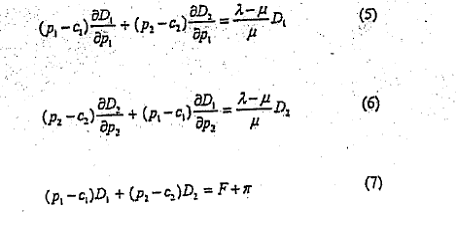
Where λ is the marginal utility of income (ie, the Lagrange multiplier associated with the budget constraint (1)) and µ is the consumers’ marginal disutility of the bank’s required profit (ie, the Lagrange multiplier associated with the profit constraint (3)).
Assumer for simplicity that preferences are quasi-linear, ie, U(x1, x2, x3) is of the form µ(x1, x2) + x3. This implies λ=1 and no income effects, ie, the Marshallian demand functions, D1(p1, p2) and D2(p2, p1), are identical to the Hicksian demand functions. It then follows from Slutsky symmetry that:
We can thus rewrite (5) as follows:
 ”
”
484 Once again, this means nothing to me. In making that observation, I do not intend to cast any doubts upon Professor Farrell’s technical expertise. Plainly, I am in no position to do so. To be fair, the mathematical formulae set out above were in technical appendices. Perhaps Professor Farrell assumed that any judge hearing a matter of this kind would be able to understand material presented in this manner. If so, he was mistaken, at least as far as I am concerned.
485 I regret to say that evidence presented to a court in this form is likely to be unhelpful, and really should not be adduced. The technical appendices provide a significant part of the rationale for Professor Farrell’s conclusions, which are themselves not altogether easy to follow. Having regard to the difficulty that I have in understanding Professor Farrell’s reasoning, I propose to exclude his evidence in-chief in its entirety. I am prepared, however, to have regard to those parts of his evidence, under cross-examination, that I was able to understand.
486 The criticisms levelled by the applicants at Professor Katz and Dr Fitzgerald were somewhat narrower in scope, and in my opinion, unwarranted. I found Dr Fitzgerald, in particular, to be a highly intelligent and thoroughly competent expert witness, with a sound grasp of economic theory and practice. He also understood Australian economic conditions, in a way that that neither Professor Katz, nor Professor Farrell, could possibly hope to emulate. I will therefore receive the evidence of Professor Katz and Dr Fitzgerald, treating any of the numerous, but minor, criticisms legitimately levelled at that evidence as going to weight, rather than admissibility.
487 Finally, having ruled that the evidence of Mr Lembit was admissible, it must follow that the evidence of Professor Dunsmuir, in rebuttal, is also admissible.
construction issueS – Section 7 OF THE PSR Act
488 The applicants contend that the RBA erred in law by excluding merchants from the term “participant” in s 7 of the PSR Act. They make the same point in a slightly different way when they submit that the EFTPOS payment system, as gazetted, did not include the participation of merchants. These errors are said to have caused the RBA to commit further errors of law when it came to consider the relevant infrastructure, and costs, associated with the EFTPOS system. The applicants say that the RBA erred by designating only part of that system, that being the part that is said to comprise arrangements between issuers, acquirers and merchants principal. They say that the Decision is invalid because the “designation” does not include all “instruments and procedures” that relate to the EFTPOS system.
489 The source of the power to designate is s 11 of the PSR Act. That section relevantly provides that the RBA “may designate a payment system if it considers that designating the system is in the public interest” (emphasis added). Section 11 makes no reference to a “participant”. Nor does s 7, which defines “payment system” as “a funds transfer system that facilitates the circulation of money, and includes any instruments and procedures that relate to the system”.
490 The designation that appeared in the Gazette dated 9 September 2004 described EFTPOS in the following terms:
“The EFTPOS system is the electronic funds transfer at point of sale payment system described in clause 1 of the CECS manual for the Consumer Electronic Clearing System and governed by the rules of that system set out in the manual, supplemented or modified by contracts, arrangements or understandings between individual issuers, acquirers and merchant principals (as that latter term is defined in the CECS manual) in the system. This system allows cardholders to use a debit card to pay for goods or services or withdraw cash at the point of sale”.
491 It is apparent, therefore, that EFTPOS is described, in the Gazette, by reference to its description in cl 1 of the CECS manual, supplemented or modified by contracts, arrangements or understandings between issuers, acquirers and merchants principal.
492 In my view, there is nothing in the language of the PSR Act that obliges the RBA, when designating “a payment system” to include a reference in the designation itself to “participants” in that system. The terms of designation are a matter for the RBA, subject only to any legislative constraints. In the present case, the designation adopted was entirely consistent with the definition of “payment system” in s 7. The language used in the Gazette was apt to describe “a funds transfer system that facilitates the circulation of money”. It was also apt to include “any instruments and procedures that relate to the system”. Merely because s 7 also contains a definition of “participant in a payment system” does not mean that any designation of a payment system will be invalid unless it refers in terms, or at least implicitly, to the participants in that system. Accordingly, the RBA did not err in law by designating the EFTPOS system in the manner that it did, and without any specific reference, in the description of EFTPOS in the designation, to who might, or might not be, a participant in that system.
493 The applicants’ contention that merchants are “participants” in EFTPOS, and that their role must be acknowledged and reflected in any designation of that system if it is to be valid cannot be accepted. For one thing, the definition of “participant” in a payment system in s 7 is limited to “constitutional corporations”. These are defined in s 7 as corporations to which paragraph 51(xx) of the Constitution applies. It goes without saying that not all merchants are “constitutional corporations”. For another, the definition of “participant” in s 7 operates by reference to whether the corporation is a “participant in the system in accordance with the rules that govern the operation of the system”. These two features make it tolerably clear that not all merchants who provide EFTPOS facilities or services are relevantly “participants” in the EFTPOS payment system. Indeed, there is also considerable force in the RBA’s submission that if merchants were “participants”, it would be likely that cardholders, who are obviously integral to the EFTPOS system, would also be participants. Once again, given the reference to “constitutional corporation” in the definition of “participant” this construction is plainly untenable.
494 It also follows that the applicants’ submission that the designation, as set out in the Gazette, is invalid because “instruments and procedures” that relate to EFTPOS, including point of sale processing equipment installed by merchants, have not been included within the designation, cannot be accepted.
495 The designation describes the EFTPOS system by reference to the CECS manual, as supplemented or modified by various contracts, arrangements or understandings. The reference to the manual, and to those supplementary or modifying arrangements, does not restrict the ambit of the system designated to the CECS (or essentially to the clearing and settlement function). The designation makes it plain that the system encompasses the electronic funds transfer at point of sale system described in the manual, and is one that “allows cardholders to use a debit card to pay for goods or services or withdraw cash at the point of sale”. These descriptors plainly encompass features that extend well beyond the clearing and settlement function.
496 In any event, the RBA submitted, correctly in my view, that the CECS manual, at cl 1.2.1, recognises merchants as an important component of the EFTPOS system, representing the final link in the delivery of the service to a cardholder. Indeed, the CECS manual details the role of merchants in the system in over half a page of text under the heading “Glossary – Overview of Consumer Electronic Transactions” at cl 1.2. That is hardly consistent with the applicant’s claim that the designation of EFTPOS left out an essential feature of that system, and was therefore invalid.
497 The applicants’ claim that the RBA’s power to designate can only be exercised in relation to a “whole” payment system, including “instruments and procedures”, may be readily accepted. However, that seems to me to be of no consequence in the present case because this is precisely what the RBA has done. Contrary to the applicants’ submission, I do not accept that the RBA limited its designation simply to arrangements between issuers, acquirers and merchants principal. When understood in context, the fact that the PSB, in the Statement, chose to describe merchants as users of EFTPOS, and not relevantly as participants in the system, is not inconsistent with the RBA having designated the EFTPOS system in its entirety.
498 To the extent that the applicants contend that the RBA made the decision to designate on the premise that merchants were to be disregarded, or that their interests were to be completely ignored, the evidence does not support that conclusion. I shall return to this matter later in these reasons for judgment.
construction issueS – Section 8 OF THE PSR Act
499 A distinct, but perhaps related attack upon the form of the designation, contends that the RBA failed to consider, adequately or at all, the efficiency and competitiveness of the EFTPOS system as required by s 8 of the PSR Act. The point being made is that the RBA erred by focussing not upon the EFTPOS system itself, as it ought to have done, but rather on “the overall payments system”. In substance, the applicants say that the RBA failed to consider whether designation of EFTPOS would promote the efficiency and competitiveness of that system, when viewed in isolation, as it was required by s 11(1), and by s 8, to do.
500 A partial answer to this contention lies in both s 10B(3) of the RBA Act and s 8 of the PSR Act. Under s 10B(3)(b) of the RBA Act, the RBA’s powers under the PSR Act are to be exercised in a way that, in the PSB’s opinion, will best contribute, inter alia, to “promoting the efficiency of the payments system” (emphasis added). The applicants’ contention that the RBA ought to have focussed on EFTPOS alone is difficult to reconcile with that broader statutory obligation. Similarly, the RBA’s duty under s 8 to have regard to “the desirability of payment systems” (emphasis added) being, in its opinion, “efficient” and “competitive” allows the RBA to have regard to a specific payment system. However, it does not confine the RBA to a consideration of the desirability of that system, standing alone, being efficient and competitive.
501 A more complete answer to this contention is that, as will be seen below, I accept the RBA’s submission that the issues of “efficiency” and “competitiveness” that the PSB addressed were considered not merely within the context of the “overall payments system”, as discussed in the Statement, but also in the context of the EFTPOS system itself. However, the PSB never lost sight of the need to consider the interaction between EFTPOS, and other payment systems, such as credit cards and Visa debit. It considered efficiency in the sense of “allocative efficiency”, as that term is used by economists. It adopted both a micro, and a macro, view of EFTPOS, and therefore, in my opinion, adequately discharged its statutory obligation.
502 The same can be said in relation to competition. The PSB found that interchange fees in EFTPOS are currently subject to little competitive pressure. Whether that conclusion is right, does not matter for present purposes. The RBA clearly addressed the issue that was before it for determination. The fact that it went on to consider the wider implications of designation for competition, and the desirability of access reform to encourage more competitive entry into EFTPOS, and possible substitutes for EFTPOS by other payment methods, does not detract from the fact that it carried out its statutory duty, as required.
CONSTRUCTION ISSUES – Section 10b OF THE rba act
503 The applicants, in their third construction point, submitted that the RBA failed to form the requisite opinions, under s 10B of the RBA Act, regarding efficiency and competition. They also contended that the RBA failed to consider whether the decision to designate was directed to the “greatest advantage of the people of Australia”, in accordance with the requirements of s 10B(3)(a).
504 In the Visa case, Tamberlin J rejected a similar argument regarding the alleged failure to form requisite opinions. His Honour accepted that the mere fact that a statute requires the formation of an opinion as a condition precedent to the exercise of power does not immunise the decision from judicial review. However, the effectiveness of any such review will largely depend upon the nature of the matters in relation to which the decision-maker is required to be satisfied.
505 His Honour observed at [599] that:
“…the promotion of efficiency of the payments system and promoting competition in the market for payments services, consistent with overall stability of the financial system, are matters in respect of which different minds can reach different conclusions.”
506 His Honour added that it was for the PSB to form the opinion as to what would “best contribute” to the broad objectives set out in s 10B(3).
507 It is clear that whether or not an opinion is held can be a jurisdictional fact: R v Connell; Ex parte Hetton Bellbird Collieries Limited (1944) 69 CLR 407 at 430; Minister for Immigration and Multicultural Affairs v Eshetu (1999) 197 CLR 611 at 651 (“Eshetu”); and Corporation of the City of Enfield v Development Assessment Commission (2000) 199 CLR 135 (“Enfield”) at 148. However, unlike the Visa case, the applicants have not placed any reliance upon jurisdictional fact in this proceeding. Even if they had, the following observations by Tamberlin J, at [604], would be apposite.
“It is important to note that it is solely for the PSB to form an opinion as to what will best contribute to promoting efficiency in the payment system and promoting competition in the market for payment services, consistent with the overall stability of the financial system. This is reinforced by sub s10B(3)(c) which refers to the manner of exercise being in a way that in the Board’s opinion will best contribute to the overall stability of the financial system. The words ‘in the Board’s opinion’ are central to the determination as to what will best contribute to achieving the objectives. Section 10B is silent as to the methodology which is to be used to ascertain whether the proposed actions will best contribute to those objectives.” (emphasis in original)
508 In reviewing the opinion reached by the RBA, it is relevant to note that the PSB was not constrained by the enabling legislation to follow any particular methodology, or process of reasoning.
509 The second attack upon the Decision, based upon the RBA’s alleged misconstruction of s 10B, appears to arise from s 10B(3)(a), which provides that it is the duty of the PSB to ensure, within the limits of its powers, that the RBA’s payments system policy “is directed to the greatest advantage of the people of Australia”. However, as the RBA correctly submitted, the Decision was not an exercise of power directed to “the Bank’s payments system policy” (the term used in s 10B(1)), but rather involved an exercise of the PSB’s specific power under s 11 of the PSR Act. As such, the provision of the RBA Act that was engaged was not s 10B(3)(a), which deals with “payments system policy”, but rather s 10B(3)(b), which deals with the exercise of the RBA’s powers under the PSR Act. That sub-paragraph requires the RBA to exercise the particular powers under consideration in a way that, in the PSB’s opinion, will best contribute to various specified matters, but not, in terms, to “the greatest advantage of the people of Australia”.
510 It follows that none of the grounds that allege reviewable error based upon misconstruction of ss 7, 8 and 11 of the PSR Act or s 10B of the RBA Act are made out.
taking into account irrelevant considerations
511 The applicants contend that the RBA took into account the following irrelevant considerations in making the decision to designate EFTPOS:
· whether designation would promote the efficiency and competitiveness of the overall payments system, without considering the efficiency of each individual payment system;
· the prices and costs of the EFTPOS system relative to the different prices and costs of the credit card payment system, without regard to the efficiency and competitiveness of each of those systems considered separately;
· the claim that merchants’ costs had decreased as a result of the designation of the credit card payment system, and the imposition of standards on credit card interchange fees; and
· whether interchange fees were necessary to make a payment system viable, including in particular, the EFTPOS and credit card payment systems.
512 The applicants plainly carry a significant burden in endeavouring to establish that any of these particular matters are truly “irrelevant considerations”. Section 8 of the PSR Act provides that, in determining whether any particular action is in the public interest, the RBA is required to have regard to various matters. Importantly, however, the RBA is also empowered to “have regard to other matters that it considers are relevant”. The section provides a list of mandatory considerations, but then allows the RBA to take into account, if it so wishes, additional matters that it regards as relevant. In other words, the legislative scheme implies that, short of capriciousness, the determination of whether or not these additional matters are relevant, and what weight they should be accorded, is largely a matter for the RBA.
513 In my view, the applicants would need to demonstrate that the RBA acted in a manner that was almost arbitrary or capricious in having regard to the matters that are said to be irrelevant in order to make good this ground of review.
514 Another way of looking at this matter is that which was that adopted by the Full Court in Seven Cable Television at [137], where it was said:
“For a consideration to be irrelevant in this sense the statute must expressly or impliedly prohibit consideration of it - Minister for Aboriginal Affairs v Peko-Wallsend at 40; R v Australian Broadcasting Tribunal; Ex parte 2HD Pty Ltd (1979) 144 CLR 45 at 49-50.”
515 In my view, it was open to the PSB to have regard to the efficiency and competitiveness of “the overall payments system” when considering whether or not to designate EFTPOS. Similarly, it would have been open to the PSB to have regard to “prices and the costs of the EFTPOS system relative to the different prices and costs of the credit card payment system”, without regard to the efficiency and competitiveness of each of those systems considered separately. However, for the reasons that I have earlier given, I do not consider that this is in fact what the PSB did.
516 Reasonable minds might differ as to the relevance to the Decision of the PSB’s observation that merchants’ costs had decreased as a result of the credit card reforms. However, it is difficult to conclude, in any categorical sense, that the PSR Act, expressly or impliedly, prohibited consideration of this fact.
517 The same may be said of the PSB’s comment regarding the need to make a payment system “viable”.
518 If, however, I am wrong about the relevance of any of these considerations, in order to succeed upon this ground, the applicants would still have to demonstrate that the RBA treated them as elements leading up to the formation of its Decision, and did not merely regard them as part of the background or context in which that decision was formed. I am not persuaded that the applicants have succeeded in doing so.
519 The RBA submitted that some of the applicants’ allegations concerning irrelevant considerations were “thinly disguised challenges to findings of fact made by the RBA”. That submission is not without some justification.
Failure to take into account relevant considerations
520 The applicants set out no less than ten “relevant and necessary considerations” which they claim the RBA failed to take into account in making the Decision.
521 At a general level, the RBA submitted that this approach to judicial review manifested the very vice identified by Deane J in Sean Investments Pty Ltd v MacKellar (1981) 38 ALR 363 where his Honour said at 375:
“This does not, however, mean that a party affected by a decision is entitled to make an exhaustive list of all the matters which the decision-maker might conceivably regard as relevant and then attack the decision on the ground that a particular one of them was not specifically taken into account.”
522 The authorities make it clear that failure to take into account a relevant consideration can only be made out as a ground of review if the decision-maker fails to take into account a consideration that he or she is bound to take into account in making that decision. Whether a decision-maker is bound to take a particular matter into account is determined by the construction of the statute conferring the discretion. If the relevant factors are not expressly identified in the statute, they must be determined by implication from its subject matter, scope and purpose: Minister for Aboriginal Affairs v Peko-Wallsend Limited (1986) 162 CLR 24 at 39-40 (“Peko-Wallsend”); Price v Elder (2000) 97 FCR 218 at 221 and Foster v Minister for Customs and Justice (2000) 200 CLR 442 at 452.
523 It follows that the applicants must demonstrate that the various matters allegedly not taken into account by the RBA were matters that the RBA was bound to consider. That task is by no means an easy one, given the breadth of the RBA’s powers, and the terms of both s 11 of the PSR Act and s 10B of the RBA Act.
524 In its closing submissions, the RBA identified two problems confronting the applicants in relation to this limb of their argument:
“145 … The first relates to the fact that, while Section 8 of the PSRA identifies various mandatory relevant considerations to which the RBA must have regard in determining whether it is in the public interest to designate, those various matters are expressed at a relatively high level of generality, involving as they do broad concepts such as “efficiency” and “competitiveness”. As noted above, the PSRA is silent on the methodology or approach which is to be taken by the RBA in complying with its statutory obligation to have regard to the desirability of payment systems being “efficient” and “competitive”. In those circumstances, the Applicants have to demonstrate that, having regard to the subject matter, scope and purpose of the PSRA, the various so-called relevant considerations which they have identified are mandatory or compulsory components of efficiency or competitiveness. The Applicants have failed to discharge that obligation.
146. The second matter relates to the significance of the RBA’s residual discretion under Section 8 of the PSRA. As noted above in paragraph 134, while isolating a limited number of mandatory relevant considerations as components of the “public interest”, the legislature has deliberately left a wide discretion to the RBA to have regard, if it so wishes, to other additional matters that it considers to be relevant in determining whether or not particular action is in the public interest. That statutory scheme simply serves to highlight the heavy burden carried by the Applicants in identifying additional factors or matters which do not fall within the parameters of the express mandatory relevant consideration set out in Section 8. The Applicants have to demonstrate that, despite the fact that the legislature has isolated a group of matters as mandatory relevant considerations, there are also additional matters which the RBA was bound to take into account. The Applicants’ task in this regard contradicts the very scheme of the Act, which is to leave a selection of additional relevant matters to the RBA’s discretion. The Applicants’ contentions, if accepted, would result in a significant expansion in the list of mandatory relevant considerations to be taken into account by the RBA in considering whether or not particular action is in the public interest in circumstances where Section 8 itself is quite specific in expressly identifying a limited number of mandatory relevant considerations.” (emphasis in original)
525 I consider that there is force in both these contentions. I also accept the proposition, drawn from the judgment of Hely J in Elias v Commissioner of Taxation (2002) 123 FCR 499, that where a discretion is conferred in broad terms, it is generally a matter for the decision-maker to decide what is relevant and what is not, and it determines the comparative importance of matters which are regarded as relevant. In his Honour’s terms, at [57]:
“As long as the decision-maker considers those things that the legislation requires to be taken into account and ignores any prohibited consideration, the grounds of failing to take into account a relevant consideration, or taking into account an irrelevant consideration, will not be available. Nor are those grounds available where the essence of the complaint is that the decision-maker paid either too little or too much attention to a relevant factor…”.
526 In the Visa case, Tamberlin J observed that where a decision-maker is bound to take a matter into account, regard must be had to that matter in a “real” sense. An alternative formulation, in relation to the expression “have regard to” requires the decision-maker to give consideration to the particular matter in a realistic and genuine sense, involving an “active intellectual process” though not necessarily to treat it as a fundamental element in the decision-making process: Singh v Minister for Immigration and Multicultural Affairs (2001) 109 FCR 152 at [52]-[59].
527 The RBA acknowledged that where it was required to have regard to the explicitly identified mandatory relevant considerations in s 8 of the PSR Act, in deciding whether or not to designate a payment system, it had to give realistic and genuine consideration to those matters. It further acknowledged that if there were additional mandatory relevant considerations, it was similarly obliged to give realistic and genuine consideration to them. It submitted, however, that it was not obliged to treat such matters as “fundamental elements” in the decision-making process. The distinction between these two propositions was somewhat elusive, and does not immediately commend itself to me.
528 Of greater cogency was the RBA’s reminder that this ground of review can easily stray into impermissible merits review: Craig v South Australia (1995) 184 CLR 163 at 167 and Minister for Immigration and Multicultural Affairs v Yusuf (2001) 206 CLR 323 at [72]-[75].
529 The “relevant and necessary considerations” that the RBA is said to have failed to take into account are set out in par 9(b) of the application. They are as follows:
“(i) the costs incurred in operating EFTPOS terminals and related software and infrastructure at the point of sale by merchants, through which payments using the EFTPOS system are electronically processed and transferred and/or cash is dispensed to customers of banks or other financial institutions, which are costs of the EFTPOS system;
(ii) the sworn evidence before the Australian competition Tribunal in Re EFTPOS Interchange Fees Agreement [2004] ACompT 7 (“the EFTPOS case”) that a reduction in EFTPOS interchange fees would adversely affect investment in the EFTPOS system by merchants:
(iii) the effect of the Decision on the behaviour of merchants in connection with the operation of the EFTPOS system and the offer of EFTPOS payment and/or cash services;
(iv) the efficiency of the EFTPOS system;
(v) whether the price of the EFTPOS system reflects the costs and benefits of the EFTPOS system and whether the price of the credit card system reflects the costs and benefits of the credit card system;
(vi) all elements of the price incurred by cardholders in using the credit card system, including annual fees, interest charges and merchant surcharges;
(vii) that the effective per transaction price by cardholders in using the EFTPOS system had reduced substantially between the date of the joint study published by the Respondent and the Australian Competition and Consumer Commission in October 2000 titled ‘Debit and credit card schemes in Australia: a study of interchange fees and access’ (“the Joint Study” and the date of the decision;
(viii) whether the efficiency of each of the EFTPOS system and the credit card payment system would be promoted by Respondent exercising powers under s 18 of the Act to alter further the levels of interchange fees in the credit card payment system rather than the levels of interchange fees in the EFTPOS system;
(ix) the finding of the Australian Competition Tribunal in the EFTPOS Case that any pass through of a reduction in interchange fees by financial institutions that issue EFTPOS cards to cardholders is likely to be small in amount, may take the form of adjustments to bank charges other than the fees payable for EFTPOS transactions, and any signalling of any change is unlikely to alter the conduct of cardholders with respect to the use of EFTPOS;
(x) the different characteristics of debit cards and credit cards that substantially limit the degree of economic substitution between them as a means of payment for goods or services or withdrawal of case at the point of sale.”
530 The RBA denied that it was bound to take any of these matters into account. It submitted that the applicants had elided findings of fact, or matters determined in the exercise of the RBA’s judgment, so as to suggest that relevant considerations had been ignored. In any event, it submitted that all of these matters had in fact been considered, and in a realistic and genuine sense, when the RBA came to make the Decision.
531 It is unnecessary to traverse in detail the way in which each party put its case on this issue. Some examples will suffice. The applicants submitted, in grounds 9(b)(i) and 9(b)(iii) of their application, that the RBA had ignored merchants’ costs when it came to make the Decision. This is, in some ways, similar to the point made in a different context when the applicants attacked the form of the designation itself for excluding merchants as participants in the designated system.
532 The fact is that when considering the efficiency of the EFTPOS system, the RBA decided that it was appropriate, from an economic perspective, to treat issuers and acquirers (who, incidentally included merchants principal) as the providers of the EFTPOS system, and merchants and cardholders as the users of that system. However, that did not mean that the RBA ignored merchants’ costs in deciding to designate.
533 Indeed, in the Statement, the PSB specifically addressed merchants’ costs at [30]-[36] under the general heading “Resource costs”. In [34], the PSB considered and rejected the criticism by the Australian Merchant Payments Forum, and the ACT, that the data in the Joint Study could not be relied upon because it did not include merchants’ costs, and was also out of date. The PSB said that it gave this view little weight because it recognised that in considering whether an interchange fee was necessary to make a payment system viable, it was widely accepted that it was the costs of issuers and acquires that were relevant, and not the costs of end users. It explained that this argument had been set out by the RBA publicly in a number of places, and had been advanced to the ACT as recently as April 2004. It is important to note that the RBA’s submission to the ACT included, inter alia, a detailed analysis of the resource costs of EFTPOS which specifically encompassed merchants’ resource costs.
534 Whether or not one agrees with this analysis in the context of a comparison between the resource costs of EFTPOS, and those of credit card networks, is not to the point. The RBA plainly addressed the issue of merchants’ costs. It did so expressly, and in terms. At one point, it noted that those costs were affected by interchange fees. At another point it concluded that if cardholders switched to EFTPOS, instead of credit, merchants might face lower costs, even if they faced higher merchant service fees for EFTPOS. This discussion is at odds with any suggestion that the RBA failed to have regard to merchants’ costs. The reality is that the applicants are unhappy with the way in which the RBA treated the issue of their costs. Even if they have a legitimate sense of grievance regarding that matter, this does not, of itself, give rise to any reviewable error.
535 The applicants cite [35] of the Statement in support of their contention that the RBA disregarded merchants’ costs. As already indicated, that is not its correct import. The paragraph deals solely with the Joint Study, and the criticisms that had been levelled at it. Even then, the Joint Study did not purport to calculate the resource costs of all parties involved in a payment system. Its objectives were to investigate the level of interchange fees in debit and credit card systems, how those fees were set, whether they encouraged efficient provision of services and whether they created barriers to entry. The Joint Study also considered the role of such fees in two-sided markets and whether, as some claimed, interchange fees were necessary for the viability of the system. For these purposes, the Joint Study did not need to consider merchants’ costs in detail.
536 Moreover, as previously indicated, the RBA gathered further data on a number of matters following the Joint Study. These included merchants’ costs. As noted, in [5] of the Statement, set out at [195] of these reasons for judgment, the RBA had regard to a wide range of material when it considered whether the relative prices of EFTPOS and other relevant payment systems reflected the relative costs of those systems. It concluded that they did not. An analysis of that type is arguably adequate, in the context of a consideration of allocative efficiency, at least according to the RBA’s expert witnesses. It is sufficient for present purposes simply to note that the RBA did not, in any sense, fail to have regard to these matters. It plainly gave them genuine and realistic consideration.
537 Another matter that the RBA supposedly failed to take into account, though it was allegedly bound to do so, was whether designation of EFTPOS would promote, or might adversely affect, the competitiveness of EFTPOS, and competition in the market for payment services. Curiously, this matter was not specifically identified among the plethora of factors allegedly ignored by the RBA in par 9(b) of the application. However, it was raised by the applicants in their closing submissions.
538 In my view, the RBA was not bound to give specific consideration to this matter. It is sufficient to note that the RBA did consider “competition”, as that term is used in the PSR Act. It concluded that interchange fees, in EFTPOS, are currently subject to little competitive pressure. It also concluded that designation, and consequent access reform, could lead to lower barriers to entry into the EFTPOS system. The applicants have not demonstrated any reviewable error on the part of the RBA in this regard.
539 To the extent that the applicants criticise the RBA’s conclusion regarding the limited competitive pressure on the level of interchange fees, based upon the conclusions of the ACT on that subject, it is sufficient simply to note that the ACT’s reasoning was carefully considered by the RBA, and it took a different view.
540 It is unnecessary to reiterate, in any detail, the applicants’ case regarding the competitive pressures to which interchange fees are said to be subject. It is sufficient to note that the evidence shows that most such fees are clustered within a reasonably narrow price band and, once fixed, tend not to move at all, or only in relatively small degrees. The RBA’s conclusion that there is little competitive pressure regarding current interchange fees represents a finding of fact. That finding was open on the material. It does not give rise to reviewable error. Indeed, it is supported, in terms, by Dr Fitzgerald who stated in evidence, at 482 of the transcript, that “the nature of these markets is that it’s actually very difficult for an appropriate price to emerge in competition”. This was despite there being, in Dr Fitzgerald’s view “a quite competitive environment in the end market, acquiring and issuing…”.
541 It follows that none of the points made on behalf of the applicants’ in support of ground 9(b) of the application are made out.
WEDNESBURY UNREASONABLENESS
542 The applicants complain of Wednesbury unreasonableness by reference to no fewer than twenty-two separate matters that are said to constitute elements in the RBA’s reasoning process. Those twenty-two individual matters are set out in par 9(c) of the application, and are as follows:
“(i) the failure to consider as costs of the EFTPOS system the costs incurred in operating EFTOS terminals and related software and infrastructure at the point of sale by merchants, through which payments using the EFTPOS system are electronically processed and transferred and/or cash is dispensed to customers of banks or other financial institutions;
(ii) the sworn evidence before the Australian Competition Tribunal in the EFTPOS Case that a reduction in EFTPOS interchange fees would adversely affect investment in the EFTPOS system by merchants;
(iii) the failure to consider the effect of the Decision on the behaviour of merchants in connection with the operation of the EFTPOS system and the offer of EFTPOS payment and/or cash services;
(iv) the failure to consider the efficiency of the EFTPOS system;
(v) the failure to consider whether the price of the EFTPOS system reflects the costs and benefits of the EFTPOS system and whether the price of the credit card system reflects the costs and benefits of the credit card system;
(vi) the failure to consider all elements of the price incurred by cardholders in using the credit card system, including annual fees, interest charges and merchant surcharges;
(vii) the fact that the effective per transaction price incurred by cardholders in using the EFTPOS system had reduced substantially between the date of the Joint Study and the date of the Decision;
(viii) the failure to consider whether the efficiency of each of the EFTPOS system and the credit card payment system would be promoted by the Respondent exercising powers under s.18 of the Act to alter further the level of interchange fees in the credit card payment system rather than the level of interchange fees in the EFTPOS system;
(ix) the finding of the Australian Competition Tribunal in the EFTPOS Case that any pass through of a reduction in interchange fees by financial institutions that issue EFTPOS cards to cardholders is likely to be small in amount, may take the form of adjustments to bank charges other than the fees payable for EFTPOS transactions, and any signalling of any change is unlikely to alter the conduct of cardholders with respect to the use of FFTPOS;
(x) the failure to consider the different characteristics of debit cards and credit cards that substantially limit the degree of economic substitution between them as a means of payment for goods or services or withdrawal of cash at the point of sale;
(xi) unreasonably concluding that users of the credit card system typically face either a zero or negative effective price for each transaction;
(xii) unreasonable reliance on historical data obtained in connection with the Joint Study;
(xiii) unreasonably concluding that there was unlikely to have been any material change in the costs of issuers and acquirers of debit cards in the EFTPOS system between the date of the Joint Study and the date of the Decision;
(xiv) unreasonably overstating the extent to which debit card holders typically pay a price or fee per EFTPOS transaction;
(xv) unreasonably concluding that the effective price paid by consumers for EFTPOS transactions would reduce if EFTPOS interchange fees were reduced;
(xvi) unreasonably concluding that unless EFTPOS interchange fees were reduced, the effective price paid by consumers for EFTPOS transactions would increase in the future;
(xvii) unreasonably concluding that it is unlikely to be sustainable for financial. institutions to offer a large number of free EFTPOS transactions while having to pay on average an interchange fee of around 20 cents per transaction;
(xviii) unreasonably concluding that if the EFTPOS interchange fees were reduced, there would be some substitution towards EFTPOS and away from other forms of card based payments
(xix) unreasonably concluding that bilaterally set interchange fees do not reflect normal competitive pressures;
(xx) unreasonably concluding that the main reason that EFTPOS is not more heavily used in Australia in comparison with other countries is the relative high price (compared with credit cards) of using EFTPOS;
(xxi) unreasonably concluding that, absent interchange fees, EFTPOS issuers’ and acquirers’ costs and revenues are relatively balanced;
(xxii) unreasonably disregarding the role of the EFTPOS system in providing a cash withdrawal service by merchants for the benefit of banks and other financial institutions that issue debit cards and cardholders.”
543 As previously outlined, the parties could not agree on whether this head of review is limited to perversity or capriciousness in the final decision, or whether it applies as well to individual elements or components of the reasoning process which underlie that decision. The RBA submitted that the former view was correct, while the applicants submitted that the authorities supported the latter interpretation.
544 In Associated Provisional Picture Houses, Limited v Wednesbury Corporation [1948] 1 KB 223 (“Wednesbury”), the Court of Appeal upheld as valid a condition attached to a cinema licence that no child below the age of fifteen be admitted to a Sunday performance. The licensing authority in that case was an elected local body, empowered to attach such conditions at it thought fit to impose. There was no provision for any appeal from such a determination. The classic dictum of Lord Greene MR, allowing for review on the basis of unreasonableness, was expressed in narrow terms. His Lordship said, at 230:
“It is true to say that, if a decision on a competent matter is so unreasonable that no reasonable authority could ever come to it, then the courts can interfere.”(emphasis added)
545 However, his Lordship went on to say, also at 230, that to “prove a case of that kind would require something overwhelming”.
546 A similarly narrow formulation of the scope of Wednesbury unreasonableness appears in Peko-Wallsend per Mason J at 41. To the same effect are the decisions of the Full Court in Cubillo v Commonwealth (2001) 112 FCR 455 at [254] and Inglewood Olive Processors Limited v Chief Executive Officer of Customs [2005] FCAFC 101 at [46].
547 On the other hand, the applicants contend that the test for Wednesbury unreasonableness, whether at common law, or as reflected in s 5(2)(g) of the ADJR Act, extends to the process leading up to the making of the decision. They refer, in that regard, to Prasad v Minister for Immigration and Ethnic Affairs (1985) 6 FCR 155 at 169 where Wilcox J observed that s 5(2)(g) is concerned with the manner of exercise of the power, and not just the final decision. His Honour came to a similar conclusion in Taveli v Minister for Immigration, Local Government and Ethnic Affairs (1989) 86 ALR 435 at 453. His Honour’s approach in Prasad was cited with approval by Mason CJ and Deane J in Minister for State and for Immigration and Ethnic Affairs v Teoh (1995) 183 CLR 273 at 289-290. A similarly broad view was taken by the Full Court in Luu v Renevier (1989) 91 ALR 39 at 50, and again in Singh v Minister for Immigration (2000) 105 FCR 453 at 463-6.
548 The applicants submit that the decisions of the High Court in Eshetu at 626-8, 640, 649-654, 659 and 669, and S20 at 61-63, 66-67 and 75-76 (“S20”) also provide support for their broader contention.
549 For reasons that will become apparent, it is unnecessary for me to determine which view of Wednesbury unreasonableness is correct.
550 One thing, however, is clear. The courts have repeatedly stressed the importance of keeping this ground of review under strict limits. Wednesbury itself provides a good illustration of just how limited “unreasonableness” is as a ground of judicial review. Lord Greene said, at 229, that a decision could be “so absurd that no sensible person would ever dream that it lay within the powers of the authority”. However, the example that he gave was the utterly extreme and hypothetical case cited by Warrington LJ in Short v Poole Corporation [1926] 1 Ch 66 of the red-haired teacher, dismissed because she had red hair.
551 A more realistic example of an “absurd” decision is to be found in Williams v Giddy [1911] AC 381. There, the New South Wales Public Service Board purported to excise its power to award a gratuity by granting the applicant the sum of one penny for each year of service. The Privy Council, in a precursor to Wednesbury unreasonableness, held that this was tantamount to a refusal to exercise the discretion conferred upon the Board, and therefore gave rise to jurisdictional error.
552 In Eshetu, Gleeson CJ and McHugh J, at [40], sounded yet another cautionary note regarding this ground of review:
“Someone who disagrees strongly with someone else’s process of reasoning on an issue of fact may express such disagreement by describing the reasoning as “illogical” or “unreasonable”, or even “so unreasonable that no reasonable person could adopt it”. If these are merely emphatic ways of saying that the reasoning is wrong, then they may have no particular legal consequence.”
553 Plainly, it is necessary to proceed with care when considering a challenge based upon Wednesburyunreasonableness. There is always a danger that the Court will be drawn into merits review, rather than focussing, as it should, upon the legality of the decision: Attorney-General (NSW) v Quin (1990) 170 CLR 1 at 35-6 per Brennan J, cited with approval in Minister for Immigration and Ethnic Affairs v Wu Shan Liang (1996) 185 CLR 259 (“Wu Shan Liang”) at 272, Abebe v Commonwealth of Australia (1999) 197 CLR 510 at 579-80 and Enfield at 152.
554 There are, of course, some instances, admittedly rare, in the reported cases, where this ground of review has succeeded. In C Beaton-Wells, “Judicial Review of Migration Decisions: Life After S157” (2005) 33 Federal Law Review 141 (“Beaton-Wells”) at 152, the learned author observes:
“The demanding nature of the ground known as Wednesbury unreasonableness has meant that it has seldom been invoked and even less seldom with success…”.
555 According to Aronson, Wednesbury unreasonableness started life as a “truly exceptional” ground, but became less demanding in the 1980s, particularly in England. Australian cases were said to have followed English trends for a time, but had now reverted to the earlier, narrower approach. Indeed, the learned authors observe that the current view, in this country, seems to be a throwback to Lord Greene’s dictum, and to regard this ground as representing a safety net, designed to catch the rare and totally absurd decision which has somehow managed to survive the application of all other grounds of review.
556 In S20, the High Court appears to have widened the scope for review on the basis of unreasonableness, although the extent to which it has done so is by no means easy to discern. In that case, the Court dealt with a provision of the Migration Act 1958 (Cth) which empowered the Federal Court to entertain judicial review challenges to migration decisions on enumerated grounds, but prevented challenge on two other grounds. The prohibited grounds were breach of natural justice and that “the decision involved an exercise of a power that [was] so unreasonable that no reasonable person could have so exercised the power” (s 476(2)(b)). The permissible grounds included that the decision was unauthorised, or made without jurisdiction. The permissible grounds were said to be “subject to” the prohibited grounds.
557 In S20, the applicant’s case was that the Refugee Review Tribunal had found facts in a manner that was grossly unreasonable. The Federal Court could not entertain such a ground. The applicant sought to circumvent this prohibition by characterising the challenge as being based upon “irrationality” or “illogicality” in fact finding.
558 At common law, want of logic was not synonymous with error of law. See generally Bond at 356 per Mason CJ.
559 As Aronson correctly observes, in one sense “unreasonableness” must often overlap “irrationality” or “illogicality”.
560 However, if there were an overlap in S20, then the Federal Court could not entertain the challenge. The case is a difficult one from which to extract a clear statement of principle. The majority, with Kirby J dissenting, rejected the appellant’s portrayal of the Refugee Review Tribunal’s reasoning as “illogical”. Nonetheless, the majority endorsed the proposition that extreme irrationality or illogicality in a decision-makers fact finding processes could amount to a jurisdictional error. Gleeson CJ, at [9], appeared to put this on a natural justice basis, while McHugh and Gummow J reasoned, at [54] that it was implicit in any statute that a power conferred even in subjective terms should be exercised reasonably. Kirby J appeared sympathetic to both approaches.
561 It follows that in the course of their reasoning, four of the five judges appeared more receptive that had previously been the case to the idea that extreme cases of illogicality might be reviewable: Beaton-Wells, at 151. However, McHugh and Gummow JJ at [73]-[74], and Kirby J at [142]-[146], held that the legislative intent had been to exclude Wednesbury unreasonableness, and in any event to narrow its scope.
562 On one view, therefore, notwithstanding the Court’s apparent willingness in S20 to entertain review for irrationality or illogicality, the reality is that little has changed in this regard. It will still be extraordinarily difficult in proceedings for judicial review to challenge findings of fact. In practical terms, Wednesbury unreasonableness will be largely confined to review of discretionary decisions.
563 It is interesting, in the light of the way this case has been presented, that Aronson states categorically, at 340, in relation to Wednesbury unreasonableness, that:
“the courts “never” receive evidence when applying the reasonable Minister standard, or when deciding how a reasonable council, bureaucrat, tribunal, regulatory body or inferior court judge would not have decided or acted.”
564 Rather, Aronson contends, the courts’ reasonableness standard is ultimately intuitive. No doubt that is true in the vast majority of cases. However, it was not true of the Visa case. And it represents a far cry from the approach taken by both sides in the present case.
565 The policy underlying unreasonableness review is discussed by Aronson at 340:
“Confined to extreme cases, its application should not involve the courts in trawling through the fine details of the administration’s work, looking for errors. Rather, it amounts to the sort of low-level quality control which most management systems should maintain in any event … there would be serious credibility costs to the system if demonstrably absurd decisions were allowed to go unchecked.”
566 Applying that policy, and the law as it has been expounded by the High Court, it is useful to stand back from the detail of the applicants’ challenge to the Decision, and remind oneself of what precisely the RBA has done. It is also useful to remember just who came up with the decision that is now said to be “absurd”.
567 The members of the PSB who attended the meeting on 3 September 2004, and made the Decision, were the Governor of the RBA, the Deputy Governor, the Chairman of the Australian Prudential Regulation Authority and three other persons, namely Joe Gersh, Sue McCarthy and John Poynton. To suggest that a body comprising persons with such qualifications and experience has acted “irrationally”, and arrived at an “absurd” decision is, to put it colloquially, “a big ask”. That “ask” is all the “bigger” when the material makes it plain that the Decision was only arrived at after a lengthy process of consideration, extensive consultation and the receipt of expert advice.
568 That is not to say that the RBA or the PSB is immune from aberrational behaviour. Economists are no less likely to arrive at decisions that can be characterised as “absurd” than any other experts in any other field. I hasten to add that this includes lawyers. Nonetheless, and especially where questions of “opinion or policy” are concerned, the courts have stressed the difficulty of establishing “unreasonableness”, and for good reason: see Buck v Bavone (1976) 135 CLR 110 at 118-9 per Gibbs J.
569 I do not propose to trawl through the voluminous particulars that the applicants have relied upon in support of their claim that the Decision should be set aside on the ground of Wednesbury unreasonableness. Some of those particulars merely repeat points also taken under other grounds. For example, it is said that the Decision should be set aside because of the failure to consider the efficiency of the EFTPOS system. That matter was also raised in relation to several of the construction arguments. It is also said that there was unreasonable reliance on historical data obtained in connection with the Joint Study, and that the RBA had unreasonably disregarded the role of EFTPOS in providing a cash withdrawal service.
570 Attaching the adverb “unreasonably” to an alleged failing on the part of the PSB does not convert what is essentially a complaint that involves merits review into a challenge to legality. Many of the particulars relied upon by the applicants in support of Wednesbury unreasonableness seem to me simply to manifest disagreement on their part with some detail or other of the PSB’s reasoning. Even if there is substance in some of their points, this does not give rise to reviewable error.
571 In the context of a case such as this, where even acknowledged experts, from a variety of backgrounds, cannot agree among themselves as to whether it makes good sense to reduce EFTPOS interchange fees, it is difficult to see how the applicants can hope to succeed in challenging the anterior Decision simply to designate EFTPOS, on the basis of Wednesbury unreasonableness. In my view, even on the broadest view of that ground of review, they have not succeeded in doing so.
the NO EVIDENCE ground
572 The next ground relied upon by the applicants is that which is contained in par 10 of the application for review. The ground identifies seventeen separate “findings” or “elements” of the RBA’s reasoning process leading up to the making of the Decision which the applicants contend are unsupported by any evidence, or other material.
573 Paragraph 10 is in the following terms:
“There was no evidence or other material to justify the making of the Decision.
Particulars
There was no evidence or other material from which the Respondent could reasonably be satisfied that:
(a) the efficiency or competitiveness of the EFTPOS payment system would be increased, enhanced or best promoted by reason of the Decision;
(b) it is widely accepted that only the costs of EFTPOSissuers and acquirers are relevant to a consideration of the efficiency or viability of the EFTPOS system;
(c) a reduction in EFTPOS interchange fees would not adversely affect investment in the EFTPOS system by merchants;
(d) the price of the EFTPOS system did not reflect the posts and benefits of the EFTPOS system;
(e) a reduction in interchange fees is likely to result in anoticeable reduction in the fees payable for EFTPOS transactions by card holders;
(f) users of the credit card system typically face either a zero or negative effective price for each transaction;
(g) there was unlikely to have been any material change in the costs of issuers and acquirers of debit cards in the EFTPOS system between the date of the Joint Study and the date of the Decision;
(h) as at the date of the Decision, the whole of the resource costs associated with a credit card payment materially exceeds those associated with an EFTPOS payment;
(i) unless EFTPOS interchange fees were reduced, the effective price paid by consumers for EFTPOS transactions would increase in the future;
(j) it is unlikely to be sustainable for financial institutions to offer a large number of free EFTPOS transactions while having to pay on average an interchange fee of around 20 cents per transaction;
(k) a continuation of the current interchange arrangements would mean that over time financial institutions would face pressure to increase their per transaction EFTPOS fees and/or to steer customers away from EFTPOS towards other. forms of payment;
(l) if the EFTPOS interchange fees were reduced, issuers of EFTPOS cards would offer cardholders lower prices or more fee-free transactions;
(m) if the EFTPOS interchange fees were reduced, issuers of EFTPOS cards would be more likely than at present to encourage the use of EFTPOS;
(n) if the EFTPOS interchange fees were reduced, there would be some substitution towards EFTPOS and away from other forms of card based payments;
(o) bilaterally set interchange fees do not reflect normal competitive pressures and are currently subject to little competitive pressure;
(p) the main reason that EFTPOS is not more heavily used in Australia in comparison with other countries is the relative high price (compared with credit cards) of using EFTPOS;
(q) absent the interchange fee, EFTPOS issuers’ and acquirers’ costs and revenues are relatively balanced.”
574 In dealing with the no evidence ground, it must first be noted that there are differences, in respect of findings of fact, between judicial review under the common law, and review under the ADJR Act.
575 Under s 39B of the Judiciary Act (which reflects the common law), the “no evidence” ground requires that there be simply no evidence, or other material, to justify the findings of fact made. Aronson suggests, at 239, that “no evidence” means “not a skerrick of evidence”. If there is some evidence, no matter how unconvincing, and no matter how overwhelming the evidence to the contrary may be, the traditional approach is to treat the complaint as factual, and not legal. According to Mason CJ in Bond, at 356:
“So long as there is some basis for an inference – in other words, the particular inference is reasonably open – even if that inference appears to have been drawn as a result of illogical reasoning, there is no place for judicial review because no error of law has taken place.”
576 The position under the ADJR Act is more complex. Aronson suggests that it provides for a more relaxed version of the no evidence ground. Section 5(1)(h) provides for review on the ground “that there was no evidence or other material to justify the making of the decision”. However, that section is qualified by s 5(3) which provides as follows:
“(3) The ground specified in paragraph 1(h) shall not be taken to be made out unless:
(a) the person who made the decision is required by law to reach that decision only if a particular matter is established, and there was no evidence or other material (including facts of which he or she is entitled to take notice) from which he or she could reasonably be satisfied that the matter was established; or
(b) the person who made the decision based the decision on the basis of the existence of a particular fact, and that fact does not exist.”
577 Section 5(3)(a), in substance, seems merely to restate the doctrine of jurisdictional fact. However, as the RBA correctly submitted, s 8 of the PSR Act, which sets out the matters to which the RBA must have regard in determining whether a particular action is or would be in the public interest, does not specify any particular matter that must be “established” before the RBA can designate a payment system. Rather, the section requires the RBA, in determining whether or not designation would be in the public interest, to have regard to the desirability of payment systems being, in its opinion, “efficient” and “competitive”. A provision couched in such subjective terms does not leave much scope for the operation of s 5(3)(a).
578 Section 5(3)(b) deals with a different issue, namely whether the decision under challenge was “based … on the existence of a particular fact, and that fact does not exist”. This paragraph was considered by the Full Court in Curragh Queensland Mining Limited v Daniel (1992) 34 FCR 212 (“Curragh”), where it was held, at 220-4, that s 5(3)(b) could only be satisfied if:
· the decision was “based on” the existence of a “particular fact”, meaning a fact that was “critical to the making of the decision”;
· there was no evidence or other material to support the finding of that particular fact; and
· it could be shown that the particular fact did not exist.
579 In Minister for Immigration and Multicultural Affairs v Rajamanikkam (2002) 210 CLR 222, the High Court was concerned with the equivalent to s 5(1)(h) of the ADJR Act, which formerly appeared in the Migration Act as s 476(1)(g). The equivalent to s 5(3) was s 476(4). There are difficulties with aspects of the reasoning in Rajamanikkam, and these arecanvassed by Aronson at 242-5. However, it can at least be said that Curragh was cited with approval by Gleeson CJ at [33], Kirby J at [115]-[118] and Callinan J at [140] in Rajamanikkam.
580 The last element of s 5(3)(b) operates to confine the “no evidence” ground to a case where the applicant can actually negative the fact on which the decision was based. It requires the applicant to adduce evidence positively establishing the contrary to the “fact” that it is alleged the decision-maker based its decision on, and in respect of which it is claimed there is no supporting evidence or other material. Meeting this second limb of s 5(3) can be extremely difficult. The mere absence of evidence as to a fact will not establish its non-existence. As Aronson notes, at 244:
“Further second limb questions have concerned whether it covers: a decision-maker’s finding of a fact’s non-existence; a state of affairs rather than a specific fact; predicted facts rather than just past facts; a decision-maker’s disbelief (either wholly, or to the relevant level of persuasion) of an assertion of facts; or a refusal to exercise a statutory power, rather than a decision to exercise it.” (footnotes omitted)
581 A further limitation upon the operation of the “no evidence” ground of review in s 5(1)(h) is that it must be confined to findings of fact, and does not extend to expressions of opinion. In Seven Cable Television, the Full Court stressed the importance of this distinction in the context of a “no evidence” challenge to a finding by the ACCC that the making of a declaration would be likely to increase competition. That finding was said to involve matters of judgment, and not to be a finding of fact. Accordingly, s 5(1)(h) had no application. See also Randwick City Council v Minister for the Environment (1998) 54 ALD 682 at 717 per Finn J, affirmed on appeal by the Full Court in Randwick City Council v Minister for the Environment (1999) 167 ALR 115.
582 I accept the RBA’s submission that a number of the matters relied upon by the applicants under their “no evidence” ground are not, in truth, findings of fact, but rather opinions or conclusions in the nature of value judgments. Indeed, it is difficult to find in any of the “facts” or “elements” identified in par 10 of the application anything that could properly be described as a finding of fact in the sense spoken of in Seven Cable Television. For that reason alone, s 5(1)(h) of the ADJR Act can have no application.
583 The RBA provided a useful example of this failing in the applicants’ case in their written submissions. It said, at [191]:
“That is apparent from the terms of the RBA’s reasons which make repeated reference to the Board’s conclusions being very much in the nature of “opinion” or “judgement”. Take, for example, the Applicants’ allegation in paragraph 10(n) of the Application, which is to the effect that there was no evidence or other material upon which the RBA could reasonably be satisfied that if EFTPOS interchange fees were reduced, there would be some substitution towards EFTPOS and away from other forms of the card based payments. That allegation appears to be based on the contents of paragraph 76 of the Reasons, which are relevantly in the following terms:
“Given the evidence, discussed above, that cardholders respond to changes in relative prices, the Board’s opinion was that, were there to be a change in interchange arrangements, some substitution towards EFTPOS and away from the other forms of card based payments would take place” (emphasis added)
Not only does the Board give express emphasis to the matter being one which it has arrived at in its opinion, but the evaluative nature of that statement is reinforced in paragraph 77 of the Reasons, which makes express reference to the Board having made “judgements”.”
584 If I am wrong in regarding the applicants’ case as being flawed in this way, I would nonetheless reject their submissions based upon the “no evidence” ground in s 5(1)(h) because I am not persuaded that any of the various matters identified in par 10 of the application was relevantly “critical” to the RBA’s decision. Rajamanikkam confirmed that an applicant who relies upon a ground of this type must show that the fact was “critical” to the impugned decision. See [35]-[39] per Gleeson CJ, [56]-[58] per Gaudron and McHugh JJ, and [155] and [161] per Callinan J.
585 Finally, I am not persuaded that the applicants have established that any of the “particular facts” upon which the Decision was based (if any of the matters raised by the applicants are such “facts”) have been shown not to exist. That is so notwithstanding the plethora of evidence adduced by both sides, said to be relevant to that issue.
NATURAL JUSTICE
586 The last ground upon which the applicants rely in support of their application for review concerns an alleged failure to accord natural justice. Ground 11 is in the following terms:
“A breach of the rules of natural justice occurred in connection with the making of the Decision.
Particulars
There was a reasonable apprehension of bias on the part of the Respondent in connection with the making of the Decision, in that:
(a) the Respondent had determined to make the Decision irrespective of the decision and findings of the Australian Competition 'Tribunal in the EFTPOS Case, the evidence presented to the Australian Competition Tribunal in the EFTPOS Case (including unchallenged factual evidence and expert economic evidence), and the evidence and arguments presented to the Respondent in connection with the making of the Decision;
(b) the reasons for the Decision published by the Respondent on 14 October 2004 misstate or ignore material facts, evidence and/or expert opinion that was before the Respondent.”
587 The denial of natural justice alleged involves a claim of bias. The claim has two limbs. The first is that the RBA pre-judged the issue as to whether to designate EFTPOS, irrespective of the decision and findings of the ACT, and the evidence and arguments presented as part of the process of consultation. The second is that the PSB, in the Statement, misstated or ignored relevant facts and other material.
588 The general principles governing this branch of the law are well settled. In Ebner v Official Trustee in Bankruptcy (2000) 205 CLR 337, the High Court distinguished between Court proceedings and other kinds of decision-making when dealing with claims of pre-judgment.
589 That distinction was reaffirmed in Minister for Immigration and Multicultural Affairs v Jia Legeng (2001) 205 CLR 507 (“Jia Legeng”). In that case it was held that in considering whether an administrative decision-maker’s conduct indicated pre-judgment, careful attention had to be given to the nature of the decision-making process, and the repository of the power in question. A distinction should be drawn between the standards of behaviour expected of a Minister, and those expected of a Judge or Tribunal.
590 It follows that it is important to have regard to both the nature of the decision-making process, and the membership of the decision-making body when determining whether there has been pre-judgment of the kind that would vitiate the Decision.
591 In the Visa case, Tamberlin J noted, at [605], the importance of keeping in mind the role of the RBA in the administrative and economic hierarchy of the nation, and the nature and scope of the discretions exercised by it. His Honour stressed the role of the RBA as “the Central Bank of Australia and principal regulator of the Australian economy”. He said that its functions, powers and discretions were not only to formulate broad economic policy, but also to implement that policy in such a way that it achieved the relevant statutory objectives.
592 Tamberlin J also acknowledged the importance of understanding the “level of operation” of the decision-making body when construing the exercise of its powers. His Honour noted at [606] that the decisions under challenge in the Visa case were “an exercise of the RBA power by officers at the highest level of the RBA”. The ultimate decisions were a result of the cumulative considerations of materials, reports and discussions over a long period. It was important to bear that in mind when considering, for example, whether relevant considerations were taken into account.
593 His Honour went on to say, at [607], that it did not follow that decisions on matters of this type taken by the RBA should be accorded any particular deference. The Court had to ensure that the statutory process, correctly interpreted, had been undertaken in accordance with law. Nevertheless, in carrying out its role, the approach of the Court was not the same as that which would be appropriate if the court were considering decisions of, for example, a junior official in the administration of a closely prescribed regulatory scheme. The Court should recognise that it was evident from both the PSR Act and the RBA Act that both the PSB and the RBA were intended to exercise functions and powers which embodied a broad range of discretion, leaving extensive room for movement within the parameters of reasonableness, without travelling beyond the statutory limits.
594 A similar point was made by Gummow J in Eshetu. His Honour said, at [140]:
“Further, whilst it is for this Court to determine independently for itself whether in a particular case a specialist tribunal has or lacks jurisdiction, weight is to be given, on questions of fact and usage, to the tribunal's decision, the weight to vary with the circumstances. The circumstances will include such matters as the field in which the tribunal operates, the criteria for appointment of its members, the materials upon which it acts in the exercise of its functions and the extent to which its decisions are supported by disclosed processes of reasoning. A similar doctrine has been developed by the Supreme Court of Canada, at least with respect to findings of non‑jurisdictional fact.” (footnotes omitted)
595 It is important to remember that neither the PSB, nor the RBA, is a court, or an adjudicative tribunal. Rather, they exercise purely administrative powers on matters of public policy and national interest.
596 The RBA was under no statutory obligation to engage in public or private consultation with relevant stakeholders before making the Decision. The PSR Act provides for such consultation after such a decision is taken, but is silent with regard to the procedures to be followed prior to designation. Nonetheless, as is evident from the Statement, and the minutes of various meetings tendered before me, the PSB gave careful consideration to a wide range of matters, including representations made on behalf of retailers, before deciding on designation. The PSB gave the most scrupulous attention to the findings and general observations of the ACT in the EFTPOS Interchange Fees Agreement decision, having understood full well the implications of disagreeing with a body of that stature. The extensive consultations that the PSB engaged in produced a large body of material that was expressly taken into account, and clearly influenced to some extent the PSB’s final views.
597 Unless this whole consultation process was little more than a sham, designed to conceal the fact that the RBA had, all along, a fixed agenda, from which it would not depart, no matter how compelling a case that might be mounted against it, it is difficult to see how the claim of pre-judgment can succeed.
598 Because the PSB was only required to determine whether EFTPOS should be designated, and not what, if anything, should be done thereafter, its role can hardly be described as adjudicative. The procedure to be followed leading up to the Decision was essentially a matter for the PSB to determine. Beyond the need to ensure that it complied with all statutory requirements, and accorded natural justice, that procedure is not a matter to be dictated by this Court.
599 When an allegation of pre-judgment is made, at least in the context of administrative decision-making, the fact that there may be evidence of some predisposition or inclination is not of itself sufficient to establish a denial of natural justice. In Jia Legeng, Gleeson CJ and Gummow J said, at [71]-[72]:
“Decision-makers, including judicial decision-makers, sometimes approach their task with a tendency of mind, or predisposition, sometimes one that has been publicly expressed, without being accused or suspected of bias. The question is not whether a decision-maker’s mind is blank; it is whether it is open to persuasion. The fact that, in the case of judges, it may be easier to persuade one judge of a proposition than it is to persuade another does not mean that either of them is affected by bias.
… The state of mind described as bias in the form of prejudgement is one so committed to a conclusion already formed as to be incapable of alternation, whatever evidence or arguments may be presented. Natural justice does not require the absence of any predisposition or inclination for or against an argument or conclusion.” (footnotes omitted)
600 The onus of establishing a denial of procedural fairness rests upon the applicants. In my view, they have not established that there was any pre-judgment of the type alleged. There is no reason, in my opinion, to doubt the truthfulness, or accuracy, of the PSB’s assertion in [5] of the Statement that it had taken into account the various matters there identified. These included the written and oral submissions made to the RBA by industry participants and interested parties. They also included the submissions made to the ACCC, and subsequently to the ACT, on behalf of the retailers, and the actual decisions made by those bodies.
601 If the PSB’s apparently careful consideration of the competing arguments for and against designation was nothing more than a sham, it is difficult to explain why, at its meeting on 17 August 2004, it specifically sought additional advice, and further comment, from RBA staff on the ACT’s findings, and the implications of those findings for the decision whether or not to designate. As previously indicated, RBA staff prepared a comprehensive paper in response. It is of course possible that the staff who prepared that paper were labouring under a sense of grievance, and seeking to vindicate an earlier stance that had not found favour with the ACT. However, there is no evidence to support any such conclusion. The authorship of the paper is unknown. I am not prepared to infer bad faith or malice on the part of those who advised the PSB regarding this matter, still less on the part of those who acted on that advice.
602 In the circumstances, I am not prepared to draw the inference for which the applicants contended that the process through which the Decision was arrived at was essentially fraudulent, designed to make it appear that the PSB approached this matter with an open mind when, in truth, that was not the case.
603 It follows that the applicants’ claim that the Decision should be set aside on the ground of denial of natural justice must be rejected.
Remaining matters
604 There were several additional points developed in the parties’ closing submissions that should be addressed.
605 The first is the RBA’s point that the applicants had failed to come to grips with the fact that the decision under challenge was, in truth, nothing more than a first step in what might be an ongoing process. It was not a decision to determine a particular standard, or to impose an access regime.
606 The applicants characterised this submission as going to form rather than substance. They pointed out, with some force, that the evidence made it plain that once EFTPOS had been designated, it was almost certain that the RBA would take the next step, and determine a standard, as well as imposing an access regime.
607 I do not think that this submission adequately meets the RBA’s contention that, on an application for judicial review, the legality of the Decision, namely the decision to designate, must be considered on its own terms. The fact is that, as a matter of law, the Decision merely opens up the possibility that further regulatory steps may be taken. The applicants have chosen, no doubt for reasons that were carefully considered, to anticipate these further regulatory steps, and to mount their challenge without awaiting further developments. That makes this case different to the Visa case where the relevant further steps had already been taken. The applicants are of course entitled to choose the point at which they bring their challenge. However, they must accept the consequence that, in challenging the lawfulness of a decision that does no more than open up the possibility that other consequences may follow, their task may be made all the more difficult.
608 I should indicate there is one aspect of the applicants’ case that caused me some concern. It is a point that was not identified expressly, or perhaps even by implication, in their application for review. However, it emerged throughout this proceeding, and was the subject of extensive submissions by both sides.
609 The applicants contended that whatever else might be in dispute in this case, there was one matter that was beyond argument. That was that “efficiency”, in the sense in which that term is used in the PSR Act, is promoted by what the experts in this case all describe as the “user pays principle”.
610 “User pays” means essentially that the users of a product pay a price that reflects the costs incurred by society in producing that product. Professor Williams explained that the efficiency of an allocation is assessed, in economic terms, on the basis of the net benefits of that allocation. Those benefits are calculated as the difference between the willingness to pay for a particular service, and the resource costs associated with producing that service. As previously indicated, this approach is known as the “total surplus” approach to efficiency.
611 I note that Professor Farrell, whose evidence in-chief I have rejected, adopted a similar approach. I also note that under cross-examination, he agreed that the user pays principle was both necessary, and broadly sufficient for economic efficiency, and acknowledged that a policy that worked against that principle would, prima facie,be detrimental to such efficiency.
612 On one view, Professor Katz supported a similar analysis. So too did Dr Fitzgerald, who accepted that, for the most part, the PSB was concerned with allocative efficiency, which in his opinion, revolved around whether the effective prices charged to cardholders for different payment systems reflected the relative resource costs associated with making a payment via each of those systems. In Dr Fitzgerald’s view, allocative efficiency would be attained when price was set equal to marginal cost. Accordingly, efficiency would be promoted by the user pays principle. It would not be promoted if a user were to pay a price that did not reflect the costs of the use of the service because those costs were effectively borne by non-users.
613 The applicants submitted that the PSB, in its framework document, entitled “Payments System Efficiency – the Issues” dated November 1998, had adopted essentially the same approach to this issue as did the various experts called before me. They submitted that the RBA had also, correctly, approached the credit card reforms with a “user pays principle” in mind.
614 However, the applicants submitted that when it came to EFTPOS, for some inexplicable reason, the RBA had abandoned its commitment to user pays, and instead adopted an approach that was its very antithesis. They submitted that in designating EFTPOS with the specific aim of reducing EFTPOS interchange fees, the RBA was consciously shifting costs away from users of that system, and transferring them to the general public. This was said to be in plain and deliberate disregard of the fundamental, and basic, user pays principle, an essential component of the “public interest” through s 8 of the PSR Act, and its requirement that payment systems be “efficient”.
615 The RBA responded to this submission by pointing out that EFTPOS was a two-sided market and, as a result, the user pays principle did not assist in the consideration of competition and efficiency. The applicants challenged the adequacy of that response. Were that all that the RBA had said, there would be considerable force in the applicants’ submission. However, the two-sided market argument was not the entirety of the RBA’s response.
616 What the RBA actually said was that the applicants, and their expert witnesses, had failed to define “the user pays principle in a two-sided market”. More importantly, the RBA said that the applicants’ criticisms were misconceived because they were directed beyond designation to another decision - not yet made – to determine an interchange standard.
617 In any event, the RBA submitted that whatever importance might attach to the user pays principle in abstract terms, it was not a consideration that the RBA was bound to take into account, in the Peko-Wallsend sense.
618 There is no doubt, from the evidence before me, that the RBA was well aware that a change in merchants’ costs, arising from a reduction in EFTPOS interchange fees, could possibly be passed on to customers in the form of higher prices for goods and services. However, the PSB responded expressly, and in terms, to that concern. It noted, in [81] of the Statement, that any switch from credit cards to EFTPOS might result in lower costs to merchants even with higher merchant service costs for EFTPOS. According to the PSB, that was because the merchant service fee on a typical credit card payment was higher than the merchant service fee on an EFTPOS payment of the same value. That was likely to remain the case. Moreover, the PSB considered that, in the event that overall merchants’ costs increased as a result of lower EFTPOS interchange fees, this needed to be viewed in the context of the overall reform process, a point already addressed in these reasons for judgment.
619 In effect, this reasoning on the part of the PSB shows that it appreciated the importance of the user pays principle as a component of economic efficiency, and allowed for that principle in arriving at its Decision. Whether or not particular economists who are expert in matters of regulatory theory agree with the PSB’s treatment of this issue is not to the point. The fact is that the matter was given careful consideration.
620 It is true that the PSB did not reach any definitive conclusion as to the extent of any “switch” from credit cards (and Visa Debit) to EFTPOS. However, its assessment was consistent with the basic economic proposition that consumers, in general, are responsive to changes in price. As such, any reduction in the price of EFTPOS as a result of the reforms would be likely to result in consumers switching from the higher cost payment methods to EFTPOS. This in turn would result in a fall in merchants’ costs.
621 Finally, it may be said that the PSB’s reasoning, in [81] of the Statement, which took into account the fall in merchants’ costs as a result of the credit card reforms, and the effect that any increase in EFTPOS costs would have on merchants, was broadly consistent with its general approach to efficiency in considering the EFTPOS system within the context of the overall payments system. Given the width of the RBA’s power to have regard to such “other matters that it considers are relevant”, under s 8 of the PSR Act, it is difficult to see how the applicants can succeed in demonstrating that, by having regard to efficiency within the overall payments system, the RBA failed, in some way, to perform its statutory duty.
622 I should add a final note. Designation is a precursor not merely to the determination of a standard, but also to the imposition of an access regime. The RBA pointed out, in its written submissions, that the imposition of such a regime had at one stage been considered desirable by at least two of the present applicants.
623 Even if the material before the PSB fell short of making a sufficient case for designation with a view to determining a standard, the Decision would still be capable of being upheld on the alternative basis that designation was appropriate in order to consider the imposition of an access regime. The applicants have not demonstrated that this alternative justification for designation cannot be legally supported.
final observations
624 I cannot pass from this case without commenting upon the burden that litigation of this type, conducted in this hard fought manner, with no quarter being given, imposes upon the Court. It goes without saying this case is important. Cases that involve serious challenge to administrative decisions are fundamental to our system of justice, and to the rule of law. It is essential that the government, and various governmental bodies, including the RBA, be held to account, through the process of judicial review: See generally Church of Scientology Inc v Woodward (1982) 154 CLR 25 at 70 per Brennan J and Plaintiff S157/2002 v Commonwealth (2003) 211 CLR 476 at 492 per Gleeson CJ.
625 At the same time, the process of judicial review must be kept within reasonable bounds. I do not intend to be unduly critical of the parties in this case. Nonetheless, it should be noted that they have, between them, provided me with twenty arch lever folders, euphemistically described as a “court book”. Together these twenty folders contain approximately 7000 pages of material, much of it closely typed, and requiring careful analysis. In addition, the parties, between them, provided me with a further fourteen arch lever folders of exhibits, legislation and case law. There are more than 800 pages of transcript of this proceeding.
626 I have already noted the comment in Aronson that courts confronted with claims of Wednesbury unreasonableness do not normally receive evidence additional to that which was before the original decision-maker. If that be so, this case is very much the exception. Not only did the parties tender the material before the RBA when it made the Decision, they also led a substantial body of evidence from an array of experts analysing that decision in the most minute detail. As I have already indicated, a good deal of their evidence was highly technical and difficult to follow.
627 I appreciate that the stakes in this case are large. I also appreciate that the provisions of the PSR Act under which the Decision was taken, are by no means straightforward and simple to apply.
628 The fact remains, however, that it has taken me, and I think would take most judges, months to work through the vast body of material presented to the Court. In my view, something has gone wrong. An application for judicial review, no matter what the decision under challenge may be, or how important it is, should not require the expenditure of as much time and effort as this case has done.
629 I note that the applicants required eighty-three pages to summarise, in the most general of terms, their closing submissions. In addition, they handed up four sets of supplementary closing submissions, totalling a further twenty-five pages. Those submissions were supplemented by a day of oral argument.
630 Not to be outdone, the RBA required one hundred and nineteen pages, in its case heavily footnoted, and prepared in a more condensed typeface, for its closing submissions. It too supplemented those submissions with a day of oral argument.
631 I understand that the conduct of litigation is becoming increasingly complex, and time consuming. There are those who would say, and I am one of them, that this does not necessarily lead to better decision-making. Nor does it enhance the quality of justice as it is administered through the courts. In making these comments, I mean no disrespect to the legal representatives of either side in this proceeding. They have prepared their cases in a timely, and generally helpful manner, and have done their best, in difficult circumstances, to assist the Court in dealing with an extraordinarily challenging case.
632 It must be remembered however, that the RBA’s decision to designate EFTPOS, important though it may be to the applicants, and potentially to consumers generally, is still only a first step towards other, more critical, decisions that have not yet been taken. Designation is a preliminary matter, potentially triggering other decisions that may have a real impact across payment systems at large. If a decision on such a preliminary matter can engage the commitment of resources that have been applied to this case, it is daunting to contemplate the scope of any future challenge to any decisions of consequence that might be taken, arising out of the designation.
633 The application for review identified something like seventy-seven separate errors on the part of the RBA in relation to the Decision. A number of these alleged errors were simply replicated under different grounds of review. I doubt that it is necessary, or appropriate, to canvass so many different grounds, or to particularise so many separate errors, as part of any application for judicial review. An appellate court, confronted with a notice of appeal containing seventy-seven grounds of appeal arising out of a twenty-seven page judgment (the length of the Statement), would surely require the appellant to be more judicious in its complaints. The same principle should apply in relation to judicial review.
634 In Wu Shan Liang (1996) 185 CLR 259 at 272, the High Court said, in words that are often cited, and may be apposite to this case:
“the reasons of an administrative decision-maker are meant to inform and not to be scrutinised upon over-zealous judicial review by seeking to discern whether some inadequacy may be gleaned from the way in which the reasons are expressed.”
635 It is possible that both sides have embarked upon the process of tendering voluminous evidence, on this application, in part because of the criticisms levelled at the banks by the ACT for their failure to adduce before it adequate evidence in the earlier authorisation decision.
636 It must be remembered however, that the ACT was engaged in merits review. That made it entirely appropriate to lead a significant body of evidence in support of, and in opposition to, the particular decision then under challenge. I have already indicated that there are some cases, involving judicial review, where additional evidence not before the decision-maker will be relevant, and admissible. An example is the need to satisfy the requirements of s 5(3)(b) of the ADJR Act by establishing that the fact found by the decision-makers “does not exist”.
637 It does not follow that there is open slather, in cases of judicial review, to lead any evidence that may be thought to impugn, or support, the merits of the decision at issue. Proceedings for judicial review are not, and should not be regarded as, full blown trials. They should not ordinarily require the tender of new evidence in relation to the decision under challenge, or the resolution of heavily contested issues of fact. When matters are conducted in a way that involves an enormous amount of court time, as well as judgment writing time, other litigants, whose cases are as important to them as this case may be to the parties in this proceeding, are deprived of access to the court, and a timely resolution of their cases.
orders
638 It follows from these reasons for judgment that the application for an order of review must be dismissed. There is no reason, in my view, why the ordinary rule as to costs should not apply.
|
I certify that the preceding six hundred and thirty-eight (638) numbered paragraphs are a true copy of the Reasons for Judgment herein of the Honourable Justice Weinberg. |
Associate:
Dated: 28 November
|
Counsel for the Applicants: |
Mr N.J. Young QC with Mr M.H. O’Bryan |
|
|
|
|
Solicitor for the Applicants: |
Minter Ellison |
|
|
|
|
Counsel for the Respondent: |
Mr T.F. Bathurst QC and Dr J.E. Griffiths SC, with Mr A.J. Payne and Ms K. Barrett |
|
|
|
|
Solicitor for the Respondent: |
Clayton Utz |
|
|
|
|
Dates of Hearing: |
23, 24, 25, 26, 27 and 30 May 2005 and 14, 17, 21, 22 and 23 June 2005 |
|
|
|
|
Date of Judgment: |
28 November 2005 |


