

FEDERAL COURT OF AUSTRALIA
JMVB Enterprises Pty Ltd v Camoflag Pty Ltd [2005] FCA 1474
PATENT – revocation – want of novelty – obviousness – patent for a campervan with a roof capable of being stowed or erected by spring means – prior publications – claim that patentee not entitled to invention.
DESIGN – expungement – want of novelty or originality – entitlement.
Patents Act 1990 (Cth) ss 7, 13, 14(1), 15(1), 18(1)(b), 40(2), 40(3), 102, 105, 112, 114(1), 120(1), 121, 128, 129, 138(3)
Designs Act 1906 (Cth) ss 4(1), 15(2)(b), 17(1), 19, 20(1), 30, 32, 32C, 32D
Evidence Act 1975 (Cth) ss 76, 79, 80
Federal Court Rules 1976 (Cth) O 58 r 10(1)
A’Van Campers Pty Ltd v Camoflag Pty Ltd (2003) 57 IPR 494 cited
Aktiebolaget Hassle v Alphapharm Pty Ltd (2002) 212 CLR 411 followed
Alsop’s Patent [1907] 24 RPC 733 referred to
Atlantis Corp Pty Ltd v Schindler (1997) 39 IPR 29 referred to
Australian Steel Co (Operations) Pty Ltd v Steel Foundations Ltd (2003) 58 IPR 69 referred to
Autocaps (Aust) Pty Ltd v Pro-Kit Pty Ltd (1999) 46 IPR 339 referred to
Azuko Pty Ltd v Old Digger Pty Ltd (2001) 52 IPR 75 followed
Benmax v Austin Motor Co Ltd [1953] 70 RPC 284 referred to
Bristol-Myers Squibb Co v FH Faulding & Co Ltd (2000) 97 FCR 524 followed
C Van der Lely NV v Bamfords Ltd [1963] 80 RPC 61 referred to
Commonwealth Industrial Gases Ltd v MWA Holdings Pty Ltd (1970) 180 CLR 160 followed
Conrol Pty Ltd v Meco McCallum Pty Ltd (1996) 34 IPR 517 referred to
Conrol Pty Ltd v Meco McCallum Pty Ltd (1997) 80 FCR 264 followed
D Sebel & Co Ltd v National Art Metal Co Pty Ltd (1965) 10 FLR 224 referred to
Dart Industries Inc v Décor Corporation Pty Ltd (1989) 15 IPR 403 followed
Doric Products Pty Ltd v Lockwood Security Products Pty Ltd (2001) 53 IPR 270 referred to
Dunlop Rubber Co Ltd v Golf Ball Developments Ltd [1931] 48 RPC 268 referred to
F Hoffman-La Roche & Co AG v Commissioner of Patents (1971) 123 CLR 529 followed
Fina Research SA v Halliburton Energy Services Inc [2003] FCA 55 referred to
Firebelt Pty Ltd v Brambles Australia Ltd (2002) 76 ALJR 816 followed
Firmagroup Australia Pty Ltd v Byrne & Davidson Doors (Vic) Pty Ltd (1985) 82 FLR 311 referred to
Flour Oxidizing Co Ltd v Carr & Co Ltd (1908) 25 RPC 428 referred to
Gambro Pty Ltd v Fresenius Medical Care South East Asia Pty Ltd (2004) 61 IPR 442 referred to
General Tire & Rubber Co v Firestone Tyre & Rubber Co Ltd [1972] 89 RPC 457 referred to
George C Warner Laboratories Pty Ltd v Chemspray Pty Ltd (1967) 41 ALJR 75 followed
Hill v Evans (1862) 31 LJ Ch 457 referred to
Hsiung’s Patent [1992] RPC 497 referred to
Humpherson v Syer [1887] 4 RPC 407 referred to
Illuka Midwest Ltd v Wimmera Industrial Minerals Pty Ltd (2001) 55 IPR 140 referred to
J Rapee & Co Pty Ltd v Kas Cushions Pty Ltd (1989) 15 IPR 577 referred to
Jones v Dunkel (1959) 101 CLR 298 followed
Kimberly-Clark Australia Pty Ltd v Arico Trading International Pty Ltd (2001) 207 CLR 1 followed
L J Fisher & Co Ltd v Fabtile Industries Pty Ltd (1979) 1A IPR 565 referred to
Le May v Welch (1884) 28 Ch D 24 referred to
Leonardis v Sartas No. 1 Pty Ltd (1996) 67 FCR 126 followed
Lido Manufacturing Co Pty Ltd v Meyers & Leslie Pty Ltd (1964) 5 FLR 443 referred to
Lockwood Security Products Pty Ltd v Doric Products Pty Ltd (2004) 217 CLR 274 followed
Macrae Knitting Mills Ltd v Lowes Ltd (1936) 55 CLR 725 followed
Malleys Ltd v JW Tomlin Pty Ltd (1961) 180 CLR 120 followed
Martin v Scribal Pty Ltd (1954) 92 CLR 17 followed
Meyers Taylor Pty Ltd v Vicarr Industries Ltd (1977) 137 CLR 228 followed
Microsoft Corp v Intertrust Technologies Corp (2003) 59 IPR 260 referred to
Minnesota Mining & Manufacturing Co v Beiersdorf (Australia) Ltd (1980) 144 CLR 253 followed
Minnesota Mining & Manufacturing Co v Tyco Electronics Pty Ltd (2002) 56 IPR 248 followed
Mond Nickel Co Ltd’s Application [1956] 73 RPC 189 referred to
Nicaro Holdings Pty Ltd v Martin Engineering Co (1990) 16 IPR 545 followed
Oakley Inc v Oslu Import and Export Pty Ltd (2000) 48 IPR 32 referred to
Olin Corp v Super Cartridge Co Pty Ltd (1977) 180 CLR 236 followed
Olin Mathieson Chemical Corp v Biorex Laboratories Ltd [1970] 87 RPC 157 referred to
Pressler & Co Ltd v Gartside & Co (Manchester) Ltd & Widd Owen Ltd [1933] 50 RPC 240 referred to
R v Commissioner of Patents; Ex parte Martin (1953) 89 CLR 381 followed
RD Werner & Co Inc v Bailey Aluminium Products Pty Ltd (1989) 25 FCR 565 followed
Re Applications by CSIRO and Gilbert (1995) 31 IPR 67 followed
Re Beecham Group Ltd’s (Amoxycillin) Application [1980] 97 RPC 261 referred to
Re Upham and Commissioner of Patents (1998) 28 AAR 276 referred to
Rehm Pty Ltd v Websters Security Systems (International) Pty Ltd (1988) 81 ALR 79 referred to
Rescare Ltd v Anaesthetic Supplies Pty Ltd (unreported Gummow J, 4 March 1993) referred to
Rosedale Associated Manufacturers Ltd v Airfix Products Ltd [1957] 74 RPC 239 referred to
Row Weeder Pty Ltd v Nielsen (1997) 39 IPR 400 referred to
Ryan v Lum (1989) 95 FLR 383 referred to
Sartas No. 1 Pty Ltd v Koukourou & Partners Pty Ltd (1995) 30 IPR 479 referred to
Smith Kline & French Laboratories Ltd v Evans Medical Ltd [1989] 1 FSR 561 referred to
Speedy Gantry Hire Pty Ltd v Preston Erection Pty Ltd (1998) 40 IPR 543 referred to
Stack v Brisbane City Council (1999) 47 IPR 525 referred to
Stack v Davies Shephard Pty Ltd (2001) 108 FCR 422 followed
Stanway Oyster Cylinders Pty Ltd v Marks (1996) 66 FCR 577 referred to
Sunbeam Corp v Morphy-Richards (Aust) Pty Ltd (1961) 180 CLR 98 followed
Sunstrum & Payette v Boland (2003) 59 IPR 146 referred to
Sydney Cellulose Pty Ltd v Ceil Comfort Home Insulation Pty Ltd (2001) 53 IPR 359 referred to
Townsend Controls Pty Ltd v Gilead (1989) 16 IPR 469 referred to
U & I Global Trading (Australia) Pty Ltd v Tasman-Warajay Pty Ltd (1995) 60 FCR 26 referred to
Valensi v British Radio Corp Ltd [1973] 90 RPC 337 referred to
Wanem Pty Ltd v Tekiela (1990) 19 IPR 435 referred to
Wellcome Foundation Ltd v VR Laboratories (Aust) Pty Ltd (1981) 148 CLR 262 followed
Wimmera Industrial Minerals Pty Ltd v RGC Mineral Sands Ltd (No. 3) (1997) AIPC 91-366 referred to
JMVB ENTERPRISES PTY LTD v CAMOFLAG PTY LTD
V1190 of 2001
CRENNAN J
18 OCTOBER 2005
MELBOURNE
|
IN THE FEDERAL COURT OF AUSTRALIA |
|
|
VICTORIA DISTRICT REGISTRY |
V1190 OF 2001 |
|
BETWEEN: |
JMVB ENTERPRISES PTY LTD (formerly A’Van Campers Pty Ltd) APPLICANT and CROSS-RESPONDENT
|
|
AND: |
CAMOFLAG PTY LTD RESPONDENT and CROSS-CLAIMANT
|
|
CRENNAN J |
|
|
DATE OF ORDER: |
|
|
WHERE MADE: |
MELBOURNE |
THE COURT ORDERS THAT:
1. The proceeding be adjourned to 4:00 pm on 19 October 2005.
Note: Settlement and entry of orders is dealt with in Order 36 of the Federal Court Rules.
|
IN THE FEDERAL COURT OF AUSTRALIA |
|
|
VICTORIA DISTRICT REGISTRY |
V1190 OF 2001 |
|
BETWEEN: |
JMVB ENTERPRISES PTY LTD (formerly A’Van Campers Pty Ltd) APPLICANT and CROSS-RESPONDENT
|
|
AND: |
CAMOFLAG PTY LTD RESPONDENT and CROSS-CLAIMANT
|
|
JUDGE: |
CRENNAN J |
|
DATE: |
|
|
PLACE: |
MELBOURNE |
REASONS FOR JUDGMENT
Introduction
1 The applicant instituted the present proceedings on 19 November 2001 seeking relief under s 13 and s 120(1) of the Patents Act 1990 (Cth) (‘the Patents Act’) for infringement of the applicant’s Australian Patent No. 693176 (‘the patent’).
2 Additionally, the applicant sought relief pursuant to s 30 of the Designs Act 1906 (Cth) (‘the Designs Act’) for infringement of its Australian Registered Design No. 125944 (‘the registered design’).
3 It is noted that although the Designs Act was repealed with effect from 17 June 2004 by the current Designs Act 2003 (Cth) (‘the Designs Act 2003’) the earlier Act applies here as this proceeding was pending immediately before the commencement of the Designs Act 2003 and pursuant to the transitional provisions this matter is to be decided as if the earlier Designs Act were not repealed (s 151(3) and s 156(3) of the Designs Act 2003).
4 Subsequently, the respondent cross-claimed pursuant to s 121 of the Patents Act for revocation of the patent on the ground of invalidity. It also cross-claimed pursuant to s 32 of the Designs Act for rectification of the Register of Designs on the basis that the registered design was invalid. The respondent further cross-claimed under s 128 of the Patents Act and s 32C of the Designs Act for relief from the applicant’s unjustified threats of infringement proceedings.
5 Finally, and in the light of material that was discovered in the course of the pre-trial process, the applicant moved the Court, pursuant to s 105(1) of the Patents Act,for an order directing an amendment of the patent.
6 Since 1994, the applicant, JMVB Enterprises (formerly A’Van Campers Pty Ltd) has been a manufacturer and supplier of collapsible campervans, known in the Australian market as ‘A’Vans’, which have an A-shaped appearance when erected. That A‑shape was sometimes referred to in evidence as ‘A‑line’ such that the expression A‑line functioned adjectively to describe a campervan with an A‑shaped appearance. The respondent, Camoflag Pty Ltd, is similarly engaged in the market for collapsible campervans, and its products are known in the Australian market as ‘Chalet’ campervans.
7 The trial was concerned with liability only and extensive evidence was filed in this matter. The applicant relied on affidavits from Mr Robert Charles Funder of AL-KO International Pty Ltd, a technical and manufacturing manager, Mr Jeffrey Van Baardwyk, director of the applicant, A’Van Campers Pty Ltd, Mr Peter Kingsley Bayly of Bayly Design Associates Pty Ltd, an industrial designer, Mr Peter Lawson-Hanscombe, a freelance journalist specialising in the transport industry and Mr Thomas Swinburne the principal of Younger & Swinburne Solicitors. The respondent relied upon on affidavits from Associate Professor Bruce William Field, a consultant engineer and Associate Professor in the Department of Mechanical Engineering at Monash University, Mr Trevor George Page of Page Brothers, a caravan retailer and repairer, Mr Ray Gee, who has been involved in the caravan and motor industry for approximately 30 years, Mr Christopher Haldor Hanson, president of Chalet RV Inc, incorporated in the USA, Mr Ian Harry Cannon, sole director and shareholder of Camoflag Pty Ltd, Mr Anthony John Fowlerward, Patent Attorney at Griffith Hack Patent and Trade Mark Attorneys, Victorian Patent Attorney, Mr Anthony Josef Pietras of AJ Pietras and Associates Ltd, New Zealand Patent Attorney and Mr James Stefan Tobin, solicitor at Griffith Hack Lawyers.
The patent
8 The patent is entitled ‘Campervan’ and claims a combination of features forming a campervan. The application date of the patent was 13 May 1994 and it was published as accepted on 25 June 1998. Subsequent amendments were made to the patent’s claims on 14 March 2001, but the claimed priority date of 13 May 1994 remains unchanged.
9 The patent refers to the ‘need to provide campervans that can be readily and easily put into a compact form for towing and storage but which can be erected readily for use.’ The applicant claims this reference was ‘prophetic’ as its sales of this type of campervan have been very significant, enabling the applicant to build its business from a modest commencement in 1994 to a business now employing approximately 200 people.
10 The patent contains nine claims. Claim 1 of the patent is described as the main claim and provides as follows:
‘A campervan comprising:-
a base;
two lower mutually opposite sides upstanding from the base;
two mutually opposite ends upstanding form the base forming a box with a base and sides;
an upper side section hingedly mounted on each lower side;
the upper side sections being capable of moving between an erect position where they form a general A-frame and a stowed position within the campervan; and
a roof comprising:-
two sections, each hinged to one of the ends and being capable of moving between a stowed position and an erected position under the influence of spring means at or near each corner of the box.’
11 The remaining eight claims are dependent on claim 1.
12 Claim 2 claims a campervan as claimed in claim 1, wherein the spring means are rat‑trap springs.
13 Claim 3 specifies that the upper side sections when folded over are supported by built-in fitments within the campervan.
14 Claim 4 claims the feature that, in the stowed position, the roof sections are retained by ‘a pair of over centre latches’ (as depicted in figures 1 and 2, items 29 and 31).
15 Claim 5 claims the feature wherein the roof sections overlap each other and have a weather seal at their point of contact (as depicted in figure 12).
16 Claim 6 claims certain features of the roof section depicted in figure 12.
17 Claim 7 claims manual latches to lock together the roof and side sections in the erected position (as depicted in figure 11).
18 Claim 8 claims the feature of a resilient means for holding the two roof sections together in the erected position (as depicted in figure 2, item 32, elastic cord). Relevant figures numbered 1 to 6 inclusive, and 11 and 12 are annexed hereto as Annexure A.
Application to amend the patent
19 By notice of motion dated 10 September 2003 the applicant applied to the Court to amend its patent. The application to amend, if successful, would insert the word ‘internal’ before the words ‘spring means’ in claim 1 of the patent.
20 The application to amend the patent arose in the following way. In late 2002, in the course of pre-trial processes, the respondent filed and served evidence in support of its cross-claim for revocation of the patent on the ground of invalidity. This evidence included a claim that the patent was anticipated by, inter alia, a piece of prior art, being New Zealand Patent Application No. 165930 for an invention entitled ‘A Collapsible Gable Roof Caravan’ (‘the Johnson patent’). The Johnson patent was published at the Intellectual Property Office of New Zealand on 26 November 1974, but subsequently lapsed on 9 May 1980. The applicant claims that it was unaware of the existence of the Johnson patent until the respondent served a copy of it as part of its evidence in support of its claim of invalidity in December 2002. Relevant drawings of the Johnson Patent are annexed hereto as Annexure B.
21 The respondent obtained leave from Justice Merkel on 23 April 2003 to amend its defence and its particulars of grounds of invalidity to include the claim that the Johnson patent constituted relevant prior art: see A’Van Campers Pty Ltd v Camoflag Pty Ltd (2003) 57 IPR 494. As a consequence, the applicant applied to the Court to amend its patent in the manner described above in an attempt to differentiate it from the Johnson patent.
22 The Johnson patent recites that ‘this invention relates to a collapsible gable roof caravan or trailer which folds to compact dimensions for towing or storage but is easily erected to a usable position when required.’ It is clear the invention is similar to the invention in the patent that is the subject of these proceedings. However the spring mechanism described at item 21 of the Johnson patent is said to consist of ‘external tension springs’. In the event that the application to amend claim 1 of the applicant’s patent is successful, the description of the applicant’s spring mechanism will read ‘internal spring means’. The applicant contends that if the amendment to the patent is granted it will significantly narrow the scope of claim 1, with the consequence that the amended claim 1 (and the eight dependent claims thereto) will not have been anticipated by the Johnson patent.
23 As required by s 112 of the Patents Act, the application was made pursuant to s 105. Section 105(1) provides that ‘[i]n any relevant proceedings in relation to a patent, the court may, on the application of the patentee, by order direct the amendment of the patent, the patent request or the complete specification in the manner specified in the order’. The order may be made subject to any terms the court thinks fit: s 105(2).
24 The applicant has taken all the necessary statutory steps required to amend its patent. A notice of application to amend Letters Patent pursuant to s 105 of the Patents Act and an advertisement pursuant to O 58 r 10(1) of the Federal Court Rules 1976 (Cth) were filed with the Commissioner. The advertisement of the application was published in the Official Journal on 31 July 2003 and the Commissioner wrote to the respondent on 1 September 2003, advising that no notice of opposition to the proposed amendments had been received and that the Commissioner considered the amendment prima facie complied with s 102 and therefore the Commissioner would not seek to appear in the proceeding.
25 However, s 105(4) of the Patents Act provides that the court is not to direct an amendment that is not allowable under s 102. It is not necessary in this case to undergo a detailed analysis of s 102. This has already been undertaken by Sundberg J in Wimmera Industrial Minerals Pty Ltd v RGC Mineral Sands Ltd (No. 3) (1997) AIPC 91-366 at 39,781-39,783 (‘Wimmera’). In reliance on this authority, the applicant argued that the amended specification does not claim any matter not in substance disclosed in the specification as originally filed, that the claims of the amended specification fall within the scope of the claims before amendment and the amended specification complies with s 40(2) and (3) of the Patents Act. These claims are based on the fact that the internal springs are shown clearly in the illustrations accompanying the original patent.
26 It is clear that the requirements of s 102 have been met. However, that fact is not conclusive in favour of the application. The court retains a general discretion to refuse an application to amend, even if the amendment is allowable under s 102: Wimmera at 39,789. There are several factors which influence the exercise of this discretion. Aldous J considered these factors in Smith Kline & French Laboratories Ltd v Evans Medical Ltd [1989] 1 FSR 561 at 569:
‘First, the onus to establish that amendment should be allowed is upon the patentee and full disclosure must be made of all relevant matters. If there is a failure to disclose all the relevant matters, amendment will be refused. Secondly, amendment will be allowed provided the amendments are permitted under the Act and no circumstances arise which would lead the court to refuse the amendment. Thirdly, it is in the public interest that the amendment is sought promptly. Thus, in cases where a patentee delays for an unreasonable period before seeking an amendment, it will not be allowed unless the patentee shows reasonable grounds for his delay. Such includes cases where a patentee believed that the amendment was not necessary and has reasonable grounds for that belief. Fourthly, a patentee who seeks to obtain an advantage from a patent, which he knows or should have known should be amended, will not be allowed to amend. Such a case is where a patentee threatens an infringer with his unamended patent after he knows or should have known of the need to amend. Fifthly, the court is concerned with the conduct of the patentee and not the merit of the invention.’
As noted by Sundberg J in Wimmera at 39,789, this passage was cited with approval by the Court of Appeal in Hsiung’s Patent [1992] RPC 497 at 522 and by Gummow J in Rescare Ltd v Anaesthetic Supplies Pty Ltd (unreported, Gummow J, 4 March 1993).
27 The applicant contended that no discretionary considerations ought to operate against the grant of the amendment, as the application has been made in good faith and in a timely fashion once the applicant became aware of the existence of the Johnson patent when the respondent introduced it into the present proceedings.
28 The respondent submitted that the Court should refuse the application on discretionary grounds. It was submitted that the amendment is a ‘validating amendment’, in the sense that it is designed to narrow the original claim 1 so as to avoid invalidity in the light of a piece of prior art. The respondent also argued that the applicant has delayed in bringing the application to amend in order to take advantage of an unfairly broad monopoly. It was contended that it is unlikely that no officer or employee of the applicant had come across material adverting to the Johnson patent or illustrating vehicles exhibiting the Johnson patent or a similar design before the proceeding, and that the delay between the time that the applicant’s officers or employees can be imputed to have become aware of the Johnson patent and the bringing of the amendment application disentitles the applicant to the relief sought.
29 Given that it took some time for the respondent to identify the Johnson patent and the fact that the applicant’s director, Mr Jeffrey Van Baardwyk, gave evidence that he had no knowledge of the patent prior to the respondent drawing his attention to it, which evidence I accept, I decline to find that the applicant’s officers or employees can be imputed to have become aware of the Johnson patent before December 2002. Accordingly, I do not consider that the applicant delayed for any significant period in bringing its application for amendment. Furthermore, I accept that the application was brought in good faith. It is not blameworthy conduct to apply to amend a patent to catch an infringer and avoid prior art: Wimmera at 39,792.
30 The respondent further submits that the placement of the spring mechanism was not so essential to the nature of the campervan as to require specific identification of its location. In the alternative, it claims that insofar as the internal spring mechanism of the applicant’s campervan is different from the external spring mechanism described in the Johnson patent, the difference is merely a point of detail, not one of inventiveness. In my view these factors go to the merit of the invention and therefore they are not relevant here.
31 In the circumstances, I do not consider that this case warrants any withholding of a favourable exercise of the judicial discretion. The application to amend was made promptly after the respondent introduced the Johnson patent as a relevant piece of prior art. Accordingly, the respondent’s attacks on the validity of the patent will be considered on the basis that the amendment would be allowed if it were useful and expedient to so order.
Patent invalidity
32 As noted above, the respondent relied upon a number of grounds of invalidity. In particular, it alleged:
(a) Lack of novelty because of publicly available prior art (see s 18(1)(b)(i) and s 138(3)(b) of the Act);
(b) Lack of novelty and postponement of the date of the claims because of lack of fair basis in amendments. The amendments to claims 2 to 8 of 15 March 2001 are said to be not fairly based on matter disclosed in the specification as filed, but were only disclosed on 15 March 2001 (see s 114(1) of the Patents Act; see also reg 3.14(b));
(c) Lack of inventive step (see s 18(1)(b)(ii) and s 138(3)(b) of the Patents Act);
(d) the applicant is not entitled to the patent (see s 138(3)(a) of the Patents Act); and
(e) the patent was obtained or amended by false suggestion or misrepresentation (see s 138(3)(d) and (e) of the Patents Act).
Relevant provisions of the Patents Act
33 Section 138(3) provides the grounds for ordering revocation of the patent, upon which the respondent relies, as follows:
‘(a) that the patentee is not entitled to the patent;
(b) that the invention is not a patentable invention;
(c) . . .
(d) that the patent was obtained by fraud, false suggestion or misrepresentation.
34 Section 18(1) provides that an invention is a ‘patentable invention’ for the purposes of a standard patent if:
‘. . . the invention, so far as claimed in any claim:
(a) . . .
(b) when compared with the prior art base as it existed before the priority date of that claim:
(i) is novel; and
(ii) involves an inventive step . . .’
35 Section 7(1) dealing with ‘novelty’ provides:
‘For the purposes of this Act, an invention is to be taken to be novel when compared with the prior art base unless it is not novel in the light of any one of the following kinds of information, each of which must be considered separately:
(a) prior art information (other than that mentioned in paragraph (c)) made publicly available in a single document or through doing a single act;
(b) prior art information (other than that mentioned in paragraph (c)) made publicly available in 2 or more related documents, or through doing 2 or more related acts, if the relationship between the documents or acts is such that a person skilled in the relevant art would treat them as a single source of that information;
(c) prior art information contained in a single specification of the kind mentioned in subparagraphs (b)(ii) of the definition of “prior art base” in Schedule 1.’
36 Section 7(2) governing ‘inventive step’ provides:
‘For the purposes of this Act, an invention is taken to involve an inventive step when compared with the prior art base unless the invention would have been obvious to a person skilled in the relevant art in the light of the common general knowledge as it existed in the patent area before the priority date of the relevant claim, whether that knowledge is considered separately or together with the information mentioned in subsection (3).’
37 Section 7(3) provides:
‘The information for the purposes of subsection (2) is:
(a) any single piece of prior art information; or
(b) a combination of any 2 or more pieces of prior art information;
being information that the skilled person mentioned in subsection (2) could, before the priority date of the relevant claim, be reasonably expected to have ascertained, understood regarded as relevant and, in the case of information mentioned in paragraph (b), combined as mentioned in that paragraph.’
38 It should be noted that the dictionary in Schedule 1 of the Act was amended by two separate series of amendments on 24 May 2001 and 1 April 2002 to define ‘prior art base’ to mean:
‘(a) in relation to deciding whether an invention does or does not have an inventive step or an innovative step:
(i) information in a document that is publicly available, whether in or out of the patent area; and
(ii) information made publicly available through doing an act, whether in or out of the patent area.’
‘Prior art information’ is defined to mean information that is part of the prior art base.
39 Prior to the amendments referred to in the preceding paragraph ‘prior art base’ was defined to mean:
‘(a) in relation to deciding whether an invention does or does not have an inventive step:
(i) information in a document, being a document publicly available anywhere in the patent area; and
(ii) information made publicly available through doing an act anywhere in the patent area; and
(iii) where the invention is the subject of a standard patent or an application for a standard patent‑information in a document publicly available outside the patent area.’
40 In relation to standard patents, the amendments expanded the prior art base (against which ‘inventive step’ is assessed) to include information made ‘publicly available through doing an act, whether in or out of the patent area.’ The relevant amendment was made by the Patents Amendment Act 2001 (Cth), which commenced on 1 April 2002. It was expressly provided in Schedule 1, item 13 of that Act that the amendments only apply to patents for which the complete application is made on or after the day on which the relevant part of the Act commenced. Therefore, this amendment is not applicable when assessing the inventive step of the patent the subject of the present proceeding.
41 In the present case the priority date claimed is 13 May 1994. At the relevant time the ‘prior art base’ was defined in Schedule 1 to mean:
‘(a) information in a document that is publicly available anywhere in the world;
(b) information made publicly available through doing an act in Australia.’
42 Before considering the detailed arguments particularly about publications relevant to the issues of novelty and obviousness, it is useful to record some of the relevant evidence which explains the background to the applicant’s claims to its patent and registered design.
43 There was no controversy that campervans like those claimed in the patent and registered design had been manufactured and sold in the United States of America (the ‘USA’) by two competing manufacturers for several years before the priority dates of either the patent or the registered design.
44 The principal of the applicant, Mr Van Baardwyk, gave candid evidence that he went to the USA in late 1993 and was very excited when he first saw A-line campervans and realised their potential for the Australian marketplace.
45 He then sought to assemble these products in Australia under licence from one or other of the two established manufacturers in the USA by purchasing kits from them. He first approached Chalet RV Manufacturing Inc. (‘Chalet RV’) in California in December 1993. The negotiations with Chalet RV were not fruitful. He next approached A-Liner Inc. in Pennsylvania and entered into a licence with that company on 12 December 1993. He subsequently imported a product referred to in the evidence a the ‘Columbia Northwest A‑liner’ which was assembled in Australia and from which drawings were made for the purpose of filing a provisional application for patent protection.
46 When Mr Van Baardwyk was cross‑examined in this proceeding the following exchanges took place:
‘Mr Ryan: The drawings at volume 3, page 3.110 to 3.115, which we’ve agreed I think were the drawings which accompanied the provisional patent specifications. Would you look at those please?
Mr Van Baardwyk: Yes, all right.
Mr Ryan: Now, each feature of claim 1 that I’ve asked you to have a look at is disclosed in those drawings, isn’t it?
Mr Van Baardwyk: Yes.
Mr Ryan: Those drawings are drawings of van which was made by Columbia Northwest, aren’t they?
Mr Van Baardwyk: Yes, they were, your Honour.
Mr Ryan: So insofar as claim 1, claims a campervan having certain features, each of those features is a feature of a van made by Columbia Northwest, isn’t it?
Mr Van Baardwyk: Yes, it is, your Honour.
Mr Ryan: Could you look at claim 2 of the patent in suit, also at page 1.11?
Mr Van Baardwyk: Right.
Mr Ryan: You see that adds to claim 2 the feature that the spring means should be a rat‑trap spring. Correct?
Mr Van Baarwcyk: Correct.
Mr Ryan: The van which is depicted in the drawings, which I’ve shown you, has a rat‑trap spring, doesn’t it? You can see it quite clearly in figure 5?
Mr Van Baardwyk: Yes.
Mr Ryan: You can see an exploded view of it in figure 4?
Mr Van Baardwyk: Yes, your Honour.
Mr Ryan: So claim 2 claims patent protection for a van made by Columbia Northwest. Is that correct?
Mr Van Baardwyk: Yes, your Honour . . .
Mr Ryan: Those drawings substantially reproduce the drawings at 3.110 to 3.115, do they not, save that some of the written detail is absent from the drawings in the patent as granted? Would you agree with that?
Mr Van Baardwyk: I presume, your Honour, yes.
Mr Ryan: So the position is, is it not, Mr Van Baardwyk, that each integer of each one of the claims of the patent in suit can be found in these drawings at 3.110 to 3.115 and that these drawings at 3.110 to 3.115 are drawings of a van made by Columbia Northwest?
Mr Van Baardwyk: Yes, your Honour.
Mr Ryan: These drawings were made in Australia or in the United States, Mr Van Baardwyk?
Mr Van Baardwyk: They were made in Australia, your Honour.
Mr Ryan: They were made, were they not, from a van which you imported from Columbia Northwest?
Mr Van Baardwyk: Yes, your Honour . . .
Mr Ryan: The van from which the draftsmen worked to create the drawings at 3.110 to 3.115 – was it imported completely erected or made up, or was it imported in a kit which you had to make up when it came to Australia?
Mr Van Baardwyk: No, your Honour, it was partially erected.
Mr Ryan: So you completed the erection and then the draftsmen worked from the erected van. Is that correct?
Mr Van Baardwyk: That’s correct, your Honour.
Mr Ryan: If that van was a van which was made by Columbia Northwest and pictures of it display each integer of each claim of the patent, how can you possibly have made any part of the invention claim?
Mr Van Baardwyk: Again, your Honour, we have made many, many changes to the vans and to the unit . . .
Mr Ryan: Now, I want to ask you, Mr Van Baardwyk, about the van which you imported from Columbia Northwest, which you were speaking about when you answered those questions. That van was a van of a kind which had been commercially produced and sold by Columbia Northwest in the United States for many years, prior to 1994, hadn’t it?
Mr Van Baardwyk: You are so right, your Honour, that’s correct.
Mr Ryan: Thank you. As to the first van of that kind, you did not yourself see Mark Tait making it or designing any part of it, did you?
Mr Van Baardwyk: I did not, your Honour . . .
Mr Ryan: . . . Could you identify in that document [the patent in suit] anything which reflects your contribution to the invention insofar as wall heights are concerned?
Mr Van Baardwyk: No, I can’t. I can’t tell exactly what those wall heights – because they aren’t written down in the patent either, so that could be anything, your Honour.
Mr Ryan: Could I ask you, Mr Van Baardwyk, to identify in that document anything which reflects your contribution in relation to the axles?
Mr Van Baardwyk: I can’t, your Honour.
Mr Ryan: Can I ask you to identify in that document anything which reflects your contribution to the internal layout?
Mr Van Baardwyk: I can’t, your Honour, because the layouts are not shown.
Mr Ryan: Is there anything in the document which reflects your contribution to the power systems?
Mr Van Baardwyk: I can’t, your Honour.
Mr Ryan: Is there anything in the document which reflects your contribution to the banjo cord?
Mr Van Baardwyk: No, your Honour.
Mr Ryan: Is there anything in that document which reflects your contribution to the seals.
Mr Van Baardwyk: No, your Honour.
Mr Ryan: Is there any contribution that you made to the campervan which is reflected in the patent suit?
Mr Van Baardwyk: No, your Honour.
Mr Ryan: Could you look at the design, Mr Van Baardwyk – and you’ll find that in volume 1 tab A3. Do you have that, Mr Van Baardwyk?
Mr Van Baardwyk: Yes, I do, your Honour.
Mr Ryan: Is there anything in those two drawings which reflects a contribution made to the design by you?
Mr Van Baardwyk: No, I can’t, your Honour, not this.
Mr Ryan: By your wife?
Mr Van Baardwyk: I can’t answer for my wife, your Honour, she’s not here.’
47 Mr Van Baardwyk then gave evidence about first seeing the Chalet campervan in Portland, Oregon. The following exchanges took place in cross‑examination:
‘Mr Ryan: You saw a van in Oregon, Portland, Oregon in the United States. Is that correct?
Mr Van Baardwyk: Yes, I did, your Honour.
Mr Ryan: And that was a Chalet van, was it?
Mr Van Baardwyk: Yes, your Honour.
Mr Ryan: And was that for sale in a caravan yard?
Mr Van Baardwyk: That was for sale in a caravan yard, your Honour.
Mr Ryan: So that was a sale by a retailer?
Mr Van Baardwyk: Yes, your Honour.
Mr Ryan: Was that a new caravan?
Mr Van Baardwyk: Yes, your Honour.
Mr Ryan: Did you go and inspect that caravan?
Mr Van Baardwyk: I just looked at it, your Honour, yes.
Mr Ryan: You were pretty excited by it, weren’t you?
Mr Van Baardwyk: I certainly was, your Honour . . .
Mr Ryan: Is that a copy of the brochure [the ‘Alpine Lite Folding Camping Trailer’ brochure available from Chalet RV] which you picked up in Portland, Oregon?
Mr Van Baardwyk: Yes, I did, your Honour.
Mr Ryan: Thanks. That brochure, by the way, was made available to you, wasn’t it, because insofar as the guy that was selling the vans was concerned, you were a potential customer?
Mr Van Baardwyk: That’s not correct, your Honour. I told the gentleman that I liked it and I would like to get in touch with the manufacturer of that product, your Honour.
Mr Ryan: You understood that brochure, however, to be one that was available to people who might want to purchase the van?
Mr Van Baardwyk: Of course, your Honour, yes.’
Prior publications
48 In support of its claims in relation to lack of novelty and obviousness the respondent relied, in its further amended particulars of grounds of invalidity, on the existence of at least eight pieces of prior art information:
(1) Brochure for the ‘Chalet All-Season Folding Camping Trailer’ available from Family Van RV, a retailer in Phoenix, Arizona, USA (the ‘Chalet (All-Seasons) brochure’);
(2) Brochure for the ‘Alpine Lite Folding Camping Trailer’, available from the Chalet RV in Albany, Oregon, USA (the ‘Chalet (Alpine Lite) brochure’);
(3) The owner’s manuals in respect of the products described in (a) and (b) and available from the same locations (the ‘Chalet manuals’);
(4) Advertisements for the business Centennial Trailer Sales Inc, in the US West Direct Yellow Pages that depict the ‘Alpine Lite Folding Camping Trailer’ (the ‘US Yellow Pages advertisements’);
(5) Advertisement for the ‘A-Liner Campervan’ produced by Colombia Northwest Inc in Volume 7, Number 6 (November 1987) of RV Trade Digest (the ‘RV Trade Digest advertisements’);
(6) Advertisement for the ‘Chalet Campervan’ published in Volume 44, Number 9 (December 1993) of RV Business (the ‘RV Business advertisements’);
(7) Australian Registered Design No. 76987 in respect of a folding caravan, published in the Australian Designs Office on 29 June 1979 (‘the Johnson design’). Figures are annexed hereto as Annexure D; and
(8) The Johnson patent, which was published in the New Zealand Patent Office on 26 November 1974. Figures 1 to 7 inclusive are annexed hereto as Annexure B.
Novelty
49 The Patents Act provides in s 138(3)(b) (which is extracted above), that a Court may revoke a patent on the ground that the invention is not a patentable invention. One of the requirements for an invention to be patentable is that it is novel, so far as claimed in any claim, when compared with the prior art base as it existed before the priority date of that claim: s 18(1)(b)(i). Section 7(1), extracted above, provides that an invention is novel when compared with the prior art base unless it is not novel in light of ‘prior art information . . . made publicly available in a single document or through doing a single act.’
50 The basic test for novelty, known as the reverse infringement test, is the ‘same as that for infringement and one generally can properly ask oneself whether the alleged anticipation would, if the patent were valid, constitute an infringement’: Meyers Taylor Pty Ltd v Vicarr Industries Ltd (1977) 137 CLR 228 at 235 (‘Meyers Taylor’); RD Werner & Co Inc v Bailey Aluminium Products Pty Ltd (1989) 25 FCR 565 at 568-569 (per Lockhart J). See also the discussion of the relevant authorities in Bristol-Myers Squibb Co v FH Faulding & Co Ltd (2000) 97 FCR 524 at [61]-[67] (‘Bristol-Myers’).
51 However, the test described in Meyers Taylor is only ‘generally’ applicable: Nicaro Holdings Pty Ltd v Martin Engineering Co (1990) 16 IPR 545 at 560 per Gummow J (Jenkinson J agreeing) (‘Nicaro’). It is also necessary to recognise that the prior publication must contain ‘clear and unmistakable directions’ to do what the patentee claims to have invented: Flour Oxidizing Co Ltd v Carr & Co Ltd (1908) 25 RPC 428 at 457 (Parker J as he was then); General Tire & Rubber Co v Firestone Tyre & Rubber Co Ltd [1972] 89 RPC 457 at 485-486 (‘General Tire’); Bristol-Myers at 548 (per Black CJ and Lehane J), quoting General Tire at486.
52 In other words, the prior art must give sufficient information for a person skilled in the relevant art to make the invention without further information or experiments. A ‘signpost’ on the road to the patentee’s invention is not enough: Bristol-Meyers at 548; Olin Corp v Super Cartridge Co Pty Ltd (1977) 180 CLR 236 at 260-261 (‘Olin Corp v Super Cartridge Co’). Whatever is essential to the invention must be read out of or gleaned from the prior publication: Hill v Evans (1862) 31 LJ Ch 457 at 466 (‘Hill v Evans’); General Tire at 486. The prior publication must disclose all of the integers, with the possible exception of the substitution of ‘mechanical equivalents to perform analogous purposes’: see Nicaro at 549 and the cases referred to therein.
53 Prior art will only be relevant to the consideration of novelty or inventive step if it was ‘made publicly available’ before the priority date of the claim in question. The respondent bears the onus of proof with respect to establishing that the prior art information was ‘publicly available’ at the relevant priority date: s 7(1) Patents Act.
54 The requisite degree of publication will be met if the prior publication or act communicates the information to any one member of the public in a manner which left that person free, in law and in equity, to make use of the information: Humpherson v Syer [1887] 4 RPC 407; Stanway Oyster Cylinders Pty Ltd v Marks (1996) 66 FCR 577 at 581 (‘Stanway Oyster Cylinders’). Even a description in an obscure publication can destroy novelty, whether or not it was read generally by the public, as long as it was available to the public: Sunbeam Corp v Morphy-Richards (Aust) Pty Ltd (1961) 180 CLR 98 at 111-112; 35 ALJR 212 at 218 (per Windeyer J).
55 A disclosure must be full and meaningful: Hill v Evans at 463 per Lord Westbury. When determining the degree of disclosure required one must construe the document as at the date of its publication: General Tire at 485. In order to anticipate a claim, the prior art document must contain sufficient disclosure to enable a person skilled in the relevant art to perform the invention: Stanway Oyster Cylinders at 581. The person skilled in the art must be able to perceive, understand and be able to practically apply the discovery without inventive ingenuity or further experimentation: Bristol-Myers at 546-547. Therefore, any specific details necessary for the practical working and utility of the invention must be found substantially in the prior art document: Hill v Evans at 463.
Publication
56 The applicant argued that much of the alleged prior art lacked proof of publication before the priority date of 13 May 1994. It has been a common practice before the Patent Office and the Court to prove publication of documents by providing affidavits from publishers or librarians. No such evidence was filed by the respondent. In every instance where publication is in issue, it is a question of fact to be decided by reference to the civil standard of proof. The only prior art in relation to which publication was not contested was the Johnson design and the Johnson patent. The submissions in respect of the remaining pieces of prior art are considered below.
(1) The Chalet (All-Seasons) brochure
57 This brochure for the ‘Chalet All-Season Folding Camping Trailer’, was allegedly available from Family Van RV, a retailer in Phoenix, Arizona, USA from as early as 1993. However, the brochure is undated and the applicant alleges that publication of this document was not proved.
58 The brochure shows the source of the A-line campervan shown is Chalet Manufacturing Inc, which is located at the same address in California as the company which dealt with Mr Van Baardwyk in December 1993. The respondent did not lead any significant evidence to prove publication of the Chalet (All-Seasons) brochure. I find that publication of this piece of prior art as alleged at the relevant date was not proved.
(2) The Chalet (Alpine Lite) brochure
59 This brochure is undated and was allegedly available from the Chalet RV in Albany, Oregon, USA from as early as 1993. It records on its face that ‘Alpine Lite is a registered trademark of Chalet RV’ and that Chalet RV is at 829 Ninth Street, San Jacinto, California. This is the same entity which corresponded with Mr Van Baardwyk in December 1993 about importing kits into Australia for assembly and sale. The applicant argues that publication of this document was not proved. The respondent relies primarily on Mr Hanson’s evidence in respect of the Chalet (Alpine Lite) brochure to prove the date of publication. Mr Hanson is the president of Chalet RV, mentioned above as a company incorporated in the USA, which manufactures and sells recreational camping trailers.
60 The applicant disputes Mr Hanson’s evidence. It points to the fact that Mr Hanson did not purchase Chalet RV until 1998, therefore he was not working in the business in 1993. Further, Mr Hanson accepted in cross examination that there were various versions of the brochure and that he could not be definite about any date relevant to the publication of this brochure. His evidence was based on his belief that the brochure was available in 1993 or 1994, having regard to the records of the business he purchased. He was able to say that he believed the trade mark ‘Alpine Lite’ was discontinued ‘sometime in 1994’ and also able to say the business records of Chalet RV contained warranty cards for the Alpine‑Lite product dating back to 1993. Evidence of belief in this context is not evidence of the fact of publication, which can be objectively ascertained. Mr Hanson’s evidence is not sufficient, on its own, to prove publication of this document, as claimed, beyond reasonable doubt.
61 The respondent submitted that if Mr Hanson’s evidence were not sufficient, the testimony of Mr Van Baardwyk should put this point beyond doubt. The relevant evidence has been extracted above at paragraph 47. However, the applicant argued that Mr Van Baardwyk gave confusing evidence about Chalet brochures. In cross-examination he identified a brochure as being one he picked up in Oregon in 1993 but, in re-examination he merely stated that he picked up a brochure in Oregon.
62 I do not accept this interpretation of Mr Van Baardwyk’s evidence. My view is that Mr Van Baardwyk confirmed Mr Hanson’s evidence that this brochure had been published as alleged before the priority date. Mr Van Baardwyk’s evidence on re‑examination was as follows:
‘Mr Hess: You were asked some questions about visiting a retailer in Portland, Oregon?
Mr Van Baardwyk: Yes, I did, your Honour.
Mr Hess: You were asked some questions about this brochure and you were asked whether this was a copy of a brochure that was picked up by you in Portland?
Mr Van Baardwyk: Well, it may not be my copy but I picked up a brochure, your Honour.
Mr Hess: Is your evidence that you picked up a brochure?
Mr Van Baardwyk: I picked up a brochure, your Honour.
Mr Hess: On what basis are you able to say that you picked up a brochure that looked like this one?
Mr Van Baardwyk: Because I remember that we were – because I was quite excited, yes.’
63 On the totality of the evidence concerning the brochure, I find that publication of the Chalet (Alpine Lite) brochure as alleged before the priority date 13 May 1994 has been sufficiently proved.
(3) The Chalet manuals
64 The Chalet manuals were allegedly available from the same locations as the brochures discussed in (1) and (2). The applicant alleges that publication of these documents was not proved either. The respondent sought to prove publication through the evidence of Mr Hanson. However, the Chalet manuals were not dated and Mr Hanson accepted during cross examination that there may have been several versions of the manuals and he really had no way of being able to accurately ascribe a date to them. He accepted that it was only his belief that the Chalet manuals had been provided to purchasers since 1993. Evidence of a belief in this context is not evidence of the fact of publication, which is an objective fact. It has not been proved that the Chalet manuals were published as alleged before 13 May 1994.
(4) The US Yellow Pages advertisements
65 These advertisements for the business Centennial Trailer Sales Inc were allegedly in the 1993 US West Direct Yellow Pages and depict the ‘Alpine Lite Folding Camping Trailer’. The applicant alleges that publication of these advertisements was not proved. The respondent argues that Mr Hanson confirmed publication in the USA of these advertisements. He identified the date of the US West District Yellow Pages from the date appearing on the cover. He gave evidence about the free distribution of the US West District Yellow Pages in the State of Colorado. The totality of this evidence in respect of this piece of prior art was sufficient to prove publication before the priority date.
(5) The RV Trade Digest advertisement
66 The RV Trade Digest advertisement was published in Volume 7, Number 6, November 1987. The applicant alleges that publication of this document was not proved, whereas, the respondent contends that, on the balance of probabilities, the Court ought to find that the magazine was published in the USA before the priority date.
67 The advertisement was not part of the RV Trade Digest magazine itself; it was an insert to Volume 7, No 6, November 1987. The applicant submitted that proof of publication of the magazine does not prove publication of the insert. I do not accept this argument. Proof of publication of the magazine proves publication of the insert, particularly as the insert is referred to at the top of p 26 of the magazine, which in turn refers to Business Reply Cards which are integrated into the body of the magazine.
68 The applicant also pointed to the fact that none of the witnesses gave evidence that he had received this particular issue of the magazine before the priority date. Mr Funder was not aware of the magazine at all, nor was Mr Van Baardwyk. Mr Hanson and Mr Page were both aware of the title, but neither received the magazine in 1987.
69 Although no witnesses could give evidence that they had received the relevant issue of the magazine Mr Page was a subscriber from 1989 to 1994 and he described the magazine as a ‘leading US recreational vehicle magazine’. Mr Page was able to identify the relevant exhibit as an edition of RV Trade Digest and the advertisement in it for the A-Liner van, an American version of the campervan.
70 Additionally, the magazine itself has the following entry on the table of contents page:
‘RV Trade Digest . . . is published monthly, except in April when an annual directory and buyers guide appears as a 13th edition by Continental Publishing Company of Indiana.’
71 The respondent submitted that this paragraph is admissible under s 70 of the Evidence Act 1957 (Cth) (‘Evidence Act’), being writing placed on the document which may reasonably supposed to have been so placed in the course of business for the purpose of describing the identity, nature and contents of the document; and that, accordingly, publication of the relevant volume of RV Trade Digest should be accepted. I agree with this submission.
72 Having regard to the original exhibit and the totality of the evidence in respect of the publication, I accept that publication as alleged before the priority date has been proved to the requisite standard.
(6) The RV Business advertisement
73 This advertisement for the ‘Chalet Campervan’ was published in Volume 44, Number 9 (December 1993) of RV Business, which was allegedly available from Complete Caravan Services Pty Ltd in Dundas, New South Wales. The applicant alleges that publication of this document was not proved.
74 Mr Gee gave evidence that as a subscriber to the magazine in 1993 he would usually receive a copy of RV Business within 4 to 5 weeks of its publication date. However, Mr Gee accepted that he never date stamped documents he received and that he had no way of knowing exactly when he received the December 1993 issue, given that it could have been delayed in transit. The respondent contends that Mr Gee’s evidence that the December 1993 issue of RV Business was received by him in Australia before the priority date should be accepted. I agree and find it improbable that Mr Gee would not have received the December 1993 issue of RV Business well before 13 May 1994. Accordingly, I find publication in Australia proved by reference to the requisite standard.
75 In summary, since publication of the Chalet (All-Seasons) brochure and the Chalet manuals have not been proved to have been published as alleged as at the priority date, it is not necessary to consider whether there is relevant disclosure in those pieces of prior art.
Relevant disclosure
76 The applicant submitted that even though most of the respondent’s alleged prior art documents show aspects of an A-shaped or A-line van, they did not disclose the internal working of the vans depicted at all, or with sufficient detail, to disclose each and every feature of the combination claimed in the patent. Therefore, the patent does not lack novelty on the basis of either the reverse infringement test or by reference to whether each piece of prior art gives to the parties ‘clear and unmistakable directions’ to the patent.
77 The applicant also points to the fact that most of the prior art is largely composed of photographs and drawings, about which there is no expert evidence. It argued that the Court should not attempt to determine the question of novelty based on its own reading or construction of the photographs and drawings without the aid of expert evidence: C Van der Lely NV v Bamfords Ltd [1963] 80 RPC 61 at 71 (‘Van der Lely NV’) approved by the Full Court in Leonardis v Sartas No. 1 Pty Ltd (1996) 67 FCR 126 at 137. This argument is made in respect of all the prior art documents apart from the Chalet manuals, which only contain text, and which have not been proved anyway and the Chalet (Alpine Lite) brochure and Johnson patent, about which considerable expert evidence was given.
78 The closest piece of prior art, the Chalet (Alpine Lite) brochure, was considered by the respondent’s witness Associate Professor Field. He gave evidence that a black line in a photograph (possibly the spring means by which the roof was lifted) could not be definitely identified by him as a spring, and he went on to give other suggestions as to what it might represent. Accepting him as a person with appropriate engineering skill and experience and following the approach identified by Lord Reid in Van der Lely NV at 71, I am bound to conclude that the brochure does not disclose either the spring feature of claim 1 or the ‘internal spring’ feature of the proposed amended claim 1.
79 Applying the authorities to which reference has already been made, and putting aside the Johnson patent, none of the prior art documents proven to be published as alleged as at the priority date disclosed each and every essential feature of the combination of the features claimed in each claim of the patent as proposed to be amended. Similarly, none of the prior art documents presently under discussion gave ‘clear and unmistakable directions’ to produce a campervan with the combination of features claimed in each claim of the patent as proposed to be amended.
The Johnson patent
80 The evidence showed the Johnson patent was published in New Zealand in November 1974. Expert witnesses who gave evidence in respect of the issue of novelty (Associate Professor Field for the respondent and Mr Funder for the applicant) directed their attention to the Johnson patent.
81 By comparison with the patent, the Johnson patent did not disclose:
(1) the claimed spring means of the Johnson patent are not rat‑trap springs as claimed in claim 2 (see also item 37 in the accompanying drawings);
(2) the upper side sections of the van are supported in the stowed position upon built‑in fitments within the van as claimed in claim 3; and
(3) resilient means for holding the two sections of the roof together when in the erected position as claimed in claim 8 (see also item 32 in the accompanying drawings); and
(4) the separate fold out roof extension (see item 33 in the accompanying drawings) and an asymmetrical alternative (Figures 17-19) as claimed in claim 9.
82 Both experts agreed that if the patent remained unamended, claims 2, 3, 8 and 9 of the unamended patent are not relevantly anticipated by the Johnson patent, although claims 1, 4, 5, 6 and 7 were anticipated.
83 Further, both Associate Professor Field and Mr Funder agree that that Johnson patent does not disclose internal spring means. Thus, if the proposed amendment of claim 1 were allowed by the addition of the word ‘internal’ before the words ‘spring means’ in claim 1, then the Johnson patent would not relevantly anticipate the claims of the patent as amended.
Obviousness
84 Section 138(3)(b) of the Patents Act, in conjunction with s 18(1)(b)(ii) (both of which are extracted above), provide that a further ground for revocation is that the invention, so far as claimed in any claim, when compared with the prior art base as it existed before the priority date of that claim, involves no inventive step.
85 The court must resolve whether the invention would have been obvious to the non-inventive worker in the field, equipped with the common general knowledge in that particular field as at the priority date: s 7(2); Wellcome Foundation Ltd v VR Laboratories (Aust) Pty Ltd (1981) 148 CLR 262 at 270 (‘Wellcome Foundation’); Olin Mathieson Chemical Corp v Biorex Laboratories Ltd [1970] 87 RPC 157 at 187-188.
86 Under s 7(3) of the Patents Act it is also permissible to combine common general knowledge with prior art information made publicly available in a single document or through doing a single act, or in 2 or more related acts or documents which would be treated as a single source of information, whilst the document was not itself part of common general knowledge, if it could reasonably be expected to have been ‘ascertained, understood and regarded as relevant’ by the skilled addressee prior to the priority date. The relevant definition of ‘prior art base’ has already been set out.
87 To become part of the common general knowledge in the relevant field, a publication needs to be not just accessible, it must also have been assimilated into the consciousness of the skilled worker: Aktiebolaget Hassle v Alphapharm Pty Ltd (2002) 212 CLR 411 at [57] (‘Alphapharm’).
88 In Alphapharm a majority judgment in the High Court (Gleeson CJ, Gaudron, Gummow and Hayne JJ) referred with approval to the decision of Aickin J in Wellcome Foundation and held at [53] that the following is the correct test when assessing inventive step:
‘That way of approaching the matter (ie. asking whether experiments were “part of “ the inventive step claimed in the patent or whether they were “of a routine character” to be tried “as a matters of course”) has an affinity with the reformulation of the “Cripps question” by Graham J in Olin Mathieson Chemical Corporation v Biorex Laboratories Ltd [1970] RPC 157. This court had been referred to Olin in the argument in Wellcome Foundation. Graham J had posed the question:
“Would the notional research group at the relevant date, in all the circumstances, which include a knowledge of all the relevant prior art and of the facts of the nature and success of chlorpromazine, directly be led as a matter of course to try the –CF3 substitution in the “2” position in place of the –C1 atom in chlorpromazine or in any other body which, apart from the –CF3 substitution, has the other characteristics of the formula of claim 1, in the expectation that it might well produce a useful alternative to or better drug than chlorpromazine or a body useful for any other purpose?” (Emphasis added.)
That approach should be accepted.’
Applying the Alphapharm test to the patent here, the following question arises: would the notional person skilled in the art as at May 1994, in all the circumstances, directly be led as a matter of course to try to design a campervan having the combination of the claimed features of each claim of the patent in the expectation that it might well produce a useful improvement in the field of campervan design in Australia?
A person skilled in the art
89 The question of obviousness is to be determined through the eyes of a person skilled in the relevant art. The level of skill which can be attributed to the person is important and will vary, depending on the field concerned. The more highly skilled the person is, the more likely the person will consider an invention obvious. The hypothetical skilled person may be constituted by a research team or group, the members of which contribute different skills to the notional task: General Tire at 485.
90 In Fina Research SA v Halliburton Energy Services Inc [2003] FCA 55 at [8] (‘Fina’) Moore J held that a professor with general expertise as a chemist and with knowledge of, and experience in, the petroleum industry was not a ‘person skilled in the art’ in the relevant field because he had not, in the past, formulated drilling mud used in the industry and so could not give evidence of any assistance to the Court in respect of the formulation of drilling mud, which was essential to a number of issues in the case, including obviousness.
91 Lahore’s Patents, Trade Marks and Related Rights, Vol 1, ed J Lahore, Butterworths, Australia, 2001 at 12,892 contains the following commentary on the Fina decision:
‘The importance of evidence on the state of knowledge of a skilled addressee at the priority date and his understanding of the available evidence cannot be over-emphasised. It is equally important that the evidence should be directed to showing what the “notional skilled worker” would have known, not what a leading expert in the field would have known. There are numerous decisions in which evidence has been discounted because the expert witness knew too much. An expert witness should have no “excess of any peculiar or special knowledge” (British Celanese Ltd v Courtaulds Ltd (1933) 50 RPC 63 at 90), he should not be over-qualified and, most importantly, he should be able to depose to the state of the common general knowledge in Australia at the priority date.’
92 The applicant submitted that the respondent’s witness, Associate Professor Field, was not a ‘notional skilled worker’ because he was over-qualified and too inventive. Associate Professor Field is an Associate Professor in the Department of Mechanical Engineering at Monash University who teaches and researches machine design and industrial innovation, creativity and invention. He was named as an inventor in respect of some 12 patents.
93 The applicant submitted that there was no evidence that persons in the caravan industry in May 1994 were skilled engineers with the qualifications of Associate Professor Field. Associate Professor Field himself admitted that he had no involvement in the caravan industry in May 1994. The evidence of the applicant’s witness, Mr Funder, was that persons in the caravan industry prior to May 1994 were largely businessmen/entrepreneurs, who worked with a team of tradesman. Mr Funder gave further evidence during cross-examination that persons designing and manufacturing caravans in May 1994 were generally ‘blacksmiths and carpenters’. He also said that he could not recall having contact within the caravan manufacturing industry with a professional engineer until 5 or 6 years ago. The applicant also refers to the fact that Mr Page asserted that some caravan manufacturers consulted engineers in their design process in 1994 but, in cross-examination, he admitted that he was never present at any such consultations.
94 The relevant skilled worker against which to judge the inventiveness or not of the invention as claimed is the person or persons designing and improving caravans as at the priority date.
95 Further, the applicant submitted that Associate Professor Field’s evidence was largely inadmissible or, if admissible, should be qualified or given little weight because Associate Professor Field avoided the issue of the inventiveness of claim 1 until cross-examined in this respect. This interpretation of Associate Professor Field’s evidence is incorrect as he clearly dealt with the issue of the inventiveness of claim 1 in his affidavit evidence.
96 The applicant also argued that Associate Professor Field’s evidence should be deemed inadmissible or given little weight because he continually referred to various dependent claims as being ‘obvious’. Section 76 of the Evidence Actprovides that evidence of an opinion is not admissible to prove the existence of a fact about which the existence of the opinion is expressed. This is qualified by s 79, which provides that this does not apply to opinion evidence of a person where the person has specialised knowledge based on the person’s training, study or experience and the opinion is wholly or substantially based on that specialised knowledge. Under s 80, evidence of an opinion is not inadmissible only because it is about a fact in issue or an ultimate issue.
97 In Minnesota Mining& Manufacturing Co v Tyco Electronics Pty Ltd (2002) 56 IPR 248 at 259 (‘3M v Tyco’) the Full Court held that even if it is assumed that an opinion as to obviousness is within s 80 of the Evidence Act, s 79 must still be satisfied. An opinion on obviousness will often not only be based on specialised knowledge, but also upon patent law. This was the basis of reiterated objections that Associate Professor Field drew conclusions of law. Experts would not necessarily have a detailed understanding of patent law and the Full Court in 3M v Tyco at 259 found that ‘such evidence, even if it is strictly admissible, is unlikely to be helpful and it is preferable to exclude it’. See also Firebelt Pty Ltd v Brambles Australia Ltd (2002) 76 ALJR 816 at [46] (‘Firebelt’).
98 After careful consideration it seems to me that Associate Professor Field’s evidence is strictly admissible on the issue of obviousness and I overrule the objection to the admissibility of the whole of his evidence on the basis of his competence as an expert. I deal with other specific reserved objections to his evidence in Annexure E. Obviousness always involves issues of fact and degree: Alphapharm at [33]. Whilst Associate Professor Field was a professional engineer with a special interest in design, rather than a specific caravan designer or manufacturer, there is no reason to doubt Mr Page’s evidence that sometimes such persons were consulted in the design process in 1994. Mr Page’ long experience in the industry provided a proper factual substratum for the giving of this evidence. I bear in mind that the hypothetical skilled worker can be a team and an individual can be a part of such a team: General Tire at 485. Further, despite being named as an inventor in respect of some patents, Associate Professor Field’s evidence did not proceed from any ‘excess of any peculiar or special knowledge’; rather he was a design consultant who could have formed part of a team as at the relevant date. It could not reasonably be contended, and it was not contended, that he was overqualified as a ‘leading expert’ in the field. The field is caravan design which is a simpler field than a complex scientific area of expertise in which ‘leading experts’ are far removed from skilled workers. There was no such problem on the facts here. Finally, I have taken the objections to admissibility into account when determining what weight to give evidence to which objections have been raised.
Hindsight analysis
99 It is well settled that a ‘scintilla of inventiveness’ is sufficient for validity: Meyers Taylor at 249. Testing obviousness with the benefit of hindsight, where you start with the alleged invention and look back, has been criticised by the courts: for example, see Alphapharm at [21]. It is not appropriate, with the benefit of hindsight, to merely line up the previously known elements of the claim and assess whether the invention might have been arrived at by taking a series of obvious steps: see Meyers Taylor at 242-243 per Aickin J and Commonwealth Industrial Gases Ltd v MWA Holdings Pty Ltd (1970) 180 CLR 160 at 163-164.
100 In 3M v Tyco the Full Court criticised the evidence presented on lack of inventive step, including the fact that the patent and other prior art documents were provided to the expert witnesses. The Full Court at 258, said that such conduct was ‘hardly calculated to result in objective evidence as to what the hypothetical uninventive but skilled worker would have done. To give the patent to a prospective witness is tantamount to leading the witness.’ The Court added that such evidence should be given little weight: see also Microsoft Corp v Intertrust Technologies Corp (2003) 59 IPR 260 at [12], [25]; Gambro Pty Ltd v Fresenius Medical Care South East Asia Pty Ltd (2004) 61 IPR 442 at 508, [354].
101 The applicant submitted that the evidence of Associate Professor Field and Mr Page is tainted by the error of hindsight and that it must be either rejected outright, or accorded very little weight. Associate Professor Field admitted in cross-examination that he was given the patent and alleged prior art documents at the one time by the respondent’s solicitor in order to prepare his affidavit evidence. I overrule these objections, but in doing so I have noted them in the context of deciding what weight to give the evidence of these two witnesses.
Relevant publications for the purposes of s 7(3)
102 Section 7(3) of the Act permits consideration of the common general knowledge of a person skilled in the art, combined with information in a document which the skilled person ‘could, before the priority date of the relevant claim, be reasonably expected to have ascertained, understood and regarded as relevant to work in the relevant art in the patent area.’ For a discussion of the legislative history of this provision see Firebelt at [31]-[36].
103 The respondent submitted that the alleged invention claimed in each of claims 2, 3, 8 and 9 was obvious in the light of the Johnson patent, the Chalet (Alpine Light) brochure or the RV Trade Digest advertisement, when combined with the common general knowledge of a person skilled in the art. For ease of reference I maintain the numbers given to each piece of prior art in paragraph 48 above.
(8) The Johnson patent
104 The applicant submitted that there was no evidence that the Johnson patent, or the van described in it, was part of the common general knowledge of persons skilled in the art in Australia at the priority date. None of the witnesses gave evidence that they knew of the Johnson van or patent prior to May 1994.
105 The mere existence of the Johnson patent in New Zealand at the priority date is not enough to make it part of the prior art base for assessing inventive step pursuant to s 7(3). It is therefore necessary to establish that the Johnson patent could reasonably expected to have been ‘ascertained, understood and regarded as relevant’ by a person skilled in the art. It is not necessary to show that anyone actually did ascertain the prior art, but rather that the hypothetical person skilled in the art could have done so, i.e. that a skilled addressee in the caravan industry in Australia would be reasonably expected to have carried out patent searches in New Zealand: cf the approach taken by Cooper J in Stack v Brisbane City Council (1999) 47 IPR 525 at 565.
106 The applicant submitted there was no evidence that any of the experts called for either party in this matter carried out patent searches in New Zealand in May 1994. There was some evidence from Mr Page and Mr Funder that if seeking information about new developments overseas the skilled addressee might have looked to the USA or Europe. Accordingly, the applicant contended that it is more likely that a patent search, if undertaken, would have been conducted primarily in the USA or Europe, rather than New Zealand.
107 The applicant also argued that the evidence given in relation to patent searches in New Zealand by the patent attorneys, Mr Ward and Mr Pietras, was irrelevant because there is no reason why New Zealand would have been chosen as a jurisdiction in which to carry out a patent search. I have overruled these objections to relevance. Essentially, all that the evidence of Mr Ward and Mr Pietras demonstrates is that if it is known that there is a relevant patent in New Zealand, then it is easy to conduct a search to find that patent.
108 The respondent submitted that a prudent campervan retailer in New Zealand would have found the Johnson patent.
109 On the totality of the evidence concerning this issue I find that a skilled addressee could reasonably have been expected to have carried out a patent search in New Zealand. Therefore, the Johnson patent is likely to have been ascertained, understood and regarded as relevant by a person skilled in the art. Accordingly, the evidence supports treating the Johnson Patent as a relevant document for the purposes of s 7(3).
(2) The Chalet (Alpine Lite) brochure
110 The respondent submitted that anyone interested in recent developments in caravans in the USA could have picked up the Chalet (Alpine Lite) brochure from a retailer there, as Mr Van Baardwyk himself in fact did.
111 Accordingly, given the evidence that a person interested in developments in the relevant industry would have looked to the USA and the fact that Mr Van Baardwyk did do so, I find a skilled addressee would reasonably have been expected to find the brochure. I also find that the Chalet (Alpine Lite) brochure is likely to have been ascertained, understood and regarded as relevant by a person skilled in the art. Accordingly, it is a relevant document for the purposes of s 7(3).
(5) RV Trade Digest advertisement
112 Anyone interested in reading about current developments could similarly have obtained a copy of the relevant RV Trade Digest. Mr Page gave the following evidence:
‘Mr Hess: . . . Could I then take you to paragraph 37. Would you accept that, like the Johnson patent, like your evidence in relation to the Johnson patent, a fair summation of your evidence at paragraph 37 is, if you were asked to go and find or obtain the November 1987 edition of the RV Trade Digest or the December 1993 edition of the RV Business magazine, your evidence basically is that, if you are asked to go and find those specific documents . . . ?
Mr Page: . . . I would have found them very easily.’
113 I find that in relation to the RV Trade Digest advertisement the skilled person is reasonably likely to have ascertained, understood and regarded it as relevant. Accordingly, it is a relevant document for the purposes of s 7(3).
Consideration of prior art and relevant documents
114 Associate Professor Field considered the Chalet (Alpine Lite) brochure and the RV Trade Digest advertisement together and said that they showed the folded campervan and the folding process, so there is no doubt about the ways in which the campervan might be folded. He said that:
‘An ordinary engineer would realise that the separate roof panels, most likely being made from a lightweight material such as aluminium or plywood, would nevertheless be heavy, since they would require heat insulation, light fittings and other attachments such as additional windows. Consequently, the ordinary engineer would at once have recognised the need to reduce the effort needed to erect the roof panels, and would consider the use of counterweights and springs to do so. He would without any difficulty at all have seen the possibility of using a rat –trap spring for this purpose. He would also without the slightest trouble have seen the possibility of using fitments to support the upper side walls in their stowed position.’
115 In relation to the features in claim 2 and the Johnson patent Associate Professor Field gave evidence that:
‘. . . the adoption of any spring means to assist in the raising or closing of structures have been known for a considerable time and an engineer of ordinary ability would immediately consider the use of spring means – be they torsion springs, compression springs or tension springs and be they inside or outside the body of the caravan – to open and close the roof of the caravan.’
116 In oral evidence Mr Funder agreed that if he had the Johnson patent at the priority date and he wanted to change the spring means in claim 2 to the rat‑trap spring it would have been a readily available alternative. He said that he had seen the rat‑trap spring used in analogous circumstances, namely raising and lowering truck tail gates. Although he resisted the proposition that using a rat‑trap spring would have been one of the options he would have immediately considered, he agreed that it would have been an option and was able to identify only 3 other options, namely gas struts, flat panel type springs and scissor lift type mechanisms. He also agreed that the logical place to put the rat‑trap springs would be inside the van.
117 As to claim 3, Mr Funder did not contest Associate Professor Field’s assertion that it was obvious to support the side sections in stowed position upon built in fitments within the caravan. Further, in his oral evidence he agreed that the sides of the Johnson van would rest upon the fittings inside it.
118 Mr Funder did not contest the assertion that the use of ‘resilient means’ referred to in claim 8 to assist holding the two sections of the roof together when in the erected position was obvious. Mr Funder agreed that it was similar to an ockie strap and gave evidence when cross‑examined as follows:
‘Mr Ryan: Ockie straps were well known in 1994, weren’t they?
Mr Funder: I would assume so. I couldn’t be confident of the date that they were brought into Australia or whatever, but I would assume so.
Mr Ryan: Well, people have been using ockie straps, haven’t they, for putting, for example, surfboards on roof racked, since the 1970’s. Would you agree with that?
Mr Funder: Perhaps, yes.
Mr Ryan: It’s an absolutely straight forward simple thing to do, is it not, to use an ockie strap to hold together two members?
Mr Funder: Yes, I would say so.
Mr Ryan: That would have been so in 1994, wouldn’t it?
Mr Funder: Yes.’
119 Further, as to claim 9, Associate Professor Field gave evidence that:
‘. . . [the separate fold out roof extension] is a smaller embodiment of the same folding concept used for the main roof and triangular side panels, and [the asymmetrical alternative] introduces no new inventive aspect.’
120 Also, in his third affidavit he notes:
‘Furthermore, I note that claim 9 claims a campervan “substantially hereinbefore described with reference to any of the drawings.” The campervan described in the Johnson Patent is in substance the same as the campervan described in the A’Van Patent; any difference identified in the A-Van Patent are fundamentally aesthetic or insubstantial embellishments to the Johnson Patent, and accordingly the Johnson Patent falls within claim 9. . .’
121 Mr Funder did not specifically answer this.
122 Mr Page, who had operated a caravan distributorship, Page Brothers Pty Ltd (‘Page Bros’) for over 35 years, gave evidence that Page Bros sold collapsible camping trailers in around 1973. He said:
‘These campers had an extendable canopy mounted to a fibreglass box‑like base. I specifically recall that the Chesney camper had internal springs fixed inside each of the four corners of the camper to assist in the erection of the campervan’s canopy. These springs were rat trap springs. I sold over 50 of these campers from 1973. It was certainly the case that businesses other than Page Bros sold these campers to the public from 1973 across every state in Australia. I also recall that Sunwagon (from around 1969-1970) and Freeway (now known as Winnebago) (from around 1974) built and sold collapsible camping trailers in Australia that used internal rat trap springs inside their four corners to assist in the lifting of their roofs.
Accordingly, the use of internal springs in this context, specifically rat trap springs, was an accepted means of reducing the effort required to manually raise the roof of a camper trailer prior to the A’Van Priority Date. The use of rat trap springs to raise separate panels was common knowledge at this time, not just in the caravan industry but in the motor vehicle industry generally.’
It should be noted that the applicant urged me to reject or qualify Mr Page’s evidence for a range of reasons, including that Mr Page distributes caravans for Jayco, described in evidence as Australia’s largest caravan maker and therefore, I assume, a natural competitor of the applicant. It was suggested that Mr Page may have an interest in the outcome of the proceedings. I note this objection, overrule it, and record that after seeing Mr Page in the witness box I had no reason to doubt the veracity of his evidence. There were many other objections to Mr Page’s evidence based on hearsay, relevance and competence. I deal with reserved objections in Annexure E and have borne them in mind when determining what weight to give Mr Page’s evidence.
123 It also needs to be mentioned that it is necessary to determine whether anyone skilled in the relevant art, but lacking in inventive capacity, would consider that trying the applicant’s combination of the plurality of components or integers would be something worth trying in order to solve recognised problem or need: Re Beecham Group Ltd’s (Amoxycillin) Application [1980] 97 RPC 261 at 290-291 per Buckley J.
124 Recognised problems or needs were set out in the patent specification as noted in a paragraph 9 above as follows:
‘There is a need to provide campervans which can be readily and easily put into a compact form for towing and storage but which can be erected readily for use.’
125 The applicant relied on Mr Funder’s evidence that the patent in suit claims ‘a remarkable new combination of features.’ The applicant submitted that, based on this evidence, it must be concluded that no person skilled in the art would have been directly led as a matter or course to try a caravan with the combination of features claimed in the expectation that it might produce a useful improvement in the field of campervan design. The applicant contended that this is supported by the fact that Associate Professor Field stated in cross-examination that the combination of features in claim 1, and consequent dependent claims, was inventive.
126 The applicant also argues that the commercial success of its vans in Australia supports the inventiveness of its product. To support this proposition it refers to Firebelt at [49] where the High Court stated that ‘the presence of a known need for a particular product and the subsequent commercial success of an invention meeting that need may contribute to the conclusion that there was an inventive step’. However, although commercial success is a well recognised indicator of inventiveness, and is a factor to be taken into account, it is not in itself decisive: see Minnesota Mining & Manufacturing Co v Beiersdorf (Australia) Ltd (1980) 144 CLR 253at 298, see also Sartas No. 1 Pty Ltd v Koukourou & Partners Pty Ltd (1995) 30 IPR 479 at 511 per Gummow J (‘Sartas No. 1’).
127 In the light of all the evidence I am satisfied that as at 14 May 1994 common general knowledge included the use of rat‑trap springs to perform a function whereby a collapsible roof or extendible canopy of a caravan could be moved from a stowed position to an erected position. Following the Alphapharm approach set out above and asking the question posed in paragraph 88 above, I would answer that the notional person skilled in the art at May 1994, in all the circumstances, would have been led directly as a matter of course to try to design a campervan with the features claimed for the alleged invention in the expectation that this might well produce a useful improvement in the campervan field. An invention in a combination patent can lie in the selection of the integers: Minnesota Mining at 226 and at 292-293; see also Alphapharm at 72. What is unusual about the facts of this case is that the parties’ experts are agreed that claims 1, 3, 4, 5, 6 and 7 (unamended) are not novel over the Johnson patent. It is for that reason that the respondent has approached the issue of obviousness by concentrating on the invention as claimed in each of claims 2, 3, 8 and 9. Whilst it is not permissible to disaggregate integers and avoid asking whether the invention claimed is obvious (as is required by the terms of the statute), it is helpful to consider whether the novel claims which are not prior published are obvious as a step in the reasoning process dictated by asking the question set out in paragraph 88 above. The alleged invention not prior published in the Johnson patent, as claimed in each of the claims 2, 3, 8 and 9 was obvious in the light of the Johnson patent, or the Chalet brochure or the RV Trade Digest when combined with common general knowledge. Proceeding then to ask the question set out in paragraph 88 above, in the context that claims 1, 3, 4, 5, 6 and 7 are not novel because of a document which is relevant for s 7(3) purposes, and claims 2, 3, 8 and 9 were obvious at the relevant time, I find that the notional person skilled in the art of campervan design as at May 1994, in all the circumstances (which include common general knowledge and the documents relevant for s 7(3) purposes) would be directly led as a matter of course to try to design a campervan having the combination of the claimed features of each claim of the patent in the expectation that it might produce a useful improvement in the field of campervan design in Australia. In other words, applying the Alphapharm approach I find the invention as claimed, here a combination, was obvious at the relevant date. It can also be noted, and to the extent that the majority in Alphapharm at [34] accept that obvious means ‘very plain’, that it seems to me the invention, that is the combination claimed, was very plain as at the priority date. The ground of objection that the patent lacks an inventive step has been made out.
Lack of entitlement / False suggestion or misrepresentation
128 The Patents Act provides that the court may order that a patent be revoked on the grounds that the patentee is not entitled to the patent or that the patent was obtained by fraud, false suggestion or misrepresentation: s 138(3)(a) and (d). The respondent submitted that both of these grounds of invalidity apply here. The respondent bears the onus of establishing each ground: Ryan v Lum (1989) 95 FLR 383 at 387-388; George C Warner Laboratories Pty Ltd v Chemspray Pty Ltd (1967) 41 ALJR 75; Speedy Gantry Hire Pty Ltd v Preston Erection Pty Ltd (1998) 40 IPR 543 at 549 (‘Speedy Gantry’).
‘Patentee not entitled to the invention’
129 This ground of revocation stems from the common law principle that deception of the Crown as to entitlement to the invention or the identity of the true inventor destroys the foundation on which the patent is granted: Davies Shephard Pty Ltd v Stack (2001) 108 FCR 422 at 428-433 (‘Davies Shephard’).
130 The term ‘entitlement’ refers to the conditions for the grant of a patent contained in s 15 of the Patents Act, which provides that a patent may only be granted to a person who:
‘(a) is the inventor; or
(b) would, on the grant of a patent for the invention, be entitled to have the patent assigned to the person; or
(c) derives title to the invention from the inventor or a person mentioned in paragraph (b); or
(d) is the legal representative of a deceased person mentioned in paragraph (a), (b) or (c).’
131 Accordingly, the primary person to whom the invention will be granted is the inventor; all other people derive title to the invention via the inventor: Davies Shephard at 432.
132 Rights in an invention are determined by objectively assessing contributions to the invention, rather than an assessment of the inventiveness of respective contributions. If the final concept of the invention would not have come about without a particular person’s involvement, then that person has entitlement to the invention. One must have regard to the invention as a whole, as well as the component parts and the relationship between the participants. The fact that the parties were in collaboration can be a major consideration: see Illuka Midwest Ltd v Wimmera Industrial Minerals Pty Ltd (2001) 55 IPR 140; Re Upham and Commissioner of Patents (1998) 28 AAR 276; Re Applications by CSIRO and Gilbert (1995) 31 IPR 67; Row Weeder Pty Ltd v Nielsen (1997) 39 IPR 400; Sunstrum & Payette v Boland (2003) 59 IPR 146.
133 A patent cannot be granted to one of two inventors unless there has been an assignment between them. Otherwise, such a patent would confer upon one of the inventors the benefit of that part of the invention for which he or she was not responsible. A grant of a patent in these circumstances is liable to be set aside: Davies Shephard at 432; Speedy Gantry at 549-550. Section 15(1)(b) covers any situation in which a person is entitled to have the patent assigned to them. An assignment which occurs after a patent application has been made must be ‘in writing signed by or on behalf of the assignor and assignee’: s 14(1). However, such formalities are not necessary if the assignment takes place prior to the lodgement of the patent application: see Speedy Gantry at 550.
‘Fraud, false suggestion and misrepresentation’
134 Whilst s 138(3)(d) extracted above provides that a Court may revoke a patent on the grounds that it was obtained by fraud, false suggestion or misrepresentation, a patent can also be revoked in the situation where amendment of the patent request was made or obtained by fraud, false suggestion or misrepresentation: s 138(3)(e). The respondent submitted that the patent was obtained, or amended, on the basis of false suggestions or misrepresentations, and that the patent should be revoked under one of these provisions.
135 This ground of revocation derives from the common law premise that if the grant of a privilege by the Crown was obtained by fraud or false suggestion then the Crown was entitled to revoke it. The ‘false suggestion’ does not need to be fraudulent in the common law sense of the word. What is clear is that it must be ‘a misrepresentation so material that it can be said that the Crown has been deceived’: see Alsop’s Patent [1907] 24 RPC 733 at 753; Valensi v British Radio Corp Ltd [1973] 90 RPC 337 at 378.
136 An incorrect statement to the Commissioner as to the identity of the inventor of a patent application which is later granted will make the patent susceptible to revocation on the ground of false suggestion or misrepresentation: Atlantis Corp Pty Ltd v Schindler (1997) 39 IPR 29 at 54; Martin v Scribal Pty Ltd (1954) 92 CLR 17 at 67-69, 93 (‘Martin v Scribal’); see also R v Commissioner of Patents; Ex parte Martin (1953) 89 CLR 381 per Williams ACJ at 398-399 (in dissent in the result, but discussing the law).
137 In this case, the patent application was made by letter dated 12 May 1994 from the applicant’s patent attorneys, Sandercocks. The letter was accompanied by a request for a provisional specification that named Helen Spence as the inventor. Helen Spence was also named as the author on the complete specification request. On 30 May 1997 the examiner issued an examination report which included an objection on the ground of that a notice stating the entitlement of the applicant to the grant of the patent had not been filed. The applicant’s patent attorneys responded by letter on 23 March 1998, which enclosed a notice of entitlement and a request to amend the named inventor to Jeffrey Van Baardwyk. The amendment was said to be necessary because an error had been made by an employee of Sandercocks when taking instructions from the applicant as to the name of the inventor (this was supported by a statutory declaration from the employee). The name of the inventor was amended as requested, to Mr Van Baardwyk, and the patent was accepted on 22 April 1998.
138 Subsequently, the applicant’s patent attorneys again sought to amend the patent so as to include, along with Mr Van Baardwyk, Mark A Tait as an inventor. The letter seeking the amendment relevantly stated as follows:
‘Jeffrey Van Baardwyk was named as the inventor during prosecution of 20135/95. We are satisfied that this is correct but subsequent enquiries persuade us that he was not the sole inventor. The other contributor was Mark A. Tait of USA. A licence from Mark A. Tait, inviting the Applicant to apply for a patent in Australia is attached.’
139 The licence referred to was not attached to the letter in the Patent Office file. However, it appears at the end of the file and is dated 12 December 1993. Under the agreement A-Liner Inc granted a licence to NBS Enterprises Pty Ltd (as the applicant was then known) and Jeffrey Van Baardwyk. The document proceeds on the basis that the applicant will manufacture campervans ‘according to designs and know-how provided by A-Liner Inc’. In reliance on these documents, Mark A Tait, who signed the licence document for A-Liner Inc, was listed as a joint author on 11 July 2001.
140 Any entitlement of the applicant to the patent arises pursuant to s 15(1)(b) or (c). This depends upon Mr Van Baardwyk and Mr Tait being the co-inventors, or a successful assignment of the patent from Mr Tait to the applicant (assuming that Mr Tait is in fact the inventor). The respondent submitted that there was no evidence supporting such assertions. To the contrary, Mr Van Baardwyk gave oral evidence that the campervans as claimed in the patent had been manufactured and sold in the United States and elsewhere by two competing manufacturers for many years. Mr Van Baardwyk sought to import and assemble these campervans in Australia under licence from one of the US manufacturers. He first went to Chalet RV in November 1993, but his negotiations were unsuccessful. He then went to A-Liner Inc (formerly Columbia Northwest), with whom he entered into a licence agreement on 12 December 1993.
141 Having imported a Columbia Northwest van from the USA Mr Van Baardwyk then redesigned the van for Australian conditions. His evidence was that, due to the changes made, he honestly believed he was entitled to be named as an inventor on the patent. The changes included changes to the aluminium extrusions, stiffening the chassis and strengthening the latches. There were also changes to wall heights, axles, internal layouts, the power system, certain seals and the banjo cord. All the changes or modifications he described were manufacturing changes, rather than part of the patent claims. Mr Van Baardwyk’s concession that he made no contribution to the invention disclosed in the patent has already been set out above. There was no evidence that Mr Van Baardwyk was an inventor in the relevant sense.
142 The applicant submits that Mr Mark Tait is correctly named as an inventor and whether Mr Van Baardwyk is unnecessarily or even wrongly named as co-inventor, because of his honest belief that he was an inventor, arising from modifications he made to the van, is of no relevance given that the correct inventor is now named. However, in cross-examination Mr Van Baardwyk suggested that Mr Mark Tait and Mr Ralph Tait were both involved in creating the invention. Mr Van Baardwyk said about manufacture of an A‑shaped or A‑line campervan in the 1970s:
‘. . . I was talking about Mr Rolf (Ralph) Tait, you know, Mark’s dad, that had the unit in the 70s. And Mark Tait who reinvented in the 80s . . .’
Of Mr Mark Tait, Mr Van Baardwyk said:
‘I believed [Mark Tait was] the guy that put it all together.’
143 One of two co-inventors, each responsible for part of the invention, is not entitled to a patent over the entire invention: Davies Shephard at 432. The respondent also relies on the fact that Mr Van Baardwyk gave evidence that at least two manufacturers in the USA produce A‑shaped or A‑line campervans, as throwing doubt on Mr Tait’s claim to be the inventor. There was no evidence that either of the two manufacturers who made and sold such vans in the USA before the priority date, hold a patent or design in respect of the product. There was no evidence as to which of the two manufacturers was first in the market. Whilst the named inventor on a patent may be prima facie evidence of inventorship, the evidence mentioned above, treated cumulatively, calls for an answer and shifts the burden of proof to the applicant, who could have put on evidence showing that Mr Mark Tait was the actual inventor.
144 However, Mr Mark Tait was not called to give evidence. It is a common occurrence in the Federal Court for a relevant witness in a case to give evidence by video link from the USA and also routine for the convenience of an overseas witness to be taken into account when arrangements are made for such evidence to be given. The Court is entitled to assume that Mr Tait’s evidence would not have assisted the applicant: Jones v Dunkel (1959) 101 CLR 298. The respondent has led evidence and elicited admissions from Mr Van Baardwyk in cross examination sufficient for me to conclude that it is not possible to be satisfied to the requisite standard that Mr Mark Tait is in fact the inventor of the patent as claimed; the actual inventorship of Mr Mark Tait has not been proved.
145 Even if Mr Tait were the inventor, the respondent submitted that there was no effective assignment from him to the applicant of any entitlement which Mr Tait held in the claimed invention. An assignment of rights as between the applicant and A-Liner Inc was executed on 19 April 1994. The document, which purports to supplement an agreement dated 17 December 1993 (which is in similar terms to the one dated 12 December 1993 referred to above), was not provided to the Patents Office during the course of prosecution of the patent. The respondent questions whether the document was made on the date that it bears for this reason. The applicant denies that the assignment was either forged or falsified. In any event, assuming in the applicant’s favour that the assignment did exist at the relevant time and can be relied upon, the respondent argues that it was ineffective to convey any interest in the invention to the applicant because there is no evidence that A-Liner Inc has any interest to convey. This would depend upon evidence from Mr Tait that he was the inventor and no such evidence was led.
146 Further, the respondent argued that A-Liner Inc’s campervan and the invention claimed is a product, but the assignment does not assign rights in a product. Rather it assigns ‘all its rights in [A-Liner’s] production methods . . . designs, apparatus, machinery and/or methods used in manufacture of [A-Liner’s] product . . .’ It was submitted that these words do not have the effect of assigning rights of ownership in the product or invention, but rather that only rights in the methods and designs used in the manufacture of the product are assigned. I agree with this submission. Accordingly, there was no effective assignment of any rights to the invention, i.e. to the product itself, which might amount to an entitlement for the grant of the patent under s 15(1)(b) or (c). Because Mr Sandercock, the applicant’s patent attorney, is deceased the confused history in relation to the claims of inventorship cannot be clarified, so far as they ever could be, subject to just claims of privilege. It is important in this context to emphasise Mr Van Baardwyk impressed me as an honest witness who did not in any way intend to mislead the Commissioner. He relied on his patent attorney and on Mr Tait. It is not possible to make any findings about whether Mr Sandercock received any instructions about Mr Ralph Tait’s involvement. Regrettably it is now only Tait who could have given evidence to rebut this particular challenge to the validity of the patent. In Atlantis Corporation Pty Ltd v Schindler (1997) 39 IPR 29 at 54 Wilcox and Lindgren JJ observed:
‘Section 15(1) of the 1990 Act provides, so far as relevant:
15(1) Subject to this Act, a patent for an invention may only be granted to a person who:
(a) is the inventor; . .
The word “inventor” is not defined. The word bears its ordinary English meaning. Mr Urriola may have “invented”, in the sense of having seen the potential application of a structure like the piece of plastic paddle bat to drainage purposes. But the inventor of the apparatus itself is not Mr Urriola. By representing, in his application for the patent, that he was the inventor of the structure, Mr Urriola misrepresented to the Commissioner of Patents his status as a person entitled to apply for a patent in respect of the apparatus. It should be inferred that if he had disclosed the true position to the commissioner (sic), the patent would not have issued: see Martin v Scribal Pty Ltd (1954) 92 CLR 17 at 67-8 (Dixon CJ), 92 (Fullagar J).’
147 Martin v Scribal concerned a declaration to be made in a prescribed form which included a declaration that the applicant for a patent is in possession of the invention. At 68 Dixon CJ said:
‘. . . however much the specification may change its shape by amendment the representation of the applicant that he was, at the date of applying, in possession of the invention therein described is continuing and operates upon it. Otherwise a grant would not be made as of the date of the application.’
148 In R v Commissioner of Patents; Ex parte Martin (1953) 89 CLR 381 (dealing with similar parties and patent subject matter as the later case of Martin v Scribal) Williams ACJ (although dissenting in the ultimate outcome of the case) discussed the law at 398 as follows:
‘The condition [a condition that the letters patent should be void if the person named as the inventor was not in fact the inventor] is an adaptation of an old condition inserted in letters patent granted to inventors by the Crown before the days of Patents Acts . . . If the person to whom the grant was made falsely represented to the Crown that he was the actual inventor whereas he was not, the grant was revoked by proceedings of scire facias . . .’
149 In Sartas No. 1 at 508 Gummow J noted that paragraph 138(3)(d) of the 1990 Act follows para 100(1)(k) of the 1952 Act as in force at 31 May 1988.
150 Whilst it can be accepted that the prescribed forms in support of applications for Letters Patent have altered over the years, the older cases throw some light on the materiality of the requirement that an application for Letters Patent disclose properly the entitlement of the applicant to the invention either through being the inventor or claiming entitlement via the inventor. I accept the respondent’s submissions on this aspect of the proceeding. I am satisfied on the evidence that the challenges to validity based on s 138(3), (d) and (e) are made out.
Postponement of priority date and fair basis
151 The Patents Act requires that claims must be ‘clear and succinct and fairly based on the matter described in the specification’: s 40(3). Accordingly, if a claim is not fairly based on the matter described in the specification then it is invalid.
152 The respondent’s further amended particulars of invalidity allege that amendments made to the patent on 15 March 2001 in respect of claims 2 to 8 were not fairly based on what was disclosed in the original specification filed on 13 May 2004. Accordingly, the novelty of the invention ought be assessed by reference to the prior art as in existence on 15 March 2001. If this argument is to be accepted, the respondent contended that the patent claims were not novel insofar as they had been anticipated by the applicants own prior art information made available in the course of its business relating to the A’Van campers. The applicant submitted that the respondent’s arguments have no substance and should be rejected.
153 In assessing the fair basis of a claim under s 40(3) the Patents Act a comparison is required between the matter described in the body of the specification and the claim which defines the scope of the monopoly: Kimberly-Clark Australia Pty Ltd v Arico Trading International Pty Ltd (2001) 207 CLR 1 at [15]; Lockwood Security Products Pty Ltd v Doric Products Pty Ltd (2004) 217 CLR 274 at [49].
154 There are a number of formulations of the test for fair basis. The rules enunciated by Lloyd-Jacob J in Mond Nickel Co Ltd’s Application [1956] 73 RPC 189 at 194 have frequently been used as a guide when considering fair basis of the claims on the disclosure in the body of the specification: for example, see F Hoffman-La Roche & Co AG v Commissioner of Patents (1971) 123 CLR 529 at 538-539. The rules are as follows:
(a) Is the alleged invention as claimed broadly (i.e. in a general sense) described in the basic application?
(b) Is there anything in the basic application which is inconsistent with the alleged invention as claimed?
(c) Does the claim include as a characteristic of the invention a feature as to which the basic application is wholly silent?
155 In the alternative, in Olin Corp v Super Cartridge Co, Barwick CJ suggested at 240 that the test for fair basis is whether the claim as expressed travels beyond the matter disclosed in the provisional specification. In Rehm Pty Ltd v Websters Security Systems (International) Pty Ltd (1988) 81 ALR 79 at 95 Gummow J framed that question as whether there is ‘a real and reasonably clear disclosure in the body of the specification of what is then claimed, so that the alleged invention as claimed is broadly, that is to say in a general sense, described in the body of the specification.’
156 The applicant contended that the amendments made on 15 March 2001 were fairly based on the matters described in the specification because the drawings in the provisional and complete specification disclosed all of the relevant features. It is well accepted that a drawing may constitute a ‘real and reasonably clear disclosure’: Leonardis v Sartis No. 1 Pty Ltd (1996) 67 FCR 126 at 137. The drawings at figures 1 to 19 of the patent were contained within the complete specification filed on 15 May 1995, which was in turn supported by the detailed text and drawings in the provisional specification of 13 May 1994.
157 The evidence of Mr Bayly was that all of the features of claims 1, 2, 4, 5, 6, 7 and 8 are described in the complete specification, primarily in the drawings at figures 1 to 19. Additionally, in cross-examination Mr Van Baardwyk was taken to each of the claims of the patent and to the relevant drawings in the provisions specification filed on 13 May 1994 and he indicated that all of the relevant claimed features were in the respective drawings. I accept this evidence and reject the respondent’s submissions that the claims in question were not fairly based on matter disclosed in the provisional specification.
Patent infringement
158 Whilst is it not strictly necessary to consider the allegations of infringement, given the findings made, some reference to them should be made. The applicant contended that its patent has been infringed by the respondent’s exploitation of a product, the Chalet van, which possesses each and every one of the essential integers of the claims of its patent: Olin Corp v Super Cartridge Co at 246; for a recent review of the authorities by the Full Court see Azuko Pty Ltd v Old Digger Pty Ltd (2001) 52 IPR 75 at 95-99 (Beaumont J), 108-109 (Heerey J).
159 A patent gives the patentee the exclusive rights, during the term of the patent, to exploit the invention: s 13(1). In relation to an invention ‘exploit’ includes making, selling, hiring or otherwise disposing of the product or, where the invention is a method or process, using the method or process or making, selling etc a product resulting from such use: Dictionary, Schedule 1. Generally, infringement is the doing of an act which the patentee has the exclusive right to do without the authority of the patentee: Bristol-Myers at [85].
160 In this case infringement is alleged in respect of campervans made, imported, hired, sold, offered for sale, used or kept by the respondent. In support of its submissions, the applicant relied primarily on the opinion of Mr Bayly, who examined a Chalet campervan and gave evidence of the similarities between the Chalet and the patent. Mr Bayly went to Canterbury Caravans in Bayswater, Victoria on 3 July 2003 to look at the Chalet campervans displayed for sale at this site. Mr Bayly gave evidence in respect of both the current claims and the proposed amended claim 1. His opinion was that all of the features of the claims, whether amended or not, are present in the Chalet.
161 The respondent did not endeavour to seriously contradict the applicant’s evidence as to the infringement of its patent. The respondent has admitted that it produced, promoted, distributed, marketed and imported the Chalet campervans. It commenced importing Chalet campervans into Australia and selling them in April 2001. The respondent also admitted that the Chalet campervans offered for sale by Canterbury Caravans are examples of the Chalet products referred to in the evidence of Mr Cannon, director of the Respondent.
162 The question of infringement is decided upon a proper understanding of what is described in the body of the specification, and on a proper construction of the claims: see Azuko Pty Ltd v Old Digger Pty Ltd (2001) 52 IPR 75 at 95, [23].
163 Having reviewed the evidence myself, I agree with the opinion of Mr Bayly that all of the essential features of claim 1, in its present form or in its proposed amended form, have been taken by the Chalet campervan. Any differences are minor and of no functional significance. I consider that this is a plain case of the respondent taking the substantial ideas disclosed in the specification of the applicant’s patent and that any small differences have no practical significance for the normal operation of the campervan.
164 Since claims 2 to 9 relevantly depend upon claim 1 in essential respects, it must follow that these claims are also infringed by the respondent’s Chalet product. Accordingly, I accept the applicant’s claims that, if valid, its patent has been infringed both as to the current claims of the patent as well as to the claims as proposed to be amended.
The design
165 The applicant’s registered design was accepted and entered in the Register of Designs on 28 February 1996. It illustrates and describes a campervan which is consistent with that which is described and depicted in figure 2 of the patent. Relevant drawings are annexed hereto as Annexure C.
166 The respondent alleges that the registered design is invalid because it is not new or original, in the light of several prior publications it has identified. The respondent also contends that the applicant was not a person entitled to apply for registrations of the registered design, for reasons that are in substance the same as those alleged against the applicant’s entitlement to the patent.
Relevant provisions of the Designs Act
167 Section 4(1) of the Designs Act includes the following definition:
‘design means features of shape, configuration, pattern or ornamentation applicable to an article, being features that, in the finished article, can be judged by the eye, but does not include a method or principle of construction.’
168 Section 17(1) is concerned with invalidity. It relevantly provides:
‘17(1) Subject to this Act, a design shall not be registered unless it is a new or original design and, in particular, shall not be registered in respect of an article if the design –
(a) differs only in immaterial details or in features commonly used in the relevant trade from a design that, before the priority date in respect of the application for registration, was registered, published or used in Australia in respect of the same article;’
169 The general principles governing novelty or originality are well known and it is unnecessary to make lengthy reference to them. The requirements for ‘novelty or originality’ are alternative requirements for registrability under s 17(1) of the Act: Malleys Ltd v JW Tomlin Pty Ltd (1961) 180 CLR 120 at 125 (‘Malleys’). A design needs a level of clear distinctiveness over any prior art to qualify for registration as ‘new or original’: Le May v Welch (1884) 28 Ch D 24 at 33-34 per Baggally J; Macrae Knitting Mills Ltd v Lowes Ltd (1936) 55 CLR 725 at 729-730 per Dixon J, as he was then; D Sebel & Co Ltd v National Art Metal Co Pty Ltd (1965) 10 FLR 224 at 228 (‘Sebel’); Conrol Pty Ltd v Meco McCallum Pty Ltd (1996) 34 IPR 517 at 528 per Lockhart J, affirmed on appeal in Conrol Pty Ltd v Meco McCallum Pty Ltd (1997) 80 FCR 264.
170 Whether an individual ‘appearance’ is new or original over prior art is a matter to be determined by the eye: Malleys at 123. As observed by Lockhart J in Dart Industries Inc v Décor Corporation Pty Ltd (1989) 15 IPR 403 at 408-409 (‘Dart v Décor’) ‘ultimately it is for the court to rule on the meaning of a design.’ To the extent that it remains the ‘court’s eye’ which must assess novelty or originality, expert evidence enables the court’s eye to be an ‘instructed eye’: L J Fisher & Co Ltd v Fabtile Industries Pty Ltd (1979) 1A IPR 565 at 572-575.
171 When comparing an article alleged to infringe with a registered design it is necessary to assess differences between them qualitatively. The question to be asked is whether the differences are ‘immaterial’ (s 17(1)(a)) or are ‘differences of substance’ (Sebel at 228). Principles to be applied when assessing novelty or originality have been usefully summarised by Finn J in Oakley Inc v Oslu Import and Export Pty Ltd (2000) 48 IPR 32 at 37 (‘Oakley’).
172 The main controversy in this case was whether some of the alleged prior art was in fact ‘published’ in Australia. ‘Published’ in the context of challenging the novelty of a design has a wider meaning than published in a document. ‘Published’ means disclosed to the public and can occur in a printed publication, orally or through use involving disclosure to the public: Russell‑Clarke and Howe on Industrial Designs, 7th edn, Sweet & Maxwell, London, at 3-97. As to the width of any relevant disclosure, publication will occur where the design is disclosed to, or made available to, the public without any restrictions as to secrecy or confidentiality: Pressler & Co Ltd v Gartside & Co (Manchester) Ltd & Widd Owen Ltd [1933] 50 RPC 240 at 246 per Luxmoore J; J Rapee & Co Pty Ltd v Kas Cushions Pty Ltd (1989) 15 IPR 577at 586 (‘Rapee’). The prior are base referred to in s 17 is ‘in Australia’. If, and to the extent that it has been suggested otherwise in S Ricketson and C Creswell, The Laws of Intellectual Property: Copyright, Design and Confidential Information, Vol. 2, Lawbook Co., Australia, para 21.65, the express words of the statute are plain.
173 As with patent law, the disclosure must be full and meaningful: Hill v Evans at 463 per Lord Westbury; General Tire at 484; and see also particularly Lord Evershed MR in Rosedale Associated Manufacturers Ltd v Airfix Products Ltd [1957] 74 RPC 239 (‘Rosedale’) at 244:
‘. . . if a document is to constitute prior publication then a reader of it, possessed of ordinary knowledge of the subject, must from his reading of the document be able at least to see the design in his mind’s eye and should not have to depend upon his own originality to construct the design from the ideas which the document may put into his head . . .
The most that can, in my judgment, be said of Clarice Jones’ specification [allegedly constituting prior art disclosure] is that someone who read it with close attention and great patience might, if he had a certain amount of ingenuity, derive from it the idea that he could make, instead of the suggested two-piece mould, an object somewhat like a flower pot with a bottom similar to the bucket designed by the Respondents’; and if he went on to add a handle, he would end by producing a toy bucket resembling fairly closely the bucket of the Respondents’ design. But this falls short, in my view, of prior publication.’
174 In Rapee at 586 after referring the passage quoted above from Rosedale, Gummow J stated that the ‘design or something substantially the same as the design should be disclosed with reasonable clarity.’
Prior art
175 In final submissions the respondent relies on certain prior art, all pieces of which predate the registered design’s priority date. For convenience the same numbers are used as ere used in paragraph 48 above:
(7) the Johnson design;
(5) the RV Trade Digest advertisement;
(6) the RV Business advertisement;
(4) the US Yellow Pages advertisements. (It can be noted these were not included in the amended particulars of invalidity, but were relied on in final submissions).
176 The respondent submitted that the registered design is not new or original in light of the prior art referred to above. The question to be determined is whether the applicant’s design differs only in immaterial details or in features commonly used in the relevant trade from any of the above listed instances of prior art, which have been ‘registered, published or used’ before the priority date.
177 In support of its submissions, the respondent relied on to the cross-examination of the applicant’s expert witness, Mr Bayly. He conceded that each of the pieces of prior art depicted campervans having ‘significant features’ of the registered design.
178 The applicant responded to these claims by pointing to the lack of any evidence of the publication in Australia of the RV Trade Digest advertisement before the priority date of registered design. Publication of this piece of prior art is discussed above at paragraphs 66-72, where I found that publication in the USA had been proved. However, there was no basis in the evidence upon which to find publication in Australia proved (cf s 17 as extracted above and s 15(2)(b) of the Designs Act 2003).
179 Mr Gee believed that he had received the relevant RV Business magazine, but could not be certain that he received the magazine in Australia before the registered design’s priority date. As discussed above, in paragraphs 73-75, I accept Mr Gee’s evidence and am able to infer he had received the magazine before the relevant priority date given his evidence about the usual delays in receipt. I repeat that publication of this piece of prior art in Australia was proved. Given Mr Bayly’s concession that the RV Business advertisement shows campervans having ‘significant features’ of the registered design, I agree with the respondent’s submission that the registered design is not new or original in the light of this prior art document.
180 Publication of the Johnson design in Australia is not contested. The respondent submitted that the registered design differs only in ‘immaterial details’ from the Johnson design. The applicant’s witness, Mr Bayly, testified that in his opinion the registered design and the Johnson design depicted two different campervans, and that the difference comes about by a collection of small differences ‘which, when added up, amount to a significant difference between the two designs.’ Mr Bayly was a careful witness. However, on this issue I do not accept his assessment. In my view, judged by my informed eye, the differences between the two designs are clearly immaterial details, and I agree with the respondent’s submission that the registered design is not new or original in the light of this prior art document.
181 There was no attempt to prove that the US Yellow Pages advertisements were published in Australia. It is unnecessary to deal with them in the context of the attack on the novelty or originality of the applicant’s design.
Lack of entitlement to registration
182 As with the patent registration, the respondent argued that the applicant was not entitled to registration of the design and, accordingly, the registration should be expunged from the Register of Designs (as provided for in s 32 of the Designs Act).
183 Section 20(1) of the Designs Act provides that ‘the owner of a design is entitled to make application for registration of the design.’ The author of a design is in most cases the owner of the design: s 19(1). However, if the design was commissioned the person who commissioned it is the owner or if the design was made in the course of employment the employer is the owner: see s 19(3), s 19(4). In addition, the author may assign any interest he or she has in the design to another person: s 19(4).
184 Application for registration of the applicant’s design was made by letter from the applicant’s patent attorneys, Sandercocks, on 12 May 1994. On 18 November 1994 the Designs Office issued its first examination report, which indicated the design could not be registered until a statement in support had been provided. Sandercocks responded to the examiner by letter dated 20 February 1996, enclosing a statement in support which stated that Jeffrey Van Baardwyk, Paul Nicholas and Helen Spence were the authors of the design. The statement is dated 13 May 1994 and signed by each of the alleged authors. Then, on 21 February 1996 Sandercocks supplied a further statement in support. This statement indicated that Jeffrey Van Baardwyk and Marin Van Baardwyk were the joint authors of the design. It was signed by Marion Van Baardwyk and dated 20 February 1996. The design was accepted and registered on 28 February 1996.
185 Following this, on 24 April 2001, the applicant’s patent attorneys wrote to the Registrar of Designs and requested that Mark A Tait also be mentioned as author of the design. The letter said (in part) that Mr and Mrs Van Baardwyk:
‘. . . had the right to apply but they clearly did not know all the person [sic] connected with the creation of the design should be mentioned. Mark A Tait is a director of the US Company . . . with whom the proprietors have a continuing commercial relationship. They exchange improvements to this day. Mark A Tait signed the enclosed Assignment which began the enterprise on behalf of his US caravan company.’
186 A licence agreement dated 12 December 1993 was attached to the letter (the same licence agreement as was provided to the Patent Office in respect of the applicant’s patent). Under the agreement A-Liner Inc granted a licence to NBS Enterprises Pty Ltd (as the applicant was then known) and Jeffrey Van Baardwyk. The document proceeds on the basis that the applicant will manufacture campervans ‘according to designs and know-how provided by A-Liner Inc’. It is also noted that the form attached to the letter referred to Richard A Tait, rather than Mark A Tait, as co-author. On 30 April 2001 the applicant’s patent attorneys wrote another letter to the Registrar of Designs deleting the reference to Richard A Tait and inserting a reference to Mark A Tait as one of the co-authors of the design. Therefore, the design as currently registered has Jeffrey Van Baardwyk, Marion Van Baardwyk and Mark A Tait listed as co-authors.
187 The parties’ submissions in respect of this issue are essentially the same as those made in relation to the patent. The respondent submitted that there was no evidence supporting the claims to authorship of the design, nor was there any evidence that the exceptions in s 19 apply in this case. In particular, it was argued that the licence agreement is evidence of the fact that the campervan design was complete well before 13 May 1994 without the involvement of the Van Baardwyk’s, so the applicant could not have been the owner of the design pursuant to s 19(2) or (3) by way of employment or commission of either Mr or Mrs Van Baardwyk.
188 Mr Van Baardwyk’s concessions in relation to authorship of the design have been set out above in paragraph 46.
189 Mrs Van Baardwyk gave no evidence. The court is entitled to assume that her evidence would not have been of assistance to the applicant. Accordingly, I find that neither Mr or Mrs Van Baardwyk were authors of the registered design. Furthermore, there is no evidence that Mr Mark Tait was the author of the design or that the alleged assignment was effective to convey any interest in the design, for reasons substantially the same as discussed above in relation to the patent application. Accordingly, registration of the design was wrongfully made and ought to be expunged.
Design infringement
190 The applicant claims that the respondent’s Chalet product infringes its registered design. Whilst is it not strictly necessary to determined this issue given the findings above about the want of novelty or originality of the registered design, I next consider this issue.
191 The registered proprietor of a registered design has a monopoly in a design. Section 30(1) deals with infringement of the registered proprietor’s monopoly and relevantly provides:
‘30(1) A person shall be deemed to infringe the monopoly in a registered design if he, without the licence or authority of the owner of the design –
(a) applies the design or any fraudulent or obvious imitation of it to any article in respect of which the design is registered;
(b) imports into Australia for sale, or for use for the purposes of any trade or business, any article in respect of which the design is registered and to which the design or any fraudulent imitation or obvious imitation of it has been applied outside Australia . . .;
(c) sells, or offers or keeps for sale or hires, or offers or keeps for hire, any article –
(i) to which the design or any fraudulent or obvious imitation of it has been applied . . .’
192 The legislative provisions make it clear that a registered design protects the appearance of an article which must be ‘special or distinctive’: Dart v Décor at 408 per Lockhart J (with whom Jenkinson and Gummow JJ agreed).
193 In Malleys at 127 the following observations were made in relation to infringement:
‘Turning to s. 30 it is apparent that there is infringement in any one of three cases - that is, where the design which has been applied is: - (i) the registered design (ii) an obvious imitation of the registered design (i.e., not the same but a copy apparent to the eye notwithstanding slight differences) and (iii) a fraudulent imitation (i.e., a copy with differences which are both apparent and not so slight as to be insubstantial but which have been made merely to disguise the copying).’
194 In Dart v Décor Lockhart J sets out principles established by the authorities at 408-412, which have since been summarised by Gummow J in Wanem Pty Ltd v Tekiela (1990) 19 IPR 435at 440 as follows:
‘(i) first impressions are important in determining whether there is an infringement of a design,
(ii) an obvious imitation is one which is not the same as the registered design but is a copy apparent to the eye notwithstanding slight differences,
(iii) the question must be looked at as one of substance and by examining the essential features of the design,
(iv) a closer correspondence between the registered design and the alleged infringing design is necessary to satisfy the test of obvious imitation than that of fraudulent imitation,
(v) precise mathematical comparisons or matters of measurements or ratios, which form no part of the mental picture which the eye conveys to the brain of shape or configuration suggested by the design, are not to be applied as the test of infringement; appearance to the eye is the critical issue, and
(vi) questions of infringement must not be determined by a narrow or overly technical approach in comparison between the design and the alleged infringement, lest the registration be sapped of its worth to the registered owner.’
195 Reference can also be made to the summary of Finn J in Oakley at 37. Here the applicant accepts that its evidence does not support a claim of design infringement by way of fraudulent imitation. Therefore, to succeed it must show that the respondent has applied a design which is the registered design or an obvious imitation of the registered design.
196 In relation to obvious imitation,whether the maker of the allegedly infringing article deliberately sets out to copy the registered design is not relevant. Farwell J in Dunlop Rubber Co Ltd v Golf Ball Developments Ltd [1931] 48 RPC 268 at 279 said:
‘. . . in my judgment “obvious” means something which, as soon as you look at it, strikes one at once as being so like the original design, the registered design, as to be almost unmistakable. I think an obvious imitation is something which is very close to the original design, the resemblance to the original design being immediately apparent to the eye looking at the two.’
197 Finkelstein J set out the following approach in Autocaps (Aust) Pty Ltd v Pro-Kit Pty Ltd (1999) 46 IPR 339at 363:
‘To determine whether there has been an obvious imitation (when there is not an exact replication) the question is whether, based on the overall impression to be gained from the design and the alleged infringing article, there is substantial similarity between them.’
198 The applicant contended that that the design features of the Chalet van are the same as the significant design features of the registered design, and that any differences are minor in nature and do not have a significant visual impact. In support of this contention, the applicant relied substantially on the evidence of Mr Bayly. Mr Bayly’s evidence was that the significant design features of the Chalet are the same as the significant design features of registered design. Whilst Mr Bayly catalogued in the course of his evidence a number of differences between the design features of the Chalet and the registered design, his opinion was that each of those differences did not ‘significantly impact on the appearance of the campervan in its erected condition’. The differences Mr Bayly referred to included differences in the type, numbers and placement of windows, differences in the shape of the rear wall of the van and differences in the type of arch above the road wheel.
199 The respondent offered little in the way of substantive material to defend the allegation that it infringed the registered design. It pointed only to the evidence of Mr Bayly to the effect that there were some differences between the appearance of the Chalet and the registered design, but disagreed with Mr Bayly’s view that the differences were immaterial.
200 The authorities make it clear that is it the overall appearances and not the differences which are in issue when making a determination of infringement. I find the respondent’s Chalet product is a copy apparent to the eye, as I regard the differences between the product and the registered design as slight. However, the differences referred to preclude a finding that the applicant’s design has been applied. Comparing the applicant’s registered design and the respondent’s Chalet product I find there has been an obvious imitation of it. Accordingly, if the design had been validly registered I would have found the respondent had infringed.
Unjustified threats
201 As noted earlier in these reasons for judgment, the respondent also cross-claimed for relief from the applicant’s unjustified threats of infringement proceedings in relation to both the registered design and patent.
202 In respect of threats of proceedings for infringement of the patent, the respondent relies upon s 128 and s 129 of the Patents Act. Section 128 provides as follows:
‘(1) Where a person . . . threatens a person with infringement proceedings . . . a person aggrieved may apply to a prescribed court . . . for:
(a) a declaration that the threats are unjustifiable; and
(b) an injunction against the continuance of the threats; and
(c) the recovery of any damages sustained by the applicant as a result of the threats.
(2) Sub-section (1) applies whether or not the person who made the threats is entitled to, or interested in, the patent or a patent application.’
203 Section 129 provides:
‘If an application under section 128 for relief relates to threats made in respect of a standard patent . . . the court may grant the applicant the relief applied for unless the respondent satisfies the court that the acts about which the threats were made infringed, or would infringe:
(a) a claim that is not shown by the applicant to be invalid; . . .’
204 In respect of the registered design, the respondent relies upon s 32C and s 32D of the Designs Act. Section 32C relevantly provides:
‘(1) Where a person . . . threatens a person with infringement proceedings … the person aggrieved may apply to a prescribed court. . . for:
(a) a declaration that the threats are unjustifiable; and
(b) an injunction against the continuance of the threats; and
(c) the recovery of any damages sustained by the applicant as a result of the threats.
(2) Sub-section (1) applies whether or not the person who made the threats is entitled to, or interested in, the design.
205 Section 32D deals with the Court’s power to grant relief as follows:
‘The court may grant an applicant under section 32C the relief applied for unless the respondent satisfies the court that:
(a) the relevant design is registered; and
(b) the acts about which the threats were made infringed, or would infringe, the monopoly in the design.’
206 The respondent submitted that the following three letters sent by the applicant’s solicitors, Younger & Swinburne, constitute such threats:
(a) letter dated 3 April 2001 to Griffith Hack Lawyers, solicitors for the respondent;
(b) letter dated 11 May 2001 to Kimberley Campers Victoria, a dealer of the respondent in Sunbury, Victoria; and
(c) letter dated 11 May 2001 to Express Campers, a dealer of the respondent in Unanderra, New South Wales.
207 Each of these letters contained paragraphs which essentially said:
‘If your client does not agree to the demands contained in the first two abovementioned paragraphs [which required the recipient of the letter to immediately cease distributing, offering for sale or selling the allegedly infringing campervan] within the time specified our client will commence proceedings against your client forthwith.
Should the latter information and declarations not be provided by [a particular date] our client reserves the right to commence legal proceedings against your client immediately after that date.’
208 The aggrieved party, in this case the respondent, must first establish the making of a threat: Australian Steel Co (Operations) Pty Ltd v Steel Foundations Ltd (2003) 58 IPR 69 at [16]. The threat must be made in Australia, in that it must be received in Australia and relate to an Australian patent or design: for an example in the context of a patent see Townsend Controls Pty Ltd v Gilead (1989) 16 IPR 469 at 474 (‘Townsend Controls’).
209 A threat arises where the language, by direct words or implication, conveys to a reasonable person that the author of the letter intends to bring infringement proceedings against the person said to be threatened: U & I Global Trading (Australia) Pty Ltd v Tasman-Warajay Pty Ltd (1995) 60 FCR 26 at 31 (‘U & I Global’). A threat may arise without a direct reference to infringement proceedings: Lido Manufacturing Co Pty Ltd v Meyers & Leslie Pty Ltd (1964) 5 FLR 443 at 450-451. However, a communication merely notifying a person of the existence of a patent or a patent application, together with a statement that any suggestion that the recipient is entitled to replicate the invention is not maintainable, or a communication seeking confirmation that no improper or wrongful use or infringement of the patent has come to the recipient’s attention is not a threat: see s 131: Australian Steel Co (Operations) Pty Ltd v Steel Foundations Ltd (2003) 58 IPR 69 at [17].
210 Once a threat has been established it is prima facie unjustifiable unless the person making the threat establishes that it was justified: U & I Global at 32. The court may grant the relief applied for unless the person threatening infringement proceedings establishes that the relevant conduct infringes or would infringe a valid claim of a patent: s 129; see also U & I Global at 33; Doric Products Pty Ltd v Lockwood Security Products Pty Ltd (2001) 53 IPR 270 at 273. Ultimately, the grant of relief is discretionary: Townsend Controls at 475.
211 A threat can be made by means of a letter from a legal representative: Sydney Cellulose Pty Ltd v Ceil Comfort Home Insulation Pty Ltd (2001) 53 IPR 359 at 374. I am satisfied that the letters in this case amount to threats. The statement that proceedings ‘will be commenced forthwith’ if the relevant campervans are not withdrawn from the market is clear. Further, the statement that the respondent ‘reserves’ its right to sue if certain information and declarations are not provided is a threat to sue for infringement on a future occasion: see U & I Global at 32.
212 However, I am not persuaded that the threats were unjustified in the circumstances. In Benmax v Austin Motor Co Ltd [1953] 70 RPC 284 (‘Benmax’), a patent case in the House of Lords where the plaintiff’s solicitors sent similar letters threatening to bring an action prior to commencing proceeding, Evershed MR held at 295:
‘It is accordingly suggested by Austins that they are persons aggrieved and that, by counterclaim in the present proceedings brought for infringement, they are entitled as of right and without proof of damage in fact to a declaration to the effect that the threats are unjustifiable, to an injunction against the continuance of the threats, and to an inquiry as to any damages sustained by them because of the threats.
The result, as I have said, seems to me at first sight startling. I can well understand that a business which received what are commonly called “threatening” letters from persons who have a somewhat similar business may suffer serious business damage, and to rely upon the common law action for slander of goods may be a wholly ineffective remedy, having regard to the necessity of proving malice. But here Austins fought the action, and as to the threats being unjustifiable, I would only observe that the Judge found that the Plaintiff was entitled to judgment, and both the Judge and this Court, if the patent was good, have held it to have been infringed. But according to my view, the Plaintiff’s patent turns out to be invalid and therefore this Court will order that it be revoked. It seems, therefore, startling and I do not hesitate to say rather oppressive for this Company, the Austin Motor Coy. Ld., to ask for a declaration, as they do, that the threats of proceedings in respect of this patent which is now revoked are unjustified, and to go on to ask for relief which might place the Plaintiff under risk of criminal liability, namely, placing him under an injunction.
. . .
I have come to the conclusion that the Court ought to make no order whatever in the Defendant’s favour under this section.’
213 As in Benmax, the only threats made in this case were solicitors’ letters before the action was commenced. I have found that if the patent and design were good they would have been infringed. Expungement occurs as final relief in this proceeding after a considerable body of evidence has been put before the court. Accordingly, I do not think it appropriate to exercise my discretion to grant relief in respect of the threats made by the applicant. There is no evidence they are likely to be repeated.
Evidence
214 During the hearing, after discussion with counsel for the parties, I took the course of admitting some material in affidavits subject to objection. Counsel on both sides indicated that not only would this course not cause them any difficulty, but also they urged that in the circumstances it was the preferable course. My attention was drawn to Gambro Pty Ltd v Fresenius Medical Care South East Asia Pty Ltd (2004) 61 IPR 442 at 529 per Allsop J.
215 I am conscious that courts making decisions binding on me occasionally deprecate such a course: Firebelt at [42]; Alphapharm at [77]. I am equally conscious that the course taken is not uncommon in intellectual property litigation. See for example at first instance, Firmagroup Australia Pty Ltd v Byrne & Davidson Doors (Vic) Pty Ltd (1985) 82 FLR 311 (King J). Reasons for such a course can include the fact that evidence relevant to the cogency of an objection (for example as to the proper qualification of a skilled addressee) may not be available when the objection is first raised. Further, it is a common experience that many objections to the admissibility of evidence are not maintained at the conclusion of the hearing.
216 The rulings on evidence are contained in Appendices E and F, being the respective rulings on the applicant’s objections to admissibility in respect of the respondent’s affidavits and the respondent’s objections to admissibility in respect of the applicant’s affidavits and evidence.
Conclusion
217 The applicant’s patent is invalid because it did not involve any inventive step. It is also liable to revocation because the conditions entitling a person to the grant of a patent in s 15 of the Patents Act have not been satisfied. The applicant’s registered design is invalid for want of novelty or originality. Further, it is also liable to expungement by reason of incorrect claims of authorship. It is appropriate to afford the parties an opportunity to bring in short minutes to give effect to the reasons for judgment.
|
I certify that the preceding two hundred and seventeen (217) numbered paragraphs are a true copy of the Reasons for Judgment herein of the Honourable Justice Crennan. |
Associate:
Dated: 18 October 2005
|
Counsel for the Applicant: |
B J Hess Dr L Duncan |
|
|
|
|
Solicitor for the Applicant: |
Younger & Swinburne |
|
|
|
|
Counsel for the Respondent: |
A J Ryan |
|
|
|
|
Solicitor for the Respondent: |
Griffith Hack |
|
|
|
|
Dates of Hearing: |
2, 3, 4, 5, 6 August 2004 21 September 2004 |
|
|
|
|
Date of Judgment: |
18 October 2005 |
ANNEXURE A
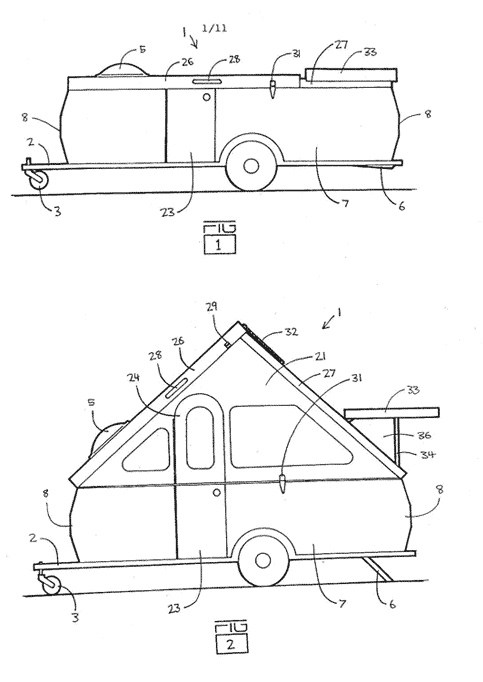
ANNEXURE A (cont)
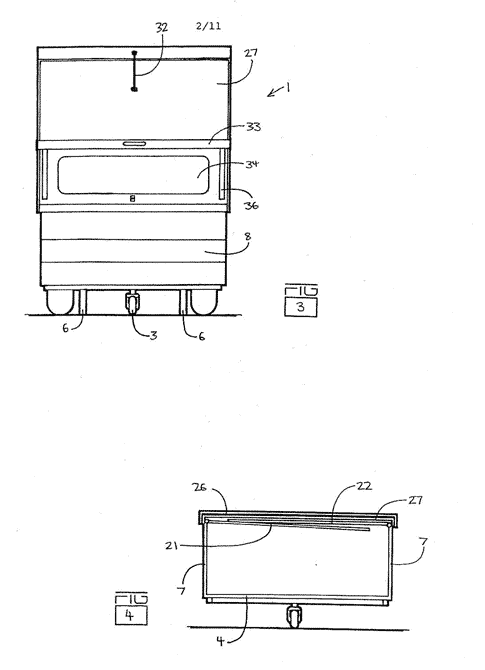
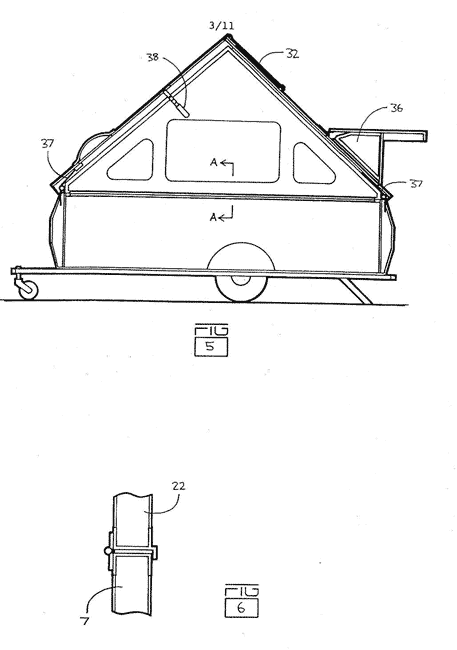
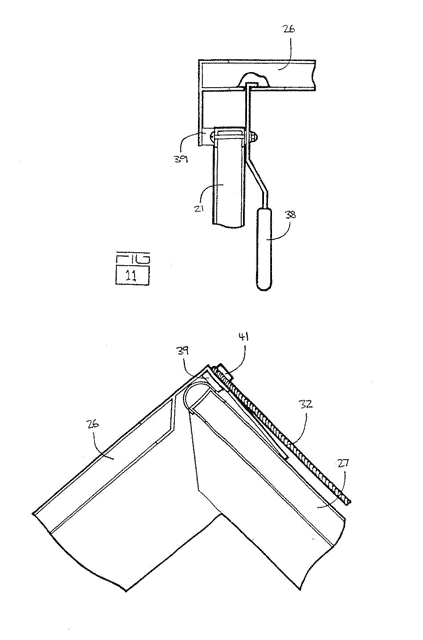
ANNEXURE B
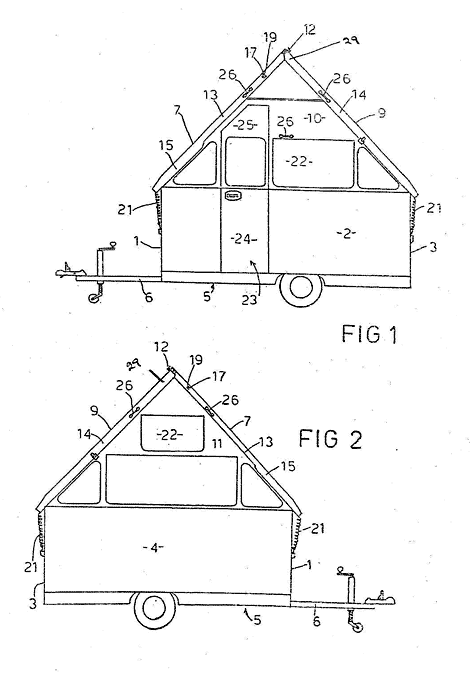
ANNEXURE B (cont)
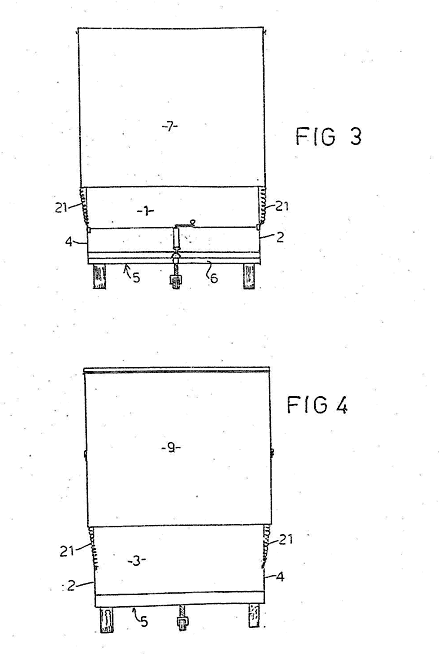
ANNEXURE B (cont)
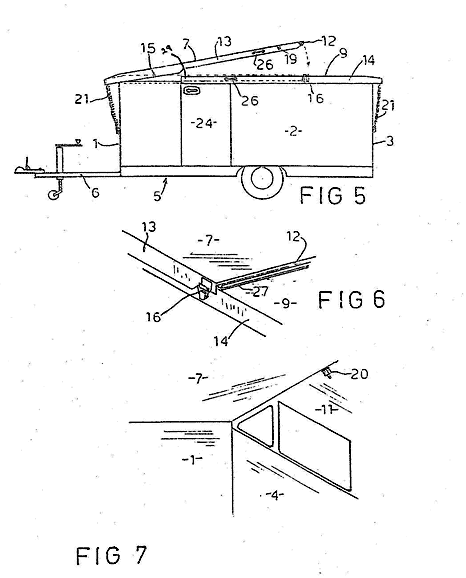
ANNEXURE C
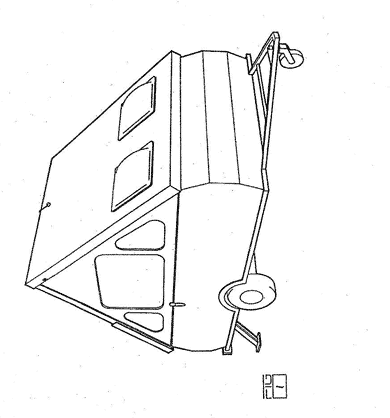
ANNEXURE C (cont)
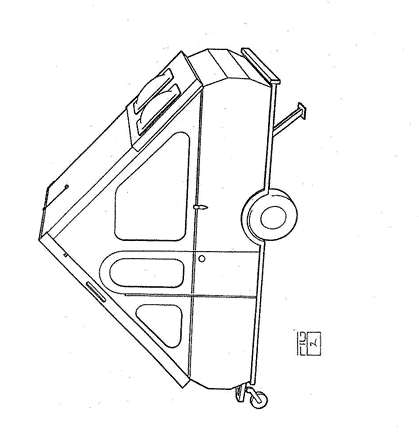
ANNEXURE D
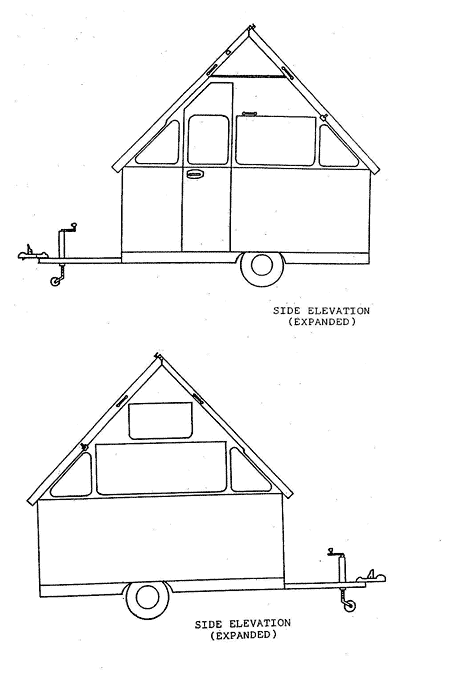
ANNEXURE D (cont)
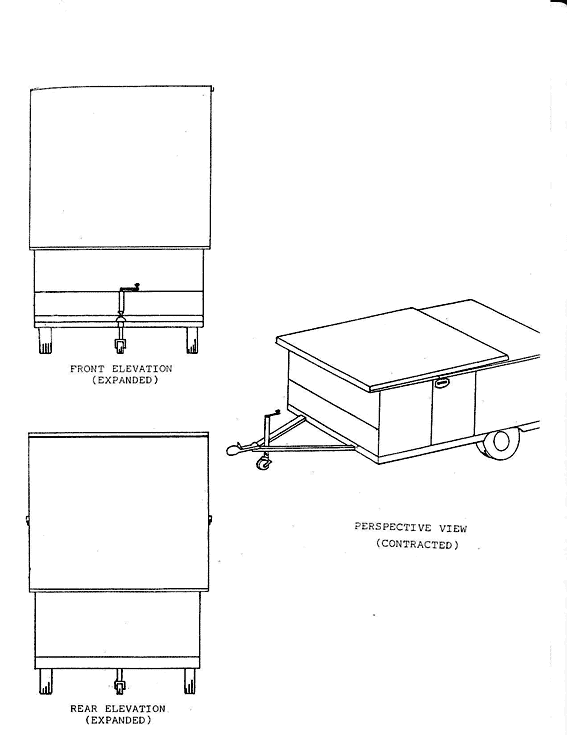
The applicant maintained the following evidentiary objections:
(a) The evidence of Associate Professor Field and Mr Page should be rejected or qualified for the various reasons set out in the applicant’s objections to evidence, oral submissions of 5 August 2004 and closing submissions of 16 September 2004.
(b) Jayco is Australia’s largest caravan marker. It presently does not make campervans. Its managing director, Mr Ryan, told Mr Funder at a recent function that Jayco ‘had purchased Camoflag, had purchased Chalet’. Mr Page is a Jayco dealer and for the last 21 years the only new products sold by his business have been Jayco products. The business in which Mr Gee works is indirectly owned by Jayco through the shareholdings of Mr Ryan. Mr Hanson had been in correspondence with Jayco about rights to Chalet campers and trade marks.
The applicant argues that if Jayco was, in fact, moving into an A’Van style product Mr Page, Mr Gee and Mr Hanson would have in interest in the outcome of the proceedings and that any remaining evidence by them against the applicant after cross-examination may need to be qualified on this basis.
Ruling: I have overruled the objection to the whole of Associate Professor Field’s evidence and to the whole of Mr Page’s evidence in the reasons for judgment. It can, however, be noted the objections have been taken into account when assessing what weight is to be given to the evidence of each of those witnesses. The ‘objection’ to Mr Gee’s evidence, Mr Hanson’s evidence and Mr Funder’s evidence goes only to weight, not admissibility, and it has been noted.
Specific rulings in relation to the applicant’s other objections to evidence set out in a document dated 19 July 2004 are dealt with immediately below.
Exhibit E - rulings on applicant’s objections to respondent’s affidavits
Affidavit of Bruce William Field, sworn 9 December 2002
|
Whole |
In the reasons I have overruled this objection as to competence and relevance. |
|
|
Para 9 |
In the reasons I have overruled the objection based on conclusions reached and indicated Associate Professor Field was able to give evidence of common general knowledge. |
|
|
Para 12 (parts thereof) – first objection |
In the reasons I have overruled the objection to competence. I also overrule the objections based on hearsay, speculation and relevance. Associate Professor Field is qualified as an expert in the field. |
|
|
Para 12 – second objection |
Overruled. |
|
|
Annexure B |
Overruled. Any difficulties with the foundation of the evidence are matters going to weight. |
|
|
Affidavit of Bruce William Field sworn 3 March 2004 |
||
|
Whole |
Overruled; see reasons. |
|
|
Para 8 |
Overruled. Any difficulties with the foundation of the evidence are matters going to weight. |
|
|
Para 9 |
Overruled. Any difficulties with the foundation of the evidence are matters going to weight. |
|
|
Paras 10-20 |
Overruled; the objection is not a proper objection to admissibility; the witness is able to give admissible evidence on features of the combination. |
|
|
Para 14 |
Overruled; consistently with the overruling of cognate objections. |
|
|
Para 16 |
Upheld. |
|
|
Para 18 |
Overruled; objection goes to weight. |
|
|
Para 19 |
Upheld. |
|
|
Para 20 |
Upheld. |
|
|
Affidavit of Trevor George Page sworn 4 March 2004 |
||
|
Para 11 – two objections |
Overruled; the evidence is based on Mr Page’s 35 years of experience in the caravan industry which enable him to give the evidence from a proper basis; in any event any difficulties with the foundation of the evidence are matters going to weight only. |
|
|
Para 14 |
Overruled. |
|
|
Para 15 |
Overruled. |
|
|
Paras 17–27 |
Overruled; the witness’s experience in the field established a proper foundation for giving the evidence objected to and the evidence is relevant. |
|
|
Para 17 |
Overruled. |
|
|
Para 18 |
Overruled. |
|
|
Para 19 |
Overruled. |
|
|
Para 23 |
Overruled; the witness has established a proper foundation for giving the evidence. |
|
|
Para 25 |
Overruled; consistently with rulings in respect of cognate objections. |
|
|
Para 28 |
Overruled. |
|
|
Para 29 |
Overruled; in any event any difficulties in respect of the foundation of the evidence go to matters of weight. |
|
|
Para 31 |
Overruled for the same reason as expressed immediately above. |
|
|
Para 31 |
Overruled; the witness has established a proper foundation for the giving of the evidence. |
|
|
Para 34 |
Overruled for the same reasons as expressed immediately above. |
|
|
Para 37 |
Overruled; however it can be noted this evidence has not been accepted as evidence of the fact of publication of these magazines. |
|
|
Affidavit of Ian Henry Cannon sworn 25 September 2002 |
||
|
Para 7, Annexure T |
Upheld. |
|
|
Para 8, Annexure U |
Upheld. |
|
|
Para 10, Exhibits IHC1, IHC3 and IHC4 |
Overruled; noting that the evidence does not prove the truth of any factual matters in the documents contained therein. |
|
|
Para 11, Exhibits IHC5 and IHC6 |
Overruled for the same reasons as set out immediately above. |
|
|
Affidavit of Ray Gee sworn 31 October 2002 |
||
|
Para 4 |
Overruled. |
|
|
Affidavit of Christopher Haldon Hanson sworn 15 November 2002 |
||
|
Para 4, Annexure B |
Overruled; the witness established a proper foundation for giving the evidence. |
|
|
Para 4, Annexure C |
Overruled; a proper foundation for the evidence has been established. |
|
|
Para 5, Annexures D, E and F |
Overruled; a proper foundation for the evidence has been established. |
|
|
Para 6 |
Overruled; a proper foundation for the evidence has been established. |
|
|
Para 6, Annexures G, H and I |
Overruled; noting that the documents do not prove the truth of the factual matters contained therein. |
|
|
Affidavit of James Stephen Tobin sworn 19 December 2002 |
||
|
Para 4(a) |
Overruled. |
|
|
Para 4(b), Exhibit JST3 – two objections |
Overruled first objection; second objection upheld. |
|
|
Para 7, Exhibit JST5 |
Overruled; noting that the objection goes to matters of weight. |
|
|
Affidavit of James Stephen Tobin sworn 20 February 2003 |
||
|
Para 3, Exhibit JST6 |
Objection noted inasmuch as it goes to weight, not admissibility. |
|
|
Para 8, Exhibit JST9 |
Objection noted inasmuch as it goes to weight, not admissibility. |
|
|
Para 9 |
Upheld. |
|
|
Affidavit of James Stephen Tobin sworn 5 March 2003 |
||
|
Para 2, Exhibit JST10 |
Objection noted as it goes to weight only, not admissibility. |
|
|
Affidavit of James Stephen Tobin sworn 27 March 2003 |
||
|
Para 2, Exhibits JST13 and JST14 |
Objection noted as it goes to weight only, not admissibility. |
|
|
Affidavit of James Stephen Tobin sworn 28 May 2003 |
||
|
Para 4 |
Upheld. |
|
|
Para 5 |
Objection noted as it goes to weight only, not admissibility. |
|
|
Para 14 |
Upheld. |
|
|
Affidavit of Anthony John Fowler Ward sworn 11 March 2004 |
||
|
Whole |
Overruled as to relevance. |
|
|
Affidavit of Anthony Josef Pietras sworn 26 April 2004 |
||
|
Whole |
Overruled as to relevance and hindsight which goes to weight. |
|
The respondent maintained the following evidentiary objections:
(a) Affidavit of Peter Kingsley Bayly dated 25/11/02: para 7.4-7.12 – relevant; exhibit ‘PKB7’ – hearsay, relevance.
(b) Affidavit of Robert Charles Funder dated 29/12/03: para 103 – irrelevant commentary.
(c) Affidavit of Thomas Swinburne dated 18 March 2003: the whole affidavit – relevance; para 9 – hearsay; para 10, second sentence – hearsay; para 11, second and third sentences – hearsay; para 12, second sentence and exhibit ‘THS2’ – hearsay; para 12 – non-expert opinion.
(d) Affidavit of Jeffrey Van Baardwyk dated 6 February 2003: para 14, second sentence – hearsay, belief based on hearsay.
(e) Oral evidence of Jeffrey Van Baardwyk – the respondent says he was deliberately obstructive when he thought that frank answers to the questions put to him would not be in the applicant’s interests. For example, his refusal to accept the simple proposition put to him at T92 L7 in light of the evidence given to him immediately prior at T91 L25, his reluctance to agree that claim 1 of the patent in suit describes a campervan at T95, his extraordinary assertion at T96 L10 that he probably wouldn’t have look at the patent for 10 years and his assertion at T125 that he had never used a computer.
Ruling: I rule on the objections above as follows:
(a) Overruled, except for the objection to Exhibit PKB7, which is upheld.
(b) Upholds.
(c) Overruled; except for the objection to para 12, which is upheld.
(d) Upheld.
(e) Overruled.


