

FEDERAL COURT OF AUSTRALIA
Nine Films & Television Pty Ltd v Ninox Television Limited [2005] FCA 1404
INTELLECTUAL PROPERTY – copyright – application for declaration of groundless threats of copyright infringement and other relief – cross-claim for declaration of infringement of copyright – respondents are the New Zealand producers and broadcasters of the television program, Dream Home – first applicant obtained license to produce and broadcast Dream Home in Australia – applicants broadcast one series of Dream Home but declined an option for a second series – applicants developed a concept for a new program, The Block, andproduced and broadcast two series of this program – first and third respondents made threats against Nine alleging infringement of copyright in Dream Home by the production and broadcast of The Block – whether the applicants copied the Dream Home format – whether the format of The Block involves a reproduction of a substantial part of the format of Dream Home
TRADE PRACTICES – misleading and deceptive conduct – claim that first and third respondents had misrepresented that Nine had infringed copyright in the Dream Home format
Copyright Act 1968 (Cth) ss 115(4), 202
Trade Practices Act 1974 (Cth) ss 52, 75B
IPC Media Ltd v Highbury-Leisure and Publishing Ltd [2005] FSR 20 cited
Telstra Corporation Ltd v Royal & Sun Alliance Insurance Ltd (2003) 57 IPR 453 cited
Glyn v Weston Feature Film Co [1916] 1 Ch 261 referred to
Avel v Multicoin Amusements Pty Limited (1990) 171 CLR 88 followed
S W Hart & Co Pty Limited v Edwards Hot Water Systems (1980) 30 ALR 657 followed
Bagge v Miller [1917-1923] MacG Cop Cas 179 cited
Kelly v Cinema Houses, Ltd [1928-35] MacG Cop Cas 362 cited
Dagnall v British & Dominions Film Corporation Ltd [1928-35] MacG Cop Cas 391 cited
Poznanski v London Film Production Ltd [1936–45] MacG Cop Cas 107 cited
Nichols v Universal Pictures Corporation (1931) 45 F 2d 119 discussed
Telmak Teleproducts Australia Pty Limited v Bond International Pty Limited (1985) 66 ALR 118 cited
Green v Broadcasting Corporation of New Zealand [1989] 2 All ER 1056 referred to
Zeccola v Universal City Studios Inc (1982) 46 ALR 189 discussed
Tate v Fullbrook [1908] 1 KB 821 referred to
Autospin (Oil Seals) Ltd v Beehive Spinning (a firm) [1995] RPC 683 referred to
Jones v Dunkel (1959) 101 CLR 298 applied
NINE FILMS & TELEVISION PTY LTD (ACN 066 040 024) AND NINE NETWORK AUSTRALIA PTY LTD (ACN 008 685 407) v NINOX TELEVISION LIMITED (FORMERLY KNOWN AS NINOX FILMS LIMITED), TELEVISION NEW ZEALAND LIMITED AND JOHN CHARLES McEWEN
NSD 1820 OF 2004
TAMBERLIN J
SYDNEY
30 SEPTEMBER 2005
|
IN THE FEDERAL COURT OF AUSTRALIA |
|
|
NEW SOUTH WALES DISTRICT REGISTRY |
NSD 1820 OF 2004 |
|
BETWEEN: |
NINE FILMS & TELEVISION PTY LTD ACN 066 040 024 FIRST APPLICANT/FIRST CROSS-RESPONDENT
NINE NETWORK AUSTRALIA PTY LTD ACN 008 685 407 SECOND APPLICANT/SECOND CROSS-RESPONDENT
|
|
AND: |
NINOX TELEVISION LIMITED (FORMERLY KNOWN AS NINOX FILMS LIMITED) FIRST RESPONDENT/CROSS- CLAIMANT
TELEVISION NEW ZEALAND LIMITED SECOND RESPONDENT
JOHN CHARLES McEWEN THIRD RESPONDENT
|
|
TAMBERLIN J |
|
|
DATE OF ORDER: |
30 SEPTEMBER 2005 |
|
WHERE MADE: |
SYDNEY |
THE COURT ORDERS THAT:
- The Application is granted in respect of the claim of unjustified threats of copyright infringement.
- The Cross-Claim is dismissed.
- The applicants are to bring in Short Minutes of Order within fourteen days to give effect to these reasons for judgment.
- The first and third respondents are to pay the costs of the applicants on the Application.
- The first respondent/cross-claimant is to pay the costs of the applicants/cross-respondents on the Cross-Claim.
- The matter is stood over for further directions to 9.30 am on Friday 4 November 2005.
Note: Settlement and entry of orders is dealt with in Order 36 of the Federal Court Rules.
|
IN THE FEDERAL COURT OF AUSTRALIA |
|
|
NEW SOUTH WALES DISTRICT REGISTRY |
NSD 1820 OF 2004 |
|
BETWEEN: |
NINE FILMS & TELEVISION PTY LTD ACN 066 040 024 FIRST APPLICANT/FIRST CROSS-RESPONDENT
NINE NETWORK AUSTRALIA PTY LTD ACN 008 685 407 SECOND APPLICANT/SECOND CROSS-RESPONDENT
|
|
AND: |
NINOX TELEVISION LIMITED (FORMERLY KNOWN AS NINOX FILMS LIMITED) FIRST RESPONDENT/CROSS-CLAIMANT
TELEVISION NEW ZEALAND LIMITED SECOND RESPONDENT
THIRD RESPONDENT
|
|
JUDGE: |
|
|
DATE: |
30 SEPTEMBER 2005 |
|
PLACE: |
SYDNEY |
REASONS FOR JUDGMENT
1 This is a claim instituted by Nine Films & Television Pty Ltd (“Nine Films”) and Nine Network Australia Pty Ltd (“Nine Network”) (collectively referred to herein as “Nine”) for relief under s 202 of the Copyright Act 1968 (Cth)(“the Act”) for unjustifiable threats of copyright infringement and s 52 of the Trade Practices Act 1974 (Cth) (“the TPA”) for misleading and deceptive conduct.
2 Nine claims that the first respondent, Ninox Television Limited (“Ninox”), and the third respondent, Mr McEwen (“McEwen”), made unjustifiable threats against it alleging copyright infringement in the format of a television program called Dream Home, which wascreated by Ninox in New Zealand in 1999 and subsequently broadcast in that country. Nine also claims that Ninox contravened s 52 of the TPA by engaging in misleading conduct in the form of misrepresentations made by Ninox to third parties that Nine had infringed copyright in the Dream Home format.
3 It is common ground that, at all relevant times, McEwen was the sole director and shareholder of Ninox and controlled and directed its activities. The applicant makes a separate claim against McEwen in the nature of a claim for liability as an accessory pursuant to s 75B of the TPA.
4 By Amended Cross-Claim filed in Court on 27 June 2005, Ninox acknowledges that it made threats against Nine arising out of its complaint that Nine had infringed copyright in the Dream Home format by producing and screening the television program The Block in 2003 and a second series of that program in 2004.
5 The second respondent, Television New Zealand Limited (“TVNZ”), is the New Zealand broadcaster of Dream Home and a joint owner of the copyright and, for this reason, is a party to the proceedings. TVNZ does not, however, allege that Nine has infringed copyright in the Dream Home format. TVNZ elected not to participate in the proceedings and indicated that it would have no objection to a declaration of non-infringement in favour of Nine.
6 These reasons concern questions of liability only. The parties have agreed that the quantum of any pecuniary relief should be decided at a later stage.
7 Section 202 of the Actrelevantly provides:
“Groundless threats of legal proceedings
(1) Where a person, by means of circulars, advertisements or otherwise, threatens a person with an action or proceeding in respect of an infringement of copyright, then, whether the person making the threats is or is not the owner of the copyright or an exclusive licensee, a person aggrieved may bring an action against the first-mentioned person and may obtain a declaration to the effect that the threats are unjustifiable, and an injunction against the continuance of the threats…
(2) The mere notification of the existence of a copyright does not constitute a threat of an action or proceeding within the meaning of this section.
…
(4) The defendant in an action under this section may apply, by way of counterclaim, for relief to which he or she would be entitled in a separate action in respect of an infringement by the plaintiff of the copyright to which the threats relate and, in any such case, the provisions of this Act with respect to an action for infringement of a copyright are, mutatis mutandis, applicable in relation to the action.”
8 Section 52 of the TPA provides:
“Misleading or deceptive conduct
(1) A corporation shall not, in trade or commerce, engage in conduct that is misleading or deceptive or is likely to mislead or deceive.
(2) Nothing in the succeeding provisions of this Division shall be taken as limiting by implication the generality of subsection (1).”
9 Section 75B of the TPA relevantly provides:
“Interpretation
(1) A reference to this Part to a person involved in a contravention … shall be read as a reference to a person who:
(a) has aided, abetted, counselled or procured the contravention;
(b) has induced, whether by threats or promises or otherwise, the contravention;
(c) has been in any way, directly or indirectly, knowingly concerned in, or party to, the contravention; or
(d) has conspired with others to effect the contravention.”
factual background
10 On 22 June 1999, Ninox and TVNZ reached agreement in relation to the production of Dream Home in New Zealand. At that time, Mr Baldock (“Baldock”) was a director and shareholder of Ninox, which had been formed by him in 1989 as a television production company. The agreement followed meetings between Baldock and representatives of TVNZ to discuss Baldock’s idea for a new home renovation program. The concept for the program, as first submitted to TVNZ on 30 April 1999, was contained in a six page document entitled Dream Home in Blenheim. On 17 June 1999, after further discussions with TVNZ, a revised written proposal was submitted to TVNZ for a television program entitled Mitre 10 Dream Home (“Dream Home”). A formal production agreement between Ninox and TVNZ was signed on 22 June 1999, when Dream Home already was in production.
11 Dream Home is part of a “genre” of television program that can loosely be described as “reality television”. “Reality television” is described in Wikipedia, an online encyclopaedia, in the following terms:
“Reality television is a genre of television programming which generally is unscripted, documenting actual events over fiction, and featuring ‘ordinary’ people over professional actors. Although the genre has been featured since the early years of television, the current explosion of popularity dates from circa 2000 (particularly from Survivor). Critics of the genre have claimed that the term is a misnomer, as many reality TV shows put the participants in exotic locations and/or abnormal situations, thus not promoting a sense of ‘reality’. According to the Nielsen Media Research, reality shows account for about 56% of all American TV shows (both in cable and broadcast), and also accounts to about 69% of all of the world TV shows (in cable and in broadcast).”
12 Dream Home, as submitted by Baldock to TVNZ in June 1999, is claimed by Ninox and McEwen to embody the following features:
“(a) a ten part series which followed the endeavours of what were described as ‘two average Kiwi families’ in a home renovation competition;
(b) two couples would in competition with each other, renovate in their own time, two old houses placed on adjacent blocks in a subdivision;
(c) the work to be carried out by the couples over the life of the series was normal home handyman work. Any structural or technical works such as plumbing or electrical would be undertaken by tradesmen;
(d) the show had to appeal primarily to young family audiences. The show targeted young families who worked but who could not save a deposit for their own home;
(e) the episodes for the program were broken down into a structure involving a first episode to establish or “set up” the series, eight episodes which filmed the contestants over each of the weekends when one room or one particular aspect of the renovation was accomplished, concluding with the tenth episode as a grand finale where the result of the contest was revealed and a winner selected;
(f) the winning family was able to keep the home which had been renovated and the losing family was given prize money allowing them to bid at auction for the house which they had renovated;
(g) the families had a limited budget, limited time, limited skill and specific tasks to undertake in the course of their renovation;
(h) the program was to have a presenter who introduced the contestants and provided weekly updates and also visited the contestants for progress reports. The presenter was to be an observer rather than taking part in the renovations.”
13 Some of these features are indicated by the Dream Home publicity document set out below.
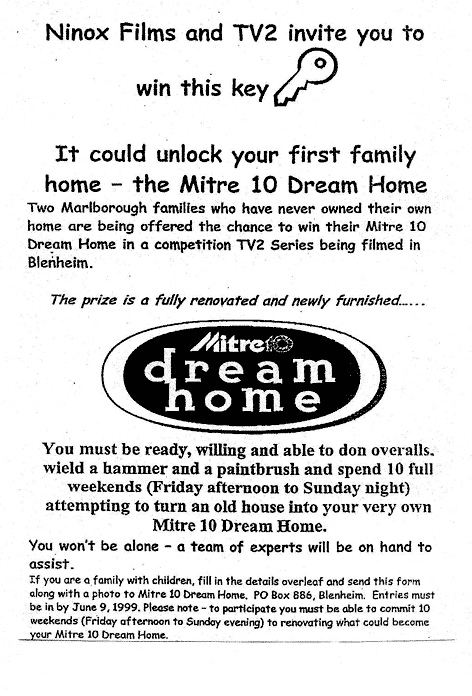
14 The production of the first series of Dream Home during 1999 was followed by the carrying out of editing and post-production work by Baldock.
15 Dream Home became one of New Zealand’s most successful television shows. There have been six series produced and broadcast in New Zealand to date. Dream Home was the highest rating program in the 18-39 age group in 2001 and was placed in the top five programs in the 25-54 age group in 2002. The sixth series of Dream Home finished in April 2005 and reached an audience share of 51% in the 18-39 age group and 47% of household shoppers.
16 By October 1999, Baldock was keen to exploit Dream Home outside New Zealand. He prepared a document entitled “Dream Home Production Bible” (“the Dream Home Bible”). Baldock reached an agreement in principle with the Becker Group Limited (“Becker”), an Australian company, to grant rights for the exploitation of Dream Home in Australia and Papua New Guinea.
17 On 26 October 1999, Mr Becker, the chief executive officer of Becker, met with Mr Stephens (“Stephens”), the head of programming for Nine, and negotiations began between Becker and Nine for an arrangement for the production and broadcast of Dream Home in Australia (“Australian Dream Home”). On 27 October 1999, the group general manager of Becker, Mr Hogg (“Hogg”), wrote to Stephens recording the fact of their meeting and requesting that he indicate as soon as possible whether Nine was interested. Stephens was given copies of episodes one and two of Dream Home in order to discuss the project with Mr Meakin (“Meakin”), who was then the head of news, current affairs and lifestyle television for Nine.
18 Nine decided to proceed with the project and appointed Mr Dwyer (“Dwyer”) as executive producer of Australian Dream Home. Barbour, who had previously worked with Dwyer on another home renovation program entitled Changing Rooms, was appointed as series producer and the production of Australian Dream Home began in the early months of 2000. Barbour, as series producer, was responsible for assisting with the selection of the location for the homes which would be renovated, purchasing both the land on which the homes were placed and the homes themselves, casting the contestants, supervising the filming of each episode and carrying out the post production work. Barbour watched several episodes of the first New Zealand series of Dream Home, whichscreened in 1999, whilst producing Australian Dream Home. He also had available, at least in part, a copy of the “Dream Home Bible”, which had been prepared by Baldock in 1999 and given to Nine by Becker.
19 Australian Dream Home was broadcast by the Nine Network between July and September 2000. It averaged in the order of 1.5 million viewers per episode across the five capital cities in Australia and won its timespot, in ratings terms, in the final episode broadcast on 12 September 2000. None of the previous episodes of Australian Dream Home had won their timeslot.
20 The production and broadcast of Australian Dream Home took place pursuant to an agreement between Becker and Nine Films, as set out in a letter dated 11 July 2000 from Nine Films to Becker. Under this agreement, Becker granted Nine the right to produce Australian Dream Home from 11 July 2000 using the Dream Home format and, in cl 6.2, an option was granted to Nine for a second series. In cl 4.2 of the agreement, Nine acknowledged that it had no interest in the copyright or other intellectual property rights in the format of Dream Home and that Ninox was the owner of the Dream Home format. Nine’s rights to produce and broadcast Australian Dream Home were limited to the territories of Australia and New Guinea. Nine was also given certain merchandising rights. By cl 7 of the agreement, Becker was restrained from being involved with any substantially similar program during the term of production of Australian Dream Home Australia and for six months thereafter without the consent of Nine.
21 By facsimile dated 6 December 2000, from Stephens to Becker, Nine exercised its option to produce a second series of Australian Dream Home.
22 Ninox thereafter produced three further series of Dream Home in New Zealand, which screened in 2000, 2001 and 2002. The series continued to be successful. Baldock continued to act as the producer of the Dream Home series in New Zealand, as an employee of Ninox.
23 Nine did not follow through on its statement to Becker in December 2000 that it intended to produce a further series of Australian Dream Home. By April 2002, Mr Hannah, a consultant to Becker, was preparing to reapproach Nine about a second series and was in touch with Meakin to arrange a meeting. This meeting took place on 14 May 2002. No clear or firm proposals by Nine emerged from these discussions.
24 On 24 May 2002, during a regular working session to discuss ideas for new programs, Barbour and Mr Cress, another Nine employee, came up with the concept of The Block. The evolving format for this program was given the preliminary title, Blockbuster. Barbour and Cress co-operated to brainstorm and formulate the format for The Block. A ‘pitch’ document was prepared within a short amount of time and was presented to Meakin for consideration on 28 May 2005.
THE NINOX CROSS CLAIM
25 The principal basis for the copyright infringement claim by Ninox is set out in the Amended Cross-Claim.
26 Ninox alleges that it holds the world-wide distribution rights for the Dream Home format and is a joint owner with TVNZ of the copyright in the Dream Home format, which is a “dramatic work” within the definition contained in s 10 of the Act.
27 Ninox states that the Dream Home format was provided to Nine by Becker, prior to 11 July 2000, in the “Dream Home Bible”.
28 The Dream Home format, as particularised by Ninox in its Cross-Claim, is said to comprise the following elements:
|
Events and Characters
|
|
Sponsor friendly |
|
2 couples |
|
Selection by public application |
|
Attempt to out-renovate each other |
|
Strict budget to work to |
|
One room completed per episode |
|
Time frames strictly enforced |
|
Completely renovate and decorate |
|
2 old relocatable houses |
|
Houses same size |
|
House same value |
|
Helped by team of experts |
|
Houses auctioned in finale |
|
Winner keeps house |
|
Second place winner keeps $20,000 |
|
Emotional elements
|
|
Pressure dealings with mess, budgets, builders |
|
Impact on relationships |
|
Tears, tantrums, trying to finish on time |
|
Human drama, anger, sadness, joy, betrayal, triumph, despair |
|
Builders do structural work when contestants at work during week |
|
Couples work on decorating outside business hours |
29 The Cross-Claim refers to the agreement between Nine Films and Becker of 11 July 2000, whereby Becker granted Nine the right to produce Dream Home in Australia from 11 July 2000 using the Dream Home format.
30 Subsequently, in early September 2000, Nine produced and broadcast Australian Dream Home in Australia using the Dream Home format. Thereafter, between June 2002 to 17 August 2003 and August 2003 to 25 July 2004, Nine made and produced two series of The Block,which was broadcast in Australia.
31 It is alleged by Ninox that, in producing The Block,Nine has reproduced the Dream Home format, or a substantial part thereof, in a material form, without the licence of Ninox or TVNZ, and has thereby infringed the copyright of those parties in the Dream Home format.
32 The primary relief sought by Ninox is an injunction restraining Nine from producing, publishing, broadcasting, distributing or licensing the television program The Block. Ninox also seeks either an account of profits from Nine or damages for infringement of copyright, including additional damages pursuant to s 115(4) of the Act.
33 In order to give a brief indication of some features of The Block,I have set out below the back cover of the DVD for the first series of The Block.
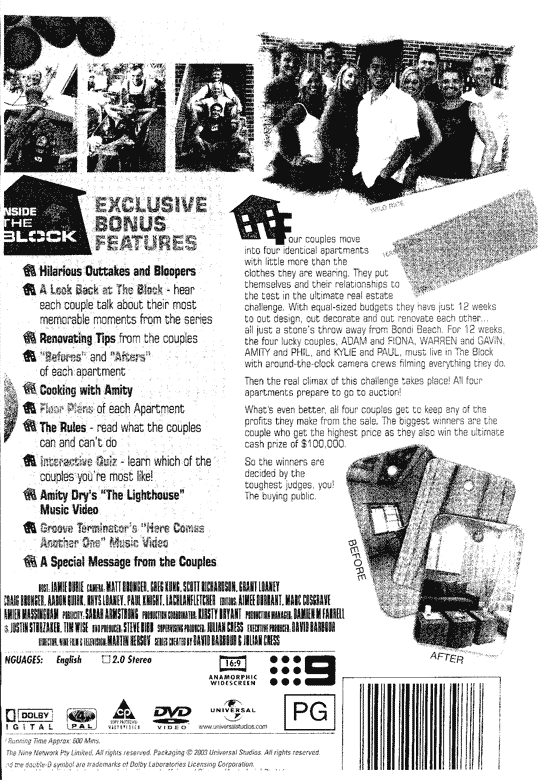
34 By way of defence, Nine denies that in producing and broadcasting The Block it copied Dream Home in any respect. It says that there is no relevant or substantive connection between the work alleged to infringe and the original copyright work because The Block was a work of independent creation. It denies that there is any substantial similarity between The Block and the original copyright work embodied in Dream Home and its format. It says that aside from a few high level generic similarities, such as the fact that both programs contain a game show element that involves renovation, there are significant differences between The Block and Dream Home. The distinguishing features of The Block are said by Nine to be:
(a) The Block is a drama show set in a renovation environment, as opposed to a renovation show with some incidental dramatic aspects deriving from time and budgetary constraints.
(b) The interaction between the competing couples, and also within couples, is the principal focus of attention.
(c) The Block is set in as “a sexy, aspirational location” (Bondi for series 1 and Manly for series 2). It is filmed in summer and features frequent footage of skimpily dressed beach-side bodies.
(d) The contestants in The Block are sexy, young couples (with no children) and one gay couple.
(e) The couples in The Block are not selected on the basis of being needy and/or do not appear to be so.
(f) The types of properties in the two programs are different. The Block involves an apartment block in which four couples reside.
(g) The four couples in The Block must reside in the apartment block for the duration of the 12 week challenge. They are not permitted to go home at the end of each day and must live in the apartment, amidst the renovating debris, and continue to go to work at their day jobs while trying to complete their renovations, both before and after work and on the weekends.
(h) The four couples in The Block are forced, by the circumstances imposed by the structure of the program, to interact with other couples in the form of body corporate meetings, shared electrical power crises, reward challenges and the like, and they are portrayed as competitors over whom an advantage is sought to be obtained.
(i) The couples are not provided with professional assistance by the producers in order to do their renovations. Any tradesmen that they engage for renovating their rooms must be sourced by them and paid for from their limited budget.
(j) The couples do not wear team colours and are not identified by team names.
(k) The couples are not assisted by their friends or families in undertaking the renovations.
(l) Each individual couple decide which rooms to renovate and in which order.
(m) A prize is awarded to the couple that wins the periodic contest as to the which of the rooms that has been delivered adds the most value to the property. These prizes were, at times, in the form of cash, which could be added to the couple’s budget and thus allow them to gain an advantage over the other couples.
(n) Completed rooms become simultaneously “open for inspection” after delivery and competing couples inspect the other couples’ rooms and critique them, typically adversely, for the camera.
(o) The individual rooms of each competing couple are judged by a property expert (John McGrath) on the basis of which room adds the most value to the apartment.
(p) The final result and look of each room that is renovated comes as a surprise to the viewer.
(q) The winner does not get to keep the apartment. Rather, the winning couple gets a cash prize of $100,000 and contestants get to keep any money for which the apartments are sold above their reserve price at auction in the final episode.
(r) The Block involves transparency in the judging of the final prize, in that the winner is determined by public auction.
(s) The Block includes Survivor-like rewards challenges.
(t) The couples in The Block do not have periodic meetings with a bank manager to discuss the possibility of obtaining a home loan at the conclusion of the program.
(u) The couples must engage their own real estate agents for the marketing and selling of their apartments.
(v) All four apartments are sold at auction in The Block.
(w) The couples in The Block do not bid on the four apartments at auction.
(x) The Block involves frequent use of vibrant, “boppy” music, including the music from the song “Here Comes Another One” by Groove Terminator.
(y) The ‘look and feel’ of The Block is the result of higher production values than Dream Home: edgier, more dramatic editing; a brighter and more hard-edged look; and camera techniques (such as swooping aerial shots of beachside locations).
35 Nine contends that these features serve to distinguish The Block and Dream Home. Nine relies on the differences in structure and elements of the two programs, the rules of the programs, the overall tone, quality, sound and appearance and their distinctive ‘look and feel’. Nine says that perhaps the most important difference is in the degree and form of the dramas and tensions which develop in The Block and which are not present in Dream Home in the same form or to the same level of intensity. These dramas and tensions are said to be important features that the structure of The Block was designed to achieve.
PRINCIPLES
36 To determine whether there has been an infringement of copyright by reproduction of a substantial part of the Dream Home format and production, it is necessary to consider the whole context in which the claimed similarities and differences arise and in which the characters and plot develop. Television series often depend for their audience on the gradual development of character and plot over time, so that the audience becomes involved in the personalities, places, information and plot. To look at one or more episodes in isolation may result in a failure to appreciate the significance of individual scenes or events. Thus, a program may appear attractive to a devoted watcher, whereas a person who simply watches one episode may speculate as to the strange tastes of the dedicated aficionado who has traced the development of character and plot. Therefore, in determining whether copyright has been infringed, it is necessary to consider the whole of the series and the importance of the relevant parts in that context. In this case, I have subjected myself to viewing and hearing substantially all of the various productions tendered in evidence and I have weighed the similarities and differences between the programs in the light of each of the series as a whole: see IPC Media Ltd v Highbury-Leisure and Publishing Ltd [2005] FSR 20 at [11]; Telstra Corporation Ltd v Royal & Sun Alliance Insurance Ltd (2003) 57 IPR 453 at [40]-[48].
37 It is well-settled that there is no infringement where a defendant independently produces the challenged work without copying or where there is no substantial reproduction of, or similarity to, the material in which the concepts are embodied.
38 Even where it is established that some features are taken from another’s work by a respondent, there may be no infringement if the respondent can show that it has expended such mental labour upon the taken material, and subjected it to such revision and alterations, as to produce an original result. In Glyn v Weston Feature Film Co [1916] 1 Ch 261 at 269, Younger J, in a much cited passage, said:
“… if, in considering whether such a literary work as a novel has been infringed by such a thing as a cinematograph film, the true enquiry is, …whether, keeping in view the idea and general effect created by a perusal of the novel, such a degree of similarity is attained as would lead one to say that the film is a reproduction of incidents described in the novel or of a substantial part thereof, then in my opinion the answer in the present case must be in the negative.”
39 In the present case, the onus of persuading the Court that there has been an infringement is on Ninox, as the threatening party: see Avel v Multicoin Amusements Pty Limited (1990) 171 CLR 88 at 95 per Mason CJ, Deane and Gaudron JJ, at 105 per Dawson J, at 120 per McHugh J. A wrong but bona fide belief that conduct is an infringement is not a defence: see S W Hart & Co Pty Limited v Edwards Hot Water Systems (1980) 30 ALR 657 at 661 per Lavan SPJ.
40 One question to be addressed is whether any of the episodes use a substantial part of the incidents, plot, images or sounds presented in Dream Home or colourable imitations thereof. In order to succeed, Ninox must show that the combination or series of dramatic events in The Block reproduce in a substantial way any of the situations or incidents in the Dream Home format or production: see Bagge v Miller [1917-1923] MacG Cop Cas 179 at 186-188; Kelly v Cinema Houses, Ltd [1928-35] MacG Cop Cas 362 at 370; Dagnall v British & Dominions Film Corporation Ltd [1928-35] MacG Cop Cas 391 at 394-5; Poznanski v London Film Production Ltd [1936–45] MacG Cop Cas 107 at 109.
41 A practical approach to consideration of infringement in a case such as the present was given by Learned Hand J (with whom his brother Judges Swan and Augustus Hand JJ agreed) in Nichols v Universal Pictures Corporation (1931) 45 F 2d 119. That case concerned two dramatic works, namely, Abie’s Irish Rose, a play authored by the plaintiff, and The Cohens and The Kellys, a motion picture produced by the defendant. Each of these works, in broad outline, involved religious, cultural and familial conflicts arising out of a proposal by one of the children in the family to marry out of a particular religion. The fathers in both cases were portrayed as stereotypically devout and orthodox believers in the Christian and Jewish faiths respectively. At 121, Learned Hand J said, when referring to levels of comparison between the works:
“Upon any work, and especially upon a play, a great number of patterns of increasing generality will fit equally well, as more and more of the incident is left out. The last may perhaps be no more than the most general statement of what the play is about, and at times might consist only of its title; but there is a point in this series of abstractions where they are no longer protected, since otherwise the playwright could prevent the use of his ‘ideas’, to which, apart from their expression, his property is never extended. …
Nobody has ever been able to fix that boundary and nobody ever can. In some cases the question has been treated as though it were analogous to lifting a portion out of the copyrighted work … but the analogy is not a good one, because, though the skeleton is a part of the body, it pervades and supports the whole. In such cases we are rather concerned with the line between expression and what is expressed. As respects plays, the controversy chiefly centres upon the characters and sequence of incident, these being the substance.”
Learned Hand J continued at 122:
“Whatever may be the difficulties … we have no question on which side of the line this case falls. A comedy based upon conflicts between Irish and Jews, into which the marriage of their children enters, is no more susceptible of copyright than the outline of Romeo and Juliet.”
42 As Learned Hand J points out, the outcome in such cases frequently depends on the level of generality at which the works are approached. The coincidence that two works involve a Romeo and Juliet theme with a number of stock, stereotyped characters is not sufficient to establish infringement. Speaking generally, there is no monopoly on the backgrounds to particular works or generalised lines of development. The difficulty is to select the appropriate level of detail at which the question of infringement of copyright is addressed.
43 In the present case, of course, there is no suggestion of identical reproduction by copying. That is, it cannot be said that any one episode or scene of The Block reproduces images and sounds that appear in any episode of Dream Home: see Telmak Teleproducts Australia Pty Limited v Bond International Pty Limited (1985) 66 ALR 118.
44 The concept of “format” in relation to a television program was considered by the Privy Council in Green v Broadcasting Corporation of New Zealand [1989] 2 All ER 1056, where their Lordships said at 1058:
“It is stretching the original use of the word ‘format’ a long way to use it metaphorically to describe the features of a television series such as a talent, quiz or game show which is presented in a particular way, with repeated but unconnected use of set phrases and with the aid of particular accessories. Alternative terms suggested in the course of argument were ’structure’ or ‘package’. This difficulty in finding an appropriate term to describe the nature of the ‘work’ in which the copyright subsists reflects the difficulty of the concept that a number of allegedly distinctive features of a television series can be isolated from the changing material presented in each separate performance (the acts of the performers in the talent show, the questions and answers in the quiz show etc) and identified as an additional ‘dramatic work’ …
The protection which copyright gives creates a monopoly and there must be certainty in the subject-matter of such monopoly in order to avoid injustice to the rest of the world …. The subject matter of the copyright claimed for the ‘dramatic format’ of ‘Opportunity Knocks’ is conspicuously lacking in certainty. Moreover, it seems to their Lordships that a dramatic work must have sufficient unity to be capable of performance and that the features claimed as constituting the ‘format’ of a television show, being unrelated to each other except as accessories to be used in the presentation of some other dramatic or musical performance, lacked that essential characteristic.”
45 Another helpful case is Zeccola v Universal City Studios Inc (1982) 46 ALR 189. In that case, an application was made for interlocutory relief in respect of allegations of infringement by the appellants’ film, Great White, of the respondent’s copyright in a novel, screenplay and film, each entitled Jaws. The appellants’ film was made by Italian filmmakers in 1980 under the name La Ultimo Squalo (The Last Shark). The respondent’s film is the well-known film directed by Steven Spielberg, an American producer and director. After noting the submission of counsel for the appellants that Jaws and Great White are genre films based upon the idea of a savage monster menacing a community and a killer shark terrorising human beings, and the submission that neither film was entitled to protection because there was no copyright in a general idea, Lockhart and Fitzgerald JJ, in a joint judgment, said at 192:
“In general, there is no copyright in the central idea or theme of a story or play, however original it may be; copyright subsists in the combination of situations, events and scenes which constitute the particular working out or expression of the idea or theme. If these are totally different the taking of the idea or theme does not constitute an infringement of copyright.
Of necessity certain events, incidents or characters are found in many books and plays. Originality, when dealing with incidents and characters familiar in life or fiction, lies in the association, grouping and arrangement of those incidents and characters in such a manner that presents a new concept or a novel arrangement of those events and characters. We accept that where a story is written based on various incidents which, in themselves, are commonplace, a claim for copyright must be confined closely to the story which has been composed by the author. Another author who materially varies the incidents and characters and materially changes the story is not an infringer of the copyright. If a literary or dramatic work is not wholly original there is no copyright in the unoriginal part so as to prevent its use. Additional factors may fall for consideration where the alleged infringement is by cinematograph film.”
46 At 193, their Honours observed that the primary Judge had correctly recognised that the two questions involved in the resolution of the major issue were: first, the degree of objective similarity between the appellants’ film and the respondent’s novel and screenplay; and, secondly, whether copying was established. The latter question involves a consideration of the inspiration for, and derivation of, the format and production of the alleged infringing film or dramatic work.
47 In Tate v Fullbrook [1908] 1 KB 821, Vaughan Williams LJ, emphasising contextual considerations, said at 829-830:
“I think that one ought to take the words of the first piece as presented to the public plus all their dramatic surroundings, and compare them with the words of the other piece, which is said to be a piracy, not taking the latter words by themselves only, but with the stage situations and scenic effects by which they were accompanied, and to ask oneself, taking the whole of each piece together, whether there is such a similarity between the plaintiff’s play as a whole and the defendant’s play as a whole that the latter is an infringement of the proprietary right of representation vested in the plaintiff. … my view of the true construction of the Act is that the subject matter, the right of the author … which is intended to be thereby protected, is something which is capable of being printed and published.” (Emphasis added)
48 In resolving the issue of copyright infringement in the present case, it is also important to take into account that copyright in a written story gives protection not simply to the words used but can take into account the expression of themes and ideas embedded in the production if they are sufficiently substantial. Copyright is directed to protect the work and skill embodied in the expression of an idea. As Laddie J points in Autospin (Oil Seals) Ltd v Beehive Spinning (a firm) [1995] RPC 683 at 697:
“… this may well include the combination of the main themes, incidents and characters in the story. It may be said, therefore, that copyright protects that combination. Both the 1956 and 1988 Acts require the relevant skill and effort to be fixed in some material form. Frequently this takes the form of words on a page. But it is not the form of fixation which is protected, it is the relevant skill and effort involved in creating the literary work”
copying
49 The genesis of the format that led to the production of The Block is given in detail in the affidavits filed by Barbour and Cress and the exhibits to these affidavits.
50 At all relevant times, Barbour and Cress were experienced television executives at Nine. From about June or July to September 2001, Barbour and Cress worked together on Rescue Me, a pilot that went to air as occasional segments on A Current Affair. From about January 2002, the pair worked together on a renovation infotainment program produced and broadcast by Nine entitled Changing Rooms. As the name indicates, “infotainment” programs convey information in a way designed to attract an audience by entertaining them. In the present case, I consider that the emphasis in The Block, when compared with Dream Home,is far more on entertainment than information.
51 Prior to the production of The Block in 2002 and 2003, Barbour and Cress, along with other members of the senior production staff at Nine, were involved in pitching new program proposals to the program executives at Nine. Cress says that the process of pitching a new program involves coming up with a concept for a new program and attending meetings to describe the program format and structure, the ‘look and feel’ of the program and the way in which it would develop over the course of the series in order to persuade the program executives to produce the program. This process requires the brainstorming of concepts and the shaping of a proposal into a form where it can be pitched to the executives at Nine.
52 Barbour said that as from 2000 onwards he did not think that Nine would make a second series of Dream Home. This was his continuing expectation thereafter. The first series did not suit its timeslot and it had not been an “outrageous success”. In May/June 2002, Barbour did not consider that there was any urgency in relation to the production of Blockbuster as a consequence of anything concerning the Dream Home program or the production of a second series.
53 Barbour said that he did not set out to make an episodic show like Dream Home in May/June 2002. When asked in cross examination, Barbour strongly denied that his intention in May/June 2002 was, in any way, to dislodge the possibility of Nine broadcasting a second series of Australian Dream Home in the important 6.30 pm Sunday timeslot. He also denied in cross-examination that he had appropriated the best features of Dream Home but had failed to disclose this to Cress in their discussions regarding the development of the format for The Block.
54 There is nothing in the evidence to support the submission by counsel for Ninox that Barbour’s denials should be rejected. I accept that Cress and Barbour wanted to quickly develop the format of the new program, then known as Blockbuster,as a consequence of concentrated brain-storming sessions in which they engaged, and I do not consider that the speed with which the program was formulated was due, so far as they were concerned, to any pressure caused by an impending possible further production of Australian Dream Home. I also accept that Blockbuster was not created to “fill a hole” in the television market caused by the decision of Nine not to produce a second series of Australian Dream Home, as renovation shows were both popular and fashionable at that time.
55 During their work together on Changing Rooms, Barbour and Cress also collaborated to develop and pitch new programs. On 24 May 2002, Barbour and Cress began to develop and formulate the concept for The Block. They exchanged ideas and discussed aspects of programs that they considered had been successful, such as Melrose Place, Big Brother, Sylvania Waters and Changing Rooms. Other programs taken into account on the evidence were Survivor, Renovation Rescue and Location, Location. The evidence of Barbour and Cress was that they considered that, along with other features, these programs involved attractive young characters and their interactions, human drama with arguments between protagonists and situations involving renovating and tensions arising from the imposition of time limits and a budget, together with game playing formulation of alliances such as in “Survivor” and tensions being created during auctions. The emphasis in these programs was seen to be on the interaction and dramatic tension between the individuals, including conflicts of personalities and positions, against a variety of backgrounds. In the case of The Block, the background was renovation.
56 A note relating to the discussions between Barbour and Cress on 24 May 2002 is in evidence and includes the following:
“Combination of ‘Living with the Builders’, ‘Location, Location’, ‘Big Brother’, ‘Survivor’ and ‘Sylvania Waters’. What happens when you combine the best elements of each??”
57 In cross-examination, Barbour said that Dream Home only came up during his discussions with Cress on 24 May 2002 in terms of “things of what not to do”. Barbour said that there were a lot of programs that he didn’t consider and Dream Home didn’t enter his thought process at the time as it wasn’t a strong program to work off.
58 Barbour and Cress prepared a glossy A3 pitch document, which outlined key elements of Blockbuster including a set of rules, and worked out a basic version of a format for presentation to Nine executives. Barbour and Cress presented the proposal to Meakin, who reacted positively to the proposal. They then prepared a budget and the program was approved for production by about mid-June. A property in Bondi was used for series one of The Block. This property was purchased in late June or July 2002 for $1.195 million. The second series involved a property in Manly.
59 The program concept that Barbour and Cress developed as Blockbuster was, according to them, inspired by a few highly successful programs of the past. Nine asserts that The Block was quite different from other programs that had gone before it. It was seen by Barbour to be a pioneering program in the sense that it was a cross-genre program combining elements of drama, reality television, and life-style or renovation programs, as well as elements of a game show format. Nine’s case is that The Block was an original and pioneering concept and that this led to its enormous success, which was manifested in the form of unparalleled ratings, great public interest, and Nine’s subsequent ability to license it overseas. Barbour and Cress deny any suggestion that, in developing the concept for The Block,they copied Dream Home in any way and they say that the production was the result of original creative efforts on their part.
60 In cross-examination, Cress said that he had not seen an episode of Dream Home at the time he created The Block and stated that he had never seen the “Dream Home Bible”. The evidence of Cress was not diminished by cross-examination.
61 The contemporaneous working documents of Barbour and Cress are supportive of The Block being the result of independent creative efforts. As noted, there are references to several other programs being models for the format and production of a new program, comprising those that I have mentioned above. In their evidence, Barbour and Cress explain why and how those programs were used as reference points. The more detailed document created by Barbour and Cress after 24 May 2002, which came into existence on about 28 May 2002, contained references to the type of dramatic show that Barbour and Cress wanted to create and the rules and structure of the program then contemplated. Aside from references to the other dramatic sources that Barbour and Cress regarded as useful, such as Melrose Place, Big Brother and Survivor, there are references in that documents to fights, tantrums, joy and despair, competition, manipulation, deal-making and back-stabbing, four attractive and determined young couples who will watch the fireworks explode. These features reflect the emphasis on dramatic inter-couple tensions as the main theme rather than the detailed practical steps of the renovation process.
62 In the course of the cross-examination of Barbour and Cress, counsel for Ninox closely explored the reason why there was no reference in the development notes or pitch meetings for The Block to programs such as Dream Home,having regard to the fact that it was an obvious reference point because it was a competitive renovation program. This point assumed considerable significance in the case as presented for Ninox. Ninox saw a central question as being the Court’s assessment of whether Barbour was consciously or unconsciously drawing on his unrivalled knowledge in Australia of Dream Home and all that it entailed, in the formulation and production of The Block.
63 Ninox accepts that Cress gave his evidence honestly but stresses the fact that Cress knew very little about Dream Home. Ninox refers to the evidence that when the ‘pitch’ document for Blockbuster was composed in late May 2002 for the purpose of presentation to Meakin, it was Cress who raised Dream Home as a suggestion, for comparative purposes, which was then immediately dismissed by Barbour. It is submitted for Ninox that this is highly significant because it indicates that the absence of any reference to Dream Home in the ‘pitch’ document was brought about by Barbour’s refusal to continue the discussion in respect of Dream Home, which,in turn, evidences an intention on the part of Barbour to use Dream Home as a source and to conceal that fact. This line of argument attributes to Barbour a degree of foresight and deviousness that is not supported by the evidence. The handwritten notes taken by Cress on 24 May 2002, which do not refer to Dream Home, are, in my view, supportive of the conclusion that Dream Home was regarded as irrelevant by Barbour and Cress. The notes do not give rise to any reasonable inference that reference to Dream Home was deliberately suppressed by Barbour.
64 In cross-examination, Barbour agreed that, as at 24 May 2002, he thought that the structure of Blockbuster would include some introductions, some quotes, choice of builders and a series of episodes in which renovation would take place, culminating in the completion of the whole of the apartments and the commencement of the marketing of the apartments.
65 In written submissions, counsel for Ninox refers to the evidence of Barbour and stresses the apparent haste with which the ‘pitch’ document was prepared for presentation to Meakin after 24 May 2002. The evidence indicates that Barbour and Cress began formulating the format of Blockbuster on 24 May 2002 and then prepared a ‘pitch’ document, which they provided to Meakin on 28 May 2002. Ninox says that the most likely explanation for this haste was that Barbour knew that Nine was considering running a second series of Australian Dream Home at 6:30 pm on Sunday, which is a timeslot of prime importance, and wanted to formulate a program based on Dream Home which would have the effect of undermining the Ninox’s efforts to negotiate a further series of Australian Dream Home with Nine.
66 Counsel for Ninox submits that the explanation of Barbour for not referring to Dream Home as a source of inspiration in the notes and documents relating to the development of The Block was not credible, especially as Barbour was the person at Nine who knew the most about Dream Home. Counsel says that absence of any reference to Dream Home strongly indicates that Barbour wanted to disguise the reality that Dream Home was, in fact, a major source of inspiration and the ‘pitch’ document was calculated to conceal Barbour’s true intention, namely, to make a program which was a thinly veiled copy of Dream Home with all that program’s central characteristics, from Cress and Meakin. It is said by Ninox that Barbour accepted, after initial evasion, that Dream Home was the only series that, prior to the development of Blockbuster,had followed the efforts of contestants to renovate a complete property with a winner at the end of the series. However, in my view, this evidence, having regard to its generality, does not provide any basis for a finding of concealment by Barbour or a finding that he derived his inspiration from Dream Home in any way.
67 In addition, it is said by counsel for Ninox that, with the exception of the requirement that the contestants should live on the premises throughout the renovations, The Block reproduced the structure of Dream Home as it was understood by Barbour in May 2002. Ninox submits that the evidence of Barbour in cross-examination in seeking to draw a number of distinctions between the two programs was unconvincing. The submission was made that I should reject the evidence of Barbour as to whether any use was made of the Dream Home format in preparing the format and production of The Block. I do not accept that submission.
68 When Barbour was asked in cross-examination to explain why Dream Home was not included as one of the stated programs for consideration when he and Cress formulated The Block, the following exchange occurred:
“Q: How could you conceivably have not included Dream Home which was a renovation show with the closest structure to what you were proposing.
A: Well, there’s a lot of shows that I didn’t consider for the same – you know, for whatever reason, and that being that - you know, it didn’t enter my thought process at the time. It wasn’t a strong program to work off.
…
As I’ve stated in my affidavit, the only conversation I had with Jules [Cress] about Dream Home was that the idea of a clear winner/loser was not attractive; the idea of having experts was not attractive; and the idea of having team colours to depict teams was not attractive.
….
Q: And it’s no surprise, I would suggest to you, that you did not mention to Mr Cress Dream Home in this meeting, because anything that was linked with Dream Home could not succeed in outflanking it for the 6.30 timeslot that was open.
…
A: That’s complete rubbish.”
69 Both Cress and Barbour impressed me as frank and reliable witnesses and I accept their evidence in all material respects. In particular, I accept the statement of Cress in cross-examination that he had not watched any episodes of Dream Home by early 2002 and knew only a little about the program, and also the evidence of Barbour that he did not raise Dream Home as a source of comparison or inspiration for Blockbuster with Cress because he believed that it was not a strong program to work off. I also accept Barbour’s evidence in chief and in cross-examination as to the differences that he perceived in May 2002 between the formats of Dream Home and The Block, which placed particular emphasis on the fact that participants in The Block were required to live on the premises throughout the course of the renovations, thereby strengthening the tensions and dramatic interactions between the couples. Barbour saw these tensions and interactions as a key feature of The Block, which would enable the audience to relate to the participants as a realistic portrayal of living in a site under renovation, with all the traumas and drama that situation generates.
70 I reject the submission that there was any copying, conscious or unconscious, of any substantial part of the Dream Home format, Bible, broadcast or production.
REPRODUCTION OF SUBSTANTIAL PART
71 Ninox’s primary submission on this question is that, with the exception of the requirement that the contestants should live on the premises throughout the renovations, the dramatic format of The Block involves a reproduction of the structure of Dream Home. It is said that Barbour wanted to create a television series that had all of the essential features of Dream Home, namely, its focus on home renovation, episodic progression and the competitive elements resulting in a life-altering outcome for one of the couples. It is said that Barbour and Cress adopted the time and budgetary constraints in the concept for The Block and also the idea of a program that had significant opportunities for sponsor involvement in the content of the program.
72 Ninox says that the“Dream Home Bible”, as developed by the Australian and New Zealand productions of Dream Home,involves a strict and significant order of events. This order of events involves the introduction of the particular contestants in the ‘set up’ phase and the identification of the rules that will constrain them in the renovation task undertaken. It also involves a series of individual programs to be screened over the life of the series in which the task of renovation of the entire residence is shown progressively room by room and area by area. It is said that both programs involve the audience following and comparing the efforts of the contestants and the outcome that they achieve at each stage. At each stage, and in each episode, the dramatic tension caused by the time and budgetary restrictions on the contestants is an important theme. There is said to be a constant and continuous demonstration of the fact that the couples are amateurs undertaking a task, albeit with some assistance from time to time by professionals, constrained by their own lack of training and the tightness of their budgets. The program involves observation of the strain and tiredness engendered by the imperatives of the contest, resulting in the problems and outbursts that occur from time to time. It is said that the program follows the progress of the contestants towards a final outcome dictated at the end of the series where a winner emerges as a consequence of the quality of the efforts employed in the task of renovation.
73 Ninox also says that it is significant that the events and dialogue are, to a large extent, unscripted and unanticipated by the maker of each series. This arises from the fact that the contestants are placed in situations where dramatic aspects emerge and are captured by the television producer. There are opportunities for editing so as to emphasise dramatic moments, with the exception of the final live episode. The final episodes of both The Block and Dream Home are live to air and this is said to dictate an important part of the structure of the series.
74 In my view, simply by reason of the fact that there are large elements of unscripted dialogue and interaction within the overall framework of the programs, there cannot be any substantial reproduction.
75 In [29] above, I have set out the particulars of the Dream Home format as pleaded by Ninox in the Amended Cross Claim. These include events and characters and emotional elements. I have considered each of these elements and, having regard to my viewing of the complete episodes of the programs, I am not persuaded that these aspects, as portrayed in the productions of the two programs, are at the necessary level of detail or bear any sufficient resemblance in mood, tone, portrayal, structure, visual and aural impact, or by way of general impression from content, to support a conclusion that there has been any substantial reproduction of the Dream Home format as submitted by Ninox in this case.
76 I turn now to each of the particularised elements in [29].
77 I do not consider that the claimed “sponsor friendly” element is a point of substantial resemblance or reproduction because it is a given imperative of commercial television that programs will reflect favourably on sponsors and television programs frequently provide opportunities for sponsorship.
78 The reference to “two couples” in the Dream Home format is not a point of similarity because The Block features four couples, including one gay couple, as opposed to two heterosexual couples in Dream Home. Indeed, the type and style of the couples in Dream Home and The Block are quite different. The couples in Dream Home are families with children whereas the couples in The Block are trendy, modish and up market.
79 The reference to “selection by public appreciation” is not a point of specific similarity. The winners of television competitions are frequently selected by public application.
80 The reference to “attempts to out-renovate each other” is a broad generalised concept that does not provide any important overlap because it is the context and manner in which the parties conduct these attempts that is important and the way in which those attempts are portrayed.
81 In the “Dream Home Bible”,there is reference to the couples having to work to a “strict budget”. This is a generalised concept that can embrace many different types of programs.
82 A reference to “one room completed per episode” is not a point of similarity between the programs because the couples in The Block individually choose what room to renovate at a particular time, whereas, in Dream Home, the couples renovate the same room each episode. Furthermore, The Block is not dedicated on an episodic basis to the completion of rooms.
83 The strict enforcement of timeframes, which is referred to in Ninox’s Amended Cross-Claim, is broad and general in both cases and this aspect could accommodate many different types of program. In any event, in Dream Home,on a number of occasions, timeframes were not strictly enforced.
84 The reference to “2 old relocatable houses” is a clear point of distinction rather than similarity between the two programs. The Block involves a non-relocatable apartment block in which the four couples reside whereas Dream Home involves two houses that are purchased separately and then transported so as to be placed on adjoining locations in a subdivision. Furthermore, the atmosphere of the geographic settings in Dream Home and The Block is in marked contrast. With respect to the reference in the Bibleto the houses being the “same size”, there are no houses in The Block but rather a single apartment building and the apartments in The Block were not all the same size. Similarly, the comment that “house same value” in Dream Home is a point of differentiation with The Block.
85 The reference to “completely renovate and decorate” in the “Dream Home Bible”is again general and does not provide any point of distinction from other programs involving renovation. This reference merely provides a broad outline of the aim of the competitions in Dream Home and The Block.
86 The reference in the “Dream Home Bible”to the assistance of a “team of experts” in the Dream Home is a further important point of difference. In The Block,the couples must engage tradesmen on their own initiative and from their own budgets and they are not given a permanent team of experts to assist them. In Dream Home, the producers assign a team of experts to each couple who then direct the progress of the renovations.
87 In Dream Home,only the losing family’s house is put up for auction. The winning couple in Dream Home are able to keep their house. In contrast, in The Block,the winnering couple does not keep their apartment but rather gets a cash prize of $100,000 together with a further sum of money representing the amount, if any, by which the apartment sold above its reserve price. The losing couples only receive a sum of money representing the amount, if any, by which the apartment sold above its reserve price. All the apartments are auctioned off at the end of The Block and, unlike in Dream Home, the couples cannot bid on the apartments.
88 The drama and pressure in The Block is of a different type, mood and intensity to that in Dream Home,as is the impact on personal relationships. The emotional elements are different in relation to each of the programs, being heightened in The Block by the fact that the contestants live in the premises. To a far greater extent, and with stronger effect, than Dream Home, The Block emphasises the elements of human drama, anger, sadness, joy, betrayal, triumph and despair.
89 The time periods that can be devoted to the renovations under the formats are different for each program. In the case of Dream Home,the work is carried out on the weekend with the assistance of a team of experts, whereas, in The Block, the couples can work on the renovations at any time outside their working hours.
90 The sound, feel, mood, style and structure of the programs bear only the most superficial resemblance. The characters comprise quite different elements of society and appear to come from different backgrounds and have different aspirations. They are placed in quite different contexts.
91 In my opinion, it cannot be said that the features, or any significant number of them, of the Dream Home format as pleaded by Ninox in the Amended Cross Claim In my opinion, it cannot be said that these features, or any significant number of them, are present in The Block production or format. In fact, I find that, looked at overall and in context, these characteristics of The Block are in sharp contrast to the themes and characteristics of Dream Home. Having regard to technique, context, character of contestants, mood, music, image, style and basic theme content, the two productions and formats are a long way apart and are quite different in their essential features.
92 The fact that the programs might target similar age groups is not significant because the tone, style and mode of appeal conveyed by the programs to members of the audience are focussed on different interests and this is evident from watching the various episodes. An important point of contrast between Dream Home and The Block is that Dream Home can properly be described as a “do it yourself” infotainment family program whereas The Block is focussed on dramatic conflicts, the glamour and trendiness of the couples and multi-group interactions between quite different types of personalities. In my view, the objectives and interests of audience members watching the two programs as a whole would be different. In the case of Dream Home,the audience would want to learn something about renovating and the practical problems involved, including the way in which the renovation is to be carried out, whereas, in The Block, the characteristics of the program are directed to an audience interested in drama and conflict in a totally different geographic and social context.
93 From my examination of all the episodes of both programs, I am not persuaded that there is any substantial reproduction or similarity at a generic level, taking into account the images, sounds, moods, themes, and emphases in the two programs and the context in which they are produced.
Jones v Dunkel
94 Ninox submitted that the failure by Nine to call Meakin or Stephens to give evidence warrants the application of the principle laid down in Jones v Dunkel (1959) 101 CLR 298 at 308, namely, that any inference favourable to the plaintiff for which there was ground in the evidence might by more confidently drawn when a person who is presumably able to put the true complexion on the facts relied on as a ground for the inference has not been called as a witness by the defendant and the evidence provides no sufficient explanation of the absence.
95 In my view, there are several answers to this submission. The first is that there is no inference able to be drawn from the evidence capable of being strengthened by the application of this principle. The second is that there was nothing in the evidence called for Ninox that would necessitate the calling by Nine of either Stephens or Meakin. The third is that both Cress and Barbour were witnesses of truth and their evidence was inherently probable as to the absence of any consideration of Dream Home at the time when the format for The Block was under development. I have also taken into account the fact that Meakin has left the employment of Nine, however, this is not, in itself, a reason for not calling him as a witness.
96 Having regard to the highly speculative basis on which Ninox founds its submission that there was a conscious and devious course of conduct by Barbour in concealing his reliance on Dream Home as a source or reference point for the production of The Block, I am not persuaded that there is any reasonable likelihood that Meakin could have thrown additional light on this issue, especially having regard to the strength and detail in the evidence of Cress and Barbour.
Trade practices claim
97 In the Statement of Claim, Nine claims that Ninox has engaged in misleading and deceptive conduct in contravention of s 52 of the TPA by representing to persons, including Nine’s licensees, that in producing, distributing, exploiting, licensing and broadcasting The Block, Nine has infringed Ninox’s copyright in the format rights in Dream Home. Nine further claims that McEwen was aware of, directed, counselled or procured Ninox to make these representations and is therefore liable as an accessory pursuant to s 75B of the TPA.
98 No specific evidence was led by Nine to support this claim and the allegation was not developed or clarified in submissions except to say that it followed from the finding of unjustified threats of copyright infringement that there was misleading and deceptive conduct by Ninox in making those threats. This does not necessarily follow. In my view, there was no misleading and deceptive conduct on the part of Ninox in making the threats of copyright infringement against Nine. To make of claim of infringement is not, of itself, misleading and deceptive conduct simply because the claim fails after a full hearing on disputed questions of fact and law. In my view, a claim or threat, without more, would not constitute misleading and deceptive conduct. If the making of a claim or threat which ultimately fails is considered to constitute misleading and deceptive conduct, then in any case where a claim fails, the claimant could arguably be said to contravene the norm prescribed by s 52 of the TPA. This is an extreme consequence. There was no evidence or argument by Nine that anyone had, in fact, been misled by the making of the threats and the allegation was not developed.
99 My conclusion therefore is that the Application should be granted in respect of the claim of unjustified threats of copyright infringement and that the Cross-Claim should be dismissed.
100 The first and third respondents are to pay the costs of the applicants on the Application. The first respondent/cross-claimant is to pay the costs of the applicants/cross-respondents on the Cross-Claim.
101 I direct the applicant to prepare and file Short Minutes of Order to give effect to these orders within 14 days.
102 The matter will be re-listed for further directions on Friday 4 November 2005 at 9:30 am to consider the form of the orders, costs and further directions in these proceedings.
|
I certify that the preceding one hundred and two (102) numbered paragraphs are a true copy of the Reasons for Judgment herein of the Honourable Justice Tamberlin J. |
Associate:
Dated: 30 September 2005
|
Counsel for the Applicant: |
S G Finch SC and D T Kell |
|
|
|
|
Solicitor for the Applicant: |
Gilbert + Tobin |
|
|
|
|
Counsel for the First and Third Respondents: |
J M Ireland QC and D R Sibtain |
|
|
|
|
Solicitor for the First and Third Respondents: |
McCullough Robertson |
|
|
|
|
Counsel for the Second Respondent: |
The Second Respondent did not appear |
|
|
|
|
Solicitor for the Second Respondent: |
Blake Dawson Waldron |
|
|
|
|
Date of Hearing: |
27, 28, 29 and 30 June 2005 |
|
|
|
|
Date of Judgment: |
30 September 2005 |


