FEDERAL COURT OF AUSTRALIA
Christodoulou v Disney Enterprises Inc [2005] FCA 1401
TRADE MARKS – infringement – use of the words THE HUNCHBACK OF NOTRE DAME in respect of films and related products – whether such use constitutes use as a trade mark.
PRACTICE AND PROCEDURE – determination of separate questions – had the capacity to render any further trial unnecessary.
Trade Marks Act 1995 (Cth) ss 6, 17, 120, 120(1), 120(2)
Federal Court Rules O 29 r 2
Aristoc v Rysta (1944) 62 RPC 65 cited
Arsenal Football Club plc v Reed (2003) RPC 144 cited
Beecham Group plc v Colgate-Palmolive Pty Ltd [2005] FCA 838 cited
British Sugar plc v James Robertson & Sons Ltd (1996) RPC 281 cited
Clark Equipment Co v Registrar of Trade Marks (1964) 111 CLR 511 followed
Coca-Cola Co v All‑Fect Distributors Ltd (1999) 96 FCR 107 followed
Digitrex (Aust) Pty Ltd v EMT Aust Enterprise Pty Ltd [2004] FCA 1027 referred to
Global Brand Marketing Inc v Cube Footwear Pty Ltd [2005] FCA 852 referred to
Johnson & Johnson Australia Pty Ltd v Sterling Pharmaceuticals Pty Ltd (1991) 30 FCR 326 followed
Levi Strauss & Co v Wingate Marketing Pty Ltd (1993) 43 FCR 344 followed
Mothercare UK Ltd v Penguin Books (1988) RPC 113 referred to
Musidor BV v Tansing (1994) 52 FCR 363 followed
Native Guano Co v Sewage Manure Co (1887) 4 RPC 473 referred to
Ocean Spray Cranberries Inc v Registrar of Trade Marks (2000) 47 IPR 579 referred to
Pepsico Australia Pty Ltd v Kettle Chip Co Pty Ltd (1996) 135 ALR 192 followed
R v Johnstone [2003] 3 All ER 884 cited
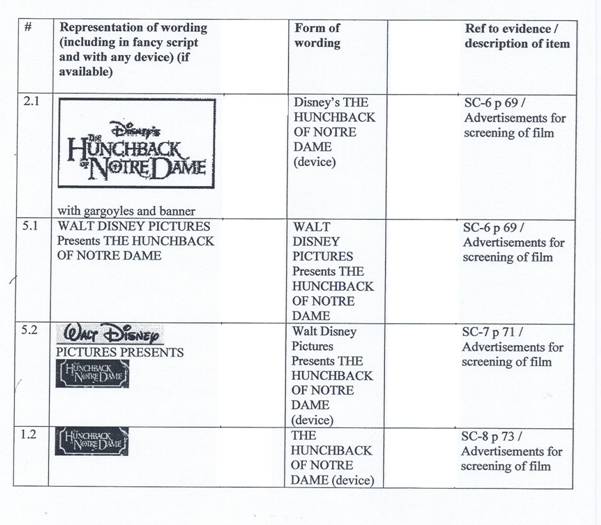
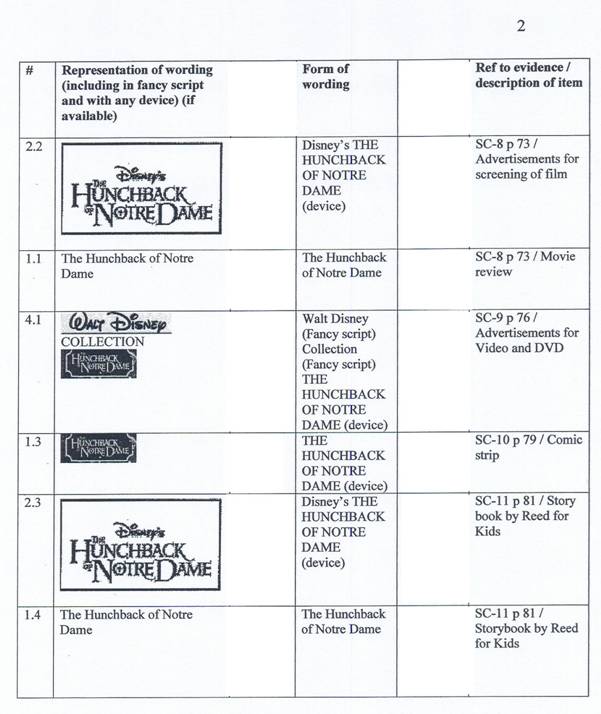
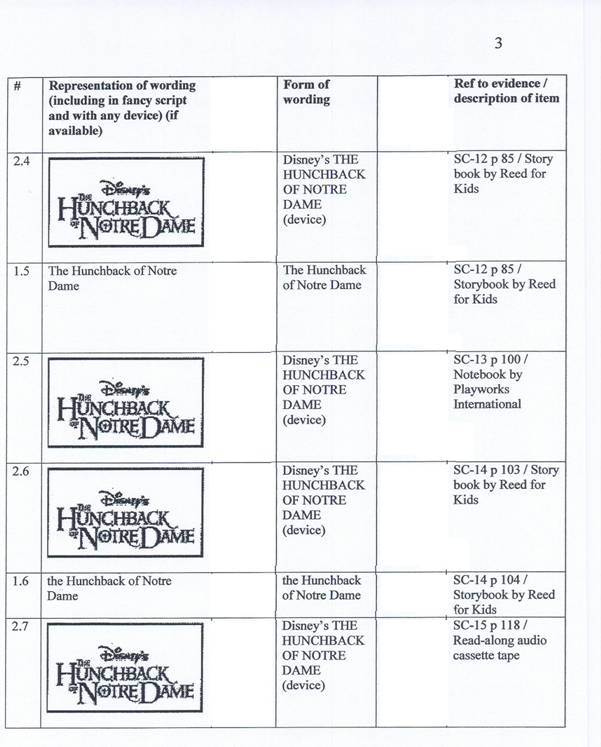
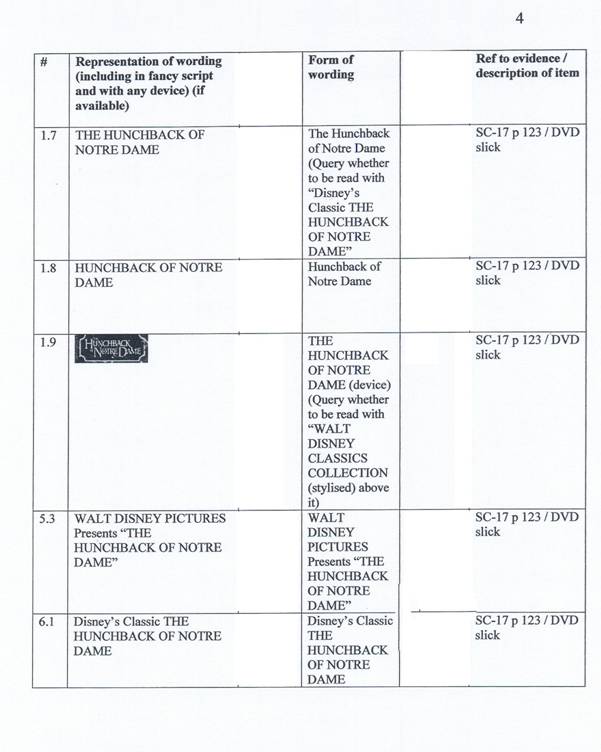
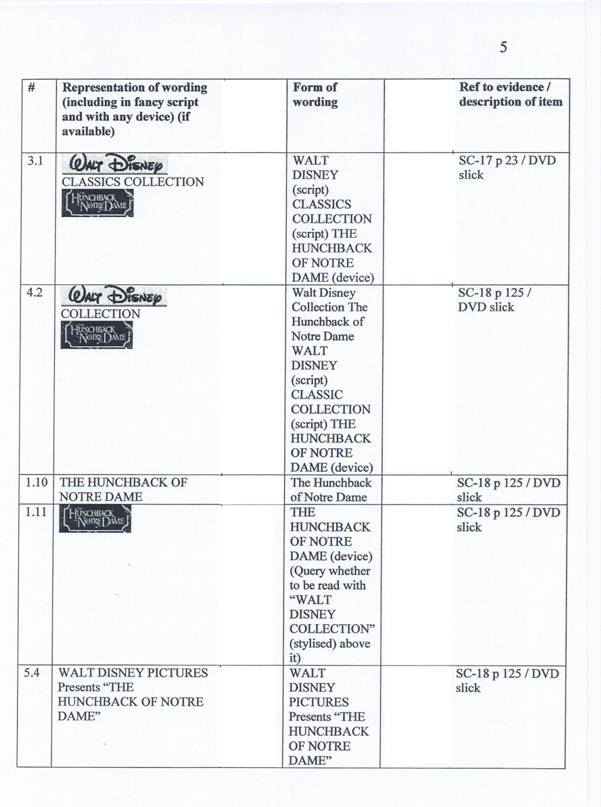
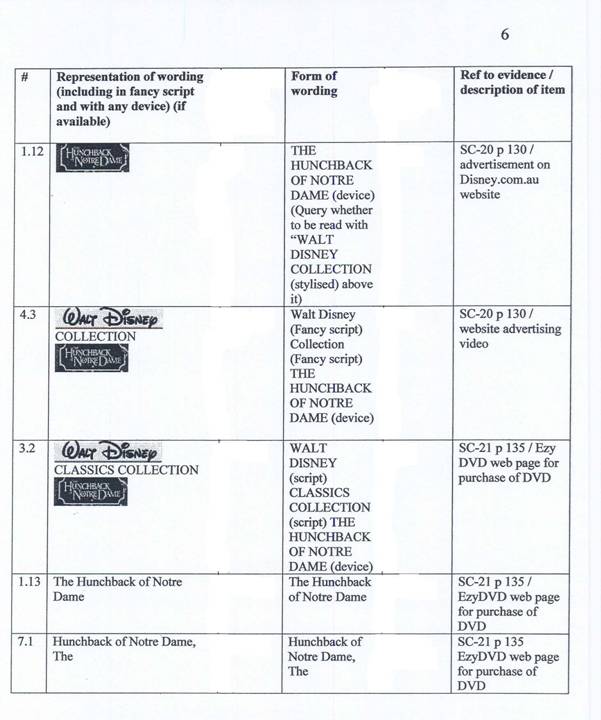
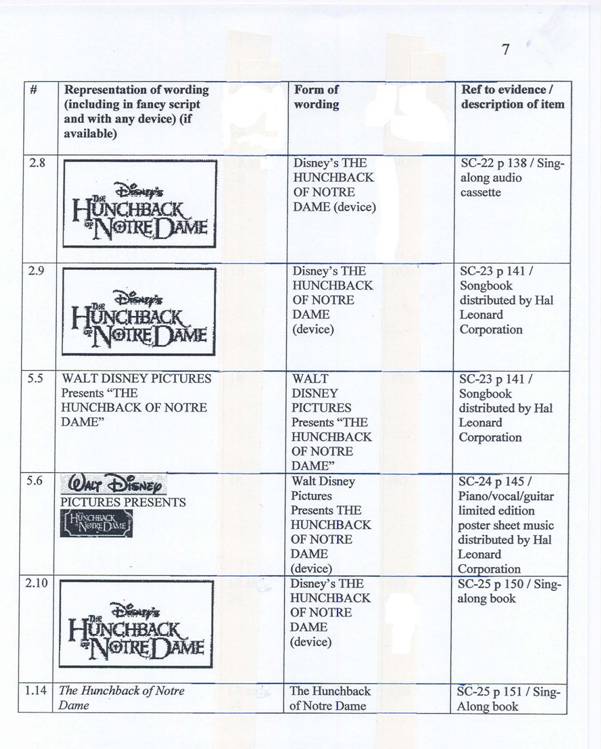
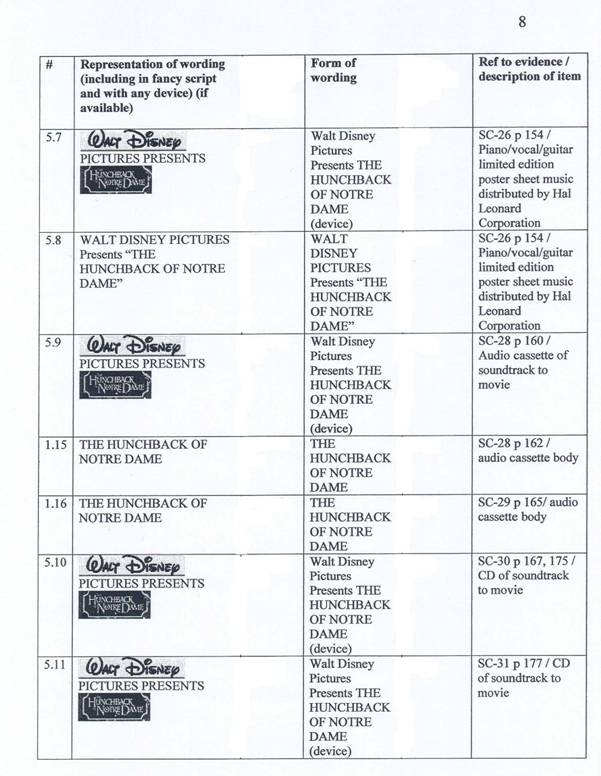
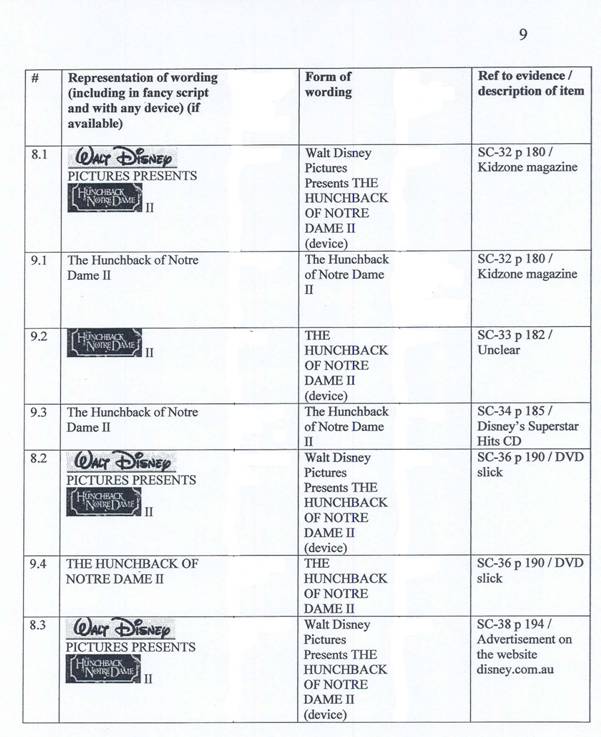
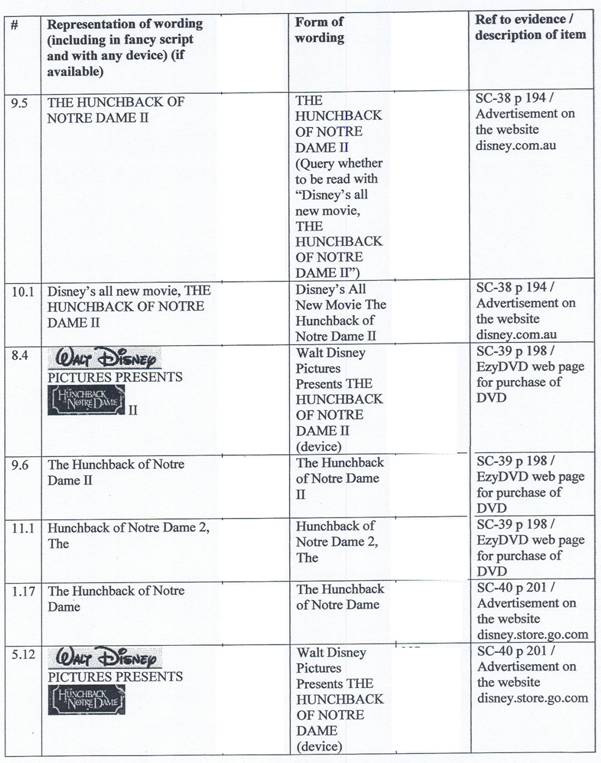
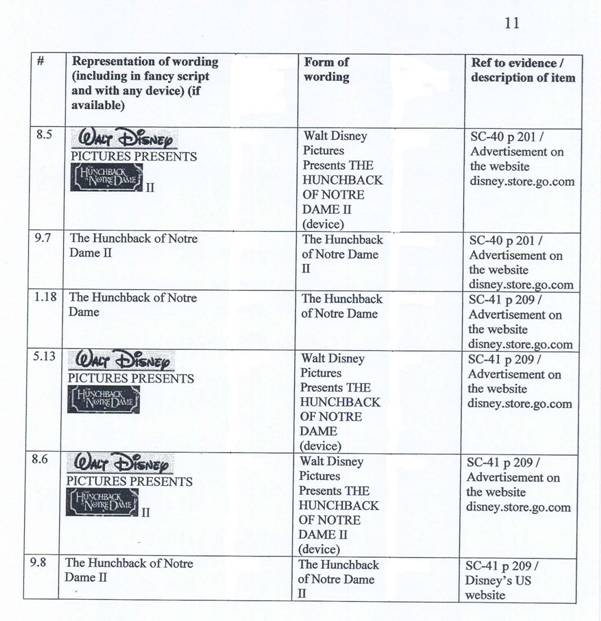
Registrar of Trade Marks v Woolworths Ltd (1999) 93 FCR 365 followed
Rugby Portland Cement Co v Rugby & Newbold Portland Cement Co (1891) 8 RPC 241 referred to
Rugby Portland Cement Co v Rugby & Newbold Portland Cement Co (1892) 9 RPC 46 referred to
Shell Co (Aust) Ltd v Esso Standard Oil (Aust) Ltd (1963) 109 CLR 407 followed
Wellness Pty Ltd v Pro‑Bio Living Waters Pty Ltd (2004) 61 IPR 242 referred to
SAVVAS CHRISTODOULOU v DISNEY ENTERPRISES INC. and BUENA VISTA (AUSTRALIA) PTY LIMITED and BMG AUSTRALIA PTY LIMITED
VID 589 of 2002
CRENNAN J
4 OCTOBER 2005
MELBOURNE
|
IN THE FEDERAL COURT OF AUSTRALIA |
|
|
VICTORIA DISTRICT REGISTRY |
VID 589 OF 2002 |
|
BETWEEN: |
CHRISTODOULOU APPLICANT
|
|
AND: |
DISNEY ENTERPRISES INC FIRST RESPONDENT
BUENA VISTA (AUSTRALIA) PTY LIMITED SECOND RESPONDENT
BMG AUSTRALIA PTY LIMITED THIRD RESPONDENT
|
|
CRENNAN J |
|
|
DATE OF ORDER: |
|
|
WHERE MADE: |
MELBOURNE |
THE COURT ORDERS THAT:
1. The answers to the separate questions are:
Question (a): The parties consented to the answer to be given to this question (see para 22 and Annexure A).
Question (b): No.
Question (c): Not necessary to decide
2. The application is dismissed.
3. The applicant is to pay the respondents’ costs of the proceeding.
Note: Settlement and entry of orders is dealt with in Order 36 of the Federal Court Rules.
|
IN THE FEDERAL COURT OF AUSTRALIA |
|
|
VICTORIA DISTRICT REGISTRY |
VID 589 OF 2002 |
|
BETWEEN: |
SAVVAS CHRISTODOULOU APPLICANT
|
|
AND: |
DISNEY ENTERPRISES INC FIRST RESPONDENT
BUENA VISTA (AUSTRALIA) PTY LIMITED SECOND RESPONDENT
BMG AUSTRALIA PTY LIMITED THIRD RESPONDENT
|
|
JUDGE: |
CRENNAN J |
|
DATE: |
|
|
PLACE: |
MELBOURNE |
REASONS FOR JUDGMENT
1 This matter relates to an action for alleged infringement of a trade mark by the registered owner under s 120 of the Trade Marks Act 1995 (Cth) (‘the Act’).
2 The applicant is a Melbourne-based writer and composer who is also involved in a business for providing, among other things, live entertainment booking services. At one stage in this proceeding the applicant had legal representation, however, at the hearing the applicant appeared for himself.
3 The first respondent is part of the well‑known Disney group of companies. The width of the reputation of the Disney group of companies was not a contested issue. Further, it was not in contest that Walt Disney, Disney and the Disney group of companies have a reputation for the production and sale of films, being animated cartoons, including animated cartoons of well‑known narratives. The first respondent is incorporated in the State of Delaware in the United States of America. The second respondent is involved in the Australian release and distribution of films. The third respondent is involved in the release and distribution of sound recordings in Australia.
4 The applicant’s registered trade mark is for the words THE HUNCHBACK OF NOTRE DAME (Australian Registered Trade Mark No. 631891) in class 41 for ‘Entertainment services in class 41’ (the ‘registered mark’). It was originally accepted for registration under the Trade Marks Act 1955 (Cth) in Part A from 10 June 1994. An endorsement was included on the Trade Marks Register (prior to the commencement of the 1995 Act) that ‘Registration gives no right to the exclusive use of the words NOTRE DAME’.
5 The registered mark is in capital letters simpliciter as rendered above. All of the allegedly infringing uses have occurred after the date of registration.
6 On 2 December 2003, under the provisions of O 29 r 2 of the Federal Court Rules, Finkelstein J ordered that the issue of whether the declarations and injunctions sought should be made was to be considered separately from and prior to all other issues. The declarations sought were in essence declarations that various uses of the words THE HUNCHBACK OF NOTRE DAME by the respondents constituted infringements of the applicant’s registered mark.
7 The applicant alleges the respondents have infringed the registered mark under s 120 of the Act, by virtue of the respondents’ use of a sign as a trade mark in respect of:
(a) services in respect of which the mark is registered, under s 120(1);
(b) services ‘of the same description’ as the registered services, under s 120(2); and
(c) goods that are ‘closely related’ to the registered services, under s 120(2).
8 On 15 July 2005, the separate issue of infringement was narrowed by consent of the parties to three specific questions, again under the provisions of O 29. This was an expedient course for proper management of the proceeding, as the determination of the questions could render unnecessary any further trial. The agreed separate questions to be answered are:
(a) What is the sign or signs that the respondents have used (or procured the use of) in each of the examples in suit?
(b) In each case, was the sign used (or procured to be used) as a trade mark?
(c) If the answer to (b) is in the affirmative, in each case was the sign used (or procured to be used) substantially identical with or deceptively similar to the applicant’s registered mark?
9 The registered mark is the English translation of the title of an epic gothic novel written originally in French by Victor Hugo. The novel was first published in 1831 and then translated into English in 1833. The original French title was Notre Dame de Paris, literally Our Lady of Paris, a reference to the Cathedral of Notre Dame. The well‑known English title, The Hunchback of Notre Dame, emphasises the hunchback character, Quasimodo.
10 The uncontested evidence showed that since Hugo’s novel was first published there have been numerous adaptations of the story in Notre Dame de Paris, some more faithful to Hugo’s original tale than others. For example, there are a number of cinematic and television productions bearing the title The Hunchback of Notre Dame, including a silent film made in 1923 starring Lon Chaney Snr, a film made in 1939 starring Charles Laughton, a television production featuring Warren Clarke made in 1977 and a television production of 1982 starring Anthony Hopkins. A film version in 1956, starring Anthony Quinn, was released in French as Notre Dame de Paris and in the United States under the English title, The Hunchback of Notre Dame. A television production in 1997 starring Mandy Patinkin and Salma Hayek was shown in the USA as The Hunchback, but shown in Europe as The Hunchback of Notre Dame.
11 In 1996 Walt Disney Pictures released an animated cinematic version of the story (the ‘first Disney film’); and in 2002 released an animated sequel for a form of release known as ‘straight to video’, entitled The Hunchback of Notre Dame II (the ‘second Disney film’) (together ‘the Disney films’).
12 The applicant provided evidence that he began composing a musical version of the story, entitled The Hunchback of Notre Dame, in or about 1981, having completed it by 1991. Although not relevant to the question of infringement in this matter, the applicant also provided a substantial amount of information concerning the composition of this work and the history and operation of his entertainment services business.
13 The first respondent and other companies within the Disney group are owners of a number of registered trade marks in Australia. These include, among others, registrations of the word (or name) DISNEY (Australian Registered Trade Mark Nos. 967987 and 640417) and registrations of the words (being a name) WALT DISNEY (Australian Registered Trade Mark Nos. 526923 and 640420).
14 The first respondent is also applying for the registration of a composite mark, DISNEY’S THE HUNCHBACK OF NOTRE DAME (Australian Trade Mark Application No. 899342) in a particular font and arrangement in class 9. This trade mark application is opposed by the applicant in the current matter.
15 Further, the applicant in the current matter has applied to register as a trade mark the words THE HUNCHBACK OF NOTRE DAME in class 9 (Australian Trade Mark Application No. 870743). This application has been opposed by the first respondent. The resolution of the opposition is pending following the outcome of the current matter.
16 It is important to note that the existence of these trade mark applications and oppositions is not a consideration which the Court is able to take into account in determining the outcome of the specific questions regarding alleged infringement. The only issues to be determined at this stage are the three questions set out above at paragraph 8.
17 Any questions as to good faith or alleged lack thereof, which were raised in the course of this particular matter, are not relevant to answering the separate questions regarding infringement. Submissions regarding good faith only become relevant if it is found that the respondents have infringed the applicant’s registered mark and then only if the respondents seek to raise such issues as defences or otherwise, such that they become part of the justiciable controversy.
18 Further, submissions regarding the artistic merit of various adaptations are not relevant, nor are questions of moral rights determinative of the outcome in this application. The subsistence of copyright, including the embodiment of the idea that underlies the applicant’s musical, is not contested in this matter. The application is not one made under the Trade Practices Act 1974 (Cth); nor is it one couched in terms of any recognisable common law actions, such as passing off.
19 The tests to be applied in actions for the alleged infringement of a registered trade mark are well established. They are found in the legislative structure in the Act, and the relevant authorities.
20 The applicant’s claim for infringement is based on uses of signs in connection with the Disney films. For the purposes of resolving the separate questions, the respondents admit that the Disney films were released, along with associated digital versatile discs (‘DVD’), videos (‘VHS’), soundtrack albums in cassette and compact disc (‘CD’) formats, books and sheet music. Where the second or third respondents were involved in the release or distribution of film or sound recordings for the Disney films, the first respondent admits giving approval in relation to those activities. The respondent does not admit any responsibility for uses of the collocation of the words THE HUNCHBACK OF NOTRE DAME by unrelated entities for example, in movie reviews of the Disney films.
21 The applicant swore three affidavits filed in this proceeding. For the purposes of this hearing only the applicant’s first affidavit, sworn on 19 September 2003, attached exhibits containing the allegedly infringing uses. The uses included movie reviews published in newspapers or on the internet; internet websites; advertisements; cinema screening times; storybooks; comic strips; audiocassette, DVD, CD and VHS recording covers; song books and sheet music; and magazines.
22 A list, which identified the 64 allegedly infringing uses and certain particulars of them, was agreed by the parties and filed with the Court by the conclusion of this hearing. This rendered it unnecessary to consider artwork in certain collocations, which was additional to the signs described in paragraph 24 below. It is this list which answers the first question as to what are the sign or signs which constitute the allegedly infringing uses. This list is set out in Annexure A to these reasons for judgment. Although the list is a convenient aide memoire when considering collectively all the allegedly infringing uses, in considering whether each use complained about was ‘use as a trade mark’, I have referred to each of the exhibited items separately. This allowed me to consider the context of each use, including the positioning of the text, the colours, the font, the size of letters or words used and other features of appearance.
23 For the purposes of resolving the separate questions, submissions were concentrated mainly on the first Disney film. However, each occasion of alleged infringement was considered separately.
24 It was agreed by the parties that the allegedly infringing uses took one of a number of forms, being:
a) THE HUNCHBACK OF NOTRE DAME, either in plain font, or in stylised gothic script;
b) or those words in a) used in combination with other signs, such as:
i. DISNEY’S or DISNEY’S CLASSIC;
ii. WALT DISNEY PICTURES PRESENTS;
iii. WALT DISNEY COLLECTION;
iv. WALT DISNEY CLASSICS COLLECTION; and
v. DISNEY’S ALL NEW MOVIE.
Further, where the second Disney film was the subject of any impugned use, it was constituted by any combination of the above signs, with the addition of the Roman numeral II, to indicate its status as a sequel and often with the subtitle ‘The Secret of the Bell’.
Relevant provisions of the Act
‘Badge of Origin’
25 ‘Trade mark’ is defined in s 17 of the Act as follows:
‘A Trade Markis a sign used, or intended to be used, to distinguish goods or services dealt with or provided in the course of trade by a person from goods or services so dealt with or provided by any other person.’
26 In s 6 ‘sign’ is defined as including:
‘the following or any combination of the following, namely, any letter, word, name, signature, numeral, device, brand, heading, label, ticket, aspect of packaging, shape, colour, sound or scent.’
27 A trade mark indicates a connection in the course of trade between the goods and their source: it is a ‘badge of origin’: Levi Strauss & Co v Wingate Marketing Pty Ltd (1993) 43 FCR 344 at 361 per Lockhart J; see also Black CJ, Sundberg and Finkelstein JJ in Coca-Cola Co v All‑Fect Distributors Ltd (1999) 96 FCR 107 at 115-116 (‘Coca-Cola Co’) and Wilcox J in Ocean Spray Cranberries Inc v Registrar of Trade Marks (2000) 47 IPR 579 at 591, at [40] (‘Ocean Spray’), citing Burchett J in Johnson & Johnson Australia Pty Ltd v Sterling Pharmaceuticals Pty Ltd (1991) 21 IPR 1 at 19 (now reported at (1991) 30 FCR 326) (‘Caplets’).
28 As stated by the Full Court in Coca‑Cola Co at [115] the concept of the use of a trade mark as a ‘badge of origin’ is ‘embodied in the definition of a “trade mark” in s 17.’ Behind this statement of principle lies a long statutory history of articulating the relevant ‘connection’ between a trade mark owner and goods (or services) to which the trade mark owner applied the trade mark (cf s 3 Trade Marks Act 1912 (Cth) with s 6(1) Trade Marks Act 1955 (Cth) and s 17 of the Act).
29 In explicating legislative changes in the Trade Marks Act 1938 (UK), which were not dissimilar to equivalent changes made by the Australian Act of 1955, Lord Wright in Aristoc v Rysta (1944) 62 RPC 65 at 82, explained:
‘The word “origin” . . . denotes at least that the goods are issued as vendible goods under the aegis of the proprietor of the trade mark, who thus assumes responsibility for them.’
30 From at least 1912 in Australia and earlier in the United Kingdom ‘manufacturing’ was recognised in the relevant statutes as a ‘connection’ in the course of trade, between goods and a trader applying a mark to those goods. In that context there are a number of early authorities where courts readily concluded that use of words by a rival manufacturer for a purely descriptive purpose or function did not infringe a trade mark registration which included descriptive words, particularly where the descriptive meaning of those words was established prior to any registration: see, for example, Native Guano Co v Sewage Manure Co (1887) 4 RPC 473 at 476-477 (Kay J) and Rugby Portland Cement Co v Rugby & Newbold Portland Cement Coy (1891) 8 RPC 241 at 246 (Vaughan Williams J) upheld by the Court of Appeal in (1892) 9 RPC 46. The establishment and recognition of the words THE HUNCHBACK OF NOTRE DAME as the English title of Hugo’s novel, from 1833 until the date of the applicant’s application for registration evidences the fact that the words are apt to describe a translation or adaptation, in English, of Hugo’s novel.
31 When words are apt to describe a product it becomes necessary to ask whether any use of such words is likely to be taken to be use as a trade mark. The function of a trade mark is reflected in the rights which are protected through registration. In the leading judgment of R v Johnstone [2003] 3 All ER 884 (‘R v Johnstone’), Lord Nicholls explained the connection between trade mark rights based on a trade mark’s function as a ‘badge of origin’ and infringement, at 889 paragraph 13:
‘ . . . the exclusive rights granted to the proprietor of a registered trade mark are limited to use of a mark likely to be taken as an indication of trade origin. Use of this character is an essential prerequisite to infringement. Use of a mark in a manner not indicative of trade origin of goods or services does not encroach on the proprietor’s monopoly rights.’
Infringement
32 Section 120 of the Act deals with infringement:
(1) A person infringes a registered trade mark if the person uses as a trade mark a sign that is substantially identical with, or deceptively similar to, the trade mark in relation to goods or services in respect of which the trade mark is registered.
(2) A person infringes a registered trade mark if the person uses as a trade mark a sign that is substantially identical with, or deceptively similar to, the trade mark in relation to:
(a) goods of the same description as that of goods (“registered goods”) in respect of which the trade mark is registered; or
(b) services that are closely related to registered goods; or
(c) services of the same description as that of services (“registered services”) in respect of which the trade mark is registered; or
(d) goods that are closely related to registered services.
(emphasis added)
33 The applicant sought to establish infringement under s 120(1) and, at the time of hearing, under s 120(2) as well. It was, however, agreed by the parties in the course of the hearing that the three separate questions should be decided first and then, depending on the outcome, any issues relevant to s 120(2) would be considered later.
Use as a trade mark
34 The tests regarding what will constitute ‘use as a trade mark’ have been well established. Kitto J in Shell Co (Aust) Ltd v Esso Standard Oil (Aust) Ltd (1963) 109 CLR 407 (‘Shell’) at 425 sets out the relevant question:
‘. . . the question becomes whether, in the setting in which the particular pictures referred to were presented, they would have appeared to the television viewer as possessing the character of devices, or brands, which the appellant was using or proposing to use in relation to petrol for the purpose of indicating, or so as to indicate, a connexion in the course of trade between the petrol and the appellant.’
This approach has been adopted many times. For a recent example see Global Brand Marketing Inc v Cube Footwear Pty Ltd [2005] FCA 852 (Goldberg J) at [36]–[37]; see also the judgment of Sackville J in the Full Court decision in Pepsico Australia Pty Ltd v Kettle Chip Co Pty Ltd (1996) 135 ALR 192 (‘Kettle Chips’) where his Honour conveniently collects the authorities at 209-214.
35 The test involves consideration of the context in which the allegedly infringing use occurs. This can encompass factors such as the positioning of the sign, the type of font, the size of words or letters and the colours which are used, as well as how the sign is applied to advertising materials or the packaging of the goods in relation to other features: for example, see the analysis of Emmett J in Beecham Group Plc v Colgate-Palmolive Pty Ltd [2005] FCA 838 at [46]-[48] with respect to the use of the term ‘MaxClean’ used on toothbrushes.
36 The same test can be applied by asking whether the use of a sign as a trade mark is use by the respondent to distinguish its goods and services in the course of trade from those of others: Digitrex (Aust) Pty Ltd v EMT Aust Enterprise Pty Ltd [2004] FCA 1027 at [18] (Stone J). A similar approach applies when considering whether a mark is inherently adapted to distinguish goods and services, with a view to the registration of a mark. In Clark Equipment Co v Registrar of Trade Marks (1964) 111 CLR 511, Kitto J noted at 515: ‘the more apt a word is to describe the goods, the less inherently apt it is to distinguish them as the goods of a particular manufacturer.’ See also Ocean Spray.
37 In Wellness Pty Ltd v Pro‑Bio Living Waters Pty Ltd (2004) 61 IPR 242 Bennett J considered whether the respondents’ use of the words ‘Pro-Bio Living Waters’ infringed the registered trade mark LIVING WATER. Her Honour made the following observations about descriptive signs at [29]:
‘A mark may have a descriptive element but still serve as a badge of trade origin (Johnson & Johnson Australia Pty Ltd v Sterling Pharmaceuticals Pty Ltd (1991) 30 FCR 326 . . . per Lockhart J at 335 and per Gummow J at 347) and there may still be trade mark use although another trade mark or indication of origin is used in the same packaging or advertisement (Johnson & Johnson per Gummow J at 349; Pepsico per Sackville J at 210, 213 and 216). The use of descriptive words may, however, make it more difficult to establish that the words do so distinguish the product.’
38 The decision of Dillon LJ in Mothercare UK Ltd v Penguin Books [1988] RPC 113 (‘Mothercare’) dealt with the publication of a book entitled ‘Mother Care/Other Care’, which was a study of the upbringing of children of working mothers, and the question of whether this use infringed the registered trade mark of Mothercare UK Limited for MOTHERCARE, where the trade mark was registered for many classes of goods, including books. In finding that there was no infringement, at 118-119 Dillon LJ observed:
‘. . . it stands to reason that a Trade Marks Act would only be concerned to restrict the use of a mark as a trade mark or in a trade mark sense, and should be construed accordingly. If descriptive words are legitimately registered [as a trade mark], there is still no reason why other people should not be free to use the words in a descriptive sense, and not in any trade mark sense . . .
In the present case the words “Mother Care” in the title of the book are not, in my judgment, used as a trademark or in any trademark sense. They are merely used descriptively as describing, with the words “Other Care” what the book is about.’
39 These statements were quoted by Lord Nicholls in R v Johnstone, after which his Honour posed, at [13], the ‘extreme hypothetical example beloved by trade mark lawyers’:
‘If a magazine publisher were to register an ordinary question mark, ‘?’, as a trade mark for magazines this would not prevent the grammatical use of question marks on the covers of other magazines.’
40 R v Johnstone concerned, among other things, an allegation of trade mark infringement under s 10 of the Trade Marks Act 1994 (UK), the equivalent of s 120 in the Australian Act, as a result of the production and sale of bootleg music recordings. Lord Nicholls explained that it would be a question of fact in each case as to whether the identification of a performer or the contents of a recording served descriptive purposes only, rather than indicating the ‘origin’ of the disc itself. For completeness, Lord Nicholls noted Arsenal Football Club plc v Reed [2003] RPC 144 at 165, where it was found that the particular use of an ARSENAL logo created the impression of a material link in the course of trade between the goods concerned, and the owner of the mark and accordingly there was infringement.
The respondents’ case
41 The respondents’ main argument is that none of the identified uses, by the respondents, of the words THE HUNCHBACK OF NOTRE DAME in relation to the Disney films, constitutes ‘use as a trade mark.’ The respondents rely on Caplets’ in which Gummow J stated at 347:
‘When the issue is one of infringement, a pivotal question is whether the use complained of is use by the alleged infringer as a trade mark. The answer to that question requires an understanding of the “purpose and nature” of the impugned use: see Shell Company of Australia Ltd v Esso Standard Oil (Australia) Ltd (the Shell case) (1963) 109 CLR 407 at 426, per Kitto J. As his Honour there points out, with reference to Edward Young & Co Ltd v Grierson Oldham & Co Ltd (1924) 41 RPC 548 . . . the nature of the allegedly infringing use may be considered in the light of a usage common in the relevant trade. The relevant context, where the mark is a word mark, includes a consideration of the way in which the word has been displayed in relation to the goods and advertisements of which complaint is made: See Mars GB Ltd v Cadbury Ltd [1987] RPC 387 at 402, per Whitford J.’
Further, at 351 Gummow J held:
‘ . . . on the question of infringement, one asks whether, in the setting on the package on which “CAPLETS” is depicted, it appears to possess the character of a word which Johnson & Johnson is using in relation to its paracetamol product, for the purpose of indicating or so as to indicate a connection in the course of trade between Johnson & Johnson and the contents of the package. Does “CAPLETS” appear as a mark for distinguishing a Johnson & Johnson product from other pain killing products in the course of trade?’
42 In answering the questions he posed Gummow J concluded the use of the word CAPLETS was not a use to indicate a connection in the course of trade or to distinguish the product from other products. In Musidor BV v Tansing (1994) 52 FCR 363 (‘Rolling Stones’), the respondent was trading in unauthorised recordings of the Rolling Stones. Musidor BV, a company associated with the band, was the registered proprietor of a trade mark registration in class 9 for goods, including CDs, for the mark THE ROLLING STONES. These same words were used prominantly on the unauthorised CDs. In determining whether the words on the unauthorised CDs were used as a trade mark, the Full Court of the Federal Court examined the context in which the words were used, the nature of the allegedly infringing use and the fact that the mark was comprised of ordinary English words which described the content of the CDs as being music performed by the Rolling Stones. The decision in Rolling Stones was referred to with apparent approval in R v Johnstone by Lord Nicholls at [37]-[39].
43 In Rolling Stones at 372, Heerey and Gummow JJ explained the authoritative test set out by Kitto J in Shell at 442:
‘But the context is all-important, because not every use of a mark which is identical with or deceptively similar to a registered trade mark infringes the right of property which the proprietor of the mark possesses in virtue of the registration.
Although the mark was used with reference to Shell petrol, in context, the message conveyed related to the qualities of that petrol and not to its brand or origin. Accordingly, there was no infringement.’
44 Further, their Honours also cited (at 373) the summary earlier provided by Gummow J in Caplets at 347-348:
‘Where the trade mark allegedly used by the defendant comprises ordinary English words . . . then, as this decision illustrates, that circumstance may be taken into account by the court in the process of reasoning by which it accepts or rejects a submission that the use in question is not a trade mark use but a description of the goods in question. To say that is not to gainsay the point made by Dixon CJ in Mark Foys Ltd v Davies Coop & Co Ltd (the Tub Happy case) . . . that language is not always used to convey a single, clear idea; a mark may have a descriptive element but still serve as a badge of trade origin. However, where the issue is one of infringing use by use of a word mark (as in the present case), the fundamental question remains . . . whether those to whom the user is directed are being invited to purchase the goods (or services) of the defendants which are to be distinguished from the goods of other traders “partly because” they are described by the words in question.’
45 The second question under consideration here is whether each allegedly infringing use was in fact ‘use as a trade mark’. Having regard to the above authorities, the relevant inquiry is one involving consideration of the context, purpose and nature of each instance of allegedly infringing use. The questions I need to ask are whether the respondents’ uses of the words THE HUNCHBACK OF NOTRE DAMEare uses to indicate a relevant connection in the course of trade or to distinguish the respondents’ goods from those of other traders. Whilst I have considered each alleged infringement separately, for ease of reference in these reasons for judgment, I have grouped the allegedly infringing uses according to their contents and form.
Movie review
46 Where the words THE HUNCHBACK OF NOTRE DAME were used, either alone or in combination with other marks such as DISNEY, as a part of a movie review (in exhibit SC-8 and also in SC-41), this is not use as a trade mark. Such use is a reference to the English title of the book or movie which is reviewed, whether referred to in the title of the article, in an image of the DVD, or within the running text of the article itself.
Packaging of CDs, DVDs and audio cassettes
47 With regard to the packaging of the CD, DVD and audio cassette recordings by the first respondent, they are labelled in the conventional way, by having the title of the recording displayed on the front cover, the spine of the packaging and on the back cover. Additionally, there are booklets which accompany some versions of these products which also feature the title of the recording.
48 These allegedly infringing uses were contained in the following exhibits: SC-15 (cover of a read-along audio cassette tape); SC-17 (cover of the DVD of the first Disney film); SC-18 (cover of the DVD of the first Disney film); SC-22 (cover of a sing-along audio cassette tape); SC-28 (cover of the audio cassette tape of the soundtrack to the first Disney film); SC-29 (body of the audio cassette tape of the soundtrack to the first Disney film); SC-30 (cover of the CD soundtrack of the first Disney film); SC-31 (cover of the CD soundtrack of the first Disney film); and SC-36 (cover of the DVD of the second Disney film).
49 In total there were 19 uses complained of appearing on the allegedly infringing DVD, CD and audio cassette covers, or the body of the cassette tape. Of these, 11 uses contained the words THE HUNCHBACK OF NOTRE DAME in conjunction with one or more other Disney trade marks. Two of the uses complained of were in relation to the second Disney film and thus were presented with the Roman numeral II after the title.
50 In examining each of these CD, DVD and audio cassette recording covers, I have considered whether the words THE HUNCHBACK OF NOTRE DAME have been used to indicate a connection in the course of trade between the relevant products and any of the respondents or to distinguish the respondents’ goods from those of other traders.
51 In Rolling Stones, it was accepted by Gummow and Heerey JJ at 376-377 that the words THE ROLLING STONES used on the allegedly infringing CDs were not used for the purpose of indicating a connection in the course of trade between the respondent and the discs: rather, the words were used to identify a recording of a live performance of the band of that name. Their Honours noted at 377 that,
‘If it matters, there is force also in the further submission that, as a practical matter, there is no other way in which identification readily can be made of the group, a sound recording of whose performance is embodied in the discs.’
52 Similarly, here, the Disney films are animated versions, namely cartoons, of a classic story. Without listening to the recordings themselves, it is apparent that the songs, music and animation which feature on the DVDs, CDs and audio cassette tapes are those which were featured in the Disney film versions of the Hugo story. By using the words THE HUNCHBACK OF NOTRE DAME on the covers of their DVD, CD and audio cassettes, the respondents describe the contents of the recordings and there is no readily apparent way other than the use of such words to describe the contents accurately, so as not to mislead the consumer.
53 In considering the relevant context in which the allegedly infringing uses have occurred, the uncontested evidence was that there have been numerous adaptations of this particular story since first written by Hugo over 150 years ago. Many of these versions have been produced for the cinema or television. There is even a version of the story embodied in a ballet. There have also been musical versions, other than those produced by the applicant and the first respondent. It is further noted that the Disney group of companies has also been involved in the production of animated versions or cartoons of numerous other stories or fairy tales. It is within this context that a consumer will view and understand the allegedly infringing uses of the words THE HUNCHBACK OF NOTRE DAME by the respondents.
54 By way of further example, in Kettle Chips, Lockhart, Sheppard and Sackville JJ determined that the use of the word ‘Kettle’ in ‘Double Crunch Kettle Cooked Potato Chips’ on the packaging was descriptive of the process by which Frito-Lay’s chips were produced and of the end product; and that the use by Frito-Lay of ‘Kettle’ was not use as a trade mark, and that therefore there was no infringement of the registered mark ‘Kettle’, as owned by Kettle Chips. Sheppard J specifically noted that the badge of origin of Frito-Lay’s chips was the registered mark ‘Thins’ (at 200). Here, the respondents use the words THE HUNCHBACK OF NOTRE DAME because it is the established English title of the story that is told in their animated films, namely cartoons. The respondents are doing no more than indicating the products contain their version or adaptation of a well‑known story. The fact that the possessive form of Disney is used, often in combination with the words complained about, emphasises this.
55 In those 11 instances which incorporate other DISNEY signs, the badge of origin may be understood, for example, to be the words DISNEY’S, or WALT DISNEY PICTURES. It is these signs which indicate a connection in the course of trade with, specifically, the first respondent, but they may also be understood at a consumer level to refer to the Disney group of companies as a whole. The DISNEY signs function to import certain expectations in a consumer about the quality, style, production values and even content which are associated with other films originating from Disney and which also bear Disney marks.
56 In each case, as used by the respondents, the words THE HUNCHBACK OF NOTRE DAME are ‘apt to be the name of the product, not a trade mark’: per Jacob J at 302 of British Sugar Plc v James Robertson & Sons Ltd [1996] RPC 281.
57 The same may be said of the inserted booklet, included with the compilation CD, ‘Disney Superstar Hits’ contained in exhibit SC-34. The applicant cites the use of the words THE HUNCH BACK OF NOTRE DAME II as used in the track listing to indicate the Disney film in which the song appeared. When used in this context, that is, a track listing on a Disney music compilation, it refers to the title or name of the movie. In the same way that the catalogue of titles appearing on the back of the story book is a list of other titles and stories in the Disney Classic series, this index of songs is simply a list which describes content and is not use as a trade mark.
Advertisements on the Disney website
58 Similar observations may be made with regards to the appearances of the words THE HUNCHBACK OF NOTRE DAME on the Disney websites, including the Disney Store website through which purchases of Disney products may be made online. There were 12 allegedly infringing uses on Disney websites; appearing in exhibits SC-20, SC-38, SC-40 and SC-41.
59 In each of these instances, the allegedly infringing words are used to describe the content of the products advertised or referred to in the websites, including DVD, CD and VHS recordings. In the relevant online context, the source of the products is clearly identified through the constant use of DISNEY, WALT DISNEY or similar signs, while the words THE HUNCHBACK OF NOTRE DAME refer to the story told in the products promoted.
Ezy-DVD web page
60 Exhibits SC-21 and SC-39 are excerpts from the EzyDVD online shopping site, advertising the Disney films. The site contains a brief review or plot summary and lists the features contained on the DVD. It is not immediately apparent that the impugned uses on this website may be attributable to the respondents. However, the uses cannot be characterised as uses as a trade mark on the same basis as described above in relation to the CD, DVD and VHS recording covers.
Advertisements for screening of the film
61 The applicant cites advertisements contained in newspapers and magazines for the screening of the Disney films. These advertisements were contained in exhibits SC-6, SC-7 and SC-8 to the applicant’s affidavit.
62 Such advertisements can typically include images of characters from the Disney films, cinema information, movie ratings, any other special offers (including a ‘Value Combo deal’ for popcorn, a beverage and a souvenir cup, as in SC-8) and screening times. The advertisements also include the words THE HUNCHBACK OF NOTRE DAME: either in a gothic script; in the bold font list of movies screening accompanied by their session times; or in the details of the movie which include the director, cast, composer and other credits, printed in small font at the base of the advertisement.
63 In each of the allegedly infringing instances that appear in the film advertisements, it is apparent that the words THE HUNCHBACK OF NOTRE DAME are used in order to identify the title of the film as the title of the story told, rather than to indicate that the source of the films is the first respondent. There are also numerous references to Disney, through the use of other marks, which, in contrast with the title of the film, operate to signify a connection with the first respondent and operate to distinguish the respondents’ goods from those of other traders, which would include the applicant.
Books
64 Also annexed to the affidavit of the applicant is a copy of a story book for children (SC-11) published in Australia by Reed for Kids, a division of Reed International Books Australia Pty Ltd. This company is not a party to these proceedings. The book contains a copyright notification by The Walt Disney Company, an entity which also is not a party to these proceedings. Regardless, it is not necessary to infer any relationships, procurement or authorisation as between these companies and any of the respondents in order to deal with an allegation of infringement: for the reasons indicated above in relation to the packaging and internet advertising of impugned DVDs and CDs, the use of the words THE HUNCHBACK OF NOTRE DAME on the front cover and title page of this story book is use of the title of a story and does not amount to use as a trade mark. Similarly, the back cover of the story book shows a list of other titles in the ‘Disney Classic Series’ including THE HUNCHBACK OF NOTRE DAME. Clearly, the accompanying DISNEY marks and references indicate the origin of this particular version of the original tale and distinguish this version from versions by other traders.
65 The same findings apply to the smaller story book also published by Reed for Kids in exhibit SC-12 to the applicant’s affidavit, the read-along book contained in exhibit SC-14 and the sing-along book contained in SC-25; the song books and sheet music books at SC-23, SC-24 and SC-26; as well as the note book produced by Playworks International at SC-13. None of the instances of impugned use in these exhibits can be characterised as ‘use as a trade mark’.
Disney Adventures comic
66 Exhibited to the applicant’s affidavit is the cover page of and an excerpt from, a children’s magazine entitled ‘DISNEY ADVENTURES’ (SC-10). The excerpted pages display the words THE HUNCHBACK OF NOTRE DAME in gothic script as a part of the title to a short comic strip which features the same characters from the first Disney film. It is located next to the particular title of the comic strip ‘Scent-imental Journey’. The cover of the magazine itself indicates its origin as being DISNEY.
67 As outlined above, one of the considerations in determining whether an impugned use is ‘use as a trade mark’ is whether the sign is being used to distinguish the particular product from those from other sources or competitors. Taking into account the context in which this use appears, it is apparent that the words THE HUNCHBACK OF NOTRE DAME act as the title to this particular comic strip, indicating its subject matter and characters. The words are not being used to distinguish this particular comic book or magazine from other comic books or magazines, but rather they are the title of one story told within a number of other Disney comics or products features in the Disney magazine.
68 In addition to the use exhibited in SC-10, two further instances of use in a Disney Adventures magazine are alleged infringements. Exhibit SC-33 appears to be an advertisement for the television screening of the second Disney film on the Disney Channel, accompanied by a maze game. As above, it is clear that the use of THE HUNCHBACK OF NOTRE DAME is as the title of the film to be screened and not as its badge of origin.
69 Further, exhibit SC-9 appears to be an advertisement in a Disney Adventures magazine, for a range of DVD and VHS recordings of a number of Disney animated feature films, under the heading ‘WALT DISNEY COLLECTION’. Among them is a small image of the DVD cover of the first Disney film, containing the allegedly infringing words. Similarly, in exhibit SC-32, the applicant has provided an advertisement in a ‘K-zone’ magazine which features a small image of the DVD cover of the second Disney film. For the same reasons provided in relation to the story books, these are not infringing uses.
70 In the light of these conclusions, it is not necessary to consider the remaining question regarding the degree of similarity or identity between the applicant’s registered mark and the respondents’ uses of the words THE HUNCHBACK OF NOTRE DAME. A Full Court of the Federal Court in Registrar of Trade Marks v Woolworths Ltd (1999) 93 FCR 365 held that where an element of a mark is so widely known and familiar to consumers, such as ‘WOOLWORTHS’, its notoriety must be taken into account when making comparisons with other mark in deciding questions of identity or deceptive similarity. The same principles apply in relation to the use of the words DISNEY and WALT DISNEY, which sufficiently distinguish the respondents’ uses from the applicant’s registered mark. The allegedly infringing uses which may be attributed to one of the respondents are all used in conjunction with, or at least in close proximity to, one or more registered DISNEY trade marks.
Conclusions
71 Like the appellant in Rolling Stones, the appellant’s case appears to be ‘an attempt to obtain a monopoly over words used to describe a lawful product’ (per Gummow and Heerey JJ at 377). The words used by the respondents in the promotion of the Disney films are use of an established title of the story portrayed. A recognised title of an adaptation or cartoon version of a well‑known story is descriptive. The descriptive meaning of these words was established well before the applicant applied for registration of his trade mark. The purpose and nature of each use is to describe the respondents’ products accurately. The uses are not for the purposes of indicating a relevant connection in the course of trade or to distinguish the respondents’ goods from those of other traders. The uses do not amount to ‘use(s) as a trade mark’ within the meaning of s 120 of the Act. Therefore, in each case the use complained about was not use as a trade mark. These findings do not necessarily preclude the inclusion of the words THE HUNCHBACK OF NOTRE DAME in a registrable trade mark, particularly a composite trade mark. It remains a matter for the Registrar to determine the registrability of any trade mark containing descriptive material.
72 The answers to the questions set out in paragraph [8] are:
Question (a): The parties consented to the answer to be given to this question (see para 22 and Annexure A).
Question (b): No.
Question (c): Not necessary to answer.
73 It is appropriate to make orders under the provisions of O 29 r 4 dismissing the proceeding and ordering the applicant to pay the respondents’ costs.
|
I certify that the preceding seventy-three (73) numbered paragraphs are a true copy of the Reasons for Judgment herein of the Honourable Justice Crennan J. |
Associate:
Dated: 4 October 2005
|
Counsel for the Applicant: |
The Applicant appeared in person |
|
|
|
|
|
|
|
Counsel for the Respondent: |
R Cobden SC C Bova |
|
|
|
|
Solicitor for the Respondent: |
Shelton IP Lawyers |
|
|
|
|
Date of Hearing: |
15 and 18 July 2005 |
|
|
|
|
Date of Judgment: |
4 October 2005 |
ANNEXURE A