

FEDERAL COURT OF AUSTRALIA
Collins
Debden Pty Ltd v Cumberland Stationery Co Pty Ltd (No 2)
[2005] FCA 1398
TRADE PRACTICES – misleading and deceptive conduct – desk calendar refills – complaint that get-up of respondent’s refills deceptively similar to that of applicant’s – necessity for applicant to establish reputation and secondary meaning – functional feature of size and positioning of holes to fit desk stands – words ‘desk calendar refill’ ordinary descriptive words.
TORT – passing off – desk calendar refills – complaint that get-up of respondent’s refills deceptively similar to that of applicant’s – necessity for applicant to establish reputation and secondary meaning – functional feature of size and positioning of holes to fit desk stands – words ‘desk calendar refill’ ordinary descriptive words.
Reckitt & Colman Products Ltd v Borden Inc [1990] 1 All ER 873 cited
Parkdale Custom Built Furniture Pty Ltd v Puxu Pty Ltd (1982) 149 CLR 191 cited
Tot Toys Ltd v Mitchell t/as Stanton Manufacturing [1993] 1 NZLR 325 cited
Komesaroff v Mickle [1987] VR 703
Telmak Teleproducts (Australia) Pty Ltd v Coles Myer Ltd (1989) 89 ALR 48 cited
Equity Access Pty Ltd v Westpac Banking Corporation Ltd (1989) 16 IPR 431 cited
Dodds Family Investment Pty Ltd v Lane Industries Pty Ltd (1993) 26 IPR 261 cited
Apand Pty Ltd v The Kettle Chip Company Pty Ltd (1994) 52 FCR 474 cited
Burica Pty Ltd v Tops to Bottoms (Australia) Pty Ltd (1997) 39 IPR 447 cited
Cadbury-Schweppes Pty Ltd v Pub Squash Co Pty Ltd [1980] 2 NSWLR 851 cited
Conagra Inc v McCain Foods (Aust) Pty Ltd (1992) 33 FCR 302 cited
Interlego AG v Croner Trading Pty Ltd (1992) 39 FCR 348 cited
S & M Motor Repairs Pty Ltd v Caltex Oil (Aust) Pty Ltd (1988) 12 NSWLR 358 cited
Pearce and Bros v Valentine & Co (1917) 34 RPC 267 cited
Purefoy Engineering Co Ltd v Sykes Boxall & Co Ltd (1955) 72 RPC 89 cited
Dairy Vale Metro Cooperative v Browns Dairy Pty Ltd (1981) 54 FLR 243 cited
COLLINS DEBDEN PTY LIMITED v
CUMBERLAND STATIONERY CO PTY LIMITED
NSD 1397 of 2004
LINDGREN J
30 SEPTEMBER 2005
SYDNEY
|
IN THE FEDERAL COURT OF AUSTRALIA |
|
|
NEW SOUTH WALES DISTRICT REGISTRY |
NSD 1397 OF 2004 |
|
BETWEEN: |
COLLINS DEBDEN PTY LIMITED (ACN 005 173 839) APPLICANT
|
|
AND: |
CUMBERLAND STATIONERY CO PTY LIMITED (ACN 000 761 339) RESPONDENT
|
|
LINDGREN J |
|
|
DATE OF ORDER: |
30 SEPTEMBER 2005 |
|
WHERE MADE: |
SYDNEY |
THE COURT ORDERS THAT:
1. The application be dismissed.
2. The applicant pay the respondent’s costs.
Note: Settlement and entry of orders is dealt with in Order 36 of the Federal Court Rules.
|
IN THE FEDERAL COURT OF AUSTRALIA |
|
|
NEW SOUTH WALES DISTRICT REGISTRY |
NSD 1397 OF 2004 |
|
BETWEEN: |
COLLINS DEBDEN PTY LIMITED (ACN 005 173 839) APPLICANT
|
|
AND: |
CUMBERLAND STATIONERY CO PTY LIMITED (ACN 000 761 339) RESPONDENT
|
|
JUDGE: |
LINDGREN J |
|
DATE: |
30 SEPTEMBER 2005 |
|
PLACE: |
SYDNEY |
REASONS FOR JUDGMENT (No 2)
INTRODUCTION
1 This proceeding concerns desk calendar refills or calendar blocks which are also referred to as ‘bunches of dates’. The product is a familiar one and comes in two versions: the two-top-hole and the four-side-hole. Apart from the position and number of the holes, the two-top-hole and four-side-hole products are identical.
2 The applicant (‘Collins’) seeks to restrain the respondent (‘Cumberland’) from marketing desk calendar refills similar to those that Collins has been producing and selling for some years. The first calendar year for which Cumberland has marketed its product is 2005.
3 Collins’s 2005 calendar and appointments pages (two-top-hole version) and Cumberland’s calendar and appointments pages (two-top-hole version) are reproduced below:
|
COLLINS PRODUCT |
|
CUMBERLAND PRODUCT |
|
|
|
|
|
|
|
|
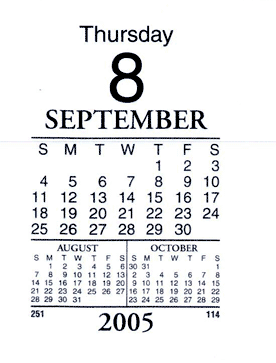
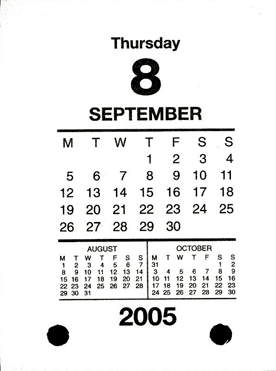

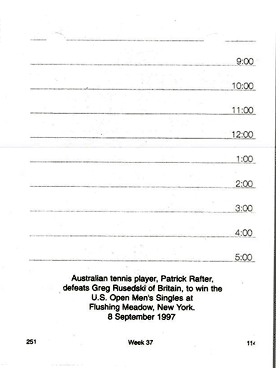
4 Most of the similarities and differences between the calendar and appointments pages of the two products are clearly visible:
- The Cumberland print is slightly smaller and thicker than the Collins print;
- The Cumberland print is black, whereas the Collins print is dark blue (it is also advertised as being dark blue);
- Each week in the Collins calendar begins on a Sunday, but in the Cumberland calendar, it begins on a Monday;
- The Collins ‘appointments page’ has eleven lines, whereas the Cumberland has ten;
- The Cumberland appointments page records the hours of the business day in a column in the margin, whereas the Collins does not;
- The ‘days of the year past/days of the year remaining’ numbers appear at the foot of the calendar page in the Collins product but at the foot of the appointments page in that of Cumberland;
- The Cumberland refill gives the number of the current week at the foot of the appointments page where the Collins does not give this information;
- The Collins appointments page has a ‘quotable quote’ at its foot, whereas the Cumberland specifies an ‘On this day ...’ notable event, in that position.
5 The external (visible) front covers of the two calendar blocks are quite different, and clearly identify the respective products’ sources:
|
COLLINS PRODUCT |
|
CUMBERLAND PRODUCT |
|
|
|
|
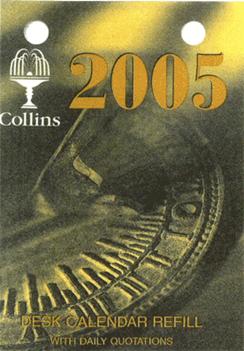

6 Both parties’ refills are of the same size, 4 inches x 3 inches (or 102 mm x 75 mm), and have identically positioned holes. Both the top-hole and side-hole holders on the market have only two ‘loops’. Oddly, however, the side-hole refills have four holes because it is commonly understood that at some time in the past a holder was produced which had four loops. John Lynton Bentley, a director of Collins, explained that Collins has continued to produce the four-side-hole refills against the possibility that some consumer may still possess and use the four-loop holder which was manufactured in former times, and would be disappointed, indeed, annoyed, to find that only a two-side-hole refill can now be bought.
7 Collins relies on contravention of s 52 and other sections of the Trade Practices Act 1974 (Cth) and passing off, not the infringement of any form of intellectual property, in particular, of copyright. Paragraph 11 of Collins’s statement of claim sets out the facts on which it relies to support both claims:
‘By manufacturing and supplying the Respondent’s Desk Calendar Refills for the year 2005 members of the public in their capacity as consumers of the Collins Desk Calendar Refills when they purchase the Respondent’s Desk Calendar Refills for the year 2005 are likely to be misled that they are purchasing the Collins Desk Calendar Refill for the year 2005.
Particulars
Members of the public in their capacity as consumers of the Collins Desk Calendar Refills are likely to be misled for the following reasons:
(a) The size and configuration of the Respondent’s Desk Calendar Refills are identical to the Collins Desk Calendar Refills.
(b) The Respondent’s Desk Calendar Refills for the year 2005 have the same two holes punched in the top, or four holes punched in the side, of the calendar enabling the Respondent’s Desk Calendar Refill for the year 2005 to be used in a Collins Desk Stand.
(c) The Respondent’s Desk Calendar Refills for the year 2005 uses the same plastic packaging as the Collins Desk Calender Refill for the year 2005.
(d) The Respondent’s Desk Calendar Refills for the year 2005 assert on the back of the refills that it has copyright over the desk calendar refills.
(e) The Respondent’s use of the same expression, namely the expression, “desk calendar refill”, on the front of its desk calendar refills, as that used on the front of the Collins Desk Calender Refills.
(f) The use of the expression “desk calendar refill” on the front of the Respondent’s Desk Calendar Refills, in conjunction with its size, configuration, the assertion by the Respondent of copyright over the refills and the use of plastic packaging is likely to lead a member of the public who is a consumer of the Collins Desk Calendar Refills to assume the Respondent’s Desk Calendar Refills and the Collins Desk Calendar Refills are the same product.
(g) The Respondent’s Desk Calendar Refills have the same get-up as the Collins Desk Calendar Refills.’
THE FACTS
8 According to the testimony of Graham William Johnson, a person with many years experience in the stationery industry in Australia, immediately prior to 1996 there were only two companies in Australia which produced the desk calendar refills: Croxley Collins Olympic Pty Ltd and Spicers Stationery Pty Ltd. Mr Johnson stated that both companies, although competitors, were subsidiaries of Spicers Paper Ltd. In 1996, there was a merger so that a new company, Spicers and Collins Stationery Pty Ltd, a subsidiary of Spicers Paper Ltd, became the only company engaged in the business of producing desk calendar refills in Australia. It sold the refills under the ‘Collins’ trade mark.
9 As a result of a series of agreements entered into ‘as of’ 30 June 1998, Collins acquired that business.
10 Collins relies on the fact that from about 30 June 1998 until the entry of Cumberland into the market with its 2005 refills in mid to late 2004, Collins was the sole manufacturer of the 102 mm x 75 mm two-top-hole and four-side-hole desk calendar refills supplied to the Australian market (but see [12] – [13] below).
11 In 2002, another entity known as ‘Distinguished Diaries’ produced desk calendar refills for the 2003 calendar year. They were colourful, perhaps ‘playful’ in style, with a distinctive font and typeface. Howard Gordon Blight, the managing director of Cumberland, agreed that they were ‘probably aimed at a female or child market or something along those lines’. The product was unlike the ‘business style’ refills manufactured by Collins, and now by Cumberland.
12 Apart from the Distinguished Diaries product, I find that in respect of 1999, 2000, 2001, 2002, 2003 and 2004 Collins was the sole manufacturer of 102 mm x 75 mm desk calendar refills sold in the Australian market.
13 I have been careful to say that Collins was the sole ‘manufacturer’ of refills for 1999 to 2004, because not all Collins-manufactured refills were sold under Collins’s name. A substantial part of Collins’s business was the manufacture of refills for private label brands. For the calendar years 1999 to 2005, Collins produced desk calendar refills for ‘Corporate Express’, ‘Office Choice’, ‘WC Penfold’, ‘Invicta’, ‘South East Stationers’, ‘Viking’ and ‘News Power’. Prior to the acquisition of the business by Collins as of 30 June 1998, calendar blocks had been manufactured in that business for private labels for at least ‘a few years’ according to Mr Bentley. He said that approximately one third of Collins’s production of desk calendar refills is for private label brands. On the front cover of the private label products, the relevant private label appears, and there is no reference to Collins. In an advertisement at the back of the private label calendar blocks, there is no reference to the ‘Collins Debden’ desk calendar refills, although there is, for example, a reference to the ‘Collins Debden’ diary.
14 In April 2003, Cumberland purchased from Collins 40,000 of its refills for calendar 2004 and on-sold them to wholesalers and retailers.
15 Some time in or about September 2003, Cumberland decided to begin manufacturing and selling its own desk calendar refills, commencing with those for 2005. Cumberland decided to have its product manufactured in China. A sample was produced in early 2004. The final versions of Cumberland’s two-top-hole and four-side-hole configurations were manufactured and distributed in mid to late 2004.
16 Collins asks me to find that Cumberland’s instructions to its manufacturer in China were, in effect to manufacture a copy of Collins’s product.
17 On 11 December 2003, Paula Hodge of Cumberland sent an email to the Chinese manufacturer, the last paragraph of which was as follows:
‘I will fedex a fresh sample of our competitors [sic] product to show you the packaging required. I will also include a sample stand so you can match the holes perfectly.’
The ‘competitor’s product’, which Cumberland accepts it forwarded to China, was Collins’s calendar block. The ‘packaging’ referred to in the email was transparent unmarked shrinkwrap. I infer that a sample stand was also sent by Cumberland to the Chinese manufacturer as foreshadowed in Ms Hodge’s email. Nothing has been made of the ‘stands’ or ‘containers’ or ‘holders’ in the case, and the evidence does not reveal who first manufactured them. I infer, however, that since 30 June 1998, Collins has been the sole manufacturer of them for the Australian market.
18 Cumberland placed its order with the Chinese manufacturer on 14 April 2004. The letter placing the order stated that it was essential that the dates of the year be in the correct order, and that the holes be drilled in the correct positions to fit the stands. The letter enclosed two diagrams, one for the two-top-hole version and the other for the four-side-hole version. The diagrams gave overall dimensions of 76 mm [sic] x 102 mm and the locations of the centres of the various holes. When it was put to him that he had simply taken the dimensions from a Collins calendar block, Mr Blight replied:
‘What I did was reproduce a refill that was the same as the refill that I had been aware of for 40 odd years.’
When it was then put to him that the particular refill which came to his mind and to his hand was the Collins product, he replied:
‘The Collins Debden Bunch of Dates is the same as those that have been available for 40 years.’
19 Ultimately, Mr Blight said that he did not know from which desk calendar refill he had taken the dimensions, but that he possessed refills that went back ‘many many years’ and could have taken the dimensions from any one of them.
20 Probably the particular desk calendar refill used by Mr Blight as the source of the dimensions was a Collins-manufactured product. Apart from the Distinguished Diaries refills, the Collins-manufactured products, whether sold as Collins or private label items, had been the only desk calendar refills on the Australian market since 30 June 1998. While it is possible that Mr Blight used a pre-30 June 1998 refill, this is unlikely, and we know that it was a Collins calendar block that he sent to China to demonstrate the shrinkwrap packaging required.
21 I also accept, however, that the non‑Collins-manufactured desk calendar refills that had been on the Australian market for many years prior to 30 June 1998 had had the same dimensions and placement of holes as the post-30 June 1998 Collins-manufactured ones. Collins and other manufacturers before it, and now Cumberland, have had to manufacture calendar blocks to fit the stands, which have been in use for some 40 years.
22 Notwithstanding the references to the ‘Collins Desk Stand’ in para 11(b) of Collins’s statement of claim (see [7] above), no evidence was directed to the manufacture and supply of the stands. Mr Bentley of Collins said that he did not know who was the first manufacturer of stands in Australia to take desk calendar refills. This testimony, that of Mr Blight that the size and hole positioning of Cumberland’s refill was the same as those of the refills, emanating from various sources from time to time, which had been in the Australian market for 40 years, and the fact that Collins itself produces a four-side-hole calendar block against the possibility that some consumer still has a previously manufactured four-side-loop stand, combine to suggest that any question of originality, as to either stand or size, configuration and hole positioning of refills, is now lost in the mists of time.
23 Cumberland’s catalogue for 2005 shows its desk calendar refills as having dimensions of 102 mm x 75 mm. The advertisement states, ‘One day to a page’, a feature which Cumberland’s product shares with that of Collins, and ‘Contains “On this day...” in Australia’, a reference to the fact at the foot of the appointments page, there is noted an event of historical interest which occurred on the date in question.
CONSIDERATION
24 In my opinion, the application fails because it is not established on the evidence that consumers identify the features which are similar as between the Collins and Cumberland desk calendar refills, with Collins as their source. The mere fact that Collins was, except for Distinguished Diaries, the sole manufacturer of refills sold in Australian from 30 June 1998 to 31 December 2004 does not establish this. It would have made no difference even if all refills had been marketed under Collins’s name in that period. In fact, however, as noted at [13], about one-third of those which Collins manufactured were marketed under private labels. On them the external front covers are not Collins covers, but private label covers (incidentally, the private label calendar blocks are also marketed shrinkwrapped).
25 The relevant part of the statement of claim was set out at [7]. It is not pleaded or proved that Cumberland has marketed its refills under the Collins name or Collins’s ‘fountain’ logo. On the contrary, Cumberland has used its name prominently on the front cover, on a page containing a ‘2006 calendar refills order form’ and advertisement (located at 2 September 2005), and on the back cover. Collins’s case must be that this prominent, correct identification of Cumberland as the source of its refills, is displaced by the association made by consumers of the features mentioned in [7] above with Collins. This case is not made out.
26 A strikingly distinctive get up, packaging or trade dress may be found to be misleading, or deceptive, notwithstanding correct identification of source (cf Reckitt & Colman Products Ltd v Borden Inc [1990] 1 All ER 873 (‘Reckitt & Colman’)). Identification of the source of products having a similar appearance may have a different significance according to:
· the relevant surrounding circumstances, such as the price of the goods and the associated care or nonchalance which may be expected to characterise the decision-making of consumers (cf Parkdale Custom Built Furniture Pty Ltd v Puxu Pty Ltd (1982) 149 CLR 191 (‘Parkdale’));
· the nature of the goods and of the features of them that have a similar appearance; and
· the prominence of the identification of source.
27 The present desk calendar refills are inexpensive, retailing for less than $2.00. The identification of source, Collins or Cumberland, is prominent on the external front cover.
28 With the exception of the ‘quotable quotes’ and ‘On this day ...’ features, the daily calendar and appointments pages of the desk calendar refills are compilations of mundane, readily available factual information which is presented in a clear and useful, but obvious and unimaginative form: cf Tot Toys Ltd v Mitchell t/as Stanton Manufacturing [1993] 1 NZLR 325 at 338.
29 Paragraphs (a) and (b) of para 11 of the statement of claim refer to size, configuration and number and positioning of holes. The evidence shows, however, that all refills that have been manufactured over the last 40 years or so have been manufactured to the dimensions of, and the positioning of the loops in, the refill holders, which have been in the market over that period. Features which are dictated purely by function do not point to one trade source rather than to another: see, for example, Komesaroff v Mickle [1987] VR 703 (moving sand pictures). It is true that it would be possible for a refill with pages of slightly different external dimensions to fit the holder, but this would not overcome the problem for Collins that consumers are not shown to associate with Collins calendars with pages of the existing length.
30 Paragraph (c) of para 11 refers to the use of ‘the same plastic packaging’. The reference is to the transparent unmarked shrinkwrap. Consumers are not shown to regard this as pointing to a Collins product.
31 Paragraph (d) of para 11 refers to the claim made on the back of the refill to ‘copyright’. This leads nowhere.
32 Paragraph (e) of para 11 refers to the use of the expression ‘desk calendar refill’ on the front cover. These are ordinary descriptive words. Mr Bentley acknowledged that people called desk calendar refills precisely that, ‘desk calendar refills’, since before 1998. The words are not shown to have acquired a secondary meaning suggestive of Collins: cf Telmak Teleproducts (Australia) Pty Ltd v Coles Myer Ltd (1989) 89 ALR 48 (‘dry fry convection oven pan with lid’); Equity Access Pty Ltd v Westpac Banking Corporation Ltd (1989) 16 IPR 431 (‘equity access’); Dodds Family Investment Pty Ltd v Lane Industries Pty Ltd (1993) 26 IPR 261 (‘Solar Tint’); Apand Pty Ltd v The Kettle Chip Company Pty Ltd (1994) 52 FCR 474 (‘Apand v The Kettle Chip Company’) (‘kettle’); Burica Pty Ltd v Tops to Bottoms (Australia) Pty Ltd (1997) 39 IPR 447 (‘Simply Irresistible’).
33 It is not shown that either separately or in combination, the mundane features relied on by Collins, some of them dictated by functional considerations, represent a get-up for which Collins has a reputation. The appearance of Collins’s calendar blocks is not fanciful, extravagant or capricious (cf the lemon-shaped plastic containers in Reckitt & Colman).
34 The importance of establishing its ‘reputation’, or a ‘secondary meaning’ pointing to it, in cases turning on get-up, packaging, shape, or trade dress, such as the present one, has been recognised in many authorities; see, for example: Cadbury-Schweppes Pty Ltd v Pub Squash Co Pty Ltd [1980] 2 NSWLR 851; Parkdale, above; Conagra Inc v McCain Foods (Aust) Pty Ltd (1992) 33 FCR 302 at 346, 352 to 353, 355 to 359, 374; Telmak, above; Interlego AG v Croner Trading Pty Ltd (1992) 39 FCR 348 at 386-388 per Gummow J, with whom Black CJ and Lockhart J agreed; Apand v The Kettle Chip Company, above, at 487.
35 It is necessary, however, that I address the evidence of Charles Asomatianos, Miriam Neill and Stephen Ferretti.
36 Mr Asomatianos and Ms Neill were, at relevant times, licensed commercial private inquiry agents. Mr Asomatianos was the managing director of Grierson (Aust) Pty Ltd (‘Grierson’) and Ms Neill was employed by that company.
37 According to his affidavit, pursuant to instructions received by Grierson from Collins’s solicitors, Mr Asomatianos attended upon ten stationery retailers and asked to buy ‘Collins’ desk calendar refills (he attended on four additional stationery retailers but they are not relevant for present purposes). In six instances, he was told that the shop did not have Collins refills but that it had Cumberland refills, which were ‘the same’. In those cases, the sales staff clearly appreciated the difference between the sources of the two products.
38 The visits to the remaining four retailers were as follows:
|
Date |
Store |
|
26 October 2004 |
W C Penfolds Stationery Store 68 Willoughby Road Crows Nest |
|
14 December 2004 |
Office National Stationery Store Dural |
|
14 December 2004 |
Office National Stationery Store Auburn |
|
14 December 2004 |
Office National Stationery Store Surry Hills |
39 Although there were some differences, generally speaking in each of the four cases, although Mr Asomatianos asked for ‘Collins’ refills, the sales person produced Cumberland ones and sold them to him.
40 I do not know, however, why the sales person did so. While it is possible that he or she erroneously assumed that the product produced was a Collins refill, another possible explanation is that, knowing that only Cumberland refills were in stock, he or she assumed that Mr Asomatianos would not care which brand was sold to him. (Product substitution is a wrongful act for which relief can be obtained as for passing off, the passing off being that of the person who effects the substitution: see S & M Motor Repairs Pty Ltd v Caltex Oil (Aust) Pty Ltd (1998) 12 NSWLR 358; Pearce and Bros v Valentine & Co (1917) 34 RPC 267; Purefoy Engineering Co Ltd v Sykes Boxall & Co Ltd (1955) 72 RPC 89; Dairy Vale Metro Cooperative v Browns Dairy Pty Ltd (1981) 54 FLR 243.) Yet another possibility is that the sales person did not hear or take on board the word ‘Collins’. Since all desk calendar refills must fit the standard holders, it would be understandable if sales persons regarded them all as ‘the same’ and paid no attention to the word ‘Collins’.
41 In the case of six of the ten purchases deposed to by Mr Asomatianos, the sales person must have heard the word ‘Collins’ and appreciated the distinction between Collins and Cumberland products. I do not infer that the salespersons at these other four stores also heard the word ‘Collins’, took it on board, and mistakenly believed that he or she was supplying Collins refills.
42 Ms Neill logged onto Office National’s website and registered as an on-line purchaser. She selected the page ‘Collins Desk Calendar refills’ and proceeded to the next page to make a purchase. On that page, the general heading was ‘collins desk calendar refills’, but further down the page, where the number to be purchased is to be entered, the product is shown as ‘Office National Desk Calendar refill’. In addition, a photograph of both the two-top-hole and four-side-hole versions appeared with Office National branding.
43 Whatever may be said of Office National’s website, it does not support Collins’s claim that Cumberland had engaged in misleading or deceptive conduct or had passed off its product as that of Collins.
44 Mr Ferretti, the National Sales Director of Collins, was called as an expert witness. In his affidavit, however, he happened to recount a telephone conversation with a customer who had called Collins and spoken to him on 5 or 6 January 2005. The customer said to Mr Ferretti:
‘I am disappointed you have changed your desk calendars. I am disappointed that Collins desk calendar is now using “notable dates” instead of “daily famous quotes”.’
Mr Ferretti states that he understood that the caller must have bought Cumberland’s desk calendar refill, and replied:
‘Madam, you have purchased Cumberland’s product, not the Collins desk calendar. The Cumberland desk calendar refill can be easily mistaken with the Collins desk calendar refill.’
45 This one conversation would be a very unsound foundation for concluding that ‘consumers’ in Australia generally are misled. The woman did not testify. Perhaps she knowingly bought a Cumberland refill but had forgotten that it was a Cumberland product by the time of her telephone conversation with Mr Ferretti. Perhaps she had defective eyesight. Perhaps she had bought, not a Cumberland diary, but a diary which ‘Spicers Stationery’ produced and marketed in late 2004 for calendar 2005 under its ‘Universal’ brand, which also used ‘On this day ...’ notations rather than ‘quotable quotes’.
46 I would not infer, on the basis of Mr Ferretti’s conversation with this one caller, that consumers generally are likely to be misled by the previously mentioned features of Cumberland’s desk calendar refills on which Collins relies, into understanding that those refills come from Collins.
CONCLUSION
47 For the above reasons, the application should be dismissed with costs.
|
I certify that the preceding forty-seven (47) numbered paragraphs are a true copy of the Reasons for Judgment herein of the Honourable Justice Lindgren. |
Associate:
Dated: 29 September 2005
|
Counsel for the Applicant: |
Mr D B McGovern SC and Mr M P Cleary |
|
|
|
|
Solicitor for the Applicant: |
Bradfield & Scott |
|
|
|
|
Counsel for the Respondent: |
Mr J J Garnsey QC and Mr R C Titterton |
|
|
|
|
Solicitor for the Respondent: |
Norman Waterhouse |
|
|
|
|
Date of Hearing: |
5, 6, 7, 8 September 2005 |
|
|
|
|
Date of Judgment: |
30 September 2005 |


