

FEDERAL COURT OF AUSTRALIA
Protiviti Inc v Probiti Pty Ltd [2005] FCA 1114
TRADE MARKS – trade mark infringement – application for interlocutory injunction – applicants’ trade marks “Protiviti” and respondents’ company and business name “Probiti” – damage alleged not that respondents would get business from applicants but that potential customers of applicants would go to other competitors
Trade Marks Act 1995 (Cth) ss 41(2), 57, 88(2)(a)
The Mond Staffordshire Refined Company Limited v Ellis Harleman (1929) 41 CLR 475 at 477 cited
Shell Company of Australia Limited v Esso Standard Oil Australia Proprietary Limited (1963) 109 CLR 407 at 415 applied
Southern Cross Refrigerating Company v Toowoomba Foundry Proprietary Limited (1954) 91 CLR 592 at 594-595 applied
Clark Equipment Co v The Registrar of Trademarks (1964) 111 CLR 511 at 514 cited
PROTIVITI INC & ANOR v PROBITI PTY LTD & ORS
NO VID 818 OF 2005
HEEREY J
5 AUGUST 2005
MELBOURNE
|
IN THE FEDERAL COURT OF AUSTRALIA |
|
|
VICTORIA DISTRICT REGISTRY |
VID 818 OF 2005 |
|
BETWEEN: |
PROTIVITI INC FIRST APPLICANT
PROTIVITI PTY LTD (ACN 108 473 909) SECOND APPLICANT
|
|
AND: |
PROBITI PTY LTD (ACN 710 760 953) FIRST RESPONDENT
RICHARD JOHN HOPKINSON SECOND RESPONDENT
ANTHONY NEIL ROBERTS THIRD RESPONDENT
PHILIP ANDREW SAUNDERS FOURTH RESPONDENT
|
|
HEEREY J |
|
|
DATE OF ORDER: |
|
|
WHERE MADE: |
MELBOURNE |
ORDERS
Upon the applicants, by their Counsel, undertaking to:
(a) submit to such order (if any) as the Court may consider to be just for the payment of compensation, to be assessed by the Court as it may direct, to any person whether a party or not a party, adversely affected by the operation of Orders 1 or 2 below or any continuation (with or without variation) and;
(b) pay the compensation referred to in (a) to the person there referred to.
THE COURT ORDERS THAT:
1. Until the trial of this proceeding or until further order:
(i) The respondents be restrained from carrying on business or providing or offering to provide business consulting services in Australia, or advertising, marketing or promoting such a business, including the domain name www.probiti.com at the website located at http://www.probiti.com, under or by reference to the word “PROBITI” in any style or lettering, or any other word which is substantially identical with or misleadingly or deceptively similar to the word “PROTIVITI”.
(ii) The second, third and fourth respondents be restrained from aiding, abetting, counselling or procuring, and from being directly or indirectly knowingly concerned in or a party to the conduct of the first respondent referred to in paragraph 1.
2. Costs reserved.
3. The orders be stayed for 7 days.
Note: Settlement and entry of orders is dealt with in Order 36 of the Federal Court Rules.
|
IN THE FEDERAL COURT OF AUSTRALIA |
|
|
VICTORIA DISTRICT REGISTRY |
VID 818 OF 2005 |
|
BETWEEN: |
PROTIVITI INC FIRST APPLICANT
PROTIVITI PTY LTD (ACN 108 473 909) SECOND APPLICANT
|
|
AND: |
PROBITI PTY LTD (ACN 710 760 953) FIRST RESPONDENT
RICHARD JOHN HOPKINSON SECOND RESPONDENT
ANTHONY NEIL ROBERTS THIRD RESPONDENT
PHILIP ANDREW SAUNDERS FOURTH RESPONDENT
|
|
JUDGE: |
HEEREY J |
|
DATE: |
|
|
PLACE: |
MELBOURNE |
REASONS FOR JUDGMENT
1 This application for an interlocutory injunction arises out of the use by the applicants of the name Protiviti and the use by the respondents of the name Probiti. The first applicant, Protiviti Inc, is a United States corporation which is the registered proprietor under the Trade Marks Act 1995 (Cth) (the Act) for the following marks:
- Number 923107, Protiviti (regardless of font), effective date 13 May 2002;
- Number 923311, Protiviti, in lower case, as follows, effective date 3 July 2002; and
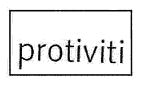
- Number 923104, Protiviti Independent Risk Consulting, as follows, effective date 3 July 2002.

The above trade marks are all registered in respect of class 35, services: “Providing business consulting services, internal audit, technology risk consulting and financial and commodity risk consulting”.
2 Protiviti Inc's parent company owns the domain names, www.protiviti.com and www.protiviti.org. Protiviti Inc owns the domain name www.protiviti.net. A related company is the owner of the Australian domain name www.protiviti.com.au.
3 Protiviti Inc commenced business in May 2002 in the United States to take over that part of the business of the collapsed Arthur Andersen which was concerned with internal audit and business risk consulting. Its activities fall into the categories of business risk, technology risk and internal audit. Business risk is concerned with assisting companies to understand, measure and control the risks to their business and to comply with regulations and local laws such as the Sarbanes-Oxley Act in the United States and the Stock Exchange and corporate law regime in Australia. In that field Protiviti is concerned with matters such as corporate security, energy commodity risks and fraud investigation.
4 The second category, technology risk, is concerned mainly with information technology and risks involved therein, such as security and privacy. In the third category, internal audit, Protiviti Inc provides services such as quality assurance reviews and internal audit transformation.
5 These services have traditionally been provided to large corporations by major international accounting firms such as Ernst and Young, PriceWaterhouseCoopers, KPMG, Deloitte and the former Arthur Andersen. However, recent legislative changes in the United States have prohibited firms from providing both external audit services, answerable to the client company’s shareholders, and internal services, answerable to its board. Hence, an opportunity arose for Protiviti Inc, which now has almost 2000 employees and annual revenue of US$500 million.
6 Protiviti Inc has performed work for companies in Australia since around 2003 by flying out personnel from time to time from the United States. The second applicant, Protiviti Pty Ltd, was incorporated as a subsidiary of Protiviti Inc on 13 April 2004. Since then Protiviti Pty Ltd has expanded rapidly. In June 2004 it had 10 professional staff in Sydney and 12 in Melbourne. It now has 63 professional staff in the two cities. Turnover has risen from around $9 million in the first year of operation to an anticipated $15 million in its second year.
7 Protiviti Pty Ltd has expended a substantial amount of money in promotion, with approximately $466,000 spent on advertising in addition to sponsorship of events such as the Tri Series Triathlon. It was officially launched in Australia in June 2004 at large functions in Sydney and Melbourne and has been the subject of substantial coverage in the financial and general press.
8 To further its promotion in Australia, Protiviti Pty Ltd has formed strategic partnerships and sponsorship arrangements with professional bodies such as Chartered Secretaries Australia, the Australian Institute of Company Directors, the Institute for International Research, the Institute of Internal Auditors and the Information Systems Audit and Control Association.
9 In all of these activities the trade mark name Protiviti has featured prominently. The concluding letter “i” is used as a distinguishing feature. For example, the invitations to the Sydney and Melbourne launches had a cover bearing the legend “a real i opener” and inside there is the statement:
“Forward thinking business leaders across the US, Europe and Asia have already said ‘i’
Now Australian business leaders can join them and say ‘i’ to independence, integrity and trust.”
The invitation asks recipients to “say i to RSVP”.
10 The second, third and fourth respondents Mr Richard Hopkinson, Mr Anthony Roberts and Mr Philip Saunders, are directors of the first respondent, Probiti Pty Ltd. On 30 July 2004, Mr Hopkinson registered under the Business Names Act 1962 (Vic) the business name Probiti Solutions. Applicants for registration of business names in Victoria are provided with an information sheet which includes the following:
“Right and Protection of Business Names.
The requirement to register a Business Name is to provide public disclosure about the people who own the business ie. so that customers, suppliers, etc can determine who they are dealing with.
The registration of a Business Name under the Business Names Act 1962 does not provide protection of, or establish rights to, a Business Name.
Registration of a Business Name may infringe the ownership of a Trade Mark or Domain Name. Check with the appropriate registration authorities to ensure that there is no conflict with a Trade Mark or Domain Name.
One way of protecting your Business Name is to register a Trade Mark.
These are private civil matters. You may need to seek legal advice.
Trademarks and Internet Domain Names.
Trade Marks are registered and administered by IP Australia, a Commonwealth Government Agency. Information about Trade Marks can be found on the website www.ipaustralia.gov.au.
The registration of Domain Names is administered by .au Domain Administration Limited and a list of Accredited Registrars can be found on its website, www.auda.org.au.”
11 Mr Hopkinson deposes that until recently he had no particular knowledge of the protection afforded by registered trade marks or the different legal protection afforded by trade marks, business names and company names, and that it did not
“cross my mind in around July/August 2004 to investigate registered trademark protection for the name Probiti and I did not do so.”
12 Mr Hopkinson says that he wanted to register the name Probity with a “y” but was told by the people at Consumer Affairs Victoria that he could not register that name. It is a little surprising that somebody who has had some experience in the world of commerce is not broadly familiar with the concept of registered trade marks. In any event, the respondents accept that as at 30 July 2004 they were aware of the existence of the Protiviti name and the business carried on under that name.
13 Also on 30 July 2004 Mr Hopkinson registered the domain name www.probiti.com.
14 On 6 August 2004 Mr Roberts and Mr Saunders, who were then directors of a company called Resume IT (Vic) Pty Ltd (Resume), went to see Mr Gary Anderson, the Managing Director of Protiviti Pty Ltd. They gave Mr Anderson business cards describing themselves as directors of Resume, and inquired about some form of employment with Protiviti. Mr Anderson explained that he did not have positions for senior people like themselves but there was a possibility for them to work on a contract basis if a large request for resources came in. They acknowledged this and said they would send details of their Resume company for future use.
15 A few days later, on 9 August, Mr Saunders sent Mr Anderson an email enclosing a company profile of Resume. It is of some significance that Messrs Roberts and Saunders made no mention to Mr Anderson of the fact that they had already registered the name Probiti Solutions.
16 It is not entirely clear when the respondents commenced business under the name Probiti Solutions. According to the Victorian business name records the business was commenced on 15 August 2004. However, the respondents organised a public launch of their business as late as 31 May 2005. There is, nevertheless, some evidence of them doing work in September 2004.
17 On 31 August 2004 Probiti Pty Ltd was incorporated, the directors being Messrs Hopkinson, Roberts, Saunders and a Mr Malcolm Bingham. The registered office and principal place of business is 1/33 Tulip Street, Black Rock, which is a residential address. On 1 October 2004 Messrs Roberts and Saunders resigned as directors of Resume.
18 On 30 May 2005 Protiviti Pty Ltd first learned of the existence of Probiti when a senior manager in Protiviti Pty Ltd's technology risk group was offered employment by Mr Bingham on behalf of Probiti Pty Ltd. As mentioned, there was the Probiti launch on 31 May 2005. On 6 June 2005 the applicants' solicitors sent a letter of demand. Correspondence followed resulting in the commencement of this proceeding on 26 July 2005.
19 The statement of claim alleges trade mark infringement, misleading and deceptive conduct contrary to s 52 of the Trade Practices Act 1974 (Cth) and s 12(e) of the Fair Trading Act 1999 (Vic) and passing off. The main argument, however, was concerned with the trade mark infringement claim.
20 The applicable principles are not in dispute. The allegedly infringing mark Probiti is not to be compared side by side with the registered marks. The Court must determine the impression based on recollection of the Protiviti marks that persons of ordinary intelligence and memory would have, compared with the impression that such persons would get from the Probiti unregistered mark. The effect of the word Probiti as spoken must be considered. Similarity of meaning must be considered. The usual meaning in which ordinary people behave is the test. The relevant course of business and the way marks are used is to be considered. It may be relevant that the form of words or a recognisable part thereof are common in the area in which both the parties operate: The Mond Staffordshire Refined Company Limited v Ellis Harleman (1929) 41 CLR 475 at 477.
21 The question is one of fact and impression: see generally Shell Company of Australia Limited v Esso Standard Oil Australia Proprietary Limited (1963) 109 CLR 407 at 415. The test is whether a number of persons would be caused to wonder if Probiti’s services and Protiviti’s services came from the same source: Southern Cross Refrigerating Company v Toowoomba Foundry Proprietary Limited (1954) 91 CLR 592 at 594-595.
22 In my opinion, the two words are quite similar. They both commence with the syllable “Pro”. Importantly, they both end with the letter “i”, pronounced “ee”. This is an unusual ending for words in the English language. The internal consonants “v” in the one word and “b” in the other can often be confused. It is a matter of common experience that people looking at a word often do not read it carefully. If they have in mind an earlier word they can mistakenly leap to the conclusion that the word they are looking at, if it has some similarity, is the one that they had in mind. This is particularly so when the opening syllables are the same.
23 This is the more so when both words are invented words and the person reading or hearing them does not have reference to a tangible thing to fasten one meaning in his or her mind compared with another.
24 While at the moment I only have to find whether there is a triable issue, this is arguably a case for the application of the well-known doctrine in Australian Woollen Mills Limited v F.S. Walton and Co Limited (1937) 58 CLR 641 at 657, where it was held that if a trader had deliberately intended a name to mislead or confuse, the court can infer that, in fact, this happened or is likely to happen. It does seem to be a remarkable coincidence that within a short space of time the respondents, being in precisely the same area of business as part of the applicants’ business (technology risk), picked a name which just happened to have the unusual ending “i”. Moreover, this is in a setting where the respondents when they first registered their name were aware of the existence of the applicants’ name and business.
25 There was some evidence of actual confusion and some evidence of people not being confused. I do not put a great deal of weight on this either way as there has been a limited period of time during which the potential for this confusion might have arisen. In relation to the question of intention, I refer again to the meeting of 6 August 2004. If Messrs Roberts and Saunders honestly thought there was no question of any confusion between their name and the applicants’ name, it is not clear why they would not have mentioned it to Mr Anderson.
26 I then come to the question of balance of convenience. The applicants put their case this way. They rely not so much on people taking their business to the respondents as a result of the confusion; rather they say they see themselves as competing in the marketplace with the major accounting firms, Deloittes, Ernst and Young, KPMG and PriceWaterhouseCooper, for the business of large corporations and government bodies.
27 Mr Anderson deposes that the main risk to Protiviti Pty Ltd of Probiti Pty Ltd continuing to trade under and by reference to the name Probiti is that companies will engage one of the big four firms rather than Protiviti Pty Ltd because they will have confused the reputation and type of service that Protiviti Pty Ltd provides with the service provided by Probiti Pty Ltd. The reputation and brand image of the services will be confused in the marketplace and buyers will tend towards well-known brand names such as the big four because they will not believe there is a separate global firm that can reliably deliver these services in large, complex and often international projects that require high standards of quality control.
28 As senior counsel for the applicant put it in argument by way of analogy, it is as though a one man suburban solicitor’s practice used a name deceptively similar to Mallesons, and as a result somebody who wanted the service of a very large firm thought Mallesons was a one man practice and, instead of going to Mallesons, went to Blake Dawson Waldron. While this is perhaps an unusual way of formulating a case of apprehended loss and damage, Mr Anderson, who has considerable experience in this area, has sworn to his belief that damage may be caused in this way. The proposition is not inherently improbable, and I see no reason why I should not accept it for present purposes.
29 On that basis there is, I accept, a distinct possibility that the applicants would suffer loss that they would not be able to detect or ascertain, still less quantify. On the other hand, the respondents are in a position where, on the best view of the evidence, they have only been in business since September 2004. The evidence of their business is of a general and rather vague nature. For example, Mr Saunders deposed that since September 2004
“I have been keen to ensure that Probiti promotes itself by reference to the skills of its four directors and other necessary contracted resources.”
and that
“We have worked extremely hard since September 2004 trying to achieve this.”
30 One of the deponents of affidavits filed on behalf of the respondents is a Ms Petronell Claessens who is the Manager of Security, Strategy and Governance at the ANZ Bank. She has had dealings with the respondents. The gist of her evidence is that when recruiting persons for this type of work, she places great emphasis on the individual experiences and qualities of the persons who will actually be doing the work. She describes the process of seeking out such persons and she deposes that after short-listing the individuals whose names have been put forward:
“I would then make a decision as to which person would be offered the role. My decision was based on my assessment of each person's skills, capabilities, experience and personality. My decision was not based on what I would call ‘brand’ considerations such as the name and profile of the business to which a contractor would provide their services.”
So therefore, while it might be accepted that Messrs Hopkinson, Roberts and Saunders are experienced and capable people in this field of work, there is no reason to feel that they will be very much inhibited in carrying on that work if they cannot use the name Probiti.
31 Counsel for the respondents raised the prospect of a cross-claim for the expungement of the Protiviti marks under s 88(2)(a) of the Act. He submitted that the registration of each of the marks could have been opposed under s 57 read with s 41(2) on the basis that as at the date of the application for registration, 15 August 2002, the mark was not capable of distinguishing the applicants’ services from the services of other persons. This was because, if Probiti was deceptively similar to any of Protiviti Inc’s marks, then the registration of the first applicant’s marks has the effect of preventing the use of an ordinary English word as a trademark in relation to service of IT risk management, a desirable characteristic of which the word is perfectly apt to describe.
32 Counsel referred to the statement of Kitto J in Clark Equipment Co v The Registrar of Trademarks (1964) 111 CLR 511 at 514 where his Honour said:
“The question whether a mark is adapted to distinguish is to be tested by reference to the likelihood that others trading in goods of the relevant kind and being actuated only by proper motives in the exercise, that is to say of the common right of the public to make honest use of the words forming part of the common heritage for the sake of signification which they ordinarily possess will think of the word and want to use it in connection with similar goods in any manner which would infringe a registered trademark granted in respect of it. “
33 I think the short answer is, as senior counsel for the applicants put it, that the validity would have to be assessed as at the date of the application for registration, at which time the word Probiti was not in use. In any event, the word Protiviti is an invented name and not part of the “common heritage”.
34 Counsel for the respondents suggested the possibility of an early hearing, say in the second half of October. This was implicitly on the basis that there would be no grant of an interlocutory injunction. However, I think this is a reasonably clear case for interlocutory relief. A case is made out that the applicants would be at risk of suffering irremediable damage in the meantime. They are entitled to have their application for an interlocutory injunction considered on its merits. Accordingly, I will make the orders sought upon counsel giving the usual undertakings.
|
I certify that the preceding thirty-four (34) numbered paragraphs are a true copy of the Reasons for Judgment herein of the Honourable Justice Heerey. |
Associate:
Dated: 5 August 2005
|
Counsel for the Applicants |
G S Clarke SC and B Fitzpatrick |
|
|
|
|
Solicitors for the Applicants: |
Davies Collison Cave |
|
|
|
|
Counsel for the Respondents: |
A J Ryan |
|
|
|
|
Solicitors for the Respondents: |
Deacons |
|
|
|
|
Date of Hearing: |
5 August 2005 |
|
|
|
|
Date of Judgment: |
5 August 2005 |


