FEDERAL COURT OF AUSTRALIA
SZDQO v Minister for Immigration & Multicultural & Indigenous Affairs [2005] FCA 1026
MIGRATION – appeal from Federal Magistrates Court –appellant did not respond to invitation to hearing before Refugee Review Tribunal – appellant sent medical certificate three days prior to scheduled hearing – Tribunal then rescheduled hearing in ten days time – Tribunal informed appellant of rescheduled hearing by pre-paid post – appellant did not attend rescheduled hearing – appellant did not raise concerns about rescheduled hearing or notice period before Federal Magistrate or Federal Court on appeal – whether Tribunal required to provide notice of rescheduled hearing in accordance with s 425A(3) of the Migration Act 1958 (Cth) – whether failure to do so constitutes jurisdictional error – whether relief should be refused on discretionary grounds
Migration Act 1958 (Cth) ss 425, 425A
Judiciary Act 1903 (Cth) s 39B
Migration Regulations 1994 (Cth) reg 4.35D
Plaintiff S157/2002 v Commonwealth of Australia (2003) 211 CLR 476 cited
Muin v Refugee Review Tribunal; Lie v Refugee Review Tribunal (2002) 190 ALR 601 cited
SGDB v Minister for Immigration and Multicultural and Indigenous Affairs [2003] FCA 74 cited
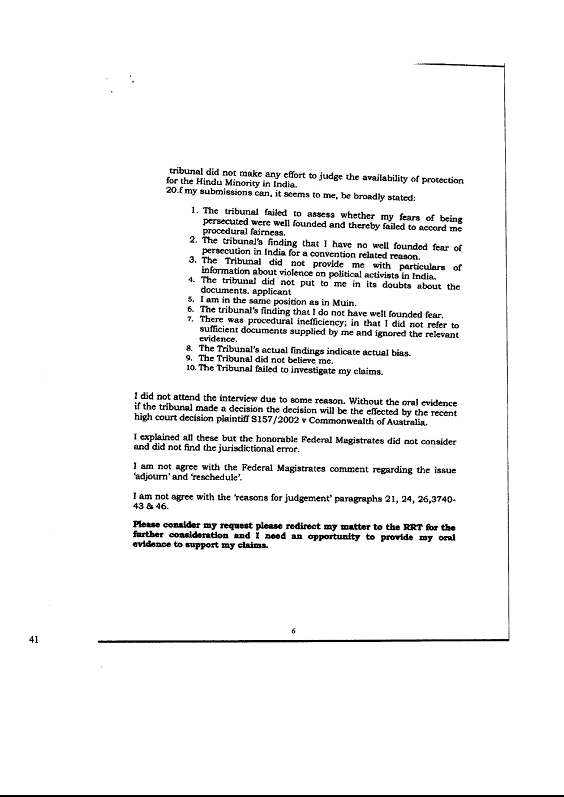
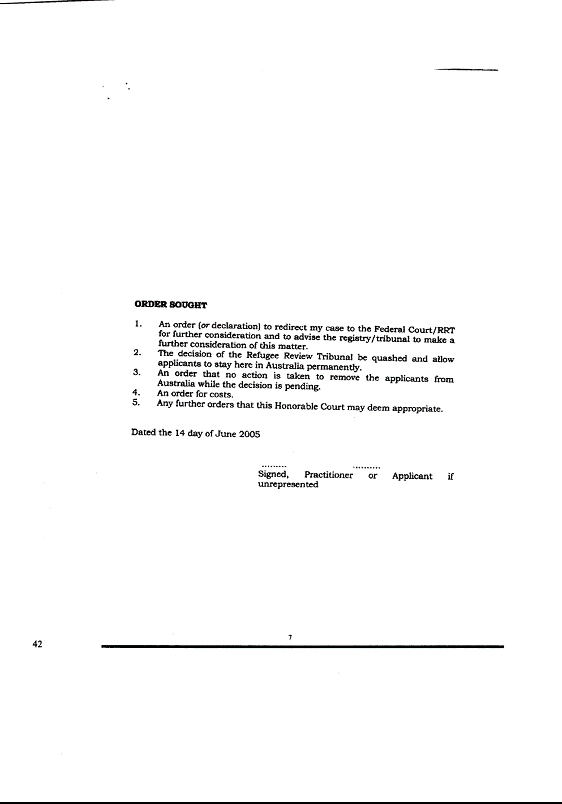
Applicant NAHF of 2002 v Minister for Immigration & Multicultural & Indigenous Affairs (2003) 128 FCR 359 discussed
Xiao v Minister for Immigration & Multicultural Affairs [2000] FCA 1472 cited
Hossain v Minister for Immigration & Multicultural Affairs [2000] FCA 842 referred to
NBBU v Minister for Immigration & Multicultural & Indigenous Affairs [2004] FCA 767 distinguished
SZBAZ v Minister for Immigration and Multicultural and Indigenous Affairs [2004] FMCA 790 applied
SZBNS v Minister for Immigration & Multicultural & Indigenous Affairs [2005] FMCA 458 distinguished
NAHV of 2002 v Minister for Immigration & Multicultural & Indigenous Affairs (2003) 129 FCR 214 referred to
SAAP v Minister for Immigration & Multicultural & Indigenous Affairs (2005) 215 ALR 162 referred to
SZDQO v MINISTER FOR IMMIGRATION AND MULTICULTURAL AND INDIGENOUS AFFAIRS
NSD 465 of 2005
CONTI J
27 JULY 2005
SYDNEY
|
IN THE FEDERAL COURT OF AUSTRALIA |
|
|
NEW SOUTH WALES DISTRICT REGISTRY |
NSD 465 OF 2005 |
ON APPEAL FROM THE FEDERAL MAGISTRATES COURT OF AUSTRALIA
|
BETWEEN: |
SZDQO APPELLANT
|
|
AND: |
MINISTER FOR IMMIGRATION AND MULTICULTURAL AND INDIGENOUS AFFAIRS RESPONDENT
|
|
CONTI J |
|
|
DATE OF ORDER: |
|
|
WHERE MADE: |
SYDNEY |
THE COURT ORDERS THAT:
1. The appeal be dismissed.
2. The appellant to pay the respondent’s costs.
Note: Settlement and entry of orders is dealt with in Order 36 of the Federal Court Rules.
|
IN THE FEDERAL COURT OF AUSTRALIA |
|
|
NEW SOUTH WALES DISTRICT REGISTRY |
NSD 465 OF 2005 |
ON APPEAL FROM THE FEDERAL MAGISTRATES COURT OF AUSTRALIA
|
BETWEEN: |
SZDQO APPELLANT
|
|
AND: |
MINISTER FOR IMMIGRATION AND MULTICULTURAL AND INDIGENOUS AFFAIRS RESPONDENT
|
|
JUDGE: |
CONTI J |
|
DATE: |
|
|
PLACE: |
SYDNEY |
REASONS FOR JUDGMENT
Background
1 This is the appeal from the decision of Scarlett FM made on 8 March 2005, whereby his Honour dismissed an application for judicial review of a decision of the Refugee Review Tribunal (‘the Tribunal’) made on 8 April 2004 and handed down on 17 May 2004, which in turn had affirmed a decision of a delegate of the Minister made on 27 February 2003 refusing the appellant’s application for a protection (Class XA) visa.
2 The appellant is a 23-year-old Indian national from Ahmednagar in India, who arrived in Australia on 13 October 2002. On 6 November 2002, he lodged an application for a protection visa with the Department of Immigration and Multicultural and Indigenous Affairs, asserting thereby that he belonged to a political party called the Shiv Sena, that his father was an ardent supporter of that party, and that they were both engaged in active politics, and were in opposition to the Congress Party and had been mistreated by members of the Congress Party. Other aspects of the appellant’s circumstances in India claimed to give rise to his qualification for refugee status appear in [3] of the reasons for decision of the Federal Magistrate below.
3 The circumstances relating to the appellant’s purported pursuit of review by the Tribunal of the delegate’s decision adverse to the appellant’s application for a protection visa are set out in detail in the reasons for decision of Scarlett FM. In short, the appellant did not attend the Tribunal hearing scheduled for 29 March 2004 on the basis of an illness certified by Dr Loi Phan of the Multicare Family Medical Centre at Ashfield. Nor did the appellant attend the Tribunal on the rescheduled date fixed for 8 April 2004, when the Tribunal member formally affirmed in the appellant’s absence the delegate’s decision not to grant a protection visa. In the course of decision-making, the Tribunal member recorded difficulty in understanding why the appellant had to flee India in alleged fear of danger to his life. The appellant testified that his father owned family farming land in India. His father has remained in India without any suggestion of problems adversely affecting that ownership.
4 The appellant’s grounds set out in his application to the Federal Magistrates Court were framed unspecifically as follows (read literally):
‘(1) The Tribunal made his decision in bad faith.
(2) The Tribunal deprived me of the natural justice.
(3) The Tribunal denied the evidentiary proof of my claim.
(4) The Tribunal’s decision did not reflect the material facts of my claim.
(5) The Tribunal has given a decision which was preset in the back of its mind.
(6) The Tribunal mixed up many facts with this decision which affected the decision.
(7) The Tribunal concentrated in particular fact while ignored many other facts of this condition.
(8) The Tribunal make up his mind without any inquiry regarding my claim and he did not believe my genuine Convention based refugee claim.
(9) I will provide more details and grounds later.’
5 Despite being directed to do so, the appellant did not file an amended application below.
6 The appellant presented written submissions to the Federal Magistrates Court bearing date 17 December 2004, purportedly of his own authorship and extending into five pages, in which he raised complaints of ‘actual bias’, and asserted his holding of ‘genuine and true claims… regarding… convention base persecution…’. He identified in those submissions a well known High Court authority related to migration law, and referred to the implications of s 39B of the Judiciary Act 1903 (Cth), asserting in that context unspecifically that ‘… the Tribunal did not act in good faith’ and cited in particular the High Court decision of Plaintiff S157/2002 v Commonwealth of Australia (2003) 211 CLR 476. He referred unspecifically and briefly to ‘fundamental rights’, to s 474 of the Migration Act, and to breach of the rules of natural justice.
7 Scarlett FM made the following observations and/or findings in support of his dismissal of the appellant’s application for review of the Tribunal’s decision:
(i) the Tribunal did consider the appellant’s medical certificate, and rescheduled the hearing of its review of the delegate’s decision to a later date, being well beyond the anticipated period of illness estimated in the medical certificate;
(ii) the Tribunal was empowered to commence a hearing and then to adjourn and reschedule the same, at least in a situation where an applicant does not appear, referring to s 426A(2) of the Migration Act 1958 (Cth) (‘the Act’); moreover the period of notice referred to in s 425A(3) of the Act applies only to giving notice of the originally scheduled application;
(iii) the appellant claimed that the migration agent who had been representing him was no longer acting for him and had ‘disappeared’;
(iv) there was no example of actual bias or bad faith or prejudice of the Tribunal that was evident to his Honour;
(v) there had been no deprivation of natural justice, and in fact ‘[t]he opportunity was there for him to attend and give oral evidence and he did not take it or did not seek a further adjournment’ and he did not provide any further written statement; there had been therefore no denial of natural justice;
(vi) the assertion of the appellant that the Tribunal had ‘denied the evidentiary proof of the applicant’s claim’, and that its decision ‘did not reflect the material facts of the applicant’s claim’ constituted ‘… nothing more than a review on the merits of the application’;
(vii) there was no obligation on the Tribunal ‘… to go beyond the evidence presented by the Tribunal’ or ‘to make its own independent enquiry’ into the appellant’s claims;
(viii) the Tribunal had not accepted the appellant’s claim ‘… on the evidence currently before the Tribunal’; moreover applicants such as the appellant who do not attend Tribunal hearings ‘… do themselves a disservice’;
(xi) the High Court’s decision in ‘Muin v Refugee Review Tribunal; Lie v Refugee Review Tribunal [(2002) 190 ALR 601]’ was distinguishable ‘on its facts’;
(x) the claim that the Tribunal acted in bad faith was not viable, since the basis of the appellant’s allegation in that regard was merely that ‘… the decision-maker got the facts wrong, took into account irrelevant matter, did not take certain matter into consideration’; and
(xi) in any event, there was no evidence of bad faith, denial of natural justice, or of actual bias, or of prejudice; moreover the appellant had misconceived the juridical notion of bad faith.
The present appeal
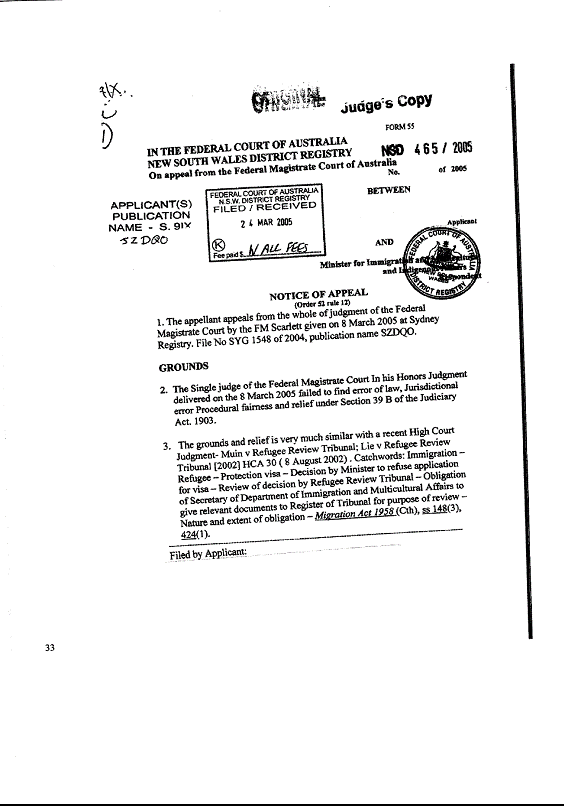
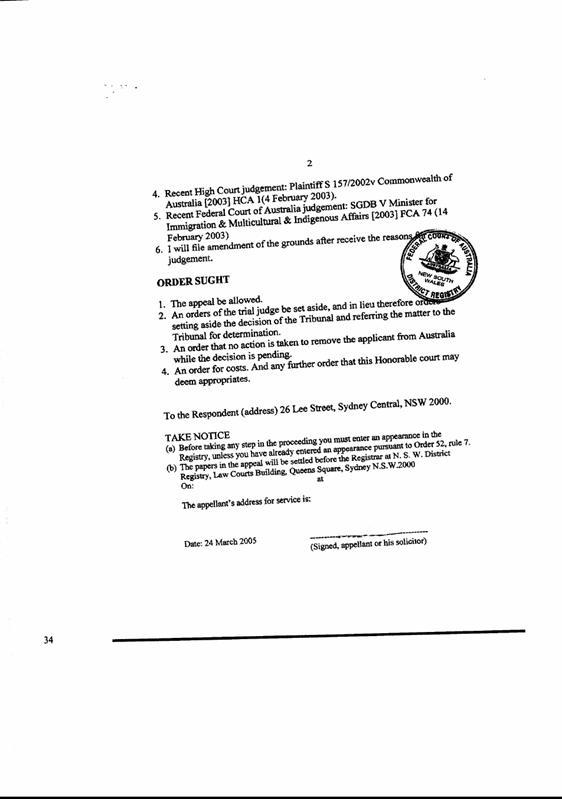
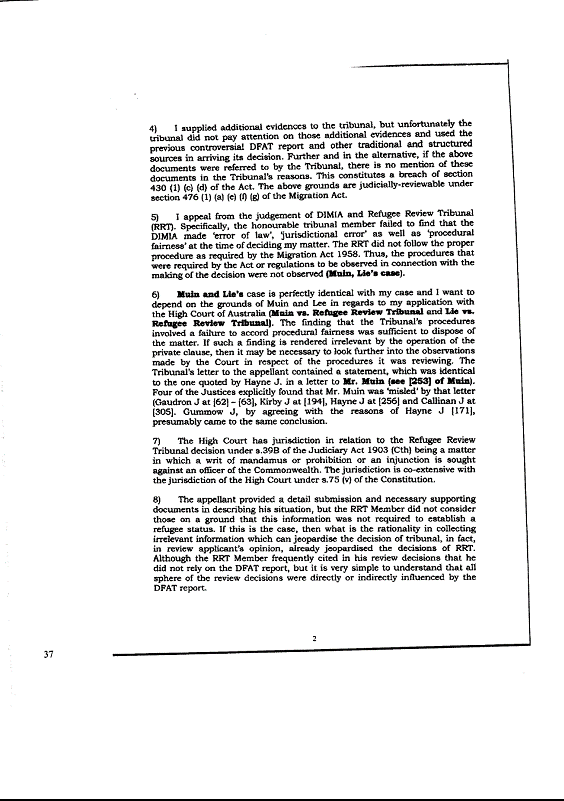
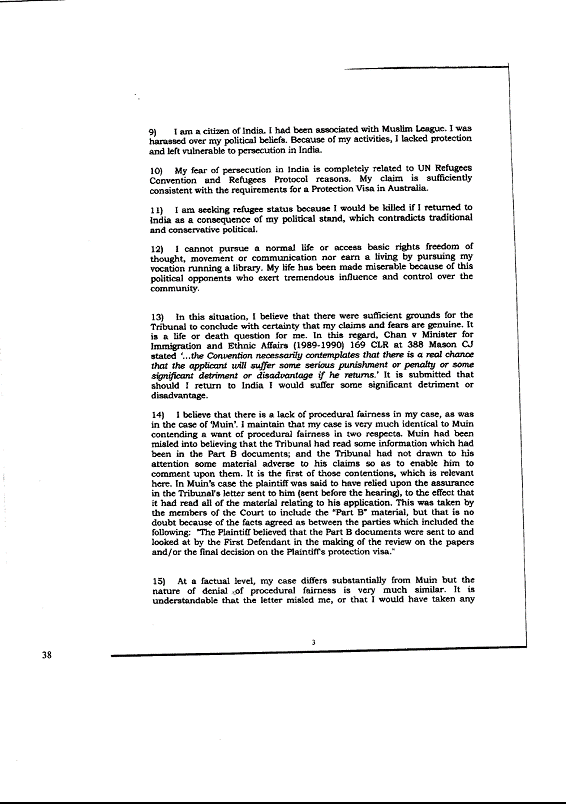
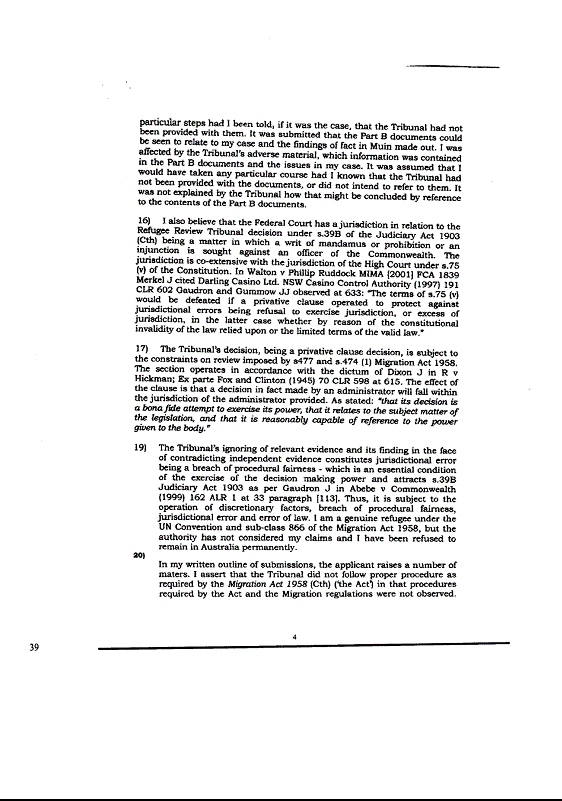
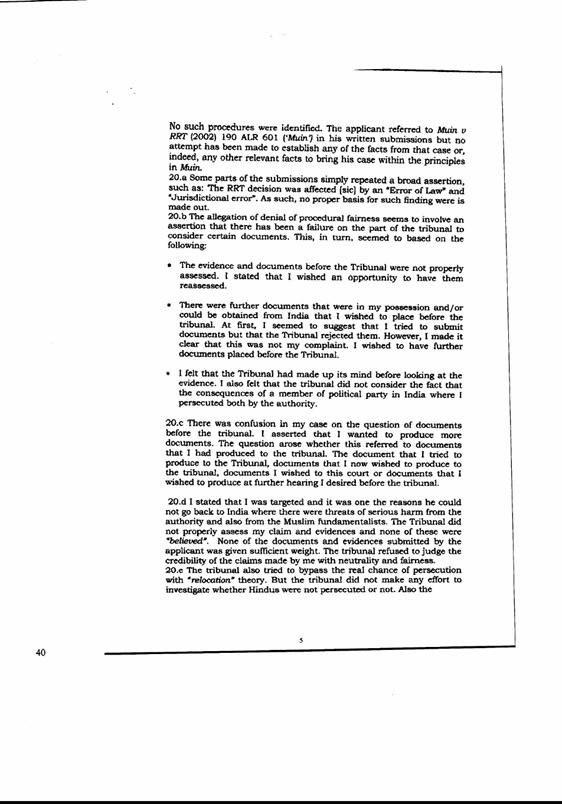
8 It is I think clear that the notice of appeal to the Federal Court, filed by the appellant on 24 March 2005, did not distil or isolate specifically, or at all, any error of law on the part of Scarlett FM. It was framed in not dissimilar terms to the application filed by the appellant in the Federal Magistrate’s Court. I have attached to these reasons for ease of reference a copy of that notice of appeal filed in the Federal Court, which has been redacted in part to ensure the suppression of the identity of the appellant in accordance with s 91X of the Act.
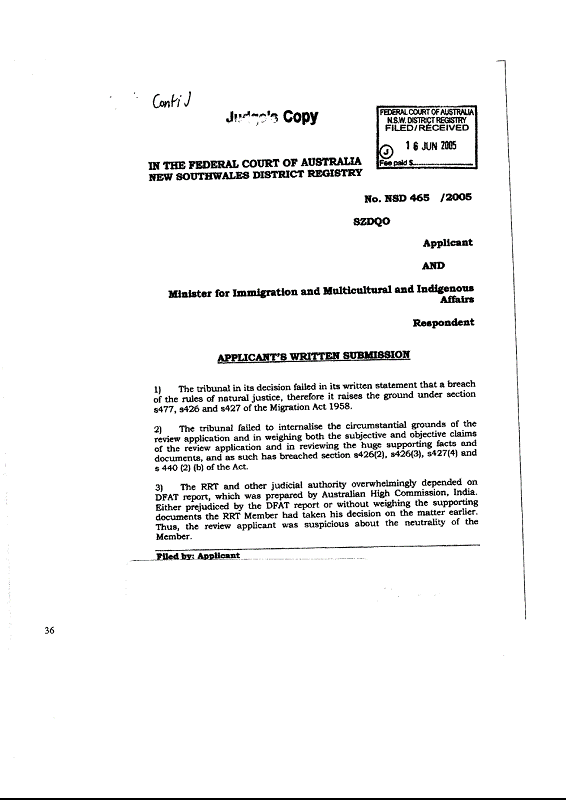
9 In support of the purported grounds of appeal set out in the notice of appeal to this Court, the appellant provided to the Federal Court so-called ‘Applicant’s Written Submissions’, a copy of which is also attached so that at least their format may be observed. The Minister had not been provided with a copy of those submissions. The similarity of those written submissions, both in format and content, to those provided below to the Federal Magistrate, is readily apparent.
10 The appellant explained to the Federal Court at the commencement of the hearing of the appeal, through the Court’s interpreter Ms Maharaj, in response to my question ‘[w]hat is the error of law that you say was committed by the Federal Magistrate?’, the following:
‘I present my written submissions, your Honour… I had given (sic) to my agent and he said he has provided a copy’
he then repeated:
‘I have given my written submissions to my agent and he said he has provided the copies.’
When I asked the appellant what was his agent’s name, he replied ‘Mollah’, and that such person’s office was situate in King Street, Mascot, though he could not remember the street number. The following further dialogue then ensued:
‘His Honour: Did Mr Mollah assist you in connection with your case in front of the Federal Magistrate?
The Interpreter: At that time he didn’t, but he was supposed to help me with this one.
His Honour: I see, thank you. Well now, Mr SZDQO, is there anything that you wish to – and I appreciate that you are not a legally qualified person. Do I take it that all that you wish to say is set out in these written submissions that Mr Mollah has prepared?
The Interpreter: Yes. And you can give your decision your Honour, based on that.
His Honour: Yes, thank you. There is nothing you wish to add to then?
The Interpreter: Nothing.’
11 Counsel for the Minister then indicated that no such material had been provided to the Minister, and I therefore caused copies to be made and provided to him. Counsel also informed the Court that copies of the Minister’s written submissions to the Court had been sent by courier to the appellant’s address, which the appellant thereupon acknowledged to the Court. The case was then adjourned to enable counsel for the Minister to read the appellant’s written submissions.
12 Counsel for the Minister made the following submissions in relation to the grounds of appeal contained in the attached notice of appeal:
(i) the first ground of appeal was difficult to understand in any meaningful way, absent particularisation, and was so broad as to be virtually meaningless;
(ii) Scarlett FM correctly distinguished the operation of the High Court’s decision in Muin on its facts;
(iii) the mere citation of Plaintiff S157/2002 v Commonwealth of Australia (2003) 211 CLR 476 did nothing to assist the appellant, who had in any event failed to demonstrate that the decision of the Tribunal was vitiated by jurisdictional error;
(iv) the decision of this Court in SGDB v Minister for Immigration and Multicultural and Indigenous Affairs [2003] FCA 74 was merely one which applied Plaintiff S157; any remission of the appeal to Scarlett FM for further hearing could not be justified and could not advance the appellant’s case.
Counsel then continued:
(v) the real issue before Scarlett FM was whether the Departmental notice of the rescheduled hearing was given according to law. Scarlett FM so held that it was, and correctly so;
(vi) the notice of the Tribunal hearing was sent by registered post to the appellant on 9 January 2004 at the only address made available by the appellant to the Department, and was deemed to have been received by the appellant pursuant to s 441C(4)(a) of the Act after 7 working days;the period of 14 days prescribed by s 425A(3) would have expired on 3 February 2004, and thus well in advance of the hearing date appointed by the Tribunal for 29 March 2004;
(vii) no formal response to the invitation to hearing was sent by the appellant to the Tribunal;
(viii) although the appellant sent the Tribunal a medical certificate on 26 March 2004, and did not appear on the appointed hearing date of 29 March 2004, the Tribunal would have been entitled to proceed in any event to a hearing pursuant to s 426A of the Act; nevertheless the Tribunal chose to re-schedule a further date for the appellant’s appearance, pursuant to s 426A(2) of the Act, for 8 April 2004, and so notified the appellant by express post on 30 March 2004; and
(ix) section 426A(2) expressly recognised that although a right to proceed without taking any further action pursuant to s 426A(1) had arisen, so much did not preclude the Tribunal from re-scheduling an appearance by the appellant and delaying the making of a decision; on the true construction of the Act, s 425 did not apply to the letter sent on 30 March 2004 which re-scheduled the hearing; the Tribunal had complied with s 425A by sending the original invitation to the hearing on 9 January 2004, and was not required to further comply with that section in the context of re-scheduling the hearing as it did in that case; therefore the appellant was not entitled to be given the prescribed period of notice of 14 days, pursuant to s 425A(3) and Regulation 4.35Dof the Migration Regulations 1994 (Cth) (‘the Regulations’), in relation to the re-scheduled hearing date.
13 Aside for the moment the concluding issue raised above, it is unnecessary for me to add anything more in the way of background material other than that each of the appellant’s submissions the subject of the preceding sub-paragraphs are plainly correct, and no further observations or reasoning needs to be recorded.
14 As to last sub-paragraph (ix) above, it is first necessary to extract the relevant provisions of the Act:
‘Section 425 Tribunal must invite applicant to appear
(1) The Tribunal must invite the applicant to appear before the Tribunal to give evidence and present arguments relating to the issues arising in relation to the decision under review.
(2) Subsection (1) does not apply if:
(a) the Tribunal considers that it should decide the review in the applicant's favour on the basis of the material before it; or
(b) the applicant consents to the Tribunal deciding the review without the applicant appearing before it; or
(c) subsection 424C(1) or (2) applies to the applicant.
(3) If any of the paragraphs in subsection (2) of this section apply, the applicant is not entitled to appear before the Tribunal.
Section 425A Notice of invitation to appear
(1) If the applicant is invited to appear before the Tribunal, the Tribunal must give the applicant notice of the day on which, and the time and place at which, the applicant is scheduled to appear.
(2) The notice must be given to the applicant:
(a) except where paragraph (b) applies—by one of the methods specified in section 441A; or
(b) if the applicant is in immigration detention—by a method prescribed for the purposes of giving documents to such a person.
(3) The period of notice given must be at least the prescribed period or, if no period is prescribed, a reasonable period.
(4) The notice must contain a statement of the effect of section 426A.
…
Section 426A Failure of applicant to appear before Tribunal
(1) If the applicant:
(a) is invited under section 425 to appear before the Tribunal; and
(b) does not appear before the Tribunal on the day on which, or at the time and place at which, the applicant is scheduled to appear;
the Tribunal may make a decision on the review without taking any further action to allow or enable the applicant to appear before it.
(2) This section does not prevent the Tribunal from rescheduling the applicant's appearance before it, or from delaying its decision on the review in order to enable the applicant's appearance before it as rescheduled.’
15 Regulation 4.35D, entitled ‘Prescribed periods - notice to appear before Tribunal ([Migration] Act, s 425A)’, provides as follows:
‘For subsection 425A (3) of the Act, the prescribed period:
(a) if the applicant is a detainee — starts when the applicant receives notice of the invitation to appear before the Tribunal and ends at the end of 7 days after the day on which the notice is received; or
(b) in any other case — starts when the applicant receives notice of the invitation to appear before the Tribunal and ends at the end of 14 days after the day on which the notice is received.
Note 1 If the Tribunal gives a person a document by a method specified in section 441A of the Act, the person is taken to have received the document at the time specified in section 441C of the Act in respect of the method.
Note 2 A document given to a person in immigration detention is given in the manner specified in regulation 5.02.’
16 For the purposes of determining when the appellant received his s 425 invitation, s 441C(4)(a) provides that the appellant was deemed to have received the invitation, which was sent by pre-paid post on 9 January 2004 in accordance with s 441A(4), after 7 working days. As counsel for the Minister submitted, there can be no dispute that the invitation to the originally scheduled hearing was received well after the ‘prescribed period’ had elapsed, as required by s 425A(3). The only issue is whether or not the failure of the Tribunal to accord the appellant the prescribed period of time in respect of its notification of the rescheduled hearing was such as to amount to a jurisdictional error. As I have recorded above, the appellant did not respond to the invitation to the hearing scheduled for 29 March 2005 other than to submit, some three days before, a medical certificate explaining that he would be ineligible to ‘work’ for a 5 day period, ending on 31 March 2004. When the appellant did not appear at the hearing scheduled for 29 March 2004, the Tribunal determined to reschedule the same on 8 April 2004; that decision was communicated to the appellant by means authorised by s 441A(4) on 30 March 2004. The appellant did not attend the rescheduled hearing, and the Tribunal proceeded to make its decision in his absence.
17 Counsel submitted that on the adjourned hearing day thus scheduled for 29 March 2004 the Tribunal was entitled to make its decision on the review without taking any further steps to enable the appellant to appear before it, and to do so pursuant to s 426A of the Act in the light of the events which happened. Hely J, sitting as a single judge in Applicant NAHF of 2002 v Minister for Immigration & Multicultural & Indigenous Affairs (2003) 128 FCR 359, rejected an argument that the refusal of the Tribunal to adjourn a hearing, in circumstances where one of the applicants for review had submitted a medical certificate, amounted to a breach of s 425 of the Act. His Honour referred at [29] to the terms of s 426A(1) and noted in passing (without considering) Wilcox J’s citation at [28] of Xiao v Minister for Immigration & Multicultural Affairs [2000] FCA 1472 of Mansfield J’s dictum in Hossain v Minister for Immigration & Multicultural Affairs [2000] FCA 842 at [20] to the effect that the expression ‘does not appear’ in s 426A(1) may require further judicial exposition, in that it may not apply to an applicant who desires to attend but is unable to do so, due for instance to hospitalisation. In any event Hely J did not determine NAHF of 2002 on a statutory basis, finding instead that the Tribunal had failed to accord with the common law requirements of procedural fairness. I would for myself observe that Mansfield J in Hossain rejected the placement of any ‘gloss’ on s 426A(1) as urged by the appellant there, namely that the Tribunal ‘must be satisfied that the visa applicant has abandoned the opportunity to appear to give evidence before [it] can proceed under s 426A’ (at [21]). His Honour considered that it is ‘a matter of considering the circumstances in which the Tribunal determined to proceed [in the applicant’s absence] to assess whether the Tribunal complied with s 425(1) of the Act and s 426A(1) of the Act’ (at [22]). The Tribunal did not however purport to proceed in accordance with s 426A(1) on 29 March 2004 in the present context, and the appellant raised no issue with the Tribunal’s decision to do so on 8 April 2004.
18 On the plain language of s 426A(2), the Tribunal was empowered in the foregoing circumstances to reschedule the appellant’s appearance before it and the issue, as framed by the Minister, is whether or not the requirement of s 425A, at least as to the prescribed period of notice therein stipulated, applied to any notification of the appellant of that rescheduling, at least in circumstances at the instance of the appellant as here occurred. The Minister supported Scarlett FM’s finding that the Tribunal complied with ss 425 and 425A in inviting the appellant to the 29 March 2004 hearing in the manner it did. Thus the Minister was not required to ‘re-comply’ with the latter provision in re-scheduling the hearing, meaning thereby that the appellant was not entitled to the 14 days’ prescribed period of notice, and the s 441C deeming provisions did not apply. His Honour held that reasonable notice was given by the postage of the letter, by express post, on 30 March 2004 to the appellant.
19 Counsel for the Minister was unable to refer me to any Federal Court authority in which this precise issue has squarely arisen for determination. Counsel did refer me to three decisions however in which not dissimilar issues have arisen.
20 In NBBU v Minister for Immigration & Multicultural & Indigenous Affairs [2004] FCA 767, Sackville J sanctioned orders made by consent of the appellant and the Minister whereby the proceeding would be remitted back to the Tribunal. In that instance it was common ground that the Tribunal had complied with s 425A in notifying the appellant of the hearing scheduled for 16 December 2003 by letter dated 28 October 2003; however that hearing date was changed to 18 December 2003 and the appellant was only notified of this by facsimile sent to his authorised recipient on 16 December 2003, the original day scheduled for the hearing. His Honour referred to ss 425 and 425A(3) and reg 4.35D and stated:
‘[4] The respondent accepts that non-compliance with the prescribed period constitutes a jurisdictional error. I am satisfied that this error on the part of the RRT is sufficient to justify the consent orders that are embodied in the short minutes of order handed up to me today.’
Counsel for the Minister contended that NBBU turned on a concession made by the Minister in the particular circumstances there subsisting. Because his Honour was not actually passing reasoned judgment, but merely providing his imprimatur to orders drafted by consent, there is no detail of the cause of the rescheduling apparent from the reasons for judgment. Nor is it apparent why the Tribunal saw fit to reschedule the hearing on what was literally a moment’s notice. It is also unclear whether the appellant had responded affirmatively or otherwise to the Tribunal’s earlier invitation to attend the original hearing. It is I think unlikely that his Honour, by his foregoing observation made in the context of implementing consent orders, implicitly intended to lay down an inflexible principle that the failure of the Tribunal to comply with s 425A(3), when rescheduling a hearing date as distinct from scheduling the original hearing date amounts to jurisdictional error.
21 I was also referred to two decisions of Federal Magistrate Barnes. In SZBAZ v Minister for Immigration and Multicultural and Indigenous Affairs [2004] FMCA 790, the applicant attended a hearing before the Tribunal on 28 June 2002, notice of which had been sent by letter dated 14 June 2002. This was the third scheduled hearing allowed to the applicant, the first two of which had both been postponed by the Tribunal at the request of the applicant’s migration agent on the ground that the applicant was in ill health. The invitation to the first Tribunal hearing, in SZBAZ, scheduled for 31 May 2002, was made by the Tribunal’s letter dated 26 April 2002, which gave more than the prescribed period of notice of the originally scheduled hearing. Referring to the transcript of the Tribunal hearing, Barnes FM observed that the applicant had taken no objection to the notice provided of the third scheduled hearing. Her Honour then went on to make the following comments:
‘[28] …From the perspective of the Tribunal the invitation it had extended remained open. This is not a case where the Tribunal itself re-scheduled a hearing and hence might be said to have issued a fresh invitation to which s.425A(3) should apply. Rather the invitation had been properly extended and accepted by the applicant in a response to hearing form. In postponing the hearing at the request of the applicant’s adviser the Tribunal was not issuing a fresh invitation for which the specified period of notice would be required. It had met such obligations in the earlier notice of 26 April 2002.
[29] Common sense would suggest that while the s.425A notice requirements apply to an initial invitation and may apply to a hearing rescheduled by the Tribunal, if a hearing date is rescheduled at the request of the applicant (or his adviser) it should not be necessary for the Tribunal to provide a fresh 14 day period of notice as contemplated by 425A(3), provided the obligations under s.425A have been met in relation to the initial invitation. Were it otherwise any delay, even of minutes or hours, at the request of the applicant would give rise to a failure to comply s.425A. Such an interpretation is also consistent with the language of s.425A which is limited to situations where an applicant “is invited to appear before the Tribunal” as distinct from situations where, having been properly invited, the applicant subsequently seeks a rescheduling of his or her appearance before the Tribunal. It is also consistent with the detailed statutory procedure in Division 4 of Part 7 and with the purpose of s.425A(3) to ensure that the applicant is given adequate notice of any scheduled hearing.’
22 Barnes FM was therefore was satisfied that the Tribunal had met its obligations under s 425A by sending the initial invitation to the applicant to attend a hearing. Since the subsequent letters sent by the Tribunal, which purported to reschedule the hearing in response to the applicant’s request, did not therefore constitute a change in the date for the hearing made at the instigation of the Tribunal, they could not be construed as a fresh invitation on the part of the Tribunal to appear and thus be amenable to the requirements of s 425A. Not being an invitation within s 425A, the letter of 14 June 2002 was not subject to the period of notice prescribed by s 425A(3) and reg 4.35D.
23 Counsel for the Minister submitted that the present circumstances were indistinguishable from those before Barnes FM in SZBAZ, because the appellant’s failure to attend the 29 March 2004 hearing, coupled with his posting of a medical certificate excusing himself from that hearing, implicitly reflected the requests of the applicant in SZBAZ for rescheduling of the final hearing date. There is I think force in the drawing of that distinction.
24 In SZBNS v Minister for Immigration & Multicultural & Indigenous Affairs [2005] FMCA 458, the appellant was invited to a hearing to be held on 12 August 2003 by letter dated 25 June 2003. The appellant sent a positive response to that invitation which the Tribunal received on 10 July 2005. By further letter dated 4 August 2003 the Tribunal indicated that it would be unable to conduct a hearing at the scheduled time, and stated that a new hearing would be held on 19 August 2003 at the same designated time and place. There was in evidence a file note to the effect that the applicant telephoned the Tribunal on 8 August 2003 to confirm his attendance at the rescheduled hearing, which he duly did. Thus the circumstances there involved were distinguishable from the present, to the extent that the initiative for an adjourned hearing date emanated at the instance of the Tribunal, and distinguishable from the context in which Sackville J made his observation in NBBU, in so far as it appears from his Honour’s reasons for judgment.
25 The sole ground of the applicant’s complaint in SZBNS was that the Tribunal committed a jurisdictional error by failing to give him notice of the rescheduled hearing in accordance with s 425A of the Act, relying on NBBU, which was cited in the particulars to that sole ground of his application for review. Barnes FM considered the circumstances of the case and the relevant statutory provisions, and framed the issue arising at [18]:
‘What then is the consequence of a breach of s.425A (and, if there was a breach, s.426) where the substantive obligation under s.425 was fulfilled and where no lack of procedural fairness has been established?’
Her Honour then discussed the decision of the Full Federal Court in Applicant NAHV of 2002 v Minister for Immigration & Multicultural & Indigenous Affairs (2003) 129 FCR 214 extracting a number of passages from the reasons for judgment of Carr, Kiefel and Allsop JJ, including this passage which appears at [23] of their Honours’ reasons:
‘In our view, it cannot be concluded that invalidity of the Tribunal’s decision is the necessary consequence of any failure to comply with subs 424A(2), irrespective of the absence of any unfairness, whether of a substantive or procedural kind. Thus, we do not think that the failure to convey the relevant information by the correct method or vehicle can be seen as jurisdictional. This is so, it seems to us, even without considering the application of s 474 of the Act. (Quite different considerations might attend the analysis had there been a breach of subs 424A(1).)’
26 After concluding that the Tribunal had extended an invitation, and had given the applicant an opportunity to provide evidence and to comment on material during a hearing, her Honour purported to apply the reasoning in NAHV of 2002 to the facts before her (at [26]-[27]) as follows:
‘It is not in dispute that the Tribunal met its obligation under s.425A, in particular under s.425A(3), and under s.426 in its invitation to the applicant of 25 June 2003. Indeed in one sense it could be said that the letter of 4 August 2003 was not a fresh invitation but merely a postponement. However, on the basis that both ss.425A and 426 were breached, the relevant inquiry in this case is whether Parliament intended that any breach of the condition as to the period of notice to be given of a hearing or as to the notification of a right to ask the Tribunal to obtain oral evidence from others necessarily spells the invalidity of the Tribunal’s decision “even in circumstances where there has been satisfaction of the important substantive requirement.” (NAHV at [23]). Here the important substantive requirement of s.425 to give the applicant a proper and meaningful invitation to appear was satisfied. In such circumstances, where the invitation required by s.425 has been given in a manner which ensured the applicant had sufficient notice and was made aware of his rights and obligations and where there is no evidence that the applicant was in any way denied a fair hearing or a fair conduct of his review, despite the apparently mandatory language of ss.425A(3) and 426(1)(b) I consider that the failure to observe the procedural requirements of s.425A(3) and any failure to comply with s.426(1)(b) (if there was such a failure) was not such as to amount to a failure to exercise jurisdiction or an exceeding of jurisdiction. No unfairness, whether of the substantive or procedural kind, has been established. The failure cannot be seen to be jurisdictional.
This is not to say that, in some other circumstances, it might well be the case that a breach of s.425A(3) or, indeed, of s.426(1)(b), might give rise to a jurisdictional error because it led to a failure to comply with the substantive obligation in s.425 or with some other aspect of the substantive obligations of the Tribunal in relation to the conduct of the review. Indeed this may well be the explanation for the decision in NBBU v MIMIA as, if a failure to comply with the notice requirement of s.425A(3) led to the applicant not having the requisite opportunity to receive an invitation and attend a hearing to give evidence and present arguments as required by s.425 or as an incident of the requirements of procedural fairness, such a failure would constitute a jurisdictional error. It is notable that in NBBU his Honour was merely considering whether to make orders that the parties sought by consent and was not determining whether there had been a jurisdictional error in circumstances where this was disputed by one of the parties. Hence the judgment contains no detail of the circumstances of the case.’
27 The basis and extent of her Honour’s reasoning in SZBNS falls to be examined however in the light of the High Court’s recent decision in SAAP v Minister for Immigration & Multicultural & Indigenous Affairs (2005) 215 ALR 162, whereby the majority confirmed that the requirements of s 424A were mandatory in nature, breach of which would always amount to jurisdictional error, and hence seemingly negating the effect, at least in principle, of the dicta of the Full Court in NAHV cited by Barnes FM in SZBNS. The High Court’s decision was handed down on 18 May 2005. At [77] of his reasons for judgment in SAAP, McHugh J expressed the following view in disavowal of the approach taken by the Full Federal Court in NAHV:
‘There can be no “partial compliance” with a statutory obligation to accord procedural fairness. Either there has been compliance or there has not. Given the significance of the obligation in the context of the review process (the obligation is mandated in every case), it is difficult to accept the proposition that a decision made despite the lack of strict compliance is a valid decision under the Act. Any suggestion by the Full Federal Court in NAHV to the contrary should not be accepted.’
The only other member of the Court to refer to the decision in NAHV was Gummow J, who was not one of the majority. His Honour appeared to distinguish the decision in NAHV at [135]. I observe that s 425A was not directly the subject of decision in SAAP, the alleged contravention there addressed being related to s 424A of the Act, which is directed to the giving by the Tribunal of particulars of certain information to a review applicant.
28 In his submissions in the context of the decision of Barnes FM in SZBNS, counsel for the Minister emphasised in the present appeal her Honour’s statement at [26] ‘[i]ndeed in one sense it could be said that the letter of 4 August 2003 [notifying the applicant of the rescheduling of the hearing to 19 August 2003] was not a fresh invitation but merely a postponement’ as being ‘redolent of the approach her Honour took in SZBAZ, where her Honour distinguished between an initial application [sic, hearing] and a re-scheduling’. In doing so counsel appeared to articulate a ratio decidendi for SZBNS stripped bare of her Honour’s apparent reliance on the approach adopted by the Full Court in NAHV to breaches of s 424A.
29 In my opinion, the Minister’s approach is correct. The circumstances in SZBNS are distinguishable from those of the present appellant. Here the Tribunal rescheduled the hearing as a result of the appellant’s non-attendance at the original hearing at the applicant’s own initiative, albeit with the support of a doctor’s certificate. In my opinion, in circumstances where the Tribunal decides to reschedule a contemplated hearing at the behest, explicitly or implicitly, of an applicant, s 425A does not apply in relation to the notice of a rescheduled hearing, at least in so far as concerns the period of the reviewed notice. The sanction on the Tribunal in those circumstances would be the operation of the general law as to natural justice, as Hely J indicated in NAHF, albeitin a different factual context, and subject to the operation of the recently enacted s 422B of the Act. As Barnes FM reasoned in SZBAZ, in my opinion rightly, ‘[w]ere it otherwise, any delay, even of minutes or hours, at the request of the applicant, would give rise to a failure to comply with s 425A’. Other examples of circumstances where the conduct of a review by the Tribunal could be unreasonably thwarted readily come to mind. It is conceivable moreover that an applicant could set in train an indefinite number of re-scheduled hearings in a repetitive context of a requirement for not less than 14 days’ notice. It was I think soundly submitted by the Minister that Scarlett FM’s finding in the present case was correct to the effect that the period of notification given for the rescheduled hearing was reasonable and according to law, albeit involving less than 14 days’ notice. I would dismiss the appeal, which, aside from this controversial issue as to notice, was in any event devoid of any apparency of merit.
30 In the result I would conclude that no reviewable error has been established in the reasons for decision of the Tribunal below, and in particular for what it may matter, no error by way of failure to exercise, or of excess of, jurisdiction has been established, and no entitlement to relief on any other viable basis has been demonstrated by the appellant.
31 I would add that there is force in the submission of the appellant in the alternative, in accordance with the notice of contention filed, that if jurisdictional error has been established, contrary to my present view, then to the extent that the Court has a viable discretion in the circumstances of the case, relief should be declined in any event. In that regard, the appellant did not testify that he wanted to attend the hearing secondly scheduled in lieu of the first hearing, but was prevented from doing so by insufficiency of notice. Nor was there any evidence or indication to suggest that the appellant had further evidentiary material he would have put before the Tribunal in that regard. Moreover for what it may further matter, when informed by the Minister that the Tribunal’s decision would be shortly handed down, the appellant did not seek to put further material before the Tribunal, nor seek any further Tribunal hearing antecedently to the handing down of its decision.
32 In the result, the appeal must be dismissed with costs.
|
I certify that the preceding thirty-two (32) numbered paragraphs are a true copy of the Reasons for Judgment herein of the Honourable Justice Conti. |
Associate:
Dated: 27 July 2005
|
The appellant appeared in person |
|
|
|
|
|
Counsel for the Respondent: |
J A C Potts |
|
|
|
|
Solicitor for the Respondent: |
Clayton Utz |
|
|
|
|
Date of Hearing: |
23 June 2005 |
|
|
|
|
Date of Judgment: |
27 July 2005 |