

FEDERAL COURT OF AUSTRALIA
Arms v WSA Online Limited (ACN 081 121 495) FCA [2005] 943
SIMON ARMS v WSA ONLINE LIMITED (ACN 081 121 495) (Subject to a Deed of Company Arrangement), JAMES HOUGHTON and JAMES STUDENT
VID 228 of 2001
RYAN J
8 JULY 2005
MELBOURNE
|
IN THE FEDERAL COURT OF AUSTRALIA |
|
|
VICTORIA DISTRICT REGISTRY |
VID 228 of 2001 |
|
BETWEEN: |
SIMON ARMS Applicant
|
|
AND: |
WSA ONLINE LIMITED (ACN 081 121 495) (Subject to a Deed of Company Arrangement) First Respondent
JAMES HOUGHTON Second Respondent
JAMES STUDENT Third Respondent
|
|
RYAN J |
|
|
DATE OF ORDER: |
8 JULY 2005 |
|
WHERE MADE: |
MELBOURNE |
THE COURT ORDERS THAT:
1. There be judgment for the applicant against the first respondent in the sum of $58,331.00.
2. The application as against the second and third respondents be dismissed.
3. The application stand over to a date to be fixed for receiving submissions on the questions of interest and costs.
Note: Settlement and entry of orders is dealt with in Order 36 of the Federal Court Rules.
|
IN THE FEDERAL COURT OF AUSTRALIA |
|
|
VICTORIA DISTRICT REGISTRY |
VID 228 of 2001 |
|
BETWEEN: |
SIMON ARMS Applicant
|
|
AND: |
WSA ONLINE LIMITED (ACN 081 121 495) (Subject to a Deed of Company Arrangement) First Respondent
JAMES HOUGHTON Second Respondent
JAMES STUDENT Third Respondent
|
|
JUDGE: |
RYAN J |
|
DATE: |
8 JULY 2005 |
|
PLACE: |
MELBOURNE |
REASONS FOR JUDGMENT
The background facts
1 The applicant, Arms (“Arms”) had been engaged as Sales and Marketing Manager of Eyton Winery at Coldstream in Victoria until March 1999. Before his resignation from Eyton Winery, after discussion with other people in the wine industry, Arms conceived, the idea of providing a market service for small to medium independent wineries by means of the Internet. He envisaged that a website would be established under the name “auscellardoor” to which retail purchasers would have access to identify wines available from participating wineries and, if so minded, to make purchases of wines which they had selected. It was contemplated that payments would be made by credit card processed through an “e-Gate” facility to be provided by the ANZ Bank. Once the transfer of funds from the purchaser had been cleared, they would be credited, after deduction of a small transaction charge, directly to the account of the vendor winery which was to have its own “merchant agreement” with ANZ e-Gate. Income was to be generated for auscellardoor by charging a commission of 5% on each sale effected through the Internet.
2 The attraction of the concept for participating wineries was that they would pay, on sales effected through the Internet, tax at the rate applicable to “cellar door” sales and would avoid the need to pay a margin, usually of the order of 30%, to agents or distributors who arranged the sale of the wineries products to retail outlets.
3 As he refined the concept, Arms proposed to become an “online wine facilitator” of sales of wine from small to medium wineries directly to the public by means of a website which Arms, through auscellardoor, would own and operate. To that end, he conceived a “business plan”.
‘An opportunity exists to market cellar door business through the Internet, using one site to facilitate the “cellar doors” of a group of wineries.
However to market individual (small) wineries on the Internet is costly, and Internet browsers are looking for sites that accomplish many needs. Individual wineries may be hard to find and limited in the market they cater for. They are unlikely to generate “hits” from clients who are unfamiliar with them.
auscellardoor can accomplish both with a catchy and marketable name and list many small to medium wineries for both sales and information.
The marketing of this business will be in two areas. The marketing to the wineries and then the marketing to the potential customers wishing to buy and/or visit the web site, either to make a purchase or for winery/wine information.
The marketing to the wineries will begin with a launch that stretches 6 months in each wine region in Australia. Each targeted winery will receive a presentation kit, contract and follow up call and visit from myself. In addition, advertising will be aimed specifically at the wineries and operators through Grapegrower and Winemaker and at Wine Australiawhich takes place in November 2000 in Melbourne.’
5 These projections were made of the income stream and capital requirements of auscellardoor in its establishment phase and the early months of its operation:
‘As consumers visit our web site, orders will be then made through auscellardoor and will be forwarded to the relevant winery. A 5% commission will be incurred on all sales and wineries will be invoiced quarterly along with the monthly subscription.
The aim of this business is to offer an alternative selling/marketing opportunity to small-medium sized wineries through what will be a recognised web site address. The launch phase of the business relies on a 20% success rate (170 wineries) in acceptance of the wineries, with a 12 month commitment growing to 26% (250 wineries) by June 2001 and 42% (400 wineries) by December 2002. Sales targets are based on cases per winery over the forecast. I have made assumptions further into the document which I consider to be ultra conservative.
The funding required will be primarily for start up costs which include computers, web page design and set up, software and advertising. Revenue does not begin until May 2000 when advertising begins. My projected costs are in detail further in this document but I anticipate $30,000 is required for commencement. This figure is based upon starting requirements until June 2000 when the first revenue, in the form of subscription payments, will be due.’
|
PROFIT RETURN TO WINERIES |
|
|
RETAIL |
AUSCELLARDOOR |
|
Model 1 |
|
|
$ 90.00 wholesale |
$ 90.00 wholesale |
|
$ 63.00 Agent/Distributor margin 30% |
|
|
|
|
|
$ 90.00 retailer purchase price |
|
|
$126.90 41 % sales tax |
$ 22.23 tax at 26% |
|
$ 10.57 LUC |
|
|
$ 13.75 selling price (30% margin) |
$ 13.00 selling price |
|
|
$ 1.30 auscellardoor (5%) |
|
Return to Winery |
Return to Winery |
|
$ 5.25 per bottle or $ 63.00 per case |
$ 9.45 per bottle or $113.50 per case |
|
Model 2 |
|
|
$150.00 wholesale |
$150.00 wholesale |
|
$105.00 Agent/Distributor margin 30% |
|
|
|
|
|
$150.00 retailer purchase price |
|
|
$211.50 41 % sales tax |
$ 39.00 tax at 26% |
|
$ 17.62 landed unit cost |
$ 22.00 selling price |
|
$ 22.91 selling price (30% margin) |
$ 1.10 auscellardoor (5%) |
|
Return to Winery |
Return to Winery |
|
$ 8.75 per bottle or |
$ 17.65 per bottle or |
|
$105.00 per case |
$211.80 per case |
7 The first column indicates the expected return to the winery on a sale to a retail outlet effected through an agent or distributor and the second column indicates the expected return to a winery if the same wine were sold through auscellardoor’s website.
8 The business plan expressly contemplated that auscellardoor would use the services of the first respondent, WSA Online Limited (“WSA”). In mid-December 1999 Arms met with Julie McDowell and the third respondent, James Student (“Student”), who were representatives of WSA. He outlined to them his proposal for online wine sales and gave them a “draft outline” of a business plan. He emphasised the need for secure processing of electronic payments for purchases made through the website which would not be handled by the business which, it was proposed, would derive income from a commission charged to participating wineries.
9 According to Arms, Ms McDowell and Student told him that his business model was the perfect way to set up an Internet business and that they had extensive experience in designing websites like that which he proposed.
10 Arms also said that he was told that WSA could design a website which could securely process electronic payments between wineries and purchasers, manage “business to consumer” transactions and process orders from customers to participating wineries. As well, according to Arms, Ms McDowell and Student represented that WSA had the expertise to design and construct a website for the business and had recently designed or developed websites for Transurban and the ANZ Bank.
‘Phase 1
Initial scope of Ozcellardoor.com.au
- strategic recommendations
- logistics of web site
- Site map
- media and loyalty initiatives
- project timings
- cost estimate of subsequent phases
4,000
Creation of presentation kit
- Overview of concept for presentation to cellars
- Ozcellardoor.com.au web site graphics
- Cellar page
- Limited interactive presentation tool
8,500 – 12,500
Phase 2
Web site and administration function production
- Completion of web site
- Completion of administration function
- Administration user tuition
- ISP account creation and web site registration
8,000 – 15,000
Ongoing costs
- ISP monthly account charge 100 - 200
- Support as required from WSA Online 1,000 – 1,500
Phase 3
Media initiatives
- To be discussed’
12 At the same time, Arms gave Student a revised version of his business plan which included passages from which extracts have been reproduced at [4] to [6] above.
‘Phase 1
Initial scope of auscellardoor.com.au and creation of presentation kit
- Outline of strategy promotional and market model $1600
- Website look and feel and mock-ups $6200
- PowerPoint or other interactive presentation $2480
- Brochure/promotional material
- Design $2480
- Film & print 1000 $2100
Total $14860
Phase 2
Strategy
Complete detailed marketing strategy and program $3600
Web site and administration function production
Completion of web site
Completion of administration function
Administration user tuition
ISP account creation and web site registration
$8,000 - $15,000’
14 Later, on about 10 January 2000, Arms signed a quotation bearing that date which was in substantially the same terms as the quotation described at [13] above. Thereafter, Arms had several meetings with Student in the course of one of which Student furnished him with a document dated 23 January 2000 which essentially embodied a marketing strategy for targeting the two groups of customers whom auscellardoor needed to enlist, being the subscribing wineries and the purchasers of wine online to whom the product of the wineries would be sold.
15 On 31 January 2000, WSA rendered an invoice to Arms for $7,340 for work described as “Initial Development of Strategy and presentation kit.” Payment was made on that invoice on or about its date.
16 At one of their meetings in late January 2000, Student introduced Arms to the second respondent, James Houghton (“Houghton”) whom, according to Arms, Student described as the “guru of interactive website design and development.” At that meeting or shortly afterwards, Houghton told Arms that he was aware of a financial transactions product called “ANZ e-Gate” which would be “perfect” for Arms’ business and would enable payments to be made by visitors to the website by means of all major credit cards in return for which each winery would pay a transaction fee of between 2% and 2.5%.
‘ANZ has a new product called e-gate, which is a transaction clearing facility in the same vein as Surelink, but with a number of advantages.
The initial discussion was relating to Auscellardoor - looking at a way to have a single e-commerce structure and engine that would allow e-commerce purchases to be cleared directly into the bank account of the relevant winery.
ANZ are happy to set up a system where WSA is the prime e-gate client, with each of the member wineries (or any other WSA clients) as individual merchants:
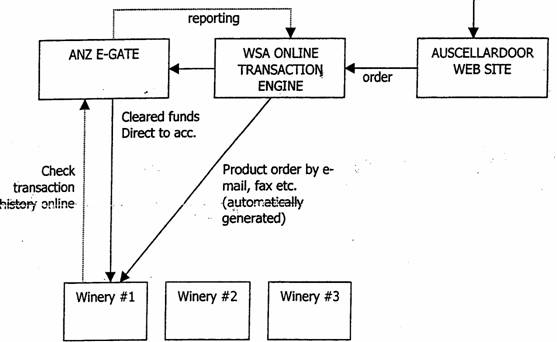
This means that while the wineries have their own merchant agreement with ANZ e-gate, and they can go online to review their transactions at any time, all transaction reports will flow via WSA.
Once WSA has set up an e-gate interface and account, additional wineries (or any other businesses) can be added to the system by simply filling in a form and paying a small set up fee (costs are coming soon).
This effectively gives WSA an EPOS cleared e-commerce engine where all transactions are cleared direct into the third party business' bank account without the set up costs associated with setting up single clients through surelink or the like, and an integrated reporting and stats function across all accounts.’
‘Key benefits:
▪ Auscellardoor will market your products to the world.
▪ Auscellardoor will return you around twice as much as traditional distributors.
▪ Auscellardoor gets you online with minimum fuss - you get your own web site, where your customers can purchase online. You can even register your own Internet domain name.
▪ Auscellardoor gives personal visitors to your cellar door an easy way to order in the future without visiting/phoning/faxing - through your own web site.
▪ Every existing customer you move online (rather than sell by phone or mail order) will save you time and administration costs.
▪ Auscellardoor gives small wineries a level playing field online.
▪ Auscellardoor promotes winery tourism and visits.
Why is auscellardoor different?
▪ Nobody else offers you your own web site, e-commerce facilities plus central marketing.
▪ Auscellardoor does not require you to process credit card transactions - it's all orders are already cleared.
▪ Auscellardoor clears each transaction direct into your bank account through ANZ. And you can check your transaction history online 24 hours a day.
▪ Auscellardoor is independent and passionate about the wine industry.
▪ Auscellardoor is professionally developed using the marketing, design and technical expertise of the B&T Interactive Agency of the year, WSA Online.’
19 In about mid-March 2000, at another meeting, Student and Houghton gave Arms a further document descriptive of the business of auscellardoor which contained these passages:
‘Auscellardoor will be positioned as a directory of small and medium, sized wineries. Each winery will have its own page (or mini-site as required) giving general information about the winery, with a facility to order wines 'direct from the cellar door'.
Users will also be able to search for wines by variety, style and region across all wineries. This lends the site a versatility that other wine sites do not offer, being useable as:
· A directory of wineries.
· Home pages for individual wineries.
· An online wine retailer.
Wineries will be charged a basic subscription to the service ($100 per month), which will include a basic home page and the e-commerce transaction facilities. Auscellardoor will levy a 5% commission on sales for handling the transaction. It is anticipated that wineries will be able to purchase more sophisticated 'mini-sites' at additional cost.
Deliveries will be organised directly by the wineries.’
‘Multi-purpose site for users
The Auscellardoor site can fulfil a number of functions for users:
· A wine industry information resource.
· A wine tourism planning resource.
· An e-commerce retailer.
The use of appropriate editorial could be used to emphasise some or all of these aspects.’
‘Objectives of phase 1 marketing
Establish Auscellardoor as an innovative, unique and exciting online venture.
Establish Auscellardoor membership as a win-win proposition for wineries that delivers:
· A low-cost e-commerce web presence.
· An easy method for existing customers to make repeat purchases.
· Easier administration of sales through electronic transactions (when compared with mail-order or telephone transactions).
· A better margin than retail on sales.
· New business through Auscellardoor promotion of the site.
Establish the Auscellardoor organisation and venture as honest, substantial, likely to succeed, and having the best interests of the Wineries at heart.
Create an easy path to signing-up with Auscellardoor.’
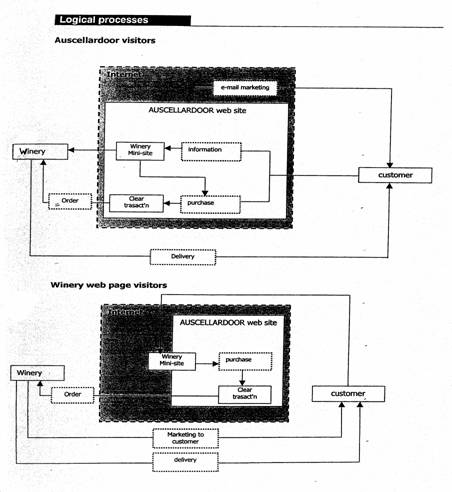
20 In relation to those flow diagrams, Houghton explained that a visitor to the website would make a purchase, the transaction would be cleared and the order placed with the winery which would deliver direct to the customer.
21 After his successive meetings, principally with Houghton and Student, Arms decided to retain WSA to design and construct the auscellardoor website and to use the ANZ e-Gate facility. During February and March, Arms began approaching wineries with a view to their participating in the website. To that end, WSA produced a “trade presentation kit” which included a form on which each winery was to provide bank details to enable moneys to be deposited in its account, a brochure and a mock-up of the website contained on a compact disc. The brochure extolled the benefits of auscellardoor for the wineries but did not descend to particulars of the mechanism for effecting credit card payments. It did note, under the heading “The benefits to you”:
‘Currently, a $100 sale to the distributor will gross the winery approximately $6 per bottle. An equivalent sale from the cellar door will earn close to $14 per bottle. On the same $100 sale, taking into consideration all setup and transaction costs, aus cellardoor will return approximately $12 per bottle.’
22 In the course of his approaches to various wineries, Arms represented that, for each purchase made from the website, the winery would receive a payment from the customer’s credit card after transaction fees had been deducted, that credit card transaction fees were between 2% and 2.5% and a commission of 5% would be payable to auscellardoor after the sale had been processed. It was further stated that the winery would receive at least 92.5% of the retail sale price and have to pay a monthly subscription of $100 to auscellardoor.
‘I agree to participate on the auscellardoor.com.au internet site. / agree to pay $100 per month subscription and a 5% commission on sales for purchases made via auscellerdoor.com.au web site. I understand that this commitment is for a minimum of 12 months.
I am aware that / must inform auscellardoor.com.au of any relevant information such as price changes, new releases, vintage changes, forthcoming events or any information that will assist the sales and marketing of my winery.
I authorise auscellardoor to use the information provided by me in the use of marketing and advertising of the auscellardoor website.
I also understand and accept auscellardoor to be my exclusive internet portal with the exclusion of your own internet site.
|
Payment to be made |
Annually |
||
|
|
Biannually |
||
|
|
Quarterly
|
||
|
Payment can be made in the following ways: |
|
||
|
|
Cash Cheque Visa |
||
|
|
Diners B/card A/mex’ |
||
24 In parallel with its discussions with Arms, WSA was obtaining information from the ANZ Bank about the use, as an Internet trading engine, of ANZ e-Gate which the Bank was then promoting. The first meeting between WSA and the ANZ Bank occurred on 7 February 200 when Houghton had an introductory discussion with Laird who was then the ANZ Sales Manager for ANZ e-Gate.
26 Houghton had another meeting with Laird on 24 February 2000 which was also attended by Doug Fitcher, a credit card merchant sales representative for the ANZ Bank. According to Laird, it was agreed at that meeting that the ANZ e-Gate licence would belong to WSA and “the credit card merchant facilities would belong to the individual wineries who would subsequently come along and sign up to the auscellardoor website.”
‘ANZ eGateTM - Shaping the Future for Payments
What is ANZ eGate?
Whether you are selling on the web, through a mail order service or accepting payments through an IVR system or Call Centre, ANZ eGate provides a simple and secure payment service. Your Customers will be able to purchase from you or make payments to you 24 hours a day, 7 days a week.
Payments may be accepted from MasterCard, Visa, Bankcard, American Express or Diners Club cards. In addition to quick and efficient credit card payments, you can also take advantage of the store credit feature. Store Credit allows you to pre-approve your customers for purchases, up to a limit that you specify for each customer. Additional payment methods to support B2B trading are being considered.
ANZ eGate is supported by convenient reporting, enabling Merchants to improve their Customer management capabilities.
ANZ eGate is the first of a family of services that is being developed to support ANZ business customers in. exploiting the web.
Benefits of Becoming an ANZ eGateTM Merchant
ANZ eGateTM provides the following benefits:
· Customer confidence in using a secure bank branded payment system;
· Decreased payment risk - verification and authorisation of transactions by ANZ;
· Instant Payment approval;
· Simple order and transaction confirmation services for ease of reconciliation;
· Store credit capability;
· Customer relationship management through standard reporting facilities;
· Automation of entire sales and payment process;
· Lower processing costs;
· Comprehensive support.
Who should use it?
ANZ eGate can be used by merchants of any size. Generally we would prefer customers that would process more than 600 payments per annum. It becomes more cost effective for larger merchants.
In addition to purchasing ANZ eGate, you will need to qualify and be approved for your chosen payment methods. In most cases this means that you will need to be approved as a Credit Card merchant.
How do I connect to ANZ eGate?
There are two different ways to connect to eGate,
The Interactive interface is very easy to implement for small, simple web based merchant applications - typically less than 10 products for sale. This method takes the Buyer through an interactive process to capture payment and delivery information and provide a receipt. You are automatically advised of payments captured in this way.
Most merchants will use the Application Programming Interface (API) to directly integrate their application with ANZ eGate. This provides maximum flexibility and power. The development required on the interface is generally very small. Your application delivers the payment details to the eGate interface and eGate processes the payment and advises the result to your application.
Your application does not need to be Internet based, or to operate over Internet. However, direct Internet access is required for communication between ANZ eGate and your application.
How to Become an ANZ eGateTM Merchant
The ANZeGate information web site http://xxxx.yyy.zzz has more details about ANZ eGate and application forms.
The developer toolkit and assistance is also available from http://xxxx.yyy.zzz.
Or phone the ANZ eGate help desk on 1800 xxx xxx.’
28 At a further meeting early in May 2000, Student told Arms that the website would not be operational by 15 May 2000 but would be fully operational by 1 July of that year. However, on 23 June 2000, Student told Arms that Houghton had made a mistake in describing how the ANZ e-Gate facility would operate and that Arms would have to arrange for each participating winery to become a “merchant” accredited by each of the ANZ Bank, Diners Club and American Express. Student further said that, to achieve that accreditation, each winery would have to provide to each of the ANZ Bank, Diners Club and American Express acceptable profit and loss statements for the last two years and a business plan. Because he had already enrolled about 30 wineries and the website was to be launched within five days, Arms regarded it as impossible to require wineries to comply with the conditions necessary to become individual merchants.
29 As a result of the information conveyed to him by Student, Arms, on 23 June 2000, telephoned Laird and expressed concern about the time being taken to get the e-Gate facility up and running. He conveyed to Laird that he had been led to believe that “if WSA buys the e-Gate licence, the credit card merchant facilities are automatically given through to the wineries.” Laird arranged to meet Arms over the ensuing weekend of 24-25 June and explained that the ANZ e-Gate facility required an application form from each participating winery which had to be accompanied by two years’ financial statements and had to be sent to a dedicated person within the ANZ Bank for assessment. Although his preference was for each winery to become an approved merchant, Laird indicated that the problem could be overcome by auscellardoor becoming the accredited merchant. He had no knowledge of other arrangements whereby multiple ANZ approved merchants sold through a single website although he recalled one attempt where some 80 application forms had been sent to proposed individual merchants but only 10 or 15 had been returned. In his evidence, Laird denied ever having told a representative of WSA that wineries proposing to sell through auscellardoor would not be required to process credit card transactions or that all orders would be already cleared.
30 Immediately after his meeting with Laird, Arms, on 26 June 2000, wrote to Student the following letter setting out his perception of the difficulties inherent in his becoming a merchant in relation to the ANZ Bank, Diners Club and American Express:
‘A quick note to put you in the picture of where we are up to with banking and the affects these changes make. I will give you an example based on a $200 sale.
Customer -> $200.00 -> Auscellardoor paid by Amex.
Amex takes 3.8% = $192.40.
ANZ e-gate takes 1.75% = 188.90. – This is what is deposited into A.C.D account
I need to transfer $195.00 into the wineries account as per our negotiations of approx 2.5%.
I then invoice them for 5% commission Three months later which equates to $10.00. My profit is $3.90 (1.95%). This is not taking into consideration for FID TAXES and how much extra work is involved in manually transferring funds.
I will also stress that I now believe that A.C.D is in breach of the Liquor Licensing regulations which prevent a business or person accepting money for wine without a Licence.
I realize that you don’t have an answer on the spot but we need a solution.
Maybe Jim can help with the answer. I will be in touch.’
31 After being advised by Student on 29 June that the website was fully operational with the ANZ e-Gate facility, Arms engaged in an advertising and promotional campaign in connection with which he incurred expenses of $16,215.40 including $13,171.40 payable to WSA Media Buying, a firm associated with WSA.
|
‘Known costs at this stage are as follows (subject to negotiation): |
||||
|
Establishment and licence fee (to WSA once-off) |
$1500 |
|||
|
Set up for each merchant |
$95 |
|||
|
Monthly access fee (for each member account) |
$5 |
|||
|
Transaction fee per transaction |
$0.90 (up to 500 pm) |
|||
|
|
$0.70 (501 - 1,000) |
|||
|
|
$0.55 (1,001 - 5,000) |
|||
|
|
$0.40 (5,001 - 10,000)
|
|||
|
Merchant fee |
(TBA - around 2%) |
|||
|
|
|
@ 1,001-5,000 trans. |
||
|
Approximate cost per sale (@ $10) |
$0.75 |
|||
|
(excluding WSA margins) (@ $100) |
$2.55 |
|||
|
|
(@ $500) |
$10.55 (3.1%)
|
||
WSA could charge by monthly service fee, per transaction as a flat fee, and/or take a percentage of revenue.
Summary of opportunity
This seems like an excellent opportunity to build a fully 'shrink-wrapped' transactional solution as part of any e-commerce development. This could form part of the hosting package, or be used with clients that host elsewhere.
· Few, if any of WSA's direct competitors are currently offering a cooked up package like this.
· Enable WSA to provide simple and cost-effective e-commerce solutions for all but the largest clients (who will generally want to integrate directly with their existing merchant and financial arrangements).
· Provide WSA with ongoing transactional revenue.
· Assist in locking clients into an ongoing relationship with WSA.
· Potential to automatically analyse server logs and transactional information and cross-relate data (across a single client or multiple clients).
Suggest following steps:
1. Ensure technical viability.
2. Establish the likely demand amongst present and potential clients (via BMs and PMs).
3. Negotiate initial deal with ANZ.
4. Trial with Auscellardoor (or other upcoming project).’
33 On or about 8 July 2000, Arms executed a form of agreement between himself and WSA which identified Student as the “WSA Online Project Manager.” The body of the document was in these terms:
|
‘Costings |
||||||||
|
|
|
|
||||||
|
Phase 1 |
|
|
||||||
|
|
||||||||
|
Initial development of auscellardoor.com.au concept and creation of trade presentation kit: |
||||||||
|
|
|
|
||||||
|
|
- Outline of strategy promotional and marketing model |
$ 1600 |
||||||
|
|
- Web site look and feel and mock-ups |
$ 6200 |
||||||
|
|
- Web site look and feel and mock-ups - Model 2 |
$ 3200 |
||||||
|
|
- 3 x Model 2 sites |
$ 3000 |
||||||
|
|
- PowerPoint or other interactive presentation |
$ 2480 |
||||||
|
|
|
|
||||||
|
|
Total |
$16,480 |
||||||
|
Phase 2 |
|
|
||||||
|
|
|
|
||||||
|
Strategy |
|
|
||||||
|
|
Complete detailed marketing strategy and program |
$ 3600 |
||||||
|
Development |
|
|
||||||
|
|
Web site and administration function production (approximate pricing subject to development of full specification). |
|
||||||
|
|
|
|
||||||
|
|
Completion of web site |
|
||||||
|
|
Completion of administration function |
|
||||||
|
|
Administration user tuition |
|
||||||
|
|
ISP account creation and web site registration |
|
||||||
|
|
|
$15000 |
||||||
|
|
|
|
||||||
|
|
Additional web site functionality: |
|
||||||
|
|
|
|
||||||
|
|
Integration with ANZ e-Gateway* |
|
||||||
|
|
Integration with secure transaction environment (Verisign)* |
|
||||||
|
|
Membership module* |
|
||||||
|
|
|
- database capture |
|
|||||
|
|
|
- modification of database via interface |
|
|||||
|
|
|
- Password nomination |
|
|||||
|
|
|
- Forgotten password function |
|
|||||
|
|
Shopping cart function* |
|
||||||
|
|
Regional Maps within Australia |
|
||||||
|
|
Integration with unique models via single interface |
|
||||||
|
|
|
|
|
|||||
|
|
(see also, site map for explicit detail) |
|
||||||
|
|
|
$ 23,130 |
||||||
|
|
ANZ e-Gateway |
$ 1,500 |
||||||
|
Credits |
|
|
|
|||||
|
|
Credit of development time - offset e-Gateway |
$ 1,000 CR |
||||||
|
|
|
|
||||||
|
|
Total |
$42,230 |
||||||
|
|
|
|
||||||
|
|
Final Total - WSA Online |
@155/hr |
$58,710 |
|||||
|
|
Final Total - WSA Online |
@200/hr |
$75,755 |
|||||
|
|
|
|
||||||
|
|
Sweat for equity contract 50% |
$37,878 |
||||||
|
|
|
|
||||||
|
External cost elements required (all external elements are to be paid directly by auscellardoor): |
||||||||
|
|
|
|
||||||
|
|
Verisign 128-bit encryption certificate |
$1747.25 |
||||||
|
|
Additional design of logo and site |
$2000 |
||||||
|
|
Brochure/promotional material |
$2910 |
||||||
34 As a result of what he had learned from Laird, Arms decided that auscellardoor should become a merchant for the purpose of the ANZ e-Gate facility and, to that end, he completed, on 25 June 2000, a standard form “ANZ e-Gate Merchant Application.” That form required an applicant to indicate whether the services required included “Visa”, “Mastercard”, “Bankcard”, “Diners Club and American Express.” In the event of either of the latter two services being required, the applicant had to supply either or both a “Diners Club Merchant Number” or an “American Express Merchant Number.” An applicant was also required to indicate the expected number of ANZ e-Gate transactions per month, the expected monthly value of ANZ e-Gate sales and the expected average transaction size for ANZ e-Gate sales. The standard form also indicated that any business applying for an ANZ e-Gate merchant facility was required to provide the following financial information:
* ‘Financials including profit and loss report and balance sheet for the business, a business plan and projected cashflows
* Company constitution and certificate of incorporation and board resolution (if business is incorporated)
* Partnership Deed (if business is a partnership)
* Trust Deed and a statutory declaration stating that the trust deed is complete and correct (if business is a trust)
* Business Name Registration or Australian company Number Certificate’
35 The standard form also noted that the information was required “even if a customer has an existing Merchant facility for other ANZ products.” The auscellardoor application was accepted by the ANZ Bank on 29 June 2000.
37 In late October at a further meeting with Hooke and Brad Allen, the Managing Director of WSA, Arms said that he had had enough, the situation was completely untenable, the ANZ e-Gate facility and the website were still not operating properly and he, Arms, was going to see his lawyers. On 28 October 2000 Arms wrote this letter to Brad Allen of WSA:
‘I would like to document to you the situation concerning the ANZ E-gate facility and the position I know find myself in as a result. As discussed with you I will be seeking compensation for the E-Gate in Four areas, Firstly, paying for a system that clearly does not work and has not worked. Secondly for the loss of revenue on sales and Thirdly the I will seek the money I have spent on Advertising, this has been wasted due to only 1 order been generated independently of myself since the launch of Auscellardoor. Lastly and most importantly Auscellardoor has not grown and developed due to the lack of orders, which is vital for the participating Wineries to remain with Auscellardoor.
Brad, I have sought out preliminary advice, which advises me that I will need to pursue WSAonline for compensation as the contract to supply ANZ E-gate is with ANZ and WSA. I don't want to go down that avenue but I would prefer to pursue ANZ with WSAonline. I have detailed the following as the reasons for my pursuit of compensation.
Breakdown of Orders.
Test orders 67
Orders generated from Simon Arms-17
Failed Orders - 6
Orders –1
The only order that has been generated independently and due to the advertising and with the ANZ E-gate system working was on the 20th of September for Mrs. Robbi Ellis.
There has been 6 failed orders which have been Mastercard transactions where the Declined E-mail comes back to the customer, this occurs with every Mastercard and all have been cards which have been valid. I have manually facilitated 4 of these transactions myself with 1 customer not willing to replace the order and 1, which received the order without ever paying for the stock. No customer has reordered after the ordeal nor do I imagine have recommended Auscellardoor as a result of this embarrassment.
There is a further 17 orders which have either been for myself or close friends which I have put the order through for. The orders that I have placed are to create the impression to the participating wineries that we are receiving orders.
As Auscellardoor only accepts Visa and the almost out of use Bankcard I believe many potential customers have ordered wine only to delete the order at the last step due to our ordering restrictions. I have received 9 phone calls and 3 E-mails to this affect with countless others not bothering to contact me.
ANZ E-gate was first introduced to me In March this year by Jim Houghton; it was sold to me on the basis that it would facilitate transactions with all credit cards and clear funds directly to a Wineries bank account. On the 26th of May (1 week prior to launch of Auscellardoor) I was informed by James Student that I will need to see all wineries and have them fill out Credit applications for the E-gate which would require a full Two years of Financial records and in addition I will need them to fill out Diners Club and American Express applications also. A lack of communication from ANZ to Jim Houghton and to James Student was the reason for the mess. I met with David Laird from ANZ on the Saturday the 27th of May and the solution which was to be short term was for myself to be the merchant for all the Wineries and transfer all funds following a transaction. On the Monday I met with Diners Club and organized a merchant facility with them at a cost of 3.75% per transaction and forwarded the number to James and David. David assured me that the system would be in place prior to going live and he would do everything in his power to achieve this. I would also like to point out that David and James were aware that I was now running an illegal business due to the liquor licencing regulations which prevent me from accepting money for alcohol. A situation which still occurs.
I have now endured many broken promises and endless frustrations and demanded a meeting with David Laird, which Cameron Hook coordinated. On the 27th of September myself, David Laird, Cameron Hook and James Student met at WSAonlines office and agreed that the situation could go on for no longer. David Laird agreed to assist in the merchant facility requirements for participating wineries and to have a E-gate specialist come into WSA and fit a new version of E-gate which would facilitate all credit cards. I received the merchant requirements more than two weeks later via Cameron and as at the 26th of October no-one had contacted myself or WSA to fit a new version of the E-gate. As of late Friday a E-gate expert will come to WSA on Wednesday to fit version 2, I spoke with both David Laird on Friday the 26th and apologized many times and agreed with me that this has been a disgrace and I should pursue compensation.
I also spoke to Wayne Fox from ANZ and with absolutely no urgency said that this is a minor problem and it is probably a coding error which could have been fixed previously. This comment came after I said that E-gate accepts Visa and Bankcard, he could not understand this and that was his response.
Brad, I am not overstating the fact that Auscellardoor is in serious trouble which is due to the inability of the ANZ E-gate system not functioning. In addition there has been no effort or urgency from ANZ to get it fixed or right, considering the ANZ E-gate has been discussed since March they have had more than 7 months to have the system working. In addition ANZ are aware that Auscellardoor is an illegal business due to their lack of assistance and communication and lastly a commitment to a business that relys on their system and professionalism.
Brad, I would like to discuss with you at your earliest convenience the way to move forward and to seek compensation. My aim is to resolve this in conjunction with yourself and quickly as this business needs it.’
38 Those complaints elicited this reply by letter from Allen on 30 October 2000:
‘Thankyou for your letter and corresponding documentation re: the ongoing ANZ - e-gate nightmare. I have passed the information onto David Laird and requested immediate response. As you know WSA Online has been diligently working through the issues trying to drive ANZ to make good their promise.
Re: your intention to proceed with litigation - I completely agree - however to litigate against WSA Online I feel is unwarranted. I hope to meet with you at your earliest convenience to discuss the situation further; however in the mean time I will pass on your letter to our representatives and receive a formal opinion.’
39 Despite the difficulties and complaints recounted at [36]-[38] above, Arms and the Chief Financial Officer of WSA, had, on 25 July 2000, signed a “sweat for equity” agreement under which WSA was to take an equity of 10% of the business of auscellardoor in return for remitting $50,000 of the first $100,000 to be charged for services to be provided by WSA. On 11 October 2000, WSA issued a press release announcing that the auscellardoor website “goes live today and can be found at www.auscellardoor.com.au.” That press release included this testimonial by Arms:
‘Simon Arms, CEO of auscellardoor, came to WSA Online with the concept of a 'purchase direct' winery site in late 1999. WSA worked with Simon to develop the business strategy and the marketing model before designing and building the site, the back-end database and content management system.
According to Arms; "When I first spoke to WSA, auscellardoor was an idea. My background's in the wine industry so I felt very confident that auscellardoor would appeal to the smaller upmarket wineries that have great problems getting cost effective distribution and shelf space through mainstream channels.
"WSA brought the online expertise to the party: They helped build a strong business case for the site and added significant value to the concept through their understanding of e-commerce business and marketing issues, and their ability to directly apply this knowledge to the design of the website. Each activity and objective of the site was considered in advance and the site and the marketing activities that go around it were designed with usability and business outcomes in mind."’
40 On 31 October 2000, the present solicitors for Arms wrote this letter to WSA:
‘I advise that we act on behalf of Simon Arms. Our client conducts a business selling wine via the internet.
I am instructed that our client entered into a contract with WSA Online Ltd (“WSA”) on 10 January 2000. Pursuant to that contract, WSA was required to develop the website at www.auscellardoor.com.au, including the installation of fully functional e-commerce facilities at the site.
The site was launched on 1 July 2000. At no time during the operation of the site have the e-commerce facilities been fully functional. The e-commerce facilities have repeatedly rejected valid cards and have failed to process purchase orders.
As a result of WSA’s failure to comply with its contractual obligations, our client has incurred expenses in attempting to rectify the problem and has suffered damage to his business as a result of having been unable to process numerous transactions.
Please provide the following within 48 hours:
1. a timetable for finalisation/rectification of the electronic commerce facility at the site; and
2. a commitment to negotiate in good faith in relation to compensating our client for the damage suffered by his business.
If we do not receive this timetable and your commitment to negotiate within the next 48 hours, we will seek our client's instructions in relation to enforcement of his legal rights in this matter.’
‘Following our conversation an Wednesday the 8M of November and also with David Lard from the ANZ Bank on the same day I have outlined my claim for compensation for the E-gate system not working as agreed.
Firstly, the issues as they stand.
1. Jim Houghton and James Student sold the ANZ E-gate facility to me from WSAonline. Jim Hougton’s information came directly from the ANZ Bank. The E-gate system was to facilitate all credit cards on the Auscellardoor Website and clear funds within a 24 hour basis
2. David Laird on Saturday the 24th of June 2000 met with me to assist in the launching of ANZ E-gate with the Auscellardoor Website for the 1st of July 2000. As per my notes David confirmed to me the ANZ E-gate would facilitate all credit cards within 24 hours and would be ready for the 1st of July 2000.
3. The site has been tested for ANZ E-gate over 60 times in the initial launch, the system was never passed as workable but promised from WSAonline and ANZ that it work.
4. On the 15th of September 2000 Peter Vucic who is an ANZ E-gate employee again tested the site and again discovered the E-gate not to be functioning. This test was not requested by me and no action was taken by Peter following his test to either contact me to assist or rectify the problem.
5. On the 27th of September a “Crisis” meeting was held with myself David Laird, Cameron Hook and James Student to rectify the E-gate issue. Despite this meeting and further assurances the system still does not work.
6. In early October a decision was made by Ryf Quaill and myself to halt any further advertising as I was receiving adverse feedback from the ANZ E-gate facility. In addition the MasterCard facility was also taken away from the options.
7. I have documented cases of customers phoning and E-mailing me with concerns over no full credit card facility, Credit Card bounces due to the ANZ E-gate and customers have actually ordered and then signed off due to the problems.
8. I have been in contact to Wayne Fox to ANZ to tell me that it is a simple coding problem and could have been fixed strait away, with no urgency. I have never heaved from him again. Our conversation took place in late October.
I would therefore like to claim the following;
Advertising Expenditure $20,000- as all advertising was booked with the assurance from ANZ that the system would work. The Website has attracted a steady and constant amount of users.
Cost of ANZ E-gate to Auscellardoor. $500.
Loss of Business $20,000 - Due to poor or no sales to the Wineries I am not able to pursue money owed from existing Wineries nor am I able to pursue further Wineries.
Loss of Customers $10,000 - As a result of customers not coming back or purchasing from Auscellardoor I am claiming this amount.’
42 Early in 2001, Arms consulted Stephen Foxworthy and Andrew Davidson, who had previously been involved as consultants to WSA in the development of the auscellardoor website and were then working with a business called “Rare Media”. Rare Media was engaged to cure remaining problems with the auscellardoor website and add extra functional features including a newsletter facility. That work was completed, according to Arms, within three or four months. However, the retainer of Rare Media did not come to an end until April or May 2004.
Resolution of the issues raised by the pleadings
43 The causes of action pleaded against WSA are for breach of contract and contraventions of the Trade Practices Act 1974 (Cth) (“the TPA”). Arms also seeks to make Student and Houghton personally liable on the basis of contraventions, by the same representations as are alleged against WSA, of ss 4 and 9 of the Fair Trading Act 1999 (Vic) (“the Fair Trading Act”).
(i) The claim for breach of contract
44 In par 6 of his second amended statement of claim Arms has alleged that, before entering into an agreement in writing with WSA dated 10 January 2000, he:-
‘ … informed the Respondent that the Applicant required the services for the purposes of producing a website which would allow the Applicant to operate the Business as follows:
(a) the Applicant would act as a facilitator of sales made by wineries to customers;
(b) payments for sales would be made by the customers directly to the wineries electronically through the website; and
(c) the Applicant would receive a commission of 5% of all sales transacted through the website
(the Purposes).’ (original emphasis)
“The services” had earlier been defined in par 5 of the statement of claim as “strategic business advice, design, technical development, marketing and costing services”.
‘(a) the services will be rendered with due care and skill, and
(b) the services supplied under the Agreement would be reasonably fit for the Purposes and would-,be of such a nature and quality that they might reasonably be expected to achieve the Purposes.’
‘(a) it was not viable for each of the wineriesto be the merchants for the sales made through the Website; and the only viable option was for the Applicant to be the merchant. The Applicant refers to parts (e) & (f) of paragraphs 13 & 15;
(b) transaction fees associated with each purchase would be 1.75% to the ANZ Bank plus, with respect to American Express, 3.8% and with respect to Diners Club, 3.75%;
(c) the Website was difficult to use and customer orders frequently failed;
(d) the payment procedure was not secure because, until December 2000, the Applicant received in his email in-box, the customer name and credit card details when a customer transacted a purchase via the Website;
(e) until December 2000 purchases could not be processed by Diners Club, American Express or Mastercard credit cards;
(f) the Applicant was unable to use the Website to design websites for the wineries because of the above defects in the Website;
(g) the Website contained spelling mistakes and parts of the Website did not operate as they should;
(h) an error occurred on the Website with respect to Shottesbrooke Winery which included the text “there is no reason to visit this winery, there are no features and nothing worth seeing”; and
(i) the Website could only list the first10 wines of a range of any winery.’
‘(1) In every contract for the supply by a corporation in the course of a business of services to a consumer there is an implied warranty that the services will be rendered with due care and skill and that any materials supplied in connexion with those services will be reasonably fit for the purpose for which they are supplied.
(2) Where a corporation supplies services (other than services of a professional nature provided by a qualified architect or engineer) to a consumer in the course of a business and the consumer, expressly or by implication, makes known to the corporation any particular purpose for which the services are required or the result that he or she desires the services to achieve, there is an implied warranty that the services supplied under the contract for the supply of the services and any materials supplied in connexion with those services will be reasonably fit for that purpose or are of such a nature and quality that they might reasonably be expected to achieve that result, except where the circumstances show that the consumer does not rely, or that it is unreasonable for him or her to rely, on the corporation's skill or judgment.’
48 The concept of “consumer” for the purpose of, amongst other provisions of the TPA, s 74, is explained by s 4B, which, so far as is relevant, provides:
‘(1) For the purposes of this Act, unless the contrary intention appears:
… … …
(b) a person shall be taken to have acquired particular services as a consumer if, and only if:
(i) the price of the services did not exceed the prescribed amount; or
(ii) where that price exceeded the prescribed amount - the services were of a kind ordinarily acquired for personal, domestic or household use or consumption.
(2) For the purposes of subsection (1):
(a) the prescribed amount is $40,000 or, if a greater amount is prescribed for the purposes of this paragraph, that greater amount;
(b) subject to paragraph (c), the price of goods or services purchased by a person shall be taken to have been the amount paid or payable by the person for the goods or services;
… … …
(3) Where it is alleged in any proceeding under this Act or in any other proceeding in respect of a matter arising under this Act that a person was a consumer in relation to particular goods or services, it shall be presumed, unless the contrary is established, that the person was a consumer in relation to those goods or services.’
49 It was submitted by Mr Cawthorn for WSA that the evidence amply demonstrated that the amounts actually paid by Arms for the services provided by WSA exceeded $40,000 and were as high a $53,007.50 for “initial development of strategy”.
50 It was responded for Arms that he was to be presumed to have been a “consumer” of the services provided by WSA because WSA had not discharged the onus imposed by s 4B of the TPA of establishing that the price of the services exceeded the prescribed amount of $40,000. The quotation signed on 10 January 2000 stipulated a price of $14,860 for Phase 1, a price of $3,600 to complete a detailed marketing strategy and program under Phase 2 and a price range of $8,000-$15,000 for the completion of the website and the other services to be provided under Phase 2. Not even an indicative price was stipulated for the “media initiatives” under Phase 3 which were “to be discussed”. In the result, it was contended, the maximum price which could be imputed as payable for WSA’s services under the contract was $33,460.
51 In the same context, Counsel for Arms submitted that what is to be taken to be the price of services as contemplated by s 4B(2)(b) of the TPA is the price stipulated in the contract pursuant to which the services are provided which, in this case, was concluded on 10 January 2000. However, it is to be remembered that s 4B(2)(b) stipulates that the price of “services purchased by a person shall be taken to have been the amount paid or payable by the person” for the services (emphasis added). That formulation, I consider, permits regard to be had to the total amount paid and payable for the services acquired by the presumptive consumer. It is not predicated solely on the price “to be paid” under a particular contract for the supply of goods but directs attention also to the services “purchased” in the past tense. That suggests to my mind that, where the supply of services has been completed, it is open to the supplier to discharge the onus under s 4B(3) by showing that the total price paid and payable for the services so supplied exceeded $40,000, irrespective of whether the supply was referable to one or more contracts. In this case it is not disputed that the total price paid by WSA for services rendered exceeded $40,000.
52 Counsel for Arms submitted that, in any event, it was an implied term of the contract between him and WSA that WSA would exercise reasonable care and skill in providing the services contracted for; see e.g. Costa Vraca Pty Ltd v Berrigan Weed and Pest Control Pty Ltd (1998) 155 ALR 714 where Finkelstein J observed, at 720:
‘Whether there was one contract or a number of them it is clear that there is to be implied in that contract or those contracts a term that Berrigan would carry out its services with the reasonable care and skill to be expected from a person providing the services that Berrigan provided: Bolam v Friern Hospital Management Committee [1957] 1 WLR 582 at 586; Chin Keow v Government of Malaysia [1967] 1 WLR 813. Such an obligation would require Berrigan to take reasonable precautions to ensure that its spraying rig was not contaminated with any chemical that might damage or destroy Costa Vraca’s tomato crop.’
See also Astley v Austrust Ltd (1999) 197 CLR 1 at 22.
53 In the light of those authorities, and in case I be wrong about the correct interpretation of s 4B of the TPA, I have proceeded on the assumption that it was an implied term of the contract between WSA and Arms that WSA’s services would be rendered with due care and skill and would be reasonably fit for the purpose for which they were supplied.
54 It was contended on behalf of Arms that the breaches which had occurred of the implied terms of the contract were constituted by the same conduct as was involved in making the ANZ Requirements Representation, the Production Representation and the Best Method Representation which are discussed below. Those breaches were said in Counsel’s written submissions to be:
‘a. The misrepresentations about the requirements of the ANZ Bank; and
b. The failure to provide the website as promised.
Further, the failure of the site to operate for the four months from July to November 2000 constitute a breach of the statutory implied term. The evidence of the failure of the website to be fit for the purpose during this period is clear, uncontradicted and uncontested:
a. Between July and the end of October only 1 transaction was completed through the website from an independent consumer.
b. The site was tested by WSA over 60 times without success and there were numerous failed attempted purchases.’
55 Breaches of the implied terms of due care and skill and fitness for purpose were said to be demonstrated by the fact that the auscellardoor website did not operate effectively for four months from July to November 2000. There were numerous minor defects like the spelling mistakes and the insulting reference to Shottesbrooke Winery which were the subject of complaints summarised at [36] to [38] above. However, whatever view be taken of those “glitches”, the fact remained that only one independent consumer had successfully prosecuted a transaction by means of the website in the period between July and October 2000. It was said on behalf of Arms that it was immaterial that most, if not all, of the failures and defects during this period were attributable to shortcomings in the design or installation of the ANZ e-Gate system. WSA had introduced and recommended ANZ e-Gate to Arms and was responsible as head contractor for any lack of care and skill exhibited by the ANZ Bank as a sub-contractor to WSA.
57 It was urged on behalf of WSA that there was no evidence that an exercise of due care and skill would have averted any of the detrimental features of the auscellardoor website identified in the particulars to par 19 reproduced at [46] above. Secondly, it was said, Arms had accepted that many of the defects there listed had been cured in the course of WSA’s retainer. They were said to be matters inevitably encountered in the development of a website which are overcome by adjustments in the nature of “tweaking” the system.
58 In the same context it was said that Arms had failed to prove that it was not viable for each of the participating wineries to be a merchant for sales made through the auscellardoor website. All that had been shown was that he, Arms, considered the ANZ Bank’s requirements for the provision of two years’ financial statements and the like to be so onerous as to inhibit him from requesting the wineries to comply with them.
59 It was next submitted for WSA that, even if a term that it would exercise due care and skill in performing the agreement might be implied to give business efficacy to the agreement, there was no admissible evidence to demonstrate what was the appropriate standard of care and skill for a website designer in the circumstances of the present case; see Provincial Insurance Pty Ltd v Consolidated Wood Industries Pty Ltd (1991) 25 NSWLR 541 at 556. Nor was there any complementary expert evidence to the effect that WSA’s performance of the agreement had fallen short of the appropriate degree of care and skill.
60 In view of the concession noted at [56] above and the fact that I am not satisfied on the evidence that there was a breach of any term of the contract other than that constituted by the falsity of the ANZ Requirements Representation discussed below, it is unnecessary to express a concluded view on other aspects of Arms’ claim against WSA for breach of contract.
(ii) The representations
61 The case sought to be made by Arms based on a contravention of s 51A of the TPA depended on two sets of representations, the first of which was pleaded as follows in par 7 of the second amended statement of claim:
‘7. Prior to entering into the Agreement, the First Respondent and the Third Respondent represented that:
(a) the First Respondent would provide services to the Applicant which would be fit for the Purposes; and
(b) operating in accordance with the Purposes was the best way to operate the Business
(the First Representations).’
‘13. In February and March 2000 the Respondents represented that:
(a) the first Respondent would provide services to the Applicant which would be fit for the Purposes;
(b) operating in accordance with the Purposes was the best way to operate the Business;
(c) the maximum transaction fee payable by the wineries would be 2.5% per purchase;
(d) the Website would be operational by 1 July 2000;
(e) the wineries would not be required to process credit card transactions; and
(f) in order to effectively run the Business and operate the Website, the Applicant was not required to obtain any documentation from the wineries other than a form, with provision for banking details, included in the Trade Presentation Pact and a standard form ‘agreement’ document.
(the Second Representations).’
63 In his final submissions, Mr Riordan SC, who appeared with Mr M E King of Counsel for Arms, collapsed the First Representations and the Second Representations into three alleged representations, the substance of which was said to be:
a. In order to effectively run the business and operate the website, the applicant was not required to obtain any documentation from the wineries other than a form, with provision for banking details. (“the ANZ’s Requirements Representation”)
b. The respondents would produce a website which would allow the applicant to make sales of wine on behalf of wineries through the internet, with payment being effected electronically to the winery. (“the Production Representation”)
c. Operating in accordance with the proposed method was the best way to operate the applicant’s business. (“the Best Method Representation”)
I have adopted the same analysis in examining the representations allegedly made in contravention of the TPA. I have assumed that any representation not comprehended as part of one or other of the ANZ’s Requirements Representation, the Production Representation and the Best Method Representation was no longer pressed as affording a basis for any of the relief which Arms has claimed.
(a) The ANZ Requirements Representation
‘Australia and New Zealand Banking Group Limited
ACN 005 357 522

Information Paper
ANZ eGate – Application Process
To facilitate a direct transfer of funds from Auscellardoor to your account please provide the following details”
|
Winery Name: |
|
|
Banking Details |
|
|
Bank Name and Address |
|
|
Account Name |
|
|
BSB |
|
|
Account Number |
|
|
Any enquiries or assistance required, please contact: |
|
Simon Arms 9417 347 288’ |
65 WSA contended that it was at all relevant times made clear to Arms that, if individual wineries were to become “merchants” for the purposes of having their wine purchased by customers using credit cards processed through ANZ e-Gate, they would have to complete applications to the ANZ Bank, Diners Club and American Express respectively. It was said to be notorious that merchants, not customers, pay the fees or charges, expressed as a percentage of the value of each transaction, to the company whose credit card is used by a particular customer. Arms should therefore have known that each winery, as a prospective merchant, would have to demonstrate its creditworthiness to the respective credit card providers.
66 In any event, Mr Cawthorn argued, there was no evidence that any representation was made either orally or in writing to the effect alleged in par (f) reproduced at [62] above. Rather, the applicant’s case seemed to be that Houghton had information from Laird about the need for wineries to supply two years’ financial statements and the like which he failed to disclose to Arms. The Court was invited to prefer the evidence of Houghton on that point to that of Laird.
‘That does not, however, mean that a corporation which purports to do no more than pass on information supplied by another must nevertheless be engaging in misleading or deceptive conduct if the information turns out to be false. If the circumstances are such as to make it apparent that the corporation is not the source of the information and that it expressly or impliedly disclaims any belief in its truth or falsity, merely passing it on for what it is worth, we very much doubt that the corporation can properly be said to be itself engaging in conduct that is misleading or deceptive.’
68 Arms’ understanding was said to coincide with WSA’s perception of itself as a mere conduit of information from the ANZ Bank because he wrote, in point 1 of the letter of 8 November 2000 quoted at [41] above that “Jim Houghton’s information came directly from the ANZ Bank.”
69 It was next submitted that for Arms to establish a misrepresentation or misleading or deceptive conduct as to the “two years’ financial statements” he had to show that to have been an “unusual and unexpected circumstance” attracting the application of the principle discussed by a Full Court of this Court in Demagogue Pty Ltd v Ramensky (1992) 39 FCR 31 where Black CJ said, at 32:
‘Silence is to be assessed as a circumstance like any other. To say this is certainly not to impose any general duty of disclosure; the question is simply whether, having regard to all the relevant circumstances, there has been conduct that is misleading or deceptive or that is likely to mislead or deceive. To speak of "mere silence" or of a duty of disclosure can divert attention from that primary question. Although "mere silence" is a convenient way of describing some fact situations, there is in truth no such thing as "mere silence" because the significance of silence always falls to be considered in the context in which it occurs. That context may or may not include facts giving rise to a reasonable expectation, in the circumstances of the case, that if particular matters exist they will be disclosed.’
See also per Gummow J at 40 where his Honour observed:
‘"Conduct" within the meaning of s 52 includes refusing to do an act and refusal to do an act includes a reference to "refraining (otherwise than inadvertently) from doing that act": s 4(2). But in any case where a failure to speak is relied upon the question must be whether in the particular circumstances the silence constitutes or is part of misleading or deceptive conduct. The expanded meaning given by s 4(2) to "conduct" should not distract attention from the fundamental issue in the case at hand.
Spender J indicated in the passage I have set out earlier in these reasons, that the present case concerns both a positive misrepresentation, as to the provision of vehicular access, and misleading conduct from the failure to say anything about the Road Licence, with the whole of the circumstances creating in the respondents the clear but erroneous impression that there was nothing unusual concerning access to the site.’
70 In these circumstances, it was suggested, Arms could have avoided any misapprehension by himself approaching Laird or some other officer of the ANZ Bank concerned with the administration and development of ANZ e-Gate.
71 Further, in relation to the requirement to supply two years’ financial statements, it was contended on behalf of WSA that Houghton was entitled to assume that wineries to be enlisted by Arms would either already be accredited as merchants by the credit card providers or would have no difficulty in satisfying the requirements for obtaining such accreditation. Arms’ former employer, Eyton Winery, had apparently been accredited to make sales to credit card holders.
72 The evidence revealed that the “paperwork” for ANZ e-Gate was not available on 7 April 2000 because it was still being settled by the ANZ Bank’s legal officers or advisers. Moreover, Houghton attested to a belief that the subscribing wineries, as established businesses, should have no difficulty in becoming “ANZ merchants” and that Arms probably would not want to do business with those which could not. Houghton, it was said, had no motive for deliberately refraining from disclosing to Arms whatever information he had about the ANZ Requirements.
73 It was next said on behalf of WSA that Arms always knew that subscribing wineries would have to obtain separate accreditation as Diners Club and American Express “merchants” because his system was designed to take all major credit cards.
75 I am satisfied that Arms was told at the meeting on 7 February 2000 by one or other of Student or Houghton that wineries could be added to the website “by simply filling in a form” or “by filling in a simple form” and paying a small set-up fee. The difference between the two formulations of the representation is, I consider, immaterial, because the form of application to become an ANZ e-Gate merchant, as ultimately developed by some time in June 2000, was far from “simple” and required more of an applicant by way of provision of financial statements and projections and company or partnership details than “simply filling in” the form. However, I incline, on balance, to a finding that WSA told Arms that additional wineries could be added by “simply filling in a form” because that was the expression used by Houghton in his note, reproduced at [17] above, of his discussion with Laird.
‘Merchants
To become a Merchant your customer needs to complete a Merchant Application form located on the ANZ Website at www.anz.comunder ‘What’s New at ANZ’. Form needs to be mailed to:
Ø ANZ eGate Help Desk
5th Floor Podian Level 530 Collins Street
Melbourne Victoria 3000
Applications are processed within 10 days, unless your customer is applying for a new Merchant facility, in which case it would take longer.
Once the application is approved your customer will be contactedby ANZ who will advise that accreditation should be undertaken and that ANZ eGate software can be installed. A fee schedule will also be provided at this stage. Accreditation is conducted by a third party approved by ANZ.
Merchants will need to use the ANZ eGateMerchant Test System before processing any payments, to ensure that ANZ eGate software has been integrated correctly.
After successful testing, Merchants will be formally accredited and issued with an ANZ eGate Merchant Identifier.
Technical support is available on the ANZ eGate Website or alternatively ANZ has a Solution Provider Program through which various companies offer the skills to integrate ANZ eGate into the systems environments of your customers.’
77 The document in which that recital appeared was exhibited to an affidavit by Houghton and, I infer, came to his notice in or shortly after December 1999. There is no evidence as to when the Merchant Application form referred to in the passage just quoted was first available on the ANZ website www.anz.com. Nor does the evidence disclose the terms in which the application form was then expressed.
78 However, Houghton has deposed that, shortly after a meeting in early February 2000, he e-mailed Arms the website address for ANZ e-Gate. The evidence does not disclose that Arms ever availed himself of the facility to visit that website.
79 In my view, by approving the presentation kit which was to be used by Arms in approaching wineries to become participants in the auscellardoor website, WSA impliedly represented that an applicant winery would not be required to do more to become an ANZ e-Gate merchant than complete the relevant documents in the kit, being those reproduced at [23] and [64] above. This was not a case of “mere silence” in the sense explained by the Full Court in Demagogue Pty Ltd v Ramensky (supra). In relation to the application form required by ANZ e-Gate before a winery could become a merchant, WSA had made itself responsible for compiling, or at least approving, the contents of the presentation kit, knowing that it was to be used by Arms in seeking to persuade wineries to become subscribers to the auscellardoor website. After WSA told Arms that wineries could be added to the system by simply filling in a form and allowed the presentation kit to go to wineries without the inclusion of an ANZ approved form, Arms was entitled to assume that completion of the forms in the kit would suffice as an application by a winery to become an ANZ e-Gate merchant.
80 It was not reasonable in the circumstances as they existed between February and June 2000 to expect Arms himself to approach Laird or somebody else within the ANZ Bank to find out what were the contents of the application form which it required to be completed by prospective e-Gate merchants. There is much force in the submission advanced by Mr Riordan that WSA was concerned to maintain itself as an intermediary between Arms or auscellardoor and ANZ e-Gate. WSA was itself to hold the ANZ e-Gate licence and saw in that arrangement an opportunity to add customers other than auscellardoor to the facility. WSA saw in the arrangement an opportunity to derive for itself “ongoing transactional revenue” and regarded auscellardoor as a suitable vehicle for a trial of that arrangement; see the internal WSA memorandum reproduced at [32] above. Moreover, WSA took no steps before 23 June 2000 to introduce Arms to Laird or any other representative of the ANZ Bank involved in the administration of ANZ e-Gate. The meetings on 7 February, 24 February, 9 March, 7 April and 23 June 2000, which are recounted at [25]-[27] of these reasons, all occurred in the absence of Arms between representatives of WSA on the one hand and Laird and other representatives of the ANZ Bank on the other. Even as late as 20 June 2000 Student sent, to an assistant to Laird at the ANZ Bank, an email which contained these passages:
‘I will be the point of contact from here on in for WSA Online in relation to ANZ eGate.
… …
I would like to explain the structure of how we will be using ANZ eGate:
Auscellardoor is a new web site to be launched on the 30th of this month. They are selling wines on behalf of 25 different wineries around australia. The Auscellardoor web site is ecom enabled, and after receiving an order from the end customer, will capture their credit card details and clear the transaction via ANZ eGate. The merchants (in this structure) are the wineries, not auscellardoor. Therefore, there will be 25 separate merchants. But the point of contact for all the participating wineries is:
Simon Arms
Auscellardoor
03 9696 9673
So, all correspondence – where applicable – to the wineries, should be directed to him. Also, the applications will be coming to you via fax, so could you please send me your fax number.
2.
In relation to the merchant accounts, I would have thought a merchants bank account would need to be nominated, or are you setting one up? … …’
The last two passages suggest that Student was unaware, or had forgotten, what was required to complete an application to become an ANZ e-Gate merchant and whether the application form provided for the nomination of the merchant’s bank account.
81 It is no answer to Arms’ complaint under this head to say that Houghton was entitled to assume that the wineries would already be accredited as merchants with Visa, American Express, Diners Club and the other credit cards contemplated as usable on the auscellardoor website. It was made clear in the extract from the “Produce & Services Pack” reproduced at [76] above that the requirement to complete and mail an ANZ e-Gate Merchant Application form applied even to those customers who had an “old” merchant facility. When Arms completed his Merchant Application on 25 June 2000, he was able to include American Express and Diners Club among the services available to him as an e-Gate merchant by supplying his respective existing merchant numbers for those credit card providers but was not exempted from providing to the ANZ Bank the rest of the considerable volume of information required by the standard form ANZ e-Gate Merchant Application.
82 The same consideration operates to negate WSA’s reliance on the fact that Arms must have known that the wineries would require separate accreditation from Diners Club and American Express since his system was designed to take all major credit cards. He was misled into believing, not that separate accreditation from Diners Club and American Express was unnecessary, but, that all that was required by ANZ e-Gate was simply filling in a form providing the banking details of each winery.
85 On the findings which I have made, WSA did more in relation to the requirements for wineries to become ANZ e-Gate merchants than simply pass on to Arms information obtained from the ANZ Bank. In the first place, as recounted at [84] above, it did not convey to Arms the information which Laird had given to Houghton 7 February 2000. Secondly, WSA, without ascertaining what was required by the form mandated by the ANZ Bank which it told Arms had “simply” to be filled in, or after overlooking the existence of any such requirement, allowed Arms to approach wineries with the presentation kit which WSA had devised or approved. It engaged in that conduct, I find, when it was incumbent on it to alert Arms to the existence of the additional requirements of the ANZ Bank or to ascertain that there were no such additional requirements to be satisfied in order for a winery to become an ANZ e-Gate merchant. For these reasons, the present case is distinguishable from Yorke v Lucas quoted at [67] above. WSA did not expressly or by implication disclaim any belief in the truth or falsity of the ANZ Requirements Representation. Rather, it fashioned the representation by selectively passing on information which it had received from the ANZ Bank and by implying, by its approval of the presentation kit, that no more complex e-Gate Merchant application form was required than the documents reproduced at [23] and [64] above.
(b) The Production Representation
86 This alleged representation was essentially to the effect that WSA would produce a website which would allow auscellardoor, on behalf of a winery, to sell wine to a customer over the Internet with payment by means of a credit card being made electronically to the winery’s bank account.
87 Mr Riordan contended that the system devised by WSA did not allow auscellardoor to sell wine through the Internet with payments being made electronically to each winery. The Production Representation was said to be made with respect to a future matter thereby attracting the application of s 51A of the TPA, subss (1) and (2) of which provide:
‘(1) For the purposes of this Division, where a corporation makes a representation with respect to any future matter (including the doing of, or the refusing to do, any act) and the corporation does not have reasonable grounds for making the representation, the representation shall be taken to be misleading.
(2) For the purposes of the application of subsection (1) in relation to a proceeding concerning a representation made by a corporation with respect to any future matter, the corporation shall, unless it adduces evidence to the contrary, be deemed not to have had reasonable grounds for making the representation.’
88 However, I have not been persuaded, on the evidence that the system as devised or endorsed by WSA would not have allowed each winery to receive payment for sales made over the Internet by having the net amount of each payment credited electronically to the winery’s account. The only thing which, the evidence suggests, prevented that from happening was that the individual wineries never applied to become ANZ e-Gate merchants. That did not occur as a result of any feature intrinsic to the system. It occurred because Arms did not learn, until 23 June 2000, of what was required for each winery to become an ANZ e-Gate merchant. Upon forming the judgment that those requirements were too onerous for him to request the wineries to comply with them at that stage, he made the “marketing” decision to interpose auscellardoor as the ANZ e-Gate merchant. It follows that this part of Arms’ case depends on his making out the ANZ Requirements Representation. No independent or alternative contravention of the TPA can be founded on the Production Representation.
(c) The Best Method Representation
89 Mr Riordan submitted that for WSA to have represented that the method proposed by Arms was the best, or even a viable, method of conducting the auscellardoor business was misleading. That was said to follow from the fact that a system which involved multiple merchants “hanging off” a single website serviced by a transaction engine like ANZ e-Gate had never been administered successfully in the past. However, that does not entail, to my mind, a lack of viability, particularly in an industry as rapidly evolving and technologically innovative as electronic commerce by means of the Internet.
90 I accept that the Best Method Representation was partly with respect to a future matter in the sense used in s 51A of the TPA because it involved an assurance, at least by implication, that the method outlined by Arms would work, or be viable, in the future. However, I consider that WSA, through Houghton and Student, had reasonable grounds for making that representation as far as it went to aspects on which Counsel for Arms relied as demonstrating that it was misleading. Counsel pointed to the statement in the draft prepared by Houghton and Student reproduced at [18] above that “auscellardoor gets you online with minimum fuss”. However, that statement has to be read in its context and as part of a marketing tool for enlisting wineries on the website.
91 The second matter to which Counsel pointed under this head was the indication in the auscellardoor business plan as it evolved in the course of consultations between Arms and WSA that “auscellardoor would avoid the difficulties associated with establishing individual internet sites for the wineries.” To my mind that representation, if made, was self-obviously true. The system proposed by Arms, as endorsed by WSA, would have allowed individual wineries to promote themselves by means of the professionally serviced auscellardoor website in a way that they could not have done, without considerable difficulty and expense, on their own individually established and maintained websites.
‘a. each winery would be required to either:
i. change its credit card arrangement from the existing bank to the ANZ bank; or
ii. establish a second set of arrangements for credits cards through the ANZ bank.
b. To enable a winery to obtain these facilities, it was necessary for the winery to make a Merchant Service application to the ANZ bank. For the application to be considered, the ANZ bank required:
i. Financial statements for the past 2 years, including profit and loss statements and balance sheet data, business plan and projected cash flows.
ii. Company constitution and certificate incorporation and board resolution.
iii. Business owned registration or ACN certificates. (CB542S)
c. It would be necessary for each winery to make application for facilities separately to Diners Club and American Express.’
93 Those obstacles were, in large measure, inextricably bound up with the ANZ Requirements Representation discussed above. The evidence suggests that each winery was required to make a separate application to become an ANZ e-Gate merchant and to provide evidence in the form of the relevant merchant number of its accreditation by Diners Club and American Express. It was only if the winery were not already accredited with the latter two credit card providers that the obstacle identified in [92](c) above would present itself. If it did, that was a consequence of Arms’ decision that the auscellardoor website would be available for use by the holders of all major credit cards. In those circumstances, the need to obtain additional accreditation from Diners Club or American Express did not render the Best Method Representation, if made, misleading or deceptive.
94 Counsel for Arms sought to demonstrate the falsity of the Best Method Representation by pointing to the evidence of Laird that another attempt to institute a similar “multi-vendor” website had elicited no more than 15 responses after approaches to about 80 prospective vendors. Of those 15, all were existing ANZ customers and almost none of those “sent back any supporting paperwork.” I do not regard that evidence as demonstrating that, to the extent that it travelled beyond the ANZ Requirements Representation, the Best Method Representation was misleading or deceptive. There was no evidence that the other venture instanced by Laird was comparable, in a marketing sense, with auscellardoor. Moreover, the evidence in the present case suggests that Arms was successful in obtaining favourable responses from what he regarded as a viable number of the wineries which he approached. It was only his perception of the difficulties attendant on the falsity of the ANZ Requirements Representation that led him to make the marketing judgment that it would be destructive of the auscellardoor business if he were to approach the wineries again with a request for them to comply with the actual requirements of ANZ e-Gate.
95 For these reasons, I am not satisfied that the Best Method Representation, if made, was misleading or deceptive. Nor am I persuaded that Arms relied on it, independently of the ANZ Requirements Representation, in incurring any loss for which he claims to be compensated in this application.
(iii) The application of the Fair Trading Act (Vic) to Student and Houghton
96 Mr Settle advanced an independent contention on behalf of Student and Houghton that, as employees of WSA, they were not engaged in trade and commerce “as required by s 9 of the Fair Trading Act.” The intention to be gleaned from the Second Reading Speech on the Bill which became the Fair Trading Act was to extend the prohibition in the TPA on misleading or deceptive conduct by corporations to “non-corporate traders – that is individuals and partnerships – trading within Victoria”. Engagement in trade and commerce was said to have the same meaning in both the Fair Trading Act and the TPA which has been held by the High Court to be concerned with “the conduct of a corporation towards persons, be they consumers or not, with whom it (or those whose interests it represents or is seeking to promote) has or may have dealings in the course of those activities or transactions which, of their nature, bear a trading or commercial character”; see Concrete Constructions (NSW) Pty Ltd v Nelson (1990) 169 CLR 594 at 604.
97 Mr Settle drew a parallel between s 145 of the Fair Trading Act and s 75B(1) of the TPA and contended that both sections require “knowing” conduct on the part of a participant in the nature of an accessory to misleading or deceptive conduct. He went on to contend that accessorial liability of an individual must be distinct from the conduct of a principal which is said to be vicariously liable for the acts of the individual; Wright v Wheeler Grace & Pierucci Pty Ltd (1988) ATPR 40-865. No such distinct conduct has been imputed to Student or Houghton neither of whom could, in any sense, be said to have been engaged in trade or commerce on his own account as distinct from being an employee of WSA.
98 Counsel for Arms contended that Student and Houghton’s personal conduct occurred “in trade or commerce” in the sense in which that expression is used in the TPA and in the sense, not relevantly different, in which it is used in the Fair Trading Act. That characterisation was said to follow from the fact that the individual second and third respondents were engaged in offering and supplying services to Arms “in the course of business”. However, the “business” was that of WSA, not of Student or Houghton personally.
99 Tobacco Institute of Australia v Woodward (1993) 32 NSWLR 559 was said not to avail Student or Houghton. In that case Bryson J held that a professional publicist who was the executive officer of a corporation Action on Smoking and Health Ltd was not engaged “in” trade or commerce when he made statements highlighting the dangers of passive smoking and referring to certain findings made in this Court. Counsel for Arms contended that his Honour’s finding was based on an acceptance that the defendant’s corporate employer was not itself engaged in trade or commerce. It was said to be “not suggested that, if the corporate employer had been acting in trade or commerce, the [defendant’s] statements would not have been made in trade or commerce”.
100 However, the corollary there indicated does not entail that the defendant’s statements, if made in the course of his employment, would have been made in trade or commerce in which he personally was engaged.
101 Concrete Constructions (supra) which was relied on by Counsel for Student and Houghton was said by Mr Riordan to be distinguishable because the conduct of the worker was held not to be of a trading or commercial character. By contrast, the conduct of Student and Houghton was patently of a trading or commercial character.
102 It was also argued on behalf of Arms that the fact that a person has not engaged in the impugned conduct in his or her “own right” does not preclude that person from acting in trade or commerce. However, that analysis begs the question which is not whether the person was acting “in trade or commerce” but whether he or she was so acting on his or her own behalf or solely as the employee or agent of another. Of the authorities relied on by Counsel for Arms in this context, Concrete Constructions leaves the question open. It was there observed by Toohey J, at 613:
‘… No doubt, in most cases the focus will be on the nature of the defendant's business but the section is not so limited. It does not, in terms, refer to the trade or commerce of the particular corporation. It seems unlikely, given the nature of the activities with which Pt V, Div 1 of the Act is concerned, that it should be necessary to consider closely the character of a corporation's business and in particular to determine whether or not the conduct relied upon by an applicant or plaintiff can fairly be said to be in the trade or commerce of that corporation. Notions of ultra vires can hardly have a part to play in this area of the law. The position of the expression "in trade or commerce" in s 52(1), and indeed in other sections in Pt V, Div 1, suggests that it is trade or commerce in general terms with which the statute is concerned.’
103 In Meadow Gem Pty Ltd v ANZ Executors and Trustees Co Ltd (1994) ATPR (Digest) 46-130, Hedigan J, at 53,631 said, that Beach J in Lauren v Jolly (unreported, Supreme Court of Victoria, 28th April 1992) had rightly construed a passage in Concrete Constructions at 604 as being authority for the proposition that the conduct in question does not have to be conduct in connection with one’s own business and that it would be sufficient if the conduct engaged in was for the purpose of promoting the business of some other person or corporation. Hedigan J then continued:
‘… Beach, J, in respect of the same statements, concluded that it was arguable (his Honour was there dealing with the same style of applications as made to me) that the representations made by Jolly, McCutcheon and Lafranchi were made for that purpose, that is to promote the business of Pyramid. Applying the authorities to which I have referred, his Honour refused to strike out the paragraphs in the plaintiff's Statement of Claim, alleging breaches of s11 of the Fair Trading Act. Mr Santamaria submitted that the promotion of business test adopted by his Honour derived from Nelson was inapplicable to a case concerning the noteholders, because there was no direct nexus between the statements made by the Government parties and any alleged reliance on them by the noteholders for the purposes of the continuation of their investment in FFC, as opposed to Pyramid itself.
In my view, the distinction purported to be drawn is incapable of being sustained at the present level of inquiry. The allegation made in the Statements of Claim is that the noteholders did rely on the statements, notwithstanding that the noteholders have not chosen to sue the State parties. This issue remains to be determined on the facts at trial. Without forming any concluded view travelling beyond the necessities of the present exercise, it seems to me to be clearly arguable that the statements made were to shore up Pyramid, and one would apprehend, the companies connected with it, whilst there was a run on Pyramid. The Statements of Claim plead such a run. The language of the High Court, and Beach, J concerning "promotion" are just as arguably adaptable to the situation of noteholders, since the reassurances concerning Pyramid, and the statements concerning the Government's own inquiries satisfying it of its soundness, must have been as much directed to allaying the fears of those investing in companies closely connected with it. To my mind, it may be easier to distinguish [Unilan Holdings Pty Ltd v]Kerin [(1992) 35 FCR 272] than Lauren v Jolly as Mr Kerin's speech was dealing with Government policy and was not specifically dealing with any identifiable conduct which itself had a trading or commercial character. In the present case the representations made (see para 30 of, for example, the DNJJ Statement of Claim) were directly addressed to and supportive of the affairs of a trading and financial corporation and therefore are more easily identifiable as representations made in the trade or commerce of a building society. It appeared to be accepted by Mr Santamaria that the conduct in question does not have to be conduct in connection with one's own business or activity but may be sufficient if it was engaged in for the purpose of promoting the business for some other purposeful corporation. Without finally deciding any issue concerning this, it would seem to me to be at least arguable that "promotion" is sufficiently wide to encompass conduct encouraging the continuation of investment in a trading corporation. Indeed, without being further instructed, it is not easy to imagine a clearer case of such promotion or encouragement since the Government itself was not directly involved in the profit or loss of the business of Pyramid and/or the associated companies and was apparently in the position of the detached State bystander who had conducted its own objective studies and it reached the conclusion that Pyramid was in good shape. It is arguable that the statements were made with the intention of encouraging investors to maintain their trading relationship with Pyramid: see too Glorie v WA Chip and Pulp Co (1981) 55 FLR 310 and Meates v Attorney General 1983 NZLR 308. In one sense, the very existence of the dispute concerning the reconciliation of Kerin and Lauren v Jolly, and Meates, emphasizes that it is impossible to conclude on the tests applicable on such a summons as this that the defendants' contentions are untenable.
104 However, in both Meadow Gem and Lauren v Jolly the statements made by the State Treasurer and the State Attorney-General were arguably made for the purpose of promoting the interests of Pyramid when no relationship of employment or agency existed between the makers of the statements and Pyramid. The statements were therefore made on their own behalf and in connection with their own “business” or in discharge of what they perceived to be their personal duty as Ministers of the Crown.
105 In Fasold v Roberts (1997) 70 FCR 489 (145 ALR 548), Sackville J reviewed the earlier authorities which have been canvassed and, at 531 (594) distilled the following propositions which he said “shed light on the test formulated by the High Court in Concrete Constructions”:
‘ (i) A person undertaking public presentations, such as exhibiting films or publishing advertisements, engages in conduct in trade or commerce if the presentations are designed to advance or protect the commercial interests of the exhibitor or the publisher, or of trading entities represented by the exhibitor or publisher: Glorie [v WA Chip & Pulp Co Pty Ltd (1981) 39 ALR 67; 55 FLR 310]; Tobacco Institute v AFCO [(1992) 38 FCR 1; 111 ALR 61;
(ii) Altruistic motives will not necessarily prevent the public presentation being in trade or commerce, depending on the other circumstances of the case: Glorie.
(iii) A person may make public statements designed to influence trading patterns, yet not make those statements in trade or commerce. Even statements designed to persuade people to buy a particular commodity, if made by a government representative, are not necessarily made in trade or commerce: Kerin [Unilan Holdings Pty Ltd v Kerin (1992) 35 FCR 272 ; 107 ALR 709].
(iv) Public statements by a person not engaged in trade or commerce himself or herself, may be made in trade or commerce if designed to encourage others to invest, or continue investments, in a particular trading corporation: Meadow Gem [v ANZ Executors & Trustees Co Ltd (1994) ATPR (Digest) 46-130].’
106 It is to be borne in mind that all of the public presentations and statements in respect of which those principles were postulated were made at least arguably in the pursuit of a business or the purported exercise of powers or functions attaching to a public office. When Sackville J said in proposition (iv) extracted above that “public statements by a person not engaged in trade or commerce himself or herself may be made in trade or commerce” (emphasis added), his Honour is not to be taken to have endorsed the proposition that any statement made by an employee which is made in trade or commerce will be taken to have been made by the employee on his or her own behalf.
107 It is significant that although s 9 of the Fair Trading Act and its counterparts in the legislation in other States have been in force for about two decades, the researches of Counsel have not revealed a single authority where an employee has been held personally liable for statements made in the course of his or her employment by an employer who, or which, was concededly engaged in trade or commerce. I except from that observation the accessorial liability of an employee under eg, s 75B(1) of the TPA.
108 An attempt to fix Student and Houghton with that kind of liability has been expressly abandoned in the present case.
109 The consideration just indicated together with my own analysis in the light of the authorities of the common basis on which liability for deceptive or misleading conduct “in trade or commerce” is erected by both the TPA and the Fair Trading Act has led me to conclude that it does not extend to the conduct of Student or Houghton in the present case. That is not to say that a director or sole shareholder of a company may not attract liability for statements made in the course of the company’s business if their making can be characterised as tending to promote the director’s or shareholders own trading or commercial interests. See eg Arktos v Idyllic Nominees Pty Ltd [2004] FCAFC 119; (2004) ATPR 42-005. However, no independent trading or commercial interest can be imputed to Student or Houghton in the present case. The application against those respondents must therefore be dismissed.
(iv) Damages
‘In some circumstances, the determination of what proportionate figure represents the extent of the chance or possibility of benefit or detriment and the assessment of what would represent fair and just compensation for an actual loss of that benefit or an actual sustaining of that detriment is relatively straightforward. Where that is so, there is little difficulty in assessing damages for the loss of the chance of the benefit or for the existence of the possibility of detriment [See, eg, as to the straightforward process of valuing such a chance, Takaro Properties Ltd v Rowling[1986] 1 NZLR 22, at pp 62-65; and cf, generally, King, op cit, at pp 1381-1387]. In other circumstances, the assessment of damages for the loss of such a chance or for the existence of such a possibility may be fraught with difficulty and attended by uncertainty. The mere fact that damages cannot be assessed without difficulty and uncertainty does not, however, relieve a court from the responsibility of attempting to assess them as best it can [See, eg, Howe v Teefy (1927), 27 SR (NSW) 301, at p 306; McRae v Commonwealth Disposals Commission (1951), 84 CLR 377, at pp 411-412]. As was pointed out by Dixon and McTiernan JJ in Fink v Fink [(1946) 74 CLR 127, at p 143] "Where there has been an actual loss of some sort, the common law does not permit difficulties of estimating the loss in money to defeat the only remedy it provided for breach of contract, an award of damages." There are, however, extreme cases in which curial procedures are simply inadequate to determine whether there was any real or significant chance that an alleged benefit would actually have been obtained but for the repudiation or breach of contract or to assess the intrinsic worth of a particular suggested "benefit".’
112 The starting point of Arms’ case on damages was that he had spent almost six months to the end of June 2000 developing a business which was incapable of operating in the manner which he intended. To preserve his credibility and goodwill with the wineries and in the industry generally he was forced to convert auscellardoor door into a retailer but one with a mark-up or commission limited to the 5% which he had represented would be charged to the wineries under the system which he had been forced to abandon at the end of June 2000. It was next contended that the business had to operate in that way for the ensuing twelve months ie, until 30 June 2001. That was said to be so even in respect of wineries to which no commitment had been made before 30 June 2000 because it was impracticable, if not unethical, to run two different businesses in parallel during the financial year which ended on 30 June 2001. That compelled Arms to maintain, for that year, the system under which auscellardoor was the merchant accredited to ANZ e-Gate, Diners Club and American Express but confined to its recovering from the wineries a commission of only 5% of sales effected on their behalf.
115 It was sought to justify the eighteen months as an appropriate period on which to base the “lead-time loss” by contending that the retail business which Arms eventually instituted required no “build-up” or “lead-time” to be successful. However, that contention is negated by the fact that, even in the year ended 30 June 2002 after the new retail format had been operating for a full twelve months, Arms had incurred a loss of $26, 898 after allowing himself a salary of only $8,750.
116 In addition to damages calculated in the way just described, Arms pointed to the fact that he had paid WSA about $58,000 and Rare Media a further amount of about $38,000 for a website which, on Mr Davidson’s evidence, would have cost no more than $24,000 to build from “the ground up”. However, Mr Riordan accepted that no part of that expense could be identified as attributable to Arms’ reliance on the ANZ Requirements Representation.
117 Mr Cawthorn for WSA submitted, on the other hand, that, since the auscellardoor website eventually became a successful operation, the measure of Arms’ loss, if WSA had been guilty of any misrepresentation, was the difference between what the website had cost and what Arms would have expended if the representation had not been made. There was, no evidence, Mr Cawthorn submitted, to establish that any damage had been suffered on that measure.
118 To similar effect, Mr Settle, for Student and Houghton, contended that the change whereby auscellardoor became the credit card merchant instead of the wineries occurred “virtually overnight” and did not contribute to the delay until after the end of 2000 in achieving a satisfactory operation of the business.
119 These submissions on behalf of the respondents do not acknowledge the premise of Arms’ case that the operation of the business whereby he became the merchant but was confined to charging a commission of only 5% was an interim arrangement until he could, without damage to his goodwill, undertake the more profitable role of an independent retailer, presumably through the same website. His evidence that it was necessary, in order to maintain his reputation in the industry, to maintain that interim arrangement for twelve months was not seriously challenged and was not contradicted by any other evidence. He had extensive experience in the marketing of wine and had personally, and apparently exclusively, made and maintained contact with the participating wineries. In these circumstances, I find that his decision to maintain the interim arrangement for twelve months was not unreasonable.
120 I am not prepared to allow, as part of Arms’ damages for the breach which I have found of the ANZ Requirements Representation, the expenses incurred in developing the website being the amounts successively paid to WSA and Rare Media. I infer that expenses of that order would have been incurred in developing the website even if Arms had adopted his present, retail, method of trading early in 2000. There was certainly no evidence from Mr Davidson or any other suitably qualified expert to suggest that significant savings would have been achieved solely by the adoption of that method of trading from the outset.
121 Nor can I allow the promotional expenses in the order of $14,000 which were said to have been thrown away because of the delay until November in auscellardoor’s website becoming operational. Those expenses were included in the trading losses for the year ended 30 June 2001 noted at [113] and [114] above. In the second place, the evidence does not permit a finding as to what proportion of those promotional expenses were, in fact, thrown away and what proportion enured for the benefit of the business as it was reconstituted after 30 June 2001.
122 Nor does the evidence support a finding that the losses of slightly more than $40,000 and slightly more than $26,000 which were incurred in the financial years ended 30 June 2001 and 20 June 2002 would not have been incurred had the business operated in its reconstituted form from the outset. Indeed, the loss in the second of those years was incurred when the business had presumptively been operating in its reconstituted form for the whole year.
123 In the circumstances, I consider it reasonable to assume that, had he known the truth about the ANZ Requirements Representation, Arms would have changed the website to its present method of trading by November 2000. (It is to be remembered that it was not until then that auscellardoor, as the sole ANZ e-Gate merchant, obtained the necessary accreditation from both Diners Club and American Express). On that assumption the time lost in the development of the reconstituted business was about seven months between November 2000 and 30 June 2001.
124 The authorities noted at [111] above recognize that it is appropriate to assess, with the benefit of hindsight, profits which would have been made on the hypothesis which an applicant has persuaded the court to adopt. However, I am not persuaded on the basis of evidence of 21 months of profitable trading to assume that the reconstituted auscellardoor business will continue to return an average annual profit of $130,000 in real terms. Although it involves an arbitrary estimate in the nature of the “guesswork” referred to by Haynes J in Placer (Granny Smith) Pty Ltd v Thiess Contractors Pty Ltd (2003) 196 ALR 257, at 266 [38], I have discounted the probable average profit from the amount of slightly more than $130,000 achieved in the year ended 30 June 2004 to $100,000. That is to take account of vicissitudes likely to affect the reconstituted business over its expected life and the notoriously intense competition which prevails in the local wine retailing industry. On that basis, a figure of $58,331 represents appropriate compensation for the set back of seven months which I have imputed to the development of the business.
Conclusion
125 For the reasons which I have endeavoured to explain, there will be judgment for Arms against WSA in the sum of $58,331. The application as against Student and Houghton will be dismissed. I shall hear Counsel, or, at their election, receive written submissions, on the questions of interest and costs.
|
I certify that the preceding one hundred and twenty-five (125) numbered paragraphs are a true copy of the Reasons for Judgment herein of the Honourable Justice Ryan. |
Associate:
Dated: 8 July 2005
|
Counsel for the Applicant: |
Mr P Riordan SC with Mr M King |
|
|
|
|
Solicitor for the Applicant: |
Middletons |
|
|
|
|
Counsel for the First Respondent: |
Mr P Cawthorn |
|
|
|
|
Solicitor for the First Respondent: |
Herbert Geer and Rundle |
|
|
|
|
Counsel for the Second and Third Respondents: |
Mr M Settle |
|
|
|
|
Solicitor for the Second and Third Respondents: |
Deacons |
|
|
|
|
Date of Hearing: |
1 September 2004 |
|
|
|
|
Date of Judgment: |
8 July 2005 |


