

FEDERAL COURT OF AUSTRALIA
E I Du Pont de Nemours and Company v ICI Chemicals & Polymers Limited [2005] FCA 892
PATENTS - appeals from decisions of Commissioner of Patents in relation to opposition to two Australian Patent applications – whether, when compared with prior art base as existed before priority date, both applications sufficiently novel – whether inventive step involved – whether complete specification fairly based
Patents Act 1990 (Cth) ss 3, 7, 18(1), 29, 40, 49, 59, 60
Aktiebolaget Hassle v Alphapharm Pty Ltd (2002) 212 CLR 411 (cited)
E I Du Pont de Nemours and Company v ICI Chemicals & Polymers Ltd (2003) 128 FCR 392 (cited)
F Hoffman La-Roche AG v New England Biolabs Inc (2000) 99 FCR 56 (cited)
Lockwood Security Products Pty Ltd v Doric Products Pty Ltd (2004) 212 ALR 1 (cited)
Minnesota Mining and Manufacturing Co v Tyco Electronics Pty Ltd (2002) 56 IPR 248 (cited)
New England Biolabs Inc v F Hoffmann-La Roche AG (see [2004] FCAFCA 213 (cited)
E I DU PONT DE NEMOURS AND COMPANY v ICI CHEMICALS & POLYMERS LIMITED & ANOR
V407 OF 2002
ATOFINA SA v E I DU PONT DE NEMOURS AND COMPANY
N613 OF 2002
ICI CHEMICALS & POLYMERS LIMITED v E I DU PONT DE NEMOURS AND COMPANY
N614 OF 2002
E I DU PONT DE NEMOURS AND COMPANY v ICI CHEMICALS & POLYMERS LIMITED
N825 OF 2002
EMMETT J
1 JULY 2005
SYDNEY
|
IN THE FEDERAL COURT OF AUSTRALIA |
|
|
NEW SOUTH WALES DISTRICT REGISTRY |
V407 OF 2002 |
|
BETWEEN: |
E I DU PONT DE NEMOURS AND COMPANY APPELLANT
|
|
AND: |
ICI CHEMICALS & POLYMERS LIMITED FIRST RESPONDENT
ATOFINA SA SECOND RESPONDENT
|
|
JUDGE: |
EMMETT J |
|
DATE OF ORDER: |
1 JULY 2005 |
|
WHERE MADE: |
SYDNEY |
THE COURT ORDERS THAT:
1. The appeal be upheld.
2. The decision of the Commissioner of Patents be set aside.
3. The opposition by the first and second respondents be refused.
4. Australian Patent Application 686434 proceed to grant.
5. The first and second respondents pay the appellant’s costs of the appeal.
Note: Settlement and entry of orders is dealt with in Order 36 of the Federal Court Rules.
|
IN THE FEDERAL COURT OF AUSTRALIA |
|
|
NEW SOUTH WALES DISTRICT REGISTRY |
N613 OF 2002 |
|
BETWEEN: |
ATOFINA SA APPELLANT
|
|
AND: |
E I DU PONT DE NEMOURS AND COMPANY RESPONDENT
|
|
JUDGE: |
EMMETT J |
|
DATE OF ORDER: |
1 JULY 2005 |
|
WHERE MADE: |
SYDNEY |
THE COURT ORDERS THAT:
1. The appeal be dismissed.
2. The appellant pay the respondent’s costs of the appeal.
Note: Settlement and entry of orders is dealt with in Order 36 of the Federal Court Rules.
|
IN THE FEDERAL COURT OF AUSTRALIA |
|
|
NEW SOUTH WALES DISTRICT REGISTRY |
N614 OF 2002 |
|
BETWEEN: |
ICI CHEMICALS & POLYMERS LIMITED APPELLANT
|
|
AND: |
E I DU PONT DE NEMOURS AND COMPANY RESPONDENT
|
|
JUDGE: |
EMMETT J |
|
DATE OF ORDER: |
1 JULY 2005 |
|
WHERE MADE: |
SYDNEY |
THE COURT ORDERS THAT:
1. The appeal be dismissed.
2. The appellant pay the respondent’s costs of the appeal.
Note: Settlement and entry of orders is dealt with in Order 36 of the Federal Court Rules.
|
IN THE FEDERAL COURT OF AUSTRALIA |
|
|
NEW SOUTH WALES DISTRICT REGISTRY |
N825 OF 2002 |
|
BETWEEN: |
E I DU PONT DE NEMOURS AND COMPANY APPELLANT
|
|
AND: |
ICI CHEMICALS & POLYMERS LIMITED RESPONDENT
|
|
JUDGE: |
EMMETT J |
|
DATE OF ORDER: |
|
|
WHERE MADE: |
SYDNEY |
THE COURT ORDERS THAT:
1. The appeal be upheld.
2. The decision of the Commissioner of Patents be set aside.
3. The opposition by the respondent be refused.
4. Australian Patent Application 686433 proceed to grant.
5. The respondent pay the appellant’s costs of the appeal.
Note: Settlement and entry of orders is dealt with in Order 36 of the Federal Court Rules.
|
IN THE FEDERAL COURT OF AUSTRALIA |
|
|
NEW SOUTH WALES DISTRICT REGISTRY |
|
V407 OF 2002
|
BETWEEN: |
E I DU PONT DE NEMOURS AND COMPANY APPLICANT
|
|
AND: |
ICI CHEMICALS & POLYMERS LIMITED FIRST RESPONDENT
ATOFINA SA SECOND RESPONDENT
|
N613 OF 2002
|
BETWEEN: |
ATOFINA S A APPLICANT
|
|
AND: |
E I DU PONT DE NEMOURS AND COMPANY RESPONDENT
|
N614 OF 2002
|
BETWEEN: |
ICI CHEMICALS & POLYMERS LIMITED APPLICANT
|
|
AND: |
E I DU PONT DE NEMOURS AND COMPANY RESPONDENT
|
N825 OF 2002
|
BETWEEN: |
E I DU PONT DE NEMOURS AND COMPANY APPLICANT
|
|
AND: |
ICI CHEMICALS & POLYMERS LIMITED RESPONDENT
|
|
JUDGE: |
|
|
DATE: |
|
|
PLACE: |
SYDNEY |
REASONS FOR DECISION
THE NATURE OF OPPOSITION PROCEEDINGS
THE DU PONT EUROPEAN PATENT APPLICATION
1 These four proceedings are concerned with opposition to the grant of Australian patent applications, numbers 686434 (‘the Binary Application’) and 686433 (‘the Ternary Application’). Both applications relate to mixtures of hydrofluorocarbons that are useful for use as refrigerants. On 5 June 2002, a delegate (‘the Delegate’) of the Commissioner of Patents (‘the Commissioner’) concluded that all the claims of the Binary Application lacked novelty. However, the Delegate allowed 60 days for suitable amendments to be made to the Binary Application to overcome the lack of novelty. On 19 July 2002, the Delegate concluded that all of the claims of the Ternary Application lacked novelty and that there was no patentable subject matter present in the complete specification. The Ternary Application was therefore refused. These proceedings consist of appeals from the decisions of the Delegate in relation to the two applications.
THE OPPOSITION PROCEEDINGS
2 The Ternary Application was filed on 6 October 1995 by E I Du Pont de Nemours & Company (‘Du Pont’) as a divisional application of application number 91433/91, which was filed on 12 December 1994. The priority date of the Ternary Application is derived from two earlier United States applications filed on 17 December 1990 and 1 February 1991. Acceptance of the Ternary Application was advertised on 5 February 1998. ICI Chemicals & Polymers Limited (‘ICI’) filed a notice of opposition on 5 May 1998 and a statement of the grounds and particulars of its opposition was filed on 5 August 1998.
3 The Binary Application was filed by Du Pont on 9 October 1995 as a divisional application of application number 91738/91, which was also filed on 12 December 1994. The Binary Application also claimed priority from the same two earlier United States applications filed on 17 December 1990 and 22 February 1991. Acceptance of the Binary Application was also advertised on 5 February 1998. ICI filed notice of opposition on 5 May 1998 and a statement of grounds and particulars of its opposition on 5 August 1998. Atofina SA (‘Atofina’) also filed notice of opposition on 5 May 1998 and a statement of the grounds and particulars of its opposition was also filed on 5 August 1998.
4 A hearing of the oppositions in relation to both the Ternary Application and the Binary Application was held on 6, 7 and 8 February 2002. The two hearings were conducted concurrently. Following the decisions of the Delegate, Du Pont filed a notice of appeal in relation to the Binary Application on 26 June 2002. On 26 June 2002, ICI filed a notice of appeal from that part of the decision of the Delegate whereby it was decided that the opposition failed. On 26 June 2002, Atofina also filed a notice of appeal from that part of the Delegate’s decision whereby it was decided that Atofina’s opposition failed. On 9 August 2002, Du Pont filed a notice of appeal from the decision of the Delegate that the opposition to the Ternary Application would be allowed. On 16 August 2002, ICI filed notice of contention that its opposition should have been allowed on additional grounds. Thus, there are four appeals before the Court, three in relation to the Binary Application Decision and one, coupled with notice of contention, in relation to the Ternary Application Decision.
5 Successive amendments have been made to the particulars of invalidity, the last of which was recorded in amended particulars of invalidity, filed on behalf of ICI and Atofina on 16 March 2005, the last day of the oral argument on the appeals. The amended particulars of invalidity in relation to the Binary Application raise only three grounds, being:
- The alleged invention, so far as claimed in any claim of the Binary Application, is not a patentable invention in that, when compared with the prior art base as it existed before the relevant priority date, the alleged invention is not novel.
- The alleged invention, so far as claimed in any claim of the Binary Application, is not a patentable invention in that, when compared with the prior art base as it existed before the priority date of each claim, the alleged invention did not involve an inventive step.
· The claims with respect to the complete specification are not fairly based on the matter described in the specification.
The amended particulars of invalidity in relation to the Ternary Application raise only the first and third of those grounds. There is considerable overlap in relation to the grounds of invalidity in relation to each of the two applications. I shall deal with the particulars of the grounds in more detail below. First, it is necessary to describe the statutory framework within which the appeals arise.
STATUTORY FRAMEWORK
6 Each application was made under the Patents Act 1990 (Cth) (‘the Act’). Section 18(1) of the Act provides that an invention is a patentable invention if, relevantly, the invention, so far as claimed in any claim, when compared with the prior art base as it existed before the priority date of that claim, is novel and involves an inventive step. Section 7 of the Act describes what is meant by novel and what is involved in an inventive step.
7 Under s 7(1) an invention is to be taken to be novel when compared with the prior art base unless, relevantly, it is not novel in the light of any one of the following kinds of information, each of which must be considered separately:
(a) prior art information (other than that mentioned in paragraph (c) below), made publicly available in a single document or through doing a single act;
(c) prior art information contained in a single specification of a kind mentioned in subparagraph (b)(ii) of the definition of prior art base in Schedule 1 to the Act.
8 Under s 7(2) of the Act, an invention is to be taken to involve an inventive step when compared with the prior art base unless the invention would have been obvious to a person skilled in the relevant art in the light of the common general knowledge as it existed in Australia before the priority date of the relevant claim.
9 Section 3 of the Act provides that certain expressions are defined, for the purposes of the Act, in the dictionary in Schedule 1 to the Act. According to the dictionary in Schedule 1, the term ‘prior art base’ means:
‘(a) in relation to deciding whether an invention does or does not involve an inventive step…:
(i) information in a document that is publicly available, whether in or out of [Australia]; and
(ii) information made publicly available through doing an act, whether in or out of [Australia].
(b) in relation to deciding whether an invention is or is not novel:
(i) information of a kind mentioned in paragraph (a); and
(ii) information contained in a published specification filed in respect of a complete application where:
(A) if the information is, or were to be, the subject of a claim of the specification, the claim has, or would have, a priority date earlier than that of the claim under consideration; and
(B) the specification was published after the priority date of the claim under consideration; and
(C) the information was contained in the specification on its filing date and when it was published.’
10 Under s 29(1) of the Act, a person may apply for a patent for an invention by filing a patent request and such other documents as are prescribed. An application may be a complete application, in which case it must be accompanied by a complete specification. Under s 40(2) of the Act, a complete specification must describe the invention fully and end with a claim or claims defining the invention. Under s 40(3) of the Act the claim or claims must be clear and succinct and fairly based on the matter described in the specification.
11 Under s 49(1), the Commissioner must accept a patent request and complete specification if the Commissioner is satisfied that the invention satisfies the criteria mentioned in s 18(1)(b) and the Commissioner considers that there is no lawful ground of objection to the request and specification. Under s 49(5), where the Commissioner accepts a patent request and complete specification, the Commissioner must notify the applicant and publish a notice of the acceptance in the official journal. Under s 59 of the Act, any person may oppose the grant of a patent on the ground that the invention is not a patentable invention or that the specification filed in respect of the complete application does not comply with s 40(2) or s 40(3).
12 Under s 60(1) of the Act, where the grant of a patent is opposed, the Commissioner must decide the case in accordance with the Regulations. Under s 60(4), the applicant for a patent, and any opponent, may appeal to the Federal Court against a decision of the Commissioner under s 60(1). The appeals presently before the Court are appeals pursuant to s 60(4) of the Act.
THE NATURE OF OPPOSITION PROCEEDINGS
13 The purpose of pre-grant opposition proceedings is to provide a swift and economical means of settling disputes that would otherwise need to be dealt with by the courts in more expensive and time consuming post-grant litigation; that is, to decrease the occasion for cost revocation proceedings by ensuring that bad patents do not proceed to grant. Further, before concluding that a patent should not proceed to grant, it should appear clear to the Court, on the hearing of an appeal in opposition proceedings, that no patent granted in respect of the relevant specification would be valid. Before the Court should uphold an opposition to the grant of a patent, the Court should be clearly satisfied that the patent, if granted, would not be valid – see F Hoffman La-Roche AG v New England Biolabs Inc (2000) 99 FCR 56 at [47] and [67].
14 The appeals are to be conducted as a hearing de novo and ICI and Atofina bear the onus of satisfying the Court, to the requisite standard, that the Binary Application and the Ternary Application should not proceed to grant. Nevertheless, notwithstanding that the appeals involve a hearing de novo by this Court, it is appropriate for the Court to accord respect to the views expressed by the Commissioner’s Delegate in the decisions from which the appeals are brought, particularly where those views are informed by technical knowledge and experience on the part of the Delegate – see E I Du Pont de Nemours and Company v ICI Chemicals & Polymers Ltd (2003) 128 FCR 392 at [28].
15 After these proceedings were commenced, the question arose as to whether ICI and Atofina could rely on grounds that were either not argued before the Delegate or were expressly abandoned before the Delegate. That issue was dealt with by me in my reasons of EI Du Pont De Nemours and Company v ICI Chemicals & Polymers Ltd [2003] FCA 291 and by the Full Court in its reasons of New England Biolabs Inc v F Hoffmann-La Roche AG (see [2004] FCAFCA 213).
16 At the commencement of the hearing of these appeals, both parties relied on brief opening statements. The hearing then occupied eight days, during which there was not insignificant cross-examination of witnesses. Following the completion of the evidence, both parties prepared quite extensive written submissions which have been supplemented from time to time by further written submissions and extensive oral argument. Following the completion of the oral argument, I directed the parties to file consolidated submissions intended to draw together all of the material that was still to be relied upon, but omitting material that was no longer being pressed by way of submissions. That process took some 6 weeks.
17 It is not a criticism of counsel that the process took so long. However, those circumstances give rise to a concern that opposition proceedings are not always a quick and effective way of preventing the grant of patents that are clearly bad. Of course, following extensive examination of evidence and detailed submissions, it may be possible to conclude that any patent that might be granted pursuant to an application would clearly be bad. However, if the Court concludes to the contrary, and the application proceeds to grant, much the same issues may well be litigated again in a revocation proceeding. Even if I conclude that the oppositions should not succeed, that does not mean that ultimately Du Pont will be entitled to patents.
18 Such considerations raise doubts as to the desirability of contested opposition proceedings. One possibility for reform would be to provide that an appeal from a decision in an opposition proceeding be by way of judicial review rather than a hearing de novo.
THE PATENT APPLICATIONS
19 The background of both applications is the same and is common ground. The long-term environmental effects of chlorofluorocarbons have come under substantial scientific scrutiny. It has been postulated that such materials decompose in the stratosphere, under the influence of ultraviolet radiation, thus releasing chlorine atoms. The theory is that chlorine atoms undergo chemical reaction with the ozone layer in the stratosphere. That reaction could deplete, or at least reduce, the stratospheric ozone layer, thus permitting harmful ultraviolet radiation to penetrate the Earth’s protective ozone layer. Substantial reduction of the stratospheric ozone layer could have a serious deleterious impact on the quality of life on Earth.
20 The refrigerant known as R-502 is a binary mixture of chlorodifluoromethane, commonly known as R-22, and chloropentafluoromethane, commonly known as R-115. Each of R-22 and R-115 contains chlorine atoms. R-502 has long been used as the refrigerant in most of Australia’s supermarket refrigeration cases. However, since R-115 is being phased out, the industry is required to replace R-502 with environmentally safer fluorinated hydrocarbons.
21 R-124 and its isomer, R-124a, have been mentioned as possible substitutes, but their low vapour pressures (relatively high boiling points) limit their refrigeration capacity, thus making them undesirable in applications where R-502 has been used. R-25 has also been suggested as a replacement for R-502, but its energy efficiency (heat removed by the evaporator divided by the power to compress the vapour) is approximately 10 per cent lower than that of R-502. Consequently, newly designed equipment would be required to achieve the refrigeration effect currently needed for supermarket applications.
22 Mixtures of environmentally safe compounds might also be used, if the desired combination of properties could be obtained by a mixture of such compounds. However, mixtures may create problems in the design and operation of the equipment currently used in refrigeration systems if they boil at different temperatures. If they do boil at different temperatures, separation or segregation of the compounds in the mixture may occur during the change between the vapour and liquid phases of refrigeration.
23 As I have said, each of the present applications involves refrigerants. The Binary Application claims an invention in respect of mixtures of two hydrofluorocarbons, being pentafluoroethane and difluoromethane, which are respectively known as R125 and R32. The Ternary Application claims an invention in relation to mixtures of three hydrofluorocarbons, being R-125, R-32 and tetrafluoroethane. Tetrafluoroethane and its isomer are commonly referred to as R-134 and R-134a respectively. The mixtures of both the Binary Application and the Ternary Application are claimed to be useful replacements for R-502.
24 The specification for the Binary Application states that it is an object of the invention claimed to provide a constant boiling composition of at least two hydrofluorocarbons that is:
· low boiling;
· non-inflammable; and
· suitable for use as a refrigerant and for other purposes.
25 The specification in respect of the Ternary Application provides that it is an object of the invention claimed to provide a substantially constant boiling composition of at least two hydrofluorocarbons that is:
- low boiling;
- non flammable; and
- suitable for use as a refrigerant and for other purposes.
26 Thus, there is a degree of similarity in the objects of the inventions claimed in the two applications and the problem sought to be solved by the inventions claimed.
27 A constant boiling composition is a mixture of two or more components that boils at a specific temperature at constant pressure giving rise to a vapour composition above the liquid that is identical to the composition of the liquid. That is to say, the relative proportions of the components in the liquid and the vapour are identical. A substantially constant boiling composition may be taken to be one that substantially exhibits that characteristic.
28 An azeotrope is a mixture of liquids that, at a given pressure, boils at a constant temperature. The composition of the compounds in the vapour phase is the same as the composition of those compounds in the liquid phase. An azeotrope will exist only in relation to a particular composition under particular temperature and pressure conditions. For example, R-32 and R-125 form an azeotrope in the proportions of about 81.5 weight per cent R-32 and 18.5 weight per cent R-25, at a temperature of –15.3ºC and pressure of 70.2 psia. R-502 is itself an azeotrope at similar temperature and pressure.
29 If the composition of the mixture is changed, the changed mixture will not form an azeotrope under those same conditions. The composition may display azeotropic properties only over a certain temperature range and the azeotropic composition may vary with temperature and pressure. The closer the boiling points of the pure components, the more rapidly the azeotropic composition changes with pressure.
30 The specification for the Binary Application states that the terms ‘azeotropic’ and ‘constant boiling’, when used in the specification, are intended to mean ‘essentially azeotropic’ or ‘essentially constant boiling’. That is to say, included within the meaning of those terms are not only the true azeotrope but also other compositions containing the same components in different proportions, which are true azeotropes at other temperatures and pressures, as well as those equivalent compositions which are part of the same azeotropic system and are also substantially constant boiling.
31 For the purposes of the specification of the Ternary Application, the term ‘near azeotropic’ is used to mean essentially azeotropic or essentially constant boiling. That is to say, included within the meaning of those terms are variable degrees of near azeotropic behaviour depending on the proportions of the components.
THE BINARY APPLICATION
32 In the complete specification for the Binary Patent, the invention is said to consist of a substantially constant boiling mixture comprising about 10 to 90 weight per cent R-125 and about 90 to 10 weight per cent R-32 that is suitable particularly for use in the refrigeration cases found in supermarkets. The specification states that the preferred compositions comprise about 13 to 61 weight per cent R-125 and about 39 – 87 weight per cent R-32. More preferred compositions comprise about 13 to 23 weight per cent R-125 and about 77 to 87 weight per cent R-32. The most preferred composition was said to be the azeotropic composition of about 18.5 weight per cent R-125 and about 81.5 weight per cent R-32 determined at –15.3ºC at 70.2 psia. The preferred, more preferred and most preferred compositions so described are based on their close proximity to the azeotropic composition.
33 The specification for the Binary Application then goes on to say that the commercial applications of the invention will be as a replacement for R-502 in current commercial equipment. The specification states that it has been found that compositions rather distant from the azeotropic composition remain substantially constant boiling, are less flammable, operate in refrigeration equipment at lower compression temperatures and match the surface tension of R-502. Thus, says the specification, the compositions will operate without any substantial changes in the commercial equipment that currently employs R-502.
34 The specification then says:
‘Such appealing compositions for commercial operations comprise about 10-45 weight per cent HFC-32 and about 55-90 weight per cent HFC-125. The more preferred commercial compositions comprise about 15-40 weight per cent HFC-32 and about 60-85 weight per cent HFC-125; and the most preferred comprise about 20-30 weight per cent HFC-32 and about 70-80 weight per cent HFC-125.’
35 The Claims of the complete specification of the Binary Application may be summarised as follows:
1. A substantially constant boiling mixture comprising about 10-19 weight per cent R-125 and about 90-10 weight per cent R-32.
2. A substantially constant boiling mixture as in Claim 1 which also contains at least one compound selected from a group of compounds identified in the claim, but not a ternary fluorocarbon mixture comprising about 5-90 weight per cent R-125, about 5-90 weight per cent R-32 and 5-90 weight per cent of at least one of R-134a or R-134.
3. A substantially constant boiling mixture as claimed in Claim 1 comprising about 13-23 weight per cent R-125 and about 77-87 weight per cent R-32.
4. An azeotropic mixture of about 18.5 weight per cent R-125 and about 81.5 per cent R-32 having a boiling point of about -15.3ºC at 70.2 psia.
5. A substantially constant boiling mixture of about 60.6 weight per cent R-125 and about 39.4 weight per cent R-32.
6. A substantially constant boiling mixture comprising about 55-90 weight per cent R-125 and about 45-10 weight per cent R-32.
7. A substantially constant boiling mixture as claimed in Claim 6 which also contains at least one compound selected from a group of compounds identified in the claim, but not a ternary fluorocarbon mixture as described in Claim 2.
8. A substantially constant boiling mixture as claimed in Claim 6 comprising about 60-85 weight per cent R-125 and about 15-40 weight per cent R-32.
9. A substantially constant boiling mixture of about 70-80 weight per cent R-125 and about 20-30 weight per cent R-32.
36 The ternary mixture referred to in the exclusion in Claim 2 is the mixture of Claim 1 of the Ternary Application.
37 Claims 10 to 17 of the Binary Application are for processes comprising the steps of condensing the mixture as claimed in any one of Claims 1 to 9. They involve the following:
- producing refrigeration;
- producing heat;
- heating or cooling;
- atomising a fluid;
- electrically insulating;
- suppressing a fire;
- producing a foamed polymer;
· delivering power.
Finally, Claim 18 is for a substantially constant boiling mixture according to any one of Claims 1 to 9 or a process according to any one of Claims 10 to 17, substantially as described in the complete specification with reference to any of the examples.
THE TERNARY APPLICATION
38 In the complete specification of the Ternary Application, the invention is said to consist of a ternary fluorocarbon mixture that comprises 5-90 weight per cent R-125, about 5-90 weight per cent R-32 and about 5-90 weight per cent R-134a and R-134, that is suitable particularly for use in the refrigeration cases found in supermarkets. The specification states that the substantially constant boiling compositions comprise about 5-59 weight per cent R-125, 5-59 weight per cent R-32 and about 5-35 weight per cent of at least one of R-134 and R-134a. The range for R-134a is anywhere from about 5-90 weight per cent; from 15-70 weight per cent in mixtures with R-125 and R-32 are said to be ‘quite satisfactory’. A range of about 5-45 weight per cent, preferably 15-45 weight per cent, for R-134 is also said to be ‘quite satisfactory’. The specification asserts that the compositions of the invention are particularly useful in refrigeration applications since they maintain their stability and their azeotropic like properties at temperatures of -30ºF to 115ºF and pressures of 24 psia to 350 psia.
39 The claims of the complete specification of the Ternary Application may be summarised as follows:
1. A ternary fluorocarbon mixture comprising about 5-90 weight per cent R-125, about 5-90 weight per cent R-32, and 5-90 weight per cent of at least one of R-134a or R-134.
2. A ternary fluorocarbon mixture as claimed in Claim 1 which contains R-134a and R-134.
3. A mixture as claimed in Claim 1 comprising about 5-59 weight per cent R-125, about 5-59 weight per cent R-32, and about 36-65 weight per cent of at least one of R-134a or R-134.
4. A substantially constant boiling mixture as claimed in Claim 1 comprising about 5-59 weight per cent R-125, about 5-59 weight per cent R-32, and about 5-35 weight per cent of at least one of R-134a or R-134.
40 Claims 5 to 12 are for processes comprising the steps of condensing the mixture of Claim 1 for:
- producing refrigeration;
- producing heat;
- heating or cooling;
- atomising of fluid;
- electrically insulating;
- suppressing a fire;
- producing a foamed polymer;
- delivering power.
41 Finally, Claim 13 is for a mixture as claimed in any one of Claims 1 to 4 or a process as claimed in any one of Claims 5 to 12, substantially as described in the complete specification with reference to any one of the examples.
GROUNDS OF INVALIDITY
42 The grounds of invalidity relied on by ICI and Atofina in relation to the Binary Application are identical. Both ICI and Atofina are represented by the same solicitors and counsel. Atofina is not involved in the proceedings concerning the Ternary Application. I shall refer only to ICI on the basis that such references in relation to the Binary Application also include Atofina. It is convenient to set out the particulars of each ground of invalidity in respect of each of the patent applications.
THE BINARY APPLICATION
43 First, ICI contends that the alleged invention, so far as claimed in any claim of the Binary Patent Application, is not a patentable invention because it does not comply with s 18(1)(b)(i) of the Act in that, when compared with the prior art base as it existed before the priority date of each claim, the alleged invention is not novel. The particulars of that ground are as follows:
(a) The alleged invention is not novel in the light of information contained in the specification filed in respect of Australian Patent Application No 74076/91 by Daikin Industries Ltd (‘the Daikin Patent’), in that, if the information were to be the subject of a claim of the specification of the Daikin Patent, that claim would have a priority date of 4 April 1990.
(b) The alleged invention is not novel in the light of information made publicly available in each of the following documents, taken separately:
(i) Article 14623 by Du Pont in the journal Research Disclosure, Vol 146, June 1976, pages 13-14 (‘Research Disclosure’), which became publicly available in or about June 1976 in the United Kingdom;
(ii) A paper by M. McLinden, “The NIST Workshop on Property Data Needs for the Ozone-Safe Refrigerants”, prepared following a United States Department of Commerce National Institute of Standards and Technology workshop held on 22 September 1988 at Gaithersburg, Maryland (‘the NIST Workshop’), which became publicly available on or about 11 October 1988 when distributed to persons in the United States of America and the United Kingdom who attended that workshop.
(iii) The A1 specification of European Patent Application No 0 400 894 by Du Pont (‘the Du Pont European Patent Application’), which became open for public inspection on or about 5 December 1990 at the European Patent Office in Munich, Germany.
(iv) Paper by Vineyard E A et al, ‘Selection of Ozone-Safe, Non-Azeotropic Refrigerant Mixtures for Capacity Modulation in Residential Heat Pumps’, in The 1989 ASHRAE Transactions, Volume 95, Part 1 (‘the Vineyard Paper’), which became publicly available on or about 20 August 1990 at the British Library in the United Kingdom.
44 Secondly, ICI contends that the alleged invention, so far as claimed in any claim of the Binary Application, is not a patentable invention because it does not comply with s 18(1)(b)(ii) of the Act in that, when compared with the prior art base as it existed before the priority date of each claim, the alleged invention does not involve an inventive step. The particulars of that ground are that the alleged invention would have been obvious to a person skilled in the relevant art in the light of the common general knowledge in the relevant art in Australia before the priority date of each claim. The common general knowledge as it existed at the priority date of each claim of the Binary Application is alleged to have included, without limitation, knowledge about the following matters:
(a) refrigerant compositions, and particularly the use of such compositions in refrigeration, heating and air conditioning equipment;
(b) chlorine containing refrigerants such as chlorofluorocarbons (CFCs) and hydrochlorofluorocarbons (HCFCs), and particularly the ozone depleting potential of such refrigerants;
(c) the Montreal Protocol of 1987, and particularly the fact that Australia became a signatory prior to the priority date of the patent application, providing the impetus for shift away from CFCs towards non-ozone depleting refrigerants;
(d) hydrofluorocarbons (HFCs), and in particular their nature as non-ozone depleting refrigerants and their suitability for use in refrigeration equipment;
(e) refrigerants R-32 (difluoromethane) and R-125 (pentafluoroethane), and in particular their nature as HFCs and physical and chemical properties relevant to their use as refrigerants;
(f) refrigerant blends, and in particular knowledge that the properties of such blends were closely related to the properties of the individual components of the blends and could be varied for particular applications by changing the relative amounts of the components;
(g) how to prepare and test refrigerant blends for suitability in particular applications or particular refrigeration, heating and air conditioning equipment;
(h) the use of mathematical modelling techniques as a tool to predict which mixtures should be tried in empirical experimentation to determine useful refrigerant mixtures;
(i) azeotropes and near azeotropes of refrigerants, their properties relevant to their use as refrigerants, and in particular the advantages and desirability of using such compositions as refrigerants;
(j) methods for the preparation of azeotropes and near azeotropes of refrigerants, and methods for determining whether particular compositions of refrigerants are azeotropes or near azeotropes.
45 Finally, ICI contends that the complete specification filed in respect of the Binary Application does not comply with s 40(3) of the Act, in that the claims are not fairly based on the matter described in the specification. ICI says that the subject matter of the claims travels beyond the matter disclosed in the specification in the following respects:
(i) there is no support in the specification for the selection of the ranges of the components of the mixtures claimed, which are merely arbitrary parameters;
(ii) the invention described in the specification requires concentration of R-32 of no more than about 35 weight percent, or alternatively 40 weight percent, or alternatively 45 weight percent and, accordingly, the specification read as a whole shows that the invention is narrower than the invention described in the consistory clause and Claims 1, 3, 6, 7, 10-12 and 18.
THE TERNARY APPLICATION
46 First, ICI contends that the alleged invention, so far as claimed in any claim of the Ternary Application, is not a patentable invention because it does not comply with s 18(1)(b)(i) of the Act in that, when compared with the prior art base as it existed before the priority date of each claim, the alleged invention is not novel. The particulars of that assertion are as follows:
(a) The alleged invention is not novel in the light of information contained in the specification filed in respect of the Daikin Patent, in that if the information were to be the subject of a claim of the specification of the Daikin Patent, that claim would have a priority date of 4 April 1990,
(b) The alleged invention is not novel in the light of information made publicly available in the Du Pont European Patent Application.
47 ICI also contends that the complete specification filed in respect of the Ternary Patent Application does not comply with s 40(3) of the Act, in that the claims are not fairly based on the matter described in the specification by reason that the subject matter of the claims travels beyond the matter disclosed in the specification in the following respects:
(i) There is no support in the specification for the selection of the ranges of the components of the blends claimed, which are merely arbitrary parameters.
(ii) The invention described in the specification is a substantially constant boiling composition which contains 35 weight percent of R-134a or less and accordingly the specification read as a whole shows that the invention is narrower than the invention described in the consistory clause and Claims 1, 2, 3, 5, 6,7 and 13.
NOVELTY
48 As I have said, ICI relies on five documents as having anticipated the invention claimed in the Binary Application. Two of those documents are also relied upon by ICI in its contention that the invention claimed in the Ternary Application was anticipated. Four of the documents fall within par (b)(i) of the definition of prior art base as being documents that, as at the relevant priority date, were publicly available in or out of Australia. The other document, namely, the Daikin Patent, does not. The Daikin Patent, being a published specification filed in respect of a complete application, must satisfy the three prerequisites of par (b)(ii) of the definition of prior art base. The prerequisites in par (b)(ii)(B) and par (b)(ii)(C) are satisfied, in that the Daikin Patent was published after the priority date of the claims of the Binary Application and the Ternary Application and the information alleged to have anticipated the inventions claimed in the Binary Application and the Ternary Application was contained in the Daikin Patent on its filing date and when it was published. However, there is a question as to whether or not the prerequisite of par (b)(ii)(A) of the definition of prior art base in the Act is satisfied.
49 The information in the Daikin Patent relied on by ICI is not the subject of a claim of the Daikin Patent. The question is whether, if the information were to be the subject of a claim of the Daikin Patent, the claim would have a priority date earlier than that of the claims of the Ternary Application and the Binary Application. That question involves a question of the proper construction of paragraph (b)(ii)(A), namely what is meant by the phrase ‘if the information were to be the subject of a claim’. ICI accepts that it is necessary to identify a hypothetical claim of the prior specification that is fairly based on the information in the prior specification that is relied upon. Du Pont, on the other hand, contends that, not only must the hypothetical claim or claims be fairly based on the relevant information, they must also be shown to comply with the other requirements of s 40 of the Act. The question of whether or not the information in question did anticipate the inventions must also be considered and is dealt with below.
THE DAIKIN PATENT
50 The ground of lack of novelty is based primarily on the Daikin Patent. It is therefore desirable to say something about the complete specification of the Daikin Patent.
51 The invention of the Daikin Patent related to refrigerants. The complete specification referred to ‘an urgent demand for development of a novel refrigerant, which has no or little potential to cause the problem of depleting the stratospheric ozone layer’. An object of the invention was said to be to provide a novel refrigerant that has excellent properties for use in refrigerators, which would exert little or no influence on the stratospheric ozone layer, when released into the atmosphere. The specification asserted that, during research, it was found that, when using a mixture of three compounds selected from a group consisting of specific hydrofluorocarbons, that contemplated object would be achieved.
52 The complete specification of the Daikin Patent said that the invention consisted of a refrigerant comprising a mixture of three compounds selected from the group consisting of hydrofluorocarbons represented by the following formula:
‘ C1HmFn
wherein when 1 is 1, m is an integer of 1 or 2, n is an integer of 2 or 3 and m + n =4; when 1 is 2, m is an integer of 1 to 4, n is an integer of 2 to 5 and m + n= 6; and when 1 is 3, m is an integer of 1 to 3, n is an integer of 5 to 7 and m + n = 8.’

|
53 The complete specification of the Daikin Patent refers to ‘examples’, which are said to clarify the features of the invention in more detail. Attached to the specification are ten figures consisting of triangular diagrams, which are stated to represent ‘the results obtained’ in the examples. The diagrams show:
- the relationship between various compositions of the claimed refrigerant and the coefficient of performance, and
· the relationship between the same compositions of the claimed refrigerant and refrigerating capacity.
The figures show readings for those relationships, said to have been taken during the operation of a refrigerator using the compositions in question under the following conditions:
- refrigerant-evaporating temperature - 0ºC;
- condensing temperature - 55ºC;
- superheat degree of 5ºC;
- sub-cool degree of 0ºC in the condenser.
54 Readings were also taken for use of R-22 under the same conditions. The co-efficient of performance for R-22 under those conditions was 4.13 and the refrigerating capacity for R-22 was 716 kcal/m3.
55 ICI says that Figure 3 is of particular significance because it recorded readings for certain mixtures of R-125, R-32 and R-134a, being the mixture of the Ternary Application. It also showed readings for certain mixtures of R-32 and R-125, which are the subject of the invention claimed in the Binary Application. Figure 3 is set out in Appendix 1 to these reasons.
56 The specification of the Daikin Patent asserted that the values arranged in pairs at upper and lower positions in each of the diagrams represent the results obtained in the examples. The value at the upper position designates the coefficient of performance and the value at the lower position expresses the refrigerating capacity.
57 Looking at Figure 3, the top apex of the triangle represents pure R-134a and the horizontal lines below it define mixtures containing 80 per cent, 60 per cent, 40 per cent, 20 per cent and 0 per cent R-134a respectively. The left apex of the triangle represents pure R-125. The parallel sloping lines running from left to right of the triangle and increasing in size define mixtures containing 80 per cent, 60 per cent, 40 per cent, 20 per cent and 0 per cent R-125 respectively. The right apex of the triangle represents pure R-32 and the parallel sloping lines running from the right hand side to the left hand side of the triangle and increasing in size define mixtures containing 80 per cent, 60 per cent, 40 per cent, 20 per cent and 0 per cent R-32 respectively.
58 Thus, on Figure 3, the point of intersection of three lines showing the values 4.74 and 807 defines a mixture of:
- 60 per cent R-134a;
- 20 per cent R-32;
- 20 per cent R-125.
The point of intersection of three lines showing the values 4.42 and 970 defines a mixture of:
- 40 per cent R-134a;
- 40 per cent R-32;
- 20 per cent R-125.
59 Similarly, on the base of the triangle, the point showing the values 3.65 and 1040 defines a mixture of:
- 60 per cent R-125;
- 40 per cent R-32.
The point on the base of the triangle showing the values 3.80 and 1180 defines a mixture of:
- 80 per cent R-32;
- 20 per cent R-125.
60 The pairs of values on each side of the triangular diagrams in the ten figures are said to show the results obtained by use of binary mixture refrigerants. The specification states that those values are shown ‘as references’.
61 ICI contends that it is clear from the terms of the specification, including the ten Figures, that the binary mixtures and ternary mixtures disclosed in the Figures were made by Daikin and tested in operating systems. ICI says that the performance data recorded in the figures was real data, which is of value to the skilled reader as enabling such a person to compare the performance of each of the tested mixtures with that of R-22.
62 ICI says that the mixtures represented at the four points marked on the base of the triangle in Figure 3 showed data for binary mixtures of R-125 and R-32. If it is assumed (and there is ambiguity as to this question) that the percentage amounts are by weight, each of the four mixtures had an amount of R-25 and R-32 falling within the compositional range of Claim 1 of the Binary Application. ICI says that it is an inherent feature of refrigerant mixtures of R-125 and R-32 in the weight range 10-90 per cent and 90-10 per cent that they are substantially constant boiling and, accordingly, Figure 3 anticipated Claim 1 of the Binary Application.
63 The mixture represented by the values 3.80 and 1180 defines a mixture of 80 per cent R-32 and 20 per cent R-125. That mixture would fall within Claim 3 of the Binary Application, which describes a substantially constant boiling mixture comprising about 13-23 weight per cent R-125 and about 77-87 weight per cent R-32.
64 In the reasons for the decisions that are the subject of the appeals, the Delegate concluded that, while the values on the edges were shown for comparison, the binary mixtures described ‘must have actually been made in order for the coefficient of performance and the refrigeration capacity to have been measured and plotted’. The Delegate considered that those values constituted a proper disclosure of binary mixtures. Figures 3, 7 and 8 also disclosed binary mixtures of R-32 and R-125. The Delegate considered that there was clear disclosure of those binary mixtures, notwithstanding that such mixtures were not actually claimed in the specification.
65 The Delegate considered that the reference in the specification of the Daikin Patent to adding stabiliser on a weight percentage basis would lead a skilled addressee to read the whole specification as being in weight percentages and that, accordingly, any ambiguity as to whether the Figures were expressed in mole percentage or weight percentage was resolved. The Delegate concluded, therefore, that Claims 1, 3, 4, 5, 6, 8 and 9 of the Binary Application were not novel in the light of the Daikin Patent.
66 The Delegate considered that, since Claims 10 and 12 merely disclosed the use of the binary composition for cooling or refrigeration, which is disclosed in the Daikin Patent, those claims were not novel. The Delegate also considered that, since it was well known that all refrigeration systems must, by their very nature, also have a heating system, placed away from the area to be cooled, Claim 11 also lacked novelty.
67 The Delegate characterised Claims 2 and 7 of the Binary Application as claiming ternary refrigeration compositions. The Delegate considered that those were clearly disclosed in two of the Figures of the Daikin Patent and that the Daikin Patent disclosed the use of blends of R-32, R-125 and R-134a in refrigeration and air conditioning systems. The Delegate considered that, accordingly, they would be substantially constantly boiling as defined in the specification of the Binary Application.
68 The Delegate concluded also that Claim 18 of the Binary Application was not novel because it referred back to the earlier claims.
69 While it is appropriate for the Court to accord respect to the views expressed by the Commissioner or her delegate, in the decision from which an appeal is brought in an opposition proceeding, those views will carry little weight where the evidence before the Court is significantly different from that before the Commissioner or her delegate. The evidence before the Court in these proceedings went well beyond that which was before the Delegate. Further, in some respects evidence was materially different.
70 The evidence of Mr Bertrand Harrington, a research chemist called to give evidence on behalf of ICI, was summarised in the reasons for the Delegate’s decision. Mr Harrington also gave evidence before the Court. The evidence before the Delegate was different from that given by Mr Harrington in the proceeding before the Court.
71 Specifically, there is an ambiguity in the Daikin Patent as to whether the Figures in the Daikin Patent were expressed in mole percentage or weight percentage. The Delegate observed that Mr Harrington, as a man skilled in making refrigerants in Australia, seemed to have had no difficulty in construing the Daikin Patent as being expressed in weight percent. However, in the course of cross examination before the Court, Mr Harrington referred to references in the Daikin Patent to the use of a manometer and said:
‘It’s not clear, like so much else in here. It is not clear. But if that is what they are doing then they are measuring the refrigerants that they are testing for flammability by volume. And volume means molecular quantities, molecular moles.’
Thus, a skilled addressee, such as Mr Harrington, would be left in doubt as to whether the supposed 20 per cent increments in the compositions expressed in the Figures are measured in weight per cent or mole per cent.
72 The Delegate also observed that Mr Harrington:
‘also had no difficulty in reading the diagrams as a continuum rather than as just a discrete series of points.’
However, Mr Harrington did not give that evidence before the Court and that conclusion can be contrasted with an analysis provided by Professor Young, who gave evidence on behalf of Du Pont, pointing out the non-linear relationships between the various points in the diagram.
73 Much of the reasoning of the Delegate, therefore, that resulted in rejection of submissions made on behalf of Du Pont, that there was no clear disclosure in the Daikin Patent, is not applicable in the light of the evidence before the Court. I shall say something below concerning the significance of the ambiguity. However, having regard to the matters I have just summarised, the views of the Delegate are of relatively little assistance in these appeals.
74 The body of the specification of the Daikin Patent contains a heading ‘Detailed Description of the Invention’. Under that heading, the specification lists the boiling points of hydrofluorocarbons that are said to be ‘exemplified as useful in the present invention’. Included in the list is R-41. However, R-41 does not fall within the formula described above.
75 Following the list of hydrofluorocarbons, the specification says as follows:

|
76 The specification then goes on to explain the dotted line shown in each of the Figures, including Figure 3. It describes the dotted line as follows:
‘The refrigerant having the composition represented by the portion of triangular diagram above the broken line is non-flammable. The non-flammability of refrigerants was evaluated by the following procedure. The mixture was quantatively determined by a manometer, placed into a globular vessel (about 2 litre in volume) and fully stirred, followed by introduction of air. When the mixture became homogenous, the generation of sparks was attempted using an ignition device in order to find out whether the mixture of each composition was non-flammable.’
77 It is by no means clear from the above description just what ‘broken’, or ‘flammability’ line discloses. Further, it is unclear what significance should be attached to the phrase ‘on the average’ in the body of the specification, a phrase that does not appear in Claim 2.
78 According to Professor Young, the formula concerning non-flammability is ambiguous and might be interpreted in at least two ways:
- Either, as requiring that each of the components satisfies the formula: in that case, all of the ternary compositions referred to in the Figures are flammable, because each has at least one component which achieves 0.5 or above, when the formula is applied.
- Or, as requiring that the weighted average result for the individual components satisfies the formula, in that case, all of the ternary compositions referred to in the figures will be non-flammable, except compositions containing R-152a, where some will be flammable.
Both results are substantially inconsistent with the flammability lines shown on the Figures. For example, the flammability line on Figure 3, read together with the sentence from the body of the specification quoted above, would indicate that mixtures with less than about 25 per cent R-32 would be non-flammable. However, applying the formula, any mixture short of 100 per cent R-32 would be non-flammable.
79 The problems with the ambiguity of the information concerning flammability make it impossible for a skilled reader to follow the Daikin Patent and produce a useful refrigerant. The specification states clearly that the useful refrigerants are those that are non-flammable in accordance with the formula. Once the information as to flammability is shown to be misleading and contradictory, the skilled worker would be left to speculate as to what reliance could be placed on the Daikin Patent.
80 In order to satisfy the pre-requisite of paragraph (b)(ii)(A) of the definition of prior art for the purposes of novelty, it is necessary first to identify information contained in the Daikin Patent. Secondly, it is necessary to demonstrate that that information either is the subject of a claim of the Daikin Patent or could be the subject of a claim of the Daikin Patent. The latter alternative is the consequence of the requirement that, if the information were to be the subject of a claim, that claim would have a priority date earlier than that of the Claims of the Binary Application and the Ternary Application.
81 There are at least two possible interpretations of paragraph (b)(ii)(A). They are as follows:
- having identified a relevant piece of information, consideration is then given to whether that information was present in a document that would take priority over the claims under consideration; or
· having identified a relevant piece of information, consideration is then given to whether that information is the subject of an actual claim. If the information is the subject of an actual claim, consideration is then given to whether the claim would take priority over the claims under consideration. If the information is not the subject of an actual claim, consideration is then given to whether the information could be the subject of a claim. If the information could be the subject of such a notional claim, consideration is then given as to whether that notional claim would take priority over the claims under consideration.
One aspect of the second construction is whether any such notional claim needs to be capable of being characterised as a valid claim. That is to say, the question is whether such a notional claim would satisfy the requirements of s 40 in relation to the complete specification of the patent said to contain the relevant information.
82 Paragraph (b)(ii)(A) speaks in terms of ‘a priority date’. That directs attention to s 43 of the Act, which relevantly provides that:
- each claim of a complete specification must have a priority date; and
· the priority date of a claim is the date determined under the Regulations.
Regulation 3.12 relevantly provides that the priority date of a claim of a specification is the earliest of:
- the date of filing of the specification; and
- if the claim is fairly based on matter disclosed in one or more relevant applications, the date of making the relevant application in which the matter was first disclosed.
83 There is no mechanism under which information can be compared between documents for the purpose of giving that information a priority date. Only a claim can have a priority date. That consideration suggests that the second interpretation is to be preferred. If the first interpretation were to be adopted, it would be necessary to consider the relevant nexus between the information in a specification as filed and the information in the relevant priority document. The Act recognises no such process.
84 Further, there must be some relationship between the notional claims and the specification in which information is said to have been disclosed. That relationship is provided by the requirement that the notional claim must be a valid claim of the specification in question. To be a valid claim, the notional claim must be fairly based on the specification in question.
85 In the light of those considerations, it is necessary to determine first whether there is any information contained in the Daikin Patent that:
- anticipated the inventions of the Binary Application and the Ternary Application; and
- is the subject of a claim of the Daikin Patent or could be the subject of a valid notional claim of the Daikin Patent.
86 As I have said, Claim 1 of the Daikin Patent defines the refrigerant blend as comprising a mixture of three compounds selected from a group of HFCs according to a formula. That formula covers twenty components producing a total of 1,140 ternary compositions. Of the twenty possible components, a skilled addressee would have realised at once that a number of compositions would not have worked in conventional refrigeration. The skilled reader who sought to follow the Daikin Patent could not know what compositions within the formula to make and which to shun.
87 Nor would the skilled reader know whether the formula is correct or requires amendment. It is clear that some of the mixtures would not work at all. It is unclear which of the remainder are claimed to be useful. Mr Harrington accepted that it was likely that the useful mixtures would be 7 per cent or less of the total number of 1,140 ternary compositions covered by the formula. Mr Harrington also agreed that, in order to select the useful refrigerant from the sixty compositions disclosed in the triangular Figures, he would need to ascertain their boiling points, vapour pressure, condenser discharge temperature and surface tension and that he could not do that without a very considerable degree of work, which would involve one or more research projects in themselves.
88 Because a skilled reader would at once realise that Claim 1 of the Daikin Patent was erroneous, some process of selection would be necessary. Mr Harrington, as a relevant skilled addressee, accepted that he did not have sufficient information to make that selection without further extensive research. Mr Harrington said that the main formula in the Daikin Patent, the flammability formula and the flammability line on the figures, and the ambiguity as to whether the figures were expressed in mole or weight per cent, gave rise to lack of clarity in the Daikin Patent. While the Daikin Patent provided Mr Harrington with some useful information concerning coefficient of performance and refrigerating capacity (compared to R-22, although not in absolute terms) it did no more than provide a starting point for the necessary research projects.
89 Claim 2 is vitiated by the same problems as Claim 1, to the extent that Claim 2 incorporates the same formula. Additional difficulty arises from the fact that the application of the flammability formula is entirely unclear, contradictory and self-defeating. Thus:
- The formula in the body of the specification and in Claim 2 is expressed in different terms.
- Any interpretation of the formula is substantially inconsistent with the flammability lines shown in the Figures themselves. For example, the flammability line on Figure 3, read together with the body of the specification, would indicate that mixtures with less than about 25 per cent R-32 would be non-flammable. However, applying the formula, any mixture short of 100 per cent R-32 would be non-flammable. As the refrigerator of Claims 3 and 4 is operated with the refrigerant of Claim 1 or Claim 2, the same difficulties apply to both sets of claims.
90 The possible information contained in the specification of the Daikin Patent identified by ICI was not the subject of any claim of the Daikin Patent. It is therefore necessary to consider possible notional claims. ICI has to that end prepared notional claims as set out in Appendix 2 to these reasons, however, ICI contends that it is not incumbent upon it to prepare such notional claims, as it is entitled to rely upon all of the information set out in the Daikin Patent.
91 ICI formulated 45 notional claims it says are based on the information in the Daikin Patent: 21 in respect of the Binary Application and 24 in respect of the Ternary Application. However, in the list of notional claims, ICI did not identify any information for the purposes of paragraph (b)(ii) of the definition of prior art base. Without knowing in advance the solution claimed in the Binary Application and in the Ternary Application, there would be 450 notional claims, being 210 binary mixtures and 240 ternary mixtures.
92 I do not consider that it is appropriate, in an opposition proceeding, to embark on the task of ascertaining what notional claims might, consistently with s 40 of the Act, properly be derived from the Daikin Patent specification, particularly in circumstances were the authors of the Daikin Patent have not attempted to do so. I do not consider that it is appropriate to embark on such a task in order to establish whether the patents that would be granted in respect of the Binary Application and the Ternary Application would be valid. Questions would arise, for example, as to which of the 450 claims the skilled addressee would first attempt to follow.
93 A further difficulty is that in drafting the notional claims ICI has accepted the ambiguity as to whether the percentages refer to weight or mole per cent. Alternative notional claims are therefore included. Thus, for example, notional claims 1 to 9, dealing with binary mixtures, assume that the Figures give weight measures. Claims 10 to 17 assume that the Figures give mole measures. Similarly, in relation to the ternary mixtures, claims 2 to 8 assume weight measure whereas claims 15 to 21 assume mole measure. The fact that it is necessary to adopt such alternative claims emphasises the difficulty that would be met by a skilled addressee, such as Mr Harrington, in determining precisely what information is disclosed by the specification of the Daikin Patent.
94 I do not consider that ICI has established that the Daikin Patent clearly anticipates the mixtures claimed in the Binary Application or the Ternary Application. The Daikin Patent does not clearly point to those mixtures.
RESEARCH DISCLOSURE
95 In 1976, a journal entitled ‘Research Disclosure’ claimed to provide an alternative, or supplement, to companies who wished to obtain patents and who wished to benefit others by the prompt publication of technology, while maintaining their own freedom to use their own technology. The June 1976 issue of the journal contains material that was said to be ‘disclosed by’ Du Pont. The relevant part of the material appeared under the heading ‘Refrigerants useful in vapour compression systems’. The narrative under that heading included the following:
‘The performance of mixed refrigerants differs from that of single components in a number of ways. An important difference is that the temperature is not constant through the length of the heat exchangers (evaporator and condenser) with mixed refrigerants. The reason for this is that the composition, and hence the boiling point, changes as evaporation and condensation takes place because of the differences in the vapour pressures of the components…
Large temperature gradients along the heat exchangers, generally speaking, are undesirable. The magnitude of the gradient increases with increasing difference in the boiling points of the components and, for a particular binary system, is greatest for an equimolar mixture. …
Materials whose boiling points are reasonably close to one another are, therefore, preferred as the components of binary refrigerants. It is also desirable that the components be chemically similar so that conflicting compatibility requirements are not encountered. Some materials that are chemically similar as regards compatibility with materials found in refrigeration systems and that have reasonably close boiling points are listed in Table 1.
In Table I, boiling point differences range from 1º to 38ºF. Somewhat wider differences are tolerable with some sacrifice in performance. Examples of such materials are given in Table II.
…’
96 Table I is headed ‘Binary refrigerants’ and consists of five columns showing particulars of boiling points in relation to some 28 binary mixtures, some of the components of which are HCFCs or CFCs. Specifically, one of the mixtures is of R-125 and R-32. Table II has the same column headings and lists a further eight mixtures.
97 Table I shows the following for R-125 and R-32:
‘Component 1 B.Pt. 1(ºF) Component 2 B.Pt. 2(ºF) ∆B.Pt.(ºF)
125 -55º 32 -61º 6º’
98 It is significant that several of the mixtures set out in the tables are compounds containing chlorine. It is quite clear that Research Disclosure made no attempt to determine possible solution to the problem arising from the possible harmful effect of chlorine atoms on the stratospheric ozone layer. It is concerned only with comparing the performance characteristics of mixtures to the performance characteristics of the components of the mixtures, and with the problem posed by differences in the boiling points of components. The mixture of R-125 and R-32 is not singled out as an ideal mixture. Thus, several mixtures with a smaller boiling point difference are disclosed in Table 1.
99 Research Disclosure does not in any way disclose a mixture of R-125 and R-32 as constituting a solution to the problem of identifying a refrigerant to replace R-502 in order to avoid the possible deleterious consequences of release of chlorine atoms into the atmosphere. I do not consider that Research Disclosure anticipates the invention of the Binary Application.
THE NIST WORKSHOP
100 On 22 September 1988, the National Institute of Standards and Technology (‘NIST’), a part of the United States Department of Commerce, conducted a workshop on property data needs for ozone safe refrigerants. The purpose of the workshop was to identify the need for thermodynamic and transport property in data constructing replacements for those refrigerants that damage the ozone layer in the upper atmosphere. Approximately thirty experts from industry, government and universities participated in the workshop. Among those who attended was Mr Richard Powell of the Research and Technology Department of ICI in England.
101 A summary of the discussion sessions at the workshop (‘the Summary’) was prepared and circulated to participants. Extracts and summaries of papers delivered in the course of the workshop were also made available to participants.
102 The Summary recorded that the workshop was convened in order to inform industry of the progress of research begun at NIST in early 1988 into measurements of the thermo physical properties of promising alternative refrigerants such as R-134a, R-123 and R-141b. The Summary also stated that the workshop was convened principally to solicit industry input into the directions and priorities for further work in that area. The Summary recorded that, following several prepared presentations, those in attendance divided into two discussion groups, each of which addressed five specific topics, namely:
1. What refrigerants should be considered?
2. Should mixtures be planned for, and if so which ones?
3. What properties should be measured, at what accuracy level, and in what format should the data be presented?
4. What is industry doing now and what are they willing to provide in the future?
5. What organisations have experimental expertise?
103 The Summary set out conclusions under those heads. The conclusion under the first two heads, relevant for present purposes, were as follows:
‘1. What refrigerants should be considered?
Refrigerants 134a, 123 and 141b, the alternative fluids under active development, were taken as given. Additional fluids proposed were:
R32
R124 (particularly in centrifugal applications)
R125
R134
R142b
R152a (proposed as component of mixtures)
R23 (proposed as component of mixtures)
Several specific needs in search of a fluid were also identified:
- Commercial (e.g. supermarket) refrigeration systems currently using R502 were identified as a high priority application; R32 and R125 (or mixtures thereof) were considered likely candidates.
- Other substitutes for R12 should the efficiency of R134a indeed prove lower.
- Substitutes for R22 in the event that it is regulated in the future. There were some, however, who felt that R22 substitutes should not be discussed; they argued that even a rumor of a likely R22 substitute would strengthen the position of those wanting to restrict it.
All of the above fluids were for refrigeration applications; no fluids beyond R123 and R141b were identified for foam blowing applications.
Beyond the above near-to-mid-term alternatives there was some discussion on long-range possibilities, including the need to develop a second generation of alternatives for maximum possible energy efficiency. Although no specific fluids were identified, fluorinated ethers, 3-carbon halocarbons and refrigerant mixtures were mentioned as possibilities. It was agreed that fluids which underwent a “wet compression” would not be acceptable for compressors having valves (e.g. piston-type compressors) but such fluids could not be ruled out in other types of compressors.
2. Should mixtures be planned for, and if so which ones?
Azeotropic mixtures were felt to be acceptable for many applications with nonaeotropic mixtures viewed with suspicion; near-azeotropic mixtures received an intermediate reception. Although there was much disagreement on specifics there was a consensus that mixtures should be investigated, with the use of nonazeotropic mixtures an open question.
Mixtures were viewed as a good possibility in refrigerators, especially if they would yield higher COPs than single-component fluids. One group identified large chillers as one possible application for nonazeotropic mixtures while the other indicated that mixtures would present problems in large equipment. Nonazeotropic mixtures were viewed as not acceptable for use in automotive air-conditioning. One explanation offered for the reluctance to accept mixtures was simply lack of familiarity on the part of the mechanical engineers who normally design refrigeration equipment.
Specific mixtures suggested were:
Near-azeotropic mixtures:
R22/152a
R22/142b
R134a/152a
R32/124
R32/125
Nonazeotropic mixtures:
R23/152a
R32/124
The first three mixtures listed above were suggested for use in refrigerators.
The difficulties presently encountered in modelling highly polar mixtures (i.e. mixtures of the hydrogen-containing refrigerants) could be reduced significantly given a set of accurate thermophysical property data for a reference mixture.’
104 One of the prepared presentations was by Messrs Mark O. McLinden and David A. Didion entitled THERMOPHYSICAL PROPERTY NEEDS FOR THE ENVIRONMENTALLY-ACCEPTABLE HALOCARBON REFRIGERANTS (‘the McLinden Paper’). The abstract of the McLinden Paper was in the following terms:
‘The need for, and uses of thermodynamic and transport properties in the selection of working fluids for the vapour compression cycle and in equipment design are reviewed. A list of hydrogen-containing halocarbons, as well as their mixtures, are presented as alternatives to the environmentally-harmful, fully-halogenated chlorofluorocarbons. These fluids range from well-characterized, widely-available refrigerants to materials available only by custom synthesis about which very little is known. Data priorities for these fluids are presented; most essential are critical point, vapor pressure, liquid density, ideal gas heat capacity, and vapor p-V-T data. A critical need exists for these data on a number of candidate working fluids in order not to lose the opportunity to select the best set of future refrigerants.’
105 The introduction section of the McLinden Paper states that CFCs are a class of compounds containing the halogens chlorine and/or fluorine on a carbon skeleton. The major CFC refrigerants are characterised by their non-flammability, low toxicity, good thermal properties and extreme stability. That last characteristic, which had previously been considered an asset, was then seen to be a liability. The introduction states that CFCs are responsible for approximately 15 to 20 per cent of the predicted global warming trend. Reference was then made to the International Protocol to limit the production of certain CFCs that was negotiated at Kyoto in 1987 and refers to the restrictions on the production of CFCs that some countries have announced. The impending restrictions were said to have created new urgency in research for replacement fluids.
106 The introduction then stated that, to be acceptable as a refrigerant, a fluid must satisfy a variety of criteria as indicated below:
‘Chemical:
Stable and Inert
Health, Safety and Environmental:
Nontoxic
Nonflammable
Does not degrade the environment
Thermophysical Properties:
Critical point and boiling point
Temperature, appropriate for the application
Low vapor heat capacity
Low viscosity
High thermal conductivity
Miscellaneous:
Soluble in lubricating oil
High vapor dielectric strength
Low freezing point
Compatible with common materials
Easy leak detection
Low cost’
107 Section 2 of the McLinden Paper is headed ‘THERMOPHYSICAL PROPERTIES IN THE VAPOR COMPRESSION CYCLE’ and contains the following relevant material:
‘2.1 Thermodynamic Properties
Thermodynamic properties determine the efficiency and capacity of the cycle and thus are the key data needed in designing refrigeration equipment and in comparing one refrigerant with another. Of prime importance is the energy involved in the various processes, thus the need for accurate enthalpy values. … Also important are the operating pressures of the condenser and evaporator; these are largely a function of the vapor pressure. …
Pressures and densities in themselves need be known to an accuracy of only a few percent. …
2.2 Transport Properties
…
2.3 Data Format
To be useful to the design engineer, thermophysical property data must be in the proper format. …Tables listing properties for the saturated liquid and vapor states at even increments of temperature are the most common and widely used format. As a minimum, these include vapor pressure, liquid and vapour density…, and liquid and vapour enthalpy and entropy. Also desirable is a tabulation of viscosity, thermal conductivity, isochoric and isobaric specific heats, and sonic velocity for the saturated liquid and vapor states and surface tension as a function of temperature.’
108 In Section 3, under the heading ‘STATUS OF THE ENVIRONMENTALLY-ACCEPTABLE REFRIGERANTS’ the McLinden Paper lists, in order of normal boiling point, the components that might replace CFCs. The McLinden Paper then goes on to say, relevantly, as follows:
‘Three fluids are currently the focus of intense development efforts, both by the chemical producers and refrigeration equipment manufacturers. R134a, the most publicized new refrigerant, shows promise as a replacement for R12, particularly in refrigeration and automotive air-conditioning applications. R123 and R141b are being developed as replacements for R11;… The use of R123 as a refrigerant in centrifugal-type compressors appears feasible while the evaluation of R141b in this application has been seriously hampered by a lack of thermodynamic data. Both R123 and R141b are available in limited quantities, the former as a specialty chemical and the latter as a byproduct of the R142b process.
There are several additional compounds that warrant consideration, both in terms of their properties and prospects for eventual commercial availability…’
109 After referring to R-123, R-123a, R-124, R-125 and R-143a as possible candidates, reference is made to R-32 and R-134 and R-134a. The McLinden Paper then states that there are several reasons to expand the list of considered fluids beyond the R-134a, R-123 and R-22 ‘that are most often discussed’. Reasons are given.
110 Reference is then made to hydrogen-containing halocarbons, listed according to their flammability and chlorine content. The McLinden Paper then states that at least a dozen halocarbons are candidates and goes on to say:
‘Toxicity testing is, however, incomplete for several of these compounds; in particular, there are concerns about potential toxicity problems with R123 and R141b. If, however, a non-flammable, chlorine-free (zero ozone depletion potential) fluid is required, the list is shortened to four.’
The four shown are R-134, R-134a, R-125 and R-23. However, R-23 is said to have a boiling point ‘Far too low for most applications’.
111 Section 4 of the McLinden Paper is entitled ‘DATA PRIORITIES’ and begins with the statement that ‘there is a critical need for at least skeleton data on a variety of potential halocarbon refrigerants’. The McLinden Paper then lists the thermophysical property data needed to allow an assessment of a refrigerant. The data are categorised and prioritised as follows:
- ‘Zero Order’: Information that is the minimum necessary to screen a large number of candidate fluids.
- ‘Group 1’: The core thermodynamic information necessary to fit most equations of state, thus allowing an accurate evaluation of the performance of a fluid in refrigeration equipment.
- ‘Group 2 and Group 3’: The basic transport properties needed for equipment design and to allow refinement of the thermodynamic formulation.
- ‘Group 4’: Measurements that provide a much more extensive and complete characterisation of a fluid.
112 A table then sets out information available under each of those five groups in relation to twelve environmentally acceptable halocarbons, including R-143a, R-125 and R-32. The table indicates that, for the mot part, there was no data for R-143a, R-125 and R-32 in respect of Groups 1, 2, 3 and 4; the only data available for those compounds was limited, of questionable accuracy, or referred to isolated points. That is to say, much of the critical data necessary for the assessment of those compounds was not available at that time.
113 After referring to the lack of data in relation to mixtures and the need for such data to allow an assessment of near azeotropic mixtures as CFC replacements and to aid in the identification of possible azeotropic mixtures, the McLinden Paper concludes as follows:
‘A set of hydrogen-containing halocarbons have been identified as the most promising fluids to replace the fully-halogenated CFC refrigerants. Thermophysical property data on these fluids is critically needed in order not to lose the opportunity to develop the best set of working fluids and to permit the design of efficient refrigeration equipment using them. The fully-halogenated CFCs now appear to be doomed as important industrial chemicals, yet… most of the properties work on refrigerants is still concerned with fully-halogenated fluids. The fluid properties community would do a great service by turning their attention to the environmentally-acceptable working fluids.’
114 The overall impression to be derived from the material concerning the NIST workshop, as summarised above, is that there was a critical need for much more information in relation to numbers of possible compounds. While some of the compounds involved in the mixtures of the Ternary Application and the Binary Application are referred to, it is clear that the material does not point in any unequivocal manner towards any of the mixtures of the Ternary Application or the Binary Application.
115 While the Summary states that R-32 and R-125, or mixtures thereof, were considered likely candidates for refrigeration systems currently using R-502, any such mixture was no more than a hypothetical possibility. It is by no means clear from the reference to those refrigerants as to whether a mixture of R-32 and R-125 was being suggested or whether it was being suggested that a mixture of R-32 and some other refrigerant, on the one hand, and R-32 and some other refrigerant, on the other hand, were being put forward as likely candidates. The summary does not clearly point to the mixtures of the Binary Application.
THE DU PONT EUROPEAN PATENT APPLICATION
116 On 24 May 1990 Du Pont filed European patent application number 90305648.9, which described the field of the invention in the following terms:
‘This invention relates to lubricants used with refrigerants in compression refrigeration. More particularly, it relates to lubricants for use with tetrafluoroethanes [such as R-134a, R-134 and of lesser importance, R-125]. These refrigerants are being considered as replacements for [R-12], particularly in automotive air conditioning systems.’
Thus the patent application was for lubricants and was not directed to mixtures of refrigerants.
117 The Du Pont European Application referred to the fact that refrigeration systems that use R-12 as the refrigerant generally use mineral oils to lubricate the compressor and that, when substituting R-134a or R-134 for R-12 in such refrigeration systems, it would be desirable to be able to use the same mineral oils as are used with R-12. There would then be no requirement for substantial change in equipment or in the conditions used for such a system. The Application stated that the mineral oils are not adequately miscible with those refrigerants and that one of the objects of the invention was to provide a combination of lubricating oil and refrigerant where the area of miscibility encompasses the full ranges of temperature and composition encountered in compression refrigeration.
118 The Application summarised the invention in the following terms:
‘The present invention is based on the discovery that the use of a sufficient amount… of at least one difunctional, preferably a random, polyalkylene glycol (pag),… will be completely miscible with tetrafluoroethane and pentafluoroethanes, usually 80-90% by volume of… HFC-134 and HFC-134a and… HFC-125, or blends thereof with each other and with other refrigerants… The more preferred weight percents of oxypropylene units and oxyethylene units in the pag are from 40-60%, to 60-40%, respectively and the most preferred ratio is about 50:50.’
119 The preferred embodiment of the invention was stated as follows:
‘As stated previously, the tetrafluoroethanes, eg HFC-134a, HFC-134 and pentafluoroethane, HFC-125, particularly HFC-134a, have physical characteristics which allow substitution for CFC-12 with only a minimum of equipment changes in compression refrigeration. They could be blended with each other, as well as with other refrigerants including [R-12, R-22, R-152A, R-124, R-124a, R-142b, R-32, R-143a, R-143, R-125 and R-218] and for purposes of the present invention such blends are not excluded. However, only those blends of tetrafluoroethane or pentafluoroethane with other refrigerants which are miscible with the lubricants of this invention in the range of -40ºC to at least +20ºC are included.’
120 It is clear that the Du Pont European Patent Application is not concerned with mixtures of refrigerants but with the identification of an appropriate lubricant to be used in connection with refrigerants. Further, while reference is made to the possibility of a mixture involving the identified lubricant with mixtures of various refrigerants, including R-134, R-134a and R-125, and a possibility of blends of those refrigerants with other refrigerants which, amongst others, included R-32, the Application does not in any way point to any of the mixtures claimed in the Binary Application or the Ternary Application. I do not consider that it anticipated the inventions claimed by the Binary Application or the Ternary Application.
VINEYARD PAPER
121 One of the papers presented at the 1989 Winter meeting of the American Society of Heating, Refrigerating and Air Conditioning Engineers Inc (‘ASHRAE’) was a paper by E.A. Vineyard, J.R. Shand and T.G. Statt entitled:
‘Selection of ozone-safe, non-azeotropic refrigerant mixtures for capacity modulation in residential heat pumps’
122 The abstract for the Vineyard Paper contained the following:
‘Many combinations of refrigerants have been tested in an effort to improve the efficiency of residential heat pumps. Up to this point, there has been no systematic approach for determining which fluid pairs have the greatest potential for improving heat pump performance. The primary purpose of this work was to perform a comprehensive screening of refrigerant pairs which, through a shift in composition, could improve the performance of heat pump systems by modulating their capacity to better follow a building load. Secondary goals were to select a mixture with (1) a gliding temperature difference that matches that of the heat transfer fluid in both heat exchangers and (2) a higher capacity relative to R-22 at low outdoor temperatures…’
123 The authors state in the introduction that, in heat pump systems, non-azeotropic refrigerant mixtures are purported to have several advantages over pure refrigerants. Among those advantages are improved coefficient of performance, capacity control and increased capacity at low ambient temperatures. The introduction states that the goal of a future test program is to utilise capacity control and matching of the temperature glides in both heat exchangers to improve the coefficient of performance. The introduction also notes that, in the attempt to incorporate those performance improvements concurrently, a trade off had to be made between them, since both are a function of the boiling point differential of the pure components.
124 Under the heading ‘TEMPERATURE GLIDE’ the Vineyard Paper states the following:
‘Once theoretical performance of the pure refrigerants was known, it became necessary to estimate the temperature glide of the mixtures to determine which mixtures would best match the temperature glides occurring in the condenser and evaporator heat transfer fluids. … The temperature glide was determined for a variety of 50/50 weight per cent compounds at a pressure equivalent to an average of the evaporator and condenser saturation pressures…’
125 Under the heading ‘RESULTS’ the Vineyard Paper stated that a matrix had been constructed that showed the temperature glide for 50/50 weight per cent mixtures of 12 preferred refrigerants. Two of the refrigerants shown in the matrix were R-32 and R-125. The paper referred to those mixtures of the preferred refrigerants that had the most potential for matching the temperature glide in the heat exchanges. While R-32 and R-125 were shown in the matrix, a mixture of R-32 and R-125 was not stated to be one of the mixtures having the most potential for matching the temperature glide in the heat exchanges. The Vineyard Paper suggests five mixtures as being the best ones. The best mixtures did not include a mixture of R-125 and R-32.
126 In the ‘Conclusions and Recommendations’ section of the Vineyard Paper reference was made to those five mixtures as the most promising candidates, that section goes on to suggest that many of the identified mixture components ‘should also be researched as potential purer refrigerant or “nere-azeotrope” substitutes for ozone-depleting CFCs’.
127 Thus, the Vineyard Paper does not point in any way to a mixture of R-32 and R-125 as an appropriate candidate for a substitute refrigerant. It did not anticipate the invention of the Binary Application.
OBVIOUSNESS
128 The question of obviousness that arises under s 18(1)(b)(ii) of the Act in relation to a patent application is whether a person, or notional research group, skilled in the relevant art at the relevant date, in all the circumstances, which include a knowledge of all the relevant prior art, would be led directly, as a matter of course, to try the solution proposed by that patent application – see Aktiebolaget Hassle v Alphapharm Pty Ltd (2002) 212 CLR 411 at [53] (‘Astra’). The question is whether the hypothetical skilled person or research group, in all the circumstances, would be led directly, as a matter of course, to pursue a particular avenue of enquiry in the expectation that it might well produce a useful result (Astra at [54]). The Court is required to consider what the hypothetical skilled person or research group would have done in hypothetical circumstances. That matter is, of course, is ultimately for the Court. Hypothetical evidence from persons possibly thought to have been in the position of the hypothetical skilled person or research group may be admissible in respect of that question; such evidence will, however, inevitably be argumentative and hence carry little real weight.
129 Evidence as to the knowledge of and resources available to such a skilled person or research group, would clearly be admissible and helpful, as would evidence of the approach that could be taken, or was in fact taken, by such a person or group at the relevant time in relation to similar problems. In particular, it is highly relevant for the Court to be informed as to the state of knowledge of and the resources available to relevantly skilled persons or research groups who have a practical interest in the subject matter of the claimed invention (see Minnesota Mining and Manufacturing Co v Tyco Electronics Pty Ltd (2002) 56 IPR 248 at [38]-[39]). What such a person might say concerning the procedures that would have been followed will only be helpful where the circumstances are such that one might fairly expect that such a person would have been put in the position of considering whether to follow such procedures.
130 Ultimately, it is a matter for the Court as to whether a proposed line of enquiry was obvious to the relevant persons. Where the evidence of a relevant person constitutes no more than speculation as to what that person might have done in circumstances that had never arisen, are unlikely to arise and were unlike any circumstances that had in fact arisen for that person, the evidence will have little weight and, often, even if it were strictly admissible, should often be excluded pursuant to s 135 of the Evidence Act. The probative value of such evidence would be substantially outweighed by the danger it might cause or the possibility tat it would result in undue waste of time.
131 ICI relied on the evidence of Mr Harrington, a research chemist. Mr Harrington has had considerable experience as a research chemist in Australia since 1957. He was asked to give evidence as to the state of his knowledge in December 1990 and the state of knowledge in the refrigeration industry in general in Australian in December 1990 concerning refrigerants for use in low temperature refrigeration applications. Evidence of that nature is relevant and helpful.
132 However, Mr Harrington was also asked to give evidence as to the manner in which, in December 1990, he would have sought to identify an ozone safe refrigerant suitable for use in low temperature refrigeration applications, had he been charged with the task of doing so at that time. Such evidence is of quite a different character.
133 Mr Harrington had been involved in developing new chemical processes and improvements relating to chemical plants throughout the course of his career. He had worked on modifications for an ascorbic acid process and on improving the operations of an acetic acid recovery plant. That involved the screening and distillation of many azeotropic mixtures. During a period as plant manager of a chemical plant, he was involved in the redesign of a hydrofluoric acid plant so as to improve its performance. He also incorporated significant changes to a plant improving R-22. In that aspect of his duties, he routinely consulted chemical reference materials in order to look up the properties of chemicals with which he was dealing.
134 Mr Harrington understood that, by the mid-1980s, CFCs had began to be characterised in terms of their ozone depletion potential. He also understood that HCFCs, which also contain chlorine, were known to have the potential to deplete stratospheric ozone, although at a lower rate than CFCs (43). In December 1990, Mr Harrington believed that the desirable properties for a long term replacement refrigerant for low temperature applications included the following:
- the refrigerant would have zero ozone depletion potential;
- the refrigerant would have a similar boiling point to R-502, since that was the existing refrigerant used in most low temperature refrigerant applications;
· the refrigerant would have low or no flammability and no acute toxicity to humans.
Thus, Mr Harrington was apprised of the problem that the Binary Application and the inventions of the Ternary Application sought to solve.
135 Mr Harrington understood that many HFCs containing one, two or possibly three carbon atoms would possess the first and third of the properties just identified. That understanding was derived from his general knowledge of chemistry and experience with the handling of fluorocarbons. He says that he believed in December 1990 that, because of the number of potential chemical molecules involved, it would be surprising if some did not possess the second property.
136 Mr Harrington knew that it would be possible to blend two or more HFCs together in order to obtain a desirable mix of properties for low temperature refrigeration applications, because that is what had occurred with the development of R-502 in previous years. He believed in December 1990 that that would be appropriate if there were no single HFC that exhibited the desired mix of properties.
137 Mr Harrington said that he was aware, in December 1990, that ascertaining the basic properties of HFCs, such as boiling points, was a straightforward matter of consulting the relevant reference materials, being a standard text or handbook, to look up the data. Consulting such reference materials was done by chemists and chemical engineers working with chemicals such as fluorocarbons and HFCs, as a matter of course in December 1990.
138 Mr Harrington believed in December 1990 that HFCs would be capable of being synthesised by a competent organic chemist using techniques and equipment described in the literature then available and that such synthesis could be carried out in a chemistry laboratory such as at a university, the CSIRO or a research laboratory of a large refrigerant manufacturer. He believed that sufficient amounts of HFC for testing purposes could be obtained by making arrangements with such laboratories in December 1990.
139 In December 1990, there existed at Sydney Technical College, Ultimo, NSW, a well instrumented refrigeration rig, which was used for practical experiments in student training. Mr Harrington believed at that time that that rig could have been used as is, or with fairly straightforward modification, to carry out a screening test on prospective HFC refrigerants and mixtures. He also believed that it was possible to test HFC refrigerants and mixtures in an actual refrigeration system that could have been bought.
140 However, as at 1990, Mr Harrington had never attempted to identify a new refrigerant. He believes he would have been asked to do so only if those asking him were ‘desperate’. As at December 1990, Mr Harrington had never attempted to compile a list of HFCs that might be suitable replacements for R-502.
141 Mr Harrington said, however, that if he had been asked in December 1990 to identify an ozone safe refrigerant suitable for use in low temperature refrigeration applications, he would have compiled a list of possible HFCs. He said that, in doing so, he would have disregarded unsaturated molecules on the basis of likely instability. He said that the list that he would have compiled, after excluding unsaturated molecules, would have included the following methanes and ethanes:
· Methanes
R-41
R-32
R-23
R-14
· Ethanes
R-161
R-152a
R-152
R-143
R-143a
R-134
R-134a
R-125
R-116
He said that he would also have included some 28 propanes in his list.
142 However, he would then immediately have discounted all compounds that had less than 50 per cent substitution with fluorine, namely, R-41, R-32, R-161, R-152a and R-152 together with ten of the propanes. He would then have determined each of the boiling points of the remaining compounds using standard reference materials that were then available to him. He would have looked for compounds with similar boiling points to R-502 and, accordingly, he would have discounted all of the remaining fluorine substituted propanes, with the exception of octafluoro propane.
143 He said that, left with the remaining fluorine substituted methanes and ethanes, it would have been a straightforward matter to produce a short list of refrigerants that, based on their boiling points, determined as indicated above, would most likely provide a replacement for R-502. The short list that he said he would have produced is as follows:
R-161
R-218
R-143a
R-125 and
R-32
He said that those five refrigerants would have been selected because their boiling points approximate that of R-502.
144 He said that, because the most desirable solution would involve a single refrigerant, thereby avoiding the need for blending, he would have originally investigated R-125 and R-218. Because R-161 was flammable and toxic, he would have been disinclined to investigate that refrigerant further. It was also the furthest removed in boiling point from that of R-502. He would have been disinclined to investigate R-143a and R-32 as each were reported to be flammable.
145 If R-125 and R-218 proved unsuitable, he would then have proceeded to consider blends of either R-125 and R-218 with the other refrigerants on his short list, beginning with binary blends. He would have arranged for the compounds to be synthesised by a university or other appropriate laboratory or, if commercially possible, would have obtained a sample from an overseas supplier.
146 Mr Harrington said that he would not have considered a blend with R-128 to be a likely candidate because he would have expected such mixtures were unlikely to exhibit substantially constant boiling behaviour. He would have expected that R-125 would form a substantially constant boiling mixture with either R-32 and R-143a because of the similarity in boiling points of those compounds. He would also have expected that R-125 could reduce any flammability issues that might arise in relation to R-32 and R-143a. He would not have considered a blend of R-32 and R-143a as each is flammable. He said that, by that process, if a single refrigerant were not suitable, he would have reduced his list of binary blends to the following:
· R-125 and R-32
· R-125 and R-143a
147 As at December 1990, Mr Harrington had never made blends of refrigerants. However, he said that he would have begun by evaluating a 50/50 by weight mixture of each blend in a test refrigeration rig. He said that that mixture would have given him a good indication of the influence of each compound in the blend. He said that he would then have systemically adjusted the proportion of each compound in the blend and would have tested the new blend in order to achieve the best refrigeration properties of the blend as a replacement for R-502. He said that he would have arrived at a solution to the problem of identifying a likely alternative low temperature refrigerant based on standard consultation of reference materials and standard experimental and evaluation procedure.
148 Mr Harrington made clear that formulation and testing were integral to the process of selection and evaluation. He did not say that he would have reached a solution and then sent the mixture of the solution off for testing. Rather the testing was a continual operation in the selection process. Mr Harrington needed to formulate and test the pure components, R-218 and R-125, before he could consider any mixtures. That is clear from his evidence that, if R-125 and R-218 proved unsuitable as single refrigerant replacements for R-502, he would then have proceeded to consider blends involving either R-125 or R-218.
149 There was no evidence that there existed in Australia any test rig for low temperature uses. Mr Harrington had never carried out any necessary modifications such as a change of compressor, change of evaporator or changes to the configuration of a rig such that it mirrored the conditions of a low temperature situation.
150 It is apparent from Mr Harrington’s evidence, as summarised above, that it was not within his capability and capacity as at December 1990 to carry out all of the steps that he said would need to be taken in order to identify the mixture of the Binary Application. He accepted that he would have needed assistance in the synthesis of the relevant compounds from a university laboratory, the CSIRO or the research laboratory of a large refrigerant manufacturer. Further, he would have needed access to a refrigeration system in order to set up a test rig. As I have indicated above, Mr Harrington had never been asked to, and had never contemplated that he might, endeavour to identify an ozone safe refrigerant suitable for use in low temperature refrigeration applications in lieu of R-502. A fortiori, in December 1990, he had no specific access to the relevant compounds or the means of testing a refrigerant.
151 ICI sought to overcome that deficiency in Mr Harrington’s experience by adducing evidence from Professor Ian David Rae and Mr Antal Bittmann. Professor Rae has a PhD in chemistry from the Australian National University and has consulted in a wide range of areas in relation to organic chemistry processes. Mr Bittmann has had extensive experience in the manufacture and installation of large capacity air conditioning systems for commercial use in offices and public buildings.
152 One area of particular interest to Professor Rae is work with fluorine chemistry, which has led to study and work with fluorocarbon compounds. Professor Rae was asked whether, in December 1990, he could have manufactured R-32, R-125, R-143a and R-218 at laboratory scale and, if he had been asked to do so, how long it would have taken and approximately what quantity of each he could have produced. Professor Rae was not ordinarily consulted by people in the refrigeration industry in December 1990. He had never synthesised R-125, R-32, R-218, R-143a or R-134a and he had never advertised any ability to synthesise such substances. He had never been asked to synthesise a refrigerant and he had not been consulted by anyone in the refrigeration industry before December 1990. Further, Mr Harrington did not say that he normally worked with or had regard to people in Universities as at December 1990. There was no evidence that, at that time, Mr Harrington consulted academics at Universities or people at technical colleges in relation to the synthesis or testing of refrigerants.
153 Mr Bittman’s experience extended to testing systems prior to installation in order to certify performance criteria, including the cooling performance of systems. His experience included the building and operation of test rigs and certifying the performance of air conditioning systems. Cooling performance testing in December 1990 was carried out using a test rig coupled to an air conditioning system. As at December 1990, Mr Bittman was very familiar with the way in which refrigeration and air conditioning systems operated and how the performance of such systems could be measured.
154 Mr Bittman was asked to describe the nature and function of a typical test rig that was operated in Australia as at December 1990 and to describe the processes for testing refrigeration systems that were available in Australia at December 1990. He was asked whether it would have been possible in December 1990 to conduct tests to determine whether a test refrigerant could function to provide low temperature refrigeration and how he would have conducted such tests, assuming he had been provided with a few hundred grams of test refrigerant.
155 Mr Harrington did not identify Mr Bittmann has a person whom he would have consulted. Nor did Mr Harrington identify a type of person who might be consulted. Mr Bittmann had no experience in testing refrigeration systems, as opposed to air conditioning systems, and had had no experience in testing new refrigerants or refrigerant mixtures. He had no experience at all with blends: it is by no means clear that he was aware that R-502 was a blend. Mr Bittmann did not have the capacity to test refrigerants under a range of operating conditions, other than by way of acquiring a series of different pieces of equipment; he gave no evidence as to the nature of that equipment or of the possibility of acquiring it.
156 Mr Bittmann gave evidence about the use of a small ice cream freezer for testing, although Mr Harrington agreed that a test in a small ice cream freezer could not be translated to the low temperature use in a supermarket freezer. His testing would have involved a smaller temperature range than a relevant temperature range of a typical supermarket system. Mr Bittmann did not know what refrigerant would customarily be used in his proposed ice cream freezer.
157 Mr Bittmann had no idea how much refrigerant he would need to fill his ice cream freezer test system. Mr Harrington said that a small unit would require a couple of kilograms. However, Professor Rae could make only a few hundred grams of refrigerant.
158 Even the production of a few hundred grams by Professor Rae would have involved:
- research to ascertain the boiling points of R-32, R-125 and R-143a;
- research to ascertain what chemical reaction, in terms of reagents and reaction conditions, were needed to produce the refrigerant;
- importation into Australia of reagents that were not available;
- conduct of synthesis reactions, which were difficult and hazardous and which could only be done by either a student approaching a doctor philosophy level or by a doctor of philosophy.
159 It is by no means clear that Professor Rae and Mr Bittmann should be treated as part of a team that included Mr Harrington. Mr Harrington speculated as to what he would have done in circumstances that he had never experienced and considered it was highly unlikely that he would ever have been asked to experience. He did not identify anyone in the position of Mr Bittman as part of a hypothetical team having relevant skill and knowledge. Professor Rae had never been asked to synthesise refrigerants as at December 1990.
160 In the light of the evidence summarised above, I am by no means convinced that it is clear that no inventive step was involved in the invention claimed in the binary application. Indeed, I would be disposed to conclude positively, on the basis of the material before me, that there was an inventive step involved in the formulation of the compound of the Binary Application.
FAIR BASING
161 It is contended by ICI that, while the relevant claims of both the Binary Application and the Ternary Application are expressed in very broad terms, no support for such breadth can be found in the body of either specification either by way of the inclusion of a single unequivocal consistory clause or otherwise. Rather, ICI says, the body of the specification in each case expressly describes an invention different from that described in the particular Claims referred to in the particulars, as described above.
162 Section 40(2) requires that the complete specification of an application end with a claim or claims defining the invention. The claim or claims must, under s 40(3), be fairly based on the matter described in the specification. However, coincidence of language between a claim and a part of the body of the specification does not satisfy s 40(3) if that part of the language of the specification does not reflect the description of the invention in the light of the specification as a whole (Lockwood Security Products Pty Ltd v Doric Products Pty Ltd (2004) 212 ALR 1 at [p87]). Section 40(3) requires that the specification, read as a whole, must correspond with the invention as described in the consistory clause. It will not be satisfied by mere assertion in a consistory clause (see Lockwood at [91]). A claim based on words expressed in the form of a consistory clause in the specification will not be fairly based if other parts of the matter in the specification show that the invention is in truth narrower than that consistory clause. The question is what the body of the specification, read as a whole, discloses as the invention. The consistory clause must be considered with the rest of the specification (Lockwood at [99]).
THE BINARY APPLICATION
163 The consistory clause in the complete specification in respect of the Binary Application relevantly provides as follows:
‘According to the present invention, a substantially constant boiling composition has been discovered that comprises about 10-90 weight percent… as HFC-125, and about 90-10 weight percent… HFC-32, that is suitable for the aforementioned uses, particularly for use in the refrigeration cases found in supermarkets. The preferred compositions comprise about 13-61 weight percent HFC-125 and about 39-87 weight percent HFC-32. More preferred compositions comprise about 13-23 weight percent HFC-125 and about 77-87 weight percent HFC-32; but the most preferred is the azeotropic composition itself of about 18.5 weight percent HFC-125 and about 81.5 weight percent HFC-32 determined at –15.3ºC at 70.2 psia.’
That clause defines the full range of compositions of R-32 set out in Claims 1, 3 and 6. Claims 7, 10-12 and 18 are derivative claims.
164 The complete specification then goes on to describe the preferred embodiments of the invention in the following terms:
‘The preferred compositions comprise about 13-61 weight percent HFC-125 and about 39-87 weight percent HFC-32. More preferred compositions comprise about 13-23 weight percent HFC-125 and about 77-87 weight percent HFC-32; but the most preferred is the azeotropic composition itself of about 18.5 weight percent HFC-125 and about 81.5 weight percent HFC-32 determined at –15.3ºC at 70.2 psia.
The preferred, more preferred and most preferred compositions described above are based on their close proximity to the azeotropic composition. However, the commercial applications of this invention will be as a replacement for R-502 in current commercial equipment. Unexpectedly, it has been found that compositions rather distant from the azeotropic composition remain substantially constant boiling; are less flammable (since they contain far less than 60% of HFC-32); operate in refrigeration equipment at lower compression temperatures, match the surface tension of R-502; in short, operate without any substantial changes in the commercial equipment that currently employs R-502.
Such appealing compositions for commercial operations comprise about 10-45 weight percent HFC-32 and about 55-90 weight percent HFC-125. The more preferred commercial compositions comprise about 15-40 weight percent HFC-32 and about 60-85 weight percent HFC-125; and the most preferred comprise about 20-30 weight percent HFC-32 and about 70-80 weight percent HFC-125’.
165 The preferred, more preferred and most preferred compositions clearly fall within the consistory clause set out above, as do the ‘appealing compositions for commercial operations’, the ‘more preferred commercial compositions’ and the ‘most preferred compositions’.
166 It is clear that the phrase ‘this invention’ refers to the consistory clause and indicates that what follows are preferred commercial applications of the invention so described in the consistory clause. There is no reason why references to the invention throughout the complete specification should be taken to be references to anything other than the invention described in the consistory clause.
167 Further, the complete specification contains Table 4, which sets out data for different concentrations of R-32 and is said to show an ‘evaluation of the refrigeration properties of the azeotropic mixtures of the invention versus HCFC-22, refrigerant 502, and… HFC-125 alone’ [emphasis added]. There is no basis for concluding that the reference to ‘the invention’ requires that the R-32 concentration is limited to 35 or 40 or 45 per cent when Table 4, purporting to set out an evaluation of the invention, expressly sets out data for higher concentrations of R-32. Table 4 can be seen to be doing no more than providing the data necessary to locate the most suitable embodiment of the invention for a particular purpose.
168 The complete specification also contains Table 1, which is said to consist of data that ‘confirm the azeotrope-like behaviour of the compositions claimed in this invention’ [emphasis added]. That table contains compositions ranging from 10 per cent R-25 and 0 per cent R-32 to 90 per cent R-125 and 10 per cent R-32.
169 ICI’s contention involves comparing particular claims with preferred embodiments for different commercial applications. It does so on the basis that the preferred embodiments are to be taken as limiting the invention. That is not a permissible approach unless, on a fair reading of the complete specification, the statement of preferred embodiments is to be taken as qualifying a broader disclosure in the consistory clause.
170 ICI contended that a skilled reader of the Binary Application would read the invention as directed to the appealing compositions for commercial applications. However, the evidence of the skilled addressee is to assist the Court in understanding technical language. It is for the Court to construe the claims and the specification, albeit in the light of evidence as to technical matters and language given by the skilled addressee.
171 I do not consider, on a fair reading of the Binary Application, that the statement of preferred embodiments should be taken as cutting down the broad disclosure in the consistory clause. I consider that the Claims impugned under this ground of invalidity are fairly based on the matter described in the complete specification.
THE TERNARY APPLICATION
172 The observations made above in relation to the Binary Application apply in general terms to the Ternary Application. The consistory clause of the Ternary Application is as follows:
‘According to the present invention, a ternary fluorocarbon mixture has been discovered that comprises about 5-90 weight percent… HFC-125, about 5-90 weight percent… HFC-32, and about 5-90 weight percent…HFC-134A AND HFC-134, THAT IS SUITABLE FOR THE ABOVEMENTIONED USES, PARTICULARLY FOR USE IN THE REFRIGERATION CASES FOUND IN SUPERMARKETS. The substantially constant boiling compositions comprise about 5-59 weight percent HFC-125, 5-59 weight percent HFC-32 and about 5–35 weight percent of at least one of HFC-134 and HFC-134a. The range for HFC-134a is anywhere from about 5-90 weight percent; and, as shown in Table 2, from 15-70 weight percent in mixtures with HFC-125 and HFC-32 were quite satisfactory. As for HFC-134, a range of about 5-45 weight percent, preferably 15-45 weight percent as shown in Table 2, is quite satisfactory.’
The ‘aforementioned uses’ are use as a refrigerant, aerosol propellant, a heat transfer medium, a gaseous dielectric, a fire extinguishing agent, an expansion or blowing agent for polymers and as a power cycle working fluid.
173 As for the Binary Application, the ‘substantially constant boiling’ embodiments of the invention of the Ternary Application are merely preferred embodiments, which are suitable for particular subsets of those uses. That is made apparent in the following extracts from the complete specification of the Ternary Application:
(a) ‘the novel mixture compositions of the instant invention exhibit differences in dew and bubble points [that is, are not substantially constant boiling]. However, these differences can increase the overall energy efficiency of the refrigeration cycle and be beneficial to refrigeration equipment designs.’ – page 3, line 27.
(b) ‘The use of non azeotropic mixtures that exhibit differences in dew and bubble points can be used with concurrent heat exchangers to offer potential energy efficiency advantages which pure component and azeotropic and near azeotropic mixtures may not exhibit’ – page 4, line 20.
(c) ‘For a refrigeration cycle typified by the above conditions, the [coefficient of performance] of the mixtures are either significantly higher or essentially the same as R-502. These mixtures exhibit temperature glides [difference in inlet and exit temperature] through the condenser and evaporator. These glides in temperature vary from 3 to 18ºF, depending on the composition of the mixture. In the case of an azeotrope the temperature glide is zero, in the case of a near azeotropic mixture a temperature glide may be as much as 10ºF. However, these temperature glides should not pose any significant problems to equipment manufacturers. In fact, higher temperature glides may be useful to aid designers increase the energy efficiencys of their machines. Also, the mixtures have much more capacity than R-502, due to their higher vapour pressures.
(d) Mixtures containing 35 weight per cent of… HFC-134a or less are considered substantially constant boiling since the vapour pressure will change less than 10 per cent at 50 per cent leakage. Mixtures containing greater than 35 weight per cent of [HFC-134a] are considered non-azeotropic as the vapour pressure has changed more than 10 per cent at 50 per cent leakage. These mixtures could still be quit useful in many applications, especially those that require very small sizes.’
174 The references set out above demonstrate that the phrase ‘the invention’ refers to the consistory clause, which contains no reference to substantially constant boiling. The references make it clear that high glide, or non substantially constant boiling compositions, are included in the invention. The fact that high glide compositions are preferred embodiments which are suitable for purposes different from those for which the substantially constant boiling compositions are suitable, does not mean that the claims in the Ternary Application are not fairly based on the matter in the specification.
175 I do not consider that, on a fair reading of the Ternary Application, the Claims are not fairly based on the matter described in the body of the specification of the Ternary Application.
CONCLUSION
176 It follows that the opposition to the Binary Application and the opposition to the Ternary Application should fail. The appeals by Du Pont should be upheld. The appeals by ICI and Atofina should be dismissed. ICI and Atofina should pay the costs of the appeals.
|
I certify that the preceding one hundred and seventy-six (176) numbered paragraphs are a true copy of the Reasons for Judgment herein of the Honourable Justice Emmett. |
Associate:
Dated: 1 July 2005
In matter VID407/2002
|
Counsel for the Appellant: |
Mr J Gleeson SC and Mr C Moore |
|
|
|
|
Solicitors for the Appellant: |
Addisons, Lawyers |
|
|
|
|
Counsel for the Respondents: |
Mr D Catterns QC and Mr C Dimitriadis |
|
|
|
|
Solicitors for the Respondents: |
Phillips Ormonde & Fitzpatrick Lawyers |
|
|
|
|
Date of Hearing: |
7, 8, 9, 10, 11, 14, 15 and 16 March 2005 |
|
|
|
|
Date of Judgment: |
1 July 2005 |
In matter NSD613/2002
|
Counsel for the Appellant: |
Mr D Catterns QC and Mr C Dimitriadis |
|
|
|
|
Solicitors for the Appellant: |
Phillips Ormonde & Fitzpatrick Lawyers |
|
|
|
|
Counsel for the Respondent: |
Mr J Gleeson SC and Mr C Moore |
|
|
|
|
Solicitors for the Respondent: |
Addisons, Lawyers |
|
|
|
|
Date of Hearing: |
7, 8, 9, 10, 11, 14, 15 and 16 March 2005 |
|
|
|
|
Date of Judgment: |
1 July 2005 |
In matter NSD614/2002
|
Counsel for the Appellant: |
Mr D Catterns QC and Mr C Dimitriadis |
|
|
|
|
Solicitors for the Appellant: |
Phillips Ormonde & Fitzpatrick Lawyers |
|
|
|
|
Counsel for the Respondent: |
Mr J Gleeson SC and Mr C Moore |
|
|
|
|
Solicitors for the Respondent: |
Addisons, Lawyers |
|
|
|
|
Date of Hearing: |
7, 8, 9, 10, 11, 14, 15 and 16 March 2005 |
|
|
|
|
Date of Judgment: |
1 July 2005 |
In matter NSD825/2002
|
Counsel for the Appellant: |
Mr J Gleeson SC and Mr C Moore |
|
|
|
|
Solicitors for the Appellant: |
Addisons, Lawyers |
|
|
|
|
Counsel for the Respondent: |
Mr D Catterns QC and Mr C Dimitriadis |
|
|
|
|
Solicitors for the Respondent: |
Phillips Ormonde & Fitzpatrick Lawyers |
|
|
|
|
Date of Hearing: |
7, 8, 9, 10, 11, 14, 15 and 16 March 2005 |
|
|
|
|
Date of Judgment: |
1 July 2005 |
 |
APPENDIX 1
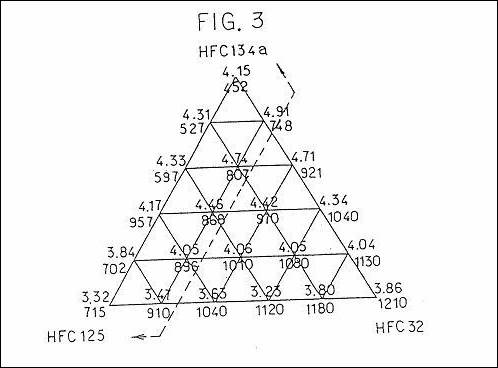
APPENDIX 2
Binary Application
1. The following notional claims:
(1) A mixture consisting of HFC-32 and HFC-125.
(2) A mixture consisting of 80 to 20 weight percent HFC-125 and 20 to 80 weight percent HFC-32.
(3) A mixture consisting of 80 to 40 weight percent HFC-125 and 20 to 60 weight percent HFC-32.
(4) A mixture consisting of 60 to 20 weight percent HFC-125 and 40 to 80 weight percent HFC-32.
(5) A mixture consisting of 60 to 40 weight percent HFC-125 and 40 to 60 weight percent HFC-32.
(6) A mixture consisting of 80 weight percent HFC-125 and 20 weight percent HFC-32.
(7) A mixture consisting of 60 weight percent HFC-125 and 40 weight percent HFC-32.
(8) A mixture consisting of 40 weight percent HFC-125 and 60 weight percent HFC-32.
(9) A mixture consisting of 20 weight percent HFC-125 and 80 weight percent HFC-32.
(10) A mixture consisting of 90.2 to 36.6 weight percent HFC-125 and 63.4 to 9.8 weight percent HFC-32.
(11) A mixture consisting of 90.2 to 60.6 weight percent HFC-125 and 9.8 to 39.4 weight percent HFC-32.
(12) A mixture consisting of 77.6 to 36.6 weight percent HFC-125 and 22.4 to 63.4 weight percent HFC-32.
(13) A mixture consisting of 77.6 to 60.6 weight percent HFC-125 and 22.4 to 39.4 weight percent HFC-32.
(14) A mixture consisting of 90.2 weight percent HFC-125 and 9.8 weight percent HFC-32.
(15) A mixture consisting of 77.6 weight percent HFC-125 and 22.4 weight percent HFC-32.
(16) A mixture consisting of 60.6 weight percent HFC-125 and 39.4 weight percent HFC-32.
(17) A mixture consisting of 36.6 weight percent HFC-125 and 63.4 weight percent HFC-32.
(18) A binary mixture as claimed in any one of claims 1 to 17 which is substantially constant boiling
(19) A process for producing refrigeration comprising the steps of condensing the mixture as claimed in any of claims 1 to 18 and thereafter evaporating said mixture in the vicinity of a body to be cooled.
(20) A process for producing heat comprising the steps of condensing the mixture as claimed in any of claims 1 to 18 in the vicinity of a body to be heated and thereafter evaporating said mixture.
(21) A process for heating or cooling comprising the step of using the mixture as claimed in any of claims 1 to 18 as a heat transfer media.
2. Further or in the alternative, claims (1) to (21) above in which the words “consisting of” in claims (1) to (17) above are replaced with the word “comprising” according to the definition of “comprising” in the Binary Application at page 10, lines 7-11.
Ternary Application
3. The following notional claims:
(1) A ternary mixture consisting of HFC-125, HFC-32 and HFC-134a.
(2) A ternary mixture consisting of 20 to 60 weight percent HFC-125, 20 to 60 weight percent HFC-32 and 20 to 60 weight percent HFC-134a.
(3) A ternary mixture consisting of 40 to 60 weight percent HFC-125, 20 to 40 weight percent HFC-32 and 20 to 40 weight percent HFC-134a.
(4) A ternary mixture consisting of 20 to 40 weight percent HFC-125, 40 to 60 weight percent HFC-32 and 20 to 40 weight percent HFC-134a.
(5) A ternary mixture consisting of 20 to 40 weight percent HFC-125, 20 to 40 weight percent HFC-32 and 40 to 60 weight percent HFC-134a.
(6) A ternary mixture consisting of 20 to 60 weight percent HFC-125, 20 to 60 weight percent HFC-32 and 20 to 40 weight percent HFC-134a.
(7) A ternary mixture consisting of 20 to 40 weight percent HFC-125, 20 to 60 weight percent HFC-32 and 20 to 60 weight percent HFC-134a.
(8) A ternary mixture consisting of 20 to 60 weight percent HFC-125, 20 to 40 weight percent HFC-32 and 20 to 60 weight percent HFC-134a.
(9) A ternary mixture consisting of 20 weight percent HFC-125, 60 weight percent HFC-32 and 20 weight percent HFC-134a.
(10) A ternary mixture consisting of 40 weight percent HFC-125, 20 weight percent HFC-32 and 40 weight percent HFC-134a.
(11) A ternary mixture consisting of 20 weight percent HFC-125, 20 weight percent HFC-32 and 60 weight percent HFC-134a.
(12) A ternary mixture consisting of 20 weight percent HFC-125, 40 weight percent HFC-32 and 40 weight percent HFC-134a.
(13) A ternary mixture consisting of 40 weight percent HFC-125, 40 weight percent HFC-32 and 20 weight percent HFC-134a.
(14) A ternary mixture consisting of 60 weight percent HFC-125, 20 weight percent HFC-32 and 20 weight percent HFC-134a.
(15) A ternary mixture consisting of 25.1 to 70.0 weight percent HFC-125, 10.1 to 41.3 weight percent HFC-32 and 19.8 to 64.0 weight percent HFC-134a.
(16) A ternary mixture consisting of 31.7 weight percent HFC-125, 41.3 weight percent HFC-32 and 27.0 weight percent HFC-134a.
(17) A ternary mixture consisting of 48.4 weight percent HFC-125, 10.5 weight percent HFC-32 and 41.1 weight percent HFC-134a.
(18) A ternary mixture consisting of 25.1 weight percent HFC-125, 10.9 weight percent HFC-32 and 64.0 weight percent HFC-134a.
(19) A ternary mixture consisting of 28.0 weight percent HFC-125, 24.3 weight percent HFC-32 and 47.7 weight percent HFC-134a.
(20) A ternary mixture consisting of 53.8 weight percent HFC-125, 23.3 weight percent HFC-32 and 22.9 weight percent HFC-134a.
(21) A ternary mixture consisting of 70.0 weight percent HFC-125, 10.1 weight percent HFC-32 and 19.8 weight percent HFC-134a.
(22) A process for producing refrigeration comprising the steps of condensing the mixture as claimed in any of claims 1 to 21 and thereafter evaporating said mixture in the vicinity of a body to be cooled.
(23) A process for producing heat comprising the steps of condensing the mixture as claimed in any of claims 1 to 21 in the vicinity of a body to be heated and thereafter evaporating said mixture.
(24) A process for heating or cooling comprising the step of using the mixture as claimed in any of claims 1 to 21 as a heat transfer media.
4. Further or in the alternative, claims (1) to (24) above in which the words “consisting of” in claims (1) to (21) above are replaced with the word “comprising” according to the definition of “comprising” in the Ternary Application at page 11, lines 1-5.


