FEDERAL COURT OF AUSTRALIA
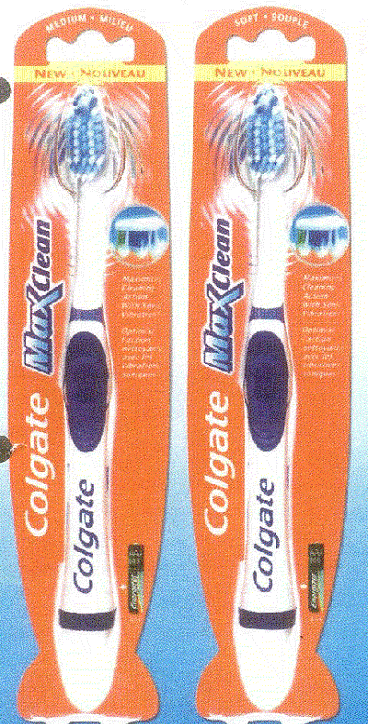
Beecham Group Plc v Colgate-Palmolive Pty Ltd [2005] FCA 838
TRADE MARKS – infringement of Applicants’ trade mark “Macleans” claimed in relation to Respondent’s product “MaxClean” – whether the use of the alleged infringing sign was use as a trade mark – whether alleged infringing sign was deceptively similar to the trade mark – “MaxClean” not deceptively similar to "Macleans” despite some visual and aural similarities - similarities not such that likely to mislead or cause confusion.
Trade Marks Act 1995 (Cth), ss 6, 10, 17, 27(1), 44(1), 120(1)
Trade Practices Act 1974 (Cth), Part V
Aristoc Ltd v Rysta Ltd (1945) 62 RPC 65 at 73 (cited)
Australian Woollen Mills Ltd v FS Walton & Co Ltd (1937) 58 CLR 641 (cited)
Beard v Turner 13 LT(NS) 746 (cited)
Blackwell v Crabb (1867) 36 LJCh 504 (cited)
CA Henschke & Co v Rosemount Estates Pty Ltd (2000) 52 IPR 42 (cited)
Caterpillar Loader Hire (Holdings) Pty Ltd v Caterpillar Tractor Co (1983) 1 IPR 265 (cited)
Johnson & Johnson Aust Pty Ltd v Sterling Pharmaceuticals Pty Ltd (1991) 30 FCR 326 (cited)
Mark Foy’s Ltd v Davies Co-op & Co Ltd (1956) 95 CLR 190 (cited)
Registrar of Trade Marks v Woolworths Ltd (1999) 45 IPR 411 (cited)
Southern Cross Refrigerating Co v Toowoomba Foundry Pty Ltd (1954) 91 CLR 592 (cited)
BEECHAM GROUP PLC & ANOR v COLGATE-PALMOLIVE PTY LTD
NSD1425 OF 2004
EMMETT J
22 JUNE 2005
SYDNEY
|
IN THE FEDERAL COURT OF AUSTRALIA |
|
|
NEW SOUTH WALES DISTRICT REGISTRY |
NSD1425 OF 2004 |
|
BETWEEN: |
BEECHAM GROUP PLC FIRST APPLICANT
GLAXOSMITHKLINE AUSTRALIA PTY LTD SECOND APPLICANT
|
|
AND: |
COLGATE-PALMOLIVE PTY LTD RESPONDENT
|
|
EMMETT J |
|
|
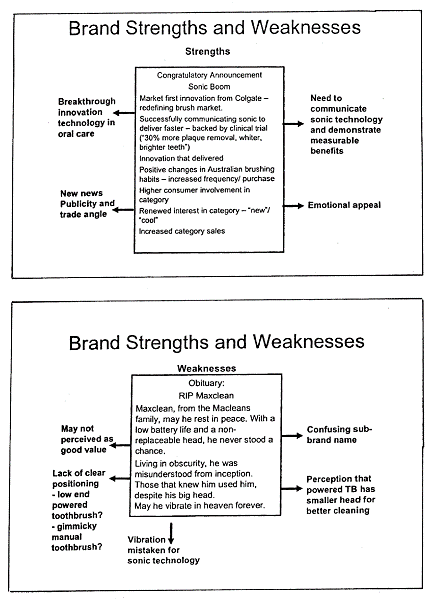
DATE OF ORDER: |
|
|
WHERE MADE: |
SYDNEY |
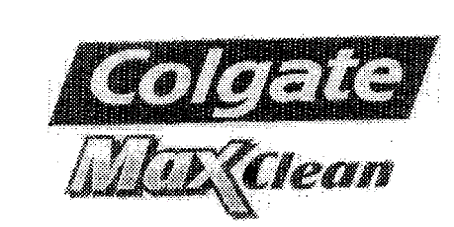
THE COURT ORDERS THAT:
1. The application be dismissed.
2. The applicants pay the respondent’s costs of the proceeding.
Note: Settlement and entry of orders is dealt with in Order 36 of the Federal Court Rules.
|
IN THE FEDERAL COURT OF AUSTRALIA |
|
|
NEW SOUTH WALES DISTRICT REGISTRY |
NSD1425 OF 2004 |
|
BETWEEN: |
BEECHAM GROUP PLC FIRST APPLICANT
GLAXOSMITHKLINE AUSTRALIA PTY LTD SECOND APPLICANT
|
|
AND: |
RESPONDENT
|
|
JUDGE: |
|
|
DATE: |
|
|
PLACE: |
SYDNEY |
REASONS FOR JUDGMENT
1 The first applicant, Beecham Group Plc (‘Beecham’) is the registered proprietor of Australian Trade Mark Number 774677 in relation to toothbrushes (‘the Macleans Mark’). The Macleans Mark consists of the word ‘MACLEANS’. The second applicant, GlaxoSmithKline Australia Pty Ltd (‘GSK’), claims to be an authorised user of the Macleans Mark, although, at this stage there is no evidence of any arrangement to that effect. Beecham and GSK claim that the respondent, Colgate-Palmolive Pty Ltd (‘Colgate’), has infringed and threatens to infringe the Macleans Mark by use of the sign as shown in Schedule 1 to these reasons (‘the MaxClean sign’) in connection with the marketing of toothbrushes. Colgate denies that it has used the MaxClean sign as a trade mark and that, if it has used it as a trade mark, its use has not infringed the Macleans Mark.
STATUTORY FRAMEWORK
2 Section 27(1) of the Trade Marks Act 1995 (Cth) (‘the Act’) provides, inter alia, that a person may apply for the registration of a trade mark in respect of goods. Under s 17, a trade mark is, relevantly, a sign used, or intended to be used, to distinguish goods dealt with or provided, in the course of trade, by a person, from goods so dealt with or provided by any other person. The term ‘sign’ is defined in s 6 as including any letter, word, name, signature, numeral, device, brand, heading, label, ticket, aspect of packaging, shape, colour, sound or scent and any combination of those.
3 Part 7 of the Act deals with registration of trade marks by the Registrar of Trade Marks. Section 44(1) relevantly provides that an application for the registration of a trade mark (‘applicant’s trade mark’) in respect of goods (‘applicant’s goods’) must be rejected if the applicant’s trade mark is substantially identical with, or deceptively similar to, a trade mark registered by another person in respect of goods similar to the applicant’s goods.
4 Section 120(1) relevantly provides that a person infringes a registered trade mark if the person uses, as a trade mark, a sign that is substantially identical with, or deceptively similar to, that registered trade mark, in relation to goods in respect of which that trade mark is registered. Under s 10, for the purposes of the Act, a trade mark is taken to be deceptively similar to another trade mark if it so nearly resembles that other trade mark that it is likely to deceive or cause confusion.
BRANDS
5 Ms Jeanne Strachan, who is a marketing consultant, was called by Beecham and GSK and gave evidence by affidavit concerning brands and brand names. Her evidence was not disputed. For many years Ms Strachan has conducted market research and provided market research services to clients in a wide range of industries, including the fast moving consumer goods industry. In doing so, Ms Strachan uses a range of quantitative and qualitative market research techniques.
6 Quantitative research is used to measure numerically consumer attitudes or behaviour to specific products or services. Qualitative research is used to provide insights into, and an understanding of, consumer attitudes, wants and needs, rather than a simple numerical measure of consumer attitudes and behaviour.
7 A brand is a mark, symbol or word that is used by a company on its goods or services to set its goods or services apart from another company’s goods or services. Products and services often have both a parent brand and a sub-brand. A parent brand is sometimes referred to as an umbrella brand, in that it is a brand under which sub-brands are marketed. A sub-brand is any brand that is subsidiary to a parent brand.
8 An effective brand is one that:
- communicates succinctly the primary consumer benefit of the product;
- is memorable;
- is easily recognisable;
- is unique and distinctive; and
· is short.
However, there are effective brands that, on their face, do not demonstrate all of those attributes. An effective brand may also be closely associated with a particular colour or shades of colour. Colour is a key way for consumers to recognise a particular brand. Accordingly, many companies will use consistent colours across a range of products and will use the same colour combination when presenting their brands.
9 A parent brand may be used together with a sub-brand for several reasons. In general, the use of sub-brands enables the proprietor of the parent brand to market a range of different products or services, competing in different market segments, but retaining the values of the parent brand. Thus, a parent brand is often used together with a sub-brand so that the positive attributes of the parent brand are attributed to the sub-brand, without the need to create an entirely new set of brand values for the sub-brand, which would cost the company time and money and may not succeed.
10 Sub-brands are also used to communicate to consumers specific and differentiating values pertaining to the sub-brand, which often appeal to different market segments while still having the benefit of attributing to each sub-brand the brand values of the parent brand. Sub-brands are usually promoted individually, in the sense that two sub-brands will not usually be promoted together in the same advertisement. That is because sub-brands may have different messages, which have nothing in common, and may be aimed at different demographic and psychographic markets. One of the aims of sub-branding is to promote the unique attributes of a particular product: to promote two sub-brands together would risk blurring what is unique about each product in the minds of consumers.
MARKETING OF TOOTHBRUSHES
11 There are several segments of oral care products in Australia being:
- toothbrushes;
- toothpaste;
- whitening products;
- dental floss and dental tape;
- mouth wash;
· denture care.
12 The toothbrush segment of consumer sales is relatively fast moving, in the sense that large numbers of toothbrushes are sold every week. The toothbrush market is a highly competitive one, where companies try to match any new product offerings by their competitors, in order to reduce the points of differentiation between the two. The toothpaste market is also a relatively fast moving one, since most people use toothpaste. Consumers replace their toothbrushes on a regular basis, although not as frequently as they purchase toothpaste.
13 Large numbers of units of toothbrushes and toothpaste are sold in supermarkets. Supermarkets tend to have an oral care section where all brands of toothbrushes and toothpastes are offered for sale. There is typically a multitude of products in close proximity to each other. Some supermarkets present toothbrushes in a neater and more orderly fashion than in others. In the majority of supermarkets and retail outlets, toothbrushes are displayed either standing upright or hanging vertically, rather than horizontally. Accordingly, a name or brand, which will tend to be written lengthways along the packaging, will be presented to the consumer sideways. That can have some significance in terms of the capacity of consumers to perceive accurately the name or brand displayed on the packaging.
14 The way in which shoppers buy toothbrushes is distinct from the way in which they buy other oral care products, such as toothpaste. Most consumers shop with a high pre-intention to buy a specific brand of toothpaste. That type of shopping for toothpaste is aided by the consistent grouping of toothpaste products in supermarkets according to brand, and the fact that each brand of toothpaste has similar visual characteristics, including a consistency of design, colour, packaging and overall look throughout its product range. The grouping together of like branded products on shelves is a strong navigational aid for consumers, and results in a short period of browsing for specific products. Toothpaste shoppers who enter the toothpaste section of a supermarket with a pre-intention to purchase a particular brand tend not to switch to other brands.
15 However, compared with other fast moving consumer goods, people shop for a toothbrush relatively infrequently, with the average being one toothbrush purchased approximately every eight to nine months. Consumers frequently cannot easily find the toothbrush they are looking for and often cannot remember exactly the type of brush they have at home.
16 The selection process for toothbrushes is more involved than for toothpaste, as shoppers spend more time at the shelf browsing and consider more products before making a selection. Brand preference is less developed than it is with toothpaste. Compared with toothpaste, shoppers are more likely to have predetermined the functional features of the toothbrush they require, such as head size, angle, grip and bristle type, rather than a specific brand. Thus, features rank more highly than brand on the purchase decision hierarchy. The decision to purchase a manual toothbrush rather than a power toothbrush is usually made before the customer enters the store, so that those planning to buy a manual brush do not generally consider the power alternative once they are in the store. A significant proportion of people who go to a store intending to purchase a toothbrush leave the store without having so done.
17 Overall, purchases of toothbrush products are rarely the result of impulse decisions and are generally the result of a need to replace an existing toothbrush. However, because toothbrushes do not ‘run out’ in the way that toothpaste ‘runs out’, a consumer who might intend to buy a toothbrush, but who cannot find the toothbrush he or she wants, is able to defer the purchase.
COLGATE AND MACLEANS
18 Colgate is a subsidiary of Colgate-Palmolive Company (‘Colgate Co’), a New York listed public company, which traces its origins to 1806. Colgate uses the name ‘COLGATE’ as a parent brand and large numbers of different products, each with its own sub-brand, are sold under that brand. Colgate Co is the proprietor of a significant number of registered trade marks in Australia relating to Class 21 goods, including a significant number in relation to toothbrushes. Specifically, Colgate Co is the registered proprietor of several composite trade marks for toothbrushes, as follows:
- Colgate Total
- Colgate Ultra Protection
- Colgate Classic
- Colgate Massager
- Colgate Active Clean
- Colgate Intense Clean
- Colgate Deep Clean
- Colgate Magna Clean
- Colgate 360 Clean
19 GSK currently sells toothbrushes, toothpaste and teeth whitening products in Australia under the Macleans Mark. The Macleans Mark is a parent brand, which is used on a variety of different products. Products sold under the Macleans Mark are sold under a number of sub-brands. For example, toothbrushes bearing the Macleans Mark are sold under sub-brands such as:
- Flex;
- Flex Direct;
· Max Active.
Within each sub-brand, there are toothbrushes of different strength bristles, different size brushes and different colours.
20 Similarly, toothpaste sold under the Macleans Mark is also sold under a number of sub-brands including:
- Active
- Protect
- Extreme Clean
· Revitalise 40+
Within each toothpaste product, there may be toothpastes of different flavours or different size tubes.
21 GSK also sells teeth whitening products in Australia under the Macleans Mark. It sells such products under the sub-brand ‘Brilliant White’.
22 There are four main brands of toothbrushes sold in Australia under the following brands:
- Colgate
- Oral B
- Reach
· Macleans
Colgate brand toothbrushes have been on sale in Australia for many years, while Macleans brand toothbrushes have been on sale only since about 1996. As at the end of September 2004, Colgate was the market leader with approximately 31.3 per cent of units sold, while Macleans had 9.3 per cent of the market in terms of units sold. As at the end of January 2005, those figures were 32 per cent and 9.5 per cent respectively. As at the end of September 2004, Colgate was the market leader in the toothpaste market, with approximately 65.2 per cent of the market in terms of units of toothpaste sold, while the Macleans brand is the second highest selling brand, with approximately 17.4 per cent of the market in terms of units sold. By the end of January 2005, those figures were 64.6 per cent and 17.8 per cent respectively.
THE VIPER TOOTHBRUSH PROJECT
23 Before February 2004, Colgate Co had been working on a project involving the development of a low cost battery toothbrush with a manual appearance. The project was named ‘Viper’. Viper was to be a disposable manual-like battery toothbrush, with a compact and ergonomic design that closely approached the handle size of a manual, super premium toothbrush. The head was to have a vibrating feature that may provide better cleaning. The brush was to have a flexible neck and one replaceable AAA battery.
24 As at February 2004, Colgate Co was interested in determining the most appropriate name for the proposed new product. Several names were tested in the United States of America, the United Kingdom and France. Two of the names tested were found to exhibit ‘overall strength across the key measures’. In a market research report of Colgate Co of February 2004, the name ‘MaxiClean’ was said to demonstrate ‘the greatest strength’ and was recommended by the report.
25 On 21 March 2004, the Global Toothbrush Division of Colgate Co (‘the GTD’) prepared a consumer research proposal in relation to the Viper Project. The memorandum relevantly said:
‘A previous central location study was conducted with three of the names showed strengths MaxiClean, ActiClean and Buzzz. However, there is still an opportunity to strengthen the names, as there are negative associations with the MaxiClean and ActiClean name and trade mark problems with the name Buzz. For this, a central location phase II will be conducted with three names:
1. MaxClean
2. Bzzz
3. MicroClean
…
The research objective is to identify the most appropriate name for this toothbrush:
- generates strong purchase intent and appeal
- generates the best preference’
26 An internal memorandum of Colgate Co of April 2004, after reporting that the three names, MaxiClean, ActiClean and Buzz, ‘showed strength in previous name testing’, went on to say that there was still an opportunity to identify stronger names. The memorandum said that a second round of name testing had been conducted to measure the relative appeal of three alternative names:
- MaxClean;
- MicroSonic; and
· Bzzz.
The report contained a recommendation to proceed with ‘Colgate MicroSonic’ in order to establish a new ‘anchor’ brand name for Colgate’s first entry into the segment of toothbrushes between manual and power.
27 At about the same time, the GTD produced graphics for the packaging of both MicroSonic and MaxClean brands, together with a comparison as follows:
|
MicroSonic vs. MaxClean |
|||
|
MicroSonic · Parity in main measures and attributes - top 2 box PI, uniqueness, name appropriateness/appeal · Ownable trademark - US, Canada, Australia, NZ, UK and France already Cleared · Balanced communication of cleaning and powered attributes - Vibration / Sonic - Batter-powered · Strongest communication of Compact size / shape attributes |
MaxClean · Parity in main measures - win in top box PI · Descriptive use but won on name Preference · Strongest communication of Cleaning attributes but little/no Powered attributes · Little communication of compact Size / shape attribute |
||
|
Colgate Global Toothbrush Division |
|||
28 On 27 April 2004, Ms Candi Rancel, a researcher in Colgate Co, forwarded ‘the results of the Viper Name test phase II’ to Ms Cathy Thornhill of Colgate Co. A Power Point presentation was enclosed, which dealt with the three names ‘MaxClean’, ‘MicroSonic’ and ‘Bzzz’. The Power Point presentation included the following statements:
‘Conclusions
· Max Clean was the strongest name tested. Specifically:
- Strong top box purchase intent and preference ranking
- Strongest cleaning attribute profile
- Preferred name for ranking
· MicroSonic followed closely:
- Parity to Max Clean in all indicators with the exception of top box purchase intent
- Communicates a balance of attributes
· Bzzz lost significantly vs. the other two names in all indicators, attributes and preference ranking
… … …
‘Recommendation
· Proceed with Colgate MicroSonic to establish a new “anchor” brand name for Colgate’s first entry into this segment (transition between manual and power)
Rationale
· MaxClean is not ownable:
- Can not be trademarked
- Competitors using the name (OralB CA Max, Reach Max)
· MicroSonic is ownable and communicates a balance of attributes:
- Cleaning, Small size/ergonomic, Powered/Sonic
- Trademark clear in US and key markets’
29 On 27 April 2004, Ms Rancel received a response to her email to Ms Cathy Thornhill of that date. The response said:
‘I read the report. Research is fine methodologically.
You can go w/ either name from consumer response. I understand the business rationale (more ownership) for MicroSonic. I also think it does fit the more unique shape/ergonomics better (you get more use/feature playback), hence is right for differentiation which is important in this category today.
Only concern is that MaxClean did better on cleaning attributes – so you should be careful in Advertising and Shelf to stress “cleaning” since that is a core driver in the category.
But I do support the reco to move forward w/ MicroSonic as the brand’s name.’
30 On 29 April 2004, Mr Noel Wallace of Colgate Co sent to Mr Bill Shanahan of Colgate Co, an email concerning ‘Viper Name Test Phase II’. The email relevantly said:
‘Attached please find the results or [sic] the Viper name test. This was conducted in US during the month of April on a central location.
Background/Business Objectives
Viper has undergone four rounds of name testings:
1. Concept test where the names where [sic] screened using two indicators.
2. Quantitative screener using e-panel.
3. Quantitative screener using central location where three names, MaxiClean, ActiClean and Buzzz showed strength.
We embarked on a fourth test with the following:
· MaxClean – MaxiClean was changed to MaxClean, as the former had negative associations in later qualitative tests.
· MicroSonic – which cleared later trade mark search in key markets.
· Bzzz - trade mark that CP owns.
Conclusion:
· MaxClean obtained the greatest overall strength of the key action standard measures of purchase interest, appropriateness and preference. Also MaxClean communicates the strongest cleaning efficacy message, although playback of the “battery powered’ feature of this name is very low.
· MicroSonic showed a very good balance in communication of both cleaning efficacy and the batter power feature which are key to brand communication since the toothbrush is a transition between manual and power. This name was parity to MaxClean in all key measures with the exception of top box purchase intent.
· Bzzz exhibits significant weaknesses versus both MaxClean and MicroSonic across all measures.
The GTD recommendation, on concert with all of the major divisions, is to proceed with Colgate MicroSonic for the following reasons:
· communicates the product technology/feature best, sounds scientific and superior;
· stands for powered, which is an important attribute to communicate for a product that looks like a manual toothbrush;
· provides very well balanced communication of key benefits: cleaning, small size, powered/sonic technology, unique;
· leverages the sonic feature which OralB will be driving at the high end (OralB Sonic Complete) and provides opportunity for Viper to increase price-value perceptions.’
31 Thus, the research carried out by Colgate to the end of April 2004 indicated that the preferred name for the Viper product was ‘MicroSonic’. That name was recommended over the name ‘MaxClean’. That recommendation would have been reinforced by a facsimile communication of 1 May 2004, received by Colgate Co on 7 May 2004, from FB Rice & Co, patent and trade mark attorneys in Australia. FB Rice & Co relevantly said as follows:
‘Thank you for your instructions requesting a search in Australia for the trade mark ‘MAX CLEAN’.
…
A search of the available database records of the Australian Trade Marks Office is completed. The search was conducted in Class 3 to cover toothbrushes and toothpaste,…
IN SUMMARY: the search did not locate any obstacles for the use of MAX CLEAN for toothpaste and toothbrushes. However, an application for registration is likely to encounter serious difficulties on the basis that MAX CLEAN is both descriptive and laudatory.
…
As indicated in the summary above, I anticipate difficulties for registration of MAX CLEAN given that MAX is a common abbreviation for MAXIMUM, and the word CLEAN is, of course, descriptive of the function of the goods. While MAX CLEAN has previously been registered for cleaners…, I believe that any application filed at this time would encounter serious objection.’
32 No evidence was adduced on behalf of Colgate as to what prompted the letter from FB Rice & Co, or what instructions were given to FB Rice & Co. Nor was there any evidence from Colgate as to any reaction on the part of Colgate Co to the receipt of that letter.
33 On 10 May 2004, Ms Karen Hawkins, who was then an employee of Colgate, but who left Colgate in November 2004, prepared a memorandum seeking approval of artwork for the backer card and leaflet of the proposed Viper power toothbrush. Attached to the memorandum was artwork for a backer card and leaflet for each of ‘Colgate MaxClean’ and ‘Colgate MicroSonic’. Ms Julie Dillon, the marketing manager of Colgate, made a handwritten note on the bottom of Ms Hawkins memorandum saying:
‘GTD have not yet confirmed brand name.
it is either - Colgate Max Clean or
Colgate Micro Sonic’
34 Despite the recommendations referred to above, on or about 11 May 2004, Colgate was informed by Colgate Co that the name for the Viper toothbrush would be ‘Colgate Max Clean’. According to Ms Dillon, that decision was made by someone in Colgate Co and communicated to Colgate by email. Ms Dillon was unable to locate a copy of the email, either in electronic or hard form. No evidence of the decision making process was adduced other than has been summarised above.
35 In or about mid to late May 2004, a number of telephone conferences took place between Colgate and Colgate Co, in which employees of Colgate, including Ms Dillon, expressed a preference for the name ‘MicroSonic’. Ms Dillon said that it was her belief, at the time, that the name ‘MicroSonic’ better communicated the most innovative and beneficial feature of the product, and that it would help differentiate the toothbrush from other toothbrush products available in the market. Ms Dillon also saw ‘MaxClean’ as being too generic in its description of the cleaning function. She did not consider that ‘MaxClean’ would effectively differentiate the product from the other toothbrushes in the market in the same way that ‘MicroSonic’ would.
36 From time to time, meetings are conducted between staff of Colgate and outside media agencies, in order to determine a coherent and effective media planning and buying strategy. That involves identifying the target market for a specific product and identifying the most effective way of reaching that intended market. Ms Dillon said that one of the techniques that is used in that process is to ‘brainstorm’ different elements of a potential product launch in order to identify potential success factors for the purpose of adopting a media planning and buying strategy to avoid or overcome weaknesses.
37 Such a meeting was arranged for 2 August 2004, in respect of the proposed launch of the Viper product. The meeting was to involve Mediaedge:cia (‘MEC’), a media agency. On 29 July 2004, MEC prepared a memorandum saying that the key objective of the proposed meeting was ‘to develop a single minded connection message (or theme) which springboards into ideas across the key media and promotional vehicles within an integrated launch campaign’. On 30 July 2004, MEC prepared a ‘Pre-reading’ presentation for the proposed MaxClean meeting. The presentation included the following:
‘Colgate Maxclean Product Information
· Bridging the gap between manual and powered brushes
· Comparable in appearance to a high end manual
- Contains AAA battery, which powers a sonic vibration of the whole brush to provide the ultimate clean from a Manual Brush
· Normal brushing required, giving a sense of control and manoeuvrability
· Market first in Australia’
38 The meeting of 2 August 2004 was attended by several people from Colgate, including Karen Hawkins, together with people from MEC and other agencies concerned with consumer promotion. Ms Hawkins attached to a copy of the pre-reading presentation several post-it notes, on which she had placed some handwriting. One of those notes was as follows:
‘Appeal to Power ¹ Max Clean
Max Clean = Mcleans’
39 MEC produced a further presentation concerning the Maxclean meeting, entitled ‘Output Document’. That presentation included pages dealing with the strengths and weaknesses of the proposed MaxClean brand, as set out in Schedule 2 to these reasons. It is clear from those pages that those who attended the meeting had a negative reaction to the proposed ‘MaxClean’ name. Thereafter, the pages from the MEC presentation that set out the weaknesses and the strengths of ‘MaxClean’ were circulated throughout Colgate on several occasions.
40 On 12 August 2004, Ms Dillon and Ms Hawkins received an email communication from Mr Richard Usuquen, the head of Power Toothbrushes world wide for Colgate Co. The email dealt with the subject of ‘MicroSonic Name for Viper’ and relevantly said as follows:
‘Good news! We have senior management approval to proceed with the MicroSonic name for Viper!
This decision today was brought about by:
· legal assessment of risk associated with the MaxClean name due to its phonetic and visual similarity with Macleans (GSK) oral care trade mark
· Our continuing push behind MicroSonic as our recommendation because of some very strong consumer results. It communicates all the attributes the Viper brush stands for : cleaning, compact size, powered, technological…etc.
· MicroSonic is ownable; We have filed for trademark in our 6 major markets and now extending the application to cover the world
We will be working on optimizing the MicroSonic graphics and working closely with Australia and Canada (global leads) to manage the conversion from MaxClean to MicroSonic. As soon as the new graphics are approved by senior mgt, we will be accelerating regional artwork executions for which we will be counting on your support to move fast on.
Thanks to everyone – all your appeal for MicroSonic has been heard. We are off to a great start.’
41 Thus, there appears to have been a change of heart by Colgate Co. However, despite Mr Usuquen’s email of 12 August 2004, a decision was apparently made to proceed with the launch of the new product in Australia and Canada under the brand ‘MaxClean’. The circumstances surrounding, and the reasons for, the change of mind have not been explained.
42 On 31 August 2004, Mr Patrick Casey, the product manager for Colgate toothbrushes in Canada, forwarded an email to Ms Hawkins asking her a number of questions. He told Ms Hawkins that he was ‘currently working on our MaxClean programmes’. The questions and relevant parts of Ms Hawkins’ response of the same day were as follows:
‘1) Are you supporting MaxClean via TV or Print media? If yes, are you launching it before or after the name change? Media vehicles are still being finalised; at this stage it is likely to be print and radio. This will be before the name change…
2) From a packaging standpoint, are you switching directly into MicroSonic or do you plan on introducing some sort of transitional name (i.e. MaxClean MicroSonic) in between? Switching straight over – again sub brand names are of relatively little importance in the purchase decision hierarchy. Focusing on the “New Colgate Sonic Toothbrush” will be the key communication focus.
3) Are there any trade issues with changing your name? Early conversations with our sales team indicate that logistically this should be OK – with same APN numbers etc. We will however need to provide a valid reason why. For us, the legal issue of being close in appearance & sound to Macleans (which is Aquafresh in other markets) is one of the main reasons we are likely to communicate.
…’
43 On 2 September 2004, Ms Hawkins sent an email to Mr Brenton Wooding, a colleague of Ms Dillon in Colgate’s sales section. The subject of the email was ‘Stickering of New MaxClean Packs’. Ms Hawkins relevantly said as follows:
‘Background/Purpose: The reason we are doing this is twofold; 1) It will draw attention to the fact that this is New and will induce trial,
2) we are changing the name from Maxclean to Microsonic in around November/December this year – primarily due to the legal risk of sounding and looking like “Macleans”. Therefore we are “playing down” the mention of any sub brand name (ie: MaxClean) and focusing all consumer communication in Advertising to be “New Colgate Sonic Toothbrush”. Therefore it is critical that we make this link for consumers at the shelf.
…’
On 22 October 2004, Mr Wooding replied by email to Ms Hawkins on the same topic. Mr Wooding repeated part of the contents of Ms Hawkins’ email, including the part just quoted. The addressees of Mr Wooding’s email were more extensive than those of Ms Hawkins’ email.
THE DISPUTE
44 On 22 September 2004, the solicitors for Beecham and GSK wrote to Colgate. The letter alleged infringement of the Macleans Mark by Colgate and demanded that Colgate desist from use of the MaxClean sign. In response to the letter of 22 September 2004, Colgate’s solicitors responded as follows:
‘Your letter refers to the use by our client of the trade mark “MAXCLEAN”. Our client’s product actually uses a composite mark, namely Colgate MaX Clean, written in a stylised distinctive form. It is this mark which is used on both the front and back of our client’s packaging, not “MAXCLEAN”.
The letter also referred to the fact that Colgate Co had applied in the United States for trade marks for ‘MaX Clean’ in a stylised form. On 1 October 2004, Colgate applied for registration in class 21 of three Australian trade marks. One of them consists of the words ‘COLGATE MAX CLEAN’. The other two, which consist of the MaxClean sign, are as shown in Schedule 3 to these reasons.
45 This proceeding was commenced on 1 October 2004. On 15 October 2004, Tamberlin J granted interlocutory injunctions relating to the advertising and sale, by Colgate, of a toothbrush under the name ‘MaxClean’. An application for leave to appeal from those orders was refused by Bennett J on 29 October 2004.
IS MAXCLEAN USED as a TRADEMARK?
46 Under s 120(1) of the Act, there is no infringement unless a sign is used as a trademark. Colgate contends that its use of the MaxClean sign, in the packaging and advertising of the Viper toothbrush, is not use as a trade mark. Rather, Colgate says, it is a descriptive term, describing features and benefits of the toothbrush. Just as other participants in the market use the word ‘max’ in describing their products, so does Colgate. Colgate asserts that the MaxClean sign, in the form shown in Schedule 1 to these reasons, is no more than descriptive of the effect of its toothbrush, namely that it has maximum cleaning effect. Colgate also points to its intended concurrent use of the sign ‘Max Fresh’ in relation to toothpaste. It says that Max Fresh, just like MaxClean, describes the feature or benefit of a mouthwash product.
47 However, the submission belies Colgate’s own treatment of the MaxClean sign. Ms Dillon accepted that ‘MaxClean’ was a sub-brand in the sense described above. Colgate’s own documents characterise it in the same way. Further, the packaging of the toothbrush indicates that the MaxClean sign is used as a trade mark. The packaging includes, in addition to the MaxClean sign, the following statements:
- ‘Maximises cleaning action with sonic vibration!’;
- ‘Medium’;
- ‘New’;
- ‘Outstanding sonic cleaning!’
- ‘Combines high-speed sonic vibrations with multi aimed bristles to remove more plaque than a manual toothbrush.’
- ‘Its slim, comfortable handle is easy to manoeuvre.’
Those statements are in a much smaller font than the MaxClean sign and appear in ordinary script. The MaxClean sign, however, is in a stylised script and is coloured and shaded. Further, the letter ‘X’ in the MaxClean sign is distorted to some degree, although it is unequivocally an ‘X’.
48 The prominence and positioning of the MaxClean sign on the packaging of the toothbrush and in promotional material, together with the font size, styling, colour and shading of the MaxClean sign, suggests even greater significance than the ‘Colgate’ brand. Other products, of both Colgate and its competitors, position distinguishing names that are properly characterised as sub-brands in the same place as the MaxClean sign appears in relation to Colgate on the packaging and leaflet. The distinctive styling, colouring and shading has a graphic element akin to a logo. The distinctive blue and white colouring, with a halo effect of white shading around the words, is also indicative of use as a trade mark, rather than as a merely descriptive phrase. Although the ‘C’ appears in upper case, there is no space between the ‘X’ and the ‘C.’ That suggests an invented word intended for use as a trade mark.
49 I consider that the use of the MaxClean sign by Colgate, in the packaging of the toothbrush and in the promotional leaflet, is use as a trade mark within the meaning of s 120 of the Act.
COMPOSITE MARK?
50 The MaxClean sign does not appear, except in conjunction with the Colgate trade mark. As indicated above, Colgate’s solicitors suggested initially that the phrase ‘Colgate MaxClean’ was a composite mark. A consumer who sees the toothbrush in the supermarket would not see the MaxClean sign in a vacuum. The MaxClean sign appears on the front of the packaging, against a red background and immediately adjacent to the Colgate name. It is unrealistic to consider the MaxClean sign independently of the sign ‘Colgate’, which is very well known in relation to oral care products. As previously mentioned, Colgate is the market leader in the toothpaste and toothbrush markets. There is, therefore, likely to be a significant public awareness of the distinction between Colgate and Macleans. The Colgate name is likely to be notoriously ubiquitous and very familiar to consumers.
51 If a person uses a registered trade mark as a trade mark, it is an infringement of that registered trade mark, notwithstanding that the person always adds its own name – see Mark Foy’s Ltd v Davies Co-op & Co Ltd (1956) 95 CLR 190 at 197 and Caterpillar Loader Hire (Holdings) Pty Ltd v Caterpillar Tractor Co (1983) 1 IPR 265 at 267, 279 and 289 and Johnson & Johnson Aust Pty Ltd v Sterling Pharmaceuticals Pty Ltd (1991) 30 FCR 326 at 349.
52 Nevertheless, the use of an alleged infringer’s name as part of an impugned mark is an element to be considered in determining whether or not there is deceptive similarity – see Beard v Turner 13 LT(NS) 746 and Blackwell v Crabb (1867) 36 LJCh 504. In assessing the nature of a consumer’s imperfect recollection of a mark, the fact that the mark, or perhaps an important element of it, is notoriously so ubiquitous and of such long standing that consumers generally must be taken to be familiar with it, and with its use in relation to particular goods or services, is a relevant consideration – see CA Henschke & Co v Rosemount Estates Pty Ltd (2000) 52 IPR 42 at [52] and Registrar of Trade Marks v Woolworths Ltd (1999) 45 IPR 411.
53 I would be disposed to conclude that Colgate has used a composite mark, consisting of the MaxClean sign and the Colgate name. If that is the correct characterisation, it is clear that there was no infringement of the Macleans Mark. However, having regard to the conclusion I have reached below on the question of whether the MaxClean sign is deceptively similar to the Macleans Mark, it is not necessary to decide whether there was a use of a composite mark.
IS THE MAXCLEAN SIGN DECEPTIVELY SIMILAR TO THE MACLEANS MARK?
54 In considering whether two signs are deceptively similar, the signs are not to be compared side by side. An attempt must be made to estimate the effect or impression produced on the mind of potential customers by the sign for which protection is claimed. It is the impression or recollection that might be carried away and retained that forms the basis of any mistaken belief that the impugned sign is the protected sign. Similarities both of sound and of meaning must be considered, and the usual way in which ordinary people behave is the test of whether deception might be expected. Potential buyers of goods are not to be credited with any high perception or habitual caution, although exceptional carelessness or stupidity may be disregarded – see Australian Woollen Mills Ltd v FS Walton & Co Ltd (1937) 58 CLR 641 at 658.
55 There must be a real, tangible danger of confusion occurring: the mere possibility of confusion is not enough. However, it is sufficient if the result of the use of the impugned sign will be that a number of persons will be caused to wonder whether it might not be the case that two products come from the same source. It would be sufficient if the ordinary person would entertain a reasonable doubt. In considering the probability of deception, all the surrounding circumstances must be taken into consideration, including the circumstances in which the signs will be used, the circumstances in which the relevant goods will be bought and sold and the character of the probable purchasers of the goods – see Southern Cross Refrigerating Co v Toowoomba Foundry Pty Ltd (1954) 91 CLR 592 at 595.
56 The question whether the sound of one word resembles the sound of another so as to make the two deceptively similar, must depend upon first impressions. A person who is familiar with both words will be neither deceived nor confused. It is the person who knows only one of the words and has an imperfect recollection of the word who might be deceived or confused – see Aristoc Ltd v Rysta Ltd (1945) 62 RPC 65 at 73.
57 Beecham and GSK point to several factors that are said to lead to the conclusion that there is deceptive similarity between the Macleans Mark and the MaxClean sign. They are as follows:
- The MaxClean sign is written as a single word, although the letter ‘C’ appears to be in upper case.
- Each has eight letters, which appear in the same order except for the insertion of ‘X’ in the MaxClean sign and the addition of ‘S’ at the end of the Macleans Mark.
- The distortion of the letter ‘X’ makes it unlikely that potential customers would read the word as two words, ‘Max Clean’, but would rather see the whole as a logo that resembles the Macleans Mark.
- The colours, shading and font used for the MaxClean sign are strikingly similar to those traditionally used for the Macleans Mark.
- Having regard to the way in which toothbrushes are marketed in supermarkets and other stores, the MaxClean sign would be seen vertically and would not therefore be as easily distinguishable as if it appeared horizontally.
- The toothbrushes would ordinarily be offered for sale in a supermarket, where there would be a low level of attention or care given by a prospective buyer choosing from a busy and cluttered shelf.
58 I consider that the fact that the MaxClean sign can be broken into two words, albeit one of them being colloquial, is a significant distinguishing factor. The Macleans Mark might suggest a surname, but otherwise the first syllable is incapable of suggesting a separate word, whether colloquial or otherwise. Colgate relies on the fact that the MaxClean sign can be broken into two words in its contention, as indicated above, that it is merely descriptive. While I have rejected that contention, the two parts of the MaxClean sign do have a descriptive connotation, which helps to distinguish it from the Macleans Mark.
59 Beecham and GSK point out that there is no limitation as to the form of the Macleans Mark, although a particular colour scheme is ordinarily used. However, the manner in which the MaxClean sign is displayed is not reminiscent of the usual way in which the Macleans Mark is displayed. The font of ‘Max’ is different from the font of ‘Clean’. ‘Max’ is in outline whereas ‘Clean’ is not. The Macleans Mark, however, is unequivocally a single word in the same script.
60 Advertising of products by Colgate includes television and, to a lesser extent radio advertising, in the course of which the name of products, particularly sub-brands, may be spoken. Beecham and GSK say that there is a high degree of aural similarity between the MaxClean sign and the Macleans Mark.
61 However, while there is some degree of aural similarity, the natural tendency when pronouncing the MaxClean sign would be to stress the first syllable, assuming that the MaxClean sign would be read as a single word, or to give equal stress to both words, if it is read as two words. On the other hand, the natural tendency when pronouncing the Macleans Mark is to stress the second syllable. Pronouncing either in the other way would be unnatural and unlikely. Further, it is possible to read the MaxClean sign as constituting two words, namely, ‘Max’ and ‘Clean’. While those two parts of the MaxClean sign are not separated by a space, the use of the upper case for the letter ‘C’ suggests a break. Accordingly, the tendency would probably be to give equal stress to the two syllables, ‘Max’ and ‘Clean’, thus providing a greater degree of aural differentiation than aural similarity.
62 A relatively recent practice of consumer merchandising involves the use of the internet. There are websites operating, from which a consumer might purchase a toothbrush from a list of product names appearing in ordinary font and type. In such a context, the word ‘MAXCLEAN’ may seem quite similar to ‘MACLEANS’. Beecham and GSK say that a consumer familiar with the Macleans Mark could mistake the word ‘MAXCLEAN’ in ordinary font for ‘MACLEANS’. Such a person might at least be caused to wonder whether the MaxClean product comes from the Macleans trade source. An answer to such a contention is that, in all of the instances furnished in evidence of such shopping facilities, the parent or umbrella brand is specified. Specifically, in relation to toothbrushes, the item is, in every instance, prefaced by the word ‘Colgate’.
63 I do not consider that the MaxClean sign so nearly resembles the Macleans Mark that it is likely to deceive or cause confusion. The MaxClean sign is not deceptively similar to the Macleans Mark.
INTENTIONS OF COLGATE CO
64 Intent to deceive or cause confusion is not an essential element in the proof of infringement under s 120 of the Act. However, proof of intention to deceive or cause confusion by the use of a particular sign may lead the Court to infer more readily that there has in fact been use of a sign that is likely to deceive or cause confusion and is therefore deceptively similar to a registered trade mark. Nevertheless, it is ultimately a question of fact for the Court to decide whether there is a reasonable probability of deception or confusion between an impugned sign and a registered trade mark – see Australian Woollen Mills Ltd at 658.
65 Beecham and GKS invited the Court to draw adverse inferences concerning the intention of Colgate and Colgate Co in using the MaxClean sign in Australia. Ms Dillon, who explained the process involved in the introduction of a new product by Colgate, said that all decisions concerning the name and marketing of the Viper product were made by Colgate Co, rather than Colgate. However, no oral evidence was led from any officer of Colgate Co as to why:
- Colgate Co included MaxClean in its tests in March and April 2004, in circumstances where there were doubts as to the availability of the name as a trade mark.
- Colgate Co ignored the recommendations made in April 2004 to use the MicroSonic brand rather than MaxClean brand.
· Colgate Co decided to launch the new toothbrush under the MaxClean brand, notwithstanding there was assessed to be a legal risk, due to the phonetic and visual similarity of the MaxClean sign to the Macleans Mark.
66 Colgate asserts that it has been unable to obtain a full explanation from Colgate Co as to the process that led to those decisions concerning the adoption of the MaxClean sign, despite the advice from FB Rice & Co, and then the subsequent abandonment of the MaxClean sign in favour of the MicroSonic sign. Even murkier are the circumstances in which Colgate actually launched the toothbrush bearing the MaxClean sign. Clearly, there were views expressed internally in Colgate and Colgate Co against the adoption of the MaxClean sign because of the possible confusion with Macleans. Yet Colgate Co has volunteered no real explanation.
67 Doubtless Colgate Co is entitled to legal professional indemnity in respect of its legal advice. However, in the circumstances, it causes some disquiet that Colgate Co may have been less than forthcoming about the legal assessment of risk referred to in Mr Usuquen’s email of 12 August 2004. Even if there were no written memorandum of that assessment, someone must have made such an assessment. I would draw the inference that Colgate Co declined to cooperate in providing evidence as to that matter.
68 Nevertheless, I do not consider that those considerations give rise to an inference that those responsible for the decision-making process in Colgate Co intended to appropriate any part of the goodwill of the Macleans Mark. I do not consider that the material to which I have referred above gives rise to an inference that there was a conscious decision, made by Colgate, to launch the new toothbrush under the MaxClean sign in order to take advantage of the goodwill of the Macleans Mark. Nor does that material lead to the conclusion that Colgate, or Colgate Co, intended to deceive or cause confusion by use of the MaxClean sign.
CONTRAVENTION OF THE TRADE PRACTICES ACT
69 Beecham and GSK also contend that Colgate has contravened Part 5 of the Trade Practices Act 1974 (Cth) because its use of the MaxClean sign was conduct in trade or commerce that was misleading or deceptive or likely to mislead or deceive.
70 In the context of supermarket sale, the evidence of Ms Strachan was that consumers want to get in and out of the supermarket as quickly as possible. They often do not take time to read a brand, but rely on other cues, such as colour. Consumers take a snap shot of the packaging and often read only part of the word or words that make up a brand. In that context, the toothbrush fixture in most supermarkets is confusing, with very many brands, sub-brands or other benefits for consumers displayed. Eight out of ten consumers make decisions at the point of purchase and one in ten leaves the toothbrush display without having made a purchase. Consumers find the toothbrush display area confusing because of the variance in types of toothbrush, with different features and many sub-brands. However, the invariable presence of the Colgate name, colouring and packaging indicate that it is highly unlikely that a consumer would be misled or deceived.
71 The criteria for determining whether conduct in trade or commerce is misleading or deceptive or likely to mislead or deceive are far less stringent than the criteria for infringement of a trade mark. It is highly unlikely that any purchaser of the toothbrush in its present packaging could be misled or deceived as to whether Colgate MaxClean signifies some connection with Macleans. For the reasons indicated above, I do not consider that there was a contravention of Part V of the Trade Practices Act.
CONCLUSION
72 It follows that the proceeding should be dismissed with costs.
|
I certify that the preceding seventy-two (72) numbered paragraphs are a true copy of the Reasons for Judgment herein of the Honourable Justice Emmett. |
Associate:
Dated: 22 June 2005
|
Counsel for the First and Second Applicants: |
Mr A Bannon SC and Mr C A Moore |
|
|
|
|
Solicitors for the First and Second Applicants: |
Freehills |
|
|
|
|
Counsel for the Respondent: |
Mr R Ellicott QC and Mr D Studdy |
|
|
|
|
Solicitor for the Respondent: |
Dibbs Barker Gosling |
|
|
|
|
Dates of Hearing: |
23, 24, 25 and 30 May 2005 and 1 June 2005 |
|
|
|
|
Date of Judgment: |
22 June 2005 |
SCHEDULE 1
SCHEDULE 2
SCHEDULE 3
MAXCLEAN TRADE MARKS