

FEDERAL COURT OF AUSTRALIA
Austal Ships Pty Ltd v Stena Rederi Aktiebolag [2005] FCA 805
PATENT – appeal from dismissal of opposition by Commissioner of Patents – burden of proof where extensive evidence – whether obviousness evidence assessed on balance of probabilities – multi-hull seagoing vessels – novelty – anticipation – essential and inessential integers – “substantial portion” in claim understood in context of whole specification – evidence on normal meaning of terms not relevant – precise mathematical parameters in claims – whether differences said to be not material to performance are included in mathematical criteria – whether made essential – not a case for purposive construction – mechanical equivalence of inessential not essential integers – whether claims permit a 2% variation said to be within operational functions and of no practical significance – hindsight in evidence of disclosure of prior publication – fact that witness aware of patent specified not of itself sufficient to disregard evidence – lack of inventive step and obviousness – assertion that prior art vessels essentially achieved solution although not within claimed parameters – hindsight – manner of manufacture – whether claims limited to exemplified embodiments – utility – embodiments within the claims that are not useful and would not be considered – proper construction of claims – whether all embodiments fulfil the promised advantages of the invention – fair basis – clarity
WORDS AND PHRASES – narrow waisting – substantial proportion – continually decreases
Patents Act 1990 (Cth)
Patents Amendment Act 2001 (Cth)
US Free Trade Agreement Implementation Act 2004 (Cth) s 3 and Sch 8
Advanced Building Systems Pty Ltd v Ramset Fasteners (Aust) Pty Ltd (1998) 40 IPR 243
Aktiebolaget Hassle v Alphapharm Pty Ltd (2002) 56 IPR 129
AMP Incorporated v Utilux Pty Ltd (1971) 45 ALJR 123
Arrow Pharmaceuticals Ltd v Merck & Co, Inc (2004) 213 ALR 182
Azuko Pty Ltd v Old Digger Pty Ltd (2001) 52 IPR 75
Bristol-Myers Squibb Company v FH Faulding & Co Limited (2000) 97 FCR 524
CatnicComponents Limited v Hill Smith Limited [1982] RPC 183
Cook Inc v World Medical Manufacturing Corp (2003) 58 IPR 193
Coopers Animal Health Australia Ltd v Western Stock Distributors Ltd (1986) 6 IPR 545
F Hoffman-La Roche AG v New England Biolabs Inc (2000) 99 FCR 56
Flexible Steel Lacing Company v Beltreco (2000) 49 IPR 331
General Tire & Rubber Co v Firestone Tyre & Rubber Co Ltd [1972] RPC 457
Genetics Institute Inc v Kirin-Amgen Inc (1999) 92 FCR 106
Hill v Evans (1862) 1A IPR 1
Horville Engineering Company Limited v Clares (Engineering) Limited [1976] RPC 411
Kimberly-Clark Australia Pty Ltd v Arico Trading International Pty Ltd (2001) 207 CLR 1
Leonardis v Sartas No 1 Pty Ltd (1996) 67 FCR 126
Lockwood Security Products Pty Limited v Doric Products Pty Limited (2004) 217 CLR 274
Martin Engineering Co v Trison Holdings Pty Ltd (1989) 14 IPR 330
Meyers Taylor Pty Limited v Vicarr Industries Limited (1977) 137 CLR at 235
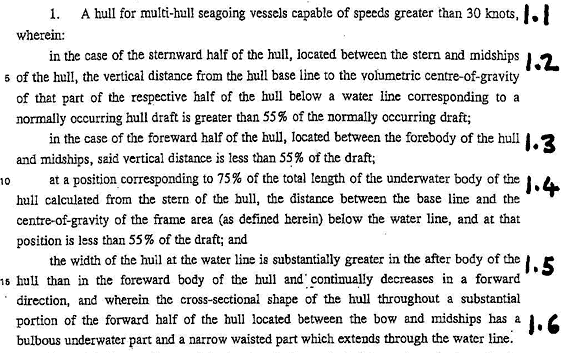
Minnesota Mining & Manufacturing Company v Tyco Electronics Pty Ltd (2002) 56 IPR 248
Monsanto Company v Commissioner of Patents (1974) 48 ALJR 59
National Research and Development Corporation v Commissioner of Patents (1959) 102 CLR 252
Nicaro Holdings Pty Ltd v Martin Engineering Co (1990) 16 IPR 545
No-Fume Ltd v Frank Pitchford & Co Ltd (1935) 52 RPC 231
Norton and Gregory Ld v Jacobs (1937) 54 RPC 271
NV Phillips Gloeilampenfabrieken v Mirabella International Pty Ltd (1995) 183 CLR 655
Olin Corporation v Super Cartridge Co Pty Ltd (1977) 180 CLR 236
Populin v HB Nominees Pty Ltd (1982) 41 ALR 471
Raychem Corp’s Patents [1998] RPC 31
Sachtler GMBH & Co KG v RE Miller [2005] FCA 788
Samuel Taylor Pty Ltd v SA Brush Co Ltd (1950) 83 CLR 617
Shave v H V McKay Massey Harris Pty Ltd (1935) 52 CLR 701
The Mullard Radio Valve Company Limited v Philco Radio & Television Corporation of Great Britain (1935) 52 RPC 323
Washex Machinery Corporation v Roy Burton & Co Pty Ltd (1975) 49 ALJR 12
Welch Perrin & Co Pty Ltd v Worrel (1961) 106 CLR 588
Williams Advanced Materials, Inc v Target Technology Company LLC [2004] FCA 1405
AUSTAL SHIPS PTY LTD v STENA REDERI AKTIEBOLAG
VID230 OF 2000
BENNETT J
17 JUNE 2005
SYDNEY
|
IN THE FEDERAL COURT OF AUSTRALIA |
|
|
NEW SOUTH WALES DISTRICT REGISTRY |
VID230 OF 2000 |
ON APPEAL FROM A DECISION OF THE COMMISSIONER OF PATENTS
|
BETWEEN: |
AUSTAL SHIPS PTY LTD APPLICANT
|
|
AND: |
STENA REDERI AKTIEBOLAG RESPONDENT
|
|
BENNETT J |
|
|
DATE OF ORDER: |
17 JUNE 2005 |
|
WHERE MADE: |
SYDNEY |
THE COURT ORDERS THAT:
Note: Settlement and entry of orders is dealt with in Order 36 of the Federal Court Rules.
|
IN THE FEDERAL COURT OF AUSTRALIA |
|
|
NEW SOUTH WALES DISTRICT REGISTRY |
VID230 OF 2000 |
ON APPEAL FROM A DECISION OF THE COMMISSIONER OF PATENTS
|
BETWEEN: |
AUSTAL SHIPS PTY LTD APPLICANT
|
|
AND: |
STENA REDERI AKTIEBOLAG RESPONDENT
|
|
JUDGE: |
BENNETT J |
|
DATE: |
17 JUNE 2005 |
|
PLACE: |
SYDNEY |
REASONS FOR JUDGMENT
1 This is an appeal from a decision of a Delegate of the Commissioner of Patents (‘the Delegate’) to dismiss the opposition to the grant of patent application No 648634 entitled “A hull structure for multi-hull ships”. The applicant (‘Austal’) is the opponent; the respondent (‘Stena’) is the patent applicant.
2 The patent application was filed on 28 January 1992. It claims a priority date of 30 January 1991 based on the filing of a basic application in Sweden on that date. It is common ground that the application is to be dealt with pursuant to the provisions of the Patents Act 1990 (Cth) (‘the Act’). The application was advertised as accepted on 28 April 1994 and was originally opposed by three parties. In the proceedings before the Delegate, the opposition was unsuccessful on all grounds.
3 The grounds of opposition relied upon in the appeal are:
- lack of novelty
- lack of inventive step
- an allegation that the invention, the subject of the claims is not a patentable invention, not being a manner of manufacture within the meaning of s 6 of the Statute of Monopolies 1623
- lack of compliance with s 40(2) or s 40(3) of the Act
- the invention so far as claimed in the claims is not useful
4 Austal also submitted that, by reason of amendments made to the specification, the priority date of the claims was deferred with the result that, if the claims were otherwise valid, they were anticipated by a publication between the claimed priority date and the deferred priority date.
5 The parties addressed the grounds of opposition to the independent claim, claim 1. Claims 1 to 9 are dependent on claim 1. All claims were opposed other than claim 10, which claims a hull structure with reference to the drawings or figures of the specification. If the opposition to claim 1 fails, it is conceded that the opposition to claims 2 to 9 also fail. If the opposition to claim 1 succeeds on the ground of lack of novelty, independent novelty of the dependent claims is pressed and will need to be addressed.
Burden of proof
6 The burden of proof in this appeal by an opponent from a decision of the Commissioner of Patents to dismiss an opposition is not in dispute. Austal accepts the tests as set out in previous decisions that the Court must be clearly satisfied that the patent, if granted, would not be valid (F Hoffman-La Roche AG v New England Biolabs Inc (2000) 99 FCR 56 at [67]). An alternative statement of the test was that affirmed by the Full Court in Genetics Institute Inc v Kirin-Amgen Inc (1999) 92 FCR 106 at [17]: whether it was ‘practically certain that the patent to be granted on the specification would have been invalid’.
7 The patent application was accepted in 1994, prior to amendments made by the Patents Amendment Act 2001(Cth) which took effect in relation to patent applications which had not been accepted as at 1 April 2002. In any event, those amendments did not affect s 59 or s 60 of the Act, the sections dealing with pre-grant opposition proceedings.
8 However, Austal draws attention to the fact that it has conducted the proceedings as if it were a full hearing on the merits and has filed extensive evidence. Austal submits that, because of the way it has conducted the case and because Stena can, if the opposition is successful, seek to amend the patent application, a lower standard should be applied, akin to an assessment on the balance of probabilities.
9 In my opinion, the reason for the test to be applied at this stage in the life of a patent application is, as has been noted in the above cases, a result of the nature of pre-grant opposition proceedings themselves and the purpose of the retention of pre-grant proceedings in the Act. The test cannot be a moveable feast depending on the decision of one party to adduce more or less evidence or to conduct a more or less extensive cross-examination.
10 The submission has also been made by Austal that obviousness should be determined on the balance of probabilities, that being said to be the standard to be applied to the evidence in these proceedings. This is said still to recognise that a different standard may apply to the establishment of obviousness or lack of inventive step as a ground of opposition.
11 Stena points to the opinions of its independent witnesses to the effect that, as at the priority date, the hull form for multi-hulled vessels defined in the claims was new, innovative and unlike anything they had seen before in Australia or elsewhere and that the claims are in terms which are clear and were readily capable of being understood by any competent naval architect at the time. Stena submits that, unless it can be shown that these opinions are based on some fundamental misconception, or that the views are not honestly or reasonably held, the opposition must fail.
12 I can accept that a lower standard may apply to proof of evidence such as whether a document has been published or, indeed, whether a prior art vessel was well-known. I do not accept that it properly applies to the factual question that itself is the test for obviousness or lack of inventive step. Where the factual question is itself the legal test, as set out in s 7(3) of the Act, it seems to me that it should be determined at the higher standard. That means that where there are two opposing expert views that are conclusive on obviousness, both presented bona fide by witnesses of accepted expertise, unless one set of views can be rejected on proper grounds, the legal burden to establish a ground of opposition is not discharged; the Court cannot be practically certain that obviousness or lack of inventive step is established.
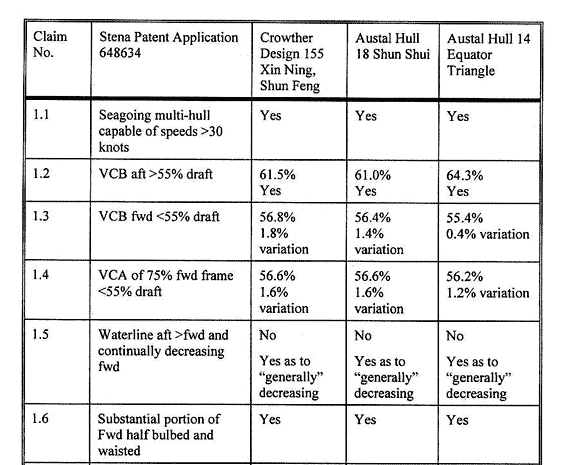
THE PATENT APPLICATION
13 It was agreed that the background information in the patent application was part of common general knowledge in Australia before the earliest priority date. The prior art described at pages 1 and 2 of the specification includes two kinds of multi-hull vessels: conventional catamarans and SWATH-type vessels. SWATH stands for “Small Water Area Twin Hull” and describes a particular kind of multi-hull vessel where the hull has a torpedo-like underwater section and a connecting strut at the waterline. Such hulls were seen before the priority date in quite specific applications, such as large research vessels and oil platforms, where stability was the prime consideration. They have a low centre of buoyancy compared with the hulls of conventional catamarans, which are generally “V” or “U” shaped and have a large cross-sectional area at the waterline.
14 It was not in dispute that a bulbous bow on a multi-hulled vessel had been known for many years prior to the earliest priority date. Such a bow decreased resistance but did not make a significant contribution to seakeeping; it mainly exerted some dampening effect at the bow of the vessel.
15 As set out in the patent application, these conventional catamarans have advantages and drawbacks. One such drawback is the tendency to move vertically when in motion. This is unpleasant to passengers and generates unfavourable forces on transported goods. This characteristic – the presence or absence of the pitching motion – is referred to as seakeeping. In the agreed glossary, when used as an adjective, seakeeping is a term signifying a ship’s ability to maintain normal functions at sea.
16 This ‘troublesome drawback’ led to the development of multi-hull vessels with a narrow cross-section at the water line, so that a small lifting force is generated by waves that act on the hull. At the same time, those parts of the hull that are located beneath the surface of the water are joined to the parts of the hull above the surface of the water by narrow connections. Such vessels, ‘which have a narrow hull waist at the water line’ are known as SWATH vessels (Small Water Area Twin Hull). SWATHs have better seakeeping than conventional catamarans.
17 This structure results in problems with respect to the equipment required to propel the vessel and also results in a greater need for power. Water-jet propulsion units give the necessary power but are only suitable for installation at the water line of the vessel. SWATHs are, therefore, powered by a propeller drive, which places limitations on speed. There are also problems associated with the placement of the motor to drive the propeller.
18 SWATH vessels have low load stability since the part of the hull, which extends above the water line, has a relatively small cross-sectional area. This can be corrected but that adds to complications and expense. The buoyancy or floating stability of the hull presents a problem when loading and unloading the vessel.
19 What is described as an object of the invention is ‘to provide a hull of favourable construction for multi-hull vessels’. Thus, it is said, the objective of the invention is to provide a hull structure which:
‘a. has low tendency to upward lift under the influence of waves during movement of the vessel through the water (good seakeeping),
b. is highly efficient and will allow the vessel to be propelled at high speeds (low resistance),
c. will result in only a small reduction in speed in high seas (good seakeeping faster than a SWATH),
d. has a high load resistance and will enable the vessel to be powered by means of any desired power means, including water-jet propulsion systems, and
e. has a high stern stability so as to enable the vessel to be loaded and unloaded from the stern thereof.’
20 The hull, for multi-hull seagoing vessels capable of speeds greater than 30 knots, is then described. The sternward half of the hull is different to the forward half of the hull:
For the ‘sternward half of the hull, located between the stern and midships of the hull, the vertical distance from the hull base line to the volumetric centre-of-gravity of that part of the respective half of the hull below a water line corresponding to a normally occurring hull draft is greater than 55% of the normally occurring draft.’
In the case of the foreward half of the hull, located between the forebody of the hull and midships, said vertical distance is less than 55% of the draft.’
21 There is some “looseness” of language that may derive, at least in part, from the fact that the patent was translated from the original Swedish. I compare the words of claim 1 with a description of how it is said that ‘the inventive hull construction can be described’. In particular, the claim refers to “the sternward half” and “the foreward half” whereas the description refers to the “rearward hull part” and the “foreward hull part”. In context, there is no distinction between “hull part” and “half”; they both mean “half”. “Foreward” and “forward” are used in the evidence indiscriminately. I shall do the same.
22 There is also reference to a requirement at a position corresponding to 75% of the total length of the underwater body of the hull, calculated from the stern of the hull. At that point, the distance between the base line and the centre-of-gravity of the frame area below the water line, and at that position is less than 55% of the draft.
23 The invention is described as having the following characteristics:
- A foreward hull part, which has a bulbous underwater cross-section, that is the hull width is narrower in the region of the water line than both above and below the water line.
- A rearward hull part, which merges continually therewith.
- The local draft of which decreases in a direction towards the stern while simultaneously the width of the hull at the water line increases in this direction.
- This imparts to the stern a shape favourable for water-jet propulsion, although the invention is not restricted to water-jet propulsion. The hull has a relatively large width at the water line at the stern part of the hull enabling propulsion engines to be fitted without the identified problems.
- The relatively large water line width in relation to the maximum width of the hull beneath the water line, particularly at the stern of the hull gives the hull good stability, particularly at its stern part, favouring loading and unloading of cargo at the stern.
- The bulbous shape of the foreward part of the hull, with its narrow width in the vertical region through the water line, lowers the wave-exerted lifting force that results in the vertical movement associated with conventional catamarans that have a generally uniform hull cross-section along the length of the hull. Later in the specification (page 9 lines 5-7) the link between the lower lifting force exerted by the waves and the smaller width of the hull above the water line is said to be ‘as is general in the case of SWATH-hulls’.
- The differences between the hulls of the invention and conventional designs are that the width of the hull decreases generally in a forward direction at the water line from a relatively large width at the stern parts, while maintaining a substantially constant frame area beneath the water line along the length of the hull.
24 The advantages of the invention are said to be:
- Vessel propulsion equipment can be comfortably mounted in the hull and easily maintained and the hull can be equipped with water-jet propulsion means.
- The hull, particularly at the stern, can withstand loads.
- The hull is adapted for high speeds eg 40 knots.
- The hull has relatively low pitching tendency so that under normal sea conditions and at a significant wave height of about 4 metres, there will not be a need to lash down transported vehicles.
25 The invention is described with reference to a preferred embodiment. That is later described as an exemplifying embodiment, typical of the invention. It is said that one of normal skill in the art should be able to practice the invention on hulls of other sizes and under other conditions. The specification also makes reference to specific hull size and capacity, which are said merely to illustrate the technical effect provided by the hull structure and not to restrict the scope of the invention.
26 As I read the specification, the figures relate to the preferred embodiment. It is agreed that figure 1 shows a hull with a SWATH like forward two-thirds and a conventional round bilge stern. The bulb is shown in figure 1 as extending over the whole of the forward part and into the aft part of the hull.
27 Claim 1 with, by agreement, the designation of the integers for the purposes of discussion, is as follows:
28
THE DECISION OF THE DELEGATE
29 The grounds of opposition relied upon before the Delegate were lack of novelty, lack of inventive step and lack of compliance with s 40(2)(a) and s 40(2)(b) of the Act.
30 As noted by the Delegate, for its case based on s 40 of the Act, the opponent relied upon:
- The required parameters for the position of the volumetric centre of buoyancy of each of the rear half and foreward half of the hull below the water line are imprecise and speculative. There is no definition of where the centre of buoyancy is in a horizontal sense, either transversely or longitudinally of the hull; the latter position is critical to the seagoing characteristic of the hull.
- The arbitrary nature of the 55% limit; the upper limit is broader than that for the invention disclosed in the specification.
31 The Delegate held that s 40 of the Act does not require the patent applicant to justify the selection of limits. The preferred embodiment only needs to illustrate the invention and there is no requirement that the embodiment be practised at precisely the end points of the range. The specification is addressed to persons skilled in the art who are in a position to perform the invention and to test the validity of the ranges specified for various features. He observed that there was no evidence to show that such a person was unable to perform the invention. The Delegate said that he was he was unable to conclude that the features are imprecise and speculative.
32 As to the non-definition of the centre of volume/buoyancy in a longitudinal sense, the Delegate referred to evidence that this feature is not required to put the invention into effect and the absence of evidence that it was. Accordingly, he did not conclude that it was essential to a full definition of the invention.
33 The opponent referred to “continually decreases” and “substantial portion” as present in the claims. The Delegate noted that “continual”, in The Australian Concise Oxford Dictionary, means: ‘constantly or frequently recurring; always happening’ and that “substantial” means ‘essential; true in large part; of large size or amount’. The Delegate concluded that any ambiguity of the requirement that the width of the hull at the waterline “generally” decreases in a forward direction as set out in the specification was overcome with the use of the term “continually decreasing” in the claims.
34 As to an alleged lack of clarity arising from the meaning of “substantial portion”, the Delegate rejected the opponent’s contention that 20% is a substantial portion and referred to the embodiment (bulbous shape throughout the foreward half of the hull) and claim 1 (bulbous shape extends throughout a substantial portion of the forward half of the hull). He declined to find a ‘huge inconsistency’ between claim 1 and the embodiment or that there was no basis for the term in the specification. Accordingly, he found that claim 1 is fairly based on the specification and did not make a finding of lack of clarity.
35 The Delegate also referred to evidence of the meaning of the terms “volumetric centre of gravity” and “centre of gravity of frame area” as equating to “centre of volume/buoyancy” and “centre of (frame) area” respectively. He did not find ambiguity in the terms or resulting lack of clarity of the claims.
36 The opponent relied on the prior art vessels Crowther Design 155, Crowther Design 157, Austal Hull 18 and Austal Hull 14 to establish lack of novelty as at the priority date. Evidence before the Delegate included calculations to show that the hulls of the prior art vessels fall within 2% of the parameters claimed in claim 1. The opponent’s experts alleged that a 2% variation can be attributed to adjustments in load and trim.
37 The Delegate observed that falling within 2% of the specified ranges is not the same as falling within the specified ranges. Further, the other features of continuously decreasing width and bulbous and waisted portions extending for up to half of the forward half of the hull were found not to be present in the prior art vessels as required by the claims. The attack on novelty was rejected.
38 The Delegate accepted that the same four vessels were well known before the priority date and used them as the prior art base for consideration of lack of inventive step. However, he noted that the opponent did not provide evidence as to how the skilled addressee would arrive within the ranges of the opposed inventions or what reasoning would guide the skilled addressee to alter the shape of the stern or to extend the bulbous portions of the hull. Consequently, he did not find that the hypothetical skilled addressee would have taken as a matter of routine whatever steps might have led from the prior art to the opposed invention. The attack based on lack of inventive step failed.
The evidence
39 Austal’s case on anticipation depends on the meaning to be given to the words and numerical criteria in the claims. While these are matters for the Court, it is appropriate to consider the evidence of the reader skilled in the art, where the evidence goes to the way in which such a reader would, by reason of that skill, give a particular meaning to the terminology (Sachtler GMBH & Co KG v RE Miller [2005] FCA 788 at [20]–[22] (‘Sachtler’)). To the extent that the words reflect ordinary usage and reflect no special meaning or disclosure, such evidence is not relevant.
40 It is, however, appropriate to consider the disclosures that expert readers would take from the patent in their reading of it, by reason of their expertise, especially in respect of terms or figures that are not self-evident. The patent application is addressed to persons possessing a degree of assumed skill and knowledge.
41 Evidence was directed to the patent application and what the various expert witnesses understood from the description. Some of the information in the background was expanded, uncontroversially, by the expert witnesses.
42 It is apparent from the evidence that different witnesses emphasised different aspects of the patent. They also drew on different parts of the patent to come to their conclusions as to the disclosures and descriptions contained therein. This is not unexpected, as different readers can, depending on their own experience, emphasise different parts of the text.
43 There was no challenge to the expertise of any of the witnesses. Both parties adduced evidence from expert witnesses although Austal contended that the evidence from its witnesses who had designed multi-hull vessels was to be preferred to the evidence from witnesses without such specific experience. I found that all the witnesses who gave oral evidence were knowledgeable of the matters on which they commented.
The expert witnesses for Austal
44 James Morrison Black is a naval architect, currently acting as the service manager for Austal, a company located in Western Australia whose business since 1987 has been the design and construction of many types of seagoing vessels. By 30 January 1991, Mr Black had 19 years experience in the marine industry, including experience in the design, development and construction of vessels in aluminium and fibre reinforced plastic. Since 1986, a major part of his work was the design and construction of multi-hulled vessels. After joining Austal in 1990, Mr Black worked with Mr Christopher Norman to refine high-speed catamaran design.
45 Brett Andrew Crowther is a director of Crowther Multihulls Pty Limited (‘Crowther’), which specialises in the design of multi-hulled vessels. Crowther carries out all aspects of the boat design and testing of hull shapes and offers consulting services to manufacturers of the vessels. By 30 January 1991, Mr Crowther had worked in the marine industry for 7 years as a design engineer and had particular expertise in the design of multi-hulled vessels.
46 Ben Duncan is a naval architect, employed by Austal in its structural design division. By 30 January 1991, Mr Black had no experience as a naval architect. At the time of swearing his affidavit, on 27 June 2001, Mr. Duncan had 7 months experience in the marine industry in the testing and experimental analysis of computer models of vessel hulls.
47 Christopher John Norman is a naval architect who currently acts as the Executive Director of Marketing for Austal. By 30 January 1991, he had more than 8 years of practical knowledge and experience of the marine industry particularly in relation to the design, development and construction of multi-hulled vessels. After joining Austal in 1989, Mr Norman was involved in the development of a range of new catamaran designs and was the principal designer for Austal of a number of aluminium catamaran vessels.
48 Noel Thomas Riley is a shipwright and naval architect and a principal of Commercial Marine Design Pty Ltd, a firm of consulting naval architects and marine engineers based in New South Wales. By 30 January 1991, Mr Riley had 41 years experience in the marine industry working as an academic and in the design and development of many kinds of seagoing vessels, particularly commercial vessels. Austal largely abandoned Mr Riley’s affidavits.
49 John Rothwell is the Executive Chairman of Austal Limited. Mr Rothwell responded to paragraph 80 of Dr Renilson’s affidavit regarding events in or about 1990 at which time Mr Rothwell was the Managing Director of Austal Ships. Mr Rothwell’s expertise was not in issue.
50 Nigel Watson is a naval architect and a current employee of Seastate Pty Ltd (‘Seastate’), which is a firm within the Austal group of companies. Seastate provides consultancy services in research and development to Austal and other businesses in the maritime industry. By 30 January 1991, Mr Watson had considerable experience with the marine industry as a researcher in the field of motions of high-speed ferries. However, he had no practical experience designing multi-hulled vessels.
51 Glen Williams is a naval architect currently appointed as Manager, Sales and Product Development for Austal. By 30 January 1991, Mr. Williams had 6 years experience in the marine industry and had broad experience in the design, development, manufacture and sale of many kinds of seagoing vessels, especially multi-hull vessels such as high-speed catamarans.
The expert witnesses for Stena
52 Douglas James Sloan Beck is a naval architect currently working for AMOG Consulting, an Australian engineering consultancy offering a range of specialist services, including in hydrodynamic engineering for the marine industry. By 30 January 1991, Mr Beck had 25 years experience working in the marine industry. He had practical experience designing and developing multi-hull and SWATH vessel designs. In particular, he had investigated the possible application of SWATH vessels for specific inquiries where an extra wide beam would be of particular benefit, such as in research vessels.
53 Dr Martin Robinson Renilson is a naval architect currently working as Technical Manager and Deputy Technical Director, Hydrodynamics at the Centre for Marine Technology at QinetiQ Maritime Systems. The Centre for Marine Technology offers specialist services in the field of marine science and technology, including marine structure design assessment. By 30 January 1991, Dr Renilson had 9 years experience in the marine industry as an academic in naval architecture and was aware of catamaran design developments carried out prior to January 1991 although he was not aware of the Austal prior art vessels relied on for lack of novelty. At that time he did not have any experience designing or constructing multi-hull vessels. However, Dr Renilson had practical experience in the assessment of vessel design, for instance in hydrodynamics, structural and hull form design assessment.
54 Allan Soars is a naval architect currently working as the Technical Director of Advanced Multihull Design Marine Consulting Pty Ltd. The company is a marine design consultancy, which specialises in all aspects of the design of large twin hull vessels. By 30 January 1991, Mr Soars had 10 years experience in the marine industry as a naval architect, researcher and marine design consultant. By 1991, he had been the principal designer of a number of large twin hull vessels and other high-speed craft and had designed wavepiercer catamarans to overcome the same seakeeping problems as identified in the patent application.
55 Peter Ottosson and Hans Liljenberg are both naval architects employed as project managers by SSPA Sweden AB (‘SSPA’). SSPA is a Swedish company, which provides services in the area of ship design and maritime operation. It has particular expertise in hydrodynamics, hydro acoustics and the use of simulations in the design of ships and marine structures. SSPA’s customers include Austal and Stena. For the purposes of these proceedings, SSPA was instructed to undertake a study and prepare a report on the expected motion characteristics of three hypothetical catamaran forms. Mr Ottosson co-authored the report with Mr Liljenberg.
56 Mr Black, Dr Renilson, Mr Soars, Mr Beck and Mr Crowther gave oral evidence and were cross-examined.
57 It bears comment that the Austal witnesses canvassed the issues in identical or near identical terms, to the extent that the words used in the affidavits did not, in many cases, vary. In some cases, I will set out which of the witnesses made the statement I refer to. However, it becomes unnecessary to link each witness to each statement. It is unfortunate that so much time was obviously taken and resources expended to adduce identical and repetitive evidence from different witnesses.
58 There is also a degree of repetition in the responses of the Stena witnesses in substance, if not in form. Where Stena witnesses have agreed with each other, again I have not necessarily recorded all of the different witnesses who have given that evidence.
The expressions not in dispute
Volumetric centre of gravity
59 Mr Soars explains the meaning of centre of buoyancy or centre of volume or, depending on the context, centre of area as the centre of gravity of the fluid that fills that volume, which is just the centre of volume or, in the case of a floating vessel, the centre of buoyancy of that vessel. It is the same as the ‘gravity centre point’ in claim 3.
60 In the agreed glossary of terms, the following definitions are found:
‘Center of gravity (G) – The center through which all the weights constituting the ship and its contents may be assumed to act. The distance measured from mid-ships, the fore perpendicular (FG) or the after perpendicular (AG), and from the baseline or keel (KG) are called longitudinal and vertical center of gravity, respectively.’
61 Frame area and wet frame area are both defined in the patent specification. “Frame” means the cross sectional contour of the hull and “frame area” means the cross-sectional area of the hull below the water line. “Wet frame area” refers to the cross-sectional area of the hull below the water line.
62 From the evidence, the meaning of some of the terms, as understood by the skilled addressee, was further elucidated:
(a) “midships” – the point half way between the sternmost part of the hull at the design draft waterline and the foremost part of the hull at the design draft waterline;
(b) “base line” – a notional horizontal line running the length of the hull and drawn through the lowermost part of the hull;
(c) “volumetric centre-of-gravity” – the centre of buoyancy of the relevant part of the hull;
(d) “normally occurring draft” – the design draft the hull;
(e) “centre-of gravity of the frame area” – the centre of area of a frame or cross-section of the hull.
63 Seakeeping, as explained by Mr Black, is a general term that conveys to naval architects the motion of a vessel in a seaway. Broadly speaking, there are six components of motion being the three translational motions of heave, surge and sway and the three rotational motions of pitch, roll and yaw. For a multi-hull vessel, generally the most significant motions are pitch and heave. The seakeeping of a vessel is affected by the wave properties, in particular amplitude, wavelength and periodicity as well as by the vessel speed and direction in relation to the waves.
64 Resistance is the totality of forces resisting movement of a vessel through the water and has an inverse relationship to vessel speed (at constant power). As put by Mr Hess, who appeared with Dr Duncan for Austal, resistance can be treated as the inverse of speed.
65 As described in the patent application, SWATH vessels tend to have high resistance. Conventional catamarans have seakeeping problems.
66 Mr Beck points out that the preferred combination of seakeeping and speed/resistance depends on the application. For example, in calm water an improvement in seakeeping at the expense of resistance would not be a good combination. For operation in rough seas it may be that substantial improvements in seakeeping at the expense of a substantial increase in resistance would be optimal. The patent application directs the reader to a vessel for sea going conditions, with a wave height of up to four metres.
The expressions in dispute
67 The expressions that were the primary subjects of debate were:
- ‘continually decreases in a forward direction’ in integer 1.5
- ‘substantial portion’ in integer 1.6
- ‘narrow waisted’ in integer 1.6
the construction of the claims
68 Much of the evidence and submissions was based on certain assumptions as to the construction of the claims. It is therefore convenient to deal first with the construction issues.
69 The patent application is in a highly technical area of hull design. It is clearly directed to skilled workers in that field, naval architects and, in particular, naval architects who design and test multi-hull seagoing vessels.
70 It is necessary first to resolve the meaning of two expressions used in claim 1: “narrow waisted” and “substantial proportion”. Austal’s case, to a large part, depends upon the meaning of “narrow waisted” given by Mr Black. The case on novelty, that is said to bring the prior art vessels to parameters that are close to those of the claims and the preferred embodiment, is based upon the “narrow waisting” of Mr Black’s definition.
71 The specification, including the claims, is not be read in the abstract but construed with common sense in the light of the common general knowledge in the art as at the priority date (Kimberly-Clark Australia Pty Ltd v Arico Trading International Pty Ltd (2001) 207 CLR 1 (‘Kimberly-Clark’) at [25]; Sachtler at [49]). The essential integers of the claims are those made essential by the patent applicant. Patent applications are normally drafted with care and skill and are frequently drafted both to define the monopoly and to avoid the prior art. This is not, of course, always successful. Where a patent applicant specifies criteria or parameters in the claims, it is then a question whether those parameters are made essential or inessential. If essential and mathematically precise, then it does not assist a claim of anticipation that the difference between those parameters and those of the prior art is said to be of no importance. That precision may be to the detriment of the patentee in a subsequent action for infringement. If a mathematical parameter can be shown to be inessential, for example where a maximum or minimum is not precisely stated but included as an approximate figure (for example, by inclusion of “about”) then a mechanical equivalent, such as a different maximum or minimum with the same effect, may he substituted, both for anticipation and for infringement (Arrow Pharmaceuticals Ltd v Merck & Co, Inc (2004) 213 ALR 182 at [116] (‘Arrow’)).
72 If a term of approximation is used or a term, as construed by the skilled reader, would be understood to be approximate, some latitude may be afforded. Thus in CatnicComponents Limited v Hill Smith Limited [1982] RPC 183 (‘Catnic’), “extending vertically” was not understood by the reader skilled in the art as requiring strict compliance so that any variant would fall outside the claim even though it had no material effect on the way the invention worked.
Narrow waisted part through a substantial proportion of the forward half of the hull
Narrow waisted
73 The proper approach to construction is, armed with the explanation of the technical terms, to construe the specification in order to understand what the patent applicant means by the claims. Some of the terms are of an apparent general nature, such as “substantial portion” and “narrow waisted”. To understand what is meant by such terms, it is necessary to consider the context of their use (Leonardis v Sartas No 1 Pty Ltd (1996) 67 FCR 126 at 134; Monsanto Company v Commissioner of Patents (1974) 48 ALJR 59 at 60-61 (‘Monsanto’); Populin v HB Nominees Pty Ltd (1982) 41 ALR 471 (‘Populin’) at 476-480). Accepting that some of the parameters in the claims are not conventionally used to describe hull shapes, this is a case where it is particularly appropriate to have regard to the way in which words and expressions used in the claims have been used in the specification.
74 The claims are understood in the context of the whole of the specification.
75 To summarise the patent specification in relation to “narrow waisted”:
- SWATHs are catamaran type vessels where those parts of the hull located beneath the surface of the water are joined by narrow connections. Such vessels have a narrow hull waist, or narrow cross section, at the water line.
- The cross sectional shape of the hull shapes of the claims throughout a substantial portion of the forward half of the hull has a bulbous underwater part and a narrow waisted part which extends through the water line.
- The hull construction of the claims comprises a forward hull part which has a bulbous underwater cross section. That is, the hull width is narrower in the region of the water line than both above and below the water line. There are numerous references to the bulbous shape. For example, ‘pronounced bulbous shape solely at the foreward part of its underwater body’. The bulbous shape of the forward part of the hull cross-section – a relatively narrow hull width in the vertical region of the hull extends up through the water line.
- The figures, in particular figure 1, show the bulbous shape underwater and significant waisting at the water line.
- The hull is described in such a way as to indicate to the skilled reader that the forward part is SWATH-like. There is a specific reference to the link between the area above the water line and a characteristic of SWATHs.
76 Austal’s case is that narrow waisting is satisfied if any part of the hull at the waterline is narrower than the body of the hull below the waterline. Mr Black defines “narrow waisting” the same way as “waisting”. That is, where any part of the hull under water is wider than the area at or above the water line. He says that he can give no meaning to the word “narrow” because, as an engineer, it is not to him a term of precision.
77 Stena’s case is that this may be waisting but it is not narrow waisting nor narrow waisting in the context of the patent specification. In cross-examination Dr Renilson was asked to go to any particular part of the specification that says where along the hull the narrowness ceases but that it may continue to be waisted. Dr Renilson conceded that no precise percentage is spelt out but pointed to figure 3 as indicating that there is a narrow waterline over the average of the forward part and the ‘whole description is about having a narrow waterline forward. Not about having a waist forward but having a narrow waterline. Small water plane area. That’s what it is all about’.
78 The expression used in claim 1 is “narrow waisted”, not simply “narrow” or “waisted”. Each word should be given a meaning and the expression is not unknown. In the Shorter Oxford English Dictionary, Oxford English Press, 5th ed, 2002, “waisted” is defined as ‘having a waist (of a specified size or form). Long-waisted, short-waisted, wasp-waisted etc’. On this basis, narrow waisted imports not only a waist but also a waist that is narrow.
79 Further, the term as used in the claim is, in context: ‘has a bulbous underwater part and a narrow waisted part which extends through the water line’. Unassisted by the evidence, I would construe “narrow waisted” in this context as meaning significant narrowing. I do not accept Mr Black’s interpretation of “narrow waisted’ as ‘any part of the hull below the waterline [is] wider than the hull at the waterline’. This may be waisted but it is not narrow waisted.
80 I accept the evidence of Mr Soars who understood the patent application as describing vessels of a SWATH type structure in the forward half. The waist of a SWATH type vessel is very narrow compared to the underwater body shape. The purpose of the narrow waist in a SWATH is, as explained by Dr Renilson, for a small water plane. This is reinforced by the description of a narrow waist in connection with a bulbous underwater part.
81 In cross-examination, Mr Soars detailed and explained the parts of the description in the specification on which he relied in drawing his conclusion that the hulls of the claims are, in the forward half of the vessel, confined to a SWATH or semi-SWATH hull shape. These characteristics were not limited to those of design but included those of the resulting performance which were characteristic of or ‘the principle of’ a SWATH. Mr Soars drew a clear link between the requirement of a “narrow waisted part” in the claims and the purpose and function of the narrow waisted sections and small waterplane area of a SWATH-type vessel.
82 I do not accept that, in the context of the specification describing a SWATH type structure, narrow waisting equates with waisting.
Substantial portion
83 “Substantial” as a term in a claim does not, of itself, result in lack of clarity. What is substantial is a question of degree but such imprecision does not necessarily give rise to ambiguity (Monsanto at 60 per Stephen J).
84 The specification and the claims clearly distinguish between the sternward half and the forward half of the hull. As set out at page 3A lines 11 to 14 of the specification, the inventive hull construction is described as ‘comprising a forward hull part which has a bulbous underwater cross-section, ie the hull width is narrower in the region of the water line than both above and below the water line, and a rearward hull part which merges continuously therewith’. There is a further reference at page 3A lines 26 to page 4 line 2 ‘the bulbous shape of the foreward part of the hull cross-section ie a relatively narrow hull width in the vertical region of the hull that extends up through the water line, as a continuation of a more generally U-shape of the hull stern’. At page 4 line 6, the specification speaks of ‘the bulbous shape of the cross-section of the foreward hull part’. Figure 1 shows the bulbous part extending into the rearward half.
85 At page 8 line 34, there is a reference to the bulbous cross-section ‘in this length region’ being at least from fore to midships.
86 Mr Williams, Mr Norman and Mr Black consider that figure 1 of the patent application shows a body plan for a hull where the bulbous portion extends into the aft portion of the hull. They point out that this is not just a substantial portion of the forward half but the whole of it and is a characteristic of SWATH vessels. All of these references suggest that the narrow waisted feature is present for the whole of the forward part.
87 There did not seem to be any real dispute that the subject matter of the specification related to a modification of a SWATH hull form, the modifications intended to retain the benefits of that hull form, such as in seakeeping, without the detriments. Indeed, Austal’s case on obviousness is that the specification describes a “semi-SWATH” and that semi-SWATHs were known prior to the priority date.
88 The skilled readers understood the patent specification to be describing a vessel with, in part, the characteristics of a SWATH. Mr Soars concluded from the specification that the whole of the forward hull part had a bulbous underwater cross-section but that the requirement that this merges continuously with the rearward part which does not have the bulbous part, being a more conventional catamaran hull part, means that there would be some area of transition between the two, so that the bulbous part may not be the total length of the forward section.
89 To the extent that the witnesses give evidence as to the normal meaning of “substantial proportion”, that does not assist and is not relevant. To the extent that they derive the meaning of the term as skilled readers from the specification, that does assist. There must, however, be more than mere assertion that the specification gives rise to a particular understanding of the percentage of the forward half referred to; there must be some basis for the conclusion, some reference to the specification or to the art.
90 Austal contends that “substantial portion” comprehends prior art vessels which have a bulbous and waisted part to at least about 30% of the forward part of the hull. It is said that the expression means no more than a portion of substance. This accords with a standard meaning of the term.
91 Mr Black does not provide support for his assertion that substantial portion means a portion that is more than trivial or minimal. While I accept Mr Riley’s evidence that 5% or 10% of the length of the forward half of a hull is real and “of substance”, this evidence is not based on the context of the specification.
92 Stena contends that the expression requires a majority, that is greater than 50% and preferably approaching 100% - most or all of the forward half of the hull.
93 Stena, through Dr Renilson, says that, reading the patent application as a whole, “substantial portion” is in excess of 50% and approaching 100% of the forward part. This section should have a waisted cross-section. He points to the specification and the fact that figure 1 shows the waisted part as greater than half the vessel length. The extent of the bulb in the preferred embodiment indicates to him that “substantial portion” means well more than 30% and closer to 100%. Figure 3 indicates that the waterplane area of the forward part is less at the design draft than at lower drafts, because of the waisted part in the cross-section of the waterline. This indicates to Dr Renilson that the designer intends that substantial portion is to be most of the forward part.
94 Mr Soars interprets the terms in the context of specific statements in the patent application to mean “a majority portion”, that is more than 50%. This means to him that claim 1 refers to a definite pronounced bulbous shape to the underwater hull coupled with a narrow waisted part extruding through the waterline over most of the forward half of the hull. In Mr Soar’s interpretation, the bulbous section would be ‘a majority portion’ of the forward half of the hull, not a portion comprising 100% of that half. This is because, he argues, the requirement that the bulbous section merge continuously with the rearward part, means that there would be some area of transition between the two; ‘Which to me implies that the whole of the foreward half [is] a bulbous section, although it does talk about merging continuously, so there would be some area of transition between the two, so it may not be the total length of the foreward section.’
95 As I read the specification, it describes the narrow waisting as being all of the forward half. Accepting that the requirement for narrow waisting is related to SWATH-like characteristics, I cannot accept that 5% or 10% or 30% narrow waisting of the forward half constitutes a substantial portion for the purposes of claim 1. I find the reasoning of the Stena witnesses persuasive in that it is consistent with the description of the subject matter of the specification and the claims. In my view, substantial portion, in context, means a portion approaching 100% of the forward half. It does not mean less than 50%.
The mathematical parameters
96 There was an issue between the parties as to the numerical criteria of the claims, that is whether strict compliance was required or whether differences that were said not materially to affect the performance of the hull were included within those criteria for the purposes of the claims.
97 In claim 1 the mathematical parameters are precise. They are not qualified by words of approximation. From a reading of the claims, the patent applicant has made those parameters, as the limitation of a maximum or minimum, essential.
98 There are no words of approximation used when the parameters are cited in the specification. Expressions used are of the nature of :
- ‘at the frame at the position which corresponds to 75% of the length of the underwater body’
- ‘attains to at most 50% of the draft’
- ‘shall be greater than 65% of the draft’
- ‘shall be less than 50% of the draft’
- ‘shall exceed 55% of the draft’
This is in contrast to other descriptions where approximations are made (at page 8):
- ‘a pivot point which is located at a point about 1/3 of the hull length’
- ‘the pivot point…lies approximately at ¼ or 1/5 of the hull length’
- ‘the local draft at the stern of the hull falls to about 50% of the hull draft’
and, at page 9:
- ‘said hull having a draft of about 4.5m, an underwater part having a width of about 5m, and a length of about 120m’
99 The evidence of Mr Black is that hull forms with similar parameters exhibit the same characteristics of seakeeping and resistance. That is not the issue. Mr Black does not say, for example that as the skilled reader he would have read those parameters in the claims as approximations or as a range or as other than precise mathematical limitations.
100 In my view, the mathematical parameters of the claims are essential integers as stated.
101 Austal submits that this is a case for the application of a “purposive construction” as in Catnic. This is not a case such as Catnic where the expression “vertical” was given a construction of non-mathematical precision. There is no evidence to support such an approach here. The evidence does not establish that, in the words of Lord Diplock in Catnic at [243] ‘persons with practical knowledge and experience of the kind of work in which the invention was intended to be used, would understand that strict compliance with a particular descriptive word or phrase appearing in the claim was intended by the patentee to be an essential requirement of the invention so that any variant would fall outside the monopoly claimed, even though it could have no material effect upon the way the invention worked’. Austal relies on experimental work to show that the precise limitations are not necessary to achieve the objects of the invention. As pointed out by Lord Diplock in Catnic, subsequent work that establishes that the limitation was unnecessary is not relevant; the patent applicant is taken to have had good reason, at the time of filing, for limiting the monopoly so strictly and to have intended to do so.
102 Austal submits that there is no explanation in the specification for the choice of parameters and that, accordingly ‘it must be the case that the numerical parameters of claims 1 to 3 (and the other parameters of claims 4 to 9) have been arbitrarily selected’. Austal also relies upon the small differences between the claimed parameters of claim 1 and the relevant parameters of the prior art. The submission follows that in the absence of demonstrated effect of the differences, no significance can be attached to them or to the effect on seakeeping and resistance characteristics of the hull shapes to which they relate.
103 I do not agree.
104 Even if it could be said that the parameters, acknowledged to be “unconventional” as criteria for hull designs were a product of “parametritis” as described by Laddie J in Raychem Corp’s Patents [1998] RPC 31 at 37, the inclusion of parameters not mentioned in the prior art but consisting of measurements that may or may not of themselves find easy reference in the prior art does not affect the test of invalidity. It does not affect the need to demonstrate anticipation or want of novelty.
105 The present case does not directly raise the problem of equation with the parameters of the prior art. It is acknowledged by Austal that the prior art parameters were different. What is put is that the differences have no functional significance.
106 There are problems with that submission. First, it is conceded that the parameters are different from those of the prior art vessels. Secondly, the parameters are expressed as precise, not an approximation. Thirdly, the evidence is not that a skilled reader would have read those parameters as including a range. Fourthly, any permissible variation in a single parameter would not be sufficient to conclude functional equivalence, as the subject matter is a combination. Fifthly, there is evidence that the differences between the parameters and the prior art, albeit individually slight, demonstrate a conceptual difference in the relative centres of volume of the forward and rearward halves of the hull.
107 Dr Renilson explained a difference between prior art vessels being catamarans with bulbous bows and a round bilge form forward and the hull form of that patent application. In the hull design of the patent application, ‘the centre of area of the forward section and hence the forward centre of buoyancy is below 55% of the draft whereas the same for the sternward part of the vessel is above 55% for claim 1 and below 50% and above 50% respectively for claims 2 and 3. A conventional catamaran would have both the bow and stern centres of buoyancy below about mid draft’. A conventional SWATH would have both the bow and the stern centres of buoyancy below about mid draft.
108 Unlike in Williams Advanced Materials, Inc v Target Technology Company LLC [2004] FCA 1405 at [48], there is reference in the patent specification and evidence which supports the fact that the parameters have been carefully chosen, are part of the invention and are related to a claimed advantage as part of the combination of the design.
NOVELTY
109 Austal’s case on novelty (‘the proposition’) is summarised in the consolidated statement of issues:
‘The Applicant will contend that the vessels Crowther Design 155, Crowther Design 17, Austal Hull 18 and Austal Hull 14 are catamarans having hulls that have a shape for practical purposes is the same shape as the hull defined by the claimed parameters of the opposed application. Calculations carried out using the line plans of those four prior art vessels show that the prior art vessels fall within 2% of the percentage parameters claimed in claim 1. There is no real operational or practical difference between two hull shapes where the difference between the parameters of the two hull shapes is only within +/- 2%. A 2% variation can be attributed to adjustments in draft, load and trim, the computer software used to carry out the calculations and inaccuracy of hand-drawn lines plans. The claims of the opposed application do not specify the draft, load and trim of the vessel relevant to the claimed percentages.
In respect of those parameters of the prior art hull forms falling outside the +/- 2% threshold, the Applicant will contend that such differences cannot confer any novelty on claims 1 to 9 as the differences are merely the result of routine modifications to Semi-SWATH hull forms well known in Australia before the earliest priority date.’
110 The proposition raises a number of issues in the consideration of novelty. It is based on the assumption that Austal’s contentions on “narrow waisted” and “substantial portion” are accepted. If not, Austal does not succeed in establishing lack of novelty as it is accepted that none of the prior art vessels has a narrow waisted part which extends through the water line, in the sense of both narrow and waisted, nor that such narrow waisting extends beyond about 30% of the forward half of the hull. Accordingly, these vessels do not meet the requirement of claim 1 that the cross-sectional shape of the hull through a substantial portion of the forward half of the hull located between the bow and midships has a bulbous underwater part and a narrow waisted part which extends through the waterline. On this basis, there is no anticipation.
111 Austal relies on prior art vessels designed and built in Australia prior to the priority date. The existence of those vessels at that time is not in dispute.
112 The language of the proposition would seem to be drawing on the principle in Hill v Evans (1862) 1A IPR 1 at 7; where Lord Westbury spoke of the need for a prior publication relied upon to disprove novelty as providing information that ‘must, for the purposes of practical utility, be equal to that given by the subsequent patent. The invention must be shewn to have been before made known. Whatever, therefore, is essential to the invention must be read out of the prior publication’. It is important to read the whole passage of his Lordship’s judgment in context. Although the reference is to a prior publication and not prior use, his Lordship also states that: ‘apparent generality, or a proposition not true to its full extent, will not prejudice a subsequent statement which is limited and accurate, and gives a specific rule of practical application’.
113 The proposition does not make clear the basis of Austal’s claim. The assertion of practical equality is referable to the concept of mechanical equivalence of inessential integers. Austal does not make clear whether it is submitting that the parameters in question are essential or inessential integers of the claims.
114 It is of interest that Austal relies upon the same contentions in its particulars of obviousness and lack of inventive step.
115 There is said to be no dispute on the principles to be applied. Austal relies primarily on prior use and submits that the reverse infringement test is appropriate for the purposes of testing anticipation. While reverse infringement test is not always applicable to test novelty, (Meyers Taylor Pty Limited v Vicarr Industries Limited (1977) 137 CLR at 235(‘Meyers Taylor’); Bristol-Myers Squibb Company v FH Faulding & Co Limited (2000) 97 FCR 524 at [61] – [62] (‘Bristol-Myers’)), it is not in dispute that it is appropriate here.
116 Mr Soars comments on the bulbous portions of the prior art vessels to which Mr Black refers. In Mr Soars’ view, these hulls do not extend beyond 10% to 15% at most of the length of the hull.
117 The proposition then refers to the mathematical parameters of claim 1. It is conceded that none of the prior art vessels fall within those parameters. However, the contention advanced is that it is sufficient for novelty purposes if the prior art vessels fall within 2% of those parameters.
118 Mr Black prepared a table which conveniently sets out the integers of the claims and Austal’s contention as to the presence or absence of those integers in the prior art vessels relied on to establish lack of novelty.
119 As can be seen from the table prepared by Mr Black, even on his interpretation of “substantial proportion” and “narrow waisted”, Austal does not contend that any of the prior art vessels contain the combination of integers of the claims. Each example lacks at least one feature of the hull form defined by the claims. The contention is that the variations are not significant. In particular, Austal relies for novelty purposes on the Austal 18 hull.
Do the claims permit a 2% variation?
120 Evidence from Austal’s witnesses is to the effect that a normal operational change or trim or loading condition on any vessel could change its parameters by at least +/- 2%. Also, line plans and variations in computer programs could introduce error of this order in design. Mr Black points also to another cause of variation, relating particularly to hand-drawn lines plans where the lines are never perfectly drawn. Accordingly, Mr Williams, Mr Black and Mr Crowther each say that each parameter should be varied by +/- 2% so that, with that variation, a hull falls within the scope of the relevant claims.
121 Mr Williams does not say that, as the skilled reader, he construes the percentages in the claims as importing a +/- 2% error. He describes such differences as ‘trifling and inconsequential’ and as minor variations that regularly and routinely occur in the shipbuilding industry and are the result of routine and obvious modifications to well known semi-SWATH hull forms or, as Mr Norman says, occur during routine shipbuilding. Mr Crowther and Mr Norman also refer to normal operational change of trim or loading condition or variations in computer programs and inaccuracy of lines plans. Mr Crowther says that ‘for all practical purposes’ any parameter falling less than 2% outside a claim ‘would be considered by me as effectively falling within that claim’. So does, for example, Mr Norman, who adds the description of the difference as ‘trivial’.
122 Mr Black also says that he reads each of the parameters of claims 1 to 9 as including a +/- 2% variation and says that there is no real operational or practical difference between two hull shapes where the difference between the parameters of the two hull shapes is only +/- 2%. He does not see the basis or explanation for the parameters chosen. Mr Black is of the view that ‘for all practical purposes’ the prior art hull vessels have the same hull shape as those of claims 1 to 9. He also considers that the differences outside the +/- 2% threshold are insignificant in that they are all the same bulbed semi-SWATH shape of the hulls of claims and that the numerical differences have no practical effect. He asserts that they are merely the result of routine modifications to well-known semi-SWATH hull forms which he says he would have seen as apparent and obvious as at the priority date.
123 Moreover, Mr Williams says that such differences would not have any advantages in resistance or seakeeping compared to the semi-SWATH hulls known to him at 30 January 1991.
124 Dr Renilson concedes that there may be a potential for error in the calculation of the positions of the centre of volume and the centre of area when those figures are used to calculate the ratios referred to in the claims but says that the resultant variation would be about 1% rather than 2%. This is also the view of Mr Soars.
125 Austal’s case is that the skilled readers of the patent interpret each of the parameters of claim 1 as including a +/- 2% variation. The same applies to each of the parameters of the dependent claims. This leads those readers to conclude that the prior art hulls were ‘in practical terms’ or ‘for all practical purposes’ the same as those of the patent application.
126 The words of the claim in setting out the mathematical parameters are clear and precise. As I construe them, there is no reason to import a margin, let alone a margin or error of +/- 2%. The evidence of the Austal witnesses as it relates to the construction of the integers by the skilled reader is unclear. There is much emphasis on the asserted lack of practical difference if those parameters are varied. That, however, is not relevant to the construction of the words of the claim. While some of the witnesses have asserted that they interpret each of the parameters of claim 1 as including a +/- 2% variation, that assertion amounts to a conclusion based the view of the lack of practical difference. No proper basis is given for reading the words of the claim as importing that variation or the choice of +/-2%, which is the variation relied upon by Austal between those parameters and the prior art vessels. Austal’s submission is, in effect, an attempt to rewrite the claim.
127 No attention is directed as to why each of the parameters of the combination would be so construed and how those individual parameters would be construed as varied in the context of the combination.
128 The mathematical parameters have been made essential integers of the claim. The words of the claim do not include words of approximation or variation. Neither does the description in the specification. Austal’s evidence really seeks to establish mechanical equivalence of a +/- 2% variation. That is not relevant to an essential integer but to an inessential integer (Nicaro Holdings Pty Ltd v Martin Engineering Co (1990) 16 IPR 545 at 559 – 560(‘Nicaro’)). To the extent that the evidence goes to asserted routine and obvious modifications, that is relevant to allegations of obviousness but not to claim construction or to novelty.
129 The fact is that the claims give a specified, mathematical maximum or minimum to a number of essential parameters. Austal’s reading is not consistent with the specification. The evidence does not establish that this ordinary meaning would be interpreted differently by a skilled reader.
130 Stena submits that each of the features are essential and are specified clearly and precisely to define a new and inventive hull shape. As none of the prior art hulls have all of the features, all of the essential integers, Stena submits that there has been no anticipation.
131 Austal submits that the differences are ‘minimal and inconsequential’. Austal relies on “modified” hull forms to demonstrate alleged insignificance of differences between the claims and the prior art. Stena relies upon the fact that these modified hull forms did not exist and are, therefore, irrelevant in a consideration of novelty. Stena also asserts that even the ‘modified’ hull forms do not fall within the scope of the claims, omit essential integers of the claims and are based on a fundamentally different design approach to that of the invention.
132 The modelled hull forms tested for Austal were of hull forms within the claim 1 as I have construed it because none had integer 1.6. The tests were carried out on hull forms that conformed with Mr Black’s interpretation of narrow waisted, which I have rejected.
133 If an allegedly infringing article takes all of the essential integers of the claims of the patent, there has been infringement. If one of those essential integers is missing, there is no infringement. That is the case here for reverse infringement or anticipation. Austal relies on Catnic at 243; Azuko Pty Ltd v Old Digger Pty Ltd (2001) 52 IPR 75 at [31]-[35] (‘Azuko’); and Arrow at [110]-[111] where infringement has not been avoided by a difference held to be not substantial. When those cases are properly considered, they are not authority for the proposition that a precise requirement of the claim can be viewed as some generic characteristic. The important question is the proper construction of the claim (Sachtler at [65]).
134 It is not uncommon for claims to be drafted with precision to avoid the prior art to confer novelty. The evidence does not establish that the parameters are inessential integers of the claim. Austal’s evidence seems to assume that they are and is directed to establishing mechanical equivalence, in the sense of equivalent behaviour of the hulls. This also ignores the fact that the parameters are only some of the integers of the combination.
135 Austal cannot rely on “clear and unmistakable directions” for this aspect of its case on novelty because its case is that the skilled worker would not have changed the prior art parameters and the evidence does not establish that the prior art vessels would have directed a skilled naval architect to change those parameters.
Width of the hull continually decreases in a forward direction
136 Mr Williams concedes that, while the width of the hulls of the prior art vessels generally decreases in a forward direction, it cannot be ‘quite described’ as continually decreasing. He says that in his opinion ‘the practical difference between the two is small’.
137 It is conceded that none of the prior art vessels has a hull where the width of the hull at the water line continually decreases in a forward direction from the stern, as required by integer 1.5. This is an essential integer of claim 1. However, Austal contends that a small deviation from this requirement makes no difference to the performance characteristics of the hull.
138 The question is what has the patent applicant made essential and is the requirement for continual decrease an essential or inessential integer of the claim. If inessential, then the evidence that establishes that there is little difference between the two is relevant to establish a mechanical equivalent. Claim 1 is clear in requiring continual decrease. The specification, at page 3A, refers to ‘a rearward hull part which merges continuously therewith, the local draft of which decreases in a direction towards the stern while simultaneously the width of the hull at the water line increases in this direction’. On the other hand, at page 4, the specification refers to ‘the width of the inventive hull decreases generally in a foreward direction at the water line’.
139 The words of the claim are clear on this aspect. The requirement is a continual decrease in the width of the hull at the water line in a forward direction. That integer is an essential integer of the claims. It is consistent with the description in the specification, if more precise. There is evidence, including that of Dr Renilson, to support the requirement. If Stena has included this integer for the purpose of overcoming the prior art vessels it is entitled to do so. This is a common trade off with infringement.
140 The patent specification at page 3A links the shape of the stern of the vessel and the continuous decrease of the width of the hull at the water line in a forward direction with a shape favourable to water-jet propulsion, one of the objects of the invention and also to stern stability, another object. At page 4 of the specification, this integer is again referred to as an essential difference between the hull shapes of the invention and conventional hull design and links it, in combination with other characteristics, as relevant to enabling the local draft of the hull at the stern part to be restricted.
141 Integer 1.5 is an essential integer of the hull shape. Its absence in each of the prior art vessels means that none of those vessels anticipate the hulls of claim 1.
Conclusions on novelty over the prior art vessels
142 None of the prior art vessels possess the characteristics of integer 1.6; none have narrow waisting throughout more than 50% of the forward half of the hull. None of the prior art vessels has integer 1.5; none has a hull where the width of the hull continually decreases in a forward direction. None of the prior art vessels have integers 1.3 and 1.4. While the variations may be slight, they are present and outside the claims. The assertions of practical equivalence are not to the point. In any event, the evidence does not establish practical equivalence of the combination. The requirement is for each and every integer of the combination to be present in the prior art vessels. That has not been established.
The Fast Ferry Article
143 Austal relies upon a publication in Fast Ferry International in April 1996 (‘the Fast Ferry article’) as an anticipation of claim 1. The publication of the article is not in dispute. It was published after the earliest claimed priority date and prior to the date of amendments to the specification. Austal claims that, by reason of the amendments, the priority date is deferred. The Fast Ferry article is the only publication on which Austal relies as an anticipation between those two possible priority dates. If it does anticipate the invention as claimed in claim 1, it will be necessary to examine the priority date of the claims. If it does not, it is agreed that the question of any deferral of the priority date of the claims does not arise.
144 The subject of the article is the Stena HSS 1500. The hull is described as having concave sides which are ‘extremely narrow’ at the waterline. It is said that the development of the design was aimed at eliminating heave and pitch without having recourse to a ride control system. The article refers to the ship’s ‘buoyant aft section and sharply angled forebodies’ which results in the centre of motion being shifted well to the fore, resulting in more comfortable motion. The catamaran design was included for its seakeeping ability. There is reference to the semi-SWATH hull form featuring bulbous bows.
145 The description of the vessel in the article is of a general nature. There is also discussion of the materials and engines used. Austal placed reliance on the drawings and figures in the article.
146 Austal relied on oral evidence by Mr Black as to the disclosures of the Fast Ferry article. Mr Black was asked to explain what the article would have showed to him in March 1998. He explained that it was his practice to pore over such articles to find out every piece of information about competitors’ vessels. Mr Black said that what was disclosed to him was mainly from the photographs and the drawings:
- The photograph depicted the vessel in quite severe seas.
- The article indicates a 40 knot vessel.
- The photographs show the bulbous bow.
- One can see the water jets and bilge keel added in the aft third and extending forward about one-third of the bottom length.
- The shape of the hull tapers continuously forward.
- The location of the construction line at the maximum curvature of the bulb and the operating waterline in the region or slightly below that.
- The centre of buoyancy, centre of volume, is certainly no more than 40% above the base line.
- There is a U-shaped section throughout the aft area. With any U-shaped section the centre of area and centre of volume is going to be more than 50% above the bottom line of any section. His estimation put the centre of area and the centre of volume of the aft half of the vessel at least at 60% above the baseline.
- He could see ‘lines close to, if not actually at the waterline continually decreasing forward’. There was then this exchange:
‘Her Honour: How can you tell from that drawing whether parts of them remain parallel versus continually decreasing in the back – let’s say the back 20 per cent?
Mr Black: Yes, I suspect they may be almost parallel, they may be just parallel in that last 20 per cent, I would agree with that. They certainly don’t appear to decrease aft in any way. They’re certainly generally, if not continually decreasing forward.’
- One can certainly get some impression of the waisting in way of the waterline, some form of narrow waisting of the bulk water line, even right through to the aft end of the ship.
- At the 75% frame, Mr Black said the he could ‘reasonably deduct’ that the centroid is below 50%.
147 Mr Nicholas submits that Mr Black’s evidence goes either to integer 1.3 or 1.4 and that he did not address both integers.
148 Dr Renilson swore an affidavit in response to this evidence. For that purpose he said that he studied the Fast Ferry article as a naval architect. What was disclosed to him was a ‘hull for multi-hull seagoing vessels capable of speeds greater than 30 knots’. Dr Renilson said that a number of features of claim 1 were not disclosed or not clearly disclosed to him. He accepts that a skilled naval architect, particularly one who is familiar with the features disclosed in claim 1 and who knows what to look for, may be able to deduce the existence of some of these.
149 Dr Renilson distinguished between those features that are not disclosed and those that are not clearly disclosed.
150 Not disclosed, in his view, were integers 1.3 and 1.4. In his opinion, there is no sufficient information to enable the location of the baseline to be deduced with sufficient accuracy for the purpose of determining whether or not the hull disclosed in the article has either of these features. Further, in his view, there is insufficient information on the shape of the forward part of the hull aft of that visible in the photograph to enable determination with accuracy of the vertical centre of buoyancy of this part of the hull.
151 Dr Renilson identified two other features which he placed into the category of features that a skilled naval architect familiar with the patent application who knows what to look for would find not clearly disclosed. They are integers 1.2 and 1.6. For example, as to the latter, he saw a very substantial narrow waist at the forward end but was unable to say how far beyond the 10% mark of the forward half of the hull the narrow waist extends.
152 The Fast Ferry article does not disclose all of the integers of claim 1. I accept that a skilled naval architect would, at the publication date, have examined the article carefully to deduce as much as possible. Even without taking account of the evidence that the parameters of the claims, such as the prescribed mathematical parameters, have been the subject of criticism by Austal witnesses and described as unconventional definitions of hull design, I do not accept that the skilled naval architect would, without knowledge of the patent application, have found those integers disclosed. Although Mr Black explained that he would have “pored over” the article, he does not say that he would have made the calculations of those parameters of the claims.
153 Austal’s case is that the Fast Ferry article provides “clear and unmistakable directions” to the hull design of the claims (General Tire & Rubber Co v Firestone Tyre & Rubber Co Ltd [1972] RPC 457 at 486). As elaborated by Lockhart J in Nicaro at 549, this means that the article:
‘must enable the notional skilled addressee at once to perceive and understand and be able practically to apply the discovery without the necessity of making further experiments. Whatever is essential to the invention must be read out of or gleaned from the prior publication.’
154 Stena submits that Mr Black’s evidence ‘is tainted by his past involvement with the Stena vessel and knowledge of the patent specification’ in a manner similar to that criticised by the Full Court in Minnesota Mining & Manufacturing Company v Tyco Electronics Pty Ltd (2002) 56 IPR 248 at [43] – [50] (‘Tyco’).
155 The mere fact that a witness is aware of the patent specification and the subject matter of the claims is not, in my opinion, of itself sufficient to cause his or her evidence to be disregarded. The Court must assess the evidence and the approach of the witness. Courts have long allowed for “the insidious effects of hindsight” in patent cases. This applies equally to evidence going to obviousness and evidence going to the extent of disclosure in a prior art publication that does not explicitly state the essential integers.
156 Mr Black was, in my view, trying to give his evidence objectively. However, as the evidence was given, he was looking for the integers of the claims in the Fast Ferry article and trying to find them, if necessary by combining different parts of the article without explanation of why he would have done so at its publication date in the absence of knowledge of the claims. It was apparent to me that he was looking for disclosures of the integers of claim 1. In this case, that evidence could not be said to have weight as evidence of what the article would have disclosed at the relevant time or what would have been read out of the article at that time without knowledge of the patent application.
157 In any event, Austal’s evidence of the disclosure of the Fast Ferry article does not deal with each of the essential integers of claim 1. The evidence of Mr Black does not establish that each of the integers of claim 1 were disclosed to him in the article alone or in combination. I accept the evidence of Dr Renilson, who was not cross-examined on his evidence of absence of disclosure of integers 1.3 and 1.4. To that I would add that both Mr Black and Dr Renilson were equivocal as to a disclosure of integer 1.5. As I read the article and taking account the evidence, in my view it cannot be said that such disclosure was made, let alone that the ground of lack of novelty has been clearly established.
158 There was some evidence from both Mr Black and in cross-examination of Dr Renilson about the disclosure of some of the integers of the dependent claims. Even if some of those integers were disclosed, anticipation is dependent on establishing disclosure also of the integers of claim 1, on which those claims depend. There is no need to examine further the disclosure of the additional integers of the dependent claims.
159 The Fast Ferry article does not anticipate the subject matter of the claims. It does not satisfy the reverse infringement test. Accordingly, as is agreed in those circumstances, there is no need to consider the question of deferred priority date of the claims by reason of the amendments.
LACK OF INVENTIVE STEP
160 Section 18(1) of the Act provides that an invention so far as claimed in the claims must involve an inventive step.
161 Section 7(2) of the Act provides:
‘For the purposes of this Act, an invention is to be taken to involve an inventive step when compared with the prior art base unless the invention would have been obvious to a person skilled in the relevant art in the light of the common general knowledge as it existed in the patent area before the priority date of the relevant claim, whether that knowledge is considered separately or together with the information mentioned in subsection (3).’
162 The test for inventive step is in terms of obviousness.
163 In Aktiebolaget Hassle v Alphapharm Pty Ltd (2002) 56 IPR 129 (‘Alphapharm’), the High Court at [21] emphasised the onus on one who seeks to establish obviousness to lead evidence looking back to the priority date and said that the danger of the misuse of hindsight is ‘particularly acute where what is claimed is a new and inventive combination for the interaction of integers, some or all of which are known’.
The witnesses
164 Where the claim is for a combination, as here, Austal must show that the selection of the particular integers and the interaction between them, which is the essential requirement for an inventive step, was obvious to the skilled worker in the art as at the priority date.
165 It is submitted by Mr Nicholas SC, who appears for Stena, that Austal’s evidence going to obviousness should be given little weight because the Austal witnesses are employees of Austal and had been given the patent specification and Stena’s internal documentation that revealed the research and experiments undertaken to address the problem identified in the patent application and arrive at the solution. Mr Nicholas submits that the evidence has been tainted by that information and by hindsight (Tyco at [45]-[46]. Mr Nicholas also points to the characterisation of prior art vessels by those witnesses as “Semi-SWATH” vessels, a term that he says did not exist before the asserted priority date of 30 January 1991 and was first used in connection with these hull forms developed by Stena, in or about 1993.
166 Mr Nicholas also criticises the use of that expression by the Austal witnesses to describe prior art vessels that were catamarans incorporating a bulbous bow which, according to Dr Renilson, are different to the hull forms of the patent application.
167 On the other hand, Austal submits that the Stena witnesses do not have the same level of common general knowledge relevant to multi-hull vessels which were well known to Austal (and to Mr Black) in Western Australia. In particular, Mr Hess submits that the evidence of Mr Black, a designer of catamarans, should be preferred to that of Dr Renilson who has not himself designed multi-hulled vessels. Austal designers were designing multi-hull vessels for the Australian and international markets.
168 I formed the view that each of the witnesses gave evidence as objectively as he was able. The only qualification to this was Mr Black’s evidence on the disclosures of the Fast Ferry Article where it could be said that he examined the article’s disclosures with an eye to the claims of the patent application.
The evidence on the invention as claimed in the claims
169 The relevant test for obviousness has been considered by the High Court in Alphapharm.
170 What must be shown is that the invention, so far as claimed in claim 1, does not involve an inventive step so that the invention does not comply with s18(1)(b). What must be shown is that the combination was obvious, not that each of the integers was obvious (Alphapharm at [72]). Austal must establish that the invention, the hull shape with the claimed combination of integers, would have been obvious to a skilled naval architect in the light of common general knowledge in Australia before 30 January 1991.
171 Mr Soars described the hulls of the patent application as ‘quite unconventional and highly innovative’. Dr Renilson used similar language.
172 Dr Renilson saw the innovation in terms of a combination of a SWATH type of hull forward and a conventional catamaran aft and described the centre of area and centre of buoyancy as ‘one of the critical features of the hull shape’. This distinguished catamarans with bulbous bows and a round bilge form from the hull designs of the claims. Mr Beck does not consider this parameter to be arbitrary but rather a logical and practical description of a feature of unique and improved hull shape.
173 Dr Renilson describes the “essence of the invention” as the hull shape with a low centre of buoyancy/centre of area forward, with a lower than average waterplane width, combined with a higher centre buoyancy/centre of area aft, with a high waterplane width, increasing from forward to aft. That is, the hull shapes of the patent application have the combination of a low centre of buoyancy forward, like the bow of a conventional SWATH and high centre of buoyancy aft, like a conventional catamaran. Dr Renilson says that the combination of these two features makes the design unique and that none of the vessels of the prior art have this combination. He refers to the need for the centre of buoyancy (and area) in the forebody to be low (‘less than 55% in claim 1’) as one of the major features which ‘clarify and highlight the description of the hull form’. He contends that it is the numerical descriptions of the claims that obviate the difficulties in reproducing the hull forms to which the patent application relates.
174 Mr Soars’ first impression on reading the patent application was that the hull design was different, in that it was the torpedo like forebody with a small waterplane area, which transitioned aft into a more conventional catamaran stern: a SWATH style front half and a reasonably conventional catamaran back half.
175 In cross-examination, the Stena witnesses were asked about individual integers and whether they were unconventional and innovative but not whether the combination was.
176 Austal submits that the prior art vessels are so close to the design characteristics of the claims that, even if they are not considered as examples of prior use, they ‘essentially have achieved the solution’ of the claimed invention, ‘nothwithstanding a slight divergence in parameters’.
177 In my view, this submission does not adequately deal with the requirement in s 18(1) of the Act that what must be proved as lacking an inventive step is ‘the invention so far as claimed in any claim’. It is the subject matter of the claims that must be shown to be obvious.
178 Austal acknowledges that the preferred embodiment was not found in the prior art vessels but says that Australian naval architects had not turned their skills to the development of hull shapes such as that of the preferred embodiment ‘only because’, at that date, Australian naval architects were designing vessels for semi-sheltered routes rather than for exposed sea conditions. However, inventions which are an advance of contemporary expectations and reveal an “unfelt want” may involve an inventive step (Alphapharm at [38]). Austal’s case is that the prior art vessels were of a design that showed no practical difference in seakeeping and resistance to those of claim 1 and there is no explanation why the skilled naval architect would have changed the design to that of the claim.
179 Mr Black says that what he calls “semi-SWATH” vessels were developed with seakeeping in mind but says that seakeeping was not of the highest priority to those developing semi-SWATHs in Australia because clients who bought vessels from Austal and Precision Marine before the priority date put a premium on speed, rather than seakeeping. Austal and Precision Marine had no custom for larger multi-hull ferries on more exposed routes. Mr Black says that this explains why he never designed vessels with the hull shape of the preferred embodiment prior to January 1991.
180 Austal then addressed the hypothetical question: if a skilled Australian naval architect working in the field on the priority date had been asked to design a hull shape to meet the requirements of the conditions posed to the designer of the preferred embodiment hull shape, what would have been that hull shape. Austal submits that the evidence supports the proposition that ‘the specific hull shape of the preferred embodiment would have been an obvious development for an Australian shipbuilder if presented with the problem faced by Stena’. That evidence is, however, expressed as a conclusion such as ‘a hull shape similar to that of the preferred embodiment was something I would have seriously considered at that date, as having potential as a solution to the “problem”’.
181 This evidence is directed towards a problem-solution approach to obviousness, which is not the correct test in Australia (Alphapharm at [40]). It is not directed to the integers of the claims and, as expressed, appears to be tainted by hindsight. Further, the evidence does not explain why the person of ordinary skill in the art would have arrived at the combination of claim 1 prior to the priority date. The evidence does not support a conclusion that the hypothetical naval architect would have come to the combination of the patent application.
Were semi-SWATH hull forms known prior to 30 January 1991?
182 Part of the difficulty with the evidence is that the Austal witnesses describe the prior art vessels as semi-SWATHs while the Stena witnesses maintain that such a description does not apply to the prior art vessels and that the expression “semi-SWATH” was not used prior to the priority date or prior to the appearance of the Stena vessel designed in accordance with the design of the patent application. This is said to be another example of evidence with hindsight.
183 Mr Beck believes that the first use of the term semi-SWATH was in 1993. Dr Renilson says that he was not aware of the use of the term “semi-SWATH” prior to the priority date.
184 The question then is whether the hull forms of claim 1 were known prior to the priority date, by any name.
185 Austal has adduced extensive evidence on the ways in which information on the design of new vessels spread through the shipbuilding industry during the late 1980s and early 1990s, especially in Perth. That is not in dispute. It includes the prior art vessels relied upon by Austal for its case on novelty and as common general knowledge against which to assess inventive step. That is, there is no dispute that those vessels and their hull design formed part of the common general knowledge of naval architects in Australia before the priority date and of the prior art base.
186 Mr Black says that in Australia the state of knowledge had moved beyond conventional catamarans for fast (multi-hulled) passenger transport and that he and others had for several years prior to the priority date been designing and building “semi-SWATH” vessels of the type described in the patent application.
187 It does not seem to be in dispute that conventional catamarans for fast ferry transport prior to 30 January 1991 did have drawbacks as set out in the specification. The same is said of the SWATHs, for example that they require more installed power to achieve the same speed as a “semi-SWATH”.
188 It is clear from the evidence that the Austal witnesses use the expression “semi-SWATH” to describe prior art vessels which had a bulb extending up to 30% (or just over) the length of the forward half of the hull. That is consistent with the Austal evidence that this constitutes narrow waisting throughout a substantial portion of the forward half of the hull, a construction that I have rejected. It is not said that a semi-SWATH vessel as in figure 1, with the bulb extending into the aft of the hull, was known prior to the priority date. Further, it is not apparent that the prior art vessels have their centres of buoyancy forward below 55% of the draft.
189 Mr Soars says that the term “semi-SWATH” was used to describe a vessel which had water plane features which were approximately half way between those of a conventional catamaran and a SWATH. The defining feature of a SWATH vessel is to have the maximum beam of the underwater hull form significantly greater than the beam at the waterline throughout the length of the hull. A semi-SWATH should have this feature for a significant proportion of the hull. This feature is not present on the prior art hull forms on which Austal relies. Accordingly, Mr Soars does not accept that the hull forms of the patent application are the same as or an extension or natural development from these prior art hull forms.
190 Mr Beck says that he had not seen hull forms like those of the patent application prior to the priority date. He describes those hull forms as an attempt to retain the seakeeping benefits of a SWATH hull form without the weight sensitivity inherent in a SWATH form due to its small waterplane area resulting in large draft changes for relatively small changes in displacement. He says that for a vessel to resemble a SWATH one would at least expect that the maximum beam of the underwater hull form would be greater than the beam at the water line throughout all or at least the majority of the length of the hull and that the prior art hull forms bear no resemblance to the form of a SWATH. Any SWATH-like vessel will have the feature of the narrow width at the water line which corresponds to the strut to be found in SWATH hull forms.
191 Mr Williams describes Lock Crowther designs of the early 1980’s, which he says were well known at the priority date as semi-SWATH hull shapes. Hull shapes developed by Lock Crowther Designs in Australia in the early 1980’s combined the benefits of favourable speed and seakeeping performance. Lock Crowther Designs first incorporated bulbous bows into sailing multi-hulled vessels in the early 1980’s, to reduce pitching by reducing added resistance in waves. Mr Crowther’s evidence showed that bulb bows had been incorporated into sailing multihulls to reduce pitching inherent in such hulls. This gave a speed advantage, reduced resistance and increased efficiency of the sails. Bulb bows applied to high speed catamarans by Lock Crowther Designs improved pitching. These were described at the time as “bow bulbed round bilge hulls” and were said to be more efficient than the chine hulls usually adopted for this type of craft. It is not apparent, however that, to solve the problems with high speed catamarans, there was incorporation of SWATH characteristics or that the Crowther hulls were called semi-SWATHs.
192 It is not clear how precise Mr Williams is and the extent to which he is guided by hindsight when, as he says:
‘I was aware of several vessels that were designed in Australia that had hulls which were in practical terms the same as the design of the hull shape that is described and claimed in claims 1 to 9 [of] the opposed patent application. I would describe these prior art hull shapes and the hull shape of the opposed patent, as being a bulbous bow, Semi-SWATH shape.’ (emphasis added).
He also says that the hulls of the prior art vessels ‘have for all practical purposes’ the same hull shape as those of the claims. Other witnesses, such as Mr Norman, refer to semi-SWATH hull forms as well known prior to the priority date. Mr Norman expresses the opinion that the description of the hull shape of the patent application is ‘merely of a bulbed semi-SWATH having a water-jet propulsion system’, a hull shape very well known to him prior to the priority date. Mr Black says precisely the same.
193 However, Dr Renilson says that the hull forms of the patent application cannot be simply described as catamarans with bulbous bows and a round bilge form forward which, he says, applies to the Lock Crowther hull. He says that designers of high speed craft were always concerned with seakeeping and speed. He also says that there were a number of attempts in Australia to develop hull forms with low motions but they resulted in different design developments to that of the patent application.
194 Dr Renilson points to the prior art vessels, which varied individual parameters such as the waterplane area of SWATHs, as attempts by designers to develop a high speed hull form which reduces motions in waves without designing the solution proposed by the patent application, the combination of the claims.
195 Mr Beck says that the fitting of a bulbous bow was primarily to increase speed and was not primarily intended to improve ride control, stern stability, loading/unloading arrangements, reduce motion sickness or to make the hull more suitable for the fitting of alternative propulsion. Dr Renilson maintains that a bulb fared into the hull over the first quarter of the forward half is quite different to the philosophy of introducing a narrower waterline (SWATH style) over a substantial portion of the forward half of the vessel.
196 Stena’s evidence is to the effect that it was the combination of the integers of the claim which retain the seakeeping benefits of a SWATH hull form, without the weight sensitivity inherent in a SWATH, due to its small waterplane area resulting in large draft changes for relatively small changes in displacement that makes the combination “unique”. It is asserted that the combination of the two different concepts created a new capability. The hull of the patent application is said to produce a vessel capable of high speeds with improved seakeeping performance in high seas. Mr Beck’s evidence is that, prior to the priority date, twin hull high speed catamarans of the type being built in Australia were primarily designed for speed. He is not aware of any research on hull design considerations to address the problem of motion sickness on small high speed ferries, even in partially sheltered waters.
197 Austal’s evidence does not establish, in my view, that semi-SWATH hull forms as described in the patent were known by name or by form prior to the priority date. The evidence is couched in the language of hindsight and the assertion that prior art hulls were called semi-SWATHs is not supported by pre-priority date evidence or by the Stena evidence.
Modifications to SWATHs
198 SWATHs have a very low motion when in use and therefore the potential for excellent seakeeping, especially in exposed conditions. However, they have a much higher resistance than conventional catamarans and therefore much slower speed for the same amount of power.
199 It is accepted by Mr Williams that the semi-SWATH hull shape combined the benefits of favourable speed and seakeeping performance. However, he also says that the hull forms of the claims result from routine and obvious modifications to well known prior art hull forms which ‘would have been seen by me as routine and obvious modifications’ as at the priority date. That is said without explanation of why he would have made such modifications, especially in the context of his statement that the hull forms of the claims show no advance whatsoever over prior art hull forms and his expressed difficulty in ascertaining how particular parameters were chosen and how those particular parameters contribute to the successful performance of the claimed hull forms. Mr Norman’s evidence is that, had he been faced with the same problem as the patent applicant, he would have considered the hull shape of the preferred embodiment as ‘something I would have seriously looked at and tested’ as a solution but does not explain how he would have arrived at the combination of features of that preferred embodiment.
200 However, Mr Williams considers the hull shape of figure 1 a workable solution to the problem posed by the patent application and is not aware of any “semi-SWATH” hull prior to the priority date that had a bulb extending into the aft of the hull. Such vessels had a bulb extending up to 30% (or just over) of the length of the forward half of the hull. Mr Black’s evidence is ‘that in order to modify a hull form by adding a bulbous bow, it is necessary for the parent hull form to be subject to significant analysis and modification of hydrostatic and hydrodynamic parameters’. This evidence emphasises the complexity of hull design and of the interrelationship of the parameters.
201 Dr Renilson and other witnesses comment that, if the changes were merely routine modifications, he would have expected that at least one hull form in Australia or overseas would have contained all of the features of at least claim 1. He does not agree that the changes are the result of purely routine modifications to “semi-SWATH” hull forms.
Conclusion on obviousness
202 Austal has not established that the combination of the claims would have been obvious. While the evidence contained assertions that the Austal witnesses would have designed a hull shape of claim 1, there was no evidence as to how or why they would have chosen the integers of the claim and rejected others and arrived at the combination of parameters that define the hull shape. Accordingly, it cannot be said that claim 1 does not involve an inventive step within s 7(2) of the Act.
203 Taking into account the whole of the evidence, from both Austal and Stena, Austal has not established invalidity on this ground nor that it is “practically certain” that the patent application if granted, would be invalid by reason of lack of inventive step.
MANNER OF MANUFACTURE
204 Austal’s case on lack of manner of manufacture mirrors to some extent its submissions on other grounds of opposition.
205 It is said that the inventor has provided no consideration for the monopoly as the claims travel beyond any invention actually made. Austal relies on Olin Corporation v Super Cartridge Co Pty Ltd (1977) 180 CLR 236 at 263-4 (‘Olin’) and May & Baker Ltd’s Application (1948) 65 RPC 255 at 288 and The Mullard Radio Valve Company Limited v Philco Radio & Television Corporation of Great Britain (1935) 52 RPC 323 at 347-348 and submits that, although analogous to a fair basis objection, it is available also under the rubric of manner of manufacture.
206 In respect of this argument, Austal says that the only innovative advance is confined to the specific hull shape of the preferred embodiment. As no other specific hull shapes are advanced or described with any experimental support, it is said that there is no consideration for a monopoly in them.
207 In Bristol-Myers, Black and Lehane JJ concluded at [30] that the threshold requirement of inventiveness of s 18(1) of the Act (which has been referred to as the requirement of a manner of new manufacture) as set out in NV Phillips Gloeilampenfabrieken v Mirabella International Pty Ltd (1995) 183 CLR 655 (‘Mirabella’)is determined by whether, on the basis of what was known, as revealed on the face of the specification, the invention claimed was obvious. That is, if there is an admission on the face of the specification. It may be that, in context, it was this potential argument to which the High Court referred to in Lockwood Security Products Pty Limited v Doric Products Pty Limited (2004) 217 CLR 274 (‘Lockwood’) at [35].
208 In Lockwood the High Court at [59] reinforced the principle stated in Shave v H V McKay Massey Harris Pty Ltd (1935) 52 CLR 701 at 709 per Rich, Dixon, Evatt and McTiernan JJ:
‘“When a combination claim states an invention which gives an old result by a new means, the monopoly is limited, at any rate prima facie, to the new means. But when by a new application of principle the inventor has obtained a new result or thing, even when it be done by a combination, he may claim all the alternative means by which the thing or result may be achieved.”’
And continued at [60]:
‘For the purposes of s 40(2)(a), it is not necessary for the inventor to disclose all the alternative means; it is enough that there is disclosure in the sense of enabling the addressee of the specification to produce something within each claim without new inventions or additions or prolonged study of matters presenting additional difficulty…’
209 Further, at [69], the High Court made it clear that, in considering fair basis, the requirement for “a real and reasonably clear disclosure” does not limit disclosures to preferred embodiments. As noted in Doric at [93], a statement in the specification that the invention is not limited to the preferred embodiment has been held sufficient for courts to decline to construe the claims as so limited.
210 A claim that claims more than the preferred embodiment where the specification states that the invention is not so limited is not for that reason claiming an invention that is not properly the subject of letters patent.
211 Mr Nicholas submits that the claims define a hull for multi-hull seagoing vessels by reference to a combination of clearly defined physical features and characteristics and that the claimed practical utility of the product is clear from the specification. I agree. The combination of characteristics of the SWATH and a conventional catamaran produces a new and useful hull shape, said to provide the advantages as specified in the specification with respect to resistance, seakeeping and stern load stability. On this basis, as such it is proper subject matter for the grant of letters patent (National Research and Development Corporation v Commissioner of Patents (1959) 102 CLR 252 (‘NRDC’) )
212 Mr Nicholas submits that it cannot be said that there is a lack of inventiveness on the face of the specification and the threshold “lack of invention” test must fail for the reasons set out in Bristol-Myers at [45]. The case sought to be made out is one of obviousness. Evidence has been directed to the nature of the invention and the question of advances over the prior art hull forms. Characterisation as an absence of manner of manufacture, it is submitted, is inapt (Mirabella at 454; Advanced Building Systems Pty Ltd v Ramset Fasteners (Aust) Pty Ltd (1998) 40 IPR 243 at 253 – 255 (‘Ramset’); Bristol-Myers at [19] – [31]).
213 Reliance is placed by Mr Hess on the infinite number of hull shapes (or as it is put, no shape at all) that fall within the parameters of the claims. This is also framed, perhaps as a corollary, as the parameters having no clear relevance to the invention. It is said that these failings are clear on the face of the specification and that the parameters are arbitrary, without any explanation of how they define an innovative hull shape. It is said that the claims do not define a “manufacture”, as the description is of an abstract concept absent the usual parameters for defining a hull shape, in circumstances where the parameters given permit shapes that are clearly absurd.
214 I do not accept the factual basis of that submission. Dr Renilson has explained the relevance of the mathematical parameters to the concept of the invention. It is not to the point that the description does not use what Austal says are the usual parameters for hull design.
215 In part, this aspect of Austal’s submission is based on the same evidence of the range of possible hull shapes that are encompassed by the claims as is relied upon for the ground of lack of utility.
216 As Austal concedes in its submissions on utility, a claim should not be construed so as to arrive at a ridiculous or concocted result. A specification should not be construed in a way that any sensible person would appreciate would lead to unworkability when by construction it could be given a more limited meaning (Welch Perrin & Co Pty Ltd v Worrel (1961) 106 CLR 588 at 602 per Menzies J (‘Welch Perrin’)). A purposeful adoption of a hull form that would obviously malfunction is not an appropriate way of testing utility (Washex Machinery Corporation v Roy Burton & Co Pty Ltd (1975) 49 ALJR 12 at 19 per Stephen J (‘Washex Machinery’)).
217 Austal submits that any inventive advance is in the specific hull shape of the preferred embodiment, uniquely defined by the body plan of figure 1 and that no other specific hull shapes are advanced or described with any experimental support. It is said that there is no consideration to support the multitude of hull shapes that fall within the parameters of claims 1 to 9.
218 In Flexible Steel Lacing Company v Beltreco (2000) 49 IPR 331 (‘Beltreco’), Hely J observed at [86] that patent drawings are not designed to illustrate precise measurements unless so stated. They illustrate the concept. That same proposition has been supported in respect to this patent application by the evidence and by the reference in the specification to figure 2, where the curves are said to be characteristic of the invention. The specification also makes it clear that the exemplifying embodiment is typical of the invention but that persons skilled in the art can apply it to hulls of other sizes and under other conditions. It is not necessary for a patent application to provide experimental support for each embodiment covered by the claims.
219 There are numerous examples in the specification that make it clear that it was not intended to limit the invention to the preferred embodiment, which is described in terms of a preferred embodiment of an inventive hull structure and an “exemplifying” or “typical” hull structure and that persons of normal skill would be able to practice the invention on hulls of other sizes and under other conditions. There is no reason to construe the claims as limited to the preferred embodiment (Lockwood at [92]-[93]).
220 Austal says that, as the parameters of the prior art vessels are very close to or only marginally different from those of claim 1, it is apparent to the skilled addressee that, on the face of the specification, there is no innovation described.
221 Austal points to evidence where the Stena witnesses acknowledged the small numerical differences between the individual parameters of the prior art vessels and those of the claims but not to evidence that those witnesses saw innovation in the hulls of the specification. Indeed, it is acknowledged in Austal’s submissions that the hull shape of figure 1 does represent a unique hull shape with different parameters which results in significant improvement in seakeeping.
222 As the parameters are only marginally mathematically different, Austal maintains that the hull shapes are “old”. Consequently, the claims are said to comprehend an old product used for an old purpose with no new result being achieved by any marginal difference in the parameters of the claims. This ignores the fact that to the extent that “old” is the opposite of “novel”, Austal has not established that the combination of the claim is old, nor that it is old in the sense of obvious.
Conclusion on manner of manufacture
223 There was evidence, from Stena’s witnesses such as Mr Soars and Dr Renilson, that the invention so far as claimed in the claims, was new and innovative. The evidence of Austal’s witnesses such as Mr Black, was that the hull shapes were not new and were obvious and, to that extent, not innovative. However, that evidence was based upon an understanding of the requirement that the hull be narrow waisted throughout a substantial portion of the forward part of the vessel required mere waisting throughout a portion of the order of 30%. If that were the case, the claims would fail for lack of novelty or, perhaps, lack of inventive step.
224 As I have construed the claims and as they have been construed by the Stena witnesses, the evidence is that the hull forms are innovative. Further, as noted in Bristol-Myers at [45] where, as here, the evidence has addressed the question of obviousness and has not established lack of inventive step and Austal has not pointed to any express or implied admission in the specification, it is difficult to see how it can be said that the patent specification does not, on its face, disclose inventiveness.
225 Austal has not established absence of manner of manufacture.
LACK OF UTILITY
The principles
226 It is not in dispute that this ground is available in opposition proceedings after amendments to s 59 of the Act in 2004 by US Free Trade Agreement Implementation Act 2004 (Cth) s 3 and Sch 8 to implement the United States Free Trade Agreement. It was added as a ground of opposition by leave, shortly prior to the hearing.
227 Austal’s submission rests on the proposition outlined in Norton and Gregory Ld v Jacobs (1937) 54 RPC 271 (‘Norton’) at 275-6 that a claim will fail for inutility if within its scope there is subject matter claimed which will not achieve the desired or promised result, even if a skilled person would know, or be able to avoid that result.
228 In AMP Incorporated v Utilux Pty Ltd (1971) 45 ALJR 123 at 128, McTiernan J affirmed what was said in No-Fume Ltd v Frank Pitchford & Co Ltd (1935) 52 RPC 231 at 243 to the effect that specifications may contain mistakes and omissions but if the skilled worker in the art can correct the mistake or supply the omission without the exercise of any inventive faculty, the description is sufficient. It is not necessary for a patent to instruct persons wholly ignorant of the subject matter of the invention; the patent applicant is entitled to assume that the reader has a reasonably competent knowledge of what was known before and reasonably competent skill in the practical mode of doing what was then known (Samuel Taylor Pty Ltd v SA Brush Co Ltd (1950) 83 CLR 617 at 624-5 per McTiernan J). It is not necessary to disclose all the alternative means of achieving a result in order to claim those alternative means if the combination reflects a new application of principle (Lockwood at [59]-[60]).
229 The evidence did not establish, to my mind, that a skilled naval architect would have a problem in reading the description, the drawings and the claims and determining the appropriate parameters and hull shape which fulfilled the requirements of the claims in the context of a SWATH-like forward part and a rearward part like a conventional catamaran.
230 On the other hand, in Norton at 276-277, Lord Greene MR said that the fact that a skilled worker would not use that part of the claim which was not useful, would not avoid the claim lacking utility. That principle was adopted in Coopers Animal Health Australia Ltd v Western Stock Distributors Ltd (1986) 6 IPR 545 by Wilcox J at 572-4. There may be a distinction, however, where what is relied upon as not useful is an application that is actually unskilled or mistaken (Horville Engineering Company Limited v Clares (Engineering) Limited [1976] RPC 411 at 445 per Goff LJ).
231 However, that does not mean that a specification should be construed in a way that any sensible person would appreciate would lead to unworkability when by construction it could be given a more limited meaning (Welch Perrin at 602 per Menzies J). A purposeful adoption of a hull form that would obviously malfunction is not an appropriate way of testing utility (Washex Machinery at 19 per Stephen J).
232 Austal contends that the promise of the specification is improved seakeeping and resistance. Austal has produced hull shapes said to be within the parameters of the claims that, it says, do not fulfil this promise. Mr Black has prepared a diagram of hull forms said to fall within the scope of the claims which would have a far worse combination of seakeeping and speed/resistance than either the preferred embodiment or what he calls a modified Austal 18 – a modified prior art vessel said to come within the parameters of the claims.
233 Dr Renilson’s response is to point out that these hull forms are very different to the preferred embodiment and each represents a poor design and not a design that he would expect any skilled naval architect seriously to consider adopting.
234 Stena opposes the admission into evidence of the material on which Austal relies. In any event, it argues, that evidence does not provide a reasonable evidentiary foundation for a finding of lack of utility as Austal relies upon a form of the invention which would obviously not work and would not have been considered as a form of the invention by an intelligent person skilled in the relevant art and desirous of making use of the invention (Washex Machinery at 19). To the extent that Austal’s experimental evidence tests hull forms within the scope of the claims, Stena relies upon that evidence to demonstrate the advantages of those hull forms.
235 In Welch Perrin at 602, the alleged lack of utility was that the claims were so general that an unworkable machine could be made in conformity therewith, although a most useful machine could also be made within the claim. Menzies J, at 601, considered the principle that all within the scope of the claim must be useful if the claim is not to fail for inutility. His Honour refined the principle in Norton and held that a specification should not be ‘construed in a way that any sensible person would appreciate would lead to unworkability when by construction it could be given a more limited meaning’ (at 602).
236 It is apparent that in Washex Machinery at 18, Stephen J was of the view that the claim did not need to specify a limitation that was common knowledge in the art for that limitation to apply. Further, to postulate ‘a quite purposeful adoption’ of a form which would obviously malfunction was‘not an appropriate mode of testing validity of a patent specification’.
237 In Martin Engineering Co v Trison Holdings Pty Ltd (1989) 14 IPR 330 at 336-338 (‘Martin Engineering’), Burchett J discussed lack of utility, both in the sense of the claims asserting a monopoly, over the useful and the non-useful and also in the failure of the range of claimed devices to fulfil the promise of the specification, to overcome the identified problem. As to the former, Burchett J accepted that if, on its correct construction a claim asserts a monopoly in respect of something useful and also in something not useful, the patent is bad. However, his Honour observed that Norton was decided on the proper construction of the claims. Burchett J distinguished the reasoning Norton in cases where the words of the claim were not ‘clear words’ (at 337 – 338). Rather than adopt Lord Greene’s concept of a rigid separation of claim and body of the specification, his Honour said that the claims are not to be construed without regard to the specification of which they form part. He also affirmed the necessity to consider the claims as would the person skilled in the art desirous of making use of the invention. This included ‘limitations dictated by common sense after a perusal of the whole of the specification including the claims’ (at 338). That approval is, in my opinion, consistent with proper claim construction in Australia.
238 Austal accepted that a claim should not be construed so as to arrive at a ridiculous or concocted result but submitted that both Martin Engineering and Welch Perrin accepted the correctness of Norton. I must say, this is not how I read those decisions. Rather, it seemed to me that Norton was distinguished and a different statement of principle adopted.
239 To the extent that Austal placed reliance on Cook Inc v World Medical Manufacturing Corp (2003) 58 IPR 193 at [57] where Norton is cited, I note that Goldberg J was dealing with an application to strike out a pleading and, referring to Norton, held that it was open to argue that a claim includes a form of the invention which is not useful results in lack of utility for the purposes of s 18(1)(c) of the Act.
240 Austal proposed a number of hull shapes for the purpose of establishing absence of utility. The only ones that are relevant are those that fit within the requirements of claim 1 as I have construed it. Further, I do not consider that lack of utility is established by a consideration of the characteristics of hull shapes that are totally impractical and contrived and would not be considered by any experienced or competent naval architect. The claims are not directed to readers in a vacuum, they are directed to and are to be understood by the skilled workers in the field. That is the person who construes them, in a commonsense way (Populin at 476-477). It would be artificial to assess utility in a way that ignores the fact that a design that is theoretically or mathematically within the parameters of the claims would never be contemplated for use by the skilled naval architect wishing to design a hull for a multi hulled vessel capable of speeds greater than 30 knots. A design that no naval architect would adopt would not be the appropriate test on the question of utility.
241 Austal’s contention is that all of the vessels that could be built within the parameters of claim 1 (and dependent claims) must have the promised advantages as set out in the patent application for the invention. That must be understood with the same limitations on claim construction referred to above. Austal cites the promised advantages of ‘the two significant aspects of seakeeping and resistance’. The submissions made it apparent that the contention was that each of those characteristics had to be improved. Where this was not the case, it was said that the patent application was bad for inutility.
242 To the extent that a test for utility is whether the subject matter of the claims fulfils the ‘promises’ of the patent specification, as I have noted above, the ‘promises’ or objectives of the alleged invention are of a hull structure with the five characteristics. The promised hull structure will have the beneficial combination of those characteristics. Specifically and in summary, it will combine good seakeeping and low resistance, will enable the vessel to be powered by any means and have a high stern stability. In the context of the specification, there has been a trade-off in prior art vessels of either good seakeeping or good resistance. The promise of the invention is that the vessels of the claims will exhibit a better combination of these two characteristics while, at the same time, fulfilling the other criteria of mode of powering and rear stability.
The computer analyses used in the proceedings
243 Austal also relies on the evidence that the prior art vessels, modified to fit within the parameters of the claim, did not demonstrate improved seakeeping and resistance over the prior art vessels.
244 Both parties conducted computer analyses on several hull shapes. These analyses were relied upon as predictive of resistance and sea keeping capabilities of such hulls. Submissions were then made as to the significance of the differences in these properties with different hull shapes and the extent to which they were predictive of those properties in a sea-going environment.
245 The purpose of the analyses, as conducted by Austal, seemed to be two-fold. First, Austal wished to demonstrate that prior art hulls modified to fall within the parameters of claim 1 have virtually identical resistance and small, measurable but imperceptible differences to those properties of the unmodified hull forms of the prior art. Secondly, Austal relied upon the difference between the properties of the preferred embodiment and the breadth of the hull shapes encompassed by claim 1.
246 Austal also concluded from the data that the preferred embodiment of figure 1 of the patent application defines a unique hull shape that has significantly improved sea keeping over the prior art vessels but at the expense of significantly increased resistance. It is conceded by Austal that the preferred embodiment does comply with the stated objects of the invention as stated in the specification. However, Austal maintains that not all hull shapes within claims 1 would do so.
247 Austal modified the prior art hull shapes to fall within the parameters of the claim. Certain of those hull shapes were modified only to change the three required percentages and the continually decreasing waterline. One, called H18-AP(B), was Austal 18 further modified to extend the waisted portion (as defined by Mr Black, that is waisted but not narrow waisted) throughout the whole of the forward half of the hull. Evidence was directed to a comparison of hull shapes within the claims and hull shapes within Austal’s definition of “narrow waisted” and “substantial proportion” which I find are outside the claims. Such evidence is unhelpful. Stena further modified Austal 18 in H18-AP(B) Modified to conform with a narrow waisted forebody.
248 Austal’s analysis of the data is that the modified vessels, other than the preferred embodiment hull shape of figure 1 and claim 10, which was also tested against the unmodified vessel, showed similar resistance. H18-AP(B) Modified was not tested for resistance. Mr Black described this result in terms of ‘no practical difference’. It is not entirely clear precisely what was encompassed in this term.
249 There were differences in seakeeping ability which Austal maintained were “small and insignificant” for all modified vessels except H18-AP(B) Modified which, like the preferred embodiment, showed significant reduction in vertical motion. Again, it is not clear precisely what was encompassed by the ‘small difference’ in seakeeping reported but the modified hull forms exhibited better seakeeping than the unmodified ones. The preferred embodiment also had significantly higher resistance. This, Austal contends, demonstrates that the marked increase in seakeeping ability was at the expense of significantly increased resistance.
250 Mr Nicholas contends that the patent specification does not make a promise as to improved resistance over prior art hull forms. He does, however, draw attention to the trend of improved seakeeping as one moves from a computer modelled hull form at the outer boundary of claim 1 toward the preferred embodiment. This is apparent both in the Watson report commissioned by Austal and in the SSPA Report commissioned by Stena.
251 A further issue in the proceedings was the reliability of computer modelling as a predictive tool in the absence of model tests and sea trials. It was accepted by Stena that computer modelling may give an indication of the likely seakeeping characteristics. However, Stena maintained that such results cannot be considered conclusive without undertaking model tests and that no firm or reliable conclusions can be drawn, particularly where the differences were small.
252 I am satisfied that computer modelling is a well-used and reliable method of testing and predicting performance characteristics of hull shapes. However, I also accept the evidence that, in order to find conclusively that small differences in hull shape have no practical effect on resistance and sea keeping it would be necessary, at least, to do model or tank testing.
253 In circumstances where it seems that there is a trend towards substantial differences as hull forms change from the prior art to those of the preferred embodiment, Austal would need positively to establish that those hull forms at the “boundary” of the claim did not fulfil the object of the invention as set out in the specification. It is in this context that even differences in performance described as “similar” or “of no practical significance” or “insignificant” may still go some way in meeting the object of the invention, such that lack of utility for the purposes of the Act is not established.
254 I am not satisfied that the hull shapes tested in the Watson report are within the claims. Specifically, I am not satisfied that they possess integer 1.6. In addition, the promise of the invention is not an improvement in a single feature. It is quite clear that the promised advantages are as compared with conventional catamarans and with SWATHs. No specific prior art vessels are mentioned. The object and promise of the invention is in terms of an optimal combination of characteristics which relate both to performance and to structure. This may import a trade-off between, for example, resistance and seakeeping. The evidence was that such a trade-off is not uncommon in designing vessels to meet individual requirements.
255 The promise of the patent specification is an improvement in a balance of performance parameters of the hulls of the claims over those of a SWATH. It does not assist to provide evidence of a lack of improvement in one of these parameters without concurrent consideration of the others.
256 Mr Beck says that the multi hull form of the patent application overcomes the problems with conventional catamarans and SWATHs in that:
(a) it will have reduced tendency to experience lift under the influence of waves when in motion;
(b) it will have high speed capability;
(c) it will be capable of sustaining high speed in high seas;
(d) it will have a high load resistance and allow vessels to be powered by water jet propulsion. This means it will not be a traditional SWATH but will have a more substantial waterline to reduce or remove the tendency for the draft to change significantly under different load conditions. The stern will have a relatively wide waterline to enable vessels to be loaded or unloaded from the stern.
257 As I read the patent specification, it does not assert that the resistance of the claimed hulls will necessarily represent an improvement over conventional catamarans. An object is to provide improved seakeeping of multi-hulled vessels capable of travelling at high speeds in a sea going environment. The design is directed to a hull that provides for an optimal combination of the performance characteristics of seakeeping, resistance, high load resistance and high stern stability. For the purposes of utility, it is not a question of determining if one of the characteristics is not improved; it is the combination or the balance between those characteristics that are claimed.
258 The computer modelling did not establish a lack of utility in failing to meet the promise of the claimed combination. It certainly has not established a lack of utility to the requisite standard.
FAIR BASIS
259 Austal submits that there has been insufficient disclosure in the specification of the range of hull shapes encompassed within claim 1 and that those hull shapes may differ substantially from that of the preferred embodiment. An example is that in the preferred embodiment, the narrow waisting is of the whole of the forward half and extends into the rearward half of the hull whereas the claim is wider, encompassing narrow waisting of a substantial portion of the forward half.
260 Here, the combination claimed is for a new result achieved by the application of a new principle by the use of existing means in combination. The patent applicant may claim all the alternative designs by which the object may be achieved (see above at [208]).
261 Some of Austal’s submissions on fair basis mirror those under the heading of Manner of Manufacture. The basic attack is that it is said that the claims travel beyond any invention actually made or that they travel beyond any consideration by way of disclosure.
262 It is said that there is no disclosure of a bulbous and waisted part of less than the entire forward half of the hull. Mr Nicholas’ response is simple: the greater includes the lesser.
263 Further, it is submitted that there is no disclosure to support the ‘infinite number of hull shapes falling within claims 1 to 9’, other than the consistory clause. In Lockwood at [3], the High Court reaffirmed what was said by Dixon CJ, Kitto and Windeyer JJ in Welch Perrin at 612 that, in a patent for a combination ‘the most important function of the body of the specification is to show what are the mechanical means which, operating together, produce the result claimed; and how they so operate’.
264 Mr Nicholas submits that Austal’s case on fair basis must fail in light of the decision of the High Court in Lockwood at [50]-[54]. He submits that the disclosures of the specification, including the drawings and, in particular, the consistory clause, provide fair basis. I agree.
265 Dr Renilson’s evidence is that the specification gives the naval architect of ordinary skill, seeking to produce a vessel to meet the requirements sufficient instructions to design a hull or to work the invention within the hull parameters of the claims.
266 Dr Renilson is of the opinion that the patent application defines a general shape, rather than a specific hull form and that this is reasonable as, to define a specific hull form a full lines plan is required. A lines plan covers the exact shape of a specific hull form. He says that the patent application uses parameters which are different to those used to define conventional vessels and must have different values from those on existing conventional hull forms. Mr Soars describes the terms used in the patent application as ‘unconventional’ but says that he readily understands them and is able to picture in his mind the family of hull form to which the patent application relates.
267 Mr Hess has not established that the preferred embodiment that depicts the bulbous underwater part and narrow waisted part extending through the whole of the forward half of the hull is not a real and reasonably clear disclosure to the skilled reader of a substantial portion of that characteristic. This ignores the evidence of the disclosure of a family of hull shapes to the skilled reader, in circumstances where there is a merging of the SWATH shape of the forward half and the catamaran shape of the sternward half.
268 Austal has not established lack of fair basis.
CLARITY
269 Austal adduced evidence as to lack of clarity of the parameters in claim 1 and the absence of information to enable design of a hull to meet the objectives of the specification. Dr Renilson disputes this.
270 Dr Renilson points to the unusual nature of the hull shape as necessitating an alternative way of defining that shape, rather than the parameters that are used for conventional hulls.
271 Austal asserts that a number of expressions used in claim 1 are not usually used to determine hull shape but it is fair to say that there has not been much emphasis on this ground of opposition. Many of the grounds of attack based on an alleged lack of clarity have been abandoned. Apart from the specific expressions that I have dealt with above, there has been no evidence that the witnesses had difficulty in understanding the meaning of the claim.
272 Austal submits that a number of parameters that are usually used to determine hull shape are not used in claim 1, however, that does not mean that the claim lacks clarity. The totality of the evidence and the discussion of the claim and the specification by the witnesses does not establish difficulty with the clarity of the claims. The evidence demonstrates that the specification provides a sufficiently clear and workable definition of the invention claimed.
conclusion
273 None of the grounds of opposition has been made out. I am not satisfied or practically certain that, if granted, the patent would be invalid.
274 The appeal should be dismissed and the applicant ordered to pay the respondent’s costs.
|
I certify that the preceding two hundred and seventy-four (274) numbered paragraphs are a true copy of the Reasons for Judgment herein of the Honourable Justice Bennett. |
Associate:
Dated: 17 June 2005
|
Counsel for the Applicant: |
B J Hess with Dr LJ Duncan |
|
|
|
|
Solicitor for the Applicant: |
Griffith Hack |
|
|
|
|
Counsel for the Respondent: |
J Nicholas SC with C Dimitriadis |
|
|
|
|
Solicitor for the Respondent: |
Spruson & Ferguson Lawyers |
|
|
|
|
Date of Hearing: |
17-19 November 2004; 22-26 November 2004; 2-3 December 2004 |
|
|
|
|
Date of Judgment: |
17 June 2005 |


