

FEDERAL COURT OF AUSTRALIA
Comcare Australia v Pires [2005] FCA 747
COMPENSATION – Appeal from Administrative Appeals Tribunal - meaning of s 8(1) of the Safety, Rehabilitation and Compensation Act 1988 (Cth) – whether overtime to be included in calculation of normal weekly earnings
Safety, Rehabilitation and Compensation Act 1988 (Cth) – s 8
Acts Interpretation Act 1901 (Cth) – s15
Bortolazzo v Comcare (1997) 75 FCR 385 referred to
Bull v Attorney-General (NSW) (1913) 17 CLR 370 referred to
CIC Insurance Limited v Bankstown Football Club Limited (1997) 187 CLR 384 referred to
Hoffman v Chief of Army [2004] FCAFC 148 referred to
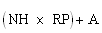
Isherwood v Butler Pollnow Pty Limited (1986) 6 NSWLR 363 referred to
IW v City of Perth (1997) 191 CLR 1 referred to
Network Ten Pty Limited v TCN Channel Nine Pty Limited (2004) 205 ALR 1 referred to
Newcastle City Council v GIO General Limited referred to
Project Blue Sky Inc v Australian Broadcasting Authority (1998) 194 CLR 355 referred to
R v Young (1999) 46 NSWLR 681 referred to
Re Bolton; Ex parte Beane (1987) 162 CLR 514 referred to
Re Zarb and Comcare (1997) 48 ALD 718 not followed
Refrigerated Express Lines (Australasia) Pty Limited v Australian Meat and Livestock Corporation (No 2) (1980) 29 ALR 333 referred to
Rieson v SST Consulting Services Pty Limited [2005] FCAFC 6 referred to
Pearce and Geddes, Statutory Interpretation in Australia, 5th Ed, Butterworths, Sydney, 2001
COMCARE AUSTRALIA v VIRATO PIRES
NSD 1880 of 2004
JACOBSON J
9 JUNE 2005
SYDNEY
|
IN THE FEDERAL COURT OF AUSTRALIA |
|
|
NEW SOUTH WALES DISTRICT REGISTRY |
NSD 1880 of 2004 |
On appeal from a decision of the Administrative Appeals Tribunal
|
BETWEEN: |
COMCARE AUSTRALIA APPELLANT
|
|
AND: |
VIRIATO PIRES RESPONDENT
|
|
JACOBSON J |
|
|
DATE OF ORDER: |
9 JUNE 2005 |
|
WHERE MADE: |
SYDNEY |
THE COURT ORDERS THAT:
1. The appeal be allowed.
2. The decision of the Tribunal is to be set aside and the following decision substituted:-
(a) the decision under review is to be set aside.
(b) Mr Pires’ normal weekly earnings before the injury were $694.36.
3. There be no order as to costs.
Note: Settlement and entry of orders is dealt with in Order 36 of the Federal Court Rules.
|
IN THE FEDERAL COURT OF AUSTRALIA |
|
|
NEW SOUTH WALES DISTRICT REGISTRY |
NSD 1880 of 2004 |
On appeal from a decision of the Administrative Appeals Tribunal
|
BETWEEN: |
COMCARE AUSTRALIA APPELLANT
|
|
AND: |
VIRIATO PIRES RESPONDENT
|
|
JUDGES: |
JACOBSON J |
|
DATE: |
9 JUNE 2005 |
|
PLACE: |
SYDNEY |
REASONS FOR JUDGMENT
Introduction
1 The appellant (“Comcare”) appeals on a question of law under s 44(1) of the Administrative Appeals Tribunal Act 1975 (Cth) from a decision of the Administrative Appeals Tribunal (“the Tribunal”) constituted by Senior Member Allen. The Tribunal’s decision was given on 19 November 2004.
2 Three questions of law are raised by the appeal. The questions are as to the proper construction of ss 8(1) and 8(2) of the Safety, Rehabilitation and Compensation Act 1988 (Cth) (“the Act”)
3 Section 8 of the Act prescribes the method of calculation of “normal weekly earnings” which is a principal component in the determination of the amount of compensation payable to an employee who is incapacitated for work as a result of an injury; see s 19 of the Act.
4 The method of calculation prescribed by s 8 consists of a formula. One of the components of the formula in s 8(1) is “NH” which is the “average number of hours” worked each week by the employee. Another component is “RP” which is the employee’s average hourly ordinary time rate of pay.
5 Section 8(2) provides that where an employee is required to work overtime on a regular basis, the normal weekly earnings are to be the amount calculated in accordance with s 8(1) plus an additional amount calculated under another formula. That formula is based upon the average number of hours of overtime and the employee’s hourly overtime rate of pay.
6 The essential question which arises is whether hours of overtime which are not “required” or “regular” fall for inclusion under the NH component of the “average number of hours worked in each week” under s 8(1) of the Act.
7 In Re Zarb and Comcare (1997) 48 ALD 718 (“Zarb”) Deputy President Burns held that hours of overtime which were not required or regular must be included in the calculation under s 8(1). In the hearing before the Tribunal in the present case, Comcare contended that Zarb was incorrectly decided insofar as it found that overtime which is neither required nor regular is nonetheless to be included in the calculation under s 8(1). The Tribunal rejected that submission and followed Zarb.
The legislation
8 Section 4(1) of the Act contains the following relevant definitions:-
““normal weekly earnings" means the normal weekly earnings of an employee calculated under section 8.
"normal weekly hours", in relation to an employee, means the average
number of hours (including hours of overtime) worked in each week by the
employee in his or her employment during the relevant period as calculated for
the purpose of applying the formula in subsection 8(1) or (2).”
9 Section 8(1) provides:-
“(1) For the purposes of this Act, the normal weekly earnings of an employee (other than an employee referred to in subsection (2)) before an injury shall be calculated in relation to the relevant period under the formula:
where:
NHis the average number of hours worked in each week by the employee in his or her employment during the relevant period;
RPis the employee’s average hourly ordinary time rate of pay during that period; and
Ais the average amount of any allowance payable to the employee in each week in respect of his or her employment during the relevant period, other than an allowance payable in respect of special expenses incurred, or likely to be incurred, by the employee in respect of that employment.”
10 Section 8(2) is as follows:-
“(2) Where an employee is required to work overtime on a regular basis, the normal weekly earnings of the employee before an injury shall be the amount calculated in accordance with subsection (1) plus an additional amount calculated in relation to the relevant period under the formula:

where:
NH is the average number of hours of overtime worked in each week by the employee in his or her employment during the relevant period; and
OR is the employee’s average hourly overtime rate of pay during that period.”
11 Section 8(10) provides:-
“If the amount of the normal weekly earnings of an employee before an injury, as calculated under the preceding subsections, would exceed:
(a) where the employee continues to be employed by the Commonwealth or a licensed corporation—the amount per week of the earnings that the employee would receive if he or she were not incapacitated for work; or
(b) where the employee has ceased to be employed by the Commonwealth or a licensed corporation—whichever is the greater of the following amounts:
(i) the amount per week of the earnings that the employee would receive if he or she had continued to be employed by the Commonwealth or the licensed corporation in the employment in which he or she was engaged at the date of the injury;
(ii) the amount per week of the earnings that the employee would receive if he or she had continued to be employed by the Commonwealth or the licensed corporation in the employment in which he or she was engaged at the date on which the employment by the Commonwealth or the licensed corporation ceased;
the amount so calculated shall be reduced by the amount of the excess.”
12 Section 9 prescribes the relevant period for calculating the normal weekly earnings of an employee before an injury. Section 9(1) states that a reference in s 8 to the relevant period is, subject to the other paragraphs of s 9, a reference to the latest period of two weeks before the date of the injury.
13 Section 19 provides, relevantly:-
“(1)This section applies to an employee who is incapacitated for work as a result of an injury, other than an employee to whom section 20, 21, 21A or 22 applies.
(2) Subject to this Part, Comcare is liable to pay to the employee in respect of the injury, for each week that is a maximum rate compensation week during which the employee is incapacitated, an amount of compensation worked out using the formula:

where:
AE is the greater of the following amounts:
(a) the amount per week (if any) that the employee is able to earn in suitable employment;
(b) the amount per week (if any) that the employee earns from any employment (including self-employment) that is undertaken by the employee during that week.
NWE is the amount of the employee's normal weekly earnings.
(2A) For the purposes of subsection (2), a week is a maximum rate compensation week, in relation to an employee to whom this section applies, if:
(a) it is a week during which the employee's incapacity prevents the employee working the employee's normal weekly hours because the employee is unable to work or unable to work at the level at which the employee worked before the injury; and
(b) the total number of hours that the employee has been prevented from working, or working at that level, during that incapacity, in that week and in all previous weeks, if any, to which paragraph (a) applies, does not exceed 45 times the employee's normal weekly hours.
(2B) If, before the end of a particular week, the total of the hours that the employee has been prevented from working, or working at that level, in that week and in previous weeks, will exceed the total number of hours worked out in accordance with paragraph (2A)(b), then:
(a) subsection (2) applies in respect of the part of the week before that total number of hours is exceeded in accordance with subsection (2C); and
(b) subsection (3) applies in respect of the remainder of the week in accordance with subsection (2D).
(2C) For the purposes of paragraph (2B)(a), the compensation payable in respect of the part of the week to which that paragraph refers is an amount worked out using the formula:
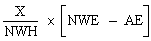
where:
AE applies in relation to the whole of that particular week and has the same meaning as in subsection (2).
NWE is the amount of the employee's normal weekly earnings.
NWH means the number of normal weekly hours worked by the employee before his or her injury.
X is the total of the hours in that particular week:
(a) that would have counted towards the employee's normal weekly hours (whether those hours are worked or not); and
(b) that elapse before the total number of hours worked out in accordance with paragraph (2A)(b) exceeds 45 times the employee's normal weekly hours.
(2D) For the purposes of paragraph (2B)(b), the compensation payable in respect of the part of the week to which that paragraph refers is worked out using the formula:

where:
NWH means the number of normal weekly hours worked by the employee before his or her incapacity.
reduced rate compensation entitlement is the rate of compensation that would have been applicable for the whole week had subsection (3) applied throughout the whole week.
X is the total of the hours in that particular week:
(a) that would have counted towards the employee's normal weekly hours (whether those hours are worked or not); and
(b) that elapse before the total number of hours worked out in accordance with paragraph (2A)(b) exceeds 45 times the employee's normal weekly hours.
(3) Subject to this Part, Comcare is liable to pay compensation to the employee, in respect of the injury, for each week during which the employee is incapacitated, other than a week referred to in subsection (2), of an amount calculated using the formula:

where:
adjustment percentage is a percentage equal to:
(a) if the employee is not employed during that week—75%; or
(b) if the employee is employed for 25% or less of his or her normal weekly hours during that week—80%; or
(c) if the employee is employed for more than 25% but not more than 50% of his or her normal weekly hours during that week—85%; or
(d) if the employee is employed for more than 50% but not more than 75% of his or her normal weekly hours during that week—90%; or
(e) if the employee is employed for more than 75% but less than 100% of his or her normal weekly hours during that week—95%; or
(f) if the employee is employed for 100% of his or her normal weekly hours during that week—100%.
AE applies in relation to the whole of that particular week and has the same meaning as in subsection (2).
NWE is the amount of the employee's normal weekly earnings.
(3A) If, as a result of the incapacity:
(a) the amount per week payable to the employee in respect of his or her continued employment is reduced; and
(b) a pension under a superannuation scheme is payable to the employee;
subsection (3) applies in relation to the employee in relation to a week during which the employee is incapacitated as if the references in the subsection to the amount he or she was able to earn during the week in suitable employment were instead references to the sum of that amount and any amount of the pension referred to in paragraph (b) that is payable to the employee in respect of that week.”
The Second Reading Speech
14 Comcare relied on a passage from the Second Reading Speech on the Commonwealth Employees’ Rehabilitation and Compensation Bill 1988. I will set out the passage in full as follows:-
“I turn now to the benefits which will be payable under this legislation. The benefits package is aimed specifically at assisting those employees most in need - that is, the long-term incapacitated workers. At the heart of the new scheme is the change from a system of fixed long-term benefits adjusted by regulation to one of weekly benefits calculated on the basis of the individual employee’s normal weekly earnings. An employee’s normal weekly earnings will be based on his or her pre-injury salary andwill take into account certain allowances andregular rostered overtime which the employee is required to work as a condition of his or her employment. Employeeswho are incapacitated for work will receive weekly benefits equal to 100% of normal weekly earnings for the equivalent of the first 45 weeks of that incapacity.”
(emphasis in original)
The decision in Zarb
15 The learned Deputy President pointed out at [16] that ss 8(1) and 8(2) of the Act raise a dilemma. If overtime is not included in the calculation under s 8(1) the employee will not be compensated for the loss even though some overtime is a feature of the employment, albeit that the overtime was not compulsory and not regular. However, if overtime is included in the calculation in s 8(1) an employee who worked overtime on a compulsory and regular basis will be compensated twice. This is because s 8(2) provides for “an additional amount” calculated in accordance with that formula to be added to the amount calculated under the formula in s 8(1).
16 The approach which the Deputy President took to resolve the question and to arrive at the correct or preferable result was twofold. First, he looked at a number of possible interpretations of the two subsections. He decided at [22] that an interpretation which included overtime that was not required and not regular in s 8(1) was preferable, because it removed the dilemma which he had identified. He said that this approach allows an employee who works overtime that is not required and which is irregular to be compensated, though at a lower rate for overtime because the formula in s 8(1) attracts only the employee’s average ordinary time rate of pay.
17 The second step was to ask whether this interpretation could be sustained by the wording of the Act.
18 The Deputy President considered at [25] that some help could be obtained from the definition of “normal weekly hours” even though, as he recognised at [26], that expression does not appear in either s 8(1) or s 8(2).
19 Nevertheless, the Deputy President was mindful of the fact that if the definition of “normal weekly hours” was applied to s 8(1) and s 8(2), an employee who worked overtime on a required and regular basis would be compensated twice. He referred to the decision of Heerey J in Bortolazzo v Comcare (1997) 75 FCR 385 (“Bortolazzo”) in which his Honour observed that the underlying policy of the Act is that an injured worker should be neither worse off, nor better off, during the period of incapacity.
20 The Deputy President resolved the double counting dilemma by pointing to the provisions of s 8(10) of the Act. He said that this subsection could apply to the situation covered by the potential for additional compensation under s 8(2) by imposing a ceiling so that the employee would not be able to receive more per week than would have been received if the employee had not been incapacitated.
21 The conclusion which the Deputy President reached was set out at [30] – [31] as follows:-
“30 The tribunal’s considered view is that the definition of ‘normal weekly hours’ does apply to ss 8(1) and 8(2) and must be given its meaning as defined in s 4. Accordingly, the hours of overtime worked must be included when calculating the average number of hours worked in each week during the relevant period for the purposes of ascertaining the ‘NH’ part of the formula in s 8(1) and in turn, it will take its place when s 8(2) becomes relevant. However, s 8(10) needs to be kept in mind and applied where appropriate to ensure that injured employees are not better off than they otherwise would have been.
31 Before applying the above interpretation to the facts, the tribunal must determine whether the applicant was ‘required to work overtime on a regular basis’ within the ambit of s 8(2) of the Act.”
22 Thus, the effect of Deputy President Burns’ approach is that overtime is to be included in the calculations under s 8(1) provided that the employee does not fall within s 8(2).
The Decision under appeal
23 The respondent was employed by ADI Limited (formerly Australian Defence Industries) at the Garden Island Dockyard. Prior to his injury on 12 May 1999, there had been a “regular and ongoing necessity” for workers employed at the Dockyard to be requested by their employer to work overtime; see at [6].
24 The principal issue before the Tribunal was whether the respondent was required to work overtime. In Zarb, Deputy President Burns had held that “required” should be given its ordinary everyday meaning so that it meant the imposition in an authoritative fashion of an obligation upon the employee to work overtime on a regular basis. The Tribunal followed this interpretation and found at [22] that although the respondent felt a strong moral obligation, he was not compelled or “required” within the meaning of s 8(2) of the Act.
25 The Tribunal then turned to the calculation of “normal weekly earnings” in s 8(1). It said at [23]:-
“During submissions the Respondent argued that the calculations of normal weekly earnings in the reviewable decision had been incorrectly performed. The delegate of the Respondent in making the reviewable decision had followed the formula set out in re Zarb. Again I see no reason why I should not follow the decision in re Zarb which was not appealed by the Respondent in that matterand who is the same Respondent as in these proceedings. Further it would appearthatre Zarbhas been relied upon and followed by determining authorities since it was delivered.”
Discussion
26 Mr Hanks SC, for Comcare, submitted that the intention of Parliament as revealed in ss 8(1) and 8(2) is that the only way in which an incapacitated employee can be compensated for lost overtime is through the application of the formula in s 8(2). That is to say, the employee must be one who was required to work overtime on a regular basis. Overtime which was either not required or irregular cannot, on Mr Hanks’ approach to the Act, be compensated when the formula set out in s 8(1) is applied under s 19(2).
27 Mr Hanks pointed, in particular, to five features of s 8 which he said support his submission that s 8(2) states exhaustively the circumstances in which overtime can be brought to account in the calculation of normal weekly earnings. They are:
· the rate of pay specified in s 8(1) is the employee’s average hourly ordinary rate of pay, not the overtime rate.
· it is implausible that Parliament would have seen the necessity for an “additional amount” under s 8(2), if overtime was already included in the calculation under s 8(1).
· the Deputy President’s approach leads to the possibility of double counting of the components of normal weekly earnings.
· the expression “normal weekly hours”, although defined in s 4(1) to include overtime, does not appear in s 8(1) or s 8(2).
· the mechanism proposed by the Deputy President for avoiding the dilemma of double counting, ie by reference to s 8(10), is highly artificial and not in accordance with the proper construction of that subsection.
28 However, Mr Mrsic, for the respondent, pointed to the width of the expression “average number of hours worked in each week” appearing in the NH component of the formula in s 8(1). He submitted that, on the face of it, s 8(1) includes all hours of overtime so that it is then necessary to reconcile s 8(1) and s 8(2).
29 The effect of Mr Mrsic’s submissions was that the Deputy President in Zarb had correctly applied and reconciled s 8(1) and s 8(2) so that the two subsections can work together in a fair and just way. Thus, an employee who performed overtime on an irregular or not required basis will be compensated at less than the full overtime rate. It is only where an employee carried out regular and required overtime that he or she will be compensated at the full rate. He pointed out that the construction favoured by Mr Hanks would deny all injured employees, other than those whose overtime was required and regular, any compensation for that element of the loss. Thus it was submitted that such a harsh result could not have been intended bearing in mind the beneficial nature of the Act.
30 The modern approach to statutory construction is to construe the relevant provision in its context so that it is consistent with the language and purpose of all the provisions of the statute; see CIC Insurance Limited v Bankstown Football Club Limited (1997) 187 CLR 384 (“CIC Insurance”) at 408 (Brennan CJ, Dawson, Toohey and Gummow JJ); Project Blue Sky Inc v Australian Broadcasting Authority (1998) 194 CLR 355 (“Project Blue Sky”) at [69] (McHugh, Gummow, Kirby and Hayne JJ); Network Ten Pty Limited v TCN Channel Nine Pty Limited (2004) 205 ALR 1 (“Network Ten”) at [11] (McHugh, Gummow and Hayne JJ); Rieson v SST Consulting Services Pty Limited [2005] FCAFC 6 (“Rieson”) at 14 (Wilcox, Sackville and Finn JJ).
31 The context to which the Court may look in order to determine the legislative purpose permits recourse to extrinsic material including the legislative history and explanatory material such as a Second Reading Speech; see Newcastle City Council v GIO General Limited (1997) 191 CLR 85 (“Newcastle City Council”) at 99 (Toohey, Gaudron and Gummow JJ), 112 (McHugh J); Isherwood v Butler Pollnow Pty Limited (1986) 6 NSWLR 363 at 387-388 (McHugh JA).
32 This approach is permitted both by the common law and by s 15AB of the Acts Interpretation Act 1901 (Cth) (“Interpretation Act”); see Newcastle City Council at 99. However, the modern approach exemplified in the Interpretation Act appears to insist that the context be considered first even before any consideration of whether the provision is ambiguous may be thought to arise; see CIC Insurance at 408; see also Rieson at [20].
33 This is not to say that resort to extrinsic material can override the language of the statute. As Mason CJ, Wilson and Dawson JJ said in Re Bolton; Ex parte Beane (1987) 162 CLR 514 at 518, the words of a Second Reading Speech must not be substituted for the text of the statute; the function of the Court is to give effect to the rule of Parliament as expressed in the statute itself; see also R v Young (1999) 46 NSWLR 681 at [35] (Spigelman CJ).
34 It is true in the present case that a literal construction of the words “the average number of hours worked in each week” in the NH component stated in s 8(1) are wide enough to embrace overtime hours. But the principles to which I have referred make it plain that these words must be construed having regard to their statutory context and, so far as necessary, with the aid of extrinsic materials.
35 Quite apart from what was said by the Minister in the Second Reading Speech, it is plain that when s 8 is read as a whole, a conundrum is raised as to the proper sphere of operation of the broad words “average number of hours worked” in s 8(1). The conundrum is that which was recognised by the Deputy President in Zarb.
36 Each of the indicia of s 8 emphasised by Mr Hanks points in favour of a construction which restricts the words “the average number of hours worked” to ordinary, non-overtime hours.
37 If Parliament had intended to include overtime in s 8(1), it is difficult to see why it would have done so at a rate of pay which is stated to be the average hourly ordinary time rate of pay. The Deputy President in Zarb explained this upon the basis that the employee is compensated at a lesser rate for irregular, not required overtime. But this seems to me to be an ex post facto rationalisation for a construction which does not flow naturally from the wording of s 8(1) read on its own or in its full context.
38 The inclusion of the “additional amount” in s 8(2) gives effect to the natural meaning of ss 8(1) and 8(2) when read together. Ordinary, non-overtime hours, are included in the formula under s 8(1) and overtime hours, calculated at the “average hourly overtime rate of pay” are then added. This seems to me to be a common sense and straightforward approach to the language of the two subsections when read together. It flows naturally from a fair reading of ss 8(1) and 8(2) when the two subsections are read as a whole.
39 This approach to the construction of ss 8(1) and 8(2) enables them to be reconciled in a way which gives full effect to the meaning of both sub-sections. It gives effect to both provisions while maintaining the unity of the statute; Project Blue Sky at [69] – [70]; Network Ten at [61]; Hoffman v Chief of Army [2004] FCAFC 148 (“Hoffman”) at [8] – [9] (Black CJ, Wilcox and Gyles JJ).
40 What is involved is, as McHugh, Gummow, Kirby and Hayne JJ said in Project Blue Sky at [70], the reconciliation of provisions which might be thought to involve a conflict. The provisions must have been intended to operate harmoniously. This will often require determination of the question of which one is to yield to the other.
41 The subject matter of s 8(2) is overtime that is “required” and “regular”. It may be thought to be a special provision which deals with overtime whereas s 8(1) is a general provision covering hours worked in each week. A conventional method for resolving an inconsistency between the general and the specific is that the latter prevails to the extent of any repugnancy; see Refrigerated Express Lines (Australasia) Pty Limited v Australian Meat and Livestock Corporation (No 2) (1980) 29 ALR 333 (“REL”) at 347 (Deane J); see also Hoffman at [12] – [15].
42 As Deane J said in REL at 347:-
“Repugnancy can be present in cases where there is no direct contradiction between the relevant legislative provisions. It is present where it appears, as a matter of construction, that special provisions were intended exhaustively to govern their particular subject matter and where general provisions, if held to be applicable to the particular subject matter, would constitute a departure from that intention by encroaching on that subject matter.”
43 Applying this general canon of construction avoids the conundrum of double counting and gives effect to both sub-sections in a way which may be thought to reflect a fair reading of the section in its full context.
44 It is true, as Heerey J said in Bortolazzo at 388, that the Act is social legislation which ought to be construed liberally in favour of an injured employee in the event of ambiguity. But once the two subsections are reconciled in the manner to which I have referred, there is no scope for the application of this principle.
45 Indeed, to the extent that Heerey J’s remarks at 388 are applicable, it is to be noted that his Honour said that an injured employee should be neither worse off, nor better off, as a result of the injury. The approach urged upon me by the respondent would permit double counting, unless this is precluded by s 8(10).
46 The interpretation of beneficial provisions is subject to the rider that the interpretation must be restrained within the confines of the actual language employed and what is fairly open on the words used: Pearce and Geddes, Statutory Interpretation in Australia, 5th Ed, Butterworths, Sydney, 2001 at [9.3] and the cases cited therein.
47 Isaacs J observed that a remedial Act should be construed beneficially, but not such that the true significance of the provision should be “strained or exceeded, but that it should be construed so as to give the fullest relief which the fair meaning of its language will allow”: Bull v Attorney-General (NSW) (1913) 17 CLR 370 at 384.
48 It seems to me that no assistance can be gained from the definition of “normal working hours” in s 4(1). That expression does not appear in s 8. It does appear in s 19.
49 The concept of “normal weekly earnings” and “normal weekly hours” are quite separate. The purpose of “normal weekly earnings” is to establish a value of the employee’s earnings before injury and to prescribe how it is to be calculated for the purpose of determining the actual amount of compensation payable under s 19(2).
50 The concept of “normal weekly hours” is referred to in ss 19(2A), (2C) and (2D). It is a factor to be taken into account in determining the maximum compensation payable to an employee under s 19(2). That sub-section prescribes its own formula, which is “normal weekly earnings” less other earnings defined as AE.
51 Section 19(2A) and the related sub-sections of s 19 fix the maximum compensation payable to an injured employee as 45 times the employee’s “normal weekly hours.” The definition of that expression includes overtime but it is only for the purpose of fixing the maximum compensation when the “normal weekly earnings” formula is applied under s 19(2). That is why the definition of “normal weekly hours” in s 4(1) concludes with the words “for the purpose of applying the formula in subsection 8(1) or (2)”.
52 Nor does s 8(10), on its ordinary construction, bear upon imbalances in the calculation of ordinary weekly earnings under ss 8(1) and 8(2) resulting from the possible inclusion of overtime in s 8(1). Rather, s 8(10) is concerned with the possibility of over compensation payable to an injured employee as a result of changes in conditions of employment to which the employee would have been subject if he or she had continued to work after the injury.
53 This was what occurred in Bortolazzo. There, the employees had worked on shifts and, before their injuries, had been paid penalty rates which increased their remuneration substantially over their base salaries. However, after they were injured, the army base on which they worked was privatised and penalties were no longer payable. Heerey J was of the view that the effect of s 8(10)(a) was that the employees could not be in a better position when they were not working than would have applied to them had they continued to work under the post-privatisation regime.
54 Although Bortolazzo was concerned with s 8(10)(a), it illustrates the way in which both ss 8(10)(a) and (b) are intended to have effect. They are concerned with a comparison of normal weekly earnings pre-injury and the amount the employee would have received after the injury if he or she were not incapacitated or had continued to work for the employer under the changed work conditions.
55 The construction which I have gleaned from the wording of ss 8(1) and 8(2) is confirmed by a reference to the Second Reading Speech and the legislative history of the Act.
56 The Act repealed the Compensation (Commonwealth Government Employees) Act 1971 (Cth) (“the Commonwealth Employees Act”) which had replaced the Commonwealth Employee’s Compensation Act, 1930 (Cth). There was nothing in the calculation of “average weekly earnings” in the provisions of Part III of the Commonwealth Employees Act, or in the earlier legislation, which provided for the inclusion of overtime in the determination of compensation payable to an injured employee.
57 It seems to me that the Second Reading Speech of the Act makes clear the Minister’s intention in providing for the inclusion of overtime in the calculation of normal weekly earnings. It was to bring to account regular overtime which the employee is required to work as a condition of employment. There is nothing in this to suggest that irregular or non-required overtime hours should be included in the calculation. Indeed, the Minister’s words suggest the contrary.
58 This is not a case where extrinsic material is used to justify a “strained construction” in order to cure the mischief the legislation was intended to overcome. Rather, the Second Reading Speech confirms what may be thought to be the purpose of ss 8(1) and 8(2) of the Act in light of the reasonable and natural meaning of the language used when the two subsections are read together; cf IW v City of Perth (1997) 191 CLR 1 at 12 (Brennan CJ and McHugh J); Newcastle City Council at 113; Rieson at [20].
59 Finally, it might be thought that the construction which I have adopted works some unfairness to the respondent. This is because he receives no compensation for overtime which he performed as a result of a strong moral obligation.
60 However, if there be unfairness in the result, it seems to me to flow from the construction of the word “required” in s8(2) by the Tribunal in Zarb. That construction was not challenged.
61 It should be borne in mind that any unfairness in the present case must give way to the proper construction of the Act. It cannot be a mandate for idiosyncratic notions of justice and fairness.
Orders
62 Mr Hanks submitted that if the appeal is allowed, the proper calculation of the respondent’s normal weekly earnings would be $694.36. This was not disputed by the respondent. However, I will stay the making of the orders for 14 days in case the respondent wishes to challenge the calculation.
63 The orders I will make are:-
3. The appeal be allowed.
4. The decision of the Tribunal is to be set aside and the following decision substituted:-
(a) the decision under review is to be set aside.
(b) Mr Pires’ normal weekly earnings before the injury were $694.36.
3. No order as to costs (as requested by Mr Hanks).
|
I certify that the preceding sixty-three (63) numbered paragraphs are a true copy of the Reasons for Judgment herein of the Honourable Justice Jacobson. |
Associate:
Dated: 9 June 2005
|
Counsel for the Appellant: |
Mr P Hanks QC |
|
|
|
|
Solicitor for the Appellant: |
Hunt and Hunt |
|
|
|
|
Counsel for the Respondent: |
Mr J Mrsic |
|
|
|
|
Solicitor for the Respondent: |
Turner Freeman |
|
|
|
|
Date of Hearing: |
30 May 2005 |
|
|
|
|
Date of Judgment: |
9 June 2005 |


