FEDERAL COURT OF AUSTRALIA
Pearson v Commissioner of Taxation [2005] FCA 250
TAXATION – unit trusts – whether beneficiary presently entitled – whether entitlement disclaimed
Taxation Administration Act 1953 (Cth) s 14ZZ
Income Tax Assessment Act 1936 (Cth) s 95A
The Union-Fidelity Trustee Company of Australia Ltd and Another v The Commissioner of Taxation of the Commonwealth of Australia (1969) 119 CLR 177 cited
Federal Commissioner of Taxation v Whiting and Others (1942-43) 68 CLR 199 applied
Arjon Pty Ltd v Commissioner of State Revenue [2003] VSCA 213 discussed
Commissioner of State Revenue v Karingal No. 2 Holdings Pty Ltd [2003] VSCA 214
Kent v The Vessel “Maria Luisa” (No 2) (2003) 130 FCR 12 cited
Trustees of the Estate Mortgage Fighting Fund Trust v Commissioner of Taxation
(2000) 102 FCR 15 discussed
Re Smith, Public Trustee v Aspinall (1928) Ch 915 cited
Buschau v Rogers Communications Inc, 20 February 2004, Court of Appeal for British Columbia discussed
Ramsden v Federal Commissioner of Taxation [2004] FCA 632 cited
Commissioner of Taxation v Ramsden [2005] FCAFC 39 applied
Saunders and Anglia Building Society [1971] AC 1004 discussed
R P Meagher et al, Jacobs’ Law of Trusts in Australia, 6th edn, Butterworths, Sydney, 1997
Halsbury’s Laws of England, 4th edn, Vol 48
JANETTE ANN PEARSON v COMMISSIONER OF TAXATION
Q 264 of 1999
Q 265 of 1999
Q 266 of 1999
SPENDER J
16 MARCH 2005
BRISBANE
|
IN THE FEDERAL COURT OF AUSTRALIA |
|
|
QUEENSLAND DISTRICT REGISTRY |
Q 264 of 1999 Q 265 of 1999 Q 266 of 1999 |
|
BETWEEN: |
JANETTE ANN PEARSON APPLICANT
|
|
AND: |
COMMISSIONER OF TAXATION RESPONDENT
|
|
SPENDER J |
|
|
DATE OF ORDER: |
16 MARCH 2005 |
|
WHERE MADE: |
BRISBANE |
THE COURT ORDERS THAT:
1. The parties supply short minutes of orders to give effect to these reasons, except orders as to costs, by 1 April 2005.
2. The applicant file any written submissions on costs within seven days; the respondent file its submissions on costs within a further seven days.
3. Should the parties wish any further findings of fact to be made, other than the findings made in these reasons, written submissions concerning such findings should be made within seven days.
Note: Settlement and entry of orders is dealt with in Order 36 of the Federal Court Rules.
|
IN THE FEDERAL COURT OF AUSTRALIA |
|
|
QUEENSLAND DISTRICT REGISTRY |
Q 264 of 1999 Q 265 of 1999 Q 266 of 1999 |
|
BETWEEN: |
JANETTE ANN PEARSON APPLICANT
|
|
AND: |
COMMISSIONER OF TAXATION RESPONDENT
|
|
JUDGE: |
SPENDER J |
|
DATE: |
16 MARCH 2005 |
|
PLACE: |
BRISBANE |
REASONS FOR JUDGMENT
1 These are “appeals” under s 14ZZ of the Taxation Administration Act 1953 (Cth) (“the Administration Act”) against appealable objection decisions in respect of the 1992, 1993 and 1994 financial years of income advised by notices of decisions on objections dated 9 September, 14 September and 14 September 1999 respectively. Mrs Pearson, whom I will call the appellant, sought in the respective applications to have the decisions varied by allowing the objections to the extent of reducing the taxable income for each year to $392,183.00, $199.00 and $7,260.00 respectively by the remission of all additional tax and the recalculation of the Medicare levy in each year.
2 In addition to the appellant and her husband Cyril Pearson, the other three relevant tax entities are Corplan Financial Group Unit Trust (“CFGUT”); Corplan Financial Network Unit Trust (“CFNUT”) and the Jancy Trust, the trustee of which is Jancy Pty Ltd (“Jancy”).
3 Jancy’s involvement has been entirely as trustee of the Jancy Trust.
4 The matters concern distributions from the Jancy Trust. The Jancy Trust Deed was settled on 1 November 1983. Cyril John Pearson and Janette Ann Fenton (the appellant’s maiden name) are the primary beneficiaries of that trust.
5 As the result of audits, the respondent, the Commissioner of Taxation, (“the Commissioner”) decided that the income tax returns of each of CFGUT and CFNUT for the relevant years were incorrect, and determined that the assessable income of each be increased. The imputed increased income was notionally distributed to Jancy and then notionally distributed to the appellant, as the basis of the Commissioner’s assessments. The adjustments made were as follows:
1992 Year
6 The amended assessment issued to the appellant in respect of the 1992 year for the sum of $1,182,180.00 was as a result of:
(a) increasing CFGUT’s assessable income by $1,422,125.00 from a loss initially returned of $61,682.00 to an assessable income of $1,360.443.00;
(b) increasing CGNUT’s assessable income by $489,199.00;
(c) notionally distributing the increases of Jancy;
(d) further increasing Jancy’s assessable income by $514,718.00 in respect of amounts credited to an account called “The Proprietorship Account” in Jancy.
7 As a result of those adjustments, Jancy’s assessable income for the 1992 year was increased as follows:
· CFGUT $1,360,443.00
· CFNUT $ 489,199.00
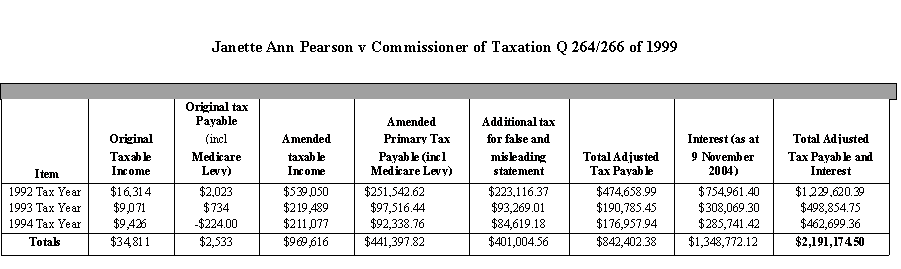
· Jancy $514,718.00
Total Increase $2,364,360.00
8 One half of that increase in assessable income in Jancy, $1,182,180.00, was notionally distributed to the appellant pursuant to what is asserted by the Commissioner to be Jancy’s Resolution dated 30 June 1992 distributing the income of the Jancy Trust in that year to and equally between the appellant and her husband.
9 The Commissioner subsequently partly allowed an objection in the amount of $450,000.00 in respect of the Proprietorship account and the Jancy Trust for the 1992 year. The amount of $450,000.00 related to the increase in the Proprietorship account in respect of a unit known as the Riverview Gardens unit.
1993 Year
10 The amended assessment issued to the appellant in respect of the 1993 year, increased her assessable income by the amount of $694,964.00 by:
(a) increasing the assessable income of CFNUT by $358,005.00 for amounts credited to the Proprietorship account for that year;
(b) further increasing the assessable income of CFNUT by $315,588.00 by disallowing claims for unsubstantiated expenses;
(c) after deducting a loss of $2,455.00 originally claimed, the above adjustments resulted in an amended taxable income for CFNUT of $671,138.00 for the 1993 year, which was notionally distributed to Jancy;
(d) further increasing Jancy’s assessable income by $23,826.00 in respect of amounts credited to the Proprietorship account of Jancy.
11 As a result of those adjustments, Jancy’s assessable income for the 1993 year was increased as follows:
· CFNUT $671,138.00
· Jancy $23,826.00
Total increase $694,964.00
12 Initially the total of that increase of $694,964.00 was assessed to the appellant. The Commissioner subsequently partly allowed an objection in the amount of $347,418.00 to reflect what is said to be the trustee’s resolution for the distribution of the Jancy income for the 1993 year whereby one half of the trust’s income over the first $9,000.00 was to be distributed to the appellant.
1994 Year
13 The amended assessment issued to the appellant in respect of the 1994 year increased her assessable income by $236,464.00 by:
(a) increasing the assessable income of CFNUT by $196,603.00 for the disallowance of claims for unsubstantiated expenses;
(b) further increasing Jancy’s assessable income by $4,740.00 for amounts credited to the Proprietorship account by Jancy;
(c) further increasing Jancy’s assessable income by $35,484.00 in respect of a capital maintenance adjustment in relation to the devaluation of Unit 70, Silverton Place.
14 As a consequence of those adjustments, Jancy’s assessable income for the 1994 year was increased as follows:
· CFNUT ($363.00) Not originally returned
· CFNUT $196,603.00
· Jancy $40,224.00
Total increase $236,464.00
15 A joint report of accounting experts was filed on 17 September 2004 pursuant to an order made by the Court on 27 May 2004, and an amended joint report was filed on 25 October 2004.
16 The experts in the matter are Mr Paul Vincent, a chartered accountant instructed by the solicitors for the appellant, and Mr Onus Maynes, a chartered accountant instructed by the Australian Government Solicitor. There had previously been a report by Mr Vincent prepared on 4 May 2004 and a report by Mr Maynes prepared on 18 July 2002.
17 The first schedule to the joint report filed on 17 September 2004 shows the items and amounts which are agreed, and those which are not agreed, between the experts. The report produced by Mr Maynes categorised items into three categories. Category 1 items were those which, in Mr Maynes’ opinion, the Commissioner should disallow as a deduction or adjust to include in assessable income. Category 2 items were those about which, in his opinion, the appellant did not discharge the burden of proof which lay on her. Category 3 items were those which, in Mr Maynes’ opinion the Commissioner should not have disallowed as a deduction, or should not have included in assessable income.
18 The consequence of the joint approach by the accountants was that only four of the items in Category 1 were in dispute when these matters were called on for hearing. Those four items were item 7 which is an “AGC Debenture” in the amount of $124,900.00; item 14 which is “Trade Creditors Written Back” of $44,192.00; item 23 which is “Staff Training” in the amount of $5,676.00 and item 24, “Advertising”, in the amount of $31,442.00.
19 The appellant concedes all the items in Category 2, and the Commissioner concedes that all Category 3 items should be allowed to the appellant.
20 On the second day of the trial of these applications, the parties reached agreement concerning those four items, it being agreed that the first two items are properly to be treated in Category 2 and the last two items are to be put into Category 3.
21 The issues with which the Court is now concerned involve the question of what was the income for the Jancy Trust for the years ended 30 June 1992, 1993 and 1994, which in turn depends on the income of CFNUT and CFGUT for those years, and a present entitlement in the Jancy Trust to that income as at 30 June of each of those years; and the second question of whether the appellant disclaimed her entitlement to the income applied to her by Jancy.
22 There is no dispute in these proceedings as to the Commissioner’s power to issue amended assessments and his approach to the quantification of additional tax payable by the appellant, should his contentions concerning the income and the asserted disclaimers be accepted.
23 The Jancy Trust is a discretionary trust. It is contended by the appellant that no beneficiary has any vested entitlement to any part of the income of that trust, and that accordingly, each purported distribution of income to the appellant has to be treated separately. It was submitted that the appellant was entitled to have disclaimed each purported distribution and that she has effectively disclaimed the purported distributions to her from the Jancy Trust in each of the relevant fiscal years 1992, 1993, 1994, on which the Commissioner relies.
24 The appellant put in issue the question of whether the Commissioner had correctly construed the various trust deeds and the Income Tax Assessment Act 1936 (Cth) (“the Tax Act”), and whether facts exist to lead to the conclusion that there were distributions from CFGUT and CFNUT respectively to Jancy and from Jancy to the appellant in each of the tax years.
25 I am satisfied on the evidence that in each of the relevant years, Jancy resolved to distribute a share of the income of the Jancy Trust to the appellant, the resolution for the 1994 tax year being for the whole of the income.
26 In respect of the 1992 financial year, there are minutes of a meeting of directors signed by Cyril Pearson as follows:
‘MINUTES OF THE MEETING OF DIRECTORS
OF
JANCY PTY LTD
AS TRUSTEE FOR
THE JANCY TRUST
HELD AT THE REGISTERED OFFICE OF THE COMPANY
ON THE
30th June 1992
PRESENT: CYRIL JOHN PEARSON (Chairman)
JANETTE ANN PEARSON
DISTRIBUTION
INCOME: In accordance with the powers contained in the trust deed in relation to income, it was resolved that the income of the above family trust for the year ended 30th June 1992, be distributed as follows:
THE BALANCE EQUALLY BETWEEN:-
CYRIL JOHN PEARSON
JANETTE ANN PEARSON
CONFIRMATION: These minutes were read to the meeting and it was resolved that they be confirmed.
Confirmed,
(Signature of Cyril Pearson)
Chairman’
27 In respect of the 1993 financial year, there are minutes of a meeting, unsigned, as follows:
‘MINUTES OF THE MEETING OF DIRECTORS
OF
JANCY PTY LTD
AS TRUSTEE FOR
THE JANCY TRUST
HELD AT THE REGISTERED OFFICE OF THE COMPANY
ON THE
30th June 1993
PRESENT: CYRIL JOHN PEARSON (Chairman)
JANETTE ANN PEARSON
DISTRIBUTION
INCOME: In accordance with the powers contained in the trust deed in relation to income, it was resolved that the income of the above family trust for the year ended 30th June 1993, be distributed as follows:
THE FIRST $9000 SOLELY TO :-
Janette Ann Pearson
THE BALANCE EQUALLY BETWEEN:-
CYRIL JOHN PEARSON
JANETTE ANN PEARSON
CONFIRMATION: These minutes were read to the meeting and it was resolved that they be confirmed.
Confirmed,
----------------
Chairman.’
28 In respect of the 1994 financial year, there are minutes of a meeting of directors of Jancy signed by Janette Ann Pearson as Chairman as follows:
‘MINUTES OF THE MEETING OF DIRECTORS
OF
JANCY PTY LTD
AS TRUSTEE FOR
THE JANCY TRUST
HELD AT THE REGISTERED OFFICE OF THE COMPANY
ON THE
30th June 1994
PRESENT: JANETTE ANN PEARSON (Chairman)
WADE ROBERT FENTON
DISTRIBUTION
INCOME: In accordance with the powers contained in the trust deed in relation to income, it was resolved that the income of the above family trust for the year ended 30th June 1994, be distributed as follows:
100 % SOLELY TO :-
Janette Ann Pearson
CONFIRMATION: These minutes were read to the meeting and it was resolved that they be confirmed.
Confirmed,
(Signature of J. Pearson)
Chairman.’
29 The returns submitted by the appellant reflect the appointments of income as recorded in those minutes.
30 The 1992 tax return of the appellant records:
‘… Partnerships & trusts
Net non-primary production income distribution 4131 …’
The appellant’s signature appears on this page of the income tax return above that item, and on the following page appears:
‘Distributions from Partnerships and Trusts
Including Cash Management, Property and Other Unit Trusts
|
|
Share of Income PP non PP $ $ |
PPS credit
$ c |
Imputation credit
$ c |
TFN credit
$ c |
|
THE JANCY TRUST (tax file number) |
0 4131 |
0.00 |
0.00 |
0.00 |
|
Sub-totals |
0 4131 |
Q 0.00 |
R 0.00 |
S 0.00 |
|
Totals |
O 0 P 4131’ |
|
|
|
The appellant’s signature also appears immediately above that item.
31 The appellant also signed the declaration on the front of the tax return that the information given in the return was true and correct and dated the 1992 return “5.1.94”.
32 In respect of the 1993 year tax return, the appellant again signed the declaration that the information given in that return was true and correct and dated the return “22.2.94”. On a page of the return, which is signed at the top by the appellant, appears the following:
‘… Partnerships & trusts
Net non-primary production income distribution … 8872 …’
33 In respect of the 1994 tax return, the declaration that the information is true and correct is signed by the appellant and dated “10.8.94”. That return records:
‘Partnerships & trusts
Net non-primary production income distribution … 2166 …’
34 The Category 1 and Category 2 adjustments to the relevant amounts of taxable income are, according to the respondent’s written submissions:
1992:
CFGUT $553,238
CFNUT $489,199
JANCY $64,718
TOTAL FOR 1992 $1,107,155
1993:
CFNUT $399,337
JANCY $23,826
TOTAL FOR 1993 $423,163
1994:
CFNUT $196,603
JANCY $4,741
TOTAL FOR 1994 $201,344
OVERALL TOTAL $1,731,662
35 The amounts in this table match the amounts in Appendix B of the Joint Report of Accounting Experts, filed 17 September 2004, except the CFNUT amount for the year ended 30 June 2003. Shown in the Joint Accounts report is $436,455, not the $399,337 set out above. Also the respondent’s table showed the total as $1,730,264, whereas the correct addition of the three yearly totals listed is $1,731,662 as set out above.
36 There was no resolution concerning the CFGUT amount for 1992 or the CFNUT amounts for 1993 and 1994.
37 The oral submissions for the Commissioner asserted that there was a resolution in the evidence before the Court relating to the CFNUT income for the 1992 tax year, and a reference was given for that resolution. The resolution is not to be found at that reference, and I have been unable to find, in the material before the Court, a resolution relating to the CFNUT income for the 1992 tax year. There is, in evidence, a resolution in respect of the CFNUT trust income for the 1991 tax year. For the reasons which follow, however, the existence of a resolution or not is immaterial in respect of entitlement to the CFNUT income for the 1992 tax year.
ENTITLEMENT OF JANCY TO THE CFNUT TRUST INCOME IN EACH RELEVANT YEAR
38 The Commissioner contends that the provisions of the CFNUT trust operated to entitle Jancy to the income of the CFNUT trust in each of the three tax years. The CFNUT trust deed relevantly provided as follows:
(i) by Recital D:
‘This Deed is made with the intention that the benefits of the trusts herein declared shall ensure to the extent herein provided for the benefit of every Unit Holder who shall hold units as herein provided.’
(ii) by clause 1, the following terms are defined:
‘(1) “the Trust” means the Trust hereby established;
(4) “Trust Fund” means the said initial sum all moneys paid to and accepted by the Trustee upon the issue of Units pursuant to paragraph 8 (6) hereof the accumulations of income hereinafter directed or empowered to be made all accretions to the Trust Fund and the investments and property from time to time representing the said money and accumulations or any part or parts thereof respectively;
(12) “Accounting Period” means the period from the date hereof to the next ensuing thirtieth day of June and thereafter each period of twelve months ending on the thirtieth day of June in each year and if the date of termination of the Trust is not the thirtieth day of June in any year the last Accounting Period shall be the period commencing on the first day of July next preceding the date of termination of the Trust and terminating on the date of termination of the Trust; …’
(iii) by clause 4:
‘Nothing in this Deed shall constitute or shall be deemed to constitute the relationship of principal and agent between the Trustee and the Unit Holders nor the relationship of partners as between the Trustee and the Unit Holders or as between the Unit Holders inter [sic] nor to give rise to any association whether contractual or otherwise between the Unit Holders inter se. All income payable in accordance with the provisions of this Deed to Unit Holders shall be payable to them separately and income received by the Trustee shall not be received or be construed as received by or on behalf of the Unit Holders jointly or otherwise.’
(iv) by clause 5:
‘IT IS EXPRESSLY DECLARED AND AGREED between the Trustee and the Unit Holders that notwithstanding anything contained or implied in or arising from this Deed no Unit Holder shall be required to indemnify the Trustee against any liability or obligation incurred by the Trustee in the course of exercising its duties rights powers or authorities in relation to the Trust Fund or arising from the terms of this Deed or in the course of carrying on any business whether authorised or permitted by this Deed or not.’
(v) by clause 6:
‘IN CONSIDERATION of the premises the Trustee HEREBY DECLARES that it will henceforth stand possessed of the Trust Fund and the income thereof upon the trusts and with and subject to the powers and provisions hereinafter expressed concerning the same.’
(vi) by clause 7:
‘(1) The beneficial interest in the trust Fund as originally constituted and as existing from time to time shall be vested in the Unit Holders for the time being.
(2) Subject always to the provisions of paragraph 4 hereof each person who becomes registered as a Unit Holder shall be entitled to the benefit and shall be bound by the terms and conditions of this Deed and of any supplemental Deed.’
(vii) by clause 8(1):
‘Each Unit shall entitle the registered holder thereof together with the registered holders of all other Units to the beneficial interest in the Trust Fund as an entirety but subject thereto shall not entitle a Unit Holder to any particular security or investment comprised in the Trust Fund or any part thereof and no Unit Holder shall be entitled to the Transfer to him of any property comprised in the Trust Fund.’
(viii) by clause 8(4):
‘Where the Units are expressed in the Second Schedule to be divided into classes, each class of Units shall confer the rights and be subject to the restrictions (if any) and shall be differentiated in the manner set out in the Second Schedule. Unless otherwise provided in the Second Schedule all Units shall comprise one class and shall be of equal value.’
(ix) by clause 33:
‘(1) The Trustee shall collect all dividends interests rents and other income from the Investments of the Trust Fund.
(2) The Trustee shall pay out of the gross income of the Trust Fund all costs and disbursements commissions fees taxes (including land tax and income tax) management charges and other proper outgoings in respect of the Investments and administration of the Trust Fund.’
(x) by clause 34(1):
‘Subject to any special rights or restrictions provided in the Second Schedule in relation to Units of any class the trustee in each Accounting Period until the Vesting Day or the date of the termination of the Trust whichever shall first occur shall pay or apply the net income of the Trust Fund of that Accounting Period to or for the benefit of the Unit Holders in proportion to the number of Units of which they are respectively registered as Holders at the end of each Accounting Period.’
(xi) by clause 34(6):
‘The Trustee shall hold so much of the net income of the Trust Fund for each Accounting Period as shall not be the subject of a determination effectively made at or prior to the end of such Accounting Period pursuant to the foregoing provisions of this Paragraph in trust for the Holders of Units in proportion to the number of Units of which they are respectively registered as holders on the last day of such Accounting Period.’
39 The appellant drew attention to par 5 of the Second Schedule to the CFNUT trust deed which provides:
‘The Trustee in each Accounting Period until the Vesting day or the date of the termination of Trust whichever shall first occur shall pay or apply the net income of the Trust Fund of that Accounting Period to or for the benefit of the holders of Fixed Income Units issued in each class in proportion to the number of Fixed Income Units respectively issued in each class at the end of each Accounting Period.’
It was contended for the appellant that the trustee was required to make a decision to apply the income, and that no such decision was made. The contention seems to be that Jancy, in those circumstances, had no entitlement to the CFNUT trust income in any relevant year.
40 It was contended on behalf of the Commissioner that the effect of the provisions of the CFNUT trust deed, especially clauses 7(1), 34(1) and 34(6), is that the net income of the CFNUT trust was income to which Jancy was presently entitled at the end of each year of income.
41 I accept that, simply by the force of those identified provisions, Jancy was presently entitled at the end of each year of income to the net income of the CFNUT trust for that year.
ENTITLEMENT OF JANCY TO THE CFGUT TRUST INCOME IN THE 1992 TAX YEAR
42 The position in relation to the CFGUT trust is more complex. The question of whether Jancy was presently entitled to the net trust income of the CFGUT trust is only of application for the 1992 tax year.
43 The CFGUT trust relevantly provided:
(i) by Recital A:
‘It is intended by this Deed to establish a Trust to be called THE CORPLAN FINANCIAL GROUP UNIT TRUST which trust shall be administered for the benefit of the parties and the holders of units as provided in this Deed.’
(ii) by Recital C:
‘All such cash and investments are to be held by the Trustee upon the trusts and subject to the terms and conditions declared and contained in this Deed.’
(iii) by clause 1, the following terms are defined:
‘ “Accrual period” means the year ending on the thirtieth day of June referred to in sub-clause (1) of Clause 22 hereof. The first accrual period shall be from the date of this Deed to the thirtieth day of June 1985.
“Reserve” means the reserve established pursuant to Clause 23.
“The Trust” means the Trust hereby constituted and to be called THE CORPLAN FINANCIAL GROUP UNIT TRUST.
“Units” means the units created under Clause 8 of this Deed and for the time being outstanding in the hands of registered holders.’
(iv) by clause 3(1):
‘The Trustee shall hold the Fund upon trust for the registered holders of units therein upon the terms of this Deed.’
(v) by clause 8:
‘(1) The beneficial interest in the Fund as originally constituted by the payment of TEN DOLLARS by the Settlor to the Trustee shall be divided into 100 units which shall be capable of being transferred, mortaged [sic] or otherwise dealt with as hereinafter provided.
(2) The beneficial interest in the initial units is as follows:-
NAME OF BENEFICIARY UNIT ENTITLEMENT
JANCY PTY LTD as Trustee for
the JANCY TRUST 100 UNITS’
(vi) by clause 22:
‘(1) During the month of June in the year 1985 and in the month of June in every following year until the termination of the trust, the trustee shall decide the amount (if any) of the net income of the Fund which shall be distributed to the registered holders in respect of the accrual period which shall be such amount, not exceeding the amount available for distribution, as the Trustee shall in its absolute discretion decide.
(2) Forthwith after the Trustee shall have decided the amount (if any) of the net income to be distributed the Trustee shall subject to the provision to this sub-clause distribute amongst the registered holders of units the amounts decided to be distributed in respect of the accrual period. Provided however that in making such distribution of income to the said registered holders the Trustee may issue to the said registered holders of units additional or further units either in whole or part satisfaction of the said distribution of income.
(3) Income shall be distributed among such registered holders in proportions to the number of units of which they were respectively registered as the holders.
(4) The Trustee shall be entitled to make any interim distribution of income at such time or times as the Trustee shall decide during any accrual period.
(5) Any income not distributed shall be added to the General Reserve established under Clause 23 and shall become part of the Fund.’
(vii) by clause 23(1):
‘The Trustee may in its absolute discretion establish a reserve and the Trustee may before making any payment of income under Clause 22 set aside out of the income of the Fund such sums as in its discretion the Trustee thinks proper as such reserve (to be known as “The General Reserve”).’
44 There are no resolutions of the trustee of the CFGUT trust under clause 22 in respect of the accounting period ending 30 June 1992 which purport to distribute the income of the CFGUT trust. There is no evidence of a resolution or any document to show that a General Reserve had been established under clause 23.
45 The appellant submitted that, in those circumstances, the income was “income not distributed”, and went to a reserve which was automatically erected by reason of non-distribution under clause 22 of the trust deed, even if not otherwise previously established.
46 For the Commissioner it was submitted that there were three possibilities as to the income of the CFGUT trust for the accounting period ending 30 June 1992:
‘(a) clause 22(3) operates to effect an automatic distribution to Jancy Pty Ltd in the absence of any other applicable provision; or
(b) Jancy Pty Ltd, as the sole beneficial owner of the trust fund. Jancy Pty Ltd has an accrued entitlement to payment of the income by the trustee of CFGUT, because it holds them as a bare trustee not having dealt with them under the terms of the trust; or
(c) if it be correct to say that clause 23 does operate to take the income into the reserve established thereunder (and notwithstanding that it was not established), Jancy Pty Ltd was presently entitled to the income of the CFGUT trust because Jancy Pty Ltd was entitled to call for the income by reason of the rule in Saunders v Vautier. Income added to the Fund is, in this way, income to which the 100% unit holder [Jancy] is beneficially entitled. No order of the Court or exercise of discretion by the trustee is necessary to establish this entitlement. …’
47 In the view I take of the matter, clause 22(3) does not operate to effect an automatic distribution to Jancy. Clause 22(3) is directed to the manner of distribution, and requires a decision by the trustee pursuant to clause 22(1) to distribute an amount to the registered holders.
48 In my opinion, clause 23 does not operate to take the income into a General Reserve, in the absence of the trustee, in the exercise of its discretion, establishing a reserve. In my opinion, in the absence of any distribution by the trustee pursuant to clause 22(1) and in the absence of the establishment of any reserve pursuant to clause 23, the question is whether Jancy, as the sole beneficial owner of the trust fund, has a present entitlement to the net income of the CFGUT fund for the 1992 tax year.
49 The contentions by the parties are easily stated. For the appellant, Mr Bain QC submitted:
‘… It is simply incorrect to say that even a sole holder of all the units … [is] presently entitled … It may be … that the person is the owner of the income in equity. But that doesn’t necessarily determine whether the person is presently entitled.’
50 Mr Bain agreed that the principle for which he contended was that the equitable owner of property is not presently entitled to that property. It is only when the legal title is in it that it is presently entitled to the money.
51 In support of his position, Mr Bain referred to s 95A of the Tax Act which provides:
‘(1) For the purposes of this Act, where a beneficiary of a trust estate is presently entitled to any income of the trust estate, the beneficiary shall be taken to continue to be presently entitled to that income notwithstanding that the income is paid to, or applied for the benefit of, the beneficiary.
(2) For the purposes of this Act, where a beneficiary has a vested and indefeasible interest in any of the income of a trust estate but is not presently entitled to that income, the beneficiary shall be deemed to be presently entitled to that income of the trust estate.’
52 Section 95A(1) was inserted as a consequence of the judgment of Barwick CJ in The Union-Fidelity Trustee Company of Australia Ltd and Another v The Commissioner of Taxation of the Commonwealth of Australia (1969) 119 CLR 177, where his Honour had held that if the income of the trust is actually distributed, then it is not income to which the beneficiary is presently entitled. Mr Bain, however, draws attention to s 95A(2) in support of his contention that a vested and indefeasible interest in the income of a trust estate does not mean that the beneficiary is presently entitled to that income.
53 It was submitted for the Commissioner that the question is whether, as between trustee and beneficiary, the beneficiary was presently entitled to be paid the income, and in the circumstances of this case, Jancy was presently entitled to the 1992 CFGUT trust income.
54 Reliance was placed on the judgment of Starke J in Federal Commissioner of Taxation v Whiting and Others (1942-43) 68 CLR 199 (“Whiting”), at 219:
‘My brother Rich thought it “reasonably plain that in the case of a beneficiary who is sui juris all that is necessary in order to attract liability to him and to divert it from his executor or trustee, is that he should be presently entitled to income of the estate. By this … is meant entitled for an interest in possession as contrasted with an interest in expectancy. It is not necessary that he should have received his share of the income.” The last-mentioned proposition is true enough, but a beneficiary is not, I think, presently entitled to income unless it can be established that there is income which he is presently entitled to receive: that he is entitled to obtain payment thereof from the trustee.
The sections do not look to the nature of the beneficiaries’ title to shares of the income whether they be vested or contingent, but to the right to receive income which is available in the hands of trustees for payment to the beneficiaries. So far as cases throw any light upon the construction of the Act they are, I think, all in favour of this view, from Lord Sudeley v. Attorney-General (1897) A.C. 11 down to the case in this Court of Robertson v. Deputy Federal Commissioner of Land Tax (1941) 65 CLR 338. And if this view is right, it is clear that the beneficiaries are not so entitled in the present case.’
55 The observations of Rich J make it clear that interest in expectancy would not be a present entitlement.
56 The contention for the Commissioner was that, in this case, the beneficiary was entitled to obtain payment from the trustee, with the consequence that s 97 imposes the obligation to pay tax on the beneficiary rather than the trustee. It was submitted that:
‘Just as Mrs Pearson’s entitlement as against Jancy didn’t depend on her making demand to be paid the moneys that had been appointed to her, so the moneys here were moneys which as between trustee and beneficiary the beneficiary was entitled.
57 It was submitted that the judgment in Arjon Pty Ltd v Commissioner of State Revenue [2003] VSCA 213 (16 December 2003) (“Arjon”) and Commissioner of State Revenue v Karingal No. 2 Holdings Pty Ltd [2003] VSCA 214 (“Karingal”) support the contention that Jancy, as the sole unit holder, was entitled to the income vis-à-vis the trustee of CFGUT. The decision of the Full Court of the Federal Court in Kent v The Vessel “Maria Luisa” (No 2) (2003) 130 FCR 12 (“Kent”), it was submitted, was not contrary to that conclusion, particularly since the reasoning in that case accepted the correctness of the judgment of Nettle J in Karingal.
58 The question of “present entitlement” was considered by Hill J in Trustees of Estate Mortgage Fighting Fund Trust v Commissioner of Taxation (2000) 102 FCR 15 (“Estate Mortgage”). The Commissioner of Taxation had assessed the trustee to tax on the income of the trust estate on the basis that the beneficiaries were not presently entitled to that income. The trustee argued that the beneficiaries were deemed to be presently entitled under s 95A(2) of the Assessment Act. Hill J held that the interest of the beneficiaries in the trust income was vested and indefeasible, and was accordingly a “deemed” present entitlement within s 95A(2) of the Assessment Act, and the aliquot share of the net income of the trust should be included in their assessable income.
59 Hill J said at par 33:
‘No doubt where there is a trust to accumulate income during the year of income it will ordinarily be true that there could be no present entitlement, and thus an assessment for tax of the trustee under s 95A(4) is required.’
60 His Honour said at par 35:
‘It is elementary trust law that a sole beneficiary of a trust entitled to an absolute and indefeasible interest may call for the trust assets and thus put an end to a trust for accumulation in the trust deed, notwithstanding that to do so may be contrary to the intentions of the settlor as found in the trust deed: Saunders v Vautier (1841) 4 Beav 115; 49 ER 282. That beneficiary is not bound to wait until a trust for accumulation comes to an end.
The principle is stated by the learned authors of R P Meagher, Jacobs’ Law of Trusts in Australia (6th ed, 1997), par 2308 as follows:
“Where a sole beneficiary’s interest in the trust property is vested and he is sui juris, he may put an end to the trust by directing the trustees to transfer the trust property to him or his nominee, notwithstanding any directions to the contrary in the trust instrument. This is the celebrated rule in Saunders v Vautier … The same rule applies where there is more than one beneficiary, even although their several interests are not all immediate but successive, provided they are unanimous in wishing to end the trust. Thus, where A is entitled for his life with remainder to B and C, and all are sui juris, all may combine during A’s lifetime to put an end to the trust.”’
61 Hill J said, in par 38:
‘… At the heart of the concept of present entitlement lies the immediate present right of a beneficiary to demand and receive payment of the income of the trust estate or a share of it. The leading High Court authority, Harmer, expressed the tests as follows (at 271):
“The parties are agreed that the cases establish that a beneficiary is ‘presently entitled’ to a share of the income of a trust estate if, but only if: (a) the beneficiary has an interest in the income which is both vested in interest and vested in possession; and (b) the beneficiary has a present legal right to demand and receive payment of the income, whether or not the precise entitlement can be ascertained before the end of the relevant year of income and whether or not the trustee has the funds available for immediate payment.”
Present entitlement to the income must arise, if at all, at the latest by the end of the year of income.’
62 At par 41:
‘It is clear that where there are successive beneficiaries in a trust estate so that, as the authors of Jacobs Law of Trusts in Australia observe, the consent of all would be necessary to bring the trust to an end, it could not be said of any beneficiary that he or she had a present entitlement to the income. An argument that present entitlement existed because all the beneficiaries could bring the trust to an end (although none had attempted to do so) was summarily dismissed by a Full Court of this Court in Walsh Bay Developments Pty Ltd v Commissioner of Taxation (Cth) (1995) 130 ALR 415 at 430.’
63 There is no question in the present case of “co-owners” or “successive beneficiaries”. Hill J recognised that the proposition as stated in Jacobs Law of Trusts in Australia was qualified, an example of which was in the case of personalty, noting the text at par 2310 footnote 78:
‘ “…in the case of personalty, a beneficiary absolutely entitled to an aliquot share thereof is, in the absence of special circumstances, entitled to have his share transferred to him.”’
64 Hill J expressed the view in par 51:
‘Clearly, if a beneficiary is absolutely and indefeasibly entitled to an aliquot share of the trust fund (or income) and the assets of the trust are money, the beneficiary will usually be entitled to call for the money. Whether there is some residual discretion of the Court where to distribute the money would be contrary to the intention of the trusts may be doubted. If there were, then there would be no present entitlement, since the right to demand income would be conditional on an order of the Court. If there is no such discretion, then, as presently advised, I see no reason why the beneficiary would not be presently entitled.’
65 Hill J said that it was not necessary to determine that issue conclusively in the case before him, because there would nevertheless be deemed present entitlement under s 95A(2).
66 Volume 48 of Halsbury’s Laws of England, 4th edn says in par 627:
‘If each class member is sui juris, then, if the members are unanimous, they may require all the income to be distributed to them.’
citing Re Smith, Public Trustee v Aspinall (1928) Ch 915.
67 In Buschau v Rogers Communications Inc, a judgment of 20 February 2004 of the Court of Appeal for British Columbia, Madam Justice Newbury, with whom the other members of the court agreed, said at [3]:
‘… If each class member is sui juris, then, if the members are unanimous, they may require all the income to be distributed to them. …
[4] Where the rule is Saunders v. Vautier does apply, no court order or approval is necessary – at least in theory. The beneficiaries are entitled to call on the trustee to deliver over the property and the trustee must comply. (Alternatively, the trustee may invoke the rule and require the beneficiaries to accept the distribution of the trust property, and may pay it into court if they refuse: Underhill, supra, at 711.) In practice, however, most trustees will wish to ensure that they will not be subject to legal action by the settlor or beneficiaries should a question arise as to the propriety of abrogating the trust. Thus the direction of the court will generally be sought, if only to obtain its opinion as to the applicability of an undoubted rule.’
68 Arjon was a judgment of the Supreme Court of Victoria. The assertion by the Commissioner in that case was that Arjon as trustee of the Gandel Family Trusts (the sole unitholder of all the issued units of the GSF Unit Trust), was the owner of the equitable estate or interest in the Broadmeadows land. The question was whether Arjon was the owner for the purposes of the Land Tax Act 1958, “owner” being defined as every person entitled to any land for an estate of freeholding in possession.
69 At par 35 in Arjon, Phillips JA said:
‘… In Karingal, in the judgment which is under appeal, Nettle, J. said this of MSP [2002] VSC at [47]:
“But where, as in MSP and here, the trust deed divides the beneficial interest in the fund into units and specifically confers on each unit holder an interest in the trust fund as a whole, the fact that certain of the unit entitlements, and perhaps even most of the unit entitlements, are discretionary in one sense or another, cannot mean that the trust is to be characterised as a discretionary trust in a sense that deprives the unit holders of the interest for which the deed expressly provides; and the High Court did not say otherwise.”
This was recently quoted with approval by Goldberg, J. in Lock v. Commissioner of Taxation (Cth) (2003) 52 ATR 575 at [62], and, with respect, I too agree.’
70 His Honour Phillips JA referred in par 38 to the joint judgment of Tamberlin and Hely JJ in Kent at 71:
‘On the relevant date, [the beneficiary] AFE had a contingent defeasible interest in the specific assets of the trust, including the ship. The interest was contingent on AFE being a beneficiary of the trust as at the vesting date, and was defeasible in relation to particular assets of the trust if they were disposed of by the trustee in the course of administration of the trust prior to the vesting day.’
Phillips JA continued:
‘This may be correct in relation to the entitlement of a particular unit holder when there is more than one unit holder; but in a case like the present where the trust deed itself declares that the trust fund as a whole is vested in all the unit holders together and there is but one person holding all the issued units, it seems to me to follow that that sole unit holder must be regarded as in equity entitled to an interest, vested in possession, in all of the trust assets. The trustee has the legal title to the trust property, holding subject to the trust deed; and the equitable title to that property is in all of the unit holders together – or, when there is only one who holds all of the units, in that sole unit holder. To say that the sole unit holder does not have equitable title to the property unless and until the right to terminate the trust is exercised and the title called for appears to me, with respect, to confuse the right to be recognised as the owner in equity with the right to call for a transfer of the legal title. Again I emphasise that this is to speak only of the holder of all of the issued units; I am not dealing with the right of the individual unit holder who is but one of several.’ (Emphasis in original)
71 The question in the present case is whether there was a present entitlement to income as between beneficiary and trustee. The issue in Kent was who was the owner, vis-à-vis the third party, who wished to bring an action for damages in rem against the ship Maria Luisa as a surrogate of the vessels on which he was working when injured.
72 Consistent with the obiter view of Hill J expressed in par 51 of his Honour’s reasons in Estate Mortgage, and the opinions of Rich J and Starke J in Whiting referred to above, in my opinion, Jancy was presently entitled to the 1992 net trust income of the CFGUT trust.
DISCLAIMER
73 The appellant, in an affidavit filed 20 October 2004, says that she relied wholly on her husband’s expertise in accounting with respect to their financial dealings. She says that she was aware of the existence of the Jancy Trust, but that she was unaware of its purpose, and that she was not aware of receiving any income or benefiting from any such income. The appellant says that she first disclaimed her entitlement to all income from the Jancy Trust in her defence delivered on 29 January 1997 proceedings No. 404 of 1997 in the Supreme Court of Queensland.
74 The appellant says that there were no meetings to which the minutes of meetings recording resolutions of appointment of income relate. It was contended on her behalf that, as a consequence, the minute is a hollow document and conveys nothing of substance about her acquiescence, participation or knowledge. Mrs Pearson gave evidence before me, and it is apparent that she is an intelligent and not inexperienced woman in matters of business.
75 In respect of the dealings by the appellant as a director of Jancy, it is relevant to her knowledge of the operation of Jancy that the appellant signed a letter dated 7 June 1994 to the Manager of the ANZ Bank which letter said:
‘Jancy Pty. Ltd
(ACN 010 482 747)
as trustee for
The Jancy Trust
7 June, 1994 16 Picasso Crescent
Carseldine Qld 4034
The Manager
ANZ Bank Ph: (07) 263 7676
1st Floor Fax: (07) 263 7939
Queen & Creek Streets
BRISBANE QLD 4000
Dear Sir
Following discussions with your senior lending manager’s assistant I enclose, as requested, financial statements for Jancy Pty Ltd for the last two (2) years and year to date financials to 30th April 1994 which include management fees received from The Fintax Group and rents received.
I require to refinance a loan with the Bank of Singapore on Unit 70, Silverton Place. The balance of the mortgage is $177,580.48.
I enclose the valuation for mortgage purposes prepared by Egan Leggett Rogers, National Valuers on behalf of Mortgage Finance Australia (Securities) Limited Sydney dated 3 July, 1991 when the property was purchased.
I also enclose a copy of the lease agreement with Drs Nigel Prior and Josephine Sundin dated 1 July, 1992 terminating on 30 June, 1994 for an annual rental of $21,285.00 with a second option period three years from the expiry of the first option period.
Also enclosed is a letter from Drs Prior and Sundin exercising their option.
Finally, I enclosed a statement of assets and liabilities of assets in my own name separate from the Jancy Trust.
Would you kindly advise your intention to offer a mortgage based on your present banking practices.
Yours faithfully
(Signed by J. Pearson)
JANETTE A PEARSON’
76 Annexed to the letter was a balance sheet of Jancy as Trustee for the Jancy Trust which shows, amongst others, the profit and loss statement for the period ended 30 April 1994, which document shows:
‘… DISTRIBUTION TO BENEFICIARIES
Janette Ann Pearson 8872.74’
It also shows the profit and loss statement for the year ended 30 June 1993 showing:
‘… Distribution to Beneficiaries:
…
Janette Ann Pearson 8,872.74 …’
77 The ANZ Bank wrote to “The Directors, Jancy Pty Ltd as trustee for the Jancy Trust” by letter dated 29 June 1994. That letter said:
‘Dear Sirs/Madam
We are pleased to advise that the Bank has approved a Fully Drawn Advance of $156,000.
…
Terms and Conditions of the loan are as follows: …’
and there the letter set out in detail matters concerning interest, term, repayments, the bank’s right to demand, prepayment of loan, insurance and other matters. At the base of the letter was an acknowledgement in these terms:
‘We acknowledge that we have read and understand the terms and conditions of the above approval letter, and wish the loan to be made available.’
It is signed by Mrs Pearson over the words “JA PEARSON” and also by W.R. Fenton, who is Mrs Pearson’s son.
78 In 1994, the Australian Securities Commission as it then was applied to the Federal Court in proceedings QG 3007 of 1994 seeking to recover money from the appellant’s husband and companies associated with him and seeking, in effect, to freeze the assets of those companies. Jancy was not a party to those proceedings. The appellant says that in 1994 she and her husband were unsure as to the ramifications of those proceedings, and accordingly, with a view to protecting the assets of Jancy Pty Ltd and the Jancy Trust for the beneficiaries of the trust, and upon the advice of senior counsel on 17 February 1995, certain steps were taken to vest the assets of Jancy Trust in Heydale Pty Ltd as trustee of Janette Pearson Trust. This re-vesting of the assets of Jancy Trust was not revealed to anybody at the time the Australian Taxation Office was conducting an audit of the affairs of Mr Pearson and his companies.
79 The appellant also negotiated the sale of a commercial lot by Jancy, as the director of Jancy. I earlier set out the statements made in the appellant’s respective tax returns for the relevant years.
80 The appellant said in her oral evidence that she signed various documents, resolution of companies, trust instruments and tax returns, relying on the advice of her husband, and she trusted and acted upon his advice and on the advice of lawyers who acted for her in these various transactions. She was asked:
‘You signed the documents accepting that he’s prepared them for you, acting on your behalf, and you signed them on that basis?---I suppose I would have signed them, yes, that they were correct and true, and … I would have relied on his doing them correctly.’
81 In my opinion, it is not open for the appellant to rely on what is, in substance, a plea of non est factum in respect of important and serious documents relating to her personal financial affairs. In Saunders and Anglia Building Society [1971] AC 1004, which was on appeal from Gallie v Lee, Lord Reid said that the plea of non est factum could not be available to anyone who signed without taking the trouble to find out at least the general effect of the document. Nor could it be available to a person whose mistake was really a mistake as to the legal effect of the document.
82 Viscount Dilhorne noted that it will not suffice if the signer thought that in some respect the document would have a different legal effect from what it has; nor will it suffice if in some respects it departs from what he thought it would contain. The difference must be such that the document signed is entirely or fundamentally different from that which it was thought to be, so that it was never the signer’s intention to execute the document.
83 I considered the question of disclaimer at first instance in Ramsden v Federal Commissioner of Taxation [2004] FCA 632.
84 The Full Court of the Federal Court, on 15 March 2005 allowed an appeal from my decision at first instance: Commissioner of Taxation v Ramsden [2005] FCAFC 39.
85 It appears that there were two grounds on which the Full Court allowed the appeal.
86 The first was that since a disclaimer has to be of the whole gift, in the circumstances of that case the disclaimer had to be of the entire entitlement under the relevant deed to income in default of an appointment in any and every accounting period during the currency of the trust. A disclaimer in respect of a taking in default entitlement in a particular accounting period in the circumstances of that case was contrasted with a disclaimer of a particular appointment of income in a particular accounting period by a trustee of a discretionary trust. The Full Court also determined that the disclaimers in that case did not occur within a reasonable time after notice of the gift and were ineffective for that reason also.
87 The disclaimers in the present applications are in respect of several appointments by Jancy in the exercise of its powers as trustee of a discretionary trust. The resolutions appointing income are not in respect of specific amounts, but as a proportion of the net income of the trust income during the relevant years.
88 In this case the question is whether the appellant had effectively disclaimed her entitlement to the respective discretionary appointments of income to her, which were the results of the resolutions of Jancy in each respective year.
89 In this case, I am satisfied that the appellant did not disclaim the appointment of income to her in each respective year. Despite the submissions of Mr Bain QC to the contrary, it seems to me from all the evidence, including Mrs Pearson’s involvement in the resolutions of Jancy, the tax returns which were personally signed and declared to be correct, and in correspondence with the ANZ Bank in connection with a loan to Jancy of $160,000, that the appellant acknowledged and accepted the appointment to her of income as a beneficiary of Jancy in each respective tax year.
90 It is in my opinion not to the point that at the time of acceptance the appellant believed that the quantum appointed to her as beneficiary was substantially less than the amount which the resolutions appointing income in fact conferred.
91 I am satisfied that the appellant knew that she was a beneficiary of Jancy, and as such, in each of the respective tax years, had an entitlement to trust income, which entitlement was not disclaimed within a reasonable time of her knowing of that entitlement. It is irrelevant that the appellant, in acknowledging the entitlement to the appointment of income by the trustee, believed that the income appointed to her was of a particular amount, when on the true facts the appointment was of a much larger amount.
CONCLUSION
92 The parties are agreed that if I should find for the Commissioner in respect of the issues concerning the trust income of CFNUT and CFGUT in the relevant years and find against the appellant on the question of disclaimers, the monetary amounts should be as in the table annexed to these reasons.
93 Further, notwithstanding the failure of the appellant in respect of the three issues in contention at the trial, in the course of these proceedings the appellant succeeded in achieving a measure of success in respect of some parts of her objection, as a result of the resolution of matters by the joint experts.
94 In those circumstances it is appropriate that I should hear the parties on the orders that I should make, and on costs.
|
I certify that the preceding ninety-four (94) numbered paragraphs are a true copy of the Reasons for Judgment herein of the Honourable Justice Spender |
Associate:
Dated: 16 March 2005
|
Counsel for the Applicant: |
Mr R.G. Bain QC, with Mr B.G. Cronin |
|
|
|
|
Solicitor for the Applicant: |
Johnsons Solicitors |
|
|
|
|
Counsel for the Respondent: |
Mr P.A. Keane QC, with Ms E. Ford |
|
|
|
|
Solicitor for the Respondent: |
Australian Government Solicitor |
|
|
|
|
Date of Hearing: |
8-10 November 2004 |
|
|
|
|
Date of Judgment: |
16 March 2005 |
APPENDIX 1