FEDERAL COURT OF AUSTRALIA
Foxtel Management Pty Ltd v Australian Video Retailers Association Limited[2004] FCA 1613
TRADE PRACTICES – one party provider of pay television services – other party corporate representative of DVD/video store proprietors whereof the latter are members – introduction of new digital technology for pay television and its implications in terms of comparative advertising of the litigants – opposing claims of misleading and deceptive conduct by way of promotional material claims – modern advertising techniques including websites – implications of each conflicting party’s promotional materials – appropriate remedies for respective litigating parties – remedies granted in favour of both litigating parties
Trade Practices Act 1974 (Cth) ss 52, 53(c), 53(e) and 163A
Yorke v Lucas (1985) 158 CLR 661 referred to
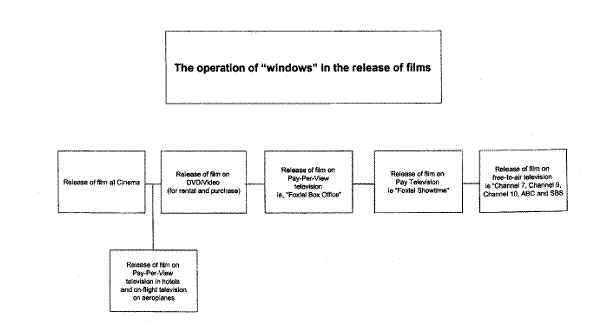
Hornsby Building Information Centre Pty Ltd v Sydney Building Information Centre Ltd (1978) 140 CLR 216 referred to
Parkdale Custom Built Furniture Pty Ltd v Puxu Pty Ltd (1982) 149 CLR 191 referred to
Puxu Pty Ltd v Parkdale Custom Furniture Pty Ltd (1980) 31 ALR 73 referred to
Heidelberg Graphics Equipment Limited v Andrew Knox & Associates Pty Limited and Others (1994) ATPR 41-326 referred to
Taco Company of Australian Inc v Taco Bell Pty Ltd (1982) 42 ALR 177 referred to
Red Bull Australia Pty Ltd v Sydneywide Distributors Pty Ltd (2002) 53 IPR 481 referred to
Telstra Corporation Limited v Optus Communications Pty Ltd (1996) 36 IPR 515 referred to
Equity Access Pty Ltd v Westpac Banking Corporation (1990) 16 IPR 431 referred to
Global Sportsman Pty Ltd v Mirror Newspapers Pty Ltd (1984) 2 FCR 82 referred to
Campomar Sociedad Limitado v Nike International Limited (2000) 202 CLR 45 applied
Sterling Winthrop Pty Ltd v R & C Products Pty Ltd (1994) ATPR 41-308 referred to
Lumley Life Ltd v Independent Order of Odd Fellows of Victoria Friendly Society (1989) 16 IPR 316 referred to
Duracell Australia Pty Ltd v Union Carbide Australia Ltd (1988) 14 IPR 293 referred to
Hoover (Aust) Pty Ltd v Email Ltd (1991) 104 ALR 369 referred to
Twentieth Century Fox Film Corporation v The South Australian Brewery Co Ltd (1996) 66 FCR 451 referred to
Truth About Motorways Pty Limited v Macquarie Infrastructure Investment Management Limited (1999) 200 CLR 591 applied
Stuart Alexander & Co (Interstate) Pty Ltd v Blenders Pty Ltd (1981) 37 ALR 161 referred to
Colgate Palmolive Pty Ltd v Rexona Pty Ltd (1982) 58 FLR 391 referred to referred to
Gillette Australia Pty Ltd v Energizer Australia Pty Ltd (2002) 193 ALR 629 referred to
FOXTEL MANAGEMENT PTY LIMITED v AUSTRALIAN VIDEO RETAILERS ASSOCIATION LIMITED, AUSTRALIAN VIDEO RETAILERS ASSOCIATION LIMITED AND FOXTEL MANAGEMENT PTY LIMITED
N 1054 OF 2004
CONTI J
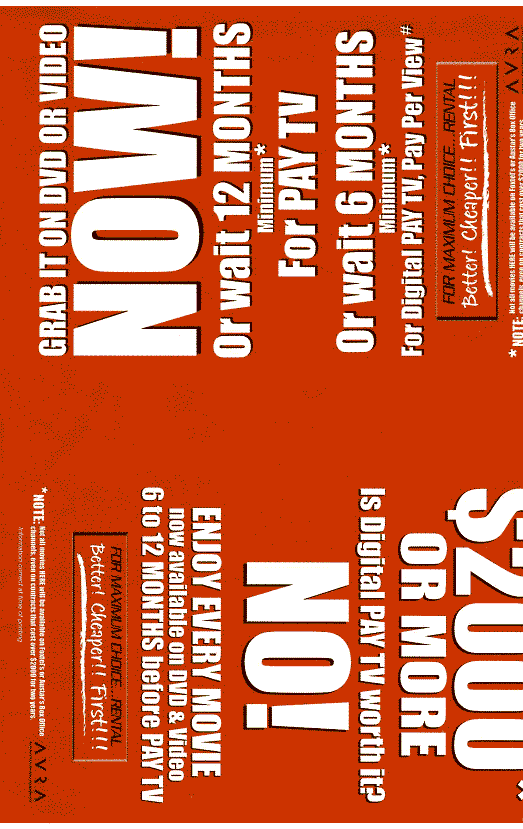
8 DECEMBER 2004
SYDNEY
|
IN THE FEDERAL COURT OF AUSTRALIA |
|
|
NEW SOUTH WALES DISTRICT REGISTRY |
N 1054 OF 2004 |
|
BETWEEN: |
FOXTEL MANAGEMENT PTY LTD APPLICANT
|
|
AND: |
AUSTRALIAN VIDEO RETAILERS ASSOCIATION LIMITED RESPONDENT
AUSTRALIAN VIDEO RETAILERS ASSOCIATION LIMITED CROSS-CLAIMANT
FOXTEL MANAGEMENT PTY LTD CROSS-RESPONDENT
|
|
JUDGE: |
CONTI J |
|
DATE OF ORDER: |
8 DECEMBER 2004 |
|
WHERE MADE: |
SYDNEY |
INDEX OF JUDGMENT
|
Page |
Paragraphs |
Headings |
|
|
|
|
|
1 |
1 - 10 |
Introduction and overview of Foxtel’s Pay TV service and of AVRA’s functions |
|
|
|
|
|
6 |
11 - 24 |
Facts and circumstances alleged by Foxtel as fundamental to the provision of its FBO service including recent developments |
|
|
|
|
|
14 |
25 - 31 |
The AVRA advertising material the subject of complaint by Foxtel |
|
|
|
|
|
18 |
32 - 59 |
Foxtel’s complaints of misleading and deceptive conduct – summary of evidence tendered by Foxtel |
|
|
|
|
|
31 |
59 - 64 |
Foxtel’s characterisation of misleading and deceptive representations said to have been made by AVRA |
|
|
|
|
|
34 |
65 - 75 |
AVRA’s responses to Foxtel’s claims of misleading and deceptive conduct |
|
|
|
|
|
40 |
76 - 103 |
Conclusions on Foxtel’s claims against AVRA |
|
Page |
Paragraphs |
Headings |
|
|
|
|
|
53 |
104 - 112 |
AVRA’s cross claims for relief in relation to the launch and promotion of Foxtel’s digital Pay TV service |
|
|
|
|
|
57 |
113 - 128 |
AVRA’s submissions in support of each complaint the subject of its cross-claim, Foxtel’s responses, and my threshold views in respect of each |
|
|
|
|
|
65 |
129 - 140 |
Conclusions on AVRA’s Cross-Claim |
|
|
|
|
|
|
|
|
|
IN THE FEDERAL COURT OF AUSTRALIA |
|
|
NEW SOUTH WALES DISTRICT REGISTRY |
N 1054 OF 2004 |
|
BETWEEN: |
FOXTEL MANAGEMENT PTY LTD APPLICANT
|
|
AND: |
AUSTRALIAN VIDEO RETAILERS ASSOCIATION LIMITED RESPONDENT
AUSTRALIAN VIDEO RETAILERS ASSOCIATION LIMITED CROSS-CLAIMANT
FOXTEL MANAGEMENT PTY LTD CROSS-RESPONDENT
|
|
CONTI J |
|
|
DATE OF ORDER: |
|
|
WHERE MADE: |
SYDNEY |
THE COURT ORDERS THAT:
1. The respondent Australian Video Retailers Association (‘AVRA’) be restrained until further order from further publishing and distributing, and further causing to be published and distributed, each of the three sets of advertising materials described in the reasons for judgment as the first, second and third advertisements.
2. The proceedings the subject of the claims of the applicant Foxtel Management Pty Limited (‘Foxtel’) be stood over until 15 December 2004 at 2:15pm for the purpose of determination of the scope and text of the final orders to be made in favour of Foxtel, including orders as to damages and costs of the principal proceedings.
3. Foxtel as cross-respondent be restrained until further order from publishing and causing to be published the representations categorised in the reasons for judgment as:
(i) the ‘movie availability misrepresentations’; and
(ii) the ‘comparison misrepresentations’
and any material in or to the effect of those representations.
4. The proceedings the subject of the cross-claims of AVRA be stood over until 15 December 2004 at 2:15pm for the purpose of determination of the final orders to be made in favour of AVRA, including orders as to damages and costs of the proceedings the subject of the cross-claim.
5. Submissions in writing of each party as to the text of the final orders to be made be delivered to my Chambers by 4.00pm on 14 December 2004.
Note: Settlement and entry of orders is dealt with in Order 36 of the Federal Court Rules.
|
IN THE FEDERAL COURT OF AUSTRALIA |
|
|
NEW SOUTH WALES DISTRICT REGISTRY |
N 1054 OF 2004 |
|
BETWEEN: |
FOXTEL MANAGEMENT PTY LTD APPLICANT
|
|
AND: |
AUSTRALIAN VIDEO RETAILERS ASSOCIATION LIMITED RESPONDENT
AUSTRALIAN VIDEO RETAILERS ASSOCIATION LIMITED CROSS-CLAIMANT
FOXTEL MANAGEMENT PTY LTD CROSS-RESPONDENT
|
|
JUDGE: |
CONTI J |
|
DATE: |
|
|
PLACE: |
SYDNEY |
REASONS FOR JUDGMENT
Introduction and overview of Foxtel’s Pay TV service and of AVRA’s functions
1 Foxtel Management Pty Limited (‘Foxtel’) undertakes in Australia the provision of pay television services (‘Pay TV’), otherwise known as subscription television services, and has done so since about 1995. Prior to 14 March 2004, those pay television services in Australia took the form of analogue services only; on that date Foxtel commenced the provision of digital services, including in particular its pay-per-view movie service, known and marketed as Foxtel Box Office (‘FBO’). FBO is only available to digital subscribers, the entitlements whereof are later outlined in more detail. Both the digital and analogue services continue to be delivered by Foxtel, although it is planned to eventually phase out the analogue service entirely.
2 The analogue and digital Pay TV services both offer subscribers a large number of channels relating to subjects or features such as news, sport and entertainment. Each subscriber must take up at least the so-called ‘basic tier’; other tiers of channels such as so-called ‘Movie Essentials’, ‘Movie Plus’ and ‘Entertainment Plus’ may be further taken up by additional subscription to the analogue service, while so-called ‘Movies’, ‘Movies De Luxe’, ‘Quest & Adventure’, ‘Fun & Entertainment’ and ‘Laughter & Living’ tiers may be further added to the digital service. By comparison with the analogue service, the digital service contains improved pictures and sound and ‘interactive’ and enhanced services. Specifically, the new basic tier of the digital service, called ‘Digital Basic’, includes three additional channels, six time shift channels, 24 to 30 audio channels and more. There was no price increase imposed by Foxtel upon the introduction of the basic digital service by comparison with the basic analogue service delivered by satellite, though a price increase was introduced in relation to the tier of the analogue services delivered by cable, which was from $42.95 to $48.95 per month. The top or ‘Platinum’ package for the digital service includes all available tiers and presently costs $94.95 per month. In addition a connection fee is payable upon subscription to both digital services.
3 FBO was described as one of three interactive and enhanced new services, the others being ‘Sports Active’ and ‘News Active’, not relevant for present purposes, available as part of Foxtel’s digital services. A subscriber must presently pay a fee of $5.95 to watch a particular movie on the FBO service. A subscriber to FBO may thus choose to watch in particular one of a number of recently released movies available at any time of the day or night. The FBO movies are screened at fixed times, typically every 15 to 30 minutes, so that the subscriber is able to commence watching a movie, often within minutes, of deciding to do so. Hence the promotional Foxtel phrase adopted of ‘near-video-on-demand’. Once purchased or selected as part of the FBO service, a movie may be watched by the subscriber at any number of viewing times when the movie is shown, commencing from the next scheduled viewing time after the moment of purchase, and continuing up and until 5.59 am on the following day. Thus if the subscriber nominates, at the time of purchase, a viewing time for the movie to start the next day, or at any point up to three days in advance, that subscriber can watch the movie at any number of times when it is shown, starting from 6.00 am on the day of the nominated viewing time up until 5.59 am on the following day.
4 The mechanical steps involved in viewing an FBO movie were explained in the affidavit evidence of Mr Patrick Delany, Foxtel’s ‘Executive Director – Content, Production Development and Delivery’ (‘Mr Delany’) as follows:
‘3. …
(a) The subscriber must first press the “Box Office” button on the FOXTEL Digital hand-held remote control. The subscriber’s television screen will then show a menu of options for the “FOXTEL BOX OFFICE” service. The subscriber then uses the remote control to select “Now Showing” to access a list of the movies which are currently available for viewing, and the time when they may be viewed.
(b) The subscriber can then use the remote control to select the “FOXTEL BOX OFFICE” movie which he or she would like to watch. The subscriber must also select a start time for that movie from the range of available start times shown…
(c) Once the subscriber has selected the movie and start time, a message appears on the subscriber’s television which lists the movie and start time that has been selected, the censorship rating of the movie and the price “$5.95 Inc GST”. The subscriber may also be prompted for his or her “PIN” (personal identification number) if he or she has previously elected to have this security mechanism. From this screen the subscriber can choose “Select” to complete the order of the movie or “Back” to exit to the previous screen.
…
(e) When a “FOXTEL BOX OFFICE” movie is ordered and viewing time selected by a subscriber, the details of that movie are automatically entered into the subscriber’s personal “planner” maintained electronically by the FOXTEL Digital Service, which is effectively a calendar showing the subscriber’s future viewing schedule as programmed by the subscriber.
4. A subscriber will receive a “reminder” message on his or her television screen shortly before the commencement of a movie the details of which are contained in the subscriber’s planner to assist the subscriber to remember the viewing time selected.
…
6. To be charged for a movie a subscriber must actively use his or her handheld remote control to select and tune into the channel or channels on which the ordered movie is playing at any time after the movie has been ordered up until 5:59am AEST on the day of the selected movie screening time. If the subscriber does not tune into the relevant channel or channels during this period he or she will not be charged for the “FOXTEL BOX OFFICE” movie.’
5 As is shown by the diagram below, which was prepared by Foxtel’s legal representatives, so-called mainstream movies are generally speaking released in Australia for viewing according to a staged process. The first release has traditionally occurred in the cinema. Since from about the 1970s to the 1980s, the next release (aside from releases to hotels and on-flight television on aeroplanes for present purposes), made some months later, has occurred on videos and so-called DVDs available for rental, and in many cases for purchase, by customers through various outlets, including those of video and DVD operators, many of whom have been, or presently are, members for the time being of the respondent Australian Video Retailers Association Limited (‘AVRA’). The next stage in the diagram, being that asserted by Foxtel to have come about in the context of movie releases in March 2004, is at the heart of the controversy in the proceedings, and will shortly be addressed. As to the following stage, the same was introduced in 1995, occasioned by the release of movies to analogue Pay TV, but now also includes all of Foxtel’s digital Pay TV services other than, ‘Sports Active’, ‘News Active’ and FBO, described as ‘interactive’. The final stage of movie release has traditionally taken place on ‘free to air’ television channels, being known by abbreviation as the ABC, SBS, and in Sydney metropolitan area etc Channels 7, 9 and 10, and that continues to be the case.
6 The periods of time between those various stages of movie release are referred to in the industry as ‘windows’. Those stages of movie release are generally determined by agreements or arrangements or practices made or undertaken between the film movie studios on one side and the various outlets and service providers on the other side. There are about nine major movie studios, presently named or identified as MGM, Paramount, Sony incorporating Columbia, Universal, Disney incorporating Buena Vista, Warner, Dream Works, Roadshow and Twentieth Century Fox. AVRA added to that list what it asserted to be a major movie studio named Icon. As seen above, each stage of the release of a film is separated by a preceding or following window, represented by a horizontal line, thereby illustrating the contractually prevailing sequential periods of time between the nature or identity of exhibitor(s) of films in succession. I shall hereafter refer to the window between ‘Release of film on DVD/Video (for rental and purchase)’ and ‘Release of film on Pay-Per-View television ie “Foxtel Box Office”’ as the ‘FBO window’ and the window between ‘Release of film on DVD/video (for rental and purchase)’ and ‘Release of film on Pay Television ie “Foxtel Showtime”’ as the ‘Showtime window’. As I have indicated, the first stage of these releases is confined to digital Pay TV while the second stage of these releases is relevant to both analogue and digital Pay TV.
7 Of primary importance to the issues arising in the present proceedings is the recently engaged FBO window between the initial release of movies on DVD and video, and the release of those movies later in time to pay-per-view television services such as FBO. Prior to the introduction of FBO, the window period between the release of a movie on DVD and video, and its showing on analogue Pay TV was in the order of 12 months. However, with the advent of digital Pay TV, and in particular FBO, an earlier release window time, the FBO window, has been enjoyed by Foxtel. Of further relevance to the issues arising is the price of accessibility to the Foxtel digital pay-per-view service, FBO, for the viewing of those movies, implicitly in comparison to the price for the hire for viewing purposes of movies on DVD and video from video stores.
8 AVRA is an independent corporate body which, as already foreshadowed, represents the majority of video and DVD libraries or stores on an industry basis in Australia. It is constituted as a company limited by guarantee, and has a board of directors, comprising about 10 in number, who are elected annually. It has approximately 1100 members, the range thereof including:
(i) large companies which own and operate video chains comprising hundreds of individual video and DVD libraries;
(ii) smaller operators of video and DVD libraries;
(iii) individual retail stores that are members of a video and DVD library chain; and
(iv) individual stores that are not members of any video and DVD library chain.
Members of AVRA pay an annual membership fee. Some of the members conduct more than one video store or outlet; indeed in some cases, members conduct quite a number of stores or outlets.
9 AVRA’s primary objective is to develop, promote and represent the video and DVD industry by providing services, support and direction to and for its members. AVRA’s functions include the representation of that industry in discussions and negotiations with government bodies in relation inter alia to matters of censorship, movie classification, and changes to laws that affect the industry. It was incorporated as a company limited by guarantee.
10 AVRA does not itself conduct any business of selling or hiring videos or DVDs. That business is conducted by video and DVD stores and related selling/hiring outlets (all of whom I will hereafter include in the expression video stores rather than video libraries). AVRA pointed out that Foxtel has not joined any video stores as respondents to the proceedings, nor is there any evidence that Foxtel has ever communicated with store owners about the conduct whereof it complains in the present proceedings. Foxtel’s conduct in that regard is however understandable, at least upon the basis of practicality, in the light of the large numbers of entities involved. Any such joinder would obviously have militated against any practical and expedient conduct of what has become complex litigation.
Facts and circumstances alleged by Foxtel as fundamental to the provision of its FBO service including recent developments
11 Foxtel pointed to the following three factors in particular, said by Foxtel to have been established by the evidence adduced in the proceedings, and to be material to its entitlement to curial relief.
12 The first factor is that Foxtel has made arrangements with seven of the major studio corporate groupings earlier identified in these reasons for the release of movies to its FBO service. Those arrangements are evidenced mainly by complex, though largely standard forms of documentation, adopted by each studio separately, mostly involving at least initial three year terms of operation. All such arrangements were in operation at the time of commencement of the AVRA advertising campaign complained of. As to five of those seven studio corporate groupings, namely MGM, Paramount, Disney incorporating Buena Vista, Roadshow and Twentieth Century Fox, the FBO window (ie the period of time between the release of movies on DVD and home video on the one hand, and availability on Foxtel’s FBO service on the other), is contractually provided to be no later than six months or 180 days from home or local video release or sale or rental in Australia, or to similar effect of operation. Movies are currently provided by those five studios to Foxtel on that window basis, pursuant to the terms of current licence agreements in operation in each case. The existence of that not less than six month window in favour of Foxtel, pursuant to contractual stipulation to that effect, in relation to those five so-called movie houses, is not disputed by AVRA, and indeed could not be so disputed, in the light of the five formal written agreements in favour of Foxtel tendered in evidence.
13 Universal is one of the remaining two major studios with whom Foxtel has historically enjoyed similar window arrangements, although the FBO window is stipulated by the formal written instrument in favour of Foxtel to be, in relation to so-called ‘Currents’, no later than 180 days, and in relation to so-called ‘TVMs’, no later than six months, in either case ‘after home video street data in Territory where applicable’. Notwithstanding the terms of that formal instrument, Foxtel asserted in evidence that it was actually being then provided by Universal with movies on a three month FBO window, and Foxtel tendered email communications passing between itself and Universal, including the following email from Universal to Foxtel sent on 2 March 2004:
‘Attached you will find a revised avail list for PPV/VOD Australia based on 3 months from local home video release as per Holly’s approval. Please note that this is only a tentative availability list and subject to final confirmation on conclusion of the Foxtel deal…’
For what it may ultimately matter, AVRA pointed out that the Universal material in evidence did not evince any firm arrangement of a formal nature henceforth to operate in all cases by way of a 180 day FBO window. AVRA accepted however that on 23 June 2004, an AVRA board meeting was informed that Universal had entered into an agreement with Foxtel for the provision of product on the basis of a three month FBO window. That board meeting occurred 30 days after AVRA set in train the physical dispatch to video stores of the first set of promotional material complained of in the proceedings, and eight days after AVRA physically dispatched the second set of that promotional material to video stores.
14 In the case of the Warner studio, the FBO window was also said by Foxtel to be operating on a three months window release date, which is consistent with the availability date provisions of the Warner written agreement of 1 April 2004 in evidence. In that regard clause 10.1 of that Warner agreement provides as follows:
‘10.1 The “Availability Date” for each Included Program shall be as follows:
10.1.1 For each Current Theatrical Release, the Availability Date shall be as advised by Warner, but no later than the earlier of:
10.1.1.1 For Current Theatrical Releases having an Availability Date in Year 1, (i) three (3) months from the local video release date in the Territory (“LVR”), or (ii) if there is no LVR, thirty (30) months from the US theatrical release; or
10.1.1.2 For Current Theatrical Releases having an Availability Date in Year 2 and in each Year thereafter, (i) six (6) months from LVR, or (ii) if there is no LVR, thirty (30) months from the US theatrical release.’
However it would appear that subsequently in May 2004, the commencement of operation in favour of Foxtel of a three months window from Warner was agreed to be put back until September 2004, which resulted in four movies being ‘pulled’ by Warner, in controversial circumstances shortly to be related.
15 The position adopted by AVRA was that it disputes that the new Universal written arrangements stipulate a three month period, but accepts that the new Warner written agreement does so stipulate. As I have already mentioned, AVRA accepted that Foxtel had the benefit of at least not later than six month window with Universal until 23 June 2004, whereafter AVRA has been aware that prior thereto, Universal had entered into an agreement with Foxtel upon the footing of a three month window. Foxtel has not, at least as yet, entered into studio window arrangements with three remaining significantly sized movie producers, namely Sony Incorporating Columbia, Dream Works, and also Icon (the latter not being in any event described by Foxtel as a major studio). I should add that Foxtel accepted that movie houses, with which it has no distribution agreement at all, have also produced ‘blockbuster’ movies such as ‘The Passion of Christ’, ‘Monster’, ‘Shrek I’ and ‘Shrek II’.
16 The second of the three factors said by Foxtel to be material to the grant of curial relief is that although there have been certain exceptions, whereof details were explained in considerable detail by Mr Delany, those seven major studio groupings have been at material times providing movies to Foxtel in accordance with the consensual window periods of time, both formally and informally documented which I have earlier recorded, and that Foxtel has been showing those movies on FBO. This second factor involved controversy in the proceedings in the context of a period of transition concerning the introduction of arrangements for implementation of the FBO window, in particular Warner’s new film titles ‘Matchstick Men’, ‘Looney Tunes’, ‘Last Samurai’ and ‘Something’s Gotta Give’. It is appropriate to trace in some detail certain of the communications which occurred in relation to this controversy, as between Warner and AVRA on the one hand and Warner and Foxtel on the other, in the light of the attention given to what may be described as the Warner FBO window controversy at much of the centre of the proceedings.
17 A convenient starting point of those communications was Warner’s letter to AVRA (written by Mr Nickerson) of 22 March 2004 containing inter alia the following:
‘We will continue to look at 3 separate windows, which will consist of (1) pay per use, (2) Pay TV, and (3) free to air.
Pay per use will include video on demand, near video on demand, and pay-per-view. Pay TV includes both cable or subscription TV, as well as premium subscription channels.
The chart below will show what window we currently have for each classification, and where the window could move to within the next 6 months.
|
Category |
Current Window* |
Future Window* |
|
Pay Per Use |
6 months |
3 months |
|
Pay TV |
12 months |
9 months |
|
Free to Air |
24 months |
12 months from Pay TV release |
*From Home Video street date
For all of the categories above, there will be on air advertising permitted 45 days prior to the initial air date, and program guide (print) advertising available 60 days prior to initial air date.
As any of this information changes, we will inform you and your members ASAP…
We appreciate your continued support and understand our obligation to inform you on a timely basis of changes to our business models.
…’
In short, as so described by counsel for Foxtel, that Warner email informed AVRA that at some time within the ensuing six months, the existing FBO window could change from six months to three months.
18 The evidence does not disclose any immediate reaction in writing on the part of AVRA to that Warner notification until AVRA’s communication of 11 May 2004 made explicitly on behalf of its board of directors to Warner reading as follows:
‘I have been asked to write to you on behalf of the Board of Directors seeking an explanation as to why the following titles, Sylvia, Bright Young Things and Normal in your July dealer information kit have a published window to Pay per View as “To be determined”.
In your letter to the Association dated 22nd March you clearly indicated the current window to Pay per View was “6 months” and this was relayed to our members in the AVRA April Newsletter. Your letter then goes on to say “as any information changes, we will inform you and your members ASAP.”
No such notification has been received, so the Board cannot understand why you would proceed to publish the window period as “To be Determined”.
As you are well aware stores make their commercial business decisions when buying product on the information disclosed and published in the dealer kits and to that end the Board asks that window period for these titles be clearly and correctly stated as 6 months. To erase any confusion in the market place this should be done immediately.’
19 Warner does not appear to have responded to that AVRA communication, and on 17 May 2004, AVRA wrote again to Warner in the following terms:
‘I am writing to you on behalf of the AVRA Board in relation to your title “Matchstick Men” advertised for screening by Foxtel 3rd to 23rd June.
In your letter to the Association dated 22nd March, you clearly indicated the current window to Pay per View was “6 months”. This information was relayed to our members in the AVRA newsletter in April. Although your letter goes on to say that as information changes, we will inform you and your members ASAP, no such notification has been received.
The Board cannot comprehend how you can detail Warner policy in correspondence and within months have scant regard to its contents.
Our members base their commercial buying decisions on the information disclosed and available at the time and the Board, on behalf of its members is seeking an agreed financial arrangement to offset the revenues lost by this titles early release to Pay per View.’
The bold print was that used by AVRA.
20 Warner’s response to this communication was to immediately email Mr Delany of Foxtel, stating: ‘I need your help on this Patrick’. Thereafter ensued a number of email messages, including email messages between Foxtel and Warner, whereby compromise solutions by way of ‘pulling’ certain planned FBO screenings were proposed and discussed in relation to the issues raised in the correspondence, notwithstanding the title features which had been already scheduled and published by Foxtel for pay-per-view availability. Foxtel asserted for instance that Matchstick Men had been planned to premiere on 3 June 2004, Looney Tunes in July 2004, and Last Samurai and Something’s Gotta Give both in August, and that Foxtel stood to have ‘no Warner titles scheduled June, July and August’. Foxtel asked Warner moreover ‘Will this affect Warner titles from September onwards?’ In the meantime Civic Video Pty Ltd, a large video store operator in Australia having many store outlets, had emailed Warner on 18 May 2004, asserting ‘breach of the published 12 month TV holdback’, and referring to ‘… our meeting dated 22 March’, and Warner’s alleged acknowledgement that ‘… the introduction of a Pay Per View window… would commence with a six month window and Civic would be notified of any future changes [which] has not occurred’.
21 Warner subsequently wrote to Foxtel on 21 May 2004 indicating the following compromise:
‘Reference is made to that certain Pay Per View Term Sheet (hereinafter the “Agreement”) dated as of April 1, 2004 between Warner Bros. (Australia) Pty Ltd (ACN 000 013 445) (“Licensor”) and FOXTEL Management Pty Limited (ABN 65 068 671 938), as agent on behalf of FOXTEL Partnership (“Licensee”), in full force and effect as of the date hereof. All capitalized terms used herein but not expressly defined herein are as defined in the Agreement.
1. The following three (3) titles represent additional selections of Year 1 included Programs licensed under the Agreement as follows:
Licence Period
(Month/Day/Year)
3 Included Programs Category Availability Date Expiration Date
|
LAST SAMURAI, THE LOONEY TUNES: BACK IN ACTION SOMETHING’S GOTTA GIVE |
Mega Current B Mega |
11/12/2004 02/11/2005 09/30/2004 12/29/2004 10/28/2004 01/27/2005 |
2. The Licence Period for the Included Program MATCHSTICK MEN has been revised, as follows:
Original Licence Period Revised Licence Period
(Month/Day/Year) (Month/Day/Year)
Availability Expiration Availability Expiration
1 Included Program Date Date Date Date
MATCHSTICK MEN 06/03/2004 09/02/2004 09/03/2004 12/02/2004
The Schedule 2 (Year 1), attached herewith and incorporated herein by this reference, sets forth all Included Programs licensed in Year 1 to date and supercedes any previous versions.’
The date specifications extracted above appear in the order, first as to the month, secondly as to the day of that month, and thirdly as to the year.
22 On the following day (22 May 2004), Warner wrote to AVRA, presumably in response to either or both of AVRA’s above communication, as follows:
‘I apologize that the response has not been sooner, but I wanted be sure that the information that follows is as complete and accurate as possible.
Firstly, despite the advertisements that recently ran from Foxtel, there will not be any Warner titles that have recently been released to VHS/DVD that will play on pay per view before the end of the six month window that was previously communicated to AVRA. This includes Matchstick Men, as well as all titles released through June. The advertisements for Matchstick Men are being pulled off the air. Please note that there will be an ad in the June Foxtel program guide, which could not be removed because of print timelines.
In addition, the July titles mentioned in your May 11 email will also have a six month pay per view window. The reason that our dealer kit materials were written as they were is due to the print deadlines that we work under, and the possibility that the window on these titles might have been changed. (This is one of the reasons why we would like you to encourage your members to utilize the WHVdirect.com website, as it allows for the timeliest and most accurate info on titles, with the product info and updates permitted to be done immediately, without the need for us to be working under old prehistoric print deadlines).
The likelihood of a change in our windows for pay per view was clearly communicated in my March letter.
I can now confirm that commencing in August, some of our titles will have a 90 day pay per view window. As there is a possibility for some of our titles to stay with a six month window (depending on supplier) we will communicate specifically for each title in our dealer kit and on our website.
Any further changes in our policies will be communicated as soon as possible, both to you and directly to your members through our sales force.’
The second and third last paragraphs are significant in relation to Foxtel’s case, the same signalling to AVRA the intended acceleration of the then current six month FBO window to three months, or more specifically, 90 days. The reference to the so-called ‘March letter’ was implicitly to that of 22 March 2004 from Warner to AVRA earlier extracted in these reasons. Significantly, that Warner communication also occurred prior to AVRA’s distribution of the promotional material the subject of the proceedings, as to the first and third advertisements later referred to on or about 24 May and as to the second advertisement later referred to on 15 June 2004.
23 Thereafter on 27 May 2004, Warner Bros wrote to Foxtel as follows:
‘This letter will serve to confirm the parties’ agreement that the following films from Year 1 will be made available to Foxtel six months (rather than three months) following local video release in the Territory:
MATCHSTICK MEN
SOMETHING’S GOTTA GIVE
THE LAST SAMURAI
LOONEY TUNES: BACK IN ACTION
Please contact me immediately should any of the above not reflect the parties’ current understanding.’
Thus it will be seen that in response to Warner’s request for ‘help’ from Foxtel, by reason of Warner’s apparent omission to provide AVRA with earlier up-dates to Warner’s letter of 22 March 2004 in respect of its new FBO window arrangements, at least so far as concerned the four films abovementioned, the foreshadowed shortened period of the FBO window, was deferred to the temporary advantage of video stores, inclusive of course of those operated by members of AVRA.
24 The third factor said by Foxtel to be material to the court’s intervention is that Foxtel’s so-called digital service is available to subscribers to the Digital Basic tier plan for the recently introduced subscription fee of $48.95 per month. Any person who subscribes to a fixed contract is also entitled to terminate his or her contract at any time within the contract term or period, upon payment of a maximum fee of $250. For example, in relation to a period of two years based on the Digital Basic tier plan, a subscriber pays periodic subscription fees of 24 x $48.95, being $1174.80 in total, so that adding thereto the appropriate installation fee of $129.95, the total payment for the initial two year period is $1304.75. That Foxtel digital service has been available from 14 March 2004 on a six month contract in relation to the so-called Digital Basic tier, involving a total installation and subscription fee of $249.95 plus six times the above amount of $48.95 equalling $543.65; moreover as outlined above further tiers are available at greater cost. In addition, there is evidence that subscribers to the so-called Platinum package, again referred to above, relevantly exceed $2000 on a two year plan, in that regard in contrast to all other digital Pay TV contracts.
The AVRA advertising material the subject of complaint by Foxtel
25 Foxtel’s complaints against AVRA the subject of the proceedings relate to an advertising campaign commenced by AVRA in Australia in the month of May 2004, apparently provoked by Foxtel’s launch in March 2004 of its digital pay-per-view service, FBO. The present proceedings were instituted by Foxtel on 6 July 2004. That campaign took the form of a so-called marketing kit, described in the proceedings as a ‘pro-rental kit’. To adopt the description of counsel for AVRA, the marketing kit was designed at least primarily to extol the virtues of hiring videos and DVDs from video stores, in comparison in particular with Foxtel’s recently introduced FBO service. That kit included what have been identified in these proceedings as ‘the first advertisement’, ‘the second advertisement’ and ‘the third advertisement’, in relation to each of which, Foxtel makes complaint in the proceedings as to contravention by AVRA of ss 52(1), 53(c) and 53(e) of the Trade Practices Act 1974 (Cth) (‘TP Act’). Those sub-sections read as follows:
‘52(1) A corporation shall not, in trade or commerce, engage in conduct that is misleading or deceptive or is likely to mislead or deceive.
…
53. A corporation shall not, in trade or commerce, in connexion with the supply or possible supply of goods or services or in connexion with the promotion by any means of the supply or use of goods or services:
…
(c) represent that goods or services have sponsorship, approval, performance characteristics, accessories, uses or benefits they do not have;
…
(e) make a false or misleading representation with respect to the price of goods or services;
…’
26 The pro-rental kit was offered to members of AVRA for purchase in the sum of $69.90 plus postage costs. The pro-rental kit was apparently offered for sale to non-AVRA members as well and a number of non-members purchased the same for similar display in their respective stores. Altogether about 1600 kits were sold by AVRA. Thus it may be inferred that a very large number of video stores displayed the promotional material the subject of the kit. Because of printing problems, the kit was prepared and dispatched to purchasers in two stages (infra).
27 Those three categories of advertisements comprised in summary as follows:
(i) as to the first advertisement, one side of a large single page advertisement headed ‘GRAB IT ON DVD OR VIDEO NOW!’ followed by (inter alia) the words ‘Or wait 12 MONTHS Minimum For PAY TV Or wait 6 MONTHS Minimum for Digital PAY TV, Pay-per-view’; AVRA did not dispute that it prepared and provided that material to its members (inter alia) as part of the pro-rental kit, and that the same was forwarded to such purchases for display in poster form; AVRA further caused a smaller version of that single advertisement to be included as an entire page its video retailing magazine C Mag published for the month of July 2004; the first advertisement was however provided to its video store members principally for the purpose of display in their stores; the first advertisement, reduced to A4 size, is reproduced by way of initial attachment to these reasons;
(ii) as to the second advertisement, comprising a single sheet containing written material on both sides, being designed to fold in half, and thus to consist of four pages; on the front side there appeared (inter alia)‘Thinking of paying for digital PAY-TV? Start counting to 365 – that’s how many days you’ll have to wait before your favourite movie is out on PAY-TV.’; below that appeared a diary, opened on the page for 7 July 2004 upon which is written ‘50 First Dates out on DVD and VHS!! (not on Pay TV til July 2005)’; on the reverse side appeared on one page the heading ‘GRAB IT ON DVD OR VIDEO NOW!’, and below that ‘Better get used to counting because digital pay television customers will have to wait up to a year longer than video library members to see the same new release movies’; then on the other page the heading ‘Stick with us’, followed underneath by ‘New release movies at least 6 months before digital PAY-TV’, and underneath again ‘No $2000-plus contracts…’; each kit contained 500 of these second advertisement fliers; both the front and reverse sides of the second advertisement are reproduced by way of second attachment to these reasons; and
(iii) the third advertisement, having two pages of printed matter, also intended to be folded, one page comprising the same (but a smaller version) of the first advertisement and the other page comprising (in the same colours) ‘$2000 OR MORE Is Digital PAY TV worth it?’, followed by a large ‘NO!’ and following further below with the message ‘ENJOY EVERY MOVIE now available on DVD & Video 6 to 12 MONTHS before PAY TV’; the third advertisement was designed to serve the function as covers or ‘slicks’ for video and DVD cases (and hence the two variations in size); again, the third advertisement is reproduced by way of third attachment to these reasons.
28 The first and third advertisements were printed on or about 17 May 2004 and dispatched to purchasing video stores on or about 24 May 2004; the second advertisement was printed on or about 8 June 2004 and dispatched also to purchasing video stores on or about 15 June 2004. In the context of the proceedings, it appears that AVRA has since undertaken not to further distribute those kits. AVRA did not however take any steps by way of recall of the advertisements thus purchased and sold and disseminated, nor did AVRA instruct the purchasers of the advertisements to cease to use the same, whether on the footing of refund of the purchase price, or otherwise.
29 It is not in dispute that at least many members of AVRA exhibited and disseminated the AVRA promotional materials, the subject of the proceedings, at and from their video stores. In the words of counsel for Foxtel, the campaign constituted by these materials was ‘intended to speak to the public for some time’. It is those materials which are of course the focus of the proceedings.
30 As foreshadowed in these reasons, AVRA arranged for the first advertisement to appear in the June 2004 issues of trade magazines, and in one case, in July 2004. It may be inferred that many AVRA members displayed the advertisements in their respective stores, particularly since the same had to be purchased from AVRA in the first place, and it is unlikely that AVRA members would have outlaid $69.90 for a pro-rental kit and not used the same for the purpose for which the kit was thereupon supplied. The first advertisement also contained the words ‘All details are verified and correct at time of printing’, the second advertisement contained the words ‘All information is correct at the time of printing’, and the third advertisement contained the words ‘Information correct at time of printing’, though in each case, not with the prominence of the respective dominant messages which I have already reproduced. Nevertheless, given the substantial size of the poster form of the first advertisement, its footnotes are readily readable by a proximate passer-by, though of course most casual observers would tend to focus on the major text thereof.
31 It appears from very comprehensive first hand affidavit testimony provided by Foxtel that at least some of the material complained of was still being displayed in numerous video stores shortly prior to the hearing. The second advertisement, having also been a one page feature of AVRA’s monthly magazine, would have remained for perusal or viewing in that physical context at least for the month of July 2004.
Foxtel’s complaints of misleading and deceptive conduct – summary of evidence tendered by Foxtel
32 Foxtel correctly submitted that the evidence disclosed that since the launch of its digital service, Foxtel has enjoyed the advantage of an FBO window of no later than six months (my emphasis), in the case of MGM Worldwide Television based on Licence Agreement dated 15 April 2004, of Paramount Pictures International based on Licence Agreement dated 24 February 2004, of Twentieth Century Fox Film Corporation based on Licence Agreement dated 3 February 2004, of Buena Vista International based on Licence Agreement dated 26 October 2001, and of Roadshow Television based on Licence Agreement dated 7 July 2003. In the case of Warner and Universal, even shorter FBO windows became available in the informal circumstances I have already recorded in these reasons, prior to those informal circumstances taking place, Foxtel had entered into Licence Agreements with Warner and Universal in similar terms to those granted to Foxtel by the five first mentioned movie houses. In each case of the formal movie production agreements entered into by Foxtel, the same were thus in place prior to the launch of Foxtel’s digital Pay TV service. The more recent arrangements involving shorter FBO window periods available to Universal and Warner were seemingly made prior to the Foxtel Digital launch, albeit that in the case of Warner, the showing of the earlier identified four movies was agreed by Foxtel to be deferred until September 2004.
33 Foxtel’s enjoyment of the benefit of each of the FBO and Showtime windows was further asserted by Foxtel to render untrue AVRA’s advertising representations as to a waiting time of 12 MONTHS Minimum for viewing of Foxtel Pay TV movies, for the reason that an ordinary consumer would think that the reference to ‘PAY TV’ in the AVRA advertisements would include the ‘Digital PAY TV’ FBO service. In this context, Foxtel emphasised that FBO is integral to the Foxtel digital Pay TV generally, and pay-per-view services in particular, and has been so since its availability to consumers in Australia.
34 Foxtel further contended that at the time of distribution of the AVRA so-called pro-rental kits to video stores, and during the lifespan thereafter of the pro-rental campaign, there was in operation in favour of Foxtel three month FBO windows, or thereabouts, conferred by two of the major studios, namely Universal and Warner (subject to the deferral arrangements made with Warner in relation to the four movies I have earlier identified), and in relation to five of the remaining major studios which I have also already identified, the FBO window was contractually expressed to be ‘no later’ than six months, or words to similar effect, in contrast to AVRA’s advertised reference to ‘6 MONTHS Minimum. Upon that footing, Foxtel contended that those ‘6 MONTHS’ representations by AVRA were false and misleading. Foxtel tendered in support of that contention a so-called ‘Summary of information contained in documents to be tendered on behalf of [Foxtel] in relation to actual local video release dates and FOXTEL BOX OFFICE premiere dates 19 February 2004 to 30 September 2004’, which detailed movies supplied to it by Roadshow, Twentieth Century Fox, Buena Vista, Paramount, MGM Warner and Universal (in that sequence), and thereby demonstrated the FBO window enjoyed by Foxtel from the majority of major movie houses from April 2004.
35 Consistently with what I have already also recorded, Foxtel submitted that at no time before or during the AVRA advertising campaign were the AVRA representations as to a ‘$2000 OR MORE’ price accurate; similarly as already recorded, at all times during the AVRA campaign, Foxtel’s digital services, inclusive of access to its FBO service, was (and still remains) available on packages costing substantially less than $2000 for two years, apart from Foxtel’s Platinum subscription package earlier mentioned. It appears that there was a discussion at the AVRA board level, as early as April 2004, concerning the accuracy of that latter representation, occasioned by a three page email of 2 April 2004 from Mr David Hynes to other AVRA board members, in which the following inter alia appears:
‘I have noticed that as a couple more drafts of the POS have been suggested and designed that the wording might be getting “tighter” but we might also be slipping into dangerous LEGAL waters
For example,
“FACT! Spend $2328.78 for PAY TV to see movies 6-12 months after video rental!”
That’s the Platinum subscription, the most expensive, and while that might be the full cost, perhaps there are “out clauses” in the contract.
…’
36 The email response of 8 April 2004 from Mr George Kafataris, the President of AVRA, who gave affidavit evidence in the proceedings and was cross-examined by video link, included the following:
‘…
New disclaimer to be added
… only 2 movies per month included for Foxtel premium package at over $2000 for 2 years. Other movies will be charged.’
Mr Hynes’ further email of 8 April 2004 stated thereafter as follows:
‘…
Next I do believe that Keran is right on the money when she says that any references to Pay TV contracts and Prices must go to David Bradley for a legal opinion (none of us have actually seen a Pay TV contract… and maybe there are “OUT” options that mean that the $2328 contract doesn’t have to be paid out in full.
More importantly on that, I am heeding the advice of members that quoting the MAXIMUM subscription price might not be the ideal position and in fact, might be seen as being detrimental to our cause. After all, you can get “Box Office” for about $70 a month and we don’t know whether there are special, non-advertised deals being done at a cheaper rate (eg “Basic PLUS ONLY Box Office”).
…’
The above reference to ‘Keran’ was to AVRA’s board member Ms Wicks, one of AVRA’s principal witnesses in the proceedings, whilst the reference to David Bradley is to the solicitor on the record for AVRA in the present proceedings.
37 Foxtel submitted in any event, on the assumption that the ordinary consumer was able to distinguish between references to ‘PAY TV’, ‘Digital PAY TV, Pay-Per-View’ and ‘digital PAY-TV’ per se (those three descriptions being variously appearing in the three advertisements), being an assumption which Foxtel disputed as a general proposition, that the statements relating to movie availability waiting periods of time made by AVRA in those advertisements were not true. Foxtel thus pointed to the statements so made in the first and third AVRA advertisements that subscribers would need to wait ‘6 MONTHS Minimum’ to see movies on Digital PAY TV, Pay-per-view’, placing emphasis on the word ‘Minimum’, which tends to infer the notion of open-ended. In the case of the second AVRA advertisement, Foxtel pointed to the statement that ‘… digital pay television customers will have to wait up to a year longer than video library members to see the same new release movies’ and to the words ‘Start counting to 365 – that’s how many days you’ll have to wait before your favourite movie is out on PAY-TV’, appearing immediately following the words ‘Thinking of paying for digital PAY-TV?’. To the extent that consumers might not appreciate or readily appreciate the distinction between ‘PAY TV’, ‘digital PAY-TV’ and ‘Digital PAY TV, Pay-Per-View’, Foxtel asserted that those consumers would be misled and deceived by conflating the concepts involved.
38 Apart from the MGM, Paramount, Twentieth Century Fox, Buena Vista and Roadshow agreements, involving no later than six months availability, or virtually equivalent stipulations, Foxtel again pointed to the earlier documented Warner and Universal formal agreements, and to the subsequent correspondence and events in evidence involving Warner and Universal, both as to acceleration or intended acceleration of that availability. Specifically in relation to Warner, Foxtel placed reliance upon the further circumstances that in May 2004, Foxtel screened two Warner movies called A Mighty Wind and White Oleander on the basis of four and five month FBO windows respectively. AVRA’s response was that no material significance should be ascribed to those two screenings, since all that was demonstrated thereby was merely that ‘prior to August 2004, only those two movies were by that time exhibited within six months of their release date in Australia’, and further that such screenings occurred ‘without the knowledge of AVRA representatives and in breach of contractual assurances provided by Warner Bros, both at the time the titles were sold to video stores, and in the course of communications between Warner Bros and individual store proprietors… and between Warner Bros and AVRA.’ AVRA did not appear to provide evidence as to any earlier release dates in the United States, nor did it appear to point to the basis for the existence of any such contractual assurances, apart from two emails, one from Civic Video Pty Ltd (whereof Mr Kafataris is managing director) to Warner dated 18 May 2004 and another of 22 May 2004 from Warner to AVRA, wholly extracted above, neither of which establish per se the AVRA proposition so put forward.
39 AVRA made no apparent attempt in any event to restrain any such breach of contractual assurances by any court proceedings taken against Warner; instead AVRA submitted that ‘[h]ad AVRA or individual video store or chain proprietors been aware that it was proposed to allow Warner Bros movies prior to August 2004 within 6 months of their release date in Australia, AVRA would have made contact with Steve Nickerson of Warner Bros and requested that “he pull” the movies (ie A Mighty Wind and White Oleander) from FBO’. However it would be clearly unsafe to give effect to that somewhat hypothetical assertion.
40 In the context which I have outlined, it was therefore submitted by Foxtel that at the time of distribution of the AVRA pro-rental kits, and during what was described as the subsequent lifespan of AVRA’s pro-rental advertising campaign, there was in place for its benefit, and thus for its digital Pay TV subscribers, a not later than six month FBO window from five major film studios, and in addition a shorter FBO window of three months or thereabouts with two further major film studios, with the consequence that the ‘6 MONTHS’ representations of AVRA complained of were false, and thus misleading and deceptive. It will be recalled that the first and third advertisements used the words ‘wait 6 MONTHS Minimum For Digital PAY TV, Pay-Per-View’, in contrast to the Foxtel contractual provisions earlier cited, being not later than six months and expressions similar thereto, and the second advertisement, by similar contrast, used the description ‘at least 6 months’.
41 Moreover Foxtel further submitted that at no time before or during the AVRA promotional campaign complained of were the AVRA price representations accurate, since the evidence disclosed that Foxtel’s FBO service was available on certain packages, with the sole exception of its Platinum package, costing substantially less than $2000 for two years viewing. The ‘$2000 OR MORE’ representation the subject of the third advertisement was of course unspecific as to contractual duration and the effect of early termination provisions. The same may be said of the ‘No $2000-plus contracts’ representation the subject of the second advertisement. Framed in words of such generality, Foxtel’s complaint has prima facie viability.
42 I should add that Foxtel pointed to evidence, albeit limited in scope, that the capacity of the ‘$2000 OR MORE’ and ‘No $2000-plus contracts’ representations to mislead and deceive was being openly discussed among AVRA board members by email in or around April 2004. I have already referred to the concerns of Mr Hynes of AVRA, expressed in emails, as to the accuracy of the representations proposed to appear in AVRA’s advertising material, and placed before AVRA’s board of directors for approval prior to its publication or dissemination.
43 Ms Wicks, an AVRA director since 1996, as well as the managing director of the corporate owner of a video distribution business in Australia, testified that by mid May 2004, she was still not aware that FBO was available to the public for subscription upon payment of a fee of $70 per month. It is apparent however, from the email messages disseminated amongst the AVRA board members, including Ms Wicks, that such information was disclosed to the AVRA board by way of email from Mr Hynes. So much may be inferred from the observation appearing therein that ‘[a]fter all, you can get “Box Office” for about $70 per month and we don’t know whether there are special, non-advertised deals being done at a cheaper rate (eg ‘Basic PLUS ONLY Box Office’)’. Absence of knowledge of material underlying facts is no answer in principle in any event to misleading and deceptive conduct otherwise objectively established, though it may be relevant to the nature and extent of relief to be ordered. In other words, the issue is whether tested objectively, the conduct complained of is likely to mislead reasonable members of the class of the public to which it is directed; see in that regard the numerous authorities catalogued in Miller’s Annotated Trade Practices Act 2004 edition at par 1.52.46.
44 Foxtel next submitted, upon the footing of written material disseminated between AVRA board members, that the issue of price for Foxtel’s digital Pay TV service appears to have disappeared after May 2004 from AVRA board email communications, yet the advertised claims disseminated by AVRA as to ‘No $2000-plus contracts’ in the second advertisement, and ‘$2000 OR MORE’ in the first and third advertisements, were kept in place by AVRA, without any suggestion of withdrawal or qualification. Incidentally in the first and third advertisements, there also appeared, albeit with less prominence, the following ‘Notes’ at the foot or bottom thereof, consistently with Foxtel’s complaint as to wrongful AVRA representations on the subject of FBO price:
‘NOTE: Not all movies HERE will be available on Foxtel’s or Austar’s Box Office channels, even on contracts that cost over $2000 for two years.
NOTE: Only 2 movies per month are included in Foxtel’s Platinum Package at over $2000 for two years. Further charges apply for additional Pay-Per-View movies.’
As I have earlier indicated, those footnotes would have been visual to persons passing close by the large first advertisement.
45 Upon the footing of what has been thus far summarised largely from documentary materials produced by AVRA, and of the unavailability as witnesses of key AVRA persons directly involved in the actual drafting of the advertisements complained of, to provide evidence upon which cross-examination could have been undertaken as to the basis or source of information reflected in those materials, Foxtel submitted that ‘… the Court is severely hampered in having a clear understanding of the way in which the pro-rental campaign was put together, and what facts were and were not checked by AVRA, because despite their availability key persons involved in the preparation of the materials have not given evidence.’ That is an observation which is clearly open to be made on Foxtel’s part, though AVRA’s two senior board members did provide testimony in the proceedings, and were extensively cross-examined. Foxtel pointed out in any event that notwithstanding being stationed in Melbourne and working with Ms Wicks together as board members of AVRA, and being otherwise presumably available to give evidence, Mr David Hynes, the author of earlier emails of relevance which I have identified, did not proffer any testimony in the proceedings. Yet Mr Hynes was apparently the driving force in the compilation of the AVRA advertising complained of. Moreover Foxtel pointed to the absence of any testimony by Mr Walden, the executive director of AVRA and its only full-time staff member, he being involved in the drafting of the advertisements complained of, and in email correspondence with the film production studios earlier identified in these reasons, and in certain related or incidental email correspondence in evidence. Foxtel further submitted, in my opinion rightly, that it ‘clearly emerged’ from Ms Wicks’ cross-examination that despite the unqualified representations of the most definite kind complained of, said to have been made in and by the three AVRA advertisements, there was little or no indication of AVRA having engaged in any, or at least any adequate and proper, process of factual verification of the controversial matters the subject of those advertisements.
46 Foxtel further submitted that AVRA was aware that so-called release windows (both the FBO and Showtime windows) were fluid and subject to circumstances of change. The following testimony under cross-examination given by Ms Wicks on behalf of AVRA was relied upon by Foxtel:
‘You have not put into evidence, have you Ms Wicks, any contractual document between your company and any studio about windows?--- No, I haven’t.
AVRA was alerted by Warner on 22 March that the question of windows was fluid and up for grabs, was it not?--- The windows in this industry have always been fluid and a moveable feast so that was nothing unusual with what was happening.
But windows have always been fluid and a moveable feast, they change at short notice, do they?--- Not at short notice, no. But distributors are often having discussions with us about windows.
And so you would agree with me wouldn’t you that if you are going to make firm representations about windows you would have to be very careful and check your facts carefully?--- And we did. We spoke to every single distributor about their window to pay per view. I personally spoke to every single distributor about that.
HIS HONOUR: How many people would that have been?--- About eight your Honour.’
47 Irrespective of that latter brief response of Ms Wicks to my question, Foxtel submitted that despite making unqualified factual representations of the most definite kind in the context of the AVRA pro-rental campaign, AVRA does not seem to have engaged in any, or any proper, process of first verifying the facts the subject thereof, notwithstanding that AVRA was aware that release windows (both the FBO and Showtime windows) were ‘fluid and a moveable feast’ (as Ms Wicks stated above). Foxtel relied also upon the concession (such as it was) made by Mr Kafataris, in the course of his cross-examination, that ‘[i]f highlighting the difference between the windows means that it was meant to convey negativity, then I have to agree with you’, though he asserted that ‘I wanted [the advertising] to be correct’. Foxtel also placed particular reliance upon the letter of the managing director of Warner (Mr Nickerson) of 22 March 2004, addressed to AVRA, which has been earlier extracted in these reasons, and in particular the words ‘… could move to within the next 6 months’. Ms Wicks saw that letter ‘at the time’, and agreed that she understood the reference therein to ‘[f]uture [w]indows’ related to Foxtel’s Pay Per Use’, thereby inclusively referring to FBO.
48 Foxtel submitted therefore that at the very least, AVRA turned ‘a blind eye to a possibility that was quite open on [that] Warner letter, which was that the [FBO] window period would reduce to 3 months early in the 6 month period following 2 March 2004, ie by no later than September 2004.’ Shortly afterwards on 1 April 2004, the agreement styled Pay-Per-View Term Sheet, was entered into between Foxtel and Warner Bros (Australia) Pty Ltd (doubtless an Australian Warner subsidiary), which contained the critical FBO window provisions which I have earlier extracted in these reasons. In the meantime Warner did not notify AVRA of any change to its proposals contained in its said letter of 22 March 2004, though in Warner’s subsequent email to AVRA of 22 May 2004, it was indicated that ‘[t]he likelihood of a change in our windows for pay-per-view [ie FBO window] was clearly communicated in my March letter.’
49 Instead of ‘stopping the presses’ on its campaign, and taking steps to arrest the further distribution of potentially or conceivably misleading material, as Foxtel asserted to have been the appropriate AVRA response under the circumstances whereof, on the evidence, it must have become aware, prior to its pro-rental advertising campaign being put into operation, AVRA’s reaction to those Warner communications was to assert that its members had a firm and enforceable agreement with Warner, to the contrary of what Warner was saying, being an assertion said by Foxtel, seemingly correctly, not to have been proved on the basis of any written contractual material subsequently placed before the Court. Foxtel further pointed out that there was no evidence to the effect that AVRA ever proceeded against Warner with claims for compensation for breach of contract, or with any similar cause of action. Though any substantive damages claims for misrepresentation or breach of contract would seemingly have been required to be made by class action of AVRA members, injunctive relief in the first instance on the part of AVRA, at least as a temporary step or preliminary process, would seemingly have been open (see in that regard s 163A of the TP Act later discussed in these reasons). Foxtel submitted in any event that AVRA, by its foregoing response, misrepresented the true position to Warner by its assertion that AVRA had advertised the existence of the six month window to their members in AVRA’s April newsletter. The cross-examination of Ms Wicks on that subject included the following support for that Foxtel assertion:
‘So it appears that… when Mr Walden says:
“This information was relayed to our members in the in the AVRA newsletter in the April newsletter”
That was inaccurate?--- It appears that way, yes.
…
So its clear… from Warner that from August their window… for some titles would be 90 days?--- Yes.’
50 Returning to the content of the second advertisement, and in particular the assertion ‘No $2000-plus contracts’, and also to the content of the third advertisement and in particular the very prominent wording of the third advertisement ‘$2000 OR MORE’, and immediately underneath ‘Is Digital PAY TV worth it?’, Foxtel submitted that it was clear from Mr Hynes’ communications placed in evidence (ante), and from Ms Wicks’ affidavit and viva voce evidence, that prior to AVRA’s finalising the wording of the AVRA advertisements, ‘no one did the sums’ for AVRA by way of verification of that estimated sum of money across the board, as it were, in relation to digital Pay TV being worth it. There is clear force in those Foxtel submissions, bearing in mind the extent of the Foxtel packages priced below that amount, when priced over the two year term thereof.
51 Foxtel further submitted that despite what it asserted to be the central importance of the FBO windows to the AVRA advertising campaign, there was no evidence as to AVRA causing to be first examined the contents of the regularly published Foxtel magazine or its electronic program guide, or FBO’s actual screenings, or any other source including Warner itself, in order to ascertain whether Warner movies were in fact being exhibited by Foxtel within less than a six month FBO window period. Foxtel submitted that ‘[t]he most rudimentary checking by people with the special knowledge of AVRA, and its video retailer members of Foxtel’s materials… would have revealed that A Mighty Wind and White Oleander, were in fact screened with a window of less than six months’ (I have of course made reference in these reasons to those two movies screened by Foxtel on FBO in May of 2004, though I have some hesitation concerning the existence of any decisive implications emanating therefrom).
52 Moreover Foxtel submitted that even although on AVRA’s own case, AVRA and its directors (for example Ms Wicks) were aware that a three month FBO window would apply to Warner and Universal films from August 2004, ‘… they simply assumed that the window would be in relation to movies released to video from August 2004; that is, becoming available to pay-per-view on FBO from 1 November 2004’. Foxtel submitted that the reasonable inference open to be drawn from the evidence was that ‘from 1 August 2004, any Warner and Universal movie that had been released to video 3 months or more before was available for FBO’. Foxtel pointed out in that regard that Lost in Translation and Love Actually were both released in August and September 2004, which occurred three to four months respectively after their video release. The AVRA campaign was of course well underway by then. Foxtel therefore submitted that largely in the light of Ms Wicks’ evidence, AVRA did not trouble itself to verify publicly available facts, which Foxtel characterised critically as ‘illustrative of AVRA’s approach’, being an approach which Foxtel inferred to be cavalier, in the light of the content of its advertising. There is particular force in that submission.
53 Foxtel arrangements made with Warner appear to have been the subject of greater evidentiary contractual clarification than those made by Foxtel with Universal. Foxtel described the Foxtel arrangements with Warner as formalised on 1 April 2004, and contended that the evidence established that relevant Warner films, having been released to video showing from 1 May 2004, became available on FBO from 1 August 2004. Those circumstances were contended by Foxtel to reflect the implementation of what had been foreshadowed by Mr Nickerson of Warner in his email of 22 May 2004 to Mr Walden of AVRA, which I have earlier reproduced, being an email which would have been received by AVRA by the time of commencement of business in Australia on Monday 24 May 2004. That date was emphasised by Foxtel as the time when the first segment of AVRA’s pro-rental kit, comprising the first and third advertisements, was leaving the mailing house’s distribution centre, as for instance Ms Wicks verified in her affidavit evidence of 14 September 2004. Foxtel thus submitted that AVRA, ‘as an entity’, knew at the very latest on that day that the principal window message of the pro-rental kit, and in particular of the first advertisement, namely ‘… wait 12 MONTHS Minimum For PAY TV Or wait 6 MONTHS Minimum for Digital Pay TV, Pay-Per-View’, was to a significant extent inaccurate, but that nevertheless, AVRA did nothing to interrupt the distribution of that (or the other) advertisements.
54 Foxtel submitted that it was largely against the evidentiary background which I have summarised and reviewed that AVRA’s conduct falls to be judged, and upon the basis whereof any appropriate relief should be framed in favour of Foxtel. There is no doubt that by preparing and distributing the pro-rental kit to so many video stores, containing the first, second and third advertisements, and by causing the first advertisement to be published in its current magazine (or magazines), AVRA caused the representations complained of by Foxtel in the proceedings to be brought to the attention of members of the public, being members of the public likely to be interested in movies. As Mr Kafataris fairly conceded in cross-examination, the provision of the advertising material to AVRA’s members ‘certainly would encourage them to do that’.
55 At the very least, so Foxtel further submitted, AVRA knew and intended that the materials contained within the pro-rental kit would be put on display or otherwise made available to the public by purchasing video stores, for a period of time from six to ten weeks according to Mr Kafataris, or 30 to 45 days according to Ms Wicks. Indeed the ‘strong inference’ was submitted by Foxtel to be that the materials would be displayed or otherwise made available in video stores for much longer than either conceded period of time. That last submission was correct. The AVRA advertisements complained of were largely still on display or available to be taken away (as the case may be) in numerous video stores shortly prior to the commencement of the hearing of the proceedings on 15 September 2004, as Foxtel established by comprehensive first hand affidavit evidence.
56 Despite events which had occurred in the meantime, which I have already recorded, the following notice was given by AVRA to its members on 9 July 2004, by way of implicit encouragement to actively participate or continue participation in the pro-rental campaign on an ongoing basis, and notwithstanding also the commencement of the present proceedings by Foxtel on 6 July 2004:
‘Notice to AVRA members
As you may be aware, Foxtel is suing AVRA in the Federal Court, alleging that certain statements made by AVRA in its Pro-Rental Campaign Kit are false and misleading or deceptive and contravene the Trade Practices Act. AVRA denies these allegations.
At the heart of the matter is the Pro-Rental Campaign Kit which is a kit of promotional material that AVRA developed and distributed to its members across the country in May and June of this year. The Pro-Rental Campaign Kit consists of pamphlets, case covers, posters and decals. The material in the Kit highlights the advantages of renting over Pay TV (which we all know are significant).
At Court AVRA stated that it will bring a cross claim against Foxtel for making false and misleading or deceptive statements about Foxtel’s Digital Pay TV service.
AVRA will stand by its members and will not be gagged by Foxtel. Nor will AVRA be intimidated by the corporate giant. AVRA regards Foxtel’s conduct very seriously and will not be taking it lying down.
It is important that you be aware that you do not have to do anything in relation to the Court case. It is a matter between Foxtel and AVRA.
The Court has not yet heard the case to determine the matter – it is merely at the information gathering stage. We will keep you updated on the progress of the matter. It is due back before the Court on Wednesday 14 July.’
(The bold print was that used by AVRA).
As I think Foxtel rightly submitted, that notice constituted an implicit recommendation to AVRA members at least to the effect that the pro-rental kit materials need not be removed from display in the video outlets of its members; I refer in that regard in particular to the expression AVRA… will not be gagged by Foxtel. AVRA’s submission that its above direction was merely ‘… a statement that because stores were not party to the proceedings, they do not have to take any steps in the proceedings’ was hardly realistic.
57 In the circumstances I have outlined, the written representations complained of were made by AVRA, both directly and indirectly, from the commencement of the pro-rental campaign in late May 2004, and thereafter for so long as the materials embodying the same remained on display or for collection (as the case may be) in video stores, or remained available for reading in the relevant trade magazine(s), or otherwise remained available for dissemination. Even on the version of events most favourable to it, AVRA was by those times aware of falsity in certain of the representations the subject of each of the three advertisements, yet did nothing to cause the material to be removed from its members’ premises, or the premises of non-members to whom it also sold the advertising kit. The video store proprietors who purchased the advertising kit acted as intermediaries, in that they passed on, or permitted their video stores to be vehicles for the passing on, of information provided by AVRA to members of the public, that being the role and function implicitly intended by AVRA to be performed by those video store proprietors.
58 It was submitted by Foxtel that in the events which happened, AVRA’s responsibility for the making of the representations complained of exemplified the very antithesis of the principle as to exemption for liability of a mere agent for transmission of information, as enunciated by the High Court in enunciated by the High Court in Yorke v Lucas (1985) 158 CLR 661 at 666. Of course there was no contractual obligation imposed by AVRA upon the purchasers of the material complained of to exhibit the same or pass on the same to members of the public. AVRA correctly submitted that ‘[t]he AVRA members chose to buy the kit and then chose when and where to display its contents and for how long’, and further that ‘[t]hey were principals in a contract for sale and retain an unfettered discretion as to the manner, if any, in which they would use the pro-rental kits which they had purchased’. However the submission does not reflect the commercial reality, and the implications, of AVRA’s role, as well as objective, in producing and distributing (albeit by sale) the pro-rental kits in relation to the operation of s 52 etc of the TP Act. The submission overlooks AVRA’s promotional purpose of its sale of the material to AVRA members, and to a lesser extent to non-member retailers, in the first place. With one exception, the persons involved in executive action on AVRA’s behalf in relation to the campaign were directly or indirectly DVD/video store proprietors.
Foxtel’s characterisation of misleading and deceptive representations said to have been made by AVRA
59 Building upon the generality of the submissions and evidence already recorded, Foxtel proceeded to characterise the representations it pleaded as ‘window representations’ and ‘price and accessibility representations’, each of which will be outlined in turn.
60 As to the ‘window representations’, Foxtel submitted that the first, second and third advertisements conveyed representations inter alia to the effect that consumers must wait periods of six months, twelve months, or even more, from the time of release of a movie on DVD or video, for that movie to be available on ‘PAY TV’, ‘Digital PAY TV, Pay-Per-View’, or ‘digital PAY-TV’, by reason of the following statements respectively appearing therein:
(a) ‘GRAB IT ON DVD OR VIDEO NOW! Or wait 12 MONTHS Minimum For PAY TV’ (first and third advertisements);
(b) ‘… Or wait 6 MONTHS Minimum For Digital Pay TV, Pay Per View’ (first and third advertisements);
(c) ‘Thinking of paying for digital PAY-TV? Start counting to 365 – that’s how many days you’ll have to wait before your favourite movie is out on PAY-TV’ (second advertisement); and
(d) ‘New release movies at least 6 months before digital PAY-TV’ (second advertisement).
Foxtel described those statements as ‘very hard and fast representations’ on AVRA’s part, being without ‘a hint of qualification’ to the respective waiting times postulated.
61 In the context of the so-called ‘window representations’, Foxtel submitted that its FBO service has at all material times been understood by consumers as falling within the notion generally of Pay TV, with the consequence that the first and third advertisements, by their reference to ‘wait 12 MONTHS Minimum For PAY TV’, were capable of misleading or deceiving readers into thinking that such reference extended to the release of movies on FBO, after its negotiated FBO window with its movie producers had expired (ie after the asserted three to six month period of exclusivity for DVD/video operators had ended). AVRA sought however to explain its advertised reference to ‘PAY TV’ in the first and third advertisements as being limited to the release of movies on both analogue and digital Pay TV (other than FBO in the latter context) in the context of the Showtime window. In that regard however, the distinction between the FBO window (the ‘Pay Per Use’ category) and the Showtime window (the ‘Pay TV’ category) is exemplified in Warner’s letter of 22 March 2004 to AVRA earlier reproduced in these reasons, by its reference respectively to ‘6 months’ and ’12 months’ under the first heading ‘Current Window’, and by its further reference to ‘3 months’ and ‘9 months’ under the second heading ‘Future Window’ (the description ‘Pay for Use’ used in that letter is of course a synonym for pay-per-view).
62 With respect to the ‘price and accessibility representations’, Foxtel further submitted, as I have already foreshadowed, that the following wordings appearing in the first, second and third advertisements, conveyed representations to the effect that a Foxtel digital Pay TV contract, which allows subscribers access to movies on FBO, costs over $2,000 for 2 years, and/or has a minimum term of 2 years, with the consequence that those representations were therefore further misleading and deceptive:
(i) ‘$2000 OR MORE Is Digital PAY TV worth it? NO!’ (third advertisement);
(ii) ‘… even on contracts that cost over $2000 for two years’ (first and third advertisements);
(iii) ‘… Foxtel’s Platinum Package at over $2000 for two years’ (first and third advertisements); and
(iv) ‘No $2000-plus contracts…’ (second advertisement).
In the case of (ii) and (iii) above, the representations there identified do appear in much smaller print than the representations in the case of (i) and (iv) above, but in the case of the first poster sized advertisement, the same is so large in size that a person standing nearby may be readily able to read its two footnotes, including that in particular in or to the effect of (ii) above.
63 Those representations as to cost were described by Foxtel as false, and demonstrably so. That was said to be because contracts for the so-called Digital Basic tier of Foxtel’s digital service, which includes access to the FBO service, are in fact priced at substantially less than $2,000, even taking into account a contractual FBO term of two years, and the installation cost involved. While subscribers to digital Pay TV must pay an extra $5.95 for a movie which they select individually through the FBO service, a customer is able to do so at a basic or general cost overall of substantially less than $2000 over 2 years. It was therefore contended by Foxtel to be false and misleading for AVRA to represent a digital Pay TV cost of $2000 or more in the way, and to the extent, appearing in each of the three advertisements. In addition, it was pointed out by Foxtel that existing subscribers to Foxtel’s analogue service may upgrade to Foxtel’s digital service, and thereby be enabled to access the FBO service without entering into any minimum term contract, and further that new subscribers to Foxtel’s digital service may enter into contracts with minimum terms of six, twelve or twenty-four months.
64 Moreover Foxtel emphasised that the ‘price and accessibility representations’ complained of should be viewed in context, and that in the case of each of the first, second and third advertisements, the same indicated or suggested that by reason of the matters the subject of AVRA’s representations, it was better or preferable for consumers to obtain access to movies by hiring them on DVD or video, as opposed to subscribing to Pay TV services generally, and in any event, as opposed to subscribing to the ‘Digital PAY TV, Pay Per View’ service of Foxtel. In addition, Foxtel referred to that aspect of the third advertisement which stated ‘Is Digital PAY TV worth it? NO!’, and also to that aspect of the second advertisement which concluded with the message in similar vein, albeit in relatively smaller print to what had preceded it, ‘Of course, if you enjoy the counting, contracts and costs… but I’m sure you don’t’. Those statements were described by Foxtel as serving to emphasise what it described as the overall misleading messages of the second and third advertisement.
AVRA’s responses to Foxtel’s claims of misleading and deceptive conduct
65 AVRA’s case in response to Foxtel’s claims was largely directed to an explanation and demonstration that its decision-makers did not intend to mislead or deceive any members of the public who might view the first, second or third advertisements, and in particular, customers and potential customers of its members’ stores. AVRA accepted responsibility for the compilation and distribution of the first, second and third advertisements, but disputed that its conduct in so doing was misleading or deceptive in contravention of ss 52 and 53(c) and (e) of the TP Act. In the course of outlining the substance of Foxtel’s case and matters incidental thereto, I have referred to various areas of controversy between the parties, including evidence tendered by AVRA in support of its case.
66 Ultimately there was not a great deal of dispute raised by AVRA as to factual and circumstantial matters the subject of the evidence in the proceedings, the issues debated being mainly related to the significance and consequences of such matters. One of those matters was the nature and extent of the FBO windows conferred by Universal, AVRA contending that the email material involving Universal and Foxtel, transmitted on and about 2 March 2004, to which I have earlier referred, fell ‘well short’ of establishing at any material time the existence of any three month FBO window agreement formed between Foxtel and Universal. That was said by AVRA to be, as I have earlier foreshadowed, because Universal told AVRA on or about 23 June 2004 (that being a time after the pro-rental kits had been sold and distributed to video store proprietors), that it had agreed to a three month FBO window with Foxtel, and that it was not until late July 2004 that AVRA found out that the Universal agreement was retrospective. However it must be observed that even if the formation of Universal’s arrangements were the sole focus relevantly of the window evidence, which of course they were not, AVRA took no steps on or after 23 June 2004 to qualify or withdraw any of the terms of its pro-rental advertising (it will be recalled that the first and third advertisements were dispatched to purchasing video stores on 24 May 2004, and the second advertisement was dispatched to video stores on 15 June 2004). It was part of AVRA’s case that once the sale and delivery of the pro-rental kits took place, AVRA could not in law withdraw the same or cause the same to be relevantly qualified, but that explanation did not reflect the reality of the relationship between the members of AVRA and their representative body, those members making up of course the vast majority of the buyers of the pro-rental kits.
67 A further matter of dispute pursued by AVRA related to the arrangements made between Warner and Foxtel for the supply of new movies. The evidence I have summarised demonstrates that those arrangements evinced the existence of an agreement made prior to AVRA’s dispatch of the advertisements to video stores for display, being an agreement for the provision by Warner to Foxtel of movies at times significantly earlier than the six month period referred to by the written licence agreement (ie not later than six months), and foreshadowed by Warner to AVRA as a matter of likelihood by letter written on 22 March 2004, and confirmed to AVRA in writing on 22 May 2004. The agreement reached between Warner and Foxtel to postpone the time for implementation of that arrangement already negotiated between them, in the particular circumstances and to the limited extent I have recorded, does not in any event detract from the operation otherwise of the formal licence agreement (styled Pay-Per-View Term Sheet made between Warner and Foxtel on 1 April 2004) for future windows expressed to operate in favour of Warner according to an ‘Availability Date’ defined by clause 10.1 thereof, which I have extracted earlier in these reasons.
68 In any event, as I have already also emphasised, the evidence disclosed that Foxtel held at all material times, without room for controversy, windows of no later than six months, or no later than 180 days, with five other major studio corporate groupings I have earlier identified, so that irrespective of the absence of any similar window accelerated arrangements with what remained of those five substantial movie production corporations, and strictly speaking, AVRA’s three advertisements were objectively misleading and deceptive upon the basis alone of those five longstanding arrangements. That is because of the AVRA advertised expressions ‘wait 6 MONTHS Minimum’ (the first and third advertisements) and ‘New release movies at least 6 months before digital PAY-TV’ (the second advertisement). Throughout its written submissions, AVRA used the description ‘at least 6 months’, but that description also inherently misstates the contractual terms of not later than six months or 180 days, quite apart of course than the lesser periods of time extended by Warner and Universal.
69 It is appropriate to record in this context the principle, which needs to be borne in mind in contexts such as the present, that intent is not necessary for the establishment of contravention of s 52 (and ss 53(c) and (e) for that matter); see Hornsby Building Information Centre Pty Ltd v Sydney Building Information Centre Ltd (1978) 140 CLR 216 at 223 (Stephen J) and Parkdale Custom Built Furniture Pty Ltd v Puxu Pty Ltd (1982) 149 CLR 191 at 197 (Gibbs CJ). The existence of intent (or prior knowledge) may however be material, as I have earlier mentioned, to remedies and sanctions for contraventions of those statutory provisions.
70 AVRA advanced the further contention in final submissions that ‘[a]t the time of the preparation of the pro-rental kit, [Ms] Wicks… rang each of the major movies distributors’ (said by her to be about eight in number), and was told that the window period agreed with Foxtel was ‘6 months’, being evidence said not to have been contradicted. AVRA seemingly relied solely upon that particular aspect of cross-examination of Ms Wicks in support of the contention. I have already referred in these reasons to certain evidence of Ms Wicks, given under cross-examination, to the effect that she ‘spoke to every single distributor about that’, said by her to comprise eight distributors in all, which distributors she did not however identify by name; nor did she identify her informant by name. There was no contemporaneous note of any such conversations produced in evidence, much less any confirmation in writing. That is not to imply that Ms Wicks set out intentionally to mislead the Court. It is just that with human recall being as frail as it is, it is difficult for me to attach significant weight to such a sweeping and unspecific assertion made merely under cross-examination. Moreover Ms Wicks gave the following evidence in the context of her cross-examination:
‘… You were aware, were you not, from March 2004, that the question of windows was likely to change in the very near future?--- I was, Warner Bros had changed their sales strategy and as part of rolling that out to me personally and to the rental industry they were saying that windows may move which is not unusual. They say that every time they roll out a new sales strategy.
(the latter remark was not however supported by independent documentary material, that is, material divorced from the context of the controversial circumstances here involved).
…
You understood that to mean as at 19 April 2004 that a studio could change the window period during the currency of this campaign?--- No, I took that to understand that more pressure would be applied to the studios by Foxtel as they needed more product for pay per view and it may change, their windows may change in the future. Certainly, I wouldn’t have thought that during the course of that campaign.
In the not too far distant future, as at April?--- In the distant future, not too distant future, no.’
71 AVRA also sought to rely upon the words appearing at the very foot of each of the three advertisements, which I have earlier recorded, to the effect that all details or information was correct at the time of printing. There are three difficulties to sustaining any defence or adequate defence in that regard, which to my mind are insurmountable. First, no date of printing was inserted for the benefit of the reader, secondly those words were printed in a size in no way comparable or proximate in size and presentation to the principal words complained and thirdly, it can be no answer in principle to an assertion of misleading and deceptive conduct to put into the public arena material not misleading and deceptive at the time of so doing, but upon discovery that it is misleading and deceptive, to allow the status quo of such publication activity to remain in that arena indefinitely, or at least without bona fide efforts being made to recall the same for destruction, and in any event to correct the same in an appropriate way, and with expedition, after discovery of its misleading and deceptive aspects. Moreover once misleading and deceptive material has been published, being misleading and deceptive material at the time of publication, any such footnote would normally be of little or no avail to avoidance of responsibility for the consequences of its offending nature, at the very least without disclosure of that time.
72 A further submission of AVRA, relating generally to what I have already discussed and ruled upon, was to the effect that the totality of AVRA’s conduct falling to be adjudged was to be confined to what was undertaken or put in place by AVRA up to mid June 2004. In order to fully understand the implications of that submission, it is appropriate to summarise the evidence as to relevant events prior to that time; as earlier foreshadowed in these reasons, those events were as follows:
(i) the written agreement between Warner and Foxtel, which provided for a three month FBO window, was entered into on 1 April 2004; subsequently the operation of that window was deferred until September 2004; AVRA had been notified by Warner earlier on 22 March 2004 of the possibility of Warner’s move to a three month FBO window in favour of Foxtel within the next six months; subsequently AVRA received the notifications of 21 and 22 May 2004 from Warner in purported response to AVRA’s communications of 11 and/or 17 May 2004 to the effect that the FBO window to two particular movies be clearly and correctly stated;
(ii) AVRA’s board meeting was notified on 23 June 2004 of the provision of a three month FBO window granted by Universal in favour of Foxtel; how much earlier that information came to the knowledge of any executive officer of AVRA, in order to provide that very information to that board meeting, is unstated;
(iii) Foxtel had entered into comprehensive written agreements with the following movie production companies (apart from Warner and Universal) which stipulated FBO windows of not later than six months or 180 days, namely Buena Vista on or about 22 October 2001, Roadshow on or about 7 July 2003, Twentieth Century Fox on or about 3 February 2004, Paramount on or about 24 February 2004, MGM on or about 15 April 2004;
(iv) Foxtel had already screened the two Warner movies A Mighty Wind and White Oleander on the basis of four and five month FBO windows respectively; and
(v) on or about 27 May 2004 Warner ‘pulled’ four movies from exhibition on FBO, but in a context whereby AVRA was notified, by Warner’s letters to AVRA of 22 and 27 May 2004, sent in response to AVRA’s letter of protest of 17 May 2004, to the effect that by so doing, Warner had resorted to the previous FBO window status quo, but further that such action was confined to those four movies, and Matchstick Men in particular; thus Warner indicated to AVRA that ‘the likelihood of a change in our windows for pay-per-view [ie FBO windows] was clearly communicated in [Warner’s] March letter’.
73 Accordingly AVRA’s submission that ‘[a]t the time the conduct [of AVRA] was engaged in – being conduct engaged in prior to mid June 2004 – AVRA had been told by the movie distributors that the relevant window period to FBO was 6 months’, does not adequately reflect the written material placed in evidence.
74 It is true that it was not until on or about 23 June 2004, that is to say, after the pro-rental kits had been dispatched to video stores for exhibition and dissemination, that Universal informed AVRA of its FBO window arrangements made with Foxtel. Given that AVRA was not by then already on notice from Foxtel that the kits contained misleading and deceptive material, whether wholly or at least partly to the extent complained of by Foxtel, AVRA thereupon took the calculated risk of causing or at least allowing its pro-rental campaign to remain in operation. The material I have just referred to in those general terms concerned not just the ‘$2000 OR MORE’ advertising, but also the window period of time material, both of which carried implications upon which I will later express my conclusions.
75 AVRA next contended that the evidence did not support Foxtel’s case to the effect, that ‘AVRA caused the first advertisement, the second advertisement, and the third advertisement, to be made available to members of the public by providers of video retailing services’, because ‘… all that AVRA did was offer the pro-rental kit to video stores for purchase’, and further that ‘[w]hether those stores purchased the pro-rental kit, and, having purchased it, then displayed the material contained in the pro-rental kit … was entirely a matter for those stores’. AVRA further contended that ‘[t]he position of AVRA is analogous to that of a manufacturer of goods who supplies those goods to a retailer or wholesaler’, citing in that regard the reasons for decision of this Court in Heidelberg Graphics Equipment Limited v Andrew Knox & Associates Pty Limited and Others (1994) ATPR 41-326 at 42-309–311 (O’Loughlin J). No assistance can reasonably be derived by AVRA from the particular and somewhat unusual circumstances of that case. I would observe moreover that his Honour affirmed in that litigation the general principle that if a corporation makes a representation with respect to a future matter, and it has grounds for making the representation at the time, the representation would not be taken to be misleading, but if the corporation subsequently learns that the representation was no longer accurate, yet proceeds in its dealings with the representee as if it was accurate, thereby permitting the representee to act to his detriment, the conduct of the corporation is misleading and deceptive. Moreover if a manufacturer for instance sells product to a wholesaler, and the wholesaler on sells the same to a consumer, and the product is misleadingly and deceptively labelled, the manufacturer is of course exposed to liability to a consumer as well as to a competitor.
Conclusions on Foxtel’s claims against AVRA
76 It is established by authority that it is unnecessary for Foxtel to demonstrate that AVRA’s conduct complained of actually or misled anyone, or that AVRA intended to mislead or deceive (Parkdale at 196 per Gibbs CJ); it is enough if the conduct was likely to have that effect (Parkdale at 203 per Mason J). The TP Act is not concerned with any unfairness of competition as such between traders (Hornsby at 226), the objective of Part V of the TP Act being to eliminate unfair trade practices (Parkdale at 204 per Mason J). Conduct is likely to mislead or deceive, and therefore constitute an unfair trade practice, if that is a real and not a remote chance or possibility in the circumstances, the test not depending for instance on the state of mind of the representor but being an objective one, which the Court must determine for itself (Global Sportsman Pty Ltd v Mirror Newspapers Pty Ltd (1984) 2 FCR 82 at 87-88 (Bowen CJ, Lockhart and Fitzgerald JJ).
77 Principles which must guide my decision-making in circumstances such as the present have been recently summarised in the following passages of the single judgment of the High Court in Campomar Sociedad Limitado v Nike International Limited (2000) 202 CLR 45 at 85-87:
‘Where the persons in question are not identified individuals to whom a particular misrepresentation has been made or from whom a relevant fact, circumstance or proposal was withheld, but are members of a class to which the conduct in question was directed in a general sense, it is necessary to isolate by some criterion a representative member of that class. The inquiry thus is to be made with respect to this hypothetical individual why the misconception complained has arisen or is likely to arise if no injunctive relief be granted… [I]n an assessment of the reactions or likely reactions of the “ordinary” or “reasonable” members of the class of prospective purchasers of a mass-marketed product for general use… the court may well decline to regard as controlling the application of s 52 those assumptions by persons whose reactions are extreme or fanciful… The initial question which must be determined is whether the misconceptions, or deceptions, alleged to arise or to be likely to arise are properly to be attributed to the ordinary or reasonable members of the classes of prospective purchasers.’
The class of prospective purchasers here to be identified may be characterised as persons who have an interest in watching movies, particularly in home environments. Of those patrons, there would doubtless be many whose particular interest was or included those movies which most recently have become available for watching in Australia, or were likely to be so in the near future, including movies of the so-called ‘blockbuster’ variety.
78 In characterising the section or section of the public, in relation to whom the determination as to the existence or otherwise of misleading and deceptive conduct is to be made, I bear in mind that in Hornsby Building Information Centre at 228, Stephen J (with whose reasons Barwick CJ at 221 agreed, as did Jacobs J at 232 and Aickin J at 235 also in separate judgments), observed in relation to s 52, that ‘… the focus is upon the misleading of others rather than upon the injury to one competitor’. Nevertheless of course, injury occasioned by one competitor to another in the course of trade and commerce, by virtue of misleading and deceptive advertising directed to consumers at large, may nevertheless be the subject of declaratory and injunctive relief, as well as of an award of damages. As a legal entity, AVRA is not itselfa competitor of Foxtel, but the principal activityof AVRA is the protection and advancement of numerous individual business persons and entities engaged in video store operations, each of whom compete as a business grouping as well as individually with Foxtel for home movie entertainment patronage, and who are AVRA’s corporate members.
79 In Taco Company of Australian Inc v Taco Bell Pty Ltd (1982) 42 ALR 177 at 202, it was observed, in the joint reasons for judgment of Deane and Fitzgerald JJ, as members of a Full Federal Court, that it was first ‘… necessary to identify the relevant section (or sections) of the public (which may be the public at large) by reference to whom the question of whether conduct is, or is likely to be, misleading or deceptive falls to be tested’. Having performed that task of identification, their Honours pointed out that the matter to be considered involves ‘a question of fact to be decided by considering what [was] said and done against the background of all the circumstances’, and further explained ‘by reference to all who come within [the section], “including the astute and the gullible, the intelligent and not so intelligent, the well educated as well as the poorly educated, men and women of various ages pursuing a variety of vocations”’, citing thereby the earlier reasons for judgment of Lockhart J in Parkdale at 93 in the Full Court (Puxu Pty Ltd v Parkdale Custom Furniture Pty Ltd (1980) 31 ALR 73.
80 The immediate context to the present dispute is a new initiative in trade and commerce undertaken by Foxtel at least since April of this year. It is an initiative based on new technology which has, and continues to have, significant competitive business implications for AVRA in its capacity as the industry representative of the interests of numerous DVD/video stores in Australia, each of whose ongoing operations stand to be adversely affected by Foxtel’s new field of competitive conduct. Although the decision of Lockhart J, as one of the majority of the Full Federal Court in Parkdale, was subsequently reversed by a majority of the High Court,his Honour’s above cited observations are consistent in principle and analysis with the majority findings of the High Court in that subsequent appeal. Thus in the reasons for judgment of Gibbs CJ in the High Court in Parkdale (at 198) it was confirmed that ‘… although s 52 is intended for protection of consumers, it is enforceable by a trade competitor who is not a consumer’.
81 The consumers here relevant comprise a wide segment of people, not having any particular sophistication, who would be seeking to have and enjoy home movie entertainment of their choice, whilst the trade competitors here relevant, I have already foreshadowed, comprise of course Foxtel on the one hand and numerous small business operators of home DVD/video stores on the other, the latter whereof hire their products mainly to individual householders for short periods of time for home entertainment, or else sell the same to those consumers, though in the latter case on a much smaller scale.
82 No evidence has been adduced by Foxtel in the proceedings from any member of the public to the effect that he or she was personally misled or deceived by AVRA’s advertising media, such as to have refrained from subscribing to Foxtel’s digital Pay TV, though in the case of mass produced products, in contexts particularly such as the present, the adducement of evidence of that kind by litigants from members of the public tends to be confined to isolated numbers thereof, or else to be entirely absent (for example, only one member of the public gave evidence in favour of the successful advertiser in Red Bull Australia Pty Ltd v Sydneywide Distributors Pty Ltd (2002) 53 IPR 481). In situations such as the present therefore, the Court must ultimately reach its own judgment upon the material complained of, often without the benefit of evidence of consumers (which is the situation here). In the course of my recording part of the complexity of facts and circumstances involved, and of the submissions of the parties, I have already made incidental observations upon some significant aspects of the evidence, as well as upon the submissions of the parties as to the implications of that evidence, which need not be repeated, but may be taken into account in any assessment of these reasons.
83 The theme of the three AVRA advertisements complained of by Foxtel boils down to representations to the effect that the FBO window is significantly longer in duration than the window available to video stores for DVD or video products in relation to the same movies. Even then, Foxtel complained that AVRA advertised that movies becoming available on FBO nevertheless do so at a larger cost to the consumer than in the case of DVD and video products. Put another way by Foxtel, AVRA’s advertising complained of represented that movie products obtainable on hire from DVD and video stores or outlets cost less to watch, and become available to be viewed at significantly earlier points in time, than the same movie products when screened on FBO.
84 In the circumstances of the advertising of AVRA complained of in the proceedings, the evidence discloses that the targeted consumers thereof are existing and potential video store customers, the latter class including for instance passers by of video stores who pause to look at what appears by way of promotional material in the shop front and casual entrants into video stores to inspect and make inquiry about the availability of DVD and video products. There is no suggestion as to the AVRA advertising material complained of being reproduced on television or in the print media (other than in AVRA’s magazine material).
85 In my consideration of Foxtel’s complaints, I have kept in mind that it is not enough for Foxtel to establish that readers of the advertisements complained of would have been merely confused thereby, and further that the public is accustomed to advertisers’ puffing: Telstra Corporation Limited v Optus Communications Pty Ltd (1996) 36 IPR 515 at 523.
86 The facts and circumstances which I have recorded in these reasons establish misleading and deceptive conduct on the part of AVRA in causing to be distributed the first advertisement to its members, and also to certain non-members on what appears to have been an ad hoc basis, for the evident purpose of exhibition thereof in their respective DVD/video stores. The evidence further discloses the acquisition by Foxtel, for use in and by its FBO service, of movies produced by seven major movie corporate groups, in each instance by no later than 6 months or 180 days after the time of availability thereof to DVD/video stores, and in relation to two of those seven major movie corporate groups, namely of course Warner and Universal, within times significantly earlier than six months or 180 days. Yet AVRA’s first advertisement prominently used the words ‘6 MONTHS Minimum’, to connote the supposed temporal priority in effect of the FBO window, when compared to that window enjoyed by DVD/video stores. Those seven major movie houses comprise the majority of large movie production corporations operating in and from the United States, and who have a presence in effect in the Australian consumer market for movie products for home viewing.
87 The source and extent of AVRA’s actual knowledge at material times in the proceedings of the true state of the window availability of product to Foxtel from any one or more of the major US movie house producers is unclear from the evidence. In any event however, the critical issue as to alleged misleading and deceptive conduct on AVRA’s part, as arising for determination, is to be resolved objectively rather than according to intent on AVRA’s part. Moreover it was unnecessary for Foxtel to have adduced evidence from any individual person as to having been actually misled or deceived by any of the subject advertising, it being sufficient to establish the likelihood of consumers have been misled or deceived: see for instance Equity Access Pty Ltd v Westpac Banking Corporation (1990) 16 IPR 431 at 449 and (1990) ATPR 40-994 at 50,950 (Hill J).
88 With regard to the first and third advertisements, the following words prominently appearing therein:
‘… Or wait 6 MONTHS Minimum For Digital PAY TV, Pay Per View’
are, and at all material times have been, incorrect in relation to each of the seven major movie house sources of supply to Foxtel. In the first place the FBO window the subject of all seven of those sources of supply of new movie product, including ‘blockbusters’, is contractually expressed in terms of not later than 6 months or not later than 180 days, or words of similar operation or effect, and thus is to be contrasted the notion of merely a so-called Minimum waiting period of time, which imports the absence of any assurance as when actual supply to Foxtel might ultimately occur. The employment by the first and third advertisements of the expression ‘GRAB IT ON DVD OR VIDEO NOW!… Or wait 6 MONTHS Minimum For Digital Pay TV, Pay Per View’ is thus relevantly misleading and deceptive. Moreover the second advertisement, in so far as it uses the expressions ‘New release movies at least 6 months’, and ‘Better get used to counting because digital pay television customers will have to wait up to a year longer than video library members to see the same new release movies’, is similarly misleading and deceptive. The contrasting movie assured circumstances of Foxtel’s situation above discussed are a fortiori in effect in relation to Foxtel’s more recently accelerated window times conferred by Foxtel with Warner and Universal, they being of course two of the seven substantial movie houses with whom Foxtel has contractual movie supply arrangements.
89 In my opinion, it may therefore be reasonably inferred that at least a significant number of potential acquirers of Foxtel’s digital Pay TV service, who would be entitled to FBO access (ie ‘Digital PAY TV, Pay Per View’ to use the AVRA advertised description), would be likely to have been, and would continue to be likely to be, misled and deceived by the contents of the first and corresponding part of the third advertisement. A movie viewer’s choice of patronage of relatively new movie productions for his or her home viewing would more probably than not be materially, if not decisively, influenced by the length of time before which he or she could first be able to watch the same on DVD or video hired from store premises, in comparison with the extent of the longer period of time of waiting to watch the same movies, pursuant however merely to the press of a button effected, in the comfort and convenience of his or her own home. Moreover in the case of the first advertisement, by reason in particular of its relatively substantial size as an advertising stand (albeit in paper) in retail shop-type premises, I think the first of its two footnotes, addressing as it does the subject of cost inter alia of Foxtel’s ‘Box Office channels’, is also misleading and deceptive, for reasons I will later provide in the context of my conclusions upon the ‘over $2000 for two years’ and ‘No $2000-plus contracts’ representations the subject of Foxtel’s further complaints later to be addressed.
90 I would however, incline to the view that the first advertisement is not misleading and deceptive, to the extent of its inclusion of the words ‘wait 12 MONTHS Minimum For PAY TV’, contrary to what was in the nature of an initial submission of Foxtel. There is of course a significantly longer window (ie the Showtime window) before product is available to Pay TV, than in the case of pay-per-view (ie the FBO window). AVRA chose to introduce into the first (and third) advertisement reference to the 12 month period of the Showtime window for the much earlier established traditional form of Pay TV, be it analogue or digital, in the context at least of an implicit trigger for the contentious advertising complained of, namely Foxtel’s newly introduced FBO service. I do not think however on balance that the inference is rightly open to be drawn that by reason of the similarity of the advertised words ‘PAY TV’ and ‘Digital PAY TV, Pay Per View’, the hypothetical reasonable reader of the first advertisement would be misled or deceived into thinking that because of the overlapping technologies and similar designations of those terms, the notion of digital Pay TV, introduced by Foxtel in March 2004 and incorporating as it does FBO, was being represented to consumers as having a 12 months window period of availability, as in the case of Pay TV in operation up to that time. The hypothetical reasonable reader would I think be expected to observe the differing waiting times of 12 months and 6 months, when seeing the first advertisement, and may be thereby confused as to the basis for that difference in timing. That negative finding in relation to the first advertisement would of course carry through in application to the identical corresponding half of the third advertisement.
91 An impermissible line was in any event in my opinion crossed in relation to the other half page of the third advertisement, by reason of its very prominent words ‘$2000 OR MORE’, below which appears ‘Is Digital PAY TV Worth It? NO!’. Those aspects of the third advertisement, are together misleading and deceptive, as so further submitted by Foxtel, for the reason that it is limited in terms of accuracy to the extent of only one of Foxtel’s digital Pay TV products by then recently introduced as part of the FBO window, namely the so-called Platinum package. To ascribe to a range of a competitor’s products a description as to price which is true as to one of those products, but not of the others, tends to be misleading and deceptive, particularly where, as here, significant differences are involved in relation to the products the subject of a common or global description. The present instance is I think of that vitiating character. I appreciate that at least in the case of those products of FBO on present offer from Foxtel the subject of the advertising in issue, a fee of $5.95 is payable for each single ad hoc viewing in respect of Foxtel’s nominated 24 hour period of time, but the bare assertion of ‘$2000 OR MORE’ does not purport to provide any reasonable particularity of qualification in order to render that claim to be correct. As to the footnotes to that half page of the first advertisement, the same are separated by too far a distance from the dominant message at the top of the page in order to provide an effective qualifying explanation of what is misleading and deceptive per se. It follows in the result, the second half as well as that aspect of the first half of the third advertisement comprising ‘Or wait 6 MONTHS Minimum’ is in my opinion, misleading and deceptive.
92 The second advertisement embodies or reflects the same two themes of a misleading and deceptive nature the subject of the first advertisement, albeit by the use of differing words which I have already distilled from the first and third advertisements. Fortunately for Foxtel, it may be observed, the purposes for which the second advertisement were put, namely insertion in AVRA’s movie magazines, and otherwise as ‘pick up’ counter-type material, would tend not to have carried the same extent of promotional scope or impetus of attraction, as in the case of the first and third advertisements. In relation to that comparison, I would refer in particular to the expressions appearing on one side of the second advertisement carrying the headings ‘GRAB IT ON DVD OR VIDEO NOW!’, and ‘Stick with us’, below which appear:
‘· New release movies at least 6 months before digital PAY-TV
· No $2000-plus contracts…’
93 As a matter of text however, the second advertisement carries additional misleading and deceptive messages, as already foreshadowed, by its use of the description ‘digital PAY- TV’ in the immediate context inferentially of the one year window (ie 365 days) in relation to ‘PAY-TV’; thereby in this instance creating a confusion of similarity between the FBO window and the Showtime window, being a confusion contributed to by the words appearing on the reverse side ‘… digital pay television’. In this context, such a confusion of terminology is involved so as to lead a hypothetical person reading the same to think there is a one year window between the release of a movie on DVD or video on the one hand and the release of the same movie on FBO on the other, which on the evidence is of course incorrect to the extent of six months and less. Although, Pay TV apparently ceased to be wholly analogue prior to the time of the AVRA advertising complained of, the description ‘digital’ was at the time material to the present proceedings associated closely with FBO, as exemplified for instance by the prominent reference to ‘Digital PAY TV, Pay Per View’ in the first and third advertisements. As a consequence I would draw the inference, which I have withheld in relation to the first and third advertisements, that the second advertisement added to its misleading and deceptive comparison of window availability advantages the increased dimension of a timing advantage specifically of one year (ie ‘365 days’), as well as the maintenance of a cost advantage across the board, as it were.
94 I therefore uphold Foxtel’s case as to the misleading and deceptive character of each of the first, second and third advertisements. I think that Foxtel’s submissions in relation to the offending elements of each of those advertisements are sound, except to the extent that I have otherwise indicated in the course of summarising the contexts and the respective submissions of the parties. Each of the advertisements was and continues to be capable of leading members of the public generally into confusion and error. Moreover I am of the view that the evidence permits the inference to be readily and sufficiently drawn that each of the first, second and third advertisements is, and at all material times has been, deceptive, by reason of an element of recklessness of judgment on AVRA’s part in relation to certain aspects of each of the three advertisements which I have identified. Whilst my examination of the issues and my expression of findings have been focused upon s 52 of the TP Act, I think that the same apply mutatis mutandis to the benefits element of s 53(c) of the Act, and to the price of goods element of s 53(e) of the Act.
95 It matters not to the viability of the findings which I have made that the first, second and third advertisements were designed and sold by AVRA for use by video store operators for promotional purposes conducted in their own respective premises, and were thus not displayed by individual employers or on individual premises, whether or not those employers were AVRA members. In that regard, as I have earlier indicated, the first advertisement was assembled for the purposes of display within or immediately adjacent to the exterior of video stores, particularly by reason of its size as a promotional tool, and the third advertisement was assembled for the purposes of insertion in video and DVD slicks for random dispersal or placement on the video and DVD product shelves between video and DVD products available for letting or sale. Moreover, as I have also recorded, the second advertisement was assembled as reading material for insertion as an inset into magazines designed to promote movies presently or soon to be available for video hire, being magazines produced or distributed in DVD/video stores. Furthermore it appears that these insets were intended to serve the function of counter pick up/casual reading material in video stores of a kind similar to that available for distribution generally to customers of video stores, where magazine material serves the primary purpose of indicating imminent movie attractions to become available for borrowing etc from video stores and shops.
96 The circumstance that the advertising and promotional material complained of has been displayed by owners or occupiers of video stores not owned or controlled by AVRA is at least for those reasons immaterial to the findings of statutory contravention which I have made. AVRA’s creation of the material complained of was clearly enough undertaken by AVRA, at its own risk, for the purpose of sale and distribution to third parties, being material designed to serve the purpose of display and distribution at and from AVRA’s member stores, as well as, incidentally, at and from non-member stores engaged in the same commercial activities, being store proprietors who might be prepared to purchase that promotional material, and thus constitute vehicles in common with AVRA members for conveying the messages of the three advertisements to the public at large. That material was nevertheless designed to advantage AVRA’s members directly, and AVRA as their industry organisational and promotional body, directly and indirectly. Moreover and in any event, AVRA acclaimed authorship implicitly by its ‘signature’ at the foot of each advertisement, in the form of its initials prominently stated, as well as, in the case of the first and second advertisements, its full name.
97 As I have earlier indicated, all that is enough to attract in principle remedies in favour of Foxtel against AVRA, to the extent that the material complained of was misleading and deceptive etc. The circumstances that the operators of those DVD/video stores intended for involvement in the exhibition and distribution (as the case may be) of each of the three segments of the advertising material complained of may have been ignorant of the misleading and deceptive nature of that material, and that it was those operators to whom distribution of such materials was made by way of outright sale, does not operate to relieve AVRA from exposure to contraventions of ss 52 and 53(c) and (e) of the Act. The initiating conduct of AVRA in selling the materials complained of, for the evident purpose of display etc in the video stores of the buyers of those materials for the purposes envisaged by those statutory provisions, suffices to establish the contraventions complained of on AVRA’s part. It was therefore unnecessary for those video store operators to have been joined by Foxtel as parties to the proceedings (cf Yorke v Lucas (1983) 49 ALR 672 at 681-682).
98 In terms of relief, Foxtel first seeks declarations in respect of eleven discrete representations, each of which has been canvassed one way or another in the course of my foregoing reasons. In the circumstances of this case, and in the light of the findings I have made, it does not seem to me to be appropriate or of utility to grant declaratory relief. Those findings do not relate to matters of construction of contracts as such, or of statutes, but more to conduct tortious by analogy. They are findings that in any event would normally give rise to issue estoppel.
99 Foxtel further seeks orders against AVRA for an injunction from making further representations, ‘whether expressly or impliedly, by any means …’, in or to the effect or similar effect of the subject matters of the requested declaratory relief. I agree that Foxtel should be granted injunctive relief in principle, framed however in terms in and to the effect of further publication of what appears in each of the first, second and third advertisements complained of.
100 Foxtel further again seeks orders for the delivery up by AVRA ‘or its agents’ of the first, second and third advertisements; that is I think relief which is appropriate in principle to be granted, though I should record that I would not attribute the status of agent relevantly to those persons and companies who or which have purchased the advertising kit from AVRA, they having acquired the proprietary ownership of the advertisements which they respectively purchased. In short, they have legal title to the physical material accommodating those advertisements.
101 Foxtel further again seeks a comprehensive order that AVRA offer to re-purchase unconditionally all of its advertising material previously sold to video stores and to notify all such stores of the Court’s orders, and otherwise to undertake the following steps:
‘(a) The respondent is to cause to be printed 1600 kits each of:
(i) 50 DVD slicks and 50 VHS slicks, with the front and back cover area each substantially occupied by the Corrective Text; and
(ii) 4 “A1” posters bearing the Corrective Text,
(the Corrective Kits) not later than [date].
(b) The respondent is to distribute not later than [date] a number of kits to each video store or video store operator to whom the Pro Rental Kits were distributed equal to the number of Pro-rental Kits (the Affected Video Stores) that that video store or video store operator required.
(c) In supplying the Corrective Kits to the Affected Video Stores the respondent must inform each Affected Video Store by letter that:
(i) The Federal Court has found that the Pro Rental Kits that AVRA distributed in May and June this year were misleading and deceptive under the Trade Practices Act.
(ii) The Federal Court has ordered AVRA to distribute corrective kits at its expense.
(iii) A number of corrective kits equal to the number of Pro Rental Kits you purchased from us is enclosed.
(iv) Please ensure that you:
(A) insert the slicks in the corrective kits in empty display cases and display them at least as often and as frequently as you displayed the slicks in the Pro Rental Kit;
(B) affix the posters in the same places, or in as prominent places, as the poster contained in the Pro Rental Kit were affixed, or (if you did not affix the posters or all of them) in prominent places in public view,
up to and including [a date eight weeks after receipt].
(v) Unless you do what is required by (iv) above, there is a real risk that AVRA will be required to undertake other corrective advertising. Accordingly, you cooperation will be greatly appreciated.
(v) Please acknowledge your receipt of the corrective kit and of these instructions.
(d) The respondent must take all necessary steps to ensure that a full page advertisement in the form of the Corrective Text appears in the following video rental magazines in each of the issues for [November 2004, December 2004 and January 2005]:
(i) “Video Vibes”;
(ii) “C Mag”;
(iii) “Press Play”.
(e) The respondent must publish in its newsletter of [October 2004] a full page advertisement in the form of the Corrective Text.
(f) The respondent must by affidavit filed and served not later than [date] verify that the above steps have been taken and, in the case of the full page advertisements noted in sub-paragraph (d) above, set out the arrangements which have been made for the publication of those full page advertisements.
(g) If the respondent fails to take any of the steps in paragraphs (a) to (f) above, or if the Affected Video Stores fail to significantly comply with the directions given by the respondent pursuant to paragraph (c) above, the applicant has liberty to apply for the Court to order alternative corrective advertising. Unless the respondent otherwise persuades the Court, that corrective advertising will include the undertaking by the respondent of a television corrective advertising campaign at a cost of $200,000.00 (inclusive of creative costs of $X and broadcast costs of $X).’
No judicial precedent has been cited for the making of orders of such complexity, many of which orders carry the implication of the need for the Court’s supervision, and to be otherwise outside the Court’s jurisdiction. I will hear submissions on the subject from both parties within 14 days, and will require assistance as to appropriate judicial precedent for the making of any such orders.
102 Foxtel thereafter seeks the publication by AVRA of a retraction in or to the following effect:
‘CORRECTIVE ADVERTISEMENT
[ON RED BACKGROUND]
We got it wrong!
The Australian Video Retailers Association apologies to FOXTEL for misleading you, our customers, about FOXTEL Digital and the FOXTEL Box Office Service.
We accept that we made false claims about FOXTEL’s costs, and the release times for movies on FOXTEL’s movie channels and FOXTEL Box Office.
FOXTEL Digital offers a selection of movies across 10 different movie services – nine 24-hour-a-day dedicated movie channels, and the additional FOXTEL Box Office service. FOXTEL Box Office enables subscribers to select premium, recent-release Hollywood blockbusters for a one-off fee, and is available to all FOXTEL Digital subscribers no matter what subscription package they choose.
The Federal Court has ordered that we place this advertisement and write to our member stores requesting that they withdraw all misleading material provided by us.
[AVRA Logo].’
I do not think that the Court should order corrective advertising, certainly to the extent of the commercially orientated themes of the draft submitted. What I have in mind, unless persuaded as to any deletions, alterations or additions by either party within the next ensuing 14 days, is set out below, or something to that effect. Thereafter I will make orders as to corrective advertising, along with the other orders which I have foreshadowed in these reasons, unless I am persuaded otherwise:
‘The Australian Video Retailers Association (‘AVRA’) apologises to Foxtel for promoting and selling to the proprietors of member and non-member video retail stores the advertising kit and its contents relating to Foxtel Office Box. AVRA accepts that it was not correct for AVRA’s advertising to state or imply that a subscriber to Foxtel Box Office would not be able to view a movie for 6 months minimum after the same movie became available for rent or purchase on DVD or video.
AVRA further accepts that a subscriber to digital Pay TV would not have to pay $2000 or more in order to access Foxtel Box Office. In fact subscription over 6 months can cost as little as $543.65.’
103 Finally Foxtel seeks orders as to damages and costs, being orders which would normally follow the event in the light of the findings I have made. Quantification of damages would obviously require assessment at a separate hearing, and relevant to quantification may well be the extent of the order I may ultimately make as to corrective advertising.
AVRA’s cross claims for relief in relation to the launch and promotion of Foxtel’s digital Pay TV service
104 AVRA’s complaint formulated by way of cross-claim in the proceedings, was that the conduct of Foxtel relating to the promotion of the Foxtel digital Pay TV service involved five instances of misleading and deceptive conduct on Foxtel’s part, which allegedly contravened ss 52(1) and 53(c) of the TP Act. Foxtel admitted that it engaged in each instance in the conduct described by AVRA, but disputed that any one instance of that conduct was rightly to be characterised as misleading or deceptive.
105 The first instance of AVRA’s complaints comprised Foxtel’s brochure ‘Welcome to the Revolution’ (the ‘Welcome brochure’), which was distributed to members of the public on or about 26 March 2004, and which contained in particular the following passage complained of:
‘Blockbuster Movies Starting Every 30 Minutes
FOXTEL Box Office gives you the ultimate movie experience. See the latest blockbuster movie titles, in widescreen, many with enhanced sound. At the touch of a button, you can have movies starting every 30 minutes delivered straight to your home. And you only pay for the movies you watch. So you can forget about video store late fees, this is cinema at home.’
106 The second instance of AVRA’s complaints comprised a passage contained in Foxtel’s brochure ‘The Television Revolution is Coming’ (the ‘Television brochure’), which was distributed to existing subscribers of Foxtel’s analogue Pay TV service on or about February 2004; the passage complained of (being not dissimilar to the passage above) was in the following terms:
‘Blockbuster Movies Starting Every 30 minutes
Foxtel Box Office gives you the ultimate movie experience, offering the latest blockbuster movie titles, shown in widescreen, with enhanced sound. At the touch of a button you can have movies, starting every 15-30 minutes, delivered straight to your home. You simply choose from a list of movies, then select from a range of times when you want your film to start. And you only pay for the movies you watch. Forget about going to the video store, this is cinema at home!’
107 The third instance of AVRA’s complaints comprised Foxtel’s four page lift-out advertisement which appeared in the ‘Herald Sun’ newspaper and the ‘Adelaide Advertiser’ newspaper on 17 March 2004, and in the Brisbane ‘Courier Mail’ newspaper on 18 March 2004 (‘the Lift-Out Advertisements’). The passages in particular complained of were respectively in the following terms:
‘Foxtel Box Office is a near video-on-demand service that will deliver the latest release films, starting every 30 minutes.
…
Foxtel Box Office is like having a video store in your own home without the long lines, the disappointment of not finding the movie you want and the worry of late fees.
…
Foxtel Digital’s near video-on-demand service will supply you with the latest movies from Hollywood and around the world in the comfort of your own home.’
108 The fourth instance of AVRA’s complaints comprised material contained on Foxtel’s former website as at 26 June 2004, which stated inter alia:
‘FOXTEL BOX OFFICE
FOXTEL Box Office gives you the ultimate movie experience, offering the latest blockbuster movie titles, shown in wide screen, many with enhanced sound.
You’ll enjoy:
· Access to the latest blockbuster movies at the touch of a button
· Blockbuster movies starting every 30 minutes delivered straight to your home
· Choose a time that suits you – simply choose from a list of movies, then select from a range of times when you want your film to start
· Only pay for the movies you watch
Forget about going to the video store, this is cinema at home.
…
How many times can you watch?
You can watch a FOXTEL Box Office Programme (other than an Adult Programme) each time it screens within a specified 24 hour period without having to pay any further FOXTEL Box Office Charges. You can only view an Adult Programme once. If you have purchased a Main Event Programme and it is repeated then you may be required to pay an additional Main Event Charge to view the repeat screening. We will tell you if this is the case.’
109 It is convenient to interpolate at once, in relation to the above fourth instance, that Foxtel’s website was changed in or about late June or early July 2004, and as at 20 July 2004, the new Foxtel website, which is the subject of further and ongoing complaint, in combination with what I have above recorded as the fourth instance of AVRA’s complaints, stated inter alia:
‘FOXTEL Box Office gives you the ultimate movie experience, offering blockbuster movie titles, shown in wide screen, many with enhanced sound.
In the comfort of your own lounge room, you can enjoy:
· Access to blockbuster movies at the touch of a button
· Blockbuster movies starting every 30 minutes delivered straight to your home
· Watching movies at a time that suits you – simply choose from a list of movies, then select from a range of times when you want your film to start
· Only paying for the movies you select ($5.95 per movie)
FOXTEL Box Office will have access to most movies 6 months after, and in some cases 3 months after, they have been released on video and DVD and up to 18 months ahead of the open broadcasters.
This is cinema at home!
…
How Many Times Can You Watch?
You can watch a FOXTEL Box Office Programme (other than an Adult Programme) each time it screens from the time that you purchased the movie until 5:59 am AEST without having to pay any further FOXTEL Box Office Charges. You can only view an Adult Programme once, in a two-hour PAY PER VIEW basis. If you have purchased a Main Event Programme and it is repeated then you may be required to pay an additional Main Event Charge to view the repeat screening. We will tell you if this is the case.’
110 The fifth instance comprised material produced in a Foxtel television advertisement identified by the key number FXTBR1624 (the ‘Televised advertisement’); the text of the script for that advertisement is set out below:
‘HJ: It’s wet outside and you want to watch a movie, but don’t want to go to the video store.
HJ: Imagine you could choose from 30 channels of the latest release movies.
HJ: (as an aside) A personal favorite…
And watch them when you want it.
HJ: It’d be like owning your own cinema!
HJ: Now where would you find revolutionary television like that?
On the television you’re watching right now.
HJ: It’s called FOXTEL Box Office and you get it on FOXTEL Digital.
HJ: Call 131 787 now.’
111 The above reference to ‘HJ’ is to the well known Australian actor Hugh Jackman, who was the face, so to speak, of Foxtel’s digital and FBO advertising campaign. As I have earlier indicated, Foxtel commenced the present proceedings on 6 July 2004, and AVRA’s cross-claim was subsequently filed on 27 July 2004. AVRA’s cross-claim seeks declaratory relief, and further relief by way of injunctions, rectification of Foxtel’s new website (ie that prevailing as at 20 July 2004), retraction and correction of misrepresentations, and damages. In other words AVRA seeks relief of the kind, broadly speaking, sought by Foxtel in the principal proceedings. However AVRA is yet to frame the website corrections, retractions etc which it seeks.
112 For convenience of presentation, AVRA divided its complaints as to the foregoing five alleged instances of misrepresentation into the following named categories or subjects, based upon one or more of the written or transcribed materials attributable to Foxtel as extracted and set out above:
(i) ‘movie availability misrepresentations’;
(ii) ‘pay-per-view misrepresentations’;
(iii) ‘viewer access misrepresentations’; and
(iv) ‘comparisons misrepresentations’.
I will address those complaints in the same sequence. The respective materials the subject thereof are of course to be read and understood in their full contexts, but it is I think not essential to set out or describe those contexts beyond what already appears in these reasons. I will thereafter address the subject of AVRA’s locus standi for obtaining the relief sought by AVRA’s cross-claim.
AVRA’s submissions in support of each complaint the subject of its cross-claim, Foxtel’s responses, and my threshold views in respect of each
113 In furtherance of its first segment of complaints, being those the subject of the ‘movie availability misrepresentations’, AVRA submitted that the same failed to disclose, or to disclose adequately, that only some blockbuster movie titles were available on FBO, yet the Foxtel material complained of represented that FBO had immediately available for showing all of ‘the latest blockbuster movies’, or ‘the latest release films’, as the case may be. Those representations were said by AVRA to be established from the context of the Welcome brochure (earlier extracted), and in particular by the reference therein to subscribers being able to see on FBO ‘the latest blockbuster movie titles’, and similarly from the contexts of each of the Television brochure, the Lift-Out advertisements, the former Foxtel website, and the Television advertisement (also earlier extracted). They were described by AVRA as ‘clearly false’ representations. AVRA asserted that ‘… it is undisputed that at the time Foxtel engaged in this conduct, the relevant window [ie the FBO window] was six months’, being of course a controversial description, as will have been appreciated from my discussion already of the dominant complaint made in Foxtel’s case against AVRA. It was further asserted by AVRA that the range of movies available to be shown on FBO was significantly less than those movies available for hire at a DVD/video store.
114 In the case of the Welcome brochure, the Television brochure, the Lift-Out advertisements and the Television advertisement, there is no evidence of reprints having been made, or of repeat televising, of the material complained of. However those two brochures and the Lift-Out advertisements, being in written form, would not in the ordinary course have disappeared or gone out of existence, and therefore out of sight, following their publication, and the same might conceivably be true of the Television advertisement, subsequent to its initial course of televising. In the case of the Foxtel former website, the same was subsequently replaced by the present Foxtel website, concerning which no ongoing controversy is apparently raised by AVRA, except perhaps for reference to Foxtel’s daily termination of viewing time for FBO movies of 5.59am AEST.
115 AVRA also made complaint about the use of the Foxtel expression ‘this is cinema at home’ appearing in the Welcome brochure, the Television brochure and on Foxtel’s former website, and also about the similar Foxtel expressions ‘like having a video store in your own home’ appearing in the Lift-Out advertisements and ‘It’d be like owning your own cinema’ appearing in the Television advertisement. Those complaints were advanced upon the footing that as in the case of ‘the latest blockbuster movie titles’ etc, readers of that material would be misled and deceived into believing that FBO enjoyed the same window as that applicable to DVD and video store outlets. I can see force in AVRA’s position on the former, but not the latter expression. Similar observations may be made concerning the uncertain duration of those additional Foxtel representations.
116 Foxtel’s responses to AVRA’s case as to ‘movie availability misrepresentations’ were largely threefold, as follows:
(i) AVRA’s contentions depended ‘almost entirely’ on the presence of the expression ‘the latest blockbuster movie titles’, yet it would be a very careless reader who did not see on the same page of the ‘Welcome brochure’ material to the effect, first, that the blockbuster movies were to start every 30 minutes, secondly, that a customer would choose from a list of movies, and thirdly, that there was a link further down the page to ‘click on’ to see the list of movie highlights for the ‘current week’ and ‘coming soon’;
(ii) only that hypothetical ‘very careless reader’ would read and understand that what was advertised to be available were movies for the ‘current week’ and ‘coming soon’, such advertising thereby ‘clearly indicating’ that it was a limited group of movies available; moreover any such reader would look at the screen slot on the top right-hand side and see that there was a limited selection of movies; and
(iii) the ‘Welcome brochure’, as well as the material formerly appearing on Foxtel’s website, were but part of a promotional campaign, inclusive of the so-called ‘Lift-Out’ advertisement upon which AVRA also relied, each of which explicitly stated that FBO would offer eight to twelve movies at any one time; it was therefore ‘fanciful’ to think that any customer taking reasonable care of his or her own interests, in the light of the overall advertising campaign, and in particular in the light of the materials relied upon by AVRA, would assume that the entire range of titles available in a video store – some thousands of titles at one time – would be available through FBO.
117 I do not think that those Foxtel responses come adequately to issue with the essence of AVRA’s complaint the subject of the ‘movie available misrepresentations’ asserted by AVRA. It is the first impression conveyed by advertising which normally or more often than not impacts on the reader or viewer, rather than any constituent parts of the advertised message: see for instance Sterling Winthrop Pty Ltd v R & C Products Pty Ltd (1994) ATPR 41-308 at 42,126 (Lockhart J) and 42,133 (Sheppard and Burchett JJ); and Telstra Corporation Ltd v Optus Communications Pty Ltd (1996) 36 IPR 515 at 523 (Merkel J). As those and subsequent authorities to similar effect indicate, once a false impression is conveyed, its message will not necessarily be ameliorated for instance by the accuracy of the remaining constituent part or parts of the advertising material accompanying the message complained of. Moreover readers (or viewers as the case may be) may be expected not to make a close study of the totality of advertising media, but merely to absorb the general thrust thereof. I do not think, contrary to Foxtel’s submission, that in the circumstances the subject of this complaint, Foxtel can place exculpating reliance to the effect of the following observation made by Lockhart J in Lumley Life Ltd v Independent Order of Odd Fellows of Victoria Friendly Society (1989) 16 IPR 316 at 323-4:
‘There is a possibility, and some of the evidence lends support to it, that there might in the minds of some people be temporary and commercially irrelevant confusion, but nothing that constitutes misleading or deceptive conduct… Section 52 is not concerned with conduct where the risk of infringement is remote.’
118 AVRA further sought to support its complaint, as to the ‘movie availability misrepresentations’, by reference to the extent of change to the Foxtel website made in early July 2004 (or at the end of June 2004), whereby the words ‘offering the latest blockbuster movie titles’ were replaced by ‘offering blockbuster movie titles’, and by a further statement to the effect that FBO had access to most movies six months after the DVD/video release, being changes said by AVRA to be consistent with an implicit appreciation by Foxtel that what had been previously displayed on the Foxtel website was false and misleading. A further change to the Foxtel website, apparently made by 20 July 2004, stated merely ‘Blockbuster movies starting every 30 minutes’. Those changes were said by AVRA to represent an implicit acknowledgment by Foxtel of prior and deceptive conduct the subject of AVRA’s first complaint. Certainly the changes are significant and bear upon the substance of AVRA’s first complaint.
119 In relation to AVRA’s second complaint, described by AVRA as the ‘pay-per-view misrepresentations’, AVRA submitted that Foxtel’s Television brochure and Lift-Out advertisements complained of failed to disclose, as allegedly they should have, that FBO constituted a pay-per-view service, and that by Foxtel failing to disclose that material matter, both were misleading and deceptive. It was pointed out by AVRA in particular in that regard that consumers wishing to view any FBO movie were required to pay a fee of $5.95 (called a pay-per-view fee), in addition to the ordinary subscription fees for the Foxtel Digital Service, yet the requirement to meet that additional charge in every such instance was said by AVRA not to have been made clear, or at least sufficiently made clear, by Foxtel, particularly since subscribers to Foxtel digital were said to be required to pay ‘considerable monthly fees just to access the service’.
120 To my perception, this submission was ultimately pressed somewhat faintly, and I think understandably so. The brochure and other promotional material complained of does not provide impression to the effect and extent alleged by AVRA. I observe incidentally that each of the Welcome and Television brochures stated that ‘… you only pay for the movies you choose’. The second complaint of AVRA boils down very much to impression.
121 AVRA’s third complaint, namely as to misrepresentations on the part of Foxtel which AVRA termed ‘viewer access misrepresentations’, related to a similar subject to that of the second complaint. It was said to originate from Foxtel’s initial or former website for Foxtel digital Pay TV (ie that which prevailed as at 26 June 2004, and thus prior to the change effected in late June or early July 2004). That former website has earlier been extracted to the extent relied upon by AVRA; to avoid confusion, I will repeat below that aspect most specifically the subject of this third complaint.
‘You can watch a Foxtel Box Office Programme (other than an Adult Programme) each time it screens within a specified 24 hour period without having to pay any further Foxtel Box Office Charges...’
AVRA sought to contrast the above with the replacement Foxtel website statement operating from and including 20 July 2004, which has already been largely extracted, a portion of which is also repeated below, and which substituted the following message of relevance:
‘You can watch a FOXTEL Box Office Programme (other than an Adult Programme) each time it screens from the time that you purchase the movie until 5.59 am AEST without having to pay any further FOXTEL Box Office Charges…’
Both representations were I think at least literally true. The issue raised by AVRA goes to the absence of reference to an additional circumstance which was said to render both websites, or at least the first, misleading and deceptive.
122 AVRA submitted that the website change was particularly material to the ‘viewer access misrepresentations’. That was because the change was consistent with Foxtel having come to the appreciation that prior thereto, Foxtel’s website was misleading and deceptive to the extent asserted, by failing to disclose that consumers wishing to view an FBO movie must pay a fee of $5.95, in addition to the ordinary subscription fees for the Foxtel digital service, and that such fee was payable by reference to the prescribed or set daily fee. AVRA submitted that the former website failed to disclose that an FBO consumer might in reality have far less than 24 hours within which to watch a selected movie in return for the payment of the $5.95 charge. This is because if a viewer tenders payment of $5.95 for a movie he or she wishes to watch, that selected movie will commence to be shown and continue being played for the benefit of the particular payer, starting from when a subscriber ‘clicks on’, as it were, to his or her selected movie from the time of selection until the following 5.59am AEST. Thereafter, subject to any movie having been selected shortly before the cut off time of 5.59am AEST (and thereby continuing until completion in the ordinary course), the next day’s FBO broadcast commencing at 6.00am AEST would follow in favour of that Foxtel subscriber in the ordinary course, and if the subscriber was to require a second viewing of that movie, he or she would be required to pay the usual $5.95 charge. Whilst the material the subject of the ‘viewer access misrepresentations’ may have been somewhat elliptically framed, and indeed Foxtel conceded that the initial website was ‘confusing’, it is difficult to see how any misleading or deceptive conduct is relevantly involved within Part V of the TP Act.
123 AVRA’s fourth complaint, termed the ‘comparison misrepresentation’, was to the effect that Foxtel’s Welcome brochure represented to readers that ‘FBO was like having a video store at home, without the worry of late fees’. The full text of that representation, which appeared on the third page of that brochure, has been already reproduced in these reasons, but is set out again below for ease of reference:
‘FOXTEL Box Office gives you the ultimate movie experience. See the latest blockbuster movie titles, in widescreen, many with enhanced sound. At the touch of a button, you can have movies starting every 30 minutes delivered straight to your home. And you only pay for the movies you watch. So you can forget about video store late fees, this is cinema at home.’
AVRA submitted that similar statements had been made by Foxtel in the Television brochure, and up to 26 June 2004 on the former Foxtel website, and that a misleading and deceptive representation was thereby conveyed to an ordinary reader to the effect that FBO provides an identical service, in terms of movie availability to that provided by a DVD/video store.
124 In support of AVRA’s submission as to this so-called ‘comparison misrepresentation’, AVRA pointed out that at the time Foxtel engaged in the promotional conduct complained of, there was a significant gap between the time when a movie would be released on DVD/video, and would be thus available for hire at a DVD/video store, and the time when it would be shown on FBO. I have in these reasons digested at length of course the evidence relating to the presently prevailing window between the release of films on DVD/video and FBO or pay-per-view television. Moreover AVRA submitted, and it was not to my understanding disputed by Foxtel, that there presently exists a wider range of movies for sale or hire at an average or normal DVD/video store than on FBO, even if the movie criteria for comparison was to be confined to that of so-called ‘blockbusters’.
125 By undertaking the comparative advertising the subject of the fourth complaint, Foxtel undertook what might be inferred to have been a calculated risk, because it is at least somewhat equivocal in nature. But is it misleading and deceptive according to law? It is of course well established by authority that any inaccuracy, half-truth, ambiguity or omission, made in the context of comparative advertising, may conceivably have greater potential to mislead consumers than perhaps in other spheres of advertising: Telstra at 524-4; Bristol-Myers at 165; Sterling Winthrop at 364-5; Duracell Australia Pty Ltd v Union Carbide Australia Ltd (1988) 14 IPR 293 at 299 (Burchett J); and Hoover (Aust) Pty Ltd v Email Ltd (1991) 104 ALR 369 at 375 (Gummow J). Where a person engaging in advertising or promotion intends to convey a particular impression as so to influence consumers in a particular way, the Court may more readily infer that the attempt has succeeded, and that consumers were so influenced: Twentieth Century Fox Film Corporation v The South Australian Brewery Co Ltd (1996) 66 FCR 451 at 464 (Tamberlin J). On the other hand, given that the subject matter of the fourth complaint involves at least implicitly comparative advertising, it is not a precept of the general law that comparative advertising must refer to all material criteria, by reference to which the respective goods of competitors might be compared: Gillette Australia Pty Ltd v Energizer Australia Pty Ltd (2002) 193 ALR 629.
126 It was submitted by AVRA that the ‘Foxtel statements’ the subject of this fourth segment of complaint created the misleading and deceptive impression that additional fees would be payable, by a person hiring a DVD/video from a DVD/video store, to what would be paid by a subscriber to FBO who had paid fees to watch a movie on FBO. In that respect, so this fourth segment of AVRA submissions continued, ‘the position’ was no different to a person who hires a DVD/video from a DVD/video store, but then does not return it to the store by the allotted time. Moreover the FBO situation was said by AVRA to be less financially advantageous than the regime relevantly applicable to DVD/video hiring, in that the charging of a late fee by a DVD/video store was in the discretion of the store proprietor, and it was ‘quite possible’ that the late fee would be waived or substantially reduced by the store proprietor, in the exercise of his or her discretion, and generally as a matter of practice. By way of contrast, the 5.59am cut-off point applicable to FBO movie watching operated automatically, subject only to continuation of that movie then in the course of display pursuant to payment of the $5.95 fee, until its completion for that individual subscriber. It would seem that the circumstances I have just outlined demonstrate the existence relevantly of misleading and deceptive conduct on Foxtel’s part. The fact is that video stores do apparently impose as a matter of admitted practice late return fees, irrespective of apparently widespread practices as to waiver in whole or in part of the discretion of the store proprietor, though not so readily in the case of a popular recent release.
127 Finally AVRA submitted rightly that it had standing in principle to obtain declaratory relief and orders in the nature of prohibition, certiorari or mandamus from the Court, by reason of the operation of s 163A(1) of the TP Act, as well as injunctive relief pursuant to the operation of s 80(1) of the TP Act, in circumstances of contravention of Part V of the TP Act. The operation of s 163A(1) was addressed by the High Court in Truth About Motorways Pty Limited v Macquarie Infrastructure Investment Management Limited (1999) 200 CLR 591, which related to proceedings for contravention of s 52 of the TP Act brought by the manager of two unit trusts, whose assets included a toll road project. At 603, in the joint judgment of Gleeson CJ and McHugh J, the following appears:
‘The fact that no private right, or special interest, of the applicant is at stake in the present case does not deny to its disputed assertion that the respondent has violated s 52 of the Act and its claim for remedies of the kind provided by the Act the character of a justiciable controversy. Parliament is no less entitled to confer on a federal court jurisdiction to grant such remedies at the suit of “any other person” than it is entitled to confer jurisdiction to grant them at the suit of the Commission.’
128 The fact therefore that AVRA has not sought to establish any loss or damage occasioned to itself is therefore no answer in principle to AVRA’s claims for the declaratory relief, or indeed any other remedies by way or in the nature of those prerogative remedies falling within the description of ss 80 and 163A of the TP Act. Apart from seeking declaratory and injunctive relief, AVRA seeks relief by way of corrective advertising. AVRA does not press any claim for damages, and correctly so in the light of the limited scope of those legislative provisions; any damages caused by Foxtel’s conduct complained of by way of AVRA’s cross-claims would have been sustained by video shop proprietors.
Conclusions on AVRA’s Cross-Claim
129 I will first conclude upon the so-called ‘movie availability misrepresentations’ on the part of Foxtel asserted by AVRA the subject of its first complaint, four of which misrepresentations involved the use of the description the latest blockbuster movie titles, and words to similar effect, another of which involved the use of the wider description the latest movies from Hollywood and around the world, and yet another 30 channels of the latest release movies.
130 Notwithstanding the evidence as to what may be described for convenience as the temporal priority in favour of FBO, in comparison with the much earlier established pay TV, and its further and even more favourable comparison with free-to-air television, yet in the light of the priority in time in favour of the release on DVD/video for rental (or purchase), over both FBO and long established traditional Pay TV, I think that the so-called ‘movie availability misrepresentations’ complained of by AVRA, fall within the threshold tests for contravention of s 52 and s 53(c) of the TP Act; in the case of s 53(c), the misrepresentations plainly satisfy the statutory description of benefits. It is of course true that the public is accustomed to the puffing of products in advertising (Stuart Alexander & Co (Interstate) Pty Ltd v Blenders Pty Ltd (1981) 37 ALR 161 at 164–5 per Lockhart J), but I do not think that in the context in which the ‘movie availability misrepresentations’ were made, the same could be reasonably described as merely puffing, as that expression has been exemplified in this area of the general law.
131 However I would not conclude on balance that there may be additionally characterised as misleading and deceptive the further Foxtel advertised expression the subject of this first AVRA complaint, involving the expression ‘this is cinema at home’, or words to similar effect, any more or less than that any such characterisation could conceivably be made also in relation to the scope for enjoyment of DVD/video, pay television or free to air television. In that regard, I have used for brevity the description ‘misleading and deceptive etc’ (and below) to encompass reference to s 53(c) and s 53(e) of the TP Act additionally to s 52.
132 Moving then to the so-called ‘pay-per-view misrepresentation’ asserted by AVRA, being the second AVRA complaint by way of cross-claim, I would not characterise Foxtel’s omission to refer to the $5.95 fee imposed by Foxtel on a subscriber to digital Pay TV/pay-per-view, and the implications thereof, in order to watch a movie shown on FBO, as misleading and deceptive etc, notwithstanding that such payment is of course required to be made in addition to the basic subscription fees for FBO. I acknowledge the principle that an omission made in the context of comparative advertising may have greater potential to mislead consumers than in other spheres of advertising (Hoover (Australia) Pty Ltd v Email Ltd (1991) 104 ALR 369 at 375 per Gummow J), but the FBO representations complained of by AVRA could not be reasonably described as focused on price. To establish an omission of material which might provide a more complete picture or understanding of advertising, tends to be a more formidable task that the circumstance of explicit misstatement.
133 The so-called ‘viewer access misrepresentations’, being the subject of the third complaint and apparently appearing on Foxtel’s website until 26 June 2004, were not in my opinion misleading and deceptive, by reason of any omission of Foxtel to make explicit reference to the implications of the 5.59 am AEST cut-off time operating on a twenty-four hour basis, and of the fact that a Foxtel digital Pay TV subscriber cannot initiate the commencement of the showing of an FBO movie by payment of the $5.95 charge. The time of commencement of the showing of a movie is set by Foxtel programming, albeit that there are screened successive showings throughout any given twenty-four hours ended 5.59am AEST. Thus, if the watching of a movie (being a movie for which a Foxtel subscriber has paid the special fee of $5.95) is temporarily discontinued by the Foxtel viewer for some reason, and the completion of the watching time for that movie occurs before 5.59am AEST, the viewer is not entitled for instance to an extension of the time beyond that daily deadline for the particular movie, without payment of a further fee of $5.95 to Foxtel. Put another way more broadly, a viewer must accommodate himself or herself to the viewing times set by Foxtel, for instance, by a ‘blockbuster’, and cannot determine for himself or herself commencement and finishing times, by reason of payment of $5.95, as in the case of DVD/video entertainment. No Foxtel digital Pay TV subscriber would stand to be denied his or her particular movie viewing entitlement, and thus value for his or her prior payment of $5.95, except perhaps in the extreme circumstances, say, of falling asleep during the watching of an FBO movie, at a point in time when it would be too late, by reason of the imminence of 5.59am AEST or its occurrence already, for a replay to be subsequently viewed to the extent necessary to make good that unanticipated reduction in viewing time for that movie which had occurred.
134 Lastly as to the so-called ‘comparison misrepresentation’, being the fourth misrepresentation asserted by AVRA I would conclude that the reference in the ‘Welcome to the Revolution’ brochure to the late return fees chargeable by video stores should not be characterised as misleading and deceptive, notwithstanding that the imposition of such fees by individual video stores is discretionary, in that the same may well be waived in whole or in part by individual video stores as a matter of usual practice. On the other hand, the entire omission from that material of reference to Foxtel’s requirement for an additional (and duplicated) fee for viewing a movie, if required to be watched beyond 5.59 am next following time when the same was first selected, constituted misleading and deceptive conduct, given that if an FBO subscriber commences watching the same prior to that cut-off time, pursuant to payment of $5.95 for that entitlement, he or she is entitled to continue to watch that movie to its culmination. AVRA further contended moreover that the viewer access misrepresentation was in any event false and misleading, because of an omission to disclose that an FBO movie programme is rendered subject to a later waiting period of time for release by the movie producer than the release of the same movie programme on DVD/video in favour of a video store proprietor. In that regard, I repeat that Foxtel representations complained of by AVRA, which I have earlier extracted, used not only the expression ‘latest blockbuster movies’ and ‘latest blockbuster movie titles’, but also ‘the latest release films’ and ‘the latest movies’. Those misrepresentations were characterised by AVRA as serious in their consequences, and demanding of a qualifying explanation which was never afforded by Foxtel’s advertising.
135 Applying the essence of the test enunciated by the High Court in Nike International as to ordinary and reasonable members of a prospective class of persons being largely concerned to purchase and watch at home movies of more recent production or release, and whilst allowing legitimate room for those persons’ likely expectation of a degree of puffing in advertising, yet also bearing in mind that what is presently involved is a substantial corporation seeking to gain a significant share of market for home movie watching, necessarily to the disadvantage of individual video store proprietors (cf in that regard Colgate Palmolive Pty Ltd v Rexona Pty Ltd (1982) 58 FLR 391 at 405), the use of those promotional expressions, each involving the description latest, demands careful scrutiny. I think on balance that in relation to this fourth and last representation complained of, AVRA has established its case for misleading and deceptive conduct.
136 In the result, I conclude that AVRA has established contravention of ss 52 and 53(c) of the TP Act on Foxtel’s part in relation to the so-called ‘movie availability misrepresentations’ and the ‘comparison misrepresentations’.
137 AVRA seeks the following relief in relation to each of the Foxtel misrepresentations complained of:
(i) declaratory relief;
(ii) an order restraining the making by Foxtel of further misrepresentations in or to the effect complained of;
(iii) a further order that Foxtel cause the content of its website www.foxtel.com.au to be amended to give effect to order (ii) above;
(iv) a further order that Foxtel cause to be published a notice or notices of retraction or correction of the misrepresentations complained of in a form and manner approved by the Court; and
(v) damages and costs.
138 As in the case of Foxtel’s claims for relief, I do not think that declaratory relief, in the circumstances of AVRA’s claims, is appropriate. AVRA is entitled however in principle to injunctions against any repeated publication of the two segments of misrepresentation which AVRA has established against Foxtel, namely the so-called ‘movie availability’ and ‘comparison’ misrepresentations.
139 In principle, AVRA is entitled to an order for the publication of a retraction or correction from Foxtel in relation to the two segments of misrepresentation I have found to have been made by Foxtel. Whether however AVRA is further entitled to an order as to damages raises a complex issue. Any loss or damage occasioned as a consequence of misrepresentations made by Foxtel advertising would seemingly be attributable only to individual DVD/video store proprietors. However as requested by AVRA, I will withhold from any final determination on those issues as to AVRA’s claim for damages pending the submissions of the parties on those issues.
140 As to the costs of the cross-claim, AVRA has been only partly successful in that it has succeeded on two of the four areas of complaint. However in the light of my findings in favour of AVRA on two out of the four of its complaints of misleading and deceptive conduct, the institution and pursuit of the proceedings by way of cross-claim on AVRA’s part was justifiable in principle. In the circumstances, I think that the appropriate order is that AVRA should have its costs of the cross-claim.
|
I certify that the preceding one hundred and forty (140) numbered paragraphs are a true copy of the Reasons for Judgment herein of the Honourable Justice Conti. |
Associate:
Dated: 10 December 2004
|
Counsel for the Applicant: |
R Cobden with C Dimitriadis |
|
|
|
|
Solicitor for the Applicant: |
Allens Arthur Robinson |
|
|
|
|
Counsel for the Respondent: |
RJ Weber SC with IR Pike |
|
|
|
|
Solicitor for the Respondent: |
Gadens Lawyers |
|
|
|
|
Date of Hearing: |
15, 17 & 30 September 2004 |
|
|
|
|
Date of Judgment: |
8 December 2004 |
The First Advertisement:

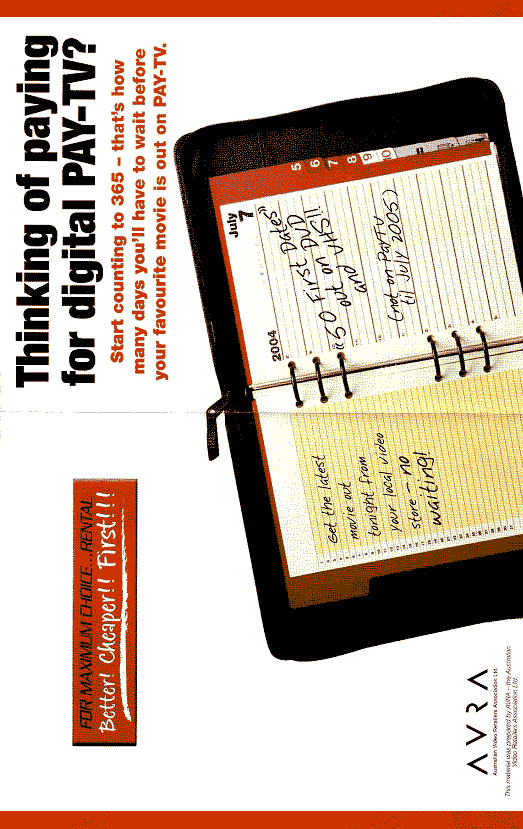 The
Second Advertisement (Front Side):
The
Second Advertisement (Front Side):
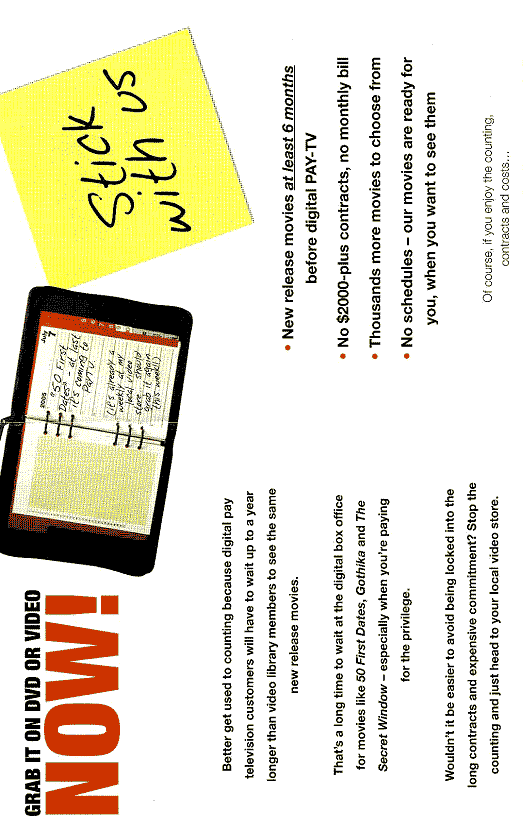 The Second
Advertisement (Reverse Side):
The Second
Advertisement (Reverse Side):
The Third Advertisement: