FEDERAL COURT OF AUSTRALIA
Rivkin Financial Services Limited (ACN 061 287 045) v Sofcom Limited
(ACN 087 482 602) [2004] FCA 1538
CORPORATIONS – Insider trading– Corporations Act s 1043A – where alleged that each of the defendants knew of the purpose and intention of the other defendants to acquire collectively at least 5 per cent of issued shares in the plaintiff company to gain control of the board of directors - whether knowledge of own intentions can be inside information where one controlling mind of three defendant companies – whether material effect of information on value of shares – cross-claim of insider trading
CORPORATIONS – Oppressive conduct – whether improvidence or impropriety of purpose – failure to call general meeting pursuant to request – whether defendants had at least 5 per cent of the votes at time of request – whether incorrect share register affects membership for purposes of s 249D
Central Exchange Ltd v Rivkin Financial Services Ltd [2004] FCA 1436
Australian Competition and Consumer Commission v Amcor Printing Papers Group Ltd & Ors (2000) 169 ALR 344
Commonwealth Homes and Investment Company Limited v Smith (1937) 59 CLR 443
Commissioner of Taxation v Patcorp Investments Limited (1976) 140 CLR 247 at 272
Corporations Act 2001 (Cth), ss 9, 167, 168(1), 169(1), 169(3), 233, 233(1), 249D, 249D(1)(a), 249D(4), 249D(5), 249E, 249F, 1042A, 1042D, 1043A, 1043A(1), 1043I, 1043O, 1317E(1)(jf), 1317E(2), 1317F, 1317J, 1324, 1325, Division 3 of Part 7.10
RIVKIN FINANCIAL SERVICES LIMITED (ACN 061 287 045) v SOFCOM LIMITED (ACN 087 482 602) & ORS
N1092 OF 2004
EMMETT J
26 NOVEMBER 2004
SYDNEY
|
IN THE FEDERAL COURT OF AUSTRALIA |
|
|
NEW SOUTH WALES DISTRICT REGISTRY |
N1092 OF 2004 |
|
BETWEEN: |
RIVKIN FINANCIAL SERVICES LIMITED (ACN 061 287 045) PLAINTIFF
|
|
AND: |
SOFCOM LIMITED (ACN 087 482 602) FIRST DEFENDANT
FAST SCOUT LIMITED (ACN 088 488 724) SECOND DEFENDANT
ALTERA CAPITAL LIMITED (ACN 082 541 437) THIRD DEFENDANT
|
CROSS CLAIM:
|
|
SOFCOM LIMITED (ACN 087 482 602) FIRST CROSS-CLAIMANT
FAST SCOUT LIMITED (ACN 088 488 724) SECOND CROSS-CLAIMANT
ALTERA CAPITAL LIMITED (ACN 082 541 437) THIRD CROSS-CLAIMANT
|
|
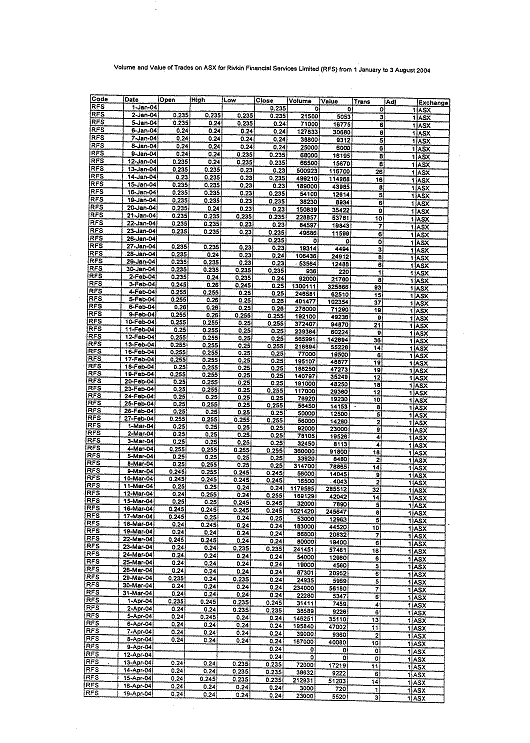
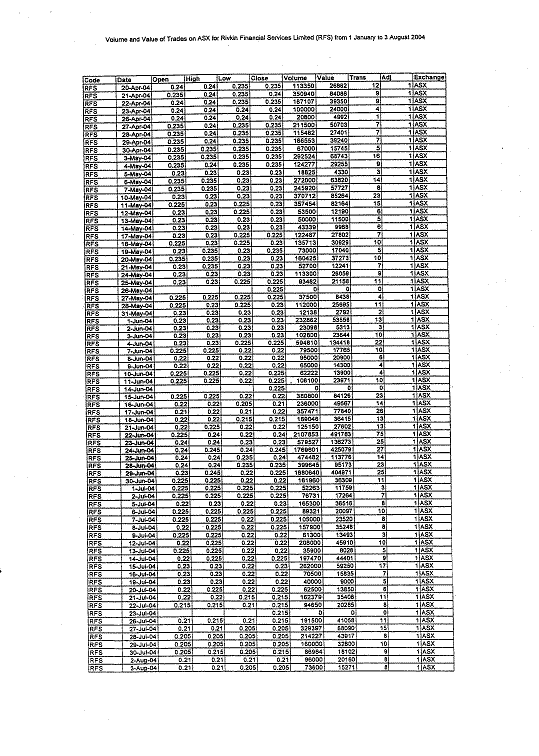
|
RIVKIN FINANCIAL SERVICES LIMITED (ACN 061 287 045) FIRST CROSS-DEFENDANT
ALAN DAVIS GROUP PTY LTD (ACN 000 762 489) SECOND CROSS-DEFENDANT
NETWORK LIMITED (ACN 091 780 924) THIRD CROSS-DEFENDANT
COLE KABLOW SUPERANNUATION PTY LTD (ACN 082 873 541) FOURTH CROSS-DEFENDANT
ALAN ANDEREW DAVIS FIFTH CROSS-DEFENDANT
|
|
JUDGE: |
EMMETT J |
|
DATE OF ORDER: |
|
|
WHERE MADE: |
SYDNEY |
THE COURT ORDERS THAT:
1. The application be dismissed.
2. The cross-claim be dismissed.
Note: Settlement and entry of orders is dealt with in Order 36 of the Federal Court Rules.
|
IN THE FEDERAL COURT OF AUSTRALIA |
|
|
NEW SOUTH WALES DISTRICT REGISTRY |
N1092 OF 2004 |
|
BETWEEN: |
RIVKIN FINANCIAL SERVICES LIMITED (ACN 061 287 045) PLAINTIFF
|
|
AND: |
SOFCOM LIMITED (ACN 087 482 602) FIRST DEFENDANT
FAST SCOUT LIMITED (ACN 088 488 724) SECOND DEFENDANT
ALTERA CAPITAL LIMITED (ACN 082 541 437) THIRD DEFENDANT
|
CROSS CLAIM:
|
|
SOFCOM LIMITED (ACN 087 482 602) FIRST CROSS-CLAIMANT
FAST SCOUT LIMITED (ACN 088 488 724) SECOND CROSS-CLAIMANT
ALTERA CAPITAL LIMITED (ACN 082 541 437) THIRD CROSS-CLAIMANT
|
|
|
RIVKIN FINANCIAL SERVICES LIMITED (ACN 061 287 045) FIRST CROSS-DEFENDANT
ALAN DAVIS GROUP PTY LTD (ACN 000 762 489) SECOND CROSS-DEFENDANT
NETWORK LIMITED (ACN 091 780 924) THIRD CROSS-DEFENDANT
COLE KABLOW SUPERANNUATION PTY LTD (ACN 082 873 541) FOURTH CROSS-DEFENDANT
ALAN ANDEREW DAVIS FIFTH CROSS-DEFENDANT
|
|
JUDGE: |
|
|
DATE: |
|
|
PLACE: |
SYDNEY |
TABLE OF CONTENTS
|
PROCEDURAL HISTORY |
3 |
|
MR KHAN’S INTEREST IN THE COMPANY |
7 |
|
DAVIS GROUP AND THE COMPANY |
12 |
|
THE KHAN COMPANIES’ ACQUISITION OF SHARES IN THE COMPANY |
16 |
|
NETWORK AND COLE KABLOW |
21 |
|
THE COMPANY, COLE KABLOW AND NETWORK |
23 |
|
THE ISSUES IN THE PROCEEDING |
35 |
|
RELEVANT PROVISIONS OF THE ACT |
38 |
|
Insider Trading |
38 |
|
Oppression |
40 |
|
INSIDER TRADING BY THE KHAN COMPANIES |
40 |
|
Inside Information |
42 |
|
Relief |
45 |
|
VALIDITY OF THE KHAN COMPANIES’ S 249D REQUEST |
46 |
|
CROSS-CLAIM |
50 |
|
OPPRESSION |
50 |
|
Improvidence |
50 |
|
Impropriety of Purpose |
51 |
|
The s 249D Request and the Proceeding |
55 |
|
INSIDER TRADING BY THE CROSS-DEFENDANTS |
55 |
|
Acquisition by Davis Group of Rene Rivkin’s Shares |
55 |
|
Acquisition by Cole Kablow of 40,000 Shares in the Company on 24 June 2004 |
59 |
|
Acquisitions by the Company, Network and Cole Kablow on 2 July 2004 |
61 |
|
Acquisition by Network of 4,000,000 Shares in the Company on 1 September 2004 |
62 |
|
CONCLUSION |
63 |
REASONS FOR JUDGMENT
1 Shares in the plaintiff, Rivkin Financial Services Ltd (‘the Company’), are listed for quotation on Australian Stock Exchange Limited (‘ASX’). This proceeding is concerned with dealings in those shares and whether the board of directors of the Company should be controlled by the fifth cross-respondent, Mr Alan Andrew Davis (‘Mr Davis’), the managing director of the second cross-defendant, Alan Davis Group Pty Ltd (‘Davis Group’), or by Mr Farooq Khan, the managing director of the three defendants, Sofcom Limited (‘Sofcom’), Fast Scout Limited (‘Fast Scout’) and Altera Capital Limited (‘Altera’).
2 The involvement of Mr Davis and Davis Group in the affairs of the Company began on 17 June 2004 when, in an off-market transaction, Davis Group acquired 7,305,784 shares in the Company from Mr Rene Rivkin for a price of $1,607,272. Those shares represented 7.94 per cent of the capital of the Company at the time of acquisition. Following that acquisition, Mr Davis was appointed as a director and as chief executive officer of the Company on 21 June 2004. The defendants (‘the Khan Companies’) then acquired 4,908,471 shares in the Company in transactions on ASX in the period 22 to 29 June 2004.
3 The Company asserts that the Khan Companies acquired their shares in the Company in contravention of s 1043A of the Corporations Act 2001 (Cth) (‘the Act’). Section 1043A is concerned with insider trading. The Khan Companies, on the other hand, assert in their cross-claim that there have been various contraventions of s 1043A by the Company, Davis Group, the third cross-defendant, Network Limited (‘Network’) and the fourth cross-defendant, Cole Kablow Superannuation Pty Ltd (‘Cole Kablow’). The Khan Companies also claim relief under s 233 of the Act on the basis that, by reason of those contraventions and other matters, the conduct of the affairs of the Company has been contrary to the interests of its members as a whole and has been oppressive to, unfairly prejudicial to or unfairly discriminatory against members of the Company.
PROCEDURAL HISTORY
4 The proceeding was commenced on 14 July 2004, when Hely J gave the Company leave to file an originating process and made orders, ex parte, that, until 5.00 pm on 16 July 2004, each of the Khan Companies be restrained from exercising, in respect of the shares in the Company acquired by them from 22 to 29 June 2004, any right to call a general meeting of the Company or any right to request the directors to call a general meeting. On 16 July 2004, the Khan Companies undertook to the Court that they would not, prior to 5.00 pm on 21 July 2004, exercise, in respect of those shares, any right to call a general meeting or to request the directors to call a meeting. On 20 July 2004, the Khan Companies gave a further undertaking to the Court, up to and including 4 August 2004, not to dispose of those shares without giving the plaintiff 48 hours’ notice in writing of their intention to do so, other than by way of sale on market during normal trading. On 4 August 2004, both undertakings were extended up to 17 August 2004. On that day, the undertakings were extended until the final determination of the proceeding.
5 A general meeting of the Company called pursuant to s 249F of the Act and the annual general meeting of the Company are both to be held on 29 November 2004. I have already determined a proceeding concerning the holding of the meeting called pursuant to s 249F of the Act – see Central Exchange Ltd v Rivkin Financial Services Ltd [2004] FCA 1546. Because the issues in this proceeding affect the entitlement of the parties to exercise rights in respect of shares in the Company, the parties require a final determination of the issues raised in the proceeding prior to 29 November 2004. The matter has therefore been heard with a degree of urgency.
6 When the Khan Companies closed their case on the cross-claim, Network and Cole Kablow moved for dismissal of the cross-claim as against them, on the ground that there was no case to answer. They made that application on the basis that they not be required to elect whether to go into evidence before the Court ruled on the application.
7 The general rule of practice is that a decision will not be given on a no case submission unless the moving party elects to give no evidence. However, the Court has a discretion to depart from that general rule, although a departure can seldom be justified unless adherence to the rule would not serve the ends of justice or convenience – Australian Competition and Consumer Commission v Amcor Printing Papers Group Ltd & Ors (2000) 169 ALR 344 at [60] – [62].
8 Where it is contended by a respondent or defendant that the evidence adduced by the claimant, taken at its highest from the claimant’s point of view, cannot support the cause of action pleaded or is so weak and unreliable that it should be dismissed without calling on the respondent or defendant, it may be appropriate, in some circumstances, to allow the respondent or defendant to make submissions without being forced to make an election at that stage. In deciding whether to require an election to be made, the Court may have regard to a number of factors such as:
- whether time will be saved;
- whether there is a case to answer on some of the issues in the proceeding;
- whether the case alleges fraud or allegations akin to fraud;
- whether all respondents or defendants join in the submission;
- whether the respondents or defendants have given sufficient notice of the possibility of making such an application to ensure that the claimant is not placed at a disadvantage.
9 The allegations against Network and Cole Kablow involve contravention of the insider trader provisions of the Act. Contravention is an offence in respect of which significant penalties can be imposed. It is accepted by the Khan Companies that the allegations against Network and Cole Kablow are serious. Further, the Khan Companies accept that they have not been placed at a disadvantage by the making of the application at the time when it was made. Network and Cole Kablow made clear in the course of the hearing that they did not wish to indicate whether they would call evidence until the case of the Khan Companies on the cross-claim was closed. They intimated, at the end of the hearing on Friday 29 October 2004, that they wished to make such an application. The application was in fact made at the completion of the Khan Companies’ evidence on the morning of Monday 1 November 2004.
10 Three witness statements have been filed on behalf of Network and two witness statements have been filed on behalf of Cole Kablow. If those witnesses were to be called, there would be a prospect of further cross-examination of the witnesses in relation to the matters in issue as against Network and Cole Kablow. On the other hand, that cross-examination may not delay the proceeding unduly unless matters emerge that require further evidence to be called.
11 Each of the Company, Davis Group and Mr Davis has adduced evidence in relation to the cross-claim. While Davis Group and Mr Davis are implicated in the allegations of insider trading made against Network and Cole Kablow, there are the additional claims against Davis Group and Mr Davis involving allegations of oppression in relation to the conduct of the affairs of the Company. There has been no attack on the credit of those witnesses who have given evidence so far. I accept that the witnesses who have given evidence on behalf of the Company and Davis Group, including Mr Davis, are reliable and honest witnesses, bearing in mind the minor inconsistencies that are inevitable in recollecting dates and conversations, even within weeks of their occurrence.
12 I heard submissions from counsel for Network and Cole Kablow on the case against their respective clients. Without hearing from counsel for the Khan Companies on the question, I was persuaded by those submissions that it is at least arguable that there is no case to answer by Network and Cole Kablow. Accordingly, having regard to the seriousness of the allegations involving insider trading and the possible consequences for Network and Cole Kablow if I concluded that there has been a contravention of the Act, I considered that it was appropriate to entertain their application for dismissal of the proceeding on a final basis without requiring them to elect not to call evidence.
13 In reaching that conclusion, I was mindful of the possibility that, if I am persuaded that there is a case to answer, it may be necessary to hear further evidence from Network and Cole Kablow. I was also mindful of the possibility that, if I am persuaded that there is no case to answer but, on appeal, a different conclusion is reached, it would be necessary for the matter to be remitted for further hearing.
14 I have had regard to the fact that the proceeding is brought in the context of a dispute in the market place between Davis Group and Mr Davis on the one hand and Mr Khan and the Khan Companies, on the other, concerning control of the board of directors of the Company. At the general meeting of the members of the Company to be held on 29 November 2004, the members will be called upon to decide whether to remove the existing directors and replace them with nominees of the Khan Companies. It is highly desirable, in the interests of all members of the Company, that the questions raised by this proceeding be resolved prior to the meetings so that all members know what rights are to be exercised in relation to all issued shares in the capital of the Company.
15 Accordingly, I allowed Network and Cole Kablow to apply for dismissal of the cross-claim as against them without being required to elect whether to adduce evidence. I have now heard full argument from all parties in respect of all issues, on the basis of the evidence presently before me.
MR KHAN’S INTEREST IN THE COMPANY
16 Mr Farooq Khan is the managing director and executive chairman of each of the Khan Companies. At relevant times during June 2004, the other directors of Sofcom and Altera were Mr Victor Ho and Mr Simon Cato and the other directors of Fast Scout were Mr Azhar Chaudhri, Mr Yaqoob Khan and Mr Victor Ho. In addition, there are common shareholdings in the three Khan Companies. Thus, Fast Scout was the holder of 32.253 per cent of the issued share capital of Altera. Altera was also the holder of 80.54 per cent of Sofcom’s issued share capital and Fast Scout was the holder of 1.63 per cent of Sofcom’s issued share capital. In a ‘Notice of Initial Substantial Holder’ in respect of the Company dated 30 June 2004, the Khan Companies stated that Fast Scout has control of Altera and that Altera controls Sofcom.
17 It is instructive to have regard to published reports of the Khan Companies. Thus, the Annual Report for 2003 of each of the Khan Companies contains a section headed ‘GENERAL INVESTMENT STRATEGIES’. The introductory paragraphs differed for each Khan Company and were as follows:
SOFCOM: ‘The Board will endeavour to pursue selective investment and commercial opportunities with the objective(s) of creating a secure income stream for the Company and/or the acquisition of assets that provide for capital growth. Assets will be acquired either on the basis that they are currently undervalued or present the opportunity for superior capital growth.’
FAST SCOUT: ‘In addition to the commercial exploitation of the Company’s investment in the Virtual Web service, the Board is actively seeking to add value to the asset base and underlying share price of the Company through the pursuit of selective investment and other commercial opportunities.
Such selective investment and commercial opportunities will be pursued with the objective(s) of creating a secure income stream for the Company and/or the acquisition of assets that provide for capital growth. Assets will be acquired either on the basis that they are currently undervalued or present the opportunity for superior capital growth.’
ALTERA: ‘As is evident from the above investments, the Board is actively seeking to add value to the asset base and underlying share price of the Company through the pursuit of selective investment and other commercial opportunities.
Such selective investment and commercial opportunities will be pursued with the objective(s) of creating a secure income stream for the Company and/or the acquisition of assets that provide for capital growth. Assets will be acquired either on the basis that they are currently undervalued or present the opportunity for superior capital growth.’
18 The Annual Reports for each of the Khan Companies then continued in identical terms as follows:
‘The intention is to increase the asset base of the Company to a level which the Board considers is a prudent capital base from which it will be able to take advantage of further commercial investment activities. The Board will also consider the expansion of the capital base of the Company through the issue of equity capital and/or the formation of strategic alliances or mergers with other companies.
The Board believes that a listed company requires a critical mass of capital sufficient to secure commercial opportunities and accordingly provide both an income stream and capital growth for its shareholders. The Board believes that a prudent capital base from which a listed company is able to secure such commercial objectives is between $10 – 15 million.
This capital base of $10-$15 million dollars has been determined as an appropriate based by the Board based upon a number of matters including but not limited to an analysis of the existing capital structure of the Company, its current cash reserves, the present state of the Australian capital markets, the likelihood of the Company attracting capital investment in the short to medium term at prices at least equal to or in excess of its current cash backing and the level of internal investment capital the Board believes the Company requires to generate economic returns sufficient to attract investor support and accordingly the ability to raise further capital.
The Board does not believe that the Company will be readily able to achieve such objective on its own. The Board however believes that such objective can be achieved through an “aggregation” process whereby the assets of the Company and a number of other suitable listed companies are combined effectively into a single entity that holds the collective net tangible assets previously held in each separate company.
This “aggregation” process may be realised (subject to acceptable taxation advice and compliance with the Corporations Act and the ASX Listing Rules) through a number of avenues including participating companies subscribing to a new “master” company or via a scheme of arrangement. Alternatively, an existing participating company may be used as the “lead” vehicle in terms of the aggregation process.
The Board is currently in discussions with a number of Australian public listed companies with respect to this “aggregation” process and will advise shareholders on the outcome of these discussions.’
19 A similar pattern can be observed in the 2004 Preliminary Final Reports for each of the Khan Companies. Thus, each contains a section headed ‘“AGGREGATION”, under which the following appears:
‘The Board believes that a listed company requires a critical mass of capital sufficient to secure commercial opportunities and accordingly provide both an income stream and capital growth for its shareholders. The Board believes that a prudent capital base from which a listed company is able to secure such commercial objectives is at least $15 million.
…
The Board does not believe that the Company will be readily able to achieve such objective on its own. The Board however believes that such objective can be achieved through an “aggregation” process whereby the assets of the Company a number of other suitable listed companies are combined effectively into a single entity that holds the collective net tangible assets previously held in each separate company.’
The reports then go on to describe how the ‘aggregation’ process may be realised.
20 The similarity of the reports, the common directorships and interconnected holdings, together with the fact that Mr Khan is the managing director of each of the Khan Companies, indicate clearly enough that the mind of Mr Khan was relevantly the mind of each of the Khan Companies.
21 Mr Christopher Ryan is a principal of Westchester Corporate Finance, corporate advisor to Sofcom. On Friday 14 May 2004, Mr Ryan suggested in an email to Mr Khan that the Company ‘has to be a target’. Mr Ryan drew Mr Khan’s attention to an article in the Sydney Morning Herald of the previous Saturday indicating that ‘everything Rene Rivkin owns is for sale’. By email dated 18 May 2004, Mr Ryan reported to Mr Khan concerning a meeting that he had held on that day with two of the then directors of the Company, Mr Jordan Rivkin and Mr Shannon Rivkin, sons of Mr Rene Rivkin. Mr Ryan said that there was to be a board meeting of the Company on the following day to consider its future. Mr Ryan also said that he had been told that Mr Rene Rivkin would probably be willing to sell.
22 On 19 May 2004, Mr Ryan sent an email to Mr Jordan Rivkin referring to their meeting on the previous day. In that email, Mr Ryan said that he was ‘continuing discussions aimed at defining a mutually acceptable transaction’. Mr Ryan went on to say:
‘In particular, my client would like you to know that he… would like to buy approximately 10% of the existing capital of [the Company] at a price around market and to subscribe for additional shares in [the Company] at the price paid for the existing shares, plus 0.5 cents – the point of the differential being to demonstrate to the shareholders that they had received a marginally preferential deal. The intention of these two transactions would be to build my client’s shareholding to close to 20%.
Following these share transactions, my client would like to appoint additional directors to enable board control…’
The references to ‘my client’ and ‘he’ suggest that Mr Ryan was receiving instructions from a single individual. It is clear, as it turned out, that Mr Ryan was referring to Mr Khan.
23 Jordan Rivkin responded to Mr Ryan’s email on 24 May 2004, saying:
‘Thank you for your email, and for your proposal. We are constantly seeking out opportunities to improve shareholder value in [the Company], whether it be by acquisition or disposal of certain assets. Without the benefit of further detail, we have difficulty in determining how passing control of the company and the investment portfolio away from the current Board to a newly constituted board with an outsourced management agreement would enhance value to our shareholders. And without a clear vision as to how shareholder value would be improved, we are naturally hesitant to proceed with anything. We shall, however, spend some time giving some more thought to the idea.’
Having received that email, Mr Ryan said to Mr Khan in an email of 24 May 2004 ‘we need to have a clearer and more detailed plan for going forward’ and ‘we should be encouraged to develop a more detailed proposal’. At that stage, it was not clear who ‘we’ comprised.
24 On 27 May 2004, Mr Ryan told Mr Khan in a further email that he had spoken to Jordan Rivkin who reiterated that ‘they could not see a relative advantage to shareholders in our proposal, particularly in that they could not see who was going to drive the growth of the broking business’. Mr Ryan told Mr Khan that he had told Jordan Rivkin that ‘our proposal was an offer to existing shareholders (Rivkin friends and family) for up to 20% of the capital of [the Company] with any shortfall being subscribed as new capital to the Company’. Mr Ryan said that Jordan Rivkin told him that they ‘need to work [through] the options’ and that he would get back to Mr Ryan ‘if they wanted to talk further’.
25 It appears that there was a telephone conversation on 2 June 2004 involving Mr Khan, Mr Ryan and Jordan Rivkin. On the following day, 3 June 2004, Mr Ryan sent an email to Jordan Rivkin confirming ‘the willingness of our client to add a buy back of shares to the proposal discussed in our recent meeting and subsequent communications’. The email went on to say:
‘In summary, the proposal involving the buy back options is as follows:
· a company under the control of our client would acquire the Rivkin family shareholding in [the Company] for an agreed price. The price is open for discussion…
· once the share purchase was completed, our client would be invited to nominate two representatives to the Board of [the Company].
· in order to provide the other shareholders with an opportunity to sell shares at the same price paid by our client, our client’s board representatives would support an equal access buy back offer being made to all shareholders for 50% of their shares at 24 cents cash per share. …
· our client would work with the board to further develop the broking and investment businesses of [the Company]…
As previously indicated, our client is supportive of the business of [the Company] and is quite flexible as to the structure of any agreement which provides our client with an investment and representation on the board of the company.’
26 It is significant that, in the course of the negotiations conducted by Mr Ryan with Jordan Rivkin, Mr Ryan referred to only a single client. Clearly, his instructions were coming from Mr Khan, to whom Mr Ryan sent copies of all of his communications with Jordan Rivkin. Thus, it is clear that, at that stage, decision making in relation to a proposed investment in shares of the Company was in the hands of Mr Khan, although the information given by Mr Ryan was that it may well be a plurality of companies associated with Mr Khan who would make any investment in the Company.
27 In any event, as will appear below, Mr Ryan’s overtures were not favourably received by Messrs Jordan Rivkin and Shannon Rivkin and the others responsible for making a decision to sell Rene Rivkin’s shares in the Company. Rather, those responsible began to negotiate with Mr Davis and Davis Group in the circumstances that I shall describe.
DAVIS GROUP AND THE COMPANY
28 In June 2004, while Mr Davis was on holiday in France, he was told by telephone that Rene Rivkin wished to sell his shares in the Company. After discussing the matter with his wife, Mr Davis concluded that Mr Rene Rivkin’s shareholding in the Company presented him with an opportunity to do what he had always wanted to do, namely, to ‘build up a large enterprise in Mining, Money and Media’. While still in France, Mr Davis pondered steps that he could take and decided that he would like to invest, inter alia, in Network. He also gave thought to various other possible investments. With such plans in his mind, he returned to Australia determined to buy Rene Rivkin’s shares in the Company. Having had dealings with Rene Rivkin in the past, Mr Davis believed that any dealings with Rene Rivkin would be ‘fair, transparent and quick’. He also felt confident that Rene would lend him any money necessary to complete the purchase of his shares in the Company.
29 Mr Anthony Lister is a director of Davis Group and other companies in which Mr Davis has an interest. Mr Lister and Mr Davis have known each other for 35 years. They are both close personal friends as well as close business associates. Mr Lister and companies associated with him have had many business dealings with Mr Davis and companies associated with him over the past 32 years.
30 When he arrived back in Australia from France on 16 June 2004, Mr Davis arranged a meeting with Jordan Rivkin, Shannon Rivkin, Mr Lister and Mr Davis’s son, Ben Davis. The meeting took place on 17 June 2004. After discussion about the asset backing of shares in the Company, the market price of shares in the Company and the number of issued shares in the Company, a bargain was struck, which was then reduced to writing. The writing consisted of a letter typed by Ben Davis and signed by Mr Davis. The letter was addressed to Rene Rivkin and was in the following terms:
‘Dear Rene,
I am writing to confirm the arrangements I made this morning with your sons, Jordan and Shannon, who were acting on your behalf, to purchase your shareholding of 7,305,784 shares in Rivkin Financial Services Limited at a price of 22 cents per share cum dividend for a total price of $1,607,272.
Terms of the Purchase: 1. $ 200,000 cash herewith
2. $ 1,407,272 within 120 days.
Security: 1. Mortgage back of the Shares
2. 2nd Mortgage of the property situated at and known as 300 Johnston Street, Annandale NSW 2038
Interest Rate: 10% per annum calculated on monthly rests and payable on settlement.
Good Faith Extension: They agreed that should it be necessary you will agree to a six month extension of the period in which the principal shall be paid but in that case interest from the beginning will be calculated at 15% per annum.
Appropriate documentation to give effect to this agreement will be prepared by your solicitor at our expense.
I have asked your sons to sign a copy of this letter to give effect to this agreement and to confirm they have your authority to do so.
With kind regards,
Yours sincerely,
Alan Davis Group Pty Limited’
The letter was also counter signed by Jordan Rivkin and Shannon Rivkin.
31 Discussion then followed about the future of the Company, including a discussion about management. Mr Davis said that he would like to be chief executive and a director but thought that it was important, for continuity in the market, that Jordan Rivkin and Shannon Rivkin remain as directors. Reference was also made to Mr David Croll, who was also a director of the Company at that time. Messrs Jordan Rivkin and Shannon Rivkin expressed a desire to cease being directors of the Company in the reasonably near future.
32 There was also discussion about the future share trading activities of the Company. Mr Davis said that he was interested in share trading in only a limited way and was more interested in taking substantial positions ‘in stocks I like’. He mentioned Network, among other media and oil and gas companies. The meeting finished with social discussion concerning Mr Davis’s involvements with Rene Rivkin in the past.
33 On 18 June 2004, the then fourth director of the Company, Mr Spiros Dassakis, resigned with immediate effect. The circumstances of the decision of Mr Dassakis to resign do not appear to be relevant to the issues before me.
34 On 20 June 2004, a standard transfer form in respect of Rene Rivkin’s shareholding in the Company was signed by Rene Rivkin as transferor and by Mr Davis, on behalf of Davis Group, as transferee. On 21 June 2004, having signed a form of consent, Mr Davis was appointed as a director and chief executive officer of the Company. There was no discussion at that stage in relation to his remuneration.
35 Also on 21 June 2004, Mr Croll, as secretary of the Company, requested ASX to halt trading in the Company’s shares because, as he said, ‘a change in substantial shareholding will be notified to the market this afternoon in conjunction with changes to the board’. Later in the day, Jordan Rivkin, as chairman of the Company, announced to ASX that, following the acquisition of a substantial interest in the Company by Davis Group, Mr Davis had been appointed as a director and chief executive of the Company. On the same afternoon, Minter Ellison forwarded to ASX a completed form of ‘Notice of Initial Substantial Holder’ on behalf of Davis Group. Attached to that notice was a copy of the letter that had been prepared and signed on 17 June 2004 evidencing the bargain struck on that day. On the same day, a form of ‘Notice of Ceasing to be Substantial Holder’ was also forwarded to ASX on behalf of Rene Rivkin.
36 On 22 June 2004, there were two meetings of the directors of the Company. The first meeting was held at 9.00 am. At that meeting, after discussion of the Company’s share trading policies and the management and risk profile of the stock broking subsidiary of the Company, the following resolutions were passed:
‘1. That until a thorough review of the Group’s trading policies were undertaken no further trading actions by the Group as principal should be undertaken;
2. That the management of the Group’s share trading subsidiary should be instructed to reduce the risk profile of the accounts; and
3. That David Croll under the supervision of Mr Davis should be responsible for the implementation of the resolutions.’
At the second meeting, held at 3.00 pm, Mr Croll confirmed he had spoken to the recruitment agents engaged to locate new management for ‘the stockbroking operation’. The minutes record that Mr Croll was optimistic that a short list of potential candidates would be available within two weeks. Mr Davis said in cross-examination that the item in the minutes of that meeting is a reference to concern expressed by the then directors that there were problems with the discount stockbroking operation conducted by the Company’s subsidiary.
37 On 23 June 2004, Mr Ryan sent an email to Jordan Rivkin. Jordan Rivkin sent a copy of the email to David Croll, who sent a copy to Mr Davis. The email from Mr Ryan to Jordan Rivkin was as follows:
‘I tried many times to call you yesterday.
On Monday you undertook to call me yesterday (Tuesday) afternoon.
Our client tried without success to contact you yesterday.
A situation is developing which requires careful handling.
As we discussed, we saw, and still see a clear distinction between the interests of Rene Rivkin as a shareholder and the duties of directors of RFS. Our client seeks assurance that the transaction with Andrew Davis recognises this distinction as clearly as we would have expected. Is it reasonable now to expect that if our client purchases 7.9% of RFS our client will be invited to nominate an appointee for the board – as a minimum?
Our client is at a loss to understand why the Rene Rivkin shareholding should have been sold on delayed payment terms for 22 cents, when our client had indicated in writing a willingness to pay 24 cents and to offer a buy back to RFS shareholders if you felt it would help. A phone call would have enabled you to ascertain whether our client’s price still held in the light of the fall in the market.
A dispassionate observer would conclude that there is more to the transaction than has been disclosed.
We are informed that in addition to buying the Rene Rivkin shareholding in RFS, interests associated with Andrew Davis also bought an interest in the Rivkin Report. If this were so, would I not be correct in forming the view that the subscribers to the Rivkin Report should have been told this in association with this week’s RR recommendation regarding RFS?
In relation to the recommendation, our client holds in excess of 1% of the shares in RFS. In our client’s view, the enthusiastic recommendation that the appointment as CEO of Mr Davis – a graduate in law from 1963 with extensive experience as a car dealer and other pursuits and specualtive [sic] activities – will somehow be good for RFS, fails to provide sufficient support for the proposition and therefore is not compelling. Of course, our client remains open minded on the question. The point is that our client feels uninformed.
Other than its cash, the major asset of RFS is its broking business. Are we correct in deducing that Mr Davis’ extensive experience does not extend to stockbroking? What then is planned for RDS?
We request that you and Mr Davis agree to a meeting as soon as possible with a view to determining a course of action ahead in all of our mutual interests. I include all of the RFS shareholders in that.’
38 In discussions between Mr Davis and Mr Croll concerning the email, Mr Croll mentioned the name of Farooq Khan. That was the first time that Mr Davis had heard of Mr Khan. Mr Davis also had a conversation with Jordan Rivkin about the email. Jordan Rivkin told him that he had had a number of approaches from Messrs Khan and Ryan to purchase the Rivkin family’s shares in the Company at a price of 24 cents per share. Jordan Rivkin told Mr Davis that Rene Rivkin and the family had refused to deal with Mr Khan. Later in the day, Jordan Rivkin responded to Mr Ryan’s email saying:
‘Mr Davis is out of town today, but we will discuss your email with him when he returns tomorrow.’
Mr Ryan forwarded that email to Mr Khan. No meeting was arranged between Mr Khan and Mr Davis.
THE KHAN COMPANIES’ ACQUISITION OF SHARES IN THE COMPANY
39 From 22 June 2004 to 29 June 2004 the three Khan Companies brought shares in the Company on ASX as follows:
DATE PURCHASER NO. OF SHARES
22 June 2004 Sofcom 1,203,153
23 June 2004 Sofcom 243,227
24 June 2004 Sofcom 1,053,620
24 June 2004 Fast Scout 372,481
25 June 2004 Fast Scout 442,000
29 June 2004 Sofcom 750,000
29 June 2004 Fast Scout 93,990
29 June 2004 Altera 750,000
40 Those purchases were made through Mr Sala Tenna of Bell Potter, stockbrokers. At 10.30 am on 22 June 2004, Mr Tenna placed an order on the Stock Exchange Automatic Transfer System of ASX (‘SEATS’) for 3,000,000 shares at 23 cents. That was filled immediately as to 385,481 shares, leaving an order for the balance of 2,614,519 shares. No further shares were purchased on the order and at 10.28 am on 24 June 2004, the order was reduced to 614,519 shares. No shares were purchased on that reduced order and the order was cancelled at 5.13 pm on 24 June 2004.
41 Orders placed on 22 June 2004 for 14,672 shares and 803,000 shares respectively were filled instantly or later on the same day. A further order for 1,000,000 shares at 23 cents was also placed on SEATS at 10.30 am on 22 June 2004. No shares were purchased on that order and it was cancelled at 10.27 am on 24 June 2004.
42 On 23 June 2004, an order for 243,227 shares was filled instantly or later on that day. On 24 June 2004, an order for 540,620 shares was filled instantly or later on the day. Also on 24 June 2004, an order for 1,000,000 shares was filled as to 885,481 shares either instantly or later on the same day. The balance of the order was cancelled later on that day. On 25 June 2004, an order for 442,000 shares was filled either instantly or later on the same day.
43 On 29 June 2004, an order for 1,548,314 shares was filled instantly as to 1,353,107 shares. The balance of the order was cancelled later on that day. Also on 29 June 2004, an order for 240,883 shares was filled instantly or later on that day.
44 By 29 June 2004, as a result of those purchases, the Khan Companies held shares in the Company as follows:
Sofcom 3,250,000
Fast Scout 908,471
Altera 750,000
TOTAL 4,908,471
Together, those shares represented in excess of 5 per cent of the issued share capital of the Company as at 29 June 2004.
45 On 28 June 2004, meetings of the directors of each of Sofcom and Altera were held at the office of Sofcom. In the minutes of each of those Khan Companies, under a heading referring to the Company, the following is recorded:
‘Mr Khan reported that Mr Christopher Ryan of Westchester Corporate Finance had discussed with Mr Khan the possibility of acquisition of shares in RFS including those potentially available from RFS’s largest controlling shareholder, Mr Rene Rivkin, as both he and Mr Ryan had noted media articles reporting that Mr Rivkin and his family were selling their properties and other assets.
Mr Khan reported that Mr Ryan had been in discussions with Jordan Rivkin (Chairman of RFS) in May 2004 with respect to the acquisition of Rene Rivkin’s 7.9% interest in RFS.
Mr Khan reported that Mr Ryan had not received a response from Jordan Rivkin to such proposal and that Jordan Rivkin had failed to return numerous telephone calls made by Mr Ryan.
The recent (17 June 2004) sale of Rene Rivkin’s 7.9% interest in RFS to Alan Davis Group Pty Ltd (at 22 cents per share on deferred payment terms) and the appointment of Alan Andrew Davis as Director and CEO of RFS on 21 June 2004 as announced by RFS were noted.
Mr Khan reported that, in consultation with Mr Ryan, Bell Potter Securities had been instructed to place an initial 4 million buy order for RFS shares apportioned 3 million for the Company and 1 million for Fast Scout Limited (FSL). Mr Khan reported that this very large initial buy order was placed to provide a clear signal to the market that there was an interest to acquire a large line of RFS stock and to entice any large holders of RFS stock who were not presently selling to be able to immediately tender into such order.
Mr Farooq Khan reported that the Company had acquired 2.5 million shares in RFS at an average entry price of approximately 23.89 cents per share and that FSL had acquired 814,481 shares in RFS at an approximate average entry price of approximately 24 cents per share, to date.
Mr Khan reported on the general strategy with respect to RFS – to seek the appointment of nominees to replace some or all of the current Board of RFS on the platform of the following proposals to RFS shareholders:
· the appointment of an independent professional investment manager to manage the $16-18 million investment portfolio of RFS;
· support for the continuation of the broking operations of RFS;
· if appropriate after our nominees have been appointed to the Board and have undertaken a review of the affairs of RFS, implementing an equal access scheme share buy-back for a portion of each RFS shareholder’s shares, potentially up to 50%.
Mr Khan advised that implementing the above strategy would require obtaining a greater than 5% interest in RFS and the service of a requisition notice to RFS Directors to call a meeting to seek changes to the board to implement the proposals outlined above.
In this regard it was agreed that it would be appropriate for the Company to enter into an appropriate Memorandum of Understanding (MOU) with FSL and Altera Capital Limited (AEA) with respect to each companies’ investment in RFS to act as a single collective “bloc” in relation to the same, on terms similar to the MOU that was entered into between the Company and FSL with respect to their investment in Bentley International Limited (BEL) last year’.
46 The directors of Sofcom ratified the purchase of 2.5 million shares in the Company to date and authorised expenditure of a further $200,000 in acquiring shares in the Company. The directors of Altera authorised expenditure of up to $200,000 in acquiring shares in the Company. The directors of Sofcom and Altera then resolved as follows:
‘That the Company enter into a Memorandum of Understanding (MOU) with [the other Khan Companies] with respect to each [Company’s] investment in [the Company] to act as a single collective “bloc” in relation to the same ….
That upon the MOU parties attaining a 5% interest in [the Company], the MOU parties would serve a requisition notice to [the Company] to seek the appointment of nominees (of the MOU parties) to the board of [the Company] and to seek the removal of certain [of the existing directors of the Company].’
47 There is no evidence of any meeting of the directors of Fast Scout at that time.
48 On 30 June 2004, a Memorandum of Understanding was entered into among the Khan Companies. The Memorandum of Understanding relevantly provided as follows:
‘3.1 [Sofcom, Altera and Fast Scout] understands that they will act as one collective “bloc” with respect to exercising their rights as individual shareholders of [the Company].
3.2 Nothing in this MOU shall constitute, comprise or be deemed an agreement or understanding of any nature whatsoever between the parties with respect to any act, matter or thing outside of the respective parties exercising their rights as a collective “bloc” of shareholders of [the Company] and none of the parties shall be entitled to rely on this document other than in relation to their respective shareholdings in [the Company].
…
4.1 Each of [Sofcom, Altera and Fast Scout] understands that it will consult with the other Parties with respect to any decision or action in relation to exercising their rights as individual shareholders of [the Company], including:
(a) the exercise of voting power in [the Company];
(b) the disposal of shares in [the Company].
…
5.1 [Sofcom, Altera and Fast Scout] will lodge one substantial shareholder notice(s) as required by the Corporations Act (Cth) 2001 to reflect their exercising their rights as individual shareholders of [the Company] as one collective bloc.’
49 On the same day, a ‘Notice of Initial Substantial Holder’ was submitted to the Company showing each of the Khan Companies as the holder of a relevant interest in 4,908,471 shares in the Company. Finally, also on 30 June 2004, Sofcom made an announcement to ASX, relevantly in the following terms:
‘ sofcom
Wednesday, 30 June 2004
MARKET ANNOUNCEMENT
RIVKIN FINANCIAL SERVICES LIMITED – BECOMING A SUBSTANTIAL SHAREHOLDER AND REQUISITION FOR EGM TO EFFECT BOARD CHANGES
Sofcom Limited (Sofcom) is pleased to announce that it and its associates have become substantial shareholders of Rivkin Financial Services Limited (RFS) holding in excess of 5% of its issued capital.
As a substantial shareholder Sofcom also announces its intention to requisition a meeting of the shareholders of RFS pursuant to the provisions of Section 249D of the Corporations Act seeking the following:
1. The removal of Mr Alan Andrew Davis as a director and chief executive of RFS;
2. The removal of Mr Shannon Rivkin as a director of RFS;
3. The appointment of Mr Farooq Khan as a director of RFS;
4. The appointment of Mr Christopher Ryan as a director of RFS;
5. The appointment of Mr Simon Cato as a director of RFS.
Messrs Khan, Ryan and Cato are currently directors of Bentley International Limited, an ASX listed investment company. Full details of the professional background and experience of the proposed new directors of RFS are set out at the end of this announcement.
The Company does not propose to seek the removal of the chairman of RFS, Mr Jordan Rivkin or director Mr David Croll.
Given the intention to effect the foregoing changes to the board of RFS, Sofcom confirms its view that the current board are now to be regarded as caretakers to manage the affairs of RFS in that capacity until such time as the foregoing resolutions are put to shareholders of RFS.’
50 At 4.40 pm on 5 July 2004, Sofcom delivered to the office of the Company a request under s 249D of the Act for the directors of the Company to call and arrange to hold a general meeting of the Company for the purpose of considering resolutions for the removal of Mr Davis and Shannon Rivkin as directors and the election of Messrs Khan, Ryan and Cato as directors of the Company. At about 7.30 pm on the same day, Mr Davis forwarded to ASX an announcement by the Company that the Company had received a notice pursuant to s 249D of the Act and that the Company would comply with its obligations under s 249D(5) and call a meeting of the Company within 21 days after the date of receipt of the request.
51 However, on 13 July 2004, Mr Davis made another announcement to ASX on behalf of the Company that, notwithstanding that the Company had initially indicated that a meeting would be called pursuant to the request received from the Khan Companies, the Company had determined, after further review of the requisition, that it was not a valid requisition and that, therefore, the Company would not be convening a general meeting pursuant to the request. The reason for the change of heart is explained by a sequence of events that began on the morning of 16 June 2004, after Mr Davis’s returned from France, which I shall now describe.
NETWORK AND COLE KABLOW
52 Network’s primary activities consist of owning outdoor media sites, acting as a national sales brokerage company for independent third party outdoor media site owners and the production of outdoor media. It has other activities that are incidental to outdoor and out of home media. Before it became involved in media, Network was a biotechnology company. Mr Christopher Bregenhoj is the managing director of Network. Mr Brendon Cook is a director of Network and is the chief executive officer of a subsidiary of Network. Mr Graham Jones is the non-executive chairman of Network.
53 Mr William Cole is the managing director and a shareholder of Cole Kablow. The other director and shareholder of Cole Kablow is Mr Cole’s wife, Mrs Maureen Cole. Mr Cole and Mr Davis have known each other for about 30 years, during which time they have become friends. They have regularly been in contact in relation to both social and business matters.
54 As at 9 January 2004, Mr and Mrs Cole were the only shareholders of No. 1 Media Group Pty Ltd (‘NMG’) and were the owners of certain assets used by NMG in connection with its outdoor and mobile vehicle advertising business and enterprise. On 9 January 2004, Mr and Mrs Cole, NMG and Outdoor Network Australia Pty Ltd (‘Outdoor’), a wholly owned subsidiary of Network, entered into a Memorandum of Understanding whereby Mr and Mrs Cole and NMG agreed to provide Outdoor with access to all information necessary for Outdoor to conduct ‘due diligence’ in relation to the business carried on by NMG and to enable Outdoor to make informed decisions as to whether or not to proceed to acquire the assets of NMG and the other assets of Mr and Mrs Cole.
55 The Memorandum of Understanding provided for Outdoor to decide, in its absolute discretion, whether it would proceed with such acquisition as soon as practicable after it completed the proposed ‘due diligence’. If Outdoor decided to proceed, the parties were to use reasonable endeavours to negotiate, and enter into, an agreement whereby Outdoor would acquire the business of NMG and other assets of Mr and Mrs Cole. The Memorandum of Understanding provided for a consideration for such acquisition consisting of the issue of shares and options by Network, or the payment of cash, if such issue of shares and options was not approved by the members of Network.
56 On 24 February 2004, Network and Mr and Mrs Cole agreed that a specific transaction would be put to the shareholders of Network. The proposal was that the consideration for the sale to Network of NMG would be $1,050,000 and that consideration would be satisfied by the allotment of 3,500,000 shares in Network and the issue of 3,000,000 options to acquire shares in Network.
57 On 27 May 2004, Network announced to ASX that it had entered into an agreement with IAF Corporation Pty Limited (‘IAF’) to sell its subsidiary Inhibin Pty Limited (‘Inhibin’) for $5,000,000. The announcement indicated that completion was expected by 30 June 2004, when Network was to receive $2,000,000 in cash. The balance of the purchase price was to be paid in two instalments of $1,500,000 on each of the first and second anniversaries of completion.
58 At the annual general meeting of Network held on 28 May 2004, resolutions were passed by members of Network approving the proposed issue of shares and options to Mr and Mrs Cole. Accordingly, on 1 June 2004, Mr and Mrs Cole entered into a sale agreement with Network and Outdoor, whereby Mr and Mrs Cole agreed to sell their shares in NMG and the other assets to Outdoor. Clearly enough, the form of the agreement had been settled prior to the annual general meeting of Network, because it referred to the approval of shareholders as a future event. Under the sale agreement, the consideration for the sale was to be paid by the issue to Mr and Mrs Cole of 3,500,000 shares in the capital of Network together with 3,000,000 options, subject to approval at a meeting of shareholders of Network.
59 The shares in Network that were to be issued to Mr and Mrs Cole were to be the subject of security in favour of Outdoor in respect of any claims that might be made against Mr and Mrs Cole under warranties contained in the sale agreement. The shares in Network that were to be issued were therefore to be subject to restrictions on alienation by Mr and Mrs Cole.
THE COMPANY, COLE KABLOW AND NETWORK
60 Mr Roger Colman is a director of CCZ Statton Equity Pty Limited (‘CCZ’), a stockbroking firm based in Sydney. Mr Coleman is a financial analyst who specialises in media stocks. He has a considerable knowledge of listed media companies and enjoys a high reputation in the financial community. He also advises on opportunities for media investments. He was previously a director of Mid-West Radio Limited, a small, formerly listed, radio company in which Mr Davis’s wife owns shares. Mr Davis and Mr Colman have known each other for over ten years. They are friends and Mr Colman has also done business for Mr Davis over that period.
61 On the morning of 16 June 2004, Mr Davis telephoned Mr Colman and, after discussion about other matters, Mr Davis asked Mr Colman: ‘How is Network going?’. Mr Davis told Mr Colman that he needed to see him, possibly on the Tuesday of the following week. Mr Davis said ‘I have something coming up’.
62 On 17 June 2004, Mr Davis spoke by telephone to Mr Cole. In the course of discussion in relation to personal matters, Mr Davis asked Mr Cole:
‘On a different note how is Network going?’
Mr Cole replied:
‘Brendon is doing a good job, so is Chris.’
63 On 21 June 2004, Mr Davis spoke to Mr Cole again. Mr Davis did not tell Mr Cole about the arrangements with Rene Rivkin, as they had not been advised to the market. He told Mr Cole that he was interested in talking to him about Network and that ‘[w]e would like to get involved’. Mr Davis asked Mr Cole to come to his Annandale office the following day to ‘have a talk’ with Mr Lister and himself.
64 On 22 June 2004, Mr Colman and Mr Davis had a telephone conversation. After referring to the acquisition of shares in the Company by Davis Group, Mr Davis said that he would like to talk to Mr Colman about Network. He asked Mr Colman what he thought Network was worth and said that he was ‘looking at an issue by Network and buying up to 15 or 16 per cent’. Mr Colman replied that he was convinced that Network would be taken over within the next 18 months to two years for 40 to 50 cents at least. Mr Colman and Mr Davis had a further discussion about the prospects of Network, in the course of which Mr Davis said that he was ‘thinking about swapping some Network shares for Rivkin shares and developing the relationship’.
65 On 22 June 2004, Mr Davis and Mr Lister met Mr Cole at Mr Davis’s office in Annandale. Mr Lister was present at the meeting because he was a mutual friend of both Mr Davis and Mr Cole. The discussion on that occasion was light hearted and informal. In the course of the meeting an exchange took place along the following lines:
Mr Cole: ‘Congratulations. I read about the Rivkin deal.’
Mr Davis: ‘Thanks. We’ve got some real money behind us.’
Mr Cole: ‘I’ll have to buy some shares.’
Mr Davis: ‘Good, will you have a word with the Network people as I would like to do something with them. I would like to investigate the possibility of business opportunities between ourselves and Network as regards either an investment or joint ventures. ’
Mr Cole: ‘I’ve always been interested in anything you’ve been involved with and would be more than happy to be part of a business venture with you.’
Mr Davis: ‘We should all get together, Brendon, Cole, Chris.’
Mr Cole: I’ll arrange with Chris and Brendon to set up a meeting.’
Mr Davis: ‘Will you let Tony or me know.’
66 That conversation suggests that Mr Cole formed the intention of buying shares in the Company simply because Mr Davis had become involved with the Company. He indicated his intention before any mention was made of Network or Mr Davis’s intentions concerning Network.
67 Mr Cole subsequently indicated to Mr Davis that a meeting that week ‘was out’and that any meeting would have to take place in the following week. Mr Davis was unavailable on Monday 28 June and Tuesday 29 June 2004 and arrangements were made to meet representatives of Network on 30 June 2004 at Mr Davis’s office at Annandale.
68 Mr Bregenhoj received a telephone call from Mr Cole at about 3.30 pm on 22 June 2004. In his electronic diary Mr Bregenhoj recorded the subject as ‘Bill Cole called re Rivkin’. The diary note relevantly records the following:
‘Bill [Cole] advised that he had met with Andrew Davis and Tony Lister… He asked if I had seen the article in the papers regarding Andrew’s family [i.e. Mr Davis] taking out Rene Rivkin’s interest [in] Rivkin Financial Services Ltd. I advised that I would get a copy of the paper… He said that Andrew would like to get together with Brendon and I sometime next week to discuss outdoor business and where Network was going. I said we would be delighted to get together…’
69 On 24 June 2004, Cole Kablow acquired 40,000 shares in the Company. CCZ acted as broker in connection with the transaction.
70 A meeting of the directors of Network was held at 8.30 am on 29 June 2004. The minutes of that meeting record the following under the heading ‘Share Promotion and Funding’:
‘Mr Bregenhoj reported that Mr Bill Cole has had discussions with Mr Andrew Davis in respect of Rivkin Financial Services taking an equity position in Network Limited. It was agreed that a meeting be held with RFS to discuss the matter further. Mr Cook advised the meeting of the background of Mr Davis and Network Outdoor’s long association with the Davis’ family businesses.’
71 On 29 June 2004, Mr Davis saw Mr Cole again, when he and Mr Lister met to inspect a development site at Gladesville, which was being suggested as a possible investment for the Company. Mr Davis told Mr Cole that it was not what he was thinking of doing with the Company. After the meeting, Mr Cole confirmed that a meeting had been arranged for the following day.
72 A diary note made by Mr Bregenhoj indicates that he had a discussion with Mr Cole at about 12.30 pm on 29 June 2004. The diary note records nothing of the substance of the discussion but records the subject matter as being:
‘Bill Cole meeting with RFS – Davis & Lister’
It is likely that Mr Bregenhoj referred to the meeting that he had had with Messrs Davis and Lister to discuss the Gladesville property. There is nothing to suggest that any thing else was discussed.
73 On the morning of 30 June 2004, Mr Davis rang Mr Colman and had a short conversation with him as follows:
Mr Davis: ‘I’m just about to see the Network people. Is there anything to report?’
Mr Colman: ‘There’s nothing new.’
Mr Davis asked Mr Colman the price of shares in Network and the Company and Mr Colman told him the prices.
74 Later on 30 June 2004, a meeting took place at Mr Davis’s Annandale office involving Messrs Cook, Bregenhoj, Cole, Davis and Lister. At the meeting, Mr Davis said something to the following effect:
‘As I told Billy [Cole] last week, we would like to do something with Network Limited. We know it’s a good company and believe it is undervalued. There a perception it’s complicated and the biotechnology doesn’t help.’
75 After further discussion, the following exchange took place:
Mr Davis:
‘I told Billy that Rivkin would like to get about 15% to 16% of Network Limited and work with you. We’d like to put about $2,000,000 in cash in the deal and do a share swap for the rest.’
Mr Bregenhoj:
‘We can place up to 15% but over that we would have to refresh the authority. There’s no problem about that as we control well over 50% of the capital.’
Mr Davis:
‘How about this for a deal. We do a share swap for 5,000,000 Rivkin shares. We take a placement of a further 5,000,000 shares for a million dollars and we lend you a million at 9% for 3 years. The loan would have to have a clause enabling us to convert it into shares if there are any issues. The shares are not to have the dividend that has just been declared.’
Mr Bregenhoj:
‘That seems a fair deal. We’d agree to that’.
Mr Cole:
‘I’ve got 3,500,000 Network shares that I’m owed for my media sale. I would be happy to swap them for Rivkin Shares.’
[The Network shares had not at that stage been issued and allotted to Mr and Mrs Cole.]
Mr Davis:
‘How about 22 cents for 20 cents. That would mean you get 3,340,000 Rivkin shares for your 3,500,000 Network Shares. Is that fair?’
Mr Cole:
‘That’s alright by me’.
Mr Davis:
‘That’s agreed then’.
They all then went together to lunch at a restaurant in Annandale.
76 Mr Davis spoke to Mr Croll early on the morning of 1 July 2004 and told him about the proposed arrangements concerning Network. He said that Network would be making a presentation at Mr Davis’s Annandale office on Friday 2 July 2004 and that Network was anxious to conclude the arrangements as it would find the $2,000,000 to be contributed by the Company useful in its expansion plans. Mr Davis asked Mr Croll to arrange to be at Mr Davis’s office on 2 July 2004 with Jordan Rivkin and Shannon Rivkin.
77 Also on the morning of 1 July 2004, Mr Davis went to the Company’s office at Double Bay. There he was told that there had been an announcement the day before that Sofcom and its associates had acquired a 5% stake in the Company and had announced an intention ‘to call for a Board spill’. That was the first that Mr Davis had heard of the request from the Khan Companies to call a meeting of the members of the Company for the purpose of replacing directors.
78 In the course of Thursday, 1 July 2004, Mr Davis spoke to Jordan Rivkin, who said that the press were ‘upsetting the family with their constant attention’. Mr Davis then asked Jordan Rivkin to agree to the appointment of two additional directors. Jordan Rivkin said that he was ‘happy to strengthen the Board with some other people’. In the late afternoon of that day, Mr Davis spoke to Mr Lawrence Chartres and Mr Lister, both of whom agreed to join the board of the Company.
79 At 10.00 am on Friday, 2 July 2004, the proposed presentation by Network took place at Mr Davis’s Annandale office. At the presentation were Messrs Jones, Bregenhoj and Cook from Network, Messrs Davis, Jordan Rivkin, Shannon Rivkin and Croll from the Company and Messrs Lister and Chartres. Mr Cook then gave a presentation, which took over an hour. It was made with the use of a computer and was supported by a brochure about Network. Mr Bregenhoj also gave a presentation concerning the financial affairs of Network and explained how $2,000,000 would enable Network to develop its business more quickly.
80 At 12.00 on 2 July 2004, a meeting of the directors of Network was held at Mr Davis’s office in Annandale. The minutes show Messrs Bregenhoj, Jones and Cook as being present and, relevantly, record the following business:
‘RFS Placement and Loan: The chairman tabled a draft Mutual Subscription Agreement and a Loan Agreement both between the Company and Rivkin Financial Services Limited.
…
RESOLVED to authorise Mr Bregenhoj and Mr Egan as Company Secretary to execute the Mutual Subscription Agreement and the Loan Agreement this evening on behalf of the Company.
IT WAS FURTHER RESOLVED to issue 10,000,000 Shares to Rivkin Financial Services Limited, upon signing the Mutual Subscription Agreement and to arrange for their listing on the ASX and AIM.
Completion of No. 1
Media Group Business
Acquisition: The Chairman tabled a Deed of Variation for the settlement of the Company’s acquisition of the business and assets of the No 1 Media Group from William and Maureen Cole. This Deed of Variation related to a change in the claw back security from some of the shares to be issued in Network Limited at settlement to a charge over William and Maureen Cole’s No 1 Taxis business.
IT WAS RESOLVED to sign the Deed of Variation as tabled.
IT WAS FURTHER RESOLVED to issue 3,500,000 Network Limited shares at 30c each in completion and settlement for the No 1 Media Group business and assets from William and Maureen Cole. A direction from Mr and Mrs Cole was tabled to have these 3,500,000 shares issued in the name of Rivkin Financial Services Limited.
…’
81 After the Network representatives left the meeting, Jordan Rivkin said to Mr Davis:
‘Are you sure we can do this? I’m worried about Farooq Khan.’
Mr Davis replied:
‘This deal had already been done before anyone knew of his intentions. We are perfectly entitled to finalise it. … If you are worried about any aspect of the transaction you should ring Steven Humphries at Minter Ellison… and get his advice.’
After speaking to Minter Ellison, Jordan Rivkin told Mr Davis that he had done so and that he, Jordan Rivkin, was ‘perfectly happy that we can complete the transaction’.
82 At 4.05 pm on the afternoon of 2 July 2004, a meeting of the directors of the Company was held at the office of the Company at Double Bay. The minutes of the meeting, relevantly, record the following:
|
‘Appointment of New Directors: |
1. His consent to act in that capacity having been received it was resolved that George Anthony Lister be appointed a director of the Company. 2. His consent to act in that capacity having been received it was resolved that Lawrence Joseph Chartres be appointed a director of the Company. 3. Mr. David Croll indicated he wished to resign as Secretary of the Company. This was accepted and Mr. Chartres was appointed Secretary of the Company. |
|
Mr A A Davis’ employment: |
Mr Davis tabled a letter concerning his employment as chief executive of the Company and it was resolved that the matter should be dealt with later. |
|
Notice of Interest: |
1. Mr Davis tabled a letter from himself to the Company detailing his involvement with Network Limited and he also tabled a letter of advice to him from Mr Snelgrove. Mr Davis told the meeting that in his view his involvement with and shareholding interest in Network Limited did not amount to a “material interest” nevertheless he proposed to absent himself from the discussion concerning the Network and Cole proposals and not participate in the voting on them. 2. Mr Lister advised that a company in which he was financially interested had 38,000 shares in Network Limited and that Network Limited sold advertising on commission in respect of an advertising sign on the M4 motorway and that he was a director of Alan Davis Group Pty Limited. Mr. Lister told the meeting that he did not believe his shareholding interest and advertising sign commission selling agreement with Network Limited amounted to a “material interest” within the meaning of the Corporation Law. However, he proposed to absent himself from both the meeting and discussion of the Network and Cole proposals. 3. Mr Davis and Mr. Lister left the meeting. |
|
Network and Cole proposal: |
Mr. Chartres tabled the documents for consideration of the Network Limited proposal and the purchase of the Cole shares in Network Limited. The documents in relation to the loan of $1,000,000 for three years at 9% per annum to Network Limited were also tabled. The Board discussed the proposal at length and unanimously decided:- (a) that the Company should enter the Mutual Subscription Agreement between the Company and Network Limited; (b) that the Company should enter into the Loan Agreement between the Company and Network Limited; (c) that the Company should execute the Bill Cole offer letter; (d) that on completion of the Mutual Subscription Agreement 5,000,000 new ordinary shares be issued and allotted to Network Limited as fully paid share capital of the Company and that the Company’s share registrar be directed to enter these shares as allotted on the 2nd of July 2004; (e) that following execution and completion of the transactions referred to in the Bill Cole letter 3,340,000 new ordinary shares be allotted to Cole Kablow Superannuation Pty. Limited as fully paid up share capital of the Company and that the Company’s share registrar be directed to enter those shares as allotted on the 2nd day of July 2004; (f) that the Company apply to the A.S.X. for quotation of the Network and Cole shares and that the Company Secretary be authorized to finalise and deliver to the A.S.X. the listing application and all ancillary documentation; (g) that Mr Chartres, Mr. Jordon Rivkin and Mr. A.A. Davis be authorised to complete and execute all documents needed under this paragraph including, if necessary, authority to agree any minor changes or amendments to the agreements; (h) that Mr. Chartres be appointed to oversee the arrangements contemplated by this motion. Mr. Davis and Mr. Lister rejoined the meeting. |
|
Resignation of Directors: |
Mr. Jordan Rivkin, Mr. Shannon Rivkin and Mr. David Croll indicated that they wished to resign as directors. It was resolved that their resignations be accepted. Mr. Davis thanked them for their assistance and it was resolved that this be noted in the minutes. |
|
Appointment of: Chairman: |
Mr. Chartres was appointed Chairman of the Company. The meeting then adjourned to enable completion of the Network and Cole Transactions.’ |
83 Following that meeting several documents were execute. A Mutual Subscription Agreement, between Network and the Company, provided for the Company to subscribe for 10,000,000 shares in Network and for Network to allot those shares to the Company, and for Network to subscribe for 5,000,000 shares in the Company and for the Company to allot those shares to Network. The Mutual Subscription Agreement provided for completion to take place on 2 July 2004, when the parties were to take all such steps and do all such things as were necessary to ensure that:
(a) the Company pay to Network $1,000,000;
(b) the Company deliver to Network a completed application to subscribe for 10,000,000 Network shares;
(c) Network deliver to the Company a completed application to subscribe for 5,000,000 shares in the Company;
(d) Network allot shares to the Company;
(e) the Company allot shares to Network;
(f) Network register the Company in its register of members;
(g) the Company register Network in its register of members.
84 A Loan Agreement was entered into between Network and the Company whereby the Company agreed to lend Network the sum of $1,000,000 to be used by Network for general working capital purposes or any other purposes approved by the Company. The Loan Agreement provided for terms of repayment and for the payment of interest.
85 In addition, a Deed of Variation was entered into between Mr and Mrs Cole, Network and Outdoor to vary their sale agreement of 1 June 2004, so as to provide that Mr and Mrs Cole would be entitled to direct Network to issue 3,500,000 shares to the Company and that the shares were no longer to be subject to any restriction on alienation.
86 The Company also signed a letter addressed to Cole Kablow offering to buy 3,500,000 shares in Network in consideration of the issue and allotment to them of 3,340,000 shares in the Company. Mr and Mrs Cole accepted that offer on behalf of Cole Kablow.
87 Also on 2 July 2004, Mr Chartres, as the secretary of the Company, sent by facsimile to Computershare Investor Services Pty Ltd (‘the Share Registrar’), the Company’s share registrar, a copy of:
- an application form executed by Network for 5,000,000 new shares in the Company;
· an application form executed by Cole Kablow for 3,340,000 new shares in the Company.
Those documents were sent under cover of a letter that finished by saying:
‘Please attend to the registration of these new shares as soon as possible.’
88 Also on 2 July 2004, Mr Davis sent an announcement to ASX relevantly saying:
‘… the [Company] is pleased to announce that it has entered into an agreement to subscribe for 10,000,000 shares in Network Limited. The consideration for the issue comprised $1,000,000 cash and the issue of 5,000,000 shares in the Company to Network Limited.
The Company has also entered into an agreement to purchase from Cole Kablow… 3,500,000 shares in Network Limited in consideration for the issue to Cole Kablow… of 3,340,000 shares in the Company.
The Company now holds 13,500,000 shares in Network Limited representing 16.36 per cent of Network Limited’s total issued share capital.
The Company has also made available to Network Limited a loan of $1,000,000.
…
The Company is also pleased to announce the appointment of Lawrence Chartres and Anthony Lister to the Board of Directors. Mr Chartres has also been appointed Company Secretary. …’
89 Finally on 2 July 2004, Network forwarded an announcement to ASX that it had made a placement of 10,000,000 shares, representing approximately 12 per cent of the issued shares of Network. The announcement said that the shares had been placed with the Company and that the consideration comprised $1,000,000 in cash and 5,000,000 ordinary shares in the Company. The announcement also referred to a working capital facility from the Company of $1,000,000 for three years.
90 The Share Registrar did not process the allotments of shares to Network and Cole Kablow on 2 July 2004. It was not until 5 July 2004 that computer entries were made in the database that comprised the share register of the Company. Thus, a printout of the share register of the Company as at 2 July 2004, described as ‘Run Number 0530’, showed total issued shares of 91,972,134. That print out showed the Khan Companies as the holders of the numbers of shares that had been acquired from 22 to 29 June 2004 as described above. A subsequent printout of the share register recorded the allotments of shares to Network and Cole Kablow. ‘Run Number 0531’, which is dated 5 July 2004, recorded total issued shares of 100,312,134 and showed, in addition to the shares held by the Khan Companies, the shares allotted to Cole Kablow and Network on 2 July 2004.
91 By letter dated 12 July 2004, the Share Registrar confirmed to the Company that the total shares on issue at close of business on 2 July 2004 was 91,972,134 shares and that the total shares on issue at close of business on 5 July 2004 was 100,312,134 shares. On 13 July 2004, Mr Davis wrote to the Share Registrar referring to the facsimile of 2 July 2004 in relation to the issue of shares to Network and Cole Kablow, to which he referred as ‘New Shares’. The letter went on to say:
‘The New Shares were issued on 2 July 2004 and the ASX was advised on this date of such share issue…
It has come to our attention that, notwithstanding the above, the Company’s register of members indicates that the New Shares were issued on 5 July 2004.
Accordingly, would you please correct the register to reflect that the New Shares were issued on 2 July 2004. Once this has been done, would you please confirm by return facsimile the number of shares in the Company that were on issue at 12:01 am on 5 July 2004.’
Later on the same day, the Share Registrar replied to Mr Davis saying:
‘We confirm the Issued Capital for [the Company] as at start of business on 5 July 2004 as follows:
Ordinary Fully Paid Shares – 100,312,134
…’
92 The effect of the allotments to Network and to Cole Kablow was to reduce the holdings of the shares in the Company by the Khan Companies to just under 5 per cent of the total number of issued shares. However, when, on 5 July 2004, Mr Davis received the Khan Companies’ request to call a meeting, he overlooked the fact that the allotments that had taken place on 2 July 2004 had the effect of diluting the Khan Companies’ proportion of issued shares to below 5 per cent. It was not until 13 July 2004 that Mr Davis realised that significance of the allotments. However, at that time he assumed that the instructions given to the Share Registrar on 2 July 2004 had been carried out on that day. As just indicated, however, the entries were not made in the register of the Company until 5 July 2004. That is significant in relation to the validity of the request from the Khan Companies to call a meeting of members of the Company.
93 On 1 September 2004, Network acquired a further 4,000,000 shares in the Company. The acquisition took place on ASX. The total consideration paid for those shares by Network, including brokerage and GST, was $795,674.52.
THE ISSUES IN THE PROCEEDING
94 The issues in the proceeding may be summarised as follows:
(1) Whether there was a contravention of s 1043A of the Act by the Khan Companies in acquiring 4,908,471 shares in the Company from 22 June to 29 June 2004
(2) Whether there was a contravention of s 1043A of the Act:
· by Davis Group in acquiring 7,305,784 Shares in the Company on 17 June 2004;
· by Cole Kablow in acquiring 40,000 shares in the Company on 24 June 2004;
· by the Company in acquiring or agreeing to acquire shares in Network from Network and Cole Kablow on 2 July 2004;
· by Network in acquiring or agreeing to acquire shares from the Company on 2 July 2004;
· by Cole Kablow by acquiring or agreeing to acquire shares from the Company on 2 July 2004;
· by Network in acquiring or agreeing to acquire shares on 1 September 2004.
(3) Whether the conduct of the affairs of the Company has been contrary to the interests of the members of the Company as a whole or oppressive to, unfairly prejudicial to or unfairly discriminatory against members of the Company (‘the Oppression Claim’) by reason of:
· the allotment of the 5,000,000 shares to Network;
· the allotment of the 3,340,000 shares to Cole Kablow;
· the retirement of Jordan Rivkin, Shannon Rivkin and Mr Croll as directors and the appointment of Mr Chartres and Mr Lister as directors of the Company;
· the further acquisition of shares in the Company by Network on 1 September 2004;
· the failure of the directors to call and arrange a meeting of members of the Company pursuant to the request received from the Khan Companies on 5 July 2004;
· the commencement and prosecution of this proceeding.
95 The Khan Companies make the following particular allegations in their Second Further Amended Cross-Claim in relation to the oppression claim:
· It was the purpose (‘the Alleged Purpose’) and intention (‘the Alleged Intention’) of the Company, Network and Cole Kablow that the issue of shares to Network and Cole Kablow on 2 July 2004 should take place in order to:
o reduce the combined shareholding of the Khan Companies to less than 5 per cent;
o prevent the Khan Companies from requesting the directors of the Company to call and arrange to hold a meeting to enable the members of the Company to consider replacing the directors;
o prevent the nominees of the Khan Companies being elected to the board of the Company.
· The transaction with Cole Kablow was not entered into for the benefit of or the interests of the Company or is members but in order to put into effect the Alleged Intention and carry out the Alleged Purpose.
· The changes to the board of the Company on 2 July 2004 occurred in order to put into effect and carry out the Alleged Purpose.
· In the circumstances in which the Mutual Subscription Agreement was entered into on 2 July 2004, it was not a transaction entered into for the benefit of, or in the best interests of, the Company or the members of the Company as a whole, but in order to put into effect the Alleged Intention and carry out the Alleged Purpose.
· The acquisition of further shares by Network on 1 September 2004 was to enable Network and/or Cole Kablow to gain greater influence and/or control in relation to the affairs of the Company to the exclusion of the Khan Companies.
· The issue to Network of 5,000,000 shares in the Company, the subscription for 10,000,000 shares in Network, the making of a loan of $1,000,000 to Network, the agreement to purchase 3,500,000 shares in Network from Cole Kablow and the issue to Cole Kablow of 3,340,000 shares in the Company were entered into by the directors of the Company in breach of their fiduciary duty in that:
o those transactions were entered into in order to put into effect the Alleged Intention and carry out the Alleged Purpose, to advance the interests of Davis Group and to secure the control of the Company by the Davis Group and
o the transaction with Network involved conduct of the Company contrary to s 260A of the Act in that the loan of $1,000,000 and the payment of $1,000,000 in subscription funds materially prejudiced the interests of shareholders in the Company and in particular the Khan Companies.
· The issue of shares to Network and Cole Kablow at an issue price of 22 cents per share represented:
(a) a discount to the price at which shares in the Company traded on 1 July 2004;
(b) a price either equal to or a discount to the market price for shares in the Company for the two trading weeks prior to the date of the transaction;
(c) only a small premium to the net changeable asset backing per share of the Company as announced on 11 June 2004 in respect of net tangible asset backing as at 31 May 2004, namely 19.95 cents per share.
· The transactions were entered into in circumstances where the Company had no valid commercial reason to raise equity funding.
· Despite the Company’s significant investment in Network, the Company did not obtain any appointment of its officers to the board of Network and did not obtain any ability to influence the affairs of Network.
· The transaction in relation to Network represents a substantial change to the existing business operations of the Company.
· On 13 July 2004 the Company announced that it did not intend to convene a meeting pursuant to the request lodged by the defendant on 5 July 2004.
· On 14 July 2004, the Company commenced this proceeding, obtained an ex parte interlocutory injunction restraining the Khan Companies from exercising rights attached to its shares and continues to claim final relief restraining the Khan Companies from exercising the rights attached to their shares.
96 It was originally alleged that the acquisition by Network of 4,000,000 shares in the Company on 1 September 2004 was financed by the Company in contravention of s 260A of the Act. However, the Khan Companies abandoned that allegation in the course of final address.
RELEVANT PROVISIONS OF THE ACT
Insider Trading
97 Division 3 of Part 7.10 of the Act contains the insider trading prohibitions. The relevant prohibition for present purposes is contained in s 1043A(1). That section provides that, if a person (the insider) possesses inside information and the insider knows, or ought reasonably to know, that certain matters are satisfied in relation to the information, the insider must not apply for, acquire, or dispose of, certain financial products, including shares in a company, or enter into an agreement to apply for, acquire, or dispose of, such financial products. In the present context, the prohibition is on applying for, acquiring or disposing of shares in the Company by a person who possesses inside information, as that term is defined.
98 Section 1042A and s 1042D contain definitions that are relevant for present purposes. Thus, information relevantly includes matters relating to the intentions, or likely intentions, of a person. Inside information means information in relation to which the following are satisfied:
(a) the information is not generally available;
(b) if the information were generally available, a reasonable person would expect it to have a material effect on the price or value of relevant financial products, being, in the present case, shares in the Company.
Under s 1042D, in the present case, a reasonable person is to be taken to expect information to have a material effect on the price or value of shares in the Company, if (and only if) the information would, or would be likely to, influence persons who commonly acquire financial products in deciding whether or not to acquire or dispose of shares in the Company.
99 However, under s 1043I(1) a body corporate does not contravene s 1043A(1) by entering into a transaction or agreement in relation to shares issued by another person merely because the body corporate is aware that it proposes to enter into, or has previously entered into or proposed to enter into, one or more transactions or agreements in relation to shares issued by that other person.
100 Under s 1043O of the Act, if the Court finds that a contravention of s 1043A has occurred, the Court may, in addition to other orders, make such order or orders as it thinks just including any one or more of the following orders:
- an order restraining the exercise of rights attached to shares;
- an order restraining the acquisition or disposal of shares;
- an order directing the disposal of shares;
- an order vesting shares in Australian Securities and Investments Commission (‘the Commission’);
- an order cancelling an agreement for the acquisition or disposal of shares.
101 In addition, under s 1317E(1)(jf) if a court is satisfied that a person has contravened s 1043A(1), it must make a declaration of contravention. Under s 1317E(2) a declaration of contravention must specify, inter alia, the person who contravened the provision and the conduct that constituted the contravention. Under s 1317F, a declaration of contravention is conclusive evidence of the matters so specified.
102 Section 1317J then provides that the Commission may apply for a declaration of contravention, a pecuniary penalty order or a compensation order. Section 1324 provides that where a person has engaged in conduct that constituted a contravention of the Act, the Court may grant an injunction restraining the person from engaging in the conduct. Under s 1325, where the Court finds that a person who is a party to a proceeding has suffered or is likely to suffer loss or damage because of conduct that was engaged in in contravention of the Act, the Court may, whether or not it grants an injunction, make such order or orders as it thinks appropriate against the person who engaged in the conduct or a person who was involved in the contravention, if the Court considers that the order will compensate the first person for the loss or damage or will prevent or reduce the loss or damage.
Oppression
103 Section 232 of the Act provides that if the conduct of a company’s affairs is either contrary to the interests of the members as a whole, or oppressive to, unfairly prejudicial to, or unfairly discriminatory against, members of the Company, the Court may make an order under s 233. Section 233(1) provides that the Court can make any order under s 233 that it considers appropriate in relation to the Company, including an order:
- regulating the conduct of the Company’s affairs in the future;
- for the purchase of any shares by a member;
- for the company to discontinue specified proceedings;
- restraining a person from engaging in specified conduct or from doing a specified act;
- requiring a person to do a specified act.
INSIDER TRADING BY THE KHAN COMPANIES
104 The Company alleges that in the period 22 June to 29 June 2004 (‘the Relevant Period’), it was the purpose and intention of each of the Khan Companies to acquire collectively at least 5 per cent of the issued shares in the Company over a short period of time and, once sufficient shares had been acquired, to gain control of the Company’s board by collectively requisitioning a meeting of members to remove certain directors and appoint new directors. The Company says that, during the Relevant Period, each of the Khan Companies knew that that was the purpose and intention of the other two Khan Companies. The Company then says that that knowledge was information that was not generally available and that, if it were available during the Relevant Period, a reasonable person would expect it to have a material effect on the price or value of the Company’s shares. Accordingly, the Company says, each of the Khan Companies acquired their respective parcels of shares in the Company during the Relevant Period in contravention of s 1043A of the Act.
105 The Company points to the identical board composition of Sofcom and Altera and the presence of Messrs Khan and Ho on the four-member board of Fast Scout. Further, by reason of the shareholdings of Fast Scout in Altera and Sofcom and the shareholding of Altera in Sofcom, Fast Scout controls Altera and Altera controls Sofcom. Mr Khan was, at the relevant times, the managing director of all three Khan Companies. For present purposes, the controlling mind and will of each of the Khan Companies was constituted by the mind of Mr Khan. Mr Khan gave instructions to Mr Sala Tenna of Bell Potter, stockbrokers, to buy shares in the Company on behalf of each of the Khan Companies. Mr Khan’s intention was the intention of each of the Khan Companies and each of the Khan Companies, through Mr Khan, was aware of that intention.
106 Mr Khan said, on 18 May 2004, that the intention was to get a shareholding in the Company close to 20 per cent and to be able to appoint additional directors to the Board. On 22 June 2004, after the acquisition of Rene Rivkin’s shares by Davis Group had been announced, Mr Ryan said to Mr Khan:
‘If you want to remain in the game, you need to buy a substantial shareholding so you can requisition a meeting to effect changes to the board of [the Company]’.
Mr Khan then gave instructions to Mr Sala Tenna that Sofcom, Fast Scout and Altera wanted to buy a 5 per cent stake in the Company.
107 On 30 June 2004, the ‘Notice of Initial Substantial Holder’ was prepared for each of the Khan Companies and other associated entities. On the same day, the three Khan Companies entered into the Memorandum of Understanding, providing that they would act as one collective ‘bloc’ with respect to exercising their rights as individual shareholders of the Company. Also on the same day, Sofcom announced to ASX that it and its ‘associates’ had become substantial shareholders of the Company, holding in excess of 5 per cent, and that their intention was to requisition a meeting of the shareholders of the Company for the purpose of passing resolutions the effect of which would be to gain control of the Board of the Company.
108 It is clear enough, in the light of those circumstances and the matters referred to in the 2003 Annual Reports of the three Khan Companies, that no later than 22 June 2004, Mr Khan, acting as managing director of each of the Khan Companies, had the intention that the three Khan Companies would collectively acquire at least 5 per cent of the issued shares of the Company as soon as practicable and would then jointly request the directors of the Company to call a meeting of the members of the Company to appoint nominees of the Khan Companies to the Board and remove Messrs Davis and Shannon Rivkin from the Board. That is apparent from the terms of the announcement made by Sofcom on 30 June 2004.
109 The first question is whether the matters relating to the intention of the other two Khan Companies constituted inside information possessed by any one of the Khan Companies. That question has several sub issues. The knowledge by Mr Khan on behalf of the Khan Companies of his own intentions was information. The first sub issue is whether the information was generally available. If it was not generally available, the second sub issue is whether, if it were, the information would be likely to influence persons who commonly acquire financial products in deciding whether or not to acquire or dispose of shares in the Company. The second question is whether, even if each of the Khan Companies possessed inside information, being matters relating to the identical intentions of the other two Khan Companies, it is appropriate to order any relief of the nature claimed by the Company.
Inside Information
110 The Khan Companies contend that the matters relating to their respective intentions were matters that were generally available. They point to the circumstance that Mr Tenna’s orders to buy parcels of 3,000,000 and 1,000,000 shares were recorded on SEATS. However, at no time did the orders on SEATS amount to 5 per cent. While the fact of large orders would be known to those who ordinarily have access to SEATS, the evidence does not support a conclusion that all persons accustomed to dealing in financial products would have access to SEATS.
111 Nor does the evidence support a conclusion that it would be generally known that an order placed by Bell Potter was placed on behalf of companies associated with Mr Khan. Certainly, Shannon Rivkin and Jordan Rivkin drew the inference that Mr Khan was behind the orders that appeared on SEATS. However, it is fair to conclude that they drew that inference because of the prior interest that Mr Khan had expressed in the shareholding of Rene Rivkin in the Company. In any event, the sequence of the placement of orders by Mr Tenna and the withdrawal of them was such that it would never have been apparent, even to someone who continued to watch trading on SEATS, that Mr Khan had the intention that the three Khan Companies would together acquire 5 per cent of the issued shares in the Company and then exercise rights conferred by the Act to have a meeting called for the purpose of removing two of the four directors and appointing three nominees of the Khan Companies. Thus, it follows that information consisting of matters relating to the intentions of the Khan Companies was not generally available.
112 The Company contends that the requirement as to materiality is satisfied because:
- An acquisition of a 5 per cent stake in the Company over a trading period of approximately five days would be likely to increase speculation and interest in the Company and increase the price of its shares, particularly where the register of the Company is ‘thinly held’;
- A potential board change would be likely to influence persons who commonly acquire shares in listed companies because such persons would be influenced in making a decision about acquiring, holding or selling shares in the Company by knowledge of a proposal to call a meeting to change control of the Board of the Company;
- The prospect of a ‘corporate raider’ becoming involved in a company would be likely to have a significant influence on a decision by persons who commonly acquire shares in listed companies as to whether to acquire shares in that company.
- A shareholding of 5 per cent is of significance under the Act. The fact that, under the Act, 5 per cent is regarded as the minimum proportion that is significant for disclosure is also relevant in determining whether the intention to acquire 5 per cent is likely to influence the market. On a reasonable view, the Act assumes that anything above 5 per cent is material. That is to say, an obligation arises to inform the market of the ultimate controllers of such a shareholding and also of other matters relating to the interest. In addition, the Act confers a right to the holders of 5 per cent or more of shares in the capital of a company to request directors to call a meeting and to call a meeting themselves if the directors fail to do so or, whether or not they request the directors to do so, to call a meeting of the members themselves.
113 Particulars of dealings in shares in the Company on ASX during the period 1 January 2004 to 3 August 2004 are set out in the Schedule to these reasons. The fact that the Khan Companies had acquired 5 per cent and had requested the Directors to call a meeting to remove certain directors, when announced to the market, appears to have had had no appreciable effect on the price of shares in the Company. The Khan Companies say that, accordingly, the Court should draw the inference that that information would not be likely to influence persons who commonly acquire shares in listed companies in deciding whether or not to acquire or dispose of shares in the Company.
114 However, the lack of effect of the announcement of the acquisition of 5 per cent on the price of shares in the Company, would afford no guidance as to whether knowledge in advance of a desire to acquire 5 per cent in a short period of time would result in an appreciable movement of the market. By the time the desire to acquire 5 per cent became known generally, the 5 per cent had already been acquired.
115 On the other hand, the announcement of the identity of the Khan Companies as the acquirers of 5 percent and their intention to request that a meeting be called for the purpose of reconstituting the Board also appears to have had no appreciable effect on the market. That is a measure of the lack of materiality of that information. Further, while the placing of orders on SEATS did not disclose the intention to acquire 5 per cent, the orders were for not insignificant numbers of shares in the Company. The placing of the orders does not appear to have had an appreciable effect on the market.
116 In all the circumstances, I am disposed to conclude that the information in question would not, and would not be likely to, influence persons who commonly acquire relevant financial products in deciding whether or not to acquire or dispose of shares in the Company. It would follow that I am not satisfied that a reasonable person would expect the information to have a material effect on the price or value of shares in the Company.
Relief
117 The powers of the Court, where a contravention of the insider trading provisions is established, are not to be exercised for the purpose of punishing the contravention. They are to be exercised for the purpose of depriving the contravener of the benefit derived from the contravention. The question, therefore, is whether, even if each of the Khan Companies possessed inside information, being matters relating to the identical intentions of the other two Khan Companies, it would be appropriate to order any relief of the nature claimed by the Company.
118 It is alleged that each of the Khan Companies possessed information, being knowledge that each of the other two Khan Companies had the intention to acquire a number of shares that, when aggregated with the shares acquired by all of the Khan Companies, would be equal to 5 per cent of the total number of shares issued and then to exercise the rights attached to all of those shares, as a single bloc, for the purposes of calling a meeting of the members to remove some of the directors of the Company and elect nominees of the Khan Companies.
119 Even if each of the Khan Companies possessed inside information of that nature, it is difficult to see what advantage was derived by any of them by its knowledge of the common intention of the other two. Whether the Khan Companies have derived any benefit is closely related to the question of the materiality of the information. I am not persuaded that any advantage or benefit is likely to have been obtained by any of the Khan Companies by reason of their having acquired shares in the Company while in possession of such knowledge.
120 It is clear that Mr Khan had an intention that should be attributed to each of the Khan Companies. The policy of the Act, as evidenced by s 1043I, is that where a body corporate has an intention, the knowledge of that body corporate of its own intention and the knowledge of the officers or employees of that body corporate of that intention, will not give rise to a contravention of s 1043A. In the present case, it is not a question of a person from outside the Khan Companies having knowledge as to the intention of Mr Khan concerning the proposed conduct of each of the Khan Companies. In truth, the complaint by the Company is that Mr Khan knew of his own intention to cause each of the Khan Companies to act collectively.
121 As the Company accepted, the same commercial end could have been achieved by the Khan Companies by adopting a different course. Thus, one of the avenues for realising the aggregation process contemplated by each of the Khan Companies in their 2004 Annual Reports was for participating companies to subscribe for shares in an existing ‘lead’ company or in a new ‘master’ company. If the proposed lead or master company then put into effect Mr Khan’s intention of acquiring shares in the Company and making a request for a meeting of members to be called, that lead or master company would be entitled to the benefit of s 1043I of the Act.
122 If I concluded that knowledge of Mr Khan’s intention on behalf of each of the three Khan companies was inside information, s 1043I would be of no relevance because three different companies were involved, each of which was possessed of different inside information. Nevertheless, having regard to the nature of that information, being knowledge of the intentions of a single individual, and the ease with which the protection of s 1043I could have been made available in the circumstances, I do not consider that it would be appropriate to grant relief of the nature claimed by the Company.
VALIDITY OF THE KHAN COMPANIES’ S 249D REQUEST
123 In its originating process, the Company claimed a declaration that the request dated 5 July 2004 by the Khan Companies to the Company to call a general meeting of members pursuant to s 249D was invalid and of no force and effect. That question has now been overtaken by events. Nevertheless, the question appears to have some continuing relevance, since the Khan Companies assert that the failure by the Company to comply with its request is an element in the oppression claim. It is therefore necessary to say something about the question.
124 Section 249D(1)(a) relevantly provides that the directors of a company must call and arrange to hold a general meeting on the request of members with at least 5 per cent of the votes that may be cast at the general meeting. Section 249D(4) states that the percentage of votes that members have is to be worked out as at the midnight before the request is given to the Company. As I have indicated, the Share Registrar did not record in the computer data base maintained by it as the register of members of the Company, until 5 July 2004, the allotment of shares to Network and Cole Kablow that the directors of the Company had resolved on 2 July 2004 to make. The Company contends, however, that that is immaterial for two reasons. The first is that the register should be treated as recording Network and Cole Kablow as members from the moment at which the directors had taken all steps necessary to issue and allot the shares. The second reason is that the Share Registrar rectified the register of members of the Company on 13 July 2004.
125 The question is whether it can be said that, on 5 July 2004, when the Company received the Khan Companies’ notice under s 249D, the Khan Companies were members with at least 5 per cent of the votes that may be cast at a general meeting of the Company. That raises the question of whether Network and Cole Kablow were members of the Company at the midnight before the Khan Companies’ request was received by the Company on 5 July 2004.
126 Under s 168(1) of the Act, a company must set up and maintain a register of members. Under s 169(1), the register of members must contain the following information about each member:
- the member’s name and address;
- the date on which the entry of the member’s name in the register is made.
Under s 169(3), if the Company has a share capital, the register must also show, inter alia, the date on which every allotment of shares takes place and the number of shares in each allotment.
127 Under s 9 of the Act, unless the contrary intention appears, ‘member’ in relation to a company means a person who is a member under s 231. Under s 231, a person is a member of a company if that person:
- is a member of the company on its registration; or
- agrees to become a member of the company after its registration and the person’s name is entered on the register of members; or
- becomes a member of the company under s 167, which deals with conversion of a company from one limited by guarantee to one limited by shares.
128 What is termed allotment is generally neither more nor less than the acceptance by a company of an offer to take shares. Commonly, such an offer may be to take a certain number of shares. Such an offer may be accepted by the allotment of the total number of shares mentioned in the offer. That acceptance constitutes a binding contract to take the number of shares according to the offer and acceptance. Thus, the allotment is an appropriation of a specific number of shares. However, it does not make the person who has thus agreed to take the shares a member from that moment. It simply constitutes a binding contract under which the company is bound to make a complete allotment of the specified number of shares and under which the person who has made the offer is bound to take that particular number of shares – see Commonwealth Homes and Investment Company Limited v Smith (1937) 59 CLR 443 at 453-4. Shares are personal property. It is the allotment, entry in the share register and the sealing and delivery of share certificates that are the matters of fact that normally constitute the issue of shares, considered as a form of property – Commonwealth Homes and Investment Company Limited at 461.
129 The requirement of s 169, that there be entered in the register the date at which the name of each person was entered in the register as a member, refers, not to the date on which the entry was physically made, but to the date on which the person should have been entered in the register as a member. It is the duty of the officers of a company to give effect promptly to the company’s obligations to enter the names of members in the register. Section 169 must be read as requiring the entry in the register of the date when the directors approve or direct an allotment of shares – see Commissioner of Taxation v Patcorp Investments Limited (1976) 140 CLR 247 at 272. If a person ought to have been on the register on a certain day and he is subsequently registered as from that day, that person should be held to be a shareholder on that day. Registration operates retrospectively from the date on which it was effected to the date at which the name of the shareholder was entered in the register – Patcorp Investments Limited at 296.
130 On 2 July 2004, the directors of the Company resolved to accept applications for shares in the Company from Network and Cole Kablow. On that day, the directors of the Company unanimously decided:
· that, on completion of the Mutual Subscription Agreement, 5,000,000 new ordinary shares be issued and allotted to Network,
· that, following execution and completion of the transactions referred to in the offer to buy 3,500,000 shares in Network from Cole Kablow, 3,340,000 new ordinary shares be allotted to Cole Kablow; and
· that the Share Registrar be directed to enter those shares as allotted on 2 July 2004.
131 The Mutual Subscription Agreement and the transactions referred to in the offer to Cole Kablow were completed on 2 July 2004. On the same day, the secretary of the Company instructed the Share Registrar to attend to the registration of ‘these new shares’ as soon as possible. While the appropriate computer entries were not made until some time on 5 July 2004, it is clear that the intention of the directors was that Network and Cole Kablow be treated as members of the Company from 2 July 2004. The register of members of the Company should have reflected that fact, but it did not do so. Subsequently, the directors of the Company instructed the Share Registrar to rectify the register of members so that it did so. The Share Registrar did so on 13 July 2004.
132 Where the register of members of a company has been altered in a way that was the clear result of a mistake, it is open to the directors to direct that the register be rectified. It is not necessary to obtain a court order for the rectification of the register. The directors are under an obligation to keep a register containing the particulars to which I have referred above. If the directors perceive that the register contains an error, it is open to the directors to correct that error without the need for a court order. Further, where the directors correct an error, the correction may be taken to be effective retrospectively, in the sense that the register is to be treated as though it always said what it ought to have said, subject, of course, to the possibility that an estoppel might arise by reason of some reliance upon the register in its erroneous form.
133 However, a distinction is to be drawn between an erroneous entry in the register and a mere failure to make an entry in the register. If the failure to make an entry in the register was a mistake, it may be that the register may be rectified in the same way as if an erroneous entry had been made in the register. However, where, for whatever reason, entries have not been made in the register, notwithstanding that it was intended by the directors that they should be made, it does not follow that there has been a mistake such that it can be said that the entry ought to have been made.
134 It is clear on the evidence that the names of Network and Cole Kablow were not entered in the register of members of the Company on 2 July 2004, whatever might have been the intention of the Directors. The effect of completion of the Mutual Subscription Agreement and the transactions contemplated by the offer to Cole Kablow was that there was a binding, unconditional contract between the Company, on the one hand, and Network and Cole Kablow, on the other, for the Company to allot shares to Network and Cole Kablow. As between the Company, on the one hand, and Network and Cole Kablow, on the other, those shares were to be taken to have been allotted as at 2 July 2004. Network and Cole Kablow were entitled to be treated, as between themselves and the Company, as members of the Company as from 2 July 2004. By the same token, as between the Company, on the one hand, and Cole Kablow and Network, on the other hand, the Company was entitled to treat Network and Cole Kablow as members of the Company.
135 However, that has nothing to do with s 249D and s 231 of the Act. As at midnight between 4 and 5 July 2004, the names of Network and Cole Kablow had not been entered on the register of members of the Company. Accordingly, they were not members of the Company at that moment for the purposes of the Act. They were not members with votes as at midnight between those two days. It follows that, at the time of receipt of the request under s 249D from the Khan Companies, the Khan Companies were members of the Company with at least 5 per cent of the votes that may be cast at the general meeting that they requested the Company to call.
CROSS-CLAIM
OPPRESSION
136 In essence, the Oppression Claim has three limbs. The first limb involves an allegation that the transactions that were effected on 2 July 2004, being the issue of shares in the Company to Network and to Cole Kablow and the acquisition by the Company of shares in Network by allotment and transfer from Cole Kablow, were improvident. The second limb impugns the purpose of the directors of the Company who participated in the transactions that were effected on 2 July 2004. The third limb is concerned with the s 249D notice given by the Khan Companies and the commencement of this proceeding.
Improvidence
137 The Khan Companies led no evidence to support the assertions that, in the light of the allegations as to the price at which shares in the Company were traded at various times, the transactions of 2 July 2004 were in some way improvident from the point of view of the Company. There has been no examination of the business or assets of Network to indicate that the investment by the Company in Network was other than a sound investment. Mr Davis gave evidence, which was not challenged, that he believes the investment is a very good one from the Company’s point of view. Mr Colman expressed the view that Network shares could be worth 40 to 50 cents in 2005. There was no objection to that evidence and Mr Colman was not cross-examined. In the circumstances, the first limb is not established.
Impropriety of Purpose
138 The Khan Companies contend that, from the fact that the holding of the Khan Companies in the Company was mentioned, at the meeting on 30 June 2004, it can be inferred that, at least from that time, Messrs Bregenhoj, Cook, Jones and Lister were aware of the existence of Mr Khan, the Khan Companies and the shareholdings of the Khan Companies in the Company. The Khan Companies also contend that settlement of the proposed transactions discussed at the meeting of 30 June 2004 was accelerated and completed with unusual speed.
139 The Khan Companies say that, from Network’s point of view, the transactions of 2 July 2004 involved:
- the allotment of shares to the Company, which would result in the Company becoming a substantial or influential shareholder in Network;
- the variation of the agreement of 1 June 2004 relating to NMG to allow the sale of the shares that were otherwise subject to a restraint on alienation;
- the borrowing of $1,000,000 from the Company at interest;
- Network receiving a large number of shares in the Company.
The Khan Companies say that those transactions collectively were major proposals from Network’s point of view and would require careful examination under Network’s corporate governance procedures and comprehensive risk assessment and management and risk mitigation strategies.
140 However, Network did not comply with its own due diligence and risk assessment procedures before entering into the transactions. Neither Network nor Cole Kablow conducted any investigation of the financial affairs of the Company. The Khan Companies say that the absence of such assessments and the speed of entry into and settlement of the transactions of 2 July 2004, in circumstances where Network and Cole Kablow knew of Mr Khan’s interest in the Company, should give rise to an inference that the transactions were for the Alleged Purpose and with the Alleged Intention.
141 One answer to the suggestion that no investigation was made of the financial affairs of the Company is that its assets were essentially cash. The only investigation needed would be an examination of the latest published accounts of the Company.
142 The Khan Companies contend that the Alleged Purpose and the Alleged Intention should be attributed to each of the Company, Network and Cole Kablow. However, in one sense, the purpose or intention of the Company, Network and Cole Kablow is irrelevant. There has been no allegation of conspiracy between those parties. While there is an assertion that the transactions that took place on 2 July 2004 were entered into by the directors of the Company in breach of their fiduciary duty, the directors who made the relevant decisions are not parties to the proceeding.
143 The only director of the Company who is a party to the cross-claim is Mr Davis. Yet Mr Davis did not participate in the decisions made by the directors of the Company to effect the transactions that day. As I have indicated, the minutes of the meeting of the directors of the Company held on 2 July 2004 record that Messrs Jordan Rivkin, Shannon Rivkin, Davis and Croll, who were then directors, were present and that, by invitation, Messrs Lister and Chartres were also present. The first item of business was the appointment of new directors. Messrs Lister and Chartres were both appointed as directors of the Company and Mr Croll indicated that he wished to resign as secretary of the Company. After a resolution that the matter of the employment of Mr Davis as chief executive be dealt with later, Mr Davis tabled a letter to the Company detailing his involvement with Network and a letter of advice from his solicitors. Mr Lister also advised that a company in which he was financially interested had shares in Network and that he was a director of Davis Group.
144 Notwithstanding that Messrs Davis and Lister told the meeting that they believed that their involvement with Network did not amount to a material interest, they then left the meeting. The remaining directors, being Messrs Jordan Rivkin, Shannon Rivkin, Croll and Chartres, then considered the documents relating to the transactions involving Network and Cole Kablow. Those four directors, after discussing the proposal at length, unanimously decided to give effect to the transactions. Messrs Davis and Lister then rejoined the meeting, when Messrs Jordan Rivkin, Shannon Rivkin and Croll tendered their resignations as directors. Those resignations were accepted by the continuing directors.
145 It is by no means clear from the allegations of the Khan Companies just whose purpose and intention should be treated as constituting the purpose and intention of the Company. Each of Messrs Jordan Rivkin, Shannon Rivkin and Croll gave evidence that they did not have the Alleged Intention or the Alleged Purpose. They were not cross-examined as to that evidence other than to be asked whether there was any discussion at the meeting concerning the involvement of Mr Khan. Each of them said that there was not.
146 Further, it is unlikely that Mr Davis, as the instigator of the transactions that were effected on 2 July 2004, had the Alleged Purpose or the Alleged Intention. If he did, it is extraordinary that he was ignorant of the fact that the transactions of 2 July 2004 gave effect to his Alleged Intention and achieved the Alleged Purpose. If it was his purpose and intention that the transactions would reduce the combined shareholding of the Khan Companies to less than 5 per cent, it is quite extraordinary that, when he received the request under s 249D of the Act to call a meeting of members of the Company, he did not announce that it was ineffective but announced to ASX on the same day that the Company would call a meeting pursuant to the request. It was not until some days later that he realised that the effect of the transactions of 2 July 2004 was to frustrate the aim of the Khan Companies to have a meeting of members of the Company called to reconstitute the Board of directors.
147 The Khan Companies have undertaken an extraordinarily difficult task in endeavouring to persuade the Court that an inference should be drawn that, notwithstanding the evidence of a number of witnesses, each of the Company, Network and Cole Kablow had the Alleged Purpose and the Alleged Intention in approving the transactions of 2 July 2004. Putting aside Messrs Davis and Lister, who left the directors’ meeting, the Khan Companies’ contention was that the Alleged Purpose and the Alleged Intention must be attributed to each of the other directors of the Company, the directors of Network and the directors of Cole Kablow who participated in the decisions to give effect to the transactions of 2 July 2004. That involves the following individuals:
- Mr Jordan Rivkin;
- Mr Shannon Rivkin;
- Mr Croll;
- Mr Chartres;
- Mr Cole;
- Mrs Cole;
- Mr Bregenhoj;
- Mr Jones;
- Mr Cook.
The Khan Companies’ allegation amounts to the extraordinary proposition that all of those individuals conspired together to achieve the Alleged Purpose.
148 The allegation has been made, and persisted in, notwithstanding the evidence of each of those individuals, other than Mr and Mrs Cole, Mr Bregenhoj, Mr Cook, Mr Jones and Mr Chartres. It was not suggested to any of the witnesses who gave evidence that he was lying in the evidence that was given. I do not consider that any of the witnesses who gave evidence before me was doing otherwise than attempting to give an honest recollection of events in which that witness was involved and an honest recollection of the state of mind of that witness at relevant times.
149 On the basis of the evidence before me, it is impossible to conclude that the directors of the Company who made the decision to enter into the transactions that were effected on 2 July 2004 had the Alleged Purpose or the Alleged Intention. Three of the directors who made the relevant decisions resigned immediately after making the decision to enter into the impugned transactions. It would be curious that those directors would have such a purpose or intention.
150 Nor do I consider that any of the other individuals who gave evidence had the Alleged Intention or the Alleged Purpose. In those circumstances, I do not consider that there is any evidence to justify an inference that the individuals involved who have not given evidence, namely, Mr and Mrs Cole, and Messrs Bregenhoj, Jones and Cook, had the Alleged Intention or the Alleged Purpose.
151 It follows that, in so far as the cross-claim makes allegations that the Alleged Intention or the Alleged Purpose has had some part to play in the conduct of the affairs of the Company, it cannot succeed. I am not persuaded that anyone had either the Alleged Intention or the Alleged Purpose at any time.
The s 249D Request and the Proceeding
152 It may be that the Khan Companies were entitled to have the Company call a meeting of members pursuant to the request under s 249D delivered to the Company on 5 July 2004. However, it is difficult to see how the failure to call the meeting was in any way unfair to the Khan Companies in relation to the affairs of the Company. Within days, the Court had granted interlocutory injunctions restraining the Khan Companies from exercising rights in relation to the shares they had acquired from 22 to 29 June 2004. Within a few further days, the Khan Companies had given undertakings to the Court not to exercise such rights. There was clearly a dispute as to whether or not the Khan Companies were entitled to have a meeting called or, upon the failure of the directors to call a meeting, to call one themselves pursuant to s 249E of the Act. The failure to call the meeting does not of itself constitute grounds for relief under s 233 of the Act.
153 The commencement and prosecution of this proceeding has not been shown to be unfair to the Khan Companies or to other members of the Company. There has been no suggestion that the proceeding is in some fashion an abuse of process. That is to say, there is no basis for a contention that the proceeding was commenced for some ulterior purpose other than to vindicate the stance taken by the Company in relation to the acquisition of shares in the Company by the Khan Companies.
INSIDER TRADING BY THE CROSS-DEFENDANTS
154 I shall deal separately with each allegation of contravention of s 1043A made by the Khan Companies in their cross-claim.
Acquisition by Davis Group of Rene Rivkin’s Shares
155 The Khan Companies allege that, both before and at the date of acquisition by Davis Group of its shares in the Company on 17 June 2004, it was the purpose and intention of:
- Rene Rivkin, Jordan Rivkin and Shannon Rivkin; and/or
- Mr Davis; and/or
- Davis Group;
that Davis Group, upon acquisition of the shares for Rene Rivkin, would take steps to gain control of the Board of directors of the Company.
156 The Khan Companies allege that each of those parties knew that it was the purpose and intention of the others that Davis Group, upon acquisition of the shares from Rene Rivkin, would take steps to gain control of the Board of directors of the Company and were acting with the common intention, and for the common purpose, that Davis Group, upon acquisition of the shares from Rene Rivkin, would take steps to gain control of the Board of the Company.
157 The Khan Companies contend that that purpose and intention should be inferred from the following circumstances:
- Mr Davis wanted to use the Company as the vehicle to realise his desire to build up a large enterprise in mining, money and media, and that required control of the Board;
- Jordan Rivkin and Shannon Rivkin wanted to cease being directors of the Company in the reasonably near future;
- Mr Davis became chief executive officer shortly after purchasing Rene Rivkin’s shares;
- the desire of Mr Davis to join the Board was discussed with Jordan Rivkin and Shannon Rivkin and formed part of the underlying basis for the purchase of the shares of Rene Rivkin.
158 I do not consider that the evidence gives rise to any inference that Rene Rivkin, Jordan Rivkin or Shannon Rivkin had any purpose or intention that the Davis Group would take steps to gain control of the Board of directors of the Company. They were simply negotiating with the Davis Group with a view to selling Rene Rivkin’s shares in the Company.
159 The Khan Companies also allege that each of those parties was aware of the terms upon which Rene Rivkin was prepared to dispose of his shares and was aware of information comprising suppositions arising from the fact that the shares were available for sale on the terms on which Davis Group brought them, being matters of supposition going to the financial affairs, management and likely future affairs of the Company. The Khan Companies then allege that those matters constituted information in the possession of Mr Davis as an officer of Davis Group, which came into his possession in the course of the performance of his duties as such officer. They also allege that none of those matters was generally available and that, if generally available, a reasonable person would expect those matters to have a material effect on the price or value of shares in the Company. They say that, therefore, those parties possessed inside information within the meaning of the Act and that Davis Group acquired the shares from Rene Rivkin in contravention of s 1043A of the Act.
160 Davis Group could not have been aware of the terms upon which Rene Rivkin was prepared to dispose of his shares until such time as a bargain was struck. There was no evidence that Mr Davis or anyone else on behalf of Davis Group had any prior knowledge as to the terms on which Rene Rivkin would be prepared to sell. There is no evidence that Mr Davis or anyone else from Davis Group had any knowledge of the financial affairs and likely future affairs of the Company that was not otherwise publicly available. There is no substance in the allegation that Davis Group had knowledge of Rene Rivkin’s terms or any information comprising suppositions going to the financial affairs, management and likely future affairs of the Company.
161 There is no evidence that it was the purpose or intention of any of Rene Rivkin, Jordan Rivkin, Shannon Rivkin, Mr Davis or Davis Group at any time prior to the completion of the acquisition by Davis Group from Rene Rivkin of shares in the Company on 17 June 2004 that Davis Group would take steps to gain control of the Board of directors of the Company. Indeed, the evidence of Messrs Jordan Rivkin, Shannon Rivkin and Davis was to the contrary. Nothing in the evidence leads me to conclude that they should not be believed in that regard.
162 Mr Davis said that at no time was it his intention to seek to have Jordan Rivkin or Shannon Rivkin leave the Board of the Company. As at 17 June 2004, Mr Davis had formed no intention in relation to Mr Croll because he had not met him at that time. After meeting him, Mr Davis felt that Mr Croll would have a useful contribution to make and he asked Mr Croll later to remain as a director and continue his part-time employment at the Company. Mr Davis said that, before the meeting on 17 June 2004 started, it was his intention that Jordan Rivkin and Shannon Rivkin should remain as directors because Rene Rivkin, over many years, had proved to be a good friend and supporter. Another reason why Mr Davis wanted Jordan Rivkin and Shannon Rivkin to remain as directors was that he felt that the Rivkin family had been badly treated in the wider community. He felt that, by joining the Board, he would enhance the credibility of the Company and assist Jordan Rivkin and Shannon Rivkin in their endeavours to create careers for themselves free of their father’s notoriety.
163 On 1 July 2004, Mr Davis had a discussion with Jordan Rivkin in the course of which, Jordan Rivkin said that the press were upsetting the Rivkin family with their constant attention. Mr Davis inferred from his statement that he might welcome some assistance and he therefore asked Jordan Rivkin to agree to the appointment of two additional directors. In the course of a conversation on the morning of the following day, Mr Davis asked Jordan Rivkin whether it would be possible for Mr Lister and Mr Chartres to join the Board and Mr Rivkin said that there would be no difficulty about that. At no stage did Mr Davis ask for the resignations of Jordan Rivkin, Shannon Rivkin or Mr Croll. He said that he was perfectly happy for them to remain as directors. While they resigned at the meeting of 2 July 2004, their intention to resign had not been made known to Mr Davis earlier. Mr Davis said that he was perfectly content to have them remain as directors and was particularly keen for Mr Croll to remain.
164 Jordan Rivkin said that at the meeting on 17 June 2004 there was a conversation involving himself, Shannon Rivkin and Mr Davis along the following lines:
Shannon or Jordan: ‘Would you want to be on the Board? I suppose you would if you bought Rene’s shares.’
Mr Davis: ‘It’s a matter for the Board but of course I’m interested. I believe I can bring some benefits to the Company.’
Shannon or Jordan: ‘Yes, it’s a matter for the Board to discuss and we’ll let you know.’
165 Jordan Rivkin said that between Friday, 18 June 2004 and Monday, 21 June 2004 there was discussion involving the three directors of the Company, being himself, Shannon Rivkin and Mr Croll in relation to the possible appointment of Mr Davis as a director of the Company. One of them said:
‘I think Andrew [Davis] would be a good appointment. The company needs new faces and ideas. Let’s invite him to join the Board.’
166 Shannon Rivkin and Mr Croll gave similar evidence concerning the discussions and their intentions relating to the appointment of Mr Davis to the Board. There is no evidence from which a conclusion could be drawn that it was the intention of any of Jordan Rivkin, Shannon Rivkin or Mr Croll as at 17 June 2004 that Mr Davis or Davis Group would be given control of the Board of directors of the Company.
167 Whether or not Mr Davis wanted to use the Company as a vehicle to realise his desire to build up a large enterprise in mining, money and media, that of itself does not lead to the conclusion that he had the intention of controlling the Board. Further, there is no evidence that Jordan Rivkin and Shannon Rivkin wanted, as at 17 June 2004, to cease being directors of the Company. There is certainly no basis in the evidence for concluding that a desire of Mr Davis to join the Board formed any part of the underlying basis for the acquisition of Rene Rivkin’s shares in the Company. The allegations made in the Second Further Amended Cross-claim are pure conjecture and are quite unsupported by any evidence. It follows that there was no contravention of s 1043A of the Act in connection with the acquisition by Davis Group of Rene Rivkin’s shares in the Company.
Acquisition by Cole Kablow of 40,000 Shares in the Company on 24 June 2004
168 The Khan Companies allege that, on 22 June 2004, Mr Cole, on behalf of Cole Kablow, was informed by Mr Davis of the intention of Mr Davis and the Company to seek to obtain a substantial shareholding in Network and that Mr Cole spoke to Mr Bregenhoj of Network and arranged a meeting between Mr Bregenhoj and Mr Davis to discuss the possibility of the Company obtaining a substantial shareholding in Network. The Khan Companies say that those matters constituted information that was not generally available and that, if generally available, a reasonable person would expect the information to have a material effect on the price or value of shares in Network. They say, therefore, that as at 24 June 2004, Cole Kablow possessed inside information in relation to those matters and that the acquisition by Cole Kablow of 40,000 shares in the Company on 24 June 2004 involved a contravention of s 1043A of the Act.
169 The Khan Companies contend that the Court should infer from the discussion between Messrs Cole and Davis, the diary note made by Mr Bregenhoj and the minutes of the meeting of directors of Network that, as at 22 June 2004, Mr Cole was informed of the matters referred to above, which are alleged to constitute insider information. Mr Bregenhoj thought the possibility of the Company taking an equity position in Network was important enough to mention at the directors meeting of Network. Accordingly, if Mr Cole had mentioned the possibility to Mr Bregenhoj, one might have expected Mr Bregenhoj to make a note of it in his diary. However, Mr Bregenhoj’s diary note of 22 June 2004 makes no reference to it.
170 On the other hand, as indicated above, Mr Davis told the representatives of Network, at the meeting on 30 June 2004, that he had told Mr Cole that the Company would like to get about 15 to 16 per cent of Network. I consider that an inference should be drawn that Mr Cole was told by Mr Davis, prior to 24 June 2004, that Mr Davis had in mind the possibility that the Company might obtain a shareholding in Network and Mr Cole knew of the proposal to arrange a meeting between Mr Davis and Mr Bregenhoj.
171 Nevertheless, the question is whether a reasonable person would expect those matters to have a material affect on the price or value of shares in the Company. The fact that Mr Davis had in mind the possibility that the Company might obtain a shareholding in Network is not information that would, or would be likely to, influence a person who commonly acquires financial products in deciding whether or not to acquire or dispose of shares in the Company. The Khan Companies have not attempted to establish that acquiring a substantial interest in Network would have any effect at all on the financial position of the Company. As at 24 June 2004 there was no specific proposal for the Company to invest in Network. I do not consider that there is any basis in the evidence for concluding that the mere fact that there was to be a meeting to discuss the possibility of an investment in Network of an unspecified amount on unspecified terms would be of any significance in the market place.
172 Accordingly, I am not persuaded that the evidence presently before the Court leads to a conclusion that anything said to Mr Cole by Mr Davis prior to 24 June 2004 would constitute inside information for the purposes of the Act. It follows that there was no contravention of s 1043A in the acquisition by Cole Kablow of 40,000 shares in the Company on 24 June 2004.
Acquisitions by the Company, Network and Cole Kablow on 2 July 2004
173 The Khan Companies allege that on 29 June 2004 Mr Bregenhoj informed Mr Davis that it was possible that Network would receive cash of $4,500,000 within a short period of time. As I have said Network had entered into an agreement to sell the shares in its wholly owned subsidiary, Inhibin. Network had proposed to the buyers of the shares that the payment provisions provided in the contract for sale be amended from payment of $2,000,000 with $1,500,000 to be paid on each of the two following anniversaries to a payment of the sum of $5,000,000 immediately, less a 5 per cent discount on the two deferred payments. Network had not at that stage received a response from the buyers.
174 The Khan Companies also allege that on 30 June 2004 Mr Davis informed Mr Bregenhoj and Mr Cook of Network and Mr Cole of Cole Kablow that the Company intended to move from an investment strategy of short term share trading to taking longer term strategic positions in companies, particularly in media and mining companies and funding, through financing, by joint venture or otherwise, acquisitions by Network. At no time prior to 2 July 2004 had Network or the Company made any announcements about those matters. Accordingly, say the Khan Companies, those matters constituted information that was not generally available and that, if generally available, a reasonable person would expect to have a material effect on the price and value of shares in Network.
175 The Khan Companies say that as at 2 July 2004, the Company, Network and Cole Kablow knew those matters, knew that they were not generally available and knew that, if generally available, a reasonable person would expect those matters to have a material effect on the price or value of shares in the Company. Accordingly, the Khan Companies say, the transactions that took place on 2 July 2004 were entered into in contravention of s 1043A of the Act. That is to say, the allotment of shares in the Company to Network, the allotment of shares in Network to the Company, the allotment of shares in the Company to Cole Kablow and a transfer of shares in Network from Cole Kablow to the Company each constituted disposal or acquisition of shares in contravention of s 1043A of the Act.
176 There is no basis for concluding that the fact that Network was contemplating a variation of the arrangements relating to the sale of Inhibin was information that, if generally available, would be expected by a reasonable person to have a material effect on the price or value of shares in Network. Further, there is no evidence that Mr Davis informed Mr Bregenhoj, Mr Cook or Mr Cole that the Company intended to move from an investment strategy of short term share trading to taking longer term strategic positions in companies through financing by joint venture or otherwise.
177 In addition, the Khan Companies say that the Alleged Intention and the Alleged Purpose of each of the Company, Network and Cole Kablow and the fact that those parties were acting with that common intention and for a common purpose constituted information that was not generally available and that, if generally available, a reasonable person would expect to have a material effect on the price or value of the shares of the Company. The Khan Companies say that each of the Company, Network and Cole Kablow knew that that information was not generally available and that a reasonable person would expect the information to have a material effect on the price of shares in the Company. Accordingly, they say, each of the transactions entered into on 2 July 2004 by the Company, Network and Cole Kablow constituted a contravention of s 1043A of the Act.
178 For the reasons indicated above in dealing with the oppression claim, there is no basis for drawing the inference that the Company, Network or Cole Kablow had the Alleged Purpose or Alleged Intention. It follows that none of them could have had knowledge of such an intention or purpose on the part of the others or any of them.
179 Accordingly, there could have been no contravention of s 1043A in connection with the acquisition by Network or Cole Kablow of shares in the Company pursuant to the transactions entered into on 2 July 2004. Nor could there have been any contravention in connection with the acquisition by the Company of shares in Network on that day.
Acquisition by Network of 4,000,000 Shares in the Company on 1 September 2004
180 The Khan Companies also say that, as at 1 September 2004, when Network acquired 4,000,000 shares in the Company, the Alleged Intention and Alleged Purpose was still not generally available and that, accordingly, as at that date, Network possessed inside information in relation to shares in the Company and knew that the information was not generally available. Therefore, they say, the acquisition of 4,000,000 shares by Network on 1 September 2004 contravened s 1043A of the Act.
181 Once again, for the reasons indicated above, the evidence does not support any conclusion that the Company, Network or Cole Kablow had the Alleged Intention or Alleged Purpose. Accordingly, as at 1 September 2004, Network did not have any inside information as alleged by the Khan Companies.
CONCLUSION
182 It follows that both the originating process and the cross-claim should be dismissed. I shall invite the parties to make submissions as to the appropriate order for costs.
|
I certify that the preceding one hundred and eighty-two (182) numbered paragraphs are a true copy of the Reasons for Judgment herein of the Honourable Justice Emmett. |
Associate:
Dated: 26 November 2004
|
Counsel for the Plaintiff: |
T F Bathurst QC, R R Stitt QC, JRJ Lockhart, J Horowitz |
|
|
|
|
Solicitor for the Plaintiff: |
Atanaskovic Hartnell |
|
|
|
|
Counsel for the First, Second and Third Defendants: |
M Oakes SC, R Harper SC |
|
|
|
|
Solicitor for the First, Second and Third Defendants: |
Michell Sillar |
|
|
|
|
Counsel for the First, Second and Third Cross Claimants: |
M Oakes SC, R Harper SC |
|
|
|
|
Solicitor for the First, Second and Third Cross Claimants: |
Michell Sillar |
|
|
|
|
Counsel for the First Cross Defendant |
T F Bathurst QC, R R Stitt QC, JRJ Lockhart, J Horowitz |
|
|
|
|
Solicitor for the First Cross Defendant |
Atanaskovic Hartnell |
|
|
|
|
Counsel for the Second and Fifth Cross Defendants |
L P Robberds QC, B DeBuse |
|
|
|
|
Solicitor for the Second and Fifth Cross Defendants |
Snelgrove Boyle Neilson |
|
|
|
|
Counsel for the Third Cross Defendant |
P H Greenwood SC, I R Pike |
|
|
|
|
Solicitor for the Third Cross Defendant |
Dibbs Barker Gosling |
|
|
|
|
Counsel for the Fourth Cross Defendant |
A McGrath |
|
|
|
|
Solicitor for the Fourth Cross Defendant |
Turks Legal |
|
|
|
|
Date of Hearing |
25, 26, 27, 28, 29 October 2004; 1, 2, 3, 4 November 2004 |
|
|
|
|
Date of Judgment: |
26 November 2004 |
SCHEDULE 1