

FEDERAL COURT OF AUSTRALIA
Osgaig Pty Ltd v Ajisen (Melbourne) Pty Ltd [2004] FCA 1394
TRADE PRACTICES – Misleading or deceptive conduct – Relationship with passing off –Advertising and operation of restaurant using same two Chinese characters as nearby restaurant – Whether use of the same characters amounted to a representation of association or connection between restaurants – Consideration of the section of public to whom representation made – Consideration of requirement that a significant number of members of the class have been or likely to be misled – Principles governing discretion to grant injunctions – Power to order corrective advertising under ambit of injunctive relief
PASSING OFF – relationship with misleading or deceptive conduct
WORDS AND PHRASES – “sponsorship” – “approval”
Trade Practices Act 1974 (Cth) ss 52(1), 53(c), 53(d), 80 and 87
10th Cantanae Pty Ltd v Shoshana Pty Ltd (1987) 79 ALR 299 at 307, referred to
Wickham v Associated Pool Builders Pty Ltd (1988) 12 IPR 567 at 577, referred to
Hornsby Building Information Centre Pty Ltd v Sydney Building Information Centre Ltd (1978) 140 CLR 216, referred to
ConAgra Inc v McCain Foods (Aust) Pty Ltd (1992) 33 FCR 302 at 308-309, 343-344 and 362, applied
Erven Warnink Besloten Vennootschap v J Townend & Sons (Hull) Ltd [1979] AC 731 at 742, discussed
Sydneywide Distributors Pty Ltd v Red Bull Australia Pty Ltd (2002) 55 IPR 354 at 371, discussed
Office Cleaning Services, Ltd v Westminster Office Cleaning Association [1944] 2 All ER 269, referred to
Marleef Pty Ltd v Metcash Trading Ltd [2001] FCA 1316 at [66], referred to
Cadbury Schweppes Pty Ltd v Pub Squash Co Pty Ltd (1980) 32 ALR 387, referred to
Henjo Investments Pty Ltd v Collins Marrickville Pty Ltd (No 1) (1988) 39 FCR 546 at 555, referred to
S & I Publishing Pty Ltd v Australian Surf Life Saver Pty Ltd (1998) 88 FCR 354 at 361-362, referred to
Equity Access Pty Ltd v Westpac Banking Corporation (1989) 16 IPR 431 at 440-441, followed
Taco Company of Australia Inc v Taco Bell Pty Ltd (1982) 42 ALR 177 at 202-203, applied
Parkdale Custom Built Furniture Pty Ltd v Puxu Pty Ltd (1982) 149 CLR 191 at 198-199, referred to
Campomar Sociedad, Limitada v Nike International Ltd (2000) 202 CLR 45 at 85-87, applied
Australian Competition and Consumer Commission v Henry Kaye and National Investment Institute Pty Ltd [2004] FCA 1363, followed
.au Domain Administration Ltd v Domain Names Australia Pty Ltd (2004) 207 ALR 521 at 528-530, followed
Melbourne Chinese Press Pty Ltd v Australian Chinese Newspapers Pty Ltd [2004] FCAFC 201 at [16], referred to
My Kinda Town Ltd v Soll and Another [1983] RPC 407, referred to
Monaco Willows Pty Ltd v Greenbax Pty Ltd (1996) 36 IPR 387, distinguished
Mikasa (NSW) Pty Ltd v Festival Stores (1972) 127 CLR 617 at 651, referred to
ICI Australia Operations Pty Ltd v Trade Practices Commission (1992) 38 FCR 248 at 256-257 and 267, referred to
Trade Practices Commission v Gold Coast Property Sales Pty Ltd (1994) 49 FCR 442, referred to
Australian Competition and Consumer Commission v Health Partners Inc (1997) 151 ALR 662, referred to
Australian Competition and Consumer Commission v C G Berbatis Holdings Pty Ltd (2001) ATPR 41-802, referred to
Australian Competition and Consumer Commission v Danoz Direct Pty Ltd (2003) 60 IPR 296, referred to
Trade Practices Commission v GLO Juice Co Pty Ltd (1987) 73 ALR 407, referred to
Deane v Brian Hickey Invention Research Pty Ltd (1988) 11 IPR 651 at 656, referred to
Akron Securities v Iliffe (1997) 41 NSWLR 353, referred to
Janssen Pharmaceutica Pty Ltd v Pfizer Pty Ltd (1985) 6 IPR 227, referred to
Mundine v Layton Taylor Promotions Pty Ltd (1981) 51 FLR 73 at 77, distinguished
OSGAIG PTY LTD (ACN 007 333 600) v AJISEN (MELBOURNE) PTY LTD (ACN 107 108 654)
V1223 of 2004
WEINBERG J
29 OCTOBER 2004
MELBOURNE
|
IN THE FEDERAL COURT OF AUSTRALIA |
|
|
VICTORIA DISTRICT REGISTRY |
V1223 OF 2004 |
|
BETWEEN: |
OSGAIG PTY LTD (ACN 007 333 600) APPLICANT
|
|
AND: |
AJISEN (MELBOURNE) PTY LTD (ACN 107 108 654) RESPONDENT
|
|
WEINBERG J |
|
|
DATE OF ORDER: |
29 OCTOBER 2004 |
|
WHERE MADE: |
MELBOURNE |
THE COURT ORDERS THAT:
1. The matter be stood over to a date to be fixed for the making of final orders and for determination of the issue of costs.
Note: Settlement and entry of orders is dealt with in Order 36 of the Federal Court Rules.
|
IN THE FEDERAL COURT OF AUSTRALIA |
|
|
VICTORIA DISTRICT REGISTRY |
V1223 OF 2004 |
|
BETWEEN: |
OSGAIG PTY LTD (ACN 007 333 600) APPLICANT
|
|
AND: |
AJISEN (MELBOURNE) PTY LTD (ACN 107 108 654) RESPONDENT
|
|
JUDGE: |
WEINBERG J
|
|
DATE: |
29 OCTOBER 2004
|
|
PLACE: |
MELBOURNE
|
REASONS FOR JUDGMENT
introduction
1 This case concerns a dispute between the applicant and the respondent over the respondent’s right to use certain Chinese characters as part of the signage and name of its Japanese restaurant.
2 Since 1998, the applicant, Osgaig Pty Ltd, has conducted a Japanese noodle restaurant at 122 Bourke Street, in Melbourne, at the corner of Bourke Street and Market Lane. The restaurant is advertised, marketed and operated under the name “Ito Japanese Noodle Café”. The applicant has registered that name under the Business Names Act 1962 (Vic). The applicant’s restaurant is also known by its Chinese name “Mei Qian La Mien”. In Chinese, that is written as follows:
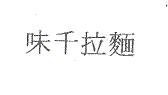
That name translates as “Taste Thousand Ramen Noodle”, or perhaps “Taste Thousand Stretch Noodle”. The name in Chinese is sometimes shortened to “Mei Qian”, using just the first two Chinese characters:
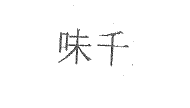
These characters translate as “Taste Thousand”. The transliteration “Mei Qian” represents the pronunciation of the characters in Cantonese. The characters are pronounced differently in Mandarin, but nothing of significance turns upon the distinction. For convenience the characters will be referred to hereafter as “Mei Qian”. The name is a made-up one and is said to have poetic qualities, although the respondent suggested that it was used in a merely descriptive sense.
3 The sign which appears outside the applicant’s restaurant contains the four Chinese characters, the name of the restaurant in English and a logo consisting of a red bowl with chopsticks prominently displayed. It is as follows:
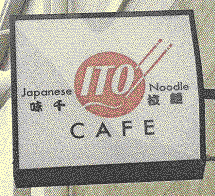
4 A similar signage is used on the restaurant’s menu, and the uniforms worn by its staff.
5 The problem in the present case arises out of the fact that written Japanese also uses Chinese characters. The Japanese language uses three forms of written characters. These are Hiragana, Katakana and Kanji. Hiragana is a phonetic alphabet, and is the ordinary syllabic script. Although all Japanese words can be written in Hiragana, that script is usually used only as an adjunct or supplement to Kanji. Katakana is also a phonetic alphabet, but is used for foreign words, onomatopoeic words and for emphasis. Kanji, which is the main form of Japanese writing, is defined as “a syllabary derived from Chinese orthography”. Kanji uses Chinese characters, which are non-phonetic. It uses symbols representing meaning, and must be memorised. The Chinese characters “Mei Qian” are pronounced “Ajisen” in Japanese, but have the same meaning in both languages.
6 “Ramen noodles” are a type of Chinese noodle that is also produced in Japan. Japanese ramen noodles are distinct from other types of Japanese noodles, such as “udon” and “soba”. As it happens, ramen noodles are relatively expensive in Australia and are not found on the menus of most traditional Japanese restaurants in Melbourne.
7 It was common ground that the applicant’s restaurant is patronised by significant numbers of members of the Asian community. There was a dispute about the percentage of patrons who were members of that community, with a suggestion that it may have been as high as 75 per cent. However, the better view seems to be the percentage was considerably less than that, and perhaps somewhere between about 25-50 per cent. The applicant claims that its Chinese patrons know its restaurant and refer to it by the name “Mei Qian” or, in some cases, “Mei Qian La Mien”. It says that its restaurant has built up a favourable reputation among members of the Chinese community by reference to that name. It also says that the name is associated with the directors and owners, namely Mr Eddy Sinn and Mr Martin Shao Yi Ma.
8 Ajisen (Melbourne) Pty Ltd, the respondent to this proceeding, proposes to open a Japanese restaurant at 130 Bourke Street Melbourne, two doors from the applicant’s restaurant. The respondent’s restaurant will be advertised, marketed and operated using the two Chinese characters that, when read by someone who speaks Japanese, are pronounced as “Ajisen”. Signage for the respondent’s restaurant includes six Japanese characters, the first two of which are Kanji characters that would be read by someone who speaks Chinese as “Mei Qian” or “Wei Qian” (depending upon whether that person speaks Cantonese or Mandarin). The last four characters on the respondent’s sign are written in Katakana, and translate as “Ramen Noodle”, or perhaps “Stretch Noodle”. Nothing turns upon the different terminology.
9 The respondent’s restaurant forms part of an international chain that is designated as the “Ajisen Ramen” restaurants. The company behind that chain, Shigemitsu Industry Co Ltd, is based in Japan. Shigemitsu was incorporated in 1972 to operate the Ajisen Ramen business. That business has grown significantly since its inception, particularly since the early 1990s. Ajisen Ramen restaurants have proved to be extremely popular in Hong Kong. By the end of 1998, there were seven such restaurants operating there, all of which advertised widely. Shigemitsu presently has franchisees operating its restaurants in Japan, China, Hong Kong, Singapore, Thailand, the Philippines, Indonesia and the United States. It also operates Ajisen Ramen restaurants in Japan.
10 In total, there are 125 Ajisen Ramen restaurants in Japan, 27 in China, 14 in Hong Kong, 10 in Singapore, seven in Thailand, three in Indonesia, three in the United States, and two in the Philippines. The respondent’s restaurant will be the first Ajisen Ramen restaurant in Australia, but others are likely to follow.
11 Shigemitsu manufactures ramen noodles at its factories in Japan, China, and Thailand. All Ajisen Ramen franchisees purchase their requirements of ramen noodles exclusively from Shigemitsu. Every Ajisen Ramen restaurant features a distinctive “get-up” consisting principally of the name “Ajisen Ramen”, a logo comprising a little girl holding a bowl of noodles, and the four Chinese or Kanji characters. In some countries, the third and fourth characters are replaced with the Katakana characters, meaning “Ramen Noodles”. A typical example of the “little girl” logo and the combination of Kanji and Katakana characters is to be found in the sign that has already been erected outside the respondent’s premises. It is as follows:

12 It will be seen from this sign that the two Kanji characters on the left are the same as the two Chinese characters that appear on the left of the applicant’s restaurant’s sign (although the font is different). It is that feature that has given rise to this proceeding.
13 The evidence suggests that “Ajisen” brand ramen noodles are popular throughout China and Japan. They are available for purchase in supermarkets in both countries, as well as through Ajisen Ramen restaurants. Those restaurants also offer for sale a variety of merchandise featuring the name Ajisen Ramen and the “little girl” logo, including umbrellas, keychains and towels.
14 Each of Shigemitsu’s franchisees is responsible for its own advertising. The nature and extent of such advertising varies from franchisee to franchisee, but is typically extensive and includes newspaper and magazine advertisements, radio and television advertisements, and billboards and posters. The advertising focuses upon the name “Ajisen Ramen”, the logo, and includes the Kanji characters that translate as “Taste Thousand”.
the pleadings
15 Put simply, the applicant’s primary case is that the advertising, marketing and operation of the respondent’s restaurant by reference to the name Ajisen Ramen (with signage including the two Chinese characters that would be pronounced “Mei Qian” in Chinese) constitutes the making of representations to members of the Asian community in greater Melbourne which are misleading or deceptive, or likely to mislead or deceive.
16 In its particulars, the applicant contends that the respondent’s signage implies that its restaurant is owned or operated by the applicant, or operated with the approval of the applicant, or affiliated with the applicant’s restaurant. These are said to be “the representations”.
17 The applicant claims that the representations are false. It claims that the respondent has engaged, and unless restrained by injunctive relief will continue to engage, in conduct in contravention of ss 52(1), 53(c) and 53(d) of the Trade Practices Act 1974 (Cth) (“the TPA”).
18 The applicant also pleads an alternative case in passing off. It claims that by its conduct, the respondent has wrongfully passed off and, unless restrained by injunctive relief, will continue to wrongfully pass off, its restaurant as, or affiliated with, the applicant’s restaurant, or as a restaurant operated with the licence, sponsorship or approval of the applicant.
19 The respondent’s defence is also quite simple. It accepts that it has used the signage identified in the applicant’s case, and that it has already commenced advertising in the way alleged. It also accepts that it has used the two Chinese characters about which the applicant complains, but claims that it has used them only as “descriptors of the goods or services on offer at its premises”.
20 The respondent denies the applicant’s claim regarding its reputation in the Asian community. It denies that members of that community have come to know the applicant by its Chinese name.
21 The respondent says, in the alternative, that if the applicant has acquired a reputation of the kind alleged, it attaches only to the word “Ito” and the logo appearing in the applicant’s current trademark application, and not to the Chinese characters appearing in a low-key manner in its signage. The respondent further says that if the applicant has acquired a reputation in relation to the Chinese name Mei Qian, that reputation does not extend to the use of the same Chinese characters in the Japanese language. Moreover, that reputation is said to be confined to those who speak only Chinese, and does not extend to those who also speak English or Japanese. Finally, that reputation does not extend to those already familiar with the Ajisen Ramen restaurant chain.
22 In effect the respondent claims that any reputation that the applicant might enjoy in relation to the name of its restaurant is confined to that very small number of persons who regularly patronise its restaurant, and who speak only Chinese. Indeed, that group is further narrowed for present purposes by excluding those who unreasonably ignore the other graphic content of the applicant’s restaurant’s signage, its get-up, appearance and other distinctive features.
23 The respondent also claims that to the extent the applicant enjoys any small or residual reputation of the kind specified above, it only does so by reason of its having taken advantage of the Chinese characters that have been used by the Shigemitsu group since 1972 in naming their restaurants. In substance, the respondent alleges that by adopting the name Mei Qian La Mien, which is simply a Chinese translation of Ajisen Ramen, the applicant has sought to derive some benefit to which it is not entitled, namely trading off the reputation of the Ajisen Ramen chain. Far from the respondent having acted improperly, it was the applicant that had done so. Accordingly, even if the applicant’s case could be made out, injunctive relief should be refused in the exercise of the Court’s discretion.
24 In essence, the respondent denies having engaged in any conduct in contravention of any of the provisions of the TPA. The respondent further denies having engaged in passing off. It claims that prospective customers, acting reasonably, would not be misled into thinking that there is a connection between the applicant’s restaurant and that of the respondent, and even if some such customers might be misled, the numbers would be miniscule. As will be seen, it relies upon the evidence of a number of witnesses, all of whom say that they have seen the respondent’s sign and did not regard it as conveying any representation that such a connection existed.
the EVIDENCE IN SUPPORT OF THE APPLICANT’S CASE
25 The proprietors of the applicant’s restaurant, Eddy Sinn and Martin Shao Yi Ma, and the general manager of the restaurant, Eddy Sinn’s wife Judy, all gave evidence in this proceeding.
26 Eddy Sinn was born in Canton, in China, in 1954. He moved to Hong Kong as a child and grew up there. He came to Australia in about 1972. He speaks Cantonese, but little English. He and his wife have operated both Chinese and Japanese restaurants in Melbourne for the past twenty years or so. They have also operated Chinese and Japanese restaurants in South Australia and Western Australia. Judy Sinn manages and operates what Eddy Sinn described as the “Mei Qian” restaurant, while Eddy Sinn and Martin Ma manage their other restaurants throughout Melbourne.
27 According to Eddy Sinn, in 1998 he and Judy decided to open a modern, casual Japanese restaurant in Chinatown. Traditional Japanese restaurants at the time were expensive and they chose a noodle restaurant because it would be more affordable. At that time, there were no other Japanese noodle restaurants in Melbourne, and he saw it as a good business opportunity.
28 Eddy Sinn said that he attended a Japanese food exhibition, the Hokkaido Festival, at Daimaru, a Japanese department store then located at Melbourne Central. There were many different types of noodles at the exhibition. These included ramen noodles from a Japanese manufacturer, Hokumen Frozen Food Co Ltd. When he tasted those noodles he liked them. He contacted Hokumen’s Australian agent and arranged to import ramen noodles from the manufacturer. At that time some restaurants in Melbourne sold one or two ramen noodle dishes but they were quite expensive. By importing the noodles directly, he was able to get a good price and also acquire the sole rights to the Hokumen product. In September 2004 he visited the Hokumen factory in Japan and obtained a document certifying that its ramen noodles were only available in Australia at the applicant’s restaurant. That document referred to the applicant’s restaurant both by its English name, and by its Chinese name.
29 Eddy Sinn’s explanation as to how he came by the Chinese name for the applicant’s restaurant was as follows:
“Once we decided to open the restaurant at 122 Bourke Street, Melbourne it was necessary to choose a name for the new restaurant. I had been thinking about a new name for about three or four months. The concept of taste is very important to me and I wanted a name which reflected this. … I had hundreds of names I thought of and then I reduced that to a list of about ten possible names each of which included the Chinese word for taste. In choosing a name I drew inspiration from reading magazines and newspapers from Hong Kong. I regularly read magazines and newspapers from Hong Kong … I do not recall specifically where the name Mei Qian La Mien came from. I may have read it in one of the Hong Kong magazines … I did not know of any Ajisen Ramen restaurant in Hong Kong when I chose the name … About a year after we opened Mei Qian restaurant I went back to Hong Kong and found that there were one or two shops called Ajisen Ramen, but I was not concerned as they were in Hong Kong and were not like Mei Qian restaurant.”
30 Judy Sinn was born in Hong Kong and moved to Australia with her family when she was a child. She can speak and read English, Mandarin and Cantonese fluently as well as some Japanese.
31 On 18 November 1998 the applicant’s restaurant began trading. Its specialty was ramen noodle. Judy Sinn had registered the business name “Ito Japanese Noodle Café”, but not the Chinese name, “Mei Qian”. That was because Chinese names could not be registered as business names. Nonetheless, the applicant’s restaurant was always marketed and promoted under the name “Mei Qian”, or the longer variant “Mei Qian La Mien”, and was always referred to by one or other of those names by members of the Chinese community in Melbourne. Judy Sinn said that the four Chinese characters would be read by anyone who spoke Japanese as “Ajisen Ramen”.
32 Judy Sinn confirmed her husband’s account of how the name “Mei Qian” had come to be chosen. She added that they had decided that “Mei Qian La Mien” would be an attractive name as it had a poetic ring in Chinese. She described “Mei Qian” as a “made up or coined expression in Chinese”.
33 Judy Sinn said:
“It is a common practice in Melbourne for Asian food restaurants and Asian businesses to have two names – the registered business name which is in English and the Chinese name which is used with the business name and set out in Chinese characters. The English name is often different from the English language translation of the Chinese name. The Chinese-speaking community know and speak about each of the restaurants by their Chinese name, not their English name.”
34 Judy Sinn then produced a list of various Asian restaurants and Asian businesses in Melbourne with their respective English and Chinese names. Among the restaurants listed were the Flower Drum, with its Chinese name translated as “Million Life Palace”; the Mask of China, with its Chinese name “House Full of Gold”; and the Shark Fin Inn, with its Chinese name “Eat First”. She said that the applicant’s Asian clientele mainly knew her restaurant by the name “Mei Qian”, though some knew it by the name “Ito” as well. She claimed that at least 75% of her clientele was of Asian descent, and that her restaurant had built a strong reputation based on the use of the Chinese name.
35 According to Judy Sinn, the name “Mei Qian” appeared on the applicant’s restaurant’s marketing and promotional material, including its outdoor signage, menus, wine menus, business cards, and staff uniforms. In addition the name appeared in all of the applicant’s restaurant’s advertising material, including in newspaper advertisements in both Chinese and Japanese newspapers. She said that the restaurant had a seating capacity of approximately 100 people, was open seven days a week for lunch and dinner, and catered to clientele who were generally under 50 years of age, with a mix of students and office workers. The patrons were generally of ethnic Chinese background, originating principally from China, Singapore, Malaysia, Indonesia and Taiwan. The majority of the staff spoke Chinese, though some of the chefs were Japanese. Many patrons did not make bookings in advance. However, it was normal for larger groups to book. Although advertising was an important part of its marketing, the restaurant had developed its reputation and goodwill mainly by word of mouth and through repeat custom.
36 Judy Sinn said that in June 2004 she noticed that the premises at 130 Bourke Street were vacant. In July and August she began to hear rumours in Chinatown that a restaurant was to open at those premises using the name “Mei Qian”. In August 2004 she learned that Ms Irene Hui Ee Lau was planning to open a Japanese restaurant with the name “Ajisen Ramen”. She had previously seen that name used in connection with restaurants in Hong Kong, and knew that those restaurants used the same Chinese characters as those used by her restaurant.
37 Judy Sinn said that, having discovered that Shigemitsu had applied to register a trademark that incorporated the two Chinese characters “Mei Qian”, she had filed a notice of opposition to that application. The basis for that opposition was that her restaurant had acquired a reputation in Melbourne for its restaurant services, and was entitled to protect that reputation. On 6 September 2004, she had instructed her solicitors to file two trademark applications. One was for the image of the four Chinese characters and the name “Mei Qian” in Chinese. The second was for the combination of the name “Mei Qian”, the English business name and the graphic logo.
38 Judy Sinn said that on or about 16 September 2004, she noticed that a sign had been erected outside the respondent’s restaurant. It included the Chinese characters “Mei Qian” followed by a series of characters in Katakana that translated as “Ramen Noodle”. She said that it was apparent that the respondent’s restaurant was being fitted out, and that it would soon be open for business. She said that she had become aware of the fact that the respondent’s restaurant had advertised in the June edition of Southern Sky, a Japanese newspaper that circulated in Melbourne. She believed that further advertisements were planned for the October edition of a monthly Japanese magazine.
39 According to Judy Sinn, it was highly likely that some prospective patrons of her restaurant would end up in the respondent’s restaurant in the mistaken belief that the two restaurants were in some way connected. The risk of this happening was heightened by their close proximity. She claimed that the respondent was seeking to take advantage of the goodwill and reputation that the applicant had built up over more than six years. She argued that it was no accident that the respondent had chosen to open its restaurant virtually next door to that of the applicant. She said that she believed that, unless the respondent were restrained, there would be a diversion of custom from her restaurant, and the applicant would suffer substantial loss and damage.
40 Judy Sinn exhibited to an affidavit a list of names of Chinese-speaking patrons of her restaurant. All were said to have eaten there regularly, and enjoyed the food and service. All claimed that they knew the restaurant by its distinctive Chinese name. All had noticed the sign outside the respondent’s restaurant two doors down, and had noticed that it used two of the Chinese characters that appeared in the name of the applicant’s restaurant. All of them said that when they saw that sign, they immediately thought that the new restaurant was connected to the applicant’s restaurant.
41 The next witness called on behalf of the applicant was Martin Shao Yi Ma. He too exhibited to an affidavit a list of names similar in form to that exhibited by Judy Sinn.
42 Mr Clarke SC, senior counsel for the applicant, readily acknowledged that there were difficulties associated with this form of survey evidence. In the end, he all but conceded that it had little probative value. However, he submitted that the views attributed to the persons named in these lists supported the views expressed by a series of witnesses, all of whom gave evidence and were cross-examined before me.
43 The first of these witnesses was Mr Lu Wei Jin, a proprietor of a takeaway food outlet. He said that he was a friend of Eddy Sinn and Martin Ma, and that he had eaten at the applicant’s restaurant before. Most of the customers had been of Asian background, and many spoke Chinese. When he visited the restaurant he spoke to the staff in Chinese. He said that he spoke Mandarin, and also a little English.
44 The witness said that when he referred to the applicant’s restaurant, he did so using its Chinese name, “Mei Qian” or sometimes “Mei Qian La Mien”. He said that he did not know the restaurant by its English name, “Ito”. He said that recently, while on his way to the applicant’s restaurant, he saw the sign outside the respondent’s restaurant. As a result, he wondered whether Eddy and Martin were opening a new restaurant. He spoke to Eddy, and was told that this was not so. He said that Chinese-speaking people would be confused or misled by the signage, and that some would end up eating at the respondent’s restaurant in the belief that it was being run by Eddy and Martin purely because of the Chinese characters on its sign.
45 Under cross-examination by counsel for the respondent, Mr McGowan, the witness readily acknowledged that because he spoke little English, he would normally take particular care to examine business signs in order to ensure that he had come to the right place. However, he insisted that he had focused predominantly upon the Chinese characters rather than the graphics. He had paid no attention to the words in English or in Japanese, presumably because he could not read either language. When it was suggested to him that the name “Ito” (as an abbreviation of “Ito Japanese Noodle Café”) was easily remembered, he maintained that he had never referred to the applicant’s restaurant except by its Chinese name. He said that he did not consider it strange that Eddy Sinn would open a new Japanese restaurant two doors down from his existing premises using a different logo, and different signage.
46 The next witness in this category, Mr Fuk On Kuan, had been in Australia for about 15 years but spoke only Cantonese. He said that although he had eaten at the applicant’s restaurant on a number of occasions, he had never heard of the name “Ito”. He said that when he saw the sign outside the respondent’s restaurant he noticed the two Chinese characters, and paid no attention to the logo, the words in English “Ajisen Ramen”, or the additional Japanese characters. He said “I just looked at the two Chinese characters ‘Mei Qian’.” He said that whenever he spoke of Chinese restaurants he always referred to them by their Chinese names, and never by any other means. He insisted that he had been quite certain, when he saw the respondent’s sign, that Eddy was opening another restaurant even when it was suggested to him, in cross-examination, that he had merely wondered whether that was so.
47 Mr McGowan suggested to the witness, in cross-examination, that he had deliberately shut his eyes to the fact that there were many differences between the signs outside the two restaurants. The witness denied that, and said that he had focused solely upon the Chinese characters because that was his invariable practice. Mr McGowan also suggested to him that if he had done so, he had acted unreasonably. The witness denied that suggestion.
48 Evidence to like effect was given by Ms Shuk Kam Chan, who worked at Chine on Paramount, a Chinese restaurant located close by in Little Bourke Street. She said that she could speak Cantonese, and also some English. She too insisted that she had never heard the applicant’s restaurant referred to by its English name. She knew the restaurant only as “Mei Qian”. When she first saw the sign outside the respondent’s restaurant, she focused solely upon the two Chinese characters. She immediately assumed that there was a link between the two restaurants.
49 Mr William Ho, a wine consultant, gave evidence in substantially the same form. He had dealt with Eddy and Judy Sinn for some years. He said that he spoke Cantonese and English, and some Mandarin. He claimed that he knew the applicant’s restaurant by its Chinese name. He translated the words Mei Qian as “a lot of flavours”. He acknowledged that he also knew the restaurant by the name “Ito”. When he filled out order forms for wine for that restaurant, he referred to it as “Ito”, and not as “Mei Qian”. He too said that when he first saw the sign outside the respondent’s restaurant, he assumed that Eddy Sinn was about to open a new business. He did not regard the fact that the signage was different as in any way odd. It was only when Eddy Sinn told him that the new restaurant was not connected to his business that he appreciated that there was no link between them.
50 The next witness to give evidence on behalf of the applicant was Mr Martin Chan. He is the general manager of the Shark Fin group of companies. That group operates seven Chinese restaurants and food court businesses in and around Melbourne. He said that he speaks both Chinese and English. Once again, his evidence was similar to that of the previous witnesses. He said that he knew the applicant’s restaurant by its Chinese name. He also knew it by the name “Ito Noodles”. He said that his office was located in the same building as the respondent’s restaurant. He claimed that his reaction upon first seeing the sign outside that restaurant was that Eddy and Judy Sinn had opened new premises.
51 Under cross-examination, Martin Chan acknowledged that restaurants within the Shark Fin group all used the same English expression, “Shark Fin”, in their signage. That was because the group had built up a successful reputation, and sought to exploit the name in order to gain clientele. When asked why Eddy Sinn would have chosen a completely different English name for his new restaurant, he replied that it was possible that Eddy was trying to capture a new market. He added, however, that as far as the Chinese characters were concerned, the two words were plainly recognisable.
52 In re-examination Martin Chan said that Shark Fin restaurants did not all use identical signage. Indeed, some had slightly different names.
53 The next witness was Ms Leung Wai Nei. She is employed as a waitress at a Chinese restaurant in Little Bourke Street that is also owned by Eddy Sinn. She said that she had eaten at the applicant’s restaurant on a number of occasions. She knew that restaurant as “Mei Qian”, as did her friends. She also knew it by the name “Ito”. When she first saw the sign outside the respondent’s restaurant, she immediately thought that Eddy Sinn was opening a new business.
54 Under cross-examination, it was suggested to her that if the respondent’s restaurant were permitted to open under its proposed name, and she wished to refer her Chinese-speaking friends to one or other of the two restaurants, it would be easy to differentiate them. It was put to her that she could simply say “go to Mei Qian with the little girl” if she intended to refer them to the respondent’s restaurant, or “go to Mei Qian with the red bowl and chopsticks” if she meant the applicant’s restaurant.
55 The witness rejected that suggestion. She said that it was not her habit when describing a restaurant to her friends to incorporate its logo into the description. She would invariably simply mention the restaurant by name. She also rejected the suggestion that was put to her, in substance, that she had deliberately disregarded all of the differences in the signage in claiming to have been confused when she first saw the respondent’s sign.
56 The last witness who gave evidence of this kind was Ms Pui-Chun Go. She is the cashier at the Dragon Boat Restaurant in Little Bourke Street, and has held that position for the past seven years. She said that she spoke both Chinese and English. She said that she had eaten at the applicant’s restaurant on a regular basis, and that the owners were her friends. She said that when she first saw the respondent’s restaurant with its sign saying “Mei Qian” in Chinese characters she immediately assumed that Eddy Sinn was opening a new restaurant. She claimed that she did not know the applicant’s restaurant by any other name. She believed that it was confusing for the respondent’s restaurant to call itself “Mei Qian”, and she thought that Chinese-speaking people would be misled into thinking that the two restaurants were connected.
57 In cross-examination, Mr McGowan invited Ms Go to examine a photograph of the applicant’s restaurant. Unbeknownst to her, he had arranged for the photograph to be “doctored”. The Chinese characters had been removed so that all that could be seen was the building itself, the English name “Ito Japanese Noodle Café”, and the logo of the red bowl and chopsticks.
58 Not surprisingly, Ms Go was readily able to identify the restaurant from the photograph despite the absence of the Chinese characters. Indeed, she did not at any stage detect the fact that the photograph had been “doctored”. This ultimately formed the basis of a submission by Mr McGowan that the witnesses, who claimed that they knew the applicant’s restaurant by its Chinese name, were exaggerating the importance of the Chinese name in order to support the applicant’s case.
THE EVIDENCE IN SUPPORT OF THE RESPONDENT’S CASE
59 The respondent filed no fewer than thirty-six affidavits from various witnesses. In the end, only two deponents were required for cross-examination. They were Ms Irene Hui Ee Lau, one of the directors of the respondent, and Mr Honda Osamu, the franchise operations manager for Shigemitsu. His evidence largely related to the operation of Shigemitsu and its relationship with the respondent.
60 Irene Lau said that she had been considering going into the restaurant business in Melbourne for some time and eventually decided upon a Japanese ramen noodle restaurant. In 2003, she approached Shigemitsu to see whether she could obtain the franchise for an Ajisen Ramen restaurant in Melbourne.
61 According to Mr Honda, discussions followed and led ultimately to the execution of a franchise agreement in December 2003. As a result, Shigemitsu instructed its trademark attorneys to file three trademark applications in Australia. The first involved the “little girl” logo, the second the “little girl” logo with the two Chinese characters, and the third the “little girl” logo with the word Ajisen written in English. The first and third applications had been accepted. The applicant had opposed the second application and its status was presently unresolved.
62 Irene Lau said that she had been born in Malaysia but had basically lived in Australia since 1993. She said that she spoke Mandarin Chinese, and was also fluent in English. She could not speak or read Japanese. She said that she first became aware of the Ajisen Ramen restaurant chain in 1998 during a visit to Singapore. She was impressed by the quality of the food, and the overall concept.
63 Irene Lau said that she began to look for suitable premises to open the first Ajisen Ramen restaurant in Melbourne in or about October 2003. The central business district, and in particular the region around Bourke Street, seemed to her to be an obvious choice as it featured numerous popular restaurants. The site at 130 Bourke Street appeared ideal for her purposes. It featured a basement that could be used for storage. At the time that she selected that site she was aware that there was another Japanese restaurant nearby. She said that this appealed to her because there was often a mutual benefit to be had in similar restaurants being in close proximity to each other. She also said that there was no particular region of Melbourne associated exclusively with Japanese restaurants.
64 According to Irene Lau, she was aware at the time that the Japanese restaurant nearby was named “Ito Noodle Café”. She said that she could not recall having seen the Chinese characters associated with that restaurant on any signs or other materials. If she had seen those characters, they had made no impact whatsoever upon her. She could only assume that this was because they appeared in relatively small font, and were overwhelmed by the prominence of the name “Ito”, and the bowl and chopsticks logo. She claimed that the first time she became aware that there were Chinese characters on the applicant’s restaurant’s sign was when she received a letter from the applicant’s solicitors complaining about her own proposed sign on or about 3 September 2004. That was shortly before this proceeding was commenced.
65 Ms Lau claimed that a Chinese-speaking person would not see any connection between the Chinese characters for “Mei Qian” and the words “Ajisen” or “Ajisen Ramen”, whether written in English or in Kanji. She said that her aim was to operate a restaurant that was quite different from the applicant’s restaurant. She described that restaurant as traditional, serving traditional Japanese food. Her restaurant would be a “contemporary Australian café”, and would not feature décor typically associated with traditional Japanese restaurants. It would serve modern Japanese food, focusing heavily on ramen noodles. She noted that her proposed menu contained 38 dishes, of which 16 were variations of ramen noodles. The applicant’s menu, on the other hand, contained 103 dishes, of which only eight consisted of ramen noodles.
66 Ms Lau said that since preparing to open her restaurant in December 2003, she had spoken to many suppliers and potential customers. None had ever suggested or even raised the possibility of her restaurant having any connection with the applicant’s restaurant. As previously indicated, she said that it was her belief that Chinese-speaking persons would not see any connection between the Chinese characters “Mei Qian” and the English name “Ajisen Ramen” because they would not pronounce those characters in that way. Chinese speakers who also spoke English would readily distinguish her restaurant from the applicant’s restaurant on the basis of their different English names, different signage and different get-up. The same was true of Japanese speakers who also spoke English.
67 Irene Lau added that many Chinese and Japanese speakers in Melbourne would be familiar with Shigemitsu’s Ajisen Ramen restaurant chain, and the distinctive get-up of its restaurants, based upon their own travels through Asia. Such people would easily recognise the respondent’s restaurant as part of that international chain.
68 Irene Lau acknowledged that it was possible that some Chinese and Japanese-speaking persons, who did not speak any English, might notice that the applicant’s restaurant and her own restaurant both used the same two Chinese or Kanji characters on their respective signs. She said:
“It is possible that these people might not necessarily be able to distinguish the restaurants based on their respective English names. However, this group represents only an extremely small percentage of Melbourne’s population. Such persons would also notice the non-language aspects of the signage and get-up.”
69 Ms Lau went on to say that most, if not all, of the people within this latter group would probably have travelled to China, Hong Kong or Japan and would be likely to know of the Ajisen Ramen chain and conclude that her restaurant was part of that chain. She said that the respondent had invested approximately $450,000 to date in preparing for the operation of the restaurant, and if prevented from using the name “Ajisen”, or the Chinese or Kanji characters that represented that name, at least $150,000 of that expenditure would be wasted. That figure would include franchise fees, signage, T-shirts, advertising, company and business names, and the costs associated with obtaining a new trademark and logo. Of the $450,000 so far invested, she had personally borrowed $200,000.
70 Finally, she denied ever having intended to mislead anyone into thinking that there was any connection between her restaurant and that of the applicant. She said that she thought the prospect of anyone being so misled was remote.
71 The other witnesses who swore affidavits on behalf of the respondent, but who were not required for cross-examination, fell into three main categories.
72 The first category consisted of a series of witnesses who all spoke Chinese. Most of them knew of the Ajisen Ramen franchise. These witnesses all said that they did not regard the Ajisen Ramen name or logo to be in any way similar to the applicant’s restaurant’s name or logo. A number of them said they had dined at “Ito” and would not mistake that restaurant for Ajisen Ramen should the respondent be permitted to commence trading under that name. Some of them also observed that the applicant’s restaurant was sometimes referred to as “Ito”, and not by its Chinese name.
73 The second category consisted of two witnesses who did not speak or read Chinese or Japanese. Both were familiar with the Ajisen Ramen franchise overseas and were also familiar with the applicant’s restaurant. Both said that they could see no similarities between the applicant’s logo, and that of the Ajisen Ramen chain.
74 The third category consisted of five witnesses who could speak Chinese. Two of them were familiar with the Ajisen Ramen chain, and one was also a regular patron of the applicant’s restaurant. These witnesses had recently eaten at the applicant’s restaurant, and had attempted to estimate the number of patrons who spoke English or some other language. In one case, there were 13 people who spoke English, and three who spoke in a language other than English. Another witness said that on the day that she was there, 36 people spoke in English and 22 spoke in a language other than English, though not necessarily Chinese. A third witness said that when she attended, there were 21 people of non-Asian appearance, three of Asian appearance who spoke in a language other than Chinese, and four of Asian appearance but of uncertain background. She did not hear any customers speaking in Chinese. The other witnesses whose evidence fell into this category gave varying estimates.
75 One witness, who did not fall into any of the three main categories, Mr Ji Dong Li, said that he was fluent in Mandarin, and was aware of the Ajisen Ramen chain. He had eaten at the applicant’s restaurant on two previous occasions, and noticed that the texture of the noodles and the soup base of its ramen dishes were “totally different” from those of the ramen noodles that he had eaten at the Ajisen Ramen restaurant in Shanghai. He said that the fonts of the Chinese characters used by the two restaurants were different, and the “feel” reflected by those fonts was “really different”. He never, at any stage, believed that there was any association between the two restaurants.
76 Finally, Mr Patrick Yu-hong Lin-Wu, a solicitor in the employ of the respondent’s solicitors, said that he had caused enquiries to be made of the Australian Bureau of Statistics in relation to the 2001 Census of Population and Housing for settlers in Melbourne. A total of 587,264 people had been born overseas, and spoke a language other than English. Of these, 440,119 (74.94%) spoke English well or very well, 139,893 (23.82%) spoke English not well or not at all, and 7,252 (1.23%) did not state their ability in the English language. He had conducted Internet searches for “Ito Japanese Noodle” and “Mei Qian” and had also searched the Australian Yellow Pages websites. However, nothing of any significance emerged from these searches.
the relevant legal principles
77 Section 52 of the TPA provides that a corporation shall not, in trade or commerce, engage in conduct that is misleading or deceptive or is likely to mislead or deceive. Sections 53(c) and 53(d) provide, inter alia, that a corporation shall not, in trade or commerce, in connection with the supply or possible supply of good or services, represent that those goods or services have sponsorship or approval that they do not have, or that the corporation has a sponsorship or approval that it does not have.
78 It has been noted that pars (c) and (d) of s 53 appear to have particular relevance to “passing off”, but it has sometimes been found to be “unnecessary” or “undesirable” to find contraventions of these provisions in civil actions brought by rival traders. Moreover, “sponsorship” and “approval” have specific meanings and do not encompass every form of association with the plaintiff that might give rise to passing off or a contravention of s 52. In 10th Cantanae Pty Ltd v Shoshana Pty Ltd (1987) 79 ALR 299 Pincus J observed at 307 that the word “sponsorship” should be given its natural meaning, and that in a commercial context it would convey that a commercial or other organisation or person stands behind and, perhaps, wholly or partly finances some activity. Similarly, there is authority relating to the word “approval” in s 53(c): see generally Wickham v Associated Pool Builders Pty Ltd (1988) 12 IPR 567 at 577.
79 Although s 53(c) is plainly relevant, it is doubtful that s 53(d) is directly in point in the present case. There is no suggestion that the identities of the two companies that are the parties to the proceeding are in any way relevant. Moreover, the evidence does not support any conclusion that there has been a representation as to the respondent’s corporation having the sponsorship or approval of the applicant corporation, assuming that this is a requirement of this paragraph.
80 There are obviously close similarities between claims brought under s 52, and claims brought for the tort of passing off. It is true that s 52 is intended to protect the interests of consumers by prohibiting misleading or deceptive conduct, whereas passing off is primarily concerned with the protection of the goodwill of a business. However, although s 52 is not concerned with the protection of a competitor’s reputation as such, competitors have standing to take action for breach of that section: Hornsby Building Information Centre Pty Ltd v Sydney Building Information Centre Ltd (1978) 140 CLR 216. It is common for both causes of action to be pleaded in the one proceeding. It is sometimes said that the cause of action under s 52 is wider than that available in passing off so that any case that fails under s 52 must also fail in passing off. That is not necessarily true. There may be some cases where it will be necessary to fall back upon the tort because, for one reason or another, the elements of the section cannot be made out.
81 However, the present case does not fall into that category. There is no dispute about whether the alleged representations, if made, were made “in trade or commerce”. There is no limitation problem of the kind that can arise where there is a claim for damages under s 82. If the applicant can make good a claim in passing off, it can also make good a claim under s 52. It is for that reason that I propose to direct attention initially to the question whether the s 52 claim can be made out. Nonetheless, I am mindful that both causes of action are pleaded. For the sake of completeness, therefore, I will set out briefly the elements of the tort at this stage.
82 As already indicated, the action for passing off seeks to protect the goodwill associated with the plaintiff’s business. Passing off is a tort providing a remedy to a plaintiff where misrepresentation by another trader causes or is likely to cause damage to the plaintiff’s goodwill or reputation.
83 In ConAgra Inc v McCain Foods (Aust) Pty Ltd (1992) 33 FCR 302, Lockhart J, with whom French J relevantly agreed, cited (at 308-309) the following passage from the speech of Lord Diplock in Erven Warnink Besloten Vennootschap v J Townend & Sons (Hull) Ltd [1979] AC 731 at 742 as an authoritative statement of the necessary elements to establish passing off:
“(1) a misrepresentation, (2) made by a trader in the course of trade, (3) to prospective customers of his or ultimate consumers of goods or services supplied by him, (4) which is calculated to injure the business or goodwill of another trader (in the sense that this is a reasonably foreseeable consequence) and (5) which causes actual damage to a business or goodwill of the trader by whom the action is brought or (in a quia timet action) will probably do so.”
84 Lockhart J also said at 343 that in order to succeed in passing off, a plaintiff must establish reputation in the jurisdiction. Both Lockhart and Gummow JJ observed that, in order to succeed in a claim for passing off, it was not necessary that the defendant had acted fraudulently or with moral obloquy. In that regard, there was no difference between a claim for passing off and a claim under s 52.
85 In Sydneywide Distributors Pty Ltd v Red Bull Australia Pty Ltd (2002) 55 IPR 354 a Full Court of this Court noted at 371 that the approach taken by Lord Diplock in Erven Warnink had not escaped criticism. However, Lord Diplock’s exposition appears to have been endorsed. Certainly the Full Court emphasised that there was no requirement that there be an actual, subjective intention to mislead, although this did not detract from the evidentiary value of deliberate borrowing. The Full Court also emphasised that the misrepresentation need only be likely to lead the public to believe that the goods are those of the plaintiff. Proof of actual deception is not required. See also Office Cleaning Services, Ltd v Westminster Office Cleaning Association [1944] 2 All ER 269 and Marleef Pty Ltd v Metcash Trading Ltd [2001] FCA 1316 at [66].
86 In substance, therefore, a plaintiff seeking to rely upon the tort of passing off must establish the requisite reputation in its trade or product, an actionable misrepresentation, and actual or likely damage: Cadbury Schweppes Pty Ltd v Pub Squash Co Pty Ltd (1980) 32 ALR 387. It is interesting to note that the Privy Council, in dismissing the appeal in that case, observed that the tort of passing off was no longer anchored to a trademark or trade name, but encompassed other material such as slogans or visual images, provided always that such material had become part of the goodwill of the product.
87 Turning then to the elements required in order to establish a breach of s 52, it is clear that while misleading or deceptive conduct usually consists of misrepresentations, whether express or by silence, it is not confined exclusively to circumstances which constitute some form of representation: Henjo Investments Pty Ltd v Collins Marrickville Pty Ltd (No 1) (1988) 39 FCR 546 at 555 per Lockhart J. See also S & I Publishing Pty Ltd v Australian Surf Life Saver Pty Ltd (1998) 88 FCR 354 at 361.
88 In Equity Access Pty Ltd v Westpac Banking Corporation (1989) 16 IPR 431, Hill J summarised in a convenient form the principles applicable to s 52 cases, such as the present, where the issues raised are closely akin to those involved in passing off. His Honour said (at 440-441):
“1. For conduct to be misleading or deceptive the conduct must convey in all the circumstances of the case a misrepresentation: Taco Bell at 202. In the present case the misrepresentation on the part of the respondents is said to be that the financial product advertised and marketed by each of them is the product of the applicant or that there is some business relationship between the applicant and each of the respondents or that the applicant has endorsed the respective product of the respondents.
2. There will however be no contravention of s 52(1) of the Act unless error or misconception results from the conduct of the corporation and not from other circumstances for which the corporation is not responsible: Puxu per Gibbs CJ at (CLR) 6 and per Mason J at (CLR) 15; Global Sportsman Pty Ltd v Mirror Newspapers Ltd (1984) 55 ALR 25 at 34.
3. Conduct will be likely to mislead or deceive if there is a ‘real or not remote chance or possibility’ of misleading or deception regardless of whether it is less or more than 50 per cent: Global Sportsman at 34. The question of whether conduct is misleading or deceptive or likely to mislead or deceive is an objective question which the Court must determine for itself. Hence evidence that persons in the relevant class have been misled will, although admissible, not be determinative. In some cases however such evidence will be very persuasive: Puxu per Gibbs CJ at (CLR) 198-9.
4. Conduct of a corporation causing mere confusion or uncertainty in the minds of the public in the sense that they may be caused to wonder whether two products may have come from the same source is not necessarily coextensive with misleading or deceptive conduct: Puxu at 100; Bridge Stockbrokers v Bridges (1984) 5 IPR 81; 57 ALR 401 at 413 per Lockhart J. Since actual deception need not be shown the court must consider whether a reasonably significant number of potential purchasers would be likely to be misled or deceived: Weitmann v Katies Ltd (1977) 29 FLR 336 at 343. The test in passing off cases is usually expressed as being whether a ‘substantial number of persons likely to become purchasers ... are liable to be deceived by the defendant’s use of the name. On the other hand it is not necessary to show that all, or substantially all, persons in the market associate the name with the plaintiff’s goods, if this can be shown of a substantial proportion of persons who are probably purchasers of the goods of the kind in question’ (per Wilberforce J, as he then was, in Norman Kark Publications Ltd v Odhams Press Ltd [1962] RPC 163 at 168 and see Saville Perfumery Ltd v June Perfect Ltd (1941) 58 RPC 147 at 175-6; 10th Cantanae Pty Ltd v Shoshana Pty Ltd (1987) 10 IPR 289; 79 ALR 299 at 315 per Gummow J).
5. In a case such as the present the applicant must establish that it has acquired the relevant reputation in the name, that is to say that the name had become distinctive of the applicant’s business in a particular country or geographical area: Sheraton Corporation of America v Sheraton Motels Ltd [1964] RPC 202; BM Auto Sales Pty Ltd v Budget Rent A Car System Pty Ltd (1976) 12 ALR 363. However, at least in some circumstances, very slight activities may be found to be sufficient to establish that a name has become distinctive of a person’s business in a particular country: Miki Shoko Co Ltd v Merv Brown Pty Ltd (1987) ATPR 40-858.
6. Section 52 is not confined to conduct which is intended to mislead or deceive: Puxu per Gibbs CJ at 197 and a corporation which acts honestly and reasonably may none the less engage in conduct that is likely to mislead or deceive: Yorke v Lucas (1985) 61 ALR 307 at 309.” (emphasis in original)
89 These principles were restated and approved by the Full Court in S & I Publishing Pty Ltd v Australian Surf Life Saver Pty Ltd at 361-362.
90 Hill J then cited with approval a passage from Taco Company of Australia Inc v Taco Bell Pty Ltd (1982) 42 ALR 177, where Deane and Fitzgerald JJ set out four guidelines for the application of s 52 to cases where the alleged misrepresentation was not express. Their Honours said (at 202-203):
“First, it is necessary to identify the relevant section (or sections) of the public (which may be the public at large) by reference to whom the question of whether conduct is, or is likely to be, misleading or deceptive falls to be tested (Weitmann v Katies Ltd (1977) 29 FLR 336, per Franki J at 339–40, cited with approval by Bowen CJ and Franki J in Brock v Terrace Times Pty Ltd (1982) 40 ALR 97 at 99; [1982] ATPR 40-267 at 43,412).
Second, once the relevant section of the public is established, the matter is to be considered by reference to all who come within it, ‘including the astute and the gullible, the intelligent and the not so intelligent, the well educated as well as the poorly educated, men and women of various ages pursuing a variety of vocations’: Puxu Pty Ltd v Parkdale Custom Built Furniture Pty Ltd (1980) 31 ALR 73, per Lockhart J at 93: see also World Series Cricket v Parish, supra, per Brennan J (16 ALR at 203).
Thirdly, evidence that some person has in fact formed an erroneous conclusion is admissible and may be persuasive but is not essential. Such evidence does not itself conclusively establish that conduct is misleading or deceptive or likely to mislead or deceive. The court must determine that question for itself. The test is objective (see, generally, Annand & Thompson Pty Ltd v Trade Practices Commission (1979) 25 ALR 91 per Franki J at 102; Sterling v Trade Practices Commission (1981) 35 ALR 59, per Franki J (with whom Northop J agreed) at 66 and per Keely J at 69; Snoid v Handley (1981) 38 ALR 383, per the court (Bowen CJ, Northrop and Morling JJ); and Brock v Terrace Times, supra, per Bowen CJ and Franki J).
Finally, it is necessary to inquire why proven misconception has arisen: Hornsby Building Information Centre v Sydney Building Information Centre (18 ALR at 647; 140 CLR at 228). The fundamental importance of this principle is that it is only by this investigation that the evidence of those who are shown to have been led into error can be evaluated and it can be determined whether they are confused because of misleading or deceptive conduct on the part of the respondent.”
91 Conduct will be misleading or deceptive if it induces or is capable of inducing error: Parkdale Custom Built Furniture Pty Ltd v Puxu Pty Ltd (1982) 149 CLR 191 (“Puxu”) at 198. Whether particular conduct is misleading or deceptive is always a question of fact. The intent of the defendant is not relevant. All that is relevant is whether, viewed objectively, the conduct was misleading or deceptive, or likely to mislead or deceive. A corporation which has acted honestly and reasonably may nevertheless be liable to be restrained by injunction, and to pay damages, if its conduct does in fact meet that description.
92 Section 52 does not expressly specify what class of persons should be considered as the possible victims for the purpose of deciding whether particular conduct contravenes the section. In particular, there is an issue as to whether the focus should be upon the section of the public to which the representation is made, or possibly only some part of that section of the public.
93 In Campomar Sociedad, Limitada v Nike International Ltd (2000) 202 CLR 45 the High Court addressed this issue, noting that a class of consumers might be expected to include a wide range of persons. The Court also noted that in Puxu, Gibbs CJ determined at 199 that the legislation did not impose burdens that operated for the benefit of persons “who fail[ed] to take reasonable care of their own interests.”
94 The Court then formulated the relevant test for whether a particular group within the community was likely to be misled or deceived, as follows (at 85-87):
“Where the persons in question are not identified individuals to whom a particular misrepresentation has been made or from whom a relevant fact, circumstance or proposal was withheld, but are members of a class to which the conduct in question was directed in a general sense, it is necessary to isolate by some criterion a representative member of that class. The inquiry thus is to be made with respect to this hypothetical individual why the misconception complained has arisen or is likely to arise if no injunctive relief be granted. In formulating this inquiry, the courts have had regard to what appears to be the outer limits of the purpose and scope of the statutory norm of conduct fixed by s 52. Thus, in Puxu, Gibbs CJ observed that conduct not intended to mislead or deceive and which was engaged in ‘honestly and reasonably’ might nevertheless contravene s 52. Having regard to these ‘heavy burdens’ which the statute created, his Honour concluded that, where the effect of conduct on a class of persons, such as consumers, was in issue, the section must be ‘regarded as contemplating the effect of the conduct on reasonable members of the class’.
It is here that there arises a critical question on the case put for the appellants. It concerns the so-called ‘doctrine’ of ‘erroneous assumption’ said to be derived from, in particular, decisions of the Full Court of the Federal Court in McWilliam’s Wines Pty Ltd v McDonald’s System of Australia Pty Ltd, Taco Co of Australia Inc v Taco Bell Pty Ltd and Lego Australia Pty Ltd v Paul's (Merchants) Pty Ltd. In their joint judgment in Taco Bell, Deane and Fitzgerald JJ emphasised that ‘no conduct can mislead or deceive unless the representee labours under some erroneous assumption’. Their Honours went on to observe:
‘Such an assumption can range from the obvious, such as a simple assumption that an express representation is worthy of credence, through the predictable, such as the common assumption in a passing-off case that goods marketed under a trade name which corresponds to the well-known trade name of goods of the same type have their origins in the manufacturer of the well-known goods, to the fanciful, such as an assumption that the mere fact that a person sells goods means that he is the manufacturer of them.’
Their Honours added that, in determining the question whether conduct properly should be categorised as misleading or deceptive or as likely to mislead or deceive, the nature of the erroneous assumption which must be made before conduct could have that character ‘will be a relevant, and sometimes decisive, factor’. Their Honours rejected:
‘[any] general proposition of law to the effect that intervention of an erroneous assumption between conduct and any misconception destroys a necessary chain of causation with the consequence that the conduct itself cannot properly be described as misleading or deceptive or as being likely to mislead or deceive’.
Nevertheless, in an assessment of the reactions or likely reactions of the ‘ordinary’ or ‘reasonable’ members of the class of prospective purchasers of a mass-marketed product for general use, such as athletic sportswear or perfumery products, the court may well decline to regard as controlling the application of s 52 those assumptions by persons whose reactions are extreme or fanciful. For example, the evidence of one witness in the present case, a pharmacist, was that he assumed that ‘Australian brand name laws would have restricted anybody else from putting the NIKE name on a product other than that endorsed by the [Nike sportswear company]’. Further, the assumption made by this witness extended to the marketing of pet food and toilet cleaner. Such assumptions were not only erroneous but extreme and fanciful. They would not be attributed to the ‘ordinary’ or ‘reasonable’ members of the classes of prospective purchasers of pet food and toilet cleaners. The initial question which must be determined is whether the misconceptions, or deceptions, alleged to arise or to be likely to arise are properly to be attributed to the ordinary or reasonable members of the classes of prospective purchasers.” (footnotes omitted)
95 In Australian Competition and Consumer Commission v Henry Kaye and National Investment Institute Pty Ltd [2004] FCA 1363 (“ACCC v Kaye”), Kenny J dealt with an application to restrain the respondents from continuing to advertise the “Henry Kaye” or “$1 million Challenge”, which was to consist of five free seminars during which Mr Kaye proposed that he would teach one person from each seminar how to become a property millionaire. Certain conditions were said to attach to this proposal. Mr Kaye also set out a further challenge, whereby he claimed he would turn 1,000 ordinary Australians into property millionaires within 12 months. The challenge and the free seminars were advertised by radio advertisements broadcast from 10 September 2003 to 18 September 2003 on Fox FM in Melbourne and 2 Day FM in Sydney. The challenge was also advertised on an Internet site and in The Australian Financial Review, The Sydney Morning Herald, The Sunday Telegraph, The Age and The Herald Sun Newspapers. Her Honour said (at [105]-[106]):
“All the advertisements were conveyed to a very wide class of persons. In effect, anyone who, on the publication dates, read any of The Herald Sun, The Age, the SMH, the AFR and the Sunday Telegraph; listened to Fox FM in Melbourne or 2 Day FM in Sydney between 10 September and 18 September 2003; or used the Internet in September 2003 to visit Mr Kaye´s website was likely to have been exposed to the advertisements. In Tobacco Institute, Sheppard J said, in relation to newspapers, that:
Newspapers are read by people across the whole spectrum of society. They were read by almost all age groups. … They are read by the well educated and the poorly educated. They are read by the intelligent and the wary and also by the unsuspecting, the gullible and the impressionable. It is unnecessary to go on. Clearly those responsible for the advertisement intended that it should have the widest possible impact across all sections of society.
This is equally true of the advertisements in this case that were conveyed by radio and on the Internet: see also Puxu at 199 per Gibbs CJ and Taco Company of Australia Inc v Taco Bell Pty Ltd (1982) 42 ALR 177 (‘Taco Company of Australia’) at 202 per Deane and Fitzgerald JJ.
In Campomar Sociedad, Limitada v Nike International Limited (2000) 202 CLR 45 (‘Campomar’) at 85, the High Court said:
It is in these cases of representations to the public … that there enter the ‘ordinary’ or ‘reasonable’ members of the class of prospective purchasers. Although a class of consumers may be expected to include a wide range of persons, in isolating the ‘ordinary’ or ‘reasonable’ members of that class, there is an objective attribution of certain characteristics.”
96 Her Honour then referred to the passage previously set out at [94] and continued:
“I do not consider that, in these passages, their Honours adopted a different view from that expressed in Taco Co of Australia Inc and in Tobacco Institute. Certainly, their Honours did not expressly say that they did: see also National Exchange Pty Ltd v Australian Securities and Investment Commission [2004] FCAFC 90; 49 ACSR 369 (“National Exchange”) at [23] to [25] per Dowsett J and [68] per Jacobson and Bennett JJ; also Medical Benefits Fund of Australia Limited v Cassidy [2003] FCAFC 289 (“Medical Benefits Fund”) at [31] per Stone J. In considering the effect of representations on the public, including their meaning, the court is to consider the effect on ordinary or reasonable members of the class in question. This does not mean that the court cannot consider the diversity of the experience and knowledge within the class and other matters pertinent to members of the class: compare National Exchange at [24] per Dowsett J. The question is whether, considered objectively, ordinary or reasonable members of the listening and reading public would have understood the representations in the way the Commission contends: see also Cassidy v Medical Benefits Fund of Australia (No 2) [2002] FCA 1097; 205 ALR 402 (“Cassidy”) at [44] per Hill J; appeal dismissed (save as to one matter) in Medical Benefits Fund.”
97 The last question of general principle to consider, before moving to my conclusions, is whether it is possible to maintain an action for breach of s 52 in circumstances where the alleged misrepresentation has been made to an identifiable group, but the evidence suggests that only a relatively small number of persons within that group are likely to be misled.
98 Finkelstein J answered that question in .au Domain Administration Ltd v Domain Names Australia Pty Ltd (2004) 207 ALR 521. His Honour said (at 528-530):
“The final point in relation to “representation to the public” cases concerns the requirement, which has been stated in many decisions both at first instance and on appeal, that for the representation to be actionable it must be shown that significant numbers of the group to whom the representation is directed are likely to have been misled or deceived. This requirement can be traced back to the decision of Franki J in Weitmann v Katies Ltd (1977) 29 FLR 336, an early s 52 case. …
Franki J was correct in stating that in a passing off action it is necessary for the plaintiff to show that a large number of consumers are liable to be deceived by the defendant’s use of a particular name or get up … This is hardly surprising. The basis for a passing off action is a proprietary right in goodwill established through the use of a name or get up in connection with the plaintiff’s goods … The action is for damage done or threatened to be done to that property by the defendant. That is the reason the plaintiff must show that a significant number of people are likely to be misled. Unless many people are misled it is unlikely that the plaintiff’s goodwill will be damaged.
In my opinion, however, Weitmann v Katies Ltd borrowed from the law relating to passing off without due regard to the difference between a passing off action and a claim based on s 52. …
It seems to me that there is simply no warrant for imposing a requirement that in a ‘representation to the public’ case significant members of the public must be misled by the impugned conduct before there can be a contravention of s 52. First, s 52 does not prescribe this requirement. Second, there is no reason in principle why the requirement should exist. Third, it would be strange if a court were to determine that certain conduct had the capacity to mislead (and did in fact mislead a handful of people) but nevertheless held that the conduct was not actionable because an insufficient number of people were misled.
These reasons are not, of course, enough for me to disregard the previous case law on the topic because the position is that a number of Full Court decisions have followed Franki J’s dictum, albeit without any analysis. The decisions include, among others: Snoid v Handley (1981) 38 ALR 383; 10th Cantanae Pty Ltd v Shoshana Pty Ltd (1987) 79 ALR 299; Siddons Pty Ltd v Stanley Works Pty Ltd (1991) 29 FCR 14 … But there is a way out. I am of opinion that the dictum cannot survive the High Court’s decision in Campomar Sociedad. By laying down the rule that in a ‘representation to the public’ case the question whether conduct is misleading or deceptive is to be assessed by reference to the reaction of the hypothetical representative member of the class to whom the representation is directed, the High Court has left no scope for the operation of the requirement that it must also be shown that a significant number of members of the class have been misled. That is, the two requirements cannot sit side by side. I take the position now to be that the dictum imposed in Weitmann v KatiesLtd has been overtaken.” (citations omitted)
Conclusion
99 The first and most important issue to be determined is whether the applicant has established that the respondent, by its advertising and signage, has falsely represented the existence of a connection, or association, between the applicant’s restaurant and its own.
100 In my opinion, the respondent’s use of the two Chinese characters that make up the name “Mei Qian” when read by a Chinese-speaking person, and “Ajisen” when read by a Japanese-speaking person, gives rise to a representation that the two restaurants are connected or associated in some way. Indeed the use of those characters constitutes a representation that the respondent’s restaurant has “sponsorship” or “approval” that it does not have.
101 In arriving at that conclusion, I have not compared the signs, and their respective Chinese characters, side by side. Although this is not a trademark case, the principles that govern the question of deceptive similarity in that context appear to me to be relevant in the present context. The question is one of impression, based on “recollection of the mark”: Melbourne Chinese Press Pty Ltd v Australian Chinese Newspapers Pty Ltd [2004] FCAFC 201 at [16].
102 That representation is false. It is likely to mislead or deceive at least some members of the public in sufficient numbers to satisfy the requirements of s 52. In arriving at that conclusion, I am conscious of the fact that there is a distinction between the likelihood that a person may be confused, and the likelihood that that person may be misled. Evidence that particular persons have been confused does not in itself explain why that confusion has occurred. In My Kinda Town Ltd v Soll and Another [1983] RPC 407, Lord Justice Oliver emphasised that confusion per se does not give rise to an action for passing off. The action is based on a misrepresentation by the defendant, whether deliberate or unintentional, that the goods or services which he offers are those of the plaintiff or are connected with the plaintiff. A similar approach may be taken in relation to s 52.
103 I accept the evidence of all of the applicant’s witnesses who have eaten at its restaurant on a regular basis that they have come to know it by the name “Mei Qian”. A number of them know it by that name alone. I do not think it appropriate to compare, and contrast, the entirety of each sign on a logo by logo basis, or on a character by character basis. The evidence seems to me to establish that a Chinese-speaking patron would not look at these signs on a “word by word” basis, but would rather focus upon the first, and key, components of the name, “Mei Qian”.
104 I also accept the evidence of at least some of those witnesses that upon seeing the sign outside the respondent’s restaurant, they immediately concluded that the respondent’s restaurant was connected to or associated with that of the applicant. Others merely “wondered” whether that was so, and probably were not relevantly misled.
105 It is true that there was a substantial body of evidence led by the respondent that suggested that no such link would be drawn by Chinese-speaking patrons. These witnesses said that they were in no way misled by the fact that the signage for the new restaurant contained the same two Chinese characters as the signage for the applicant’s restaurant. However, it seems to me to be significant that most of the witnesses who gave evidence of this nature on behalf of the respondent were familiar with the Ajisen Ramen chain of restaurants overseas. In many cases they spoke English as well as Chinese. Such persons are far less likely to be misled, or even confused, by the use of the same Chinese characters having regard to the very different logos and signage used by the two restaurants. They will not conclude that there is any connection or association between them.
106 However, it is not that group that is likely to be misled or deceived. It is, rather, the members of the Chinese community that is likely to be misled who are primarily reliant upon Chinese as their effective means of communication, who speak little or no English or Japanese, and who have never come across the Ajisen Ramen chain before. In addition, it may include a smaller group who only speak Japanese, and not Chinese or English. Persons in this category may see the four Chinese characters on the applicant’s sign, all of which they can understand, and associate them with the combination of Kanji and Katakana characters on the respondent’s sign, thereby concluding that there is a link between the two restaurants. I should emphasise, however, that my judgment in this matter is not based upon this latter group as no evidence of this kind was led before me.
107 The applicant’s restaurant bases its goodwill largely upon recommendations by its patrons. It is not difficult to see how a Chinese-speaking patron who speaks little or no English or Japanese, to whom a recommendation regarding the applicant’s restaurant has been made, and who decides to eat there, could be misled by the respondent’s signage into thinking that the respondent’s restaurant is in fact the “Mei Qian” restaurant at which that person wishes to dine.
108 The chance that such a person might be misled is increased by the fact that both restaurants serve Japanese food, are in close proximity, and purport to specialise in ramen noodles although their menus suggest that many other dishes are available.
109 Indeed, the prospect that the applicant may lose some potential customers who are misled by the respondent’s signage is further enhanced by the fact that, in the ordinary course, patrons are likely to approach the two restaurants from Swanston Street, and will therefore arrive at the respondent’s restaurant before they have any real opportunity to see the applicant’s restaurant. As such, more patrons are likely to enter the respondent’s restaurant in the mistaken belief that it is the applicant’s restaurant than vice versa. In addition, it is possible that they will remain there even if they discover that the respondent’s restaurant is not the restaurant to which they were actually recommended.
110 It seems to me that there is another group of prospective patrons of the applicant’s restaurant that is likely to be misled by the respondent’s use of the Chinese characters in its signage. That group consists of those who have eaten regularly at the applicant’s restaurant, and who happen to notice the respondent’s restaurant’s signage, or its proposed advertisements. It is likely, in my view, that at least some members of that group will assume that there is a connection between the two restaurants. They may try the respondent’s restaurant because they have enjoyed the meals they have eaten at the applicant’s restaurant in the past. These patrons may be lost to the applicant forever.
111 It was submitted on behalf of the respondent that no sensible person could possibly conclude that there was a connection between the two restaurants merely because they both have on their signage the Chinese characters “Mei Qian”. I reject that contention. A number of witnesses gave evidence before me that this was precisely the conclusion that they had arrived at, and I accept their evidence as truthful. I do not regard them as persons devoid of common sense. Nor do I accept that they wilfully closed their eyes to the differences in the signage between the two restaurants. It is not unreasonable that those who speak only Chinese would refer to Chinese restaurants by their Chinese names. It is not unreasonable that they would focus upon those names, and ignore or attach little weight to logos, or differences in the English names, which they cannot in any event read or understand. In any event, putting to one side logos on well-known chains such as “McDonald’s”, I doubt that logos of the kind displayed on these two restaurants would create any lasting impression. It is worth recalling the evidence given by Mr Chan in re-examination that not all restaurants that are linked, and operate under the same name, use the same signage and logos.
112 I accept that the numbers of prospective patrons who are likely to be misled by the common use of the Chinese characters will not be great. On the other hand, that number may not be insignificant when considered from the perspective of the applicant. I reject the respondent’s submission that the numbers in question should be characterised as minuscule because they must be viewed against the entire class of potential restaurant patrons throughout greater metropolitan Melbourne. It seems self-evident that a representation conveyed by the use of Chinese characters cannot be communicated to anyone who cannot read those characters. It follows that the class of potential restaurant patrons who might be misled is essentially confined to those who speak and/or read only Chinese. Understood in that context, the proportion of the applicant’s present and prospective customer base that might be misled, though not great, could nonetheless be significant.
113 I reject the respondent’s contention that the name “Mei Qian” is used only in a descriptive sense. “Mei Qian” is a composite expression and is the name by which the applicant’s restaurant is generally known within large sectors of the Chinese community. The reputation that the restaurant has built is linked to that name, and any use of the same name by a nearby Japanese restaurant is likely to be misleading to some patrons. I note in that regard the very different circumstances that prevailed in Monaco Willows Pty Ltd v Greenbax Pty Ltd (1996) 36 IPR 387, where Merkel J concluded that the use of the name “La Piazza” by an Italian restaurant in Templestowe did not constitute misleading or deceptive conduct, or passing off, in relation to the applicant’s three takeaway Italian food outlets located at Box Hill Central, Northland and Australia on Collins shopping centres. The risk that there will be a significant diversion of trade from the applicant’s restaurant in this case goes much further than the risk of minor confusion on the part of a handful of persons in that case.
114 I also reject the respondent’s contention that the applicant does not come to this Court with “clean hands”. There is no satisfactory basis upon which I can conclude, on the evidence before me, that when Eddy Sinn chose the name “Mei Qian” he had in mind, whether consciously or subconsciously, the signage of the Ajisen Ramen chain, including its use of the Kanji characters for “Ajisen”. His evidence was that the idea for the name “Mei Qian” probably came from a Chinese magazine. Whether or not that was so, that statement cannot fairly lead to a finding that the applicant borrowed the name from the Ajisen Ramen chain.
115 That leads me to the final issue to be determined. Having concluded that the respondent has engaged in misleading or deceptive conduct, and thereby contravened s 52 and s 53(c), and has possibly also committed the tort of passing off, to what relief, if any, is the applicant entitled?
116 By its application, the applicant claims declaratory relief, injunctive relief, damages and orders for delivery up by the respondent of all materials which the respondent has used, or proposes to use, in engaging in the conduct that is said to be misleading or deceptive. In reality, however, the only remedy actually sought during the course of the trial was an injunction restraining the respondent from continuing to use the Kanji characters for “Ajisen”.
117 The injunction that was originally sought was couched in terms that would have restrained the respondent from advertising, marketing, or operating a Japanese restaurant at 130 Bourke Street Melbourne, or anywhere else in the greater Melbourne metropolitan area, under or by reference to the names “Mei Qian”, or “Ajisen Ramen”, or the Chinese characters currently depicted on the sign outside the respondent’s restaurant. In addition, it was sought to restrain the respondent from using any names that were “misleading or deceptively similar thereto and/or to the Chinese characters” that make up the name “Mei Qian La Mien” currently depicted on the signage of the applicant’s restaurant.
118 An injunction framed in such broad terms would obviously be inappropriate. It would go far beyond the applicant’s legitimate concerns that its customers would be diverted to the respondent’s restaurant. Mr Clarke readily acknowledged that this was so during the course of argument. He submitted, however, that I should grant a more tightly framed injunction, and he argued that nothing short of an injunction prohibiting the use of the Kanji characters would be effective.
119 The power to grant injunctive relief for contraventions of the Act is contained in s 80. Section 80(1) provides that where the Court is satisfied that a person has engaged, or is proposing to engage, in conduct that constitutes, inter alia, a contravention of a provision of Pt V, the Court may grant an injunction in such terms as it determines to be appropriate. Section 80(4) provides that the power of the Court to grant an injunction may be exercised whether or not it appears that the person intends to engage again, or to continue to engage, in conduct of the kind in question, whether or not that person has previously engaged in conduct of that kind, and whether or not there is an imminent danger of substantial damage to any person if that person engages in conduct of that kind.
120 It is clear that s 80 does not confer upon the Court an arbitrary discretion. Moreover, to require, rather than permit, the Court to grant an injunction once a contravention has been established would deny the Court the power to adapt the remedy to the needs of the case, and would lead to injustice: Mikasa (NSW) Pty Ltd v Festival Stores (1972) 127 CLR 617 at 651 per Gibbs J.
121 The principles which govern the Court’s discretion to grant injunctive relief are well-established. Those principles are helpfully set out in ICI Australia Operations Pty Ltd v Trade Practices Commission (1992) 38 FCR 248 at 256-257 per Lockhart J and at 267 per Gummow J. While actual or likely damage is not a jurisdictional requirement by virtue of s 80(4), it remains relevant to the exercise of discretion.
122 There are many examples of cases where breaches of various kinds have been proved, but injunctive relief has been refused in the exercise of the Court’s discretion. See for example Trade Practices Commission v Gold Coast Property Sales Pty Ltd (1994) 49 FCR 442; Australian Competition and Consumer Commission v Health Partners Inc (1997) 151 ALR 662; Australian Competition and Consumer Commission v C G Berbatis Holdings Pty Ltd (2001) ATPR 41-802; Australian Competition and Consumer Commission v Danoz Direct Pty Ltd (2003) 60 IPR 296.
123 It is obvious that a final injunction should not be expressed in terms which are too broad. It should bear upon the case proven. There must be a nexus between the conduct found to constitute the relevant contravention and the injunction granted. The Court must ensure, so far as it can, that its orders are certain, and provide clearly for what the parties affected by them are bound to do or refrain from doing. There is a useful analysis of the relevant principles in Trade Practices Commission v GLO Juice Co Pty Ltd (1987) 73 ALR 407.
124 Although a competitor has standing to take action under s 52 in relation to conduct closely akin to passing off, the right conferred upon the competitor is a right to enforce a provision of the Act. It is not a private right to protect the competitor’s reputation.
125 It is important to note that s 87(1) provides that, without limiting the generality of s 80, where the Court finds that a person who is a party to the proceeding has suffered, or is likely to suffer, loss or damage by the conduct of another, it may make such order or orders as it thinks appropriate against the person who engaged in the conduct or was involved in the contravention if it considers that this will compensate in whole or in part for the loss or damage, or prevent or reduce that loss or damage. The subsection applies to proceedings instituted under Pt VI. This is such a proceeding. The section confers a wide power upon the Court to make remedial orders. That power is not fettered by any express terms, but it is nevertheless permissible for the Court to have regard to equitable and other principles that are established in other contexts.
126 Section 87 allows for a broad range of possible orders: see generally Deane v Brian Hickey Invention Research Pty Ltd (1988) 11 IPR 651 at 656 per Burchett J and Akron Securities v Iliffe (1997) 41 NSWLR 353. Among the orders that it permits, pursuant to s 87(2), are orders declaring contracts void, orders requiring the refund of money or the return of property, orders directing the payment of money, orders directing the repair of goods that are defective, and orders requiring the supply of specified services.
127 It is not immediately obvious whether the orders referred to in s 87(2) are intended to be read as an exhaustive list of the orders that can be made under s 87, or whether there is some flexibility built into ss 87(1) and (1A) to enable orders to be tailored to meet the exigencies of particular cases.
128 There is no general power conferred upon the Court to order what might be described as “corrective advertising”. The Court has power under s 86C to make an order requiring a person to publish, at the person’s expense, and in the way specified in the order, an advertisement in the terms specified in, or determined in accordance with, the order. However, only the Australian Competition and Consumer Commission (“the Commission”) can apply to have that section invoked: see generally ACCC v Kaye at [203]-[205]. Section 86C(3) provides that s 86C does not limit the Court’s powers under any other provision of the Act.
129 It seems clear that the power conferred upon the Court to grant injunctive relief under s 80 is sufficient to allow the Court to order a form of corrective advertising if that is appropriate to meet the needs of the particular case. In Janssen Pharmaceutica Pty Ltd v Pfizer Pty Ltd (1985) 6 IPR 227 Burchett J determined at 237-238 that power existed under s 80 to issue a mandatory injunction requiring the respondent to publish what was in effect corrective advertising. I consider, with respect, that his Honour was entirely correct in arriving at that conclusion. I note that in Mundine v Layton Taylor Promotions Pty Ltd (1981) 51 FLR 73 Ellicott J expressed doubt (at 77) whether the Act, as it then stood, empowered the granting of relief of this kind in an application not made by the Minister or the Commission. However, as Burchett J observed, the problem was that s 80 then authorised the making of orders of carefully defined types, which did not include corrective advertising, while s 80A specifically empowered the Court to make such an order but only on the application of the Minister or the Commission.
130 Section 80 is now cast in general terms and should be regarded as enabling the Court to tailor any injunction to ensure that the objects of s 52 can be achieved without causing disproportionate prejudice to a respondent who may inadvertently have contravened the section. If the real vice in the present case is that a small but significant number of customers will be diverted from the applicant’s restaurant by being misled into thinking that there is a connection between the two establishments, or that the respondent’s restaurant is in fact operated by the applicant, one solution to that problem is to require the respondent to take practical steps to ensure that this does not occur.
131 There is of course a difference between corrective advertising, whether ordered pursuant to s 87 or s 80, and an injunction that prohibits the continuation of misleading or deceptive conduct. In some cases, corrective advertising will operate as a compensatory measure to prevent loss flowing from the misleading or deceptive conduct. In that sense the remedies available under these sections may be regarded as conceptually distinct. It may even be thought that s 87(1) is the more appropriate basis for a mandatory order compelling what is in substance a form of corrective advertising.
132 It would of course be possible to ensure that no prospective patron is misled into thinking that there is a connection between the two restaurants by preventing the respondent from using the offending characters in its signage. The applicant contends that nothing less than an order in those terms would suffice. It is necessary, however, to bear in mind that the applicant is not entitled to injunctive relief as of right. The grant of that relief is discretionary. In addition, the applicant is most certainly not entitled to be protected from lawful competition. The fact that a Japanese ramen noodle restaurant is about to open, virtually next door to the applicant’s restaurant, may mean that the applicant will lose significant custom. Neither s 52, nor the tort of passing off, operates to provide any redress in relation to such loss.
133 The present case is unusual in that the two Chinese characters that make up the word “Mei Qian” also happen to be used as Kanji characters in the Japanese word “Ajisen”. In addition, those characters have the same meaning in both languages. The evidence suggests that the problem that the applicant faces by reason of the respondent’s proposed use of those characters could be overcome, in a practical sense, by requiring the respondent to make it absolutely clear to anyone contemplating eating at its restaurant that there is no connection between the two establishments.
134 I note that the applicant suggested that the respondent could retain the name “Ajisen” but avoid using Kanji characters, and use Katakana or Hiragana script instead. However, the evidence is that “Ajisen” must be written in Kanji, or it will not be recognised as having the meaning “taste thousand” that is traditionally associated with the Ajisen Ramen chain. I accept that evidence.
135 I should add that there is no basis for any finding that the respondent has sought to copy, or reap the benefit of the applicant’s restaurant’s reputation, by using the Kanji characters. As previously indicated, the use of those characters is standard for all Ajisen Ramen franchise restaurants.
136 In summary, I am satisfied that the harm that the applicant might suffer if the respondent were to use the offending characters in its signage would not be great, and could substantially be overcome by ensuring that steps were taken to prevent prospective patrons from being misled. It would be wrong, in my view, to grant injunctive relief that went well beyond the needs of the case, and cause significant and unnecessary harm to the respondent in circumstances where a ready alternative form of relief is available. There is no reason why the respondent should be prevented from using the Kanji characters that have long been associated with the Ajisen Ramen franchise. Substantial expense has already been incurred in preparing for a fit-out and operation of the respondent’s restaurant using crockery and other paraphernalia bearing the Ajisen lettering and logo. That expenditure would be thrown away if the injunction sought by the applicant were granted.
137 I take into account the fact that Irene Lau denied that she had any ulterior intent in opening her restaurant in close proximity to that of the applicant, and I accept her evidence. She claimed that she was unaware that the applicant’s restaurant had the Chinese characters “Mei Qian” on its signage until she received a letter from the applicant’s solicitor informing her of that fact on or about 4 September 2004, and there is no reason to disbelieve her. It is really only the fact that the two restaurants are near each other that creates the risk that there may be some diversion of trade from the applicant’s restaurant. I would not regard that risk, or the level of harm that the applicant would be likely to sustain, as sufficient to warrant restraining the respondent from using the Kanji characters as part of its signage as proposed.
138 On the other hand, I consider that the applicant is entitled to some protection against the risk that a number of prospective customers might be misled into thinking that there is a connection between the two restaurants. Steps can be taken to prevent that from happening. Customers should be made aware of the fact that there are no links whatever between those restaurants, and that anyone wishing to dine at the applicant’s restaurant will find that restaurant at 122 Bourke Street, and not at 130 Bourke Street.
139 In my view, this object can readily be achieved by requiring the respondent to display, for an appropriate period, in a prominent location, and clearly visible from the exterior of its restaurant, signs written in both Chinese and Japanese that make it clear that the two restaurants are not in any way connected or associated. I also consider that a similar disclaimer should be included in all of the respondent’s advertisements.
140 As foreshadowed during the hearing, I propose to hear the parties further regarding the form that any such orders should take. I also propose to hear the parties regarding the costs of this proceeding.
|
I certify that the preceding one hundred and forty (140) numbered paragraphs are a true copy of the Reasons for Judgment herein of the Honourable Justice Weinberg. |
Associate:
Dated: 29 October 2004
|
Counsel for the Applicant: |
Mr G.S. Clarke SC with Mr R.A. Millar |
|
|
|
|
Solicitor for the Applicant: |
Kliger Partners |
|
|
|
|
Counsel for the Respondent: |
Mr G.C. McGowan |
|
|
|
|
Solicitor for the Respondent: |
Tan and Tan |
|
|
|
|
Date of Hearing: |
13, 14 and 15 October 2004 |
|
|
|
|
Date of Judgment: |
29 October 2004 |


