

FEDERAL COURT OF AUSTRALIA
Beecham Group PLC v Colgate-Palmolive Pty Ltd [2004] FCA 1335
INTELLECTUAL PROPERTY - Trademarks - Infringement - Interlocutory Injunction - Application to restrain respondent from using a mark resembling the applicants' registered trade marks - Applicants proprietors of MACLEANS trade marks - Respondents marketing "Colgate MAXCLEAN" power toothbrush - Serious question to be tried - "MAXCLEAN" deceptively similar to "MACLEANS" - Similarities such that consumers likely to have reasonable doubt as to whether the two products come from the same source - Substantial visual and aural similarity - Balance of convenience - Principle damage dilution of applicants' trade marks - Use of name damaging applicants' reputation and goodwill - Damages an inadequate remedy - Respondent aware of the similarity between "MAXCLEAN" and the MACLEANS marks - Interlocutory injunction granted - (CTH) Trade Marks Act 1955 s 120
Trade Marks Act 1995 (Cth) s120
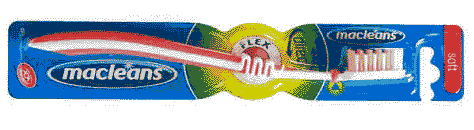
Johnson & Johnson Australia Pty Limited v Sterling Pharmaceuticals Pty Limited (1991) 30 FCR 326 approved
Mark Foys Limited v Davies Coop & Co Limited (Tub Happy Case) (1956) 95 CLR 190 approved
Shell Co of Australia Limited v Esso Standard Oil (1963) 109 CLR 407 approved
Carnival Cruise Lines Inc v Sitmar Cruises Limited (1994) 31 IPR 375 cited
Australian Woollen Mills Limited v F S Walton & Co Limited (1937) 58 CLR 641 approved
Wingate Marketing Pty Limited v Levi Strauss & Co (1994) 49 FCR 89 referred to
Polaroid Corporation v Sole N Pty Limited [1981] 1 NSWLR 491 approved
British Petroleum Co Ltd v European Petroleum Distributors Ltd [1968] RPC 54 approved
Southern Cross Refrigerating Co v Toowoomba Foundry Pty Ltd (1954) 91 CLR 592 approved
Aristoc Limited v Rysta Limited [1945] AC 68 discussed
Castlemaine Tooheys Limited v South Australia (1986) 161 CLR 148 cited
Patrick Stevedores Operations No 2 Pty Limited v Maritime Union of Australia (No 3) (1998) 195 CLR 1 cited
Australian Guarantee Corp Limited v Sydney Guarantee Corp Limited (1951) 51 SRNSW 166 applied
Telmark Teleproducts (Australia) Pty Ltd v Coles Myer Ltd (1988) 84 ALR 437 applied
Twentieth Century Fox Film Corporation v The South Australian Brewery Co Ltd (1996) 66 FCR 451 cited
Parfums Christian Dior (Australia) Pty Limited v Dimmey’s Stores Pty Ltd (1997) 39 IPR 349 referred to
Beecham Group Limited v Bristol Laboratories Pty Limited (1968) 118 CLR 618 referred to
Tidy Tea Limited & Lyons Tetley Limited v Unilever Australia Limited (1995) 32 IPR 405 referred to
Plimpton v Spiller [1876] 4 Ch D 286 approved
BEECHAM GROUP PLC AND GLAXOSMITHKLINE AUSTRALIA PTY LTD v COLGATE-PALMOLIVE PTY LTD
NSD1425 OF 2004
TAMBERLIN J
SYDNEY
15 OCTOBER 2004
|
IN THE FEDERAL COURT OF AUSTRALIA |
|
|
NEW SOUTH WALES DISTRICT REGISTRY |
NSD1425 OF 2004 |
|
BETWEEN: |
BEECHAM GROUP PLC FIRST APPLICANT
GLAXOSMITHKLINE AUSTRALIA PTY LTD ABN 47 100 162 481 SECOND APPLICANT
|
|
AND: |
COLGATE-PALMOLIVE PTY LTD ABN 79 002 792 163 RESPONDENT
|
|
TAMBERLIN J |
|
|
DATE OF ORDER: |
15 OCTOBER 2004 |
|
WHERE MADE: |
SYDNEY |
THE COURT ORDERS THAT:
1. The application for injunctive relief be granted until further order upon the undertaking of the first and second applicants as set out in their proposed Short Minutes of Order, namely:
(a) to submit to such order (if any) as the Court may consider to be just for the payment of compensation, to be assessed by the Court or as it may direct, to any person, whether or not a party, adversely affected by the operation of the interlocutory order in Order 1 or any continuation (with or without variation) thereof; and
(b) to pay compensation referred to in (a) to the person there referred to.
2. Orders be made in accordance with Order 1 of the Short Minutes of Order proposed by the applicants as follows:
1. until the determination of the proceedings or further order of the Court, the Respondent by itself, its servants or agents or otherwise be restrained from:
(a) using or threatening to use the word “MAXCLEAN” in the manner in which it is used on the packaging a copy of which is “Attachment A” to the Application filed in these proceedings (the “MAXCLEAN toothbrush”), or in any manner which is similar to such use, in relation to the packaging, promotion, advertising, manufacture, distribution, offering for sale or sale of dental or oral hygiene products, including toothbrushes and toothpastes; and
(b) using or threatening to use the mark “MAXCLEAN” in relation to the packaging, promotion, advertising, manufacture, distribution, offering for sale or sale of dental or oral hygiene products, including toothbrushes and toothpastes; and
(c) using or threatening to use the trade marks listed below, or any mark which is substantially identical with or deceptively similar to those trade marks in relation to the packaging, promotion, advertising, manufacture, distribution, offering for sale or dale of dental or oral hygiene products, including toothbrushes and toothpastes:
(1) Australian registered trade mark no. 774677 for MACLEANS; and
(2) Australian registered trade mark no. 115973 for MACLEANS.
(3) The respondent pay the applicants’ costs of this application.
THE COURT FURTHER ORDERS THAT:
1. The hearing of the matter be expedited.
Note: Settlement and entry of orders is dealt with in Order 36 of the Federal Court Rules.
|
IN THE FEDERAL COURT OF AUSTRALIA |
|
|
NEW SOUTH WALES DISTRICT REGISTRY |
NSD1425 OF 2004 |
|
BETWEEN: |
BEECHAM GROUP PLC FIRST APPLICANT
GLAXOSMITHKLINE AUSTRALIA PTY LTD ABN 47 100 162 481 SECOND APPLICANT
|
|
AND: |
ABN 79 002 792 163 RESPONDENT
|
|
JUDGE: |
|
|
DATE: |
15 OCTOBER 2004 |
|
PLACE: |
SYDNEY |
REASONS FOR JUDGMENT
INTRODUCTION
1 This is an application for interlocutory relief seeking, among other things, to restrain the respondent from using a mark resembling the applicants’ registered trade marks.
2 The first applicant is the registered proprietor of Australian registered trade mark no. 774677 in relation to toothbrushes, toothpicks and dental floss and of Australian trade mark no. 115973 for the same word in relation to toothpaste (“the MACLEANS marks”).
3 The second applicant is an authorised user of the MACLEANS marks and sells both toothbrushes and toothpaste under these marks in Australia. I shall refer to both applicants together as “MACLEANS”. MACLEANS has the second highest share, namely 15.6% for this year to date, of the combined toothbrush and toothpaste market behind the market leader, Colgate, and the fourth highest share, namely 9.4%, of the toothbrush market alone.
4 This dispute arises because the respondent (“Colgate”) has commenced to sell a small battery powered toothbrush in packaging that bears the letters “Ma”, followed by a heavily distorted character which is followed by the letters “Clean”. The heavily distorted third character looks like a “x” or, alternatively, a character of no definite meaning which punctuates the letters on either side of it. This is said to resemble a star asterisk which appears above the MACLEANS marks on MACLEANS products.
5 The comparison between the usage of the two marks can be illustrated by photographs of the two toothbrushes in their respective packaging, which I set out below:
MACLEANS TOOTHBRUSH
COLGATE TOOTHBRUSH

6 On the present application which is the subject of these reasons, MACLEANS proffers an undertaking for damages and seek orders restraining Colgate from using or threatening to use the word MAXCLEAN on the packaging of its toothbrush, or in relation to the marketing of its toothbrush on the basis that it infringes the MACLEANS marks, and for Colgate to take immediate steps to urgently recall all supplies of the MAXCLEAN toothbrush from all retail and wholesale outlets to which it has been sold.
7 Colgate disputes the claim and has proffered Short Minutes of Order which include undertakings that after 21 October 2004 it will not import any further stocks of the MAXCLEAN toothbrushes into Australia; that it will not proceed with any advertising by reference to “Colgate MAXCLEAN”; and that it will not introduce any toothpaste or other oral care products into the Australian market that are sold under or promoted by reference to “MAXCLEAN” or “Colgate MAXCLEAN”. Colgate seeks directions that the proceedings continue on pleadings. A timetable is set out, and it is proposed that the matter be fixed for hearing, over four days, in February 2005, which is approximately four months’ time. MACLEANS oppose Colgate’s offer of the undertakings and the suggested timetable primarily because it is said that the hearing will not be effective to adequately remedy the damage done to the MACLEANS marks because it could be extremely difficult to estimate any damage caused as a consequence of the marketing of “Colgate MAXCLEAN” if MACLEANS’ claim proves to be successful.
Is there a serious case?
8 Section 120 of the Trade Marks Act 1995 (Cth) provides that a person infringes a registered trade mark if the person uses as a trade mark a sign that is substantially identical with, or deceptively similar to, the trade mark in relation to goods or services in respect of which the trade mark is registered. The first question which the section raises is whether the trade mark in question is being used as a trade mark. In this case, this question depends on whether the “MAXCLEAN” sub-brand is being used by Colgate for the purpose of indicating a connection in the course of trade between the MAXCLEAN toothbrush and a particular trade source: see Johnson & Johnson Australia Pty Limited v Sterling Pharmaceuticals Pty Limited (1991) 30 FCR 326 at 351. This in turn gives rise to the question whether “MAXCLEAN” appears as a mark for distinguishing the MAXCLEAN toothbrush from other toothbrushes in the course of trade: see Mark Foys Limited v Davies Coop & Co Limited (Tub Happy Case) (1956) 95 CLR 190 at 198-200 (the “Tub Happy case”). These questions are to be assessed from the perspective of a person looking at the label, and on the assumptions that a reasonable person would make as to the purpose of the product and nature of its use. In considering these questions, importance is attached to the position and prominence of the disputed word on the packaging, and in its promise in promotion of material: see Shell Co of Australia Limited v Esso Standard Oil (1963) 109 CLR 407 at 422-5. The addition of words or signs, such as, for example, “Colgate (R)” adjacent to “MAXCLEAN”, or any other references to Colgate will not avoid trade mark infringements. This distinguishes an infringement action from a passing off suit. As was pointed out by Williams J in the Tub Happy Case at 205:
“ … if the defendant uses the words of the plaintiff’s trade mark as indicating origin it is still an infringement notwithstanding that the defendant always adds his own name.”
See also Carnival Cruise Lines Inc v Sitmar Cruises Limited (1994) 31 IPR 375 at 383-384.
9 The next question to be considered is whether the MAXCLEAN mark is substantially identical with or deceptively similar to the MACLEANS marks. The relevant principles in examining this question are set out in Australian Woollen Mills Limited v F S Walton & Co Limited (1937) 58 CLR 641 at 658, per Dixon and McTiernan JJ:
“In deciding [the] question, the marks ought not, of course, to be compared side by side. An attempt should be made to estimate the effect or impression produced on the mind of potential customers by the mark or device for which the protection of an injunction is sought. The impression or recollection which is carried away and retained is necessarily the basis of any mistaken belief that the challenged mark or device is the same. The effect of spoken description must be considered. If a mark is in fact or from its nature likely to be the source of some name or verbal description by which buyers will express their desire to have the goods then similarities both of sound and of meaning may play an important part. The usual manner in which ordinary people behave must be the test of what confusion or deception may be expected. Potential buyers of goods are not to be credited with any high perception or habitual caution. On the other hand, exceptional carelessness or stupidity may be disregarded.” (Emphasis added)
10 The products in the present case are closely related. Both having the appearance of a manual toothbrush although the Colgate MAXCLEAN toothbrush is of course a battery operated toothbrush. See also the remarks of Sheppard J in Wingate Marketing Pty Limited v Levi Strauss & Co (1994) 49 FCR 89. It is no answer in determining deceptive similarity that the products of one party are more expensive and provided to a different class of customer than the product of the other part: see Polaroid Corporation v Sole N Pty Limited [1981] 1 NSWLR 491 at 497; British Petroleum Co Ltd v European Petroleum Distributors Ltd [1968] RPC 54 at 64.
11 It is necessary to show that there is a real danger of deception or confusion occurring and a mere possibility is not sufficient. However, it is sufficient if the use of the disputed mark is likely to cause a number of persons to wonder whether the two products might come from the same source. It is enough if the ordinary person has reasonable doubt. In order to assess this, it is necessary to consider the context in which the mark is used, including the circumstances in which the goods or services will be bought and sold, and the character of the probable customers for the goods or services: see Southern Cross Refrigerating Co v Toowoomba Foundry Pty Ltd (1954) 91 CLR 592 at 594-595.
12 Moreover, in cases such as the present, aural comparison is important. In Aristoc Limited v Rysta Limited [1945] AC 68, it was noted with approval at 86, that Luxmoore LJ, in the Court of Appeal, had considered the way in which to make an aural comparison as follows:
“The answer to the question whether the sound of one word resembles too nearly the sound of another so as to bring the former within the limits of s.12 of the Trade Marks Act, 1938, must nearly always depend on first impression, for obviously a person who is familiar with both words will neither be deceived nor confused. It is the person who only knows the one word, and has perhaps an imperfect recollection of it, who is likely to be deceived or confused. Little assistance, therefore, is to be obtained from a meticulous comparison of the two words, letter by letter and syllable by syllable, pronounced with the clarity to be expected from a teacher of elocution. The court must be careful to make allowance for imperfect recollection and the effect of careless pronunciation and speech on the part not only of the person seeking to buy under the trade description, but also of the shop assistant ministering to that person’s wants.” (Emphasis added)
13 In my view, there is a serious case raised by the applicant on the material presently before me on the question whether the word “MAXCLEAN” is used as a trade mark: see Castlemaine Tooheys Limited v South Australia (1986) 161 CLR 148 at 153; Patrick Stevedores Operations No 2 Pty Limited v Maritime Union of Australia (No 3) (1998) 195 CLR 1 at 24. It is evident from the photographs that the word is prominent and positioned immediately above the toothbrush. The size of the lettering of the word “MAXCLEAN”and its distinctive style reinforce this impression. There is a lack of a gap between the “X” and the capital “C”, which creates a new word, which can be said to be associated with the product.
14 I do not consider that the addition of the word “Colgate” adjacent to the word “MAXCLEAN” prevents the mark operating being used as a trade mark. In my opinion, “MAXCLEAN” is used as distinguishing mark of the toothbrush, both among other toothbrushes in the Colgate range, and from competing products.
15 In relation to the question of deceptive similarity, there is arguably a close association between the Colgate and MACLEANS branding as a consequence of the aural similarity between the marks “MAXCLEAN” and “MACLEANS”. It cannot be assumed that potential buyers of the toothbrushes will be aware of the history of the MACLEANS name in Scotland as a distinguishing feature or that a particular accent will be used. Having regard to both the appearance of the marks and the aural sound, a serious question is therefore raised as to whether a prospective buyer would wonder whether the Colgate product originated from MACLEANS. It was pointed out in argument that the word MACLEANS is sometimes used as a noun as a replacement for the word “teeth”, bringing with it an association of whiteness and teeth. While it is true that the evidence indicates that the two products will be located in a similar section of supermarkets, pharmacies and other stores, and that the colouring of the Colgate and MACLEANS packaging is different, nevertheless, this does not mean that the two words may not give rise to probable doubt and wonder as to origin of the Colgate product. Customers will no doubt cast their eye over the range of products before making a purchase, and given the prominence of the word MAXCLEAN, I consider that such a consequence could not be said to be a mere possibility or fanciful.
16 Furthermore, in the present case, as will be discussed in greater detail below, Colgate’s marketing experts were aware of the competing MACLEANS mark when they were considering the MAXCLEAN name and were targeting that mark. This is indicated by the Colgate MAXCLEAN marketing material that was put in evidence in these proceedings, which referred to an obituary and “RIP MACLEANS”. This shows that experienced experts in the area of toothbrush marketing considered that the MAXCLEAN sub-brand would have an effect on MACLEANS products, and would have an adverse effect upon them, if it did not kill and bury them, to use the colourful language of the marketing experts. The question of whether these experts, in adopting “MAXCLEAN”, chose it in the hope or expectation of deriving benefit from its resemblance to “MACLEANS” in that the Colgate MAXCLEAN product might be confused with a MACLEANS product is relevant. As the authorities indicate, a court will more readily infer that promoters, who know their field of business well, were justified in entertaining their hope and expectations, and that it was therefore probable that, in this case, MACLEANS would suffer damage: see Australian Guarantee Corp Limited v Sydney Guarantee Corp Limited (1951) 51 SRNSW 166 at 170-1 per Roper CJ in Eq; Telmark Teleproducts (Australia) Pty Ltd v Coles Myer Ltd (1988) 84 ALR 437 at 445 per Gummow J and Twentieth Century Fox Film Corporation v The South Australian Brewery Co Ltd (1996) 66 FCR 451 at 466. In my view, the marketing experts’ foresight is of importance in the present application.
17 Accordingly, the first requirement for the grant of an interlocutory injunction is satisfied in the present case.
balance of convenience
18 Evidence was led by Colgate from Ms Dillon, Colgates’s Marketing Manager for Consumer and Professional Oral Care, as follows:
19 Colgate is the proprietor of a significant number of registered trade marks in Australia relating to toothbrushes and toothpaste among other items. On 1 October 2004, it applied for several “Colgate MaXClean” trade marks. Ms Dillon was aware that MACLEANS had previously marketed and sold a battery operated toothbrush in the Australian market, which had been withdrawn. She said that two brand names had been considered for the Colgate product prior to 11 May 2004, whereupon she was informed that the proposed brand name would be “Colgate MaXClean”. On 7 June 2004, Colgate approved packaging for a power toothbrush styled with that name. Previously, on 1 May 2004, Colgate had been given the results of trade mark searches in Australia. In about mid-July 2004, Colgate presented mock-ups of the “MAXCLEAN” toothbrush to various suppliers and third party retailers, such as supermarkets and pharmacies, as a prelude to the launch of the MAXCLEAN toothbrush onto the Australian market. The product was first manufactured on or about 19 August 2004 in China, and the first shipment arrived in Australia on about 27 August 2004.
20 On or about 12 August 2004 Ms Dillon was informed by the head of the Powered Toothbrush Global Division from the New York office of the Colgate-Palmolive Company that the name of the product was to change from “Colgate MAXCLEAN” to a new name. On 22 September 2004, Colgate received a letter from the solicitors for MACLEANS. Ms Dillon says that prior to that date Colgate had not received any complaint about using “MAXCLEAN”, notwithstanding the fact that the MAXCLEAN toothbrush had been presented to the Coles Myer and Woolworths supermarket chains in or around mid-July 2004. She attaches to her affidavit a plan for promotions of the MAXCLEAN toothbrush as at 31 August 2004.
21 The evidence indicates that Colgate’s Australian office had been notified on 12 August 2004 that the MAXCLEAN name would be abandoned for the following reasons: the legal risk associated with Colgate’s use of “MAXCLEAN” due to its phonetic and visual similarity with the MACLEANS marks; the continuing push behind the proposed new brand name for the MAXCLEAN toothbrush; the new name had yielded some very strong consumer results; the new name was “ownable”; and filings for trade marks had been made in a number of major markets. An e-mail to Ms Dillon (“Exhibit D” in these proceedings) indicated that Colgate’s New York office would be working on optimising the graphics for the new name, and working closely with Australia and Canada to manage the transition from “MAXCLEAN” to the new name. In addition, it emerged in cross-examination, that in reaching a view as to the appropriate brand name for the toothbrush product, prior to 12 August 2004, careful consideration had been given in brainstorming sessions to the strengths and weaknesses of the MAXCLEAN brand. A diagrammatic representation of these strengths and weakness (“Exhibit E” in these proceedings) makes the following, mockingly sad, reference to MAXCLEAN:
“Obituary:
RIP Maxclean
Maxclean, from the Macleans
family, may he rest in peace. With a
low battery life and a non-
replaceable head, he never stood a
chance.”
22 Counsel for MACLEANS tendered the e-mail (Exhibit D) and the brainstorming diagrams (Exhibit E) and cross-examined on them. In submissions MACLEANS described the conduct of Colgate in not disclosing this information as “egregious”. It will be noted from the affidavit of Ms Dillon that although steps had been taken on 7 June 2004 to approve the packaging for the “Colgate MAXCLEAN” toothbrush, and although the product had been presented to suppliers, a decision had been made by 12 August 2004 by Colgate not to proceed with that name. Accordingly, the product was manufactured goods were imported and deliveries made after Colgate was well aware of the closeness of the resemblance between MAXCLEAN and the MACLEANS marks and the proposed abandonment.
23 In a confidential exhibit, Ms Dillon confirmed that a large number of MAXCLEAN toothbrushes were due to arrive in Australia on or before 21 October, which is the date referred to in the undertaking proffered by Colgate. I note that at the time when the undertakings were handed up in Court, Colgate did not indicate that 21 October was the date of the importation of a large number of cases of the MAXCLEAN toothbrushes. It also appears from the evidence of Ms Dillon that there has been a substantial amount of stock shipped to the Coles Myer and Woolworths supermarkets, and that these suppliers currently hold a large number of cases. Many more cases are on hand with a very substantial amount of stock in the Colgate warehouse as at the date of the hearing.
24 Ms Dillon stated in her evidence, by way of explanation, that up to 12 August 2004, when she became aware that the name MAXCLEAN was no longer to be used, she had assumed that there was no legal problem with using the word MAXCLEAN because it had been vetted by legal advisers.
25 The evidence was that Colgate sells the majority of its toothbrush products to Coles Myer and Woolworths supermarkets, and that approximately 70% of the MAXCLEAN toothbrushes have been delivered to, and are projected to be sold through, these combined outlets. Ms Dillon set out her experience in marketing high-volume goods to Coles Myer and Woolworths, and the way in which shelf space is negotiated and obtained. Her belief is that if supply of the MAXCLEAN toothbrushes to the supermarkets ceased, Colgate could lose shelf space, but she agreed in cross-examination that every step would be taken by Colgate to ensure that such shelf space would not be lost.
26 The newly-named power toothbrush is scheduled to arrive in Australia on about 22 November 2004, and Colgate expects that it will be able to supply it to the supermarkets by mid-December 2004. Ms Dillon referred to the substantial losses that Colgate claims it would suffer if it ceased to supply the MAXCLEAN toothbrush entirely. There are no calculations to support the assertions that the cessation of supply for two or more weeks, combined with resulting loss of shelf space, would cause Colgate to incur substantial losses. Ms Dillon says that in the event of an interlocutory injunction preventing the further supply by Colgate of the MAXCLEAN toothbrush pending final hearing, it is possible that the supermarkets may attempt to avoid any perceived or alleged infringing activities by seeking to return their inventory of the MAXCLEAN toothbrushes to Colgate. However, there was no specific evidence in relation to this assertion.
27 Ms Dillon said that her view, MAXCLEAN was not deceptively similar to the MACLEANS trade marks.
Reasoning ON THE APPLICATION
28 Colgate submitted that there was undue delay in MACLEANS’ application, because of the marketing steps taken by Colgate during August, as well as prior to that date.
29 The evidence of Mr Turnbull, the Oral Care Marketing Manager with the second applicant, was that on 25 August 2004 he was informed by MACLEANS Oral Care Trade Category Manager that she had seen a new Colgate battery operated toothbrush branded MAXCLEAN at a Woolworths’ meeting concerning shelf layout. Mr Turnbull was not able to get detailed information as to precisely how the product was being used. As soon as the product was made available for retail sale on 9 September 2004, he obtained a sample. Mr Turnbull initiated inquiries in relation to the registration of trade marks comprising the word MAXCLEAN. On 23 September 2004, a MACLEANS officer went to a Coles outlet and took photographs of the toothbrush section. Between 22 September 2004 and 30 September 2004 correspondence was exchanged between the solicitors for the parties, and on 1 October 2004 the present proceeding was commenced.
30 In my view, in these circumstances, it cannot be said that here has been any disentitling delay on the part of MACLEANS.
31 Colgate submits that the case advanced by MACLEANS is so weak that this is a powerful consideration against a grant of interlocutory relief. Given the substantial aural and visual similarities of the marks I am not persuaded the case sought to be made can properly be said, on the material presently before me, to be without any substantial foundation. I cannot make any precise predictions as to the likely outcome of the proceeding, but the MACLEANS case is far from lacking substance. Accordingly, although I have taken this consideration into account, I am not persuaded that it should be given any great weight.
32 A third matter advanced by Colgate is that the proposed undertakings by Colgate as to damages, together with offers to cease marketing the product under the name MAXCLEAN, are sufficient to adequately protect MACLEANS from any likely loss. The real prospect of damage to MACLEANS is the undermining of the strength of the association established by MACLEANS with their toothbrush products over a substantial period of time. This is a matter in respect of which it is extremely difficult to assess damages. The diminution in value of the worth of a trade mark caused by the raising of doubt in relation to similar products is persuasive as to whether damages are a sufficient remedy: see Parfums Christian Dior (Australia) Pty Limited v Dimmey’s Stores Pty Ltd (1997) 39 IPR 349 at 354-356. As noted earlier, Colgate did not disclose when it proffered these undertakings that the date of 21 October 2004 was in fact the day on which, or around which, a further very substantial shipment of the MAXCLEAN toothbrushes is anticipated.
33 MACLEANS contends that the undertakings and a four-day hearing in February 2005 would be quite inadequate to protect its position. They say that the damage will have been done to its marks by then, and they point to the difficulty of proving damages in the event that they are ultimately successful. They are also concerned about the dilution of the MACLEANS marks in the mind of customers who have been led to wonder as to the origin of the Colgate product by reason of Colgate’s use of “MAXCLEAN”, which Colgate’s legal and marketing advisers acknowledge relates to and bears a similarity to the word “MACLEANS”. Colgate at relevant times associated the sub-brand “MAXCLEAN” with the MACLEANS marks as evidenced by the brainstorming session.
34 In my view, it is not unreasonable to suggest that a potential customer seeing the word MAXCLEAN on a Colgate product, or hearing the word “MAXCLEANS”, may reasonably and wrongly assume some relationship between Colgate and MACLEANS in relation to the toothbrush being exhibited. As noted above, the prominent use of the word “Colgate” cannot, in my view, be taken to completely dispel the prospect of this erroneous impression.
35 Two other aspects of the present case are in my view significant. The first is that it can be said on the material now before me that Colgate embarked on its marketing project well aware of the obvious risk it was running in the face of the MACLEANS marks, having regard to Exhibits “D” and “E” in these proceedings particularly. As Kitto, Taylor, Menzies and Owen JJ said in Beecham Group Limited v Bristol Laboratories Pty Limited (1968) 118 CLR 618 at 626:
“The plaintiff on 10th May 1967 warned the defendant that if it began to do so proceedings for infringement of the patents would be taken. It was in the face of this warning that the defendant commenced the acts now complained of, and the action was thereafter instituted without delay. Any goodwill the defendant may since have built up for hetacillin would of course be destroyed or damaged by granting an injunction, but that was a risk the defendant took with its eyes open.”
36 In Tidy Tea Limited & Lyons Tetley Limited v Unilever Australia Limited (1995) 32 IPR 405 at 415-416, Burchett J stressed the importance of the fact that the respondent went into the marketing of the product with its eyes open well aware of the applicant’s claim to be entitled to the grant of a patent. His Honour also referred in that case to the difficulty of calculating damages if the plaintiff was ultimately successful.
37 The further matter, which weighs in favour of injunctive relief, is that Colgate was seeking in effect to begin a “new trade” by using the word MAXCLEAN in relation to the old well-established use of the MACLEANS marks by MACLEANS. This can be, and is in the present circumstances, an important consideration in granting injunctive relief. As Brett JA said in Plimpton v Spiller [1876] 4 Ch D 286 at 292-293, in words that are apposite to this case:
‘Now if the trade of a Defendant be an old and established trade, I should say that the hardship upon him would be too great if an injunction were granted. But where, as here, the trade of the Defendant is a new trade, and he is the seller of goods to a vast number of people, it seems to me to be less inconvenient and less likely to produce irreparable damage, to stop him from selling, than it would be to allow him to sell and merely keep an account, thus forcing the plaintiff to commence a multitude of actions against the purchasers.”
38 My conclusions in the present case are that there is a serious question to be tried. The case cannot be described as so weak or fanciful or lacking in substance such as to weigh against the grant of injunctive relief. As to the balance of convenience, I consider that this comes down strongly in favour of MACLEANS, particularly having regard to the undertaking as to damages, the circumstances in which the Colgate product came to be marketed, the inadequacy of damages to counter the harm complained of by MACLEANS as a result of the possible infringement, and the evidence that any damage to Colgate will be reduced, especially in view of the fact that the word “MAXCLEAN” is no longer intended to be used in relation to the battery operated toothbrush.
39 I do not consider that it is appropriate at this point to require Colgate to take immediate steps to urgently recall all supplies of the MAXCLEAN toothbrush from all retail and wholesale outlets to which it has been sold, as sought by MACLEANS. At this point in time, this relief is not warranted and is not necessary to fully protect MACLEAN’S position.
40 I consider that the matter has considerable urgency and I order that the hearing of it be expedited so that if possible it is heard as soon as possible. Accordingly, the application for injunctive relief is granted upon the undertaking of MACLEANS.
|
I certify that the preceding forty (40) numbered paragraphs are a true copy of the Reasons for Judgment herein of the Honourable Justice Tamberlin. |
Associate:
Dated: 19 October 2004
|
Counsel for the Applicant: |
A J L Bannon SC with Cameron Moore |
|
|
|
|
Solicitor for the Applicant: |
Freehills |
|
|
|
|
Counsel for the Respondent: |
John Ireland QC with John Hennessy |
|
|
|
|
Solicitor for the Respondent: |
Dibbs Barker Gosling |
|
|
|
|
Date of Hearing: |
7 October 2004 |
|
|
|
|
Date of Judgment: |
15 October 2004 |
|
|
|
|
Date of Written Reasons: |
19 October 2004 |


