

FEDERAL COURT OF AUSTRALIA
Minister for the Environment & Heritage v Greentree (No 3) [2004] FCA 1317
ENVIRONMENT – civil penalties – contravention of s 16(1) of the Environment Protection and Biodiversity Conservation Act 1999 (Cth) (‘EPBC Act’) by taking an action that had a significant impact on the ecological character of a declared Ramsar wetland – contravention deliberate – criteria to be taken into account – EPBC Act, s 481(3)
ENVIRONMENT – prohibitory injunctions – orders preventing further damage to wetland – repair orders – order to plant tree seedlings – EPBC Act, ss 475(2), 479
Environment Protection and Biodiversity Conservation Act 1999 (Cth) ss 16, 475, 479, 481
Crimes Act 1914 (Cth) s 4AA
Trade Practices Act 1974 (Cth) s 76
Rivers and Foreshores Improvement Act 1948 (NSW)
Convention on Wetlands of International Importance especially as Waterfowl Habitat, done at Ramsar, Iran on 2 February 1971
Trade Practices Commission v CSR Ltd [1991] ATPR 41-076 followed
NW Frozen Foods Pty Ltd v Australian Competition and Consumer Commission (1996) 71 FCR 285 cited
Australian Competition and Consumer Commission v Australian Safeway Stores Pty Ltd (1997) 75 FCR 238 cited
Australian Competition and Consumer Commission v Ithaca Ice Works Pty Ltd [2002] ATPR 41-851
Rich v Australian Securities and Investment Commission (2004) 209 ALR 271 cited
Chief Executive Officer of Customs v Labrador Liquor Wholesale Pty Ltd (2003) 201 ALR 1 cited
Camilleri’s Stock Feeds Pty Ltd v Environment Protection Authority (1993) 32 NSWLR 683 cited
Hayes v Weller (No 2) (1988) 50 SASR 182 cited
Australian Competition and Consumer Commission v ABB Transmission and Distribution Ltd (No 2) (2002) 190 ALR 169 cited
Australian Securities and Investments Commission v Adler (2002) 42 ACSR 80 cited
Mill v The Queen (1988) 166 CLR 59 cited
Pearce v The Queen (1998) 194 CLR 610 cited
MINISTER FOR THE ENVIRONMENT AND HERITAGE v GREENTREE & ORS
NSD 914 of 2003
SACKVILLE J
SYDNEY
14 OCTOBER 2004
|
IN THE FEDERAL COURT OF AUSTRALIA |
|
|
NEW SOUTH WALES DISTRICT REGISTRY |
NSD 914 of 2003 |
|
BETWEEN: |
MINISTER FOR THE ENVIRONMENT AND HERITAGE APPLICANT
|
|
AND: |
RONALD GREENTREE FIRST RESPONDENT
MERRYWINEBONE PTY LTD THIRD RESPONDENT
ADAM NORRIE FOURTH RESPONDENT
AMY MAREE GREENTREE FIFTH RESPONDENT
KENNETH BRUCE HARRIS SIXTH RESPONDENT
ROBERT HAROLD HARRIS SEVENTH RESPONDENT
AUEN GRAIN PTY LTD EIGHTH RESPONDENT
|
|
SACKVILLE J |
|
|
DATE OF ORDER: |
14 OCTOBER 2004 |
|
WHERE MADE: |
SYDNEY |
THE COURT ORDERS THAT:
1. Subject to par 2, the first respondent (‘Mr Greentree’) and the eighth respondent (‘Auen’) be restrained from engaging, either directly or through the servants or agents of either of them, in the following conduct:
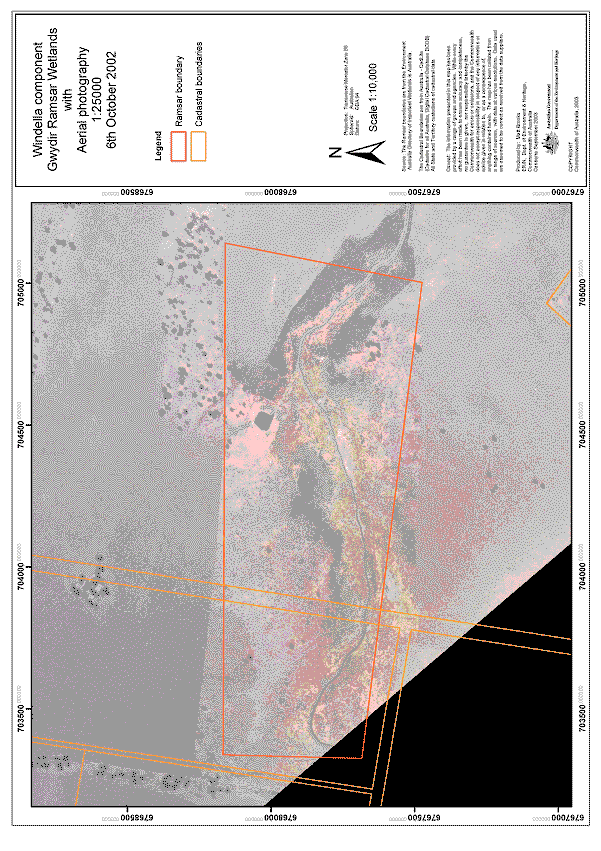
(a) land clearing, ploughing, cultivating, herbicide or pesticide spraying, sowing, harvesting or other activities disturbing or otherwise affecting the soil within that portion of the declared Ramsar wetlands known as the Gwydir Wetlands located within the property known as ‘Windella’, in particular Lot 8 in DP 750461 in the Parish of Dundunga and Lot 9 in DP 750444 in the Parish of Collyu, County of Benarba, Local Government Area of Moree Plains, being the area delineated on the aerial photograph annexed to these orders (‘the Windella Ramsar site’);
(b) any activity on the Windella Ramsar site designed to alter, or which is reasonably likely to have the effect of altering, the flow regime of waters into, within or out of the Windella Ramsar site, other than activities undertaken with the consent of the proprietors of Windella and in accordance with any approval that may be required under the Rivers and Foreshores Improvement Act 1948 (NSW) or any other legislation governing such activity;
(c) bringing or allowing any vehicles or machinery to be brought onto the Windella Ramsar site at any time, other than such machinery as may be reasonably necessary to carry out any of the activities referred to in par 2;
(d) bringing or allowing domestic or grazing stock to be brought onto the Windella Ramsar site at any time before 1 April 2007.
2. Within 28 days from the date of these orders Mr Greentree and Auen do everything reasonable within their power, or the power of either of them, to obtain a licence from the proprietors of Windella and in the event of obtaining such a licence within a further period of 30 days do the following acts:
(a) engage a tree planting contractor (‘the Contractor’), whose identity is approved beforehand in writing by the applicant, to plant within 30 days of the engagement, 100 (one hundred) tree seedlings randomly across the Windella Ramsar site (‘the tree planting’), such seedlings to comprise an approximately even mix of the following species: coolibah (Eucalyptus coolabah), belah (Casuarina cristate) and river cooba (Acacia stenophylla);
(b) engage the Contractor to carry out the following work:
(i) within 14 days of the engagement, spot spray Glyphosphate to those areas of the Windella Ramsar site that lie within a two metre radius from the site at which each of the seedlings referred to in par 2(a) is to be planted; and
(ii) immediately prior to the tree planting, again apply Glyphosphate to the areas identified in par 2(b)(i).
3 Mr Greentree pay to the Commonwealth within 60 days of the orders a pecuniary penalty of $150,000.
4 Auen pay to the Commonwealth within 60 days of these orders a pecuniary penalty of $300,000.
5 Mr Greentree and Auen jointly and severally pay the applicant’s costs of the proceedings against them.
6 The applicant pay the third to seventh respondents’ costs of the proceedings against them.
7 The orders made against the third to seventh respondents on 31 July 2003, as varied on 8 August 2003, be discharged.
8 The proceedings against the third to seventh respondents be dismissed.
9 The parties have liberty to apply on seven days notice.
Note: Settlement and entry of orders is dealt with in Order 36 of the Federal Court Rules.
ANNEXURE TO ORDERS
|
IN THE FEDERAL COURT OF AUSTRALIA |
|
|
NEW SOUTH WALES DISTRICT REGISTRY |
NSD 914 of 2003 |
|
BETWEEN: |
MINISTER FOR THE ENVIRONMENT AND HERITAGE APPLICANT
|
|
AND: |
RONALD GREENTREE FIRST RESPONDENT
MERRYWINEBONE PTY LTD THIRD RESPONDENT
ADAM NORRIE FOURTH RESPONDENT
AMY MAREE GREENTREE FIFTH RESPONDENT
KENNETH BRUCE HARRIS SIXTH RESPONDENT
ROBERT HAROLD HARRIS SEVENTH RESPONDENT
AUEN GRAIN PTY LTD EIGHTH RESPONDENT
|
|
JUDGE: |
SACKVILLE J |
|
DATE: |
14 OCTOBER 2004 |
|
PLACE: |
SYDNEY |
REASONS FOR JUDGMENT
THE PROCEEDINGS
1 In these proceedings, the Minister seeks orders requiring the payment of pecuniary penalties and other relief under the Environment Protection and Biodiversity Conservation Act 1999 (Cth) (‘EPBC Act’). The parties agreed that I should first determine whether any of the respondents were liable to civil penalties under the EPBC Act and whether any injunctive relief should be granted to the Minister against the respondents. The question of penalties was to be addressed at a subsequent hearing.
2 In a judgment delivered on 11 June 2004, I found that the first respondent (‘Mr Greentree’) and the eighth respondent (‘Auen’) had contravened s 16(1) of the EPBC Act inthat they had taken action that had a significant impact on the ecological character of a ‘declared Ramsar wetland’: Minister for the Environment & Heritage v Greentree (No 2) [2004] FCA 741 (Greentree (No 2)). I also found that the Minister had established a basis for the grant of injunctive relief against Mr Greentree and Auen, subject to discretionary considerations. I concluded, however, that the proceedings against the third to seventh respondents should be dismissed. (The proceedings against the second respondent had previously been discontinued.)
3 I made orders requiring the parties to file evidence and submissions as to:
· penalty;
· any other orders that should be made against Mr Greentree and Auen; and
· costs.
After some delays, the parties filed additional evidence and written submissions on these issues.
4 A further hearing took place on 6 and 7 September 2004. At that hearing, Mr Littlemore QC and Ms Lane (who had previously appeared for all respondents) appeared for Mr Greentree and Auen. Mr Fagan SC appeared, as before, for the Minister. The third to seventh respondents were, for the first time, separately represented. Mr Taylor SC appeared on their behalf to make a brief submission on costs.
5 This judgment should be read in conjunction with Greentree (No 2), although it will be necessary to recount some of the findings made in that judgment. I have used the same abbreviations as in recorded in the List of Abbreviations in Greentree (No 2).
LEGIslation
6 A contravention of s 16(1) of the EPBC Act attracts a maximum penalty of 5,000 penalty units for an individual and 50,000 penalty units for a body corporate. A penalty unit is defined by s 4AA(1) of the Crimes Act 1914 (Cth) to mean $110. It follows that the maximum civil penalty that may be imposed for each contravention of s 16(1) is $550,000 in the case of Mr Greentree and $5,500,000 in the case of Auen.
7 The Court’s power to impose civil penalties is conferred by s 481(2) of the EPBC Act. If satisfied that a person has contravened a civil penalty provision (including s 16(1)), the Court may order the wrongdoer to pay to the Commonwealth, for each contravention, the pecuniary penalty that the Court determines is appropriate, being not more than the specified maximum.
8 Section 481(3) of the EPBC Act provides as follows:
‘In determining the pecuniary penalty, the Court must have regard to all relevant matters, including:
(a) the nature and extent of the contravention; and
(b) the nature and extent of any loss or damage suffered as a result of the contravention; and
(c) the circumstances in which the contravention took place; and
(d) whether the person has previously been found by the Court in proceedings under this Act to have engaged in any similar conduct.’
The criteria specified in s 481(3) of the EPBC Act are very similar to those specified in s 76(1) of the Trade Practices Act 1974 (Cth) (‘TP Act’), which governs the determination of pecuniary penalties for contraventions of certain provisions of the TP Act.
9 Section 475(2) of the EPBC Act provides for what the headnote describes as ‘prohibitory injunctions’ as follows:
‘If a person has engaged, is engaging or is proposing to engage in conduct constituting an offence or other contravention of this Act or the regulations, the Court may grant an injunction restraining the person from engaging in the conduct.’
If the Court grants an injunction restraining a person from engaging in conduct and in the Court’s opinion it is desirable to do so, the Court may make an order requiring the person to do something (including repair or mitigate damage to the environment): s 475(3).
10 Section 479 provides as follows:
‘(1) The Federal Court may grant an injunction restraining a person from engaging in conduct:
(a) whether or not it appears to the Court that the person intends to engage again, or to continue to engage, in conduct of that kind; and
(b) whether or not the person has previously engaged in conduct of that kind; and
(c) whether or not there is a significant risk of injury or damage to human beings or the environment if the person engages, or continues to engage, in conduct of that kind.
(2) The Federal Court may grant an injunction requiring a person to do a particular act or thing:
(a) whether or not it appears to the Court that the person intends to refuse or fail again, or to continue to refuse or fail, to do the act or thing; and
(b) whether or not the person has previously refused or failed to do the act or thing; and
(c) whether or not there is a significant risk of injury or damage to human beings or the environment if the person refuses or fails, or continues to refuse or fail, to do the act or thing.’
BACKGROUND
11 In Greentree (No 2), I found (at [207], [214]) that Mr Greentree and Auen had contravened s 16(1) of the EPBC Act by taking action that had a significant ecological impact on the Windella Ramsar site. The Windella Ramsar site is an area of about 100 hectares, located wholly within the boundaries of a property known as ‘Windella’, which itself comprises about 2000 hectares. The dimensions and location of the Windella Ramsar site are delineated on two aerial photographs reproduced in Appendix A to Greentree (No 2). The site is one of four separate wetland areas totalling 823 hectares (the Ramsar Gwydir Wetlands) which, as I have found (at [87]), were duly designated by the Commonwealth under Art 2 of the Ramsar Convention, on or about 14 June 1999. The Ramsar Gwydir Wetlands are located about 80 kilometres west of Moree in the north-west of New South Wales.
12 The findings I made in Greentree (No 2) include the following:
· The proprietors of Windella are the fifth respondent (‘Ms Greentree’), the sixth respondent (‘Kenneth Harris’) and the seventh respondent (‘Robert Harris’) (collectively ‘the Proprietors’): [4].
· At all material times, Windella has been farmed by a partnership known as Greentree Farming. Since 1 July 2002, the partners in Greentree Farming have been the third respondent (‘Merrywinebone’), as to 49.9 per cent, and Auen, as to 50.1 per cent: [4].
· At all material times, Greentree Farming has been managed and directed by Mr Greentree: [5]. Mr Greentree has been the sole director of Auen since its incorporation and is the controlling mind of that company: [6], [213]. The only shareholders of Auen are Mr Greentree and Prime Grain Pty Ltd of which Mr Greentree is the sole shareholder: [6].
· In February 2003, Mr Greentree instructed Mr Jones, the then farming operations manager of Greentree Farming, to clear and plough an area of land on Windella in preparation for a seedbed. Shortly thereafter, in accordance with Mr Greentree’s instructions, most of the uncleared and unploughed land on the Windella Ramsar site was cleared of ground cover and ploughed. By 30 July 2003, virtually the whole of the Windella Ramsar site had been cleared of ground cover and ploughed: [104], [105].
· By 16 August 2003, about 30 per cent of the Windella Ramsar site had been sown with wheat. This was done pursuant to instructions given by Mr Greentree: [107], [206].
· Mr Greentree’s actions in relation to the Windella Ramsar site were designed to advance Auen’s interests as a partner in Greentree Farming: [213].
· Prior to February 2003, when the clearing and ploughing on the Windella Ramsar site took place, it had lost some of the attributes of a pristine wetland. About 20 per cent of the site, on its eastern boundary, had been cleared and the value of the site as a habitat had been diminished to some extent by fire, the spread of the exotic weed lippia and the dredging of the Gingham channel that traverses the Windella Ramsar site. Nonetheless, the Windella Ramsar site at that time retained important wetland attributes. Native wetland plants were present on the site, as were coolibah and casuarina trees. The site also retained the potential to regenerate relatively swiftly: [198].
· The actions of Mr Greentree and Auen effectively cleared the whole of the Windella Ramsar site, other than a narrow strip on either side of the Gingham channel and the area that had been cleared prior to February 2003. Those actions had a significant impact on the ecological character of the site: [199], [207], [214].
ISSUES
13 In his written submissions, the Minister sought orders pursuant to s 475(2) of the EPBC Act restraining Mr Greentree and Auen, by themselves, their servants or agents, from:
(i) land clearing, ploughing, cultivating, spraying, sowing, harvesting or undertaking other activities disturbing the soil within the Windella Ramsar site;
(ii) any such actions within 40 metres of the boundary of the Windella Ramsar site or within 40 metres of the entire length of the Gingham channel on Windella;
(iii) any activity designed to alter, or which is reasonably likely to alter the flow regime of waters into, within or out of the Windella Ramsar site;
(iv) bringing or allowing any vehicle or machinery onto the Windella Ramsar site at any time, other than vehicles or machinery reasonably necessary to carry out specifically authorised activities; and
(v) bringing or allowing domestic or grazing stock onto the Windella Ramsar site at any time prior to 1 April 2007.
14 The Minister did not press the relief in (ii). Mr Littlemore, on behalf of Mr Greentree and Auen did not dispute that orders substantially to the effect of (i), (iv) and (v) were appropriate.
15 The only dispute in relation to the restraining orders sought by the Minister, therefore, concerns the orders in (iii). Mr Littlemore contended that an order in this form would be too wide and was not supported either by the findings or the evidence. He did not oppose a narrower order, limited to restraining activities on the Gingham channel itself, other than those activities approved by the Committee responsible for supervising works on the Gingham channel in the area of Windella. After the hearing, the Minister formulated an alternative proposal, as follows:
‘[Mr Greentree and Auen be] restrained from engaging in the following conduct, either directly, or through the servants or agents of either of them:
any activity on the Windella Ramsar site designed to alter, or which is reasonably likely to have the effect of altering, the flow regime of waters into, within or out of the Windella Ramsar site, other than activities undertaken with the consent of the owners of Windella in accordance with any approval that may be required under the Rivers and Foreshores Improvement Act 1948 and/or any other legislation governing such activity.’
I propose, in substance, to adopt this formulation.
16 The Minister’s written submissions sought orders requiring Mr Greentree and Auen to permit Departmental officers to conduct a survey on the Windella Ramsar site. They also sought mandatory orders pursuant to s 475(3) of the EPBC Act requiring Mr Greentree and Auen, upon completion of the survey, to fence the boundaries of the Windella Ramsar site and to replace a sign at the access gate identifying the site as a declared Ramsar wetland. However, Mr Fagan conceded in his oral submissions that orders in these terms would be inappropriate because, on the evidence, Mr Greentree and Auen would require the consent of the Proprietors to grant permission to conduct a survey of the Windella Ramsar site or to erect fencing or signs on or near the site. Mr Fagan did not ask for orders requiring a survey or the erection of fencing or signage subject to the Proprietors granting their consent. Nor did Mr Fagan seek orders requiring Mr Greentree and Auen to take all reasonable measures to obtain the Proprietors’ consent. Mr Fagan was apparently influenced to take the course he did by an indication in the written submissions on behalf of the Proprietors that they did not ‘presently consent’ to Mr Greentree or Auen conducting the activities required by the Minister’s proposed orders.
17 It follows that no issue now arises concerning the conduct of a survey or the erection of fencing or signage on the Windella Ramsar site.
18 The Minister’s proposed short minutes of order include an order for the planting of trees on the Windella Ramsar site in the following terms:
‘(e) Within 14 days engage a tree planting contractor, to be approved by the [Minister], to plant between 1 September 2004 and 30 November 2004, 1,000 tree seedlings randomly across the Windella Ramsar site (the tree planting), the 1,000 seedlings to comprise an approximately even mix of the following species: coolibah (Eucalyptus coolabah), belah (Casuarina cristata) and river coobah (Acacia stenophylla).
(f) Within 21 days of this order engage the said tree planting contractor referred to in [par (e)] to carry out the following:
(i) within 14 days of engaging the said tree planting contractor, spot spraying of Glyphosphate to those portions of the Windella Ramsar site that lie within a 2 metre radius from where each of the tree seedlings referred to in [par (e)] are to be planted;
(ii) immediately prior to tree planting, a second application of Glyphosphate is to be in the same areas as identified in [subpar] (f)(i).’
19 Mr Littlemore indicated that Mr Greentree and Auen were prepared to submit to an order requiring them to do everything reasonable to obtain a licence from the Proprietors and, in the event of obtaining such a licence, to plant 40 native trees as advised by the Minister’s expert witness, Mr McCosker, at random intervals across the Windella Ramsar site. On the same basis, Mr Littlemore indicated that his clients had no objection to an order requiring them to spray Glyphosphate as proposed by the Minister.
20 Mr Fagan, on behalf of the Minister, accepted that since the Proprietors could not be compelled to consent to the planting of trees on the Windella Ramsar site, any order should be subject to the qualifications suggested by Mr Littlemore. Accordingly, the only dispute in relation to the proposed tree planting orders concerns the number of trees that Mr Greentree and Auen should be ordered to plant on the Windella Ramsar site.
21 Finally the Minister proposed rather elaborate draft orders, the substance of which was to require Mr Greentree and Auen to take steps to secure the release of water from the Copeton Dam to flow via the Gingham channel to the Windella Ramsar site. The purpose of these proposed orders was to assist in the rehabilitation of the site by ensuring that it is periodically inundated. Much of Mr McCosker’s evidence concerning remediation of the Windella Ramsar site was directed to the need for a secure flow of water to encourage regeneration of native plants on the site.
22 It soon became apparent from Mr McCosker’s evidence, however, that there are formidable difficulties in the path of making the orders sought by the Minister. These include practical obstacles to obtaining sufficient water from the Copeton Dam and to ensuring that any water released from the Copeton Dam actually reaches the Windella Ramsar site, given the need for it to flow for considerable distances along the unregulated Gingham channel. The evidence of Mr Cameron, the Resource Access Manager of the Barwon Region of the New South Wales Department of Infrastructure, Planning and Natural Resources, establishes that, in any event, the necessary licences required for an environmental flow of water to be dedicated to the Windella Ramsar site cannot currently be granted under State law.
23 In these circumstances, Mr Fagan did not press the proposed orders designed to secure an environmental flow of water to the Windella Ramsar site.
24 The parties were far apart on the question of penalties. The Minister submitted that the contraventions by Mr Greentree and Auen of s 16(1) of the EPBC Act were in the ‘worst category’. According to Mr Fagan, the contraventions warrant the imposition of the maximum pecuniary penalty, or at least a penalty close to the maximum. Mr Littlemore, by contrast, submitted that the contraventions were the product of an honest mistake and that Mr Greentree and Auen would incur sufficient penalties by an adverse costs order. He contended, therefore, that no pecuniary penalties should be imposed.
25 It follows from what has been said that, apart from the question of costs, the only issues to be resolved are the following:
· the number of trees that Mr Greentree and Auen should be required to plant (subject to securing the licence of the Proprietors); and
· the quantum of any pecuniary penalties that should be imposed on Mr Greentree and Auen.
26 I should mention two matters that were not ultimately in issue between the parties. First, there was a suggestion in Mr McCosker’s evidence that herbicide had been sprayed onto the Windella Ramsar site sometime in March or April 2004. I was not asked by Mr Fagan to find that any such spraying had occurred, much less that Mr Greentree or Auen had been responsible for the application of herbicide to the site. In any event, I am not satisfied that the site had been sprayed with herbicide in the manner suggested by Mr McCosker. I therefore approach the question of penalties and other relief without regard to the suggestion made by Mr McCosker.
27 Secondly, the Minister was content to approach the question of penalties on the basis that Mr Greentree and Auen had each committed a single contravention of s 16(1) of the EPBC Act, notwithstanding that the contravening conduct occurred over a significant period of time. Thus the Minister seeks a penalty against each contravener in respect of one contravention only.
NUMBER OF TREES
28 The Minister’s submission that Mr Greentree and Auen should be required to plant 1000 tree seedlings was based on the expert report of Mr McCosker. However, it was clear from Mr McCosker’s oral evidence that his proposal that 1000 tree seedlings should be planted was part of a program designed to restore the Windella Ramsar site to a pristine condition (so far as it is possible to do so).
29 I have found that at the time the contraventions occurred, there was only a small number of live native trees on the Windella Ramsar site. Mr McCosker thought that up to 50 per cent of tree seedlings planted on the site would die. I think that justice would be served if Mr Greentree and Auen were to plant 100 tree seedlings on the site. A 50 per cent mortality rate would still allow more trees to survive to maturity than were on the site in February 2003. I do not think it appropriate to limit the order to planting the number of seedlings required to produce precisely the number of native trees that were on the site before the clearing took place, particularly having regard to the scale of the clearing and ploughing that took place.
PENALTIES
sUBMISSIONS
30 The differences between the parties’ submissions on penalty are explained, in part, by their differences on a threshold factual question. The Minister submitted that Mr Greentree and, through him, Auen were well aware that the Windella Ramsar site was protected under the EPBC Act before they cleared and ploughed the site and planted wheat on a considerable portion of it. According to Mr Fagan, the contraventions were deliberate and serious and penalties should be imposed on that basis.
31 Mr Fagan pointed out that the only justification offered by Mr Greentree for his conduct was his assertion, made prior to the clearing of the Windella Ramsar site, that he regarded himself as no longer bound by the MOU entered into by the previous proprietors of Windella. That assertion, so Mr Fagan submitted, was quite irrelevant since Mr Greentree had never been a party to the MOU and, in any event, the continued operation of the MOU had no bearing on the validity of the designation of the Windella Ramsar site under the Ramsar Convention. Moreover, Mr Greentree had been specifically told of the legal position and had access to competent legal advice before deciding to undertake the contravening conduct.
32 Mr Littlemore, by contrast, submitted that I should infer that Mr Greentree had an honest and reasonable, albeit mistaken belief by February 2003 that he and Auen were no longer bound by the MOU and that they were entitled to farm the Windella Ramsar site. Mr Littlemore contended that Mr Greentree’s mistaken belief was an important consideration to be taken into account in determining the appropriate penalties.
33 The Minister submitted that the nature and extent of the contravening conduct should be viewed as exceptionally serious. The incursions onto the Windella Ramsar site were not only deliberate, but large scale and carried out over a long period of time. The losses suffered as the result of the contraventions of the EPBC Act were ‘extensive and profound’. In effect, the Windella Ramsar had been sterilised and its ability to regenerate as a wetland severely compromised. In consequence, an aspect of the environment of national and international significance had been adversely affected.
34 The Minister further contended that there were aggravating factors to be taken into account on the question of penalties. These included the following:
- Mr Greentree misled the Department about his intentions prior to clearing the site.
- Mr Greentree also misled Mr Jones by claiming that he (Mr Greentree) had the option of being released from any obligation imposed by the MOU.
- Neither Mr Greentree nor Auen had displayed any contrition and indeed had shown ‘contempt for and a total lack of cooperation towards officers of the Department’.
35 Finally, the Minister pointed to evidence suggesting both Mr Greentree and Auen had substantial income and that Mr Greentree had substantial assets in his name. Accordingly, there was no issue as to their ability to pay any penalties that might be imposed.
36 Mr Greentree and Auen emphasised that the damage attributable to their conduct was limited to the consequences of the clearing, planting and sowing during the period from February 2003 to July 2003. Prior to those activities, the ecological value of the Windella Ramsar site had already been diminished. In short, according to Mr Littlemore, the site had already been degraded and could not therefore be said to be of national or international significance. Moreover, so he argued, the site represents less than 0.1 per cent of the entire Gwydir wetland system. In any event, it could be expected to regenerate over time, particularly if the Court made the remediation orders which Mr Greentree and Auen did not oppose.
37 Mr Littlemore submitted that, given that neither Mr Greentree nor Auen had previously contravened the EPBC Act, this was by no means within the worst category of contraventions of the EPBC Act. Mr Littlemore invited me to take account of the willingness of Mr Greentree and Auen to implement remediation measures, including their offer to import dead timber to the site. Mr Littlemore also argued that it would be wrong to impose penalties through any sense of ‘morality larger than that which is defined by the legislative purpose’ (language used by French J in Trade Practices Commission v CSR Ltd [1991] ATPR 41-076, at 52,151). Further, general deterrence is not a major factor since only a ‘minuscule’ number of people are in a position to contravene the relevant provisions of the EPBC Act (presumably because the only persons likely to do so are the proprietors or occupiers of land neighbouring a declared Ramsar wetland).
dELIBERATE CONTRAVENTION OR HONEST MISTAKE?
38 Mr Littlemore relied on several matters to justify the submission that the contravening conduct of Mr Greentree and Auen was the product of an honest, albeit mistaken belief as to the legal status of the Windella Ramsar site. One such matter was a finding in Greentree (No 2) that Mr Greentree instructed Mr Jones to clear and plough the Windella Ramsar site, in part at least, ‘because he regarded himself as no longer bound by the MOU’ (at [206]).
39 That finding, however, was not intended to be and cannot be read as a finding that Mr Greentree had acted under a mistaken belief that he was entitled to clear and plough the Windella Ramsar site. The finding merely reflected the fact that Mr Greentree told Mr Jones in February 2003 that he (Mr Greentree) would never have bought Windella if he did not have the option of being released from the ‘obligation’ (presumably that imposed by the MOU). I accept that Mr Greentree’s view that he was ‘no longer bound by the MOU’ played some part in his thought processes. That leaves open, however, the question of whether he believed that he was entitled to clear and plough the Windella Ramsar site.
40 Mr Littlemore pointed to other evidence bearing on this question. At the meeting held on 13 December 2002, Mr Greentree said that he had notified the Department that ‘the Ramsar site no longer exists on Windella’. As I have noted, his explanation to Mr Jones (who had queried whether it was permissible to clear the Windella Ramsar site) suggests that Mr Greentree regarded himself as released from obligations flowing from the MOU.
41 Mr Greentree did not give evidence. However, there is no dispute that he made the comments on which Mr Littlemore relies. If there were no other evidence, the comments would provide some evidence that Mr Greentree believed that he was entitled to remove himself (and Auen) from any obligation not to interfere with the Windella Ramsar site. Although there are other plausible explanations for Mr Greentree’s comments, the language used by him is consistent with his holding an erroneous belief that he could clear the site.
42 The difficulty with Mr Littlemore’s submission is that there is a good deal of evidence that Mr Greentree was made aware, prior to February 2003, that he was not entitled to clear and plough the Windella Ramsar site and that any such action would constitute a contravention of the EPBC Act. On 30 September 2002, Environment Australia wrote to Mr Greentree in these terms:
‘You may be aware that the “Windella” property contains part of the “Gwydir Wetlands: Gingham and Lower Gwydir (Big Leather) Watercourses” Ramsar site. The Gwydir Wetlands are protected under the [EPBC Act]. The Gwydir Wetlands and surrounding areas are also known to provide habitat for a number of migratory birds, and may provide habitat for listed threatened species.
Under the EPBC Act a person must not take an action that has, will have, or is likely to have a significant impact on a matter of national environmental significance without the approval of the Commonwealth Environmental Minister. Any person proposing to undertake such an action should refer their action to Environment Australia for a decision as to whether Commonwealth environmental approval is necessary. Substantial penalties apply to any person taking such an action without approval. Our records show that a referral has not been made under the EPBC Act for the vegetation clearance activities that have been undertaken on the property of Windella.’
The letter also referred specifically to s 16 of the EPBC Act.
43 On 11 October 2002, Mr Greentree’s solicitor informed Environment Australia that his client would not, under any circumstances, consent to a site inspection. The solicitor also asked a series of questions relevant to whether a contravention of the EPBC Act had taken place.
44 After further correspondence between the parties, on 18 October 2002 Mr Greentree’s solicitor sent a somewhat curious letter to Environment Australia. This stated that Mr Greentree no longer wished to be a party to the MOU because of his dissatisfaction with certain conduct of the Department. The letter did not explain why the MOU (to which Mr Greentree had never been a party) was relevant to the operation of the EPBC Act on the Windella Ramsar site. Nor did the letter assert that Mr Greentree regarded himself as entitled to clear or plough the Windella Ramsar site.
45 Environment Australia responded to this letter on 10 January 2003. The response reiterated the proposition that the EPBC Act contains both civil and criminal penalties for actions which are likely to have a significant impact on the ecological character of ‘Ramsar listed wetlands’. The letter also pointed out that the Department had no record of Mr Greentree being party to an MOU relating to the Windella Ramsar site. Doubtless if the letter of 18 October 2002 had asserted that Mr Greentree was entitled to clear the Windella Ramsar site, regardless of any environmental damage, Environment Australia would have disputed the assertion.
46 Whatever prompted the letter of 18 October 2002, I infer that Mr Greentree’s solicitor made Mr Greentree aware that his ‘withdrawal’ from the MOU could have no bearing on his obligations under the EPBC Act in relation to the Windella Ramsar site. The same solicitor acted for Mr Greentree throughout the course of the extensive correspondence with the Department and had obviously taken steps to familiarise himself with the contents of the EPBC Act. At no stage did the correspondence assert that Mr Greentree or Auen was entitled to farm the Windella Ramsar site regardless of the environmental consequences. Moreover, at no time after the site had been cleared and ploughed did Mr Greentree or his solicitor claim that Mr Greentree’s ‘withdrawal’ from the MOU entitled him to clear and plough the site. The defences ultimately relied on in the present proceedings were not referred to in the correspondence and there is no evidence that they played any part in Mr Greentree’s conduct in authorising the clearing and ploughing of the Windella Ramsar site.
47 Mr Greentree was not obliged to give evidence in the current proceedings and no inference can be drawn from his not having done so. But in the absence of direct evidence as to his state of mind, I am satisfied to the required standard that Mr Greentree (and, through him, Auen) knew and appreciated that the Windella Ramsar site was protected under the EPBC Act and that the unauthorised clearing and ploughing of the land and the subsequent sowing of wheat, provided it had a significant impact on the ecological character of the site, would constitute a contravention of the EPBC Act. Mr Greentree may have had a sense of grievance about the process, as he understood it, that led to part of ‘his’ land being unavailable for agricultural development. But that is very different from the proposition that Mr Greentree held the belief imputed to him by Mr Littlemore.
48 I am satisfied that the contravening conduct by Mr Greentree and Auen was deliberate, in the sense that Mr Greentree (and, through him Auen) was well aware that any unauthorised action on his part that had a significant impact on the ecological character of Windella Ramsar site would constitute a contravention of the EPBC Act. For the sake of completeness, I add that Mr Greentree was well aware of the approximate boundaries of the Windella Ramsar site when he gave instructions for the clearing and ploughing of virtually the whole site and the sowing of wheat on a substantial part of the site. When giving the instructions, Mr Greentree knew that whatever ecological character the site retained as a wetland would be largely destroyed, at least for a lengthy period, once his instructions were carried out.
PRINCIPLES
49 Section 481(2) of the EPBC Act empowers the Court to order a wrongdoer to pay to the Commonwealth for each contravention the pecuniary penalty it determines is appropriate, subject to the statutory maximum. The Court is directed by s 481(3) to have regard to all relevant matters, including the following:
‘(a) the nature and extent of the contravention; and
(b) the nature and extent of any loss or damage suffered as a result of the contravention; and
(c) the circumstances in which the contravention took place; and
(d) whether the person has previously been found by the Court in proceedings under this Act to have engaged in any similar conduct.’
50 The four specified matters do not exhaust all relevant considerations, but they indicate the matters that Parliament regards as particularly significant. As I have noted, s 481(3) is in very similar terms to s 76(1) of the TP Act. The parties in the present case accepted that the approach that had been applied in proceedings for pecuniary penalties under the TP Act was appropriate, subject to any necessary adaptations, to proceedings for pecuniary penalties under the EPBC Act.
51 In TPC v CSR French J set out a checklist of matters which subsequent cases have regarded as appropriate to take into account in proceedings for pecuniary penalties under the TP Act. Apart from the matters expressly mentioned in s 76(1), the checklist includes the following (at 52,152-52,153):
‘· The size of the contravening company.
· The degree of power it has, as evidenced by its market share and ease of entry into the market.
· The deliberateness of the contravention and the period over which it extended.
· Whether the contravention arose out of the conduct of senior management or at a lower level.
· Whether the company has a corporate culture conducive to compliance with the Act, as evidenced by educational programs and disciplinary or other corrective measures in response to an acknowledged contravention.
· Whether the company has shown a disposition to co-operate with the authorities responsible for the enforcement of the Act in relation to the contravention.’
52 In NW Frozen Foods Pty Ltd v Australian Competition and Consumer Commission (1996) 71 FCR 285, Burchett and Kiefel JJ (with whom Carr J generally agreed) endorsed French J’s checklist, although their Honours (at 292) regarded the list as an elaboration of the statutory requirement to consider ‘the circumstances in which the act or omission took place’ (cf 481(3)(c) of the EPBC Act).
53 In NW Frozen Foods the Court expressed the view that the deterrent effect of a penalty, both specific and general, is a factor to take into account in determining the appropriate penalty in a particular case. Burchett and Kiefel JJ said (at 294-295):
‘The Court should not leave room for any impression of weakness in its resolve to impose penalties sufficient to ensure the deterrence, not only of the parties actually before it, but also of others who might be tempted to think that contravention would pay, and detection lead merely to a compliance program for the future.’
54 There has been a continuing debate within this Court as to whether the purposes of imposing a pecuniary penalty include punishment. In NW Frozen Foods, Burchett and Kiefel JJ said (at 296-297) that the penalties imposed by s 76 of the TP Act are not criminal sanctions and their purpose is not punishment. Carr J expressed a reservation about this observation (at 299). See also the discussion by Goldberg J in Australian Competition and Consumer Commission v Australian Safeway Stores Pty Ltd (1997) 75 FCR 238, at 240-242. However, as the Full Court observed in Australian Competition and Consumer Commission v Ithaca Ice Works Pty Ltd [2002] ATPR 41-851, at 44,543, there seems to be:
‘little or indeed no difference between taking into account, in computing the penalty, the deliberate nature of the conduct in question (a matter the relevance of which is not in dispute) and taking into account the fact that the penalty should act as a punishment of the offender.’
55 The High Court has recently rejected the suggestion, in the context of an application for an order disqualifying a person from acting in the management of a corporation, that it is useful to distinguish between ‘punitive’ and ‘protective’ proceedings. The joint judgment in Rich v Australian Securities and Investment Commission (2004) 209 ALR 271, at 280-281 [32], observed that ‘[a]t best, the distinction between “punitive” and “protective” is elusive’. Their Honours also pointed out (at 282 [35]) that to begin with an a priori classification of proceedings as either protective or penal
‘invites error primarily because the classification adopted assumes mutual exclusivity of the categories chosen when they are not, and because the classification is itself unstable’.
56 These observations are consistent with comments made in Chief Executive Officer of Customs v Labrador Liquor Wholesale Pty Ltd (2003) 201 ALR 1. There Hayne J (with whom Gleeson CJ and McHugh J agreed) rejected an argument that the classification of proceedings as ‘civil’ or ‘criminal’ is determinative of the appropriate standard of proof. His Honour said (at 28-29 [114]) that the classification:
‘seeks to divide the litigious world into only two parts when, in truth, that world is more complex and varied than such a classification acknowledges. There are proceedings with both civil and criminal characteristics: for example, proceedings for a civil penalty under companies and trade practices legislation. The purposes of those proceedings include purposes of deterrence, and the consequences can be large and punishing.’ (Emphasis added.)
57 Rich v ASIC was not concerned with a claim for pecuniary penalties. But the approach taken by the High Court in that case and in CEO of Customs v Labrador tends to reinforce the Full Court’s observation in ACCC v Ithaca Ice Works that there is little or no difference between taking into account in determining penalty the deliberate nature of the conduct in question and taking into account the object of punishing the offender.
58 The principles formulated in the context of s 76(1) of the TP Act provide guidance in proceedings for pecuniary penalties under the EPBC Act, although they cannot be transferred uncritically into the rather different context of proceedings seeking the imposition of penalties for environmental damage to protected sites. Obviously enough, for example, the degree of market power is a consideration likely to be highly relevant to a penalty for a contravention of Part IV of the TP Act, but is not likely to be relevant to the imposition of a penalty under the EPBC Act. Similarly, the question of a corporate culture may not necessarily have relevance to proceedings under the EPBC Act, although whether a contravener has taken remedial action to minimise environmental damage may be significant on the question of penalty. On the other hand, there may be circumstances relevant to proceedings under the EPBC Act that have no relevance to proceedings under the TP Act. In the end, while the statutory criteria must of course be taken into account, each case must depend upon its own unique circumstances.
The APPROPRIATE PENALTY
59 The first factor that I must take into account in determining the appropriate pecuniary penalties to impose on Mr Greentree and Auen in respect of their contraventions of s 16(1) of the EPBC Act is the ‘nature and extent of the contravention[s]’: s 481(3)(a). I have found that Mr Greentree and, through him, Auen gave instructions for virtually the whole of the Windella Ramsar site to be cleared and ploughed. Mr Greentree and Auen knew and appreciated that the site was protected under the EPBC Act and that the clearing and ploughing of the site and the subsequent sowing of wheat would constitute a contravention of the EPBC Act if those actions had a significant impact on the ecological character of the site. I have also found that Mr Greentree and Auen appreciated that their actions in clearing, ploughing and sowing wheat would largely destroy the character of the Windella Ramsar site as a wetland, at least for a lengthy period.
60 This is precisely the kind of conduct that s 16(1) of the EPBC Act is intended to prohibit. The legislation provides a mechanism for wetlands considered to be of international importance to be designated under the Ramsar Convention. The prohibition on taking an action that has a significant impact on the ecological character of a declared Ramsar wetland is plainly intended to protect the wetland from ecological damage. It is also designed to ensure that Australia complies with its obligations under Art 3(1) of the Ramsar Convention to promote the conservation of wetlands included in the List of Wetlands of International Importance. The Windella Ramsar site is, of course, on the List.
61 The contraventions of s 16(1) of the EPBC Act by Mr Greentree and Auen were deliberate. Moreover, although the clearing, ploughing and sowing of the Windella Ramsar site have been treated by the Minister as a single contravention by each of Mr Greentree and Auen, the contravening conduct took place over a period of time. The deliberate conduct was more than an isolated act of the kind that might occur as the result of an impulsive error of judgment. It was planned conduct. The nature and extent of the contraventions of s 16(1) of the EPBC Act suggest that substantial pecuniary penalties are warranted.
62 Section 481(3)(b) of the EPBC Act requires the nature and extent of any loss or damage suffered as a result of the contraventions to be taken into account in determining the appropriate pecuniary penalties. Mr Littlemore is correct, in my view, in submitting that one factor in favour of imposing less severe penalties than otherwise might be the case is that the Windella Ramsar site, prior to the contravening conduct taking place, was not a pristine wetland. As I have found, the ecological value of the site had been diminished prior to February 2003 by the impact of the Copeton Dam on the flow of water, fires, proliferation of the exotic weed lippia, the construction and maintenance of the Gingham channel and the clearing and ploughing of about 20 per cent of the site at its eastern end. There is nothing in the evidence to suggest that Mr Greentree or Auen was responsible for this degradation of the ecological character of the Windella Ramsar site. Thus the damage caused by their actions was not as devastating as it would have been had the Windella Ramsar site been in a less degraded condition.
63 Nonetheless, the actions of Mr Greentree and Auen caused significant ecological damage to the Windella Ramsar site. Virtually the entire area was cleared and ploughed and about one third of the site was subsequently sown with wheat. In consequence, the native vegetation remaining on the site in February 2003 was almost entirely removed. Moreover, the capacity of the site to regenerate as a wetland refuge for native plants and as a habitat for native fauna has been severely impaired. Given that it is impossible to guarantee regular inundation of the site, either from natural sources or from the Copeton Dam, the extent to which the site is now capable of regeneration is problematic, even taking into account the remediation orders that I propose to make. Mr McCosker’s evidence indicates that much will depend upon whether, over the next few years, flooding occurs naturally in the manner that permits native plants to regenerate. Regeneration of the Windella Ramsar site, if it does occur, is likely to require a much longer period of time than if the contraventions had not taken place.
64 Contrary to Mr Littlemore’s submissions, I do not think that a great deal turns on the fact that the Windella Ramsar site comprises a very small proportion of the entire Gwydir wetland system. While it is possible to envisage contraventions of s 16(1) of the EPBC Act causing severe environmental damage to a much larger area than this particular site, it is not for the Court to second-guess the designation of the site under the Ramsar Convention. The designation was (as I have held) lawful and there has been no submission that the Windella Ramsar site lacked qualities that made it appropriate for designation under the Ramsar Convention. In my view, the question of penalties should not be approached by disregarding the designation under the Ramsar Convention, or acting on the view that the site is of little or no environmental significance. While the extent of the degradation of the site prior to February 2003 cannot be ignored, equally the significance of the designation of the site in the List of Wetlands of International Importance cannot be ignored.
65 The circumstances in which the contraventions took place (s 481(3)(c)) include the reasons why Mr Greentree and Auen took the actions they did. It is true that the evidence does not suggest that either Mr Greentree or Auen reaped a substantial financial reward from the development of the Windella Ramsar site. That is a factor to take into account. Nonetheless, that development was carried out as part of agricultural activities conducted on Windella itself. In that sense, the contravention was part of a commercial operation which Mr Greentree conducted on behalf of Greentree Farming (a partnership in which Auen had a majority interest). In other words, the contravening conduct was motivated by commercial considerations.
66 As I have noted, it may well be that Mr Greentree felt a sense of grievance that Greentree Farming could not develop the Windella Ramsar site as he or the partners in the business thought fit. However, in view of the fact that he knew that the site was protected under the EPBC Act and that neither he nor Auen was entitled to take action that had a significant impact on the ecological character of the site, I do not think that any sense of grievance he may have had weighs heavily in the balance in determining the appropriate penalties.
67 Section 481(3)(d) directs the Court to take into account whether Mr Greentree and Auen have previously been found to have engaged in any similar conduct under the EPBC Act. It is common ground that neither has been found to have engaged in any similar conduct. Accordingly, this is an important factor that weighs in their favour.
68 The four factors identified in s 481(3) do not exhaust the matters that should be taken into account in determining the appropriate penalties. First, Parliament has specified very high maximum pecuniary penalties for contraventions of s 16(1) of the EPBC Act. It is for the Court to assess the seriousness of the contravening conduct in a particular case. Nonetheless, the maximum penalties of $550,000 for an individual and $5,500,000 for a corporation reflect the ‘public expression’ by Parliament of the seriousness of the offence: Camilleri’s Stock Feeds Pty Ltd v Environment Protection Authority (1993) 32 NSWLR 683, at 698, per Kirby P (with whom Campbell and James JJ agreed); see also Hayes v Weller (No 2) (1988) 50 SASR 182, at 187, per Perry J (with whom King CJ and Jacobs J agreed).
69 Secondly, the penalties imposed in respect of the contraventions should be sufficient to act both as a specific deterrent to Mr Greentree and Auen taking further action which could cause significant environmental damage to a declared Ramsar wetland (taking into account the other orders I propose to make in relation to the Windella Ramsar site). They should also be such as to constitute a deterrent to others who might, for whatever reason, contemplate taking action which is likely to harm the ecological character of such a wetland.
70 Mr Littlemore submitted that the concept of deterrence should not be given particular weight in this case because of the ‘minuscule number of persons who could possibly contravene’ the relevant provisions of the EPBC Act. It is not clear why the number of possible contravenors of the EPBC Act should be regarded as ‘minuscule’. There appears to be no evidence that addressed this question and no basis for reaching a conclusion as to the number of persons or corporations who might have the opportunity and motivation, for example, to develop declared Ramsar wetlands. In any event, even if there are only a few persons or corporations who might be in a position to cause ecological damage to declared Ramsar wetlands, the imposition of pecuniary penalties for deliberate contraventions of s 16(1) of the EPBC Act might be expected to come to their attention. Such penalties might therefore be expected to have a significant deterrent effect on those who otherwise might see some advantage in destroying or damaging protected wetlands.
71 Thirdly, neither Mr Greentree nor Auen has shown contrition for their conduct. Once the finding was made that they had contravened s 16(1) of the EPBC Act, they resisted the imposition of penalties on the ground that their conduct was the product of an honest, but mistaken belief that they were entitled to develop the Windella Ramsar site. I have rejected that contention. Nothing has been said on their behalf that amounts to an unqualified acknowledgment that their conduct was wrong. Nor have they expressed regret at the environmental damage that their conduct has caused.
72 Mr Littlemore relied on the fact that Mr Greentree and Auen put forward proposed orders that if made, would require positive action on their part to contribute to the remediation of the Windella Ramsar site (albeit subject to the consent of the Proprietors). I do not interpret this offer, however, which was made about ten days before the hearing on penalties, as demonstrating contrition or a sincere desire to rehabilitate the site. The proposed orders were put forward as a response to the Minister’s submissions seeking more onerous orders against Mr Greentree and Auen.
73 Fourthly, I reject the Minister’s submission that the penalties should reflect what was said to be the contentious attitudes of Mr Greentree and Auen to the Department. It is clear that there has been antipathy between Departmental officers, on the one hand, and Mr Greentree and Auen on the other. I am not in a position to make findings as to the origins of the evident antipathy or (assuming this can be done) who bears primary responsibility for that state of affairs. In any event, while a co-operative attitude towards an investigation is a factor that, depending on the circumstances, might count in favour of a contravenor, I do not think that penalties ordinarily should be increased because the contravenor does not display a co-operative attitude towards the investigating authority.
74 Fifthly, the evidence discloses that Mr Greentree has substantial assets, in the form of shares in a publicly listed company and real estate holdings. The financial statements of Greentree Farming, in which Auen now has a 50.1 per cent interest, showed that the partnership made a net profit of nearly $5 million in 2001-2002. However, it appears that Auen did not acquire its interest in Greentree Farming until 1 July 2002. There is no direct evidence as to Auen’s current financial position, nor as to the profits it derives from farming Windella.
75 Despite the absence of evidence concerning Auen’s current financial position, Mr Littlemore did not submit that the imposition of substantial pecuniary penalties would cause any financial hardship either to Mr Greentree or to Auen. In these circumstances, perhaps the principal significance of the evidence to which I have referred (such as it is) is that the pecuniary penalties that are otherwise appropriate should not be reduced by reason of the financial position of Mr Greentree or Auen. I proceed on the basis that each has the capacity to pay the penalties I propose to impose.
76 Sixthly, Mr Littlemore submitted that the penalties should be reduced to take account of the fact that Mr Greentree and Auen will be required to pay the costs of the proceedings. They were of course entitled to defend the proceedings. But it was their choice to contest the issues on which they failed. Moreover, a costs order is designed to compensate the successful party, at least in part, for the costs of conducting the proceedings. In the absence of financial hardship or other special considerations, the fact that a person who has deliberately contravened the EPBC Act is the subject of an adverse costs order will not ordinarily warrant a reduction in the penalty that should be imposed on the contravenor.
77 Seventhly, it is appropriate to take into account both the fact that Auen is, in effect, a ‘one-man’ company and the relationship between Auen and Mr Greentree. The evidence indicates that Mr Greentree is the sole director and, in effect, the sole shareholder of Auen. (Prime Grain Pty Ltd is a shareholder of Auen, but Mr Greentree holds all shares in Prime Grain Pty Ltd.) While Auen has the capacity to pay a substantial penalty, its position is not the same as, for example, a very large publicly listed corporation to which a pecuniary penalty of some hundreds of thousands of dollars might be of relatively small financial moment.
78 I infer that Mr Greentree will bear the burden of any diminution of Auen’s assets that will result from the imposition of a pecuniary penalty on the company. It is appropriate to take that fact into account in order to prevent Mr Greentree being punished, in effect, twice over: Australian Competition and Consumer Commission v ABB Transmission and Distribution Ltd (No 2) (2002) 190 ALR 169, at 182 [45], per Finkelstein J; Australian Securities and Investments Commission v Adler (2002) 42 ACSR 80, at 116-117 [131]-[132], per Santow J. On the other hand, Auen has been involved in a deliberate contravention of s 16(1) of the EPBC Act. The contravening conduct was undertaken in Auen’s commercial interests. It is also necessary to bear in mind that the maximum penalties that can be imposed on a corporation are ten times larger than the penalties that can be imposed on individuals who contravene the EPBC Act. The overall pecuniary penalty should obviously be no less than if Auen, a corporation, had been the sole contravenor. On the contrary, the overall penalty should reflect the fact that Mr Greentree, as well as Auen, has contravened s 16(1) of the EPBC Act.
79 Finally, as is implicit in what I have already said, when a Court is imposing penalties for more than one offence, particularly when essentially the same conduct constitutes separate offences, the Court should ensure that the penalties imposed in aggregate are just and appropriate: Mill v The Queen (1988) 166 CLR 59, at 62-63, per curiam; Pearce v The Queen (1998) 194 CLR 610, at 623-624, per McHugh, Hayne and Callinan JJ. As Santow J pointed out in ASIC v Adler, at 116 [128]-[130], the reasoning in criminal sentencing cases cannot be applied precisely to civil penalty cases, since the Court cannot replicate cumulation or concurrence in sentencing. Nonetheless, it is important to consider the totality of the penalties imposed to ensure that they fairly reflect the statutory criteria and do not result in unfairness.
80 As I have found, this case involves deliberate and sustained contraventions by Mr Greentree and Auen of s 16(1) of the EPBC Act. The contraventions were serious. However, contrary to the Minister’s submissions, I do not regard their conduct as within the worst category of contraventions. Mr Greentree and Auen have not previously been found by a Court to have engaged in similar conduct under the EPBC Act. The contravening conduct, although serious, has not had environmental consequences as profound as would have been the case if the Windella Ramsar site had been a pristine wetland at the relevant time. The evidence does not establish that either Mr Greentree or Auen obtained substantial financial benefits from their contraventions, although their conduct was undertaken in the course of commercial operations. There is some prospect of the site being rehabilitated albeit over a lengthy period and subject to the vagaries of climatic conditions.
81 On the other hand, the conduct of Mr Greentree and Auen calls for substantial penalties, not least to act as a deterrent both to Mr Greentree and Auen and to others who might be tempted to override the legal protection accorded to sites judged to be of international importance. As I have explained, the contravening conduct has caused significant environmental damage to a site protected under the EPBC Act.
82 Having regard to the maximum penalty applicable to a contravention by an individual, I think that a pecuniary penalty of $150,000 should be imposed on Mr Greentree. Had Auen been the only contravenor, taking into account its status as a private company and the higher maximum penalty applicable to a contravention by a corporation, I would have imposed a penalty in the order of $400,000. Having regard to the desirability of avoiding penalising Mr Greentree twice over, I think that Auen should pay a penalty of $300,000. In my view, the total penalty of $450,000 is appropriate in the circumstances of the case.
COSTS
83 The Minister submitted that Mr Greentree and Auen should be ordered to pay the Minister’s costs for the entirety of the proceedings, without any discount to take account of the dismissal of the proceedings against the third to seventh respondents. Mr Fagan SC contended that the Minister’s costs would not have been different had the proceedings been taken only against Mr Greentree and Auen, since all allegations related to the same events and the respondents had common legal representation (at least until submissions were made on the question of costs). He also contended that the successful respondents had incurred no quantifiable costs separate from those of Mr Greentree and Auen.
84 The successful respondents were separately represented at the costs hearing. Mr Taylor submitted on their behalf that the evidence did not enable the Court to determine whether the successful respondents had or had not incurred legal costs in defending the proceedings. He pointed out that whether they had incurred such costs would depend upon the arrangements between themselves and the solicitors who appeared at the trial on behalf of all respondents. Mr Taylor contended that this was a matter properly to be pursued by a taxing officer.
85 In my opinion, no reason has been shown why costs in the present case ought not follow the relevant events. The third to seventh respondents have successfully resisted a claim for relief made against them. They did so essentially on the ground that the Minister had failed to discharge the evidentiary burden of establishing that they had contravened s 16(1) of the EPBC Act. The successful respondents should receive the benefit of an order in their favour for the costs of the proceedings. It will then be a matter for the taxing officer to quantify the costs that should be paid by the Minister to them.
86 Similarly, I see no reason why Mr Greentree and Auen should not be ordered, jointly and severally, to pay the Minister’s costs of the proceedings against them. An order in this form will prevent the Minister recovering his costs insofar as they were incurred in pursuing the case against the third to seventh respondents.
87 I should add that I indicated to the parties that, if I were asked to do so, I would be prepared to suggest what proportion of the costs could fairly be regarded as attributable to the case against the third to seventh respondents. However, no party took up this invitation.
ORDERS
88 The orders I propose to make give effect to the conclusions I have reached. In particular I propose to order Mr Greentree to pay a pecuniary penalty of $150,000 and Auen a pecuniary penalty of $300,000.
89 The orders incorporate an aerial photograph which was appended to the judgment in Greentree (No 2). I record for completeness that the co-ordinates for the four corners of the Windella Ramsar site, as depicted on the photograph, are those specified in Greentree (No 2), at [85].
|
I certify that the preceding eighty-nine (89) numbered paragraphs are a true copy of the Reasons for Judgment herein of the Honourable Justice Sackville. |
Associate:
Dated: 14 October 2004
|
Counsel for the Applicant: |
DJ Fagan SC |
|
|
|
|
Solicitor for the Applicant: |
Australian Government Solicitor |
|
|
|
|
Counsel for the First and Eight Respondents: |
SM Littlemore QC with PM Lane |
|
|
|
|
Solicitor for the First and Eight Respondents: |
PricewaterhouseCoopers Legal |
|
|
|
|
Counsel for the Third to Seventh Respondents: |
PW Taylor SC |
|
|
|
|
Solicitor for the Third to Seventh Respondents: |
Woolf Associates |
|
|
|
|
Date of Hearing: |
6-7 September 2004 |
|
|
|
|
Date of Judgment: |
14 October 2004 |


