FEDERAL COURT OF AUSTRALIA
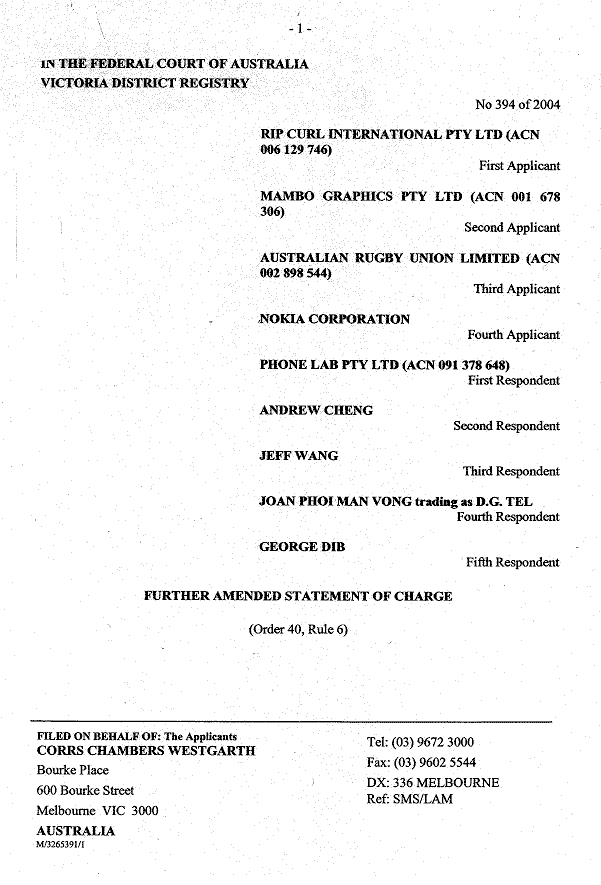
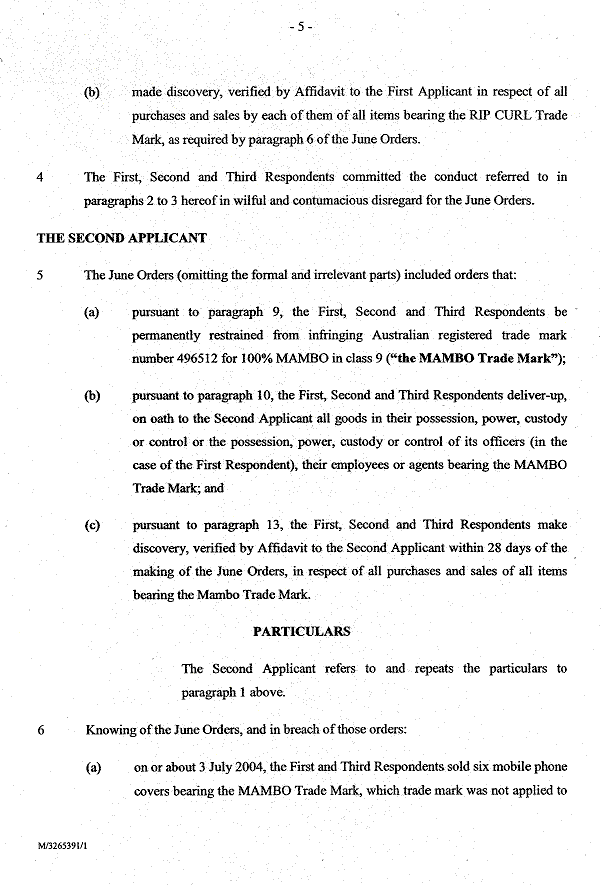
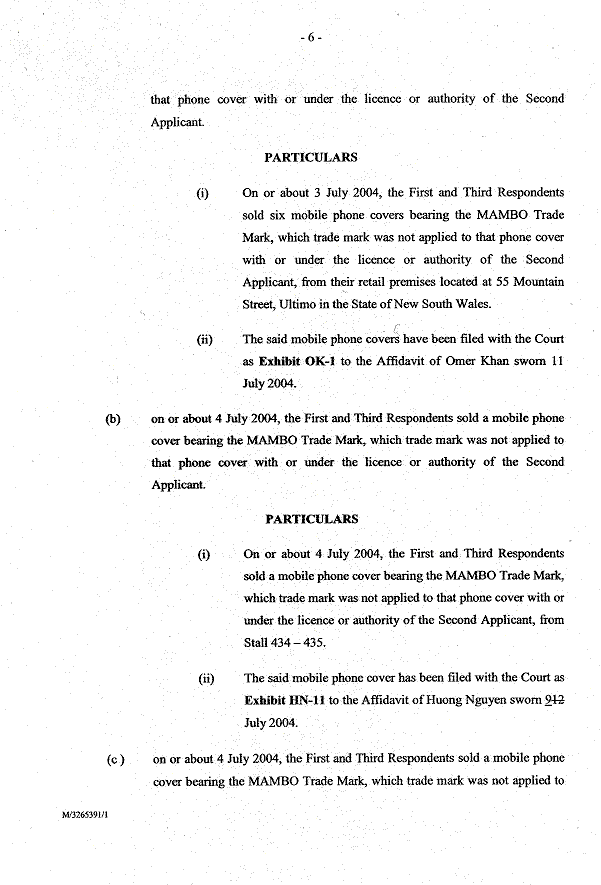
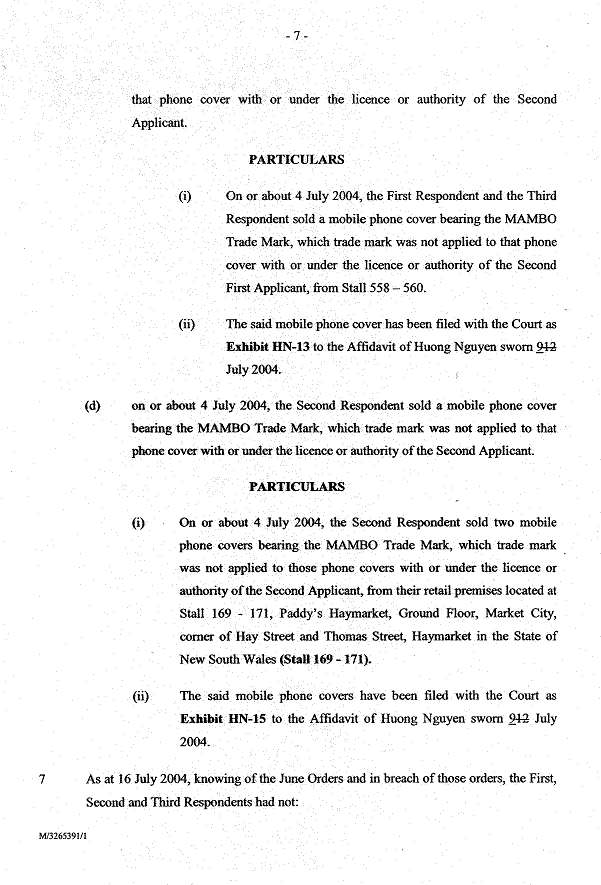
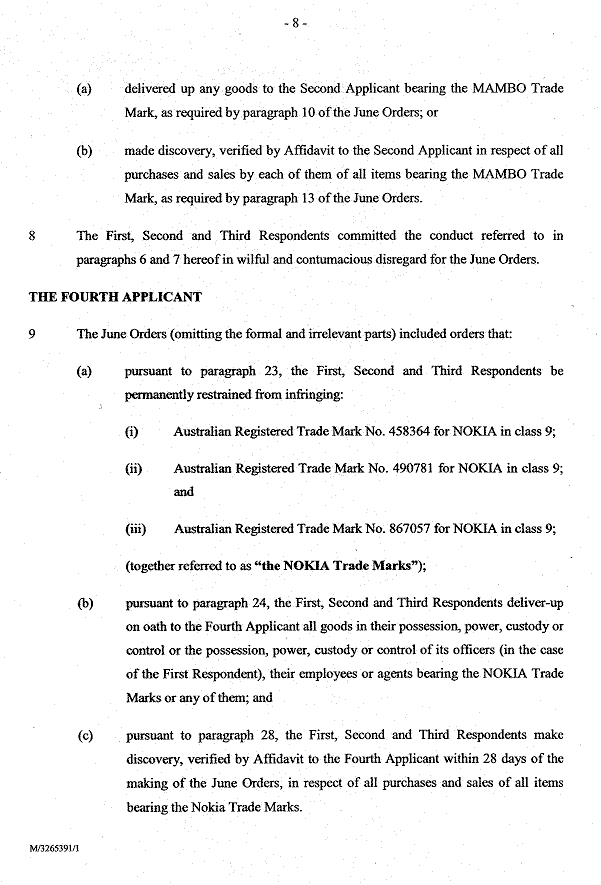
Rip Curl International Pty Ltd v Phone Lab Pty Ltd [2004] FCA 1215
CONTEMPT – penalty – contempt admitted to be wilful and contumacious – discretion of Court to impose penalties – suspended prison terms imposed
Trade Marks Act 1995 (Cth) s 134
Federal Court Rules Order 37 r 2(1), r 2(3), r 6
Adlam v Noack [1999] FCA 1606 applied
Australian Competition & Consumer Commission v World Netsafe Pty Ltd (2003) 204 ALR 537 cited
Australian Competition & Consumer Commission v Hughes (2001) ATPR 41-807; [2001] FCA 38 cited
Australian Competition & Consumer Commission v Australian Taxation Information Services Pty Ltd [1999] FCA 1607 cited
Australian Investments & Securities Commission v Eagle Inter-Link Pty Ltd [2002] FCA 1524 cited
Australian Securities & Investments Commission v Matthews (1999) 32 ACSR 404 applied
Australasian Meat Industry Employees’ Union v Mudginberri Station Pty Ltd (1986) 161 CLR 98 applied
BHP Steel (AIS) Pty Ltd v Construction Forestry Mining & Energy Union [2001] FCA 336
Deputy Federal Commissioner of Taxation v Hickey (1999) 99 ATC 5124; [1999] FCA 259 cited
Deputy Commissioner of Taxation v Uysal [2004] VSC 278 cited
Witham v Holloway (1995) 183 CLR 525 followed
Sony Computer Entertainment Australia v Dannoun [2000] FCA 1634 cited
Sony Computer Entertainment Australia Pty Ltd v Johnston [2001] FCA 912 cited
RIP CURL INTERNATIONAL PTY LTD & ORS v PHONE LAB PTY LTD & ORS
V 394 OF 2004
HELY J
17 SEPTEMBER 2004
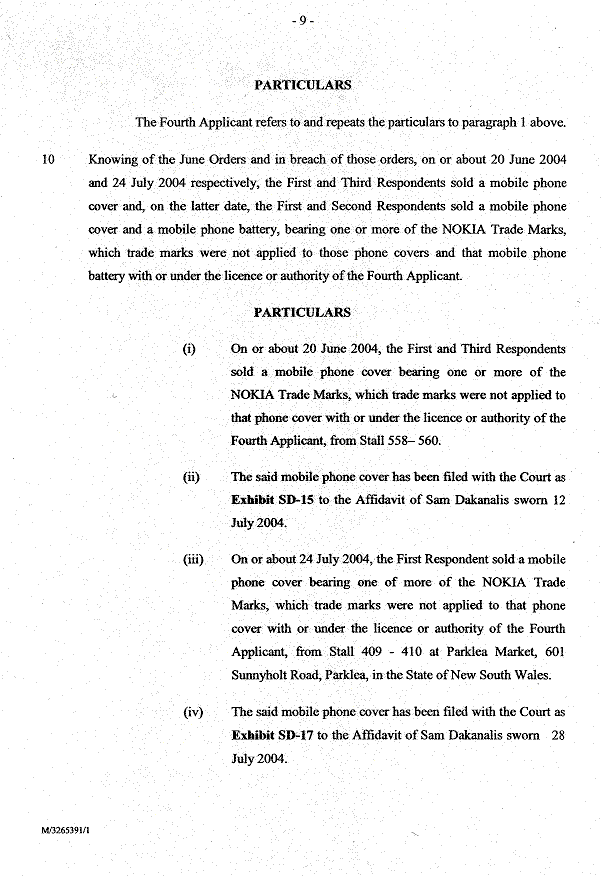
SYDNEY (HEARD IN MELBOURNE)
|
IN THE FEDERAL COURT OF AUSTRALIA |
|
|
VICTORIA DISTRICT REGISTRY |
|
BETWEEN: |
RIP CURL INTERNATIONAL PTY LTD (ACN 006 129 746) FIRST APPLICANT
MAMBO GRAPHICS PTY LTD (ACN 002 678 306) SECOND APPLICANT
AUSTRALIAN RUGBY UNION LIMITED (ACN 002 898 544) THIRD APPLICANT
NOKIA CORPORATION FOURTH APPLICANT
|
|
AND: |
PHONE LAB PTY LTD (ACN 091 378 648) FIRST RESPONDENT
ANDREW CHENG SECOND RESPONDENT
JEFF WANG THIRD RESPONDENT
JOAN PHOI MAN VONG TRADING AS D G TEL FOURTH RESPONDENT
GEORGE DIB FIFTH RESPONDENT
|
|
DATE OF ORDER: |
|
|
WHERE MADE: |
SYDNEY (HEARD IN MELBOURNE) |
THE COURT ORDERS THAT:
1. The first respondent pay the sum of $38,500.00 by way of penalty for the contempts of Court on the part of the first respondent specified in par 56 of these reasons, such sum to be paid on or before 28 October 2004 to the District Registrar, New South Wales Registry, Federal Court of Australia.
2. The third respondent pay the sum of $5,000.00 by way of penalty for the contempt of Court on the part of the third respondent specified in par 58(f) of these reasons, such sum to be paid on or before 28 October 2004 to the District Registrar, New South Wales Registry, Federal Court of Australia.
3. (i) A warrant addressed to the Governor, Metropolitan Remand and Reception Facilities, issue for the committal of the second respondent to a prison in New South Wales for a period of one month. Such committal is for contempt of Court in that the second respondent is in contempt of Court in the manner specified in par 57 of these reasons for decision; and
(ii) The warrant lie in the Registry to the intent that it not be executed provided that the second respondent refrains from contravening any of the orders made by Sundberg J on 15 June 2004 for a period of 12 months from today’s date.
4. (i) A warrant addressed to the Governor, Metropolitan Remand and Reception Facilities, issue for the committal of the third respondent to a prison in New South Wales for a period of one month. Such committal is for contempt of Court in that the third respondent is in contempt of Court in the manner specified in par 58(c) – (i) and (k) of these reasons for decision; and
(ii) the warrant lie in the Registry to the intent that it not be executed provided that the third respondent refrains from contravening any of the orders made by Sundberg J on 15 June 2004 for a period of 12 months from today’s date.
5. The first, second and third respondents pay the costs, including reserved costs, of the first, second and fourth applicants of and incidental to the application by Notice of Motion filed on 16 July 2004 for contempt, such costs to be taxed on the basis that the costs include all costs except insofar as they are of an unreasonable amount or unreasonably incurred so that, subject to such exceptions, and to the qualification hereafter appearing, each of the applicants is completely indemnified by the respondents for their costs. This order is subject to the qualification that it does not include the costs of the second day’s hearing on 24 August 2004.
6. The costs the subject of these orders be taxed forthwith, and upon being taxed, be paid forthwith.
Note: Settlement and entry of orders is dealt with in Order 36 of the Federal Court Rules.
|
IN THE FEDERAL COURT OF AUSTRALIA |
|
|
VICTORIA DISTRICT REGISTRY |
|
BETWEEN: |
RIP CURL INTERNATIONAL PTY LTD (ACN 006 129 746) FIRST APPLICANT
MAMBO GRAPHICS PTY LTD (ACN 002 678 306) SECOND APPLICANT
AUSTRALIAN RUGBY UNION LIMITED (ACN 002 898 544) THIRD APPLICANT
NOKIA CORPORATION FOURTH APPLICANT
|
|
AND: |
PHONE LAB PTY LTD (ACN 091 378 648) FIRST RESPONDENT
ANDREW CHENG SECOND RESPONDENT
JEFF WANG THIRD RESPONDENT
JOAN PHOI MAN VONG TRADING AS D G TEL FOURTH RESPONDENT
GEORGE DIB FIFTH RESPONDENT
|
|
JUDGE: |
|
|
DATE: |
|
|
PLACE: |
SYDNEY (HEARD IN MELBOURNE) |
REASONS FOR JUDGMENT
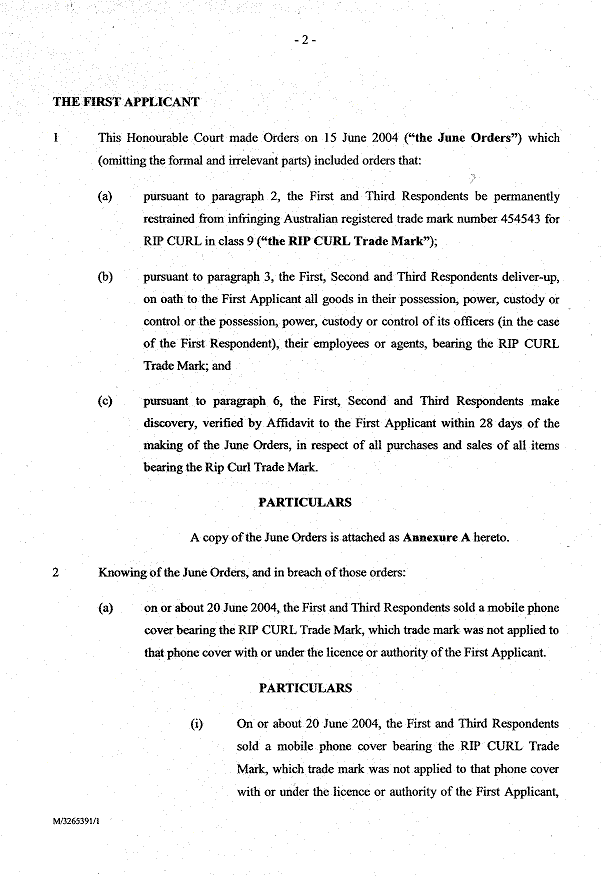
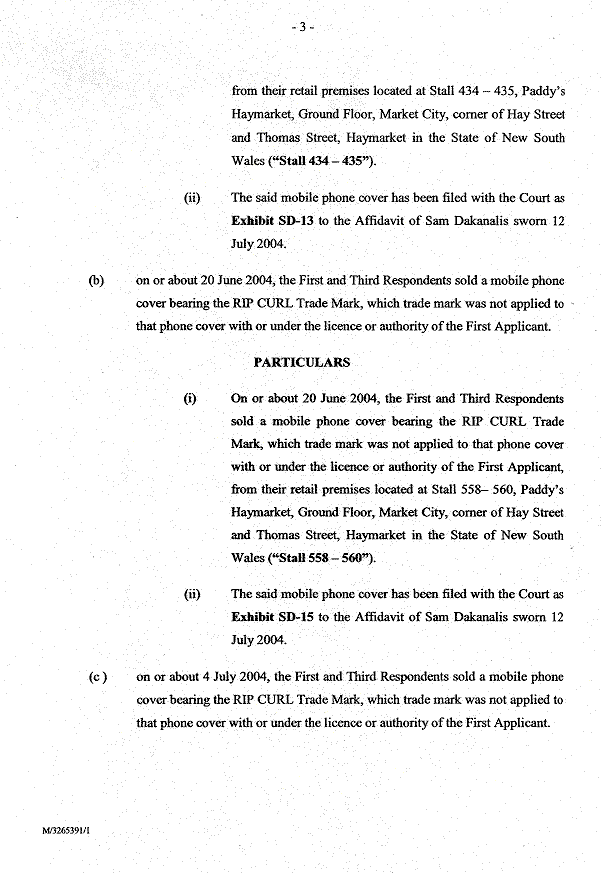
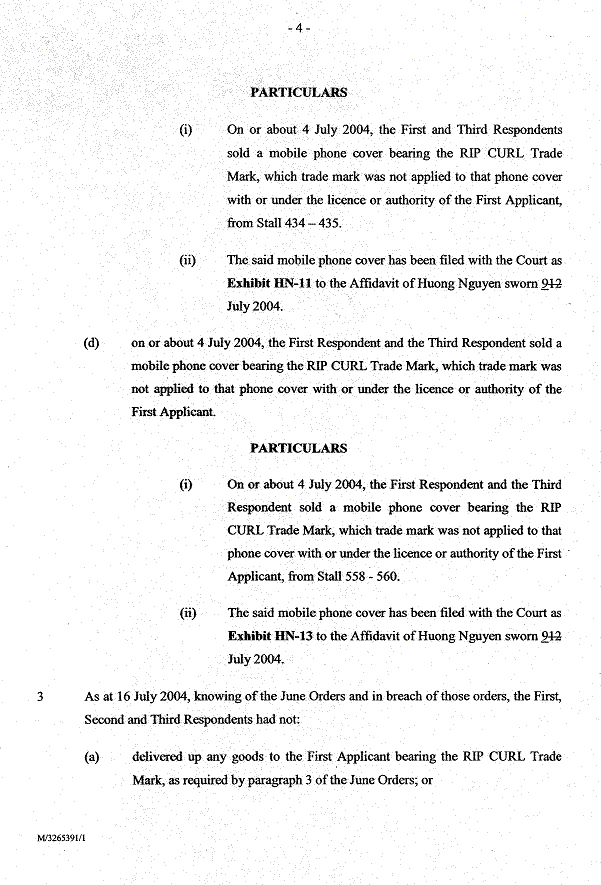
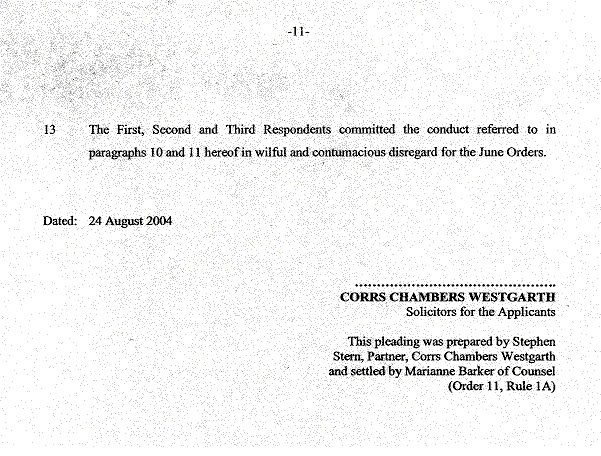
1 The first, second and fourth applicants (‘the applicants’) charge the first, second and third respondents with contempt of court. The alleged contempts are as set forth in a Further Amended Statement of Charge filed by the applicants on 24 August 2004. For ease of reference, a copy of the Further Amended Statement of Charge (with the Annexure omitted) is appended to these reasons. Ultimately, the first, second and third respondents pleaded guilty to each of the charges of contempt made against them, hence the issue with which I am concerned is the question of penalty.
2 The first respondent (‘Phone Lab’) is a retailer of mobile telephones and accessories which include, among other things, detachable telephone covers in a variety of colours and styles, and batteries. Phone Lab has been trading in Sydney for approximately three years. The second respondent and the third respondent are directors of Phone Lab.
3 Phone Lab and the second and third respondents, conduct their business from:
(a) a number of market stalls at Paddy’s Haymarket, in Haymarket, NSW;
(b) a number of market stalls at Parklea Markets, in Blacktown, NSW;
(c) a number of market stalls at Flemington Market, in Flemington, NSW;
(d) a shop, in Chatswood, in NSW; and
(e) a warehouse, in Ultimo, in NSW.
4 At Parklea Markets, Stalls 409-410 and 841-842 are recorded as operated by Phone Lab. At Paddy’s Market the following persons are recorded as the proprietor of the following stalls:
Stall Proprietor
169-171 second respondent
434-435 third respondent
558-560 third respondent
5 One of the second respondent’s main tasks is to supervise the stalls at Paddy’s Haymarket, whereas the third respondent principally supervises Phone Lab’s stalls at the Parklea Markets and the Flemington Markets.
Background
6 In September 2002 the Australian Customs Service gave notices to Nokia Australia pursuant to subs 134(b) of the Trade Marks Act 1995 (Cth) in relation to the seizure of certain goods bearing what appeared to be Nokia trade marks. The designated owners of the goods were either Phone Lab, or the second respondent. Phone Lab and the second respondent consented to the forfeiture of those goods, and on 2 October 2002 Phone Lab wrote to Trade Mark Investigation Services stating:
‘We have ceased all trade in counterfeit Nokia accessories in our shop and market stalls. Since October 2001 we have been notified that they are counterfeit accessories, this stock has been returned to local suppliers.’
On 11 October 2002 a Deed of Undertaking was signed by the second respondent undertaking that he would cease ‘infringing the intellectual property rights of which Nokia Corporation is the registered owner’.
7 On 30 August 2003 an employee of Trade Mark Investigation Services, Themis Pappas, observed phone covers bearing the trade marks Rip Curl, Mambo and Nokia respectively being displayed for sale at a stall in Parklea Markets operated by Phone Lab. Warning documents were served on the second respondent. The documents related to each of the Rip Curl, Mambo and Nokia trade marks. The warning documents warned the person to whom they were delivered that he or she was selling infringing goods, and made various demands in relation to the goods. The recipient was also warned that failure to comply with the demands in the document could result in legal action being taken.
8 On 24 October 2003 a packing list shows that Phone Lab received phone covers with what appeared to be the Mambo and Rip Curl trade marks which had been supplied by a person by the name of Henry Hong. On 11 November 2003 Phone Lab received some batteries branded with what appeared to be the Nokia trade mark which had apparently been sold to it by a company called Accessories Australia Pty Ltd.
9 On 15 November 2003 an officer of Trade Mark Investigation Services, Mr Taylor, observed numerous phone covers bearing the Mambo and Rip Curl trademarks being displayed at Phone Lab’s stalls in Paddy’s Haymarket. On that occasion he handed a further set of the warning documents referred to above to one of the attendants operating the stall. On 22 November 2003 he returned to one of the Paddy’s Haymarket stalls. He again observed numerous phone covers bearing both the Rip Curl and Mambo trade marks being displayed and offered for sale, and he again handed a set of the warning documents to one of the attendants working at the stall.
10 On 26 March 2004 these proceedings were instituted.
11 On 2 April 2004 Mr Jason Li, solicitor, received instructions from Phone Lab, and from the second and third respondents, admitting that they had infringed the trade marks of the first, second and third applicants ‘albeit unintentionally’. Thereafter correspondence ensued with the solicitor for the first, second and fourth applicants, Corrs Chambers Westgarth (‘Corrs’), which culminated in orders being made by consent by Sundberg J on 15 June 2004 (‘the June orders’). The Further Amended Statement of Charge is with respect to breaches of those orders. The orders were served on Phone Lab on 25 June 2004, upon the second respondent on 28 June 2004 and on the third respondent at 1.03 pm on 3 July 2004. Service on the third respondent was delayed because he had gone overseas on 21 June 2004, and only returned to Australia on 2 July 2004.
12 The orders which were served on Phone Lab and upon the second and third respondents bore the following endorsement:
‘TAKE NOTICE that if you disobey these court orders, you are liable to be punished by fine, imprisonment and/or the sequestration of your property.’
That notice did not comply with Federal Court Rules Order 37 r 2(3) inasmuch as the notice fails to name ‘the person concerned’. Counsel for the applicants, Mr Hammond QC, drew this deficiency to the attention of the Court and to the attention of counsel for the respondents. After that had been done the respondents maintained their plea of guilty to all charges.
13 Phone Lab, and the second and third respondents admitted by their pleas that the conduct charged as a contempt was, in the case of each charge, a wilful and contumacious disregard of the June Orders.
14 Notwithstanding the plea of guilty, counsel for the applicants read much of the evidence which had been filed in support of the contempt motion. He also tendered particular paragraphs from affidavits of the second and third respondents which although filed, were not read on behalf of the respondents. The respondents did not adduce any evidence on the contempt motion, and the matters referred to hereunder have been derived from evidence adduced on behalf of the applicants either directly, or by the tender of paragraphs from the affidavits of the second or third respondents.
The contempts charged
20 June 2004: Phone Lab and third respondent
15 Charges 2(a) – (b), 4, 10 (as to part) and 13 allege three breaches of the June orders, each of which is said to have occurred on 20 June 2004. The breaches are comprised of two sales of mobile phone covers each bearing the Rip Curl trade mark, and a further sale of a mobile phone cover bearing the Nokia trade mark from stalls in Paddy’s Market recorded as operated by the third respondent. Each of these breaches occurred prior to the service of the June orders upon any of the respondents. Mr Hammond did not read the affidavits noted upon a chronology which he provided which are said to prove the three sales on 20 June 2004, but having regard to the guilty plea, it was not incumbent upon him to do so. However, Order 37 r 2(1) provides that subject to the Rules, an order shall not be enforced by committal or sequestration unless the order or a certified or office copy of it is served personally on the person bound. Under Order 37 r 6 the Court may dispense with service under this Rule, but no specific application in that respect has been made to me in relation to the non-service of the orders as at 20 June 2004. This rule was, however, invoked in relation to the deficiency in the endorsement referred to above. No point was taken by counsel for the respondents in relation to the fact that these contempts were committed prior to service of the Court’s orders, or in relation to the deficiency in the endorsement. In any event, it is difficult to see how any procedural deficiency could avail the respondents, given that as the June orders were made by consent, the respondents must have been aware of them.
16 The third respondent left for China on 21 June 2004, and returned to Australia on 2 July 2004. He was aware, at the time he left for China and before, that Phone Lab and he would be in very serious trouble if steps were not taken to prevent further sales which infringed any of the applicants’ trade marks. According to his affidavit, it was for this reason, principally, that the third respondent went to China.
3 July 2004: Phone Lab and third respondent
17 Charges 6(a) and 8 allege a breach of the June orders at about 6.05 pm on 3 July 2004. The breach consists of a sale effected by the third respondent personally of six mobile phone covers bearing the Mambo trade mark from Phone Lab’s warehouse at 55 Mountain Street, Ultimo NSW. The circumstances of this sale were the subject of some controversy, inasmuch as Mr Khan (for the applicants) and the third respondent filed affidavits giving different accounts of the circumstances of the sale. Counsel for the respondents submitted, and I accept, that the plea of guilty on behalf of Phone Lab and the third respondent is an admission only of the critical elements of the offence (Australian Securities & Investments Commission v Matthews(1999) 32 ACSR 404). However, in this case, the pleas are sufficient to prevent my accepting the third respondent’s version of these events as set forth in his affidavit, as his version is inconsistent with his plea. The following matters are of importance in relation to this infringement:
· the sale was effected by the third respondent approximately five hours after the June orders were personally served upon him, endorsed in the manner noted above;
· Phone Lab and the third respondent originally indicated an intention to plead not guilty to the charges by a memorandum which was filed on 18 August 2004 pursuant to an order which I had made on 16 August 2004;
· Mr Khan swore an affidavit on 19 August controverting the third respondent’s version of these events, which was served by hand on 20 August 2004; and
· at about 7.47 pm on 20 August 2004 Corrs received a letter from Jason Li, Lawyers, advising that each of his clients had decided to plead guilty to each of the charges made against them.
4 July 2004: Phone Lab and third respondent
18 Charges 2(c), 2(d) and 4 allege breaches of the June orders on 4 July 2004 by two sales of mobile phone covers bearing the Rip Curl trade mark at the Paddy’s Haymarket stalls operated in the name of the third respondent. Charges 6(b), 6(c) and 8 allege breaches of the June orders on 4 July 2004 by the sale of mobile phone covers bearing the Mambo trade mark at these stalls. There is no evidence that the third respondent was directly involved in any of the sales of mobile phone covers effected on 4 July 2004.
4 July 2004: second respondent
19 Charges 6(d) and 8 allege that the second respondent sold a mobile phone cover bearing the Mambo trade mark on 4 July 2004 at a stall in Paddy’s Haymarket operated in the name of the second respondent. The evidence establishes that whilst the second respondent was at the stall at the relevant time, the sale was made by an attendant.
16 July 2004: Phone Lab, second and third respondents
20 Charges 3 and 4, and charges 7 and 8, allege a breach of orders to deliver up on oath infringing goods to the first and second applicants, and to make discovery of purchases and sales of infringing goods to the first and second applicants by 16 July 2004. As appears from par 1(b) and 5(b) of the Further Amended Statement of Charge, whilst orders for delivery up on oath were included in the June orders, no date by which delivery up was to be effected was specified. However, it was not contested that the order for discovery referred to in par 1(c) and 5(c) of the Further Amended Statement of Charge required discovery, verified by affidavit, by 16 July 2004, and that the respondents failed to comply with that order.
The institution of contempt proceedings
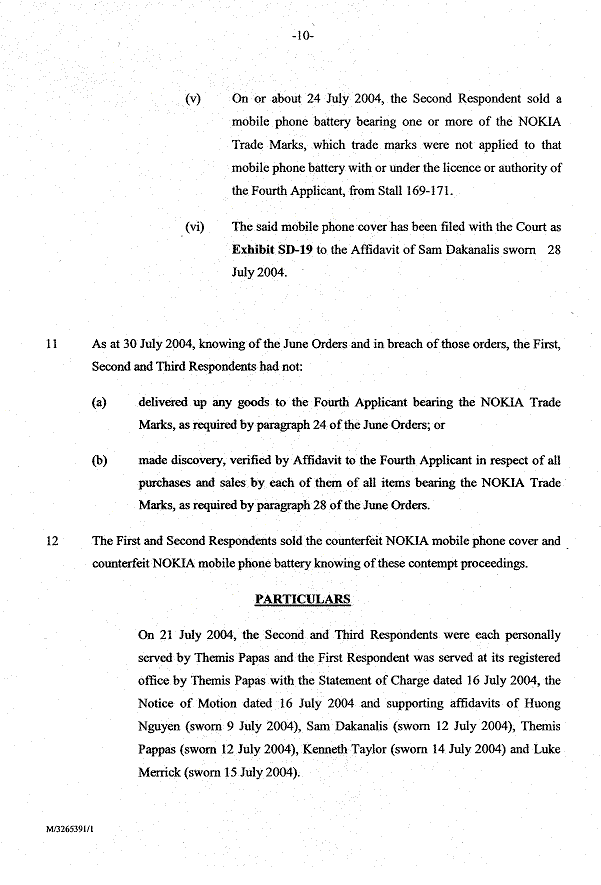
21 On 16 July 2004 the applicants filed a Notice of Motion seeking to punish Phone Lab and the second and third respondents for contempt. On 21 July 2004 the contempt proceeding documents were served on Phone Lab, and upon the second and third respondents.
24 July 2004: Phone Lab and second respondent
22 Charge 10 (as to part), 12 and 13 allege breach of the June orders on 24 July 2004 by the first and second respondents when a mobile phone cover bearing a Nokia trade mark was sold from a stall in Parklea Markets operated in the name of Phone Lab, and when a mobile phone battery bearing one or more of the Nokia trade marks was sold from a stall in Paddy’s Haymarket operated in the name of the second respondent.
30 July 2004: Phone Lab, second and third respondents
23 Charge 11 alleges a breach of the June orders inasmuch as at 30 July 2004 the respondents had not delivered up any goods bearing the Nokia trade mark to the fourth applicant as required by par 24 of the June orders, or made discovery of sales and purchasers of items bearing the Nokia trade marks as required by par 28 of the June orders.
The current contempt proceedings
24 On 30 July 2004 an Amended Notice of Motion was filed seeking to punish the respondents for contempt of court and it is that Amended Notice of Motion and the accompanying Amended Statement of Charge which were fixed for hearing before me. The Further Amended Statement of Charge does no more than correct an error occurring in the Amended Statement of Charge as to the date on which an affidavit was sworn.
Attempted compliance with discovery orders
25 On 10 August 2004 Jason Li, Lawyers, wrote to Corrs as follows:
‘In accordance with his Honour’s orders, we enclose the following items:
(1) the remainder of the goods bearing the Rip Curl Trade Mark (32 items),
(2) the remainder of the goods bearing the Mambo Trade Mark (37 items),
(3) the remainder of the Nokia batteries (4 items),
(4) Original Purchase Records for the Nokia batteries, and the mobile phone covers bearing the Rip Curl Trade Mark and the Mambo Trade Marks. We note that the Invoice for the mobile phone covers were supplied by a gentleman by the name of Mr Henry Hong who runs a business with ABN number 43 126 455 047. We enclose a further Company search for that ABN number. We are instructed that Mr You Tao Hong is the same Henry Hong who supplied the goods to our clients.
We are instructed that they represent the entirity of the documents and goods relating to the products the subject of the current proceedings.’
26 Enclosed with that letter was a packing list dated 24 October 2003 to which I have referred above, as well as an invoice relating to the goods the subject of that packing list and an invoice relating to the supply of Nokia batteries also referred to above.
27 On 13 August 2004 the third respondent filed three affidavits. The shortest of those affidavits (‘the delivery up affidavit’) states that on 10 August 2004 the third respondent provided a bundle of original documents and a box of goods bearing the Rip Curl trade mark, the Mambo trade mark and the Nokia trade mark to Mr Jason Li ‘for the purposes of delivering up and making discovery of those documents to the lawyers for the Applicants’, Corrs. The affidavit asserts that ‘I am not now in possession of any goods’ referred to in the June orders and that the ‘bundle of documents and box of goods which I provided to Jason Li’ included ‘all the documents and items (including documents stored on electronic form) which I made delivery-up of, which are in my possession, power, custody or control which bear (without the licence or authority of the relevant applicant)’ the Rip Curl trade mark, the Mambo trade mark or the Nokia trade mark (emphasis added).
28 On 18 August Corrs wrote to Jason Li, Lawyers, asserting that the third respondent’s affidavit of 13 August was not a compliance with the June orders for a number of reasons, the most obvious of which is that each of the respondents, and not simply the third respondent, was ordered to effect discovery and delivery up upon oath.
29 On 16 August 2004 I ordered that Phone Lab and the second and third respondents should lodge a memorandum indicating the plea which each of them proposed to make in relation to each of the charges. On 18 August 2004 the respondents filed a memorandum stating that the relevant respondents would plead guilty to all of the charges preferred against that respondent other than charges 4, 6(a), 8 and 13. That position changed on 20 August 2004, when the applicants’ solicitors were notified that a plea of guilty would be entered in relation to all of the charges. As I have noted above, that notification was received at about 7.47 pm on the Friday prior to the hearing of the contempt motion which was due to commence on the following Monday.
Continuing contempts
30 When the matter came on for hearing on Monday 23 August 2004 Mr Hammond opened the applicants’ case. He indicated that in his clients’ contention there were continuing breaches by all three respondents in respect of the orders to make discovery verified by affidavit, and by Phone Lab and the second respondent in respect of the order for delivery up on oath. I was informed by Mr Nugent, counsel for Phone Lab and the second and third respondents, that until Mr Hammond opened the applicants’ case in that way he was not aware that the applicants were asserting a continuing breach of the June 2004 orders. Thereupon Mr Nugent arranged for an affidavit to be sworn by Karyan Lee on 23 August 2004. Ms Lee is an employee of Jason Li, Lawyers, and it was she who drafted the affidavit of 13 August 2004 sworn by the third respondent. She took personal responsibility for the deficiencies in that affidavit and apologised to the Court for them. Phone Lab, and the second and third respondents each by their counsel then gave an undertaking to the Court that on or before 4 pm on 7 September 2004 they would each comply with pars 3, 4, 6, 10, 11, 13, 24, 25 and 28 of the orders made by Sundberg J on 15 June 2004 relating to discovery, and delivery up.
31 Charges 3, 7 and 11 relate to failures as at 16 July 2004 and 30 July 2004 to comply with the June orders in relation to delivery up and discovery, and by their guilty pleas to charges 4, 8 and 13 the respondents acknowledge that their failure to comply with those orders up to that time constitutes a wilful and contumacious disregard for the June orders. I did not understand Mr Nugent to attempt to resile from that position; rather his statement to me referred to above reflected an erroneous assumption on his part that the affidavit sworn by the third respondent on 13 August 2004 was a belated compliance with the terms of those orders.
Contempt is a serious matter
32 As Tamberlin J observed in Australian Competition & Consumer Commission v Hughes (2001) ATPR 41-807; [2001] FCA 38, without the enforcement of Court orders the whole process of adjudication becomes a hollow exercise. If a losing party can defy the orders of the Court, then such disobedience renders futile in the perception of the community the remedy secured by the successful party. Defiance of Court orders diminishes the authority of the Courts. The offence involves interference with the effective administration of justice. Unless the laws of contempt are properly enforced, the whole system of justice is at risk: Deputy Federal Commissioner of Taxation v Hickey (1999) 99 ATC 5124; [1999] FCA 259 at [35] (Carr J).
33 Phone Lab, the second respondent and the third respondent admit that the breaches of the June 2004 orders to which they have pleaded guilty were wilful, and a contumacious disregard for the June 2004 orders. Thus the disobedience of those orders cannot be described as casual, accidental or unintentional. A fine and/or imprisonment may therefore be imposed: Australasian Meat Industry Employees’ Union v Mudginberri Station Pty Ltd (1986) 161 CLR 98, 113. The Court’s power to punish for contempt includes a power to suspend on condition any sentence of imprisonment that it might impose in respect of the contempt: Australian Securities & Investment Commission v Matthews (1999) 32 ACSR 404 at 411. It also includes a power to impose an accruing fine until performance: Mudginberri Station (supra). As Mansfield J observed in Adlam v Noack [1999] FCA 1606 the Court’s power extends to punishing contempt by any combination of these alternatives.
34 The applicants submit that the appropriate penalty in this case is:
‘27(a) that there be a term of imprisonment imposed upon the Second and Third Respondents of up to two months duration and/or until they comply with the [June orders] to make discovery verified by Affidavit as required by paragraph 6 (Rip Curl), paragraph 13 (Mambo), paragraph 28 (Nokia) and in respect of the First and Second Respondent the [June orders] for delivery up as required by paragraphs 3 and 4 (Rip Curl), paragraphs 10 and 11 (Mambo) and paragraphs 24 and 25 (Nokia);
(b) there be a fine imposed upon each of the First, Second and Third Respondents in the sum of:
(i) $5,000 for each breach of the [June orders] prior to 21 July 2004; and
(ii) $10,000 for each breach of the [June orders] from 21 July 2004;
(c) there be a daily fine of $200.00 per day upon each of the First, Second and Third Respondents until they comply with the [June order] to make discovery verified by Affidavit and in respect of the First and Second the [June order] for delivery up;
(d) alternatively, that there be orders of sequestration against the property of each of the First, Second and Third Respondents.’
The document attached to the applicants’ submissions styled ‘Schedule of Proposed Fines’ is as set out hereunder.
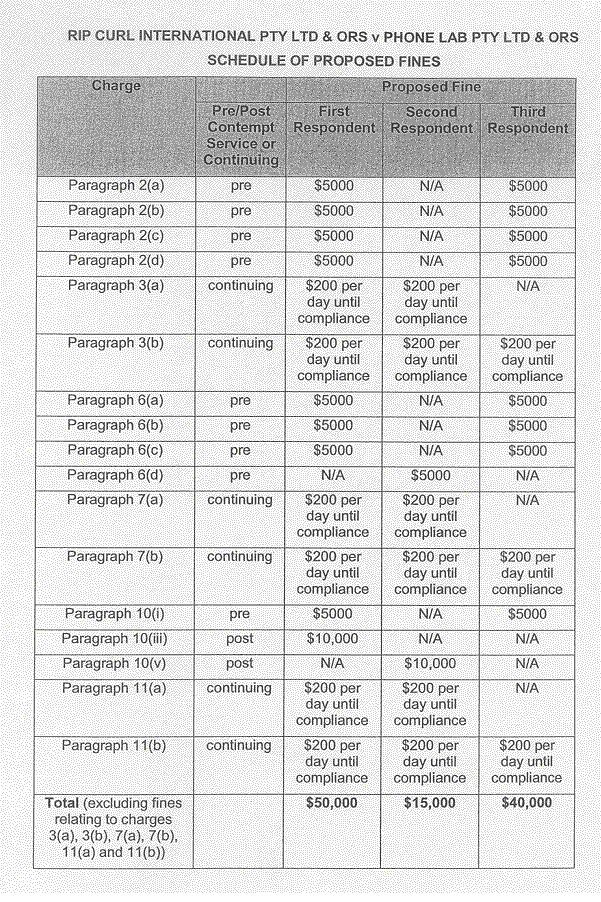
35 The applicants place particular emphasis on the fact that Phone Lab and the third respondent wilfully disobeyed the Court’s orders on the evening of the day on which the orders were served on the third respondent endorsed in the manner referred to above, and upon the fact that Phone Lab and the second respondent wilfully disobeyed those orders after service of the contempt proceedings upon them.
36 The applicants also tendered certain paragraphs of the longest of the affidavits sworn by the third respondent on 13 August 2004. Mr Hammond told me that the purpose of the tender was to show that the third respondent had attempted to erect a smokescreen around his conduct, by falsely suggesting that the explanation for the breaches of the orders was that insufficient steps were taken to remove infringing products from large quantities of China-sourced material, whereas the packing list referred to in par 8 above suggests that the infringing products had been obtained from Mr Henry Hong, rather than from China. In the applicants’ submission the third respondent attempted ‘to deflect the Court and the applicants away from what has really been going on’. The problem which I have with this submission is that the packing list was supplied by the respondents to Corrs under cover of the letter of 10 August 2004, before the third respondent’s affidavit was sworn. It is unlikely that the third respondent intended by his affidavit to suppress or conceal the involvement of Mr Hong in the supply of infringing products, when the documents which established that involvement had been supplied to the applicant’s solicitors only a day or so earlier.
37 Some of the paragraphs of this affidavit which the applicant tendered, if accepted, show that some steps were taken by the second and third respondents to comply with the Court’s orders, and this is confirmed by the evidence of Mr Khan, inasmuch as he says that he did not observe any infringing goods on display at Stalls 409-410 at Parklea Markets on 3 July 2004. Some paragraphs of this affidavit, if accepted, would also indicate that at least some of the breaches of the orders may have been unintentional, but a finding to this effect would be inconsistent with the respondents’ pleas. However, I find that some steps were taken by the second and third respondents to remove infringing products from being displayed for sale. My general view is that the paragraphs of the second and third respondents’ affidavits which the applicants tendered do not take the applicants’ case beyond that which is inherent in the guilty pleas, but they do provide a basis for a finding that some (inadequate) steps were taken by the second and third respondents to comply with the June orders.
38 Counsel for the respondents pointed out that a total of 14 phone covers and 1 battery were sold in breach of the Court’s orders, and that the proceeds received by Phone Lab by reason of the breaches is about $140 in respect of the phone covers, and $20.00 in respect of the battery, of which approximately $90.00 or thereabouts was profit. The respondents wrongful conduct thus resulted in only a small profit to Phone Lab, and minimal damage to the applicants.
39 However, I find these statistics to be unimpressive, because what is involved here, on the respondents’ own admission, is a wilful and insolent defiance of orders of the Court to the making of which the respondents consented. I also find that the small amount involved in the contraventions is of minimal significance, as it is the public interest in having Court orders obeyed which must be vindicated in these proceedings, and not just the private interests of the applicants in securing future obedience to those orders: see Witham v Holloway (1995) 183 CLR 525 at 533.
40 The respondents have chosen not to put any evidence before me either to explain the circumstances in which the breaches of the June 2004 orders occurred, or as to their personal circumstances. It may be, as their counsel contended, that they took this course in order to minimise the costs which might be incurred by lengthy cross-examination. But the fact remains that the respondents have pleaded guilty to wilful and contumacious breaches of the Court’s orders, and have sought to rely upon their guilty plea and apology in mitigation of their offence.
41 The pleas of guilty, although tendered late in the piece, and the apology on the part of the respondents which was proffered by counsel in the course of his submissions, are mitigating factors. The decision of Spender J in Australian Competition & Consumer Commission v World Netsafe Pty Ltd (2003) 204 ALR 537 contains a useful summary of the principles which the Court should apply in making a decision upon penalty, and confirms that the factors to which I have referred are properly to be taken into account in mitigation of the offences.
42 I have read a large number of first instance decisions involving contempt of Court in order to ascertain whether any settled pattern has emerged as to the appropriate form and level of penalty in cases such as the present. So far as I can ascertain, no such pattern has emerged. Imprisonment, whilst a measure of last resort, is sometimes imposed in relation to deliberate breaches of orders (eg Australian Competition & Consumer Commission v Australian Taxation Information Services Pty Ltd [1999] FCA 1607; Australian Investments & Securities Commission v Eagle Inter-Link Pty Ltd [2002] FCA 1524; Deputy Commissioner of Taxation v Uysal [2004] VSC 278), although sometimes the term of imprisonment is suspended for a time in order to allow the respondent a last opportunity of complying with the order (eg, Australian Competition & Consumer Commission v Hughes (2001) ATPR 41-807; [2001] FCA 38),or on condition that the respondent not contravene any of the orders during a specified period (eg, Australian Securities & Investment Commission v Matthews (supra)).
43 In other cases, fines have been imposed at varying levels of severity. For example, in BHP Steel (AIS) Pty Ltd v Construction Forestry Mining & Energy Union [2001] FCA 336 Kiefel J imposed a fine of $200,000 on the respondent union; on appeal ([2001] FCA 1758), the Full Court remitted the matter to Kiefel J for re-determination of penalty. Kiefel J reduced the penalty to $120,000 ([2002] FCA 702), and on further appeal to the Full Court the penalty was reduced to $50,000: [2003] FCAFC 13. The fines which were imposed in this case are the largest of those imposed in the cases to which I was referred by counsel, or which I have otherwise read.
44 Cases which bear a closer factual resemblance to the present include:
(a) Sony Computer Entertainment Australia v Dannoun [2000] FCA 1634 where Lindgren J imposed a penalty of $3,500 in relation to a single charge of contempt for infringement of trade mark; and
(b) Sony Computer Entertainment Australia Pty Ltd v Johnston [2001] FCA 912 where Emmett J imposed a penalty of $5,000 in relation to a contempt consisting of an infringement of trade mark on two occasions.
Phone Lab
45 The following penalties should be imposed upon Phone Lab:
Charge Date Penalty
2(a) 20.6.2004 $ 3,000
2(b) 20.6.2004 $ 3,000
2(c) 4.7.2004 $ 3,000
2(d) 4.7.2004 $ 3,000
3(a) 16.7.2004 Nil
3(b) 16.7.2004 $ 1,500
6(a) 3.7.2004 $ 3,000
6(b) 4.7.2004 $ 3,000
6(c) 4.7.2004 $ 3,000
7(a) 16.7.2004 Nil
7(b) 16.7.2004 $ 1,500
10(i) 20.6.2004 $ 3,000
10(ii) 24.7.2004 $ 5,000
10(v) 24.7.2004 $ 5,000
11(a) 30.7.2004 Nil
11(b) 30.7.2004 $ 1,500
$38,500
46 I make the following observations in relation to those penalties:
· I have not imposed any penalty in relation to charges 3(a), 7(a) and 11(a) because no date was fixed by the June 2004 orders by which delivery up was to be effected, and my attention has not been drawn to any communication from the applicants to any of the respondents giving reasonable notice that delivery up was required to be effected by the nominated dates;
· I have not imposed a continuing penalty in relation to charges 3(b), 7(b) and 11(b) because the Further Amended Statement of Charge does not explicitly allege a breach continuing after the nominated date, and because I have accepted an undertaking to the Court to remedy any continuing breach. Breach on and after 13 August 2004 was at least contributed to by defective legal advice, or misunderstandings on the part of lawyers, for which the respondents should not be punished. Of course, different considerations will arise if the undertakings referred to above to remedy the breach by 7 September 2004 are not performed; and
· higher penalties have been imposed in relation to charges 10(ii) and 10(v) because the conduct the subject of those charges was deliberately engaged in after the institution of the contempt proceedings.
Second respondent
47 The second respondent has pleaded guilty to charges 3(a), 3(b), 6(d), 7(a), 7(b), 10(v), 11(a) and 11(b). He accepts that his conduct giving rise to those breaches was in wilful and contumacious disregard of the June orders. The breaches were flagrant, overt (at least in the sense that other stallholders may well come to learn of them) and involved repeated acts of infringement. The administration of justice will fall into disrepute if the appearance is given that conduct of this type will go unpunished. The second respondent has given assurances on more than one occasion to the applicants that he will not infringe their trade marks – assurances which have been broken at least as often as they have been given.
48 The second respondent’s admitted conduct is sufficiently serious to warrant a term of imprisonment for one month, particularly as further breaches of the June orders occurred after the second respondent learnt of the institution of contempt proceedings. However, in view of the fact that it has not been established that the second respondent has previously been guilty of disobedience of the Court’s orders, and in view of the mitigating circumstances, the term of imprisonment should be suspended on condition that the second respondent not contravene during a period of twelve months from the date hereof any of the orders made by Sundberg J on 15 June 2004. A suspended sentence recognises that imprisonment is a remedy of last resort, but that it may be necessary to impose a term of imprisonment in order to secure future obedience to the June orders. It also gives the second respondent the opportunity to demonstrate the correctness of the submission made by counsel on his behalf, but which is unsupported by evidence, that he now appreciates the gravity of his conduct.
49 I do not think that it is appropriate for any additional pecuniary penalty to be imposed on the second respondent having regard to the pecuniary penalties imposed on Phone Lab for essentially the same conduct, and to the costs order which I propose to make.
Third respondent
50 The third respondent has pleaded guilty to charges 2(a), (b), (c) and (d), 3(a), (b), 6(a), (b), (c), 7(a), (b), 10(i) and 11(a) and (b). The observations which I have made in relation to the second respondent are at least equally applicable to the third respondent. I propose to impose, but to suspend, the same term of imprisonment on the third respondent as I imposed on the second respondent and on the same condition. For the reasons earlier given that term will not be imposed in relation to charges 2(a) and (b) and 10(i) (see par 15 above).
51 I did not impose any additional pecuniary penalties on the second respondent beyond those imposed on Phone Lab because, in substance, there was but one offence. There is, however, a matter of considerable aggravation in the case of the third respondent, namely that he was personally involved in the sale of six Mambo phone covers on 3 July 2004 the subject of charge 6(a) – a sale which occurred only hours after service of the Court’s orders upon him. A penalty of $5,000 is imposed on the third respondent in relation to this charge. I do not think it appropriate for any further pecuniary penalties to be imposed on the third respondent for the same reasons as I gave in relation to the second respondent.
Costs
52 The applicants seek the following costs order:
‘1. The First, Second and Third Respondents pay the costs including reserved costs of the First, Second and Fourth Applicants of and incidental to the application by Notice of Motion filed 16 July 2004 for contempt, such costs to be taxed on the basis (in each case) that the costs include all costs except in so far as they are of an unreasonable amount or were unreasonably incurred so that, subject to such exceptions, each of the said Applicants is completely indemnified by the said Respondents for their costs.
2. Pursuant to FCR Order 62 Rule 3(2) and (3), the costs the subject of paragraph 1 of these orders be taxed forthwith and upon being so taxed be paid forthwith.’
53 There is no general principle or rule of law in contempt cases that a successful applicant is routinely awarded costs on an indemnity basis, or solicitor and own client basis: Australian Competition & Consumer Commission v World Netsafe Pty Ltd (supra) at 545. However, such orders are commonly made. In Sony Computer Entertainment Australia Pty Ltd v Johnston (supra), and in Australian Competition & Consumer Commission v Australian Taxation Information Services Pty Ltd (supra) costs were awarded on a solicitor and own client basis. In Sony Computer Entertainment Australia Pty Ltd v Dannoun costs were awarded on an indemnity basis, that is all the costs of and incidental to the motion except any costs unreasonably incurred and costs unreasonable in amount.
54 Here, all the contempts charged were ultimately admitted, as was the allegation that the conduct the subject of the charges was wilful and in contumacious disregard of the June orders.
55 In those circumstances, costs should be awarded to the applicants on a more generous basis than party and party costs. This is particularly so because pecuniary penalties have not been imposed on the second and third respondents, except in relation to the third respondent on charge 6(a). There is one qualification to that proposition, and that arises out of the fact that the hearing of the contempt proceedings extended over two days. At the end of the two day hearing the applicants had not materially advanced their case beyond the admissions inherent in the guilty pleas. Two hearing days were consumed in the hearing of the motion, rather than one, because the applicants unsuccessfully attempted to advance their case beyond the admissions. I propose to make orders as sought by the applicants, with the qualification that the applicants are not to receive the costs of the second hearing day.
Conclusions
56 I hold that the first respondent is guilty of contempt of this Court by its conduct in disobeying orders made by Sundberg J on 15 June 2004 in that the first respondent knowing of those orders, and in wilful and contumacious disregard for those orders:
(a) on or about 20 June 2004 sold a mobile phone cover bearing the Rip Curl trade mark, which trade mark was not applied to the phone cover with or under the licence or authority of the first applicant as alleged in par 2(a) of the Further Amended Statement of Charge (‘the Charge’);
(b) on or about 20 June 2004 sold a mobile phone cover bearing the Rip Curl trade mark, which trade mark was not applied to that phone cover with or under the licence or authority of the first applicant as alleged in par 2(b) of the Charge;
(c) on or about 4 July 2004 sold a mobile phone cover bearing the Rip Curl trade mark, which trade mark was not applied to that phone cover with or under the licence or authority of the first applicant as alleged in par 2(c) of the Charge;
(d) on or about 4 July 2004 sold a mobile phone cover bearing the Rip Curl trade mark, which trade mark was not applied to that phone cover with or under the licence or authority of the first applicant as alleged in par 2(d) of the Charge;
(e) as at 16 July 2004 had not:
(i) delivered up any goods of to the first applicant bearing the Rip Curl trade mark, as required by par 3 of the June orders, and
(ii) made discovery, verified by affidavit to the first applicant, in respect of all purchases and sales of all items bearing the Rip Curl trade mark as required by par 6 of the June orders,
as alleged in pars 3(a) and (b) of the Charge;
(f) on or about 3 July 2004, sold six mobile phone covers bearing the Mambo trade mark, which trade mark was not applied to that phone cover with or under the licence or authority of the second applicant as alleged in par 6(a) of the Charge;
(g) on or about 4 July 2004, sold a mobile phone cover bearing the Mambo trade mark, which trade mark was not applied to that phone cover with or under the licence or authority of the second applicant as alleged in par 6(b) of the Charge;
(h) on or about 4 July 2004, sold a mobile phone cover bearing the Mambo trade mark, which trade mark was not applied to that phone cover with or under the licence or authority of the second applicant as alleged in par 6(c) of the Charge;
(i) as at 16 July 2004 had not:
(i) delivered up any goods to the second applicant bearing the Mambo trade mark as required by par 10 of the June orders, and
(ii) made discovery, verified by affidavit, to the second applicant in respect of all purchases and sales of all items bearing the Mambo trade mark, as required by par 13 of the June orders,
as alleged in pars 7(a) and (b) of the Charge;
(j) on or about 20 June 2004 sold a mobile phone cover and on about 24 July 2004 sold a mobile phone cover and a mobile phone battery, bearing one or more of the Nokia trade marks, which trade marks were not applied to those phone covers and that mobile phone battery with or under the licence or authority of the fourth applicant as alleged in par 10(i) and 10(iii) of the Charge;
(k) as at 30 July 2004 had not:
(i) delivered up any goods to the fourth applicant bearing the Nokia trade marks, as required by par 24 of the June orders; and
(ii) made discovery, verified by affidavit to the fourth applicant in respect of all purchases and sales of all items bearing the Nokia trade marks as required by par 28 of the June orders,
as alleged in pars 11(a) and (b) of the Charge.
57 I hold that the second respondent is guilty of contempt of this Court by his conduct in disobeying orders made by Sundberg J on 15 June 2004 in that the second respondent, knowing of those orders and in wilful and contumacious disregard for those orders:
(a) as at 16 July 2004 had not:
(i) delivered up any goods of to the first applicant bearing the Rip Curl trade mark, as required by par 3 of the June orders, and
(ii) made discovery, verified by affidavit to the first applicant, in respect of all purchases and sales of all items bearing the Rip Curl trade mark as required by par 6 of the June orders,
as alleged in pars 3(a) and (b) of the Charge;
(b) on or about 4 July 2004 sold a mobile phone cover bearing the Mambo trade mark, which trade mark was not applied to that phone cover with or under the licence or authority of the second applicant as alleged in par 6(d) of the Charge;
(c) as at 16 July 2004 had not:
(i) delivered up any goods to the second applicant bearing the Mambo trade mark as required by par 10 of the June orders, and
(ii) made discovery, verified by affidavit, to the second applicant in respect of all purchases and sales of all items bearing the Mambo trade mark, as required by par 13 of the June orders,
as alleged in pars 7(a) and (b) of the Charge;
(d) on or about 24 July 2004 sold a mobile phone battery, bearing one or more of the Nokia trade marks, which trade marks were not applied to that mobile phone battery with or under the licence or authority of the fourth applicant as alleged in par 10(v) of the Charge;
(e) as at 30 July 2004 had not:
(i) delivered up any goods to the fourth applicant bearing the Nokia trade marks, as required by par 24 of the June orders; and
(ii) made discovery, verified by affidavit to the fourth applicant in respect of all purchases and sales of all items bearing the Nokia trade marks as required by par 28 of the June orders,
as alleged in pars 11(a) and (b) of the Charge.
58 I hold that the third respondent is guilty of contempt of this Court by his conduct in disobeying orders made by Sundberg J on 15 June 2004 in that the third respondent, knowing of those orders and in wilful and contumacious disregard for those orders:
(a) on or about 20 June 2004 sold a mobile phone cover bearing the Rip Curl trade mark, which trade mark was not applied to the phone cover with or under the licence or authority of the first applicant as alleged in par 2(a) of the Charge;
(b) on or about 20 June 2004 sold a mobile phone cover bearing the Rip Curl trade mark, which trade mark was not applied to that phone cover with or under the licence or authority of the first applicant as alleged in par 2(b) of the Charge;
(c) on or about 4 July 2004 sold a mobile phone cover bearing the Rip Curl trade mark, which trade mark was not applied to that phone cover with or under the licence or authority of the first applicant as alleged in par 2(c) of the Charge;
(d) on or about 4 July 2004 sold a mobile phone cover bearing the Rip Curl trade mark, which trade mark was not applied to that phone cover with or under the licence or authority of the first applicant as alleged in par 2(d) of the Charge;
(e) as at 16 July 2004 had not:
(i) delivered up any goods of to the first applicant bearing the Rip Curl trade mark, as required by par 3 of the June orders, and
(ii) made discovery, verified by affidavit to the first applicant, in respect of all purchases and sales of all items bearing the Rip Curl trade mark as required by par 6 of the June orders,
as alleged in pars 3(a) and (b) of the Charge;
(f) on or about 3 July 2004, sold six mobile phone covers bearing the Mambo trade mark, which trade mark was not applied to that phone cover with or under the licence or authority of the second applicant as alleged in par 6(a) of the Charge;
(g) on or about 4 July 2004, sold a mobile phone cover bearing the Mambo trade mark, which trade mark was not applied to that phone cover with or under the licence or authority of the second applicant as alleged in par 6(b) of the Charge;
(h) on or about 4 July 2004, sold a mobile phone cover bearing the Mambo trade mark, which trade mark was not applied to that phone cover with or under the licence or authority of the second applicant as alleged in par 6(c) of the Charge;
(i) as at 16 July 2004 had not:
(i) delivered up any goods to the second applicant bearing the Mambo trade mark as required by par 10 of the June orders, and
(ii) made discovery, verified by affidavit, to the second applicant in respect of all purchases and sales of all items bearing the Mambo trade mark, as required by par 13 of the June orders,
as alleged in pars 7(a) and (b) of the Charge;
(j) on or about 20 June 2004 sold a mobile phone cover bearing a Nokia trade mark, which trade mark was applied to that phone cover which trade mark was not applied to the phone cover with or under the licence or authority of the fourth applicant as alleged in par 10(i) of the Charge;
(k) as at 30 July 2004 had not:
(i) delivered up any goods to the fourth applicant bearing the Nokia trade marks, as required by par 24 of the June orders; and
(ii) made discovery, verified by affidavit to the fourth applicant in respect of all purchases and sales of all items bearing the Nokia trade marks as required by par 28 of the June orders,
as alleged in pars 11(a) and (b) of the Charge.
Orders
59 I make the following orders:
(a) The first respondent pay the sum of $38,500.00 by way of penalty for the contempts of Court on the part of the first respondent specified in par 56 of these reasons, such sum to be paid on or before 28 October 2004 to the District Registrar, New South Wales Registry, Federal Court of Australia.
(b) The third respondent pay the sum of $5,000.00 by way of penalty for the contempt of Court on the part of the third respondent specified in par 58(f) of these reasons, such sum to be paid on or before 28 October 2004 to the District Registrar, New South Wales Registry, Federal Court of Australia.
(c) (i) A warrant addressed to the Governor, Metropolitan Remand and Reception Facilities, issue for the committal of the second respondent to a prison in New South Wales for a period of one month. Such committal is for contempt of Court in that the second respondent is in contempt of Court in the manner specified in par 57 of these reasons for decision;
(ii) The warrant lie in the Registry to the intent that it not be executed provided that the second respondent refrains from contravening any of the orders made by Sundberg J on 15 June 2004 for a period of 12 months from today’s date.
(d) (i) A warrant addressed to the Governor, Metropolitan Remand and Reception Facilities, issue for the committal of the third respondent to a prison in New South Wales for a period of one month. Such committal is for contempt of Court in that the third respondent is in contempt of Court in the manner specified in par 58(c) – (i) and (k) of these reasons for decision;
(ii) the warrant lie in the Registry to the intent that it not be executed provided that the third respondent refrains from contravening any of the orders made by Sundberg J on 15 June 2004 for a period of 12 months from today’s date.
(e) The first, second and third respondents pay the costs, including reserved costs, of the first, second and fourth applicants of and incidental to the application by Notice of Motion filed on 16 July 2004 for contempt, such costs to be taxed on the basis that the costs include all costs except insofar as they are of an unreasonable amount or unreasonably incurred so that, subject to such exceptions, and to the qualification hereafter appearing, each of the applicants is completely indemnified by the respondents for their costs. This order is subject to the qualification that it does not include the costs of the second day’s hearing on 24 August 2004.
(f) The costs the subject of these orders be taxed forthwith, and upon being taxed, be paid forthwith.
|
I certify that the preceding fifty-nine (59) numbered paragraphs are a true copy of the Reasons for Judgment herein of the Honourable Justice Hely. |
Associate:
Dated: 17 September 2004
|
Counsel for the Applicants: |
J Hammond SC, N Russell |
|
|
|
|
Solicitor for the Applicants: |
Corrs Chambers Westgarth |
|
|
|
|
Counsel for the First, Second and Third Respondents: |
P Nugent |
|
|
|
|
Solicitor for the First, Second and Third Respondents: |
Jason Li Lawyers |
|
|
|
|
Date of Hearing: |
23, 24 August 2004 |
|
|
|
|
Date of Judgment: |
17 September 2004 |