

FEDERAL COURT OF AUSTRALIA
Port Kembla Coal Terminal Ltd v Braverus Maritime Inc [2004] FCA 1211
SHIPPING AND NAVIGATION – compulsory pilotage – negligent navigation by pilot – liability of shipowner for damage caused by collision with berth – pilot employed by port corporation – vicarious liability of shipowner for default of pilot – pilot deemed to be shipowner’s servant by s 410B of Navigation Act 1912 (Cth) and s 85 of the Ports Corporatisation and Waterways Management Act 1995 (NSW) – shipowner vicariously liable for negligence of servant – entitlement to contribution from port corporation – no entitlement to contribution – statutory immunities operate to defeat contribution claim
SHIPPING AND NAVIGATION – licensing of pilots – no valid licence issued to pilot – statutory scheme operates despite absence of licence
TORT – vicarious liability – employers – employee exercising independent duties – pilot employed by port corporation but deemed by statute to be servant of shipowner – duty imposed by statute operative to exclude vicarious duty of employer
TORT – contributory negligence – causation – insufficient causative link between increased risk of damage and damage ultimately suffered – no contributory negligence
CONTRACT – formation – alleged existence of standing offer on the part of port corporation for provision of pilotage services – pilotage services offered pursuant to statutory obligation – no voluntary assumption of duty – no contract where duty imposed by statute – imperfect performance of statutory duty does not give rise to a contract
CONSTITUTIONAL LAW – just terms – Navigation Act alleged to have effect of removing cause of action and imputing incontestable liability without provision of just terms – Navigation Act not a law with respect to the acquisition of property – in any event, no liability or cause of action had accrued at the relevant time
TRADE PRACTICES – misleading or deceptive conduct – pilot carrying out statutory function – pilotage not an activity bearing a trading or commercial character – pilotage not ‘in trade or commerce’
Law Reform (Miscellaneous Provisions) Act 1946 (NSW) s 5(1)(c)
Law Reform (Miscellaneous Provisions) Act 1965 (NSW) s 8, 9
Marine Pilotage Licensing Act 1971 (NSW) s 3, 6, 7, 7(2)(a), 8, 12, 12(1), 14, 50A
Marine Pilotage Licensing Regulations 1974 (NSW)
Merchant Shipping Act 1854 (17 & 18 Vic)
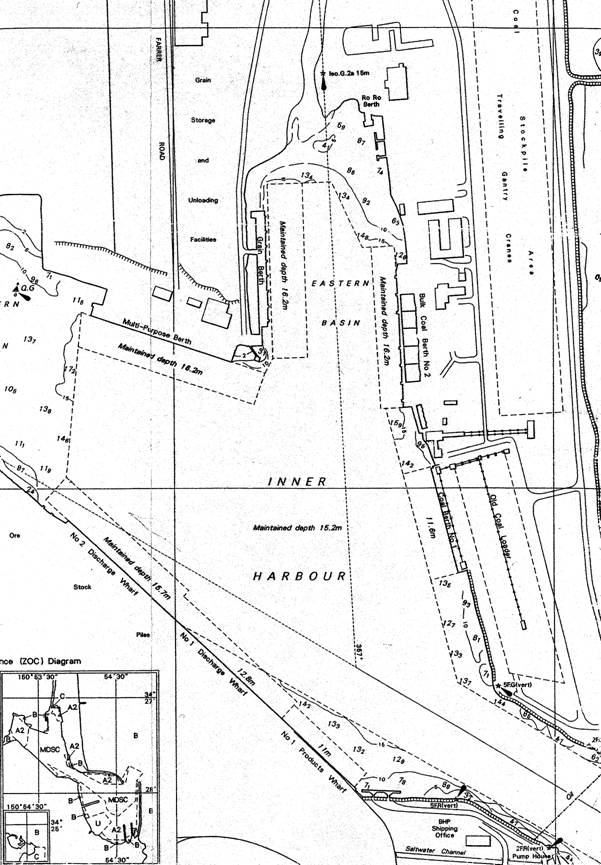
Merchant Shipping Act 1894 (57 & 58 Vic) s 633
Navigation Act 1912 (Cth) s 2(1)(a), 6, 410B, 410B(1), 410B(2)
Navigation Act 1920 (Cth)
Navigation Act 1958 (Cth)
Navigation (Maritime Conventions) Act 1934 (Cth)
Pilotage Act 1812 (52 Geo III)
Pilotage Act 1825 (6 Geo IV) s 55
Pilotage Act 1913 (Imp) s 15, 15(1)
Ports Corporatisation and Waterways Management Act 1995 (NSW) s 3, 7, 9, 11, 53, 54(2), 67, 68, 70, 77, 78, 84(1), 85, 86
Ports Corporatisation and Waterways Management Regulation 1997 (NSW) Regs 10, 11
State Owned Corporations Act 1989 (NSW) s 20F, 20ZB(1)
Trade Practices Act 1974 (Cth) s 45, 52, 74, 82, 87
Constitution s 51(i), 51(xxxi), 98, 109
International Convention for the Unification of Certain Rules of Respecting Collisions between Vessels (signed 23 September 1910; generally in force 1 March 1913; entered into force in Australia 24 October 1930)Article 5
Canada Shipping Act 1952
Australia, House of Representatives, Debates, 22 October 1912, pp 4481-4482
Explanatory Notes on Clauses of Draft Navigation Bill 1958 (7th March 1958)
A Aronson, B Dyer & M Groves Judicial Review of Administrative Action, LBC, Sydney, 3rd Ed, 2004
R P Balkin & J L R Davis, Law of Torts, Butterworths, 3rd Ed, 2004
D A Butler & W D Duncan, Maritime Law in Australia, Legal Books, Sydney, 1992
R Douglas, P Lane and M Pete, Douglas & Geen on the Law of Harbours Coasts and Pilotage, LLP, London, 5th ed, 1997
R G Marsden A Treatise on the Law of Collisions at Sea, Stevens and Sons, London,6th Ed, 1910
F Trindade & P Cane, The Law of Torts in Australia, OUP, 3rd Ed, 1999
The Nautical Institute on Pilotage and Shiphandling, The Nautical Institute, London, 1990
Amarantos Shipping Co Ltd v South Australia (2004) 87 SASR 528 cited
Astley v Austrust Ltd (1999) 197 CLR 1 applied
Australian Coastal Shipping Commission v O’Reilly (1962) 107 CLR 46 cited
Australian Tape Manufacturers Association Ltd v Commonwealth (1993) 176 CLR 480 discussed
Australian Woollen Mills Pty Ltd v Commonwealth (1954) 92 CLR 424 followed
Branir Pty Ltd v Owsten Nominees (No 2) Pty Ltd (2001) 117 FCR 424 followed
Caswell v Powell Duffryn Associated Collieries Ltd [1940] AC 152 cited
Chapman v Luminis (No 4) (2001) 123 FCR 62 followed
Chelfco Ninety-Four Pty Ltd v Road Traffic Authority [1985] VR 1 cited
Clark (or Thom) v J & P Hutchinson Ltd [1925] SC 386 cited
Concrete Constructions (NSW) Pty Ltd v Nelson (1990) 169 CLR 594 applied
Dare v Pulham (1982) 148 CLR 658 referred to
Dovuro Pty Ltd v Wilkins (2003) 77 ALJR 1706 cited
Esso Petroleum Co Ltd v Hall Russell & Co Ltd [1989] 1 AC 643 (‘The Esso Bernicia’) applied
Fowles v Eastern and Australian Steamship Co Ltd (1913) 17 CLR 149 cited
Fowles v Eastern and Australian Steamship Co Ltd [1916] 2 AC 556 cited
Fox v Percy (2003) 214 CLR 118 followed
Georgiadis v Australian and Overseas Telecommunications Corporation (1994) 179 CLR 297 cited
Harbutt’s Plasticine Ltd v Wayne Tank and Pump Co Ltd [1970] 1 QB 447 cited
Henville v Walker (2001) 206 CLR 459 applied
Holman v Irvine Harbour Trustees (1877) 4 Sess Cas (4th series) 406 explained
Hyder Consulting (Australia) Pty Ltd v Wilth Wilhelmensen Agency Pty Ltd [2001] NSWCA 313 followed
Johnson v Perez (1988) 166 CLR 351 applied
Johnston v Frazer (1990) 21 NSWLR 89 applied
Jones v Livox Quarries [1952] 2 QB 608 discussed
Joslyn v Berryman (2003) 77 ALJR 1233 applied
Leotta v Public Transport Commission of New South Wales (1976) 9 ALR 437 referred to
Lismore County Council v Stewart (1989) 18 NSWLR 718 applied
Norweb PLC v Dixon [1995] 3 All ER 952 cited
Oceangas (Gibraltar) Ltd v Port of London Authority [1993] 2 Lloyd’s Rep 292 (‘The Cavendish’) referred to
Oceanic Crest Shipping Co v Hamersley Iron Pty Ltd [1986] WAR 88 discussed
Oceanic Crest Shipping Co v Pilbara Harbour Services Pty Ltd (1986) 160 CLR 626 applied
Optus Networks Pty Ltd v Leighton Contractors Pty Ltd [2002] NSWSC 450 followed
Otago Harbour Board v Cates (1884) 2 NZLR 123 discussed
Owners of the Dredger “Liesbosh” v Owners of the Steamship “Edison” [1933] AC 449 cited
Pfizer Corporation v Ministry of Health [1965] AC 512 referred to
Puntoriero v Water Administration Ministerial Corporation (1999) 199 CLR 575 distinguished
Purcell v Watson (1979) 26 ALR 235 followed
R W Miller & Co Pty Ltd v Shortland County Council (1988) 83 ALR 225 cited
Re DPP; ex parte Lawler (1994) 179 CLR 270 applied
Re Maritime Union of Australia; ex parte CSL Pacific Shipping Inc (2003) 77 ALJR 1497 cited
Rockhampton Harbour Board v Ocean Steamship Co Ltd [1930] QSR 343 cited
Southampton Container Terminals Ltd v Hansa Schiffartsgesellschaft mbH [1999] 2 Lloyd’s Rep 491 (‘The Maersk Columbo’) distinguished
Smith v ANL Ltd (2001) 204 CLR 493 cited
SS Alexander Shukoff v SS Gothlard [1921] 1 AC 244 cited
Stirling Harbour Services Pty Ltd v Bunbury Port Authority [2000] FCA 1381 cited
Suatu Holdings Pty Ltd v Australian Postal Corporation (1989) 86 ALR 532 cited
Texada Mines Pty Ltd v The Ship ‘Afovos’ [1974] 2 Lloyd’s Rep 168 cited
The Andoni [1918] P 14 cited
The Arum [1921] P 12 cited
The Christiana (1850) 7 Moore’s PC Cases 160; 13 ER 841 discussed
The Eden (1846) 2 Wm Robb 442 ; 166 E.R. 822 discussed
The Gazelle (1884) 2 Wm Robb 279; 166 ER 759 discussed
The Guy Mannering (1882) 7 PD 132 discussed
The Maria (1839) 1 Wm Robb 95; 166 ER 508 discussed
The Oregon 158 US 186 (1895) cited
The Peerless (1860) Lush. 30 ; 167 ER 16 cited
The Prinses Juliana [1936] P 139 cited
The Tactician [1907] P 244 discussed
Tiwi Barge Services Pty Ltd v Stark (1997) 78 FCR 218 cited
Wood v Smith (1874) LR 5 PC 451 (‘The City of Cambridge’) discussed
Workington Harbour and Dock Board v Towerfield (Owners) [1951] AC 112 (‘The Towerfield’) discussed
PORT KEMBLA COAL TERMINAL LTD v BRAVERUS MARITIME INC
N 1397 OF 2002
HELY J
17 SEPTEMBER 2004
SYDNEY
| IN THE FEDERAL COURT OF AUSTRALIA |
|
| NEW SOUTH WALES DISTRICT REGISTRY IN ADMIRALTY |
| BETWEEN: | PORT KEMBLA COAL TERMINAL LTD (ACN 003 942 774) PLAINTIFF
|
| AND: | BRAVERUS MARITIME INC DEFENDANT
|
| BETWEEN: | BRAVERUS MARITIME INC CROSS CLAIMANT
|
| AND: | PORT KEMBLA PORT CORPORATION CROSS DEFENDANT
|
| BETWEEN: | PORT KEMBLA PORT CORPORATION COUNTER CROSS CLAIMANT
|
| AND: | BRAVERUS MARITIME INC COUNTER CROSS DEFENDANT
|
| HELY J | |
| DATE OF ORDER: | 17 SEPTEMBER 2004 |
| WHERE MADE: | SYDNEY |
THE COURT ORDERS THAT:
1. The plaintiff bring in short minutes of order to give effect to my decision that:
(a) Judgment should be entered in favour of the plaintiff against the defendant in the sum of $16,097,548.17 together with interest thereon at Schedule J rates.
(b) The plaintiff should prepare an interest calculation and endeavour to reach agreement with the defendant on the quantum of that claim.
(c) An order be made that the defendant is to pay the plaintiff’s costs of the proceedings.
(d) Reserve liberty to the plaintiff to apply for a special costs order on motion filed within 14 days.
2. The Corporation should bring in short minutes of order to give effect to my decision that the defendant’s cross claim against the Corporation should be dismissed with costs, and the Corporation’s cross claim against the defendant should be dismissed with costs.
Note: Settlement and entry of orders is dealt with in Order 36 of the Federal Court Rules.
| IN THE FEDERAL COURT OF AUSTRALIA |
|
| NEW SOUTH WALES DISTRICT REGISTRY IN ADMIRALTY |
| BETWEEN: | (ACN 003 942 774) PLAINTIFF
|
| AND: | DEFENDANT
|
| BETWEEN: | BRAVERUS MARITIME INC CROSS CLAIMANT
|
| AND: | PORT KEMBLA PORT CORPORATION CROSS DEFENDANT
|
| BETWEEN: | PORT KEMBLA PORT CORPORATION COUNTER CROSS CLAIMANT
|
| AND: | BRAVERUS MARITIME INC COUNTER CROSS DEFENDANT
|
| JUDGE: | |
| DATE: | 17 SEPTEMBER 2004 |
| PLACE: | SYDNEY |
The possibility of error in communication
Massive conflicts in the evidence
The Pilot boards the Fortius (approximate time 13:00)
The pilot card and the ship’s particulars
The passage plan and the pilotage report
The significance of the higher displacement
Did the swing commence too far to the north in the inner harbour? (Approximate time: 13:50)
The slow ahead or stop engines/slow astern point
Captain Hoogendoorn’s observations
An overview of the negligence issue
Respective responsibilities of master and pilot under the general law
The 1910 Convention and thereafter
Impact of the current statutory regime on the relationship between master and pilot
Vicarious liability in the defendant for the negligence of the pilot
Was the Fortius proceeding on an overseas voyage?
Constitutional validity of s 410B(2)
Outcome of the plaintiff’s claim
REASONS FOR JUDGMENT
1 The plaintiff is the lessee and operator of the Port Kembla Coal Loading Terminal (‘the facility’). The facility includes two berths, namely the No 1 berth, sometimes referred to as the ‘old coal wharf’ (‘CB1’) and the No 2 berth, sometimes referred to as the ‘bulk coal berth’ (‘CB2’).
2 Both CB1 and CB2 are situated on the eastern side of the inner harbour at Port Kembla, and adjacent to the Eastern Basin. CB1 is to the south of CB2. This case is primarily concerned with CB2. CB2 has a berth face of about 282 metres in length and 6.4 metres wide, sitting on piles and running in a north-south direction. At each end of the berth are two platforms, used as washdown and maintenance areas. These platforms are also supported by a pattern of piles underneath. The berth face is tied back to anchor points on shore by four tubular steel struts. A series of eight fender platforms protrude from the berth face with large square steel structure fenders (suitably faced) attached and appropriately sprung.
3 A coal loader is situated on CB2. The coal loader comprises two rail mounted ship loaders (‘the No 1 and No 2 ship loaders’) and associated conveyors and ancillary structures and equipment. The ship loaders are used to load coal from the adjacent stockpiles onto vessels berthed alongside CB2. Each of the ship loaders weighs 1,500 tonnes, stands 23 metres high (from the berth deck to the top of the structure), is 25 metres wide, 74.50 metres long when parked and 109.50 metres long when the cargo boom is extended.
4 The ship loaders can travel the length of CB2 along two steel rails running lengthwise on the surface of the berth. These rails are used as tracks for the outer bogies of the ship loaders (that is those on the seaward side of the berth) and are supported by a set of 2000 mm concrete piles under the berth running directly beneath the rails. There is also a similar set of steel rails running alongside the shore or landward side of the berth, supporting the inside bogies of the ship loaders.
5 The ‘SA Fortius’ (‘the Fortius’) is a ‘cape size’ class, gearless, bulk carrier with a gross registered tonnage of 87,542 tonnes. A ‘cape size’ vessel is one whose beam is too great to allow it to pass through the Panama Canal. The Fortius is owned by the defendant and registered in Nassau, Bahamas. She has a length of 289.08 metres overall, a beam of 45.0 metres, a summer draught of 17.721 metres and a deadweight at that draft of 171,509 tonnes. The Fortius has 9 cargo holds and an aft engine room, deck house and bridge. The bridge is 246.3 metres from the Fortius’ bow and 42.7 metres from the stern. The vessel is equipped with direct bridge control of the engine.
6 In April 2002, the Fortius was under the command of Captain Ryszard Krol. In addition to the master, there was a complement of 20 officers and crew on board, operating and navigating the vessel. The master and the ship’s complement were employed by the defendant or by managing agents for and on behalf of the defendant.
7 Captain Krol first went to sea in 1971 and achieved the rank of master in 1987. In about 1991 he first acted as Chief Officer on cape size vessels. In 1997 he started to be a master on cape size vessels, and has been in command of cape size vessels ever since. Captain Krol has had considerable experience in the navigation and command of cape size vessels.
8 In early 2002, the Fortius was chartered to lift a full cargo of 130,000 tonnes of coal from Newcastle and Port Kembla for discharge in Rotterdam. On 14 April 2002 the vessel berthed in Newcastle and loaded 55,410 tonnes of coal on board. Early on the morning of 15 April 2002 the vessel sailed from Newcastle to Port Kembla. At that time she had, in addition to the 55,410 tonnes of cargo loaded at Newcastle, a further 30,000 tonnes of ballast. The Fortius’ displacement was then approximately 110,000 tonnes.
9 The Fortius arrived off Port Kembla at about 13:00 hours on 15 April 2002. She was booked to berth at CB2 that afternoon for the purpose of loading the balance of her cargo of coal, before proceeding to Rotterdam. This was the second occasion on which Captain Krol had visited Port Kembla, the first occasion being in May 1997 when he was the master of a cape size vessel which discharged iron ore at a BHP discharge berth on the southern side of the inner harbour.
10 Prior to the vessel arriving in Port Kembla, Captain Krol completed a pre-arrival checklist with the assistance of various officers. This checklist included testing the engine both ahead and astern and testing the full range of the steering gear and rudder from side to side. No difficulties or problems were encountered. This pre-arrival check also included a check on the course recorder, although the nature and extent of the check does not appear. The vessel’s engines and steering gear were thus in perfect working order and during the entry into Port Kembla the vessel’s main engines did not experience any difficulties or problems.
11 Port Kembla is a compulsory pilotage port: Ports Corporatisation and Waterways Management Act 1995 (NSW) s 77 and s 78 (‘the PCWM Act’). The cross defendant (‘the Corporation’) is a ‘Port Corporation’ established by s 7 of that Act. As a matter of fact the Corporation, and only the Corporation, provided pilotage services in Port Kembla Harbour. One of the ‘pilots’ which the Corporation employed for that purpose was Captain Stephen James. I say ‘pilots’, because one of the many issues in this case is whether Captain James was licensed as a pilot under s 7 of the Marine Pilotage Licensing Act 1971 (NSW) (‘the MPL Act’), and whether he was employed as a Pilot for the purposes of the PCWM Act. It will be necessary to return to that issue in due course, but, for the time being, I will refer to Captain James as the Pilot, without prejudging that question.
12 Captain James boarded the Fortius at about 13:00 hours on 15 April 2002. He did so for the purpose of piloting the vessel on her passage into Port Kembla Harbour and alongside CB2. Captain James purported to act as the Fortius’ Pilot, and the master and crew of the Fortius permitted Captain James to act in the same way as a Pilot routinely does in the manoeuvring and berthing of the vessel. There are a number of factual disputes between the Pilot on the one hand, and the Master, Chief Officer and Helmsman on the other about that passage to which it will be necessary to return.
13 It was Captain James’ intention to manoeuvre the Fortius through the breakwater at Port Kembla harbour, before turning to the starboard in the outer harbour and guiding the vessel into the inner harbour through a narrow channel between the outer and inner harbour called ‘the cut’.
14 Once inside the inner harbour, the Fortius would be swung to starboard so as to pass through approximately 240 degrees. This manoeuvre was to take place in the middle of the inner harbour to the south west of CB2 in an area referred to as the turning basin. When that manoeuvre had been completed, the Fortius should have been lying broadly parallel with CB2 to the south west of CB2 with her bow facing south. The tugs that had accompanied the vessel into the inner harbour, and assisted her with the swinging manoeuvre, would then be used to push the vessel astern and then sideways towards CB2 in a broadly north then easterly direction, with the vessel berthing port side to. A chart of the inner harbour has been reproduced on the following page, with CB2 located on the eastern side of the eastern basin. The smaller scale chart inserted in the bottom left corner of the inner harbour chart shows the overall configuration of Port Kembla harbour, and the relationship between the outer harbour, the cut, and the inner harbour.
15 In carrying out the swinging manoeuvre, the Fortius moved too far north and too close to CB2. As the Fortius was being swung, her bow collided with CB2 towards the southern end of that berth at an angle of about 80 to 90 degrees to the berth (which lies at an angle of about 5 or 10 degrees off due north/south), causing damage to the berth structure and to the No 1 ship loader. It was generally accepted that the collision occurred at about 13:59 hours on 15 April 2002. There was a ‘v’ shaped indentation of approximately 2 metres in the concrete structure of the berth where the starboard bow of the Fortius collided with it on a heading of about 78 degrees. The bulwark came into contact with the No 1 ship loader, causing it to be derailed and rendered unstable. The cost of repairing the No 1 ship loader alone is claimed to be $5,889,090.20. The cost of rectifying the damage to the berth and the ship loader, and some incidental expenses, are claimed by the plaintiff to be $16,110,548.47.
16 According to witnesses whose evidence I accept, 15 April 2002 was a fine sunny day. There was hardly any wind. The water was calm and flat. Visibility was clear. The Fortius’ log recorded that at 1200 hours the weather was cloudy with good visibility and a moderate sea. As Captain Krol acknowledged in evidence ‘everything was perfect’ (so far as he could see) ‘for a safe berthing procedure for the Fortius’. Captain Krol also acknowledged in evidence that if everyone involved in the navigation and manoeuvring of the ship had properly done their job then the collision would not have occurred. No similar incident had occurred at CB2 in over 20 years. No one has suggested that anything other than human error caused or contributed to the collision, although there is a marked conflict in the evidence as to who is responsible.
17 In very general terms, the Pilot attributed the Fortius’ movement to the north, and the subsequent collision with CB2, to a failure on the part of the Master, Chief Officer and Helmsman to execute the Pilot’s helm and engine orders. In a letter dated 24 September 2002 to the Australian Transport Safety Bureau (‘the ATSB’) the Pilot said that his orders were ignored, and countermanded by the Master, without the Master informing the Pilot of his decision. The Master denies that this is so, and attributes the collision to faulty navigation on the part of the Pilot. The Master is supported in that denial by the evidence of the Chief Officer and the Helmsman.
18 Whatever the cause of the Fortius’ movement to the north, a point arose when both Pilot and Master recognised that there was a risk of collision between the vessel and CB2, but that if appropriate action had then been taken, the collision would have been averted. That point was when the Fortius was approximately 150 m west of CB2, on a heading of approximately 35 degrees, and travelling at about 1 knot. At that point (which I shall refer to as ‘the 150 m point’), both the Pilot and the Master were of the view that the Fortius’ engines should have been stopped and then put to full astern. If necessary the tugs could have been deployed to further arrest the movement of the vessel towards CB2.
19 There are conflicts in the evidence as to what orders the Pilot gave both before and after this point, and as to whose fault it was that a full astern order was not implemented in time to prevent a collision from occurring. The 150 m point is therefore a useful reference point, as the failure to take appropriate action at the 150 m point was directly causative of the collision. The evidentiary conflicts are also more generally relevant, since should the issue of allocation of responsibility fall for decision, contrary to the Corporation’s submissions, the conflicts between the accounts of the Master and the Pilot become relevant to that question.
20 Although the damage sustained by the berth and ship loader was extensive, the collision was a very near thing. Had the Fortius’ position and/or heading immediately prior to the impact been slightly different, then the collision would probably not have occurred. Captain Kirkland, an expert witness called by the plaintiff and who had inspected the impact, gave it as his opinion that if the Fortius had been put astern 10 or 12 feet earlier, then she probably would not have touched the berth.
21 After the collision the Fortius berthed alongside CB1 where she remained until she returned to anchorage off Port Kembla on 19 April 2002. On 19 May 2002 the Fortius returned to CB2 and loaded the balance of the cargo of coal, and resumed her voyage to Rotterdam.
22 The ATSB conducted an enquiry into the collision. At least some of the information given to the ATSB by the Corporation is in evidence before me. I do not know whether the defendant placed any material before the ATSB. Nor have I been provided with the ATSB’s draft report, or its final report.
The issues – an overview
As between the plaintiff and the defendant
23 The plaintiff says that the collision between the Fortius and CB2 was caused by the negligence of the Master and the bridge crew in their navigation of the vessel in the inner harbour, for which negligence the defendant is vicariously liable. Although the vessel was under pilotage at all material times, she remained subject to the authority and control of the Master, who was not relieved from his responsibility for the conduct and navigation of the vessel by reason only that she was under pilotage. Reliance is placed on s 410B(1) of the Navigation Act 1912 (Cth) (‘the Navigation Act’) and upon s 85(1) of the PCWM Act in this regard.
24 Further and in the alternative the plaintiff says that the collision was caused by the negligence of the Pilot, Captain James, for which the defendant is also liable pursuant to s 410B(2) of the Navigation Act and s 85(2) of the PCWM Act, or under the general law.
25 The defendant denies negligence on the part of the Master and the bridge crew. In the defendant’s contention the damage to CB2 and the coal loader was caused solely by the negligence of Captain James, for whose conduct his employer, the Corporation, is vicariously liable. Captain James was not a licensed Pilot under s 7 of the MPL Act at the time of the collision, hence s 85(2) of the PCWM Act does not apply, and the defendant is not vicariously liable for Captain James’ negligence. Under the general law a shipowner is not vicariously liable for the actions of a Pilot, including one supplied by a port authority, in a circumstance where pilotage is compulsory. In the defendant’s contention s 410B(2) of the Navigation Act has no relevant application, because at the time of the collision the Fortius was engaged in an intra-state voyage from Newcastle to Port Kembla. If s 410B(2) renders the defendant vicariously liable for the negligence of Captain James, notwithstanding his status as an unlicensed Pilot, then the defendant submits that the section is constitutionally invalid to the extent that it effects an acquisition of the defendant’s property without the provision of just terms as required by s 51(xxxi) of the Constitution.
26 If the defendant is liable to the plaintiff in negligence the defendant says that the loss and damage sustained by the plaintiff was contributed to by the plaintiff’s own negligence in failing to comply with its own procedures and directives which required that the No 1 ship loader be located in a position of safety at the centre of the berth.
27 In any event issues as to betterment and unreasonableness are raised by the defendant in relation to a number of items which form part of the plaintiff’s claim.
As between the defendant and the Corporation
28 If the Master and the Pilot are both found to be liable in negligence, an issue for determination on the Second Further Amended Cross Claim filed for the defendant (‘the cross claim’) is the relative responsibility as between the Master and the Pilot for any damage sustained by the plaintiff. Irrespective of whether such a finding is made, the Corporation’s liability to the defendant under the cross claim falls for determination.
29 The defendant contends that the Corporation is liable to it in contract, under s 82 of the Trade Practices Act 1974 (Cth) (‘the Trade Practices Act’) and in tort. The Corporation puts these claims in issue and contends that, in any event, it has the benefit of the statutory immunities created by s 410B of the Navigation Act and s 85 and s 86 of the PCWM Act. The defendant denies that these sections have any relevant application.
30 If any statutory defence is prima facie available to the Corporation under s 85 and s 86 of the PCWM Act, then the defendant contends that those sections are invalidated by Part IV of the TPA. They are also inconsistent with s 52, 82 and 87 of the TPA and, pro tanto invalid by reason of s 109 of the Constitution.
31 To the extent that any defence or immunity is prima facie available to the Corporation under s 410B of the Navigation Act, the defendant asserts that the section is constitutionally invalid as it effects an acquisition of property, viz the defendant’s common law causes of action against the Corporation, without the provision of just terms.
The principal witnesses
32 The ‘bridge team’ consisted of the Master, the Chief Officer, the Helmsman (collectively, ‘the crew’) and the Pilot. The Master is a Polish national who is fluent in the English language. The Chief Officer is a Ukrainian national who reads and speaks the English language, and is used to using that language when performing his duties. Both gave evidence in these proceedings without needing the assistance of an interpreter. The Helmsman is a Ukrainian national whose native tongue is Russian. He has a very limited understanding of the English language, although course orders are ordinarily given in English, and he understands their meaning. He gave evidence in these proceedings with the assistance of an interpreter. The Pilot described himself as ‘a pom’. When giving evidence he presented as a softly-spoken man, although he said that ‘he was not softly spoken when he was on a ship’. He spoke with an English accent. He agreed that a person such as the Master, whose first language is not English, might misunderstand orders which he gave.
The possibility of error in communication
33 The possibility of error in the communication of orders is obvious, and all the more so when orders pass between persons with different first languages. In order to limit the possibility of such an error occurring, the procedure adopted by the crew of the Fortius was that each order was executed and confirmed. This means that each order was verbally repeated as it was performed. The purpose of the procedure is to decrease the chance of an error in communication going undetected, with a corresponding reduction in the probability of an incorrect order being executed.
34 Practical examples of communication errors, and the usefulness of, and limitations inherent in, the system referred to above, are furnished by events which occurred on board the Fortius in Newcastle harbour en route for Port Kembla. When the Fortius entered Newcastle harbour on 14 April 2002, and left that harbour on 15 April 2002 the crew were on the bridge. On each occasion the Pilot was Captain George Nahapiet, a senior marine pilot employed by the Newcastle Port Corporation. On the inwards leg, Captain Nahapiet gave an engine order of ‘dead slow ahead’, which was relayed to the Master and then the Chief Officer. When the Chief Officer repeated the order as ‘slow ahead’, Captain Nahapiet intervened and stated ‘no, dead slow ahead’, which instruction was then implemented. On the outwards leg Captain Nahapiet gave a helm order of ‘port 20’. The Helmsman correctly repeated that order, but moved the helm to a position of 20 degrees to starboard. Either Captain Nahapiet, the Master or the Chief Officer detected the error, and immediately corrected the Helmsman, who moved the helm back to amidships then to port 20 degrees. In his evidence, Captain Nahapiet said that it was he who picked up the ‘wrongway helm’. However, in a conversation with the Newcastle Harbourmaster, Captain Tim Turner, shortly after the incident, he told Captain Turner that he had had a ‘wrongway helm’ in Newcastle harbour, but the Master and mate picked it up. The probabilities are that the statement to Captain Turner made within days of the incident is more accurate than Captain Nahapiet’s subsequent recollection. The Master then spoke to the helmsman in a language which Captain Nahapiet did not understand. He asked the Master what he had said. The Master replied: ‘I told him to pay attention to his job’. Subject to the qualification referred to above, I accept Captain Nahapiet’s account of these incidents.
35 Captain Nahapiet accepted that the wrong engine order resulted from a mishearing. In his experience, errors frequently occur between ‘dead slow ahead’ and ‘slow ahead’, and ‘dead slow astern’ and ‘slow astern’. The second error, where the rudder is moved to an incorrect position, is generally called a ‘wrongway helm’. Captain Nahapiet gave evidence that a wrongway helm does not occur frequently, but it is not uncommon. As a consequence, Captain Nahapiet watches the helm quite closely when he gives an order to see that in fact it has been placed in the correct position.
36 The Master denied that either of these incidents occurred and denied that he told the Helmsman to pay attention. The Chief Officer said that he recalls Captain Nahapiet advising ‘dead slow ahead’, but denies that his response was ‘slow ahead’. He denied that he was given a helm order of ‘port 20’, or that the Helmsman moved the wheel to 20 degrees to starboard. The nature of the Chief Officer’s denial is curious. I could understand that the crew might not recall these events given the passage of time, and their relatively inconsequential character. But the Chief Officer’s evidence was much more emphatic than that: ‘… never was the situation’. The Helmsman’s evidence in relation to the ‘wrongway helm’ was equally emphatic: ‘it didn’t happen’.
37 What happened in Newcastle Harbour has implications in relation to the reliability of the evidence of the crew generally. Contrary to the defendant’s submission, the fact that I prefer Captain Nahapiet’s account of the events concerning the entry into and exit from Newcastle harbour does bear upon the extent to which reliance can be placed on the evidence of the crew as to the events which occurred in Port Kembla.
Massive conflicts in the evidence
38 In the present case there is a massive conflict of evidence between witnesses called by the defendant and by the Corporation as to how the collision occurred. It has been observed, perhaps somewhat cynically, that there is almost a ‘tradition’ of those parties involved in a maritime collision giving flatly contradictory evidence on all material points: D A Butler & W D Duncan, Maritime Law in Australia, Legal Books, Sydney, 1992 at 219. If there is such a tradition, a possible explanation for it is the gravity of a collision from the financial and professional perspectives of those involved. As counsel for the plaintiff, Mr Sullivan QC, correctly submitted, reconstruction or wisdom benefited by hindsight, or a conscious or unconscious instinct of self-preservation or loyalty, may result in interested parties giving evidence which does not accord with the true version of the facts.
39 This is a case in which the crew on the one hand, and the Pilot on the other, give flatly contradictory evidence on most material points commencing when the Pilot boarded the vessel at about 13:00 hours on 15 April 2002 and continuing until the collision with CB2 about an hour later. As will emerge as I proceed through these reasons, there are many unsatisfactory aspects of the evidence given by the Master, the Chief Officer and the Helmsman on the one hand, and the Pilot on the other, which makes it impossible to accept the evidence of any one of these witnesses in its entirety.
40 I agree with the plaintiff’s submission that in this very difficult context, the Court should, where possible, base its fact findings on the objective or contemporaneous documentary evidence augmented by the testimony of the relevant witnesses to the extent that these witnesses are not in conflict. Where there is conflict the Court should, where possible, seek to resolve it by determining, on the objective evidence, what is inherently probable supplemented by admissions against interests made by the crew, on the one hand, or the Pilot on the other.
Contemporaneous records
41 The only contemporaneous records of the Fortius’ passage into Port Kembla to CB2 on 15 April 2002 are the Bell Book, the course recorder and the tug transcripts. The Pilot prepared a number of accounts of what had occurred both on the day of the collision and afterwards, but the reliability and the accuracy of those accounts is in issue.
The Bell Book
42 The Bell Book is a book kept by the Chief Officer. The book is a pre-printed type with a range of engine movement shown at the top of the page moving through the possible engine movements from dead slow ahead through to stop to full astern. It is intended as a record of all engine orders given by the Master. The Bell Book does not record helm movements. The practice was that when the Chief Officer received an engine order from the Master, he immediately looked at the ship’s clock and wrote the time (eg 13:56) in the Bell Book. On 15 April 2002 the Chief Officer accepts that he made two errors in his initial recording of orders in the Bell Book which he immediately corrected at the time. First, he recorded a ‘slow astern’ order as being given at 13:59, when it was in fact given at 13:58. He realised he had made a mistake and immediately changed the 9 to an 8. Second, he recorded the ‘full astern’ order given at 13:58 in the column for ‘full ahead’. He immediately rubbed out the incorrect entry with the eraser on the top of his pencil and inserted 13:58 in the column for full astern. Three orders were given at 13:58. The Chief Officer attributes his errors to the ‘extreme situation’ in which three orders were given in the space of one minute. At this point the bow of the Fortius was about 20 metres from CB2, and collision with the berth was likely. The Master was not aware that these alterations had been made but this fact is of no particular import. It has no sinister significance.
43 A forensic report obtained by the Australian Federal Police in relation to the Bell Book is in evidence. The only alterations to the Bell Book identified in that report are those which have been explained above.
44 The Chief Officer’s denial of the possibility of other errors in the entries in the Bell Book, simply on the basis that if they occurred he would have noticed them, is logically unsupportable. The Corporation attacks the reliability of the Bell Book on the basis that engine orders which the Pilot claims to have given in the relevant period are not recorded in it. That attack cannot be repelled simply by the production of the Bell Book. Whether that attack succeeds or not depends upon an assessment of all of the relevant evidence.
45 In any event, the entries in the Bell Book are only approximately accurate. For example, an order which is in fact given at 25 minutes and 30 seconds in any particular hour may be recorded at either 25 minutes or 26 minutes, as parts of a minute are not recorded. If the next engine order is given at 27 minutes and 30 seconds then that may be recorded at either 27 minutes or 28 minutes. In this example (which may, in practice, be an extreme example) orders which are in fact 2 minutes apart could be recorded as being 1 minute apart, or 2 minutes apart or 3 minutes apart.
46 I describe the example given as an extreme one because although as is obvious the Bell Book does not record orders to the second, all orders were recorded by the same person (the Chief Officer) who gave evidence that all times were recorded to the nearest minute.
47 Nevertheless, the Master accepted in his evidence that it is not possible to calculate speed with accuracy of a fraction of a knot, or time with an accuracy of a few seconds by reference to entries in the Bell Book. For those reasons the Master also accepted that it is impossible to calculate distances accurately by reference to entries in the Bell Book.
The course recorder
48 There is no documentary record kept on the ship of helm orders except as may be gleaned from the course recorder trace. The course recorder has two main parts: a pen that is attached to the ship’s gyro compass and a roll of printed paper that is attached to a clock and which rotates at a constant speed. The pen draws on the printed paper as the roll rotates, creating what is called the ‘course recorder trace’. The course recorder records changes in the heading of the vessel, and it shows the time at which the vessel’s heading was at a particular compass point. If the heading of the vessel is compared at different points in time, then the trace provides information about whether, and at what rate and in what direction, a vessel is turning.
49 As an example, when a vessel’s heading is constant, the gyro compass will not be moving and the line traced by the pen on the paper will be vertically straight. When a vessel begins turning, the gyro compass begins moving and the course recorder trace starts moving horizontally across the page. As the speed of the ship’s turn increases the pen will move faster, and the line drawn on the recorder will move closer to the horizontal. As the speed of the ship’s turn decreases, the line drawn on the recorder will move back towards the vertical position.
50 The course recorder trace does not show when a helm order was given, or the degree of the order, that is, what the order was. The trace also does not show any movement of the vessel which does not involve a change of heading, such as movement due to drift, tide or current. Further, in interpreting a course recorder trace, account needs to be taken of the fact that there is a time lag between the giving of a helm order which will alter the heading of a vessel, and the emergence of a visible alteration in the trace. The effect of the tugs also needs to be taken into account.
The tug transcripts
51 The tug transcripts are a transcription of a recording made by the Corporation of the VHF frequency used for communication between the captains of the tugs and the Pilot. The transcripts record these communications as well as the times at which they occurred.
52 During the Fortius’ passage into Port Kembla there were four tugs in attendance. From least to most powerful, the tugs were the Kembla II, the Karoo, the Korimul, and the Bullara. The Kembla II was positioned at the bow of the ship, the Bullara was positioned on the starboard shoulder, the Karoo was on the starboard quarter, and the Korimul was at the stern. Each tug was fastened to the ship by a line, enabling it to exert either a pulling or pushing force on the ship as required.
Reconciling time discrepancies in the contemporaneous records
53 Any attempt to identify the time at which any event recorded in one document occurred by reference to any other document must take account of the fact that there are four separate time scales referred to in the evidence: tug transcript time, course recorder time, Bell Book time and Captain James’ watch time. There is no evidence which enables any of these time scales to be reconciled at all, let alone with any precision. An example of the lack of precision was given by Captain Bozier, an expert witness called by the defendant, who gave evidence that the course recorder chart was reading 1.5 minutes slow. The Pilot also expressed a view that the times on the tug transcripts might not be the same as on his watch, or on the ship’s clock.
The Pilot boards the Fortius (approximate time 13:00)
The ordinary practice when a Pilot comes on board
54 When a vessel arrives at a port, it is often the case that the Pilot has not worked on the ship previously, and the Master has little or no experience of the port. There is a universal practice whereby information about the vessel, about the port, and about the intended passage of the vessel to the berth, is exchanged between the Master and the Pilot when the Pilot comes on board.
55 It was Captain Krol’s practice to provide the Pilot with information about the vessel and its handling characteristics in the form of a pilot card and in another document styled ‘ship’s particulars’. In return Captain Krol ordinarily received from the Pilot, and he expected to receive from the Pilot on arrival in Port Kembla, the Pilot’s passage plan. In Captain Krol’s experience the passage plan could be given in an oral or written form, or as a combination of both.
56 The Master and the Chief Officer both give evidence that the ordinary practice of exchanging information between the Master and the Pilot was followed when the ship arrived in Newcastle harbour, and upon its departure from that port. Captain Nahapiet did not give any evidence on this issue, hence I accept the uncontradicted evidence of the Master and the Chief Officer on this point.
Was there an unexplained departure from ordinary practice off Port Kembla?
57 There is a conflict in the evidence of the Master and the Chief Officer, on the one hand, and the Pilot on the other as to whether on the arrival of the Fortius in Port Kembla, the ordinary practice of exchanging information took place. The witness statements of the Master and the Chief Officer assert that the Chief Officer handed the ship’s pilot card for arrival in Port Kembla and a document styled ‘ship’s particulars’ to the Pilot. In his statement, the Pilot asserts that whilst he is usually provided with information about the vessel in the form of a pilotage card which he is asked to sign, on this occasion he was not handed any document giving the ship’s particulars, nor was he asked to sign one. He obtained information about the vessel himself from plaques located in the wheelhouse, including information as to the speed through the water and engine revolutions that could be expected at various engine settings (such ‘slow ahead’ and ‘slow astern’).
58 In his statement, the Pilot says that he and the Master discussed the passage for Port Kembla in the bridge front. He had his passage plan and his pilotage report with him. As he described the passage to the Master, he was illustrating it to him both on the passage plan and the pilotage report, both of which have charts and show the passage diagrammatically (the former in more detail). As he spoke, the Pilot says that he drew on the pilotage report the location of the intended swing in the inner harbour and the movement from there to the berth with arrows. The copy of the pilotage report which is in evidence has markings on it which appear to satisfy that description. The Pilot says that he left the pilotage report and ‘my passage plan’ on the bridge front.
59 The Master says in his statement that he expected the Pilot to provide him with his passage plan so that he could understand the passage that the vessel would take when entering the port so that he could anticipate the necessary manoeuvring of the vessel to the berth. But the Pilot did not do so; he made no attempt voluntarily to advise the Master about the entry to the port and the berthing:
‘… the pilot did not provide any documentation or diagram. He did not say anything to the Chief Officer or myself. I did not even know how many tugs would be used. The pilot made no attempt voluntarily to advise me about the entry to the port and the berthing. He had no charts or equipment (such as a laptop computer or handheld GPS) with him other than, so far as I could see, his VHF/walkie talkie.’
(Further Amended Statement of Captain Ryszard Krol, 7 April 2004, par 25)
In cross-examination the Master asserted that the Pilot did not have a passage plan, or the pilotage report with him when he came on board.
60 In par 29 of the Chief Officer’s statement, he says:
‘After handing the Pilot the information regarding the vessel, I expected the Pilot to provide his own plan showing the intended passage into the port and to the berth in return. However, the Pilot did not do so on this occasion, contrary to the normal practice.’
61 None of the participants gives any explanation for the alleged departures from the normal practice in relation to the exchange of information, nor do any of the participants assert that any other participant requested that the usual practice should be followed, or commented on the departure from that practice. In fact, the only evidence of trepidation at the departure from normal practice was given by the Master, who says that he was concerned that he had not been provided with any written information as to the proposed passage plan, hence he asked the Pilot a number of questions which elicited information about the proposed passage.
The pilot card and the ship’s particulars
62 I am satisfied that a pilot card was prepared specifically in relation to the Fortius’ arrival in Port Kembla on 15 April 2002. There was no reason for departing from the ordinary practice of making that card available to the Pilot when he came on board, as that was the only purpose underlying the preparation of such cards. The cards were produced to assist the Pilot with the navigation of the vessel within the harbour.
63 In their written statements, both the Master and the Chief Officer speak in terms of the card being ‘handed’ by the Chief Officer to the Pilot. When called to give evidence after the Master’s evidence had been completed, the Chief Officer explained what he meant to convey by that expression. He said that he did not actually hand the two documents to the Pilot; rather he drew the Pilot’s attention to the documents, told him what they were, and placed them in front of the Pilot on the bridge window. He followed the same practice in Newcastle. His usual practice was to produce the documents and explain what they were, rather than actually placing them into the Pilot’s hands. I do not regard this ‘correction’ of his evidence, if in truth it is a correction, as of itself detracting from his testimony on this point. I am conscious that the Master gave his evidence on this issue without giving the same explanation as the Chief Officer volunteered, but that does not detract from the Chief Officer’s evidence on this point.
64 In my view, the probabilities are overwhelming in favour of the usual practice having been followed at Port Kembla. There is no reason for a departure from the ship’s ordinary routine of preparing a pilot card and making it available to the Pilot. I do not accept the Pilot’s evidence that this did not occur on this occasion. Whether the Pilot derived information as to the vessel and its handling characteristics from the card which the Chief Officer produced for his inspection, from plaques above the ship’s telegraph, or from the boards fixed to the aft bulkhead of the bridge does not matter.
65 I note that the Pilot does not suggest (nor could he, given his version of the events) that his pilotage of the vessel was impeded in any way by reason of the absence of these documents assuming that they were not provided to him.
The passage plan and the pilotage report
The passage plan
66 Captain James prepared a written passage plan for Port Kembla harbour as part of the Advanced Marine Pilot that he attended course on 16 March 2001. In par 8 of his witness statement dated 26 February 2004 he stated that it was his intention to navigate the Fortius ‘in accordance with my passage plan’. The passage plan consists of admiralty charts of the relevant sections of Port Kembla harbour with handwritten annotations, as well as some information about tugs.
67 The Pilot expected that the Fortius would be in ballast when she arrived in Port Kembla; that is, she would have no cargo, and only sufficient ballast to maintain stability. He expected that the total displacement of the vessel would be around 60,000 tonnes. In fact, the Fortius had both cargo and ballast on board, and its actual displacement was about 110,000 tonnes. If the Fortius had been fully laden with cargo, then its displacement would have been in excess of 190,000 tonnes.
68 In fact, as the Pilot admitted in cross-examination, his passage plan only refers to fully laden vessels. The assertion in his witness statement that he intended to navigate the partly laden Fortius in accordance with the notations on that passage plan is incorrect. The notations forming part of the passage plan are not relevant to the passage of a partly laden vessel into the inner harbour. For example, one notation indicates that the speed through the cut should be less than 4.5 knots, whereas the more lightly laden Fortius was taken through the breakwater and into the cut at 6.1 knots or thereabouts.
69 Counsel for the defendant, Mr Rares SC, submitted that it is improbable that a pilot would produce a passage plan to a master, and particularly to a foreign master, which had annotations upon it which were inappropriate to the vessel to be taken under pilotage. The Pilot maintained that he showed the pilotage plan to the Master ‘for a reference’. He said: ‘It’s still courtesy to show him the plan’, even though the passage plan is only applicable to fully laden cape size vessels. However, although the Pilot showed the passage plan to the Master, he said that he did not expect him to read it. In response to an earlier question he had said:
‘Every vessel I bring in I show them this plan and I show them how to do it. I don’t exactly point to the statements’.
70 I find that the Pilot did not have with him when he went on board a passage plan which contained relevant notations with respect to the intended passage of the Fortius. However, the probabilities are that the Pilot had what he called ‘his passage plan’ with him when he went on board because it included the admiralty charts for the sections of the harbour which the Pilot could use, as he said he did, to show the Master his intended passage to the berth. I so find. If the Pilot appreciated (as he says he did), that the Fortius’ displacement was 110,000 tonnes, it is unlikely that he would have drawn the Master’s attention to his annotations on those charts, which had no relevant application. As will later appear, I accept that the Pilot did appreciate that the Fortius’ displacement was 110,000 tonnes.
The pilotage report
71 Shortly before boarding the Fortius, Captain James claims to have prepared a document styled ‘pilotage report’ in relation to the Fortius. The report included information about the vessel derived from the Corporation’s computer. The pilotage report also contained some sketches, or reproductions of parts of charts, showing the approximate position in the inner harbour for the swinging of the vessel, and for the berthing of the vessel at CB2, port side to.
72 The Master says that when he returned to Port Kembla on 19 May 2002, the pilot on that occasion produced a pilotage report containing information similar to the ‘approx posn for vessel swinging’ which appears in the copy of Captain James’ pilotage report tendered in evidence. The Master’s evidence is that this is the precise information which he expected Captain James to provide when the Fortius first entered Port Kembla on 15 April 2002, but which Captain James did not.
73 The report contains a section headed ‘Passage Plan Procedures’. At the end of that section the following appears:
‘I hereby acknowledge and accept the proposed plan.
…’
Space was left for the Master’s signature. The Pilot’s evidence is that he did not ask the Master to sign this acknowledgement and acceptance of the proposed plan. When asked why he did not follow the procedure of having the Master sign his acceptance of the proposed plan before the Pilot embarked upon it, the Pilot’s initial response was ‘I don’t know’. Then he said that his usual practice was not to procure the Master’s signature to the acknowledgement and acceptance of the proposed plan at the time when the plan had been explained to the Master. Rather, he said, ‘we generally did it at the end’.
74 Notwithstanding the unsatisfactory nature of this evidence, the probabilities are that the Pilot produced his pilotage report to the Master on arrival of the Fortius at Port Kembla. The document was prepared for that purpose, and there is no rational explanation as to why it would not have been used in that way. The markings on the copy of the report tendered in evidence suggest that it was used as part of the process by which the Pilot explained to the Master his intended passage of the Fortius into the harbour. Further, it is improbable that any pilot would behave in the unhelpful and uninformative manner which the Master attributes to the Pilot.
75 Whilst it may be that the inappropriateness of the Pilot’s passage plan inhibited the Pilot’s ability to explain his intended passage, I do not accept the Master’s evidence that the Pilot did not produce any documents to him. I accept the Pilot’s evidence that he used his pilotage report and passage plan to explain his proposed passage to the Master. There is no reason why the Pilot would not have done on this occasion what he did on every other working day, namely, discuss the proposed passage with the Master by reference to these documents. However, the Pilot did not leave his pilotage report on the bridge front as he originally claimed, because he later asserted that he took it with him on to the bridge wing to remind him of the location of the tugs.
76 The Master contends that the non-provision by the Pilot of information as to his intended passage plan for the Fortius impeded the Master’s ability to properly discharge his responsibilities as master of the Fortius. In cross-examination the Master said:
‘Captain, is it your evidence that you really had no idea what the Pilot was going to do in the inner harbour at Port Kembla, and that because you really had no idea what he was intending to do you were not in a position to intervene when things started to go wrong? --- Yes.
Would it be fair to say that you found yourself in a position where you were not happy about the way the Pilot was conducting the vessel, but you were in no real position to query his actions because you had little or no idea as to what should have been happening; is that right? --- Yes.’
77 I do not accept this evidence. The Master gave the following evidence as to his understanding of the relationship between a Master and a Pilot of a vessel:
- the Master must remain in absolute control of his vessel and is ultimately responsible for ensuring the safety of the vessel at all times, even when a Pilot is on board;
- the Master is ultimately responsible for the safety of the ship and for the safety of other ships or other property in the port whilst the ship is coming into port;
- when a Pilot boards a vessel, he is joining the bridge team as an addition to that team, not taking over control or responsibility from the officer of the watch;
- the presence of a Pilot on board does not relieve the Master or the officer of the watch of their duties and obligations for the safety of the ship;
- the Master and the officer of the watch should be prepared to exercise their right not to proceed to a point where the ship would not be able to manoeuvre, or would be in any danger;
- the Pilot remains subject to the Master’s authority at all times. He advises the Master as to how the Pilot considers that the vessel should be manoeuvred, but does not give orders which must be obeyed by the Master;
- if the Master disagrees with the Pilot’s advice, he seeks clarification from the Pilot as to why the advice was given. If, having been given that clarification, the Master still does not agree with the advice, he will not follow it, but will take whatever action he thinks appropriate in order to ensure the safety of the ship;
- all of the officers on watch have to be sufficiently aware of the Pilot’s intentions to meaningfully query his intentions at any stage;
- the bridge team has to know what is expected to happen so that they can intervene in an appropriate way if what is expected to happen does not occur;
- the ship must allow whatever time is required in order to obtain sufficient information to enable the bridge team to monitor the Pilot’s manoeuvres in the pilotage area;
- the Master must have sufficient information about the manoeuvres the Pilot is proposing in order to monitor what the Pilot is doing to ensure the safety of the ship; and
- the information which is needed includes the Pilot’s planned route, what changes of direction and speed the Pilot proposes and at what times, the speed at which the vessel will pass through the cut, the assistance the Pilot expects to receive from the tugs, and when it is anticipated they will be used and in what manner.
78 Captain Nahapiet’s assessment of the Master was that he is a careful man, who cared for the safety of his vessel and who was perhaps over cautious. My own impression from watching the Master give evidence over some days is that he is both knowledgeable and careful. Given his understanding as to the relationship between Master and Pilot, it is unlikely that the Master would knowingly allow a Pilot to place him in the position where he was incapable of discharging what he conceived to be his responsibilities as master of the Fortius in relation to the safe navigation of his ship.
79 Ultimately the Master conceded in cross-examination that either the Pilot gave him a great deal more information than is set out in his statement, or he was not acting prudently when he permitted the Fortius to proceed into Port Kembla harbour under his pilotage on 15 April 2002. In re-examination the Master appeared to accept that he had received more information from the Pilot before the breakwater, even though it is not to be found in his statement.
80 In my view, whether by provision of the passage plan, the pilotage report or by oral explanation or by a combination of all three, it was the Master’s perception when the Fortius entered the inner harbour that he had received sufficient information from the Pilot to enable him to monitor the safe passage of the Fortius to CB2.
What the Master was not told
81 The Pilot expected the Fortius to have a displacement of about 60,000 tonnes. I accept that he learnt when he boarded that the Fortius’ displacement was about 110,000 tonnes. That information was shown on the pilot card (at 111,359.8 tonnes). In any event, it would be a simple matter for a person with the Pilot’s experience to calculate the approximate displacement of the vessel in the light of information given by the Master as to the weight of the cargo and ballast on board. In addition, a person with any experience at all of cape size vessels can discern from the way in which the ship is sitting in the water, and the visibility of the paint on the vessel’s hull, as to whether it has a displacement of 60,000 tonnes or 110,000.
82 The Pilot says that all that was required to accommodate for this development was a ‘slight operational change’ to his intended passage plan, namely that he decided ‘to stop the vessel for the swing to starboard in the inner harbour’, in the sense of slowing the Fortius down to a very low speed. If this was the Pilot’s intention, he did not tell the Master that he proposed to stop the Fortius, or slow her to a trickle, when she got to any particular point in the inner harbour.
83 The Pilot’s explanation for failing to disclose that information to the Master is unconvincing. It was:
‘Why didn’t you tell him how you were going to navigate the vessel before you embarked on the navigation of it? --- I told him when we went in the inner harbour we’d swing about starboard. How that occurs depends on the weather conditions and different environmental factors on the day.’
The significance of the higher displacement
84 The difference between the ballasted displacement (60,000 tonnes) and the partly laden displacement (110,000 tonnes) of the Fortius becomes relevant when the momentum of the vessel is considered. This is because the formula for the calculation of the momentum of a body is mass multiplied by speed. A vessel of 110,000 tonnes travelling at the same speed as a vessel of 60,000 tonnes will have a higher momentum than the lighter vessel, and will thus be harder to start, harder to stop and harder to turn. Captain Nahapiet’s opinion was that the disposition of the weight of a vessel with a displacement of 110,000 tonnes also causes a vessel to react differently from a vessel which is only in ballast. Captain Nahapiet said:
‘… you can be caught out if you’re not familiar with handling a vessel of that size in that displacement.’
85 Captain Nahapiet also said that whether the 110,000 tonne displacement is all cargo, or some cargo and some ballast, also makes a ‘little bit of [a] difference’ because the vessel:
‘commences turning differently and it turns differently and it is harder to stop or easier to stop because the disposition of the cargo and the ballast changes the centre of buoyancy and the centre of gravity and that changes the handling characteristic of the ship.’
Captain Krol, on the other hand, expressed the view that what was important was the vessel’s displacement rather than whether that displacement arose from a combination of cargo and ballast.
86 The Pilot’s experience with partly laden cape size vessels was limited. In particular, he had no experience of swinging a partly laden cape size vessel with a displacement of 110,000 tonnes going to CB2, since ordinarily the cape size vessels which he swung to starboard in the inner harbour were only in ballast, as they were to load their cargo of coal on arrival at CB2. But the Pilot did have extensive experience of stopping fully laden cape size vessels in order to berth at the BHP discharge wharves. He also had extensive experience in taking fully laden or nearly fully laden vessels from the No 2 discharge berth to sea. This involves taking the vessel off the berth, manoeuvring the stern back into the eastern basin (between CB2 and the grain berth) and then swinging the vessel to port into the cut. In the Pilot’s opinion, this is a more difficult manoeuvre than swinging a vessel in the manner that he intended to swing the Fortius on 15 April 2002.
87 The Pilot adopted a practice of ‘driving the vessel around’ when swinging cape size vessels in ballast to starboard in the inner harbour. He gave the following description of what that practice involves (the ‘investigators’ is a reference to the ATSB):
‘Did you tell the investigators with a cape size in ballast you normally drive the ship around? --- In ballast, yes.
What does that mean? --- It means you use the tug on the shoulder to stop the vessel and you keep the engines going a bit longer than you would normally in a ballasted ship.
When you say keep the engines going a bit longer can you tell his Honour the sequence of orders that you give to drive a cape size in ballast around, that you were describing on this occasion? --- You just, you go from dead slow ahead to slow ahead and you just keep the engines going much longer than you would normally as the speed – you are not actually making any forward momentum you are just turning quicker.
Is that a variety of the kick ahead technique that you have just described to his Honour? --- The old kick ahead technique, no, that’s – because you are using the tugs on the bow, both tugs on the bow. It’s a different technique.
But you are telling his Honour that you kept the engine on slow ahead a lot longer than you would where the vessel was fully loaded, is that right? --- Yes, that’s right.
How much longer? --- Maybe two minutes, not much longer.
Is it the purpose of giving the increase in engine speed from dead slow ahead to slow ahead to give a short but substantial burst of engine power to kick the vessel into the beginning of a swing or kick start it swinging? --- Start it swinging yes.
The longer you keep the engine moving forward at slow ahead the more likely it is that the vessel will gain forward momentum? --- No.
Now, driving the ship around, as you understand it, means keeping the engine on a speed higher than dead slow ahead for a longer period? --- Yes.
You put it up beyond slow ahead? --- Sometimes, not often.
What displacement does a cape size in ballast to which you were referring when you were discussing that concept with the ATSB investigators, what is the displacement of the cape size? --- When you drive them around?
In ballast? --- Maybe 90,000 tonnes.
Or less? --- Or less, yes.
What about the 60,000 tonnes you anticipated the Fortius to be likely to have before you got on board? --- Yes you do then, yes.
You certainly don’t stop the vessel when she is in ballast to perform this manoeuvre? --- In effect you do stop the vessel.
At what point? --- When the tug on the starboard shoulder stops the vessel.
Do you tell the tug captains before you commence the navigation in the inner harbour that the vessel is in ballast? --- No.
Do you tell them she’s laden or fully laden? --- No.’
(emphasis added)
88 The Pilot told the ATSB at an interview on 17 April 2002 that a ‘slightly different approach’ was required with the Fortius because she was ‘semi loaded, large inertia’. The ‘slightly different approach’ is apparently the slight operational change referred to in par 17 of the Pilot’s first statement, namely that he decided to stop the vessel for the swing to starboard in the inner harbour.
Did the swing commence too far to the north in the inner harbour? (Approximate time: 13:50)
89 The Pilot’s boarding of the Fortius was followed by the arrival of the tugs. Shortly thereafter the vessel entered the breakwater at Port Kembla harbour, and made a starboard turn in the outer harbour before proceeding through the cut. It is not necessary to describe this sequence of events more fully because this portion of the vessel’s voyage has no bearing upon the collision or its causes.
90 As the bow of the Fortius emerged from the cut and prior to the swing in the inner harbour, the speed of the Fortius by the vessel’s GPS was 3.2 knots. This is consistent with the Master’s assessment that her speed was less than 4 knots, and was an appropriate speed for this manoeuvre.
91 The Pilot says that when the bridge of the Fortius was in line with the ro-ro berth (the old ANL berth), at approximately 13:50 hours, he advised ’20 degrees starboard’, and then ‘hard to starboard’, and ‘slow ahead’ in order to commence the swing. The Master and Chief Officer give a slightly different account of the sequence and timing of the orders given at this point. For example, they say, and the Bell Book records, that the slow ahead order was given at 13:48. It is neither possible nor necessary for me to determine which of these different accounts is ‘correct’.
92 The Master, the Chief Officer and the Pilot each illustrated the position of the Fortius on a chart to show her position at the commencement of the swing. Those illustrations are in evidence. The illustration performed by the Pilot shows that the swing began slightly further to the north than usual. However, the Pilot gave evidence that this illustration shows the point at which the wheel was put hard over, rather than the point at which the order for starboard 20 degrees was given. If the commencement of the swing is regarded as when the order for starboard 20 degrees is given, then the swing commenced a little earlier than is shown on the Pilot’s illustration. The Pilot also prepared a number of annotated charts shortly after the incident. Chart 1 shows the position of the Fortius as she came out of the cut and into the inner harbour, and Chart 2 shows the position of the Fortius at the commencement of the turn. Captain Bozier, an expert witness called by the defendant, estimated in his first statement the position of the Fortius at the time of the commencement of the swing based upon information derived from the course recorder trace and/or tug records. The derived position is a slightly different position to that shown by the Master in his illustration, but Captain Bozier accepted that there is room for legitimate disagreement based on the course recorder trace and the tug records as to the location of the Fortius in the inner harbour at any particular point in time.
93 The defendant submits that the swing commenced at a position in the inner harbour which is further in from the cut than usual. In the defendant’s submission the swing began late and further to the north. Ultimately, Mr Rares SC, for the defendant, accepted that even if the swing did begin late and further to the north than was to be expected, this was of no causal significance. That concession was correctly made, because when the Fortius was approaching the dolphin at the end of the multi-purpose berth (when the slow ahead/slow astern controversy referred to later in these reasons arises) both Master and Pilot agreed that she was not too far north in the inner harbour, but could safely turn without hitting the dolphin. The Pilot’s evidence was that if it were the fact that the entry into the harbour was further north than usual, it had no ongoing effect at this point.
94 Nonetheless, Mr Rares submitted that the resolution of this issue might throw some illumination on the Pilot’s appreciation of the handling characteristics of the Fortius.
95 The tug captain of the Karoo stated in a report admitted into evidence that the Pilot entered the harbour further than usual before commencing his turn to starboard. None of the tug captains were called to give evidence. It is unclear whether the reference is to further to the west, or to the north or both. Observers gave evidence as to their impression that the Fortius was further to the north than usual, but except in the case of Mr Bell, from the defendant’s point of view it is at best unclear whether the observers were describing the commencement of the swing, or some later point in time. In any event, there is no bright line which marks ‘the commencement’ of the swing, nor is there a single spot which is the ‘normal spot’ for the commencement of the swing.
96 Mr Bell, an employee of the plaintiff’s who was working adjacent to CB2 as the Fortius was manoeuvring in the inner harbour, marked on a chart of the inner harbour with a (1) the normal position at the commencement of the swing, and with a (2) the position at which the Fortius first started its turn. Position (2) was much further to the north than position (1). But the Master confirmed that the Fortius’ bow was close to position (1) when she started the swing to starboard, and that position (2) was not the point at which she commenced her turn. In my view, Mr Bell, although undoubtedly a witness who was doing his best to assist, was confused or mistaken in his recollection.
97 The Pilot’s evidence was that the Fortius was north of ‘the leads’ when coming out of the cut and not in the ideal position. ‘The leads’ are navigational aides that allow an observer on a vessel to determine whether the vessel is in the same location and heading as that specified by the admiralty chart. The leads through the cut at Port Kembla harbour are on a heading of 300 degrees. On 15 April 2002 the Fortius travelled through the cut on a heading of 306 degrees. The pilot’s explanation for this discrepancy was that:
‘… when we made the turn in the breakwater I had to steer 306 to bring her back onto the leads so she actually came across the leads.’
He denied that the reason for this altered heading, and its consequential affect on the positioning of the vessel, was due to the fact that the Fortius entered the breakwater at an excessive speed. Nevertheless, it was ultimately the Pilot’s evidence that the swing commenced slightly further to the north than usual, but only slightly, and not noticeably so.
98 It may be, as the defendant submits, that a possible explanation for the fact that the swing commenced further to the north than was usual was because the Fortius with its displacement of 110,000 tonnes was slower in its response to helm orders designed to take her out of the cut and into the inner harbour than would have been the case if the vessel had been in ballast. But neither the Pilot’s evidence nor that of the crew confirms that this is so. At this point it is no more than a possibility, rather than an established fact.
99 In my view, the position at which the Fortius commenced its swing was further to the north than, but nonetheless close to, the position at which the Pilot ordinarily commenced the swing, and expected to commence that swing on this occasion.
100 My conclusions are therefore that the swing of the Fortius to starboard commenced a little further to the north than usual, but at an unremarkable spot, and at an unremarkable speed. Even if those conclusions be wrong, any departure from the norm was not a contributing factor to the ultimate collision.
The swing
The Pilot’s account
101 The Pilot’s account of the swing is as set forth in the following paragraphs. When the bridge of the Fortius was in line with the ro-ro berth (the old ANL berth) at approximately 13:50 hours, the Pilot advised 20 degrees starboard, and then ‘hard to starboard’ and ‘slow ahead’. The purpose of these orders was to commence the swing. The order ‘starboard 20 degrees’ was ‘just to gently commence the swing’, since ‘you always get the swing going slowly’ before engaging the tugs. The engine revolutions were increased from dead slow ahead to slow ahead to assist with getting the swing started.
102 Within a minute or so of the start of the swing the Pilot advised ‘dead slow ahead’. The Bell Book records an order for ‘dead slow ahead’ at 13:50. Immediately after that order, the following orders were given to the tug masters as recorded in the tug transcript:
13:50:36 - ‘Hello Kembla II, standby for bow to starboard’
13:50:46 - ‘Bullara lay back and go astern’
13:51:29 - ‘Kembla II bow to starboard’
The order to the Kembla II was given about a minute after the order for ‘hard to starboard’, and when the Pilot gave these commands he was in the centre of the wheelhouse.
103 At this stage, the application of the rudder and the effect of the ‘Bullara’ was causing the Fortius to slow down. The tug transcript has a four minute period of silence following the Kembla II’s acknowledgement of the bow to starboard order recorded at 13:51:31. Captain James agreed that during this period, the rate of swing was increasing and the Bullara was acting as a brake and slightly assisting the starboard swing.
104 When the Fortius was about 300 metres off the grain berth the Pilot moved to the port side of the wheelhouse because he wanted to monitor the distance between the stern and the grain berth to the north. He thought that the swing was ‘going somewhat slower than expected’. He advised stop engines, and saw the Chief Officer moving the telegraph to the stop position. He knew that this order had been implemented when he observed that the revolution counter had dropped to zero. The stop engines order was to be followed by an order for slow astern, since the engine had to be stopped before it could be put astern.
105 The ‘stop engines’ order was given between the acknowledgement by the Kembla II of the bow to starboard order at 13:51:31 and the order to the Bullara at 13:55:27 to stop, as shown in the tug transcript. The Pilot gave evidence that it was close to 13:54 when the order was given. He had earlier said that it may have been closer to 13:55.
106 The ‘stop engines’ order is not recorded in the Bell Book.
107 The Pilot then says that he moved outside onto the port bridge wing about one metre from the ship’s side. The bridge wings on the Fortius were exposed walkways directed perpendicular to the keel of the vessel, one on each side of the wheelhouse. The Pilot was at this time near the extremity of the port bridge wing; that is, he was standing at an elevated position close to the port side of the ship. At this point on the bridge wing there were a number of repeater instruments including a compass, rudder indicator and engine tachometer. The Master remained in his position at the door of the wheelhouse about 15 metres away from the Pilot. The Pilot considered this to be quite unusual, since normally the Master follows the Pilot around ‘like glue’. Thereafter the Pilot shouted his advice to the Master, who then relayed the advice by shouting to the Chief Officer who was standing approximately a further 10 metres from the door. This was quite awkward.
108 The next order which the Pilot claims to have given is slow astern about 15 or 20 seconds after the stop engines order had been given. He says that he saw the tachometer which was in front of him on the bridge wing ‘flicker’, hence he assumed his order had been carried out. Whilst he observed the master relaying something to the crew, he could not hear what was said. The Bell Book does not record any slow astern order being given at about this time. Rather, the Bell Book records that at 13:56 the order which was given was slow ahead. According to the Master and Chief Officer, the order given was slow ahead.
109 At this point, the Fortius was moving ahead only very slowly, at a speed which the Pilot estimated as being between 1 and 2 knots. In anticipation that his slow astern order would be carried out, he ordered the Bullara to stop, as otherwise it ‘could have begun to take the vessel aft’.
110 The Pilot then observed from visual cues that the Fortius’ swing was not increasing as is normally the case when a vessel slows down. He then said that:
‘I looked at the rev indicator and wheel indicator and observed that the engines were now going ahead and the wheel was hard to port. This, I believe, had stopped the vessel turning and caused a large drift angle to the north.’
(emphasis added)
111 The Pilot’s first statement then continues:
‘At approximately 13:55 hours, I shouted to the master words to the effect “stop the engines, wheel mid-ships, slow astern”. When vessel’s engines went astern which I observed on port bridge wing rev indicator, I immediately advised “full astern”. The master questioned my advice and replied “half astern” to which I replied “No, full astern”. The master did not acknowledge, but relayed an instruction into the bridge.
(emphasis added)
The Master denies the Pilot’s account. According to the Bell Book, a stop engines order was not given until 13:57.
112 At the point when the instruction ‘full astern’ was given, the Fortius was about 150 metres off CB2 – that is, at about the 150 m point. When these instructions were given, the Pilot regarded the situation as being one of an emergency, and thought that this would have been obvious to all concerned. On his own evidence, when the full astern order was given, the Pilot was ‘very panicked’. In normal circumstances, the Pilot accepts that if the full astern order had been implemented then the Fortius would have stopped in sufficient time to avoid a collision.
113 At 13:57:07 the Pilot ordered The Bullara to ‘lay back come astern’. This order was given in order to assist in stopping the vessel. I have listened to the tape of the tug communications. I did not detect any signs of stress in the Pilot’s voice at this point. At 13:57:20 the Kembla II advised the Pilot: ‘150 metres off the berth Capt., still closing in’. At 13:57:46 the Pilot ordered: ‘Korimul stern to port’. There is some anxiety apparent in the Pilot’s voice at this point. The Korimul replied at 13:57:51: ‘I haven’t got much room here Steve. I’m nearly on the dolphin’. At 13:58:21 the Pilot again ordered: ‘Korimul stern to port’. At this point the Pilot’s voice suggests that he was extremely agitated and stressed.
114 The Master shouted to the Pilot that the distance to CB2 was about 50 metres. At that stage the bow of the Fortius had stopped swinging and continued to move sideways and ahead. Approximately three to four minutes after giving the initial instruction of ‘full astern’ the Fortius’ bow came into collision with CB2.
115 The only explanation which the Pilot gives in his witness statements as to why the Fortius did not stop in time after the full astern instruction was given, is that whilst it did not occur to him at the time, thinking about the matter afterwards he realised that the usual evidence of the vessel going full astern was absent. There is a clear inference from this assertion that the crew failed to implement his instructions.
116 The Pilot had his pilotage report with him on the bridge wing. Whilst the Pilot was on the bridge wing he claims that he made the following handwritten annotations on the report at about 14:30 on 15 April 2002:
‘Ordered ship DSAH – stop slow astern
13:56 Ship still was on slow ahead
13:57/58 Full astern
14:00 Tug broke line
13:59 Touch berth
V/L swinging OK. Spd in turn 3.2 kts
I said I swing stern port. I went on bridge wing V/L swing slowed
I said stop slow astern
When I look wheel was hard to port and slow ahd’
117 Following the collision, but whilst he was still on board the vessel, the Pilot had the following conversation with the master of the Karoo over the VHF at about 14:50:
‘Roozendaal: Karoo’s line is being slipped. Thank you.
James: Thanks Karoo. Thanks for your help.
Roozendaal: Hope your nerves are a bit better now, mate.
James: Oh, it’s only just begun, Ernie.
Roozendaal: Yeah, I can imagine. If you need any assistance or any help at all, I’ll be happy to help you out if I can.
James: Ok. Thanks a lot, Ern.’
(emphasis added)
118 Later on at 15:00:30:
‘Operator: Bullara, Pilot.
Bullara: Bullara.
James: Mick, they’ll still be another 5, 10 minutes but when they let you go that will do it, thanks, and I’ll go face the music.
Bullara: Bullara, roger.’
(emphasis added)
119 After the Fortius came into contact with CB2, the Pilot was instructed to berth the vessel at CB1 which he did. There is a dispute as to whether he left the vessel before berthing was complete, an issue which I do not think that it is profitable to explore. Captain James left the bridge at 15:05 without ever speaking to the Master or any of the ship’s officers after the collision. The form of passage plan used by the Pilot contains a statement: ‘I am satisfied with the performance of the Pilot’ with a space for the signature of the Master. There is no signature on the copy of the passage plan in evidence, an omission the Pilot says was caused by the fact that the Master had by that time gone to his cabin, and was not available to sign his passage plan.
The crew’s account
120 Once the bow of the Fortius entered the inner harbour the Pilot ordered ‘dead slow ahead’. The Bell Book contains an entry to this effect at 13:50. The Pilot then ordered starboard 20 degrees. When this order was given the Master was standing next to the Pilot at the door of the bridge leading outside to the portside bridge wing. With the assistance of the tugs the turn to starboard was ‘quite gradual’.
121 After the commencement of the swing, the Pilot stepped outside the bridge and proceeded to the end of the port side bridge wing. The Master followed him.
122 The next order was ‘hard to starboard’. When this order was given the Master was standing next to the Pilot on the bridge wing. The Master then asked: ‘is there sufficient room to turn before the dolphin?’, to which the Pilot responded ‘yes there is’. The Pilot confirmed that this conversation occurred when the vessel was about 300 metres off the grain berth on a due north heading. The Master agreed with the Pilot’s assessment that, at this time, there was sufficient room to turn. He asked the question simply to confirm that all was going well.
123 I should mention, if only in passing, that the Chief Officer also claimed to have overheard this conversation but, unlike the Master, said that it occurred when the Master and the Pilot were standing at the bridge wing door. Had the Master been standing with the Pilot at the end of the bridge wing, as the Master claimed, it is unlikely that the Chief Officer would have been able to overhear this conversation. The Helmsman also claimed to have overheard this conversation, which he also said took place when both the Master and the Pilot were standing at the wheelhouse door. The Helmsman’s sketch as to where the Fortius was when this conversation occurred is in evidence. The Fortius is shown on that sketch as being almost perpendicular to CB2, which is entirely at odds with the evidence of the Master and the Pilot that the conversation occurred before the bow had passed the dolphin, when the bow of the Fortius was about 300 metres from the grain berth. For reasons which I will later explain I have no confidence in the Helmsman’s evidence, and this is an example of its unreliability. I find that this conversation occurred at a point when the Fortius’ bow was approaching the dolphin, and not at the point shown on Helmsman’s sketch.
124 The Master contended that as the bow of the Fortius passed the dolphin the next order was ‘slow ahead’ as recorded at 13:56 in the Bell Book, rather than an order for ‘slow astern’ for which the Pilot contends. When this order was given he was standing with the Pilot at the end of the bridge wing and he repeated this order to the Chief Officer via walkie talkie. The Chief Officer in turn repeated the order back to the Master. The Chief Officer did not refer to this order in his witness statement, but denied in cross-examination that an order for slow astern was given at 13:56 and that the Bell Book was in error in this respect. The Chief Officer contends that the only stop engines order given after the Fortius entered the inner harbour was one given at 13:57. Similar evidence was also given by the Master. However, the Chief Officer’s categorical denial that two stop engines orders were given after the Fortius entered the inner harbour was in spite of evidence given by him on the previous day, when he had assented to a leading question put by counsel for the Corporation, Mr Sexton SC, that the sequence of orders was slow ahead, followed by dead slow ahead, followed by stop engines. On the following day the Chief Officer professed not to recall that evidence, but later he said he was mistaken in the evidence which he had earlier given.
125 The Master’s evidence was that the ‘slow ahead’ order was given to assist the swing of the vessel. The effect of that order was not to increase the speed of the vessel, but to increase the rate at which she was swinging.
126 The crew deny that the helm was put hard to port, and that the Pilot advised at any stage that it should be put to port.
127 The vessel then moved forward to the north and swung east to starboard following the slow ahead engine order of 13:56 until she reached a heading of about 035 degrees. Captain Krol and Captain James agreed broadly on the location at which this occurs, although Captain James on one of his accounts said the bow was about 75 metres to the south than Captain Krol had indicated at this point.
128 About 30 seconds after the Pilot instructed ‘slow ahead’ the Master noticed that the Fortius was still advancing (that is, moving forward) more than she was turning to starboard. He said to the Pilot (‘the par 53 conversation’):
‘Our speed is too high. We are moving forward too much. Do we have sufficient room to move safely into the berth?
The Pilot replied: “No. This is OK.”’
The Master located this conversation as having occurred at the point shown on p 32A of his witness statement (the ‘p 32A point’). According to the Master, the time of the conversation was between 13:56 and 13:57. The Master gave evidence in cross-examination that at the p 32A point the bow of the Fortius was approximately 150 metres from CB2.
129 The Pilot does not recall this conversation, although he said that he could not deny that the Master made the statement which he claims to have made. He denied the response attributed to him, but conceded that at this point he was not concerned that the Fortius would come into contact with CB2, or that she was going too fast, nor was he concerned that the vessel might not be able to manoeuvre safely into the berth.
130 The Master’s evidence is that at the p 32A point:
- the Fortius was travelling at a speed of about half a metre per second, or one knot;
- he was concerned about the safety of the ship because she was being turned much further to the north than the position where she could be safely turned;
- there was the possibility of a collision with CB2;
- he still believed that the vessel could be safely turned about;
- when the vessel was 150 metres from CB2 there was sufficient time to stop the vessel in order to prevent it coming into contact with CB2;
- the Pilot was becoming stressed by the situation; he appeared to be agitated; and
- he himself became agitated, because the Pilot’s agitation was a worrying matter for a master.
131 The Pilot instructed stop engines at 13:57. That order was implemented and recorded in the Bell Book at 13:57. Despite the engines being stopped, the Fortius was still moving forward and swinging to starboard.
132 The Master said to the Pilot (‘the par 58 conversation’):
‘The engines should be put astern as much as possible to stop forward movement.’
What the Master was saying was that the engine should be put to full astern. He says that the Pilot’s response was to instruct dead slow astern, which instruction the Master implemented. The dead slow astern order appears in the Bell Book at 13:58. The Pilot did not recollect this conversation. His evidence was that it was possible although he would have said ‘slow astern’ rather than ‘dead slow astern’. The Fortius was 150 metres from the berth when the par 53 and par 58 conversations referred to in the Master’s first statement occurred. On the Master’s evidence, the conversations occurred at about the same time. The par 53 conversation occurred at the p 32A point, the par 58 conversation occurred at what I have referred to as the 150 metre point. The two points are very close together (see [157] below).
133 The Master’s evidence is that at this point in time:
- it was his view that if something was not done there was an ever increasing danger of collision with the berth;
- the engines should have been put to full astern;
- if the engines were put to full astern there would still be sufficient time to avoid a collision. (It takes about one minute to stop the vessel by putting the engines at full astern when she is travelling at one knot);
- any local knowledge the Pilot may have had was irrelevant because the ship was in a position of potential danger to which local knowledge had no relevance;
- the Pilot gave no reason to the Master for not acting in accordance with his statement that the engines should be put at full astern;
- he did not seek any clarification from the Pilot as to why the Pilot had advised dead slow astern, or any explanation for the Pilot’s failure to follow his instruction (see [132] above);
- if he had given the order for ‘full astern’ the risk of collision with the berth would have disappeared; and
- he should have told the Pilot that he did not accept his advice that the engine should be placed at dead slow astern, and should have himself ordered full astern.
134 The Fortius continued to move forward. The Pilot advised, and the Master ordered, slow astern. That order is recorded in the Bell Book at 13:58. The Master then made enquiries of the Second Officer, who was stationed on the forecastle, as to the distance between the bow and CB2. The Second Officer responded by saying ‘40 metres’, then at about 10 second intervals, ‘35 metres’ then ‘30 metres’. The Master repeated these responses to the Pilot, who was standing a few feet away from him on the port side bridge wing.
135 The Master then formed the view that the distance from the ship to CB2 was diminishing rather quickly. He formed the view that the vessel was too close to the berth, and that given its momentum, a collision was likely. He said to the Pilot: ‘How are we for distance?’, but the Pilot did not reply.
136 When the Second Officer reported that the vessel was 20 metres from CB2 the Master ordered that the vessel’s engines be engaged ‘full astern’. The order was implemented and recorded in the Bell Book at 13:58. The Bell Book also records ‘Touch Berth’ at 13:59.
137 The Pilot maintains that at this point he was at the end of the bridge wing, and the Master was about 15 metres away from him at the door to the bridge wing relaying instructions into the bridge which the Pilot did not hear. The Master maintains that he was standing next to the Pilot on the port side bridge wing at the time of impact. The Master’s evidence is that it is always his routine to remain with a Pilot during the course of a passage into and out of port. Not for one second did he leave Captain James’ side.
138 The Master gave this evidence:
‘Q: There was a collision wasn’t there?
A: Yes
Q: Well, what went wrong?
A: Can you repeat?
Q: You have agreed with me that the ship was in good condition, there was nothing wrong with the weather or the sea, and you have agreed with me that if everyone had properly done their job in respect of the navigation and the manoeuvring of the ship the collision didn’t occur – wouldn’t have occurred. So I am asking you, well what went wrong in your opinion? Why did the collision occur?
A: Not this Pilot should be on Board this time.
Q: I beg your pardon.
A: Not this Pilot should be on board this time, during the berthing of the vessel.
Q: You say it was all the Pilot’s fault do you?
A: It was also the Pilot’s fault.
Q: Also the Pilot’s fault. And it was also your fault wasn’t it?
A: In this stage everyone has fault.
Q; Including you?
A: Yes.’
(emphasis added)
139 The Master said that after the collision he asked the Pilot to come to his cabin when the mooring of the vessel was completed because ‘I want to discuss this with you’. The Pilot replied that he did not have time, as he had to go to the office and make a report.
Other accounts of the collision
140 I do not know whether the Master, the Pilot, or the Helmsman provided a statement to the ATSB.
141 The annotations, which the Pilot says he made on his pilotage report when on the bridge of the Fortius shortly after the collision, are set out in par 116 above. The original of that report has not been produced. I decline to infer, as the defendant submits I should, that the Corporation has sought to suppress the original of this report. The more likely inference is that the original report was given to an ATSB investigator. In any event, there is an insufficient evidentiary foundation for a finding of suppression of the original report on the part of the Corporation.
142 However, even on the photocopy which is in evidence, different sections of the handwritten annotations appear to have been made on the report at different times, and the last four lines in particular appear to have been added to the document after the Pilot signed it. The Pilot accepts that this is so, but says that the last four lines were added whilst he was still on the port wing bridge. The defendant submits that as originally completed and signed the left hand side of the page simply contained the entries for 13:57/58, 14:00 and 13:59. This is said to emerge from their placement in the available space, the spacing between lines as opposed to the cramped nature of the other entries both immediately above and below, and the abbreviated nature of the entries. The contention is that entries which were added later were squeezed in to fit the Pilot’s development of an exculpatory explanation in relation to the port helm and slow astern engine order.
143 It was ultimately put to the Pilot that he made up the ‘hard to port or contrary engine order’ when he went back to the office and added the last four lines to the report. The Pilot rejected that suggestion.
144 It may well be that the first line of the annotations, viz: ‘ordered ship DSAH – stop slow astern’, and more certainly, the last four lines, were added after the report was originally signed. But that of itself does not establish that the entries were ‘made up’, in the sense of having no factual foundation. Whether that is so or not involves an assessment of all of the relevant evidence, including the circumstances in which these annotations came to be made.
145 The Pilot prepared an incident report on his return to the office on the day of the collision (‘first incident report’) and two other incident reports (’second incident report’ and ‘third incident report’) on the following days. These reports are internal reports of the Corporation which were not given to the ATSB. A few days after the incident, the Pilot prepared annotated charts of the inner harbour, which showed the location of the Fortius at key points with associated annotations made by the Pilot. The Pilot showed these charts to one of the ATSB investigators.
146 The Pilot attended an interview with ATSB officers on 17 April 2002. A record of that interview is in evidence (‘the interview record’). The interview record was not made by the Pilot, but his evidence was that to the best of his knowledge, it was an accurate record of what he told the ATSB investigators at that interview. Later in his evidence he said that he had no recollection of what he had said at the interview, and notwithstanding his earlier evidence, he has never read the interview record, hence he was unable to verify it. Still later he reverted to the position that the interview record was a fairly accurate record of what he said to the ATSB’s investigators, although he challenged the accuracy of some specific entries.
147 A document styled ‘Statement of Stephen James’ was prepared by lawyers, vetted by the Port Kembla Harbourmaster, Captain Hoogendoorn, and submitted to the ATSB at some stage, apparently between 3 June 2002 and 5 July 2002. This statement is also in evidence (‘the draft statement’).
148 Finally, on 24 September 2002 the Pilot wrote to the ATSB commenting on its draft report. This letter included the following statement:
‘In relation to conclusion 5, if there was a problem with the bridge team work, it arose because my orders were ignored, and countermanded by the master without him informing me of his decision.’
The evidence does not shed any light on the content of ‘conclusion 5’.
149 There are inconsistencies and evolutions within these other accounts, and some inconsistencies between entries in the other accounts and the Pilot’s evidence. Both types of inconsistency are referred to later in these reasons.
The Pilot’s state of mind at the time of preparation of these accounts
150 The Pilot regarded the collision as a personal disaster. He described it as an ‘horrific experience’. He says that after the collision he was in a confused state. He gave this evidence:
‘You say that you were so confused on this afternoon and for a number of days afterwards that you weren’t able to give an accurate account of what happened. Is that your evidence to his Honour? --- Yes.’
He says he was in a worse state on the day after the collision than on the previous day. When he prepared the annotated charts he says that he was in a confused state and he claimed to still be in a confused state even when he wrote his letter to the ATSB on 24 September 2002. He attributes changes made in his written accounts of the collision to the fact that: ‘it was all a bit of a blur at the time’ and things became clearer after he calmed down and talked it through with the benefit of legal advice. I should add that the Pilot returned to work on 19 April 2002, although his pilotage on that day was under supervision.
151 The Pilot denies that he knew from the moment the Fortius hit the berth that there was a real chance he would be accused of negligence. When the ATSB started to investigate the matter he says that he did not consider his own reputation to be at stake. He denied a consciousness that these proceedings involved an allegation that he was negligent in piloting the vessel and causing it to collide with the berth. He says that: ‘I didn’t think of it until we came to Court’.
152 After this evidence was given the VHF recordings of the Pilot’s conversations after the collision with the Karoo and the Bullara tug masters came to light. The relevant conversations are set out at [117-118] above. His statements that ‘it’s only just begun, Ernie’ and ‘I’ll go face the music’, especially when delivered in the somewhat resigned tone which I heard when the tape was played, are inconsistent with the evidence which the Pilot earlier gave as to whether he thought that he might be blamed for the collision.
153 The Pilot gave the following evidence:
‘You were concerned that you might be blamed when you told the Bullara captain that you were going to go and face the music? --- I was not.
I suggest to you that answer is a lie? --- It is not.’
154 I do not accept this evidence. In my view, the Pilot was aware from the time of the collision onwards that, rightly or wrongly, he might be held responsible for the collision, if only because he was the Pilot in charge of the navigation of the ship at the time the collision occurred. He knew that there would be an investigation into the collision, and he must have appreciated that the investigation would extend to his performance as pilot. It was in that sense, as he says, that he would have ‘to face the music’. However, it does not follow from this finding that I should conclude, as the defendant submits that I should, that it establishes a ‘consciousness of guilt’. Rather, it seems to me that I need to evaluate the credibility of all of the witnesses in the usual way, in light of all of the evidence and having regard to its inherent likelihood or improbability, as the case may be.
155 Somewhat surprisingly, the Pilot asserted in evidence before me that he was not seeking to blame the Master in a letter sent to the ATSB on 24 September 2002. Plainly, he was. Equally surprisingly, he would not agree that the letter was highly critical of the Master. Plainly, it was. In a table attached to the letter it was stated:
‘It was the Master’s failure to implement [the slow astern order at around 13:55] and his apparent over-riding of that order to engage forward helm and half left rudder, which ultimately compromised the berthing operation and led directly to the berth impact.’
156 Ultimately the Pilot accepted that this statement was a ‘pretty terrible criticism’ of the Master. The Pilot defended his initial evidence by saying that the statement in the letter was somebody else’s wording, and that in the Pilot’s personal opinion it was an unjustified criticism of the Master. The Pilot did not expand why he considered the criticism to be ‘unjustified’, and the issue was not pursued in cross-examination.
Consideration of the swing
157 All of the events up to and beyond the 150 m point were the subject of detailed discussion in the written submissions. But in oral submissions counsel for the plaintiff and the Corporation submitted that, at least in terms of deciding the plaintiff’s case against the defendant, it is not necessary to decide how the Fortius got to the 150 m point; rather the focus is upon what happened at that point, and thereafter. Counsel for the defendant did not dissent from this proposition, but neither did he expressly embrace it. The issue was further blurred when occasionally in submissions counsel failed to differentiate between what I have called the 150 m point and the p 32A point (see [128] above). However, this imprecision is not of great significance, given that the Master agreed that the par 58 conversation (ie, the conversation referred to in [132] above) also occurred when the bow of the Fortius was 150 metres from CB2. It is therefore likely that the two conversations occurred at about the same time, and hence the p 32A and 150 m points refer to approximately the same location in the inner harbour.
158 However, notwithstanding the limited causative effect of events that occurred prior to the 150 m point, it is not sufficient to begin an examination of the vessel’s manoeuvring at the 150 m point. This is so for three reasons. First, because what happened up to the 150 m point has a bearing on credit; second, because these prior events are capable of having a bearing on the probabilities as to what happened at and after that point; and third, the events may have a bearing on any question of apportionment. It is therefore necessary for me to consider the conflicts in the evidence in this respect.
Separating the swing into manageable segments
159 I propose to consider the swing in relation to three different periods, because different considerations are relevant to each of the periods. The periods by reference to which I propose to consider the evidence are:
- from the commencement of the swing (approximate time 13:50) to the point when either a slow ahead or stop engines/slow astern order was given (approximate time 13:54 or 13:55 or 13:56);
- from that point to the 150 m point (approximate time 13:57/58); and
- from the 150 m point to the collision with CB2 (approximate time: 13:59).
160 I include these approximate times not in disobedience of my own injunction as to the difficulty of allocating precise times to specific events, but simply to assist in the description of the sequence of those events. I should add one further cautionary note. I said earlier that it was generally accepted that the collision occurred at about 13:59. In its submissions in reply the plaintiff contended that more probably the time was between 13:59 and 1400. This was not put to any witness. Mr Jaffray, an employee of the plaintiff, made a notation in his personal log to the effect that the collision occurred at 13:58. Given this uncertainty, it is not realistically possible to be any more precise than fixing the time of the collision as ‘about’ 13:59. But 13:59 should not be treated as if it were set in concrete.
The slow ahead or stop engines/slow astern point
161 The period of time from the commencement of the swing to implementation of an ahead order has a single controversy: whether the ultimate engine movement was implemented in obedience to an order given by the Pilot, or as the result of a misunderstanding or deliberate disobedience on the part of the ship’s crew. In this section I will refer to the Pilot’s claimed stop engine/slow astern orders and the crew’s claimed slow ahead order collectively as ‘the disputed orders’.
Reconciling the Pilot’s account with the Bell Book
162 There is no stop engines order recorded in the Bell Book prior to the stop engines order at 13:57. Nor is a slow astern order recorded in the Bell Book at about this time. The Chief Officer was cross-examined so as to suggest that what now appears in the Bell Book as a stop engines order at 13:57 was originally recorded as occurring at 13:51, but that the entry was changed after the collision to 13:57. A stop engines order, if given at 13:51, would be consistent with the putting into effect of a decision on the part of the Pilot physically to stop the vessel and swing her to starboard.
163 The Chief Officer acknowledged in cross-examination that the figure 7 in the entry for 13:57 was ‘a little bit different’ to the figure 7 appearing in other entries, but he denied that after the incident he changed the stop engines entry from 13:51 to 13:57. I accept the Chief Officer’s evidence in this respect. His denial that a stop engines order was given at 13:51 is supported by the evidence of the Pilot, who stated that he did not give a stop engines order at about 13:51. He says that he gave that order at about 13:54 or 13:55. Further, the theory that the entry at 13:51 underwent subsequent modification does not account for the presence of only one stop engines order in the Bell Book (remembering that the Pilot’s version of events requires there to have been two stop orders during the relevant period). A reconciliation of the Pilot’s evidence with the Bell Book would require not only a finding that the Chief Officer modified an entry for one engine order, but also that he omitted completely the entry for another engine order, namely the second stop engines order, as well as omitting the slow astern order.
164 As for the Pilot’s evidence as to when the first stop engines order occurred, the defendant submits that the pilot’s evidence that the stop engines order was given at about 13:54 or 13:55 reflects a change in his evidence, as the Pilot originally and falsely asserted that a stop engines order was given about 13:51, which was the foundation for the cross-examination of the Chief Officer referred to above.
165 I have reviewed all of the evidence on this point, including the transcript references given by Mr Sexton in his oral submissions, which have been recorded. It would overburden an already lengthy judgment to record that evidence again. When that evidence is considered as a whole, it is clear to me that the Pilot has maintained a consistent position on this point, namely that the stop engines order was given at about 13:54 or 13:55, and not at about 13:51.
166 In summary, there is no way to reconcile the Bell Book with the Pilot’s claim that there were stop engines/slow astern orders at 13:54 or 13:55. Either the Chief Officer fraudulently or accidentally failed to record these orders in the Bell Book, or else the Pilot’s claim that such orders were given is false.
Deficiencies in the evidence given by the crew
167 The problem of fixing the timing of events is complicated by the fact that the Master has no independent recollection of the engine orders given during the relevant time period apart from the information contained in the Bell Book. The Helmsman also could not recall what orders were given, and the Chief Officer was at least dependent upon the Bell Book for the timing of orders, and probably for their sequence.
168 The Master initially denied that the order sequence as the Fortius entered the inner harbour was starboard 20 degrees, hard to starboard, slow ahead. Later he agreed that was the sequence. I do not regard this contradiction in the Master’s evidence as having any real bearing upon his general reliability.
169 I have already referred to the contradictions in the Chief Officer’s evidence ([124] above) as to whether on entry into the inner harbour the sequence of orders was slow ahead, dead slow ahead stop engines. I accept that the Chief Officer was mistaken in assenting to that sequence, whereas that assent was relied upon by Mr Sexton in support of his contention that a stop engines order was given at 13:51. As the Pilot does not contend that a stop engines order was given at that time, the Chief Officer’s concurrence in the proposition that such an order was given at about that point is likely to be the product of a mistaken recollection on his part, as he said later in his evidence. In any event, this contradiction in the Chief Officer’s evidence has no bearing upon whether a stop engines order was given as the Fortius was approaching the grain berth some three or four minutes later.
Was the swing turning well at the time of the disputed orders?
170 The Pilot does not contend that the crew were in any way responsible for the Fortius’ position at the point where he gave his alleged stop engines/slow astern order at about 13:54 or 13:55, or for the way in which the turn to starboard was progressing at that point. It has not been suggested that the wheel had been put hard to port before that point. It may therefore be instructive to consider whether, at that point, the turn to starboard was progressing at a place, and in a manner, which was consistent with the Pilot’s expectations.
171 Chart 3 of the charts prepared by the Pilot shortly after the incident shows the location of the Fortius at a point approximately 300 metres south of the grain berth. The Pilot made the following annotations upon this chart:
‘Swing turning well. Stopped engines - witnessed instructions being given. Slow astern.’
172 These annotations are consistent with the Pilot’s evidence that there was nothing unusual happening at this point, and that the Fortius was swinging quite well; that the purpose of the stop engines order was to slow the vessel right down to complete the swing to starboard; and that this was a normal position for a cape size vessel to be in at this point of the swing. In cross-examination the Pilot gave the following evidence:
‘What caused you to give the stop engines and later the slow astern command was your impression that the swing was not going as quickly as it ought to be at that point, is that right? --- No, it was to stop the vessel and continue the swing.’
173 On the other hand, the pilotage report states: ‘v/l swing slowed’. In the three incident reports the Pilot says that the stop engines/slow astern orders were given after he noticed visually that the swing had slowed down. But in the draft statement there is no reference to any observation that the swing was stalling until after the stop engines order had been given. In the Pilot’s witness statement (par 29), the final written version of events, he says:
‘I was already at this stage thinking that the swing was going somewhat slower than expected.’
174 In evidence, the Pilot originally said that there was no inconsistency between par 29 of his witness statement, and the notations on Chart 3. He said:
‘The swing was slower but it’s still swinging well.’
He denied that in par 29 of his statement he was seeking to give a reason for ordering stop engines at that time.
175 However, in the letter to the ATSB of 24 September 2002 he said:
‘I was aware that the turn was not proceeding successfully – this is why I gave the order at around 13:55 for “slow astern”.’
Ultimately, the Pilot acknowledged that his accounts of the slow astern order given in Chart 3 on the one hand, and in the letter of 24 September 2002 on the other, were inconsistent.
176 In the course of his cross-examination the Pilot said that contrary to what is stated in his incident reports, in the interview record, and in his witness statement, the swing had not ‘slowed down’ prior to the stop engines order. Rather: ‘it wasn’t speeding up the way it should do’. Even if this alteration is accepted, the fact remains that the swing was not progressing in accordance with his expectations.
177 There is another problem with the Pilot’s evidence at this point. In his second and third incident reports the Pilot places the Fortius’ position at the time of the claimed ‘stop engines order’ at 100 metres south of the grain berth on a northerly heading. In the draft statement submitted to the ATSB the position was changed to ‘approximately 300 metres’ off the grain berth. That is also the position shown on Chart 3.
178 In his witness statement (par 27) the Pilot says that the Fortius was 300 metres off the grain berth when the three tug orders earlier referred to in [102] above were given. The last of these orders was at 13:51:29. The Fortius would have been at least 100 metres closer to the grain berth when the claimed ‘stop engines’ order was given three or four minutes later.
179 The Pilot’s oral evidence on this point was inconsistent. First, he said that the bow was 100 metres of the grain berth ‘four or five minutes later’ than 13:50. Later in his testimony, however, he said that the bow was 300 metres off when the Master asked if there was sufficient room to turn before the dolphin, although both the Master and Pilot’s versions place this conversation at a point close in time to when the stop engines order would have been given.
180 I do not accept that the notations which the Pilot made upon Chart 3 in relation to the swing accorded with his observations or perception at that time. The vessel could not have been 300 metres off the grain berth when the Pilot gave the disputed orders. At most, the distance was 100 metres. The swing was not turning well. As the other statements to which I have referred made clear, particularly the letter of 24 September 2002, it was the Pilot’s perception that the turn was not progressing as he had expected. The consequence is that it is most likely that whatever order was next given was given because the swing was not proceeding in accordance with the Pilot’s expectations.
181 Although the Pilot agreed that a vessel whose displacement is 110,000 tonnes will swing more slowly than a lighter vessel of the same size, he denied that this was the cause of the swing not proceeding as expected. However, the Pilot was unable to identify any other factors which might explain why, at this point, the swing was going slower than he expected, or why it was not increasing in speed at the rate he expected. This at least suggests as a possibility that the handling characteristics of the partly laden Fortius may have been different from what the Pilot expected them to be.
182 While neither the Pilot nor the Master suggested that the slow rate of the swing caused the Fortius to be in a dangerous position at this point, there is, or may be, a question as to whether the Fortius was out of position, in the sense of being further to the north than the Pilot intended. The Pilot’s evidence is that he gave the ‘slow astern’ order after he walked out onto the port side bridge wing. This occurred when the Fortius was on a heading of 015 – 30 degrees, and after the bow had passed the dolphin. If one attempts a comparison (necessarily a rough comparison) between that position and the two turning circles shown the pilotage report, the position described by the Pilot is further to the north than is shown on the circle on the right of the pilotage report, but in the vicinity of the circle shown on the left. Consequentially, in view of the evidence of the Master and Pilot to which I earlier referred, and to the problems involved in estimation, I am not satisfied that the Fortius was out of position at this point.
The rationale for stop engines/slow astern orders
183 The purpose of whatever order was given at this point was to increase the rate of the Fortius’ swing, which was then occurring at a rate less than that which the pilot expected or desired. If either of the competing versions of the order(s) given would not be conducive to the achievement of that objective, or for other reasons would not have been given by an experienced mariner in the circumstances prevailing at the time, then this would have an obvious bearing on the probabilities.
184 For the Pilot’s part, he has consistently maintained that the orders which he gave at around 13:54/13:55 were stop engines, slow astern. The Corporation points to the pilotage report, a contemporaneous document, as giving support for this version. If the truth is that the only order which was given at this time was for slow ahead, then the entries which the Pilot claims to have made in his pilotage report immediately after the collision are either a deliberate fabrication, or the product of his claimed state of distress and confusion at that time. The defendant answers this submission by claiming that the pilot invented a story about the wheel going hard to port, and created apparently contemporaneous records to bolster his story.
185 At this point I should note two consequences that flow from the Pilot’s version of events. First, no one has suggested that the correct sequence of orders was ‘stop engines’ and then ‘slow ahead’. This is because there would be no logic in the Pilot ordering the engines to ahead, then to stop, and then ahead again. The consequence is that the Pilot’s version must be taken as all or nothing: either both of the orders he claims he made actually occurred, or neither of them did. Second, in the Pilot’s version, regardless of the orders that he gave, the actual sequence of engine movements was ahead, then stop, then ahead. On the Pilot’s evidence, neither the Chief Officer nor the Master perceived any oddity in the sequence of orders; a proposition that, given the illogical nature of the sequence, is at least questionable.
186 Returning to the Pilot’s account, his evidence was that if a swing slows down, a means of getting it to speed up again is to go astern; and that the purpose of the astern movement in this instance was to assist the swing to starboard. No evidence to the contrary was called, nor was it suggested to the Pilot in cross-examination that his evidence in this respect was wrong. Rather, Mr Rares put the following questions to the Pilot and received the following responses:
‘When the vessel was bearing between 15 and 35 degrees, you had two options to get her around: you could either try and stop her and pull her back and swing her later when she was stationary, or you could give her a kick ahead, is that right? --- I had two options: either to stop her or kick ahead?
Yes? --- Yes. Yeah.
You went for the wrong one didn’t you, and took a kick ahead at that time? --- No.’
187 I therefore conclude that the orders which the Pilot claims to have given at this point, if given and implemented, would have been conducive to the achievement of his objective, and were such as could reasonably have been given by an experienced mariner in the circumstances prevailing at the time.
The rationale for a slow ahead order
188 The Pilot did not agree with the proposition that if a swing slowed down, a means of getting it to speed up again is to give a ‘kick ahead’. The ‘kick ahead’ technique involves the application of a short but substantial burst of engine power when the rudder is already placed at hard to starboard or hard to port. The idea is that a large amount of the water shifted by the propeller will be forced aft onto the rudder, thus imparting transverse force on the rudder and causing the stern of the vessel to move sideways. There are pitfalls potentially associated with the use of this technique, since only a portion of the force exerted by the water on the rudder is in a transverse direction, with the remainder being towards the stern of the ship. The longer the engines are moving ahead, the more forward speed the vessel will gain. The kick ahead manoeuvre is therefore potentially hazardous if it is attempted in a confined environment, as it may become necessary to arrest any forward movement gained while the engines are ahead.
189 The Pilot accepted that he was familiar with the ship handling technique of giving a vessel a ‘kick ahead’ to increase the speed of the turn. But he did not accept that around 13:55 a kick ahead order to get the swing going was a ‘likely possible order’. The following exchange occurred during cross-examination:
Q. I suggest you wanted to give a short kick ahead to increase the swing? --- A. At that time that’s ridiculous.’
It was ridiculous, according to the Pilot, because you do not give the engines a kick ahead with a vessel of the size of the Fortius. It was also his opinion that it would not have been good seamanship to give a kick ahead to a vessel in the Fortius’ position because she was heading towards the berth, and no matter how short the time for which a kick ahead is applied, there will always be some forward movement.
190 The Pilot agreed, however, that if he had given such an order it would have been quickly followed by an order to stop engines. But he did not accept that the stop engines order recorded in the Bell Book as given at 13:57 was consequential upon a kick ahead order which he had earlier given (at 13:55).
191 On the other hand, the Master asserted that the effect of a slow ahead order at this point was to increase the turning of the vessel, rather than its forward speed. Captain Hoogendoorn, the Port Kembla Harbourmaster at the time, and a man with considerable pilotage experience, said that ‘it was not unimaginable at all’ that an order that the engine be taken from dead slow ahead, to slow ahead for a short period would be an appropriate command to increase the rate of swing. Captain Hoogendoorn’s view was that ‘you sometimes give her a kick ahead to initiate a turn’. This was stated as an abstract proposition; Captain Hoogendoorn did not express an opinion as to the appropriateness of a ‘slow ahead’ order in the particular circumstances in which the Fortius was at the relevant time. Nonetheless, his evidence supports the proposition that a slow ahead order was one which was rationally available in order to achieve the Pilot’s objective.
192 Similarly, Captain Bozier, the defendant’s expert witness, expressed the opinion that if the Pilot thought that the rate of turn was not increasing as he expected, it is reasonable that he would order slow ahead on the ship’s engine so as to kick the bow to starboard. In his report of 30 April 2004 Captain Bozier said:
‘With the vessel in the position shown in …Chart 3 or page 33 of the annexures to Krol, a kick ahead manoeuvre was not risky providing the vessel was nearly stopped and the pilot was prepared to order an appropriate astern engine movement in order to slow or stop any appreciable forward movement of the vessel.’
Captain Bozier did not explain what he meant by ‘nearly stopped’. He was not asked whether a speed of 1 - 2 knots would satisfy that description.
193 The Corporation objected to the evidence given by Captain Bozier on this topic. In the Corporation’s submission, even if Captain Bozier’s qualifications are sufficient to establish that his evidence is admissible, it should be accorded no weight. It is therefore appropriate to consider his qualifications in some detail.
194 Captain Bozier is the holder of an Extra Mariner’s Certificate which he obtained at the School of Navigation at Warsash in Southampton in 1966. Between 1966 and 1967 he served as a chief officer and since then has largely been engaged as a marine surveyor. Captain Bozier has not served in any capacity on a commercial vessel since 1967; he has never served as a master; the largest vessel he served on was 25,000 tons; and he has never been on a cape size vessel other than when berthed. He has never worked as a pilot; he has never worked on a tug. Finally, I accept that his qualifications in mathematics and physics are limited to those of a practical seaman trained many years ago, and that in his evidence he has attempted to calculate figures based on broad assumptions which at do not justify the level of precision which he has put forward.
195 Captain Bozier’s evidence covered a range of topics, and the weight to be given to his evidence depends upon the topic which he is addressing. In relation to some topics he readily conceded that there were others much more qualified than he to express an opinion on the topic in question, whilst maintaining his own qualification. However, the topic with which I am currently concerned is ship handling. Whilst Captain Bozier conceded that he could only give a view on the general principles of ship handling, in his opinion those principles were equally applicable to a cape size vessel as to other vessels.
196 Notwithstanding the limitations on his experience, in my view, Captain Bozier’s opinion upon this question is entitled to some weight, particularly in the absence of any independent expert evidence to the contrary.
197 The evidence of the Master, Captain Hoogendoorn and Captain Bozier is sufficient for me to conclude that although it quickly became apparent that slow ahead, if part of a ‘kick ahead’ manoeuvre, had not worked, the slow ahead order is one which, if given at this point, could have been conducive to the achievement of the Pilot’s objectives, and it is also one which might reasonably have been given by an experienced mariner in the circumstances prevailing at that time.
198 It is necessary to add a postscript at this point. In an attempt to undermine the likelihood of the disputed order being a slow astern order and to bolster the likelihood of it instead being a slow ahead order, the defendant submitted that the undoubted fact that at 13:55:27 the Pilot ordered the Bullara (which had been going astern) to stop was inconsistent with the engine orders which the Pilot contends he gave at about 13:54/13:55. In my view, Mr Rares’ cross-examination of the Pilot did not make good this assertion, and none of the experts who were called supported this contention. The Pilot’s objective in giving the orders which he claims to have given at the time was not to cause the Fortius to go astern, but to increase the rate of its swing.
The likelihood of the crew disobeying or misunderstanding the Pilot
199 Both versions of the disputed orders are thus navigationally plausible. It is therefore appropriate to return to a consideration of which is more likely: that the Pilot’s account is false; or, that the Bell Book records the sequence of orders incorrectly.
200 The Bell Book does not record either of the orders alleged by the Pilot, and any omission from the Bell Book cannot be referable to a failure on the part of the Chief Officer to hear the orders, because on the Pilot’s evidence at least one of orders (stop engines) was implemented. The consequence is that if the Pilot is correct, then the Chief Officer must have either accidentally or deliberately not recorded both of the two orders, even though he implemented the stop engines order. And given that there was no challenge as to the Chief Officer’s evidence as to the way in which the Bell Book was usually maintained, the omissions must have taken place at about the time the orders were given. However, there is no reason why the Chief Officer would deliberately decide not to record these orders, because at this point there was no suggestion of any fault upon the part of the crew, nor was there any emergency. For the same reasons, it is also unlikely that he would fail to record the two orders by accident.
201 In fact, no member of the crew had a motive to engage in deception or fraud at this point. The Master had no reason not to act on an order given by the Pilot, as his opinion at this point was that there was sufficient room to swing the vessel. Similarly, the Chief Officer and Helmsman had no reason not to implement an order given by the Master, and, for the reasons I have given in the previous paragraph, it is inherently unlikely that any order given by the Pilot was miscommunicated.
202 If the Pilot gave the instructions for which he contends, then a further question arises as to why he did not notice that they had not been carried into effect. As will appear from the next section of these reasons, on the Pilot’s own evidence, one to two minutes elapsed before the Pilot noticed that the Fortius was still going ahead, despite his order for ‘slow astern’. The Pilot addressed this issue in his second incident report, where he said that ‘the first opportunity to check the helm and engine status’ was at 13:56 when he noticed the rogue indicators. This is an entirely unconvincing explanation, as the Pilot tacitly recognised in his third incident report, where he modified his language to assert that at 13:56 he simply ‘checked the helm and engine status’.
203 Captain Nahapiet (see [34] above) was the only other pilot to give evidence. His evidence was that he looks at the instruments in front of him on the bridge wing constantly to monitor what the vessel is doing. The Pilot’s evidence, on the other hand, was that once he has given an instruction for the wheel to go to port or to starboard, there is no reason to check it again. I find the Pilot’s evidence on this point to be implausible because the general tenor of the evidence in this case is that the bridge team monitors the implementation of all orders. Repeater indicators were directly in front of the Pilot on the bridge wing. If the Pilot gave the orders for which he contends, he has not provided any satisfactory explanation for his failure to observe that they had not been implemented until one to two minutes later.
Did the Pilot give orders for stop engines/slow astern or for slow ahead?
204 This analysis of the events occurring up to this point is, despite the deficiencies that I have identified in both accounts, inconclusive. In final submissions counsel for the plaintiff and the Corporation accepted that I could not tell merely from the surrounding circumstances or the probabilities whether a ‘slow astern’ or ‘slow ahead’ order was given, as either was possible, and there is nothing in the surrounding circumstances which would render one more probable than the other. I do not agree. The fact that each set of orders was equally navigationally plausible only forms part of the analysis. It is also necessary to look at the likelihood of the events by reference to any relevant evidence, especially that given by the Pilot himself. As the previous section has demonstrated, and putting aside the controversies surrounding the Bell Book, it is still unlikely that, if the Pilot had given the instructions for which he contends, he would not have noticed that the crew had failed to implement them, and his explanation of why he did not notice the crew’s omission is implausible.
205 For reasons which I later explain under the heading ‘Decision as to credit’, I have no confidence in the Pilot’s evidence as to the circumstances surrounding the collision. The factors discussed above reinforce the view that the Pilot’s version of the disputed orders should not be accepted.
206 Accordingly, I do not accept the Pilot’s evidence that at this point he ordered stop engines and then slow astern. I accept the evidence of the crew that the order was slow ahead.
To the 150 m point
207 According to the Bell Book, the slow ahead order was given at 13:56. About 30 seconds after this order was given, the Master says that he noticed that the Fortius was moving forward more than it was turning to starboard. The Pilot’s evidence is that it was 1 – 2 minutes after the ‘slow astern’ order that he observed that the engines were going ahead, and the wheel was hard to port.
The p 32A point conversation
208 If the sequence of events given by the Pilot is correct, then the conversation which the Master says took place between himself and the Pilot at the p 32A point referred to in par [128] above took place (assuming it occurred) before the Pilot learned that his claimed instructions had not been implemented. The Pilot’s estimation of where the Fortius was at this time was about 75 metres to the south of the 150 m point, but on a similar heading to that estimated by the Master.
209 There is nothing inherently improbable about the subject matter of the conversation, provided it took place before the Pilot learnt that his claimed instructions had not been implemented. It would be highly improbable that a conversation in these terms would have occurred afterwards, assuming that the Pilot is telling the truth about his discovery in that respect.
210 The Pilot’s evidence in relation to this conversation is a little curious. He did not deal with it in his witness statement, because he said he has no recollection of it. In evidence he said that he could not deny that a conversation took place in those terms. But he had earlier said that it was not possible that the conversation had occurred, and that he had forgotten about it, because the Master was standing too far away from him at the time. These two pieces of evidence can be reconciled if the Pilot’s failure to deny that the conversation occurred is regarded as a tacit recognition on his part of the possibility that the Master may have said these words, but he was too far away to hear them. The Pilot does not explicitly advance that explanation, but that is not necessarily his fault. If the Master and the Pilot were 10 – 15 metres apart, as the Pilot says, then it is unlikely that this conversation could have occurred.
211 Whether the Pilot and the Master proceeded to the end of the port bridge wing together or whether the Master remained in the wheelhouse at the bridge wing door, is an issue which has to be confronted. But in order to address it account needs to be taken of some observations which Captain Hoogendoorn claims to have made at about the time of the collision. I address this issue later in these reasons under the heading ‘Captain Hoogendoorn’s observations’ (see [292] and following). For the reasons which I there give, I do not accept the Pilot’s evidence that the Master did not follow him out onto the bridge wing. I accept the Master’s evidence as to this conversation.
The Pilot’s observations just prior to the 150 m point
212 The Pilot illustrated the position of the Fortius at a time just prior to the 150 m point on Chart 4 of the charts prepared by him shortly after the collision. Chart 4 shows the Fortius on an approximate heading of 85 degrees, and there are notations on the chart showing the distance from the Fortius to the grain berth dolphin as 100 m, and the distance to CB2 as 150 m. In cross-examination the Pilot indicated that the heading of the vessel shown on Chart 4 was inaccurate, and that the correct heading of the vessel at this time was 30 degrees – 45 degrees.
213 There are annotations on Chart 4 as to the Pilot’s observations at that time. These observations are substantially preserved throughout the various documents authored by the Pilot, although minor but significant amendments can be seen to have been made in different versions. The most recent written version of the observations is contained in par 33 of the Pilot’s witness statement, where he contends that he made the following observations when the Fortius was at the point illustrated on Chart 4:
(i) the swing was not increasing as is normally the case when a vessel slows down. This observation was based on visual cues;
(ii) the engines were going ahead and the wheel was hard to port; and
(iii) the vessel had stopped turning and there was a large drift angle to the north.
In his belief (iii) was the product of (ii). However, in the letter to the ATSB of 24 September 2002 the Pilot said that he detected the drift angle before he gave the stop engines/slow astern instruction. He said in evidence that he was ‘not too sure’ whether this was inconsistent with observation (iii).
Drift and drift angles
214 Before considering each of the observations in turn, it is appropriate to consider what the Pilot was intending to convey by his use, in observation (iii), of the phrase ‘there was a large drift angle to the north’. A ‘drift angle’ is the difference in direction between the heading of the ship and the transverse movement of the ship. The transverse movement of the ship refers to that part of the ship’s movement that is directed neither ahead nor astern. Transverse movement may be caused by factors specific to the ship, such as the momentum of the ship while it is turning, as well as external factors, such as tide and current.
215 The relationship between the two terms ‘drift’ and ‘drift angle’ is causative. The presence of a drift angle will, over time, cause a ship to drift in accordance with that angle. The larger a drift angle, the larger the angle at which the drift will take place. However, the size of a drift angle does not determine how far a ship will drift from its intended course. The extent to which a drift angle causes a course deviation over time is entirely determined by the vessel’s velocity.
216 The Pilot’s observation (iii) is therefore equivalent to saying that in his opinion the port helm caused the Fortius to move in a transverse direction significantly to the north of the heading indicated by her bow. In his view, that explained why the swing had a larger than expected turning circle.
217 In par 37 of his witness statement the Pilot advanced another explanation for the drift of the Fortius to the north. He said that he saw the Korimul on the port quarter with ‘considerable weight on its line’. The Korimul, at this point, was in a standby position to pull the stern to port, but no instruction had been given to the tug to pull the stern to port. If the Korimul had been putting weight on its line for some time, this might have made the drift of the vessel to the north worse.
218 Charts 3, 4 and 5 of the charts prepared by the Pilot shortly after the collision all contain notations to the effect that the Korimul had weight, or a lot of weight on line, and Chart 3 contains a notation: ‘no instruction to do so’. The Pilot avoided answering questions in cross-examination as to what he sought to convey by his observation that the Korimul had a lot of weight on her line, but denied that he was trying to convey that the Korimul was pulling the Fortius to port. Ultimately, Mr Sexton conceded that the Pilot ‘distanced himself’ from his original proposition that the Korimul had some part to play in the Fortius’ drift to the north.
219 Two other pieces of evidence address the subject of the Korimul. A contemporaneous account made by the Third Officer suggests that the Korimul was pulling to port, but the incident report completed by the Master of the Korimul suggests otherwise.
220 All that can be deduced from the evidence on this point is that there is a possibility that the Korimul might have had some influence on the drift of the Fortius to the north. The Pilot originally advanced this theory, but, to use Mr Sexton’s term, distanced himself from it. His reason for distancing himself from the theory which he originally floated does not emerge from the evidence. The Pilot denied that he was trying to blame the Korimul for pulling the Fortius to port but, in my view, this is directly contradicted by the annotations in relation to the Korimul that he made on Charts 3, 4 and 5. It is clear that the purpose of the annotations was to convey that the Korimul may have been partially responsible for the Fortius’ movement to the north, and that the Korimul acted without orders from the Pilot. Otherwise the annotations are simply pointless.
Observation (i): The swing was not increasing as was normal
221 This observation is not recorded in the pilotage report, or in any of the incident reports. It first emerges in the Pilot’s draft statement that was submitted to the ATSB, where he described the vessel’s swing as ‘stalling’.
222 The course recorder establishes that at this point, although the Fortius’ swing was increasing, it was increasing at a decreasing rate. The Master’s evidence was that he expected that the rate of increase would itself increase during the swing. The Corporation submitted that the correct conclusion to be drawn from the fact that the rate of swing did not accelerate is that some other force was operating on the Fortius. This is undoubtedly the case, but it does not necessarily follow that this ‘other force’ was something abnormal (with the inference that the abnormal event was the rudder going to port). In the ordinary course the acceleration of the swing will decrease over time because water pressure increases as the rate of swing increases, and, as the Master explained, at some point the force exerted by the turning mechanisms (ie the tugs and the rudder) will be insufficient to overcome water pressure. When this point is reached the acceleration will drop to zero and the rate of swing will level off.
223 The support for observation (i) depends on the interpretation that is placed on the Pilot’s use of the word ‘increasing’. If read literally, observation (i) is not supported by the course recorder, since the course recorder shows that the rate of swing continued to increase up to the time of the collision. However, the observation does accord with a more generous interpretation of ‘increasing’, namely that the swing was increasing but at a decreasing rate, since the course recorder trace demonstrates that the rate of turn did not continue to accelerate.
Observation (ii)(a): The engines were going ahead
224 The pilotage report contains a notation:
‘13:56 ship still was on slow ahead.’
It is unclear whether this notation was part of the original record, or whether it was added later. Arguments can be marshalled in support of either proposition. There is no reference at this point to the wheel being hard to port. The last of the four lines, which appear to have been added after the signature, reads:
‘When I look wheel was hard to port and slow AHD.’
225 The incident reports record that observation (ii) was made at 13:56. The Pilot’s draft statement to the ATSB refers to this observation, but without the time reference of 13:56. In fact, no time reference is given for this observation in the draft statement, although the Pilot states that he gave orders in response to the observation at ‘approximately 13:55’; and the engine speed in the draft report and in his statement for these proceedings is given simply as ‘ahead’, rather than ‘slow ahead’. The Pilot denied in cross-examination that the reference to ‘slow ahead’ in his pilotage report, incident reports and annotated charts was deliberately omitted when he came to draft his statement to the ATSB and his witness statement. When the Pilot was asked, in the light of this uncertainty, as to his recollection of what speed ahead the engines were on at the time, he replied ‘I don’t know’.
226 A further possible inconsistency in the Pilot’s account emerges from the record of interview with the ATSB inspectors, where the Pilot is recorded as saying that the engine speed at this point was ‘DS Ahd’. When the Pilot originally assented to the proposition that, to the best of his knowledge, the interview record accurately recorded what he told the ATSB inspectors on 17 April 2002, he was not taken to the paragraph containing the reference to ‘DS Ahd’ on which the defendant now relies. The paragraph states:
‘100 m from berth. Not too concerned with forward clearance, more concerned with stern and dolphin/Korimul. Told Karoo to come astern full power. Ship still drifting towards berth. Noticed engine was at DS Ahd and rudder full port. Midships, stop, DS Astern, Slow astern and Full astern in quick order. Korimul still giving forward impulsion. Did not start pushing up until after SAF hit berth.’
(emphasis added)
227 When the Pilot was taken to that paragraph, he said that with the exception of the reference to the Korimul giving forward impulsion, to the best of his knowledge, he told the ATSB inspectors what is recorded in that paragraph. He was not taken specifically to the reference to ‘DS Ahd’. He was then taken to the reference to ‘DS Astern’, and he denied that he told the ATSB inspectors ‘DS Astern’. His evidence was that to stop a vessel you would never give an order for dead slow astern, rather, the first astern order would always be for slow astern.
228 I do not know who prepared the interview record, when, or in what circumstances or with what assistance, if any, from contemporaneous notes. Notwithstanding the unsatisfactory nature of the Pilot’s evidence on this point, I am not prepared to draw any inference adverse to the Pilot from the reference in the interview record to ‘DS Ahd’, as it is out of line with his pilotage report, his incident reports and with the notation ‘slow ahead’ on Chart 4. The reference to ‘DS Ahd’ in the interview record may be explicable as a mistake on the part of the person transcribing the interview record. In any event, my attention has not been drawn to any passage in the transcript where the Pilot was given the opportunity to explain the reference in the interview record, and I have not found one.
229 An associated issue arises at this point; namely, the Pilot’s failure to react in any way to what, on his version of events, was demonstrated incompetence or inattentiveness on the part of the crew. The Pilot did not speak to the Master about his claimed discovery of these rogue orders. He did not ask the Master whether or why he had countermanded his instructions. His explanation for not doing so was that the Master was in a highly stressed state at this time, but the converse appears to be more likely the case. He gave evidence that he was not aware that there were two people who were giving orders at this time, but in his letter to the ATSB commenting on their draft report he said that it was the Master’s apparent overriding of the stop engines/slow astern order which ultimately compromised the berthing operation, and led to the impact with the berth.
230 The Pilot’s perception was that the vessel had been navigated contrary to his directions. Yet he says that he was not angry, and, although annoyed, he was not stressed by his orders being overridden. He did not even express his annoyance to any of the bridge team. As I have noted above, the pilotage report contains a section which is to be completed and signed by the Master in circumstances such as the present. But he did not ask the Master to sign it. The Master had gone to his cabin. The pilot said in evidence:
‘But that’s what your form says, you were asked to get the master to certify, isn’t it? --- No, the form says I am satisfied with the performance of the pilot.
Was there any reason known to you why the master wouldn’t sign that after the vessel had come into collision with the berth? --- Well, it’s quite obvious, isn’t it? He wouldn’t be satisfied.
Why wouldn’t he have been satisfied if you’d done nothing wrong? --- I don’t know.’
231 The failure of the Pilot to react is an issue to which I will return later. For present purposes, it is enough to note that from this point on the Pilot was aware, on his version, his claimed slow astern order had not been implemented.
Observation (ii)(b): The wheel was hard to port
232 The Helmsman said that he did not turn the wheel hard to port whilst the Fortius was in the inner harbour. He no longer works for the defendant, and he came to Australia to give evidence voluntarily. But he was a singularly unimpressive witness. He avoided questions, was argumentative and ‘clever’ and either had a very poor recollection, or deliberately conveyed that he had no recollection of significant matters.
233 Paragraph 15 of his statement is:
‘At no time from the time the vessel entered the outer harbour did I hear the pilot give any orders for the rudder to be turned to port. All helm commands that were made by either the pilot or Captain Krol were to starboard.’
His evidence is that he does not know why par 15 was included, and that he did not know that par 15 was included to answer an allegation made by the Pilot. He says that he does not remember anybody telling him that the Pilot had alleged that the helm was put to port during the manoeuvres. He says that he did not know when he signed his statement or when he gave evidence that par 15 was intended as an answer to an allegation made by the Pilot. I do not believe him.
234 His denials that he discussed the incident with other crew members are inherently unlikely, and the manner in which he made his denials enhances the likelihood that his evidence was false in this regard.
235 I formed the view that I could have no confidence in the Helmsman’s evidence.
236 Leaving aside the Helmsman, there are a number of factors to be taken into account in assessing the probabilities as to whether the wheel was placed hard to port. First, there is the improbability of the Pilot concocting such a story. After all, why would the Pilot invent the wrongway helm, when simpler and more believable failures by the crew to follow the Pilot’s instructions would have been a sufficient invention to lay the blame on the ship? The Pilot recorded the wrongway helm on his pilotage report and in his first incident report. Both documents were created before Captain Hoogendoorn’s conversation with Captain Turner on 18 April 2002 in which the information about the wrongway helm in Newcastle was conveyed to the Port Kembla Harbourmaster. It is thus unlikely that the catalyst for the Pilot’s assertion of a wrongway helm was the discovery by the Pilot and/or Captain Hoogendoorn of the events in Newcastle earlier on the morning of the collision.
237 The Master conceded that the instinctive reaction of a mariner to the possibility of the aft port side of the Fortius colliding with the dolphin was to put the helm to port in order to swing the vessel’s bow to port and up into the eastern basin. But it is improbable that in response to an order from the Pilot: ‘stop engines/slow astern’, the Master would simply order the wheel to be put hard to port, and the engines slow ahead, without discussing the matter with the Pilot, or even informing him of what he had done. That is so even if it be assumed that the Master had lost confidence in the Pilot at this point.
238 It is also improbable that the Helmsman would deliberately place the helm hard to port without an order from the Master to that effect.
239 There is a possibility that the helm went to port in error, as occurred in Newcastle harbour earlier in the voyage, but if so, there remains the question of why was the error not detected? The Pilot and the Master were standing in front of a rudder indicator on the port bridge wing, and the Chief Officer was within sight of the indicator in the wheelhouse. Yet nobody detected the rogue order until the Pilot’s claimed discovery at 13:56, which, according to the Pilot’s account, occurred one to two minutes after he gave the disputed orders. The necessary conclusion is that if the helm went to port in error, either both the crew and the Pilot were completely inattentive, or the wheel was only hard to port for a short period of time. As will become clear below, the Corporation ultimately adopted the latter proposition. However, this was at odds to the Pilot, who in his written statements consistently maintained that the wrongway helm had a significant impact on the course of the ship, and thus would not have been only a fleeting occurrence.
240 The most important piece of contemporaneous objective evidence in relation to the wrongway helm is the course recorder trace. Predictably, both sides sought to extract different conclusions from the trace. The defendant submitted that the course recorder trace disproves the hypothesis that the helm was placed hard to port, as in the relevant period the trace shows an unbroken line indicating a constant state of swing. The Corporation, on the other hand, originally contended that the course recorder trace implied that the helm had been placed hard to port. However, Mr Sexton’s ultimate submission was that the course recorder trace neither supports nor negates the possibility of a port helm.
241 There are a number of problems in deriving reliable conclusions on this issue from an examination of the course recorder trace. The original course recorder trace was not produced. Apparently it is with the ATSB, and the ATSB takes the view that permission for its production is needed from the government of the Bahamas, since that is the flag under which the Fortius is registered. No evidence was given as to the actual size of the course recorder, apart from general agreement that the photocopies in evidence were much larger than the original. Enlarged photocopies were produced in evidence, however it is at least possible that distortions in the trace arise during the photocopying and enlargement process, and even on the enlargements it is difficult to discern changes in the trace over small periods of time or variations in heading. As an example, Captain Kirkland stated that the scale of the course recorder on the copy he examined was 1 millimetre as equivalent to 90 seconds in time. On Captain Bozier’s copy 1 millimetre was equivalent to 40 seconds. It is obvious that, when dealing with small variations in time or heading at such scales, any information that is extracted from the trace will be very much a matter of interpretation. Finally, the extraction of any useful information is made still more difficult by the need to consider the potential responsibility of external forces, such as the tugs, for any perceived deviation in the trace.
242 The problems with interpretation do not arise in relation to the first aspect of the question, namely whether the trace shows that the helm was put hard to port. This is because the Pilot, in response to evidence given by the Master and Captain Bozier, agreed that the trace does not support a movement of the helm hard to port for any length of time, and that one cannot tell from an examination of the trace whether there was a movement of the rudder to port. Accordingly, I find that the course recorder trace does not show that the helm was placed hard to port.
243 The more difficult aspect of the question is whether the course recorder trace shows that the helm was not put hard to port at the relevant time. The difficulty arises because the Pilot was unable to give any evidence as to how long the rudder had been in the port position when he made his observation. Without knowing the length of time that the rudder was at hard to port, it is difficult to determine whether the trace is consistent or inconsistent with the helm being hard to port for that time, or inconclusive.
244 Several experts were asked to consider the problem. Captain Nahapiet started from the proposition that putting the rudder hard to port resists the starboard swing. In his opinion, it would take longer than one or two minutes to discern visually a change from hard to starboard to hard to port when a vessel is travelling at a speed of one or two knots, although you might notice the swing slowing, and you should be able to see evidence of the change on a course recorder.
245 Captain Bozier’s primary opinion was that it would take at least one minute for a change in the rudder to hard to port to affect the trace noticeably, but between one and two minutes after the rudder arrived at the hard to port position there would be a slight alteration in the trace. This would be reflected in some bumps or interruption on the trace line, and it would not be the ‘nearly straight line’ that it is. Captain Bozier used this expression because he found it difficult to discern with the naked eye, and even with the assistance of glasses, precisely what the trace is doing a in the five minutes leading up to the Fortius’ collision with CB2. In Captain Bozier’s opinion, there was ‘possibly’ a slight bow visible in the line on when the Fortius’ heading was between 55 degrees and 65 degrees when the trace was compared to a straight edge.
246 Captain Bozier did not agree that it is possible for the helm to be put hard to port for a sufficiently short time not to be visible on the trace, but sufficiently long to have an effect on the swing. Instead, he asserted that any rudder change that produced an appreciable effect on the swing of the vessel would show up on the course recorder, although he was unable to demonstrate the truth of this statement conclusively, and was not qualified to perform the necessary calculations. It is unclear what he intended to convey by ‘appreciable effect’, given Captain Kirkland’s evidence that a distance of 12 feet might have made all the difference (see [20] above).
247 The Corporation’s response to the evidence given by Captain Bozier was to call Dr Brandner, a researcher in cavitation and fluid dynamics at the Australian Maritime College. Dr Brandner conducted a number of simulations designed to assess Captain Bozier’s assertion that if the helm were placed hard to port, it would necessarily result in a noticeable perturbation in the trace line. His simulations were modelled on a cape size vessel, the ‘Japan Apricot’, which had a different configuration to the Fortius, and her handling characteristics could not necessarily be assumed to be the same as those of the Fortius.
248 Dr Brandner emphasised that the results of his simulations cannot be used to determine what happened to the Fortius on 15 April 2002. Rather, the purpose of the simulations was to test Captain Bozier’s proposition that the rudder force was so great compared to tug forces that a port helm must have resulted in a noticeable change in the course recorder trace within a short period of time. That did not prove to be the case in simulation runs 2 (a vessel speed of 1 knot) or 8 (a vessel speed of 1½ knots) with the wheel hard to port, the engines at dead slow ahead, and the Bullara exerting full power astern, as there was no noticeable perturbation in the trace line after four minutes for either of these runs.
249 However, on the Pilot’s version of the facts, the Bullara was not exerting force on the Fortius in the period between the disputed orders and the time when the Pilot claims to have perceived that the helm was hard to port. Further, as I have noted above at [224] – [228], the Pilot’s consistent position in the contemporaneous documents was that he observed the engine at ‘slow ahead’, not ‘dead slow ahead’. The crew’s version is also that the relevant engine movement was ‘slow ahead’. The simulation runs in Dr Brandner’s statement most likely to be relevant are therefore runs 6 and 12, where the wheel went hard to port, the Bullara exerts no force and the engine is slow ahead. Looking at the graphs for runs 6 and 12, within two and a half minutes the swing has stopped, and after one minute (run 12 – speed of 1.5 knots) or one and a half minutes (run 6 – speed at 1 knot) there is a noticeable flattening in the course recorder line.
250 The difficulty with drawing any conclusions from these observations is that, as I have noted above, there are significant uncertainties surrounding the parameters upon which the observations which the Pilot claims to have made about the wrong way helm are based. The hypothesis is that that at 13:56 the wheel was hard to port, but for how long is it assumed to have been in that position? The Fortius’ speed is estimated at 1 – 2 knots, but how close is that to the correct figure? And, even assuming that the course recorder was sufficiently precise to record events of short duration, how accurately has the course recorder trace been reproduced on the copies in evidence?
251 Nevertheless, although it is impossible, given the state of the evidence, to be dogmatic about the matter, the probabilities are that if the wheel had been placed hard to port for a period of about two minutes or more, then some perturbation in the trace would have been apparent, and it is not. However, there is a large element of estimation and imprecision in the formulation of the hypothesis, and the precise form that the expected perturbation would take has not been clearly established by the evidence. It is certainly not possible to conclude, on the basis of the course recorder, that the Fortius was not put hard to port for sufficient time to allow her to travel Captain Kirkland’s critical 12 feet.
252 Hence, whilst the course recorder trace provides no confirmation for the Pilot’s claim that the Fortius was put hard to port, I am not satisfied, even on the balance of probabilities, that it establishes that the Pilot’s claim cannot be correct.
253 Again, the discussion to this point is inconclusive, but the proposition that the helm was put hard to port is entirely dependent on the observation which the Pilot claims to have made in this respect. For reasons which I explain under the heading ‘Decision as to credit’ (see [304] and following), I have no confidence in the Pilot’s evidence as to the circumstances leading up to the collision. Two factors reinforce that view so far as this issue is concerned. First, if the Pilot truly thought that the drift to the north was caused by a wrongway helm, one would expect him to have raised the matter with the Master, but he did not. Second, as appears from the next section of these reasons, the Pilot has attempted to bolster his claim that there was a wrongway helm by a knowingly false assertion as to his observations at this point. The fact that the Pilot made, recorded and repeated a knowingly false claim as to his observations at this point is destructive of his credit, which is accentuated by the circumstances in which he ultimately came to withdraw that claim. I do not accept the Pilot’s evidence as to the wrongway helm.
Observation (iii): the vessel had stopped turning and there was a large drift angle to the north
254 Chart 4 contains a handwritten notation by the Pilot that at this point ‘swing has stopped’. In the Pilot’s witness statement he claims in par 33 that the vessel had stopped turning and in par 39 that the bow had stopped swinging. The Pilot’s earlier draft statement to the ATSB also contains these claims, and the Pilot additionally claims that at this time he perceived that the swing was ‘stalling’. If the swing had in truth stopped at any point, that would support the Pilot’s observation that the helm had been placed hard to port for a significant period.
255 On 1 April 2004 Captain Bozier made a statement in these proceedings in which he said that in his opinion, the course recorder trace did not support these claims. When the Pilot later gave evidence, he agreed in cross-examination that the course recorder demonstrates that his statements in pars 33 and 39 that the vessel had stopped swinging were untrue. It follows that his annotation on Chart 4 that ‘swing has stopped’ is also untrue.
256 The Pilot said in cross-examination that it was never his belief that the vessel had stopped turning and that the statement which he made in par 33 of his witness statement is incorrect. He claims to have realised his mistake ‘a couple of months ago’, but did not correct the error when he verified the truth of his statement because ‘I didn’t know you had to’. I do not believe this explanation.
257 The Pilot claims that what he meant to say was that the swing was not increasing. I do not believe that the notation on Chart 4: ‘swing has stopped’ was due to any mistake on the part of the Pilot. He then knew, as he now admits, that the swing had not stopped. He made this endorsement on Chart 4 to reinforce and give credence to his claim that the helm was hard to port. I do not accept that he made this statement because he was distressed and confused when he prepared Chart 4, as he repeats it in his witness statement.
258 Nor do I believe that observation (iii) was included in the witness statement as a result of a mistake on the part of the Pilot. His assertion that what he meant to say was that the swing was not increasing does not ring true, because he had already made a statement to that effect in observation (i). Observation (iii) incorporates into the Pilot’s witness statement the notation on Chart 4, and it was only when the Pilot learnt that the course recorder falsified this observation that he belatedly withdrew it.
Associated issues
A possible explanation for the ‘wrongway helm’
259 The pilotage report, in the second of the last four lines, contains a notation: ‘I said I swing stern port’. This matter is again referred to in the incident reports, in the draft statement and in the Pilot’s witness statement. In par 28 of his witness statement, the Pilot says that about 13:51 he asked the Master to tell the crew down aft to stay clear of the tug line, as the aft centre lead tug (Korimul) would shortly be coming round to pull the stern to port. The Pilot volunteers the possibility that the Helmsman overheard this comments as an explanation as to how the wheel could have gone to port ‘at about this time’.
260 But the Pilot places the wrongway helm as having occurred around 13:54 to 13:56, not at 13:51. If the helm went to port between 13:51 and 13:56 then the swing would have stopped, and that would have been visually apparent and recorded on the course recorder trace. In fact, the order ‘stern to port’ was not given by the Pilot to Korimul until 13:57:46, after the Pilot claims to have discovered that the helm had been put hard to port.
261 This possible explanation for an error on the part of the Helmsman does not fit with the timing of relevant events. If it be assumed that the Pilot made the statement referred to above at 13:51, it is not likely that this would lead the Helmsman to put the wheel hard to port some 3 or 4 minutes later. And it is at least curious that as early as his pilotage report, the Pilot is formulating an hypothesis which might account for an error on the part of the Helmsman, when the hypothesis does not fit the facts.
262 The Master did not confirm or deny that the Pilot made the statement referred to in par 28 of the Pilot’s statement, and there was little cross-examination on this issue. In those circumstances, the fact that the Pilot advanced this possible explanation for an error on the part of the Helmsman leads nowhere.
How did the Fortius come to be so far to the north?
263 I have noted above that the pilot observed a large drift angle to the north. Given that I have declined to accept his explanation for this drift angle, it remains to be considered how it was that the Fortius came to be so far to the north. The question is, however, a complex one. Dr Brandner’s evidence indicated that the prediction of a ship’s trajectory is a multi-parameter problem which, in the absence of simulation, cannot be undertaken with any certainty.
264 However, while Dr Brandner’s caution is well founded, there is no doubt that the momentum of a vessel has a large effect on its behaviour. A heavier ship with the same speed will be harder to start, harder to stop, and, most importantly, harder to turn than a slower one. It therefore follows that at least one possible explanation for the Fortius’ unusual location is that the Pilot attempted to drive the Fortius around, as he did with cape size vessels which were only in ballast, but that he miscalculated the effect of the Fortius’ greater displacement on her momentum (see [84] and following above).
265 That this may be a likely explanation is supported by the observations made above that even at a point prior to any alleged error on the part of the crew, the Fortius’ swing was proceeding more slowly that the Pilot expected.
266 An alternate explanation, namely that the Korimul was pulling the stern to port without instructions, has already been discussed above (see [214] – [220]). As I have noted there, this proposition is disputed by the tug’s captain and was ultimately repudiated by Captain James (see [218]). The likelihood of this explanation being the correct one is therefore, at best, highly speculative.
From 150 m point to CB2
267 As the Fortius reached the 150 m point the engines were ordered to stop (the Bell Book records this as happening at 13:57); and a sequence of tug orders was given (see [113] above). At this time the Fortius was still swinging to the starboard and moving towards CB2.
268 The p 32A point and the 150 m point are further north than the turning circle, and this fact was recognised by both the Pilot and the Master. At both the p 32A point and the 150 m points, the vessel was out of position and it was apparent to the Master that the 150 m point was much further to the north of where he expected the Fortius to be swung in safety. However, he thought the swing could have been safely completed at this point. The Pilot had at this stage independently come to the realisation that ‘the vessel was in trouble’. Both the Pilot and the Master agreed in evidence that the engines should have been put to full astern at the 150 m point. Both also agreed that if an order to that effect had been given and implemented, then the collision with CB2 would not have occurred.
269 At some point prior to the collision the engines of the Fortius were placed at full astern. However, there is significant conflict as to how much time passed between the 150 m point (where the engines were stopped) and the implementation of the full astern order. On the Master’s evidence the engine was put full astern when the Fortius was 20 metres from the berth. Whilst the Corporation disputes that it was at this point that the full astern engines order was engaged, there is no evidentiary foundation for a conclusion that any full astern order was implemented earlier. So how much time passed between the 150m point and a point 20 metres off the berth? If the Fortius was travelling at one knot it would have taken her something like four minutes to travel a distance of 130 metres. If she was travelling at two knots, it would have taken about two minutes to travel that distance. In each case some adjustment would be required to the time estimates to take account of the fact that the vessel was swinging to starboard as well as moving forward, and, perhaps, for the actions of the tugs.
270 It is therefore necessary to explain the time that passed between the 150 m point, when both the Pilot and Master agreed that full astern was the appropriate order, and the point 20 metres off the berth, when the engines were actually placed at full astern. The Master’s explanation for the gap is set out at [134] above, and I will return to his account later, once I have examined the Pilot’s account.
The Pilot’s version of the orders that were given after the 150 m point
271 The Pilot’s account is set out at [111] above. On his version he ordered, in quick succession, the rudder to midships, the engines to stop and then slow astern (waiting to ensure that they had caught), and then to full astern in sufficient time to avoid a collision. The fact that a collision occurred implies, on the Pilot’s version, that the crew failed to implement these orders when he gave them.
272 The Pilot has given conflicting versions as to when he gave the orders which he claims to have given at this point. The pilotage report and each of the incident records record these orders as having been given at 13:57/13:58. The Pilot’s evidence is that he looked at his watch and saw that it was between 13:57 and 13:58, which is how he came to note this time in his pilotage report. By contrast, in the statement to the ATSB these orders are recorded as having been given at 13:55. In the incident reports, the time of discovery of the wrongway helm/slow ahead is given at 13:56, but the time of this discovery is omitted from the statement to the ATSB. The timings recorded in the pilotage and incident reports on the one hand and the statement to the ATSB on the other cannot be reconciled. If the wrongway helm/slow ahead was not discovered until 13:56, then the succession of orders for which the Pilot contends could not have been given at 13:55. This suggests that a calculated choice was made when the statement to the ATSB was prepared to omit the time at which the wrongway helm/slow ahead was allegedly discovered, and to bring forward the full astern order from 13:57/13:58 to 13:55. The Pilot conceded that is was he who made the change from 13:57/13:58 to 13:55. However, when invited in his evidence-in-chief to explain why he made this change, his response was: ‘I don’t really know’.
273 In the Pilot’s witness statement (par 34) these orders are recorded as having been given at 13:55. He maintained in cross-examination that he gave the stop engines order at 13:55 and rejected a suggestion that the order was not given until 13:57:30 – no more than 1½ minutes before the vessel hit the berth. He said, without any equivocation: ‘I gave the orders at 13:55’. In response to the question: ‘what were you doing for the four minutes between approximately 13:55 and the vessel hitting the berth’, the Pilot’s answer was: ‘watching the ship keep on going’. The Pilot said that it did not occur to him in this four minute period that his ‘full astern’ instruction may not have been implemented. A little later in the Pilot’s cross-examination he conceded that the reference to 13:55 in par 34 of his witness statement must be wrong, although he was again unable to explain why 13:55 had been inserted.
274 The inference which I draw from these events is that the Pilot prepared a statement for the ATSB showing that the succession of engine orders culminating in ‘full astern’ were given at 13:55 when he knew that this was false. For a time, he persisted with this false account in his evidence in this Court although he knew it to be false. This is the third occasion on which the Pilot has put forward a knowingly false account of material events, and he was unable to give a satisfactory explanation for any of them. In those circumstances, I conclude that the false accounts were put forward because the Pilot conceived that they would assist him in maintaining his position that the collision was not his fault. In reaching that conclusion, I have taken account of the facts that at some point the pilotage report was made available to the ATSB and that it would probably come to the surface in any litigation, and that the assertion that the full astern order was given at 13:55 might create as many problems for the Pilot as it was intended to solve.
275 For these reasons, I do not accept the Pilot’s account of these events as given in par 34 of his witness statement.
276 Support for this conclusion is also given by the circumstances surrounding the events leading up to the collision. According to the Pilot, he reacted to the indicators on the bridge wing, which told him that his earlier orders had not been followed, by ordering, in quick succession, the rudder to midships, the engines to stop and then slow astern (pausing to ensure that they had caught) and then to full astern. But for a period of about four minutes on the version of the facts given in his witness statement, or for about 1½ minutes on the version of the facts to which he retreated, the crew failed to implement these orders, and the Pilot failed to notice that fact.
277 It is inherently improbable that if the Pilot did give these orders, the crew would not have obeyed them, because they accorded with the Master’s view as to what should have occurred at the time. It is also inherently improbable that if the Pilot gave such orders, he would not have noticed that the crew had failed to implement them, particularly as on the Pilot’s version of the facts, the need for these orders arose because his previous orders in relation to the navigation of the vessel had not been followed. Chart 5 contains a notation by the Pilot:
‘No indication vessel was on full astern – no vibration. No turbulence down aft.’
If the Pilot had given an order for ‘full astern’ it is improbable that he would not have noticed the absence of these signs, unless the order was only given shortly prior to the collision.
278 There is also a problem in working out when the Pilot claims to have given these orders if, as I have found, his claim that he gave them at 13:55 cannot be accepted. Annotations that he made on a copy of the tug transcript place the orders as being given after 13:55:31, but before 13:57:07 when he ordered the Bullara to lay back and come astern. In oral evidence he said that the orders in question were given when he told the Bullara to lay back and in par 36 of his witness statement he says that the orders were given before he told the Bullara to lay back. It follows from the Kembla II report at 13:57:20 of ‘150 metres off the berth’ that the Fortius was at least 150 metres off the berth when the Bullara was ordered to lay back. But in the second and third incident reports and the interview record the Pilot asserts that the orders in question were given at the same time as he asked the Master the distance off the wharf, and was informed 50 metres and closing slowly. This is close to the point at which the Master claims that he ordered full astern. The cross-examination of the Pilot on this issue was unilluminating.
The crew’s version of the orders that were given after the 150 m point
279 The Master says that the Pilot reacted to his expressed concerns as to the position of the vessel by ordering the engines to stop. On being prompted again the Pilot then ordered dead slow astern, followed by slow astern. The Master made enquiries of the Second Officer which elicited the information that the Fortius was 40 metres, then 35 metres, then 30 metres from the berth, which information he repeated to the Pilot. When the Pilot did not respond to an enquiry from the Master: ‘How are we for distance’, about 20 metres from the berth, the Master ordered the vessel’s engines to be engaged ‘full astern’ (I have set out the crew’s account in greater detail commencing at [120] above).
280 It is hard to understand why the Pilot’s response to an assertion by the Master that ‘the engines should be put astern as much as possible to stop forward movement’ would be to order ‘dead slow astern’, particularly as ‘dead slow astern’ as opposed to ‘slow astern’ is not an appropriate order if the objective is to arrest forward movement of the vessel. Given the Master’s perception of the situation at that time, it is surprising that he would have unquestionably acquiesced in that instruction. Nonetheless, I accept the Master’s evidence as to the conversation summarised in [132] above. In cross-examination, the Master was asked:
‘Why didn’t you say to him, what are you talking about, I’ve just told you that as master of this vessel I consider the engine should be put astern as much as possible? --- Can you repeat?
Why didn’t you say to him, that is not an appropriate order, the vessel should be put full astern in my opinion as master; why didn’t you say that? --- I agree.’
He later agreed in cross-examination that what he should have done in response to the Pilot’s order of ‘dead slow astern’ was to tell the Pilot that he did not accept that advice, and ordered the ship to be put full astern. He also agreed that another reason for not permitting the Pilot to countermand the Master’s wishes was that the Pilot appeared to be stressed and agitated at the time.
281 The Chief Officer’s version of these events is not precisely aligned with that of the Master. The Chief Officer says that the engine orders were given very quickly together: ‘in close succession’, whereas on the Master’s account there was a gap between ‘slow astern’ and ‘full astern’ during which information was obtained from the Second Officer as to distances from the berth. In his witness statement, the Chief Officer recites the enquiries made of the Second Officer and his responses before reciting the engine orders recorded in the Bell Book as occurring at 13:57 and 13:58, and it is unclear whether he is implying that the vessel was 30 – 40 metres off the berth when these orders were given. In cross-examination, he could not recall how far the bow of the Fortius was from CB2 when the full astern order was given.
282 There are two other aspects of the Master’s evidence at this point which are unsatisfactory.
283 First, he says that he ordered full astern ‘just a few seconds’ after the Pilot advised ‘dead slow astern’. A much longer period is likely to have elapsed than that. The Master agreed in cross-examination that a lot longer than ‘a few seconds’ elapsed between the ‘dead slow astern’ order and his ordering the engines to be placed at full astern. He agreed that there was an interval of at least 40 seconds between these events.
284 The defendant submits, in accordance with the Master’s concession, that only about 40 seconds elapsed between these events. In my view, this is an unrealistic minimum, as it assumes that the period was entirely consumed by the enquiries made by the Master of the Second Officer. That is an unrealistic assumption. Whilst no precise mathematical calculations have been put before me, when account is taken of the distances involved and of the Fortius’ speed (and noting that she was both swinging to starboard as well as going forward), the minimum time which the Fortius would have taken to travel 130 metres from the 150 m point to the point at which full astern was ordered is likely to have been of the order of 1½ minutes, and probably more.
285 The second unsatisfactory aspect of the Master’s evidence is that he said that he did not intervene earlier than he did because the forward movement of the ship had stopped, although she was still swinging to starboard.
286 This explanation is inconsistent with the Master’s evidence in pars 52, 58, 61 and 67 of his first witness statement that the Fortius was moving forward up to and including the point when he ordered that her engines should be engaged ‘full astern’. It is also directly inconsistent with the Chief Officer’s evidence that the vessel continued to move NNE as well as swinging to starboard right up until the moment when she touched the berth.
Findings in relation to the period from the 150 m point to the collision
287 Given the uniformity of opinion as to the orders that should have been given at the 150 m point, it is astonishing that a collision occurred at all. Yet it did. The Master proffers no explanation for the fact of the collision, beyond a concession that he could have and should have acted before he did. The Pilot, on the other hand, unequivocally states that he gave the appropriate avoidance orders in time, with the inference that it was the inattentiveness or incompetence of the crew that ultimately brought about the collision.
288 I do not accept the Pilot’s evidence that he gave orders culminating in a full astern order in sufficient time to avoid a collision, and the crew failed to implement those orders. The proposition that he gave those orders four minutes before the collision is untenable, as the Pilot himself ultimately came to accept. But the fact that he made and, for a time, maintained this claim is totally destructive of his credit, particularly when the path by which the claim is first made in the Pilot’s draft statement is uncovered. Once that claim is rejected, it is hard to resurrect or replace it with a credible claim that he gave those orders, but much later, but still in time to avoid a collision.
289 Notwithstanding the unsatisfactory features of the Master’s evidence referred to above, his general account of the events leading up to the collision is to be preferred to that of the Pilot.
290 On the state of the evidence it is difficult, if not impossible, to form a confident view as to precisely what occurred in the minute or so prior to the collision. However, these things are clear:
- the Master and the Pilot recognised when the Fortius was 150 metres from CB2 that there was at least a real risk of collision with the berth;
- each was of the view that the risk could have been avoided if the engines were placed full astern;
- if the engines had been placed full astern, there was sufficient time to arrest the forward motion of the vessel; if necessary tug assistance could have been enlisted; and
- an order that the engines be placed full astern was not given until the Master gave an order to that effect when the vessel was about 20 metres off the berth.
291 I do not know why an order for full astern was not given earlier. A possible explanation is that even though collision was a possibility at the 150 m point, there was an initial expectation that the swing to starboard would be completed before the vessel hit the berth. But this possibility does not fit comfortably with the consensus at the 150 m point that the engines should be put full astern.
Captain Hoogendoorn’s observations
292 Captain Hoogendoorn was an employee of the Corporation, and was for many years until January 2004 the Harbourmaster at Port Kembla. He is no longer employed by the Corporation. At about 13:30 on 15 April 2002 Captain Hoogendoorn was attending to some tasks on the multi-purpose berth. At that time, the Fortius was starting to make a turn to starboard in the inner harbour. There was something about the vessel’s swing which did not look right to Captain Hoogendoorn, but as he did not normally view arriving vessels from the multi-purpose berth, he was uncertain as to what the normal aspect of an arriving vessel should have been. The vessel seemed to be closing on the dolphin at the eastern end of the multi-purpose berth hence Captain Hoogendoorn started walking in that direction. Captain Hoogendoorn neither saw nor heard the collision between the Fortius and CB2. At the time, the bulk of the vessel was between him and the point at which he later found out that the Fortius had collided with CB2.
293 While Captain Hoogendoorn was on the multi-purpose berth, he could see the Pilot moving about on the port bridge wing of the vessel. He recollected that the port bridge wing on the port side had solid bulwarks around its forward and port sides, but only had a railing towards the stern. He could look up through those railings and see Captain James moving between the wheelhouse door and the extremities of the bridge, looking over to check the position of the tugs and the vessel and so on. At no time did he see anybody else with Captain James.
294 Thereafter he was informed of the collision and that the Fortius was proceeding to CB1. He drove to CB1 and arranged for certain of the ship’s lines to be shifted. He then proceeded up the gangway and onto the vessel. At the top of the gangway he met Captain James, and had a brief discussion with him and told him to proceed directly to the office. He had a discussion with the Master and the mate at that time, but only concerning the need to de-ballast to decrease the vessel’s draft, as CB1 was not deep enough to accommodate the vessel otherwise.
295 In Captain Hoogendoorn’s experience the Master is the Pilot’s shadow no matter where he is standing. The Master sticks to the Pilot like glue.
296 The bridge was around 25 metres above the level on which Captain Hoogendoorn was standing when he looked up. Contrary to Captain Hoogendoorn’s recollection, a bulwark or panel partially covers the stern side of the bridge wing on the Fortius. Because there is a bulwark or panel on the stern side of the bridge wing prior to the railing, Captain Hoogendoorn would not have been able to see if there was somebody standing at the very front of the bridge unless that person was looking over the ship’s side. Captain Hoogendoorn did not have a full, unobstructed view of the whole of the bridge wing. But he did not see anybody other than the Pilot on the port bridge wing. The strangeness of not seeing the Master in the proximity of the Pilot prompted Captain Hoogendoorn to report his observations.
297 None of the three incident reports prepared by the Pilot refers explicitly to the fact that the Master did not accompany the Pilot onto the bridge wing, although there are references to the Pilot’s order being ‘shouted’. In the second and third incident reports the Pilot states that when he ‘shouted’ orders at 13:57/58 he ‘asked’ the Master the distance off the wharf and was informed that it was 50 metres and closing slowly. The Pilot agreed in cross-examination that nothing he wrote in the first or second incident reports suggests that the Master was not with him on the bridge wing. The incident reports are internal documents of the Corporation.
298 It was not until the preparation of a draft written statement of the Pilot which was vetted by the Chief Executive Officer of the Corporation and by Captain Hoogendoorn that such an express reference was made. In par 17 it is stated that ‘during the entire pilotage act the master did not come out of the bridge and I had to shout to master all instructions’. However, my statement may require qualification as Chart 6, which shows the position of the Fortius at the point of impact, contains a notation by the Pilot: ‘Master was wheelhouse all the time’, but I do not know when that notation was made.
299 The defendant contends that there is a real question about the reliability of much of Captain Hoogendoorn’s evidence because it was unsatisfactory, slippery and evasive. I do not think that this is a fair characterisation of Captain Hoogendoorn’s evidence. I accept his evidence that he did not see Captain Krol on the port bridge wing when he looked up to the bridge wing from the multi-purpose berth. Captain Hoogendoorn regarded that as being a matter of significance, as his letter of 25 September 2002 to the ATSB makes plain. In that letter Captain Hoogendoorn stated:
‘As discussed with yourself and Captain G Mathais (NSW DoT) on your first visit to the port to interview the Pilot, I was at the eastern end of the multi-purpose berth looking up to the stern of the SA Fortius from the time that the tow line on the Karoo parted until such time as the vessel cleared the dolphin and moved well away from this part of the port. At no time was anyone other than the Pilot visible on the port bridge wing. The strangeness of not seeing the Master in the proximity of the pilot prompted me to report my observations.’
300 But it does not necessarily follow from acceptance of Captain Hoogendoorn’s evidence that Captain Krol was not on the port bridge wing at the material times. Captain Hoogendoorn’s observations were made just after the collision and he did not have a full view of the bridge wing. The Master may not have been on the bridge wing at that point, or he may have been, but in a position where the Harbourmaster could not see him. The fact that the Pilot did not refer to this aspect of the matter in the first three of his incident reports prepared at the time suggests, at the very least, that he did not regard any absence on the part of the Master from the bridge as having the significance that Captain Hoogendoorn, and later, the Pilot, attributed to it.
301 There is a minor matter which I should record: the Pilot says that he shouted orders to the Master over a distance of 15 metres, and the Master in turn shouted them to the Chief Officer over a distance of 10 metres. Both the Master and the Chief Officer say that orders were given by the Master to the Chief Officer via a walkie talkie, and confirmed by the Chief Officer to the Master in that way.
302 Once the significance of Captain Hoogendoorn’s observation is discounted so as to put it in its proper light, then the proposition that the Master was not on the bridge wing at relevant times depends upon the uncorroborated testimony of the Pilot. In my view, the Pilot has seized upon Captain Hoogendoorn’s observation as part of a process by which he has reconstructed relevant events so as to present his part in those events in a more favourable light.
303 Captain Nahapiet confirmed that when he moved on to the bridge wing in Newcastle Harbour, the Master followed him. This is the usual practice. It is obviously a sound practice. The evidence does not disclose any reason for a departure from the usual practice when the Fortius was in Port Kembla, and the probabilities are that there was no such departure. That conclusion is reinforced by my assessment of the Pilot’s lack of credibility referred to in the next section of these reasons. I do not accept the Pilot’s evidence that the Master did not accompany him onto the bridge wing.
Decision as to credit
304 There were some inconsistencies in the evidence given by members of the crew. Examples include whether the ship’s documents were actually handed to the Pilot when he came on board, whether the helmsman had a walkie talkie and when the ‘wheel midships’ order was given at about the time of the collision. The examples can be multiplied. I do not regard inconsistencies of this type as having much bearing on the general reliability or credibility of the members of the crew.
305 Another matter which Mr Sexton relied upon as demonstrating the unreliability of the Master was his evidence that the Fortius reached the position at which he said the swing commenced by the use of tugs, when there is nothing in the tug transcripts which supports this contention. But this evidence was given in the context of a cross-examination as to whether a helm order for 20 degrees starboard was given earlier than 13:50. On a fair reading, the Master’s evidence was that the vessel could have got to that position by the tugs, but if no order had been given to the tugs then he agreed that there would have to have been a starboard helm movement prior to 13:50. The Master did not claim to have heard any order given to the tugs. He was merely advancing a possible explanation for a fact. Even if it be assumed that this was not in fact the explanation, I do not think that this has a material adverse effect on the general reliability or credibility of the Master’s evidence.
306 Other matters were relied upon by Mr Sexton. It is not necessary to discuss them all. To my mind, the matters which are of concern in assessing the evidence of members of the crew are:
- the events in Newcastle (see [34] – [37] above);
- what happened when the Pilot came on board (see [54] and following above);
- whether the Chief Officer overheard a conversation which both Master and Pilot say occurred at the end of the bridge wing (see [123] above);
- the lack of alignment between the evidence of the Master and the Chief Officer as to the events immediately prior to the impact (see [281] above);
- the Master’s claim that he intervened ‘a few seconds’ after the ‘dead slow astern’ instruction (see [283] – [284] above); and
- whether the Fortius was still moving ahead, as well as swinging, immediately prior to the point of impact (see [285] – [286] above.
307 On reflection, this last incident is best characterised as an attempt by the Master in cross-examination to grasp a plank to justify inaction on his part when, on his own evidence, the plank was not there. It is a factor to be taken into account in assessing the Master’s credit, but it is not of itself totally destructive of his credit. In cross-examination the Master accepted, correctly, that the second last matter was an exaggeration of the factual situation.
308 On the other hand, the Master was not unimpressive as a witness. It is true that he often paused significantly before answering questions, and frequently asked for questions to be repeated. This is understandable, as English is not his first language. Having gone through this process, the Master generally gave direct and responsive answers to questions, sometimes making concessions against himself. My general impression was that in cross-examination the Master was prepared to make concessions against his own interest when he thought they should be made, but only after careful thought. Demeanour is not a good guide to reliability of a witness, but nonetheless it is a factor which may be taken into account, although its use should be constrained: as the High Court has recently said in Fox v Percy (2003) 214 CLR 118 at [128] – [129] (Gleeson CJ, Gummow and Kirby JJ) judges should reason to their conclusions, as far as possible, on the basis of contemporary materials, objectively established facts and the apparent logic of events.
309 Notwithstanding my general impression, the Master was willing to exaggerate the facts so as to emphasise that it was the Pilot, rather than he, who was in control of the navigation of the ship. For example, the Master maintained that the Pilot ‘kept his walkie talkie close to the left hand side of his chest’ with the result that he could not hear conversations between the Pilot and the tug captains. The pilot denied this and maintained that he held the walkie talkie about 30 cm from his chest. The Chief Officer’s evidence was that the Pilot held the walkie talkie 20 cm in front of his mouth when he spoke into it. When questioned in cross-examination the Master denied that he was intending to convey by his evidence that the Pilot was deliberately keeping him out of hearing the orders he was giving to the tug captains. Whilst this is a small matter, it illustrates the point which I have made, as does the Master’s account of what occurred when the Pilot first came on board.
310 The Chief Officer was not as impressive a witness as the Master. For him, the Bell Book was a complete and accurate account of the engine orders given whilst the Fortius was in Port Kembla, but I doubt the strength of his independent recollection in that respect.
311 On the other hand, the Pilot has given different and false accounts of the events leading up to the collision. Thus:
- prior to the slow astern/slow ahead controversy, the swing was variously described by the Pilot as having slowed down, or as turning well, and finally, neither of these, but not speeding up the way it should (see [170] – [176] above);
- after the claimed discovery of the wrongway helm, the Pilot said that the swing had stopped, whereas this was never his belief (see [254] – [258] above); and
- the Pilot claimed to have given a succession of orders culminating in a ‘full astern’ order at 13:55, some four minutes before the collision, whereas these orders, if given at all, were not given at that time (see [271] – [275] above).
312 The Pilot also produced substantially contemporaneous documents giving accounts of these events which he now accepts are false. Thus:
- Chart 3 contains an assertion that the swing was turning well (see [171] , [180] above);
- Chart 4 contains an assertion that the swing had stopped (see [254] above); and
- the statement prepared for the ATSB contains an assertion that the orders culminating in a full astern order were given at 13:55 (see [272] above) whereas they were not.
313 The Pilot was either unable to give any explanation for the matters referred to above, or alternatively he proffered assertions of confusion or mistake which I have found to be false (see [257] and [258] above).
314 There are other unsatisfactory features of the Pilot’s evidence which adversely impact upon his credibility. The most important of these are:
- the pretence that it did not occur to him that he might be blamed for the collision (see [151] above);
- the assertion that he was not seeking to blame the master for the collision in his letter to the ATSB (see [155] above); and
- his denial that the annotations on Charts 3, 4 and 5 were intended to convey that Korimul may have been partially responsible for the drift to the north (see [218] above).
315 Additional, but less important matters include:
- the Pilot’s unconvincing explanation for failing to disclose to the Master his intention to stop the vessel for the swing (see [83] above);
- the Pilot’s shifting evidence as to whether the interview record in evidence was an accurate record of the ATSB meeting (see [146], [226] – [228] above);
- the unconvincing assertion in the second incident report that 13:56 was ‘the first opportunity’ to check the helm and engine status (see [202] above); and
- the implausible assertion that there was no reason for a pilot to check whether his orders have been implemented (see [203] above).
316 I have no confidence in the Pilot’s evidence as to the events which occurred in the inner harbour. I feel no persuasion that his evidence accords with the facts. The Pilot perceived the collision to be a personal disaster, and ever since the collision occurred he has attempted to reconstruct the events leading up to it in a way which would indicate the he was not at fault. Although the composition of the picture changes from time to time, the Pilot tried to paint a picture of the Fortius’ passage in the eastern basin which, at different times, had the following features:
(a) the swing was going well;
(b) unbeknown to him, orders which he gave designed to increase the rate of swing were countermanded by the crew; and
(c) when he discovered this he gave orders at 13:55 for the engines to be put full astern, which for four minutes the crew failed to implement.
317 (a) and (c) are now acknowledged by the Pilot to be false. (b) depends upon the Pilot’s uncorroborated assertion, which is not backed up by the course recorder (although it does not disprove it), yet strangely, the Pilot made no mention of these matters to any of the crew either at the time of his discovery, or after the collision. What the Pilot does do, however, is to assert (falsely) that the swing had stopped at this point, an observation which, if true, would have supported his contention that the wheel had been placed to port. In addition, there is at least a hint or suggestion that the Korimul might have been at fault, although the Pilot distanced himself from this explanation when the matter was pursued in cross-examination.
318 This account breaks down at too many points to be accepted as a credible account of what occurred. As the account breaks down, the Pilot attempts to change it, but that does not increase one’s confidence in the reliability of the revised account.
319 It is true that the Pilot has incorporated elements of his account in contemporaneous documents, and in particular in the pilotage report and the first incident report. The relevant entries on the pilotage report appear to have been added after the signature, but they were probably made on the day of the collision either whilst on the bridge (as the Pilot says) or when he went back to the office. I cannot tell which.
320 But in a context such as the present, the reliability of a written record does not rise above the reliability of the recorder. The fact that the Pilot created some contemporaneous documents which are consistent with his account is not sufficient to persuade me that his account should be accepted, particularly having regard to the admittedly false entries in other substantially contemporaneous accounts.
321 Notwithstanding my assessment of the Pilot’s lack of credibility as a witness, on some issues I have preferred his evidence to that of the Master because it is more consistent with my assessment of the probabilities. The matters referred to above concerning the evidence of the members of the crew indicate that in general terms the Master’s evidence should be treated with considerable caution. The Master was a more credible witness than the Pilot, but that is not to say that on any particular point the Master’s evidence should necessarily be accepted (as to the general approach I have taken throughout, see [40] above).
An overview of the negligence issue
322 A ship owes a duty of care to avoid acts that are likely to damage not only other ships and their cargoes, but also bridges, wharves and jetties: see, for example, Rockhampton Harbour Board v Ocean Steamship Co Ltd [1930] QSR 343; Texada Mines Pty Ltd v The Ship ‘Afovos’ [1974] 2 Lloyd’s Rep 168; DA Butler & WD Duncan, Maritime Law in Australia, Legal Books, Sydney, 1992 at 215-216.
323 In the present case, the collision between the Fortius and CB2 was due solely to the acts and/or omissions of the crew and/or of the Pilot. The irresistible inference from the circumstances of the collision, and in particular from the fact that the Fortius struck CB2 at almost a right angle without any apparent cause, is that the collision occurred as a result of the negligence of the crew and/or of the Pilot.
324 The defendant is liable for the loss or damage to CB2 caused by the negligence of the crew. It is sufficient that the relevant breach of duty on the part of the crew is a cause of (in the sense of materially contributing to) the loss or damage even if other factors, such as acts or omissions on the part of the Pilot, played a significant or an even more significant role: Henville v Walker (2001) 206 CLR 459 at 469 (Gleeson CJ), 493 (McHugh J), 509 (Hayne J).
325 But the defendant contends that whether or not the Master was negligent falls to be decided in the context of what the defendant describes as well settled principles of law concerned with the respective roles and responsibilities of a master and pilot when a pilot is on board. In the defendant’s submission the pilot’s duty, in a case such as the present, is to take charge of the ship; with the consequence that the pilot supersedes the master in the conduct of the ship. In the defendant’s submission, as it was the Pilot who was in charge of the navigation of the vessel at the relevant time, the loss and damage to CB2 was caused solely by the negligence of the Pilot.
326 The plaintiff would be entitled to succeed against the defendant even if the Pilot alone was negligent, if the defendant is vicariously liable for the Pilot’s negligence. However, the defendant denies that it is vicariously liable for the negligence of the Pilot, particularly as in the defendant’s contention the Pilot was not a licensed pilot.
327 It is therefore desirable to determine whether the crew were a cause of the loss or damage to CB2, if only against the possibility that the defendant might succeed in its contention that it is not vicariously liable for the acts and/or omissions of the Pilot. That determination may also have a bearing on the cross claim.
The role of a pilot
328 It is common ground that pilots are engaged for a number of reasons including: their ability to anticipate accurately the effects of currents and tidal influences; their expertise in navigating in close proximity to land and narrow channels; their understanding of local traffic; their language ability when dealing with shore services; their proficiency in ship handling; their expertise in handling tugs and linesmen; to support the master and to relieve fatigue; as well as to provide an extra person on the bridge to assist with navigating the ship: see The Nautical Institute on Pilotage and Shiphandling, The Nautical Institute, London, 1990 at 11.
329 In a discussion paper entitled ‘Pilotage and the Ship’s Captain’ prepared by the Command Working Group of the National Institute, the respective roles of master and pilot are described in this way (the paper can be found at p 11 of the publication referred to in the previous paragraph):
‘A captain is charged with the responsibility for the safety of the ship and the efficient prosecution of the voyage. Pilots are engaged to assist with the navigation in confined waters and to facilitate port approach berthing, unbreathing and departure.
The shipmaster carries the ultimate responsibility and has the right to take over from the pilot in cases, albeit rare, where inexperience or misjudgement can hazard the vessel. Generally when pilots are engaged they have the conduct of the vessel.’
330 The effect of s 78 of the PCWM Act is that pilotage (defined as the conduct of a vessel by a pilot when entering, leaving or being moved within a port: PCWM Act s 77) in Port Kembla is compulsory. The master commits an offence if he enters, leaves or moves within the Port before taking on board the pilot made available by the pilotage service provider to conduct the vessel on its movement into, out of, or within the port: PCWM Act s 78. The master of a vessel under pilotage must ensure that any order given with the master’s authority by the pilot is carried out, and give the pilot such information as the pilot may require for the safe navigation of the vessel: PCWM Act: s 84(1). However, a person who is employed as a pilot by the pilotage service provider and who has the conduct of a vessel is subject to the authority of the master of the vessel. The master is not relieved from responsibility for the conduct and navigation of the vessel merely because the vessel is under pilotage: PCWM Act s 85(1).
331 Similarly, s 410B(1) of the Navigation Actprovides:
‘(1) A pilot who has the conduct of a ship is subject to the authority of the master of the ship and the master is not relieved from responsibility for the conduct and navigation of the ship by reason only of the ship being under pilotage.’
Respective responsibilities of master and pilot under the general law
332 A pilot voluntarily employed by a shipowner has always been regarded as if he were a servant of the shipowner (even if in fact he is an independent contractor, or an employee of a harbour authority) with the result that the shipowner will be vicariously responsible for his negligence unless relieved of that responsibility by Act of Parliament: The Eden (1846) 2 Wm Robb 442; 166 ER 822; Oceanic Crest Shipping Co v Pilbara Harbour Services Pty Ltd (1986) 160 CLR 626 (‘Oceanic Crest’) at 640; Esso Petroleum Co Ltd v Hall Russell & Co Ltd [1989] 1 AC 643 (‘The Esso Benicia’) at 685.
333 At common law, however, this rule did not apply to a pilot taken on board where pilotage was compulsory: The Maria (1839) 1 Wm Robb 95; 166 ER 508; The Arum [1921] P 12 at 19; Oceanic Crest at 640 (Gibbs CJ). The reason for this distinction was that where the pilot’s employment was compulsory he did not become the shipowner’s servant: Oceanic Crest at 640. In The Maria, Dr Lushington said that the distinction was founded on general principles of reason and justice, and (at 166 ER 514) ‘that no one should be chargeable with the acts of another who is not an agent of his own election and choice’.
334 The common law exemption of a shipowner from liability for the conduct of a compulsory pilot was, in earlier times, enshrined in s 633 of the Merchant Shipping Act 1894 (57 & 58 Vic) and its predecessors. Section 633 exempted shipowners and masters from liability for any loss or damage arising from the ‘the fault or incapacity’ of a pilot ‘acting in charge’ of the vessel within a compulsory pilotage district. That Act required masters to ‘give the charge of piloting [the] ship to’ a pilot. Similar, but differently worded provisions are to be found in the Pilotage Act 1812 (52 Geo III), the Pilotage Act 1825 (6 Geo IV) and the Merchant Shipping Act 1854(17 & 18 Vic). In The Maria (supra) Dr Lushington described (at 166 ER 513) the compulsory pilotage defence as a creature of the statute law, but the defence would have been recognised by the common law in any event.
335 The compulsory pilotage defence could only be made out if the pilot alone was responsible for the collision: The Peerless (1860) Lush 103; 167 ER 16. If any fault or negligence on the part of the owners, or on the part of their agents, or the officers or crew of the ship contributed to the loss, they, as well as the pilot were responsible: see R G Marsden A Treatise on the Law of Collisions at Sea, Stevens and Sons, London,6th Ed, 1910 (‘Marsden’), at 223.
336 The compulsory pilotage defence required courts to give consideration to the respective roles and responsibilities of master and pilot (I use the past tense because the defence was abolished in the United Kingdom as and from 1 January 1918). That consideration did not take place in a vacuum, but in the context of the merchant shipping statutes which were in force at the time. Thus Marsden at 241 states:
‘The Legislature has not defined the duties of the pilot; but it assumes that it is the pilot’s duty to conduct the navigation of the ship. In the Merchant Shipping Act, 1894, he is spoken of as “having the conduct”, “having command or charge”, “having charge”, “taking charge”, and “acting in charge” of the ship; the master is required to “give the charge of piloting the ship to him”.’
337 The primary rule enunciated by the courts in this context was that the pilot superseded the master in all matters connected with the command and navigation of the ship: ‘His authority is supreme; his orders must be implicitly obeyed, and any negligence in carrying them out, or interference with him in his duties will make the owners liable in case of collision’ (Marsden at 229). It was the exclusive duty of the pilot to give the orders to the helm, and it was for the pilot to decide upon the time, place and manner of turning a ship when docking: Marsden at 230.
338 Marsden’s observations in this respect are supported by the authorities. The pilot’s position in the United Kingdom was as stated by Baron Parke giving the advice of the Privy Council in The Christiana (1850) 7 Moore’s PC Cases 160; 13 ER 841, whose advice was in turn approved by the Privy Council in Wood v Smith (1874) LR 5 PC 451 (‘The City of Cambridge’)at 459-460:
‘The duties of the master and the pilot are in many respects clearly defined. Although the pilot has charge of the ship, the owners are most clearly responsible to third persons for the sufficiencies of the ship and her equipments, the competency of the master and crew, and their obedience to the orders of the pilot in everything that concerns his duty, and under ordinary circumstances we think that his commands are to be implicitly obeyed. To him belongs the whole conduct of the navigation of the ship, to the safety of which it is important that the chief direction should be vested in one only … The pilot has unquestionably the sole direction of the vessel in those respects where his local knowledge is presumably required. The direction, the course, the manoeuvres of the vessel when sailing belong to him. It was also his sole duty to select the proper anchorage place and mode of anchoring and preparing for anchoring, as was held to be clear in the case of The Gipsy King [(1847) 2 Wm Robb 537].
(emphasis added)
339 Baron Parke reached the conclusions which he did upon the proper construction of the Pilotage Act 1825 (6 Geo IV), and in particular upon the construction of s 55 of that Act, which exempted shipowners from liability for loss arising from the neglect of a pilot ‘acting in charge’ of the vessel. Baron Parke made it plain that under ordinary circumstances the master does not have a discretion whether to obey the pilot or not, but there may be extraordinary occasions in which the master would be justified in disobeying the commands of the pilot (at 13 ER 845): ‘if from sudden illness or intoxication, he becomes incompetent to command, the supreme authority would revert to the master …’.
340 In The Tactician [1907] P 244 at 250 Lord Ulverstone CJ explained the rationale behind the sole control doctrine:
‘The cardinal principle to be borne in mind in these pilotage cases, that raise difficult questions of law, and very often difficult questions of fact, is that the pilot is in sole charge of the ship, and that all directions as to speed, course, stopping and reversing, and everything of that kind are for the pilot; and I entirely agree, if I may say so, with great respect, with the opinions of the very learned judges, from Dr Lushington downwards, to which attention has been called, as to the danger of a divided command, and the danger of interference with the conduct of the pilot; and that if anything of that kind amounts to an interference or a divided command serious risk is run of the ship losing the benefit of the compulsory pilotage.’
(emphasis added)
341 In The Peerless (supra) Dr Lushington had said in summing up to the Trinity Masters (at 167 ER 17):
‘There may be occasions on which the master of a ship is justified in interfering with the pilot in charge, but they are very rare. If we encourage such interference we should have a double authority on board, a divisim imperium, the parent of all confusion, from which may accidents and much mischief would most surely ensue. If the pilot is intoxicated, or is steering a course to the certain destruction of the vessel, the master no doubt may interfere and ought to interfere, but it is only in urgent cases. Here the danger was not urgent, until at the last moment. But I ask you to say, looking at all the circumstances of the case, whether the master was to blame for not interfering with the pilot.’
(emphasis added)
The Trinity Masters advised on the facts of that case that the pilot was solely to blame for the collision.
342 Still earlier, in The Maria (supra), Dr Lushington had said that (at 166 ER 514):
‘… it would be a most dangerous doctrine to hold, except under the most extraordinary circumstances, that the master could be justified in interfering with the pilot in his proper vocation. If the two authorities could so clash, the danger would be materially augmented, and the interests of the owners, which are now protected by the general principles of la, and specific enactments from liability for the acts of the pilot would be most severely prejudiced.’
343 In The Christiana (supra) Baron Parke observed (at 13 ER 845):
‘There may be extraordinary occasions when the Master would be justified in disobeying the commands of the Pilot. If, from sudden illness or intoxication, he becomes incompetent to command, the supreme authority would revert to the Master during the period of the Pilot’s temporary incapacity. It may be the same in the case of manifest incapacity of a permanent character; but any opinion upon those questions is unnecessary for the decision of the present case, as none of these circumstances occurred.’
344 But the presence on board of a compulsory pilot charged with the responsibility for the navigation of a vessel was not regarded as depriving the master of all responsibility and of all power to act to prevent damage to his ship. The master was not merely entitled, but also bound to point out to the compulsory pilot that he might be mistaken in an opinion he had formed. He was also entitled, in order to avoid immediate peril, to take the navigation out of the hands of the pilot, but if he did so he had to be prepared to show justification: Workington Harbour and Dock Board v Towerfield (Owners) [1951] AC 112 (‘The Towerfield’) at 142.
345 In cases of manifest danger (as opposed to manifest incompetence or intoxication) it has been said that it is the duty of the master to interfere to the extent of warning the pilot: Marsden at p 236. In The Tactician (supra), at 253, Fletcher Moulton LJ spoke of the duty of the master to call the pilot’s attention to an imminent danger, there a stationary vessel ahead, and to ‘put prominently before his mind the very questionable character of the course he was pursuing’.
346 SS Alexander Shukoff v SS Gothland [1921] 1 AC 216 was a case where the pilot was navigating a ship at full speed in narrow waters among a large number of vessels. Lord Birkenhead said (at 226):
‘It cannot be contended that in this case it was the master’s duty to take the vessel out of the pilot’s charge, but the course taken was such that it must have been obvious to the master either that the pilot did not know of the risk to which he was subjecting the ship or that if he did know he was undertaking an unwarrantable risk. The master owed a duty to his owners and to the pilot to call the pilot’s attention to the risk so that the latter might have his attention directed to the danger that was imminent unless more care was taken. Yet the master did nothing.’
(emphasis added)
347 In The Oregon 158 US 186 (1895) the Supreme Court of the United States stated (at 194-195) that whilst the pilot supersedes the master for the time being in the command and navigation of the ship, and his orders must be obeyed in all matters connected with the navigation, ‘the master is not wholly absolved from his duties while the pilot is on board, and may advise with him and even displace him in case he is intoxicated or manifestly incompetent’. The Court stated that in an official report made by a maritime commission in 1874, the Elder Brethren of Trinity House are said to have expressed the opinion (at 158 US 195):
‘That in all well conducted ships the master does not regard the presence of the duly licensed pilot in compulsory pilot waters as freeing him from every obligation to attend to the safety of the vessel; but that, while the master sees that his officers and crew duly attend to the pilot’s orders, he himself is bound to keep a vigilant eye on the navigation of the vessel and, when exceptional circumstances exist, not only to urge upon the pilot to use every precaution, but to insist upon such being taken. (Marsden, Collisions, 255)’
(emphasis added)
348 The reference in the above quote is to an edition of Marsden earlier than 1910. The correct page reference in the 1910 edition is 240. In the 1910 edition of Marsden, reference is also made to the opinion of the Board of Trade as to the responsibility of the master, which was that (at 240):
‘… he is bound to exercise a vigilant supervision, and that, though the advice of the pilot is of the greatest value, the master is not bound to follow it implicitly, if it appears to involve danger to the ship.’
349 If the master interfered with matters which were within the pilot’s province, then he did so at the risk of making the owner liable in the case of collision: Marsden at p 239. If the master took the navigation out of the hands of the pilot and countermanded his orders, he had to satisfy the Court that he was justified in so doing and that the action which he took was at all events more calculated to avoid a collision than the manoeuvre which he countermanded: The Towerfield (supra) at 142; The Prinses Juliana [1936] P 139 at 149-150.
350 These authorities do not justify the general principle for which the defendant contends, namely that the duty of a master in circumstances of ‘obvious danger’ or ‘unwarrantable risk’ or ‘imminent danger’ was confined to drawing the pilot’s attention to that fact, as opposed to assuming command. In the event of a collision, the courts required a master to justify his conduct in assuming command and would take into account all relevant circumstances in coming to a decision on that question.
The 1910 Convention and thereafter
351 The law with respect to compulsory pilots was reversed following the signing, in Brussels on 23 September 1910, of the International Convention for the Unification of Certain Rules of Law Respecting Collisions between Vessels (signed 23 September 1910; generally in force 1 March 1913; entered into force in Australia 24 October 1930) (‘the Convention’). Article 5 of the Convention proposed the abolition of the shipowner’s defence of compulsory pilotage, at least insofar as it applied to collisions. Article 5 provides:
‘The liability imposed by the preceding articles attaches in cases where the collision is caused by the fault of a pilot, even when the pilot is carried by compulsion of law.’
352 Following the signing of the Convention, s 15 of the Pilotage Act 1913 (Imp) was enacted which came into force on 1 January 1918. Section 633 of the Merchant Shipping Act 1894 (57 & 58 Vic) ceased to have effect as from that date. Section 15(1) of the Pilotage Act 1913 (Imp) provided:
‘(1) Notwithstanding anything in any public or local Act, the owner or master of a vessel navigating under circumstances in which pilotage is compulsory shall be answerable for any loss or damage caused by the vessel or by any fault of the navigation of the vessel in the same manner as he would if pilotage were not compulsory.’
353 The Pilotage Act 1913 (Imp) followed upon a report of a Departmental Committee of the Board of Trade which was appointed in 1909 ‘to enquire as to the present state of the law and its administration with respect to pilotage in the United Kingdom, and as to what changes, if any, are desirable’. The legal relationship between master and pilot was the subject of considerable discussion by the Committee and the opinion of those who gave evidence was divided. Having weighed all the evidence the Committee recommended that there should be an express provision in the new pilotage legislation that the pilot should be given a subordinate role to that of the master: R Douglas, P Lane and M Pete, Douglas & Geen on the Law of Harbours Coasts and Pilotage, LLP, London, 5th ed, 1997 (‘Douglas & Geen’) at [19.23]. The authors go on to state (at [19.25]):
‘The Act did give effect to the recommendation abolishing the shipowners’ and masters’ defence of compulsory pilotage but did not include any specific provision altering or defining the legal relationship between master and pilot, a provision which the committee had regarded as an essential adjunct to such abolition.’
354 Once s 15(1) came into force, adopting the expression used by Lord Jauncey in The Esso Benicia (supra)at 682, the position of the compulsory pilot was ‘equiparated’ (ie, ‘regarded as equivalent’ or ‘equated to’) the position of a voluntary pilot.
355 In Australia, ss 351 and 352 of the Navigation Act originally provided:
‘351(1) The duty of a pilot shall be to pilot the ship subject to the authority of the master, but the master shall not be relieved, by reason of the ship being under pilotage, from responsibility for the conduct and navigation of the ship.
351(2) The owner or master of a ship shall not be exempt from liability for any loss or damage occasioned by the fault or want of capacity of a pilot by reason of the fact that the employment of the pilot is compulsory.
352(1) An unauthorized person may take charge of a ship as pilot –
(a) when the master has used all reasonable means to obtain an authorized pilot, but no authorized pilot is available; or
(b) when the ship is in such circumstances as to make it necessary for her safety that she should be brought into port at once.
(2) In any such case, so soon as an authorized pilot presents himself, the master shall cause charge of the ship to be at once given up to him.
Penalty: Fifty pounds.
(3) Except as allowed by this section, no unauthorized person shall act as pilot.
Penalty: One hundred pounds.’
‘Pilot’ was defined in s 6 so as to mean any person appointed or licensed as such under the Act, and not belonging to a ship, who had the conduct thereof.
356 A study of the Parliamentary debates for October 1912, when the Bill for what became the Navigation Act was under consideration, reveals that Parliament was aware of the recommendation of the UK Departmental Committee on Pilotage that there should be a change in the law as regards the relation between master and pilot. Even though that recommendation had not been implemented in the United Kingdom at that time, cl 352 of the Bill (s 351 of the Act) and in particular subs (1) (ie, s 351(1)) was drafted and included in the Bill in order to give effect to that recommendation. Parliament was concerned that cl 352 as originally drafted extended the liability of the shipowner so as to make the shipowner responsible for the negligence of the pilot, without giving the owner power to direct the pilot. Subs (1) [s 351(1)] was included to overcome that concern. The ‘final say’ was to be with the master: see Australia, House of Representatives, Debates, 22 October 1912, pp 4481-4482.
357 Section 352 of the Navigation Act was amended in 1921 (by the Navigation Act 1920 (Cth)) by omitting from subsection (1) the words ‘take charge of a ship as pilot’ and inserting in their stead the words ‘pilot a ship’, and by omitting from subsection (2) the word ‘charge’ and inserting in its stead the words ‘the piloting’.
358 In 1934 (by the Navigation (Maritime Conventions) Act 1934 (Cth)) s 351(2) of the Navigation Act was omitted, and the following subsections were inserted instead:
‘(2) Notwithstanding anything contained in any Act or State Act, the owner or master of a vessel navigating under circumstances in which pilotage is compulsory shall be answerable for any loss or damage caused by the vessel or by any fault of the navigation of the vessel in the same manner as he would if pilotage were not compulsory.
(3) For the purposes of this section “pilot” includes any pilot employed or licensed by any State Government, Marine Board or other State authority to pilot ships in any port or district in which the employment of a pilot is compulsory.’
A marginal note in the amending Act directs attention to 2 and 3 Geo V, C 31, s 15 – ie to s 15 of the Pilotage Act 1913 (Imp).
359 Sections 351 and 352 of the Navigation Act were repealed by the Navigation Act 1958 (Cth) (‘the 1958 Act’). With effect from 27 June 1959, s 410B was inserted into the Act by s 195 of the 1958 Act. Section 410B(1) has been quoted above (see [331] above). Section 410B(2) as originally enacted provided:
‘(2) Notwithstanding anything contained in an Act or a State Act, the owner or master of a ship navigating under circumstances in which pilotage is compulsory under a law of a State or Territory is answerable for any loss or damage caused by the ship, or by a fault of the navigation of the ship, in the same manner as he would if pilotage were not compulsory.’
‘Pilotage’ is not defined in the Navigation Act. ‘Pilot’ in that Act is defined so as to mean a person who does not belong to, but has the conduct of a ship. As a result of subsequent amendments minor charges were made to s 410B(2). The subsection now provides:
‘Notwithstanding anything contained in a law of the Commonwealth or of a State or Territory, the owner or master of a ship navigating under circumstances in which pilotage is compulsory under a law of a State or Territory is answerable for any loss or damage caused by the ship, or by a fault of the navigation of the ship, in the same manner as the master or owner would if pilotage were not compulsory.’
360 The Explanatory Notes on Clauses of Draft Navigation Bill 1958 (7th March 1958) states the following in relation to cl 195:
‘Following the proposed repeal of Part VIII relating to Pilots and Pilotage, it is necessary, as was stated when dealing with Part VIII, to provide for the continuance of the only section of the Part which is in operation, that is section 351.
…
The new section, which is being inserted in the “Miscellaneous” Part of the Act, follows the lines of sub-sections (1.) and (2.) of section 351. Sub-section (1.) will set out that a pilot, while conducting a ship, is subject to the authority of the master of the ship, and that the master is not relieved of responsibility for the conduct and navigation of the ship by reason only of the fact that the ship is under pilotage.
Sub-section (2.) makes the shipowner liable for damage done, even under a compulsory pilot.’
361 The complimentary provision in the New South Wales legislation is s 85(2) of the PCWM Act, which provides:
‘The master and the owner of a vessel being navigated under circumstances in which pilotage is compulsory are jointly and severally liable for any loss or damage caused by any fault of navigation of the vessel in the same manner as if pilotage were not compulsory.’
‘Pilot’ is also defined in the PCWM Act as meaning a person who has the conduct of the vessel but who does not belong to the vessel.
Impact of the current statutory regime on the relationship between master and pilot
362 The plaintiff and the Corporation submit that the statutory provisions informing the common law in respect of the relationship between master and pilot are now quite different from the provisions of the United Kingdom legislation which informed decisions of the Courts as to the relationship between master and pilot in the period up to 1 January 1918.
363 The proposition that the relationship between, or the respective duties of, the master and the pilot depends upon the particular statutory context is made good by the decision in The Guy Mannering (1882) 7 PD 132, which involved a collision in the Suez Canal. One of the shipowners, who had a compulsory pilot on board at the time of the collision, argued that he was exempt from liability by reason of the compulsory pilotage. The Court of Appeal rejected the argument, holding that, unlike the position in England, a compulsory pilot operating in the Suez Canal did not ‘take charge’ of the navigation of the vessel. Brett LJ put it thus (at 135):
‘It has been argued that the relation of master and servant did not exist between the owners of The Guy Mannering and the pilot, and that the doctrine as to the exemption of owners where pilotage is compulsory, must always be upheld in English Courts; but all theory fails to assist the defendants, because the duties performed by a pilot of the Suez Canal Company are not the same as those of an English pilot. He does not take control of the course of the ship; he is not bound to direct how she is to be navigated. In the words of Article 4 of the Regulations for the Navigation, … “the captain is held responsible for all groundings and accidents of whatsoever kind resulting for the management and manoeuvring of his ship.”’
Cotton LJ said (at 135-136):
‘By the English law the owner of the ship is not liable for the negligence of a pilot whom he is compelled to employ; and the reason is that the pilot is not the servant of the owner. In some sections of Part 5 of the Merchant Shipping Act, 1854 such as ss 359, 362, 388, a pilot is said to “have charge” or to “take charge,” or to be “acting in charge;” this language seems to show that in the opinion of the legislature, when a pilot comes on board, he takes the management of the vessel; in fact, the management of the vessel passes out of the hands of the captain; and therefore it is only reasonable that when pilotage is compulsory, the owner should not be held liable for the negligence of the pilot. But how does that principle apply here? The duties of a pilot on the Suez Canal are prescribed by the regulations of the company, and these declare that when an accident of whatsoever kind happens, the captain is to be responsible. … if any accident happens as a result of a mistake of the pilot, it cannot be said to occur through the default of the person in charge: the pilot has not the control of the vessel: the captain has the control, and is the person in charge.’
364 The plaintiff and the Corporation submit that the changes in the legislative scheme beginning with the Pilotage Act 1913 (Imp) have resulted in the disappearance of all of the essential bases or rationales underpinning the development of the common law ‘rule’ limiting the circumstances in which a master could or should interfere with the discharge of duties by a compulsory pilot. It was integral to Dr Lushington’s perception of the relative responsibilities of master and pilot (see [341] – [342] above) that shipowners were exempted from all liability for the conduct of compulsory pilots. The compulsory pilotage defence has gone; the compulsory pilot is to be regarded as a servant of the shipowner and hence subject to his control (or the control of the shipowner’s agent, the master of the ship). Section 410B(1) of the Navigation Act, and s 85(1) of the PCWM Act expressly provide that whilst the pilot has the conduct of the ship, he is subject to the authority of the master. Whilst, as the Lord President said in Clark (or Thom) v J & P Hutchison Ltd [1925] SC 386 at 392 in many circumstances it might be foolish for the master to attempt to exercise that authority, nonetheless under the current statutory regime a pilot does not supersede a master, but is subject to the authority of the master.
365 On the other hand, the defendant submits that s 410B(1) is, in essence, declaratory of the common law; what (and all) s 410B(1) does is to preserve a master’s right to intervene in the very limited circumstances established by the cases, whilst at the same time making it plain that the fact that a pilot is on board does not relieve the master from ‘responsibility for the conduct and management of the ship’. That responsibility was as stated in the existing case law, namely to ‘assist’ the pilot by properly manning and equipping the vessel, keeping a sufficient look out and taking all other usual and proper precautions. The same concept is, in the defendant’s submission, evident in s 84 and s 85(1) of the PCWM Act.
366 The defendant suggests that a possible explanation for the inclusion of s 410B(1) was because of the definition of ‘pilot’ in s 6 of the Navigation Act, viz a person who ‘has the conduct of the ship but who does not belong to the ship’. The prima facie meaning of a person with ‘the conduct of the ship’ is that the person has ‘charge of the navigation of the ship’: The Andoni [1918] P 14 at 18. Without the clarification that s 410B(1) provided, it may have been open to contend that the definition of ‘pilot’ in s 6 of the Navigation Act wholly deprived a master of authority and relieved him of such responsibility as he otherwise would have had with regard to the ship.
367 In Oceanic Crest (supra) the High Court was principally concerned with s 410B(2) of the Navigation Act, although some members of the Court made some observations (obiter) in relation to s 410B(1). Thus, Gibbs CJ, observed (at 160 CLR 642) that ‘the master has, though only in exceptional circumstances, power to take control of navigation out of the hands of the pilot … , a power [which is] confirmed by subs (1) of s 410B’. On the other hand, Wilson J said (at 646):
‘Subsection 1 of s.410B confirms that the rationale for subjecting the owner of the ship to liability is grounded in the incorporation of the pilot into the shipowner’s enterprise in the capacity of a servant. The pilot is declared to be subject to the authority, that is the control, of the master.’
368 In his dissenting judgment, Brennan J appears to have taken a different view to that of Wilson J. His Honour said (at 669):
‘The authority conferred on a compulsory pilot by a State or Territory law is unaffected by s 410B(1), although sub-s. 1 provides that the pilot’s conduct of the ship may be taken out of his hands by the authority of the master – an authority for the exercise of which the master must be prepared to show justification: see The Towerfield [(supra) at [1951] AC 142]. Section 410B(1) is consistent with and provides for a limit on the pilot’s authority by reference to that narrow authority reserved to a master to supersede the instructions of a compulsory pilot. But s 410B(1) does not purport to vest in the master of the ship any control over the pilot in the exercise of his authority. The pilot’s authority may be superseded by the master, but its exercise is not subject to the master’s control.’
369 When Oceanic Crest was before the Full Court of the Supreme Court of Western Australia members of that Court proceeded upon the basis that limitations on the circumstances in which a master could and should assume control when a vessel is under compulsory pilotage referred to in cases such as The Peerless and The Towerfield were of continuing application notwithstanding the enactment of s 410B: Oceanic Crest Shipping Co v Hamersley Iron Pty Ltd [1986] WAR 88. Burt CJ said (at 95-96):
‘It has been said in many cases that if a pilot, including a compulsory pilot, is obviously incompetent because he is drunk or for any other reason, the master might and indeed he should take over the navigation of the ship. And he should do so if the pilot is obviously steaming into danger and if he persists in that course after the existence of that danger has been pointed out to him. In short, the master remains in command of the ship and he is under a duty to take over the navigation of the ship if in his judgment the conduct of the pilot is bringing the ship into danger. But the occasions upon which the master is called upon to exercise that reserve of authority either by interfering with the conduct of the ship or by taking the navigation out of the hands of a competent pilot are rare and should the master exercise that reserve authority he must justify his actions.’
(emphasis added)
370 There is force in the submission of the plaintiff and the Corporation that the abolition of the compulsory pilotage defence, and the statutory equiperation of the position of a compulsory pilot to that of a voluntary pilot, have undermined the foundation of the common law rules which limited the circumstances in which a master could interfere with a pilot’s decision. Nonetheless at least some of the members of the Full Court and of the High Court in Oceanic Crest proceeded on the basis that the common law rules were of continuing significance notwithstanding the modern statutory context.
371 In determining the respective roles of master and pilot in the present case, account has to be taken of the fact that the modern Australian legislation makes no reference to a pilot as ‘having charge’ or being ‘in charge’. Instead, it expressly provides that a pilot is ‘subject to the authority of the master’ and makes the master and shipowner liable for the loss or damage caused by a vessel navigating in circumstances where pilotage is compulsory. Account also has to be taken of the fact that Port Kembla is defined by s 77 of the PCWM as a ‘pilotage port’, and hence s 78 of the PCWM Act requires a pilot to be on board in Port Kembla and to ‘have the conduct of the vessel’. A person who is given the conduct of a vessel by statute is not appropriately characterised as a mere adviser, particularly when the explanation for his appointment in the first place includes local knowledge, which an itinerant master would not be expected to have.
372 The legal position of the pilot on board a vessel was summarised in Canada by the 1968 Report of the Royal Commission on Pilotage as follows (see Douglas & Geen at [21.28]):
‘“To conduct a ship” must not be confused with being “in command of a ship”. The first expression refers to an action, to a personal service being performed, the second to a power. The question of whether a pilot has control of navigation is a question of fact and not of law. The fact that a pilot has been given control of the ship for navigational purposes does not mean that the pilot has superseded the master. The master is, and remains, in command; he is the authority on board. He may, and does, delegate part of his authority to subordinates and to outside assistants whom he employs to navigate his ship, ie., pilot. A delegation of power is not an abandonment of authority, but one way of exercising authority.’
373 The defendant’s submissions invite me to approach the issue of negligence by determining whether the defendant could have taken advantage of the compulsory pilotage defence in the circumstances of the present case had the law remained as it was prior to the abolition of that defence. In the defendant’s contention, if that question is answered in the affirmative, then the negligence claim must fail.
374 In my view, that is the wrong approach. The negligence alleged on the part of the Master is that he failed to take action until it was too late. The Master had power to override the Pilot’s instructions, because, by force of the applicable statutes, the Pilot was subject to the Master’s authority. Section 410B was clearly intended to reverse the pre-existing law under which the supreme authority or command was with the compulsory pilot, and the Parliamentary debates confirm that this was the mischief or evil which the former s 351 of the Navigation Act was intended to cure. If only for this reason, the defendant’s submission that the Parliamentary debates may not be considered in determining the proper construction of s 410B(1) should be rejected. The dangers inherent in a divided command are both obvious and real. The statutory stipulation that a pilot is subject to the authority of the master should not be treated as if it were subject to an unexpressed qualification designed to preserve the supremacy of the pilot which the law recognised in earlier times. The Parliamentary debates referred to above confirm that this was not the legislative intention. The legislative intention was to change the existing law, rather than to enact it. If and insofar as Brennan J indicated a different view in the Oceanic Crest, I would respectfully disagree, except to say that it may be as Brennan J suggests, that the master cannot tell a compulsory pilot what orders to give, but must give his own orders in the event of disagreement with the pilot. But that is not an issue which requires determination in the present case.
375 Hence the question is whether the Master was negligent in not exercising a power which he undoubtedly had. That provokes a factual enquiry as to how a reasonably competent master would have exercised his judgment whether or not to override the Pilot’s orders in the circumstances with which the Master was confronted.
376 In determining the answer to that question account must be taken of all relevant circumstances including the nature of the power which it is said that the Master negligently failed to exercise, viz a power to override decisions of an apparently qualified pilot who was compulsorily taken on board and given the conduct of the vessel. But the enquiry nonetheless remains a factual one as to what the exercise of reasonable care requires in the circumstances: Johnston v Frazer (1990) 21 NSWLR 89.
377 The observations of Burt CJ in Oceanic Crest which I have emphasised in the passage quoted above at [369] are germane to that question, not because they are a hangover from some special rules which regulated the relationship between master and pilot in earlier times, but because they reflect what the exercise of reasonable care would ordinarily require if the master perceived that the pilot was bringing the ship into danger.
Was the Master negligent?
378 This was not a case of sudden emergency, where split second decisions had to be made. The Master had been watching events unfold for some minutes before he intervened. At the 150 m point, he made his own assessment of what was required to avoid the danger which was imminent, but for no good reason, he did nothing until it was too late.
379 At the 150 m point, the Master was of the view that the engines should have been put to full astern because he believed that:
- the Fortius was further to the north than it should have been if she was to be safely turned;
- such an order was required to stop the forward movement of the ship;
- there was a risk of collision with CB2 unless the full astern order was given;
- if the full astern order was then given, there would still be time to avoid any risk of collision with the berth;
- that if something was not done there was an ever increasing danger of collision with the berth; and
- any local knowledge the Pilot may have had was irrelevant because the ship was in a position of potential danger to which that local knowledge had no relevance.
380 Further, at the p 32A point the Pilot appeared to the Master to be showing signs of stress and agitation. It hardly needs stating that the Master would not expect a pilot to become stressed and agitated when piloting a vessel into port. The defendant submitted that the Master made an honest mistake in his evidence that the Pilot appeared to be stressed at this point, and that I should find that he did not exhibit signs of stress until a much later point in time, when it became evident from his voice that he was under stress. I decline to accept the defendant’s invitation to find that the Master was in error in this respect, as a person may exhibit signs of stress, without it necessarily becoming apparent in his voice. Simply listening to the tape of the VHF tug transmissions does not put me in a better position than the Master to assess whether the Pilot was stressed.
381 The Master had formed a judgment at the 150 m point that the conduct of the Pilot had brought his ship into danger and that the engines should be placed to full astern at that point whilst there was still time to avoid the risk of collision with CB2. The Master accepted in evidence that what he should have done at the 150 m point was to tell the Pilot that he did not accept his advice, and to order the ship to be put full astern. He acknowledged, in the passage quoted above at [138], that the collision was caused at least in part by his fault.
382 Captain Kirkland, called by the plaintiff as an expert, has not been to sea for 30 years. But in his experience, although masters do not commonly countermand a pilot’s orders, it is not so uncommon an occurrence as to be described as remarkable. If a master considers that he is in a seriously dangerous position he must do something about it: ‘You can’t stand back and do nothing just because a pilot is manoeuvring the vessel’. He said, in relation to par 58 of the Master’s witness statement (as to which see [132] above):
‘From what [was] said and from what I read in the statement, the pilot was – then the Master was concerned and when the pilot gave, slow astern he thought it should have been full astern. Under such circumstances I would have assumed that the Master would have countermanded the pilot’s order and said, no pilot, full astern, if that is what he thought at the time.’
383 Captain Bozier gave similar evidence. He was asked to make a series of assumptions which were put to him in written form. The defendant criticised those assumptions, but the criticisms are not such as to deny any weight to Captain Bozier’s response. That response was:
‘Captain, I want to put to you that if the assumptions I put to you are correct, then if ever there was an occasion for countermanding the pilot’s orders and acting in accordance with his own assessment of the situation, that is, the master’s own assessment of the situation, this was it, wasn’t it? --- Yes.’
384 The evidence establishes that it is understood within the maritime industry, and it was understood by the Master that:
- the presence of a pilot on board does not relieve the master or the officer of the watch of their duties and obligations for the safety of the ship;
- both the master and the officer of the watch should be prepared to exercise their right not to proceed to a point where the ship would not be able to manoeuvre or would be in any danger;
- the pilot remains subject to the master’s authority at all times;
- the pilot advises the master as to how the pilot considers the vessel should be manoeuvred, but he does not give orders that must be obeyed by the master;
- if the master agrees with the pilot’s advice, then he issues an order consistent with that advice. If he disagrees with it, he will seek clarification from the pilot as to why he gave the advice. If, having been given that clarification, he still does not agree with the advice, he will not follow it. If he does not agree with the pilot’s advice and has decided not to follow it, the master will then have to take any action he thinks appropriate to ensure the safety of the vessel;
- each member of the bridge team must appreciate that the safety of the ship can never depend upon the decision of any one person only;
- any decision or any order that is made has to be considered by those who are aware of that order having been given or made so they can check whether they think it is appropriate;
- it is the responsibility of everybody on the bridge to monitor whether an order has been executed appropriately. Every member of the bridge team should be alert to ensure that any order that is given by any other member of the bridge team is an appropriate order. If any member of the bridge team thinks that an order that has been given is an inappropriate order, then they should say something about that; and
- when it comes to the conduct of the vessel through pilotage waters, all of the officers on watch have to be sufficiently aware of the pilot’s intentions to query meaningfully his actions at any stage.
385 In the defendant’s submission, the Master acted appropriately and in accordance with his legal duty by drawing the Pilot’s attention to matters and by asking questions at the p 32A point and the 150 m point and receiving reassurances. I do not accept that submission because by the time the Fortius had reached the 150 m point there was no justification for any deference on the part of the Master: there was no issue at that point as to local knowledge, the Master perceived that his ship was in a position of danger, and the Pilot was in a condition of stress and agitation. Consistently with the general understanding in the maritime industry referred to above, which the Master shared, the Master should have intervened. In my view, the Master was negligent because he did not act in accordance with his own assessment of the situation at the 150 m point, but delayed acting until it was too late. That negligence caused or materially contributed to the collision. It is beside the point that the Pilot was also negligent in failing to give (on my findings) the orders which he claims to have given at about the 150 m point.
386 I therefore find that Master is negligent, and that the defendant is vicariously liable for the negligence of the Master.
387 I should add that the defendant submitted that the plaintiff neither pleaded nor particularised a case that the Master ought to have superseded the pilot at any stage. I do not agree: see particular (g) to par 10 of the plaintiff’s Statement of Claim filed on 20 December 2002. In any event, from the outset of the hearing the plaintiff made it pellucidly clear that this was the plaintiff’s case, and there is no element of surprise whatsoever in the plaintiff’s final submissions on this point. Even if I thought that there was any substance in the defendant’s complaint as to inadequacy of the plaintiff’s particulars in this respect, I would nonetheless determine the issue (see Dare v Pulham (1982) 148 CLR 658 at 654; Leotta v Public Transport Commission of New South Wales (1976) 9 ALR 437 at 446). Were it necessary to do so, I would have granted leave to the plaintiff to amend its particulars.
Vicarious liability in the defendant for the negligence of the pilot
388 The plaintiff contends that the effect of s 410B(2) of the Navigation Act, and s 85(2) of the PCWM Act, is to make the defendant vicariously liable for the negligence of the Pilot. The defendant denies that this is so, and raises the following matters by way of defence:
- s 410B of the Navigation Act has no relevant application because the Fortius was engaged on an intra-state voyage at the time of the collision;
- the Pilot was not licensed, and neither s 410B, nor s 85(2) applies where the Pilot is unlicensed; and
- s 410B is constitutionally invalid.
Was the Fortius proceeding on an overseas voyage?
389 Section 2(1)(a) of the Navigation Act provides that the Act does not apply in relation to ‘a trading ship proceeding on a voyage other than an overseas voyage or an inter-state voyage’. It is common ground that the Fortius was within the definition of a trading ship, but in the defendant’s submission, she was proceeding on an intra-state voyage from Newcastle to Port Kembla at the time of the collision rather than on an overseas voyage.
390 ‘Overseas voyage’ is defined in s 6 so as to include a voyage in the course of which the ship travels between a port in Australia and a port outside Australia, whether or not the ship travels between two or more ports in Australia in the course of the voyage.
391 At the relevant time the Fortius was chartered under the terms of a voyage charter party in the Americanised Welsh Cole Charter Standard Form edition 1997 (as amended) by the defendant to Safore Pty Ltd. It is plain from the terms of that charter that the Fortius was engaged on a voyage from Newcastle to Rotterdam in the course of which she travelled between two ports in Australia, namely Newcastle and Port Kembla. This is the route that the Fortius was intended to take, and that is the nature of the voyage on which the Fortius was engaged at the relevant time: see Tiwi Barge Services Pty Ltd v Stark (1997) 78 FCR 218 at 222.
392 Accordingly, the Fortius was engaged on an overseas voyage when the collision occurred, and s 410B of the Navigation Act applied.
The absence of a licence
Section 410B
393 Part IIIA of the Navigation Act is concerned with pilotage. For the purposes of the Part, ‘licensed pilot’ is defined as ‘a person who is licensed as a pilot under this Act’. I was informed by counsel that licensing under the Navigation Act is only required for that area of water beyond the State limits and up to the Australian Territorial Limit, which was thought to be between three miles and twelve miles offshore. I do not know whether or not the Pilot was a ‘licensed pilot’ under the Navigation Act, but nobody submitted that this was a matter of any relevance.
394 There is a general definition of ‘pilot’ in s 6 of the Navigation Act as meaning a person who does not belong to, but has the conduct of, a ship. The definition of ‘pilot’ contained in s 2 of the Canada Shipping Act is in the same terms. Douglas & Geen (supra) note at [20.10] that a definitive interpretation of the word ‘pilot’ is contained in the report of a Royal Commission published in 1968, which investigated all aspects of pilotage in Canada. The report analyses the statutory definition as having two elements:
- having the conduct of the ship, that is the action of navigating the ship; and
- not belonging to the ship, that is the relationship towards the ship.
The report continued (Douglas & Geen at [20.10]):
‘The expression “having the conduct of the ship” is not defined and, therefore, it should be construed in its normal meaning, that is to have charge and control of navigation; in other words, of the movement of the vessel. Hence the substantive “pilot” is synonymous with “navigator” and the verb “to pilot” is equivalent to “navigate” …The verb “to pilot” and the noun expressing the action of piloting, ie “pilotage” are synonymous with “to navigate a ship” and “the action of navigating a ship” …Therefore, to be a pilot as defined in the Act is not a question of qualification, profession, certificate or licence; it is the fact of actually navigating a vessel (and not of being capable or authorised to navigate a vessel). A pilot, whether licensed or not, ceases to be “pilot” when, for any reason, he is superseded by the master or by the person in command.’
395 Section 410B is not, in terms, predicated upon or confined to circumstances in which a ship is being navigated by a pilot who is duly licensed. If a collision occurred in circumstances where the pilot was required to be licensed under the Navigation Act, but was not, s 410B would nonetheless apply because it applies to a ‘pilot’, rather than to a licensed pilot. Except to the extent covered by Part IIIA of the Navigation Act, licensing is a matter of State law. It cannot be implicit in s 410B that the section is confined to a pilot licensed under State law because ‘pilot’ is defined in the Navigation Act in a manner which has nothing to do with matters of qualification, profession, certificate or licence. Finally, and most importantly, s 410B(2) applies notwithstanding anything contained in a law of a State. It would be inconsistent with that stipulation to treat s 410B(2) as confined in its operation to circumstances in which the pilot was licensed in accordance with State law. For these reasons, the defendant’s submission that the Corporation ‘never sent out a pilot’ to the Fortius, but, instead, an unlicensed person, must be rejected, at least in the context of s 410B. Section 410B operates in accordance with its terms whether or not State laws contain provisions in relation to the licensing of pilots, and whether or not any such provisions have been complied with.
396 The operation of s 410B(2) is enlivened if the ship is navigating under circumstances under which pilotage is compulsory under a law of a State or Territory. The defendant submits that the Fortius was not navigating under such circumstances because the Fortius was not navigating with a licensed pilot on board. However, a vessel is ‘navigating under circumstances in which pilotage is compulsory’ whenever it is navigating within a port or other area in which, under the law of a State or Territory, the vessel is obliged to take a pilot on board. Section 78 of the PCWM Act provides that ‘pilotage is compulsory in every pilotage port’. Location is the key, not the presence or absence of a licensed pilot on board.
397 Further, whilst s 78(2) of the PCWM Act obliges the master to take on board the pilot made available by the pilotage service provider, it is at least theoretically possible (and no analysis was attempted of the applicable legislation in other States) that state legislation could take a form which made pilotage compulsory, but left the selection of the pilot to the shipowner. In such case, there would be no obvious reason for limiting the shipowner’s liability to cases in which a licensed pilot was selected.
398 Section 410B, in terms, seeks to visit upon the shipowner in the cases of compulsory pilotage, the same liability as the shipowner bears in the case of voluntary pilotage. What, then, is the common law position of a shipowner who engages a voluntary pilot who is unlicensed? The common law rule is that when a pilot is engaged voluntarily by a shipowner, he is, so far as any acts or omissions on the pilot’s part are concerned, the servant of the shipowner even if he is in fact in the general employment of a pilotage authority or an independent contractor: The Esso Bernicia (supra) at 685; Oceanic Crest (supra) at 640 (Gibbs CJ), 646 (Wilson J), 685 (Dawson J).
399 As Wilson J explained in Oceanic Crest (at 646), the rationale for subjecting the owner of a ship to liability is grounded in the incorporation of the pilot into the shipowner’s enterprise in the capacity of a servant. Given the rationale for the shipowner’s liability, it is difficult to see why it should make any difference whether a pilot voluntarily taken aboard is licensed or not. Indeed, it would be odd if a shipowner were liable for the negligence of a licensed pilot whom he voluntarily engaged and selected, but that liability was not visited upon him in cases where he voluntarily engaged an unlicensed person to navigate his vessel.
400 Subject to the constitutional argument, the defendant accepts that if the Pilot were licensed, and if the Navigation Act applies, then the effect of s 410B(2) is to render the Master and shipowner of a vessel under compulsory pilotage vicariously liable for the Pilot’s negligence, as was always so in cases of non-compulsory pilotage.
Holman v Irvine Harbour Trustees(1877) 4 Sess Cas (4th series) 406
401 However, the defendant submits on the authority of Holman v Irvine Harbour Trustees (1877) 4 Sess Cas (4th series) 406 (‘Holman’) that a shipowner is not liable at common law for the negligence of an unlicensed pilot even where the pilotage is compulsory. Before turning to Holman’s case, it should be borne in mind that the only relevance so far as the present case is concerned of whether the Pilot was licensed or unlicensed is because of the impact, if any, which that status has upon what would otherwise be the vicarious liability of the defendant. The Corporation is not sued in the cross claim for breach of any duty to supply a public officer, in the form of a licensed pilot. If it were so sued, obvious issues as to causation would arise.
402 In Holman a harbour authority contracted with a shipowner to bring the ship safely into the harbour. Pilotage within the harbour was voluntary. The harbour authority sent out its employee to bring the ship in and the ship was damaged as a result of the employee’s negligence. The employee was a ‘hobbler’ employed by the harbour authority, rather than a pilot licensed under the Merchant Shipping Act 1854 (17 & 18 Vic). The shipowner sued the harbour authority for the damage to the ship.
403 At first instance, Lord Shand dismissed the claim essentially on the ground that the harbour authority had not undertaken to ‘bring the vessel in safely’, but merely to ‘give the services of one whom they believed to be duly qualified for the duty’, and the ‘hobbler’ in question, although unlicensed, was found to have (at 408) ‘possessed the requisite knowledge and experience to fit him for the duty’.
404 That decision was reversed on appeal to the Scottish Court of Session. Lord Ormidale held that the harbour authority had undertaken to bring the ship safely into the harbour, and was vicariously liable for the fault of its servant. Had the hobbler been a licensed pilot, he would have occupied an independent position, and the usual consequences and responsibilities flowing from the ordinary relationship of master and servant would not have arisen.
405 Lord Gifford held that the hobbler was not acting as an independent pilot employed by the shipowner or the master, who was merely licensed or authorised by the harbour authority, but was acting solely and simply as the servant of the harbour authority, discharging a duty which the harbour authority had undertaken to perform. In those circumstances there was no reason for departing from the general rule that makes a master who undertakes any piece of work liable for the fault of a servant who the master directs to carry out the operations which the master has undertaken. His Lordship said (at 421):
‘Difficult questions might arise if [the hobbler], in the course of piloting the defenders’ ship, had by his fault or negligence occasioned injury to third parties, for example, to other ships in the harbour, or to members of the public, and it is possible that in a question with such third parties he might have been held the servant of the “Gertrude” or of her owners. No such question arises here, and it enough for the decision of the present case that as in a question between the pursuers and defenders [the hobbler] was acting solely as the servant of the harbour trustees.’
[The reference to ‘defenders’ in the first sentence is presumably an error, and should be ‘pursuers’, that is, the shipowners]
406 The Lord Justice-Clerk was also of the opinion that the harbour authority entered into a contractual undertaking for the safe pilotage of the ship, and was responsible on ordinary principles for the negligent performance of obligations which the harbour authority had assumed by its servants. His Lordship identified a second basis of liability (at 422):
‘Second, the harbour commissioners here did not perform their duty under the pilotage Acts in sending out a man to pilot the “Gertrude” who was a licensed pilot. They sent only one of their own servants, who held no licence, and for his fault they must be liable. No doubt, if the harbour commissioners had sent out a licensed pilot they would have done all that could have been required of them, for it is certain that a pilotage authority, having duly licensed a pilot, is not responsible for any fault he may commit. The licensing of a pilot is the appointment of a public officer, and the supplying of a licensed pilot to pilot a vessel is the due performance of the obligation under which the harbour commissioners lie.
It is not a sufficient performance of that obligation, first to neglect the duty of licensing pilots, and then to send out a man who, however qualified he may be, is not in the position of a public officer.’
407 Holman has been referred to in a number of cases, most recently by the High Court in Oceanic Crest. Whilst it is fair to say that the decision in Holman was not the subject of any criticism in the cases which have referred to it, nor was it the subject of any detailed analysis. If the harbour authority gave the undertaking to the shipowner to bring the ship in safely as the Court of Session found, then the proposition that the harbour authority was liable for the negligence of its servant in that respect is unexceptional, although it is unclear why that outcome should depend upon whether or not the servant was licensed. If the undertaking was limited to the supply of a licensed pilot to bring the ship in, then consistently with cases such as Fowles v Eastern and Australian Steamship Company Limited [1916] 2 AC 556 the harbour authority would not have been liable for the negligence of a pilot whom it licensed and appointed. But if the undertaking was to supply a licensed pilot, then the harbour authority would be in breach of contract in supplying a mere hobbler instead, and subject to questions of causation, would have been liable to the shipowner in damages. Questions of causation were of obvious importance on the facts of Holman’s case, as Lord Shand found at first instance that the hobbler, although unlicensed, was nonetheless competent.
408 In the Otago Harbour Board v Cates (1884) 2 NZLR 123 the Supreme Court of New Zealand applied the reasoning of the Court of Session in Holman to find that because a licensed pilot was a public officer, the relationship between the harbour authority and a pilot in such case was not that of master and servant. Since there was no suggestion that the pilot supplied by the Otago Harbour Board was not properly licensed, Williams J found that the board was not vicariously liable for the negligence of the pilot.
409 Holman is very much a decision on its own facts. In any event, the issue in Holman is different from the issue which arises in the present case. Holman was concerned with the liability of the harbour authority to the shipowner, whereas s 410B is concerned with the liability of the shipowner to a third party. Holman is not a decision on that question, as is stated explicitly in the passage of the judgment of Lord Gifford quoted above.
410 In The Esso Bernicia (supra) Lord Jauncey said (at [1989] 1 AC 685):
‘… when [the pilot] had been engaged voluntarily by a shipowner he was, so far as any acts or omissions on his part were concerned, the servant of the shipowner. The rule operated whether he was in the general employment of a pilotage authority or whether he was an independent contractor.’
411 In my view, it does not follow from Holman that Lord Jauncey's observations are only applicable where the pilot is licensed, and in principle there is no reason for confining his Lordship’s observations in that way. In The Eden (supra) the fact that a pilot (who had been engaged voluntarily) was licensed did not alter (at 166 ER 825) ‘the old and well-recognised principle that owners of vessels are liable whenever they take a pilot without compulsion’. That principle had developed in an environment where, at least originally, ‘the business [of pilotage] was simply a matter of private enterprise; seamen of local experience made their own bargains with masters of ships’: Fowles (supra) at 560. But as Dr Lushington explained in The Eden, the principle continued to apply notwithstanding that Acts of Parliament later provided for the licensing of pilots. It was never the case that the principle was confined to licensed pilots. It is clear that in Dr Lushington’s view the pilots in earlier times, whom he described as (at 166 ER 823) ‘a body of persons not appropriated to the local navigation of vessels by any competent authority, but persons promiscuously plying about in the neighbourhood of ports and channels and taken on board by the masters at their own option, for the purpose of conducting their vessels where a local knowledge and experience was required’ were the servants of the shipowner and thus persons for whose negligence the shipowner became vicariously liable.
412 Under the law as laid down by the majority of the High Court in the Oceanic Crest, and confirmed by the House of Lords in The Esso Bernicia, a pilot cannot have two masters, and if he becomes the servant of the shipowner he will not be regarded as being the servant of his general employer, in this case the Corporation, at the same time. That is because s 410B makes him the servant of the shipowner for all purposes connected with the navigation, and, in the case of a licensed pilot, because of his status as an independent professional. Whether this leads to the conclusion that Holman would be decided differently under modern statutory conditions is an interesting question which I need not resolve. I note, however, that whether any and, if so what, contract is found to exist between shipowner and harbour authority would be highly relevant to the resolution of that question.
413 I conclude that, subject to the constitutional question discussed hereunder, the defendant is answerable under s 410B(2) of the Navigation Act for the loss or damage to CB2 caused by the negligence of the Pilot.
Section 85(2) – PCWM Act
414 Despite some difference in language, s 85(2) of the PCWM Act is, in substance, to the same effect as s 410B(2) of the Navigation Act. ‘Pilot’ is defined in s 3(1) of the PCWM Act as ‘the person who has the conduct of the vessel, but who does not belong to the vessel’. Section 78(2) of the PCWM Act obliges the master to take a pilot on board ‘to conduct the vessel’ on its movement into the port. In the defendant’s submission, this is not language which sits comfortably with the Corporation’s submission by reference to the Guy Mannering (supra) that the pilot, in the statutory context applicable in New South Wales in 2002, was ‘on board only as the adviser to the master’.
415 Section 85 of the PCWM Act is the statutory analogue of s 410B of the Navigation Act. The specification in s 85(1) of the PCWM Act that the pilot is subject to the authority of the master is reflected in the provisions of s 84(1)(a) of that Act which obliges the master of a vessel under pilotage to ensure that any order given with the master’s authority by the pilot is carried out.
416 Section 85(2) received only scant attention in the defendant’s submissions. The argument that the pilot was required to be licensed was mainly developed in the context of s 86 of the PCWM Act, and then by reference to the words ‘acting as pilot’, which appear in s 86, but not in s 85. However, the defendant submitted that the word ‘lawfully’ should be inserted into the definition of ‘pilot’ in s 3 of the PCWM Act, as well as into the phrase ‘acting as a pilot’ in s 86.
417 The Marine Pilotage Licensing Act 1971 (NSW) (‘the MPL Act’) defines ‘pilot’ for the purposes of that Act as meaning a person licensed under s 7 to conduct ships to which he does not belong. Under s 7 of the MPL Act the Director-General may (inter alia) grant a licence to any person to conduct ships to which he does not belong. The licence is to state the port or ports to which it applies, and to have endorsed thereon any other restrictions on its application imposed by the Director-General under s 8. Under s 6 of the MPL Act a person is deemed not to be a pilot when acting otherwise than in conformity with the terms of his licence. Under s 12 of the MPL Act a person undertaking or proposing to undertake the conduct of a ship to which he does not belong is required to produce his licence to the master of the ship if required by the master to do so. Under s 14 of the MPL Act it is an offence for a person, other than a pilot, to undertake the conduct of a ship to which he does not belong in any port within the jurisdiction.
418 The defendant submits that the MPL Act and the PCWM Act must be read together both as a matter of general principle, and because the latter Act refers in terms to the former. Thus s 12 of the PCWM Act provides that a Port Corporation must exercise port safety functions in accordance with the ‘marine legislation’ (a term that is defined so as to include the MPL Act: PCWM Act s 3). Under the PCWM Act, port safety functions include the provision of pilotage services (s 11).
419 In the defendant’s submission, the result of reading the two Acts together necessarily imports into the definition of ‘pilot’ the qualification that the pilot is acting lawfully, that is, in accordance with the MPL Act.
420 However, the PCWM Act and the MPL Act define ‘pilot’ differently. The definition of ‘pilot’ under the MPL Act is narrower than the definition of ‘pilot’ under the PCWM Act. A person can be a ‘pilot’ for the purposes of the PCWM Act – by conducting ships to which he does not belong – even though he does not have a licence issued under s 7 of the MPL Act. It may well be that, in conducting a ship without a licence, the person in question is committing an offence under the MPL Act. But there is no reason why that should impact on the liability of the shipowner under the PCWM Act, in which the word ‘pilot’ is defined without reference to any licence.
421 One of the functions which the definition of pilot serves under the PCWM Act is to describe a person for whose conduct the shipowner is to be held liable. The legislature has deliberately chosen a definition of pilot in that context which is broader than the definition of pilot in the MPL Act. No justification has been shown for shrinking the notion of ‘pilot’ for the purposes of the PCWM Act merely so as to bring it in line with the differently defined term in the MPL Act.
422 I have already rejected the defendant’s submission that because a licensed pilot was not on board, the Fortius was not being navigated in circumstances in which pilotage is compulsory. Section 85 of the PCWM Act was intended to reflect the same change in the law as s 410B of the Navigation Act. The general effect of each section is artificially to make the compulsory pilot the servant of the shipowner so far as legal liability is concerned.
423 I conclude that the defendant is liable under s 85(2) of the PCWM Act for the loss or damage to CB2 caused by the negligence of the pilot.
Was the Pilot licensed?
424 If the conclusions which I have so far reached are correct, the Pilot, even if unlicensed, fell within the definition of pilot in the Navigation Act and the PCWM Act, hence it is not necessary to determine whether the Pilot was licensed. Nonetheless it is convenient that I should do so.
425 The Pilot was appointed to a position with the Corporation described as ‘Assistant Harbourmaster/Marine Pilot’ in November 1995, his appointment date being 13 December 1995.
426 On 29 January 1996 the Corporation wrote to the Pilot under the signature of the Harbourmaster, Captain Hoogendoorn, as follows:
‘ Pilotage licence – Port Kembla Harbour
I have received the information you forwarded regarding the vessels you have observed being manoeuvred to, from within the Port and the recommendation of a check pilot.
In this regard I am pleased to confirm that as of today, 29 January 1996, that you are authorised to pilot vessels to, within and from Port Kembla Harbour with the following restrictions:
(1) maximum LOA 184 metres.
A licence, signed by the Minister’s representative, will be arranged later.’
427 On 29 January 1996 Captain Hoogendoorn signed a document as follows:
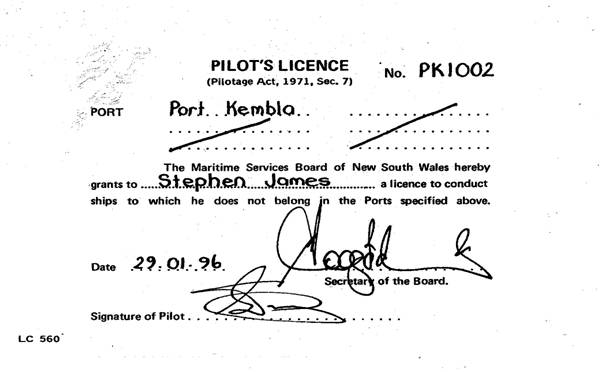
428 Captain Hoogendoorn was not the Secretary of the Maritime Services Board on 29 January 1996, nor had he ever held that position. The Maritime Services Board was dissolved with effect from 1 July 1995. Under s 50A of the MPL Act the Director-General was authorised to delegate his powers, authorities, duties and functions under that Act to a public servant, or to any other person approved by the Minister. The Director-General’s powers had not been delegated to Captain Hoogendoorn as at 29 January 1996. Captain Hoogendoorn gave some confused and confusing evidence as to by what right he purported to issue a pilot’s licence in favour of the Pilot.
429 By a series of letters written after 29 January 1996 the Pilot was informed of increases in the length overall (LOA) of vessels which he could pilot. On 23 November 1997 the Pilot requested the Harbourmaster to increase his pilotage limit to a maximum of 290 metres. That letter was endorsed by Captain Hoogendoorn as ‘Harbourmaster - Port Kembla’ with his approval and by Captain R Choppin – Senior Pilot.
430 Since November 1997 the Pilot has in fact worked full time as an unlimited pilot in Port Kembla (290 metres being the ‘unlimited’ threshold for the port). Between 24 January 1996 and 19 April 2002 he piloted 1531 vessels in and out of the port.
431 No other document purporting to be a pilot’s licence has been issued to the Pilot. In the Corporation’s internal records, for some unexplained reason, the document issued to the Pilot on 19 January 1996 is recorded as an exemption certificate. On 19 January 1996, ten days prior to the issue of the purported licence, the Pilot had applied to be examined for a pilotage exemption certificate.
432 By an instrument dated 2 November 2000 the Acting Director-General of the Department of Transport, having first obtained the approval of the Minister for Transport to do so, and pursuant to s 50A of the MPL Act, in respect of the port of Port Kembla, delegated to the Chief Executive Officer of Port Kembla Port Corporation and the Harbourmaster employed by Port Kembla Port Corporation acting jointly, the Director-General’s functions, rights and roles and authority under Part 2 of the MPL Act and the Marine Pilot Licensing Regulations 1974 (NSW) (‘the MPL Regulations’). The delegation included the power to issue licences under s 7.
433 I infer that from and after 2 November 2000 Captain Hoogendoorn and the Chief Executive Officer of the Corporation knew that Captain James was one of the five pilots employed by the Corporation and who were being held out as authorised to pilot vessels within the port, but they did not take any steps to grant him a pilot’s licence. A minimum requirement of the grant of a pilot’s licence is that it be in the form of a document (MPL Act s 7(2)(a); s 12(1)) granted by the Director-General or his delegate. In case it matters (and I do not think that it does) I should record my finding that Captain James believed that he was a licensed pilot, and that the fact that he was not was due to bureaucratic ineptitude.
434 In the Corporation’s submission the document issued to the Pilot on 29 January 1996 constitutes a pilot’s licence for the purposes of the MPL Act. However, the Corporation’s submissions do not demonstrate how this is so, nor is any authority cited in support of the proposition that the Pilot is to be treated as a licensed pilot, even though the purported appointment as such was made by a person not authorised by s 9 of the MPL Act to make it. No submissions were put by any party that the ‘de facto officers doctrine’ (see A Aronson, B Dyer & M Groves Judicial Review of Administrative Action, LBC, Sydney, 3rd Ed, 2004, 318-320) had any relevant application: cf Chelfco Ninety-Four Pty Ltd v Road Traffic Authority [1985] VR 1 at 23-24. I conclude that the Pilot is not a licensed pilot for the purposes of the MPL Act.
435 The defendant submitted that the Pilot could not comply with the prerequisites for obtaining a license in various respects. This contention was advanced for the first time in final submissions, and in some respects is based on assertions as to the absence of evidence as to particular matters. The only issue in the proceedings is whether or not the Pilot was licensed, hence it is not appropriate that I should determine whether the Pilot could have been licensed. That is particularly so as under s 53 of the MPL Act, the Director-General is empowered to dispense with the requirements imposed by the MPL Regulations where compliance appears to him to be impractical or unnecessary.
Constitutional validity of s 410B(2)
436 As I understand the defendant’s submissions, s 51(xxxi) of the Constitution is relevant in two different ways. First, par 12 of the Further Amended Defence asserts that to the extent to which the plaintiff relies upon s 410B of the Navigation Act to render the defendant vicariously liable for the Pilot’s conduct of the vessel, that section is not a valid law. In the defendant’s submission, that is because the section effects an acquisition of the defendant’s property, namely:
- by subjecting the defendant to the award of an incontestable liability and damages for the actions of a person that the defendant neither employed, nor was vicariously responsible for; and
- by creating an obligation to be answerable in damages for another person’s fault where the defendant was compelled by the law of New South Wales to accept the services of the person at fault;
without the provision of just terms, or any terms, as required by s 51(xxxi) of the Constitution. Second, in par 5A of its Further Amended Reply filed in answer to the Corporation’s defence to the defendant’s cross claim, the defendant pleads that if s 410B operates so as to ‘prevent’ the Corporation from being held liable to the defendant in the present case:
‘then that section effects an acquisition of [the defendant’s] property, namely its common law and statutory rights of action, without the provision of just terms or any terms as required by s 51(xxxi) of the Constitution and is, in the premises, invalid’.
437 For present purposes I am concerned with the first of the ways in which the defendant puts its argument. The second of these ways is dealt with later in these reasons. In its answer to the plaintiff’s claim, the defendant identifies the property which is allegedly acquired as a result of the operation of s 410B as being the defendant’s money to the extent of any damages awarded against it as a result of the operation of s 410B. The defendant relies upon the observations of Mason CJ, Brennan, Deane and Gaudron JJ in Australian Tape Manufacturers Association Ltd v Commonwealth (1993) 176 CLR 480 at 510:
‘… the mere fact that what is imposed is an obligation to make a payment or to hand over property will not suffice to avoid s 51(xxxi)’s guarantee of “just terms” if the direct expropriation of the money or other property itself would have been within the terms of the subsection. Were it otherwise, the guarantee of the section would be reduced to a hollow façade.’
438 Section 51(i) of the Constitution expressly empowers the Commonwealth Parliament to make laws with respect to ‘trade and commerce with other countries, and among the States’. Section 98 of the Constitution goes on to provide that:
‘The power of the Parliament to make laws with respect to trade and commerce extends to navigation and shipping …’
In Australian Coastal Shipping Commission v O’Reilly (1962) 107 CLR 46 at 54 Dixon CJ (with whom Kitto, Taylor and Owen JJ agreed) described the combination of s 51(i) and s 98 of the Constitution as giving the Commonwealth ‘the widest power to deal with the whole subject matter of navigation and shipping in relation to trade and commerce with other countries and among the States’.
439 The requirement of ‘just terms’ imposed by s 51(xxxi) only applies to laws which are properly characterised as laws ‘with respect to the acquisition of property’. It does not operate to invalidate laws which are clearly authorised under some other grant of legislative power. Thus in Australian Tape Manufacturers (supra) at 510 Mason CJ, Brennan, Deane and Gaudron JJ said:
‘In a case where an obligation to make a payment is imposed … as compensation for a wrong done or damages for an injury inflicted, or as a genuine adjustment of the competing rights, claims or obligations of persons in the particular relationship or area of activity, it is unlikely that there will be any question of “acquisition of property” within s 51(xxxi) of the Constitution.’
440 In Re DPP; ex parte Lawler (1994) 179 CLR 270 the High Court unanimously rejected an argument that a federal law providing the forfeit to the Commonwealth of a boat used in illegal fishing operations was in breach of s 51(xxxi), even though the boat owner had not been complicit in the contravention. As Brennan J stated (at 278):
‘A law which imposes a penalty or sanction for breach of a provision prescribing a rule of conduct and which, apart from its imposition of a penalty or sanction, is a law with respect to a head of power other than s 51(xxxi) cannot be classified as a law with respect to the acquisition of property within s 51(xxxi). To place it within the s 51(xxxi) category would be to annihilate the penalty or sanction and thus to weaken, if not destroy, the normative effect of the prescription of the role of conduct.’
441 Section 410B commenced operation on 27 June 1959. The defendant was not incorporated until 10 September 1999. The defendant did not exist when s 410B commenced its operation, hence it is at least a little surprising that the section is said to have effected an acquisition of the defendant’s property some 40 years later. However, the critical point is that s 410B is clearly authorised by s 51(i) and s 98 of the Constitution. It is within the Commonwealth’s power to regulate the liability of a master or owner of a ship under pilotage when the ship is engaged in trade or commerce between Australia and other countries. The fact that the form of regulation selected by the Parliament prospectively alters the common law, and removes a defence which would otherwise have been available to the defendant under the general law, does not lead to the conclusion that s 410B should be classified as a law with respect to the acquisition of property within s 51(xxxi). If it were otherwise, every law passed by the Commonwealth Parliament which incidentally altered, modified or extinguished rights would be at risk of being declared invalid on the basis that ‘just terms’ had not been afforded to an affected individual or class.
442 For these reasons, the claim that s 410B of the Navigation Act infringes s 51(xxxi) of the Constitution because it renders the defendant vicariously liable for the negligence of the Pilot is rejected.
Contributory negligence
443 The contributory negligence issue relates to the positioning of the No 1 ship loader at the time of the incident. The cost of repairing the No 1 ship loader was $5,889,090.20, and the contributory negligence issue is confined to that part of the plaintiff’s claim. The contributory negligence alleged is a failure on the part of the plaintiff to park the No 1 ship loader at or near the centre of the berth, as required by the plaintiff’s operating procedures (a diagram of CB2, with the positioning of the loaders on 15 April 2002 represented by the hatched rectangles, is reproduced below at [462]).
The plaintiff’s operating procedures
444 When the ship loaders were originally commissioned for use in 1982, it was the plaintiff’s practice to park the loaders on the maintenance platforms at either end of CB2 when they were not in use. However, between 1982 and 1984 there were a number of collisions between vessels and the ship loaders when the loaders were parked in that position.
445 By 1985 the procedure had changed. Thereafter the ship loaders were kept off the maintenance platforms at the ends of CB2. The present incident is the first occasion since the 1985 change in procedure where a vessel berthing at, or sailing from, CB2 has damaged either ship loader.
446 The accepted berthing practice at CB2 is to swing the vessel in the inner harbour until the vessel is aligned roughly north-south and parallel to the berth. The vessel is then reversed, stern first, into the Eastern Basin (CB2 being located on the eastern side of the Eastern Basin). When the vessel is about 50 metres off the berth, the vessel is pushed from west to east parallel with and up to the berth. The object is to have the vessel make gentle contact with the berth’s fender system in a parallel position to the berth. The fenders on CB2 have about a 2 metre stand off from the face of the berth.
447 Typically, a vessel flares at the bow and stern so that it overhangs beyond its waterline. If the vessel develops a position whereby it is at an angle to the berth as it is being pushed up to the berth, then the flares at bow or stern can overhang the berth edge, in some cases significantly, and strike any wharf-side appliances, such as ship loaders, that might be adjacent to the bow or stern flares. Usually the stern lands on the berth slightly before the bow, hence it is the No 2 ship loader at the northern end of the berth which is most at risk.
448 CB2 is not long enough to enable equipment such as the ship loaders to be completely removed from the docking area. Of necessity, the rails for the ship loaders had to be close to the edge of the berth to enable the loaders to reach over the ship and to carry out their loading functions. Thus the risk of injury to the loaders if a berthing operation does not go according to plan cannot be completely eliminated. As the loaders cannot be completely withdrawn from the berth face, the next best thing is to position the loaders so that they are clear of where the bow or stern of the ship is likely to be if there is some mishap in the berthing operation.
449 For these reasons, the appropriate practice is to place loaders and cranes (and the ship loaders on CB2 in particular), at a location that will be alongside the parallel (ie, flat) areas of a vessel’s hull, and not adjacent to the zones where the vessel flares at bow and stern. Whether the exercise of reasonable care requires the adoption of some more stringent practice is the subject of controversy.
450 On 14 June 1995, the plaintiff reissued a document entitled ‘Port Kembla Coal Terminal – Operations Department – Coal Handling – Shiploading No 2 Berth – Shiploading – No 2 Berth Operating Instructions’ (‘Operating Instructions’). Section 10.0 of the Operating Instructions is headed ‘Shiploader Shut Down Procedure’. Paragraph 10.8 states:
‘Long travel the ship loader to the parking area in the centre of the berth.’
451 The plaintiff also published a procedure entitled ‘Port Kembla Coal Terminal – Operations – Administration and General – Vessel Berthing Procedure’ (‘Berthing Instructions’). The Berthing Instructions are dated 2 November 1999. Paragraph 6 of this document provides (‘MCR’ is an acronym for ‘Main Control Room’):
‘6.0 Actions
6.1 Availability of Safe Position of Shiploaders
6.1.1 MCR operator assigned shall ensure shiploaders are parked safely.
6.1.2 MCR operator assigned shall check availability of loaders and position accordingly.
6.1.3 MCR operator assigned shall notify pilot if shiploader(s) are not parked in the centre of the wharf.’
452 In an email from the Harbourmaster to the plaintiff’s General Manager, Mr John Brannon, of 8 March 2002, Captain Hoogendoorn wrote:
‘I also take this opportunity to repeat another standard criteria for berthing and that has to do with the positioning of the loaders.
Best (and prudent) practice is to have the loaders positioned at/near the centre of the berth. This dramatically reduces the possibility of any contact between the ship and the loader, both at arrival and departure, although the arrival is the riskier of the two operations.
It is appreciated that at times the loaders need to be parked for maintenance and due to berth design, must be parked at the extremity of the berth. It is critical to operations, that at such times, adequate advice is received by the Vessel Traffic Centre so that the pilot is informed of the situation prior to leaving the office.
Adequate warning of the situation allows the pilot to determine the risk involved after considering at which end of the berth the loader is parked, the size of the vessel and the current and short term weather (wind). It may possibly be that certain wind conditions and with a larger vessel, the risk is unacceptable and the pilotage needs to be deferred.’
453 That email was sent following receipt by Captain Hoogendoorn of an email dated 22 January 2002 which stressed the importance of documented procedures to provide for the safety of all Corporation’s operations, including those of its lessees and including the positioning of ship loaders on structures wherever the Corporation berthed vessels. Mr McGavin went on to draw attention to a recent berthing incident at Wallaroo in South Australia. Although the email does not disclose this fact, in that incident the vessel had struck the berth at an angle of approximately 90 degrees. (I note in passing that it is this incident which was the subject of the proceedings before Debelle J in Amarantos Shipping Co Ltd v South Australia (2004) 87 SASR 528).
Evidence given by employees of the plaintiff and the Corporation
454 Mr Jaffray is employed by the plaintiff as a Main Control Room (‘MCR’) Operator. As an MCR Operator, his responsibilities include parking the No 1 and No 2 ship loaders and to ensure that they are in their ‘correct positions’ while vessels are berthing at and departing from CB2. There was some confusion amongst the plaintiff’s witnesses as to what was the ‘correct position’ at which the loaders should be parked. Mr Jaffray’s evidence was that the positions at which the loaders were parked on 15 April 2002 are the positions at which the loaders are customarily parked during berthing operations for cape size vessels. In Mr Jaffray’s understanding, the ‘correct position’ was anywhere on the berth other than the maintenance areas at either end. Mr Jaffray has parked the loaders according to this practice since 1990, and his understanding was that the ship loaders had been parked according to the practice since the early 1980s. No one ever told him that this was not ‘the centre’ for the purposes of the plaintiff’s procedures. Mr Jaffray had not been told prior to the incident involving the Fortius that Captain Hoogendoorn had said that the best and prudent practice was to have the coal loaders positioned at or near the centre of the berth.
455 Mr Tonini (the plaintiff’s Finance Manager) in his affidavit said that it has always been a procedure of the plaintiff for the loaders to be parked ‘at the centre’ of CB2 prior to and during the berthing of vessels. His oral evidence was that the No 1 loader was located on the date of the incident at about the position in which he observed it to be normally located in the years that he has been at Port Kembla.
456 For Mr Jaffray and Mr Tonini, the ‘centre of the berth’ is otherwise than on the maintenance areas at each end of the berth.
457 Mr Hooper is the Operations Manager of the plaintiff. His evidence was that the loaders were ‘to be positioned approximately near the centre of each half of’ CB2, that is, at the one-quarter and three-quarter points of the berth. This means that loader 1 is usually parked ‘straddling the first tie beam north of the [southern] maintenance area’ and loader 2 is usually parked ‘straddling the first tie beam south of the [northern] maintenance area’ (the tie beams are depicted as heavy vertical lines on the diagram of CB2 reproduced below at [463]). The reason for this positioning was that at least two accidents had occurred when the loaders were parked on the maintenance bays, and the new parking spots were intended to ensure that the loaders were parked away from the ship’s superstructure, thus reducing the chance of a collision occurring. The reason for the spacing between the loaders is to reduce the risk of damage flowing from one loader toppling onto the other.
458 Mr Hooper drafted the current coal terminal policy on loader positioning. Mr Hooper claimed, but then contradicted, that the loaders were positioned ‘approximately near the centre of each half of’ CB2 when the collision occurred. He accepted that the loaders were not parked in accordance with usual practice, but did not know why. Nevertheless, his opinion was that, for the berthing of a cape size vessel, as long as the loaders are off the maintenance bays they are safe.
459 Captain Hoogendoorn stated that, based on his experience and observation, the northern coal loader is more likely of the two to be at risk of collision. He thought that the risk of either loader being hit was very unlikely, with a berthing angle of greater than 20 degrees required. He thought there was nothing wrong with the positioning of the loaders on 15 April 2002. As for the coal loader parking procedure, he thought that ‘at or near the centre of the berth’ meant ‘away from the ends’. He reiterated that the only important factor is that the loaders were away from the ends of the berth. But he agreed that the closer to the centre, the less the risk. In his affidavit, he gave his opinion that, taking into account the nature of the vessel berthing, the loaders as positioned on 15 April 2002 had ‘an ample safety margin’. More generally, his opinion was that ‘the appropriate practice is to place loaders … at a location that will be alongside the parallel (ie flat) areas of the vessel’s hull’.
460 Captain James did not remember where the loaders were usually parked. His opinion was that they should not be at the extremities of the berth due to overhang at the vessel’s bow and stern. When told the hypothetical positioning of the loaders on 15 April 2002 he stated that there was ‘an ample safety margin’ between the bow flare and the southern loader.
Finding as to usual placement of the ship loaders
461 There was some confusion amongst the witnesses as to what the coal terminal’s procedures actually required. However, there was general agreement amongst the witnesses from Port Kembla that the placement of the loaders should be governed by the overall length of the particular ship that is berthing, and when the ship is a cape size vessel there was also general agreement that as long as the loaders were off the maintenance bays they would be well clear of the stern accommodation and bow flare. On the balance of probabilities I find that the usual practice at Port Kembla was to park the loaders off the maintenance areas and at a place adjacent to where the parallel part of a cape size vessel will come into contact with the fenders, rather than at the specific one-quarter and three-quarter points described by Mr Hooper, or at a point being the geometric centre of the berth.
The location of the ship loaders on 15 April 2002
462 A diagram depicting the location of the No 1 and No 2 ship loaders on the berth on 15 April 2002 is reproduced hereunder. The No 1 ship loader was parked between the second and third fender counting from the south of the berth. Had the ship loaders been parked between the fourth and fifth fenders from the south, then they would have been at or near the centre of the berth. At this point, I note that there is an issue between the parties as to whether the loaders were placed as they were as a result of a conscious action in preparation for the berthing of the Fortius or whether they were just left in the same position as they were when the previous ship departed that morning. Evidence given by Mr Jaffray and Mr Hooper favours the latter conclusion, and I so find.
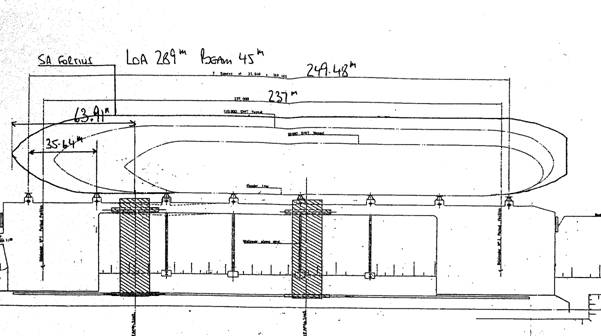
463 The largest of the outlines on the above diagram is the outline of the Fortius in the position she would have been in if she had berthed at CB2 in the ordinary way. The Fortius had an overall length of approximately 289.08 metres and CB2 was approximately 282 metres in length. It is apparent, therefore that if the Fortius was berthed ‘portside to’ alongside CB2 she would more than take up the whole of the length of the berth, with any ‘overhang’ ordinarily being at the northern end of CB2. If the Fortius had berthed at CB2 on 15 April 2002 in the ordinary way there would have been a distance of about 20 metres between the No 1 ship loader and the flare of the bow of the Fortius. In other words, the No 1 ship loader was parked in a position which would have been alongside the parallel or flat sides of the vessel’s hull. The hatched sections of the diagram represent the position of the ship loaders on the day of the collision. The No 1 ship loader is on the southern (left hand) side of the berth.
464 The Fortius only just hit the berth, but it did so at almost right angles, and the flared superstructure at the bow actually impacted on the upper part of the No 1 ship loader. Had the loader been parked perhaps 10 or 20 metres further north towards the centre of the berth, then it would not have been damaged at all. Equally, had the ship loader been parked at the points ordinarily regarded as the most vulnerable, ie on the maintenance areas, it would also not have been damaged. Captain Hoogendoorn’s evidence, which I accept, is that the point at which the Fortius struck CB2 was a function of the manner in which the swinging manoeuvre failed, and could not have been predicted in any way prior to the incident occurring.
465 In any event, the position of the loaders is something which the Pilot ordinarily considers only after the vessel has been swung. If, in the judgment of the Pilot, they are in an inappropriate position, requiring them to be shifted does not create any practical problems, as movement of the coal loaders from one position on the wharf to another is an uncomplicated and inexpensive task which can be completed in 5 – 10 minutes.
Applicable legal principles
466 At common law a plaintiff is guilty of contributory negligence when the plaintiff exposes himself or herself to a risk of injury which might reasonably might have been foreseen and avoided and suffers injury within the class of risk to which the plaintiff was exposed: Joslyn v Berryman (2003) 77 ALJR 1233 at [16]. In New South Wales, reduction of a plaintiff’s damages on account of contributory negligence is provided for by s 9 of the Law Reform (Miscellaneous Provisions) Act 1965 (NSW) which is in the following terms:
‘(1) If a person (the claimant) suffers damage as a result partly of the claimant’s failure to take reasonable care (contributory negligence) and partly of the wrong of any other person:
(a) a claim in respect of the damage is not defeated by reason of the contributory negligence of the claimant, and
(b) the damage is recoverable in respect of the wrong are to be reduced to such extent as the Court thinks just and equitable having regard to the claimant’s share in the responsibility for the damage.’
(emphasis in original)
Section 8 of the Act provides inter alia that:
‘wrong means an act or omission that:
(a) gives rise to a liability in tort in respect of which the defence of contributory negligence is available at common law; or
(b) amounts to a breach of a contractual duty of care that is concurrent and co-extensive with a duty of care in tort.’
(emphasis in original)
467 The decision of the High Court in Astley v Austrust Ltd (1999) 197 CLR 1 is authority for the following propositions (see 197 CLR 11-14 per Gleeson CJ, McHugh, Gummow and Hayne JJ):
- if a plaintiff fails to take care of its property it may be guilty of contributory negligence although it owed no duty to the defendant in respect of the property;
- contributory negligence may be established by conduct which contributed towards the plaintiff’s injury, but not to the accident;
- the plaintiff may be guilty of contributory negligence even though the very purpose of the duty owed by the defendant is to protect the plaintiff’s property; and
- contributory negligence focuses on the conduct of the plaintiff. The duty owed by the defendant, although relevant, is only one of many factors that must be weighed in determining whether the plaintiff has so conducted itself that it failed to take reasonable care for the safety of its property.
468 The applicable standard is one of reasonableness rather than perfection: Purcell v Watson (1979) 26 ALR 235 at 237. In the context of negligence, McHugh J said in Dovuro Pty Ltd v Wilkins (2003) 77 ALJR 1706 at [38] that:
‘…a defendant is not negligent merely because it fails to take an alternative course of action that would have eliminated the risk of damage. The plaintiff must show that the defendant was not acting reasonably in failing to take that course. If inaction is a course reasonably open to the defendant, the plaintiff fails to prove negligence even if there were alternatives available to the defendant that would have eliminated the risk.’
(emphasis in original)
Those observations are equally applicable where the issue is one of contributory negligence.
469 The defendant must further establish that the loss or damage suffered by the plaintiff was causally linked to the contributory negligence of the plaintiff. The plaintiff’s negligence must be shown to be a cause operating to produce the damage: Caswell v Powell Duffryn Associated Collieries Ltd [1940] AC 152 at 165. Exactly what this statement means has, in times past, varied considerably. However, in the modern context, it can be accepted as settled that in determining whether contributory negligence caused the relevant injury, the ordinary common law commonsense principles of causation apply: see R P Balkin & J L R Davis, Law of Torts, Butterworths, 3rd Ed, 2004 at [10.6].
470 Finally, a risk of injury, though reasonably foreseeable, may be so small that the exercise of reasonable care does not require precautions to be taken against it. The issue is how a reasonable person would respond after considering the magnitude of the risk, the probability of it occurring and the expense, delay and inconvenience in taking steps to avoid it: Dovuro (supra) at [36] (McHugh J).
Evidence of expert witnesses
471 Four expert witnesses gave evidence, three called by the defendant (Messrs Bradshaw, MacKnight and Oram), and one (Mr Gibbons) called by the Corporation. Messrs Bradshaw and MacKnight were wharf designers, Mr Oram was a crane expert and Mr Gibbons was a risk management expert. They were not of the one opinion. Thus Mr Oram described the loaders on 15 April 2002 as being placed in ‘a dangerous position’ and ‘clearly vulnerable’, whereas Mr Gibbons described their positioning as ‘sound’.
472 Mr Oram’s expertise was limited, he did not know a number of matters which he needed to know in order to determine the likelihood of the bow protrusion extending over the line of the berth, and he wrongly assumed that the larger vessel shape on Annexure G to Mr Hooper’s affidavit accurately reflected the shape and size of the Fortius, when, in fact, that vessel shape was of a significantly smaller vessel (the larger vessel shape on Annexure G is the second of the three shapes shown in the diagram reproduced at [462] above). These factors affect the weight to be attached to Mr Oram’s evidence, and I do not accept his view that on the day of the incident the ship loaders were placed in a dangerous position. It may be that there was a safer position in which the loaders could have been parked, but that is a different question.
473 Captain Hoogendoorn’s evidence was that for there to be a real risk of collision with loader No 1, the Fortius would have to be out of position, in a fore and aft direction, by more than 20 metres, and strike the wharf at a very steep angle, at least 20 degrees. My impression is that the angle of 20 degrees given by Captain Hoogendoorn was a matter of impression, rather than the result of a precise calculation. The estimates given by Mr MacKnight and Mr Bradshaw were that a problem could arise if the fenders were struck at a much lesser angle.
474 Notwithstanding these differences of opinion, the preponderance of expert opinion favoured the view that the further the loaders were placed from a position at about the centre of the berth, the greater the risk that the loaders might be harmed if something went wrong in a berthing operation. Mr Gibbons and Captain Hoogendoorn came to accept that this was so. Thus the issue becomes whether the increase in the risk as one moves away from the centre of the wharf is such as would be assumed by a reasonable person in the position of the plaintiff. That is really a matter for judicial decision, rather than expert opinion.
475 Best practice requires that the loaders be positioned at the place of least risk during berthing and departure operations. The centre of the berth is not always the place of maximum safety. The dominant view amongst the experts, which I accept, is that the geography of the loader relative to the berth is not the important matter; rather what is important is the position of the loader relative to the ship. To the extent that Captain Hoogendoorn’s email earlier referred to suggests otherwise, it is not consistent with the preponderance of expert opinion. But I also accept that in the case of a cape size vessel berthing at CB2, the best practice would be for the loaders to be located at or near the centre of the berth, but at a distance of about 35 metres from each other, so that if one loader is damaged, its collapse will not result in damage to the other.
476 On 15 April 2002 the loaders were in a position such that they were likely to be clear of where the bow or stern of the ship were likely to be if some angularity developed as the ship was pushed in parallel to the berth. But they were not in the position which provided the maximum protection against that risk, since, when a cape size vessel is being berthed, the location of maximum protection is at or about the centre of CB2. The expert evidence establishes that there is an increased risk of damage to coal loader No 1 as it was placed on 15 April 2002, than there would have been had it been parked in the centre of the berth. The plaintiff either knew or ought to have known that this was so. While the applicable standard is one of reasonableness, rather than perfection, in view of the minimal additional extra cost and effort involved in parking the coal loaders in a central position, a reasonable person in the position of the plaintiff would have taken steps to make sure that the loaders were placed in a position at or near the centre of the berth.
477 Mr Gibbons’ evidence that the location of the vessels as shown in the diagram above was sound was a matter of impression, rather than of calculation. The evidence of Mr Bradshaw, on the other hand, was grounded in calculations which show that there was a real chance of impact with the No 1 loader if the Fortius was misaligned by a tolerance margin of 15 metres with a berthing angle of 6 degrees. Whether that chance would come to pass may depend upon a range of variables, but the effect of Mr Bradshaw’s evidence (which was not undermined by cross-examination) is that there is a non negligible risk of harm to the No 1 loader if it is parked in the position shown above if a berthing operation miscarried within those parameters, it being foreseeable that such a miscarriage might occur, even though deviations from the norm to that extent might not be expected.
Causation
478 However, the strategy of locating the loaders at the centre of the berth when a vessel such as the Fortius is berthing is intended to guard against the risk of angularity arising as the vessel, when parallel to the berth, is pushed into the berth by the tugs. Consideration of the potential adverse angles of approach of the range of vessels likely to use the berth is an important parameter in the design of a berth. Mr MacKnight agreed that a berth and the facilities on the berth are never designed to take account of a vessel hitting the berth at an angle close to 90 degrees, because that would be so outside the parameters of what would be normal that it would be fanciful to seek to design a berth for that eventuality. The fender system, for example, is not designed to cater for that eventuality. Mr Oram was of a similar view. Commonly, in Mr MacKnight’s experience, the angle of approach for a vessel in a harbour such as Port Kembla would rarely exceed 5–6 degrees.
479 The circumstances in which the Fortius collided with CB2 on 15 April 2002 were outside the class of risk against which a sound strategy for loader placement is designed to afford protection. The Fortius never completed its swing, nor did it get into a position parallel to the berth from which the tugs could push it in to the berth. In the circumstances as they existed prior to the collision, the coal loaders were at risk wherever they were placed on the berth. It was a matter of mere chance as to where a vessel manoeuvring so far outside the norm would hit the wharf. There is no evidentiary foundation for a conclusion that it was less likely that the Fortius would strike the centre of the berth rather than some other point on the berth. Had the loaders been placed on the maintenance bays (the least safe part of the berth in the context of a berthing operation), they would not have been damaged.
480 The requisite causal link between the damage to the coal loaders and the plaintiff’s negligence is therefore lacking. It is the issue of causation which distinguishes this case from the Southampton Container Terminals Ltd v Hansa Schiffartsgesellschaft mbH [1999] 2 Lloyd’s Rep 491 (‘The Maersk Colombo’). Causation questions involve value judgments. Whilst it is true to say that the No 1 loader would not have been damaged had it been placed at the centre of the berth, in the circumstances of this case that is entirely fortuitous.
481 The commonsense test of causation is a two stage process. In F Trindade & P Cane, The Law of Torts in Australia, OUP, 3rd Ed, 1999, the authors state (at 565) that the negligence must be a factual cause of the loss and must also be a legal or attributative cause of the damage. Foreseeability is relevant to legal causation but is not decisive of it. The authors give the following example (at 565):
‘In Jones v Livox Quarries [[1952] 2 QB 608] Denning LJ said [at 616] that the negligence of the plaintiff in riding on the tow-bar of a vehicle would be a cause of injury to P whether P was thrown off the tow-bar or crushed when another vehicle collided with it. But there would be no (attributive) causal link between P’s injuries and P’s negligence if P was shot by a negligent sportsman, and the bullet would not have hit P if P had been in the cab rather than on the tow-bar.’
482 In Jones v Livox Quarries [1952] 2 QB 608, Singleton LJ said (at 614):
‘If [the plaintiff] unreasonably, or improperly, exposed himself to this particular risk, I do not think that he ought to be allowed to say that it was not a cause operating to produce the damage, even though one may think that the prohibition against riding on the vehicle was not made with that particular risk in mind.’
(emphasis added)
But here parking the loaders otherwise than in the centre of the berth only exposed the loaders to an increased risk of damage in the context of a vessel being pushed by the tugs up to the face of the berth. The collision with the berth on this occasion occurred at an anterior stage in the berthing process. The link between the exacerbated risk and the damage was therefore not sufficiently close to render one causative of the other.
483 The defendant has failed to establish its defence of contributory negligence.
Damages
Principles
484 The object of the award of damages in an action in tort is, so far as money can, to put the plaintiff back in the position it would have been had the loss not been inflicted: Owners of the Dredger “Liesbosh” v Owners of the Steamship “Edison” [1933] AC 449 at 459; Johnson v Perez (1988) 166 CLR 351 at 355 (Mason CJ). More generally, the Court will award ‘that amount in damages which will most fairly compensate him for the wrong he has suffered’: Johnson v Perez at 356 (Mason CJ).
485 If a defendant negligently damages or destroys the plaintiff’s property and there is no evidence that the plaintiff had any reasonable choice other than to replace or repair what had been damaged or destroyed, the cost of replacement or repair, provided it is not extravagant, will be recoverable as damages. In each case it is a question of fact: Hyder Consulting (Australia) Pty Ltd v Wilth Wilhelmsen Agency Pty Ltd [2001] NSWCA 313 (Hyder Consulting) at [54] (Sheller JA). If the rectification work has been carried out and the actual cost is known, that provides sound evidence of the reasonable cost, and will ordinarily provide the basis for damages in preference to a theoretical calculation of the reasonable cost: Hyder Consulting (supra) at [99] (Giles JA).
486 Subject to questions of extravagance, there is no rule that requires a plaintiff to account for any advantage or betterment which the plaintiff has obtained by repairing an old article with new materials or by acquiring a new article for old in the case of a replacement after total loss, although any savings or profits which the plaintiff makes by use of the new article must be brought to account. In particular, no allowance for betterment is made merely because the property which is repaired or replaced might last longer than the property which was damaged or destroyed by the defendant’s negligence: Optus Networks Pty Ltd v Leighton Contractors Pty Ltd [2002] NSWSC 450 at [1387]-[1388].
487 The rationale for this approach was explained by Dr Lushington in The Gazelle (1884) 2 Wm Robb 279; 166 ER 759 (at Wm Robb 281; ER 760):
‘If [the injured] party derives incidentally a greater benefit than mere indemnification, it arises only from the impossibility of otherwise effecting such indemnification without exposing him to some loss or burden, which the law will not place upon him.’
488 Thus a wrongdoer cannot diminish a plaintiff’s claim simply on the ground that the plaintiff has obtained new for old: Harbutt’s Plasticine Ltd v Wayne Tank and Pump Co Ltd [1970] 1 QB 447. For a betterment claim to succeed, the plaintiff must have acquired something more than restitutio ad integrum, as for example where the damaged property was replaced with added extras, or had more money spent on it than would have been spent had it been rebuilt according to the old plan.
Specific items in dispute
489 The following table is a summary of the amounts initially in dispute and the current sum in dispute following the conclave between the experts:
| Item |
| Initial Sum in Dispute
| Current Sum in Dispute |
| 1. | Barclay Mowlem Superintendence Rate | $847,000 | $847,000 |
| 2. | Betterment
| | |
| 2.1 | Rail Replacement & Fixings | $ 88,000 | $ 73,461 |
| 2.2 | Concrete Grade | $ 20,000 | $ 10,000 |
| 2.3 | Shiploader Loads | $ 36,000 | $ 10,000 |
| 2.4 | Upgrade No 1 Berth | $ 80,000 | $ 47,600 |
| 2.5 | Change to Fender specification | $ 46,000 | $ 46,000 |
| 2.6 | Shiploader Repair & Overhaul | $ 20,000 | $ 0.0 |
| 2.7 | Supervision & Co-ordination | $ 73,000 | - |
| 3. | Barclay Variations | | |
| 3.1 | Delay Due to Shipping | $ 46,000 | $ 39,430 |
| 3.2 | Post Contract Site Agreement | $ 76,000 | $ 107,240,21 |
| 4. | PKCT Direct Costs – No 1 Berth Coal Loading | $110,000 | $110,000 |
Barclay Mowlem Superintendence Fees - $847,000
490 Maunsell Australia Pty Ltd (‘Maunsell’) was engaged by the plaintiff to manage the tasks of restoring the plaintiff’s coal loading terminal to operation and rebuilding the damage to CB2 and the No 1 loader as a consequence of the collision. The work was divided into three stages:
- Stage 1 - stabilisation of damaged facilities and restoration of limited operations;
- Stage 2 - No 1 ship loader relocation; and
- Stage 3 - No 1 ship loader restoration/No 2 berth reconstruction.
491 Barclay Mowlem Construction Limited (‘Barclay Mowlem’) was one of 13 subconsultant specialists engaged by Maunsell to assist with the project. Barclay Mowlem, as the main subconsultant, undertook the reconstruction of the damaged No 2 berth and restoration works on the No 2 loader. Barclay Mowlem was appointed as a contractor and required to commence work at the end of April 2002. The urgency which was involved in restoring the terminal to operation prevented finalisation of the contract documentation prior to the mobilisation of the contractor.
492 The current dispute relates to Stage 3(W) of the works – berth reconstruction. Stage 3(W) of the works officially began on 15 June 2002 when the damaged loader was shifted onto the southern maintenance platform. Unlike the costs for the other stages of the project, the work that was carried out by Barclay Mowlem on the restoration and repair of the berth during Stage 3(W) was done on a Bill of Quantities (‘BOQ’) basis. That is not a matter of which the defendant complains.
493 Barclay Mowlem submitted its priced BOQ on 20 June 2002 which included a claim for superintendence fees in an amount of $1,757,121. At about the same time a firm of quantity surveyors, Currie & Brown Pty Ltd, was commissioned by Maunsell to ensure that all rates and prices eventually agreed upon for the BOQ both individually and as a whole were appropriate. The estimate for superintendence fees produced by Currie & Brown was $761,040.
494 In view of this difference, Maunsell obtained a further estimate of superintendence fees from Alan Rae Consulting Pty Ltd. This further estimate came to $1,071,294.
495 In late June 2002 further details were requested from Barclay Mowlem as to exactly how the rate was calculated. Those details were provided by Mr Short of Barclay Mowlem on 5 July 2002.
496 Maunsell carried out its own assessment of the reasonableness of the superintendence fee claimed, and concluded from that analysis that the rate claimed by Barclay Mowlem was too high by about $500,000. Mr Burnett, the Project Manager appointed by Maunsell, had earlier received an opinion from Mr Woodruff (another employee of Maunsell) that the figure was too high by about $700,000.
497 Mr Burnett and Mr Woodruff had a couple of meetings with Mr Short in July 2002 to discuss the superintendence rate in an attempt to reduce the proposed amount by about $500,000. Mr Short was reluctant to reduce the superintendence rate, as he had already reduced other rates for various construction items in the BOQ and told Mr Burnett as much. In particular, Mr Burnett’s evidence was that Mr Short told him:
‘I won’t budge on this superintendence rate’.’
498 Mr Burnett’s evidence was that by the end of July 2002, he thought that Maunsell:
‘…would be fighting a losing battle to try and negotiate the superintendence rate down as it was clear that Mr Short was not going to change his position in this regard.’
I accept that this was Mr Burnett’s assessment of the position at that time.
499 On 2 August 2002 the priced BOQ rates for Stage 3(W) were agreed in an amount of $7,512,104 which included $1,757,121.24 for Barclay Mowlem’s superintendence fee. This fee corresponds to Item 1.1.5.1 of the final agreed BOQ.
500 The reasons provided by Mr Burnett for accepting the sum proposed by Barclay Mowlem once Mr Short made it plain that Barclay Mowlem would not change its declared position on the issue of superintendence fees were, in essence, that:
(a) selecting an alternate contractor in July would in the circumstances have led to excessive costs, possible mobilisation difficulties and the possibility that an alternate contractor would not provide as competitive rates; and
(b) Maunsell had successfully negotiated Barclay Mowlem down substantially on many items, and had secured a concession that Barclay Mowlem would be liable for latent conditions (that is, unexpected or unforseen costs) by Special Condition 12.1 of the contract.
501 No evidence was called by the defendant by way of contradiction of the matters referred to in (a). The defendant’s expert, Mr Cashen, did not contradict the opinions which Mr Burnett expressed in this respect. He gave no evidence on this point at all, except that in the course of cross-examination he agreed that the matters that Mr Burnett had identified in his affidavits as matters to which he had regard in his consideration of the Barclay Mowlem claim were matters which a reasonable project manager would take into account in determining what recommendation he should make to his principal about acceptance of a disputed item such as superintendence.
502 Mr Cashen expressed the view that the superintendence costs claimed by Barclay Mowlem were not reasonable. In his assessment a reasonable sum was $953,000 for 21 weeks of superintendence. When allowance is made for eight days extension of time due to shipping delays, the figure becomes $1,005,000. Mr Cashen’s assessment did not take into account the particular circumstances in which the agreement with Barclay Mowlem was reached, or the relative bargaining positions of the parties.
503 Mr Cashen’s evidence suggests that the figure of $1,757,121 was overstated to the extent of $804,121. The manner in which the sum of $847,000 said to be in dispute was calculated does not emerge from the parties’ submissions.
504 The defendant accepts that at the time the superintendence fee was agreed to, Barclay Mowlem was in a good bargaining position, but that ‘it tends to beggar the imagination that they wouldn’t come to a commercial deal that would have been more reasonable and much more in line with market rates. They may have had a good bargaining position but there are limits.’ Implicit in the defendant’s submissions is the suggestion that the plaintiff was less frugal than would otherwise have been the case, because the circumstances of the collision were such that ultimately the repair cost was likely to be for the defendant’s account.
505 Barclay Mowlem was placed in a strong bargaining position as a direct consequence of its appointment almost immediately after the collision to commence the stabilisation and relocation works, and prior to the finalisation of the pricing and contract documents for Stage 3(W). The defendant did not contend that the fact that Barclay Mowlem was in this strong bargaining position was referable to any fault on the part of the plaintiff, or on the part of any others for whose defaults the plaintiff is responsible.
506 The only cross-examination designed to establish that Maunsell agreed to a recommended payment which it knew to be excessive because it was perceived that these costs would ultimately be for the defendant’s account was directed at Mr Burnett as follows:
‘You had in the back of your mind from the commencement of your work in this project that the shipowners or their insurers would foot the bill for whatever damage flowed from the collision?--- That was my understanding, yes.
You can’t say with that being in the back of your mind that did not influence the agreement that you agreed to with respect to superintendency, can you? --- I can say that.’
507 I accept Mr Burnett’s sworn evidence to this effect.
508 Maunsell knew that the fee being demanded by Barclay Mowlem was inflated by a figure of at least $500,000 and possibly more. The issue which the submissions of the parties poses for decision is whether a reasonable person in the plaintiff’s position would nonetheless have agreed to pay the sum claimed. The defendant’s submission that Maunsell did nothing at all to seek to negotiate a fair or reasonable sum should be rejected, because it pays no regard to undisputed facts. Even the more diluted submission that there was a failure to take part in any ‘meaningful negotiations’ should be rejected. The fact is that there were negotiations, but they were not successful. There is no evidentiary foundation for a conclusion that the negotiations were not ‘meaningful’, or that they were conducted at an inappropriate level, or that they were in any way lacking in good faith.
509 Mr Burnett’s assessment, which I accept to be a reasonable one, was that his attempts to negotiate a better deal had proved to be unsuccessful, and that Mr Short was not prepared to budge. One of the factors which Mr Burnett properly took into account in reaching his conclusions in this respect was that Maunsell had successfully negotiated Barclay Mowlem down on other items, which could provide a reason for Mr Short’s refusal to make any concession on this item.
510 Mr Burnett recognised that he was being confronted with an excessive demand which he had unsuccessfully attempted to negotiate down. He gave consideration to what he perceived to be the only other potentially available alternative, namely invocation of cl 40.6 of the contract. The effect of this clause was that if agreement was unable to be reached on (inter alia) the BOQ rates by specified times, the plaintiff had the right to delete all work under Stages 3(W) and 3(S) from the contract. The plaintiff was then free to engage other contractors to perform such work (cl 40.6(d)). However, if the plaintiff exercised that right, it would nonetheless remain liable to pay Barclay Mowlem for any preparatory work that may have been authorised by Maunsell prior to the commencement of Stages 3(W) and 3(S) (cl 40.6(e)).
511 Mr Burnett came to the conclusion that if the plaintiff exercised that right, additional costs would be likely to be incurred which would be far greater than the $500,000 reduction which Maunsell had unsuccessfully attempted to negotiate in respect of the superintendence fee. He also concluded that there were other potential problems confronting the plaintiff if it were to pursue this course, including delays, uncertainty over the availability of suitable equipment, the absence of any certainty that an alternative contractor could be secured at similar or lower rates to those claimed by Barclay Mowlem, and the disruption to the project caused by a change in contractors when by this stage the project was running smoothly.
512 In the end Mr Burnett’s view was that the preferable course was to agree to the claim, given the likely costs and consequences of the only available alternative. The defendant did not contradict Mr Burnett’s evidence in this respect, or even attempt to cut it down by cross-examination. Mr Burnett’s evidence in this respect is thus unchallenged, and derives some support from the evidence of Mr Cashen. The defendant does not point to any other alternatives which the plaintiff could and should have pursued, apart from the assertion that ‘in dealing with a contractor [the plaintiff] could not be said to be without leverage’. However, the defendant did not identify the available lever either by evidence or in submission.
513 I accept Mr Burnett’s evidence. I find that reasonable efforts were made to contain the superintendence fees which were perceived by Maunsell to be excessive, and that the decision to agree to the amount claimed by Barclay Mowlem was, in the circumstances, a reasonable one.
Items of alleged betterment
514 Evidence on the issue of damages was included in a statement of Gary Eric Bullock that was filed by the defendant. Mr Bullock fell ill shortly prior to the hearing and was on sick leave during the hearing. Portions of his statement were received into evidence by consent when they were adopted by Mr Curran, a civil engineer, who was retained by the defendant at the last minute to undertake so far as he was able the examination of the issues of ‘betterment’ which had been undertaken by Mr Bullock.
Rail replacement and fixings - $73,461
515 Mr Bullock had two issues with the replacement rail and rail fixing systems which Maunsell had allowed for. The first related to the length of rail replaced. The second related to the rail fixing system. As to the second, Mr Curran did not agree with Mr Bullock’s opinion that an upgraded rail fixing system was not needed. In Mr Curran’s opinion the decision by Maunsell to replace the rail fixing system using an upgraded proprietary fixing system was appropriate. The second issue identified by Mr Bullock thus falls away.
516 As to the first issue, rails totalling 140 metres in length were damaged as a result of the collision and required replacement. As well as these damaged lengths of rail, portions of the adjacent rail were also replaced in the course of, and as part of, the replacement of the damaged rail. This adjacent rail was not itself directly damaged in the collision. The adjacent rail consisted of an additional 40 metres length of front rail on the maintenance bay (the other rail had to be removed to relocate the ship loader on the maintenance bay). In addition, rails over about 33 metres between the directly damaged section and the expansion joint (at about the centre of the berth) were also replaced. In all, the defendant maintains that 106 metres of rail need not necessarily or reasonably have been replaced.
517 The replacement of those sections of the rail was recommended by Ian Watson (of Maunsell) who had significant experience involving rail systems and ship loader loads, and Mr Watson’s recommendation was endorsed by Mr Fountain (also of Maunsell), an engineer, whose experience was such that he was familiar with issues concerning rails and rail systems and their repair and the need for repair by reason of their condition. Both Mr Watson and Mr Fountain physically inspected the rails before making their recommendations for their replacement.
518 Mr Fountain gave a detailed explanation as to why he formed the opinion that the safest, quickest and most cost effective method available to restore the facility involved the replacement of the undamaged rails. Shortly stated, his reasons were:
- reuse of each of the undamaged rail sections required the rails to be lifted over a length of 20-24 metres to achieve the thermit weld between the new and the old rail sections;
- because of corrosion, it was necessary to destroy the rail clips and bolts that were securing the rail in order to remove or lift the rail. This would have been a time-consuming and costly task;
- notching was discovered in the rail at the point where the original clips were installed which introduced a weakness in the rail links at that point once the clips were removed. The notching rendered much of the rail unsuitable for reuse;
- the likely difficulty in achieving a smooth transition between the partly worn rail and the new rail; and
- the loads imposed by the ship loaders onto the rails were such that there was a risk of the loads causing a failure of the reused rail, with potentially serious consequences.
519 In par 4.11 of his affidavit Mr Fountain states:
‘The problems that this notching caused were that:
(a) if the existing rail was re-used, the existing clips and the clip assembly locations were not able to be re-used (for the reasons I have already given); and
(b) it would have been necessary to place the clips at different locations between the locations of the existing clip assemblies, thereby leaving the notched sections of the rail exposed in between the clip assemblies and between the principal points of support. This notching introduced a weakness in the rail at that point. If the rail was re-used, there would therefore be these points of weakness along the rail at locations other than the principal points of support (Although these points of weakness existed prior to the collision, they were at the points of support of the rail and did not of themselves require the rail to be replaced in any event at that time).’
Mr Curran’s evidence was that on the face of it, this statement by Mr Fountain would appear to be a good reason for replacement of the rails. However, in Mr Curran’s opinion, an investigation consisting of mathematical modelling should have been carried out over a period of approximately one week at a cost of approximately $15,000, or alternatively a two day investigation could have been performed on that portion of the rail which had already been removed in order to determine the extent of the replacement required.
520 The defendant originally submitted that the plaintiff failed to take steps in order to mitigate its loss by not having undertaken mathematical modelling in order to ascertain the extent of repair/replacement required. As failure to mitigate had not been pleaded, that submission was recast so as to assert that principles as to betterment or extravagance precluded recovery of the cost of replacing the undamaged rail section.
521 There is no foundation in the evidence for a conclusion that had the modelling or investigation for which Mr Curran contends been undertaken, the results would have revealed that the undamaged rail was suitable for reuse contrary to the view formed by Mr Fountain and Mr Watson.
522 I accept Mr Fountain’s evidence. Mr Curran agreed that on the face of it Mr Fountain’s assessment of the problems that the notching caused appeared to be a good reason for replacement of the rail. Mr Fountain and Mr Watson were sufficiently experienced to form their own assessment as to what was required. The defendant has not established that it was unreasonable for them to give effect to their own opinions on this question or that there was anything unreasonable about making a decision on the issue on the basis of a visual inspection of the rails.
523 The cost of the rail replacement and fixings should be allowed to the plaintiff in full.
Concrete grade - $10,000
524 A 6 per cent portion (in lineal terms) of the concrete of the berth was replaced following the collision.
525 The specification for the original concrete berth superstructure was for a concrete strength of 25 MPa, however, the original structure was built to an increased concrete strength of 35 MPa. The current Australian Standard (AS 3600-2001 - Concrete Structures) (‘Concrete Code’) provides for a minimum concrete strength of 50 MPa. The repairs to the berth were effected using concrete that conformed to the Concrete Code.
526 The Concrete Code is a guide. Compliance is not compulsory in circumstances where an engineer is satisfied on reasonable grounds that a lesser standard will suffice.
527 The plaintiff has not provided any submissions to justify why 6 per cent of the berth should have been rebuilt to a different standard than the rest of the structure, except to state that the standards have changed and that the repairs were effected in accordance with the current standards. In the defendant’s submission, it was an unnecessary and more costly improvement.
528 I accept Mr Curran’s evidence that it was not necessary to replace 6 per cent of the berth with materials which were of a much higher standard and cost than the balance of the berth into which it was integrated. But the issue is whether it was unreasonable for the repairs to the berth to be effected in accordance with the current standard. The issue is one of extravagance rather than of betterment. Mr Fountain appears to have proceeded upon the basis that it was necessary for Maunsell to specify a minimum concrete strength in accordance with a standard which was current in 2002. I accept Mr Curran’s evidence that it was not necessary to use the higher strength concrete specified in the current standard and the plaintiff does not provide any explanation as to why it was appropriate to do so.
529 Mr Curran gave the following evidence:
‘And you surely couldn’t say it was unreasonable for an engineer such as Mr Fountain to take the view in 2002 that it was reasonable to specify concrete in accordance with the current standard? --- No, I don’t, but it was more than required in this situation.
But you don’t say it was unreasonable do you? --- No.’
Mr Curran’s evidence was that it was entirely reasonable to depart from the standard. Whether it was unreasonable for an unnecessary cost to be incurred is a matter for my decision, rather than for expert evidence. In this regard, I accept as uncontradicted the defendant’s submission that the use of a higher concrete grade was unnecessary, and I therefore find that the use of the higher grade concrete was an unreasonable extravagance.
530 The defendant’s objection to the allowance of this item should be upheld.
Ship loader loads - $10,000
531 The defendant made no submissions with respect to this item. Accordingly, I allow the plaintiff’s claim.
Upgrade No 1 berth - $47,600
532 The plaintiff’s original damages claim was $16,142,948.47. Included in that claim was an amount of $80,000, which incorporated $32,400 for renewal of fenders at CB1. The plaintiff did not press for the recovery of the $32,400. As a result the total claim was reduced to $16,110,548.47. Consequentially the amount remaining in issue in relation to this item is now $47,600.
533 For a time following the collision, CB2 was not able to be used. The plaintiff spent $539,501.39 on upgrading CB1 to enable it to be used whilst CB2 was out of operation. It was necessary to modify the ship loader on CB1 so that it could handle coal. Following the resumption of the use of CB2, the ship loader on CB1 was returned to the state that it had been in prior to the collision. The plaintiff gained no ongoing benefits from the upgrading of CB1, except to the extent involved in the concession earlier referred to.
534 The basis on which the defendant objects to the remaining $47,600 is that only five vessels were unloaded at CB1 during the time that CB2 was undergoing restoration. In the defendant’s submission, the plaintiff obtained a substantial benefit by the structural renovation that was not necessary.
535 This item received scant attention in the defendant’s submissions. The costs that go to make up the $47,600 have not been identified. The plaintiff’s decision to bring CB1 on line so that coal loading could continue whilst CB2 was out of operation was a reasonable one to take in mitigation of the consequences to its business caused by the collision and the loss of the use of CB2. The fact that only five ships were handled at CB1 while CB2 was out of operation is of no significance because the evidence discloses that these five ships were handled from 19 April (following the departure of the Fortius from the berth) until 17 May 2002, being the day after CB2 resumed limited operation. CB1 was fully occupied by these five ships throughout the whole of that period, hence CB1 was fully utilised at that time.
536 In the circumstances, the plaintiff’s expenditure in upgrading CB1 was both necessary for the continued operation of the plaintiff’s business and reasonable even though, in the end, only five vessels may have been handled. The defendant has not shown any reason for disallowing the residue of this claim.
Change to the fender specification - $46,000
537 One of the fenders on CB2 required replacement as it had been damaged in the collision. It was replaced at a cost of $166,820. The original quote was $124,570 and the difference between the two figures, excluding GST, was $48,575.50, but the parties have agreed that the sum in dispute is $46,000. At the time the replacement fender was purchased, Maunsell treated the difference between the two sums as a variation.
538 The defendant contends that the explanation for the increase in costs was that Maunsell specified a significant upgrade in the condition of the fender from that which had been originally supplied to the berth. The defendant bases that submission upon the construction which it places on documents contained in Annexure C to Mr Fountain’s affidavit of 2 April 2004. One of the documents in Annexure C is a Maunsell memorandum setting out the variation in costs between the original quote from the fender supplier and the final cost of the fender as delivered. On this document, there is a handwritten annotation ‘did not comply with our specification’ next to the original quoted price.
539 The defendant’s submissions proceed upon the basis that:
- the original quoted price of $124,570 was for a fender that was in all respects comparable to the fender that had been damaged when the Fortius struck the berth;
- the revised cost of $166,820 (brought about in order for the fender supplied to comply with the Maunsell specification for the replacement fender) was for a specification over and above that of the original fender; and
- the difference between the two, taken to be $46,000, represents the additional costs incurred as a result of the Maunsell specification being different and superior to the original specification.
540 Mr Fountain’s evidence was that the fender that was supplied and installed as part of the repair work was very similar to the fender that had been damaged in the collision save in two respects. The first difference was that the U-bolt chain anchors used on the replacement fender were made of stainless steel instead of galvanised mild steel and this produced a cost increase of $1,414. The second difference was the paint system used on the replacement fender. The reason for that difference was that it was highly unlikely that the original paint system would have been available to be used on the replacement fender due to developments in paint technology over the last 20 years.
541 Mr Fountain’s evidence in this respect was not contradicted by the defendant, and nothing emerged in cross-examination to make the reasons that he gave inconsistent or implausible. I accept Mr Fountain’s evidence in relation to this item.
542 The defendant’s submissions therefore fail at the outset, as the fender that had originally been ordered, and which was the subject of the original pricing, did not comply with Maunsell’s specification.
543 In any event, whether the specification for replacement fender changed, and whether the fender as delivered represented a significant improvement upon the fender as ordered, are matters that are immaterial. What is important for present purposes is that the increased price was imposed in relation to the delivery of a fender which, except in the two respects referred to above, matched the fender which was originally installed on the berth. The increased cost of the U-bolts is immaterial and the change in the paint system reasonable. As the increase in costs was not for the supply of a different or more superior fender as the defendant contends, the plaintiff’s claim in relation to this item should be allowed in full.
Ship loader repair and overhaul
544 It has been agreed between the parties that $20,000 is a fair and reasonable assessment of service and maintenance audit costs with respect to this item. No issue remains between the parties. In the circumstances no allowance should be made against the plaintiff’s claim in respect of this item.
Supervision and co-ordination - $73,000
545 The parties have agreed that in principle any allowance for this item is to be calculated at 30 per cent of the total amount (if any) that the Court may allow in respect of betterment.
546 As I have come to the conclusion that an allowance of $10,000 should be made in this respect, it follows that a further allowance of $3,000 should be made in relation to this item.
Barclay variations
Delay due to shipping - $39,430
547 By a variation to the original contract Barclay Mowlem claimed additional costs for delays to their work brought about by shipping movements on the berth. That variation was allowed by Maunsell. An element in the variation was the profit included in the delay claim in the sum of $22,334.22.
548 Mr Putt of Maunsell valued that claim pursuant to cl 35.5 and cl 41 of the contract which allows variations to the contract to be assessed as day work. An assessment on that basis incorporates a component for overhead and profit, hence Mr Putt was of the view that Barclay Mowlem was entitled to the full amount claimed.
549 Whether that is the right view or the wrong view depends upon the proper construction of the contract. If it is the wrong view, then the fact that Mr Putt may have made an honest mistake in allowing the claim is beside the point.
550 Clause 35.5 of the contract provides for the grant of extensions of time where the work is delayed. Clause 36 of the contract provides that where a contractor has been granted an extension of time under cl 35.5 for delay then the principal shall pay to the contractor such extra costs as are necessarily incurred by the contractor by reason of the delay. Clause 40 of the contract provides for variations to the work which, pursuant to cl 40.3, are to be valued under cl 40.5. Clause 40.5(f) provides that if the valuation relates to extra costs incurred by the contractor for delay or disruption, the valuation shall include a reasonable amount of overheads but shall not include profit or loss of profit. Clause 41 provides that certain variations to the contract falling within cl 40.1 shall be carried out as day work.
551 In my view, Mr Putt erred in applying the day work provisions of the contract to a delay claim. The consequence of an extension of time being granted under cl 35.5 is that cl 36 applies, and the allowance for which cl 36 makes provision is in relation to ‘extra costs’ as distinct from a profit. Variations to the work were not directed pursuant to cl 40.1, which is a clause that encompasses changes in the scope of the work. I conclude that the day work provisions in cl 40.1 were not attracted in relation to the claim for loss of profit. But it does not follow, for the reasons which I later explain, that this element of the claim should be disallowed.
552 A second element in the variation was a payment for a Franna crane and crew in the sum of $17,161.06. The provision of a Franna crane as a component of the site establishment costs is evident in ‘s 6 – Contract Schedule 2’, BOQ and Item 1.2.4. In the defendant’s submission, it should therefore not have been allowed as a variation to the contract.
553 Mr Putt’s evidence was that initially he refused to approve the variation claim for this item. Ultimately, the item for the Franna crane was approved ‘because we traded the claim off for other variation claims rejected’. In Mr Putt’s experience, this was a common practice in negotiating and approving or rejecting claims for variations. In his view, some of the rejected claims had some merit. I accept Mr Putt’s evidence on this issue, and find that it was reasonable for the contract to be administered in this way.
554 As Mr Putt originally recognised, this claim was not within the provisions of the contract which provided for the payment of extra compensation in relation to variations. However, the issue which I have to determine is whether the plaintiff can recover the amount paid to Barclay Mowlem upon Maunsell’s recommendation and approval, even though on the strict application of the contract, the payment should not have been certified.
555 The defendant’s submissions assume, without any demonstration of why this is should be the case, that the consequence of error on the part of Mr Putt is that the plaintiff cannot recover the sum in question. It was necessary for the plaintiff the enter into a building contract for the reconstruction of the berth, and it was not submitted that the contract which was entered into was in any way inappropriate. There is always a risk that an erroneous certification may be made under such a contract, and there may be circumstances in which it would be reasonable for a superintendent to certify a claim, even though it is not strictly payable, if it is in the overall interests of the project that the claim be accepted. While it may be the case that the concurrence of the principal in required, however, that is not an issue that here arises for determination.
556 The issue of a certificate by Maunsell in relation to these items obliged the plaintiff to pay the sums in question (cl 42.1) subject to the mechanism for dispute resolution in cl 47. If it were shown that the plaintiff acted unreasonably in failing to challenge such a certificate, then the defendant may succeed in establishing that, to the extent of the certificate, the plaintiff failed to mitigate its loss. Again, I note that in his submissions, counsel for the defendant eschewed any reliance upon a defence of failure to mitigate and no submission was put that the claim should be disallowed for this reason.
557 In those circumstances each of these claims should be allowed in full. It has not been shown that the plaintiff acted unreasonably in paying either of these claims in accordance with Maunsell’s certification.
Post contract site agreement - $107,240.21
558 The parties are agreed that if the defendant’s objection to this item is allowed then the amount to be deducted from the plaintiff’s claim is $107,240.21.
559 On 7 June 2002 the Australian Workers Union (‘AWU’) requested the plaintiff to enter into a union site agreement in relation to the project. In a letter of 21 June 2003 Barclay Mowlem advised Maunsell of its willingness to assist in the resolution of the issues with the unions provided the plaintiff accepted the outcome of negotiations and met all costs associated with the resolution of this matter. Thereafter discussions with the unions took place.
560 On 19 August 2002 Mr Putt (of Maunsell) wrote to the plaintiff in relation to a possible arrangement with the unions for a site agreement. Mr Putt sought the plaintiff’s direction as Barclay Mowlem were asserting that increased labour costs flowing from a site agreement constituted a variation to the contract, whereas Maunsell’s stance had been that Barclay Mowlem were responsible for subcontractors and personnel employed in relation to the project.
561 Matters came to a head on 20 August 2002 when union labour on the site, including Barclay Mowlem employees and subcontractors, walked off the site on strike, announcing that a picket line would be established on the following day, and that the union representative responsible for instigating the strike was going away for a long weekend holiday and would not be available to discuss the matter until the following week.
562 Thereafter Mr Burnett (of Maunsell) was requested by the plaintiff’s terminal manager, Mr Brannon, to ensure that the industrial issues were resolved so that the plaintiff’s operations would not be shut down, and the works delayed further. Mr Burnett instructed Mr Short (of Barclay Mowlem) to contact the union representatives immediately in order to resolve the matter such that there would be no further industrial action at the facility, and to ensure that work resumed on the project forthwith.
563 Mr Short contacted the union representatives. Work resumed on 21 August 2002 on the basis of a site agreement that provided for increased rates for employees working on the restoration of the berth. The increased rates were backdated to 12 June 2002.
564 Some time later, Barclay Mowlem claimed the cost of the site agreement as a variation, a claim which Mr Burnett, on behalf of Maunsell, accepted. He did so because he was of the opinion that the claim was a legitimate variation, having regard to the economic consequences of a complete shut down of the restoration works and all operations at the facility if the site agreement was not agreed to.
565 I find that Mr Burnett and Mr Putt were each of the opinion that without the site agreement the likely cost of the consequences to the terminal would exceed the additional costs to the project brought about by the increased wage rates. I also find that these opinions were reasonably based. As Mr Burnett said:
‘…at that time, the only way I could see the site agreement being agreed to expeditiously, was if a suitable arrangement could be reached with Barclay Mowlem to accommodate the additional wage costs they would incur as a result of the site agreement. At the time, I believed I had no other reasonable choice.’
I accept Mr Burnett’s evidence. Mr Putt said in evidence that failure to reach an agreement would have resulted in a delay in the project works, and extra costs, which could have been in the order of a few hundred thousand dollars (depending on the length of the strike). I accept that Mr Putt was of that opinion, and that it was reasonably based. I accept Mr Burnett’s and Mr Putt’s denials that their belief that the shipowners or their insurers would foot the bill for whatever damage flowed from the collision was an operative factor in the decision making process.
566 Nonetheless, the variation which Mr Burnett accepted was not within the provisions of the contract in relation to variations, and it was not a sum which the superintendent was required to certify.
567 The inference which I draw is that the plaintiff concurred in the making of this payment even though it was not one which was otherwise required to be made under the contract. The issue is whether the plaintiff acted reasonably in concurring in the making of this payment in all of the circumstances: see Balkin and Davis (supra) at [27.18]. The evidence of Mr Burnett and Mr Putt establishes that, on balance, it was reasonable for the plaintiff to behave in this way.
568 The defendant’s objection to this item is disallowed, and the plaintiff’s claim is allowed in full.
PKCT direct costs – No 1 Coal Berth Loading - $110,000
569 Although the amount in issue is said to be $110,000, the defendant’s submissions were confined to $23,409.24 in relation to the loading of the ‘Henza’ and $18,818.98 in relation to the loading of the ‘Kowulka’. These vessels were loaded at CB1 shortly before and shortly after CB2 resumed limited operations on 16 May 2002. It was far more expensive for the plaintiff to load coal at CB1 than it was at CB2 because of the lack of automation at CB1. The defendant submits that it would have been ‘more reasonable’ to load these vessels from CB2 and that the direct costs of loading these vessels should not be part of any award against the defendant. It was implicit in the submissions of the parties that no part of these costs would have been incurred had the vessels been loaded at CB2.
570 The ‘Henza’ berthed at CB1 at about 0525 on 14 May 2002, approximately two days before CB2 resumed limited coal loading operations. The vessel sailed from CB1 at 2358 on 17 May 2002. Whilst 13 May 2002 was targeted as the date on which it was hoped that CB2 would resume limited operations, it was not until 15 May 2002 (ie the day after the ‘Henza’ berthed at CB1 and commenced loading) that this came to pass.
571 Mr Hooper’s evidence is that when the ‘Henza’ berthed at CB1 it was unclear when agreement would be reached between all interested parties (the plaintiff, Maunsell, Barclay Mowlem and the Corporation) for the resumption of operations at CB2. Nor was it a realistic or economically viable option to delay the loading of the ‘Henza’ any longer than necessary, as this would have had a flow on effect causing increased delays to other vessels, including the Fortius, which were in fact loaded from CB2 from 16 May 2002.
572 In cross-examination Mr Hooper denied the proposition that it would have been cheaper and more efficient and more sensible to have berthed the ‘Henza’ at CB2 a day later. The defendant did not call any evidence to contradict Mr Hooper’s evidence in this respect. I accept his evidence.
573 I reject the defendant’s claim in relation to the direct costs in relation to the ‘Henza’.
574 The ‘Kowulka’ was loaded at CB1 from 23 May 2002 (approximately one week after CB2 resumed limited operations). The ‘Kowulka’ loaded both coke and coal from CB1. As she was to be loaded with both types of cargo, it was decided that it would be more efficient to load the vessel with coal on CB1, rather than moving her to CB2 for that part of the loading operation.
575 There was a queue of ships waiting to load coal at CB2, and the ‘Kowulka’ had been in the queue for some time. This was a factor which influenced the decision to proceed with the loading at CB1. Finally, as was the case with the ‘Henza’, Mr Burnett emphatically denied in cross-examination that it would have been more efficient to load the ‘Kowulka’ at CB2. The defendant did not call any evidence to rebut Mr Hooper’s evidence in relation to the ‘Kowulka’.
576 I reject the defendant’s claim in relation to the direct costs of loading the ‘Kowulka’.
Outcome of the plaintiff’s claim
577 The plaintiff should bring in short minutes of order to give effect to my decision that:
(a) Judgment should be entered in favour of the plaintiff against the defendant in the sum of $16,097,548.17 together with interest thereon at Schedule J rates.
(b) The plaintiff should prepare an interest calculation and endeavour to reach agreement with the defendant on the quantum of that claim.
(c) An order be made that the defendant is to pay the plaintiff’s costs of the proceedings.
(d) Reserve liberty to the plaintiff to apply for a special costs order by a motion filed within 14 days.
Cross claim
578 The defendant contends that the Corporation is liable to it in contract, under s 82 of the Trade Practices Act and in tort.
Contract
579 On 25 March 2002, Safbulk Pty Limited (‘Safbulk’) (on behalf of the defendant) appointed Inchcape Shipping Services Pty Ltd (‘Inchcape’) as ship agent for the Fortius for the purposes of its call into Newcastle and Port Kembla. One of the duties of Inchcape as ship’s agent was arranging for a pilot for the berthing and departure of the vessel. On 26 March 2002, Inchcape informed Safbulk of the fees associated with the vessel’s call to Port Kembla including an estimated $5,843 for pilotage.
580 Safbulk requested Inchcape to nominate the vessel to the relevant authorities at Port Kembla, which it did.
581 The Corporation published Harbour Guidelines which, under the heading ‘Vessel Booking and Scheduling Information’, specified information to be supplied by the vessel’s agent to the Corporation including the vessel’s name, estimated date and time of arrival, vessel’s particulars and estimated time of departure. Those information requirements were also published on the Corporation’s web site.
582 The Harbour Guidelines also required the vessel’s agent to ‘firm up’ arrival date ‘3 to 2 days out’ and, in cl 6.4, provided that ‘confirmed bookings shall be made by the shipping agent 24 hours prior to arrival’. On 11 April 2002 Inchcape booked the Fortius for a 15 April 2002 arrival to be berthed at CB2 indicating that a pilot was required. Inchcape ‘firmed up’ the booking by email dated 12 April 2002.
583 On 15 April 2002, Mr Ross, of Inchcape, telephoned the Corporation’s vessel traffic centre to advise of the Fortius’ likely arrival time off Port Kembla, resulting in a mutual agreement that the pilot would board the Fortius at 1300.
584 On 23 May 2002 the Corporation forwarded an invoice to Inchcape Shipping in relation to the provision of pilotage services in respect of the Fortius in the sum of $11,248.31, the invoice to be payable within 14 days in accordance with the Corporation’s terms of trade. Included in the invoice was a claim for $2,921.64 with respect to pilotage services provided on 15 April 2002. An amount for GST was also charged, being 10 per cent of the total of the original charge.
585 From at least 1996 the Corporation’s Port Charges Guide (including in relation to pilotage rates), noted that the Corporation’s ‘terms of trade’ were 14 days from the date of invoice. The Port Charges Guide noted that pilotage is compulsory at Port Kembla and is:
‘… a service provided by the Port Kembla Port Corporation. Boarding ground is 2.3 nautical miles north of the breakwater entrance. The charge is dependent on vessel size measured in terms of Gross Registered Tonnage (GRT) which takes account of the skill factor for piloting larger vessels. The payer of the charge is the Shipping Agent.’
586 A substantial part of the defendant’s cross claim depends upon the notion that the Corporation entered into a binding agreement with the defendant pursuant to which the Corporation agreed to provide pilotage services. In particular, the defendant contends that the ‘statutory immunities’ referred to hereunder, do not apply to a claim for breach of contract.
587 The contract on which the defendant relies is alleged to arise from:
(a) the Corporation’s ‘standing offer’ to supply pilotage services for a fee and the acceptance of that offer by Inchcape Shipping on behalf of the defendant. The ‘standing offer’ is said to have been made in a letter forwarded by the Corporation to Inchcape Shipping advising of the schedule of port charges for the upcoming year. The letter actually received by Inchcape has not been produced, but I accept that it took the form of the pro-forma letter produced on discovery by the Corporation. That letter is dated 9 July 2001 and includes the following:
‘The attached Schedule of Port Charges, effective 1 July 2001, shows the statutory and non-statutory charges for Port Kembla, inclusive of GST. The new prices have been approved by the Minister for Transport and endorsed by our Board and NSW Treasury.
The Corporation remains committed to its strategy of providing a more commercially oriented pricing policy specifically designed to attract new and diversified cargoes through the port of Port Kembla. The more successful we are in achieving this outcome then ultimately the more beneficial it will be for all users of the port and the region.
In line with this policy there are no increases in prices for the coming year…’
‘Pilotage charges’ are statutory charges.
(b) Inchcape’s offer (on behalf of the defendant) to pay the Corporation the advertised fee in return for pilotage services. That offer is alleged to have been made by Mr Ross of Inchcape on or about 15 April 2002. Mr Ross prepared a statement for use in connection with these proceedings which was received as an exhibit. That statement does not disclose any oral communication in which fees were discussed or agreed upon. The statement also does not disclose any acceptance of either of the offers referred to in this paragraph and paragraph (a) above.
588 As earlier noted (see [401] above) the Corporation is not sued for breach of a duty (howsoever arising) to make available or to assign a licensed pilot to conduct the Fortius on its movement into and within the Port. The breach of contract which the defendant alleges is a failure on the part of the Corporation (through its servant, Captain James) to exercise reasonable care and skill in the conduct of the Fortius within the Port. The complaint is, in substance, that the pilot’s services were not rendered with due care and skill: ie that the navigation of the vessel was faulty, rather than that an unqualified person was appointed to navigate the vessel.
589 The Corporation admits that Inchcape was the defendant’s agent, but all claims which depend upon the existence of a contractual relationship between the defendant and the Corporation are denied on the basis that there was no relevant contract between the Corporation and the defendant. That is because the taking on board of the pilot and the payment of the associated pilotage charges was not the result of a consensual arrangement from which a contract would be implied, but was instead the consequence of legislation which made the taking on board of a pilot compulsory, and which unilaterally imposed on the shipowner a liability for pilotage charges.
590 The essence of a contract is that there is a voluntary assumption of a legally enforceable duty: Australian Woollen Mills Pty Ltd v Commonwealth (1954) 92 CLR 424 at 457. Whilst tort obligations are imposed on the parties, contractual obligations are voluntarily assumed: Astley v Austrust Ltd (1999) 197 CLR 1 at 36.
591 The PCWM Act makes pilotage compulsory at Port Kembla, and prohibits a master of a vessel from entering, leaving or moving the vessel within the port without first ‘taking on board a pilot made available by’ the pilotage service provider (s 78). Later in these reasons, I conclude that the Corporation was the relevant pilotage service provider. The defendant therefore had no option but to take on board a pilot supplied by the Corporation.
592 Further, Regulations 10 and 11 of the Ports Corporatisation & Waterways Management Regulation 1997 (NSW) expressly required the owner of a vessel in respect of which navigation and/or pilotage charges are payable to furnish particular information to the port authority, including such information as the port authority reasonably requested. The information which was supplied by Mr Ross of Inchcape to the Corporation was thus no more than compliance with the applicable regulatory procedure.
593 The Corporation was in turn required by s 11 and s 12 of the PCWM Act to exercise ‘port safety functions’ (which include providing or arranging for the provision of ‘pilotage services’) in accordance with its operating licence. Clause 16.1 of the operating licence obliges the Corporation to ensure ‘that licensed pilots are always available’.
594 Pilotage charges are imposed by s 53 of the PCWM Act. Section 53(4) of the PCWM Act provides that a pilotage charge is payable by the owner of the vessel concerned. The Corporation is authorised by s 54 of the PCWM Act to set the level of pilotage charges, but only with the approval of the Minister and in accordance with its operating licence. Section 68 of the PCWM Act provides that a charge under Part 5 of the Act (including a pilotage charge) is payable on demand by the Corporation, or at such time, or on such terms, as the Corporation may determine. Section 70 provides for interest to accrue on charges that are unpaid by the due date at a rate determined by the relevant port authority. Section 70(3) imposes a limitation on the rate which may be determined.
595 There was nothing voluntary about the engagement of the pilot by the defendant. The defendant’s obligation was to take on board the pilot ‘made available’ or ‘assigned’ by the pilotage service provider. Nor was there any need for the defendant or Inchcape to agree upon the charges payable with respect to the provision of the pilot because the applicable charge was fixed by the operation of the statute and payable by virtue of the statute. Further, as a matter of fact, there is no evidence that the parties negotiated about, or agreed upon, the price which was to be paid by the defendant in respect of the Corporation’s provision of a pilot.
596 Section 67 of the PCWM Act authorises the relevant port authority, with the approval of the Minister, to enter into an agreement with any person liable to pay any kind of charge under Part 5 (including a pilotage charge). Section 67(2) specifies the matters for which such an agreement may make provision and s 67(3) provides that to the extent that provision is so made, the agreement displaces any determinations of the relevant port authority in relation to the matter. Section 67 allows for agreement to be reached, with the approval of the Minister, for a regime different from that which would otherwise flow from the application of the Act. However, s 67 has no application in the circumstances of the present case, because there was no express agreement between the defendant and the Corporation for a regime in relation to the provision of a pilot or for the payment of pilotage charges different from that which the PCWM Act makes provision, nor was there any approval of the Minister to enter into such an agreement.
597 In Holman v Irvine Harbour Trustees (supra) the Lord Justice-Clerk characterised the relationship between the ship and the trustees as one of contract (at (1877) 4 Sess Cas (4th series) 421) ‘under which the vessel was bound to pay pilotage dues, and the commissioners in return undertook the safe pilotage of the vessel’. On the other hand, in Oceanic Crest Shipping Co v Hamersley Iron Pty Ltd [1986] WAR 88 the Full Court of the Supreme Court of Western Australia rejected an argument that a contract came into existence between the relevant pilotage services provider and the shipowner on the ground that the ship took on the pilot and handed over control of the ship to him under legal compulsion. In the High Court, only Brennan J, who was in dissent in the result of the case, dealt with the contract question. Under the heading ‘No Contract between the Shipping Company and Pilbara’, his Honour said (at (1986) 160 CLR 656):
‘The master of the “Oceanic Crest”, being bound by reg. 7 of the Port of Dampier Regulations to take a pilot on board, took on board Captain Hammonds. He became liable to pay the pilotage charges prescribed by the regulations. If it were not for the provisions of the regulations making pilotage on entering the Port of Dampier compulsory, a contract for the engaging of the pilot and the payment of a pilotage fee may have been implied between the shipping company or the master on the one hand and Pilbara and the pilot (or one of them) on the other. When the question is whether a contract has been made for the provision of pilotage services in a case where pilotage is compulsory, something in the nature of a consensual arrangement must appear before a contract can be found – something more than an arrangement on the part of the shipowner or master to discharge the statutory obligation by taking a pilot on board and permitting the pilot to navigate the ship: see per Barton A.C.J. in Fowles v. Eastern and Australian Steamship Co. Ltd. [(1913) 17 CLR 149 at 167-18] (an appeal to this Court on a case stated before the trial of the action which led to the appeal to the Privy Council earlier mentioned). In the present case, the master of the “Oceanic Crest” was not shown to have done more than to have taken Captain Hammonds on board and to have permitted him to navigate the ship within the harbour. No contract was thereby to be implied between the shipping company or the master on the one hand and Pilbara or the pilot (or one of them) on the other. The Full Court was right in so holding.’
598 In the passage quoted above, Brennan J referred to a passage from the judgment of Barton ACJ in Fowles v Eastern and Australian Steamship Co Ltd (1913) 17 CLR 149 where his Honour said that it was (at 167-168):
‘…doubtful whether there is any contract even between the shipowner and the government (See, however, Brabant & Co v King [[1895] AC 632]). The plaintiffs were compelled by law to take a pilot, and compelled by law to pay pilotage rates or dues. There was neither a voluntary promise nor a voluntary consideration…’
599 In Oceangas (Gibraltar) Ltd v Port of London Authority [1993] 2 Lloyd’s Rep 292 (‘The Cavendish’) Clarke J agreed with Brennan J’s analysis and said (at 299):
‘The arrangement made was no more than an arrangement to discharge the shipowner’s statutory obligation by taking a compulsory pilot and paying for his services … as provided for in the regulations made under the Act. I therefore accept Mr Tomlinson’s submission that there is no room for a finding that there was a contract between the [shipowners] and [the Harbour Authority]. The [shipowner’s] claim in contract therefore fails.’
600 In R W Miller & Co Pty Ltd v Shortland County Council (1988) 83 ALR 225 Mason CJ distinguished between an arrangement which was predicated upon a performance by a Council of its statutory duty to supply electricity to a consumer, who being entitled, demands a supply, and an acceptance by the Council of an offer by a potential consumer to take and pay for the supply. In Norweb PLC v Dixon [1995] 3 All ER 952 the English High Court held that legal compulsion as to both the creation of the relationship and the fixing of its terms is inconsistent with the existence of a contract. Reference was made in Norweb to the decision of the House of Lords in Pfizer Corporation v Ministry of Health [1965] AC 512 where their Lordships held that there was no consensual bargain where one party was obliged by statute to supply medicines at a particular price, and the other party had a statutory right to obtain medicines at that price. Similarly in Suatu Holdings Pty Ltd v Australian Postal Corporation (1989) 86 ALR 532 at 542 Gummow J held that the routine dealings between the Postal Corporation and members of the public were non-contractual, although there was power to enter into special arrangements which would have contractual force.
601 In the present case, the defendant submits that there is, using the language of Brennan J ‘something more than an arrangement on the part of the shipowner or master to discharge the statutory obligation by taking a pilot on board and permitting the pilot to navigate the ship’. The additional matters upon which the defendant relies is that the Corporation was carrying on the business of the provision of pilotage services for profit, and that the Corporation assumed the function of piloting vessels into and within Port Kembla itself, as opposed to making available a (licensed) pilot for that purpose.
602 The Corporation was constituted as a statutory State-owned corporation (‘SOC’) pursuant to s 7 of the PCWM Act. Section 9 of the PCWM Act provides that the principal objectives of each of the three Port Corporations (Newcastle, Port Kembla and Sydney) established by the Act are as follows:
‘(a) to be a successful business and, to this end:
(i) to operate at least as effectively as any comparable business; and
(ii) to maximise the net worth of the State’s investment in the Port Corporation; and
(b) to promote and facilitate trade through its port facilities, and
(c) to ensure that its port safety functions are carried out properly.’
603 Section 20F of the State Owned Corporations Act 1989 (NSW) (‘the SOC Act’) provides that an SOC is not and does not represent the State, and s 20ZB(1) of the SOC Act, gives a SOC, for or in connection with the performance of its functions, all the powers of a natural person, including the power to enter into contracts and to charge, and fix terms, for goods, services and information supplied by it.
604 Thus the Corporation had a statutory objective to be a successful business and to maximise the net worth of the State’s investment in the Corporation. The Corporation developed and maintained a competitive price structure, including in respect of pilotage services, although, in accordance with s 54(2) of the PCWM Act, such charges were only fixed with the approval of the Minister. The provision of pilotage services was described by the Port Corporation in its annual report for 30 June 2001 as part of its core business and monies earned from pilotage services formed part of the Corporation’s revenue. For the year ended 30 June 2001 revenues from the provision of pilotage services amounted to about 6.5 per cent of the Corporation’s total revenue. On the Corporation’s website, the Corporation promoted itself and its pilots as having ‘world class people and state of the art navigation tools’. The Corporation referred to users of pilotage services as its ‘customers’.
605 These factors indicate that the Corporation was both authorised and required to act in a business-like manner in the discharge of its statutory functions and that the Corporation endeavoured to do so. Clearly the Corporation had power to enter into contracts (remembering, of course, that agreements in respect of charges authorised by s 67 of the PCWM Act require Ministerial approval). However, the evidence does not establish any undertaking given by the Corporation to do anything in relation to the Fortius that went beyond the Corporation’s statutory obligations. While it is true that the terms of the Operating License charge the Corporation with the responsibility of ensuring that licensed pilots are available for allocation to vessels, it is the pilot, rather than the Corporation, which undertook the actual piloting of the ships: cf Oceanic Crest (supra) at 649 (Wilson J), 682 (Dawson J).
606 The fact that there has been a commercialisation of entities, such as the Corporation, carrying out statutory functions does not alter the fact that both the creation of the relationship between the Corporation and the defendant, and the fixing of its terms, arose by the operation of the PCWM Act. The Corporation offered a pilot to the Fortius because it was bound to do so, and the defendant took a pilot on board the Fortius because it was bound to accept and, as I have outlined above, even the resultant financial obligations between the defendant and the Corporation were imposed by the PCWM Act. The absence of voluntariness and the fact of compulsion operating on both the defendant and the Corporation must inevitably lead to a conclusion that in the case of routine arrangements for the provision of pilotage, such as the present, there is no contract.
607 In Branir Pty Ltd v Owsten Nominees (No 2) Pty Ltd (2001) 117 FCR 424 Allsop J (with whom Drummond and Mansfield JJ agreed) emphasised that (at 525):
‘The essential question … is whether the parties’ conduct, including what was said and not said and including the evident commercial aims and expectations of the parties, reveals an understanding or agreement or, as sometimes expressed, a manifestation of mutual assent, which bespeaks an intention to be legally bound to the essential terms of the contract.’
The question of whether there was ‘agreement’ and ‘mutual assent’ presupposes that the parties had a choice in the matter of whether they could agree and assent, as well as in relation to the terms or conditions on which they would do so. Where there is compulsion, no question of contractual intent in either party arises: Lismore County Council v Stewart (1989) 18 NSWLR 718 at 726 (Hope AJA, Kirby P and Samuels JA agreeing). It is true that in Puntoriero v Water Administration Ministerial Corporation (1999) 199 CLR 575 the High Court had no difficulty in envisaging the existence of a contract between a supply authority and a customer even in circumstances where as a practical and legal matter the customer was constrained to deal with the supply authority, and there was only limited room for negotiation. But the existence of a contract does not appear to have been in issue before the High Court: the issue was as to the scope of the statutory immunity. And, in any event, a majority in Puntoriero appears to have regarded the class of transaction there before the Court as being either (at 585 (Gleeson CJ and Gummow J)) ‘consensual’ or being undertaken with (at 589 (McHugh J)) ‘consent’.
608 The Corporation’s performance of its port safety function in relation to the provision of pilotage services for the Fortius was imperfect, since it assigned an unlicensed pilot to conduct the Fortius into and within the Harbour, contrary to the stipulation in its operating licence that a duly licensed pilot should be available at all times. This, however, has no bearing on the issue of whether there was a contract between the defendant and the Corporation of the kind which the defendant alleges. There is no reason why a consequence of imperfect performance by one party of a statutory obligation should be the creation of a contract which would not have come into existence had the statutory obligation been properly performed.
609 The cross claim, insofar as it alleges a breach of contract, therefore fails.
Trade Practices Act
610 The defendant relies on a cause of action based on s 52 of the Trade Practices Act. The essence of the defendant’s claim in this respect is that the Pilot misled the Master into believing that the Fortius would be safely berthed at CB2 if the Pilot’s orders were implemented.
611 The first question is whether the Pilot’s conduct in this respect was in trade or commerce. In Re Maritime Union of Australia; ex parte CSL Pacific Shipping Inc (2003) 77 ALJR 1497 the High Court said (at [36]):
‘A ship journeying for reward is in commerce; those who co-operate in the journey of the ship are in commerce and the wages of those persons and the conditions of their employment relate to that commerce.’
612 But it does not follow that the conduct relied upon to found this particular claim (ie, the acts and omissions of Captain James whilst piloting the Fortius) was conduct in trade or commerce. There are two reasons why Captain James’ conduct does not satisfy that description. First, the Pilot was purporting to carry out the statutory functions of a pilot under the PWCM Act. That was not a function which is itself an aspect or element of activities which bear a trading or commercial character: see Chapman v Luminis Pty Ltd (No 4) (2001) 123 FCR 62 at 109 (von Doussa J). Second, the acts or omissions of Captain James whilst piloting the Fortius are analogous to the incorrect hand signals given by a driver of a truck in the course of a carrier’s haulage business which were held by the High Court in Concrete Constructions (NSW) Pty Ltd v Nelson (1990) 169 CLR 594 at 602-603 (Mason CJ, Deane, Dawson and Gaudron JJ) not to fall within the words ‘in trade or commerce’. As von Doussa J observed in Chapman (at 109), just because a person ‘is carrying out work of a professional nature in performing that [statutory] function, and is being remunerated for doing so, does not transform the function into an activity which bears a trading or commercial character’. His Honour’s observation is apposite here.
613 Section 52 of the Trade Practices Act has no relevant application.
614 Even if the section did apply, there is a question as to whether the Pilot’s conduct was misleading or deceptive or causative of the loss. On my findings, the Pilot should have ordered the engines to be engaged at full astern at the 150 m point, which order he failed to give. The case is thus one of failure to issue an order, or remaining silent. The Pilot knew at the 150 m point that the Fortius’ engines should have been engaged at full astern and the Master had a reasonable expectation that such information would be disclosed to him. The failure on the part of the Pilot to convey that information to the Master was thus conduct which was likely to mislead or deceive. However, the Master was not in fact misled or deceived. The Master made his own assessment of the situation and of the advice he was receiving from the Pilot and came to his own conclusion that the engines should have been put full astern at the 150 m point. The claim under s 52 therefore also fails for want of reliance on the part of the Master upon the Pilot’s silence.
615 The claim under s 52 therefore fails.
Tort
616 In the light of my findings, but subject to the question of statutory immunities which I will later address, apportionment between the defendant and the Corporation pursuant to s 5(1)(c) of the Law Reform (Miscellaneous Provisions) Act 1946 (NSW) falls for consideration. Before turning to that question, I should observe that two other negligence related issues remain.
617 The first issue is that the defendant seeks to recover from the Corporation its losses in physically repairing the damaged ship and for loss of income whilst the Fortius was being repaired. This claim raises the same issues as to the responsibility for the collision which I have dealt with when considering the plaintiff’s claim against the defendant. In answer to this claim, the Corporation pleads contributory negligence on the part of the defendant. An issue arose in final submissions as to whether my findings as to the respective responsibilities of the defendant and the Corporation for the plaintiff’s loss will be determinative of the apportionment of the defendant’s loss for contributory negligence pursuant to s 9 of the Law Reform (Miscellaneous Provisions) Act 1965 (NSW). However, in light of my conclusions in relation to the statutory immunities, to which I will come shortly, it is not necessary to pursue this issue further.
618 Second, Mr Sexton stated on more than one occasion that he apprehended that the defendant was making a claim against the Corporation which had not been clearly articulated, but which was apparently grounded in the existence of a duty of care on the part of the Corporation to protect the ship in relation to the positioning of the shiploaders. Presumably, Mr Sexton’s apprehension was based in particular (g) to par 25 of the Notice of Second Further Amended Cross Claim. Mr Rares did not respond to my invitation to withdraw any such claim, but nor has he put any submissions in support of it.
619 I agree with Mr Sexton that this claim has not been clearly articulated, and in the absence of any submissions from Mr Rares in support of the claim, I decline to accept it.
Apportionment
620 In assessing the relative share of responsibility of the defendant and the Corporation for the plaintiff’s loss, all of the circumstances must be looked at, although the authorities direct attention to the relative causal potency of each party’s conduct. The extent to which each party fell below the standard of care expected of a reasonable person in the circumstances is to be taken into account.
621 Mr Sexton proposed that the relative causal potency of each party’s conduct is largely to be assessed having regard to their conduct at and after the 150 m point, because at that point both the Master and the Pilot were aware of the problem and how to solve it, and there was time for each of them to do so. Given the logic of this proposition, and in the absence of any alternate proposal from the defendant, I generally accept Mr Sexton’s submission in this regard. However, on my findings, the fact that the Fortius was in that position was due to faulty navigation of the ship on the part of the Pilot, and some small allowance for that fact is appropriate.
622 An issue that periodically arose throughout the course of the proceedings was whether the Master was subject to any impediments that restricted his ability to react to the emerging crisis. In particular, attention was drawn to the Master’s lack of familiarity with Port Kembla Harbour, and the fact that the Pilot’s control of the tugs impaired the Master’s ability to act. Neither of these assertions should be accepted. While the Pilot was engaged to conduct the Fortius in the Harbour, the Master accepts that any local knowledge which the Pilot had was immaterial by the time the Fortius had reached the 150 m point. As for the second assertion, on the view which I take of the legislation, the Pilot was subject to the authority of the Master. As a consequence, I do not accept that the Master’s ability to exercise that authority was constrained by the fact that it was the Pilot who was in communication with the tugs. The Master certainly did not feel any such constraint when he ultimately ordered the engines to be put to full astern.
623 Thus the case is one in which the Master and the Pilot each had a duty to perform, and neither did so. Each of them could and should have acted differently – the Pilot because he was factually in control of the navigation of the ship, and the Master because it was his responsibility to ensure that the ship was not placed in a dangerous position. However, the Master’s responsibility only arose in consequence of the Pilot’s failure properly to discharge his function. The fault of the pilot at and after the 150 m point was marginally greater than that of the Master. Taking that fact into account, as well as the fact that it was the pilot who was responsible for the ship being in a dangerous position in the first place, I apportion responsibility for the plaintiff’s loss to the defendant as to 40 per cent and to the Corporation as to 60 per cent.
Statutory immunities
624 The Corporation contends that it is immune or exempt from any liability in negligence arising out of the collision by reason of s 410B of the Navigation Act and s 85 and s 86 of the PCWM Act. The Corporation also contends that if there were a contract between it and the defendant those sections would also immunise or exempt the Corporation from any liability in contract arising from the incident. As I have found that there is no liability in contract, it is not necessary for me to deal with this second contention.
625 The decision of the High Court in Puntoriero (supra) confirms that any grant of statutory immunity which derogates from what would otherwise be the rights of individuals should be zealously interpreted.
Section 410B
626 Section 410B of the Navigation Act provides as follows:
‘(1) A pilot who has the conduct of a ship is subject to the authority of the master of the ship and the master is not relieved from responsibility for the conduct and navigation of the ship by reason only of the ship being under pilotage.
(2) Notwithstanding anything contained in a law of the Commonwealth or of a state or Territory, the owner or master of a ship navigating under circumstances in which pilotage is compulsory under a law of a State or Territory is answerable for any loss or damage caused by the ship, or by a fault of the navigation of the ship, in the same manner as the master or owner would if pilotage were not compulsory.’
627 I have already found that the effect of s 410B(2) is to make the defendant vicariously liable for the negligence of the Pilot whether or not the Pilot is licensed. The claim for contribution which the defendant makes against the Corporation depends upon whether the Corporation, as the Pilot’s general employer, would if sued have been liable in respect of the same damage.
628 Section 410B(2) does not, in terms, confer any immunity upon the Corporation in relation to the negligence of the Pilot. However, the issue in Oceanic Crest (supra) was whether the section operated to make a shipowner solely liable for the negligence of the Pilot to the exclusion of any liability on the part of the Pilot’s employer. By a majority (Gibb CJ, Wilson and Dawson JJ; Brennan and Deane JJ dissenting) the High Court held that the effect of s 410B(2) was to exempt the Pilot’s employer (in that case the Port Authority) from any liability for damage caused by the Pilot’s negligence in the conduct of the vessel.
629 The conclusion of the majority that the Port Authority was not liable for the Pilot’s negligence had two foundations. First, the general law principle that the Port Authority was not responsible for the negligent navigation of a compulsory pilot it employed because the pilot was executing an independent duty which the law imposed upon him. Second, the provisions of s 410B itself.
630 In relation to s 410B Gibbs CJ said (at 641):
‘This provision, which was not in force at the time of the stranding which gave rise to Fowles v Eastern and Australian Steamship Co Ltd [[1916] 2 AC 556], provides an additional reason for concluding that, in the case of compulsory pilotage, the employer of a pilot is not responsible for his negligence. “The law does not recognise a several liability in two principals who are unconnected” …In the case of a pilot, s 410B(2) of the Navigation Act casts the liability directly on the shipowner and in consequence excludes any liability of the general employer of the pilot.’
631 Wilson J said (at 646):
‘… the terms of sub-s (2) plainly impute the pilot’s negligence to the shipowner in all cases where loss is caused through faulty navigation, leaving it responsible for damage to its own ship, as well as for injury caused thereby to the property of another…
…
… the only basis available to Oceanic [the shipowner] in support of its claim is the proposition that Pilbara, as the employer of the pilot, was vicariously liable to Hamersley for his faulty navigation. But that liability cannot co-exist with an identical liability attaching to Oceanic. It is unnecessary to look for the exceptional circumstances that would, consistently with the views of the House of Lords in Mersey Docks and Harbour Board v Coggins and Griffith (Liverpool) Ltd [[1947] AC 1], result in the transfer of the service and control of a servant from a general employer to a particular employer so as to attach vicarious liability for the servant’s negligence to the latter. It is unnecessary because the statute has pre-empted the answer. …’
Dawson J held, at 681, that the effect of s 410B(2) was to exclude liability on the part of Pilbara for the negligence of the pilot in the course of his employment. His Honour said (at 685):
‘The vicarious liability imposed by the section is as if the pilotage were not compulsory, that is, as if it were voluntary. That means, fiction though it might be, that the position of the compulsory pilot as regards the owner is one in which the maxim respondeat superior applies, necessarily excluding the responsibility of some other person upon the same basis.’
632 The defendant submits that consistently with the decision in Puntoriero (supra) s 410B(2) should not be construed as conferring an immunity on the Corporation for the negligence of the Pilot, let alone an immunity with respect to a contractual claim for negligent navigation. No public purpose would be served, in the defendant’s submission, by imputing to the Parliament an intention to derogate from a shipowner’s rights of action where the person made available as a ‘pilot’ was not lawfully entitled to have the conduct of the vessel.
633 So far as I am concerned, the construction of s 410B(2) has been authoritatively settled by the decision of the majority in Oceanic. Section 410B does not derogate from any right of action which a shipowner may have against the Corporation in consequence of its making available an unlicensed person to pilot the Fortius. But the defendant has not brought such an action.
634 I have already rejected the defendant’s submission that the Fortius was not navigating under circumstances in which pilotage is compulsory, as well as its submission that a shipowner is not liable for the defaults of a voluntary unlicensed pilot. No other issues as to the construction of s 410B(2) were raised by the defendant hence, subject to the constitutional question, s 410B(2) operates to defeat the defendant’s claim for contribution under the Law Reform (Miscellaneous Provisions) Act 1946 (NSW).
635 Section 410B also operates to defeat the defendant’s claim against the Corporation in negligence to recover the cost of repairs to the ship and loss of income whilst the Fortius was being repaired. The operation of the section in this manner can be seen in The Towerfield (supra), where the House of Lords held that s 15 of the Pilotage Act 1913 (Imp) (a provision practically identical in wording to s 410B(2)) not only operated to render a shipowner liable for damage suffered by third parties, but also operated to defeat claims brought by the shipowner to recover damage that he suffered whilst his ship was under compulsory pilotage.
Constitutional validity of s 410B(2)
636 As I indicated earlier (see [436] above), the defendant relies upon s 51(xxxi) of the Constitution. For present purposes I am concerned with the second of the ways in which the defendant puts its argument, namely that s 410B effects an acquisition of the defendant’s property, that is, the causes of action which it would otherwise have against the Corporation, without the provision of just terms.
637 Authorities such as Georgiadis v Australian and Overseas Telecommunications Corporation (1994) 179 CLR 297 and Smith v ANL Ltd (2001) 204 CLR 493 establish that a right of action which is vested in a person is property, and a law which extinguishes a vested right of action may bear the character of a law with respect to the acquisition of property.
638 Here, there never was a time when the Corporation was liable to the defendant for the damages which the defendant now seeks, and it is nonsensical to speak of proprietary rights being ‘acquired’ contrary to s 51(xxxi) when those rights never existed at all.
639 Further, for the reasons earlier explained (see [439] – [441] above), s 410B is not a law which is properly characterised as a law with respect to the acquisition of property within the meaning of s 51(xxxi).
640 For these reasons, the claim that s 410B of the Navigation Act infringes s 51(xxxi) of the Constitution by reason of the operation of the section in the light of the decision of the majority in Oceanic is rejected.
Section 86 of the PCWM Act
641 I have already concluded (see [423] above) that the defendant is liable to the plaintiff under s 85(2) of the PCWM Act for the loss or damage to CB2 caused by the negligence of the Pilot. Although the decisions of the High Court in Oceanic was given in the context of s 410B of the Navigation Act, the decision of the majority implies that the liability which s 85(2) imposes on the defendant for the negligence of the Pilot precludes any simultaneous liability for such conduct on the part of the Corporation as the Pilot’s general employer.
642 Section 85 of the PCWM Act is in very similar terms to s 410B. Section 85 was enacted after the decision of the High Court in Oceanic Crest and the House of Lords in The Esso Bernicia, which reinforces the contention that the section should receive the same construction as has been given to s 410B.
643 It is, however, unnecessary to pursue this question further because s 86 of the PCWM Act specifically provides:
‘1. Neither the State, nor the Minister, nor a pilotage service provider is liable for any loss or damage that is attributable to the negligence of any person employed as a pilot by the pilotage service provider while the person is acting as a pilot.
2. A person employed as a pilot by the pilotage service provider is not personally liable in pecuniary damages for any loss or damage attributable to the person’s negligence while the person is acting as a pilot.’
644 The defendant contends:
(a) that the Corporation is not a ‘pilotage service provider’; and
(b) that Captain James was not at the relevant time ‘acting as a pilot’.
Pilotage service provider
645 Section 77 of the PCWM Act defines ‘pilotage service provider’ so as to mean:
(a) in relation to pilotage services provided by a Port Corporation under an operating licence – the Port Corporation, or
(b) in relation to pilotage services provided by a contractor under a contract under s 81 – the contractor, or
(c) in relation to any other pilotage services – the Minister.
646 The Corporation is a ‘Port Corporation’ (s 3). The term ‘operating licence’ is defined in s 3 so as to mean ‘an operating licence issued to the Port Corporation by the Governor under Division 3 of Part 2’.
647 Division 3 of Part 2 consists of ss 11 – 15 (inclusive) of the PCWM Act. Section 11 defines ‘port safety functions’ to include:
‘…the function of providing or arranging for the provision of … pilotage services …’
Section 12 then provides:
‘(1) The port safety functions exercisable by a Port Corporation are to be determined by the Minister;
(2) any such port safety functions may only be exercised by a Port Corporation in accordance with an operating licence issued to the Port Corporation by the Governor on the recommendation of the Minister;
(3) while a Port Corporation holds an operating licence, the Port Corporation must exercise the port safety functions to which it applies and must do so in accordance with the licence, the marine legislation and any other relevant Act or law.
…’
648 Therefore, if and insofar as the Corporation provides or arranges for the provision of ‘pilotage services’ under an operating licence issued to it by the Governor under Division 3 of Part 2, the Corporation is a ‘pilotage service provider’ for the purposes of the PCWM Act.
649 At the time of the collision, the Corporation had been issued with an operating licence by the Governor pursuant to Division 3 of Part 2 of the PCWM Act. Clause 4.1 of that licence provides as follows:
‘The Port Kembla Port Corporation is granted this licence for the purpose of carrying out the port safety functions or services required under sections 10 and 12 of the Act and which are set out in this licence.’
Clause 16.1 of the licence provides as follows:
‘The licensee must ensure that the pilotage service provider maintains a system to ensure that licensed pilots are always available to maintain an efficient and safe pilotage service for the entire period that it is performing the function.’
Appendix 7 to the licence contains performance standards which are to be achieved. Those standards require the licensee to ensure that the pilotage service provider does specified things and to ensure that the pilotage service providers’ pilots are assessed in a specified manner.
650 The defendant submits that the Corporation was not a ‘pilotage service provider’ within the meaning of s 86 for the following reasons:
- it is plain from the terms of the operating licence that the Corporation was not a pilotage service provider. The licence expressly differentiates between the Corporation and the pilotage service provider for Port Kembla; and
- there is no evidence of any determination by the Minister under s 12(1) of the PCWM Act conferring a port safety function, namely pilotage, on the Corporation in addition to those in the operating licence.
651 If the defendant’s submissions are correct, it would follow that the Corporation has been appointed by the operating licence to supervise a pilotage service provider. However, the Minister has not entered into a contract with a person for the provision of pilotage services pursuant to s 77(c) and s 81 of the PCWM Act in relation to Port Kembla. There is nobody other than the Corporation who fits or might fit the description ‘pilotage service provider’ contained in cl 16.1 of the operating licence.
652 Captain Hoogendoorn’s evidence establishes that at least since 1989, when he was first employed at Port Kembla, nobody other than the Corporation or its predecessors (the MSB, the Illawarra Ports Authority) have provided pilotage services at Port Kembla. The operating licenses issued to the Corporation prior to 20 December 2000, referred in cl 16.1 to the ‘licensee’ as being obliged to ensure the availability of pilots. There can be no doubt therefore but that the Corporation was a ‘pilotage service provider’ for the purposes of the PCWM Act prior to 20 December 2000. The words ‘pilotage service provider’ were first inserted into cl 16.1 in the version of the operating licence which came into being on 20 December 2000. Yet the change in the wording of the licence was not accompanied by any change in the identity of the body which was in fact providing pilotage services.
653 The evidence also shows that there was a common form of operating licence for Port Kembla, Newcastle and Sydney; and that in Sydney the ‘licensee’ and the ‘pilotage service provider’ are different entities. That suggests that if the operating licence was to take a common form in relation to the three ports, that its language needed to be sufficiently flexible to accommodate the different pilotage arrangements which were applicable in each of those ports.
654 The port safety operating licence needs to be construed against the background of the practical operation of the industry in relation to which the licence was granted. By the grant of that licence the Minister has determined that the function of providing or arranging for the provision of pilotage services is to be exercised by the Corporation. It would be irrational to attribute to the Minister an intention that the Corporation should be confined to the role of supervising some other pilotage service provider, when the Minister has not taken any steps to appoint any other person to that position.
655 For these reasons I conclude that the Corporation is a pilotage service provider within the meaning of s 86(1) of the PCWM Act.
Acting as a pilot
656 The defendant contends that Captain James was neither employed as a pilot nor acting as a pilot at the time of the collision because he was not the holder of a licence issued under the MPL Act. The defendant contends that ‘acting as a pilot’ must be read as confined to ‘acting lawfully as a pilot’ because s 14(1) of the MPL Act provides that no person other than a person licensed under that Act shall undertake the conduct of a ship to which he does not belong. The statutory context and the different definitions of ‘pilot’ contained in the MPL Act and the PCWM Act are discussed at ([417] – [421])above.
657 In the defendant’s contention, Captain James could only ‘act as a pilot’ if he were a public officer; after all, s 86(1) is not concerned with a person’s thespian qualities – it is concerned with granting immunity when a negligent act is committed by a public officer, being a licensed pilot, who is in the employ of a pilotage services provider
658 A consequence of the defendant’s contention, if correct, would be that a shipowner would escape the liability which s 85 was intended to visit upon it if the pilot is acting unlawfully, however inconsequential the fact of illegality may be in terms of causation. That is not a consequence which the legislature is likely to have intended. The legislative history and extrinsic materials referred to above demonstrate that the statutory objective was to visit upon the shipowner liability for the negligence of a stranger who in fact had the conduct of the ship, whether or not that stranger was a licensed pilot. The above material also demonstrates that the definition of ‘pilot’ contained in the MPL Act is only of limited assistance in the interpretation of the PCWM Act, given the significant differences between the definitions and approaches contained in the two statutes.
659 Captain James, as a pure matter of fact, was employed by the Corporation as a pilot – that is, as a person engaged by the Corporation to have the conduct of vessels to which he did not belong. He was the person assigned by the Corporation to act as the pilot of the Fortius on the day of the collision. A person so assigned is ‘acting as a pilot’ within the meaning of s 86 when performing that assignment.
660 Accordingly, I conclude that s 86 gives the Corporation an immunity in relation to any loss or damage that is attributable to the negligence of the Pilot.
Section 109 inconsistencies
661 The defendant submits that s 86 of the PCWM Act is void pursuant to s 109 of the Constitution to the extent to which it purports to exclude or modify the effect of the TPA. In particular, reliance was placed upon s 74 of the TPA and upon s 45.
662 Section 74 of the Trade Practices Act can only add obligations to an existing contract between parties. It does not operate to directly prescribe norms of conduct. If, as I have found, there is no such contract, then s 74 has no application and no question of inconsistency (pursuant to s 109 of the Constitution) or exclusion (contrary to s 68 of the TPA) arises.
663 The defendant also relied upon s 45(2) as invalidating the effect of any immunity conferred by s 86 of the PCWM Act on the Corporation. However, s 85 and s 86 of the PCWM Act form part of the law of New South Wales. They do not owe their existence to any contract, arrangement or understanding between the Corporation and the defendant. In any event, there was simply no evidence as to any anti-competitive effect which flowed from the position of the Corporation as the sole supplier of pilots to perform pilotage services in Port Kembla. The decision of the Full Court in Stirling Harbour Services Pty Ltd v Bunbury Port Authority [2000] FCA 1381is an illustration of the fact that it cannot simply be assumed that an anti-competitive effect necessarily flows from the position of the Corporation as sole supplier.
Outcome of the defendant’s cross claim
664 The defendant’s cross claim should be dismissed with costs.
The Corporation’s cross claim
665 The Corporation instituted a cross claim against the defendant which was abandoned. That cross claim should be dismissed with costs.
Separate issue
666 On 6 May 2004 I made the following order:
‘Pursuant to Order 29 rule 2 and by consent I order that the questions of first, the loss relating to the cost of the physical repairs to the vessel necessitated by her collision with coal berth number 2 on 15 April 2002, and second, the loss sustained by the defendant in not being able to earn income from the vessel in consequence of the collision, be determined separately and after the determination of all other issues in the trial.’
667 It follows from the reasons for decision which I have delivered that there is no practical utility in determining the issues referred to in that order, except against the contingency that my decision will be reversed on appeal. I will give the parties an opportunity of considering my reasons for decision before formally pronouncing an order for the dismissal of the cross claim.
668 The Corporation should bring in short minutes of order to give effect to my decision on the cross claims.
| I certify that the preceding six hundred and sixty-eight (668) numbered paragraphs are a true copy of the Reasons for Judgment herein of the Honourable Justice Hely. |
Associate:
Dated: 17 September 2004
| Counsel for the Plaintiff: | A Sullivan QC, G Nell |
| | |
| Solicitor for the Plaintiff: | Blake Dawson Waldron |
| | |
| Counsel for the Defendant: | S Rares SC, A Bell |
| | |
| Solicitor for the Defendant: | Ebsworth & Ebsworth |
| | |
| Counsel for the Cross-Defendant: | J Sexton SC, G Rich |
| | |
| Solicitors for the Cross-Defendant: | Thynne & Macartney |
| | |
| Date of Hearing: | 5, 7,8, 13-16, 19-23, 27-30 April, 3-7,18-21, 28, 31 May, 1-4 June 2004 |
| | |
| Date of Judgment: | 17 September 2004 |


