

FEDERAL COURT OF AUSTRALIA
Ansett Australia Ground Staff Superannuation Plan Pty Ltd (ACN 065 590 178)
(as Trustee of the Ansett Australia Ground Staff Superannuation Plan) v
Ansett Australia Limited (Subject to Deed of Company Arrangement)
(ACN 004 209 410) [2004] FCA 130
CORPORATIONS – voluntary and deed administration – dispute between trustee of superannuation fund and administrators of group of companies regarding priority of claims by members of superannuation plan – terms of settlement agreed upon – application pursuant to s 447A and s 447D(1) of the Corporations Act 2001 (Cth) for court approval of variation of deed of company arrangement to reflect settlement – variation re-ordered priority of claims provided for in deed of company arrangement – directions sought for administrators and trustee of superannuation fund to enter into, and give effect to, terms of settlement – directions sought for trustee to distribute assets upon winding-up of fund according to allocation recommended by superannuation plan’s actuary.
Corporations Act 2001 (Cth): ss 444A(5), 447A, 447D, 556
Corporations Regulations 2001 (Cth): reg 5.3A.06, sch 8A
Judiciary Act 1903 (Cth): s 39B(1A)(c)
Federal Court of Australia Act 1976 (Cth): ss 22, 23
Re Ansett and Korda (2002) 115 FCR 409, followed
Re Codisco Pty Ltd (1974) CLC 40‑126, referred to
Sanderson v Classic Car Insurances Pty Ltd (1985) 10 ACLR 115, referred to
Re Spedley Securities Ltd (in liq) (1992) 9 ACSR 83, applied
Re Addstone Pty Ltd (in liq) (1997) 25 ACSR 357, referred to
Re Atkinson, deceased [1971] VR 612, applied
In re Earl of Strafford, decd; Royal Bank of Scotland Ltd v Byng [1980] 1 Ch 28, applied
In the Matter of the Trust of Will of Gilchrist (1867) 6 SCR (NSW) Eq 74, referred to
Re Pilling; Ex parte Salaman [1906] 2 KB 644, referred to
McKinnon v Samuels [2000] VSC 393, applied
Allen‑Meyrick’s Will Trusts [1966] 1 WLR 499
Johnson Tiles Pty Ltd v Esso Australia Pty Ltd (2000) 104 FCR 564, applied
Cawthorn v Keira Constructions Pty Ltd (1994) 12 ACLC 396, referred to
Brash Holdings Ltd v Katile Pty Ltd [1996] 1 VR 24, referred to
Re Brashs Pty Ltd (1994) 15 ACSR 477, referred to
Wood v Laser Holdings Ltd (1996) 19 ACSR 245, referred to
Re Hellenic Athletic and Soccer Club of SA Inc [1999] SASC 393, referred to
Australasian Memory Pty Ltd v Brien (2000) 200 CLR 270, referred to
Re Ansett Australia Ltd (2001) 39 ACSR 355, referred to
Re Ansett Australia Ltd; Korda v Ansett Australia Ground Staff Superannuation Plan Pty Ltd (2002) 41 ACSR 598, followed
Milankov Nominees Pty Ltd v Roycol Ltd (1994) 52 FCR 378, followed
Re GIGA Investments Pty Ltd (No 2) (1995) 17 ACSR 547, followed
Mulvaney v Rob Wintulich Pty Ltd (1995) 60 FCR 81, followed
Hamilton v National Australia Bank Ltd (1996) 66 FCR 12, followed
In re Beloved Wilkes’s Charity (1851) 42 ER 330, applied
Re Osborne (1863) 2 SCR (NSW) Eq 89, applied
Gisborne v Gisborne (1877) 2 App Cas 300, applied
Re Schneider; Kirby v Schneider (1906) 22 TLR 223, applied
Re Knolly’s Trusts [1912] 2 Ch 357, applied
HAJ Ford et al Ford’s Principles of Corporations Law, (11th ed), Butterworths, Sydney, 2003
RP Meagher and WMC Gummow, Jacobs’ Law of Trusts in Australia, (6th ed), Butterworths, Melbourne, 1997
ANSETT AUSTRALIA GROUND STAFF SUPERANNUATION PLAN PTY LTD (ACN 065 590 178) (as Trustee of the ANSETT AUSTRALIA GROUND STAFF SUPERANNUATION PLAN) v ANSETT AUSTRALIA LIMITED(Subject to Deed of Company Arrangement) (ACN 004 209 410) & ORS
ANSETT AUSTRALIA LIMITED(Subject to Deed of Company Arrangement) (ACN 004 209 410) & ORS v ANSETT AUSTRALIA GROUND STAFF SUPERANNUATION PLAN PTY LTD (ACN 065 590 178) (as Trustee of the ANSETT AUSTRALIA GROUND STAFF SUPERANNUATION PLAN)
V 3107 of 2002
GOLDBERG J
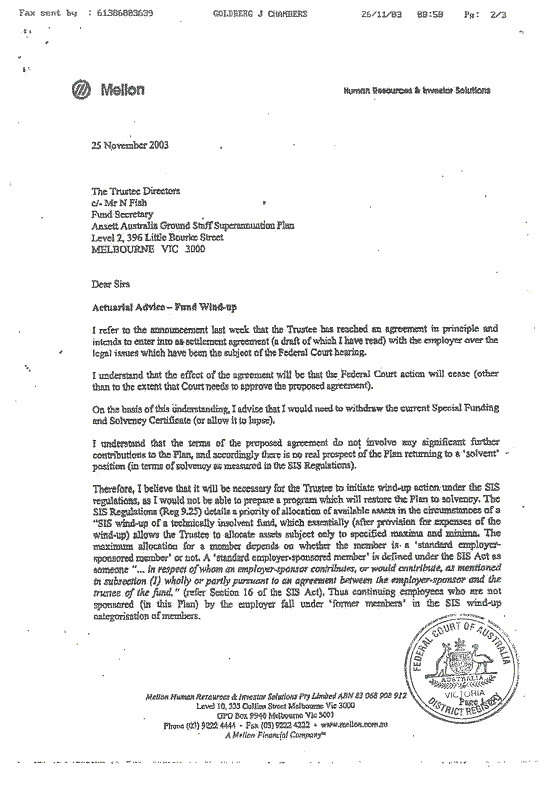
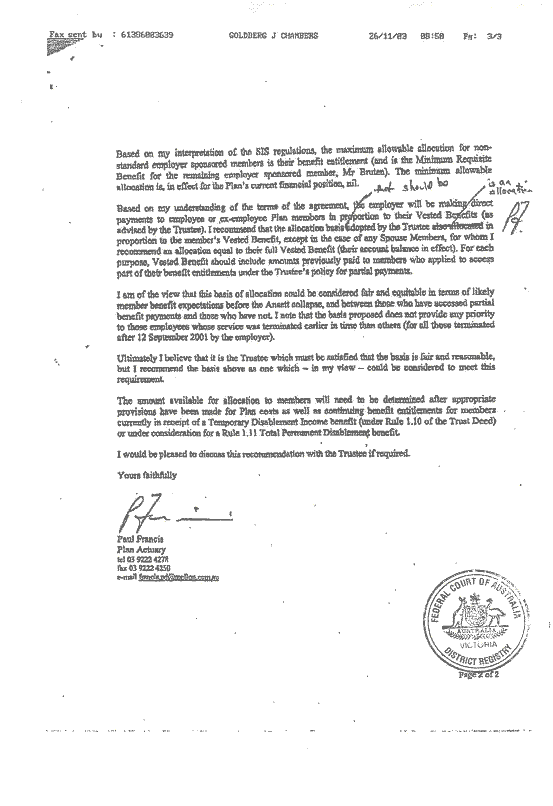
24 FEBRUARY 2004
MELBOURNE
| IN THE FEDERAL COURT OF AUSTRALIA |
|
| VICTORIA DISTRICT REGISTRY | V 3107 of 2002 |
| BETWEEN: | ANSETT AUSTRALIA GROUND STAFF SUPERANNUATION PLAN PTY LTD (ACN 065 590 178) (as Trustee of the ANSETT AUSTRALIA GROUND STAFF SUPERANNUATION PLAN) Applicant
|
|
| ANSETT AUSTRALIA LIMITED (ACN 004 209 410) (Subject to Deed of Company Arrangement) First Respondent MARK FRANCIS XAVIER MENTHA (as Deed Administrator of ANSETT AUSTRALIA LIMITED) (Subject to Deed of Company Arrangement) Second Respondent MARK ANTHONY KORDA (as Deed Administrator of ANSETT AUSTRALIA LIMITED) (Subject to Deed of Company Arrangement) Third Respondent
|
| AND: | ANSETT AUSTRALIA LIMITED (ACN 004 209 410) (Subject to Deed of Company Arrangement) First Cross-Claimant MARK FRANCIS XAVIER MENTHA (as Deed Administrator of ANSETT AUSTRALIA LIMITED) (Subject to Deed of Company Arrangement) Second Cross-Claimant MARK ANTHONY KORDA (as Deed Administrator of ANSETT AUSTRALIA LIMITED) (Subject to Deed of Company Arrangement) Third Cross-Claimant
|
| AND: | ANSETT AUSTRALIA GROUND STAFF SUPERANNUATION PLAN PTY LTD (ACN 065 590 178) (as Trustee of the ANSETT AUSTRALIA GROUND STAFF SUPERANNUATION PLAN) Cross-Respondent
|
| JUDGE: | GOLDBERG J |
| DATE OF ORDER: | 25 NOVEMBER 2003 |
| WHERE MADE: | MELBOURNE |
THE COURT ORDERS THAT:
1. Pursuant to s 447A of the Corporations Act 2001 (Cth) (“the Act”), s 447D(1) of the Act is to operate in relation to Ansett Australia Ltd (“AAL”) so that in an application for directions pursuant to s 447D(1) in relation to terms of settlement in this proceeding dated 25 November 2003, a copy of which terms are annexed as Schedule A to this Order (“the Terms of Settlement”), the Court may:
(a) give a direction that it approves the Terms of Settlement and that the first, second and third respondents may properly perform and give effect to the Terms of Settlement;
(b) vary the AAL deed of company arrangement executed by AAL on 2 May 2002 (“the Deed”) in the terms set out in Schedule B to this Order.
2. Pursuant to s 447D(1) of the Act as it operates in accordance with par 1(a) of this Order, the Court directs that:
(a) the Court approves the Terms of Settlement;
(b) the first, second and third respondents may properly perform and give effect to the Terms of Settlement.
3. Pursuant to s 447D(1) of the Act as it operates in accordance with par 1(b) of this Order, the Court directs that the Deed is varied in the terms set out in Schedule B to this Order.
4. The Court directs that:
(a) the Court approves the applicant entering into the Terms of Settlement;
(b) the applicant may properly perform and give effect to the Terms of Settlement.
5. The Court approves the distribution by the applicant of the assets of the Ansett Australia Ground Staff Superannuation Plan in accordance with the advice of the Actuary in his letter dated 25 November 2003 to the directors of the applicant, a copy of which is Schedule C to this Order.
6. The proceeding and the cross claim be dismissed with no order as to costs.
Note: Settlement and entry of orders is dealt with in Order 36 of the Federal Court Rules
IN THE FEDERAL COURT OF AUSTRALIA
VICTORIAN REGISTRY
V3107 of 2002
BETWEEN:
ANSETT AUSTRALIA GROUND STAFF SUPERANNUATION
PLAN PTY LTD (ACN 004 209 410)
(As Trustee of the Ansett Australia Ground Staff Superannuation Plan)
Applicant
and
ANSETT AUSTRALIA LIMITED First Respondent
(Subject to Deed of Company Arrangement)
MARK FRANCIS XAVIER MENTHA Second Respondent
MARK ANTHONY KORDA Third Respondent
TERMS OF SETTLEMENT
RECITALS
1.1 The applicant (“the trustee”) is the trustee of the Ansett Australia Ground Staff Superannuation Plan (“the Plan”).
1.2 The first respondent (“Ansett”) as an employer is a party to the superannuation trust deed which regulates the Plan (“the Trust Deed”).
1.3 The second and third respondents (“the administrators”) were the administrators of Ansett until 2 May 2002 and thereafter were, and continue to be, deed administrators of Ansett pursuant to a Deed of Company Arrangement (“the DOCA”).
1.4 In a proceeding in the Supreme Court of Victoria, being proceeding No. 2115 of 2001 (“the Supreme Court proceeding”), Justice Warren ordered, amongst other things, as follows:
1.4.1 in answer to paragraph 12(a) of the Originating Motion (as amended), that Ansett was obliged to make further contributions for certain groups, referred to as Membership Groups 1 and 3, in accordance with the requirements of a Funding and Solvency Certificate dated 24 April 2002 issued by the actuary of the Plan (“FSC5”);
1.4.2 in answer to paragraph 14 of the Originating Motion (as amended):
(a) the further contributions required for Membership Group 3 under FSC5 are not expenses within the meaning of section 556(1)(a) of the Corporations Act 2001 (“the Act”). The further contributions required for Membership Group 1 under FSC5 from Ansett are expenses within the meaning of section 556(1)(a) of the Act;
(b) the further contributions required for Membership Groups 1 and 3 under FSC5 are not debts within the meaning of section 556(1)(c), are not expenses within the meaning of section 556(1)(dd), and are not superannuation contributions within the meaning of section 556(1)(e) of the Act.
1.5 By an Amended Notice of Appeal dated 24 June 2003 the trustee appealed against certain of the orders made by Justice Warren and by a Notice of Cross‑Appeal Ansett and the administrators appealed against the order made by Justice Warren in response to paragraph 12(a) of the Originating Motion (as amended).
1.7 The DOCA contains provisions concerning any claim by the trustee defined as a “Top Up Retrenchment Benefit Claim”. The trustee instituted this proceeding seeking, amongst other things, to terminate or vary the DOCA (“the Federal Court proceeding”). Ansett and the administrators have issued a cross-claim in the Federal Court proceeding.
1.8 FSC5 lapsed on 25 March 2003.
1.9 On 29 April 2003 a document described as a Special Funding and Solvency Certificate (“SFSC1”) was issued by the actuary of the Plan.
1.10 On 21 August 2003 the Court of Appeal made certain orders on the appeal and cross‑appeal including setting aside the orders referred to in recital 1.4.2 above and orders as to costs.
1.11 On 2 September 2003 Justice Warren made orders in relation to the costs of the trial of the Supreme Court proceeding.
1.12 On 10 October 2003 a document described as a Special Funding and Solvency Certificate (“SFSC2”) was issued by the actuary of the Plan.
1.13 On 5 November 2003 a document described as a Special Funding and Solvency Certificate (“SFSC3”) was issued by the actuary of the Plan.
1.14 By terms of settlement dated 9 October 2003 outstanding issues before the Court of Appeal were settled and thereafter the cross‑appeal was discontinued.
NOW IT IS AGREED:
2.1 The parties agree to jointly seek orders varying the DOCA in the terms of, or to substantially the same effect as the terms of, the annexed document marked “A” entitled “Proposed DOCA Amendments”.
2.2 The trustee will also seek the orders set out in the annexed document marked “B” entitled “Proposed Trustee Orders”.
2.3 The administrators will also seek the orders set out in the annexed document marked “C” entitled “Proposed Administrators’ Orders”.
3.1 Upon:
3.1.1 the making of the orders referred to in paragraph 2.1 in terms satisfactory to each of the parties;
3.1.2 the making of the orders referred to in paragraph 2.2 in terms satisfactory to the trustee; and
3.1.3 the making of the orders referred to in paragraph 2.3 in terms satisfactory to the administrators,
the following provisions of this clause shall come immediately into effect.
3.2 The parties shall consent to orders otherwise dismissing the Federal Court proceeding (including the cross‑claim) with no order as to costs.
3.3 The trustee, its directors and former directors on the one hand and Ansett and the administrators on the other shall thereupon release each other from all claims (including those existing and any which might otherwise arise in future) relating to or arising out of:
3.3.1 the claims made in, and the facts and circumstances deposed to in, the Federal Court proceeding and in the Supreme Court proceeding;
3.3.2 the Trust Deed;
3.3.3 the DOCA, save insofar as it operates in future as varied pursuant to the orders referred to in paragraph 2.1;
3.3.4 FSC5, SFSC1, SFSC2, or SFSC3;
3.3.5 the Superannuation Industry (Supervision) Act 1993 and the regulations made thereunder;
3.3.6 any outstanding costs orders between the parties in any proceeding;
3.3.7 otherwise in relation to the Plan.
3.4 The parties shall be taken to have been satisfied respectively with the orders referred to in paragraph 3.1 upon indicating to the Federal Court through their counsel that they are so satisfied, or upon seeking or consenting to the order referred to in paragraph 3.2 hereof.
DATED the 25th day of November 2003.
...........................................................
........................................................... ..............................................................
........................................................... ..............................................................
Counsel for the trustee Counsel for the administrators and Ansett
ANNEXURE “A”
PROPOSED DOCA AMENDMENTS
Pursuant to Section 447A the Corporations Act 2001 (Cth)(“the Act”) the Ansett Australia Limited Deed of Company Arrangement (“the DOCA”) be varied:
1 by inserting (in alphabetical order) in clause 1.1 of the DOCA the following new definition:
“ “Court’s Amending Order” means the order of the Court amending the Deed, made pursuant to Section 447A of the Act, dated 25 November 2003.”.
2 by inserting the following new clauses immediately after existing clause 18.2.3 of the DOCA:
“18.2.4 fourthly, $39,000,000 to be paid as severance pay rateably in accordance with the amounts shown and to the employees of the Ansett Group Companies identified as members of the Ansett Australia Ground Staff Superannuation Plan (“the Ground Staff Plan”) in the schedule comprised in exhibit “PDF‑” to the affidavit of Paul Daniel Francis sworn 25 November 2003 filed in proceeding V3107 of 2002 in the Federal Court of Australia and on the basis that such payments are to be deducted from each such employee’s unpaid “Employee Amounts” (if any) (as defined in the deed of company arrangement concerning the relevant Ansett Group Company that employed them);
18.2.5 fifthly, $28,000,000 rateably as severance pay to each employee of the Ansett Group Companies that is not a member of the Ground Staff Plan in proportion to their unpaid “Employee Amounts” (as defined in the deed of company arrangement concerning the relevant Ansett Group Company that employed them) and on the basis that such payments are to be deducted from each such employee’s unpaid Employee Amounts (as so defined);
18.2.6 sixthly, to the SEESA Payer an amount equal to:
18.2.6.1 100 cents in the dollar for amounts advanced by the SEESA Payer to either the Voluntary Administrators or the Deed Administrators pursuant to the SEESA Deed and the SEESA Payments Deed that would have priority in a liquidation of the Company under Sections 556(1)(e) or 556(1)(g) of the Act; PLUS
18.2.6.2 up to 27.5 cents in the dollar for amounts advanced by the SEESA Payer to either the Voluntary Administrators or the Deed Administrators pursuant to the SEESA Deed and the SEESA Payments Deed that would have priority in a liquidation of the Company under Section 556(1)(h) of the Act,
LESS $67,000,000, on the basis that such payment is to be deducted from amounts owed by the Voluntary Administrators or the Deed Administrators to the SEESA Payer;
18.2.7 seventhly, up to 27.5 cents in the dollar as severance pay to each employee of the Ansett Group Companies in proportion to their respective unpaid “Employee Amounts” (as defined in the deed of company arrangement concerning the relevant Ansett Group Company that employed them) and on the basis that such payments are to be deducted from each such employee’s unpaid Employee Amounts (as so defined);
18.2.8 eighthly, $67,000,000 to the SEESA Payer on the basis that such payment is to be deducted from amounts advanced by the SEESA Payer to either the Voluntary Administrators or the Deed Administrators pursuant to the SEESA Deed and the SEESA Payments Deed;”.
3 by:
3.1 renumbering existing clause 18.2.4 of the DOCA to be clause 18.2.9, and in that clause replace the word “fourthly” with “ninthly”; and
3.2 renumbering existing clause 18.2.5 of the DOCA to be clause 18.2.10, and in that clause replace the word “fifthly” with “tenthly”.
4 by deleting the word “For” at the start of clause 18.3 of the DOCA and inserting the following words instead:
“Subject to the provisions of the Court’s Amending Order, for”.
5 by inserting new clauses 19 and 20 between existing clauses 18 and 19 of the DOCA, as follows:
“19 SEESA PAYMENT ACKNOWLEDGEMENT
For the avoidance of any doubt, the parties acknowledge that:
(i) other than distributions in accordance with clauses 18.2.1 ‑ 18.2.7, no further distributions can be made by the Deed Administrators until the SEESA Payer is paid $67,000,000 in accordance with clause 18.2.8;
(ii) the variations to the Deed made pursuant to the Court’s Amending Order are to be given effect to without regard to the dispute between the Commonwealth of Australia, the SEESA Payer and the Voluntary Administrators or Deed Administrators concerning the Payment in Lieu of Notice made by the Voluntary Administrators or Deed Administrators to Employees ("the PILN dispute");
(iii) the variations to the Deed made pursuant to the Court’s Amending Order do not otherwise affect the operation of the SEESA Deed; and
(iv) without limiting clause 19(iii), the variations to the Deed made pursuant to the Court’s Amending Order do not otherwise affect the SEESA Payer’s rights under Section 560 of the Act as if the Company is in liquidation created pursuant to the order of the Court in proceeding no. V3083 of 2001 (a copy of which is Exhibit 7 to the DOCA).
“20 TREATMENT OF NET PROCEEDS OF SALE OF CERTAIN ASSETS
To the extent that the following assets are owned by the Company, the parties agree that the Deed Administrators must pay the net proceeds of sale of the following assets:
(i) aircraft;
(ii) the Engine Shop site located at Garden Drive, Tullamarine;
(iii) the Data Centre site located at Garden Drive, Tullamarine,
(iv) the Flight Simulator site center at Garden Drive, Tullamarine;
(v) the balance of the Garden Drive, Tullamarine land following subdivision of the total site to create separate titles for the Engine Shop site, Data Centre site and the Flight Simulator Centre;
(vi) the balance $4,200,000 of the purchase price to be paid to the Deed Administrators pursuant to the sale of the Company’s interest in its lease of part of the domestic terminal at Perth airport, secured by a bank guarantee; and
(vii) any Boeing 737 engines; and
(viii) any other aircraft engines,
directly to the SEESA Payer, until the SEESA Payer has received $67,000,000 in accordance with clause 18.2.8. Until that time, the Deed Administrators:
(ix) will meet with the SEESA Payer and such other persons as the SEESA Payer may nominate (“the SEESA Group”) to report to the SEESA Group regarding the progress of the Ansett administration, such meetings to occur monthly at a time and place mutually convenient to the SEESA Group and the Deed Administrators; and
(x) will provide the SEESA Group with access to the Deed Administrators’ books and records regarding the Ansett administration, and will provide to the SEESA Group copies of relevant parts of those books and records upon receipt on reasonable notice of a request from the SEESA Group for those copies, provided that the SEESA Group must keep such information confidential at all times.”
6 by renumbering existing clauses 19 – 41 of the DOCA to be clauses 21 ‑ 43, respectively.
“ANNEXURE B”
PROPOSED TRUSTEE’S ORDERS
The Court:
1. Approves the agreement providing for the compromise by the Applicant of its claims in this proceeding which agreement is exhibit “MDT-1” to the affidavit of Michael Douglas Tilley sworn 25 November 2003 and filed in this proceeding.
2. Approves the distribution by the Applicant of the assets of the Ansett Australia Ground Staff Superannuation Plan in accordance with the advice of the actuary in his letter dated 25 November 2003 comprised in exhibit “PDF-B” to the affidavit of Paul Daniel Francis sworn 25 November 2003.
ANNEXURE “C”
PROPOSED ADMINISTRATORS’ ORDERS
1. Pursuant to s. 447A of the Corporations Act 2001 (Cth) (“the Act”), s. 447D(1) of the Act is to operate in relation to Ansett Australia Limited so that in an application for directions pursuant to s. 447D(1) in relation to the terms of settlement of this proceeding dated # November 2003, the court may give a direction that it approves the terms and that the second and third respondents may properly perform and give effect to those terms.
2. Pursuant to s. 447D(1) of the Act, as it operates in accordance with para. (1) of this order, the court directs that:
(a) the court approves the terms of settlement between the parties dated # November 2003;
(b) the second and third respondents may properly perform and give effect to those terms.
SCHEDULE “B”
VARIATIONS TO THE DEED
This Deed is varied in the following terms:
1. By inserting in the heading of the Deed immediately after the words “THIS DEED OF COMPANY ARRANGEMENT is made the 2nd day of May 2003 pursuant to the provisions of Part 5.3A of the Corporations Act:
“and varied pursuant to order of the Federal Court of Australia made 25 November 2003.”
2. By inserting (in alphabetical order) in clause 1.1 of the Deed the following new definition:
“Court’s Amending Order” means the order of the Court amending the Deed, made pursuant to Section 447A of the Act, dated 25 November 2003.”.
3. By inserting the following new clauses immediately after existing clause 18.2.3 of the Deed:
“18.2.4 fourthly, $39,000,000 to be paid as severance pay rateably in accordance with the amounts shown in the second column of figures, and to the employees of the Ansett Group Companies identified as members of the Ansett Australia Ground Staff Superannuation Plan (“the Ground Staff Plan”), in the schedule comprised in exhibit “PDF -A” to the affidavit of Paul Daniel Francis sworn 25 November 2003 filed in proceeding V3107 of 2002 in the Federal Court of Australia and on the basis that such payments are to be deducted from each such employee’s unpaid “Employee Amounts” (if any) (as defined in the deed of company arrangement concerning the relevant Ansett Group Company that employed them);
18.2.5 fifthly, $28,000,000 to be paid as severance pay rateably to each employee of the Ansett Group Companies who is not a member of the Ground Staff Plan in proportion to his or her unpaid “Employee Amounts” (as defined in the deed of company arrangement concerning the relevant Ansett Group Company that employed them) and on the basis that such payments are to be deducted from each such employee’s unpaid Employee Amounts (as so defined);
18.2.6 sixthly, to the SEESA Payer an amount equal to:
18.2.6.1 100 cents in the dollar for amounts advanced by the SEESA Payer to either the Voluntary Administrators or the Deed Administrators pursuant to the SEESA Deed and the SEESA Payments Deed that would have priority in a liquidation of the Company under Sections 556(1)(e) or 556(1)(g) of the Act; PLUS
18.2.6.2 up to 27.5 cents in the dollar for amounts advanced by the SEESA Payer to either the Voluntary Administrators or the Deed Administrators pursuant to the SEESA Deed and the SEESA Payments Deed that would have priority in a liquidation of the Company under Section 556(1)(h) of the Act,
LESS $67,000,000, on the basis that such payment is to be deducted from amounts owed by the Voluntary Administrators or the Deed Administrators to the SEESA Payer;
18.2.7 seventhly, up to 27.5 cents in the dollar (being a number of cents the same as the number of cents in the dollar of the payment under clause 18.2.6.2) as severance pay to each employee of the Ansett Group Companies in proportion to his or her respective unpaid “Employee Amounts” (as defined in the deed of company arrangement concerning the relevant Ansett Group Company that employed them) and on the basis that such payments are to be deducted from each such employee’s unpaid “Employee Amounts” (as so defined).
18.2.8 eighthly, $67,000,000 to the SEESA Payer on the basis that such payment is to be deducted from amounts owed by the Voluntary Administrators or the Deed Administrators to the SEESA Payer”.
4. By:
4.1 renumbering existing clause 18.2.4 of the Deed to be clause 18.2.9, and in that clause replace the word “fourthly” with “ninthly”; and
4.2 renumbering existing clause 18.2.5 of the Deed to be clause 18.2.10, and in that clause replace the word “fifthly” with “tenthly”.
5. By deleting the word “For” at the start of clause 18.3 of the Deed and inserting the following words instead:
“Subject to the provisions of the Court’s Amending Order, for”.
6. By inserting new clauses 19 and 20 between existing clauses 18 and 19 of the Deed, as follows:
“19 SEESA PAYMENT ACKNOWLEDGEMENT
For the avoidance of any doubt, the parties acknowledge that:
(i) other than distributions in accordance with clauses 18.2.1 – 18.2.7, no further distributions can be made by the Deed Administrators until the SEESA Payer is paid $67,000,000 in accordance with clause 18.2.8;
(ii) the variations to the Deed made pursuant to the Court’s Amending Order are to be given effect without regard to the dispute between the Commonwealth of Australia, the SEESA Payer and the Voluntary Administrators of the Deed Administrators concerning the Payment in Lieu of Notice made by the Voluntary Administrators or Deed Administrators to Employees (“the PILN dispute”);
(iii) the variations to the Deed made pursuant to the Court’s Amending Order do not otherwise affect the operation of the SEESA Deed; and
(iv) without limiting clause 19(iii), the variations to the Deed made pursuant to the Court’s Amending Order do not otherwise affect the SEESA Payer’s rights under Section 560 of the Act as if the Company is in liquidation created pursuant to the order of the Court in proceeding no. V3083 of 2001 (a copy of which is Exhibit 7 to the Deed).
“20 TREATMENT OF NET PROCEEDS OF SALE OF CERTAIN ASSETS
To the extent that the following assets are owned by the Company, the parties agree that the Deed Administrators must pay the net proceeds of sale of the following assets:
(i) aircraft;
(ii) the Engine Shop site located at Garden Drive, Tullamarine;
(iii) the Data Centre site located at Garden Drive, Tullamarine;
(iv) the Flight Simulator site center at Garden Drive, Tullamarine;
(v) the balance of the Garden Drive, Tullamarine land following subdivision of the total site to create separate titles for the Engine Shop site, Data Centre site and the Flight Simulator Centre;
(vi) the balance $4,200,000 of the purchase price to be paid to the Deed Administrators pursuant to the sale of the Company’s interest in its lease of part of the domestic terminal at Perth airport, secured by a bank guarantee;
(vii) any Boeing 737 engines; and
(viii) any other aircraft engines
directly to the SEESA Payer, until the SEESA Payer has received $67,000,000 in accordance with clause 18.2.8. Until that time, the Deed Administrators:
(ix) will meet with the SEESA Payer and such other persons as the SEESA Payer may nominate (“the SEESA Group”) to report to the SEESA Group regarding the progress of the Ansett administration, such meetings to occur monthly at a time and place mutually convenient to the SEESA Group and the Deed Administrators; and
(x) will provide the SEESA Group with access to the Deed Administrators’ books and records regarding the Ansett administration, and will provide to the SEESA Group copies of relevant parts of those books and records upon receipt of reasonable notice of a request from the SEESA Group for those copies, provided that the SEESA Group must keep such information confidential at all times.”
7. By renumbering existing clauses 19‑41 of the Deed to be clauses 21‑43, respectively.
| IN THE FEDERAL COURT OF AUSTRALIA |
|
| VICTORIA DISTRICT REGISTRY |
| BETWEEN: | ANSETT AUSTRALIA GROUND STAFF SUPERANNUATION PLAN PTY LTD (ACN 065 590 178) (as Trustee of the ANSETT AUSTRALIA GROUND STAFF SUPERANNUATION PLAN) Applicant
| |
| AND: | ANSETT AUSTRALIA LIMITED (ACN 004 209 410) (Subject to Deed of Company Arrangement) First Respondent MARK FRANCIS XAVIER MENTHA (as Deed Administrator of ANSETT AUSTRALIA LIMITED) (Subject to Deed of Company Arrangement) Second Respondent MARK ANTHONY KORDA (as Deed Administrator of ANSETT AUSTRALIA LIMITED) (Subject to Deed of Company Arrangement) Third Respondent
| |
| AND: | ANSETT AUSTRALIA LIMITED (ACN 004 209 410) (Subject to Deed of Company Arrangement) First Cross-Claimant MARK FRANCIS XAVIER MENTHA (as Deed Administrator of ANSETT AUSTRALIA LIMITED) (Subject to Deed of Company Arrangement) Second Cross-Claimant MARK ANTHONY KORDA (as Deed Administrator of ANSETT AUSTRALIA LIMITED) (Subject to Deed of Company Arrangement) Third Cross-Claimant
|
|
| AND: | ANSETT AUSTRALIA GROUND STAFF SUPERANNUATION PLAN PTY LTD (ACN 065 590 178) (as Trustee of the ANSETT AUSTRALIA GROUND STAFF SUPERANNUATION PLAN) Cross-Respondent
|
|
| ||
| DATE: | 24 FEBRUARY 2004 |
|
| PLACE: | MELBOURNE |
|
REASONS FOR JUDGMENT
Introduction
1 When the Ansett Australia Limited group of companies (“Ansett”) was placed in administration under Pt 5.3A of the Corporations Act 2001 (Cth) (“the Act”) on 12 September 2001, the consequences for the Australian community were dramatic. A major transport facility and an Australian institution closed down, causing substantial disruption across the whole of Australia and resulting in large‑scale unemployment for Ansett’s sizeable workforce. Within a short space of time a substantial part, and ultimately most, of the Ansett workforce comprising some 15,000 people lost their jobs. For many employees it was an abrupt termination of many years of service to Ansett. That service gave rise to a number of entitlements upon termination of employment by either resignation or retrenchment.
2 The administrators of Ansett had to find funds to meet the entitlements of employees, including salaries and wages for existing staff, accrued holiday pay for staff who resigned or who were retrenched, and retrenchment payments for those who were retrenched. Retrenchment also gave rise, for some employees, to a possible further superannuation payment.
3 The Ansett workforce was covered by a number of superannuation plans. One plan in particular, the Ansett Australia Ground Staff Superannuation Plan (“Ground Staff Superannuation Plan”), covered some 8,000 employees. The Ground Staff Superannuation Plan was established by the Ansett Transport Industries Limited Airline Ground Staff Superannuation Plan Trust Deed and Rules dated 18 March 1988 as amended from time to time (“the Trust Deed”). Ansett Australia Ground Staff Superannuation Plan Pty Limited, the applicant, was the Trustee. Employee members of the Ground Staff Superannuation Plan who were retrenched became entitled, pursuant to cl 1.13 of the Trust Deed, to a superannuation payment which had the potential to be greater than the payment which they would otherwise receive on resignation pursuant to cl 1.12 of the Trust Deed.
The historical and statutory background
4 Shortly after Ansett was placed in administration it became apparent to the administrators that many Ansett employees whose services had been terminated would not be able to receive in full the retrenchment payments to which they were entitled under various industrial instruments.
5 On 14 September 2001 the Deputy Prime Minister of Australia announced that the Commonwealth Government would pay the entitlements of Ansett employees to wages, leave and payment in lieu of leave, as well as for redundancies up to the community standard of eight weeks, to the extent that those entitlements were not able to be met from the assets of Ansett. This commitment was confirmed in a letter dated 7 October 2001 from the Deputy Prime Minister to Mr Korda, one of the administrators of Ansett. The Commonwealth Government had decided to take this course under the Special Employee Entitlement Scheme for Ansett group employees (“the SEESA Scheme”) provided for under the Air Passenger Ticket Levy (Collection) Act 2001 (Cth) (“the Ticket Levy Collection Act”). It was made clear by the Deputy Prime Minister that the money to be advanced under the SEESA scheme would be by way of a loan specifically for the purpose of paying employee entitlements to the extent that there were not sufficient assets of the Ansett group to pay those entitlements.
6 The circumstances of this arrangement are set out in full in In the Matter of Ansett Australia Limited and Mentha (2002) 115 FCR 376. In brief, the Ticket Levy Collection Act provided for the payment of a levy on air passenger tickets purchased on or after 1 October 2001. The purpose of the levy was to enable the Commonwealth of Australia to meet the cost of the payment of employee entitlements under the SEESA scheme.
7 An integral part of the SEESA scheme was that the Commonwealth Government would be repaid for any advances made under the scheme in the same priority as distributions would be made to employees in the event of a winding up. The Commonwealth would “stand in the shoes” of those employees who had received payments through the scheme and thereby receive priority in repayment of the amounts advanced. The Commonwealth would have priority for repayment over non‑employee unsecured creditors and this would enable the Commonwealth to rank equally with those employees who had entitlements, such as retrenchment payments, calculated by reference to a period in excess of eight weeks, which had not been paid to them under the Scheme.
8 As a result of the SEESA scheme, shortly before Christmas 2001 Ansett employees received accrued redundancy payments calculated by reference to a period up to a maximum of eight weeks. To date, the SEESA scheme has advanced $3 million to the Ansett administrators for wages, $187.1 million for annual leave and long service leave entitlements, $22.3 million for payment in lieu of notice benefits and $122.5 million for redundancy benefits, amounting to a total of $334.9 million.
9 During the administration an issue arose as to whether the Ansett workforce had been retrenched by the administrators in such circumstances as would give rise to an entitlement of employee members of the Ground Staff Superannuation Plan to a superannuation payment based on retrenchment. In brief, the Trustee said that where members of the Ground Staff Superannuation Plan had been retrenched, they were entitled to a superannuation payment pursuant to cl 1.13 of the Trust Deed, which provided a potentially greater benefit than that based on resignation, and that the Ansett administrators were obliged to contribute to the Plan’s funds to ensure the Trustee could make such payments to members. The Trustee argued that its claim to have the fund topped up to meet members’ entitlements should receive priority over the claims of certain other creditors of Ansett. The administrators said that even if those employees were entitled to a greater superannuation payment under the Trust Deed because they had been retrenched, which point was not conceded, the priority of the Trustee’s claim had been relegated by the Ansett creditors to that of an unsecured creditor pursuant to the deed of company arrangement that had been entered into by Ansett.
10 I turn to a brief outline of the statutory context of the dispute. The parties agreed at the commencement of the hearing that the Ground Staff Superannuation Plan was a defined benefit fund and was thereby subject to Div 9.3 of the Superannuation Industry (Supervision) Regulations 1994 (Cth) (“the SIS Regulations”). Regulation 9.09 of the SIS Regulations provides that the trustee of a defined benefit fund must obtain a funding and solvency certificate from the actuary of the fund. Funding and solvency certificates certify the solvency of the fund as at a certain date and certify the minimum contributions reasonably expected by the actuary to be required to secure the solvency of the fund on the expiry of the certificate. The trustee of the fund gives a copy of the certificate to each employer‑sponsor who has contributed, or is contributing, to the superannuation fund so that they can make the contributions necessary to secure the solvency of the fund. Before the administration of Ansett commenced, the actuary of the Ground Staff Superannuation Plan had issued three funding and solvency certificates. Two further funding and solvency certificates were issued after the administration commenced.
11 The SIS Regulations provide that if an actuary forms the opinion that the fund is technically insolvent, a status defined by reg 9.06(3) as the situation whereby the minimum benefit index of the fund is not able to be certified in accordance with Div 9.3 as not less than 1, then the actuary must make a declaration that the fund is technically insolvent: ref 9.16(1). Once such a declaration is made, the actuary can only issue what are known as “special funding and solvency certificates”: reg 9.18(2). Special funding and solvency certificates certify, inter alia, the minimum contributions reasonably expected by the actuary to be required to secure the solvency of the fund at the end of the period of technical insolvency: reg 9.18(9)(d). Regulation 9.17 provides that, once a fund has been declared to be technically insolvent, the trustee must either initiate a program designed to return the fund to a position that would enable the actuary to certify the solvency of the fund in a funding and solvency certificate no later than five years after the date on which the technical insolvency commenced, or initiate winding‑up proceedings in accordance with Div 9.4 of the SIS Regulations.
12 In March 2002 the actuary of the Ground Staff Superannuation Plan formed the view that the Plan was technically insolvent and made a declaration of technical insolvency. Three special funding and solvency certificates have been issued since that declaration and have been provided to the Ansett administrators in order that they can make the contributions estimated by the actuary to be necessary to restore the solvency of the Plan. The validity of the current special funding and solvency certificate was in issue in the proceeding.
13 The Trustee maintained that there was a deficiency in the Ground Staff Superannuation Plan that gave rise to an obligation on the part of the administrators to make up the shortfall so that all the entitlements of members could be paid by the Trustee. Upon the declaration of technical insolvency of the Plan, the Trustee effectively elected to institute a program to return the Plan to solvency rather than to wind‑up the Plan. The actuary has made various estimates in the special funding and solvency certificates as to what contribution would be necessary from the Ansett administrators in order to restore the fund to solvency, with a claim for $180 million finally being put forward.
14 Assuming employee members of the Ground Staff Superannuation Plan were entitled to the cl 1.13 superannuation benefits, it was clear that on a final distribution there would not be sufficient funds available for the administrators to pay all redundancy entitlements of Ansett employees and for the Trustee to pay all superannuation entitlements of employee members of the Ground Staff Superannuation Plan.
15 After extensive consultations with relevant parties, the administrators propounded a deed of company arrangement for the companies in the Ansett group, which preserved the position of the Commonwealth under the SEESA scheme but relegated the position of the Trustee to that of an unsecured creditor. In doing so, the deed of company arrangement varied the order of priority which would otherwise apply (pursuant to s 556 of the Act) in the event of a winding‑up.
16 In the ordinary course, unless otherwise provided, the provisions of s 556 of the Act as to the order in which creditors should be paid in a winding‑up form part of a deed of company arrangement as a result of the operation and inter‑relationship of s 444A(5) of the Act, reg 5.3A.06 and cl 4 of Sch 8A of the Corporations Regulations 2001 (Cth) (“the Corporations Regulations”). Section 444A(5) of the Act provides that a deed of company arrangement is taken to include the “prescribed provisions,” except so far as it provides otherwise. Regulation 5.3A.06 of the Corporations Regulations provides that, for the purposes of s 444A(5) of the Act, the “prescribed provisions” are those set out in sch 8A of the Corporations Regulations. Clause 4 of sch 8A of the Corporations Regulations provides that an administrator must apply the property coming under his or her control under a deed of company arrangement in the order of priority specified in s 556 of the Act. Section 556 of the Act provides:
“(1) Subject to this Division, in the winding up of a company the following debts and claims must be paid in priority to all other unsecured debts and claims:
(a) first, expenses (except deferred expenses) properly incurred by a relevant authority in preserving, realising or getting in property of the company, or in carrying on the company’s business;
(b) if the Court ordered the winding up—next, the costs in respect of the application for the order (including the applicant’s taxed costs payable under section 466);
(c) next, the debts for which paragraph 443D(a) entitles an administrator of the company to be indemnified (even if the administration ended before the relevant date), except expenses covered by paragraph (a) of this subsection and deferred expenses;
(d) if the winding up began within 2 months after the end of a period of official management of the company—next, debts of the company properly incurred by an official manager in carrying on the company’s business during the period of official management, except expenses covered by paragraph (a) of this subsection and deferred expenses;
(da) if the Court ordered the winding up—next, costs and expenses that are payable under subsection 475(8) out of the company’s property;
(db) next, costs that form part of the expenses of the winding up because of subsection 539(6);
(dc) if the winding up began within 2 months after the end of a period of official management of the company—next, the remuneration, in respect of the period of official management, of any auditor appointed in accordance with Part 2M.4;
(dd) next, any other expenses (except deferred expenses) properly incurred by a relevant authority;
(de) next, the deferred expenses;
(df) if a committee of inspection has been appointed for the purposes of the winding up—next, expenses incurred by a person as a member of the committee;
(e) subject to subsection (1A)—next, wages and superannuation contributions payable by the company in respect of services rendered to the company by employees before the relevant date;
(f) next, amounts due in respect of injury compensation, being compensation the liability for which arose before the relevant date;
(g) subject to subsection (1B)—next, all amounts due:
(i) on or before the relevant date; and
(ii) because of an industrial instrument; and
(iii) to, or in respect of, employees of the company; and
(iv) in respect of leave of absence;
(h) subject to subsection (1C)—next, retrenchment payments payable to employees of the company.”
17 The Trustee contended that its claim would be entitled to priority in a winding‑up under s 556 of the Act, coming within either subs (1)(a), (1)(dd) or (1)(e).
18 At the adjourned second meeting of creditors of Ansett held on 27 March 2002 the Trustee sought unsuccessfully to have the provisions of the deed of company arrangement amended so as to preserve the priority of any payments otherwise due to the Ground Staff Superannuation Plan. The deed was passed with the Trustee’s priority relegated to that of an unsecured creditor.
19 The deed of company arrangement was entered into on 2 May 2002. Clause 18.2 set out the manner in which funds would be distributed to creditors. It provided:
“The Distribution Amounts shall be applied in payment of the Voluntary Administrators, the Deed Administrators and the Participating Creditors of the Company as follows:
18.2.1 firstly, the Voluntary Administrators and the Deed Administrators in relation to any amounts owing to them and unpaid pursuant to the terms of the Deed, to the extent they would be afforded priority in a winding‑up of the Company;
18.2.2 secondly, the Secured Creditors of the Company, to the extent that their Security is valid;
18.2.3 thirdly, Priority ROT [retention of title] Creditors of the Company in relation to their Priority ROT Amount;
18.2.4 fourthly, in the order of priority set out in section 556:
18.2.4.1 Employees of the Company;
18.2.4.2 the SEESA Payer in accordance with the terms of the SEESA Deed and the SEESA Payments Deed;
18.2.4.3 any trustee of the Superannuation Fund that is a Priority Creditor, to the extent of its Priority Creditor Amount (but, for the avoidance of any doubt, excluding the amount of any Top Up Retrenchment Benefit Claim that trustee may have); and
18.2.4.4 any other Participating Creditors of the Company entitled to a priority under section 556 of the Act as if the Company were to be wound up; and
18.2.5 fifthly (but subject to Clause 18.4), other Participating Creditors of the Company (including Top Up Retrenchment Benefit Creditors to the extent of their Top Up Retrenchment Benefit Claims) on a pro rata basis,
in the amounts and on the dates determined by the Deed Administrators in their absolute discretion.”
20 For the purposes of the deed of company arrangement, “Priority Creditors” were defined in cl 1 to mean, inter alia:
“(e) trustees of Superannuation Funds [which were defined to include the Ground Staff Superannuation Plan] to the extent of their Priority Creditor Amounts,
but does not include Top Up Retrenchment Benefit Creditors;”
“Priority Creditor Amounts” were defined to mean, inter alia:
“(d) in the case of a trustee of a Superannuation Fund, the amount of any unpaid employer superannuation contributions and/or any unpaid member superannuation contributions, relating to the relevant Superannuation Fund, but not including the amount of any Top Up Retrenchment Benefit Claim.”
“Top Up Retrenchment Benefit Claim” was defined to mean:
“the amount of any claim for payment or contribution to a Superannuation Fund in respect of any shortfall in the Superannuation Fund in meeting or paying retrenchment benefits, being a claim of the type raised in Victorian Supreme Court proceeding no. 2115/01 …as so determined in that proceeding (if any).”
“Top Up Retrenchment Benefit Creditor” was accordingly defined to mean:
“a person that is or was a trustee of a Superannuation Fund or a Superannuation Fund with a Top Up Retrenchment Benefit Claim.”
21 Importantly, cl 16 of the deed provided:
“16.1.1 All Top Up Retrenchment Benefit Claims by trustees of the Superannuation Funds shall be treated as ordinary unsecured Claims, and shall not constitute Priority Creditor Amounts for the purposes of this Deed, even if a court determines that all or any of such claims rank to priority in a liquidation of the Company.
16.1.2 For the avoidance of doubt, all persons bound by the Deed acknowledge that the provisions of Clauses 16.1.1 and 18.3 are intended to govern the treatment of Top Up Retrenchment Benefit Claims under the Deed, notwithstanding:
16.1.2.1 the provisions of the SEESA deed, the SEESA Payments Deed and the terms of the Court’s order in proceeding no. V3083 of 2001…; and
16.1.2.2 that a court may determine that Top Up Retrenchment Benefit Claims rank to priority in a winding up of the Company as referred to in Clause 16.1.1.”
The Court proceedings
22 On 19 June 2002 the Trustee commenced a proceeding in the Federal Court seeking to have the deed of company arrangement terminated or amended so as to delete or vary the provisions that denied priority to the Trustee’s claim. The Trustee became concerned that there might be jurisdictional difficulties in the Federal Court determining all the relevant issues and commenced a proceeding in the Supreme Court of Victoria. The Federal Court proceeding was adjourned pending the outcome of the Supreme Court proceeding.
23 The Supreme Court proceeding sought the determination of a number of issues:
· Were the retrenched employees of Ansett entitled to benefits under the Trust Deed, and if so, to which category of benefit were they entitled?
· If the entitlements resulted in a deficiency in the Ground Staff Superannuation Plan was Ansett obliged to make further contributions to enable the payment of those benefits?
· If Ansett was required to make further contributions to the Ground Staff Superannuation Plan, what priority ranking did such contributions attract under s 556(1) of the Act?
24 The proceeding was heard by Warren J, (as she then was), over twenty days during July and August 2002. On 20 December 2002 her Honour delivered reasons for judgment, which reasons were revised on 7 February 2003: Ansett Australia Ground Staff Superannuation Plan Pty Ltd v Ansett Australia Ltd (2002) 174 FLR 1. Her Honour held that the employee members of the Ground Staff Superannuation Plan who had been retrenched by the administrators since 12 September 2001 were entitled to retrenchment benefits payable under cl 1.13 of the Trust Deed. Her Honour found that Ansett was obliged to make contributions to the Plan pursuant to Funding and Solvency Certificate No 5 which had been issued by the Ground Staff Superannuation Plan’s actuary, and that this obligation arose from the superannuation statutory regime and the contract of employment between Ansett and employees who were members of the Ground Staff Superannuation Plan. However, her Honour found that Ansett’s obligation to pay further funds into the plan did not attract priority under s 556(1) of the Act and simply constituted a debt provable in the administration of Ansett.
25 The Trustee appealed to the Court of Appeal and the administrators cross‑appealed. In relation to the Trustee’s appeal, the Court of Appeal relevantly determined that the matter before Warren J contained a hypothetical question in respect of s 556(1) of the Corporations Act. Her Honour’s judgment to that extent was set aside. Costs were ordered against the Trustee: Ansett Australia Ground Staff Superannuation Plan Pty Ltd v Ansett Australia Ltd [2003] VSCA 117. The cross‑appeal by the administrators was ultimately resolved by the parties.
26 Following the Court of Appeal decision, the parties returned to the Federal Court and revived the adjourned proceeding. On 27 August 2003 I set it down for hearing commencing 12 November 2003 on a ten day estimate.
27 The Trustee’s statement of claim underwent a number of changes. In its final form it raised the following issues:
· Has the Trustee made a valid claim on the administrators for payment to make up a shortfall in the superannuation fund?
· If the Trustee has made a valid claim, would that claim ordinarily be entitled to payment in priority to other creditors of Ansett pursuant to s 556(1) of the Corporations Act?
· If the claim would ordinarily be entitled to priority pursuant to s 556(1) of the Corporations Act, has that claim been effectively excluded from priority by the deed of company arrangement?
· Were the creditors who voted in favour of the deed of company arrangement misled, or not given full information, about Ansett’s circumstances, which affected their decision whether to vote in favour of the deed?
· Is the deed of company arrangement in its present form unfair or discriminatory?
· If the deed of company arrangement is unfair or discriminatory, should the Court exercise its discretion to vary or set aside the deed?
28 The administrators filed a cross‑claim which raised the following issues:
· Istheclaim by the Trustee, made pursuant to various funding and solvency certificates and special funding and solvency certificates, a “Top Up Retrenchment Benefit Claim” within the meaning of that expression in the deed of company arrangement?
· If the claim is not a Top Up Retrenchment Benefit Claim, should the Court vary the deed of company arrangement pursuant to s 445G or s 447A of the Corporations Act so as to exclude the claim from the definition of “Priority Creditor Amounts” within the meaning of that expression in the deed of company arrangement so that the claim is not entitled to priority under cl 18.2.4.3 of the deed?
· Alternatively, if the claim is not a Top Up Retrenchment Benefit Claim, should the Court give a direction pursuant to s 447D of the Act that the administrators ought to convene a creditors’ meeting to consider a resolution to vary the deed of company arrangement so as to remove any priority the claim might have under cl 18.2.4.3 of the deed?
29 At the commencement of the hearing, counsel sought leave to intervene on behalf of the Australian Council of Trade Unions (“ACTU”) and eight other unions who represented the majority of the Ansett workforce at the time of the commencement of the administration in September 2001. Leave to intervene was refused but the affidavits of union officials, which they wished to have placed before the Court, were tendered and relied upon by the administrators.
30 The appearance of the ACTU and the unions highlighted an incongruity in the proceeding. The administrators and, it appeared, a substantial number of the retrenched Ansett employees, contended that the Trustee of the Ground Staff Superannuation Plan did not have any priority for the payments which Ansett might be obliged to make to the Ground Staff Superannuation Plan, the result being that more funds would be available to the administrators to cover retrenchment and redundancy payments.
31 The Trustee, representing the interests of employee members of the Ground Staff Superannuation Plan (a considerable number of whom were also represented by the ACTU and the unions), was seeking to have the administrators give priority to the payment claimed to be due to the Ground Staff Superannuation Plan to cover the shortfall in the superannuation fund. Such priority would have the inevitable result of diminishing the amount available to pay redundancy and retrenchment payments, albeit with the perceived advantage of increasing superannuation payments to members of the Plan.
32 By the time the matter came before me in November, it was estimated by counsel for the parties that costs in excess of $3 million had been incurred by the parties in litigating their claims. These costs were incurred in circumstances where the parties on each side of the proceeding represented in a significant respect the interests of a large group of the same people.
33 I was extremely concerned at the amount of costs which had been incurred by the date the matter came before me. This had the result of removing millions of dollars from the funds available to be distributed to Ansett employees when, on one view, no matter what the outcome, the continuation of the debate before the Court was not in the interests of a substantial body of those employees.
34 On the one hand, the administrators were seeking to preserve sufficient funds to pay retrenchment entitlements to all Ansett employees at the expense of superannuation entitlements of those retrenched employees who were also members of the Ground Staff Superannuation Plan. On the other hand, the Trustee was seeking to obtain funds to cover the superannuation entitlements of retrenched employees who were members of the Ground Staff Superannuation Plan at the expense of redundancy or retrenchment payments to all employees.
35 The Trustee argued that if its claim for priority was unsuccessful, employees who had a substantial number of years of service with Ansett and who were either close to, or had reached, retirement age were most disadvantaged. Such employees were in a position where they could immediately, or shortly, access their superannuation entitlements and they would receive smaller superannuation entitlements once their superannuation benefits were reduced as part of the overall sharing of the shortfall in funds. However, as I understood the evidence of the Ground Staff Superannuation Plan’s actuary, as years of service increased and an employee approached retirement age, the amount of the benefit payable on resignation or early retirement and the amount of the benefit payable on retrenchment converged. This occurs because voluntary termination benefits are designed to equate to the retrenchment benefit by the age of retirement at age 65. As employee members of the Ground Staff Superannuation Fund approached 65 years of age, the gap between their resignation or early retirement benefit and their retrenchment benefit would be closing. Thus, as the actuary of the Ground Staff Superannuation Plan agreed in evidence, such persons would, in practical terms, suffer little disadvantage if the Trustee’s claim failed.
36 For those employees who had less years of service and were not nearing retirement age, the failure of the Trustee’s claim appeared to have the consequence that those employees would receive more in redundancy payments now, but less in superannuation entitlements, the bulk of which they would not be able to access in any event until some later point in time. It appeared that this course was preferred by the majority of employees, the ACTU and the represented unions. Evidence was given that the average age of Ansett employees was 41. Given that the age for early retirement is 55 years and that the retirement age is 65 years, this meant there would be a considerable period of time before many Ansett employees could access their superannuation entitlements. The greater body of employees appeared to have taken the view that they preferred to receive their redundancy payments as soon as possible rather than wait to obtain enhanced superannuation payments at some time in the future. At the second creditors meeting creditors had been asked to vote on whether to enter into the deed of company arrangement on both a poll and a show of hands. The creditors voted in favour of entering into the deed by 99.33% in value and 99.57% in number.
37 The situation before the Court therefore seemed incongruous, and with encouragement initially from the administrators and then also from the Trustee, I referred the proceeding to mediation with the particular direction that the ACTU, the represented unions and the Commonwealth of Australia be entitled to participate in the mediation. The hearing of the matter continued concurrently with the mediation up until 21 November 2003 when I was asked by the parties to adjourn the matter to 25 November 2003.
The proposed settlement
38 As a result of the mediation of the proceeding by Deputy District Registrar Efthim, the parties, the Commonwealth, the ACTU and the represented unions reached an agreement in principle. In order to give effect to this agreement, the parties required an order of the Court allowing for the variation of the deed of company arrangement and directions that the parties could give effect to the terms of settlement reached and distribute funds accordingly.
39 The terms of settlement provided for the deed of company arrangement to be varied to reflect a new priority regime by which the administrators would distribute assets to priority creditors. The priority of the administrators, secured creditors and priority reservation of title creditors, enshrined in cls 18.2.1 to 18.2.3 of the deed, remained unchanged. A number of new subclauses were then added to cl 18 to provide for a revised order of priority of payments after cls 18.2.1 to 18.2.3. These subclauses provided for the following payments:
· Clause 18.2.4
Fourthly, $39 million in severance pay to be distributed rateably amongst members of the Ground Staff Superannuation Plan on the basis that such payments were to be deducted from each employee’s unpaid “Employees Amounts” (being amounts owing to an employee in respect of his or her employment such as entitlements to payment of wages or salary in lieu of notice, long service leave, annual leave and sick leave);
· Clause 18.2.5
Fifthly, $28 million in severance pay to be distributed rateably amongst employees of Ansett who were not members of the Ground Staff Superannuation Plan in proportion to their unpaid Employee Amounts, on the basis that such payments were to be deducted from each employee’s unpaid Employee Amounts.
· Clause 18.2.6
Sixthly, to the Commonwealth, an amount equal to:
o 100 cents in the dollar for amounts advanced by the Commonwealth under the SEESA scheme to the administrators for wages and superannuation contributions and amounts due in respect of leave of absence (these being amounts that would have priority in a liquidation of Ansett under subss 556(1) (e) and 556(1)(g) of the Act);
o plus up to 27.5 cents in the dollar for amounts advanced by the Commonwealth under the SEESA scheme to the administrators for retrenchment payments (these being amounts that would have priority in a liquidation of Ansett under subs 556(1) (h) of the Act);
o less $67 million,
on the basis that such payment be deducted from the amounts owed by the administrators to the Commonwealth under the SEESA scheme.
· Clause 18.2.7
Seventhly, up to 27.5 cents in the dollar as severance pay to each employee of Ansett in proportion to their respective unpaid Employee Amounts, on the basis that such payments be deducted from each employee’s unpaid Employee Amounts.
· Clause 18.2.8
Eighthly, $67 million to the Commonwealth, on the basis that such payment be deducted from amounts advanced by the Commonwealth to the administrators pursuant to the SEESA scheme.
40 The priority of those creditors originally identified in cls 18.2.4 and 18.2.5 of the deed of company arrangement would accordingly be deferred to the above claims and would be found in cls 18.2.9 and 18.2.10.
41 New clauses 19 and 20 were proposed to be added to the deed of company arrangement confirming the position of the Commonwealth under the SEESA scheme and putting in place some administrative arrangements between the administrators and the Commonwealth.
42 In addition to seeking, jointly with the Trustee, a variation of the deed of company arrangement, the administrators sought the Court’s approval of the terms of settlement and a direction that the administrators may properly perform and give effect to the terms of settlement.
43 By a separate notice of motion, the Trustee sought orders from the Court approving the agreement entered into by the Trustee which provided for a compromise of the Trustee’s claims in the proceeding.
44 The Trustee also sought court approval of the manner in which it proposed to distribute the assets of the Ground Staff Superannuation Plan. The result of the settlement of the proceeding was that the program to restore the fund to solvency, embarked upon by the Trustee pursuant to reg 9.17 of the SIS Regulations, came to an end. The Trustee informed the Court that the Ground Staff Superannuation Plan would be wound‑up. The priority in which benefits are to be distributed in the event of a winding‑up under the SIS Regulations is governed by reg 9.25. Regulation 9.25 allows a Trustee to allocate assets subject to a minimum allocation of zero and a maximum allocation of the full entitlement, depending upon whether the minimum benefit index at the winding-up date is less than, or greater than, one.
45 The Trustee had sought advice from the actuary. The actuary sent a letter to the directors of the Trustee dated 25 November 2003 in relation to what would constitute a fair and equitable allocation of the assets remaining in the Plan. The actuary recommended that the assets be allocated in proportion to the members’ Vested Benefits, and that such benefits should be calculated to include amounts previously paid to members who had applied to access part of their benefit entitlements under the partial payment policy formerly implemented by the Trustee. In the case of spouse members, the actuary recommended an allocation equal to those members’ full Vested Benefits, which was effectively their account balance. The recommended allocation did not provide any first in time priority to employees whose services were terminated prior to 12 September 2001, the date on which Ansett was placed in administration.
46 Upon such orders and directions being made and given by the Court, the terms of settlement provided that the parties would consent to orders otherwise dismissing the proceeding and the cross‑claim, and would release each other from all further related claims.
Principles and factors to be considered in approving the terms of settlement and the proposed distribution of assets by the Trustee
47 I had reached a clear view as to the merits of the settlement, the orders that should be made and in general terms the reasons why those orders should be made. I wanted to facilitate payments being made to Ansett employees as soon as possible. I was satisfied that the settlement should be approved and I made orders at the time of the hearing. I now set out in more detail my reasons for making the orders on 25 November 2003.
48 Ordinarily courts will not give directions to administrators approving of decisions concerning the commercial merits of a proposed course of action where no issue as to power, propriety or reasonableness or otherwise requiring the exercise of judgment on a legal issue arises; Re Ansett and Korda (2002) 115 FCR 409 and the cases discussed therein at 422‑428, in particular, Re Codisco Pty Ltd (1974) CLC 40‑126; Sanderson v Classic Car Insurances Pty Ltd (1985) 10 ACLR 115; Re Spedley Securities Ltd (in liq) (1992) 9 ACSR 83; Re Addstone Pty Ltd (in liq) (1997) 25 ACSR 357. Decisions of a purely commercial or business nature are entrusted to administrators who will generally be in a better position than the courts to make such decisions.
49 In the present case however, there were legal issues involved; rights and duties were being compromised and causes of action were being given up. Further, the terms of settlement involved a further variation of the statutory scheme of priorities recorded in s 556(1) of the Act which is ordinarily incorporated into the deed of company arrangement by s 444A(5) of the Corporations Act and reg 5.3A.06 and cl 4 of Sch 8A of the Corporations Regulations. These factors took the administrators’ decision to enter into the terms of settlement outside the realm of a purely commercial decision. This was an appropriate case for the Court to consider giving its approval to the administrators entering into the terms of settlement and giving effect to the agreement reached between the parties.
50 So far as the approval of the Court sought by the Trustee is concerned, the Court has power to make orders and give directions regarding the conduct of litigation and the compromise of claims by trustees: Re Atkinson, deceased [1971] VR 612 at 615; In re Earl of Strafford, decd; Royal Bank of Scotland Ltd v Byng [1980] 1 Ch 28; cf Will of Gilchrist (1867) 6 SCR (NSW) Eq 74 at 78‑80; Re Pilling; Ex parte Salaman [1906] 2 KB 644 at 647‑648. The Court can direct that it is proper for atrustee to enter into terms of settlement, although the precise terms of the compromise are solely the concern of the trustee and will not be examined closely by the Court: McKinnon v Samuels [2000] VSC 393 at [14]‑[16]. Where a trustee has a discretion which it may exercise, a court will not tell or direct the trustee how to exercise that discretion: In the Matter of the Trust of the Will of Gilchrist (supra) at 78‑80; Gisborne v Gisborne (supra) at 307; Allen‑Meyrick’s Will Trusts [1966] 1 WLR 499 at 503.
51 However, it is open to a trustee who has a discretion, to come to the Court seeking a direction that is not improper or beyond power for the trustee to exercise the discretion in a particular way: Allen‑Meyrick’s Will Trusts (supra) at 503; Gisborne v Gisborne (supra); RP Meagher and WMC Gummow, Jacobs’ Law of Trusts in Australia, (6th ed), Butterworths, Melbourne, 1997 at p 653.
52 Recently in McKinnon v Samuels (supra) Eames J had to consider an application for approval of a compromise of an action brought by the mother of a child of a testator. A mediation had resulted in a compromise of the action and terms of settlement were executed. Eames J analysed the role of the Court in such circumstances. Eames J considered whether he was being asked to approve the wisdom and appropriateness of the compromise or whether he was being asked to make his own assessment of the compromise and to approve it on the basis that it was fair and appropriate. Eames J said at par [14]:
“It is the trustees who have the absolute discretion to determine whether a compromise should be reached and as to what the terms of any compromise should be. The court can do no more than state whether it is proper for the trustees to exercise the powers of compromise as they intend. The terms of the compromise are solely the concern of the trustees. It is not proper for the court to approve the compromise in terms of assessing the wisdom of the terms of compromise, whether from the point of view of the trustees or those of any beneficiaries of the estate. What the court can properly be called upon to do is to advise the trustees whether it is proper for them to agree to the compromise and, if appropriate, to rule that they be at liberty to enter the agreements contained in the terms of settlement.”
53 I have proceeded upon the same basis as Eames J. It has been for the trustee, and the trustee alone, to make up its mind as to the terms of the compromise. In directing that the Court approves the trustee entering into the terms of settlement and that it may properly perform and give effect to the terms of settlement, the Court is not substituting its view of the terms of settlement for the view taken by the trustee in the exercise of its discretion; rather, the Court is directing or advising the trustee that it is proper for it to agree to the terms of settlement and that it is at liberty to enter into and carry out the terms of settlement.
54 The Court has the power to make the orders which were sought by the Trustee in relation to entering into the terms of settlement and distributing the assets of the fund in a particular manner by virtue of its original jurisdiction found in s 39B(1A)(c) of the Judiciary Act 1903 (Cth). That section empowers the Court to make orders in matters arising under the suite of Commonwealth superannuation legislation and the Corporations Act with which the proceeding was concerned. The Court’s power also derives from its accrued jurisdiction which arises once a federal matter is raised thereby empowering the Court to deal with all the constituent claims involved in the controversy before it: Johnson Tiles Pty Ltd v Esso Australia Pty Ltd (2000) 104 FCR 564 at 596-602. By virtue of ss 22 and 23 of the Federal Court of Australia Act 1976 (Cth), the Court has power to make such orders which would have the effect of conclusively dealing with all matters properly before it.
55 The Court also has the power to make orders and give directions varying a deed of company arrangement. The Court has a general power under s 447A of the Act to make orders concerning the way Pt 5.3A of the Act is to operate in relation to a particular company. This is an intentionally broad power enabling the Court to fashion the operation of Pt 5.3A to meet new issues in administration and respond to the requirements of justice in a particular case: Cawthorn v Keira Constructions Pty Ltd (1994) 12 ACLC 396 at 399‑400; Brash Holdings Ltd v Katile Pty Ltd [1996] 1 VR 24 at 26‑27; Re Brashs Pty Ltd (1994) 15 ACSR 477 at 481‑483; Wood v Laser Holdings Ltd (1996) 19 ACSR 245 at 256‑258; Re Hellenic Athletic and Soccer Club of SA Inc [1999] SASC 393 at [9]; Australasian Memory Pty Ltd v Brien (2000) 200 CLR 270; Re Ansett Australia Ltd (2001) 39 ACSR 355 at 375; Re Ansett Australia Ltd; Korda v Ansett Australia Ground Staff Superannuation Plan Pty Ltd (2002) 41 ACSR 598 at 601 (reversed in part but not on the construction of Pt 5.3A); HAJ Ford et al Ford’s Principles of Corporations Law, (11th ed), Australia, Butterworths, 2003.
56 This broad objective is limited by the overriding requirement that any orders made and directions given must be designed to achieve the objects of Pt 5.3A as expressed in s 435A of the Act. However, it is clear that this power extends to orders varying deeds of company arrangement: Milankov Nominees Pty Ltd v Roycol Ltd (1994) 52 FCR 378 at 383; Re GIGA Investments Pty Ltd (No 2) (1995) 17 ACSR 547; Mulvaney v Rob Wintulich Pty Ltd (1995) 60 FCR 81 at 83; Hamilton v National Australia Bank Ltd (1996) 66 FCR 12 at 40; Re Ansett Australia Ltd; Korda v Ansett Australia Ground Staff Superannuation Plan Pty Ltd (supra) at 602.
57 It was therefore open to the Court, pursuant to the general power residing in s 447A, to order that s 447D(1) of the Act operate in relation to Ansett in a way which enabled appropriate orders to be made and directions to be given regarding the variation of the deed of company arrangement.
58 Whilst the Court has the power to make the orders and give the directions sought, there remained the question of whether it was appropriate for the Court to give its sanction to the settlement. Whilst I was conscious of the fact that the terms of settlement disturbed the priority regime set out in the deed of company arrangement, a deed which had been the subject of widespread consultation and which had been approved by the vast majority of Ansett’s creditors, I decided that it was appropriate to make the orders and give the directions sought.
59 The effect of an order under s 447A of the Act to vary a deed of company arrangement would deny creditors the opportunity to vote on the variation of the deed. It follows that the effect of such an order on creditors had to be carefully considered before deciding whether it should be made. The practical commercial consequences of what would happen if the variation of the deed was not approved also had to be considered. These considerations had to be weighed up and balanced and the competing interests evaluated.
60 In relation to the effect on creditors, I was satisfied that the general body of unsecured creditors would not be disadvantaged by the terms of settlement being approved and carried into effect, because their position would not be altered. Irrespective of whether the deed of company arrangement was varied there would be insufficient funds to pay unsecured creditors.
61 The priority creditors are in general terms advantaged, and certainly not disadvantaged, by the terms of settlement. The Trustee informed the Court that in resolving to enter into the terms of settlement the Board of the Trustee had taken into account the effect of the settlement on the Ground Staff Superannuation Plan as a whole, although not the individual circumstances of members of the Plan. Members of the Ground Staff Superannuation Plan would receive a redundancy payment in excess of their estimated vested superannuation benefit shortfall, although I was informed by the administrators that the excess is less than the total costs which members will, in effect, bear through reduced superannuation entitlements when the Ground Staff Superannuation Plan is wound-up.
62 Employees who are not members of the Ground Staff Superannuation Plan will achieve a slightly higher total return under the amended deed than they would have received under the original deed of company arrangement. There is also the additional benefit that such employees will have these payments made to them sooner than if the matter had continued to be litigated in the court.
63 The only party who it appeared might have been disadvantaged by the proposed variation to the deed of company arrangement was the Commonwealth of Australia. The Commonwealth effectively deferred its priority in respect of $67 million. However, the Commonwealth had been a party to the mediation and to the settlement of the matter and I took into account the fact that it had obviously formed its own view about its interests and the course of action it wished to take.
64 In considering the outcome for creditors under the terms of settlement vis‑à‑vis the outcomes for creditors if either the administrators or the Trustee were successful in this proceeding, it seemed to me that if the administrators were successful, there would be little further advantage obtained by the priority creditors. If the Trustee were successful, priority creditors in general would suffer a disadvantage as more money would be available for superannuation benefits but at the cost of immediately accessible redundancy benefits. I noted that the effect of the settlement was that vested benefits are covered but retrenchment benefits, in the form of the cl 1.13 superannuation benefit, are not. However, as I have already noted above, a substantial number of employees who might have been entitled to cl 1.13 retrenchment benefits under the Ground Staff Superannuation Plan in the long‑term, voted in a manner which demonstrated that they would prefer to have their redundancy money sooner rather than a greater entitlement to superannuation accessible at some future point. For those who, because of their age and years of service, could obtain relatively expeditious access to superannuation benefits including the cl 1.13 retrenchment benefit, it did not appear that a successful outcome for the Trustee was particularly advantageous. As the actuary of the Ground Staff Superannuation Plan demonstrated in his evidence, the closer a member gets to retirement (and thereby to an entitlement to access superannuation), the narrower is the gap between the early resignation or voluntary retirement benefit and the retrenchment benefit. Indeed there comes a point before retirement where the benefits are the same.
65 I also considered the outcome of the terms of settlement for the administrators, given that any claims they give up will affect the pool of funds ultimately available for distribution to creditors. Whilst the effect of the settlement is that the administrators effectively forego the costs order in their favour obtained in the earlier proceedings against the Trustee, this decision is a commercial decision made after weighing up the further costs which would be incurred in continuing to litigate this matter, the size of the Trustee’s claim, the consequences for creditors who are not members of the Ground Staff Superannuation Plan if the Trustee was successful, and the likely delays involved in further litigation.
66 As Giles J has noted in the liquidation context, courts pay regard to the commercial judgment of liquidators in determining whether or not to compromise claims and will generally not interfere in such decisions unless some lack of good faith, error in law or principle, or real and substantial grounds for doubting the prudence of the conduct is apparent: Re Spedley Securities Ltd (in liq) (supra) at 85‑86. This observation is equally applicable in the present context and I could see no reason why the administrators’ decision to compromise its claim to a costs order against the Trustee should be disturbed.
67 It was also a relevant consideration in the exercise of my discretion that, when the parties came before me to seek orders effecting the settlement, appearances were made by counsel on behalf of the ACTU and the eight unions, the Commonwealth of Australia and the Australian Securities and Investments Commission. There was no opposition to the making of the orders sought, and in fact counsel for the Australian Securities and Investments Commission contended that there was a strong public interest in the Court making the orders. As a result, I was satisfied that all interests that might be affected by the terms of settlement were represented in one form or another at the Bar table.
68 Other factors which I took into account in assessing whether approval of the terms of settlement should be given were the nature of the litigation, the time it had taken for the matter to came to trial, and the prospects of the litigation continuing through to another appellate hearing. My overarching concern in this proceeding was the substantial delay which had occurred in Ansett employees gaining access to their entitlements. The effect of approval of the terms of settlement was that a distribution could be made to Ansett employees and they would finally receive money to which they are entitled and for which they have been waiting in excess of two years.
69 In these circumstances, I considered it appropriate to approve the terms of settlement which effected a variation of the deed of company arrangement.
70 I was also satisfied that I should approve of the Trustee entering into the terms of settlement. As I noted earlier, the actuary for the Ground Staff Superannuation Plan advised the Trustee that it should initiate a winding-up pursuant to reg 9.17(b) of the SIS Regulations. I was informed by the Trustee that it was anticipated that as at the date of the winding‑up the minimum benefit index of the fund will be less than 1. In these circumstances, reg 9.25(5) of the SIS Regulations governs the distribution of the remaining assets to members of the fund. It provides the Trustee with a discretion, within certain limits, as to how to allocate such funds. The actuary of the Ground Staff Superannuation Plan advised the Trustee as to what he considered to be a fair and equitable allocation of the remaining assets to members of the fund and the Trustee sought the Court’s approval of a distribution of assets in accordance with that advice.
71 It has long been established that, when a trustee seeks directions concerning the exercise of a discretion, courts will primarily be concerned with the lawfulness of the proposed course of action and will not undertake a determination of whether the action is the most prudent or commercially astute option available. In appropriate cases, courts will approve, in a general manner, of a trustee’s proposed exercise of his or her discretion absent mala fides or a failure to give fair consideration to relevant issues; In re Beloved Wilkes’s Charity (1851) 42 ER 330 at 333; 3 Mac & C 440 at 448; Re Osborne (1863) 2 SCR (NSW) Eq 89; Gisborne v Gisborne (1877) 2 App Cas 300; Re Schneider; Kirby v Schneider (1906) 22 TLR 223; Re Knolly’s Trusts [1912] 2 Ch 357.
72 Given that the manner in which the Trustee proposed to distribute the remaining assets of the Ground Staff Superannuation Plan appeared to have been devised on a fair consideration of the interests of members, on the advice of an experienced actuary, and in circumstances where there was no suggestion of a lack of good faith or ulterior purpose, I was prepared to give the direction sought by the Trustee.
Conclusion
73 This case is unusual in that two parties to the terms of settlement are seeking a direction from the Court that the Court approve them entering into the terms of settlement and that the Court give a direction that each of the two parties can properly perform and give effect to the terms of settlement. The power of the Court to give such a direction to the administrators is found in s 447A and s 447D(1) of the Act. The power to give such a direction and make such an order in favour of the trustee, is found in the equitable principles which have been developed in relation to trustees and to which I have referred. Nevertheless, it is important that it be made clear that the Court is adjudicating upon the power of each of the parties to enter into the terms of settlement. The Court is not settling the terms and provisions of the terms of settlement, rather the Court is giving the parties the protection of an order protecting them from collateral attack for entering into the compromise on the basis that they had no power to do so or that it was an improper or inappropriate exercise of power to do so.
| I certify that the preceding seventy-three (73) numbered paragraphs are a true copy of the Reasons for Judgment herein of the Honourable Justice Goldberg. |
Associate:
Dated: 24 February 2004
| Counsel for the Applicant: | JG Santamaria QC, DM Maclean and PD Crutchfield |
| | |
| Solicitor for the Applicant: | Minter Ellison |
| | |
| Counsel for the Respondent: | SP Whelan QC, S Sharpley and B McMahon |
| | |
| Solicitor for the Respondent: | Arnold Bloch Leibler |
| | |
| Counsel for the Australian Council of Trade Unions and eight unions: | R Garratt QC and Mr D Star |
| | |
| Solicitor for the Australian Council of Trade Unions and eight unions: | Maurice Blackburn Cashman |
| | |
| Counsel for the Commonwealth of Australia: | TJ Ginnane SC and PD Nicholas (appeared on 25 November 2003) |
| | |
| Solicitor for the Commonwealth of Australia: | Australian Government Solicitor |
| | |
| Counsel for Australian Securities and Investments Commission: | MW Shand QC (appeared on 25 November 2003) |
| | |
| Solicitor for Australian Securities and Investments Commission: | Australian Securities and Investments Commission |
| | |
| Dates of Hearing: | 12, 13, 14, 17, 18, 19, 20, 21 and 25 November 2003 |
| | |
| Date of Judgment: | 24 February 2004 |


