FEDERAL COURT OF AUSTRALIA
Clinique Laboratories Inc v Luxury Skin Care Brands Pty Ltd
[2003] FCA 1517
INTELLECTUAL PROPERTY – trade marks – opposition to registration – whether marks deceptively similar – where applicant’s trade marks have French connotations – where respondent’s trade mark has Italian or Spanish connotations – where registration of a foreign version of an English word does not amount to registration of, or reputation in, that English word or all foreign equivalents
Trade Marks Act 1995 (Cth), ss 10, 33, 42, 44, 55, 57, 60
Anheuser-Busch Inc v Budejovický Budvar, Národní Podnik and Others [2002] 56 IPR 182 cited
Australian Woollen Mills Ltd v FS Walton & Co Ltd (1937) 58 CLR 641 cited
Cooper Engineering Co Pty Ltd v Sigmund Pumps Ltd (1952) 86 CLR 536 applied
F Hoffman-La Roche AG v New England Biolabs Inc (2000) 99 FCR 56 referred to
Fina Research SA v Halliburton Energy Services Inc and Others (2002) 121 FCR 94 referred to
Lomas v Winton Shire Council [2002] AIPC 91-839, [2002] FCAFC 413 referred to
Miller v University of New South Wales (2003) 200 ALR 565 cited
Registrar of Trade Marks v Woolworths Ltd (1999) 93 FCR 365 cited
Torpedoes Sportswear Pty Limited v Thorpedo Enterprises Pty Ltd & Anor [2003] FCA 901 referred to
CLINIQUE LABORATORIES, INC v LUXURY SKIN CARE BRANDS PTY LIMITED (ACN 101 708 945)
N 583 OF 2002
GYLES J
19 DECEMBER 2003
SYDNEY
|
IN THE FEDERAL COURT OF AUSTRALIA |
|
|
NEW SOUTH WALES DISTRICT REGISTRY |
N 583 OF 2002 |
ON APPEAL FROM A DELEGATE OF THE REGISTRAR OF TRADE MARKS
|
BETWEEN: |
CLINIQUE LABORATORIES, INC APPLICANT
|
|
AND: |
LUXURY SKIN CARE BRANDS PTY LIMITED (ACN 101 708 945) RESPONDENT
|
|
GYLES J |
|
|
DATE OF ORDER: |
19 DECEMBER 2003 |
|
WHERE MADE: |
SYDNEY |
THE COURT ORDERS THAT:
1 The application be dismissed.
2 The decision of the Registrar of Trade Marks be confirmed.
3 The applicant pay the costs of the respondent.
Note: Settlement and entry of orders is dealt with in Order 36 of the Federal Court Rules.
|
IN THE FEDERAL COURT OF AUSTRALIA |
|
|
NEW SOUTH WALES DISTRICT REGISTRY |
N 583 OF 2002 |
ON APPEAL FROM A DELEGATE OF THE REGISTRAR OF TRADE MARKS
|
BETWEEN: |
CLINIQUE LABORATORIES, INC APPLICANT
|
|
AND: |
LUXURY SKIN CARE BRANDS PTY LIMITED (ACN 101 708 945) RESPONDENT
|
|
JUDGE: |
GYLES J |
|
DATE: |
19 DECEMBER 2003 |
|
PLACE: |
SYDNEY |
REASONS FOR JUDGMENT
1 This is an appeal from the decision of a delegate of the Registrar of Trade Marks directing that an application by Rita-Marie Aloschi (‘Aloschi’) for a trade mark proceed to registration over opposition by Clinique Laboratories, Inc (Clinique). The appeal by Clinique is brought pursuant to s 56 of the Trade Marks Act 1995 (Cth) (the Act). The respondent, Luxury Skin Care Brands Pty Limited, is an assignee of the original applicant for the trade mark.
2 It is accepted that the appeal is by way of rehearing in the full sense and is, in effect, a hearing de novo. The Court substitutes its decision for that of the Registrar pursuant to s 55 of the Act which is in the following terms:
‘Unless the proceedings are discontinued or dismissed, the Registrar must, at the end, decide:
(a) to refuse to register the trade mark; or
(b) to register the trade mark (with or without conditions or limitations) in respect of the goods and/or services then specified in the application;
having regard to the extent (if any) to which any ground on which the application was opposed has been established.’
3 Section 57 provides:
‘The registration of a trade mark may be opposed on any of the grounds on which an application for the registration of a trade mark may be rejected under Division 2 of Part 4, except the ground that the trade mark cannot be represented graphically.’
4 The opponent relied upon grounds provided by ss 42, 44 and 60 of the Act. Section 44 so far as relevant is as follows:
‘(1) Subject to subsections (3) and (4), an application for the registration of a trade mark (applicant's trade mark) in respect of goods (applicant's goods) must be rejected if:
(a) the applicant's trade mark is substantially identical with, or deceptively similar to:
(i) a trade mark registered by another person in respect of similar goods or closely related services; or
(ii) a trade mark whose registration in respect of similar goods or closely related services is being sought by another person; and
(b) the priority date for the registration of the applicant's trade mark in respect of the applicant's goods is not earlier than the priority date for the registration of the other trade mark in respect of the similar goods or closely related services.
(2) Subject to subsections (3) and (4), an application for the registration of a trade mark (applicant's trade mark) in respect of services (applicant's services) must be rejected if:
(a) it is substantially identical with, or deceptively similar to:
(i) a trade mark registered by another person in respect of similar services or closely related goods; or
(ii) a trade mark whose registration in respect of similar services or closely related goods is being sought by another person; and
(b) the priority date for the registration of the applicant's trade mark in respect of the applicant's services is not earlier than the priority date for the registration of the other trade mark in respect of the similar services or closely related goods.
(3) If the Registrar in either case is satisfied:
(a) that there has been honest concurrent use of the 2 trade marks; or
(b) that, because of other circumstances, it is proper to do so;
the Registrar may accept the application for the registration of the applicant's trade mark subject to any conditions or limitations that the Registrar thinks fit to impose. If the applicant's trade mark has been used only in a particular area, the limitations may include that the use of the trade mark is to be restricted to that particular area.
5 Section 60 provides as follows:
‘The registration of a trade mark in respect of particular goods or services may be opposed on the ground that:
(a) it is substantially identical with, or deceptively similar to, a trade mark that, before the priority date for the registration of the first-mentioned trade mark in respect of those goods or services, had acquired a reputation in Australia; and
(b) because of the reputation of that other trade mark, the use of the first-mentioned trade mark would be likely to deceive or cause confusion.’
6 Section 10 provides as follows:
‘For the purposes of this Act, a trade mark is taken to be deceptively similar to another trade mark if it so nearly resembles that other trade mark that it is likely to deceive or cause confusion.’
7
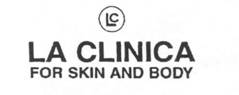 |
The respondent’s mark is as follows:
The mark was accepted for goods and services in classes 3 and 42 respectively:
‘Class 3: Soaps, perfumery, essential oils, body and massage oils, cosmetics, hair lotions, shampoos, conditioners, bleaching products for skin and body
Class 42: Providing of food, drink and temporary accommodation; hygienic, medical and beauty care including spa/health resort; scientific and industrial research in respect of skin care; day centre for surgical and non-surgical procedures; laboratory for skin care development.’
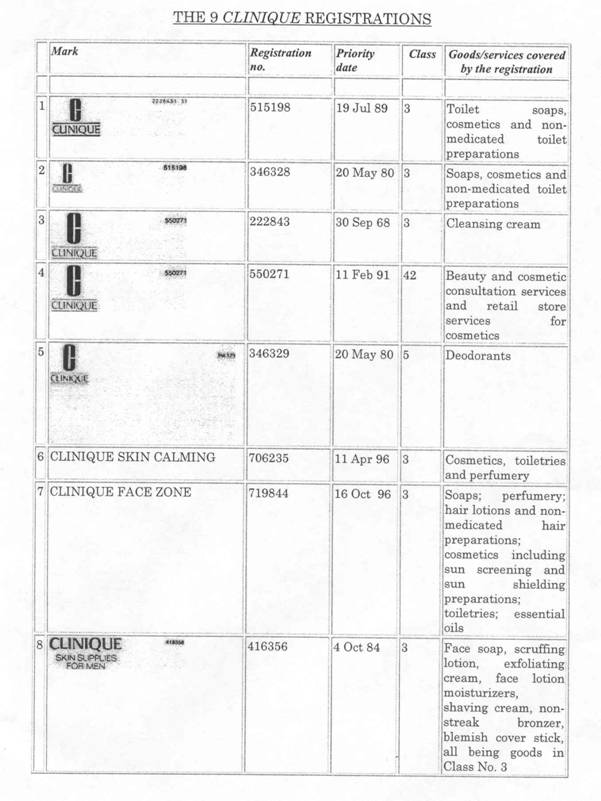
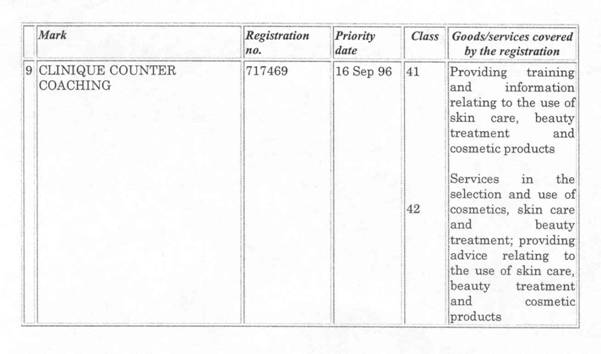
8 Particulars of nine trade mark registrations of Clinique are set out in the schedule to this judgment. Each contains the word ‘Clinique’. The opposition is based upon s 44 in relation to those marks and s 60 in relation to those marks and to the reputation acquired in those marks and variations of them prior to 18 October 1996 which is the priority date for the respondent’s application. It was accepted that the validity of the application is to be judged as at its priority date.
9 It was accepted by the applicant that if the other grounds of opposition cannot be established then the ground provided by s 42 cannot be established. Therefore it does not require separate examination.
10 It was submitted by counsel for the respondent that a presumption in favour of registration underlies the policy of the Act as reflected particularly in s 33 and he referred to Registrar of Trade Marks v Woolworths Ltd (1999) 93 FCR 365 at [24]. It was submitted that unless the applicant is able to establish that the application should clearly not be registered, the opposition should be dismissed and that opposition proceedings and appeals from oppositions are quasi summary in nature, referring to Lomas v Winton Shire Council [2002] AIPC 91-839, [2002] FCAFC 413 at [17]–[19], [36] and Torpedoes Sportswear Pty Limited v Thorpedo Enterprises Pty Ltd & Anor [2003] FCA 901 at [15]–[22].
11 Counsel for the applicant accepts that his client bears the onus of establishing a ground of opposition by reason of the operation of s 55 and s 33. He does not accept that it is necessary to show that the application should clearly not be granted or that opposition proceedings and appeals from oppositions are quasi summary in nature.
12 This raises an important issue for this jurisdiction. There is support for the submissions on behalf of the respondent in the passages from the judgments to which reference was made. Counsel for the applicant submitted that the respondent’s argument sought to put a gloss on the clear words of s 55 of the Act. The opponent has to establish a ground of opposition and there is nothing in s 55 (or s 33) which indicates that this is to be done either to any special standard of proof or in a summary or cursory fashion. Section 54 governs procedure and, apart from the opportunity of being heard, proceedings must be in accordance with the regulations. There is nothing in the regulations to limit the ability of an opponent to prove a ground of opposition. Counsel submitted that the dicta in Lomas and Torpedoes was based upon a false analogy with patent proceedings which could not withstand scrutiny of the legislative history of the provisions and relevant extrinsic material. He submitted in particular that the relevant portion of the Report of the Working Party to Review the Trade Marks Legislation, July 1992, has been misunderstood. The extent to which procedure relevant to patent examination has been incorporated is reflected in the provisions of the Act and regulations governing procedure rather than by an unstated gloss.
13 There is much to be said for the arguments advanced for the applicant. I find it difficult to see how s 33 and s 55 can be read in the manner contended for by the respondent. It is not necessary for me to come to a final view about that because of the opinion I have formed as to the merits of the opposition. It is therefore not necessary for me to analyse the reasoning in Lomas and Torpedoes or in the decisions in relation to patent oppositions such as F Hoffman-La Roche AG v New England Biolabs Inc (2000) 99 FCR 56 at 64–66 and Fina Research SA v Halliburton Energy Services Inc and Others (2002) 121 FCR 94, which themselves are controversial. It appears to be a consequence of this reasoning that a party can oppose the grant of a patent or a trade mark, including appeal to the Court, causing considerable expense and delay and, even if unsuccessful, then bring expungement or revocation proceedings based upon precisely the same ground as relied upon in the opposition proceedings. It is difficult to see how any estoppel or other principle could prevent this occurring if opposition is a summary proceeding decided by reference to a special high onus (cf Miller v University of New South Wales (2003) 200 ALR 565). The opportunity for oppression of an applicant at the hands of a well-resourced commercial opponent is obvious.
Section 44
14 Section 44 requires a comparison of registered marks. The nine marks of the applicant which have been identified all have a priority date before that of the respondent’s mark which is in question. It is virtually accepted that the marks are in respect of similar goods. There is a question as to services. It has not been seriously contended that the marks are substantially identical. The practical question for decision is whether the respondent’s trade mark is deceptively similar to the registered marks of the applicant, at least in relation to the registration for goods. I have taken into account the general evidence as to the course of trade in the goods and services in relation to which the marks are registered. I take the view that purchase or use would be the subject of more than perfunctory consideration.
15 The test for deceptive similarity has been the subject of much authority which has recently been analysed by Allsop J in Anheuser-Busch Inc v Budejovický Budvar, Národní Podnik and Others [2002] 56 IPR 182 at 216–218 and by Bennett J in Torpedoes at [72]–[80]. There is no need for me to repeat that analysis. The issue depends to a large extent upon impression and has been aptly described as a jury question, the answer to which is not easy to explain in analytical language. I have come to the conclusion that the marks are not deceptively similar. I will endeavour to explain why. I see little visual similarity. The only similarity is between the first part of the words ‘Clinique’ and ‘Clinica’. The ending of each is distinct. More importantly, ‘Clinica’ is used in conjunction with ‘La’ as a composite phrase. The layout and other features of the marks are different. In my view the look of the marks would not cause confusion even with imperfect memory.
16 I do not regard the sound of the words as likely to cause confusion. The presence of ‘La’ and the hard second ‘c’ in ‘Clinica’ is quite a different sound from the ‘ique’ ending of ‘Clinique’. ‘La Clinica’ would be perceived as an Italian or Spanish phrase whereas ‘Clinique’ would be perceived as a French word.
17 The best argument that the applicant has is the association of ideas between the words, namely the English word ‘clinic’. Having in mind the classes of goods for which the marks are registered, each word might be said to conjure up an association with a beauty or health clinic. However, the fact that the marks may convey the same idea does not create a deceptive resemblance between them as such. Registration of marks including the word ‘Clinique’ does not amount to registration of every derivation of the English word ‘clinic’ (Cooper Engineering Co Pty Ltd v Sigmund Pumps Ltd (1952) 86 CLR 536 at 538–9).
18 In my opinion this is not a case where those seeing or hearing the marks would assume that there was an association by way of trade between the French version of ‘clinic’ and the Italian or Spanish version of ‘clinic’ or that goods so identified might come from a common source. In my view the respondent’s mark does not so nearly resemble the applicant’s mark that it is likely to deceive or cause confusion. The applicant has not established the ground of opposition provided by s 44 on any view of the required standard of satisfaction.
19 The applicant submitted that I should find that Aloschi chose the respondent’s mark with the intention of appropriating the reputation of the Clinique mark and that this would establish the s 44 issue. I am not persuaded by this argument. I will deal with it in the context of s 60.
20 It is unnecessary to consider whether, in any event, the operation of s 44(3) of the Act could be relied upon by the respondent and, if so, whether it would have defeated the opposition.
Section 60
21 The yardstick of deception or confusion under s 60 is the reputation of the existing mark, whether registered or unregistered. The applicant submits that marks of the applicant have been used in Australia since 1969. The evidence as to that date is unconvincing. I can safely conclude that the applicant’s business was established in Australia by 1979, was well-established by 1989, that it traded on a significant scale until 1996 and that continued thereafter until the present time. It is relevant to note that one of the applicant’s marks was registered as early as 1968 and two others were registered in 1980. The volume of sales was such, and the kind and degree of advertising and promotion were such, that by 1996 there was a considerable reputation in the trade mark ‘Clinique’, without the precise particular representations in the registered marks, in respect of prestige skin and beauty care treatments, cosmetics and related products. I am satisfied that ‘Clinique’ was seen by consumers in Australia by 1996 as a well-established top international mark for prestige products imported from France.
22 The test for deceptive similarity is the same for s 60 as it is for s 44. For that purpose I cannot distinguish the comparison between, on one hand, the word mark ‘Clinique’ (no matter how well-known) and the respondent’s mark and, on the other hand, that between the applicant’s registered marks and the respondent’s mark with which I have dealt.
23 The applicant submits that Aloschi chose the mark in question in order to appropriate part of the reputation that the applicant had built up in the mark ‘Clinique’ by taking another version of the same word and calls in aid the well-known passage from Australian Woollen Mills Ltd v FS Walton & Co Ltd (1937) 58 CLR 641 at 657 (per Dixon and McTiernan JJ):
‘The rule that if a mark or get-up for goods is adopted for the purpose of appropriating part of the trade or reputation of a rival, it should be presumed to be fitted for the purpose and therefore likely to deceive or confuse, no doubt, is as just in principle as it is wholesome in tendency. In a question how possible or prospective buyers will be impressed by a given picture, word or appearance, the instinct and judgment of traders is not to be lightly rejected, and when a dishonest trader fashions an implement or weapon for the purpose of misleading potential customers he at least provides a reliable and expert opinion on the question whether what he has done is in fact likely to deceive. Moreover, he can blame no one but himself, even if the conclusion be mistaken that his trade mark or the get-up of his goods will confuse and mislead the public.’
24 Aloschi was an unsatisfactory witness. Her oral evidence directly contradicted much of her affidavit evidence. She was defensive and evasive. I am satisfied that she was prepared to tailor her evidence to suit her case. Her explanation for the later registration of two other international brands from different fields as marks was unsatisfactory. Her evidence as to the choice of ‘La Clinica’ was plausible but unconvincing. I am satisfied that she was well aware of the reputation of ‘Clinique’. Whilst ‘La Clinica’ may have occurred to her for the reasons she advanced, it is quite possible that she perceived the link with ‘Clinique’ and saw it as a possible advantage.
25 However, in my opinion, any such advantage would not be the result of deceptive similarity between the marks but, rather, the association of ideas based upon the English word ‘clinic’. As I said in relation to s 44, registration of a foreign version of an ordinary English word does not amount to registration of the ordinary English word or of all foreign equivalents of it and gaining a reputation in a foreign version of an ordinary English word is in the same category. In the present case I have held that the marks themselves are distinct. I do not believe that a number of purchasers might be confused as to whether those behind the prestige mark with a French connotation might be marketing goods with an Italian or Spanish connotation.
26 The applicant has not established the ground of opposition based upon s 60.
27 It follows that the appeal must be dismissed, and the decision of the Registrar to register the mark be confirmed. The applicant is to pay the respondent’s costs of the appeal.
|
I certify that the preceding twenty-seven (27) numbered paragraphs are a true copy of the Reasons for Judgment herein of the Honourable Justice Gyles. |
Associate:
Dated: 19 December 2003
|
Counsel for the Applicant: |
R Cobden |
|
|
|
|
Solicitor for the Applicant: |
Baker & McKenzie |
|
|
|
|
Counsel for the Respondent: |
J Baird |
|
|
|
|
Solicitor for the Respondent: |
Griffith Hack |
|
|
|
|
Date of Hearing: |
9–11 December 2003 |
|
|
|
|
Date of Judgment: |
19 December 2003 |
SCHEDULE