

FEDERAL COURT OF AUSTRALIA
Australian Competition & Consumer Commission v Oceana Commercial Pty Ltd [2003] FCA 1516
SUMMARY
1. In accordance with the practice of the Federal Court in some cases of public interest, the following summary has been prepared to accompany the reasons for judgment delivered today. The summary is intended to assist understanding of the decision of the Court. It is not a complete statement of the conclusions reached by the Court or the reasons for those conclusions. The only authoritative statement of the Court’s reasons is that contained in the published reasons for judgment. The published reasons for judgment and this summary will be available on the Internet at www.fedcourt.gov.au.
2. These proceedings concern the sale of residential units at the Gold Coast in 1997 and 1998. The principal respondents involved in the marketing in question are Oceana Commercial Pty Ltd and Markfair Pty Ltd, which were then respectively called Coral Reef and Investlend. Coral Reef engaged a company called NAPC to market the properties and Investlend was used to provide financial advice to prospective purchasers. Mr Bilborough, the fifth respondent was associated with both companies and Mr Quinlivan, the sixth respondent, with Investlend. It has been found that these companies through Mr Bilborough and Mr Quinlivan acted in concert to carry out what has been called the ‘NAPC Scheme’. The steps the Commission alleged were involved in it appear at[17]of the reasons for judgment and the Court’s further comments on it and at [167]. The part the other respondents, apart from the bank, played in it is explained at [6].
3. The ACCC alleged that the conduct of the scheme as a whole was misleading and deceptive conduct within the meaning of s 52 of the Trade Practices Act 1974 (Cth). That aspect of the case has not been established as a matter of law (see [168] to [179]).
4. It has been established that it was possible that purchasers may have been misled about two matters by the representatives of NAPC and Investlend. They were told that the purchase price was the unit’s market value and they were told that the unit would increase in value at the rate of 8 per cent per annum over the following ten years.
5. To establish that the representation about market value was misleading or deceptive it was necessary for the ACCC to prove that the units were sold at a price substantially greater than their true value. The ACCC’s evidence did not establish that fact (see at [223] to [238]).
6. The representation about the rate of capital growth which was made by the Investlend representative in the process of undertaking what was called a ‘property investment analysis’ for purchasers was found to be misleading. (See at [239] to [248]). That was because it was not shown that the companies in question and Mr Bilborough and Mr Quinlivan had any reasonable basis for a belief that the rates were a reliable guide to value.
7. Another aspect of the case involves particular purchasers, Mr and Mrs Gleeson. In connexion with them it has been found that the companies misled them as to the rate of capital growth they could expect and also as to the true role of the Investlend advisor. They were told that that person was a ‘qualified financial advisor’, implying that they were quasi-professional people who were giving advice to the Gleesons which would be in their interests. The impression conveyed was that they were separate from the marketer NAPC. In fact they were engaged in the process of selling properties with NAPC. There is no suggestion that the advisors were qualified. They were simply trained to present their ‘analysis’ and apply pressure.
8. Coral Reef and Investlend have been found liable for breach of s 52. Some but not all of the other respondents have been found liable as accessories to the contravention of s 52. They are the fifth and sixth respondents and the seventh and eighth respondents. There are separate findings made with respect to each of the respondents. The developer and the directors, the third, eleventh and twelfth respondents have not been found liable.
9. The two solicitors (the tenth and thirteenth respondents) were joined to the proceedings because they were on a ‘panel’ of solicitors to whom Investlend referred prospective purchasers at a point when the contract was to be signed. It was alleged that they were guilty of misleading conduct because they did not alert their clients to a number of matters, including the relationship between NAPC and Investlend. It was also alleged that they knew most of the details of the NAPC scheme. This has not been established. With respect to Mr Pointon it was found however that he knew sufficient to have required him to make disclosures to his clients. No orders could however be made because the ACCC is not able to seek orders against him under the Fair Trading Act 1989 (Qld) as it sought to do. It was not shown that he was an accessory to the company’s conduct as alleged by the Commission (see [286] to [304]). The case against Mr Johanson was not established.
10. It was not alleged that the bank knew of or participated in the scheme of marketing. Mr and Mrs Gleeson sought a loan from it to enable them to conclude the purchase. The bank’s valuer had advised the bank that they may have paid too much for the property and that they may not have understood local market conditions. The ACCC alleged, on various bases, that the bank was obliged to provide them with the content of the valuation or alert them in some way so that they might seek their own advice. To succeed the ACCC needed to establish that the Gleesons were in a position such that their ability to make a judgment as to their best interests was seriously affected, or that the bank behaved unconscionably. This requires a consideration of all the circumstances pertaining to the Gleesons and the bank. They did not establish either proposition (see at [322] to [341]).
11. It is necessary to add that in the publicity attending the proceedings reference was made to ‘two tier marketing’. It was said that this involved the sale of units at one price to people who were familiar with the Gold Coast property market and at a much higher figure to people drawn from places distant. There was no evidence tendered at the hearing of such a market (see at [235]).
AUSTRALIAN COMPETITION AND CONSUMER COMMISSION v OCEANA COMMERCIAL PTY LTD, MARKFAIR PTY LTD, ADVANCED COMMERCIAL DEVELOPMENTS PTY LTD, COMMONWEALTH BANK OF AUSTRALIA, CHRISTOPHER RUSSELL BILBOROUGH, DUDLEY JAMES QUINLIVAN, SHANE ANDREWS, MICHAEL BYROM, PETER EGGENHUIZEN, GREGORY POINTON, DEAN CORNISH, JOHN GROUNDS, RODNEY JOHANSON
Q232 of 2001
KIEFEL J
BRISBANE
18 DECEMBER 2003
FEDERAL COURT OF AUSTRALIA
Australian Competition & Consumer Commission v Oceana Commercial Pty Ltd [2003] FCA 1516
TRADE PRACTICES – misleading and deceptive conduct – whether whole course of conduct constitutes misleading and deceptive conduct – scope of s 52 – whether specific representations by companies and their employees constitutes misleading and deceptive conduct – whether solicitors engaged in misleading and deceptive conduct by failing to disclose information to their clients – non-disclosure – silence – whether a reasonable expectation of disclosure – effect of exclusion clauses – accessorial liability – whether knowingly concerned
TRADE PRACTICES – Unconscionable conduct – whether the purchasers were at a special disadvantage – whether the bank acted unconscionably
REMEDIES – injunctions – declarations – scope of relief
Statutes
Australian Securities and Investments Commission Act 2001 (Cth)ss 12CA, 12CB, 12CC, 12DA, 12DG
Trade Practices Act 1974 (Cth) ss 52, 51A, 51AA, 51AC, 80, 75B, 51AAB
Fair Trading Act 1989 (Qld) ss 38, 98
Property Agents and Motor Dealers Act 2000 (Qld) ss 364, 366
Cases
Ahern v The Queen (1988) 165 CLR 87 (Applied)
Australian Broadcasting Corporation v Lenah Game Meats Pty Ltd (2001) 208 CLR 199 (Discussed)
Australian Competition & Consumer Commission v CG Berbatis Holdings Pty Ltd (2003) 197 ALR 153 (Discussed)
Australian Competition & Consumer Commission v Berbatis Holdings Pty Ltd (2000) 169 ALR 324 (Discussed)
Australian Competition & Consumer Commission v Commonwealth Bank of Australia [2003] FCA 1397 (Discussed)
Australian Competition & Consumer Commission v Danoz Direct Pty Ltd [2003] FCA 881 (Discussed)
Australian Competition & Consumer Commission v Universal Sports Challenge Ltd [2002] FCA 1276 (Discussed)
Australian Competition & Consumer Commission v Simply No-Knead (Franchising) Pty Ltd [2000] FCA 1365 (Discussed)
Blomley v Ryan (1956) 99 CLR 362 (Referred to)
Bridgewater v Leahy (1998) 194 CLR 457 (Approved)
Burg Design Pty Limited v Wolki (1999) 162 ALR 639 (Approved)
Campomar Sociedad, Limitada v Nike International Limited (2000) 202 CLR 45 (Discussed)
Commercial Bank of Australia Limited v Amadio (1983) 151 CLR 447 (Approved)
Commonwealth Bank of Australia v Finding (2001) 1 Qd R 168 (Approved)
Commonwealth Bank of Australia v Smith (1991) 102 ALR 453 (Distinguished)
Demagogue Pty Ltd v Ramensky (1992) 39 FCR 31 (Approved)
Fraser v NRMA Holdings Ltd (1995) 55 FCR 452 (Discussed)
Golby v Commonwealth Bank of Australia (1996) 72 FCR 134 (Approved)
Henjo Investments Pty Limited v Collins Marrickville Pty Limited (1988) 39 FCR 546 (Approved)
Hornsby Building Information Centre Pty Ltd v Sydney Building Information Centre Ltd (1978) 140 CLR 216 (Discussed)
Hurley v McDonald’s Australia Ltd (2000) ATPR 41-741 (Discussed)
ICI Australia Operations Pty Limited v Trade Practices Commission (1992) 38 FCR 248 (Approved)
Kimberley NZI Finance Ltd v Torero Pty Ltd (1989) ATPR (Digest) 53,193 (Approved)
Lam v Ausintel Investments Australia Pty Ltd (1989) 97 FLR 458 (Discussed)
Lezam Pty Ltd v Seabridge Australia Pty Ltd (1992) 35 FCR 535 ((Approved)
Melway Publishing Pty Limited v Robert Hicks Pty Limited (2001) 205 CLR 1 (Approved)
Parkdale Custom Built Furniture Pty Ltd v Puxu Pty Ltd (1982) 149 CLR 191 (Approved)
Poseidon Ltd v Adelaide Petroleum NL Ltd (1992) 105 ALR 25 (Approved)
Rhone-Poulenc Agrochemie SA v UIM Chemical Services Pty Ltd (1986) 12 FCR 477 (Discussed)
Spencer v The Commonwealth (1907) 5 CLR 418 (Discussed)
State Government Insurance Corporation v Government Insurance Office of New South Wales (1991) 28 FCR 511 (Approved)
Taco Company of Australia Inc v Taco Bell Pty Ltd (1982) 42 ALR 177 (Approved)
Ting v Blanche (1983) 118 ALR 543 (Discussed)
Yorke v Lucas (1984) 158 CLR 661 (Approved)
Other Authorities
Miller’s Annotated Trade Practices Act 1974 (24th ed)
AUSTRALIAN COMPETITION AND CONSUMER COMMISSION v OCEANA COMMERCIAL PTY LTD, MARKFAIR PTY LTD, ADVANCED COMMERCIAL DEVELOPMENTS PTY LTD, COMMONWEALTH BANK OF AUSTRALIA, CHRISTOPHER RUSSELL BILBOROUGH, DUDLEY JAMES QUINLIVAN, SHANE ANDREWS, MICHAEL BYROM, PETER EGGENHUIZEN, GREGORY POINTON, DEAN CORNISH, JOHN GROUNDS, RODNEY JOHANSON
Q232 of 2001
KIEFEL J
BRISBANE
18 DECEMBER 2003
FEDERAL COURT OF AUSTRALIA
Australian Competition & Consumer Commission v Oceana Commercial Pty Ltd [2003] FCA 1516
Index
BACKGROUND
THE STATUTORY PROVISIONS
THE ALLEGATIONS
against Coral Reef, Napc and Investlend
The NAPC Scheme Generally
The NAPC Scheme and the Gleesons. 14
Against Mr Bilborough
Against Mr Quinlivan
Against the NAPC and Investlend Representatives
Against Redwind and its Directors
Against Mr Pointon
Against Mr Johanson
Against The Bank
the evidence
the marketing and sale of units by napc & Investlend
Redwind’s agreement with napc
the marketing and sale of unit 29 to the Gleesons
the solicitors
the period to settlement - the bank
WHETHER CONTRAVENTIONS
The napc scheme and seciton 52 trade practices act 1974 (Cth)
particular representaitons in the course of the napc scheme
Non-disclosures and the scheme
non-disclosures and the Gleesons
Representations made to the Gleesons
whether market value representation misleading
whether representation of average annual capital growth rate misleading
the liability of coral reef and investlend
the LIABILITY OF Mr Bilborough
the liability of Mr Quinlivan
the liability of Mr Eggenhuizen
the liability of Mr byrom
the liability of Mr Andrews
THE KNOWLEDGE AND COMPLICITY OF Redwind AND ITS DIRECTORS
THE LIABILITY OF Mr Pointon
THE LIABILITY OF Mr Johanson
THE CASE AGAINST THE BANK
ORDERS
AUSTRALIAN COMPETITION AND CONSUMER COMMISSION v OCEANA COMMERCIAL PTY LTD, MARKFAIR PTY LTD, ADVANCED COMMERCIAL DEVELOPMENTS PTY LTD, COMMONWEALTH BANK OF AUSTRALIA, CHRISTOPHER RUSSELL BILBOROUGH, DUDLEY JAMES QUINLIVAN, SHANE ANDREWS, MICHAEL BYROM, PETER EGGENHUIZEN, GREGORY POINTON, DEAN CORNISH, JOHN GROUNDS, RODNEY JOHANSON
Q232 of 2001
KIEFEL J
BRISBANE
18 DECEMBER 2003
|
IN THE FEDERAL COURT OF AUSTRALIA |
|
|
|
QUEENSLAND DISTRICT REGISTRY |
Q 232 OF 2001 |
|
|
BETWEEN: |
AUSTRALIAN COMPETITION AND CONSUMER COMMISSION APPLICANT
|
|
|
AND: |
OCEANA COMMERCIAL PTY LTD (ACN 070 287 991) FIRST RESPONDENT
MARKFAIR PTY LTD (ACN 065 542 761) SECOND RESPONDENT
ADVANCED COMMERCIAL DEVELOPMENTS PTY LTD (ACN 076 810 672) THIRD RESPONDENT
COMMONWEALTH BANK OF AUSTRALIA (ACN 123 123 124) FOURTH RESPONDENT
CHRISTOPHER RUSSELL BILBOROUGH FIFTH RESPONDENT
DUDLEY JAMES QUINLIVAN SIXTH RESPONDENT
SHANE ANDREWS SEVENTH RESPONDENT
MICHAEL BYROM EIGHTH RESPONDENT
PETER EGGENHUIZEN NINTH RESPONDENT
GREGORY POINTON TENTH RESPONDENT
DEAN CORNISH ELEVENTH RESPONDENT
JOHN GROUNDS TWELFTH RESPONDENT
RODNEY JOHANSON THIRTEENTH RESPONDENT
|
|
|
DATE OF ORDER: |
||
|
WHERE MADE: |
BRISBANE |
|
THE COURT DECLARES THAT:
1. That the first and second respondents, Oceana Commercial Pty Ltd, formerly known as Coral Reef Group Pty Limited, and Markfair Pty Ltd, formerly known as Investlend Pty Ltd, did between November 1997 and November 1998 contravene s 52 of the Trade Practices Act 1974 (Cth) by misleading purchasers as to the rate by which residential units at the Gold Coast would increase in value over the following ten years by applying a rate of annual growth of 8 per cent when they had no reasonable basis for so representing.
2. That each of the fifth, seventh and eighth respondents were knowingly concerned in such contraventions and that the fifth respondent conspired with the first, second and sixth respondents and National Asset Planning Corporation Pty Ltd to effect the contraventions.
3. That the sixth respondent was knowingly concerned in such contraventions and conspired with the first, second and fifth respondents and National Asset Planning Corporation Pty Ltd to effect the contraventions in the period from November 1997 to 9 September 1998.
4. That in or about September 1998 the first and second respondents contravened s 52 of the Trade Practices Act 1974 (Cth) by misleading purchasers namely Mr and Mrs Gleeson about the rate by which the unit they were to purchase would increase over the following years by applying an annual rate of 8 per cent per annum, when they had no reasonable basis for so representing and by representing Investlend Pty Ltd as a qualified financial advisor who would act in their interests.
5. That each of the fifth, seventh and eighth respondents were knowingly concerned in those contraventions and in the case of the fifth respondent, conspired with the first and second respondents and National Asset Planning Corporation Pty Ltd, to effect those contraventions.
6. Adjourn for further hearing the question of costs.
Note: Settlement and entry of orders is dealt with in Order 36 of the Federal Court Rules.
|
IN THE FEDERAL COURT OF AUSTRALIA |
|
|
QUEENSLAND DISTRICT REGISTRY |
Q 232 of 2001 |
|
BETWEEN: |
AUSTRALIAN COMPETITION AND CONSUMER COMMISSION APPLICANT
|
|
AND: |
OCEANA COMMERCIAL PTY LTD (ACN 070 287 991) FIRST RESPONDENT
MARKFAIR PTY LTD (ACN 065 542 761) SECOND RESPONDENT
ADVANCED COMMERCIAL DEVELOPMENTS PTY LTD (ACN 076 810 672) THIRD RESPONDENT
COMMONWEALTH BANK OF AUSTRALIA (ACN 123 123 124) FOURTH RESPONDENT
CHRISTOPHER RUSSELL BILBOROUGH FIFTH RESPONDENT
DUDLEY JAMES QUINLIVAN SIXTH RESPONDENT
SHANE ANDREWS SEVENTH RESPONDENT
MICHAEL BYROM EIGHTH RESPONDENT
PETER EGGENHUIZEN NINTH RESPONDENT
GREGORY POINTON TENTH RESPONDENT
DEAN CORNISH ELEVENTH RESPONDENT
JOHN GROUNDS TWELFTH RESPONDENT
THIRTEENTH RESPONDENT
|
|
JUDGE: |
|
|
DATE: |
|
|
PLACE: |
BRISBANE |
REASONS FOR JUDGMENT
BACKGROUND
1 These proceedings involve the marketing and sale of residential units at the Gold Coast in the years 1997 and 1998. At issue is the means by which they were sold. The Australian Competition & Consumer Commission (‘the Commission’) alleges that sales were effected using a system of marketing which contravened the Trade Practices Act 1974 (Cth) (‘the Act’). The fifth and sixth respondents, Mr Bilborough and Mr Quinlivan, and companies with which they were associated, Coral Reef Group Pty Limited (‘Coral Reef’), National Asset Planning Corporation Pty Ltd (‘NAPC’) and Investlend Pty Ltd (‘Investlend’), are alleged to have implemented a system of marketing referred to in the amended statement of claim as the ‘NAPC Scheme’. An allegation that they were responsible for having devised the scheme was not pursued.
2 The NAPC scheme involved a number of steps commencing with telemarketing. This was followed by a seminar at which the benefits of investing in property at the Gold Coast using negative gearing principles and, for those who qualified, an in-home ‘consultation’. At this point prospective purchasers were encouraged to attend at the Gold Coast. Those who accepted were allocated a ‘runner’ whose task was to show them selected properties and introduce them to the ‘financial advisor’. The properties were chosen from a number where Coral Reef had an agreement for marketing. Up to this point the steps were undertaken by representatives of NAPC. The financial advisor was a representative of Investlend. The financial advice consisted primarily of a computer analysis which provided them with projections of income and of the value of the unit at certain points in the future amongst other things. A purchaser was then taken to a solicitor to whom NAPC and Investlend usually referred purchasers.
3 The Commission seeks declarations or injunctions, but not pecuniary penalties, based upon the knowledge or participation of the respondents in the NAPC scheme as a whole. The Commission accepts that not all of the steps in the scheme would constitute a contravention of s 52 of the Act. It nevertheless contends that the conduct of the scheme can be characterised as conduct that is misleading and deceptive or conduct which is likely to mislead or deceive.
4 The Commission’s case also relies upon the use of specific misrepresentations in the carrying out of the scheme in the relevant period. Principal amongst them are statements as to the present and future values of the units being sold, the latter involving the rate at which the unit was said to increase in value. Non-disclosures of aspects of the scheme, such as the existence of a marketing arrangement and a substantial fee to be paid by a developer pursuant to it, are also relied upon.
5 The NAPC scheme is alleged to have been applied to particular purchasers, Mr and Mrs Gleeson. No relief is sought on their behalf. They were purchasers of a unit in a development called the Chevron Palms Units at Chevron Island, Surfers Paradise, in September 1998. Specific misrepresentations are alleged to have been made to them. The Commission also relies upon non-disclosures as misleading and deceptive conduct.
6 In addition to the respondents referred to above, a number of others are said to have been involved in the NAPC scheme. Redwind Pty Ltd, as the third respondent was then named, was a developer who entered into an agreement with Coral Reef for the marketing of its Chevron Palm units. It is also sought to make liable its directors, Mr Cornish and Mr Grounds (the eleventh and twelfth respondents). The eighth and ninth respondents, Messrs Byrom and Eggenhuizen, were NAPC representatives and, respectively, a runner and an in-home consultant. Mr Andrews, the seventh respondent, acted for Investlend as an advisor. Each of them dealt with Mr and Mrs Gleeson. The tenth and thirteenth respondents, Messrs Pointon and Johanson, are solicitors whose firms were on a ‘panel’ maintained by NAPC and Investlend. They dealt with purchasers of marketed properties. Mr Pointon acted for Mr and Mrs Gleeson in the purchase of their unit and Mr Johanson acted for Redwind in the same conveyance.
7 The fourth respondent (‘the bank’) stands in a somewhat different position from the other respondents. A reference to ‘the respondents’ in these reasons does not include a reference to the bank. It was the Gleesons’ bank with respect to the purchase of the unit and held a valuation of the property. It is not alleged that it took part in, or knew of, the NAPC Scheme. It is alleged that, by reason of a valuation it had obtained, it knew of the use of such a marketing scheme in the sale to the Gleesons and that the purchase price was well above the unit’s market value. Its liability is said to depend upon its failure to alert the Gleesons to these matters.
THE STATUTORY PROVISIONS
8 Section 52(1) in Part V of the Act provides that:
‘A corporation shall not, in trade or commerce, engage in conduct that is misleading or deceptive or is likely to mislead or deceive’.
Conduct within the meaning of s 52 includes refusing to do an act: s 4(2).
9 Section 51A is relied upon by the Commission in connexion with representations alleged to have been made as to the future value of properties sold. It provides:
‘Interpretation
(1) For the purposes of this Division, where a corporation makes a representation with respect to any future matter (including the doing of, or the refusing to do, any act) and the corporation does not have reasonable grounds for making the representation, the representation shall be taken to be misleading.
(2) For the purposes of the application of subsection (1) in relation to a proceeding concerning a representation made by a corporation with respect to any future matter, the corporation shall, unless it adduces evidence to the contrary, be deemed not to have had reasonable grounds for making the representation.
(3) Subsection (1) shall be deemed not to limit by implication the meaning of a reference in this Division to a misleading representation, a representation that is misleading in a material particular or conduct that is misleading or is likely or liable to mislead.’
10 Section 75B(1) (‘accessorial liability’) relevantly provides that a reference in this Part to a person involved in a contravention of a provision of Part V shall be read as a reference to a person who:
‘(c) has been in any way directly or indirectly, knowingly concerned in, or party to, the contravention; or
(d) has conspired with others to effect the contravention’.
Allegations of a conspiracy are now restricted to the first and second respondents and the fifth and sixth respondents.
11 Section 80(1) of the Act relevantly provides that the Court may grant injunctions, on the application of the Commission, in such terms as are deemed appropriate where it is satisfied that a person has engaged in conduct that contravenes Part IVA or Part V or where they have been knowingly concerned in the contravention.
12 Sections 51AA(1) and s 51AC, in Part IVA of the Act, are relevant to the case brought against the bank:
‘51AAUnconscionable conduct within the meaning of the unwritten law of the States and Territories
(1) A corporation must not, in trade or commerce, engage in conduct that is unconscionable within the meaning of the unwritten law, from time to time, of the States and Territories.’
‘51AC Unconscionable conduct in business transactions
(1) A corporation must not, in trade or commerce, in connection with:
(a) the supply or possible supply of goods or services to a person (other than a listed public company); or
(b) the acquisition or possible acquisition of goods or services from a person (other than a listed public company);
engage in conduct that is, in all the circumstances, unconscionable.
(2) A person must not, in trade or commerce, in connection with:
(a) the supply or possible supply of goods or services to a corporation (other than a listed public company); or
(b) the acquisition or possible acquisition of goods or services from a corporation (other than a listed public company);
engage in conduct that is, in all the circumstances, unconscionable.
(3) Without in any way limiting the matters to which the Court may have regard for the purpose of determining whether a corporation or a person (the supplier) has contravened subsection (1) or (2) in connection with the supply or possible supply of goods or services to a person or a corporation (the business consumer), the Court may have regard to:
(a) the relative strengths of the bargaining positions of the supplier and the business consumer; and
(b) whether, as a result of conduct engaged in by the supplier, the business consumer was required to comply with conditions that were not reasonably necessary for the protection of the legitimate interests of the supplier; and
(c) whether the business consumer was able to understand any documents relating to the supply or possible supply of the goods or services; and
(d) whether any undue influence or pressure was exerted on, or any unfair tactics were used against, the business consumer or a person acting on behalf of the business consumer by the supplier or a person acting on behalf of the supplier in relation to the supply or possible supply of the goods or services; and
(e) the amount for which, and the circumstances under which, the business consumer could have acquired identical or equivalent goods or services from a person other than the supplier; and
(f) the extent to which the supplier's conduct towards the business consumer was consistent with the supplier's conduct in similar transactions between the supplier and other like business consumers; and
(g) the requirements of any applicable industry code; and
(h) the requirements of any other industry code, if the business consumer acted on the reasonable belief that the supplier would comply with that code; and
(i) the extent to which the supplier unreasonably failed to disclose to the business consumer:
(i) any intended conduct of the supplier that might affect the interests of the business consumer; and
(ii) any risks to the business consumer arising from the supplier's intended conduct (being risks that the supplier should have foreseen would not be apparent to the business consumer); and
(j) the extent to which the supplier was willing to negotiate the terms and conditions of any contract for supply of the goods or services with the business consumer; and
(k) the extent to which the supplier and the business consumer acted in good faith.’
13 Section 51AA(2) provides that s 51AA does not apply to conduct that is prohibited by s 51AC.
14 There have been changes effected with respect to conduct in connexion with ‘financial services’. Section 51AAB(1) of the Trade Practices Act provides that s 51AA does not apply to conduct engaged in relation to financial services. Section 51AF(2) likewise provides that s 52 does not apply to such services. By s 4 of the Act ‘financial services’ has the same meaning as in Division 2 of Part 2 of the Australian Securities and Investments Commission Act 2001 (Cth). It is there defined in such a way as would include the provision of a loan facility. From 11 March 2002 that Act dealt with unconscionable conduct in relation to the provision of financial services (ss 12CA - 12CC) of Division 2 and with misleading and deceptive conduct in connexion with those services (s 12DA). The latter is in the same terms as s 52 of the Trade Practices Act. Section 12CA mirrors s 51AA of the Trade Practices Act and s 12CB contains similar proscriptions to s 51ACbut the list of matters which the Court may have regard to are fewer than in s 51AC(3). Section 12GD provides the Court with power to grant injunctions ‘on the application of the Minister, the Commission or any other person’ where conduct is engaged in which constitutes a contravention of Division 2. The ‘Commission’ is the Australian Securities and Investments Commission.
15 Section 38(1) of the Fair Trading Act 1989 (Qld) is in the same terms as s 52 of the Trade Practices Act 1974 (Cth) save that the prohibition extends to the conduct of a natural person. Section 98(1) and (2) of that Act provides that an injunction may be granted against a person if they have engaged in such conduct. Section 98(3) however provides that the power of the Court to grant an injunction restraining a person from engaging in such conduct:
‘(b) does not include the power to grant an injunction restraining a person from engaging in conduct that constitutes or would constitute a contravention solely of section 38 … unless -
(i) the application is made by the Minister or the commissioner on the grounds that a consumer is, or consumers generally are or would be, adversely affected by the conduct; or
(ii) the application is made by a person who is, or would be, adversely affected by the conduct as a consumer’.
The ‘commissioner’ is the Commissioner for Fair Trading. A question may arise as to the Commission’s reliance upon the Fair Trading Act provisions.
THE ALLEGATIONS
against coral reef, NAPC and Investlend
The NAPC Scheme Generally
16 The first respondent, Oceana Commercial Pty Ltd was, until 22 December 1999, Coral Reef Group Pty Limited and I shall refer to it as ‘Coral Reef’ in these reasons. Mr Bilborough was its sole director and shareholder. Coral Reef obtained units from developers on the Gold Coast for the purpose of their marketing and sale. It was the signatory to an agreement with Redwind for the marketing of what are described in the pleadings as the Chevron Units. They have, however, been called the ‘Chevron Palm Units’ elsewhere and by the witnesses in the proceedings and I will also refer to them by that description. NAPC was previously called Coastal Reef Pty Ltd. I shall continue to refer to it as NAPC. It was in voluntary liquidation at the commencement of the action and is not a party to it. Mr Bilborough was its sole director and shareholder. It was involved in marketing the properties and obtaining potential purchasers.
17 The second respondent traded as ‘Investlend (Australia)’. Up until 9 September 1998 its shares were held equally as between Mr Quinlivan’s wife and Mr Bilborough. Mr Quinlivan managed it. Its function was to provide financial advice to prospective purchasers brought to it by the NAPC representatives and to obtain finance for the purchase. After 9 September 1998 Mr Bilborough alone is alleged to have owned and controlled it. It is not suggested that Mr Quinlivan had a role in Investlend after this time. The NAPC scheme is alleged to have been utilised by Coral Reef, NAPC and Investlend to effect sales of some 900 to 1000 properties in the period in question. Many of the steps involved in the scheme are not in dispute. It is however necessary to set out the whole of the allegation concerning its operation.
‘17. The NAPC Scheme operated in the following manner:
(a) Coral Reef would enter into a marketing arrangement with a developer for a particular development of residential units in the City of the Gold Coast;
(b) pursuant to the marketing arrangement, Coral Reef would be paid a marketing fee per unit for negotiating the sale of units in the development at the marketed price;
(c) the marketing fee:
(i) was substantially in excess of the maximum commission payable to a licensed real estate agent regulated under the Auctioneers and Agents Act 1971 (Qld) who negotiated a sale for the same purchase price as the marketed price;
(ii) was, on average, approximately $30,000 per unit, and on occasions as high as $35,000 per unit;
(d) Coral Reef and the developer would agree the marketed price at which the residential units were to be sold;
(e) the marketed price of each unit was substantially in excess of:
(i) the price at which a developer could reasonably expect to sell the unit without engaging a marketer;
(ii) the fair market value of that unit;
(f) Coral Reef would in turn engage NAPC to undertake the marketing;
(g) NAPC would compile and maintain a stock-list of residential units available for sale from each developer at their respective marketed prices;
(h) NAPC would engage telemarketers to canvass members of the public at a location removed from the City of the Gold Coast (“the targeted location”) in order to:
(i) produce a sufficient group of persons to attend an investment seminar conducted by NAPC at the targeted location;
(ii) determine whether such persons were qualified to participate in the investment seminar, and to purchase a unit in a residential development marketed by Coral Reef and NAPC;
PARTICULARS
Pursuant to the NAPC Scheme members of the public were qualified by earning a minimum income of $30,000 to $40,000 per annum and having a minimum equity in a residential property (usually the family home) of at least $60,000.
(i) if a member of the public was qualified to attend the investment seminar and expressed interest in doing so NAPC would send them a written invitation;
(j) NAPC arranged to conduct an investment seminar at a venue at the targeted location;
(k) at the investment seminar NAPC represented to the members of the public who attended (the “prospects”) that:
(i) NAPC, the presenter, and the other in-house consultants were paid for or sponsored by a group of Gold Coast developers wishing to promote the Gold Coast;
(ii) if they bought an investment property and paid it off, they would have a valuable asset and rental income to support them in their retirement;
(iii) they could negatively gear their purchase against their present income and rental received from the investment and that investment properties on the Gold Coast accordingly cost relatively little to buy and were affordable even by people with modest means;
(iv) rich people exploit the same means to get wealthy, and reduce their income tax at the same time, and that the process was perfectly legal;
(v) investment opportunities on the Gold Coast offered unique benefits in terms of capital growth;
(vi) The Gold Coast averaged capital growth on property values in excess of 10% per annum;
(vii) they could arrange an in-home consultation where an in-home consultant would attend at their home to explain more fully property investment on the Gold Coast and negative gearing with regard to their particular circumstances;
(viii) if they were suitable persons to purchase an investment property on the Gold Coast, they would be offered free or subsidised travel to, and accommodation on, the Gold Coast to inspect investment properties;
(l) the investment seminar was conducted according to a script, a copy of which is available for inspection during business hours at the office of the applicant’s solicitors;
(m) NAPC engaged consultants to attend upon those prospects who requested an in-home consultation;
(n) at the in-home consultation, the consultant made representations to the prospects:
(i) in the terms pleaded in subparagraphs (k)(ii) to (vi) hereof;
(ii) that they were his or her clients and that NAPC and its staff acted in their interests;
(o) further, at the in-home consultation, the consultant engaged by NAPC:
(i) assessed and made a note of the personality type of the prospects, which was recorded on a proforma document to be sent to NAPC and Investlend, as pleaded in subparagraph (p) hereof, without the prospects’ knowledge;
(ii) made a list of the features of the investment proposal that most appealed to the prospects which was recorded on a proforma document to be sent to NAPC and Investlend, as pleaded in subparagraph (p) hereof, without the prospects’ knowledge;
(iii) obtained details of the financial position of the prospects which was also recorded on the proforma document to be sent to NAPC and Investlend, as pleaded in subparagraph (p) hereof;
(iv) determined whether the prospects met the minimum financial criteria, referred to in subparagraph (h)(ii) hereof;
(v) attempted to convince prospects who did meet the requisite criteria to travel to the Gold Coast to get free advice from a financial consultant and to inspect some properties they may care to purchase;
(vi) offered prospects free or subsidised travel to, and accommodation on, the Gold Coast to inspect prospective investment properties;
(p) in the case of each prospect who agreed to travel to the Gold Coast, the in-home consultant:
(i) completed a pro forma document devised by NAPC which recorded personal details of the prospect, together with the information pleaded in subparagraphs (o)(i), (ii) and (iii) hereof;
(ii) forwarded a copy of such document to NAPC and Investlend;
(q) upon such document and information being received:
(i) NAPC assigned a “runner” to the prospect to show the prospect investment properties when they travelled to the Gold Coast;
(ii) Investlend assigned a “financial adviser” to the prospect;
(r) each of the runner and the financial adviser were given a copy of the document referred to in subparagraph (p) hereof;
(s) upon arrival at the Gold Coast, prospects would be met by their assigned runner who would:
(i) introduce them to their assigned financial adviser at Investlend;
(ii) show them residential units only from the stocklists maintained by NAPC;
(iii) reiterate the benefits described in subparagraphs (k)(iii), (v) and (vi) of investing in residential units on the Gold Coast;
(iv) if prospects agreed to purchase a residential unit, introduce or take them to a solicitor, who would act for them on the conveyance of the unit;
(t) upon being introduced to the prospects by their assigned runner, the financial adviser at Investlend would:
(i) explain negative gearing and show prospects an analysis of properties they could consider purchasing;
(ii) review the prospects’ financial position to determine the amount which they would be able to borrow;
(iii) by computer assisted financial analysis, represent what were purported to be the financial benefits of the proposed investments;
(iv) use in such demonstration:
(A) the marketed price as the fair market value of the residential unit;
(B) a capital growth rate of 7% or 8%;
(v) represent that capital growth rates on the Gold Coast exceeded 10% per annum, and that it was accordingly reasonable and conservative to use a capital growth rate of 7% or 8% to assess the investment;
(u) if prospects agreed to purchase a residential unit, the financial adviser at Investlend would:
(i) prepare a finance application, to be submitted to a lender to enable the purchase to proceed, for which Investlend charged the prospects a fee;
(ii) prepare documentation necessary to arrange insurance for the residential unit;
(v) after the finance documentation was completed either the financial adviser or the runner would organise a solicitor to act for the prospects in the purchase of the residential unit, with such solicitor chosen from a panel of firms.
(w) Johanson and Pointon, and their respective firms Short Punch and Greatorix and Perrin Pointon, were on the said panel of firms.’
18 In relation to the NAPC scheme, it is alleged that each of Coral Reef, NAPC and Investlend ‘engaged in a course of conduct, namely the operation of the NAPC Scheme, including the operation of the scheme in its application to the Gleesons, that contravened s 52 of the Act …’.
19 In par 22(a) to (f) and (g) it is alleged that some elements of the scheme were or were likely to mislead or deceive. I have highlighted in par 17 set out above those statements which are dealt with in par 22 as contravening conduct. Paragraph 22 is in these terms:
‘22. The representations made to prospects as part of the NAPC Scheme were misleading or deceptive, or likely to mislead or deceive in that:
(a) NAPC, the seminar presenter and the in-house consultants were not paid for or sponsored by a group of Gold Coast developers wishing to promote the Gold Coast, but in fact were paid from marketing fees derived from the sale of marketed properties;
(b) NAPC and its representatives did not act in the interests of the prospects, but in fact acted in their own interest to derive a marketing fee which was not disclosed to the prospects;
(c) investment opportunities on the Gold Coast did not offer the prospects unique benefits in terms of capital growth;
(d) residential units on the Gold Coast did not enjoy capital growth in excess of 10% per annum;
(e) there was no reasonable likelihood that the marketed properties would return capital growth in the order of 7% or 8% per annum. Insofar as such a representation was as to a future matter, none of the participants in the NAPC Scheme had reasonable grounds for making the representation and the applicant relies on section 51A of the Act;
(f) the marketed price was not the fair market value of the marketed property;
(g) it was not reasonable and conservative to use the marketed price as the value of the residential unit to assess the benefits of the investment;
(h) it was not reasonable and conservative to use 7% or 8% per annum growth rates to assess the benefits of the investment.’
20 It is also alleged that, in order to induce the belief that NAPC and Investlend were separate businesses, they maintained separate offices.
21 Those representations pleaded in parts of par 17, and dealt with in par 22, are later alleged to amount to individual contraventions on the part of NAPC or Investlend. Whilst some respondents contended that the Commission’s case, in connexion with the NAPC scheme, was limited to its operation as a whole, these allegations are clearly alternative. Other respondents are said to be liable as accessories under s 75B(1). I shall deal with them separately in these reasons.
22 The third aspect of the Commission’s case, concerning the application of the scheme generally, is based upon non-disclosures to purchasers. At par 20 it is alleged:
‘20. Each of Coral Reef, NAPC, Investlend, Bilborough, Quinlivan, Andrews, Byrom, Eggenhuizen, Pointon and Johanson:
(a) knew of the NAPC Scheme, the part other respondents played in it, and agreed to participate in it;
(b) knew that the purpose of the NAPC Scheme was to identify prospects and induce them to purchase marketed properties at the marketed prices in the belief that those prices were fair market value;
(c) believed, and acted on the belief, that prospects would be unlikely to purchase marketed properties if they knew of:
(i) the existence of the marketing arrangement;
(ii) the nature, existence or magnitude of the marketing fee;
(iii) the fair market value of the marketed properties;
(iv) the fact that the marketer was not acting in their interests;
(v) the relationship between NAPC, Investlend, Coral Reef and the developer;
(vi) the fact that the income or remuneration of NAPC, Investlend, the telemarketers, the in-home consultants, the runners and the financial advisers depended on persuading prospects to buy marketed properties; and
(d) at no time disclosed any of the matters pleaded in subparagraph (c) hereof to prospects or purchasers of marketed properties;
(e) believed, and acted upon the belief that no other marketing participant would disclose any of the matters pleaded in subparagraph (c) hereof to prospects or purchasers.’
It is later alleged, in par 64, that the non-disclosures of the matters referred to in par 20(c) amount to a contravention of s 52 by Coral Reef, NAPC and Investlend, although there is some doubt as to whether these claims are pursued, as I later observe.
23 I will not set out each of the allegations of conspiracies affecting the first and second respondents. In summary, where it involves conduct of the other or of NAPC they are said to have been knowingly concerned in that conduct or to have conspired with the other parties to act unlawfully. These allegations extend to the operation of the NAPC scheme generally, its application to the Gleesons, and representations and non-disclosures in the course of it to purchasers generally.
The NAPC Scheme and the Gleesons
24 The pleading then turns to the sale, through the use of the NAPC Scheme, of Unit 29 in the Chevron Palms development to Mr and Mrs Gleeson on 24 September 1998, with the first contact occurring on 27 August 1998. It is alleged that the application of the scheme to the Gleesons involved conduct contravening s 52, principally because of misrepresentations. Not all respondents are said to be liable for each misrepresentation. Liability is also said to arise by reason of non-disclosures to the Gleesons.
25 It is alleged that on or about 31 January 1997 Coral Reef entered into a marketing agreement ‘the Chevron Marketing Agreement’ with Redwind. The eleventh and twelfth respondents, Messrs Cornish and Grounds, were directors of Redwind. Mr Johanson, the thirteenth respondent, was a member of the firm of solicitors, Short Punch & Greatorix, and acted for Redwind. It is alleged that the agreement was made pursuant to, and utilising, the NAPC Scheme and provided for a marketing fee in an amount by which the purchase price for each unit sold exceeded $130,000. It is alleged that Redwind agreed with Coral Reef that the units be sold at prices of between $159,900 and $164,900. Coral Reef is then said to have engaged NAPC to market the Chevron Units ‘using the NAPC scheme, at prices between $159,900 and $164,900’ and that these prices were substantially in excess of the fair market value of the units.
26 Mr and Mrs Gleeson resided in Cairns in northern Queensland. They were invited by a telemarketer to attend an investment seminar on 8 September 1998 and did so. At that seminar representatives of NAPC were alleged to have said to them (par 33(d)):
‘…
(i) that NAPC was sponsored by a group of developers to promote the Gold Coast;
(ii) that there were negative gearing benefits of purchasing investment properties on the Gold Coast;
(iii) that the capital growth stemmed from infrastructure spending in the region, that the infrastructure spending was continuing and that the rate of capital growth would continue;
(iv) that no other region of Australia offered a comparable growth rate to the Gold Coast;
(v) that no other form of investment yielded the same level and certainty of return as property investing on the Gold Coast;
(vi) by providing documents including newspaper clippings promoting Gold Coast investment, that there were sustained high property growth rates on the Gold Coast;
(vii) that investment in residential property on the Gold Coast would provide a secure and high rate of capital growth;’
27 The seminar was followed up with a personal consultation at the office of Mr Gleeson on 15 September 1998. Mr Eggenhuizen was NAPC’s representative on this occasion. He is alleged to have made representations to them (par 33 (f)):
‘(f) …
(i) that the Gleesons were his clients and clients of NAPC and that he and NAPC acted in the interests of its clients;
(ii) that by use of negative gearing principles known to him and NAPC, an investment property could be purchased for $165,000 and would have a net cost to the Gleesons of about $27 a week;
(iii) that capital growth rates on the Gold Coast were in the order of 11% per annum so that a $165,000 property could be conservatively expected to increase on average by 8% per annum, making it worth $390,000 in 10 years time;
(iv) that the Gleesons would need to buy several such properties over time to reach the $1 million in 17 years time that would be required for their retirement;
(v) that other forms of investment offered either insufficient returns or were too speculative to compare with the benefits of negative gearing of investment in Gold Coast real estate;
(vi) that a line of credit was the best way to finance the transaction;’
28 It is also alleged that he advised them about negative gearing and purchasing investment property on the Gold Coast and to have provided a booklet and newsletter published by NAPC:
‘(g) …
(i) advised the Gleesons about options for negative gearing and purchasing an investment property on the Gold Coast;
(ii) provided documents to the Gleesons about the benefits of negative gearing;
(iii) provided a newsletter from NAPC which included representations that:
(A) NAPC provided “a comprehensive service to [its] clients which extends from obtaining an investment property to its specific finance and insurance requirements, rental and maintenance, through a group of professional proactive companies affiliated with [NAPC]”;
(B) “Through our knowledge and research at NAPC and Investlend, we try and analyse what will be the best area and price range for our clients”;
(C) “Our aim is to reach out to the Australian community, and encourage individuals to seek and obtain a secure financial future that will allow them to enjoy a better quality of life”;’
…
(iv) provided an NAPC booklet which contained representations including:
(A) NAPC “is a group of entities who operate primarily as property marketers, offering a complete service to investors in residential and commercial real estate. This service includes assessing the requirements of individual investors, identifying the most appropriate properties for their specific negative gearing qualities and providing sound financial analysis to enable potential clients to make informed decisions”;
(B) “Investors are also protected by the use of independent solicitors, registered to operate in the state in which the asset is acquired. Solicitors are compelled to act in the best interest of their clients and face onerous consequences should they not adhere to the stringent requirements of their professional body”;
(C) NAPC “recommends the use of accredited Investment Financial Advisors who in turn arrange finance for the client’s investment only through major Banks and Financial Institutions which are backed by the Reserve Bank of Australia or Government regulated authorities”;
(D) NAPC “prides itself on doing the research for the client”;
(E) “Client’s protection and satisfaction is our objective”;’
29 He encouraged them to visit the Gold Coast and view properties and to that end offered them discounted airfares and accommodation. He subsequently provided details concerning the Gleesons to NAPC and Investlend on 16 September 1998.
30 On 24 September 1998 the Gleesons were shown Unit 29 in the Chevron Palms development by Mr Byrom who is alleged to have represented (par 33(o)):
‘(o) …
(i) the purchase price of $164,900 was fair market value for Unit 29;
(ii) units at the Chevron Units were rented out at $90-$100 per night;
(iii) there was no “low season” for holiday rentals on the Gold Coast, only “peak time” and “mid season”;
(iv) Unit 29 would be a profitable investment for them to purchase;
(v) NAPC was providing independent advice to the Gleesons and was acting in their interests;
(vi) Investlend was providing independent advice to the Gleesons and was acting in their interests;
(vii) Pointon would act as an independent legal adviser for the Gleesons in relation to their purchase of Unit 29;’
31 Mr Byrom then took the Gleesons to the offices of Investlend and introduced them to Mr Andrews. As Investlend’s representative he is said to have represented to them that (par 33(q)):
‘(q) …
(i) the purchase price of $164,900 was fair market value for Unit 29;
(ii) the purchase price of $164,900 was the appropriate price to use to analyse the benefits of buying Unit 29 as an investment;
(iii) Unit 29 would be a profitable investment for them to purchase;
(iv) it was reasonable to apply a capital growth rate of 8% per annum to the purchase price for Unit 29 in analysing the benefit of purchasing it as an investment;
(v) they would be able to sell Unit 29 for $242,292 after 5 years, with selling costs and capital gains tax of $15,404;
(vi) they would be able to sell Unit 29 for $356,007 after 10 years, with selling costs and capital gains tax of $53,697;
(vii) there would be no net outgoing to them in buying Unit 29, after negative gearing, even if rent and occupancy figures were less than those represented by Byrom;
(viii) Investlend was providing independent advice to them and was acting in their interests;’
32 I have highlighted those particulars which are relied upon by the Commission as founding the contravening conduct. Although no relief is sought on their behalf, it is alleged that Mr and Mrs Gleeson decided to purchase the unit ‘in reliance on the representations made to them by NAPC, Investlend, Eggenhuizen, Byrom and Andrews’.
33 The representations are alleged to have been misleading or deceptive, or likely to mislead or deceive, in that:
‘41 …
(a) NAPC, the seminar presenter and Eggenhuizen were not paid for or sponsored by a group of Gold Coast developers wishing to promote the Gold Coast, but in fact were paid from marketing fees derived from the sale of marketed property;
(b) NAPC and its representatives did not act in the interests of the Gleesons, but in fact acted in their own interest to derive a marketing fee which was not disclosed to the Gleesons;
(c) Investlend and its staff did not act in the interests of the Gleesons, but in fact acted in their own interest and in the interest of the other marketing participants;
(d) investment opportunities in marketed property on the Gold Coast did not offer the Gleesons unique benefits in terms of capital growth;
(e) residential units on the Gold Coast did not enjoy capital growth in excess of 10% or 11% per annum;
(f) there was no reasonable likelihood that the marketed properties would return capital growth in the order of 7% or 8% per annum. Insofar as such a representation was as to a future matter, none of the participants in the NAPC Scheme had reasonable grounds for making the representation and the applicant relies on section 51A of the Act;
(g) the marketed price of Unit 29 was not the fair market value of that property;
(h) it was not reasonable and conservative to use the marketed price of Unit 29 as the value of the unit to assess the benefits of the investment;
(i) it was not reasonable and conservative to use 7% or 8% per annum capital growth rates to assess the benefits of investing in Unit 29;
(j) there was no reasonable likelihood that the Gleesons will be able to sell Unit 29 for $242,292 in December, 2003. Insofar as such a representation was as to a future matter, none of the participants in the NAPC Scheme had reasonable grounds for making the representation and the applicant relies on section 51A of the Act;
(k) there was no reasonable likelihood that the Gleesons will be able to sell Unit 29 for $356,007 in December, 2008. Insofar as such a representation was as to a future matter, none of the participants in the NAPC Scheme had reasonable grounds for making the representation and the applicant relies on section 51A of the Act;
(l) Investlend was not an independent financial adviser to the Gleesons, but rather was a marketing participant;
(m) Unit 29 was not a profitable investment for the Gleesons to purchase;
(n) the rentals and occupancy rates advised were not achievable by Unit 29;
(o) Pointon did not provide independent legal advice to the Gleesons, but was a marketing participant.’
34 There are also allegations of non-disclosures to the Gleesons with respect to the matters referred to in par 20(c):
‘76. Each of Coral Reef, NAPC and Investlend, by failing to disclose to the Gleesons any of the matters pleaded in paragraphs 20(c)(i) - (iv), by reason of the matters pleaded in paragraphs 16 to 20 and 34 to 36 has contravened section 52 of the Act and section 38 of the Qld Act.’
35 The same observations made earlier concerning the conspiracy allegations and accessorial liability of Coral Reef and Investlend for the conduct of the other and for NAPC’s conduct apply here.
Against Mr Bilborough
36 Mr Bilborough is alleged to have been knowingly concerned in or a party to the operation of the NAPC scheme, its application to the Gleesons and in the making of each of the representations made in the course of the scheme. He is also alleged to have been knowingly concerned in or a party to the contraventions of s 52 of the Act constituted by the non-disclosures of Coral Reef, NAPC and Investlend (par 65). He is also alleged to have conspired ‘with others’, in the carrying out of the scheme, to contravene s 52. So far as concerns the non-disclosures and misrepresentations alleged to have been made in the course of the scheme generally, he is alleged to have conspired with either or all of Coral Reef, NAPC and Investlend.
37 The only allegation involving s 38 of the Queensland Act now relied upon by the Commission is contained in par 65. It involves a number of the personal respondents:
‘65. Each of Bilborough, Quinlivan, Andrews, Byrom, Eggenhuizen, Pointon and Johanson, by failing to disclose any of the matters pleaded in paragraph 20(c), by reason of the matters pleaded in paragraphs 16 to 20:
(a) has contravened section 38 of the Qld Act;
(b) was knowingly concerned in or party to the contravention by Coral Reef, NAPC and Investlend of the provisions alleged in the preceding paragraph; and
(c) further or alternatively conspired with Coral Reef, NAPC and/or Investlend to contravene those provisions.’
38 So far as concerns the case involving conduct in the nature of representations to the Gleesons, Mr Bilborough is said to be liable as an accessory for each of them, on the basis that he was knowingly concerned in them as contraventions. Allegations of conspiracy are also made in this context, and in par 77, which relates to the non-disclosures of the matters listed in par 20(c)(i)-(vi) to the Gleesons:
‘77. Each of Bilborough, Andrews, Eggenhuizen and Byrom, by failing to disclose to the Gleesons any of the matters pleaded in paragraph 20(c)(i)-(vi), by reason of the matters pleaded in paragraphs 16 to 20 and 34 to 36:
(a) has contravened section 38 of the Qld Act;
(b) was knowingly concerned or party to in the contravention by Coral Reef, NAPC and Investlend of the provisions alleged in the preceding paragraph; and
(c) further or alternatively conspired with Coral Reef, NAPC and/or Investlend to contravene those provisions’.
39 For the reasons earlier mentioned reliance is no longer placed upon s 38 of the Queensland Act here and the allegations of conspiracy would be limited to Mr Bilborough.
Against Mr Quinlivan
40 It is likewise sought to make Mr Quinlivan liable for the operation of the NAPC scheme generally, its application to the Gleesons, the making of representations in it and the non-disclosures to purchasers. With respect to each of these contraventions of s 52 he is alleged to be liable as an accessory, as being both knowingly concerned in the contravention or having conspired with others in it. It is also sought to make him liable under s 38 of the Queensland Act (par 65).
41 The case concerning the Gleesons brought against him is more limited, by reason of his non-involvement after 9 September 1998. It is sought only to make him liable as an accessory to the representation, made at the seminar, that NAPC was sponsored by a group of Gold Coast developers. It is not sought to make him liable for non-disclosures to Mr and Mrs Gleeson.
Against the NAPC and Investlend Representatives
42 It is sought to make each of Mr Eggenhuizen, Mr Byrom and Mr Andrewsliable as accessories to the contravention of s 52 constituted by the conduct of the scheme as a whole, including its application to the Gleesons.
43 In relation to the specific representations within the scheme, Mr Eggenhuizen is said to have been knowingly concerned in those made at the seminar concerning sponsorship by the developers; that investment opportunities offered unique benefits in terms of capital growth; that the Gold Coast averaged capital growth in property values in excess of 10 per cent per annum; and for both the representation made at the seminar and in the in-home consultation that prospective purchasers were clients. He is not said to have been knowingly concerned in what was thereafter represented in the in-home consultation and following. In particular he is not alleged to be involved in the later representation about the use of 8 per cent per annum to assess capital growth, although it is alleged in par 20 that he knew of the scheme as a whole.
44 Mr Andrews is alleged to have been knowingly concerned in the representations that the sale price was a property’s market value and as to the reliability of capital growth rates at 7, 8 and 10 per cent. Liability on the part of Mr Byrom is not alleged to arise from his participation in any specific representations made in the course of the scheme.
45 Each of the three representatives are alleged to have contravened s 38 by the non-disclosure to purchasers of the matters listed in par 20(c) and to have been knowingly concerned in Coral Reef, NAPC or Investlend’s contravention constituted by similar non-disclosures.
46 So far as concerns the Gleesons Mr Eggenhuizen is sought to be made liable as an accessory for the representation at the seminar concerning sponsorship by developers; and for his statement that the Gleesons were his clients; for those contained in the NAPC newsletter and booklet concerning NAPC’s role and that NAPC and Investlend were providing independent advice; and for his statements about capital growth rates. He is also said to be accessorily liable for Mr Andrews’ statements to that effect but not the representation as to price and market value. It is sought to render him liable as an accessory to the s 52 contravention constituted by the companies’ non-disclosures and for his failure to disclose the matters referred to in par 20(c) to the Gleesons.
47 The case against Mr Andrews, as an accessory, concerning the representations to the Gleesons rests upon statements in NAPC’s material provided to them; upon his statements that NAPC and Investlend were providing independent advice and acting in their interests; and upon the statements as to market value and as to the application of capital growth rates.
48 So far as concerns Mr Byrom, and the case concerning the Gleesons, it is also sought to make him liable as an accessory to the statements made by Mr Eggenhuizen about their being clients of NAPC, for the statements about NAPC in the newsletter and booklet and for his and Mr Andrews’ statements about NAPC and Investlend providing independent advice. He is also said to have participated in the representation as to market value. Liability based upon the non-disclosures to the Gleesons of the matters in par 20(c) is alleged against him in the same terms as against Mr Eggenhuizen and Mr Andrews.
Against Redwind and its Directors
49 It is alleged that on 31 January 1997 Coral Reef entered into a marketing agreement with Redwind with respect to the Chevron Palm development. Redwind, through Mr Cornish and Mr Grounds, is alleged to have known that Coral Reef, through NAPC, would market the units using the NAPC scheme; of the extent of the marketing fee; that the marketed price of the units in the development was in excess of their fair market value; that Redwind itself would receive an amount for the units which was substantially in excess of their market value; and that prospective purchasers would not be informed of these matters (par 24). In view of its valuation evidence I do not understand the Commission to press the allegation concerning the amount Redwind received. Paragraph 25 alleges that the marketing agreement:
‘(a) was made pursuant to and utilising the NAPC scheme;
(b) provided for a marketing fee in the amount that the purchase price for each unit sold exceeded $130,000’.
50 It is then alleged, in par 26, that Redwind agreed with Coral Reef that the Chevron Palm Units would be sold at prices between $159,900 and $164,900 each. It is sought to make each of Redwind and Mr Grounds and Mr Cornish liable as having been knowingly concerned in the application of the scheme generally to the Gleesons. It is also sought to make them liable as accessories for the representation as to the price for the unit being its market value. Liability on their part is not however based upon the non-disclosures to the Gleesons.
Against Mr Pointon
51 It is not in issue that Mr Pointon, a member of the firm of Perrin Pointon, acted for Mr and Mrs Gleeson in connexion with their contract to purchase the unit and the settlement of it. He and his firm are also alleged to have been on the panel utilised by NAPC and Investlend. It is alleged that he knew of the NAPC scheme and the part others played in it and he is alleged to have been knowingly concerned in the contravention of s 52 constituted by the operation of the whole scheme and in the application of the whole scheme to the Gleesons.
52 An alternative basis for liability is alleged to arise from Mr Pointon’s non-disclosures. In relation to disclosures to purchasers generally, liability is founded upon the matters referred to in par 20(c). He is alleged to have contravened s 38 of the Queensland Act thereby and to have been knowingly concerned in NAPC and Investlend’s contraventions.
53 In relation to Mr and Mrs Gleeson it is alleged that:
‘37. Between 24 September 1998 and 21 December 1998 Pointon:
(a) owed a duty to act with reasonable care, skill and diligence as the solicitor for the Gleesons and to inform them of all matters known to him that were relevant to them purchasing Unit 29;
(b) knew how the NAPC Scheme worked;
(c) knew that the purchase price for Unit 29 paid by the Gleesons included a marketing fee of $34,900;
(d) knew that Unit 29 was being marketed to the Gleesons pursuant to the NAPC Scheme;
(e) knew that commissions were paid to marketing participants in the NAPC Scheme, and that marketing fees were paid to Coral Reef and NAPC;
(f) knew that the purchase price being paid by the Gleesons was not the fair market value of Unit 29;
(g) knew that the Gleesons had not been informed by any other marketing participant of the commissions and marketing fees to be paid to Coral Reef, NAPC or the other marketing participants;
(h) knew that the Gleesons had not been informed by any other marketing participant that the purchase price was not the fair market value for Unit 29;
(i) knew that an earlier client of his had signed a contract to purchase Unit 29, but was released from the contract and had the deposit of $1,000 refunded upon claiming that NAPC had colluded with Investlend in relation to the purchase;
(j) did not advise the Gleesons of any of the matters within his knowledge set out in subparagraphs (b) to (i) hereof;
(k) knew that if he informed the Gleesons of the nature or extent of the marketing fee for Unit 29 he would no longer get referrals from NAPC or Investlend;
(l) was a marketing participant’.
In par 78 the following contravention is pleaded:
‘78. Pointon, by failing to disclose to the Gleesons any of the matters pleaded in paragraphs 37(b)-(i), by reason of the matters pleaded in paragraphs 16 to 20 and 37:
…
(b) was knowingly concerned in or party to the contravention by Coral Reef, NAPC and Investlend of the provisions alleged in paragraph 76;…’
(Paragraph 76 refers back to par (20(c)).
54 Allegations that he also contravened s 38 of the Queensland Act by reason of non-disclosures to the Gleesons and that he was a conspirator are not pursued. In relation to the specific misrepresentations alleged to have been made to the Gleesons he is sought to be made liable as an accessory for that relating to the purchase price being the market value of the unit.
Against Mr Johanson
55 It is not controversial that Mr Johanson acted as Redwind’s solicitor both in relation to the marketing agreement with Coral Reef, and associated agreements, and with respect to the conveyance to the Gleesons. He and his firm are also alleged to have been on the panel. Mr Johanson is alleged to have known of the scheme and the part played by the other respondents in it.
56 It is sought to make him liable as an accessory to the conduct of the scheme and the consequential breach of s 52, for its application to the Gleesons and the non-disclosures to purchasers generally of the matters in par 20(c). It is sought to hold him liable personally for the non-disclosures to purchasers generally under s 38 of the Queensland Act. So far as concerns the misrepresentations alleged to have been made to the Gleesons, he is alleged to have been an accessory to that concerning the unit being sold at market value.
57 Additionally it is alleged against him that:
‘38. Between about 24 September 1998 and 21 December 1998 Johanson:
(a) acted as attorney and assolicitor for Redwind in relation to its sale of Unit 29 to the Gleesons;
(b) knew how the NAPC Scheme worked:
(c) knew that the purchase price for Unit 29 paid by the Gleesons included a marketing fee of $34,900;
(d) knew that Unit 29 was being marketed to the Gleesons pursuant to the NAPC Scheme;
(e) knew that commissions were paid to marketing participants in the NAPC Scheme, and that marketing fees were paid to Coral Reef and NAPC;
(f) knew that the purchase price being paid by the Gleesons was not the fair market value of Unit 29;
(g) knew that the Gleesons had not been informed by any other marketing participant of the commissions and marketing fees to be paid to Coral Reef, NAPC or the other marketing participants;
(h) knew that the Gleesons had not been informed by any other marketing participant that the purchase price was not the fair market value for Unit 29;
(i) knew that NAPC and Coral Reef were marketers;
(j) knew of the terms of the contract between Redwind and Coral Reef to market the Chevron Units;
(k) knew that a fee of $34,900 was paid to Coral Reef from the sale proceeds of Unit 29;
(l) knew that he and his firm had previously acted for purchasers of property marketed pursuant to the NAPC Scheme, which they knew to be marketed property and had failed to disclose that fact, or the nature or the extent of the marketing fees involved, to their clients;
(m) knew that a previous purchaser of Unit 29 had claimed that Redwind had colluded with NAPC and Investlend in relation to the purchase of Unit 29 and that Redwind had subsequently agreed to release that purchaser from its contract and had repaid the deposit;
(n) was a marketing participant;
(o) did not disclose the nature, existence or extent of the marketing fee to the Gleesons’.
58 The contravention constituted by this knowledge and the failure to disclose the marketing fee is not pleaded. The Commission disavowed reliance upon s 38, in par 77 (referred to at [37] above) which related to some disclosures to the Gleesons and in any event that plea did not ever refer to Mr Johanson. I therefore take it to be part of the narrative relevant to the non-disclosures to purchasers generally.
Against The Bank
59 Paragraph 46 of the amended statement of claim is in these terms:
‘46. The CBA:
(a) knew that the purchase price of Unit 29 was $164,900;
(b) knew that the fair market value of Unit 29 was approximately $100,000;
(c) knew that the purchase price of Unit 29:
(i) was substantially in excess of its fair market value;
(ii) included selling costs that were well in excess of standard Real Estate Institute of Queensland rates; and
(iii) was an inflated purchase price that could not be recouped upon further resale;
(d) knew that the Gleesons resided and carried on business in Cairns;
(e) knew that the fair market value of Unit 29 was not sufficient of itself to support a loan in the amount applied for by the Gleesons;
(f) knew that, if the Gleesons proceeded to make the proposed loan agreements, the benefits to the CBA included:
(i) receipt of loan fees;
(ii) receipt of interest on the sum borrowed over the term of the loan; and
(iii) the opportunity to sell additional services and products, such as insurances, to the Gleesons over the term of the loan;
(g) knew that, notwithstanding that the Gleesons had sought loans very substantially in excess of the fair market value of Unit 29, the total value of the security offered by the Gleesons was ample for the loans sought and that the benefit to the CBA would be greater if the loans sought were provided than if only loans sufficient to purchase Unit 29 at its fair market value were provided;
(h) knew, or had reason to believe, that the Gleesons believed the fair market value of Unit 29 to be approximately $164,900;
(i) knew that the Gleesons were unaware that the fair market value of Unit 29 was approximately $100,000;
(j) knew or had reason to believe that the Gleesons were unaware that the purchase price of Unit 29:
(i) was substantially in excess of its fair market value;
(ii) included selling costs that were well in excess of standard Real Estate Institute of Queensland rate; and
(iii) was an inflated purchase price that could not be recouped upon further resale;
(k) knew or had reason to believe that the Gleesons had been misled, by persons using investment seminar marketing techniques, as to the fair market value of Unit 29;
(l) knew, or had reason to believe, that the Gleesons, as its customers, would rely on the CBA to tell them if it knew of allegations or evidence of any misleading conduct by third parties in relation to their purchase of Unit 29;
(m) knew that, if the Gleesons had been aware of any of the matters pleaded in subparagraphs (b), (c) or (k) they would not have:
(i) proceeded with the purchase of Unit 29; or
(ii) proceeded with their finance application or entered into the loan agreements;
(n) did not disclose the contents of the valuation to the Gleesons;
(o) did not advise the Gleesons of the substance of the matters referred to in paragraph 45 hereof;
(p) did not take any step to alert the Gleesons to the facts set out in subparagraphs (b), (c) or (k)’.
It is then alleged that that conduct, in the context of the Gleesons’ application for finance, amounts to a contravention of s 52. Alternatively, it is alleged that the bank has engaged in conduct which is unconscionable, contrary to s 51AC(1)(a) or alternatively s 51AA.
the evidence
THE MARKETING AND SALE OF UNITS BY NAPC & Investlend
60 The use of a system of marketing involving many of the steps pleaded by the Commission as the NAPC scheme was admitted by Mr Bilborough, although he referred to it as ‘the Coral Reef system’. It is also clear from the evidence of the Gleesons, and from the evidence of other purchasers of NAPC-marketed properties called by the Commission, that the steps were generally those outlined by the Commission. I did not understand the respondents to dispute this. Transcripts of the evidence given by Mr Bilborough, Mr Quinlivan and Mr Pointon pursuant to under s 155 of the Act, particularly that relating to Mr Bilborough, also confirm aspects of the scheme. The Commission’s evidence includes records of some sixty meetings between 4 July 1996 and 1 December 1998 at which one or both of Mr Bilborough and Mr Quinlivan were usually present. They extend to some hundreds of pages. There are some references amongst them which are relevant to confirm the operation of the scheme and how it was managed by NAPC and Investlend and which provide some detail of aspects of it which assume some importance in these proceedings. The scripts used by NAPC representatives for the seminar and the in-home consultation fall into the latter category.
61 Neither Mr Bilborough nor Mr Quinlivan gave evidence at the trial. In his s 155 examination Mr Bilborough explained that the system of marketing commenced in about 1994 or 1995 and that about 1,000 properties were sold by NAPC in its best year. It was a large operation with about 300 people engaged in it at its height.
62 It also appears that Coral Reef maintained stock lists. There are numerous references in the meetings to ‘stock’ in connexion with properties and to ‘runners’ and others undertaking ‘stock runs’ which, I infer, is a process whereby they were to familiarise themselves with particular developments which were to be marketed. Mr Bilborough said that a property stock list was maintained within NAPC and it was from this list that properties to be shown to prospective purchasers were drawn. Coral Reef was the main company which dealt with the developers. Coral Reef and Coastal Reef, the name under which NAPC traded, operated as part of the one group. He said that developers set the price which was put into the stock list. This may be in contention. By 1997 the ‘marketing fee’ was close to $30,000, and on average about $28,000 on each property.
63 As to the marketing arrangements alleged, there is evidence that Coral Reef entered into three other agreements apart from that with Redwind. They are dated 20 November 1996, 23 October 1997 and 9 September 1998. They are relevantly in the same terms as Redwind’s and include reference to a net price payable to the developer. The marketing fee is the amount by which the purchase price obtained by Coral Reef exceeds that price. Clause 5.2 is in the same terms in each case. Pursuant to it the developer agreed to sign an irrevocable authority in the form attached to the Deed for payment of the marketing fee ‘which shall be the amount that the purchase price exceeds the nett price as identified in the Second Schedule’. There are, in the records of meetings, some few references to marketing fees of $30,000 or more. There are references to NAPC, but not the developers, taking ‘the risk’ which I take to refer to the developers being guaranteed payment at the price agreed. In particular at the meeting of 4 June 1998 (at which Mr Bilborough was present) there is discussion of two prices - one for which the developer brings the unit ‘to the market’, and another, higher, figure which is referred to as the selling price. On that occasion the difference was some $15-$25,000, although the discussion refers to paying the costs of marketing to obtain $30-$45,000, and of $30,000 going to the group as the ‘marketer’. Clearly these amounts exceeded what would usually be paid to a real estate agent in Queensland under the Property Agents and Motor Dealers Act 2000 (Qld). It is not however suggested that the fee agreed to be paid by a developer to a marketer was unlawful and it is obvious that this system of marketing would be likely to involve greater expense than more conventional methods.
64 In late August or early September 1998 NAPC received a facsimile message from ‘Forrester Kurts Properties’. It attached what were said to be valuations ‘on all Gold Coast properties you are to sell under our agreements’. The valuation lists in fact identified purchase price, valuation and shortfall. This might be evidence of an occasion when the purchase price was set between Coral Reef and a client. It is not apparent what ‘the agreements’ were. No one was called to prove the valuation figures. It was not obvious that the author of the message was a valuer or just another property agent. The ‘shortfall’ of, some $17,000, was not of the order of Coral Reef’s other marketing fees to which evidence has been directed. It may be advice of what will be necessary by way of bank accommodation.
65 Telemarketing was the first step in the process. Prospective purchasers, or ‘prospects’ as they are referred to in the marketing materials, were recruited from areas away from the Gold Coast. Mr Bilborough said that, from a marketer’s point of view, people coming from a distant area are more likely to make a decision straight away. This may be in part because they do not have the option of putting off a decision by saying that they will return if they remain interested. There may also be a question whether this was the only reason for selecting them.
66 In the publicity attending this trial it was asserted that the system was ‘two tier’ in prices. This refers to there being a lower price for people who lived at the Gold Coast and another, higher, figure which marketers obtained from persons living distant from it and who were not familiar with the local market. As I later observe in these reasons, in connexion with the evidence as to market value, if this was in fact the case it has not been established by the Commission.
67 NAPC ran both the telemarketing and the seminars. The script generally used by NAPC was utilised with respect to the Chevron Palm Units development. There was a standard speech to be delivered at the seminar. Mr Bilborough identified the training manual and the seminar script which would have been used in 1998. It is consistent in some respects with the recollection of the Gleesons as to what was said. He said that seminar presenters were expected to follow the script and were required to learn it. This is apparent from the script itself and from discussions recorded at some of the sales and management meetings which Mr Bilborough and Mr Quinlivan attended. Indeed Mr Bilborough acknowledged, as the records of some meetings show, what was sought to be achieved was a standardised approach throughout.
68 Mr Sivright would appear to have had the most input into the text of the seminar script. At various meetings, including those of 13 March 1997, 2 October 1997, 5 and 6 November 1997 and 1 December 1997, changes to the ‘script’ are proposed. There are a number of references to the ‘script’ the ‘speakers’ and ‘doing the speak’. At a meeting on 5 September 1996 Mr Bilborough suggests that at all levels of contact the seminar speakers, the in-home consultant and the financial advisers should be saying exactly the same thing. This would appear to have been effected in some important respects. On 6 November 1997 (at a meeting at which the fifth and sixth respondents were not present) Mr Sivright stressed the importance of adhering to the original seminar script ‘word for word’. He said that seminar speakers would receive a copy of the video tape of their ‘speak’ along with an analysis of their performance. The ‘speak’ needed to be ‘perfect’ if they were to continue as speakers. Mr Eggenhuizen was an in-home consultant and not a seminar presenter. He did however attend many seminars and confirmed that the presentation was always the same.
69 The seminar script did not mention sponsorship by Gold Coast developers. The Gleesons’ recollection was that the presenter in answer to an enquiry, about ‘what was in it for you’ or as to whether NAPC were real estate agents, said that they were not agents and they were sponsored by a group of developers to promote the Gold Coast. The script did mention sponsorship by Australian developers and NAPC. NAPC was said to have provided assistance to Australians to provide security for their future through investment. Its ‘clients’ were said to have invested in over 443 properties. There does not appear to be any further reference to NAPC’s role. It is the subject of further explanation at the in-home consultation.
70 Pursuant to the script the audience is told that they are probably paying too much tax and that they could legitimately reduce their tax, as some wealthy people do. None of the witnesses recalled this. The emphasis was however clearly upon real estate as being the best investment. The examples given of negative gearing suggest that a property at the Gold Coast purchased for $165,000 would cost relatively little, when the tax benefits are taken into account. Some of the witnesses recalled being told that they could negatively gear their purchase and that investment properties would then cost relatively little. Only Mr Gleeson appears to have recalled the figure of $165,000 being used in the example, as I accept it was. It may generally be observed that none of these other witnesses recalled events in anything like the detail of Mr and Mrs Gleeson, but they were not as focussed and their statements were not taken until much later. I will not detail the example as it is not suggested to be erroneous. The seminar audience are told that an approach to investment should be conservative. There are further examples of the benefits provided. One refers to ‘clients’ who will be likely to sell the property on retirement at a price reflecting an 11 per cent average annual capital growth since purchase.
71 The audience is steered towards the Gold Coast and it is put forward as an ideal location for an investment, although it is not expressed as having ‘unique benefits in terms of capital growth’. The script clearly however places some emphasis upon the rate of capital growth which might be expected. None of the witnesses recalled it being said that investment opportunities on the Gold Coast offered unique benefits in terms of capital growth, but the purchasers Mr Fletcher and Mrs Hanson recalled something being said about increases in value or rates in Queensland and Mr Webber thought the Gold Coast was said to be the highest growth area in Queensland. As I later observe, the reference to a unique opportunity is likely to have been made during the in home consultation.
72 There is some emphasis placed, in the script, upon an explanation of real estate cycles, and to prices for which a unit at the Gold Coast could have been bought at the low point in the cycle ($45,000 - $50,000) and what it sold for at its peak ($150,000 - $175,000).
73 On being shown a slide projection of the words ‘Prices to Double’ the audience is taken to the importance of ‘Average Annual Capital Growth Rate’ in a long term investment. It is explained at the outset that ‘when we talk about negative gearing real estate, we are talking about a medium to long term investment. Usually seven to ten years or more’. The average annual growth rate is said to be derived by looking at values over fifty years. One then averages out ‘the highs and lows of the cycle’ to obtain the average annual capital growth rate. This is said to help to measure the return on investment. The script then goes on:
‘Australia-wide over the past 55-60 years, average annual growth has been about 9.4%. That means that in most places in Australia, if you bought a property it usually doubled in value about every 10 ½ years. During that same period in Southeast Qld, the average annual capital growth rate has been 11.2%, which means that properties on the Gold Coast, for example, doubled about every 7 years during this period. Some areas of the Gold Coast, Sydney and Melbourne, have experienced growth of close to 20% a year.
When we look at average annual capital growth rate, many areas compare favourably. The Gold Coast and Sydney have both enjoyed growth rates in some areas in excess of 20%. The difference, until recently, has been that to get good growth in Sydney, an investor had to look mainly in the Eastern suburbs, where property values started at around $500,000. You could get the same growth rate in the Gold Coast region for $150-200,000. In fact, most of our clients in the past have invested in the Gold Coast region’.
74 The Gleesons’ evidence of what was said is consistent with the references in the script to 11 per cent and 20 per cent. The script then provides for the audience to be told that they need to determine what is the right property, one that will be easy to rent at the right price and one which offers them tax advantages. Financial assessments should be individual and a free personal assessment is to be offered. It is said to include ‘a negative gearing exercise based on a sample property and your financial details’. So far as concerns the person undertaking it, it is said that ‘the people who do the assessments are not licensed agents, which means that you can’t buy anything from them’. This may be what Mrs Gleeson recalls as advice that the in-home consultants are not qualified. Clearly the suggestion was that they would not be pressured to buy anything at that point. To qualify for an assessment they are told they need to have a taxable income of around $30,000 a year and equity in a property of $40,000 or an equal amount of cash. Mrs Gleeson recalled a reference to income of about $40,000.
75 There is evidence concerning the choice made by NAPC personnel concerning the rate for capital growth which appears in the script. Mr Sivright, at the meeting of 13 March 1997 (which both the fifth and sixth respondents attended), discussed the use of either 11.2 per cent or 11 per cent and said he thought that they should use 8 per cent. The context of the discussion was changes to the seminar script. Mr Bilborough suggested a reference to growth over the past 20 years and that at the Gold Coast it had been 12 per cent, 13 per cent and 8 per cent. There is discussion about whether to refer to it at the seminar or leave it to the in-home consultant, who would be in a position to deal with anticipated statements of disbelief. Mr Sivright suggested that when the ‘runners’ come to Investlend, Mr Quinlivan and others associated with Investlend would want to be in a position to speak of ‘10 years based on X per cent growth’. Mr Bilborough proposed the statement that it ‘should be worth conservatively 8 per cent’ and to stress that that is what it should be worth. They voted to retain a reference to 11 per cent. At later points in the sale process it will be observed that the lower figure of 8 per cent is used.
76 The in-home consultation was also conducted by NAPC representatives according to some scripted material and a booklet or collection of papers entitled ‘Investment Property and Negative Gearing’ and ‘Personal Assessment’ and which contains some pages which are blank save for a topic. No doubt it was intended that the in-home consultant was to write some notes upon them as the explanations of each of those topics was provided. Another booklet provided to the Gleesons detailed the principles and application of negative gearing. Many of the purchasers who dealt with NAPC, in addition to the Gleesons, retained the personal assessment booklet. They are in the same form.
77 The first page to be completed by the consultant provides for a calculation of how much money the couple would need to enable them to retire on a nominated income. In the case of the Gleesons the ‘annual income required’ was $50,000 and the sum of $1M nominated as necessary. No complex analysis as to how that sum could be achieved was entered into. Rather a simple calculation was undertaken by which $1M was divided by the number of years for which Mr Gleeson intended to work, 17 years. It was then said, in ‘summary’ that this required $58,823 per annum or $1131 per week. This would have suggested to the Gleesons that the provision they needed to make for their future was substantial, as apparently it did. The next topic in the booklet provided for a discussion of the five step process that the couple were involved in - from seminar to decision. Comparisons were made of the ‘Ways to Wealth’, which included references to banks, superannuation, speculation and lastly, real estate. The next two pages are entitled ‘Property Values’ and ‘Factors in Choosing a Property’. The following, entitled ‘Types of Properties’ has three ranges of prices. They are scored as to whether they contain the three attributes of being easy to rent, easy to sell and having tax advantages. In the case of the Gleesons only the mid-range is nominated as positive on all three - that of $125,000 - $350,000. This range was also nominated in the booklets produced by the other NAPC purchasers. It is not difficult to infer that that was the price range of properties which NAPC marketed.
78 A sheet is provided for the consultant to take financial information. A ‘personal negative gearing sheet’ is then to be filled in. It estimates how much the investment in a unit will cost after taking into account rental income and tax benefits. The cost to the Gleesons was said to be $27 per week. The sheets prepared for the other purchasers all suggested only a small weekly sum as necessary.
79 Amongst the material prepared by Mr Eggenhuizen for the Gleesons is a page which has columns headed ‘1 y’, ‘5 y’ and ‘10 YR’ which I take to be his calculation of the value of such a property at those points of time subsequent to purchase. In this respect however the information provided to the Gleesons appears to differ from that provided to the other purchasers. No sheet containing these calculations appears amongst the material provided to them. As I later observe, there is nothing to suggest that these calculations were intended by NAPC to be undertaken by the consultants. Neither the script nor the printed material allows for it. I should add that the booklets produced by the other purchasers does not contain a completed worksheet on the first mentioned topic, of the money necessary to be accumulated for retirement. It was however provided for as a topic and it would seem likely that it was to be dealt with, to some extent. An NAPC ‘newsletter’ dated May 1998 was also provided to the Gleesons. Mr Eggenhuizen said it was his practice to give the newsletter to his clients. I take it that he was instructed to do so. In it NAPC is described as a ‘group of entities who operate primarily as property marketers, offering a complete service to investors in residential and commercial real estate’. The other purchasers were given similar information. During 1996 it is said that NAPC ‘Sold over 400 properties’ and that ‘Our clients saved $5.6 million in tax’. Elsewhere in it NAPC is described as a team working as professional marketers and consultants. Under the heading ‘Protection for One and All’ all properties ‘marketed’ through NAPC are said to be protected by a building authority. Investors are also said to be ‘protected by the use of independent solicitors’ who are, it is said, ‘compelled to act in the best interests of their clients’. It is said that NAPC ‘recommends the use of accredited investment financial advisors who … arrange finance’. The reference by the NAPC consultant at this point to ‘financial advisors’ is confirmed by the majority of the purchasers who gave evidence. There is nothing to suggest that Investlend representatives in fact had qualifications. I infer that they did not and were simply trained by Investlend in the manner directed by Mr Quinlivan.
80 Mr Eggenhuizen also said that as part of his presentation he would ask the clients to identify how much they would need for their retirement. In each case the figure of $1M was arrived at. He said ‘I believe that figure was around $1 million dollars (that would give the clients approx $50,000 x 20 yrs in retirement)’. It is not apparent from their evidence whether the other purchasers were given the same figure, or one close to it. He would work out an example of negative gearing supplied by NAPC using a property priced at about $167,000 and demonstrate that using an 8 per cent bank interest rate and after taking into account the tax advantages they would only have to contribute about $27.00 per week. He said ‘This was rote learned as part of my training and depending on peoples individual incomes the figure $27.00 could change either way’. He also recalled being trained to refer to investing in property as a medium to long-term investment ‘usually 7 to 10 years and people should look for an area that will achieve capital growth’.
81 The topics in the personal assessment booklet are aligned to those in the script with which Mr Eggenhuizen was provided when he was trained as an in-home consultant. He says that it was not substantially altered in the time he was with NAPC which was between January 1998 and August 2000. It forms part of the NAPC training manual. I take it that the scripts remained in much the same form throughout the operation of this system of marketing, which appears to have predated the period in question. It would appear that the consultants were, like the seminar presenters, required to speak word-for-word from the script. Mr Eggenhuizen was instructed to do so and he memorised it.
82 In accordance with the script to be used the prospective purchasers were to be told that there were three different groups within NAPC: the seminar team which did the seminars and personal assessments; the finance group ‘which is an independent company, which talks to our clients about finance and acts as a broker in most cases’; and a real estate division. The NAPC representatives were to explain that a decision to buy a property follows a five stage process. The seminar is the first stage, the personal assessment the second, the third involves talking to ‘our finance people’. If the potential purchaser thinks negative gearing is something worth pursuing, then the finance and real estate people will target properties for them, depending on the finances and the goals they are trying to reach. Inspection of properties is the fourth step. If they choose to buy a property they will pay a deposit and go through the necessary paperwork. Real estate is described in the script to offer the greatest return on actual investment. The Gold Coast is said to represent a ‘unique opportunity in investment property’ because of its geographical limitations upon expansion. There was low supply and high demand on the Gold Coast. Real estate was to be said to go through definite cycles, occurring usually every 7 years. The script provided for a ‘graphic representation of these cycles’. An illustration was also to be provided by the representatives of unit prices on the Gold Coast averaging $45-50,000 at the low part of the last cycle. At the high end of that cycle, around 1988 and 1989, the same units are to be said to have sold for $150-175,000, a gain of $100,000 in five years. The cycle’s low point is said to have occurred around 1991. Real estate prices were said to have begun to improve and that it was the time to invest: ‘According to the experts, based on past cycles, property values should double in the next three to five years’. An explanation of negative gearing was then to be gone into and the factors necessary to be considered as advantageous. In the range of prices for properties those at between $125,000 and $300,000 were to be targeted as suitable for negative gearing where ‘all the right elements exist’. The Gold Coast’s ‘unique opportunity for growth’ is reiterated in a concluding summary. A worksheet is then to be prepared to show how much a property in the range referred to might cost.
83 At the conclusion of the ‘consultation’, the evidence shows, prospective purchasers were encouraged to attend at the Gold Coast and in some cases discounted airfares and accommodation were offered. Information about them including a ‘personality profile’, as it is referred to in the training manual, and about their financial position would then be forwarded to NAPC and Investlend. In the latter respect at a management meeting on 1 May 1997 (at which both Mr Bilborough and Mr Quinlivan were present) Mr Sivright pointed out that it is not the task of the in-home consultants to decide whether prospective purchasers qualify financially. That is said to be Mr Quinlivan’s and, I therefore infer, Investlend’s job.
84 On arrival at the Gold Coast prospective purchasers were met by the ‘runner’ from NAPC who would take them to the offices of Investlend and show them a small number of properties, usually three. The evidence of the other purchasers did not provide much detail as to what was said by that person. Most of them however recalled being told that the person to whom they were taken and introduced to at Investlend was a ‘financial advisor’ or ‘financial consultant’ or ‘financial guru’. Some few recalled that person producing a business card which also described them as a ‘financial consultant’. One was given a business card with those words printed on it, but this does not appear to have been a universal practice amongst the Investlend representatives. This evidence may assume more relevance in the Gleesons’ case. Mr Bilborough explained that the financial advisor would obtain further details of their financial position and capacity to borrow and undertake a property investment analysis. This refers to computer-generated calculations and projections which were printed out, given to prospective purchasers and discussed by the financial advisors. I shall refer to them as the spreadsheets.
85 The spreadsheets in each case are in the same form as that provided to Mr and Mrs Gleeson. In each of them certain ‘assumptions’ are listed for the calculation. The ‘property value’ in each case has a sum which represents the purchase price which was later paid for the unit in question. The capital growth rate utilised is in each case 8 per cent, although another set of calculations at 5 per cent was also done for the Gleesons. Why this was undertaken for them is not apparent. Relevantly, the projections include that for property values at points in a 10 year period, which have clearly been derived by applying 8 per cent for capital growth annually. The spreadsheet produced for the Gleesons with respect to the Chevron Palm Units was in the following terms:
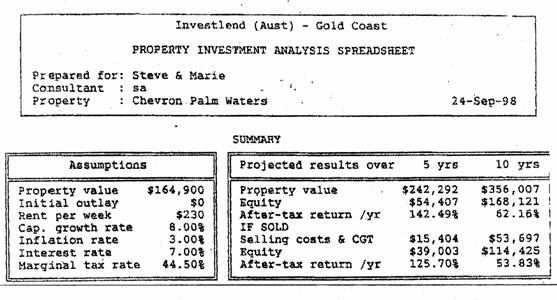
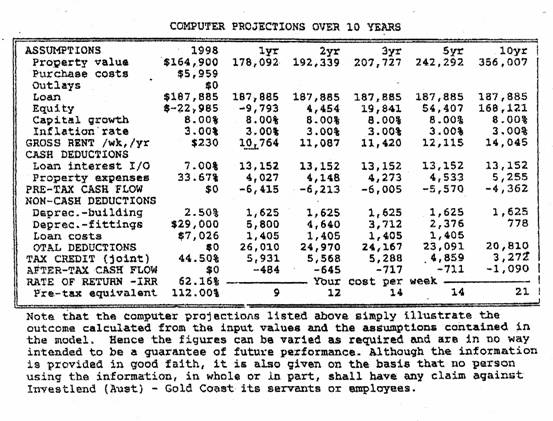
86 The process at the Gold Coast with the runner and the financial advisor was continuous. There was little or no opportunity for private discussion or reflection. The runner remained with them throughout. It involved creating an impression of urgency in relation to securing a unit and substantial pressure then being applied to ‘close’ the sale. I did not understand the fifth and sixth respondents to suggest to the contrary. Indeed it was conceded by them that aspects of the marketing, and the approach which could be seen to be taken to it in the records of meetings, might be seen as unattractive. The sixth respondent accepted that ‘prospects’ were led to believe that a property fulfilled their criteria for an investment; that efforts were taken to prevent them from considering other properties; that an impression was created that NAPC properties were selling quickly; that the purchaser needed to act urgently to secure one; and that they were put under a deal of pressure to make a decision on the spot. When the prospective purchaser’s agreement had been obtained, the Investlend representative would fill out an application for finance, have them sign a mortgage brokerage agreement and provide a cheque by way of deposit. Pursuant to the brokerage agreement Investlend was said to be entitled to a fee of 1.5 per cent. The runner would then take them to a solicitor who had already been chosen for them.
87 The solicitors were from firms on a list, or ‘panel’, maintained by NAPC and Investlend. Mr Bilborough accepts there was such a list. Mr Quinlivan dealt with the solicitors. Records of meetings show that by late 1997 three or four firms were spoken of. Mr Johanson’s firm had been mentioned at an earlier point. The word ‘panel’ is sometimes used in discussions. There is nothing to suggest that the solicitors there referred to were to act in some other capacity other than for these purchasers. The discussions clearly refer to runners bringing prospective purchasers to the named solicitors. On 5 September 1996 and 16 July 1997 the need for runners to obtain deposits before attending upon the solicitors is reiterated. Of the purchasers, other than the Gleesons, who were called as witnesses, seven were taken to Mr Pointon and Mr Johanson’s firm acted for four of them. In each case it would appear that the solicitor was chosen by either NAPC or Investlend.
88 Some twenty purchasers were called, in addition to the Gleesons, to prove the wider application of the NAPC scheme. The purchases took place over a period from late 1997 to 2000. Eight of the properties were purchased after Mr Quinlivan’s association with Mr Bilborough and Investlend apparently ceased, on 9 September 1998. Four of them were not involved with NAPC and Investlend but with a marketer called the ‘Epic Group’ and an advisor called Greenwich Financial Services, entities later associated with Mr Bilborough. I have not had regard to them. Their evidence as to the rates used for capital growth in the property investment analysis is in any event irrelevant, since different rates were used. Those purchasers who dealt with NAPC and Investlend had little recollection of specific statements made to them, such as are alleged. As elsewhere observed, the scripts provide evidence as to the likelihood that the same information was provided to them. These purchasers were able to confirm the use of the written material by the in-home consultant and in most cases were able to produce the spreadsheet they were given by the Investlend advisor.
89 The substantial body of evidence, from NAPC’s records in particular, shows a highly organised operation. Regular and often lengthy meetings were held at which aspects of the scheme were discussed. Many of them were attended by both Mr Quinlivan and Mr Bilborough. Detailed records were kept. Reports from representatives at each point of contact were obtained. Statistics showing the results of seminars were maintained. Reports were filed by the runners. Investlend representatives also filed reports and copies of these were sent to both Mr Quinlivan and Mr Bilborough. There was a substantial focus on training and upon a standard presentation.
REDWIND’S AGREEMENT WITH NAPC
90 Mr Cornish and his father owned some land on Chevron Island, Surfers Paradise in 1996 and Redwind held options on other lots. Together the land was sufficient for a development comprising forty, one bedroom units. Units of this size are targeted at the investment market. It was necessary to proceed with the development he says, or the options might be lost.
91 Mr Cornish says that he had some experience in development at this point but it was principally with respect to commercial developments. He had undertaken only one residential unit development. When he came to consider this development he says he looked at some other units and spoke to sales people. He considered a unit in the proposed development might sell for between $155,000 to $160,000. Mr Grounds became involved at a point after another person left the joint venture with Mr Cornish or Redwind. In any event, I take it that he was involved in the development at the point when the negotiations with Coral Reef were commenced. His function was to undertake the construction of the building.
92 Mr Johanson acted for Redwind in connexion with the agreement for marketing made with Coral Reef and a ‘put option deed’ with Ocean Glade Pty Ltd (‘Ocean Glade’). On 14 January 1997 Mr Johanson wrote to Mr Cornish about Coral Reef. The letter confirms that Mr Johanson’s firm had had discussions with Mr Hart who was representing Ocean Glade. Ocean Glade is said to have a connexion with Mr Bilborough. In the records of meetings of NAPC staff and others Mr Hart appears to be the person who was responsible for the maintenance of a list of ‘stock’, which is to say units or other residential properties for sale through marketing. Mr Johanson advised that Ocean Glade was prepared to enter into an agreement by which any units unsold sixty days after registration of the Building Units Plan would be purchased by it. He noted that Mr Bilborough: ‘is associated with National Asset Planning Corporation and the Coral Reef Group, which entity undertakes marketing of Investment Real Estate throughout Australia and Overseas. Based on the advices given to us by Mr Hart, the Coral Reef Group averaged twenty-three completed sales per month’.
93 In late January 1997 Mr Cornish received a valuation report (‘the Landmark White Valuation’) which valued the development at $5.975M and individual units, except for the manager’s unit, at $135,000. The author of it was not called in these proceedings. It was received in evidence on the limited basis that it may be relevant to the state of mind of the directors of Redwind.
94 On 31 January 1997 Coral Reef and Redwind entered into a deed described as ‘Joint Venture for Development and Marketing’. It was signed by Mr Hart on behalf of the Coral Reef Group. Pursuant to it Redwind appointed Coral Reef as its marketer and promoter. Coral Reef was to engage real estate agents having Redwind’s authority to sell units in the project which was described as ‘Palm Waters’. There is no dispute that this refers to the Chevron Palms Units. As earlier mentioned, cl 5.2 provided in terms that Redwind agreed to sign an irrevocable authority in the form attached to the Deed for payment of the marketing fee ‘which shall be the amount that the purchase price exceeds the nett price as identified in the Second Schedule’. The price identified in the Second Schedule for units 2-40 was $130,000. The authority was to be signed before Redwind was presented with a contract for the sale of each unit. Clause 5.4, which assumes some importance in the Commission’s submissions, provides for an acknowledgment, on the part of Redwind, ‘that this Deed shall form part of any contract of sale entered into by the Developer during the currency of this Deed’. Redwind authorised the purchasers’ solicitors to distribute proceeds on settlement in accordance with the Deed. Redwind’s liability for the marketing fee was expressed to be its maximum liability and any fees and commissions were to be paid by Coral Reef. The marketing fee was not otherwise enumerated.
95 On 19 March 1997 Redwind and Ocean Glade executed a ‘Put Option Deed’, having the effect outlined above. The contract price which Ocean Glade agreed to pay, in the event that units were not sold within the time agreed, was $130,000. By the time the Gleesons signed their contract to purchase Unit 29, there had been thirty sales in the unit development at between $150-$165,000. Although this was a considerable period after the time nominated by the Put Option Deed for sales, Mr Cornish said that it did not occur to him to take the unsold units back and place them with local real estate agents, to recover for Redwind the prices they were in fact selling. The contracts of sale did not make reference to the joint venture agreement nor have a copy of it attached. Mr Cornish said that it became necessary for Redwind to enter into the agreements, including that for a put option, because of difficulties he was having in obtaining finance. Another company associated with Mr Cornish and Mr Grounds, Beltane Pty Ltd, later entered a further marketing agreement with Coral Reef.
the marketing and sale of unit 29 to the Gleesons
96 Mr Gleeson has practised as an architect for over 20 years and is also a registered builder. Mrs Gleeson was trained as a nurse, but for many years has assisted with administrative tasks in the architectural practice. Their accountant, Mr Campbell, is described by them as ‘conservative’, which I take to mean that he is cautious and not likely to advise strategies which involve much risk. Mr and Mrs Gleeson have bought and sold some land in and around Cairns, and they have held some shares. They utilise a family discretionary trust in connexion with the income of the business and understand its operation. In 1998 their family home was unencumbered, a matter of some importance to Mrs Gleeson. Additionally, Mr Gleeson had some familiarity with the development of small-scale residential strata-title units in Cairns and had worked with developers on them. He had undertaken some feasibility studies of such developments but these were connected with building costs. He would not, however, normally be asked by a developer about what units might sell for once they were built. Mr and Mrs Gleeson had not owned investment properties before 1998. Mrs Gleeson said that she was not familiar with analysing rates of return or capital growth rates from the perspective of a purchaser. Mr Gleeson however appears to have understood the relevant principles. He said that he understood about arriving at a value of a property by capitalising a rate of return and about the use of occupancy levels and rental rates in that regard.
97 Each of Mr and Mrs Gleeson received a telephone call in late August 1998 from persons associated with NAPC, inviting them to attend a seminar and learn about investing for retirement and saving on tax. Mr Gleeson attended a seminar conducted by another company the day before he and Mrs Gleeson attended the NAPC seminar, on 8 September 1998. The NAPC seminar covered topics such as investment options, superannuation, the need to be self-funded at retirement, comparison of long term investment returns for different forms of investment, negative gearing, the Gold Coast and its development advantages. The seminar’s focus was on investing in property on the Gold Coast.
98 The seminar presenter was a woman who identified herself as being from NAPC. There was a bundle of newspaper clippings and other information on their seats when they arrived. Mrs Gleeson recalls the seminar presenter saying that the Gold Coast had not had any slumps in growth. The corridor between Brisbane and the Gold Coast, bounded by the hinterland, made the Gold Coast special, as did the climate and the limited availability of land. It was said to be the only area in Australia which had a constant rise in real estate and population. The Gold Coast had had significant business growth and there was presently both a building and a property boom. Mrs Gleeson thought that the ‘high capital growth rates’ of the Gold Coast were given as 10 or 11 per cent but said that she was not now certain. The presenter did not differentiate between different types of property at the Gold Coast. She stressed the need to provide for retirement and Mrs Gleeson became concerned that they may not have enough money to retire on. She recalls that in answer to an enquiry from the audience, the presenter said they were not real estate agents and that NAPC ‘was sponsored by a group of developers to promote the Gold Coast’.
99 Mr Gleeson recalls growth rates in Gold Coast property for the previous 10-20 years being shown. At times the figures showed a growth rate of over 20 per cent and an average of about 10 per cent. There were a lot of graphs and statistical information discussed. The charts showed some ‘dips’ but generally there was sustained growth throughout. The presenter said that capital growth stemmed from infrastructure spending in the region and this was likely to continue. As a result of what Mr Gleeson was told he believed the Gold Coast was the best area in Australia to buy real estate. Examples of the effectiveness of negative gearing were given. It was explained that a unit purchased for $165,000 would cost a person earning $40,000 a year approximately $20 to $25 per week. He also recalls the presenter saying that NAPC was sponsored by a group of developers to promote the advantages of investing in property on the Gold Coast. Neither Mr nor Mrs Gleeson gave evidence that the presenter had said specifically that ‘investment opportunities on the Gold Coast offered unique benefits in terms of capital growth’. Mr Eggenhuizen said that no statement in those words was made. This would appear to be so by reference to the seminar script. These words do however appear in the script utilised by Mr Eggenhuizen.
100 At the conclusion of the seminar the presenter advised that a personal interview could be arranged for persons having an income of over $40,000, where they had a certain amount of equity in their home. An assessment of their personal circumstances would then be undertaken. If they were suitable NAPC would arrange for them to travel to the Gold Coast to inspect properties and consult with an ‘independent financial adviser’. Mrs Gleeson recalls the reference as being to ‘a qualified financial adviser’. I have some doubts about whether a reference is likely to have been made at this point to a financial advisor. It was not scripted and no other purchaser gave evidence of it. I certainly do not think the evidence establishes that the additional qualifications of that person being ‘qualified’ or ‘independent’ were used. They did not appear in any script or material. If anything NAPC and Investlend seem to me to be exercising some care in how far they would go in describing the Investlend representative. It is not hard to appreciate that they may have been conscious of possible repercussions. The further qualifications perhaps more correctly express the opinion Mr and Mrs Gleeson reached at some point about the advisor. Mrs Gleeson also recalls that the audience was advised, in response to a question from a member of it, that the in-home consultant was not a qualified financial adviser. Their job was to assess whether a person’s circumstances were suitable for property investment. Mr Gleeson saw the marketing process as potentially useful to a client who was then developing a strata title hotel in Cairns. Mrs Gleeson was not interested in being interviewed, but the NAPC presenter insisted that both husband and wife be present. This would appear to accord with NAPC’s policy.
101 Mr Eggenhuizen conducted the personal interview at Mr Gleeson’s office on 15 September 1998. Mrs Gleeson did not want the interview to take place in their home. It took between one and two hours. The newsletter was signed by Mr Bilborough as Managing Director. Mr Sivright is referred to in it as the Marketing Manager. He provided a copy of the booklet entitled ‘Investment Property & Negative Gearing Personal Assessment’ and a newsletter of NAPC to the Gleesons.
102 Mr Gleeson recalls Mr Eggenhuizen advising that they would need $1M for their retirement. The property would increase in value over a 10 year period at a rate of 8 per cent per annum. A property that cost $179,000 would be worth $390,000 after 10 years. He said that if you brought a property that cost $165,000 it would cost $27.00 a week to purchase using negative gearing principles and in 10 years time you could sell it for $390,000. Mr Gleeson told Mr Eggenhuizen that they could probably afford $27.00 per week. Mr Gleeson has referred to different figures as the purchase price. Mrs Gleeson recalls a purchase price of $165,000 being mentioned, the net cost to them being $27.00 per week if they used negative gearing and that after five years the property would be worth $260,000 and after 10 years, $390,000. These figures appear in Mr Eggenhuizen’s handwriting in the booklet which I shall shortly refer to. Mr Gleeson recalls being asked by Mr Eggenhuizen whether they could afford $27.00 per week and he replied that they probably could. Mr Eggenhuizen said the actual growth rate over the past 20 years had been 11 per cent but he had used 8 per cent capital growth rate in order to be conservative. He recommended a line of credit as the best method of funding the transaction.
103 Mr Eggenhuizen denied that he had said that the property could be bought at a cost of $27.00 per week and that it would increase in value over a 10 year period by 8 per cent. He said that the reference to 8 per cent was to current interest rates, not capital growth. This is not consistent with the interest rate attributed by him in the booklet to an investment with a bank. It is shown as 5 per cent. He did however agree that he told them they would have a profit on sale after 10 years of approximately $216,000. He did not accept that he had referred to a growth rate of 11 per cent over the last 20 years. Neither 8 per cent nor 11 per cent were in his script, he pointed out.
104 In the personal assessment sheets which were filled in by Mr Eggenhuizen he calculated that to achieve $1M on their retirement, the Gleesons would need to put aside $58,823 per annum or $1131 per week. Mr Eggenhuizen said that he did discuss the figure of $1M for their retirement, but after they had said how much income they needed to live on each year. He did not entirely accept (‘not really’) that it was part of his standard presentation to adopt income at $50,000 a year and apply it over 20 years so as to arrive at $1M. This would not appear to accord with his earlier evidence.
105 When he came to discuss the three price ranges, he has indicated the range referred to in the script as containing all necessary advantages. In a sheet entitled ‘Personal Negative Gearing Sheet’ a unit price of $165,000 was put into the calculation. After rental income and tax benefits were taken into account the cost to Mr and Mrs Gleeson was said to be $27.00 per week. On the following page, which does not have any printing on it, three columns were created in his handwriting and headed “1 y” “5 y” and “10 YR”. The sums of $179,000, $260,000 and $390,000 were inserted under them in that order. Clearly enough there are sums which might be achieved on sale at those points in time after purchase. They are close to the figure later derived by Mr Andrews on a purchase price of $164,900 using an annual capital growth rate of 8 per cent.
106 A figure of $14,040 was also written on the sheet by Mr Eggenhuizen at the end of the ‘10 YR’ column and under the figure of $216,000. The latter would appear to be the difference between the profit which might be derived after 10 years, taking into account the sum of $14,040 which I take to be the cost of the investment based on $27 per week. Mr Eggenhuizen at least recalls giving the Gleesons a figure of $216,000 for profit.
107 It is possible that Mr Eggenhuizen departed from the script in speaking of rates of 11 per cent and 8 per cent undertaking the calculations of future values as he clearly did. As earlier mentioned, it is not provided for in the script or the printed material. A representation that a capital growth rate of 8 per cent per annum was appropriate is not alleged to form part of the NAPC scheme until the point when the financial advisor is involved. It is relied upon in connexion with the Gleesons’ case which is said to be an application of the NAPC scheme.
108 So far as concerns the in-home consultation, Mr Eggenhuizen confirmed that he referred to the persons he was interviewing as ‘clients’ because he had been instructed to do so and to ‘follow on from what the presenter said at the seminar’. He would give them his business card. He considered that it was appropriate to refer to them as clients. He had observed NAPC had likewise referred to people as clients in its handouts and booklets. They were clients in the sense that he was doing his best for them and providing a service by showing the average person how to reduce their taxes and increase their personal wealth. At a later point in his evidence Mr Eggenhuizen sought to resile from this evidence when senior counsel for the fifth respondent suggested to him that he may have picked up the word ‘client’ by reference to a draft affidavit which the Commission’s legal representatives did for him at some point. He agreed with that suggestion.
109 Mr Eggenhuizen did not agree with Mrs Gleeson’s account, that he had examined their tax returns. It seems unlikely that he would have done so if they were not wishing to disclose their complete financial details as Mrs Gleeson said. Mr Eggenhuizen does not believe he would have recommended a line of credit facility. He might have said that most people use a line of credit, but he did not really understand such a facility. This was not convincing. It would not seem to me likely that Mr and Mrs Gleeson would incorrectly recall reference to a particular method of financing. There is further support for the prospect that it was mentioned, since it was a method of financing referred to at the management meetings of NAPC and Investlend of 4 June 1997. Mr Quinlivan there refers to there being no need to include it in the ‘pitch’, which I take to be the scripted presentations.
110 At the conclusion of the interview Mr Eggenhuizen offered Mr and Mrs Gleeson a return airfare to the Gold Coast and accommodation at a discounted price. Mrs Gleeson did not want to go, but Mr Gleeson considered it a good opportunity. The offer was however available only if both of them went. Mrs Gleeson says that Mr Eggenhuizen said that a ‘qualified financial advisor’ would look at their details at the Gold Coast. She asked who the financial advisers were, and Mr Eggenhuizen replied that they were independent financial advisors who NAPC use all the time. She asked why she could not give the information to her financial advisor in Cairns but he said they needed to be advised by someone familiar with the Gold Coast. Mr Gleeson recalls a reference to an ‘independent’ financial advisor. Again, I do not think it likely that the words ‘qualified’ or ‘independent’ were used. They were not scripted and the evidence of the other purchasers does not support their use as likely. The evidence of the other purchasers does however establish as likely that the in-home consultant referred to a financial advisor on the Gold Coast as the next step to take.
111 At some point Mr Gleeson asked why the same principles could not be applied to Cairns real estate and Mr Eggenhuizen replied that the Gold Coast was ‘unique’ or ‘special’. Mr Eggenhuizen, in his evidence, said that the conversation may have taken place, but he could not recall. He does recall that it was company policy to have both husband and wife travel to the Gold Coast. This is also borne out by discussions at NAPC meetings.
112 Mrs Gleeson was suspicious of NAPC. After the interview and before they travelled to the Gold Coast she contacted the Office of Fair Trading and enquired about that company and generally about companies who were selling real estate on the Gold Coast. She was told that the Office had ‘nothing on’ that company. She felt more relaxed because there were no warnings given about the company and apparently no complaints had been received about it. She said, under cross-examination, that whilst she was suspicious, there was a point when she decided that ‘the company must be okay’ because it seemed like a large operation with money to spend.
113 On their arrival at Brisbane on 23 September 1998 Mr and Mrs Gleeson were met by a limousine driver and driven to their accommodation at the Gold Coast. They spent some time looking in the windows of real estate agents offices, but the prices they saw did not assist them. They did not further elaborate on this. Mr Byrom met them the following morning. He told them that he would take them to see ‘the financial advisor’. He took them to Investlend where they were introduced to Mr Andrews. Mr Byrom and Mr Andrews appeared to know each other and to know of the Gleesons’ financial information, Mr Gleeson says. Mrs Gleeson recalls Mr Byrom saying that he was not a real estate agent but that he had worked in real estate before. Mr Byrom told them that he knew some of the consultants at Investlend but had not previously dealt with Mr Andrews. Neither Mr Byrom nor Mr Andrews gave evidence in these proceedings, although Mr Andrews participated to an extent.
114 At the Investlend office Mr and Mrs Gleeson say that Mr Byrom advised Mr Andrews, in their presence, that he was going to show them three properties. The three properties were in the price range of $150,000 to $170,000 and were situated at Merrimac, Scholars Cove and Chevron Palm Waters. Mr Andrews is then said to have undertaken the computer analysis earlier referred to with respect to each of the properties. There is some confusion about whether Mr Andrews undertook an analysis of all three properties at that point. Whilst Mr Gleeson says that he did, he does not refer to copies of those calculations concerning Chevron Palm Waters until later in his affidavit, when he refers to events in the afternoon. Mrs Gleeson’s recollection is that the Palm Waters calculations were undertaken in the afternoon. They may have been done twice. It would seem inconsistent with the pattern of conduct to show them a unit without having such calculations. It would not seem to be a matter of great moment, save for what it might convey about the accuracy of Mr Gleeson’s evidence of these events. In any event, it would seem to me likely that, since the Gleesons were taken to all three properties, the calculations were undertaken of all of them beforehand.
115 Mrs Gleeson recalls Mr Andrews using a figure of 8 per cent when discussing capital growth rates for the units although she says that she did not understand the spreadsheets. Mr Gleeson recalls him saying that the figure was conservative, and referred them to the other material they had been given at the seminar and by Mr Eggenhuizen. He recalls the spreadsheets being used to show what the weekly cost of purchasing each property would be and what they would be worth in 10 years time. Mr Andrews also used a high occupancy rate, of 90-95 per cent. Mr Gleeson agreed that his recollection was that the spreadsheets were used to give them an idea of what they might experience over a long-term period. Mr Gleeson told Mr Andrews that he did not want to buy at this point and that he would like to take the material home and show it to his accountant.
116 Mr Gleeson assumed Mr Andrews was a qualified financial advisor. Mr Andrews’ focus was on the amount it would cost them, on a weekly basis, to buy a property and he was attempting to ascertain whether they could afford Chevron Palms. Mr Gleeson told him that he would prefer to refer the matter to his accountant. Mr Andrews asked what his name was and Mr Gleeson provided it. The fact that the Chevron Palms was operating on holiday rentals interested Mr Gleeson because he had recently done an analysis for a strata title hotel in Cairns. He says he had some understanding about what were reasonable occupancy levels and room rates. He also said that when Mr Andrews was doing the spreadsheets he, Mr Gleeson, thought about the weekly income, but not the annual income. This might suggest a greater interest in return on investments than capital value. Mr Gleeson agreed later, in cross-examination, that he understood the spreadsheets and the important factor to him was the investment value and the positive cash flow. The actual value of the unit and whether it was, say, $159,000 or $158,000 was not really relevant. It was not put to him whether it mattered if the units true value was substantially less.
117 Mr Byrom took Mr and Mrs Gleeson to inspect the three properties. He told them that he had himself bought a property on the Gold Coast at Chevron Island. He appeared confused however about where his block of units was and could not find it. When they arrived at Chevron Palm Waters the number of the unit he took them to did not match that on the file he had. It was occupied and he had to offer to show them another one in the building. Mr Gleeson asked Mr Byrom if there was a ‘pooled rental system where the rents are shared out’ and he said that there was such a system. This interested Mr Gleeson. Mr Byrom told them that the room rates for the unit were $90.00 to $100.00 a night during peak season, Christmas and Easter. The rest of the year was mid-season. Mr Byrom said that the occupancy rates were high but did not give them a figure. Mr Gleeson sought out the manager of the units, Mr Nelson, and asked him about occupancy rates and rental rates. The manager told them that the room rates were $90 or $100 per night and that there were no seasonal variations. He said that the units had been operating for 8 months, that occupancy had started at 30 per cent, quickly built up to 60 per cent and was now running close to 100 per cent. This interested Mr Gleeson because the figures seemed to verify NAPC’s advice and he thought that an on-site manager would have no reason to exaggerate rates. He thought that if Mr Nelson’s advice was correct it would be a very good investment. Later whilst they were at the Merrimac development Mr Byrom received a phone call which was conveyed in some way to the Gleesons. They understood that someone was asking whether the unit they had looked at, at Chevron Palms was still available for sale. Although neither Mr nor Mrs Gleeson describe Mr Byrom as a salesperson who pressured them, Mr Gleeson felt a pressure about buying the unit when he was told about the call.
118 Mr Gleeson videotaped each of the properties. The purchase price of each of the properties was the same, even though they were of different sizes and quality. It does not appear that price was discussed at any point during the day. No attempt was made by Mr Gleeson to negotiate price.
119 Mr and Mrs Gleeson were able to have a private conversation over lunch. The unit at Chevron Palms was the only one which interested Mr Gleeson. They both remained of the view that they would not buy a property that day.
120 Mr Byrom later took Mr and Mrs Gleeson back to the offices of Investlend and to Mr Andrews. He remained with them. Mr Gleeson asked Mr Andrews to ‘punch in’ the occupancy rates he had been provided for Chevron Palms. Mr Gleeson says an analysis was done using a ‘room rate’ of $90.00 and an occupancy rate in excess of 80 per cent. This showed a promising cash flow projection. These calculations were not printed out and provided to him. Mrs Gleeson recalls Mr Andrews saying that at $90.00 a night they would not have to pay anything for three years. Mr Gleeson considered that 60 per cent occupancy and $70.00 per night was a fair but conservative rate for such an assessment, based on previous work he had done for a client. He asked Mr Andrews to do different calculations based on 60 per cent occupancy rates, a ‘worst case scenario’, and also on daily room rates of $65.00. He says he was focussed on the weekly income stream but did not attempt to value the property using those figures. They all produced positive outcomes. Mr Gleeson became interested. In cross-examination he agreed that he relied principally upon his own calculations and the advice of the on-site manager rather than what appeared in the spreadsheets provided to him. He does not appear to have been particularly concerned about the present or future value of the unit. He did not query the price or make an offer at a lower figure.
121 Mr Andrews asked Mr Gleeson if he was interested in the unit at Chevron Palms and was told that Mr Gleeson wished to discuss it with his accountant. Mr Andrews asked whether he would be prepared to buy if the accountant said all was ‘okay’ and Mr Gleeson said ‘probably’. Each of Mr and Mrs Gleeson appear to have been aware of the fact that Mr Andrews was pressuring them. Mr Gleeson recalls feeling uncomfortable about it. Mr Andrews asked whether, if he was able to satisfy their accountant about the figures, Mr Gleeson would be prepared to buy. Mr Gleeson said that he would have to sit down and discuss the matter with his accountant on his return to Cairns as there were other issues, such as the family trust, which needed to be considered. Mr Andrews asked whether he would need to do that if his accountant had all the information and could give the advice now. Mr Gleeson replied ‘probably not’. Mr Andrews then told them that he had already faxed the spreadsheets to their accountant with whom he had spoken and said that he could get him on the phone. Mr Gleeson was annoyed that Mr Andrews had taken this liberty and that he would be charged fees by his accountant as a result. He also says that at this point he could recognise the ‘close’ on the sales pitch. He asked Mr Andrews why he, and not Mr Byrom, was doing the selling if he was the financial advisor and Mr Byrom the sales person. Mr Gleeson says that he believed that Mr Andrews was an independent financial advisor and he remained of this view even though he appreciated Mr Andrew’s remuneration was likely to be linked to their purchase.
122 Mr Gleeson spoke to Mr Campbell over the telephone. The spreadsheets which had been faxed to Mr Campbell were for the Merrimac and Chevron Palm Waters developments. Those relating to Merrimac had utilised growth rates of both 5 per cent and 8 per cent but only that spreadsheet utilising 8 per cent with respect to Chevron Palms was sent to him. Mr Campbell said that he had looked through the spreadsheets and they appeared reasonable. He expressed concern that the growth rates may not be sustainable. Mr Gleeson told Mr Campbell that he had checked out the occupancy levels with the on-site manager who had confirmed that they had been averaging 80 per cent after the first two months of opening and that he had confirmed the salesman’s advice that the room rates were $90.00 per night. He then says that he said:
‘If we are getting the occupancy levels and the room rates over a consistent period, then will that not determine the value of the property and drive the growth rate?’.
Mr Campbell said that he agreed, but that he would have to satisfy himself that he would be able to get the room rates and occupancy rates required. Mr Gleeson agreed in cross-examination that Mr Campbell left the decision with him. This conversation took place in the absence of Mr Byrom and Mr Andrews. It suggests, clearly enough, that the topic of the property’s value in the future arose at some point.
123 Mr Gleeson was asked by the fourth respondent about a note which, was said to have been obtained from Mr Campbell on subpoena and was tendered as part of his business records. Mr Campbell was not called by the Commission to give evidence. It is not dated, but its contents appear to suggest it was made prior to entry into the contract. In this respect I refer in particular to the concluding advice ‘don’t do it’. Its focus would appear to be upon capital value and Mr Gleeson said his was on returns. He said that, when be bought the property, he thought about the return and ‘worked it out as a product between the occupancy level and the room rate’. He says that he may have discussed capital gain on the Gold Coast with Mr Campbell. Mr Gleeson’s question, about the value of the property being determined by its returns may have been a response to Mr Campbell. He does not recall a discussion about a rental guarantee, but was aware what it might cost.
124 The note, is headed ‘Note for Steve’ and records:
‘1. Rental Guarantee probably included in Purchase price
2. as architect he should know relative value
- Gold Coast unknown - construction costs how
to they compare with his experience.
3. Capital gain on Gold Coast - any evidence
4. Unless certain of some capital improvement
on value or expectation that it would do so
don’t do it.’
125 Each of Mr and Mrs Gleeson say that Mr Andrews was engaging in ‘hard-sell’. It is not clear whether this was their view then or one obtained with hindsight. When he returned to the room Mr Andrews asked whether Mr Campbell had answered his queries. Mr Gleeson told him that he had and that he was satisfied that the tax benefit analysis was okay, provided that the assumptions upon which they were based were correct. Mr Gleeson says that he then asked both Mr Andrews and Mr Byrom how he could know that they would be getting a property at a reasonable market value since they had not had a chance to look around and see if the property was over-priced. Mr Byrom responded that they could not have remained in business for 10 years if they were over-pricing properties. There was no other discussion about price. Mr Gleeson said that they wished to go away and think about it, but Mr Byrom countered that the properties sell very quickly. This unit was only available because a sale had not been completed. At this point Mr Gleeson felt that he had to act quickly. Mr and Mrs Gleeson briefly discussed a purchase whilst still in the company of Mr Byrom and Mr Andrews. Mrs Gleeson indicated a lack of understanding but Mr Gleeson said that Mr Campbell had said the tax figures were all right and that had given him peace of mind. He said that he wanted to buy. Mrs Gleeson left the decision to him. Mr Gleeson believed it was a great opportunity and that he might not have another chance to come to the Gold Coast again. Moreover his wife would be reluctant to do so.
126 Mr Andrews then produced paperwork for them to sign. They paid a deposit of $500.00. There does not appear to have been any discussion about price. The finance application was completed quickly, with Mr Andrews advising that they should borrow $200,000 to allow for the purchase of a ‘furniture package’ and to pay out some existing liabilities. Mr and Mrs Gleeson house was to be used as security. They told Mr Andrews they would prefer to use their own bank, the Commonwealth Bank. Mr Gleeson says that Mr Andrews advised them that their house had to be included as security because the amount borrowed was more than the unit. They had discussed borrowing more to cover a furniture package for the unit and additional sums which they could use to pay their credit card account. He said that the unit would cover most of the security requirements. Mrs Gleeson says that she was not aware until some later time that their house property was required as additional security. They signed a mortgage brokerage agreement. Mr Andrews explained that there would be a fee for the brokerage, and that Investlend did not get paid unless they got finance, but did not state the amount. Mr Byrom and Mr Andrews discussed which solicitor they would use and Mr Byrom said ‘Greg Pointon’. Up to this point the Gleesons had not been told about the need for a solicitor. Mr Byrom then took Mr and Mrs Gleeson to Mr Pointon’s office.
the solicitors
127 Mr Pointon did not give evidence in these proceedings. In his examination under s 155 he said that his firm had acted for a number of purchasers on referral by Mr Bilborough’s companies. Mr Pointon said, in his examination, that he was aware that he was on a panel of solicitors and that there were three or four firms on the panel. He understood that work was referred to the solicitors in turn or to whomever was available on the day. The majority of work referred by NAPC to him was undertaken on the weekends and in the afternoon. He said that he recalled meeting Mr Quinlivan and indeed went to see him. This related to the referral of work to his firm. He said that the purpose of his meeting with Mr Quinlivan was to understand the procedure with a view to ‘streamlining the process’.
128 Mr Pointon knew that Coral Reef was operated by Mr Bilborough and that Mr Bilborough’s companies were marketing the Chevron Palms development, after he had seen a number of contracts with respect to it. He knew that Mr Hart obtained ‘stock’ for NAPC. He knew of an association between Mr Quinlivan and Mr Bilborough. He was aware that Mr Bilborough’s company ran a marketing programme for the sale of properties on the Gold Coast and that this was different from the way in which real estate agents marketed. He was aware that telemarketing, seminars and invitations to attend at the Gold Coast were involved and of the use of ‘runners’. He was aware that purchasers were provided with the property income and investment analysis.
129 He knew that the marketing company, Coral Reef, was to be paid a fee. He did not make enquiries to ascertain what fees were paid to the marketers. He was aware that it was substantial. He later accepted that it could be $30,000 or more. In the case of the Gleesons the settlement statement shows the sum of $34,900 to be paid to the Coral Reef Group. At settlement, and following a request from the contracts manager of Coral Reef, Perrin Pointon arranged for a cheque in that amount to be paid to Coral Reef. It may be that his para-legal, Ms Templeton, dealt with these matters. It may be that Mr Pointon also had knowledge of these matters. In any event it is clear enough that he knew that the fee payable to Coral Reef was a substantial one, of the order of $30,000. At no point was information concerning the marketing fee conveyed to his client.
130 Mr Pointon’s principal involvement was in interviewing the client and explaining the contract before it was signed. His para-legal did most of the paperwork following that. He said that the first thing he told clients was that he was an independent solicitor and had no other involvement with the developers or with the marketing or referral group other than the fact that they introduced and referred clients to him. The Gleesons recalled him making such a reference. The Gleesons’ evidence was that they were first met by Ms Noelene Templeton. After being introduced to Mr Pointon, Mr Gleeson asked him whether he was acting for them or for NAPC. Mr Pointon said that whilst he was appreciative of NAPC’s business, he was there to represent them and that he was an independent solicitor. Mr Pointon and Mr Byrom seemed familiar with each other. Mr Byrom remained in the room. Mr Pointon discussed his fees for conveyancing.
131 A contract appears to have already been prepared but they had not signed it. Mr and Mrs Gleeson noticed that it referred to a unit in a different position than the one they had been shown, but since it seemed to be in a superior position, they were unconcerned. Mrs Gleeson agreed, upon questioning, that Mr Pointon took them through their contract, explaining aspects of it. He discussed it being subject to approval of finance and what that meant and advised that there was no ‘cooling off’ period in Queensland. Mr Gleeson also agreed that Mr Pointon advised them that they were purchasing the unit direct from the developer. Mrs Gleeson found this confusing as she had noticed that the deposit was paid to another company, Coral Reef. He also said that the developer wished to retain a right of access to the property and control of the body corporate for 12 months. They were asked to sign a limited power of attorney to that end. Mr Pointon witnessed their signatures in the contract documents.
132 Mr Pointon agreed in his examination that when Mr and Mrs Gleeson first came to see him they had not contracted to buy the unit. He witnessed their signatures. He said that he did not give them any advice other than his ‘standard script’. Some of the other purchasers he dealt with recall him delivering what appeared to be a ‘spiel’. He says that he did not usually enquire as to whether a client had been pressured into signing a contract.
133 Mr Gleeson recalls Mr Pointon saying that the contract contained all of the terms of the agreement between them and the vendor. They could not rely on anything other than what appeared in the contract. Mr Gleeson says that they had relied on other information but he does not appear to have elaborated upon it. Mr Pointon gave a hypothetical example of what they would not be held to. He said if they had been promised a three bedroom unit and it was found only to be a two bedroom unit they could terminate. Mr Gleeson’s evidence as to this conversation was not very clear, and I do not take it to be entirely reliable. He was not however challenged about his general recollection of Mr Pointon’s initial advice about the contract containing the only terms of agreement between the parties and I accept that some such statement may have been made.
134 Some discussion occurred about having the unit inspected prior to settlement, as they had not actually seen it to this point. Mr Byrom is said to have agreed to do so. There would also appear to have been some discussion about the condition of finance approval and whether it should be extended if their bank was slow in approving finance. Mr Pointon advised them that he would obtain extensions for finance unless Mr Gleeson instructed otherwise. Mr Gleeson agreed that that could be done. In the result the contract dated 24 September 1998 had the period for approval of finance extended to 30 November and the settlement to 14 December.
135 Mr and Mrs Gleeson say that at no time were they told of the marketing fee payable to NAPC. If they had been told of it they say they would not have purchased the unit. The evidence shows that prior to acting for the Gleesons Mr Pointon had acted for Mr and Mrs Foley, Mr and Mrs O’Neill and Mr and Mrs Ghata between January 1998 and April 1998 with respect to their purchases of units in Chevron Palms. He acted for Mr and Mrs Veale in July 1998. At some point prior to his dealings with the Gleesons he would have learned that the marketing fee paid to Coral Reef was substantial.
136 Mr Pointon’s view of his role was that of a ‘conveyancing solicitor’. To that extent he understood the Gleesons relied upon him to act in their interests in the conveyance. He did not consider it his duty to disclose the marketing fee and its size, although he said that if he had reason to believe that the marketing fees caused the property to be overpriced, then he would bring that to the client’s attention. He accepted that the marketing fee was not disclosed to clients. Mr Pointon is said to have been encouraging of purchases from NAPC of Gold Coast properties on two occasions. When asked by Mr Gentile, whether he was doing the right thing he responded by pointing to photographs of the development of the Gold Coast and saying words to the effect that one could not go wrong buying in the area. To Mr Hancock he said that he was lucky to have purchased a unit in Chevron Palmsas there were only a few remaining.
137 Mr and Mrs O’Neill were the previous purchasers of Lot 29 but did not complete the conveyance. Ms Templeton’s file note of 26 March 1998 records Mrs O’Neill having telephoned to say that she did not wish to proceed with the sale as an accountant had indicated to them that it did not look like a good investment. Mr Pointon wrote to the O’Neills on the same day pointing out that they were obliged to complete the contract and that they had no grounds for terminating it. A ‘blind copy’ of this letter would appear to have been sent to Investlend. Nevertheless Mr Pointon did write to Mr Johanson’s firm. Mr Johanson in turn sought advice from NAPC and afterwards wrote advising that, as the condition of approval of finance had been fulfilled, the O’Neills were obliged to complete the transaction. Mr Pointon wrote a letter in different terms on 18 May 1998. In it he said:
‘We are specifically instructed by our clients that in defending any attempt to enforce the Contract of Sale they will be asking questions regarding breaches of the Privacy Act under which the developer has been informed of the terms and conditions of the purported loan approval from the Commonwealth Bank.
Our clients will further raise issues regarding collusion between National Asset Planning Corporation, Investlend and the developer’.
138 It is not clear how this letter came to be written. Mr O’Neill did not say that he or his wife gave instructions to write a letter in those terms. Any discussion with Mr Pointon about how they could extricate themselves from the contract was not gone into. At this point, 18 May 1998, Mr Johanson reverted to Redwind, seeking Mr Cornish’s instructions. Mr Cornish said in his evidence that it was Redwind’s practice to let purchasers out of contracts if they asked. It is difficult to believe that this would have been done without reference to Coral Reef or NAPC. The contract was in any event terminated.
139 In the process of Investlend arranging finance for a Mr and Mrs Brain, for the purchase of a unit in Chevron Palm Units for $164,900, Investlend obtained some documents dated February 1998 from a bank which included a ‘Loan Update’. It stated that the valuation of the unit was $120,000. Investlend sent a copy of this document to NAPC and to Perrin Pointon, no doubt in order to inform them as to the progress of finance approval. It may be that it came to Mr Pointon’s attention, but it may not have. He denies that it did. Without more I do not think that knowledge of the valuation figure can be imputed to him.
140 The Commission also relies upon a copy of an earlier communication, on 9 December 1997, from Mr Bilborough which was forwarded to the then panel solicitors. The firms included Mr Pointon’s and Mr Johanson’s firms. In it Mr Bilborough asked them to use their ‘best endeavours to complete the settlements for Chevron Palm Waters … as quickly as possible as we have a personal interest in this development’.
141 Mr Johanson acted for the developer Redwind on the sale to Mr and Mrs Gleeson. He acted for Redwind on all the conveyances in the Chevron Palms development and drew the contracts of sale. They did not contain a reference to the agreement between Coral Reef and Redwind. His firm also acted for Mr Berger in connexion with the purchase of a unit in that development. Of the other purchasers who gave evidence, he acted for Mr Gentle and Mr Lennartsson another solicitor in his firm acted for Mr Puohotauoa. Mr Johanson did not give evidence in these proceedings nor was he examined under s 155.
142 On the way to the airport from Mr Pointon’s office Mrs Gleeson realised that she did not have a copy of all the documents they had signed. She says this was the reason why she became upset. It may be however that she simply realised that they had been pressured into the contract, as they clearly had, and may have made a mistake.
the period to settlement - the bank
143 Some time after their return to Cairns and on 4 November 1998 Mr Gleeson wrote to Mr Pointon’s firm and asked for a copy of the contract. Mr Gleeson says that he also made some enquiries of persons including real estate agents. He appears to have been concerned to discover whether they could get out of the contract. It is not entirely clear when this took place.
144 Mr Gleeson says that he met with Mr Campbell sometime in the period between purchase and settlement. He may have seen him more than once. At some point Mr Gleeson provided Mr Campbell with the new sales figures for himself and his wife which had been adjusted to take advantage of the predicted tax benefits. He says that they discussed the same topics as before. If this is so the note earlier referred to might relate to this communication, except that the advice not to act unless certain of some improvement in value seems more appropriate to a pre-purchase conversation.
145 Although Mrs Gleeson suggested in her evidence that upon their return to Cairns she left the matter with Mr Gleeson, it would appear that she and not he was involved in the correspondence with the solicitors about settlement and with the bank. A number of extensions were organised. She says she became tired of the endless telephone calls. In the two months between their signing the contract and entering into the loan agreement with the bank, Mrs Gleeson received letters from the bank, had telephone communications with officers concerning the transaction and discussed it with an officer at the bank. A letter from the bank dated 23 November 1998 enclosed the bank’s usual terms and conditions. Another copy was sent at a later point. Mr and Mrs Gleeson gave evidence that they assumed the bank would provide them with a copy of the valuation or advise them of any discrepancies. Mrs Gleeson agreed however that she understood the bank’s ‘Usual Terms and Conditions’ document to have advised that it would not make available valuations obtained for its purposes. Further, and contrary to an allegation made by the Commission, that clauses 11.5 and 11.6 were not drawn to the Gleesons’ attention, Mrs Gleeson agreed that a bank officer enquired as to whether she had read them and understood them and she advised that she had. Mr Gleeson did not bother to read them as he regarded any conditions as non-negotiable. Clause 11.5 provided:
‘11.5 If any of our officers, or any person engaged by us, carries out any inspection or valuation of the property offered or taken as security, they do so for our purposes only and not on your behalf. This is the case even if the Contract says you must pay us a valuation fee. Any reports made as a result of the inspection or valuation are our exclusive property. When we inspect or value a property, or do anything as a result of the inspection or valuation, or pay any Loan drawing under clause HL3, we are not responsible for and make no representation to you about the condition of the land, the construction of any building or the standard or value of any building on the property or the uses to which the property may be put’.
146 Clause 11.6 concluded by advising the customer, in case of doubt, to obtain appropriate advice.
‘11.6 We take no responsibility for any decision you make:
(a) to enter into the Contract;
(b) to obtain the Loan; or
(c) about the kind of interest rate (for example, fixed or variable interest rate) you want under the Contract.
Our employees and agents do not have our authority to:
(aa) make any predictions about what might happen to our or anyone else’s interest rates;
(bb) tell you what kind of interest rate would best suit you; or
(cc) make any other representation, prediction or statement of opinion about any other matter or thing affecting the Contract or the Security.
If you have any doubt at all about any of these matters you should seek help from a financial counsellor or obtain legal advice or do both.’
147 Mr and Mrs Gleeson did not seek further assistance.
148 Mrs Gleeson did have a conversation with her brother, an engineer who resided in Brisbane, a few weeks after they had signed the contract to purchase Unit 29. He expressed concern that they had paid too much for it and said that he wished he had known they had been going down to the Gold Coast. He did not think the Gold Coast was a good place to invest in. Mrs Gleeson did not depose to this conversation in her affidavit and said she did not consider it to be relevant. She says she did not seek any further advice as a result of the conversation but did tell her husband about it. Mr Gleeson does not recall being told of it. It would seem to me most unlikely that Mrs Gleeson would not have done so.
149 On 29 October 1998 the Gleesons received a letter from Investlend advising that the bank had conditionally approved their application for finance subject to valuation and other verifications. Mrs Gleeson’s brother carried out an inspection of the unit for them prior to settlement. Settlement took place on 21 December 1998. The settlement reconciliation statement from Mr Pointon’s firm did not disclose the existence of the marketing fee which had been agreed between Redwind and NAPC. Other evidence indicates that each of the persons engaged by NAPC, but not the solicitors, received some form of commission, presumably out of the marketing fee. Mr Gleeson says that it was sometime after settlement that he and his wife realised they had been ‘ripped off’.
150 When the first rent cheque was received on 16 February 1999, for the sum of only $268.86 for a period comprising half of December and all of January, Mr and Mrs Gleeson thought there must have been some error and resolved to take the matter up with the on-site manager. Whether they did so is not apparent. Mr Gleeson said that he also went to see his solicitors in Cairns but stopped doing so when they changed to a firm in Brisbane.
151 On 11 March 1999 Mr Gleeson went to the Annual General Meeting of the Body Corporate of Chevron Palms and discovered that there was no pooled rental system, outgoings were much higher, rentals averaged only about $36 per day and January occupancy rates had been 59 per cent. He says that had he known this to be the true picture, he would not have purchased.
152 It was not until a current affairs programme, which dealt with marketing of units on the Gold Coast, was televised in late February 1999 that Mr and Mrs Gleeson took some steps. Mr Gleeson says that his wife probably first raised the prospect that there was a problem with the unit after seeing the programme. She decided to see a solicitor in Brisbane and was herself contacted by the Commission after she wrote to the presenter of another television programme. She then commenced contacting other unit owners in the Chevron Palms units. Some of them gave evidence in these proceedings.
153 In February and March 2000 Mrs Gleeson wrote to the bank requesting a copy of the its valuation but this request was denied. She did not receive a copy of the valuation until much later when she brought proceedings in the Queensland Property Agents and Motor Dealers Tribunal.
154 The bank’s valuer had assessed the value of the Gleesons’ unit at $100,000. The valuation was undertaken on11 November 1998by reference to three comparable sales in Surfers Paradise. Again, however, the valuation has not been proved in evidence and stands only as the information available to the bank and which, in accordance with its policy, it did not pass on to the Gleesons. In that regard the valuer had advised:
‘Demand for property of this class is currently subdued with purchasers very discerning with large amounts of available stock.
The property was sold via investment seminar techniques where purchasers are generally not well informed as to local market conditions. Selling costs are often well in excess of standard REIQ rates which are then passed on to the purchaser by way of an inflated purchase price and cannot be recouped upon further resale. These methods are well known for achieving selling prices well in excess of local market values’.
155 Mr Brett, the valuer called by the Commission, and indeed the only valuer called to give evidence, is of the opinion that Unit 29 was worth in the order of $120,000 at the date that the Gleesons purchased it. His method of assessing its value is very much in issue. Mr and Mrs Gleeson have not sold the unit. Damages are not sought on their behalf and there is no evidence of its value at the present time, although there was some reference to substantial increases in prices in recent times. The Gleesons also confirmed that rentals are now much higher.
WHETHER CONTRAVENTIONS
THE NAPC SCHEME AND SECTION 52 Trade Practices Act 1974 (Cth)
156 In the period in question Coral Reef entered into marketing agreements with developers pursuant to which it was to be paid a fee. The amount of the fee was not specified. The extent of it depended upon, the amount by which the price at which Coral Reef sold a property exceeded the amount agreed to be paid to the developer. It is not correct to say, as the Commission alleges, that Coral Reef and the developer agreed the price at which the units would be sold. An inference that other developers did so is not open. Coral Reef was looking for a substantial sum, sometimes around $30,000. It is possible that some developers had knowledge of the prices at which units were to be sold by marketers.
157 Many of the other steps taken in the course of NAPC’s marketing are not in dispute. Issue was taken by some respondents to reliance being placed upon the scripts. I will not here repeat the more general statements in the seminar script which deal with the benefits of negative gearing, how little an investment would cost and the like. Of the more contentious references presenters were to say, at each seminar, that NAPC and its representatives were sponsored by a group of Australian developers. Investment opportunities at the Gold Coast were highlighted as most attractive. The average annual capital growth of investment properties at the Gold Coast was said to be more than 10 per cent. It was said to have averaged 11.2 per cent in a period of more than fifty years. Some areas were said to experience nearly 20 per cent annual growth. What this meant, in terms of analysing an investment, was not gone into in any detail at this point. The purpose of the seminar was apparently to create interest in persons who might have enough money to purchase properties in the price range in which Coral Reef sold. It also seems to me likely that the high capital growth rates there referred to were intended to set the scene for a lower rate to be accepted as appropriate for use in analysing a prospective investment.
158 There does not seem to me any reason to regard the seminar script as unreliable. It was identified by Mr Bilborough. It is consistent in some important respects with the evidence of purchasers. The records of meetings establish its content so far as concerns the capital growth rate and confirm that the script would have been kept to on each occasion. Whilst the script was no doubt refined over the period with which this case is concerned, there is nothing to suggest that the main features of it, and especially the figures for capital growth, were altered. It was not suggested that it was in any way substantially altered. Mr Bilborough referred to ‘the script’ prepared by Mr Sivright when he was examined.
159 Similarly it is clear from the evidence of Mr Eggenhuizen and the discussions at meetings about standardisation that the in-home consultant was to keep to a script in discussions with prospective purchasers and in filling out the sheets in the personal assessment booklet. Consistent with the use of the term in NAPC’s material, prospective purchasers were referred to as clients. It was not expressly stated that NAPC and its staff acted in their interests. The balance of the tasks undertaken by the in-home consultant, as particularised, would not appear to be controversial.
160 Mention was made of NAPC’s role in its own material. It referred to itself as sponsored by developers at the seminar. The material provided to purchasers at the in-home consultation contained a reference to NAPC as being a marketer and seller of properties. It also referred to having a separate finance division. There is no suggestion that it did or that Investlend was put forward as being part of NAPC. It is to be recalled however that it is not part of the Commission’s case regarding the scheme generally that Investlend and its representatives were put forward as independent financial advisors to purchasers. That becomes relevant in the case concerning the Gleesons.
161 The only controversial aspects of the dealings by the NAPC and Investlend representatives with prospective purchasers at the Gold Coast are the inferences which are to be drawn from the property investment analysis produced on the printed spreadsheet.
162 The sixth respondent points out that the Commission’s allegation that it was represented in that document that the ‘marketed price’ was the ‘fair market value’ of the unit is not made out. This is because ‘marketed price’ is defined in the preamble to the amended statement of claim as the price agreed between the developer and Coral Reef at which a unit was to be sold. Such an agreement is not established.
163 It is true that the Commission’s pleading proceeds upon an assumption that the price at which a unit is sold was the subject of some agreement with the developer. This would not however seem to me to preclude the Commission relying upon the fact that the price at which they were in fact sold is given as the ‘property value’. The ‘marketed price’ in the amended statement of claim seems to me to bear two meanings. By par 17(t)(iv)(A) it was intended to allege that the price at which units were in fact sold was represented as being their present market value. The fact that the Commission’s assumption that the price was agreed between the developer and Coral Reef would not detract from that basic premise. It is however common ground that the Commission’s additional qualification of the market value being ‘fair’ adds nothing to usual principles of valuation.
164 Eight per cent was said to be the average annual growth rate of the unit investment. It was utilised in the analysis undertaken. Its use and the way in which the conclusions were presented conveyed two things in my view: that the figure might reliably be used in the analysis and that the property’s value over the next ten years could reasonably be forecast using that figure. It does not however appear that a mention of capital growth rates having exceeded 10 per cent and that the use of 8 per cent was therefore conservative, was made at this point. There is no script for the Investlend interview in evidence, although undoubtedly the financial advisors were trained. This allegation would appear to be drawn from what Mr Andrews said to Mr and Mrs Gleeson, but it is not possible to draw a conclusion that all purchasers were told this as a matter of course. I accept however that purchasers were led to believe the figure was reliable by reference to high capital growth rates in the seminar and a lower rate when analysing the investment.
165 Investlend and NAPC conducted their offices at different places. It may be inferred that it was sought to portray Investlend as separate or independent to an extent.
166 The final step in the scheme was to take the purchaser to a solicitor to whom NAPC and Investlend regularly referred purchasers and with whom they had had some discussions. Clearly this was undertaken.
167 The aspects of the scheme which are not pleaded, but which would seem to me to have a great deal to do with its effectiveness are those features earlier referred to: the script which is never departed from and which allows the client to be taken to the conclusion sought to be reached; the lack of opportunity to reflect on the investment and the nature of the advice being given; and the reliability of the persons with whom they were dealing. I also gained the impression, but put it no higher, that NAPC may have determined to choose people having a similar level of experience and personality type. The pressure to decide, applied towards the end by the adviser acting in concert with the runner, was considerable and it would, I think, have been obvious to many purchasers. It would however appear that they felt constrained to continue. A matter which exemplifies the position in which purchasers found themselves is, in my view, the fact that not one purchaser discussed price. They were led to believe they had to act quickly to obtain these units which would prove to be valuable assets. Negotiation does not appear to have been considered as an option.
168 The Commission submit that, whilst the majority of cases concerning s 52 concern conduct which involves the making of discrete representations, the scope of the section is not so confined. So much may be accepted. Conduct answering the description of being ‘misleading or deceptive’ may not always involve misrepresentations: Henjo Investments Pty Limited v Collins Marrickville Pty Limited (1988) 39 FCR 546 at 555; Demagogue Pty Ltd v Ramensky (1992) 39 FCR 31 at 40-41; and State Government Insurance Corporation v Government Insurance Office of New South Wales (1991) 28 FCR 511 at 561-562. On the Commission’s case the section is wide enough to encompass a number of steps and conduct of different kinds and effect. The Commission’s case at this point does not identify particular conduct which is said to derive its nature and effect from the context in which it took place. Rather it is contended that all planned conduct may itself be viewed as contravening s 52 regardless of whether some, or a substantial part of it, is not itself unlawful.
169 Section 52 is concerned not only with representations but with what conduct generally might convey to a consumer. The section is concerned with the effect upon a consumer’s state of mind: State Government Insurance Corporation v Government Insurance Office of New South Wales (1991) 28 FCR 511 at 561-562, per French J. It is not every act which may be influential in some way which is the concern of the section. It is necessary that it have the potential to mislead or deceive. The meanings that those words have in common is ‘to lead into error’: per Gibbs CJ in Parkdale Custom Built Furniture Pty Ltd v Puxu Pty Ltd (1982) 149 CLR 191 at 198. More recently the nexus between conduct and misconceptions and deceptions was adverted to in Campomar Sociedad, Limitada v Nike International Limited (2000) 202 CLR 45 at 83. It was there observed that in Hornsby Building Information Centre Pty Ltd v Sydney Building Information Centre Ltd (1978) 140 CLR 216 at 228, Stephen J considered it relevant to enquire why a misconception had arisen in persons’ minds.
170 It is not correct to say, as a matter of law, that ‘the scheme’ caused persons to agree to purchase units.There are only a few aspects of the scheme as pleaded which might possibly have had the effect of creating a misconception about a material matter, assuming for present purposes that purchasers were misled, and it lay in the information which was provided to them. The scheme provided the vehicle for the advice that was given and rendered statements made more effective in the influence they were likely to have. It is not however possible in my view to say that ‘the scheme’ was likely to mislead purchasers, nor can one say that each element in it was of that character. The various steps in it, from telemarketing to being taken to solicitors cannot be so described. Nothing in s 52 renders unlawful the marketing measures employed. The section’s prohibition does not extend to conduct which might be regarded as oppressive but which does not convey information such that they might be led into error.
171 Many purchasers who were exposed to the scheme may have felt unable to consider where their best interests lay or to consider the risks inherent in the investment. The latter would especially have been produced by the pressure applied by the Investlend representative acting in concert with the NAPC representative. These aspects of the scheme operated to hinder a proper decision-making process. Section 52 however is concerned with a different access of that process namely whether they were likely to have been led into error in coming to a decision.
172 In the present case the purchasers’ evidence does not itself establish what influenced them. I shall refer separately to that issue relating to Mr Gleeson. Nevertheless the Court can discern that purchasers could have been led into error about the market value of the property, the rate of capital growth which it was appropriate to apply and consequently the value of the property in the following ten years, if this information was incorrect. To these observations one might add the prospect that they were led to believe, erroneously, that they were receiving advice from a person qualified to give it and that it was reliable for that reason. A ‘qualified’ advisor, or an ‘accredited advisor’ implies a quasi-professional standing, and a person who will advise clients in their best interests and be ‘independent’ in that sense. A question which arises is whether the lastmentioned representations form part of the case concerning the scheme as a whole.
173 The answer to the question how purchasers were likely to have been led into such error, if error it be, is simply that they were misinformed about these material facts and predictions. I accept that the conduct of a respondent must be viewed as a whole: Parkdale Custom v Puxu at 199. The proper view of the other elements of the scheme is that it provided context, and it provided a process by which a sense of reliability in the capital growth rate figures and the value of the property was instilled in purchasers’ minds.
174 The Commission’s case may, in my view, be tested in another way and by reference to the relief which might appropriately be granted with respect to the NAPC scheme as a whole. Injunctive relief would be limited to what is necessary in the circumstances of the particular case: Taco Company of Australia Inc v Taco Bell Pty Ltd (1982) 42 ALR 177 at 207; Campomar Sociedad, Limitada v Nike International Limited, at 89-90. As Gummow J pointed out in ICI Australia Operations Pty Limited v Trade Practices Commission (1992) 38 FCR 248 at 267, an injunction could not be said to be ‘appropriate’ with the meaning of s 80 if it:
‘operates upon a range of conduct some of which does, but some of which does not, have the relationship required by s 80 with contravention of the Act. The injunction should not prohibit conduct falling outside the boundaries drawn by s 80: see Thomson Australia Holdings Pty Ltd v Trade Practices Commission (1981) 148 CLR 150 at 161’.
175 Further in my view a person faced with an injunction couched in terms of the scheme as a whole, even if they are in a position to refer to the pleading, is likely to be uncertain as to what is comprehended by the order. Such a lack of clarity when persons are exposed to the consequences of a breach of a Court order is inappropriate: Melway Publishing Pty Limited v Robert Hicks Pty Limited (2001) 205 CLR 1 at 26.
176 In recognition, no doubt, of these difficulties the Commission did not seek injunctions in general terms. Those it sought were limited to specific conduct forming part of the scheme, namely the statements about rates of future capital growth and non-disclosure of the marketing agreement. In relation to the scheme as a whole declarations only were sought that its operation constituted a contravention of s 52. Similar difficulties as referred to also attach such an order. Future actions of those involved may be sought to be adjudged against the terms of such a declaration. It hardly seems necessary to add that the question of the accessorial liability of others creates added complexity. These considerations confirm the misconceptions inherent in the Commission’s case.
177 In its final written submissions the Commission came closest to explaining its real complaint about the scheme, namely its effectiveness. It said:
‘the likelihood of a person being misled is increased by the carefully structured and highly pressurised context in which the representations take place’.
178 The submission is clearly correct, but it confirms that the proper approach to the method of marketing is to view it as providing the context and an explanation for the conduct of the purchasers. I have no doubt about the pressure they were put under. The unconscionability of the conduct of Coral Reef, NAPC and Investlend is not however in issue in these proceedings.
179 In my view, the Commission seeks to widen the operation of s 52 impermissibly. I add that it was not at all clear to me why it continued to do so and thereby substantially added to the evidence necessary, and the length and complexity of the case. A significant feature of the method of marketing was in the application of pressure to purchasers at various points. At the time these practices were employed in Queensland there was no statutory requirement of a ‘cooling off’ period. Section 366 of the Property Agents and Motor Dealers Act 2000 (Qld) requires that a statement be attached to contracts such as these. It is to provide that the contract is subject to a ‘cooling off period’ which is defined to mean a period of five business days (s 364). The Act imposes an obligation to recommend that the buyer seek independent legal advice. This provision came into effect on 1 July 2001. The purchaser is also to be advised to seek an independent valuation before the cooling off period ends. This provision came into effect on 29 October 2001. A buyer may terminate a contract during the cooling off period and receive a refund of the deposit less the amount of any termination penalty. Additionally, a lawyer acting for a purchaser must provide a certificate stating, amongst other things, that the lawyer is independent of anyone involved in the sale or promotion of the sale and whether the lawyer is expecting to receive a benefit for promoting the sale, other than the usual professional costs. A property developer is also obliged to disclose to a prospective buyer the nature of the relationship they have with any person to whom the developer’s agent refers them for professional services. It may be inferred these provisions were directed to marketing such as this. They would have been relevant to whether relief should be granted in any event, had I considered this aspect of the Commission’s case to be within the ambit of s 52, but I do not.
particular representations in the course of the napc scheme
180 The misrepresentations alleged fall into three categories: those which suggested that NAPC was acting in the interests of purchasers; those relating to the capital growth which might be expected on the investment; and those relating to market value.
181 In the first-mentioned category it is alleged, on the one hand, that it was misleading and deceptive for NAPC to say that it was sponsored by a group of Gold Coast developers. It is also alleged that it was similarly misleading and deceptive for the in-home consultants to refer to purchasers as clients and say that NAPC and its representatives were acting in their interests. It was not explained just what purchasers were likely to have understood from these statements and the two allegations would to an extent appear to be inconsistent.
182 No witness, apart from Mrs Gleeson, recalls a reference to sponsorship but I accept that the seminar script would have the presenter explaining, at the outset, that NAPC was sponsored by developers. This is said to be misleading and deceptive because they were not sponsored by developers but were to be paid from marketing fees derived from the sale. The Commission’s case at this point does not rely upon the non-disclosure of the marketing fee, but rather an inaccuracy in the reference to sponsorship. It was not clear whether the Commission was saying that a reference to ‘sponsorship’ conveyed that they were not being paid at all by developers. I do not think that is likely to have been understood by the audience. It was clear that they were engaged in marketing investments in real estate. If NAPC’s position as a seller was not clear at this point it would have progressively become so. It is difficult to see that the statement had the potential to mislead them in any meaningful way.
183 The in-home consultants are likely to have referred to potential purchasers as clients. The term is now used very widely and in a number of situations. It does not only convey, as I infer the Commission contends for here, that a person is acting in something approaching a professional capacity such that they would be under particular duties to protect the interests of the client. Clearly the NAPC representatives were connected with the selling of unit properties. The use of the word ‘client’ may have been used to engender a feeling in potential purchasers that the representatives had their interests at heart. I do not think that it would have conveyed this very strongly, for it must have been apparent that they had an interest in the sale of investment properties to purchasers. This is confirmed by the evidence given by the purchasers, some of whom suggested that it did not mean much to them.
184 No purchaser recalled being told that the investment opportunity offered unique benefits of capital growth, although it is clear that real estate investment at the Gold Coast was spoken of as providing the best, or unique opportunities. Mr Hancock recalls the opportunities being described as ‘the best’. Mr Ghata recalled reference to ‘unique benefits’ in the Gold Coast because it was a tourist area. There are two references in the training manual which suggest that it might have been said that there were unique opportunities in real estate or investment properties in the area. Mr Webber came closest to recalling something being said about capital growth rates. He said that the seminar presenter mentioned that the Gold Coast had the highest growth rate in Australia with the best capital appreciation on property. The seminar script does not however provide for statements in those terms.
185 The evidence does not establish that the uniqueness spoken of at some points was a description of the capital appreciation of property, although some members of the seminar audience may have put the two concepts together. The representation pleaded of itself would not, in any event, convey much. More to the point, I consider, is the likelihood that a purchaser would believe that the 8 per cent later spoken of, in the financial analysis, was special to the Gold Coast. That was, in part, because that area was spoken of as being special and as being similar to Sydney and Melbourne in the sense that it had had high rates of growth. In the seminar and in-home discussions it was set apart and focussed upon as providing particularly good investment opportunities.
186 Potential purchasers were encouraged to view the rates used by the Investlend advisor as not too high and in that sense conservative. The scene was set at the seminar by references to a rate of 20 per cent, with 11.2 per cent per annum said to have been the rate of growth achieved for some areas at the Gold Coast over the last fifty years. It was accepted, as the meeting earlier referred to shows, that this might be considered a high rate by some. The lower rate of 8 per cent, probably introduced for the first time by the Investlend advisor, would by comparison be considered reasonable to use.
187 When the Investlend advisor came to use 8 per cent in the investment analysis the purchasers, in my view, had been conditioned to its acceptance. Given what had been impressed upon them about how high the rates of capital appreciation were, they may well have considered that it was reasonable to place some reliance upon the figures as showing what might be achieved. Some of the witnesses accepted that it was not put forward as certain, but as indicating what might be received. It is likely that these witnesses were speaking in hindsight when they accepted this proposition. Even so, had the representative suggested it was merely indicative, which seems unlikely, this would not have detracted from what the use of the particular rates in the analysis conveyed. I do not consider that purchasers would have viewed the exercise as something approaching a hypothetical one. They were encouraged to, and most likely did, believe that some faith could be put in the projections not the least because of the high historical figures which they had been informed of. In that sense they would have considered the application of the rate in the analysis as ‘reasonable’ and ‘conservative’, given that it was said to be substantially less than historically derived rates. Conduct on the part of NAPC and Investlend would therefore be misleading and deceptive if the rate was not a reliable guide over the following ten years or there was no basis for putting it forward as reliable.
188 There remains the question as to representations as to the present value of the units. The use of a sum representing the price at which the property was to be sold to the purchaser without more would not have conveyed much. It would simply stand as one of the figures utilised in the calculation. It would say nothing about whether that was its present value. The printed spreadsheets which were produced to purchasers clearly conveyed that the sum represented the value of the property in question. Subject to questions relating to the notation on the spreadsheets, as to the figures used in the analysis and the headings, if the figure did not represent its current value persons might be misled.
189 The fifth respondent submits that the note appearing at the foot of the printed spreadsheets substantially detracts from any statement about the market value of the unit or about what rate of capital growth might be expected. It is submitted that purchasers would clearly understand that they were only assumptions used for the purpose of the calculation. In particular it was submitted that the effect of the notation was that it operated as ‘an express disclaimer of liability for use of the information in the document’. It is submitted that it would have been apparent that the Investlend representative was assuming that the selling price for the property was the same as its value; that the projected results in the spreadsheet depended upon that assumption being correct, and that Investlend disclaimed responsibility for the use of the information by the purchaser.
190 Clauses excluding liability have been regarded as contrary to the public policy provisions of the Act relating to consumer protection. Generally speaking they are not regarded as effective to oust the operation of the Act: Henjo Investments v Collins Marrickville at 561. The submission that the clause operates in its terms as a complete disclaimer cannot be accepted. If such a clause is to be effective, it must be because it enables the conduct complained of to be seen as not misleading: Lezam Pty Ltd v Seabridge Australia Pty Ltd (1992) 35 FCR 535 at 557 per Burchett J. The question, as his Honour pointed out in Burg Design Pty Limited v Wolki (1999) 162 ALR 639 at 649 is whether the conduct as a whole, including the clause in question, is misleading in fact.
191 The first thing which may be observed about the notation on the spreadsheet, in my view, is that it says nothing about any assumption being made by the advisor that the sale price reflected the unit’s current market value. Its focus is upon what people might understand about projected values and returns. It is the heading ‘Assumptions’ under which the sale price is given as ‘Property Value’ which might convey some such message. A purchaser, if asked, may well say that they understood that the computer projections were based upon an assumption of that kind. The point is that they were encouraged to believe that the assumption was one which it was reasonable to make. A statement as to the value of a property is not rendered meaningless by adding that it is an assumption for the purpose of a computer analysis. Purchasers were encouraged to view the purchase price of a unit as its present market value. This was reinforced by the advice they were given by the runner that units were selling quickly, and impliedly at those prices. That such a belief was engendered, in people who would have little knowledge themselves of prevailing prices, is borne out to an extent by the lack of discussion about price by any purchaser. It is in this background that purchasers are told, by reference to the spreadsheets, that the listed price equates to its value, which they would reasonably take to mean its current market value. Nothing in the notation nor in what the headings conveyed would have detracted from that representation in my view.
192 The notation has little effect upon the use of 8 per cent for the rate of capital growth so as to convey what a unit would be worth at 1, 2, 3, 5 and 10 years from the date of purchase. I have described how purchasers were led to the conclusion that it was a reasonable rate to use. Any ‘assumption’ was therefore to be seen as reasonably reliable. The fact that purchasers may have thought about it, and understood that the outcome of projections varied depending upon the assumptions built into the calculation does not detract from this. And, whilst they may also have regarded the future values as not certain to be achieved, they would I think have considered that they were being advised that they were not unrealistic. This is not inconsistent with the evidence of some purchasers, under cross-examination, that they understood that they were being given ‘an idea’ of what the property might be worth in the future.
193 There is a question whether the Commission’s pleaded case, in connexion with the scheme as a whole, contains allegations about the Investlend representatives being represented as qualified financial advisors. These allegations are directly raised in connexion with the Gleesons, but do not appear in the case concerning the NAPC scheme. The closest reference in par 17 is to the fact that financial advisors were assigned to purchasers, followed by an allegation that the runner would ‘introduce them to their assigned financial advisor at Investlend’ (par 17(s)(i)). Neither fact pleaded contains any reference to what was said to purchasers about the Investlend representative, and I do not think that the respondents can be taken to have assumed that the reference to an introduction being effected includes statements made within it. If it was thought to be part of the NAPC scheme it could have been pleaded. I infer that it was not. It may be that the amended statement of claim was put in its final form before the evidence of the other purchasers was obtained. I am confirmed in this view by the fact that the evidence of the other purchasers was not tendered against all of the respondents who might be said to be liable for a contravention such as this. It was not in any event sought at any point to revisit the particulars of the scheme in this regard and the Commission has not adverted to this question in its submissions.
194 So far as concerns information provided in the carrying out of the scheme, purchasers may have been misled about the rates of capital growth which they might reasonably expect on the property and whether the price they were being asked to pay was its current market value. It remains necessary to consider whether the information provided and statements made were incorrect.
NON-DISCLOSURES AND THE SCHEME
195 The other basis for liability in Coral Reef, NAPC and Investlend is alleged to arise from their failure to disclose to prospective purchasers generally the matters referred to in par 20(c) of the amended statement of claim - the existence of the marketing agreement; of the fee and of its magnitude; of the relationship between those involved in the scheme and the fact that their remuneration depended upon a sale; that they were acting in their interests and not that of the purchasers; and as to the market value of the units.
196 Where a failure to speak is relied upon as contravening s 52 the enquiry is ‘whether in the particular circumstances the silence constitutes or is part of misleading or deceptive conduct’. The expanded meaning of ‘conduct’ in s 4(2) does not alter that enquiry: Demagogue v Ramensky at 40 per Gummow J. Put another way, the question is whether in the light of all relevant circumstances constituted by acts, omissions, statements or silence, there has been conduct which is or is likely to be misleading or deceptive (at 41).
197 French J in Kimberley NZI Finance Ltd v Torero Pty Ltd (1989) ATPR (Digest) 53,193 at 53,195 in a passage referred to with approval by Gummow J in Demagogue v Ramensky (at 41) said:
‘If in a particular case silence would, as a matter of fact, constitute misleading or deceptive conduct, s 52 by virtue of its prohibition of such conduct imposes its own statutory duty to make disclosure.
The cases in which silence may be so characterised are no doubt many and various and it would be dangerous to essay any principle by which they might be exhaustively defined. However, unless the circumstances are such as to give rise to the reasonable expectation that if some relevant fact exists it would be disclosed, it is difficult to see how mere silence could support the inference that the fact does not exist’.
Black CJ in Demagogue v Ramensky was of a like view (at 32).
198 Demagogue v Ramensky and Henjo Investments v Collins Marrickville furnish examples of circumstances where a lack of disclosure or qualification amounted to conduct to which s 52 might refer. In the former there was both a positive misrepresentation about vehicular access being provided to the property being sold and nothing said about the need for a road licence. These circumstances combined to convey, erroneously, that there was nothing unusual about access to it. In Henjo Investments v Collins Marrickville an unqualified statement about the capacity for seating in a restaurant was misleading because it did not distinguish between the actual and the licensed capacity. Fraser v NRMA Holdings Ltd (1995) 55 FCR 452 also holds that where the provision of advice or information is entered upon there may be a reasonable expectation enlivened that the disclosure will be full and fair.
199 Section 52 does not itself import a duty or obligation to provide information. As Gummow J pointed out in Demagogue v Ramensky (at 40) to enquire whether an independent ‘duty to disclose’ has arisen is ‘to digress from the application of the terms of s 52’. The use of the term ‘duty’, in his Honour’s view ‘is apt to suggest a necessary connection with the general law, which does not exist and is not required by the statute …’ (and see Fraser v NRMA at 555).
200 The nature of the relationship between the parties may nevertheless be relevant to the question whether one of them could reasonably be expected to have been informed. It is one factor to be taken into account with others. Parties in a commercial situation would not usually be considered to have an expectation of disclosure. Vendors and purchasers fall squarely within this category absent some other circumstances: Rhone-Poulenc Agrochemie SA v UIM Chemical Services Pty Ltd (1986) 12 FCR 477 at 490. In Lam v Ausintel Investments Australia Pty Ltd (1989) 97 FLR 458 at 475 Gleeson CJ said:
‘Where parties are dealing at arm’s length in a commercial situation in which they have conflicting interests it will often be the case that one party will be aware of information which, if known to the other, would or might cause that other party to take a different negotiating stance. This does not in itself impose any obligation on the first party to bring the information to the attention of the other party, and failure to do so would not, without more, ordinarily be regarded as dishonesty or even sharp practice’.
201 As Burchett J observed in Poseidon Ltd v Adelaide Petroleum NL Ltd (1992) 105 ALR 25 at 26 traditional bargaining may be secretive and hard without being misleading or deceptive in the statutory sense. That does not mean that the bargaining process is to be viewed as involving a licence to deceive.
202 There is no additional circumstance relied upon in the Commission’s pleading other than that potential purchasers did not know of the factors listed and those participating in the NAPC scheme knew that to be the case. Nevertheless there is evidence which bears upon whether disclosure is required and the parties have had the opportunity to address it.
203 It is convenient first to refer to what potential purchasers may reasonably have been expected to know. The Commission’s case at some points appears to treat them as if they were incapable of appreciating that they were participants in a marketing exercise. Many of the witnesses were clearly able to judge this for themselves.
204 The fact that NAPC was marketing properties for developers was made plain at the outset. They were effectively selling agents, as Mr Gleeson appreciated, even if their techniques were different. If a potential purchaser had turned their mind to their role, it would have been obvious that they stood to gain from the exercise and that their interests and that of the developers for whom they were acting might not completely correspond with those of purchasers. I would not have thought that the existence of something like a marketing fee to have been a matter of surprise to purchasers. The extent of an agent’s commission is not something which itself is apt to be misleading. The relevance of a substantial marketing fee, in the Commission’s case, is to alert a purchaser to the fact that the purchase price may be inflated. That is to say the obligation to warn of this arises because the property is not being sold at its market value.
205 There can be no obligation on the part of a vendor’s agent to provide advice as to the market value of a property being sold. The Investlend representative did put forward the sale price as the market value of the unit when undertaking the investment analysis and it appeared on the printed spreadsheet in that way. It seems to me unnecessary to say that if you are making a representation of that kind that you should qualify or explain it. If there is not a proper basis for saying that it represents market value it clearly has the potential to mislead. It would add nothing to express it as a failure to draw a purchaser’s attention to the fact that it might not be its market value.
206 There remains the question whether it was necessary to disclose the fact of the relationship between Investlend and NAPC in particular. Stated in this way, as it is in fact pleaded, does not really suggest that much needs to be said. It would have been clear enough to a purchaser that there was some connexion between the two. This had been mentioned in the NAPC material. Further, it was plain enough that Investlend also had a financial interest in a sale. The point at which a clarification of Investlend’s position might become necessary is in a situation where it is put forward as a qualified financial advisor, one who will provide something approaching independent advice to purchasers. Such representations are not however part of the Commission’s case concerning the regular conduct of the NAPC scheme. They are only alleged to have been conveyed to the Gleesons.
207 Absent other elements which would bear upon the need to refer to the matters listed in par 20(c) this aspect of the case fails. It is convenient to turn to those non-disclosures in the context of the case so far as it involves the Gleesons.
non-disclosures and the Gleesons
208 Mr and Mrs Gleeson were aware that NAPC was attempting to sell a property to them. Not only were they under no illusions as to this, they were probably a little more distrustful than many of the other purchasers who were called to give evidence. Mrs Gleeson thought fit to make an enquiry about NAPC of the Office of Fair Trading and about companies involved in selling properties at the Gold Coast. Mr Gleeson referred to NAPC’s representative, Mr Byrom, as the selling agent to distinguish him from Mr Andrews whom he said he described as the financial advisor. Just what Mr Gleeson is likely to have thought about the latter’s role is a matter I shall return to. For present purposes it is sufficient to observe that both Mr and Mrs Gleeson were sufficiently astute to assess NAPC’s role.
209 In the case concerning the Gleesons there is the additional allegation that the Investlend representative was said to be a ‘qualified financial advisor’. There was a similar allegation that NAPC was providing ‘independent advice’ but it would not seem to me likely to have had much of an impact upon purchasers. Investlend however was portrayed as separate from NAPC and in such a way as would distance it from the marketing of properties in the mind of a purchaser.
210 The Gleesons gave evidence that Mr Byrom told them that he would take them to ‘the financial advisor’. Mr Eggenhuizen had referred to them seeing a ‘qualified financial advisor’. The NAPC material he gave to them contained a statement that NAPC recommended the use of an ‘accredited’ financial advisor. The likelihood that they were so advised is strengthened by the evidence of the other purchasers. It is not however shown that Mr Andrews made a similar statement. His behaviour would have confirmed to purchasers that he was undertaking such a role.
211 The Gleesons also gave evidence that the advisor was referred to as being ‘independent’. That might have been the conclusion they reached, which is to say independent in the sense that Mr Andrews was acting in their interests. I do not consider it likely that it was said. The other purchasers did not recall that it was used. In any event it would not seem to add much.
212 Even the description of a person as a ‘financial advisor’ would have conveyed something of a quasi-professional role. To refer to them as ‘qualified’ would strengthen that impression. Purchasers such as the Gleesons were then likely to believe that the advice they were receiving was reliable and that the advisor was acting in their interests. These impressions would be stronger than what would be gained by reference to the fact of some connexion between NAPC and Investlend. NAPC would be seen principally as referring people to this other, separate, entity to enable them to receive advice. The Investlend representatives in truth were selling properties with NAPC. The analysis purchasers were taken through was simply a means to that end. At no point were the representations as to the value of the property, its present or future value, qualified. There is nothing to suggest they were receiving balanced and objective advice. The Investlend role as an advisor was clearly misrepresented. Mr and Mrs Gleeson were therefore likely to be misled. The question which remains is whether they were in fact.
213 I have referred to the position concerning purchasers’ perceptions generally to distinguish the position of Mr Gleeson. The question as to what he thought of Mr Andrews’ role is attended with some difficulty. He said that he assumed he was a qualified financial advisor and I can accept this, given that he had been described as an advisor without limitation. At another point, Mr Gleeson said that he believed that Mr Andrews was an independent financial advisor and he remained of that view even though he appreciated that his remuneration was probably dependent upon their purchasing a unit. Just how independent he really believed he was is another question. I infer that he realised Mr Andrews and Mr Byrom were acting in concert when he spoke to them of their reversed roles.
214 Mr Gleeson is unlikely to have believed Mr Andrews to have been acting only in their interests, in my view. He appreciated at some point prior to his enquiry of them that he was involved in selling properties to them and that Mr Andrews was putting considerable pressure on him. If he was initially misled as to Mr Andrews’ true role, as well he may have been, he became aware of it by the time he made the enquiry. He could not reasonably then have considered that Mr Andrews was providing advice which was only in their interests. It might be thought that the unqualified description of the Investlend representative required clarification or further explanation of their true role and disclosure on that account. The misleading elements in my view were however contained in what was actually said and in the messages which the words ‘qualified financial advisor’ carried with them in the circumstances created by NAPC and Investlend, which had suggested the separateness of Investlend. It is not therefore a case of misleading conduct by non-disclosure.
Representations made to the Gleesons
215 Mr and Mrs Gleeson were cross-examined at some length and their evidence was the subject of some criticism. Mrs Gleeson was at times a difficult witness, in the sense that she was clearly annoyed and unresponsive, but she was in some physical discomfort and was subjected to some very long cross-examinations. It is true that she did not volunteer evidence about what her brother had told her, and there were aspects of her evidence, as to just what she and her husband did subsequent to entering into the contract by way of obtaining advice concerning the investment. This may be more relevant to the bank’s case. So far as concerns the principal case, their evidence is supported substantially by the NAPC materials to which I have referred. Even if their evidence, was based, to an extent, upon what was contained in some of that material, it would not seem to me to matter. The scripts and other material bear out the critical representations.
216 Although it is alleged that the NAPC scheme was applied to the Gleesons there are a number of statements made by the NAPC and Investlend representatives which were not included in the particulars of that scheme which are also relied upon.
217 The general statements made by the seminar presenter about the Gold Coast offering unique benefits in capital growth were repeated by Mr Eggenhuizen and then translated into a specific figure of 8 per cent by him. The Gleesons were encouraged to consider this as reliable by his reference to the actual rate of growth being 11 per cent and 8 per cent as therefore being conservative. At the seminar they had heard mention of rates of 20 per cent and 11.2 per cent as earlier mentioned. The script did not provide for Mr Eggenhuizen to discuss capital growth rates. I do not consider that it was something which the in-home consultants were told to discuss. It would seem that this was to be left to the ‘financial advisor’ at Investlend when the computer analysis was undertaken. Nevertheless other evidence supports the likelihood that Mr Eggenhuizen did discuss those rates and that he used 8 per cent. That figure is consistent with the amount of profit he recalls discussing with them and with the notes he made. The effect of what Mr Eggenhuizen discussed with them was that 8 per cent was an appropriate rate of growth to apply to a Gold Coast unit property. A house purchased for $165,000 would be worth $390,000 in ten years time.
218 Mr Byrom did not really say anything of note to the Gleesons save for referring to Investlend or Mr Andrews as the financial advisor with whom they had an appointment. What he did was to confirm the need to act urgently to secure a unit. It is not necessary in that regard to determine whether the telephone call he relayed about interest in the unit they were shown was genuine. Additionally, he remained with the Gleesons and therefore participated in what Mr Andrews said.
219 Mr Andrews said, in effect, that a figure of 8 per cent as a rate of annual capital growth was conservative and he implied that it was reliable by using it in the analysis. That conveyed to the Gleesons that they might reasonably expect the unit to increase in value by that rate over the next ten years. The unexplained use of 5 per cent does not detract from that. The fact that Mr Gleeson may have been more focussed upon the projections concerning income from the property and how much it would cost to acquire does not affect a conclusion that these statements would be likely to mislead or deceive if they were not accurate.
220 Mr and Mrs Gleeson were advised, as were the other purchasers, that the price which they were asked to pay for the unit represented its market value. It is not necessary for me to repeat those findings here.
221 Representations were made about the rate of rental for units in the development and about differing rates of rentals in the seasons, but they do not appear to be pursued by the Commission. The evidence in any event is somewhat incomplete concerning whether they were, over a longer period, in fact inaccurate.
222 I have already discussed the import of the various statements made by NAPC about the Investlend representative being a ‘qualified financial advisor’, in the context of the allegations of non-disclosure of the true relationship between NAPC and Investlend. While I consider that statements about NAPC being ‘independent’ or ‘acting in the clients interests’ are unlikely to have carried much weight with purchasers if they were said, Investlend stands in a somewhat different position. I shall not repeat my earlier observations as to the effect of these statements. Mr and Mrs Gleeson were initially misled by them.
whether market value representation misleading
223 In connexion with the question as to the market value of Unit 29, the Commission disavowed any reliance upon the word ‘fair’ which they had pleaded as a qualifier of market value. Mr Brett, the valuer, at some points however did refer to it. He appears to have done so because of his belief that purchasers were misinformed.
224 The Commission relied upon the test of market value propounded by Isaacs J in Spencer v The Commonwealth (1907) 5 CLR 418 at 440-441 where his Honour said:
‘The facts existing on 1st January 1905 are the only relevant facts, and the all important fact on that day is the opinion regarding the fair price of the land, which a hypothetical prudent purchaser would entertain, if he desired to purchase it for the most advantageous purpose for which it was adapted. The plaintiff is to be compensated; therefore he is to receive the money equivalent to the loss he has sustained by deprivation of his land, and that loss, apart from special damage not here claimed, cannot exceed what such a prudent purchaser would be prepared to give him. To arrive at the value of the land at that date, we have, as I conceive, to suppose it sold then, not by means of a forced sale, but by voluntary bargaining between the plaintiff and a purchaser, willing to trade, but neither of them so anxious to do so that he would overlook any ordinary business consideration. We must further suppose both to be perfectly acquainted with the land, and cognizant of all circumstances which might affect its value, either advantageously or prejudicially, including its situation, character, quality, proximity to conveniences or inconveniences, its surrounding features, the then present demand for land, and the likelihood, as then appearing to persons best capable of forming an opinion, of a rise or fall for what reason soever in the amount which one would otherwise be willing to fix as the value of the property’.
225 Mr Brett valued the unit at September 2002 and then at the purchase date, September 1998. He valued the unit on each date at the same figure, $120,000. His starting point was to consider the amounts for which seven units in the Chevron Palms development later sold. He then considered general trends in residential unit sales over a ten year period, from 1991 to 2001. There was little growth in this period, about 0.65 per cent per annum. He considered that the resale figures were therefore reliable to indicate values at the date of purchase. The same exercise was undertaken by him with respect to the units bought by other purchasers who were called as witnesses.
226 The resale figures in the Chevron Palms Unit development used by Mr Brett showed a decrease of about 30 per cent or more in the resale prices of five of the units, but at different points of time. Indeed there seemed to be some improvement overall in the period from late 1997 to August 2001 and 2002. It was difficult to see just what Mr Brett derived with certainty from the figures. They involved a very small number of comparative sales. He also conceded that new units sold at a premium and later sales could therefore be expected to return a lower figure, although I do not understand him to say that it would account for a difference of $44,900 which he found in the value of the unit four years after the Gleesons’ purchase of it. He also conceded that the real estate market for units was quite volatile in the shorter term. In all, it would seem to me that the exercise was hardly a sufficient foundation for an assessment of market value four years before. It does not explain why the prices paid in 1997 and 1998 are to be completely ignored.
227 There was a further difficulty in Mr Brett’s approach. He has chosen a short period in time to assess whether prices remained static. If that period was in the lower part of a cycle it would not be a reliable guide. For example, if the recent, well-publicised, increase in real estate prices was utilised the result would likely be quite different. The sixth respondent submitted the method used would produce a different value for 1998 depending upon which year was selected as a starting point. The submission identifies the difficulty in Mr Brett’s method, which would arise when there was some movement in prices, as his evidence relating to growth over a ten year period shows.
228 It did not seem to me that Mr Brett placed much weight himself upon his graph showing median growth in building units at Surfers Paradise at the relevant time. He used it to see if there was an explanation for the view he had arrived at, namely that the prices were relatively the same overall. He considered that it provided no explanation for a drop in price between 1998 and 2001.
229 Mr Brett assessed median growth in the period he chose by taking the monthly median and then averaging it over the previous twelve months. His methods were the subject of considerable criticism when it was thought he was also offering an opinion as to whether there was anything like 8 per cent annual capital growth rate in the period. It was not plain to me that that was his intention. In any event the exercise has been shown to be too simplistic for that purpose.
230 Mr Brett’s opinion of market value was derived from certain assumptions he made. He considered that marketing, or ‘marketeering’ of units as it was sometimes called, was endemic at the time. In his view it involved a large expenditure on marketing, without which a sale at prices like that paid by the Gleesons could not be achieved. It involved a substantial marketing fee paid by the developer to the marketer, of the order of $30,000 to $40,000. It involved purchasers who were misled as to features such as anticipated capital growth. The market at the time involved a form of marketing designed to secure the highest price. The high prices were however unsustainable.
231 It may be observed that Mr Brett’s valuation puts the value of the units in Chevron Palms at a price less than the developer was to receive for them, $130,000. And it may be thought that that figure should be seen as discounted to an extent because the developers were not responsible for any marketing costs and were guaranteed receipts without any outlay or risk on their part.
232 The fact that a number of organisations engaged in a particular type of marketing at the time does not establish what the value was, even on Mr Brett’s evidence. He clearly discounts the purchase prices paid at the time by at least the amount he considered was paid for in the marketing fee. It does not seem to me, to necessarily follow, that if there was no marketing fee the price paid would be less by that amount.
233 Mr Brett was of the view that if a purchaser put their property back on the market they would not have been able to achieve the price paid. There is however no evidence of resales at a point close in time to that of purchase. The only evidence of comparable sales shows that prices were consistently of the order paid for Unit 29. Of some three hundred or more sales effected on Chevron Island in a relevant period, many were sales at $150,000 or more. Many were of units which could usually be described as inferior in some respects to those in Chevron Palms. Mr Brett agreed that if you were buying a unit on Chevron Island at the time, you would have to pay $150,000. This would seem to me to suggest there was a price set by the market. Mr Brett considered that it should not however be seen as market value. Indeed at one point in the cross-examination he drew a distinction between the price paid in the market and market value.
234 The key to Mr Brett’s approach is his assumption that all purchasers subject to this marketing were misinformed. One may accept that a purchase price which is calculated by a purchaser who has been misinformed about an important characteristic of the property and places reliance on that information may not be reliable as an example of market value. If these matters were known to a valuer it would be appropriate to ignore that price for the purpose of comparisons. I would not however accept that predictions as to how the property might increase in value necessarily falls into the category of which his Honour spoke in Spencer’s case.
235 It might be expected that sales where purchasers have been persuaded to pay too much for a property would be apparent. They should stand apart from other sales. The difficulty in Mr Brett’s approach is that it would appear, from the evidence presented, that all sales were effected at about the same price. Not one sale at a substantially lesser price is pointed to. Although the publicity generated by the Commission at an early point in these proceedings referred to there being two levels or ‘tiers’ of sales there has been no attempt to establish that. It has not been shown that there was a different price paid by local purchasers who were aware of local market conditions and of marketeers’ methods and fees. Mr Brett’s evidence was to the contrary. One price was paid by all purchasers.
236 I appreciate the argument that if ‘marketeers’ are effective and they are selling large numbers of properties they might affect the market. I would however expect there to be at least some examples of purchases where marketeers were not involved. It is difficult to accept there were no such sales at all in this period. Mr Brett however eschewed any prospect that what was involved here was an abnormal or false market, to which the usual principles of valuation do not apply. His conception of it being a false market was simply that it was based upon false expectations having been raised in purchasers.
237 There is no other evidence which may be relied upon on to the issue of value. The Landmark valuation, the Forrestor Kurt property valuation lists and the valuation obtained by the fourth respondent were not proved. Even if they were all consistent with his opinion, and they are not, they cannot be used to make it good. Statements by Mr Bilborough and Mr Quinlivan about other valuations would appear to me to be equivocal and, in any event, hardly sufficient as evidence on this point. They are relevant only to their state of mind. At a meeting of 1 May 1997 they discussed the fact that valuers appear to lower their valuations when they know NAPC is involved. They appear to equate this, however, to a tendency in valuers to give a lower valuation when a mortgagee is selling a property. At another meeting, of 16 July 1997, Mr Quinlivan speaks of obtaining valuations to show investors the value of properties. What this conveys is not clear, save that he obviously thought that he would be able to obtain such valuations.
238 While I may have some doubts about the prices paid by purchasers the evidence does not establish that the market value of Unit 29 and the other properties considered by Mr Brett was substantially less than the price paid for them.
whether representation of average annual CAPITAL growth rate misleading
239 Section 51A of the Act has been said to cast the burden of proof upon a corporation, which has made a future representation, to show that in making that representation it had reasonable grounds for doing so: Ting v Blanche (1983) 118 ALR 543 at 553. The sixth respondent in particular submits that the representations pleaded were not as to future matters. I understand the submission to rely upon the relevant representation as to capital growth rates on the Gold Coast being expressed in the present tense. Paragraph 17(t)(v) is to be read as saying no more than that is what the rate of capital growth presently is and that it is in order to use that rate in the analysis of the investment. The submission overlooks the balance of the allegation, that rates of 7 or 8 per cent per annum are then used to assess the investment, which can only refer to the future. To similar effect are allegations in par 22 about assessing the benefits of the investment. This part of the pleading, concerning the NAPC scheme generally, is not as detailed in its description of the representation. It sufficiently conveys however that the future value of the property was said to be reliably ascertained by use of rates of 7 or 8 per cent. I would not think any respondent was misled or uncertain that this was part of the Commission’s case. The evidence led is consistent with those allegations It is plain from the scripts, from the exercises Mr Eggenhuizen did, and from the computer calculations undertaken by Mr Andrews, that the focus was on future increases in value. Additionally the Gleesons were told of the price their unit would sell for at various points in the future over a ten year period.
240 I should add, in connexion with the operation of s 51A, that a question has been raised as to whether it is effective to put the onus of proof on a corporation where it has called evidence. Emmett J in Australian Competition & Consumer Commission v Universal Sports Challenge Ltd [2002] FCA 1276 at [46] suggested that s 51A(2) might be seen to provide only that the deeming provision takes effect unless the corporation adduces some evidence to the contrary. When it did so, it is for the Court to make a judgment whether the corporation had reasonable grounds. The question was adverted to by Dowsett J in Australian Competition & Consumer Commission v Danoz Direct Pty Ltd [2003] FCA 881 at 56, [172]-[173] where it was observed that such an approach might be inconsistent with the Explanatory Memorandum to the section but consistent with the words of the section. In neither case was it necessary to resolve it. The issue was not raised in argument here.
241 The sixth respondent adduced some evidence on the point. Whilst it tendered a document said to provide a basis for a belief, on the part of Mr Quinlivan and Investlend, and called expert evidence to rebut Mr Brett’s evidence in this regard, the ultimate state of the evidence does not permit a conclusion that there was a basis for such a belief.
242 The fifth respondent, in his defence, relied upon a number of publications as providing a basis for the prediction but he did not give evidence as to them and his belief. The only document tendered by the sixth respondent was that produced by the Real Estate Institute of Queensland (‘REIQ’). In his s 155 examination Mr Bilborough identified that document. It would appear that Investlend staff were encouraged to use it and indeed the sixth respondent relies upon this fact as supporting an honest belief in its accuracy.
243 Ms Tam was involved in the maintenance of the REIQ’s property data base. The source for it was records held by a government department. The document produced was in fact entitled ‘Sales of Dwellings (Land Area less than 2000m2)’ and covered the financial years from 1974/5 to 1994/5. It is said by the fifth respondent to support the average annual growth rate referred to in the seminar script, 11 per cent.
244 The document on its face relates to house properties. Ms Tam confirmed that the data used did not include sales of strata title units. I take it from the cross-examination of Mr Brett that it is not disputed that there are different markets for different types of accommodation. There was no evidence that changes in value in the different markets follow the same pattern and are of the same order annually. I take each of Mr Bilborough and Mr Quinlivan to be knowledgeable about the property market and to have appreciated the difference between house and unit values. If the fifth or sixth respondent had some basis for believing that to be so, they have not explained it. The document does not appear to provide a reasonable foundation for a belief that a rate of 8 per cent or more could apply to units. Moreover it does not itself suggest that the average growth rate in the period to 1995 is reliable as a guide to a ten year period in the future. The evidence of Dr Webber is to the contrary. I draw the inference that the fifth and sixth respondents did not have such a belief more confidently, given that they have chosen not to give evidence on an issue which was raised with them at an early point.
245 It is therefore strictly unnecessary to consider Mr Brett’s evidence on this topic, but for completeness I shall do so.
246 As I have earlier mentioned, I did not understand Mr Brett to have proffered an opinion in his valuation report about rates of the order of 8 per cent annually over a ten year period. In any event it was shown, through the evidence of Dr Webber, that Mr Brett’s exercise is not sufficient for that purpose. It was also established that before a prediction could be made a detailed analysis would have to be undertaken. Even so it was not said to what extent such a prediction could be relied upon.
247 Dr Webber, is a consultant micro-economist and statistician. His expertise in the area of the statistical analysis of trends is established. Mr Brett does not have this expertise. Dr Webber said that Mr Brett’s estimate of an average growth rate is not a statistically reliable indication of trend. The method used is susceptible to error if there is a high level of variability and upon Dr Webber’s calculation there is that level. Mr Brett made concessions to that effect. The reason it is so highly variable is that the rate of growth in the value of residential units in Surfers Paradise depends upon a number of economic variables, the value of which change over time. The fifteen variables listed by him include interest rates, borrowings, cost of borrowing money and inflation. It is necessary to undertake a statistical relationship between the building unit values and those economic variables. Around trends, the time path of price levels are cycles which represent the growth rates. What one is concerned to do is to model the forces that drive a trend in conjunction with the forces that drive a cycle. None of these analyses was undertaken by Mr Brett. Further, Mr Brett’s approach contains a sampling error in Dr Webber’s view. He uses 10 points in time and there would be a high standard of deviation in such a sample. I conclude that Mr Brett’s evidence cannot be regarded as probative. Dr Webber did not himself undertake an analysis to support the figure of 8 per cent or more. In the result, and regardless of Mr Brett’s evidence, it has not been shown that NAPC and Investlend had any reasonable grounds for the representation.
248 It is necessary then to turn to the liability of the corporate respondents for this conduct and of any accessorial liability on the part of the personal respondents.
the liability of coral reef and investlend
249 I have held that liability on the part of the two companies cannot be founded upon a contravention of s 52 by reference to the operation of the scheme as a whole. This would also apply to the case founded upon the application of the NAPC scheme to the Gleesons, for it referred to the application of the whole scheme to them.
250 In relation to specific misrepresentations alleged in connexion with the scheme and to have been made to purchasers generally in the period in question, that which contravenes s 52 is the representation that 8 per cent per annum was reliable to assess the value of the property to be purchased over the ensuing ten years. It was rendered so in part because of earlier representations and the encouragement to see it as a conservative and therefore reliable figure.
251 So far as the case concerning the Gleesons, contraventions of s 52 have been established by putting forward Investlend as a financial advisor and by the several representations confirming the reliability of the use of 8 per cent annually for future capital growth.
252 Additionally there was a ruling made during the course of the trial, in accordance with Ahern v The Queen (1988) 165 CLR 87, admitting the evidence of Mr Bilborough and Mr Quinlivan against each other. The effect of the ruling is to admit that same evidence against the companies of which they were directors. It hardly seems necessary, however, to resort to it when regard is had to the extent of the co-operation between them in connexion with the conduct of the NAPC scheme, from which may be inferred almost complete knowledge of each aspect of it.
253 I do not have difficulty inferring that NAPC and Investlend acted in concert in the conduct of the entire system of marketing and sale. There was obviously a high degree of co-operation between the two companies. The records of meetings show a high level of interaction between Mr Bilborough and Mr Quinlivan. There were detailed discussions about the contents of scripts, the training of staff, the various points of contact and the need to standardise presentations. It is obvious that it would be necessary that each of them know what the other was doing and in some detail if it were to be effective. There may be no direct evidence as to the agreed use of the spreadsheets, but the evidence of understanding of almost every other aspect of the NAPC scheme, leaves me in little doubt that it was to be part of the system. It is very difficult to imagine Mr Bilborough not knowing of it or wanting to know of it.
254 Investlend contravened s 52 by the making of the representation concerning the future rate of growth in value to the Gleesons and to purchasers generally in the period from November 1997 to November 1998. This period is derived from the evidence of purchasers as to the date of their purchase. Through Mr Bilborough, Coral Reef and NAPC knew that the rate was going to be used. Mr Bilborough and Mr Quinlivan had discussed rates to be used at the seminar and I consider it to be more than likely that they did so with respect to the rate to be utilised in the investment analysis. The scheme was carefully considered in each aspect. NAPC’s continuing interest can be seen by the presence of the runner throughout the financial and legal consultations. Additionally Mr Quinlivan and Mr Bilborough sought to justify the use of a figure of the order of 8 per cent. This confirms, if it be necessary, that they knew of its use. The REIQ document, which Investlend representatives were to use if necessary, was known to both of them. It is likely to have formed part of the discussion between them.
255 NAPC additionally contravened s 52 by putting forward the Investlend representative as a qualified financial advisor to the Gleesons. Mr Bilborough and therefore Coral Reef would have known of this. I also infer that Mr Quinlivan, who trained the Investlend ‘advisors’, would have known not only that they were being represented in a way which would imply independence form the marketer but that NAPC was referring to them in that way in the material it gave to purchasers.
256 Each of Mr Bilborough and Mr Quinlivan would have appreciated that a purchaser would believe that they were being offered reliable information and advice. That was the intended effect, in my view.
257 Had the representation as to the value of units and of Unit 29 in particular been established as unjustified, both Coral Reef and Investlend would have been liable under s 52 on that account.
258 Given the content of the representations as to the role of the Investlend advisor a further contravention of s 52 cannot be constituted by a failure to disclose its true role.
the LIABILITY OF Mr Bilborough
259 Since I have found that the operation of the NAPC scheme as a whole, including its application to the Gleesons, cannot amount to a contravention of s 52, it is not relevant to consider whether Mr Bilborough was a person involved in them within the meaning of s 75B(1)(c) or (d). The question of his accessorial liability remains relevant to the contraventions which are established by the misrepresentations made in the course of the scheme and to the Gleesons. To be knowingly concerned in a contravention a person must be an intentional participant, having knowledge of the essential facts constituting the contravention: Yorke v Lucas (1984) 158 CLR 661 at 670. Actual and not constructive knowledge is therefore required. A conspiracy refers to an agreement, with others, to effect the unlawful purpose.
260 The nature of and methods employed in the operation of the scheme would have required Mr Bilborough to have been aware of what was said about the rates of capital growth, leading up to the use of the spreadsheet which contained the critical representations. For the scheme to operate cohesively and effectively they needed to be linked with what was said at the seminar. The evidence that he and Mr Quinlivan and others agreed upon the rate to be discussed at seminars, and placed in the script, also makes it likely that they discussed the rate to be used by the Investlend representative in company with the NAPC representative. Mr Bilborough’s statements in his s 155 examination, that he did not have any involvement in Investlend lacks credibility, when regard is had to the level of co-operation evident between NAPC and Investlend at meetings between the two companies’ representatives, and the fact that the scheme had to be uniform and operate as a whole. It is extremely difficult to believe that he would have been unconcerned about just what was to occur at the critical phase, particularly given NAPC’s impact to this point. His statement that he did not approve 8 per cent as a figure and thought that 7 per cent was being used is ineffective to distance him from what Investlend was doing. It tends to confirm that he knew figures of that order were being used. Reliance could not genuinely or reasonably be placed upon the REIQ figures. Not only were they not apparently applicable to units they did not pretend to be a proper analysis for the purpose of future prediction. I infer Mr Bilborough did not have a belief in their reliability. Moreover the evidence shows that he was party to the tenor of the script which set the scene with high rates. It is not difficult to infer that he was also a party to a decision to use the rates in the analysis.
261 So far as concerns his involvement in the contraventions of s 52 constituted by Investlend being put forward as a financial advisor to the Gleesons there is no doubt that he knew of and directed this. The description of an ‘accredited financial advisor’ was recommended in the NAPC material. The implication later was that the Investlend representative was such a person. Mr Byrom was shown to have said so. Given Mr Bilborough’s position in the scheme and the level of his involvement it is difficult to accept that he was not involved in the decision to use the title and in training the runners to do so. He must have known that purchasers would believe that they were receiving something approaching independent advice, advice which could at least be relied upon. The scheme was structured in such a way as to encourage them to this view and to have them seen as just sufficiently distant from the marketer for this purpose.
262 Any direct liability under s 38 of the Queensland Act would not seem to me to add much to the order which might be made given Mr Bilborough’s involvement in these contraventions. It is necessary however to say something about the case brought under the Queensland Act by the Commission.
263 Section 38 applies to individuals, but it is limited in its application to ‘consumer transactions’ which are defined, by s 6 of that Act, relevantly as where a consumer acquires an interest in land for a price of not more than $40,000 and acquires it otherwise than for a business carried on by the person. The sales referred to in these proceedings would not have come within that definition on the first basis and perhaps not the second. Moreover, s 98(3)(b) of the Queensland Act does not provide power in a Court to grant injunctions for contraventions solely of s 38 unless the application for it is made by the Minister or the State Commissioner for Consumer Affairs. It is not obvious to me that the Commission has an interest in the enforcement of state legislation such as this, but I should add that this matter and the following question of its standing even in declaratory proceedings was not taken up in argument. In any event in light of the statutory limitations upon whom might bring proceedings for injunctions with respect to conduct contravening the Act, I would not have thought it appropriate for a Court to grant a declaration on the application of some other party.
264 The same result with respect to s 38 follows with respect to Mr Quinlivan, Mr Andrews, Mr Byrom, Mr Eggenhuizen, Mr Pointon and Mr Johanson. I shall not repeat these conclusions in considering the cases against them.
the liability of Mr Quinlivan
265 The case against Mr Quinlivan concerning the application of the scheme as a whole generally also fails for the reasons earlier given. The case based on his involvement in non-disclosures to purchasers also fails. There remain only two bases for his liability: his knowledge of and part played in the representations made in the course of the scheme about capital growth rates and, in the case concerning the Gleesons, the representation concerning sponsorship by Gold Coast developers.
266 As to the last-mentioned, I have earlier concluded that it was unlikely to have meant much to a potential purchaser. It is unlikely to have operated as misleading or deceptive. The Commission appears to have assumed in this respect that any misstatement would automatically amount to a breach of s 52 and that is clearly not so.
267 Mr Quinlivan would have been fully aware of and approved the use of the spreadsheet, the use of 8 per cent as capital growth rates and the presentation by the Investlend representative. He was involved in their training. He and Mr Bilborough decided upon the figure to be used in the seminar and I take it to be likely that they would have both approved the figure to be used later. As with Mr Bilborough, he has not been shown to have had any reasonable basis for doing so. He is therefore liable as a party to the contraventions in the period at least until 9 September 1998.
268 As earlier mentioned the Commission’s case against him does not extend to his knowledge of and participation in the conduct affecting the Gleesons.
the liability of Mr Eggenhuizen
269 Consistent with my previous findings, no contravention of s 52 arises for the operation of the NAPC scheme as a whole and the accessorial liability of persons such as Mr Eggenhuizen does not require consideration. I would add however that it would not have been possible to conclude that he had knowledge of each of the elements which are pleaded as making up the NAPC Scheme. It may be concluded that he knew what was said at seminars and he was trained as an in-home consultant. He is likely to have known of the runners and their role and generally of the part the Investlend representative played. His reference to 8 per cent as a rate of annual capital growth might also suggest that he knew something of what was conveyed to purchasers.
270 It was also sought to make Mr Eggenhuizen liable for representations made in the course of the scheme. I have held that those relating to developers’ sponsorship and unique opportunities made at the seminar are not likely to have meant much to the audience. In relation to NAPC’s representation at both the seminar and the in-home consultation about capital growth rates being in excess of 10 per cent I have held that, in the context of the scheme, the statement at the seminar would have provided the background to what purchasers were later to be told. The statements which I consider he did make, about actual growth over the last twenty years having been 11 per cent and that 8 per cent was therefore a conservative rate, are not alleged to have been part of the NAPC Scheme and I have found that it was not.
271 So far as concerns the representations made to the Gleesons he did refer to them as clients and was no doubt encouraged to do so by the NAPC material. It is not however a representation which has the quality s 52 speaks of. That concerning the sponsorship of Gold Coast developers would not have been likely to mislead, nor would the statements about the roles of NAPC which appeared in the booklets which he gave the Gleesons, and other purchasers, and with which he was familiar.
272 It is not sought to make Mr Eggenhuizen personally liable for his statements about rates of capital growth made to the Gleesons in the course of the in-home consultation. There are difficulties in any event in the application of s 38 of the Queensland Act, as earlier observed. Relief is also sought against him on the basis of his being knowingly concerned in the statements to like effect made by Mr Andrews. I do not see how knowledge of these later representations can be attributed to him.
273 Mr Eggenhuizen is said to have been involved in the representations about Investlend being an independent financial advisor. He provided a booklet which referred to the financial advice to be obtained but this is not pleaded against him and is relevant only as supporting evidence of the allegations which are made. Those allegations concern statements alleged to have been made by Mr Byrom and Mr Andrews, although only that made by Mr Byrom is established. Again it is not apparent to me just how Mr Eggenhuizen is said to have been involved in them.
274 It is not necessary to consider Mr Eggenhuizen’s liability as an accessory to the alleged non-disclosures. The case against him is not made out.
the liability of Mr byrom
275 Very little is known of Mr Byrom’s knowledge of the scheme, or about what a ‘runner’ was trained to understand. It is not known whether Mr Byrom had knowledge of features of the marketing system or how long he was with NAPC. He did not give evidence and none of the records of NAPC and Investlend pointed to by the Commission identify the extent of training of a runner. I have inferred only that they were trained and that they were likely to have been trained to refer to the Investlend representative as a financial advisor. In any event there can be no liability for the operation of the scheme as a whole. It was not sought to make him liable for representations made in the course of it.
276 It was sought to make Mr Byrom liable for the non-disclosure to purchasers generally and to the Gleesons, but I have found that the Commission’s case in effect wrongly characterises the relevant conduct. It is not necessary to consider, in addition, whether the gaps in the evidence about his knowledge could be filled by reference to his alleged wilful blindness. Wilful blindness can only properly be found where it can almost be said that the respondent actually knew.
277 So far as concerns the representations made to the Gleesons, only those relating to capital growth rates and to Investlend acting as a financial advisor remain relevant. Mr Byrom’s liability as an accessory in this regard is established by his presence with Mr Andrews when the rate of 8 per cent was used. It may be inferred that he did so on other occasions, although the period of his involvement is not apparent, since part of the runner’s task was to remain with the client. It is difficult to imagine that he was unaware of what was in the spreadsheet and what figures were inserted. He would have had to know what they were being told so that he did not cut across it in any way. Moreover he would have heard Mr Andrews speaking of a figure of 8 per cent and that it was a conservative rate. He, like the others, had no reason to believe they would reliably show what increases in value might be achieved. He referred to Investlend as the Gleesons’ financial advisor and was present when Mr Gleeson confirmed this to be his understanding and did nothing to correct it.
the liability of Mr Andrews
278 Mr Andrews did not give oral evidence and his affidavit did not contain his account of events. He did however appear at some points at the hearing and took the opportunity of cross-examining Mr and Mrs Gleeson.
279 It is not necessary at this point to reiterate the findings about the operation of the scheme as a whole, in respect of which it was also sought to make Mr Andrews liable. As I have elsewhere observed it would be difficult to conclude that persons such as Mr Andrews had knowledge of each element of the NAPC scheme as pleaded.
280 The representations in the course of the scheme generally and to the Gleesons which remain relevant to Mr Andrews are those relating to capital growth rates and Investlend being put forward as an independent advisor. It seems most unlikely that he did not know that that was how Investlend was described. In any event he participated in that reference when Mr Gleeson raised the question of his role. Mr Andrews would have appreciated that that purchasers such as the Gleesons would have initially thought he was providing advice which could be relied upon. His task was to ensure that they did rely upon him. Had he not applied so much pressure their belief may have been maintained. He well knew that in fact he was to sell a property to them by conveying the information he had been instructed to give. He could not have had a belief about whether the information was in fact correct and the predictions reliable. Had the Commission established that sale prices were not at market value, he would have been liable as an accessory to that conduct as well.
THE KNOWLEDGE AND COMPLICITY OF Redwind AND ITS DIRECTORS
281 It was also sought to make each of Redwind, Mr Cornish and Mr Grounds liable as accessories in connexion with the application of the scheme as a whole to the Gleesons. It is unnecessary to deal with it. In any event it would seem to me that they could not be said to have known about each element of the scheme.
282 Their enquiries through Mr Johanson would have revealed that NAPC was a marketer and that its techniques included telemarketing and seminars and that prospective purchasers were brought to the Gold Coast. Mr Cornish would have had some knowledge of the effectiveness of the marketing which Coral Reef undertook and is likely to have passed this on to Mr Grounds. He knew of the sales achieved. He was obviously sufficiently convinced of the effectiveness of the marketing techniques that he made a prompt decision to enter into the arrangement with Coral Reef. I do not accept that he is likely to have seriously sought finance from other sources prior to this. If he did so it would have been without a valuation. The put option may have provided some security but the greater attraction of dealing with Coral Reef was the certainty of sales being effected in a timely way through the marketing it organised. It may also be accepted that Mr Cornish and Mr Grounds knew something about how sales were achieved and the type of marketing techniques employed. It is quite another to infer that they knew what was to be said to purchasers to induce them to purchase.
283 Redwind and other developers did not set the price for the sale of units. They were however in a position to know the amount received by Coral Reef and its associates over and above the amount paid to a developer. If they did not know this at the time the marketing agreement was entered into, a fact which is uncertain, they came to know when settlement statements were received. Mr Cornish in particular would have been involved in the settlements. It was to him that Mr Johanson turned for instructions in the case of the O’Neills.
284 They also knew, from the Landmark White valuation they received in late January 1997, that the value placed on the units was $135,000. This was slightly above what Redwind was to receive and was certainly less than the amounts later received by Coral Reef, by some $30,000. It is not difficult to conclude that they knew the order of profit Coral Reef was making. There is nothing to suggest that they believed purchasers were told of this. As with others involved I would not expect any of them to have thought that this would be undertaken. Mr Cornish said that he only read the conclusion as to net realisable amount and in any event considered the valuation to be conservative. It is difficult to accept that he did not check what the valuer had said about the price for which the units might be sold, particularly since the valuation was said to have been obtained for the purpose of funding. The valuer who produced the report was not called as a witness and the Court is left in the position of having no reliable evidence on the question of market value. It could not in these circumstances be concluded, in connexion with the operation of the scheme as a whole, that Redwind and its directors knew that the property was to be marketed at a price well above market value and, moreover, that purchasers were to be advised that the price they were to pay was the true market value.
285 The only other basis for liability of the part of Redwind and the directors was with respect to the representations made to the Gleesons concerning the market value of the unit they were to purchase. Apart from the lack of proof as to its value, it has not been shown that these respondents knew or had reason to believe that such a representation would be made, that it would be made in the context of an investment analysis. There was no other basis for liability said to arise from non-disclosure. The case against Redwind and the directors fails.
THE LIABILITY OF Mr Pointon
286 It is not necessary to reiterate my findings in relation to the operation of the scheme as a whole or its application to the Gleesons. Mr Pointon has not in any event been shown to have had knowledge of each element in it nor in statements that were going to be made to purchasers. The larger question relevant to the remaining case against him, based upon his non-disclosures to his clients or his involvement in NAPC’s and Investlend’s non-disclosures, is just what he did know.
287 Mr Pointon knew that NAPC was a marketer and he knew of a connexion between NAPC and Investlend. He knew that Mr Bilborough was involved in marketing and Mr Quinlivan was involved with Investlend. He had dealings with him in that capacity in relation to settlement procedures. He knew of some of the steps in the process and the persons involved. He knew of the runners used and that someone from Investlend spoke to the purchasers before they were brought to him. Purchasers were referred to him because he was on a panel maintained by NAPC or Investlend. He understood Investlend to be the main source of referral.
288 Mr Pointon would have soon become aware of the extent of the marketing fee once he embarked upon a few conveyances. He certainly would have known of it by the time he saw the Gleesons. He would readily have appreciated that it was substantially more than real estate agents would usually charge. It is possible that he thought it was a cost borne by the developer, in the sense that their profit was reduced by the amount of the fee. That was the effect of his evidence in his s 155 examination. In any event without establishing his knowledge of the true market value the marketing fee assumes little significance.
289 Mr Pointon did know that the marketing fee was not likely to have been brought to the attention of purchasers. He would not have thought it likely that NAPC and the others would do so and it was not his practice to detail it in the settlement statement sent to clients, although he knew of the sum involved sometime prior to settlement. The Commission placed some reliance on its omission in this regard, but it does not seem to me necessarily to show a guilty mind, absent proof of his knowledge that clients were paying too much for their property.
290 Reliance was placed by the Commission upon Mr Pointon having received two valuations. In fact only one, that relating to Mr and Mrs Brain’s purchase, found its way into evidence. That valuation certainly suggests a substantial difference between the price paid and what the valuer thought it was worth. The valuation is not otherwise proved. He denies it was brought to his attention. If it was he says that he would only have been concerned to ascertain that the valuation permitted finance. The evidence is not sufficient to support a finding of knowledge on his part on this occasion. Even if it had, more would be required to show that he must have appreciated something untoward was occurring. If the purchase price was consistently substantially higher than the valuations he received it might be possible to conclude that his suspicions must have been around. That would however require evidence of more than one or a few such instances. Ms Templeton was not called as a witness.
291 Mr Pointon can be seen to be involved with Investlend and NAPC on some occasions in a manner more appropriate to a client. His firm’s position on the panel provided it and Mr Pointon with a significant amount of work. There is always a danger when solicitors accept a nomination such as this that they will be influenced by a desire to remain in the favour of a referee particularly if a regular flow of work is involved, as it appears to have been here. The possibility of conflict with a client’s position is therefore real. There are a few examples of Mr Pointon acting in a way which would be considered unusual. He sent a copy of his initial letter of advice to the O’Neills concerning their withdrawal from the contract to Investlend and at the same time ensured that they were not made aware of that. It would be difficult to accept that he was not in control of this correspondence. He accepted that he dealt with problems which arose on conveyances. Why he permitted the NAPC representative to remain when he was advising clients is unexplained. It appears to have been a practice of NAPC’s and I infer that some arrangement was made with him to allow it to occur. I draw that inference principally because his conduct in that regard is so unusual. His explanation given in his s 155 examination is unconvincing. These matters suggest that Mr Pointon was responding to conflicting loyalties. That does not however establish unlawful conduct on his part.
292 The letter written for the O’Neills stands apart. The allegations against NAPC, Investlend and the developer are strange in the context of his relationship with them. It was not in terms which might have impressed NAPC or Investlend. On the other hand it does not appear to have affected his position on their panel, which seems even more strange. How it came to be written is entirely unclear. The O’Neills made no complaint of collusion to him or indeed any about Investlend’s breach of confidence. It is also not apparent whether he had any conversations with Mr Johanson about the matter and Redwind’s prompt acceptance of a termination of contract no doubt on instruction from Coral Reef is also unexplained. These uncertainties cannot be resolved, but they do not affect the terms of the letter itself.
293 The letter (at [137] above) is important in the Commission’s case. It was sought to explain on Mr Pointon’s behalf that the ‘collusion’ he spoke of between NAPC, Investlend and the developer as referred to no more than the provision of information about the O’Neill’s loan approval contrary to Investlend’s obligation of confidentiality. The letter clearly says more. The general context of the letter is what defences the O’Neills would raise if Redwind sought to enforce their obligations under it or sought damages for breach of them. The first matter raised is the breach of confidentiality. The terms of the letter however suggest that he regarded the ‘issues regarding collusion’ as further and separate matters from the breach of confidence. This is at least a reasonable inference to be drawn from the words used by Mr Pointon. I draw it with more confidence given that he has chosen not to explain it in some other way.
294 The question which then arises is what is to be concluded about what Mr Pointon was referring to. In my view he was speaking of them acting in concert together and in such a way which would provide a defence. Their conduct must have been wrongful in some way which provides a defence. ‘Collusion’ implies some wrongdoing. The most obvious defences to a purchaser involving the actions of a vendor’s agents would be conduct of a kind which was unconscionable, or which involved a misrepresentation or the inducement of some mistake in the mind of a purchaser.
295 There is nothing to suggest that this knowledge or Mr Pointon’s part arose for the first time in the O’Neill’s transaction. Indeed there is nothing to suggest that they made any such complaint. Their request, to be allowed out of the contract, arose only because their accountant had told them that it was not a good investment for them.
296 There is one other aspect of the evidence of Mr Pointon’s knowledge which requires consideration. He said in his examination that he knew that a property investment analysis was undertaken. He appreciated that it was of a kind that its starting point would be an assumption about market value. To a person with some knowledge of property such an exercise would almost certainly involve considerations of the net benefit or cost of the investment taking into account income, expenditure and the effect upon taxable income. It would also likely involve considerations of the future value of the property, since one of the main benefits in ‘negative gearing’ is the appreciation of an asset whilst payments of interest on borrowings are allowed as deductions from income for taxation purposes. A property’s present market value is clearly relevant to that enquiry. It is not shown however that Mr Pointon knew that they were told that the purchase price was the same as its market value, although it might well have occurred to him if he had turned his mind to it.
297 A conclusion that he could have determined what they were told about other matters, such as the rate of future capital growth, is less certain. It is however reasonably clear that he appreciated at some point that purchasers were being given advice of a financial kind from Investlend. Indeed his evidence in the examination shows a distinct lack of surprise that that might be the case.
298 The question of the duty Mr Pointon owed to clients such as Mr and Mrs Gleeson is not determinative of the question whether his conduct was in all the circumstances likely to mislead or deceive. Detailed consideration of that question is therefore not necessary. He was not obliged to provide them with commercial advice or to determine all the factors which had influenced them to buy. Mr Pointon’s description of his role as a conveyancer is too narrow especially since he was privy to some knowledge about possible impropriety on the part of others in connexion with the sale or the real prospect that his clients may have been led into error in a material matter. So far as his purchaser clients were concerned I consider that they would reasonably have expected to be told of those matters.
299 At least by the time of the O’Neills conveyance, in March 1998, Mr Pointon knew that Investlend was providing financial advice and that Investlend and NAPC were acting in concert together to sell properties. He knew that they were acting in such a way as might provide a purchaser with a defence to an action brought on the contract. Even if he did not know they were likely to have been misled in some way he must have believed their conduct to have been wrongful.
300 Mr Pointon did disclose to clients who had been referred by NAPC and Investlend that he received referrals from NAPC. He said that he was an independent solicitor and was acting for them. He did not mention his connexion with Investlend or Investlend’s close connexion with NAPC. He did not disclose that those companies acted in concert to sell properties and that they needed to be aware of that when considering any advice or information which had been provided to them. Instead he assisted in the appearance of regularity by permitting the NAPC runner to remain. Purchasers would have been comforted by Mr Pointon’s statement that he was acting for them alone and not for NAPC. His conduct in permitting the NAPC runner to remain in his office conveyed approval of NAPC. His silence about Investlend whom he knew to have given the financial advice and about the ‘collusion’ between Investlend and NAPC can in these circumstances be described as misleading.
301 Mr Pointon may well be taken to have contravened s 38 of the Queensland Act. The section itself would apply, because the relevant ‘consumer services’ are those provided by him and are within the amount referred to in the section. Neither an injunction nor a declaration could however be given in proceedings brought by the Commission for the reasons I have earlier given.
302 Had s 38 applied Mr Pointon may have been held liable for a failure to alert clients to the relationship between NAPC and Investlend, as alleged in par 20(c) had s 38 provided a basis for Court orders. The only other reference to s 38 in connexion with Mr Pointon, apart from par 65 of the amended statement of claim, appears in par 78. In closing submissions the Commission confined its case to par 65.
303 The only other basis for Mr Pointon’s liability on the Commission’s pleaded case is as an accessory to contraventions by Coral Reef, NAPC and Investlend. I have found that the conduct which contravenes s 52 relates to the predictions for capital growth and, in the case of the Gleesons, as to statements about Investlend’s role as a financial advisor. It is not pleaded that Mr Pointon was an accessory to these contraventions nor would the evidence enable that conclusion.
304 The case brought against Mr Pointon is not one for breach of professional duty or for negligence as a solicitor. I should add that it is not part of the Commission’s role to undertake cases of that kind. Its role is with respect to the Trade Practices Act, which applies only to corporations as principal contravenors. The Fair Trading Act might have applied to Mr Pointon, but no relief is possible at the suit of the Commission. The case pleaded against him has therefore not been made out. Although I draw no conclusion about the extent of Mr Pointon’s role, as the evidence does not permit me to do so. It is however sufficient in my view to warrant the matter being referred to the Law Society of Queensland which at this time still maintains an investigatory role. It may be that Mr Pointon is entirely innocent of complicity in the carrying out of the scheme. I have not had the benefit of his evidence about it. In light of my findings he might well benefit from a proper investigation.
THE LIABILITY OF Mr Johanson
305 Mr Johanson did not give evidence and was not examined under s 155. Less is therefore known about his knowledge of and involvement in the scheme. He or his firm also acted for purchasers on referral from NAPC or Investlend. His advices to Mr Cornish concerning NAPC as marketer and Mr Bilborough disclose some knowledge of the persons involved with the entities and the extent of their sales turnover. He knew of Mr Hart’s position in the organisation and about the maintenance of stock lists.
306 Much store was placed by the Commission on cl 5.4 of the joint venture documents which, it was said, obliged Redwind and thereby Mr Johanson, to attach or incorporate the document in every contract for the sale of a unit in the Chevron Palms development. If that were the case then the price Redwind was receiving and the existence of a marketing fee would have been disclosed. The purchaser would then have been able to identify from the price they were paying, the amount of the marketing fee. I understood the Commission to suggest that the non-disclosure of the joint venture resulted from a deliberate decision, on Mr Johanson’s part, to keep the details of it secret.
307 Clause 5.4 could not reasonably be read to require the disclosure spoken of, in my view, and it is highly unlikely that Redwind and Coral Reef intended that purchasers be so advised. The purpose of the clause was to confirm, as between Redwind and Coral Reef, that the Joint Venture Deed operated with respect to each sale and in particular that Redwind would therefore receive only the sum agreed from the proceeds of settlement.
308 Even if the conduct of the scheme as a whole amounted to a contravention of s 52, the evidence does not establish that Mr Johanson knew of each aspect of it. So far as concerns the non-disclosure to purchasers generally of the relationship of the other entities with Investlend and thereby that it was not a financial advisor to the purchasers in a true sense, it is not shown that he knew Investlend was being presented in this way. Any such inference is speculative. In any event the principal contraventions are not constituted by non-disclosures.
309 Section 38 of the Queensland Act does not apply to these sales and Mr Johanson could not be made liable under it. In any event it would seem to me that it could hardly be said that he engaged in misleading or deceptive conduct by not telling them of the fact that NAPC acted for developers and received a substantial marketing fee. There was no relationship which obliged such a disclosure and nothing in his conduct towards them which could be said to require such a disclosure.
310 As earlier mentioned, it is not now sought to make Mr Johanson liable under s 38 for non-disclosures to the Gleesons. I do not consider in any event that the position with respect to them was much different. As with so many of the respondents, the Commission’s case depended upon proof that sales were effected at more than market value to their knowledge. Neither of these factors has been established.
311 The last remaining basis for the orders sought against Mr Johanson also fail on this account. It is alleged he was knowingly concerned in the representation to the Gleesons that the unit was being sold at market value. Additionally, there is no evidence that he knew that such a representation would be made to them by the Investlend representative.
THE CASE AGAINST THE BANK
312 Section 51AA of the Act has no application if conduct falls within s 51AC. Since the latter section is likely to have a wider operation it might be thought to be the focus of the Commission’s case. Further, s 51AC is not expressly excluded from application to the provision of ‘financial services’ as is s 51AA (and s 51AB, but this section was not relied upon). The Commission however maintained its case under s 51AA and it will provide a convenient starting point for considerations generally as to whether there has been any unconscionable conduct on the part of the bank.
313 In the event that the Commission establishes a contravention on the part of the bank in 1998 of one of these provisions, or of s 52, a question is raised by the bank as to whether the Court continues to have the power to order an injunction with respect to future conduct under s 80 of the Trade Practices Act given the operation of the Australian Securities and Investments Commission Act since March 2002. The Commission and the bank have approached the matter on the basis that the Trade Practices provisions of s 51AA and s 52 so far as concerns financial services were withdrawn when the Australian Securities and Investments Commission Act came into effect at that time. The Commission was granted leave to amend its application to rely upon s 12GD of that Act. A similar question, with respect to s 52, arose in Australian Competition & Consumer Commission v Commonwealth Bank of Australia [2003] FCA 1397, a recent decision of Conti J, where his Honour held that the Australian Securities and Investment Commission has authority to seek injunctions for future breaches in such circumstances, given that the conduct is identically proscribed by the current and superseded legislation.
314 In Australian Competition & Consumer Commission v Commonwealth Bank of Australia the Australian Security and Investments Commission was a party. It is not to these. Senior Counsel for the bank has drawn to my attention a reference in Miller’s Annotated Trade Practices Act 1974 (24th ed) at 373 which confirms that unconscionable conduct in relation to financial services is now the responsibility of the Australian Security and Investments Commission, but that it has delegated power to take action on its behalf to the Chief Executive Officer of the Australian Competition and Consumer Commission.
315 It is convenient to deal in the first place with the Commission’s allegation that the bank was guilty of misleading or deceptive conduct in not disclosing the contents of its valuation or taking steps to alert them to the matters to which its valuer had adverted. I would say at the outset that I have some difficulty with the proposition that the bank could be obliged to warn that a customer might be borrowing money to pay a price which is more than market value when that fact has not been established. I accept that the bank may have accepted its valuers opinion. There is nothing to suggest to the contrary. Nevertheless I would have thought it necessary for the Commission to have proved that they were in fact true. Any orders made in that circumstance would be based upon an assumption which may or may not be correct. I shall nevertheless consider the arguments which, it seems to me, proceed upon the basis that it is sufficient for the bank to have been advised by its valuers.
316 The existence of a relationship, as earlier discussed, may be relevant to the question whether a person has a reasonable expectation that they will be told of something and whether, in the absence of that advice, the conduct of the other party may be misleading. The Commission’s case for contravention of s 52 would appear to assume something more arising from the relationship between the bank and the Gleesons than was really the case.
317 In Golby v Commonwealth Bank of Australia (1996) 72 FCR 134 at 136 Hill J said:
‘Although, as Mason J in Hospital Products Ltd v United States Surgical Corporation (1984) 156 CLR 41 at 96 suggested, the categories of fiduciary relationship are not closed, the relationship of banker and customer is not one of the accepted fiduciary relationships. It is not a critical feature of a banker/customer relationship that the banker undertakes or agrees to act for or on behalf of or in the interests of its customer in the exercise of some power or discretion affecting the interests of the customer in a legal or practical sense. When a customer defaults in the repayment of a mortgage, a banker is entitled to exercise the powers in the mortgage for the banker’s own interest, at least so long as the banker acts in good faith in exercising the power of sale. Absent therefore some special feature, such as the giving of advice in Smith, there is no reason to erect a fiduciary relationship between banker and customer when that relationship is essentially one founded in contract.’
318 The statement was cited with approval by the Queensland Court of Appeal (Davies JA, Pincus JA and Derrington J) in Commonwealth Bank of Australia v Finding (2001) 1 Qd R 168 at 172. In that case, as here, the bank held a valuation which suggested that their customers had paid too much for the property. Further its officers held some concerns about the profitability of the business conducted on it, a hotel. The Court held that the bank was under no duty to provide the valuation (at 172-173) and that there was nothing in the conduct or statements of the bank which was misleading or deceptive by non-disclosure of the valuation (174-175). Relevantly the customer could not be said to have expected disclosure (at 175).
319 There are situations in which a bank might itself create such an expectation. In Commonwealth Bank of Australia v Smith (1991) 102 ALR 453 a Full Court of this Court (Davies, Sheppard and Gummow JJ) held that a bank both breached a fiduciary relationship with its customer and engaged in misleading and deceptive conduct. In that case, however, a manager of the bank had advised the respondents about the suitability of a business without having a reasonable basis for the statement. He had also advised them that the owner of the hotel in question was a customer of the bank. In these circumstances the respondents were entitled to think that the statements were made by a person who had a close knowledge of the hotel and was in a position to say whether the price was reasonable (at 475).
320 There is nothing in the relationship of the bank and the Gleesons or in the bank’s conduct which is similar to the circumstances pertaining in Smith. It is closer to those in Finding. The Gleesons did not give evidence of the creation of a relationship over the course of time which involved their reliance upon the bank for advice, to the bank’s knowledge. The only relationship which appears to have existed between them is a business relationship in which the bank was a lender. It had not been and was not now their advisor. No advice had been sought by the Gleesons. The Gleesons would have expected the bank to obtain its own valuations so that it might assess the value of the security offered. They could not have had an expectation that the valuation would be provided to them or that the bank would volunteer advice about the wisdom of the purchase they had undertaken. This is so even without the conditions. The conditions which the bank ensured Mrs Gleeson had read, put it beyond doubt.
321 The bank’s terms and conditions should not be overlooked as unimportant. Clause 11.5 clearly advised the Gleesons that the bank would not be disclosing its valuation. They were not to infer from the bank’s offer of a loan to them any representation from the bank about the property’s value. They were reminded that the bank took no responsibility for any decision they may make to enter into a contract, although this had already occurred. If they had any doubt about any matter. They were advised to seek the services of a financial counsellor or legal advisor.
322 The Commission’s principal case against the bank rests upon notions of unconscionability. In that regard the focus is almost entirely upon the advice the bank received from its valuer and the corresponding lack of knowledge, or possible lack of knowledge, on that topic on the part of the Gleesons.
323 It has been pointed out that s 51AA does more than re-enact the general law principles such as those stated in Blomley v Ryan (1956) 99 CLR 362 and Commercial Bank of Australia Limited v Amadio (1983) 151 CLR 447: Australian Competition & Consumer Commission v CG Berbatis Holdings Pty Ltd (2003) 197 ALR 153 at 163-164, [40]. Conduct contravening the section is subject to remedies not otherwise available. As Gleeson CJ observed in Australian Broadcasting Corporation v Lenah Game Meats Pty Ltd (2001) 208 CLR 199 at 227, [45] the question which then arises is according to what principles equity would consider conduct be such as to be enjoined by injunction (Berbatis at 164, [41]).
324 In this case, as in Berbatis, it was not however sought to further explore that territory. The Commission’s case was based upon an application of the principles in Amadio. It is nevertheless instructive to consider the injunctions sought by the Commission. They serve to identify something of the problems in the Commission’s case.
‘22. An order that CBA be restrained, for a period of five years, from lending money, whether secured or not, to a person for that person to purchase property where CBA knows, or has been informed, that the person buying the property has been misled or deceived by the vendor or its agents as to the market value of the property to be acquired, unless CBA shall have first informed the person in writing of such knowledge or information and the person has advised CBA in writing that it has considered the knowledge or information provided by CBA and wishes to continue with its application to borrow money to purchase the property.
23. An order that CBA be restrained for a period of five years, from lending money, whether secured or not, to a person for that person to purchase property as an investment where CBA knows or has been informed that:
(a) the purchase price is more than 10% greater than any valuation of the property obtained by CBA and the person does not reside in the same town or city as the property being sold; or
(b) the purchase price is more than 15% greater than any valuation of the property obtained by CBA,
unless CBA has first recommended in writing to the person that the person obtain independent professional advice as to the value of the property to be purchased and the person has subsequently informed CBA in writing that he or she is satisfied that the purchase price represents fair local market value.’
325 The injunctions sought in par 22 require the bank to provide advice whenever someone informs it that a customer has been misled as to the value of the property. It does not allow for any consideration on the part of the bank as to the reliability of the advice and the likelihood that their customer has been influenced in that way. I accept that an order drafted so as to permit such considerations would involve considerable uncertainty as to the extent of the bank’s obligation to enquire, but that serves further to highlight the problem. The order has been framed so as to avoid the difficulty that the bank’s own valuation be provided, a circumstance which would expose both it and the valuer to other claims were the opinion found to be incorrect. It is further likely to involve the bank in a breach of its contractual obligations to the valuer. In submissions however the Commission contended that the provision of the valuation was essential if the bank wished to enter into the loan transaction. Even without providing the valuation itself difficulties would remain for a bank carrying out the order. It will be entering upon advice which is likely to affect whether a client will take steps to extricate themselves from their contract. It will be obvious that the bank is saying they are paying too much. And if the advice about market value is wrong the bank could not be assured of protection by telling the customer to seek their own advice as well.
326 The order in par 23 is even more problematic. Ten or fifteen per cent may not reflect a substantial difference between purchase price and valuation. It would depend on the amount of the purchase. In any event it is difficult to see how the Commission could justify these figures. Moreover I assume that these orders are intended to frame a practice for all banks which would require them to insist upon their customers obtaining valuations. It would prevent the customers from proceeding with a bank loan even if they considered that it was in their interests to do so notwithstanding advice as to value. Further, the injunctions appear to be premised upon a purchaser being in a position to make a choice without litigation. That is not the real situation into which a bank is to be required to participate.
327 In Amadio (at 461-3) Mason J referred to the situation in which equity might intervene, that referred to in Blomley v Ryan, where one party ‘is placed at a special disadvantage vis-à-vis another and unfair or unconscientious advantage is then taken of the opportunity thereby created’: His Honour went on (at 462):
‘…I qualify the word “disadvantage” by the adjective “special” in order to disavow any suggestion that the principle applies whenever there is some difference in the bargaining power of the parties and in order to emphasize that the disabling condition or circumstance is one which seriously affects the ability of the innocent party to make a judgment as to his own best interests, when the other party knows or ought to know of the existence of that condition or circumstance and of its effect on the innocent party’.
328 In the same case Deane J (at 476-477) adopted the description given by McTiernan J in Blomley v Ryan (at 392) of the weakness that attracts the jurisdiction namely that the ‘essence of such weakness is that the party is unable to judge for himself’. More recently, in Bridgewater v Leahy (1998) 194 CLR 457 at 470-471, [39]-[42] Gleeson CJ and Callinan J referred to these decisions with approval and confirmed once more that the nature of the disadvantage lies in the ability of a person to make an informed judgment as to their interests. Their Honours added (at [41]-[42]):
‘Absence of independent legal advice, like age, or infirmity, or some other condition or circumstance of the kind referred to may, in a given case, be of factual importance in determining whether special disability or weakness, of the relevant kind, exists, but it is important to bear in mind the essence of the supposed disability or weakness’.
(Their Honours, were in dissent but not upon what constitutes a special disadvantage. The majority’s reasons focussed upon whether unconscionable advantage was taken).
329 One party to a commercial transaction will often know more than the other. A difference in bargaining power, even a substantial difference, does not however amount to the ‘special disadvantage’ of which Mason J spoke in Amadio and as was further discussed in Berbatis (see Berbatis at 157, [11] and 168, [56]). The parties in Berbatis, as Gleeson CJ observed, were at a distinct disadvantage in seeking an extension or renewal of their lease but there was nothing ‘special’ about it. Critically, they did not suffer from a lack of ability to judge or protect their financial interests at 157-158, [15] (and see at 168, [56]).
330 In the present case the bank had been informed by its valuer that he considered that the Gleesons had probably contracted to pay substantially more for the unit than it was worth. It was also informed by the valuer that the reason for this would be their lack of knowledge of local market conditions. The reference to ‘seminar techniques’ being employed would have conveyed little more. The only reference to the situation of purchasers was to their lack of knowledge. There was no suggestion that they had been actively misled and the Commission’s contention in that regard must be rejected. The bank can be taken to know that purchasers were persuaded to pay more. It does not follow that the bank knows that they were told a falsehood.
331 The knowledge that the bank had without more, would not, have required it to disclose its valuation or the advice it had received. The disadvantage that the Gleesons laboured under, which might be said to be evident to the bank, was not such as to seriously affect their ability to make a judgment as to their interests. They were able to form that judgment and protect their interests if they had obtained the necessary information. That they did not do so does not constitute the disability or weakness of which the cases speak.
332 The Commission’s case also appears to assume that the Gleesons have continued to labour under the disadvantage spoken of, lack of knowledge about the value of the property. Given that it is the bank’s entry into the loan transaction which is alleged to be unconscionable it is necessary to consider the Gleesons position up to that point. If the bank is said to be required to warn them, in effect, not to enter into the loan transaction until they have sought valuation and legal advice about the contract they have entered into, it is necessary to consider what they did in fact know and what enquiries they could and did make up to this point.
333 Mr and Mrs Gleeson are educated, intelligent people, well able to comprehend that the price sought for a property may not be the same as its market value. If it were not for a combination of the pressure applied by the NAPC and Investlend representatives and Mr Gleeson’s enthusiasm to buy a property, they may well have made the necessary enquiry although it would seem to me that Mr Gleeson largely convinced himself to purchase by reference to the rental figures which had been provided by the manager. More importantly, they had the ability to do so. Indeed Mr Gleeson obtained advice from Mr Campbell prior to their purchase, who cautioned him about the correctness of the assumptions in the spreadsheet.
334 When Mr and Mrs Gleeson returned to Cairns Mrs Gleeson had already had second thoughts about the purchase. This aspect of Mr and Mrs Gleeson’s evidence is unsatisfactory. They were not entirely forthright about the enquiries they made when they returned, the information they received and the consideration that they gave to the question as to what to do about the settlement of the purchase. Because of Mrs Gleeson’s unhappiness with the purchase, Mr Gleeson made enquiries of persons about it and he went so far as to say that this was because he was thinking about getting out of the contract. Neither Mr nor Mrs Gleeson explained what their concerns were with respect to the purchase. They had however been alerted to the prospect that it was not a good investment and therefore likely to prove to their benefit. Mrs Gleeson, I apprehend, was concerned about that after she left the solicitors’ office on the day of the purchase. Mr Gleeson said that he spoke to real estate agents about it although he did not say what they told him. It is difficult to avoid the conclusion that it was about the value of the investment property. He also spoke to his accountant in that period. It is hard to imagine that Mr and Mrs Gleeson did not have discussions prior to and consequent upon the advice received. They do not appear to have sought legal advice, although it is possible that they did. One would think it likely that they would have considered doing so. I do not think it is necessary for the bank to show that they in fact received that advice. The Commission’s case is that they were under a special disability. In my view the Commission is required to show that the Gleesons were unable to obtain the information which it says they needed. In truth Mr and Mrs Gleeson were not under any disability such as would prevent them from obtaining the very advice which it is now said the bank should provide to them. On the Commission’s case all they had to do was seek advice from a valuer on the Gold Coast.
335 Section 51AC(3) applies to the supply of goods or services to a ‘business consumer’. The setting of s 51AC, gleaned from subs (4), is small business. It was not apparently considered necessary to transfer any financial services component which the section might have to the Australian Securities and Commission Act. There may be a question as to its application in a transaction such as this. Argument however proceeded upon the basis that it might apply and it is not necessary for me to further consider that question.
336 The unconscionable conduct prohibited by s 51AC has not been considered to be limited by reference to ‘specific equitable doctrines’: Australian Competition & Consumer Commission v Berbatis Holdings Pty Ltd (2000) 169 ALR 324 at 335 per French J; Australian Competition & Consumer Commission v Simply No-Knead (Franchising) Pty Ltd [2000] FCA 1365 at [31]. And in Hurley v McDonald’s Australia Ltd (2000) ATPR 41-741 at 40,585 a Full Court of this Court (Heerey, Drummond and Emmett JJ) said that whatever ‘unconscionable’ means in ss 51AB and 51AC, the term carries the dictionary meaning namely actions ‘“showing no regard for conscience” or that are “irreconcilable with what is right or reasonable” - Qantas Airways Ltd v Cameron (1996) 66 FCR 246 at 262. The various synonyms used in relation to the term “unconscionable” import a pejorative moral judgment - Qantas Airways Ltd v Cameron … at 283-4 and 298”.’ Whilst the circumstances of the consumer no doubt remain relevant under s 51AC, the focus would appear to be upon the conduct of the supplier.
337 The Commission’s focus in s 51AC(3) was upon par (i) which permits a Court to take into account the extent to which the supplier has unreasonably failed to disclose to the business consumer any risks to the business consumer arising from the supplier’s intended conduct. I do not think it could be said that the bank’s conduct exposed the Gleesons to risks. The question is broader in any event. Section 51AC permits consideration of all the matters listed in it but even then it is not exclusive. The broader question is whether the bank’s actions could be said to be contrary to good conscience.
338 That the bank would be acting in Mr and Mrs Gleesons’ interests if it were to advise or warn them in some way that they may have paid too much for the unit is not the appropriate measure of the bank’s conduct. It is necessary to consider just what it was that the bank should have done, why it should have done so and what position those actions would have placed the bank in. It does not seem to me to be possible to ignore the bank’s own interests, at least so far as concerns the protection of them, in considering its conduct.
339 I have discussed some of the difficulties which would arise for the bank were it to provide its valuation. In any event it could hardly be said to be acting contrary to good conscience in not doing so when it has told its customer that it would not be providing it and that they should draw no conclusion about a property’s value because the bank is willing to advance the monies sought. If it were to advise them to seek valuation advice it would be conveying to them that there is something wrong in that regard. It is difficult to envisage any way of alerting persons such as the Gleesons to the prospect of the property not being as valuable as they might have thought without conveying that message. The bank is then faced with the prospect that they might take steps on the basis of that advice, advice which the bank did not wish to give and which it had warned them it would not. The reason for the bank removing itself from the position of advisor is clear enough. It would place itself in a position where it might be held responsible for the steps then taken by the purchaser. Added to that is the assumption in all of this that the bank’s valuer is correct in his opinions.
340 The Commission submitted that the bank might avoid a finding of unconscionable conduct by simply advising the Gleesons to seek advice. In reality Mr and Mrs Gleeson were always able to obtain that advice, if not before their entry into contract then afterwards. They may have done so. They were alerted to the possibility of it not being a good bargain and made some enquiries at or after this time. The only reasonable conclusion to be drawn from their continuing with the contract in my view was that Mr Gleeson wished to do so.
341 In my view it could not be said that the bank was guilty of unconscionable conduct. The case against the bank fails.
342 In view of my findings it is not necessary for me to deal with the issue relating to the source of power to grant injunctive relief and whether it is available at the suit of the Commission. I would however add that I would not have been disposed to grant an injunction, not the least because of the difficulty in drafting one and because this bank has been singled out for the purposes of a test case. A declaration, in my view, would in these circumstances be sufficient.
ORDERS
343 Declarations which simply reflect findings of contravention are not always warranted, but I accept that they may be useful in public interest litigation where they serve to vindicate legislation aimed at the protection of consumers. There will be declarations of contraventions by the first and second respondents and of the accessorial liability of the fifth, sixth, seventh and eighth respondents.
344 I have considered the grant of injunctions in connexion with possible future representations as to persons being qualified financial advisors when they are not and, perhaps more importantly, injunctions requiring the disclosure of that person’s role in selling and marketing or their connexion with the marketers. Such injunctions might have been appropriate against the first, second and fifth respondents. I would not have granted them against the seventh and eighth respondents who are not shown to have had a strong historical connexion to property or the carrying out of schemes such as the NAPC scheme. The essential vice in the conduct the subject of the declaration is, I consider, addressed by the more recent Queensland legislation and injunctions are therefore unnecessary. Any future contraventions can be adjudged in any event in light of the declarations made.
345 An injunction concerning representations as to rates of capital growth is difficult to fashion. It cannot contain, as a condition to any such future advice, that expert professional advice be obtained before the giving of the advice, since it is not apparent that experts would advise the use of rates as reliable. Such an injunction might be misconstrued as suggesting that such advice was possible and in order. It would not seem to me that an injunction requiring specific warnings would be of much utility and again might be misconstrued as a licence to so advise.
346 I will adjourn for further hearing the question of costs.
|
I certify that the preceding three hundred and forty-six (346) numbered paragraphs are a true copy of the Reasons for Judgment herein of the Honourable Justice Kiefel. |
Associate:
Dated: 18 December 2003
|
|
|
|
Counsel for the Applicants: |
Mr S Couper QC and Mr K Wilson SC |
|
|
|
|
Solicitors for the Applicant: |
Australian Government Solicitor |
|
|
|
|
For the First Respondent: |
No appearance |
|
|
|
|
For the Second Respondent: |
No appearance |
|
|
|
|
Counsel for the Third Respondent: |
Mr T Carmody SC |
|
|
|
|
Solicitor for the Third Respondent: |
Hopgood Ganim |
|
|
|
|
Counsel for the Fourth Respondent: |
Mr J Hilton SC and Mr C Wilson |
|
|
|
|
Solicitors for the Fourth Respondent: |
L E Taylor and A J Mullumby (Town Agents) |
|
|
|
|
Counsel for the Fifth Respondent: |
Mr T Bradley |
|
|
|
|
Solicitor for the Fifth Respondent: |
Blake Dawson Waldron |
|
|
|
|
Counsel for the Sixth Respondent: |
Mr A Morris QC, Mr D Atkinson and Mr L Jurth |
|
|
|
|
Solicitor for the Sixth Respondent: |
Quinn Box & Muller |
|
|
|
|
For the Seventh Respondent: |
In Person |
|
|
|
|
For the Eighth Respondent: |
In Person |
|
|
|
|
For the Ninth Respondent: |
In Person |
|
|
|
|
Counsel for the Tenth Respondent: |
Mr C Hampson QC and Mr N Thompson |
|
|
|
|
Solicitor for the Tenth Respondent: |
Grays Lawyers |
|
|
|
|
Counsel for the Eleventh Respondent: |
Mr T Carmody SC |
|
|
|
|
Solicitor for the Eleventh Respondent: |
Hopgood Ganim |
|
|
|
|
Counsel for the Twelfth Respondent: |
Mr T Carmody SC |
|
|
|
|
Solicitor for the Twelfth Respondent: |
Hopgood Ganim |
|
|
|
|
Counsel for the Thirteenth Respondent: |
Mr J Griffin QC and Mr C Carrigan |
|
|
|
|
Solicitor for the Thirteenth Respondent: |
McCullough Robertson |
|
|
|
|
Dates of Hearing: |
10 – 14 March 2003 17 – 21 March 2003 24 – 26 March 2003 31 March 2003 1 – 2 April 2003, 7 – 11 April 2003 14 – 16 April 2003 4 – 6 June 2003 10 – 13 June 2003 16 – 18 June 2003.
|
|
|
|
|
Date of Judgment: |
18 December 2003 |


