FEDERAL COURT OF AUSTRALIA
Mobileworld Communications Pty Ltd v Q & Q Global Enterprise
[2003] FCA 1404
TRADE MARKS – infringement – “Crazy John’s” infringed by “Crazy Ron’s”
TRADE PRACTICES and PASSING OFF
Trade Marks Act 1995 (Cth) ss 6, 10, 27, 43, 58, 60, 88, 89, 120, 124, 126
Trade Practices Act 1974 (Cth) ss 52, 53(d)
ACCC v Dell Computers Pty Ltd (2002) ATPR 41-878 referred to
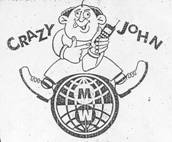
Anheuser-Busch, Inc v Budějovický Budvar, Národní Podnik (2002) 56 IPR 182 referred to
Big Country Developments Pty Ltd v TGI Friday’s Inc 48 IPR 513 referred to
Cadbury-Schweppes Pty Ltd v Pub Squash Co Pty Ltd [1981] RPC 429 referred to
Campomar Sociedad, Limitada v Nike International Ltd (2000) 202 CLR 45 applied
CBS Records Australia Ltd v Telmak Teleproducts (Aust) Pty Ltd (1987) 72 ALR 270 referred to
ConAgra Inc v McCain Foods (Aust) Pty Ltd (1992) 33 FCR 302 referred to
Electrolux Ltd v Electrix Ltd (1953) 71 RPC 23 referred to
Erlanger v New Sombrero Phosphate Company (1878) 3 App Cas 1218 referred to
Equity Access Pty Ltd v Westpac Banking Corporation (1989) 16 IPR 431 referred to
Habib Bank Ltd v Habib Bank AG Zurich [1982] RPC 1 referred to
HTX International Pty Ltd v Semco Pty Ltd (1983) 49 ALR 636 referred to
Ind Coope Ltd v Paine & Co Ltd [1983] RPC 326 referred to
In the Matter of a Trade Mark of John Sinclair, LD [1932]49 RPC 123 referred to
Lincoln Industries Ltd v Wham-O Manufacturing Co [1984] 1 NZLR 641 referred to
New South Wales Dairy Corporation v Murray Goulburn Co-operative Company Ltd (1989) 14 IPR 26 referred to
Polo Textile Industries Pty Ltd v Domestic Textile Corporation Pty Ltd (1993) 42 FCR 227 referred to
Registrar of Trade Marks v Woolworths Ltd (1999) 93 FCR 365 referred to
Revlon Inc v Cripps & Lee Ltd [1980] FSR 85 referred to
Saville Perfumery Ltd v June Perfect Ltd (1941) 58 RPC 147 referred to
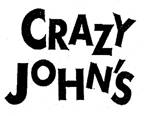
S & I Publishing Pty Ltd v Australian Surf Life Saver Pty Ltd (1998) 88 FCR 354 referred to
St Lukes Health Insurance v Medical Benefits Fund of Australia Ltd (1995) ATPR 41-428 referred to
Taco Company of Australia Inc v Taco Bell Pty Ltd (1982) 42 ALR 177 referred to
Thai World Import and Export Co Ltd v Shuey Shing Pty Ltd (1989) 17 IPR 289 referred to
The United Telecasters Sydney Ltd v Pan Hotels International Pty Limited (1978) ATPR 40-085 referred to
Winton Shire Council v Lomas (2002) 56 IPR 72 referred to
MOBILEWORLD COMMUNICATIONS PTY LTD (ACN 090 451 415) & ORS v Q & Q GLOBAL ENTERPRISE (ACN 104 267 049) & ORS
V 658 of 2003
ALLSOP J
4 DECEMBER 2003
SYDNEY (HEARD IN MELBOURNE)
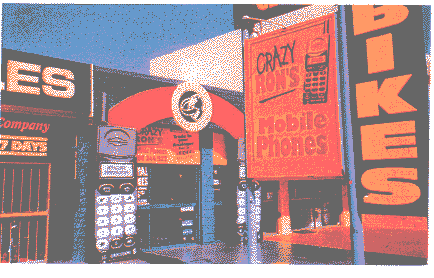
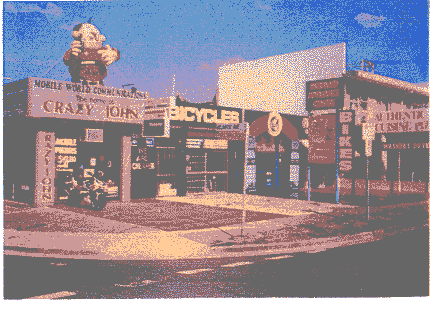
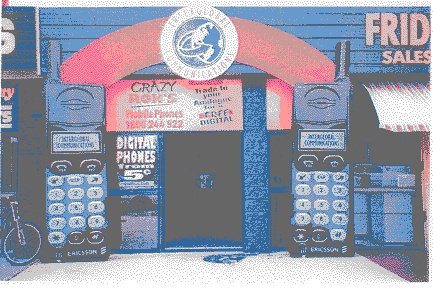
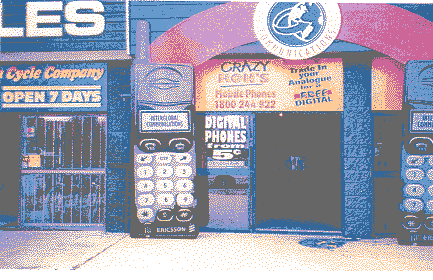
|
IN THE FEDERAL COURT OF AUSTRALIA |
|
|
VICTORIAN DISTRICT REGISTRY |
V 658 of 2003 |
|
BETWEEN: |
MOBILEWORLD COMMUNICATIONS PTY LTD (ACN 090 451 415) FIRST APPLICANT
MOBILEWORLD OPERATING PTY LTD (ACN 090 451 433) SECOND APPLICANT
CRAZY JOHN (AUSTRALIA) PTY LTD (ACN 090 451 424) THIRD APPLICANT
|
|
AND: |
Q & Q GLOBAL ENTERPRISE (ACN 104 267 049) FIRST RESPONDENT
CRAZY RON’S COMMUNICATIONS PTY LTD (ACN 097 918 806) SECOND RESPONDENT
CRAZY RON’S COMMUNICATIONS AUSTRALIA PTY LTD (ACN 093 598 488) THIRD RESPONDENT
BHL GROUP (ACN 098 798 997) FOURTH RESPONDENT
CRAZY RON’S NETWORK PTY LTD (ACN 097 906 860) FIFTH RESPONDENT
CRAZY RON’S COMMUNICATIONS AUSTRALIA PTY LTD (ACN 093 598 488) CROSS CLAIMANT
MOBILEWORLD COMMUNICATIONS PTY LTD (ACN 090 451 415) CROSS RESPONDENT
|
|
ALLSOP J |
|
|
DATE OF ORDER: |
4 DECEMBER 2003 |
|
WHERE MADE: |
THE COURT ORDERS THAT:
- The cross-claim be dismissed.
- Subject to order 3 below, and until further order, the respondents whether by themselves, their servants or agents, or otherwise be restrained from infringing:
(a) Australian Registered Trade Mark No. 656212 for CRAZY JOHN MW and device in class 38 for “telecommunications”; and
(b) Australian Registered Trade Mark No. 803950 for CRAZY JOHN’S (in script) in class 35 for “business advisory services relating to telecommunications; retail services relating to telecommunications products” and class 38 for “telecommunications services and advisory services relating thereto”,
and in particular from using as a trade mark either said mark or any mark, name, word, sign, logo or device which is substantially identical or deceptively similar thereto, including but not necessarily limited to “Crazy Ron” or “Crazy Ron’s” or “www.crazyrons.com.au”.
- Liberty be reserved to the parties to seek, by argument, to add to, or amend, order 2 above, including as to whether there should be any condition applied to the continuation of any injunction on a permanent basis.
- The respondents pay the applicants’ costs of the proceedings to date.
- Time for the filing of a notice of appeal be extended to a date to be fixed by further order.
- The proceedings stand over to a date to be fixed for further argument and the making of further orders.
Note: Settlement and entry of orders is dealt with in Order 36 of the Federal Court Rules.
|
IN THE FEDERAL COURT OF AUSTRALIA |
|
|
VICTORIAN REGISTRY |
V 658 of 2003 |
|
BETWEEN: |
MOBILEWORLD COMMUNICATIONS PTY LTD (ACN 090 451 415) FIRST APPLICANT
MOBILEWORLD OPERATING PTY LTD (ACN 090 451 433) SECOND APPLICANT
CRAZY JOHN (AUSTRALIA) PTY LTD (ACN 090 451 424) THIRD APPLICANT
|
|
AND: |
Q & Q GLOBAL ENTERPRISE (ACN 104 267 049) FIRST RESPONDENT
CRAZY RON’S COMMUNICATIONS PTY LTD (ACN 097 918 806) SECOND RESPONDENT
CRAZY RON’S COMMUNICATIONS AUSTRALIA PTY LTD (ACN 093 598 488) THIRD RESPONDENT
BHL GROUP (ACN 098 798 997) FOURTH RESPONDENT
CRAZY RON’S NETWORK PTY LTD (ACN 097 906 860) FIFTH RESPONDENT
CRAZY RON’S COMMUNICATIONS AUSTRALIA PTY LTD (ACN 093 598 488) CROSS CLAIMANT
MOBILEWORLD COMMUNICATIONS PTY LTD (ACN 090 451 415) CROSS RESPONDENT
|
|
JUDGE: |
ALLSOP J |
|
DATE: |
4 DECEMBER 2003 |
|
PLACE: |
REASONS FOR JUDGMENT
Nature of Proceedings
1 The applicants, who carry on a business selling mobile phones and associated services under the name “Crazy John’s” seek, in essence, to restrain the respondents from carrying on business under the name or style “Crazy Ron’s” or “Crazy Ron”. The structure of the controversy is as follows. First, the applicants seek declarations, injunctions, damages and other relief in respect of the alleged infringement of two registered trade marks under the Trade Marks Act 1995 (Cth) (the TM Act), the alleged contravention of s 52 and s 53(d) of the Trade Practices Act 1974 (Cth) (the TP Act) and the alleged committal of the tort of passing off. Secondly, one of the respondents, as cross-claimant, seeks an order under s 88 of the TM Act cancelling the registration of one of the marks (the mark registered second, in 1999).
Factual outline – the development of the business now run by the applicant
2 By reason of the issues raised, it is necessary to recount the factual history with some care. In this factual history some attention is required to be given to the corporate structure employed in connection with the business historically and currently operated under the name “Crazy John’s”.
3 I have attached exhibits C1 and C2 to these reasons. These exhibits set out, in flow chart and explanatory forms, the various corporate entities on what might be said to be the applicants’ side of the record. Where relevant in this factual history, I will refer to events described therein.
4 Prior to 1991, Mr Mustafa Ilhan (known as John Ilhan) was employed by the “Strathfield Group” as a mobile telephone salesman. In 1991, he was 26 years of age and he decided to establish his own business selling mobile telephones and related accessories. He caused a company, Mobile World Communications Pty Ltd (ACN 050 242 558), to be set up. This is not the first applicant. It later changed its name to Mobile World Wholesalers Pty Ltd. This company operated a business until 1994. The first store was opened in Brunswick in Melbourne in March 1991. This was the only shop opened before January 1994.
5 The business was originally called “Mobileworld”. Mr Ilhan said that he was inspired to use the word and phrase “Crazy” and “Crazy John’s” after a number of customers referred to his deals as “crazy”. The phrase “Crazy John’s Mobileworld” was originally used in 1993 and later in 1993 it was abbreviated to “Crazy John’s”. The phrase was used in relation to the business.
6 In January 1994, Mobile World Communications Pty Ltd (ACN 050 242 558) transferred the business and assets to a company bearing the same name, Mobile World Communications Pty Ltd (ACN 063 108 547). This company is not the first applicant either. This second company named Mobile World Communications Pty Ltd (ACN 063 108 547) carried on the business of selling mobile phones and related activities from January 1994 to June 1996. At this time in January 1994 the transferor Mobile World Communications Pty Ltd changed its name as referred to above.
7 Further stores were opened in Victoria from April 1994. By 1 October 1995, six further stores were opened in Victoria. Also, in October 1995, interstate expansion took place, with two stores opening simultaneously on the Gold Coast at Mermaid Beach and Windsor.
8 At least by October 1995, there was advertising using the phrase “Crazy John” adjacent to a device and picture of a character who might be said, in a colloquial usage, to look “crazy” and using the phrase “Crazy John’s” in what was termed in debate before me (appropriately, if I may say so) “radical script”. An extract from an October 1995 advertisement employed in print media in Queensland and elsewhere is annexed and marked ‘A’. This was a not untypical usage of the first mark.
9 On 22 March 1995, Mobile World Communications Pty Ltd (ACN 063 108 547) applied for the registration of the first mark, which in due course was registered in class 38 (telecommunications). The mark is described as follows in the register:
Word: CRAZY JOHN MW
Image: MAN, CARTOON ATOP GLOBE,
MERIDIANS HAS MOBILE PHONE
The following image appears:
An endorsement on the register was to the effect that registration gave no right to the exclusive use of the word “John” and of the letters MW.
10 On 22 May 1996, Mobile World Communications Pty Ltd (ACN 063 108 547) assigned the first trade mark to Crazy John Pty Ltd (ACN 070 157 452). For the period of a little over six weeks, from then to 30 June 1996, Mobile World Communications Pty Ltd (ACN 063 108 547) continued to carry on business in the seven Victorian stores and two Gold Coast stores.
11 The assignment of the trade mark to Crazy John Pty Ltd (ACN 070 157 452) was pursuant to advice, which I accept was given, by Mr Pryles and others, to the effect that for prudent commercial reasons it was best to separate the capital assets of the business, such as trade marks, from the revenue operations of the business. For this period of 22 May to 30 June 1996, Mobile World Communications Pty Ltd (ACN 063 108 547) used the trade mark in the business with the implied licence of Crazy John Pty Ltd (ACN 070 157 452).
12 On 1 July 1996, by written agreement, Mobile World Communications Pty Ltd (ACN 063 108 547) sold the business carried on by it to Mobileworld Communications (Aust) Pty Ltd (ACN 073 366 757). I will refer to this latter operating company as Aust P/L. The sale price for the business operating through nine stores was $415,651.13, which price represented the difference between plant and equipment on the one hand, and liabilities, on the other.
13 On 1 July 1996, Aust P/L also executed a written agreement with Crazy John Pty Ltd (ACN 070 157 452) under which Aust P/L was granted a licence to use the “right, title, interest and goodwill” in the first trade mark for the licence fee of $300,000 per annum. With the exception of one later year, when a reduced sum was paid, the licence fee was paid annually. Crazy John Pty Ltd (ACN 070 157 452) acted as the trustee of a trust called the Mobileworld Communications Trust. (It had originally been intended by advisers that Aust P/L would be the trustee of this trust. It retired, however, as trustee and only ever traded on its own account.)
14 Also on 1 July 1996 Mobileworld Wholesalers Pty Ltd (the original Mobileworld Communications Pty Ltd ACN 050 242 558) entered a written sale agreement with Mobile World Communications Pty Ltd (ACN 063 108 547) which was on the same day selling the operating business to Aust P/L. The subject of the sale were certain assets valued at $96,031. It is not clear what role Mobile World Communications Pty Ltd (ACN 063 108 547) thereafter played in the business.
15 The structure of the business until December 1999 appears to have been the use of three companies: (a) a wholesale company (perhaps Mobile World Communications Pty Ltd (ACN 063 108 547)), (b) Aust P/L as the operating retail company, and (c) Crazy John Pty Ltd as the asset owning company, at least in regard to intellectual property assets.
16 After 1 July 1996, and up to December 1999, a further eleven stores were opened in Victoria. All was not, however, plain sailing. In June 1997, the two stores on the Gold Coast were closed.
17 From the time the two stores opened in 1995 on the Gold Coast, there was regular advertising in Queensland. Between October 1995 and December 1996, $858,000 was spent on advertising in Queensland in newspapers and on radio and television.
18 From February 1995 to December 1996, $2.85 m was spent on advertising in Victoria in newspapers and on radio and television.
19 This advertising in Queensland and Victoria used the phrase “Crazy John’s” in radical script or partly radical script; and used the character in the trade mark usually holding a mobile phone and sometimes not astride a globe.
20 By November 1996, the business was apparently very successful on the Gold Coast. Ms Doueihi was the former partner (business and personal) of Mr Bakir, who with Ms Doueihi founded the “Crazy Ron’s” business. Ms Doueihi who was in a position to comment, said that the business represented by the “Crazy John’s” stores was “very successful” and “dominated the Gold Coast”.
21 This success on the Gold Coast is consistent with the not inconsiderable advertising undertaken in Queensland. Advertising was placed at least three times per week in the Brisbane Courier Mail and Gold Coast Bulletin. This advertising continued until May 1997. These newspapers had significant circulation: The Courier Mail up to June 1997 had a circulation of about 215,000 per day and 330,000 on weekends and the Gold Coast Bulletin 40,000 per day.
22 Expenditure on advertising undertaken on television from October 1995 to late 1996 was in the order of $90,000. In the same period expenditure on advertising undertaken on two local Gold Coast FM stations was in the order of $190,000. There was advertising by the distribution of up to 3,000 written pamphlets or “flyers” in Windsor and Brisbane. In-store promotions were conducted at the Windsor store, which was preceded by radio advertising. Dance and karaoke competitions were sponsored. The White Pages for the Gold Coast and Brisbane in 1996 had a listing for “Crazy John” and the Yellow Pages for the Gold Coast and Brisbane in 1996 carried an advertisement using the logo.
23 The circumstances of the closure of the two stores in Queensland were described by Mr Ilhan. It was not a result of poor response to the operation of the stores in Queensland. Rather, there had been a rapid expansion of the number of stores in the overall business, and financial difficulties were encountered. In his affidavit, Mr Ilhan said that it was and remained his intention to re-open in Queensland. I accept this evidence. Since July 2000, thirteen “Crazy John’s stores” have opened in Queensland.
24 I will return shortly to the extent of the promotion of the “Crazy John’s business”. First it is necessary to complete the chain of events leading to the current structure of the business.
25 The precise details of the financial difficulties surrounding the various companies associated with Mr Ilhan and Mr Ilhan himself are not clear. Mr Fleiter, a solicitor with insolvency and related expertise, began providing advice to Mr Ilhan and the predecessors of the applicants in 1997. Financial pressures continued in 1998. On 14 October 1998, Mr Ilhan executed (for the first time) an authority under Part X of the Bankruptcy Act 1966 (Cth). At the same time, Mr Ilhan resigned as a director of Crazy John Pty Ltd and transferred his ten shares in the company to his father.
26 In May 1999, Mr Ilhan executed a second authority under s 188, which culminated in a deed of arrangement executed by him on 19 July 1999.
27 On 17 August 1999, Mr Darrer, a partner of Mr Fleiter, made an application for the second trade mark consisting of the words “Crazy John’s”, in the following style:
28 This application for the second mark was made in the name of Aust P/L. Later, on 12 November 1999, Mr Darrer informed the Trade Mark’s office that the application had been made in error, and that the application should have been made in the name of Crazy John Pty Ltd. This was said to have been the result of an “oversight by the Administration Manager”. The application was amended accordingly. It is apparent what had happened. Those (probably Ms Orlowski, née Sequenzia) responsible for the instructions to Mr Darrer either did not know of, or had forgotten, the terms and intentions of the advices in 1996 to place the intellectual property assets in Crazy John Pty Ltd. I accept that through the advisers to the companies and Mr Ilhan, the relevant arrangement had always been intended to be that Crazy John Pty Ltd would own the intellectual property assets of the group.
29 There was a plan to float the business towards the end of 1999. This did not occur. There were, however, some changes to the corporate structures. The issue of the holder of the marks came up again in November 1999 in the work connected with the reconstruction of the companies.
30 On 2 December 1999 Aust P/L entered an “Asset Purchase Agreement” with Mobileworld Operating Pty Ltd (ACN 090 451 433), the second applicant, as purchaser, and Mobileworld Communications Ltd (ACN 090 451 415), described as a “holding company”, which owned all the shares in the vendor (Aust P/L) and which is the first applicant. Under the agreement, the assets, including the contracts with customers, were sold. The effective date of the sale was 1 December 1999. Thus, from 1 December 1999 the second applicant conducted the business described in the agreement as:
..the Business carried on by the Vendor including the distribution, wholesale and retail of telephones and any other communication equipment, computers, computer software, any other electrical equipment and all accessory products in relation thereto.
31 Another document was entered on 2 December 1999 entitled “Deed of Assignment of Trade Mark”, between Crazy John Pty Ltd and Mobileworld Communications Ltd (ACN 090 451 415), the first applicant.
32 Apparently, Mobileworld Communications Ltd (ACN 090 451 415), the holding company, which was a party to these two transactions in December 1999, and which is the first applicant, became a private company before the commencement of these proceedings. The respondents place some emphasis on the circumstances of the execution of this document, to which I will return. By the terms of the document it was recited that the assignor, Crazy John Pty Ltd, had agreed to assign to the assignee, the first applicant, all its property, right, title, interest, benefit and claims in and to, amongst other things, the first mark and the application for the second mark. The terms of the document then sought to effect that assignment in the following terms:
RECITALS
A The Assignor is the proprietor in Australia of the trade mark defined in clause 1 of this Deed.
B The Assignor has agreed to assign to the Assignee all its property, right, title, interest, benefit, and claims in and to the trade mark defined in clause 1 of this Deed including the goodwill belonging to the Assignor relating to the goods or services in respect of which the Trade Mark has been used (including without limitation, licensed) by the Assignor at any time.
OPERATIVE PROVISIONS
1. DEFINITIONS
In this Deed, the term “Trade Mark” means the Australian trade marks, whether registered, unregistered or at the application stage, particulars of which appear in Schedules 1, 2 and 3 to this document, together with all copyright subsisting in the marks.
2. ASSIGNMENT
The Assignor assigns to the Assignee all property, right, title, interest, benefit and claims in and to the Trade Mark, including all rights of suit and action (whether past or present) against any third party in respect of the Trade Mark and the goodwill belonging to the Assignor relating to the goods or services in respect of which the Trade Mark has been used (including without limitation, licensed) by the Assignor at any time.
[emphasis in original]
33 In 2000 the second applicant (Mobileworld Operating Pty Ltd) registered the business name “Crazy John’s” in New South Wales, Queensland and South Australia. In 2000, the third applicant Crazy John (Australia) Pty Ltd (ACN 090 451 424) registered the same business name in Victoria.
34 Since 2000, the business that is operated by the applicants has expanded dramatically. By 1 January 2000 there had been twenty stores opened in Victoria and Queensland, of which the two Queensland stores and three Victorian stores had closed. Thereafter, twelve stores were opened in 2000: Victoria (4), New South Wales (4), Queensland (2) and South Australia (2). Of these, four have now closed (two in New South Wales, one in Victoria and one in Queensland). Eleven stores were opened in 2001: Victoria (4), New South Wales (4) Queensland (2) and South Australia (1). One store was opened in 2002 in Victoria. Further huge expansion has taken place in 2003 with forty six stores opening: New South Wales (17), Queensland (10), Victoria (11), South Australia (3), the Australian Capital Territory (2) and Western Australia (3).
35 I shall return to the question of reputation and goodwill after I have outlined the development of the respondents’ business.
36 I was taken through the detail of the officers and shareholders of the various companies with which Mr Ilhan and the “Crazy John” business have been associated. Mr Ilhan’s immediate family appear to have been office holders at most times. From the evidence, however, I can safely draw the conclusion, I think, that Mr Ilhan had a controlling influence on the business and its activity. That is not to suggest, in the slightest, any sinister subterfuge. Nor is it to remove or undermine the necessity for compliance with corporate form, when corporate acts are undertaken. It is necessary to say, however, that little, I think, is to be made of the absence of specific office holders from the evidence when the subject matter of consideration is the strategy and intentions of those running the business. That was for Mr Ilhan (in consultation with others) if the matter were commercial, and for Mr Ilhan’s advisers such as Mr Pryles, Mr Mitsios and Mr Fleiter if the matter legal and accounting. It is plain that in the latter respect Mr Ilhan expected the legal and accounting structure, such as the role of Crazy John Pty Ltd as the asset owning company, to be sorted out by the professionals.
Factual outline – the development of the business now run by the respondent
37 In September 1995, Mr Ron Bakir and his then partner, Ms Jean Doueihi moved to the Gold Coast from Orange. They established a business selling mobile phones using the name “Ronicam International”. The selling was largely done door to door by Mr Bakir. Mr Bakir and Ms Doueihi were in their early twenties.
38 In October 1996, having returned to the Gold Coast from Orange, they were keen to open a retail store. After searching they found and renovated a shop adjacent but one from the existing Mermaid Beach store controlled by Aust P/L. The two stores were separated by a bicycle shop. Photographs of the two shops were in evidence. They show, amongst other things, the use of the inflatable figure “Crazy John” and the “radical script” used by each.
39 Set in this context, the differentiation of the two businesses was clear. As Ms Doueihi said in her evidence, customers would use the proximity of the two businesses to seek to extract the best bargain possible from two apparently competing businesses.
40 Mr Bakir and Ms Doueihi initially intended to trade under the name “Universal Mobile Phones”. This was how they traded in Orange. Mr Bakir registered the name “Inter Global Communications” in Queensland in 1996. When they found the shop almost next door to what was a successful mobile phone business of “Crazy John’s”, they were pleased because of this proximity to a good competing business. They began to trade under the name “Interglobal Communications”. They later changed the name of the shop to “Crazy Ron’s Mobile Phones”. Apparently people were saying “Wouldn’t it be funny to have the name Crazy Ron’s”.
41 Ms Doueihi gave the following evidence, which I accept, referring to Mr Bakir and to the business:
J D Doueihi And then once we had the shop up and running, he wanted to change the name of the shop and he asked me what I thought of "Crazy Ron's" and I agreed that it would be a good name.
Mr Shavin Did he discuss with you reasons why it would be appropriate to adopt the name?
J D Doueihi I think more than anything he thought it was funny, being in such close proximity to Crazy John's.
Mr Shavin Did any people who came into the shop between December 1996 and June 1997 mention Crazy John's to you?
J D Doueihi Yes.
Mr Shavin Could you tell his Honour in what context?
J D Doueihi Often customers would come in who had been into the Crazy John's store and got prices, they would come into our store to ask if we could beat the prices. That's on many occasions that happened. Sometimes customers would come in thinking, like, they'd come in with advertisements that they had seen from Crazy John's ads and ask us, once again, if we could beat prices, because we advertised that we would or we had there that we'd guarantee to beat prices. So more so than anything else, people would come in for us to compete against Crazy John's and the deals that they had.
Mr Shavin Were there any other circumstances in which people mentioned Crazy John's in the shop in that period?
J D Doueihi On many occasions people would come in and, as I said, once they'd meet Ronnie they'd laugh about the name and say, "Look, you know, you should go under the name of Crazy Ron's." That's more than anything what people would say when they would come in in relation to Crazy John's.
42 It must have been plain that people thought it was funny because of the similarity, not only of what the shops sold, but also of their names. Mr Bakir failed to explain what he understood about this. I find that he appreciated full well in December 1996 and thereabouts the degree of similarity in rhyme and context of the two shops and their names, though I accept that he was pleased to be able to use his own name in the business. I do not find that at this point Mr Bakir was seeking to mislead people into thinking that his shop was associated with “Crazy John’s”. Indeed the context told people to the contrary, as Ms Doueihi’s evidence indicates. However, he could not have been oblivious, and I find that he was not, to the similarity of the two names when spoken and of the likely confusion, at the least, which could occur when use of the phrase “Crazy Ron’s” taken away from a context of adjacent physical properties.
43 Mr Bakir was asked to refrain from using the name “Crazy Ron’s”. He refused. On 13 December 1996, solicitors acting on behalf of Crazy John Pty Ltd sent a letter complaining of trade mark infringement. It was submitted that the lack of independent claims for s 52 and passing off is of significance. It was said to betray “a recognition of the lack of basis for a case based on the proposition that the words “Crazy John” were being used.” I think this overstates the significance of the letter. I do not draw very much from it. There was an assertion that the use of the name “Crazy Ron’s” was “misleading and deceptive”.
44 The two businesses traded competitively in Queensland between December 1996 and June 1997.
45 No further threat was made against Mr Bakir or his business over his use of the name “Crazy Ron’s”.
46 After Aust P/L closed the stores in Queensland in June 1997, Mr Bakir continued to trade under the name Crazy Ron’s. As it had always been his intention, Mr Bakir opened further stores: four stores were opened between February 1998 and September 1999 in South East Queensland at Bundall, Ashmore, Tweed Heads (NSW), and Labrador. A head office was opened in Surfers Paradise. The stores were about 35 kilometres apart, from Tweed Heads to the Gold Coast.
47 In March 2000, the business name “Crazy Ron’s Mobile Phones Adelaide” was registered by a Mr Sadaka in South Australia with Mr Bakir’s consent. Mr Bakir’s company took a percentage of the income. That store operated in central Adelaide for about eighteen months. It advertised on radio and television, using the Adelaide Advertiser and pamphlet drops. It closed in September 2001.
48 It should be noted that the “Crazy John’s” stores which opened prior to September 2001 in South Australia were at Marion on 4 November 2000, Tea Tree Plaza on 15 November 2000, and Rundle Mall (in central Adelaide) on 18 May 2001. There was no evidence of any complaints by the applicants about the use of “Crazy Ron’s” in Adelaide in that period.
49 The relationship between Ms Doueihi and Mr Bakir broke down in July 2000. They divided the shops between them. Ms Doueihi ceased to use the name “Crazy Ron’s”. The final resolution of the breakdown of the personal and business relationship between them occurred in August 2001.
50 In November 2001, Mr Bakir sold the stores and the underlying corporate structure to the fourth respondent which was and is controlled by a Mr Canzoneri. Mr Bakir remained as an employee and the “public face” of “Crazy Ron’s”.
51 No real expansion under the name “Crazy Ron’s” occurred until August 2003 at which time the fourth respondent purchased an established chain of mobile phone stores in metropolitan Sydney and Melbourne which was trading under the name “B Store”. This existing chain consisted of six stores in Melbourne and four in Sydney. The Melbourne stores were rebranded from 5 August 2003 and the Sydney stores from September 2003.
Reputation – “Crazy John’s”
52 I have adverted already to some of the advertising undertaken by the applicants.
53 The business which uses the name “Crazy John’s” is a national one. It now employs over 500 people in Australia. It is Telstra’s largest dealer in two “divisions” of that company’s business in Australia.
54 Since 2002, the second applicant has operated a call centre from which up to thirty employees call existing customers in order to sell “telecommunications products”. They describe themselves by using the name “Crazy John’s”.
55 The amounts spent on advertising and promotion in the early years of the stores using the phrases “Crazy John” and “Crazy John’s” were not the subject of precise evidence. Records have in the ordinary course been destroyed. Some idea of the extent of the promotion can be seen in the Queensland and Victorian figures referred to earlier. These were not insignificant sums of money considering the number of stores then operating.
56 There has been significant growth in the business since the year 2000. The operating revenues from 2000 to 2003 (contained in confidential exhibit BWF 13) show a significant business and a doubling of revenue over that period. Similarly confidential exhibit BWF 14 reveals a business with its most valuable areas being Victoria and New South Wales.
57 There has been a very large expenditure of money on advertising and promotion since 2001. The amounts and other details of this were contained in confidential exhibits, in particular confidential exhibit BWF 15, and confidential Exhibit BWF 18. The expenditures are now in the millions of dollars and are increasing in apparent arithmetic proportions. Significant numbers of public identities, especially well known professional sportsmen and former sportsmen have been engaged to promote “Crazy John’s”. Well known rugby league and Australian rules football teams have been sponsored.
58 This type of sponsorship and promotion has been accompanied by significant press, radio, television, magazine, billboard and pamphlet advertising.
59 Non-confidential exhibit BWF 20 reveals a significant body of advertising in 2001, 2002 and 2003 in Victoria, New South Wales, Queensland and South Australia.
60 In recent years, advertising has been undertaken on a weekly basis on the National Nine network in Brisbane, Sydney, Melbourne and Adelaide.
61 The extensive press advertising has usually carried the phrase “Crazy John” or “Crazy John’s” in some form.
62 Outdoor signage has been placed in sporting stadiums in Melbourne, Sydney and Brisbane.
63 The pamphlets have been produced in great numbers. For example, in January 1999 a distribution of 1.5 million pamphlets or “flyers” was made in Victoria. Many other months in the last four years have had similar coverage in Melbourne, Sydney and Brisbane.
64 A Lamborghini racing team has been sponsored.
65 Each store is subject to control as to the style and get up of its appearance. A “log book” is given to those who run the stores dealing with such matters as “store image”, “product presentation” and the like. Consistent use of the “Crazy John” logo is required.
66 One aspect of the presentation of the “Crazy John” name which was emphasised by Mr Ireland QC, who, with Mr Anderson, appeared for the respondents, was the use of the caricature or cartoon man representing “Crazy John”. In the get up of stores in early years the figure was in the form of a blow up balloon. In other advertising he is a figure, rather like a human sized mascot, in recent years seen with the various people, such as football stars, in the advertisements. This personification of “Crazy John” was said to be a crucial distinguishing feature from “Crazy Ron’s” which, in asserted contradistinction, was a business under that name. Whilst the point has some force, it must be recognised that much of the print and radio advertising does not rely on the presence of “Crazy John” as a person or a cartoon man. Rather, the phrases “Crazy John’s” and “Crazy John” are used in a conventional way as the brand or name of the business, much like “Crazy Ron’s”. Notwithstanding the use of the person dressed up as “Crazy John”, and the added dimension this gives to the totality of the image and get up of the business, there is no doubt, looking at all the evidence of advertising, that significant effort and money has been spent in creating a business known as “Crazy John’s” with an asserted reputation of low prices, good quality and good service.
67 That effort has been largely successful, such that by late 2002 and in 2003 the brand is well known and prominent on the east coast of Australia, especially in Melbourne and Sydney.
Reputation – “Crazy Ron’s”
68 From 1997 advertising was undertaken in the Gold Coast press. Advertisements were made in local Gold Coast television. In-store promotions were held, involving the broadcasting of a local radio station from one of the shops. This occurred about three times a year since 1997. Mr Bakir accepted invitations to participate and advertise on publicly broadcast shows. He featured on a 60 Minutes story. Various other promotions were undertaken including being a guest on a television program, undertaking promotions to raise money for charity, sponsoring various events and charity organisations, sponsoring some sporting figures, the precise detail of which is unnecessary to recount.
69 Whilst there has been this promotion, as well as print and radio advertising in south east Queensland and in some Gold Coast cinemas and taxis and the entry into Adelaide by a type of franchise, there was no evidence that a large goodwill existed, certainly by the time the fourth respondent purchased the business and companies in November 2001. The purchase price paid by the first respondent was a modest sum indicating the purchase of little more than a call centre and three shops. I find that the reputation of “Crazy Ron’s” at all time prior to 2003, at least, was modest and largely restricted to the part of south east Queensland from the New South Wales border to the Gold Coast. Also, there was a transient reputation in Adelaide, which may be recalled by some.
The Claims of the Applicants
the trade mark claim
70 There are two trade marks:
(i) that referred to in [9] above
(ii) the words “CRAZY JOHN” in class 35 for “business advisory services relating to telecommunications; retail services relating telecommunications products” and class 38 for “telecommunications services and advisory services relating thereto”, with effect from 17 August 1999.
71 The second mark is the subject of attack in the cross-claim. It is convenient to deal with that attack first.
the attack on the second mark
72 The first attack is through s 88 of the TM Act, which is in the following terms:
(1) Subject to subsection (2) and section 89, a prescribed court may, on the application of an aggrieved person, order that the Register be rectified by:
(a) cancelling the registration of a trade mark; or
(b) removing or amending an entry wrongly made or remaining on the Register; or
(c) entering any condition or limitation affecting the registration of a trade mark that ought to be entered.
(2) An application may be made on any of the following grounds, and on no other grounds:
(a) any of the grounds on which the registration of the trade mark could have been opposed under Division 2 of Part 5;
(b) an amendment of the application for the registration of the trade mark was obtained as a result of fraud, false suggestion or misrepresentation;
(c) because of the circumstances applying at the time when the application for rectification is filed, the use of the trade mark is likely to deceive or cause confusion for a reason other than one for which:
(i) the application for the registration of the trade mark could have been rejected under section 43 or 44; or
(ii) the registration of the trade mark could have been opposed under section 60;
(e) if the application is in respect of an entry in the Register—the entry was made, or has been previously amended, as a result of fraud, false suggestion or misrepresentation.
73 Section 88(2)(a) is relied on. Section 58 (within Division 2 of Part 5 of the TM Act) states:
The registration of a trade mark may be opposed on the ground that the applicant is not the owner of the trade mark.
74 Section 27(1) of the TM Act states:
(1) A person may apply for the registration of a trade mark in respect of goods and/or services if:
(a) the person claims to be the owner of the trade mark; and
(b) one of the following applies:
(i) the person is using or intends to use the trade mark in relation to the goods and/or services;
(ii) the person has authorised or intends to authorise another person to use the trade mark in relation to the goods and/or services;
(iii) the person intends to assign the trade mark to a body corporate that is about to be constituted with a view to the use by the body corporate of the trade mark in relation to the goods and/or services.
75 The sequence of events will be recalled:
(a) In 1999, (until December 1999) Aust P/L was running the retail business and using the phrases “Crazy John” and “Crazy John’s” in its advertising and promotion.
(b) In August 1999, the mark “Crazy John’s” was applied for in the name of Aust P/L.
(c) In November 1999, it was realised that Crazy John Pty Ltd should have made the application and the Trade Marks Office was informed of the error.
(d) On 2 December 1999, Crazy John Pty Ltd assigned its interest in the application to the first applicant.
76 The respondents’ arguments were essentially based on the proposition that Crazy John Pty Ltd was not the owner of the mark and so its prosecution of the application after the notification of the “mistake” in November 1999 did not fulfil s 27.
77 Further it was said that:
(a) Crazy John Pty Ltd did not use or intend to use the mark (for s 27(1)(b)(i))
(b) There was no evidence that Crazy John Pty Ltd had authorised or intended to authorise Aust P/L to use the mark (for s 27(1)(b)(ii)).
(c) There was no evidence that Crazy John Pty Ltd intended to assign the mark (for s 27(1)(b)(iii)).
78 I reject these submissions. It had been the intention of Mr Pryles and those directing the affairs of the group since 1996 to have the intellectual property assets reside in Crazy John Pty Ltd. There was no suggestion or evidence of revocation of that intention. The first mark was assigned to Crazy John, which granted a licence to use that mark to Aust P/L, for which a sizeable fee was agreed to be paid and paid, secured by registered charge. Crazy John Pty Ltd (Aust P/L’s parent) was, I find, intended to be the repository of the intellectual property of the group. The sizeable fee ($300,000 p.a) was for, amongst other things, the use of the “goodwill” of the first trade mark, the relevant agreement said so in terms. The second mark was the use of two words used in the first mark. There was a reputation or brand or goodwill of the first mark which could be identified as “Crazy John’s”. Leaving aside for the moment the respondents’ arguments as to lack of infringement of the first mark, based on its composite nature, the licence of the “goodwill in the trademark” contemplated by the agreement between Crazy John Pty Ltd and Aust P/L dated 1 July 1996 encompassed an entitlement to use the goodwill which might be said to attach to the first mark: cf In the matter of a Trade Mark of John Sinclair, LD (1932) 49 RPC 123. Within that concept was the right to use any cognate mark that would be an infringement of the first mark if used without permission.
79 The assignment of the first mark took place on 22 May 1996. Looking at that mark, as it strikes the eye and fixes in the recollection (Saville Perfumery Ltd v June Perfect Ltd (1941) 58 RPC 147, 162), one of the essential features of the mark is the phrase “Crazy John”. This essentiality comes from the prominence of the words and their reinforcement by the deranged look on the face of the man sitting astride the globe.
80 Looking at all the surrounding circumstances the assignment of the first trade mark was intended to be with the goodwill attaching to the mark. The following factors assist, in particular, in the drawing of this conclusion: the letter of assignment dated 22 May 1996 was an assignment of “all of its interests in the registered trademark”; the assignee’s name was changed to a name which incorporated an essential feature of the first mark: “Crazy John”; the licence agreement dated 1 July 1996 described in recital A what the licensor (Crazy John Pty Ltd, the assignee on 22 May 1996) had: it included “goodwill in the trade mark”; and the licence fee was substantial.
81 I conclude in the light of all the circumstances that it was not intended that Aust P/L, rather than Crazy John Pty Ltd, be the owner of the second mark before application.
82 Crazy John Pty Ltd did claim to be the owner of the mark. The terms of the letter of Dr Darrer dated 12 November 1999 to the Trade Marks Office were as follows:
Re: Trademark Application Numbers 803947, 803948, 803949, 803950, 803951, and 812138 [which included the application in question]
We act for the Mobileworld group of companies.
Each of the above applications, naming Mobileworld Communications (Aust) Pty Ltd as the applicant, were lodged with your office on instructions from the group’s Administration Manager. However, this was done in error. The applications should have been lodged in the name of a related company in the group: Crazy John Pty Ltd which is the actual owner of each of the trademarks. Consistent with this we refer you to registration No 656212 for the trademark “CRAZY JOHN” with graphics of a man atop a globe holding a mobile phone, that is registered in the name of Crazy John Pty ltd.
This was an oversight by the Administration Manager. On the basis of the above, can you please amend each of the above applications to record the correct applicant as Crazy John Pty Ltd ACN 070 157 452.
If you have any queries do not hesitate to contact Mark Darrer at our office.
83 The ground of opposition is s 58 (see s 88(2)(a)). Bearing in mind the definition of applicant in s 6 as meaning the person in whose name the application is for the time being proceeding, the time to judge the satisfaction of s 27(1)(a) is during the application. Aust P/L initially, implicitly, claimed to be the owner, by being identified on the application form as the applicant. Later, this was changed to Crazy John Pty Ltd: see the November letter, which made an express claim on Crazy John Pty Ltd’s behalf that Crazy John Pty Ltd was the owner. I think on the evidence that Crazy John Pty Ltd was the owner. The respondents seek to hoist the applicants upon a proposition put by the latter in submission that notwithstanding that Aust P/L first applied for the mark, the position should be considered as if Crazy John Pty Ltd was the original applicant. Since Crazy John Pty Ltd did not, as at 17 August 1999, claim to be the owner of the mark, but did so only later, in November, it is said s 27(1)(a) was not satisfied. I do not agree. Crazy John Pty Ltd was a person who, while the application was proceeding, claimed to be the owner and who claimed to be the owner at the time of grant. Aust Pty Ltd before then claimed to be the owner, but withdrew that claim. To make the application fail because of innocent error of the kind displayed in the evidence would impermissibly narrow the power of amendment in Part 6 of the TM Act. Crazy John Pty Ltd claimed to be the owner during the registration process. It was an applicant. Section 27(1)(a) was satisfied.
84 Crazy John Pty Ltd had impliedly authorised Aust P/L to use the mark: Revlon Inc v Cripps & Lee Ltd [1980] FSR 85, and Polo Textile Industries v Domestic Textile Corporation Pty Ltd (1993) 42 FCR 227, and whilst the precise timing of the reconstruction in 1999 is not clear, I can infer that Crazy John Pty Ltd intended, in November 1999, to authorise others to use the second mark or to assign it.
85 The first ground of attack fails.
86 The second ground of attack on the second mark relates to the assignment in late 1999 of the second mark from Crazy John Pty Ltd to the first applicant. This ground requires attention to the prevailing terms in late 1999 of s 127 of the Corporations Law 1989. Section 127 as it then stood, was in the following terms:
(1) A company may execute a document without using a common seal if the document is signed by:
(a) 2 directors of the company; or
(b) a director and a company secretary of the company; or
(c) for a proprietary company that has a sole director who is also the sole company secretary – that director.
(2) A company with a common seal may execute a document if the seal is fixed to the document and the fixing of the seal is witnessed by:
(a) 2 directors of the company;
(b) a director and a company secretary of the company; or
(c) for a proprietary company that has a sole director who is also the sole company secretary – that director.
(3) A company may execute a document as a deed if the document is expressed to be executed as a deed and is executed in accordance with subsection (1) or (2).
(4) This section does not limit the ways in which a company may execute a document (including a deed).
87 The deed was executed by Ayse Kirmizi, Mr Ilhan’s sister, as “sole director and sole company secretary”, without use of the seal.
88 The submission was that the purported execution as a deed was invalid, because the articles of association of Crazy John Pty Ltd had not been amended to terminate the requirement that there be two directors.
89 There were two answers given to this argument. First, it was said, Exhibit F being a record of a special resolution dated 30 June 1995, did effect a reduction to one director. Secondly, there was consideration to support the agreement.
90 There may be some doubt about the first answer, but I need not decide that. The evidence reveals that there was valuable consideration for the assignment and so the agreement passed the equitable interest in the mark. The owner in equity is now registered.
91 It was submitted on behalf of the applicants that the Court has a general discretion under s 89(2)(b) which would enable me to take into account, what I would otherwise conclude, that there was a bona fide intention, supported by consideration, to assign the mark, and any deficiency in corporate structure or detail should not be held against the first applicant. There has been no blameworthiness or default in the first applicant: cf HTX International Pty Ltd v Semco Pty Ltd (1983) 49 ALR 636, 643. Further, if the intention to assign the second mark to the first applicant were in some way defective it could be remedied at any time whilever the interests of the parties are common. To the extent that I have a discretion in making an order under s 88 I accept these submissions.
92 The terms of s 89 of the TM Act, however, should be noted:
(1) The court may decide not to grant an application for rectification made:
(a) under section 87; or
(b) on the ground that the trade mark is liable to deceive or confuse (a ground on which its registration could have been opposed, see paragraph 88(2)(a)); or
(c) on the ground referred to in paragraph 88(2)(c);
if the registered owner of the trade mark satisfies the court that the ground relied on by the applicant has not arisen through any act or fault of the registered owner.
(2) In making a decision under subsection (1), the court:
(a) must also take into account any matter that is prescribed; and
(b) may take into account any other matter that the court considers relevant.
93 Section 89(2) qualifies s 89(1) which does not expressly qualify s 88(2)(a), except in so far as s 89(1)(b) refers to it. Here, the claim is made under s 88 and specifically s 88(2)(a), s 58 and through the latter, s 27. The foundation, nature and extent of the discretion argued for is not clear. Given the views to which I have otherwise come, it is not necessary to take this any further.
94 The third ground of the attack was that as at August 1999, when an application was first made for the second mark, there had been extensive use of the phrase “Crazy Ron’s”, at least in south east Queensland. It was said that if the phrases “Crazy John’s” and “Crazy Ron’s” were and are deceptively similar (as argued by the applicants) there would be a relevant confusion for the purposes of s 43 of the TM Act. Section 43 is in the following terms:
An application for the registration of a trade mark in respect of particular goods or services must be rejected if, because of some connotation that the trade mark or a sign contained in the trade mark has, the use of the trade mark in relation to those goods or services would be likely to deceive or cause confusion.
95 A ground on which an application may be rejected under Part 4 Division 2 included s 43. Section 57 of the TM Act made such grounds available to opposition; and, so, s 43 was a ground contemplated by s 88(2)(a) and by s 89(1)(b).
96 Section 43 is not concerned with deception or confusion caused by the reputation of some other mark. That is dealt with by s 60: see Winton Shire Council v Lomas (2002) 56 IPR 72, 77 [19], Big Country Developments Pty Ltd v TGI Friday’s Inc 48 IPR 513, 521 [43], and Registrar of Trade Marks v Woolworths Ltd (1999) 93 FCR 365, 389 [79].
97 Reliance on s 43 thus fails. In submissions filed after the close of evidence Mr Ireland QC accepted this, but sought to rely on s 60, not s 43. Section 60 of the TM Act is in the following terms:
The registration of a trade mark in respect of particular goods or services may be opposed on the ground that:
(a) it is substantially identical with, or deceptively similar to, a trade mark that, before the priority date for the registration of the first-mentioned trade mark in respect of those goods or services, had acquired a reputation in Australia; and
(b) because of the reputation of that other trade mark, the use of the first-mentioned trade mark would be likely to deceive or cause confusion.
98 This was opposed by the applicants. The cross claim was pleaded on the basis of s 43: see [5(d)] of the cross claim and amended cross claim dated 18 September 2003 and 17 October 2003, respectively. The cross-claim and amended cross-claim contained no allegation raising s 60.
99 Senior counsel for the applicants (Mr Shavin QC and Mr Caine SC) said in submissions dated 27 October 2003:
3. Not only have the Respondents not pleaded a cause of action based upon Section 60 (see paragraph 5(d) of the amended cross-claim) but also, had Section 60 been relied upon in the amended cross-claim, the Applicants’ cross examination of both Mr Bakir and Mr Canzoneri would have been significantly affected.
4. The material facts pleaded in paragraph 5 of the amended cross-claim do not support the intricate test articulated in Section 60. Had that test been an issue in the proceedings, a much closer examination would have been necessary of the precise nature and scope of any “reputation” said to be attached to the name or mark “Crazy Ron’s”.
5. Cross examination was not directed to this issue because it was not necessary, at a detailed level, in relation to the Section 52 claims, nor was it necessary in relation either to the Applicants’ claims for trade mark infringement or the amended cross-claim based upon Section 43 having regard to the limited scope of that section.
6. Accordingly, the Applicants’ submit that:
(a) no regard should be had to Section 60 when dealing with paragraph 5 of the amended cross-claim; and
(b) to the extent that the Respondents are implicitly seeking to amend their amended cross-claim at this very late stage of the proceeding, such leave should be refused.
100 I accept these submissions. The nature of the reputation of ‘Crazy Ron’s” other then for its existence for s 52 of the TP Act was not the subject of agitation or dispute.
101 No application has been made to amend or re-open. In these circumstances, it is not open to rely upon s 60, at this stage, in this way.
102 For these reasons, I would dismiss the cross-claim
Trade Mark Infringement
Alleged Infringement
103 The primary issue is whether the use of the phrases “Crazy Ron”, “Crazy Ron’s” in writing and by sound was deceptively similar to the first and second marks for the purposes of ss 120(1) and 10 of the TM Act. There was no issue that the use of the phrases was relevantly other than use as a trade mark.
104 I referred to the governing principles in Anheuser-Busch, Inc v Budějovický Budvar, Národní Podnik (2002) 56 IPR 182 at 216-218 [141] to [153]. I do not repeat what I said there.
105 Important for the question here are the following aspects of the principles and what I take from the evidence:
(a) the nature of the goods (identical, relatively low value consumer items) and how they will be sold (often through attention seeking advertisements);
(b) the fact that here the marks will be used both in written form and in sound form in a way to attract attention by reference to the “craziness” of the seller;
(c) the fact that the phrase will quite possibly be said loudly or indistinctly in promoting the business;
(d) the fact of the similarity of the words – but one consonant being different and a soft consonant, found at the point of the connection of the two words;
(e) the fact of the difficulty in hearing any difference between the two when said quickly or loudly and if the senses are otherwise being cluttered by noise and distraction in an advertisement for identical goods;
(f) the fact that precise and sustained attention and concentration is often not to be expected of viewer or listener. In many circumstances the reader or viewer will be bombarded by attention grabbing use of language the phrase identifying the brand of the business in question.
106 Important also in this case is that there is direct evidence of people confusing, and indeed mistaking, one shop for another after hearing or seeing the other’s advertising. I should be clear about my use of this evidence. Even if this evidence had not been led I would have concluded that the use of “Crazy Ron’s” and “Crazy Ron” would in all the circumstances be likely to create in the minds of a not insignificant number of people a significant degree of confusion about which trade source was connected with what they were hearing or seeing – Crazy John or Crazy Ron or whether the trade source was the same, and that consumers would likely be led into error.
107 The actual evidence revealed people thinking one was the other – delivery orders confused by couriers, Mrs Houseman associating what she heard on the “Crazy Ron” television advertisement with the name “Crazy John”, some thinking “Crazy Ron’s” was part of “Crazy John’s”.
108 The respondents’ submissions attempted to deal with this evidence by emphasising that the cause of the confusion was not explained. A distinction was drawn in their submissions between misunderstanding and confusion. Some of the evidence was equivocal – the evidence of the directions given in the shopping malls to the wrong shop was not compelling. However, the evidence of Mrs Houseman, notwithstanding the criticisms of it, indicates how the sound of “Crazy Ron’s” said loudly, quickly and in the context of a busy, almost raucous, advertisement while a recipient of the information was otherwise busy, can be associated then, and over time, with the recollection of “Crazy John’s”. This is likely, it seems to me, because of the virtual absence of aural distinction when either is uttered in this way.
109 Ms Cutts spoke to a customer who made the brand association between “Crazy John’s” and “Crazy Ron’s”. Some customers on the telephone were adamant that the stores that they had heard advertised as “Crazy Ron’s” stores were “Crazy John” stores. This was not through visiting the stores but taking from the aural message in the “Crazy Ron” advertisement something they recalled from “Crazy John’s” reputation. (The reverse could occur also.)
110 The infringement of the second mark is perhaps clearer than the first, but only because the first is a composite mark with a number of features. As I have already said, “Crazy John” is an essential element of the first mark. I think the confusion as to trade source will arise in respect of the first and the second marks.
Defences to infringement
111 The respondents rely upon the failure by the applicants, their predecessors and Mr Ilhan for over six and a half years to restrain the use of “Crazy Ron’s” of which they were aware. This, it is said, disentitles the applicants to relief.
112 The statutory rights existed and exist. To the extent that it is possible so to do, no case could be made (and none was) that there had been an abandonment of the statutory rights. There has been no representation of any kind that would make the enforcement of the statutory rights in the future, by injunctive relief, unjust. Mr Bakir knew full well of the existence of the competitor’s name and the trade mark claim as soon as he opened his shop and shortly thereafter. He did not give evidence that he believed that there would be no claim against him. See Electrolux Ltd v Electrix Ltd (1953) 71 RPC 23, 34, 40; and CBS Records Australia Ltd v Telmak Teleproducts (Aust) Pty Ltd (1987) 72 ALR 270, 284. No legitimate basis for an estoppel has been made out.
113 No argument was put that any injunctive relief should be qualified by a condition to take account of past conduct (at least in south east Queensland) and the consequences thereof. (cf New South Wales Dairy Corp v Murray Goulburn Co-operative Company Ltd (1989) 14 IPR 2667-68.)
114 It is plain that Mr Ilhan and others interested in the applicants knew of “Crazy Ron’s” in Queensland from late 1996. They expressed opposition to Mr Bakir using that name. At the time their resources and attention were focussed elsewhere and their Queensland stores closed in mid 1997. Mr Ilhan said that he did not bother pursuing “Crazy Ron’s” because he thought they would disappear by a commercial lack of success. I accept that evidence; but I also think that he took the view that he would deal with “Crazy Ron’s” when and if he had to – if, or when, he moved to Queensland again. The movement south of “Crazy Ron’s” came as an unpleasant surprise in August this year, leading to the necessity to deal with the issue.
115 I do not think that any of the authorities entitle the respondents to argue successfully for a denial of injunctive relief under s 126 as to the future: cf Erlanger v New Sombrero Phosphate Company (1878) 3 App Cas 1218, 1279, Habib Bank Ltd v Habib Bank AG Zurich [1982] RPC 1, 35-6, Ind Coope Ltd v Paine & Co Ltd [1983] RPC 326, 340-41 and Lincoln Industries Ltd v Wham-O Manufacturing Co [1984] 1 NZLR 641, 671-677.
116 However, as Gummow J noted in New South Wales Dairy Corporation v Murray Goulburn Co-operative Company Ltd (1989) 14 IPR 26, 67-8 the injunctive relief granted under s 126 (there s 65 of the 1955 Act) is discretionary and subject to conditions. I am only dealing at this point with the question of liability. (See the order, under O 29 r 2 made on 16 October 2003.) Nevertheless, it may be appropriate that the orders for the injunctive relief under s 126, to which the applicants are I think entitled, in some fashion be conditioned by reference to some amelioration of the position in south east Queensland which a restraint henceforth on using the name “Crazy Ron’s” would cause. This has not been argued. I will hear the parties on it.
117 The second defence to infringement was based on s 124. Section 124 is in the following terms:
(1) A person does not infringe a registered trade mark by using an unregistered trade mark that is substantially identical with, or deceptively similar to, the registered trade mark in relation to:
(a) goods similar to goods (registered goods) in respect of which the trade mark is registered; or
(b) services closely related to registered goods; or
(c) services similar to services (registered services) in respect of which the trade mark is registered; or
(d) goods closely related to registered services;
if the person, or the person and the person's predecessor in title, have continuously used in the course of trade the unregistered trade mark in relation to those goods or services from a time before:
(e) the date of registration of the registered trade mark; or
(f) the registered owner of the registered trade mark, or a predecessor in title, or a person who was a registered user of the trade mark under the repealed Act, first used the trade mark;
whichever is earlier.
(2) If the unregistered trade mark has continuously been used only in a particular area of Australia, subsection (1) applies only to the use of the trade mark by the person in that area.
118 There are a number if difficulties with this argument. First, the use of “Crazy Ron’s” and “Crazy Ron” is an infringement of the first mark.
119 Secondly, and putting to one side the infringement of the first mark, it is the earlier of the circumstances in paragraphs (e) and (f) in s 124(1) that the respondents must precede. The applicants or their predecessors were using the phrases “Crazy John” and “Crazy John’s” before Mr Bakir and Ms Doueihi, who saw the signage on the “Crazy John’s” Gold Coast shop before they began using “Crazy Ron” and “Crazy Ron’s”.
120 If this be wrong the relevant use was only in the Gold Coast area.
121 There was no pleading of honest concurrent use or any aspect of s 122 of the TM Act.
Sections 52 and 53(d) of the Trade Practices Act 1974
122 The relevant principles are conveniently set out in Campomar Sociedad, Limitada v Nike International Ltd (2000) 202 CLR 45, 83-88, S & I Publishing Pty Ltd v Australian Surf Life Saver Pty Ltd (1998) 88 FCR 354, and Equity Access Pty Ltd v Westpac Banking Corporation (1989) 16 IPR 431.
123 There is a necessity to identify the relevant class: Campomar 84-5. Here the class is those members of the public who have been, are or may be in the future interested in acquiring a mobile phone and related services. This is a wide spectrum of the public of all ages, backgrounds, levels of sophistication and intelligence.
124 The applicants submit that the relevant date at which to consider the applicants’ reputation is the date of commencement by the respondents of the relevant conduct complained of by the applicants. They refer to Anheuser-Busch, Inc v Budějovický Budvar, Národní Podnik (2002) 56 IPR 182 at 237, adopting Cadbury-Schweppes Pty Ltd v Pub Squash Co Pty Ltd [1981] RPC 429 at 494; [1980] 2 NSWLR 851 at 861; and Thai World Import and Export Co Ltd v Shuey Shing Pty Ltd (1989) 17 IPR 289 at 302. No submission to the contrary was put.
125 The relevant conduct complained of is that from 1996 in Queensland and in August and September 2003 in Victoria and New South Wales.
126 A similar analysis as undertaken in the trade mark context is relevant here, except, of course, confusion as to trade source is not enough. The conduct must be misleading or deceptive or likely to mislead or deceive (not confuse).
127 I think that there may well have been a tendency to mislead some of the public in south east Queensland in late 1996 and early 1997. The evidence discloses that by that time the “Crazy John’s” business had some considerable reputation in that area. That is why Mr Bakir opened his shop almost next door. I do not think that there was any tendency to mislead, or even confuse, by the shop called “Crazy Ron’s” being where it was originally at Mermaid Beach. However, Mr Bakir advertised in the newspapers and otherwise in south east Queensland. For a period of some months in 1997 it may well be that people would have been led to believe that “Crazy Ron’s” was “Crazy John’s” or that there was some connection between the two. The predecessors of the applicants, however, left the field in south east Queensland in 1997. Thereafter, “Crazy Ron’s” continued doing business in that area and does so up to this day. The evidence indicates that there has been a not insignificant body of local advertising by Mr Bakir over the years in local newspapers, on local radio and on local television. It is doubtful whether he would be described as a local identity, however, he attempted to put forward his personality as “Crazy Ron” in this local or regional area. During these years after mid 1997, there was no “Crazy John” in the local area to mislead people about or to confuse people about.
128 Sydney and Melbourne in August and September 2003 is another matter entirely. By 2003 the applicants and their predecessors had invested very significant sums of money in the development of a reputation and an awareness of a brand in Melbourne and Sydney especially, and Victoria and New South Wales generally. Significant amounts of money had been spent in sponsorship and promotion of major professional sports and sportsmen. Significant sums of money had been spent on radio and television and other advertising. By August and September 2003 the reputation of “Crazy John’s” was well known in these States. The business had also expanded to a degree into South Australia and Western Australia, though on the evidence it was fair to say that the stronger reputation appears to have been in the south eastern States.
129 The use by the respondents of “Crazy Ron’s” in the rebranded “B Stores” would, I think, have misled people or had a tendency to mislead or deceive. The respondents point to the fact that names are very important in our society. This is correct. Names are the fundamental way people and companies identify themselves. I think the TP Act claims reduce to a factual question as to what people will think when exposed to the variety of uses of the phrases “Crazy Ron’s” and “Crazy John” in the manner in which they have been and will be likely to be used. If the only use of these phrases were on the front of a shop or in a document which indicated clearly the use of the name “Ron” it might well be able to be said that confusion could arise for a greater or lesser length of time depending on the person, but that the one consonant difference was all important. “John” is a different name to “Ron”. This clear use however is not the only way the phrases have been and will be used. They will be used in advertising in the way I have described earlier. They will lead people to associate the mobile phone selling business that they are hearing about in a “Crazy Ron” advertisement or a “Crazy John” advertisement and give little attention, quite possibly, to whether the “Crazy ...on” business they heard about on the television or radio or press advertisement was “Crazy John” or “Crazy Ron”. It is not merely that people would be confused, but there would be a tendency for people hearing or seeing advertising for “Crazy Ron’s” to take away an imperfect recollection of sound or script and believe that they are dealing with what is an established business and a well known reputation of “Crazy John’s”. It may well be that after a period of time of significant public education the two businesses could co-exist, with the worst that could be said being that people were confused from time to time by the irritating similarity of the sounds.
130 It might be said that these kinds of considerations raise a real issue as to the necessary relief to avoid misleading or deceptive conduct in the future. (I leave to one side the area of south eastern Queensland north of the Tweed River to the Gold Coast).
131 The following might be said about the underlying issue and the appropriate relief: that the relevant misconception of people is either that what they are hearing or seeing in the phrase “Crazy Ron’s” is (in particular in relation to oral representations) “Crazy John’s” (either because of slight mishearing or slurred pronunciation) or that the word “Ron” is perceived or distinguished, but the phrase “Crazy Ron’s” is thought to be associated with “Crazy John’s”. The particular circumstances of the advertisement in question may disabuse the viewer or listener of these assumptions.
132 Injunctive relief might be seen as a blunt weapon in these circumstances. If there were no trade mark infringement it may be that an injunction could be moulded allowing the respondents to make use of the phrase “Crazy Ron’s” on condition that a significant and real attempt was made to inform the public that this new business had nothing to do with “Crazy John’s”. This could be achieved by a negative injunction to apply except in certain circumstances. Were it not for the trade mark infringement it might be said that the similarity between the two names could be dealt with at this level of generality by ensuring that a clear distinguishing was made between these two businesses in any advertising, at least for a period of time until the market would be taken to understand the existence of two similarly named businesses. One would then leave to analysis of specific advertisements the question whether any particular misleading conduct was revealed.
133 This approach would recognise a number of aspects of this litigation. First, the high level of generality with which the case under the TP Act was approached. Secondly, it would recognise (on this hypothesis – ignoring the TM Act claim) the underlying entitlement of the respondents to call their business “Crazy Ron’s” as long as they were not misleading or tending to mislead the public by the use of that name. It is difficult to see how the public would, at this level of generality, be misled by the respondents, if they were to be allowed to use the phrase “Crazy Ron’s” but being required to make clear to the public in their advertising that they were not “Crazy John’s”.
134 This could perhaps be done by requiring the respondent’s to cease using the phrase “Crazy Ron’s” except in circumstances which made clear that “Crazy Ron’s” had no connection with Crazy John’s telephone business.
135 I do not think that his qualified conditional approach is appropriate.
136 The fact that the respondents’ conduct may only have a transitory effect because consumers will be told at the point of sale that “Crazy Ron’s” is not “Crazy John’s” does not mean that the conduct is not misleading: St Lukes Health Insurance v Medical Benefits Fund of Australia Ltd (1995) ATPR 41-428, p 40, 823; The United Telecasters Sydney Ltd v Pan Hotels International Pty Limited (1978) ATPR 40-085; ACCC v Dell Computers Pty Ltd (2002) ATPR 41-878 and Taco Co v Taco Bell Pty Ltd (1982) 42 ALR 177, 197-99. Also, I think that members of the public will still be misled, notwithstanding disclaimers and the like. The similarity of the two phrases “Crazy John’s” and “Crazy Ron’s” and any derivative, in the context of identical products and identical themes such as “crazy low prices”, and “crazy deals” leads to the likelihood, it seems to me, that even with the best will in the world and the use of disclaimers, there is a real and significant likelihood that members of the public of the relevant class will take a “Crazy Ron’s” shop to be a “Crazy John’s” shop having heard advertising from “Crazy John’s” (and thus take advantage of advertising and reputation paid for by the applicants); or knowing of “Crazy John” and having absorbed its reputation from the variety of sources in which the applicants have spent funds, the prospective purchaser of the mobile phone mistakes the sound or visual effect of “Crazy Ron’s” for “Crazy Johns”. The capacity for and likelihood of, not just confusion, but real mistake as to identity, is real.
137 Further, there is a real likelihood that some, and I would not describe them as gullible or stupid or as making extreme or fanciful assumptions, who would regard the two businesses as in some fashion connected. After all, they are in the same business, selling the same goods, using the same theme or motif and using very similar names. This view would probably not have been taken by the people on the Gold Coast who visited the two stores almost side by side separated by a bicycle shop. That particular circumstance, however, disclosed clearly the existence of two competing businesses, directly adjacent to each other. If “Crazy John’s” and “Crazy Ron’s” have stores in Sydney and Melbourne or Adelaide and Perth and one does not see the two shops directly adjacent to each other as competing businesses, it will be far from fanciful to think that they may well be seen to be related in a trade sense. I do not think that there is merely a risk of confusion as to this (for the purposes of trade mark law); I think that some members of the class I have identified are likely to make that connection.
138 In all the circumstances, I think the best explanation as to why the respondents wish to rebrand an existing chain of stores as “Crazy Ron’s” is to take advantage of the reputation of a now well known name, at least in south eastern Australia. That is not to draw a conclusion of deliberate dishonesty. This was not squarely put to Mr Canzoneri. Nevertheless, I see little in a business sense to explain the choice of “Crazy Ron’s” in such a deliberate way, rebranding, no doubt at some expense, an otherwise existing business.
139 The above conclusions do not apply to the area in south east Queensland north of the Tweed River and up to the Gold Coast. Whilst there may have been some misleading or deceptive conduct or conduct likely to mislead or deceive between December 1996 and the middle of 1997 by Mr Bakir using the phrase “Crazy Ron’s” at a time when the predecessors of the applicants had established some reputation, the latter moved out of the area. Since 1997 Mr Bakir and the respondents (the latter from November 2001) have developed a reputation in the area by advertising and promotion. I do not see any reason to conclude that the respondents would be engaging in misleading or deceptive conduct or conduct likely to mislead or deceive by continuing to use the phrases “Crazy Ron’s” or “Crazy Ron” in this area. Therefore, if it were not for the claims under TM Act I would not grant injunctions under the TP Act in respect of this area. The precise terms of such geographic restriction would need to be carefully drafted.
Passing Off
140 The applicable principles in passing off are, of course, similar, though different, to those governing the application of s 52 of the Trade Practices Act. In particular, the TP Act has at its root the protection of the public.
141 It is unnecessary to set out at length the relevant principles. They are discussed in ConAgra Inc v McCain Foods (Aust) Pty Ltd (1992) 33 FCR 302.
142 It follows from what I have said under the previous heading that the conduct undertaken and threatened by the respondents otherwise than in south east Queensland on the Gold Coast involved and involves the probability of representations, being made by a trader in the course of trade to customers and prospective customers which amounted and amount to misleading representations or representations likely to mislead (and in that sense misrepresentations) which were and are reasonably forseeably likely to have taken and to take customers from the business of the applicants and weaken the goodwill in their name and which, because of that, is likely to cause damage to the business or goodwill of the applicants. (I leave the question of damage in the past to another day.)
143 Put in more blunt terms, I have difficulty in concluding that the strikingly similar name was chosen for the rebranded stores in Sydney and Melbourne for reasons other than an attempt by the respondents to take advantage of an association, clear in all the circumstances, between the use in their business of “Crazy Ron’s” and the use in the established business of “Crazy John’s” and reputation of the applicants.
144 In these circumstances, were it not for the injunctions pursuant to the TM Act, I would also grant injunctions based on the law of passing off; though, as in relation to s 52 and s 53(d), I would excise the Gold Coast north of the Tweed River from those injunctions.
145 It is appropriate that I make orders immediately. An interlocutory application was sought unsuccessfully. It may be however, that the parties would prefer to consider my reasons and to formulate the precise terms of any orders, about which there may be further debate. In particular I will entertain submissions from the respondents as to a condition to be placed on the injunctive relief under s 126 of the TM Act. In so saying I have not concluded that any such condition is either legally available, or appropriate. It does seem to me, however, as I earlier said, that the enforcement of the rights under the TM Act for the future may cause some expense to the respondents in respect of their stores in south east Queensland. Given the inactivity of Mr Ilhan and his group of companies, albeit for the reasons he gave, there may be something to be said for a price to be paid for the unqualified relief under the TM Act to which, I think, the applicants are otherwise entitled.
146 The orders that I propose to make are:
- The cross-claim be dismissed.
- Subject to order 3 below, and until further order, the respondents whether by themselves, their servants or agents, or otherwise be restrained from infringing:
(a) Australian Registered Trade Mark No. 803950 for CRAZY JOHN MW and device in class 38 for “telecommunications”; and
(b) Australian Registered Trade Mark No. 803950 for CRAZY JOHN’S (in script) in class 35 for “business advisory services relating to telecommunications; retail services relating to telecommunications products” and class 38 for “telecommunications services and advisory services relating thereto”,
and in particular from using as a trade mark either said mark or any mark, name, word, sign, logo or device which is substantially identical or deceptively similar thereto, including but not necessarily limited to “Crazy Ron” or “Crazy Ron’s” or “www.crazyrons.com.au”.
- Liberty be reserved to the parties to seek, by argument, to add to, or amend, order 2 above, including as to whether there should be any condition applied to the continuation of any injunction on a permanent basis.
- The respondents pay the applicants’ costs of the proceedings to date.
- Time for the filing of a notice of appeal be extended to a date to be fixed by further order.
- The proceedings stand over to a date to be fixed for further argument and the making of further orders.
147 I took the course of accepting into evidence video tapes of advertisements without seeing them in Court. I did this to obviate the necessity for counsel and solicitors to view these at the expense of their clients while I watched them. This was a mistake. Of the videos I was given, a number contained lengthy recordings having little, except fleeting, relationship to the issues in the case. I was also given summaries of video tape which bore some relationship, though often confusing (and sometimes no relationship) to the videos that they were intended to be referred to. In a case such as this if counsel are to expect the Court to view video and audio tapes otherwise than in Court they should take personal responsibility to ensure that the Court’s time is not wasted by unnecessary viewing of irrelevancy. In this respect I refer in particular to the tapes of an AFL Grand Final breakfast and Mothers Day “Footy Show” which had little or nothing to do with the issues in this case. Other tapes were repetitious. If the Court is to be given video and other real exhibits they must have a purpose and not be useless or only marginally helpful or repetitive. I for one will in future not accept tapes of this kind to be viewed outside court hours without the personal assurance of counsel tendering the material that he or she has viewed or listened to all of the tape and that all of it is relevant and useful.
|
I certify that the preceding one hundred and forty-seven (147) numbered paragraphs are a true copy of the Reasons for Judgment herein of the Honourable Justice Allsop. |
Associate:
Dated: 4 December 2003
|
Counsel for the Applicant: |
Mr D Shavin QC and Mr B N Caine SC with Ms M Barker |
|
|
|
|
Solicitor for the Applicant: |
Corrs Chambers Westgarth |
|
|
|
|
Counsel for the Respondent: |
Mr J Ireland QC with Mr R J Anderson |
|
|
|
|
Solicitor for the Respondent: |
Morgan Conley Solicitors |
|
|
|
|
Date of Hearing: |
16 and 17 October 2003 and 20 and 21 October 2003 |
|
|
|
|
Last Submissions Received: |
27 October 2003 |
|
|
|
|
Date of Judgment: |
4 December 2003 |
“A”
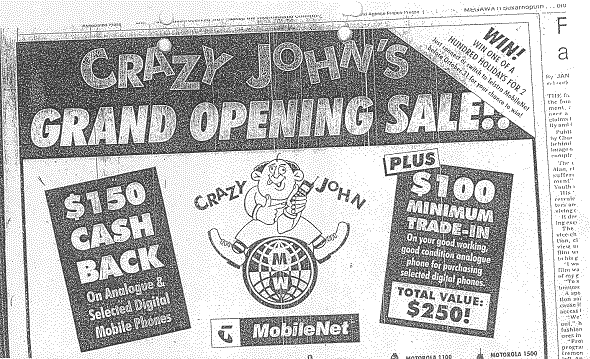
Exhibit C1
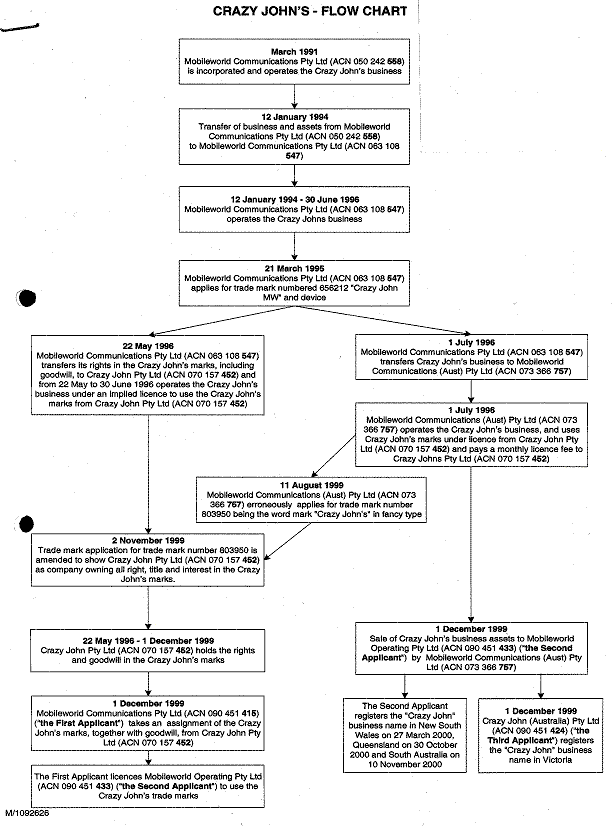
Exhibit C2