FEDERAL COURT OF AUSTRALIA
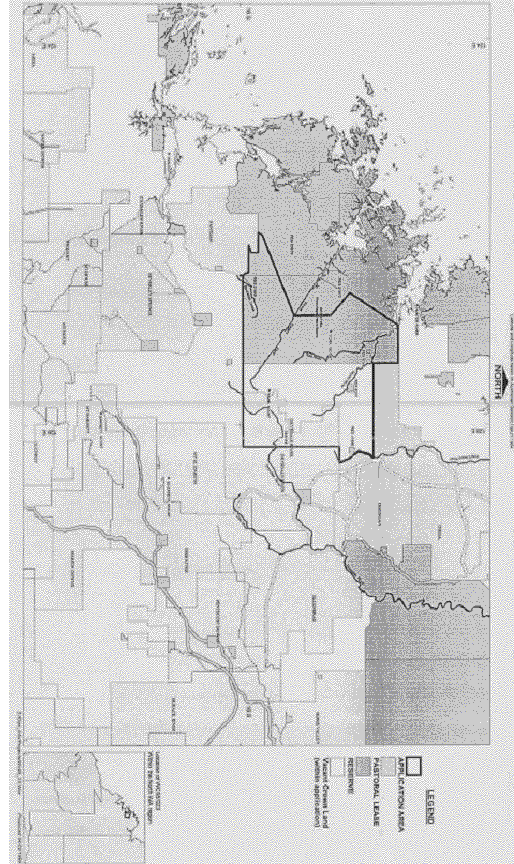
Neowarra v State of Western Australia [2003] FCA 1402
NATIVE TITLE – Application for determination – Applicants associated with particular dambun or estate areas ‑ Members of three language groups – Whether entitled to join in one claim – Whether claim should be dambun or language area based – Characteristics of native title – Whether amounts to possession, occupation, use and enjoyment as against whole world – Extinguishment – Effect on native title of other interests – Interests include pastoral leases, special leases, reserves, public works – Whether extinguishment required to be disregarded
Native Title Act 1993 (Cth) ss 11, 13, 14‑22H, 23B, 23C, 23D, 23DA, 23E, 23F, 23G, 23H, 23HA, 23I, 24OA, 28, 44H, 47, 47A, 47B, 61-62, 81, 211-213, 223, 225, 226, 227, 228‑232E, 237A, 238, 239, 242, 245, 246, 248, 248A, 248B, 249C, 251D, 253
Titles Validation and Native Title (Effect of Past Acts) Act 1995 (WA) ss 5,6, 7, 8, 9, 12A‑12E, 12I, 12J, 12M, 14
Mining Act 1904(WA) ss 26, 42-47, 79, 115, 117, 276
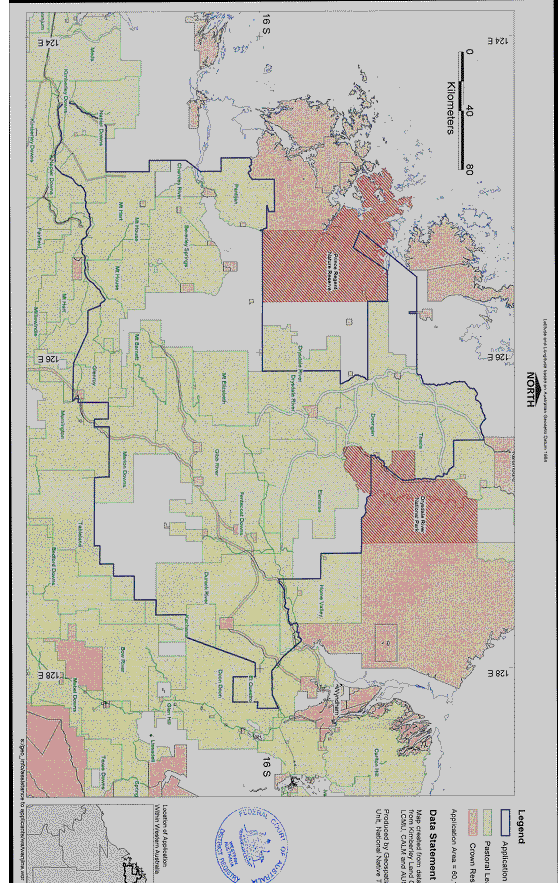
Mining Act 1978 (WA) ss 79, 85, 87, 91-94B
Country Areas Water Supply Act 1947 (WA) ss 8‑9, 11, 105,
Rights in Water and Irrigation Act 1914 (WA) ss 4, s 26B, 39, 41
Wildlife Conservation Act 1950 (WA) s 23
Land Act 1933 (WA) ss 7, 13, 29-30, 33, 90-91, 101A, 102-103, 105-107, 116, 140
Land Act 1898 (WA) ss 4, 13, 39-40, 46, 91-98, 100-102, 106, Sch 24
Aboriginal Affairs Planning Authority Act 1972 (WA) ss 20, 23
Petroleum Act 1967 (WA) s 9
Parks and Reserves Act 1895 (WA) ss 3‑4, 8
Fauna Conservation Act 1950 (WA) ss 14, 16, 22, 23
Telecommunications Act 1975 (Cth) s 16
Australian Telecommunications Corporation Act 1989 (Cth) s 88
Telecommunications Act 1991 (Cth) s 129
Telecommunications Act 1997 (Cth) Sch 3, cl 5‑7
Aboriginal and Torres Strait Islander Commission Act 1989 (Cth) ss 14, 191B, 191E
Aboriginal Development Commission Act 1980 (Cth) ss 8, 27
Fisheries Act 1905 (WA) ss 3, 39C
Land Regulations 1878 regs 2‑4, 8, 12, 59‑61, 71, 73, Sch 10
Land Regulations for the Kimberley District 1880 regs 9, 12
Land Regulations 1882 regs 3, 7, 8, 29‑30, 61, 70, 73‑74, 79-81, 83, 85, Sch 11
Land Regulations 1887 regs 3, 5, 32-33, 38, 57, 61, 71, 73-74, 105, Sch 9
Mining Regulations made pursuant to Mining Act 1904(WA) regs 84, 87
Mining Regulations 1981 (WA) regs 37‑42B
By‑laws made pursuant to Country Areas Water Supply Act 1947 (WA) by laws 31, 34‑36, 38‑40
By‑laws made pursuant to Parks and Reserves Act 1895 by‑laws 13, 15‑17, 24, 26, 35‑36
Fisheries Regulations 1938 (WA) reg‑3
Mabo v Queensland (No 2) (1992) 175 CLR 1 cited
Western Australia v Ward (2002) 191 ALR 1 applied
Yorta Yorta v Victoria (2002) 194 ALR 538 applied
Ward v Western Australia (1998) 159 ALR 483 cited
Western Australia v Ward (2000) 99 FCR 316 applied
Commonwealth v Yarmirr (2001) 184 ALR 113 applied
De Rose v South Australia [2002] FCA 1342 distinguished
Commonwealth v Yarmirr (2000) 101 FCR 171 cited
Hayes v Northern Territory (1999) 97 FCR 32 considered
Yarmirr v Northern Territory (No 2) (1998) 82 FCR 533 distinguished
Project Blue Sky Inc v Australian Broadcasting Authority (1998) 194 CLR 355 applied
Montreal Street Railway Co v Normandin [1917] AC 170 considered
Clayton v Heffron (1960) 105 CLR 214 considered
Attorney‑General (NSW); Ex rel Franklins Stores Pty Ltd v Lizelle Pty Ltd [1977] 2 NSWLR 955 considered
Yates Security Services v Keating (1990) 98 ALR 68 cited
Minister for Natural Resources v New South Wales Aboriginal Land Council (1987) 9 NSWLR 154 cited
Western Stores Ltd v Orange City Council [1971] 2 NSWLR 36 cited
City Mutual Life Assurance Society v Elliott (1897) 18 LR (NSW) 391 distinguished
Wandarang People v Northern Territory (2000) 104 FCR 380 cited
Erubam Le (Darnley Islanders) v Queensland [2003] FCAFC 227 cited
Rubibi Community v Western Australia (2001) 112 FCR 409 cited
Passi v Queensland [2001] FCA 697 cited
Daniel v Western Australia [2003] FCA 666 considered
Shanmugam v Commissioner for Registration of Indian and Pakistani Residents [1962] AC 515 considered
Walton v Bank of Nova Scotia [1964] 1 OR 673 cited
Wentworth v New South Wales Bar Association (1992) 176 CLR 239 cited
PADDY NEOWARRA, PADDY WAMA & OTHERS v THE STATE OF WESTERN AUSTRALIA & OTHERS
WAG 6016 OF 1996
WAG 6015 OF 1999
WAG 6006 OF 2002
SUNDBERG J
8 DECEMBER 2003
MELBOURNE
TABLE OF CONTENTS
| The Applications | 1–9 | |||||
| Applicants’ Statement of Issues, Facts and Contentions | 10-24 | |||||
| Respondents’ Responses to Applicants’ Statement and Applicants Replies | 25-28 | |||||
| The Hearing | 29 | |||||
| The Legislation | 30-31 | |||||
| Major Judicial Pronouncements | 32-41 | |||||
| Genealogical Evidence | 42-49 | |||||
| Historical Evidence | 50-61 | |||||
| Archaeological Evidence | 62-70 | |||||
| Anthropological Evidence | 71-120 | |||||
| Rumsey/Redmond Report | 71-82 |
| |||
| Professor Sansom’s Report | 83-86 |
| |||
| Professor Blundell’s Report | 87-90 |
| |||
| Professor Sansom’s Further Report | 91-96 |
| |||
| Redmond/Rumsey Cross‑Examination | 97-99 |
| |||
| Professor Blundell’s Oral Evidence | 100-111 |
| |||
| Rumsey, Redmond, Blundell – too partisan? | 112-119 |
| |||
| Findings | 120 |
| |||
| Languages and Language Country Areas | 121-125 | |||||
| The Claim Area | 126-161 | |||||
| Ngarinyin (including Wurla and Andajin) | 126-130 |
| |||
| Gunjarlngarri | 131-132 |
| |||
| Galiyamba | 133-134 |
| |||
| Gumulowru | 135-137 |
| |||
| Anthropological Assistance | 138-141 |
| |||
| Unggumi | 142-150 |
| |||
| Western Seaboard | 151 |
| |||
| Langarrigona | 152-153 |
| |||
| Respondents’ Submissions | 154-159 |
| |||
| Conclusion on claim area | 160-161 |
| |||
| Laws Acknowledged and Customs Observed | 162-322 | |||||
| Wanjina | 164-177 |
| |||
| Wunggurr | 178-184 |
| |||
| Wanalirri | 185-191 |
| |||
| Language Knowledge and Use | 192-198 |
| |||
| Moieties | 199-203 |
| |||
| Clans and dambun | 204-210 |
| |||
| Kinship, marriage and clans | 211-226 |
| |||
| Ceremonial ritual | 227-229 |
| |||
| Place specific ritual | 230 |
| |||
| Junba composition and performance | 231-236 |
| |||
| Baran – widow law and mourning | 237-243 |
| |||
| Traditional burial | 244-249 |
| |||
| Rambarr – avoidance relationships | 250-252 |
| |||
| Wudu – instructing young children | 253-255 |
| |||
| Avoiding names of deceased people | 256-257 |
| |||
| Naming practices | 258-260 |
| |||
| Wurnan – sharing and trading resources | 261-271 |
| |||
| Cultural knowledge | 272-273 |
| |||
| Being from or belonging to country | 274 |
| |||
| Speaking for country | 275-276 |
| |||
| Painting country | 277-285 |
| |||
| Looking after country and places | 286-301 |
| |||
| Access to country and resources | 302-311 |
| |||
| Inheritance of country | 312-315 |
| |||
| Living on, using and enjoying country | 316-322 |
| |||
| Traditional? | 323-346 | |||||
| Connection of claimants with land or waters (s 223(1)(b) | 347-362 | |||||
| Native Title Rights and Interests | 363-383 | |||||
| Section 223(1)(a) | 363-365 |
| |||
| Applicants’ formulation of their case | 366-367 |
| |||
| The State’s submissions | 368-376 |
| |||
| Group 2A submissions | 377-378 |
| |||
| Conclusion | 379-383 |
| |||
| Native Title Recognition Level | 384-398 | |||||
| Extinguishment | 399-765 | |||||
| Legislative Scheme | 399-415 |
| |||
| Ward on extinguishment | 416-423 |
| |||
| The tenure documents and tenure map | 424-430 |
| |||
| Pastoral leases | 431-556 |
| |||
| (a) Validity | 431-464 |
| |||
| (b) Rights conferred by pastoral leases | 465-470 |
| |||
| (c) Comparison of rights conferred by leases with claimed native title rights and interests | 471-500 |
| |||
| (d) Comparison of rights conferred by leases with claimed activities | 501-515 |
| |||
| (e) Result of comparison | 516-522 |
| |||
| (f) Conclusions on pastoral leases | 523-554 |
| |||
| Reserves | 555-587 |
| |||
| (a) Validity | 555-570 |
| |||
| (b) Inconsistency | 571-587 |
| |||
| Special leases | 588-598 |
| |||
| Minerals, petroleum and gas | 599-600 |
| |||
| Mining tenements | 601-616 |
| |||
| (a) Mining Act 1904 | 601-609 |
| |||
| (b) Mining Act 1978 | 610-616 |
| |||
| Public works | 617-628 |
| |||
| (a) General | 617 |
| |||
| (b) Roads | 618-625 |
| |||
| (c) Bores and water monitoring equipment | 626-627 |
| |||
| (d) Conservation infrastructure | 628 |
| |||
| Extinguishment by legislation | 629-645 |
| |||
| Country Areas Water Supply Act 1947 and By‑Laws | 629-631 |
| |||
| Parks and Reserves Act 1895 and By‑Laws | 634-636 |
| |||
| Rights in Water and Irrigation Act 1914 | 637-643 |
| |||
| Wildlife Conservation Act 1950 | 644-645 |
| |||
| Telstra | 646-671 |
| |||
| Disregarding extinguishment | 672-761 |
| |||
| Section 47 | 673-678 |
| |||
| Section 47A | 679-718 |
| |||
| Areas affected by the Fitzroy River Proclamation | 719 |
| |||
| Section 47B | 720-760 |
| |||
| WAFIC | 761-784 | |||||
| IN THE FEDERAL COURT OF AUSTRALIA |
|
| WESTERN AUSTRALIA DISTRICT REGISTRY | WAG 6016 OF 1996 WAG 6015 OF 1999 WAG 6006 OF 2002 |
| BETWEEN: | PADDY NEOWARRA, PADDY WAMA, SCOTTY MARTIN, JIMMY MALINE, JACK DANN, JACK DALE, KEITH NENOWATT, PAUL CHAPMAN, REGGIE TATAYA, DONALD CAMPBELL, PANSY NULGIT, BETTY WALKER, KATHY OREERI, MANDY WUNGUNDIN, BARNEY U APPLICANTS
|
| AND: | STATE OF WESTERN AUSTRALIA AND OTHERS RESPONDENTS
|
| JUDGE: | SUNDBERG J |
| DATE: | 8 DECEMBER 2003 |
| PLACE: | MELBOURNE |
REASONS FOR JUDGMENT
THE APPLICATIONS
1 On 22 November 1996 the Native Title Registrar lodged with the Court a native title determination application made under s 61(1) of the Native Title Act 1993 (“the Act”) in relation to 7,225.9 square kilometres of land in the Kimberley region of Western Australia (WAG 6016 of 1996). As later amended, the persons on whose behalf the application was made are described as:
“those people who hold in common the body of laws and customs derived from beliefs about Wanjina/Ungurr. Those people are
(b) The descendants of [some 87 named individuals]
(c) together with the descendants of Dalbi, who was adopted into the native title claimant group.”
Schedule B to the application identifies the external boundaries of the claim area by reference to geographic co‑ordinates and a map. The map is reproduced as an attachment hereto. Under the heading “internal boundaries” the applicants exclude from the claim:
(a) any areas covered by valid acts on or before 23 December 1996, comprising such category A past acts as defined in ss 228 and 229 of the Act and category A intermediate period acts as defined in ss 232A and 232B as are included as extinguishing acts within the Act or the Titles Validation and Native Title (Effect of Past Acts) Act 1995 (WA) (“the State Validation Act”), and
(b) any areas in relation to which a previous exclusive possession act (as defined in s 23B of the Act) was done, being an act attributable to the Commonwealth, or an act attributable to the State of Western Australia, where a law of the State has made provision as mentioned in s 23E in relation to the act.
These exclusions are expressed to be subject to such of ss 47, 47A and 47B of the Act as apply to any part of the claim area, including three areas vested in Aboriginal Land Trusts as reserves under the Aboriginal Affairs Planning Authority Act 1972 and the area comprising vacant Crown land. Attached to the application is a bundle of searches disclosing the existence of non‑native title rights and interests in relation to the land covered by the application. These are reserves and pastoral leases.
2 The application then describes the native title rights and interests claimed by the applicants. They are:
“the rights to the possession, occupation, use and enjoyment as against the whole world (subject to any native title rights and interests which may be shared with others who establish that they are native title holders) of the area and any right or interest included within the same, and in particular, comprise:
(a) rights and interests to possess, occupy, use and enjoy the area;
(b) the right to make decisions about the use and enjoyment of the area;
(c) the right of access to the area;
(d) the right to control the access of others to the area;
(e) the right to use and enjoy resources of the area;
(f) the right to control the use and enjoyment of others of resources of the area;
(g) the right to trade in resources of the area;
(h) the right to receive a portion of any resources taken by others from the area;
(i) the right to maintain and protect places of importance under traditional laws, customs and practices in the area;
(j) the right to maintain, protect and prevent the misuse of cultural knowledge of the common law holders associated with the area.”
3 The rights and interests claimed are expressed not to include any minerals, petroleum or gas wholly owned by the Crown in right of the Commonwealth or the State. In relation to waters, the rights and interests claimed are not to the exclusion of other rights and interests validly created by a law of the Commonwealth or of the State or accorded under international law. Subject to the operation of ss 47, 47A and 47B in relation to the areas to which they are said to apply, the applicants do not claim native title rights and interests which confer possession, occupation, use and enjoyment to the exclusion of all others in respect of any areas in relation to which a previous non‑exclusive possession act as defined in s 23F was done in relation to an area, and either the act was attributable to the Commonwealth, or was attributable to the State and a law of the State has made provision as mentioned in s 23I in relation to that act. Rights and interests are not claimed to the exclusion of any other rights or interests validly created by or pursuant to the common law, the law of the State or a law of the Commonwealth.
4 The factual basis of the claim is expressed as follows:
“The native title rights and interests are those of and flowing from the right to possession occupation use and enjoyment of the land pursuant to the traditional law and custom of the claim group based upon the following facts:
(i) the native title claim group and their ancestors have, since the assertion of British sovereignty possessed, occupied and enjoyed the claim area; and
(ii) such possession, occupation, use and enjoyment has been pursuant to and possessed under the laws and customs of the claim group,
including traditional laws and customs that rights and interests in land and waters vest in members of the native title claim group on the basis of:
(a) descent from ancestors connected to the area
(b) conception in the area
(c) birth in the area
(d) traditional religious knowledge of the area
(e) traditional knowledge of the geography of the area
(f) traditional knowledge of the resources of the area
(g) knowledge of traditional ceremonies of the area;
(iii) such traditional law and custom has been passed by traditional teaching, through the generations preceding the present generations to the present generations of persons comprising the native title claim group;
(iv) the native title claim group continues to acknowledge and observe those traditional laws and customs;
(v) the native title claim group by the laws and customs have a connection with the land in respect of which the claim is made;
(vi) the rights and interests are capable of being recognised by the common law of Australia.”
5 Under the heading “activities” in relation to land or waters currently being carried out by the claim group, the following appears:
“Members of the native title group have continuously/from time to time carried out activities on the land and waters within the area of the claim in particular, they have possessed, occupied, used and enjoyed the area, including by way of hunting, gathering, fishing and conducting traditional ceremonies.”
6 On 10 June 1999 a second application (WAG 6015 of 1999) was filed by the applicants in relation to some 60,150 square kilometres of land adjacent to that the subject of the earlier application. The external boundaries of the claim area are identified by reference to geographic co‑ordinates and a map. The map is reproduced as an attachment hereto. The second application is in substantially the same form as the earlier one as amended. The differences are as follows:
(a) there is an additional exclusion from the claim area (under the heading “Internal boundaries”) of “any areas in relation to which native title rights and interests have otherwise been extinguished”;
(b) in relation to the exclusions (under the heading “Internal boundaries”), the applicants say that “to avoid uncertainty” they particularly exclude all acts for a public work, dedicated roads and grants of unqualified freehold;
(c) the applicants state that no searches had been carried out for non‑native title rights and interests;
(d) the activities carried out on the claim area are expanded so as to include:
(i) camping;
(ii) living in and building structures;
(iii) moving freely about and having access to the claim area;
(iv) taking and using the resources of the area, including forest products, water, minerals and other resources from the land and waters;
(v) manufacturing tools and weapons from the resources of the land and waters;
(vi) disposing by trade or exchange of the products of the land and waters or things manufactured from the products of the land and waters;
(vii) managing, conserving and caring for the land and waters and controlling access to the land and waters;
(viii) visiting and protecting sites;
(ix) passing on the knowledge of the country and of the traditional law and custom;
in accordance with custom and tradition.
7 On 17 December 1999 orders were made that the two applications proceed and be heard together, that the materials filed in the first application be taken to have been filed in the second, and that the description of the native title claim group be amended in each application so as to take into account the greatly expanded claim area. The claim group had been the same in relation to both areas. Now the group was divided into three sub‑groups across the combined claim area, one group representing the Ngarinyin language group, one the Wunambal language group and one the Worrorra language group.
8 On 30 December 2002 a third application (WAG 6006 of 2002) was filed. Its object was to enable ss 47 or s 47A of the Act to be applied to three areas covered by the second application that had been transferred to the Indigenous Land Corporation since the second application was made in 1999. The areas are pastoral lease 3114/918 (Pentecost Downs, also known as Karunjie), pastoral lease 3114/648 (Durack River) and so much of pastoral lease 3114/962 (Home Valley) as lies within the claim area. These are areas over which the applicants assert that any extinguishment of native title is required by ss 47 and 47A to be disregarded. On 4 February 2003 I ordered that this application be heard and determined together with the others.
9 The respondents to the applications are the State of Western Australia (the first respondent), Sunlight Holdings Pty Ltd (the second respondent), pastoral lessees other than the second respondent, West Australian Fishing Industry Council (the third respondent), Telstra Corporation Limited (the eighth respondent) and Mitchell Plateau Bauxite Co Pty Limited (the Group 5 respondent). I will call them, respectively, the State, Sunlight Holdings, Group 2A, WAFIC, Telstra and Mitchell Bauxite. Telstra and Mitchell Bauxite were concerned only with issues of extinguishment.
APPLICANTS’ STATEMENT OF ISSUES, FACTS AND CONTENTIONS
10 On 19 December 2000, pursuant to an order in that behalf, the applicants filed a Statement of Issues, Facts and Contentions in the first and second applications (“the Statement”). The Statement has been amended from time to time. The following description of its contents takes account of the amendments. The Statement first describes the composite claim area. It consists of areas of unallocated Crown land, Crown land the subject of specified pastoral leases, Crown land the subject of specified pastoral leases for the benefit of Aboriginal peoples, Crown land the subject of reserves, Crown land the subject of special leases pursuant to s 116 of the Land Act 1933 (WA), and major river systems. The expression “Wanjina‑Wunggurr region” is used to describe the claim area and adjacent areas generally to the north and west of it. The expression “surrounding areas” is used to describe the Wanjina‑Wunggurr region outside the claim area.
11 The Statement describes the claimants as “members of the Wanjina‑Wunggurr community”. They are further described as the descendants of various named people. Membership of the claim group is said to be by way of “an inherited link through mother or father to a clan estate country (dambun) within the Wanjina‑Wunggurr region”. Under the heading Prior inhabitants of the claim area it is asserted that Aboriginal people inhabited the Wanjina‑Wunggurr region at the time non‑indigenous sovereignty was claimed over Western Australia and had done so for perhaps as long as 26,000 years. In support of this assertion reference is made to archaeological investigations of the region, and linguistic investigations which establish that the languages identified with the Wanjina‑Wunggurr people and the region are related to each other within a single family of languages which have been developing in situ in the region for at least 1,000 years.
12 Sovereignty is said to have been first asserted over Western Australia by the Crown in 1829. Under the heading Native Title at Sovereignty appear these paragraphs:
“10. At sovereignty Aboriginal people held native title in the claim area and surrounding areas.
11. At sovereignty the Crown did not acquire absolute beneficial ownership of the land but a radical title burdened or qualified by the indigenous inhabitants of the land: Mabo (No 2) 175 CLR 1.
12. The Aboriginal people who held the native title at sovereignty were those who inhabited the claim area, were present upon it, who were in occupation of it, or used it at the time: Mabo (No 2) 175 CLR 1 at 58 per Brennan J, at 188 per Toohey; and Commonwealth v Yarmirr 168 ALR 496 (per Merkel J).
…
14. The native title held by Aboriginal people in the claim area and surrounding areas at sovereignty was a full and comprehensive interest in the land. At sovereignty all that was necessary for those people’s existence was obtained from the claim area. They used the land and waters for all the purposes of their lives. That included their home and shelter, their diverse foods, their implements for living, their weapons, their means of fire, their medicines and their adornments. Their religious beliefs, ceremonial ritual, language, and artistic expression were intimately connected with the land. Their relationship with the land is rightly and appropriately described as ownership. There were no owners other than those Aboriginal people. They were entitled as against the whole world to possession, occupation, use and enjoyment of the land of the claim area. It is that traditional community title (communal native title) that burdened the radical title of the Crown.”
13 In support of the contentions in paragraphs 10 and 14 of the Statement reliance is placed, amongst other things, on:
(a) the archaeological and linguistic investigations referred to in [11];
(b) the oral histories of senior Aboriginal people concerning their own lives, and the lives of their parents’ and grandparents’ generations, which give a comprehensive account of their presence upon, occupation and use of the claim area and surrounding areas back to the second half of the 19th century, from which it is proper to infer that earlier generations of Aboriginal people were also present upon, occupying and using the claim area and surrounding areas going back to 1829;
(c) the existence of a spiritual belief system of the Aboriginal people of the region (encompassing “a dimension known as Larlan”, and the presence in particular places in the landscape of spiritual essences that came to a father of a child in a dream and inhabit the mother of the child), that has been passed down over many generations, and from which it is proper to infer that the system, and the presence of the society whose system it is, goes back to 1829;
(d) European historical records giving uncontradicted testimony to Aboriginal presence in, and occupation and use of, the claim area and surrounding areas before and after sovereignty.
14 Under the next heading – Native title holders at sovereignty and the claimants’ ancestral community – it is claimed that the Aboriginal people who held native title in the claim area at sovereignty are the ancestral community of the claimants, the ancestors of the present day Wanjina‑Wunggurr community. To support this contention reliance is placed on the following facts and matters:
(a) the archaeological and linguistic investigations referred to in [11];
(b) genealogies prepared by Diana McCarthy, Kim Doohan and Daniel Vachon and the Report accompanying the genealogies;
(c) genealogies of members of the native title group include some ancestors of the group who were alive in 1829;
(d) membership of the claimant group depends on having at least one parent who is a member of the community;
(e) previous occupiers of the Wanjina‑Wunggurr region are in most cases the actual biological forebears (and in a few cases the adoptive forebears) of the present claimants;
(f) the previous occupiers of the Wanjina‑Wunggurr region also identified with and spoke the languages the members of the native title claim group today identify with and speak;
(g) all the Aboriginal languages associated with the Wanjina‑Wunggurr region are related to each other within a single family of languages which have been developing in situ in the region for at least 1,000 years;
(h) the language areas recognised by the claimants are to a high degree coincident with the language areas identified in earlier records and accounts;
(i) a high proportion of past and present marriages involving claimants are between members of the Wanjina‑Wunggurr community;
(j) claimants commonly observe, and past members of the Wanjina‑Wunggurr community have commonly observed, a distinctive form of marriage called patrilateral cross cousin marriage, which entails a special type of kin classification and moiety exogamy;
(k) ethnographic and anthropological investigations have identified the Aboriginal people present in and occupying and using the claim area and surrounding areas as the claimants, and refer to them using various labels by which the claimants are known in various subsets, subgroups and categories.
15 The applicants also rely on the “broad generalisations” collected by Deane and Gaudron JJ in Mabo v Queensland (No 2) (1992) 175 CLR 1 at 99‑100 (Mabo (No 2)), which they say are applicable to the Aboriginal people who were present upon and occupying and using the claim area and surrounding areas in 1829. Further, they say that insofar as ancestors of the claimants cannot be traced back to 1829, it is proper to infer that there have been no intervening events in the years from 1829 to the time of the birth of the known ancestors of the applicants, and to conclude that the claimants are the descendants of the Aboriginal people present on the claim area in 1829.
16 The next heading is The Claimants’ laws and customs are traditional. The facts and matters relied on to support the contention that the traditional laws acknowledged and the traditional customs observed by the claimants are derived from, or based on, the traditional laws and customs of the Aboriginal people who held native title over the claim area at sovereignty are:
(a) those referred to in [11]:
(b) Wanjina paintings and beliefs about them and what they represent are central to the laws and customs acknowledged and observed by the contemporary Wanjina‑Wunggurr community;
(c) the members of the native title group regard themselves and their forebears as the only people who acknowledge and observe the laws and customs comprising the Wanjina‑Wunggurr cultural domain;
(d) the presently observed laws and acknowledged customs of the Wanjina‑Wunggurr cultural domain are relevantly similar to those laws and customs which were observed and acknowledged by Aboriginal people, now deceased, who previously occupied the Wanjina‑Wunggurr region, those laws and customs having been continuously practised and transmitted in much the same form within the region since 1829;
(e) the members of the Wanjina‑Wunggurr community have, and their forebears had, their own distinctive, shared body of beliefs, social and cultural traits and language affinities that bind them together and differentiate them from neighbouring regions, and include:
(i) beliefs in Wanjina;
(ii) beliefs in Wunggurr;
(iii) events of spiritual conception through which a child is associated with a place from which its body was entered in utero by a pre‑existing spirit placed there by Wunggurr;
(iv) a division of the entire region into dambun, each associated with one or more Wanjina, often present as a painting in one or more caves or rock shelters within the country;
(v) clan groups, each of which is associated with one of the dambun, clan membership being determined by that of one’s father;
(vi) a kind of top‑down division of the world (human and non‑human alike) into two complementary categories or moieties, children being assigned to the opposite one to their mother’s (usually the same as their father’s);
(vii) a system of kin classification through which clan estates are linked together in specific quasi‑genealogical or affinal relationships (brother‑brother, mother‑child, husband‑wife etc);
(viii) a system of exchange (wurnan) in which objects, songs and valued knowledge are circulated through an established order of adjacent clan estates;
(ix) a distinctive form of marriage called patrilateral cross cousin marriage;
(f) the members of the Wanjina‑Wunggurr community through recorded and remembered history have maintained a physical connection to the Wanjina‑Wunggurr region, including the claim area;
(g) the claimants and deceased members of the Wanjina‑Wunggurr community, in accordance with the laws and customs of the Wanjina‑Wunggurr cultural domain, have carried out, and continue to carry out, within the Wanjina‑Wunggurr region, including the claim area, the following activities:
(i) living and building structures and establishing and maintaining communities;
(ii) moving freely about and having access to the claim area;
(iii) camping;
(iv) hunting;
(v) gathering and fishing;
(vi) taking and using the resources of the area, including forest products, water, minerals and other resources from the land and waters;
(vii) manufacturing items from the resources of the land and waters;
(viii) disposing of the products of the land and waters or manufactured from products of the land and waters by trade or exchange;
(ix) managing, conserving and caring for the land and waters and controlling access to the land and waters;
(x) conducting and taking part in ceremonies;
(xi) visiting and protecting sites;
(xii) making decisions about the use and enjoyment of the claim area;
(xiii) using and enjoying, having access to, controlling the access of others to, painting, freshening and repainting painted images on rock surfaces within the claim area, in particular in relation to, but not limited to, painted images known as, or referred to by the claimants as, Wanjina images and Gwion images and images associated with those images;
(h) the claimants and deceased members of the Wanjina‑Wunggurr community, in accordance with the laws and customs of the Wanjina‑Wunggurr cultural domain, have acted and continue to act in relation to the land and waters of the Wanjina‑Wunggurr region, including the claim area, as if they had, and in so acting have asserted and continue to assert, inter alia, the rights listed in [2] together with additional rights. Although it involves some repetition, it is convenient to assemble all these rights in one place. They are rights to:
(i) possession, occupation, use and enjoyment of the claim area as against the whole world;
(ii) otherwise possess, occupy, use and enjoy the claim area;
(iii) assert valid proprietary claims over and speak authoritatively for, on behalf of, and about, the claim area;
(iv) make decisions about the use and enjoyment of the claim area;
(v) have access to the claim area;
(vi) control the access of others to the claim area;
(vii) use and enjoy resources of the claim area;
(viii) control the use and enjoyment of others of resources of the claim area;
(ix) trade in resources of the claim area;
(x) receive a portion of the benefit of any resources taken by others from the claim area;
(xi) maintain and protect places of importance under traditional laws, customs and practices in the claim area;
(xii) use, maintain, protect and prevent the misuse of cultural knowledge of the Wanjina‑Wunggurr community in relation to the claim area;
(xiii) uphold and enforce the traditional laws and customs of the Wanjina‑Wunggurr community;
(xiv) recognise or determine as between members of the Wanjina‑Wunggurr community what is the form of connection or relationship of a particular member of the Wanjina‑Wunggurr community to particular parts of the claim area and what are the particular rights and interests that arise from that particular form of connection or relationship;
(xv) resolve disputes concerning the claim area;
(xvi) as against the whole world, possession of painted images on rock surfaces within the claim area, in particular in relation to but not limited to painted images known as or referred to by the claimants as Wanjina images and Gwion images and images associated with those images;
(xvii) as against the whole world, use the land or waters adjacent to such images for the purposes of or incidental to (xvi);
(xviii) belong to or be from the claim area;
(xix) speak for the claim area;
(xx) represent the Wanjina;
(xxi) look after the land and waters of the claim area;
(xxii) inherit the land and waters of the claim area;
(xxiii) be acknowledged as the owners of the land and waters in accordance with traditional laws and customs.
17 The applicants then allege that they are Aboriginal people who, under traditional laws acknowledged and traditional customs observed by them, possess rights and interests in the claim area. The Statement then asserts that the claimants are Aboriginal people who acknowledge a body of traditional laws and observe a body of traditional customs including laws and customs in relation to control of access to the claim area and its resources, occupation of the claim area, and use and enjoyment of it and its resources for all the purposes of their lives. The Statement goes on to set out the facts relied on to support these claims:
(a) those referred to in [11], [13], [14], [16] and [22];
(b) the native title claim group members acknowledge a body of traditional laws and observe a body of traditional customs and practices that include those derived from beliefs about Wanjina and Wunggurr;
(c) Wanjina and Wunggurr are two of the distinctive elements of the native title claim group’s traditional laws and customs – Wanjina referring to the distinctive figures found in painting galleries located within the Wanjina‑Wunggurr region that are associated with certain beliefs acknowledged and practices observed by the claimants, and Wunggurr associated with a set of beliefs in a creative agent sometimes called the “Rainbow Serpent”, and often associated with deep pools of water in the region;
(d) the existence of the Wanjina‑Wunggurr community and its connection to the region (including the claim area) is the outcome of the claimants’ observance and acknowledgment of an inherited body of laws and customs (the Wanjina‑Wunggurr cultural domain);
(e) the claimants share a communal right to control, disseminate and apply the knowledge associated with the Wanjina‑Wunggurr cultural domain, including the tangible things which are of significance within that domain such as Wanjina painting sites, Wunggurr pools, and other areas of significance in the Wanjina‑Wunggurr region;
(f) the Wanjina‑Wunggurr cultural domain has developed in the course of a long period of Aboriginal occupation of the Wanjina‑Wunggurr region, and involves the continuing relationship of the claimants, through ritual and other customary practices, with the Wanjina beings, whom they believe to have been the original occupiers of the region, and whom they believe continue to be physically manifested as topographic features, rain clouds and celestial bodies in the region;
(g) the extent of the Wanjina‑Wunggurr region can be determined by the locations and distribution of sites recognised by the claimants as associated with the Wanjina‑Wunggurr cultural domain;
(h) distinctive labels are used by and for a certain kind of sub‑group of the Wanjina‑Wunggurr community, namely Ngarinyin, Wurla, Wunambal, Gambere, Wilawila, Worrorra, Yawijibaya, Unggarrangu, Unggumi and Umida; labels that apply to sets of claimants, the several languages they speak or identify with, and areas within the Wanjina‑Wunggurr region;
(i) the members of the Wanjina‑Wunggurr community also use these same labels to differentiate themselves and to designate areas of land and waters within the Wanjina‑Wunggurr region. Language difference is part of the basis upon which members of the community were and are interrelated;
(j) there is a high degree of coincidence between the aggregate of these language areas and the distribution of sites associated with the Wanjina‑Wunggurr cultural domain;
(k) the laws and customs observed by the claimants establish a number of kinds of connections between them and areas of land and sites within the Wanjina‑Wunggurr region, including language countries, conception sites, and named areas of the kind commonly referred to in anthropological literature as “estates”, which the claimants call “dambun”, and which are loosely bounded areas usually associated with one or more named Wanjina site and Wunggurr place;
(l) the members of the community of claimants, almost without exception, are known to each other by Aboriginal names in addition to European names;
(m) the members of the community of claimants observe traditional law requirements as to the avoidance of certain places, and the names of recently deceased persons are not spoken.
18 Under the heading The claimants’ native title appear these paragraphs:
“25. The native title of the claimants in relation to the land and waters of the claim area is a communal native title that confers on the members of the native title claim group for their respective communal, group and individual rights and interests, the right of possession, occupation, use and enjoyment of the claim area as against the whole world.
25A. The native title confers a right, as against the whole world, of possession in relation to painted images on rock surfaces within the claim area, in particular in relation to but not limited to painted images known as or referred to by the claimants as Wanjina images and Gwion images and images associated with those images, and in the alternative confers rights of access to, rights to control the access of others to, rights to make decisions in relation to, and rights to paint, freshen and repaint, those painted images.
25B. If it be necessary (contrary to the Applicants’ contentions) in any event, in order to identify any particular incident or incidents of the right referred to in paragraph 25 above for the purpose of describing the native title rights and interests or the nature and extent of the native title, it will be appropriate to identify such particular incident or incidents by reference to such of the description of rights set out at paragraph 22(h) above or by reference to such of the activities as are referred to in paragraph 22(g) above other than (xii) and (xiii) thereof as may be necessary for the purpose.
25C. If it be necessary (contrary to the Applicants’ contentions) in the event that the Court does not accept the contention set out in paragraph 25 above, to identify native title as a set of less generally described rights and interests for the purpose of describing the native title rights and interests or the nature and extent of the native title, it will be appropriate to identify such particular incidents by reference to such of the description of rights set out at paragraph 22(h) above and by reference to such of the activities as are referred to in paragraph 22(g) above other than (xii) and (xiii) thereof as is necessary for the purpose.”
The content of par 22(h) (rights) referred to in pars 25B and 25C above is set out in [16(h)], and the content of par 22(g) (activities) in [16(g)].
19 The Statement goes on to claim that the claimants’ native title:
· has the quality of a special relationship with the land and waters of the claim area
· is part of the given order of the way things are, originating in and ordained by the Larlan
· is full and comprehensive
· is a traditional community title for the benefit of the community as a whole and for the sub‑groups and individuals within it.
20 Paragraph 32 deals with what the applicants describe as the “internal dimensions” of the native title:
“Recognition of the native title as being held by the Wanjina Wunggurr community as a right of possession, occupation, use and enjoyment of the claim area as against the whole world involves an acknowledgment that the native title has ‘internal’ dimensions being
(a) rights and interests as between the members of the native title group in relation to various parts of and places on the claim area; and
(b) particular rights and interests that are encapsulated in the generality of the right as described;
(c) the entitlement of the claimants to do all of those things in relation to land and waters that they are permitted or required to do respectively as individuals, as groups or as a community under the traditional laws acknowledged and traditional customs observed by them; and
(d) the entitlement of the claimants as individuals, as groups and as a community respectively to do all those things that are permitted by reason of their having, as common law holders, a ‘right of possession’, occupation, use and enjoyment against the whole world’.”
21 Paragraph 36 particularises some of the features of the internal dimensions of their native title:
(a) entitlements possessed by the claimants under the traditional laws acknowledged by them and the traditional customs observed by them within the Wanjina‑Wunggurr region, including in the claim area, exist as a complex set of cross‑cutting and overlaid individual, groups and community rights and interests of various kinds;
(b) the Wanjina‑Wunggurr region and the claim area is not undifferentiated with regard to those entitlements;
(c) those entitlements are not undifferentiated in their existence in relation to or in application to the Wanjina‑Wunggurr region or the claim area, and are not all held or shared equally by all claimants in relation to the whole of the Wanjina‑Wunggurr region or the claim area for all time and for all purposes, but are variously possessed by the claimants, for their respective individual, group and community rights according to traditional laws acknowledged and customs observed by them, namely according to the traditional laws and traditional customs of the Wanjina‑Wunggurr cultural domain (examples are given);
(d) members of clans whose countries have particular kinship relationships to another clan country have particular rights and interests in relation to that clan country depending upon the nature of the kinship relationship, and some of them may have or come to acquire direct or primary rights by way of processes of succession in the event of the death of the last member of that other clan; members of clans having the same moiety affiliation, and members of clans having countries of the same language affiliation, have particular rights in the other clan countries having those affiliations; members of the claimant group have particular rights in relation to the clan country of particular kin; and a member of the claimant group has particular rights in relation to his or her Wunggurr place and the clan country in which that place is situated;
(e) the nature and extent of those entitlements that are held by the Wanjina‑Wunggurr community as a whole also includes the entitlements to determine, sustain, manage, support, adjust, resolve disputes in relation to, regulate and administer the culturally specific forms of linkages and privileges of the members of the Wanjina‑Wunggurr community in relation to lands and waters of the Wanjina‑Wunggurr region and the claim area, and to control, disseminate and apply the knowledge associated with the Wanjina‑Wunggurr cultural domain and, as a community, in relation to matters involving the whole of the claim area or matters involving land and waters within the claim area on which is located a site that is central to the traditional laws and customs of the Wanjina‑Wunggurr community (for example in relation to a matter involving a threat to the place Wanalirri), the entitlement to possession, occupation, use and enjoyment of the claim area and such a site as against the whole world;
(f) the members of the native title claim group
(i) have the entitlements referred to in par 32(c) and (d), quoted in [20] including all the rights referred to in par 22(h)(ii) to (xiv) set out in [16], and
(ii) may do all of the things that may be done under the entitlements referred to in par 32(c) and (d), quoted in [20], including all the things referred to in par 22(g) other than sub‑pars (xii) and (xiii) set out in [16].
22 The Statement next deals with connection to the claim area. The applicants contend that individually, collectively in various groupings and as a community, by the traditional laws they acknowledge and the traditional customs they observe, they have a connection with the claim area. This connection is said to include historic, ancestral, social, physical, ritual, spiritual, traditional and economic connections. In support of these claims they rely on the following facts and matters:
(a) the facts referred to in [17] and those in par 36(a) to (e) set out in [21];
(b) their connection to the claim area is distinctive, unique and exclusive;
(c) individual claimants are connected to named dambun areas and sites in a variety of ways defined and established in accordance with the body of law and custom of the Wanjina‑Wunggurr cultural domain;
(d) the connections to named dambun areas form the basis on which some specific rights and interests are held by claimants and the basis on which they identify at a higher level with the Wanjina‑Wunggurr region as a whole;
(e) connections to the dambun of a claimant’s father has particular social and cultural salience, and is the basis on which one becomes a member of a named group associated with that particular dambun/clan;
(f) connections to other dambun can be legitimately gained through other means, such as a relationship to other relatives (eg mother, mother’s mother) and to a number of relations by marriage;
(g) dambun are classified according to a moiety system;
(h) dambun are associated with one or more of the several language labels that apply to sets of members of the claimant group and areas within the Wanjina‑Wunggurr region, so that in certain circumstances a claimant will assert a legitimate connection to and have rights and interests in a dambun having the same language association as one’s own dambun;
(i) dambun are ordered within a system of exchange called the wurnan;
(j) other ways of establishing connection to a site or dambun include
(i) through the link to the specific place or Wunggurr of a claimant’s spiritual finding; and
(ii) through links to the dambun of a genealogically distant, classificatory father’s father;
(k) dambun are not, and never have been, independent economic, ritual, residential or political units, and have not, and have never had, exclusive rights and responsibilities in an estate’s economic and cultural resources; they can undergo legitimate fission and fusion during the course of the observance by the claimants of the laws and customs of the Wanjina‑Wunggurr cultural domain;
(l) there is a long history of co‑residency among the claimants, a strong sense of common identity, and a social network of multiple cross‑cutting ties.
23 The applicants contend that it is immaterial that their laws and customs may have undergone some change since sovereignty, so long as the general nature of the connection between them and the land remains. They say that the circumstances of history have not destroyed their, or their ancestors’, acknowledgment of traditional law and observance of traditional custom. They have continued to live and work on, and close to, their country.
24 Finally the claimants contend that their rights and interests in the claim area are recognised by the common law of Australia. The right of possession, occupation, use and enjoyment of the area as against the whole world is known to the common law, as are:
“(however described) other forms of full and comprehensive rights and interests in relation to land and waters, rights to make decisions about land and waters, rights of control of access to and use of land and waters and resources, rights of ownership, rights of use of land and waters and resources for all the purposes of life.”
RESPONDENTS’ RESPONSES AND APPLICANTS’ REPLIES
25 The State, Group 2A, Sunlight Holdings and WAFIC responded to the Statement in its original, unamended form. The State:
· admits there were Aboriginal people present upon or occupying the claim area in 1829
· does not admit that the Aboriginal people present in the claim area in 1829 were members of a Wanjina‑Wunggurr community, or that such a community existed at that time
· says that at 1829 and continuing up to European settlement:
· discrete areas of land within the claim area were used and enjoyed by particular clan groups each of which constituted an organised society
· membership of each clan group was essentially patrilineal and its residence was patrilocal
· some of the clan groups in the claim area shared common languages, including Ngarinyin, Worrorra and Wunambal
· says that non‑Aboriginal settlement, particularly the establishment of mission settlements and pastoral stations, caused disruption of the clan group organisation, relocation of Aboriginal people from their traditional clan lands and a decline in adherence to traditional laws and customs
· does not admit that there is an identifiable community called the Wanjina‑Wunggurr community
· does not admit that the applicants
· are the descendants of the Aboriginal people who were present upon the land in the claim area at 1829
· form a presently identifiable community
· presently acknowledge traditional laws and observe traditional customs
· hold the native title rights and interests claimed in the Statement.
26 The applicants’ reply to the State’s response essentially joins issue with the denials and non‑admissions, save that:
(a) in relation to the admission that at 1829 discrete areas of the clan area were used and enjoyed by particular clan groups in an organised society, they assert that:
(i) the “discreteness” of such areas was not at any material time absolute relative to the areas or the entitlement of persons to occupy, use and enjoy them, or over time;
(ii) such areas were not used and enjoyed only by members of the particular clan group, and entitlement to use and enjoy such areas was not limited to the members of the particular clan group; and
(iii) such clan groups did not in themselves constitute self sufficient, self regulating societies whose members in fact necessarily or only used or enjoyed their “clan area”;
(b) they accept that the society of the Aboriginal people in occupation of the claim area at sovereignty may have undergone some changes including adaptations in response to events involved in European settlement.
27 Group 2A’s response is to substantially the same effect as the State’s. They do not admit the existence at 1829 of a Wanjina‑Wunggurr community on the claim area, and say that if it did exist, it was not the only Aboriginal community present upon, occupying and/or using the area at that time, and that any current Wanjina‑Wunggurr community is not present upon, occupying and/or using the same land and waters as any previous Wanjina‑Wunggurr community. They also do not admit:
· that the applicants and their predecessors have maintained or have substantially maintained a connection with the claim area
· that the applicants and their predecessors have since 1829 continued to acknowledge laws and observe customs based upon the traditional laws and customs of the Aboriginal people who were present upon, occupied and/or used the claim area at 1829
· that any native title enures for the benefit of the applicants, or that the applicants continue to possess any native title at all or any native title that existed prior to the date of the acquisition of sovereignty.
The applicants’ reply essentially joins issue with Group 2A’s response to the Statement.
28 Sunlight Holdings adopts Group 2A’s response to the Statement. WAFIC’s response to the Statement:
· does not admit that the applicants have a right to enjoy the resources of the claim area, alternatively that part of the claim area seaward of the high water mark, alternatively seaward of the low water mark, other than those resources that were, at and following sovereignty, used under the traditional laws and customs of the applicants and their ancestors
· denies that at 1829 or thereafter the applicants or their ancestors, under their traditional laws and customs, had or have the right or exclusive right claimed in the Statement in relation to the claim area, alternatively that part of the claim area seaward of the high water mark, alternatively seaward of the low water mark
· says that if the applicants and their ancestors have or had a right to control the use and enjoyment by others of resources, or to trade in resources, or to receive a portion of the resources taken by others from the claim area:
· “resources” are limited to those resources that were, at and following sovereignty, used under traditional laws and customs and continue to be so used
· resources do not include “fish” as defined in the Fish Resources Management Act 1994 (WA) or pearl oysters and pearls as defined in the Pearling Act 1990 (WA).
In their reply the applicants join issue with WAFIC’s non‑admissions and denials.
THE HEARING
29 Preservation evidence from six witnesses was taken at the Aboriginal community at Mowanjum, near Derby, in November 2000. These witnesses were either elderly or in poor health, and it was appropriate to record their evidence in advance of hearing other witnesses in case events should render the evidence unavailable. The applicants’ opening address was made in Perth on 5 and 6 May 2001 followed by opening statements by the State, Group 2A, Sunlight Holdings, WAFIC and Mitchell Bauxite. The evidence of fifty three Aboriginal witnesses in the applicants’ case was heard at Mowanjum, various places in the claim area, and in Derby over twenty nine days between July and October 2001. On ten of those days in August and September 2001 evidence was taken at locations in the claim region. The Court travelled to various parts of the region, by road, helicopter and fixed wing aircraft. Although these travels covered only a small part of the claim area, they were sufficient to make clear that the area is remote and largely undeveloped. Fifty of the Aboriginal witnesses were members of the native title claim group and three were from outside the Wanjina‑Wunggurr region. The evidence of expert witnesses for the applicants and the respondents, together with evidence as to connection and extinguishment issues for the respondents, was heard from 6 to 17 May and from 27 May to 7 June 2002. Closing submissions were made in Perth between 3 and 6 February 2003. In all, the trial occupied fifty nine hearing days.
THE LEGISLATION
30 Section 61 of the Act enables a native title determination application to be made by, amongst other people, those who, according to their traditional laws and customs, hold the common or group rights and interests comprising the title claimed. The Court’s jurisdiction to hear and determine such an application is conferred by ss 81 and 213. Division 2 of Part 15 of the Act defines some of the key concepts embodied in the Act. Section 223(1) provides:
“The expression native title or native title rights and interests means the communal group or individual rights and interests of Aboriginal peoples or Torres Strait Islanders in relation to land or waters, where:
(a) the rights and interests are possessed under the traditional laws acknowledged, and the traditional customs observed, by the Aboriginal peoples or Torres Strait Islanders; and
(b) the Aboriginal peoples or Torres Strait Islanders, by those laws and customs, have a connection with the land or waters; and
(c) the rights and interests are recognised by the common law of Australia.”
Without limiting sub‑s (1), the rights and interests there referred to include hunting, gathering and fishing: sub‑s (2).
31 Section 225 provides:
“A determination of native titleis a determination whether or not native title exists in relation to a particular area (the determination area) of land or waters and, if it does exist, a determination of:
(a) who the persons, or each group of persons, holding the common or group rights comprising the native title are; and
(b) the nature and extent of the native title rights and interests in relation to the determination area; and
(c) the nature and extent of any other interests in relation to the determination area; and
(d) the relationship between the rights and interests in paragraphs (b) and (c) (taking into account the effect of this Act); and
(e) to the extent that the land or waters in the determination area are not covered by a non-exclusive agricultural lease or a non-exclusive pastoral lease—whether the native title rights and interests confer possession, occupation, use and enjoyment of that land or waters on the native title holders to the exclusion of all others.”
MAJOR JUDICIAL PRONOUNCEMENTS
32 In Western Australia v Ward (2002) 191 ALR 1 (“Ward”) at [17] Gleeson CJ, Gaudron, Gummow and Hayne JJ (“the joint judgment”) summarised the effect of s 223(1) as follows:
“First, the rights and interests may be communal, group or individual rights and interests. Secondly, the rights and interests consist ‘in relation to land or waters’. Thirdly, the rights and interests must have three characteristics:
(a) they are rights and interests which are ‘possessed under the traditional laws acknowledged, and the traditional customs observed’, by the relevant peoples;
(b) by those traditional laws and customs, the peoples ‘have a connection with’ the land or waters in question; and
(c) the rights and interests must be ‘recognised by the common law of Australia’.”
33 Their Honours went on at [18]‑[19] to say that whether (a) is satisfied in a particular case is a question of fact:
“It requires not only the identification of the laws and customs said to be traditional laws and customs, but, no less importantly, the identification of the rights and interests in relation to land or waters which are possessed under those laws or customs. These inquiries may well depend upon the same evidence as is used to establish connection of the relevant peoples with the land or waters. This is because the connection that is required by par (b) of s 223(1) is a connection with the land or waters ‘by those laws and customs’. Nevertheless, it is important to notice that there are two inquiries required by the statutory definition: in the one case for the rights and interests possessed under traditional laws and customs and, in the other, for connection with land or waters by those laws and customs.
The distinction is critical for any attempt (as is made in this litigation) to treat the maintenance and protection of cultural knowledge of native title holders as a matter with which the NTA is concerned. The cultural knowledge in question may be possessed under the traditional laws acknowledged and traditional customs observed by the relevant peoples. The issue which then arises is whether, by those laws and customs, there is ‘a connection with’ the land or waters in question.”
34 The joint judgment then considered at [20] the relationship between pars (a) and (b) of s 223(1) on the one hand and par (c) on the other:
“Paragraphs (a) and (b) of s 223(1) indicate that it is from the traditionallaws and customs that native title rights and interests derive, not the common law. The common law is not the source of the relevant rights and interests; the role accorded to the common law by the statutory definition is that stated in par (c) of s 223(1). This is the ‘recognition’ of rights and interests. To date, the case law does not purport to provide a comprehensive understanding of what is involved in the notion of ‘recognition’.”
Their Honours made further observations about the notion of recognition, but it is not necessary to note them at this stage.
35 In Yorta Yorta v Victoria (2002) 194 ALR 538 (“Yorta Yorta”) Gleeson CJ, Gummow and Hayne JJ (“the joint judgment”) returned to the elements of s 223(1). Their Honours first considered the import of “traditional” at [46]‑[47]:
“As the claimants submitted, ‘traditional’ is a word apt to refer to a means of transmission of law or custom. A traditional law or custom is one which has been passed from generation to generation of a society, usually by word of mouth and common practice. But in the context of the Native Title Act , ‘traditional’ carries with it two other elements in its meaning. First, it conveys an understanding of the age of the traditions: the origins of the content of the law or custom concerned are to be found in the normative rules of the Aboriginal and Torres Strait Islander societies that existed before the assertion of sovereignty by the British Crown. It is only those normative rules that are ‘traditional’ laws and customs.
Secondly, and no less importantly, the reference to rights or interests in land or waters being possessed under traditional laws acknowledged and traditional customs observed by the peoples concerned, requires that the normative system under which the rights and interests are possessed (the traditional laws and customs) is a system that has had a continuous existence and vitality since sovereignty. If that normative system has not existed throughout that period, the rights and interests which owe their existence to that system will have ceased to exist. And any later attempt to revive adherence to the tenets of that former system cannot and will not reconstitute the traditional laws and customs out of which rights and interests must spring if they are to fall within the definition of native title.”
36 Their Honours went on at [49]‑[55] to explain why what they had said about the second element of “traditional” had the consequences described in [47]. Having done so, they said at [56]:
“For these reasons, it would be wrong to confine an inquiry about native title to an examination of the laws and customs now observed in an indigenous society, or to divorce that inquiry from an inquiry into the society in which the laws and customs in question operate. Further, for the same reasons, it would be wrong to confine the inquiry for connection between claimants and the land or waters concerned to an inquiry about the connection said to be demonstrated by the laws and customs which are shown now to be acknowledged and observed by the peoples concerned. Rather, it will be necessary to inquire about the relationship between the laws and customs now acknowledged and observed, and those that were acknowledged and observed before sovereignty, and to do so by considering whether the laws and customs can be said to be the laws and customs of the society whose laws and customs are properly described as traditional laws and customs.”
37 The joint judgment then turned to the requirement of “recognition” in s 223(1)(c). Having rejected the claimants’ contention that par (c) is a drafting device by which a pre‑existing body of the common law of Australia defining the rights or interests known as native title is brought into the Act, it continued at [77]:
“The reference to recognition by the common law serves a different purpose of which there are at least two relevant features. First, the requirement for recognition by the common law may require refusal of recognition to rights or interests which, in some way, are antithetical to fundamental tenets of the common law. No such case was said to arise in this matter and it may be put aside. Secondly, however, recognition by the common law is a requirement that emphasises the fact that there is an intersection between legal systems and that the intersection occurred at the time of sovereignty. The native title rights and interests which are the subject of the Act are those which existed at sovereignty, survived that fundamental change in legal regime, and now, by resort to the processes of the new legal order, can be enforced and protected. It is those rights and interests which are ‘recognised’ in the common law.”
38 Their Honours then noted that demonstrating the content of pre‑sovereignty traditional laws and customs may present difficulties of proof, and that claimants will often invite the Court to infer, from evidence led at trial, the content of traditional law and custom at times earlier than those described in the evidence: at [81].
39 The joint judgment then considered the significance of adaptation of traditional laws and customs in response to the impact of European settlement. At [82]‑[83] their Honours said:
“In such cases, difficult questions of fact and degree may emerge, not only in assessing what, if any, significance should be attached to the fact of change or adaptation but also in deciding what it was that was changed or adapted. It is not possible to offer any single bright line test for deciding what inferences may be drawn or when they may be drawn, any more than it is possible to offer such a test for deciding what changes or adaptations are significant. ...
What is clear, however, is that demonstrating some change to, or adaptation of, traditional law or custom or some interruption of enjoyment or exercise of native title rights or interests in the period between the Crown asserting sovereignty and the present will not necessarilybe fatal to a native title claim. Yet both change, and interruption in exercise, may, in a particular case, take on considerable significance in deciding the issues presented by an application for determination of native title. The relevant criterion to be applied in deciding the significance of change to, or adaptation of, traditional law or custom is readily stated (though its application to particular facts may well be difficult). The key question is whether the law and custom can still be seen to be traditional law and traditional custom. Is the change or adaptation of such a kind that it can no longer be said that the rights or interests asserted are possessed under the traditional laws acknowledged and the traditional customs observed by the relevant peoples when that expression is understood in the sense earlier identified?”
40 Their Honours then dealt with interruption of use or enjoyment of rights or interests which, they said at [84], presented more difficult questions. They first pointed out that while the exercise of native title rights or interests may constitute powerful evidence of both the existence of those rights and their content, evidence that at some time since sovereignty some of those who now assert that they have that native title have not exercised those rights does not inevitably answer the question posed by s 223(1). That is because that question is directed to possession of the rights or interests, not their exercise. Their Honours also pointed out that pars (a) and (b) of s 223(1) are cast in the present tense. They concluded their consideration of the issue of interruption at [86]‑[87]:
“it is important to bear steadily in mind that the rights and interests which are said now to be possessed must nonetheless be rights and interests possessed under the traditional laws acknowledged and the traditional customs observed by the peoples in question. Further, the connection which the peoples concerned have with the land or waters must be shown to be a connection by their traditional laws and customs. For the reasons given earlier, ‘traditional’ in this context must be understood to refer to the body of law and customs acknowledged and observed by the ancestors of the claimants at the time of sovereignty.
For exactly the same reasons, acknowledgment and observance of those laws and customs must have continued substantially uninterrupted since sovereignty. Were that not so, the laws and customs acknowledged and observed now could not properly be described as the traditional laws and customs of the peoples concerned. That would be so because they would not have been transmitted from generation to generation of the society for which they constituted a normative system giving rise to rights and interests in land as the body of laws and customs which, for each of those generations of that society, was the body of laws and customs which in fact regulated and defined the rights and interests which those peoples had and could exercise in relation to the land or waters concerned.”
41 Their Honours then explained at [89] why they had said that acknowledgment and observance must have continued substantially uninterrupted since sovereignty:
“It is a qualification that must be made in order to recognise that proof of continuous acknowledgment and observance, over the many years that have elapsed since sovereignty, of traditions that are oral traditions is very difficult. It is a qualification that must be made to recognise that European settlement has had the most profound effects on Aboriginal societies and that it is, therefore, inevitable that the structures and practices of those societies, and their members, will have undergone great change since European settlement. Nonetheless, because what must be identified is possession of rights and interests under traditional laws and customs, it is necessary to demonstrate that the normative system out of which the claimed rights and interests arise is the normative system of the society which came under a new sovereign order when the British Crown asserted sovereignty, not a normative system rooted in some other, different, society. To that end it must be shown that the society, under whose laws and customs the native title rights and interests are said to be possessed, has continued to exist throughout that period as a body united by its acknowledgment and observance of the laws and customs.”
GENEALOGICAL EVIDENCE
42 Genealogical evidence was adduced orally from Aboriginal witnesses. Anthropologists prepared genealogical charts and reports, gave oral evidence and were cross‑examined. Nearly all Aboriginal witnesses gave detailed evidence about their forebears and descendants which, for the most part, was not challenged. Some of the respondents challenged the status of the genealogical evidence as “expert” evidence. At the conclusion of Mr Vachon’s evidence those respondents withdrew the challenge “in the light of the evidence that’s been given”. The evidence of Ms Doohan and Ms McCarthy was later in time, and their parts of the genealogies were admitted without comment. They gave evidence as to the way in which they had assembled the genealogies, and although the withdrawal was not repeated, I took it that the earlier withdrawal applied to their evidence as well. In any event, I would have rejected the challenge to their parts of the genealogies as “expert” evidence. At first instance in Ward v Western Australia (1998) 159 ALR 483 at 532 Lee J was of the view that genealogies duly prepared by anthropologists employing their specialised skill and understanding of the structure and culture of a society represent an appropriate field of expert evidence. In light of the evidence from the three anthropologists as to the way in which they prepared their parts of the genealogies, I am satisfied that they have specialised knowledge based on their training, study and experience, and that the genealogies and the report accompanying them are substantially based on that knowledge. See Evidence Act 1995 s 79.
43 In the report accompanying the genealogies Ms McCarthy, Ms Doohan and Mr Vachon identified the volumes for which they were responsible, explained how the spread sheets containing the genealogical information were to be understood, noted the secondary sources they had consulted, and acknowledged the extent to which each had consulted the other authors and other anthropologists, such as Professor Blundell and Dr Redmond. The following extracts from the report disclose the way in which the genealogies were constructed:
“10. Genealogies are a graphic representation of the socially‑recognised connections of the claimants. They are not intended to represent any one individual’s knowledge, but rather depict a complex of research findings and analysis.
11. These genealogies depict socially‑recognised biological connections between individuals and also connections by adoption and socially‑recognised putative genealogical links ….
12. Genealogical data is gathered in a process that combines:
(a) detailed interviews with the applicants and others;
(b) taking relevant material from historical and archival records in published and unpublished sources; and
(c) collaboration with other researchers where appropriate.
13. These genealogies are a composite representation of the connections of the members of the native title claim group to their upper generational kin (‘the old people’), to each other and to their own descendants as well as providing an indication of peoples’ connection to certain named locations and/or regions within the Wanjina‑Wunggurr Region.
14. These representations demanded the continuity of connection between members of the native title group and the eldest known, or recorded people, these being the ancestors listed in the native title determination applications in this proceeding ….
15. Descent from a named ancestor has been defined as a genealogical connection through either a male or female link.
16. Some of the earliest ancestors appear on the genealogies from secondary sources only. These ancestors are shown where there is clear overlap between the secondary source material and primary data.
17. In some of the genealogies contained in Volume 1 the notation ‘cb’ (classificatory brother) or ‘cz’ (classificatory sister) appears. On some of the genealogies presented in volumes 2 and 3 there are broken lines between upper generational kin. These notations indicate putative kinship, eg old people linked in these ways as classified as or said to be ‘brothers’ and ‘sisters’ to each other.
18. In volumes 2 and 3 this same kind of line can also indicate a socially‑recognised form of adoption.
19. The birth dates for the upper generations have been estimated with reference to both Love and Birdsell where applicable. Other dates have been estimated using a twenty year inter‑generation gap in Volumes 2 and 3 and a twenty five year gap in Volume 1 … between a known, or recorded, birth date and then working backwards towards the upper most generation.
20. Given that most marriages tended to occur between men who were much older than their wives, the most senior men were probably older than estimated. Even so the genealogies indicate that the applicants’ most senior kin were within the claim area from at least the 1860s.”
As I have said, each author orally elaborated on the methodologies used in the construction of the genealogies for which he or she was responsible.
44 Ms McCarthy was cross‑examined at some length about a report she had prepared on the percentage of claimants contained in her data base who had married within the claimant group. However there was no real attack on her contribution to the genealogies. Professor Sansom, who gave anthropological evidence for the State, in his Further Report filed 7 May 2002 said of Ms McCarthy’s contribution to the genealogies:
“I must remark the overall attention to detail in the compilation of the report which investigates 1423 instances of ‘witnesses referring to a person who is contained in the database’ (p 1). The magnitude of the task of establishing the database and performing all the subsequent operations is quite something and I myself have not previously seen any group‑genealogical material subjected to so thoroughgoing an examination. In my view the reliability of the genealogy and database created by Diana McCarthy is well established.” [page 39 par 17]
45 Nor was Mr Vachon’s contribution subjected to any real criticism. Ms Doohan was cross‑examined at length, but again her part of the genealogies was not seriously sought to be undermined. In the course of her cross‑examination Ms Doohan accepted that a person’s father shown in her genealogies was not necessarily a biological father. In re‑examination she said:
“the biological component … is how people see themselves being connected to their fathers and their grandparents, and often people use the term ‘my really father’ to make a distinction that we would see more as a kind of biological relationship and people are saying that ‘Even though I’ve got 4 or 5 fathers, this is my really father’ in that context.”
She later said that where someone spoke of a “really father”, that was the father she recorded in the genealogies – “that connection of an intimacy which is of a different nature than the one with the other fathers”.
46 In view of this evidence, and the reference in the report to “socially‑recognised biological connections between people, and connections by adoption and socially‑recognised putative genealogical links”, I should refer to what Beaumont and von Doussa JJ said in the Full Court in Western Australia v Ward (2000) 99 FCR 316 at [232]:
“When these two passages [from the judgment of Brennan J in Mabo (No 2)] are read together we think it plain that his Honour was not intending to lay down as an invariable requirement that there be strict ‘biological descent’. Rather, we understand Brennan J to be expressing a requirement that there be an identifiable community with an entitlement to the present enjoyment of native title rights in relation to land arising from the adherence to traditionally based laws and customs. A substantial degree of ancestral connection between the original native title holders and the present community would be necessary to enable a group to be identified as one acknowledging and observing the traditional laws and customs under which the native title rights were possessed at sovereignty.”
47 Their Honours went on to refer to the evidence in that case about the adoption or “growing up” of children by members of the Miriuwung and Gajerrong community, and expressed the view that Brennan J’s reference to “biological descent” was not intended to exclude such people from membership of the community. Nor, said their Honours at [234]‑[235], did biological descent mean that descent must be patrilineal:
“The identity of those presently entitled to enjoy native title rights, is to be ascertained by reference to the traditional laws and customs as currently acknowledged and observed. The evidence in this case is to the effect that under the traditional laws and customs, a whole range of relationships may lead to membership of the community, including ‘father’s country’, ‘father’s mother’s country’, ‘mother’s country’, ‘mother’s mother’s country’, ‘regent’s country’, ‘the country of a spouse’, and spiritual conception or birth within the area.
…
On the evidence, the traditional laws and customs acknowledged and observed by the communities in the determination area at sovereignty, and as currently acknowledged and observed by those recognised amongst themselves as present members of the Miriuwung and Gajerrong community, did not impose a requirement of strict biological descent, let alone patrilineal descent as a prerequisite to membership.
The trial judge was plainly correct to observe that the genealogies admitted into evidence showed ‘a broad spread of links with ancestors’ among the representative claimants and other witnesses who had given evidence in support of the claim. … That broad spread of links is in our opinion sufficient proof of ‘biological’ connection between the present community and the community in occupation at the time of sovereignty.”
The evidence in the present case as to acknowledged membership of the Wanjina‑Wunggurr community is to the same general effect as that referred to by their Honours. The evidence of Ms Doohan, Ms McCarthy and Mr Vachon accords with that of the Aboriginal witnesses in this respect.
48 A determination of native title pursuant to s 225 of the Act requires the identification of “who the persons or each group of persons holding the common or group rights comprising the native title are”. Group 2A submit that the applicants have not established by evidence the persons who comprise the claimant group and the basis upon which those persons are members of the group. In my view they have established both those things. The claimant group is described as the descendants of named people who were previous inhabitants of the claim area. The genealogies, which were not the subject of serious assault by the respondents, link the claimants with previous inhabitants. As indicated in [42]‑[45], I accept the expertise of the genealogists and the accuracy of their charts. Insofar as ancestors of the claimants cannot be traced back to sovereignty (1829), it is reasonable to infer that there have been no intervening events between 1829 and the time of the birth of the known ancestors of the applicants that stand in the way of a conclusion that the claimants of today are the descendants of the Aboriginal people present on the claim area in 1829. Cf Mason v Tritton (1994) 34 NSWLR 572 at 588‑589 per Kirby P.
49 My findings in relation to the genealogical witnesses and their evidence are as follows:
(1) The challenge to Mr Vachon’s evidence on the basis that he did not have specialised knowledge based on his training, study or experience was withdrawn.
(2) The challenge to Ms Doohan’s and Ms McCarthy’s evidence on the basis that neither had specialised knowledge based on training, study or experience was not expressly withdrawn, though it was withdrawn by implication.
(3) In any event I am satisfied that each of Mr Vachon, Ms Doohan and Ms McCarthy has specialised knowledge in relation to anthropology and the preparation of genealogies based on his or her training, study and experience.
(4) The traditional laws and customs acknowledged and observed by the ancestors of the claimant group did not impose a requirement of strict biological or patrilineal descent as a condition of membership of the group.
(5) The members of the claimant group are the descendants of the individuals named in the applications.
(6) The members of the claimant group are the descendants of the Aboriginal people present on the claim area in 1829.
HISTORICAL EVIDENCE
50 To some extent the respondents’ admission that there were Aboriginal people present upon, or occupying, the claim area in 1829 renders unnecessary the historical evidence to the extent that it is directed to that question. However its relevance goes well beyond that non‑issue. Dr Fiona Skyring, an historian employed by the Kimberley Land Council, provided three written reports and gave oral evidence for the applicants. In her first report of 17 May 2001 she addresses the question – Whether the claim area was inhabited by Aboriginal people in organised society at the time of formation of the colony of Western Australia in 1829. After commenting on the accounts of the journeys in and in the vicinity of the claim area of Phillip King (1820‑1821), J Lort Stokes (1837‑1838), George Grey (1837‑1838), Alexander Forrest (1879), Frank Hann (1898) and F S Brockman (1901), Dr Skyring answers the question as follows:
“The approach to the question of whether Aboriginal people inhabited the claim area in organised society in 1829 exposes the limitations and incompleteness of the historical record. There were no white men in the Kimberley to create the records, so documentary evidence from 1829 cannot exist. At that time, the small white population of Western Australia was concentrated around the makeshift settlement in the south west, several thousand kilometres from the Kimberley ….
It was nearly a decade after 1829 when George Grey ventured inland from the Kimberley coast to record his impressions of the people around the Glenelg River. His journal showed there was an established society close to the western boundary of the claim area, and that this society was organised. They built structures and adorned their environment with paintings. They attacked, then watched and followed the white intruders into their territory, traversing a large area for the duration of five months.
Brockman’s expedition in 1901 was the first time white people travelled extensively over the claim area. It is the earliest record available on which to base a historical assessment of whether Aboriginal people inhabited the claim area in 1829. This gap of over seventy years is again a limitation of the historical record and not a function of what actually happened. It is reasonable to assume that the evidence of occupation by Aboriginal people which Brockman and his party recorded in 1901 would have been the same if the white men had travelled through the area in 1829.” (pages 18‑19)
51 According to Dr Skyring (pages 16‑18), Brockman traversed the interior of the Kimberley from Walcott Inlet in the west to the Durack Ranges in the east, and the Drysdale and Woodhouse Rivers in the central northern part of the claim area. His party found examples of rock and cave paintings and frequently discovered at abandoned camps the pigments used in the paintings. Brockman encountered fewer Aboriginal people inland than he had found along the coast. While travelling up the Chamberlain River he met several small parties, probably not more than seventy or eighty in all. He did not meet any more until reaching the Glenelg River (which flows into George Water on the west coast), but saw evidence that small parties inhabited the valleys of the Chamberlain and Calder Rivers, and that they were more numerous about the shores of Doubtful Bay (to the south of George Water). Brockman encountered more Aboriginals in the northern part of the district. Those the team met were usually small hunting parties. The size of their camps suggested that there were seldom more than forty or fifty to be found together. To another member of the expedition, former Derby Resident Magistrate F House, the Aboriginals appeared, judging only by the numbers seen, to be very sparsely scattered. Nevertheless, signs of their existence were everywhere, such as camping places, marks on trees etc.
52 Dr Skyring went on to examine The nature of European settlement in the region of the claim area and the continuities and discontinuities in the Aboriginal inhabitancy of and connection with the claim area resulting from that European settlement. Under this heading she describes the establishment of pastoral stations, the killing of cattle by Aboriginals, the pastoral industry and police response, and the abandonment of some stations. This part of the report is purely descriptive, and the author offers no conclusions on the topic.
53 On the question Whether it is more likely than not that Aboriginal people who inhabited the claim area after World War II were identifiable with the Aboriginal people who inhabited the same area in 1829, Dr Skyring is unable to reach a final conclusion because she had only analysed documentary records up to the late 1930s. She identifies some of the additional records she would need to consult in order to answer the question posed. She does however report on the basis of her research up to the late 1930s:
“I can, based on my analysis so far, suggest that there is nothing in the historical record which seriously undermines the preliminary conclusion that Aboriginal people in parts of the claim area in the 1930s were the same as people there in 1829 …. Aboriginal people were everywhere that white men went. The Aboriginal people in various parts of the claim area responded to the various first attempts at white settlement, often in the form of retaliation. During the police raids in response to white settler complaints, many Aboriginal men were arrested and taken away. The historical record also indicates that many of them returned. There were not enough white men to effect any mass removal or killing of Aboriginal people throughout the claim area, and many white settlers did not want that result anyway because they relied on Aboriginal labour to run their stations. In the early decades of the twentieth century, Aboriginal people managed to frustrate the efforts of would‑be pastoralists and of the police sent to protect white‑owned livestock. Some stations were abandoned, and the police regularly gave up their pursuits of Aboriginal suspects where the country was too rough or the area too remote from white settlement.
Aboriginal occupancy of the land under leasehold north of the King Leopold Ranges and west of the Durack Ranges was never substantially questioned in the records to the 1930s. There is nothing in the record to suggest any mass movement of Aboriginal people from the claim area. They continued to conduct ceremony and on occasions travelled long distances across the claim area.” (page 57)
54 In Dr Skyring’s Supplementary History Report (December 2001) she considers the question posed in [52] in an amended form. The amendment added the words “with particular reference to the pastoral industry and the nature of the Aboriginal involvement in that industry”. After an examination of the industry in the Kimberley, Dr Skyring deals with the Aboriginal pastoral workforce generally, and in relation to particular stations in and on the boundaries of the claim area. Under the heading The Aboriginal pastoral workforce she expresses the view that Aboriginal people comprised the “overwhelming majority” of the pastoral workforce in the Kimberley until the 1970s, and continues:
“Commentators from the 1880s through to more recent times acknowledged the essential role Aboriginal workers played in the development of the pastoral industry in the north. Without Aboriginal labour the pastoral industry in the Kimberley would not have developed. Historical sources showed that until the 1970s, any fence, bore, well or windmill built on the stations within the claim area was probably built by Aboriginal workers. There were also references in the record which indicated that Aboriginal station workers in the Kimberley lived on or close to country to which they asserted traditional connection.” (page 51)
After her examination of the individual stations, Dr Skyring repeats her earlier observation that pastoral leaseholders in the Kimberley were dependent on Aboriginal labour until changes to the industry in the 1970s, and that Aboriginals did most of the work on the stations. After expressing the opinion that facilities for Aboriginal workers at the stations were poor, Dr Skyring concludes:
“Food rations had to be shared amongst the station communities and the records showed that people continued to supplement their rations with bushfoods, and hunting and fishing. Aboriginal pastoral workers were made to work hard for little material gain. Their only apparent advantage was that they could stay close to their ‘own country’ and that their elderly relatives and children could also live on the stations.” (page 88)
In her third report of February 2002 Dr Skyring documents the involvement of Aboriginals in three stations she had not dealt with in her Supplementary Report. Dr Skyring was cross‑examined by some of the respondents, but not so as to affect the foregoing account of her evidence.
55 Dr Mary Jebb, an historian, was requested by the applicants’ advisers to provide a bibliography of works relevant to the history of the Aboriginal presence on the claim area, and a “summary description and general analysis of the range of source material upon which historical research relevant to Aboriginal presence on the claim area is based”. She was also asked to give her opinion on a number of questions about the presence of Aboriginal people on the claim area at various dates, the identification of those people with those on the area in 1829, and the effects of European settlement on Aboriginal inhabitancy. Due to limited time and resources Dr Jebb was only able to prepare the bibliography and the summary description. The summary description details the records of European exploration and surveys from 1644 (Abel Tasman as reproduced by Captain King in 1827) to 1954 (J Morgan), police records (1903‑1923), Aboriginal Affairs Department Records (from 1948), pastoral station diaries, records of missionaries, anthropologists and scientists (JRB Love, AP Elkin, H Coate), the novels of Ion Idriess (published between 1949 and 1961), and oral history evidence. Because of the limited ambit of the task Dr Jebb undertook, her exposition is much less useful than Dr Skyring’s. Dr Jebb does not express opinions or conclusions about the material she details. In a Supplementary Report she comments on various opinions expressed by Dr Neville Green, who prepared a report for the State. Dr Jebb was not cross‑examined.
56 Dr Green’s Preliminary Historical Report is in essentially four parts. The first is a summary of exploration in the claim area by most of the same expeditioners referred to in Dr Skyring’s first report (King, Stokes, Grey, Forrest and Hann). The author claims that the material he sets out in this part establishes the following:
(a) Aboriginal people were seen in the Kimberley region before English settlement in 1829;
(b) the early coastal and overland explorers did not identify, by tribe or language, the Aborigines they encountered;
(c) Aborigines made artefacts of wood, and used stone to crush and grind seeds and to shape into spearheads;
(d) fire was used by Kimberley Aborigines;
(e) as early as 1821 Aborigines were making use of imported materials such as metal;
(f) Wanjina art was recorded as early as 1838;
(g) the Aboriginal population of the claim area cannot be given, though it is known that as many as 200 Aborigines were seen by Grey, while other explorers saw very few.
The material reviewed by Dr Green establishes the facts claimed. As to (b), he adds – “and there is no certainty that the people seen in a particular place are the ancestors of those seen at the same locality a century later or are the ancestors of those residing in the region today”. As to (e) Dr Green says that Brockman (1901) assumed that metal used by Aborigines “had been traded several hundred miles from the goldfields in the south‑east” (at 2.7.7).
57 The second part of Dr Green’s Report concerns Aborigines and police experiences. He claims that the material he sets out in this part establishes that:
(a) police patrols in the late 19th and early 20th century crossed over the claim area;
(b) none of the police files examined identified Aboriginal people by tribe or language group;
(c) the personal names of Aborigines were usually only recorded if they were accused of offences, or were prisoners or victims of attacks by spears or guns;
(d) the police records provide evidence of the removal of some Aboriginal people to prison or hospital;
(e) sheep and cattle pastured within the boundaries of the claim area were speared by Aborigines;
(f) Aborigines in possession of beef suspected to be stolen were arrested and those resisting arrest might be shot;
(g) over time Aborigines took precautions to reduce the chance of arrest;
(h) some of the arrest reports suggest that numbers of Aboriginal men were charged with crimes they may not have committed;
(i) police references to traditional Aboriginal customs rarely extend beyond use of weapons and fire, though there is occasional mention of a corroboree or a traditional burial, but without description.
These claims are borne out by the material deployed by Dr Green in their support.
58 The third part of the Report deals with Pastoralism. Dr Green claims that the material contained in this part establishes that:
(a) pastoral leases have covered much of the claim area;
(b) prior to 1951 the files of the Aborigines Department do not offer a comprehensive view of Aborigines on Kimberley pastoral stations;
(c) there was a high rate of arrest and imprisonment of men charged with stock killing;
(d) there is some evidence that the arrest and removal of Aboriginal men forced the women into dependence upon pastoral stations;
(e) between 1882 and 1970 Aboriginal people were employed under changing conditions: The Masters and Servants Act, The Aborigines Protection Act 1886, the Aborigines Act 1905 and the Pastoral Industry Award 1965 (after December 1968);
(f) between 1882 and 1950 most (Kimberley) station Aboriginals were unpaid employees;
(g) between 1905 and 1954 the Kimberley station workers were employed under a general permit applied for annually, the names of employees did not have to be provided, and no master file of permit applications was located;
(h) there is some evidence that the Pastoral Industry Award 1965 resulted in the displacement of Aboriginal workers on some Kimberley stations, though the real effect on station Aborigines in the claim area has yet to be evaluated;
(i) station census reports have been located for most pastoral stations falling within the claim area;
(j) the extension to Aboriginals of social welfare benefits, especially the age pension, gave many station pensioners and surplus employees an alternative income.
The material deployed supports facts (a) to (f) and (h) to (j)). Fact (g) is not in terms supported, but I have no reason to doubt its truth.
59 The fourth part of Dr Green’s Report is devoted to the Influence of missions. He claims that the material he sets out in this part establishes that:
(a) missions, although outside the boundaries of the claim area, had a trade and social significance for the Ngarinyin and Wunambal people;
(b) Munja government station was closely associated with the Ngarinyin and Wunambal people;
(c) the existence of the Ngarinyin, Wunambal and Worrorra language groups was known by 1915;
(d) by 1913 as many as 120 Aborigines were visiting Pt George IV mission, and it is likely that some of these were Ngarinyin and Wunambal people;
(e) the recollections of Mowanjum people, published in 1980, show that there were marriage links between the Worrorra and Ngarinyin people;
(f) there was a movement of people between Kunmunya mission and Munja government station;
(g) in 1950 the populations of Kunmunya and Munja were amalgamated at Wotjulum mission, thus bringing together a group comprising Worrorra, Ngarinyin and Wunambal people;
(h) in 1956 the Wotjulum population was transferred to Mowanjum mission on the outskirts of Derby;
(i) Munja, on the Walcott Inlet, was a Wunumbal word for the Harding Range;
(j) Constable Carr’s report of 1945 showed that a few elderly people continued to live partly independent of mission and pastoral stations.
Dr Green’s examination of the history of the missions and government stations supports facts (b) and (e) to (j). The first part of fact (a) is also supported, but the second part is a conclusion reached by the author. There is, however, no reason to doubt its veracity. Fact (c) is not supported by the material discussed. Again there is no reason to doubt its accuracy. The first part of fact (d) is supported. The second part is a conclusion of the author that appears in the summary alone, though there is no reason to doubt its appropriateness.
60 At the end of his Report Dr Green briefly reviews Dr Jebb’s preliminary report. He notes the limited nature of the report. He says there is very little in the report that is contentious. The sources are those familiar to researchers and historians, and “the few conclusions she arrives at, I would generally agree with” (at 6.2). He takes issue with some of Dr Jebb’s conclusions. But they are matters of detail. Although Dr Green’s report is described as a “Preliminary Historical Report”, there is no later supplementary or final report. Dr Green was not cross‑examined.
61 I now set out my findings on the historical witnesses and their evidence.
(1) Each of Dr Skyring, Dr Jebb and Dr Green has specialised knowledge in relation to history based on his or her training, study and experience.
(2) Aboriginal people were seen in the Kimberley region before 1829.
(3) In 1838 there was an established Aboriginal society close to the western boundary of the claim area (Glenelg River). It was an organised society, the members of which built structures and adorned their environment with paintings including Wanjina paintings, made artefacts of wood, and used stone to crush and grind seeds and to shape into spearheads.
(4) In 1901 Aboriginal people were present over the whole of the claim area, even though there were some places where they appeared to be sparsely scattered. Even where Aboriginals were not to be seen, signs of their existence (camping fires and marks on trees) were everywhere.
(5) It is to be inferred from findings (2), (3) and (4) that the level of occupation by Aboriginal people of the claim area in 1901 would have been the same in 1829.
(6) In the 1930s Aboriginal people were present everywhere in the claim area where white people went.
(7) There is nothing in the documentary records up to the 1930s that suggests any mass movement of Aboriginal people from the claim area, and they continued to conduct ceremonies and to travel long distances across the claim area.
(8) Many white settlers did not want the removal of the Aboriginals from the claim area because they relied on Aboriginal labour to run their stations. Aboriginal labour was essential to the viability of the pastoral industry in the region from the 1880s to the 1970s.
(9) Aboriginal occupancy of the land under leasehold north of the King Leopold Ranges and west of the Durack Ranges was never substantially questioned in the documentary records up to the 1930s.
(10) The involvement of Aboriginal people in station work meant they could live on or close to their traditional country and have their elderly relatives and children live on the stations. They supplemented their station rations with bush food and hunting and fishing.
ARCHAEOLOGICAL EVIDENCE
62 Dr Veitch, a consultant archaeologist, conducted “desktop” archaeological research on behalf of the applicants in relation to the claim area and the claim region. In his report Dr Veitch draws attention to the limitations of his research. He says that seventeen days were allowed for the research and the production of the report, and that in this time he covered about two thirds of the available literature. He had hoped to review a selection of site files from the Register of Aboriginal sites held at the Aboriginal Affairs Department, but time did not permit this to be done. He had been asked to prepare a map of the claim area and claim region showing all Aboriginal archaeological sites referred to in the report. But time and resources did not enable this to be done. Instead he produced a map showing sixteen major sites mentioned in the text (Appendix 6).
63 Dr Veitch was first asked for his opinion as to Whether there was an Aboriginal occupation of, and use of, … the claim area before … the establishment of the colony of Western Australia in 1829. The respondents had admitted that there had been Aboriginal occupation and use of the area from time immemorial, and this part of Dr Veitch’s Report was ruled inadmissible. However, that there was such occupation and use since before 1829 of both the claim area and the claim region is the starting point for his consideration of the remaining two questions. Dr Veitch generally uses “claim region” to describe the Wanjina‑Wunggurr region outside the claim area (ie what the applicants in the Statement call the “surrounding areas”). See [10]. The second question was Whether there has been a continuous use or occupation of the claim area by Aboriginal people. Dealing first with the claim area, Dr Veitch says there are two dated sites near Pantijan, excavated by Cathy Stokes in 1990, that contained material evidence for continuity of occupation. He continues:
“These sites are the Snake rockshelter and the Small Painting rockshelter excavated by Stokes (Table 1). Specifically, Stokes found at the Snake rockshelter that glass artefacts continued in the deposit to spit 8 (a depth of 23 cm beneath the ground surface). In addition ceramic material was recovered in spit 4 the deposit of the Snake rockshelter, and a blue plastic bead was located on the surface of the deposit …. At the Small Painting rockshelter, Stokes found glass artefacts to spit 6, or a depth of 10 cm beneath the ground surface.
The evidence from these two rockshelter sites presents clear evidence for Aboriginal use and occupation from 560+ 70 bp to 640+ 50 bp respectively (see Table 1), to well into the historic period. This information is also consistent with continuous, though possibly intermittent, use and occupation at these sites.” (page 19)
The letters “bp” mean “before present”. The “present” is 1950 for the purposes of radiocarbon dating, the method of analysis used to ascertain the abovementioned occupation dates.
64 Dr Veitch notes that in the early 1970s Professor Blundell recorded a number of sites in the claim area that contain evidence consistent with pre‑contact and post‑contact use. Dr Veitch considers that although no radiometric dates are available for these sites, the presence of flaked stone artefacts in most of the sites is consistent with pre‑contact use, and the presence of flaked glass artefacts and other European material clearly attests to post‑contact use. In the claim region Dr Veitch says there is far more evidence suggesting continuity of occupation. The relative abundance of such evidence is, he says, a direct result of the greater amount of research that has been conducted in the claim region as opposed to the claim area. Dr Veitch details the evidence. He concludes on this second question as follows:
“The evidence for continuity of occupation of the Claim Area from dated sites represents a geographic bias, in that it comes from two sites in the south of the Claim Area. The kind of evidence from these two sites, however, appears more widespread in the Claim Region, and suggests that this apparent absence of evidence is a reflection of the lack of coordinated research into the Claim Area ….
The material from undated sites recorded by Blundell (1975), however, contains a far greater geographic spread of the same kinds of material evidence contained in the dated sites. Specifically, the presence of flaked stone and glass artefacts, and of stone and glass points at many sites, suggests that evidence consistent with continuity of use of the Claim Area and Region is far more widespread than information from the dated sites would indicate.” (page 24)
65 The third question Dr Veitch was asked was Whether the current Aboriginal archaeological evidence shows a cultural continuity, or if there have been changes over time in the use and occupation of the land … from the earliest recorded Aboriginal presence to the post‑contact period. Dr Veitch says there is widespread evidence for cultural continuity in the claim region, from dated sites that show use from well before 1829 to the post‑contact period including well into the late 20th century. Evidence from dated sites in the claim area is limited to the two sites excavated by Stokes near Pantijan. Dr Veitch notes, however, that the dates obtained by Stokes and the nature of the evidence she discovered is in broad agreement with those obtained by Dr Veitch himself from rockshelters excavated on the Mitchell Plateau in the claim region. He thus formed the view that the dates obtained by Stokes may reflect wider chronological patterns that suggest increasing use of the claim area from approximately 6,000 bp and use of many sites into the contact period.
66 In regard to Professor Blundell’s undated sites, there is, says Dr Veitch, substantial evidence for continuity in the form of flaked stone, flaked glass and ground iron. He continues:
“This line of evidence suggests that European materials were used in ways consistent with Aboriginal technological traditions well into the historic period. The more widespread evidence consistent with the pre‑ and post‑contact use in undated sites in both the Claim Area and Region, suggest that material evidence for cultural continuity over time is more widespread than the number of dated sites would suggest. Specifically, the repeated presence of glass flakes, and glass points is clearly consistent with Petrie’s observation that glass and metal were replacing stone for traditional purposes (Petrie 1954:67‑68). Indeed, Akerman’s (1979) observation that pyrex was preferred for making points, combined with Mr Jack Karadada’s continued ability to make points, illustrate continuing aspects of Aboriginal traditions that relate to material culture.” (pages 36‑37)
67 Dr Veitch comments on the dating of rock art (Wanjinas and Bradshaw/Gwion figures). He observes upon difficulties encountered in some forms of dating, but notes findings that minimum age estimates for a number of Wanjinas in the Kimberley range from 600 to 100 years. He says there are current cultural views and sensitivities to Wanjinas, the places where they are found and the practice of maintaining them, representing another aspect of cultural continuity from at least 600 years ago into current times. Referring to various sources, including Professor Blundell, Dr Veitch says that the distribution of Wanjina painting sites is “broadly congruent with the area of the Claim Region, with the exception of the area to the south near Winjana Gorge, Carpenter’s Gap and the Oscar Ranges” (page 36). Winjana Gorge is to the south of the Gibb River Road near Napier Downs. Carpenter’s Gap is within the Winjana Gorge National Park. The Oscar Ranges run from Winjana Gorge south east towards Fitzroy Crossing. In the passage just quoted “Claim Region” is used in the sense of “Wanjina‑Wunggurr region”.
68 Under the heading General Conclusions Dr Veitch comments again on continuity:
“There is evidence for continuity of occupation of the Claim Area by Aboriginal people. This evidence is in the form of flaked glass and ceramic material in the Snake and Small Painting rockshelters in the vicinity of Pantijan Station. Other material, from undated sites recorded by Blundell (1975), provides evidence consistent with continued occupation from pre‑contact times to post‑contact times. Given the propensity, indeed apparent eagerness, of Aboriginal people to use European material for traditional purposes, it is the opinion of the author that the presence of flaked stone artefacts at sites in the Claim Area suggests pre‑contact use. Further, the presence of flaked glass artefacts at some of these sites also confirms use of these sites (Table 5 and Table 6) into the post‑contact period. Evidence for continuity of occupation of the Claim Region, is again more substantial. The presence of ground steel and aluminium points, and flaked glass artefacts on or near the surface of dated sites, suggests continuity of occupation well into the contact period, and possibly into the middle of the 20th century in the case of Ngurini. The High Cliffy Island and Widgingarri sites also present evidence for use into recent times (Blundell 1975; O’Connor 1990). Again, the data from undated sites, in the opinion of the author, suggests continuity. The presence of flaked stone artefacts and flaked glass points and metal points suggests use from pre‑contact to post‑contact times.
With the exception of the last glacial maximum in the Pleistocene, there is evidence for cultural continuity in the Claim Area and Region from at least the mid‑Holocene. Despite the changes wrought on Aboriginal society by European settlement, there are several aspects of cultural continuity present in the material evidence. The use of glass to make spear points is an example of the use of a European raw material in ways more consistent with Aboriginal technological traditions than European ones. Likewise, the use of ground steel and aluminium spear points further suggests continuity of Aboriginal technological traditions using European materials.” (pages 38‑39)
In these passages “Claim Region” is used in the sense of the “surrounding areas”. See [10]. The High Cliffy Island and Widgingarri sites are in the surrounding areas.
69 Cross examination of Dr Veitch disclosed, or clarified, that:
· although he has worked in the surrounding areas (Mitchell Plateau), he has not worked in the claim area
· he expects that when the archaeological record is comprehensively assembled, it will demonstrate Aboriginal occupation of this area of Australia for an extended time depth
· his information about the dated sites in the claim area was obtained from conversations with Stokes and a letter she had given him (Appendix 2 to the Report)
· Stokes currently lives in Perth
· sites recorded on the old sites department register make it likely that the patterns elicited from the few dated sites in the south are more widespread than the currently available evidence would suggest.
70 I now set out my findings on the archaeological witness and his evidence.
(1) Dr Veitch has specialised knowledge in archaeology based on his training, study and experience.
(2) Evidence obtained by Stokes from two rockshelter sites in the claim area near Pantijan shows Aboriginal use and occupation from 560 + 70bp to 640 + 50 bp respectively to well into the historic period.
(3) Evidence obtained by Professor Blundell from undated sites in the claim area containing flaked stone artefacts is consistent with pre‑contact use, and the presence of flaked glass artefacts and other European material attests to post‑contact use.
(4) Much more research has been conducted in the surrounding areas than in the claim area, and in the former there is accordingly much more evidence suggesting continuity of occupation.
(5) There is widespread evidence for cultural continuity in the surrounding areas from dated sites that show use from well before 1829 to the post‑contact period including well into the late 20th century.
(6) Dr Veitch’s excavations on the Mitchell Plateau (in the surrounding areas) produced evidence that is in broad agreement with the dates obtained by Stokes and the nature of the evidence she discovered. The dates obtained by Stokes may thus reflect wider chronological patterns that suggest increasing use of the claim area from approximately 6,000bp and use of many sites into the contact period.
(7) Professor Blundell’s undated sites produced substantial evidence for continuity in the form of flaked stone, flaked glass and ground iron; the flaked glass and iron suggesting that European materials were used in ways consistent with Aboriginal technological traditions well into the historic period.
(8) The more widespread evidence consistent with the pre‑ and post‑ contact use in undated sites in both the claim area and the surrounding areas suggests that material evidence from cultural continuity over time is more widespread than the number of dated sites would suggest.
(9) Minimum age estimates for a number of Wanjina rock art paintings in the Kimberley range from 600 to 100 years.
(10) The distribution of Wanjina painting sites is broadly congruent with the expanse of the claim area and the surrounding areas.
ANTHROPOLOGICAL EVIDENCE
Rumsey/Redmond Report
71 The limited extent to which the applicants’ experts (Dr Rumsey, Dr Redmond and Professor Blundell) and the respondents’ expert (Professor Sansom) are in disagreement, namely as to the level at which the claimants’ native title should be recognised, is best understood by outlining their evidence in the order in which it was filed. The Joint Report of Dr Rumsey and Dr Redmond was filed first. Both reporters have done extensive field work in the Kimberley and in particular in the Wanjina‑Wunggurr region and claim area. Their expertise was not challenged, though it was submitted by the respondents that both were too close to the applicants to be accepted as unbiased experts. I will return to this issue later.
72 In section 2 of the Report – The Wanjina‑Wunggurr Cultural Domain before European Colonisation – the authors examine in turn the historical, archaeological, linguistic and ethnographic evidence. At the conclusion of the discussion of the ethnographic evidence (Elkin on the Ngarinyin, Love on the Worrorra, and Hernandez and Lommel on the Wunambal and related groups), the authors express these views:
“138 [Those] three bodies of ethnography … show a high degree of consistency regarding key socio‑cultural traditions among the peoples they describe:
(1) belief in a class of individually named ancestral creator beings known as Wanjina, who left themselves throughout the region as cave paintings of a distinctive sort, and/or as features of the landscape;
(2) a set of beliefs about Wunggurr, the primordial water‑serpent, closely associated with Wanjina, rain, and with child‑spirit countries from which children acquire a Wunggurr identity through a dream that comes to their father;
(3) named clan countries and groups, each associated with one or more named Wanjina creator beings, usually portrayed at rock shelters within the clan country;
(4) named exogamous patri‑moieties (with cognate or overlapping sets of names).
139. These four features … are part of a cultural complex which is distinctly different from what was found in … all the neighbouring regions. This is made clear by Elkin’s comparative studies (Elkin 1932, 1933), in which he contrasts Northern Kimberley social organisation, with its patrilineal moieties, to the surrounding areas, all of which have section (four‑class) or sub‑section (eight‑class) systems instead. The area he maps out as ‘Northern Kimberley’ in this respect (Elkin 1932:297) is virtually identical with what we here refer to as the ‘Wanjina‑Wunggurr’ region, and corresponds very closely to what he later mapped as the ‘Boundary of Wanjina Cult Paintings’ (Elkin 1964:66).”
73 Later the authors say:
“141. What is most distinctive of the Northern Kimberley region is not the presence of moieties, patrifilial totem local groups or the Wunggurr beliefs by themselves, but the way in which these three strands are intertwined with each other, and with others that have been mentioned above, including a particular kinship and marriage system, and clan‑based exchange system. In the case of the latter two traits also, what we find among the Northern Kimberley peoples are systems which are not totally anomalous, but which are recognisable as distinctive regional variants of more general Australian patterns or institutions. Though the ensemble of socio‑cultural forms found in the Northern Kimberley is distinctive, none of its elements is so exotic as to warrant the inference that it must have been introduced from outside Australia in the recent past (as has sometimes been suggested, for example about the Wanjina complex, eg by Capell 1939:392).
142 Rather, it seems reasonable to conclude that this ensemble evolved through processes of continuous reproduction and transformation within a wider Australian Aboriginal social field. And given the continent‑wide distribution of some of its most basic elements, it seems reasonable to conclude that these processes have been going on for a very long period of time – needless to say, far, far longer than the period of European colonization, since the relevant features – exogamous, patri‑filiative local‑totemic groups, moieties, ideas about the rainbow serpent, etc – could not possibly have swept across Australia during the short interval between the arrival of Captain Cook and the first recorded observations of these features at widely scattered locales. Indeed, it would seem reasonable to conclude on the basis of the ethnographic evidence alone, especially when viewed in comparative perspective, that the evolution of this Northern Kimberley ensemble took place on a time scale such that the state it had reached in 1829 was probably very much like the one reported in the earliest ethnography a hundred years later ….”
74 Objection was taken to the form of this passage – “it seems reasonable to conclude” etc. This led to some further evidence by Dr Rumsey as to the basis of his (and Dr Redmond’s) conclusions. He was asked what he meant when he described the ensemble as “distinctive”, and also to outline the basis for it being reasonable to conclude as he (and Dr Redmond) did. His answer was, in part:
“what we have is a number of elements each of which can be taken to be continuous with things that are happening elsewhere on the continent. You know, the Rainbow Serpent is very widespread; moieties are obviously found elsewhere, although not in the immediate region around the Northern Kimberley, you have to go quite a distance before you find them in North‑East Arnhem Land they’re prominent.
Even the Wanjina figures, although the painting style without a mouth and so forth is distinctive, there are certain continuities between that set of beliefs and others that you find elsewhere in Australia, especially when you consider that some of the Wanjinas are not actually represented as paintings, but they’re represented as features of the landscape, and many are represented in both ways at once.
So I was trying to argue that, well, there’s no reason to assume that any of these elements must have come from outside and the most probable picture, although this is always a matter of inference, but the most probable picture is that this ensemble of features developed over a long period of time out of a combination of things that were already there in some previous form and that each of those things that was there in some previous form …, must have been there for far longer than 200 years because they are attested so widely around the continent.
It’s not conceivable, for instance, that beliefs about the Rainbow Serpent could have spread from New South Wales where they are found all the way up to Kimberleys or in the other direction, over the course of 200 years since Captain Cook arrived in Australia. So this is, I mean it’s just something that I put as a matter of what’s reasonable to believe or not.”
75 The authors then refer to the highly skilled technique of pressure flaking:
“147. Like Morwood’s, Watchman’s and Crawford’s findings regarding the antiquity and distribution of painting styles across the Northern Kimberley region, Blundell’s findings concerning stone tools further support the impression one gains from the ethnography, of the Northern Kimberley as a [relatively] homogenous culture area. Her survey did not include the Wunambal‑Gambere region or any other part of the far north (hence her designation of it as ‘West Kimberley’) but other literature on that area (eg Lommel 1952) shows that the same methods for making axes and pressure flaked spear tips were used there. (Indeed Wunambal were regarded, at least at the time of Alan Rumsey’s first stay at Mowanjum in 1975, as the pre‑eminent masters of this highly skilled technique). Pressure flaking was not only used across the entire Northern‑Kimberley region, but was unique to it.”
76 Dr Rumsey was solely responsible for the section on linguistic evidence (s 2.3). He says (par 91):
“Ever since the first extensive research on Northern Kimberley languages was carried out by Arthur Capell in the 1930s, they have been classified together as a distinct group. O’Grady, Voegelin and Voegelin (1966) held that this group is a family of languages, related by common descent from a single ancestral language. I have adduced further evidence in favour of that claim here [see s 2.3.1], with particular reference to their system of compound verbs and of body‑part prefixation. Data from geographically contiguous languages show that they contrast sharply with the Northern Kimberley ones in these and other respects. These shared features of the Northern Kimberley languages are extremely unlikely to be due to borrowing alone, because of the systematic nature of the resemblances among the languages, and the fact that they are shared even among non‑contiguous languages in the group, but not with neighbouring languages which are not members of the group. Both the overall affinities within the group and the pattern of differentiation among the languages strongly suggest that they have been developing in situ for a very long period of time.”
77 In his examination in chief Dr Rumsey was asked how the linguistic evidence in s 2.3 fitted into the scheme of things. He replied:
“it’s striking that … the boundaries of the Northern Kimberley Language Family is fairly closely aligned with those across which all of these other features are distributed, the moieties, the named clan groups each associated with the Wanjina, the set of beliefs about Wunggurr and so forth.
So those two kinds of evidence reinforce each other and suggest that there is a relatively distinct community here, not one which is totally bounded and never, you know, ventures outside its own boundary, something like that, but a relatively distinct regional community of people in interaction with each other and evolving a set of institutions in close interaction with each other.
And so the linguistic data corroborates that, and it also, in addition, gives you some basis for putting some numbers on this in terms of years, you know, a time span over which this thing has been developing. As I explained yesterday the margin of error is considerable but it takes us back at least a thousand years into the past.
Okay, now having done that we look at the evidence from archaeology, from the dating of these Wanjina paintings for example, and we see that a minimum figures of 600 years has been put on those; some people think they're more like, you know, they've been there for more like 3000 years. Again that’s another kind of evidence, together with the mapping, the distribution of the Wanjina figures across this region, which goes along with the others and gives you yet another kind of evidence that can be quantified in a way that the ethnographic cannot.”
78 Section 3 of the Report – The Wanjina‑Wunggurr Cultural Domain in the Present and Recent Past – deals in turn with continuing beliefs and practices regarding Wanjina and Wunggurr, and other continuing aspects of the Wanjina‑Wunggurr cultural domain (moieties, clans, patrilateral cross‑cousin marriage, clan level exchange relations, and conception). The authors’ conclusions regarding traditional ties to Wanjina‑Wunggurr country include the following (par 205):
“1. There are ways of identifying country which are not mediated by particular people’s relationship to it. Places and regions have this or that clan identity stamped upon them by what happened during the larlan ancestral period and retain those identities even where the clans have no surviving members. In the same way, larger regions have this or that language identity stamped upon them notwithstanding the more complex and varied language repertoires of people who are associated with the region. At an even higher level, there is a more extensive region that is identified by what went on there during the larlan as the Wanjina‑Wunggurr region. That is the region within which the landscape was created and endowed with significance by a particular class of beings, namely the Wanjinas, which are intrinsically associated with the named dambun across the region.
2. Particular places and regions in general have people related to them in more than one way. A given site may be the Wungurr place of persons A and B, within the clan country of C and D (to which A and B do not belong), to which E is linked by a father’s father’s sister name, F and G by the fact that it is within Ngarinyin country, to which they also belong, etc. To the extent that these various forms of social identification may be used to specify groups of people, the groups are neither mutually exclusive (since people belong to multiple more or less overlapping ones) nor undifferentiated in their identification with country, since the people in each group have multiple, cross‑cutting ties to other country on other bases.
3. At the most inclusive level we have discussed above – the level of the Wanjina‑Wunggurr region as a whole – … the landscape is stamped with the distinctive features which define the system in terms of which the lower‑level identifications (of named dambun, Wunggurr places, etc) are made. People’s identification with particular places and areas within the larger region are underwritten by their common adherence to the sets of beliefs and practices regarding … Wanjina and Wunggurr described in 5.1, and these beliefs and practices pertain to the entire region, notwithstanding the fact that they link people in multiple, cross‑cutting ways to specific places and areas within it. That is one reason why we think it is most appropriate for this level to be taken as the one at which the claimant group is specified (cf section 5.3).”
79 In the course of his evidence in chief Dr Rumsey explained what he meant by “multiple, cross‑cutting ties” and “multiple, cross‑cutting ways”:
“there are two different aspects of it, the multiple and the cross‑cutting, and they’re both necessary to have in there in order to describe what’s going on. Take a given site, site A what we’re calling here; you can have ‑ you could imagine a situation where people were related to that site in multiple ways at successive levels of a kind of hierarchy, at, you know, successive levels within a kind of Chinese box structure.
So you’ve got – let’s say that that’s a site that is in the clan region of one particular person and that site is also within the language group region or language area that that person belongs to. So you’ve got a kind of, a larger area of country that the site is in that that person is affiliated to, and you’ve got a smaller region, a clan area that they’re affiliated to. So you can imagine ‑ a kind of Chinese box set of, hierarchical set of relations and that’s, there is such a thing, but on the other hand you’ve also got these cross‑cutting ties, ones which go across any of those levels, for example the connection of conception.
Basil Sansom refers to this as the joker in the pack, because this can actually connect people to somebody, and outside of those, outside of that language area in any kind of set of circles within circles that you want to draw, can be cross‑cut by a, one of these conception spirit connections. So that’s the sense in which they are cross‑cutting ties. So we’re saying that they’re both of those together.”
80 In the section following the conclusions set out in [78] (s 3.5) the authors illustrate the first of them by reference to Dodnun, an Aboriginal community on Mt Elizabeth Station. This was the community in which Dr Redmond lived for about twelve months in order to study in situ what the authors call “multiple, cross‑cutting links”.
81 In section 3.7 – On defining the claimant group – the authors say:
“278. The claimants in this claim … are the group of people that we have called the Wanjina‑Wunggurr community. This community consists of people who share the set of beliefs and practices which we have called the Wanjina‑Wunggurr cultural domain, as described in this and the previous section of the report, and who are linked to land in the region in accordance with the principles we have been discussing. Most of the people who are linked to specific places and locales in the region have more than one kind of link, as exemplified in sec 3.5. This follows in part from the high rate of endogamy within the region, and from the fact that clans are strictly exogamous, which means that many people have specific links to at least two distinct dambun within the region, through their father and mother. The great majority of people with one or more links of that kind within the region also have their Wunggurr place within it, even if not necessarily within either of their parents’ clan countries (dambun).
279. There are of course some people who are linked to the region through one parent only, the other one having come from outside it. For these people, in every case we are aware of, a link through either parent seems sufficient to establish membership in the community, notwithstanding the other links that such a person may have outside the region, just as a person may be identified with different languages through each parent (cf sections 3.3 and 4.3).”
82 Section 5 of the Report – Rights and interests held within the Wanjina‑Wunggurr Cultural Domain – deals first with rights and interests as evident in the earliest written sources (pars 372‑383), and then with those evident in the present and recent past (pars 384‑423). The authors summarise their conclusions in section 5.3, which is in part as follows (par 433):
“As we have pointed out in section 5.2, rights to specific places or locales within the region are not held in common amongst the entire Wanjina‑Wunggurr community, but by certain members of it who are linked to the place or locale in specific ways. But, consistent with what we have said above about ‘intellectual property’, one thing that the entire community does hold in common is the set of culturally recognised forms of linkage in terms of which all such links to specific places and locales are established. For that reason, the level of the Wanjina‑Wunggurr community as a whole is crucial for questions of native title. Here again, as in our discussion of rights above, what might seem like opposing emphases, on the local and on the regional, are actually two sides of the same coin. For example, in relation to specific locales within the Wanjina‑Wunggurr region, clan‑level connections figure importantly, as exemplified many times in this report. But in relation to the region as a whole, clan membership is equally significant at a higher level in that it gives people a certain kind of connection to country which other members of the community also have, in relation to other places within the region (in contrast, for example, to what happens outside the claim area to the south and east, where the estate groups [are] of a quite different sort). These shared kinds of connections to country, and the shared beliefs and practices which underwrite them, provide the basis on which the claimants constitute themselves as a single community in relation to all of the land within the Wanjina‑Wunggurr region.”
Professor Sansom’s Report
83 In response to the Joint Report the State filed a report by Professor Basil Sansom. Professor Sansom has qualifications, including postgraduate qualifications, in social anthropology. He was Professor of Anthropology at the University of Western Australia from 1978 to 1994. He has carried out field work in several areas of Australia, though not in the claim area. The State’s brief to Professor Sansom requested him to address, amongst other things, three questions of present relevance:
“3. Provide your opinion as to who held the traditional title prior to 1829 and the relationship of those title holders to the present Applicants.
4. What was the traditional land holding‑group? That is, was land held on the basis of local or estate groups, language groups, ‘wider nation’ groups or some other entity?
…
6. Are the present Applicants the correct people to be making a native title claim to the claim area?”
I have set out question 3 only for the context it provides to question 4. Professor Sansom was also asked to comment on the Joint Report.
84 On question 4 Professor Sansom expresses the following views:
“20. … My view is that Ngarinyin lands traditionally are held on the basis of recognition of clan estates called dambun which are contained within Ngarinyin country and on the basis of recognition of the Ngarinyin people as both the owners of their language and the spiritual custodians of that country in which their language is emplaced. With reference to land holding, I do not accept Ngarinyin recognition of and containment in that wider entity characterised by Rumsey and Redmond throughout their Report as ‘the Wanjina‑Wunggurr cultural domain’.
21. The view I put forward has important implications for the determination of the nature and inclusiveness of the landholding ‘community’ under Native Title. For Rumsey and Redmond, ‘the Wanjina‑Wunggurr cultural domain’ includes the country of the three peoples who belong to that part of the north‑west Kimberley associated with Wanjina rock art namely, the Ngarinyin, the Worrorra and the Wunambal. Rumsey and Redmond contend that these three peoples are characterised by a single system of land tenure and, due to cross‑cutting ‘ties’ and ‘linkages’, participate widely in the ownership of one another’s lands. In contrast, I intend to show that Ngarinyin landholders should be considered a distinct ‘community’.
22. A further implication of my argument is that Worrorra and Wunambal peoples should probably be held to constitute distinct ‘communities’ too. The boundary that separates Ngarinyin from Worrorra country and the boundary that separates Ngarinyin from Wunambal country should be distinctly drawn if the Ngarinyin are to be defined as a landed ‘community’ on their own. In the view of Rumsey and Redmond, exact delineation of these boundaries is not necessary. Rumsey and Redmond submit that the peoples of ‘the Wanjina‑Wunggurr cultural domain’ all share together in a single ‘community’, the delimitation of such bounds would be an internal matter and, therefore, need not be of concern during the consideration of this application.
…
24. … my studied objections to subsuming Ngarinyin lands within a wider ‘Wanjina‑Wunggurr cultural domain’ are grounded in my appreciation of the nature of Aboriginal customary law. I believe that granting Native Title and ‘community’ status to a group wider than the Ngarinyin language group in the manner proposed by Rumsey and Redmond, would do violence to traditional and customary practice.
25. Customary practice required that certain core rights be privileged over others. Similarly, customary practice required that particular persons be distinguished as the primary custodians of estates. When Rumsey and Redmond model ‘the Wanjina‑Wunggurr cultural domain’, they treat all ‘links’ and ‘ties’ that join people to country as equivalent and equal. In contrast, equivalence and equality of ‘links’ and ‘ties’ does not feature in a model of land tenure in which the most inclusive grouping is the language group. In a language‑group model of land tenure, the integrity of privilege to core rights and to custodianship of clan estates are both preserved.”
85 In his more concise formal answers, Professor Sansom answers question 4 as follows:
“184. The traditional land‑holding group was a group recruited by inheritance to rights of ownership in a clan estate. Land was held on the basis [of] the identification of the clan estate as the object of the laws of tenure. Laws of let and hindrance applied to the clan estate and were administered by those with hereditary right to the lands of that estate. No group greater than the clan held rights of ownership in clan lands.
185. Members of the Ngarinyin language group had a general interest in Ngarinyin country, that interest being in the proper administration of the law by members of the constituent clans of the Ngarinyin people. This interest in the administration of the land was not a primary holding in land. Nor was there any delegation of authority to the holders of clan estates. Authority in clan estates came directly to clan members from their association with the Dreamings and Dreaming sites of the clan. Members of the broader language group derived a collective interest in each regional clan estate from the fact that mismanagement of that estate by its members could disturb local Dreamings and have malign ripple‑effects throughout the region. The collective interest of members of the language groups was in trying to ensure that Dreamings of the region would not be provoked.
186. That wider countryside which may be identified as the country of the Wanjinas was not a consolidation of peoples in relation to land.”
86 Professor Sansom’s answer to question 6 (see [83]) is:
“Those among the Applicants who can demonstrate their attachment to nominated clan countries (dambun) together with their right to claim ownership of a relevant language are the correct people to be making a native title claim to the claim area.” (page 102)
Professor Blundell’s Report
87 In his report Professor Sansom makes frequent reference to certain of Professor Blundell’s works, published and unpublished. By reference to her unpublished doctoral thesis Aboriginal Adaptation in Northwest Australia (1975), Professor Sansom claims support for his clan theory, saying that “Blundell’s account unambiguously gives the clan estates as that unit of land which was administered with regard to allowing or disallowing access” (par 72). The applicants requested Professor Blundell to comment on Professor Sansom’s report, in particular on the use he had made of her writings. The earliest of Professor Blundell’s writings on the Kimberley is her thesis. Professor Sansom’s reference to Professor Blundell’s writings is mainly to this thesis. Professor Blundell takes issue with Professor Sansom’s characterisation of her position on clan estates and language groups. She refers to her writings later in time than the thesis, which are listed by Professor Sansom in his bibliography but, she says, are not reflected in his report. These, she contends, give a more complete statement of her position than her thesis considered alone. Thus she says:
“13. I believe that a more complete reading of my earlier work strongly supports the view that Worrorra, Ngarinyin, and related groups constitute the Wanjina‑Wunggurr cultural domain and community. In his report, Sansom concludes … that ‘Ngarinyin lands traditionally are held on the basis of recognition of clan estates called dambun which are contained within Ngarinyin country and on the basis of recognition of the Ngarinyin people as both the owners of their language and the spiritual custodians for that country in which their language is emplaced’. I consider this too limited a view. Land is held on the basis of what anthropologists have called ‘clans’, but it is also held on the basis of the recognition of more inclusive and cross‑cutting areas of land, including the language and moiety countries and, most importantly, on the basis of a shared homeland, viz the country given form by Wanjina/Wunggurr during Lalai/Lalan.
15. In this regard, I would note that in my earlier work I explicitly identified several related, and named, ‘language’ and ‘tribal’ groups that share a system of beliefs and practices regarding human‑land and human‑human relations (including groups generally referred to as the Worrorra, Ngarinyin, and Wunambal). I believe it is clear from a full reading of my work (especially my paper in the journal Culture) that it is these shared beliefs that inform and legitimate the shared system of traditional laws and customs and a shared sense of a Community of inter‑related people who collectively belong to what they perceive as a shared homeland. As well, it is these shared beliefs that direct people’s more local connections to land within this homeland and to one another.
The paper in Culture is “Symbolic Systems and Cultural Continuity in Northwest Australia: A Consideration of Aboriginal Cave Art”, Culture (11) 1, 1982.
88 On the matter of clans and clan estates Professor Blundell says:
“58. Specifically, it seems to me that Sansom is drawing on my discussions of ‘clans/clan estates’ primarily to support his argument that ‘land is held on the basis of the ownership by clans of clan estates’, and that this is a form of ownership best characterized by its exclusivity (eg see Sansom at 42 through 47).
…
61. That is, I am saying that I think Sansom uses my work to infer that ‘clans’ have existed primarily to ‘own’, ‘control’, and restrict access to land, while I am saying that I believe my work conveys a more complex situation, namely that ‘clans’ are significant units of social organization: (i) because they provide a basis whereby residential groups can be formed (that is, ideally, around a core of clansmen); (ii) because clansmen, as members of residential groups, have played key roles in managing (looking after, ‘regulating’) local areas of land within a broader community and homeland of inter‑related people; and (iii) because they have provided one basis for the enactment of the reciprocities that sustain people economically, permit them to acquire spouses, and facilitate the transmission of the emic cultural models that guide their individual and group practices (including ceremonial practices associated with the Wanjina rock art sites, which I discussed in my paper [in] the journal Culture).”
89 On the clan, language or “domain” level of recognition issue Professor Blundell responds to Professor Sansom as follows:
“83. Sansom (eg at 24 and 207) fears that recognizing Native Title at the level of the domain would ‘do violence to traditional and customary practice’, including, the undermining of the ‘ownership’ of estates based on clan affiliation, and thus ‘discourage’ ‘the survival of the Ngarinyin clan estate’. However, I would argue that this is not the case. As Sansom himself acknowledges (eg at 30), any depiction of currently named ‘clans’ and ‘clan estates’ is a snapshot in time, and the picture can change through time in response to environmental, demographic and historical conditions. And, furthermore, given what I have argued is Sansom’s overly rigid conception of ‘clans’ and ‘clan estates’, it is my view that not recognizing Native Title at the level of the domain would work against the traditional processes whereby Worrorra, Ngarinyin and related groups enact their ‘acknowledged traditions’ as their ‘customs observed’.
…
87. … I believe my work supports the argument that Native Title rests at the level of the cultural domain because: (i) it is this level – rather than the level of the clan or ‘language country’ – that is culturally reproduced through time; (ii) it is this level that constitutes a blueprint or charter for the more specific and more local connections, rights and responsibilities that people have within the domain to the land and sea, and (iii) it is this level that constitutes a blueprint for the acknowledged traditional processes whereby these connections, rights and responsibilities are enacted in the changing contexts of people’s everyday lives.”
90 Professor Blundell was also asked whether she had changed her views since her work in the West Kimberley in the 1970s and early 1980s. Her response is, in part:
“92. … if there has been a shift in the way I approach Aboriginal perceptions of human‑human and human‑land connections, then it has been a shift in terms of where I would now begin my own ‘representation’ and analysis of contemporary Aboriginal ‘traditions acknowledged and customs observed’. As I hope is clear in my Art of Country paper, I would now begin with the way in which Worrorra, Ngarinyin, and related groups conceive of a shared cultural geography, a culture‑scape that was marked and named during the Lalai/Lalan (the Dreaming) by the activities of the Wanjina and their associated spiritual beings.
93. I would argue that this is a densely named culture‑scape, with named places as well as larger named areas, some of which are organized hierarchically (little countries [the sub‑estates and estates of my earlier work] within big countries [super estates and in some cases language countries]), and some of which cross‑cut each other (for example, moiety countries which cross‑cut so‑called ‘language countries’, as well as, in some cases, estates that have ‘mixed’ languages.
94. Importantly, analytically (that is as a ‘translation’ of the way I think Aboriginal people conceptualise their connections with land) I would ‘locate’ these named places and areas (including ‘estates’) within the broader culture‑scape (the cultural domain). I would not, as I read Sansom as doing, locate ‘estates’ solely within a ‘language country’.
95. I would argue that individuals as individuals and individuals as members of descent groups come to be connected with specific places and areas within the ‘culture‑scape’ (domain) in multiple ways and they come to identify themselves in a number of ways (as ‘clansmen’, as members of moieties, as members of ‘tribal’ or ‘language groups’).
96. And as I have argued was the case in the past, at the same time I would argue that the ‘structured elasticity’ of contemporary traditional culture continues to permit a range of enactments of such traditional ‘laws’, in the contexts of people’s contemporary conditions.
97. For example, as I have already indicated, I would argue that the groups referred to by anthropologists (including myself) as ‘clans’ manifest themselves today in some cases as ‘family groups’ which are traditional, normative, transformations of the ‘bands’ I described in my earlier work which (as ideal types) have formed around a core of patrilineally related ‘clansmen’.”
The Art of Country paper referred to by Professor Blundell in par 92 is The Art of Country: Aesthetics, Place and Aboriginal Identity in Northwest Australia, presented at the Land, Place Culture and Identity Conference, Perth, July 2000.
Professor Sansom’s Further Report
91 A further report by Professor Sansom was filed on 7 May 2002. In it he gives his reasons for rejecting what he calls the Domain Model. It is “a construct of the anthropologists that neither corresponds with Aboriginal cultural perceptions nor accords with the practice of members of the Applicant population” (2). Professor Sansom says he derives this belief from the published ethnography and the evidence of the witnesses. He is of the view that the Domain Model
“is not evidenced in the traditions observed or in the customs followed by members of the Applicant population. Instead, the people of the claim area come to country by establishing connection with patriclan estates called ‘dambun’ and they hold that according to law and custom such estates are contained within distinct and separate language‑countries.” (page 2)
92 However, after considerable exposition, he modifies his answers to the questions posed in his preliminary report. He now answers the question whether the applicants are the correct people to be making a native title claim to the claim area as follows:
“Those among the Aboriginals who can demonstrate their attachment to relevant clan countries (dambun) are the correct people to be making claims to one or other of the three language‑countries that extend into the claim area.” (page 21)
Whether the applicants, or one or more particular sub‑groups, have a traditional connection to all or part of the claim area is now answered:
“The lands of three language‑countries extend into the claim area. Those among the Applicants who can demonstrate their attachment to relevant clan countries (dambun) and who, furthermore, have maintained association with country, would have a traditional connection with one or other (or several) of the three language‑countries of the claim area.” (page 21)
93 Professor Sansom then answers one of the questions posed in the brief occasioning his later report. That is whether the Aboriginal evidence supports the Domain Model. His answer is that it does not. Rather, his opinion is that traditional rights and interests in land, should they exist, are held in common by those who can show connection with the estates or dambun of a particular language‑country, three of which extend into the claim area. In relation to this answer, Professor Sansom does not refer to any Aboriginal evidence. In a later part of the report Professor Sansom compares the Kimberley with the Western Desert, and expresses the view that the flexibility urged by Professor Blundell, the neglect of which by Professor Sansom causes her to criticize him, while appropriate to the Desert, is inappropriate to the Kimberley. He gives his reasons, basically climatic differences between the two regions, at pages 33 to 35.
94 In his oral evidence Dr Redmond disagreed with the passage set out in [91]:
“In the light of my own field work, my studies of the secondary sources, and also in the light of having had the benefit of having sat through the primary evidence, your Honour, I find it hard to conceive how Professor Sansom claims that there is not a set of laws and customs commonly acknowledged and observed by Worrorra, Wunambal and Ngarinyin people. So I certainly can’t agree with that first sentence and I would also say that, in regard to the claim that people of the claim area come to country by establishing connection with patri‑clan estates called dambun, I would say that it’s exactly that set of laws and customs commonly acknowledged at the domain level which allows people to ‘come to country’. If there is not a shared system for people coming to country, then I can’t [see] how they’re actually assigned to patri‑filial estates.
95 Professor Sansom refers at page 14 of his Further Report to the cultural domain as an “imagined and invented entity” and a “novel creation that has no customary existence”. Dr Redmond took issue with the characterisation of the domain as “novel”:
“The Wanjina Wunggurr cultural domain is decidedly not a novel creation. In my experience of the secondary sources, my own fieldwork, and in the transcript, there is demonstrably a set of beliefs, practices, laws and customs which is shared by a group of people for whom a label, the Wanjina Wunggurr community has been created as a shorthand for an entity defining itself in this situation in relation to a western legal process.
The lack of an emic label, one created by the community itself by which a group calls itself, is not, in my experience and in my reading, an unusual phenomenon, and I would refer your Honour to Elkin’s 1964 monograph ….”
The monograph is Elkin’s The Australian Aborigines: how to understand them (4th ed, 1964). At page 45 Elkin refers to a community in Eastern Arnhem land with distinct clans and sub‑clans each with its own country, some with different dialects, but linked together by the same rules of marriage and descent, the same beliefs, mythology and ritual. He observes that in spite of this common culture, the community did not have a name for itself, and an American ethnographer who visited the country in the 1930s invented a name “in order to have a term of reference”. This said Dr Redmond:
“reads as a presentiment of what I was to find in the evidence for the North Kimberley case, your Honour, a group of – an assembly of language groups, a community of social organisation and culture sharing the same rules of marriage, descent, beliefs, mythology and ritual linking them together through doctrine, inter marriage and mutual obligations and performance of rituals, and note that it is an assemblage of social and cultural entities that link these together as a single community of people.”
96 In relation to Professor Sansom’s amended answers [92], Dr Redmond said that both seem to suggest that if a person can demonstrate any type of attachment to any one dambun in the claim area, he or she is entitled to be a claimant in any one or any combination of the three claims. This, he said, was “not entirely at odds … with the way that the claimant group is constituted in this claim”.
Redmond/Rumsey cross‑examination
97 Dr Redmond was cross‑examined about the absence of an Aboriginal name for the Wanjina‑Wunggurr cultural domain. It was put to him that the concept went “beyond an etic construct, because it doesn’t reflect an emic reality”. He responded:
“I’d disagree that it doesn’t reflect reality. As I was explaining yesterday, the ‑the idea of having a single label for a group of people who share a system of … laws and culture and traditions and systems of marriage, cultural institutions such as the Wurnan, ceremonial engagements, beliefs in … a single … anthropomorphic figure who is specifically associated with particular dambun ‑ these are all elements that go to make up a ‑ a system of law [and] culture, and a cultural domain.”
Dr Redmond went on to say that while the label “cultural domain” is alien to Aboriginal conceptualisations, “the absence of a single label, as Elkin noted, does not at all diminish the shared cultural and social world inhabited by the people of the region”.
98 Dr Rumsey was cross‑examined about aspects of the recognition level he and Dr Redmond proposed. One related to the existence of three languages amongst the claimants. It was put to him that they were “mutually unintelligible”. He replied:
“Yes, although it’s – it’s very hard to talk about that when you get down to brass tacks here because so many people are multi‑lingual. They ‑ they know the languages anyway, so you can’t do an experiment of saying to a Wunambal speaker something in Ngarinyin, and saying ‘Do you understand this’ and then expecting that that says ‑ tells you about the mutual unintelligibility.”
He went on to say that Kimberley people tended to be able to shift amongst the languages. Dr Rumsey was later challenged by other counsel about “mutual unintelligibility”. He replied that the languages were “different enough to be mutually unidentifiable if people didn’t know them though multi‑lingualism”. In re‑examination he said:
“The thing that makes that comparison difficult for Aboriginal Australia is that people are always ‑ familiar with – they ‑ they live with ‑ and they’re familiar with languages around [them]. And the case in ‑ in this claim is typical ‑ extraordinary in world terms, but typical in Aboriginal terms. In the Worrorra area, Love reports, for example, that all Worrorra people can understand, not only Worrorra, but both Ngarinyin and Wunambal. He also reports that all Worrorra can speak Wunambal. Every single one of them.
And that is understandable in terms of another thing he reports, which is that the majority of Worrorra people marry outside their ‑ outside the Worrorra. They marry non‑Worrorra. So the kids grow up being exposed to both of those languages. It also means that people are always on the scene who are speaking more than one of them, and people tend to grow up speaking more than one. So that’s the ‑ that complicates the ‑ the question of mutual intelligibility and what it could mean in this sort of context.”
99 Dr Rumsey was also cross‑examined about what was put to him as the anthropological invention, the “Wanjina‑Wunggurr community”. It was put to him that there was no Aboriginal name for the claimant group. He replied:
“Well, I mean you can take statements like ‘the three tribes’ or the ‑ or the one that I quoted this morning, ‘the Wanjina Tribe’ - - -
…
as used by DM. There is certainly a notion of ‑ of commonality amongst these people. Whether there is a single word for it is not necessarily decisive. There isn’t a word ‑ as we’ve discovered, there isn’t a word for the kind of thing that claim groups are either.
MR HUGHSTON: Yes. But if they formed a living cohesive community, you would expect, would you not, that they would have a name for themselves and that other people would have a name for them as well.
DR RUMSEY: Well, I’m saying that there are ways in which people name these people, the three tribes, Ngarinyin, Worrorra, Wunambal.”
He then agreed that there is a clearly definable Ngarinyin community and a Wunambal community and a Worrorra community, and that they have these names for themselves that are recognised by others. But in response to the assertion that there is no name for the anthropologists’ construct, he repeated:
“No single name, only names like the ‑ the three tribes, the Worrorra, Wunambal and Ngarinyin, or expressions like DM’s Wanjina people or Wanjina tribe.”
Avoidance of the use of the names of people who have recently died, and the devices employed to deal with the problem, is referred to at [256].
Professor Blundell’s oral evidence
100 Professor Blundell gave extensive oral evidence on behalf of the applicants. Her report, it will be recalled, was limited to a response to Professor Sansom’s use of her writings in support of his conclusions. Asked what she meant in her writings by the expression “culturally distinct population”, she said the people “share a system of beliefs and practices that are different from those of other populations in the overall geographical region in which one is working”. She added that a shared kinship system is a very clear indicator that people share a culture and constitute a people, because kinship is “the glue that holds these types of societies together”. Professor Blundell explained what she meant by “kinship”:
“Kinship refers to the way in which people make their biological relationships culturally meaningful, and people do this in a range of ways so that, in my culture, I have one mother. In Worrorra, Wunambal, Ngarinyin culture, people have many mothers. The sisters of mother are also considered mothers. So it’s making biological links meaningful, culturally; saying what they mean within a particular logic that’s distinctive to a people.”
101 Asked about a passage in one of her publications that “the smaller the population [of a group of foragers] the more likely it is that random fluctuations in the number of births and deaths alone will finish the population”, she said, in reference to Kimberley Aboriginals, “that a small group formed around the core of a clan and occupying an estate would have great difficulty in sustaining itself as a biological population – It’s just too small a unit to maintain itself”.
102 Commenting on a passage set out in [87] that “a more complete reading of my earlier works strongly supports the view that Worrorra, Ngarinyin and related groups constitute the Wanjina‑Wunggurr cultural domain and community”, Professor Blundell said that by “cultural domain” she meant “the beliefs, customs, traditions, acknowledged processes that define a community of people”, and by “community” she meant a body of people who “make reference to that body of law, tradition and acknowledged sets of processes and … look to that set of beliefs to inform their behaviour”.
103 Asked to comment on Professor Sansom’s view that the “figment that is the Wanjina‑Wunggurr cultural domain” could conform quite well in the conditions of the Western Desert, but was out of place in the Kimberley, Professor Blundell said:
“Obviously, your Honour, I don’t agree that the Wanjina-Wunggurr-Wilinggin cultural domain, the Wanjina-Wunggurr cultural domain, the Wanjina-Wunggurr region, the Wanjina-Wunggurr community, I do not agree that any of these are figments of anthropological imagination.
…
I’m not sure how to interpret that it’s out of place. My understanding of the Wanjina-Wunggurr cultural domain is based upon my field work in the area over a fairly long period of time. It’s consistent with sections of the transcript; it’s - it is my view that, based on my own evidence, this is an appropriate way of understanding the nature of Aboriginal culture in this part of Australia.”
104 Professor Blundell was referred to statistics in Professor Sansom’s Further Report (derived from Ms McCarthy’s genealogical report) claiming that in the Worrorra, Ngarinyin and Wunambal claimant group endogamy could be rated at 69%, clan exogamy could be rated at 90% and moiety exogamy could be rated at 90%. She said these figures were consistent with her conclusion about the existence of the Wanjina‑Wunggurr community.
105 Commenting on Professor Sansom’s opinion that the Domain Model neither corresponds with Aboriginal culture or perceptions nor accords with the practices of the applicant population, Professor Blundell said it was inconsistent with her data and with the Aboriginal evidence she had read. She named the witnesses whose evidence she had read.
106 Professor Blundell was cross‑examined at length. She agreed that the “Wanjina‑Wunggurr community” described in her report is not referred to as such in her thesis or by any other name, but added that the discussion in the conclusion of the thesis made it clear that the groups that share beliefs about Wanjina “constitute an entity … a group of individuals who are inter‑dependent”. She went on to say that in her later writings she described the Ngarinyin, Worrorra and Wunambal people as “interconnected people who share the same culture”.
107 She agreed that:
(a) the wurnan extends beyond the Ngarinyin, Worrorra and Wunambal region;
(b) the existence of moieties is a cultural trait that is shared with many other Aboriginal groups in Northern Australia;
(c) there is literature that suggests that clan estates and patrilineal clans are concepts shared with other groups in Northern Australia;
(d) junba and other activities which relate to spiritual beliefs are shared with Aboriginal people outside the Ngarinyin, Worrorra and Wunambal region.
108 Asked about the entitlement of an unrelated clan to hunt, gather and fish in a particular dambun, Professor Blundell said:
“the members of the Wanjina Wunggurr region are all interrelated and claims, legitimate claims, claims that people could expect to have honoured were possible, depending on the nature of the resource base at a particular time. One would expect that they would be – that they would be honoured.”
109 In re‑examination Professor Blundell said she had initially been surprised and confused when Aboriginals, asked what their country was, responded with more than one dambun name or more than one language group. She said further investigation disclosed the way in which people had multiple identities – “the way in which people expressing connections to countries would often express or convey different language affiliations, different dambun affiliations depending on the context”. Asked about the sort of circumstance in which people would give a dual language affiliation, she said:
“Oh, often … people would say they were born from Ngarinyin or born from Worrorra, so very often people would report that they were Ngarinyin when, for example, the genealogies provided by them and by other individuals and cross checked, etcetera, indicated that their father was Worrorra.”
110 Professor Blundell accepted that the Wanjina‑Wunggurr cultural domain was an “anthropological construct”, but denied that that was the same as a “figment”. She explained what she meant by an anthropological construct:
“a discursive term that attempts to represent the emic inside view of another culture that the anthropologist is interested in using an analytical language that other anthropologists will understand. If every anthropologist represented the culture that he or she had done fieldwork in simply within the emic categories of that particular culture, it would be very difficult for anthropologists to communicate with one another.
So we use the term clan as an etic term because we argue that there are a range of societies that have certain kinds of groups which generally share certain characteristics, although they would articulate within their own cultures with other categories in very distinctive ways such as the articulation between Wunggurr and Wanjina among Worrorra, Ngarinyin and Wunambal.”
111 In reference to the evidence that Worrorra and Ngarinyin languages are mutually unintelligible, Professor Blundell agreed that it was possible for people to be multilingual across mutually unintelligible languages. She said that was one of the characteristics of the Wanjina‑Wunggurr community, that “many, many individuals continue, in fact, to be multilingual‑quadrilingual”.
Rumsey, Redmond, Blundell ‑ too partisan?
112 The respondents submitted that Dr Rumsey and Dr Redmond were too close to the applicants to be accepted as independent experts. They were, it was said, advocates for the applicants. The following passages show how Dr Rumsey dealt with the allegation:
“MR HUGHSTON: You have known many members of this claimant group for a great many years now?
DR RUMSEY: Yes.
MR HUGHSTON: Some of them for more than quarter of a century?
DR RUMSEY: Yes.
MR HUGHSTON: You have lived with them, you have worked with them on many occasions. Have you formed any friendships amongst the claimant group?
DR RUMSEY: Yes, although I would say my closest friends among the group have all passed away.
…
MR HUGHSTON: From a personal as opposed to a professional point of view, do you support this Native Title Claim?
DR RUMSEY: Yes.
MR HUGHSTON: Do you support it strongly?
DR RUMSEY: I suppose I would say so, yes.
MR HUGHSTON: Okay.
DR RUMSEY: From a personal point of view.
MR HUGHSTON: Do you think if one combines your personal viewpoint in this matter with the close friendships that you have formed within the claimant group, that you are perhaps far too close to them to offer an objective view in relation to the various aspects of their Native Title Claim?
DR RUMSEY: Well, I think that’s a danger but it’s – it’s one that I have to try to contravene by considering that I’m also a professional Anthropologist and have to take that into account.
MR HUGHSTON: Okay. Do you accept, though, that consciously or perhaps unconsciously that those matters may affect your selection of material and the opinions that you form in this matter?
DR RUMSEY: They may have, yes. I try to guard against it. Could well be the case.”
113 Having observed Dr Rumsey in the course of his lengthy evidence in chief and cross‑examination, and having read the transcript of his evidence several times, I am satisfied that despite his candour in acknowledging the risk inherent in “closeness”, his evidence and opinions were at all times entirely professional. I have no hesitation in accepting his evidence as that of an expert, eminently qualified by reason, in part, of his close involvement with the claimant group (including those now dead), to give expert anthropological and linguistic evidence.
114 Dr Redmond was also cross‑examined on “closeness”:
“MR DONALDSON: And there is, one would have thought again ‑ common sense would suggest ‑ that there is somewhat of a difficulty of a party engaging in the Participant Observation Method or in Phenomenological Technique of getting too close to their subjects.
DR REDMOND: A ‑ a closeness to one’s subjects, your Honour, was held up ‑ in my training ‑ as being the test of good fieldwork in the sense of being able to naturalise as much as possible the – one’s own presence in a quite alien social environment but without any attempt to pretend that one is an Aborigine as such.
MR DONALDSON: But can I put it to you this way: that being involved with the degree of closeness that you obviously were with these people over a period of time, it would not be uncommon for a person to get bound up in the day‑to‑day lives, expectations, and aspirations of these people, would it?
DR REDMOND: To a degree. That was a ‑ that was an objective of the research.
MR DONALDSON: Deliberate strategy, as it were?
DR REDMOND: In order to ‑ in order to try and grasp the meaning, structures, and values that people attributed to their actions. It was necessary to be close by and engaged in activities that may elicit people's expressions about values.”
Later, counsel drew attention to passages in Dr Redmond’s diary, including a statement that Aboriginal people had been “victims of a war of dispossession”, and put it to him that holding those views he could not “dispassionately express expert opinions relating to these matters”. Dr Redmond denied the claim.
115 Cross‑examined by counsel for another party, Dr Redmond was challenged about his friendship with some of the claimants:
“DR REDMOND: Certainly bonds of affection get established with particular people over a period of that length. Working and living in people’s communities, certainly - - -
MR RANSON: Again, Mr Donaldson took you to some passages from your field notes and I, like he, gained the strong impression that at an emotional level you had engaged quite closely with a lot of these people.
DR REDMOND: One becomes close to particular people ….
…
MR RANSON: … is it unfair then to suggest that, to the extent that those people want this claim to succeed to the greatest possible extent, is it unfair to suggest that that is something that you also want?
DR REDMOND: It’s unfair to suggest that the objectivity of my work as an anthropologist might be [compromised] by means of subjective - - -
MR RANSON: … were the claim not to succeed … would that be something that you would be upset or disturbed by?
…
DR REDMOND: As a private individual?
MR RANSON: Yes, I’m speaking at an emotional level I suppose you could say.
DR REDMOND: Yes, that would be fair to say as a private individual that there would be some sense of ‑ some sense of disappointment perhaps.
MR RANSON: But you’re confident that to the extent that that might be true, it hasn’t affected your approach to your work, your fieldwork and your work?
DR REDMOND: Yes, I am confident about that.”
116 Again I observed Dr Redmond over his even lengthier examination in chief and cross‑examination, and I have since read the transcript of his evidence several times. I am in no doubt that his evidence was dispassionate and professional, and that the very closeness to his subjects that gave rise to the challenge to his independence, endows his evidence with particular value. Professor Blundell said in her evidence that participant observation is “trying, in a sense, to become a member of the culture that one is studying at the same time that one maintains one’s objectivity, which is a tricky thing to do”. I am satisfied that Dr Redmond managed to maintain this tricky balance.
117 The State submitted that the value of Professor Blundell’s evidence was somewhat diminished by her defensive, at times evasive, approach to cross‑examination. She adopted the role of an advocate rather than an independent expert. It was said that except to the extent that her evidence corroborates her earlier thesis, it should be rejected. Group 2A’s challenge was more comprehensive and unqualified:
“It is submitted that her expert evidence was unreliable. Her evidence was little short of a disgrace. She showed no desire to answer questions properly asked of her. Her answers to simple questions were agonisingly long winded and evasive. It is impossible to determine from the morass of evidence that she provided whether she has expressed relevant opinions and if so what they are. Her demeanour and answers from the witness box displayed a complete lack of objectivity. She clearly viewed her role as being an advocate of the Applicants, rendering whatever opinions can be salvaged from her evidence worthless.”
118 Professor Blundell’s acquaintance with the region goes back to 1971. Her 1975 thesis is accepted as an important contribution to the literature. She followed up her thesis with further fieldwork in 1976 and 1977. Then there was a period, from 1978 to 1993, when she was at her home base in Canada. During this period, however, she published three articles on aspects of the claim region and its inhabitants. She returned to the region for field work for short periods in 1996, 1998, 1999, 2000 and 2001. Her expertise in the area about which she gave evidence cannot seriously be challenged. Professor Blundell came to Perth from Canada especially to give evidence. When she gave evidence she was suffering from jet lag, and late on the final day of her evidence she apologised for the quality of one of her answers on the ground that she was very tired.
119 Professor Blundell’s expertise meant that she was totally in command of her material, and employed with ease the many rather esoteric concepts that are the tools of her trade. From time to time she became a little impatient at the lack of precision in counsel’s questions, and the repetitive nature of the cross‑examination. On a number of occasions she pointed out that a particular topic had been covered more than once, saving the Court from having to make that point. Several times in the course of her cross‑examination in the afternoon of the last day of her evidence, when she was complaining of tiredness, she professed to be unable to answer particular questions without being able to reflect on the proper answer. I did not see this as evasion, but as a genuine inability to provide the Court with a useful answer on the spot. I reject the challenge to her evidence.
Findings
120 I now set out my findings in relation to the anthropological and linguistic evidence.
(1) Dr Rumsey has specialised knowledge in anthropology and linguistics based on his training, study and experience.
(2) Dr Redmond has specialised knowledge in anthropology based on his training, study and experience.
(3) Professor Blundell has specialised knowledge in anthropology and archaeology based on her training, study and experience.
(4) Dr Rumsey, Dr Redmond and Professor Blundell have carried out extensive fieldwork in the claim region over lengthy periods.
(5) Their closeness to members of the claimant group has not affected their professional judgment or resulted in their becoming advocates for the claimants.
(6) Professor Sansom has specialised knowledge in anthropology based on his training, study and experience.
(7) Professor Sansom has not carried out fieldwork in the Kimberley, and his opinions and conclusions have a desktop or academic quality which renders them of less weight than those of experts who have immersed themselves in the day to day life of the claimant group, as have Dr Rumsey, Dr Redmond and Professor Blundell.
(8) The earliest ethnography shows a high degree of consistency regarding key socio‑cultural traditions among the Ngarinyin, Worrorra and Wunambal peoples (Wanjina beliefs, Wunggurr beliefs, named clan countries each associated with its own Wanjina rock painting, exogamous patri‑moieties).
(9) These four traditions (and others identified in later ethnography) are part of a cultural complex that is distinctly different from that found in all the neighbouring regions.
(10) Elkin’s “North Kimberley” is almost identical to the area of the Wanjina‑Wunggurr region propounded by the applicants’ anthropologists.
(11) Elkin’s “North Kimberley” map corresponds very closely with what he later mapped as the “Boundary of Wanjina Cult Paintings”.
(12) What is most distinctive of the North Kimberley region is the way in which moieties, patrifilial local groups and Wunggurr beliefs are intertwined with each other and with a particular kinship and marriage system and clan‑based exchange system.
(13) The evolution of the North Kimberley ensemble of socio‑cultural forms took place on a time scale such that the state it had reached in 1829 was much like the one reported in the earliest ethnography 100 or so years later.
(14) Pressure flaking was used across the entire North Kimberley region and was unique to it.
(15) The North Kimberley languages are a family of languages derived from a single ancestral language, and contrast sharply with geographically contiguous languages.
(16) The North Kimberley family of languages are different enough to be mutually unintelligible, though so many Aboriginal people are multi‑lingual that the differences are of no practical relevance.
(17) The boundaries of the North Kimberley language family are closely aligned with those across which other elements of the ensemble are distributed (moieties, named clan groups associated with Wanjinas, Wunggurr beliefs).
(18) Particular places and regions in general have people related to them in more than one way – someone’s Wunggurr place, another’s clan country, another’s relation’s place, another’s language country.
(19) To the extent that the various forms of social identification in finding 18 may be used to specify groups of people, the groups are neither mutually exclusive (since people belong to multiple more or less overlapping ones) nor undifferentiated in their identification with country, since the people in each group have multiple, cross‑cutting ties to other country on other bases.
(20) People’s identification with particular places and areas within the Wanjina‑Wunggurr region is underwritten by their common adherence to the set of beliefs and practices regarding Wanjina and Wunggurr, beliefs pertaining to the entire region, notwithstanding the fact that they link people in multiple cross‑cutting ways to specific places and areas within it.
(21) Because of the high rate of endogamy within the region and the fact that clans are strictly exogamous, most of the people who are linked to specific places and locales in the region have specific links to at least two dambun within the region, through their father and mother.
(22) In addition to the links in finding 21, the great majority of people also have their Wunggurr place within the region, and not necessarily within either of their parents’ dambun.
(23) Rights to specific places within the region are not held in common amongst the entire Wanjina‑Wunggurr community, but by certain members of it who are linked to a place or locale in specific ways. However one thing the entire community holds in common is the set of culturally recognised forms of linkage in terms of which all such specific links to specific places and locales are established.
(24) Professor Sansom’s contention that what he calls the Domain Model is not evidenced in the traditions observed or in the customs followed by members of the applicant population is not borne out by the evidence, which discloses a set of laws and customs commonly acknowledged and observed by Ngarinyin, Worrorra and Wunambal people. See [162]‑[322].
(25) Although the term “Wanjina‑Wunggurr community” is an anthropological construct not used by Aboriginals, Aboriginal witnesses did describe the inhabitants of the region as “the three tribes”, “the Wanjina tribe”, and used the composite expression “Ngarinyin, Worrorra and Wunambal” to describe the members of those tribes or that tribe.
(26) An anthropological construct is an expression that attempts to represent the emic inside view of another culture using an analytical language that other anthropologists will understand.
(27) A small group of Kimberley Aboriginals formed around the core of a clan and occupying an estate would be too small a unit to maintain itself as a biological population.
(28) A shared kinship system is a clear indicator that people share a culture and constitute a people, because kinship is the glue that holds these types of societies together.
LANGUAGES AND LANGUAGE COUNTRY AREAS
121 The applicants do not mount a language area claim. However an understanding of the languages spoken in the claim region now and in the past, and of the language countries, is essential to an understanding of the level at which any native title should be recognised. According to Dr Rumsey the languages associated with the Wanjina‑Wunggurr region are known as the North Kimberley Language Family. He places them into three groups:
“Ngarinyin and Wurla developed out of the same language which was one of the branches of the North Kimberley Family, and so Ngarinyin and Wurla and probably Andajin can be grouped together in that way.
… on the western side, Worrorra, Unggumi, Umide, Unggurranyu, and Yawijibaya on that map can all be grouped together as a distinct branch of the family; that is, they descend from a common source that is later in time than the original common source of all the North Kimberley Family.
… up on the northern side the Wunambal, Gambere, Gwiinii, and all those are descended from a third ancestral branch.”
Of these eleven languages, six are directly associated with the claim area: Ngarinyin, Wurla, Andajin, Wunambal, Worrorra and Unggumi. Ngarinyin language country occupies most of the claim area. The area is described in the next section, commencing at [126].
122 Witnesses described Ngarinyin as one of the “three tribes”. Wurla and Ngarinyin languages were said by Donald Campbell to be “just about the same”. Indeed his name for the two languages was the composite “Wurla Ngarinyin”. Betty Walker said Ngarinyin is a bit “lighter” than Wurla. Dicky Tataya said Wurla and Ngarinyin “sounds all the same”, “Just like English in America”, “Like different accent”. The Wurla language area is in the east of the claim region: very generally from Doon Doon in the east to Karunjie in the west, and north up to Balalangarri.
123 Andajin is (or was) the language of the area from Mornington (to the south of the claim area) north up to the Hann River, which is within the claim area. Andajin country probably extends as far west as Tirralintje, just south of the claim area near where the Hann River crosses its southern boundary. Barney U said of Andajin ‑ “It’s Ngarinyin but he – he light way with the meaning”. Later he said Ngarinyin and Andajin had the “same meaning” but Andajin was “in light way”. Barney U spoke Andajin and Gija when he was growing up. He can still speak Andajin a “little bit”. Jack Jowan and Mick Bungarun from Immintji still speak Andajin. Dr Rumsey considered Andajin a member of the Ngarinyin branch of the family rather than a dialect of Wurla [Ex 33, pars 6‑8].
124 Wunambal is another of the “three tribes”. Wunambal country is to the north and north west of Ngarinyin. Worrorra is the third tribe. Worrorra country extends from roughly between the Glenelg and Prince Regent Rivers down the coast to the mouth of Walcott Inlet. It includes a strip of country on the north bank of the Prince Regent from Mount Trafalgar to near, but not including, Mount York. A small area of Worrorra country is in the north western corner of the claim area. Alex Jilbidij said Worrorra and Gija languages were similar – Gija people spoke “bit heavy like – like Worrorra. They talking Worrorra language, sort of heavy voice”.
125 Unggumi country is in the south west corner of the claim area in the Napier Downs region. Jack Dann said the Unggumi language sounds like Worrorra, and nothing like Ngarinyin. The Unggumi tribe was extinct by the time Professor Blundell began working in the Kimberley in the 1970s. Billy Munroe, who died in 1993, was the last Unggumi speaker.
THE CLAIM AREA
Ngarinyin (including Wurla and Andajin)
126 In the following discussion reference is frequently made to specific “dambun” and “sites”. The dambun are identified as D followed by a number (eg D15), and the sites as S followed by a number (eg S134). These identifications enable the dambun and sites to be located on the map Ex 4. On the map the dambun names appear in black type together with the dambun numbers in large black or orange type. The site names appear in small red type together with small red numbers.
127 Paddy Neowarra said Ngarinyin country meets up with Wunambal on the north‑western side of the claim area in Jibilingarri country (D15) on the north west coast (Prince Frederick Harbour). The northern boundary of Ngarinyin country follows a line running east, above (ie north of) the Mitchell River to Munuru (S134) on the King Edward River, then on to the Drysdale River at a point north east of Theda Station on the Carson River. From there the bounday inclines south east to Forrest River and then towards the King River region near Wyndham, where Ngarinyin mix with Miriuwung. The line then runs south‑east to Wanjina @ Wanggill (S88) and then down south to Gunjarlngarri country (D68).
128 Donald Campbell described Wurla country as running from Doon Doon and Dunham River (both outside the claim area) in the east to the west as far as Karunjie, up to Balalangarri (D36) and south to Galiyamba (D38). Dicky Tataya said Ngarinyin/Wurla language ran as far east as Doon Doon, as far south east as Tableland (outside the claim area), and as far south west as Glenroy, Mount House and Mount Hart. Nugget Tataya said Gija and Wurla languages met at Tableland.
129 Barney U also gave Mount House as a southern boundary marker of Ngarinyin territory. He described Andajin country as Marion Downs (Tableland side), Glenroy up to Immintji, and Mornington. Dicky Tataya’s description was to the same effect, as was Nugget Tataya’s.
130 Three dambun, Gunjarlngarri, Galiyamba and Gumulowru, are eastern, south eastern and southern border areas that require special attention.
Gunjarlngarri
131 On Ex 4 Gunjarlngarri (D68) is centred outside the claim area, south west of Dunham River. Paul Chapman said the Wurla language runs across to the east side of the Pentecost River. Tiger Moore located his Gunjarlngarri Speewar country on the eastern side of the Durack Range at the headwaters of the Pentecost River, which are just outside the claim area. He said Wurla is the language for the area, which extends to the Durack Range, to El Questro Station and Nyalinja (Fish Hole) (S86) on the Gibb River Road on El Questro. Speewar country does not go as far south as the Wilson River or Bow River, which are in Gija country. On site at Nyalinja, Tiger Moore confirmed the extent of Gunjarlngarri country. He said Speewar is in Gunjarlngarri country, which is his mother’s country. Speewar’s location is not precisely fixed by the evidence, but lies in the Salmond River region roughly mid‑way between Doon Doon and Karunjie. Nugget Tataya, on site at Wanjina@ Wanggil (S88) just outside the north eastern tip of the claim area, said this was as far as Ngarinyin country goes to the east. The language is Ngarinyin Wurla mix. In other evidence given off country he said Wunumbal is the language for Wanggil area, and that Wanggil and Gunjarlngarri mobs are “all mixed up” at Doon Doon. Paul Chapman gave Wurla and Gija as the proper languages for Wanggil.
132 On the basis of the foregoing evidence, even though it is not consistent as to the proper language for Wanggil, it can safely be said that Gunjarlngarri/Wanggil countries are within the claim region, and that the north eastern boundary of the claim area (where it runs parallel with the Pentecost and Chamberlain Rivers to the west of Doon Doon and to the west of the Pentecost River) is well within the claim region. This conclusion is supported by the anthropological evidence in [138]. The evidence also establishes that the part of El Questro Station to the south of the Gibb River Road (including Nyalinga (S86) and the area to the south west of Wanjina@ Wanggil) is within the claim region.
Galiyamba
133 Galiyamba (D38) is in the south east corner of the claim area. Mary Oreeri was born in this country and spent her early years there. It is Wurla country, and forms the catchment area of the Salmond River. She calls it Salmond River country. The Durack River, which runs directly south from Karunjie almost to Tableland, runs through Galiyamba as it passes to the west of the Salmond catchment. Mary Oreeri’s father was a Wurla man called Salmond River Tommy. In her youth she walked to and from Karunjie, and along the Chamberlain River to Bedford Downs and Yulumbu. The Chamberlain River travels close to the boundary of the claim area, for the most part just outside it. It then turns west to the north of Tableland where lies its own catchment area. Mary Oreeri said that in her youth the Aboriginals had not encountered Europeans, and lived off the country with traditional subsistence techniques. She worked at Karunjie and Moonlight Valley, a former station on the Salmond River about 60 km east of Karunjie. She often visited other relations at Speewar in Gunjarlngarri country. Dicky Tataya was born at Moonlight Valley, which he described as Wurla country, Galiyamba clan. Paul Chapman said he used to walk from Karunjie to Moonlight Valley crossing over Galiyamba in the course thereof. He said Galiyamba people were countrymen for Gumulowru (D42) and Biyarrngongo (D34) clans.
134 The Chamberlain River which runs along the south east boundary, for the most part outside the claim area, is Galiyamba country. The area to the west of the River that is included in the claim area does not encompass anything that is not within the claim region.
Gumulowru
135 Gumulowru country lies to the north of Tableland, in the area of Marion Downs Station. It is on the southern boundary of the claim area. The Wood River runs through the country. Gija country lies to Gumulowru’s south. Betty Walker, Jack Jowan’s daughter, identified Yulumbu, on the Little Fitzroy River on Tableland, and Tirralintji to the west of Yulumbu, as Gija. These are well outside the southern boundary of the claim area. Jack Jowan’s family is associated with Gumulowru. Paul Chapman described Jowan as Gija and later as Wurla Gija mix. Barney U said Jowan had Wurla, Andajin and Gija languages. Paddy Bedford, a senior Gija man, said Tableland was Ngarinyin Gija mix. He said Jowan, like other Ngarinyin people from the area, spoke Gija. He went on to say that he, Bedford, was a “really Gija man” unlike Jowan, the implication being that Jowan merely spoke Gija, which was not his main language. Betty Walker said her father’s language was Wurla, as was her language. Her mother’s language was Gija. Paul Chapman of Liyarr clan said he called Jowan “uncle”, that Jowan was from Gumulowru of Wodoy skin, and that the Liyarr clan (D29) treat Gumulowru as “all relation, they all Wodoy”. Asked what language Gumulowru country had, he replied:
“Well, I think it’s mixed little bit in with Galiyamba and Biyarr and all them and Galiyamba.
MR BLOWES: Can you explain that? You’re talking about Galiyamba and Biyarr and Gumulowru. What do you mean they’re mixed?
PAUL CHAPMAN: Well, all are countrymen.”
Chapman went on to say that his Liyarr clan conducted wurnan with Gumulowru.
136 Donald Campbell, a Ngarinyin man from Balalangarri, was asked whether Balalangarri people would be concerned if someone wanted to build a dam and flood Wanalirri. He replied:
“Well them mob would ask us to come there because he’s a Wanjina area for us. We all in the one Wanjina.”
In response to Mr Blowes’s question “Who’s all in the one Wanjina?”, he replied – Balalangarri, Biyarrngongo, Wiyarringongo (D65), Liyarr and Gumulowru people “or any long as we’re all under that one Wanjina”. Betty Walker said she continued to take her father to visit relatives at Gibb River, in particular Philip Goowan, another Biyarrngongo man and all his cousins, the White family. She calls Maudie White grandmother.
137 The evidence of Gumulowru’s links to the Ngarinyin northern clans documented above leads me to conclude that it is part of the Wanjina‑Wunggurr region, and that such part of it as is included in the claim area does not include any country outside the region. The evidence satisfies me that Gumulowru is correctly placed in the map Ex 4. Its location strongly suggests that only part of it has been included in the claim area.
Anthropological assistance
138 Dr Rumsey and Dr Redmond in their Joint Report conclude that Gunjarlngarri people, while acknowledging their membership of, and solidarity with, the larger Ngarinyin/Wurla community, also maintain strong ties with the Gija community at Warman, Turkey Creek, whose customary forms of social identification and linkage to land are quite different from those of the Ngarinyin/Wurla group. The Gunjarlngarri people, however, retain a firm footing within the Wanjina‑Wunggurr cultural domain, as members of patrifiliative dambun. The anthropologists conclude that Gunjarlngarri country, being outside the claim area, allows for any conceivable margin of error in drawing this part of the eastern boundary.
139 As to the southern boundary, on the basis of Dr Rumsey’s fieldwork with Bunuba people, the authors note these differences between Bunuba and Ngarinyin social organisation (par 363):
1) Bunuba kin classification is very different from Ngarinyin/Worrora/ Wunambal, and is of the Aranda type
2) There are named countries and groups of people who are associated with them, but these are not strictly patrifiliative
3) There are named exogamous moieties, but, consistent with 2), neither the countries themselves nor the groups of people associated with them are strictly categorised by moiety
4) Although there are a few Wanjina‑style paintings in Bunuba country, they are not considered by the Bunuba to be a regular feature of the landscape there, nor to represent a class of beings that is regularly associated either with the rainbow serpent or with a system of distinctions among named local countries or groups
5) The subsection (eight‑class) system is regularly used as a form of personal address and reference.”
140 The authors say that the Bunuba and Ngarinyin people recognise these differences and are “very clear about where the boundary between the two regions lies”. The authors refer to a meeting they convened in Fitzroy Crossing between Bunuba people and Ngarinyin claimants (naming the latter) to discuss where the southern claim boundary should be drawn. They record what transpired:
“365 People at the meeting agreed that this was a feasible task, and Tony Redmond began the discussion by bringing out maps, naming places that our discussions with Ngarinyin people had led us to believe were near the border, and asking people to say whether they were Ngarinyin or Bunuba country. Our Bunuba informants were able to do this, identifying places we named as either ‘full Ngarinyin’ (eg Phillip Range, Silent Grove), ‘full Bunaba’ (eg Snake Point Yard), ‘Ngarinyin‑Bunuba mix’ (eg Manliyan [Mt House]) or sometimes Ngarinyin‑Bunuba‑Unggumi mix (Gowularra [Mt Ord]) …
366 No one at that meeting actually offered to trace a boundary until a senior Bunuba man, Johnny Marr refocused the discussion asking: ‘You talking about language? Because if you talking about language I know where the Ngarranggarni [dreamtime creator figure] been running’. He then started giving a detailed description of where the boundary lay, expressed as a movement from west to east across the landscape, anchored in his description by reference to features we could find on the map: ‘Bunuba language started from Lennard River Crossing, went to Manaliyan, turned back from Glenroy‑Mornington, to Diamond Gorge …’, etc. Other Bunuba people then joined in, confirming and [in] some cases elaborating on his account. From the information they provided we were easily able to draw a boundary along the whole extent of the Bunuba‑Ngarinyin interface, consistent with the distinctions between Ngarinyin, Bunuba, or Ngarinyin‑Bunuba mix.”
The Ngarinyin representatives there gave their assent to the boundary drawn as a result of Johnny Marr’s exposition. The authors then observe that they had been through the same exercise some weeks before with senior Ngarinyin people. The Ngarinyin people at the Fitzroy Crossing meeting did not speak up during the discussion that followed Johnny Marr’s remarks. The Bunuba account of the boundary turned out to be almost exactly the same as the one the authors had obtained from the Ngarinyin some weeks earlier.
141 Johnny Marr’s evidence accords with the account in the Joint Report. However he not only describes the boundary between Ngarinyin and Bunuba country, but that between Bunuba and Gija as well, and gives a partial account of the area of Bunuba country as a whole. He says Ngarinyin and Bunuba country meet at Lennard Crossing on the Gibb River Road south west of Napier Downs Station. Ngarinyin is to the north and Bunuba to the south of the Road. The boundary travels basically along the Road to Immintji, then up to Mount House. Then it goes south east down the Adcock River to Old Mornington, and then south west down the Fitzroy River to Fitzroy Crossing. Country to the east of the Adcock and Fitzroy is Gija. He does not describe the Bunuba Nykina boundary or the line by which Bunuba country returns to Lennard Crossing. But nothing turns on that.
Unggumi
142 On the map Ex 4, Unggumi country is the tongue shaped area in the extreme south west of the region running south west from Mount Hart on its north side and south west from Mount Hart Outcamp on its south side. To its north is Worrorra country. Ngarinyin country is to its north east and east. To its south and south east are, respectively, Nyikina and Bunuba countries. To its west are Umida and Unggarangu.
143 Jack Dale, a Ngarinyin man, gave evidence on country. Standing on the Gibb River Road at Inglis Gap, he said Unggumi territory ran from Wamamba on the eastern side of the Gap “right down to the Barker” (ie west to the Barker River). I take Wamamba to be Waman (D 47) on the map, located a little to the north west of Immintji. Johnny Marr, a Bunuba man, said the Unggumi people inhabited the Napier Downs area “where that Barker River is coming down”. The Barker is marked but not named on Ex 4, and in this area runs roughly parallel with the Gibb River Road in a north easterly direction. It is about twenty kilometres north west of Napier Downs Station, at its nearest point. Johnny Marr gave Lennard Crossing as the boundary between Ngarinyin on the north and Bunuba on the south. Unggumi country is to the west. Jack Dann, a Ngarinyin man, pointed to three standing stones just off the Gibb River Road which he said marked the boundary between Ngarinyin, Bunuba and Unggumi.
144 Jack Dann said his dambun is Winjingayr (S71), which is towards the western side of the tongue. In describing Unggumi country he mentioned Hawkestone Creek, which is on the boundary of the western side of the tongue. The creek does not appear on Ex 4. However from the Napier Downs Pastoral Lease map (Ex AAA) and the Land Tenure map (Ex R) it appears that the claim area boundary runs more or less along the creek. Jack Dann also mentioned “Billy Moore’s”, which is Billy Moore’s yard, on the eastern side of the creek, approximately where the claim boundary turns east towards Mount Hart.
145 Unggumi country has several Wanjina sites. The Court viewed one a short distance outside the claim area, a little to the west of Napier Downs Station. This was the Jebera site [S95]. Jack Dann identified cave paintings the subject of photographs in Ex 15, including that of the Jack Dale Springs Wanjina (S76). He also said there was a Wanjina at Winjingayr Community (S72). Professor Blundell identified thirteen Wanjina sites on Unggumi country.
146 There was conflicting evidence as to whether Napier Downs was in Unggumi country. Jack Dale, Paddy Wama and Johnny Marr all said Napier Downs was Unggumi. Jack Dann first said the Unggumi belonged to Napier Downs. Later he was asked where Unggumi and Napier country met. He replied:
“Well, that Unggumi probably been meet up in Napier now, and half in Kimberley Downs.”
Earlier he had said the language of Napier, Kimberley Downs and Winjingayr was “full Ngarinyin”, though it is not clear whether he was speaking historically, or of the recent past, in the sense that “full Ngarinyin” was the result of the Unggumi people being finished. In any event, Jack Dann did not, as the State claims, say Napier was “specifically not Unggumi language country”. In view of the uncertainty surrounding his evidence, I prefer that of the other witnesses I have mentioned, and find that Napier Downs is in Unggumi country.
147 The source of Jack Dann’s relationship to Unggumi country requires mention. He was born at Gangurru on the Barker River on Napier Downs. His Wunggurr is at Gonggora (S80), a waterhole on Napier. His father and mother (both Ngarinyin) died when he was young, and he was brought up by his mother’s mother, and later by an adopted father Billy Munroe, a Ngarinyin man. As I have said at [125], the late Billy Munroe was the last Unggumi speaker. Munroe was born in the cattle yard near Hawkestone Peak (S73) on Napier Downs. He came to be regarded as a custodian of Unggumi country. Jack Dann is now widely regarded as the custodian of Unggumi country in the vicinity of Napier Downs, and looks after the country. He left Napier Downs in 1984, only to return in about 1990 to build a community for some thirty people at Winjingayr.
148 Jack Dann gave evidence that when Billy Munroe was old he said to Jack:
“Well, he – you know, he tell me when he’ll be old and something, might be leave this earth. He said, ‘When I go away, this you country now. You can take over now’. … ‘And all them Wanjina, you can look after them’.”
On six occasions in cross examination Jack Dann affirmed that Billy Munroe told him to look after the country when he, Munroe, was gone. Later Mr Donaldson referred to a site survey document in which Billy Munroe was said to have informed the historian, Dr Green, that “Wumburull was a clan estate within the Unggumi dialectical block”. He asked the witness whether Munroe had ever told him this. The answer was that he had not. The cross‑examination continued:
“MR DONALDSON: You see, what I can’t understand is old Billy’s telling Nick Green this, and you don’t know it.
JACK DANN DENDE: Yes, they was all working together and nobody would get back to me or tell me something, you know, about like clear site of mining all that thing.
MR DONALDSON: Yes, well I put it to you the reason he wasn’t telling you was because he didn’t hand the country on to you?
JACK DANN DENDE: Yes. Yes, that’s right.”
There were communication difficulties throughout Jack Dann’s evidence. Counsel had earlier twice put the question to the witness in the same form, and received answers that cast doubt on whether the witness understood the question. The first time was in this context:
“MR DONALDSON: … But I can’t understand how the old man, who you say passed the country on to you, didn’t tell you the clan estate name.
JACK DANN DENDE: Yes, that’s right, yes. Yes, true.
MR DONALDSON: Yes. Do you know how that could be?
JACK DANN DENDE: Pretty hard to say.
MR DONALDSON: Pretty hard to say, yes. Well, can I say it this way: the reason why is because the old man didn’t hand the country on to you at all?
JACK DANN DENDE: Probably.”
The second time was in this context:
“MR DONALDSON: Yes. So he asked you to look after the country then before 1988, didn’t he?
JACK DANN DENDE: Yes.
MR DONALDSON: But he didn’t take you out on site surveys?
JACK DANN DENDE: No. I don’t know what was happening there.
…
MR DONALDSON: I put it to you that he wasn’t taking you out is because he didn’t hand the country on to you?
JACK DANN DENDE: Because he was dealing with them gardiya mob see?”
149 These exchanges occurred in the course of vigorous cross‑examination. Several factors have led me to conclude that the witness did not understand what counsel put to him in the passage set out in [148]. First, his earlier answers to the same question suggest this. Secondly, the ultimate answer, if the witness is to be taken at his word, is inconsistent with his evidence in chief and his six affirmations of this in cross‑examination. Thirdly, his ultimate answer is so (triply) affirmative – “Yes. Yes, that’s right” as to sound inappropriate or incongruous. Fourthly, there were other occasions in his evidence when questions were not understood, and where positive responses have to be read negatively and vice‑versa. Finally, and most importantly, there was nothing in the witness’s demeanour at the time of his answer that suggested any awareness that he was resiling from his earlier answers – no embarrassment or confusion, and no indication that he had been “found out” or had just admitted to having told a lie. In all the circumstances, I do not treat him as having resiled from his evidence in chief and earlier answers in cross‑examination, that Billy Munroe had passed on the country to him for him to look after.
150 In my view the tongue shaped area was Unggumi country. In general terms the Aboriginal evidence is that the western part of Napier Downs was Unggumi. There is specific evidence of Wanjinas in the area, and that Wanjina held as important a place in Unggumi country as elsewhere in the region. There is ample evidence to this effect in the central area of the tongue where there are Wanjina and other sites. In the south east corner there is an important Wanjina site just outside the claim area. As to the western side of the tongue, there is evidence that Unggumi country ran from Hawkestone Peak near the tongue’s southern extremity up Hawkestone Creek along the whole western boundary. I accept the evidence of Johnny Marr that in this area the Gibb River Road marks the Ngarinyin Bunuba boundary. Accordingly the claim area does not intrude into Bunuba country because its southern boundary here is the Gibb River Road. I find that when the Unggumi people were finished, the Ngarinyin Billy Munroe took over the country and later passed it on to Jack Dann. It thus became Ngarinyin country.
Western seaboard
151 The western boundary of the claim area runs from Mt Hart/Walara through Brremararra (D51), Galurungarri (bottom) (D54), Anowurrngarri (D52) and along the Sale River to Pantijan, north east to the Prince Regent River and thence north and north west through Brrejirad (D18), Larlangarri (D17) and up to Jibilingarri. The area between Mt Hart/Walara/Brremararra and the sea is freehold land. The area to the west of Galurungarri and Anowurrngarri up to the Sale River is Worrorra country. The land westward of Pantijan, Brrejirad, Larlangarri and Jibilingarri is Worrorra and Wunambal country and is the subject of two other native title applications by the present claimants. There are no competing claimants in the areas of the western boundaries of the claim area.
Langarrigona
152 The discussion thus far has covered the Ngarinyin border areas other than Langarrigona (D3). This is the area north of the northernmost extremity of Ngarinyin country (ie north of Umborayigona (D4), which Paddy Neowarra called Ngarinyin/Wunambal mix). It is Wunambal country bounded on the west by the King Edward River which runs north along the western boundary of the claim area and thence east to the point on the northern boundary where it heads off north to Kalumburu. Umborayigona is to the east of the River as it travels north. Langarrigona is also to the east of the River at or about the point at which it veers to the east. Paddy Neowarra says the country extends to Wangulu and Mirndanbangarri, the creek before Theda Station, and is flanked by Umborayigona to the south and Gandiwal to the west.
153 I need not attempt to determine the precise boundary between Langarrigona and Gambere country to the north and north west because that area, and the Wunambal country to the west of the King Edward River, is the subject of one of the native title applications referred to in [151]. There are no competing claimants in the area of the extreme northern boundary of the claim area.
Respondent’s submissions
154 Group 2A submit that the basis on which the applicants’ case is put in respect of the boundaries of the claim area is unclear. It is said that the dual focus of the applicants’ case – the making of an “undifferentiated” claim by the group to the whole of the claim area, coupled with considerable evidence about the location, membership and contemporary salience of dambun – “presents difficulties in seeking to define the claim area”. The greatest difficulty of definition is said to be in the south (and south west) and the east. The relative clarity of the north western and northern boundaries is because these are areas bounded by the Worrorra and Wunambal language areas.
155 It is said that the decided cases provide no assistance as to the “basis for determination of claim boundaries”. It is submitted that the primary judge in Ward simply accepted the applicants’ evidence. In Commonwealth v Yarmirr (2001) 184 ALR 113 the land boundary was not controversial: at 117. In De Rose v South Australia [2002] FCA 1342 the claim was in respect of a single pastoral station and the claimant group’s area extended well beyond the station’s boundaries. It was thus unnecessary to determine the precise boundary.
156 It is then submitted that the proper basis for determination of claim boundaries and the claim area is to ascertain the area in which the claimants exercise rights pursuant to laws and customs acknowledged and observed. The evidence is that it is the core obligation in respect of country deriving from law and custom that a person’s dambun be cared for and visited. It is said that the visitation/caring for evidence is such that “there are a considerable number of named dambun in respect of which it cannot be seriously contended that evidence was led to the effect that they are dealt with or cared for [or] considered areas (or land and waters) in which the native title claim group exercise rights pursuant to laws and customs acknowledged and observed”. The dambun in question are said to fall into three categories:
· those in respect of which the evidence is to the effect that persons with an asserted primary affiliation simply do not care for or visit the country (these are the dambun listed on pages 230‑232 of Group 2A’s written submissions filed 25 November 2002)
· those in respect of which no evidence at all was given at trial (these are listed on page 232 of the submissions)
· those in respect of whether there is a passing reference to the dambun, from which alone it cannot be considered that any members of the claimant group exercise rights pursuant to laws and customs acknowledged and observed (these are listed on pages 232‑233 of the submissions).
157 Group 2A devote 230 pages of their written submission to transcript extracts dealing with what is described as the “lamentable” and “particularly weak” evidence as to the southern, particularly south western, and eastern boundary of the claim area. What is sought to be derived from the extracts is summarised under two heads – south west, southern and western boundary; and eastern boundary. The summary is of some length, and I will not set it out.
158 This extensive submission has a curious feature. It speaks of difficulties in seeking to define the claim area, and suggests a proper basis for the determination of claim boundaries. In the same vein, it claims, for example, that El Questro Station is outside the claim area. The definition of the claim area and the delineation of its boundaries is entirely a matter for the applicants. They may claim too much, and be unable to establish native title over the whole of it. The claim may then fail, or succeed only in part, with the determination area being smaller than the claim area. But it is no business of a respondent to tell an applicant what can be claimed. It will be unwise for applicants to make claims that may encroach on country belonging or arguably belonging to other people. In various ways the present applicants have sought to avoid such problems. They have been conservative on the north eastern and eastern boundaries of Ngarinyin country, by drawing the boundary to the west of the eastern extremity of that country. In relation to country to the north, west and north west of the claimed boundary they have the comfort of being themselves the native title claimants to that country. So the boundary need not be drawn with precision, as Group 2A accept. In the south eastern corner the boundary is jagged, reflecting the fact that the applicants do not claim Tableland. To the south, the applicants have ensured that the claim area does not intrude into the territory of others – Gija, Bunuba or Nykina. The Unggumi pocket, whose people are finished, has passed to Jack Dann and is to be treated as Ngarinyin. To the north west of the Unggumi pocket an area of freehold land is excluded from the claim. These are all precautions designed to ensure that the applicants do not overreach themselves by claiming territory that belongs or may belong to someone else. That is how the case is put. It does not lie in the mouth of a respondent to claim that an applicant has not validly defined a claim area on the ground that its proofs will not enable it to establish the elements of native title over the whole of the area. The short answer to the Group 2A submission is that save for prohibitions on claims to certain tenure types and previous valid acts as prescribed by the Act, the applicants can claim what they like – the claim area is the area they claim. For the same reason, it is odd for Group 2A to submit that the basis for determination of claim boundaries has not been the subject of consideration by the courts.
159 It may be that when Group 2A speak of defining the claim area they are referring to the ultimate decision as to the area over which the applicants have made out their claim, that is to say the determination area. Thus, when they assert that the proper basis for the determination of clan boundaries and the claim area is to ascertain the area in which native title rights are exercised, they may be propounding the basis upon which they say the Court should determine the area over which native title is established, that area being the “particular area” referred to in opening lines of s 225. If that is the Group 2A’s formulation of the proper approach, it will be necessary to deal with it at the appropriate stage of the inquiry. All that is under consideration at this stage is an assessment of the validity of the applicants’ contention that the area they claim is contained within the Ngarinyin, Wunambal and Worrorra claim region, and does not trespass upon the lands of any other Aboriginal groups.
Conclusion on claim area
160 Looking at the map (Ex 4) in the light of the evidence assembled above, it can be seen that undeniably Ngarinyin country (including Wurla and Andajin) starting in the north west, runs from Jibilingarri through Munuru, south of Umborayigona to Drysdale River (east of Theda Station). Then the boundary goes south east to the Forrest River and then in the same direction to the King River near Wyndham. It then runs south around part of El Questro and travels down to Doon Doon/Dunham River (outside the claim area) through Gunjarlngarri country to Tableland, and thence along its southern boundary via Mornington (outside) and Immintji. Pausing there, with the exception of Umborayigona and Langarrigona, the claim area is within the Ngarinyin boundary thus far described. On the north west, the claim area more or less follows the line described by Paddy Neowarra. To the north east, it is well within that line. To the east, it is well within Ngarinyin country. To the south east, it is close to, though inside, Ngarinyin country. On its southern boundary, it does not intrude into Gija, Bunuba or Nykina territory, and can thus be treated as within Ngarinyin country. Unggumi country, the people for which have finished, was taken over by Billy Munroe and is Ngarinyin country within the claim area. Again it does not intrude into Nykina or Bunuba territory.
161 In places the western boundary (Mount Hart, Anowurrngarri, Pantijan, inland to Brrejirad, Larlangarri and back to Jibilingarri) borders, or intrudes into, Worrorra and Wunambal territory. But since the only claimants to country on or westward of the western boundary of the claim area are the claimants themselves, there is no need to draw the western boundary with precision. It is plainly within the claim region. The same applies to the far north of the claim area. It is in part (Langarrigona) outside the Ngarinyin border in Wunambal/Gambere country. But the present claimants are the claimants in other proceedings to the north and east of this area. On the evidence, no one else claims it. Umborayigona is Ngarinyin/Wunambal mix, and it is in the same position as Langarrigona.
LAWS ACKNOWLEDGED AND CUSTOMS OBSERVED
162 In this section I deal with the laws and customs of the claimant group which they say are presently acknowledged and observed. This is part of the exercise involved in s 223(1)(a) – “traditional laws acknowledged and traditional customs observed”. In Yorta Yorta at [46]‑[47] the joint judgment described the three elements involved in the word “traditional”. The laws and customs must have been passed down from generation to generation. They must have existed before the assertion of sovereignty. They must have had a continuous existence since sovereignty. The third element will to some extent be considered under the present heading in dealing with Group 2A’s contention that certain of the laws and customs propounded by the applicants have been “washed away” in the course of time. After the laws and customs have been described and the “washed away” contention has been dealt with, the other elements of “traditional” will be considered at [323]‑[346]. It is convenient to examine the currently practised laws and customs individually. But as will become apparent, many of them are related, and at the conclusion of the examination it will be necessary to look back to view them as a whole to obtain a true picture of the way in which they work together.
163 Before considering each law and custom propounded by the applicants, Group 2A’s overall approach to them should be recorded. The laws and customs that are alleged by Group 2A to have been washed away are explained through the words of the Aboriginal witnesses at [164]‑[322]. The Group 2A submission aims to show that what the witnesses describe is a pure form of the laws and customs, and that this pure form has in many cases been so diluted that it is no longer the law or custom that existed at sovereignty. When dealing with the “washed away” submission it is important to bear in mind that if what is asserted is a change or adaptation of traditional law or custom, the question is whether that change is of such a kind that it can no longer be said that the rights or interests asserted are possessed under the traditional laws and customs of the Aboriginal people at sovereignty. If what is asserted is that there has been an interruption in the acknowledgment and observance of the law or custom, the question is whether that interruption is “substantial” or whether the acknowledgment and observance has continued “substantially uninterrupted”: Yorta Yorta at [87] and [89].
Wanjina
164 The evidence amply discloses the existence of beliefs about Wanjina. At least forty witnesses gave evidence about the significance of Wanjina to their culture. Whether the witness was Ngarinyin, Worrorra or Wunambal, the evidence about the creative powers of Wanjina and his continuing prevalence was substantially the same. Some Wunambal witnesses, such as the late WG, used the word “Gulingi” rather than Wanjina. WG said Gulingi was “Our Wanjina”, meaning the Wunambal Wanjina. He agreed that Wanjina and Gulingi were “the same thing but different name”. Matthew Martin described a number of features of Wanjina belief in this passage:
“Yes. Just Wanjina used to travel place to place, just like us human now, we used to walk. The story used to go to another place, another place, until form their painting and like picture of their own Wanjinas, Snake – that’s Wunggurr Snake. Like, and Kangaroo Dreaming Site. Crocodile. All got meaning and stories about them. Old people used to tell us you can’t eat the little croc, it’s against Wanjina rules. You have to get big, big - like, little kangaroo you can’t eat. It was just like - like Wanjina get wild and send big rain, they used to tell us - old people used to tell us stories about ‘You mustn’t touch this, eat that; you must eat the right food’.”
165 There is evidence that those who first heard Wanjina stories from their elders now pass them on to their own children and other young people. Thus Paddy Neowarra, when asked why he took young fellas with him on his trips to Wanjina sites, said:
“To show them the way. I show them the Wanjina and all those Stories and everything, give them all the Stories.”
166 Not only did Wanjina lay down rules of conduct; he was in the nature of a creator being. Paddy Neowarra, for example, said that people, animals, trees, rivers were all “under Wanjina”. Some witnesses who painted Wanjinas on to the landscape, as in a cave or on a rock wall, did so by way of assertion of their entitlement to clan country. Thus, when asked whether he had to seek anyone’s permission to paint the Wanjina in Guyungongo country (D27), Dicky Tataya replied “No, I’m the boss for it”.
167 Beliefs about Wanjina – his travels, the placing of Wanjina images in the landscape, the rules laid down by Wanjina, the consequences of breaking the rules, and the transmission of those rules from one generation to the next ‑ are confirmed by many other witnesses from across the three tribes. In a statement recorded in July 1993 DM, commenting on one painting site, said (Ex 20B p 2):
“We Wanjina. We are all Wanjina people belong to this country. In other part of the area there is no Wanjina. Only Kimberley Wanjina. We all belong to Kimberley Wanjina. We Wanjina tribe. In the Fitzroy area, all that, Noonkenbah, Turkey Creek, all that side, no Wanjina there. We are the Wanjina tribe this country, that’s all. So we’re different blackfella belong here.”
The Fitzroy area is in Bunuba country about 120 kilometres south of the southern boundary of the claim area. Noonkenbah is on the Fitzroy River about eighty kilometres south west of Fitzroy Crossing. Fitzroy Crossing is Bunuba. Noonkenbah is either Bunuba or Nykina. The evidence does not disclose which. Turkey Creek is in Gija country about 100 kilometres south of the south east corner of the claim area.
168 Speaking of another site DM said (Ex 20B p 4):
“Every old country where we symbolise represent Wanjina we are all Wanjina tribe and we tell the story what happened, the story from his time and he left us to look after this country because we are his people, we are his servants to look after and we look after him. He look after us and we look after. He talk for us, we talk for him. All the same, that’s what we are here for in this land.”
Other witnesses spoke of the “Wanjina tribe”. Bujawala Barunga, a Wunambal woman who married a Worrorra man, spoke of the “Wanjina tribe”. The context shows that by this she meant the Ngarinyin, Worrorra and Wunambal tribes. Others spoke of the “three tribes”. Thus Donny Woolagoodja, referring to the three Wanjina images on the front cover of the book Spirit of the Wanjina (Ex 16), said:
“Well, the thing, you look back in the front page, well you get the three Wanjinas that represent the three tribes so that what ‑ that’s why we call it the spirit of the Wanjinas because those three tribes connect with Wanjinas because we are all the one people that connect to the Wanjina, no matter what tribe we are.”
He went on to describe each image, the major Wanjina for each tribe – Worrorra, Ngarinyin and Wunambal. He said the Mowanjum artists painted the three Wanjinas “when we first started”, and when asked why this was done, he replied “Well because they are the important Wanjinas that represent those people”.
169 Ashley Oobagooma, as part of his evidence, performed a song written by his brother about Ngarinyin, Worrorra and Wunambal called “The Three Tribes”. When WG was asked who his “people” were, he replied – “All the Wunambal mob and Ngarinyin mob and Worrorra mob”. Several witnesses spoke of members of the three tribes having the same ways and adherence to Wanjina notwithstanding their different language areas.
170 There was much evidence that the rules as to marriage, and other rules, were laid down by Wanjina and applied to all three tribes. Thus Heather Umbagai, a Worrorra woman, said:
“HEATHER UMBAGAI: … Under Wanjina you have the two birds for the two - Wodoy and Jun.gun, the two skin groups. Wanjina give the orders to give the policy. They're the policy makers, these two, and they put it down to the tribes.
…
Yes. And they give it to all the people. You know how you have rules for this, rules for marriage, rules for law time, rules for - you know? Your skin, who you can marry, who you can't marry, and all the other rules that goes with everyday living, and rules for, you know, sharing and that's how people were - that's how people had, because they had the laws governing them from Wanjina.
MR BLOWES: And so there - you're talking about - that system there, is that for Worrorra people?
HEATHER UMBAGAI: No, that was for a whole lot. Worrorra, Ngarinyin, Wunambal. They had the same - the same principles ….”
She went on to say that she had relations who were Worrorra, Ngarinyin and Wunambal. WG, a Wunambal man, in cross‑examination, was asked:
“MR DONALDSON: Okay. When you say that "the same mob as you", is that because people from, say people from Wunambal marry Ngarinyin people and marry Worrorra people?
WG: Yes, he married to Worrorra people. My Wunambal mob married to all the Worrorra mob and Ngarinyin mob.”
171 Witnesses from neighbouring countries outside the claim region were not aware of Wanjinas or Wanjina derived laws in their countries. Thus Vernon Gerrard, a Gwiinii person, had never seen a Wanjina in his country, though he had seen Wanjina paintings when he visited Kulumburu. Paddy Bedford, a Gija man, said he did not paint Wanjina. Wanjinas were painted by the people “up north”, “right up to Oobagooma”. Johnny Marr, a Bunuba man, had only heard the word Wanjina “lately”. There were no Wanjinas in the Bunuba area.
172 Donny Woolagoodja gave evidence that the marriage system transcends language boundaries:
DONNY WOOLAGOODJA: Is that - you know, that Wanjina came down – it’s the same language that people use throughout the country, see, because the three tribe use it, see.
MR HUGHSTON: Yes.
DONNY WOOLAGOODJA: So it’s not going by language; it’s just that way that Wanjina - how to marry and how to - who you can marry, see.
MR HUGHSTON: Yes.
DONNY WOOLAGOODJA: So that’s the system. We haven’t got any boundaries of law, language.”
173 Alfie White, a Ngarinyin man, was asked whether Nelson Barunga, a Worrorra man, had “the same law or different law than what you come under”, and replied:
“Oh they got ways like junba and that, same, and they do, you know, like Wanjina and that the same. Only different thing is language maybe.”
174 Pansy Nulgit was asked what language the children of a Ngarinyin man and a Wunambal woman would have. She replied:
“Well, they are going to have both or something, you know, you know Wunambal? And Ngarinyin, because we in one Wanjina, Worrorra and Wunambal and Ngarinyin.”
175 Donald Dolon was asked about the rules relating to what people a Ngarinyin person can marry:
“MR DONALDSON: … But are there any other rules about who you can marry and who you can't marry in Ngarinyin?
…
DONALD DOLON: They can marry Ngarinyin tribe, you know.
MR DONALDSON: Yes. A Ngarinyin person can marry a Ngarinyin person?
DONALD DOLON: Yes.
MR DONALDSON: And are they the only rules you know about with who you can marry, Ngarinyin?
DONALD DOLON: Oh, what this mob? This Worrorra can marry a Ngarinyin girl.
MR DONALDSON: Yes.
DONALD DOLON: Worrorra tribe and Wunambal. Wunambal tribe can marry. That’s the law.
MR DONALDSON: … I think you said a Gija person can marry too?
…
DONALD DOLON: No. That is different mob.”
176 Group 2A examine the evidence of the witnesses relied on by the applicants to establish the continuing salience of beliefs about Wanjina with a view to demonstrating the absence of a “uniform appreciation of Wanjina” among them: that the role of Wanjina amongst the claimants is “uncertain”, that there is no uniformity of practice amongst them. By way of summary of the outcome of the examination, they submit that:
“the evidence relied upon does not disclose or prove a uniform practice, understanding or comprehension in respect of Wanjina. It is submitted that the failure of witnesses to have a uniform conception or story or explanation in respect of this matter is a telling feature of the evidence. Rather … than being supportive of the contention that there is a uniform set of beliefs in respect of this matter, the evidence presented a melange of confusion.”
177 I reject the submission that in order for something to qualify as a law or custom there must be a uniformity of practice in respect of the law or custom on the part of the Aboriginal people. Rather than presenting a “melange of confusion”, the evidence shows that witnesses’ used their own language to describe different aspects of Wanjina history, tradition and meaning. That the witnesses do not all say exactly the same thing is not a matter for surprise in a society in which different levels of knowledge about laws and customs exist in different parts of it, and different people are, as it were, custodians of special items of knowledge. It would have been suspicious if witnesses from different parts of such a large territory had given evidence in identical terms. The Aboriginal evidence was spontaneous; each witness giving his or her account in the witness’s own fashion with differing degrees of proficiency in English. At the end of the evidence the mosaic is there to be assessed as a piece. The mosaic discloses that Wanjina created the land and waters and what lives on or in them, and laid down laws and customs around which the Aboriginal people have constructed their lives. The evidence discloses the continued prominence of Wanjina beliefs.
Wunggurr
178 Nearly every witness identified his or her own Wunggurr place or that of their children or close relatives. An explanation of the Wunggurr concept or belief was given by Scotty Martin, describing the dream he had along the road to Kalumburu:
“I camp there. I had dreams about boys. That's how I found him in my dream. He came out to me, ‘Where are you dad? I’m going to be your son’. That’s how he came to be had his - having his name on that - his name is Widjalunggu after that country, and that’s where I found him.
…
Wherever you found or dream the kids next to the Wunggurr country or Wanjina country, whenever that boys or girls born, after that country you got to give the little kids the name. Because, see, the little one - little baby came from there out of that Wunggurr water or Wanjina country.
MR BLOWES: Alright. So, what, that baby is there somewhere in that water, is it? How does that work?
SCOTTY MARTIN WALAGMURO: Well, what I believe the - what a story was telling me before, any kids that came out of water or this must be Wanjina give you that - those kids. That’s what I believe.”
Beliefs about conception occurring from spirit‑substances in the vicinity of major water‑holes are not unique to the claimant group. They are widespread throughout Aboriginal culture, as Dr Rumsey and Professor Sansom point out. But there is no doubt that the beliefs are held by the claimants.
179 A Wunggurr place can be found outside a person’s clan or even language country. Paddy Neowarra gave examples of people from outside his dambun and language country who had Wunggurr places in his dambun. Paddy Wama and Maudie White share a Wunggurr place despite being of different clans. The significance of this is that a person can have rights in his or her own clan estate and in another estate in which that person’s Wunggurr place is located. Jeffrey Burgu’s Wunggurr is in Jimmy Maline’s clan estate of Gurungongo, making him one of the “right people” for that country.
180 At Galvan’s Gorge, a water hole, Pansy Nulgit told the Court about how she passes on her knowledge of Wunggurr to the young children by bringing them to the Gorge and telling them “about this water Wunggurr”. Her generation had been taught all about it, and they “got to keep passing it on to our grandchildren”.
181 The witnesses whose evidence is recorded thus far were all Ngarinyin. However, Wunggurr conception places are a custom of Wunambal and Worrorra people as well. Thus the Wunambal woman, Bujawala Barunga, said Wunggurr means spirit place:
“Where they go in and see in the water babies. They come as a frog or snake or lizard or crocodile or turtle, yes, and they come in a dream to the father or to the mother, yes.”
Her Wunggurr place is in Luli country. She came out from a rock cod, big jimbirrija that
“went up north and my father spirit me there and he say to my Mum, ‘I found a child and she turned herself into a rock cod’ and he said ‘Her name can be ngaminyin’. That flippers of that rock cod, you know, yes.”
WG, another Wunambal witness, gave a comparable account of the acquisition of his Wunggurr place. He said the Wunggurr practice applies to Ngarinyin, Wunambal, Worrorra and Gambere peoples. Louis Karadada, another Wunambal man, said the same. Heather Umbagai, a Worrorra woman, spoke of her and her father’s Wunggurr places, as did Donny Woolagoodja.
182 Group 2A accept that the evidence establishes that belief about conception occurring from spirit substances in the vicinity of major water holes is widespread amongst Aboriginal groups, but contend that there is nothing “signifying” about this evidence. This appears to be a suggestion that in order for the belief to be a law or custom of the claimant group it must be distinctive of them, in the sense that no‑one else has that law or custom. There is no such requirement in s 223(1) of the Act.
183 Group 2A note that twenty or so witnesses gave evidence about their or someone else’s Wunggurr place, that ten or so gave no evidence of a Wunggurr place, and that several were vague about the location of their or someone else’s Wunggurr. Reference is made to “evidence” that ideas of Wunggurr and conception events have changed dramatically over time to the point that the “contemporary practice in respect of Wunggurr is unrecognisable from the traditional”. Support for this is said to be found in a footnote to Dr Rumsey’s article “Aspects of Native Title and Social Identity in the Kimberleys and Beyond” in Australian Aboriginal Studies 1996, no 1 [Ex 32]. The footnote in question is to a passage in the text that says that the most prominent ways in which people are identified with country are language, clan, clan‑level exchange relations, moiety and conception, and is as follows:
“There are of course differences, especially inter‑generational ones, among Ngarinyin people in the relative salience of the various kinds of links, and ways of understanding them. Concerning the current situation, Anthony Redmond … reports that, although younger people are still aware of links to specific clan countries through father and mother, ‘there seems to have been a shift in the overall gestalt of self‑definition in relation to country’ in that ‘Wunggurr place would seem to be more prominent in consciousness than clan affiliation for younger people nowadays’.”
The footnote destroys the submission founded on it. The common theme is that the witnesses believe in conception occurring from spirit substances associated with a particular geographic locality. Group 2A then submit that there is evidence that Wunggurr places can be outside the claim area, so that “their location is a matter of complete coincidence”. It was not explained how this led to the conclusion that the conception law or custom had been washed away.
184 There is a great deal of evidence about peoples’ Wunggurr places, how they are acquired, and how such a place gives a person a link to country that may not be his or her own dambun. The failure of some witnesses to mention their Wunggurr places or those of their children, and that some witness were unclear about their or someone else’s Wunggurr place, does not, when the evidence is viewed as a whole, demonstrate loss of the conception dreaming place law or custom. Dr Rumsey’s footnote that Wunggurr places would seem more prominent than clan affiliation in the consciousness of younger people nowadays reinforces this conclusion.
Wanalirri
185 At least twenty witnesses told the Wanalirri story or parts of it. Essentially it is that the region’s Wanjinas emanated from Wanalirri (S 41), a site south east of Gibb River Station, and dispersed to various places across the region. The essence of the story is that two children abused Dumbi, the owl, by plucking his feathers and throwing him up into the air. The Wanjina were said to have gathered at a place called Barawanda before descending on Wanalirri and meting out punishment for the insult. Part of the story is told by Paddy Neowarra:
“Well those two blokes, two young blokes was - you know - well those two little boys been - they all went out fishing - what-you-call-it, I mean looking for sugarbag and one tree been break down. He had Dumbi inside that tree.
MR BLOWES: What’s the Dumbi?
PADDY NEOWARRA: It’s a owl. And they show him.
…
I think the other bloke said, ‘No, you can’t touch it, that’s what the old people said’. This bloke been say, ‘No. Someone not looking at, what do you want me?’ And he pluck him, take the feathers off him and they did.
…
Then from there they throw him up, he fall down, he flying again, fall down. The third they throw him, he went for good, go to the Wanjina. So he go to Wanalirri first and the Wanalirri shoved him over to the other mob, Wunambal, Worrorra, all those mob, Ngarinyin mob, bring him in. They all tribe coming from everywhere and they had their big meeting in Barawanda, place called Barawanda.
…
And they was travelling along, follow that King Edward River, they started from there to go to - to cross over the Mitchell, what you call it, Drysdale and then they went to -round the other side, all the way up to Gibb ….”
186 Later he continued the story:
“And they been keep going to Wanalirri.
…
MR BLOWES: What happened then?
PADDY NEOWARRA: They shoved a bloke called (Magudugudu) [Manggolarr].
… the Tat ta Lizard. They sent him - he paint himself up and then they send him up to that place to have a look. Those fellows still there. He went up there, he peep over the hills, he saw them, they was still there. But he go back, ‘Come on, come on, they still here.’
MR BLOWES: Who’s still there?
PADDY NEOWARRA: Those people now what been drowned there. They went up there and then close to the place, well they just started a proper war, just spread out like this, all the Wanjina you know, just spread out and travel round and make a big dust get up, make the ground soft. It been work like a quicksand and everybody been drowned.
MR BLOWES: From where they been dancing around?
PADDY NEOWARRA: Mm.
…
MR BLOWES: … Did the Wanjina go away from Wanalirri there or not?
PADDY NEOWARRA: No, he stayed there. The Wanalirri stayed there but the other mob went back, Wunambal, Worrorra, Ngarinyin.”
187 Louis Karadada expanded on this last answer:
“LOUIS KARADADA: Then all the Wanjina said when they tired from fighting, and one, each Wanjina, each separate to go where they cave, one Wanjina rest in the cave, another Wanjina rest in the cave. Another Wanjina rest in the cave.
MR BLOWES: Are you talking about different caves now?
LOUIS KARADADA: Yes. Different caves. Another Wanjina goes into Worrorra country.
MR BLOWES: Go to the Worrorra country, yes.
LOUIS KARADADA: Yes. And that Worrorra country, that all the Wanjina been fighting there, in that shore water, see. And you can see that all the Wanjina standing up there.
MR BLOWES: Yes.
LOUIS KARADADA: They had a war in here, you see, Wanalirri side.”
Wanalirri (S41) is in Ngarinyin country. So one has a Wunambal man talking about the fight at Wanalirri in Ngarinyin country, and the dispersal of Wanjina into other parts of that country, Worrorra country, and by implication into his own country.
188 Paddy Neowarra, asked what would happen if the Wanjina sites at Wanalirri were damaged, replied:
“Everybody will feel funny, Ngarinyin, Worrorra, Wunambal, every one of them. That’s the Wunggurr area.”
Donny Woolagoodja, a Worrorra man, having said it was not proper for him to talk about Ngarinyin country, was asked what would happen if someone wanted to build a dam and flood Wanalirri. He replied:
“Well, we got to stop them.
…
I mean, we can all get together and if that Wanjina is all - no matter what tribe we are but we respect somebody else Wanjina.”
189 The Court went to Wanalirri and was entertained by schoolchildren at the Wanalirri School. The children had created a banner telling the Wanalirri story in pictures and words. The Wanalirri story was well known to many claimants, young and old, though in the evidence it was told in different forms. Sometimes a witness told part only of the story that was told in more extended form by other witnesses. The story is clearly central to the culture of the Wanjina‑Wunggurr region, as is the Wanalirri site itself. It is clear from the children’s presentation at the School that it is a story known to the young as well as to the older generation who spoke about it as witnesses. The school children did not give evidence in the strict sense, but it was agreed that I could treat their banner and what they said about it as part of the evidence.
190 Donny Woolagoodja was asked about his Wanjina creation displayed at the opening ceremony of the Sydney Olympics:
“MR BLOWES: And you said it's not only for Worrorra but all the other people under the Wanjina. Who are they?
DONNY WOOLAGOODJA: Well, Ngarinyin tribe, Wunambal tribe. They all under that umbrella and - - -
MR BLOWES: Umbrella?
DONNY WOOLAGOODJA: Well, it's like a umbrella, see, because if they’ve got - they Wanjina like Wanalirri, well we all still - all under the same umbrella because of the Wanjina that was given to them, see?”
Heather Umbagai, a Worrorra woman, was taught about Dumbi the owl and the Wanalirri story when she was young.
191 Group 2A point out that twenty five of the fifty five Aboriginal witnesses either did not mention or were unable to recount anything of the Wanalirri story. It was said that if it was contended that a group of fifty five people comprised a Buddhist sect, the fact that twenty five had never heard of Buddha and could say nothing of him would require a great deal of explaining. The analogy breaks down because it compares twenty five witnesses who either did not mention or could not recount the Wanalirri story, with twenty five Buddhists who had never heard of Buddha and could say nothing about him. Of the twenty five witnesses, twenty three simply did not mention Wanalirri, as opposed to conceding ignorance about the story. I do not find these statistics helpful. Although Group 2A do not here expressly require “uniformity”, that is what the submission amounts to. When so many witnesses tell the Wanalirri story, the fact that two or three say they do not know the story and twenty three or so simply do not mention it, does not demonstrate that the law or custom has been washed away.
Language knowledge and use
192 There is much evidence establishing the Wanjina‑Wunggurr peoples’ knowledge and use of their group of languages. Not all the family of languages identified by Dr Rumsey are widely spoken. Those that are widely spoken are Ngarinyin, Wurla, Worrorra and Wunambal. The evidence is that Wurla is very similar to Ngarinyin. Indeed the composite description “Ngarinyin Wurla” is sometimes given to the language spoken in Wurla country. There are very few Andijan speakers and no longer any Unggumi speakers. In any event, those languages were described as simply a “light” form of Ngarinyin. Although Dr Rumsey said that some of the languages are “mutually incomprehensible”, his and other evidence discloses that this is an abstract notion because so many people are multilingual; brought up in an environment in which many languages are spoken. Many witnesses said they spoke a whole range of languages. Thus Mary Oreeri said she was taught Gija, Wurla and Ngarinyin, spoke Ngarinyin and Wurla, and could understand Wunambal and talk a little Gija. WG, a Wunambal man, said that when he was growing up, the people around him spoke Ngarinyin, Worrorra, Wunambal and Gambere. He spoke Gambere, Ngarinyin, Miiwa, Gunin and a little bit of Worrorra.
193 Another aspect of the peoples’ language culture is the relationship of language to country. Country is not Ngarinyin because that is where people speak that language. It is the land to which the language belongs. Thus Jack Dale said the Unggumi and Ngarinyin were not different people, “only the land is different”. In the Full Court in Western Australia v Ward (2000) 99 FCR at [144] Beaumont and von Doussa JJ said:
“In the evidence presented the claim area was said to be Miriuwung and Gajerrong country partly because that is where the languages belong, not because it is country inhabited by people who speak Miriuwung or Gajerrong. His Honour concluded that the mutual possession of a language connected with the land was an incident of identification of the community, as was mutual recognition of membership of that community, mutual acknowledgment and observation of traditional law, customs and practices, and the recognition by others of the existence of the community.”
The evidence in the present case is to the same effect. See [196]‑[198]. Another tradition relating to languages is that language affiliation is inherited from a parent whether or not the inheritor speaks that language.
194 Group 2A gave instances of “younger witnesses” who were unable to speak their language. One was Jeffrey Dutchie. His evidence was that he speaks Ngarinyin and a little bit of Gija and Bunuba. Though he understands most of Gija and Bunuba, he can’t speak those languages. He repeated in cross‑examination that he spoke Ngarinyin, and said he learned to speak a little Gija. He was not challenged on any of this. Another was Ashley Oobagooma. He said he spoke Worrorra. He was not challenged in cross‑examination. It is said by Group 2A that he “had to be assisted by his mother when using language”. That gives a misleading impression. In the course of his evidence in chief he was speaking of the three Wanjina from the three language areas, and was asked what languages they have. He replied:
“One’s from Wunambal is Rumidgmara. The Larinyuwa area is -
JANET OOBAGOOMA IWAMBURR: Namarali.
ASHLEY OOBAGOOMA IWAMBURR: Namarali and the inland is Wanalirri.
MR DONALDSON: Can it be noted for the transcript that it appeared to me that those answers were given to the witness by Mrs Oobagooma.”
The witness then answered the question asked:
“Wanalirri is Ngarinyin. Rumidgmara is Wunambal and Namarali is Larinyuwa - Worrorra, sorry.”
The witness was speaking English, and when he paused his mother provided the Worrorra Wanjina’s name Namarali. This does not amount to rendering assistance to the witness “when using language”. Similarly with the claim that Heather Umbagai was assisted by Janet Oobagooma. On two occasions Janet Oobagooma came to the witness’s assistance when she could not remember a name. Twice the two spoke in language, which would seem to indicate proficiency therein. Keith Nenowatt said he knows “a little bit of Ngarinyin”. Kathleen Oreeri said she could speak Ngarinyin, but “not fluently”. Tommy Carrol said he didn’t speak his father’s language, the implication being that he didn’t speak any Aboriginal language. Thus, of the examples given by Group 2A, only one witness probably spoke no Aboriginal language. Three spoke Aboriginal languages, two of them being assisted, while giving evidence in English, with names of people or things. Two spoke languages though not well or fluently. On the basis of the examples provided by Group 2A, no case of washing away has been made out. Indeed the final submission is put with appropriate modesty – “the evidence did not establish that the languages were spoken a great deal by certain of the witnesses”.
195 Group 2A submit that the contention that various languages are “inherently associated with” land, or that it is or has been “mapped” onto the land or the claim area, “is not seriously put”. Professor Sansom’s evidence, to which no objection was taken, disposes of the submission. Professor Sansom says:
“133 There is a conception of a relationship between language and land that belongs generally to Aboriginal Australia and represents a way of thinking that is wholly foreign to Western conceptions.
…
137 Language is an aspect of the Australian landscapes and it is language that tells those countrysides apart from one another. In the Australian case, Dreamings emplaced language in country. In the regions known to me, people say of a particular Dreaming that it ‘threw out’ the language into country or that it ‘put’ the language into place. Dreamings also ‘put’ the law in place. The law is given as the law for a language and a place. Language thus stands for and embraces a jurisdiction – its dicta are the very dicta in which the provisions of the law find their expression.”
196 Professor Sansom then refers to Dr Rumsey’s publications on the bringing of Aboriginal conceptions concerning language and land to general attention, describing him as an authority on the matter. He continues:
“142 … We may now turn to the Ngarinyin about whom Rumsey tells us that:
‘The Ngarinyin people have told me of how their language originated at a place called Gulemen, ‘Beverley Springs’, where it was first spoken in the Dreamtime by Possum. From there he carried it all over present‑day Ngarinyin country, and that is why the language is there today’ (Rumsey 1993:202).
143 … Possum is the primary creator figure for the Ngarinyin who supplies law and language as he also shapes the land. This is the place to observe that it is not the Wanjinas that give crafted landscapes filled with creatures and installed with language to the peoples of the Wanjina region. Each of the people of the Wanjina region is distinguished as the people of a named countryside associated with a language of its own. Each of the language groups reveres a totem figure that put their language in its place. For the Ngarinyin, that figure is Possum.”
197 Later Professor Sansom says:
“145 In both passages concerning Possum, there is an emphasis on the Dreaming figure beginning to speak or starting to speak at a certain place. This is because creation is acknowledged as the Dreaming figure moves across the land. Creation belongs to a progression.
…
147 Working to the East of Katherine in the country of Alawa and Marra peoples, Merlan made a discovery as she recorded texts of story. She found that the speakers strictly observed the rules of code switching. Furthermore, the code switching (movement out of one language and into another) happened always when the travelling Dreamtimes reached particular places. These places are the hand‑over points or take‑over places where one language yields to another. They are also boundary places from the point of view of Aboriginal tenure of land. This is why we have Possum ‘starting’ or ‘beginning’ to speak Ngarinyin at Beverley Springs.”
This phenomenon was reflected in the evidence in this case.
198 Professor Sansom then refers to Dr Rumsey’s use of the concept of “mediation” with regard to the relationship between people and language:
“148 … Rumsey writes that:
‘… language and country are directly linked, and the mediated link is between language and people: Jawoyn people are Jawoyn not because they speak Jawoyn, but because they are linked to places to which the Jawoyn language is also linked’ (Rumsey 1993:200).
…
150 In his essay of 1993, Rumsey provides another statement in which he describes the links between people and language. In this formulation, he describes the relationship people have with their respective languages by referring to ‘secondary links’ rather than referring to a ‘mediated’ relationship. The notions of secondary linkage and the mediation of relationships are not incompatible if one posits that direct links are primary links while mediated links are to be counted as secondary.
‘… in the Aboriginal myths which associate language and land, no account at all is taken of people, or peoples. Languages, or even mixes of them, are directly placed in the landscape by the founding acts of Dreamtime heroes. From that point on, the relation between language and territory is a necessary rather than a contingent one. People too, or their immortal souls, are similarly grounded in the landscapes in the form of spirit children (or ‘conception spirits’) associated with specific sites, and via links to their parents to more extensive regions. But the languages were already placed in those regions before any people came on the scene. The links between peoples and languages are secondary links, established through the grounding of both in the landscape’ (Rumsey 1993: 204, [emphasis] supplied).”
It was evidence of that kind (which does not stand alone) that I had in mind when I said in [193] that the evidence in the present case is to the same effect as that referred to by Beaumont and von Doussa JJ in Ward at [144].
Moieties
199 The division of society, people, animals and vegetation into one or other of the moieties Jun.gun and Wodoy was a constant feature of the evidence. These terms have their origin in the Larlan story in which the Spotted Nightjar and the Owlet Nightjar fight. Bujawala Burunga, when asked the source of the marriage rule that a Jun.gun person could marry a Wodoy person, but not another Jun.gun, said:
“Jun.gun‑Wodoy can marry Jun.gun, yes, Jun.gun can marry Wodoy.
MR BLOWES: And do you know where that rule came from, that rule, Wodoy, Jun.gun and that marriage rule?
BUJAWALA BURUNGA: That’s in Dreamtime long ago when Wodoy and Jun.gun were fighting.
MR BLOWES: You heard any more about that story about Wodoy and Jun.gun fighting?
BUJAWALA BURUNGA: For honey. Only sugarbag honey.
… I think Jun.gun were going to burn the honey but this Wodoy didn’t want him to burn it, so he hit him on the head and all the blood squirts all over this lot of ochre, red ochre.
MR BLOWES: And who did you hear that story from?
BUJAWALA BURUNGA: From just all my family, Wilfred and Bunjuck, Jack Lefthand, yes.”
The same story was told by Paddy Neowarra and Louis Karadada at the Ngarinyin stone arrangement site (S14) and other sites in Ngarinyin and Wunambal country.
200 Janet Oobagooma, Jack Dann, Jimmy Maline, Heather Umbagai and Pansy Nulgit all gave evidence that the moiety system and its marriage application came from Wanjina. As Heather Umbagai said: “Wanjina was the over‑ruler, … the overall one, … the ruler of the tribes”. The moiety or skin system applies across the three tribes. The Worrorra Heather Umbagai said:
“Well, Wodoy and Jun.gun, they gave the rules that - when they was in the Dreaming. And they said, ‘We'll’ - they made an agreement. ‘Your children marry my children’. You know? Wodoy said to Jun.gun, you know, only the opposite sides can marry; not two of the same kind. Two Wodoys can’t marry, or two Jun.gun. They got to be from the opposite sides.”
WG, a Wunambal man, said the moiety system and its marriage rules apply across the Ngarinyin, Worrorra, Wunambal, Gambere and Miiwa language areas. Another Wunambal man, Louis Karadada, said much the same thing, as did the Wunambal woman Bujawala Barunga.
201 While all Aboriginal groups in the north west of Western Australia have some type of skin system, the claimants’ system is distinctive relative to the surrounding groups. Thus Johnny Marr, a Bunuba man, has a different skin (Jawangari) from that of his son (Jungurra), his grandson (Jawalyi) and his father (Jangala). Jack Dann said he is Jun.gun in the Wanjina‑Wunggurr system and Jangala in Bunuba, and the two are not alike. Similarly, Paddy Bedford, a Gija man, said both his father and his son have the same skin (Jungurra) which is different from his own (Jawalyi). Donald Campbell said the Miriuwung had a different skin system. According to Professor Sansom they have sub‑sections, not moieties. That is what Donald Campbell meant when, asked in cross examination whether all Aboriginal groups, including Miriuwung, have the same skin system, he said:
“No, no, no. Us mob is different. We only got that two things.”
The sub‑section system operating to the north east of the Wanjina‑Wunggurr region was described in the anthropological reports in Ward at first instance at 530:
“The eight named sub‑sections or skins …, each with masculine and feminine equivalents, are organised on a framework of four sets of inter‑marrying pairs and an individual location within the framework is derived by reference to the mother’s skin …. It is formula by which marriages are ideally organised and which determines the correct protocol and behavioural rights and responsibilities between individuals.”
202 There was some inconclusive cross‑examination of witnesses designed to show that the Wanjina‑Wunggurr skin system is not unique. But all it established was that other groups (Gija and Miriuwung for example) have skin systems under which people of the same skin do not marry; not that they had the same moiety skin system. See for example the cross examination of Donald Campbell. Matthew Martin did say at that “Gija … got the same rule as us”. But Paddy Bedford’s evidence suggests that Matthew Martin was assenting to the proposition put to him by counsel that other Aboriginal groups like Gija have “that same rule that you don’t marry the same skin”.
203 Group 2A’s submissions about moieties relate to the marriage system and are dealt with under that heading at [211]‑[222].
Clans and dambun
204 The claimants’ society is divided into clans through a patrifilial connection with a particular tract of country – an estate or dambun. The evidence discloses the following characteristics of a clan or dambun:
· membership is determined by patrifiliation
· dambun means “own place”, “own block”, “camp”, “home”, “our country”
· a dambun is often associated with one or more Wanjina painting sites in the area
· a dambun often has a totem such as a kangaroo, dog, cypress pine, small duck, black dog, wattle tree
· membership carries with it rights in relation to the estate, expressed with different degrees of emphasis and exclusivity:
· a person and the person’s extended family can now tell stories for that country
· permission required for access to country
· a person is carrying on the rule for that country today
· right to be consulted over developments on that country
· country belongs to that person or family
· that person or family owns the area, they are the boss, they own the land
· the right to exclude people from a person’s country
· a person can push out strangers from that country
· dambun are classified according to the moiety system, each being either Jun.gun or Wodoy
· dambun are related according to the marriage rules in the same way as individuals are related
· same moiety dambuns, especially proximate ones, are seen as closely related
· dambun are ranked within the wurnan system (see Paddy Neowarra’s wurnan diagram ‑ Diagram 1 in Joint Report).
205 Dambun is a Ngarinyin word. The equivalent in Wunambal is gra, said Louis Karadada. Another Wunambal person, Bujawala Barunga said Wunambal countries are classified according to the moiety skin system.
206 Group 2A say it is a matter of “no great controversy” that in classical (pre‑contact times):
· the Ngarinyin were all members of a clan or dambun
· those clans or dambun were patrifilial
· membership carried with it certain rights and obligations in respect of the dambun area
· a person’s attachment to or affiliation with a dambun or perhaps dambun cluster was to
· the area in which the person sought primary sustenance
· the area in which that person’s Wunggurr place was located
· the area in which that person’s family Wanjina was located
· the attachment or affiliation involved male dambun members repainting or touching up the Wanjina annually
· by reason of the foregoing, the attachment or affiliation involved a person living on or near to the dambun.
It was submitted that this classical model of the scope, role and importance of the clan or dambun has ceased in contemporary times in that:
· a person’s dambun is not the area in or from which the person seeks primary sustenance
· a person’s Wunggurr place is not located in the dambun; it may be outside the clan area altogether
· the failure of claimants to visit the Wanjina painting on dambun or to tend or view the site renders the location of the painting “simply coincidental and a matter of historical curiosity”
· Wanjina paintings are not repainted or touched up annually
· dambun members do not live on or near their dambun.
207 Before considering the evidence for these “contemporary times” claims, it is necessary to consider the classical (pre‑contact) matters that are said not to be of “great controversy”. There is no evidence that one’s father’s dambun is, as a matter of traditional law or custom, the area in which a person sought primary sustenance. It is true that a group living on the dambun are likely to support themselves by resort to local fauna and produce. But on the evidence of those able to speak of their parents and grandparents times, families travelled over extended areas in search of sustenance. The existence of clan clusters, the wurnan, and kinship relationships, involved entry, often as of right, to other dambun. In their Joint Report, Dr Rumsey and Dr Redmond refer to the writings of early ethnographers. Commenting on Hernandez’s view that clans inhabited an area of land “more or less permanently”, they said:
“125 In this matter he was perhaps unduly influenced by the then widely accepted view of Radcliffe‑Brown that patrilineal totemic clans everywhere in Australia had been residential groups who exercised control of the natural resources in their territory. In any case, for whatever reason, it seems from this quote that Hernandez assumed that if these groups were ‘totemic’ then they must at least at some stage have been residential groups. Logically, this simply does not follow, and as a matter of fact, it now seems unlikely that these groups ever were residential groups over much if any of Aboriginal Australia (Hiatt 1962).”
126 What Hernandez was able to observe first hand was instead what would now be regarded as a text‑book case of the so‑called bands, ie flexibly‑constituted, seasonally shifting, land using groups, whose residential patterns and resource‑exploration were to some extent constrained by clan or horde membership, but which were not at all identical to those groups (see Peterson and Long 1986). Indeed, brief though it be, Hernandez’s accounts of what he actually saw of local groups living on the land are perhaps the fullest of the three ethnographers’, and may well comprise a more adequate description than Elkin’s or Love’s more laconic, categorical descriptions of hordes as ‘patrilocal’, or land ‘occupying’ groups.”
208 The authors also note that Hernandez points out that mutual visits between hordes were frequent, with visitors always being treated with the greatest consideration: they need not bother to look for food, but they can hunt if they want to, territorial rights not being so strict that there is any danger of the visitors being opposed (Joint Report par 126). So the prima facie truth of the primary sustenance proposition requires considerable qualification. The assertion that a person’s Wunggurr place will be in the father’s dambun is not made out. The earliest ethnography does not support it. Elkin thought that, in general, the Wunggurr place would be within the dambun, but in exceptional cases could be elsewhere. Love said a Wunggurr place could be anywhere the child’s father has travelled. See Joint Report pars 38, 39, 67. The evidence does not disclose the views of Hernandez and Lommel as to whether a Wunambal person’s Wunggurr place would be somewhere in his father’s dambun.
209 There is conflicting evidence in the secondary sources as to whether there was an obligation to repaint or retouch Wanjinas annually. Elkin’s view was that there was such an obligation. But it seems more likely that it was done whenever it needed to be done, rather than regularly whether or not required. There is a certain logic in this that was expressed by Matthew Martin when asked why the Wanjina he had repainted in the 1970s had not been touched up since. His reply was “I can do it, but painting still good”. There seems no reason why that logic should not have appealed to earlier generations of those with repainting obligations. Dr Redmond was of the view, based on the secondary sources (ie the ethnographical works), that retouching was not done annually. The transcript records him as saying – “But I just – find much evidence to the fact that it was before every wet”. The context shows that the words “do not” should replace the dash. Paddy Neowarra’s evidence was that the obligation to repaint arose when the paint was deteriorating (“paint coming off”). Paddy Wama said much the same (painting was dirty and paint was “coming off from the rain”). Mabel King said Wanjinas had to be renewed when they faded. Pansy Nulgit said the same.
210 Accordingly, Group 2A’s classical model is too categorical and inflexible to form a secure base for their conclusion that a person’s attachment or affiliation to dambun involved living there, or at least nearby. Group 2A support their classical/contemporary comparison with a ten page table purporting to indicate, in respect of each witness, his or her paternal and maternal dambun and whether either had been visited by the witness. It does indeed show that contemporary visitation to paternal and maternal dambun is a rarity. The State engaged in a similar exercise. The respondents’ approach ignores peoples’ connection with land other than their paternal or maternal dambun – a neighbouring same moiety dambun, a neighbouring other moiety dambun standing in a husband or wife relationship, a neighbouring dambun on the wurnan line, and the dambun of one’s Wunggurr place. See also Professor Blundell’s evidence under the next heading “Kinship, marriage and clans”. Another deficiency in the table is that a person’s place of residence is today generally community based rather than dambun based. This results in the failure to record that Jeffrey Dutchie’s living at Dodnun entails his living in his paternal dambun. Nor does it record the fact that Alfie White’s living at Gibb River involves him living in his mother’s dambun. For the foregoing reasons I do not attach great significance to the comparison sought to be made by use of the table.
Kinship, marriage and clans
211 Professor Blundell gave evidence about the importance of marriage to an understanding of land tenure. She said:
“it became clear to me early in the research that one way to understand the … system of … land tenure, what I referred to in my thesis as territorial organisation, was to understand how social groups were formed and it became clear that marriage was critical, that kinship, that relations of kinship were really the glue that held the society together and that to understand how people were using land required one to have some understanding of … the links that arose as a result of not only descent but the marriage system.”
One aspect of the marriage system, moiety exogamy, has been noted under the earlier heading “Moieties” at [199]‑[200]. There was evidence from Diana McCarthy, who prepared certain of the genealogies, that the rule that Jun.gun should marry Wodoy and vice versa was observed to a high degree. On the information available to her, 277 marriage unions were moiety exogamous and twenty two were not (Ex 35 pages 2, item 7 and page 4 item 13). It follows from the fact that all members of a clan are of the same moiety, that clan exogamy is a rule observed by the claimants. It is more faithfully observed than individual moiety exogamy. Ms McCarthy recorded no case of marriage between two members of the one clan in the genealogies she recorded for the purposes of the case (Ex 35 page 4 item 13).
212 Group 2A contend that the evidence discloses that the moiety system no longer exists as a law or as a custom observed in respect of procreative partner selection. It invites the inference that had additional younger witnesses been called, their evidence would not have assisted the applicants’ case in this respect. Group 2A examine the evidence of fifty one witnesses, and on the basis thereof submit that:
· the moiety system in contemporary times plays no obligatory role in relation to marriage, and
· since the marriage system has ceased effectively to operate in the current generation of marrying, procreating members of the claimant group, the group has ceased to have a coherence, and the core traditional law and custom has ceased.
The submission that the marriage system has ceased depends on an assessment of the evidence: whether or not it shows that acknowledgment and observance of the system has continued substantially uninterrupted, and that the normative system that now exists is the normative system that existed at sovereignty. See Yorta Yorta at [87], [89].
213 The fifty one witnesses analysed by Group 2A fall into seven categories:
(1) those who gave no evidence about moieties or marriage rules – seven witnesses
(2) those who described the marriage rule but said nothing about the role the rule played in their own marriage – fourteen witnesses
(3) those who had married a person from outside the Wanjina‑Wunggurr community (eg Gija or Bunuba) where the moiety system does not exist – six cases
(4) those who had initial wrong way marriages – three cases
(5) those who had later (ie second or third) wrong way marriages – two cases
(6) those who had right way marriages – eighteen cases
(7) DM’s parents’ marriage.
I do not derive any assistance from the fact that seven witnesses gave no evidence about the topic in question. In the light of repeated explanations of the marriage rule from most of the witnesses, the fact that six were silent about the rule does not demonstrate or help demonstrate its demise. Nor does the fact that fourteen witnesses who described the marriage rule said nothing about whether it had been complied with in their own marriage assist Group 2A’s submission. The few witnesses who spoke of their wrong way marriage did so without embarrassment, and the proper inference may be that these fourteen witnesses had complied with the rule. Those who married into a system without moiety rules can be put aside as having broken no law or custom by marrying outside the Wanjina‑Wunggurr community. The Group 2A assessment of the number of wrong way marriages was more than the three I have accepted as wrong way. For example Penny Bidd misstated her moiety, and is in fact right way married. It is said that Donny Woolagoodja’s marriage is wrong way because his wife Mildred is “presumably” Wodoy. It is clear, however, that Mildred is Jun.gun, and the marriage is right way. Dorothy Chapman’s marriage is said to be wrong way, but it is not. Paul Chapman is Wodoy and Dorothy Jun.gun, the moiety of her father’s dambun.
214 There is evidence that later (as in second or third) wrong way marriages are not regarded as serious breaches of the marriage rule. Dr Redmond said:
“Murlal, in the sense of that being wrong way marriage, your Honour, in my experience in the field was used to refer to same moiety marriage unions, which I usually, I found people to get quite irate about such unions, and regarded them as a source of shame.
…
MR BLOWES: … And in your, amongst the information you obtained from claimants, did you observe or know of or were told things about first or second marriages, or marriage between older people that had any relevance to the consideration of wrong way marriage?
DR REDMOND: Yes, there was certainly less moral [disapprobation] directed at second marriages which might not be correct way, though even there moiety exogamy was expected to be observed.”
There were more right way marriages than those accepted as such in the Group 2A analysis. For example, the claim that no evidence was led as to whether skin played any role in Nuggett Tatatay’s marriage is wrong. He married twice, and both were right way. A similar claim is made about Paddy Wama. The evidence is that Paddy is Jun.gun and his deceased wife, Bella, Wodoy. It was said that Alfie White did not mention any moiety consideration in relation to his marriage, and indeed did not even say he had a wife. This is wrong. He said he had a wife and that his skin was Wodoy. His wife, Nancy, the sister of the Tataya brothers of Wajingngongo (D28) is Jun.gun.
215 The late DM’s parents’ marriage was the subject of some controversy. Dr Redmond was cross‑examined about his anthropological notes, which recorded that DM’s parents’ marriage was wrong way, that “to make things straight way” DM had been given to Old Mick, his adoptive father, that DM discovered this late in life, told Dr Redmond about it and was very upset. The note went on:
“LG told me privately that the person shouldn’t have told [DM] and that in any case [DM] should forget about it, doesn’t matter now, plenty of murlalngarri old time.”
Counsel asked:
“But isn’t LG there saying, ‘It doesn’t matter now. We’ve all known’ - - -
…
We’ve known about it forever and nobody’s ever cared about it’.
DR REDMOND: I’m not saying that no one's ever cared about it at all in that excerpt, your Honour. I’m saying that people went to great lengths to adopt him out to the proper - to the proper relative, someone who would have been a proper promise - promise marriage - and certainly with children, as I expressed earlier, of illicit unions and people went to great lengths to socially circumvent the - the problems that emerge from children of - of those illicit unions.
…
MR DONALDSON: What he is saying is, ‘well, it might have mattered then, but it doesn’t matter now and you should just forget about it’.
DR REDMOND: He was certainly saying that he should forget about it and not persecute him with that - persecute himself with those ideas.
MR DONALDSON: Well, he is saying more, according to your note. He is saying it doesn’t matter now.
DR REDMOND: It doesn’t matter now because he’s been living for 70 odd years as a Wodoy - a Wodoy man and the adjustment was made at birth. And that’s why he never discovered this information, your Honour.”
Group 2A submitted that this evidence confirmed “the lack of importance in contemporary terms and even of times long past of marriage rules”. I accept that the proper reading of the file note is that given by Dr Redmond. He had the conversation with LG. It was his file note. Rather than the wrong way marriage not being important enough to mention to DM, it was inappropriate to mention it to him because the problem had been sorted out long ago by assigning him a proper Wodoy father.
216 In her Supplementary Report [Ex 34] Ms McCarthy said she was unable to find in her database for the compilation of her genealogies any instance in which two members of the same dambun had married one another. In response to a request for her opinion as to whether the majority of claimants still conform to the rule of moiety exogamy, she said:
“I have compared all cases where the moiety of both spouses is known ie those cases where two claimants (or their ancestors) have married and where the moiety of both parties is recorded. Note that a person’s moiety is invariably the opposite of their mother’s and moiety identity [has] been derived in this manner in some instances. Where the moiety of both parents is known a statistical analysis of marriages recorded in the database has shown that just over 90% of the claimants in the database, who have married within the claimant group, have married the opposite moiety.” (page 5)
After complaint was made about the absence of any numerical basis for the statistics, Ms McCarthy filed a further report [Ex 35] which contains at page 4 the figures she used to calculate the percentages referred to above:
“Moiety exogamy (‘Is the marriage moiety exogamous?’).
Yes: 277
No: 22
Unable to ascertain: 568
…
Dambun exogamy (‘Is the marriage between two people whose dambun is known and, if so, is the marriage dambun exogamous?’)
Yes: 277
No: 0
Unable to ascertain: 590”
The first set of figures shows that “just over 90%” is more precisely rendered as 93%. Ms McCarthy was also asked to report on whether “a high degree of endogamy has characterised and continues to characterise the claimant group”. Her response was that when the status of both partners to a marriage is known, she calculated that 69 per cent of individual claimants in the database have married within the claimant group. Ms McCarthy was cross‑examined in a manner that disclosed that this calculation is unreliable. I have not taken it into account. I accept the other calculations recorded above.
217 Group 2A relied on the evidence of Donald Dolon to the effect that the marriage rules are not important any more. When the witness’s evidence is read in full, it is difficult to attach any importance to it on this point. This exchange occurred in the course of his cross‑examination:
“MR DONALDSON: … can I put this to you: there’s a lot of wrong way marriages?
DONALD DOLON: Yes.
MR DONALDSON: And those things like marriage rules, people don’t follow those marriage rules any more?
DONALD DOLON: No, still they follow law, you know, married. They still follow the law, you know.
MR DONALDSON: Still follow it, do they?
DONALD DOLON: Yes.
…
MR DONALDSON: But you know out on Dodnun, there’s other people out in Dodnun who married wrong way? You know that?
DONALD DOLON: Yes.
…
MR DONALDSON: … is that okay that people marry wrong way?
DONALD DOLON: Yes.
MR DONALDSON: Yes. So those marriage rules, they’re not important any more?
DONALD DOLON: No.”
218 Group 2A assert that Jilgi Murrudngo (Edwards) said people now marry for love. However, what she was really saying was that there were no longer promised marriages, and then she agreed that “people marry because you love them”. In context that answer does not mean that all people or even some people marry in defiance of the moiety rule.
219 Heather Umbagai, asked whether young people respect the marriage rule or just marry for love these days, said some people marry for love. Later in re‑examination this exchange occurred:
“MR BLOWES: … are you able to say whether -whether young people are still following that skin way, marrying Jun.gun and Wodoy, or are they - - -
HEATHER UMBAGAI: No.
MR BLOWES: No?
HEATHER UMBAGAI: Not what I can see around here.
…
MR BLOWES: Around where?
HEATHER UMBAGAI: Just around the community.
MR BLOWES: Mm.
HEATHER UMBAGAI: And in - just up the road, Gibb River Road, you can see people marrying out of their boundaries.
MR BLOWES: So some people are marrying out of the boundaries.
HEATHER UMBAGAI: They marry - what the black fellows would say, they marry wrong way. Wrong.
MR BLOWES: Mm.
HEATHER UMBAGAI: And that’s just common.”
The witness clearly viewed this development with great disapprobation:
“MR BLOWES: And what happens then?
HEATHER UMBAGAI: Well, … with the white man’s policies, you can’t punish them. You can’t punish anybody. You can’t hit anybody because of - you can ban them from the place, but - and they just – there’s nothing you can do, really.
…
Even if you do kill them or punish them, they could take you to court.”
220 Heather Umbagai’s evidence was put to Professor Blundell:
“MR DONALDSON: … marriage according to, in this case, moiety, is central to that notion of kinship.
PROFESSOR BLUNDELL: The way in which people marry, the way in which people conceptualise those sorts of unions, is clearly central to society, yes.
MR DONALDSON: … And - and in this case, for instance, the ideal, if I can put it that way, was that a - for instance, a Wodoy woman would marry a Jun.gun man ….
PROFESSOR BLUNDELL: The ideal was that a - the ideal, the formal rule, which continues to this day, is that a person in a clan that belongs to the Wodoy moiety ought properly to marry a person in the clan of the Jun.gun moiety.
MR DONALDSON: Well, when you say that rule - did you say persists to this day?
PROFESSOR BLUNDELL: My - my data suggests that moiety exogamy is well and truly in force among contemporary Worrorra, Ngarinyin, and Wunambal.
MR DONALDSON: Oh, really? You say you’ve read the evidence of Heather Umbagai.
PROFESSOR BLUNDELL: Yes.”
The passage set out in [219] was then read to the witness. Mr Donaldson then put it that
“Heather Umbagai is clearly stating there that that system is not followed.
PROFESSOR BLUNDELL: She’s stating that there are some concerns among adults that young - some young people are not following that system.
MR DONALDSON: And you know that that particular system is not followed in a considerable number of cases, don’t you?
PROFESSOR BLUNDELL: No, I don’t know that at all.”
221 Dr Redmond was asked about the topic:
“MR DONALDSON: … can I put it to you that that particular relationship - skin relationship in relation to a marriage is a system that has completely broken down amongst this group?
DR REDMOND: I - I don’t agree with the proposition that moiety exogamy is no longer a significant aspect of Ngarinyin social life, your Honour.”
Counsel then read out Heather Umbagai’s evidence and summarised the effect of other evidence. Dr Redmond then said:
“I’m certain that older people tend to be morally disturbed by wrong way marriages, your Honour, and there are wrong way marriages. I’m not at all suggesting that [there aren’t].
…
MR DONALDSON: … you said it in your evidence today, that there was a great degree of - I think the word you used was ‘shame’ attaching to a wrong way marriage.
DR REDMOND: Yes.
MR DONALDSON: Amongst the older generation.
DR REDMOND: Yes.”
They then discussed the wrong way marriage of a person whose name was not used but was described by initials:
“DR REDMOND: The murlal relationship in that instance is a second or third marriage for the wife and the – it’s the - at least the second relationship that I’m aware of for the husband, and as I indicated the - this factor does tend to have a mitigating factor on - on wrong way marriage, but your Honour, I can assure you there was much discussion and criticism and [disapprobation] of - of that union during the time when I was living in Dodnun.
The fact that people break rules doesn’t go to indicate that there are no rules, your Honour. In fact, it goes to point to quite the opposite, and the resulting social reaction to the breaking of rules tends, to me as an Anthropologist, to indicate the existence of a set of moral precepts.
MR DONALDSON: Well, that may be so but it’s a question of degree, really, isn’t it? What I think Professor Blundell calls structured elasticity in a sense, isn’t it? Depends how far down the track we get, doesn’t it?
DR REDMOND: It depends on how far down the track we get?
MR DONALDSON: Well, depends how far from the - - -
DR REDMOND: There is still an expectation amongst the middle aged and older generation that moiety exogamy will be respected and I believe that the analysis of the genealogies indicates that there is, indeed - there remains a high degree of moiety exogamy, your Honour.”
222 On the evidence as a whole I conclude that while there may be some departure from the marriage rule amongst younger members of the claimant group, that departure is severely frowned on by the more senior members of the community. The rule is still recognised by the older and middle aged members of the group, though even amongst them, there have been some wrong way marriages. I accept Dr Redmond’s evidence that breach of the rule does not show that there is no longer a rule. I agree also that occasional breaches, when accompanied by strong indignation on the part of others, demonstrates the continuing viability of the rule. I find that despite departures from the rule, it has not ceased to be a core element of the society’s culture. It has not been washed away. We have not got so far down the track that it can now be said that there has been an interruption in its observance. To use Yorta Yorta language at [87], the rule has continued substantially uninterrupted from sovereignty to the present.
223 The Aboriginal evidence provides many examples of clans joining or clustering together as a result of kinship/marriage ties. Dr Redmond gave evidence about families of clans:
“My opinions on clan clusters have been strengthened since this report was submitted. I believe there is extensive evidence to point to the fact that dambun are linked together in segments of both a singular moiety and also strongly linked together by the marriage relationships that bind clans together across the moiety.
So I think the term clan cluster is best used to refer to ‑ in fact, I find Elkin’s description of families of country quite an apt one inasmuch as it includes brother clans and affined clans, married‑in clans and at each of these clan clusters overlaps with other clan clusters on – if you choose any particular clan as a centre of a clan cluster it can be shown that any particular clan is the centre of a different cluster of clans, and that the kinship relationship which can be articulated at that clan in the moiety level are significant indicators of those types of clan cluster.”
224 An illustration of same moiety clans bound together was given by Nugget and Reggie Tataya. Nugget’s biological father was Stumpy or Dandi, whose country was Guyungongo (D27) on Ellenbrae Station area. On his father’s death he was adopted by Mogayad of Wajingngongo country (D28), an adjacent same moiety estate. Dandi and Mogayad were brothers. Reggie is Mogayad’s son. Reggie said he paints Wanjina from Guyungongo. He doesn’t require permission to do so because Guyungongo and Wajingngongo are “all one mob”. Nugget said Dandi and Mogayad had “one Wanjina for the whole lot”. Later, when asked whether Guyungongo and Wajingngongo are different areas or the same, he replied “just only one area”. Dr Rumsey and Dr Redmond give this account as an example of clan fusion. One clan having been reduced to a single member (Nugget) fuses with the adjacent same moiety one to become a single clan group: Joint Report par 193.
225 Gordon Smith illustrated the significance of kinship and marriage to rights in land. He said his dambun was Yawarlngongo (D33), and his neighbours were Wajingngongo (D28), both Jun.gun. The examination continued:
“MR BLOWES: --- What does Yawarlngongo call Wajingngongo?
GORDON SMITH: Gaja.
…
GORDON SMITH: This mob here.
MR BLOWES: You’re indicating Nugget Tataya mob?
GORDON SMITH: Yes.
MR BLOWES: Yes. Alright, that Yawarlngongo country now, who can show people around that area? Anybody?
GORDON SMITH: Yes, probably Dicky [Tataya] or Barney [U] if we’re not around. Probably my sisters. Donny [Campbell] or Chapman. We still belong to one area.
MR BLOWES: Yes. How come Donald can show them around that area?
GORDON SMITH: Well, because he’s my nephew.
MR BLOWES: And how come Nugget and Barney and them can?
GORDON SMITH: They’re like close relation to us like cousins from my country.
MR BLOWES: Yes, go on.
GORDON SMITH: Paul [Chapman] is my close brother, my eldest brother, and my Mum’s sister.”
226 There are many other examples of the joining or clustering of clans:
· Dicky Tataya said the Larrikin mob from Balalangarri (D36) had joined in with the Liyarr mob (D29), adjacent mob
· Jack Dale said he was responsible for three adjacent countries – his mother’s (Gamuluwa) (D45), his mother’s mother’s (Brrelandarr) (D43) and his second classificatory mother’s (Winarraguda) (D64) – “all three country in one. This is all our.”
· Tiger Moore (Gunjarlngarri) (D68), asked where Jack Jambalana (Jack Jowan) was from, said
“he’s really, it’s belong to Gunjarlngarri mob, like us mob, Jack, because he’s part of that Chamberlain.”
He went on to say that was because “in Aboriginal way we still brothers”.
· Barney U, having said Jack Jowan was Gumulowru (D42), went on to say that Jack and Gumulowru were related to Gunjarlngarri:
“one big family there. They bit more side – Russ [River] side you know but Jowan he this side, you know, Gumulowru, like son side, you know, anyway. Well, they lot of group, you know. It’s a big family like, you know.”
· Paddy Neowarra speaking of his wife’s clan, Brremungorrayi (on the Lawley River outside the claim area), and Gunjangongo (D10) , said:
“They’re all Ngegamorro. All Ngegamorro family.
MR BLOWES: Yes. And did they have any language these Wanjinas, this Ngegamorro and his daughters and sons?
PADDY NEOWARRA: Yes, he’s got Wunambal.
MR BLOWES: So that Wunambal Wanjina sitting down here on this - - -
PADDY NEOWARRA: Ngarinyin area.
MR BLOWES: Yes. And how does that work, that Wunambal Wanjina
sitting in Ngarinyin?
PADDY NEOWARRA: Well, they nearly the families. Well, Wunambal, they’re like the Brremungorrayi call Gunjangongo or granny. Call granny they are.”
· Donny Woolagoodja gives an example from outside the claim area but within the claim region. His father was adopted from his Larinyuwa clan into the Jiliya clan, an adjacent name moiety estate. He described the relationship between the two clans:
DONNY WOOLAGOODJA: Yes, but [Jiliya] … still come under that umbrella of Larinyuwa.
…
MR BLOWES: How come it comes under that umbrella of Larinyuwa?
DONNY WOOLAGOODJA: Well, the clan of the people. That’s what you call them - them all the little clans under that umbrella, so that, what now, Jiliya is under that umbrella.
MR BLOWES: Right. Is that like two countries or one country or - - -
DONNY WOOLAGOODJA: No, it’s the one country. Larinyuwa is the one country but there’s another clan of Jiliya that's under that umbrella.”
Ceremonial ritual
227 Initiation or man making ceremonies take place from time to time at Mowanjum and other places. It is not clear how frequently they are held. There are two forms of initiation ceremony practised within the region. The indigenous form, Walungarri, and one introduced from Kununurra way called Wangga. Paul Chapman said the Wangga was passed on from Kununurra way ‘just like Wurnan, same as they give to people any clothes or something like that”. Although Scotty Martin said he did not know much about the Wangga because “we only just got the song”, Mary Oreeri said the Miriuwung people brought the Wangga to Karunjie when she was working there, which was decades earlier. Paddy Bedford, a Gija man, said all sorts of corroboree were sung at Karunjie – Wangga and Walungarri. On Turkey Creek side (Gija) right up to Karunjie, they had Wangga. On the other side (ie Ngarinyin) it was originally Walungarri. Dorothy Chapman said that Mowanjum had two law grounds, one for Walungarri and the other for Ngarinyin ceremonies. The Wunambal men, WG and Louis Karadada, gave evidence about their initiations, and the latter about his attendance at law ceremonies.
228 Group 2A submitted that the evidence about initiation or man making ceremonies did not establish that they were held “regularly”, as the applicants had contended. The evidence establishes that these ceremonies still take place. The issue is not whether they take place “regularly”, whatever that may involve in this context, but whether the traditional custom is still enacted whenever the occasion arises to do so. The evidence establishes that it is. Thus Scotty Martin said the initiation ceremony took place every year. Jeffrey Burgu said ceremonies still happen; they are held at Mowanjum “all the time”. Sometimes they are held at Looma, Noonkenbah and Fitzroy Crossing – “All round the place”. There were plans to go to Glen Hill (near Kununurra), maybe “this year”. Alfie White said the most recent ceremony at Gibb River was three years ago, and “They mostly have those sort of things at Immintji”. Matthew Martin said there were ceremonies “Nearly every year. These days”. Asked what places he had been to see the ceremonies, he replied:
“we go to Kalumburu, Mount House, Gibb River, up Looma, (Ganmar), Fitzroy, here. Everywhere. These days we can catch up there fast, because we got vehicle to drive.”
Paddy Neowarra said an initiation ceremony had been arranged for late in 2001. Elsewhere he said there had already been a man making ceremony. “A whole lot be going in there sometimes”.
229 Group 2A submitted that initiation ceremonies were not “in relation to land or waters”, but were similar to the protection of cultural knowledge which in Ward at [58]‑[61] was said not to be in relation to land or waters. As I read s 223(1), it is not the laws and customs that must be in relation to land or waters, but the rights and interests in land or waters that are possessed under the laws and customs.
Place specific ritual
230 The Court visited and took evidence at several Wanjina sites. Before entering the sites senior claimants called out to alert the Wanjina to peoples’ approach. Visitors were also “smoked” at various sites. This involved walking through the smoke of a small fire near the site. The places visited were Jebera (S95), Galvan’s Gorge (S111), Munuru (S134), Burial Cairn (S13) and Brarr (S31). Paddy Neowarra, at the Ngegamorro site, explained the “approach” rule:
“Yes you got to walk down and talk, talk to them first before you get there.
MR BLOWES: What have you got to say?
PADDY NEOWARRA: I got some strangers people here to visit you. We got to bring them in and then show them the way.
MR BLOWES: What language?
PADDY NEOWARRA: Talk to them with the Ngarinyin.
MR BLOWES: You got to do anything else as you approach that place?
PADDY NEOWARRA: Yes, smoke it. Before you leave.
MR BLOWES: What kind of smoke?
PADDY NEOWARRA: Just get a ironwood leaves you know.”
Pansy Nulgit said the smoking was done so that the Wanjina’s strong spirit would not follow you home. The calling out was done in Ngarinyin because that was the language Wanjina had given them, and so they had to use it when speaking to him. Jack Dale said that if the Wanjina was not warned of the approach of strangers, the people might get sick, “have a headache and all sorts of things after they finish me”. According to Louis Karadada the smoking was done so that Wanjina would not be upset. If he were upset, he might make rain or lightning.
Junba composition and performance
231 Junba are songs for public performance, called by some witnesses “corroborees”. Janet Oobagooma gave evidence of a typical composition by her grandfather, Wati Ngerdu. The evidence was given just off the Gibb River Road. Together with a group of Aboriginals, who were sitting on the ground facing a hill in the distance to the south east, Janet Oobagooma said Wati was a Worrorra man who composed a song about the hill.
“MR BLOWES: … When did he get that song?
JANET OOBAGOOMA IWAMBURR: Well, he had a dream. When a person sleeps here his spirit goes round in other places and they get these spirit people that sings and then they get the song and by the time they wake up they can remember that, that song and where he's been. And then he gathered his family to teach them, teach that corroboree that was performed to him in the dream.
MR BLOWES: Mm. And who’s got that song now?
JANET OOBAGOOMA IWAMBURR: I think Grandad gave it to the Ngorungoru clan.”
(The Ngorungoru clan is Ngarinyin.) The group then sang the song. Paddy Neowarra gave evidence to much the same effect.
232 Scotty Martin, a composer of junba, elaborated on the process of song making. He said he was out mustering in 1973:
“So I was laying on my bed, on my blankets. I went to sleep. My grandfather came along and told me, ‘Wake up my grandson. I got something to give you’. He said ‘I’ll give you the song; you must remember this’. That’s how I got the song. He showed me three songs. As I went along, so I had to compose my own song.”
He went on to say that his grandfather came to him in a dream and not in person. He then described the songs. In the course of describing the second of them, which was about tidal water, he was asked:
“MR BLOWES: Which way does it [the song] go?
SCOTTY MARTIN WALAGMURO: It’s run from the seaside, go back to Kalumburu.
…
Song made up to there. Go back to the Wanggil country.
…
Other side of the Pentecost.
…
That’s far as he go.
…
MR BLOWES: Yes. And that second song there, that one that come from saltwater side and went that way.
SCOTTY MARTIN WALAGMURO: Oh that’s on Prince Regent side.
MR BLOWES: And what language did that song come in when it came in your Dream?
SCOTTY MARTIN WALAGMURO: Some Ngarinyin. It’s meaning Ngarinyin. Some mixed with Wunambal. Only the two language.
MR BLOWES: And what was that one about? Like you mentioned it was from seaside and went travelling, then you call out Kalumburu and Wanggil. What was that one about? You got any people in that one or any more places in that one?
SCOTTY MARTIN WALAGMURO: No, just the song. I think this song only just all about the country and bit of spirit and everything. That's what the song all about.”
He added that he “always” performed the song whenever a festival was held: at Mowanjum, Doon Doon, Kalumburu, Perth and Bijili (near Dodnun). In both the above accounts, and in Paddy Neowarra’s, the composer is taken in the dream to places in country.
233 Paddy Wama gave evidence about the transmission of songs. He was speaking of Wati Ngerdu, of whom Janet Oobagooma had given evidence:
“he get the corroboree from here, right up to that Immintji, he got more corroboree for Immintji, that been go right up to Kunmunya, they been have corroboree along Kunmunya and bring it to our mob to Munja, and bring down old Mowanjum. We had a big corroboree there, now this same corroboree and bring it over here and sell him to this mob, these young fellas what working along Mount Elizabeth.”
The “young fellas” were “Jeffrey Dutchie, and all that Ngorungoru mob”. Speaking of the same transmission, Pansy Nulgit said:
“Well, that junba was given to Ngarinyin, so we're the ones going to carry on now.
MR BLOWES: How come it was given to the Ngarinyin?
PANSY NULGIT: Because that junba from there, see, from that hill? Given to all the Ngorungoru.
MR BLOWES: And how was it given?
PANSY NULGIT: Well, because it's because it belong to Manaliyan, see, Manaliyan song?
MR BLOWES: When that - was it Wati Ngerdu who gave it to Ngarinyin?
PANSY NULGIT: Yes. So he married one of my cousin sister, yes, what they call that, Minirrngarri, yes.
MR BLOWES: And how did he give it, what did he have to do to give it?
PANSY NULGIT: Because that junba from there, Wurnan.”
By reference to other evidence, it is apparent that the passing on of Worrorra Wati Ngerdu’s song was from his Ongongo clan, Wodoy moiety, to Ngarinyin Ngorungoru clan (D 40), Jun.gun moiety.
234 Speaking of a different song, Paul Chapman said:
“We get song from up Kununurra way. They pass it over to us.
…
MR BLOWES: And how did they pass it to you?
…
PAUL CHAPMAN DAMBUN: Well, they’ve got to pass it on just like wurnan.
MR BLOWES: Yes, how do they pass it on?
PAUL CHAPMAN DAMBUN: Wurnan. Just like wurnan, same as they give to people any clothes or something like that.”
Nugget Tataya said Kalumburu people brought junba to Karunjie. There was much evidence about the performance of junba. Paul Chapman said corroboree was performed at Karunjie when he was there as a stockman, and jadmi and junba were recently performed at Bijili. Mary Oreeri also spoke of jadmis at Karunjie. Tiger Moore said when he was young living at Speewar they used to meet together with Karunjie and Jangalangalayi people for corroborees. Asked what kind of corroboree they were, he replied:
“Well, all different sort where they can show to each other; this mob will have different, that mob will have different corroborees. So this mob next night, next night that mob and things like that.”
The Wunambal WG gave evidence about junba – brolga dance and turkey dance and paperbark hats. Bujawala Barunga said Wunambal, Ngarinyin and Worrorra people used to meet at the Glenelg River (in Worrorra country) to talk business and about their problems. After the meeting they had a corroboree, and after the dance they had a fight, and then they all went back where they came from.
235 The Court viewed a junba performance at Maranbabidi. Old people, middle aged people and young children participated.
236 Group 2A make the point that with the exception of the singing at Gibb River school, the singers at the performances on country were all elderly. On the basis of this it was submitted that songs are not known by the younger people. However young people were present at the performances, and it is inappropriate, when inviting the court to infer from the evidence that songs are not known by the younger people, to treat the school singing as an exception to be ignored. I do not draw the inference that songs are not known by the younger people. Nor do I accept the submission that singing and dancing are not traditional laws or customs. Group 2A submitted that singing and dancing, even if traditional customs, were not “in relation to land or waters”. Rather they were similar to the protection of cultural knowledge which in Ward at [58]‑[61] was said not to be in relation to land or waters. I refer to what I have said in this connection at [229].
Baran – widow law and mourning
237 Pansy Nulgit explained the origin of widow law. Asked about Damalarrngarri, the Black‑Headed Python, she said:
“She’s the widow for, she was widow for Wijingarri, and she was - yes, she got widow for Wijingarri and she was rubbing herself with charcoal and then she was hiding and then someone told her that Wijingarri never die; he’s here, he’s still alive, and Damalarrngarri been ‘No, he been debed [died] now. ‘Woooooo,’ she been sing out like that push him away, just like wind been take him away.”
She went on to say that Damalarrngarri “make culture for us Worrorra, Wunambal, Ngarinyin”. She then explained the baran rule:
Yes, she even make that rule for widow. We cut her hair; we get charcoal, we rub ourself, and we go hide themselves in that bush. We never come out and she the one made that story. Wanjina story, we got to, we never forget that was told from old people told us. So we won’t forget, we got to teach our children too, all the way.”
She said the rule was peculiar to Wunambal, Worrorra and Ngarinyin people.
238 Mabel King’s description of the rule was to the same effect:
“MR BLOWES: … That law you been call out for widow, cut her hair and make smoke and all that: who follow that law?
MABEL KING: Everybody. Ngarinyin people everywhere, they follow that. Only Gija people don't cut their hair. Ngarinyin and everywhere.
MR BLOWES: Ngarinyin and everywhere, you mean widow.
MABEL KING: Yes, when they widow, we cut our hair. Because that Wijingarri been die, and cut, cut our hair, and we hide ourself.
MR BLOWES: So Ngarinyin follow that law. Any others? Gija don’t follow that law? Anyone else follow that law?
MABEL KING: Everywhere this side.
MR BLOWES: Everywhere this side. Who’s that?
MABEL KING: Gibb River, Gija half way, Dodnun. Everywhere, they do that.
MR BLOWES: And what about that - around that place Wijingarri bard bard?
MABEL KING: Wijingarri bard bard, yes, do that.
MR BLOWES: What language is around there?
MABEL KING: Ngarinyin and Worrorra.”
It is not clear whether the witness excludes or includes Wunambal people. The express mention of Worrorra (“Ngarinyin and Worrorra”) does not necessarily exclude Wunambal, because she is there directing her attention to a specific place – Wijingarri bard bard. Unfortunately she does not helpfully answer the question “Everywhere this side. Who’s that?” In any event the matter is put beyond doubt by a Wunambal woman, Bujawala Barunga, who described baran and explained its origin.
239 Janet Oobagooma compared the Wunambal, Ngarinyin and Worrorra practices with that of her husband’s people in the Great Sandy Desert. When her husband died, she painted herself with mud, “and sat for five weeks” in accordance with his country’s practice. She too described the origin of the charcoal rule, which was the rule that applied to her. It was peculiar to the Wunambal, Ngarinyin and Worrorra people.
240 Another aspect of baran is that the widow does not go to her husband’s funeral. Pansy Nulgit gave evidence to that effect, and then spoke about events after the funeral:
“Like when they have funeral, everything over. That widow can be sitting down and then after, it might be two year, we come and smoke all the people. That’s all clear for us then.
MR BLOWES: Which people do you smoke?
PANSY NULGIT: We smoke son, daughters, uncle, garndingi, idja, gaja and ngadji. That’s mother, father, uncle, granny. In language I said that gaja, ngadji, idja, garndingi. that means uncle, aunty and all that in language.”
She went on to say that the Gija and Jaru people’s widow laws about events after the funeral (eg smoking people) were different.
241 Witnesses differed as to the length of time the widow remained on her own after the death. Pansy Nulgit said “it might be two year”. On the other hand, Dorothy Chapman, explaining how the widow’s isolation is brought to an end, spoke of a much shorter period:
I lose my husband and my husband die or my husband brother or my brother-in-law, so they cut my hair. I have to cut my hair and put black charcoal on my head and face and I have to go and stay in another - maybe stay in another place maybe for a couple of weeks or a couple of months. Then maybe my husband family or whoever, they‘ll come along and say, ‘Oh well, she been that long. Well, tell her to come up.’ So I be ready to go out. We have to get some food, get some clothes, and just when we start smoking the people, that’s how we going to give them everything just like they kill a kangaroo or when we go smoking them people, well we’ll smoke the kangaroo too, whatever feed they’ve got and maybe have some jebarra, emu. So we’ll smoke that and then we’ll eat those food and then we’ll give them a present from us - from me. I give them a present.”
This passage discloses another feature of baran. Because of the kinship system, the death of a classificatory husband (eg brother in law) activates the rule. A widow may thus have more than one period of baran.
242 The death of a husband is not the only occasion when a camp must be vacated. The death of a wife requires the husband’s departure for a time. Thus Donald Campbell, when asked what happens to a man when his wife dies, replied:
“Well, he goes away for a while.
MR BLOWES: Yes, what for?
DONALD CAMPBELL: Well, that’s the law, Aboriginal law, if your wife die you go away for one year or something till they have the first rain or something and then you can come back.
…
If he don’t do that he’ll be in trouble. Her family will go, ‘Why you not respecting our daughter’, or whatever she was, sister or something.
MR BLOWES: Alright. And when that person can come back?
DONALD CAMPBELL: Everything is alright.
MR BLOWES: And what happens to that person’s things, that person who died?
DONALD CAMPBELL: Well the family distribute it amongst themselves, distribute yes. It’s up to the family to do it. They smoke the place out, he can go back and live there if he wanted to.
MR BLOWES: Tell us about smoking the place out, what’s that for?
DONALD CAMPBELL: Well, people die they smoke it out, you know, to say they hunt the spirit away or something, you know, make it place suitable for living in again.”
Paul Chapman, Heather Umbagai, Jack Dann, Pansy Nulgit and Eric Wilson gave evidence of this rule, Paul by reference to his wife’s death, Jack his grandmother’s, Eric by reference to his parents’, Pansy her brother in law’s and Heather generally.
243 It was submitted that baran was not in relation to land or waters. See [229]. Attention was drawn to the fact that seven witnesses gave no evidence about baran, that one did not know the word “baran”, and another said that nothing happened to her when her husband died. There was however ample other evidence of the custom, as exemplified at [237]‑[242]. Group 2A ultimately made no submission about this custom.
Traditional burial
244 In the course of evidence on country the Court sat near the point at which the Maranbabidi access road crosses the King Edward River. Here there was a cairn of stones on a large flat rock which was surrounded by a circle of smaller stones. Paddy Neowarra said the collection of rocks and stones is known as durian. When someone dies the body is placed on the durian. He gave evidence of two types of traditional burial he had witnessed or helped organise. The first was durrgun:
“Just because the person that what died, he got to have his freedom to travel around, his spirit got to travel around, to his own country or to other places, anywhere where he was travelling round before when he was alive. He forget all those countries too. So that’s how the things was given like that, that is law. It’s the law that for his spirit to be travelling round. We just can’t put him under the six feet, under the ground or – it’s very important that his spirit let out, it’s not free.”
MR BLOWES: So doing it this way, what happens now? When that person dies, what, they put the body in that -
PADDY NEOWARRA: Durrgun.
MR BLOWES: In that durrgun. And they cover it over with the rocks or what?
PADDY NEOWARRA: Yes - no, sometimes they put angga, bark, and they put the rock on top of it. When they finish, maybe about two years time, they probably come back and take his bones, take him back to his home, his traditional home where he came from.
MR BLOWES: The bones after they dried out?
PADDY NEOWARRA: Yes. When he dry. They bring them into the tribe. Everybody cry for the bone and they take him back and leave him in the cave.”
He went on to say that he had seen about six durrgun around Munja, Pantijan “and back here, and the Roe River side”. He said he had been shown how to perform the durrgun when he was young.
245 Paddy Neowarra then described the other form of burial – gandirri. He had witnessed the burial of a Brrejirad man in this way:
“Gandirri was a small tree standing up, you know, and put the people on top, the body.
MR BLOWES: Make a platform up in the tree.
PADDY NEOWARRA: Platform on top, yes.”
He then described the second part of the ceremony at Munja where the bones were put away.
246 He then returned to durrgun, giving further details of the proceedings by reference to another burial in which he had been involved. The body had been placed in the durian, and no one had yet gone back to pick up the bones. He then explained what would happen when that second step was taken:
“Yes, he take about two years to pick up the bone.
MR BLOWES: And then -
PADDY NEOWARRA: Paint it up with the red ochre and then put them in - get your bark and then wrap it up. Bit of gum, marndan.
MR BLOWES: What’s that one?
PADDY NEOWARRA: Marndan. Just gum, yes. Guma and paint ornmol and ‑
MR BLOWES: And ornmol, that white paint?
PADDY NEOWARRA: Yes, ornmol and bilji, red ochre.”
He then explained how cylinders of bark (for later wrapping of the bones) were removed from trees.
247 The witness then lamented that people are now buried underground:
“it was the minister. You know, Christian law they had to bury inside.
…
But the first minister what was in Kunmunya, he took the word from the Aborigine people, Mr Love. He didn’t interfere in those business. They can put them on top of the gandirri or some went to the durrgun. He just take the prayer and then finish.”
But at Wotjalum and Old Mowanjum deceased people were all buried. He then referred to the “old way” burial of DM “three of four years back”:
We take him and put him in durrgun. Two years time we come up and pick him up. Bring him up to Prap Prap here, down here in this river, paint him there, put him the bark, and bring him over here and leave him in this durrgun ….
… and next morning we move him away. He went to the cave, the Walamba cave.”
The witness explained that DM didn’t go six foot under because DM said he wanted his freedom in his own country. Permission for a bush burial was obtained from the Shire Council or Clerk of Courts in Derby. Asked whether DM’s funeral might be the last bush burial in the area, he replied:
“I think that was our first one, first thing that what happened when we come back from Derby area, that’s the first bloke. Everything was forgotten far as Kunmunya and Munja.
MR BLOWES: So what do you mean that was the first one?
PADDY NEOWARRA: He was the first one to go into the durrgun. When we were in Derby, asked Shire or all those Clerk of Court and they said it was okay. They can do it in there, in your law.”
Asked in cross‑examination why there had been no bush burial in the long period between that at Munja in the late 1940s or early 1950s and that of DM, he said it was because “they was bossed by the white people”.
248 Paddy Wama gave evidence about his father’s gandirri funeral, the later picking up of his bones and wrapping them up in paperbark which was then placed in a cave. Pansy Nulgit also described the durrgun she had seen “lately”, presumably of DM. Jack Dann had seen a bush burial when he was a grown up man. The Court visited sites where bones from earlier funerals were visible.
249 Group 2A submitted that “clearly the practice of traditional burial has ceased”. However DM’s traditional burial, in recent times, shows the custom has not died out. Although burials had not been carried out for some time, this was because of resistance by Churchmen and the State. Permission was given by the Shire or Clerk of Courts for DM’s traditional funeral, and there is no reason to think that where someone is known to have wanted a traditional burial, as DM did, permission might not be sought and given again. That said, however, it must be accepted that traditional burials have been extremely rare since the move to Wotjalum.
Rambarr – avoidance relationships
250 Rambarr was said by Dicky Tataya to mean father in law, and by Keith Nenowatt to mean mother in law. Pansy Nulgit said rambarr precluded her from giving her son in law’s name in evidence. The rambarr rule precludes a person speaking to or looking at a person who falls within the concept (mother in law, father in law, son in law). As Dicky Tataya said, you “got to walk a mile out from your mother [in law];” you can’t even look at her or talk to her. Paddy Wama gave an arresting example of rambarr when he described a war between related Aboriginals that was broken up when an old woman intervened with a stick – “when they’re fighting; rambarr can come along and block them up. Finish the trouble then. Cut him off.”. As I understand this evidence, the presence of the mother in law intervening in the fight caused certain of her relations to desist and “walk away” because of the rule precluding them looking at her or being in her presence. Paddy Wama conceded this type of rambarr intervention would not work with the young people these days, even though “they got to listen, new lately people”. Bujawala Barunga confirmed that rambarr was practised by Wunambal, and Donny Woolagoodja said it was practised by Worrorra.
251 Rambarr avoidance was facilitated in the courtroom at Mowanjum by the erection of partitions so that various related people could view proceedings without being in the presence of each other.
252 The only Group 2A submission here is that avoidance relationships are not in relation to land or waters. See [229].
Wudu – instructing young children
253 Dicky Tataya said wudu is the custom by which female relatives warm their hands at the camp fire, place them on various parts of the bodies of young children, and recite rules and prohibitions, such as not swearing and not looking at young girls. He said this was a practice distinctive of Ngarinyin, Wunambal and Worrorra people. This was confirmed by the Wunambal Bujawala Barunga and by Heather Umbagai for the Worrorra. Other witnesses gave less soothing descriptions of wudu than Dicky Tataya’s. Jeffrey Burgu said:
“Know how they put their finger in a fire? And they hold you here, ‘wudu’ they tell you. Because you know what that for? That for you don’t swear anybody.
…
MR BLOWES: Did anybody ever do that to you?
JEFFREY BURGU: … Yes, they used to … cook us, yes.
…
Every morning they used to do that. That’s how we never learn to swear people, you know?”
Pansy Nulgit said:
I still burn them my grandchildren, my older grandson baby coming out, I still smoke them, still wudu yet keep going. We can’t stop. That was wudu to us. That’s how we - you know, can’t use bad language and wudu. We never steal anything. You can’t steal another woman husband. That’s wudu. When they burn them your eye wudu, well you can’t looking at that man got a wife. You have to find your own man. They used to tell us wudu. That’s how I keep doing that to my grandchildren, their babies coming out, and never stop, yes.”
254 WG gives a good description of the relationship between the parts of the child’s body to be warmed and the particular prohibitions or rules.
“WG: Warm up my - here.
MR BLOWES: You’re talking about your groin there.
WG: Yes. Warm up eyes.
MR BLOWES: Warm up eyes.
WG: Don’t look them young girls and don’t swear.
MR BLOWES: Putting your hand over your mouth.
WG: Yes.
MR BLOWES: What does that - oh you don’t swear?
WG: Yes, no swear. No looking. When you been that woman, you no look them. And warm up -
MR BLOWES: Warm up down there.
WG: And warm up, and these ones.
MR BLOWES: And fingers.
WG: Here. Don’t run away with another man’s woman, another man stealing.”
He went on to say that wudu was practised not only by his Wunambal people, but by the Ngarinyin, Worrorra, Gambere, Gwinii and Miiwa as well. The Wila Wila practise it too. They speak the same language as Wunambal. They have a different name because they are islanders.
255 The only Group 2A submission was that wudu is not a practice in relation to land or waters. See [229].
Avoiding names of deceased people
256 During the course of the evidence a witness would decline to utter the name of a person who had recently died. Some way was usually found to get around this difficulty, by the use of initials (eg DM) or a family relationship (eg Henry Mowaljarli’s father). Avoidance is practised not only by the Ngarinyin (eg DM), but by the Wunambal according to Janet Oobagooma, and the Worrorra according to Donny Woolagoodja.
257 Two Group 2A submissions were made here. The first was that the avoidance practice was not in relation to land or waters. See [229]. The second was that it was not a law or custom because it did not derive from any mandatory obligation. It was just a practice like not swearing. In Yorta Yorta the joint judgment said at [42] that the Act
“refers to traditional laws acknowledged andtraditional customs observed. Taken as a whole, that expression, with its use of ‘and’ rather than ‘or’, obviates any need to distinguish between what is a matter of traditional law and what is a matter of traditional custom . Nonetheless, because the subject of consideration is rights or interests, the rules which together constitute the traditional laws acknowledged and traditional customs observed, and under which the rights or interests are said to be possessed, must be rules having normative content. Without that quality, there may be observable patterns of behaviour but not rights or interests in relation to land or waters.”
The Shorter Oxford English Dictionary defines “normative” as “Establishing a norm or standard”, and “norm” as “A rule or authoritative standard”. One of the meanings of “norm” given by the Macquarie Dictionary is “a standard, model, or pattern”. It gives this meaning, amongst others, of “normative”
“concerning a norm, especially an assumed norm regarded as the standard of correctness in speech and writing.”
There is no doubt that the witnesses who declined to mention the name of a person who had recently died did so because of the existence of a rule that said they must not say the name. Counsel and the Court observed the rule. There was the occasional lapse, which was greeted by a murmur of disapproval from those, mainly other witnesses, at the back of the Court. I find that the “practice” of avoidance has normative content. It lays down a standard of behaviour, and it was observed by the witnesses. If it were necessary to do so, I would characterise the practice as having a mandatory or obligatory quality.
Naming practices
258 Children are given bush names. We have already encountered Wunggurr places. Often children have this place as one of their names. Thus Jeffrey Burgu’s bush name, Monjalor, comes from his Wunggurr place. Maudie White’s bush name, Anggurrman, is her Wunggurr place, Crocodile Nose. Pansy Nulgit’s bush name, Nulgit (Red Ants), is her Wunggurr place. Scotty Martin’s bush name is Walagmuro, an Eagle Hawk Wunggurr dreamt by his father. These are Ngarinyin examples. For the Wunambal, Bujawala Barunga’s bush name, Ngaminyin (flippers of the rock cod), is also her Wunggurr place. Louis Karadada got his name Bundijirii from his father. When crossing a creek his father dropped his bush tomahawk. While he was looking for it, he trod on a long necked turtle. Bundijirii means long necked fresh water turtle. Another Wunambal man, WG, got his name Goonak from his Wunggurr place. For the Worrorra, Donny Woolagoodja’s bush name, Yonadin, is that of his Wunggurr place on Augustus Island. Yonadin means whirlpool, and was applied to Donny by his father, whose lugger was stalled by a whirlpool.
259 Other children’s names identify them with an actual or classificatory grandfather or great aunt. Thus Matthew Martin was named after his father’s father. Dr Redmond gave the following evidence:
“When I was learning the names of new people in communities I was visiting, if a name was pointed out of somebody, a third party, it was not at all uncommon for somebody to say, ‘She got that name from that aunty,’ or from that ‘abi’. So there was definitely a - a sense in which people were named after - generally, after people in the alternate - alternate generation - the grandfather, great aunt level.
…
This is in addition to some people being named, having Wunggurr names. The whole system of naming practices is quite complex. I found that when I'd discuss these issues with someone as senior as LG, for example, it turned out that he had up to five names which were derived from various sources in country or from various ancestors of his, usually in the - well, I think, in this case, exclusively in that patrifilial grandfather connection.”
Most witnesses gave a bush name, which they attributed to one or other of the above sources.
260 Group 2A repeated the land and waters submission. Attention was drawn to the fact that seven “younger generation” witnesses did not give evidence about having an Aboriginal name. One of them was Patsy Goonack. Her father, WG, said “Goonack” was his Aboriginal name. Another was Joanne Nulgit. Her mother, Patsy Nulgit, said “Nulgit” was her Aboriginal name. Group 2A also pointed out that thirty six witnesses are not recorded in the transcript as having Aboriginal names. Ultimately Group 2A made no submission about this topic. All that can be said is that some Aboriginals employ an Aboriginal name and some do not. The custom of having and using such a name continues, even though not everyone practises it.
Wurnan – sharing and trading resources
261 Professor Blundell’s findings about the wurnan, as recorded in Hunter‑Gatherer Territoriality: Ideology and Behaviour in North West Australia (Ethnohistory vol 27, 1980, 103 at 111‑112), include this passage:
“In its most abstract meaning, the Wurnan is a cognitive model with a binary structure, which orders both humans and nature. As a model for ordering humans and nature, the Wurnan has several important aspects. Among these is the idea that individuals belong to social groups which are ordered relative to one another and are interrelated by reciprocity and exchange. These social groups are the clans and the moieties. As noted elsewhere, the exchange of Wurnan in marriage as well as the exchange of trade and ceremonial goods can be viewed as an indirect exchange among clans and a direct exchange between moieties (Blundell and Layton 1978). Another aspect of the Wurnan model is the idea that the totemised animal and plant species, depicted in the cave paintings, are linked to specific clans so that the ordering of humans is extended to nature. The relative social order of the clans is most clearly discernible in the geographical location of the clan estates, while the binary ordering of the moieties is spatially expressed in the locations of Monadba and Mamaladba. The Wurnan is also geographically expressed in the location of bands when members of a band are together and living in the estate of the core members.”
262 Before continuing the quotation, it is desirable to explain one expression and two words. The expression, elucidated in Professor Blundell’s oral evidence, is “binary structure” in the first sentence. This is a reference to the two moieties – Wodoy and Jun.gun. The two words are Monadba and Mamaladba. These are explained earlier in the article. Each Kimberley clan belongs to one of the moieties. The estates of the clans in either moiety are seen by the Aboriginals as belonging to two large areas of land called Monadba (Wodoy moiety clan estates) and Mamaladba (Jun.gun moiety clan estates). According to Professor Blundell the estates of clans within each of these moieties are located adjacent to one another in such a way that together they form two contiguous curving areas of country. The locations are shown in the schematic diagram fig 3 on p 111 of the article. Professor Blundell continues (pages 111‑112):
“The Wurnan, an informant told me, is ‘like a map’. In space, each segment of the Wurnan is appropriately called (in English) a ‘channel’, and trade items flow from clan core to clan core along and between the two Wurnan segments of Mamaladba and Monadba. When speaking of the exchange, for example, of sacred boards or bamboo, informants state that ‘they go by Wurnan’. If an individual wants to send an item to a distant relative, he ‘puts it in the Wurnan’. Eventually, it will reach its intended destination.
When clansmen are not actually living in their clan estates, the Wurnan still specifies the order of exchange, and this order parallels the order of exchange in space. Thus, just as the Ariguralja men living along the Perulba River send goods through the Wurnan to the Arbalandi men living along the Prince Regent River, similarly the Ariguralja men now living at Mowanjum will pass goods to Arbalandi men, who in turn pass across the Wurnan moiety segment to the Jilangari and so forth.
If a group containing Ariguralja, Arbalandi and Jilangari hunters capture a kangaroo, the Wurnan specifies how the meat will be shared: the head goes to the Ariguralja, the mid‑section to the Arbalandi, the back of the trunk to the Jilangari. The Ariguralja are said to be the ‘top’ people, because they are further up the Wurnan than the Arbalandi or Jilangari; the Jilangari are the ‘bottom’ people in this example. Similarly, the limbs and the tail will be divided into three parts. Men sit in discussion making councils according to their relative positions in the Wurnan. If an Arbalandi man dies, the Jilangari will say that someone ‘further up the wurnan’ has died. The social responsibility for a widow or an orphan – and today for individuals who come to Mowanjum from ‘far away clans’ – passes through the Wurnan within the same Wurnan segment.
In traditional times, the expression of the Wurnan in the territorial organization of clan estates and moiety countries surely functioned – on the ground – to orient band members in their movements just as the Wurnan, viewed as a ‘map’ of social order, today prevents Aborigines from ‘getting lost’ in their social interactions. As one informant told me: ‘Our people can not live without the Wurnan because it holds every man in his place’.”
263 Paddy Neowarra gave detailed evidence about the wurnan. He said that the things traded on the wurnan included spear points, boomerangs (marndi), bamboo (milinggin) and hair belts (naga). Asked how the trade works; which way does it run, he replied:
“Sometimes everything comes from the top down to the bottom. Some went from here - the post like this.
MR BLOWES: The top, you’re referring to some top country?
PADDY NEOWARRA: Yes, stuff come down to the west and some of this one go up to the north.
MR BLOWES: Are there any special rules for how that thing going to be passed along?
PADDY NEOWARRA: Oh yes, you got a lot of good rules, pretty strong rules too.
MR BLOWES: Can you tell the judge about some of those rules?
PADDY NEOWARRA: Say, like you don't have any mistake on those things what travelling through. Got to be on the right thing to go travelling to the next man, to the next king, or next mununburra bloke what we call like king, all the way up.
MR BLOWES: You say you pass along from one person, one king to the next?
PADDY NEOWARRA: The next yes, do bit of the same, different tribes.
MR BLOWES: So how far that thing going to pass before the next person?
PADDY NEOWARRA: If any - like Galarungarri area here, Brrewanggundu next neighbour, all the way up, yes.
MR BLOWES: You're talking about your country, Galarungarri, and the next one?
PADDY NEOWARRA: He start from, say from Worrorra tribe, say from [the] Prince Regent area, that Gumalamala area. From there he take off to Brrejirad [D18], Breejalngga [D20], Galarungarri [D12], Bararungarri [D11], Dilangarri [D8], Manyarrngarri [D25].
MR BLOWES: What sort of thing might come that way?
PADDY NEOWARRA: Milinggin. Naga.
MR BLOWES: What going back, is it the same way or different way?
PADDY NEOWARRA: Different ones go from here.
MR BLOWES: What way are they going to go back?
PADDY NEOWARRA: Go straight to the people up there what they been sent the first things coming down from the top, and change it back again.
MR BLOWES: Go back through that same line or a different line?
PADDY NEOWARRA: Same line yes. Same block again.”
The witness then described four wurnan lines, one of them running over into the Northern Territory.
264 Paddy Neowarra said red ochre was sent on the wurnan from “Carlton or somewhere in Kununurra”. I assume that “Carlton” (which also appears in the transcript as “Carson” and is referred to in the applicants’ submission as “Carlton Station”) is Carlton Hill, a station about fifty kilometres east of Wyndham and fifty kilometres north west of Kununurra. It is outside the claim region, showing that the wurnan functions throughout and outside the claim region. Paddy Neowarra’s account also suggests that things are sent rather than “ordered” on the wurnan. He said receipt of the ochre has to be responded to by sending something back, the example he gave was a kangaroo. That the ochre was sent rather than received pursuant to a request may also explain why it came from such a remote place as Carlton Station when it was to be found much closer near Mt Barnett. Paddy Wama also said red ochre came from far away. He gave “Wyndham side” as the source. The Wunambal WG said his “Mitchell mob” get their red ochre from Burrngor, an island near Wyndham. He said the wurnan route from Burrngor was Oombulgurri, Kalumburu, Kinjana, Mitchell. Another Wunambal man, Louis Karadada, described a wurnan route running from Kunmunya across three language areas – Wunambal, Gambere and Gwiinii. There were also routes from Wunambal country to Worrorra, and Wunambal to Ngarinyin.
265 Paddy Neowarra was asked the origin of the wurnan:
“It was created in Dududu.ngarri.
…
Well they had a plum, Black Plum. All the tribes been come in from different nations say Wunambal, Worrorra, Ngarinyin, some from the bottom end, Walman what we call it. They all meet up in that Dududu.ngarri. They had a big plum was in the table and they was going to have it there. They had some but all the kings from different tribes, they were Worrorra, Ngarinyin, Wunambal and all those people, they been all there but they been put only two lines, you can see that two line just going like this, Malandu what we call Malandu and this Waringarri what we call.”
He went on to say that there were various animals standing around the table. One of them stole the plum and took off. It was chased all the way to Bedford Downs where it was killed. He agreed that the law that came out of the story was about sharing – “anything, kangaroo, all sorts, spear point, red ochre, hair belt”.
266 The evidence discloses that wurnan not only operates over the long distances described by Paddy Neowarra, but at the local level, as with sharing the parts of a kangaroo. Paddy Wama described the sharing out, which he said is still done today. The shoulder part, rib part, leg, all the different parts are shared out in the “proper way” – “You follow the Wurnan”. If anyone tried to keep the kangaroo for himself,
“He get hiding.
…
Hiding, yes. ‘What do you want to eat that kangaroo? You share. You got to share him up’ they just tell him.
MR BLOWES: And in that Wurnan where you said share them out proper way.
…
Which way do they pass that?
PADDY WAMA: Pass him this another mob beside another mob pass him on to that another mob.
MR BLOWES: You’re indicating a few lines of - - -
PADDY WAMA: Yes. Follow that - follow the line all of them.”
The Wunambal woman Bujawala Barunga confirmed that this sharing rule applies to her people as well as the Ngarinyin and Worrorra.
267 Paul Chapman gave evidence of a place called “Nyaliga” at Karunjie station. “Nyaliga”, he said, meant a “shell in the water”, and was used to cart water around ‑ baler shells. He said the shells came to Karunjie from Kunmunya on the west coast by the wurnan. They came to his Liyarr country via the adjacent Wiyarringongo clan. Tiger Moore gave evidence of links between his eastern country (Speewar area) and western country through the wurnan.
268 The Worrorra Heather Umbagai, who had lived at Mowanjum for many years, explained that wurnan pathways are reflected in the layout of contemporary Aboriginal communities. Asked where people lived at Mowanjum, she replied:
“Well, that area of the communities, Worrorra.
MR BLOWES: You’re pointing south-east - south to south-east there.
HEATHER UMBAGAI: Yes.
… And - this side; and that side is Ngarinyin and a bit of Gandiwol is just in that little patch over there.
MR BLOWES: For - so Gandiwol, I think you were pointing pretty much north or perhaps slightly north-east, and the rest, I think you were indicating as Ngarinyin.
HEATHER UMBAGAI: Ngarinyin, yes.
MR BLOWES: And when did that set-up start, with Worrorra people living there and Ngarinyin and others living on the other parts?
HEATHER UMBAGAI: That’s how the elders decided before they moved here. That's how the Council then - - -
MR BLOWES: Yes.
…
HEATHER UMBAGAI: - - - according to the Wurnan. Yes.
MR BLOWES: Alright. Now, when you say ‘according to the Wurnan’, is there any part of that you can explain to us?
HEATHER UMBAGAI: Yes, well, in this community, and in the tribes, they have a structure that they go - their living and their everyday work, so even your - the way you organise and plan is according to that structure, Wurnan. And so they have - they design the - they didn’t design the houses but where they lived was according to the clans and how we believe.”
Janet Oobagooma gave evidence to the same effect about the layout of the humpies, tents and bough sheds at Kunmunya when she was living there prior to the community moving away in 1948. The dwellings were arranged in a line starting with the Wunambal clans which she listed in their order in the line.
269 So far as wurnan involves practices in relation to the sharing of food, Group 2A says it is not “widespread”, “invariable”, “mandatory” or “obligatory”. It is thus said not to be a law or custom. I do not accept this submission. There is ample evidence of the practice, as par 407 of Group 2A’s submission (vol 1) demonstrates. It is clearly traditional. There is no requirement that it be an invariable, mandatory or obligatory practice, so long as it is normative – rule based. See [257]. There is evidence that not to share is severely frowned on. I find that the sharing practice has the required normative character. Then it was submitted that the sharing rule was not in relation to land or waters. See [229].
270 The use of the wurnan to transmit ceremonial objects is also said not to be a law or custom because the evidence does not show it is considered mandatory or obligatory. I refer in this connection to what I have said in [257]. Jeffrey Burgu’s description of the wurnan uses the language of obligation:
“And when you say go from one fellow to the next fellow, what do you mean by ‘next one’?
JEFFREY BURGU: Yes, well, everybody got to touch it, you know? Might be some – in a line like that. This fellow got to grab and pass, all of them; this fellow, all of them ….”
He later described the wurnan law as “a law from long time” which was made by Wanjina “so anybody won’t miss out”. It will be recalled that Paddy Neowarra described the wurnan rules as “pretty strong rules”. I find that this aspect of the wurnan has a normative character. The land and waters submission is repeated. I refer to what I have said at [229].
271 Group 2A summarises the evidence of the witnesses as to wurnan (noting those who gave no evidence about it), but it is not clear what one is to make of the summary, for no independent submission follows the summary (ie no submission other than those considered above). The fact that fourteen witnesses gave no evidence about the wurnan does not show it is not a traditional custom, or that it has been washed away. Other witnesses knew what the wurnan was, but said they (mainly women) were precluded from talking about it because it was men’s business.
Cultural knowledge
272 There was a great deal of evidence about the passing on of knowledge from generation to generation within the claim group. The wudu ritual has been referred to in [253]. Initiation ceremonies are still carried out [228]. The Wanalirri story’s subsistence among young people was shown at the Wanalirri school where children recited the story [189]. Children were present at, and participated in, the junba the Court witnessed at Maranbabidi [235]. Reference has already been made to Pansy Nulgit’s evidence, in connection with the widow rule, about the importance of teaching her children and grandchildren what the old people had drummed into her generation – “So we won’t forget” [237]. Donny Woolagoodja, Chairman of the Mowanjum Artists Spirit of Wanjina Aboriginal Corporation, explained why the Corporation had been established:
“To teach our younger generation so they can carry it on the future, and if we lose - this culture is very important for the next generation. See- we started because it was difficult for us because they brought us down from - the Government brought us down, right down here in a different country. So - and we can’t get back to paint when we were in the cave because it’s very hard to get back there. So that what we decided to do is to paint Wanjina so that while we are painting it, we would learn the kids the same time, see, because they’ll know what their ancestors did before till now, see, so that they will carry it on in the future. But it is very important, they can’t lose this. So that people can recognise what they believe in.”
273 Many witnesses gave evidence about transmitting knowledge, custom and rules to the younger generation. Thus Paddy Neowarra said he took his children to places like Maranbabidi to look at the cave paintings, told them stories, took them out into the bush, and taught them about “the way the tribe came down” and about Wanjina – all of the things that had been passed on to him by the old people. Louis Karadada tells stories to the kids at the school at Kalumburu “to learn them, … to make them remember”. WG taught black fella stories to the kids at the gardiya school at his Mitchell Plateau camp, so they can hold on to their history – creation, Gulingi and law. Alfie White said his mother Maudie White and Jilgi Murrudngo teach the children at the Wanalirri school how to hunt for sugarbag, and about fishing, junba dancing and language. The children have performed junba at Mowanjum and Kalumburu. Yvonne White said her mother and Jilgi Murrudngo teach the Ngarinyin language to the children at the Gibb River school. The children also learn how to collect bush foods, hunt, make didgeridoos and clap stick. Pansy Nulgit teaches language and junba at the Mount Barnett School – “They don’t want to forget the culture”. Jack Dann said he “been study a big law on that Wurnan”, and so he had to teach his kids all about it. Nancy White is teaching her grandchildren, as she had earlier taught her children, what had been learnt from her own parents: how to find bush tucker and cook it, how to safely eat fish, crocodiles (and eggs), kangaroo, emu and the bush plum. Jeffrey Dutchie, his wife Jeanie Dutchie and an uncle (Kevin), teach their children hunting, how to pick up and cook bush tucker, how to hunt and cook kangaroo, goanna and fish, and how to grind up bullock meat and bones in the ground oven.
Being from or belonging to country
274 Many witnesses, when stating their or someone else’s Wunggurr place or dambun used the expression “come from” that place. Examples in relation to Wunggurr are Paddy Neowarra, Paul Chapman, Alfie White, Nugget Tataya and Jimmy Maline. Examples in relation to dambun are Paddy Neowarra and Tiger Moore. Some witnesses used the words “come from” and “belong”. Examples are Dicky Tataya and Nugget Tataya. Some used the expression “belong to” a place to describe their dambun or Wunggurr connection. Examples are Paddy Neowarra, Mary Oreeri, Biddy Arinda, Maisie Jodba, Nugget Tataya, Paul Chapman and Donald Campbell. Sometimes “belong to” is used or explained so as to convey ownership. Examples are Nugget Tataya (belong to that place, that’s our country, this his place), Paul Chapman (Jimmy Smith’s country, belong to him), Maisie Jodba (belong us, we country, we belong here), Donald Campbell (belong to us mob) and Heather Umbagai (Larinyuwa country belongs to Larinyuwa people). Others used the word “own”. Occasionally a witness used “come from” to describe a connection with a language country. Donny Woolagoodja is an example.
Speaking for country
275 A right to speak for, speak about, talk for or talk about country was often used by witnesses without any indication of what this amounted to in practical terms. Pansy Nulgit and Alfie White are examples. Sometimes the context provides assistance. Thus Nugget Tataya understood “speaking for” country as including the right to permit a mining or tourist company to use the land. Sometimes the rather weaker “talk about” country is explained as meaning the country belongs to the speaker or her people. That is the way Heather Umbagai understood it. On the reading of the whole of her evidence it is clear that “speaking for” country means ownership of it. Thus it is “our own private place” onto which tourist operators should not go without permission. It involves “making decisions” about the country. It involves looking after the country – “It’s my home”. Wanjina “distributed the land” to the Larinyuwa people – “it’s our inheritance”. Other witnesses used “coming from” or “speaking for” a place to convey the right to make decisions about it and to stay there. Jimmy Maline is an example. Indeed he used “coming from”, “speaking for”, “belonging to” and “making decision about” country interchangeably. Some witnesses spoke of a family “owning” country, “looking after” it and “belonging to” it. Scotty Martin is an example.
276 Tiger Moore’s evidence illustrates the interconnectedness of several concepts:
MR BLOWES: Yes. So who can speak for this Nyalinja, this Fish Hole area?
TIGER MOORE ROWARR: Well, I can tell you it’s in between Nyalinja now, between Chapman or myself, or me - far as I know I can run it from here, only Durack River through to Speewar.
MR BLOWES: You can run it; what do you mean, you can run it?
TIGER MOORE ROWARR: Well, I can hold it all, say it, or say something for it.
…
MR BLOWES: And what if a mining company just coming in on a chopper? What’s the - any proper way for them to do that?
TIGER MOORE ROWARR: Well, in that part I can tell you if he don’t come see any traditional owner that’ll be problem. He’s getting in trouble.
MR BLOWES: Who’s he going to get in trouble from?
TIGER MOORE ROWARR: Aboriginal people, all across the land, all ruling the land.
MR BLOWES: … So you hold this, you said like you hold this part; what do you mean by that?
TIGER MOORE ROWARR: Well, I have to hold this part, if I can, like just sort of rule it. I’m ruling it; rule this part of this country.
MR BLOWES: Yes. And when you say you rule it, what do you mean?
TIGER MOORE ROWARR: Well, just like I owns it.
MR BLOWES: All right. And when you say just like I owns it, what do you mean?
TIGER MOORE ROWARR: Well, owns it mean I’m the boss of it.
…
Rule it mean you got to own it, you got to rule it and you’re the boss of the country.
MR BLOWES: And … when you’re a boss of the country, what can you do on the country?
TIGER MOORE ROWARR: Well, I’ll just check on the country, if they don’t destroy it. Wherever my sacred sites and wherever, whatever, painting or whatever on the cave, just like the one we just saw back there, and if nobody’s going to control it or rule it, if it’s going to be destroyed what will happen with Aboriginal people.”
Painting country
277 The laws and customs relating to repainting Wanjinas obviously overlap with “being from”, “speaking for”, “ruling” or “owning” country. Paddy Neowarra, giving evidence at the Ngegomorro painting site (S13), said the goanna he was pointing out had been put there by Wanjina. He went on to say:
“we just got to come along and renew him again when he falling to - when everything and paint coming off. That’s our law and that's how we keep it. And that’s what was given to us from the old people. You’ve got to take care of it and look after it and always remember that.”
His attention was then drawn to two square rocks with a roundish one sitting on top. He said:
That for paint. Renew them Wanjinas, these ones here. They put the paint, red ochre or black one or white one or anything in that hole and then they rub it and make it really fine and then they paint also. Renew them again and make it more beautiful for all who see.”
Paddy Wama said he and other people he named had freshened up a crocodile painting at a site the Court visited a short distance up the Kalumburu Road from the Gibb River Road crossing. He described the process of renewal. The painting had to be renewed because it was dirty and the paint was coming off from the rain.
278 Mabel King, a noted painter of Wanjinas, gave evidence about their reproduction on canvas. These laws and customs had their origin in relation to the renewal of fading Wanjinas, and have been applied to reproductions on canvas:
“MR BLOWES: You call out - you tell me which places - which areas you paint that Wanjina from? ---
MABEL KING JAWUNBUN: Galurungarri.
MR BLOWES: Yes.
MABEL KING JAWUNBUN: Brrejirad.
MR BLOWES: Mm.
MABEL KING JAWUNBUN: Yawbada.
MR BLOWES: Yawbada. Where’s that one?
MABEL KING JAWUNBUN: Munja side.
MR BLOWES: You paint any other Wanjinas from any other place?
MABEL KING JAWUNBUN: No, I can’t. We’re not supposed to do that. We can’t paint them for another people’s place. We got trouble for us. They growl us.
MR BLOWES: And if they paint your place?
MABEL KING JAWUNBUN: We growl them too. They can’t. Wanalirri, we can’t make - make their place, because the people will squeal to us. They’ll growl us. They not supposed to be making my Wanjina Galurungarri. They can’t. And I can’t make a Wanalirri. No. No way. They’ll growl me.”
279 Professor Blundell gave evidence about the significance to the claimant group of reproductions of Wanjinas on canvas. Referring to her 1982 article in Culture [87] she said:
“The purpose of the symbolic systems paper was to show how people were able to enact a particular model of the world, if I can put it that way, within the context of changing times. Toward the latter part of the paper in ‘Culture’, I deal specifically for example with the ways in which producing art continued, particularly in the context of resettlement out of country to - to provide people with a continued sense of identity as the descendants of Wanjina, to basically sustain a distinctive view of the world although their conditions had changed quite dramatically since the late prehistoric period.
…
People were living at Mowanjum. It was more difficult for them to get on country. People were beginning to produce Wanjina paintings on bark and board ….
It was - it was a paper that was particularly interested in the way in which a community conveys to a younger generation a particular set of laws, a particular way of relating to one another, and the role … that art played in that process. So without going on and on, part of the paper deals with the way in which the images of Wanjina communicate information to individuals at different levels.
For kids, the paintings are mnemonic. They remind people of the stories of Lalai. At - at a higher level, in a sense, the paintings reflect the intra‑dependence of the different West Kimberley clans. They reflect the way in which each clan contributes to the maintenance of the world by reproducing their particular stories, their particular Wanjinas.
So that section dealt really with the question of continuity of - of tradition in a somewhat different way than had occurred in the past, so that rather than retouching rock art sites, which was difficult at this period, more difficult than it is today - people didn’t have vehicles for example - that people were, in a sense, reproducing the culture, reproducing the connections with land, etcetera, through - through the production of - of Wanjina images, and again that - that's a theme that I’ve picked up on in my more recent work.”
280 After her evidence about painting on canvas, Mabel King went on to say who was responsible for minding the Wanjinas at Galurungarri, Brrejirad and Yawbada. The evidence shows how, by inheritance rights, only those people with appropriate connection to the area of the Wanjina can renew it or authorise others to renew it. Thus Dicky Tataya, at the Ngawerri painting site (S 1), when asked who was supposed to look after the site, said he and his family were. Asked why this was so, he replied:
“Well from grandfather’s grandfather, from dad, dad’s father, and myself and Nugget and what’s-a-name, they got family, they look after this country, this wall.
MR BLOWES: And when you look after a place, what sort of things you got to do to look after a place?
DICKY TATAYA NYANDID: You got to repaint all this and repaint them, and we just follow the same paint around now.”
281 Pansy Nulgit said the old people had told her that the paint must not be allowed to fade away. If it did, “we’ll forget our story”. Other witnesses said there might be big rain if a Wanjina was damaged or not visited properly. Professor Blundell maintained the view expressed in her thesis (page 72) that it was essential for the Wanjina paintings to be retouched so that rain will fall and allow the replenishment of animals and plants.
282 The Joint Report (par 55) refers to a 1997 study by Alan Watchman of radiocarbon dating of cave paintings in and around the Ngarinyin claim area in which Dr Watchman found that because the Wanjina had been repainted as required, there were often thirty to fifty layers of paint.
283 Related to the renewal of the paintings was evidence of Aboriginal concern about unauthorised and unsupervised persons, such as tourist operators, damaging Wanjina or Wunggurr places. The reason visitors had to ask permission to visit sites was so that those looking after the sites could be there to show them around and ensure the safety of the sites.
284 Reference has already been made to the traditional approach to visiting painting places, and the smoking of visitors [230].
285 Group 2A devote much print to a discussion of whether law or custom requires Wanjinas to be touched up annually or when occasion demanded (eg when the paint was falling off or the image was fading). I have to some extent discussed this in [209]. All I add to that is that if in classical times (as Elkin thought) touching up was annual, preceding the arrival of the wet, but later came to be carried out when needed, that would not be a discontinuance of a traditional practice, but a modification or adaptation. As to the continuation of the tradition by way of painting on canvas, Group 2A submits, as did the State, that the production of goods for sale to tourists cannot be a traditional custom. I deal with this submission in [341].
Looking after country and places
286 Many witnesses spoke of their obligation to look after country to which they belong, come from or speak for. Aspects of this have been considered in the preceding paragraphs – renewing the paintings and protecting sites from misuse by tourists and other intruders. The general obligation to look after country primarily rests on those with a close connection to it – their dambun or Wunggurr – and those who can speak for country or are accepted as having the right to make decisions about it. Dicky Tataya said he was supposed to look after Wajin (D28) country, and in the passage referred to in [280] explained how this arose. Mabel King said she and her mob look after Galurungarri. This they do by sometimes going there. If they did not look after the country there might be a big flood. There are many other examples.
287 The obligation to “look after” is not limited to specific sites, such as painting sites or Wanjinas. Unless a witness was expressly dealing with a site or a Wanjina, the obligation was related to country. Paddy Neowarra, giving evidence on country, was asked whether he looks after any country. He said:
“Yes, I look after Ngegamorro. I look after Walamba.
MR BLOWES: Yes. What about country?
PADDY NEOWARRA: My country?
MR BLOWES: Yes.
PADDY NEOWARRA: I take care of everyone.
MR BLOWES: When you look after country - - -
PADDY NEOWARRA: Look after the Wanjina.
MR BLOWES: Yes. And when you look after the country, what things in the country you looking after?
PADDY NEOWARRA: Everything what in the hill. We don’t want to see the thing get damaged.
MR BLOWES: Yes, everything - what did you say, everything that’s in the - -
PADDY NEOWARRA: Earth, what in the ground, you know.
MR BLOWES: Can you explain that?
PADDY NEOWARRA: Yes, well, sort of like if I was - when I was a little boy – I’ll give you my picture. When I was a little boy fiddling around with the trees or getting sticks and belting these kind of trees, you know, these small ones?
MR BLOWES: Yes.
PADDY NEOWARRA: Old people don't like to see that thing damaged, you know. They’ll probably belt me up. They said, ‘No, that tree want to grow just the same as you want to grow.’ That the thing that what was happening.
MR BLOWES: And you talked about things in the ground. You talked about the trees?
PADDY NEOWARRA: Yes, rivers. You’re not allowed to be hitting them trees alongside - the pindanas alongside the river, you know, otherwise the water will get dry up.”
Reggie Tataya, when asked what Paul Chapman was boss for in relation to Liyarr country, said:
“What he boss for, he boss for country and all, not only Wanjina.”
Paul Chapman, who spoke for Liyarr country, said he spoke not just for story places or painting places, but for “all the creeks and everything, all the country”.
288 Jack Dann said he looked after burial grounds on his country. Asked how he looked after them, he said:
“Well, I got to clean them up because one day there was couple of skull was taken away from two young gardiya.”
Donny Woolagoodja, when asked how he looked after his country, replied:
“Well, what we do is we respect our country, see. We don’t go damage our country or something like that. We know that our country’s there to - for the - for our generation, see, and we like our country to stay as it is when he was in the beginning of time, so that, what now, - the next future generation want to see what - what is that wildlife that our ancestors lived by, and if they ruin it, well there's no place to see.”
Another Worrorra, Heather Umbagai, said looking after country involves moving there to live, “so you can say you’re there”. The Wunambal man WG said looking after country involved “making a fire and making him … clean and green”.
289 The State accepts that the claimed right to maintain and protect places of importance under traditional laws, customs and practices has been made out in relation to various Wanjina and Wunggurr sites identified in the evidence. It maintains that sites that have not been visited, and those that have only been visited in connection with the preparation of a native title claim, are to be disregarded. This partial acceptance of the applicants’ case would, assuming the other elements of s 223 to be satisfied, result in the recognition of native title in relation to small areas consisting of caves and rock overhangs housing Wanjina paintings and various Wunggurr places. It fails to acknowledge the central role played by Wanjina and Wunggurr places in the applicants’ culture and society. The locations in which Wanjinas are found is merely the place where they lay down to rest. To recognise a host of pinpricks on a map does not do justice to the connection between Wanjina and larger areas of land. As the evidence collected at [164] to [177] shows, Wanjina travelled across the country laying down the law. Wanjina is the source of the laws and customs of the society. Wanjina did more than lay down rules of behaviour. He created the landscape – people, animals, trees, rivers are all “under Wanjina”. Painting or repainting a Wanjina in a cave on one’s country is not seen as an activity in respect of a painting site alone. Rather it is seen as part of the law or custom of looking after one’s country. Belonging to country, speaking for country and owning country carry with it the obligation to do things on the land. Control of country is not limited to parts of the country in which one has discharged one’s obligation by way of painting, looking after or renovating a Wanjina site. Similarly, the evidence is that one’s Wunggurr place gives rights and imposes obligations in respect of the country in which it is located, not just in the bounded area of that specific place. Thus Jeffrey Burgu’s Wunggurr place in Jimmy Maline’s dambun makes him one of the “right people” for that country.
290 The State’s claim that lack of evidence about visitations to a site is fatal to recognition, even of the site itself, must be rejected.
291 The State submits that thirty five of the sixty eight dambun identified by the applicants are dambun of which there is no evidence of visitation by any member of the claimant group. A reading of the evidence discloses that this is a considerable overstatement. Four of the thirty five dambun (Yawarlngarri, Dalangongo, Brregural and Brremiji) are outside the claim area. Two (Agulangongo and Anowurrngarri) are largely outside the claim area. One (D6) does not appear on the map E4. The evidence discloses visits to places within twenty one of the thirty five dambun cited in the submission. The visits are either the subject of direct evidence or are to be inferred from the evidence. These twenty one dambun are Brrewarrgu, Langarrigona, Umborayigona, Mangaralligona, Dilangarri, Gunjangongo, Jibilingarri, Awulngarri, Manjilwa, Jarrullngarri, Yawarlngongo, Borringarri, Ganbungarri, Ngaywadngarri, Brredoron, Anowurrngarri, Janungarri, Gunyirrngarri, Morurungongo, Winarraguda and Wiyarringongo. One dambun, Dalangongo, appears on E4 in the immediate area of Pantijan, of which there was ample visitation evidence. A further four dambun, Diwa, Agulangongo, Garnjalngarri and Wargalingongo, were the subject of indirect visitation evidence. They contain Aboriginal sites marked on Ex 4. Dr Redmond located the Aboriginal sites that appear on the exhibit. He said the marked sites were “almost exclusively” places he had visited with people from the Ngarinyin, Worrorra and Wunambal groups. There were a handful that were well known places that had been pointed out to him from the road or from places remote from the actual site “where we were able to get a reasonable fix on the location of that site from the road”. Having regard to the apparently remote location of these handful of sites, it is not proper to infer that they were visited. It is, however, important that their location, actual or approximate, was pointed out to Dr Redmond by one or more of the claimants. Only four dambun (Jilindagarri, Wajawajangarri, Wodoyngarri and Wandingarri) are not the subject of visitation evidence.
292 The result of the foregoing is that far from thirty five of the sixty eight dambun identified by the applicants not being the subject of visitation evidence, the true number is at most eight and possibly as few as four.
293 The State contends that there is no evidence that a large area in the north east of the claim area is looked after. This is the area running from Yawarlngongo (D33) in the east of the claim area north west through Awulngarri (D26), Dilangarri (D8) to Gunjangongo (D10) and thence north up the King Edward River to Langarrigona (D3) and then south down to Carson River through Brrewarrgu (D1) and then east to Agulangongo (D9) and back south east to Yawarlngongo. Within those boundaries are Umborayigona (D4) and Mangaralligona (D7) as well. The State repeats in this connection the claim made earlier [291], that there is no evidence from any member of the claimant group that they have visited the following dambun: Brrewarrgu, Yawarlngarri (D2), Langarrigona, Umborayigona, Mangaralligona, Dilangarri, Agulangongo, Gunjangongo, Awulngarri, Yawarlngongo and Brremiji (D63). It also claims there is no evidence at all – direct or indirect – about some of those dambun. The State does not identify those the subject of this claim.
294 As indicated in [291], Yawarlngarri and Brremiji are outside the claim area, and only part of Agulangongo is within the claim area. Theda Station is in Brrewarrgu country. It is to be inferred from this that visits to the dambun took place. Indeed Jilgi Murrudngo worked at Theda and Kathleen Oreeri lived there. It is likely that during holiday times they ventured into areas surrounding the station, as other station workers did. Scotty Martin’s and his son Mark’s Wunggurr place is on Theda, and Scotty “found” Mark in his dream while camping along the Kalumburu road in Brrewarrgu. It is clear from Paddy Neowarra’s evidence that he has been to Langarrigona. He described its location and referred to “Mirndanbangarri, the creek down there when you crossing over the creek before you get to Theda”. He described the location of Umborayigona, and said this was Matthew Martin’s country and he would ask him for permission to go there. He wouldn’t refuse permission because “you can go and look at your abi brother’s place”. Paddy Neowarra calls Umborayigona people brother and sister “and half rambarr some of them”. It is to be noted that the Kalumburu road runs through the heart of Langarrigona and Umborayigona.
295 Doongan Station is on part of Mangaralligona country. Dicky Tataya, who worked there, said the station was on Mangaralligona country. Gordon Smith, who also worked there with Reggie Tataya, confirmed that it was Mangaralligona country, though he called it “Mangarall”. Other witnesses worked on Doongan. Matthew Martin walked through the area as a child, and later worked there mustering with Nugget Tataya who showed him painting sites. He described the country as “Mangaralli”. Martin repainted a Wanjina image near there when he was a young man. Doongan Station also takes in Dilangarri country. Nugget Tataya’s mother came from there. Nugget worked on Doongan. He has not been back to Dilangarri since his mother died. He now speaks for Dilangarri and should be consulted about it. Dicky Tataya also worked there.
296 Gunjangongo includes Munuru (S134) and Ngegamorro (S12). The Court took evidence at both sites. Paddy Wama and Paddy Neowarra pointed out the features of the site. Paddy Neowarra has been there and had the paintings explained to him by three old men who had since died. He looks after Ngegamorro which is not far from his community at Maranbabidi.
297 Yawarlngongo is on Ellenbrae Station. Paul Chapman asserts that Donald Campbell has the right to show people around the dambun. Gordon Smith mustered on Ellenbrae. The Dowan site (S133) is in Yawarlngongo country on the Gibb River Road. It is his father’s Wunggurr place. Yawarlngongo is Gordon Smith’s father’s country, and Gordon has the right to be consulted about developments there. People should ask him for access, and he has the right to exclude people.
298 In the light of the foregoing it can be seen that it is wrong for the State to have claimed that there was no evidence from any member of the claimant group that they have visited the dambun mentioned in [294]. It is, however, true that in respect of one dambun, Awulngarri, there is only Dr Redmond’s evidence noted in [291].
299 In De Rose at [206] O’Loughlin J expressed the view that while visiting a site in connection with preparation for a native title claim is to be taken into account, such visits do not occur as part of the visitors’ traditional culture but in the unusual atmosphere of preparing a native title case. It is not easy to quarantine these visits from the laws and customs that govern Aboriginal behaviour. For example, while the applicants visited Wanjina sites in preparation for giving evidence about them and in some cases in preparation for the Court visiting the sites, the purpose motivating the visits could not be achieved without observing traditional laws and customs about warning the Wanjina of the approach of strangers, and carrying out the smoking ritual. When the Court visited sites, it was common ground that, apart from formal evidence given there, the visits were to be treated in the same way as a view.
300 Group 2A submit that the evidence is overwhelming to the effect that the claimant group does not look after or care for country in the claim area in any manner, traditional or otherwise. Reference is made to the table referred to in [210]. Attention is also drawn to passages in the evidence in which witnesses say their parents or elders had never told them what they had to do in relation to their country, that nobody now looks after particular country, and that the proper way to look after country is to live there. Reference is also made to practical, geographical reasons why witnesses no longer look after or visit country – country too hard, no road track, living too far away, too rough to get there. As a result of all these matters, the submission concludes:
“the laws and customs in respect of responsibility for land is at the core of interests in relation to land within the meaning of s 223 and, accordingly, the desuetude of these practices strikes at the fundamental basis of the Applicants’ case.”
Much of the Group 2A submission is dealt with in what I have said about the State’s submission on looking after country. However some additional matters must be considered.
301 The fact that many members of the community live at Mowanjum, which is outside the claim area, does not show that the claimants no longer look after country. There is evidence that some live permanently at Mowanjum, and others who said they live there also live part of the time at other communities. Paddy Wama is an example. He lives at both Mowanjum and Dodnun. There is much travel between Mowanjum and other communities and places, especially those along the Gibb River and Kalumburu Roads. Professor Sansom was asked about his experience with Aboriginals living at Wallaby Cross outside Darwin:
MR BLOWES: … And many of them, if not most of them, would regard themselves as being from somewhere else as well as whatever connection they had at the camp at Wallaby Cross?
PROF SANSOM: Obviously all of them had a home base, a dambun equivalent, if you like.
MR BLOWES: And notwithstanding their relocation [from] across that wide area to the camp at Wallaby Cross, you nevertheless regarded them as carrying with them their substantial elements of their traditional law and custom?
PROF SANSOM: Yes, and they had answers to that problem which I mentioned which is how do you still maintain connection with country when there is all this movement and relocating and of course continuous movement because Aboriginal people, in my experience, don’t set up residence in one place and stay put. They are movers essentially.
MR BLOWES: And I think we had an example in the evidence of somebody being asked where they lived and they said Mowanjum and it turned out to be that they had been there overnight or something.
PROF SANSOM: Here, as well as in the northern corner of New South Wales, people talk about their beat which is their places of usual recourse over the years and that is how I envisaged most of my Aboriginal acquaintances, that they have beats.
MR BLOWES: And those beats will involve, more or less, frequent return mostly to the place where they’re from?
PROF SANSOM: That’s the happiest situation, yes.”
Nor should the other communities, mainly within the claim area, be ignored, as Group 2A do in the present connection. The Court visited and took evidence at Dodnun, Immintji, Kupungarri, Ngallangunda and Maranbabidi.
Access to country and resources
302 Nearly every witness had something to say about the asking and giving of permission to come onto his, her or someone else’s country. The only general rule that can be stated is that a “stranger” must always seek permission. The question is who is a stranger. Donny Woolagoodja, asked whether a husband living on his wife’s country could give permission to a stranger who wanted to fish or camp, said:
“what do you mean by ‘strangers’.
… say like if you come and you say ‘I want to come to your land’, well you are a stranger.
MR BLOWES: Yes.
DONNY WOOLAGOODJA: But to people that, what now, - under this system, this law what - what we follow; we no strangers, see. You can call the people that not under this umbrella, a stranger, see.
MR BLOWES: Alright.
DONNY WOOLAGOODJA: So that if other people, like family people come from another tribe, well they’re not a stranger, see.”
The “you” in the second sentence is directed to counsel. As I understand the witness, he was treating the umbrella as extending beyond those who belong to the country so as to cover family members from another tribe. Indigenous people who are not under the umbrella are in the same position as counsel. Another Worrorra, Heather Umbagai, said family members could go onto their relatives’ country.
303 Dicky Tataya’s evidence, given on his dambun, was to the same effect:
“MR BLOWES: Yes? And if stranger want to come in here and look at this place?
DICKY TATAYA NYANDID: They got to ask me.
MR BLOWES: So what about Wajingngongo mob?
DICKY TATAYA NYANDID: No, they’re right, they don’t have to ask me.
MR BLOWES: Yes. What about Liyarr mob?
DICKY TATAYA NYANDID: Yes, they got to, they're like me, so I can bring them along.
MR BLOWES: Can you push them out?
DICKY TATAYA NYANDID: No.
MR BLOWES: How come?
DICKY TATAYA NYANDID: They’re our relations.
MR BLOWES: And what about someone from Maranbabidi which you called out before?
DICKY TATAYA NYANDID: That my uncle.
MR BLOWES: That’s your uncle.
DICKY TATAYA NYANDID: That the Bararungarri people.
…
MR BLOWES: So what about them if they want to come here?
…
DICKY TATAYA NYANDID: They’re welcome.
MR BLOWES: And if somebody from Gandiwol or Kalumburu?
DICKY TATAYA NYANDID: Well, they still our relation; I call them uncle too.
MR BLOWES: Yes? And what about from, someone from Turkey Creek?
DICKY TATAYA NYANDID: They got to come through me, so I can show them around.
MR BLOWES: Yes. And what about proper way for strangers like white people?
DICKY TATAYA NYANDID: They got to still come through me, so I can show them around.”
Again, people from other related tribes can come on to Dicky Tataya’s country as of right, while indigenous people who are not related must, like white people, ask permission.
304 Some witnesses were more indignant than others at the notion of strangers entering their land without permission. Thus Betty Walker, asked what would happen if a stranger built a place on her country without asking permission, said:
“Oh, write letter, take them to Court. They shouldn’t be there, unless they come to community and see dad, me or my brother, for permission to go there. If we say no, you’re not, you know you got to let us know, you’re not going there without a permission. Otherwise that will be big trouble then.
MR BLOWES: What kind of trouble will that be?
BETTY WALKER: We kick them out, hey, whoever they come there.”
Pansy Nulgit also resorted to non‑indigenous (gardiya) language. Asked whether it was just good manners for a stranger to ask permission, she replied:
“Well, just like in that there and might be son and daughter can be sitting there minding that place, they can ask them, and if they don’t ask them and just go, you’re just like trespassing.
MR DONALDSON: Trespassing?
PANSY NULGIT: In gardiya way. You can’t just go in there without people belong to there letting them know.
MR DONALDSON: All right. So it’s a bit more than good manners, is it?
PANSY NULGIT: Yes.
MR DONALDSON: And that’s the way it is Aboriginal way, is it, for Aboriginal people?
PANSY NULGIT: Aboriginal and white people too, trespassing, in our language way we say that, you know, they got to let us know if they want to come in or if they’re just passing without letting us know, letting them know, well they can be in, just say get out, that’s my place, why you been come in and just going in, you know?”
The Wunambal man, WG, said people should ask before they come onto his Mitchell Plateau/Gandiwol area, “or maybe we invite them. But they’ve got to get permission, just like gardiya way”. Jilgi Murrudngo clearly assimilated white people and Aboriginal strangers in this respect.
305 As with “looking after” country [287], the need for permission relates to country generally and not to particular sites. Paul Chapman made this clear. He was giving evidence at a painting site:
“And if somebody wanted to come in and use that, some part of Liyarr country, might be mining company wanted to come in, what if they wanted to go here to this place here, what would - - -
PAUL CHAPMAN DAMBUN: Well, they have to come and see me, to look at the place, look at the river, and I might tell the story then.
MR BLOWES: Yes. And what if they wanted to go out on the flat out there away from any painting places or anything like that, what - is there a proper way they should?
PAUL CHAPMAN DAMBUN: No.
MR BLOWES: What should they do?
PAUL CHAPMAN DAMBUN: They have to come ask me that too.”
306 There was considerable evidence that while witnesses expected unrelated visitors to seek permission, they rarely did. Donny Woolagoodja said that while tourist companies should get permission, normally they didn’t. Heather Umbagai said black people have respect for each other and ask for permission, but not white people like tourist operators.
307 Group 2A submit that the applicants’ claim that they meaningfully acknowledge or observe a traditional law or custom pursuant to which members possess a right to control access to the claim area by excluding people from outside the clan group is “risible”. Reference is made to more than twenty witnesses who either said they had never been asked for permission, or were of the view that it was good manners to ask and bad manners not to. On the basis of this evidence it is said that there is no practice of seeking permission, and no expectation on the part of members of the claimant group that permission will be sought for access to the claim area. There was accordingly never a traditional law or custom pursuant to which access could be denied to others or, if there was, it is no longer observed or acknowledged by the claimant group or anyone else. Group 2A disagree with the applicants’ assertion that “showing people around a particular place” is in “non‑indigenous property law terms equivalent to an entitlement to grant permission for access”. It is said that the evidence discloses that to the extent that members of the claimant group have an expectation that they will be spoken to by anyone – especially non‑indigenous people ‑ prior to entry onto the clan area, that expectation is so as to ensure that such people do not inadvertently desecrate or disturb a painting site. Reference is made to the evidence of seventeen or so witnesses to that effect. The State’s submission is to much the same effect.
308 Group 2A also contend that the belief that permission should be sought cannot be a law or custom because there is no mandatory requirement to seek permission. Reliance was placed on statements by witnesses that it was bad manners to go onto land without permission and “only courtesy to let someone else know you go there”. I refer to what I have said about the “mandatory” submission at [257]. I find that the permission rule has a normative quality, and at sovereignty applied to Aboriginal persons who were “strangers” to a dambun in the sense described at [302]‑[304].
309 In a similar vein to the State’s submissions about non‑visitation is its claim that many witnesses said they had rarely enforced (or been invited to, required to, or been in a position to, enforce) the right to be asked for permission for access to country. It was said, as with non‑visitation, that the law or custom “has been significantly diminished”, is not in place in all parts of the claim area, is largely unenforced, and in many cases is not practicably enforceable because those entitled to enforce it no longer live on or near their country. The evidence is clear that relatives do not need to ask permission for access, and that “relationship” is a broad concept. The general tenor of the evidence is that Aboriginal strangers do seek permission, and non‑Aboriginal strangers usually do not. Apart from non‑Aboriginal strangers, the system appears to operate in accordance with the normative rules of the society. Non‑Aboriginal strangers may or may not know of the requirement under traditional law to seek permission before going on a person’s land. Even if there is an awareness of the right, compliance with it in the geography of the Kimberley and the circumstances of the custodians of particular country may be difficult: those with primary rights in Prince Regent country may live at Mowanjum. It would be extraordinary if non‑Aboriginal intrusion onto land, without permission, should cause this Aboriginal law or custom to be lost.
310 The State names eleven witnesses who, it says, conceded they had never visited their dambun or country for which they assert prime responsibility. In determining whether the custom of being asked for permission to enter a stranger’s land has been modified or terminated, it is appropriate to take into account all the circumstances in which claimants are placed. These include dispersion from their traditional locations consequent upon European settlement, their migration to Church and government settlements, the lack of significant employment opportunities outside the pastoral industry, and the trend towards living in Aboriginal communities. The nature and extent of the claim area is also relevant. In all those circumstances, it would be unworkable and unreasonable to expect the observance of a custom such as being asked for permission to enter land, which was established when Aboriginal people lived next to other Aboriginal people in the adjacent dambuns, all of whom acknowledged the relevant custom, to continue unaltered in the changed situation of uneven Aboriginal distribution across the Kimberley and the intrusion of white people who are strangers to the society. A normative system containing such a custom does not cease to embody that custom simply because some members of the society flout the rule. Most Aboriginal people respect it, though the dispersal of the community resulting from the changed face of the Kimberley means that there are often practical difficulties in the way of observing it. After all, many people drive their cars in excess of the speed limit. They do not thereby cease to be part of a society that requires compliance with speed limits. The permission for access custom is still observed for the purposes of s 223(1)(a). It would be wrong to approach the analysis on the basis of whether or not non‑Aboriginal people respect the custom. Certainly, many Aboriginal witnesses complained, with different degrees of heat, about the non‑observance of the custom by white people, thereby asserting the existence of the custom and deploring its non‑observance by white intruders.
311 The State’s table of those who have not visited their dambun seeks to show non‑compliance with what the State regards as an important aspect of the applicants’ normative system. However, it reflects the State’s preferred view of Kimberley Aboriginal society, with a dambun to which each person is primarily connected. But the Aboriginal and anthropological evidence establishes that people have multiple cross‑cutting ties, which include attachments by marriage and kinship with more than one country. Many witnesses displayed knowledge of a wife’s dambun or an adoptive father’s dambun, perhaps because of migration to the wife’s dambun on marriage or the early death of a “really father”.
Inheritance of country
312 Heather Umbagai said Wanjina distributed the land, the land was in the wurnan, and is the Larinyuwa people’s inheritance. This is a claim that the land has passed from generation to generation within the clan since distribution. Donny Woolagoodja said much the same thing, without using the word inheritance:
“MR BLOWES: Yes. And who can speak about that country?
DONNY WOOLAGOODJA: Well, it's all come down to me because I’m the one that’s got the responsible for all those things what my father was holding, see? It’s just like in any custom that if you - in white man custom you’ve got - when he have a son, then he say, he pick the right son to take this progression, see, only the same thing is - well, we’ve got it too. It’s just the same rule, but through the culture we do it, see?”
313 The evidence discloses that it is part of the laws and customs of the claimant group that a process of succession exists to deal with the case where a clan ceases to exist. We have already seen this at [150] in the analogous situation where a language country ceases to have members. See also [224]. Paddy Neowarra gave this evidence:
“MR BLOWES: In the Wurnan you've got those different areas. You called out different tribes, different places, different country names and how they got to have an order when they're passing that thing along. Is that like a pattern? Can you explain a little bit more about why you say the - whether the land is like a pattern.
PADDY NEOWARRA: Yes, well no part of the place land that empty. It’s not empty anywhere when you look out of here.
MR BLOWES: Can you explain that more?
PADDY NEOWARRA: You look at all the tribes, it's all like pattern, straight lines, all the way up.
MR BLOWES: What are you meaning when you say that no part of the land is empty?
PADDY NEOWARRA: Always be full before. Used to be.
MR BLOWES: Always been what?
PADDY NEOWARRA: Full up with people, all those tribe people.”
But for the reference to wurnan, this passage might not amount to much. But as Professor Blundell says:
“Yes, well, initially, your Honour, and – people would say, ‘We follow the Wurnan. We have to look after that country. If they all finish, then, you know, we follow the Wurnan’, the clear impression being that country would not be left empty, that a close relative, the person who came next in the Wurnan, would move in and look after that country, that there was a regular system for looking after vacated estates. That was clear, from many responses to that kind of discussion.”
Later in his evidence Paddy Neowarra returns to the case “where the land is empty” by referring to what would happen if the Wargalingongo (D24) people were all gone. Then, he said, Garngingarri (D22) would take over – “hang onto that area”. It is to be noted that these two Jun.gun clans are adjacent in the wurnan diagram, which is an attachment to the Joint Report. He said that for a clan to take in this way it must have the same skin as the people who previously held ownership.
314 Similarly, Donald Campbell’s response to the question what would happen if there was no one left for his dambun Balalangarri (D36) was:
“Well they got the next neighbour there, Liyarr would look after it, or Galiyamba look after it, or Wiyarringongo look after it. There’s always a neighbour there to look after that place, for the next mob. There’s no place vacant really because they got always a neighbour there looking after the place, got someone to do - whether they be through marriage or might be just on the border or something like that. Got to somebody there always looking after the place.”
According to Paddy Neowarra, when his wife’s clan, Garnjalngarri, was “all gone”, his clan, the next door neighbour, took it, and he still takes care of it. Donny Woolagoodja gave a similar account of his clan taking over Umida country (outside the claim area in the far west) when that mob was all gone. Their land is now “under the umbrella of … Larinyuwa” whose people look after it. His father had been adopted into the Larinyuwa family, and thus in due course the son became responsible for the area.
315 All that Group 2A submits here is that from the evidence of the desuetude of the practice of caring for and visiting country, “evidence as to inheritance is simply illusory”. It is not explained or elaborated with reference to particular evidence, and the examples referred to above are to the contrary.
Living on, using and enjoying country
316 The evidence discloses living on, use and enjoyment of many parts of the claim region. This can be best seen by working from Ex 4. It has marked on it:
· 134 Aboriginal sites, most in the claim area, the balance in the claim region not far from the claim area boundaries
· sixty eight dambun, all but a few in the claim area, the balance close to its borders
· station homesteads
· Aboriginal communities.
Of the 134 Aboriginal sites, seventy three were the subject of evidence showing visitation, painting, hunting, fishing or some other use. There was a great deal of evidence about Aboriginal occupation, use and enjoyment of the areas around station homesteads – Old Beverley Springs, Beverley Springs, Doongan, Drysdale River, Ellenbrae, Glenroy, Karunjie, Mt Barnett, Marion Downs, Moonlight Valley, Mount Elizabeth, Mount Hart, Mount House, Napier Downs and Theda.
317 There was also copious evidence of Aboriginal occupation, use and enjoyment of the various Aboriginal communities and surrounding areas – Dodnun, Doon Doon, Immintji, Kupungarri, Maranbabidi, Ngallangunda, Tirralintji, Winjingayr and Yulumbu. The Court visited Dodnun, Immintji, Kupungarri, Ngallangunda and Maranbabidi. Donny Woolagoodja has established a community at Cone Bay (Worrorra) where he lives part of the time. For a while they only had tents on the beach, but now have houses there. WG established a community at Gandiwol, with six houses for working boys and a school. He gave lengthy evidence about his early travels around the area and his use of the land for sustenance. Heather Umbagai spoke of a work program relating to trochus shells at Cascade Bay (Worrorra) with which she was involved.
318 Apart from the Aboriginal sites marked on Ex 4, the evidence discloses occupation, use and enjoyment of at least 130 other places spread across the claim region, most in the claim area. There are many more places mentioned in the evidence. The approximately 130 places are locations one or more witnesses visited, either while footwalking, hunting, fishing or mustering. The significance of those places is that they “fill in” several apparent gaps in Ex 4, which, so far as presently relevant, deals only with Aboriginal sites. For example, the map does not disclose the existence of places lived in and visited in the large area between Karunjie and Dunham River. However the evidence discloses such activity, involving many people who gave evidence, at and around Speewar, west of Dunham River in the region of the headwaters of the Pentecost and Dunham Rivers, and in Salmond River country to the east and south east of Karunjie. It also discloses travels over vast distances along the Chamberlain River between El Questro in the north and Tableland in the south.
319 There are sixty three claim area dambun marked on Ex 4. Most of them were the subject of detailed evidence. However, usually evidence about the use and enjoyment of the relevant country was given by reference to places, sites, rivers, paintings and other landmarks rather than dambun. While the evidence of use and enjoyment of country does not in terms cover every part of the claim area, it does substantially cover the area, and in some places extends outside the area. The pattern of use deposed to makes it easy to infer use and enjoyment over such parts of the claim area that, geographically, lent themselves to such activity. It is to be remembered that the respondents (other than WAFIC) have admitted that Aboriginals occupied the whole of the claim area at sovereignty, and WAFIC has admitted that they used the claim area at sovereignty. Professor Sansom’s evidence at [333] also supports such an inference.
320 Group 2A assert that there appears to be “little controversy that the majority of people who consider themselves to be Ngarinyin, Wunambal or Worrorra live at Mowanjum”, outside the claim area. There is in fact controversy about both “the majority” and the meaning of “live” at Mowanjum. I refer to what I have said about “living” at a place in [301]. As to what amounts to “the majority”, the evidence is that at any one time between 350 and 400 people “are at Mowanjum”. Being at Mowanjum covers those who live there permanently or on a transient or part time basis, the numerical range being the acknowledgment that there is not at any time a fixed population.
321 For their contention that they have a right arising from traditional law and custom to live on the claim area, the applicants rely, amongst other things, on the use and enjoyment they make of the Aboriginal communities that have been established in the claim area – five of them permanent (Immintji, Kupungarri, Dodnun, Ngallangunda and Maranbabidi) and one, Winjingayr, that is not occupied during the wet. Group 2A contend that these communities have been set up in accordance with the laws of Western Australia relevant to the creation of Aboriginal communities, and after a process of negotiation with non‑Aboriginal people. It is said, correctly, that the evidence is that Jack Dale’s negotiations with the McAlary family in relation to the Immintji community reserve show that the community does not consider it has a right to live in any untrammelled way on any part of the claim area. The same is said of the negotiations between Jack Dann and the lessee of Napier Downs. In relation to Dodnun, the evidence is that the community was granted their land after discussion with the Lacey family from Mount Elizabeth Station. It is also said that there is no suggestion in the evidence that prior to the purchase of Karunjie Station by the Indigenous Land Corporation the applicants were entitled to be there in any event.
322 Group 2A’s submission must be rejected. It fails to distinguish between non‑indigenous property rights and native title. The applicants claim native title over the whole of the claim area, including the communities. They rely on what they do at the communities to establish use and enjoyment of the claim area. The fact that, unless they obtain a favourable determination of native title, they must deal with pastoral lessees and the State in order to establish their communities, says nothing about their claim to native title based on the existence of those communities. To put the matter another way, it does not follow from the fact that the communities are situated on land having a particular status for non‑indigenous purposes, that members of the communities cannot have a right arising from traditional law and custom to live in the claim area.
TRADITIONAL?
323 Are the laws acknowledged and the customs observed by the claimants traditional? That is part of the question posed by par (a) of the definition of native title in s 223(1) of the Act. In Yorta Yorta at [46]‑[47] (quoted at [35]) Gleeson CJ, Gummow and Hayne JJ set out the three elements involved in the word “traditional” in s 223(1)(a). The laws and customs must have been passed down from generation to generation. They must have existed before the assertion of sovereignty. They must have had a continuous existence since sovereignty. The third element has to some extent been considered in dealing with the respondents’ submission that certain of the applicants’ laws and customs have been washed away as a result of European settlement.
324 Taking the second element first, the claimants must establish that the laws and customs considered in [162]‑[322] are the normative rules of a society that existed before sovereignty in 1829. I have found that an organised Aboriginal society or societies existed in the claim area in 1829. The principal witnesses for the applicants were men whose ages ranged from 70 to over 80. Paddy Neowarra is about 70, Louis Karadada about 75, Paddy Wama about 80, and when he gave evidence WG was over 80. When a man of 80 says he was told things by his parents and grandparents when he was a young boy, that means, putting wudu aside, that he was told in about 1930. His instructors were passing on to him practices and customs they had themselves learned from their old people. The man’s parents would have received their comparable instruction in about 1900 and his grandparents in about 1875.
325 Elkin carried out his research in the western part of Ngarinyin country in 1927‑1928. He identified many of the customs and practices of which the witnesses spoke. These included dambun (horde countries as he called them), that dambun membership was patrilocal, and that people were exogamous (ie married outside their dambun). Each dambun had one or more totems. He also recorded the marriage rules and that the members of each dambun had rules relating to the grant of access to the dambun by non‑members. He identified the division of the world into moieties, the existence of Wanjina paintings in each dambun, and the significance of Wunggurr. Finally, he described the wurnan.
326 Love began investigating Worrorra country in 1914. But his main time there was from 1927 to 1940. His account of Worrorra traditions and practices substantially accords with Elkin’s account of Ngarinyin – intermarrying moieties, local patrilineal hordes, picture caves within each horde territory, Wanjinas, the Wunggurr practice and wurnan (though he describes the phenomenon without calling it “wurnan”).
327 Beginning in 1934 Hernandez began living with the Drysdale River Tribes, including the Wunambal. As with the other ethnographers, Hernandez noted that the Drysdale people were divided into two named, exogamous, patrilineal moieties. The moiety classification applied not only to humans, but to the whole universe. Like Love, he spoke of hordes rather than dambun. Hernandez also recorded the existence of rock paintings depicting mouthless anthropomorphic figures called “Galoru”, which he said were the same as the Wanjinas of the Ngarinyin and Worrorra. He also described the Wunggurr beliefs.
328 Lommel’s fieldwork was done with the Wunambal to the south west of the Drysdale region in 1938 and 1939. He too records the division of the landscape into regions each having its own Wanjina image. He speaks of people belonging to specific country. His account of Wunggurr is substantially the same as Elkin’s and Love’s.
329 This account of the earliest ethnography accords with the evidence of the older claimants that what they were describing as having come from their parents was indeed what was observed by the ethnographers in or about the parents’ time. Paddy Wama, the 80 year old witness used as the example, would have been told about the Ngarinyin customs and traditions by his parents and grandparents only a few years after Elkin began working with the Ngarinyin. Obviously, the body of traditions and customs of which he was told and which was observed by the ethnographers did not come into being overnight. As the anthropological evidence frequently points out, such a complicated system of beliefs could only have grown up over an extended period. In any event, while the earliest ethnography supports many aspects of say, Paddy Wama’s account of what his parents told him, the Aboriginal evidence itself takes the matter back to his grandparents’ day, say 1875. And again, one can make the point that what his grandparents learned as children was not a body of rules and customs that arrived uno flatu shortly before the grandparents passed on their stories.
330 The anthropological evidence establishes that the Wanjina images predate sovereignty by a long stretch. Dr Veitch states in his report:
“While some disagreement is evident regarding the interpretation of some forms of dating …, dates have been returned from Bradshaw figures and Wanjina figures in the Kimberley region. Minimum ages were obtained for a number of motifs (Bradshaw style motifs and Wanjina motifs) by dating wasp nest accretions, which overlaid the art (Roberts et al 1997). Another form of dating that has been attempted is radiocarbon dating microscopic organic matter accreted over the top of rock art ….
Notwithstanding some of the identified difficulties found in some forms of dating rock art in the Kimberley, minimum dates for variously proposed Bradshaw styles range from 16‑17,000 years … to approximately 1,500 b.p. …. Watchman et al cautiously conclude that ‘the AMS 14C age estimates currently available show that early Bradshaw paintings are at least about 4,000 years old – but may be much older’ (Watchman et al 1997:25). Regarding Wanjina motifs, Roberts et al (1997) report minimum age estimates for a number of Wanjina motifs in the Kimberley, ranging from 600 to 100 years (OSL dates).” (page 35)
The publications referred to are Roberts and others, Luminescence dating of rock art and past environments using mud‑wasp nests in northern Australia, Nature 387: 696‑699 and Watchman and others, AMS radiocarbon age estimates for early rock paintings in the Kimberley, N.W. Australia: Preliminary Results, Rock Art Research 14(1): 18‑26.
331 Most Aboriginal witnesses gave evidence about the Wanjina‑derived origin of much of their laws and customs. Given the age attributed to the Wanjina paintings, it is reasonable to infer that the practices emanating from the Wanjinas (ie laid down by them) are at least as old as the representations themselves.
332 In the Joint Report, having surveyed the early ethnography (pars 97‑137), the authors observe that it shows a high degree of consistency regarding key socio‑cultural traditions among the peoples they describe:
“1) belief in a class of individually named ancestral creator beings known as Wanjina who left themselves throughout the region as cave paintings of a distinctive sort, and/or as features of the landscape;
2) a set of beliefs about Wunggurr, the primordial water‑serpent, closely associated with Wanjina, rain, and with child–spirit centres from which children acquire a Wunggurr identity through a dream that comes to their father
3) named clan countries and groups, each associated with one or more named Wanjina creator beings, usually portrayed at rock shelters within the clan country
4) named exogamous patri‑moieties (with cognate or overlapping sets of names).” [138]
They went on to say that these four features are part of a cultural complex that is distinctly different from what is found in all the neighbouring regions, though not unknown within the larger Aboriginal Australia. From the Report (pars 141‑142) and the evidence of Dr Rumsey set out in [74] it appears that the ensemble of features was not imported from outside but developed over a long period of time out of a combination of things that were already in place, and that each of those things must have been there for longer than 200 years because they are attested so widely around the continent. This view is reinforced by Dr Rumsey’s evidence at [77] about the North Kimberley Language Family, the boundaries of which more or less correspond with those in which the ensemble of features is found. He also refers to the distribution of Wanjina figures across the region and the dating of the paintings.
333 Professor Sansom’s evidence is not to the contrary. His difference with Dr Rumsey, Dr Redmond and Professor Blundell concerns the level at which native title should be recognised. This is apparent from the answers given to some questions posed and answered in his Preliminary Report. Asked whether all or part of the claim area was the subject of some form of traditional title prior to 1829, Professor Sansom’s answer is in part:
“There is pretty general agreement in the proposition that there was no part of the Australian continent that was not owned by Aboriginal people. The most compelling indication that this proposition holds good, is the tribal map of Australia (Tindale, 1974). On that map, each part of the continent is assigned to Aboriginal ownership. Furthermore, the map shows detailed division of the continent. Each division is associated with a distinct and named group which, in turn, is associated with a distinctive language or dialect. The general proposition is that such differentiation of groups and tongues could not have come about unless each of the various Aboriginal peoples had been sited in Australia for a very long period of time. This proposition is given yet greater credibility by the dates of occupation supplied by archaeological investigation.
All the evidence from ethnography indicates that, region by region, ethnographers have encountered developed cultures and complex languages. Cultural development and complex languages together point to long periods of time in which systems of ordered social relationships must have endured.
…
Such archaeological evidence as there is for the Kimberley is not evidence of the existence of title. It is evidence of occupation. It points to the existence of an ordered society and, therefore, to the probability of the existence of title. Once ethnography becomes available, it is difficult to envisage that the title asserted by Aboriginal people was not the same title as that asserted by their forebears before 1829.” (page 101)
334 Professor Sansom’s answer to the question “who held the traditional title prior to 1829 and the relationship of those title holders to the present applicants” is
“My opinion is that the people who held traditional title prior to 1829 were the forebears of the present Applicants and that title was held by the many clans and the three distinct language groups of the north‑west Kimberley. My opinion, in brief, is that the law and traditions defining title now existent among the groupings of the region are, by and large, the same laws and traditions that existed before 1829. (pages 101‑102)
To the question whether all or part of the claim area was subject to some form of traditional title prior to 1829, he replies:
“My opinion is that the whole of the claim area was subject to a form of traditional title prior to 1829.” (page 102)
335 On the basis of the foregoing examination of the evidence I am satisfied that the origins of the content of the laws and customs relied on by the claimants are to be found in the normative rules of the societies that existed in the claim area before 1829.
336 The first element of traditional – that the laws and customs have been passed down from generation to generation ‑ is satisfied. Nearly all witnesses said they had received instruction about the laws and customs from their parents and grandparents. The grandparents of the most senior witnesses would have received comparable instruction in about 1875. Given the evidence that the current laws and traditions are the same as those that existed before 1829 [334], it is easy to infer that the grandparents of the senior witnesses received their instruction in the same way as the witnesses had received theirs.
337 The third element in the meaning of “traditional” is that the laws and customs must have had a continuous existence since sovereignty. The joint judgment in Yorta Yorta at [46]‑[47] identified the two issues that might arise on the facts of a particular case. One is change to or adaptation of traditional law or custom in the period between the assertion of sovereignty and the present. European settlement has caused the modification of some aspects of the Aboriginal law and custom. But to the question posed by the joint judgment there can be only one answer on the evidence. Those changes and adaptations are not of such a kind that it can no longer be said that the rights and interests the applicants assert are possessed under the traditional laws and customs that existed in 1829. As I have said, this topic has to some extent been considered in dealing with Group 2A’s “washed away” submissions in [162] to [322]. Those submissions were rejected.
338 The State’s submissions on change and adaptation as applied to the evidence were not robust. First, it was said that some of the evidence suggests that, as a result of the movement of many Kimberley people from their traditional country to the various mission settlements and ultimately Mowanjum, physical connections with much of the land in the claim area was lost. It was also said that the comparatively recent practice of painting Wanjinas on canvas points to a change in the law brought about by the fact that many Aboriginal people could not return to their country in order to paint there and refresh their Wanjinas. It was suggested that selling paintings to tourists may not be “traditional”.
339 As to the move of many people to Mowanjum (on the evidence between 350 and 400 people are there at any one time), the following points need to be made:
· for many people Mowanjum is not a place of fixed abode; people move around, some living at Dodnun for example, while retaining a family base at Mowanjum
· the people who moved into the earlier settlements (Kunmunya, Munja, Wotjalum and Old Mowanjum) were basically the claimants and/or their ancestors – the Ngarinyin, Wunambal and Worrorra
· the housing at Mowanjum is laid out so as to reflect the location of Ngarinyin, Wunambal and Worrorra territories, as was the case at Kunmunya
· there is much traffic from Mowanjum along the Gibb River and Kalumburu Roads; while subsistence hunting and footwalking may be much reduced, the motor vehicle makes it much easier to get to places accessible by road
· traditional life was not a sedentary dambun based existence: there was much evidence about lengthy travels in search of sustenance, to visit relatives, and to accommodate the wet and dry seasons
· the movement of people today between Mowanjum and other settlements, and onto country, is the modern day equivalent of the earlier footwalking excursions, save that hunting and gathering are perhaps a supplement to diet rather than an essential for existence
· concentration on Mowanjum ignores the other Aboriginal settlements, most permanent (such as Dodnun), and others used during the dry season.
In all these circumstances, the adaptations involved in “relocation” do not involve, so far as the State’s present submission is concerned, a change of such a kind that the rights and interests in land asserted by the applicants are no longer possessed under the traditional laws and customs.
340 The change in the practice of painting Wanjina and other images has, according to Donny Woolagoodja, been the result of a change in the law. As he said:
“Well, they change that law when they - when they came here [Mowanjum] because they didn’t have the - you know, the opportunities for them to go back to their country where they was brought down from.”
The change in the law enabled artists to paint Wanjinas on canvas rather than on their various countries. Donny Woolagoodja emphasised the educational function of painting at Mowanjum – the kids would see what their ancestors did in earlier days, so they can carry on the tradition. Mabel King gave evidence that, in accordance with pre‑mission/settlement law, she could paint only Wanjina from her own country. Otherwise she would be “growled at”. And she would herself growl at any unauthorised person who painted her Wanjina. So despite a change in the location of the painting and the medium employed, that aspect of the law is unchanged. I refer also to what Professor Blundell said about current painting at [279].
341 I turn to the suggestion that the painting of artworks may not be traditional because they are sold to tourists. At sovereignty the claimants’ ancestors painted on rock surfaces and renovated the paintings either annually or as required. While some renovation is still carried out, the remoteness of many Aboriginal people from their Wanjina sites prompted Donny Woolagoodja and his Wanjina Corporation to keep up the painting tradition by encouraging people to paint on canvas so as to educate the children about their heritage. The sale to tourists and others of the works is an incidental spin off. Once it is accepted, as I do, that the rationale for the development of painting on canvas at Mowanjum is that given by Donny Woolagoodja and other artists such as Mabel King, the practice is “traditional” in the sense of that word in s 223(1), and does not lose that character because it has an incidental economic advantage.
342 The location of Unggumi country, Jack Dann’s connection with it, the country’s language, that Unggumi people are all finished, and that there is no one left who speaks the language, are considered in [142]‑[150]. The State does not dispute the applicants’ case as to the location and extent of Unggumi country, or that its people are finished. Rather it submits first that the Unggumi speaking peoples were distinct from the neighbouring language groups, and secondly that Jack Dann’s connections with the Napier Downs area are not traditional but are based solely on his residence in the area for some time. The first submission may be accepted, though it is to be remembered that Ngarinyin, Worrorra, Wunambal, Unggumi and other languages are members of the North Kimberley Language Family, and that Worrorra and Unggumi (and others) can be grouped together as a distinct branch of the Family. This is consistent with Jack Dann’s evidence that Unggumi sounds just like Worrorra.
343 The central component of the second contention is that Jack Dann conceded that Billy Munroe had not handed the Napier Downs country to him. I have dealt with and rejected this contention at [147]‑[149]. Accordingly I reject the State’s contention that Jack Dann’s connections with Napier Downs are not traditional but are based solely on his residence in the area for some time. It is a custom of the Wanjina‑Wunggurr community that the country of people who are finished can be taken over by those in neighbouring territory, and that one of the group that has taken over country (Billy Munroe) can become recognised as entitled himself to pass it on, as he did to Jack Dann. For the conclusion that Jack Dann took pursuant to custom I rely not only on his evidence to that effect, but as well on the matters mentioned in [147].
344 Group 2A assert that most of the applicants’ witnesses were “very elderly”, and that those who were “not elderly” did not exhibit any knowledge of traditional laws and customs. It was said that the Court should infer from the failure of the applicants to call “younger” witnesses that the evidence they would have given would not have assisted the applicants’ case, and that knowledge of traditional law and custom is limited to a number of “elderly” claimants. Group 2A drew attention to passages in the evidence in which witnesses said that young people don’t listen to the old people, eat food that under traditional law should not be eaten by young people, go to “danger places” to which they should not go, and don’t want to go into the bush and learn about country. It was submitted on the basis of the foregoing that either the group, namely those who acknowledge and observe traditional law and custom, is limited to “elderly” people, or there are no traditional laws and customs acknowledged and observed by the applicants.
345 There is evidence that in this Aboriginal society the older members are the main holders of stories, laws and customs. It is natural that these people should be deployed to describe those matters. There is also evidence that in this culture comparatively few people are fully informed about all the laws and customs, and that different people are familiar with different aspects of the cultural heritage. Further, there is ample evidence that there remains, as the applicants submit, “a vital society and lifestyle in which significant social pressures of various forms still exist that encourage and support normative behaviour”. This includes evidence that the initiation of boys continues, the wudu ritual is still practised, young people participate in junba, and senior people complain about non‑compliant behaviour, provide role models and impart knowledge of traditional rules and customs. Witnesses who spoke of the indolence of youth did so in a condemnatory manner. There is no reason to think that young Kimberley Aboriginal people are any different from young non‑Aboriginal people in a tendency to rebel against authority and question the settled practices of their elders.
346 I am not satisfied that the inter‑generational submission establishes either that there are no traditional laws and customs acknowledged and observed by the applicants, or that the group that acknowledges and observes them consists only of older people. I have concluded that the applicants’ laws and customs, while modified and to some extent diluted by the changed circumstances of the older applicants and their forebears, have had a continuous existence since sovereignty.
CONNECTION OF CLAIMANTS WITH LAND OR WATERS (S 223(1)(B))
347 Section 223(1)(b) requires the Aboriginal peoples, by the traditional laws acknowledged and the traditional customs observed by them, to have a connection with land or waters. It is not necessary that there be any acknowledgment or acceptance by others of that connection: Commonwealth v Yarmirr (2000) 101 FCR 171 at [307] per Merkel J; (2001) 208 CLR 1 at [307] per Kirby J. Nor is it necessary to show continued use of land or waters to establish a connection therewith. In Ward (2002) 191 ALR 1 at [64] the joint judgment said:
“In its terms, s 223(1)(b) is not directed to how Aboriginal peoples use or occupy land or waters. Section 223(1)(b) requires consideration of whether, by the traditional laws acknowledged and the traditional customs observed by the peoples concerned, they have a ‘connection’ with the land or waters. That is, it requires first an identification of the content of traditional laws and customs and, secondly, the characterisation of the effect of those laws and customs as constituting a ‘connection’ of the peoples with the land or waters in question. No doubt there may be cases where the way in which land or waters are used will reveal something about the kind of connection that exists under traditional law or custom between Aboriginal peoples and the land or waters concerned. But the absence of evidence of some recent use of the land or waters does not, of itself, require the conclusion that there can be no relevant connection. Whether there is a relevant connection depends, in the first instance, upon the content of traditional law and custom and, in the second, upon what is meant by ‘connection’ by those laws and customs.”
Having regard to the way the case had been argued, their Honours did not need to express a view on the nature of the connection that must exist, in particular whether a spiritual connection with the land will suffice. Callinan J, with whom McHugh J agreed, was of the view that a purely spiritual or religious connection will not suffice; physical presence is required: at [648]‑[650].
348 In the Full Court in Ward, Beaumont and von Doussa JJ said at [241]:
“It is common ground that, in order to establish entitlement to native title, the applicants are required to establish that connection with the land has been substantially maintained through the acknowledgment and observance, so far as practicable, of traditional laws and customs. With the arrival of European settlement, the ways in which the indigenous people were able to possess, occupy, use and enjoy their rights and interests in the land underwent major change. The indigenous population was substantially reduced in numbers, and land uses introduced by the settlers killed or frightened off much of the resources of the land upon which the indigenous inhabitants depended for their day to day sustenance. In these circumstances, the presence of members of the community on large areas of the determination area understandably diminished. In some areas of concentrated settler activity the reasonable inference is that Aboriginal presence became impracticable, save as people employed in the pastoral enterprises that had moved on to their lands.The evidence paints a clear picture of it being impracticable after European settlement for members of the indigenous population to maintain a traditional presence on substantial parts of the determination area. However, it does not follow that the surviving members of the indigenous population have not substantially maintained their connection with the land.”
Their Honours went on to say that the relationship between Aboriginal people and their land has been described as “primarily a spiritual affair”. They continued at [243]:
“Actual physical presence upon the land in pursuit of traditional rights to live and forage there, and for the performance of traditional ceremonies and customs, would provide clear evidence of the maintenance of a connection with the land. However, the spiritual connection, and the performance ofresponsibility for the land can be maintained even where physical presence has ceased, either because the indigenous people have been hunted off the land, or because their numbers have become so thinned that it is impracticable to visit the area. The connection can be maintained by the continued acknowledgment of traditional laws, and by the observance of traditional customs. Acknowledgment and observance may be established by evidence that traditional practices and ceremonies are maintained by the community, insofar as that is possible, off the land, and that ritual knowledge including knowledge of the Dreamings which underlie the traditional laws and customs, continue to be maintained and passed down from generation to generation. Evidence of present members of the community, which demonstrates a knowledge of the boundaries to their traditional lands, in itself provides evidence of continuing connection through adherence to their traditional laws and customs.”
The evidence in the present case is to the same effect as that referred to in the above passage, save that here the evidence is that Aboriginals came out of the bush to live in missions and government settlements, and that the impracticability of some of them visiting their country is due to its distance from Mowanjum.
349 Beaumont and von Doussa JJ then referred to a passage in the judgment of Toohey J in Mabo (No 2) at 188 which, they said at [244]:
“is not to be understood as laying down the requirement of actual physical presence as essential to the maintenance of a connection by traditional laws and customs, in circumstances where that physical presence is no longer practicable or in circumstances where access to traditional lands is restricted or prevented by the activities of European settlers. In circumstances where it is impracticable for the descendant community to continue a physical presence, it may nevertheless maintain its spiritual and cultural connection with the land in other ways. Whether it has done so will be a question of fact, involving matters of degree, to be assessed in all the circumstances of the particular case.”
350 It is useful to record some of the matters the primary judge and their Honours in Ward accepted as constituting a sufficient connection. In relation to one area, it consisted of evidence identifying the boundaries of Gajerrong country, that the area was Gajerrong, and that present members of the community had maintained connection with the country through adherence to their traditional laws and customs. In relation to an area now flooded by Lake Kununurra and Lake Argyle, where it was impracticable to engage in physical activities on country, a spiritual relationship with the land was maintained by continuing to acknowledge and observe traditional laws and customs involving ritual knowledge, ceremony and customary practices. In relation to islands, some of which had not been visited by claimants, a claimant’s continued assertion of a relationship with the islands was accepted as sufficient connection. In relation to another area where actual presence was minimal, their Honours said that none of the witnesses said their connection with the land had ceased, and it was open to the trial judge to find that a connection had been substantially maintained so far as it was practicable to do so. It can be seen from these examples that little is required to constitute a continuing connection.
351 In Daniel v Western Australia [2003] FCA 666 at [421] Nicholson J said:
“In bringing attention to that evidence [of connection] it will be important to have in mind where claimants are not resident on the claim area or portions of it. It will be equally important to have in mind the other lessons of that evidence, such as the reasons for that fact, whether attempts have been made to overcome it and whether it has in fact led to loss of connection with the claim area. This is particularly important in relation to the Yindjibarndi claimants, in relation to whom the evidence establishes that they now all live out of the claim area. From an examination of the evidence they have given I am satisfied that this historical circumstance has not broken the Yindjibarndi connection with their land and waters.”
This conclusion was of course dependent on the evidence in Daniel. However, it shows that the fact that some claimants live out of the claim area does not necessarily mean that their connection with it has been broken. This is relevant to the sizable population living at Mowanjum and those who live in Derby.
352 Many of the claimants’ laws and customs have a physical connection with land or waters. The central figures of the Wanjina are physically present on land throughout the claim area. Wunggurr places are identifiable locations. The languages of the area are related to the land. They are language countries, not merely languages spoken by people who live on the country. Clans have clan estates – areas of land. Moieties have their own countries – Jun.gun and Wodoy. Claimants travel over the country and practise their laws and customs there. The wurnan, in its various parts, is directly connected to land. There is wurnan rank and wurnan location or direction. Rituals – initiations and junbas ‑ are carried out at special sites. Baran has a physical relationship to land. The widow must leave her camp and live elsewhere for a time. These laws and customs thus have a connection with land or waters, and their observance by the Aboriginal people gives them a connection with land or waters. They are thus connected to the land or waters “by” their laws and customs. The claimants’ connection to country is deepened by what the anthropologists called “multiple cross‑cutting links to country”. Dr Rumsey’s explanation is set out in [79]. There is a network of connections. On the one hand are places (eg Wunggurr) and areas of country (eg dambun) and related groups of areas of country (eg families of clan countries, wurnan neighbours) and areas having various forms of common or overarching identity (eg moiety, language, Wanjina). On the other are individual members of the claimant group and various groupings of individuals (eg families, close kin, wurnan partners, communities, moieties, language groups). The strands of this network are multiple and cross‑cutting as described by Dr Rumsey.
353 The evidence discloses sufficient connection to satisfy s 223(1)(b). I refer to the discussion of visiting country in [291]‑[298]. On the view favoured by Beaumont and von Doussa JJ, by which I am bound, connection is amply demonstrated by the evidence. There is continued acknowledgment of traditional laws and observance of traditional customs. Traditional ceremonies are enacted at Mowanjum and other settlements such as Maranbabidi. Ritual knowledge is passed on from generation to generation. Children are taught the laws and customs by their parents and grandparents. Stories from history, such as the Wanalirri story, are passed on and widely known. Many senior claimants were able to give detailed descriptions of the boundaries of their ancestral countries and language areas. There is evidence, especially from Paddy Neowarra, of the wurnan routes. There is also much evidence that where physical connection is not maintained with country, that is mainly due to practicalities – distance, the location of many claimants far from their country (eg at Mowanjum, outside the claim region), age and difficulty of access to rough terrain. I am satisfied that the Mowanjum claimants have maintained their connection with their countries, even though they are located away from them. They maintain that connection by practising their laws and customs at Mowanjum, and by asserting claims to country inherited from their forebears and having that assertion respected by their peers. I find that it is a characteristic of their laws and customs that a connection with country can be maintained by way of that assertion and acceptance. I take that to fall within the observation in Ward at [64] that whether there is a relevant connection depends upon the content of traditional law and custom and upon what is meant by connection “by those laws and customs”.
354 The evidence shows not only a general connection between the claimants and the claim area, but a connection at dambun level.
(a) Agulangongo (D9), which is only partly in the claim area, is in the region where the Drysdale River leaves the claim area north of Ellenbrae Station. Paddy Neowarra, Donald Campbell, Nugget Tataya and Jilji Murrudngo (Edwards) all knew of the location of Agulangongo, and that it was Hector Dangal’s country. Paddy Neowarra said it was called “West Tamba”. He also said Agulangongo is the wurnan partner of Galarungarri (D12) and is in the wurnan line from Brrejalngga to Bararungarri to Agulangongo. Agulangongo is Jilji Edwards’ mother’s country – Damper Creek. Hector Dangal was her mother’s brother. The Agulangongo painting site (S52), described on Ex 4 as “Argulangongo”, was pointed out to Dr Redmond by the claimants who were accompanying him on his audit of the various sites. I infer from its remote location that this site was not visited by the group, but is one of the “handful” of “well‑known places” that were pointed out to Dr Redmond “from … places remote from the actual site where we were able to get a reasonable fix on the location of that site”. This at least indicates that the claimants were aware of the location of the painting site. This current awareness of the location of the dambun and its painting site, its neighbours, those whose country it is, and its place in the wurnan line (“wurnan evidence”), is ample evidence of connection. See Ward in the Full Court at [243] quoted at [348].
(b) Anowurrngarri (D52) is also only partly in the claim area. It is in the far west just north of Walcott Inlet. Paddy Neowarra mentioned its location in his detailed description of Ngarinyin country. When asked to name some Ngarinyin dambun and the main people for them, he said he would start from Munja‑ngarri, which he said was the name of the people from Anowurrngarri. He knew its location in the wurnan. It appears in the Neowarra/Rumsey wurnan diagram in the Joint Report. This location, entitlement and wurnan evidence is sufficient evidence of connection.
(c) Awulngarri (D26) straddles the Drysdale River in the area where Ellenbrae, Doongan and Drysdale River Stations meet. Paddy Neowarra identified its location in relation to other dambun – up the Drysdale River from Agulangongo. That is sufficient evidence of connection from a witness whose knowledge of country and the laws and customs was unrivalled.
(d) In relation to Balalangarri (D36) there is evidence of its location relative to other dambun, the dambun and people who are regarded as neighbours and to whom permission to enter cannot be refused, and those with rights in relation to the dambun and the source of their entitlement. The Mariyalu site (S85) is in Balalangarri on Home Valley jump up near the dambun’s northern boundary. Donald Campbell, whose country it is, said he had travelled “countless time” on a route that passed Mariyalu Climb and Home Valley jump up. Several witnesses, including Donald Campbell, identified the Monggowa law camp near Jack’s Hole on Balalangarri (not marked on the site map).
(e) There is evidence of the location of Bararungarri (D11) relative to other dambun, and of those with rights in relation to the dambun and the source of their entitlement. The Aboriginal community Maranbabidi is located on Bararungarri. There was recent (1997) visitation evidence.
(f) In relation to Biyarrngongo (D34) there is evidence of its location relative to other dambun, and of those with rights in relation to the dambun and the source of their entitlement. Wanalirri (S41) is on Biyarrngongo (though one witness located it on Mandangarri). Mandy Wungundin has painted Biyarr stories on canvas because Biyarrngongo is her father’s country.
(g) Borringarri (D39) contains several painting sites. The Court visited the Merela site (S98) where Scotty Martin explained its features. Scotty Martin was able to show tourists around the site because he had obtained permission from Harry Awandan, who told him not to let tourists mess it up. At the Nyornja site nearby he pointed out a repainted Wanjina.
(h) There is evidence of the location of Brredoron (D50) relative to other dambun. Jimmy Maline visited Brredoron to prevent an airstrip development there by McAlpine. It is one of the countries where Wadmana laid down the Ngarinyin language. There is no direct evidence of entitlement. No one is left for the dambun. It is now run by the people for Gurungongo, who are neighbours. There is ample evidence of connection in relation to Gurungongo. See [cc].
(i) In relation to Brrejalngga (D20) there is location, entitlement and wurnan evidence.
(j) There is location, entitlement and visitation evidence in relation to Brrejirad (D18). Mabel King paints the Brrejirad story because of her rights in the dambun. She does not paint Wanjinas from other people’s places. She said there were many Gwion Gwion paintings in Brrejirad. She and her brother look after the Wanjinas there. Her brother had recently come back from a visit there.
(k) Brrelandarr (D43) is the subject of location and entitlement evidence. It forms part of Mt House station. The North face of Manaliyan (S66) is in this country. The Court viewed the site from the Gibb River Road. It is on the border with Bunuba country. Jack Dale has painted the site on canvas. Wati Ngerdu’s song is about the site.
(l) There is location and entitlement evidence in relation to Brremararra (D51). Mt Hart station is on this dambun. There was evidence of recent visitation (1998). Brremararra is a source of white ochre for ceremonies.
(m) Brrewanggundu (D16) is the subject of location, entitlement and wurnan evidence. Several witnesses said that Yara, the law Kangaroo, started his travels at Brrewanggundu.
(n) There is entitlement and location evidence about Brrewarrgu (D1). It is near Theda Station.
(o) Dilangarri (D8) is the subject of location, entitlement and wurnan evidence.
(p) Diwa (D55) straddles the Calder River where it forms the eastern boundary of Pantijan Station. Paddy Neowarra described its location. So did Jimmy Maline, who said it was next door to his Gurungongo country. Pantijan Station takes in part of Diwa country (Joint Report par 290). No one is left for Diwa, and it has been taken over by the people for Gunyirrngarri. Dr Redmond was cross‑examined about his clan cluster diagram (Ex 25). The diagram shows Gurungongo and Gunyirrngarri next to each other. Counsel asked how this could be correct, because Ex 4 shows two intervening dambun – Brredoron and Diwa. Dr Redmond answered that there were no people left with patrifilial links to Brredoron or Diwa, and that Gurungongo and Gunyirrngarri now encompass the Brredoron and Diwa regions. As I understand the position, Gurungongo took over Brredoron and Gunyirrngarri took over Diwa. There is evidence of connection in relation to Gunyirrngarri. See [aa].
(q) Galarungarri (top) (D12) is Paddy Neowarra’s country on the Moran River. There is location, entitlement and wurnan evidence.
(r) Galiyamba (D38) is the subject of location, entitlement, visitation and wurnan evidence.
(s) Galarungarri (bottom) (D54) is the subject of location, entitlement and visitation evidence. Mabel King paints Galurungarri stories and looks after the Wanjinas there. Jimmy Maline has a community there.
(t) Gamuluwa (D45) is the subject of location and entitlement evidence. There are painting sites there. Jack Dale gave evidence of his paintings of Gamuluwa.
(u) There is location and entitlement evidence in relation to Ganbungarri (D46). Paddy Wama’s wunggurr place is there (S108). He hunts and fishes there and looks after the paintings. His Wanjina is located there. The dambun appears on the Neowarra/Rumsey wurnan diagram.
(v) There is location, entitlement and recent visitation evidence in relation to Garnjingarri (D22). Winjagin, which the Court visited, is located there. It is Pansy Nulgit’s country. She tells her children about the country because they will take it over eventually. Scotty Martin is composing a new song about Winjagin. It is the place of the Black Headed Snake story. Several witnesses pointed out features of the site.
(w) Garnjalngarri (D23) is to the south west of Maranbabidi to the east of the Moran River. Both Paddy Neowarra’s and Paddy Wama’s grandmothers came from there. Paddy Neowarra’s wife was from Garnjalngarri. He said no one is left for that country and he takes care of it because Galarungarri (his country) is “their next door neighbours to take it”. Jimmy Maline knew Garnjalngarri as the country for Galuru, who was called “Old man Fourteen” because he was so tall. Paddy Neowarra attended Galuru’s bush burial. The Court visited Brarr Wodengarri (S31) on Garnjalngarri. Pansy Nulgit and her family look after the site. She was told to do so by her stepfather whose country Garnjalngarri was.
(x) Mount Barnett community is on Gubungarri (D41). There is location and entitlement evidence. Galvan’s Gorge, which the Court visited, is on this dambun.
(y) Gumulowru (D42) is the subject of location, entitlement and visitation evidence.
(z) In addition to location and entitlement evidence about Gunjangongo (D10), Munuru (S134) is situated there. The Court visited the site. Features of the site were pointed out by Paddy Neowarra, Louis Karadada and WG. Paddy Neowarra referred to the three types of Wanjina painted there: a Wunambal one for Langarrigona, a Gambere one for the Jambarangarri mob (Gambere/Wunambal mix), and a Gunjangongo one for Ngarinyin. The Ngegamorro site (S13) is also on Gunjangongo. It was visited by the Court. Paddy Neowarra and Paddy Wama explained the features of the site.
(aa) There is location and entitlement evidence in relation to Gunyirrngarri (D59). Biddy Dale asserts rights to control access to the dambun.
(bb) Gunjarlngarri (D68), which is largely outside the claim area, is the subject of location, entitlement and wurnan evidence. The Nyalinja (Fish Hole) site (S86), which the Court visited, is the northern most point of Gunjarlngarri. Morton Moore, Paul Chapman and Tiger Moore pointed out features of the site. The Court also visited Wanjina @ Wanggil (S88), where Gunjarlngarri and Wanggil meet up.
(cc) There is location and entitlement evidence in relation to Gurungongo (D53). Munja and Pantijan are located there.
(dd) There is location and entitlement evidence in relation to Guyungongo (D27). It is Tataya country. Dicky Tataya said the Donkey Creek Wanjina in his painting is located there. It is adjacent to Wajingngongo. The two countries are one mob. Guyungongo is in the Ellenbrae Station area. Nugget Tataya said Guyungongo and Wajingngongo mix at the Crocodile Painting site (S15). The Court visited the site. Paul Chapman, Paddy Wama and Nugget and Reggie Tataya pointed out features of the site.
(ee) Janungarri (bottom) (D58) is the subject of location and entitlement evidence. Mabel King has painted a Wanjina there and looks after the place. It is DM’s burial place.
(ff) Janungarri (top) (D14) is the subject of location and entitlement evidence. The Ngurinii Wanjina painting place is in this country. Louis Karadada told the story of the Wanjina (Ngurinii) there.
(gg) Jarrullngarri (D32) straddles the Gibb River Road. Dicky Tataya looks after the Wanjina turtle painting site there and went there with some anthropologists. He had been told about the site by his father when he was young, and remembered how to get there many years later.
(hh) There is location and entitlement evidence in relation to Jibilingarri (D15). Some of the people entitled to Jibilingarri (uncle Basil’s mob from Kalumburu) had met with pearling interests on Prince Frederick Harbour about pearling lines. In June 1996 Dr Redmond accompanied various claimants on site surveys sponsored by the Australian Institute of Aboriginal and Torres Strait Islander Studies. Included in the places visited were mixed Ngarinyin Wunambal and Ngarinyin Wunambal Worrorra areas, particularly in Jibilingarri. Dr Redmond recorded data and events in the course of the trips, and took photographs and videotaped recordings at the sites. The Aboriginal people he was with included LG, Paddy Neowarra, DM, Paddy Wama, Molly Miriji, Jilgi Murrudngo, Keith Nenowatt and some younger people. The senior people explained the paintings at the sites and told the stories associated with the sites.
(ii) Jilindingarri (D31) is in the southern part of Drysdale River Station near where the Kalumburu Road crosses from Gibb River into Drysdale River. In the Joint Report (par 214) Dr Rumsey and Dr Redmond note that residents of Dodnun often remark upon the fact that the groups of clans clustered around Dodnun and its satellite at Mejerrin belong to a Jun.gun moiety group of contiguous clan countries ‑ Ngorungoru, Borringarri, Mandangarri, Manjilwa, Morurungongo, Wargalingongo and Gunyirrngarri. The authors go on to say that affiliation by moiety to a block of country (in this case the mamalarr block) is a focal point of identity. Dodnun people often say that only Jilindingarri clan country stands out as belonging to the opposite moiety “and that the group of clans in the area can operate as ‘one mob’ because of the commonality of the moiety relationship”. Thus the informants locate Jilindingarri in the matrix of surrounding dambun and single it out as an other moiety country in the midst of a large number of Jun.gun dambun. That is sufficient evidence of connection.
(jj) Landarrngarri (D19) is the subject of location and entitlement evidence. Bujawala Burunga, whose country it is, said the Wanjina for the place is Gundurrngumen. She was entitled to paint the story of the snake grabbing the green plum.
(kk) Langarrigona (D3) is the subject of location and entitlement evidence. WG and Paddy Neowarra said the kangaroo painted at Munuru (S134) represents Langarrigona.
(ll) Larlangarri (D17) is the subject of location, entitlement and visitation evidence. Paddy Neowarra painted there in about 1997.
(mm) Liyarr (D29) is the subject of location, entitlement and wurnan evidence. Karunjie is on Liyarr and was visited by the Court. Nyaliga (S130) is also on Liyarr.
(nn) Mangaralligona (D7) is the country around Doongan Station. It is now part of a larger fused dambun – Bararungarri. Dr Rumsey and Dr Redmond note that Bararungarri is a fusion of three different areas, one of which is Mangaralligona, Paddy Neowarra’s father’s Wunggurr place. Mugu, now deceased, was the last known clan member for this country: Joint Report par 194. There is ample connection evidence in relation to Bararungarri. See [e].
(oo) Mandangarri (D35) is the subject of location and entitlement evidence. It is in the Gibb River Station area. The Mandangarri people are now finished. Jerry Hann was the last of the Mandangarri. He handed the country to Alfie White who looks after it. The Court visited the Ngallangunda Painting Site (S109) on Mandangarri. Alfie White, Maudie White and Yvonne White pointed out features of the site. Yvonne White has painted the site on canvas. She had been taken to the site by Alanggurrd when he repainted the snake heads there.
(pp) Manjilwa (D30) is the subject of location, entitlement and wurnan evidence. It is Jack Dann’s father’s country. The father died when Jack was very young and he was brought up by an adoptive father. He thus has rights in both his real father’s and his adoptive father’s dambun.
(qq) Manyarrngarri (D25) is the subject of location, entitlement and wurnan evidence. There are painting sites there.
(rr) In addition to location and entitlement evidence in relation to Morurungongo (D61), the Mejerrin site is there. It is Paddy Wama’s dambun. He said Morurungongo and Wargalingongo (bottom) (D60) are all one family, mix up at Mejerrin. There was much evidence of activity at Mejerrin. Eddie Bear was building a community there. The twin peaks of Mejerrin featured in the painting display in the Mowanjum community hall where the Court took much of the evidence.
(ss) Ngarrangarri (D44) is the subject of location, entitlement, visitation and wurnan evidence. According to Paddy Neowarra the Ngarinyin language originated there. Beverley Springs Station includes this country. Banbun (S118) is there.
(tt) Ngaywadngarri (D48) is the subject of location, entitlement and visitation evidence.
(uu) Ngorungoru (D40) is the subject of location, entitlement, visitation and wurnan evidence. The dambun’s Wanjina is in a gorge there. Dodnun community is there, and there are painting sites. Mt Elizabeth homestead is in Ngorungoru country
(vv) Ngung (D37) is only partly in the claim area, on the southern boundary in the vicinity of Tirralintji community. It is the subject of location and entitlement evidence. There are painting sites there.
(ww) Umborayigona (D4) is the subject of location, entitlement and wurnan evidence.
(xx) Wajawajangarri (D56) straddles the Prince Regent River in the area where it flows west across the western boundary of the claim area. Jimmy Maline located the country and related it to adjacent clans (1930). Janet Oobagooma also described its location and said it was her grandmother’s country. She said her sons and Louis Karadada’s sons speak for Wajawajangarri.
(yy) Wajingngongo (D28) is the subject of location, entitlement, visitation and wurnan evidence. There are two Wanjinas there, one at Plain Creek and the other at Donkey Creek. The Court visited the Crocodile Painting Site (S15) where Wajingngongo and Guyungongo mix. Various witnesses pointed out features of the site. Dicky Tataya, whose country this is, identified from photographs the painting of the Wulumara (Long Neck Turtle) Footprint at Russ Creek.
(zz) Wandingarri (D66) straddles the headwaters of the Charnley River. Yvonne White said it was her late husband’s country, and she gave its location.
(aaa) Waman (D47) extends to Napier Downs and Mt Hart Stations. It is the subject of location and entitlement evidence. There are painting sites there.
(bbb) Wargalingongo (bottom) (D60) is in the vicinity of the Drysdale River on Drysdale River Station, and was located by Paddy Neowarra. Several witnesses said Mejerrin was in Wargalingongo country, which was the country for the Bear family. Eddie Bear started to build a community at Mejerrin. Paddy Wama said Wargalingongo was his and his son’s country, and he was entitled to show people around. It was good country for kangaroo, turtle, crocodile and bream. Wargalingongo was Jack Dann’s father’s country, and Jack is entitled to speak for it.
(ccc) Wargalingongo (top) (D24) has no one left. Garnjingarri, close relatives, have taken over the country. There is connection evidence for Garnjingarri.
(ddd) Wayangarri (D21) is the subject of location and entitlement evidence.
(eee) Winarraguda (D64) is only partly in the claim area. As well as location and entitlement evidence, the Immintji community is located there. Photographs of Jack Dale’s painting of the Ranges of Winarraguda were in evidence.
(fff) Winyudua (D49), on the Charnley River south of Mejerrin, is the subject of location, visitation and entitlement evidence. Penny Bidd is trying to establish a community there. It is one of the earliest countries in which Wadmana, the Possum, laid down the Ngarinyin language. Winyudua is in the northern part of Beverley Springs Station.
(ggg) Wiyarringongo (D65) is the subject of location, entitlement and wurnan evidence.
(hhh) Wodoyngarri (D57) lies to the south of Wajawajangarri. Paddy Neowarra located the dambun. It is his adoptive father’s country, which he can follow as well as his real father’s country. Paddy Wama described Wodoyngarri’s position in the wurnan. Maisie Jodba said it was the country for the composer Alec Wirrinjangu, and gave its location.
(iii) Yawarlngongo (D33) is on Ellenbrae Station. It is the subject of location, entitlement and wurnan evidence. Gordon Smith said he could exclude people from the country.
355 The observations of Beaumont and von Doussa JJ in Ward show that the matters referred to in relation to each of the above dambun are sufficient to establish a current connection between them and the claimants.
356 On the basis of the foregoing I am satisfied that, by their laws and customs, the claimants have a connection with the land or waters of the claim area, whether viewed in a general way or on a dambun by dambun basis.
357 The State submits that an ongoing physical connection to claimed lands is a critical indicium of continuing connection to those lands, and that it will be a rare case in which the requisite connection will be found to exist absent that ongoing physical element. It says that a court will require specific and compelling evidence to support such a finding. I do not think these propositions can stand with Ward, whether in the High Court or the Full Court. The starting point is s 223(1)(b). It speaks of Aboriginal peoples having a connection with land or waters by their traditional laws and customs. It is not directed to how Aboriginal peoples use or occupy land or waters. The State’s requirement of an ongoing physical connection to the land can only mean continuing presence, use or occupation of the land. Even if the State’s submission is sound, its assessment of visitation evidence is unsatisfactory, as demonstrated in [291]‑[301]. There are very few dambun that have not been visited, and all other things being equal, acceptance of the State’s submission on connection would result in the excision from the claim area of those dambun that are not the subject of visitation evidence.
358 The State then repeats a variant of its central contention that the applicants’ claim should be dambun based, by submitting that it is a major flaw in the applicants’ approach “to seek to translate particular and discrete connections between individuals or small groups of individuals and particular places into a broader, all‑encompassing native title involving the entire claimant group and the entire claim area. I refer to what is said in [393]‑[396] about the characteristics of a society.
359 Group 2A submit that it will be difficult to establish “connection” where absence from land is extensive. It refers to De Rose in this respect. The Full Court appeal in De Rose was heard in May 2003 and judgment is reserved. Unlike the present case, where the claimants make claim to many different forms of tenure, the land under claim in De Rose was a single cattle station in the far northwest of South Australia, De Rose Hill. The claimants had worked on the station, but had started leaving it in the 1950s. The last two moved out in 1978. While O’Loughlin J accepted at [898] that the persons recognised and accepted as traditional owners of the claim area, under traditional laws and customs, are Nguraritja, he did not consider this was sufficient to satisfy the connection requirement in s 223(1)(b). His Honour said at [561]:
“… I should make it clear at the outset, that I am of the opinion that a finding that a person is Nguraritja for the claim area will not necessarily lead to that person satisfying subs 223(1) of the NTA and thereby being entitled to a determination of native title. Some of the claimants may well be Nguraritja under their traditional laws acknowledged and traditional customs observed and may thereby satisfy the requirements of par 223(1)(a) of the Act. However, par 223(1)(b) requires that, by those laws and customs acknowledged and observed, those claimants must have a connection with the claim area. Whether or not a particular claimant has a connection with the claim area sufficient to justify a finding of native title, is inevitably, a question of fact that must be determined in each case. Given that native title can give rise to significant rights and interests in land, there should be, in my opinion, more than a mere trifling connection to the claim area for an individual group or community to be entitled to a determination of native title in his, her or their favour.
… in my opinion, it is incumbent on me to assess the degree of connection to the claim area of each witness who has been put forward as Nguraritja so that the Court can establish whether that person or those persons have the requisite connection that the NTA requires.”
360 In the result, O’Loughlin J found at [903] that although the claimants had not “lost their culture”, that “time and time again events occurred which made it plain that there were subjects that had particular significance to them”, and that “the Aboriginal witnesses still retain knowledge of their traditional laws and customs”, this was not sufficient. The extent to which evidence was led on the continuance of traditional laws and customs was inadequate, and such evidence as was led on that subject did not reveal the necessary connection with the claim area. His Honour said at [910-911]:
“The claimants have submitted that the Aboriginal people, who are properly described as Nguraritja in respect of the claim area, still maintain a spiritual and physical connection with the land. I have concluded that there is not now, and there has not been, any such physical connection to the claim area for the last twenty years or so. I realise that an ongoing physical connection is not necessary; a spiritual connection to a relevant piece of land can still be used to identify a retention of native title. I accept that many of the witnesses…have claimed that they have retained some affinity with the land. However, their actions belie their words. The occasional hunt for kangaroos, whilst no doubt traditional stands out in isolation. No other physical or spiritual activity has taken place in the last twenty or so years. The Nguraritja are presently individual people who, if they did once form part of a community or group, no longer do so. There is not now and there has not been for many many years, an Anangu community or a group of Anangu who could properly be described as having, as a community, or as a group, a physical or a spiritual connection with the claim area.”
361 At [913] his Honour referred to “certain incontrovertible facts”:
“The first of them is that the last of the claimants physically left De Rose Hill Station in 1978. The second is that none of those who identified himself or herself as Nguraritja for the claim area has, since that time, lived together or joined together as a cohesive community or group. Thirdly, most of the claimants, having left De Rose Hill Station (for whatever reason) have made no attempt, until the native title field trips, to return to the claim area. Finally, in the last twenty years or so, no claimant has attended to or cared for any sacred site on the claim area and no ceremony of any nature has been organised or performed on the claim area.”
362 All those incontrovertible facts are absent from the present case. The De Rose Aboriginals entirely left the claim area. They were “scattered to the four winds”. They did not stay together as a group. Many of the claimants in the present case have established communities in various parts of the claim area. It is true that between 350 and 400 are mainly based at Mowanjum. But they are there as a community, having been resettled from Munja and Kunmunya. Some of the Mowanjum people have bases in the claim area as well. Some resort to Mowanjum during the wet season when they cannot live on their own country. Many travel from Mowanjum to visit other settlements along the Gibb River and Kalumburu Roads. The communities at Mowanjum and other places in the claim area are cohesive societies or groups. They hold ceremonies – initiations and junba – and some sites are looked after. In these important respects De Rose and the present case are distinctly unalike.
NATIVE TITLE RIGHTS AND INTERESTS
Section 223(1)(a)
363 Section 223(1)(a) requires “the rights and interests” to be “possessed under the traditional laws acknowledged, and the traditional customs observed …”. Three matters arise here. The first concerns the way in which “rights and interests” are to be viewed. The second is that, because of the introductory words of s 223(1), “the rights and interests” must be rights and interests in relation to land or waters. The third is that those rights and interests must be “possessed under” the traditional laws and customs.
364 Because the rights and interests of Aboriginal peoples must be possessed under their traditional laws and customs, they must be looked at from the perspective of the claimants; as the anthropologists put it, from an emic as opposed to an etic perspective. Section 223(1)(c) would seem to confirm that the “rights and interests” in par (a) are to be viewed emically, and then must pass the test posed by par (c), namely that the Aboriginally‑viewed rights or interests are recognised by the common law. See also s 225 and Yarmirr at [14]‑[15]. The witnesses’ descriptions of their rights and interests ‑ what they mean when they say land belongs to them, or that they speak for it, or that it is theirs, are collected at [274]‑[276].
365 The rights and interests in par (a) do not for their vitality require recognition by someone other than the person who asserts them. Nor is a system of enforcement necessary. In Yarmirr at [16] Gleeson CJ, Gaudron, Gummow and Hayne JJ said:
“Nor is it necessary to identify a claimed right or interest as one which carries with it, or is supported by, some enforceable means of excluding from its enjoyment those who are not its holders. The reference to rights and interests enjoyed under traditional laws and customs invites attention to how (presumably as a matter of traditional law ) breach of the right and interest might be dealt with, but it also invites attention to how (as a matter of custom) the right and interest is observed. The latter element of the inquiry seems directed more to identifying practices that are regarded as socially acceptable, rather than looking to whether the practices were supported or enforced through a system for the organised imposition of sanctions by the relevant community. Again, therefore, no a priori assumption can or should be made that the only kinds of rights and interests referred to in par (a) of s 223(1) are rights and interests that were supported by some communally organised and enforced system of sanctions.”
The requirement that the rights and interest be “possessed under the traditional laws … and customs” means no more than that the rights and interests arise or exist under the traditional laws and customs. In other words, those laws and customs must be the source of the rights and interests.
Applicants’ formulation of their case
366 The rights and interests claimed in the Statement include rights to:
(i) possession, occupation, use and enjoyment of the claim area as against the whole world
(iv) make decisions about the use and enjoyment of the claim area
(vi) control the access of others to the claim area.
367 The evidence collected under the headings “Being from or belonging to country” [274], Speaking for country [275]‑[276] and Access to country and resources [302]‑[311], and to a lesser extent Painting country [277]‑[285], Looking after country and places [286]‑[301] and Inheritance of country [312]‑[315] establishes, amongst other things, that:
· except where witnesses use the words “belong to” a dambun or place merely to describe a connection with it, it is generally used or explained so as to convey ownership (for example “Jimmy Smith’s country, belong to him”, “belong us, we country”, “belong to us mob”, “Larinyuwa country belongs to Larinyuwa people”)
· several witnesses use the word “own” to describe their or someone else’s connection with country
· the assertion of the right to “speak for” country amounts to more than the right to talk about it; usually the context in which the assertion is made conveys:
· the right to permit or not permit someone to enter land
· that the land belongs to the speaker or the speaker’s people (in the sense of ownership of it)
· the right to make decisions about the country
· sometimes other terms are used to convey a connection with land, such as “rule it”, “hold it”, be “the boss for it”, which witnesses subsequently reduce to the English word “own”
· “ownership” (however expressed) carries with it an obligation to look after country
· “ownership” (however expressed) extends to country as a whole, and is not limited to particular places on country, such as Wanjina sites or Wunggurr places
· country has to be looked after and its special sites protected from intruders so it can be passed on to the next generation unspoilt
· one witness spoke of the land being “our inheritance” because Wanjina had “distributed” it to her people
· the passing on of country to the next generation in Aboriginal custom is the same thing as the white man’s custom of choosing where his property is to go on his death – “he pick the right son to take this progression”
· strangers (that is to say non‑indigenous people and Aboriginal people unrelated to those to whom country belongs) have to ask permission to come onto the country
· in most cases the implication from the evidence is that someone entering without permission can be expelled, and some witness said so expressly – “We kick them out”, “push them out”
· some witnesses assimilated unauthorised entry with the non‑indigenous concept of trespassing – “just like gardiya way”
· Aboriginal people who require permission to enter someone else’s country usually seek it – “black people have respect for each other”.
On the basis of the above evidence the applicants assert rights to occupy and use their countries, control the access of others thereto, inherit the land and pass it on to the next generation.
The State’s submissions
368 The State submits that an “obvious difficulty” with the applicants’ unitary title claim, because of Ward, is that it is not possible to assert a native title right equivalent to ownership when the area in question is subject to a pastoral lease or Crown reserve. But as the Court said in Ward, the first task for a court hearing a native title case is to determine the native title rights and interests that exist under traditional law and custom. Only then can issues of extinguishment be addressed. Only then does one have a right or interest that can be compared with the competing right or interest that is said to extinguish it. It is a mistake, therefore, to say that “native title” in s 223(1)(a), in the opening lines of s 225 and in par (b) thereof, cannot include rights equivalent to ownership because of the need under s 225(c) and (d) to accommodate “other rights and interests in relation to the determination area”.
369 The State asserts that the applicants have formulated their case in the very manner for which the primary judge was criticised in Ward. It is sufficient to note the observations on his Honour’s approach in the joint judgment at [93]:
“The finding that predecessors of the claimants occupied the claim area at sovereignty does not, without more, identify the nature of the rights and interests which, under traditional law and custom, those predecessors held over that area. The fact of occupation, taken by itself, says nothing of what traditional law or custom provided. Standing alone, the fact of occupation is an insufficient basis for concluding that there was what the primary judge referred to as "communal title in respect of the claim area" or a right of occupation of it. If, as seems probable, those expressions are intended to convey the assertion of rights of control over the land, rights of that kind would flow not from the fact of occupation, but from that aspect of the relationship with land which is encapsulated in the assertion of a right to speak for country.”
370 Based on this passage, the State submits that neither the existence nor the incidents of any particular native title right or interest will be assumed from evidence that some of the ancestors or members of the claimant group “occupied” all or any part of the claim area at sovereignty. But this is not how the applicants have put their case. The various expressions used by the witnesses to describe their rights and interests in land are collected at [274]‑[276]. They include people belonging to country, country belonging to people, people owning country, being able to push strangers off land, the right to be asked for permission to enter country, and to speak for country. The State’s assertion that the Aboriginal evidence amounts to no more than evidence of occupation, and that the applicants seek to deduce native title rights and interests from that alone, is baseless. I note in passing that the State said the Court can accept the Aboriginal witnesses as credible, and that their evidence, particularly that relating to oral history and traditions, can be relied upon with some confidence: State’s Submission at [66].
371 The State submits that before the Court can determine that exclusive possession of land exists as a native title right or interest, it must be satisfied not only that exclusive possession is a traditional rule or custom, but also that the rule or custom is currently observed. The State accepts that the evidence suggests that a system of permission for access to and use of land persists in some parts of the claim area, that it is rooted in traditional law and custom and remains known to many of the witnesses. However it submits that the permission concept applies almost exclusively as between the custodians of one dambun and outsiders, including other claimant group members whose links are with other dambun, other Aboriginal people and “perhaps” non‑Aboriginal people. It is said there is nothing in the evidence that the permission obligations apply as between the Wanjina‑Wunggurr community and people who are not members of the community.
372 There is no doubt that Aboriginal witnesses generally assert that the permission rule applies to non‑Aboriginal people. As I understood it, the applicants do not assert that the permission rule applies as between the Wanjina‑Wunggurr community in a monolithic sense and non‑members of it – as between the community as a whole and non‑members. Rather they claim that the rule applies as between members of the Wanjina‑Wunggurr community and those who are not members, as well as within the community itself. The applicants have at all times stressed that their entitlements are not undifferentiated in their existence in relation to the claim area, and are not all held or shared equally by all claimants in relation to the whole of the claim area, but are variously possessed by the claimants for their respective individual, group and community rights according to their traditional laws and customs. See, for example, par 36 of the Statement at [21]. There is evidence that the rule applies as between those whose country is within the claim area and Aboriginal strangers (ie non‑relations). Thus Dicky Tataya said that someone from Turkey Creek, outside the claim region, has to seek permission. Indeed the underlying tenor of the permission evidence is that a “stranger” is not simply an unrelated Aboriginal person from within the claim area or claim region, but anyone who is not related to those to whom a particular dambun belongs, Aboriginal or non‑Aboriginal. It would be surprising if “stranger” encompassed an unrelated member of the community but not some unrelated person from outside the claim region, from another language system, who for those reasons is much more “strange” than an unrelated community member.
373 The State submits that primarily as a result of the impact of European settlement the permission system has been significantly diminished. It is not in place in all parts of the claim area. It is largely unenforced and in many cases is not practically enforceable because those who might under traditional law and custom possess that right no longer live on or near their dambun. The State identifies many witnesses who asserted a right to be asked permission but conceded they had never been asked, and in any event would not be able to enforce any right to exclude. It is true that there are dambun in respect of which no witness gave evidence of the permission rule. But that does not mean that the rule is not in place there. There is a wealth of evidence about the rule in the claim area as a whole. Other customs were of general application across the area. A large and persuasive body of evidence attests to the existence of a society with common traditions and customs, founded in the travels of Wanjina, that exists over the whole of the claim region. It is appropriate in those circumstances to infer that the permission rule is of general application within that society.
374 It is true, as the State submits, that changed circumstances affecting the present location of many of the claimants makes it impracticable for some of them to enforce their right to exclude others from their country. However, as the joint judgment said in Yorta Yorta at [84]‑[85]:
“Interruption of use or enjoyment, however, presents more difficult questions. First, the exercise of native title rights or interests may constitute powerful evidence of both the existence of those rights and their content. Evidence that at some time, since sovereignty, some of those who now assert that they have that native title have not exercised those rights … does not inevitably answer the relevant statutory questions. Those statutory questions are directed to possession of the rights or interests, not their exercise, and are directed also to the existence of a relevant connection between the claimants and the land or waters in question.
Secondly, account must no doubt be taken of the fact that both pars (a) and (b) of the definition of native title are cast in the present tense. The questions thus presented are about present possession of rights or interests and present connection of claimants with the land or waters. That is not to say, however, that the continuity of the chain of possession and the continuity of the connection is irrelevant.”
The witnesses who conceded that their present location is an obstacle to enforcing their right to be asked permission still strongly asserted the existence of the right. And the existence of the right was respected and acknowledged by other witnesses notwithstanding the changed circumstances that make enforcement impracticable. I have no doubt on the evidence that at sovereignty, and for many years thereafter, Aboriginal people in the claim area not only asserted but enforced the permission rule. The evidence satisfies me of the existence of the right and its content – who must ask, whose request should be granted, and who need not ask. The statutory question is whether the relevant right is still possessed under the traditional laws acknowledged and traditional customs observed. In my view it is, notwithstanding that the changed circumstances of the claimant group have, as the State submits, resulted in the permission system being significantly diminished in its practical operation.
375 In relation to the State’s submission that the permission system is largely unenforced, and in many cases not practically enforceable, the High Court’s observations in Yarmirr at [16], quoted in [365], must be remembered. A right or interest does not require for its recognition some enforceable means of excluding from its enjoyment those who are not its holders.
376 Although the question whether or not claimants have established exclusive possession of land is a matter of evidence, it is useful to record what the joint judgment said in Ward at [88]:
“It may be accepted that … ‘a core concept of traditional law and custom [is] the right to be asked permission and to speak for country’. It is the rights under traditional law and custom to be asked permission and to ‘speak for country’ that are expressed in common law terms as a right to possess, occupy, use and enjoy land to the exclusion of all others. The expression of these rights and interests in these terms reflects not only the content of a right to be asked permission about how and by whom country may be used, but also the common law's concern to identify property relationships between people and places or things as rights of control over access to, and exploitation of, the place or thing.”
Group 2A submissions
377 Group 2A contends that the way in which the applicants have put their case applies “the discredited approach” of Lee J and North J in Ward – “to extrapolate native title rights from a finding of the existence of a common law equivalent title”. I acquit the applicants of that charge. What they have done is identify in the evidence a collection of individual rights and ask the Court to see in them a native title equivalent to ownership. Nothing said in Ward is inconsistent with that approach. In the passage from the joint judgment at [51] that was called in aid by all parties to the case, their Honours were dealing with the determination made by the Full Court. The determination was in two parts. The first related to specified parts of the claim area. In respect of those parts it was declared that the native title rights and interests “are an entitlement as against the whole world to possession, occupation, use and enjoyment of these parts of the determination area”. The second related to the balance of the land. In respect of that the Court listed five particular rights as constituting the native title. These included:
· a right to possess, occupy, use and enjoy the land
· a right to make decisions about the use and enjoyment of the land
· a right of access to the land.
It was in relation to some of the listed rights (where native title was not equivalent to ownership), that the joint judgment said at [51]:
“Where, as was the case here in relation to some parts of the claim area, native title rights and interests that are found to exist do not amount to a right, as against the whole world, to possession, occupation, use and enjoyment of land or waters, it will seldom be appropriate, or sufficient, to express the nature and extent of the relevant native title rights and interests by using those terms.”
The Court explained why that was so, and continued at [52]:
“Rather, … it will be preferable to express the rights by reference to the activities that may be conducted, as of right, on or in relation to the land or waters.”
The applicants here seek a determination of the type made in relation to the first parcel of Ward land. If they are successful, there will be no occasion, at this stage of the inquiry, to list the activities they may conduct as of right on the land. If they are not successful in that respect, but do establish some rights and interests falling short of exclusive possession, it will be appropriate to list the activities represented by those rights, avoiding expressions such as possession, occupation, use and enjoyment.
378 Group 2A submits that the use by various witnesses of language relied on by the applicants as evidence of the assertion of exclusive possession should not be accepted as such. It was said to be “ridiculous” to treat the word “own” when used by an Aboriginal witness as an assertion of non‑indigenous “ownership” having regard to the limited grasp of English that many of the witnesses had. The “own” type evidence is collected at [274]‑[276]. Although some of the witnesses spoke better English than others, I have no doubt that those who used “own” in relation to country thereby asserted that the country belonged to the witness or the person in question; that he or she was the “boss for it”. Some witnesses had no difficulty in providing credible similes for words such as “hold”, “rule” and “own” in relation to interests in land. I accept that one cannot derive much assistance from the evidence of Matthew Martin that “you got … your own country”. But that is not the typical use of the word “own”. See the examples in [275]‑[276]. I reject the submission that those examples are not supportive of the applicants’ exclusive possession case. Similarly I reject the submission that “speaking for country” does not support that case. See the observations in Ward at [88], set out in full at [376], that
“it is the rights under traditional law and custom to be asked permission and to ‘speak for country’ that are expressed in common law terms as a right to possess, occupy, use and enjoy land to the exclusion of all others.”
It was also said that not a single witness stated that a pastoral leaseholder was a “trespasser”. That is not surprising given the pastoralists’ lawful occupation of their land and Aboriginal familiarity with and acquiescence in that occupation. I refer to what I have said in this connection in [321]‑[322].
Conclusion
379 While the witnesses whose evidence is collected at [274]‑[276] do not use the common law expression “possess, occupy, use and enjoy the land to the exclusion of all others”, that is what the rights and entitlements of which they gave evidence amounts to. There are no competing Aboriginal claims to the area. Johnny Marr, a “boss man” for the Bunuba (to the south west of the claim area), gave detailed evidence about the boundary between Bunuba and Ngarinyin country. Although he was not asked whether he or the Bunuba had any objection to the applicants’ claim, it is clear from his description of the boundary that the Bunuba people assert no right to country to the north of the boundary. He said Bunuba would have to give notice before they could go on to Ngarinyin country. Paddy Bedford, a Gija man from Turkey Creek, gave evidence about the boundary between Gija and Ngarinyin/Wurla country. His evidence was clear about the eastern and south eastern area, but less certain about the south boundary west of Tableland. Although he was uncertain as to Gija/Ngarinyin boundaries to the west of Tableland, neither he nor Gija people assert a right to country inside the present claim area. All the boundary areas mentioned by him were well to the south and east of the claim area boundary. Vernon Gerrard, a man of the Balanggara tribe from Gwiinii language country, gave evidence as to the boundary with Ngarinyin country in the north eastern part of the claim area. He had spent most of his life in the Kalumburu/Carson River region, and said his country ran from there in a south eastern direction across the Forrest River to Wyndham. The Balanggara have their own native title claim. They are represented by the Kimberley Land Council, as are the present applicants. Although Vernon Gerrard’s description of the boundary of the Balanggara claim was incomplete –
“that just run beside Kalumburu there where the river is, where the King Edward River run through.
That’s the boundary run down to the saltwater and back to Carson, around that way right around”
it is proper to infer that that claim is not in competition with the present claim. In any event, the witness did not assert any Balanggara interest in the claim area in the present case. It will be recalled that the areas to the west and north to northwest of the claim area are the subject of separate claims by the present applicants.
380 The absence of competing claims strengthens the conclusion to which I have come on the basis of the claimants’ evidence, that their rights and interests are exclusive of those of any other Aboriginal people. In a case where the evidence supports such a description of the rights and interests, s 225(b) does not require more particularity. By the words “a right to possession, occupation, use and enjoyment to the exclusion of all others” the Court determines the “nature and extent” of the native title rights and interests. In a case where the evidence establishes a more modest collection of rights and interests, it will be necessary to employ a form of words that may amount to a list of the rights and interests or a list of activities. But that is not this case. In Mabo v Queensland [No 2] (1992) 175 CLR 1 at 217 the Court’s order was (so far as presently relevant):
“declare that the Miriam people are entitled as against the whole world to possession, occupation, use and enjoyment of the lands of the Murray Islands.”
Although that was not a determination under the Act, it is a formulation that has been adopted in cases decided under the Act. In Ward the primary judge’s determination described the nature and extent of the native title rights by way of a non‑exclusive list of rights ranging from a broad right to “possess, occupy, use and enjoy the determination area”, through a right to “use and enjoy resources of the determination area”, down to the more specific right to “trade in resources of the determination area”. See (1998) 159 ALR at 639‑640. The Full Court set aside the determination, and in relation to part of the claim area declared that the nature and extent of the native title rights and interests “are an entitlement as against the whole world to possession, occupation, use and enjoyment of these parts of the determination area”: (2000) 99 FCR at [663]. That order was set aside by the High Court, but only because of extinguishment considerations. There was no suggestion that, absent any co‑existing non‑native title rights and interests, the Full Court’s order was inappropriate.
381 Before the Full Court in Ward the appellant submitted that in order to comply with s 225(b) the determination should identify and declare what particular native title rights are held, and may be exercised and enjoyed, by individual people or groups in respect of particular areas within the determination area. In particular, it was said that the rights and interests that may be exercised and enjoyed by members of each estate group should be identified along with the boundaries over which those rights exist. The Court rejected this submission, saying [204]‑[207]:
“Those submissions fail to recognise that rights of occupation, use and control of particular areas enjoyed by the Miriuwung and Gajerrong community, and the estate groups within it, are a consequence of the communal title shared by the composite community under the traditionally based laws and customs as currently acknowledged and observed by it.
The degree of specificity required in a determination will depend upon the nature and extent of the native title rights and interests, and is likely to vary from case to case, depending upon the evidence. In Mabo [No 2], the court declared that ‘the Meriam people are entitled as against the whole world to possession, occupation, use and enjoyment of the lands of the Murray Islands’ …. The declaration was made in those terms notwithstanding evidence that under the traditionally based laws and customs of the Meriam community, as currently acknowledged and observed, individuals within that community occupied and cultivated plots of land to the exclusion of other members of the community. It was not necessary for the declaration to spell out the personal or usufructuary rights of particular individuals within the community. The declaration as made determined the nature and extent of the native title rights held by the Meriam people as against the whole world. As between themselves, the Meriam people determined their respective rights and interests according to their laws and customs.
In a claim under the NTA where findings as to the native title rights and interests held by an indigenous community are similar to those made in Mabo [No 2] , a determination that the community is the common law holder of native title rights and interests which entitle them as against the whole world to possession, occupation, use and enjoyment of the determination area would be sufficient, without further definition of rights and interests which may be enjoyed by different members of the community.
If the evidence establishes that the indigenous community is entitled as against the whole world to possession, occupation, use and enjoyment of the land, that entitlement will be similar in its enjoyment to the incidents which attach to a freehold title. Subject to the general laws of Australia which regulate or restrict the use and enjoyment of the land, insofar as those laws apply to the indigenous community, the community will have the right to control access to the land, to make decisions as to its use and as to the use and enjoyment of its resources, subject to its own traditionally‑based laws and customs.”
382 The source of the applicants’ right to possession, occupation, use and enjoyment of the claim area as against the whole world is their laws and customs. The right is therefore “possessed” under those laws and customs for the purposes of s 223(1)(a). It is a right in relation to land and waters. In the course of considering matters of extinguishment it may be necessary to unbundle this comprehensive right into the component parts asserted by the applicants, and to consider whether these components are in relation to land and waters.
383 Section 223(1)(c) provides that the rights and interests of Aboriginal peoples in land and waters must, in order to qualify, be “recognised by the common law of Australia”. Yorta Yorta at [92] establishes that par (c) is concerned neither with continuity of acknowledgment and observance of traditional law and custom nor with extinguishment by expiry of native title. The function of par (c) as described in Yorta Yorta is set out in [37]. A right to possession, occupation, use and enjoyment of land to the exclusion of all others is a right that can be enforced and protected by the common law.
NATIVE TITLE RECOGNITION LEVEL
384 Section 223(1) defines “native title” as the “communal, group or individual rights and interests of Aboriginal peoples … in relation to land and waters”. The applicants’ case is that the “Aboriginal peoples” are the collective Wanjina‑Wunggurr community, that as a Community they hold various rights and interests communally in the claim area, and that in various sub‑groups and as individuals they hold various sets of rights and interests in various sub‑areas of, and places within, the claim area. There is nothing in the words “communal, group or individual rights and interests of Aboriginal peoples … in relation to land or waters” that is an obstacle to the way in which the applicants put their case. A similar case was put by the applicants in Ward, and neither the primary judge nor the Full Court saw any difficulty with it. The High Court did not consider this issue. In the Full Court, Beaumont and von Doussa JJ said at [160]‑[161]:
“[The primary judge] addressed the question of whether a communal title was held by the Miriuwung and Gajerrong community, or vested in persons who ‘speak for’ the ‘estate groups’ of the Miriuwung and Gajerrong community, as asserted by the Territory applicants.
His Honour observed that the clear thrust of the evidence from both the applicants and the Territory applicants was to the effect that there is an organised community of Aboriginal people, described as Miriuwung and Gajerrong, which possess the languages and the Ngarranggarin that are part of, or run through, the claim area being a community which observes traditional laws and customs. Without exception the ‘primary’ witnesses identified themselves as Miriuwung or Gajerrong, and were regarded by others as Miriuwung or Gajerrong. His Honour said (at 542):
‘Being satisfied that there is a Miriuwung and Gajerrong community that has an ancestral connection with the Aboriginal community, or communities, which occupied the claim area at the time of the assertion of sovereignty in the State or the Territory, it follows that the communal title in respect of the claim area is the title of the Miriuwung and Gajerrong people. In observing, or acknowledging, customary rules or practices, the community may be so organised that responsibility for, and, indeed, control of parts of the area occupied by the community may be exercised by subgroups whether described as ‘estate groups’, families or ‘clans’ but the traditional laws and customs which order the affairs of the subgroups are the laws and customs of the community, not laws and customs of the subgroup.’”
385 One of the grounds of appeal to the Full Court was that the evidence did not establish that the Miriuwung and Gajerrong people are a single community. The Court rejected this ground at [239]:
“The State contends that every relevant witness claimed to be either Miriuwung or Gajerrong, and a great majority of those who claimed to be Miriuwung gave evidence that they had a full array of rights only in an estate area. Those witnesses did not claim that other estate areas were their ‘country’. To that point, the submission appears to be correct, but it does not follow that there is not now a Miriuwung and Gajerrong community which acknowledges and observes traditional laws and customs under which members of the community enjoy differing arrays of rights within and outside their particular family or estate country. It follows from what we have earlier said that it is not necessary for each of the named applicants who bring the proceedings in a representative capacity to establish that they possess rights and interests uniformly over the entire determination area. His Honour has addressed in detail the evidence that the Miriuwung community and the Gajerrong community at one time acknowledged and recognised separate territories. His Honour has given reasons for his conclusion that the two communities in more recent times have become regarded (amongst themselves) as a composite community with shared interests. In our opinion that conclusion was in accordance with the evidence.”
386 The body of evidence in pars [162]‑[322] shows that the claimants regard themselves as part of a community inhabiting the Ngarinyin, Worrorra and Wunambal region. Throughout the evidence there is an emphasis on shared customs and traditions that transcend any particular dambun or language area. Central to this sharing is the belief in Wanjina; that Wanjina impressed themselves on the landscape, principally in painting sites. Wanalirri, though in Ngarinyin country, is regarded throughout the claim area as the source of the laws and customs laid down by Wanjina. This belief extends beyond the borders of the claim area into the claim region. The Wunggurr tradition also extends across the claim area and beyond, as do other practices and customs: moieties, the marriage rules, wurnan, wudu, rambarr, traditional burial, dambun and kinship rules. The evidence collected earlier is inconsistent with any description of the group or groups that hold the native title rights other than those who are members of the Wanjina‑Wunggurr community.
387 It will be recalled that, assuming native title is found to exist, the respondents submit that it should be recognised at a dambun, or perhaps a language, level. Professor Sansom’s evidence was directed to these alternatives. A dambun based determination would not reflect the evidence that individual members of a dambun have kinship links with dambun other than their own. It would not reflect the succession laws, namely that on the death of the last member of a dambun, a neighbouring clan will take over the country, including rights and interests in it. A dambun formulation of native title would see the title expire on the death of the last member, which is not what happens. A dambun formulation would not accommodate the evidence that close relatives of dambun members have rights and interests in the land. There was much evidence that close family could come onto their relatives’ dambun without asking permission; and indeed were entitled to do so. There was evidence of dambun grouping, and that members of some neighbouring clans regard their neighbours as really the same as them. The evidence was clear that a person whose Wunggurr place was in a dambun other than his or her own had rights and interests in the Wunggurr dambun. A dambun based formulation of native title would not reflect that entitlement, and must be rejected.
388 Again as a result of the evidence, a language based formulation has comparable problems. Before dealing with those problems, it should first be said that this seems to be the model preferred by Professor Sansom. He candidly puts it forward as a model based on his general anthropological experience. He did not pretend to have had field work experience in the claim region. His model is in competition with that of Professor Blundell, who has worked in the Kimberley, on and off, for over thirty years. Dr Rumsey and Dr Redmond, whose field work in the claim region has been extensive and deep, agree with Professor Blundell’s formulation. Viewing the matter as a disagreement between expert anthropologists, I prefer that of the claimants’ experts. Their evidence is based on field work and, as I will now attempt to demonstrate, accords with the Aboriginal evidence, which Professor Sansom’s model does not. I refer to the findings in [120], especially those numbered (1) to (7) and (24).
389 The evidence is that the claimants’ laws and customs are not language based. They transcend the area of any one of the three tribes, binding them together as one. See the detailed evidence collected in pars [164]‑[322]. Further, the language areas are not discrete. There is much evidence that in what might be called “border areas” the country is “mixed”. As with a dambun based determination, one based on language would disenfranchise people who, not being say Ngarinyin, have rights and interests in Ngarinyin country based on a Wunggurr place there, a mother’s Ngarinyin language identity, or marriage ties to Ngarinyin country. The model advanced by the claimants accords with the Aboriginal evidence, and is supported by well‑based and convincing anthropological and linguistic evidence.
390 In reliance on the observations in Ward at [92]‑[93] the State submits that
“the emphasis which the majority Justices added to the passage quoted from the Reasons for Judgment of the primary Judge underscores the caution which is required before concluding that native title is held by a larger community in circumstances where ‘responsibility for and, indeed, control of’ parts of the claim area is exercised by particular subgroups within the broader community.”
The words in bold type are those the subject of the emphasis. The point of the emphasis has nothing to do with subgroups within a broader community. It is to make the point that responsibility for, or control of, land does not follow from occupation. As appears from [383], the Full Court endorsed Lee J’s conclusion that native title resided in the Miriuwung and Gajerrong community, notwithstanding that control over parts of the area it occupied was exercised by clans belonging to the community. The High Court did not suggest any disapproval.
391 The State submits that there are no rights and interests held by the Wanjina‑Wunggurr community because any rights that do exist are held by people associated with particular dambun. It says that when witnesses were asked to identify their country or their rights or interests in country, they referred to a dambun or a local site, and not to any larger region or community. As an illustration, the State refers to Paddy Neowarra’s evidence that he should be asked for permission to visit his dambun, Galurungarri. He “did not suggest that he should be similarly asked for permission to enter any other part of the claim area or region”. The State submits that evidence of this type shows that the geographical extent of any particular native title right or interest will correspond to the area of relevant dambun. This submission has to some extent been dealt with in the passage from Ward in the Full Court set out at [384]. But in the present context, it displays a misconception of the applicants’ case. To use the applicants’ own formulation:
“the Applicants do not claim, and the evidence does not suggest that rights do not have a dambun based focus, or that each right claimed is held equally by each and every member of the community in relation to the individual claim area. Rather it is claimed that the only entity which can and does contain all of the rights and interests in relation to the land and waters of the claim area, and all of the persons who respectively hold those rights, is the Wanjina Wunggurr Community. [Applicants’ Submissions – Round 2, vol 3 par 1489]”
392 The State disputes the applicants’ reliance on Ward to support the claim that native title is held by the Wanjina‑Wunggurr community. It makes three points:
· Miriuwung and Gajerrong are, essentially, two languages spoken in the Ward claim area
· Lee J’s finding “did not pass without some criticism” in the High Court
· The Full Court said that Lee J’s finding that the Miriuwung and Gajerrong community observed common traditional laws and customs, assuming they are justified by the evidence, supported the conclusion that the native title rights and interests in the area were possessed by the community.
As to the first point, it would be more accurate to say that the expert evidence accepted by Lee J was that the two languages are related languages, being part of a group of languages known as Jerrag. There are differences between them and each is a “distinct and separate language, used for separate countries”, albeit areas with overlapping boundaries: 159 ALR 438 at 523‑524. As to the second point, I have already noted at [390] that the High Court did not level any criticism at Lee J’s findings.
393 On the third point, it is of course a matter of evidence whether a community observes common traditional laws and customs. I have found in [386] that the Wanjina‑Wunggurr community does observe common traditional laws and customs. The Full Court in Ward said that where the evidence does justify such a finding, that supports a conclusion that native title rights in the area are possessed by the community and not by some smaller clans or groups that together constitute the community. It is well to repeat Lee J’s statement, which the Full Court approved, and which was not subjected to criticism in the High Court, that:
“In observing, or acknowledging, customary rules or practices, the community may be so organized that responsibility for, and, indeed, control of parts of the area occupied by the community may be exercised by subgroups whether described as ‘estate groups’, ‘families’ or ‘clans’ but the traditional laws and customs which order the affairs of the subgroups are the laws and customs of the community, not laws and customs of the subgroup.” (at 542)
Section 223(1)(a) speaks of rights and interests that are possessed under the traditional laws and customs of the Aboriginal peoples. The inquiry in Ward and in the present case is whose laws and customs – the subgroups’ or the community’s? In the present case, many witnesses described their laws and customs as those of the “three tribes” or the “Wanjina tribe”, or by using the words “Ngarinyin, Wunambal and Worrorra” in combination, to indicate that the laws and customs are not those of a dambun or language country, but of a community consisting of the Ngarinyin, Wunambal and Worrorra peoples and countries. I have already indicated that I do not regard it as fatal to the applicants’ case that the evidence does not disclose use by the Aboriginals of the description “Wanjina‑Wunggurr community”. The evidence does however disclose the existence of a community that transcends individual dambun or groups of dambun, and also individual language countries.
394 The notion of “community” was considered in the joint judgment in Yorta Yorta at [49]‑[50]:
“Laws and customs do not exist in a vacuum. They are, in Professor Julius Stone's words, ‘socially derivative and non-autonomous’. As Professor Honoré has pointed out, it is axiomatic that ‘all laws are laws of a society or group’. Or as was said earlier, in Paton’s Jurisprudence, ‘law is but a result of all the forces that go to make society’. Law and custom arise out of and, in important respects, go to define a particular society. In this context, ‘society’ is to be understood as a body of persons united in and by its acknowledgment and observance of a body of law and customs.”
In a footnote to the last sentence, their Honours said they chose the word “society” rather than “community” to emphasise “this close relationship between the identification of the group and the identification of the laws and customs of that group”. They went on at [50]:
“To speak of rights and interests possessed under an identified body of laws and customs is, therefore, to speak of rights and interests that are the creatures of the laws and customs of a particular society that exists as a group which acknowledges and observes those laws and customs.”
The evidence collected in [164]‑[322] identifies the society as the Ngarinyin, Wunambal and Worrorra people who acknowledge and observe the laws and customs there described. They are the people who are “united” by that acknowledgment and observance.
395 The anthropological evidence is important in the identification of a “society” or “community”. In Yorta Yorta at [49] the Court said that “society” issues had not been addressed directly in argument in the courts below, “whether for want of evidence about them or for some other reasons does not matter”. There was no want of evidence on the point in the present case. Dr Redmond’s evidence on the matter is set out in [94]‑[95]. There he rejects the notion that the Wanjina‑Wunggurr cultural domain is a novel creation and says, based on his fieldwork, the secondary sources and the Aboriginal evidence in the case, that
“there is demonstrably a set of beliefs, practices, laws and customs which is shared by a group of people for whom a label, the Wanjina Wunggurr community has been created as a shorthand for an entity defining itself in this situation in relation to a western legal process”.
He went on to say that the lack of an emic label created by the community itself is not unusual, and referred to Elkin’s experience, which Dr Redmond regarded as a presentiment of what he found in the North Kimberley:
“a group of an assembly of language groups, a community of social organisation and culture sharing the same rules of marriage, descent, beliefs, mythology and ritual linking them together through doctrine, inter marriage and mutual obligations and performance of rituals, and note that it is an assemblage of social and cultural entities that link these together as a single community of people.”
396 The State’s submission that no witness identified his or her country as extending “beyond the local” (presumably beyond his or her dambun) fails to accommodate the Kinship marriage and clans evidence in [211]‑[226], including Dr Redmond’s evidence about “clan clusters” and “families of clans” set out in [223]. The State’s own expert, Professor Sansom, recognised the existence of clan clusters “among the people of Wanjina country” [Ex E p 35]. He said:
“In the present matter, the recruitment of persons to patriclans is real enough; however, because ‘outsiders’ have rights in what otherwise would be the land holding of a corporation, simple corporate ownership is compromised. Patriclan members are constrained to recognise and concede ‘outsiders’ their legitimate interests. They have to recognise plural rather than single ties to country. There is a resulting complication of ties of association that link people to people and people to the land of the various particular estates within a region. Much of the difficulty in the translation of Aboriginal laws and traditions stems from the existence of a complex of connections based on criteria other than patrifiliation”. [p 10]
The kinship evidence is fatal to the State’s dambun based submission. As Professor Blundell said:
· “kinship is … the glue that holds these types of societies together”
· “These are kinship‑based societies”
· “A shared kinship system is a very clear indicator that people share, constitute, a culture, a people”.
See [100].
397 The State submits that more apt than Ward are the precedents constituted by Hayes v Northern Territory (1999) 97 FCR 32 and Yarmirr v Northern Territory (1998) 156 ALR 370. Neither case is of assistance. In Hayes the applicants were members of three “estate groups”. A composite estate group determination was made: see [10] and [169(ii)]. In Yarmirr the applicants were the members of five clans. A composite clan based determination was made: see [4] and [162]. The issue that arose in Ward and that arises in the present case did not arise in Hayes or Yarmirr.
398 The State submits that the observations of O’Loughlin J in De Rose are “pertinent” to whether the three Kimberley language groups form a single community. In De Rose a community of Yankunytjara, Pitjantjatara and Antikurinjawa speaking peoples (“the YPA community”) was put forward by an anthropologist engaged by the applicants as the entity that held native title rights and interests. The anthropologist said there were ten indicators that supported the existence of the YPA community as a composite community within the wider Western Desert cultural block. O’Loughlin J concluded that the anthropologist’s description of the YPA community was “both controversial and unique in the relevant literature” and did not gain any real support from the evidence of the claimants. The entity did not have a name and was not documented in prior ethnography. His Honour concluded at [364] that the YPA community did not exist. While the Wanjina‑Wunggurr community, like the YPA community, is an anthropological construct:
· a community of Ngarinyin, Worrorra and Wunambal people is not unique in the Kimberley literature. It is documented in the prior ethnography [95]
· it is supported by the evidence of the applicants.
De Rose is plainly distinguishable in this respect.
EXTINGUISHMENT
Legislative scheme
399 Section 11(1) of the Act provides that native title “is not able to be extinguished contrary to this Act”. The word “extinguish” means permanently extinguish native title, so that after extinguishment native title rights and interests cannot revive, even if the act that caused the extinguishment ceases to have effect: s 237A. Section 11(2) provides:
“An act that consists of the making, amendment or repeal of legislation on or after 1 July 1993 by the Commonwealth, a State or a Territory is only able to extinguish native title:
(a) in accordance with Division 2B (which deals with confirmation of past extinguishment of native title) or Division 3 (which deals with future acts etc. and native title) of Part 2; or
(b) by validating past acts, or intermediate period acts, in relation to the native title.”
400 Division 2 of Part 2 of the Act (which consists of ss 13A to 20) deals with the validation of past acts. If a past act is attributable to the Commonwealth it is validated by s 14(1). Section 15(1) provides:
“If a past act is an act attributable to the Commonwealth:
(a) if it is a category A past act other than one to which subsection 229(4) (which deals with public works) applies ‑ the act extinguishes the native title concerned; and
(b) if it is a category A past act to which subsection 229(4) applies:
(i) in any case ‑ the act extinguishes the native title in relation to the land or waters on which the public work concerned (on completion of its construction or establishment) was or is situated; and
(ii) if paragraph 229(4)(a) applies ‑ the extinguishment is taken to have happened on 1 January 1994; and
(c) if it is a category B past act that is wholly or partly inconsistent with the continued existence, enjoyment or exercise of the native title rights and interests concerned - the act extinguishes the native title to the extent of the inconsistency; and
(d) if it is a category C past act or a category D past act ‑ the non‑extinguishment principle applies to the act.
401 Part 15 of the Act (which consists of ss 222 to 253) contains a number of definitions. Section 228 defines “past act”. Sub‑section (2) provides that if:
“(a) either:
(i) at any time before 1 July 1993 when native title existed in relation to particular land or waters, an act consisting of the making, amendment or repeal of legislation took place; or
(ii) at any time before 1 January 1994 when native title existed in relation to particular land or waters, any other act took place; and
(b) apart from this Act, the act was invalid to any extent, but it would have been valid to that extent if the native title did not exist;
the act is a past act in relation to the land or waters.”
The expression “category A past act” is defined in s 229 so as to include the grant of a freehold estate in certain circumstances: sub‑s (2). Sub‑section (3) provides in part:
“A past act consisting of the grant of:
(a) a commercial lease, an agricultural lease, a pastoral lease or a residential lease …
…
is a category A past act if:
(c) either:
(i) the grant was made before 1 January 1994 and the lease was in force on 1 January 1994; or
(ii) the grant was made on or after 1 January 1994 and it is a past act because subsection 228(3) or (9) applies ….
…”
Sub‑section (4) deals with a past act consisting of the construction or establishment of a public work. Section 230 defines the expression “category B past act”. It is in part as follows:
“A categoryB past actis a past act consisting of the grant of a lease where:
(a) the grant is not a category A past act; and
(b) the lease is not a mining lease; and
(c) …
(i) the grant was made before 1 January 1994 and the lease was in force on 1 January 1994 …
…”
A category C past act is a past act consisting of the grant of a mining lease: s 231. A category D past act is any past act that is not a category A, B or C past act: s 232.
402 The effect of a reference to the non‑extinguishment principle applying to an act (referred to in s 15(1)(d)) is explained in s 238:
“(2) If the act affects any native title in relation to the land or waters concerned, the native title is nevertheless not extinguished, either wholly or partly.
(3) In such a case, if the act is wholly inconsistent with the continued existence, enjoyment or exercise of the native title rights and interests, the native title continues to exist in its entirety but the rights and interests have no effect in relation to the act.
(4) If the act is partly inconsistent with the continued existence, enjoyment or exercise of the native title rights and interests, the native title continues to exist in its entirety, but the rights and interests have no effect in relation to the act to the extent of the inconsistency.
…
(6) If the act or its effects are later wholly removed or otherwise wholly cease to operate, the native title rights and interests again have full effect.
(7) If the act or its effects are later removed only to an extent, or otherwise cease to operate only to an extent, the native title rights and interests again have effect to that extent.”
403 Section 19 provides:
“(1) If a law of a State or Territory contains provisions to the same effect as sections 15 and 16, the law of the State or Territory may provide that past acts attributable to the State or Territory are valid, and are taken always to have been valid.
(2) To avoid any doubt, if a past act validated by subsection (1) is the making, amendment or repeal of legislation, subsection (1) does not validate:
(a) the grant or issue of any lease, licence, permit or authority; or
(b) the creation of any interest in relation to land or waters;
under any legislation concerned, unless the grant, issue or creation is itself a past act attributable to the State or Territory.”
404 The Titles (Validation) and Native Title (Effect of Past Acts) Act 1995 (WA) (“the State Validation Act”) contains provisions to the same effect as ss 15 and 16 of the Act, the latter preserving reservations and conditions in favour of Aboriginal peoples. Section 5 of the State Validation Act provides that past acts attributed to the State are valid and are taken always to have been valid. Sections 6, 7, 8 and 9 of the State Validation Act are to the same effect as the various parts of s 15 of the Act.
405 Division 2A (which consists of ss 21 to 22H) deals with the validation of intermediate period acts. If an intermediate period act is attributable to the Commonwealth it is validated by s 22A. Section 22B provides:
“… if an intermediate period act is an act attributable to the Commonwealth:
(a) if it is a category A intermediate period act to which subsection 232B(2), (3) or (4) (which deal with things such as the grant or vesting of freehold estates and certain leases) applies - the act extinguishes all native title in relation to the land or waters concerned; and
(b) if it is a category A intermediate period act to which subsection 232B(7) (which deals with public works) applies:
(i) the act extinguishes the native title in relation to the land or waters on which the public work concerned (on completion of its construction or establishment) was or is situated; and
(ii) the extinguishment is taken to have happened when the construction or establishment began; and
(c) if it is a category B intermediate period act that is wholly or partly inconsistent with the continued existence, enjoyment or exercise of the native title rights and interests concerned - the act extinguishes the native title to the extent of the inconsistency; and
(d) if it is a category C intermediate period act or a category D intermediate period act - the non-extinguishment principle applies to the act.”
406 Section 232A(2) provides that an act is an intermediate period act if:
“(a) the act took place at any time during the period from the beginning of 1 January 1994 until the end of 23 December 1996 when native title existed in relation to particular land or waters; and
(b) the act did not consist of the making, amendment or repeal of legislation, other than legislation that affects the native title by:
(i) creating a freehold estate, lease or licence over the land or waters; or
(ii) containing, making or conferring a reservation, proclamation or dedication under which the whole or part of the land or waters is to be used for a particular purpose; and
(c) the act was invalid to any extent because of Division 3 of Part 2 (disregarding section 24EBA) or for any other reason, but it would have been valid to that extent if the native title did not exist; and
(d) the act was not a past act …; and
(e) at any time before the act was done, either:
(i) a grant of a freehold estate or a lease (other than a mining lease) was made covering any of the land or waters affected by the act; or
(ii) a public work was constructed or established on any of the land or waters affected by the act; and
(f) the grant, or the construction or establishment, mentioned in paragraph (e) was valid (including because of any provision of this Act).”
407 Section 232B defines “category A intermediate period act” so as to include the grant or vesting of a freehold estate: sub‑s (2). It also includes (sub‑s (3)) the grant or vesting of:
“(a) a Scheduled interest (see section 249C); or
(b) a commercial lease that is neither an agricultural lease nor a pastoral lease; or
(c) an exclusive agricultural lease (see section 247A) or an exclusive pastoral lease (see section 248A); or
(d) a residential lease; or
…
(g) any lease (other than a mining lease) that confers a right of exclusive possession over particular land or waters.”
An intermediate period act consisting of the construction or establishment of a public work is also a category A intermediate period act: sub‑s (7). Section 232C defines “category B intermediate period act” as an intermediate period act consisting of the grant of a lease if the grant is not a category A intermediate period act and the lease is not a mining lease or a lease for the benefit of Aboriginal peoples. An intermediate period act consisting of the grant of a mining lease is a category C intermediate act: s 232D. A category D intermediate period act is an intermediate period act that is not a category A, B or C intermediate period act: s 232E.
408 Section 22F provides that if the law of a State or Territory contains provisions to the same effect as ss 22B and 22C (the latter preserving reservations and conditions in favour of Aboriginal peoples), the law of the State or Territory may provide that intermediate period acts attributable to the State or Territory are valid, and are taken always to have been valid. The State Validation Act contains such provisions, and s 12A of the State ValidationAct provides that every intermediate period act attributable to the State is valid and is taken always to have been valid. Sections 12B, 12C, 12D and 12E replicate the four parts of s 22B of the Act.
409 Division 2B (which consists of ss 23A to 23JA) deals with the effect of previous exclusive possession acts and previous non‑exclusive possession acts done on or before 23 December 1996. Section 23C provides:
“(1) If an act is a previous exclusive possession act under subsection 23B(2) (including because of subsection 23B(3)) and is attributable to the Commonwealth:
(a) the act extinguishes any native title in relation to the land or waters covered by the freehold estate, Scheduled interest or lease concerned; and
(b) the extinguishment is taken to have happened when the act was done.
(2) If an act is a previous exclusive possession act under subsection 23B(7) (which deals with public works) and is attributable to the Commonwealth:
(a) the act extinguishes native title in relation to the land or waters on which the public work concerned (on completion of its construction or establishment) was or is situated; and
(b) the extinguishment is taken to have happened when the construction or establishment of the public work began.
(3) If this section applies to the act, sections 15 and 22B do not apply to the act.”
410 Section 23B(2) provides that an act is a previous exclusive possession act if:
“(a) it is valid (including because of Division 2 or 2A of Part 2); and
(b) it took place on or before 23 December 1996; and
(c) it consists of the grant or vesting of any of the following:
(i) a Scheduled interest (see section 249C);
(ii) a freehold estate;
(iii) a commercial lease that is neither an agricultural lease nor a pastoral lease;
(iv) an exclusive agricultural lease (see section 247A) or an exclusive pastoral lease (see section 248A);
…
(viii) any lease (other than a mining lease) that confers a right of exclusive possession over particular land or waters.”
Section 23B(3) provides that if by or under State or Territory legislation land or waters are vested in a person, and the right of exclusive possession of the land or waters is expressly or impliedly conferred on the person by or under the legislation, the vesting is taken for the purposes of paragraph (2)(c) to be the vesting of a freehold estate. Under sub‑s (7) an act is a previous exclusive possession act if it is valid (including because of Division 2 or 2A) and it consists of the construction or establishment of a public work that commenced to be constructed or established on or before 23 December 1996.
411 Section 23E provides that if a law of a State or Territory contains a provision to the same effect as s 23D (which preserves reservations and conditions in favour of Aboriginal peoples) or s 23DA (which deals with the confirmation of validity of use of certain land held by the Crown), the law of the State or Territory may make provision to the same effect as s 23C in respect of all or any previous exclusive possession acts attributable to the State or Territory. The State Validation Act contains such provisions, and ss 12I and 12J replicate the contents of s 23B(2), (3) and (7) of the Act in relation to previous exclusive possession acts of the State, save that s 12I uses the term “relevant act” which is defined so as to narrow the scope of the expression “previous exclusive possession act” defined in s 23B of the Act. See Ward at [257].
412 Section 23G provides:
“(1) Subject to subsection (2), if a previous non-exclusive possession act (see section 23F) is attributable to the Commonwealth:
(a) to the extent that the act involves the grant of rights and interests that are not inconsistent with native title rights and interests in relation to the land or waters covered by the lease concerned, the rights and interests granted, and the doing of any activity in giving effect to them, prevail over the native title rights and interests but do not extinguish them; and
(b) to the extent that the act involves the grant of rights and interests that are inconsistent with native title rights and interests in relation to the land or waters covered by the lease concerned:
(i) if, apart from this Act, the act extinguishes the native title rights and interests ‑ the native title rights and interests are extinguished; and
(ii) in any other case - the native title rights and interests are suspended while the lease concerned, or the lease as renewed, re-made, re-granted or extended, is in force; and
(c) any extinguishment under this subsection is taken to have happened when the act was done.
(2) If the act is the grant of a pastoral lease or an agricultural lease to which paragraph 15(1)(a) applies, this section does not apply to the act.
(3) If this section applies to the act, sections 15 and 22B do not apply to the act.”
413 Section 23F(2) provides that an act is a previous non‑exclusive possession act if
“(a) it is valid (including because of Division 2 or 2A of Part 2); and
(b) it takes place on or before 23 December 1996; and
(c) it consists of the grant of a non-exclusive agricultural lease (see section 247B) or a non-exclusive pastoral lease (see section 248B).”
Section 23I provides that if the law of a State or Territory contains provisions to the same effect as ss 23H (which preserves reservations and conditions in favour of Aboriginal peoples) and 23HA (which provides for notification to Aboriginal bodies), the law of the State or Territory may make provision to the same effect as s 23G in respect of all or any previous non‑exclusive possession acts attributable to the State or Territory. The State Validation Act contains such provisions, and in s 12M makes provision to the same effect as s 23G in respect of non‑exclusive possession acts attributable to the State.
414 Some further definitions must be noted. By s 226(2) the word “act” in reference to native title includes:
“(a) the making, amendment or repeal of any legislation;
(b) the grant, issue, variation, extension, renewal, revocation or suspension of a licence, permit, authority or instrument;
(c) the creation, variation, extension, renewal or extinguishment of any interest in relation to land or waters;
(d) the creation, variation, extension, renewal or extinguishment of any legal or equitable right, whether under legislation, a contract, a trust or otherwise;
(e) the exercise of any executive power of the Crown in any of its capacities, whether or not under legislation;
(f) an act having any effect at common law or in equity.”
By s 227 an act “affects” native title if it extinguishes the native title rights and interests or if it is otherwise wholly or partly inconsistent with their continued existence, enjoyment or exercise. An act is “attributable” to the Commonwealth, a State or a Territory if it is done by the Crown in right of the Commonwealth, the State or the Territory, the Parliament of the Commonwealth, the State or the Territory, or any person under a law of the Commonwealth, the State or the Territory: s 239.
415 Division 3 of Part 15 contains definitions relating to leases. Section 242(1) defines “lease” so as to include:
“(a) a lease enforceable in equity; or
(b) a contract that contains a statement to the effect that it is a lease; or
(c) anything that, at or before the time of its creation, is, for any purpose, by a law of the Commonwealth, a State or a Territory, declared to be or described as a lease.”
In the case of a mining lease, the expression “lease” includes a licence issued, or an authority given, by or under a law of the Commonwealth, a State or a Territory: s 242(2). Section 245(1) defines a “mining lease” as:
“a lease (other than an agricultural lease, a pastoral lease or a residential lease) that permits the lessee to use the land or waters covered by the lease solely or primarily for mining.”
The word “mine” is defined in s 253. A “commercial lease” is defined in s 246 as:
“a lease (other than a mining lease) that permits the lessee to use the land or waters covered by the lease solely or primarily for business or commercial purposes.”
A “pastoral lease” is defined in s 248 as a lease that:
“(a) permits the lessee to use the land or waters covered by the lease solely or primarily for:
(i) maintaining or breeding sheep, cattle or other animals; or
(ii) any other pastoral purpose; or
(b) contains a statement to the effect that it is solely or primarily a pastoral lease or that it is granted solely or primarily for pastoral purposes.”
By s 248A an “exclusive pastoral lease” is a pastoral lease that:
“(a) confers a right of exclusive possession over the land or waters covered by the lease; or
(b) is a Scheduled interest.”
A “non‑exclusive pastoral lease” is a pastoral lease that is not an exclusive pastoral lease: s 248B. A “Scheduled interest” is anything set out in Schedule 1: s 249C. Part 4 of Schedule 1 lists various types of interests, mainly leases, under Western Australian legislation. The expression “public work” is defined in s 253. The definition appears at [617].
Ward on extinguishment
416 The following propositions can be derived from the joint judgment in Ward.
General
(1) Whether native title rights have been extinguished by a grant of rights to third parties or an assertion of rights by the executive requires an objective comparison between the legal nature and incidents of the right granted or asserted and the native title right asserted.
(2) Two rights are inconsistent or they are not. If they are inconsistent, there will be extinguishment to the extent of the inconsistency. If they are not, there will be no extinguishment. In the absence of statutory provision to the contrary (such as s 23G(1)(b)(ii) of the Act and s 12M(1)(b)(ii) of the State Validation Act), questions of suspension of one set of rights in favour of another do not arise.
417 Racial Discrimination Act 1975 (“RDA”)
(3) Where the act in question took place before the RDA commenced (31 October 1975), it is not necessary to have regard to Division 2 Part 2 of the Act (validation of past acts). But if the act is of a kind dealt with in Division 2B (confirmation of past extinguishment by certain valid or validated acts), account must be taken of that Division and the relevant provisions of the State Validation Act. Where the act took place after the RDA commenced, it will be necessary to take account of Division 2 (validation of past acts) and, if applicable, Division 2B (confirmation of past extinguishment by certain valid or validated acts) and the relevant State Validation Act analogue.
418 Pastoral leases
(4) The grant of a pastoral lease in Western Australia did not give a right of exclusive possession, and such a lease was a “non‑exclusive pastoral lease”.
(5) There is no question about the validity of pastoral leases granted before the RDA, and accordingly Division 2 (validation of past acts) does not apply.
(6) The grant on or before 23 December 1996 of a non‑exclusive pastoral lease which is valid is a previous non‑exclusive possession act attributable to the State, and is governed by s 12M of the State Validation Act.
(7) The grant of a pastoral lease extinguished the native title right to control access to, or the use to be made of, the land (s 12M(1)(b)(i) of the State Validation Act).
(8) To the extent that rights and interests granted by a pastoral lease were not inconsistent with native title rights and interests, the rights and interests under the lease prevailed over, but did not extinguish, native title rights (s 12M(1)(a) of the State Validation Act).
(9) Whether native title rights and interests other than that in (7) are inconsistent with rights and interests granted under a pastoral lease will depend on the identification of the content of the native title rights and interests.
419 Reserves
(10) Reserving land in Western Australia pursuant to the Land Acts was inconsistent with the right to be asked permission to use or have access to the land. Reserving land before 31 October 1975 therefore extinguished that right.
(11) Reservation after 31 October 1975 of land that had not been and was not the subject of a pastoral lease was inconsistent with the RDA. Reservation would, in effect, suspend the native title right to speak for country for so long as the land remained reserved (Part 2 of the Act and the State Validation Act).
(12) In the case of land that was on 31 October 1975 or had been held under a pastoral lease, any right which native title holders may once have had to control use of or access to land would have been extinguished by the grant. The subsequent reservation of the land could not affect that right and no question would then arise under the RDA.
(13) If the construction or establishment of a public work on a reserve was commenced before 23 December 1996, the act of construction or establishment would be a previous exclusive possession act: s 23B(7). Section 12J of the State Validation Act would apply to confirm extinguishment of native title in relation to the land on which the public work was situated at its completion, and with effect from the beginning of its construction or establishment. Subject to that, creating a reserve was neither a previous exclusive possession act nor a previous non‑exclusive possession act.
(14) Any native title right to hunt or gather over land in a nature reserve created before 1975 was extinguished.
420 Vested reserves
(15) Vesting land in a body or person under s 33 of the Land Act 1933 (WA) (the 1933 Act) before 31 October 1975 passed the legal estate in the land and thereby extinguished all native title rights and interests in the land.
(16) The vesting of a reserve under s 33 after 31 October 1975 was valid, relevant State legislation not being inconsistent with the RDA. Because vesting land under s 33 conferred a right of exclusive possession to the land, it extinguished native title, and in some cases was a previous exclusive possession act. The extinguishing effect of previous exclusive possession acts is confirmed by Division 2B of the Act and Part 2B of the State Validation Act. The vesting of land under s 33 which did not amount to a previous exclusive possession act was, nonetheless, valid and effective to extinguish native title.
421 Mining leases
(17) The grant of mining leases in Western Australia would have extinguished the right to be asked permission to use or have access in relation to the whole of the area of the lease had it not been earlier extinguished by the grant of pastoral leases.
(18) Whether native title rights and interests other than that in (17) are inconsistent with rights and interests granted under a mining lease will depend on the identification of the native title rights and interests.
422 Special leases
(19) The grant of a special lease conferred on the lessee a right of exclusive possession, the grant was a previous exclusive possession act (s 23B(2)(c)(iv) of the Act), and wholly extinguished native title rights and interests.
423 Fishing
(20) The public right to fish is an “other interest” within s 225(c) of the Act. Any exclusive right to fish in tidal waters has been extinguished.
The tenure documents and tenure map
424 Kim Guthrie, Manager of the Land Claims Mapping Unit (LCMU) at the Department of Land Administration (DOLA) for Western Australia, gave evidence to the following effect. He has qualifications as a cartographer, and has been employed as such by DOLA and its predecessors for thirty‑two years. At one stage he was supervisor of the charting section, the role of which was to chart all land tenure onto the public plans. These plans covered the whole State, and as their names suggest were available to the public who could inspect them in order to discover the current tenure of any land. The plans were updated from information contained in each Government Gazette. When there was a new subdivision, the new tenures were charted on the plans. In the early days the boundaries of land were physically amended on a plan to show the new extent of the land tenure. If the tenure changed from unallocated Crown land to a reserve, it would be painted red and given a reserve number. Originally the public plans were paper, and amendments were made by scratching off the lines and drafting on new boundaries. Accordingly the plans deteriorated over time and were replaced. They could also become too dense with information, and then they would be replaced by a larger plan or a series of larger plans. Each time a new public plan was issued, it contained only current tenures. The superseded plan would be stamped “Cancelled” and stored in the plan room. DOLA no longer keeps hard copies of public plans upon which changes are noted in hand. It now keeps a fully digital copy of the public plan register. The public views the plan on a computer screen. A hard copy of the area in which a viewer has a particular interest can be produced if required. DOLA keeps a Reserves Register Index which records all the reserves as they are gazetted and any amendments such as a cancellation or a vesting of a reserve in a local authority. DOLA also maintains a register of all freehold land, a record of all lease documents, and a register of all dealings with land. These registers and records are publicly accessible.
425 In late 1993 Mr Guthrie was appointed Acting Manager, Mapping, in the Office of Traditional Land Usage. The function of the Office was to administer the Land Titles and Traditional Usage Act 1993 (WA). His role was to supply mapping and land tenure information in relation to land affected by that Act. LCMU was created in 1994 to keep track of native title claims registered in the State. Amongst other things it prepares plans and boundaries of claims as requested by the National Native Title Tribunal. This includes ascertaining details of historical tenure as well as current tenure in relation to land subject to claims. Work of this type is also done at the request of the State, the Aboriginal Legal Service, the Kimberley Land Council and individual claimants. LCMU’s staff are mainly cartographers. There are some research officers who search historical documents. Their work is done under the direction of a cartographer. Mr Guthrie explained how LCMU goes about ascertaining current and historical tenure and then mapping those tenures. He said current tenure (now held in digital format) over the extent of a claim area is extracted from DOLA’s data base of all tenures. LCMU has the boundaries of all claim areas, and the current tenure is on DOLA’s digital public plan. In order to ascertain historical tenures, LCMU goes back through the cancelled public plans, scans them and puts the information on them into a digital format, so that each public plan can be related spatially into the current cadastre. Then the cartographers extract the extent of the pastoral leases, reserves and other tenures and label each of the polygons (the areas of current tenure) with a land tenure parcel number. The land tenure parcel numbers are then researched, and a copy of whatever documentation is found is researched. If no documentation is found, the tenure is not recorded. This exercise was carried out over all the cancelled public plans in order to capture every part of every tenure shown on them. Some tenures may have been missed because cancelled public plans sometimes extended for a period of ten to fifteen years, and if a tenure had come and gone in that period, LCMU would never know that there was a tenure in between. Thus there may be more tenure than appears in the record, but LCMU identified everything it could, and endeavoured to find supporting evidence for each tenure type.
426 Mr Guthrie said the tenure documents (Ex U) and the map (Ex R) were prepared by his officers and under his supervision and direction. He referred to the volumes of spreadsheets forming part of Ex U, and said:
“The spreadsheets which are the 90 areas refer to the 90 areas of current tenure, land tenure parcels, and in each one of those spreadsheets we’ve identified what land tenures have affected or have previously existed over those areas, so of the 90 current tenures, we have then, in a digital format its reasonably easy to do an extract of what other parcels of land fall within that area over the history of time, so its virtually like a layered effect that area 1 may have had all these other tenures, either wholly or partially extend over that area. So those spreadsheets just refer to all the previous tenures that may have existed over those areas.”
427 Mr Guthrie was taken to documents in what was described as “the non‑spreadsheet volume” of tenure documents, and was asked to explain how they were to be understood. The first was a photocopy of two pages of a register of pastoral leases issued under clause 98 relating to historical pastoral lease 98/2187 shown on an old cancelled plan. There are eleven leases recorded. The one in question is the 2187th lease document issued under clause 98 (hence 98/2187). The pages record the district the land is in, the term of the lease being applied for, the date of approval of the application, the duration of the lease, the Department’s correspondence number, and the public plan number onto which the lease was charted. Mr Guthrie said the register containing the pages is the only record, other than the old public plan, that could be found in the Department’s records in relation to this lease.
428 Mr Guthrie then explained a bundle of documents he said were part of the “Crown Reserve System Reserves Index Enquiry”. The information on each page related to a different reserve. Since the 1980s the information has been kept by DOLA in digital form. Before then it was held in a card system which had been started before Mr Guthrie’s time in the Department. Taking Reserve 8215 as an example, Mr Guthrie explained its components – a default date 01.01.001 next to “Orig Gaz” meaning that no gazettal notice could be located, the class of reserve (class C), that the Reserve was not vested, the local government authority for the area, 01.01.001 defaults for gazette information about the Reserve, the current purpose of the Reserve (remount building purposes), file number, locality, the public plan the Reserve used to fall on (PP146/300), and the date on which it was cancelled (not given). Another page related to Reserve 8236. This was in much the same form as Reserve 8215 save that there was a reference to the Gazette by which the Reserve was cancelled. Mr Guthrie said that although many of the reserves had no gazettal date, they were all shown on old public plans and are recorded in the Reserves Register. That is all that is available to support the creation of reserves for which no gazettal can be found.
429 Finally Mr Guthrie was asked to comment on a document headed “Schedule” containing entries relating to seventeen Reserves (8252 to 8268). He said:
“The page has been extracted from a file and it’s a, like the back page of a file so it would appear that all those reserves were identified and would have been scheduled for a gazettal notice and this was the list of all those reserves within a file and it appears to me that somebody’s taken a copy out of the file.”
He said each Reserve would have been located on a public plan, but that apart from the plan, the Schedule was the only evidence for the existence of the Reserves. The Schedule contains the Reserve numbers, their areas, the District (Kimberley) and the purpose for which the Reserves were made (watering place for travellers and stock).
430 Mr Guthrie was cross‑examined. He agreed that the public plans had no statutory basis, but said they were “virtually an index to point you to the land tenure documentation”. He agreed that there was a lot of information on the cancelled public plans, in terms of locations and areas, that would not have been surveyed, and that with the earlier tenures the information that was transcribed onto the public plans depended for its accuracy on whoever first drew the location of the boundaries of the tenure. However, all Crown lease documents were computed and calculated in metes and bounds to ensure that the area was a closed one. Mr Guthrie agreed that with the earlier reserves, the Crown Reserves Index Enquiry System also depended on there being an entry in a public plan. In the remoter areas reserves were not always surveyed. The boundaries of a reserve would have been determined by the Departmental Regional Manager at the time. Boundaries could be based on a bore, a tree or somewhere on a stock route. A reserve might be centred on a bore site. A lot of the earlier reserves were based on a bore located on a stock route. He agreed that all that was available about the location of the Reserves listed in the Schedule page was what appears on the public plans.
Pastoral leases
(a) Validity
431 The applicants accept that native title claimants have the ultimate onus of proving that their native title has not been extinguished: Ward at [117] (Full Court). However the party asserting extinguishment has an evidential burden. Beaumont and von Doussa JJ said in Ward at [120]:
“Where extinguishment is said to arise from an act of State, or executive act, evidence is required to prove the fact and content of the act …. For example, where it is alleged that native title is extinguished by the grant of a lease, the fact of the grant and the terms of the lease must be established by evidence in the same way as any other fact that must be proved. In that situation, absent proof of the executive act, the Court would have no basis for finding extinguishment. Thus, in accordance with ordinary principle, the party asserting extinguishment carries an evidential onus of proving the nature and content of the executive act relied upon (although the discharge of that evidential onus may be assisted by the ordinary presumptions of regularity and continuance).”
(i) K Series
K Series leases are said to have been granted in 1881 and 1882 for terms commencing on either 1 January 1882 or 1 July 1882 and ending on 31 December 1893. No instruments of lease are in evidence. All K Series leases are historical; there are no current tenures. However, there are Areas on Ex R that in an extinguishment context require a decision as to whether such leases were ever granted. The applicants contend that some were not. The regulations applicable to leases commencing on 1 January or 1 June 1882 are the Land Regulations 1878 (the 1878 Regulations) which applied to land in the Kimberley District by force of the Land Regulations for the Kimberley District 1880 (the 1880 Kimberley Regulations). Regulation 8 of the 1878 Regulations provided:
“The Governor of Western Australia is authorised and required, in the name and on behalf of Her Majesty, and upon such terms and conditions as to resumption of the land or otherwise as to him shall see fit, to convey and alienate in fee simple or for any less estate or interest, to the purchaser or purchasers thereof, any Waste Lands of the Crown therein, in such forms and with such solemnities as shall from time to time be prescribed by Her Majesty; and such conveyances or alienations being so made shall be valid and effectual in the law to transfer to and to vest in possession in any such purchaser or purchasers, any such lands as aforesaid, for any such estate or interest as by any such conveyance as aforesaid shall be granted to him, her, or them ….”
Regulation 12 provided:
“All leases, licences, and instruments of disposition of Crown Lands other than Crown Grants shall be signed by the Commissioner of Crown Lands, or other officer authorised on that behalf by the Governor.”
Regulation 9 of the 1880 Kimberley Regulations prescribed the form of pastoral lease by reference to the lease in the Schedule thereto. Regulation 12 specified the rent payable and continued:
“every lease shall be subject to the condition, whether expressed in the instrument of lease or not, that before the expiration of the second year of the term the land comprised therein shall have on it at the rate of at least two head of large stock or twenty sheep, the actual property of the Lessee, for every one thousand acres ….”
Regulation 2 of the 1880 Kimberley Regulations provided that except where those regulations “specially provided”, the 1878 Regulations were to apply to Crown land in the Kimberley District.
432 The evidence relied on by the State for the existence of each K Series lease includes an Application for Lease or Licence of Pastoral Lands. The Application form did not include provision for recording whether a lease had been issued. All forms show that the application fee has been paid, together with the rent for the first year of the term or in some cases the balance of the 1882 calendar year. In all but two cases the application has been unconditionally approved. In those two cases the approval was conditional. The approval is dated and signed by Malcolm Fraser, the Commissioner of Crown Lands. Each approved application is marked “Entered” and initialled. The Applications fall into five categories:
(a) those annotated “lease issued”
(b) those marked “No diagram”, upon which a diagram has later been drawn, whereupon the Commissioner added the words “Can issue M.F.”
(c) those annotated “Cannot issue until after survey”, and later marked “Issued as above after survey”
(d) those marked “Unpaid” for one or other of the years 1885, 1886, 1887
(e) those with no mark or annotation as above.
433 One of the forms in category (a) (lease issued) (K606) is endorsed “rent of which is unpaid”. At the foot of the page the printed words “Received £…. Rent due” have been crossed out and replaced by “Rent unpaid”. That has later been crossed out and replaced by “Recd £25.00”. Cases in category (d) are those in which rent was paid for four or more years before default. It is not apparent what happened upon default, though in all cases the form has been endorsed “Cancelled” which has later been crossed out and initialled. In two cases what looks like “Reissued to lessee” has been written beneath the crossed out words. Whatever may have happened on default, each lease was “operative” at least for the first four to six years. The two cases in which approval was conditional involve the one applicant. The condition is “subject to the boundaries of all runs previously taken up as those on Lennard River may possibly displace this run applied for M.F.”. There is nothing on the form showing that the approval lapsed for any reason connected with the condition, and I infer that it became unconditional.
434 The table below shows the Applications in each category.
| (a) | Lease issued | K550, K606, K609, K617, K618, K778 |
| (b) | No diagram / can issue | K733, K758, K764 |
| (c) | Cannot issue until after survey / Issued as above after survey of 1883-4 | K777 |
| (d) | Unpaid 87 | K652, K653 |
| (d) | Unpaid 1885 | K654, K655, K656, K658 |
| (d) | Unpaid 1886 | K657 |
| (e) | Leases with no notations of the above type | K430, K485, K623, K624, K625, K627, K628, K629, K630, K631, K632, K633, K634, K635, K636, K637, K638, K639, K640, K641, K642, K643, K644, K645, K646, K647, K648, K649, K650, K759, K770, K771, K774, K808, K820, K821, K882, K899, K900, K901, K902, K903, K904, K919, K920, K921, K922, K925 |
435 The applicants submit that the only leases that were validly created are those where the Application is annotated “lease issued” or “Issued as above” (categories (a) and (c)). They point to various indications in the Regulations that an instrument of lease is an indispensable requirement for the disposal of land or any interest therein: as to the 1878 Regulations, the language of reg 8, the existence of prescribed forms and the requirement in reg 12 that leases be signed by the Commissioner, and as to the 1880 Kimberley Regulations, the assumption in reg 12 that there will be an instrument of lease. The State relies on the tenure material (Ex U) together with Mr Guthrie’s evidence, and on the presumption of regularity.
436 In Project Blue Sky Inc v Australian Broadcasting Authority (1998) 194 CLR 355 at [91] McHugh, Gummow, Kirby and Hayne JJ said:
“An act done in breach of a condition regulating the exercise of a statutory power is not necessarily invalid and of no effect. Whether it is depends upon whether there can be discerned a legislative purpose to invalidate any act that fails to comply with the condition. The existence of the purpose is ascertained by reference to the language of the statute, its subject matter and objects, and the consequences for the parties of holding void every act done in breach of the condition. Unfortunately, a finding of purpose or no purpose in this context often reflects a contestable judgment. The cases show various factors that have proved decisive in various contexts, but they do no more than provide guidance in analogous circumstances. There is no decisive rule that can be applied; there is not even a ranking of relevant factors or categories to give guidance on the issue.”
At [92] their Honours said:
“Traditionally, the courts have distinguished between acts done in breach of an essential preliminary to the exercise of a statutory power or authority and acts done in breach of a procedural condition for the exercise of a statutory power or authority.”
They then considered the traditional approach based on the “elusive” distinction between mandatory and directory requirements, a distinction which they said should no longer be employed, and continued at [93]:
“A better test for determining the issue of validity is to ask whether it was a purpose of the legislation that an act done in breach of the provision should be invalid. … In determining the question of purpose, regard must be had to ‘the language of the relevant provision and the scope and object of the whole statute’.”
437 Their Honours then considered the provision the breach of which was in question in that case (s 160 of the Broadcasting Services Act 1922 (Cth)) and said at [94]:
“The fact that s 160 regulates the exercise of functions already conferred on the ABA rather than imposes essential preliminaries to the exercise of its functions strongly indicates that it was not a purpose of the Act that a breach of s 160 was intended to invalidate any act done in breach of that section.”
This passage shows that the sentence quoted above from Project Blue Sky at [92] has survived the rejection of the traditional distinction between mandatory and directory provisions.
438 After considering other features of s 160 that are not of assistance in the present case, their Honours continued at [97]:
“Courts have always accepted that it is unlikely that it was a purpose of the legislation that an act done in breach of a statutory provision should be invalid if public inconvenience would be a result of the invalidity of the act.”
The consequences of holding an act to be invalid has been noted in many cases, albeit some of the earlier ones employ the mandatory/directory distinction. Nothing I think turns on that. The best known case is Montreal Street Railway Co v Normandin [1917] AC 170. The sheriff had failed to comply with statutory requirements for the constitution of the jury panel, and the question was whether that affected the validity of a jury’s verdict. Sir Arthur Channell, for the Privy Council, said at 175:
“When the provisions of a statute relate to the performance of a public duty and the case is such that to hold null and void acts done in neglect of this duty would work serious general inconvenience, or injustice to persons who have no control over those entrusted with the duty, and at the same time would not promote the main object of the Legislature, it has been the practice to hold such provisions to be directory only, the neglect of them, though punishable, not affecting the validity of the acts done.”
His Lordship went on to refer to the “great public inconvenience” that would be caused if it were to be held that neglect to observe the provisions of the statute made jury verdicts null and void, and declined so to hold.
439 In Clayton v Heffron (1960) 105 CLR 214 at 247 Dixon CJ, McTiernan, Taylor and Windeyer JJ said:
[In all the decided cases] the performance of a public duty or the fulfilment of a public function by a body of persons to whom the task is confided is regarded as something to be contrasted with the acquisition or exercise of private rights or privileges and the fact that to treat a deviation in the former case from the conditions or directions laid down as meaning complete invalidity would work inconvenience or worse on a section of the public is treated as a powerful consideration against doing so.”
440 In Attorney‑General (NSW); Ex rel Franklins Stores Pty Ltd v Lizelle Pty Ltd [1977] 2 NSWLR 955, one of the cases approved in Project Blue Sky at [93], a municipal council was required, before dealing with a development application, to consult with another body. It failed to do so. The Court of Appeal held that the requirement was invalid, but that even if it had been valid, a failure to consult would not have affected the council’s consent to the application. Reynolds JA said at 969:
“This is a case [in] which, in accordance with Normandin’s case the unexpressed intention of the legislature must be discerned by a consideration of the scope and object of the legislation …. The injustice or inconvenience to others who have no actual control over the council in exercising its duty is manifest. There would, as this case demonstrates, be a serious encroachment upon the fields of certainty ….”
His Honour refused to accept that the legislature intended these results to be produced by a failure to consult. Hutley JA said at 978 and 980:
“Certainly to hold the approval void creates a serious inconvenience to the appellant which had no control over the performance by the council of its duty ….
These considerations, it would seem to me, are calculated to sustain the security of titles and to encourage economic enterprise. It is destructive of economic enterprise, if the citizen cannot rely upon assurances of public authorities. This has long been recognized with respect to title to land.”
441 In Yates Security Services v Keating (1990) 98 ALR 68, cited with approval in Project Blue Sky at [93], Pincus J, as a member of the Full Court, after disagreeing with the primary judge’s disposition of the case by application of the mandatory/directory distinction, said at 91:
“Looking at s 30 broadly, it is seen to be a provision controlling, in important respects, the procedure to be adopted within the national government when dealing with matters involving the national estate. The question is whether a licence or contract which is given or made by the Commonwealth in breach of s 30 is invalidated against the citizen, innocent of the breach, who has been granted the licence or with whom the contract has been made. The statutory requirement is in the same category as that spoken of in [Australian Broadcasting Corporation v Redmore Pty Ltd (1989) 166 CLR 454 at 457]: ‘[The sub‑section’s] direction is to the ABC and not to an innocent outsider having contractual dealings with the ABC, who would be likely to act on the basis that the ABC would have complied with any statutory duty to obtain the approval of its responsible Minister before purporting to enter into a contract of the kind which required such approval’.”
442 Regulation 8 of the 1878 Regulations does not impose essential preliminaries. Rather it confers power to dispose of waste lands of the Crown, and then describes the manner in which the power is to be exercised. The purpose behind reg 8 of the 1878 Regulations was doubtless to encourage the opening up of the Kimberley to profitable enterprise by the grant of interests in land. To hold null and void leases not granted with the formalities contained in reg 8 would not advance this purpose. It would cause injustice to those who paid rent, and who went onto the land in reliance on the approval of their applications. They were “innocent” parties in the sense that the requirements in reg 8 were imposed on the Governor and not on them, and they had no control over whether the Governor discharged his duties.
443 Instruments of lease were issued in the cases in categories (a) and (c). If in respect of the other categories instruments were not issued, the failure did not mean that no leases (as opposed to instruments) came into existence. The K leases in those categories were validly granted, and were properly included in the tenure history contained in Ex U. I accept Mr Guthrie’s evidence about the compilation of the tenure information, and observe that the State’s treatment of the K leases accords with the conclusion to which I have come. It would have been unjust in the extreme for the State to have taken the rent and application fees, allowed the applicants to go into possession, and then to have asserted that through its own fault the leases had not been validly granted. It did not do so. It has throughout treated them as having been valid. The lessees held on the terms contained in their approved Applications, and otherwise subject to the provisions of the 1878 Regulations, the 1880 KimberleyRegulations and the terms of the form of lease in the Schedule to the latter.
(ii) 5 Series
444 5 Series leases are said to have been granted in the 1880s for various terms all ending on 31 December 1893. No instruments of lease are in evidence. The leases are all historical; there are no current tenures. However, there are some Areas on Ex R that in an extinguishment context require a decision as to whether such leases were ever granted. The applicants contend that some of them were not. The regulations applicable to the 5 Series leases are the Land Regulations 1882 (the 1882 Regulations). Regulation 3 provided:
“The Governor is authorised, in the name and on behalf of Her Majesty, to dispose of the Crown lands within the Colony in the manner and upon the conditions prescribed by these Regulations, … and all grants and other instruments disposing of any portion of Crown lands in fee simple or for any less estate made in accordance with such regulations shall be valid and effectual in the law to transfer to and vest in possession in the purchasers the land described in such grants or other instruments for the estate or interest therein mentioned.”
Regulation 7 provided:
“All leases, licences and instruments disposing of Crown lands other than Crown grants shall be signed by the Commissioner of Crown Lands, or other officer authorised in that behalf by the Governor.”
Regulation 8 provided:
“Unless otherwise modified, Crown grants, leases and licences will be issued in the forms given in the Schedules hereto, with such variations as may be necessary to meet the circumstances of any particular case ….”
Regulation 70 provided that pastoral leases of land in the Kimberley District were to be in the form in Schedule 11.
445 The evidence relied on by the State for the existence of all 5 Series leases is an Application for Lease or Licence of Pastoral Lands. Prior to lease 5/125 the Application form did not make provision for recording whether or not a lease had been signed or issued. The forms for leases between 5/125 and 5/251 did contain such provision. The Applications fall into the following categories:
(a) those annotated “lease issued”
(b) those showing application approved and receipt of the initial rent or that due for the balance of the initial calendar year, but also marked “Unpaid” in some later year
(c) two showing lease approved and receipt of the initial rent, but marked “Unpaid 1887” (later crossed out) and “not to issue”
(d) one showing application approved, rent for balance of the initial calendar year, but marked “Unpaid 85”, “Out of book” and “not issued”.
446 The following table shows the cases falling within each category.
| (a) | Lease issued | 5/45, 5/186, 5/190, 5/193, 5/194, 5/202, 5/209, 5/210, 5/220, 5/221, 5/224, 5/228, 5/229, 5/230, 5/231, 5/232, 5/251 |
| (b) | Application approved. “Unpaid” in some later year or “Unpaid [date]” | 5/3, 5/6, 5/7, 5/8, 5/9, 5/11, 5/14, 5/15, 5/17, 5/67, 5/68, 5/69, 5/70, 5/71, 5/72, 5/73, 5/74, 5/75, 5/76, 5/77, 5/78, 5/81, 5/82, 5/83, 5/86, 5/87, 5/88, 5/89, 5/90, 5/91, 5/96, 5/97, 5/98, 5/99, 5/104, 5/105, 5/106, 5/107, 5/108, 5/109, 5/110, 5/111, 5/112, 5/113, 5/119, 5/120, 5/125, 5/126, 5/127, 5/128, 5/129, 5/130, 5/131, 5/132, 5/133, 5/134, 5/152, 5/153, 5/154, 5/155, 5/156, 5/157 |
| (c) | Application form records: term from 7.1.86 to 31.12.93 application approved informed of approval rent for 86 unpaid 1887 (later crossed out) “not to issue” There are no notations “out of books” or “cancelled” | 5/225, 5/226 |
| (d) | Application form records: term from 1.7.84 to 31.12.93 application approved informed of approval rent paid for 84 unpaid for 85 – 31.8.85 “Out of book” “not issued” | 5/179 |
447 The applicants submit that the only leases that were validly created are those where the Application is annotated “lease issued” (category (a)). As with the K Series leases they point to various indications that an instrument of lease is an indispensable requirement for the disposal of land or any interest therein: the language of reg 3, the existence of prescribed forms and the requirement in reg 7 that leases be signed by the Commissioner. The State relies on the tenure material (Ex U) together with Mr Guthrie’s evidence, and on the presumption of regularity.
448 What I have said in [442]‑[443] in connection with the K Series leases is applicable to the 5 Series leases. Regulation 3 does not impose essential preliminaries to the exercise of the power to dispose of Crown land. It confers power to dispose of Crown land, and then describes the manner in which the power is to be exercised. Instruments of lease were issued in the cases in category (a). If instruments of lease were not issued in the cases in category (b), that does not mean that no leases (as opposed to instruments) came into existence. The lessees held on the terms contained in their approved Application forms, and otherwise subject to the provisions of the 1882 Regulations and the terms of the form of lease in Schedule 11. The fact that rent was not paid in a later year is neither here nor there. The leases were operative at least until default. It does not appear what happened upon default. Despite the notation “not to issue”, I have concluded that leases came into existence in the cases in category (c). There appears initially to have been a default in payment of the rent for the second year of the term, and the default was remedied. I infer that the words “not to issue” were written in the expectation that the default would lead to termination of the lease, so that there was no point in issuing an instrument. The case in category (d) is slightly different from those in category (c). The difference lies in the fact that the default in the payment of rent for 1885 appears not to have been remedied, and the lease was taken “Out of book”. But in my view it came into existence on notification of approval and payment of the rent in 1884, and was a valid lease until terminated in August 1885 and taken out of the book.
(iii) 71 Series
449 The thirteen 71 Series leases are said to have been granted under the Land Regulations 1887 (the 1887 Regulations) between 1887 and 1896 for terms all ending in 1907. Regulation 3 provided:
“The Governor is authorised, in the name and on behalf of Her Majesty, to dispose of the Crown lands within the Colony in the manner and upon the conditions prescribed by these Regulations … and all grants and other instruments disposing of any portion of Crown lands in fee simple or for any less estate made in accordance with such Regulations shall be valid and effectual in the law to transfer to and vest in possession in the purchasers the land described in such grants or other instruments for the estate or interest therein mentioned ….”
Regulation 5 provided:
“All leases, licences and instruments disposing of Crown lands other than Crown grants shall be signed by the Commissioner, or other officer authorised in that behalf by the Governor. The Governor in Council may from time to time, by order to be notified in the Government Gazette, prescribe the forms of Crown grants, leases, licences and other instruments requisite for carrying these regulations into effect …. Until otherwise notified, the forms given in the Schedules hereto for Crown grants, leases, licences, applications and other matters under these Regulations may be used, with such variations as circumstances may render necessary in any particular case”
Regulation 71 provided that pastoral leases in the Kimberley District were to be granted in the form in Schedule 9.
450 No instruments of lease were in evidence, and again the State relied on Application forms. The forms fall into three categories:
(a) those annotated “signed and issued” with dates
(b) those with no signed/issued notation, where all other formalities were in order (rent paid, lease approved)
(c) those with the annotation “rent unpaid”, “out of books” and “off plan”
(d) a form with the note “Put by. Lease not to issue –will not be paid for 88”.
451 The table below shows the Applications falling within the various categories.
| (a) | Application form records lease signed and issued | 71/34, 71/40, 71/54, 71/183 |
| (b) | No notations on application form that lease signed and issued but all other formalities are satisfied ie rent, approval etc | 71/29, 71/50, 71/58, 71/62, 71/74 |
| (c) | No notations on application form that lease signed and issued. Application form records rent unpaid, “Out of books” and “Off plan” | 71/100, 71/262, 71/311 |
| (d) | No notations on application form that lease signed and issued but initial rent paid (semble for 1887). “Put by. Lease not to issue – will not be paid for 88”. | 71/86 |
452 The applicants submit that the only leases that were validly created are those where an Application records that the lease was issued. What I have said in [442]‑[443] in connection with the K Series leases applies to the 71 Series leases. Regulation 3 of the 1887 Regulations does not impose essential preliminaries to the exercise of the power to dispose of Crown land. It confers power to dispose of Crown land, and then describes the manner in which the power is to be exercised. Instruments of lease were issued in the cases in category (a). If in respect of category (b) instruments were not issued, the failure did not mean that no leases (as opposed to instruments) came into existence. The lessees held on the terms contained in their approved Applications and otherwise subject to the provisions of the 1887 Regulation and the terms of the form of lease in Schedule 9. I am not satisfied that leases came into existence in category (c) cases. I am satisfied that a lease came into existence in the case in category (d). The rent was paid for the first year. The effect of the note is “don’t bother to issue an instrument because the lease will terminate at the end of the year”.
(iv) 98 Series
453 98 Series leases were granted under the Land Act 1898 (WA) (the 1898 Act) between 1899 and 1930. In many cases instruments of lease exist. The balance are cases in which the existence of a lease is dependent on the contents of Application forms and Register Extracts. Section 4 of the 1898 Act provided:
“The Governor is authorised, in the name and on behalf of Her Majesty, to dispose of the Crown lands within the Colony, in the manner and upon the conditions prescribed by this Act or by any Regulations made thereunder, and all grants and other instruments disposing of any portion of Crown lands in fee simple or for any less estate made in accordance with this Act or such regulations shall be valid and effectual in law to transfer to and vest in possession in the purchasers the land described in such grants or other instruments for the estate or interest therein mentioned ….”
Section 13 provided:
“All leases, licences, transfers and instruments disposing of Crown lands shall be signed or signed and sealed by the Minister or by an officer authorised in that behalf by the Governor.”
Section 92 provided:
“Each application for a lease shall be made in the form or to the effect of the Twenty‑third Schedule hereto, and be accompanied by a deposit of the rent prescribed for the division or part of the division in which the land is situated, as provided in section one hundred and thirty‑six, and on approval of an application a lease shall be issued in the form of the Twenty‑fourth Schedule.”
454 The material in Ex U discloses cases falling into the following categories:
(a) where lease instruments exist
(b) where Application forms are annotated “lease issued” or “handed to …”
(c) where Application forms contain no notation that a lease has issued but which show the receipt of rent, and bear annotations such as “Informed of approval [date]” or “Notice issued [date]” and “Approval notice issued” followed by the date
(d) where there is no record of the payment of rent and the form contains other indications that the transaction was not concluded (such as annotations “Off plan”, “Out of books” and “Cancelled”)
(e) where Register extracts contain entries showing that a lease issued or was “handed to” the applicant or the applicant’s agent
(f) where Register extracts contain entries of approval and gazettal but not of issue of lease
(g) where Register extract contains entries of approval, payment of rent and later cancellation (sometimes with a note of the Gazette in which the cancellation was notified), but not of the issue of the lease
(h) where Register extract contains entries of approval, initial payment of rent and non‑payment in a later year
(i) where Register extract contains no entries of approval, lease issue or gazettal, and is marked “Cancelled” (with date).
455 The following table shows the cases falling within each category.
| (a) | Lease instruments | 98/655, 98/687, 98/746, 98/836, 98/886, 98/889, 98/890, 98/977, 98/999, 98/1026, 98/1051, 98/1052, 98/1067, 98/1114, 98/1115, 98/1120, 98/1122, 98/1137, 98/1206, 98/1258, 98/1294, 98/1505, 98/1539, 98/1543, 98/1545, 98/1554, 98/1908, 98/1924, 98/1989, 98/1990, 98/1991, 98/1992, 98/1994, 98/1999, 98/2006, 98/2007, 98/2012, 98/2017, 98/2018, 98/2040, 98/2042, 98/2064, 98/2066, 98/2078, 98/2086, 98/2109, 98/2136, 98/2171, 98/2185, 98/2200, 98/2215 |
| (b) | Application form records “lease issued” or “handed to …” | 98/154, 98/182, 98/192, 98/193, 98/194, 98/195, 98/196, 98/199, 98/237, 98/250, 98/254, 98/292, 98/293, 98/338, 98/369, 98/371, *.3 98/373, 98/374, 98/378, 98/380, 98/382, 98/383, 98/384, 98/385, 98/386, 98/389, 98/390, 98/393, 98/397, 98/407, 98/409, 98/412, 98/413, 98/421, 98/449, 98/455, 98/456, 98/462, 98/466, 98/493, 98/494, 98/495, 98/496, 98/497, 98/498, 98/499, 98/541 |
| (c) | Application form contains no notation that lease issued but shows the receipt of rent and records: “informed of approval [date]” or “notice issued [date]” or “approval notice issued [date]” | 98/281, 98/388, 98/400, 98/408, 98/410, 98/463, 98/479, 98/505, 98/510, 98/511, 98/512, 98/513, 98/514, 98/515, 98/517, 98/528, 98/532, 98/533, 98/537, 98/555, 98/558, 98/570, 98/575, 98/576, 98/584, 98/588, 98/601, 98/630, 98/634 |
| (d) | Application form contains no notation that lease issued and no record of receipt of rent, and records: “On Plan” or “Off Plan” “Out of Books” “Cancelled” | 98/418, 98/420, 98/429, 98/430, 98/431, 98/432, 98/433, 98/434, 98/502 |
| (e) | Register extract records issue of lease or “handed to …” | 98/649, 98/664, 98/702, 98/709, 98/893, 98/2024, 98/2118, 98,2205, 98/2214 |
| (f) | Register extracts contains no notation that lease issued, but records lease approved and Gazettal | 98/660, 98/741 |
| (g) | Register extract contains no notation that lease issued, but records: lease approved rent paid lease later cancelled (sometimes with a note of the Gazette in which the cancellation was notified) | · 98/780 (1904) Cancelled · 98/1000 (1912) Cancelled 1913 · 98/1281 (1918) Cancelled 1936 (Gazette) · 98/1422 (1918) (previous tenure 98/886) Cancelled 1932 (Gazette) · 98/2001 (1920) Cancelled 1923 (Gazette) · 98/2014 (1920) Cancelled 1922 · 98/2015 (1920) Cancelled 1923 (Gazette) · 98/2016 (1920) Cancelled 1923 (Gazette) · 98/2019 (1921) Cancelled 1923 (Gazette) · 98/2038 (July 1921) Cancelled Dec 1921 · 98/2073 (1922) Cancelled 1928 · 98/2074 (1922) Cancelled 1928 (Gazette) · 98/2075 (1922) 1928 (Gazette) · 98/2076 (1922) Cancelled 1928 (Gazette) · 98/2082 (1922) Cancelled 1930 (Gazette) · 98/2088 (1923) Cancelled 1925 (Gazette) · 98/2093 (1923) Cancelled 1924 (Gazette) · 98/2096 (1923) Cancelled 1924 (Gazette) · 98/2099 (1923) Cancelled 1927 (Gazette) · 98/2100 (1924) Cancelled 1927 (Gazette) · 98/2117 (1924) Cancelled 1927 (Gazette) · 98/2119 (1925) Cancelled 1929 (Gazette) · 98/2191 (1929) Cancelled 1933 (Gazette) · 98/2213 (1930) Cancelled 1931 (Gazette) |
| (h) | Register extract contains no notation that lease issued, but records: lease approved rent paid at inception of lease but later unpaid | 98/778, 98/797, 98/955, 98/666, 98/678 |
| (i) | Register extract contains no notation that lease issued, no notation of approval, no Gazettal, and is marked “Cancelled” (with date) | 98/681 |
456 The applicants do not dispute the lease instruments that are in evidence. They accept that where the Application or Register extract contains a notation or entry showing the issue of a lease, a lease instrument can be treated as having issued. In other cases they say it should be inferred that no instrument issued. What I have said about the K Series leases in [442]‑[443] applies to the 98 Series leases. Section 4 of the 1898 Act does not impose essential preliminaries to the exercise of the power to dispose of Crown land. It confers the power to dispose of Crown land, and then describes the manner in which the power is to be exercised. Lease instruments in categories (a), (b) and (e) were issued. If in respect of categories (c), (f), (g) and (h) instruments were not issued, that did not mean that no leases (as opposed to instruments) came into existence. The lessees held on the terms contained in their approved Applications or in the Register, and otherwise subject to the provisions of the 1898 Act and the terms of the form of lease in Schedule 24. I am not satisfied that leases came into existence in the cases in categories (d) and (i).
(v) 102 Series
457 These are historical leases said to have been issued in 1902 under s 102 of the 1898 Act for terms that expired on 31 December 1928. Sections 4 and 13 of the 1898 Act (set out in [453]) were applicable to leases under s 102. Part X of the 1898 Act – “Pastoral Lands” ‑ consisted of ss 91 to 109. Section 92 is set out at [453]. Sections 93 to 98 dealt respectively with leases in the six Divisions of the State. Sections 100 and 101 dealt with the reduction of rent where land was stocked. Section 102 dealt with pastoral leases within goldfield and mining districts, and provided that, with presently immaterial exceptions, the terms and conditions of such leases were to be the same as those prescribed for pastoral leases within the Division in which the land was situated. The effect of a s 102 lease was thus the same as one granted under s 98 of the 1898 Act.
458 No lease instruments are in evidence. However in all but one case the Application form bears a notation that a lease issued. In the remaining case the form does not show the payment of rent, and there are other indications that the matter was never brought to a conclusion – “Off plan”, “Out of Books” and “Cancelled”. The following table shows the cases falling within the two categories.
| Lease issued | 102/1256, 102/1257, 102/1258, 102/1259, 102/1260, 102/1261 |
| No lease in existence Application shows no payment of rent and is marked “Off plan”, “Out of Books”, “Cancelled” | 102/1590 |
It is not clear from the applicants’ submissions whether they accept the validity of the leases in the first category. See pars 358‑360 of Applicants’ Submissions Round 2, vol 1, Part A. I find that instruments of lease were issued in all but one case. The lessees held on the terms appearing in their Application forms and otherwise subject to the provisions of the 1898 Act and the terms of the form of lease in Schedule 24. I am not satisfied that a lease came into existence in the case of 102/1590.
(vi) 396 Series
459 396 Series leases are historical leases issued between 1934 and 1962 under the 1933 Act. Section 7 provided in part:
“(1) The Governor is authorised, in the name and on behalf of Her Majesty, to dispose of the Crown lands within the State, in accordance with the provisions of this Act.
(2) All grants and other instruments disposing of any portion of Crown lands in fee simple or for any less estate made in accordance with this Act shall be valid and effectual in law to transfer to and vest in possession in the purchasers the land described in such grants or other instruments for the estate or interest therein mentioned.”
Section 13 provided:
“All approvals to applications, permits to occupy, leases, licences, transfers, instruments … except Crown grants, disposing of Crown land shall be signed, or signed and sealed, as the case may require, by the Minister or by an officer authorized in that behalf by the Governor.”
Section 91 originally provided:
“(1) Every application for a lease shall be made in the form in the Eighteenth Schedule hereto, and be accompanied by a deposit of an amount equal to the first instalment of the rent payable under section ninety‑eight.
(2) On approval of an application a lease shall, subject to subsection (3), be issued in the form of the Nineteenth Schedule.”
The section was later amended in a presently immaterial respect.
460 The material in Ex U discloses cases falling within the following categories:
(a) where lease instruments exist
(b) where a certificate of title for a Crown lease exists
(c) where a lease is evidenced by an “Application to surrender lease and obtain a new lease” and by a document headed “Action to Surrender lease and obtain new lease”
(d) where there are Register Extracts containing a pastoral lease number (eg PL2007) in the “Lease Issued” column and a notation that the lease was surrendered some years later
(e) where there are Register Extracts with entries for lease number (eg “Lease No 643”), approval of lease, term, later cancellation (with Gazette number), but with no entry in the lease issued column
(f) where there is a Register Extract with entries for Lease number, approval of lease, term, later surrender and cancellation, but with no entry in the lease issued column
(g) where there is an Application for lease showing payment of deposit, rent received, approval, approval notice issued, noted on plan, passed on plan, but with no issued notation
(h) where there are Applications showing payment of deposit, approval, approval notice issued, noted on plan, passed on plan, “account now opened”, no amount for rent received, but nevertheless signed by the Accountant on the dotted line beside the words “Rent received”
(i) where there is an Application showing payment of deposit, approval, approval notice issued, noted on plan, passed on plan, “account now opened”, but with no amount for rent received, and not signed by Accountant
(j) where there is an Application showing payment of deposit, approval, noted on plan, passed on plan, no amount for rent received, but nevertheless signed by the Accountant on the dotted line beside the words “Rent received”
(k) where there is an Application showing payment of deposit, approval, approval notice issued, passed on plan, “granted by Land Board”, “account now opened”, no amount for rent received, but signed by the Accountant on the dotted line beside the words “Rent received”
(l) where there is an Application showing payment of deposit, approval, rent free for first five years, noted on plan, passed on plan, approval notice issued.
461 The following table shows the cases falling within each category.
| (a) | Lease instruments | 396/404, 396/405, 396/410, 396/420, 396/421, 396/423, 396/495, 396/496, 396/515, 396/516, 396/517, 396/541, 396/542, 396/556, 396/564, 396/567, 396/573, 396/574, 396/575, 396/579, 396/580, 396/581, 396/583, 396/585, 396/587, 396/594, 396/599, 396/600, 396/603, 396/604, 396/605, 396/611, 396/619, 396/625, 396/628, 396/629, 396/633, 396/636, 396/645, 396/650, 396/656, 396/658, 396/663, 396/664, 396/665, 396/666, 396/668, 396/669, 396/670, 396/671, 396/674, 396/675, 396/680, 396/681, 396/683, 396/685, 396/697, 396/700, 396/702, 396/711, 396/712, 396/713, 396/714, 396/716, 396/717, 396/719, 396/722, 396/731, 396/732, 396/733, 396/736, 396/743, 396/744, 396/762, 396/769, 396/783, 396/787, 396/799, 396/808, 396/811, 396/812, 396/814, 396/816, 396/822, 396/824, 396/829, 396/838, 396/848, 396/855, 396/857, 396/859, 396/867, 396/869 |
| (b) | Certificate of Title for Crown Lease | 396/657 |
| (c) | Application to surrender lease and obtain new lease Actionto surrender lease and obtain new lease | 396/433 (this is the new lease) |
| (d) | Register extract records “PL” number in Lease Issued column and “Surrendered” some years later | 396/770, 396/825, 396/830 |
| (e) | Register extract records: “Lease No.” Approval Term Cancellation (Gazette) There are no notations in the “Lease issued” column | 396/643, 396/730, 396/740 |
| (f) | Register extract records: “Lease No.” Approval Term (1959) Surrender (1967) Cancellation | 396/815 |
| (g) | Application records: Deposit Rent received Approved Approval notice issued Noted on plan Passed on plan | 396/710 |
| (h) | Application records: Deposit No amount for rent received but signed by Accountant adjacent to rent received Approval Approval notice issued Noted on plan Passed on plan Account now opened | 396/819, 396/820, 396/833 |
| (i) | Application records: Deposit No amount for rent received Not signed by Accountant adjacent to rent received Approval Approval notice issued Noted on plan Passed on plan Account now opened | 396/826 |
| (j) | Application records: Deposit No amount for rent received but signed by Accountant adjacent to rent received Approval Noted on plan Passed on plan | 396/850 |
| (k) | Application records: Deposit No amount for rent received but signed by Accountant adjacent to rent received Approved Approval notice issued Passed on plan Granted by Land Board Account now opened | 396/817 |
| (l) | Application records: Deposit Rent free for the first five years Approved Approval notice issued Noted on plan Passed on plan | 396/720 |
In relation to categories (h) and (j) the deposit is a large amount, usually about half the rent payable. I infer from the Accountant’s signature that the applicant had paid all that was then required to be paid on account of rent. See s 91(1) of the 1933 Act. In category (i) the Accountant did not sign beside “Received £”, but placed initials beside the stamp “Account now opened Accountant”. Further, beneath the words “Term of lease to extend from 1st April 1959 to 31st December 1982” appears the signature of “an Officer authorised in this behalf by the Governor. By order of the Minister for Lands”. Again I infer that the applicant had paid all that was then required by way of rent (£31.0.0 deposit out of rent of £55.10.0). See s 93(1).
462 The applicants’ position is the same in relation to 396 Series leases as it is with 98 Series leases. What I have said about the K Series leases in [442]‑[443] applies to the 396 Series leases. Section 7 of the 1933 Act does not impose essential preliminaries to the exercise of the power to dispose of Crown land. It confers power to dispose of Crown land, and then describes the manner in which the power is to be exercised. A lease instrument is in evidence in respect of the cases in categories (a) and (b). If in respect of the other categories instruments were not issued, that did not mean that no leases (as opposed to instruments) came into existence. The lessees held on the terms contained in their approval Applications or in the Register, and otherwise subject to the provisions of the 1933 Act and the terms of the form of lease contained in Schedule 19.
(vii) 398 Series
463 Some of the current leases in the claim area are 398 Series leases issued under the 1933Act. There are fourteen cases in which instruments of lease are in existence. There is one case (398/564) supported by a Register extract showing “Lease No 564”, approval, term, a later surrender (“now part of lease 3114/1075”) and a later cancellation. The following table shows the position in relation to each lease.
| Lease instruments | 398/421, 398/443, 398/444, 398/445, 398/446, 398/688, 398/689, 398/691, 398/699, 398/706, 398/790, 398/834, 398/836, 398/844 |
| Register extract records approval, term beginning 1.1.72, surrender (“now part of lease 3114/1075”), cancellation | 398/564 |
Lease instruments are in evidence in respect of the cases in the first category. If in respect of 398/564 no instrument of lease issued, that does not mean that no lease (as opposed to instrument) came into existence. The lessee held on the terms contained in the Register, and otherwise subject to the provisions of the 1930 Act and the terms of the form of lease contained in Schedule 19.
(viii) 3114 Series
464 An instrument of lease is in evidence in respect of the land the subject of each lease listed below.
| 3114/448, | 3114/555, | 3114/595, | 3114/630, | 3114/648, | 3114/682, |
| 3114/723, | 3114/785, | 3114/786, | 3114/833, | 3114/865, | 3114/918, |
| 3114/921, | 3114/962, | 3114/970, | 3114/980, | 3114/997, | 3114/1042, |
| 3114/1045, | 3114/1075, | 3114/1174, | 3114/1180, | 3114/1190, | 3114/1204 |
(b) Rights conferred by pastoral leases
(i) 1878 Regulations
465 The 1878 Regulations, the 1880 Kimberley Regulations and the form of lease in the Schedule to the latter (“the Scheduled lease”)conferred the following rights on the holder of a pastoral lease granted pursuant to the Regulations:
(a) to use the land for pastoral purposes: 1880 Kimberley Regulations and Scheduled lease
(b) to undertake pastoral activities on the land: the 1880 Kimberley Regulations and Scheduled lease
(c) to graze sheep, cattle and horses on the land: reg 13 of the Kimberley Regulations
(d) to construct and use buildings, fences and stockyards : Scheduled lease and reg 61 of the 1878 Regulations
(e) to construct and use any structures relevant to the conduct of pastoral activities on the land: Scheduled lease and reg 61 of the 1878 Regulations (“any beneficial work”)
(f) to exclude Aboriginal people from hunting fauna or gathering flora from enclosed or improved parts of the land: Scheduled lease
(g) to exclude any person from enclosed or improved parts of the land: Scheduled lease and reg 71 of the 1878 Regulations
(h) to construct and use a dam or dams in any location on the land: reg 61 of the 1878 Regulations
(i) to construct and use a tank or tanks in any location on the land: reg 61 of the 1878 Regulations
(j) to construct and use a well or wells in any location on the land: reg 61 of the 1878 Regulations
(k) to fell, take and use timber for domestic or farm purposes, or for the construction of buildings, fences, stockyards or other improvements on the land: reg 73 of the 1878 Regulations and Scheduled lease
(l) to use the flora of the land to feed stock: reg 61 of the 1878 Regulations
(m) to eradicate poison plants: reg 61 of the 1878 Regulations
(n) to receive compensation for improvements made to the land from any purchaser of the land or any part thereof and from any succeeding lessee: regs 59‑61 of the 1878 Regulations
(o) to construct and use dwellings and other quarters for employees
(p) to travel across the whole of the land by horse or vehicle
(q) to live on the land and have a spouse, dependants, employees and agents living there
(r) to burn off flora on the land
(s) to use water from ponds, pools, rivers or other water body on the land
(t) to utilise in the course of construction referred to above, sand, rocks, gravel and clay found on the land: Scheduled lease.
I have rendered right (f) as a pastoralist’s right. In the Tenth Schedule is in fact a qualified Aboriginal right:
“and full right to the Aboriginal natives of the said Colony at all times to enter upon any unenclosed or enclosed but otherwise unimproved part of the said demised Premises for the purpose of seeking their subsistence therefrom in their accustomed manner”.
466 The rights supported by references to the 1880 Kimberley Regulations, the Scheduled lease and the 1878 Regulations are either expressly granted thereby or granted by necessary implication. The other rights are necessary for the meaningful exercise of the rights conferred by a pastoral lease. In Ward at [308], speaking of the rights exercisable by the holder of a mining lease under the Mining Act 1978, the joint judgment said:
“In understanding what ‘mining purposes’ are, some assistance may be provided by the authoritiesconstruing the term ‘mining operations’ as it appeared in legislation giving favourable treatment to taxpayers engaged in that activity. The term embraces operations pertaining to mining beyond the extraction of minerals from the soiland ‘is a very large expression’. Further, account must also be taken of the fact that a grant of a right (in this case to mine) encompasses those rights necessary for its meaningful exercise.”
That is an application to mining purposes of a principle of general application. The grant of a lease for pastoral purposes carries with it all rights necessary for the meaningful exercise of the rights conferred by the lease.
(ii) 1882 Regulations
467 The 1882 Regulationsconferred the following rights on the holder of a pastoral lease granted pursuant to the Regulations:
(a) to use the land for pastoral purposes: reg 61
(b) to undertake pastoral activities on the land: reg 61
(c) to graze sheep, cattle and horses on the land: regs 73, 74
(d) to construct and use buildings, fences and stockyards : regs 81, 83
(e) to construct and use any structures relevant to the conduct of pastoral activities on the land: reg 81 (“any beneficial work”)
(f) to construct and use a dam or dams in any location on the land: reg 81
(g) to construct and use a tank or tanks in any location on the land: reg 81
(h) to construct and use a well or wells in any location on the land: reg 81
(i) if included in the lease, to fell, take and use timber for domestic uses, or for the construction of buildings, fences, stockyards or other improvements on the land: reg 83
(j) to use the flora of the land to feed stock: reg 81
(k) to eradicate poison plants: reg 81
(l) to exclude any person from enclosed or improved parts of the land: Scheduled lease and reg 85
(m) to receive compensation for improvements made to the land from any purchaser of the land or any part thereof and from any succeeding lessee: regs 79‑81
(n) to exclude Aboriginal people from hunting fauna or gathering flora from enclosed or improved parts of the land: Scheduled lease
(o) to construct and use dwellings and other quarters for employees
(p) to travel across the whole of the land by horse or vehicle
(q) to live on the land and have a spouse, dependants, employees and agents living there
(r) to burn off flora on the land
(s) to use water from ponds, pools, rivers or other water body on the land.
The rights supported by references to the Scheduled lease or regulations are either expressly granted thereby or granted by necessary implication. The other rights are necessary for the meaningful exercise of the rights conferred by a pastoral lease. Right (n) is in the same form as right (f) set out in [465].
(iii) 1887 Regulations
468 The 1887 Regulationsconferred the following rights on the holder of a pastoral lease granted pursuant to the Regulations:
(a) to use the land for pastoral purposes: reg 57
(b) to undertake pastoral activities on the land: reg 57
(c) to graze sheep, cattle and horses on the land: reg 73
(d) to construct and use any structures relevant to the conduct of pastoral activities on the land: Scheduled lease (“other improvements”) and reg 74
(e) to construct and use a dam or dams in any location on the land: reg 73
(f) to construct and use a tank or tanks in any location on the land: reg 73
(g) to construct and use a well or wells in any location on the land: reg 73
(h) to construct and use a water bore or water bores in any location on the land: reg 73
(i) to fell, take and use timber on the land for domestic purposes, farm purposes, or for the construction of buildings, fences, stockyards or other improvements: Scheduled lease
(j) to utilise, in the course of construction referred to above, sand, rocks, gravel and clay found on the land: Scheduled lease
(k) to exclude Aboriginal people from hunting fauna or gathering flora from enclosed or improved parts of the land: Scheduled lease
(l) to exclude any person from enclosed and improved parts of the land: Scheduled lease and reg 61
(m) to construct and use buildings, fences and stockyards : Scheduled lease
(n) to construct and use dwellings and other quarters for employees
(o) to travel across the whole of the land by horse or vehicle
(p) to live on the land and have a spouse, dependants, employees and agents living there
(q) to burn off flora on the land
(r) to use the flora of the land to feed stock
(s) to use water from ponds, pools, rivers or other water body on the land.
The rights supported by references to the Scheduled lease or regulations are either expressly granted thereby or granted by necessary implication. The other rights are necessary for the meaningful exercise of the rights conferred by a pastoral lease. Right (k) is in the same form as right (f) set out in [465].
(iv) 1898 Act
469 The 1898 Act conferred the following rights on the holder of a pastoral lease granted pursuant to the Act:
(a) to use the land for pastoral purposes: s 91
(b) to undertake pastoral activities on the land: s 91
(c) to graze sheep, cattle and horses on the land: s 100 until 1917 and thereafter s 101
(d) to construct and use buildings (of any type), fences and stockyards on the land: s 106
(e) to construct and use any structure relevant to the conduct of pastoral activities on the land: s 106
(f) to fell, partially fell, take and use timber found on the land for domestic purposes, farm purposes or for the construction of buildings, fences, stockyards or other improvements: Scheduled lease and s 106
(g) to construct and use dwellings and other quarters for employees: s 106
(h) to construct and use a dam or dams in any location on the land
(i) to construct and use an airstrip in any location on the land
(j) to exclude Aboriginal people from hunting fauna or gathering flora from enclosed or improved parts of the land: Scheduled lease
(k) to exclude any person from enclosed and improved parts of the land: Scheduled lease
(l) to travel across the whole of the land by horse or vehicle
(m) to live on the land and have a spouse, dependants, employees and agents living there
(n) to burn off flora on the land
(o) to use the flora of the land to feed stock
(p) to use water from ponds, pools, rivers or other water body on the land
(q) to utilise, in the course of construction referred to above, sand, rocks, gravel and clay found on the land.
The rights supported by references to the Scheduled lease or regulations are either expressly granted thereby or granted by necessary implication. The other rights are necessary for the meaningful exercise of the rights conferred by a pastoral lease. Right (j) is in the same form as right (f) set out in [465].
(v) 1933 Act
470 The 1933 Act conferred the following rights on the holder of a pastoral lease granted pursuant to the Act:
(a) to use the land for pastoral purposes: s 90
(b) to undertake pastoral activities on the land: s 90
(c) to graze sheep, cattle and horses on the land: s 103 (until 1963), s 103(3) (after 1963)
(d) to construct and use wells: ss 102 and 140
(e) to construct and use reservoirs: ss 102 and 140
(f) to construct and use tanks: ss 102 and 140
(g) to construct and use dams: ss 102 and 140
(h) to construct and use fences: ss 102 and 140
(i) to construct and use sheds: ss 102 and 140
(j) to construct and use buildings erected for shearing: ss 102 and 140
(k) to construct and use buildings erected for station purposes: ss 102 and 140
(l) to clear the land of flora: ss 102 and 140
(m) to build and use constructions to facilitate draining of the land: ss 102 and 140
(n) to erect and use buildings (of any type), fences and stockyards: s 105
(o) to construct and use roads on the land: s 105 (until 1980) and s 105(1) to (3) (after 1980)
(p) to cultivate non‑indigenous pasture species on the land: s 105 (until 1980) and s 105(1) to (3) (after 1980)
(q) to exclude Aboriginal people from hunting fauna on or gathering flora from enclosed or improved parts of the land: s 106(2) (from 1934)
(r) to exclude any person from enclosed or improved parts of the land: s 106 (until 1934) and s 106(1) (after 1934)
(s) to use flora of the land to feed stock: cf s 101A (from 1936), s 103 (until 1963), s 103(5) (from 1963), s 107 (until 1980), s 107(1) (from 1980)
(t) to construct and use an airstrip in any location on the land: s 105 (until 1980) and s 105(1) (after 1980)
(u) to fell, cut, take and use timber found on the land for domestic purposes, and for the construction of buildings, fences, stockyards or other improvements: s 105
(v) to construct and use dwellings and other quarters for employees: s 105
(w) to travel across the whole of the land by horse or vehicle
(x) to live on the land and have a spouse, dependants, employees and agents living on the land: s 105 and s 140(1) (until 1963)
(y) to construct and use any structure relevant to the conduct of pastoral activities on the land
(z) to use water from ponds, pools, rivers or other water body on the land
(aa) to utilise, in the course of construction referred to above, sand, rocks, gravel and clay found on the land.
The rights supported by section references are either expressly granted thereby or granted by necessary implication. The other rights are necessary for the meaningful exercise of the rights conferred by a pastoral lease. Right (q) is expressed in slightly different language from its counterpart in leases granted under preceding legislation:
“The aboriginal natives may at all times enter upon any unenclosed and unimproved parts of the land … to seek their sustenance in their accustomed manner”.
The earlier reservations spoke of “unenclosed or enclosed but otherwise unimproved land”.
(c) Comparison of rights conferred by leases with claimed native title rights and interests
471 The primary purpose of this comparison is to determine whether the various rights and interests asserted by the applicants are inconsistent with the rights of pastoral lessees. However, in the course of the comparison consideration will also be given to whether the applicants’ claimed rights and interests are capable of being the subject of a determination under s 225 of the Act, and whether they are “in relation to land or waters” for the purposes of s 223(1). These last two issues are of general application (ie not peculiar to pastoral leases).
(i) Possess, occupy, use and enjoy the claim area to the exclusion of all others
472 The applicants have established a right to possession, occupation, use and enjoyment of the claim area as against the whole world. This right is plainly inconsistent with the rights conferred by pastoral leases. The applicants submit that in order to determine whether the rights of a pastoral lessee are inconsistent with their native title, it is necessary to “unbundle” their exclusive right into its component parts. I accept the submission. The various rights considered in [473]‑[500] are what the applicants regard as their unbundled rights. The applicants’ claimed rights and interests are taken from their Amended Statement dated 5 February 2003. They sought to amend some of them in the course of their final address.
(ii) Otherwise possess, occupy, use and enjoy the claim area
473 This wide and general claim ignores the Ward injunction that where native title rights and interests do not amount to a right against the whole world to possession, occupation, use and enjoyment of land, it will seldom be appropriate or sufficient to express the right by using the terms possession, occupation, use and enjoyment. It is inappropriate to do so here. See Ward at [51] and [89]. In any event, expressed with such generality, the right is inconsistent with the grant of a pastoral lease. See the pastoral rights referred to in [465]‑[470]. A general right of possession, occupation, use and enjoyment of the leased area would make impossible the leaseholder’s enjoyment of its tenure.
(iii) Assert valid proprietary claims over and speak authoritatively for, on behalf of, and about, the claim area
474 The applicants concede that this claim is inconsistent with the grant of a pastoral lease. They seek to avoid this result by asserting the claim only “as against other Aboriginal people”. The applicants have not satisfied me that the qualification removes the inconsistency. The claim to assert proprietary rights over and speak authoritatively for land subject to a pastoral lease remains inconsistent with the rights arising under the lease even if it is right only as against other Aboriginal people. Proprietary rights of this amplitude cannot co‑exist in a pastoral leaseholder and the claimants. See also Yarmirr at [98] referred to in [475].
(iv) The right to make decisions about the use and enjoyment of the claim area
475 If purporting to be exclusive, this claim is inconsistent with the grant of a pastoral lease. If expressed as a non‑exclusive right, its content is not easy to ascertain, as was said in Ward at [49]. The applicants seek to avoid these difficulties by expressing the right as a non‑exclusive right to make such decisions “by a person, other than a person holding a pastoral lease over the land and waters, and a person exercising a statutory right in relation to the use of the land and waters”. The amendment does not avoid the difficulties. It confuses the separate processes required by the legislation. First there must be a determination of each native title right and interest. Then there must be a comparison between that right and interest and other interests that exist in the claim area. Each right or interest now propounded by the applicants for comparative purposes must be a native title right or interest. No native title right approximating to the reformulation is established by the evidence. In accordance with Yorta Yorta, native title rights and interests must reflect the normative system that was in existence at sovereignty. It is not surprising that the evidence does not establish the amended right. The subject‑matter of the qualification (a pastoral leaseholder and a person exercising a statutory right) did not then exist. Further, the amendment suffers from the vice identified in Yarmirr at [98]. There the claimants sought to acknowledge the existence of the public rights to navigate and fish and the right of innocent passage by expressing the wide‑ranging native title rights as subject to the public rights. Gleeson CJ, Gaudron, Gummow and Hayne JJ at [98] said the two sets of rights were fundamentally inconsistent and could not stand together “and it is not sufficient to attempt to reconcile them by providing that exercise of the native title rights and interests is to be subject to the other public and international rights”. That applies to the attempt to reconcile the fundamentally inconsistent native title right to make decisions about the use and enjoyment of the land and waters and the rights granted by a pastoral lease.
(v) Have access to the claim area
476 I adopt what was said by the Full Court in Ward at [319]:
“Whilst on the one hand the reservations in favour of Aboriginal people express a clear intention that the grant of a pastoral lease does not necessarily extinguish native title, on the other hand, the terms of the reservations delineate both in terms of purpose and geographical location the extent of the rights which are not adversely affected by the grant of the pastoral lease. Correspondingly, activities of Aboriginal people that do not come within the limitations as to purpose and geographical location in respect of which their rights are reserved, are by clear implication not permitted as of right, as they are inconsistent with the rights of possession and use otherwise granted to pastoral [lessees].”
Their Honours then considered the meaning and scope of the expressions “unenclosed or enclosed but otherwise unimproved” and “unenclosed and unimproved” in the Land Regulations and the Land Acts. They concluded that in this context:
· “unenclosed” means unfenced, so that entry with or without horses, stock or vehicles is unrestricted
· “enclosed” means “fenced”
· “improved” means that which is the subject of improvement, namely bringing land into a more valuable or desirable condition, including the construction of things such as wells, reservoirs, tanks, dams, fences, sheds, buildings, the farm dwelling house, drainage and clearing (see the list in reg 105 of the 1887 Regulations), but is not limited to things in that list.
Their Honours went on to say at [324]‑[325]:
“However, to identify the presence of an improvement, or several improvements dotted about a large area of land, does not necessarily justify the conclusion that the whole of the land is improved land. The nature of the improvement, and matters of degree will arise. In the case of a well, dam or watering point an area close around the improvement would reasonably be considered ‘improved land’, but land, say one kilometre away, may not fall within that description. Questions of this kind can only be answered case by case as they arise, and do not lend themselves for blanket determination on an application for determination of native title over a very large area of land.
In our opinion it would be sufficient for the purposes of making a determination of native title for the Court to determine that an Aboriginal group claiming native title in respect of specified land holds a full right of entry in accordance with whichever of the reserved rights of entry is appropriate to the case, without entering upon the further task of defining geographically those portions of the land which are unenclosed, enclosed but unimproved, or unenclosed and unimproved. In the event of a dispute later arising as to the rights of the native title holders in relation to a particular area of land, any court of competent jurisdiction could determine whether that land came within the reservation.”
In the present case the appropriate determination is that the claimants may enter the land the subject of the pastoral leases granted under the 1878, 1882 and 1887 Regulations and the 1898 Act, but may seek their subsistence in their accustomed manner only from unenclosed or enclosed but unimproved areas. In relation to leases granted under the 1933 Act, they may enter the land, but may seek their sustenance in their accustomed manner only from unenclosed and unimproved parts of the land.
(vi) Control the access of others to the claim area
477 This right was plainly extinguished by the grant of the pastoral leases. The applicants seek to avoid this result by reformulating the right as the non‑exclusive right to refuse access to persons other than the pastoral leaseholder, or an employee, agent and invitee of the pastoral leaseholder exercising rights under and in accordance with the terms of the pastoral leases, and others who have a statutory right of access, and to grant access to Aboriginal people who are subject to the traditional laws and customs acknowledged and observed by the claimants. The reformulated right is not a traditional right or interest that existed at sovereignty. Further, what the joint judgment in Yarmirr at [98] said of the attempted reconciliation in question there is applicable here. See [475].
(vii) Use and enjoy resources of the claim area
478 Expressed with this generality – “use”, “enjoy” and “resources” – the claim is inconsistent with the rights conferred by a pastoral lease. Later, when describing their “activities”, the applicants appear to define what they mean by “use and enjoy resources”. Thus they refer to the activities of hunting, gathering and fishing. They also refer to “taking and using the resources of the area, including forest products, water, minerals and other resources from the land and waters”. This last activity is again too general, but does give some idea of what resources may involve – forest products, water and minerals. I will return to these activities in their turn. Even if a right to enjoy the resources of the claim area were to be accepted, it would need to be limited in the manner appearing in [476]. On that approach the right would be to use and enjoy the resources of the leased area, but it would not include, in the case of leases granted under the 1878, 1882 and 1887 Regulations or the 1898 Act, the right to hunt fauna and gather flora from enclosed or improved areas, and in relation to leases granted under the 1933 Act, would not include the right to seek sustenance in the claimants’ accustomed manner from enclosed and improved parts of the land. It is appropriate to deal with this claim in the context of the activities particularised by the applicants.
(viii) Control the use and enjoyment of others of resources of the claim area
479 This right is inconsistent with the rights conferred by a pastoral lease because it asserts an entitlement to control access to the land and the use to be made of the land. The semantic point that in Ward at [91], [192] and [309] no mention is made of “resources”, but only of a right to control access to and the use of land, so that the right to control the use and enjoyment of others of resources of the claim area survives the pastoral leases, must be rejected. It fastens on the word “resources” and ignores “control the use and enjoyment of others” in respect of those resources. What is said in Ward in relation to control of access and use is applicable to the presently asserted right, even though their Honours were not directing themselves to resources in the paragraphs referred to.
480 In apparent recognition of this, the applicants seek to reformulate the right as “the non‑exclusive right to control the use and enjoyment of the resources of the land and waters by people other than the pastoral leaseholders and others exercising a statutory right in relation to the use of the land and waters”. It is said that this right is not inconsistent with rights under the pastoral lease and, because it excludes from its operation all persons in respect of whom the executive has exercised authority over the land in granting the pastoral lease, is not inconsistent with the act of granting the pastoral lease. As I have said in relation to other reformulated rights, this one is not a right that was enjoyed by the claimants’ predecessors at sovereignty. Further, what was said in Yarmirr at [98] of attempting by a verbal device to reconcile the irreconcilable is applicable to the reformulated right.
(ix) Trade in resources of the claim area
481 Expressed in this broad and general manner – “trade” and “resources” ‑ this right is inconsistent with the rights conferred by a pastoral lease. The exercise of this right could involve taking from the land its timber, vegetation, fauna and flora and selling them. The removal of these items from the land is inconsistent with a pastoralist’s right to use the land for pastoral purposes and to conduct pastoral activities on the land. In particular, the removal of feed is inconsistent with the right to graze sheep, cattle and horses over the whole of the land, and to use the flora of the land to feed stock. It is also inconsistent with the right to cut timber for domestic and farm purposes.
482 Further, the evidence does not establish a general right to trade in resources. There is no evidence that the wurnan involved things such as feed, timber, vegetation or flora. There was some evidence that receipt of an item on the wurnan might be responded to by despatch of a kangaroo by the recipient. But that limited form of exchange falls far short of what could be done in pursuance of this asserted right.
(x) Receive a portion of the benefit of any resources taken by others from the claim area
483 There is no evidence that this is a traditional right that existed at sovereignty.
(xi) Maintain and protect places of importance under traditional laws, customs and practices in the claim area
484 The evidence is that maintaining places of importance involves low impact activities such as visiting, checking for damage, smoking, speaking to the Wanjina and repainting. Activities of this type are not inconsistent with a pastoralist’s right to graze stock. In the event of a clash of activities at or near a particular site, the pastoralist’s right will prevail. Protection is directed to the prevention of damage to sites. This might involve Aboriginal presence when a busload of tourists visits a painting location, to ensure that the site is not damaged. Because of the uncertain meaning of the word “protect”, it is appropriate to limit it to protection from physical harm. In this connection I refer to what appears in [485].
(xii) Use, maintain, protect and prevent the misuse of cultural knowledge of the Wanjina‑Wunggurr community in relation to the claim area
485 The determination at first instance in Ward included as particular 3(j) of the rights and interests exercisable by reason of the existence of native title “a right to maintain, protect and prevent the misuse of cultural knowledge of the common law holders associated with the ‘determination area’”. The Full Court set aside the determination, and made a fresh determination that did not include that particular, on the ground that a right to maintain, protect and prevent the misuse of cultural knowledge is not a right in relation to land of the kind that can be the subject of a determination of native title: (2000) 99 FCR 316 at [666]. The joint judgment in the High Court upheld the exclusion. After referring to the imprecision of the term “cultural knowledge”, and the apparent lack of any specific content given it by factual findings made at trial, their Honours noted that in argument reference had been made to such matters as the inappropriate viewing, hearing or reproduction of secret ceremonies, artworks, song cycles and sacred narratives. They continued:
“To some degree, for example respecting access to sites where artworks on rock are located, or ceremonies are performed, the traditional laws and customs which are manifested at these sites answer the requirement of connection with the land found in par (b) of the definition in s 223(1) of the NTA. However, it is apparent that what is asserted goes beyond that to something approaching an incorporeal right akin to a new species of intellectual property to be recognised by the common law under par (c) of s 223(1). The ‘recognition’ of this right would extend beyond denial or control of access to land held under native title. It would, so it appears, involve, for example, the restraint of visual or auditory reproductions of what was to be found there or took place there, or elsewhere. It is here that the second and fatal difficulty appears.”
This was that the scope of the right for which recognition was sought went beyond the content of the definition in s 223(1)(b). There was no connection with land or waters.
486 As I understand the joint judgment, the claim to reinstate par 3(j) in the determination was ultimately rejected on the ground that there could be no recognition of the right claimed under s 223(1)(c) because it would be a new species of intellectual property right which could not be recognised for want of a connection with land. The examples given of what might fall within the right were the restraint of visual or auditory reproductions of what was to be found at Aboriginal sites or took place there or elsewhere.
487 In the light of Ward at [59]‑[60] the applicants do not press this claim. They do however seek recognition of the right “to prevent the disclosure otherwise than in accordance with traditional laws and customs [of] tenets of spiritual beliefs and practices (including songs, narratives, rituals and ceremonies) which relate to areas of land or waters, or places on the land or waters”. The reformulation does not avoid the “fatal difficulty” to which the joint judgment referred at [60]. It will still involve the “restraint of visual or auditory reproductions of what was found [on the land] or took place there”.
(xiii) Uphold and enforce the traditional laws and customs of the Wanjina‑Wunggurr community
488 The applicants accept that this right is inconsistent with the grant of a pastoral lease and extinguished to the extent that it would enable any control of the exercise of rights by the lessee. However, they submit it would not be inconsistent if it were qualified by the opening words “As between members of the Wanjina‑Wunggurr community and as against other Aboriginal people who are subject to the laws and customs …”. The applicants further qualify the right by saying that it exists “in relation to the land and waters of the claim area”. The respondents submit that this right in either formulation is not “in relation to land or waters”. The mere use of those words in the formulation of a right does not ensure that the right is in fact “in relation to land or waters” within s 223. The true character of the right must be ascertained. In this case the right is, in my view, a right to uphold and enforce laws and customs. That is a right in relation to people and not in relation to land or waters. If I am wrong in relation to that, the first qualification does not avoid the inconsistency inherent in the original formulation. In the discourse of extinguishment, the right must be assessed as one to enforce the laws and customs in relation to the land the subject of the pastoral lease. What this involves is not made clear. To qualify it as the applicants do, does not clear away the obscurity. On its face it involves the enforcement of traditional laws and customs in relation to the leased land. Traditional laws and customs are only capable of enforcement as between Aboriginal people. So the qualification adds nothing. The applicants have the onus of establishing that native title has not been extinguished: Ward (2000) 99 FCR 316 at [117]. For want of any adequate explanation of the ambit and effect of the right and the significance of the qualification, I am not satisfied that this right has not been extinguished by the pastoral leases.
(xiv) Recognise or determine as between members of the Wanjina‑Wunggurr community what is the form of connection or relationship of a particular member of the Wanjina‑Wunggurr community to particular parts of the claim area and what are the particular rights and interests that arise from that particular form of connection or relationship
489 The applicants concede that this right “is really an aspect of the right discussed immediately above” (ie right (xiii)). Accordingly I re‑iterate my conclusion at [488].
(xv) Resolve disputes concerning the claim area
490 The applicants say that “recognising the breath of this formulation and its potential to be inconsistent to an extent with the pastoral lease” they propose a qualified right – “As between members of the Wanjina‑Wunggurr community and as against other Aboriginal people resolve traditional disputes concerning the claim area”. The evidence does not establish the existence of this right. Even if there were, what I have said in [488] would apply to this claim.
(xvi) As against the whole world, possession of painted images on rock surfaces within the claim area, in particular in relation to but not limited to painted images known as or referred to by the claimants as Wanjina images and Gwion images and images associated with those images
491 This right is inconsistent with the pastoral leases and was extinguished upon their grant. The applicants cannot have a right as against the whole world to any part of the leased land. Given that an exclusive right cannot exist, the word “possession” in a non‑exclusive sense is to be avoided: Ward at [51]. The applicants propose an alternative formulation – “rights of access to, rights to control the access of others to, rights to make decisions in relation to, and rights to paint, freshen and repaint, those painted images”. This is in part consistent with the rights of a pastoral lessee. In my view claimants with a traditional right to freshen or repaint a particular painting site may have access to pastoral land in order to exercise that right. Neither the access nor the freshening or repainting is inconsistent with the pastoral lease. However, a right to control the access of others to the site is inconsistent, since it amounts to a right of exclusive possession of the site: Ward at [52]. The same will apply to the right to make decisions about the images if it is asserted as an exclusive right. If it is a non‑exclusive right, its content is not sufficiently clear to be recognised. I see no reason to limit the right of access, freshening or repainting to Wanjinas. It extends to Gwion images. See the extracts from the Gwion Gwion book admitted into evidence, and my ruling on that admission. The right of access also extends to images associated with Wanjina and Gwion. The Court was taken to several sites where all could be seen together. All were described by witnesses. It was the site that was important because of the images within it and not merely the Wanjina painting or paintings. Although the Wanjina or Wanjinas at a site were the centre of attraction, the witnesses usually identified, and treated as important, images of crocodiles, kangaroos and water serpents.
(xvii) As against the whole world, use the land or waters adjacent to such images for the purposes of or incidental to the preceding right
492 The applicants have not established the first part of the preceding right, whether as an exclusive or non‑exclusive possessory right. They are entitled to access to the painted images to view them and freshen them up. Use of the immediate area around the site containing the images for preparation and painting purposes, and the general approach area for smoking purposes, is not inconsistent with the pastoral rights. If approaching, smoking or painting interferes with pastoral activities in the area, the pastoral rights will prevail.
(xviii) Belong to or be from the claim area
493 Some witnesses spoke of belonging to country (rather than country belonging to them) and others spoke of being from country. See [274]. In my view these assertions are facts from which an entitlement to certain rights in land or waters may arise rather than rights themselves. The applicants do not share this view, but they concede that their notion of belonging to or being from country is encompassed by the composite notion of a right of possession, occupation, use and enjoyment or in a combination of the less exclusive rights considered above. They say it “is probably not necessary to state it separately in a determination”. The applicants accept that to the extent that belonging to or being from country may be exclusive according to traditional law and custom, it is inconsistent with the grant of a pastoral lease. What the residual non‑exclusive right to belong to country comprises in a practical sense is not explained. The applicants do have, under other heads, rights in relation to pastoral land that are not extinguished. Unassisted by an explanation of what the residual non‑exclusive right to belong to country may involve, I am not satisfied that it amounts to more than the right of access to the land, the derivation of traditional sustenance from it, and the right to visit and look after important sites. The tentative nature of the applicants’ submissions in relation to this right supports this conclusion. However, since the applicants do not press for a statement of the right in a determination, I need not pursue the matter.
(xix) Speak for the claim area
494 The right to speak for country involves a claim to ownership. See [275]‑[276]. It is one of the bases upon which I have found a native title right to the possession, use and enjoyment of the land as against the whole world. The unbundling process is not assisted by singling out a right to speak for country, because that merely repeats, in the Aboriginal English used by some witnesses, the nature of the composite right. As I understand their submissions, the applicants accept this. They say:
“The same submission is made in relation to this right as has just been made in relation to the previous right.”
I take this to mean that the right is encompassed by rights earlier considered, and that it is not necessary to state it separately in a determination: [922]. The submission continues:
“within the Wanjina Wunggurr society, the right to speak for country is akin [to] a composite comprehensive right; akin to ‘ownership’. The applicants’ submission is that once that is recognised as the legal content of the right, the right is aptly described, for the purpose of comparison with other interests, and for the purpose of a determination of native title, using phrases that will be more widely understood by those who will read or be required to interpret the determination in future.”
(xx) Represent the Wanjina
495 The applicants submit that “to represent the Wanjina is to hold the law and the land in the fullest sense”. They then repeat their submission in relation to “belonging to country”. They continue:
“It is appropriate to use common law terminology that properly encompasses the notions carried by the words, which would otherwise only be understood by the claimants and those who have participated in the hearing of the evidence.
Those notions entail a composite of rights and interests of a full and comprehensive kind. There is thus an extent to which it is inconsistent with the exercise of authority over the land exercised in the act of grant and to that extent extinguished. As to the balance of the content of the rights and interests, it is not inconsistent, must be exercised reasonably and is prevailed over by rights under the pastoral lease. It is not necessary to use the language of this claimed right if the native title rights and interests are otherwise expressed adequately.”
496 I have found no evidence to support the claim that to represent the Wanjina is to “hold the law and the land in the fullest sense”. The applicants’ reference in support of representing the Wanjina in its “Summary index” (3 February 2003) does not support it. See note 39. Donny Woolagoodja used the words “representing Wanjina”, but what he said does not support the claim. He had been giving evidence about rights of access to Worrorra country. He was then asked “What about Ngarinyin country?”, and he replied:
“Well, I’m – well, I can’t say anything about Ngarinyin because it’s not of my – part of my country, see. I mean, we can talk – talk about – we can all – like if Wanjina even make, you know, fiddle about with Wanjinas and we all got together because we all in the one umbrella of representing Wanjina, see.”
As I understand this passage, the witness is saying that if some unauthorised person started fiddling around with a Ngarinyin Wanjina, people would all club together to do something about it because they are all under the one umbrella of representing Wanjina. Even on the most generous and imaginative reading, that does not support the assertion that to represent Wanjina is to “hold the law and the land in the fullest sense”. But I need not pursue this because, on the assumption that there is evidence to support the assertion, it does not advance the applicants’ case because I accept that they have a comprehensive native title as a result of evidence relating to speaking for country, exercising control over access to country, and owning or ruling it. If, as appears to be the contention, representing the Wanjina is just another way of expressing that title, it is inconsistent with pastoral lease rights to the same extent as the primary formulation. The unbundling process is not advanced by expressing that title in an alternative way that involves no greater specificity.
(xxi) Look after the land and waters of the claim area
497 In Ward at [14] the joint judgment said:
“[the connection which Aboriginal people have with country] is a relationship which sometimes is spoken of as having to care for … country. … The difficulty of expressing a relationship between a community or group of Aboriginal people and the land in terms of rights and interests is evident. Yet that is required by the NTA. The spiritual or religious is translated into the legal. This requires the fragmentation of an integrated view of the ordering of affairs into rights and interests which are considered apart from the duties and obligations which go with them.”
The present “right” has the appearance of an obligation. However the applicants submit that properly understood, caring for country encompasses notions of control of access, and in particular the control of behaviour regarded as damaging to the country. They say that the “fulfilment of the duty” to look after entails the “doing of an activity”; if the right to undertake the activity is not recognised, or is denied, the duty cannot be fulfilled. Accordingly, the applicants submit, looking after country is properly understood as a right rather than a duty or obligation.
498 The applicants accept that unaffected by questions of extinguishment, looking after country involves notions of control over people outside the claimant community and is a right against the world. They also accept that such a right is inconsistent with the rights conferred by a pastoral lease, and is to that extent extinguished. Otherwise it survives, but the pastoral right will prevail in the event of a conflict of activities on the land. The applicants say, as they have in relation to other Aboriginal English expressions conveying common law notions of exclusive possession or ownership:
“As the formulation is not an expression that is in ‘legal’ or ‘common law’ terms and in any event the activities and other notions involved in it can be sufficiently encompassed by many of the general notions above … or a combination of them, … there may be no need to resort to the original expression in a determination.”
There are clearer expressions reflective of “ownership” in the Aboriginal evidence than caring for country, and I have not found it necessary to convert what has the appearance of an obligation into a right for the purposes of s 225(b). Assuming the applicants’ characterisation of the “duty” as a “right” is sound, a matter I need not decide, it does not take their case any further than other expressions that have led me to conclude that they do have a right to possession, use and enjoyment of the land as against all others. That right is partially extinguished by the pastoral leases, and it would be similarly extinguished if it derived from the “right” to look after country.
(xxii) Inherit the land and waters of the claim area
499 Recognising the potential for inconsistency with a pastoral lease, the applicants reformulate this right as a right to “inherit the native title rights and interests in the land and waters of the claim area”. WAFIC submitted that this right is not in relation to land and waters but in relation to rights in land and waters. I would agree that it is not a right in land and waters, but it is in relation to land and waters. The expression “in relation to” is of wide ambit. It covers the passing on of rights and interests in land and waters. The reformulated right is not inconsistent with rights under a pastoral lease.
(xxiii) Be acknowledged as the owners of the land and waters in accordance with traditional laws and customs
500 As I understand the position, this right was not pressed. The applicants say it “would have no independent substantive or practical effect beyond the extent of the native title recognised in a determination”. The Court’s task under the Act is to determine what native title rights and interests have been established, and to what extent those rights and interests have been extinguished. The determination will speak for itself.
(d) Comparison of rights conferred by leases with claimed activities
501 As a result of the injunction in Ward at [52] that in certain situations it will be preferable to express rights by reference to activities that may be conducted as of right on or in relation to land and waters, the applicants also claim the right to engage in particular activities. They say the activities are “particular incidents of, but do not comprise or define the legal content of the rights previously considered”. But for extinguishment considerations, there would be no need to examine the various things that could be done in the exercise of the applicants’ general ownership right. But where, as here, pastoral leases are involved, it is useful to consider the activities relied on to illustrate aspects of inconsistency of rights.
(a) Living in and building structures and establishing and maintaining communities
502 This is a claim to an entitlement to live, build structures and establish and maintain communities anywhere on a pastoral lease. This is inconsistent with the general right to conduct pastoral activities on the whole of the land, and with many of the particular rights listed in [465]‑[470].
(b) Moving freely about and having access to the claim area
503 This activity is encompassed in the notion of access to land for traditional purposes. If qualified in the manner appearing in [476], it is not inconsistent with the rights of the pastoralist, though in the event of a conflict of activities, the rights of the pastoralist will prevail.
(c) Camping
504 This activity is encompassed in the notion of access to land for traditional purposes. Setting up a temporary camp as opposed to permanent settlements is not inconsistent with the rights of the pastoralist, though in the event of a conflict of activities, the rights of the pastoralist will prevail.
(d) Hunting
505 This activity is inconsistent with the exclusions in the pastoral leases considered at [476]. Otherwise it is not. It is a traditional right to hunt for the purpose of satisfying the personal, domestic or non‑commercial communal needs of native title holders including the purpose of observing traditional, cultural, ritual and spiritual laws and customs. Cf Yarmirr (1998) 82 FCR 533 at 602 per Olney J. It does not extend to hunting livestock. I refer to what appears at [476] about the extent to which the area around a homestead or other construction is to be regarded as “improved”. In De Rose O’Loughlin J dismissed the application. However, in case his decision was reversed on appeal, he prepared a draft determination: [922]. Paragraph 4 is as follows:
“Native title rights and interests do not exist in respect of those parts of the claim area being:
(a) any house, shed or other outbuilding or airstrip and the land within a radius of one kilometre; and
(b) any dam or any other constructed stock watering point and the land within a radius of 500 metres therefrom.”
De Rose concerned one station about which O’Loughlin J heard considerable evidence. I do not know whether he visited the station, though he took most Aboriginal evidence at a site only a kilometre or two from one of its boundaries. In the present case there are very many stations involved, none of which the Court visited at any length. I am insufficiently familiar with them to determine the extent to which the area around particular homesteads, buildings or other improvements should be regarded as improved or as part of the homestead, building or other improvements. I propose therefore to adopt the approach suggested by the Full Court in Ward rather than attempt a formulation along the De Rose lines. See Ward at [325].
506 Group 2A submit that the evidence establishes that any native title right to hunt on pastoral lease land in which native title is found to exist:
(1) excludes fenced areas
(2) excludes an area within one kilometre of the homestead
(3) excludes hunting with rifles or other firearms in areas where stock is present
(4) requires or is conditioned by an understanding that such right not be exercised without first giving to the pastoral lessee or a person otherwise in responsibility in respect of a pastoral lease advance notice of the person’s intention to hunt, so that safety issues can be addressed.
The evidence relied on is that of Scotty Martin and Jeffrey Dutchie. Scotty Martin in evidence in chief and cross‑examination said that if he wanted to go into a paddock to hunt or fish he had to ask the manager. He agreed that “everyone follows that rule around here if they go hunting”. Jeffrey Dutchie said he did not ask anyone for permission, but would let the lessee of Mt Elizabeth station know when he was going hunting on the station “just in case of break‑down of the vehicle or get‑ get bogged”. He agreed that he knew not to go hunting near stock:
“MR DONALDSON: And so you know because of the time you spent on the station that when you’re hunting for kangaroos or something like that, you don’t go in the paddocks where the cattle are in?
JEFFREY DUTCHIE: We know all - where to go for hunting and things like that.
MR DONALDSON: Yes.
JEFFREY DUTCHIE: You know, away from the stock.
MR DONALDSON: Yes, that’s right. Okay. And that all works fine.
JEFFREY DUTCHIE: Yes.”
As to exclusion (1), I refer to what I have said about enclosed and improved land at [476]. The evidence supports exclusion (1). There is no evidence to support exclusion (2). I refer to what appears in [505]. The evidence of Jeffrey Dutchie supports exclusion (3). Scotty Martin’s evidence supports exclusion (4) in relation to fenced areas.
(e) Gathering and fishing
507 These activities are not inconsistent with pastoral lease rights. Again they are traditional activities, and what I have said in [505] is applicable to them. I deal separately with fishing as it affects WAFIC.
(f) Taking and using the resources of the area, including forest products, water, minerals and other resources from the land and waters
508 I refer to what I have said in [478] about resources. Some of the resources of the area are covered by the activities hunting, gathering and fishing. This activity is too wide and general – “taking and using”, “minerals” and “other resources”. If it were expressed as “using traditional resources of the area for the purpose of satisfying personal, domestic or non‑commercial needs” it would not be inconsistent with pastoral leases. Whether “traditional resources” includes minerals is considered at [599]. I deal separately with this activity as it affects WAFIC.
(g) Manufacturing items from the resources of the land and waters
509 The respondents submit that this is not a right or activity in relation to land and waters. Rather it is a right in respect of chattels; something that has been severed from the land or taken from the waters. I do not agree. As I have said, the words “in relation to” are of considerable amplitude. The right is limited to the manufacture of traditional items such as spears and boomerangs. I deal separately with this activity as it affects WAFIC.
(h) Disposing of the products of the land and waters or manufactured from the products of the land and waters by trade and exchange
510 I refer to what I have said in [509] and in [481]‑[482] about the right to trade in resources.
(i) Managing, conserving and caring for the land and waters and controlling access to the land and waters
511 This is a claim to exclusive possession and is extinguished by the grant of a pastoral lease.
(j) Conducting and taking part in ceremonies within the claim area
512 This activity is not inconsistent with a pastoral lease. In the unlikely event that the activity were to be in competition with pastoral lease activities, the latter would prevail.
(k) Visiting and protecting sites
513 I refer to what I have said about maintaining and protecting places of importance. See [484], in particular what is there said about “protecting”.
(l) Making decisions about the use and enjoyment of the claim area
514 I refer to what I have said in [475].
(m) Using and enjoying, having access to, controlling the access of others to, painting, freshening and repainting painted images on rock surfaces within the claim area, in particular in relation to but not limited to painted images known as or referred to by the claimants as Wanjina images and Gwion images and images associated with those images.
515 I have considered this activity where it is claimed as a right at [491].
(e) Result of comparison
516 The applicants have established a native title right to possession, occupation, use and enjoyment of land and waters of the claim area to the exclusion of all others. In order to determine whether the grant of pastoral leases is inconsistent with that right, and if so to what extent, the applicants have “unbundled” their general right into its component parts in the manner appearing in their Statement (as sought to be modified and reformulated during closing submissions). They have also propounded certain “activities” that they claim to carry out in the exercise of the unbundled components of their general right.
517 I deal first with the rights as claimed in the Statement. Some, whether treated as exclusive or non‑exclusive rights, are inconsistent with rights conferred by pastoral leases. These are (ii), (iii), (iv), (vi), (vii), (viii), (ix), (xiii), (xiv), (xvi), (xvii), (xx) and (xxii). Some are not supported by any evidence. These are (ix), (x), (xv) and (xx). Some were not pursued or were said by the applicants to be unnecessary. These are (xviii), (xix), (xxi) and (xxiii). Some are not in relation to land or waters. These are (xii) and (xiii). Rights (ix), (xiii) and (xx) fall into more than one of the above categories. One right, if appropriately qualified, is not inconsistent with rights conferred by pastoral leases. That is (v). The qualification reflects the “sustenance” provisions of the leases. One is not inconsistent with rights conferred by pastoral leases. That is (xi).
518 I turn to the rights as sought to be reformulated. Some, as a result of the reformulation, did not exist at sovereignty, and in any event the inconsistency was not avoided by the reformulation. These are (iv), (vi) and (viii). Some are not saved from inconsistency by the reformulation. These are (iii), (xii), (xiii) (if in relation to land or waters) and (xiv). One, as reformulated, is still not supported by any evidence. That is (xv). The alternative formulation of (xvi) is consistent with pastoral leases insofar as it involves access to painting sites in order to freshen and repaint the images. The companion right (xvii), if its exclusivity is removed, is not inconsistent with pastoral leases. The reformulated right to inherit (xxii) (rights and interests rather than land and waters) is not inconsistent with pastoral leases.
519 The “activities” relied on by the applicants fall into three categories:
· those that are inconsistent with pastoral lease rights ((a), (h), (i), (l) and (m));
· those that, if qualified, are not inconsistent ((b), (d), (e), (f), (g) and (k));
· those that are not inconsistent ((c) and (j)).
520 The rights that survive are the right:
(v) of access to land (qualified as to sustenance);
(xi) to maintain places of importance and protect them from physical harm (qualified as to protection);
(xvi) of access to painting sites in order to freshen and repaint images;
(xvii) to use land adjacent to painting sites for the purposes of right (xvi);
(xxii) to inherit native title rights and interests.
521 The activities that survive are:
(b) moving freely about and having access to the claim area (qualified as to fenced and enclosed areas);
(c) camping;
(d) hunting for the purpose of satisfying personal, domestic or non‑commercial communal needs on unenclosed or enclosed but otherwise unimproved areas, or after 1934 on unenclosed and unimproved areas;
(e) gathering and fishing for the purpose of satisfying personal, domestic or non‑commercial communal needs on unenclosed or enclosed but otherwise unimproved areas, or after 1934 on unenclosed and unimproved areas;
(f) using traditional resources for the purpose of satisfying personal, domestic or non‑commercial communal needs;
(g) manufacturing traditional items (such as spears and boomerangs) from resources of the land and waters for the purpose of satisfying personal, domestic or non‑commercial communal needs;
(j) conducting and taking part in ceremonies;
(k) visiting places of importance and protecting them from physical harm.
522 It is appropriate to express most of these rights and activities in the form of activities that may be engaged in. They are:
· having access to land, but so that the native title holders may seek sustenance in their accustomed manner only from unenclosed or unimproved parts of the land
· camping
· hunting on unenclosed or enclosed but otherwise unimproved areas, or (after 1934) on unenclosed and unimproved areas, for the purpose of satisfying personal, domestic or non‑commercial communal needs
· having access to painting sites in order to freshen or repaint images there
· having the use of land adjacent to those painting sites for the purpose of engaging in the preceding activity
· gathering and fishing on unenclosed or unimproved parts of pastoral lease land for the purpose of satisfying personal, domestic or non‑commercial communal needs
· using traditional resources for the purpose of satisfying personal, domestic or non‑commercial communal needs
· conducting and taking part in ceremonies
· visiting places of importance and protecting them from physical harm
· manufacturing traditional items (such as spears and boomerangs) from resources of the land and waters for the purpose of satisfying personal, domestic or non‑commercial communal needs.
The one right that cannot appropriately be expressed as an activity is the right to inherit native title rights, or perhaps more appropriately, the right to pass on (rather than to receive) those rights.
(f) Conclusions on pastoral leases
Area 5 – Drysdale River Extension
523 The lease was granted in 1995 and falls within the period of an “intermediate period act”. However it is not such an act because it covers an area previously wholly covered by at least one pre‑1975 pastoral lease (396/0811). Both leases are previous non‑exclusive possession acts that were inconsistent with claimed rights (ii), (iii), (iv), (vi), (vii), (viii), (ix), (xiii), (xiv) and (xx). They are not inconsistent with the alternative formulation of right (xvi) insofar as it involves access to painting sites in order to freshen and repaint the images. If its exclusivity is removed, the companion right (xvii) is not inconsistent with the leases. The leases were inconsistent with activities (a), (h), (i), (l) and (m). They were not inconsistent with the carrying out of the activities listed in [522] or with the right to pass on and inherit native title rights and interests. It is not necessary to consider earlier pastoral lease or reserve tenures.
524 Mining tenement G04/31 was validly created. See [610]‑[614]. It was not suggested that it was inconsistent with native title to any greater extent than a pastoral lease. It will be noted as an “other interest” in the Determination.
Area 9 – Theda
525 The current lease was granted in 1967. It is a previous non‑exclusive possession act that is inconsistent with native title rights and activities to the extent described in [523]. It is not necessary to consider earlier leases or the earlier Reserve. If the Reserve was validly created, it did not have any greater extinguishing effect than the current lease.
Area 10 – Doongan
526 This lease was granted in 1982. In relation to all except the area covered by former Reserve 8265, the Area was subject to earlier pastoral leases, each of which was a previous non‑exclusive possession act. In relation to the area other than the former Reserve, the current lease was thus not a past act, as it had no additional effect on native title. In relation to the former Reserve, the current lease was not a past act because it had no greater effect on native title than the creation of the Reserve. It is a previous non‑exclusive possession act that was inconsistent with native title rights and activities to the extent described in [523]. It is not necessary to consider earlier tenures except Reserve 8265. The only document evidencing the creation of the Reserve is a 1974 Gazette notice cancelling the Reserve. That is evidence of its existence. See the discussion of comparable Reserves at [561]‑[570].
Area 11 – Drysdale River
527 This lease was granted in 1967. It is a previous non‑exclusive possession act that was inconsistent with native title rights and activities to the extent described in [523]. It is not necessary to consider earlier tenures.
Area 12 – Ellenbrae
528 This lease was granted in 1987. It is not a past act. It had no effect on native title because the whole of the area had earlier been the subject of leases (398/706, 398/689 and 398/445) that were previous non‑exclusive possession acts. The extent of inconsistency is determined by those earlier leases. They were inconsistent with native title rights and activities to the extent described in [523]. It is not necessary to consider earlier tenures.
Area 13 – Mt Elizabeth
529 This lease was granted in 1985. It was not a past act. It had no effect on native title because the whole of the area had earlier been the subject of leases (3114/970, 3114/448 and 398/688) that were previous non‑exclusive possession acts. They were inconsistent with native title rights and activities to the extent described in [523]. It is not necessary to consider earlier tenures.
Area 14 – Pentecost Downs (Karunjie)
530 This lease was granted in 1968. It is the subject of the 2002 Application. Unless s 47A applies, the current lease determines inconsistency as a previous non‑exclusive possession act. It was inconsistent with native title rights and activities to the extent described in [523]. It is unnecessary to consider previous tenures. The possible application of s 47A is dealt with at [709]‑[711].
Area 15 – Kachana
531 This lease was granted in 1988. It had no effect on native title because the whole area was the subject of a previous non‑exclusive possession act (lease 398/421) which was inconsistent with native title rights and activities to the extent described in [523]. It is not necessary to consider earlier tenures.
Area 16 – El Questro
532 This lease was granted in 1984. The tenure history is complicated. The current lease will not be a past act if the whole of the area, where it is within the claim area, had previously been the subject of previous non‑exclusive possession acts. In that case, the current lease will also be a previous non‑exclusive possession act. The earlier pastoral leases will determine the extent of inconsistency with native title. There is however a question whether three small areas identified as “King Location 275”, “Omalinde Location 4” and “Omalinde Location 5” (the locations) were included in any valid lease. If 3114/1075, granted in February 1975, included the locations, it covered the whole area of the current lease. If it did not cover the locations, they were the subject of the later lease 398/699 which was granted in 1982 and surrendered in 1984, and which covered nothing else. That lease would be a category D past act and a previous non‑exclusive possession act. Accordingly, in one way or another, the whole of the area had previously been the subject of previous non‑exclusive possession acts, namely leases 3114/1075 and 398/699. The applicants, in my view correctly, accept that the cumulative extent of inconsistency with native title is determined by the pastoral leases. They were inconsistent with native title rights and activities to the extent described in [523]. It is not necessary to consider earlier tenures.
533 Part of Area 16 is subject to by‑laws made under the Country Areas Water Supply Act 1947. These are considered at [629]‑[633]. It was common ground that the non‑extinguishment principle applies to the by‑laws. In the Determination they are noted as an “other interest” to which the non‑extinguishment principle applies.
Area 17 – Mt Barnett
534 This lease is the subject of the 2002 application. Unless s 47A applies, the current lease, granted in 1972, determines inconsistency as a previous non‑exclusive possession act. It was inconsistent with native title rights and activities to the extent described in [523]. It is not necessary to consider earlier tenures. The application of s 47A is dealt with at [629]‑[633].
535 There are two current mining tenements granted in 1991 (M80/329 and M80/331). If s 47A applies, they have no extinguishing effect, their validity is not affected by a determination of native title, and the non‑extinguishment principle applies. See s 47A(3). There is also an historical mining tenement (M80/330). If s 47A applies, native title has full force and effect because the tenement is no longer current.
Area 18 –Marion Downs
536 This lease was granted in 1973. Earlier leases covered the whole of the area. But for these the current lease would have had the same effect on native title as the earlier leases. The earlier leases were inconsistent with native title rights and activities to the extent described in [523].
Area 19 – Glenroy
537 This lease was granted in 1967. Earlier leases covered the whole area. They were inconsistent with native title rights and activities to the extent described in [523].
Area 20 – Mt House
538 This lease was granted in 1967. Earlier leases covered the whole area. They were inconsistent with native title rights and activities to the extent described in [523].
539 An historical mining lease was granted in 1991. The evidence supports the existence of this tenure, though no lease instrument was available. The grant had no greater extinguishing effect than the previous leases.
Area 21 – Beverley Springs
540 This lease was granted in 1967, and is a previous non‑exclusive possession act. The tenure documents show that earlier leases covered the whole of the area. However the applicants assert that a parcel in the south west corner of the current lease was not covered “though this is not shown in the sketches in Ex U”. I have not been able to identify this parcel. But I will not spend time on the issue because inconsistency either resulted entirely from the earlier leases, or from earlier leases together with the current lease. The leases are inconsistent with native title rights and activities to the extent described in [523].
541 Special lease 3116/10869 (Area 66) lies within Area 21. The special lease wholly extinguished native title. Reserve 8256 is also within Area 21. It was validly created. See [595]. A prior pastoral lease covered the same area. It was inconsistent with any native title right to control access to or use of land, though the Reserve would have had the same effect had the prior lease not existed: Ward at [222]. The Telstra Reserve (Area 63) resulted in total extinguishment. Telstra’s Beverley Springs DRCS Repeater Site (B11A) is a public work, a category A past act and a previous exclusive possession act. It resulted in complete extinguishment of native title.
Area 22 – Charnley
542 The current lease was granted in 1987. It is a previous non‑exclusive possession act as to any area already covered by a pastoral lease. The whole of the Area was so covered. A lease instrument exists for 98/2012, and Register extracts for 98/2099 and 98/2093. It is proper to infer from those extracts that leases came into existence. See [455(g)]. It appears that a very small area in the extreme south of Area 22 may not be covered by the three 98 Series leases. However it would have been covered by 98/588, which in my view was validly created. See [455(c)]. It would also have been covered by 98/373 which records “Lease handed to Forrest Emanuel Date 13/10/03”. The earlier leases were inconsistent with native title rights and activities to the extent described in [523]. If, contrary to my view, any part of the Area was not formerly covered by a pastoral lease, the current lease remains a past act. It is a category A past act that extinguishes native title.
Area 23 – Pantijan
543 Unless s 47 or s 47A applies, the current lease, granted in 1967, determines inconsistency as a previous non‑exclusive possession act. It was inconsistent with native title rights and activities to the extent described in [523]. It is not necessary to consider previous tenures. The application of s 47 and s 47A is dealt with in [674]‑[675] and [714]‑[715].
Area 24 – Mount Hart
544 This lease was granted in 1972. It is a previous non‑exclusive possession act that is inconsistent with native title rights and activities to the extent described in [523]. It is not necessary to consider earlier tenures.
545 Mining tenement M04/90 was validly created. See [612]. It was not suggested that it had any greater extinguishing effect than the previous pastoral leases. Historical mining tenement QA04/33 was issued in 1974 and covers the same area as M04/90. The tenement was validly created. See [603]. It was not suggested that it had any greater extinguishing effect than the previous pastoral leases. It is not necessary to note it as an “other interest”.
Area 25 – Napier Downs
546 This lease was granted in 1967. It is a previous non‑exclusive possession act. An earlier lease (396/495) covered the whole Area. It was inconsistent with native title rights and activities to the extent described in [523]. It is not necessary to consider earlier tenures.
547 There are seven current mining tenements within the Area. They were validly created. See [612], [614]. It was not suggested that they were inconsistent with native title to any greater extent than the grant of an underlying pastoral lease. They will be noted in the Determination as “other interests”. There were historical mining leases within the Area. They too were validly created. See [601], [603], [612] and [616]. Again it was not suggested that they were inconsistent with native title to any greater extent than the underlying pastoral leases. It is not necessary that they be noted in the Determination as “other interests”.
Area 26 – Durack River
548 Unless s 47A applies, the current lease, granted in 1968, determines inconsistency as a previous non‑exclusive possession act. It was inconsistent with native title rights and activities to the extent described in [523]. It is not necessary to consider previous tenures. The possible application of s 47A is dealt with at [712].
Area 58 – Gibb River
549 Unless s 47A applies, the current lease, granted in 1972, determines inconsistency as a previous non‑exclusive possession act, to the extent that special lease 3116/7000 had not already wholly extinguished native title over the area covered by it. The current lease was inconsistent with native title rights and activities to the extent described in [523]. The possible application of s 47A in relation to the current lease and the special lease is dealt with at [716]‑[718].
Area 67 – Pastoral lease (Bulleura Pastoral Co)
550 This lease was granted in 1994. There was a prior lease which covered the whole of the area (3114/1045). The prior lease was inconsistent with native title rights and activities to the extent described in [523]. The current lease had no extinguishing effect. It is not necessary to consider earlier tenures.
551 There was an historical mining tenement most of which fell within the Area. It was validly created in 1991. See [612]. It was not suggested that the tenement was inconsistent with native title to any greater extent than the earlier lease. Since it is not current, it is not described as an “other interest” in the Determination.
Area 75 – Kimberley Downs
552 This lease was granted in 1995. The whole of the area was covered by earlier leases (3114/682 and 396/495). They were inconsistent with native title rights and activities to the extent described in [523]. It is not necessary to consider earlier tenures, though some of them would have had the same extinguishing effect.
553 There were three historical mining tenements within the Area. They were validly created. See [612]. It was not suggested that they were inconsistent with native title to any greater extent than the pastoral leases. They are not noted as “other interests” in the Determination.
Area 76 – Home Valley
554 Only a small part of the lease is in the claim area. Unless s 47A applies, the current lease, granted in 1975, determines inconsistency as a previous non‑exclusive possession act. It was inconsistent with native title rights and activities to the extent described in [523]. It is not necessary to consider earlier tenures. The possible application of s 47A is dealt with at [713].
Reserves
(a) Validity
555 Within the claim area there are many parcels of land that have at one time or another been reserved under the 1878 Regulations, the 1882 Regulations, the 1887 Regulations, the 1898 Act and the 1933 Act. Pursuant to those Regulations and Acts land vested in the Crown could be reserved or disposed of in such a manner as for the public interest seemed fit, or vested in a person or body for a designated purpose. The applicants claim that many of the Reserves appearing on the tenure map (Ex R) were never validly created.
556 Regulation 2 of the 1878 Regulations provided that unless otherwise stated the waste lands of the Crown in Western Australia were not to be conveyed or alienated in fee simple except by way of sale. Regulation 3 then provided:
“Notwithstanding these Regulations, the Governor of the said Colony is hereby authorised, subject to such conditions and limitations as he may think fit, to sell or except from sale, and either to reserve to Her Majesty, her heirs and successors, or to dispose of in such other manner as for the public interest may seem best, such lands, whether surveyed into sections for sale or not, as may be required for the following objects and purposes ….”
Various public purposes were then listed. Regulation 4 provided:
“A full and complete description of every such reserve, and of the purposes to which it shall have been dedicated, shall, so soon as possible after it shall have been made, be published in the Government Gazette, and set forth on the authenticated maps in the Lands Office.”
557 Regulation 29 of the 1882 Regulations was in substantially the same terms as reg 3 of the 1878 Regulations. Regulation 30 was as follows:
“A full and complete description of every such reserve, and of the purposes for which it is made, shall, as soon as possible, be published in the Government Gazette and set forth on the authenticated maps in the Lands Office.”
558 Regulation 32 of the 1887 Regulations was in substantially the same terms as reg 3 of 1878 Regulations. Regulation 33 was as follows:
“A full and complete description of every such reserve, and of the purposes for which it is made, shall, as soon as possible, be published in the Government Gazette.”
Regulation 38 required reserves to be set forth on the authenticated maps in the Land Office.
559 Section 39 of the 1898 Act was in substantially the same terms as reg 3 of the 1878 Regulations. Section 40 was as follows:
“A full and complete description of every such reserve, and of the purposes for which it is made, shall, so soon as possible, be published in the Government Gazette.”
Section 46 required reserves to be set forth on the authenticated maps in the Department of Lands and Surveys. The list of objects and purposes in s 39 was amended on three occasions between 1906 and 1930, but otherwise these sections remained unchanged until the 1898 Act was repealed in 1933.
560 Section 29 of the 1933 Act provided:
“The Governor may, subject to such conditions and limitations as he thinks fit, reserve to His Majesty, or dispose of in such manner as for the public interest may seem fit, any lands vested in the Crown that may be required for the following objects and purposes ….”
Various public purposes were listed. Section 30 provided:
“A description of every such reserve, and of the purposes for which it is made, shall be published in the Gazette, and all reserves shall be set forth on the authenticated maps of the department.”
The list of objects and purposes in s 29 was amended from time to time, but otherwise the section remained unchanged until 1982, when the words “that may be required for the following objects and purposes …” and the list of objects and purposes were repealed, and were replaced by “and the purpose for which and such lands are so reserved or disposed of shall be specified in the reservation or disposition”. Section 30 remained unchanged until the 1933 Act was repealed by the Land Administration Act 1997.
561 The following table sets out the Reserves that are directly in question, that is those which, if valid, are current Reserves. It does not include historical Reserves, some of which are alleged to be invalid, and which it may be necessary to consider as part of an extinguishment enquiry. The first column identifies the Reserve by number and by Area number on Ex R. The second gives the date on which the Reserve appeared in the Gazette or the date appearing on such papers as bear on the creation of the Reserve. Where there is no available documentation, the date in brackets is the date of reserves bearing proximate numbers. The third column identifies the ground upon which the Reserve is alleged not to have been validly created (no Gazettal at all, or a Gazettal containing no full and complete description or no description). The fourth column contains the substance of such documentation as is in evidence and, in the case of Gazettals, the verbiage used to describe the land.
| Reserve | Date | Deficiency | Documentation |
| 8248 (Area 1) | 1902 | No Gazettal or full description | Minute Paper from Premier recommending that area be excepted from sale for stated purpose (“Minute Paper”) |
| 8247 (Area 2) | 1902 | No Gazettal or full description | Minute Paper |
| 8258 (Area 28) | no documents (1902) | No Gazettal or full description | - |
| 8260 (Area 30) | no documents (1902) | No Gazettal or full description | - |
| 33706 (Area 33) | 1975 | No full and complete description | Gazette – land as shown delineated and bordered in red on Lands and Survey Reserve Diagram No 43 (about 6450 hectares). (Plan Ashton 4 mile, near Drysdale River)) |
| 8237 (Area 35) | 1902 | No Gazettal or full description | Minute Paper |
| 17423 (Area 36) | 1920 | No full description | Gazette – “(Camping). Location No 2 (10,000 acres) (Plan 140/300)” |
| 17424 (Area 37) | 1920 | No full description | Gazette – “(Camping). Location No 1 (20,000 acres) (Plan 140/300)” |
| 8238 (Area 38) | 1902 | No Gazettal or full description | Minute Paper |
| 17422 (Area 40) | 1920 | No full description | Gazette - “(Camping). Location No 1 (10,000 acres) (Plan 140/300)” |
| 8254 (Area 45) | no documents (1902) | No Gazettal or full description | - |
| 8255 (Area 48) | no documents (1902) | No Gazettal or full description | - |
| 8256 (Area 49) | no documents (1902) | No Gazettal or full description | - |
| 8257 (Area 51) | no documents (1902) | No Gazettal or full description | - |
| 17204 (Area 53) | no documents (1920) | No Gazettal or full description | - |
| 17205 (Area 54) | no documents (1920) | No Gazettal or full description | - |
| 8239 (Area 62) | 1902 | No Gazettal or full description | Minute Paper |
562 The State relies on the presumption of regularity. In Broom’s Legal Maxims 10th ed (1939) at 642 it is said:
“where acts are of an official nature, or require the concurrence of official persons, a presumption arises in favour of their due execution. In these cases the ordinary rule is, omnia praesumuntur rite et solenniter esse acta donec probetur in contrarium … – everything is presumed to be rightly and duly performed until the contrary is shown.”
In Minister for Natural Resources v New South Wales Aboriginal Land Council (1987) 9 NSWLR 154 the question was whether the Secretary who granted a permissive occupancy had the authority of the Minister to do so. The Minister did not prove the instrument of delegation to the Secretary but relied on the maxim. The trial judge refused to apply the maxim. The Court of Appeal held he was wrong. McHugh JA said at 164:
“The natural home of the maxim is public law. Where a public official or authority purports to exercise a power or to do an act in the course of his or its duties, a presumption arises that all conditions necessary to the exercise of that power or the doing of that act have been fulfilled. Thus a person who acts in a public office is presumed to have been validly appointed to that office …. And a council which must form an opinion as to whether there will be any detriment upon the granting of a planning permit is presumed to have formed the opinion before granting the permit ….”
His Honour then referred to Western Stores Ltd v Orange City Council [1971] 2 NSWLR 36 where objection was taken to the validity of the imposition of parking area rates on the ground that the regulations imposing them did not recite that in the opinion of the Council certain works or services would be of special benefit to the areas rated. The formation of such an opinion was a prerequisite to the valid exercise of the power to make rates under the Local Government Act 1919. The Court of Appeal applied the maxim:
“as the case is one where the opinion required … was open to be held, it is to be presumed, in default of reason to conclude the contrary, that the rate was regularly made and therefore was made upon the prerequisite opinion having been formed.”
563 Wigmore on Evidence vol 9 (1981) at §2534 says:
“The general experience that a rule of official duty or a requirement of legal conditions is fulfilled by those upon whom it is incumbent has given rise occasionally to a presumption of due performance of official duty. This presumption is more often mentioned than enforced; and its scope as a real presumption is indefinite and hardly capable of reduction to rules.
It may be said that most of the instances of its application are found attended by several conditions; first, that the matter is more or less in the past and incapable of easily procured evidence; second, that it involves a mere formality or detail of required procedure in the routine of litigation or of a public officer’s action; third, that it involves to some extent the security of apparently vested rights so that the presumption will serve to prevent an unwholesome uncertainty; and, finally, that the circumstances of the particular case add some element of probability.”
564 The applicants submit that the presumption does not apply so as to cure a formal defect. They rely on City Mutual Life Assurance Society v Elliot (1897) 18 LR (NSW) 391 for the proposition that the presumption has no application where validity derives from statute and the instrument in question is not validly executed in accordance with prescribed formalities. There a transfer of land was received in evidence executed by the defendant, but there was no evidence that it had been executed in the presence of a magistrate or land agent as required by the Crown Lands Act and the regulations made thereunder. Stephen and Owen JJ refused to apply the presumption. Owen J said (at 403‑404):
“Section 119 of the Crown Lands Act of 1884 makes a transfer of land operate to pass to the transferee the whole estate at law and in equity of the transferor ‘as effectually and to all intents and purposes as if a conveyance or assignment under seal’ had been duly executed, but only on the condition that such transfer had been made, executed, and lodged in accordance with the regulations.
It is clear, therefore, that unless the transfer is executed with the formalities required by the regulations it does not act as a conveyance or assignment, and does not pass the legal estate of the transferor.”
That case is readily distinguishable, and does not establish that the presumption can never apply to cure a formal defect. As Owen J pointed out, it was a condition of the efficacy of the transfer that it be executed in a particular way. That is not the case with the regulations and legislation relating to the creation of reserves. The requirement of Gazettal is not a condition of the exercise of the power to create reserves. It is a formality to be carried out after a reserve has been created.
565 The applicants also rely on the observations of Brennan CJ in Project Blue Sky Inc v Australian Broadcasting Authority (1998) 194 CLR 355 at [35]:
“If a statutory instrument is invalid by reason of conflict between the terms of the instrument and a statutory direction as to the manner in which the power to make the instrument may be exercised, the source of the invalidity is the restricted ambit of the power, not the absence of some act or occurrence extrinsic to the statute. A statutory direction as to the manner in which a power may be exercised is not a condition upon the existence of the power or a mere direction as to the doing of some preliminary or collateral act. It is a delimitation of the power itself.”
His Honour’s observation was not directed to the application of the presumption of regularity. Further, the majority did not approach the case in the same way as the Chief Justice, who was in dissent on the material issue.
566 There are two deficiencies in the State’s evidence. The first is the absence of Gazettals for thirteen of the Reserves. The second is that in the cases where a Gazette is produced, reference to an area (acreage) and to the existence of a diagram or plan from which, presumably, the location of the land can be identified, does not constitute a full and complete description of the reserve. The second deficiency cannot be overcome by the presumption of regularity. The Gazettes are in evidence, and they disclose a failure to comply with s 40 of the 1898 Act or with s 30 of the 1933 Act. But I see no reason not to apply the presumption in the cases where no Gazette is produced. In Ward at [611]‑[612] Beaumont and von Doussa JJ noted the distinction between the non‑production of old leases and the production of unexecuted leases. They said:
“The claimants disputed the valid creation of some special leases on the ground that the leases themselves were not produced into evidence. However departmental records in the case of some of those leases indicate the processing of applications and the receipt of rental payments. So far from the event, the documents produced are sufficient, with the benefit of the presumption of regularity, to warrant a finding that valid leases were issued, in those instances.”
On the other hand, in relation to the unexecuted leases that were in evidence, their Honours said:
“This is not a situation where there was no evidence about the lease itself so that the other official records could be relied on to presume that there must have been a valid lease. Here there was evidence about the lease which his Honour considered. Having analysed the evidence his Honour was not prepared to find that leases were ever issued under the hand and seal of the Minister. The appellants have not persuaded us that this finding is wrong.”
567 The common sense observations of Wigmore (quoted at [563]) apply to those cases in which no Gazettes were produced. The “missing” Gazettes mostly relate to events that occurred over a hundred years ago. The publication of the relevant information in the Gazette is a formality or detail of an officer’s required procedure. It is not a condition of the power to create a reserve. Not to apply the presumption would affect the security of apparently vested rights; applying it will avoid uncertainty as to tenure. Finally, the evidence adds an element of probability. In some cases the Minute Paper contains a recommendation that the reservation be made. In all cases the companion requirement to Gazettal, namely setting forth the reserve on the authenticated maps, has been complied with. In connection with this last point, reference should be made to the evidence of Mr Guthrie summarised at [424]‑[430].
568 Because the presumption of validity does not assist the State in relation to those reserves where a Gazette is in existence, it is necessary to ask whether the absence from the Gazette of a full and complete description of the reserves results in their invalidity. In case I am in error in concluding that the presumption applies in the cases where no Gazette is in evidence, I will ask the same question in relation to the absence of a Gazettal. In connection with the applicants’ attack on the validity of some pastoral leases, I have set out at [436]‑[441] passages from Project Blue Sky (1998) 194 CLR 355 and other cases. Regulation 3 of the 1878 Regulations confers the power to create reserves. The power is not conditional on the taking of any steps. Regulation 4 requires a full and complete description of the reserve to be published in the Gazette “so soon as possible after it shall have been made”. It is thus a formality to be observed after the creation of the reserve. Regulation 29 of the 1882 Regulations is in the same form as reg 3 of the 1878 Regulations. The verbiage of reg 30 of the 1882 Regulations is slightly different from its predecessor, but is to the same effect. Instead of “so soon as possible after it shall have been made”, the words are “as soon as possible”. It is clear however that, as with the earlier Regulations, the reserve is first created by the Governor, and the formality of Gazettal is a later step. The provisions of the 1887 Regulations and of the 1898 Act are the same as those in the 1882 Regulations. Section 30 of the 1933 Act does not contain the words “as soon as possible”, but Gazettal is plainly an act that follows the creation of the reserve, and not a condition of the power to create it. That publication is not an essential preliminary to the exercise of power to make a reserve is, according to Blue Sky, a strong indication that it was not a purpose of the Regulations or Acts that a breach of the Gazettal requirement was intended to invalidate an act done in breach of the provisions.
569 Further, public inconvenience would result from the invalidity of the reserves. Eleven of the reserves are for watering places for travellers and stock and two are stock routes. Having regard to the nature of Kimberley terrain, the sparse habitation in the early 1900s when most of the reserves in question were thought to have been established, and the essential nature of watering places and stock routes to the pastoral industry in the Kimberley, it is highly unlikely that the legislature intended that a failure to Gazette would result in the invalidity of the reserves. The position with the incomplete description of the reserves in the Gazettes that are in evidence is equally clear. The vice in the four Gazettes in question is that the reader cannot from the Gazette itself obtain a full and complete description of the reserves. Some information (areas and purpose) is provided, but to obtain a complete understanding of the location of the reserve, the reader would need to consult an identified plan. The considerations I have mentioned in [566]‑[569] are applicable to this vice.
570 It follows that the making of the Reserves the validity of which is attacked on the ground that their Gazettal has not been proved fails, either because the Gazettal is presumed to have been made or because the failure to Gazette does not produce invalidity. Nor does invalidity result from the fact that the Gazettes relating to the other Reserves did not contain a full and complete description of the Reserves. All the Reserves except Area 28 were wholly covered by earlier pastoral leases. They determine the extent of inconsistency. They were inconsistent with native title rights and activities to the extent described in [523]. Area 28 was only partly covered by an earlier pastoral lease. The lease determines the extent of inconsistency over the area it covered. The Reserve determines the extent of inconsistency over the balance of the land.
(b) Inconsistency
(i) Non‑vested reserves
571 The reservation of land pursuant to the Land Acts was inconsistent with the right to be asked permission to use or have access to land: Ward at [219]. Reserving land before 31 October 1975 extinguished that right, but did not otherwise extinguish native title: Ward at [219]‑[221]. Reservation after 31 October 1975 of land that had not been and was not the subject of a pastoral lease was inconsistent with the RDA, and the native title right to speak for country was suspended so long as the land remained reserved: Ward at [222]. Despite the suggestion in Ward at [219]‑[221] that there may be cases in which the creation of a reserve will bring into existence rights which are inconsistent with native title rights and interests (which it acknowledges), the State does not contend that in this case the creation of any reserve has had any greater extinguishing effect than that identified in Ward as applying generally to the creation of all reserves, namely the extinguishment of rights of control of access to, or use of, land or waters. On this basis the State points to claimed rights (iv), (vi), (xvi) and (xix) in the applicants’ list as having been extinguished, and to claimed rights (i), (ii), (iii) and (ix) to the extent that they involve any element of exclusivity. As appears at [473]‑[500], the applicants’ amendment of some of the claimed rights does not avoid inconsistency with rights arising under pastoral leases. Nor does it avoid inconsistency with the Reserves.
572 Four non‑vested Reserves that are not considered in some other context (ie where the validity of the Reserve is in question or where the application of s 47A or s 47B is agitated) must be dealt with here.
Area 39 – Reserve 22279 (stopping place for travellers and stock)
573 This area was wholly covered by two 5 Series pastoral leases (5/83 and 5/130) that preceded the making of the Reserve. They determine the extent of inconsistency with native title. They were inconsistent with native title rights and activities to the extent described in [523]. If, contrary to my view, the 5 Series leases were not validly created, inconsistency as to the part not covered by valid leases is determined by the Reserve itself. It too was inconsistent with any right to control access to or use of land. See [571].
Area 52 – Reserve 9742 (government requirements)
574 This area was formerly covered by pastoral leases. They were inconsistent with native title rights and activities to the extent described in [523].
Area 59 – Reserve 22278 (stopping place for travellers and stock)
575 This area was formerly covered by pastoral leases. They were inconsistent with native title rights and activities to the extent described in [523].
Area 60a, 60b and 60c – Reserve R17421 (stock route)
576 These areas are all part of a stock route. However they must be considered separately for tenure purposes. Area 60a is an elongated narrow stretch of country virtually crossing Gibb River Station (Area 58) from south east to east. In the west it generally follows the Gibb River Road, and in some places the road runs through it. The area extends in both directions from Reserve 17422 (Area 40). In its far south west it intrudes slightly into Mt Barnett (Area 17). Most of the area of the Reserve was covered by prior pastoral leases for which there are lease instruments in existence or by “issued leases” (98/655, 98/409 and 98/407). The balance of the area was covered by K920 and 5/130 which were validly created. Accordingly the leases govern the extent of inconsistency with native title. They were inconsistent with native title rights and activities to the extent described in [523]. If, contrary to my view, K920 and 5/130 were not validly created, the Reserve will determine the extent of inconsistency over the balance of the area. The creation of the Reserve was inconsistent with any native title right to control access to or use of land. See [571].
577 Area 60b lies almost entirely within Karunjie (Area 14), with a small part intruding into Durack River (Area 26). It extends to the south and to the north east from Reserve 17423 (Area 36), and passes just to the south of Reserve 8237 (Area 35). The area was covered by two or possibly three 5 Series leases (5/112, 5/108 and perhaps 5/111). They were approved applications where rent had been paid in the initial year or years. They were validly created, and were inconsistent with native title rights and activities to the extent described in [523]. If, contrary to my view, the leases were not validly created, the Reserve itself governs the extent of inconsistency with native title.
578 Area 60c runs through Durack River, and through most of El Questro from south west to north west. Most of the area was covered by pastoral leases all of which were in my view validly created (5/11, 5/17, 5/45, 5/104, 5/105, 5/111, K485, K655 and K656). They were inconsistent with native title rights and activities to the extent described in [523]. If any of the leases were invalid because they were not issued leases, the Reserve itself determines the extent of inconsistency. To the extent that the Area was not covered by pastoral leases, the Reserve determines the extent of inconsistency.
(ii) Vested reserves
579 A considerable number of reserves in the claim area are vested reserves created under s 33 of the 1933 Act. In Ward it was held that vesting land in a body or person under s 33 before 31 October 1975 passed the legal estate in the land and thereby extinguished all native title rights and interests in the land: [235]‑[244], [249]. The vesting of a reserve under s 33 after 31 October 1975 was valid, the relevant State legislation not being inconsistent with the RDA: Ward at [253]. Because vesting land under s 33 conferred a right of exclusive possession, it extinguished native title, and in some but not all cases, was a “previous exclusive possession act”: Ward at [254]‑[261]. The extinguishing effect of a “previous exclusive possession act” is confirmed by Division 2B of Part 2 of the Act and Part 2B of the State Validation Act. The vesting under s 33 which did not amount to a “previous exclusive possession act” (such as vesting for the purposes of preserving the natural environment of an area) was nonetheless valid and effective to extinguish any native title: Ward at [258].
580 The following table, forming part of the State’s submission, shows the reserves in the claim area that are or were vested in a person or body under s 33 with the consequence, it says, that all native title rights and interests have been extinguished over the subject land.
| Reserve | Vestee | Date of vesting |
| 19751 | Aboriginal Lands Trust | 29.06.73 |
| 21327 | Aboriginal Lands Trust | 03.08.73 |
| 21328 | Aboriginal Lands Trust | 03.08.73 |
| 21968 | Aboriginal Lands Trust | 03.08.73 |
| 21969 | Aboriginal Lands Trust | 03.08.73 |
| 22256* | Shire of Wyndham‑East Kimberley | 19.08.88 |
| 23079 | Aboriginal Lands Trust | 29.06.73 |
| 27164 | WA Wildlife Authority | 10.04.64 |
| 40092 | Aboriginal Lands Trust | 17.07.87 |
| 40571 | Aboriginal Lands Trust | 27.05.88 |
| 40607 | Australian Telecommunications Commission | 09.09.88 |
| 40701 | Australian Telecommunications Commission | 21.10.88 |
| 40770 | Australian Telecommunications Commission | 18.11.88 |
| 40911 | Australian Telecommunications Commission | 23.06.89 |
| 41150 | Australian Telecommunications Commission | 22.12.89 |
| 41320 | Australian Telecommunications Commission | 02.03.90 |
| 41350 | Australian Telecommunications Commission | 01.06.90 |
| 41369 | Airservices Australia | 01.06.90 |
| 41402 | Australian Telecommunications Commission | 29.06.90 |
| 41740 | Australian Telecommunications Commission | 07.06.91 |
| 41886 | Aboriginal Lands Trust | 06.09.91 |
| 41921 | Aboriginal Lands Trust | 18.10.91 |
| 42999 | Aboriginal Lands Trust | 08.04.94 |
* portion of reserve – see Tab 22256, Volume 8, Ex U.
581 The applicants accept the State’s extinguishment claim in all cases in the table except the reserves vested in the Aboriginal Lands Trust. They also add an additional repeater station site (area 42) to the State’s list (Australian Telecommunications Commission). It is convenient to set out the applicants’ tables, the first showing the cases in which they accept and, in the sense described above, add to the State’s extinguishment claim, and the second showing the Aboriginal Lands Trust reserves. This is because the applicants’ tables, unlike the State’s, contain the important Area numbers which are the basis upon which extinguishment submissions were made (Ex R).
| Area | Reserve | Purpose | Date |
| 6 | R27164 | Conservation of flora and fauna | 1964 |
| 27 | R41320 | Repeater station site | 1990 |
| 31 | R41369 | Domestic satellite ground station | 1990 |
| 32 | R41740 | Repeater station site | 1991 |
| 34 | R41402 | Repeater station site | 1990 |
| 42 | R41687 | Repeater station site | 1991 |
| 55 | R41350 | Repeater station site | 1990 |
| 56 | R40911 | Repeater station site | 1989 |
| 57 | R40607 | Repeater station site | 1988 |
| 61a | R22256 | Stock route – part only | 1988 |
| 61b | R22256 | Stock route – part only | 1988 |
| 61c | R22256 | Stock route – part only | 1988 |
| 63 | R40770 | Repeater station site | 1988 |
| 72 | R41150 | Repeater station site | 1989 |
| 90 | R40701 | Repeater station site | 1988 |
The areas in the above table are excluded from the determination area.
| Area | Reserve | Purpose | Vested |
| Area 46 | Reserve R19751 | Use and benefit of Aborigines | 1973 |
| Area 50 | Reserve R21327 | Use and benefit of Aborigines | 1973 |
| Area 44 | Reserve R21328 | Use and benefit of Aborigines | 1973 |
| Area 47 | Reserve R21968 | Use and benefit of Aborigines | 1973 |
| Area 7 | Reserve R21969 | Use and benefit of Aborigines | 1973 |
| Area 8 | Reserve R23079 | Use and benefit of Aborigines | 1973 |
| Area 73 | Reserve R40092 | Use and benefit of Aboriginal inhabitants | 1987 |
| Area 74 | Reserve R40571 | Use and benefit of Aboriginal inhabitants | 1988 |
| Area 43 | Reserve R41921 | Use and benefit of Aboriginal inhabitants | 1991 |
| Area 41 | Reserve R42999 | Use and benefit of Aboriginal inhabitants | 1994 |
| Area 3 | Reserve R41886 | Use and benefit of Aboriginal inhabitants | 1991 |
582 The State contends there is nothing in the reasoning in the joint judgment in Ward to indicate that the vesting of a reserve in the Aboriginal Lands Trust for the purpose of “use and benefit of Aborigines” or “use and benefit of Aboriginal inhabitants” has a different or lesser effect in terms of extinguishment than the vesting of a reserve in any other person or body for any other purpose. The State accepts that the vesting falls within s 23B(9)(b) of the Act, with the result that such a vesting is not a “previous exclusive possession act”. However, vesting under s 33 is effective to extinguish any native title rights and interests even if not a “previous exclusive possession act”: Ward at [258]. The applicants accept that the vesting of the reserves in the Trust was an act conferring exclusive possession. They agree with the State that the vesting is not a previous exclusive possession act because of s 23B(9). They also accept that notwithstanding this, the vesting is apt to extinguish native title because of the valid conferral of exclusive possession. What distinguishes the reserves from those considered in Ward is that the High Court did not have cause to consider whether s 47A applies to reserves vested in the Trust. It is thus common ground that native title is wholly extinguished in these cases unless s 47A requires that extinguishment to be disregarded. That question is considered in the general discussion of s 47A at [679]‑[680] and [689]‑[696].
(iii) Public works on reserves
583 The commencement of construction or establishment of a “public work” on a reserve before 23 December 1996 is a “previous exclusive possession act” within s 23B(7) of the Act. The application of that provision to various buildings, structures and roads is considered at [617]‑[628].
(iv) The 2000 Park Reserves
584 The land tenure documents (Ex U) reflect the tenure that was in existence on 28 April 2000, the month when the task of assembling the documents was completed by the LCMU. On 10 July 2000 three reserves were created:
· Reserve 46231 for the purpose of a Conservation Park
· Reserve 46232 for the purpose of a National Park
· Reserve 46235 for the purpose of a Conservation Park.
Reserve 46231 is described on the map attached to Mr Chris Done’s witness statement (Ex V) as the Laterite Conservation Park. Mr Done is Regional Manager, Kimberley, with the Department of Conservation and Land Management (“CALM”). Reserve 46231 is located on the boundary of the claim area in the north west. Most of the Reserve is in the claim area and is part of Area 82 on Ex R. Reserve 46232 is described in Mr Done’s map as the Mitchell River National Park. The part of the Reserve that is in the claim area is in Areas 82 and 83 on Ex R. It adjoins the Prince Regent Nature Reserve on that Reserve’s northern boundary, and runs north up to Admiralty Gulf. Reserve 46235 is described on Mr Done’s map as the King Leopold Range Conservation Park. About half the Reserve’s area is within the claim area in its south west corner. To the extent it is within the claim area it is part of Area 24 on Ex R (Mount Hart). None of the Reserves appears as a reserve on that map, which also reflects tenure as at 28 April 2000.
585 The applicants contend that these Reserves are invalid, not having been created in accordance with the “future act” regime in Division 3 of Part 2 of the Act. The State contests this. However, it first points out that the Reserves have a history of prior pastoral leases. That part of Reserve 46231 (Laterite) that is within the claim area is entirely contained within Area 82, the whole of which was previously subject to pastoral leases the grant of which was inconsistent with native title rights and activities to the extent described in [523]. Mitchell Bauxite’s mining tenement 70/5610, which affects Area 82, is considered at [606]‑[608]. That part of Reserve 46232 (Mitchell River) that is within the claim area is entirely contained within Areas 82 and 83. The whole of Area 82 and the greater part of Area 83 have previously been subject to pastoral leases the grant of which had the extinguishing effect stated above. The leases affecting Area 83 (K/635 and K/634) were in my view valid. Reserve 46235 consists of land that, immediately prior to the creation of the reserve, was part of the Mount Hart pastoral lease, the grant of which had the extinguishing effect stated above. Thus, with the exception of about one third of the area of Reserve 46232, there is no part of the Reserves where, on their creation, native title rights and interests existed which were affected thereby.
586 To the extent that the creation of a conservation reserve (Laterite Conservation Park) may have had a greater extinguishing effect on native title rights than the earlier grant of a pastoral lease (such as by extinguishing a right to hunt), the failure to follow the future act provisions does not invalidate the entire reservation, but affects it only to the extent that the reservation would otherwise have extinguished native title. Thus s 24OA of the Act provides that, unless otherwise provided, a future act is invalid “to the extent that it affects native title”. See also s 28, which uses the same verbiage.
587 The result is that the three 2000 Reserves were validly created, but native title was unaffected by the creation of Reserve 46232 in relation to the part of the Reserve that had not been the subject of prior pastoral leases, and in relation to the balance of that Reserve and the whole of the others, native title was not affected to any greater extent than it had already been affected by the earlier pastoral leases.
Special leases
588 In Ward at [351]‑[357] it was held that the grant of a special lease under s 116 of the 1933 Act conferred on the lessee a right of exclusive possession and extinguished any native title rights and interests. Special leases within the claim area are these:
| Number | Area No | Purpose | Term |
| 3116/7000 | 58 | Service Station, Road House and Caravan Park | 01.07.1978 - 30.06.1999 |
| 3116/7521 | 86 | Tourist Facilities | 01.04.1980 – 31.03.2001 |
| 3116/9450 | 87 | Tourist Facilities | 01.04.1986 – 31.03.2007 |
| 3116/10335 | 65 | Tourist Facility | 01.07.1989 – 30.06.1999 |
| 3116/10530 | 70 | Non‑Directional Beacon Site | 01.10.1990 – 30.09.2010 |
| 3116/10534 | 68 | Use and Benefit of Aboriginal Inhabitants | 01.01.1990 – 31.12.2040 |
| 3116/10869 | 66 | Cropping and Grazing | 01.10.1991 – 30.06.2015 |
| 3116/11701 | 69 | Residence and Depot | 01.01.1996 – 31.12.2006 |
There is an instrument of lease in existence for each tenure. The first three leases were surrendered in 1981, 1985 and 1997 respectively. The applicants accept that all eight leases conferred a right of exclusive possession, and that with the exception of 3116/10534 each lease is a previous exclusive possession act which, where their effect on native title is not required to be disregarded, wholly extinguishes the native title.
Lease 3116/7000 (Area 58)
589 This small area was granted for a Service Station Road House and Caravan Park. I assume it is beside the Gibb River Road. It was surrounded by Gibb River pastoral lease (Area 58) on three sides. The lease was surrendered in 1981. In 1990 or thereabouts the land became part of the Gibb River lease. Unless s 47A applies, the special lease will have totally extinguished native title in respect of the small area it covers. Whether that section applies is dealt with in [718].
Lease 3116/7521 (Area 86)
590 This small area was granted for tourist facilities. It was entirely surrounded by Mt Barnett pastoral lease. Unless s 47B applies, the lease will have totally extinguished native title. Whether that section applies is dealt with in [756].
Lease 3116/9450 (Area 87)
591 This small area adjoined the Kupungarri Community Reserve (Area 73). Unless s 47B applies the lease will have totally extinguished native title. Whether that section applies is dealt with in [757].
Lease 3116/10335 (Area 65)
592 The applicants said:
“A question may arise about validity in that the purpose for which it was granted is not specified as a purpose for which leases can be granted under s 116 unless it is a purpose approved by the Governor by notice in the Gazette under s 116(14). The applicants have not been able to ascertain whether such a purpose has been so approved.”
Later they said:
“On the present assumption that the 3116/10335 lease purpose is valid, the area is not included in the application and no reference to it may be made in the Determination except in Schedule 2 of the Revised Proposed Determination of Native Title in Appendix 1, in aid of the definition of ‘Determination Area’.”
The Revised Proposed Determination excludes Area 65 from the definition. In those circumstances it is not clear whether I am called on to decide whether the lease is valid. In any event, the applicants have the onus of establishing invalidity, and they have not discharged it. The presumption of regularity applies. The lease recites that the applicants have:
“made application for a lease of the land hereinafter described for the special purposes of Tourist Facility. And whereas the Minister for lands has approved the granting of the said lease ….”
The document goes on to grant the lease “for the special purposes aforesaid”. Those provisions entitle the grantee to assume the efficacy of the grant until it is positively proved that what are called the special purposes of a Tourist Facility are not in fact purposes within s 116. Independently of whether Tourist Facility is a purpose under s 116(14), I would have thought it fell within purpose (3) – “For sites for hotels, stores, smithies, or similar buildings”. Hotels are typically where visitors, travellers and tourists stay. Given the great range of destinations available in Western Australia, the phrase “or similar buildings” should be construed so as to cover the types of accommodation available at those destinations, including undeveloped areas and the outback. The purposes listed in s 116 are public purposes, and they should be generously construed.
593 The special lease conferred exclusive possession on the lessee, and wholly extinguished native title. After the tenure documentation (Ex U) had been prepared showing the tenure in existence at April 2000, special lease 3116/10335 (tourist facility) was replaced by Crown lease H343098L for the purpose of “tourist camp site”. Since the special lease wholly extinguished native title, the Crown lease had no additional effect. The lease area is excluded from the determination area.
Lease 3116/10530 (Area 70)
594 The applicants’ attitude to this lease was the same as their attitude to 3116/10335. The lease recites that the Civil Aviation Authority has:
“made application for a lease of the land hereinafter described for the special purposes of Non‑Directional Beacon Site. And whereas the Minister for Lands has approved the granting of the said lease ….”
The document goes on to grant the lease “for the special purposes aforesaid”. Those provisions entitle the grantee to assume the efficacy of the grant until it is positively proved that what are called the special purposes of a Non‑Directional Beacon Site are not in fact purposes within s 116. The special lease conferred exclusive possession on the lessee and wholly extinguished native title. The Area is excluded from the determination area.
Lease 3116/10869 (Area 66)
595 The applicants’ attitude to this lease was the same as their attitude to 3116/10335 and 3116/10530. The lease recites that the applicants have:
“made application for a lease of the land hereinafter described for the special purposes of ‘Cropping and Grazing; And whereas the Minister for Lands … has approved the granting of the said lease ….”
The document goes on to grant the lease “for the special purposes aforesaid”. Those provisions entitle the grantee to assume the efficacy of the grant until it is positively proved that what are called the special purposes of Cropping and Grazing are not in fact purposes within s 116. The special lease conferred exclusive possession on the lessee and wholly extinguished native title. The Area is excluded from the determination area.
Lease 3116/11701 (Area 69)
596 The applicants’ attitude to this lease was the same as their attitude to 3116/10335, 3116/10530 and 3116/10869. The lease recites that the New Tribes Mission Australia Ltd has:
“made application for a lease of the land hereinafter described for the special purposes of ‘Residence and Depot’; And whereas the said Minister for Lands has approved the granting of the said lease ….”
The document went on to grant the lease “for the special purposes aforesaid”. Those provisions entitle the grantee to assume the efficacy of the grant until it is positively proved that what are called the special purposes of a Residence and Depot are not in fact purposes within s 116. Independently of whether Residence and Depot is a purpose under s 116(14), I would have thought it fell within purposes (3) and (5):
“(3) For sites for hotels, stores, smithies, or similar buildings
…
(5) For sites for tanneries, factories, saw and other mills, stores, warehouses or dwellings.”
The special lease conferred exclusive possession on the lessee and wholly extinguished native title. The Area is excluded from the determination area.
Lease 3116/10534 (Area 68)
597 Lease 3116/10534 was granted to the Aboriginal Lands Trust. The applicants contend that the grant comes within the exceptions to the definition of a previous exclusive possession act in s 23B(9)(a) and (b) because it is either:
(a) a grant or vesting that is made under legislation that makes provision for the grant or vesting of things only to, in or for the benefit of, Aboriginal peoples, or
(b) a grant or vesting expressly for the benefit of, or to or in a person to hold on trust expressly for the benefit of Aboriginal peoples.
Paragraph (a) of s 23B(9) does not apply. The lease was granted under the 1933 Act. That is not an act that makes provision for “the grant … of such things only to, in or for the benefit of, Aboriginal peoples”.
598 The lease document recites that the Aboriginal Lands Trust has applied for a lease of the land “for the special purposes of Use and Benefit of Aboriginal Inhabitants”. It then grants the lease to the Trust. Special conditions 1 and 4 are as follows:
“1. The land shall not be used for any purpose other than ‘Use and Benefit of Aboriginal Inhabitants’ without the prior approval in writing of the Minister for Lands.
4. The land shall be occupied and used by the lessee for the purpose specified within nine (9) months of the commencement of the lease and thereafter shall be continuously so used to the satisfaction of the Minister.”
The interest under the lease is held by the Trust for the benefit of Aboriginal peoples. The Trust is established pursuant to s 20 of the Aboriginal Affairs Planning Authority Act 1972. The name Aboriginal Lands Trust suggests that, in relation to land held by it, it is a trustee. Under s 23(b) the functions of the Trust include
“(b) to acquire and hold land, whether in fee simple or otherwise, and to use and manage that land for the benefit of persons of Aboriginal descent.”
In my view, when the Trust obtains the grant of a lease for the “Use and Benefit of Aboriginal Inhabitants”, it holds that interest in land “on trust expressly for the benefit of Aboriginal peoples”. Alternatively, the grant is “expressly for the benefit of Aboriginal peoples”. The application of s 47A to the Area is considered at [697]‑[698].
Minerals, petroleum and gas
Minerals
599 The native title determination applications state that to the extent that any minerals within the claim area are wholly owned by the Crown in right of Western Australia, they are not claimed. By s 117 of the Mining Act 1904 (“the 1904 Act”) the Crown acquired full beneficial ownership of minerals. Any native title in respect of those minerals was extinguished: Ward at [383]. The joint judgment in Ward noted at [381]‑[382] that there was evidence that claimants had dug for and used ochre, and that the Full Court had taken the view that ochre was not a “mineral” as defined in the 1904 Act or the Mining Act 1978 (“the 1978 Act”), so that the right to dig for ochre was unaffected by those Acts. The Court said that no party contended that ochre fell within the relevant definitions. Whether ochre is a “mineral” was not argued before the Full Court or the High Court. The definition of “minerals” in s 115 of the 1904 Act listed specific minerals (which did not include ochre), and empowered the Governor to proclaim additional ones. This the Governor did from time to time, including on 12 May 1920 when he specified “clays, ochres and feldspars for use in the manufacture of porcelain, fine pottery, or pigments”. Since then ochres used for those purposes have been wholly owned by the Crown. They are excluded from the present claims.
Petroleum and gas
600 The determination applications state that to the extent that any petroleum or gas within the claim area is wholly owned by the Crown in right of Western Australia or the Commonwealth, it is not claimed. By s 9 of the Petroleum Act 1967 (WA) the Crown acquired full beneficial ownership of all petroleum and gas within Western Australia. Any native title in respect of petroleum and gas was extinguished: Ward at [383].
Mining tenements
Mining Act 1904
Gold mining leases
601 Two gold mining leases were granted in the claim area (Area 25). They were validly created. The Register in Ex U shows approval of the applications, gazettal, payment of rent and survey fees, a later transfer, and forfeiture some years later. The rights and obligations of the holder of a gold mining lease are set out in ss 42 to 47 of the 1904 Act. By s 47 a gold mining lease confers upon the lessee “the exclusive right of mining for gold and other minerals in and on the land demised and every part thereof”. The leases were subject to the covenants in s 79. These included a covenant to “use the land continuously and bona fide exclusively for purposes for which it is demised” (sub‑s (1)(b)) and “not to assign, underlet or part with possession of the land” (sub‑s (1)(d)).
602 The leases considered in Ward were granted under the 1978 Act. The relevant provisions are set out at in Ward at [290]. They cannot be distinguished from those described in [601]. The majority in Ward held that the leases in that case extinguished any native title rights to control access to or the use of the land. Their Honours were unable to determine whether other native title rights and interests were inconsistent with the rights granted under the leases for want of specific findings as to the native title rights and interests. The present leases were not in my view inconsistent with the carrying out of the activities or the exercise of the right referred to in [523].
Quarrying areas
603 Seven Quarrying Areas were issued in the claim area. They were validly created. All register entries in Ex U show the payment of rent for several years. Three show a later transfer of the interest. Two record the issue of a certificate of registration. Two are marked “registered” with a date. Under s 26(2) of the 1904 Act the holder of a current miner’s right was entitled (except as against His Majesty) to “take possession of and occupy Crown land as an authorised holding”. Regulation 84 provided in part that
“A miner may at any time take possession of, mark off, and apply for registration of such area, as is hereinafter set forth, of the surface only of any Crown land within a proclaimed goldfield, mineral field or district as an authorised holding, for any of the following purposes:
…
(g) A Quarrying Area not exceeding 24 acres, for the purpose of obtaining stone, sand or gravel for building or other purposes.”
Regulation 87(6) required the holder of a Quarrying Area, within 30 days from the date of registration of the same, to “bona fide use, and [thereafter] continue to use the same, but only for the purpose for which it was granted”. The registration of a Quarrying Area extinguished any native title right to control access to or use of the land. It was not inconsistent with the carrying out of the activities or the exercise of the right referred to in [523].
Mitchell Bauxite
604 The applicants and Mitchell Bauxite have arrived at an agreed statement of facts. What follows in this paragraph and in [605]‑[606] is a summary of those facts. The agreed statement refers to various other documents in Ex K, which are agreed documents. Mitchell Bauxite is the manager of the Mitchell Plateau Joint Venture which comprises Mitchell Bauxite, AngloGold Australia Metals Pty Ltd and Alcoa of Australia Limited (the Joint Venturers). The Joint Venturers are the registered holders of a Right of Occupancy of Temporary Reserve for Minerals (TR70/5610), part of which falls within the claim area. That part is the area of unallocated Crown land in the north west of the claim area. The balance of TR70/5610 extends north to Admiralty Gulf.
605 TR70/5610 was granted, and is held, in accordance with and pursuant to the Alumina Refinery (Mitchell Plateau) Agreement (the Mitchell Plateau Agreement) which is ratified by the Alumina Refinery (Mitchell Plateau) Agreement Act 1971 (WA) (“the Agreement Act”). The Mitchell Plateau Agreement was made on 17 November 1971 between the State and AMAX Bauxite Corporation and its successors in title, including the Joint Venturers. The Mitchell Plateau Agreement provides for the Joint Venturers to develop bauxite reserves within certain mining areas located in the Mitchell Plateau, and to establish a bauxite mining and beneficiation operation, alumina plant and associated infrastructure. The Joint Venturers now hold all the rights and interests granted, and are subject to the obligations imposed, by the State under the Mitchell Plateau Agreement, including TR70/5610.
606 On 1 November 1972 TR70/5610 was granted for a period expiring on 30 June 1973. It conferred on the grantee the sole right to search and prospect for bauxite over certain areas under s 276 of the 1904 Act. TR70/5610 has been extended from time to time. The area of TR70/5610 has been the subject of exploration and associated activities by the Joint Venturers and their predecessors in title, including exploration drilling, small scale bulk sampling and trial mining, clearing of areas for the purposes of bauxite stockpiles and rehabilitation. An airstrip was constructed pursuant to the Mitchell Plateau Agreement, which is capable of landing large cargo planes. It is used in connection with the Joint Venturers’ exploration operations. An access road has been constructed from the airstrip to the Gibb River/Kalumburu Road in accordance with the Mitchell Plateau Agreement. The access road is about seventy five kilometres long and is part of the Mitchell Plateau access road. Under the Mitchell Plateau Agreement the Joint Venturers are obliged to maintain that part of the Mitchell Plateau access road from the airstrip to the Gibb River/Kalumburu Road. There are other roads and tracks in and around TR70/5610 that were constructed by the Joint Venturers’ predecessors and are used and maintained for the purposes of the exploration operations on TR70/5610.
607 TR70/5610 covers nearly all of Area 82 on Ex R. The whole of the area was the subject of earlier pastoral leases, the effect of which was to extinguish native title rights and interests to the extent that they stipulate for control over access to or use of the land and waters of the area. The position would be the same as a result of TR70/5610 in relation to that part of Area 82 covered by it if the pastoral leases had not already had their extinguishing operation. The pastoral leases were not inconsistent with the carrying out of the activities or the exercise of the right referred to in [523]. Nor is TR70/5610.
608 Mitchell Bauxite submitted that if any native title rights to minerals existed in the area of TR70/5610, those rights were extinguished by the Crown’s acquisition of full beneficial ownership of the minerals referred to in s 117 of the 1904 Act. The correctness of this submission was confirmed by Ward at [383]. The word “minerals” was defined in s 115 of the 1904 Act by way of an enumeration of specific minerals (which did not include bauxite), and included any mineral the Governor may from time to time by proclamation bring under the provisions of Part VI of the Act. By proclamation made on 12 May 1920 the Governor brought bauxite under the provisions of Part VI. Therefore, if any native title to bauxite existed, it was extinguished upon the making of the proclamation. I did not understand the applicants to assert the contrary.
609 Mitchell Bauxite also made submissions about flowing and subterranean water. The common law does not recognise private ownership of flowing water or subterranean water running in undefined or unknown channels: Wandarang People v Northern Territory (2000) 104 FCR 380 at [126]; Halsbury’s Laws of England 4th ed vol 49 par 413. Consequently the common law cannot recognise any native title that amounts to ownership of such water. In any event, as was held in Ward at [263], the vesting in the Crown under s 4(1) of the Rights in Water and Irrigation Act 1914 (WA) of the right to the use and flow and to the control of the water in natural waters is inconsistent with any native title right to possess those waters to the exclusion of all others. Again I did not understand the applicants to contend to the contrary. Mitchell Bauxite accepts that other native title rights (for example a non‑exclusive right to take water for the purposes of satisfying communal, personal and domestic needs) are capable of being recognised by the common law.
Mining Act 1978
Mining leases
610 In Ward it was held that the grant of a mining lease under the 1978 Act extinguished the right to control access to and use of the whole of the area of the lease: at [296]‑[310] and [341]. As I have said in [602], the Court was unable to say whether the grant had any greater effect on native title rights and interests. A lease granted after the commencement of the RDA was not invalid to any extent because of the existence of native title: [321] and [342]. Such a grant is not a category C past act, and accordingly the non‑extinguishment principle does not apply. Therefore, inconsistent rights will be permanently extinguished.
611 The applicants “do not concede the validity” of the fifteen mining leases in Ex U issued between 1985 and 1991. They point out that what are said to be mining leases are in fact annotated mining lease applications, and that no leases were produced. They also point out that no letter of Ministerial approval for the purposes of s 79 of the 1978 Act was produced. Despite this, the applicants say:
“However they are prepared to proceed on the basis set out in [637] above in relation to the mining tenements identified in Exhibit U. As any extinguishment effected is permanent, each area of a historical mining tenement ought also to be included in proposed Order 7 but need not be listed as an ‘other interest’.
The applicants’ paragraph [637] is in part as follows:
“In acknowledgment of inconsistency in relation to control of access and use, the applicants have included proposed Order 7 in the Revised Proposed Determination of Native Title in Appendix 1 and have included a Schedule 7 in which mining tenements will be listed other [than] those to which the non‑extinguishment principle applies via the application of ss 47, 47A or 47B over the tenement area.”
612 It is not clear in these circumstances whether I need decide whether the leases are valid. However, to avoid doubt, I find they are valid. The documentation is in the same form in the case of all leases, and I will take M04/84 as the example. It consists of an Application for Mining Tenement. Page 1 of the form is headed “Mining Act 1978 ss 41, 58, 74, 86, 91 Reg 64”. The form is filled in with the name of the applicant, a description of the ground applied for, and the area in hectares. At the foot of the page it is recorded that the application fee, survey fee and rent have been paid. Page 2 is headed “Lease Number 0484” and contains a number of conditions one of which is
“The grant of the lease being confined to the natural surface of the land and thereunder to a depth of 15 metres.”
Page 3 is headed “Lease Number 0484” which is said to have been “Granted 19/8/85. See page 2 for conditions”. The term of the lease is from “26.8.85 to 25.8.2006”. There is a blank beside the printed words “Instrument of Lease issued”. Underneath all this is provision for recording transfers of the lease. Here it is recorded that the lease was transferred to Colin Sim on 8 June 2000. The applicant’s name was then scored out on page 1 and the transfer number TR12794/989 was recorded beside the name. Returning to page 2, in August 1990 (five years after the grant) the Minister imposed a further condition. It is not necessary to record it. Page 4 deals with “Expenditure” and “Rent”. The Expenditure columns record the amount “Required to be Expended” ‑ $10,000 in each year from 1986 to 1992, and the amount in fact expended – ranging from $14,359 in one year up to $110,635 in another. The entries end in 1992. The Rent columns record the payment of rent from 1986 to 1992. Underneath the last entries in the Expenditure and Rent Columns are two indistinct stamps stating that “up to date” information is available in some “index”. It is clear from other parts of the documentation that the lease continued in existence after 1992, and I infer that the index contains information about expenditure and rent for later years. Pages 6 and 7 record various encumbrances from 1988 to 1999. For example on 7 July 1999 a plaint was lodged by Colin Sim “claiming entitlement to having transfer I2794/989 registered and caveat 266H/912 lifted to allow registration of the transfer”. Then follows a note that the transfer was registered. In the above circumstances I find, not that a lease document was issued, but that a lease was granted to the applicant, that he paid rent, went into possession and expended considerable sums of money on the tenement, and later transferred it. The position is the same with the other leases. All but one were the subject of transfers.
613 The rights conferred by a mining lease are set out in s 85 of the 1978 Act. They include the right to work and mine the land for minerals, to take and remove from the land any minerals and dispose of them, to take and divert water, and a general right to “do all acts and things that are necessary to effectively carry out mining operations in, on or under the land”. The Act expressly entitles the lessee to use, occupy and enjoy the land for mining purposes. Section 85(3) provides that the rights conferred are “exclusive rights for mining purposes”. These are the same provisions upon which the decision on the mining leases in Ward (at [290]) was based. Each mining lease is inconsistent with any native title right to control access to or use of land. It is not inconsistent with the carrying out of the activities or the exercise of the right referred to in [523].
General purpose leases
614 There are two general purpose leases granted under the 1978 Act. The applicants did not challenge the validity of these leases, though what they have submitted as to the validity of the mining leases is applicable to the general purpose leases. The leases entitle the lessees to the exclusive occupation of the land for one or more of the following purposes (s 87(1)):
“(a) for erecting, placing and operating machinery thereon in connection with the mining operations carried on by the lessee in relation to which the general purpose lease was granted;
(b) for depositing or treating thereon minerals or tailings obtained from any land in accordance with this Act;
(c) for using the land for any other specified purpose directly connected with mining operations.”
The joint judgment in Ward at [337]‑[342] did not distinguish between general purpose leases and mining leases, and what I have said about the latter applies to the former.
Miscellaneous licences
615 Section 91 to 94B of the 1978 Act and regs 37 to 42B of the Mining Regulations 1981 govern these licences. They confer on the licensee the right to do such things as are specified in the licence: s 91(3)(b). The purpose must be directly connected with mining operations: s 91(6). The licence is subject to the covenants and conditions in reg 41, including the requirements that the licensee “continuously use the licence for the purpose for which it was granted” (reg 41(b)) and “not assign, underlet or part with possession of the licence or any part thereof without the prior written consent of the Minister” (reg 41(c)).
616 Three miscellaneous licences were validly granted in the claim area for the purpose of access roads or tracks. One of the application forms in Ex U shows “licence granted”, licence number, the payment of rent, the transfer of the licence, and a later surrender. The other two show licence number, payment of rent and surrender some years later. The licences extinguished any native title right to control access to or use the land. They are not inconsistent with the carrying out of the activities or the exercise of the right referred to in [523].
Public works
(a) General
617 The construction or establishment of a public work “that commenced to be constructed or established on or before 23 December 1996” is a previous exclusive possession act: s 23B(7) of the Act and s 12J(1) of the State Validation Act. It is a category A past act in the circumstances described in s 229(4). See s 7 of the State Validation Act. It is a category A intermediate period act in the circumstances described in s 232B(7). See s 12C of the State Validation Act. The expression “public work” is defined in s 253 of the Act as
“(a) any of the following that is constructed or established by or on behalf of the Crown, or a local government body or other statutory authority of the Crown, in any of its capacities:
(i) a building, or other structure (including a memorial), that is a fixture; or
(ii) a road, railway or bridge; or
(iia) where the expression is used in or for the purposes of Division 2 or 2A of Part 2 – a stock route; or
(iii) a well, or bore, for obtaining water; or
(iv) any major earthworks; or
(b) a building that is constructed with the authority of the Crown, other than on a lease.”
The expression “statutory authority” is defined in s 253 of the Act as
“any authority or body (including a corporation sole) established by a law of the Commonwealth, the State or Territory other than a general law allowing incorporation as a company or body corporate.”
Section 251D provides that
“a reference to land or waters on which a public work is constructed, established or situated includes a reference to any adjacent land or waters the use of which is or was necessary for, or incidental to, the construction, establishment or operation of the work.”
(b) Roads
618 Andrew Sarich, Regional Manager, Kimberley with Main Roads Western Australia, gave evidence about the construction and maintenance of the Gibb River Road. It is a proclaimed main road under the Main Roads Act 1930 (WA). Portions of it have been dedicated as a public road. During its construction, several areas were used for the access of road building materials. Borrow materials used in road building were generally obtained from pits spaced approximately every 500 metres along the road and 200 metres from either side of the road, subject to the local terrain and quality of materials. Many of these pits are still used for ongoing maintenance. Water bores and dams were also installed during the construction of the road. The bores are still accessed for maintenance work, as is water from natural features such as creeks and rivers. Annexed to Mr Sarich’s witness statement (Ex W) are tables disclosing the location of the pits and bores. Rest areas were established during road construction, and are accessed daily by the visiting public. A number of the rest areas include facilities such as toilets, tables and chairs and barbecues. Main Roads maintains the road all year round. Use of gravel deposits and water bores is on an as required basis. Some areas may be accessed on a monthly basis and others may not have been accessed for several years. Use of these resource areas is essential to the ongoing maintenance of the road.
619 Mr Sarich said that other roads within the claim area, such as the Gibb River to Kalumburu Road and Port Warrender Road, are the responsibility of the Shire of Wyndham‑East Kimberley. Since 1995 the Shire has engaged Main Roads to carry out maintenance and improvement works on these roads. Similarly, when requested by landholders, Main Roads has carried out works on other minor roads within the claim area which service pastoral leases and Aboriginal communities.
620 The State submits that native title has been wholly extinguished by the valid construction or establishment of roads in the claim area, and that given the practical difficulty of identifying all roads that may fall into that category, the roads should be described in that general manner. The applicants accept that the Gibb River and Kalumburu Roads extinguished native title. Their applications exclude areas of land and waters the subject of category A past acts, category A intermediate period acts, previous exclusive possession acts and (except where ss 47, 47A or 47B applies) roads that are “acts for a public work” and “dedicated roads”. They do not agree that a generic description of roads, as claimed by the State, is appropriate. They say the Port Warrender Road is not identified in the evidence. In fact Mr Sarich gave some evidence about this road. See [619].
621 I agree with the applicants that the State’s general description of “any road or track” within the claim area is too wide. It would include private roads and unformed tracks, and would extend beyond the opening words of par (a) of the definition of “public work”. On the other hand, I think it appropriate to have a description that will pick up roads that have been reserved, dedicated or otherwise with some formality classed as a road. This would mean that if the Port Warrender Road fits this description, as Mr Sarich’s evidence suggests it may, it will be a road within the definition of “public work”. In Mabo (No 2) (1992) 175 CLR at 70 Brennan J employed language of this type to describe relevant extinguishing events – land that has been “validly appropriated for use (whether by dedication, setting aside, reservation or other valid means) and used for roads …”.
622 The water bores identified by Mr Sarich in Ex AS2 are public works within par (a)(iii) of the definition. The borrow pits are public works within par (a)(iv) of the definition. I infer from Mr Sarich’s description of the facilities in the rest areas that they are fixtures and thus within par (a)(i) of the definition. If they are not fixtures, they are on land adjacent to a public work and fall within s 251D, as land the use of which is necessary for, or incidental to, the operation of the Road. If the pits and bores identified by Mr Sarich were not within the definition of “public work” they too would be covered by s 251D. They are adjacent to the Road and their use is or was necessary for, or incidental to, the construction, establishment or operation of the Road. Any access tracks to the bores and pits are within s 251D.
623 These roads and public works the construction or establishment of which commenced on or before 23 December 1996 are previous exclusive possession acts under s 23B(7) of the Act and s 12J(1) of the State Validation Act, and are excluded from the claim area. If adjacent land (s 251D) is not excluded from the claim area, native title is extinguished in relation to that land.
624 It is convenient to mention here a Reserve in the vicinity of the Gibb River Road. It is described in Ex U as Areas 71a and 71b – Reserve R10773 (road). These areas involve two roads. The first is an alignment of the Gibb River Road from near the Lennard River to a point just beyond Mt Barnett. The second is a road that branches to the east off the Gibb River Road near Mt House and ends at the Hann River where it forms a western boundary of Marion Downs. The Marion Downs Road is entirely within the claim area. If it is a “road” within the definition of “public work” in s 253 and is a category A past act, a category A intermediate period act or a previous exclusive possession act, native title is wholly extinguished. Pastoral leases have over time covered the whole of its length (98/254, 98/194, 98/780, 102/1261 and 5/230), and if it is not such a road, they will determine the effect on native title. They are inconsistent with any native title right to control access to and use of land, though not with the carrying out of the activities or the exercise of the right referred to in [523].
625 Only part of the Gibb River Road stretch of the Reserve is within the claim area. To the extent that the Reserve coincides with the present alignment of the Road, native title is wholly extinguished. In respect of other parts of the Reserve, an issued pastoral lease (98/555) covered area 71b, issued pastoral leases 98/371 and 98/254, and an unissued K Series Lease (K 925), which I find to be valid, covered most of area 71a, with the extinguishing effect described in [523]. The last small stretch of the Reserve in the north of Mt Barnett (before the Reserve links up with Area 60) is covered by the current lease of Mt Barnett. If s 47A applies to Mt Barnett (Area 17), the extinguishing effect of the lease must be disregarded. The application of that section is dealt with at [704]‑[708].
(c) Bores and water monitoring equipment
626 Roderick Banyard, Manager, Strategic Development and Planning Branch, Water and Rivers Commission, gave evidence about the Commission’s rights and interests in the claim area. The Commission is a statutory body with responsibility for the management of ground and surface water resources in the State. Mr Banyard said the Commission carries out investigations of water resources by installing and operating surface water monitoring equipment and meteorological measuring equipment, and taking measurements and samples from groundwater wells, wetlands and watercourses under s 17 of the Water and Rivers Commission Act 1995 (WA). The location of the groundwater wells and surface water and meteorological monitoring sites appears from a map prepared by the Commission’s staff (Ex REB6). Mr Banyard said the Commission’s employees use access tracks to each of these wells and equipment.
627 Mr Banyard identifies the Commission’s surface water monitoring equipment and meteorological measuring equipment within the claim area as follows:
· fifteen meteorological sites constructed before 1 January 1994
· seventeen surface water sites constructed before 1 January 1994
· one surface water site constructed after 23 December 1996
· seventy four groundwater wells constructed prior to 1 January 1994
· one groundwater wells constructed since 1 January 1994
· three groundwater wells constructed prior to 1 January 1994.
These sites are public works. They are structures established by a statutory authority of the Crown. They are fixtures, as appears from the photographs exhibited by Mr Banyard (Ex REBS). The applicants accept that these sites are public works that have extinguished native title. They are excluded from the determination area. The access tracks to the equipment are adjacent to the equipment sites for the purpose of s 251D.
(d) Conservation infrastructure
628 Mr Done of CALM gave evidence about the conservation estate within the claim area and about the former Charnley River pastoral lease. The map (Ex AG1) shows the extent to which they are within the claim area. The estates are the Prince Regent Nature Reserve, Drysdale River National Park, Mitchell River National Park, Laterite Conservation Park, King Leopold Range Conservation Park. Mr Done describes each estate and the former pastoral lease and the work CALM does on them. The State contends that native title has been wholly extinguished over the “small number of roads, buildings and other conservation infrastructure” evidenced by Mr Done’s affidavit, presumably as public works. The affidavit discloses little in the way of infrastructure. None appears to exist in relation to Prince Regent, Drysdale, Laterite or Charnley. Prince Regent, Drysdale and Charnley do not have road access. Mitchell River is accessible to vehicles via the Mitchell Plateau Road which is said to commence from the Kalumburu Road. The Mitchell Plateau Road thus seems to be the same as the Port Warrender Road referred to in [621]. It is probable, however, that the Mitchell Plateau Road is the short road that runs from the Port Warrender Road to the Mitchell Falls. King Leopold Range has two principal visitor sites – the waterfalls at Bell Gorge and Lennard River Gorge. These are accessible by vehicle via side roads from the Gibb River Road. The former Mount Hart homestead is managed on CALM’s behalf as the Mount Hart Wilderness Lodge. Both Silent Grove Campground and the Lodge have airfields.
The applicants’ response to the State’s claim is that “None [of the roads, buildings etc] are identified as requiring separate consideration”. I am not sure what that means. However, it seems to me that the access roads are covered by what I have said about the Port Warrender Road in [621]. There is no evidence that the Mount Hart Wilderness Lodge or the airfields on King Leopold Range were constructed or established by or on behalf of the Crown, or a local government body or other statutory authority of the Crown. The high probability is that they were constructed by the pastoral lessee. They are not public works.
Extinguishment by legislation
Country Areas Water Supply Act 1947 and By‑Laws
629 The King River Pools Water Supply Reserve was originally proclaimed in 1966 under s 8 of the Country Areas Water Supply Act 1947 (WA) (the 1947 Act). In 1982 the area of the Reserve was extended under s 9 of the 1947 Act so that it came within the claim area. This area is part of the El Questro region in the far east (Area 16). Section 11 of the 1947 Act (prior to amendments made in 1985, 1995 and 2000) empowered the Minister to
“divert, intercept and store all water coming from the streams, water courses and other sources within the boundaries of any catchment area or water reserve, and [to] take any water found on or under the land situated within any such catchment area or water reserve.”
Section 105 of the 1947 Act authorised the Minister to make by‑laws for the prevention of pollution of water within any water reserve or catchment area. By‑laws have been made which apply to every water reserve and catchment area constituted under s 9. By‑law 31 provides:
“Bathing in any watercourse, reservoir, aqueduct or any waterworks within a catchment area is prohibited except in the places and under the conditions as the Minister may from time to time specify.”
By‑law 34 provides:
“No person, whether in possession of a timber cutter’s licence or not, shall cut or hew timber or destroy any trees, shrubs or vegetation of any kind or carry out any clearing of any kind, on any catchment area unless authorised so to do by the Minister”.
By‑law 35 empowers the Minister to prescribe restrictions on hunting, shooting and fishing in catchment areas. By‑law 36 provides:
“(1) No person, body corporate or association or group of persons shall at any time camp or picnic within 300 yards of the high‑water mark … of any well or bore or any reservoir or feeder thereto.
(2) The Minister may from time to time by notices erected in a catchment area, further restrict camping and picnicking in the catchment area.”
By‑law 38 provides:
“No person shall in any way foul or contaminate any water belonging to the Minister, and proof that:
(a) any person has washed his body or any part thereof or any clothes or utensils or any other thing whatsoever in such water; or
(b) any person has entered or caused or permitted any animal to enter such water
shall be sufficient proof of such fouling or contamination.”
By‑law 39 provides:
“No person shall camp or light a fire within an area set apart or reserved for a reservoir or bore except in such portion, if any, as may be set apart, by the authority controlling the area or in whom the area is vested, for camping or the lighting of fires as the case may be.”
By‑law 40 provides:
“The removal, plucking, or damaging of any wild flower, shrub, bush, tree, or other plant, growing on any land or reserve vested in the Minister, within half a mile of any reservoir or bore is prohibited.”
630 The State contended that the prohibitions in the by‑laws on camping, bathing and collecting flora, and the conferral on the Minister of power to restrict hunting, shooting and fishing, extinguished native title rights to carry out those activities.
631 By‑laws for the Ord Irrigation District made by the Minister under the Rights in Water and Irrigation Act, before the RDA commenced, were considered in Ward. One of them was in the same form as by‑law 40 made under the 1947 Act. Another prohibited the shooting, trapping or taking of fauna. These by‑laws were held to have extinguished native title rights to hunt and gather flora in those areas on the making of the by‑laws: Ward at [265]. There was no by‑law made under the 1947 Act prohibiting the shooting, trapping or taking of fauna, and there is no evidence that the Minister prescribed any restrictions under by‑law 35. Ward also considered similar by‑laws made by the Shire of Wyndham‑East Kimberley in 1991 covering public recreation areas under its control. Since these were made after the RDA commenced, their making was a category D past act to which the non‑extinguishment principle applied by force of s 9 of the State Validation Act: Ward at [268].
632 The by‑laws made under the 1947 Act did not apply to Area 16 until the Reserve was extended in 1982. The making of the by‑laws is thus a category D past act to which the non‑extinguishment principle applies: Ward at [268]. Thus native title rights to camp, take timber, and gather flora within the prescribed radius of a reservoir or bore, are not extinguished by the by‑laws, but the rights have no effect so long as the by‑laws exist. Should the by‑laws be repealed, the rights will again have full effect. See s 238 of the Act.
633 Section 211(1) of the Act provides that sub‑s (2) applies if, amongst other things,
“(a) the exercise or enjoyment of native title rights and interests in relation to land or waters consists of or includes carrying on a particular class of activity (defined in subsection (3)); and
(b) a law of the Commonwealth, a State or a Territory prohibits or restricts persons from carrying on the class of activity other than in accordance with a licence, permit or other instrument granted or issued to them under the law ….
…”
The activities listed in sub‑s (3) are hunting, fishing, gathering and cultural or spiritual activity. Sub‑section (2) provides:
“If this subsection applies, the law does not prohibit or restrict the native title holders from carrying on the class of activity, or from gaining access to the land or waters for the purpose of carrying on the class of activity, where they do so:
(a) for the purpose of satisfying their personal, domestic or non‑commercial communal needs; and
(b) in exercise or enjoyment of their native title rights and interests.”
Section 211 does not apply to gathering flora, because the prohibition in by‑law 40 is absolute. Nor does it apply to cutting or destroying trees (by‑law 34), because that is not “gathering” within s 211(3)(c).
Parks and Reserves Act 1895 and By‑Laws
634 Section 3(1) of the Parks and Reserves Act 1895 (WA) (the 1895 Act) (as it stood prior to amendments made in 1995) empowered the Governor “to appoint persons to form Boards of Parks and Reserves” and to “appoint each of such Boards to control and manage such of the parks and reserves as he may from time to time think fit”. The duty of Boards is to “control and manage all the parks and reserves so committed to them”: s 4. The applicants contend that there is no evidence of a Board having been established in relation to Reserve 32853 (Area 29) or of the area having been placed under the control and management of any such Board. By notice in the Government Gazette of 27 September 1974 the Governor appointed the National Parks Board as a Board to control and manage the Reserve. The Gazette is in evidence as part of Ex U. Thereupon the by‑laws made in 1963 pursuant to s 8 of the 1895 Act applied to the Reserve.
635 By‑law 13 provides:
“A person shall not injure, cut, break, deface, pull up, pick, remove or destroy any tree, shrub, plant, flower, seed or grass growing on the reserve, or remove or damage any stake or label therein, or hang or attach any clothing or other article thereto.”
By‑law 15 provides:
“A person shall not enter any cage on the reserve, or disturb, interfere with, catch or destroy any animal, bird or fish, or any nest, spawning ground or habitat of any of them within the reserve, or enter any portion of the reserve set apart or enclosed for the sole purpose of breeding or otherwise of animals, birds or fish ….”
By‑law 16 provides:
“A person shall not, without permission, cut or remove any tree or sapling, or any part thereof, either living or dead, from any part of the reserve for any purpose whatsoever.”
By‑law 17 provides:
“A person shall not without permission remove any stone, gravel or earth from any part of the reserve.”
By‑law 24 provides:
“(1) A person shall not without permission carry or discharge any firearm, or throw or discharge any stone or other missile, or set off any fire balloon, or throw or set fire to any fireworks on any part of the reserve.
(2) A person shall not without permission kindle, light, make or use a fire on any part of the reserve except in fire places provided for that purpose by the Board, and a person who uses a lighted match in any part of the reserve shall not throw away the match unless and until he has effectively extinguished it.”
By‑law 26 provides:
“A person shall not without permission organise, arrange, advertise or participate in any fete, picnic or concert or without permission engage in or conduct any public worship, preaching or public speaking of any kind, or in any meeting of like nature on the reserve.”
By‑law 35 provides:
“Except as provided by and in accordance with by‑law 36 of these by‑laws, a person shall not camp, lodge or tarry overnight in the reserve or frequent the reserve for the purpose of camping, lodging or tarrying overnight therein.”
By‑law 36 allows camping in camping areas, but not elsewhere, upon the issue of a permit and payment of a fee.
636 By‑laws 13 and 15 are inconsistent with native title rights to hunt, fish and collect flora. Those rights are extinguished. Section 211 of the Act does not apply because the prohibitions in those by‑laws are absolute. The other by‑laws prohibit the doing of various acts without obtaining permission. However the activities with which they deal do not fall within the classes of activities in s 211(3).
Rights in Water and Irrigation Act 1914
637 Mr Banyard (Water and Rivers Commission) gave evidence that some of the land within the claim area falls within the Fitzroy River Catchment Area (Fitzroy), the Ord River Catchment Area (Ord), and the Wyndham Water Supply Surface Water Area (Wyndham). These are all subject to proclamations that Division 1B of Part III of the Rights in Water and Irrigation Act 1914 (WA) (the 1914 Act) applies to the watercourses and wetlands in those areas. The areas in question are in the south and south east of the claim area. The Fitzroy proclamation was made in 1959, the Ord proclamation in 1960 and the Wyndham proclamation in 1997. Section 4(1) of the 1914 Act vests in the Crown the “right to the use and flow and to the control of the water” in natural waters. It was held in Ward at [263]‑[264] that the proclamation of Ord activated Part III of the 1914 Act (which includes s 4(1)), and that the vesting of waters in the Crown was inconsistent with any native title right to possession of these waters to the exclusion of all others.
638 The map attached to Ex AAC and the map Ex R show that Ord covers part of Area 16 and possibly part of Area 15, though it is impossible to be definitive about Area 15. The proclamation of Fitzroy and Wyndham, being in the same terms as the Ord proclamation, has had the same effect as the Ord proclamation. An examination of the two maps suggests that Wyndham covers part of Area 16 and Fitzroy covers all of Areas 19, 41, 42, 57, 59, 60, 69 70, 71, 73, 86 and 87 and parts of Areas 13, 17, 18, 20, 58 and 64. In relation to the Ord River and its tributaries and the Fitzroy River and its tributaries, the applicants accept that if no other act affects the native title, any native title rights are extinguished to the extent that they involve an unqualified right to possess and control the water. The native title right would be a non‑exclusive right to take, use and enjoy the water. However the applicants point out that while the map in Ex AAC purports generally to identify the location of areas through which such waters flow, it is not possible precisely to identify the boundaries of those areas, or even the extent to which they overlap the land administration boundary areas in Ex R.
639 The applicants also point out the proclamations cover ground the subject of pastoral leaseholds, areas where the applicants contend that s 47A or 47B applies, and areas where the applicants accept that native title has been wholly extinguished. In relation to pastoral leases, the applicants submit that the proclamations do not enlarge the partial extinguishment affected by the leases. They accept that the grant of a pastoral lease is inconsistent with a native title right to the exclusive control of water within the lease area. Of the areas covered or partly covered by the proclamations, pastoral leases cover areas 13, 15, 16, 17, 18, 19 and 20. The applicants contend that s 47A applies to areas 17, 41, 58 and 73, and s 47B to areas 64, 86 and 87. I deal with the application of these sections to numerous parts of the claim area at [679]‑[760].
640 The State and the applicants made their submissions about the 1914 Act in the form it took prior to amendments made in 2000. Neither party directed my attention to any particular aspect of the amendments. Since the proclamations were made and had their effect before 2000, I have not had regard to the amendments.
641 Putting aside the possible effect of ss 47A and 47B, in my view the position is as follows. The grant of a pastoral lease extinguished any right to the exclusive control of water. The proclamations had no extra extinguishing effect. This applies to areas 13, 15, 16, 17, 18, 19 and 20. In areas unaffected by a pastoral lease, the proclamations have the same effect as a pastoral lease. This applies to areas 41, 42, 57, 59, 60, 69, 70, 71, 73, 86 and 87 and parts of 58 and 64.
642 The applicants appear not to accept that any part of the claim area is covered by Wyndham, though they do not explain why this is so. Mr Banyard’s evidence is that it is, and I accept his evidence, which was not challenged. Probably nothing turns on this, because Wyndham would appear to affect only part of area 16, which is affected by a pastoral lease.
643 Mr Banyard also gave evidence that all the onshore land within the claim area is subject to a proclamation of 2 May 1997 establishing the Canning Kimberley Groundwater Area under s 26B(1) of the 1914 Act. No submissions were made about this Area.
Wildlife Conservation Act 1950
644 By s 14(1) of the Fauna Conservation Act 1950 (WA) (the 1950 Act) “all fauna is wholly protected throughout the whole of the State at all times”. Section 16 prohibits, under criminal sanction, the taking of fauna. Section 22 vests property in all fauna, until lawfully taken, in the Crown. The Full Court in Ward held at [499] that vesting by itself did not wholly extinguish native title. Section 23(1) provided an exception to s 22 in favour of Aboriginal people. An Aboriginal could take fauna:
“upon Crown land or upon any other land, not being a sanctuary, but where occupied, with the consent of the occupier of the land, sufficient only for food for himself and his family, but not for sale ….”
The word “sanctuary” was defined as any reserve for conservation of fauna pursuant to s 29(g) of the 1933 Act. Section 29 specified certain objects and purposes for reserves. The object and purpose in par (g) was, in part,
“For State forests, areas for the conservation of timber, and indigenous flora or fauna ….”
In 1975 the 1950 Act was renamed the Wildlife Conservation Act 1950. Section23 was amended to replace “sanctuary” with “nature reserve or wildlife sanctuary”. The expression “nature reserve” was defined as:
“an area of land which is vested in the Crown and which the Governor, subject to such conditions and limitations as he thinks fit, reserves to Her Majesty or disposes of in the public interest pursuant to the provisions of paragraph (g) of subsection (1) of section 29 of the Land Act 1933, for the conservation of indigenous flora or fauna.”
The definition of “nature reserve” was amended in 1979 so as to read:
“land reserved to Her Majesty, or disposed of, under the Land Act 1933 or any other Act, for the conservation of flora or fauna.”
645 Reserve 27164 is for “conservation of flora and fauna” (Area 6). In Ward the Full Court considered reserves under the 1950 Act, and concluded at [504] that the terms of s 23 “so clearly circumscribed the rights of Aboriginal people that native title rights to take fauna in a nature reserve or wildlife sanctuary are clearly and plainly extinguished”. The High Court refused special leave to appeal on this point: see [246]. The applicants accept that this applies to Area 6. The State contends that Reserve 32853 for “national park” (Area 29) is in the same position as Area 6. It does not explain how this comes about. It would seem proper to deal with it as a reserve the control and management of which has been committed to the National Parks Board under the Parks and Reserves Act 1895. See [634]‑[636]. What I have said there applies to this Reserve.
Telstra
Telstra’s predecessors
646 Telstra is incorporated under the Corporations Law of the Australian Capital Territory. It was originally called the Australian and Overseas Telecommunications Corporation Limited (AOTC). AOTC changed its name to Telstra on 13 April 1993. AOTC was incorporated under the Corporations Law in November 1991. On 1 February 1992 AOTC succeeded to the merged business of the Australian Telecommunications Corporation (which traded as Telecom Australia) and OTC Limited. The Australian Telecommunications Corporation (the Corporation) was originally named the Australian Telecommunications Commission (the Commission). The Commission, which also traded as Telecom Australia, was established on 1 July 1975 by the Telecommunications Act 1975 (Cth). The Commission took over responsibility for the provision of telecommunications services in Australia from the Commonwealth Department of the Postmaster‑General.
647 The Commission and the Corporation were statutory authorities of the Commonwealth. Telstra is not. Section 26 of the Australian and Overseas Telecommunications Act 1991 (Cth) (the 1991 Act) provides that AOTC (now Telstra) is to be taken not to have been incorporated or established for a public purpose or for a purpose of the Commonwealth, and not to be a public authority or instrumentality or agency of the Crown. The 1991 Act, now the Telstra Corporation Act 1991 (Cth), is still in force. The Commission and the Corporation fall within the definition of “statutory authority” in s 253 of the Act. AOTC and Telstra do not.
The facilities
648 From 1901 to the present Telstra and its predecessors have exercised statutory land access powers to install telecommunications facilities on Crown land and privately owned land. The powers are not qualified by reference to the identity of the owner of the land or by reference to the nature of the interest in the land held by any person. The legislation relevant to the facilities within the claim area is the Telecommunications Act 1975 (s 16), the Australian Telecommunications Corporation Act 1989 (Cth) (s 88), the Telecommunications Act 1991 (Cth) (s 129) and the Telecommunications Act 1997 (Cth) (Sch 3, cl 5‑7).
649 Telstra owns four types of telecommunications facilities within the claim area: radio system sites, customer terminals, optic fibre cabling and local distribution cabling. In the claim area it makes extensive use of digital radio concentrator systems (DRCS Systems) to deliver standard services. In a DRCS System the radio signal is carried via radio transmitters (also called “repeaters”) constructed at intervals of between ten and fifty kilometres along the path of the system. Each DRCS System is usually comprised of between six and twenty repeaters. Each customer serviced through a DRCS System is either cabled from a nearby repeater or connected to it by a radio link via a mast installed at the customer’s premises. The facility at the customer’s premises is referred to as a “customer terminal”. There are two DRCS Systems within the claim area. The evidence relating to Telstra’s facilities in the claim area is contained in the witness statement of John Caporn (Ex L). The applicants have made admissions (Ex N) in response to Telstra’s Notice to Admit (Ex M). Mr Caporn was not cross‑examined.
Extinguishment provisions applicable to the facilities
650 The extinguishment scheme of the Act is set out in detail in [399]‑[415]. However it is convenient to summarise here the provisions that are particularly relevant to Telstra’s facilities. Section 23B provides that an act is a “previous exclusive provision act” if:
(a) it is valid (or has been validated); and
(b) it took place on or before 23 December 1996; and
(c) it consists of:
(i) a grant of a Scheduled interest (defined in s 249C), a freehold estate or certain leases (s 23B(2)(c)); or
(ii) the construction or establishment of any public work that commenced to be constructed or established on or before 23 December 1996 (s 23B(7)); or
(iii) the vesting of particular land under State legislation where a right of exclusive possession of the land is expressly or impliedly conferred on the person in whom the land is vested, in which case the vesting is taken to be the vesting of a freehold estate for the purposes of (c)(i) above: (s 23B(3)).
If an act is a previous exclusive possession act other than a public work, and is attributable to the Commonwealth, the act extinguishes native title in relation to the land or waters covered by the relevant grant, and the extinguishment is taken to have happened when the act was done: s 23C(1). If the act is a previous exclusive possession act because it is a public work, and is attributable to the Commonwealth, the act extinguishes native title to the land or waters on which the public work is situated. The extinguishment is taken to have happened when the construction or establishment of the public work began. Sections 12I and 12J of the State Validation Act effect extinguishment in similar but not identical circumstances where the previous exclusive possession act is attributable to the State. See [411]. The definition of “public work” in s 253 is set out at [617]
651 Telstra submits that the construction of a telecommunications facility by its predecessors before 1 February 1992 (when AOTC ceased to be a statutory authority), was the construction or establishment of a public work. It says the facility is a building or other structure which is a fixture, and it was constructed by a statutory authority of the Commonwealth. That construction was thus a previous exclusive possession act attributable to the Commonwealth, and extinguished native title on the land on which the work is situated (s 23C(2)) and on adjacent land required for the operation of the facility (s 251D). It says that the routes on which it relies to access a facility are “adjacent land” for the purposes of s 251D. It points out that all its repeater stations are landlocked, and several of them are considerable distances (up to eighty three kilometres) from the nearest public road.
652 The vesting under s 33 of the 1933 Act of reserved land passes the legal estate in the land and so extinguishes any native title rights or interests: Ward at [235]‑[244], [249]. Accordingly, the vesting of a reserve before 23 December 1996, if valid, is a previous exclusive possession act within s 23B(2): Ward at [256]. The vesting of a reserve under s 33 after the commencement of the RDA was not invalidated by the RDA: Ward at [253]. Section 23B(9C) of the Act provides:
“If an act is the grant or vesting of an interest in relation to land or waters to or in the Crown in any capacity or a statutory authority, the act is not a previous exclusive possession act:
(a) unless, apart from this Act, the grant or vesting extinguishes native title in relation to the land or waters …
….”
In Ward it was held at [260] that vesting a reserve under the 1933 Act in a statutory authority did extinguish native title “apart from this Act”:
The facilities – extinguishment
Reserves A1 to A10
653 A1, A2 and so on are part of Telstra’s alpha‑numeric code used to identify each of its facilities. See Annexure 1 to its Amended Statement of Issues, Facts and Contentions. The Annexure gives the name of each facility, the basis of Telstra’s occupancy, its location, the vesting date, in whom it is vested, the purpose of the vesting, the year or years of occupation/installation and in some cases a description of the actual use of the facility. The facilities on Reserves A1 to A10 are all landlocked repeater station sites. Facilities A1, A3, A5, A7 and A8 consist of a guyed mast set on a concrete base, guy wires set at different heights on the mast extending from the mast to concrete guy blocks, an equipment building, a solar array, and a fence around the base of the mast, building and solar array. The masts range from forty to seventy metres in height. A2, A4, A6, A9 and A10 consist of a tower set in concrete footings, an equipment building/buildings/tower/shelter, and a solar array. All except A10 are fenced. The facilities were constructed before the reservation occurred. Each facility is a public work as defined in s 253. Each is a building or structure constructed by or on behalf of a statutory authority, and is a fixture. The construction was valid or has been validated, and it took place before 23 December 1996. It is unnecessary to decide what effect the RDA had on the validity of the construction: it was either valid or its invalidity as a result of the RDA was cured by s 14 of the Act. Accordingly, the construction was a previous exclusive possession act attributable to the Commonwealth, which extinguished native title in relation to the land on which the facilities are situated. See s 23C(2). The Reserves are excluded from the determination area.
Access tracks
654 As indicated earlier each site has an access track from the nearest public road. Section 251D of the Act has been set out earlier, but it is convenient to repeat it. It provides:
“a reference to land or waters on which a public work is constructed, established or situated includes a reference to any adjacent land or waters the use of which is or was necessary for, or incidental to, the construction, establishment or operation of the work”.
In Hayes v Northern Territory (1999) 97 FCR 32 at 108, in discussing the extent of the area around water bores (public works) over which native title was extinguished, Olney J said:
“The operation of a water supply bore necessarily requires that the relevant authority have access to the bore and accordingly such roads or tracks which lead directly to the site of the bore and are used for gaining access to the bore are properly to be regarded as adjacent to the land on which the bore is established.”
655 The applicants contest what they call Telstra’s claim that access roads to the repeater station facilities “are part of the public works under the extended definition in s 251D”. First, it is said that for the section to apply an area must be both adjacent and necessary for, or incidental to, the construction, establishment or operation of the work. It is pointed out that some of the access routes are many kilometres in length so that not all of the area of the route lies near the facility. Mt Deborah DRC and Repeater Site (B11B) is given as an example. The evidence is that it is accessed along a track through Pantijan Station over a distance of 180 kilometres from the Gibb River Road. Then it is said that the definition of “public work” only picks up a road that is “constructed or established”, and the evidence indicates that access is by way of tracks with no suggestion of any road having been constructed or established. Further, it is said that the definition requires the road to be constructed or established “by or on behalf of the Crown, or a local government body or other statutory authority of the Crown, in any of its capacities”, and there is no evidence that while it was a statutory authority Telstra constructed and established any road, or that after 1 February 1992 any other body fitting the description in the definition did so. The applicants suggest that the tracks are private station tracks. They accept that access within a reserve area (in the case of vested reserves) or within the facility site itself (in the case of non‑vested areas) is part of the adjacent area for the purposes of s 251D. They call in aid s 44H as a reason for not construing s 251D in the manner sought by Telstra.
656 The use of Mt Deborah (B11B) to illustrate or support the claim that lengthy tracks, or at least parts of them, are not adjacent to the facilities is inappropriate. Telstra does not contend that Mt Deborah is a “public work”. But that does not dispose of the applicants’ contention. There are “public work” examples where the tracks are many kilometres long, though not as long as the 180 kilometre track to Mt Deborah. I do not think the contention is sound. The word “adjacent” does not just mean “next door to” or “very close to”. Its meanings include “adjoining”, “contiguous” and “bordering”. See the Shorter Oxford English Dictionary (adjoining and bordering) and the Macquarie Dictionary (contiguous).The tracks here fit those descriptions. They adjoin, border and are contiguous to the site even though they only meet it over a small area, namely the width of the track.
657 The applicants’ submission appears to accept that a one kilometre track (Pentecost DRCS Repeater Site A6) is adjacent to a site. Putting aside the road/track issue, it is not disputed that “adjacent land” can include an access track. The applicants do not take issue with Hayes in this respect. Rather the submission seems to be, to take the twenty one kilometre King DRCS Repeater Site (A2) track as the example, that only the part of its length nearest the site (say 5 kilometres) is adjacent to it. Given that s 251D can include access tracks, that would be an absurd result that the legislature could not have intended. The section should be given a purposive construction, so that since access roads are covered by it, they are adjacent to a site if they lead to it. That was obviously Olney J’s view, and I agree with it.
658 The applicants’ two submissions based on the definition of “public work” have no substance. They assume that the adjacent land, in this case the access routes, is part of the public work as defined. That is not what s 251D does. The effect of s 23C(2) is that the construction of a public work which is a previous exclusive possession act extinguishes native title in relation to the “land or waters on which the public work … is situated”. Section 251D then provides that the land or waters on which the work is situated includes adjacent land or waters. It simply extends the area of the land over which the extinguishing effect of the construction of the work operates. There is therefore no occasion to consider whether a road is “constructed or established” by any relevant body.
659 Section 44H provides:
“To avoid doubt, if:
(a) the grant, issue or creation of a lease, licence, permit or authority is valid (including because of any provision of this Act); and
(b) the lease, licence, permit or authority requires or permits the doing of any activity (whether or not subject to any conditions); and
(ba) an activity is done in accordance with the lease, licence, permit or authority and any such conditions;
then:
(c) the requirement or permission, and the doing of the activity, prevail over any native title rights and interests and any exercise of those rights and interests, but do not extinguish them; and
(d) the existence and exercise of the native title rights and interests do not prevent the doing of the activity .…”
The applicants did not explain how this section “amply secures such access as is needed to the facilities”. It was said that because it does this, s 251D should not be treated as extending to access routes. Assuming that it does, that is no reason to read s 251D down so as not to apply to access routes. As I have said, Hayes was not challenged. Section 251D is specifically directed to public works, and is plainly intended to operate in conjunction with ss 23B(7) and 23C(2). There is no reason to deny its beneficial function of ensuring that a public work has the benefit of adjacent land that is necessary for or incidental to the operation of the work, especially in relation to access to landlocked works.
660 In my view each track is adjacent land the use of which is or was necessary for, or incidental to the construction, establishment or operation of the facility for the purposes of s 251D.
661 In relation to sites A4, A5, A7 to 10, B11 and B11A Telstra propounds an alternative basis for use of the access tracks. These sites are surrounded by pastoral leases. Any native title rights and interests that exist over the leasehold land do not include a right to control access to the land or make decisions about other parties’ access to it. The grant of the leases extinguished that right: Ward at [192]. There are thus no native title rights and interests that prevent Telstra’s use of the access tracks in relation to these sites. Site B11B is surrounded by Pantijan (Area 23). If s 47A applies to Area 23, extinguishment must be disregarded. See [714]‑[715].
662 Pentecost DRCS site (A6) is surrounded by a stock route (Reserve 22256) (Area 61). The creation and vesting of the reserve in the Shire of Wyndham‑East Kimberley extinguished at least any right to control or make decisions about other parties’ access to the land: Ward at [219]‑[220]. Accordingly Telstra’s use of the access tracks is not an act that would affect any native title that still exists.
663 Phillips DRCS site (A3) is surrounded by unallocated Crown land (Area 64). The Crown’s actions in reserving and vesting this site in Telstra’s predecessor (the Commission) carried with it the right to cross the surrounding Crown land in order to access the reserve. See Bradbrook and Neave, Easements and Restrictive Covenants in Australia (1981) [412]‑[420]. Any native title is thus subject to the right of access as a result of s 44H.
664 Since native title has been extinguished by the construction of the facilities, it is not necessary to decide whether that title was extinguished by the vesting of the reserves. The applicants have not admitted the validity of the creation and vesting of the reserves. But they have not contended that they were not validly created and vested. On the basis of the documentation in Ex U and Appendix 1 to Telstra’s written submissions filed 31 January 2003, I am satisfied that each reserve was validly created and vested. As indicated in [420], the vesting of a reserve under s 33 of the 1933 Act vested the legal estate in the Commission: Ward at [249], [256]. Ward held that the creation of a reserve in similar circumstances was not invalid by reason of the RDA: Ward at [260]. The vesting occurred “apart from this Act”. See s 23B(9C) of the Act. Accordingly, to the extent that native title was not otherwise extinguished, the vesting of each reserve was a previous exclusive possession act under s 23B(2), and being attributable to the State, is taken to have extinguished native title under s 12I of the State Validation Act.
Bindoola DRCS Repeater Site (B11)
665 This facility is a twenty metre tower on concrete footings, an equipment building, a solar array, and a fence around the base of the tower, building and solar array. This and the other two remaining repeater sites are not on reserves, but were constructed on pastoral lease land in exercise of Telstra’s powers under the legislation referred to in [648], with the consent of the Crown and the pastoral lessee. The facility is a public work constructed before 23 December 1996. Its component parts are plainly fixtures. As with the earlier reserves, it is not necessary to decide whether the RDA invalidated the facility. If it did, it would have been validated by s 14 of the Act. The construction was thus a previous exclusive possession act. Native title was accordingly extinguished in relation to the site itself and its three kilometre access tracks through Karunjie station from the Derby Wyndham Road by operation of s 23C(2)(b). I refer to what I have said about the access roads for A1 to A10 in [654]‑[661]. If s 47A applies to the reserve, the extinguishment brought about by the construction of the facility is not to be disregarded because it is not “any other prior interest” within s 47A(2)(b). See Erubam Le (Darnley Islanders) v Queensland [2003] FCAFC 227.
Beverley Springs DRCS Repeater Site (B11A)
666 This facility consists of a twenty metre tower set on concrete footings, two equipment buildings, a solar array and a fence surrounding the base of the tower, buildings and solar array. What I have said about the Bindoola site (B11) (apart from the reference to s 47A) is applicable to this site. Since extinguishment occurred in 1986 when the facility was constructed, it is not necessary to consider the effect on native title of the replacement of the equipment building and the upgrade effected in 1994.
Mount Deborah DRCS Repeater Site (B11B)
667 This site consists of a thirty metre guyed mast set on a concrete base, two sets of guy wires set at different heights on the mast extending from the mast to concrete guy blocks in three directions, an equipment building, a solar array and a helicopter landing area. The facility was constructed by AOTC in 1993 after AOTC ceased to be a statutory authority. The facility is on leasehold land (Pantijan – Area 23). Accordingly it is not a “public work” as defined in s 253. The facility was constructed on the land under statutory powers contained in the Telecommunications Act 1991. The validity of the exercise of these powers has not been disputed by the applicants. The Crown and the pastoral leaseholder consented to the construction. In Ward in the Full Court at [67] Beaumont and von Doussa JJ said:
“Native title is liable to be extinguished by laws enacted by, or with the authority of, the legislature or by the acts of the executive in exercise of powers conferred upon it: Mabo [No 2] at 63‑64 per Brennan J, 110‑111 per Deane and Gaudron JJ, and 195‑196 per Toohey J. In Wik Brennan CJ observed at 84‑85, that such laws or acts may be of three kinds: (i) laws or acts which simply extinguish native title; (ii) laws or acts which create rights in third parties in respect of a parcel of land subject to native title which are inconsistent with the continued right to enjoy native title; and (iii) laws or acts by which the Crown acquires full beneficial ownership of land previously subject to native title.”
The joint judgment in the High Court in Ward at [78] said:
“As Wikand Fejo reveal, where, pursuant to statute, be it Commonwealth, State or Territory, there has been a grant of rights to third parties, the question is whether the rights are inconsistent with the alleged native title rights and interests. That is an objective inquiry which requires identification of and comparison between the two sets of rights. Reference to activities on land or how land has been used is relevant only to the extent that it focuses attention upon the right pursuant to which the land is used. Any particular use of land is lawful or not lawful. If lawful, the question is what is the right which the user has. If it is not lawful, the use is not relevant to the issues with which we must deal in these matters.”
Later at [79] their Honours endorsed the observation of Beaumont and von Doussa JJ that
“The inconsistency of incidents test requires a comparison between the legal nature and incidents of the statutory right which has been granted and the native title rights being asserted. The question is whether the statutory right is inconsistent with the continuance of native title rights and interests.”
668 The Telecommunications Act 1991 authorised Telstra to construct and operate the facility. That statutory right extinguished native title over the site because it was inconsistent with any continued enjoyment of native title rights.
669 The site is on a pastoral lease. Unless s 47 or s 47A applies, the grant of the lease extinguished any native title right to control access to or use of the land: Ward at [192]. Accordingly, even if native title rights survived the creation of rights in Telstra, any native title rights and interests which continue to exist do not extend to controlling access by others, including Telstra, to the land. Telstra has the right of access via the track from the Gibb River Road. See [654]‑[661]. If s 47A applies to Pantijan, it is common ground that Telstra’s interest in the facility is protected as a confirmed valid interest, by the application of the non‑extinguishment principle, and by s 44H. Its rights will be noted as an “other interest” for the purposes of s 225(c).
Cabling – El Questro Station Spur (C 13)
670 C13 is an optical fibre cable spur off the Kununurra to Wyndham Optical Fibre Cable Route. It crosses the claim area for approximately forty six kilometres, and runs underground from the main route to El Questro Station. The spur was installed in 1999 pursuant to Telstra’s powers under the Telecommunications Act 1997. The applicants admit the cabling was validly installed. It is common ground that the cabling does not extinguish native title, though it prevails over it to the extent of any inconsistency between Telstra’s interest in the cabling and native title interests.
Local Distribution Cabling – El Questro Station
671 These are underground cables and above and below ground distribution equipment. They were installed pursuant to the applicable Telecommunications legislation at the request of the pastoral lessee. The applicants admit that the cabling was validly installed. It is common ground that the cabling does not extinguish native title though it prevails over it.
Disregarding extinguishment
672 Section 47, 47A and 47B are provisions that require prior extinguishment to be disregarded in the circumstances to which they apply.
Section 47
673 Section 47(1) provides that the section applies if:
“(a) an application under section 61 is made in relation to an area; and
(b) when the application is made, a pastoral lease is held over the area by:
(i) any of the persons who made the application claiming to hold the native title or any other persons with whom they claimed to hold the title; or
(ii) a trustee, on trust for any of those persons; or
(iii) a company whose only shareholders are any of those persons.”
Sub‑section (2) provides:
“For all purposes under this Act in relation to the application, any extinguishment of the native title rights and interests by any of the following acts must be disregarded:
(a) the grant of the lease itself;
(b) the creation of any other interest itself in relation to the area;
(c) the doing of any act under the lease or by virtue of holding the interest.”
Sub‑section (3) provides in part that:
“If the determination on the application is that the native title exists and is held by the persons mentioned in subparagraph (1)(b)(i), (ii) or (iii):
(a) the determination does not affect:
(i) the validity of the lease; or
(ii) any interest of the Crown in any capacity, or of any statutory authority, in any public works on the land or waters concerned; and
(b) the non-extinguishment principle applies in relation to the grant of the lease and any other prior act affecting the native title ….
…”
674 The applicants seek to apply s 47 to Pantijan Station (Area 23). Paragraph (a) of s 47(1) is satisfied. The applicants rely on par (b)(ii). They say that when the 1999 application was made on 10 June 1999 pastoral lease 3114/723 was held by the Commonwealth of Australia as trustee for “any of the persons who made the application claiming to hold the native title or any other persons with whom they claimed to hold the title”. The applicants rely on the fact that the lease was transferred to the Commonwealth of Australia on 21 December 1972, and on a letter dated 24 December 1999 from the Commonwealth Department of Finance and Administration to ATSIC. The letter is in part as follows:
“Following Executive Council approval, this pastoral lease was acquired through the process of the former Australian Property Group (APG) on 12 October 1972 ….
Negotiations for the purchase of the lease were undertaken by the then Department of Environment, Aborigines and the Arts, and the purchase of the lease on a ‘walk in, walk out’ basis was agreed at $100,000. Funds were provided from the Aboriginal Advancement Trust Fund.
We understand that the intention of the purchase was to secure the lease for the public purpose of ‘providing land for communities or groups of people of the aboriginal race’ and subsequently to transfer the lease to the appropriate incorporated Aboriginal group. For a variety of reasons, this transfer did not occur.”
The letter goes on to say that the Indigenous Land Corporation (ILC) had requested a transfer of the lease to it “for its subsequent legislated responsibility to transfer the title to an appropriate Aboriginal body”, and that after consulting ATSIC, APG was preparing Ministerial documentation seeking approval for transfer of the lease to ILC.
675 The letter continues:
“The administration and management of this lease has shifted in locus over the years. Initially it appears that costs (rates, rent, pastoral returns etc) were met direct by the Pantijan Cattle Company. This Company was struck off the Register (companies) on 28 October 1986. Following this, file records indicate that APG met some management costs until the incorporation of the Pantijan Aboriginal Corporation on 22 November 1988. Following this, all accounts and returns due under this pastoral lease were forwarded to the Regional Director of the Derby ATSIC Office for its action to arrange payment. It appears that payment of rent, rates etc to the State and Shire Council has been effected by the Aboriginal groups which have enjoyed the use and occupation of the leased land since its 1972 acquisition. This arrangement appears to have been subject to agreement between APG (WA) and ATSIC Derby (though possibly only on an informal basis).”
Although that letter shows that the Commonwealth asserts no beneficial interest in the land, and is prepared to transfer the lease to the ILC, it cannot be said that it holds the land on trust, as there is no satisfactory evidence as to identity of the beneficiary, and certainly none that shows them to be the persons described in s 47(1)(b)(i).
676 In their most recent application (2002) the applicants also rely on s 47(1)(b)(ii) in relation to Pentecost Downs – Karunjie (Area 14). The pastoral lease is held by the ILC. The ILC is a body corporate established under s 191A of the Aboriginal and Torres Strait Islander Commission Act 1989 (Cth) (ATSIC Act). The ILC is established to assist Aboriginal persons to acquire land and manage it: s 191B. It has the land acquisition functions referred to in s 191 and the land management functions referred to in s 191E. The land acquisition functions include granting interests in land to Aboriginal corporations, acquiring interest in land for the purpose of making grants to Aboriginal corporations, granting money to Aboriginal corporations for the acquisition of interests in land, and guaranteeing loans for the acquisition of land by Aboriginal corporations. The ILC’s powers include acting as trustee of property: s 191H(2)(i). While purporting to rely on s 47(1)(b)(ii) the applicants do not propound a case under it. There is no evidence that the ILC holds the lease on trust for anyone fitting the description in s 47(1)(b)(i). The applicants’ submissions do not attempt to explain how I could find that it does.
677 Section 47 is also said to apply to the Home Valley pastoral lease (Area 76). The Pentecost Downs – Karunjie submissions are relied on. As I have said, no explanation is given as to how s 47 could produce the result the applicants seek.
678 The applicants mount a reasoned case under s 47A in relation to Karunjie and Home Valley. I consider the application of the section to those leases (as well as Pantijan) at [709]‑[711] and [713] respectively.
Section 47A
679 Section 47A applies if
“(a) a claimant application is made in relation to an area; and
(b) when the application is made:
(i) a freehold estate exists, or a lease is in force, over the area or the area is vested in any person, if the grant of the freehold estate or lease or the vesting took place under legislation that makes provision for the grant or vesting of such things only to, in or for the benefit of, Aboriginal peoples or Torres Strait Islanders; or
(ii) the area is held expressly for the benefit of, or is held on trust, or reserved, expressly for the benefit of, Aboriginal peoples …; and
(c) when the application is made, one or more members of the native title claim group occupy the area.”
The applicants claim that s 47A applies to the following parts of the claim area:
| Area | Current Tenure | Name/Purpose |
| Area 3 | R41886 | Use and benefit of Aboriginal inhabitants (Maranbabidi Community) |
| Area 7 | R21969 | Use and benefit of Aborigines |
| Area 8 | R23079 | Use and benefit of Aborigines |
| Area 14 | PL 3114/0918 | Pentecost Downs (Karunjie) |
| Area 17 | PL 3114/0980 | Mt Barnett |
| Area 23 | PL 3114/0723 | Pantijan |
| Area 26 | PL 3114/0648 | Durack River |
| Area 41 | R42999 | Use and benefit of Aboriginal inhabitants (Dodnun Community) |
| Area 43 | R41921 | Use and benefit of Aboriginal inhabitants |
| Area 44 | R21328 | Use and benefit of Aborigines |
| Area 46 | R19751 | Use and benefit of Aborigines (Munja) |
| Area 47 | R21968 | Use and benefit of Aborigines (Munja painting) |
| Area 50 | R21327 | Use and benefit of Aborigines |
| Area 58 | PL 3114/0997 | Gibb River |
| Area 68 | Special Lease 3116/10534 | Winjingayr Community |
| Area 73 | R40092 | Use and benefit of Aboriginal inhabitants (Kupungarri Community) |
| Area 74 | R40571 | Use and benefit of Aboriginal inhabitants (Immintji Community) |
| Area 76 | PL 3114/0962 | Home Valley |
680 That State accepts that s 47A(1)(a) and (b) are satisfied in relation to each of the reserves in the table. It also accepts that four of them were relevantly “occupied” for the purposes of par (c):
· reserve 41886 (Area 3) containing the Maranbabidi community
· reserve 40092 (Area 73) containing the Kupungarri community
· reserve 40571 (Area 74) containing the Immintji community
· reserve 42999 (Area 41) containing the Dodnun community.
I find that s 47A applies to the above reserves. The State does not accept that any of the remaining reserves was relevantly occupied at the time the claim was made.
681 The applicants contend that “occupy” in ss 47A does not mean actual occupation, but includes a continuing right of occupancy. The word “occupy” also appears in s 47B which is set out in full at [723]. For present purposes it is sufficient to say that s 47B requires extinguishment to be disregarded where, amongst other things, an area is unallocated Crown land and, when the application is made, one or more members of the native title claim group occupy the area. The verbiage of the occupation requirement is the same in the two sections.
682 In Hayes v Northern Territory (1999) 97 FCR 32 at [162] Olney J, speaking of “occupy” in s 47B, said:
“The occupation of land should be understood in the sense that the indigenous people have traditionally occupied land rather than according to common law principles and judicial authority relating to freehold and leasehold estates and other statutory rights. The use of traditional country by members of the relevant claimant group which is neither random nor co-incidental but in accordance with the way of life, habits, customs and usages of the group is in the context of the legislation sufficient to indicate occupation of the land.”
In Ward at [449] Beaumont and von Doussa JJ said:
“a broad view should be taken of the word ‘occupy’ in the requirement in s 47A(1)(c) that one or more members of the native title claim group occupy the area. We think this requirement is met where a claimant member is one of many people who share occupancy, and that the land may be relevantly occupied even though the person is rarely present on the land so long as the person makes use of the land for the reserved purpose as and when that person wishes to do so.”
The areas in question there were reserves for the use and benefit of Aboriginals. Hence the reference to use of the land for “the reserved purpose”.
683 In Rubibi Community v Western Australia (2001) 112 FCR 409 Merkel J applied the observations of Beaumont and von Doussa JJ in Ward, and said the following constituted occupation of the claim area:
· continuing supervisory and protective activities of the senior Yawuru law men in relation to the claim area
· the holding of traditional ceremonies on the claim area as and when the senior law men authorise those activities
· continued storage of sacred objects on the claim area
· occupancy of the Leregon structures constructed on the claim area by members of a family, who were acknowledged to be members of the claimant group.
The Leregon structures consisted of two houses and a caravan. The claim area was a 300 acre piece of land used for ceremonial purposes.
684 In Passi v Queensland [2001] FCA 697, a consent determination, Black CJ also applied the observations of Beaumont and von Doussa JJ in Ward. His Honour said:
“Although the islands of Dauar and Waier are not permanently inhabited by the Meriam people, the evidence indicates that the Meriam people make use of the land as and when they wish to do so in a manner that is consistent with the reserved purpose. I am therefore satisfied that the Meriam people ‘occupy’ the determination area for the purposes of subs (1)(c) of the Act.”
The islands were part of a reserve for the benefit of indigenous people.
685 In Daniel v Western Australia [2003] FCA 666 Nicholson J also applied what had been said by Beaumont and von Doussa JJ which, he said,
“is also consistent with the view of connection I have taken earlier in these reasons. The submissions for the first applicants are replete with evidence of occupation in the wider sense. I therefore find occupation is established for the purposes of s 47A(1)(c) to the extent I have found connection. That is, where connection is not found, there is no finding of occupation for the purposes of that paragraph.”
His Honour’s observations about “connection” are set out at [351].
686 What is “the area” of which s 47A(1)(c) speaks? The applicants submit it is the area the subject of the application – the claim area. A reading of s 47A(1)(c) as a whole and in the context of the Act shows this submission to be unsound. When the legislature means to refer to the claim area it uses one of the descriptions “the area covered by the application” and “land and waters covered by the application”. See for example s 62. In s 47A(1)(c) “an area” is not used in that sense. Rather it contemplates a particular area. That is made clear by par (b)(i) which refers to a freehold estate existing over the area, or a lease existing over the area, or an area being vested in a person. The area in question may be the whole of the claim area, where for example the claim area consists of a freehold estate granted under legislation of the kind in par (b)(i). Then one would ask whether, when the application was made, one or more members of the claim group occupied the claim area. That would be “the area” under consideration for s 47A purposes. Similarly where the claim area is held on trust expressly for the benefit of Aboriginal people. But where, as in a case such as the present, it is sought to apply s 47A to particular reserves and pastoral leases, it is the area of the particular reserve or lease that must be assessed for occupancy.
687 The applicants derive no assistance for their meaning of “the area” from Hayes. At [162] Olney J said:
“In applying s 47B regard should be had to the portion or portions of the claimed land actually occupied in the sense described above at the time the application is made.”
Immediately after this sentence his Honour applied what he had said to the evidence of various witnesses. From this evidence, he said, the applicants:
“seek to establish that at the time the application was made one or more members of the claimant group occupied parts of the claimed land which have been subjected to extinguishing acts. To some extent the evidence was repetitious and in a number of cases it related to areas which have not been affected by prior extinguishing interests.”
His Honour then summarised the evidence of a selection of the witnesses. One had at times collected bush medicine from the Middle Park area (area 70), which his Honour regarded as sufficient to establish that when the application was made the witness “occupied at least part of area 70 of the claimed land”. Another witness hunted and gathered food and observed traditional ceremonial activities in the general area of Anthepe on land that was identified as areas 62, 151 etc, and it could fairly be said that when the application was made she occupied those areas. Olney J went on to refer to other evidence to the same general effect as that the subject of the two examples given above, and continued:
“In some cases their evidence relates to areas which have been found to have been occupied by one or more members of the claimant group at the time when the application was made and in other cases it relates to areas which have not been affected by any prior extinguishing interest.
…
The provisions of s 47B … have relevance only in relation to land in relation to which native title has been extinguished by the creation of a prior interest in the land. Areas which were occupied by one or more members of the claimant group when the application was made but which have not been the subject of a prior extinguishing interest are areas 80, 88-90, 92, 94, 116, 129, 131-134, 137, 147, 148, 150 and 151. The section does however operate so as to require that any extinguishment of native title by the creation of a prior interest be disregarded in relation to areas 62, 70, 122, 123, 135, 138-140, 142-144, 145, 152-155, 161-163 and 167.”
While Olney J thought that collecting bush medicine from land, hunting and gathering and observing ceremonial activities on land were sufficient to constitute occupation, he did not accept that entering upon land from time to time for the protection of sacred sites was sufficient by itself to constitute occupation: [163 vi].
688 I will now deal with each area in the table in [679] other than the four cases in which occupation is conceded.
Reserves
Area 7
689 This is a small reservation within the Prince Regent Reserve (Area 6). The only evidence relied on to support occupation of this area is Paddy Neowarra’s evidence in Ex 20B (page 29) that
“We went to look at that place where we wanted to lay him down, a good place on a flat stone. … That is Janungarri area. … That place belongs to Janungarri mob.”
While the reserve may be in Janungarri country, consideration of some unidentified place in that country as a possible location for DM’s burial does not establish occupation of the reserve in the sense espoused by Beaumont and von Doussa JJ in Ward. See [684].
Area 8
690 This reserve adjoins the western boundary of Area 6 (Prince Regent Reserve). It lies to the north of and adjoins Pantijan Station and is a little to the west of Area 7. Only a small part of the reserve is within the claim area. The only evidence relied on by the applicants is that considered in relation to Area 7. I refer to what I have said in [689].
Area 43
691 This reserve is surrounded by the large area of unallocated Crown land to the west of Mount Elizabeth and Gibb River. It is to the south west of Mejerrin (S100) in Wargalingongo country (D60). Various witnesses travelled through Wargalingongo country, and in particular Mejerrin, when they were young: Scotty Martin (3594), Paddy Wama (3627) and Paddy Neowarra (3284). There was evidence that Wargalingongo was Eddie Bear’s place, and that he was establishing a community at Mejerrin. But there was no evidence that a claimant or claimants made use of the reserve as and when they wished to do so.
Area 44
692 This is an area of 16,000 acres that includes both sides of the Charnley River in the north of Beverley Springs (Area 21). It is otherwise surrounded by the large block of unallocated Crown land to the west of Mount Elizabeth and Gibb River Stations. It is in Winyudua country (D49). For occupation, the applicants rely on the same material relied on in support of Area 43. I refer to what I have said in [691] in relation to that. They also rely on Penny Bidd’s evidence that Winyudua is her country, that she was “trying to establish a little community” there, and that she visited the country in 1998 and twice in 2000. She also referred to a road running through there from Beverley Springs. None of this evidence is related to the reserve, and it is impossible to conclude that when the application was made (March 1999) Penny Bidd, who lives at Mowanjum, or any other claimant, used the reserve in the sense identified by Beaumont and von Doussa JJ in Ward.
Area 46
693 This is an area of about 17,000 acres in the vicinity of Munja. It is bounded on the west by the left bank of the Calder River and Walcott Inlet, and on the south by the right bank of the Charnley River. For occupation the applicants rely on evidence relating to visitations to and presence at Munja. There was much evidence about Munja and who lived there before it broke down in 1949: Biddy Dale (4222,4241), Paddy Neowarra (20), Paddy Wama (233), Mabel King (2049‑2050) and Jimmy Maline (4646). Jimmy Maline said he has a community at Munja, which he thought (speaking in late 2001) had been there for “five years now”, and that people lived there throughout the year. The evidence does establish occupation of the community at Munja, but not occupation of the reserve. According to the map (Ex E), Munja is not on the reserve.
Area 47
694 This is a small reserve of about 100 acres on the eastern side of Area 46. The applicants rely on the material upon which they rely in relation to Area 44. I refer to what I have said in [692]. They also rely on the evidence of Mabel King (2098) that she visited a Wanjina painting in a cave in “Munja country”. There is no evidence that this cave is on the reserve.
Area 50
695 This is an area of 15,000 acres bounded on three sides by Beverley Springs Station and on its east by a large area of unallocated Crown land (Area 64). For occupation, reliance is placed on evidence relevant to other surrounding Areas, none of which establishes occupation in the relevant sense.
696 It follows from the above that s 47A applies only to reserves 41886 (Maranbabidi), 42999 (Dodnun), 40092 (Kupungarri) and 40571 (Immintji). See [680].
Special lease (Area 68)
697 This is a lease to the Aboriginal Lands Trust under the 1933 Act. That Act is not legislation of the type the subject of s 47A(1)(b)(i). The Trust is established by the Aboriginal Affairs Planning Authority Act 1972 (WA), s 20. Its functions are set out in s 23. They include:
“(b) to acquire and hold land, whether in fee simple or otherwise, and to use and manage that land for the benefit of persons of Aboriginal descent.”
Is the lease, in the hands of the Aboriginal Lands Trust, held “expressly for the benefit of … Aboriginal peoples” within s 47A(1)(b)(ii)? The Shorter Oxford English Dictionary says “express” means “Expressed and not merely implied; definite, explicit; unmistakable in import”. Its adverbial form (presumably “expressly”) is said to mean “clearly; distinctly”. The Macquarie Dictionary gives these meanings of “express” – clearly indicated; distinctly stated (rather than implied); definite; explicit; plain”. It says “expressly” means “in an express manner; explicitly”. The word “explicit” is mentioned by both Dictionaries. Oxford gives these meanings “2. Developed in detail; hence, clear, definite: 3. Of declarations, etc.: Distinctly expressing all that is meant; leaving nothing merely implied; express”. Macquarie says “1. leaving nothing merely implied; clearly expressed; unequivocal: an explicit statement, instruction, etc. 2. clearly developed or formulated: explicit knowledge or belief”.
698 The dictionary distinction between express and implied is illustrated by the case law on “express” and “expressly”. In Shanmugam v Commissioner for Registration of Indian and Pakistani Residents [1962] AC 515 the Privy Council considered a provision that “in the absence of any express provision to that effect”, the repeal of a law was not to affect any action, proceeding or thing pending or incompleted when the repeal occurred. Viscount Radcliffe for the Board said at 527:
“Their Lordships are of the view that it is correct to state that express provision is provision the applicability of which does not arise by inference. The applicability, however, of the provision under discussion to the present case does not arise by inference; it arises directly from the language used. The fact that the language is wide and comprehensive and covers many points other than the one immediately under discussion does not make it possible to say that its application can arise by inference only. To be ‘express provision’ with regard to something it is not necessary that the thing should be specially mentioned; it is sufficient that it is directly covered by the language however broad the language may be which covers it so long as the applicability arises directly from the language used and not by inference therefrom.”
In Walton v Bank of Nova Scotia [1964] 1 OR 673 at 682 Schroeder JA said:
“The definition of ‘express’ contained in Murray’s English Dictionary, where the word is applied to a law, stipulation or grant, etc, is that it is used in the sense of ‘expressed and not merely implied; definitely formulated; definite, explicit’. In my opinion the word ‘expressly’ is used in s 287 in this sense – meaning that a provision of the Act or instrument creating the corporation does not have the effect sought to be attributed to it unless it is stated in express and positive terms, directly, and not merely by implication from the language used.”
The lease is “expressly” held for the benefit of Aboriginal peoples because the 1972 Act so provides. The Winjingayr Community occupies the area, and I infer that it was in occupation in March 1999. Section 47A applies to the area.
Pastoral leases
699 The State contends that s 47A does not apply to pastoral leases. It says that s 47 expressly deals with pastoral leases, and it relies on the expressio unius rule of construction. The definition sections make it clear that a “pastoral lease” is a “lease”. Prima facie, therefore, a lease in s 47A(1)(b)(i) includes a pastoral lease. The expressio unius aid to construction is to be applied with caution: Wentworth v New South Wales Bar Association (1992) 176 CLR 239 at 250. One application of the maxim is to implied exclusion cases: where there is reason to believe that if the legislature had meant to include a particular thing within the ambit of its legislation, it would have referred to that thing expressly. Because of this expectation, the failure to mention the thing becomes grounds for inferring that it was deliberately excluded. But the maxim has also been applied to cases such as the present where two or more provisions appear to apply to the same facts and the legislature has not expressly indicated whether only one is meant to apply. Driedger says:
“The basis for exclusion in the two cases is … different. In implied exclusion cases, the basis for exclusion is the expectation of express reference: if the legislature meant to include this matter, it would have mentioned it here. In the overlap cases, the basis for exclusion, if indeed there is one, is evidence that one of the provisions was meant to be exhaustive.
Much of the criticism of the implied exclusion rule is actually aimed at inappropriate attempts to apply it to overlap cases.”
See Driedger on the Construction of Statutes 3rd ed (1994) at 173.
700 Later at 179 Driedger says:
“Where provisions overlap without conflict, it is presumed that each is meant to apply. However, this presumption is rebutted by showing that in the circumstances one of the provisions constitutes an exhaustive declaration of the applicable law. If one provision is exhaustive, the other cannot apply.
In determining whether a provision is exhaustive, the courts sometimes invoke the maxim expressio unius est exclusio alterius, in this text referred to as implied exclusion. However, reliance on implied exclusion for this purpose is usually unhelpful and can be misleading. What the courts are looking for is evidence that a particular provision is meant to be an exhaustive statement of the law concerning a matter. To show that the provision expressly or specifically addresses the matter is not enough. The court must carry out appropriate textual and purposive analyses and consider the full range of interpretive rules. In some cases, this analyses will include implied exclusion. But the question to be answered is not ‘did the legislature intend to exclude one of these two provisions?’ The question rather is ‘did the legislature intend one of these provisions to be exhaustive?’.”
701 In my view the legislature did not intend s 47 to be an exhaustive statement of the circumstances in which extinguishment is to be disregarded with respect to pastoral leases. The fact situations with which ss 47 and 47A deal are different. The legislature may well have thought that prior extinguishment should be disregarded where a pastoral lease is in effect held by the claimants or one or more of them, without intending to deny the availability of another provision (applicable to leases generally) to pastoral leases that satisfy a different set of requirements in order that prior extinguishment be disregarded. The legislature doubtless knew there were pastoral leases held by or for the benefit of Aboriginals, and accordingly made express provision for them. Because in such cases the claimant or claimants are in substance the owners of the interest, there is no requirement of occupation by them. That additional requirement is included in s 47A because the holders of the lease are not the claimants or one or more of them, but a much larger class of “Aboriginal peoples”.
702 Further, there are indications in other parts of the Act that had Parliament intended pastoral leases to be outside the s 47A regime, it would have employed the technique it has used elsewhere of expressly excluding them. Thus s 23B(2)(c)(iii) speaks of “a commercial lease that is neither an agricultural lease nor a pastoral lease” and par (viii) of “any lease (other than a mining lease)”. See also s 232A(2)(e)(i) and s 232B(3)(b) and (g). In s 245(1) it defines “mining lease” as a “lease (other than an agricultural lease, a pastoral lease or a residential lease)”. A “commercial lease” is defined in s 246(1) as a “lease (other than a mining lease)”. When the legislature intends a provision to apply to particular types of leases rather than to all leases, it says so. Thus s 229(3)(a) refers to “a commercial lease, an agricultural lease, a pastoral lease or a residential lease”. In accordance with that scheme, had it been intended that s 47A was not to apply to pastoral leases, the legislature would have included the word “(other than a pastoral lease)” in sub‑s (1)(b)(i), just as it excluded mining leases from ss 23B(2)(c)(viii), 232A(2)(e)(i), 232B(3)(g) and 246(1).
703 In my view all that can be said is that s 47 expressly deals with pastoral leases. It does not appear that the section was intended to be an exhaustive statement of the circumstances in which extinguishment in relation to pastoral leases is to be disregarded.
Mount Barnett (Area 17)
704 The pastoral lease here is held by the “Kupungari Aboriginal Corporation Inc”. The transfer was registered under the Transfer of Land Act 1893 on 12 April 1990. In evidence is a declaration under s 43(1) of the Aboriginal Development Commission Act 1980 (Cth) (the ADC Act), published in the Gazette on 5 August 1988, that “Kupungarri Community Aboriginal Corporation” (Kupungarri) is an Aboriginal Corporation for the purposes of the Act. The declaration recites that Kupungarri is a “body corporate situated in Western Australia” and incorporated under the Aboriginal Councils and Associations Act 1976 (Cth) (the ACA Act), and that it had applied for declaration as an Aboriginal Corporation under the ADC Act. The Rules of a body described as “Kupungarri Aboriginal Corporation” are in evidence. These are Rules approved by the Registrar of Aboriginal Corporations under the ACA Act. Rule 3 states that the Association is an Incorporated Aboriginal Association under the ACA Act. The objects for which the Association is established include the provision of education and training for its members, and helping and encouraging them to “manage their affairs upon their own lands”. It has power to do all such things as may seem to the Committee necessary to carry out its objects: rule 7. By rule 8(1) the members of the Association are Aboriginals who normally live at Mt Barnett Aboriginal Community who are admitted to membership. Rule 15 provides that “all funds or property of the Association not subject to any special trust shall be available at the discretion of the Committee for the purpose of carrying out” its objects.
705 The applicants rely on s 47A(1)(b)(ii), contending that when the application was made on 10 June 1999 the area was held by Kupungarri “expressly for the benefit of Aboriginal peoples”. They seek to make this out in the following manner:
(a) the purchase of the lease occurred under the provisions of the ADC Act (s 27);
(b) the functions of the Aboriginal Development Corporation established by the ADC Act include assisting communities and groups of Aboriginals to acquire land (s 8(a)), and its powers include acquiring interests in land, and granting any interests so acquired to Aboriginal corporations for the object of enabling members of those corporations to occupy land (s 27);
(c) the ADC Act was repealed and replaced by the ATSIC Act when the latter commenced on 5 March 1990 (a month before the transfer to Kupungarri was registered);
(d) ATSIC’s objects include promoting the development of self‑management and self‑sufficiency among Aboriginal persons and furthering their economic, social and cultural development;
(e) ATSIC had power to make grants of interests in property to Aboriginal corporations, including Kupungarri, and did so;
(f) the pastoral lease is held by Kupungarri expressly for the benefit of Aboriginal peoples because Kupungarri’s Rules so provide and because of the “statutory framework surrounding the holding of the land at the time”.
706 There is no evidence that the purchase of the lease occurred under the ADC Act. Such evidence as there is suggests it did not. The body that became an Aboriginal Corporation under the ADC Act in 1988 was “Kupungari Aboriginal Corporation Inc”. There is no evidence that the transfer of the lease took place under the ATSIC Act. The provisions of the ADC Act and the ATSIC Act accordingly do not assist the applicants. The remaining question is whether, as they assert, the Rules of Kupungarri Aboriginal Corporation (under the ACA Act) show that Kupungarri holds the lease “expressly for the benefit of … Aboriginal peoples”. Kupungarri’s property is “available, at the discretion of the Committee, for the purpose of carrying out the objects of the Association”. The objects in rule 6 are all directed to the benefit of a group of Aboriginal people – education, job training, housing, health services and so on. The Rules clearly and unmistakably disclose that Kupungarri’s property is held by it for the benefit of Aboriginal persons. They make that explicit. There is no need to imply that from the Rules or any other source. The case falls within s 47A(1)(b)(ii).
707 The applicants also rely on s 47A(1)(b)(ii), on the ground that the grant or vesting of the pastoral lease “undoubtedly took place under the ATSIC Act, it being legislation that makes provision for the grant or vesting of land only to, in or for the benefit of Aboriginal people”. As I have said in [706], there is no evidence that the transfer of the lease took place under the ATSIC Act. In any event, the grant of the lease and its transfer, like that of any pastoral lease in Western Australia, can occur only under the provisions of the 1933 Act.
708 The occupation requirement in par (c) is satisfied. The State did not assert the contrary. The Court visited the Community. Children from Immintji attend school there. Members of the Nulgit family live there. Paddy Wama said he travels there regularly [250]. Pansy Nulgit moved to the Community in 1980. I infer from all the circumstances that in June 1999 the leasehold area was occupied by many members of the claimant group.
Pentecost Downs (Karunjie) (Area 14)
709 This lease is held by the ILC. It is the subject of the 2002 application together with Durack River and Home Valley. The ILC is described in [676]. The question is whether the leased area is held “expressly for the benefit of”, or is held “in trust expressly for the benefit of” Aboriginal peoples within s 47A(1)(b)(ii). The leasehold is in my view held by the ILC “expressly for the benefit of Aboriginal persons”. I refer to what I have said about “expressly” in [697]‑[698]. It is clear and unmistakable that the ILC holds the asset for the benefit of Aboriginal peoples. It thus holds expressly for their benefit. The leasehold is not held on trust. The second limb of s 47A(1)(b)(ii) is not satisfied.
710 There was a great deal of evidence about Karunjie when it was a functioning station. Most people moved to Gibb River in 1962. By 1965 Karunjie was virtually abandoned. Donald Campbell was born on Karunjie and lived there with his family until 1962. He came back in 1965 to see his grandmother’s brother, old Jumbo, who was one of the few people still living there. He came back again when he was mustering in the area for Christiansen. Old Jumbo was still there. He returned in 1976, when he started “bring gear out” for Jumbo who was getting old. He did this until 1984 when Jumbo died. He picked up such of Jumbo’s possessions as were worth retaining and burned the rest. At this time, he said, no one else was at Karunjie. The Court visited Karunjie and the Nguornyinyinigarri site (S131). There were still buildings there, and a large tin shed housed machinery and other equipment. It was clear that no one was currently living there.
711 Karunjie was acquired by the ILC in mid 1999. Donald Campbell said it was to be used by the people whose country it was – “me and all the mob what’s supposed to be here”. The ILC had not formally handed over the land, and for that reason no work had been done on the site. When the “paperwork” was done he said they would try to turn it back into a working station, or perhaps consider tourist ventures. In the meantime he and others had been coming out to look at the place. Donald Campbell’s evidence on site disclosed that he was very familiar with the station and what was in the vicinity of the former homestead. He said the access road from the Gibb River Road was an all year round road, though you could never tell what might happen during a big wet. It was a dirt road and usable “but I wouldn’t say you can speed along at 120 ks”. He had not come in by road since 1997. He had been to Karunjie more recently with Dr Redmond. The implication was that they came in by helicopter. That evidence satisfies the occupation requirement in s 47A. Donald Campbell and those relevantly associated with him had made use of the land as and when they wished to do so, though this had not been frequent. The infrequent recent use was explained by the fact that there had been no formal handover by the ILC. See Ward in the Full Court at [449].
Durack River (Area 26)
712 The pastoral lease of Durack River Station has been held by the ILC since 8 September 1999. It is the subject of the 2002 application. The area adjoins Karunjie to its west and El Questro and Kachana to its east. The Gibb River Road runs through its north west corner. Until recent floods, it was along this stretch of road that the tourist stop‑over Jack’s Hole or Jack’s Waterhole was located. The Station includes areas associated with Balalangarri (D36), Liyarr (D29) and Galiyamba (D38). The first limb of s 47A(1)(b)(ii) applies to this lease for the reasons given in relation to Pentecost Downs (Karunjie) (Area 14). The second limb does not apply. I infer occupation of the lease area in December 2002 from the evidence of Donald Campbell. Balalangarri is his dambun. Amalu (S128) is there, just off the Gibb River Road as it passes through the Station. Donald said he had been there “countless times” (911‑912). Given that it is close to the Gibb River Road, there is no problem of remoteness or difficulty of access. He also gave evidence about a meeting at Merenyi (S126) about securing the Karunjie pastoral lease.
Home Valley (Area 76)
713 This pastoral lease is vested in the ILC. It is the subject of the 2002 application. Only a very small part of the lease is in the claim area. The Gibb River Road runs through this part to the west of where the road crosses the Pentecost River, as does the stock route that is part of Area 61. The Court took evidence here. For the reasons given in relation to Mount Barnett (Area 17), the first limb of s 47A(1)(b)(ii) applies to this lease. The second limb does not. There is no occupation evidence particular to the relevant part of Home Valley or indeed in relation to Home Valley altogether. This is perhaps not surprising since the vast bulk of the station is outside the claim area. There is evidence that claimants constantly use the Gibb River Road to get to Wyndham and Kununurra. But I do not think passing through by vehicle for this purpose amounts to occupation.
Pantijan (Area 23)
714 This pastoral lease has already been considered in the context of s 47. It will be recalled that the lease is held by the Commonwealth, though it asserts no beneficial interest therein, and is prepared to transfer the lease to the ILC. The applicants rely on both limbs of s 47A(1)(b)(ii). They say the Commonwealth holds the lease expressly for the benefit of the Mowanjum Community or on trust for them. There is no evidence to support these assertions. However there is evidence that
· negotiations for the purchase that led to the Commonwealth becoming lessee were conducted by the Department of Environment, Aborigines and the Arts
· funds for the purchase were provided from the Aboriginal Advancement Trust Fund
· the intention of the purchase was to secure a lease for the purpose of providing land for communities or groups of people of the Aboriginal race and subsequently to transfer the lease to the appropriate incorporated Aboriginal group, though this transfer did not occur
· rent and rates have been paid to the State and Shire Council by the Aboriginal group that has enjoyed the use and occupation of the land since 1972.
The Commonwealth’s letter shows that it holds the lease for the benefit of Aboriginal peoples. It holds “expressly” for them because that is what the letter says – “the intention of the purchase was to secure the lease for the public purpose of ‘providing land for communities or groups of people of the aboriginal race’.”
715 The occupation requirement in s 47A(1)(c) is satisfied. The Joint Report at [290]‑[292]states:
“Pantijan Station on the Sale River, 400 km northeast of Derby, is probably the least accessible of all the permanent communities in the claim area, situated as it is twelve hours drive from Derby along extremely rough tracks and black soil plains …. During the working season, this cattle station, which is administered through Mowanjum community … is occupied by thirty to forty workers and their families. A minimal staff maintains the plant and equipment during the wet season when access is by air only.
…
While living at Pantijan, which now has modern housing and infrastructure which have made permanent occupation a much more desirable prospect for younger people, frequent use is made of bush foods available from hunting and fishing. The relatively traversable country to the north of the station has allowed for long trips with motor vehicles to the Glenelg River …. With the availability of four‑wheel drive vehicles, visits to the communities at Mejerrin and to Munja on the Walcott Inlet, where the prized fish, barramundi, are plentiful, are much more possible.”
Paddy Wama said he goes past Mejerrin “all the time there now” on the way from Dodnun to Pantijan and Munja (174).
Gibb River (Area 58)
716 The Gibb River pastoral lease was issued in 1972. It was purchased by the ADC sometime before August 1989 when the transfer to the ADC was registered. It was transferred to ATSIC in 1990. After the making of the 1999 application the lease was transferred to Ngallangunda Aboriginal Corporation. The Corporation was registered on 13 December 2000. When the 1999 application was made, the lease was held by ATSIC. The objects of the ATSIC Act include the promotion of the development of self‑management and self‑sufficiency among Aboriginal persons, and furthering their economic, social and cultural development. Section 14(1) empowers ATSIC to grant an interest in land to an individual, a body corporate, or an unincorporated body for the purpose of furthering the social, economic or cultural development of Aboriginal persons. By sub‑s (3) ATSIC is empowered to acquire by agreement an interest in land for the purpose of making a grant under the section. The applicants submit that as a result of s 14:
“the holding of the pastoral lease to the area in this case was expressed by the ATSIC Act to be for the purpose of making a grant for furthering the social, economic or cultural development of Aboriginal persons.”
Despite the considerable interval between the acquisition of the land and the grant to the body corporate in December 2000, I think it appropriate to infer that the acquisition by ATSIC of a pastoral property in the Kimberley was for the purpose of making a grant under s 14. Pending the making of the grant it held the lease “expressly for the benefit of … Aboriginal peoples”. Section 47A(1)(b)(ii) is satisfied.
717 The occupation requirement in s 47A(1)(c) is satisfied. The Court visited the Community which was obviously lived in by members of the claimant group. The Court visited the Ngallangunda Painting Site (S109). Features of the site were explained by Yvonne White (1523‑4, 3786‑9), Maudie White (3789‑96) and Alfie White (3796), who had obvious familiarity with it. Wanalirri (D4) is on Gibb River Station. It has a school where the children performed songs for the Court and displayed a banner. There is no doubt that members of the claimant group now occupy the area and I infer that they occupied it in June 1999.
718 At the date of the application the land formerly the subject of special lease 3116/7000 was part of Gibb River Station. The total extinguishment that would have attended its grant must be disregarded because of s 47A.
Areas affected by the Fitzroy River proclamation
719 The Fitzroy River proclamation was made under the Rights in Water and Irrigation Act 1914. The Areas covered by the proclamation include Areas 41, 58 and 73, which are areas to which the applicants contend that s 47A of the Act applies. I have concluded at [680] that s 47A applies to Areas 41 and 73, and at [717] that it applies to Area 58. Section 47A(2)(b) requires any extinguishment resulting from “the creation of any other prior interest in relation to the area” to be disregarded. The applicants submit that any extinguishment effected by the proclamation is to be disregarded because the vesting in the Crown of the rights in relation to water is the creation of an “interest” within s 253 and is thus an “other prior interest”. The word “interest” is defined in s 253 as, amongst other things:
“(a) a legal or equitable estate or interest in the land or waters; or
(b) any other right …, charge, power or privilege over, or in connection with:
(i) the land or waters; or
(ii) an estate or interest in the land or waters.”
Section 4(1) of the 1914 Act vests in the Crown “The right to the use and flow and to the control of the water at any time in any water‑course”. That is a “right … over … waters”. It is a “prior interest” within s 47A(2)(b). Any extinguishment resulting from the Crown’s interest must therefore be disregarded. The validity of the proclamation is not affected: s 47A(3)(ii), and the non‑extinguishment principle applies to the vesting effected by it: s 47A(3)(b). The State made no submission on this issue.
Section 47B
720 Section 47B provides that the section applies where:
“(a) a claimant application is made in relation to an area; and
(b) when the application is made, the area is not:
(i) covered by a freehold estate or a lease; or
(ii) covered by a reservation, proclamation, dedication, condition, permission or authority, made or conferred by the Crown in any capacity, or by the making, amendment or repeal of legislation of the Commonwealth, a State or a Territory, under which the whole or a part of the land or waters in the area is to be used for public purposes or for a particular purpose …
… and
(c) when the application is made, one or more members of the native title claim group occupy the area.”
Sub‑section (2) provides that
“any extinguishment, of the native title rights and interests in relation to the area that are claimed in the application, by the creation of any prior interest in relation to the area must be disregarded.”
Sub‑section (3) provides that:
“If the determination on the application is that the native title claim group hold the native title rights and interests claimed:
(a) the determination does not affect:
(i) the validity of the creation of any prior interest in relation to the area; or
(ii) any interest of the Crown in any capacity, or of any statutory authority, in any public works on the land or waters concerned; and
(b) the non‑extinguishment principle applies to the creation of any prior interest in relation to the area.”
721 What I have said in [686] about s 47A is generally applicable to s 47B. However there is an indication peculiar to s 47B that shows that “the area” does not necessarily mean the claim area, though it may, and that in a case such as the present it means the particular area in relation to which it has been concluded that, but for the section, native title rights would be extinguished. Sub‑section (1) refers to the “area” not being “covered by” various forms of land tenure. Where, as in the present case, the claim area includes unallocated Crown land (land that is not “covered by” any of the tenures referred to in s 47B(1)(b)), the applicants’ construction of “the area” would lead to the application of s 47B to all of the claim area, including the land subject to the various tenures.
722 The applicants’ meaning of “area” could have absurd results. Take the case suggested by the State of a large claim area with Aboriginal occupation of a community in the extreme north east, but with no evidence of any occupation of the remainder of the area. The applicants’ interpretation would have s 47B applying to a small area of unoccupied Crown land in the opposite, south west corner of the claim area, regardless of the evidence relating to occupation there.
Area 1 – Reserve 8248 (travelling stock or other purposes of public utility)
723 For the reasons appearing at [555]‑[570], the Reserve was validly established. Accordingly s 47B(1)(b) is not satisfied. The two K Series leases were validly created notwithstanding the absence of evidence that an instrument of lease issued. See [443]. The leases are previous non‑exclusive possession acts, and were inconsistent with native title rights and activities to the extent described in [523].
Area 2 – Reserve 8247 (travelling stock or other purposes of public utility)
724 The Reserve was validly established. See [570]. Accordingly s 47B(1)(b) is not satisfied. The K Series lease was validly created. As a previous non‑exclusive possession act, it was inconsistent with native title rights and activities to the extent described in [523].
Area 4 – unallocated Crown land
725 This is a large area of Crown land to the north of Area 64, bordered by the Prince Regent Reserve on the west, Drysdale River Station on the east and Doongan on the north. The Maranbabidi Community is located in the north east corner of the Area adjacent to the King Edward River. Mejerrin (S100) is on the southern boundary. Winjagin (S6) is on the eastern boundary. There is evidence of occupation of Mejerrin. Eddie Bear is building a community there. Pansy Nulgit and others visited Winjagin in the mid 1990s. Maranbabidi was certainly occupied in 1999. That is sufficient evidence of occupation to satisfy s 47B(1)(c).
Area 28 – Reserve 8258 (watering place for travellers and stock)
726 The Reserve was validly established. See [570]. Accordingly s 47B(1)(b) is not satisfied. The K Series lease was validly created. See [443]. It determines the extent of extinguishment over the small part of the Area it covers, and was inconsistent with native title rights and activities to the extent described in [523]. The Reserve determines the extent of extinguishment over the balance of the Area. It is inconsistent with any right to control access to and use of land. See [571]. If the K Series lease was not validly created, the Reserve determines the extent of extinguishment.
Area 30 – Reserve 8260 (watering place for travellers and stock)
727 The Reserve was validly established. See [570]. Accordingly s 47B(1)(b) is not satisfied. The 98 Series pastoral lease was validly created. See [456]. It determines the extent of extinguishment. It was inconsistent with native title rights and activities to the extent described in [523]. If the 98 Series lease was not validly created, the Reserve determines the extent of extinguishment. It is inconsistent with any right to control access to and use of land. See [571].
Area 33 – Reserve 33706 (government requirements)
728 The Reserve was validly established. See [570]. Accordingly s 47B(1)(b) is not satisfied. The earlier “issued” lease (98/496) covered the whole of the area, and determines the extent of extinguishment. It was inconsistent with native title rights and activities to the extent described in [523].
Area 35 – Reserve 8237 (watering place for travellers and stock)
729 The Reserve was validly established. See [570]. Accordingly s 47B(1)(b) is not satisfied. The 5 Series lease was validly created, and determines the extent of extinguishment. It was inconsistent with native title rights and activities to the extent described in [523]. If the lease was not validly created, the Reserve determines the extent of extinguishment. It is inconsistent with any right to control access to and use of land. See [571].
Area 36 – Reserve 17423 (camping)
730 The Reserve was validly established. See [570]. Accordingly s 47B(1)(b) is not satisfied. 5 Series leases together covered the whole area. They are valid. See [448]. They govern the extent of inconsistency. They were inconsistent with native title rights and activities to the extent described in [523]. If the leases were not validly created, the Reserve determines the extent of extinguishment. It is inconsistent with any right to control access to or use of land. See [571].
Area 37 – Reserve 17424 (camping)
731 The Reserve was validly established. See [570]. Accordingly s 47B(1)(b) is not satisfied. The 5 Series lease would have covered the whole area. It was validly created. See [448]. It governs the extent of inconsistency. It was inconsistent with native title rights and activities to the extent described in [523]. If the lease was not validly created, the Reserve determines the extent of extinguishment. It is inconsistent with any right to control access to or use of land. See [571].
Area 38 – Reserve 8238 (watering place for travellers and stock)
732 The Reserve was validly established. See [570]. Accordingly s 47B(1)(b) is not satisfied. Three 5 Series leases were validly created [448]. Together they covered the whole area and determine the extent of inconsistency. They were inconsistent with native title rights and activities to the extent described in [523]. If the leases were not validly created, the Reserve determines the extent of inconsistency. It is inconsistent with any right to control access to or use of land. See [571].
Area 40 –Reserve 17422 (camping)
733 The Reserve was validly established. See [570]. Accordingly s 47B(1)(b) is not satisfied. An issued 98 Series lease covered the whole area. The earlier 5 Series leases were validly created. If they had not already partially extinguished native title to the extent described in [523], the later 98 Series lease would have had the same effect.
Area 45 – Reserve 8254 (watering place for travellers and stock)
734 The Reserve was validly established. See [570]. Accordingly s 47B(1)(b) is not satisfied. The two K Series leases together covered the whole area. They were validly created and determine the extent of inconsistency. They were inconsistent with native title rights and activities to the extent described in [523]. If the leases were not validly created, the Reserve determines the extent of inconsistency. It is inconsistent with any right to control access to and use of land. See [571].
Area 48 Reserve 8255 (watering place for travellers and stock)
735 The Reserve was validly created. See [570]. Accordingly s 47B(1)(b) is not satisfied. The K Series lease was validly created and covered the whole area. It determines the extent of inconsistency. It was inconsistent with native title rights and activities to the extent described in [523]. If the lease was not validly created, the Reserve determines the extent of inconsistency. It is inconsistent with any right to control access to or use of land. See [571].
Area 49 Reserve 8256 (watering place for travellers and stock)
736 The Reserve was validly established. See [570]. Accordingly s 47B(1)(b) is not satisfied. The K Series lease was validly created [443] and covered the whole area. It determines the extent of inconsistency. It was inconsistent with native title rights and activities to the extent described in [523]. If the lease was not validly created, the Reserve determines the extent of inconsistency. It is inconsistent with any right to control access to or use of land. See [571].
Area 51 Reserve 8257 (watering place for travellers and stock)
737 The Reserve was validly established. See [570]. Accordingly s 47B(1)(b) is not satisfied. Two K Series leases together covered the whole area. They were validly created [443], and determine the extent of inconsistency. They were inconsistent with native title rights and activities to the extent described in [523]. If the leases were not validly created, the Reserve determines the extent of inconsistency. It is inconsistent with any right to control access to or use of land. See [571].
Area 53 Reserve 17204 (stock route)
738 The Reserve was validly established. See [570]. Accordingly s 47B(1)(b) is not satisfied. Three 98 Series leases (lease instruments or “issued” leases) covered the whole area and govern the extent of inconsistency. The 98 Series leases were indisputably valid, and were inconsistent with native title rights and activities to the extent described in [523]. It is not necessary to decide whether the earlier K Series, 5 Series and 71 Series leases had already had the same extinguishing effect.
Area 54 - Reserve 17205 (stock route)
739 The Reserve was validly established. See [570]. Accordingly s 47B(1)(b) is not satisfied. Three 98 Series leases (“issued” leases) covered the whole area and govern the extent of inconsistency. The 98 Series leases were unquestionably valid, and were inconsistent with native title rights and activities to the extent described in [523]. It is not necessary to decide whether earlier K Series and 71 Series leases had already had the same extinguishing effect.
Area 62 – Reserve 8239 (watering place for travellers and stock)
740 The Reserve was validly established. See [570]. Accordingly s 47B(1)(b) is not satisfied. A 5 Series lease was validly created and governs the extent of inconsistency. It was inconsistent with native title rights and activities to the extent described in [523]. If the lease was not validly created, the Reserve determines the extent of inconsistency. It is inconsistent with any right to control access to or use of land. See [571].
Area 64 – Unallocated Crown land
741 This is a large area of Crown land running from the Calder River in the west to Mount Elizabeth Station in the east and from the Prince Regent Reserve in the north to the Hann River in the South. The areas covered by the Fitzroy River proclamation under the Rights in Water and Irrigation Act 1914 include parts of Area 64. Section 47B does not apply if, when the application is made, the area is:
“covered by a … proclamation … made … by the Crown … under which the whole or a part of the land or waters in the area is to be used for public purposes or for a particular purpose ….”
A reading of the 1914 Act as a whole discloses that the water that vested in the Crown under s 4 is to be used for the public or particular purpose of water management and conservation. The long title to the 1914 Act (prior to its amendment in 2000) was:
“An Act relating to Rights in Natural Waters, to make provision for the Conservation and Utilisation of Water for Industrial Irrigation, and for the Construction, Maintenance, and Management of Irrigation Works, and for other purposes.”
Section 4(1), which is in Part III, provides in part:
“The right to the use and flow and to the control of the water at any time in any water‑course … shall … vest in the Crown.”
Section 39 provides:
“After providing for the requirement of riparian rights as defined in Part III, the remainder of the available water supply may be appropriated by the Minister for Irrigation.”
Section 41 provides:
“Every ratepayer shall, subject as hereafter provided, and to the payment of the rate, be entitled to receive from the [Irrigation] Board a supply of water for irrigation at such times, in such quantities, and on such conditions, as may be prescribed by the By‑laws of the Board.”
Later provisions deal with the supply of water for domestic purposes, and with the Board’s duties when there is insufficient water for those who need it. These provisions show that the waters the subject of the proclamation are to be used for public purposes or for the particular purpose of conserving and managing the State’s water resources. Accordingly s 47B does not apply to such part of the Area as is covered by the proclamation. This is a small area in the south of Area 64 and an area to the west of the Gibb River boundary of Area 64. The excluded area can be seen from the map forming part of Ex AAC when compared with Ex R.
742 The dambun within Area 64 include Morurungongo (D61), Winyudua (D49), bottom Wargalingongo (D60) and bottom Galurungarri (D54). There is evidence of occupation of Mejerrin in the mixed Morurungongo/Wargalingongo area. Eddie Bear is building a community at Mejerrin. Penny Bidd said she had visited Winyudua several times in the recent past, beginning in 1998. She described the place she visited as the northern part of Beverley Springs. Winyudua includes country on the Charnley River, which forms a southern boundary of Area 64. Jimmy Maline said bottom Galurungarri was his grandfather’s and uncle’s country. He grew up there, and has been there many times. He has a community at Munja, which is in Galurungarri, where he lives part of the time. The Court went to Merela (S98) on the boundary with Mount Elizabeth. There Scotty Martin explained features of the site. There was evidence that Keith Nenowatt visited Warr muj mulimuli (S19) with old people in 1997. This is sufficient evidence of occupation for the purposes of s 47B(1)(c). Members of the claimant group live in or visit several regions spread across the area. This shows use of the area as and when they wish to do so, even though there is no evidence of occupation or use of every part of the area.
743 If, contrary to my view, the Fitzroy River proclamation does not fall within s 47B(1)(b)(ii), I should note that there is evidence of occupation in relation to the southern part of Area 64 that is covered by the proclamation. The Court went to Galvan’s Gorge (S111) and Bangin (Phillips Range Camp) (S112). It is clear that they are visited with some frequency. The latter is occupied by Pansy Nulgit and her family [2906]. She gave evidence of frequent visits to the Gorge [1158].
Area 77 – Unallocated Crown land
744 This is a large area on the eastern boundary of the claim area between Ellenbrae and Home Valley. Section 47B(1)(b) is satisfied, but par (c) is not. There is no evidence of occupation of the area at the time the application was made. Reliance is placed on evidence relating to Karunjie (Area 14), Durack River (Area 26) and Area 76. For the reasons given in [686], occupation of the area must be proved. It is not sufficient to prove occupation of some other, even nearby, area. Karunjie is not even nearby, though the two other areas are large parcels of land bordering on Area 77.
745 Reserve 8262 affects only a small area in the north west of the Area. The Reserve was validly established. It was inconsistent with any native title right to control access to or use of land. See [571]. The three 98 Series leases were validly created. Together they covered a small part in the north west, and were inconsistent with native title rights and activities to the extent described in [523]. The three 5 Series “issued” leases together covered areas in the north east and north west and are inconsistent with native title rights and activities to the same extent. Native title rights and interests in relation to the parts of the Area not covered by the Reserve or the leases are unaffected.
Area 78 – Unallocated Crown land
746 This is a large area on the southern boundary of the claim area between Tableland to the south and Karunjie to the north. Section 47B(1)(b) is satisfied, but par (c) is not. There is no evidence of occupation of the Area. Occupation of adjacent areas is insufficient. The 98 Series leases were all validly created. They did not cover the whole area. On the other hand, the 5 Series leases that preceded the 98 Series did. Those leases were valid. The applicants contend that lease 5/67 is endorsed “lease not to issue”. I am unable to find these words in the copy of the Application form in Ex U. There are some indistinct words, but on close inspection they do not appear to be those contended for. If, contrary to my finding, lease 5/67 never came into existence, the 98 Series and the other 5 Series leases together covered the Area save for a very narrow strip running from the north to the south of the eastern boundary of lease 5/67. They were inconsistent with native title rights and activities to the extent described in [523].
Area 79 – Unallocated Crown land
747 This is a small area on the eastern boundary of the claim area bordering El Questro. Section 47B(1)(b) is satisfied, but par (c) is not. There is no evidence of occupation of the Area. Occupation of other Areas (Karunjie, Durack River and Home Valley), even if established, would not suffice. The 5 Series lease is valid and covers the whole area. It was inconsistent with native title rights and activities to the extent described in [523].
Area 80 – Unallocated Crown land
748 This is a collection of three stock route like strips of land. The first runs from the south east of Ellenbrae (on its border with Pentecost Downs) west and north across Ellenbrae and Drysdale River Stations where it forks, one branch heading north across the Drysdale River into Doongan where it stops, the other heading south west and south through Drysdale River into Gibb River where it stops on the corner boundary of Mount Elizabeth and Gibb River.
749 Section 47B(1)(b) is satisfied. As to the first strip (across Ellenbrae up to the fork), par (c) is not satisfied. There is no evidence of occupation. Nor is there any such evidence in relation to the second strip (the fork up to Doongan). The first leg of the third strip (the fork down towards Reserve 33706) has one site partly on the strip (Mudjug) and another close by (Manyarrngarri womens’ place). The only presently relevant evidence about these places is that in 1994 Paddy Neowarra, DM and others visited them to make the video about North Kimberley Painting sites that was in evidence as an aide memoire (Exs 20 and 20B). That is sufficient evidence of occupation of this part of Area 80. It shows use of the land as and when some of the claimants wish to do so.
750 The second leg of the third strip (from near Reserve 33706 down to and into Gibb River) skirts the Kalumburu Road for much of its length, and as it nears Gibb River the Road runs along the strip. I do not think that use of the road by claimants can be regarded as occupation of the strip. On the other hand, once the strip enters Gibb River, where some claimants live, and which is leased by an Aboriginal corporation of which they are members, the strip can be said to be occupied because the Station itself is occupied by claimants.
751 As to the rest of the Area, all earlier tenures, except 98/420, were validly created. It is of no consequence that 98/420 was invalid as this part of the Area was earlier subject to a K Series lease and a 5 Series lease. The earlier tenures did not cover the whole of the Area. To the extent that they did cover the Area, they were inconsistent with native title rights and activities to the extent described in [523]. Native title rights over the balance of the land are unaffected.
Area 81 – Unallocated Crown land
752 This is a small square shaped area through which the Kalumburu Road runs about fifteen kilometres north of Maranbabidi. I do not think the fact that some claimants use a public road that runs through the area means they occupy the area for the purposes of s 47B(1)(c). The 98 Series lease that covered the area was validly created. It was inconsistent with native title rights and activities to the extent described in [523]. It is not necessary to consider the earlier K Series lease which also covered the entire area.
Area 83 – Unallocated Crown land
753 This area is in the north west corner of the claim area on Prince Frederick Harbour. Section 47B(1)(b) is satisfied. The evidence of site visitations and about Uncle Basil’s mob meeting with the pearling interests on Prince Frederick Harbour at [354(hh)] is sufficient to constitute occupation of the area. See Ward in the Full Court at [449].
Area 84 – Unallocated Crown land
754 This area is on the north side of Walcott Inlet. Section 47B(1)(b) is satisfied, but par (c) is not. There is no evidence of occupation of the Area. A K Series lease existed over part of the Area and was inconsistent with native title rights and activities to the extent described in [523]. Native title rights and interests over the balance of the Area are unaffected.
Area 85 – Unallocated Crown land
755 This area is on the south side of Walcott Inlet. Section 47B(1)(b) is satisfied, but par (c) is not. There is no evidence of occupation of the Area. All the 98 Series leases were validly created, as were the two 71 Series leases, the two 5 Series leases and the three K Series leases. They were inconsistent with native title rights and activities to the extent described in [523]. Not all the area is covered by those tenures, and native title rights and interests over the balance of the Area are unaffected.
Area 86 – Unallocated Crown land
756 This is a former special lease area of about 1.6 hectares. It is in the extreme north western corner of Mt Barnett. Mt Barnett is the home of the Kupungarri Community. In 1990 a body described as “Kupungari Aboriginal Corporation” was registered as proprietor of the pastoral lease. In 1988 the Kupungarri Community Aboriginal Corporation became an Aboriginal Corporation for the purposes of the ADC Act. Many claimants are members of the Community and the Corporation. I regard the Community and the Corporation as occupying the Station. I infer from the size and location of Area 86, that it is treated by the Community as part of the Station. In that sense it is occupied for the purposes of s 47B(1)(c).
Area 87 – Unallocated Crown land
757 This ten hectare area adjoins the Kupungarri Community Reserve (Area 73). It is surrounded by the Reserve and Mt Barnett Station. The Reserve and the Station were clearly occupied at the relevant date. I infer from the size and location of Area 87 that it too was occupied.
Area 88 – Unallocated Crown land
758 This area covers four strips of stock route like land:
· the first running north east from Area 33
· the second running north west from the southern boundary of Reserve 32853
· the third running north from the southern boundary of Reserve 32853
· the fourth running north west from Area 33 up to Area 81.
Section 47B(1)(b) is satisfied. There is no evidence of occupation of the first, second or third strips, and s 47B(1)(c) is not satisfied. The only difference between the fourth strip and the others is that the Kalumburu Road crosses it near the point at which the second and fourth strip meet up. The fact that claimants may have motored across the third strip does not constitute occupation of the Area or any part of it.
759 With two exceptions the 98 Series leases were validly created. The exceptions are 98/433 and 98/432. The 5 Series lease was validly created, as were the two K Series leases. They covered the whole of the Area. They were inconsistent with native title rights and activities to the extent described in [523]. The historical Reserve was validly created and was inconsistent with native title right to control access to or use of the land. See [571].
Area 89 – Unallocated Crown land
760 This area covers two strips of stock route like land:
· the first running north east from Area 81 up to the point at which the King Edward River becomes the boundary of Carson River Station
· the second running north from Area 81 and then turning east and running to the Carson River at the southern boundary of Carson River Station.
At or about the point where the second strip turns west, it is only partly within the claim area.
Section 47B(1)(b) is satisfied, but par (c) is not. There is no evidence of occupation. Over a small stretch of the second strip (where it crosses the first) the Kalumburu Road travels along the Area and crosses it at two points. But the fact that claimants may travel along the road does not constitute occupation of that small stretch, let alone the Area as a whole. Munuru (S134), which was visited by the Court, is on the second strip but, being on the north side of the King Edward River, is outside the claim area. All earlier tenures were validly created. They covered the whole of the Area. They were inconsistent with native title rights and activities to the extent described in [523]. Mining tenement TR70/5610 (Mitchell Bauxite) covers a very small part of the second strip where it is only partly within the claim area. I refer to what I have said about the effect of the mining tenement at [607]‑[608].
WAFIC
761 I have dealt with the applicants’ case against the respondents other than WAFIC in two stages – the existence of native title and extinguishment. WAFIC’s interest in the case is so different from that of the other respondents, and so geographically limited, that it is convenient to consider the applicants’ case against it as to the existence of native title and extinguishment in the one place.
762 WAFIC’s interests are in two areas of water on the western border of the claim area. The first is in the waters forming part of Walcott Inlet at the mouth of the Calder River, seaward of the high water mark. This area can be seen on Ex 4 just below bottom Galurungarri (D54). The second is in the waters forming part of Prince Frederick Harbour at the mouth of the Roe River, seaward of the high water mark. On Ex 4 it can be seen below Jibilingarri (D15). The dambun adjacent to (or perhaps including) the first of these areas of water is bottom Galurungarri. Those adjacent to (or perhaps including) the second area are Jibilingarri, Larlangarri (D17) and Landarrngarri (D19).
763 The applicants served on the respondents a Notice to Admit Facts. One of the facts was that there “was an Aboriginal population in occupation of and using the claim area prior to the assertion of sovereignty by the Crown over Western Australia”. The “claim area” was defined in the Notice as “the area of land and waters the subject of the native title determination in the proceedings”. WAFIC admits that prior to the assertion of sovereignty by the Crown “there was an Aboriginal population in that portion of the claim area that comprises land”, and that the population “used the claim area”, but otherwise does not admit the applicants’ allegations. It can accordingly be assumed that at sovereignty there were Aboriginals in the three dambun that surround (or perhaps include) the Prince Frederick Harbour waters –Jibilingarri, Larlangarri and Landarrngarri, and that those Aboriginals used the land and waters of or adjacent to their dambun. The inhabitants included forebears of parents, grandparents and great grandparents of people who gave evidence: Pansy Nulgit’s grandparents in Landarrngarri, Janet Oobagooma’s great grandparents and grandparents in Jibilingarri, and Pansy Nulgit’s and Donald Dolon’s parents in Larlangarri. It can also be assumed that at sovereignty there were Aboriginals in bottom Galurungarri in which the Walcott Inlet waters are located, and that those Aboriginals used the land and waters of or adjacent to the dambun. The occupiers of Galurungarri included forebears of grandparents of people who gave evidence: Mabel King’s grandfather, Jimmy Maline’s grandfather and Biddy Dale’s grandfather. I am satisfied that the laws and customs described at [162]‑[322] were in existence in the dambun surrounding (or perhaps including) the waters at sovereignty. I am also satisfied that the Aboriginal people who then occupied the relevant dambun used the waters in order to travel and for their sustenance. As with the land within their dambun, they had the right to possession, occupation, use and enjoyment of the adjoining waters as against the whole world.
764 I am also satisfied, for reasons given at [323]‑[346], that the laws and customs that existed at sovereignty in the region in which the areas of water are located are still in existence, though modified and in some cases diluted as a result of European settlement.
765 In order to satisfy s 223(1)(b), the applicants must establish that they have, by their laws and customs, a connection with the two areas of water. As to what is involved in that connection, see Ward in the Full Court at [243] quoted at [348]. I deal first with the Walcott Inlet waters. Pansy Nulgit spoke of a place in the vicinity of Munja where a fresh water creek meets salt water. Munja is located on the Inlet near the boundary of the claim area. It was a government depot from 1926 until 1949 when it broke down, and most of the population moved to Wotjalum. Biddy Dale said she caught salt water barramundi and catfish near Munja until it closed. Judy Ward spoke of crossing over salt water when passing through Munja as a young girl with her father. Matthew Martin still goes hunting and fishing at Hann River and Manning Gorge, and said “we even get … up to Munja” to the salt water. Jimmy Maline grew up at Munja. He has a community there which was established in about 1996. He said people live there all the year –a “big mob” of people. Jimmy Maline also lives at Mowanjum. His evidence that there is currently a community at Munja was not challenged, though Dr Redmond said he believed Munja had not been visited for up to two years. Since Jimmy Maline gave direct evidence about the current existence of a community at Munja, which was not challenged, I accept it in preference to Dr Redmond’s “belief”, which is expressed in a manner that suggests the absence of personal knowledge. Jimmy Maline also spoke about the Nowala Barramundi site which he said was where the old boat landing was.
766 Although there is no direct evidence as to what the community does at Munja, I infer from its location, Biddy Dale’s evidence about catching barramundi and catfish, the existence of the Nowala Barramundi site and Matthew Martin’s evidence, that the community fishes there. On the evidence summarised above, the people of Jimmy Maline’s community have maintained a connection with the Walcott Inlet waters for the purposes of s 223(1)(b) of the Act.
767 The dambun in the vicinity of the Prince Frederick Harbour waters are Landarrngarri, Jibilingarri and Larlangarri. Bujawala Burunga was born in Landarrngarri, in her father’s country. Her parents told her about the Wanjina there, Gundurrngumen, and she told the story about the snake that bit the Wanjina. She was entitled to paint the Wanjina, though she was not competent to do so, and would entrust that to her children or grandchildren. Bujawala Burunga continues to acknowledge the traditional laws and observe the traditional customs. Landarrngarri is Pansy Nulgit’s grandmother’s country, and she is able to talk about it. None of the female witnesses was more adamant in her respect for and observance of the claimants’ practices and traditions than Pansy Nulgit, especially about the need to educate children about them. Louis Karadada was aware of the location of Landarrngarri because he travelled through there when he was young on the way to Kunmunya.
768 Paddy Neowarra said Jibilingarri belonged to his sister Gudu’s children, the Jangoot family, and the Mangulmara family in Kalumburu. He located the country in the course of describing the boundaries of Ngarinyin territory [127]. Paddy was probably the most knowledgeable and learned of the male witnesses, and gave extensive evidence about the location of countries, the boundaries of Ngarinyin country and the positions of Aboriginal sites. He continues to acknowledge the traditional laws and observe the traditional customs of his people. Jibilingarri is Janet Oobagooma’s father’s, grandfather’s and great grandfather’s country. She said it was located “up Prince Frederick Harbour”. Now that her father has died, the country belongs to “three lots of boys” – the Jangoot boys, the Mungulu boys and Uncle Basil’s boys. Uncle Basil’s boys had had a meeting with pearling interests on Prince Frederick Harbour about pearling lines. The Jangoot boys, the Mungulu boys and Janet herself were entitled to be at the meeting, but they all live at Mowanjum which is too far away. Uncle Basil’s mob went to the meeting because Kalumburu is “closest” (presumably to the pearling site). Janet Oobagooma is not as involved as the boys in looking after Jibilingarri because she is a woman. However she supports the boys. A number of witnesses visited sites in Jibilingarri in 1996 as part of a site survey. See [354 hh].
769 Larlangarri is Pansy Nulgit’s mother’s country, and she can take care of it. It is also Donald Dolon’s mother’s country. Paddy Neowarra was in Larlangarri country in about 1997 when he painted a Gwion figure in a cave there. In 1994 he, Paddy Wama, DM and others visited Walanganda (S124) and Umbanji (S9), as part of a survey of painting sites in the Roe and Moran Rivers area. These sites appear from Ex 4 to be in Larlangarri. They are on or close to the Roe River near where it flows into Prince Frederick Harbour.
770 The evidence summarised in [767]‑[769] is sufficient to satisfy the connection requirement of s 223(1)(b) in relation to the country surrounding the Prince Frederick Harbour waters and the waters themselves.
771 The viability of the particular native title rights and interests and related activities asserted by the applicants has been considered in the discussion of pastoral leases at [501]‑[522]. In that connection the applicants modified some of the rights originally pleaded with a view to avoiding inconsistency with pastoral leases and other statutory rights, and made other modifications in the interest of clarity and accuracy. Where those modifications are inappropriate in the present context, the rights claimed will be considered in their original form. Where the modifications have been retained they are identified by square brackets. Certain claimed rights can be put aside. These are:
(a) those that are not supported by any evidence – (ix), (x), (xv) and (xx)
(b) those that are not “in relation to land or waters” – (xii) and (xiii)
(c) those that were not pursued or were said by the applicants to be unnecessary – (xviii), (xix), (xxi) and (xxiii)
(d) those that are not applicable to an area of water – (xvi) and (xvii).
772 The remaining rights are:
(ii) right to otherwise possess, occupy, use and enjoy the claim area
(iii) right to assert [as against other Aboriginal people] valid proprietary claims over and speak authoritatively for, on behalf of, and about, the claim area
(iv) right to make decisions about the use and enjoyment of the claim area
(v) right to have access to the claim area
(vi) right to control the access of others to the claim area
(vii) right to use and enjoy resources of the claim area
(viii) right to control the use and enjoyment of others of resources of the claim area
(xi) right to maintain and protect places of importance under traditional laws, customs and practices in the claim area
(xiv) right to recognise or determine as between members of the Wanjina‑Wunggurr community what is the form of connection or relationship of a particular member of the Wanjina‑Wunggurr community to particular parts of the claim area and what are the particular rights and interests that arise from that particular form of connection or relationship
(xxii) right to inherit [any native title rights and interests in] the land and waters of the claim area.
773 Native title rights and interests may exist seaward of the low water mark, but cannot be exclusive seaward thereof: Yarmirr at [76]. Nor can such rights be exclusive in tidal waters, that is to say between high water mark and low water mark: Ward at [388]. See also s 212(2)(c) of the Act and s 14(c) of the State Validation Act. Such rights cannot be exclusive because there is a fundamental inconsistency between them and the common law public rights to navigate and fish, and the international right to innocent passage. The inconsistency cannot be removed by expressing the native title right to be subject to the other public and international rights. See Yarmirr at [61] and [94]‑[98]. Accordingly, of the native title rights claimed by the applicants, some cannot be made out seaward of the high water mark because they amount to exclusive rights. For that reason the general native title right the applicants have established – possession, occupation, use and enjoyment as against the whole world – cannot survive. The other particularised rights that for that reason cannot be made out are claimed rights (ii), (iii), (iv), (vi), (viii) and (xi).
774 Rights (ii), (iii), (iv), (vi), (viii) and (xi) cannot be recognised in a non‑exclusive form. As to (ii) (treating it as asserting a non‑exclusive right to possession, occupation, use and enjoyment of the claim area), I refer to the joint judgment in Ward at [49] and [52]. The difficulty of understanding what is involved in a non‑exclusive right to “possession, occupation, use and enjoyment” when asserted in relation to seawater is even greater than when asserted in relation to land. Right (iii) cannot be recognised in relation to water. See Yarmirr and Ward. The qualification “as against other Aboriginal people” does not avoid the exclusivity problem. Other Aboriginal people are members of the public. As to (iv), I refer to the joint judgment in Ward at [49] and [52]. Rights (vi) and (viii) are inconsistent with the common law principles referred to in Yarmirr at [97]‑[98]. As to (xi), it is difficult to comprehend the content of a non‑exclusive right to maintain and protect places of importance. In the absence of any exclusive entitlement to possession of waters seaward of the high water mark, claimed rights (ix) and (x) could not exist (assuming there was evidence to support them). They are inconsistent with the common law principles referred to in Yarmirr at [97]‑[98].
775 That leaves claimed rights:
(v) to have access to the claim area;
(vii) to use and enjoy resources of the claim area;
(xiv) to recognise or determine as between members of the Wanjina‑Wunggurr community what is the form of connection or relationship of a particular member of the Wanjina‑Wunggurr community to particular parts of the claim area and what are the particular rights and interests that arise from that particular form of connection or relationship;
(xxii) to inherit the land and waters of the claim area.
776 Claim (v) is capable of recognition. It is not inconsistent with the public right to navigate and fish.
777 As to claim (vii), the resources of the part of the claim area in question will be fish, crustaceans and other marine animal life. Regulation 3(1) of the Fisheries Regulations 1938 (made under the Fisheries Act 1905) provided:
“A person who catches or attempts to catch, or assists in catching, by any method whatever, fish for sale shall hold a current professional fisherman’s licence unless the fish is caught under a licence granted or permission given under section 39C of the Act.”
The words “unless the fish is caught under a licence granted or permission given under section 39C of the Act” were inserted in 1988. Section 39C was inserted in 1974 and deals with the licensing of persons to conduct fish farms. Regulation 3(2) provided:
“A person who catches or assists in catching fish by any method whatever and disposes of, for gain or reward, any fish so caught, shall hold a professional fisherman’s licence.
Penalty – One hundred dollars.”
Regulation 3(2) was repealed in 1986 and was replaced by the following:
“A person who takes fish or assists in taking fish shall not ‑
(a) directly or indirectly sell;
(ii) offer or expose for sale; or
(iii) for gain or reward, consign or dispose of or attempt to consign or dispose of
that fish unless it is taken under a professional fishing licence or under a licence granted or permission given under section 39C of the Act by the person who is the holder of that licence.”
The word “fish” is defined in s 3 of the Fisheries Act as
“all or any of the varieties of marine or fresh water fishes, molluscs and crustacea or marine animal life, other than pearl oysters.”
The word “molluscs” was inserted into the definition in 1982. The reference to pearl oysters was inserted in 1990.
778 The Fisheries Act 1905 is no longer in force. It was replaced by the Fish Resources Management Act 1994. That Act did not come into force prior to 1 July 1993 and is thus not a “past act” (s 228(2)(a)(i) of the Act). It is for that reason that WAFIC relies on the repealed Act.
779 In Yarmirr at [255] Beaumont and von Doussa JJ said:
“any final consideration of a claim of a right to fish, hunt and gather within these waters for the purposes of trade, would need to take into account the impact of relevant respective fishing legislative regimes of South Australia, the Territory and the Commonwealth. The various forms of applicable fisheries legislation and administrative action thereunder, which clearly had at least the potential to affect a claim by any person to fish or hunt in these waters, were summarised by the primary Judge (at 594‑599). We need not repeat that summary here. It will suffice for us to say that, by this means, any right of the public to fish for commercial purposes, and any such traditional right, were at least regulated and possibly wholly or partially extinguished, by statute or executive act or both.”
The legislative regimes considered in Yarmirr were essentially of a licensing nature, as were the Fisheries Regulations 1938 referred to above. Claim (vii) is expressed in broad language that would include a right to take fish for commercial purposes. Any such right would be extinguished by the operation of the Regulations.
780 Section 211(1) of the Act, which is set out at [633], does not affect the extinguishment of which Beaumont and von Doussa JJ spoke in Yarmirr. As their Honours said at [255]:
“In the case of the native right, s 211 of the NTA would, as his Honour held, operate. But, significantly for present purposes, s 211 does not purport to confer any right to trade. Rather, s 211 achieves the outcome that a law of the Commonwealth, a State or a Territory (which would otherwise prohibit or restrict a ‘class of activity’ (including fishing)) will not operate, in the prescribed circumstances, so as to prohibit or restrict that activity. However, as s 211(2)(a) relevantly stipulates, this effective ‘preservation’ of rights has application only for the purpose of satisfying personal, domestic or non‑commercial needs.”
So long as claim (vii) is so limited, it is not inconsistent with Yarmirr or Ward and is preserved by s 211.
781 Members of the Wanjina‑Wunggurr community are members of the public, and are entitled to navigate and fish in the waters in question. Claimed right (xiv) would include the right to determine that some members of the Wanjina‑Wunggurr community are entitled to fish and navigate in the waters, and others are not. This is inconsistent with the public rights.
782 Claim (xxii) is unaffected by Ward, Yarmirr or the Fisheries Regulations.
783 Some of the activities considered at [501]‑[515] are inapplicable to an area of water. They are (a), (c), (k) and (m). I have dealt with activity (l) in the earlier discussion of right (iv). Activity (i) cannot exist because it is a claim to exclusive possession of the waters. The remaining activities are:
(b) moving freely about and having access to the claim area
(d) hunting
(e) gathering and fishing
(f) taking and using the resources of the waters
(g) manufacturing items from the resources of the waters
(j) conducting and taking part in ceremonies within the claim area.
What I have said about rights (v) and (vii) deals with activities (b), (e) and (f). I have included activity (d) in case the pursuit of some inhabitants of the sea, such as turtles, is more appropriately described as hunting rather than fishing. Activity (g) must be limited to the manufacture of traditional items, if there be any derived from waters. In the unlikely event that ceremonies would be conducted seaward of the high water mark, activity (j) is not inconsistent with the pastoral leases that formerly covered parts of Areas 22, 23 and 84 that abut Walcott Inlet and the Calder River where it flows into the Inlet.
784 An issue arose between the applicants and WAFIC as to whether the latter had established that there were any waters within the claim area and, if there were, whether they were tidal waters. Exhibit 4 discloses both areas of water. There is, however, no evidence as to whether the waters are tidal. I need not pursue these matters because it was agreed that any determination under s 225 could refer to waters seaward of the high water mark “if any”.
| I certify that the preceding seven hundred and eighty-four (784) numbered paragraphs are a true copy of the Reasons for Judgment herein of the Honourable Justice Sundberg. |
Associate:
Dated: 8 December 2003
| Counsel for the Applicants: | R Blowes |
| | |
| Solicitor for the Applicants: | Kimberley Land Council |
| | |
| Counsel for the First Respondent: | V Hughston SC and G Ranson |
| | |
| Solicitor for the First Respondent: | Crown Solicitor for the State of Western Australia |
| | |
| Counsel for the Second Respondent: | M Gregory |
| | |
| Solicitors for the Second Respondent: | Minter Ellison |
| | |
| Counsel for the Group 2A Respondents: | G Donaldson |
| | |
| Solicitors for the Group 2A Respondents: | Blake Dawson Waldron |
| | |
| Counsel for the Third Respondent: | M McKenna |
| | |
| Solicitors for the Third Respondent | Hunt & Humphry |
| | |
| Counsel for the Group 5 Respondent: | G Galic (from 23 November 2000 to 7 May 2001) C P Stevenson (from 8 ‑ 9 May 2001) G Gishubl (from 30 May 2002) |
| | |
| Solicitors for the Group 5 Respondents: | Blake Dawson Waldron |
| | |
| Counsel for the Eighth Respondent: | A Beech |
| | |
| Solicitors for the Eighth Respondent: | Blake Dawson Waldron |
| | |
| Date of Hearing: | 20-23 November 2000, 7-9 May 2001, 30-31 July 2001, 1-3, 6-10, 13-18, 28, 30-31 August 2001, 1, 3-7 September 2001, 27-29 October, 6-10, 13-17, 27-31 May 2002, 4-7 June 2002, and 3-6 February 2003 |
| | |
| Date of Judgment: | 8 December 2003 |