FEDERAL COURT OF AUSTRALIA
Barghouthi v ING Custodians Pty Ltd [2003] FCA 1272
SUPERANNUATION COMPLAINTS TRIBUNAL – appeal on question of law – application struck out – no question of law disclosed.
Administrative Appeals Tribunal Act 1975 (Cth) subs 44(1)
Federal Court of Australia Act 1976 (Cth) s 32
Insurance Contracts Act 1984 (Cth)
Judiciary Act 1903 (Cth) s 39B(1A)(c)
Superannuation (Resolution of Complaints) Act 1993 (Cth) ss 14, 37, 46(1)
Federal Court Rules
Australian Iron & Steel Pty Ltd v Luna (1969) 123 CLR 305
Australian Securities and Investments Commission v Saxby Bridge Financial Planning Pty Ltd [2003] FCAFC 244
Australian Telecommunications Corporation v Lambroglou
Barghouthi v ING Custodians Pty Ltd [2003] FCA 636.
Birdseye v Australian Securities and Investments Commission [2003] FCAFC 232
Burgundy Royale Investments Pty Ltd v Westpac (1987) 18 FCR 212
Commissioner of Taxation v Roberts (1992) 37 FCR 246
Drake v Minister for Immigration and Ethnic Affairs (1979) 46 FLR 409
Felix v General Dental Council [1960] AC 704
Hoddinott v Newton, Chambers & Co Ltd [1901] AC 49
Johnstone v Sutton (1786) 1 TR 510, 545; 99 ER 1225
Lombardo v Federal Commission of Taxation (1979) 40 FLR 208
Minister for Aboriginal Affairs v Peko-Wallsend (1986) 162 CLR 24.
National Mutual Life Association of Australia Ltd v Campbell (2000) 99 FCR 562
Nizich v Commissioner of Taxation (1991) 91 ATC 4,747
Parisienne Basket Shoes Pty ltd v Whyte (1938) 59 CLR 369
Retail Employees Superannuation Pty Ltd v Crocker [2001] FCA 1330
Re Wakim; Ex parte McNaly (1998) 198 CLR 511
Waterford v The Commonwealth (1987) 163 CLR 54
Wespac Banking Corporation v Paterson (1995) 95 FCR 59
Brown “Fact and Law in Judicial Review” (1943) 56 Harv LR 899
Farnsworth “‘Fact’ or ‘Law’ in cases stated under the Income Tax Acts” (1946) 62 LQR 248
Jaffé “Judicial Review: Question of Law” (1955) 69 Harv LR 239
Jaffé “Judicial Review: Question of Fact” (1955) 69 Harv LR 1020
Morris “Law and Fact” (1942) 55 Harv LR 1303
Stern “Review of Findings of Administrators, Judges and Juries” (1944) 58 Harv LR 70
Wilson “A Note on Fact and Law” (1963) 26 Mod LR 609
RAMZI BARGHOUTHI v ING CUSTODIANS PTY LTD & OTHERS
N 505 of 2002
ALLSOP J
7 NOVEMBER 2003
SYDNEY
|
IN THE FEDERAL COURT OF AUSTRALIA |
|
|
NEW SOUTH WALES DISTRICT REGISTRY |
N505 of 2002 |
|
BETWEEN: |
RAMZI BARGHOUTHI APPLICANT
|
|
AND: |
ING CUSTODIANS PTY LTD FIRST RESPONDENT
ING LIFE LIMITED SECOND RESPONDENT
PLESTEL PTY LIMITED THIRD RESPONDENT
|
|
ALLSOP J |
|
|
DATE OF ORDER: |
7 NOVEMBER 2003 |
|
WHERE MADE: |
SYDNEY |
THE COURT ORDERS THAT:
1. Paragraphs 2 and following of the notice of appeal filed on 31 May 2002 be struck out.
2. The applicant have leave to replead the notice of appeal as against the first and second respondents, any such further pleading is to be annexed to a notice of motion seeking leave to file the annexed draft amended notice of appeal, such notice of motion to be filed and served on or before 5 December 2003.
3. The amended notice of motion filed by the applicant on 30 June 2003 and amended by hand be dismissed.
4. The matter be stood over for directions and argument as to costs on 19 December 2003 at 9.30 am.
Note: Settlement and entry of orders is dealt with in Order 36 of the Federal Court Rules.
|
IN THE FEDERAL COURT OF AUSTRALIA |
|
|
NEW SOUTH WALES DISTRICT REGISTRY |
N 505 of 2002 |
|
BETWEEN: |
RAMZI BARGHOUTHI APPLICANT
|
|
AND: |
ING CUSTODIANS PTY LTD FIRST RESPONDENT
ING LIFE LIMITED SECOND RESPONDENT
PLESTEL PTY LIMITED THIRD RESPONDENT
|
|
JUDGE: |
ALLSOP J |
|
DATE: |
7 NOVEMBER 2003 |
|
PLACE: |
SYDNEY |
REASONS FOR JUDGMENT
Introduction and Background
1 These proceedings have had an unfortunate history.
2 The applicant is unrepresented. He makes complaints involving the Superannuation Complaints Tribunal (the Tribunal) about the decision of the Tribunal concerning his affairs.
3 On 31 May 2002 the applicant filed a notice of appeal pursuant to Order 53B of the Federal Court Rules (FCR) employing Form 55A of the Federal Court Forms.
4 The applicant is not a lawyer. He has a background as an electrical engineer. Upon reading the notice of appeal I was unable to ascertain the precise nature of the complaint. At an early directions hearing I made an order under Order 80 of the Federal Court Rules, seeking the assistance of counsel. I became aware that experienced counsel (who is now senior counsel) took up the request. Apparently a written advice was provided to the applicant. I am not aware of the contents of the advice given. The applicant has, however, not been assisted in the proceedings by any lawyer. That could be the result of one or more of a number of factors.
5 On 20 September 2002, by which time the applicant had received advice and it was evident that he was to appear for himself, I made orders seeking to clarify and simplify the documents required for any hearing. I also made orders requiring the applicant to set out in a document any concerns that he had about third parties. I did this because I gathered from what the applicant was saying at directions hearings that his complaints were not only against the two respondents that had been served (ING Custodians Pty Ltd and ING Life Limited) but also against his former employer (PlesTel Pty Ltd), the third named respondent, which had not (and, as yet, has not) been served, and others, not named as respondents, including a company or companies in what I will call the Transfield group of companies.
6 On 29 October 2002, another directions hearing was held. By this time, the applicant had filed an affidavit dated 25 October 2002. On this day, I made clear to the applicant that he could not just join third parties by naming them in an affidavit, as he had done. I said that the appeal was only on a question of law. Having listened to the applicant who was not clear about what his complaints really were, I decided to set the matter down for hearing on 7 February 2003. The aim of this was to attempt to deal with the matter shorn of procedural complexity. I hoped to get to the substance of the matter on that day, and, if necessary, thereafter adjourn the matter to enable the respondents to meet the case elucidated by that time. On 29 October 2002, I made orders for the preparation of a bundle of documents and I granted leave to the applicant to file a notice of motion for the joinder of further parties.
7 On 20 December 2002, Mr Barghouthi filed another affidavit dealing with the volumes that had, by that time, been prepared by the respondents’ solicitors.
8 On 28 January 2003, the first and second respondents filed a notice of motion to be heard with the appeal, or as the Court otherwise directed, seeking an order that the appeal be dismissed as incompetent as not disclosing a question of law. (For reasons which later appear, I do not think that lack of competency is the framework in which such complaints are appropriately brought.)
9 On 7 February 2003, I called the matter on for hearing. On that day it became evident to me that the applicant had complaints of a wider nature than expressed in his notice of appeal. Also, I thought it appropriate to have the first and second respondents commit their complaints about the existing notice of appeal to writing. Consequently on that day I made the following orders:
1. On or before Friday 28 February 2003, the Respondent is to file and serve submissions on the current notice of appeal in so far as it deals with the handling of the complaint by the Superannuation Complaints Tribunal.
2. On or before Friday 28 February 2003, the Applicant is to file and serve a draft amended notice of appeal setting out:
a) any further matters by way of the alleged error in the Superannuation Complaints Tribunal in how it dealt with the matter;
b) the claim in pleaded form against PlesTel Pty Limited concerning any cause of action sought to be brought against PlesTel; and
c) any orders sought to be made against the insurer and trustee for money sums or otherwise and a pleading of the basis of any such claims.
3. The matter be stood over for Directions on Tuesday 11 March 2003 at 9.30 am.
10 By 11 March 2003, the applicant had not filed the material which was the subject of order 2 made on 7 February. The applicant attended on 11 March. He appeared to be in a somewhat agitated frame of mind. It is unnecessary to go through all that was discussed on that day. The applicant sought an explanation of the orders made on 7 February 2003. That explanation had been given at some length on 7 February and was repeated at some length on 11 March. That explanation included an explanation as to the need for a question of law to be disclosed. Upon the applicant’s request, I extended time to him to 4.00 pm, 17 April 2003 to file and serve a draft amended notice of appeal setting out:
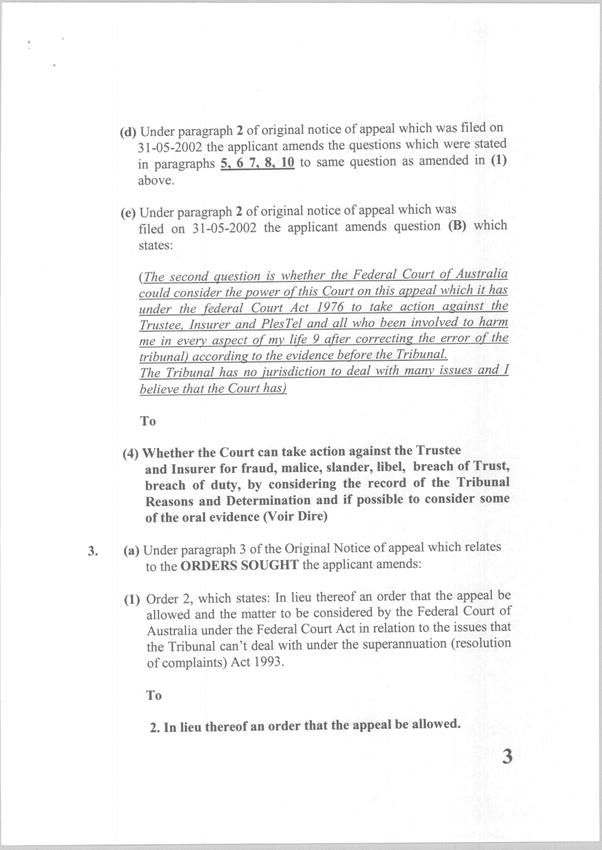
a) any further matters by way of the alleged error in the Superannuation Complaints Tribunal in how it dealt with the matter;
b) the claim in pleaded form against PlesTel Pty Limited concerning any cause of action sought to be brought against PlesTel; and
c) any orders sought to be made against the insurer and trustee for money sums or otherwise and a pleading of the basis of any such claims.
I stood the matter over for further directions on 29 April 2003.
11 On 29 April 2003, the applicant handed up an amended draft notice of appeal. I made it clear on that day that the matters set out in the document filed in Court on 29 April 2003 would be taken as the boundaries of the case that the applicant wished to make. On that day I made the following orders:
1. That the respondents ING Custodians Pty Ltd and ING Life Ltd file and serve, on or before Tuesday 13th May 2003, submissions as to the content of the draft amended notice of appeal and as to why it, or parts of it, should not be allowed to reflect the initiating process in the proceeding.
2. That the applicant file and serve, on or before Tuesday 3rd June 2003, any submissions in reply.
3. Direct the parties that the submissions should deal with the questions of costs hitherto incurred.
4. That the matter be set down for further hearing on Friday 13th June 2003 at 10.15 am.
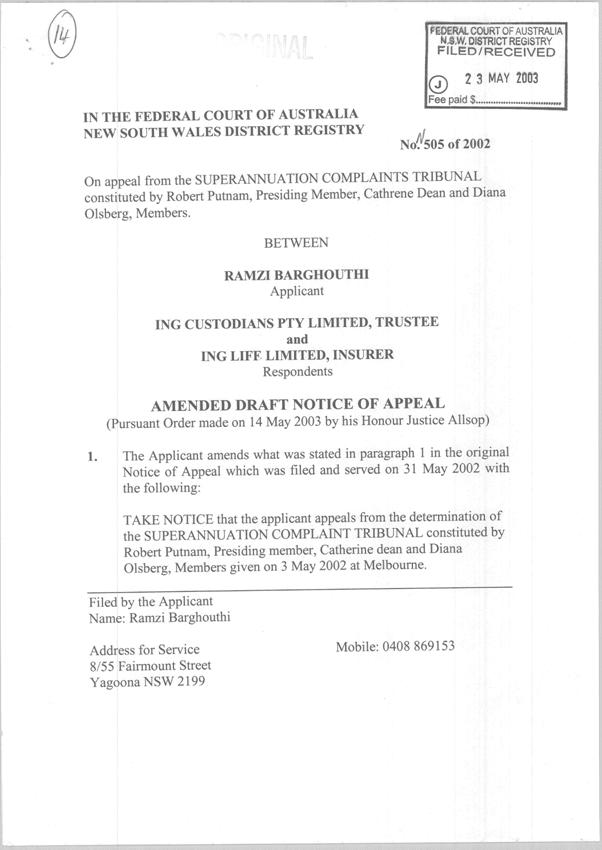
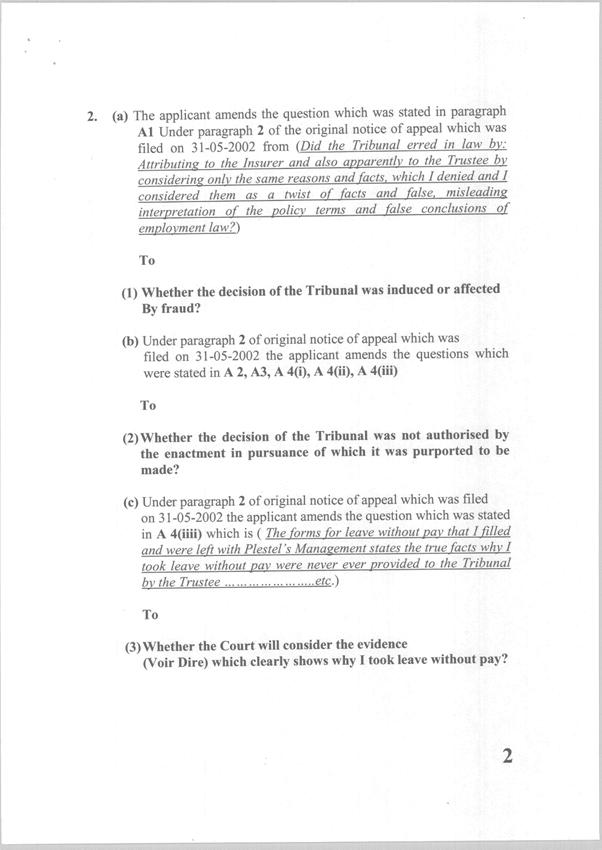
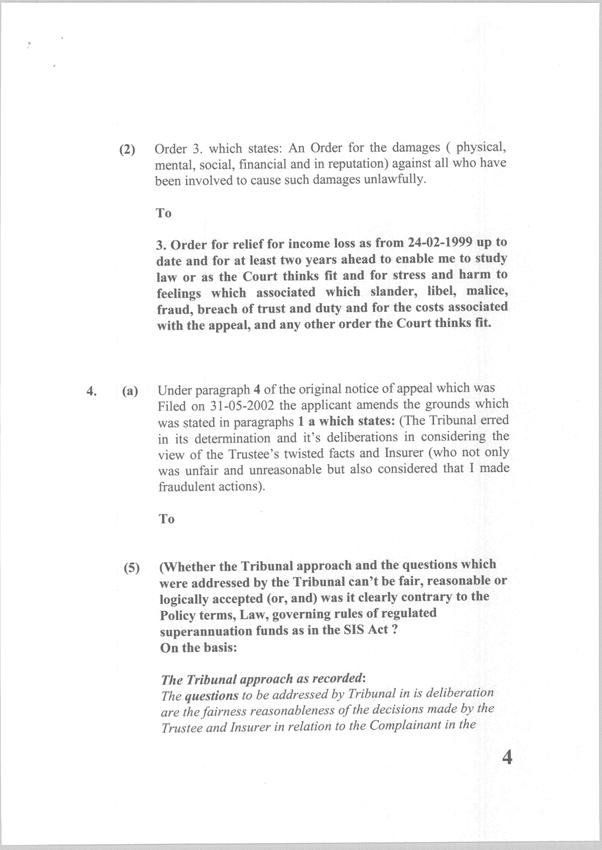
12 Later, on 23 May 2003, the applicant filed another version of the document handed up in Court on 29 April 2003 and entitled “Draft Amended Notice of Appeal”.
13 Shortly prior to 14 May 2003, the first and second respondents sought an amendment to the timetable by consent owing to the sickness of counsel. The applicant refused to grant his consent and the matter was listed for directions again on 14 May 2003. On that day, I went through the orders of 29 April and I asked the applicant why he did not consent to the timetable being changed. The applicant had no adequate explanation as to why he could not have granted consent. The applicant complained about the delay. Much of the delay hitherto had been the result of either seeking to obtain legal assistance for him or the result of his own delay in failing to comply with directions made. I gave an ex tempore judgment on that day and made the following orders:
1. The applicant, on or before Tuesday 20th May 2003, file and serve any further draft amended notice of appeal.
2 The respondents ING Custodians Pty Ltd and ING Life Ltd file and serve, on or before Friday 6th June 2003, submissions as to the content of the draft amended notice of appeal and as to why it, or parts of it, should not be allowed to reflect the initiating process in the proceeding.
3. That the applicant file and serve, on or before Friday 20th June 2003, any submissions in reply.
4 Directs the parties that the submissions should deal with the questions of costs hitherto incurred other than the costs of today.
5. Each party pay its own costs of today in any event.
14 On Friday 20 June and Monday 23 June, there occurred the somewhat extraordinary circumstances dealt with by me in my written judgment of 23 June 2003. It suffices to say that my associate was subjected to behaviour from a practitioner acting for the first and second respondents which was unwarranted and rude. I will not say anything further about that incident. I said all that I needed to say about it on 23 June 2003: [2003] FCA 636.
15 The matter came on before me on 3 July 2003. The hearing on 3 July was not a full continuation of the hearing begun on 7 February 2003. Rather, two motions were before me. The first, of the first and second respondents, filed on 25 June 2003 sought orders that the notice of appeal originally filed on 31 May 2002 be struck out. The motion was (rightly in my view) not couched in terms of competency, but by reference to the lack of a satisfactory statement of questions of law and the otherwise embarrassing nature of the document. The motion was in effect under Order 20 rule 2. Related to that notice of motion was a notice of motion filed by the applicant, which I amended by hand, under which the applicant sought leave to rely and proceed upon, as his amended notice of appeal, the amended draft notice of appeal filed in the Registry on 23 May 2003.
16 Thus, by July the matter had been reduced to a procedural argument, or two procedural arguments, notwithstanding my attempts to have the totality of this matter rolled up into a final hearing. I should say at this point that I may have appeared on 3 July to be somewhat critical of the respondents for wishing to proceed in this manner. For the reasons which follow, I think they were perfectly entitled to take this course.
17 It is necessary now to go back and analyse the material before me to ascertain what I should do with the two notices of motion before me.
18 As I have indicated above, the applicant is unrepresented. In those circumstances, I propose to examine the material placed before the Court in the notice of appeal, draft amended notice of appeal, affidavits and evidence taken on 7 February 2003 to assess what I should do on the motions.
The Nature of the Proceedings before this Court
19 Section 46 of the Superannuation (Resolution of Complaints) Act 1993 (the Act) is in the following terms:
Appeals to Federal Court of Australia from determinations of the Tribunal
(1) A party may appeal to the Federal Court, on a question of law, from the determination of the Tribunal.
(2) An appeal by a person under subsection (1) is to be instituted:
(a) not later than the 28th day after the day on which a copy of the determination of the Tribunal is given to the person or within such further period as the Federal Court (whether before or after the end of that day) allows; and
(b) in accordance with rules of court made under the Federal Court of Australia Act 1976 .
(3) The Federal Court is to hear and determine the appeal and may make such order as it thinks appropriate.
(4) Without limiting by implication the generality of subsection (3), the orders that may be made by the Federal Court on an appeal include an order affirming or setting aside the determination of the Tribunal and an order remitting the matter to be determined again by the Tribunal in accordance with the directions of the Court.
(5) The Federal Court must not make an order awarding costs against a complainant if the complainant does not defend an appeal instituted by another party to the complaint.
20 Subsection 46(1) of the Act is in similar terms to subs 44(1) of the Administrative Appeals Tribunal Act 1975 (Cth) (the AAT Act). The appeal is, of course, an application in the original jurisdiction of the Court: Drake v Minister for Immigration and Ethnic Affairs (1979) 46 FLR 409, 410. The limitation by reference to the phrase “on a question of law” has been explained in a number of cases. The appeal to this Court is not an opportunity to revisit a decision of the Tribunal involving questions of fact and law, if some gateway of legal error is able to be opened. The appeal is on a question of law.
21 In this respect the terms of Order 53 rule 3(2), (3) and (4) are relevant:
(2) The notice of appeal shall be signed by the applicant or his solicitor and shall state:
(a) the decision of the Tribunal from which the appeal is brought, the members constituting the Tribunal and the date when the decision was made;
(b) the question or questions of law to be raised on the appeal;
(c) the order sought; and
(d) briefly, but specifically, the grounds relied upon in support of the order sought.
(3) The Court may on such terms and conditions as the Court thinks fit, allow a notice of appeal to be amended.
(4) On the hearing of an appeal, the applicant shall not, without the leave of the Court, raise any question of law or rely on any ground in support of the order sought other than those stated in the notice of appeal.
22 In Birdseye v Australian Securities and Investments Commission [2003] FCAFC 232 at [16] Branson and Stone JJ expressed their agreement with earlier decisions of the Court discussed in their Honours’ reasons. At [11], [13] to [15], [17] and [18] of their Honours’ reasons for judgment, Branson and Stone JJ said the following:
[11] Gummow J observed in TNT Skypak International (Aust) Pty Ltd v Federal Commissioner of Taxation (1988) 82 ALR 175 at 178:
‘Section 44 of the AAT Act is expressed in narrower terms than the old s 196 of the Tax Act. This provided for appeals from the Board of Review which “involved” a question of law. The result was that if some question of law was involved, the whole of the decision of the Board was open to review, not merely the question of law … This no longer will be the case with appeals brought to this court under s 44 of the AAT Act. The existence of a question of law is now not merely a qualifying condition to ground the appeal, but also the subject matter of the appeal itself ….’ (citations omitted)
…
[13] In Australian Telecommunications Corporation v Lambroglou (1990) 12 AAR 515 at 524 Ryan J said:
‘I do not regard it as legitimate to call in aid the grounds supplied in purported compliance with O 53, r 3(2)(d) to read down the questions stated as required by paragraph (b) to what are truly questions of law. Because the appeal under s 44 of the AAT Act is confined to a question of law it would be inappropriate for the Rules to specify as part of the contents of a notice of appeal “grounds” which would be appropriate if the appeal could be brought against findings of fact as well as against what are said to be errors of law; cp O 52, r 13(2)(b) which requires a notice of appeal of that wider kind to state “briefly, but specifically, the grounds relied upon in support of the appeal”. The distinction is recognized by O 53, r 3(2)(d) which requires the notice of appeal under the AAT Act to state only “the grounds relied upon in support of the order sought”. In the present case the order sought is that “the Decision of the Tribunal be set aside”. Grounds in support of that order would properly assume the resolution of the question of law in favour of the applicant and indicate in a summary way the reasons why that resolution requires the decision of the AAT to be set aside. Of necessity, properly drawn grounds of that kind could not elucidate the question of law.’
[14] His Honour went on at 524 to indicate his view that merely to assert that the Tribunal had erred in law in making a particular finding was not to state a question of law.
[15] Further, his Honour at 527 expressed the view that:
‘… it simply begs the question of law to commence it with the words “Whether the Tribunal erred in law.” If the question, properly analysed, is not a question of law no amount of formulary like “erred in law” or “was open as a matter of law” can make it into a question of law.’
…
[17] A number of well known authorities has considered the distinction between a question of law and a question of fact (see, for example, Collector of Customs v Pozzolanic Enterprises Pty Ltd (1993) 43 FCR 280 (FC); Collector of Customs v Agfa-Gevaert Ltd (1996) 186 CLR 389). However, very limited consideration has been given to how a question of law ought properly to be stated in a notice of appeal from a decision of the Tribunal having regard to the requirements imposed by O 53 r 3(2). Those requirements include that the questions of law raised by the appeal are to be stated separately from the grounds relied upon in support of the order sought on the appeal.
[18] In our view, O 53 r 3(2) discloses an intention that a question of law to be raised on an appeal from the Tribunal should be stated with precision as a pure question of law. It is in the specification of the grounds relied upon in support of the orders sought that, in our view, one should expect to find the links between the question of law, the circumstances of the particular case and the orders sought on the appeal. It is not necessary in this case to give consideration to questions such as whether an allegation of denial of natural justice can give rise to a question of law so as to found an appeal under s 44(1) of the AAT Act (see Clements v Independent Indigenous Advisory Committee [2003] FCAFC 143 esp per Gray ACJ and North J at [3]-[8] and Gyles J at [58]-[67]) and if it can, how the question of law should be stated.
23 See also Brennan J in Waterford v The Commonwealth (1987) 163 CLR 54, 77-8.
24 The question was recently dealt with by a Full Court in Australian Securities and Investments Commission v Saxby Bridge Financial Planning Pty Ltd [2003] FCAFC 244. Branson J reiterated (at [45]) what her Honour and Stone J had said in Birdseye. Branson J made clear her view as to the need for specificity in identifying a “pure” question of law. Jacobson J and Bennett J said the following at [107]:
We agree with Branson J that, in order to conform with s 44(1) of the Administrative Appeals Tribunal Act 1975 (Cth) (“the AAT Act”) and O 53 r 3(2) of the Federal Court Rules, it is necessary to state questions which are pure questions of law. We also agree that the questions should be stated with precision but the issue for consideration in an appeal under s 44(1) of the AAT Actmust always be whether, on a proper analysis, the question is one of law rather than a question of fact or a question of mixed fact and law.
25 I do not understand anything in Birdseye or Saxby Bridge to support any proposition that the requirements of s 44 of the AAT Act (here s 46 of the Act) or the procedural regime in O 53 (even if the latter, as a rule of Court, could) go to the existence of the jurisdiction of the Court, as opposed to the exercise of jurisdiction: cf Parisienne Basket Shoes Pty ltd v Whyte (1938) 59 CLR 369, 391 and Burgundy Royale Investments Pty Ltd v Westpac (1987) 18 FCR 212, 219.
26 The present context in which I am dealing with this matter must be recalled. I am not being called upon to decide on a final basis whether or not an error of law was committed by the Tribunal. That question is for a final hearing (if any), the jurisdiction of the Court having been invoked, otherwise than colourably, by the assertion of the existence of questions of law: see, for example, Wespac Banking Corporation v Paterson (1995) 95 FCR 59, 61-2 [12] to [14]. What is before me is the question whether, as expressed in the notice of appeal and draft amended notice of appeal, an asserted error of law is sufficiently disclosed as to resist an application of the kind made by the respondents. I am asked by the respondents to strike out the notice of appeal and not to grant leave in respect of the amended document, in each case because of the absence of any sufficiently clearly expressed asserted error of law.
27 In this context, one should not overlook the difficulty, at times, of distinguishing between errors of law and errors of fact and of understanding the place of what are sometimes called questions of mixed fact and law in the taxonomy mandated by the terms of the legislation. See generally Morris “Law and Fact” (1942) 55 Harv LR 1303, Brown “Fact and Law in Judicial Review” (1943) 56 Harv LR 899, Stern “Review of Findings of Administrators, Judges and Juries” (1944) 58 Harv LR 70, Jaffé “Judicial Review: Question of Law” (1955) 69 Harv LR 239, Jaffé “Judicial Review: Question of Fact” (1955) 69 Harv LR 1020 , Farnsworth “‘Fact’ or ‘Law’ in cases stated under the Income Tax Acts” (1946) 62 LQR 248, Wilson “A Note on Fact and Law” (1963) 26 Mod LR 609, Johnstone v Sutton (1786) 1 TR 510, 545; 99 ER 1225, 1244 (per Lord Mansfield), Hoddinott v Newton, Chambers & Co Ltd [1901] AC 49, 56, Felix v General Dental Council [1960] AC 704, 717, Australian Iron & Steel Pty Ltd v Luna (1969) 123 CLR 305, 319-322 (per Windeyer J), Lombardo v Federal Commission of Taxation (1979) 40 FLR 208, 210-12, Nizich v Commissioner of Taxation (1991) 91 ATC 4,747, 4752 and Commissioner of Taxation v Roberts (1992) 37 FCR 246, 251-52. None of the subtleties and difficulties discussed by the learned authors and judges in these articles and cases attend the resolution of the matter. In particular, the circumstances here do not throw up the conceptual difficulties that can attend analysis of the distinction between fact and law and the place of the distinction in logical reasoning in this area: see especially French J in Nizich at 210-212. These considerations assist in appreciating that the existence of what is called for by s 46(1) of the Act (and s 44(1) of the AAT Act) is part of the exercise of the jurisdiction of the Court, and not (in the sense discussed by Dixon J in Parisienne Basket) a precondition of the existence of jurisdiction.
The Nature of the Proceedings Before the Tribunal
28 The Act was part of the wider legislative reorganisation of superannuation in Australia in 1993. The Act has been amended since 1993. By s 6 of the Act the Tribunal was established. One of its functions was and is to hear and review complaints made by members of superannuation funds about decisions of trustees of funds and of insurance companies which provide policies in connection with the carrying on of superannuation funds.
29 I adopt the description of the legislative scheme set out by the Full Court in National Mutual Life Association of Australia Ltd v Campbell (2000) 99 FCR 562, 565-68 [10] to [20].
30 I also refer to, and adopt, what I said in Retail Employees Superannuation Pty Ltd v Crocker [2001] FCA 1330 at [17] to [34] by way of explanation of the role of the Tribunal. As I indicated in Crocker’s case, central to an understanding of the role of the Tribunal are ss 14 and 37 of the Act which, relevantly, are in the following terms:
s 14 Complaints about decisions of trustees other than decisions to admit persons to life policy funds
(1) This section applies if the trustee of a fund has made a decision (whether before or after the commencement of this Act) in relation to:
(a) a particular member or a particular former member of a regulated superannuation fund; or
(b) a particular beneficiary or a particular former beneficiary of an approved deposit fund.
…
(2) Subject to subsection (3) and section 15, a person may make a complaint (other than an excluded complaint) to the Tribunal, that the decision is or was unfair or unreasonable.
…
(6A) The Tribunal cannot deal with a complaint under this section about a decision of a trustee relating to the payment of a disability benefit because of total and permanent disability unless:
(a) the decision is made on or after 1 November 1994; and
(b) the complaint is made within a period of one year after the making of the decision to which the complaint relates.
(6B) The Tribunal cannot deal with a complaint under this section about a decision of a trustee relating to the payment of a disability benefit because of total and permanent disability if:
(a) before the making of the decision, the person permanently ceased particular employment (whether before or after commencement of this subsection) because of the physical or mental condition that gave rise to the claim for disability benefit; and
(b) the claim was not lodged, or is not lodged, with the trustee, within one year after the person permanently ceased that employment.
(6C) Without limiting the meaning of a decision of a trustee relating to the payment of a disability benefit in any other provision of this Act, that expression means, for the purposes of subsections (6A) and (6B), the original decision of the trustee in relation to the matter.
s 37 Tribunal powers—complaints under section 14
(1) For the purpose of reviewing a decision of the trustee of a fund that is the subject of a complaint under section 14:
(a) the Tribunal has all the powers, obligations and discretions that are conferred on the trustee; and
(b) subject to subsection (6), must make a determination in accordance with subsection (3).
(2) If an insurer or other decision-maker has been joined as a party to a complaint under section 14:
(a) the Tribunal must, when reviewing the trustee's decision, also review any decision of the insurer or other decision-maker that is relevant to the complaint; and
(b) for that purpose, has all the powers, obligations and discretions that are conferred on the insurer or other decision-maker; and
(c) subject to subsection (6), must make a determination in accordance with subsection (3).
(3) On reviewing the decision of a trustee, insurer or other decision-maker that is the subject of, or relevant to, a complaint under section 14, the Tribunal must make a determination in writing:
(a) affirming the decision; or
(b) remitting the matter to which the decision relates to the trustee, insurer or other decision-maker for reconsideration in accordance with the directions of the Tribunal; or
(c) varying the decision; or
(d) setting aside the decision and substituting a decision for the decision so set aside.
(4) The Tribunal may only exercise its determination-making power under subsection (3) for the purpose of placing the complainant as nearly as practicable in such a position that the unfairness, unreasonableness, or both, that the Tribunal has determined to exist in relation to the trustee's decision that is the subject of the complaint no longer exists.
(5) The Tribunal must not do anything under subsection (3) that would be contrary to law, to the governing rules of the fund concerned and, if a contract of insurance between an insurer and trustee is involved, to the terms of the contract.
(6) The Tribunal must affirm a decision referred to under subsection (3) if it is satisfied that the decision, in its operation in relation to:
(a) the complainant; and
(b) so far as concerns a complaint regarding the payment of a death benefit—any person (other than the complainant, a trustee, insurer or decision-maker) who:
(i) has become a party to the complaint; and
(ii) has an interest in the death benefit or claims to be, or to be entitled to benefits through, a person having an interest in the death benefit;
was fair and reasonable in the circumstances.
The Decision of the Tribunal
31 The starting point of the analysis must be the nature and terms of the decision of the Tribunal. On 3 May 2002, three members of the Tribunal determined that the decision of “the Trustee” (the first respondent – to which I will henceforth refer as “1 R-Trustee”) and of “the Insurer” (the second respondent – to which I will henceforth refer as “2 R- Insurer”) was fair and reasonable “in its operation to the Complainant in the circumstances and the decision is thus affirmed”.
32 The factual background was briefly set out by the Tribunal as follows:
The Tribunal is satisfied on the material before it as to the following facts:
· Complainant’s date of birth 12 February 1967.
· The date the Complainant commenced work with Employer 1 was 14 September 1998.
· The date the Complainant became a Member of the Fund was 1 November 1998.
· The date the Complainant reported an injury to Employer 1 was 29 December 1998.
· The date the Complainant left the employment of Employer 1 on leave without pay was 29 December 1998.
· The date the Complainant commenced employment with Employer 2 was 4 January 1999.
· Employer 1 terminated the Complainant’s employment on 26 February 1999.
· Employer 2 terminated the Complainant’s employment on 1 March 1999.
· The Salary Continuance Benefits which are the source of this Complaint are $2,063 per month for a benefit period of two years.
33 It is not easy to glean the relevant factual detail presented to the Tribunal from its reasons. I have had recourse to the material before me in attempting to distill the narrative of events which gives rise to the applicant’s complaints. The following narrative comes principally from the applicant’s affidavit filed on 25 October 2002 and his evidence before me in February 2003. I set these matters out as the applicant’s assertions of facts that he considers to be relevant. They are not findings unless clearly so expressed.
34 The applicant was born in Jerusalem in 1967. He is an electrical engineer. He migrated to Australia in 1994. Up to August 1998 the applicant had a number of jobs. In August 1998 he had a job interview with PlesTel Pty Ltd (the party named as the third respondent to the proceedings, which has not been served, and to which I will refer as “PlesTel”). PlesTel was, apparently, a joint venture company owned by Plessey and Telstra.
35 The above job interview was conducted by a Mr Carl Koong. The applicant was offered a job as a customer service technician dealing with the installation and maintenance of Telstra’s “Commander” telephone systems.
36 The applicant says that the benefits of employment were discussed with him. He understood that he would have “full insurance” as a permanent employee. He says that he signed papers on 14 August 1998 including some concerned with the “Plessey Asia Pacific Superannuation Fund”. There was exhibited to the applicant’s affidavit a membership application form to this fund apparently signed on this day.
37 The relevance of this date will become evident in due course.
38 Thereafter the applicant began employment with PlesTel. He says that on 16 October 1998, while carrying some equipment, he had to stop suddenly to avoid an accident. The next day, he says, he began to feel pain in his lower back.
39 On 26 October 1998, the applicant saw a Dr Peter Kong who told him that he had a muscle strain and gave him some medication. The applicant continued to work.
40 On 9 November 1998, the applicant was offered a position with a company in the Transfield group. The position was for 26 weeks and the applicant, who was desirous of taking up the position, chose to start work on 4 January 1999. A letter from “Transfield Maintenance NSW” in evidence has the applicant’s signature and a date “4-1-99”, indicating that he accepted the offer on this date. Paragraph 13(c) of the affidavit of the applicant sworn in October 2002 implies that he accepted the offer before 4 January 1999. In oral evidence before me in February 2003 the applicant stated that by 23 or 24 December 1998 he already had a contract to work with Transfield.
41 On 27 November 1998, the applicant visited Dr Kong again and complained of continued pinching pain. Dr Kong referred the applicant to a Dr MacHart, an orthopaedic surgeon. On 18 December 1998, the applicant saw Dr MacHart, who told the applicant that he should have an MRI scan. The history given by the applicant to Dr MacHart was that he had a two month history of back pain (Ex A3 pp 81-2).
42 Upon returning to work on 18 December 1998, the applicant spoke to his “team leader” Mr Koong and told him that he (the applicant) had seen a specialist that morning, who had advised him to have an MRI. Mr Koong told the applicant to see Mr George Dix, the “Human Resources Manager” at PlesTel. The applicant did this, and was told that he had to put in a claim to the insurer (the worker’s compensation insurer), but that there would be a dispute because it had not been reported within 24 hours. The applicant said that he became upset about this. He later asked Mr Koong for the relevant forms in relation to worker’s compensation.
43 A few days later, on Christmas Eve 1998, the applicant, while working in the field, called Mr Koong about the worker’s compensation forms, saying that he needed them to get the MRI done. In this conversation, the applicant apparently told Mr Koong that he “wanted to stop work as from 4 January 1999” and that this was “to be considered as a notice from my side”. (See October 2002 affidavit [13(g)].) This was in effect an oral application for leave without pay. The applicant elaborated upon this in evidence before me in February this year. He gave the following evidence.
Mr Barghouthi: Yes. I asked first, “I want to stop working as from 4 January”. That is what I asked.
His Honour: Right. Why did you want to stop working?
Mr Barghouthi: I wanted to go to work for Transfield from 4 January. But since, what happened on 18 December, what was said to me and then when the forms that I had to fill for the claim for the – to get the MRI done was not signed by the employer, they didn’t want to sign it, did not fill it. Then after all that I requested leave without pay. They asked me, they said, “Why you need the leave without pay?”. I said, “It is my personal; I want leave without pay”. That is what I said.
His Honour: So you said, that’s my business, I want leave without pay?
Mr Barghouthi: Yes.
44 This was the first indication that the applicant gave PlesTel that he wished to take leave or cease work.
45 Mr Koong told the applicant that he should discuss the matters with a Mr Mitzner. On 29 December 1998, the applicant had a meeting with Mr Koong and Mr Mitzner at PlesTel’s North Ryde premises.
46 At this meeting the applicant said that he wanted to take leave from 4 January 1999. He was told that he would stop that day. He was asked why he needed an MRI and what had happened. The applicant says that he explained the history of his injury and the doctor’s advice to have the MRI. Mr Mitzner then apparently said that this was an injury from the applicant’s work before joining PlesTel. Mr Mitzner said that he should find other work. The applicant said in evidence before me that he was careful not to resign on this occasion. At, and prior to, this meeting, the applicant did not tell, and had not told, anyone at PlesTel that he was intending to work for Transfield.
47 On 4 January 1999 the applicant took up work with Transfield.
48 Some time later, Mr Koong rang the applicant about some issues with which it is unnecessary to deal. The applicant told Mr Koong that he (the applicant) was working. He did not tell him where he was working.
49 On 3 February 1999, the applicant saw a doctor (Dr McLeod) nominated by PlesTel’s worker’s compensation insurer. The applicant says that Dr McLeod told him that the pain would go away.
50 On 16 February 1999, the applicant saw Dr MacHart again. By this time, the MRI results were available. Dr MacHart told the applicant that he had a disc injury. He was referred to a physiotherapist. The applicant commenced physiotherapy the next day, 17 February 1999. He was told on that day that it was necessary to have his worker’s compensation claim approved, in order that the physiotherapy be funded by the insurer. The applicant called the worker’s compensation insurer (Royal and Sun Alliance) and told them that he had a disc injury and asked for his claim to be approved.
51 The applicant continued to work at Transfield, but thereafter, on Dr MacHart’s advice, he restricted himself to office work.
52 On 22 February 1999, the applicant apparently received two letters from the worker’s compensation insurer of PlesTel, one from a Mr Price and one from a Ms Bucksath. The letter from Ms Bucksath said that the applicant had failed to attend a medical examination. The applicant said that he rang Mr Price and asked about the two letters. He said that he had an argument in relation to the letters and Mr Price apparently accused him of fraud in working and having a compensation claim.
53 The applicant stated in evidence before me that the following day he went to work at Transfield but could not remain there. He said that he was too upset to remain at work. He said that he went to the physiotherapist who told him that the injury was serious.
54 On about 24 February 1999, the applicant received a letter from PlesTel dated 18 February 1999. The letter apparently requested the applicant to attend a meeting with Messrs Mitzner and Dix on 26 February 1999.
55 The applicant said that on 24 February he was so upset that he could not work. He was not feeling well on that day. He told Transfield that he was not coming to work on that day. He planned to go to the meeting with PlesTel on 26 February and to go back to work at Transfield on 1 March 1999.
56 On 26 February 1999, he attended the meeting with Mr Mitzner and Mr Dix. He had not been to work at Transfield on 25 February. Nor did he attend Transfield for work on 26 February.
57 The applicant says that on 26 February 1999 he went to the offices of PlesTel at 10 a.m. He first saw Mr Dix, who examined x-rays and MRI results which the applicant showed him. The applicant told Mr Dix that he had been working elsewhere. In his affidavit the applicant described the meeting as follows:
…[O]n 26/02/1999 I went to the meeting at PlesTel Pty Ltd to meet with Mr. George Dix and Mr. Chris Mitzner. At the present of Mr. Mitzner and Carl Koong Mr. George Dix suddenly while I was explaining about the injury called me a liar and then accused me of fraud and said you are sacked and Transfield will do the same. At the end he said you have to leave before I call the police. I was extremely shocked. The management of PlesTel did all that because of my injury which George Dix saw by looking at the MRI.
58 In his evidence before me, the applicant also recounted the meeting in the following terms:
Mr Barghouthi: …Suddenly Mr George Dicks in a rude way, called me a liar, George Dicks. Said, you are a liar. We put you under surveillance and you work for Transfield but did not inform us about, it’s fraud to work and have a compensation claim. I was very shocked. I told him, I didn’t put a compensation claim, I had requested an MRI and it’s not their business to tell me that I can work somewhere else. Like I mean it’s not your business and now I realise that they have business with Transfield but before I didn’t know that they had a connection with Transfield, there is a relation. I said, not your business to ask me and I spoke to Karl Koong. I told Karl that I am working and Chris Misner said to me, you have to go and work somewhere else. That’s what happened.
…
Mr Barghouthi: …He called me a liar and then accused me of fraud by saying it’s fraud to work and have a compensation claim. I was shocked and I think I stood up and I told him that I put a claim for the MRI and I need treatment now. That was I think very strong words, you know, I was very tense. He said that I failed to go to the insurance doctor. I said, I went and his name is Dr McLeod and that’s what I remember.
His Honour: Was anything else said at this meeting?
Mr Barghouthi: Much more, your Honour, but I remember that I was – what hurt me most and then he said, you are sacked. …
59 On 1 March 1999 the applicant says that he called Mr Phillip Batty at Transfield and “informed him that he had a disc problem and requested some time off work.”
60 On 2 March 1999 the applicant says he called Mr Batty again and told him that he had been suffering pain in his right leg.
61 On about 5 March 1999 the applicant said that he received a letter from Transfield signed by Mr Batty saying amongst other things:
We [Transfield] confirm your verbal resignation of 1 March 1999.
62 The applicant says that he became upset at this and called Mr Batty on 11 March 1999 and asked him why he had sent the letter. The applicant says that Mr Batty said to him that it was better for him (the applicant) and that Transfield would not keep him on their records. The applicant said that he told Mr Batty that he had not resigned and he did not want to resign. The conversation then ended.
63 Transfield did not contact the applicant again. At that time, the applicant apparently did not seek to force the issue with Transfield. He did not return to work there.
64 In April 1999, the applicant sought employment elsewhere as an engineer. In May 1999, he applied to work with Telstra and had an interview. He said that he was disappointed and he felt that the back injury was the reason for his failure to get the job.
65 The applicant said that in July and August 1999 he was feeling extremely bad and was in pain in every part of his body. He went overseas at about this time.
66 The applicant said in his affidavit that in about May 2000 he called Transfield and spoke to someone called Yasmine in the payroll department. He said that this person told him that he was suspended because of back injury as from 1 March 1999.
67 The applicant said that in July or August 2000 he spoke to someone at Transfield and applied to take his superannuation money on hardship grounds.
68 The applicant said that in August 2000 he called Transfield in an attempt to begin work again. He thereafter wrote to a Mr Maggio and asked him if he could return to work. After some unsuccessful communications, on about 3 November 2000 the applicant says that he received a letter from Transfield, from Mr Maggio. The letter said that the applicant had resigned from Transfield seventeen months earlier. Mr Maggio said there was no prospect of any re-employment with Transfield. Shortly thereafter the applicant complained to the Human Rights and Equal Opportunity Commission. On 7 April 2001, the complaint was terminated by the then President, Professor Tay. This complaint was made against Transfield Services Limited. The President decided to terminate the complaint on the grounds that the complaint was misconceived. She said that she was satisfied that the applicant was not allowed to return to work with Transfield because he was no longer employed, having resigned.
69 On 18 April 2001, the applicant applied to the Federal Court. The matter was then transferred in mid-2001 to the Federal Magistrates Court. These proceedings were between the applicant and Transfield Pty Ltd.
70 In the proceedings before the Magistrates Court, Mr Lee, an Industrial Relations Manager at Transfield, swore an affidavit which included matters which the applicant said were not correct. The applicant filed various affidavits in the Federal Magistrates Court dealing with his claim against Transfield. He cross-examined various deponents who gave evidence. Amongst the witnesses examined by Mr Barghouthi was Mr Carl Koong of PlesTel.
71 The application before the Federal Magistrate’s Court was dismissed on 15 November 2001. An appeal was lodged in this Court from the dismissal of the proceedings. The appeal was filed on 3 December 2001. That appeal was heard on 10 May 2002. Judgment was given on 5 June 2002 by Hill J who allowed the appeal, set aside the dismissal and ordered that the respondent Transfield Pty Ltd pay the appellant a sum equal to one week’s salary.
72 Apparently a worker’s compensation or common law claim was filed on the applicant’s behalf by solicitors. In his affidavit of October 2002, the applicant makes serious allegations as to the solicitors who had been representing him since March 1999 in these proceedings. The applicant said that he found that his case had been dismissed for want of prosecution on 17 April 2001. He said that he had not been kept informed by his solicitors.
73 On 24 January 2002, he went to a hearing in the Compensation Court.
74 The applicant said that PlesTel brought false evidence before the Tribunal upon which the 1 R-Trusteee and 2 R-Insurer had relied.
75 One can see from this background that there can be seen to be potential disputes between the applicant and PlesTel as to the termination of his employment, between the applicant and PlesTel’s worker’s compensation insurer as to his entitlement to worker’s compensation, between the applicant and Transfield as to the circumstances of the cessation of his employment with Transfield, and disputes involving the 1 R-Trustee and 2 R-Insurer concerning such rights, if any, as arise in relation to any policy of insurance the subject of the complaint to the Tribunal. Such rights as may exist may be able to be vindicated by direct enforcement of the rights in question – such as a claim on a subsisting contract of insurance. But what is before me is an appeal on a question of law from an administrative decision of a Tribunal.
The Matter before the Tribunal
76 On 1 July 2000, the applicant wrote to the 2 R-Insurer seeking payment under a disability policy. He described the surrounding circumstances.
77 By letter dated 7 August 2000 the 1 R-Trustee advised the applicant that his claim was rejected. The letter was in the following terms:
We refer to your claim for the GSC benefit under the above policy. Your claim for the GSC benefit has been considered by Mercantile Mutual Life Insurance Company Limited (“the Insurer”). The Insurer has decided that your GSC claim should be declined.
We advise that your claim has been referred to us, as the Trustee of the Fund, for a review of the Insurer’s decision. The Trustee notes the following:
Facts
1. You state that you sustained an injury on 16 October 1998, whilst employed by Plessey.
2. You obtained leave without pay from Plessey on 29 December 1998.
3. On 4 January 1999 you commenced full-time employment with Transfield.
4. On 26 February 1999 Plessey formally terminated your employment. You continued to work for Transfield until 1 March 1999.
As to terms of the Policy
5. To be eligible for payment of benefit under a Group Salary Continuance specified criteria must be satisfied, including:
(i) the sickness or injury must occur after the date of admission
(ii) that a person must be a Member at the time claimant suffers from total disability;
6. A person ceases to be a Member when that person ceases to be employed full-time by the participating employer.
7. Total disability is defined in the policy as “total inability solely by reason of sickness or injury to engage in the Member’s trade, profession or occupation”.
The Trustee notes that your date of entry into the Fund is 1 November 1998 and therefore you have not satisfied the criterion referred to at paragraph 5(i) above. Alternatively, the Trustee is of the view that you were not suffering from total disability on either of the dates you may be regarded as having ceased full-time employment with Plessey (that is on 4 January 1999, when you repudiated your employment with Plessey by commencing full-time work elsewhere, or on 26 February 1999 when Plessey formally terminated your employment). Therefore you have not satisfied the criterion referred to in paragraph 5(ii) above.
The Trustee has accepted the views of the Insurer and has accordingly made an initial decision to affirm the Insurer’s decision that your claim for GSC be denied.
[emphasis in original]
78 On 13 November 2000, the applicant signed a complaint form with the Tribunal naming the “Mercantile Mutual Corporate Super” Fund and stating that the fund had declined his claim and that his claim was for his weekly income. He claimed his wages for two years or until he recovers (if before two years).
79 In November 2000, the Tribunal joined the 2 R-Insurer as a party to the complaint under s 18 of the Act.
80 The reasons, at least as at July 2000, for the 2 R-Insurer’s actions can be seen in a memorandum of the relevant claims assessor dated 13 July 2000 which was in the following terms:
· The Member alleges that he injured his lower back at work on 16th October 1998 however he continued to undertake all his duties until 25th December 1998.
· On 29th December, he informed his Employer of his injury and completed Workers Compensation Claim Forms. On this day, he requested leave without pay from 4th January 1999.
· On 4th January 1999, the Member commenced full time work with Transfield. This was uncovered after PlesTel instigated surveillance as the authenticity of the Claim was in doubt. Confirmation of the Member’s employment with Transfield was confirmed by Lyn Longbottom (of Transfield). The Member completed a Pre-employment Questionnaire in November 1998 claiming that he was fit for full duties and had no injury. At no time did the Member advise PlesTel of his employment with Transfield.
· The claim has been disputed and denied by both PlesTel and Royal & Sun Alliance Workers Compensation.
· The Member sates on his Member’s Statement that he has been totally disabled since 1st March 1999, however he was dismissed on 26th February 1999 due to the fraudulent nature of his actions.
· The Member was only off work for a total of 10 Days prior to commencing full time work at Transfield. There is a 90 Day Waiting Period applicable to this Policy in order to make a Claim and the Member was clearly not Totally Disabled for this period.
We believe that this Claim should be denied as he was not Totally Disabled for the duration of the Waiting Period, notwithstanding the fraudulent nature of the Member’s actions. Furthermore, the Member is Claiming Total Disablement from a period when he was not in the employ of Plestel.
Please refer the file to the Trustees for their decision.
Reasons of the Tribunal
81 The Tribunal set out what it saw as the relevant insurance provisions.
82 The Tribunal set out the applicant’s employment history and referred to the lengthy submissions of the applicant. The Tribunal summarised the major issues raised by the applicant as follows:
At the interview with Employer 1 in August 1998, the Complainant stated the interviewer explained the benefits provided as a permanent employee of the company. The complainant claimed he understood that he ‘will be fully insured and my car will be fully insured too. I signed the superannuation papers in August 2000 (sic).’ During a Training Session on 16 October 1998 the Complainant carried a heavy piece of equipment ‘to place it on a high table (shelf) whilst I was carrying it and walking the Trainer suddenly came and stood in front of me and started to clear up the table. His action made me stop suddenly in order to avoid him, allowing the board to place enormous pressure on my lower back… First thing in the morning I felt some pain in the middle of my lower back. It was pinching pain deep from inside. The following week I worked Monday to Friday and during that week I started to feel sometimes pain in the testis (sic).’
The Complainant first saw a local doctor on 26 October 1998. He stated he was told his injury was muscle strain, was prescribed tablets and continued to work ‘doing all kind of work’.
The Complainant applied for a position with Employer 2 in early October 1998, was offered a contract on 9 November 1998, completed a medical test on 4 November 1998, and commenced employment with Employer 2 on 4 January 1999.
On 24 December 1998, the Complainant applied to Employer 1 for leave without pay. On 29 December 1998, the Complainant reported an injury had taken place on 16 October 1998 and completed a claim for insurance. He stated that personnel at Employer 1 told him at that meeting on 29 December 1998 that in all likelihood his claim would be declined as he had not reported the injury within 24 hours. He stated he was asked to stop working as from 29 December 1998. ‘I gave them all the work papers and took all my personal things’. The Complainant summarised a succession of medical examinations and detailed his distress at his continuing physical pain and his emotional distress which resulted from discussions with personnel at Employer 1. The Complainant stated that management at Employer 1 discovered through surveillance that he had been working full-time for another employer and terminated his employment on 26 February 1999. Following contact between Employer 1 and Employer 2, the Complainant stated that Employer 2 terminated his employment on 1 March 1999.
The Complainant proceeded to make representations regarding his claim and experienced distress in dealing with solicitors and the Insurance Company, with medical practitioners and with Centrelink. He departed for overseas in August 1999, returning to Australia in May 2000. He stated he has applied for many positions since his return to Australia, but has been unable to find employment and has suffered financial hardship.
In a further submission to the Tribunal dated 23 January 2002, the Complainant asserted that personnel of Employer 1 lied in disputation concerning his claim. He also complained of the length of time taken by the Insurance Company in responding to his claim. As a result of his experiences the Complainant stated he is ‘suffering mentally, physically, socially, financially and in my reputation’.
83 The Tribunal then discussed the submissions of the 1 R-Trustee and 2 R-Insurer.
84 The reasons of the Tribunal rested on the following proposition taken from the Tribunal’s reasons:
(a) To be eligible for a Salary Continuance Benefit the Insurance Policy states that benefits will be paid if the member suffers from a Total Disability if the injury first occurs after the date of Admission to the Fund.
(b) There is also a 90 day waiting period applicable to the Policy in order to make a Claim.
(c) In the particular circumstances of this case, the Tribunal is satisfied that the back injury that gave rise to the claim was incurred on 16 October 1998. Therefore the question which arises for the Tribunal is to clarify when the Complainant was regarded as a member in terms of the Fund’s Insurance policy.
(d) It appears that the Fund members (including the Complainant) were transferred from membership of a prior superannuation fund to the Fund effective from 1 November 1998. There is no evidence that a Salary Continuance Benefit was provided under the benefit provisions of the prior Fund.
(e) As the Fund’s Group Salary Continuance Policy did not commence until 1 November 1998, the Complainant was not covered by the Policy until 1 November 1998.
(f) Therefore at time that the Complainant became a member, the back injury had already occurred, and as a consequence he may not be entitled to claim a Total Disability Salary Continuance Benefit as a result of this injury.
(g) [E]ven if the Complainant had not been so excluded from eligibility, … he was only off work for a total of 10 days prior to his Christmas and New Year public holidays in which it would not have been usual for the Complainant to have been at work anyway. There is a 90 day Deferment Period applicable to the policy in order to make a claim and the Complainant was clearly not totally disabled for this period.
(h) The Complainant commenced full-time work with Employer 2 almost immediately following his application for leave without pay from Employer 1. Such continuity of full-time work makes invalid any application for Salary Continuance Benefit on the basis of Total Disablement and inability to work in paid employment as a result of his injury under the terms of the Insurance Policy. On these grounds also the Complainant is not eligible for Salary Continuance Benefits.
85 Thus, the Tribunal concluded:
(a) That this insurer could not be liable for the claim, as the injury predated the date of the commencement of obligation, 1 November 1998.
(b) Alternatively, the applicant ceased employment with PlesTel before the expiry of the 90 day Deferment Period under the policy and during the period prior to his cessation of work with PlesTel the applicant was not totally disabled.
86 These conclusions rest on a number of factual conclusions and a view of the meaning and effect of the policy. The latter involves the construction of the relevant policies, and, is, substantially at least, a legal question.
The Notice of Appeal
87 The notice of appeal sets out a number of asserted errors of law. The first is expressed as follows:
Attributing to the insurer, and also apparently to the Trustee by considering only the same reasons and facts, which I denied and I considered them as a twist of facts and false, misleading interpretation of the policy terms and false conclusions of employment law.
88 This paragraph discloses no clearly expressed error of law. I propose to strike it out because of that. I would allow the applicant to reformulate it if he can, to identify a coherent error in interpretation of the policy. Thus if the applicant were to say that:
“The Tribunal erred in construing the relevant insurance policy … [in a particular way]
I would see no vice in such a paragraph. As currently expressed, the paragraph raises unidentified factual issues and refers to a topic (“misleading interpretation of the policy terms”) which could support the expression of a question of law, if it were to be expressed in some coherent fashion.
89 The second is expressed as follows:
Not considering the real cause why I became not able to work nor the right reason why I took leave without pay, nor the exact time when I became unable to work. Those reasons were clear on the evidence before the Tribunal on Dr’s Benjamin report (Psychiatrist) and my first letter to Mercantile Mutual life Group Risk Operations dated 01-06-2000 applying for my rights and benefits and on many other documents. Instead the Tribunal considered the twisted facts of the Trustee, Insurer and PlesTel by considering that my mental problems and all my problems in life has nothing to do any thing in terms of the insurance policy, while all my problems in life whether physical, mental, social, financial and in reputation where caused because of my employment with PlesTel. I was called a liar and accused of fraud and sacked by PlesTel because of my injury on 26-10-1998 which was a as a result of lifting a commander board on 16-10-1998 and only was discovered on 16-02-1999.
90 This paragraph discloses no expressed question or error of law. Such matters as can be discerned are factual questions. In the February hearing, the applicant expressed this complaint as a failure to take into account certain evidence. So expressed, the complaint had more coherence and was akin to an allegation (which would be an assertion of a question of law) of a failure to take into account relevant considerations of the kind referred to by the High Court in Minister for Aboriginal Affairs v Peko-Wallsend (1986) 162 CLR 24.
91 The difficulty is that the matters said not to have been considered are not identified in the notice of appeal and as explained in February were doctors’ reports, clearly before the Tribunal and brought to its attention.
92 As presently framed I would strike out this paragraph as not disclosing a question or error of law. The applicant may apply to reformulate it in a satisfactory manner.
93 The third is expressed as follows:
Not considering that the insurance policy has other terms that will cover me for Pre-existing Conditions.
94 This does disclose a question of law and a legal error, albeit one unparticularised. The submissions of the respondents as to the substance of this paragraph may be correct, but they are for a final hearing. In this form, however, I do not think that the paragraph, lacking as it does any particularity, should be allowed to remain. It may be able to be restated so that the subject matter of the appeal may be clearly delineated.
95 I will strike out the paragraph, and grant leave to replead it.
96 The fourth is expressed as follows:
Considering that I became a member with Plessey Asia Pacific Superannuation Fund on 1 November 1998, while the true fact: 1 November 1998 was the date of the transfer of the plan and the right date in which I became a member in Plessey Asia Pacific Superannuation Fund is the date I commenced my employment as a permanent employee on 14-09-1998.
97 This is a factual question. I will strike the paragraph out.
98 The fifth is expressed as follows:
In considering that there is no evidence that the salary continuance benefit was provided under the benefit provisions of the prior fund, while it is clear from the Documentary evidence which:
Plessey Asia Pacific Superannuation Fund Special Notice to all members of the Fund October 1998.
That I was a member of the fund in October 1998 and the transfer which took effect on 1 November 1998 took place according to the conditions written in the Notice which are:
Following a recent review of the existing superannuation arrangements, your employer (The Company) has decided to merge the fund with Mercantile Mutual Cooperate Super with effect from 31 October 1998 and has notified the trustee accordingly.
The trust deed confers on the trustee the power to transfer members’ benefits to another superannuation entity without members consent, provided that it is satisfied that the entity is a successor fund as defined in the relevant legislation, i.e., that it confers on members equivalents rights to the rights which they have under existing fund.
NEW PLAN – Mercantile Mutual Corporate Super
[emphasis in original]
The company has decided that, as from 31 October 1998, a plan (the new plan) will be established for employees of the company under the provisions of Mercantile Mutual’s Master Fund. The Trustee of the new plan will be Mercantile Mutual Custodians Pty Limited ACN 008 508 496.
All this evidence which is the company’s and the trustee’s own evidence which shows that I was member of Plessey Asia Pacific Superannuation fund from the first day I started my work which is 14-09-1998. Further more it shows that I had another insurance cover, which as I understood at the interview in 8-1999 as full insurance of my self. All this evidence was ignored by the Tribunal, which resulted in the wrong determination based on wrong background and wrong deliberations.
99 In this form I will strike out the paragraph. Embedded within it may be a question of law, that is, whether, on the material before the Tribunal, the Tribunal was obliged to conclude as a matter of law that the 2 R-Insurer was liable in respect of injuries first occurring prior to 1 November 1998. If the matter were to be so expressed, there would be a need to identify the material from which it is said the Tribunal was obliged so to conclude. Such an error of law would need to be elucidated. It is irrelevant whether the applicant was a member of an earlier fund. He may have been. That fund may have provided rights against another insurer. The Tribunal said that there was no evidence of that. The question is whether the 2 R-Insurer was liable for injuries before 1 November 1998 and, if so, whether the Tribunal’s conclusion to the contrary involved an error of law. The matters in the cited paragraph are not directed to this and are assertions of factual questions, and irrelevant factual questions, as to whether the applicant was a member of an earlier fund. It is any legal question (and hence error) as to the responsibility of 2 R-Insurer for earlier events that is relevant – whether by assuming another company’s liabilities in some fashion (which would need to be demonstrated) or creating its own liability by its own policy terms, with retroactive effect.
100 The sixth is expressed as follows:
By considering that I repudiated my employment when I took leave without pay to go and work as a team leader and Designer with Transfield on casual basis and to protect my rights till I found if there was any thing wrong with my back. The Trustee and the Insurer view was considered by the Tribunal where the exact facts of what took place on 29-12-1998 or before that date were clear on the evidence of the file note of that meeting which took place between me and Carl Koong and Mr. Chris Mitzner and Mr George Dix was not there at all. That evidence never was send to the Tribunal to destroy the real facts and to harm rights.
101 If a relevant matter to be decided was whether facts as found amounted to a repudiation, there may be a triable issue as to whether this involved a question and an error of law. However, the finding was relevantly a purely factual one in the manner in which it was expressed and in its context:
Finally, the Tribunal considered whether the Complainant’s mental condition had any relevance to his eligibility for a Salary Continuance Benefit. The Complainant claims this condition became manifest and he became totally disabled on 1 March 1999. However having established that the Complainant is not eligible for benefits as he was no longer a member of the Fund having ceased employment and thus membership of the Fund – either on 4 January 1999 as a result of breaching his contract of employment by taking a second full-time position or on formally ceasing employment when the Employer 1 terminated his employment on 26 February 1999, the Tribunal concluded that the Complainant’s mental condition had no relevance to his eligibility.
102 Seen in this context, the date of cessation of employment is a question of fact. I would strike out this paragraph.
103 The seventh is expressed as follows:
The forms for the leave without pay that I filled and were left with PlesTel’s management which states the true facts why I took leave without pay were never ever provided to the tribunal by the trustee and the Insurer, nor the forms that I filled to get the MRI done, and that is breach of s 25 of the Superannuation (Resolution of Complaints) Act.
104 These matters disclose no question or error of law on the part of the Tribunal. I would strike out this paragraph.
105 The eighth is expressed as follows:
Concluding that upon the examinations of all documentations, the Tribunal concluded that at the time the injury was incurred the complainant was not a member of the fund to which the claim has been directed, and as a consequence the complainant is not eligible for benefits.
106 So expressed no question or error of law is revealed. It may or may not relate to a question of legal interpretation. That is unclear. In this form, I would strike it out.
107 The ninth is expressed as follows:
Erred in the determination which resulted in not solving the complaint according s 37(4).
108 This is an empty assertion of a desired outcome. It does not identify a question or error of law. I would strike it out.
109 The tenth is expressed as follows:
In considering that I became totally disabled on 1 March 1999, while the evidence before the Tribunal shows that I was unable to work on the 24 & 25-02-1999 and on 26-02-1999 I was totally shocked and since that day I never been able to work and could hardly survive what I had to go through.
110 These are questions of fact. I would strike out the paragraph.
111 The eleventh is expressed as follows:
Considering that I was no longer a member when I was unable to work on 24, 25 and 26-02-1999 according to the terms of insurance policy to claim the salary continuance benefit, and to consider the view of the insurer who accused me of fraud and the trustee who preached the trust by saying that I ceased work on 01-03-1999.
112 This paragraph may contain a question of construction of the policy. That is not clear. Certainly, asserted factual questions are present. In this form I would strike it out. Perhaps a question or error concerning the construction of the policy can be drafted. In its present form it is sufficiently vague as to be embarrassing.
113 The twelfth is expressed as follows:
Attributing to the Trustee by concluding that the Complainant’s mental condition had no relevance to his eligibility, while the evidence before the Tribunal shows that I never stopped working after I was injured physically on 16-10-1998 but I could not work after I was called a liar and accused of fraud and sacked because of my disability from PlesTel. Transfield on PlesTel’s say so send me a letter while I was trying to cope with what took place on 26-02-1999 by PlesTel Management when they called me a liar and accused me of fraud and sacked because of my injury at the time when I was seeking medical treatment plus what took place on 22-02-1999 when Royal & Sunalliance accused me of fraud with the same false reason as PlesTel on 26-02-1999.
114 There are a number of questions involved in this paragraph. All are factual. To the extent that I am wrong about that, and to the extent that there is some legal question embedded in this paragraph it does not appear textually. I would strike out the paragraph.
115 There then follows a paragraph which appears to invoke the jurisdiction of this Court in a wider sense beyond the Act. The paragraph is in the following terms:
The second question is whether the Federal Court of Australia could consider the Power of the Court on this appeal which it has under the Federal Court Act 1976 to take actions against the Trustee, Insurer and PlesTel and all who been involved to harm me in every aspect of my life (after correcting the error of the Tribunal) according to the evidence before the Tribunal.
The Tribunal has no jurisdiction to deal with many issues and I believe that the Court Has.
116 I will deal with the question of accrued and associated jurisdiction later.
117 The orders sought in the notice of appeal are in the following terms:
1. An order that the determination of the Tribunal be set aside.
2. In lieu thereof an order that the appeal be allowed and the matter to be considered by the Federal Court of Australia under Federal Court Act 1976 in relations to the issues that the Tribunal can’t deal with under the Superannuation (resolution of complaint) Act 1993.
3. An Order for the damages (physical, mental, social, financial and in reputation) against all who have been involved to cause such damages unlawfully.
118 Orders 2 and 3 sought above reflect the wider claim under the accrued and associated jurisdiction of the Court to which I will come in due course.
119 There then appear further paragraphs (nine in number) which ascertain further grounds of appeal. Whilst I am appreciative about what fell from Ryan J in Australian Telecommunications Corporation v Lambroglou (see [22]) above) I think that in the context of a litigant in person I should examine what is written in this section of the notice of appeal to see whether an error of law is thrown up which might, if it were to be appropriately drafted, be placed in an earlier section of the notice of appeal.
120 Thus, I will take these paragraphs one by one. The first is expressed as follows:
Considering the view of the Trustee’s twisted facts and the Insurer (who not only was unfair and unreasonable but also considered that I made fraudulent actions).
121 This discloses no question of law. It is an incomplete assertion of fact.
122 The second is expressed in the following terms:
Considering that my claim for the Salary Continuance Benefit was as a result of the back injury which took place on the 16-02-1998 where the truth is my physical injury did not stop me from work till 24-02-1999 but the extreme shock and the physical pain which took place after the shock and was pain as from 26-02-1999 after I was called a liar and accused of fraud and sacked because of my injury were the reasons that I was not able to work, and almost killed me.
123 These are all question of fact.
124 The third is expressed as follows:
Considering that I breached the work contract where the truth is much different. I took leave without pay to protect my rights till I check what is wrong and I wanted to go to work as a Team Leader Designer in the CAN area because I worked overseas as a CAN Engineer. I signed a file note with Mr Carl Koong My Team Leader and Mr. Chris Metzner the management of PlesTel for that meeting and the agreement was to stop working on 29-12-1998 indefinitely with leave without pay. The truth would look more clear if the Insurer and the Trustee did provide that file note which also would show that George Dix was not at that meeting of 29-12-1998 but before and as I wrote on my letter to ING was the 18-12-1998.
125 These are all questions of fact.
126 The fourth is expressed as follows:
Considering that I became a member of Plessey Asia Pacific Superannuation Fund on 1 November where the Truth is as a permanent employee of PlesTel I was admitted to the Fund from the first day I started my work.
127 I need not repeat what I have said above. In this form I do not consider any question or error of law is shown.
128 The fifth is expressed as follows:
Considering that I was unable to work as from 01-03-1999 and therefore I was not a member where the truth I was not able to work since 24-02-1999 and I was not able to work again from 26-02-1999.
129 These are questions of fact.
130 The sixth is expressed as follows:
By not considering other terms of the policy which clearly show that the trustee wrote false statement whether in their submissions or in their letters to me.
131 I have indicated earlier that something similar to this may embody an asserted error of law. However, since I have dealt with this in the appropriate place in the section of the notice of appeal under question of law I do not think that this paragraph should remain in this form in this part of the notice of appeal.
132 The seventh is expressed in the following terms:
I believe now that my disabilities, the physical and the mental and the period of three years and more being unable to work or to find any suitable work entitles me for the benefit that the Tribunal according to sections: s 14(6A)-(6B) and s 19 of the Complaints Act could not deal with. That Benefit called Disablement Benefit (TPD).
133 This paragraph throws up no discernible question or error of law.
134 The eighth is expressed in the following terms:
The Tribunal can’t deal with matters that are subject to Court Proceedings and I think the Federal Court of Australia under the Federal Court Act 1976 can consider almost all matters and can make orders for general relief for more than one cause of action.
135 There are a number of propositions embedded within this paragraph. The first is that the Tribunal had no jurisdiction to entertain the matter because of the operation of s 20 of the Act which is in the following terms:
Tribunal not to deal with complaint if subject matter of complaint is subject of court proceedings
(1) The Tribunal cannot deal with a complaint if a proceeding has been begun in a court about the subject matter of the complaint and the proceeding has not been finally disposed of.
(2) If, after a complaint has been made to the Tribunal, a proceeding is begun in a court about the subject matter of the complaint, the Tribunal cannot deal with the complaint until the proceeding is finally disposed of.
136 As the earlier chronology reveals, there were proceedings on foot which were not entirely disconnected with matters relating to the complaint. However, whether one could say that they dealt with or were about the subject matter of the complaint, may be a question open to debate. However, this would be a matter for final hearing. The paragraph also contains assertions for the Federal Court to act under the accrued or associated jurisdiction. I will deal with this in due course. As to the error in the first part of this paragraph, the issue is not appropriately raised in these terms or in this part of the notice of appeal and I would not allow the notice of appeal to contain such a paragraph. However, I would give leave to the applicant to include within the second section of the notice of appeal an assertion that the Tribunal lacked authority to deal with the matter being his complaint, by reason of s 20 of the Act in circumstances where (identified) proceedings were on foot if such a paragraph sufficiently clearly threw up the question of law.
137 The ninth matter is expressed as follows:
The Tribunal did not consider the evidence and facts in Dr. Frank Machart Report nor in Dr Benjamin and in other documentary evidence.
138 These are factual questions in essence. As I said above, it could be said that this involved some assertion as to the failure to take into account material which the Tribunal was (in a sense discussed in Peko Wallsend) obliged to take into account. However, as I have indicated, it was plain at the hearing in February that these reports were before the Tribunal and what really is the subject of complaint is a factual question that they were not in some fashion assessed differently.
139 For the above reasons, I would strike out the paragraphs of the existing notice of appeal and grant leave to replead. I will give the applicant general leave, on this occasion, to replead the notice of appeal.
The accrued and associated jurisdiction of the Court
140 The matter under a law of the parliament which is raised in connection with the Act is an appeal under s 46. This is on a question of law only. It is not within that matter for this Court to deal with factual questions. What the applicant seeks to do is to have this Court in the accrued jurisdiction, deal with his substantive claim against the 2 R-Insurer and the 1 R-Trustee. This would involve the assertion of his legal rights which he says entitle him to recovery under the policy. That claim would require judicial findings of fact about the surrounding circumstances and an assessment as to whether those facts gave rise to a legal entitlement to a claim under the policy. The matter would need to be pleaded, a defence filed and any reply filed. It may or may not throw up a matter of itself within federal jurisdiction: cf s 39B(1A)(c) of the Judiciary Act 1903 (Cth).
141 The nature of a matter was expressed by Gummow and Hayne JJ in Re Wakim; Ex parte McNaly (1998) 198 CLR 511 as follows:
[139] The central task is to identify the justiciable controversy. In civil proceedings that will ordinarily require close attention to the pleadings (if any) and to the factual basis of each claim.
[140] In Fencott [(1983) 152 CLR 570 at 608 per Mason, Murphy, Brennan and Deane JJ] it was said that “in the end, it is a matter of impression and of practical judgment whether a non-federal claim and a federal claim joined in a proceeding are within the scope of one controversy and thus within the ambit of a matter.” The references to “impression” and “practical judgment” cannot be understood, however, as stating a test that is to be applied. Considerations of impression and practical judgment are relevant because the question of jurisdiction usually arises before evidence is adduced and often before the pleadings are complete. Necessarily, then, the question will have to be decided on limited information. But the question is not at large. What is a single controversy “depends on what the parties have done, the relationships between or among them and the laws which attach rights or liabilities to their conduct and relationships” [Fencott (1983) 152 CLR 570 at 608 per Mason, Murphy, Brennan and Deane JJ]. There is but a single matter if different claims arise out of “common transactions and facts” or “a common substratum of facts” [Philip Morris (1981) 148 CLR 457 at 512 per Mason J], notwithstanding that the facts upon which the claims depend “do not wholly coincide” [Fencott (1983) 152 CLR 570 at 607 per Mason J, Murphy, Brennan and Deane JJ]. So, too, there is but one matter where different claims are so related that the determination of one is essential to the determination of the other [Philip Morris (1981) 148 CLR 457 at 512 per Mason J], as, for example, in the case of third party proceedings or where there are alternative claims for the same damage and the determination of one will either render the other otiose or necessitate its determination. Conversely, claims which are “completely disparate” [Felton v Mulligan (1971) 124 CLR 367 at 373 per Barwick CJ], “completely separate and distinct” [Philip Morris (1981) 148 CLR 457 at 521 per Murphy J] or “distinct and unrelated” [Moorgate Tobacco Co Ltd v Philip Morris Ltd (1980) 145 CLR 457 at 482 per Stephen, Mason, Aickin and Wilson JJ] are not part of the same matter.
[141] Often, the conclusion that, if proceedings were tried in different courts, there could be conflicting findings made on one or more issues common to the two proceedings will indicate that there is a single matter. By contrast, if the several proceedings could not have been joined in one proceeding, it is difficult to see that they could be said to constitute a single matter.
[142] Here, the three proceedings could have been joined in one. The fact that those advising Mr Wakim chose to issue separate proceedings at different times does not mean that the scope of the controversy is limited to the matters raised in the first proceeding. Had the Official Trustee brought a cross-claim against both the solicitors and Mr Darvall immediately after Mr Wakim commenced his proceeding against it and if Mr Wakim had then joined the cross-respondents as respondents to his principal claim, the existence of a single controversy involving several parties would be more apparent than it may be in the present circumstances. But neither the differences in the present procedural history nor the absence of any claim by the Official Trustee against the solicitors and Mr Darvall determines the question whether there is a single controversy.
142 It is unnecessary to go beyond this statement of principle for present purposes.
143 It is difficult, in the absence of a properly drafted notice of appeal under s 46(1) of the Act, for a conclusion to be drawn finally as to the scope of the matter. Nevertheless, the following comments can be made.
144 It is difficult to see a common substratum of fact between the claim under s 46 of the Act and a claim under the policy for enforcement of contractual rights. Under the matter arising under the Act the Court can make no factual findings. The substratum of fact is the decision-making process of the Tribunal and the Court deals with an asserted question of law arising therefrom. The facts in the insurance claim are the primary underlying facts. Whilst they are the facts with which the Tribunal dealt in one sense (standing in the shoes of the 1 R-Trustee and 2 R-Insurer), they are not facts which this Court can, in these proceedings under the Act, contemplate the agitation of. In these circumstances, I do not think that, not least in the absence of an acceptable notice of appeal, it has been shown that the claim under the disability policy is a claim within the jurisdiction of the Court. No assertion of legal entitlement under the Insurance Contracts Act 1984 (Cth)or any federal Act (for the invocation of s 39B(1A)(c)) has been asserted. Also, embedded in the allegations, certainly those made in May, are allegations of breach of contract for wrongful dismissal, fraud and defamation, and other unspecified complaints. These issues arise in respect of the draft amended notice of appeal. To the extent that these allegations can be found within or encompassed by the notice of appeal I do not think they form part of the matter arising under the Act for the same reasons that I do not think that the claim under the insurance policy has been shown to be a matter within federal jurisdiction within the jurisdiction of this Court.
145 Nor, at the moment, do I see any role for s 32 of the FC Act.
Draft Amended Notice of Appeal
146 It would be confusing to attempt to express the amendments made by doing other than annexing the amended draft notice of appeal to these reasons. I will deal with the paragraphs within it according to the numbering in that document.
147 The first ground apparently now to be relied upon is whether the decision of the Tribunal was induced or affected by fraud. Such a serious allegation must be supported by particulars. This is too well known and plain to require authority to be cited. I do not propose to allow this amendment in the absence of proper particularisation of all the facts said to be relied upon for the fraud in question. In particular, the person or persons said to have been fraudulent should have been identified.
148 The second basis appears to be whether the decision of the Tribunal was authorised by the enactment in pursuance of which it was purported to be made. I agree with the respondents’ submissions that, as drafted, it is so broad as to give no indication of what is the real complaint. If the real complaint is as I have referred to at [136] above I would allow such a matter to be raised if properly identified. In the current form, I do not propose to allow this paragraph to go forward.
149 Paragraph 2(3) is in the form of a request for the evidence taken on the voir dire in February 2003 to be admitted at the hearing in so far as it relates to the issue as to why the applicant took leave without pay. This does not raise any substantive contention about there is a question or error of law to be decided. It concerns procedural question which, if there is a properly identified notice of appeal before the Court, will need to be dealt with. I do not propose to allow this paragraph to go forward in this form.
150 Paragraph 2(4) asserts the existence of other causes of action including fraud, malice, slander, libel, breach of trust and breach of duty. It is in no way in a form that could go forward in any court. For the reasons I have earlier expressed, even if some appropriate pleading of these matters were made, at the moment I do not see how they are within the accrued jurisdiction of the Court attendant upon the assertion of an error of law under subs 46(1) of the Act, or brought within the Court’s jurisdiction by s 32 of the FCA Act or s 39B(1A)(c).
151 I will not allow this matter in this form to go forward. None of the balance of the amended draft notice of appeal is in a form which discloses a question or error of law or is otherwise in a form appropriate to go forward as an initiating process for an appeal under s 46(1) of the Act.
152 Paragraph 4(5) on page 4 may contain within it some claim as to a question or error of law. However, the nature of the question or error needs to be identified so that the subject matter of the appeal can be clear. I do not propose to allow such an unclear and incomplete body of assertions to form the basis of these proceedings.
153 These proceedings have consumed significant time and money to this point.
154 I have given the applicant ample time to identify, elucidate and express questions or errors of law on the part of the Tribunal. To date, in the attempts that he has made, there has been no sufficiently clear identification of any such error beyond the matters that I have identified.
155 The respondents to the current proceedings have, at some expense, met the paper generated by the applicant in these proceedings. The applicant was given a full day in Court on 7 February 2003 to explain the nature of his complaints.
156 There may be questions of law leading to conclusions of errors of law of the Tribunal which are there to be identified. To the extent that I have been able to identify those myself from what has transpired during the course of the conduct of this matter, I have done so in these reasons.
157 I do not intend to allow the applicant to place the respondents in a position of having to meet an ill-expressed notice of appeal or one which does not, with some reasonable precision, identify what is asserted to be a relevant question or error of law.
158 The orders that I propose to make are as follows:
5. The notice of appeal filed on 31 May 2002 be struck out.
6. The applicant have leave to replead the notice of appeal, any such further pleading is to be annexed to a notice of motion, such notice of motion to be filed and served on or before 5 December 2003.
7. The notice of motion filed by the applicant on 30 June 2003 and amended in the hand of Allsop J me be dismissed.
8. The matter be stood over for directions and argument as to costs on 19 December 2003 at 9.30 am.
|
I certify that the preceding one hundred and fifty-eight (158) numbered paragraphs are a true copy of the Reasons for Judgment herein of the Honourable Justice Allsop. |
Associate:
Dated: 7 November 2003
|
The Applicant appeared in person. |
|
|
|
|
|
Counsel for the Respondent: |
Ms V Heath |
|
|
|
|
Solicitor for the Respondent: |
Minter Ellison |
|
|
|
|
Date of Hearing: |
3 July 2003 |
|
|
|
|
Date of Judgment: |
7 November 2003 |
“A”