

FEDERAL COURT OF AUSTRALIA
Australia China Business Bureau Pty Ltd v MCP Australia Pty Ltd
[2003] FCA 934
CONTRACT – whether a contract is established by a course of dealing between the parties – whether a breach of contract has been established – whether there is a relevant estoppel – unconscionable conduct – no question of principle
Sale of Goods Act 1923 (NSW) s 12(2), 13, 13(2)
Sale of Goods Act 1893 (UK) s 8
Trade Practices Act 1974 (Cth) s 51AA, 51AA(1), 51AB, 51AC, 51AC(10)
Allstate Life Insurance Company v Australia & New Zealand Banking Group Ltd (1995) 58 FCR 26 referred to
Austotel Pty Ltd v Franklins Self-Serve Pty Ltd (1989) 16 NSWLR 582 referred to
Australia & New Zealand Banking Group Ltd v Frost Holdings Pty Ltd [1989] VR 695 cited
Australian Broadcasting Corporation v XIVTH Commonwealth Games Ltd (1988) 18 NSWLR 540 applied
Australian Competition & Consumer Commission v CG Berbatis Holdings Pty Ltd (2003) 197 ALR 153 referred to
Australian Development Corp Pty Ltd v White Constructions Ltd (2001) 189 ALR 266 referred to
Australis Media Holdings Pty Ltd v Telstra Corporation Ltd (1998) 43 NSWLR 104 cited
Barrier Wharfs Ltd v W Scott Fell & Co Ltd (1908) 5 CLR 647 referred to
Booker Industries Pty Ltd v Wilson Parking (Qld) Pty Ltd (1982) 149 CLR 600 referred to
Brambles Holdings Ltd v Bathurst City Council (2001) 53 NSWLR 153 referred to
Branir Pty Ltd v Owston Nominees (No. 2) Pty Ltd (2001) 117 FCR 424 referred to
Brown v Gould [1972] 1 Ch 53 referred to
Burger King Corporation v Hungry Jack’s Pty Ltd [2001] NSWCA 187 referred to
Coal Cliff Collieries Pty Ltd v Sijehama Pty Ltd (1991) 24 NSWLR 1 distinguished
Commonwealth v Verwayen (1990) 170 CLR 394 cited
Fletcher Challenge Energy Ltd v Electricity Corporation of New Zealand Ltd [2002] 2 NZLR 433 considered
Giumelli v Giumelli (1999) 196 CLR 101 cited
Hall v Busst (1960) 104 CLR 206 cited
Kuwait Asia Bank EC v National Mutual Life Nominees Ltd [1991] 1 AC 187 referred to
LMI Australasia Pty Ltd v Baulderstone Hornibrook Pty Ltd [2001] NSWSC 886 applied
May & Butcher Ltd v The King [1934] 2 KB 17 referred to
Media Holdings Pty Ltd v Telstra Corporation Ltd (1998) 43 NSWLR 104 cited
O’Brien v Dawson (1942) 66 CLR 18 referred to
Overlook v Foxtel [2002] NSWSC 17 cited
Peters (WA) Ltd v Petersville Ltd (2001) 205 CLR 126 referred to
Said v Butt [1920] 3 KB 497 cited
Stocks & Holdings (Constructors) Pty Ltd v Arrowsmith (1964) 112 CLR 646 referred to
Telstra Corporation Ltd v Optus Network Pty Ltd (2000) 193 ALR 353 cited
Vroon BV v Foster’s Brewing Group Ltd [1994] 2 VR 32 cited
Waltons Stores (Interstate) Ltd v Maher (1988) 164 CLR 387 cited
Wenning v Robinson (1964) SR (NSW) 157 referred to
Cheshire & Fifoot’s Law of Contract (8th Australian Edition) [5.19]
The Laws of Australia (Law Book Company) Vol 8 [18]
Benjamin’s Sale of Goods (6th ed) 2-046
Sutton Sales and Consumer Law (4th ed) [6.4]
Carter & Harland Contract Law in Australia (4th ed) [2318]
AUSTRALIA CHINA BUSINESS BUREAU PTY LTD v MCP AUSTRALIA PTY LTD & ORS
N 1228 OF 2001
HELY J
5 SEPTEMBER 2003
SYDNEY
| IN THE FEDERAL COURT OF AUSTRALIA |
|
| NEW SOUTH WALES DISTRICT REGISTRY | N 1228 OF 2001 |
| BETWEEN: | AUSTRALIA CHINA BUSINESS BUREAU FIRST APPLICANT
McKECHNIE INVESTMENTS SECOND APPLICANT
McKECHNIE PLC THIRD APPLICANT
|
| AND: | MCP AUSTRALIA PTY LTD FIRST RESPONDENT
WINDOWARE AUSTRALIA PTY LTD THIRD RESPONDENT
SULLIVANS INTERNATIONAL PTY LTD FOURTH RESPONDENT
M T SULLIVAN & CO PTY LTD SIXTH RESPONDENT
MICHAEL SULLIVAN SEVENTH RESPONDENT
|
| BETWEEN: | SULLIVANS INTERNATIONAL PTY LIMITED CROSS CLAIMANT
|
| AND: | McKECHNIE INVESTMENTS BV FIRST CROSS RESPONDENT
McKECHNIE PLC SECOND CROSS RESPONDENT |
| HELY J | |
| DATE OF ORDER: | 5 SEPTEMBER 2003 |
| WHERE MADE: | SYDNEY |
THE COURT ORDERS THAT:
1. The application is dismissed.
2. The cross claim is dismissed.
3. The matter be relisted for agreement or argument on the question of costs.
Note: Settlement and entry of orders is dealt with in Order 36 of the Federal Court Rules.
| IN THE FEDERAL COURT OF AUSTRALIA |
|
| NEW SOUTH WALES DISTRICT REGISTRY | N 1228 OF 2001 |
| BETWEEN: | AUSTRALIA CHINA BUSINESS BUREAU FIRST APPLICANT
McKECHNIE INVESTMENTS SECOND APPLICANT
McKECHNIE PLC THIRD APPLICANT
|
| AND: | MCP AUSTRALIA PTY LTD FIRST RESPONDENT
WINDOWARE AUSTRALIA PTY LTD THIRD RESPONDENT
SULLIVANS INTERNATIONAL PTY LTD FOURTH RESPONDENT
M T SULLIVAN & CO PTY LTD SIXTH RESPONDENT
MICHAEL SULLIVAN SEVENTH RESPONDENT
|
| BETWEEN: | SULLIVANS INTERNATIONAL PTY LIMITED CROSS CLAIMANT |
| AND: | McKECHNIE INVESTMENTS BV FIRST CROSS RESPONDENT
McKECHNIE PLC SECOND CROSS RESPONDENT
|
| JUDGE: | |
| DATE: | 5 SEPTEMBER 2003 |
| PLACE: | SYDNEY |
REASONS FOR JUDGMENT
1 The principal issue in this case is whether as a result of conversations, conduct and documents in the period between about 22 July 1998 and 20 May 1999 a valid and binding agreement came into existence between Australia China Business Bureau Pty Ltd, (‘ACBB’) and the first respondent (‘MCP’), under which MCP would procure from ACBB exclusively its requirements in Australia and New Zealand for products falling within nine product categories for a term of five years with an option for a further five years. Alternatively, ACBB asserts that MCP is estopped from denying the existence of that agreement. In the further alternative, ACBB asserts that various of the respondents have engaged in unconscionable conduct in equity, or in breach of s 51AB and 51AC of the Trade Practices Act 1974 (Cth) (‘the Act’).
2 ACBB’s business at the relevant times was described in evidence as the provision of unique customised solutions to clients that need to outsource the design, manufacture and/or packaging of specialised products in order to be competitive in the Australian and Pacific markets. ACBB specialised in ‘off-shore’ manufacturing, with its core focus on the People’s Republic of China.
3 MCP was the largest supplier of window treatments and curtain hardware products in Australia. It was a wholly owned subsidiary of McKechnie Investments BV. McKechnie PLC was the ultimate holding company of MCP. It is not necessary for the purpose of resolving the issues in this case to distinguish between these two companies, and each is referred to hereafter as ‘McKechnie’. On 30 June 2000 McKechnie sold its share in MCP to Sullivans International Pty Ltd, the fourth respondent, a company controlled by Mr Michael Sullivan, the seventh respondent.
4 ACBB asserts that in July 2000 Mr Sullivan instructed MCP to look for alternative suppliers for products and on or about 15 August 2000 MCP purported to repudiate the contract. From about July 2000 until ACBB terminated the contract on 15 March 2001 MCP wrongly refused to procure from ACBB exclusively the products the subject of the alleged agreement.
5 ACBB sues Mr Sullivan, Sullivans International Pty Ltd and the sixth respondent, M T Sullivan & Co Pty Ltd for damages for inducing MCP to breach its contract with ACBB. Except where it is necessary to distinguish between these entities, all are referred to hereafter as ‘Sullivans’.
The people involved
6 The directors of ACBB at the relevant time were Mr Peter Epov and Mr Chuan-Qiang Dong. Mr Epov was also a shareholder in ACBB and the person principally involved in the negotiation of the alleged agreement on behalf of ACBB. Mr Epov was a witness in the proceedings.
7 At the relevant time, Mr Kevan Adair was the Chief Executive Officer of MCP, and the person principally involved on behalf of MCP in the negotiations with Mr Epov. Mr Adair resigned from MCP on 1 September 2000. Mr Tas Sinadinos was the general manager of operations and logistics at MCP until he left MCP in about March 1999. Mr Garry Chenery was the former development manager for logistics at MCP until he took over from Mr Sinadinos as general manager of operations and logistics in about March 1999. He resigned from MCP in about August 2000. Mr Leigh Barker was the former general manager of finance and administration at MCP until he left MCP in or about February 1999. Mr Leigh Roden was the former materials manager for MCP. The evidence does not disclose when he left MCP but he is currently an independent consultant. All of these former officers of MCP gave evidence on behalf of ACBB.
8 Mr Jeffrey McEwen was the general manager, marketing of MCP until 30 November 2000, and since 1 December 2000 has been the general manager of MCP. Mr Nigel Burson is the general manager of MCP New Zealand Ltd which, since 30 June 2000, has been controlled by the fourth respondent. Mr McEwen and Mr Burson gave evidence on behalf of MCP. So too did Mr Michael Sullivan and Mr Gregory Wanchap, a partner of the firm Hall Chadwick, Chartered Accountants and Business Advisers, which was engaged by M T Sullivan & Co Pty Ltd, the sixth respondent, to undertake a due diligence on the proposed purchase of the share in MCP.
Background
9 As the contract is said to have resulted from conversations, conduct and documents over a period of some ten months, a detailed consideration of the factual matrix is required. I have marked with an asterisk (*) in the following paragraphs of these reasons the conversations and documents relied upon in the particulars to [16] of the Further Amended Statement of Claim (‘FASC’) as evidencing the contract.
10 Prior to its dealings with ACBB, MCP purchased products from more than thirty suppliers and in addition to this, employed its own manufacturing processes. After purchase, the products were then packaged into an existing style of packaging in Australia which, in the view of Mr Adair, was inefficient, costly and lacked any coherent quality control or quality assurance management. Mr Adair was appointed Chief Executive Officer of MCP on 26 February 1998.
11 It was Mr Adair’s view that MCP’s procurement strategy needed to be significantly modified in the following major areas:
(a) reduce the then existing suppliers to MCP from thirty to four or five major strategic supply partners, with proven areas of expertise;
(b) enter into strategic alliances with the reduced suppliers which would offer joint benefits from economies of scale and enable a drastic restructure of the Australian operation;
(c) base the strategic alliances on quality control, long term exclusivity between suppliers and MCP and volume related price breaks which would result in a reduced product cost base, reduced fixed costs environment and a more coherent procurement strategy.
12 In March/April 1998 Mr Adair was informed of discussions which had been taking place with Mr Epov since April 1997 about a proposal which, if it came to fruition, would see most of MCP’s products manufactured in China and supplied to MCP by ACBB.
13 In April 1997 Mr Epov had been approached by MCP’s consultant, Gerry Nelson, to see whether ACBB could assist MCP to rationalise its business by having ACBB manufacture and import a significant proportion of their products directly from China. Between April 1997 and July 1998 Mr Epov had a number of meetings with Mr Nelson and later with Mr Sinadinos and Mr Roden to discuss the possible sourcing from China of MCP’s product requirements. Matters which were discussed included the following:
- ACBB would need to better target prices which MCP would provide to it if ACBB was to secure MCP’s business;
- significant costs could be incurred by ACBB in connection with the set up, tooling and material purchasing which would need to be fully covered; and
- ACBB would need a minimum of three years exclusive supply to cover its set up costs and to make the project a worthwhile one.
14 On 22 July 1998 a meeting took place between Mr Epov, Mr Dong, Mr Adair, Mr Sinadinos and Mr Roden. At this meeting Mr Epov was introduced, for the first time, to Mr Adair. ACBB presented its proposal to MCP which involved the following main points:
- ACBB was willing and able to provide significant reductions in pricing available for MCP in respect of nominated products by ACBB directly identifying and dealing with product manufacturers in China;
- to make savings on the prices to be charged to MCP, there needed to be available manufacturing efficiencies with substantial bulk forward orders placed, as distinct from monthly orders in lesser quantities;
- it would be necessary for ACBB to pay up front deposits to the various Chinese factories of not less than 25 per cent of the value of its order, together with guarantees to the supplier for timely payment;
- ACBB would be required to have made an investment in the preparation of industrial design drawings, samples, and in tooling to be provided to the factories in the order of $US500,000;
- ACBB would establish its own exclusive supply system specifically for MCP so that MCP’s competitors could not obtain the same benefits as would accrue to MCP under the terms of the proposal. ACBB would not purchase product from any of MCP’s current product suppliers. It would be a totally ‘green field’ operation. ACBB would establish its own exclusive supply agreements with companies which currently do not manufacture or supply any of the products in the MCP range for either the Australian or New Zealand markets; and
- ACBB and MCP would have a long term supply contract in place and a guarantee from MCP of volume.
15 The matter was left on the basis that the parties would work together to develop an exclusive long term supply agreement. It is clear that the parties had in mind from the outset that ACBB would supply MCP with the nominated products to the exclusion of MCP’s competitors. For example, the minutes of this meeting [PE 16] contain the following:
‘KA – questioned if ACBB is supplying any competitors in Australia or New Zealand or if any of the factories are supplying Australia/New Zealand.
PE – no, on both accounts.
KA – asked that this remain the case.
PE – no problem as long as there was significant and ongoing volume for Australia and New Zealand.’
It is less clear whether the parties also had in mind at this stage of their discussions whether MCP would be obliged to source all or some part of its product requirements exclusively from ACBB, or whether there would be a commitment on the part of MCP to purchase minimum annual quantities from ACBB or, perhaps, some other arrangement.
16 After this meeting, Mr Adair appointed a project management team to evaluate the ACBB proposal. Between 22 July 1998 and 31 August 1998 regular weekly meetings were held between MCP and ACBB personnel to ensure that the project of transferring procurement to ACBB was given top priority. The minutes of a weekly communications meeting dated 10 August 1998 [KA 3] record that Mr Adair was responsible for drafting the ‘exclusivity deal’ with ACBB.
17 In August 1998, at one of the weekly meetings, Mr Sinadinos provided Mr Epov with a schedule of products which MCP wanted to source from China [PE 17]. The schedule was divided into three groups. MCP asked ACBB to cost each individual item in the document within each project, and to give MCP a price that either matched or bettered the target price which MCP would include on a project spreadsheet that MCP would provide to ACBB progressively over the next couple of months. Exhibit PE 18 is an example of such a spreadsheet. Mr Sinadinos told Mr Epov that as ACBB matched or bettered the target price of any project, MCP would transfer to ACBB the business of supplying that product to MCP.
The Heads of Agreement
18 A meeting was scheduled to be held on 20 August 1998 between representatives of ACBB and MCP. The agenda for that meeting shows as the first item of business ‘Exclusivity Deal’. A handwritten annotation was made by Mr Epov on his copy of that agenda [PE 19] as follows:
‘MCP wants exclusive supply deal – must be for us to make this investment.’
19 It is unclear whether the meeting scheduled to be held on 20 August 1998 was in fact held, or if it was held, what happened. A meeting was, however, held on 31 August 1998* between Messrs Epov, Dong, Adair, Sinadinos and Roden at which Mr Adair handed to Mr Epov a copy of a draft of the heads of agreement. That draft is Exhibit PE 20. It is headed ‘Confidentiality/Exclusivity’. Clause (ii) provides as follows:
‘(ii) ACBB agrees to operate exclusively for MCP(A) and MCP(NZ), in the procurement of products in the window treatment area, and will not procure products or services to manufacturers, distributors or retailers of window treatment products in the territories of Australia and New Zealand.’
The draft does not include any other provision in relation to exclusivity.
20 At this meeting it is common ground between Mr Epov and Mr Adair that Mr Adair told Mr Epov that he had discussed ACBB with Mr Hanratty, the Executive Director of McKechnie, who had instructed Mr Adair to sign ACBB up to a long term exclusive supply agreement. It is also common ground that Mr Epov said words to the following effect:
‘ACBB also want a long term exclusive supply agreement otherwise it is not worth pursuing this business with MCP. Exclusivity is the only way we can recoup our investment in this project.’
21 Both Mr Epov and Mr Adair agree that during this meeting there was a consensus that what was in contemplation was mutual exclusivity. Mr Sinadinos’ evidence is to the like effect. So too is the evidence of Mr Roden. In his affidavit, Mr Adair expressed it this way:
‘You will exclusively supply MCP in our markets and in return MCP will exclusively buy from ACBB all the products that we are jointly satisfied that ACBB can handle. There will be mutual exclusivity.’
Although not all the witnesses described mutual exclusivity in terms of ‘all the products that we are jointly satisfied that ACBB can handle’, it seems to me that Mr Adair’s version accords with the probabilities, particularly having regard to subsequent developments. Mr Adair confirmed in cross-examination that the quoted reference was to the process that later became embodied in the process flow chart, which is referred to hereunder.
22 The minutes of the meeting of 31 August 1998 [PE 20A] record the following:
‘Heads of Agreement
KA outlined exclusivity agreement (Heads of Agreement) briefly, stressing the need for a long term strategic alliance. He stressed the need for mutual exclusivity. PE agreed in principle to the agreement and said he would need a couple of days to look through the agreement before signing.’
The minutes also note that Mr Adair was keen to get the Heads of Agreement signed, and then would make prices and quantities readily available to ACBB.
23 On 15 September 1998 [R 1/465] Mr Adair forwarded to Mr Hanratty the draft of the Heads of Agreement which was presented at the meeting held on 31 August 1998. He indicated that the meeting was to be held on the following day to finalise the agreement, and to make any amendments to the agreement.
24 On 16 September 1998 Mr Epov provided Mr Adair with his written comments on the draft of the Heads of Agreement which had been presented to him on 31 August 1998. ACBB’s lawyer had some input into the suggestions which were made. The redrafted Heads of Agreement incorporating the suggested amendments was enclosed with that letter. As with the earlier draft, par (i) provided that ACBB and MCP agreed to work towards a supply agreement to cover the territories of Australia and New Zealand. Clause (ii) provided as follows:
‘ACBB will agrees in that supply agreement to operate exclusively for MCP(A) and MCP (NZ), in the procurement of products in the window treatments area, and will not procure products or services for manufacturers, distributors or retailers of window treatment products in the territories of Australia and New Zealand for a period of five years.’
Other alterations were suggested to the initial draft, including a new provision that the supply agreement which was to be negotiated, would expire five years from its date of commencement, and would be able to be terminated earlier by ACBB or MCP giving 30 days written notice.
25 The document styled Heads of Agreement* was signed by Mr Adair and Mr Epov on 16 September 1998. The agreement as signed differed in some respects from the form submitted under cover of the letter of 16 September 1998. Clause (ii) of the Heads of Agreement, as executed, provided as follows:
‘(ii) ACBB will agrees in that supply agreement to operate exclusively for MCP(A) and MCP(NZ), in the procurement of products in the window treatments area, and will not procure products or services for manufacturers, distributors or retailers of window treatment products in the territories of Australia and New Zealand for a period of 5 years + option for further renewal of 5 years.’
Clause (viii) provided that the supply agreement will expire five years from the date of commencement and will be able to be terminated earlier by ACBB or MCP giving six months written notice. The only provision in the Heads of Agreement which related to exclusivity of supply was cl (ii) quoted above.
26 Only Mr Sinadinos deposes to a conversation between Mr Epov and Mr Adair on the occasion of the signing of the Heads of Agreement. In [25] of his affidavit of 20 December 2002, Mr Sinadinos said:
‘25. At this meeting I recall a conversation which included words to the following effect:
Peter Epov: ACBB needs long term commitment and exclusivity in order to make this deal worthwhile.
Kevan Adair: We are after the same things. Derry Hanratty wants me to quickly sign up ACBB to a long term exclusive supply agreement. The deal is sound it will benefit both MCP and ACBB, we want mutual exclusivity and we also want a long term commitment. We understand that ACBB requires a long term commitment because of the high upfront investment that you will incur. The Heads of Agreement allow the process to start. Later we will enter into a legally binding Trading Agreement.’
This conversation is not included in the conversations particularised in [16] of the FASC as being one of the contractual conversations.
27 ACBB relies on the conversations which occurred at the meeting of 31 August 1998 and on the Heads of Agreement executed on 16 September 1998 as one of the sources of the pleaded contract. However, it is common ground between Mr Epov and Mr Adair that at the meeting of 31 August, Mr Adair said, and Mr Epov accepted, that the Heads of Agreement was intended as an interim document aimed at covering confidentiality and exclusivity until the Trading Agreement was signed. Both parties envisaged that the Trading Agreement, when settled, would replace the Heads of Agreement, which would not have any continuing application after that time.
28 Mr Epov agreed in cross-examination that there is no term in the Heads of Agreement providing that MCP will acquire exclusively from ACBB. In his understanding the effect of clause (ii) was that ACBB promised to act exclusively for MCP in the territory in the area of ‘Windoware’ products. Notwithstanding that evidence, counsel for ACBB, Mr Garnsey QC, submitted that the first two lines of clause (ii) should be construed as meaning that ACBB was to be the sole supplier for MCP(A) and MCP(NZ), otherwise the rest of the clause is redundant and unnecessary. I do not agree with this submission. The first two lines impose an obligation on ACBB rather than upon MCP, and the balance of the clause expands upon the content of that obligation. In my view, Mr Epov was correct in his understanding of clause (ii). He was also correct in his understanding that the Heads of Agreement did not contain any provision to the effect that MCP would acquire products exclusively from ACBB.
29 On 21 September 1998 Mr Adair provided a copy of the Heads of Agreement as executed to Mr Hanratty at McKechnie. He described the agreement as covering ‘tenure’, presumably as reference to the five year term of the agreement.
The project timetable
30 In October 1998 Mr Roden prepared, on the instructions of Mr Sinadinos, a document styled ‘MCP /ACBB Project Timetable’ [PE 22]*. The timetable was handed by Mr Adair to Mr Epov on about 13 October 1998*, and was described by Mr Adair as a timetable for handing over of products to ACBB.
31 The project timetable refers to three groups of projects, described as groups 1, 2 and 3, and in the case of group 1, to projects within that group. The document describes the process expected to be followed leading up to the placement of an order by MCP for the supply of goods. The first step in the process (‘P’) is the preparation by MCP for quotation. That step had apparently been completed by MCP for the projects within group 1 at the time of the preparation of this document, although not in relation to group 2 or group 3. The second step is quotation (‘Q’) by ACBB. That step involved ACBB quoting the price at which it would supply particular goods, and was scheduled to occur in relation to projects within group 1 between 6 November 1998 and 27 November 1998. The third step is described as sample (‘S’) indicating that ACBB was to provide a sample of the particular products to MCP for its consideration. A sample was to be provided in relation to some only of the projects included in group 1, and the expected date for provision of the sample in relation to those projects was indicated on the document. The fourth step in the process is review (‘R’) indicating that the sample would be reviewed either by MCP or MCP in conjunction with ACBB. The final step in the process is described as to discuss/decision (‘D’), referring to the expected date on which MCP would decide whether or not to order the goods on ACBB’s quotation. Mr Sinadinos accepted in evidence that MCP’s decision whether to order based on the quotation given or the sample supplied might be ‘yes’ or ‘no’. The last of the decisions to be made in relation to the projects falling within group 1 was scheduled to occur in the week ending 22 January 1999.
32 The significance of this document is that it describes a process of negotiation expected to result in a decision being made by MCP whether or not to place orders for particular types of goods falling within the groups described as group 1, group 2 and group 3.
A visit to China
33 On 19 October 1998* Messrs Dong, Epov, Adair and Roden visited China to inspect a number of factories which ACBB had selected to manufacture products intended to be supplied to MCP by ACBB. One of the major manufacturers/suppliers selected by ACBB in China was Jing Tai. It is common ground between Mr Epov and Mr Adair that on this visit Mr Adair suggested that ACBB should establish a centralised packing centre in Shanghai which ACBB would control. Mr Epov said that this would involve a significant additional expense but he would investigate the possibility. Mr Adair said that if ACBB agreed to centralise the packaging and quality control, he would facilitate the transfer of as much of MCP’s packaged product to ACBB as is feasible and MCP would give ACBB all of its obsolete packaging for rework. Again, there is a slight difference between Mr Epov’s account of this aspect of the conversation and Mr Adair’s. No one submitted that the difference was material. The version which I have recounted is that of Mr Adair as it is more in accordance with the probabilities.
34 On Mr Epov’s return to Sydney he authorised the establishment of a centralised packing centre in Shanghai and informed Mr Adair of the decision which had been taken. During the course of that conversation reference was made to the additional costs involved in connection with the establishment of the centralised packaging centre in Shanghai, and it is common ground between Mr Epov and Mr Adair that Mr Adair proffered an assurance that MCP would guarantee the volumes of purchases shown on the pricing schedules. Mr Epov told Mr Adair that ACBB expected MCP to adhere strictly to the minimum annual volumes for at least five years. All of ACBB’s costings would be structured around a long term supply agreement with minimum annual volumes.
The process flow chart
35 In about November 1998 Mr Sinadinos provided Mr Epov with a document styled ‘MCP/ACBB Product to Market Process Flow’ [PE 22A]*. That document is reproduced hereunder:
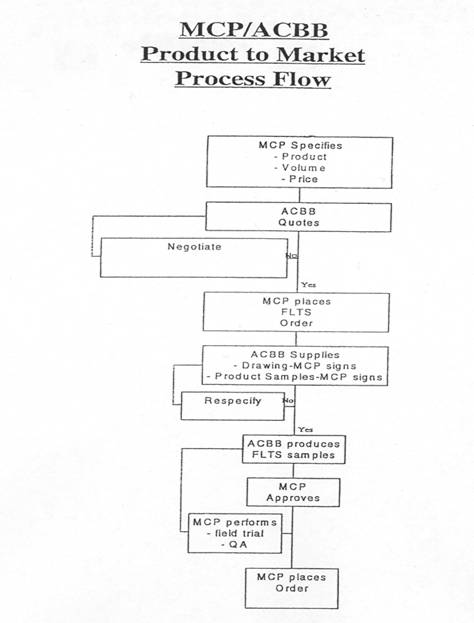
36 Mr Sinadinos recalls that when the flow chart was provided to Mr Epov in about November 1998, a conversation* occurred to the following effect:
‘I said: “This is the MCP flow to market, it is mandatory for ACBB to follow and comply with the process. This means that we will get all of our products exclusively from you provided that you follow this process. However, if you stuff up you will have to compensate us for any loss that we suffer.”
Peter Epov: “We are happy with this process.”’
Mr Sinadinos accepted that the reference to ‘stuff up’ was a reference to any failure on the part of ACBB downstream of the placement of an order. Mr Adair’s evidence was that the process flow chart continued to be a central part of the relationship between ACBB and MCP up to, including, and past the time when the trading agreement was signed.
37 If the process shown on the flow chart is followed, it will not necessarily result in MCP placing an order. There are points in the process flow at which decisions are required to be made by MCP. That is obvious on the face of the flow chart, and was confirmed by the evidence of Mr Sinadinos and Mr Roden. MCP might not accept ACBB’s quote and the negotiation for which the process flow chart provides might be unsuccessful. MCP might not approve samples which ACBB produces. The point which the witnesses made was that agreement was always able to be reached in relation to these matters with respect to the products which were exposed to the process flow chart. Thus, for example, Mr Epov’s evidence in cross-examination at T p 82 was as follows:
‘… but was it your real understanding of the arrangement between the parties that MCP under the arrangements then applying would be obliged to purchase from ACBB no matter what the price was, no matter what the state of the sample was? --- No. Well, the commercial logic would dictate if a price is too high, they would not have bought from us or if the sample was not satisfactory, we would have modified the sample, retooled it and brought it back. In reality all of our prices were well below what they have – they originally targeted or what they wanted. The samples were in reality better than anything they ever had and, you know, we produce the best product on the market.
Assuming all that to be so, you acknowledge do you though that one of the possible outcomes of the process would be that MCP would decide not to buy from you? --- Yes, it’s possible that they may have made a decision not to buy from us but it didn’t happen that way.’
38 Neither the flow chart, nor any similar document was used by MCP in relation to its dealings with other suppliers.
39 A management meeting of MCP was held on 11 November 1998. At this meeting it was resolved that Mr Adair and Mr Sinadinos were to report to McKechnie by the end of the month on the evaluation of ACBB’s supply capabilities, expectations and objectives [KA 6].
The initial bulk order
40 On or about 13 November 1998 agreement was reached between ACBB and MCP to proceed with the following product groups in [PE 17]:
(a) hooks and rings (pre-packs only), being certain products falling within ‘project 1’;
(b) stayed and unstayed brackets, being certain products falling within ‘project 6’;
(c) PC rod plastic components, being certain products falling within ‘project 6’;
(d) gold rod, being certain products falling within ‘project 7’; and
(e) PC rod plastic components (gold), being certain products falling within ‘project 7’.
(McEwen [32])
41 On or about 18 November 1998 MCP placed its initial bulk purchase order* with ACBB [PE 27]. The order related to the products referred to above plus Door Stops being ‘project 26’. Apparently quotes had been received from ACBB for some only of the products the subject of the order as at least one page of the attachments to the order contains a notation that only two of the items had been quoted, and quotes for all other items are required. The order itself provides:
‘This order is for the manufacturing of appropriate tooling and dyes to produce in bulk only, the products outlined. Note that the MCP/ACBB product to market process flow chart and initial supply and delivery agreement must be followed at all times.’
42 A document styled ‘ACBB/Windoware initial supply and delivery agreement’ had been sent to ACBB but the letter enclosing the initial bulk order advised that it was not necessary for that agreement to be signed that day. In fact, it was signed by Mr Epov on behalf of ACBB on 18 November 1998. It was not signed by Mr Adair. Subsequently, Mr Epov was advised by MCP that the document was no longer relevant. The front page of that agreement provided as follows:
‘This agreement details the following subjects and assigns responsibility between MCP and ACBB to enable the framework for new supply lines to be established ex ROC. This agreement is part of the trading terms and conditions for supply.
Initial purchase order – first lot to stock (FLTS)
Manufacturing start-up
Packaging start-up
Packaging and labelling specification
Product storage and delivery
Product traceability
QA/QC issues
Planning and inventory management’
There is nothing in this document in relation to minimum volumes or exclusivity of supply.
43 Mr Epov found that the initial bulk order represented less than 30 per cent of the MCP annual volume for that product as projected by MCP during the period July to October 1998.
44 On 20 November 1998 Mr Epov, Mr Sinadinos, Mr Roden and Mr Haines met. At that meeting Mr Sinadinos said that the initial bulk order is far too small and uneconomical to run. To achieve the savings quoted, ACBB must have a minimum 50 per cent to 60 per cent of the annual volume. Mr Sinadinos said that the order was not representative of future orders. MCP will review the bulk order and increase it. At that meeting Mr Sinadinos also tabled a document styled ‘MCP/ACBB Trading Agreement’, and draft key elements were discussed. The document took the form of an index to Part A (Terms and Conditions) and Part B (Operational Requirements) of the proposed agreement.
45 On 26 November 1998 MCP placed a revised bulk order* with ACBB. The revised order included orders for increased quantities of the products the subject of the original order and included an order for hooks and rings (metal components) ‘project 1’ [PE 29]. The purchase order states that the ‘MCP/ACBB Product to Market Process Flow Chart … must be followed at all times’.
46 On 30 November 1998 MCP submitted an initial PC rod order being some products within group 1 ‘project 6’. This purchase order also included the statement in relation to the Flow Chart quoted above.
47 Initially orders were placed by MCP for 54 different products which in turn were to be packaged by reference to three or four different brands. This meant that there were about 198 different packaged items the subject of the initial order.
48 Although ACBB continued to provide quotes on other products, MCP did not place orders with ACBB for any products other than those products falling within the range of the initial orders placed on 18, 26 and 30 November 1998. Once orders were placed with ACBB by MCP with regard to any product category as a result of the flow chart procedure, MCP did not order that same product category from any other supplier. MCP continued to reorder those product categories from ACBB.
The presentation
49 As a result of the resolution passed at a management committee meeting on 11 November 1998 Mr Sinadinos prepared a report styled ‘ACBB Project’ [KA 7]* which was presented to Mr Hanratty and other MCP personnel on 9 December 1998. Among those present at the presentation were Mr Adair, Mr Barker, Mr McEwen, Mr Sinadinos and Mr Chenery. No one from ACBB was present on this occasion.
50 The introduction to the presentation records that ACBB was introduced to MCP in late 1997 as a potential future supply partner. The introduction also records that MCP seeks to develop a partnership with ACBB as a means to eliminating the multitude of middle-men currently standing in the traditional overseas supplier base. MCP will work with ACBB on a long term partnership arrangement as a vehicle to achieve its strategic purchasing goals. The first of the project goals was as follows:
‘Establish an exclusive and confidential supplier partnership with ACBB.’
51 Section 1 of the presentation includes the following:
‘The plan is to specify 14.6M (67% of total FY99 COGS) business for ACBB to quote for supply ex PRC. Based on the FY99 budget the financial analysis shows the ACBB contribution to MCP to be in the order of 3.1M p.a. (assuming all this business goes to ACBB).’
In other parts of the presentation it is assumed that 14.6M business would be transferred to ACBB. Other benefits include the potential to take out 100 ex suppliers as well as ‘exclusivity/confidentiality – competitive edge’.
52 Section 2 of the presentation deals with procedures. It is as follows:
‘To manage the task of specifying > 2500 (SKU’s) products for quotation and resourcing, all targeted products are categorised into groups 1, 2, 3. Product and packaging specifications are being laid down for each product. An agreed procedure with ACBB is documented for bringing products to market.’
The categorisation into groups is a reference to [PE 17]. The documented procedure for bringing products to market is a reference to [PE 22A].
53 Section 5 of the presentation is headed ‘Exclusivity and Trading Agreement’. Under that heading the following appears:
‘A five year exclusivity and confidentiality heads of agreement has been signed between MCP and ACBB. A detailed trading agreement incorporating terms and conditions and operational requirements is currently being finalised with ACBB.’
A copy of the Heads of Agreement was attached to this section of the presentation as was a draft form of the Trading Agreement.
54 Mr Sinadinos recalls that when he presented the slide dealing with section 5 he said:
‘This agreement means that we would not use anyone else for the products supplied by ACBB and in return ACBB will not supply these products to anyone else.’
By ‘this agreement’ he was apparently referring to the Heads of Agreement although, as earlier indicated, there is no express term in that document which would oblige MCP not ‘to use anyone else’ for the products supplied by ACBB.
55 The form of Trading Agreement attached to this section of the presentation was drafted by Mr Sinadinos. It was divided into Part A (Terms and Conditions) and Part B (Operational Requirements) and its subject matter appears at least to some extent to follow the index presented at the meeting on 20 November 1998. The minutes of that meeting [PE 28] include as Item 14 the following:
‘Draft Trading Agreement Key Elements presented by TS for discussion – to be expanded and further presented (refer attached).’
The ‘attached’ is the document which I have described as an index. The Draft Trading Agreement attached to this section of the presentation appears to be the expansion contemplated by Item 14.
56 The Draft Trading Agreement contains provision for the attachment of an Appendix 1 described as ‘ACBB/MCP (Windoware) Exclusivity Agreement’ and for the attachment of an Appendix 2 ‘ACBB/MCP (Windoware) Agreed Procedure for the processing first lot to stock (FLTS) orders’. Appendix 2 appears to be a reference to the flow chart [PE 22A].
57 On 9 December 1998 a MCP management meeting was held at which various MCP executives were present. At this meeting Mr Hanratty said words to the following effect:
‘We are committed now to getting all of these products from ACBB so we don’t want to be stranded. So make sure you get ACBB to sign a trading agreement as soon as you can. I want to lock them in so that we are protected.’
December 1998 China visit
58 On 13 December 1998 Mr Epov met with Mr Roden in Shanghai. During the course of that week they carried out a great deal of work covering production and the refinement of packaging of supply to MCP. The work included inspection of tooling at various factories, product samples, clam shell packaging and selection of printers for labels.
A Draft Trading Agreement
59 On 7 January 1999 MCP submitted a draft of the proposed Windoware/ACBB Trading Agreement to Mr Epov for review and comment. This was the first draft of this document which had been provided to Mr Epov. It appears to be substantially the same as the form of Trading Agreement which was attached to the 9 December 1998 presentation. Many of the provisions in the draft appear to have been objected to by Mr Epov as the word ‘no’ appears in his handwriting next to many of the provisions in the draft [PE 34]. The draft contains no provision as to the duration of the agreement, and apart from the reference to Appendix 1 contains no provision about exclusivity either way. Mr Epov assumed that a copy of the Heads of Agreement was to be attached to the Trading Agreement as Appendix 1.
60 On or about 17 February 1999 a second draft of the Trading Agreement was prepared and submitted to Mr Epov. The second version is near to, but not the same as, the final agreement which was later signed on 20 May 1999. Mr Adair approved both the initial version and the revised version of the Trading Agreement. Again, there is nothing in this draft of the Trading Agreement about exclusivity one way or the other.
61 The matter of the finalisation of a detailed trading agreement with ACBB was raised at MCP management meetings on 21 January 1999 [R1/459] and 10 February 1999 [R1/242].
January 1999 China visit
62 During the period 11 to 16 January 1999 Mr Epov, Mr Dong and Mr Roden met with most of ACBB’s Chinese manufacturers in Shanghai where they reviewed product, tooling and printing. A report of that visit became [PE 35]. During the course of that visit Mr Roden prepared [PE 37] which is a schedule for the placement of continuing future bulk orders. During the course of this visit Mr Roden also gave approval for production of products the subject of the November 1998 bulk orders [PE 36]. This approval is for the production of previous orders and not a new order.
Proposed purchase of the PC Rod Machine
63 In early February 1999 Mr Adair asked Mr Epov whether he would be interested in purchasing a powder coat rod machine from MCP. As ACBB was supplying MCP with PC rods, the piece of equipment was obsolete. On 2 March 1999 Mr Adair offered the PC rod machine to ACBB for $350,000 [PE 38]. By letter dated 15 March 1999 [PE 38] ACBB put to MCP its formal proposal for the purchase of the PC rod machine. That proposal was preceded by an introduction in which ACBB made certain complaints about matters which had caused ACBB to examine its future position with MCP, as its commitment to the Windoware project thus far had been very expensive. Concern was expressed that there were several project groups which ACBB had worked on which had been scrapped at the last minute just before an order was to have been placed with ACBB. Therefore when ACBB looks at the acquisition of the assets in the package ACBB needs to view the matter ‘in the context of our overall relationship’. ACBB needs ‘certain assurances’ from MCP before ACBB can make any further investment into the project.
64 The letter then proposed an acquisition package under which ACBB would purchase from MCP for the sum of $350,000:
(a) the PC rod machine;
(b) the valance rod machine;
(c) the bracket machine; and
(d) three year’s supply of powder coating material.
65 ‘As part of this arrangement’ ACBB proposed that MCP should purchase from ACBB for a minimum period of five years:
(a) all of its PC rod requirements;
(b) all of its aluminium extrusion requirements;
(c) all of its Metal Brackets and components currently supplied by CH Trading – Korea; and
(d) all of its Valance Rod requirements.
(emphasis added)
66 The letter also proposed that Mr Roden should be employed by ACBB to liaise between MCP, ACBB and ACBB’s connections in China.
67 PC rod products fell within ‘project 6’ of group 1, valance rod products fell within ‘project 8’ of group 2. An initial order for PC rod products had been lodged on 30 November 1998.
68 On 18 March 1999 Mr Roden sent a memorandum of Mr Adair [PE 42] on the subject of supplier analysis (post rationalisation)*. A copy of this document was provided by Mr Adair to Mr Epov on 30 March 1999. The document contains a list of all of MCP’s suppliers, the product groups, the annual sales revenues, the new suppliers and a time frame for the transfer of business to the new suppliers. On the face of the document, ACBB is not nominated as the exclusive supplier for many of the product ranges. In some cases ACBB is shown as new supplier #1, in other cases some other body is shown as new supplier #1. In the case of some product ranges ACBB is shown as new supplier #2. For example, in relation to the product range styled ‘Extrusions’ McMetals is shown as new supplier #1 and ACBB is shown as new supplier #2. The analysis shows ACBB as the largest of the eight ongoing suppliers with sales revenue of about $19.963M over a projected twelve month period.
69 Taken at face value, there is a tension between this document and Mr Epov’s understanding of the arrangement that ACBB was to be the exclusive supplier to MCP in the areas where ACBB did supply to MCP. Mr Epov said that in his understanding new supplier #2 was a back-up supplier, and certain of the product ranges listed on this document were not the subject of any exclusivity arrangement between MCP and ACBB. In the case of extrusions, whilst ACBB was the back-up supplier there was a specific arrangement with Mr Adair that the extrusions business would be transferred to ACBB from 1 March 2000. Mr Epov professed an inability to explain much about this document as it was devised by MCP.
70 According to Mr Adair when he handed this document to Mr Epov on 30 March 1999* he said:
‘This document is part of our continuing exclusive arrangement between MCP and ACBB. It lists all of our current suppliers and products and a timetable to transfer, in line with the final supply agreement, products to ACBB for procurement. Some of the products you are already supplying.’
71 On 19 March 1999 there was a meeting between Mr Epov and Mr Adair to discuss Mr Epov’s letter of 15 March 1999*. It is common ground between Mr Epov and Mr Adair that during the course of the meeting Mr Adair said that MCP wants an exclusive agreement with ACBB and that is why MCP and ACBB had been working together towards finalising a supply agreement. In line with the terms of that supply agreement, MCP will purchase all of the products currently supplied by ACBB for the term of the supply agreement. MCP will also purchase, in line with the terms of the supply agreement, all PC rods, CH Trading products, valance rod and aluminium extrusions for the term of the supply agreement.
72 On 22 March 1999 [PE 39]* Mr Adair authorised Mr Roden to send to Mr Epov a list of products that were then being purchased by MCP from ACBB with the purchase prices current at the time. The products listed were mainly pre-pack products falling within group 1 in [PE 17], although some other products, for example, gold rod, were also included. The letter stated that MCP would like to incorporate the price list into the current ‘contract’, Terms and Trading Agreement, as an appendix. This was never done. There were some increases in the prices of some of the products on the list due to increased manufacturing costs and increases in the cost of materials occurring after the date of its preparation. These increases were negotiated with MCP.
73 On 29 March 1999 [PE 40]* Mr Adair wrote to Mr Epov in response to the letter of 15 March 1999 and by way of confirmation of the main points of the meeting of 19 March 1999. The letter confirmed that the machines are to be purchased for a total sum of $350,000. The machines are to be relocated in China. It is anticipated that an agreement referred to as the supply agreement, but which later became known as the Trading Agreement, would be resolved at the meeting scheduled to be held on 29 March 1999. MCP will confirm its commitment to purchase the following ranges of product, in line with the terms and conditions of the supply agreement:
(i) all PC rod for the tenure of the agreement;
(ii) all components currently sourced from CH Trading for the tenure of the agreement;
(iii) valance rod as per the specification of the assets for the tenure of the agreement; and
(iv) MCP will utilise ACBB packing centre in Shanghai for all of its packing and repacking of all packaged goods items for the tenure of the agreement.
McKechnie Metals was the sole supplier of aluminium extrusion to MCP under an agreement which expired in March 2000 [Exhibit C]. The letter recorded that the supply line of the aluminium extrusion range of product would revert to ACBB on 1 March 2000.
74 On 8 April 1999 a meeting took place attended by Mr Adair, Mr Epov, Mr Dong, Mr Hanratty and Mr Burson. Mr Epov’s notes of that meeting are [KAR 35]. The notes include the following:
· ‘Hanratty understood that MCP had intended to transfer a substantial amount of their procurement to ACBB and wanted to know whether we had the capacity to accommodate the various ranges?
· Hanratty was very happy with our efforts to date on the clamshell packaging.
…
· PE emphasised that ACBB only made the serious investment to the MCP project on the basis that there was a commitment from MCP through KRA that there would be an exclusive long term strategic alliance in place between the two parties resulting in the transfer of significant business to ACBB. Tenure and volume were the two keys for the success of this opportunity for both sides.
· Hanratty was suitably impressed. He didn’t see any reason why a progressive transfer of business could not take place with ACBB.
· He liked the concept of long term strategic alliances and talked about the UK experiences and raised the possibility of a 10 year contract between ACBB and MCP with a 10 year option.
· He was satisfied that ACBB could do the work and looked forward to hearing more about the unfolding relationship.’
75 On 16 April 1999 Mr Adair wrote to Mr Epov confirming the result of their recent meeting [PE 41]*. The consideration for the purchase of the three machines was reduced to $225,000. With regard to the purchasing commitments:
‘MCP will confirm its commitment to purchase the following ranges of product, in line with the terms and conditions of the supply agreement:
(i) all PC rod for the tenure of the agreement;
(ii) all components currently sourced from CH Trading for the tenure of the agreement;
(iii) MCP will utilise ACBB packing centre in Shanghai for all of its packing and repacking of all packaged goods items for the tenure of the agreement.
With regards to aluminium extrusions, the supply line of this range of product will revert from its existing supplier McKechnie Metals New Zealand on 1st March 2000 …’
76 On 22 April 1999 [PE 45] Mr Epov wrote a long letter to Mr Adair in response to his letter of 16 April 1999. The purpose of the letter was to advise Mr Adair that ACBB was unable to proceed with the acquisition of the surplus assets as outlined in the letter of 16 April 1999. The letter proceeded to explain why ACBB came to that decision. Initially ACBB was advised that should its pricing be satisfactory then it would secure around $A9M of annual business. Based on this volume of business and on ACBB’s confidence that it could provide favourable pricing, ACBB then made a strategic decision and invested significant resources to secure this $A9M of annual business. ACBB was also advised that the quotation process would be rolled out progressively and that ACBB would be given target pricing and all relevant information by the end of October for all of the product groups upon which ACBB would be required to quote. The date was later extended to the end of November. ‘This still has not been finalised’. ACBB was also advised that as it quoted a product group and its pricing was favourable, then orders would be placed progressively. This did not occur. In 1998 when ACBB quoted MCP on the supply of PC rod out of China, ACBB was told that if it reached a certain price then ACBB would take over the PC rod business. ACBB provided a favourable price and MCP placed a six month bulk order for over 900,000 metres. At that time, there were no preconditions relating to the acquisition of the PC rod machine. Later in February 1999 ACBB were advised (after it had invested in the production of PC rod in China) that whoever acquires the PC rod machine would then inherit the PC rod business. The letter then complains of a failure to place the aluminium extrusion business, the springs business and the valance rod business with ACBB notwithstanding the provision by ACBB of favourable pricing in relation to those products. ACBB then found itself in February 1999 in a situation where in order to secure the PC rod business, it had to acquire an old PC rod machine. In order to help MCP, with whom ACBB had made a strategic alliance, and ‘to finally secure the business’ ACBB verbally agreed on a deal with MCP to acquire certain assets. Part of this deal was that ACBB would be given the extrusion business, yet later ACBB discovers that the extrusion business is not available until the year 2000. Various other complaints are made including that MCP has withdrawn the valance rod machine from the deal even though the valance rod machine and the valance business had been previously confirmed as part of the arrangements on at least five separate occasions. The letter concluded:
‘As I have previously intimated to you, during the past three months Mr Dong and I have been examining our future position with Windoware as well as our commitment to the Windoware project. We are now seriously concerned with the ongoing viability of this business. In view of these circumstances we find that we are unable to proceed with the acquisition of the PC rod machine.’
The Letters of Intent
77 It is common ground between Mr Epov and Mr Adair that at a meeting held on 3 May 1999* Mr Adair gave to Mr Epov a letter dated 3 May 1999 annexing a Letter of Intent [PE 46]*. It is also common ground between Mr Epov and Mr Adair that on that occasion Mr Adair said words to the effect that the Letter of Intent sets out the products that MCP will purchase exclusively from ACBB in line with the terms of the Trading Agreement expected to be finalised shortly.
78 The letter of 3 May 1999 [PE 46]* was written in response to the letter of 22 April 1999, referred to above. The letter referred to teething problems that would need to be sorted out and to the fact that whilst MCP was committing the vast majority of its purchasing to ACBB, this process needs to be carried out with the minimum destruction to MCP’s business. Mr Adair said that as he saw it there are two key issues:
(i) supply commitments from Windoware; and
(ii) PC rod acquisition.
Mr Adair said in the course of his evidence that he did not regard these two issues as being interdependent.
79 To resolve these two issues Mr Adair proposed the following:
‘(1) Windoware will supply (see attached) Letter of Intent, with timings of all of the products we, at this period of time, believe ACBB can procure for Windoware (this could be drafted into a legal document); and
(2) I would propose that we conclude the PC rod acquisition at $A200,000 …’
80 The Letter of Intent attached to the letter of 3 May was signed by Mr Adair. It is convenient to set it out in full:
‘Letter of Intent
Windoware will commit to the following procurement from ACBB, see detailed below, based on the set criteria of volume, price quality and service, as per the terms of the supply agreement, the value of these projections can go up or down and they are our best forecast, based on information to date.
Product Category Timing (order placing) Value
Pre Packs Existing A$1.8 million
CH Trading Oct 1999 A$1.2 million
Extrusions Nov 1999 A$2.0 million
PC Rod Existing A$1.3 million
Others Oct 1999 A$0.5 million
NZ requirement general Oct 1999 A$0.5 million
NZ Extrusions Nov 1999 A$1.5 million
Valance Rod Jun 1999 A$0.4 million
Fly Frame May 1999 A$0.2 million
To enable this schedule of procurement to eventuate on time, I would feel it is essential that Leigh Roden coordinate the entire project as previously discussed.
Kevan Adair’
81 The product categories shown in the Letter of Intent accord with the product categories referred to in par [17] of FASC (to be referred to later in these reasons) except that ‘others’ in the Letter of Intent becomes SE Asian (others) in par [17]. There are nine product categories, one of which is PC rod. Note that pre-packs and PC rod are shown as being the subject of existing orders. The column ‘Value’ records the expected value of projected annual volumes and totals at $A9.4M. The Letter of Intent is not expressed to apply for any particular period. Nor does the Letter of Intent refer in terms to exclusivity. However, it is implicit in the letter that MCP’s requirements for the products in the nine categories specified will be purchased exclusively from ACBB, as the letter expresses an intention to commit to the procurement from ACBB of MCP’s anticipated annual requirements of products falling within the nine product categories described. That expression of intention is not absolute and unconditional; it is based on a belief that ACBB can procure those products for MCP, but that depends upon whether the products meet MCP’s criteria of ‘volume, price, quality and service’.
82 On 4 May 1999 Mr Adair sent a letter to Mr Epov attaching a further Letter of Intent [PE 46]*. The letter was sent following a meeting between Mr Dong, Mr Epov and Mr Adair on 3 May 1999, but no details as to what happened at that meeting emerge from the evidence. Nonetheless, the letter confirmed the main points of that meeting namely:
(i) the attached Letter of Intent covers the volumes of products which will be the subject of orders to be prepared and delivered by MCP to ACBB;
(ii) the assets to be acquired pursuant to the asset disposal are the PC rod assets, the PVC rod assets and the valance rod assets for a total consideration of $A200,000;
(iii) as Mr Roden intends to leave MCP and not to join ACBB, MCP would like to know what ACBB’s proposals are to ensure a smooth transition of business from MCP’s existing supply base to ACBB.
83 Again, it is convenient to set out the Letter of Intent in full. It was signed by both Mr Adair and Mr Epov. It is as follows:
‘Letter of Intent
This letter of intent is between McKechnie Consumer Products trading as Windoware, and ACBB.
It covers the procurement of the products detailed below.
McKechnie Consumer Products, trading as Windoware, will prepare and deliver orders for ACBB for the appendix attached of the products.
McKechnie Consumer Products trading as Windoware, reserves the right to execute these orders based on the existing trading criteria that is set out in the terms and conditions of the supply agreement, between the parties which covers specification, quality, service and pricing.
If the above criteria as mutually determined by the parties is acceptable, McKechnie Consumer Products, trading as Windoware will conclude the procurement of the attached product categories to ACBB.
For: McKechnie Consumer Products
T/a Windoware
Kevan Adair
Chief Executive Officer
For: ACBB
Peter Epov
Chairman and Chief Executive Officer’
84 The ‘Appendix attached’ was Appendix 1 which provided as follows:
‘Appendix 1
Product Category Value
CH product range A$1.2 million
Aluminium Extrusions A$2.0 million
SE Asian (others) A$0.5 million
NZ general requirements A$0.5 million
NZ Extrusions A$2.0 million
Valance Rod A$0.4 million
Fly Frame A$0.2 million’
85 The appendix only contains seven product categories. The two product categories which were described as being the subject of existing orders in the Letter of Intent of 3 May 1999 have dropped out. The ‘value’ of NZ Extrusions has changed from $1.5 million to $2.0 million. The column dealing with the timing of orders has been omitted. Again, there is no reference in the Letter of Intent to exclusivity, but, again, it is necessarily implicit in the letter that MCP will not purchase products within the product categories described from third parties because it intends to obtain its anticipated annual requirements of those products from ACBB. This letter makes it slightly clearer that the intended commitment is subject to the products meeting MCP’s criteria in terms of ‘specification, quality, service and pricing’. These products have yet to pass through the process flow chart [PE 22A].
86 ACBB’s letter of 17 May 1999 [PE 47]* was in response to the Letters of Intent. In that letter, Mr Epov records that over the past eight months ACBB has been working very closely with MCP/Windoware to transfer the procurement of a number of MCP’s product groups to ACBB. The letter continues:
‘The practice has been that as MCP/Windoware identify a product, ACBB then develops design drawings for that product. Once confirmed by MCP/Windoware then ACBB produces samples, tooling and dyes as well as “off tool” samples for MCP/Windoware to confirm before orders are placed with ACBB by MCP/Windoware for the production of those products. Once the products are manufactured ACBB then packs these products complete with labels, bar codes, price tags etc in blister packaging and ships the product to MCP/Windoware in Sydney.’
87 In that letter, ACBB welcomed the confirmation of MCP’s commitment to the procurement from ACBB of an annual purchase of $A9.4M of product (as listed in the attachment to the letter of 4 May 1999) for the next five years. ‘In return for this commitment’ ACBB agreed to purchase the assets identified in the letter of 4 May 1999 on the terms therein specified (emphasis added).
88 Mr Epov’s evidence was that ‘in a sense’ a commitment to purchase product from ACBB was related to the proposed asset purchase, whereas Mr Adair saw the two things as being separate.
Trading Agreement
89 ACBB forwarded its ‘final draft’ of the Trading Agreement to MCP under cover of a fax dated 19 May 1999 (sic) [PE 48]. By a fax transmission on 20 May 1999 [R 1/389] Mr Adair told Mr Epov that he was getting somewhat frustrated at the length of time it is taking to get the Trading Agreement and the Letter of Intent over to MCP. He said that he had until midday on 20 May 1999 to finalise the asset issue at Epping and if the two documents failed to arrive he will have to make alternative arrangements. This was a veiled threat to procure MCP’s products from persons other than ACBB, but according to Mr Adair, as a practical matter he was too far committed to go anywhere else. A meeting was suggested to attempt a resolution of problems referred to in the letter or to negotiate a mutually acceptable exit from the arrangement.
90 The Trading Agreement* was executed under the common seals of both companies, and it is common ground that this execution occurred after the MCP fax of 20 May 1999 [R 1/389], and probably on 20 May 1999.
91 The Trading Agreement is expressed to operate for a period of five years, with the option of further renewal of five years: cl 1(a). There is no indication in the agreement as to which party has the option of renewal or how the option may be exercised.
92 It is agreed that the Trading Agreement covers the territories of Australia and New Zealand ‘between the entities ACBB and Windoware Australia and Windoware NZ’: cl 3(a). Clause 4 is headed ‘Product Specification’ and provides as follows:
‘(a) Windoware shall provide approved product, packaging and carton specifications. ACBB shall manufacture and pack products as specified by Windoware. Any changes to specification must be in writing.’
Clause 5 deals with delivery. The dates of delivery are to be specified in the Purchase Order. Clause 6 deals with payment terms.
93 Clause 7 deals with costs. Clauses 7(a), (b) and (c) are as follows:
‘(a) the price of the goods shall be in accordance with the quotations agreed by Windoware prior to the commencement of supply of the Goods pursuant to any Windoware Memorandum of Purchase Commitment or purchase order;
(b) ACBB shall not alter, vary or amend any price of the goods without:
(i) twelve (12) weeks prior written notice to Windoware;
(ii) the consent of Windoware in writing;
(c) Windoware and ACBB agree that the price of the goods shall be reviewed each year. The first review to be conducted between November 1 and November 15 1999.’
Both Mr Adair and Mr Epov agree that the expression ‘Windoware Memorandum of Purchase Commitment’ is devoid of any content. It is a term which was used in the first draft of the Trading Agreement but which did not survive. Although the letter of 22 March 1999 [PE 39] expressed a wish to incorporate the then current price list into the Trading Agreement as an appendix, this did not occur.
94 In oral evidence Mr Chenery expressed the view that a price review referred to in cl 7(c) could result in an increase or a decrease in price, whereas Mr Epov expressed the view that absent agreement, the review could only result in an increase in price. If there was a failure to agree upon a new price as a result of the review, then the existing price continued to apply, although Mr Epov did not point to any specific conversation with Mr Adair or other MCP executives where an agreement was reached to that effect. Mr Adair’s evidence was that it was within his contemplation that ACBB’s material costs might either increase or decrease over the period of the Trading Agreement. So too would the costs of manufactured goods and transportation of goods. The price review clause was a control mechanism which enabled Mr Adair to be satisfied that he was being supplied with competitive product at competitive prices.
95 One of the product categories referred to in the Letter of Intent (and in the letter of 22 April 1999 [PE 45]) was ‘aluminium extrusions’. The transfer of the aluminium extrusion business to ACBB was the subject of negotiation in April 1999. Prior to the Trading Agreement both Mr Epov and Mr Adair knew that the pricing for extrusions was variable according to movements on the London Metal Exchange.
96 At the time of signing the Trading Agreement both parties knew that the prices for product intended to be the subject of the Trading Agreement might need to vary over its term according to a range of variables including foreign exchange fluctuations [T 362], changes in the costs of materials and costs of manufacture to ACBB, and changes in MCP’s retail market affecting the volumes it would require from ACBB. Reference should be made to [Exhibit M1] by way of example. By facsimile dated 7 May 1999 ACBB (Epov) informed MCP (Roden) of some new pricing for gathering hooks. Mr Epov asked if MCP wished to proceed with the current orders at the new price or wished to cancel those orders. The need for change had occurred because of a change of supplier to ACBB who had committed to an automated process to ensure consistency of supply and product delivery.
97 Clause 8 of the Trading Agreement is a protocol for costs review due to foreign exchange rate fluctuations. Clause 9 provides for the title to the goods to pass to MCP on delivery. Clause 10 provides that the agreement is personal to ACBB and to MCP and neither party is entitled to assign the agreement to a third party. Clause 11 deals with planning and purchase forecasting. Clause 11(b) provides for bulk orders to be raised by MCP twice a year for the manufacture of bulk product. The lead time for bulk orders will be six months ahead of the packing schedule. Clause 11(c) provides that purchase orders will be raised by Windoware every three months for packing products. The lead time for pack orders will be eight weeks ahead of the delivery schedule. Clause 11(d) provides for MCP to issue a delivery schedule to ACBB every month.
98 The Trading Agreement does not contain any exclusivity term of the type pleaded, nor does it contain any provision prohibiting ACBB from supplying products to third parties as well as to MCP. Nor does the Trading Agreement contain any provision obliging MCP to purchase any particular products in any particular quantities from ACBB, apart from the stipulation that bulk orders are to be raised by MCP twice a year.
The second bulk order
99 On 31 May 1999 MCP placed its second bulk order with ACBB [PER 1]. The products ordered in the second bulk order were products of the same groups as the initial bulk orders (including PC rod). Unlike the initial bulk orders this was an order for the actual production of the products ordered. The order did not contain the endorsement which was included on the initial bulk orders that the MCP/ACBB product to market process flow chart must be followed. The second round of orders was delayed from an intended second round expected to be placed in April 1999 [PE 43].
Purchase of PC rod machine
100 At a meeting held between Mr Epov, Mr Adair and others on 7 June 1999 Mr Adair announced that MCP did not wish to proceed with the sale of the PC rod machine at this time. The machine is to be stored and a decision will be made at a later date [PE 49]. Mr Epov raised no objection. Mr Adair was under pressure from Mr Hanratty to sell the PC rod machine. Mr Adair notified Mr Epov that he had an interested purchaser for the machine, but only on condition that MCP purchase the PC rod from the purchaser exclusively. Mr Epov agreed to release MCP from its obligation to purchase PC rod from ACBB. On 25 June 1999 MCP entered into a letter of intent with Rollcraft Victoria [KAR 1] and thereafter a mutual exclusivity arrangement [KAR 2] in relation to PC rod.
101 Paragraph [18] of FASC pleads an agreement between the parties reached in about July 1999 to exclude the product category ‘PC Rod’ from the product categories which MCP would procure from ACBB exclusively.
The dealings with ABC
102 On 15 June 1999 a management meeting of MCP was held. The agreed action included the following:
‘38 No new product briefs to ACBB until first projects are up and running. Contingency plan to cover ACBB products to be prepared, preference to overseas.’
103 At the time of the Trading Agreement ABC was an existing supplier of products to MCP. It was located in Indonesia. Between July 1999 and November 1999 approaches were made to ABC to quote on the full range of products supplied by ACBB to MCP. MCP submits that the dealings between MCP and ABC are inconsistent with the exclusivity provisions for which ACBB now contends. There are two answers to this submission. First, if there was some dispute between Mr Adair and Mr Epov as to the communications between them, Mr Adair’s dealings with ABC may have been relevant to the resolution of that dispute. However, there is no dispute as to those communications, and whatever dealings MCP had with ABC cannot impact upon the legal relationship between ACBB and MCP, if only because ACBB was not privy to those dealings. Second, a consideration of the contemporaneous documents makes it reasonably plain that MCP sought quotations from ABC for both contingency reasons and as cost comparisons: see, eg, [R1/480]. The marketing report for November 1999 of MCP records as follows: [R 1/510]
‘ABC – the ABC contingency offers for ACBB supply has been put on hold. ABC have confirmed that there would be a six month lead time for them to gear up to supply all of the ACBB products.’
104 Accordingly, I reject MCP’s submission that its dealings with ABC are inconsistent with the existence of the contractual provisions for which ACBB contends. Those dealings have no bearing on that question.
The proposed sale of MCP
105 In about October 1999 Mr Hanratty contacted Mr Adair and informed him that a decision had been taken that MCP was to be sold. Mr Hanratty requested Mr Adair to prepare an information memorandum for submission to prospective purchasers. Mr Adair produced two versions of that document. Exhibit [KA 9] is an information memorandum prepared specifically for an institutional investor who had expressed an interest in the purchase of MCP. Exhibit [KA 10] is an alternative version of the information memorandum which was drafted to keep confidentiality to a maximum. In this version, suppliers were referred to by code. Section 2.4 of [KA 10] dealt with major suppliers. It provides as follows:
‘2.4. Major Suppliers
Details of Windoware’s major suppliers are set out below:
Supplier Products Annual
Purchases
A$’000
Supplier A Packaged Blinds 5,522
Wooden Curtain Poles
Supplier B Drapery Hardware 2,389
(Packaged Goods)
Supplier C Drapery Hardware 1,608
(Components)
Supplier D Extrusions/Fly Frame 1,390
Supplier E Valance Rods/Extendables 514
Supplier F Drapery Hardware 399
Supplier G Packaged DIY Awnings 336
Supplier H Steel Coil 300
Supplier I Wooden Poles 290
Supplier J Curtain Tape 171
Supplier K Drapery Hardware 94
Supplier L Curtain Tape 34
Supplier M Plastic Components 180
Supplier N Curtain Rod 390
Supply agreements are in place with suppliers A, B, D and N. These offer protection on tenure and exclusivity …’ (emphasis added).
106 Supplier A is ABC, supplier B is ACBB, supplier C is CH Trading, supplier D is MCK Metals Pacific and supplier N is Taiwan Titan.
107 The Information Memorandum contained a disclaimer to the effect that it does not purport to be accurate and complete or all inclusive or to contain all information that a prospective purchaser may require. It urged recipients to make their own enquiries, and not rely on statements made in the information memorandum.
108 On 13 December 1999 MCP placed its third forward order with ACBB covering pre-packs and gold rods for the months of April to July 2000. MCP was unable to provide an order for August and September at that stage because the forecast for those months was being modified.
109 On 13 January 2000 there was a meeting between Mr Epov, Mr Adair and Mr Chenery in which Mr Epov was informed of McKechnie’s decision to sell the MCP operations in Australia and New Zealand. It is common ground between Mr Epov and Mr Adair that there was discussion about the agreement between ACBB and MCP in which Mr Epov was assured that the agreement would be honoured by the purchaser.
Some executives of MCP are unaware of mutual exclusivity
110 Neither Mr McEwen nor Mr Burson was aware prior to the takeover of MCP by Sullivans that ACBB asserted that MCP had agreed to purchase products exclusively from ACBB. Mr Burson says, in particular, that had he been aware of an exclusivity arrangement he would have ensured that this fact was disclosed in the information memorandum and to prospective purchasers of MCP in response to their enquiries. He was not aware of any purchaser raising the issue of mutual exclusivity during the due diligence process to be referred to hereafter.
111 In assessing Mr Burson’s evidence in this respect, it must be recalled that Mr Sinadinos, who I accept as an honest and reliable witness, says that he explained the mutual exclusivity relationship at the 9 December 1998 presentation at which Mr Burson was present. Mr Burson accepted that he was present on that occasion, but had no recollection of what had occurred.
112 Neither Mr McEwen nor Mr Burson was present at any of the meetings between Mr Epov and Mr Adair referred to above when mutual exclusivity was discussed.
PAO – ACBB exclusivity
113 PAO (Thailand) Co Ltd (‘PAO’) was a manufacturer of products located in Thailand. On 14 December 1999 Mr Adair forwarded a memorandum to Mr Chenery [R 1/511] suggesting that information should be provided to PAO highlighting potential products which PAO could manufacture and quote on. The letter included:
‘We can then go and probably finalise a deal, if we are comfortable whilst we are there.’
114 Mr Adair’s report for December 1999 [R 3/1111] referred to PAO as a potential new supplier who had been set some aggressive target prices which could result in reductions of 20-25 per cent on MCP’s existing cost base with the likes of ACBB and CH Trading.
115 A report from Mr Burson of 28 February 2000 [R 2/739] recorded that he saw PAO as being able to replace both ACBB and CH Trading.
116 On 24 February 2000, Mr Burson, Mr Adair, Mr Chenery and others attended a meeting with representatives of PAO at which Mr Burson obtained pricing information for many of the items which MCP and MCP(NZ) were then purchasing from ACBB.
117 Mr Burson’s monthly report for January 2000 [R 2/731] recorded that he was looking forward to visiting PAO in Thailand in late February to evaluate them as a potential supplier to replace ACBB and CH Trading. A memorandum from Mr Burson of 28 February 2000 [R2/739] indicates that he saw PAO as being able to replace both ACBB and CH Trading.
118 A report from Mr Adair to Mr Hanratty on 13 March 2000 [R 1/521] recorded an expectation that the PAO project would be finalised by the end of the week which would result in the consolidation of three suppliers Graber (USA), CH Trading (Korea) and MCK(NZ). ACBB had been told that the business of the last two companies was to be transferred to it.
119 The dealings with PAO came to nothing. MCP did not order any products from them at least whilst Mr Adair was with MCP.
120 Again, counsel for MCP, Mr Finch SC, submits that the dealings between MCP and PAO are inconsistent with the exclusivity provisions for which ACBB now contends. Mr Adair’s explanation for his dealings with PAO is that they were part of a contingency plan and a ‘benchmarking’ operation to obtain market intelligence to assist in pricing negotiations with ACBB. At first blush, that is an unconvincing explanation having regard to the terms of the documents to which I have referred.
121 However, Mr Chenery’s evidence supports Mr Adair in this respect. According to Mr Chenery discussions with PAO were for benchmarking purposes and as part of a contingency plan. Mr Chenery explained that benchmarking occurs when MCP obtains a price from a putative supplier, and then reveals that price to ACBB as a price at which MCP can acquire the goods and invites ACBB to better that price.
122 Mr Chenery has no interest in this litigation, and it was not suggested that he has any motive to fabricate his evidence. He was cross-examined upon these matters but adhered to the proposition that the whole trip to Thailand was for benchmarking purposes and as a contingency plan. He said that the product categories referred to in [17] of FASC which were the subject of discussion with PAO, were those referred to in (h), (g), (c), (b) and some of (a). Of those categories of products it was only some products falling within (a) that MCP had ordered from ACBB at that time.
123 There was nothing about the way in which Mr Chenery gave his evidence that caused me to have any reservations as to his reliability. In MCP’s dealings with ACBB in relation to CH Trading and aluminium extrusions referred to in the next section of these reasons, prices obtained from PAO were in fact used for benchmarking purposes. I therefore accept that the substantial purpose of the negotiations with PAO was benchmarking and the establishment of a contingency plan in relation to products which were not then being supplied by ACBB to MCP. Accordingly, I reject MCP’s submission as to the supposed significance of the PAO negotiations for the same reasons as I rejected the like submission in relation to ABC.
CH Trading
Aluminium Extrusions
Other product categories
124 ACBB contends that in late May 2000, the product categories described as ‘CH Product Range’ and ‘Aluminium Extrusions’ in Appendix 1 of the 4 May 1999 Letter of Intent were the subject of agreement between the parties concerning the matters of specification, quality and pricing. ACBB’s contention is that by late May 2000 these products had passed through the process flow chart [PE 22A] to the point where MCP could place an order for those products. It is, however, common ground that MCP never placed an order for products in those product categories with MCP.
125 In Mr Adair’s affidavit of 23 December 2002 he said that by about March 2000 MCP had signed off on the CH Trading products and the extrusion products and were ready to provide orders. That is plainly wrong, for at a meeting at which Messrs Epov, Adair and Chenery and others were present on 5 May 2000 [R 3/1152] the pricing of these products was still under discussion. Extrusion pricing changes with movements on the London Metals Exchange, and Mr Epov confirmed that there had been no agreement on the price of extrusions at this point in time.
126 The minutes of the meeting of 5 May 2000 record, in relation to extrusions, that ACBB was having problems in China in relation to payment terms and minimum quantities for orders. Mr Epov was to arrange to submit indicative prices for the extrusions after Mr Chenery provided him with updated annual volumes.
127 The minutes also record that Mr Epov was not interested in doing the extrusion business unless he also obtained the CH Trading business. Mr Chenery had received a quote from PAO which was 10-15 per cent less than ACBB’s. Mr Adair was to ask PAO to firm up their quote for CH Trading products and extrusions. Mr Epov was to consider reducing his prices by 3-4 per cent. Mr Epov said that he had already spent about $100,000 in China researching for these products. Mr Adair said that whilst he recognised ACBB’s efforts, MCP still needed to benchmark ACBB’s prices and compare with other suppliers. Mr Adair still wants ACBB’s pricing and will not make a final decision on the supplier without consulting ACBB first. Mr Adair said that he may not have a chance to look at ACBB’s pricing for another month, because his time was occupied with the impending sale of the business. Mr Epov said he may not be interested if he had to wait another month.
128 I have set out the events of this meeting in some detail, because they illustrate a number of points, namely:
- the visit to PAO in Thailand is being used for benchmarking purposes;
- the parties are not dealing with each other upon the basis that there is a subsisting mutual obligation on ACBB to sell, and on MCP to acquire products in the CH Trading and extrusion range of products;
- the parties deal with each other on the basis that before an accommodation can be reached in relation to these products, ACBB needs to overcome problems with the Chinese suppliers, and to reduce its quoted price to a level acceptable to MCP; and
- terms of supply for both CH Trading products and aluminium extrusions need to be resolved.
129 The evidence as to the dealings between the parties after this meeting in relation to products within these two product groups is scant. According to Mr Epov there were no further meetings in relation to the matter, nor is there any document that points to an agreement on extrusion pricing. Mr Epov says that after this meeting he reduced his pricing by four per cent. Mr Epov, Mr Adair and Mr Chenery all say, but without any specificity or particularisation, that Mr Chenery completed his cost benefit analysis in relation to these products in May 2000. The only explanation offered as to why orders for these products were not placed by MCP with ACBB is that advanced by Mr Chenery that ‘the final agreement came through towards the end of May which was the same time when due diligence etc was being carried out through the place’ [T199]. If final agreement was reached in relation to these products, this is an inadequate explanation for no orders being placed.
130 In August 2000 Mr Epov produced an agenda [R 3/1157] for a proposed meeting with Sullivans. Under the notation ‘issues to discuss’, there appears:
‘3. Future business opportunities:
…
> Extrusions
> C. H. Trading
…’
131 Mr Epov was asked in cross-examination whether he described these matters in this way because:
‘… it was your apprehension and understanding that those matters were matters about which there was outstanding items to agree?’
To which his answer was:
‘ … to review.’
132 The parties dealt with each other on 5 May 2000 upon the basis that there were a number of problems which needed to be solved before aluminium extrusion and CH Trading products would become subject to whatever were the trading arrangements between them. Further agreement on these matters was required. The fact that these products were still shown as merely ‘future business opportunities’ in ACBB’s agenda of August 2000 leads me to conclude that the parties had not theretofore reached the position where they had agreed upon mutually acceptable terms and conditions for the inclusion of these products within their trading arrangements. That conclusion is reinforced by ACBB’s letter of 19 August 2000 [PE 56]. It does not contain any reference to CH Trading or Aluminium Extrusion products. Had agreement been reached for the transfer of procurement of these products, one would have expected some reference to be made to that fact in this letter. There is nothing to suggest that agreement was reached on the transfer of these product categories thereafter.
133 It is uncontroversial that none of the remaining five categories in Appendix 1 to the Letter of Intent of 4 May 1999 was ever the subject of agreement in relation to matters of specification, quality and pricing. How that came to pass was not the subject of submission, and my attention was not drawn to any evidence on the point.
Due diligence
134 After a false start, Sullivan’s due diligence in connection with the proposed purchase of MCP or its assets proposed by the Information Memorandum commenced on 22 May 2000. It involved the inspection of documents at MCP’s Rydalmere premises. Mr Adair represented McKechnie in connection with the due diligence process, as did representatives of the accounting firm, Arthur Andersen. Mr Sullivan, Mr Wanchap and Mr Craig Carter, partners of the firm Hall & Chadwick, participated in the due diligence on behalf of Sullivans. Prior to the commencement of the due diligence Mr Wanchap had been provided with a copy of the confidential information memorandum which described suppliers by letter, rather than name [KA 10].
135 Five lever arch files of documents were made available to Mr Wanchap for inspection. File 3 for the Australian business included ‘supplier agreements’. The only agreement with ACBB which was included in the due diligence material was the Trading Agreement, the last page of which was marked ‘Appendix V’. There was no such appendix attached to the Trading Agreement. Neither the Heads of Agreement nor either of the Letters of Intent was included in the due diligence material, nor were they mentioned during the course of the due diligence process.
136 On 23 December 1999 Allen Allen & Hemsley had advised McKechnie [R 2/713] that prospective purchasers should be required to ask questions in written form and that answers would likewise be supplied in writing. No oral questions should be answered, and no questions should be answered verbally. Mr Adair was furnished with a copy of this advice on 5 January 2000 [R 2/712]. At the commencement of the due diligence Mr Fink of Arthur Andersen Corporate Finance explained the process. He said the requests for documents and information were to be made in writing. Requests could be made for formal interviews of members of the senior management team, however, they could not be approached informally. Mr Sullivan was told that if he wanted access to documents other than those included in the due diligence materials, he should request them.
137 In the period between 22 May and 24 May 2000 Mr Wanchap formulated on a running basis a list of what became 39 written questions. Answers were received to eight of those questions. The questions relating to suppliers, or to ACBB were questions 19 and 36. Question 19 was:
‘19 Do the due diligence files provided cover all material contracts including:
(a) licence, supply, distribution and sales agreements;
…’
Mr Wanchap asked that question because he was not satisfied that the material provided included all material contracts.
138 Question 36 was as follows:
‘36 Details of costs associated with establishment of ACBB arrangement included in financial results for the financial period ended 30 April 2000, ie additional travel costs, costs re Woolworths stock repackaging etc.’
[R 2/989, 990]
The question about the costs associated with the establishment of the ACBB arrangements was provoked as a result of an analysis of MCP’s balance sheet. The costs were included as a sub-item amongst many other items. Mr Wanchap regarded the items as sufficiently substantial to ask a question about it. No answer was received to either of these questions. As a result Mr Wanchap did not know, one way or the other, whether the files provided covered all material contracts in the area covered by question 19.
139 Mr Wanchap did not ask any written question specifically in relation to ‘Appendix V’ to the Trading Agreement. He said that he asked Mr Adair to provide a copy of the Trading Agreement with all attachments. Whilst Mr Adair offered to provide a copy if he was able to find the original, none was ever produced. Mr Adair, in his evidence in reply, denied that this request was made: Adair 20.5.03 [182].
140 Mr Wanchap did not know what products the Trading Agreement applied to or what, if any, commitments had been made by MCP to ACBB in terms of the Trading Agreement. In his view the Trading Agreement was just a standard purchase contract, which had no work to do unless enlivened by a purchase order. Mr Wanchap did not ask for copies of, or make any enquiries about, anything answering the description of a memorandum of purchase commitment. He agreed that he could have done so. He observed in cl 11 that the agreement contemplated bulk orders for six monthly periods, but he did not ask to see any of these orders. Mr Wanchap advised Mr Sullivan that he did not know what goods the Trading Agreement applied to.
141 Mr Wanchap’s evidence was that he did not know during the due diligence process who supplier B was, but that he believed that Mr Sullivan did know because of his familiarity with the industry. Mr Wanchap accepted in cross-examination that the reference in the information memorandum to tenure and exclusivity ‘could be mutual. Could be one way’. He did not enquire which. Mr Sullivan did not raise any matter with him concerning contracts with suppliers.
142 According to Mr Wanchap, at no time prior to completion of the sale to Sullivans did the vendors or their representatives inform Mr Wanchap that MCP was a party to a contract that included constraints on its ability to purchase products such as a requirement that MCP purchase products exclusively from ACBB, or to purchase minimum quantities of product from ACBB.
143 Mr Sullivan said that he had formed the view that MCP was losing money and that its financial losses were attributable to large overheads and the manner and price at which MCP was acquiring its products. If Mr Sullivan was to turn the business around, he would have to have the flexibility to buy from suppliers other than ACBB’s current suppliers. The business was not viable in his view unless MCP could significantly reduce the costs of its product acquisitions. It was evident to Mr Sullivan that MCP was buying wrongly, as other sources of supply were available at 30 per cent less.
144 Mr Sullivan said that he reviewed the Trading Agreement during the due diligence. In his view the Trading Agreement contained no restriction on MCP in terms of where it could purchase packaged curtain accessories or any other products. There was no obligation imposed on MCP to purchase products exclusively from ACBB, nor was MCP required to purchase minimum quantities of products. At no time during the due diligence process did any representative of the vendors offer any additional information or documentation in relation to ACBB other than the Trading Agreement. He says that at no time was he told that a ‘mutually exclusive contract’ was in place with ACBB. Mr Sullivan said that he understood cl 2.3 of the Information Memorandum to mean that suppliers A, B, D and N were supplying MCP exclusively.
145 Mr Sullivan says that if he had been informed that there was a mutually exclusive contract in place with ACBB he would have asked for complete details of such a contract. He would not have proceeded with the purchase of MCP had he been aware that MCP had a mutually exclusive contract with ACBB, as ACBB now alleges, because if that were so, he would have had a limited ability to turn the company around.
146 Mr Sullivan said that he made a point of being at the due diligence process himself and he said that his focus, primarily, was to ensure that there were no restrictions on MCP’s ability to change suppliers. However, neither he nor anybody on his behalf made any enquiries on this issue even though he appreciated that if he wanted information, he had to ask for it. Mr Sullivan did not ask to see any purchase orders or the Memorandum of Purchase Commitment referred to in the Heads of Agreement even though it was material to know whether there were any long term supply agreements with ACBB. Mr Sullivan decided to complete the purchase even though he knew that Mr Wanchap had sent questions to Arthur Andersen Corporate Finance asking for details of any agreements and other documents concerning supply agreements, and he knew that this information had not been provided.
147 Mr Sullivan says that when he went into the due diligence he did not know the identity of the suppliers who were designated by an alphabetical letter. However, during the course of the due diligence he came to learn that ACBB was the supplier referred to as supplier B. He said that he was not sure how he came to learn of this, but he believes that ‘either Greg Wanchap, Carter or somebody else’ mentioned the correlation. He looked at the Trading Agreement knowing fully that ACBB was the supplier of the drapery hardware package goods products. Earlier in Mr Sullivan’s cross-examination, whilst denying the conversation to which Mr Adair deposed at the start of the due diligence process, he accepted that at some stage of the due diligence he would have discussed ACBB with Mr Adair, but he asserted that nothing was said about exclusivity. Mr Sullivan does not depose to any conversation with Mr Adair in which Mr Adair gives an account of MCP’s relationship with ACBB, which is different from that contended for in Mr Adair’s evidence. Mr Sullivan’s position would thus seem to be that whilst ACBB was mentioned in discussions with Mr Adair, the discussions did not descend to the level of a discussion as to the terms of the trading relationship between ACBB and MCP.
148 Mr Sullivan’s evidence as to his state of knowledge is inconsistent with the evidence of Mr Adair. In par [65] of Mr Adair’s affidavit of 23 December 2002, in the context of discussing page 6 of the Information Memorandum [KA 10] at the start of the due diligence process, Mr Adair says that he said to Mr Sullivan:
‘Michael, there are four suppliers to MCP who have supply agreements with us. The largest of those suppliers is ACBB which is code named “B” in the Information Memorandum. ACBB has a 5 plus 5 Exclusive Agreement with us and MCP is in the process of transferring further products to ACBB including extrusions and the CH Trading component.’
149 In par [66] of Mr Adair’s affidavit of 23 December 2002 he deposes to a further conversation which he had with Mr Sullivan about a participant in the bid process having directly approached one of MCP’s strategic suppliers ACBB. The conversation included the following:
‘They have approached ACBB, but I wouldn’t worry about it. We’ve got those guys stitched up to a 5 + 5 mutually exclusive deal …’
In Mr Adair’s affidavit in reply [128] he says that he specifically recalls a conversation with Mr Sullivan on about 26 June 2000 which include words to the following effect:
‘ACBB’s and ABC’s products represent the bulk of all MCP packaged products. As you know, MCP is required to buy all of its nominated products exclusively from ACBB.’
150 These alleged conversations involve a departure from the protocol deliberately and carefully adopted for the due diligence process of requiring questions and answers to be reduced to writing. Mr Adair said that he did depart from that protocol, ‘but it was to give Mr Sullivan a quick 5 or 10 minute overview before he commenced due diligence’ [T351]. Mr Adair claims not to have deliberately concealed the existence of other agreements between ACBB and MCP apart from the Trading Agreement. He assumed that once Sullivans had gone through the files, questions would have been asked and other documents called for. The following curious exchange occurred in cross-examination [T352]:
‘Do you understand your reference to mutual exclusivity in the conversation that you said that you had with Mr Sullivan to be a reference to no more than the trading agreement? --- No.
You understood it to be a reference to more than that did you? --- It was a state of affairs of the business of MCP Australia and I was discussing the major suppliers and major customers and key people, just a thumbnail sketch of it.
Did you understand when you told him about mutual exclusivity that you were talking about contractually binding obligations other than those set out in the trading agreement? --- No.
Thank you. I’ve got nothing further, your Honour.’
151 There is a clear and direct conflict between the evidence of Mr Adair and the evidence of Mr Sullivan as to what, if anything, was said by Mr Adair to Mr Sullivan during the course of the due diligence on the topic of mutual exclusivity. It was put to Mr Adair in cross-examination that he did not mention the words, mutually or exclusive, to Mr Sullivan in any of his dealings with him in connection with the due diligence process or at all. That suggestion was rejected by Mr Adair.
152 I prefer the evidence of Mr Adair to that of Mr Sullivan as to what Mr Sullivan was told in relation to ACBB during the due diligence process. Mr Sullivan’s evidence as to the absence of any enquiry as to the terms of any trading relationship between ACBB and MCP, and his professed lack of knowledge as to that matter are inconsistent with his evidence that his purpose of being at the due diligence process himself was to ensure that there were no restrictions on MCP’s ability to change suppliers. Mr Sullivan denied that at the commencement of the due diligence Mr Adair outlined the major suppliers by name, identifying them, and claimed that he learnt that information from Mr Carter or Mr Wanchap. Mr Wanchap was not the source of the information, and no basis has been shown for an assumption that Mr Carter was privy to the information.
153 The probabilities are that it was Mr Adair who supplied the information to Mr Sullivan at the commencement of the due diligence process, as he says. Mr Sullivan conceded that he had a conversation with Mr Adair during the due diligence in which ACBB was discussed but ‘it was never brought up in the context of an exclusivity discussion’ and no questions were asked of Mr Adair in relation to the Trading Agreement. It is improbable to the point of it being unbelievable that Mr Sullivan, given his objective in attending the due diligence, was neither given nor obtained any information as to the trading relationship between ACBB and MCP other than the terms of the Trading Agreement itself.
154 Some support for this conclusion can be derived from the conversation between Mr Sullivan, Mr Adair and Mr Chenery in mid-July 2000 referred to in [166] – [168] below. I accept Mr Chenery’s version of that conversation. Mr Chenery and Mr Adair were telling Mr Sullivan in that conversation that there was an agreement between ACBB and MCP which required MCP to source product from ACBB. Mr Sullivan does not express any surprise at what he was being told. He simply said to Mr Adair: ‘Kevan there is no reason why MCP cannot source products from alternative suppliers’. The statement which Mr Sullivan attributes to Mr Adair: ‘Michael, you know there is a supply agreement with ACBB’ is inexplicable if this was the first occasion on which Mr Adair told him that MCP was constrained to acquire products from ACBB.
155 It may well be, as Mr Sullivan says, that after he was given information in relation to ACBB he reviewed the Trading Agreement, and came to the conclusion that it contained no restriction on MCP in terms of where it could purchase products. That would be consistent with the conversation referred to above.
156 Some further support for the conclusion which I have reached is provided by the exclusion of Mr Adair and Mr Chenery from the meeting with Mr Epov and Mr Dong on 15 August 2000 referred to in [170] below. The probabilities are that Mr Sullivan excluded them from that meeting because of a perception on his part that they were likely to side with Mr Epov on the question of whether a trading relationship existed between ACBB and MCP under which products were to be procured from ACBB. As I will later explain, Mr Adair may not have correctly understood what the legal relationship between the parties was, but that is not to the point.
157 That also helps to explain why after receipt of a fax from Mr Epov of 19 August 2000 as to the exclusive relationship which Mr Epov claimed to exist between ACBB and MCP, Mr Sullivan made enquiries on that matter from persons other than Mr Epov and Mr Chenery, although they were then accessible to him (see [177] below).
The fourth purchase order
158 On 23 June 2000 MCP placed a second ‘six monthly forward order’ (its fourth order) with ACBB. This order was for more pre-packs and gold rod and was for the delivery of products in the period from September 2000 to March 2001. This was the last order placed by MCP with ACBB. Had the timetable referred to in the letter of 1 April 1999 [PE 43] been followed, this order would have been placed in April 2000.
Share sale agreement
159 In the initial stages of negotiations between MCP and Sullivans, Sullivans was considering the acquisition of selected assets of MCP. On or about 9 June 2000 Sullivans changed direction, and decided to acquire the issued shares in MCP rather than proceeding by means of a selective asset acquisition.
160 On 30 June 2000 a share acquisition agreement was entered into between McKechnie Investments BV, McKechnie PLC and Sullivans International Ltd under which Sullivans International Ltd purchased the share held by McKechnie Investments BV in MCP for the sum of $A1. In addition, the purchaser was to cause MCP to pay an amount of about $A3M to the ANZ Bank in reduction of its loan facility. The purchaser was to provide MCP with the necessary funds to enable that payment to be made. The agreement contained various warranties which are the subject of the cross claim.
161 Completion of the agreement occurred on 30 June 2000. Mr Sullivan and his wife were appointed as directors of MCP conditionally on and with effect from completion of the agreement, and Messrs McDonald, Shepherd and Adair resigned as directors of MCP with effect from the completion of the agreement.
162 Apparently McKechnie PLC had guaranteed the ANZ facility. McKechnie PLC was willing to allow its guarantee to remain in place for a sufficient period to allow MCP to arrange its own finance to discharge the ANZ facility. That occurred in late July or early August 2000. It was not submitted by any party that any post-completion obligations which existed in this respect are material to the resolution of these proceedings, hence it has been unnecessary to pursue this aspect of the matter in any detail.
163 By a letter dated 3 July 2000 [PE 50] MCP advised Mr Epov that the sale of McKechnie PLC’s consumer goods business in Australia and New Zealand to Sullivans International Ltd had been announced.
164 Around that date Mr Epov had one or more conversations with Mr Adair with a view to organising a meeting between Mr Epov and Mr Sullivan. During the course of one such conversation Mr Adair said to Mr Epov:
‘Don’t worry Peter. Sullivan understands that you have an exclusive contract with MCP. We have explained your exclusive agreement with MCP during the sale process. He is fully aware of the strategic alliance between ACBB and MCP and how important this alliance is to MCP. The message that he wants to convey is business as usual, little or no change.’
Mr Epov gives a similar version of this conversation in [61] of his affidavit of 20 December 2002.
165 On 26 July 2000 Mr Epov wrote to Mr Adair enquiring when he had scheduled a meeting with Mr Sullivan.
Mr Sullivan decides to buy elsewhere
166 Mr Chenery describes a meeting which he had with Mr Sullivan in mid July 2000 in which he told Mr Sullivan that MCP had to place its six monthly orders with ACBB. This was a curious statement for him to make as a six monthly order had been placed on 23 June 2000, and even if the original timetable had been adhered to, the six monthly order would have been due to be placed in October 2000. However, this was not pursued in cross-examination. During the course of that conversation Mr Sullivan told Mr Chenery that he did not want to place orders with ACBB because he could buy cheaper elsewhere. Mr Chenery responded with a statement that MCP has an exclusive contract with ACBB. Mr Adair came into the room and confirmed that there is a contract with ACBB which has to be followed. In cross-examination Mr Chenery said that his reference to an exclusive contract in the course of this conversation was a reference to the Trading Agreement, but the examination on this topic was not taken any further.
167 Mr Adair’s version of the conversation on that occasion is as follows:
‘Chenery: “Michael has asked me not to place six month forward orders with ACBB. Michael says he can procure 30% below ACBB’s prices and that I am now to get two or three quotes before placing any orders at all.”
Sullivan: “That’s right. I can procure better prices than ACBB.”
Adair: “Michael, you know that where the products are covered by the agreement between MCP and ACBB you have to follow the terms and conditions of that contract.”’
168 Mr Sullivan confirms that he told Mr Chenery that he wanted him to look for alternative suppliers for the packaged curtain product range. He said he told Mr Chenery that MCP must have more than one supplier from China for every product. Mr Sullivan says that Mr Chenery merely nodded in response without saying anything.
169 Shortly after Mr Sullivan’s conversation with Mr Chenery he said he had a conversation with Mr Adair to the following effect:
‘Adair: “Michael, you know there is a supply agreement with ACBB.”
Sullivan: “Kevan, there is no reason why MCP cannot source products from alternative suppliers”.’
Mr Sullivan does not recall Mr Adair saying anything in response to this. To the best of his knowledge he shrugged his shoulders and walked off. Mr Sullivan’s position is that at no time during any conversation he had with Mr Adair prior to the end of 2000, did Mr Adair say to him that there was a mutually exclusive agreement with ACBB. As earlier indicated, I do not accept that this was the position.
The end of the relationship
170 A meeting took place between Mr Dong, Mr Epov and Mr Sullivan on 15 August 2000. Mr Adair and Mr Chenery were excluded from that meeting by Mr Sullivan. At the meeting there was a discussion as to ACBB’s pricing. Mr Epov was arguing for a price increase, whereas Mr Sullivan was demanding a reduction in price. Mr Sullivan said that ACBB was too expensive across the range and that he needed immediate price reductions. He produced a single page list of items [PE 53] showing the target price which ACBB had to match in order to maintain MCP’s business. According to Mr Epov, he told Mr Sullivan that there was an exclusive supply agreement between MCP and ACBB which restricted ACBB from supplying a product to others, and which restricted MCP from buying from other suppliers. Mr Sullivan’s response was:
‘I don’t care about the supply agreement, as far as I’m concerned you guys can sell to whoever you want and we will buy from whoever we want to. I now own MCP and I want is this pricing.’ (sic)
Mr Epov said that ACBB had been promised a number of product ranges that still had not been transferred. He referred to the Letter of Intent given to ACBB by Mr Adair to transfer the whole range of business to ACBB as part of the supply agreement. Mr Sullivan asked: ‘what Letter of Intent’, and Mr Epov provided him with a copy.
171 Mr Sullivan accepts that Mr Epov said that he had a supply agreement in place with MCP. In turn, Mr Sullivan claims to have said to Mr Epov that he was aware of the Trading Agreement. Mr Sullivan accepts that reference was made to the Letter of Intent which he had not seen before, but which he was permitted to photocopy. According to Mr Sullivan’s recollection there was no reference to ‘exclusivity’ at this meeting, however, Mr Epov did complain that the orders to date were nowhere near the estimates given by Mr Adair.
172 Mr Epov made some notes of this meeting which are at [PE 54]. Both Mr Epov’s affidavit and the notes suggest that Mr Sullivan adopted an aggressive approach to the discussion at this meeting, and that he was insistent upon price reductions for the range of products which MCP was then acquiring from ACBB, failing which he would buy elsewhere. He simply brushed aside assertions that ACBB had a long term exclusive supply arrangement with MCP.
173 ACBB did not elect to treat the statements made by Mr Sullivan on this occasion as a repudiation of any contract which existed between ACBB and MCP. Rather, ACBB continued to press MCP to lodge the next six monthly forward purchase order. The products the subject of discussion at the meeting of 15 August 2000 were products already being supplied by ACBB to MCP pursuant to earlier purchase orders; further purchase orders were not due to be placed for those products until, at the earliest, October 2000, or alternatively December 2000.
174 On 17 August 2000 Mr Sullivan told Mr Epov that he would be faxing ACBB the new prices that he now required for all the products which ACBB supplied to MCP. On 17 August 2000 ACBB received a four page fax from Mr Sullivan [PE 55] listing all of the products which ACBB then supplied to MCP with a column reading ‘New Req Cost FIS AUD’. Mr Epov did not think that the target prices asked for by Mr Sullivan were achievable.
175 On 19 August 2000 [PE 56] ACBB wrote to Mr Sullivan in relation to the meeting of 15 August and the fax of 17 August 2000. The letter made the following assertions:
- under the terms of ‘our exclusive trading agreement’ ACBB is entitled to seek a price increase based on the devaluation of the Australian dollar;
- it is not possible for ACBB to give MCP any reduction on the existing pricing;
- Mr Epov has been told that Mr Sullivan has been briefed on the special relationship that has been developed between ACBB and MCP. The clam shell products (ie, the packaged curtain products which ACBB was supplying to MCP) have been developed exclusively for MCP. ACBB exclusively supplies to MCP and MCP has agreed to exclusively buy the clam shell items from ACBB and to transfer a great more of their procurement to ACBB; and
- MCP are due to place the next six month forward order in early October.
176 Mr Sullivan says that the fax of 19 August 2000 was the first occasion in which anyone had informed him that MCP had agreed to purchase anything exclusively from ACBB. He says that this assertion did not correspond with his understanding of the Trading Agreement between MCP and ACBB.
177 Mr Sullivan did not ask Mr Adair or Mr Chenery either about the Letter of Intent or about the alleged exclusive agreement. He did make enquiries with existing MCP managers, namely Mr McEwen, Mr Quinn and Mr Burson. Each of them told Mr Sullivan that they knew of no reason why MCP should not purchase packaged curtain products from sources other than ACBB. Both Mr McEwen and Mr Quinn said that the Trading Agreement was designed to protect MCP from ACBB also supplying goods to MCP’s competitors. Mr Burson said that he had not purchased any goods from ACBB because the costs were too high and he could package basic products cheaper in New Zealand. He also said that he had attended most of the Australian monthly management meetings during the Kevan Adair era. A mutually exclusive arrangement with ACBB was not discussed at any of those meetings.
178 On 29 August 2000 [PE 57] MCP sent a fax to ACBB giving details of prices quoted by another supplier on MCP’s stretch wire products. ACBB was invited to match those prices, otherwise MCP would cancel its existing orders and transfer them to the putative new supplier.
179 Mr Adair resigned from MCP on 1 September 2000, although Mr Sullivan kept in contact with him from time to time after that date. In September and October 2000 Mr Epov requested Mr Sullivan and Mr McEwen to place six monthly forward orders with ACBB.
180 In early October 2000 Mr Sullivan decided not to order any further products from ACBB. His stated reasons for this decision included the fact that MCP could not afford to pay the prices being quoted by ACBB and because there were many delivery problems. Alleged delivery problems are the subject of assertion and denial in the affidavits, but no counsel submitted that any supposed delivery problems have any bearing on the outcome of these proceedings. Thus alleged delivery problems need not be pursued further.
181 After MCP decided not to order any further products from ACBB, all required plastic curtain accessories for MCP were manufactured by the sixth respondent, M T Sullivan & Co Pty Ltd in Sullivan’s Brisbane factory.
182 On 21 February 2001 Etheringtons (solicitors for ACBB) wrote to MCP [R 2/921] reciting ACBB’s version of the history of the matter and propounding various possible damages claims. The letter invited settlement negotiations. By letter dated 8 March 2001 Maclarens (solicitors for MCP) responded [R 2/923], making all appropriate denials and asserting that it was ACBB which had repudiated the Trading Agreement by its gross and persistent default in the performance of its obligations under that Agreement. On 15 March 2001 [R 2/924] Etheringtons wrote to Maclarens noting various matters and that in the light of those matters ACBB considers that MCP has terminated and/or repudiated the contract, and ACBB will pursue such rights as are available to it. On 26 March 2001 [R 2/926] Maclarens responded with an assertion that ACBB’s purported termination of the agreement between the parties was repudiatory conduct and that accordingly MCP elects to treat the agreement as terminated and gives notice accordingly.
183 These proceedings were instituted on 22 August 2001.
The contract as pleaded
184 ACBB propounds alternative versions of the contract on which it sues. Unusually, perhaps, recourse must be had to FASC and the Reply to ascertain what the alternative versions are. However, no point has been taken by the respondents in this respect. Essentially the same facts are relied upon to sustain each version of the contract. Alternative versions are propounded in case the original, preferred formulation is found not to have been made out, either because the parties did not reach agreement on those terms or otherwise. There are obvious problems as to whether the contract as originally formulated is made out, or whether it fails for incompleteness, or uncertainty particularly as to the identity of the goods to be purchased and as to the price, quantity or quality of these goods.
185 Paragraph [16] of FASC alleges that MCP agreed with ACBB for the exclusive supply by ACBB of certain products to MCP commencing on about 19 May 1999 for a term of five (5) years with an option for a further five (5) years. The particulars disclose that the agreement was reached by a process which began on 22 July 1998 and concluded on about 20 May 1999, by the time the Trading Agreement (which is part only of the agreement alleged) was executed. The applicant’s case is that the terms of the contract, which is either express, or partly express and partly implied, were refined in discussions, documents and a course of dealing up to and including 20 May 1999.
The original version
186 FASC [17] and [18] allege that it was a term of the contract that for the entire period of the Trading Agreement, MCP would procure from ACBB exclusively all of the following MCP product categories:
(a) pre-packs;
(b) CH Trading product range;
(c) extrusions;
(d) [PC rod - deleted by variation]
(e) SE Asian (others);
(f) NZ product requirement;
(g) NZ extrusions
(h) valance rod; and
(i) fly frame.
(‘the varied product categories’)
The second version
187 The Reply [par 2.1] alleges that there are further terms of the contract pleaded in FASC [16], namely those pleaded in [2.1.1, 2.1.2 and 2.1.3].
188 The Reply [2.1.1] alleges that in respect of product within the varied product categories:
‘(1) MCP would provide to ACBB product, packaging and carton specifications;
(2) ACBB would quote for the supply of that product;
(3) if MCP did not accept that quotation, MCP and ACBB would negotiate to reach agreement on the price at which and upon other terms and conditions, if any, on which MCP would accept ACBB’s quotation for the supply of that product;
(4) if MCP accepted the quotation or if MCP and ACBB reached agreement on the price at which and upon other terms and conditions, if any, on which MCP would accept ACBB’s quotation for the supply of that product, MCP would place an order for that product in accordance with clauses 11(b) and 11(c) of the Trading Agreement;
(emphasis added)
(5) upon an order being placed, ACBB would manufacture or procure the manufacture of the product and supply that product in accordance with clauses 11(d) of the Trading Agreement, and
(6) MCP would procure from ACBB its requirements of product within the product categories pleaded in paragraph 17 of the Further Amended Statement of Claim for Australia and New Zealand in an annual amount for each product category as specified in Letters of Intent of 3 May and 4 May 1999 or as subsequently forecast by it as its annual requirement for each product category for Australia and New Zealand; or
(7) alternatively to (6) above, once a quotation was accepted or agreement reached in accordance with (4) above for product within a product category MCP would procure from ACBB its requirements of product within that product category in an annual amount for each product category as specified in Letters of Intent of 3 May and 4 May 1999 or as subsequently forecast by it as its annual requirement for each product category for Australia and New Zealand.’
189 The Reply [2.1.2] alleges:
‘2.1.2 Each of MCP and ACBB would do everything necessary on its part reasonable and necessary to carry out its obligations under and to perform the Contract, including the obligations pleaded in sub-paragraphs (1) to (7) of paragraph 2.1.1 above.’
190 The Reply [2.1.3] alleges:
‘2.1.3 Each of MCP and ACBB would carry out and perform its obligations under the Contract, including the obligations pleaded in sub-paragraphs (1) to (7) of paragraph 2.1.1 above, in good faith.’
191 The following particulars are given of [2.1] of the Reply:
‘Particulars
(1) Terms 2.1(1) to (6) are express or partly express and partly implied. See Paragraphs 14 and 15 and the Particulars under Paragraph 16 of the Further Amended Statement of Claim.
(2) Terms 2.2 and 2.3 are implied as a matter of law, or alternatively, as a matter of fact. As to implication as a matter of fact, see Paragraphs 14 and 15 and the Particulars under Paragraph 16 of the Further Amended Statement of Claim.’
The contractual setting
192 From at least July 1998, and in particular from at least 16 September 1998 when the Heads of Agreement were signed, the parties were working towards the finalisation of an agreement, referred to initially as a ‘supply agreement’ and later as a ‘trading agreement’ which was expected to mark the formation of a contractual relationship between them and to record the terms of that relationship. The Heads of Agreement was an entirely provisional arrangement, which neither party intended to survive the Trading Agreement which they expected to conclude.
193 The commercial objective which the parties were endeavouring to achieve was the establishment of a ‘strategic alliance’ between ACBB and MCP which would offer benefits to both companies from economies of scale. It is inherent in this concept that the ‘strategic alliance’ was expected to involve mutual rights and obligations between ACBB and MCP in relation to the purchase and sale of products. The objective of mutual exclusivity was the subject of discussion and assent at the meeting of 31 August 1998, and at the meeting on the occasion of the signing of the Heads of Agreement. Guaranteed minimum annual volumes of purchases were an agreed objective at the meeting held after the visit to China on 19 October 1998. Exclusivity was explained to MCP officers by Mr Sinadinos at the presentation on 11 November 1998 in terms of mutual exclusivity. He made a similar statement to Mr Epov when the process flow chart was provided to him in November 1998. It was also the subject of discussion at the meeting of 8 April 1999 and in the conversation when the first Letter of Intent was handed over on 3 May 1999. As earlier indicated, neither Mr McEwen nor Mr Burson was present at these meetings, and whilst their ignorance of discussions between ACBB and MCP on the topic of mutual exclusivity is curious, it leads nowhere in the light of the evidence of the persons directly participating in those discussions, which I accept.
194 What was important from ACBB’s point of view was the $A value of the business to be transferred to it, particularly having regard to the costs which it had incurred in establishing the ‘green-fields’ operation. The notion that MCP should source its requirements for a particular product exclusively from ACBB was a means of accommodating ACBB’s legitimate interest in that respect. A matter which was of importance from MCP’s point of view was that products sourced from ACBB in China and supplied to MCP should not also be supplied by ACBB to MCP’s competitors. Exclusivity in this sense was of importance to MCP. Achievement of each of these matters was the subject of discussion between the parties. I reject a submission put by the respondents that the concern with respect to exclusivity was confined to exclusivity of supply by ACBB. Whilst the Heads of Agreement was so confined, the overall dealings between the parties were not.
195 If there was a dispute between Mr Epov on the one hand, and Mr Adair and MCP officers on the other, as to their communications on the topic of mutual exclusivity or on the topic of minimum volumes, then the absence of any explicit reference to the matter of mutual exclusivity in any of the twelve documents said to constitute the written part of the contract might be highly significant. But where, as here, there is no such dispute, the absence of a written record of communications which are agreed to have occurred loses much, if not all, of its significance.
196 The respondents did not submit that these conversations did not occur, nor is there any basis on which the respondents could properly have done so. Rather, in the respondents’ submission, the question is what the conversations mean, and how they evolved as a matter of the bargain between the parties. I agree that this is the correct approach.
197 The conversations in which reference was made to mutual exclusivity, and in particular the conversations prior to 3 May 1999, occurred in the context of a discussion of objectives to which the parties were then working, rather than in a context of a position which had been reached. At the time of these conversations, the product categories referred to in [17] of FASC had not been identified as the products which were expected to be the subject of the ‘strategic alliance’. These emerged, for the first time, in the Letters of Intent. Amongst the matters on which agreement needed to be reached before the proposed ‘strategic alliance’ could be achieved were the products which were to be the subject of the ‘strategic alliance’, the quantities to be purchased, the specification, quality and pricing of those products, and how the transfer of procurement from existing suppliers to ACBB was to be achieved. That transfer needed to be carried out with ‘minimum disruption’ to MCP’s business [PE 46]; it was a ‘complex project’ [R 1/389]. It was not contemplated that MCP would source all of its product requirements from ACBB to the exclusion of all of its existing suppliers. Mr Sinadinos’ presentation of November 1998 [KA 7] refers to a plan to specify $14.6M (67% of total FY 99 COGS) business for ACBB to quote for supply ex PRC. Mr Sullivan’s evidence was that the product categories referred to in [17] of FASC represented about 50 per cent of MCP’s business.
198 The applicant relies on each of the Letters of Intent as documents which evidence the contract. The respondents point out that the letters are expressed in different terms, and that the letter of 4 May 1999 only includes seven product categories, whereas the letter of 3 May 1999 includes nine. A submission was put that if there was a contractual arrangement between the parties, it could not extend to pre-packs or PC rod, because these product categories were omitted from the later letter. This submission should be rejected. Pre-packs and PC rod were not included in the second of the letters of intent because orders had been already placed for those products after MCP approved of their production on 16 January 1999 [PE 36]. The inference which I draw is that by the time of the Letters of Intent, those products had satisfied MCP’s criteria expressed in the process flow chart [PE 22A]. It was Mr Adair’s evidence that every single product went through that process. A ‘pricing agreement’ existed in relation to those products from 22 March 1999 [PE 39] which was expected to be incorporated into the Trading Agreement [PE 39; PE 47], but which was not in fact incorporated. The evidence does not disclose why the ‘pricing agreement’ was not incorporated into the Trading Agreement.
199 The respondents also submit that the Letters of Intent were not intended to be incorporated in the Trading Agreement. In the respondents’ submission the Letters of Intent were conditional on the acquisition by ACBB of specified MCP assets. That acquisition did not proceed and therefore the Letters of Intent fell away.
200 It was Mr Adair’s evidence that he saw the asset purchase by ACBB and the commitment by MCP as being separate issues rather than interdependent matters. I was invited to reject that evidence, but I decline to do so. I accept Mr Adair’s evidence as to how he saw the matter. However Mr Adair’s thought processes cannot be determinative of the question.
201 Negotiations between the parties had stalled with ACBB’s letter of 22 April 1999. MCP’s letters of 3 May 1999, and the Letters of Intent, proposed a way forward. ACBB’s response in its letter of 17 May 1999 was that if MCP was prepared to commit to the level of purchases described in the Letters of Intent, then ACBB was prepared ‘in return’ to purchase the assets. In substance, this was a concession offered by ACBB to MCP having regard to MCP’s commitment. Whilst described by ACBB as being ‘in return’ for that commitment, from ACBB’s point of view, it was not a return which it wanted or required. However, from MCP’s point of view, the asset purchase was a matter of significance, as in its letter of 20 May 1999 [R1/389] MCP required finalisation of that issue by midday on 20 May 1999. This letter proceeds on the basis that receipt by MCP of a Letter of Intent and the trading Agreement will satisfactorily resolve that question. The signed Letter of Intent of 4 May 1999 and the Trading Agreement appear to have been handed to MCP on 20 May 1999.
202 On 7 June 1999 MCP decided that it did not wish to proceed with the sale of the PC rod machine. Nothing was said by Mr Adair in his discussion with Mr Epov on this occasion (or otherwise) to the effect that a consequence of ACBB’s acquiescence in the abandonment of that purchase was that the Letters of Intent fell away. It is common ground between Mr Epov and Mr Adair that in that same conversation Mr Epov expressed a desire to which Mr Adair assented, ‘to expedite the transfer of outstanding projects to ACBB as soon as possible as your Letters of Intent’. Further, if the Letters of Intent had fallen away, it would not have been necessary for the parties to agree, as they subsequently did, to release MCP from its obligation to purchase PC rod from ACBB.
203 Thus the Letters of Intent take their place as one of the milestones leading up to the execution of the Trading Agreement. The respondent’s submission that the Letters of Intent should be disregarded as they fell away when the proposed asset purchase failed to proceed should be rejected.
204 It is apparent from the conversation between Mr Epov and Mr Adair on 3 May 1999 that the Trading Agreement then being negotiated was expected to provide the legal framework to enable the implementation of the Letters of Intent. It is also clear from the terms of the letters of 3 and 4 May 1999, and the attached Letters of Intent that the parties were still working towards the establishment of the ‘strategic alliance’ between them. What usually follows a letter of intent is a formal and detailed contract: Australian Broadcasting Corporation v XIVTH Commonwealth Games Ltd (1988) 18 NSWLR 540, 547; Cheshire & Fifoot’s Law of Contract (8th Australian Edition) [5.19]. However, there is nothing to suggest that the parties had in contemplation the preparation of any formal documentation other than the proposed trading agreement.
205 Even though the parties were still in a state of negotiation in early May 1999, the letters, when considered against the background of the negotiations between the parties up to that point in time, and in the light of the letters of 17 May 1999 [PE 47] and 20 May 1999 [R 1/389] reveal a consensus as to the following matters:
- a mutual belief or expectation that ACBB could procure products within the product categories itemised in the first Letter of Intent for MCP pursuant to the ‘strategic alliance’ which the parties expected to conclude;
- whether the ‘strategic alliance’ would extend to the product categories listed in the attachment to the second letter depended upon whether the products in those categories met mutually determined criteria as to specification, quality, service and pricing;
- if these criteria were met then MCP would place orders for those products, orders having already been placed for pre-pack and PC rod;
- those orders would be executed in accordance with the terms of the supply agreement, the terms of which were being negotiated between the parties;
- the supply agreement will incorporate the ‘existing trading criteria’ – apparently a reference to the process flow chart procedure [PE 22A];
- by that means procurement of the product categories would be transferred from MCP’s existing suppliers to ACBB; and
- the subject matter of the proposed procurement was to be MCP’s requirements in Australia and New Zealand for the products to which the ‘strategic alliance’ extends which were forecast to have the annual $A values as specified in the first letter, as amended in the case of ‘NZ general requirements’ by the second letter.
206 There is nothing in the letters of 3 or 4 May 1999 as to the period for which the procurement is to operate although ACBB’s letter of 17 May 1999 refers to a period of 5 years. Nor do the letters include the provision found in the Heads of Agreement to the effect that products which ACBB supplies to MCP will be supplied to MCP exclusively.
207 However, the Letters of Intent considered against the background to which I have referred, do reflect a consensus that once products in the categories specified in the second letter pass through the flow chart process, then MCP would procure its annual requirements for those products for Australia and New Zealand from ACBB (the $A values of which were forecast) subject to the execution of the Trading Agreement then being negotiated. It is implicit in the Letters of Intent that this arrangement also extends to pre-packs and PC rod, as the explanation for their non-inclusion in the appendix to the second letter is that products in those categories had already passed through the flow chart process, and were the subject of existing orders.
Whether the original version of the contract is made out
208 In commercial transactions the Court should strive to give effect to the expressed arrangements and expectations of those engaged in business, notwithstanding that there are areas of uncertainty and notwithstanding that particular terms have been omitted or not fully worked out. But there are limits: Vroon BV v Foster’s Brewing Group Ltd [1994] 2 VR 32, 67 (Ormiston J). If the parties intended to be bound, the Court will strive to find a means of giving effect to that intention by filling any gaps. But if the parties did not intend to be bound unless they themselves filled the gap (rather than leaving the task to the Court or a third party) then the agreement will not be binding if there are unagreed matters which the parties themselves regard as a prerequisite to any agreement: Fletcher Challenge Energy Ltd v Electricity Corporation of New Zealand Ltd [2002] 2 NZLR 433, [52] to [67].
209 The Trading Agreement executed on 20 May 1999 does not contain a provision to the effect of the contract pleaded in [16], [17] and [18] of FASC. The Trading Agreement does not itself evidence or purport to evidence any agreement as to the goods to which the terms of the Trading Agreement are to apply in relation to supply or purchase. Accordingly, any agreement to supply or purchase particular goods or categories of goods must be found elsewhere.
210 It is the applicant’s case that the agreement pleaded was reached pursuant to a process which began on 22 July 1998 and concluded on about 20 May 1999, by the time the Trading Agreement (which is part only of the agreement) was executed. The terms of the agreement, which is either wholly express, or partly express and partly implied, were refined in discussions, documents and an accepted course of dealing prior to and at 20 May 1999.
211 Both Mr Epov and Mr Adair regarded themselves as free to walk away from their intended relationship prior to the execution of the Trading Agreement. Both ACBB’s letter of 22 April 1999 [PE 45] and MCP’s letter of 20 May 1999 [R 1/389] are pregnant with threats to break off the negotiations between the parties unless agreement on outstanding matters can be reached. However, on the applicant’s case, the execution of the Trading Agreement marked the point where the contractual intent of the parties crystallised, although recourse needs to be had to matters outside the Trading Agreement in order to determine the content of the contract.
212 In cases such as the present, where an agreement is said to evolve over time rather than by a crisp coincidence of offer and acceptance:
‘The essential question … is whether the parties’ conduct, including what was said and not said and including the evident commercial aims and expectations of the parties, reveals an understanding or agreement or, as sometimes expressed, a manifestation of mutual assent, which bespeaks an intention to be legally bound to the essential elements of a contract.’
Branir Pty Ltd v Owston Nominees (No. 2) Pty Ltd (2001) 117 FCR 424 at p 525 (per Allsop J). That intention is tested objectively, by reference to what a reasonable observer would have concluded. A related question is whether the parties have reached agreement upon such terms as are, in the circumstances, legally necessary to constitute a contract: Australian Broadcasting Corporation v XIVTH Commonwealth Games Ltd at p 548-550 (supra). It is, of course, ‘one thing for two parties to settle what are to be the terms of an agreement, if it should be made, and quite another thing to make the agreement’: Barrier Wharfs Ltd v W Scott Fell & Co Ltd (1908) 5 CLR 647, 650, 666.
213 None of the documents relied upon by the applicant as evidencing the contract contains a term to the effect of that pleaded in [16], [17] and [18] of FASC. None of the conversations relied upon contains provisions couched in these terms. Whilst, as I have said, statements are made in those conversations about mutual exclusivity, there is no discussion, let alone agreement that MCP will unconditionally procure exclusively from ACBB all products within the varied product categories for the period of the trading agreement. For reasons which I will explain, the course of dealing between the parties up to 20 May 1999 does not support the implication of a promise to that effect. Rather, the course of dealing between the parties is inconsistent with MCP being unconditionally bound to purchase exclusively from ACBB all products within the varied product categories. The course of dealing between the parties makes it plain that products falling within the varied product categories would only become subject to whatever trading arrangements exist between them in consequence of the execution of the Trading Agreement if and when the products passed through the process flow chart to the point where MCP placed an order for the products in question. That only occurred in relation to products within the categories of ‘Pre-pack’ and ‘PC rod’, and not in relation to any other products.
214 From the outset, the parties dealt with each other on the basis that any transfer of business from MCP’s existing supplies to ACBB was dependent on ACBB demonstrating that it could provide significant reductions in price, and match or better MCP’s target price. Any transfer of business was to be in respect of products which MCP and ACBB were jointly satisfied that ACBB can handle.
215 The Project timetable, the process flow chart and the initial bulk orders make it plain that the transfer of business in relation to a product was contingent upon the product passing through the process flow chart to the point where MCP places an order, there being intermediate points at which the negotiation for which the process flow chart provides might be unsuccessful. A conditional, progressive transfer of business was in contemplation requiring further agreements between the parties before the transfer could be achieved. That this was so was acknowledged by Mr Epov when he said in cross-examination [T 168]:
‘And I take it that you acknowledge that it was part of the regime which was agreed in the trading agreement that MCP and ACBB would endeavour to agree matters such as specification, quality, service and pricing but if they didn’t the orders foreshadowed would not necessarily be made? --- Yes.
And there was nothing in the trading agreement which was eventually agreed which changed your understanding about that? --- No.’
216 The Letters of Intent are not models of clarity; but it is reasonably clear, and more particularly so in the second Letter of Intent of 4 May 1999, that MCP’s commitment to purchase products falling within the product categories specified in the letter is subject to agreement being reached as to matters such as specification, quality and pricing. The Letters of Intent continued the regime under which MCP’s commitment to transfer the procurement of product lines from existing suppliers to ACBB was subject to the process flow chart being followed to the point where MCP placed an order for the product in question. Unless and until that process was followed to completion, there is no commitment. The practice which Mr Epov records in his letter of 17 May 1999 supports that conclusion. In the conversation between Mr Epov and Mr Adair of 7 June 1999 each recognised that whilst the Trading Agreement marked the establishment of an exclusive agreement between the parties, work needed to be done before the transfer of projects to ACBB as per the Letter of Intent could be implemented. Mr Epov’s letter of 17 May 1999 described the Letters of Intent as establishing a ‘framework for the expansion of the relationship between ACBB and MCP’, rather than as an event which itself resulted in that expansion. In my view, the parties did not intend to be bound in relation to goods falling within any product category unless and until they reached agreement themselves on the matters on which the process flow chart required mutual agreement. That conclusion is derived from a consideration of the dealings between the parties earlier referred to.
217 As the only products which had passed through the process flow chart at the point of termination of the contract were products within the categories of ‘pre-pack’ and ‘PC rod’, it follows that a contract in terms of the original version has not been made out. Whether a contract confined in its operation to ‘pre-pack’ has been made out (‘PC rod’ having been deleted by variation) is the subject of consideration later in these reasons.
Whether the second version of the contract is made out
First outcome
218 The second version of the contract, introduced by the Reply, incorporates two different outcomes. The first outcome is that alleged in sub par [6] of the Reply. It is similar to [17] of FASC. The essential difference is that whereas [17] of FASC (read in the light of [18]) alleges an agreement that MCP would procure the varied product categories exclusively from ACBB, sub par [6] alleges an agreement that MCP would procure its requirements for those products from ACBB in an annual amount for each product category as specified in the Letters of Intent, or as subsequently forecast as being MCP’s annual requirements for Australia and New Zealand for each product category. The agreement alleged in sub par [6] is not expressed to be dependent on agreement being reached as provided for in sub par [4]. The applicant fails to establish a contract in terms of the first outcome for the same reasons that it failed to establish the original version of the contract.
219 Subparagraphs [1], [2], [3] and [4] of [2.1.1] of the Reply allege as contractual terms the steps involved in implementing the process flow chart with a view to agreement being reached as to whether procurement of goods in a particular product category would be transferred from MCP’s existing suppliers to ACBB. It is an exaggeration of the course of dealing between the parties to describe those steps as contractual terms. They are simply things which were done with a view to reaching agreement. Even assuming it is appropriate to express these steps in terms of contractual promises, all that results is an agreement to agree, which is unenforceable unless agreement is in fact reached in relation to specific goods.
220 However [2.1.1(3)] and [2.1.3] of the Reply allege that ACBB was obliged to negotiate in good faith to reach agreement on price and other terms and conditions on which MCP would accept an ACBB quotation for supply. No express mutual promise to negotiate in good faith was given between ACBB and MCP. In that respect the present case is to be distinguished from the decision of the NSW Court of Appeal in Coal Cliff Collieries Pty Ltd v Sijehama Pty Ltd (1991) 24 NSWLR 1 which recognised that if there is such a contract, it may be enforceable.
221 The particulars given in relation to [2.1.3] assert that the obligation to negotiate in good faith is an implied term, and reliance is placed on the decision in Burger King Corporation v Hungry Jack’s Pty Ltd [2001] NSWCA 187 at [142 – 192] and the authorities there discussed. One can readily accept that if there is a legally binding contract, then terms may be implied imposing a duty to co-operate in relation to contractual obligations or requiring the exercise of good faith in the performance of the contract: Australis Media Holdings Pty Ltd v Telstra Corporation Ltd (1998) 43 NSWLR 104; Overlook v Foxtel [2002] NSWSC 17; Telstra Corporation Ltd v Optus Network Pty Ltd (2000) 193 ALR 353, 393. However, where there is no binding agreement, there being no more than an agreement to agree at some time in the future, there is nothing into which it is necessary to imply a term obliging the parties to act in good faith to achieve business efficacy. Co-operation may sensibly be required by implication in relation to the performance of a contract, but not in relation to its formation. In Fletcher Challenge (supra) the majority in the Court of Appeal said at [115] in relation to a provision that parties would use all reasonable endeavours to reach an agreement:
‘But a negotiation of complex contractual terms is such a variable matter, both in process and in result, and so dependent on the individual positions which each party may reasonably take from to time during the bargaining, that it is impossible for a Court to define for them what they ought to have done in order to reach agreement.’
222 Even if a duty to negotiate in good faith was implied it could not affect the outcome in the present case. The existence of such a duty could not affect my decision that the contract alleged in [16], [17] and [18] of FASC and sub par [6] of the reply has not been made out. A breach of such a duty does not place the parties in the position in which they would have been had the negotiation proceeded in good faith and proved successful. Nor do the pleadings contain any allegation of a breach of a duty to negotiate in good faith in relation to the product categories in Appendix 1 of the Letter of Intent of 4 May 1999. The breach assigned in [19] of FASC is a failure or refusal from about July 2000 to procure from ACBB exclusively, the varied product categories. Any implied duty to negotiate in good faith would not require that MCP or ACBB subordinate its own interests to the other in the process of negotiation.
Second outcome
223 The second outcome is that alleged in sub par [7] of the Reply. Sub par [7] alleges an agreement that once sub par [4] is satisfied in relation to products within a product category, MCP would procure its requirement of product within that category from ACBB in an annual amount for each product category as specified in the Letters of Intent, or as subsequently forecast as being MCP’s annual requirements for Australia and New Zealand for each product category.
224 The Trading Agreement, in the respondent’s submission, is order driven. If the parties reach agreement on matters such as products, volume and price, and an order is placed, then the Trading Agreement becomes operative with respect to that order. But the Trading Agreement does not oblige MCP to continue to place orders. The Letters of Intent, in the respondent’s submission, are not part of the contract, and were not intended to be incorporated into the Trading Agreement, which merely provides machinery provisions for the administering of orders placed by MCP with ACBB. The Letters of Intent were not intended to be legally binding documents, and in any event they are uncertain. In particular and in the absence of further agreement between the parties, there is no mechanism for determining what products will be supplied, in what volumes, and at what prices. For these reasons in the respondent’s submission, a contract in terms of the second outcome has not been made out.
225 The Letters of Intent engender an expectation that the Trading Agreement would contain provisions dealing with the specification, quality, service and pricing of the products the subject of the agreement. To some extent this expectation is disappointed. The Letters of Intent contemplate that the Supply Agreement would spell out or incorporate the ‘existing trading criteria’ covering ‘specification, quality, service and pricing’ which are reflected in the process flow chart. Clause 4 deals with product specification, and cl 7 with pricing. There are no provisions dealing with quality or service, unless cl 5(c) under the heading ‘delivery’ is regarded as a provision in relation to quality.
226 The Trading Agreement does not contain any mechanism for determining what products will be purchased, or in what volumes, or for what prices. The Trading Agreement does, however, contain stipulations that:
· ACBB is to manufacture and pack product in accordance with MCP’s written specifications (cl 3);
· purchase orders will be raised by MCP. A bulk purchase order is to be raised twice a year for manufacture of bulk product. Pack orders are to be raised by MCP every three months for packing product (cl 11);
· the price of the goods shall be in accordance with quotations agreed to by MCP prior to the commencement of supply pursuant to any Purchase Order (cl 7(a));
· ACBB is not to vary the price of goods without MCP’s written consent (cl 7(b));
· the price of goods is to be reviewed each year, with the first review to be conducted between November 1 and November 15, 1999 (cl 7(c));
· prices may be adjusted to take account of exchange rate fluctuations in accordance with the protocol (cl 8);
· delivery dates for goods are to be agreed, and specified in the purchase order (cl 5). MCP has the right to reject deliveries in the circumstances specified in this clause;
· payment for goods is to be within 30 days of delivery of goods into MCP’s store (cl 6);
· title of goods passes on delivery (cl 9);
· the agreement is to operate for a period of 5 years with the option of a further renewal for 5 years (cl 1);
· the agreement covers the territories of Australia and New Zealand (cl 3); and
· the agreement is not assignable (cl 10).
227 On one view, being the view for which the respondents contend, the Trading Agreement is driven by a purchase order, without any obligation being imposed upon MCP to order any particular products, in any particular volumes, with any particular frequency or at any particular price. On this view, the operation of the Trading Agreement is confined to a specification of the consequences of a purchase order being placed by MCP with ACBB should MCP decide to place one.
228 This view proceeds upon the assumption that the entire agreement between the parties is to be found in the Trading Agreement. But the Trading Agreement, on its face, is confined in its scope, and is apparently part of a wider arrangement. There are signs within the Trading Agreement that this is so. The Trading Agreement proceeds upon the assumption that at least in many respects, the rights and obligations of the parties will flow from the provisions of a ‘Purchase Order’, being a document generated by or pursuant to some arrangement between the parties external to the provisions of the Trading Agreement. If the entire agreement between the parties was confined in the manner for which the respondents’ contend, then there would be no point in prescribing a 5 year term, and no point in the stipulation that the agreement covers the territories of Australia and New Zealand. The clauses of the Trading Agreement as to price variations, particularly cl 7(c), and the specification in cl 11 as to the frequency with which purchase orders are to be raised, are inconsistent with the respondent’s narrow approach.
229 More importantly, the commercial context makes it highly improbable that the parties intended that their agreement would be confined in the manner for which the respondents contend. The construction for which the respondents’ contend is not commercially sensible, because it is inconsistent with the common objective of establishing a ‘strategic alliance’ under which procurement of products within an agreed range would be switched from MCP’s existing suppliers to ACBB upon the basis that benefits to each company would thereby accrue from economies of scale, and from manufacturing efficiencies which would be available if substantial bulk orders were placed by MCP with ACBB, and in turn by ACBB with the Chinese manufacturers. I recognise, however, that the express terms of the Trading Agreement are inconsistent with full effect being given to that objective, because as I later explain, the parties did reserve matters for future agreement between them.
230 The Letter of Intent of 4 May 1999 is signed by both parties and was handed to MCP at the same time as the executed Trading Agreement. I deduce from the surrounding circumstances that the parties intended to be contractually bound to each other as a result of these actions. There is nothing to suggest that the preparation of any other formal documentation was then in contemplation. It was common ground between Mr Epov and Mr Adair that the execution of the Trading Agreement marked a change in the quality of their relationship. But, bound to what? As Heydon JA observed in Brambles Holdings Ltd v Bathurst City Council (2001) 53 NSWLR 153 at [81] it is relevant to ask: in all the circumstances can an agreement be inferred? Has mutual assent been manifested? What would a reasonable person in the position of each party think as to whether there was a concluded bargain? In order to answer these questions one must look at the whole of that which took place and passed between the parties: Vroon (supra) at 82.
231 In my view, it is implicit in the dealings between the parties which I have recounted that the parties agreed to the proposition that MCP would procure its requirements for Australia and New Zealand of the product categories specified in Appendix 1 to the Letter of Intent of 4 May 1999 exclusively from ACBB and otherwise on the terms of the Trading Agreement, provided that the process flow chart criteria were satisfied in relation to those products. Unless and until that occurred the agreement in this respect was merely an agreement to agree, and not legally enforceable. The parties reserved ‘to themselves alone the power of agreement’ as to whether or not those criteria were satisfied: Fletcher Challenge (supra) at [52]; Cheshire & Fifoot’s [6.8].
232 It is also implicit in those dealings that the parties agreed that MCP would procure its requirement for Australia and New Zealand of ‘pre-pack’ and ‘PC rod’ exclusively from ACBB on the terms of the Trading Agreement but without the proviso applicable to the other product categories. By the time of the Trading Agreement, the initial bulk orders had been placed, a price list for products comprised in those orders had been agreed, and by the first week of May 1999 the first of the products the subject of the initial orders began to arrive at MCP. The agreement in relation to ‘pre-packs’ was sufficiently cohesive and coherent to stand as a contract in its own right (cf LMI Australasia Pty Ltd v Baulderstone Hornibrook Pty Ltd [2001] NSWSC 886 at [35]), particularly as a progressive transfer of procurement was expected to take place. There is a clear manifestation of a mutual intention that once products in a product category pass through the process flow chart, that procurement of those products will be transferred to ACBB subject to the Trading Agreement.
233 Accordingly, I find that the parties reached an agreement substantially as alleged in [4] and [7] of the Reply, although not quite in those terms. The terms of the agreement are that if the conditions specified in [4] of the Reply are met in relation to products falling within any of the varied product categories, MCP would thereafter procure its annual requirements for Australia and New Zealand of that product from MCP in accordance with the terms of the Trading Agreement. The figures under the column ‘Value’ in the Trading Agreement were simply estimates from which the forecast annual requirements might be deduced. In the events which happened, the only products within the varied product categories which fell within that agreement were ‘pre-packs’.
Breach/Incompleteness
234 MCP submits that its failure to place a purchase order with ACBB for ‘pre-pack’ products after the takeover by Sullivans of MCP was not a breach of the Trading Agreement, because cl 7(a) requires that every purchase order must be preceded by an agreement as to price. In their discussions on 15 August 2000 and following, Mr Epov and Mr Sullivan had been unable to reach agreement as to the price payable for ‘pre-pack’ products. That position continued. Thus, in MCP’s submission, a factual precondition to the obligation to place a purchase order had not been satisfied by the time at which the lodgement of such an order would otherwise have been required, hence the failure to lodge such an order was not a breach of contract on the part of MCP. Nor could a statement by Mr Sullivan that MCP would not acquire ‘pre-pack’ products from ACBB in the future unless ACBB matched MCP’s nominated price amount to an anticipatory breach or a repudiation of the Trading Agreement, because the statement correctly reflects the effect of that agreement.
235 Sullivans put the matter slightly differently. In Sullivans’ submission the agreement which I have found is not a legally binding contract; it is merely an agreement to agree. That is because the agreement does not provide a mechanism to determine the quantity of product within the ‘pre-pack’ category which is to be the subject of a purchase order. Nor does it provide a mechanism for establishing the price. On the execution of the Trading Agreement these essential matters were left for further agreement between the parties to be embodied in purchase orders. There is no agreement as to the price or quantity of product to be purchased beyond that which is the subject of specific purchase orders. No agreement in relation to specific products could extend beyond the annual pricing review in the absence of further agreement at that time.
236 It is convenient to consider the question of quantity first. On the agreement which I have found, MCP was obliged to acquire its expected annual requirements of ‘pre-pack’ products exclusively from ACBB, and to do so by means of purchase orders raised twice a year at intervals of six months. What those expected requirements in any year are, and whether they are evenly distributed throughout the year, are questions of fact. In the event of disagreement on those matters it is to be resolved like any other factual dispute. There is no uncertainty of concept; a mere difficulty, if it exists, in establishing what the required quantity is in the case of any particular six monthly order if there is a dispute it does not result in invalidity: Brown v Gould [1972] 1 Ch 53 at 57, and 61-62. MCP was bound to do all such things as are necessary on its part to enable ACBB to have the benefit of that arrangement: Peters (WA) Ltd v Petersville Ltd (2001) 205 CLR 126.
237 I turn, then to the question of price. In a contract of sale, price is obviously a vital element, and therefore there will be no contract if the parties do not agree on the price or if they provide that the price is to be agreed by them at a future date: Stocks & Holdings (Constructors) Pty Ltd v Arrowsmith (1964) 112 CLR 646, 650; Booker Industries Pty Ltd v Wilson Parking (Qld) Pty Ltd (1982) 149 CLR 600, 604. That statement may require qualification in the context of a sale of goods, as s 13 of the Sale of Goods Act 1923 (NSW) (‘the Sale of Goods Act’) provides:
‘13 Ascertainment of price
(1) The price in a contract of sale may be fixed by the contract, or may be left to be fixed in manner thereby agreed, or may be determined by the course of dealing between the parties.
(2) Where the price is not determined in accordance with the foregoing provisions, the buyer must pay a reasonable price. What is a reasonable price is a question of fact dependent on the circumstances of each particular case.’
238 The Trading Agreement does not specify a precise date by which purchase orders will be raised, beyond the stipulation that they are to be raised twice a year at six monthly intervals. Although MCP’s letter of 1 April 1999 [PE 43] contemplated that six monthly orders would be placed in October and April in each year, in practice those targets were never achieved. In the light of the history as to the placement of orders, I conclude that the next purchase order was due to be raised prior to 23 December 2000 (‘the fifth purchase order’).
239 I note in passing that the initial bulk purchase orders did not specify the prices at which the goods were to be supplied and [PE 43] suggests that this was a deliberate omission. But Mr Epov’s evidence was that prior to this order being placed, MCP had accepted the quotations that ACBB had given them on the spreadsheets which MCP had provided. No party submitted that the matter which I have noted is of any significance to the outcome of this case, hence there is no need to pursue it further.
240 The Trading Agreement, in cl 7(c), proceeds upon the assumption that the parties will have reached agreement on the price payable for products to be comprised in a purchase order before MCP commits itself to placing a purchase order in relation to those goods. ACBB’s contention that MCP fundamentally breached or repudiated the contract by reason of its failure or refusal to place the fifth purchase order is therefore, critically dependent upon whether there was an agreement reached as to the price(s) which would be applicable to goods to be comprised in the fifth purchase order. Or, in the language of the clause, had MCP agreed to ACBB’s ‘quotations in relation to those goods’.
241 The negotiations between Mr Epov and Mr Sullivan commencing on 15 August 2000 did not produce agreement as to the applicable price, but rather a continuing state of disagreement. Mr Epov was insisting on an increase above existing prices, and Mr Sullivan was insisting upon a reduction. There was a stalemate. However, I infer that there was a quotation agreed to by MCP in relation to the ‘pre-packs’ or ‘clam shell’ products the subject of purchase orders 1-4, and which were to be the subject of the fifth purchase order, otherwise purchase orders 1-4 could not have been placed or executed. MCP’s fax of 22 March 1999 [PE 39] confirms that the prices was agreed.
242 It would not be consistent with the terms of the Trading Agreement, and in particular cl 7(c) and 11, or with the broader agreement which I have found, to require that every purchase order must be proceeded by an agreement as to specification quality and pricing where what is involved is a re-order of goods in relation to which agreement has already been reached on those matters. That is so even though the proposal to incorporate a schedule of prices into the Trading Agreement as foreshadowed by the letters of 22 March 1999 [PE 39] and 17 May 1999 [PE 47] was not implemented. The operation of the agreement between the parties is that where goods are to be re-ordered, ACBB and MCP are to adhere to the terms and conditions agreed to in relation to products of that description except insofar as the Trading Agreement otherwise provides.
243 That raises for consideration the effect of cl 7(c). MCP and Sullivans submit that cl 7(c) requires an annual round of agreement on prices. In the absence of such agreement there is no enforceable obligation for MCP to place, or for ACBB to accept, purchase orders for goods in relation to which there is no agreement as to price. The clause provides a measure of protection for both parties against the financial effect of changes in conditions, and is a surrogate for more detailed control mechanisms which could have been employed in this respect, but which were not.
244 ACBB’s response to this submission is that failure to agree upon a changed price as a result of the ‘review’ for which cl 7(c) provides is simply that the price antecedently established continues to apply in relation to subsequent purchase orders until mutual agreement to change the price is reached. The emergence of disagreement on the issue of price is therefore irrelevant.
245 There is no evidence that a price review was carried out in relation to the ‘pre-pack’ category of product in November 1999. A subsequent price review was due in 2000. It seems a reasonable implication that this review should be conducted in November 2000, or at least before the date by which the fifth purchase order was otherwise due to be raised. The Trading Agreement does not contain any criteria by reference to which the price review is to be conducted, and no mechanism for resolving a dispute in the event that the parties could not agree.
246 ACBB’s position that the pricing review clause only meant that existing prices would be maintained in the absence of a mutual agreement to change does not make commercial sense, particularly having regard to the matters referred to in [94] – [96] above. The parties, as reasonable businessmen, could not have contemplated that for the 5 year term of the agreement, ACBB could be tied into selling at or below cost, or at less than a reasonable margin, or that MCP should be obliged to purchase at prices which produced an excessive profit to ACBB, or were significantly higher than the prices being paid by MCP’s competitors. Mr Epov’s view that the pricing review could lead to price increases, but not to price deductions, also does not make commercial sense. It is contrary to Mr Adair’s understanding of the position that the annual review was intended as a control mechanism that enabled him to be satisfied that he was being supplied with a competitive product at competitive prices.
247 It would be open to the parties on a price review to agree that no change should be made to the existing price, or that some other price, higher or lower should be substituted for it. But in the absence of such an agreement, the position is that there is no agreement between the parties as to the price of goods which, if there had been agreement on price, would have been comprised in the fifth purchase order. That result flows not because the agreement is silent on the issue of price, but because the mechanism which it provides as to the establishment of a price, viz agreement in consequence of a review, has produced disagreement.
248 Although the first review was stipulated to be conducted between November 1 and November 15 1999, there is no corresponding stipulation in relation to the year 2000. The negotiations between the parties which produced disagreement occurred before November 2000, but the disagreement was as to purchase orders required to be placed after that date, and there is nothing to suggest that the state of disagreement was otherwise than continuing.
249 In the circumstances, I conclude that subject to the operation (if any) of s 13 of the Sale of Goods Act, there was no obligation to place the fifth purchase order because the parties could not agree to the price to be paid for the goods which would otherwise have been comprised in that order. I should add that there is no evidence that the prices upon which Mr Sullivan was insisting were put forward in bad faith. His assertion that he could acquire the goods elsewhere at his nominated prices was not contradicted.
250 FASC [24] alleges that on 15 August 2000 MCP purported to repudiate the contract. Inherent in that allegation is that on that occasion MCP evinced an intention no longer to be bound by the contract, or to fulfil it only in a manner which was substantially inconsistent with MCP’s obligations.
251 On my findings, the contract then subsisting between the parties did not extend beyond products within the ‘pre-pack’ category because in relation to other product categories, there was merely an agreement to agree. On my findings there was no contract between the parties obliging MCP to lodge further orders for products in the ‘pre-pack’ category because (again subject to any operation of s 13 of the Sale of Goods Act) MCP was not obliged to lodge further orders for those products as there was no agreement as to the price. It follows that Mr Sullivan’s declarations at the meeting of 15 August 2000 were not inconsistent with any contractual obligations to which MCP was then subject, and were not repudiatory in character.
252 In any event, ACBB did not then accept any repudiation as terminating the contract but continued to insist on performance. By the time performance would otherwise have been required, it is clear that ACBB and MCP disagreed on the applicable price, hence failure to lodge an order was not a breach of contract.
The Sale of Goods Act
253 The effect of cl 7(c) of the Trading Agreement is that the price established by MCP’s agreement to ACBB’s quoted price is to subsist only until the annual review for which cl 7(c) provides. It is implicit in this provision that the price payable for goods the subject of any subsequent purchase order will be as agreed between ACBB and MCP in consequence of the review. The agreement is not silent on the question of price; the manifest intention is that the price shall be fixed by agreement between the parties, just as the price payable in respect of the initial purchase order was fixed in that way. Clause 7(c) is a limited intrusion upon or exception to the ordinary arrangement between the parties as reflected in [PE 22A] that MCP must agree to ACBB’s quoted price before it is bound to place an order.
254 In May & Butcher Ltd v The King [1934] 2 KB 17 the House of Lords decided that the UK equivalent of s 13 (s 8 of the Sale of Goods Act 1893 (UK)) could have no application in circumstances such as the present because the section only applies where the contract is silent on the question of price. The section has no application where the ‘contract’ provides that the price is to be as the parties may agree, as the section cannot be used so as to contradict the express terms of the document which the parties have signed. If the intention is to settle the matter by future agreement between the parties themselves, an essential term has been reserved by the parties, and there can be no implication of a reasonable price under Sale of Goods Act legislation, which has been impliedly excluded: see Fletcher Challenge (supra) at [60]; The Laws of Australia (Law Book Company) Vol 8 [18]; Benjamin’s Sale of Goods (6th ed) 2-046; Sutton Sales and Consumer Law (4th ed) par 6.4; Carter & Harland Contract Law in Australia (4th ed) [2318]. That is particularly so having regard to the provisions of cl 7(a) of the Trading Agreement.
255 This construction is supported by s 14 of the Sale of Goods Act, which provides that where ‘there is an agreement to sell goods on terms that the price is to be fixed by the valuation of a third party, and the third party cannot or does not make the valuation, the agreement is avoided. Provided that if the goods or any part thereof have been delivered to and appropriated by the buyer, the buyer must pay a reasonable price therefore’. The effect of a failure to fix a price by this particular method is that the contract is avoided, not that a reasonable price is implied by reference to s 13(2).
256 There have been some differences of judicial opinion as to whether s 13(2) (and its equivalents) apply to executory contracts for the sale of goods, or whether the sections are confined in their operation to executed contracts: see Hall v Busst (1960) 104 CLR 206, 222 (Fullagar J), 231-234 (Menzies J), 243 (Windeyer J); Wenning v Robinson (1964) SR (NSW) 157, 161-163 (Walsh J), 167 (Asprey J); Australia & New Zealand Banking Group Ltd v Frost Holdings Pty Ltd [1989] VR 695. The weight of authority favours the view that s 13 (and its equivalents) apply to executory, as well as to executed contracts. But in none of these cases, was there any dissent from the proposition established by May & Butcher that sections equivalent to s 13 have no application where the parties intend that the applicable price will be settled as between themselves.
Estoppel
257 The claim based on estoppel relies upon Waltons Stores (Interstate) Ltd v Maher (1988) 164 CLR 387, 428-429; Commonwealth v Verwayen (1990) 170 CLR 394 and Giumelli v Giumelli (1999) 196 CLR 101. ACBB submits that MCP is estopped from denying the existence of a contract containing the terms for which ACBB contends. Insofar as that contract is an agreement to agree such an estoppel would lack utility as it would only prevent MCP from denying the existence of an ‘agreement’ which is not a legal agreement at all: Austotel Pty Ltd v Franklins Self-Serve Pty Ltd (1989) 16 NSWLR 582, 584 (Kirby P).
258 The factual history and evidence in relation to the estoppel claim is the same as that relied upon by ACBB for its claims in contract. FASC [31] alleges that the following representations were made by MCP to ACBB during the period from about July 1998 to 3 May 1999:
(a) MCP wanted a long term exclusive agreement with ACBB in which MCP would procure from ACBB exclusively and ACBB would supply exclusively to MCP, MCP products identified in the Project Timetable;
(b) if ACBB established a Centralised Packing Centre in Shanghai, China, as part of ACBB’s exclusive supply of products to MCP, MCP would allow ACBB to supply MCP exclusively with all of MCP’s packing business;
(c) MCP would procure exclusively from ACBB:
(i) all the products supplied by ACBB as at about March 1999;
(ii) all CH Trading products;
(iii) Valance rod; and
(iv) aluminium extrusions
for the period of the Trading Agreement and on the terms of the Trading Agreement;
(d) MCP would procure from ACBB the Varied Product Categories exclusively from ACBB for the term of the Trading Agreement and on the terms of the Trading Agreement.
259 FASC [32] alleges that in acting in reliance on those expectations, and induced thereby, ACBB expected that:
(a) MCP would procure exclusively from ACBB the MCP products identified in the Project Timetable;
(b) ACBB would exclusively supply MCP with all of MCP’s package business; and
(c) MCP would procure from ACBB exclusively the Varied Product Categories for the period of the Trading Agreement on the terms of the Trading Agreement.
There was some elaboration of the estoppel case in the Reply, but the expectations pleaded do not change, nor is the elaboration presently material.
260 It follows from the findings which I have already made that the factual foundation for the alleged estoppel has not been made out. The evidence does not establish that ACBB made and acted on the assumption which is central to the estoppel case. The Project Timetable described a process of negotiation expected to result in a decision being reached by MCP whether or not to place orders for particular types of goods (see [30-32]) above. Whether MCP would purchase the Varied Product Categories from ACBB depended upon whether products in those categories passed through the process flow chart procedure [PE 22A]. Both parties knew of these matters. Mr Epov and Mr Adair both conceded in evidence that it was their view that unless and until a trading agreement was executed, each was free to walk away from the proposed transaction. Mr Epov’s letter of 22 April 1999 [PE 45] asserts that ACBB invested significant resources to acquire MCP’s business based on its confidence that it could provide the favourable pricing on which the acquisition of that business was dependant. That assertion accords with the facts.
261 Mr Epov may well have expected prior to the execution of the Trading Agreement that an agreement could be concluded between ACBB and MCP which, if made, would have the result that the pleaded expectations would come to pass. But the expectation was that a deal could be done in the future, not that the dealings between the parties had passed from negotiation to the point of commitment or that further agreements which needed to be reached before that point was reached had either been made or dispensed with.
Unconscionable conduct
262 ACBB invokes ss 51AA, 51AB and 51AC of the Trade Practices Act 1974 (Cth) on the basis of the same facts and circumstances as were relied upon in connection with the estoppel claim. It is unclear how s 51AB could have any relevant operation in the circumstances of the present case. ACBB’s submissions did not explain how s 51AB was enlivened. The effect of s 51AC(10) is that the section has no relevant application in relation to the acquisition or possible acquisition of goods at a price in excess of $3,000,000. Counsel for ACBB, Mr Garnsey QC, acknowledged that s 51AC(10) was, in the circumstances of the present case, a barrier to the application of s 51AC, hence there is no need further to consider what otherwise might have been the potential application of s 51AC.
263 Section 51AA(1) provides that a corporation must not, in trade or commerce, engage in conduct which is unconscionable within the meaning of the unwritten law, from time to time, of the States and Territories. The operation of the section was recently considered by the High Court in Australian Competition & Consumer Commission v CG Berbatis Holdings Pty Ltd (2003) 197 ALR 153.
264 The case was conducted on the basis that the alleged unconscionable conduct consists of MCP’s refusal to acquire from ACBB the Varied Product Categories and to negotiate further with ACBB for the acquisition of products within the Varied Product Categories. MCP was entitled to behave in that way because two commercial organisations bargaining from apparently equal positions failed, notwithstanding what were described in evidence as ‘robust negotiations’, to conclude an agreement obliging MCP to acquire those products from ACBB. ACBB has not established that this situation was the product of any disabling condition or circumstance, so far as ACBB was concerned of which MCP took unconscientious advantage. ACBB’s submissions did not identify any special disability from which ACBB was suffering at the time of the negotiations. Nor did those submissions identify how or in what way MCP took unconscientious advantage of ACBB’s position. ACBB does not bring itself within s 51AA simply because it invested time and money in pursuit of outcomes which it failed to achieve.
Inducing breach of contract
265 FASC [26] and [29] alleges that Sullivans procured and induced MCP to breach ‘the Contract’ and to repudiate ‘the Contract’. ‘The Contract’ is identified in [16] of the FASC as the contract which was partly oral, partly in writing, and partly as a result of a course of dealing between MCP and ACBB under which MCP contracted with ACBB for the exclusive supply by ACBB of the Varied Product Categories for a term of five years commencing on or about 19 May 1995, with an option for a further five years.
266 As ACBB has not established the existence of such a contract, the tortious claim that Sullivans knowingly persuaded or induced MCP to break that contract must fail. However, in light of the possibility that my decision on the contract question may be reviewed on appeal, I shall deal briefly with the tortious claim at least for the purpose of making factual findings on the assumption that the contract for which ACBB contends has been established.
267 In order to make out the tortious claim against one or more of the fourth, sixth and seventh respondents ACBB must prove:
- that the relevant respondent persuaded or induced MCP to break its contract with ACBB; and
- that the relevant respondent intended to interfere with ACBB’s contractual rights. Knowledge of the contract may be sufficient for the purpose of grounding the necessary intention to interfere with contractual rights although the precise term breached is not known: Allstate Life Insurance Company v Australia & New Zealand Banking Group Ltd (1995) 58 FCR 26.
268 Persuasion or inducement is alleged in [23], [24] and [25] of FASC to arise from the instructions which Mr Sullivan gave to Mr Chenery in mid July 2000 not to place further six month forward orders with ACBB, from the conversation between Mr Sullivan and Mr Epov on 15 August 2000 in which Mr Sullivan threatened to obtain pre-pack products elsewhere unless ACBB matched his nominated prices, as well as from MCP’s failure or refusal to procure the Varied Product Categories from ACBB, and its procurement of those products from other suppliers.
269 If there was a breach of contract on the part of MCP it was Mr Sullivan who was the effective cause of the breach. But Mr Sullivan was at all relevant times an officer of MCP. Directors are not liable for the tort of inducing breach of contract where, in exercising their functions as directors, they have caused the company to breach its contract: see Said v Butt [1920] 3 KB 497, 506; O’Brien v Dawson (1942) 66 CLR 18, 34; Australian Development Corp Pty Ltd v White Constructions Ltd (2001) 189 ALR 266. The fact that Mr Sullivan may have been appointed to his role in MCP at the behest of the fourth respondent as a sole shareholder is not sufficient to render the fourth respondent vicariously liable for this conduct: Kuwait Asia Bank EC v National Mutual Life Nominees Ltd [1991] 1 AC 187; LMI Australasia Pty Ltd v Baulderstone Hornibrook Pty Ltd (supra) at [79]. There is no evidence that the fourth respondent did anything in relation to MCP with the intention of bringing about a breach by MCP of any contract with ACBB. The claim against the fourth and seventh respondents fails for these reasons.
270 FASC does not identify what, if anything, the sixth respondent did by way of procuring or inducing MCP to breach any contract which MCP had with ACBB. The mere fact that Mr Sullivan was the managing director, chief executive officer, and principal (FASC [8]) of the sixth respondent is not of itself sufficient to make the sixth respondent responsible for Mr Sullivan’s actions as an officer of MCP. Nor did ACBB’s submissions identify any acts on the part of the sixth respondent which procured or induced MCP to breach any contract which it had with ACBB. The claim against the sixth respondent fails for these reasons.
271 The only allegation in FASC as to Sullivans’ knowledge of the Contract is that contained in [21] of the FASC, namely that on or about 30 June 2000, Sullivans, knowing or believing that the Contract and its exclusivity provisions were in place, and that ACBB had performed and was continuing to perform its obligations to MCP under the Contract, caused the fourth respondent to purchase shares in MCP in such a way as to effectively take over and control MCP and its businesses in Australia and New Zealand.
272 The history of the dealings between the parties makes it clear that even on Mr Sullivan’s version of the facts, the information which he was given as to the trading relationship between ACBB and MCP increased over time. In particular, in the conversation of 15 August 2000, and the letter of 19 August 2000, Mr Epov informed Mr Sullivan that there was an exclusive supply agreement between ACBB and MCP. However, the argument revolved around what Mr Sullivan learnt during the due diligence process. Perhaps this is because the breach assigned in par [19] of FASC is alleged to have occurred in July 2000, although later paragraphs of FASC introduce some confusion into the matter.
273 I have already recorded my findings as to what Mr Sullivan was told about the trading relationship between MCP and ACBB during the due diligence process.
Conclusion
274 The application should be dismissed.
275 The fourth respondent filed a cross claim against McKechnie. The amended cross claim only arises if the applicant made good its case that MCP was in breach of the exclusive supply agreement alleged in FASC. As I have found against ACBB on this issue, the cross claim should be dismissed.
276 I will hear argument on the question of costs if the parties are unable to agree on the costs consequences of this decision.
| I certify that the preceding two hundred and seventy-six (276) numbered paragraphs are a true copy of the Reasons for Judgment herein of the Honourable Justice Hely. |
Associate:
Dated: 3 September 2003
| Counsel for the Applicant: | Mr J Garnsey QC and Mr M Zammit |
| | |
| Solicitor for the Applicant: | Etheringtons Solicitors |
| | |
| Counsel for the Respondent: | Mr S Finch SC and Mr D Studdy |
| | |
| Solicitor for the Respondent: | Clayton Utz Lawyers |
| | |
| Counsel for the Cross Claimant: | Mr A Meagher SC and Mr P Durack |
| | |
| Solicitor for the Cross Claimant: | Allens Arthur Robinson |
| | |
| Date of Hearing: | 2-6, 10-13 June 2003 |
| | |
| Date of last submission: | 29 July 2003 |
| | |
| Date of Judgment: | 5 September 2003 |


