

FEDERAL COURT OF AUSTRALIA
Edutainments Pty Ltd v JMC Pty Ltd [2003] FCA 923
TRADE MARKS – computer-generated characters – characters used to promote separate computer colleges – applicant’s character registered as a trade mark – whether the use of the respondent’s character is use as a trade mark – the extent of similarity between the applicant’s and the respondent’s character
TRADE PRACTICES – s 52 Trade Practices Act 1974 (Cth) misleading and deceptive conduct – computer-generated characters – characters used to promote separate computer colleges - publication of an advertisement using the respondent’s character – the likely impact of the advertisement on the section of public likely to read the advertisement – whether the advertisement would cause a cross section of the relevant public to believe the two computer colleges were the same or associated
TORT – passing off – whether the respondent’s character sought to pass off its educational services as the educational services of the applicant
Trade Marks Act 1995 (Cth) s 120(1)
Trade Practices Act 1975 (Cth) ss 52, 53(c) and (d)
Cat Media Pty Limited v Opti-Healthcare Pty Limited [2003] FCA 133 referred to
Koninklijke Philips Electronics NV v Remington Products Australia Pty Ltd (2000) 100 FCR 90 cited
Shell Company of Australia Limited v Esso Standard Oil (Australia) Limited (1963) 109 CLR 407 discussed
Taco Company of Australia Inc v Taco Bell Pty Ltd (1982) applied
EDUTAINMENTS PTY LTD (ACN 074 008 978) v JMC PTY LTD (ACN 003 572 012)
N 1387 of 2002
BRANSON J
4 SEPTEMBER 2003
SYDNEY
|
IN THE FEDERAL COURT OF AUSTRALIA |
|
|
NEW SOUTH WALES DISTRICT REGISTRY |
N 1387 of 2002 |
|
BETWEEN: |
EDUTAINMENTS PTY LTD (ACN 074 008 978) APPLICANT
|
|
AND: |
JMC PTY LTD (ACN 003 572 012) RESPONDENT
|
|
BRANSON J |
|
|
DATE OF ORDER: |
4 SEPTEMBER 2003 |
|
WHERE MADE: |
SYDNEY |
THE COURT ORDERS THAT:
1. The application be dismissed.
2. The applicant pay the respondent’s costs.
|
IN THE FEDERAL COURT OF AUSTRALIA |
|
|
NEW SOUTH WALES DISTRICT REGISTRY |
N 1387 of 2002 |
|
BETWEEN: |
EDUTAINMENTS PTY LTD (ACN 074 008 978) APPLICANT
|
|
AND: |
RESPONDENT
|
|
JUDGE: |
BRANSON J |
|
DATE: |
4 SEPTEMBER 2003 |
|
PLACE: |
SYDNEY |
REASONS FOR JUDGMENT
introduction
1 This case requires consideration to be given to the extent of the similarity between two computer‑generated characters or figures.
2 Each of the applicant and the respondent is engaged in, amongst other things, the business of operating and promoting, including by advertising, a computer college. The applicant’s computer college is known as ‘Computer Graphics College’ or ‘CGC’. The respondent’s computer college is known as ‘JMC Academy’ or ‘JMC’.
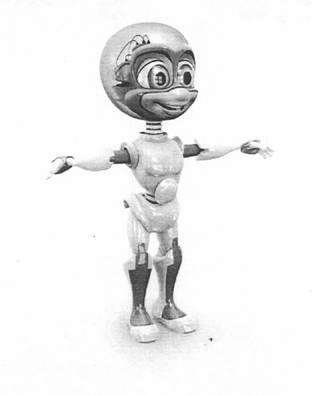
3 The applicant has used a computer‑generated character (the ‘CGC character’) in its advertising material since September 2002. On or about 2 October 2002 the applicant filed an application with the Registrar of Trade Marks for registration of the CGC character in Class 41. The applicant is now the owner of the registered trade mark number 929222 for the CGC character as depicted below in class 41 for ‘education, providing of training’ with effect from 2 October 2002.
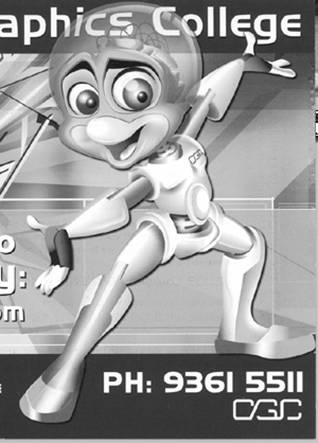
4 The CGC character is more commonly depicted in the applicant’s advertising in a pose such as:
5 The respondent took steps to have the advertisement reproduced below published in the Sydney Morning Herald newspaper on 14 and 15 December 2002.
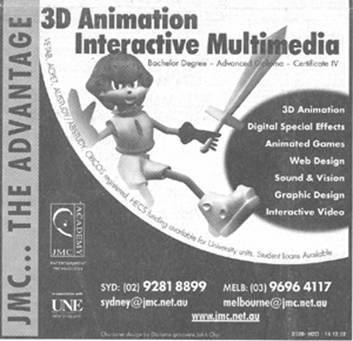
The character depicted in the above advertisement is hereafter described as ‘the respondent’s character’.
6 On 9 January 2003, upon the applicant giving the usual undertaking as to damages, an interlocutory order was made restraining the respondent from, in effect, advertising its services in association with the respondent’s character or any logo substantially similar to the respondent’s character.
7 The applicant, by an amended application dated 16 June 2003, now seeks to have the respondent permanently restrained from advertising its services in association with the respondent’s character. The applicant also seeks declaratory and other relief in reliance on the Trade Marks Act 1995 (Cth) (‘the Trade Marks Act’), Part V of the Trade Practices Act 1975 (Cth) (‘the Trade Practices Act’) and the common law of passing off.
8 For the reasons set out below I have concluded that the application should be dismissed.
factual background
9 There is little dispute between the parties as to the facts relevant to this proceeding. As is mentioned above, each of the parties operates a computer college. The colleges provide training in, amongst other things, 3D graphics and animation. The courses which the colleges respectively offer range from accredited certificate, diploma and advanced diploma courses to shorter and unaccredited courses. There is a significant degree of overlap between the courses offered by the two colleges. For this reason, they compete to some extent for students and to some extent direct their respective promotional activities to the same audience.
10 The CGC character was developed and adopted by the applicant to appeal to creative people from all spheres of the arts and with an interest in the applicant’s range of programmes. Andrea Lee Huxham (‘Ms Huxham’), the Principal of Computer Graphics College, was heavily involved in the design of the CGC character. She developed the original concept and did the initial sketches of the character that became the CGC character. An artist was briefed to complete the design of the CGC character. As is mentioned above, the applicant has used the CGC character in its advertising material since September 2002. By December 2002 the applicant had used the CGC character in advertising in Digital Media World magazine, Desktop magazine, Design Graphics magazine, Big Issue magazine, Sydney Morning Herald newspaper, Sun Herald newspaper, Daily Telegraph newspaper, The Australian newspaper and Sun Weekly and Central Coast Herald newspapers. The CGC character had also been used in late 2002 on a billboard in North Sydney and on postcards, banners and other material used in respect of functions held at, or associated with, the Computer Graphics College.
11 I find that by 14 December 2002 the applicant had established a reputation in the CGC character in metropolitan Sydney with a segment of the public, namely actual and potential students of graphic design, website design and 3D animation. I also find that from a time earlier than 14 December 2002 the applicant has used the CGC character as a trademark.
12 The respondent’s character was developed from the work of a student of the JMC Academy. Karen Kriss (‘Ms Kriss’), the Head of the respondent’s Digital Media and 3D Animation Department, gave evidence that when she was appointed to her position she decided to refocus and improve the respondent’s advertising. She planned to incorporate examples of students’ works in the advertising materials and to have the advertising material focus more strongly on the respondent’s 3D Animation course. Having chosen a character created by a student, Mr John Choi, Ms Kriss, with the approval of Mr Choi, modified and refined the character to produce the respondent’s character. The respondent’s character, as is mentioned above, was used in an advertisement published in the Sydney Morning Herald newspapers of 14 and 15 December 2002 (‘the December 2002 advertisement’). Had the interlocutory order of 9 January 2003 referred to in [6] above not been made, the respondent would have used the respondent’s character in further advertising.
13 I find that, as at 14 December 2002, no institution operating in the same field of education as the applicant other than the applicant had regularly used computer‑generated characters in a trademark‑like way to promote its educational services.
STATUtory provisions
14 A ‘trade mark’ is defined in s 17 of the Trade Marks Act as follows:
‘A trade mark is a sign used, or intended to be used, to distinguish goods or services dealt with or provided in the course of trade by a person from goods or services so dealt with or provided by any other person.’
15 Section 120(1) of the Trade Marks Act provides:
‘A person infringes a registered trade mark if the person uses as a trade mark a sign that is substantially identical with, or deceptively similar to, the trade mark in relation to goods or services in respect of which the trade mark is registered.’
16 The provisions of the Trade Practices Act on which the applicant relies are s 52 and s 53(c) and (d). Those provisions respectively provide:
‘52 (1) A corporation shall not, in trade or commerce, engage in conduct that is misleading or deceptive or is likely to mislead or deceive.
(2) Nothing in the succeeding provisions of this Division shall be taken as limiting by implication the generality of subsection (1).
53 A corporation shall not, in trade or commerce, in connexion with the supply or possible supply of goods or services or in connexion with the promotion by any means of the supply or use of goods or services:
…
(c) represent that goods or services have sponsorship, approval, performance characteristics, accessories, uses or benefits they do not have;
(d) represent that the corporation has a sponsorship, approval or affiliation it does not have;
…’
passing off
17 The tort of passing off, like s 52 of the Trade Practices Act, is concerned with possible misrepresentations. In Cat Media Pty Limited v Opti-Healthcare Pty Limited [2003] FCA 133 at [41]-[42] I observed:
‘Section 52 of the TPA is aimed at conduct likely to be harmful to consumers. However, its “clear and quite general words” are not to be given an unnaturally confined meaning because of the heading of Part V of the TPA (Hornsby Building Information Centre Pty Ltd v Sydney Building Information Centre Ltd (1978) 140 CLR 216 at 225 (“Hornsby”) per Stephen J, with whom Jacobs J, and in this regard Murphy J, agreed). The tort of passing off, on the other hand, is concerned to protect a trader’s goodwill in its business. Nonetheless, as Stephen J pointed out in Hornsby at 226:
“… a consequence of the very direct relationship which necessarily exists between the deception of consumers in the course of trade and the injury caused by the unfair practices of a trade rival [is that] [l]egislation which aims at the prevention of the former will, at the same time, tend to put an end to the latter.”
In Conagra Inc v McCain Foods (Aust) Pty Ltd (1992) 33 FCR 302 at 355 Gummow J observed that “[a]ttempts to produce a definition of the tort [of passing off] which is both succinct and comprehensive have had mixed success”. However, in this case, which is not suggested to raise any novel or complex question of law, the elements of the tort may be regarded as those identified by Lord Oliver in Reckitt & Colman Products Ltd v Borden Inc (1990) 17 IPR 1 at 7. These elements were described by the Full Federal Court in Vieright Pty Ltd v Myer Stores Ltd (1995) 31 IPR 361 in the following way at 369:
“(1) that the trader’s get-up, including any brand name, is recognised by the public as distinctive specifically of the plaintiff’s goods;
(2) that there has been a misrepresentation by the defendant to the public (whether or not intentional) leading or likely to lead the public to believe that the goods offered by the defendant are the plaintiff’s goods (whether the public is aware of the plaintiff’s identity as the manufacturer or supplier of the goods is immaterial, provided they are identified with a particular source, e.g. by means of a brand name which is in fact the plaintiff’s);
(3) that the plaintiff suffers or, in a quia timet action is likely to suffer, damage by reason of the erroneous belief engendered by the defendant’s misrepresentation that the source of the defendant’s goods is the same as the source of those offered by the plaintiff.”’
consideration
The Characters
18 The CGC character has a mechanical appearance. It was described in evidence by Ms Huxham, accurately I find, as a ‘biped that has robotic mechanical features’. It has a largely transparent head which, when the figure is clearly reproduced, allows the mechanical nature of its ‘brain’ to be seen. Ms Huxham gave evidence that the transparent head of the CGC character was inspired by a particular model of Apple computer which has a transparent back. The face of the CGC character appears rather like a mask on the front of its otherwise transparent head. The face itself was, in my view, accurately described in the respondent’s submissions as ‘a cutesy Walt‑Disney style face with big round eyes’. The legs, arms and hands of the CGC character are obviously mechanical in appearance. In only a few of the depictions of the CGC character placed in evidence is the character carrying anything. In none of those depictions is the character carrying a weapon. The CGC character is commonly depicted in a pose which can be described as inviting.
19 The respondent’s character as depicted in the December 2002 advertisement has a plastic as opposed to a mechanical appearance. It seems to me to have an appearance of heavy‑footed awkwardness about it which contrasts with the ‘well‑oiled machine’ look of the CGC character. Although it is humanoid in appearance, the head of the respondent’s character is apparently feline in design origin. No part of the respondent’s character is transparent. The respondent’s character is depicted in the advertisement brandishing an oversize sword. It seems to me that the respondent’s character as depicted in the advertisement conveys, albeit in cartoon form, the idea of a conquering hero. I do not accept that the respondent’s character has a threatening appearance. However, in no way could its pose be described as inviting.
Claims under the Trade Marks Act
20 The applicant’s claim that the respondent has infringed its registered trade mark relevantly involves three elements:
(a) that the respondent has used the respondent’s character as a trade mark;
(b) that the respondent’s character is deceptively similar to the applicant’s registered trade mark; and
(c) that the respondent has used the respondent’s character in relation to services in respect of which the applicant’s trade mark is registered.
21 The respondent acknowledges that by the advertisement of 14 and 15 December 2002 it used the respondent’s character in relation to services in respect of which the applicant’s trade mark is now registered.
22 I turn to the issue of whether the respondent’s character was used by the respondent in the December 2002 advertisement as a trade mark. The appropriate approach to this issue continues to be that adopted by Kitto J in Shell Company of Australia Limited v Esso Standard Oil (Australia) Limited (1963) 109 CLR 407 at 424-425 (Koninklijke Philips Electronics NV v Remington Products Australia Pty Ltd [2000] FCA 876; (2000) 100 FCR 90 per Burchett J, with whom Hill and Branson JJ agreed, at [8]-[12]). It is therefore necessary to answer the question whether, in the setting in which the respondent’s character appeared, it would have appeared to someone seeing the advertisement as possessing the character of a device or brand which the respondent was using, or intending to use, in relation to educational services for the purpose of distinguishing, or so as to distinguish, the respondent’s educational services from other educational services?
23 The December 2002 advertisement attributes the design of the respondent’s character to Mr Choi. However, it does so in rather faint and particularly small print. For the purpose of answering the above question that attribution is, in my view, to be disregarded. Few readers of the advertisement could be expected to notice the attribution.
24 Nonetheless, I take the view that the respondent’s character appears in the December 2002 advertisement as an illustration of 3D animation; it is likely to be understood as a display of the type of animation skills that might be gained by a person undertaking the course advertised in the advertisement. Mr Cobden, counsel for the applicant, submitted that trade mark use has evolved since the time of Shell Company of Australia Limited v Esso Standard Oil (Australia) Limited as commercial practice has changed. I accept that particular shapes, logos and even mascots might now be regarded by members of the public as badges of origin when once such things would not have been so regarded. Nonetheless, I find that in the setting provided by the advertisement, the respondent’s character would not have appeared to someone seeing the advertisement as possessing the character of a sign being used by the respondent to distinguish its educational services from those provided by other educational institutions. The use by the applicant of the CGC character as a trade mark was insufficient, in my view, to colour the way in which the respondent’s use of its character would have been seen by an observer of the advertisement. My conclusion in this regard might have been different if the respondent’s character more closely resembled the CGC character or if it had been established that computer‑generated characters were commonly utilised as trade marks in the relevant industry.
25 The applicant has not established that the respondent has used the respondent’s character as a trade mark.
26 Notwithstanding the above finding, I consider it appropriate to consider the issue of deceptive similarity. In considering whether the respondent’s character is deceptively similar to the applicant’s registered trade mark, it is necessary to compare the impression based on recollection of the CGC character that persons of ordinary intelligence and memory would have with the impression that such persons would get from the respondent’s character (Shell Company of Australia Limited v ESSO Standard Oil (Australia) Limited (1963) per Windeyer J at 415 and the cases there cited). The appearance of the two characters is analysed in [3]-[4] above. In my judgment, even when the likelihood of inaccurate recollection of detail is taken into account, the impression produced on the mind of persons of ordinary intelligence and memory by the CGC character would not result in a mistaken belief that the respondent’s character was the same character. I conclude that the respondent’s character is not deceptively similar to the applicant’s registered trade mark.
27 The applicant’s claims under the Trade Marks Act must be dismissed.
Claims under the Trade Practices Act
28 The applicant seeks a declaration that the respondent has in trade or commerce engaged in misleading or deceptive conduct in contravention of s 52 of the Trade Practices Act. The conduct alleged to be misleading or deceptive is the publication of the December 2002 advertisement. The applicant, by its amended statement of claim, has alleged that by publishing the December 2002 advertisement the respondent has represented, and engaged in conduct likely to cause consumers (including students and potential students) to believe, that:
(a) the respondent’s services are the applicant’s services;
(b) the respondent’s services are associated or affiliated with the applicant’s services; and
(c) the respondent is associated or affiliated with the applicant.
29 The applicant has further alleged by its amended statement of claim that the intention of the respondent to make further use of the respondent’s character, or a similar character, constitutes a threat to make the representations referred to above.
30 The publication of the December 2002 advertisement constituted conduct in trade or commerce. The respondent did not argue to the contrary. The critical issue is the likely impact of the advertisement on the section of the public likely to read the advertisement ‘including the astute and the gullible, the intelligent and not so intelligent’ (Taco Company of Australia Inc v Taco Bell Pty Ltd (1982) 42 ALR 177 at 202 per Deane and Fitzgerald JJ, citing Lockhart J in Puxu Pty Ltd v Parkdale Custom Built Furniture Pty Ltd (1980) 31 ALR 73 at 93). Of those who would have read the advertisement some would have examined it carefully and others noted it only casually in passing.
31 I do not consider that even a gullible reader of the December 2002 advertisement who paid it only limited attention would have thought that the respondent’s character was the CGC character or would have become confused concerning the two characters. As is identified above, there are significant differences in the appearance of the CGC character on the one hand and the respondent’s character on the other [18]-[19]. As is mentioned above, the impression which each leaves on the mind of an observer is, in my judgment, quite different.
32 I am not satisfied that the respondent by causing the advertisement to be published made any of the representations identified in [28] above, or engaged in conduct likely to cause consumers, including students and potential students, to believe any of the matters so identified. I am not satisfied that any reader of the advertisement would be misled into thinking either that the respondent’s character was the CGC character or that it was so like the CGC character that it must have some association with the CGC character. It follows that the intention of the respondent to make further use of the respondent’s character, or a similar character, did not constitute a threat to engage in conduct which would contravene s 52 of the Trade Practices Act.
33 I conclude that the respondent did not, by the publication of the December 2002 advertisement, engage in conduct in contravention of s 52 or s 53(c) or (d) of the Trade Practices Act. The applicant’s claims under the Trade Practices Act must be dismissed.
Passing Off
34 For the reasons given above in respect of the claims made under the Trade Practices Act, the applicant’s claim that the respondent has sought to pass off, and threatens to pass‑off, its educational services as the educational services of the applicant must be dismissed.
conclusion
35 The application is dismissed with costs.
|
I certify that the preceding thirty-five (35) numbered paragraphs are a true copy of the Reasons for Judgment herein of the Honourable Justice Branson. |
Associate:
Dated: 4 September 2003
|
Counsel for the Applicant: |
Mr R Cobden |
|
|
|
|
Solicitor for the Applicant: |
Rodd Peters |
|
|
|
|
Counsel for the Respondent: |
Mr J R Young |
|
|
|
|
Solicitor for the Respondent: |
James Legal Pty Limited |
|
|
|
|
Date of Hearing: |
24 & 25 June 2003 |
|
|
|
|
Date of Judgment: |
4 September 2003 |


