

FEDERAL COURT OF AUSTRALIA
ACCC v Allans Music Group Pty Ltd [2002] FCA 1552
TRADE PRACTICES – false and misleading representations – price of goods - guilty plea to nine charges – catalogue advertising discounts on musical instruments and products – previous prices lower than shown in catalogue – factors taken into account in determining penalty – public interest in fair competition – deliberateness of conduct – mitigating factors – no prior convictions – compliance programme – appropriate penalty in total
Trade Practices Act 1974 (Cth) ss 53(e), 79(1), 79(2)
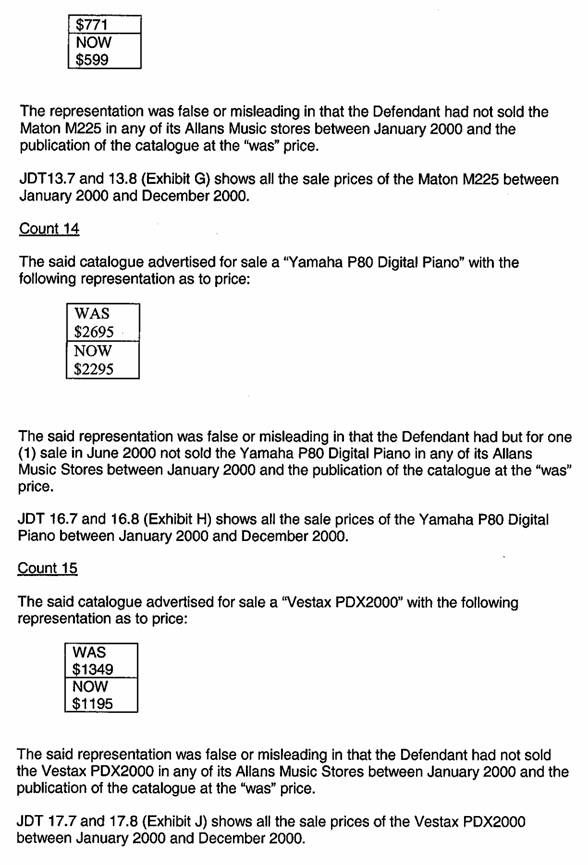
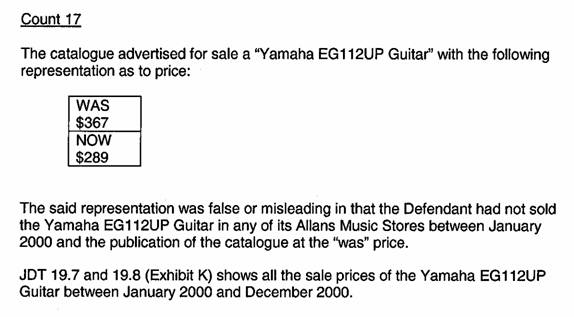
Trade Practices Commission v Cue Design Pty Limited (1996) ATPR 41-475 referred to
Hartnell v Sharp Corporation of Australia Pty Limited (1975) 5 ALR 493 referred to
Sest v Copperart Pty Limited (1989) ATPR 40-945 referred to
Trade Practices Commission v CSR Limited (1991) ATPR 41-076 referred to
AUSTRALIAN COMPETITION AND CONSUMER COMMISSION v
ALLANS MUSIC GROUP PTY LTD (ACN 082 019 341)
S 116 OF 2002
TAMBERLIN J
SYDNEY
13 DECEMBER 2002
|
IN THE FEDERAL COURT OF AUSTRALIA |
|
|
SOUTH AUSTRALIA DISTRICT REGISTRY |
|
BETWEEN: |
AUSTRALIAN COMPETITION AND CONSUMER COMMISSION PROSECUTOR
|
|
AND: |
ALLANS MUSIC GROUP PTY LTD (ACN 082 019 341) DEFENDANT
|
|
TAMBERLIN J |
|
|
DATE OF ORDER: |
13 DECEMBER 2002 |
|
WHERE MADE: |
ADELAIDE |
THE COURT ORDERS THAT:
1. In respect of counts 2, 4, 6, 7, 9, 11, 14, 15 and 17 convictions be recorded against Allans Music Group Pty Ltd.
2. In respect of the aforesaid counts, one fine of $80,000 is imposed on Allans Music Group Pty Ltd.
3. The fine of $80,000 be paid within three calendar months of this date: in default, distress.
4. The defendant pay the costs of the Prosecutor.
Note: Settlement and entry of orders is dealt with in Order 36 of the Federal Court Rules.
|
IN THE FEDERAL COURT OF AUSTRALIA |
|
|
SOUTH AUSTRALIA DISTRICT REGISTRY |
|
BETWEEN: |
AUSTRALIAN COMPETITION AND CONSUMER COMMISSION PROSECUTOR
|
|
AND: |
(ACN 082 019 341) DEFENDANT
|
|
JUDGE: |
|
|
DATE: |
13 DECEMBER 2002 |
|
PLACE: |
ADELAIDE |
REASONS FOR JUDGMENT
1 This judgment is directed to determining the appropriate penalty to impose in relation to a plea of guilty by the defendant (“Allans”) to nine of eighteen charges in respect of which an Information For an Offence was filed on 30 April 2002.
2 The prosecution arises out of breaches of s 53(e) of the Trade Practices Act 1974 (Cth) (“the Act”) which relevantly provides:
“A corporation shall not, in trade or commerce, in connexion with the supply or possible supply of goods or services or in connexion with the promotion by any means of the supply or use of goods or services:
…
(e) make a false or misleading representation with respect to the price of goods or services;”
3 At the relevant time, s 79(1) of the Act provided for a fine in the case of a corporate defendant not exceeding $200,000 for breach of the provisions of the Act. However, in accordance with s 79(2), where the contraventions appear to have been of a substantially similar nature and to have occurred at or about the same time, the aggregate fines shall not exceed the maximum fine. It is accepted in this case that this limitation applies.
4 The parties have agreed on a Summary of Facts which I set out as follows:
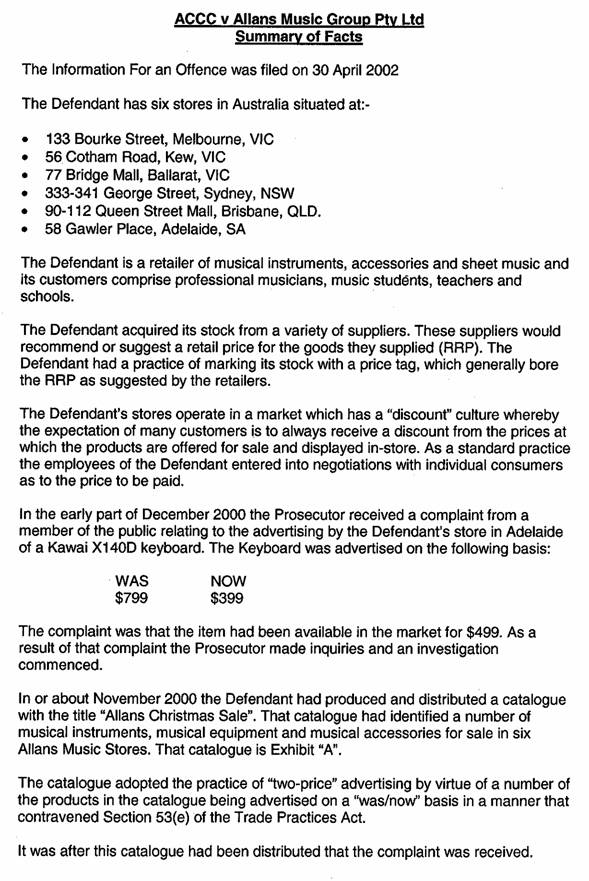
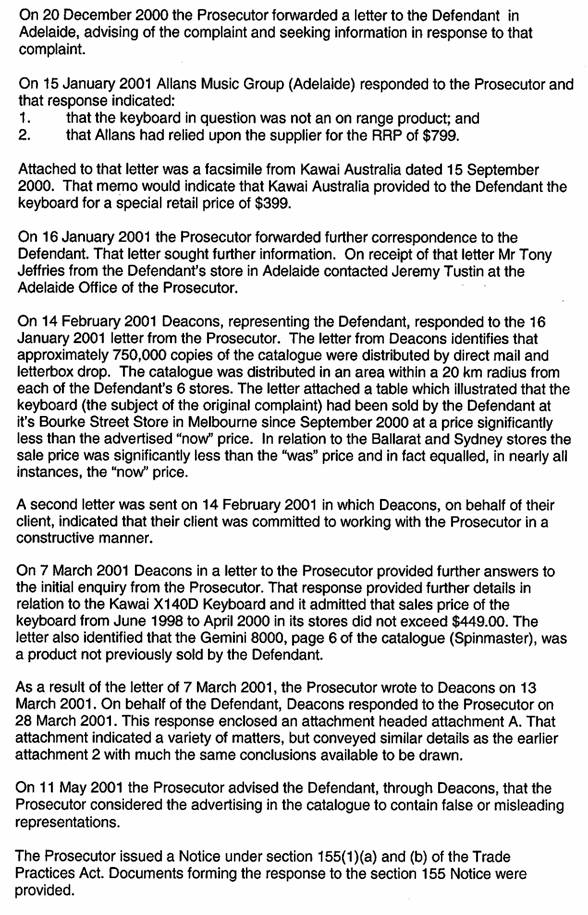
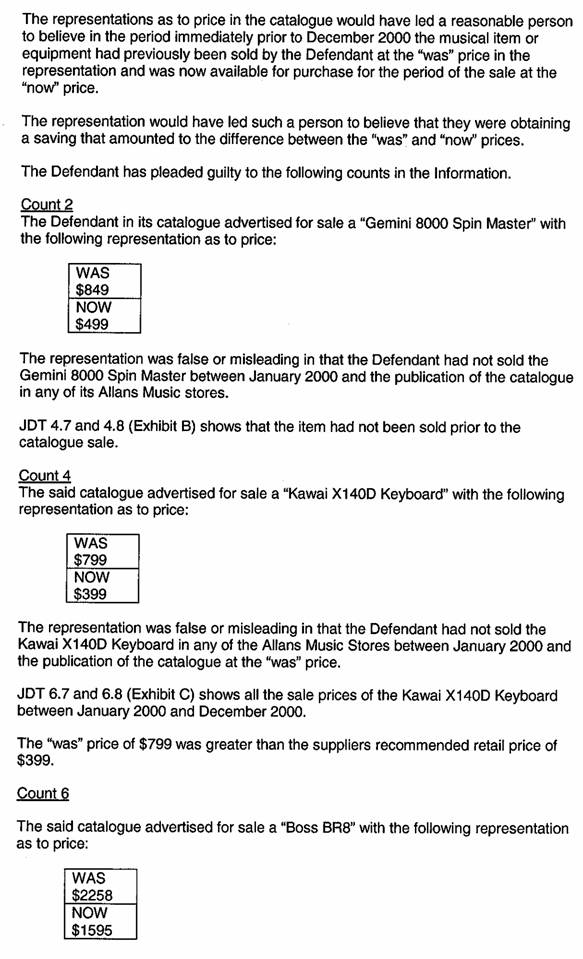
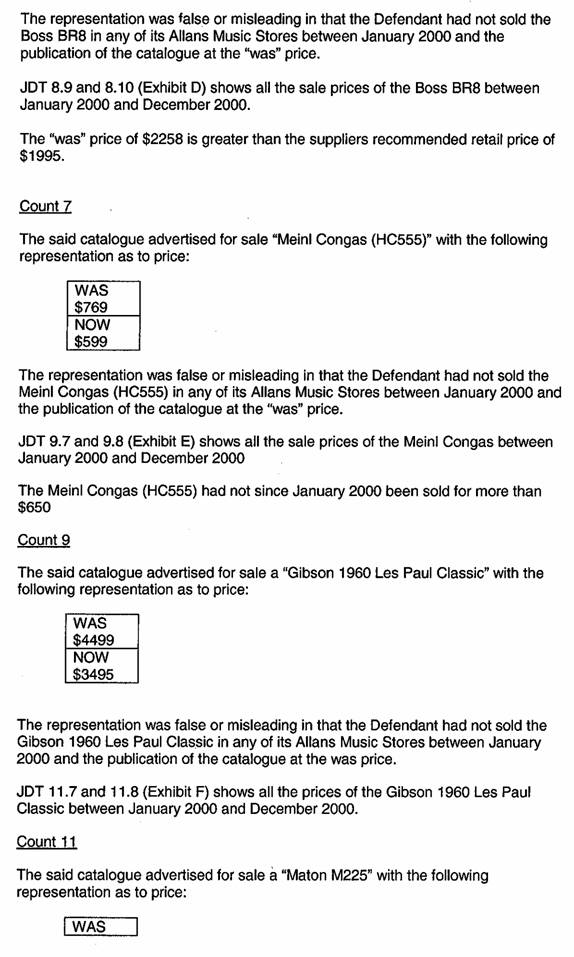
5 On the bottom right-hand side of the last page of the fifteen page colour Christmas catalogue distributed by the defendant in November 2000, there is in barely legible, extremely small, pale and faint print, a statement that includes the words:
“The savings shown in this catalogue represent the difference between the prices advertised in the catalogue and the price which would be reasonably expected to apply in Allans Music Stores when the item is not on promotion (RRP).”
6 This disclaimer, quite correctly in my view, was not relied on by the defendant as a mitigating factor.
7 The gist of the false and misleading impact of the representation, on a fair reading of the catalogue, was that there will be a narrow window of opportunity in the Christmas lead-up period from 30 November 2000 wherein bargains of a very substantial nature could be obtained on Allans musical goods by paying a much lower price in that period than that which had been paid in circumstances where a purchase was made before the beginning of that period. As the agreed facts clearly demonstrate, this was false in the sense that for all practical purposes, the items in question had not been sold in the pre-Christmas period at the “WAS” price but rather at prices which were substantially below the claimed “WAS” price. The representation as to the savings for members of the public was the amount calculated as the difference between the “WAS” price that had been charged prior to the Christmas sale period and the “NOW” price, which would be charged during the Christmas sale period.
8 Counsel for the defendant informed the Court that during the Christmas period customers were more likely to pay the asking price and less likely to negotiate downwards the price offered, than at other times of the year. No doubt this circumstance is due to the pressures both as to time and the usual Christmas buying frenzy. Consequently, it appears that during the Christmas period there is a certain reluctance to shop around for a better price. In this climate it is difficult to sustain a submission, as contended by the defendant, that customers will generally negotiate prices downwards especially in respect of the “NOW” price.
the authorities
9 While some broad, general guidance as to penalty can be obtained from the authorities, each case must turn on its own particular factors and circumstances. However, it is useful to briefly consider some of the principal authorities.
10 In Trade Practices Commission v Cue Design Pty Limited (1996) ATPR 41-475, O’Loughlin J imposed a total penalty of $75,000 in respect of thirty convictions on charges arising from a “dual-priced swing tag” on particular items of clothing, whereby members of the public would assume that the garment in question had been previously offered for sale at the higher of two prices and was now available at the lower price. This in fact was false. His Honour imposed the penalty as a total penalty on the basis that the defendants had reasonable cause to believe that the effect of the tag was that the public may be misled. That case concerned thirty individual items of clothing in five States and the Australian Capital Territory where each item seems to have been relatively low priced. There was no extensive advertising campaign and the promotional aids were low key in nature.
11 In the present case, by contrast, the advertising campaign was widespread and inter-state in nature and the musical products in question were of substantially greater value with “NOW” prices ranging from $289 to $3,495. In this case, like Cue Design, the essence of the misleading conduct arose from the representation that during the Christmas sale period there has been a substantial price reduction to the “NOW” prices from the prices which had previously been charged.
12 In Hartnell v Sharp Corporation of Australia Pty Limited (1975) 5 ALR 493, the Full Court of the Australian Industrial Court imposed a total fine of $100,000 in respect of false representations that each Sharp microwave oven had been tested and approved by the Standards Association of Australia. The Court considered that $100,000 was a sum which reflected a serious breach and would also act as a deterrent to others.
13 At 497, Smithers J said:
“To fix a penalty a number of matters have to be considered. First, the importance of untrue statements and the departure from standards; secondly, the degree of wilfulness or carelessness in the making of these statements; thirdly the degree that the statement departs from the truth; fourthly the degree that the statement has been disseminated.
Next, what efforts had been made to correct the situation; finally we have to look at it in the context of the Act and to consider the deterrent effect of any penalty that we must impose.”
14 This approach was followed by Keely J in Sest v Copperart Pty Limited (1989) ATPR 40-945, where his Honour fixed penalties on Copperart totalling $75,000 for false pricing in contravention of s 53(e) of the Act. In that case the representations included deceptive statements to the effect that the prices for a range of items were half or in the order of half off regular prices, whereas in fact, the prices at which the goods had been previously offered for sale were not reduced in respect of certain specified items. His Honour stated that the advertisements of “savings” in relation to the recommended retail price were designed to induce potential customers to believe they would be receiving a good deal because the price was less than the recommended retail price and this was false.
15 Although in a different factual context some guidance can be obtained from the judgment of French J in Trade Practices Commission v CSR Limited (1991) ATPR 41-076 at 52,152-52,153. After reviewing the authorities, his Honour listed a number of factors which are appropriate to take into account when considering the question of penalty. These were inclusive in nature and were not designed to be an exhaustive statement of every consideration in each case. Nevertheless, they provide a useful framework within which to consider the question of penalty, along with the other principles enunciated in the authorities. His Honour said at 52,152-52,153:
“The assessment of a penalty of appropriate deterrent value will have regard to a number of factors which have been canvassed in the cases. These include the following:
1. The nature and extent of the contravening conduct.
2. The amount of loss or damage caused.
3. The circumstances in which the conduct took place.
4. The size of the contravening company.
5. The degree of power it has, as evidenced by its market share and ease of entry into the market.
6. The deliberateness of the contravention and the period over which it extended.
7. Whether the contravention arose out of the conduct of senior management or at a lower level.
8. Whether the company has a corporate culture conducive to compliance with the Act, as evidenced by educational programs and disciplinary or other corrective measures in response to an acknowledged contravention.
9. Whether the company has shown a disposition to co-operate with the authorities responsible for the enforcement of the Act in relation to the contravention.”
REASoNING
16 A determination of the appropriate penalty in the present case can be approached by reference to the above considerations.
17 As to the first matter, the conduct of the defendant can be characterised as deceptive in that it falsely represented the pricing advantages suggested by the catalogue. The amount of the discrepancy between the actual prices which were charged and “WAS” prices was substantial in many cases and the suggested saving indicated was greatly exaggerated. The conduct of the defendant as demonstrated by the catalogue was designed to attract prospective customers, on an entirely false pricing basis, to buy goods from the defendant as opposed to its competitors. The effect was to significantly mislead or likely to mislead members of the public.
18 The advertising campaign as embodied in the catalogue was carried out in the Christmas lead-up period which is a period where, as indicated earlier, parties are less likely to negotiate downwards. The scale of the advertising campaign was broad and the geographic reach extended through four States.
19 There were 750,000 catalogues in question consisting of fifteen pages each with the offending misrepresentations spread over those pages wherein the price advantage suggested was prominent and the disclaimer on the back page was not. The statement in the disclaimer clause on the last page as to what the representations meant was obscure and totally inadequate to bring home the true position to a prospective customer or to any person able to read it. The existence of such a disclaimer, in my view, reflects a concern and appreciation by the defendant that the pricing needed some explanation but this was in effect buried at the back page of the catalogue in faint and very small print. The statement is generalised and clearly ineffective, there being no attempt made to rely on it in this proceeding. However, the existence of the “explanation” as indicated, has more significance above than a mere accidental failure to alert the customer to the inherent ambiguity. It indicates an awareness of the need for a proper explanation on the part of the defendant.
20 There was no evidence as to actual damage caused to any individual and the defendant stated that the goods were sold at market price. However, in my view, the conduct was such as to mislead customers, especially those not familiar with the marketing strategies in the musical instruments and products market and undermine the public interest in open and frank competition. Some significant damage to the public interest in fair competition must also have been engendered by the widespread distribution of the misleading material.
21 As to the third matter it is to be noted that the conduct took place during the Christmas sale period when, as indicated above, negotiation between buyer and seller was less likely. It is said that there is a discount mentality in the market and that prospective purchasers can be expected to negotiate and obtain a price discount, but, in my view, one cannot assume that customers are necessarily aware of this practice among sellers in the market. It may be accepted that, to some extent, a proportion of repeat buyers may be aware of this, but it is an assumption for which no proper basis has been shown in respect of its applicability in general. As a practical, commercial matter the bargaining position of the customer, even if there were negotiation, would be substantially diminished by reference to the statements indicating that substantial reductions have already been made to the price in the form of the “NOW” price. One could expect for example, that if a customer entered into negotiations to get a lower price, the response by the defendant might be to the effect that the price has already been very substantially reduced as indicated by the catalogue. On the facts of this proceeding, free, open and informed negotiation would be diminished by the false suggestions of price reduction.
22 As for factors four and five, which relate to the size and market power of the defendant, the evidence indicates that the company has a turnover of some tens of millions of dollars and cannot be said to be insubstantial in size. It operates on an inter-state basis. Notwithstanding that its market share is not a dominant one, it has a significant market share which, on the evidence, is relatively widespread.
23 Factor six considers the question of intention or deliberateness of the conduct. Assertions were made that the catalogues were compiled without any intention to deceive and that any misrepresentation was accidental. It is said that the misrepresentations arose from inadequate procedures. In my view, the failure to have any satisfactory process in place to ensure compliance with the Act is an important consideration when examining the conduct of the defendant. I do not accept that this was a matter of mere oversight given the timing, awareness and commercial sophistication of the defendant’s officers as indicated in the “explanation” by way of disclaimer, which alluded to the possibility of a misunderstanding. In my view, the material was plainly designed to attract custom on a false basis during a key marketing period. The attraction of custom of course cannot be criticised, but the resort to misleading conduct is reprehensible, as acknowledged by the guilty pleas to the nine counts.
24 There is some force in the suggestion by the prosecutor that the difficult financial position of the defendant in the previous financial periods up to and prior to the campaign might provide an incentive to aggressively market and press for sales having regard to the substantial losses which had been incurred. I do not accept that a reasonably astute and commercially sophisticated Chief Executive Officer such as Mr Michael Brash, with six years prior experience specialising in retail, could inadvertently have overlooked the misleading nature of the advertisements. This is a matter which should have been identified by a reasonably competent and astute management, such as that which the defendant company appears to have had. In my view, the contravention arose in the course of a campaign calculated to attract customers’ business without regard to the false or possible misleading nature of the assertions in the catalogue. These matters were not given any attention.
25 There has, however, since the time of the offence been an extensive compliance programme established in response to the acknowledged contravention and this, coupled with the cooperation of the defendant and the plea of guilty are mitigating factors which I have taken into account on the question of penalty. This is the subject of the ninth factor.
26 An important consideration is that the defendant has no prior convictions since its incorporation in 1998.
27 As mentioned earlier I cannot agree that the existence of a discount culture on the part of suppliers in the market provides any basis to justify or mitigate the making of false claims as to reductions from prices represented as having been previously charged. In particular, I do not accept that a customer would understand the pricing policies of the suppliers in the market as referring to reductions from a prior recommended price as opposed to a prior actual price.
28 I also note that there were no complaints, apart from the complaint to the prosecutor, from customers, but customers, of course, would probably not have been aware of the discrepancies in pricing between that represented and that which was actually charged.
29 Finally, the defendant has indicated that it proposes to offer each of the customers affected a $50 Allans gift voucher and if the customer cannot be contacted it will then donate $50 to charity. I have also taken this into account, but it should be borne in mind that the extent to which Allans departed from the true position as to earlier pricing is significantly in excess of $50 and in some cases amounts to a difference in excess of a $1,000 in respect of an individual item. There were approximately 170 sales involved.
30 Having regard to the above considerations and, in particular the lack of any compliance program prior to the breach, as well as the failure to advert to the likely effect of the statements in the catalogue, I consider that the appropriate penalty in total in respect of the nine counts for which guilty pleas were entered is an amount of $80,000.
31 Accordingly, I record a conviction of the defendant on counts 2, 4, 6,7, 9, 11, 14, 15 and 17 of the Information for an Offence filed on 30 April 2002. I fix the penalty in respect of these counts as a total amount of $80,000 cumulatively. I order the defendant to pay the costs of the prosecutor. I order that the fine be paid within three calendar months of this date: in default, distress.
|
I certify that the preceding thirty-one (31) numbered paragraphs are a true copy of the Reasons for Judgment herein of the Honourable Justice Tamberlin. |
Associate:
Dated: 13 December 2002
|
Counsel for the Prosecutor: |
C Kourakis QC |
|
|
|
|
Solicitor for the Prosecutor: |
Commonwealth Director of Public Prosecutions |
|
|
|
|
Counsel for the Defendant: |
P Riordan |
|
|
|
|
Solicitor for the Defendant: |
Deacons |
|
|
|
|
Date of Hearing: |
13 November 2002 |
|
|
|
|
Date of Judgment: |
13 December 2002 |


