FEDERAL COURT OF AUSTRALIA
WAIZ v Minister for Immigration & Multicultural Affairs [2002] FCA 1375
MIGRATION – refugees – interpreters – key question not properly translated – interpreter at different location to Tribunal – break in telephonic transmission at critical point – whether interpretation was so incompetent that applicant was effectively prevented from giving his evidence on a material matter.
Perera v Minister for Immigration and Multicultural Affairs (1999) 92 FCR 6 applied
Long v Minister for Immigration and Multicultural Affairs (2000) 106 FCR 183 referred to
Ismail v Minister for Immigration and Multicultural Affairs [1999] FCA 1555 referred to
Soltanyzand v Minister for Immigration and Multicultural Affairs [2000] FCA 917 referred to
Arif v Minister for Immigration and Multicultural Affairs [2002] FCA 1053 referred to
Minister for Immigration and Multicultural Affairs v Yusuf [2001] HCA 30 applied
WAIZ v MINISTER FOR IMMIGRATION AND MULTICULTURAL AFFAIRS
W 239 of 2001
CARR J
6 NOVEMBER 2002
PERTH
|
IN THE FEDERAL COURT OF AUSTRALIA |
|
|
W 239 OF 2001 |
|
BETWEEN: |
WAIZ Applicant
|
|
AND: |
MINISTER FOR IMMIGRATION AND MULTICULTURAL AFFAIRS Respondent
|
|
DATE OF ORDER: |
|
|
WHERE MADE: |
THE COURT ORDERS THAT:
1. The decision of the Refugee Review Tribunal, made on 30 May 2001, be set aside.
2. The matter to which that decision relates be remitted to the Refugee Review Tribunal, differently constituted, for determination according to law.
3. The respondent pay the applicant’s costs.
Note: Settlement and entry of orders is dealt with in Order 36 of the Federal Court Rules.
|
IN THE FEDERAL COURT OF AUSTRALIA |
|
|
W 239 OF 2001 |
|
BETWEEN: |
Applicant
|
|
AND: |
MULTICULTURAL AFFAIRS Respondent
|
|
JUDGE: |
|
|
DATE: |
|
|
PLACE: |
REASONS FOR JUDGMENT
introduction
1 This is an application for an order of review of a decision of the Refugee Review Tribunal, made on 30 May 2001, by which the Tribunal affirmed the decision of a delegate of the respondent not to grant a protection visa to the applicant. The applicant, who is a citizen of the Democratic Republic of Congo, arrived in Australia on 18 January 2001. On 26 January 2001 the applicant lodged an application for a protection visa with the Department of Immigration and Multicultural Affairs under the Migration Act 1958 (Cth) (“the Act”). On 12 March 2001, a delegate of the respondent refused to grant the applicant a protection visa and on 16 March 2001 the applicant applied to the Tribunal for review of that decision. The application was filed in this Court on 15 June 2001.
the applicant’s claims and the Tribunal’s decision
2 When interviewed on the day of his arrival in Australia and asked why he left the Democratic Republic of Congo, the applicant replied that he had left to save his life because there was fighting in the area in which he lived. The fighting was between government forces and Rwandan rebels.
3 The applicant was assisted by a migration agent in completing his application for a protection visa. In support of that application the applicant provided information which included the following:
· He was then 23 years of age and had grown up and been educated in the town of Mbuji-Mayi.
· After finishing school in 1994, he remained unemployed in Mbuji-Mayi for three years.
· He then moved to his grandparents’ farm at Pweto in the south-east of the Congo where he worked by helping his grandparents.
· He stayed on the farm for about three years but at the end of November 2000 rebel forces attacked Pweto. There was a mass flight. He was one of many who walked through the bush to Zambia.
· In Zambia, a truck driver gave him a lift to Durban in South Africa where he stowed away on the boat upon which he arrived in Australia.
· He did not apply for refugee status in South Africa “… because it is all one continent and I did not feel safe. I wanted to escape ethnic divisions and hatred”.
4 The applicant concluded his statutory declaration in support of his application with the following:
“9. If I am returned to CONGO, I will be killed because people who come from the outside are targeted. I have very bad memories of CONGO and I do not want to return there. Furthermore, I do not want to return to CONGO because as I am a young man, I will be forced to fight in the civil war and I do not want to get involved or to get hurt.”
5 When interviewed by the respondent’s delegate the applicant claimed that he feared that he would be killed by the authorities in the Congo because they had imputed to him anti-government opinions. The applicant stated at that interview that he had had no problems in the Congo because of his ethnicity or his religion.
6 The applicant’s solicitors lodged a written submission with the Tribunal in which they summarised the applicant’s claims as being based on the fact that he was a member of the Kasaian ethnic group, was a single man fearing forced conscription in a war he did not support, and that his fear was based upon imputed political opinion which in turn was based on his refusal to serve in that war.
7 The applicant gave oral evidence at the hearing before the Tribunal. From part of the evidence before me, being the transcripts and tape recordings to which I refer below, I have inferred that the Tribunal member, the applicant and one interpreter (a French language interpreter who appears to have taken no part in the proceedings) were together at one location, probably Port Hedland, with the Tshiluba interpreter at another location linked to the proceedings by telephone conference facilities. I infer that the first location was Port Hedland because the applicant was at that time detained at the Port Hedland Immigration Detention Centre and there are indications on pages 18 and 19 of the First Transcript (as to which see below) that the Tribunal member was away from her Sydney office and was “up here”. When the applicant was asked by the Tribunal why he could not return to the Congo, the applicant replied that he could not go back because he would be arrested or forced to join the army and sent to fight. According to the Tribunal’s reasons, the Tribunal then put to the applicant that in more than two years of civil war he had not been conscripted or even approached to join any army, nor were any of his brothers in any armies (as the applicant had confirmed in an earlier answer to a question from the Tribunal). The applicant (so the Tribunal stated) did not respond to that question. Part of the applicant’s case is that the interpretation of the proceedings before the Tribunal was so bad that he did not hear the question.
8 In relation to his claim that he would be persecuted on the grounds of his ethnicity (being from Kasai province) the applicant told the Tribunal that most members of the government, public servants and army officers in the Democratic Republic of Congo were from Katanga. Katangan animosity to Kasaians had affected him personally. He claimed that while he was living in Pweto, Katangans (soldiers and civilians alike) searched for Kasaians to kill them. He had hidden to avoid such searches.
9 Rather than attempt to summarise the Tribunal’s finding and reasons I set them out below in full. I have numbered the paragraphs to facilitate the references to them which I make later in these reasons.
“FINDINGS AND REASONS
1. Although the applicant had difficulty in recalling a number of details, the Tribunal accepts the facts of the story as put before it. This does not mean that it accepts some of the conclusions the applicant has drawn; nor would it rely on his recall of country information.
2. However, the Tribunal accepts that the applicant moved from Mbuji-Mayi to Pweto within the Democratic Republic of Congo and was driven from the latter place during fierce fighting in late November/early December 2000. Any number of independent sources confirm the facts of that particular campaign: for example, this from the International Crisis Group's recent report: "4 December 2000. RPA and RCD forces seize Pweto. Tens of thousands of civi1ians resident in Pweto flee towards Zambia. Several thousand Government and allied troops accompany them. DRC Government calls the retreat a ‘tactical withdrawal’” (ICG, From Kabila to Kabila: Prospects for peace in the Congo, ICG Africa Report No. 27, 16 March 2001, Appendix B).
3. The Tribunal notes that this was the first time that the applicant was actually caught up in conflict, despite the fact that a war involving five foreign armies had been waged on Congolese soil for more than two years at that stage. The applicant had also been exempt from any of the violence that had accompanied the fall from power of President Mobutu and the accession of Laurent Kabila, leading an army that had marched from eastern Zaire (as it then was) right across to Kinshasa in the west.
4. This is not to diminish the fear and trauma experienced by the applicant when he joined the mass exodus from Pweto, separated from his grandparents and brother. It is simply to point out that despite the many and varied reasons for conflict within the Congo, the political and ethnic divisions, and the untold abuses of human rights that have occurred, the applicant has not been involved. He has not been a member of any particular group which has been targeted for revenge by another (and there are many such groups) and luckily, he has not been in the wrong place at the wrong time, except during the assault on Pweto.
5. The Tribunal rejects his belated story about raids by Katangans against Kasaians in Pweto, as he had already stated at hearing, and written in his submission, that he (and his brother) experienced no problems in Pweto until the rebel attack.
6. The Tribunal has read a great deal of material relating to the DR Congo and is aware of a number of the bitter animosities which have arisen out of ethnic differences. In particular, the independent evidence points to the plight of Tutsis or those who look like Tutsis (see page 7 above). The Tribunal also notes that the place of the Banyamulenge people has caused great friction; and in more recent times, intense fighting (sometimes described as “ethnic cleansing") has erupted between the Hema and the Lendu peoples (see Human Rights Watch, Uganda in Eastern DRC: Fuelling political and ethnic strife, vol.13, No.2(A), March 2001).
7. In general, however, the independent evidence refers to "societal discrimination on the basis of ethnicity" and says it "is practiced widely by members of virtually all ethnic groups" (see Independent evidence at page 7 above). The dominance of the people from the Katanga province has also been noted in the independent evidence at page 7 above. In the only reference the Tribunal has found that directly relates to Katanga and Kasai, the UK Home Office reports that “The province of Shaba, which is now Katanga, has tried to secede since independence and there is friction with the Luba from Kasai-Oriental" (Immigration and Nationality Directorate, Democratic Republic of Congo Assessment, October 2000, para.5.23).
8. However, there is a world of difference between “societal discrimination” or “friction” and “ethnic cleansing”; and nowhere can the Tribunal find reference to any violent actions, such as may be termed persecution, by the Katangans against Kasaians. This does not mean that individual Katangans do not abuse the human rights of other Congolese (including Kasaians): indeed, as Katangans constitute a disproportionate number of government and army higher echelons, and as the government’s and the security force's record of human rights is very poor, it follows that Katangans may be responsible for a disproportionate amount of human rights abuse. However, this seems to be directed against all Congolose who stand in their way, or oppose them politically, or are thought to oppose them. There is no evidence before the Tribunal to indicate that Katangans have singled out or targeted Kasaians per se; or that Kasaians have disproportionately borne the brunt of human rights abuses in the DR Congo. Nowhere are Kasaians identified as an “at risk” group in the way that, say, Tutsis are by agencies such as UNHCR.
9. The Tribunal notes that the applicant's advisers, although putting forward his Kasaian ethnicity as the first of his “key claims”, did not produce any independent evidence – nor, indeed, any views at all - to indicate why being Kasaian would put him at risk. The independent evidence sent in support of the applicant's claims was of a general nature, indicating the poor human rights record of the Congolese government (which the Tribunal has already accepted) but making no mention of any individual ethnic group within Congo.
10. Given the lack of any independent information about the persecution of Kasaians, and given the applicant's own testimony that he experienced no problems in his country of origin until the rebel attack (apart from unemployment and a belated, but rejected, claim about house to house searches for Kasaians whilst in Pweto), the Tribunal is not satisfied that the applicant has a well founded fear of persecution on the basis of his ethnicity (or more correctly, of his place of origin, as there are more than one ethnic groups originating from Kasai).
11. The Tribunal is satisfied that the applicant has been one of the many casualties of the many-sided conflict in the DR Congo. The town where he was living was inarguably the scene of intense fighting in late 2000 and the Tribunal accepts that the applicant was one of the many ("tens of thousands", according to the ICG above) who fled Pweto and headed towards Zambia. The Tribunal finds it plausible that the applicant’s family in Mbuji-Mayi were
also casualties of war: he has no real information about his family other than he lost touch with them at some time. The Tribunal notes that in March 2000 there was fighting in Kasai-Oriental province as the Rwandans and RCD-Goma (rebels) launched an offensive in that province and "continued efforts to cut off Kabinda and Mbuji-Mayi" (ICG 2001, op.cit. Appendix B).
12. However, the hardships and dangers to persons caught up in a war or civil disturbance do not, without more, amount to persecution within the meaning of the Convention. The High Court emphasised in the case of Applicant A that notwithstanding the humanitarian aims of the Refugees Convention, there are limits to its humanitarian scope.
13. In the case of this applicant, there is nothing that distinguishes him from any other Congolese citizen in terms of risk factors. The Tribunal is satisfied that he has not been targeted for any Convention reason. He simply happened to be living in a town which the rebels tried to capture, and like the other townspeople (and like the government troops stationed there), he fled from the immediate danger. AUNHCR Update issued on 24 January 2001 reported that "In late 2000, fighting around the southeastern border town of Pweto sent thousands of Congolese refugees into Zambia. ...Several thousand are sheltering in Zambian villages, determined to return home as soon as the fighting ceases" (UNHCR, DR Congo: The impact of refugees, at Cisnet CX49721).
14. Since the applicant’s departure, the situation in DR Congo has changed with the assassination of the President and his replacement by his son. The younger Kabila appears to be more receptive to the implementation of the Lusaka Accords originally signed in 1999: for example, “the new president, Joseph Kabila, and his main adversary, Rwanda President Paul Kagame, travelled to New York in recent weeks with new pledges to implement peace pacts” (“UN plan speeds up Congo force as fighting subsides”, Reuters Business Briefing, 13 February 2001 at Cisnet CX50083). The same report noted that Congo was, at that time (February 2001), experiencing the longest period of subdued fighting since 1999 and that consequently the UN moved “to take advantage of the lull in the fighting and the renewed peace pledges” by deciding to send fewer peacekeeping troops but to dispatch them much more quickly (ibid). Subsequent reports have shown that the improved situation has held: the chairman of the Joint Military commission reported that “since the disengagement began, very few cases of cease-fire violations have been reported and most of the parties have respected the cease-fire agreement. ‘We have not had any major violations except in one area, Balomba in Equator region, where there was a skirmish between MLC troops and government forces on 11-13 March’.” (“Bemba’s failure to withdraw troops protested” PanAfrican News Agency, 3 April 2001 downloaded from AllAfrica Website at http://allafrica.com/stories). An even more recent report was still encouraging:
Beginning March 15, the armies that have been waging war in the DR Congo since August 1998 began a step-by-step withdrawal from their front-line positions, while a few hundred troops of the UN peace-keeping force moved into pre-arranged buffer zones. The implementation of the disengagement plan, carried out as part of the 1999 negotiated Lusaka Accords among the warring parties, has opened up the eastern Congo for the first time since 1997, when the Ugandan and Rwandan armies seized huge swathes of territory in the mineral-drenched Congo.
(Linda Frommer, “Congo: The truth is coming out”, AfricaNews, Issue 62, May 2001).
15. The Tribunal is satisfied that the applicant is able to return to his country of origin as the fighting which drove him out has ceased, the foreign armies and rebel troops are retreating and a UN presence is attempting to ensure that fighting will not erupt again. The Tribunal is satisfied that there were no other reasons which prompted the departure of the applicant from the DR Congo apart from the attack on the town in which he was living and in which he was one of many thousands adversely affected.
16. The Tribunal notes that the applicant has claimed that he fears he will be conscripted and forced to fight in a war against his wishes if he were to return to his own country. The Tribunal rejects this claim. The applicant, although aged 23 when he left Congo, had never had any approaches made to him regarding conscription. None of his three brothers is in the army, leading the Tribunal to believe that military service (conscription) is not mandatory. Indeed, given the disparate nature of the military and rebel forces in Congo over the last few years, and the replacement of the former Zairean Armed Forces by Kabila's own troops in 1997, it would be most surprising to find that any organised pattern of conscription existed. The Tribunal notes that the primary decision-maker wrote into his decision some information indicating that military service in DR Congo is "voluntary". The Tribunal has found other information indicating that "Forcible conscription of adults and children continued, although children were conscripted to a lesser extent than in the previous year" (US Dept. of State 2001, op.cit. Overview) and takes this to mean by all armed groups within Congo, rebel or government. It follows that if government troops did, indeed, forcibly conscript soldiers, then there were no regular, orderly methods of conscription. So to be conscripted would be another hazard of war, like being in a town under attack: a random danger applicable to all rather than targeted at a particular person for a Convention reason. However, with the improving situation in regards to fighting in the DR Congo, the chance that the applicant would be forcibly conscripted in the future is remote, given that he has successfully avoided the problem in the past, during the height of the conflict.
17. The Tribunal is satisfied that the applicant has not, in the past, suffered harm - let alone harm amounting to persecution - for a Convention reason and that the chance of such harm befalling him for a Convention reason in the reasonably foreseeable future is remote. It follows that the Tribunal is not satisfied that the applicant has a well-founded fear of persecution for a Convention reason.
CONCLUSION
18. Having considered the evidence as a whole, the Tribunal is not satisfied that the applicant is a person to whom Australia has protection obligations under the Refugees Convention as amended by the Refugees Protocol. Therefore the applicant does not satisfy the criterion set out in s.36(2) of the Act for a protection visa.
10 In an earlier part of its reasoning the Tribunal (in a passage which assumed some importance at the hearing of the present application) said this:
“The Tribunal asked the applicant why he could not return to DR Congo, especially now that the Lusaka Accords (the peace agreement between the many parties in the war) seems to be finally showing some promise in its implementation. The applicant replied that he could not go back because he would be arrested or forced to join the army and sent to fight. The Tribunal put it to him that in more than two years of civil war (the second rebellion is generally agreed to have begun on 2 August 1998) he had not been conscripted or even approached to join any army. Nor were any of the applicant’s brothers in any armies, according to his answer to one of the Tribunal’s questions. He did not respond to these points.”
11 The applicant does not appear to have received legal assistance in the preparation of his application, as originally filed. The relevant portions from that document are reproduced verbatim below:
“I reckon that I was forced to join the Army, contrary to what the tribunal member said. I don’t remember been asked to answer that question. I know and affirm that I was twice forced to join the Army.
My name is JEAN NTUMBA-MBIYA, Born on the 26 October 1977 in Mbuji-May. I am 23 year old citizen of D.R-CONGO. I am catholic am I am not married.
Since KABILA has been in power in 1997, I was forced to join the army two times. The second time it was in year 2000, I was forced to join the army in the civil war. And I do not want to get involved or get hurt.
I was brought in training center, I made tree weeks after that I escaped. But my I.D. it was ready in army. I have been some weeks in Pweto, without the real document until when the rebel force attacked Pweto. I was at the end of Nov. 2000.
I run away to ZAMBIA. I took a truck to DURBAN in SOUTH-AFRICA and also the ship to Australia. I fled my country in 2000 to save my life. If I return, I will be forced to join the arm again.”
12 The applicant was not legally represented at the initial hearing before me on 6 December 2001. In oral submissions, the applicant first said that, contrary to the Tribunal’s observation which I have set out at paragraph 10 above, in his lawyer’s submission dated 27 April 2001 he had in fact stated that he was forced to join the army. When I put to him that that did not seem to be the case, he responded by saying “That’s what I told my lawyer”. The applicant then, in substance, repeated what he had said in part of his application. He said this:
“I was forced to join the army.
. . .
When I went to the tribunal I didn’t hear the question. I answered to what I can hear. What I hear I reply to. If the question had been presented, of course I was going to give a reply because it is my problem. That’s the reason I don’t want to go back to my country”.
13 I discussed this matter with Ms C A Searle, counsel for the respondent, and raised the question whether it would be appropriate to adjourn the hearing so that I could have an opportunity either of listening to the tape recording of the proceedings before the Tribunal or reading the transcript of those proceedings. The importance of the point, as I saw it, was that the Tribunal had placed considerable reliance on its understanding that it had successfully put to the applicant that he had not been conscripted or approached for conscription, but he had simply not responded. If the tape or transcript showed that there had been some failure of communication [as will be seen below, it subsequently transpired that there had been a breakdown of transmission at this very critical point], then there was the possibility that there had occurred such a fundamental failure in the hearing process before the Tribunal as to warrant setting aside its decision.
14 The hearing was adjourned after I made directions for the filing of a transcript and the tape recording of the proceedings before the Tribunal, and other consequential directions. The respondent filed an affidavit to which was annexed a copy of the transcript of the proceedings before the Tribunal (“the First Transcript”). He also filed the two tapes on which those proceedings had been recorded.
15 During the adjournment I read the First Transcript and listened to the relevant portions of the tapes. There was a break in telephone communication between the interpreter, on the one hand and the Tribunal and the applicant, on the other hand, at a point in the proceedings which, from the applicant’s point of view, was a critical stage. That was when the Tribunal asked the applicant:
“You have not been made to join the army up till now and there’s been a civil war for three years and you were never made to join the army. Why would you be made to join it now?” [I refer to this question below as “the relevant question”].
16 My assessment on listening to the tape recording and simultaneously reading the First Transcript was that the applicant gave his answer in two instalments. The Tshiluba interpreter appeared to have interpreted the whole of the first instalment. There then followed several sentences in Tshiluba (the second instalment) spoken by the applicant. The tape recording discloses that only part of that second instalment was translated before the telephone line from the Tshiluba interpreter became disconnected. The Tshiluba interpreter may have completed the interpretation oblivious to the fact that he was disconnected, but if he did so there is no record of what he said or what may have passed between him and the applicant. But, of course, there is a complete record of all that the applicant said in Tshiluba until the break in transmission. At that stage, the applicant (according to what had been interpreted) had not given any evidence about prior conscription into the army. On resumption of the telephone connection, the Tribunal tried to revisit the applicant’s second instalment of his answer, but not, so it seemed to me, in a manner from which it could be safely assumed that everything the applicant had said had been fully interpreted. Accordingly, at my request, the respondent’s solicitor arranged for the “missing” sentences of the applicant’s evidence to be interpreted. By that I meant any part of the second instalment of the answer which was on the tape recording but which may not have been interpreted. That document (just over a page in length) was headed “Supplementary Transcript” and forms Annexure I to these reasons. On its face it appears to be a translation from the Tshiluba language into English made by Mr Jeff Mitshabu on 12 March 2002. It purports to be a translation of two questions and answers thereto, one question being immediately before the break in transmission (with the answer being in two paragraphs which seem to correspond with the two instalments which I have described above) and the other question immediately upon resumption of transmission. I shall refer to that document as the “First Supplementary Transcript”.
17 The application was re-listed for hearing on 19 March 2002. The applicant was again unrepresented. I suggested to counsel for the respondent that the translation by the interpreter, reflected in the First Supplementary Transcript, bore little resemblance to the English language said to have been used by the Tribunal in the transcript filed during the earlier part of the adjournment (i.e. the First Transcript). Counsel very fairly conceded that the first paragraph reproduced in the First Supplementary Transcript made it clear that the applicant’s contention, which he raised at the first hearing, that he had not been asked the relevant question, was true. The relevant question is set out at paragraph [15] above. Counsel maintained that this did not mean that the matter should be remitted to the Tribunal.
18 I raised with counsel the problem that the Court had before it some evidence that the interpretation was grossly inaccurate, which gave rise to concerns about the standard of the rest of the interpretation.
19 The response was that of a model litigant. The respondent undertook to provide a fresh translation in the form of a transcript of the whole of the proceedings before the Tribunal. With the applicant’s consent (I was concerned that he had been in detention for quite some time) the application was further adjourned. The applicant was informed that an order would be made under Order 80 of the Federal Court Rules with a view to obtaining legal representation for him.
20 As had been foreshadowed by counsel for the respondent, there was some considerable delay in obtaining the further translation. Apparently the translator was then overseas and there was no other suitably qualified translator available in Australia.
21 On 22 July 2002, the respondent filed a further affidavit to which was annexed a further translation of the proceedings before the Tribunal. I shall refer to that translation as the “Fresh Translation”. From a letter of instructions from the Australian Government Solicitor to a firm called “Conference Language Service” annexed to that affidavit, it appears that the Tshiluba interpreter (Mr Mitshabu) was provided only with the tape recording of the Tribunal proceedings and was asked to interpret all the Tshiluba on it into English. The Fresh Translation disclosed a question being asked by the Tribunal in substantially the same terms as set out at paragraph [15] above, viz:
“You have not been made to join the army up until now and they had been a civil war for 3 years. Why would you be made to join the army now.”
22 Mr C P Shanahan of counsel agreed to act for the applicant on a pro bono basis and the matter was set down for hearing on 7 October 2002.
23 At some time before the hearing, the solicitor for the respondent provided Mr Shanahan with a further version of the translation carried out by Mr Jeff Mitshabu on 12 March 2002. That document forms Appendix II to these reasons. I shall refer to it as “the Second Supplementary Transcript”. That document purports to record what transpired upon resumption of the proceedings after the break in transmission. Peculiarly, it sets out the answer which, according to the First Supplementary Transcript, was given before the break in transmission, but shows it as having been after that break.
24 Also during the adjournment, I arranged for my associate to prepare a memorandum of the various translations filed to that date, the purpose of which was to identify any potentially significant differences between the First Transcript and the Fresh Translation.
25 A copy of that memorandum was forwarded to the parties and eventually ended up in evidence. That was because, amongst other things, it annexed a copy of the Fresh Translation in a more readily readable form than it was in when originally filed.
the grounds of review
26 At the resumed hearing on 7 October 2002, Mr Shanahan successfully applied for leave to amend the application into one in which there were four grounds of review, all of which were concerned with the standard of interpretation. The particulars to each of the four grounds were the same.
27 The first ground asserted a failure on the Tribunal’s part to observe procedures required by the Act and Regulations – s 476(1)(a). The second ground was that the Tribunal did not have jurisdiction to make the decision because it failed to conduct its review in accordance with the Act and Regulations – s 476(1)(b). The third ground was that the decision of the Tribunal was not authorised by the Act or Regulations – s 476(1)(c). The fourth ground was that the decision of the Tribunal involved an error of law in that it had failed to identify and apply the legal requirements of translation and standards of interpretation necessary to provide a lawful basis for a decision in respect of the application under the Act and Regulations – s 476(1)(e).
28 The particulars common to all four grounds were as follows:
(1) The Tribunal’s purported review pursuant to the Application was based on an incomplete, incompetent, uncertain and improper translation of the Applicant’s evidence during the Tribunal’s hearing of the Application (“the hearing”), (“purported translation”);
(2) The Applicant, because of the purported translation, did not understand the hearing, and as a result was not able to identify or provide relevant evidence regarding his background and forced military service in the Democratic Republic of Congo (“DRC”) to the Tribunal during the hearing;
(3) The break in the telephone transmission during the hearing obscured the questions asked by the Tribunal and the answers given by the Applicant as to why he feared persecution if returned to the DRC;
(4) In the alternative, the employment of the same interpreter to provide additional translations of the original translation caused the perception in a reasonable observer that the translation may be inaccurate or biased, and
(5) Further in the alternative, the decision of the Tribunal failed to consider how the break in transmission during the hearing of the Application and the obvious difficulties in the purported translation may have affected the Tribunal’s understanding of the Applicant’s case, or give any reasons as to how any such deficits were remedied so as to allow the Tribunal to proceed to a decision in this case.
the submissions
29 The parties were in agreement about the legal principles to be applied in relation to the question of whether an interpretation was of a sufficient standard in a matter such as this where judicial review was sought. They accepted that they were those which were explained by Kenny J in Perera v Minister for Immigration and Multicultural Affairs (1999) 92 FCR 6. The respondent did not contend that amendments made to s 425(1) of the Act since the decision in Perera made any difference to the approach which a court should take. Perera has been following in several cases including Long v Minister for Immigration and Multicultural Affairs (2000) 106 FCR 183; Ismail v Minister for Immigration and Multicultural Affairs [1999] FCA 1555; Soltanyzand v Minister for Immigration and Multicultural Affairs [2000] FCA 917 and Arif v Minister for Immigration and Multicultural Affairs [2002] FCA 1053.
30 In Perera her Honour accepted, at [39] that:
“… it is open to the applicant to show by reference to the transcript of the Tribunal hearing that the interpretation was so incompetent that he was effectively prevented from giving his evidence. In evaluating the applicant’s case, however, one needs to bear in mind that some infelicitous expression in the transcript may be attributable to errors in transcription, not errors in interpretation.”
31 As some indicators of such a degree of incompetence her Honour, at [41] referred to:
“… the responsiveness of the interpreted answers to the questions asked, the coherence of those answers, the consistency of one answer with another and the rest of the case sought to be made and, more generally, any evident confusion in exchanges between the Tribunal and the interpreter …”.
32 Her Honour added, at [45] that it was not every departure from the standard of interpretation which prevents an applicant for refugee status from giving evidence before the Tribunal. The departure must relate to a matter of significance for the applicant’s claim or the Tribunal’s decision.
33 I propose to apply the same approach to the assessment in this matter. That is, does the evidence before the Court disclose such incompetence or other defect in interpretation that the applicant can be said to have been effectively prevented from giving his evidence in relation to a matter of significance for his claim or the Tribunal’s decision?
34 Mr Shanahan took me to various portions of the successive translations of the proceedings before the Tribunal to point out incoherence and lack of responsiveness. He submitted that these were matters of substance and material to the applicant’s case and the Tribunal’s decision. Counsel for the respondent made submissions to the opposite effect.
my reasoning
35 It is common in cases of this type to find the respective versions of translation set out either side-by-side or one after the other. I propose to adopt the side-by-side approach for the purposes of comparison. The comparison will be between the First Transcript and the Fresh Translation. I shall also make reference to the First Supplementary Transcript and the Second Supplementary Transcript.
36 Before proceeding to that stage, it is worth emphasising that all these documents are the product of the one translator. I was told that there was only one translator in Australia for Tshiluba which has been described as a tribal language. The First Transcript was taken from the tapes which recorded the proceedings before the Tribunal and shows, not surprisingly, only what was said in English. It shows the translator’s work “on the run” while the evidence was being taken. I think that this is an important point because, when comparing it with a later translation, prepared without the pressure of the requirement of instantaneous translation, care needs to be taken not to be too critical. There are two other factors which I think need to be borne in mind. First, the Tribunal did not have the benefit of a transcript. It had the tapes, but it seems reasonably certain from the First Supplementary Transcript, and I so infer, that the major part of what the applicant said in what I have described as the second instalment of his answer to the relevant question was not translated. It did not even appear in the First Transcript. Also, it needs to be borne in mind that this was a critical part of the Tribunal hearing from the applicant’s point of view. As can be seen above, the Tribunal placed importance on the apparent fact that the applicant had not responded to the relevant question. I now turn to the various criticisms which the applicant, through counsel of course, made about the standard of interpretation at the Tribunal hearing. I shall express my views in succession in respect of each complaint.
37 The Tribunal proceedings commenced with both interpreters and the applicant being sworn. Mr Shanahan first took me to what he conceded might be minor differences at the opening of the proceedings, but said that the point was that the interpreter was supposed to be an accredited interpreter who should be able to interpret at least the English question correctly. The differences were as follows:
|
The First Transcript |
The Fresh Translation |
|
|
|
|
TRIBUNAL: Alright, well let me outline the proceedings first, before we get underway. Now, you are here because you applied to the Department of Immigration for a protection visa and they did not give you one.
|
INTERPRETER: I would like to tell you the procedure before we go into details. You are here because you have applied to the DIMA for refugee status and you were not given one. |
38 I would regard these differences as being insignificant.
39 Then the Tribunal asked some questions about the farm in Pweto.
|
The First Transcript |
The Fresh Translation |
|
|
|
|
TRIBUNAL: So you went – you moved to Equateur to live with your grandparents and to help them on the farm?
INTERPRETER: Yes
TRIBUNAL: Okay, now was their farm a long (sic) from the town, or was it close, you know close by to Equateur?
INTERPRETER: Within Equateur.
TRIBUNAL: Yes, but there - obviously you cannot have a farm in the middle of the town, but you could have it close to the town, in like a distance which you could walk. So whereabouts was it?
INTERPRETER: Though its quite a big distance for walking you had to walk from the village to the farm.
|
TRIBUNAL: So you moved to Pweto to live with your grandparents to help them in their farm?
INTERPRETER: Yes
TRIBUNAL: Was their farm a long way from the town or close by to Pweto?
INTERPRETER: Within Pweto.
TRIBUNAL: Yes, but obviously you can’t get a farm in the middle of the farm but you could get close to the farm. Or at a distance which you could walk?
INTERPRETER: It was at short walking distance. |
40 Mr Shanahan contended that there was a significant difference between the two versions because the Tribunal would expect the applicant to be able to tell the Tribunal where he lived with some degree of accuracy. He submitted that the Tribunal appeared to have some concern that the applicant’s response was somewhat vague and unresponsive which was the nature of the complaint in Perera.
41 Apart from the translation of the last answer, I consider that the comparison of these two versions does not disclose anything of significance. But I regard the translations of the last answer as being significantly different. I will take that into account in my overall assessment of the translation as a whole.
42 Then there was the question of when the applicant moved to his grandparents’ farm. The comparison is as follows:
|
The First Transcript |
The Fresh Translation |
|
|
|
|
TRIBUNAL: So when did you go to your grandparents’ place?
INTERPRETER: 1997
TRIBUNAL: At the beginning of the year, or?
INTERPRETER: He doesn’t remember when, but it said it was early in 1997 that he left for his grandparents’ farm.
TRIBUNAL: In early 1997.
INTERPRETER: He doesn’t remember.
TRIBUNAL: Okay.
INTERPRETER: Only he does know it’s 1997.
TRIBUNAL: Alright.
INTERPRETER: Can I put that again, the question to him?
TRIBUNAL: Sure.
INTERPRETER: In the middle of the year.
|
TRIBUNAL: When did you go to your grandparents’ farm?
INTERPRETER: 1997
TRIBUNAL: Beginning of the year or?
INTERPRETER: I can’t remember the date.
TRIBUNAL: Was it at the beginning or end?
INTERPRETER: It was in the middle of the year.
|
43 I regard this evidence as a matter of some concern. In my opinion, what appears to be an exchange between the Tribunal and the interpreter conveys a significantly different impression than would result from focussing exclusively on what the applicant actually said.
44 Shortly thereafter the Tribunal re-visited the question. There was the following exchange which was substantially the same in both the First Transcript and the Fresh Translation.
|
The First Transcript |
The Fresh Translation |
|
|
|
|
TRIBUNAL: Now, I’m a little bit surprised that you can’t remember exactly when you went to your grandparents because 1997 was an important year in Congo?
INTERPRETER: He says it was in the middle of the year.
TRIBUNAL: So, that means it was after Kabyle came into power?
INTERPRETER: After Kabyle came to power.
|
TRIBUNAL: Now, I am a little bit surprised that you can’t remember when you went to your grandparents, 1997 was an important year in Congo?
INTERPRETER: It was in the middle of the year.
TRIBUNAL: So that was after Kabila came to power?
INTERPRETER: Kabila was in power. |
45 Mr Shanahan said that the relevance of this piece of evidence was that it went to the reliability of the applicant’s account of what occurred in the Democratic Republic of Congo. In my view, there are no significant differences between the above passages. Mr Shanahan then moved to the Tribunal’s questions and the applicant’s answer about what occurred in relation to the attack on Pweto.
|
The First Transcript |
The Fresh Translation |
|
|
|
|
TRIBUNAL: Alright, so as soon as you heard the planes and so on, you ran off into the jungle, you did not stop and take anything with you?
INTERPRETER: When I left, because most of my stuff was at my house where my parents live, but there was a little house close by where I had my guitar and some of my photos, so when I was running, I had to walk by and pick up my guitar and two of my photos these are the items, only items I carry with me.
|
TRIBUNAL: So as soon as you heard the planes, you run up into the jungle and you did not stop or take anything with you?
INTERPRETER: No, I left all my belonging to my grandparents, but next to the farm, in a little house, I had only my o, a guitar and a photo. These are the only 2 items I able carry with me.
|
46 Mr Shanahan submitted that the First Transcript suggested that the applicant was uncertain about whether he was running or walking, where he was living and what his possessions were. He said that this was again, a question of the specificity and reliability of the applicant’s recollection of what occurred at the time. There seemed to be, so he submitted, very little connection between the question and the answer. The Fresh Translation was significantly different in length, used different words and the answers were far more responsive to the question asked by the Tribunal and were more precise. He submitted that those were important qualities.
47 While I acknowledge that there are some linguistic differences between the two versions, I would not regard them as being significant.
48 The next evidence concerned the manner in which the applicant travelled from the Democratic Republic of Congo to Zambia. The Tribunal was curious about how the applicant, having crossed the border into Zambia, was able to get a lift with a large truck, if he had only gone to a village. The comparison is as follows:
|
The First Transcript |
The Fresh Translation |
|
|
|
|
TRIBUNAL: Now, from this little – from the road where the village was, did you have to make your way to a main highway to travel?
INTERPRETER: Yes, I walked but it was not a long distance [the First Transcript had the words “as that” typed in at this point, but when I listened to the tape the word used by the interpreter was “distance’].
TRIBUNAL: No, I said when you – after you got into the truck, which was obviously driving along a road, did you have to make your way – did the truck have to make its way to get on to a big highway in order to continue its journey?
INTERPRETER: The truck went into [again a correction made by me after listening to the tape for the word originally typed as “on”] the major road.
TRIBUNAL: Now, do you recall any of the places where the truck passed through in order to get to South Africa?
INTERPRETER: When we are going what I do know we left Zambia, we crossed Zimbabwe and we went to South Africa. |
TRIBUNAL: From this little village, did you have to make your own way to the main road?
INTERPRETER: Yes, I walked but it was a short distance.
TRIBUNAL: Now after you got into the truck, which was obviously driving along the road, did you make your way to the truck or the truck had to make it way onto the main road to continue its journey?
INTERPRETER: He continued in the same main road where I met him.
TRIBUNAL: Did you recall any other place where the truck passed through in order to get to South Africa?
INTERPRETER: When we left Zambia, we entered then South Africa.
|
49 Mr Shanahan submitted that the first in this series of questions was significantly different in the Fresh Translation compared to the lengthy question in the First Transcript. He contended that the Tribunal was obviously concerned about the different translation of the applicant’s account because this was a matter which was specifically referred to both in a latter part of the proceedings before the Tribunal and in the reasons published by it.
50 I do not accept that submission. Nor do I consider that the above comparison discloses significant differences. In my view, a fair reading of the Tribunal’s reasons is that it accepted this part of the applicant’s evidence when it said (at p 6 of its reasons):
“He stayed in the village perhaps three weeks. Eventually he met a truck driver to whom he told his story and found that the driver was prepared to help him. He travelled on the truck for something like 3 days until they reached Port Durban in South Africa, where the driver dropped him at the container terminal. From there, the applicant stowed away, meeting a fellow Congolese (by accident) on the day of departure.”
51 Another passage relied upon by the applicant was as follows:
|
The First Transcript |
The Fresh Translation |
|
|
|
|
TRIBUNAL: This trip leaves questions in my mind. Now I did not get the impression that the village in which you arrived in Zambia, was a village that was on a main road. So I am surprised that there would be such a big container truck driving through Zambian villages and it also surprises me that a truck driver is driving around with no load on his truck, that means he is losing money. You see a truck driver going to Durban would be carrying a load of something and then he would put it off in Durban and he would get another container to take back to somewhere else otherwise he just loses money.
INTERPRETER: When we left that village or that town, he put me in a truck, in the back seat I was and because I was in fear for my safety I didn’t even notice what he was doing, I don’t even know if he had a truck when we arrived in Durban, or when did he pick up that container, because I was just in hiding, so when we were going I don’t know what he was doing, he may have picked up something or he may have not, but I couldn’t see, I didn’t want to see what – just in hiding.
|
TRIBUNAL: This trip gave me questions in my mind. Now, I did not get the impression that the village in which you arrived in Zambia, was on a main road? So I am surprised that there will be such a big container truck to arrive in Zambian village? And what also surprised me is that a truck driver is driving without a load on his truck, that means, he is losing money? You see a truck driver who is going to Durban will be carrying a load, which he will take there, and from there he will pick up another one which he will take somewhere else. Otherwise he is just losing money?
INTERPRETER: When we left that centre in Zambia, I was concerned only to save my life. I was not concerned with what he would do or would have done or picked up, since I had no papers. I did not also have time that to check if he is picking up a container or not, I was just hiding in the cabin.
|
52 Mr Shanahan submitted that the answer in the First Transcript appeared to be very jumbled, inconsistent, and almost incoherent. The Fresh Translation showed a much shorter and more certain answer. That answer disclosed a lot of different things about the applicant, namely, that he knew it was a container truck, and that there was an issue about the container. The applicant had talked about the absence of papers which was not mentioned in the First Transcript and the applicant related what occurred to him in a coherent and consistent fashion. Mr Shanahan submitted that this was an important matter as it went to how the Tribunal assessed the applicant’s credit and reliability.
53 In my view, there are no significant differences between the translations of the question. There are some differences between the translations of the answer which I would regard as being only of minor significance. But I take into account the slip in the First Translation in relation to “truck” and the failure to mention the lack of papers.
54 The next matter was the applicant’s loss of contact with his parents.
|
The First Transcript |
The Fresh Translation |
|
|
|
|
TRIBUNAL: And was there any reason that you lost contact?
INTERPRETER: When I was in Equateur at the beginning I would keep in touch with them and then later on because of the war I thought they were dead, because they could have called me and I couldn’t call them at all, so I thought they were dead, up to now I don’t really know what happened to them.
|
TRIBUNAL: And was there any reason for you to lose contact with them?
INTERPRETER: It seemed that or I think that they are dead since they were several attacks at the place where they were living.
|
55 Mr Shanahan submitted that the whole answer, including the structure, was different.
56 I accept that the translations of the above answer are significantly different. Again, I shall take that into account when making the overall assessment.
57 Next Mr Shanahan referred to the interpretation which occurred immediately before and after the break in transmission. He submitted that the differences revealed in the Fresh Translation, on such an important question, in itself were enough to show that the interpreting standard fell short of what was required. The evidence was as follows:
|
The First Transcript |
The Fresh Translation |
|
|
|
|
TRIBUNAL: Yes, I mean that’s understandable, I can see there was clearly a mass exodus from Equateur. However, why would you be in danger if you went back there now?
INTERPRETER: Firstly, [on the typed version this was wrongly produced as “personally”] if I went back home I would be arrested, or forced to join the army so that they can send me to the front – the war front.
TRIBUNAL: You have not been made to join the army up till now and there’s been a civil war for 3 years and you were never made to join the army. Why would you be made to join it now?
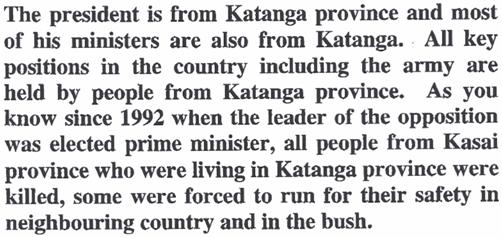
INTERPRETER: Yes okay, firstly the government in power in the Congo is mostly composed of people from Katangi Province. I am from the Kasai Province, Kasai Province and Katangi Province the two people they don’t get along well, so because also the opposition leader is from Kasai, now if I go home they will force me to join the army in revenge towards the opposition leader … the head of – the President is from Katangi. All the ministers from Katangi, senior public servants from Katangi, senior officers in the army are from Katangi. Now, this is get along back away since most of people from Kasai were the citizens killed by the Katangi’s. So if I go back being from Kasai Province I fear for my safety, they might – there are – look these among the people who run away, you know, and they get back and because from Kasai you are supporting the opposition … 1992 between Katangi and Kasai, people from Kasai there is more ---*
* I have listened, several times, to the tape-recording at this point after having listened to it from the beginning. My impression was that the number of words required to communicate in Tshiluba was roughly equivalent to the number of words required in English. I formed the clear impression that the applicant had said several sentences in Tshiluba which were not translated at all.
INTERVIEW INTERRUPTION
SHORT ADJOURNMENT [3.15 pm]
RESUMED
COURT OFFICER (PERTH): It is now 3.15 pm we will now recommence the hearing.
TRIBUNAL: Fine, if you would like to apologise to the applicant for that delay which was caused by the phone lines up here and to say that we were just about – we were just listening to his second point about why he thought he would be in danger if he returned.
INTERPRETER: Just about the end of 1992 every time the opposition leader was from Kasai Province opened his mouth to say something, all people from the province of Kasai are targeted, some are being killed, some are being tortured or detained. Now that – this is among the reasons why being from that province I don’t want to go home, because if I go home I will be badly treated. |
TRIBUNAL: That’s understandable, there was clearly a mass exodus. However why would you be in danger if you go there now?
INTERPRETER: Firstly, I return, I will be arrested and forced to join the army and they are now forcing people to join the army.
TRIBUNAL: You have not been made to join the army up until now and they had been a civil war for 3 years. Why would you be made to join the army now?
INTERPRETER: 1st problem, the Government is made of Katanganese people and I am from Kasai Province, and the leader of the opposition is from Kasai. The President is from Katanga Province, all key positions, in government, are held by Kantanganese. As you know since Tshisekedi was elected Prime Minister in 1992, lots of people from Kasai were killed. Since that conflict begun in 1992, after the conference between Katanga and Kasai there is no marriage. That’s why if I return, as from Kasai, I will be killed.
TRIBUNAL: Fine, if you would like to apologise for that interruption due to phone line up here. So you were providing the 2nd reason as to what will happen to you if you return. Please provide your arguments in particular.
INTERPRETER: So since the conflict, every time Tshisekedi will open his mouth, all Kasaian are targeted. That’s why I don’t want to go home, because if I return and be put to death.
|
|
|
|
58 Mr Shanahan submitted that the interruption was an important thing because effectively it broke the continuity of the applicant’s evidence in relation to his reasons for fearing to go back to the Democratic Republic of Congo. Equally, the question or the development of the line of questioning by the Tribunal appeared to have been broken, so that the material regarding the applicant’s prior forced conscription in the Democratic Republic of Congo did not come out.
59 Mr Shanahan submitted that contrary to the Tribunal’s observation (at pp 9-10 of its reasons) that the applicant’s advisers had not produced any views at all to indicate why being Kasaian would put the applicant at risk, the Fresh Translation shows that the applicant himself had given that evidence concerning the distinction between Katangese and Kasaians and how that would affect him.
60 Mr Shanahan made it clear, in argument, that he did not place any reliance, for review purposes, on the proposition that the Tribunal had made a mistake of fact. His point was that the interpreting of this evidence was so deficient as to lead the Tribunal to make such a conclusion.
61 In my view, it is sufficiently clear from the First Transcript that the applicant claimed persecution partly on the basis of the fact that the President, the ministers, the senior public servants and the senior officers in the army were all from Katanga and he was a Kasaian.
62 The main thrust of Mr Shanahan’s argument was that due to the telephone interruption the information about the applicant’s former forcible conscription was lost. The applicant obviously had difficulty in understanding the process because clearly all that he had done in the subsequent recorded answer (after the transmission) was simply to continue the first part.
63 In my view, there is considerable weight in Mr Shanahan’s submission. I have mentioned immediately above my concerns that there were several sentences not translated. The contents of the First Supplementary Transcript and the Second Supplementary Transcript (Annexures I and II to these reasons) do nothing to allay those concerns. Similarly, the contents of the Fresh Translation at the critical point do not suggest to me that there has been a complete translation of what the applicant said at the time of the break in transmission. That is, when the applicant kept talking immediately before the Tribunal realised that there had been a break in transmission. I shall return to this aspect, which I consider to be critical to the disposal of this application, below.
64 Finally, Mr Shanahan took me to the following evidence.
|
The First Transcript |
The Fresh Translation |
|
|
|
|
TRIBUNAL: Okay. Now, were any of your brothers involved in any armies of any sort?
INTERPRETER: No, none of my brothers were in such activity. |
TRIBUNAL: Were any of your brothers involved in any army of any sort?
INTERPRETER: No one of my brothers was involved in such activities.
|
65
In my view, this difference is not
significant. The clear answer in both
translations is “No”; the difference comes in the next word. As Kenny J observed in the passage from Perera
which I have cited at paragraph [30] above one needs to bear in mind errors
of transcription. I infer that this
resulted in the difference between “none
and “one”.
66 In summary, the applicant relied primarily on the co-incidence of an inadequate interpretation coupled with the break in transmission of the hearing and the differences between the various transcripts which have been provided, none of which, so it was put, were the same and all of which purported, at least on their face, to be a complete transcript of the proceedings before the Tribunal.
my further reasoning
67 In my view, the evidence has established, on a balance of probabilities, that the interpreter did not properly translate the relevant question. When one listens to the relevant question as it appears on the tape and compares it to the transcription in the First Transcript, it is quite clear that the typist who prepared the First Transcript precisely transcribed word for word what the Tribunal said in English. But the point, as I see it, is whether the relevant question was properly translated in Tshiluba to the applicant. It is apparent from both the First Supplementary Transcript and the Second Supplementary Transcript (Annexures I and II to these reasons) that the interpretation of the question immediately before the answer which started “the president is from Katanga province …” was either:
“The question put before you is to provide an answer as to what will happen to you if you go home?; (Annexure I) or
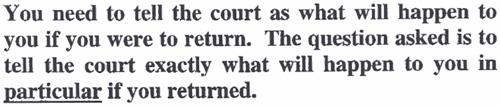
You need to tell the court as what will happen to you if you were to return. The question asked is to tell the court exactly what will happen to you in particular if you returned.” (Annexure II)
68 While my assessment of the interpretation, taken as a whole, is that it appears to have been a reasonably competent one, I have to some extent relied upon those matters to which I have referred at paragraphs [41], [43], [54] and [57] as being matters which I would take into account, when I inferred that the relevant question had not been properly translated. But I was mainly influenced by the translations of the questions which appeared in Annexures I and II which I have set out immediately above.
69 I must say that I hesitated in coming to this conclusion. On listening to that part of the tape where the interpreter translated the relevant question into Tshiluba (a language which appears to have absorbed some French expressions), one can hear him referring to the civil war and to “depuis trois ans” which corresponds to part of the English version of the relevant question. But did he translate the rest of the question?
70 In finding that the answer to that question was “No”, I decided to accept the interpreter’s first two versions (set out above) of what he translated immediately before the applicant’s first instalment in answer. As counsel for the respondent fairly conceded (at a time before the Fresh Translation had been obtained and tendered as evidence), the First Supplementary Transcript shows that the applicant’s contention, when he appeared unrepresented on the first day of the hearing, that he had not been asked the relevant question, was true.
71 I do not accept the respondent’s submissions to the effect that the applicant had failed to show material errors in interpretation and that there had thus not been a miscarriage in the decision-making process.
72 If the relevant question had been properly translated, the applicant would have had an opportunity to state that he had been conscripted twice and had deserted on each occasion, that this might cause him to be imputed with anti-government opinion, and might lead to persecution. The applicant stated in his statutory declaration in support of his application that he feared conscription if returned to the Congo (see paragraph [4] above). At the interview with the respondent’s delegate the applicant said he feared that he would be killed by the authorities in the Congo because they had imputed to him anti-government opinions. A similar claim was made in his solicitors’ submissions to the Tribunal before the hearing. The Tribunal referred to these claims in paragraph 16 of its reasons reproduced above. This was an important part of his claims.
73 In my view, the failure properly to translate the relevant question and the breakdown in transmission at this critical point effectively prevented the applicant from giving his evidence in relation to a matter of considerable significance for his claim and, in turn, for the Tribunal’s decision. On resumption of transmission, the Tribunal gave the applicant an opportunity to revisit his answer. But, on my findings, the damage had been done and, unbeknown to the Tribunal, the situation could not be retrieved. The Tribunal was deprived of the opportunity to take into account a relevant factor.
74 In those circumstances there has been an unwitting jurisdictional error on the Tribunal’s part of the type which gives rise to a ground of review under the Act as it was before the amendments which took effect on 2 October 2001 – see Minister for Immigration and Multicultural Affairs v Yusuf [2001] HCA 30 at [82] to [84]. In my opinion, Ground 2 of the amended application has been made out. The Tribunal’s decision should be set aside and the matter remitted to a differently-constituted Tribunal. There will be orders accordingly.
|
I certify that the preceding seventy-four (74) numbered paragraphs are a true copy of the Reasons for Judgment herein of Justice Carr. |
Associate:
Dated: 6 November 2002
|
Counsel for the Applicant: |
Mr C P Shanahan (on a pro bono publico basis) |
|
|
|
|
Counsel for the Respondent: |
Ms C A Searle |
|
|
|
|
Solicitor for the Respondent: |
Australian Government Solicitor |
|
|
|
|
Date of Hearing: |
6 December 2001, 19 March, 7 October 2002 |
|
|
|
|
Date of Judgment: |
6 November 2002 |
ANNEXURE I
18-MAR-02 16:38 FROM: AGS PERTH FLR ID. 61 8 92681196 PAGE 2
SUPPLEMENTARY TRANSCRIPT
Translation TSHILUBA → ENGLISH
Translated by Mr Jeff Mitshabu 12/3/02
Re: [Applicant’s name deleted]
A. The question put before you is to provide an answer as to what will happen to you if you go home
Since the beginning of that conflict 1992, between
Katanga and Kasai the relationship is gone from
bad to worse.
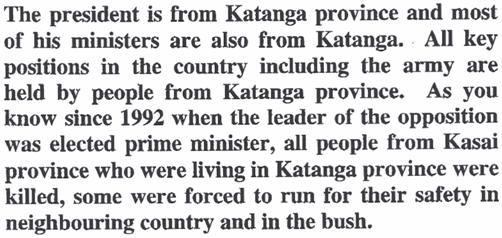
Since the beginning of the tense relationship
Between Katanga and Kasai and every time
Tshiluba opens his mouth to say something, all
People from Kasai are target with intimidation or
even death. If I return there I will be killed
B. Mr. [ ], I would like to apologise for this interruption due to technical problem with the line
Would you like to continue what you were saying on the danger you are running if you go home.
You need to tell the court as what will happen to you if you were to return. The question asked is to tell the court exactly what will happen to you in particular if you returned.
ANNEXURE II
Fax sent by 08 92681198 AGS PERTH 01/08/02 15:48 Pg: 2/3
Translation TSHILUBA → ENGLISH

Re: [Applicant’s name deleted]
A) Mr. [ ], I would like to apologise for this interruption due to technical problem with the line. Would you like to continue what you were saying on the danger you are running if you go home.
|
B)
|
|
Since the beginning of that conflict 1992, between
Katanga and Kasai the relationship is gone from
bad to worse.