FEDERAL COURT OF AUSTRALIA
Australian Competition & Consumer Commission v
Woolworths Limited [2002] FCA 1001
TRADE PRACTICES – misleading or deceptive conduct – newspaper advertisement – “dominant impression” – whether there was a dominant impression which required particular representations to be disregarded – representations with respect to a future matter – reference to a continuing policy intended to influence readers of the advertisement to buy from the advertiser
Trade Practices Act 1974 (Cth) s 51A, s 52
Campomar Sociedad, Limitada v Nike International Ltd (2000) 202 CLR 45 applied
Parkdale Custom Built Furniture Pty Ltd v Puxu Pty Ltd (1982) 149 CLR 191 distinguished
Tobacco Institute of Australia Ltd v Australian Federation of Consumer Organisations Inc (1992) 38 FCR 1 distinguished
Taco Company of Australia Inc v Taco Bell Pty Ltd (1982) 42 ALR 177 distinguished
Telstra Corporation Ltd v Optus Communications Pty Ltd (1997) ATPR §41-541 distinguished
AUSTRALIAN COMPETITION AND CONSUMER COMMISSION v
WOOLWORTHS LIMITED (ACN 000 014 875)
N 1465 OF 2001
LINDGREN J
12 AUGUST 2002
SYDNEY
|
IN THE FEDERAL COURT OF AUSTRALIA |
|
|
N 1465 OF 2001 |
|
BETWEEN: |
AUSTRALIAN COMPETITION AND CONSUMER COMMISSION APPLICANT
|
|
AND: |
WOOLWORTHS LIMITED (ACN 000 014 875) RESPONDENT
|
|
DATE OF ORDER: |
|
|
WHERE MADE: |
THE COURT ORDERS THAT:
1. The parties submit to the Associate to Lindgren J by Thursday 15 August 2002 an agreed form of orders to be made, and failing agreement by that time, orders 2 and 3 will apply.
2. The applicant file and serve by Friday 16 August 2002 (with a copy to the Associate to Lindgren J) short minutes of the orders it proposes and submission in support.
3. The respondent file and serve by Monday 19 August 2002 (with a copy to the Associate to Lindgren J) short minutes of the orders it proposes and submission in support.
4. The proceeding be listed on Tuesday 20 August 2002 at 9.30 am for the making of orders.
Note: Settlement and entry of orders is dealt with in Order 36 of the Federal Court Rules.
|
IN THE FEDERAL COURT OF AUSTRALIA |
GENERAL DISTRIBUTION |
|
N 1465 OF 2001 |
|
BETWEEN: |
AUSTRALIAN COMPETITION AND CONSUMER COMMISSION APPLICANT
|
|
AND: |
WOOLWORTHS LIMITED (ACN 000 014 875) RESPONDENT
|
|
JUDGE: |
|
|
DATE: |
|
|
PLACE: |
REASONS FOR JUDGMENT
Introduction
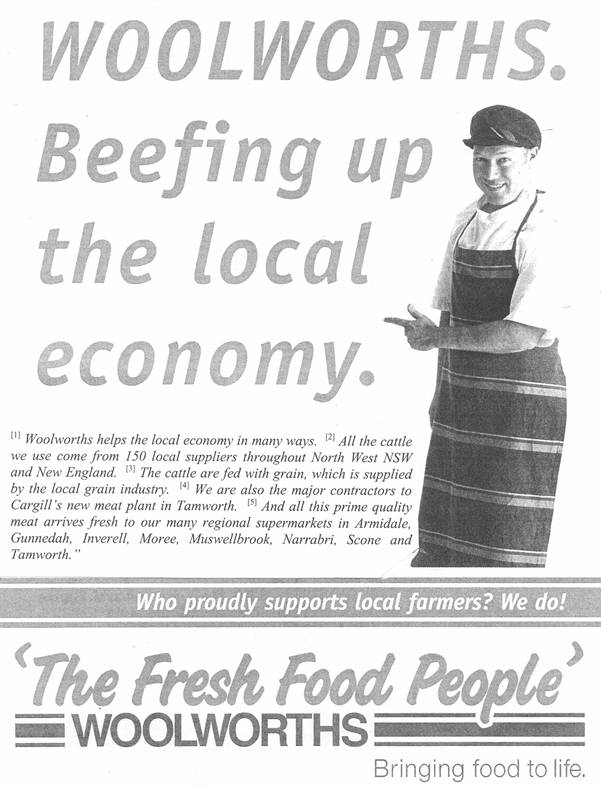
1 By its application filed on 29 October 2001, the applicant (“the Commission”) seeks declaratory, injunctive and corrective advertising relief arising out of an advertisement which the respondent (“Woolworths”) caused to be published in four country newspapers in the period 22 February 2001 to 1 March 2001. A copy of the advertisement is annexed to these reasons for judgment. (The numbers (in square brackets) of the sentences of the text have been included by me in the annexure for ease of reference.)
Background facts
2 The Commission’s application was accompanied by a statement of claim and Woolworths filed a defence on 11 January 2002. After admitting certain formal matters, the defence also admitted the allegations made in pars 3-11 of the statement of claim. These paragraphs provide a convenient statement of background facts and were as follows:
“3. At all material times, the Respondent carried on business and was engaged in trade or commerce as a retailer of beef products.
...
4. At all material times the Respondent supplied or offered to supply beef products to consumers in North West NSW and New England at stores in Armidale, Gunnedah, Inverell, Moree, Muswellbrook, Narrabri, Scone and Tamworth (‘the stores’).
5. During the period from and including 22 February 2001 to 1 March 2001 the Respondent caused to be published in The Land, the Country Leader, Queensland Country Life and the Tamworth Times, an advertisement (‘the advertisement’). During the same period the Respondent caused to be published an advertorial in the same publications, which advertorial accompanied the advertisement. The advertorial appeared in all publications except the Tamworth Times.
6. The advertisement contained the statement:
‘All the cattle we use come from 150 local suppliers throughout North West NSW and New England.’
‘The cattle are fed with grain, which is supplied by the local grain industry.’
7. The Respondent markets beef as ‘Economy’ brand and ‘Premium’ brand in the stores.
8. In the period since January 2001 Economy brand beef supplied to the stores was not sourced from the cattle of suppliers in North West NSW or New England.
9. Some Premium brand beef supplied to the stores in the period since January 2001 was not sourced from the cattle of suppliers in North West NSW or New England.
10. In the period since January 2001 the Respondent has not used 150 suppliers from the North West New South Wales and New England areas as the source of cattle for the Premium brand beef supplied to the stores.
11. In the period since January 2001 the beef supplied to the stores was not always fed grain supplied by the local grain industry.”
(I will use the expressions “the advertisement” and “the stores” with the meaning they bear in the statement of claim.)
3 In addition to admitting par 9 of the statement of claim, Woolworths’ defence stated that in the period 1 January 2001 to 31 May 2001:
“(a) Approximately 84% of cattle (by cost) slaughtered at the Cargill Tamworth Abattoir for the production of prime quality meat products for sale as premium brand beef were sourced from among approximately 150 suppliers of cattle to Woolworths located within North West NSW and New England; and
(b) Approximately 89% of the suppliers of cattle for slaughter at the Cargill Tamworth Plant were located in North West NSW or New England.”
4 In addition to admitting par 10 of the statement of claim, Woolworths’ defence stated further that:
“ ... in the period 1 January 2001 to 31 May 2001 Woolworths had approximately 168 suppliers of cattle located throughout NSW from among which it sourced cattle on a seasonal basis for the production of prime quality meat for sale as premium brand beef. Of those suppliers approximately 150 are located within North West NSW and New England.”
5 In par 12 of the statement of claim, the Commission alleged that the representation pleaded in par 6 (apparently, the reference should be to the first representation pleaded in par 6) was a representation made with respect to a future matter, namely, that all beef marketed by Woolworths at the stores in the future would be sourced from cattle from 150 local suppliers throughout North West NSW and New England, but that Woolworths did not have reasonable grounds for making the representation. Woolworths denied those allegations.
6 Finally, in par 13 of the statement of claim the Commission alleged that Woolworths’ conduct as pleaded was misleading or deceptive or likely to mislead or deceive contrary to s 52 of the Trade Practices Act 1974 (Cth) (“the TP Act”) and that by reason of that conduct Woolworths made false or misleading representations as to the origin of goods contrary to subs 53(eb) of that Act. Woolworths denied those allegations also.
Reasoning
7 The parties asked that I publish my reasons on the issue of contravention and allow opportunity for the making of submissions as to any relief to be granted.
8 The parties’ submissions in writing and orally on the hearing concentrated on the alleged contravention of s 52 of the TP Act and did not separately address subs 53(eb). I will proceed similarly.
9 The conclusion which I have reached as to the representations which the advertisement would convey to an “ordinary or reasonable” person among the readers to whom it was directed (cf Campomar Sociedad, Limitada v Nike International Ltd (2000) 202 CLR 45 at [103]-[105]) is such that on any reckoning the advertisement was misleading and deceptive. For this reason I will not discuss the evidence as to the sourcing of beef offered for sale by Woolworths.
10 Woolworths submits that the “dominant impression” of the advertisement is that Woolworths helps the local economy. I agree that that impression is conveyed by the heading, the first sentence of the text and the statement between the two parallel lines below the text. I also accept that that impression is “important”. Little purpose is served by attempting to decide whether the impression rises to the level of being “dominant”, or whether the words “Woolworths helps the local economy” give an inadequate account of the relevant “impression” as compared with, for example, the words “Woolworths helps the local economy in North West NSW and New England by supporting its cattle and grain industries”. The reason is that in my view the second, third, fourth and fifth sentences of the text clearly convey their own representations and would be understood by an ordinary or reasonable reader to do so.
11 Senior counsel for Woolworths referred to Parkdale Custom Built Furniture Pty Ltd v Puxu Pty Ltd (1982) 149 CLR 191 at 199, Tobacco Institute of Australia Ltd v Australian Federation of Consumer Organisations Inc (1992) 38 FCR 1 at 4, Taco Company of Australia Inc v Taco Bell Pty Ltd (1982) 42 ALR 177 at 199 and Telstra Corporation Ltd v Optus Communications Pty Ltd (1997) ATPR §41-541 at 43,514 as authorities for the proposition that in assessing whether conduct is misleading or deceptive, one must take care not to select and assess aspects of conduct out of context.
12 Two propositions relevant to Woolworths’ submission can be derived from the authorities, neither of which assists Woolworths in the present case. One is that s 52 of the TP Act is not to be applied to selected aspects or parts of an advertisement which would not have an effect independently of the whole. The correction brought about by the larger context may mean that the aspects or parts are not misleading or deceptive after all.
13 The other proposition is that if an advertisement truly conveys a dominant impression which is misleading or deceptive, there will be a contravention of s 52 even though aspects or parts of the advertisement can be found which are inconsistent with that impression.
14 I do not fail to heed the authorities by regarding the second, third, fourth and fifth sentences of the text as conveying the representations which Woolworths intended them to convey and which an ordinary and reasonable reader would understand them to convey.
15 I also accept Woolworths’ submission that the second, third, fourth and fifth sentences of the text are in the nature of particulars of the “many ways” referred to in the first sentence. But this does not signify that they cannot contain their own representations that are misleading or deceptive.
16 The “message” of the advertisement can be identified at different levels of generality. In my opinion, taking into account all its aspects including the photograph of the butcher, its overall message is this:
“If you buy beef from a Woolworths supermarket in the area of North West NSW and New England, you will be indirectly supporting one hundred and fifty local suppliers of cattle and the grain industry in that area, because that beef comes from cattle supplied by those producers which are fed with grain supplied by that grain industry.”
17 I will now address the second, third, fourth and fifth sentences in turn.
18 In the context of the entire advertisement the opening words of the second sentence, “All the cattle we use”, mean “All the cattle we use to provide the beef we offer for sale”. The word “all” means nothing less than all, apart from any de minimis exception. That qualification is of no significance on the facts of the present case.
19 The opening words of the third sentence, “The cattle”, refer back to the cattle referred to in the second sentence.
20 The fourth sentence, beginning “We are also”, is an additional and independent particular (indicated by the word “also”) of the “many ways” in which Woolworths helps the local economy referred to in the first sentence. Since Tamworth is within the geographical area mentioned, by being the major contractor of Cargill’s new treatment plant at Tamworth, Woolworths is again helping the local economy previously identified.
21 The opening words of the fifth and final sentence, “And all this prime quality meat”, refer to the beef which the cattle mentioned in the second sentence are used by Woolworths to produce. The fifth sentence’s reference to the arrival of the meat “fresh” at Woolworths’ “many regional supermarkets in Armidale, Gunnedah, Inverell, Moree, Muswellbrook, Narrabri, Scone and Tamworth”, all places within the geographical area mentioned, is intended to suggest a possible additional advantage for the reader who buys beef from those supermarkets: not only will the buyer be assisting Woolworths to help the local economy, but he or she will be buying meat that is fresh because it has not had to travel from outside the geographical area mentioned.
22 Woolworths submits that the meaning of the advertisement was affected by the “advertorial” which accompanied it on some occasions. The advertisement appeared in two issues of “The Land”, two issues of “Queensland Country Life”, one issue of the “Tamworth Times” and one issue of “Country Leader”, and was accompanied by the advertorial in one of the issues of “The Land” and in the issue of “Country Leader”. Independently of the fact that the advertisement was not accompanied by the advertorial in four of its six appearances, in my opinion the advertorial, when it did accompany the advertisement, would not have had any impact on the meaning it conveyed to the ordinary and reasonable reader.
23 Woolworths submits that the advertisement did not make a representation with respect to a future matter. The verbs are in the present tense and refer to an ongoing state of affairs. The advertisement was intended to induce readers to buy from Woolworths – a future act. While the advertisement did not signify that its representations would be true forever into the future, it did convey that they would remain true for a reasonable time following the advertisement’s publication. The advertisement conveys the impression that its representations reflect a “policy” of Woolworths which will not change before the occasion for a reader’s buying on the faith of the advertisement arises. In a particular case a difficult question might arise as to what is a reasonable period for which Woolworths should be held to the advertisement’s representations. But it suffices for present purposes that I hold, as I do, that par 12 of the statement of the claim is supported, because I construe the words “in the future” in that paragraph to mean “for some [unidentified] time in the future”, not “at any time in the future”.
Conclusion
24 The Commission has established that Woolworths contravened s 52 of the TP Act in the respects mentioned.
25 The Commission has not attempted to establish, and has not in fact established, that the advertisement was misleading or deceptive in so far as it represented that Woolworths supports the local economy in North West NSW and New England.
26 I will fix a time for the making of submissions as to the appropriate orders to be made and for the making of those orders.
|
I certify that the preceding twenty-six (26) numbered paragraphs are a true copy of the Reasons for Judgment herein of the Honourable Justice Lindgren. |
Associate:
Dated: 12 August 2002
|
Counsel for the Applicant: |
Mr N C Hutley SC and Ms M A C Painter |
|
|
|
|
Solicitor for the Applicant: |
Australian Government Solicitor |
|
|
|
|
Counsel for the Respondent: |
Mr R M Smith SC and Mr P R Whitford |
|
|
|
|
Solicitor for the Respondent: |
Clayton Utz |
|
|
|
|
Date of Hearing: |
13 June 2002 |
|
|
|
|
Date of Judgment: |
12 August 2002 |
ANNEXURE