FEDERAL COURT OF AUSTRALIA
Reynolds v Southcorp Wines Pty Ltd [2002] FCA 712
CONTRACT – employment contract – termination of employment – redundancy – applicant employed by respondent as Executive General Manager of Finance in Sydney – applicant was offered and accepted a 3 year project role interstate on the basis that he would be re-employed by the respondent in an equivalent or higher position upon expiry of the project – employment terminated on applicant’s return to Sydney – applicant was paid a redundancy package – whether breach of contract by respondent – whether respondent’s representation that applicant would be re-employed upon expiry of the project was made on reasonable grounds – whether representation was a contractual term – whether new project appointment effected variation of existing employment contract – whether respondent’s termination of employment policy became incorporated in employment contract
DAMAGES – calculation of damages for breach of employment contract – whether redundancy payment should be taken into account in determining whether applicant suffered any loss in consequence of early termination of employment – whether any damages should be calculated on the basis of the salary and allowances of applicant’s successor – whether applicant entitled to aggravated damages for distress or disappointment
Trade Practices Act 1974 (Cth) s 51A, 52
Annual Holidays Act 1944 (NSW) s 2(1), 2(6), 4(1)
Long Service Leave Act 1955 (NSW) s 3(2C), 4(5)
Truth About Motorways Pty Ltd v Macquarie Infrastructure Investment Management Ltd (1999) 200 CAR 591 applied
Concut Pty Ltd v Worrell (2000) 176 ALR 693 considered
Bostik (Australia) Pty Ltd v Gorgevski (No 1) (1992) 36 FCR 20 applied
Fryar v System Services Pty Ltd (1996) 137 ALR 3 applied
Black v Brimbank City Council (1998) 152 ALR 491 followed
Yorkshire Engineering & Welding Co Ltd v Burnham [1974] 1 WLR 206 referred to
Furey v Civil Service Association of WA (Inc) (1999) 91 FCR 407 considered
Haley v Public Transport Corporation of Victoria [1998] VSC 132 considered, not followed
Kirchner v Mayne Nicholas Ltd [2000] VSC 459 considered
Holmes v Jones (1907) 4 CLR 1692 applied
Clunne v Nambucca Shire Council (1995) 63 IR 304 referred to
Addis v Gramophone Co Ltd [1909] AC 488 applied
Fink v Fink (1946) 74 CLR 127 applied
Aldersea v Public Transport Corporation (2001) 183 ALR 545 followed
Macken et al The Law of Employment 5th ed.2002
McGregor on Damages 16th ed. 1997
LEO REYNOLDS v SOUTHCORP WINES PTY LTD & ANOR
N 472 OF 2001
HELY J
6 JUNE 2002
SYDNEY
|
IN THE FEDERAL COURT OF AUSTRALIA |
|
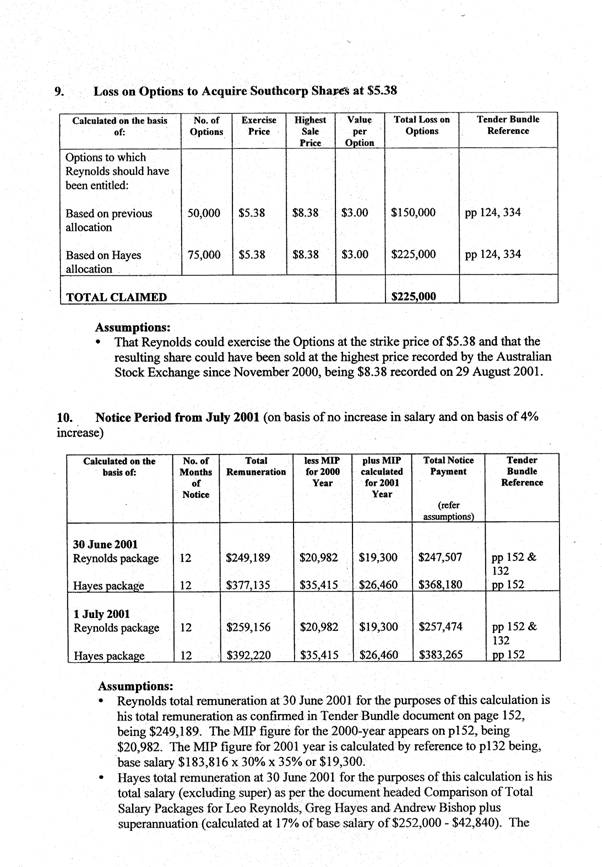
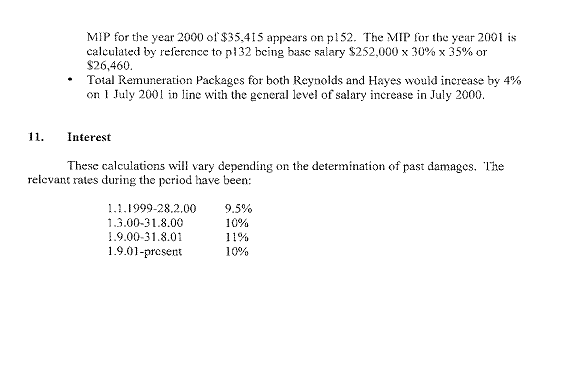
|
BETWEEN: |
LEO REYNOLDS APPLICANT
|
|
AND: |
SOUTHCORP WINES PTY LTD ACN 000 009 763 FIRST RESPONDENT
THOMAS PARK SECOND RESPONDENT
|
|
DATE OF ORDER: |
|
|
WHERE MADE: |
THE COURT ORDERS THAT:
1. The parties bring in short minutes of order to give effect to the conclusions reached in the reasons for judgment.
Note: Settlement and entry of orders is dealt with in Order 36 of the Federal Court Rules.
|
IN THE FEDERAL COURT OF AUSTRALIA |
|
|
BETWEEN: |
APPLICANT
|
|
AND: |
ACN 000 009 763 FIRST RESPONDENT
THOMAS PARK SECOND RESPONDENT
|
|
JUDGE: |
|
|
DATE: |
|
|
PLACE: |
REASONS FOR JUDGMENT
1 The applicant holds a Bachelor of Commerce degree, with a major in accounting, finance and systems, which was conferred upon him by the University of New South Wales in 1979. In October 1980 he was employed by Penfolds Wines Pty Ltd as an accountant and was subsequently appointed to the position of Finance Director.
2 In about 1990 Penfolds Wines Pty Ltd was acquired by S.A. Brewing Holdings Ltd – Wine Group (“SABH Wine Group”). On 31 May 1991 the applicant was offered, and accepted, the position of Executive General Manager, Finance within the SABH Wine Group, effective 1 June 1991. The terms of that appointment are set out in a letter from SABH Wine Group to the applicant of 31 May 1991. For present purposes, it is sufficient to record that the appointment was terminable by either party upon one months’ notice.
3 The first respondent (“Southcorp Wines”) was incorporated in or about February 1994 and took over the business and undertaking of SABH Wine Group. The applicant was thereafter employed by the respondent with continuity of employment on the same terms and conditions as are set out in his original letter of appointment.
4 In late February or early March 1998, the applicant was approached by Mr Kemp, the then Chief Executive Officer of the respondent, and was asked to head up a new project called the Business Systems Migration Project (“BSMP”) or System Application Program (“SAP”). Mr Kemp gave evidence of the importance of the project to the respondent globally, and how the applicant’s intimate knowledge of the transactions of the respondent in Australia and worldwide made the applicant the appropriate person to lead SAP, which Mr Kemp described as “quite a challenging project, a major project” with a budget of $30-odd million.
5 A second conversation took place between Mr Kemp and the applicant on 12 March 1998 in which the proposed appointment was further discussed. During the course of that conversation the applicant said:
“I have reservations about the move from the familiar role of EGM-Finance to a project role likely to have a 3 year term with the uncertainty of future career prospects.”
Mr Kemp responded:
“Key people who go into the project will become keenly sought after for future roles in the company.”
6 Mr Kemp did not file an affidavit in the proceedings, but he was nonetheless called by the respondent to give oral evidence. Mr Kemp did not deny the applicant’s account of the various conversations with Mr Kemp to which the applicant deposed in his affidavit. Mr Kemp confirmed in his oral evidence that during this second conversation, the applicant expressed concern about “coming out of an existing role and was looking for some form of guarantee that ... at the end of the successful completion of the project that there would be a role available to him back in … (interrupted)”. Mr Kemp said that he told Mr Reynolds that it was an opportunity for him to enhance his “skills-set, in terms of delivering a software implementation”. Mr Kemp said he was confident that the applicant would deliver the outcome which the respondent sought from the SAP project, and said there was “a commitment to (the applicant) in terms of the position back in Sydney”.
7 There was a third conversation between the applicant and Mr Kemp in early April 1998. That conversation was as follows:
“Reynolds:
‘I need to be sure that I will not be disadvantaged if I accept the project role. I would need to continue to be a member of the Southcorp Wines Executive Committee, I would need to continue to report to you and I would need to be sure that my salary package and other benefits would not be reduced if I take on the project role. I also need to know that I will have a position in the company when the project is over’.
Kemp:
‘At the end of the project you will be offered a position in Sydney of equal or higher level to your current position. Your salary package entitlements will not be diminished as a result of the move to the project. You will continue to report to me and remain a member of the Executive Committee. I think your insightful contributions to the Executive would continue to be valuable.’
Reynolds:
‘I am prepared to undertake the role. I can see that it is critical to Southcorp Wines. You asked me to suggest an appropriate salary package. I am looking for a salary in the range of $165,000 to $170,000 per annum, relocation costs to Adelaide and return to Sydney, housing rental subsidiary in Adelaide, return airfares for my family each year and the cost of private school fees for my two daughters while in Adelaide. All other existing benefits are to remain unchanged.’
Kemp:
‘The costs of relocation, housing and family air fares will not be a problem. What do you think the cost of private school fees will be?’
Reynolds:
‘I expect them to be about $10,000 per year for each child. Given the need to transfer them from their current school we definitely want to make sure they get the opportunity of a good school in Adelaide.’
Kemp:
‘Well, the salary figure you mentioned was a little higher than I had in mind. Can you leave that with me to get approval? I will get back to you.’
Reynolds:
‘I would like to get the details of our discussion documented in a letter of offer or contract of employment setting out the agreed terms and conditions.’
Kemp:
‘I will do that and let you know about the salary.’”
(emphasis added)
8 On 24 April 1998 the applicant met with Mr Kemp and was provided with a letter setting out the details of his appointment to manage the SAP, effective 1 July 1998, for a period of three years and renewable to the end of the project. The letter stated:
“On completion of the project you would be offered a position equivalent to your current position or higher.”
There was no further elaboration of the nature of the position which would be offered to the applicant, or as to the terms on which it would be offered.
9 The letter then set out the terms and conditions of the appointment. The commencing gross salary was $162,000 per annum, which represented a 13 per cent increase on the applicant’s then current salary. Provision was made for reimbursement of relocation costs if the applicant was required to move to Adelaide and the respondent gave an undertaking that the applicant “will not incur a financial loss as a result of relocation”. Provision was also made for school fees and return visits to Sydney. The letter concluded:
“Leo, I would like to confirm that current arrangements relating to the benefits (listed below) will continue to apply, ie:
Superannuation;
Company Car;
Management Incentive Plan;
Executive Share and Option Plan;
Employee Share Plan;
Wine Allowance;
Telephone;
Private Health Benefit Reimbursement;
Spouse Fleet Card;
Club Fees;
Airline Club Membership.
10 On 4 May 1998 the applicant endorsed his agreement to the letter of 24 April 1998 at the end of that letter.
11 Under cross-examination by Mr Greenwood SC, Mr Kemp gave the following evidence, which I accept:
“Mr Greenwood: May we take it that you were confident as at April of 1998 that after three years it would be relatively easy for you to find that position for Mr Reynolds within the Southcorp group?
Mr Kemp: Yes, there were certainly broad options to be able to do that based on the fact that there was three operating divisions and corporate including, … a global wine business.”
Two of those divisions, packaging and water heaters, were disposed of between the time of this conversation, and the applicant’s later recall to Sydney.
12 The applicant said, and I accept, that Mr Kemp’s promise that the applicant would be re-employed in an equivalent or higher position upon expiry of the SAP project was crucial to his decision to accept the position.
13 The applicant commuted to Adelaide between the months of August to November 1998. His family relocated to Adelaide in November 1998.
14 In September 1998 Mr Gregory Hayes was appointed to replace Mr Reynolds as EGM-Finance of Southcorp Wines.
15 In October 1999 Mr Kemp resigned and left Southcorp Wines. He was ultimately replaced by Thomas Park who became Executive General Manager of Southcorp Wines on 6 March 2000.
The recall to Sydney
16 Stage 1 of SAP was implemented in July 2000. A decision was taken to defer stage 2. Once the SAP system was in place, responsibility for its management was transferred from the applicant and the BSMP team to Trevor Hollitt and the Information Systems team. According to Mr Park, this change occurred because once the SAP system was up and running, it needed a different set of expertise to manage and maintain it from that which was needed to design and implement it. Accordingly, Mr Park attempted to redeploy Mr Reynolds to an alternative position.
17 At meetings on 10 August 2000, and again on 19 September 2000, Mr Park suggested to the applicant that he consider moving back to Sydney.
18 Mr Clark, the Human Resources Manager of Southcorp Wines, gave evidence that at this time, if there had been a vacant position which was suitable for the applicant and which could have been allocated to him, then Mr Park (as Chief Executive Officer), and himself (as Human Resources Manager) would have known of it. With the possible exception of the position which was to become vacant as a result of the resignation of Mr Hayes, to which reference will shortly be made, there was no such position then available.
19 Nonetheless, I accept that Mr Park spoke to Mr Clark, Mr Hayes and Mr Johnson about the need to find an alternative position for the applicant. The enquiries made by Messrs Clark, Hayes and Johnson quickly revealed that there was no existing vacant position to which the applicant could be appointed. By early October it had become apparent to Mr Park that it was unlikely that a mutually acceptable position for the applicant could be found or created.
20 On 18 September 2000 Gregory Hayes submitted his resignation as EGM-Finance with effect from 18 October 2000. It will be recalled that Mr Hayes was appointed to this position when the applicant was appointed to manage the SAP. There is evidence, which I accept, that the role entitled “EGM-Finance” changed substantially during the period of Mr Hayes’ employment. With his resignation, it was uncertain whether or not the position would be restructured. In Mr Park’s judgment the role was different, the responsibilities of the role were significantly enhanced, the role was responsible for a portfolio of areas of the Southcorp Wines business with which the applicant was not familiar and the role was larger than that which the applicant had left. I accept that this was a judgment which Mr Park honestly made.
21 Rightly or wrongly (and it is not necessary for me to decide which), Mr Park decided that it was not appropriate to appoint the applicant to that position. Instead, Mr Andrew Bishop was temporarily appointed to that role in October 2000.
22 I was invited by the applicant’s counsel to find that no genuine efforts were made to find a new position for the applicant, and that such activity which took place in that respect was “a sham” or “pathetic”. I decline to make any finding to that effect. I accept that the enquiries made or initiated by Mr Park in this respect were genuinely made, although by early October 2000 it must have become apparent to Mr Park that it was unlikely that a mutually acceptable position for the applicant could be found or created.
23 On 9 November 2000 the applicant had a meeting with Mr Park in Sydney. At that meeting Mr Park informed the applicant that his employment would be terminated as he had not been able to identify a role for the applicant in Sydney. Mr Park said that the respondent would provide the applicant with the full redundancy package of twelve months salary and outplacement services.
24 After this meeting the applicant reviewed his financial situation. At that time he owned or was entitled to 33,000 shares in Southcorp Ltd and owed approximately $63,000 in share loans to Southcorp Ltd. Those loans were being repaid by dividend payments at the rate of about $3,317 per annum. In view of his circumstances, and the available information at the time, the applicant decided, on 15 November 2000, to sell the shares at $5.60 per share, and to reduce his debt by paying out the company loans.
25 In the middle of November 2000 Rosemount Estates Pty Ltd (“Rosemount Estates”) approached Mr Park to discuss a potential merger of the two organisations. The possibility that such a merger might occur was kept confidential until a public announcement regarding the possibility of a merger was made on 21 February 2001. The share price of Southcorp Wines increased substantially on the news of the merger. In April 2001 the share price reached over $7.00, and in August 2001 it reached over $8.00. Mr Reynolds said that had he known of the plans for the merger, he would not have sold his shares in November 2000.
26 On 13 November 2000 Mr Clark forwarded a redundancy calculation to the applicant upon the basis that his last day of employment would be 31 January 2001. This was the first written notification to the applicant of the date on which his employment would cease. On 24 January 2001 the respondent wrote to the applicant confirming that his employment would cease on 31 January 2001 and enclosing further severance calculations. Additional benefits were offered subject to the provision of a release document which the applicant declined to sign.
27 On 31 January 2001 the applicant was paid a redundancy package which was less than the amount offered under cover of the letter of 24 January 2001.
28 The applicant has made efforts to obtain alternative employment. It is accepted that the applicant has made reasonable efforts in that respect. Except for two contract assignments totalling $11,000, the applicant has been unsuccessful in obtaining alternative employment.
The applicant’s claim
29 The applicant seeks a number of declarations and damages, including punitive damages for the manner in which the respondent terminated the applicant’s position “in contravention of the clear terms of the employment agreement” and aggravated damages for mental distress. The entitlement to relief is said to arise by reason of the respondent’s breach of contract, or by reason of breaches by the respondent of s 52 of the Trade Practices Act 1974 (Cth) (“the TPA”) arising by reason of misrepresentations said to have been made to the applicant in the course of his employment. The respondent submits that there is no breach of the kind alleged, or alternatively no loss flows from any such breach. An element of the respondent’s defence in relation to the TPA claims is that if there were any misrepresentations, they were not made in trade or commerce.
30 The claims for a declaration can be put to one side. If the subject matter of a proposed declaration founds an entitlement to damages, then there is no utility in making a declaration as well as awarding damages. If the subject matter of a proposed declaration does not found an entitlement to damages then, at least in the circumstances of the present case, there is no utility in making a declaration, albeit for different reasons. A declaration cannot be made if it “will produce no foreseeable consequences for the parties”: Truth About Motorways Pty Ltd v Macquarie Infrastructure Investment Management Ltd (1999) 200 CLR 591, 613 (per Gaudron J)
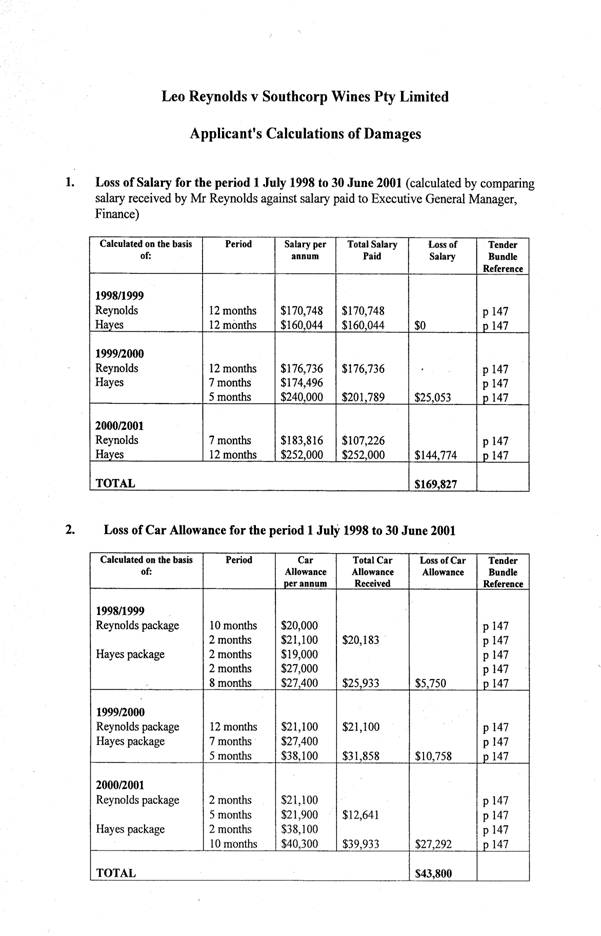
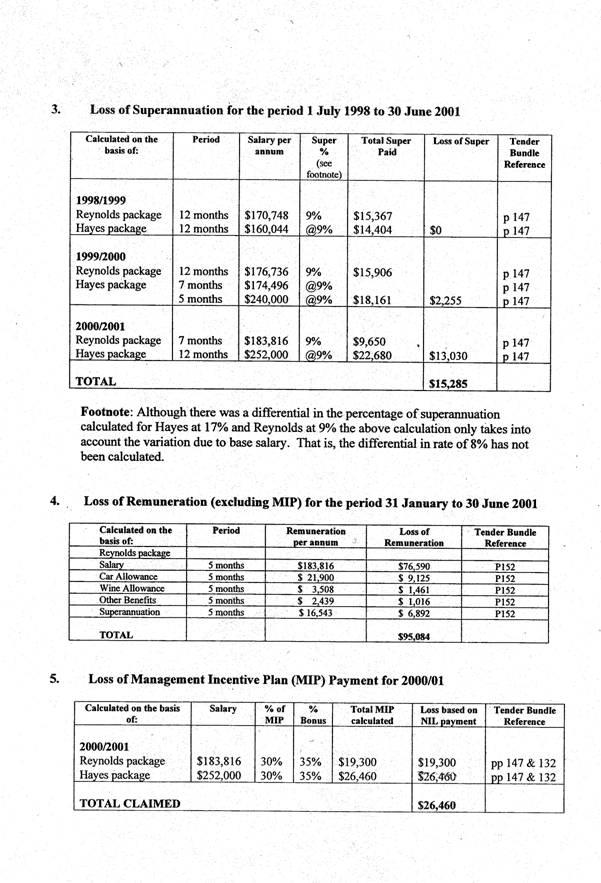
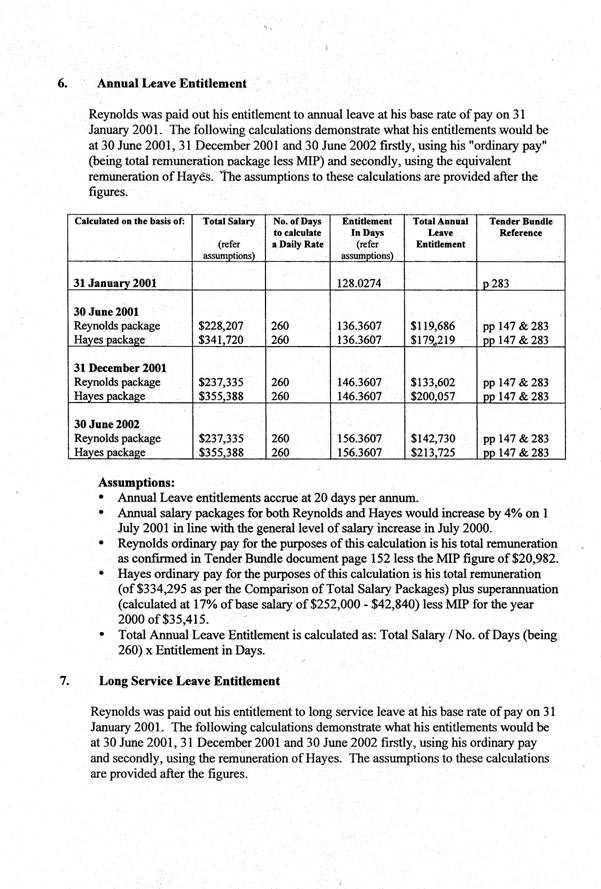
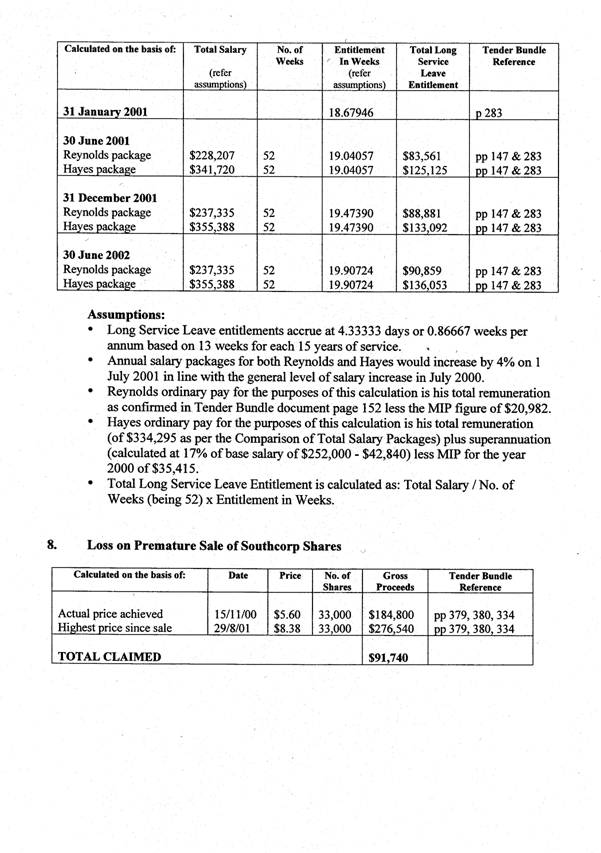
31 At the conclusion of his submissions counsel for the applicant, Mr Greenwood SC, helpfully prepared a document styled “Applicant’s Calculation of Damages”, a copy of which is appended to these reasons. The document was prepared by way of a summary of all of the heads of damage which the applicant now claims. Counsel for the respondent, Mr Pesman, agreed that I could proceed upon the basis of the figures and calculations contained in that document unless I was notified of any error. No such notification was received.
32 That document, although a damages calculation, provides a useful reference point for the determination of the respondent’s liability either in contract or under the TPA with respect to the heads of damage particularised in the document. It is convenient to commence with claim [4], as that claim raises an important question of principle.
[4.] Loss of remuneration (excluding MIP) for the period 31 January-30 June 2001
33 Mr Kemp represented to the applicant during the conversations in March and April 1998 that the applicant would be employed on the SAP project for a period of three years and, at the end of the project, the applicant would be offered a position in Sydney of equal or higher level to his then current position of EGM-Finance. Those representations were with respect to future matters, hence (assuming that they were made in trade or commerce) the issue is whether the respondent had reasonable grounds for making the representations in question. The onus of adducing evidence on that issue lies on the respondent: TPA s 51A.
34 The respondent has discharged the onus of establishing that the representations were made on reasonable grounds as they were incorporated into the letter agreement of 24 April 1998 as contractual terms, and as I accept Mr Kemp’s evidence that he was confident as at April 1998 that after three years it would be relatively easy for him to find a suitable position for the applicant within the Southcorp Group. I also accept that Mr Kemp’s confidence in this respect was reasonably based. In the events which happened, a suitable position for the applicant was not found, nor was one created, but that does not mean that the representations, when made, were not reasonably based.
35 Under the letter of 31 May 1991, the applicant’s appointment to the position of EGM-Finance was terminable on one month’s notice. The appointment effected by the letter of 24 April 1998 was to a different position, probably in a different state, for a period of three years and for the purposes of a specific project, after which the applicant would be offered a position equivalent or higher than the position of EGM-Finance.
36 The respondent submits that the letter of 24 April 1998 merely effected a variation of the 31 May 1991 letter of appointment such that the applicant’s appointment to manage the SAP program, although expressed to be for a period of three years, was nonetheless terminable on one month’s notice. In the present case, it does not matter whether the letter of 24 April 1998 is regarded as terminating the earlier appointment, or whether it is regarded as effecting a variation of the existing contract. In either case, the proposition that after 24 April 1998 the applicant’s employment was terminable upon one month’s notice is inconsistent with the terms of the 24 April 1998 appointment, hence for that reason, it should be rejected. There is nothing in the decision of the High Court in Concut Pty Ltd v Worrell (2000) 176 ALR 693, upon which the respondent’s counsel relied, which provides any support for the proposition that during the term of his three year appointment, the applicant’s employment was terminable on one month’s notice.
37 The termination of the applicant’s employment prior to 30 June 2001 was thus a breach of contract. It was not suggested at the time, nor has it been submitted, that the termination was for cause, or that the applicant had been guilty of any misconduct, or poor performance, let alone breach of contract on his part. Prima facie the damages to which the applicant is entitled for that breach include the salary over the remainder of the period of the contract, subject to reduction for the likelihood of re-employment within the remaining contractual period, and the possibility of termination of the contract before the expiry of the period without fault on the part of the employer: Macken et al The Law of Employment 5th ed. 2002 at 299. Here, it is known that the applicant was only able to earn the sum of $11,000 in the period up to 30 June 2001, hence the damages otherwise payable should be reduced to that extent
38 The date when the contract would have come to an end is to be ascertained on the assumption that the employer would have exercised any power it may have had to bring the contract to an end in the way most beneficial to itself; ie it would have determined the contract at the earliest date at which it could properly do so: Bostik (Australia) Pty Ltd v Gorgevski (No 1) (1992) 36 FCR 20, 32. It was not submitted by the respondent that any allowance should be made for the possibility of termination of the contract before the expiry of the period without fault on the part of the employer (apart from the submission which I have rejected that the contract was determinable prior to 30 June 2001 on one month’s notice), and given the comparatively short period which the contract had to run, I agree that it is not appropriate that there should be any reduction in the damages otherwise payable on that account.
39 On termination of the applicant’s employment, he received a severance payment equivalent to his base salary of $183,816 for a period of sixty weeks. The gross amount payable on that account was $212,095.38. After tax, and assuming the balance was not rolled over, the net amount of the payment became $113,398.38. The real issue between the parties is whether the severance payment should be taken into account in determining whether the applicant suffered any loss in consequence of the early termination of his appointment.
Redundancy
40 At some stage, the respondent adopted a “Termination of Employment” policy. When that policy was adopted is not revealed by the evidence. The policy was, however, current at 31 January 2000. It was published on the company’s intranet and was thereby available to all employees. Neither the letter of appointment of 31 May 1991, nor the letter of appointment of 24 April 1998, refers to severance payments or to redundancy.
41 The “Termination of Employment” policy provides that termination of employment may occur due to the following:
· abandonment of employment;
· death in service;
· dismissal;
· expiry of fixed term contract;
· redundancy;
· resignation; and
· retirement.
Each of those events is then the subject of some discussion in the policy document. Under the heading “Expiry of fixed term contract” the following appears:
“An employee will be required to cease his/her employment with Southcorp upon expiry of the employee’s contract if such contract is subject to a fixed term. It will be within Southcorp’s discretion as to whether it continues to employ the employee beyond the period of the fixed term contract. In such a case, the employee must be offered and accept a new contract in writing with the term of the contract specified. Care should be taken in extending fixed term contracts as multiple extensions create grounds for the contract to be deemed permanent.”
42 The policy further specifies that redundancy is said to occur when Southcorp determines that a particular position is no longer required. Situations that may cause a redundancy include company restructures, downturn in business activity, technological advances, outsourcing or acquisitions. Prior approval for all redundancies is required from a specified officer. The policy further provides that:
“... redundancy should not be used to terminate an employee due to misconduct or poor performance. In such cases, the dismissal procedures outlined in the Dismissal section are to be followed. When a position becomes redundant, the employee will be offered suitable alternative employment (in regards to education, skills, background experience etc) where possible. However, if there is not a suitable position available, redundancy provisions will apply.”
43 The policy provides that the redundancy provisions do not apply to persons on a fixed term contract and casual employees. When redundancy occurs a minimum of one month’s formal notice is to be provided to the employee. Severance payments are calculated on the basis of three weeks salary for each year of service. The maximum payment will be equal to sixty weeks salary.
44 Where a contract of employment is terminable by notice, any requirement to make a severance payment is in addition to the requirement to provide notice of termination – the two are distinct: Fryar v System Services Pty Ltd (1996) 137 ALR 321.
45 In The Law of Employment (supra) at p 190 it is stated:
“Where there is a contractual entitlement to severance pay, that payment is enforceable as a contractual debt. However, where there is no entitlement to severance pay (under the contract, award or statute), but the employer makes a severance payment upon termination, the question arises as to whether, in answer to a claim for damages for failure to provide adequate notice, the employer can set off the severance payment which has been made against any entitlement to damages. It is submitted that such an approach is appropriate.”
46 At p 313 of The Law of Employment the learned authors state:
“The balance of Australian authority now suggests that an amount paid as severance pay (other than in accordance with a statutory, award or contractual obligation) can be set off against an entitlement to damages for failure to provide adequate notice in accordance with the contract.”
47 On the other hand, McGregor on Damages 16th ed. 1997 at par 1236 puts the matter as follows:
“... can it not be said, wherever there is wrongful dismissal coupled with redundancy, that the employee would not have been made redundant had he not been wrongfully dismissed and that therefore redundancy payments made to him should always be deducted from his damages? Alternatively, it may be argued that wrongful dismissal cannot here be equated with personal injury, for the redundancy does not result from the wrongful dismissal as it may do from the personal injury: in a sense the wrongful dismissal and the redundancy are one and the same thing. Wrongful dismissal gives rise to a right to claim for loss of earnings over a necessarily limited period and the employee would still have received his redundancy payment if, without being wrongfully dismissed, his services had been dispensed with at the end of his contractual term. This points to making no deduction on account of redundancy payments and is thought to be the better approach.”
48 The principal authority relied upon by the authors of The Law of Employment is the decision of Moore J in Black v Brimbank City Council (1998) 152 ALR 491. In that case the applicant was employed by a council under a contract for a term which expired on 1 August 1996. The contract provided that if his position ceased to be available by reason of an amalgamation then he was to be offered redundancy on such terms as may be agreed. On 15 December 1994 the City of Keilor (of whose council Mr Black was the Chief Executive Officer) and another municipality were amalgamated to form Brimbank City Council which became Mr Black’s employer. Mr Black was one of the beneficiaries of an industrial agreement in relation to the amalgamation, one of the terms of which was that for a period of one year after the amalgamation a notice of retrenchment would not be given to any employee. The agreement also provided for severance payments. Mr Black’s employment was terminated with effect from 1 April 1995. This was within the period of a year within which retrenchment was not to occur. The severance payments provided for in the agreement were made to Mr Black. Mr Black instituted proceedings claiming damages for breach of contract. The issue for determination was whether allowance for the severance payments made under the agreement should be made in calculating the applicant’s damages for breach. Moore J held that such allowance should be made. At 505-506 Moore J said:
“Brimbank’s liability for damages arises because, it is to be assumed for present purposes, it breached the contract of employment by terminating it other than in the manner contemplated by the contract itself. This act would expose it to damages which, prima facie, are the benefits Mr Black would have derived while employed for the residue of the contractual term. However, the act which constituted the breach was also the act that founded the entitlement of Mr Black to the payment of severance entitlements under the Agreement. Had the contract not been breached by its premature termination and it had run its course and the employment terminated by the effluxion of time, there would have been no payment under the Agreement. The purpose of compensatory damages, whether in actions in tort or contract, is to place the injured party in the same position he or she would have been in had the contract been performed or the tort not committed: see Haines v Beddal (1991) 172 CLR 60; 99 ALR 385, Mason CJ, Dawson, Toohey and Gaudron JJ at 63. In contract, that is the embodiment of the principle in Robinson v Harman (1848) 1 Ex 850: see The Commonwealth v Amann Aviation Pty Ltd (1991) 174 CLR 64 at 80; 104 ALR 1 per Mason CJ and Dawson J, at CLR 98 per Dawson J, at CLR 134 per Toohey J, at CLR 148 per Gaudron J and at CLR 161 per McHugh J. The payment of severance entitlements arose directly from the act which constituted the breach for which compensatory damages are now sought. It would, in my opinion, be inconsistent with the purpose for which compensatory damages are awarded to ignore the payment of severance entitlements directly arising from the act which constituted the breach when assessing damages flowing from it. Putting the matter slightly differently the damages are designed to put the party not in default in the same position as he or she would have been in had the contract been performed: see Wenham v Ella (1972) 127 CLR 456 at 460 per Barwick CJ and 471 per Gibbs J.
Moreover, it can be assumed that had Brimbank not terminated the employment in breach of the contract, it would have given effect to its contractual obligations in the way most beneficial to it: see Amann Aviation at CLR 92 per Mason CJ and Dawson J. Thus Brimbank would have allowed the contract to run its course and conclude by the effluxion of time and not, with some four months to run, that is after the 12 months period in which retrenchments could not be effected, made payment of the severance entitlements which exceeded by a considerable margin, the cost of retaining Mr Black in employment.”
49 Moore J concluded at p 506 that there was no reason in principle why severance payments should not be brought to account in assessing damages in the circumstances of the case which was before him, even though the rationale for severance payments has been said to be, at least as a primary reason, not to provide income during the period of unemployment. His honour had earlier cited the following statements made by the Australian Conciliation & Arbitration Commission in the Termination, Change and Redundancy Case (1984) 8 IR 34 at 72-73:
“… we do not believe that the primary reason for the payment of severance pay relates to the requirement to search for another job and/or to tide over an employee during a period of employment ... We prefer the view that the payment of severance pay is justifiable as compensation for non-transferable credits and the inconvenience and hardship imposed on employees. ...”
50 It is apparent from a consideration of the whole of his Honour’s reasoning that he would have come to a different conclusion if the circumstances were such that the severance payments would have been made in any event if the fixed term contract had run its course. The payments were to be taken into account in the assessment of damages because they were benefits received in consequence of the termination of the contract which would not have been received had the contract been performed. It was on that basis that his Honour distinguished the decision in Yorkshire Engineering & Welding Co Ltd v Burnham [1974] 1 WLR 206, where the damages were not reduced by a redundancy payment which would have been made even if the fixed term contract had run its course.
51 The decision of Moore J in Black was followed by Carr J in Furey v Civil Service Association of WA (Inc) (1999) 91 FCR 407 at 417. In that case an ex gratia payment, the occasion for which was the respondent’s termination of the applicant’s employment, was taken into account in calculating the amount of compensation to which the applicant was entitled in lieu of notice.
52 The question has been considered in two Victorian cases. In the first, Haley v Public Transport Corporation of Victoria [1998] VSC 132, Ashley J declined to follow the decision of Moore J in Black. In the second, Kirchner v Mayne Nicholas Ltd [2000] VSC 459, Balmford J followed the decision of Moore J in Black, in preference to the decision of Ashley J in Haley v Public Transport Corporation of Victoria (supra).
53 Ashley J’s disagreement with the decision in Black v Brimbank City Council (supra), was the absence of a correspondence between the subject matter addressed by the benefit and a possible head of damage. In his Honour’s opinion, if the benefit is intended to meet the very loss for which damages are claimed under a particular head then it will be deductible; otherwise it will not. If the damages are not of the same character as the severance pay then there should be no offset. In his Honour’s view, its is not sufficient that the right to damages and the receipt of the benefit have their genesis in a common legal wrong.
54 There is a conflict in principle between the decisions of Moore J and Ashley J. I should follow the decision of Moore J unless satisfied that the decision of Moore J is clearly wrong. That decision has subsequently been endorsed by Carr J in Furey and Balmford J in Kirchner. The decision of Ashley J may indicate that the issue is debateable, but that does not mean that Moore J’s decision is obviously incorrect. I propose to follow that decision with the result that offset should not be denied by reason only the different purposes which damages or severance payments are intended to serve.
55 Two factors were critical to Moore J’s decision, namely:
· there was a contractual entitlement to the severance payment arising by reason of the premature termination of the contract; and
· had the contract run its course, and the employment terminated by effluxion of time, no severance payment would have been paid under the agreement.
56 Little attention was paid in evidence or argument in the present case as to whether the “Termination of Employment” policy of the respondent, or the benefits payable pursuant to that policy, were terms of the applicant’s contract of employment. Subject to one matter to which I will shortly refer, the submissions of both parties appeared to proceed on the assumption that this was so. Severance provisions contained in an employer’s policies or procedures manual may become incorporated into a contract of employment: The Law of Employment p 190. Whether or not that has occurred is a question of fact. The only relevant facts established in this respect by the evidence in this case are the terms of the policy itself, and that it was available to employees on the intranet. In addition, there is the fact that severance payments were made to the applicant which were consistent with the policy, without any specification that they were made ex gratia. That may amount to an admission (by conduct) of an entitlement.
57 The respondent did submit that the applicant would not have been entitled to receive a severance payment had the contract run its course, and expired by effluxion of time on 30 June 2001. That is because the “Termination of Employment” policy did not apply to persons on fixed term contracts. There are a number of problems with this submission. First, by parity of reasoning, the policy would have been inapplicable when payments ostensibly in furtherance of it were made on 31 January 2001.
58 Second, the applicant was not employed on a fixed term contract in the sense referred to in the policy. He had been employed by the respondent and its predecessors from 1980 as a permanent employee, and on completion of the SAP appointment he was to be offered a position equivalent to or higher than the position which he held at the time of the SAP appointment. The “Termination of Employment” policy distinguishes between permanent employees on the one hand, and casual employees, or persons employed under fixed term contracts, on the other. The applicant was in the former category.
59 Third, the contract was not intended to expire by effluxion of time on 30 June 2001; the applicant was to be offered another position.
60 Fourth, it is implicit in the submission that what disqualified the applicant from any entitlement to redundancy payment was his acceptance of the SAP appointment. On this basis a benefit to which the applicant was contingently entitled (severance payment if made redundant) at the time of that appointment, was extinguished in consequence of that appointment. That result is inconsistent with the assurances given to the applicant by Mr Kemp that the applicant would not be disadvantaged, nor his entitlements diminished, as a result of the move to the SAP project which was undertaken at the respondent’s request.
61 For these reasons, I reject the respondent’s contention that the provisions of the “Termination of Employment” policy were not applicable to the applicant for the reason that his employment was under a fixed term contract.
62 In my view, the Court can infer from the circumstances earlier referred to, and in particular from the fact that severance payments were made to the applicant in conformity with the “Termination of Employment” policy without any suggestion that they were gratuitously made, that by a course of dealing between the respondent and its employee, the benefits for which the “Termination of Employment” policy provided had become a term of the contract of employment. Whether or not this is so, it is legitimate to infer that the promised appointment to a position equivalent to, or better than, EGM-Finance was to be on the terms of the respondent’s “Termination of Employment” policy.
63 The question then becomes whether the applicant would have become entitled to a termination payment of no less a sum than was in fact paid to him if the contract of employment had been performed in accordance with its terms.
64 At the end of the three year period (30 June 2001) the respondent promised that the applicant would be offered a position equivalent to the position of EGM-Finance or higher. I have accepted the respondent’s evidence that the applicant was made redundant with effect from 31 January 2001 because there was then no position within the Southcorp Group answering that description to which the applicant could have been appointed. In my view, had the contract run its course, the respondent would have made the same judgment in relation to the applicant’s redundancy in July 2001 as it made in relation to that matter at the beginning of the year, and with the same consequences. That is to say, the applicant would have become entitled to, and would have received, a severance payment of at least an equivalent amount even if the contract subsisted to 30 June 2001, as there was then no suitable position to which the applicant could then have been appointed.
65 It is not critical to this analysis that the applicant should have been contractually entitled to receive the severance payment when his contract was prematurely determined on 30 January 2001. Rather, the question is a factual one, namely whether he then received a benefit (whether in pursuance of a contractual entitlement or otherwise) by reason of the premature determination of his contract, which benefit he would not have received had the contract run its term. For the reasons already given, in my judgment, as a pure question of fact, the respondent would then have applied its termination policy had the contract come to an end on 30 June 2001 such that the respondent would then have received a severance payment, as there was no suitable position to which the applicant could have been appointed.
66 The applicant submitted that had he been appointed to the promised position after 30 June 2001, that appointment would have been determinable on one month’s notice and I should assume that the respondent would have determined the contract by giving such notice, and thereby avoided any obligation to make a severance payment.
67 Whether such an appointment would be determinable on one month’s notice, or on reasonable notice, is a matter which will be later considered. For present purposes it does not matter which. What does matter is that the assumption which I have been invited to make itself assumes that if a contract is terminable by notice, then there is no entitlement to severance pay. That does not follow. An employee may be entitled to both.
68 Further, the assumption which I have been invited to make is inconsistent with the terms of the respondent’s “Termination of Employment” policy. That policy is constructed on the basis (see pars 42-43 above) that except in the case of misconduct, the respondent will not initiate termination of employment of a permanent employee except in circumstances of redundancy, and then only by the giving of reasonable notice and on the basis of the making of the severance payments for which the policy provides.
69 In accordance with the applicant’s calculation of damages, the applicant is therefore entitled to damages of $95,084 under this heading notwithstanding receipt of the severance payment.
[5.] Loss of Management Incentive Plan (MIP) payment for 2000/01
70 It is unnecessary for me to engage in any discussion of this head of damage, as counsel for the respondent accepted that the applicant was entitled on the termination of his contract to a pro-rata payment of $11,258 in respect of this claim. It follows from that concession, and from my finding that the contract was prematurely determined, that the applicant is entitled to damages calculated on the basis of the Reynolds package of $19,300, being the amount which the applicant would have received had the employment subsisted to 30 June 2001.
71 I reject the calculation based on the Hayes package. That claim assumes that the applicant’s financial position whilst employed on the SAP project, was to be the same as that enjoyed by Mr Hayes as EGM-Finance. I explain in the next section of these reasons why that claim is rejected.
[1.] Loss of Salary for the period 1 July 1998 to June 2001
[2.] Loss of Car Allowance for the period 1 July 1998 to 30 June 2001
[3.] Loss of Superannuation for the period 1 July 1998 to 30 June 2001
72 The applicant’s salary was increased on his appointment to the SAP project, and from time to time thereafter. At all times thereafter his salary package was such that he was financially better off as manager of the SAP project than he had been prior to the change of position.
73 In September 1998 Mr Hayes was appointed EGM-Finance in the place of the applicant. Thereafter the base salary and the car allowance for the EGM-Finance increased significantly more than for the applicant as General Manager of the SAP project. When Mr Hayes took over the role, his base salary was $160,044 p.a. with a car allowance of $19,000 p.a. At the time of his resignation in October 2000, Mr Hayes’ base salary was $252,000 p.a. with a car allowance of $40,300 p.a. It will be recalled that the role of the EGM-Finance increased during Mr Hayes’ tenure of that position beyond what it was when the position was occupied by the applicant.
74 These three heads of damage are structured on the basis that for the duration of his appointment to manage the SAP project, the applicant was to be in the same position financially as he would have been in had he remained as EGM-Finance. Implicit in that claim is the assumption that had the applicant remained in that position, he would have enjoyed the same increases in the salary package as did Mr Hayes.
75 The letter of 24 April 1998, setting out the terms and conditions of the applicant’s appointment, includes the following:
“Relocation
Should the final decision be made that you will be required to work from Magill, SA, and as a consequence you and your family relocates from Sydney to Adelaide, Southcorp Wines gives an undertaking that you will not incur a financial loss as a result of relocation.
In addition, and depending on your circumstances, you will receive a fair and reasonable after rental subsidy as compensation for the dislocation of you and your family as a result of the transfer.”
76 In the conversation with Mr Kemp prior to the applicant’s acceptance of the terms of the letter of appointment referred to in par [75] above, the applicant was told, in the context of a discussion as to the appropriate level of a salary package for the new position, that the applicant’s “salary package entitlements will not be diminished as a result of the move to the project”.
77 Those promises or representations fall far short of establishing the entitlement which the applicant now claims. There is nothing in the letter of appointment or in the pre-contractual representations which amounted to an assurance that for the duration of the applicant’s appointment as manager of the SAP project, his salary package would increase in line with any increases in the package of the Executive General Manager-Finance.
78 The Further Amended Statement of Claim (“FASC”) appears to accept that this is so as par 13.3 pleads a pre-contractual representation that the applicant would not incur any financial loss or loss of benefits as a result of acceptance of the SAP appointment.
79 The representation pleaded falls short of the claim now made. The only representation made to the applicant was that his salary package entitlements would not be diminished as a result of the move to the project, and existing benefits were to remain unchanged. Those representations accorded with the facts.
80 The applicant is not entitled to damages under these heads.
[10.] Notice period from July 2001
81 It is convenient to consider this head of damage next, as a conclusion in relation to this element of the claim may also impact upon the period for which annual leave and long service leave entitlements (the subject of claims 6 and 7) should be calculated.
82 The claim is constructed on the assumption that the applicant was entitled to be appointed to a new position on 1 July 2001; that any such appointment was terminable on reasonable notice; that twelve months is a reasonable period of notice; and that it should be assumed in favour of the respondent that such notice would have been given at the time of appointment.
83 The letter of appointment of 24 April 1998 included a promise to the applicant that at the conclusion of his contract in relation to the SAP project (which had a minimum duration of three years from 1 July 1998) he would be offered a position of EGM-Finance or higher. It was not submitted that this promise was illusory, or unenforceable for incompleteness or uncertainty or otherwise. The minimum period of notice to which the applicant would have been entitled under the “Termination of Employment” policy before being made redundant in relation to any such appointment was four weeks (had Mr Reynolds been over 45 at 30 June 2001 the period would have been five weeks).
84 The promise only required that an offer of the position of EGM-Finance or higher be made to the applicant. It is possible that if such an offer had been made to the applicant, he might not have accepted it. But in the real world, that is unlikely. The probabilities are that had the respondent made the offer to the applicant which it promised that it would make, then the applicant would have accepted the position offered to him. Before the applicant was prepared to accept the SAP appointment, he needed to know that he would have a position with the respondent when the project concluded.
85 Where a respondent contracts to do something and fails to do it, the respondent must, so far as money can do it, put the applicant in the same position as if the thing had been done: Holmes v Jones (1907) 4 CLR 1692. This is not simply a case of a loss of an opportunity to obtain further employment (cf: Clunne v Nambucca Shire Council (1995) 63 IR 304; The Law of Employment at p 299). Rather, the respondent failed to do what it promised it would do. Had the respondent made the offer which it promised it would make, the probabilities are that the applicant would have accepted it. Had the respondent performed its contractual obligations in this respect, then the applicant’s employment with the respondent would have continued for a minimum period of four weeks after 30 June 2001.
86 The applicant is therefore entitled to loss of remuneration for a further four weeks after 30 June 2001. It is reasonable to assume that the applicant’s salary package for this period is that which was applicable at the point of his dismissal.
87 The schedules supplied to me do not include a calculation consistent with the decision which I have reached. This will need to be attended to.
[6.] Annual leave entitlement
88 The applicant’s annual leave entitlement as at 31 January 2001 was calculated at $90,513.40 (gross) on his base salary of $183,816.
89 Had the respondent performed its contract, the applicant would have become entitled to a further period of annual leave reflecting service between 1 February 2001 and 28 July 2001. On the basis that annual leave entitlements accrue at 20 days per annum, the applicant would have become entitled to about 10 days additional annual leave.
90 The applicant also contends that his annual leave entitlement should have been calculated by reference to his total remuneration package, rather than by reference to his base salary. The applicant contends that it was an implied term of the contract that his entitlement would be calculated in that way. It is neither obvious nor necessary that a term to that effect should be implied into the contract, as the entitlement to annual leave arises from the Annual Holidays Act 1944 (NSW) (“AHA”)and the extent of the entitlement is laid down by the statute. The termination of employment policy provides for severance pay to be calculated on base salary.
91 FASC does not plead any default on the part of the respondent in performance of its statutory obligations, or any entitlement flowing from the legislation to have the annual leave entitlement calculated by reference to some rate of pay other than the base pay. The claim was pleaded as being based on an implied term which I have rejected.
92 Nonetheless, in the course of submissions in reply, the applicant’s counsel contended that the statutory entitlement is to be paid “ordinary pay” for the period of leave, and that “ordinary pay” is the employee’s total remuneration less bonuses. Neither counsel cited any authority on this question.
93 The applicant’s calculations regarding annual leave commence with “Reynolds package” of $228,207. That sum has been derived from a document which records the total cost to the respondent of the applicant’s employment of $249,189 less an MIP payment of $20,982. On no view of the matter is $228,207 the amount of “Reynolds package” as it includes Fringe Benefits Tax (“FBT”) on certain of the non-cash benefits which the applicant received.
94 If the MIP payment is left out of account, then the applicant’s package included:
Base salary 183,816
Company car 21,900
Wine allowance 1,980
Other benefits 1,200 25,080
Superannuation 16,543
225,439
95 Under s 4(1) of the AHA, the applicant became entitled to receive his “ordinary pay” for the period of the holidays which had accrued at the point at which his services were terminated. “Ordinary pay” means remuneration for the worker’s normal weekly number of hours calculated at the ordinary time rate of pay: s 2(1). In the case of a worker in the position of the applicant (whose salary exceeds the amount prescribed by the regulations), the “ordinary pay” is not to include or be increased by the amounts paid under any bonus, incentive or other similar scheme: s 2(6).
96 There is no foundation on the evidence for a conclusion that the non-cash benefits provided to the applicant formed part of his ordinary pay. Nor was there any explanation in submissions as to how this came about, apart from a bare assertion to that effect. The provision of a company car for use by an employee is not within the ordinary notion of pay for hours worked. The fact that FBT was payable on the other non-cash benefits tends to suggest that they are not appropriately characterised as pay for hours worked. Amounts paid by the company to a superannuation fund may be a cost to the company in consequence of the employment, but the employee cannot access the benefits derived from those contributions except in the circumstances permitted by the trusts on which the fund is constituted. The employer’s contributions to that fund are not part of the employee’s ordinary pay.
97 Accordingly, the applicant has not established that there was any shortfall in his statutory entitlement. The damages claim for wrongful dismissal needs to incorporate a component for the loss of additional 10 days annual leave which would have accrued to the applicant had the respondent performed its contractual obligation.
98 For the reasons earlier given, I reject the alternative claim based upon the “Hayes package”.
[7.] Long service leave entitlement
99 Entitlement to long service leave flows to the applicant from s 4(5) of the Long Service Leave Act 1955 (NSW). Again, for a person in the position of the applicant, his entitlement is to be calculated by reference to his “ordinary pay” which is not to include or be increased by amounts paid under any bonus, incentive or similar scheme: s 3(2C).
100 I reject this claim for the same reasons as I rejected the claim based upon an annual leave entitlement. However, the damages claim needs to incorporate a component for loss of the additional long service leave which would have accrued to the applicant had the respondent performed its contractual obligation.
[8.] Loss on premature sale of Southcorp shares
101 The circumstances surrounding the sale of these shares are summarised in pars 24 and 25 above. The basis on which this head of damage is claimed appears to have undergone a significant shift during the course of the hearing.
102 FASC par 33 alleges that the true reason for the termination of the applicant’s employment was because of the imminent merger with, or acquisition of, Rosemount Estates. The applicant alleges that he would not have sold his shares if he had not been falsely induced to the belief that his termination was due to a genuine redundancy and was due to a factor other than the imminent merger with or acquisition of Rosemount Estates. The applicant alleges that, by inducing that belief, the respondent was in breach of its duty of good faith. The applicant said that information about the proposed merger was deliberately withheld from him, and this also amounted to a failure to act in good faith.
103 No attempt was made in final submissions to sustain these allegations. That is understandable as the evidence does not support any of them. The following question and answer appears in the cross-examination of the applicant:
“Is it fair to say also that the only reason you assert that there is a connection between your termination and the Rosemount transaction is a coincidence in timing? --- That certainly is the strongest link, yes.”
104 The applicant has not established that the true reason for the termination of his employment was because of the imminent merger with, or acquisition of, Rosemount Estates. The applicant was told on 9 November 2000 that his employment was to be terminated, as Mr Park had been unable to identify a role for him in Sydney. Mr Park’s evidence was that Rosemount Estates approached him in relation to a possible merger in the middle of November 2000, and it was not certain until some time later that the transaction would proceed.
105 The proposed merger was market sensitive information. It is hardly surprising that the information was disseminated to a few senior executives only. For example, Mr Clarke, the General Manager, Human Resources, did not know of the merger on 15 November 2000. He later sold his Southcorp shares before August 2001 for less than the $5.60 per share which Mr Reynolds achieved. There is nothing sinister in the circumstance that Mr Reynolds was not informed of the proposed merger, nor does the failure to convey this information to him amount to a breach of any duty owed by the respondent to Mr Reynolds.
106 In FASC par 36.9.5 the claim is pleaded as follows:
“Southcorp Wines knew or ought with the exercise of reasonable care to have known that if Reynolds was misled into the belief that his termination was as a result of genuine redundancy, he was likely to sell shares to which he was entitled under the ESP schemes.”
107 I have already found that the termination of the applicant’s employment was as a result of a genuine redundancy, and that in believing that his employment was terminated for that reason the applicant was not misled.
108 Ultimately, in final submissions, the claim was put on the basis that loss of the opportunity to sell the shares post merger at a price greater than $5.60 was a loss flowing from the premature determination of the contract. There are at least two problems with this claim put in that way. First, it has not been established that the damage was recoverable under the first or second limbs of the rule in Hadley v Baxendale. Second, the proposition that the shares would have been sold for a higher price is no more than an exercise in speculation having regard to post merger movements in the share price.
109 Accordingly, this claim fails.
[9.] Loss on options to acquire Southcorp shares at $5.38
110 The applicant’s letter of appointment of 24 April 1998 confirmed that current arrangements relating to the benefits provided by the Executive Share and Option Plan (“ESOP”) would continue to apply.
111 Under the Trust Deed by which ESOP was constituted, Southcorp Limited might invite particular executives to apply for a specified number of options. The number of options to be offered in the invitation letter to the relevant executive is in the absolute discretion of the Board. Executives were required to keep the terms of any invitation letter sent to them confidential, under pain of withdrawal or disqualification from future offers.
112 The option conditions provided for an exercise price of $5.38. The options were not exercisable until after 31 December 2002, and then only if specified earnings per share targets had been achieved. The options expired on cessation of employment, subject to the qualification that if employment ceases after 31 December 2001 but on or before 30 June 2002, then, in the discretion of the Board, the holder may exercise the options within six months after cessation of employment.
113 In 1997 the applicant received 50,000 options. In November 1999 he was invited to apply for 20,000 options which was a significant reduction on the number of options which had been issued to the applicant in 1997. Other executives received a greater entitlement. Mr Hayes, for example, received 50,000 1997 options and 75,000 1999 options.
114 On 5 February 2001 the applicant was notified that his 20,000 options had expired on his retrenchment from the company on 31 January 2001. My attention has not been directed to any evidence as to the position in relation to any notification of expiry with respect to the 1997 50,000 options.
115 This claim is structured on the assumption that 50,000 or 75,000 options should have been issued to the applicant and that had the respondent adhered to the terms of the letter of engagement, it is likely that the applicant would have remained in the respondent’s employ until 31 December 2002, or at least to 31 December 2001, and, in the latter event that the Board would have permitted the exercise of the options.
116 Although the applicant was entitled to participate in the benefits provided by ESOP, he did not thereby acquire any entitlement to receive any particular number of options. Whether he was invited to apply for any options, and if so, how many options, was a matter within the discretion of the Board.
117 That position was not altered by the terms of the letter of appointment of 24 April 1998, or by any representations made to the applicant at that time. The applicant remained eligible to receive benefits pursuant to ESOP, but was not assured that any particular level of benefit would accrue to him in that respect. In particular there was neither a promise nor a representation that if a benefit was given to Mr Hayes, then a corresponding entitlement would arise in the applicant.
118 In any event, even if the contract of employment had been performed in accordance with its terms, the respondent would have been entitled to put an end to the employment relationship from about 28 July 2001. For the purpose of calculating damages, I should assume that the respondent would have then terminated the relationship. On that basis any options which were issued to the applicant would have been valueless, as they would have expired prior to the exercise date, as well as prior to the date after which the Board, in the exercise of its discretion, could have allowed the options to be exercised.
119 This claim fails.
Claim for distress and aggravated damages
120 I accept that the applicant was distressed and disappointed by his being made redundant. I accept that he felt that he was being unfairly treated, particularly having regard to his length of service, and to the undertaking which he had been given that he would be offered a position equivalent to EGM-Finance or better at the conclusion of his SAP appointment.
121 The general rule is that damages are not recoverable for distress or disappointment which arises from a breach of contract: Addis v Gramophone Co Ltd [1909] AC 488; Fink v Fink (1946) 74 CLR 127, at least in the absence of physical injury. In Aldersea v Public Transport Corporation (2001) 183 ALR 545 Ashley J confirmed that claims for damages for distress founded upon alleged termination of breach of contracts cannot be sustained.
122 In the view I take, the termination of the applicant’s employment was made in breach of contract. But I accept that he was made redundant because no suitable position was available for him in Sydney. There is no evidence of any conscious or deliberate wrongdoing by the respondent, nor evidence of any contumelious disregard of the applicant’s rights. The case is not one which calls for the award of exemplary damages.
Conclusion
123 The parties should confer, and bring in short minutes of order to give effect to my findings, which involves calculation of the amounts payable in terms of pars [87], [97] and [100] hereof, as well as interest.
|
I certify that the preceding one hundred and twenty-three (123) numbered paragraphs are a true copy of the Reasons for Judgment herein of the Honourable Justice Hely. |
Associate:
Dated: 6 June 2002
|
Counsel for the Applicant: |
Mr P Greenwood SC |
|
Solicitor for the Applicant: |
Philip White |
|
Counsel for the Respondent: |
Mr M Pesman |
|
Solicitor for the Respondent: |
Allens Arthur Robinson |
|
Date of Hearing: |
15, 16 and 17 April 2002 |
|
Date of Judgment: |
6 June 2002 |