

FEDERAL COURT OF AUSTRALIA
Nangkiriny v State of Western Australia [2002] FCA 660
JOHN DUDU NANGKIRINY & ORS ON BEHALF OF THE KARAJARRI PEOPLE v STATE OF WESTERN AUSTRALIA & ORS
WG 6100 OF 1998
NORTH J
12 FEBRUARY 2002
BIDYADANGA
|
IN THE FEDERAL COURT OF AUSTRALIA |
|
|
WG 6100 OF 1998 |
|
BETWEEN: |
JOHN DUDU NANGKIRINY, ALEC McKAY, EDNA HOPIGA, AMY KING, DONALD GREY, NORMAN MUNRO, MICHAEL EVERETT, CISSY EVERETT, STEVEN POSSUM, WITTIDONG MULARDY, NITA MARSHALL, MERVIN MULARDY SNR, BARNEY DEAN, ELSIE WHITE, FLORA DEAN AND DORIS EDGAR ON BEHALF OF THE KARAJARRI PEOPLE APPLICANTS
|
|
AND: |
THE STATE OF WESTERN AUSTRALIA, COMMONWEALTH OF AUSTRALIA, SHIRE OF BROOME, DARCY HUNTER, MISHA PETERS, WOODA DAVIES, ADA STEWART, WINNIE COPPIN AND ALMA GREY ON BEHALF OF THE NYANGUMARTA PEOPLE, ANNA PLAINS CATTLE CO PTY LTD, WESTERN AGRICULTURAL INDUSTRIES PTY LTD, WESTERN AUSTRALIAN FISHING INDUSTRY COUNCIL (INC), TELSTRA CORPORATION LIMITED, SHELL DEVELOPMENT AUSTRALIA PTY LTD, AUSTRALIAN SEA PEARLS PTY LTD, BROOME PEARLS PTY LTD AND THE ROMAN CATHOLIC BISHOP OF BROOME RESPONDENTS
|
|
DATE OF ORDER: |
|
|
WHERE MADE: |
THE COURT ORDERS, WITH THE CONSENT OF THE PARTIES:
1. With respect to those areas hatched red on the map accompanying schedule 1 to the determination, comprising the areas of the claim covered by:
(i) pastoral leases 398/770, 3114/789 and 398/682 together comprising Nita Downs Station;
(ii) pastoral lease 3114/604, Shamrock Station;
(iii) portion of pastoral lease 3114/1154, Anna Plains Station;
(iv) the strip of unallocated Crown land between the north western corner of pastoral lease 398/770 and the eastern boundary of pastoral lease 3114/1154;
(v) the area seaward of the mean high water mark and any tidal waters landward of the mean high water mark;
(vi) Reserve 35918 - Dragon Tree Soak Nature Reserve;
(vii) Reserves 32602, 32603, 32604, 32605, 32606, 32607 and 32608 - Geodetic Stations;
(viii)Reserves 16721, 16722 and 16723 - Water;
(ix) Reserves 1519-1527 - Watering Places;
(x) Reserve 9697 - Kimberley-De Grey Stock Route;
(xi) Reserve 36472 - Health Clinic and Associated Staff Housing;
(xii) Reserve 36473 - School Site,
(xiii)Reserve 39139 - Foreshore,
(xiv)the areas occupied by the Injudinah Optical Fibre Regenerator Site (Dampier Location 319) and the Nita Optical Fibre Regenerator Site (Pardu Location 65);
no determination is made and mediation and/or any legal submissions are adjourned pending the decision of the High Court of Australia in The State of Western Australia ‑v‑ Ben Ward & Ors P59 of 2000 (and related appeals P62 of 2000, P63 of 2000 and P67 of 2000).
2. The Native Title Determination Application, insofar as it claims land and waters seaward of the Lowest Astronomical Tide, is dismissed.
3. Liberty to apply on 7 days written notice.
4. No orders as to costs.
AND THE COURT ORDERS, DECLARES AND DETERMINES, WITH THE CONSENT OF THE PARTIES:
1. In this determination, unless the contrary intention appears:
“Determination Area A” means those parts of the claim area which are landward of the mean high water mark (not including any tidal waters landward of the mean high water mark) and which comprise:
(a) pastoral leases 3114/483, 398/744, 398/761 and 398/681 together comprising Frazier Downs Station, but not including the site of the telecommunications regenerator site at Dampier Location 319);
(b) Reserves 41648, 20704, 38399 and 11175 for the Use and Benefit of Aboriginal People;
(c) the two parcels of unallocated Crown land surrounding Reserve 32603 (one being Pardu location 8) within pastoral lease 398/770 (southern part of Nita Downs);
(d) the unallocated Crown land comprising Dampier Location 222 adjacent to reserve 36472 and surrounded by Reserve 38399;
(e) two areas of unallocated Crown land adjacent to special lease 3116/11698 (not including Dampier Location 255);
(f) those areas of unallocated Crown land between mean high water mark and the pastoral lease boundaries (not including any tidal waters landward of the mean high water mark); and
(g) the unallocated Crown land to the east of Anna Plains, Nita Downs and Shamrock.
All of the above areas being areas to which sections 47, 47A and 47B of the Native Title Act 1993 (Cth) apply, as set out more specifically in the Second Schedule.
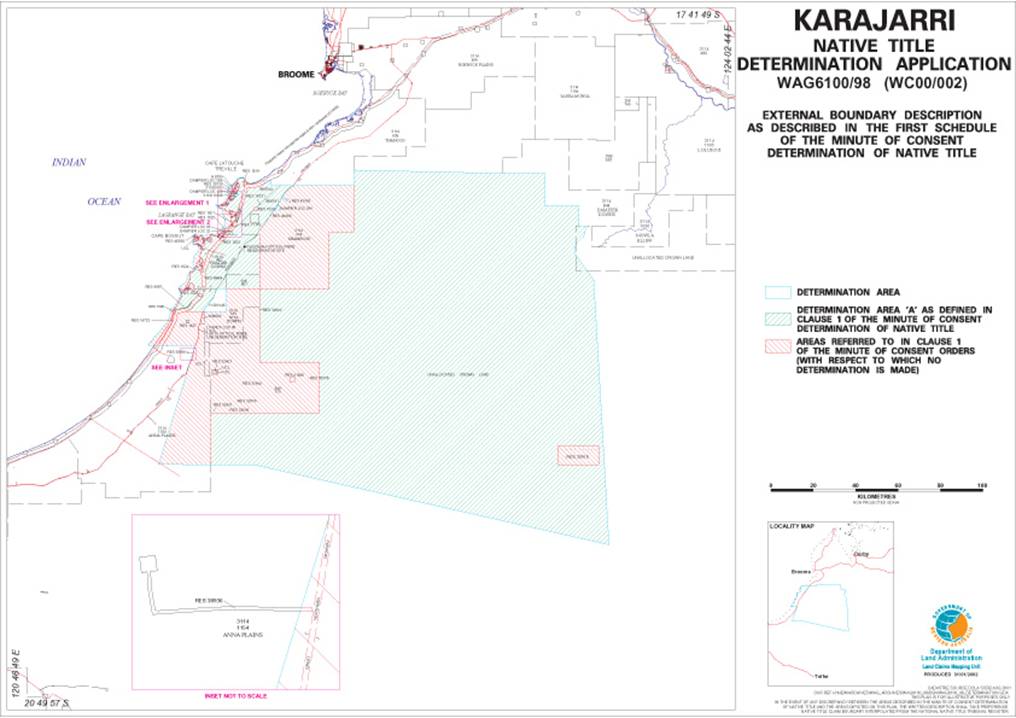
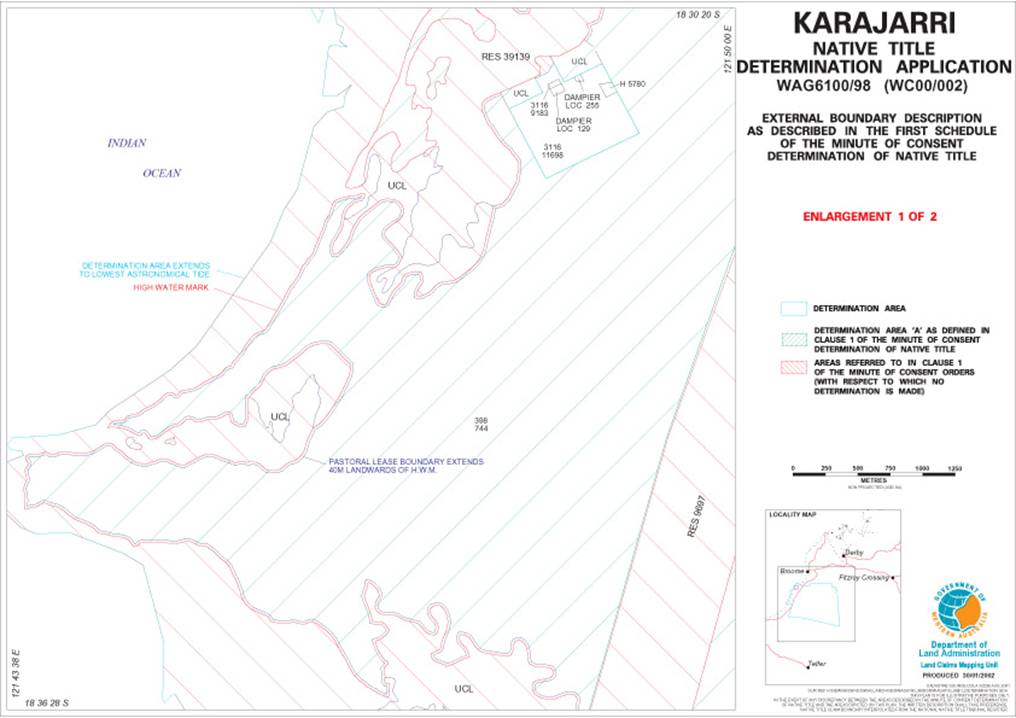
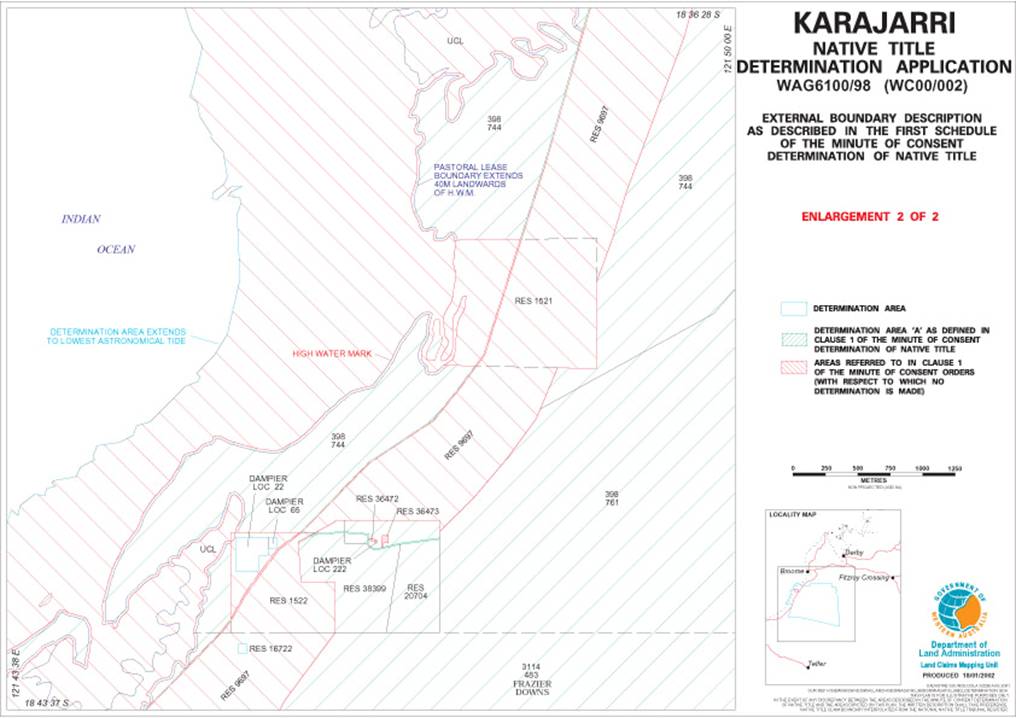
Determination Area A is depicted generally as the area hatched green on the map and enlargements accompanying the First Schedule;
“the land” means the land within Determination Area A;
“the waters” means the waters within Determination Area A excluding flowing and subterranean waters;
“flowing and subterranean waters” means those waters within Determination Area A which are:
(a) waters which flow, whether permanently, intermittently or occasionally, within:
(i) any river, creek, stream or brook; and
(ii) any natural collection of water into, through, or out of which a river, creek, stream or brook flows; and
(b) waters from and including an underground water source, including water that percolates from the ground;
“the land and waters” means “the land” and “the waters” as defined collectively.
2. Native title exists in Determination Area A.
3. The communal or group rights and interests comprising the native title in Determination Area A are held in trust by the Karajarri Traditional Lands Association (Aboriginal Corporation), a prescribed body corporate for the purposes of section 56 of the Native Title Act 1993 (Cth), for the Karajarri people as common law holders of native title. The Karajarri people are those people described in the Fourth Schedule.
4. Subject to paragraphs 5, 6, 7, 8 and 9:
(1) the nature and extent of the native title rights and interests in Determination Area A held by the Karajarri people are:
(a) the right to possess, occupy, use and enjoy the land and waters to the exclusion of all others, including:
(i) the right to live on the land;
(ii) the right to make decisions about the use and enjoyment of the land and waters;
(iii) the right to hunt, gather and fish on the land and waters in accordance with their traditional laws and customs for personal, domestic, social, cultural, religious, spiritual, ceremonial and communal needs;
(iv) the right to take and use the waters and other resources accessed in accordance with their traditional laws and customs for personal, domestic, social, cultural, religious, spiritual, ceremonial and communal needs;
(v) the right to maintain and protect important places and areas of significance to the Karajarri people under their traditional laws and customs on the land and waters; and
(vi) the right to control access to, and activities conducted by others on, the land and waters, including the right to give permission to others to enter and conduct activities on the land and waters on such conditions as the Karajarri people see fit; and
(b) the right to use and enjoy the flowing and subterranean waters, including:
(i) the right to hunt on and gather and fish from the flowing and subterranean waters in accordance with their traditional laws and customs for personal, domestic, social, cultural, religious, spiritual, ceremonial and communal needs; and
(ii) the right to take and use the flowing and subterranean waters and other resources accessed in accordance with their traditional laws and customs for personal, domestic, social, cultural, religious, spiritual, ceremonial and communal needs.
(2) The native title rights and interests are exercisable in accordance with the traditional laws and customs of the Karajarri people.
5. Notwithstanding anything in this determination the native title rights and interests (in accordance with the decision of the Federal Court in Western Australia v Ward (2000) 99 FCR 316) include ochre but do not include other minerals and petroleum as defined in the Mining Act 1904 (WA), Mining Act 1978 (WA), the Petroleum Act 1936 (WA) and the Petroleum Act 1967 (WA).
6. Nothing in paragraph 5 is intended to affect the rights of the common law holders (including any registered native title body corporate) under sub-sections 13(1) and 13(5) and the item “Revised native title determination application” in the table in sub-section 61(1) of the Native Title Act.
7. The nature and extent of other rights and interests in relation to Determination Area A are those set out in the Third Schedule.
8. The relationship between the native title rights and interests recognised by this Order and other rights and interests referred to in paragraph 7 ("the other rights and interests") is that:
(a) to the extent that the other rights and interests are inconsistent with the continued existence, enjoyment or exercise of the native title rights and interests, the native title rights and interests continue to exist, but have no effect in relation to the other rights and interests to the extent of the inconsistency for so long as the other rights and interests exist; and
(b) to avoid doubt, the existence and exercise of the native title rights and interests do not prevent the doing of the activity required or permitted to be done by or under the other rights and interests; and the other rights and interests, and the doing of any activity required or permitted to be done by or under the other rights and interests, prevails over the native title rights and interests and any exercise of the native title rights and interests, but does not extinguish them.
9. The native title rights and interests are subject to and exercisable in accordance with the laws of the State and the Commonwealth including the common law.
FIRST SCHEDULE
EXTERNAL BOUNDARY DESCRIPTION
WAG6100/98 KARAJARRI (WC00/002)
The area covered by the Native Title Determination Application is all those areas of land and waters in the State of Western Australia described as follows.
Starting at the northeast corner of pastoral lease 398/761 and extending generally south westerly along the south eastern boundaries (north western sides of the Great Northern Highway) of that lease to its southeastern corner. Then easterly to the westernmost south west corner of pastoral lease 3114/604 (Shamrock). Then generally north easterly along the north western boundaries (south eastern sides of the Great Northern Highway) of that lease to a south west corner of pastoral lease 3114/635 (Thangoo). Then easterly and northerly along the boundaries of that lease to Latitude 18.410557 South. Then easterly to the westernmost south western corner of pastoral lease 3114/844 (Dampier Downs). Then easterly, southerly, again easterly, again southerly and again easterly along the boundaries of that lease to Longitude 123.380030 East. Then generally southerly, and generally westerly passing through the following co-ordinate positions
|
LATITUDE (SOUTH) |
LONGITUDE (EAST) |
|
18.710093 |
123.367358 |
|
18.732793 |
123.337920 |
|
18.762486 |
123.326057 |
|
18.781612 |
123.326302 |
|
18.793400 |
123.334635 |
|
18.904111 |
123.412903 |
|
19.044947 |
123.421026 |
|
20.090213 |
123.481307 |
|
19.732093 |
121.890109 |
Then west along that last mentioned line of Latitude to an eastern boundary of pastoral lease 3114/1154 (Anna Plains). Then westerly to Latitude 19.730458 South, Longitude 121.461824 East, then northeasterly to a southern boundary of Reserve 38936 at Longitude 121.614920 East, then easterly, northerly and westerly along boundaries of that Reserve to Longitude 121.614975 East, then northeasterly and westerly passing through the following co-ordinate positions
|
LATITUDE (SOUTH) |
LONGITUDE (EAST) |
|
19.197809 |
121.625577 |
|
19.196344 |
121.442371 |
Then westerly to the Lowest Astronomical Tide at Latitude 19.196054 South. Then generally northwesterly along that lowest astronomical tide to Latitude 18.456532 South. Then southeasterly to the westernmost southwest corner of pastoral lease 3114/635 (Thangoo). Then easterly, southerly, and again easterly along the boundaries of that lease to the starting point.
Note: Geographic Co-ordinates provided in Decimal Degrees
Cadastral Boundaries sourced from DOLA (SCDB) January 2001
Lowest Astronomical Tide sourced from the Australian Maritime Boundary Information System (AMBIS) Data. January 2001
Datum: Geocentric Datum of Australia 1994 (GDA1994)
Prepared by: Land Claims Mapping Unit, Department of Land Administration
8 August 2001
The following areas are excluded from the Determination Area in accordance with section 61A of the Native Title Act 1993 (and section 23C of the Native Title Act 1993 and sections 12I and 12J of the Titles (Validation) and Native Title (Effect of Past Acts) Act 1995 (WA)) because they are areas where previous exclusive possession acts have occurred, native title has been extinguished in relation to the whole of these areas, and no claim to these areas can be made.
Freehold Grants:
a) Dampier Location 296 (CT 2099/606)
b) Dampier location 22 (CT 1040/610)
c) Dampier location 65 (CT 1249/828)
(d) Dampier Location 129 (CT 1480/181)
all of the above locations being subject to grants in fee simple, and
(e) the area now encompassed by Reserve 45835 which was formerly the subject of a Crown Grant to the Commonwealth of Australia (CT11245/277)
Crown Grants in Trust:
(f) Dampier location 248 (CT 3094/800) Crown Grant in Trust to the Bishop of Broome.
Special Leases:
(g) Lease H281045 under section 79 of the Land Administration Act 1997 held over an area previously subject to special lease 3116/10253 under section 116 of the Land Act 1933 for the special purposes of horticulture and cattle breeding which was still in force on 23 December 1996.
(h) Special lease 3116/11698 under section 116 of the Land Act 1933 was granted for the special purposes of airstrip and grazing and was still in force on 23 December 1996.
(i) Special lease 3116/9183 under section 116 of the Land Act 1933 was granted for the special purposes of tropical garden and bird park and was still in force on 23 December 1996.
(j) Former Special lease 3116/10564 under section 116 of the Land Act 1933 was granted for the special purposes of land base in support of pearl oyster hatchery and/or pearling activities and was still in force on 23 December 1996 (Dampier Location 255).
(k) Lease H5780 under section 79 of the Land Administration Act 1997 is held over an area previously subject to special lease 3116/9944 under section 116 of the Land Act 1933 for the special purposes of caravan park which was still in force on 23 December 1996.
Public Works:
(l) Reserve 40658 (Dampier Location 159) which was vested in the Commonwealth of Australia for the purpose of a microwave translator site on 21 October 1988 on which fixtures were validly constructed by a statutory authority of the Crown on or before 23 December 1996 (being a previous exclusive possession act under section 23B(7) of the Native Title Act 1993 and having extinguished native title to the whole of the reserve pursuant to section 23C(2) of the Native Title Act 1993).
(m) Reserve 38984 (Dampier Location 158) which was vested in the Commonwealth of Australia for the purposes of a microwave translator site on 28 December 1984 on which fixtures and a road were validly constructed by a statutory authority of the Crown on or before 23 December 1996 (being a previous exclusive possession act under section 23B(7) of the Native Title Act 1993 and having extinguished native title to the whole of the reserve pursuant to section 23C(2) of the Native Title Act 1993).
(n) Reserve 38936 (Pardu Location 15) which was vested in the Commonwealth of Australia for the purpose of a microwave translator site on 16 November 1984, on which fixtures and a road were validly constructed by a statutory authority of the Crown on or before 23 December 1996 (being a previous exclusive possession act under section 23B(7) of the Native Title Act 1993 and having extinguished native title to the whole of the reserve pursuant to section 23C(2) of the Native Title Act 1993).
(o) The Bidyadanga/La Grange Mission Telephone Exchange and Customer Radio Terminal Site (Latitude 18° 41' 07.84" S, Longitude 121° 46' 44.58" E; AMG Zone 51, North 7933.548m, East 371.247m), on which fixtures were validly constructed by a statutory authority of the Crown on or before 23 December 1996 (being a previous exclusive possession act under section 23B(7) of the Native Title Act 1993 and having extinguished native title to the whole of the site pursuant to section 23C(2) of the Native Title Act 1993).
Public Roads or Streets used by the public, including:
(p) Great Northern Highway
(q) Port Smith Road
(r) Bidyadanga Road
SECOND SCHEDULE
Section 47 of the Native Title Act 1993 (Cth) applies to the following areas within the Determination Area:
Pastoral leases 3114/483, 398/744, 398/761 and 398/681 together comprising Frazier Downs Station, but not including the site of the telecommunications regenerator site at Dampier Location 319.
Section 47A of the Native Title Act 1993 (Cth) applies to the following areas within the Determination Area:
Reserves 41648, 20704, 38399 and 11175
Section 47B of the Native Title Act 1993 (Cth) applies to the following areas within the Determination Area:
The Unallocated Crown Land to the east of Anna Plains, Nita Downs and Shamrock Stations;
Two parcels of unallocated Crown land surrounding Reserve 32603 (one being Pardu location 8) within pastoral lease 398/770 (southern part of Nita Downs);
The unallocated Crown land comprising Dampier Location 222 adjacent to reserve 36472 and surrounded by Reserve 38399;
The two areas of unallocated Crown land adjacent to special lease 3116/11698 (not including Dampier Location 255);
Those areas of unallocated Crown land between mean high water mark and the pastoral lease boundaries (not including any tidal waters landward of the mean high water mark).
THIRD SCHEDULE
The nature and extent of other rights and interests in relation to Determination Area A are:
Pastoral Leases:
(a) 3114/483, 398/744, 398/761 and 398/681 together comprising Frazier Downs Station;
Reserves:
(b) Reserve 36472 Health Clinic and Associated Staff Housing.
(c) Reserve 36473 School Site.
(d) Reserves 41648, 20704, 38399 and 11175 for the Use and Benefit of Aboriginal People.
Mining Leases:
(e) M04/244 and M04/249.
Exploration Permits:
(f) EPs 353, 390 and 391
Other Rights and Interests:
(g) Canning-Kimberley Groundwater Area proclaimed on 22 April 1997 pursuant to section 26B(1) of the Rights in Water and Irrigation Act 1914 (WA) which encompasses the entire claim area.
(h) Lease from the Aboriginal Lands Trust to the Bidyadanga Aboriginal Community La Grange Inc. over Reserves 38399 and 11175 for a period of 99 years dated 22nd October 1988.
(i) Rights and interests granted by the Crown pursuant to statute or otherwise in the exercise of its executive power.
(j) Rights and interests held by reason of the force and operation of the laws of the State or of the Commonwealth, including by force and operation of the Rights in Water and Irrigation Act 1914.
(k) Rights and interests of the pastoral lessees from time to time of pastoral leases 3114/1154 (Anna Plains Station), 398/770, 3114/789 and 398/682 (together comprising Nita Downs Station) and 3114/604 (Shamrock Station) to use and enjoy water on the pastoral leases, both flowing and subterranean, which has its source in, or passes through, Determination Area A.
(l) Rights and interests of members of the public arising under the common law.
(m) Access to areas previously unallocated Crown land by any:
(i) employee or agent of the State Government;
(ii) employee or agent of the Commonwealth Government;
(iii) employee or agent of any local government authority;
as required in the performance of his or her statutory or common law duties where such access would be permitted to private land.
(n) Existing rights of the public to access and enjoy:
(i) waterways; or
(ii) beds and banks or foreshores of waterways; or
(iii) coastal waters; or
(iv) beaches; or
(v) stock routes.
(o) The interests of Telstra Corporation Limited:
(i) as the owner and operator of the telecommunications facilities installed within Determination Area A, including:
(a)radio terminals; and
(b)optical fibre and other cabling.
(ii) created pursuant to the Post and Telegraph Act 1901 (Cth), the Telecommunications Act 1975 (Cth), the Australian Telecommunications Corporation Act 1989 (Cth), the Telecommunications Act 1991 (Cth) and the Telecommunications Act 1997 (Cth).
(p) Rights of access by employees, agents or contractors of Telstra Corporation Limited to its telecommunications facilities in Determination Area A in the peformance of their duties where such access would be permitted to private land.
(q) (i) Rights of the holders from time to time of the mining tenements and petroleum interests described in paragraphs (f) and (g) above to use (including by servants, agents and contractors) the existing roads and tracks in the determination area in order to have access to such mining tenements and petroleum interests.
(ii) Nothing in paragraph q(i) above allows any upgrade, extension, widening or other improvement to the road or track other than work done to maintain such road or track in reasonable repair.
(r) Access to and use of Bores (established by the Department of Main Roads) and Gravel pits used for maintenance of the Great Northern Highway (GNH) by the Department of Main Roads, its servants, agents and contractors, those bores and gravel pits being:
· Nita Downs No 1 Water Bore is located at 1960.25 SLK, 19deg13'49"S, 121deg37'04"E, offset 100 metres to the right of the GNH, comprising an area of 6 hectares;
· Nita Downs No 2 Water Bore is located at 1971.02 SLK, 19deg08'20"S, 121deg38'23"E, offset 150 metres to the right of the GNH, comprising an area of 6 hectares;
· Stanley No 1 Water Bore is located at 1981.80 SLK, 19deg02'40"S, 121deg39'55"E, offset 272 metres to the right of the GNH, comprising an area of 8.25 hectares;
· Gravel Deposit is located at 2020.89 SLK, offset 2300 metres to the left of the GNH, comprising an area of 12.3 hectares (comprising a public work in accordance with section 251D of the Native Title Act 1993 (Cth)) ;
· Water Bore Rest Area is located at 2040.7 SLK, offset 350 metres to the left of the GNH, comprising an area of 4.9 hectares.
· La Grange No 1 Water Bore is located at 2045.65 SLK, 18deg34'24"S, 121deg56'35"E, offset 100 metres to the right of the GNH, comprising an area of 6 hectares;
· La Grange No 2 Water Bore is located at 2055.07 SLK, 18deg29'53"S, 122deg02'21"E, offset 150 metres to the left of the GNH, comprising an area of 6 hectares;
(s) Access to Reserve 45835 "Historical Lighthouse Site" by employees or agents of the Shire of Broome, the State Government or the Commonwealth Government in the performance of their duties or members of the public for identified purposes.
(t) The Access Agreement made between the Karajarri People, Western Agricultural Industries and the State of Western Australia, being Annexure A to this determination.
FOURTH SCHEDULE
"Karajarri" means those people who refer to themselves as Karajarri, being persons who:
(a) are of Karajarri descent;
(b) identify as Karajarri and are accepted as such by the Karajarri;
(c) adhere to Karajarri customs and traditions; and
(d) are by Karajarri laws and customs entitled to the use or occupation of the Karajrri lands irrespective of whether or not the traditional entitlement is qualified as to place, time, circumstance, purpose or permission and includes those persons having native title thereto under common law.
|
IN THE FEDERAL COURT OF AUSTRALIA |
|
|
WG 6100 OF 1998 |
|
JUDGE: |
|
|
DATE: |
|
|
PLACE: |
REASONS FOR JUDGMENT
1 One of the impressions with which I left the Kimberley after the first hearing of the application of the Karajarri People, was the richness of its current music tradition. I wondered, as I contemplated today’s proceedings, whether shortly we might have, from Jimmy Chi or The Pigrams or maybe even Mervyn Mulardy Junior and his Shovellor Band, a new song reflecting the long road that has come to an end today.
2 The purpose of the hearing today is for the Court to consider whether to make orders giving effect to an agreement of the parties as to part of the area of the land for which a determination of native title is sought. The making of an agreement is not the end of the road. The agreement must be sanctioned by the Court.
3 The application was filed as long ago as June 1996. The combined application was accepted for registration on 25 February 2000 after the 1998 amendments to the Native Title Act 1993 (Cth) (the Act). Those amendments also prescribed the Federal Court as the forum in which native title determination applications are filed and progressed until a determination by the Court or other relevant order is made.
4 The hearing of this application commenced, as many of you here will know, in the Broome Courthouse on 20 June 2000. It proceeded until 22 July 2000. In all, the case occupied twenty-seven sitting days. Most of the hearing took place on country, first at Bidyadanga just over the way from where we are now sitting and then at a number of coastal sites which the Court visited with the claimants, lawyers and other representatives in a four wheel drive convoy. Those sittings were held under canvas or in the open.
5 Then between 19 and 22 July 2000 the Court, the parties and their representatives were taken east into the Great Sandy Desert into the unallocated Crown Land where the Court sat at a number of memorable places including Munro Springs, Kurriji Pa Yajula, Pirrijiti, Jawani Jawani and Yilpi.
6 The Court heard evidence from about forty witnesses. The evidence occupies over 2400 pages of transcript. Most of the witnesses were Karajarri people and Aboriginal people from neighbouring areas. The evidence of all of these people was central to the applicants’ case. Of particular importance was the evidence of John Dudu Nangkiriny, Steven Possum, Mervyn Mulardy Senior, Norman Munro, Donald Grey, Edna Hopiga, Patrick Dodson, Peter Clancy and Mervyn Mulardy Junior.
7 The Court also heard evidence from anthropologists, historians, linguists, hydrogeologists and several other people. Again, without seeking to minimise the evidence of any of those witnesses, special acknowledgment should be directed to the great assistance given by the evidence of the anthropologists, Doctor Bagshaw, Mrs Yu and Professor Maddock.
8 Even while the Court was in the course of hearing the case, mediation was continuing. This was done with the assistance of the National Native Title Tribunal. Only a matter of days ago agreement was reached in relation to a large area of land which is the subject of the application.
9 The parties have now asked the Court to make orders reflecting the agreement. The agreement simply described is that the Court should determine as a matter of law that native title exists in part of the area called Determination Area A. That area appears on the map accompanying the First Schedule to the agreement, in hatched green, the claim area being that bounded by the turquoise line. So, it is obvious that the area, Determination Area A, is a most substantial area of land. It comprises approximately 24,000 square kilometres.
10 The agreement is that the native title rights and interests in the area are held in trust by the Karajarri Traditional Lands Association and that, subject to some limitations outlined in the agreement, the central right of the Karajarri people is described in paragraph 4(1)(a) of the draft determination as follows;
“The nature and extent of the native title rights and interests in Determination Area A held by the Karajarri people are the right to possess, occupy, use and enjoy the land and waters to the exclusion of all others.”
11 The limitations recognise that persons holding rights such as mining leases are entitled to exercise those rights.
12 Section 87(1) of the Act allows the Court to make an order giving effect to an agreement relating to part of the native title application subject to two conditions. The first is that the order reflecting the agreement must be within the power of the Court. The second is that it appears appropriate to the Court to do so.
13 As to the question of power, the agreement of the parties is that the Court make a determination that native title exists. The Court has power to make such a determination. An order which makes such a determination must set out the details required by s 225, such as who holds the title and the nature and extent of those interests. The proposed orders meet those requirements. Consequently, the first condition is satisfied.
14 The second condition is that the Court is of the view that the agreement is appropriate. Ordinarily, this condition will be satisfied if the Court concludes that the agreement was freely entered into by the parties without duress, fraud or misrepresentation. Where the agreement occurs early in a case, the Court may not be in a position to assess whether the outcome is fair and reasonable. It will rely on the fact of the agreement alone. But in this case, the agreement comes at the end of the evidence. The Court is, in such a case, able to assess the appropriateness of the agreement with much fuller information.
15 Mr Irving, who appeared as counsel for the applicants, has prepared a lengthy submission in which he identifies each element necessary to be established in order to entitle the applicants to an order that the determination that native title exists. The submission then cited evidence which established each of those elements. He has done a very thorough job. I have no doubt that the agreement reached is appropriate. I rely primarily on the fact that the parties have freely agreed to the terms of the orders. The fact that there is evidence before the Court which justifies the order confirms the view that the agreement freely made is appropriate. It follows that the Court will shortly make the orders sought giving effect to the agreement of the parties which recognises that the Karajarri people have native title in Determination Area A.
16 Before doing that, there are some concluding remarks which I wish to make. There are a considerable number of people who regard the promise of radical change occasioned by the Mabo v Queensland (1992) 175 CLR 1 (Mabo) decision as largely unfulfilled. Whatever the correct view about that is, Mabo stimulated parliament to legislate a framework within which native title could be found to exist. That framework governed the conduct of this case. It has produced an outcome for all parties in relation to part of the land. But the process requires the public investigation by the Court into the most private and even secret areas of the lives and histories and laws of the Aboriginal people making the application. This case demonstrated the highly intrusive nature of that inquiry. This was so even though the respondents’ lawyers acted with sensitivity and restraint throughout.
17 The Aboriginal witnesses should be congratulated for their courage, dignity and fortitude in facing the burden placed upon them by the process of litigation. Once the wider Australian community is exposed to the people who gave evidence and the stories they told in this case and similar cases, they will come to accept with ease the basis and strength of the culture and the law of the Aboriginal people.
18 The evidence given in this case is preserved for history in the transcript of proceedings. In time it will contribute to creating an understanding which would not have existed without this case. That said, no transcript can record the beauty of Edna Hopiga’s singing, the corroboree or Mullet’s music, all of which was admitted as part of the evidence in the case.
19 Furthermore, the evidence given by the senior law people of the Karajarri People has been heard throughout the local community, and, in particular, by the young people. The proceedings gave these young people an opportunity to observe the respect accorded to their elders by the Australian people through the court system.
20 I also wish to acknowledge the contribution of a number of the people involved in the case. All of the legal representatives should congratulated for the way in which they conducted the case. The proceedings gave rise a number of novel issues. Some were matters of particular sensitivity. All the lawyers did a wonderful job, and it gives me pride to be a member of a profession that can adapt to new circumstances in the way that they have.
21 Of course, we are here today, not because there was litigation in the Court, but because outside the Court the parties had the good sense to reach an agreement. That, no doubt, reflected the efforts of many people and some of those have been acknowledged already. The position of the Court is remote from the mediation and that is as it must be. The Court does not know what occurred in the process of mediation. It does know, however, that the process of mediation could not have occurred without the good offices of the National Native Title Tribunal and its staff. In particular the efforts of the Honourable Fred Chaney, Bardi McFarlane and Anita Field should be acknowledged.
22 It is right also to pay tribute to some particular contributions by members of the staff of the Court itself. Many of the lawyers have had dealings with Martin Jan and his staff at the Perth Registry. You will remember Colin Banks who attended with Bob Sheppard at the on-country hearings. Words are inadequate to describe the contribution that Bob has made to the conduct of the proceedings. I need not say anything about his efforts to those who came on country. He commanded, cajoled, abused, offended but kept us all to a timetable. He did a remarkable job. He continues to do a remarkable job and it would be a great dereliction of my duty not to pay tribute to his great efforts on this occasion.
23 Ordinarily judges do not, in the course of a judgement, acknowledge the contribution of their staff because their staff do what their job requires. But I’m sure all those who saw my previous associate, Nehal Bhuta, in operation will understand his deep interest, commitment and knowledge about the Karajarri application which he has passed on to my current associate, Jessica Howard, who sits on my left. They have been of enormous assistance to me, as has Tarwin Shiel, my personal assistant who was present at some of the hearing on-country.
24 The transcript of the proceedings is a valuable product of these hearing. It is the result of the efforts of Graham, Irene and Kathryn Donges. They have served the Court, and the cause of this litigation with great diligence and I thank them for it.
25 Shortly, I will sign the orders which will effect the formal determination of native title. That is the legal act which brings to a close this part of Australian legal and Karajarri history. But, in closing, I wish to address perhaps the greatest significance of this day at Bidyadanga.
26 The people of Australia, through laws made by our elected representatives in parliament, have recognised that indigenous people have rights and interests in land. The law sets out the circumstances in which the rights of those people are recognised and gives the Federal Court the power to determine when those circumstances exist. This law does not grant land rights to Aboriginal people. It creates nothing new with respect to the land. It recognises long standing traditional rights and interests under Aboriginal law.
27 Today is the day of formal recognition under the laws of Australia by all the people of Australia of the ancient rights and interests of the Karajarri people in their land. It is a moment of celebration and joy for all Australians. This act of recognition is a foundation upon which reconciliation is being built. I am immensely proud that my signature on these orders will carry the message of the Australian people to the Karajarri people that justice is now being done.
28 I now make the formal orders determining that native title exists in favour of the Karajarri people in relation to Determination Area A.
|
I certify that the preceding twenty-eight (28) numbered paragraphs are a true copy of the Reasons for Judgment herein of the Honourable Justice North. |
Associate:
Dated: 24 May 2002
|
Counsel for the Applicant: |
Mr K P Howie with Mr G Irving |
|
|
|
|
Solicitor for the Applicant: |
Kimberley Land Council Aboriginal Corporation |
|
|
|
|
Counsel for the State of WA: |
Ms R Webb with Mr B King & Ms S Begg |
|
|
|
|
Solicitor for the State of WA: |
Western Australian Prime Solicitor |
|
|
|
|
Counsel for the fishing interests: |
Ms K White and later Mr T McKenna |
|
|
|
|
Solicitor for the fishing interests: |
Hunt & Humphry |
|
|
|
|
Counsel for the Pastoral Industry: |
Mr A J Power with Mr P Bishop and Ms S L Moir (appearing occasionally) |
|
|
|
|
Solicitor for the Pastoral Industry: |
Jackson McDonald |
|
|
|
|
Date of Hearing: |
20-22 June 2000, 3-22 July 2000, 19-22 February 2001, 28-30 March 2001, 12 February 2002 |
|
|
|
|
Date of Judgment: |
12 February 2002 |


