

FEDERAL COURT OF AUSTRALIA
Shargrate Pty Ltd v .AU Domain Administration Limited [2002] FCA 657
SHARGRATE PTY LTD & ANOR v .AU DOMAIN ADMINISTRATION LIMITED
N 441 of 2002
SACKVILLE J
SYDNEY
24 MAY 2002
|
IN THE FEDERAL COURT OF AUSTRALIA |
|
|
NEW SOUTH WALES DISTRICT REGISTRY |
N 441 OF 2002 |
|
BETWEEN: |
SHARGRATE PTY LTD FIRST APPLICANT
MARGARET SMYTH SECOND APPLICANT
|
|
AND: |
AU DOMAIN ADMINISTRATION RESPONDENT
|
|
SACKVILLE J |
|
|
DATE OF ORDER: |
24 MAY 2002 |
|
WHERE MADE: |
SYDNEY |
THE COURT ORDERS THAT:
1. The application for interlocutory relief be dismissed.
Note: Settlement and entry of orders is dealt with in Order 36 of the Federal Court Rules.
|
IN THE FEDERAL COURT OF AUSTRALIA |
|
|
NEW SOUTH WALES DISTRICT REGISTRY |
N 441 OF 2002 |
|
BETWEEN: |
SHARGRATE PTY LTD FIRST APPLICANT
MARGARET SMYTH SECOND APPLICANT
|
|
AND: |
AU DOMAIN ADMINISTRATION RESPONDENT
|
|
JUDGE: |
SACKVILLE J |
|
DATE: |
24 MAY 2002 |
|
PLACE: |
SYDNEY |
REASONS FOR JUDGMENT
1 The applicants seek urgent interlocutory relief to restrain the holding of an auction by the respondent in relation to the generic domain name “immigration.com.au”. The form of relief sought is that the respondent be restrained from holding the auction, which is apparently scheduled to commence next week, until the information provided by the applicants prior to a “determination” of 14 May 2002, be considered without recourse to certain guidelines published by the respondent on 28 February 2002.
2 The first applicant (“Shargrate”) is a company incorporated in New South Wales on 23 December 1997. The second applicant (“Ms Smyth”) is the sole director and shareholder of Shargrate. Shargrate trades under the name “IMMICARE Immigration Advisory Service”. Ms Smyth, however, is the registered proprietor of the business names “IMMICARE” and “Immigration Advisory Service”.
3 Ms Smyth sought leave to appear in the proceedings on behalf of Shargrate pursuant to Federal Court Rules (“FCR”), O 4 r 14(2) (which provides that a corporation may not, without the leave of the Court, commence or carry on proceedings otherwise than by a solicitor). I granted leave because she had been given that leave when the matter was before the Duty Judge on 16 May 2002 and Mr Pritchard, who appeared on behalf of the respondent, did not object to her representing Shargrate. I took this course reluctantly. Cases of this kind are difficult enough to deal with at short notice without having the additional complications flowing from the fact that a corporate applicant seeking relief is represented by a non-legally qualified person: cf Molnar Engineering Pty Ltd v Burns (1984) 3 FCR 68; Termi-Mesh Australia Pty Ltd v Josu Manufacturing Pty Ltd [1999] FCA 1241. There was no suggestion that Shargrate was unable to afford legal representation. Indeed, the very point of the litigation is to enable it to bid at an auction for what Ms Smyth presumably regards as a potentially valuable business asset for the company she controls.
4 The respondent (“auDA”) is a company limited by guarantee and is said to be a non-profit corporation that acts as the industry self-regulator of the “.au” Australian internet domain names system. At the highest level the domain name system is co-ordinated and controlled by the United States Department of Commerce. That Department has delegated its functions to the Internet Corporation for Assigned Names and Numbers (“ICANN”). ICANN controls top level names such as “.com” and “.net”, as well as the two letter designation of country code top level domains such as “.au”. The “.au” suffix indicates that the domain name originates in Australia.
5 The Commonwealth has endorsed auDA as the appropriate authority to administer, under delegation from ICANN, the “.au” country code top level domain (“.au ccTLD”). That authority has been conferred by a sponsorship agreement between ICANN and auDA. The preamble to the Constitution of auDA recites that
“the Internet Domain Name System is a public asset, and that the .au ccTLD is under the sovereign control of the Commonwealth of Australia, [and that] auDA will administer the .au ccTLD for the benefit of the Australian community.”
Clause 3.2(f) of the Constitution requires auDA to adopt open and transparent procedures which are inclusive of all parties having an interest in use of the domain name system in Australia.
6 Prior to the delegation of the .au ccTLD to auDA, a name allocation policy applied in respect of the com.au second level domain (that is, the second level of an Internet address), which prohibited registration of generic words as domain names. Apparently a recommendation was made by an advisory committee that this policy be changed and auDA released 3006 previously unavailable generic domain names. In conformity with this policy, auDA has commenced conducting online auctions for generic domain names for pre-registered and approved bidders. The online auction for the name “immigration.com.au” has not yet commenced, but is scheduled to do so shortly.
7 On 18 December 2001, auDA issued a press release advising that 3006 generic domain names would be auctioned. A list of available names was published on a website. The list included immigration.com.au. The closing date for applications was set as 31 January 2002 and the website advised prospective applicants that applications received after the closing date would be ineligible. Under the heading “ELIGIBILITY” the website contained the following information:
“In order to successfully apply for a name on the list, applicants must be eligible under the NEW com.au policy, to be introduced in 2002. Please ensure that you have read the policy prior to making an application.
In order to provide a level playing field and prevent applicants from establishing a business entity specifically to be eligible for a generic name, applicants must have been eligible under the new com.au policy on or before 13 August 2001. Your application will be checked to ensure you were eligible at this date.
So, for example, if you are applying on the basis that the generic name is part of your company name, it must have been part of your company name on or before the 13 August 2001.” (Emphasis in original.)
The website also contained information about the bidding process, including the terms and conditions of the auction, which was open only to “Registered Bidders”. The website indicated that the funds received would assist with auDA’s ongoing cost of operations and, ultimately, would reduce auDA’s domain name fee.
8 It was common ground that the new com.au policy consisted of a document (published on the website) headed
“auDA DOMAIN NAME ELIGIBILITY AND ALLOCATION POLICY RULES FOR .AU OPEN SECOND LEVEL DOMAINS” (the “RULES”).
The RULES included the following provisions:
“1.1 The document sets out the policy rules that govern the granting of domain name licences in the open second level domains (2LDs) in the .au.cccILD.
…
2. DOMAIN NAME LICENCES
2.1 There are no proprietary rights in the domain name system (DNS). A registrant does not ‘own’ a domain name. Instead, the registrant holds a licence to use a domain name, for a specified period of time and under certain terms and conditions.
…
6. CHANGES TO POLICY
6.1 From time to time, auDA may update this document for the purposes of clarification or correction (for example, if there is a change of terminology with regard to ASIC or ATO business identifiers).
6.2 auDA will not make any major changes to this document without conducting an Advisory Panel process, as described in auDA’s Constitution and Advisory Panel Procedures…”.
9 Section A of the RULES contained “ELIGIBILITY AND ALLOCATION RULES FOR ALL OPEN 2LDS”. Clause 1 of Section A stated that domain name licences are allocated on a “first come, first served” basis. Clauses 2 and 3 of Section A provided as follows:
“Registrants must be Australian
2. Domain name licences may only be allocated to a registrant who is Australian, as defined under the eligibility and allocation rules for each 2LD.
Substantial and close connection
3. There must be a substantial and close connection between the domain name and the domain name licence holder, as defined under the eligibility and allocation rules for each 2LD.”
10 Section C of the RULES specified the “ELIGIBILITY AND ALLOCATION RULES FOR COM.AU”:
“The com.au 2LD is for commercial entities.
The following rules are to be read in conjunction with the Eligibility and Allocation Rules for All Open 2LDs, contained in schedule [sic] A of this document.
1. Registrants must be:
a) a commercial entity registered and trading in Australia, evidenced by:
(i) an Australian Company Number (ACN); or
(ii) an Australian Business Number (ABN); or
(iii) an Australian Registered Body Number (ARBN); or
(iv) a Business Name registered in any Australian State or Territory; or
b) an owner of an Australian Registered Trade Mark; or
c) an applicant for an Australian Registered Trade Mark.
2. Domain names must:
a) exactly match the:
(i) name used by the registrant to register an ACN, ABN, ARBN or Business Name; or
(ii) words comprising the registrant’s Australian Registered Trade Mark; or
(iii) words comprising the mark contained in the registrant’s application for an Australian Registered Trade Mark; or
b) be an acronym or abbreviation of 2a) (i), (ii) or (iii); or
c) be otherwise substantially and closely connected to 2a) (i), (ii) or (iii).”
11 On 31 January 2002, Ms Smyth completed an on-line application on behalf of Shargrate at the relevant website as follows:
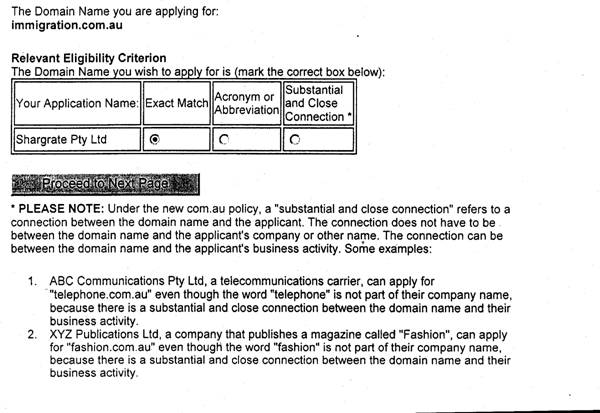
It will be seen that Shargrate applied for the “Exact Match” category.
12 The information on the website included this statement:
“Your application will be processed, and you will be contacted by auDA as to the outcome of your application.
If your application is successful, and you are the sole applicant, the domain name will be reserved for you.
If your application is successful, and there are other successful applicants for the domain name, auDA will create a special Stuff member account, which you can then use to bid on the domain name. The login details for your Stuff account will be sent to you by auDA.”
13 On 12 February 2002, Ms Smyth signed a letter on IMMICARE letterhead addressed to auDA, as follows:
“On 31 January last we expressed interest in the Generic Domain Name Auction by registering on the web site Stuff.com.au.
The domain names we expressed interest in were:
Immigration.com.au
migration.com.au
visas.com.au
Our application was under our company name of Shargrate Pty Ltd which trades as IMMICARE Immigration Advisory Service.
We notice you undertake an eligibility process prior to the auction and our purpose in writing this letter is to clarify that our business includes immigration/migration advice and the obtaining of visas for our client base, which, in our submission, will meet that test.
Sincerely,
(Margaret J Smyth)
IMMICARE.”
14 On 28 February 2002, auDA published “GUIDELINES FOR ASSESSMENT OF APPLICATION FOR GENERIC DOMAIN NAMES (“GUIDELINES”). It is not clear whether the “GUIDELINES” were regarded as a “clarification” of the RULES for the purposes of cl 6.1 of the RULES or whether they were the product of the Advisory Panel process contemplated by cl 6.2 of the RULES or neither of those.
15 The GUIDELINES included the following provisions:
“2. GENERAL INSTRUCTIONS
…
2.5 Decisions must be made solely on the basis of information provided in the application itself. Registrars must not contact the applicant for further information. In the case of the ‘close and substantial connection’ criterion, if the applicant has not provided coherent and comprehensive reasons, then the application must be rejected.
2.6 Some applicants may have chosen the wrong allocation criterion. If the applicant marked ‘exact match’ when the domain name is really an abbreviation or acronym, or vice versa, then the application can be accepted. If the applicant marked ‘close and substantial connection’ when the domain name is really an exact match, abbreviation or acronym, then the application can be accepted.
2.7 However, if the applicant wrongly marked ‘exact match’ or ‘abbreviation or acronym’ but the domain name might be a close and substantial connection, the application cannot be accepted, because no reasons have been provided.
…
5. MEANING OF ‘EXACT MATCH’
5.1 An ‘exact match’ is defined as ‘all words comprising the company or business name, trade mark or trade mark application, and in the same order’.
…
8. MEANING OF ‘CLOSE AND SUBSTANTIAL CONNECTION’
8.1 The purpose of this rule is to allow some flexibility in determining an applicant’s eligibility to license a particular domain name. As such, the rule is necessarily subjective and registrars often will be required to make their own judgements. It is important to note that this rule is NOT intended as a ‘free for all’, and the degree of flexibility is limited by the guidelines listed below.
…
8.4 There are two elements to the rule: Is there a connection between the domain name and the applicant? Is the connection close and substantial?
…
8.6 It is not possible to formulate a totally accurate, comprehensive definition of ‘close and substantial’, however it is possible to state some general principles.
8.7 The connection IS ‘close and substantial’ if:
…
b) the domain name is the generic name of a product that the applicant sells, or a service that the applicant provides, or a venue that the applicant operates, at the time of application.
8.8 The connection IS NOT ‘close and substantial’ if:
a) the domain name is the generic name of a product or service for which the applicant provides advice, information, maintenance, repairs, marketing, advertising, consulting, training or other secondary services.”
16 On 14 May 2002, Ms Smyth sent a letter to auDA’s solicitors which she signed as
“Director
Shargrate Pty Ltd T/AS
IMMICARE Immigration Advisory Service”.
In this letter she complained that
- the RULES made no mention of an auction of generic names nor any reference to eligibility for such an action;
- the GUIDELINES were published one month after the closing date for applications; and
- at no stage was notice given that decisions would be based solely on information in the application itself and that additional information would not be considered.
Ms Smyth requested that Shargrate’s application be considered, together with the correspondence of 12 February 2002, in relation to the company’s eligibility for participation in the auction.
17 The solicitors for auDA responded by pointing out that Shargrate had applied on the basis of an “exact match” between its name and “immigration.com.au”. The solicitors asserted in their letter that there was clearly no exact match and that auDA was therefore not in a position to consider the application further. The response noted that there was a review process available, although the solicitors did not explain what that review might achieve from Shargrate’s perspective having regard to the terms of their letter.
18 One other factual matter should be mentioned. Mr Pritchard pointed out in the course of argument that Shargrate was not the registered proprietor of the business names “IMMICARE” or “Immigration Advisory Service”, even though Ms Smyth’s evidence was that Shargrate was carrying on business under those business names. Mr Pritchard submitted that since Ms Smyth was the registered proprietor of both business names, Shargrate was contravening s 5(1) of the Business Names Act 1962 (NSW) (“Business Names Act”). Section 5(1) prohibits a person carrying on business under a business name unless the business name consists of the name of that person or the business name is registered under the Act in relation to that person and each other person in association with whom that person is so carrying on business. The name of a corporation for the purpose of s 5(1) of the Business Names Act is “the corporate name of the corporation”: s 5(2)(b).
19 In an endeavour to meet this difficulty, Ms Smyth tendered what she said was a copy of a “Deed of Assignment” between Shargrate and Ms Smyth, dated 8 December 2000. Under the deed, Ms Smyth assigned to Shargrate and herself “the whole right, title and interest in the proprietary right of the business name, Immigration Advisory Service”. The copy tendered shows no evidence of being stamped.
20 Mr Pritchard objected to the tender although it was only in a supplementary written submission that he identified the provision in which he relied, namely s 304 of the Duties Act 1997 (NSW) (“Duties Act”). He submitted that the deed was dutiable as it affected a transfer of “dutiable property”, being a business asset comprising the goodwill of the business or a “statutory licence or permission under a New South Wales law”: ss 8(1)(a), 11(1)(g), (h), 12(1).
21 The admissibility of the unstamped copy deed raises a nice question that was not argued. I am inclined to think that the unstamped document is not admissible, on the basis that it involves a transfer of a “business asset” and is thus caught by s 304 of the Duties Act. Ms Smyth, after the hearing, advised that she sought to have the document transmitted to the Chief Commissioner pursuant to s 304(2) of the Duties Act, thereby overcoming the difficulty. But even if the document were admitted into evidence, it would not improve Shargrate’s position. First, there was no evidence of an assignment of the business name “IMMICARE”, which is the name prominently displayed on Shargrate's letterhead (without the letterhead making any reference to Shargrate by name). Secondly, there is no evidence, despite the assignment, that Shargrate is registered as the proprietor of the business name “Immigration Advisory Service”.
22 As I understood the argument advanced on behalf of Shargrate, it was that auDA had infringed s 51AC(1) of the Trade Practices Act 1974 (Cth), which provides as follows:
“(1) A corporation must not, in trade or commerce, in connection with:
(a) the supply or possible supply of goods or services to a person (other than a listed public company); or
(b) the acquisition or possible acquisition of goods or services from a person (other than a listed public company);
engage in conduct that is, in all the circumstances, unconscionable.”
It was said that auDA had acted unconscionably in relying on the GUIDELINES, which had been introduced only after the closing date for applications.
23 An argument was also put that the RULES were “inoperative” because they were concerned with registration after allocation of domain names. This argument can be put to one side as it seems to reflect some confusion on Ms Smyth’s part arising from the use of the word “registrant” in different senses. It is clear that the RULES were intended to govern eligibility for the allocation of domain rules. It is true that the RULES did not specifically refer to the auction process, but other documents did. Indeed, the information accompanying the electronic application “form” made it clear that the consequences of a successful application, assuming other applicants were interested in the same domain name, was that the “registrant” would be able to bid for the name.
24 The starting point in assessing Shargrate’s unconscionability argument is that it specifically applied for a domain name on the basis of an “exact match”. There is no suggestion that Shargrate, through Ms Smyth, was misled in taking this course. The notation on the website extracted at [11] above, made it quite clear that it was open to Shargrate to apply on the basis of the more generous test of a “substantial and close” connection. It did not do so.
25 Ms Smyth did not suggest that Shargrate could qualify as a registrant eligible to bid by reason of an “exact match”. Nothing in the GUIDELINES has adversely affected Shargrate in this respect, since it could never have demonstrated an exact match with “immigration.com.au”.
26 Shargrate’s real complaint is that the additional information in its letter of 12 February 2002 was not taken into account. In that letter Shargrate did not specifically request that its application be treated as having been made on the basis of Shargrate’s “substantial and close connection” with the domain names in which it was interested. Indeed, it is not clear precisely what action Ms Smyth was asking auDA to take in that letter.
27 If the letter is to be understood as asking auDA to treat Shargrate’s application as having been made on the basis of its close and substantial connection with the domain name, it is difficult to see why auDA’s insistence on decisions being based solely on the information in the application itself (GUIDELINES, cl 2.5) is to be characterised as unconscionable. It is true that the GUIDELINES were published after the closing date for applications. Perhaps that was a course fraught with danger, especially if the GUIDELINES went beyond the changes contemplated by cl 6 of the RULES. But there is no evidence that Shargrate, through Ms Smyth, had mistakenly believed that it could supplement the information in its application and acted in reliance on that belief. There is no evidence that auDA singled out Shargrate for adverse treatment. On the contrary, so far as the evidence goes, every applicant in Shargrate’s position has been treated in exactly the same way. Moreover, there are obvious practical reasons why the GUIDELINES insisted upon decisions being made solely on the basis of information supplied in the application. In my opinion, the applicants have not established that there is a serious issue to be tried on the question of unconscionability.
28 There is a further difficulty facing Shargrate. The best it could have hoped for was to be assessed on the basis of what it might have contended was substantial and close connection with the domain name. The letter of 12 February 2002 put Shargrate’s case on the basis that it traded as “IMMICARE Immigration Advisory Service” and that its business included immigration advice. On the evidence before me, the conduct of that business by Shargrate under the name “IMMICARE Immigration Advisory Service” was in contravention of s 5 of the Business Names Act.
29 The purpose of s 5 of the Business Names Act is to protect the public by compelling persons who do not carry on their businesses under their own names to register and thus provide a means whereby their identity and whereabouts can be readily ascertained: Corporate Affairs Commission v Bradley [1973] 1 NSWLR 382, at 389, per Sheppard J. A related purpose is to ensure that persons dealing with a business have an opportunity to know with whom they are dealing and, in particular, whether they are dealing with an individual or corporation the office-bearers of which are ordinarily not liable for the corporation’s debts.
30 In my opinion, it is difficult to see how an applicant could show a close and substantial connection with a domain name, within the meaning of the RULES, if it was conducting its business under a name (which includes the domain name) in breach of State law. In any event, I would not be prepared to grant injunctive relief at the suit of a corporation which is trading under a name in contravention of State law and which relies on that name as an element in its case for such relief: cf Ford’s Principles of Corporations Law, at [5.250].
31 I should add that the evidence suggests that Shargrate may have been in breach of s 153 of the Corporations Act 2001 (Cth), in that it does not seem to have set out its name on all its “public documents”: see s 88A(1)(b), (c). It is not, however, necessary to say anything further about this question for the purposes of these proceedings.
32 In my opinion, on the evidence before me, the applicants have failed to establish that there is a serious issue to be tried. In any event, I would not be prepared to grant Shargrate, which is the only applicant with a direct interest in the matter, an injunction of the kind sought by the applicants. The application for interlocutory relief must be dismissed.
|
I certify that the preceding thirty-two (32) numbered paragraphs are a true copy of the Reasons for Judgment herein of the Honourable Justice SACKVILLE. |
Associate:
Dated: 24 May 2002
The first applicant was represented by Ms M Smyth (by leave)
The second applicant was self-represented.
|
|
|
|
Counsel for the Respondent: |
Mr D Pritchard |
|
|
|
|
Solicitor for the Respondent: |
Henry Davis York |
|
|
|
|
Date of Hearing: |
23 May 2002 |
|
|
|
|
Date of Judgment: |
24 May 2002 |
312


