

FEDERAL COURT OF AUSTRALIA
Gambro Pty Ltd v Fresenius Medical Care Australia Pty Ltd [2002] FCA 581
PRACTICE and PROCEDURE – application seeking further discovery of documents in the possession of the parent company and related entities of the respondent outside Australia – whether documents sought are relevant – likely existence of documents – likelihood that parent company and related entities outside Australia would comply with request by the respondent for documents sought for discovery – whether hardship or oppression on respondent
Federal Court of Australia Act 1976 (Cth) s 23
Burgundy Royale Investments Pty Ltd v Westpac Banking Corporation (unreported, Federal Court of Australia, Foster J, 21 February 1990) cited
Sabre Corporation Pty Ltd v Russ Kalvin’s Hair Care Company (1993) 46 FCR 428 followed
F Hoffmann La-Roche A G v Chiron Corporation (2000) 171 ALR 295 referred to
Unilever PLC v Chefaro Proprietaries Ltd [1994] FSR 135 referred to
Molnlycke v Procter & Gamble (No 5) [1994] RPC 49 cited
Aetna Pacific Security Ltd v HongKong Bank of Australia Ltd (unreported , Supreme Court of New South Wales, Giles J, 29 April 1993) referred to
GAMBRO PTY LIMITED and GAMBRO LUNDIA AB v
FRESENIUS MEDICAL CARE AUSTRALIA PTY LIMITED
NG 474 of 1997
TAMBERLIN J
SYDNEY
10 MAY 2002
|
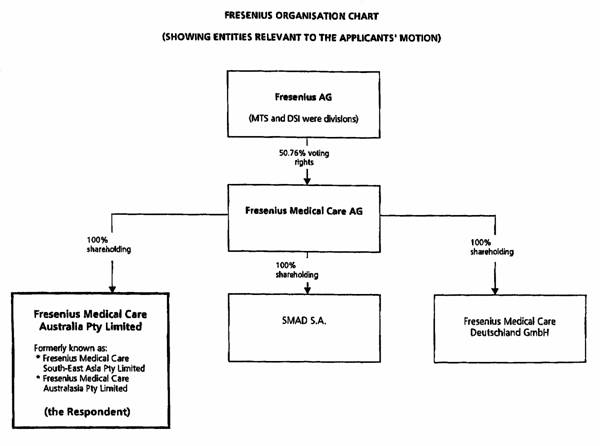
IN THE FEDERAL COURT OF AUSTRALIA |
|
|
JUDGE: |
|
|
DATE: |
|
|
PLACE: |
REASONS FOR JUDGMENT
1 The Notice of Motion filed on 15 February 2002 by the applicants (“Gambro”) seeks discovery from the respondent (“Fresenius Australia”) in relation to the following categories of documents which, as amended, are:
“AMENDED CATEGORIES 12, 13, 14, AND 15
12. All Documents containing, recording, referring to, or referred to in the course of, any research and development conducted by or on behalf of the Respondent or any Related Body Corporate of the Respondent in relation to the design, manufacture or operation of each type or model of:
(a) Dialysis Machine;
(b) article referred to in Category 4; and
(c) Modification Kit,
up to the date of the first sale, hire or other disposal in Australia of each such Dialysis Machine, article and Modification Kit respectively, including without limitation inventors notes, research records and notebooks, patents, publications and manuscripts of publications.
13. All Documents containing, recording, referring to, or referred to in the course of research and development conducted by or on behalf of the Respondent or any Related Body Corporate of the Respondent in the period beginning four years before the Priority Date and ending two years after the Priority Date directed towards:
(a) the preparation of sodium bicarbonate concentrate solutions for use in haemodialysis, haemofiltration or haemodiafiltration procedures (in particular, dissolving of hardly soluble bicarbonate into a highly concentrated solution);
(b) solving problems related to the stability of sodium bicarbonate concentrate solutions for use in haemodialysis, haemofiltration or haemodiafiltration procedures (in particular, shelf life, CO2 loss and precipitation); and
(c) minimising bacterial growth in sodium bicarbonate concentrate solutions for use in haemodialysis, haemofiltration and haemodiafiltration procedures.
14. The curriculums vitae [sic] of each of the persons employed or otherwise involved in any research, development, testing, evaluation or studies referred to in Category 13.
15. All Documents containing, recording, referring to, or referred to in the course of:
(a) any search, study or opinion by, at the request of, or on behalf of, the Respondent or any Related Body Corporate of the Respondent, as to the validity or enforceability of the Patent in any respect falling within any of the grounds in the Amended Particulars of Invalidity; or
(b) any test or evaluation by, at the request of, or on behalf of, the Respondent or any Related Body Corporate of the Respondent, to assess or determine the validity or enforceability of the Patent in any respect falling within any of the grounds in the Amended Particulars of Invalidity.”
2 The Court has previously made orders that the documents should be discovered by Fresenius Australia, which as its name suggests, is an Australian corporation. The orders presently sought concern discovery in relation to documents in the possession, custody or power of related entities which are outside Australia. In terms, the orders sought are:
“That on or before a date to be fixed by the Court the respondent take all reasonable steps available to it to obtain documents or copies thereof which fall within categories 12, 13, 14 and 15 of the Categories for Discovery from the Respondent and Cross Claimant which are set out in Annexure A to this Notice of Motion (the “Relevant Categories”), which are in the possession, custody or power of any of:
(a) Fresenius AG;
(b) Fresenius Medical Care AG (including its division known as “MTS”);
(c) Fresenius Medical Care Deutschland GmbH;
(d) SMAD SA;
(e) the entity referred to as “DSI” in the Exhibit marked “Confidential BLM 3” to the Affidavit of Benjamin Lee Miller, sworn 15 February 2002; and
…” (Emphasis in Original)
3 I granted discovery in this matter for reasons set out in my judgment given on 12 March 2001, in which I briefly described the background in this proceeding. I will not repeat these details here.
4 It is common ground that the Court has broad and flexible powers in respect to the making of orders for discovery. When called on to make such orders, the Court in the exercise of its discretion will bear in mind that O 15, r 3 of the Federal Court Rules (“FCR”) indicates that a policy of the rules is that only necessary discovery should be ordered so as to achieve the ends of justice. The Court has indicated in Practice Note No 14 that it is concerned that discovery should be kept under close supervision to ensure that there is not a disproportion between the number and extent of documents discovered, with the consequent expenditure of time and money, and the practical attainment of justice in the particular case.
5 The application is brought pursuant to s 23 of the Federal Court of Australia Act 1976 (Cth) (“the FCA”), which empowers the Court to make orders of such kinds, including interlocutory orders and to issue or direct the issue of such writs of such kinds, as the Court thinks appropriate.
Relevant principles
6 Gambro submits that the relevant principles are that the Court should have regard to the question whether the orders sought will enhance the speedy and efficient disposal of the proceedings and to the likelihood that there are relevant documents in existence. In addition, it is said that the Court should consider whether it is probable that third parties, outside Australia, would be likely to make documents available to Fresenius Australia, which is a party to the proceeding, upon request: see Burgundy Royale Investments Pty Ltd v Westpac Banking Corporation (unreported, Federal Court of Australia, Foster J, 21 February 1990).
7 The relevant principles were considered in Sabre Corporation Pty Ltd v Russ Kalvin’s Hair Care Company (1993) 46 FCR 428 at 432, where Lockhart J on a discovery application made orders requiring the party to the proceedings to request that an overseas entity, which was not a party to the proceedings, provide the Australian resident party with the specified documents. His Honour also ordered the Australian party, upon receipt of any such documents, to produce them to the Court. Gambro contends that this type of order is appropriate in the present case. In making his determination in Sabre, Lockhart J said at 432:
“This is a case where there is a real likelihood that the applicant will be provided access to the relevant documents by Joico should it request it. Joico manufactures the products in the United States and the applicant is the exclusive Australian distributor of them in Australia and has held that distributorship since 1985. My view is strengthened by certain of the [sic] provisions of the current distributorship agreement between them, in particular cl. 11.3, …”
8 It will be noted that his Honour made a factual finding that there was a likelihood the documents would be provided if a request was made. This approach was cited by Burchett J in F Hoffmann La-Roche A G v Chiron Corporation (2000) 171 ALR 295 at 299 where the leading authorities are revisited in some detail.
9 Gambro also refers to the observations of Hoffmann LJ in Unilever PLC v Chefaro Proprietaries Ltd [1994] FSR 135 at 143 where his Lordship expressed the view that in principle, discovery of research and development documents should be available against a multinational corporation on a group basis. Essentially, this is what is being sought in the present case.
10 Mr Kerr, for the respondents, submits that in discharging its discovery obligations, Fresenius Australia should not be required to take any steps to obtain access to any documents which are in the custody, possession or power of its overseas parent company or any other related body corporate. In my view, this general statement is qualified by the approach taken by Lockhart J in Sabre which I think is appropriate in this case.
11 Before such orders are made, however, it is necessary to consider the questions whether any such documents are likely to exist, whether they could be relevant and whether they could reasonably be regarded as relevant and, whether there is any likelihood that if a request is made by Fresenius Australia to the overseas entities, such a request will be granted.
INTER-RELATIONSHIP
12 The diagram below sets out the inter-relationship between the relevant overseas entities in the Fresenius Group and their relationship to Fresenius Australia.
Relevance
13 Gambro submits that the documents requested could be relevant to the issue as to whether there is an inventive step and as to obviousness and points to the wide range of issues raised in this proceeding which extend to questions of infringement. The documents are sought in so far as they produce evidence of contemporary events, which could in turn remove the danger of approaching the matter with the benefit of hindsight: see Molnlycke v Procter & Gamble (No 5) [1994] RPC 49. The relevance of the documents sought is contested by Fresenius Australia.
14 In Australia, Gambro submits that there is no evidence of relevant research and development being conducted before the priority date. There is evidence that dialysis machines sold in Australia as at the relevant dates were manufactured overseas and imported into Australia. There is also evidence that the development of the dialysis process was made outside Australia. In Australia the suppliers acted as distributors only. Gambro relies on the discovery made by Fresenius Australia to support its case as to the relevance of the material to certain parties and the appropriate qualifications, experience, and state of knowledge which should be attributed to a skilled addressee at the relevant times. Gambro also points out that there was no commercial research or development carried out in Australia in this specific area at those times. I note that Fresenius Australia has itself agreed to discover documents of the categories here in question.
15 I am satisfied that the documents sought to be produced are capable of reasonably being regarded as potentially relevant to the issues on the substantive application.
Likely existence of documents
16 I am satisfied having regard to the detailed evidence relied on by Gambro that considerable research in respect of the allegedly infringing products was performed by bodies related to Fresenius Australia, which were located outside Australia and that there are likely to be documents in existence which concern these matters. Confidential evidence indicates that there was research and development carried out prior to 1 July 1992. There is also evidence that the parent company and related bodies have engaged in research since 1979 in the relevant fields. Patent applications by Fresenius AG in Australia also support this conclusion.
Likelihood of success of request – Sabre
17 If a request were made for the provision of such documents to the overseas entities I consider that it is likely that they would be provided. The evidence indicates that the Frensenius group is closely integrated and that Fresenius Australia is controlled by its parent company and its subsidiaries. There are common ownerships. There is evidence of information exchanges and of the interest and involvement of the parent company in following these Court proceedings. The documents of the Fresenius entities indicate that they hold themselves out as a group operation and Fresenius Australia is the exclusive Australian distributor for the products which are manufactured abroad. It is obvious from the corporate structure set out earlier in these reasons that the group entities have a significant financial interest in the successful operation of Fresenius Australia. There is also evidence of the sharing of information by the overseas entities with Fresenius Australia.
18 While it is true that much of this material strictly relates to aspects of the present conduct of the legal proceedings there has been other sharing of information between the entities. In particular, the affidavit of Ben Miller of 15 February 2002 refers to much of this material. I am satisfied that if a request were made of the type referred to in Sabre then there would be a reasonable likelihood that it will be granted having regard to past dealings.
19 It cannot be said that if a request were to be made it would be futile because no effective sanctions could be taken to enforce compliance in the event that the overseas entities refused to grant the request. Gambro has intimated that it may be possible for the Court to draw adverse inferences from any demonstrated non-compliance with such a request and in one authority to which I have been referred, suggestions were made that a stay of the proceedings might be a possible remedy: see Aetna Pacific Security Ltd v HongKong Bank of Australia Ltd (unreported , Supreme Court of New South Wales, Giles J, 29 April 1993). It would be premature at this point to speculate as to possible courses of action which may be pursued in the event that it can be demonstrated there has been a deliberate choice not to comply with the request as there is presently no indication that such a course may be adopted.
Oppression and hardship
20 Order 15, r 2(5) of the FCR provides that in making a reasonable search for material, a party may take into account the nature and complexity of the proceeding, the number of documents involved and the ease and cost of retrieving a document, together with the significance of any document likely to be found and any other relevant matter. This provision operates to relieve a litigant in circumstances where there is undue hardship in searching for and obtaining documents where the documents sought may be of minor significance. Order 15 r 3 empowers the Court to order that discovery is not required in relation to documents specified in the order. Again, this provides for the Court to relieve a litigant from undue hardship. Further protection against the hardship is afforded by the approach of the Court to discovery indicated in Practice Note No 14.
21 In the present case hardship and oppression are claimed by Fresenius Australia on a number of grounds. It is said that the relevant period should be restricted in the above categories to a two year period and this is contested. Gambro accepts that in relation to category 14, the time period ought to be limited to two years but submits that in relation to the other clauses it is not appropriate to do so. In my view, the submission by Gambro in relation to categories 12 and 15 is correct and I would not impose a limit of two years in relation to those categories. In relation to category 13, there is already such a restriction.
22 The hardship relied on by Fresenius Australia goes to the difficulty of investigating large numbers of documents which have not been indexed, many of which are said to have been held by individual employees in personal files. Many of these employees are no longer employed by Fresenius or its associated entities and their files may have been destroyed or passed on. It is further said that a number of documents in the categories may be located in various cities and districts throughout Europe. Furthermore, it is said that there may be up to 20,000 pages of information that fall within categories 13 and 14.
23 Mr Kerr points out that on the question of obviousness, the primary evidence is that of a properly qualified expert witness who will say whether the relevant step would have been obvious to a skilled addressee. The material which is sought by Gambro would serve as secondary evidence of this issue and therefore he submits that the Court should be careful not to impose an obligation to produce such material where it is not likely to be of direct and significant weight on this issue. There is force in this submission but in my view the provisions of O 15 r 2(5) provide a safe-guard against the requirement that documents of marginal significance, in relation to which it would take great expense and considerable time to investigate and produce, be produced.
24 It is evident that there will be considerable expense and time involved in compliance with the orders sought. It is often the case that the provision of relevant documents can be carried out in relation to a substantial number of documents which are readily available with little expense and hardship. Of course, there will be situations in circumstances such as the present where documents may only be of peripheral significance and to locate and produce them would involve grossly disproportionate expenditure. In those circumstances there is force in the submissions made on behalf of Fresenius Australia but this does not mean that the determination of these issues in the light of specific circumstances as they develop is not a matter for the Judge who has the case under management. The fact that in some circumstances it may be oppressive does not mean that the category of documents should be excluded. It is a matter of making the search and then if necessary revisiting the situation to see whether the requirement is harsh and oppressive. In those circumstances evidence might be led as to what has been done, located and produced and as to specific difficulties which demonstrate the hardship and/or the remoteness of the documents from the central issues canvassed by the particulars and pleadings.
25 Accordingly, I grant the application in the Notice of Motion as modified by the amendments discussed between the parties in the course of the hearing and I grant liberty to the parties to apply on three (3) days notice in relation to the orders which I propose to make.
26 In relation to the question of costs I propose to reserve them pending determination of the main proceedings. The orders which I have made embody to some extent the constructive compromise and negotiation between the parties which is to be encouraged. Accordingly, I do not think it is appropriate to make any order as to costs and the Court will be in a better position to consider this question in context after the substance of the matter has been heard.
27 I direct the parties to bring in Short Minutes within two weeks from the date hereof to give effect to these reasons.
|
I certify that the preceding twenty-seven (27) numbered paragraphs are a true copy of the Reasons for Judgment herein of the Honourable Justice Tamberlin. |
Associate:
Dated: 10 May 2002
|
Counsel for the Applicants: |
Ms K Howard |
|
|
|
|
Solicitor for the Applicants: |
Blake Dawson Waldron |
|
|
|
|
Solicitor-Advocate for the Respondent: |
Mr P Kerr |
|
|
|
|
Solicitor for the Respondent: |
Allens Arthur Robinson |
|
|
|
|
Date of Hearing: |
5 April 2002 |
|
|
|
|
Date of Judgment: |
10 May 2002 |


