

FEDERAL COURT OF AUSTRALIA
Doric Products Pty Ltd v Lockwood Security Products Pty Ltd [2001] FCA 1877
PATENTS – claimed invention relating to locks – whether applicant’s locks infringe claims– whether respondent’s alleged invention is novel with respect to prior art information – whether prior art locks give rise to the problem the patent addressed – whether the patent includes an assumption which excludes alleged anticipating locks - obviousness – uninventive skilled worker - extent of common general knowledge – obviousness a question of fact - fair basis – whether claim travels beyond the specification – whether there is a real and reasonably clear disclosure of the matter claimed - sufficiency – utility – uncertainty
Patents Act 1990 (Cth) s 18(1)(b), 7(2), 7(3), 40(2), 40(3), 138(3)(f)
Trade Practices Act 1974 (Cth) s 52
U and I Global Trading (Australia) Pty Ltd v Tasman-Warajay Pty Ltd (1995) 60 FCR 26 cited
Sydney Cellulose Pty Ltd v Ceil Comfort Home Insulation Pty Ltd [2001] FCA 1350 cited
Populin v H B Nominees Pty Ltd (1982) 41 ALR 471 cited
Kimberly-Clark Australia Pty Ltd v Arico Trading International Pty Ltd (2001) 177 ALR 460 applied
Rehm Pty Ltd v Websters Security Systems (International) Pty Ltd (1988) 81 ALR 79 cited
Bartlem Pty Ltd v CMMC Pty Ltd [2001] FCA 1218 referred to
Minnesota Mining & Manufacturing Company v Tyco Electronics Pty Ltd [2001] FCA 1359 referred to
Flexible Steel Lacing Co v Beltreco Ltd (2000) 49 IPR 331 referred to
Welcome Real-Time SA v Catuity Inc (2001) 51 IPR 327 referred to
Atlantis Corporation Pty Ltd v Schindler (1997) 39 IPR 29 applied
Welch Perrin & Co Pty Ltd v Worrel (1961) 106 CLR 588 applied
Interlego AG v Toltoys Pty Ltd (1973) 130 CLR 461 applied
Catnic Components Ltd v Hill & Smith Ltd [1982] RPC 183 referred to
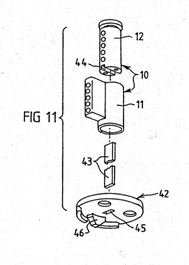
Radiation Ltd v Galliers and Klaerr Pty Ltd (1938) 60 CLR 36 applied
R D Werner & Co Inc v Bailey Aluminium Products Pty Ltd (1989) 25 FCR 565 cited
Meyers Taylor Pty Ltd v Vicarr Industries Ltd (1977) 137 CLR 228 cited
Stanway Oyster Cylinders Pty Ltd v Marks (1996) 66 FCR 577 referred to
British Liquid Air Company v British Oxygen Company Ltd [1909] 26 RPC 509 referred to
Wellcome Foundation Ltd v V R Laboratories (Aust) Pty Ltd (1981) 148 CLR 262 cited
Abbott Laboratories v Corbridge Group Pty Ltd (No 2) [2001] FCA 810 cited
Elconnex Pty Ltd v Gerard Industries Pty Ltd (1992) 25 IPR 173 referred to
Re Raychem Corp’s Patents [1998] RPC 31 applied
Winner v Ammar Holdings Pty Limited (1993) 41 FCR 205 distinguished
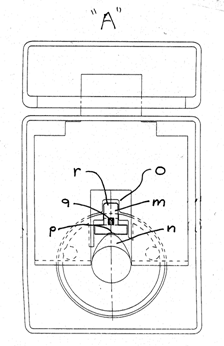
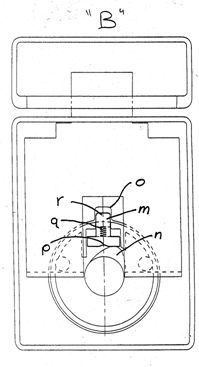
Winner v Ammar Holdings Pty Ltd (1982) 24 IPR 137 distinguished
Acme Bedstead Co Ltd v Newlands Bros Ltd (1937) 58 CLR 689 referred to
Intalite International NV v Cellular Ceilings Ltd (No 2) [1987] RPC 537 applied
Bristol-Myers Squibb Co v F H Faulding & Co Ltd (2000) 97 FCR 524 applied
Leonardis v Sartas No 1 Pty Ltd (1996) 67 FCR 126 cited
Firebelt Pty Ltd v Brambles Australia Ltd (2000) 51 IPR 531 referred to
Olin Corporation v Super Cartridge Co Pty Ltd (1977) 180 CLR 236 applied
ICI Chemicals & Polymers Ltd v Lubrizol Corp Inc (2000) 106 FCR 214 referred to
Palmer v Dunlop Perdriau Rubber Co Ltd (1937) 59 CLR 30 referred to
Biogen Inc v Medeva PLC (1996) 36 IPR 438 applied
Coopers Animal Health Australia Ltd v Western Stock Distributors Pty Ltd (1987) 15 FCR 382 distinguished
Sami S Svendsen Inc v Independent Products Canada Ltd (1968) 119 CLR 156 referred to
Blanco White, Patents for Inventions 5th ed 1983
Bannon, Australian Patent Law (1984)
CIPA Guide to the Patents Act 5th ed 2001
DORIC PRODUCTS PTY LTD v LOCKWOOD SECURITY PRODUCTS PTY LTD
N 1089 OF 2000
HELY J
21 DECEMBER 2001
SYDNEY
|
IN THE FEDERAL COURT OF AUSTRALIA |
|
|
BETWEEN: |
DORIC PRODUCTS PTY LTD (ACN 000 577 195) APPLICANT
|
|
AND: |
LOCKWOOD SECURITY PRODUCTS PTY LTD (ACN 086 451 907) RESPONDENT
|
|
DATE OF ORDER: |
|
|
WHERE MADE: |
THE COURT ORDERS THAT:
1. The parties should bring in short minutes of order to give effect to this decision.
Note: Settlement and entry of orders is dealt with in Order 36 of the Federal Court Rules.
|
IN THE FEDERAL COURT OF AUSTRALIA |
|
|
BETWEEN: |
(ACN 000 577 195) APPLICANT
|
|
AND: |
LOCKWOOD SECURITY PRODUCTS PTY LTD (ACN 086 451 907) RESPONDENT
|
|
JUDGE: |
|
|
DATE: |
|
|
PLACE: |
REASONS FOR JUDGMENT
1 Lockwood Australia Pty Ltd was entered on the Register of Patents as the proprietor of Australian Patent No 702534 (“the Patent”) for a “key controlled latch”. Since 2 November 2000 the respondent has been entered on the Register as the proprietor of the Patent, Lockwood Australia Pty Ltd having assigned its interest in the Patent to the respondent in March 1999. Except where it is necessary to distinguish between the two companies, either or both is referred to in these reasons as “Lockwood”.
2 The applicant (“Doric”) manufactures and sells door locks known variously by the identifiers “DS 1180”, “Ilco True Guard 5000 series deadlatch” and “Lane Deadlatch” (“the Doric products”). Each of the Doric products has the same internal lock mechanism, and for the purpose of these proceedings, it is not necessary to distinguish between them.
3 On 5 October 2000 letters of demand were sent to Ilco Unican Australia Pty Ltd, and to Siddons Proline, (a division of SPL Group Ltd) by patent attorneys acting on behalf of the respondent. On 10 October 2000 the respondent forwarded a letter of demand to the applicant. In each case the letters asserted that one or more of the Doric products fell within the scope of the claims of the patent and that unauthorised manufacture, sale or use of the Doric products referred to in the letter constituted an infringement of the Patent.
4 These proceedings began as a claim by Doric pursuant to s 128 of the Patents Act 1990 (Cth) (“the Act”) for relief against the respondent on the ground that, by the letters to which I have referred, the respondent unjustifiably threatened Doric and its two distributors with infringement proceedings. It is also alleged that the sending of the letters resulted in a contravention of s 52 of the Trade Practices Act 1974 (Cth) (“TPA”). The onus of proving justification is upon Lockwood; the onus of establishing invalidity of the Patent, if such is alleged, lies upon Doric: U and I Global Trading (Australia) Pty Ltd v Tasman-Warajay Pty Ltd (1995) 60 FCR 26; Sydney Cellulose Pty Ltd v Ceil Comfort Home Insulation Pty Ltd [2001] FCA 1350 at par [35].
5 By its amended cross-claim, the respondent alleges that the manufacture and sale of the Doric products infringes claims 1-8, 12-20, 22, 23 and 30-32 of the Patent. During the course of final submissions, counsel for Lockwood, Mr Bannon SC, abandoned the allegation of infringement of claims 16, 18 and 19.
6 By its second cross-claim, Doric seeks a declaration of invalidity of the Patent, and an order for its revocation.
7 Claim 1, and all subsequent claims are in relation to a latch assembly having a number of specified features. Claim 1 is with respect to a latch assembly having the following features:
(i) a casing;
(ii) a latch bolt mounted on the casing so as to be movable relative thereto between an extended latching position and a retracted release position;
(iii) a first actuator operable from an inner side of the assembly to cause movement of the latch bolt to the release position;
(iv) a locking means operable from the inner side of the assembly to adopt an active condition and thereby render the first actuator inoperable;
(v) a second actuator operable from an outer side of the assembly to cause movement of the latch bolt to the release position;
(vi) lock release means which is responsive to the operation of the second actuator so as to thereby render the locking means inactive.
An “actuator” is something which causes an operation to occur, for example, a handle or knob of a lock assembly.
A typical latch assembly
8 The specification (p 1, ll 21-28) describes a “typical latch assembly”, ie a latch assembly of a type which was well known before the priority date (14 February 1996). A “typical latch assembly” as there described is one which has features (i) to (v) of claim 1. One example of a deadlatch having those features is a Lockwood product known as the 001 deadlatch, which is the precursor of the preferred embodiment of the invention claimed. The 001 deadlatch was first released for sale in Australia in the 1980s, and enjoyed widespread success until manufacture was discontinued after the new 001 deadlatch with safety lock release was launched in early 1997.
9 Feature (iv) is an important element of the security provided by a door (it is convenient to describe the invention with particular reference to doors, even though it has wider application – see specification p 1, ll 4-6). If the door has glass panels, or if glass panels are adjacent to the door, the panels can be breached with relative ease so as to provide an opening through which an intruder could reach and open the door by means of an inside knob or handle if it was not locked. Similarly, if an intruder gained access to the premises through a small opening, eg a window, the intruder could leave via the door if the inside knob or handle was unlocked, and take larger objects than he might otherwise be able to remove from the premises.
The problem with a typical latch assembly
10 Although feature (iv) is an important element in the security provided by the door, it is also the source of a problem. A person might open the door, inadvertently leave the key in the outer lock and close the door behind him. Or the key might be misplaced after the person arrives at home, having shut the door behind him. In either case, the person is locked inside the house. This is a potentially dangerous situation if the person needs to exit the house quickly, as in the case of a fire.
11 Thus the specification says of locks having features (i)-(v) (p 1, ll 11-17):
“Such locks are typically arranged so as to be operated from the inside of the door and are not operable from the outside of the door. In particular, key operation of the latch from the outside of the door will not release the lock. That can lead to serious problems in circumstances where the door needs to be opened urgently from the inside, particularly if the lock key has been misplaced or is not conveniently accessible.”
12 Mr Wilson, an expert called by Lockwood, had been aware for many years of the problem of people locking themselves in their houses because the key to unlock the inside handle was not accessible. The problems described on page 1 of the Patent had been known to Mr Freestone, another expert called by Lockwood, since deadlatch locks were first used in Australia.
The solution to the problem: lock release means (“LRM”)
13 The specification describes an object of the invention:
“It is an object of the present invention to provide a key controlled latch which can be released from a locked condition by use of a key at the outside of the door or other member with which the latch is used.”
(p 1, ll 18-20)
The specification further states:
“According to the present invention, a latch assembly of the foregoing kind is characterised in that it includes lock release means which is responsive to operation of the second actuator to render the locking means inactive.”
(p 2, ll 10-12)
14 Thus it is the incorporation of feature (vi) into the lock assembly, in addition to features (i)-(v), which distinguishes the present invention from a typical latch assembly.
What is “lock release means”?
15 The specification states:
“It is also preferred that the lock release means is operable to influence the detent cam in a manner such that operation of the second or outer actuator causes the detent cam to move to a position corresponding to the actuator release position of the detent. The cam may be spring biased towards that corresponding position, and retaining means may be operable to allow or prevent such movement according to whether or not, respectively, the second actuator is operated.”
(p 2, ll 18-24)
The “actuator release position of the detent” is equivalent to the unlocked position. Lock release means in the preferred embodiment is described on p 7, l 28 – p 8, l 2.
16 There is no other statement in the specification as to the nature of the “lock release means” which characterises the latch assembly the subject of the invention, and which serves to distinguish it from a typical latch assembly.
Embodiments
17 Embodiments of the invention are described in detail in the later part of the specification and in the drawings. The drawings are “merely illustrative of how the invention might be put into effect”. The specification makes it clear that the preferred embodiment is but one example of a suitable lock release means. Figure 1 is a diagrammatic view of an installation including a latch assembly according to one embodiment of the invention. It is as follows.
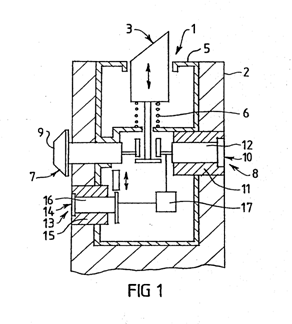
The specification states, in relation to this assembly:
“It is a feature of assembly 1 that it includes lock release means 17 which responds to operation of the lock 10 so as to automatically deactivate the locking means 13. The release means may take any suitable form, and one particular form will be hereinafter described.”
(p 4, ll 26-29)
(emphasis added)
The diagram shows the lock release means 17 as being something distinct from the second actuator although connected to it. The words which I have emphasised convey that a person skilled in the art would have no difficulty in constructing this integer without the necessity for any instruction from the patentee. The Patent does not have to teach how release means may be constructed as that is a matter within the knowledge of a skilled addressee: cf Kimberly-Clark Australia Pty Ltd v Arico Trading International (2001) 177 ALR 460. Mr Catterns QC made it plain that there is no allegation of insufficiency in this regard, an allegation which, if made, would have been antithetical to Doric’s case on obviousness.
18 On pages 7-8 of the specification more information is given as to the lock release means employed in the preferred embodiment. The specification there states:
“Lock release means is provided to enable the lever 31 to be moved out of blocking engagement with the cam projection 40. In the particular arrangement shown, the lock release means 17 is arranged to have direct influence on the cam retainer means, and it is preferred that such influence is achieved through a rotatable camming member 42 which forms part of the release means 17 and is connected to the outside lock 10 so as to rotate in response to rotation of the lock barrel 12. As shown by Figure 11, that connection may include a drive bar 43 of non-circular cross-sectional shape which engages at one end within a slot 44 in an end of the barrel 10, and engages at its other end in a rectangular aperture 45 formed through the camming member 42.
As best seen in figures 4, 6 and 8, the camming member 42 is arranged to overlie the lever 31 at the side of that lever remote from the cam 22. A camming lug 46 provided on the member 42 has a sloping cam face 47 which is adapted to engage against an upstanding portion 48 of the lever 31 which projects above the plate 36, as shown in figures 4, 6 and 8, when the lever 31 is in the cam retaining position. Rotation of the member 42 caused through operation of the lock 10, results in coaction between the cam face 47 and the lever portion 48 such that the lever 31 is progressively forced downwards against the action of the spring 41 towards the position shown in Figure 8.”
19 The lock release means as there described is the subject of claims 28, 29 and 33 of the Patent. Lockwood does not allege that the Doric products infringe any of those claims. Nonetheless Lockwood alleges that the Doric products include “lock release means” which is responsive to the operation of the second actuator so as to thereby render the locking means inactive, thus infringing claims 1-6.
Infringement
Claims 1-6
20 The elements or features of claim 1 are summarised in par [7] above. Claims 2-6 are built upon claim 1, with successive claims incorporating an additional feature to those described in the preceding claim.
21 In Doric’s outline of submissions lodged prior to the hearing, the following appears:
“22 Doric accepts that on its construction of claims 1-6, the Doric locks possess each of the integers of those claims. It submits that claims 1-6 are invalid for want of novelty and inventive step. If a construction of these claims is adopted by Lockwood on which these claims retain novelty, then the Doric product probably would not infringe on that construction.”
22 In opening, Doric’s counsel, Mr Catterns, gave notice of a “slight change in position” in relation to the alleged infringement of claims 1-6, inasmuch as Doric now contends that feature (vi) of claim 1 is not to be found in the Doric products. In order to infringe, each of the integers of the claim must be present: Populin v H B Nominees Pty Ltd (1982) 41 ALR 471, 475-476. If feature (vi) is not to be found in the Doric products, that is fatal to Lockwood’s case on infringement. On the other hand, it is common ground that if the Doric products include feature (vi) of claim 1, then the Doric products infringe claims 1-6 (assuming validity).
23 There was evidence from Mr Wilson on which he was neither cross-examined, nor contradicted by the experts called by Doric, that the Doric products have all of the elements of claim 1, and all of the elements of claims 2-6. Mr Wilson said that the exterior cylinder assembly was the second actuator described in feature (v). As to feature (vi) of claim 1 his evidence was:
“If the inner lever is locked using the key so that it cannot turn and then a key is inserted into the key hole of the exterior cylinder assembly and turned, this causes the cylinder tail to rotate and unlocks the inner lever. As a result the cylinder tail acts to release the lock mechanism in the inner lever and it is responsive to the operation of the exterior cylinder assembly. Accordingly, in my view feature (vi) is present.
24 Thus in Mr Wilson’s opinion, the LRM in the Doric products is the cylinder tail. In cross-examination, Mr Wilson was asked to identify the presence of LRM in a number of locks by operating the lock in question, and he did so. He was not asked to identify any particular component of the locks which constituted LRM. In cross-examination, Mr Freestone said that the LRM in the Doric products is the exterior cylinder assembly including the tail. Doric’s expert, Mr Garland, gave some evidence as to whether a product known as the DS60 anticipated certain of the claims in the Patent, to which it will be necessary to return in due course. It is sufficient for present purposes to note that Mr Garland regarded the exterior lock of the DS60 as the second actuator, and the cylinder tail as the LRM.
25 Figure 11 is described in the specification as “an exploded view of an outer actuator”. It is as follows:
26 According to the specification, in the preferred embodiment the rotatable camming member 42 forms part of the lock release means 17 and is connected to the outside lock 10 so as to rotate in response to the rotation of the lock barrel 12. As shown in Fig 11 that connection may include a drive bar 43 which engages at one end within a slot 44 in the end of the barrel 10 and engages at its other end in a rectangular aperture 45 formed through the camming member 22 [p 7, ll 32 – p 8 ll 6]. The drive bar 43 is the functional equivalent of the “cylinder tail” referred to by Messrs Wilson and Freestone, and it provides a connection between the lock barrel 12 and the camming member 42 [p 9, ll 14-16]. Such connections are well known in the relevant art [p 4, ll 10-11].
27 It is clear that in the case of the Doric products, a result of the operation of the outer (second) actuator is that the inside lock is released, or, using the language of the Patent, the locking means which renders the inner (first) actuator inoperative is rendered inactive.
28 The way in which this occurs in the case of the Doric products involves the following steps. (An illustrative diagram is reproduced in par 43 below; (m), (n), (o), (p), (q) and (r) are as shown on that diagram.)
- a key is turned in the outside lock cylinder;
- this causes the cylinder tail (connector) to turn;
- the cylinder tail (which fits into the top of the cam) turns the cam;
- as the cam is turned, the nose of the cam (n) is moved out of the recess (p) in the cross-bar of the T-member (m);
- the spring (q) pushes the detent part of the T-member (r) out of the casing (o);
- the spring (q) has an urging effect on the cam, pushing it towards the unlocked position inasmuch as once the nose of the cam(n) is moved out of the recess (p) the spring (q) urges the cam to a position at which the lock is unlocked (see Diagram B in par 47 below). However, although the force of the spring is sufficient to cause the cam to travel through approximately 60o to an unlocked position, that force is insufficient to cause the cam to travel through 90o to its final resting position. The turning of the key causes the cam to move through that last 30o to its final resting position;
- in order to open the door, the key must continue to be turned in order to withdraw the latch.
29 In Doric’s submission, feature (vi) of claim 1 should be construed as requiring LRM which is distinct from and responsive to the operation of the second actuator, and which is distinct from and operates on the locking means. If feature (vi) of claim 1 is construed in that way, then in Doric’s submission that feature is not to be found in the Doric products.
30 In support of that construction, Doric points to the following:
- the specification states that LRM is responsive to the operation of the second actuator (p 2, ll 11-12). In the preferred embodiment, LRM 17 “responds to” the operation of the lock 10 so as to automatically deactivate locking means 13 (p 4, ll 26-29);
- in fig 1 (reproduced in par 17 above), LRM 17 is shown as something distinct from the outer actuator 8 and the locking means 13;
- in the preferred embodiment, LRM 17 is described as distinct from the drive bar 43 by which LRM is connected to the outside lock 10 (p 7, ll 30 – p 8, ll 6: (see par [26] above). To treat the cylinder tail itself as constituting the LRM is said to be contrary to this passage in the specification.
31 LRM is the most important element in claim 1, inasmuch as LRM is said to characterise the invention, and to distinguish it from the prior art. In Doric’s submission the inclusion in the claim of LRM requires that in any infringing product there be an integer identifiable as such which is distinct from the other integers referred to in the claims.
32 Feature (vi) of claim 1 is not described in the Patent with any greater particularity than:
- LRM which may take any suitable form;
- which is responsive to the operation of the second actuator so as to thereby deactivate the lock on the inside handle.
The improvement over typical latch assemblies which is described in claim 1, is any means of unlocking the lock on the inner handle from the outside of the door by operation of the second actuator.
33 The preferred embodiment describes “one particular form” of LRM which is “not to be understood as limiting the invention”. It is not legitimate, in the absence of an express reference in the claim itself, to import into a claim features of the preferred embodiment. The preferred embodiment cannot properly be used to introduce into the definite words of a claim an additional definition or qualification of the patentee’s invention: Rehm Pty Ltd v Websters Security Systems (International) Pty Ltd (1988) 81 ALR 79 at 89; Bartlem Pty Ltd v CMMC Pty Ltd [2001] FCA 1218 at par [16].
34 The plain and unambiguous meaning of a claim cannot be varied or qualified by reference to the body of the specification. However, terms in the claim which are unclear may be defined or clarified by reference to the body of the specification: Kimberly-Clark Australia Pty Ltd v Arico Trading International Pty Ltd (supra) at 466. The principles applicable to the construction of a patent in order to determine the precise nature and extent of the rights claimed by the patentee were considered by Cooper J in Bartlem Pty Ltd v CMMC Pty Ltd (supra) at [12-17], by Sackville J in Minnesota Mining & Manufacturing Company v Tyco Electronics Pty Ltd [2001] FCA 1359 at [89-93] and by me in Flexible Steel Lacing Co v Beltreco Ltd (2000) 49 IPR 331 at [70-81]. See also Welcome Real-Time SA v Catuity Inc [2001] IPR 327 at [19], per Heerey J. No difference of opinion emerges from that discussion of applicable principles, and no purpose would be served by my repeating that discussion.
35 In the language of the Patent, there is a distinction between “means” and “member”. For example, in claim 28, LRM includes a camming member. “Means” is a method for achieving an end, whereas a “member” is a constituent part of a whole. Thus LRM describes the method or mechanism by which the lock on the inner handle is deactivated by the operation of the second actuator, rather than necessarily referring to a particular member which itself produces that result. A member may be a means, but it does not follow that a means must be comprised of a single member.
36 Claim 1 stipulates that LRM must be responsive to the operation of the second actuator. It follows that LRM and the second actuator are not the same thing, although there is no reason to assume that the second actuator may not be part of the mechanism which constitutes LRM. Thus Lockwood submits that LRM consists of all of the parts which combine to produce the result that the operation of the key in the outer lock renders the locking means on the inside handle inoperative. The operation of the second actuator is the first step in that process. I agree with that submission.
37 The Doric products do incorporate a mechanism by which the lock on the inner handle is released in the response to the operation of the second (outer) actuator. The mechanism is described in par [28] above. The argument that LRM must be distinct from components which are part of the “means” for achieving other ends is a gloss on the clear words of the claim, and is grounded, impermissibly, on the description of the preferred embodiment. Further, even in the case of the preferred embodiment, “locking means”, “retainer means” and LRM are described. The lever 31 is both part of the locking means and the retainer means and the LRM inasmuch as it plays a role in the achievement of both locking and unlocking. That is inconsistent with Doric’s argument. Mr Garland accepted that in the preferred embodiment, the retaining member (lever 31), performed more than one function inasmuch as it was part of both the locking means and the retaining means. He was not asked whether it was also part of LRM, but it certainly has a role to play in LRM.
38 Similarly, in the preferred embodiment the cylinder tail 43 is a member which is described as a connector or drive bar. But that does not mean that the cylinder tail cannot also be the LRM, or part of the mechanism which is LRM. As a result of the operation of the second actuator, the cylinder tail, in association with other components identified above, releases the lock on the inside handle. The cylinder tail is at least a component of the LRM, if not itself the LRM. In the view I take, the cylinder tail is a component of LRM. As this is a question of construction of the Patent, I am not bound to defer to expert opinion summarised in par [24] above to the extent to which that opinion proposes a different construction.
39 The specification teaches that LRM may take any suitable form provided it is responsive to the operation of the second actuator. Doric’s argument seeks to add a further, unexpressed proviso. The specification does not teach that the constituents of LRM cannot perform a role in satisfying other integers of the claim. An implication to that effect is an unexpressed qualification on the teaching of the Patent that LRM may take any suitable form.
40 Whilst the construction of the patent is a matter for the Court, it is not immaterial to note that none of the experts called advanced the proposition that LRM was not to be found in the Doric product. As a practical matter, the operation of the second actuator results in the automatic release of the lock on the inside handle, hence the object which the invention claims to satisfy has been achieved. Claim 1 is also satisfied in accordance with its terms.
41 It follows that, subject to issues as to validity, the Doric products infringe claims 1-6 of the Patent.
Claim 7
42 Claim 7 refers to a latch assembly according to any preceding claims, which has the following additional features:
(vii) the locking means includes a cam member which is moveable between a first position at which the locking means is inactive or unlocked and a second position in which the locking means is active or locked;
(viii) a cam biasing means urges the cam member toward the first (unlocked) position; and
(ix) a retaining member which is engagable with the cam member to thereby prevent movement of the cam member out of the second position when the locking means is in the active condition.
It is common ground that feature (vii) is to be found in the Doric products. The dispute centres on features (viii) and (ix).
43 Diagram A illustrates the position of the cam member in the Doric products when the locking member (m) (the “T-member”) is in the second or locked position.
The T-member (m) has been pushed by the cam member out of the hub and into a cavity in the casing (o). When the T-member is in this position the hub cannot be rotated.
44 “Cam biasing means” is something which has a biasing influence on the cam. In lock mechanisms this would typically be a spring. In the Doric products a spring (q) is located underneath the T-member. When the T-member is in the second or locked position, some force caused by the small spring (q) is exerted on the T-member (m) pushing it against the nose of the cam.
45 In Mr Wilson’s evidence in chief he said that the spring (q) is cam biasing means, as it urges the nose of the cam (n) through the T-member (m) into the first position once the nose of the cam has moved out of the recess (p) in the cross-bar of the T-member. Hence feature (viii) is present.
46 On the other hand, in Mr Garland’s evidence in chief, he said that when the T-member is in the second or locked position, the small spring (q) would not cause torque to be applied to the cam member, and would therefore not contribute to the rotation of the cam member. Hence feature (viii) is not present.
47 Diagram B illustrates the respective positions of the cam and the T-member at about 25o from the zero degree position. Although the zero degree position was referred to by Mr Kuhnell, it was not defined. I have taken it to refer to the position at which the axis of the cam is coincident with the axis of the T-member.
In Mr Garland’s evidence in chief, he said that the position of the cam member at this stage would cause the maximum torque or load to be applied by the small spring (q) through the T-member (m) during use. In Mr Garland’s opinion that force would be extremely small when applied to the small radius relative to the point of contact between the T-member (m) and the cam member. Even at that maximum torque, the force of the small spring (q) would not, in Mr Garland’s opinion, contribute to the rotation of the cam member “in any practical sense”. In Mr Garland’s opinion, it is the operation of the key tumbler by the user which urges the cam member towards the first position, hence feature (viii) is not to be found in the Doric products.
48 A “retaining member” is something that acts to hold something else in position. In Mr Wilson’s evidence in chief he said that the part of the T-member which has a recess (p) engages with the nose of the cam (n) when the locking means is in the active condition and thereby stops movement of the cam out of the locked position. His evidence was that it is therefore acting as a retaining member on the cam, such that feature (ix) is present.
49 In Mr Garland’s evidence in chief he said that in the Doric products, there is no “locking” or “retaining” of the cam member by its engagement with the T-member:
“At no time is there any ‘prevention’ of movement of the cam member. At most, there is caused a very slight resistance to rotation or biasing of the cam member out of the second position.”
The engagement of the T-member with the cam when in the second or active/locked position does not of itself stop or prevent movement of the cam member out of the locked position. In the Doric products, in contrast to the Lockwood preferred embodiment, there is no pre-existing and continuous urging by way of spring loading or otherwise to cause the rotation or movement of the cam member while it is in the locked position.
50 In Mr Garland’s evidence in chief he said that the “retaining member” referred to in feature (ix) describes a separate physical component and is not satisfied by the recess (p) in the T-member.
51 Mr Freestone, in his evidence in chief, disagreed with Mr Garland’s evidence that features (xiii) and (ix) of claim 7 are not to be found in the Doric products. In particular Mr Freestone said:
“The cross-bar of the T-member engages the cam and is pressed against the cam by the action of the compression spring. A recess is formed in the end of the T-member that engages the cam. When the nose of the cam is located within that recess a detent formed by the opposite end of the T-member is held in a position such that it prevents rotation of the handle. The cam can be rotated by means of key operation of either one of the cylinder locks. When the cam is thereby rotated to an extent such that the cam nose is removed from the T-member recess, the spring presses the T-member against the cam in a manner such as to apply a turning force to the cam. That spring created turning force drives the cam towards a position at which the detent no longer prevents rotation of the handle.”
52 In cross-examination Mr Garland accepted that the features of claim 7 are present in the Doric products. In particular, he accepted that:
- the spring functions as a cam biasing means inasmuch as once the nose of the cam is disengaged from the recess in the T-member, the spring urges the cam member to a position at which it is unlocked;
- the ability of the spring to function in that way is a natural consequence of the fact that the spring was compressed as part of the locking process, although the intended role of the spring was to drive the T-member from out of the cavity in the casing into the hub as part of the unlocking process;
- the action of the spring is able to overtake the action of the hand in moving the cam because of the “lost motion” feature which was incorporated into the Doric products for a different purpose. Whether the action of the spring will overtake that of the hand depends upon their relative speeds;
- the engagement of the cam member with the retaining member does prevent movement of the cam member from the locked to the unlocked position.
53 Thereafter the issue between the parties was not any difference of opinion between the experts as to the way in which the Doric products operate, but was substantially confined to issues of construction. Indeed a point came when Mr Catterns objected (unsuccessfully) to further cross-examination of Mr Garland on the ground that there was no issue as to the physical operation of the Doric products, but only as to questions of construction, fair basis and the laws of infringement.
54 Many of Doric’s submissions involved a comparison between the mechanics of the Doric products and those of the Lockwood preferred embodiment. Mr Freestone accepted in cross-examination that the products work in different ways, although they are alike in that both use a cam to drive the detent. The way in which the cam is operated is different. In particular in the case of the Lockwood product, the cam is preloaded with a spring which is held back by a lever or trigger. At all times the spring urges the cam to the unlocked position but is held back by the lever. To unlock the lock, the operation of a second cam depresses the trigger, thus releasing the spring which in turn drives the cam into the unlocked position.
55 Mr Freestone accepted that in the case of the Doric products, the second actuator causes the nose of the cam (n) to disengage from the recess (p) in the T-member (m) in the manner earlier described. It is not necessary for the unlocking of the lock for the spring (q) to push the cam to the unlocked position, because this will occur in any event by the manual operation of the key. But the spring may get ahead of the hand, and if it does so, it will push the cam into an unlocked position. Whilst the obvious role for the spring is to push the detent out of the casing as the cam is turned to the unlocked position, it also has this urging effect.
56 Doric submitted, accurately, that nothing of the detail provided in the description of the preferred embodiment appears in the Doric locks. The mechanism of a spring and trigger, with the trigger released by a second outside cam, is not used. But this is immaterial, as the appropriate comparison is not between the two products, but between the claims of the Patent and the Doric product. As earlier indicated, whilst the Patent must be construed as a whole, it is not legitimate to use the preferred embodiment so as to construct unexpressed limitations on the terms of a claim. That is all the more so when the specification makes it clear that the preferred embodiment is but one example of a suitable lock release means. In Atlantis Corporation Pty Ltd v Schindler (1997) 39 IPR 29, 48-49 the Full Court held that it was an error to interpret the claims as containing an implicit limitation by reference to the drainage purpose which was discernible in the body of the specification, but not in the claims, albeit the consequence was the invalidation of the claims for lack of fair basing. The fact in that case that the reason why two integers of the claims had the features which they did was left unclear by the claims, did not give rise to a lack of clarity which might be legitimately resolved by reference to the specification as a whole.
57 Finally, as Heerey J observed in Welcome Real-Time SA v Catuity Inc (supra) at [21], the alleged infringement is to be ignored when construing the patent. A patent must be construed “as if the infringer had never been born”.
The construction of claim 7
58 Two issues of construction were debated in final submissions, although other issues were raised at earlier stages of the proceedings:
- first, whether the recess (p) in the cross-bar of the T-member can serve as the retaining member as well as performing a function as a locking means;
- second, whether the claim is satisfied if the retaining member prevents mere movement of the cam member, or whether the claim requires that the engagement of the retaining member with the cam member prevent movement of the cam member to which it is being urged by the cam biasing means.
Does claim 7 necessitate a separate retaining member?
59 The recess (p) in the cross-bar of the T-member performs a retaining function. It has no other purpose than to receive the nose of the cam and to assist in holding it in position. Mr Garland accepted in cross-examination that in the Doric products, the engagement of the cam member with the retaining member does prevent movement of the cam member from the locked position to the unlocked position. He had previously accepted that the Lockwood patent teaches that a retaining member can perform more than one function, and that the recess in the T-member could be described as a retaining member.
60 Claim 7 uses the expression “retaining member”, rather than “retaining means”. Claim 23, for example, distinguishes between “retaining means” and “retaining member”. Mr Freestone said in cross-examination that in the description of the preferred embodiment in the Lockwood patent, “means” describes an overall assembly, whereas “member” describes a separate element of that assembly. That is the sense in which the expressions are used on p 6 ll 26-29 of the specification, and for that matter, it is the sense in which the expressions are used in claim 23. Doric submits that it is stretching the notion of “member” as a physical element to treat it as encompassing a groove or recess in some other element.
61 I have already found in relation to LRM that the patent does not teach that the constituents of LRM cannot perform a role in satisfying other integers of the claim. If the recess in the cross-bar of the T-member otherwise answers the description of a retaining member, then by parity of reasoning it should not be denied that character merely because the T-member serves some other function as well.
62 Given the evidence of Mr Garland referred to in par [52] above, the recess in the cross-bar of the T-member, or putting it slightly differently, the cross-bar of the T-member with a recess ground into it, is a “retaining member” in terms of feature (ix). That is the intended and only function of the recess as well as its effect.
Does claim 7 require an interaction between the retaining member and the cam biasing means?
63 It is common ground that the cam in the Doric product is moveable between a first, unlocked position and a second, locked position. Doric contends, and ultimately Lockwood came to accept, that the second, locked position is the cam/recess engagement position (“the recess position”). Lockwood does not now dispute that the “second position” is the recess position.
64 The contest between the parties is whether claim 7 is satisfied if the engagement of the recess and the cam in fact prevents movement of the cam out of the recess position (Lockwood), or whether the recess prevents movement of the cam which is being, or would otherwise be caused by the cam biasing means (Doric). Lockwood says that the Doric approach involves the addition of an impermissible gloss upon the ordinary meaning of the claim. Three High Court cases (Kimberly-Clark Australia Pty Ltd v Arico Trading International Pty Ltd (supra) at [15]; Welch Perrin & Co Pty Ltd v Worrel (1961) 106 CLR 588 at 610; Interlego AG v Toltoys Pty Ltd (1973) 130 CLR 461 at 469) and one Full Federal Court decision (Atlantis Corporation Pty Ltd v Schindler (supra) at 48-49) teach that claims are to be given their ordinary meaning without glosses. Doric’s approach is said to be heavily dependent on descriptions of the interaction of a particular lock release means with a particular locking means which are disclosed in the preferred embodiment. It is submitted that is manifestly inappropriate in circumstances where the specification makes it clear that the preferred embodiment is but one example of a suitable lock release means.
65 The specification includes the following:
“The cam may be spring biased towards [the unlocked position], and retaining means may be operable to allow or prevent such movement according to whether or not, respectively, the second actuator is operated.”
(p 2, ll 21-24)
(emphasis added)
These lines are consistent with the proposition that the retaining means prevents movement which would otherwise be caused by the spring biasing although this is not expressly stated in terms. In any event, this is something which is “preferred” rather than a qualification upon the terms of the claim.
66 The working of the preferred embodiment is described in the specification at p 6, ll 23-25:
“The spring 30 tends to move the cam 22 back to the Figure 3 position [viz: unlocked] and releasable retainer means is provided to prevent that movement.”
It is clear in the case of the preferred embodiment that the retaining means acts against an urging force supplied by the cam biasing means.
67 Claim 7 does not follow the form of claim 22, which says:
“... retaining means is operable to prevent the locking means adopting said inactive condition under the influence of said cam biasing means.”
68 I have already accepted [pars 33-34 above] the submissions put by Lockwood as to the illegitimacy of placing glosses on the ordinary meaning of a claim, particularly when the gloss derives from a description of the preferred embodiment.
69 Feature (viii) stipulates that the cam biasing means urges the cam member towards the unlocked position. It is implicit in this feature that the urging towards the unlocked position is from some other position. That other position is the second position or the recess position. Thus feature (viii) describes cam biasing means which urges the cam member from the recess position to the unlocked position.
70 But the claim contemplates that notwithstanding the urging effect of the cam biasing means, the cam member will not move out of the locked position when the locking means is in the active condition. To borrow the language of claim 8, the cam member will not be driven into the unlocked position even though the cam biasing means urges the cam member toward that position. That is because a retaining member is engagable with the cam member to prevent movement of the cam member out of the second position.
71 Thus feature (ix) describes a retaining member which is engagable with the cam member to thereby prevent movement of the cam member out of the second position. The potential for that movement flows from what would otherwise be the effect of the cam biasing means.
72 Thus I agree with Doric’s construction of claim 7, namely that the claim requires that the cam biasing means urges movement out of the locked position whilst (at the same time) the retaining member prevents it. That result accords with the description of the interrelationship between the retaining member and the cam biasing means contained in the specification with respect to the preferred embodiment, but it is neither dependent upon or derived from that description. Rather, the grammatical structure of the claim and element (ix) indicate that there is an interaction between the retaining member and the cam biasing means inasmuch as the retaining member prevents the movement which, but for the retaining member, the cam biasing means would otherwise promote.
Does the spring urge the cam member towards the unlocked position when the cam is in the recess position?
73 Until final submissions, I was under the impression that it was common ground that the spring (q) in the Doric products provides zero torque when the locking means is in the active condition, hence it does not urge the cam out of the second position. It is only when the nose of the cam is manually disengaged from the recess (p) in the cross-bar of the T-member that the spring urges the cam member to the unlocked position. By the time the spring applies some torque, the recess is no longer engaged.
74 Thus Mr Kuhnell said that once the cam is rotated (by turning the key) to clear the recess (p) in the cross-bar of the T-member (m) there is a turning moment biasing the cam towards the unlocked configuration. His table records zero torque when the cam is at the zero degree position. Positive torque is first recorded when the cam is 10o from the zero degree position.
75 Mr Wilson confirmed that it is only once the nose of the cam is manually rotated out of the recess (p) that the spring can push the cam to the unlocked position. Mr Freestone said that when the cam is manually rotated to an extent such that the cam nose is removed from the recess, the spring presses the T-member against the cam in a manner such as to apply a turning force to the cam. That spring-created turning force drives the cam toward the unlocked position. Mr Garland’s evidence was to similar effect.
76 In final submissions, and then mainly in Lockwood’s submissions in reply, an issue was raised for the first time as to whether it was too simplistic, and as a matter of theory incorrect, to assert that there is no urging towards the unlocked position in the Doric products when the cam is in the recess position. Neither this issue, nor the “theory” on which it is based was raised, or squarely raised, with any witness.
77 The Doric products do not infringe claim 7 if the cam biasing means only urges the cam member towards the unlocked position once the cam member is manually rotated such that the nose of the cam is moved out of the recess (p) in the cross-bar of the T-member. In order to infringe, there must be urging towards an unlocked position by the cam biasing means at the point where the cam biasing means is in the recess, which is restrained by the engagement of the retaining member and the cam member.
78 It is still common ground that at the zero degree position there is no torque, ie there is no cam biasing means urging the cam towards the unlocked position.
79 However, in Mr Bannon’s submission, the recess position and the zero degree position are not necessarily coincident. Whilst accommodated within the recess, the cam need not maintain the precise zero degree position. There is capacity for some “play”. Absent the recess, at each of the infinite points of interaction between the cam and T-member with the exception of one, namely zero degrees, there is cam biasing means urging the cam to the unlocked position. It is submitted that the prospect of a user of a lock turning the cam to precisely that point every time, or even usually, and leaving it there “must be practically nil. In any event, there is no prospect of that position being maintained in ordinary use”. Moreover, the construction of a device which has a single point at which the cam biasing means is not operative for a short period in practical use does not avoid infringement (see Catnic Components Ltd v Hill & Smith Ltd [1982] RPC 183 at 243).
80 The absence of an evidentiary foundation for this “theory” means that it does not rise above a theory. It does not reach the level of a matter established by the evidence. Nor did any expert seek to explain the practical operation of the Doric locks in a manner consistent with the theory. Rather the tenor of their evidence on this point, as summarised above, points in a different direction. In particular, Mr Kuhnell's report, on which he was not cross-examined, proceeds upon the basis that the locked position is equivalent to the zero degree position, at which point there is no spring biasing effect. Lockwood also conceded that the locked position is the cam/recess engagement position, rather than a range of positions.
81 This is not a case like Catnic Components Ltd v Hill & Smith Ltd (supra) where there is a minor variation from a descriptive phrase (“vertically”) which makes no practical difference to the working of the invention. The substantial idea embodied in claim 7 is that when the cam is in the locked position, movement towards the unlocked position which would otherwise result from the urging of the spring is restrained by the retaining member. But in the case of the Doric products, there is no spring biasing effect when the cam is in the locked position, considered as zero degrees, and manual rotation of the cam so as to clear the recess is required before the spring will have any practical effect.
82 In Radiation Ltd v Galliers and Klaerr Pty Ltd (1938) 60 CLR 36 at 51 Dixon J said:
“But, on a question of infringement, the issue is not whether the words of the claim can be applied with verbal accuracy or felicity to the article or device alleged to infringe. It is whether the substantial idea disclosed by the specification and made the subject of a definite claim has been taken and embodied in the infringing thing.”
83 That has not occurred with respect to claim 7. Claim 7 describes a different notion or idea from that found in the Doric product.
84 Infringement of claim 7 has not been established.
Claim 8
85 Claim 8 describes a latch assembly according to claim 7 with the following additional element:
(x) “... wherein said retaining member is responsive to operation of said lock release means to disengage from said cam member and thereby permit said cam member to be driven into said first position by said cam biasing means.”
86 If I am correct in my conclusion that claim 7 is not infringed, then it follows that there is no infringement of claim 8. If I am wrong in that conclusion, the question arises whether element (x) above is present in the Doric products.
87 Claim 8 proceeds upon the basis that LRM has an impact on the retaining member, which causes it to disengage from the cam member. In the case of the Doric products, the following occurs:
- the key in the outer lock turns the tail piece (connector) which turns the cam;
- as the nose of the cam is turned through the recess of the T-member (p), the T-member is pushed down, and there is some slight compression of the spring (q) so as to permit disengagement of the nose of the cam from the recess;
- upon disengagement, the cam member is “permitted” to be driven under the force of the spring which extends and urges the cam to the unlocked position.
88 Doric submits that the cylinder tail operates on the cam member rather than upon the retaining member. It is submitted that it is not the retaining member which is responsive to LRM, rather it is the cam member which responds.
89 Once again, an issue arises as to what constitutes LRM. Again I do not think it matters whether it is the cylinder tail which is appropriately characterised as LRM, or all of the parts which combine to release the lock. In either case pressure is applied to the T-member, which compresses the spring slightly to permit disengagement. The pressure is applied as a result of the operation of the cylinder tail, or as a result of the operation of the cylinder tail and the nose of the cam. In either case, the retaining member is responsive to the operation of LRM to disengage from the cam member.
90 Feature (x) is thus to be found in the Doric products.
Claims 9–11
91 Infringement is not alleged.
Claims 12–15
92 Claims 12-15 are alleged to be infringed. However, the only issue is whether the Doric products include feature (vi) of claim 1. If my conclusion that feature (vi) of claim 1 is to be found in the Doric products is correct, it follows that claims 12-15 are also infringed.
Claim 16
93 Infringement is not alleged.
Claim 17
94 Claim 17 is for a latch assembly according to claim 15 or 16 with the following additional feature:
(xi) “... wherein cam biasing means acts on said cam to urge it into said first position of rotation at which said detent is able to adopt said actuator release position.”
95 Infringement of claim 16 is not alleged. Thus, relevantly claim 17 is built upon claims 1-6, and 12-15, and the conclusion which I have reached in relation to claim 7 does not necessarily determine the issue of infringement of claim 17.
96 Lockwood submits that the language of claim 17 differs from the language of claim 7. In particular there is no specification in claim 17 that the cam biasing means should urge the cam “out of said second position” into the first position. Hence it does not matter that in the case of the Doric products, the spring biasing effect only occurs once the nose of the cam is moved out of the recess in the T-member.
97 The Patent must relate to one invention only: the Act s 40(4). The various claims should be read so as to produce internal consistency. When the Patent is read as a whole, the cam biasing means referred to in claim 17 is the same cam biasing means as is referred to in earlier claims, including claim 7. It is implicit in claim 17, as it is in claim 7, that cam biasing means urges the cam member from the recess position to the unlocked position. The purpose of claim 17 is not to introduce different cam biasing means; claim 17 spells out an effect of cam biasing means, namely that the detent is able to adopt the actuator release position at the first position of rotation to which the cam biasing means has urged it.
98 My conclusion in relation to claim 7 leads to the conclusion that there is no infringement of clause 17.
Claims 18-19
99 Infringement is not alleged.
Claim 20
100 Infringement is alleged. The only issue is whether the Doric product includes feature (vi) of claim 1. In view of my conclusion on that question, claim 20 is also infringed.
Claim 21
101 Infringement is not alleged.
Claim 22
102 Claim 22 is for a latch assembly according to claims 17, 18 or 19 where:
(xii) “... retaining means is operable to prevent the locking means adopting said inactive condition under the influence of said cam biasing means.”
103 Claim 22 is built upon claims 1-6, 12-15 and 17, hence my decision on claim 7 does not necessarily determine the issue of infringement of clause 22. Claim 22 includes claim 17 within its elements. As claim 17 is not infringed, neither is claim 22.
Claim 23
104 Claim 23 is for a latch assembly according to claim 22 with the following additional feature:
(xiii) “... wherein said retaining means includes a retaining member which is moveable between a cam retaining position at which it prevents movement of said cam from said second position of rotation to said first position of rotation, and a cam releasing position at which it permits such movement of the cam.”
105 Claim 23 is built upon claims 1-6, 12-15, 17 and 22, hence my decision on claim 7 does not necessarily determine the outcome. However, claim 23 includes within its elements claims 17 and 22. I have concluded that there is no infringement of those claims, hence claim 23 is not infringed.
Claims 24-29
106 Infringement is not alleged.
Claims 30-32
107 Infringement is alleged. The only issue is whether the Doric product includes feature (vi) of claim 1. In view of my conclusion on that question, these claims are also infringed.
Claim 33
108 Infringement is not alleged.
Novelty
109 Doric contends that the alleged invention was not novel by reason of prior art information made publicly available in Australia before the priority date by the sale or offer for sale of a number of specified locks. The alleged invention was thus not a patentable invention by reason of s 18(1)(b) of the Act.
110 The test for want of novelty is whether an alleged anticipation is the same in substance as the claim in suit. The test is commonly referred to as the “reverse infringement test”: R D Werner & Co Inc v Bailey Aluminium Products Pty Ltd (1989) 25 FCR 565, 568-569; Meyers Taylor Pty Ltd v Vicarr Industries Ltd (1977) 137 CLR 228.
111 The question is whether the alleged anticipation possesses each and every integer of the claim(s) so that it could be said to infringe the claim(s). Each of the claims of the Patent is a combination claim. To anticipate, the prior art must possess each and every integer of the claim in question.
The storeroom locks
112 A group of locks relied upon as an anticipation of claims 1-6 and 12 of the Patent were referred to during the hearing as the “storeroom locks”. The “storeroom locks” are the Lockwood 510, 5110 and 5210 locks, and the Falcon 371. They were all available in Australia prior to the priority date. Lockwood distributed the Falcon 371 in the late 1980s or early 1990s and manufactured the Lockwood 510, 5110 and 5210. The storeroom locks are the principal anticipation.
113 In their affidavit evidence, Mr Wilson and Mr Freestone contended that the storeroom locks did not anticipate claims 1-6 and claim 12 of the Patent, because they did not contain the element which I have earlier referred to (par 7 above) as feature (v) of claim 1. That evidence was based on limited disclosures in brochures relating to the locks. When the physical locks became available for inspection at or shortly prior to the hearing, both Mr Wilson and Mr Freestone accepted that feature (v) was to be found in them. Mr Garland also expressed that view. There was thus a consensus between the experts that the storeroom locks possessed each and every integer of claims 1-6 and claim 12 of the Patent.
114 The storeroom locks have a handle on both the inside and outside of the door. The inside handle may be locked and unlocked by the operation of the inside key. That operation also locks and unlocks the outside handle. Similarly, operation of the key in the outside handle locks and unlocks both the lock on the outside handle as well as the lock on the inside handle.
115 Unlike the old Lockwood 001, the storeroom locks do not remain deadlocked when a person enters from outside by use of a key and then closes the door behind them. The storeroom locks do not give rise to the problem that the invention solves; entry by key frees both the inside actuator and the outside actuator.
116 Lockwood contends that the storeroom locks do not cause the problem which the Patent is intended to redress. Lockwood submits that the Patent assumes a situation in which entry by key from the outside frees the inside actuator, whilst maintaining the security of the door from outside entry. With the storeroom locks, entry by key from the outside has the result that the door is no longer secure from outside entry, unless the locking mechanism is reactivated by deliberate operation of the key.
117 Neither the claims nor the specification refer to the “assumption” which Lockwood says is implicit in the patent. The problem which is identified in the specification is people who inadvertently lock themselves in (see p 1 ll 14-17). The object of the present invention is:
“to provide a key controlled latch which can be released from a locked condition by use of a key at the outside of the door or other member with which the latch is used.”
(p 1 ll 18-20). The storeroom locks achieve that objective.
118 As Mr Garland said in cross-examination the storeroom locks do not give rise to the problem which the Patent is attempting to address, rather they solve the problem. The reason the storeroom locks solve the problem is because they include feature (vi) of claim 1.
119 The Patent is not limited to locks for use on outside doors, or for that matter to locks for use on doors at all (p 1, l 20). This suggests that the Patent includes locks which are not necessarily secure from the outside when unlocked. There is no utility in a storeroom being secure on the outside when the storeman is inside the room. The problem arises if he is inadvertently locked inside. Thus one cannot by any legitimate process of construction read down the claims so that they are confined to locks which achieve the objective of the invention and maintain the security of the door from the outside.
120 Lockwood submits that the skilled worker would not understand the Patent to be directed to the storeroom locks. That submission was grounded in cross-examination of Mr Garland in which he was invited to assume that the locking means referred to in claim 1 was directed to locking means which operated the inside handle only and to assume that the outside actuator was key operated. Mr Garland’s evidence was:
“If you were to assume that the locking means referred to in claim 1 of the patent was directed to locking means which operated only an inside handle? --- Yes.
And that the outside actuator was key operated? --- Yes.
It would be confined, would it not, to products of the type which create the problem which you understood the patent to be attempting to solve? --- Could you repeat that, please?
It would confine the products, the subject of the claim, the products which had the problem which you understood the patent was trying to solve? --- Yes.
If you don’t make the assumption I put to you, it results in the claim including products such as the Falcon which you, as a skilled person in the industry, understood had no problem to be solved of the type to which the patent refers? --- It doesn’t have the problem, no.
So you agree with me? --- Yes.”
That evidence provides an insecure foundation for a conclusion that a skilled worker would read claim 1 so narrowly. Mr Garland was simply invited to assume that the Patent was confined in that way, rather than to express a view as to the manner in which a skilled worker would read the claim.
121 In any event, if a claim is worded broadly enough to cover any “latch assembly”, then it will cover all latch assemblies which possess the other integers. There is a distinction between, on the one hand, reading down the words of a patent claim to reflect how a person skilled in the art would understand it in a practical and commonsense way, and on the other hand, impermissibly limiting the clear words of a claim because a reader skilled in the art would be likely to apply those wide words only in a limited range of all the situations they describe: Stanway Oyster Cylinders Pty Ltd v Marks (1996) 66 FCR 577 at 585.
Multiple actuators
122 The storeroom locks have two outside actuators. An actuator, for present purposes, is something which has the capacity to withdraw the latch bolt. That function can be performed by operation of the key in the outside handle, or by the operation of the handle itself when unlocked. The presence of the additional outside actuator does not save claims 1-6 on novelty, just as the presence of additional integers in the Doric products would not save them on infringement. See, eg, Blanco White, Patents for Inventions 5th ed 1983 at par 3-004; British Liquid Air Company v British Oxygen Company Ltd [1909] 26 RPC 509 at 528. The Doric lock has two actuators which work from the inside – the key and the handle. The presence of these two actuators would not save the Doric product from infringement by reason of a supposed implication flowing from the use of the expression “first actuator” that multiple actuators are outside the scope of the Patent. Lockwood’s argument has to be that multiple external actuators are outside claim 1, whilst multiple internal actuators are within the claim. That suggests that Lockwood is embarking upon a recasting of the claims, rather than construction of them in accordance with accepted principles. Page 10 of the specification refers to the operation of “the outside lock (or other actuator)”. Doric sought to invoke this reference as supporting its submission that multiple actuators are within the scope of the Patent. In my view, the reference is equivocal and does not advance the argument on this question in either direction.
123 The latch assembly is described in claim 1 as “including” the features earlier referred to. That term is used to accommodate the fact that the locks may contain more elements than those described in the claims.
124 The only submission put by Mr Bannon in opposition to the contention that claims 1-6 and 12 of the Patent are anticipated by the storeroom locks is that claim 1, on its proper construction, should be confined so as to exclude those locks as an anticipation. For the reasons given, I reject that submission.
Claim 13
125 I requested the respondent’s lawyers prepare a document, which came to be referred to as “the road map”, which summarised the issues in relation to each claim. I am grateful to Mr Bannon, and to those assisting him, for the preparation of that document. According to the “road map”, novelty arising from the storeroom locks is an issue in relation to claim 13.
126 In a later document styled “applicant’s notes to the respondent’s ‘road map’”, Doric withdrew that contention. Accordingly, it is not necessary for me to address it.
Claim 31
127 The road map does not identify novelty arising from the storeroom locks as an issue in relation to claim 31. It was added as an issue by the applicant’s notes on the road map, without any recorded protest on the part of Lockwood. I therefore proceed on the basis that there is no procedural impediment to the applicant raising this issue, as I have not been notified of any such impediment.
128 Claim 31 is expressed to be a latch assembly “according to any preceding claim”, and adds the integer “wherein said first actuator includes a key operated lock”. Claim 31 is thus dependent, inter alia on claim 1, and if claim 1 is invalid for lack of novelty, then so too is claim 31. A claim will be invalid for lack of novelty even if some combinations can be found within its scope which are novel. In the case of a claim constructed in this way, if any one of the preceding claims is invalid, then so too is the claim in question: Blanco White, Patents for Inventions 5th ed (1983) at par 4-004; Bannon, Australian Patent Law (1984) at par 118. Claim 31 is therefore infected by the invalidity for lack of novelty of claim 1.
Claim 32
129 The position which applies in relation to claim 31 also applies in relation to claim 32. Claim 32 is dependent on claim 31 via claim 4. If claim 31 is invalid for want of novelty then claim 32 is invalid on the same account.
Abloy Rim Lock 1300
130 This lock is said to anticipate claims 1-5 of the Patent. It is accepted that the Abloy does not anticipate claim 6. Claims 31-32 were included as claims anticipated by the Abloy in Doric’s response to the road map.
131 With this lock, when the door is unlocked from the outside, the interior lock is released when the door is open. Whilst the door is open, the inside handle can be turned and the latch bolt retracted. But as soon as the door is closed, the deadlock automatically locks again, and the latch bolt cannot be retracted by the use of the inside handle.
132 Only one issue was raised in submissions in relation to the Abloy. Mr Bannon contends that the Abloy does not, by the operation of the second actuator, render the interior locking means inactive within claim 1. Upon the closing of the door the interior locking means is automatically reactivated. The Abloy lock does not solve the problem addressed by the Patent.
133 It is consistent with the utility of the invention to construe “inactive” as describing a state of affairs which exists where the door needs to be opened from the inside: see specification p 1 ll 15-17. That state of affairs does not exist in the case of the Abloy lock, hence it is not an anticipation. I accept Mr Bannon’s submissions in this respect.
The sliding door locks – DS30; DS60
134 The DS30 is a patio door lock, or a lock for a sliding door, which was launched by Doric in the early 1980s. The DS60 was launched in about late 1993, with a newer version introduced in 1995. The DS60 superseded the DS30. There were significant sales of the newer version in Australia before the priority date.
135 The DS60 has a hook bolt which is biased to the unlatched position. There is no automatic latching of the door upon closing the door, hence the problem which the Patent identifies does not arise in the case of the DS60, although, as with the storeroom locks, the DS60 discloses the solution to the problem inasmuch as operation of the outside actuator releases the inside lock.
136 The DS60 is alleged to anticipate claims 1-6, 7, 12, 30-32 of the Patent.
137 Mr Garland provided affidavit evidence to the effect that the DS60 discloses each integer of claims 1,2, 3, 4, 5, 6, 12 and 13 of the Patent. Claim 30 describes a latch assembly according to any one of claims 13-29 when appended to claim 4 “wherein said cam axis is substantially coincident with said actuator member axis”. Mr Garland was uncertain as to the meaning of the words “substantially coincident”. If the words mean “substantially co-axial” then, in his opinion, the features of claims 30-32 of the Patent are disclosed by the DS60.
138 Mr Wilson said, on the other hand, that the DS60 does not disclose feature (ii) of claim 1 because the pivoted tongue or “hook bolt” of the DS60 is not a latch bolt. To locksmiths:
“The term latch bolt describes something that ‘latches’. A latch will automatically return to its original position after being deflected in order to hold shut the window or door to which the latch assembly is mounted. For instance a latch bolt on a door contacts the strike plate on the door jam and is pushed into the lock case. Once the door is closed, the latch bolt will return to its extended position under the influence of a bias, usually a spring, to hold the door shut.”
139 Mr Garland responded that in his opinion, “latch bolt” does not have any special technical meaning, but is an ordinary English expression. In his affidavit of 24 July 2001, Mr Garland said:
“I would not read the words ‘latch bolt’ as used in the Lockwood Patent as limited to a spring biased latch bolt (biased in an extended or retracted position). Those words would also describe a non-spring biased latch bolt including any type of bolt or locking tongue which can lock a door, gate, window or the like in a closed position against, for example, a frame by engaging a ‘strike’ or ‘keeper’ located on the frame.”
140 Mr Garland substantially retreated in cross-examination from the position which he adopted in his affidavits:
“Let’s get it clear. You understand that the patent is directed to solving problems which only arise where you have self-latching bolts? --- Yes.
And you accept that if you don’t interpret latch bolt in claim 1 to refer only to self-latching bolts and you only give the handles or the actuators the features which claim 1 specifies, you will end up with completely and utterly useless locks within claim 1? --- Yes.
You agree? --- Yes.
And one way to avoid that circumstance is to give latch bolt what you regard as a common meaning, namely a self-latching bolt? --- Yes.
Sitting there as you do in the witness box and having regard to the matters we’ve just been discussing wouldn’t you agree that a person of ordinary skill in this industry picking up this patent and reading it would interpret latch bolt in claim 1 to refer to a self-latching bolt? --- Yes.
You agree? --- Yes.
On that basis you agree don’t you that DS60 does not have the features of claim 1? --- Yes.”
141 At T 281 the following appears:
“Ordinarily if someone had mentioned in conversation with you the expression, latch bolt, in about 1996 in the context of discussing locks, you would have ordinarily understood that to refer to the spring-actuated bevelled bolt usually operated by door furniture? --- In a hinged door, yes.
And you would expect, would you not, reading the patent as a whole and understanding the problem which it is directed to, the fair and sensible construction to give to latch bolt in claim one is to refer to a spring-actuated bevelled bolt usually operated by door furniture? --- Yes.
And not, for example, hook bolts? --- I see the hook bolt is possible.
But you would not regard that as the ordinary and sensible meaning to give to latch bolt as it is used in its context in the claims in the patent, would you? --- No.”
142 Mr Garland accepts that in the context of the Patent, if “latch bolt” is given the meaning which he ascribes to that expression (see [139] above), then the claim describes a useless piece of equipment, given that the Patent provides for the latch bolt to move in one direction only. That fact provides some reinforcement for Mr Wilson’s view that the trade meaning of the term is a bevelled bolt which is spring loaded to adopt the extended latching position. Further support for that view is to be found in the passages of Mr Garland’s cross-examination which I have quoted above. To the extent that there is or remains a conflict in the evidence of Mr Wilson and Mr Garland on this point, I prefer the evidence of Mr Wilson. It was my impression that Mr Wilson was generally a more reliable witness than Mr Garland (see for example the cross-examination concluding at T 200 on the topic of “errors” in Mr Garland’s affidavit).
143 I therefore conclude that the DS30 and DS60 do not contain feature (ii) of claim 1 of the Patent, hence the sliding door locks are not novelty destroying as they do not involve a “latch bolt”.
144 Doric submits that the bevelled latch bolt is an inessential feature, and that the hook bolt in the DS60 is a mechanical equivalent. No witness gave evidence to that effect. There is no evidentiary foundation for this submission.
145 Doric has not established that the DS60 anticipates all of the features of the claims.
Boyd mortice lock
146 This lock was sold in Australia prior to the priority date. The lock was sold with and without a “kick-off” function. When the lock with the “kick-off” function is installed, if the door is locked from the inside and then shut, the deadlock unlocks automatically. The point of this function is to prevent a person being accidentally locked out if the door slams shut behind him. On the other hand, if the door is deadlocked whilst closed, either from the inside or from the outside, the door remains deadlocked. If deadlocked from the inside, one needs to leave the premises through another exit.
147 Lockwood contended that the Boyd mortice lock could not anticipate any of the claims in the Patent because it had this “kick-off” function. As the hearing progressed, it became apparent that the “kick-off” function was in fact optional, and versions of the lock had been sold without that function.
148 There is no material distinction between Boyd mortice locks without the “kick-off” function and the storeroom locks insofar as anticipation of claims 1-5 is concerned. The Boyd mortice locks have multiple actuators in the form of a handle and key on both the inside and the outside of the lock. Lockwood relied upon these multiple actuators to avoid anticipation. That reliance fails for the same reasons that it failed in relation to the storeroom locks.
149 Doric accepts that the Boyd mortice locks do not anticipate claim 6. I conclude that claims 1-5 of the Patent are anticipated by the Boyd mortice locks sold without “kick-off” function. It may be that those claims are also anticipated by locks sold with the “kick-off” function. No submissions were put on this aspect of the matter, and it is not necessary for me to determine it.
Lockwood 530
150 This lock is similar to the storeroom locks except that there is a snib on the inside handle, rather than a key operated lock. Rotation of the snib locks and unlocks both the inside and outside handles. When the outside handle is locked, key operation releases the inside and outside handles. Thus the problem of being locked inside does not arise in the case of this lock. Feature (vi) of claim 1 is present, although when the door is unlocked from the outside it is no longer secure from the outside. In order to be secure from the outside, the handle must be locked, either by use of the snib on the inside, or by use of the key on the outside.
151 The same issues arise in relation to this lock as in the case of the storeroom locks. By parity of reasoning this lock anticipates claims 1 and 2 of the Patent, which were referred to in the road map as being allegedly anticipated by this lock.
152 In cross-examination of Mr Wilson, the following appears:
“Does that sort of problem which the patent is directed at solving arise with the sort of lock which is the 530 in front of you? --- No, it doesn’t.
Did you have any understanding as to whether or not that sort of lock which is the 530 was the sort of lock which the patent was claiming as an invention? --- I wouldn’t have thought so.”
For the reasons explained in relation to the storeroom locks, the question of anticipation is essentially one of construction of the Patent. Issues of construction are for the Court, rather than for the expert witnesses.
153 The applicant’s notes to the road map includes claims 4, 5, 6 and 12 amongst the claims allegedly anticipated by the Lockwood 530. They are included on the basis that each of those claims have a number of permutations and combinations, some of which are not anticipated by the lock. But in the case of each of those claims, at least one of the possible combinations is anticipated by the Lockwood 530. For the reasons earlier given, that is sufficient to invalidate the claim [see 128 above].
Obviousness – lack of inventive step
154 The Third Further Amended Particulars of Invalidity include the following:
“2 The alleged invention, so far as claimed in each claim of the Patent:
(i) is not a patentable invention within the meaning of the Act in that the invention so far as claimed in each claim did not involve an inventive step when compared with the prior art base as it existed before the priority date of each claim;
(ii) was obvious and did not involve an inventive step having regard to what was known and used prior to the priority date of each claim.”
The particulars itemised a large number of locks and publications as constituting the prior art base, although the range of matters relied upon was considerably narrowed in the course of submissions.
155 An invention is a patentable invention if the invention, so far as claimed in any claim, when compared with the prior art base as it existed before the priority date of that claim, involves an inventive step: s 18(1)(b)(ii). Section 7(2) defines an inventive step. Section 138(3)(b) provides for revocation of a patent, either wholly or so far as it relates to a claim, on the ground that the invention is not a patentable invention.
Direct expert evidence as to inventive step
156 Mr Garland was not a locksmith by trade, but for many years he has been directly involved in the design and development of a large range of door locks and window locks and fittings. He has been directly involved, for many years, in the provision to Doric and its related companies of design consultancy services concerning lock and locking products. He was the designer of the Doric DS30 lock.
157 In Mr Garland’s affidavit of 19 April 2001 he says that if he had been given a “brief” as at 14 February 1996 to design a lock assembly to address the “locked in” problem referred to in the Patent, he believed that one or more solutions would have been readily apparent to him without the use of any inventive faculty, by the application of then well-known and available locking techniques and locking parts and fittings. One such solution would have been, in effect, to produce the Doric lock. Another quite independent solution would have been, in effect, to produce the preferred embodiment in the Lockwood patent.
158 Mr Wilson is a locksmith, rather than a lock designer. He has been aware of the “problem” since the late 1970s. It has been his practice to caution clients that they should get into the habit of always leaving the key in the inside lock when returning home.
159 Mr Wilson’s affidavit of 3 July 2001 includes the following:
“244. Before the release of the new Lockwood 001 with safety release, it would never have occurred to me to design such a lock that operated with a safety release mechanism to overcome the problem addressed by the Patent.”
There is a potential ambiguity inherent in this paragraph. It is not clear whether “such a lock” refers to the physical Lockwood product manufactured in accordance with the preferred embodiment, or whether it refers to a lock containing feature (vi) of claim 1. In any event, Mr Wilson said in cross-examination that he has never been asked to design a lock.
160 Mr Wilson also said that he was not aware of the DS60 before the priority date. Even if he had been aware of that product, he did not think that it would have occurred to him that the internal mechanism of the DS60 provided a solution to the problem described in the Patent.
161 Mr Freestone was employed by Lockwood for many years until his retirement. He held a variety of positions and was involved in the design of numerous locks and components for locks. His evidence was that the “problem” referred to in the Patent had been known to him since deadlatch locks were first used in Australia in the 1950s. The problem was one which was discussed within Lockwood between draftsmen and designers during the 1980s and early 1990s.
162 In 1992 Mr Blanch of Lockwood, the inventor of the latch assembly the subject of the Patent, was instructed to improve the old 001 deadlatch in various ways. In May/June 1993 Mr Freestone had a conversation with Mr Blanch in which Mr Blanch said:
“What if I could do auto-unlocking in the 001 project?”
Mr Freestone responded:
“If you can do that, good luck to you. I don’t think you can do it.”
163 Mr Freestone’s evidence continued:
“179 I said these discouraging words because at the time, I considered that the problem posed by the deadlatch would be too difficult to resolve. I had put the question of solving this problem in the ‘too hard’ basket, and I believe that other lock designers at Lockwood had done the same. However, I considered Mr Blanch to be a lateral thinker and whilst I was doubtful that he would succeed, I was prepared to support him if he thought he could find a solution.”
Mr Freestone’s contemporaneous reaction to the suggestion is one of scepticism which is admissible on the issue of obviousness: Wellcome Foundation Ltd v V R Laboratories (Aust) Pty Ltd (1981) 148 CLR 262 at 280.
164 When Mr Freestone saw Mr Blanch’s prototype he considered that the solution proposed was ingenious. His evidence was:
“I had certainly never seen such a safety lock release mechanism. That is, I had never seen the application of a bias to the cam so that it could be driven from the detent lock position to the detent release position. The provision of a triggering mechanism that would hold the cam against the influence of the bias until operation of the outside lock, at which time the cam would be released so that it would be driven by the bias to the detent release position, was also not previously known to me.”
This evidence relates to the physical Lockwood product, and is therefore restricted to such of the claims in the Patent as incorporate the preferred embodiment, or elements of it. I do not think that this paragraph says anything about whether claim 1 is obvious, although the fact that the problem identified by the Patent had previously been recognised by Lockwood personnel, and put into the “too hard” basket is germane to that question.
165 The issue is whether the alleged invention would have been obvious to a non-inventive worker in the field, equipped with the common general knowledge in that particular field as at the priority date. The relevant field is that of manufacture and design of locks. Mr Garland was an inventor of a number of locks or lock type products whose field was that of research and development. What may have been obvious to him gives no indication as to what would be obvious to the ordinary skilled but non-inventive worker: Abbott Laboratories v Corbridge Group Pty Ltd (No 2) [2001] FCA 810 [56]. It is true that Mr Garland says that solutions would have been readily apparent to him “without the use of any inventive faculty”, but the fact remains that his background is that of an inventor.
166 In 1995 Mr Garland was set the specific task by Doric of designing a rim mounted deadlatch to compete with the old Lockwood 001. The solution to the problem referred to in the Patent did not occur to him at that time. If the idea had then occurred to him he would have mentioned it to Doric, even though he was working to a brief, and the resolution of the problem referred to in the Patent did not form part of that brief. He was then aware that the “locked in” problem was a serious problem but the solution to it did not come to his mind.
167 In cross-examination, Mr Garland said that faced with the problem referred to in the Patent, he “may well have” come up with one of the two solutions which he proffered. That evidence falls short of establishing that a non-inventive skilled worker would, as a matter of routine, have come up with either one of those solutions. It is not sufficient for a finding of obviousness that the skilled person “could” have done what has been claimed: CIPA Guide to the Patents Act 5th ed 2001 par 3.12.
168 As I have said, the solutions are those reflected in the Doric and Lockwood products, and the views in Mr Garland’s affidavit as to the solutions were expressed only after he had the benefit of inspecting those products. The views of Mr Garland are contrary to those of Mr Alchin who claimed that the Doric products were inventive, and represented an advance over the prior art, including the locks relied upon by Doric in these proceedings as being novelty destroying. I do not accept, as Doric submitted, that Mr Alchin’s evidence in this respect was limited to claim 9. He said:
“Everything we put into the specification provisionally amounted to inventions, yes.”
169 Mr Freestone was a former employee of Lockwood, and had a long association with that company. Mr Freestone impressed me as a careful and reliable witness. I accept his evidence that the problem identified by the Patent was one which had been recognised within Lockwood for many years, the resolution of which had been placed by Lockwood personnel into the “too hard” basket. I do not accept Mr Garland’s evidence that a non-inventive skilled worker in the field would have lit upon the solution as embodied in the Doric and Lockwood locks as an obvious solution to that problem.
Did Doric copy Lockwood?
170 The new Lockwood product was launched in early April 1997.
171 Mr Alchin was the inventor of the Doric products. His evidence was that he designed the Doric DS60 to connect coaxially the inside and outside cylinders. Whilst the Doric products have a safety release mechanism, that feature followed naturally from the use of the common central cam mechanism. It was not his objective to produce a product which included a safety release mechanism amongst its features.
172 In Mr Alchin’s first affidavit, he said that the design of the Doric products was carried out without any prior knowledge of either the Lockwood patent or the “Lockwood 001 deadlatch with safety release”. His evidence then was:
“I was not aware of either the Lockwood patent (or the alleged invention the subject of that patent) or of the ‘Lockwood 001 Deadlatch with Safety Release’ product, or any of the details of that patent or product, until about May 1998, when I received the April/May 1998 edition of the industry magazine ‘Inside Australian Hardware’.”
173 Exhibit MBA2 to Mr Alchin’s first affidavit is an Australian provisional patent application for the Doric lock which was filed with the Patents Office on 18 June 1997. The provisional application refers to “recent developments” in the design of rim deadlatches so as to include a safety release mechanism, which involve reasonably complex devices which add to the costs of manufacture of the locks. The object of the invention is to overcome or ameliorate disadvantages flowing from the complexity of the design and its corresponding impact upon costs.
174 In his affidavit of 27 July 2001 Mr Alchin said, having re-read Exhibit MBA2 to his first affidavit, “I now think that I had heard of the Lockwood 001 with safety feature before the filing of that document”. He said, “I think that I was aware of it some time shortly before 18 June 1997”, and that he otherwise adheres to the matters stated in his earlier affidavit. In cross-examination Mr Alchin accepted that he pulled the Lockwood product apart and studied it prior to the filing of the provisional patent specification. The statement that he “had heard of” the Lockwood product shortly before 18 June 1997 is less than the whole truth.
175 Mr Alchin consulted patent attorneys in about May 1997. Mr Alchin accepted that Exhibit D is a record of that consultation. It records that:
“Recent developments have led to a change in the functions available with this type of mechanism, essentially to include a ‘safety release’ function so that ‘unlocking’ the mechanism from the outside automatically ensures that the internal mechanism is also unlocked. Previously this was not the case. The Doric DS007 is the first rim deadlock designed from the ground up to include this new functionality and as such is mechanically unlike any other currently available rim deadlock.”
176 Mr Alchin maintained that he did not design the Doric locks with a safety release mechanism after becoming aware of the Lockwood product. He said that his intention was to include a common central cam derived from the DS60, and that a safety release mechanism followed from that design choice.
177 In cross-examination Mr Alchin gave the following evidence:
“In effect in response to the new Lockwood which had had this new feature added on you go about and designed a new lock from the ground up in order to include that feature and hence provide an advantage? --- No, I felt the advantage we had was it because we had designed a product from a totally different design standpoint and that we had got that feature as a result of that original standpoint, but our advantage was the product was substantially different in the way it achieved the same thing.
And would you agree that it was an object of your design to include this new feature? --- No, it was not an object of the original design.
And insofar as this sentence in this document [Exhibit D] says:
The product was designed from the ground up to include this new functionality –
you say it’s incorrect? --- It certainly reads incorrectly, yes.
It records accurately I suggest to you information which you gave to Mr Turner? --- I’d suggest that it doesn’t record it accurately. It records a letter that I gave him, yes, it’s not an accurate description to say that we had designed from the ground up to have that feature.”
178 I do not accept Mr Alchin’s assertion that the Doric products were designed prior to any awareness on his part of the new Lockwood 001. Exhibit D suggests to the contrary, and the prevarication which is implicit in the various shifts in Mr Alchin’s position as to the level of his awareness of the new Lockwood 001 at the time of the provisional specification referred to above makes it difficult to have confidence in his evidence on this topic. Doric had worked on locks of this type in 1995 and earlier when the safety release feature was not part of the design brief, but nonetheless it did not occur to those engaged in the design process (which included Mr Alchin and Mr Garland) to incorporate that feature although it is said to be both beneficial and obvious. It is too much of a coincidence to accept that the Doric products incorporated that feature at the time of the release of the Lockwood product and that this occurred without any reference to that product. I do not accept that Mr Alchin only became aware of the new Lockwood product after the completion of the design of the Doric product and shortly prior to the lodging of the provisional application.
179 I find that the new Lockwood 001 with safety release feature was the inspiration for the Doric products. I do not accept that the Doric products were independently conceived. I accept, however, that Mr Alchin did not set out to copy that product, beyond taking the bare idea of the inclusion of a lock release means whereby the inside lock would be released by the operation of the outside actuator. Rather, as Exhibit D indicates, Mr Alchin set out to design a simpler product “from the ground up” which would include this new functionality and which could be more cheaply manufactured. In making this finding, I have borne in mind my conclusion in relation to claim 7 that cam biasing means is to be found in the Doric product. But that is not inconsistent with the present finding, as the principal role for the spring in the Doric product is not as a cam biasing means, but to push the detent out of the casing as the cam is turned to the locked position. See par [55] above.
180 Doric’s conduct in this respect provides some evidence on the issue of obviousness to be considered in conjunction with the other evidence on that question: see Elconnex Pty Ltd v Gerard Industries Pty Ltd (1992) 25 IPR 173 at 183.
The Lockwood solution
181 The alleged invention is a development or improvement of the old Lockwood 001 lock. The present improvement came up as part of a search for new features for that lock. The redesign of the 001 commenced on 23 November 1992 (Exhibit 8 p 10). One of the design parameters was to reduce costs; the other was to add options or features to the existing 001.
182 On 2 June 1993, in the minutes of the product development meeting, there is the first recording of a suggestion that the design could be such that operating the exterior cylinder will automatically unlock the interior knob (Exhibit 8 p 80). On 18 August 1993, the minutes record that the design concept for unlocking inside knob from external cylinder had been completed. By 6 September 1993 all of the various parts for the stage 2 (knob unlocking device) were identified. Although the problem identified in the Patent was solved in 1993, the new lock was not launched until early 1997, because it was “de-prioritised”. There was no “Eureka”.
183 The detailed design was completed within a matter of months: Wellcome Foundation Ltd v V R Laboratories (Aust) Pty Ltd (supra) at 280 decides that evidence as to what a patentee did by way of experiment may be admissible, and documents relating to it are discoverable. But whether or not the claimed invention involves an inventive step is ascertained on an objective basis. Because the test is objective, it is irrelevant whether the invention was a matter of chance or luck or the result of long experiment or great intellectual effort: Flexible Steel Lacing Co v Beltreco Ltd (supra) at par 166.
184 The inventor of the Lockwood product was not called as a witness in the proceedings. There was no evidence from the inventor to say that that there was a perceived problem which it was necessary to overcome and that time had been taken in trying to research it and overcome it. “Evidence of this kind from the inventor would not be conclusive but plainly it would have been relevant and admissible”: Elconnex v Gerard Industries (supra) at 183. There was some evidence from Mr Freestone on these topics. Ultimately, invention depends on the nature of the result claimed against the background of common general knowledge: see Wellcome Foundation Ltd v V R Laboratories Aust Pty Ltd (supra) at 287. Evidence of the inventor’s mental processes is unlikely to be relevant on the issue of inventive step.
185 In this case, neither the time frame in which the invention was completed, nor the failure to call the inventor has any real impact on the assessment of obviousness.
Common general knowledge
186 The Lockwood 001 deadlatch had been sold in large quantities in Australia for many years. It possessed features (i)-(v) of claim 1. The specification admits that those features were part of the common general knowledge at the relevant date.
187 The other locks upon which Doric relied in its submissions on the issue of obviousness were the storeroom locks (including the Falcon 371), the sliding door locks and the Boyd mortice locks.
188 The experts agree that feature (vi) of claim 1 is to be found in the storeroom locks, but the means or mechanism used to produce that feature were not explained by any witness. The experts also agree that feature (vi) is also to be found in the Boyd mortice lock and in the sliding door locks.
189 Mr Garland did not include the storeroom locks in his itemisation in par 68 of his first affidavit of the prior art base information which had become part of his background knowledge at and prior to the priority date. In an affidavit sworn on 24 July 2001, Mr Garland gave some evidence which tended to suggest that he had some knowledge of the storeroom locks, or some of them, in 1996, but this was not further pursued in cross-examination or submission. Mr Garland did include the Boyd mortice locks and the sliding door locks in the itemised list in his first affidavit.
190 The Boyd mortice locks were sold from 1993-1995 and sales were 1000-1500 per month. Mr Alchin’s evidence as to sales of the DS60 is as follows:
“When was the DS60 launched? --- About 95.
I think you give some evidence in your affidavit that you changed the design of the inside of the DS60 ---? --- My apologies, yes, it was – the actual DS60 was first on the market as in available around about 90 – probably late 93. What I was referring to there was the more common version which is what’s been shown around the courtroom and that was introduced in 95.
Are you able to estimate how many DS60s of the newer type were sold before February 96? --- Progressively the 60 took over from the 30 in increasing numbers. Early on we did not have huge numbers, we were selling to one particular customer, it probably amounted to around about 1500 a month in the first six months, progressively moving up to around about four to five thousand by the end of that period per month that is.
That’s the end of the period up to February 96, is that right? --- Indeed.”
191 Mr Wilson did not know of the sliding door locks or the Boyd mortice locks in 1996. He said he believed that he would have become aware of those locks if they formed part of the common knowledge of locksmiths in Australia at the priority date. He said that the Lockwood 5110 was very rarely used. He had seen “Mortice locks a bit like the Boyd lock where, on the outside the handle doesn’t move at all”.
192 Mr Freestone was not aware of the Boyd mortice locks or the sliding door locks before 1996. He said that while some locks become well-known to all locksmiths and others skilled in the lock industry, it is certainly not the case that all do. A great many locks are made for very specific purposes, and may only be produced in small numbers. In general terms, it may be necessary to acquire a particular lock and take it apart in order to understand its internal mechanism. The large range of locks available on the market would make acquiring one type of each lock available a prohibitively expensive exercise. Mr Freestone knows of no one who engages in this practice. Even Lockwood did not do so on a general scale.
193 Mr Garland did not give evidence that the storeroom locks formed part of the common general knowledge in 1996 of practical and skilled, but non-inventive, workers in the relevant field. I am not satisfied that the storeroom locks, the sliding door locks or the Boyd mortice locks, and in particular the fact that feature (vi) of claim 1 was to be found in those locks, formed part of the common general knowledge at the relevant times.
194 Mr Garland does not say in terms that the storeroom locks provided the solution to the problem described in the Patent, or a step toward that solution. Rather, Mr Garland points to the DS60 as disclosing the solution to the problem. There are two problems with this. First, the only witnesses for the applicant who deposed to knowledge of the DS60 (Messrs Garland and Alchin) were involved in its design. It was not known to Mr Wilson or Mr Freestone. Second, it was Mr Wilson’s evidence that had he been aware of the DS60 before the priority date, he does not think that it would have occurred to him that the internal mechanism of the DS60 provided a solution to the problem. Similarly, Mr Freestone pointed to a number of important differences between the lock the subject of the alleged invention, and the Doric DS60 lock, which would make it difficult to conclude without specific evidence, that the invention would have been obvious to a practical and skilled but non-inventive worker in the field of manufacture and design of locks if he were equipped with knowledge of that product.
195 Accordingly, the fact that the storeroom locks, the sliding door locks and the Boyd mortice locks had been sold in Australia before the priority date does not establish want of an inventive step.
Admissions in the specification
196 Each claim must be considered separately in order to determine whether it involves an inventive step. Doric breaks the claims down into two groups:
(a) claims which consist of matters which are admitted or proved to be common general knowledge, in combination with the addition of integer (vi) of claim 1 (“CGK claims”), and
(b) claims which claim elements of the preferred embodiment.
CGK claims
197 Claims 1, 2, 3, 4, 5, 6, 12, 13, 14, 15, 20, 21, 30, 31 and 32 constitute this group.
198 The fact that a person could be locked inside using locks like the old Lockwood 001 deadlatch was common general knowledge at and prior to the priority date. Both Mr Wilson and Mr Freestone gave evidence to that effect. The specification discloses that in typical latch assemblies, key operation of the latch from outside the door does not release the lock on the inner handle (p 1 ll 13-14; p 2 ll 5-7). That disclosure is made in the context of a discussion of the practical disadvantages involved in the use of typical latch assemblies so as to suggest that it is a matter well known to skilled workers in the trade. One only has to operate the old Lockwood 001, for example, to observe that the inner handle remains locked notwithstanding key operation of the latch on the outside.
199 Doric submits that the advantage of unlocking the door from the outside of the door, “the corollary of this” was also common general knowledge. The evidence cited in support of this contention is that of Mr Freestone referred to in par 161-164 above, which does not support the submission. It is also inconsistent with Mr Freestone’s evidence that whilst the problem was a matter of common general knowledge, the question of finding a solution to the problem had been placed in the “too hard” basket, where it remained until Mr Blanch’s efforts in mid-1993, which were the subject of public release in early 1997.
200 This is not a case in which the perception of the problem can be said to be inventive because the problem was well-known; any inventiveness lies with the solution. Where questions of inventiveness arise in respect of a combination patent, it is the inventiveness of the combination as a whole that must be examined; inventiveness is not to be determined by a “piecemeal examination, integer by integer”: Elconnex Pty Ltd v Gerard Industries Pty Ltd (supra) at 184 per Lockhart J.
201 Doric submits that claim 1 is obvious on its face, because the supposed improvement over the prior art consists of any means of releasing the inside of the lock from the outside of the door. Merely to describe this in a claim cannot of itself involve an inventive step. Feature (vi) merely states the need for means by which the outside actuator releases the lock on the inner handle. It is nothing more than (admitted) known desiderata. In Doric’s submission, if the problem identified by the Patent arises and is known to arise because the outer actuator does not release the inside lock, the obvious solution is to change the device so that the operation of the outer actuator achieves that result.
202 The specification does not admit that claim 1 is obvious. The specification accepts two matters as generally known as at the priority date:
- key operation of the latch from the outside of the door does not release the inner handle;
- as a result, people may be locked in;
but does not contain any broader admission.
203 In Re Raychem Corp’s Patents [1998] RPC 31 at 41-42 Laddie J, under the heading “claims to known or obvious desiderata” observed as follows:
“What has to be determined is what technical contribution to the art has been made by the patentee. If that contribution is obvious then it is not protectable under patent law. If the patent claim consists of no more than a product or process selected by reference to a set of obviously desirable parameters, then the technical contribution is the selection of those parameters. Since that selection is obvious, so is the claim. It is permissible to look at the teaching in the specification to see what the patentee has put forward as his technical contribution. Where, as Mr Silverleaf argues is the case here, the teaching indicates that nothing novel by way of materials or processing has been used, it reinforces the conclusion that the patentee has done no more than select the obviously useful products out of the range of those which can be made with existing technology. In such a case, the patent is just for any good product. On the other hand, where the invention involves the use of new materials or a new process, such as a new way of using known materials, to achieve a known or obvious goal, the inventive concept (per Windsurfing) or technical contribution (per AgrEvo) is the materials or process. If the materials or process are not obvious, a claim of permissible width directed to or dependent on the materials or process is not obvious either. Although the claims will give protection to products or processes which meet obvious desiderata, it is the materials or methods for getting there which supports that protection. Here also, the teaching in the specification will be directed at the new materials or processes and will reinforce the conclusion that the claims are directed to a protectable technical contribution.”
204 Winner v Ammar Holdings Pty Limited (1992) 24 IPR 137 (on appeal 41 FCR 205) was concerned with a patent for an anti-theft device designed to be attached to the steering wheel of a motor vehicle. The prior art included a lock called the Club Lock, which had to be locked and unlocked by the use of a key. The alleged invention consisted of a means by which the device could be put in place without the use of a key.
205 At firstinstance, Heerey J held that the fact that the Club Lock has to be locked with a key is something which would be obvious to the user, “as would the corollary that it would be convenient to be able to secure the lock without a key” (IPR at 142). His Honour concluded that the invention claimed was obvious, as it is for a combination patent for an invention to achieve a known result by a combination of known means operating in a known manner. It is a mere collocation, without invention.
206 An appeal from that decision was unsuccessful. The Full Court held that the alleged invention was merely an obvious improvement to address an obvious problem. At FCR at 216 Davies J, after referring to the well known decision of the High Court in Acme Bedstead Co Ltd v Newlands Bros Ltd (1937) 58 CLR 689, said:
“As the High Court said: ‘If one wished to achieve a particular result, the means of doing so were obvious to persons skilled in the trade’. In that case, the conception, that of having a hospital bed which could easily be raised at one end, was held not to be inventive.
Likewise in the present case, it is difficult to see how it could have been inventive to consider that there were aspects of the operation of the Club device that could be improved. And as the effect of the evidence before the trial judge was that the means adopted for improving the device would have been obvious to skilled persons, there remained no part for invention or inventive ingenuity to have played.”
Cooper J observed (at 228) that both the problem and the solution were readily apparent to a person skilled in the patent area.
207 Guided by Re Raychem Corp’s Patents (supra)and Winner v Ammar Holdings (supra) my initial impression was that the generality of the description of the invention in claim 1, and in particular feature (vi), was sufficient to lead to the conclusion that the alleged invention as claimed is obvious.
208 However, obviousness is a question of fact. It is sometimes referred to as a jury question. The factual question is whether the claimed invention would have been obvious to a skilled worker in the field at the priority date. Whether the latch assembly described in claim 1 is merely a product described by reference to a set of “obviously desirable” parameters is to be determined on the evidence, rather than by the ex post facto application of judicial intuition, or by deduction from the matters accepted in the Patent. From the perspective of the skilled worker, obviousness is or may be bound up with practical considerations. In the absence of evidence, those considerations would not necessarily be apparent to a judge.
209 In Intalite International NV v Cellular Ceilings Ltd (No 2) [1987] RPC 537 at 547, Whitford J said:
“When skilled and inventive individuals looking for improvements in the field, fail to arrive at the claimed construction it is impossible to suggest that it would have been obvious to the hypothetical skilled man, not necessarily inventive.”
His Lordship was persuaded by evidence to that effect that his initial impression that the claimed invention was obvious was “quite wrong”.
210 I remind myself of the following observations of the Full Court in Bristol-Myers Squibb Co v F H Faulding & Co Ltd (2000) 97 FCR 524 at 541:
“The position was simply that the administration of taxol in that way had not (so far as the material referred to goes) been tried, with premedication, and there were several practical reasons why it was desirable to reduce infusion times if possible. Is the Court, armed with that knowledge, equipped with the hindsight against which authority warns (see Minnesota at 293) but otherwise on the basis of its own untutored understanding (particularly, without the benefit of expert evidence), to say that the claimed invention lacks inventiveness (would have been obvious to the skilled worker in the field)? In our view, we should be very slow to do so. If one puts aside the benefit of hindsight, how is the Court to know whether experts would have found what was tried obvious or, for reasons of which we know nothing, counter-intuitive? It is important to remember warnings (see, for instance, CCOM Pty Ltd v Jiejing Pty Ltd (1994) 51 FCR 260 at 285) that ‘[the] Court should be careful to avoid assuming a technical expertise it does not have’. We are not prepared to hold, on the material before us, that the quality of inventiveness was lacking.”
211 No witness deposes to the fact that it was understood at the priority date that a solution to the problem identified in the specification was to use the outside key to release the inside lock. It was not obvious to Mr Freestone or Mr Wilson. The fact that resolution of the problem was placed in the “too hard” basket by Mr Freestone is inconsistent with obviousness. The evidence of Mr Wilson and Mr Freestone establishes that there was a perceived need to find a solution to the problem, but it had not occurred to Mr Alchin or Mr Garland until after the release of the new Lockwood 001 that the problem should be solved in a manner which, in Doric’s submission, was obvious. My conclusions under the heading: “Did Doric copy Lockwood” also point against a conclusion of obviousness.
212 My initial impression derived from a consideration of the terms of claim 1 that the invention is obvious is not supported by, and is inconsistent with the evidence to which I have referred, particularly that of Mr Freestone. For that reason, this ground of invalidity is not made out.
Preferred embodiment claims
213 Claims 7, 8, 9, 10, 11, 16, 17, 18, 19, 22-27, 28-29 and 33 constitute this group.
214 In Doric’s submission the obviousness question is different in relation to the preferred embodiment claims: each adds to the CGK/001 lock plus feature (vi), one or more further integers drawn from the preferred embodiment. Each of these is said to be merely the addition of a workshop variation drawn from the locksmith’s repertoire of springs, triggers, cams and detents etc. To supply these is not “beyond the skill of the calling”: Leonardis v Sartas No 1 Pty Ltd (1996) 67 FCR 126.
215 It is the inventiveness of the combination as a whole that must be determined: it is impermissible to determine inventiveness by piecemeal examination, integer by integer: Elconnex Pty Ltd v Gerard Industries Pty Ltd (supra) at 184.
216 No witness was called to say that the particular combination of features in each of these claims was obvious. I agree with Mr Bannon’s contention that it has not been established on the evidence that each of these claims is obvious. That is particularly so given my finding on the CGK claims.
CGK + 1
217 Doric also relies on the provisions of ss 7(2) and 7(3) of the Act. Those sections are as follows:
“(2) Inventive step For the purposes of this Act, an invention is to be taken to involve an inventive step when compared with the prior art base unless the invention would have been obvious to a person skilled in the relevant art in the light of the common general knowledge as it existed in the patent area before the priority date of the relevant claim, whether that knowledge is considered separately or together with either of the kinds of information mentioned in subsection (3), each of which must be considered separately.
(3) For the purposes of subsection (2), the kinds of information are:
(a) prior art information made publicly available in a single document or through doing a single act; and
(b) prior art information made publicly available in 2 or more related documents, or through doing 2 or more related acts, if the relationship between the documents or acts is such that a person skilled in the relevant art in the patent area would treat them as a single source of that information;
being information that the skilled person mentioned in subsection (2) could, before the priority date of the relevant claim, be reasonably expected to have ascertained, understood and regarded as relevant to work in the relevant art in the patent area.”
218 Those provisions allow the common general knowledge to be combined with (relevantly) information arising from the doing of one act, if a person skilled in the relevant art could, before the priority date, be reasonably expected to have ascertained, understood and regarded the information as relevant to work in the relevant art in the patent area.
219 In Doric’s submission the relevant act is the sale, taken individually, of the following locks, each of which was sold before the priority date:
- the storeroom locks;
- the Abloy rim lock;
- the sliding door locks;
- the Boyd mortice lock;
- the Lockwood 530.
220 In Firebelt Pty Ltd v Brambles Australia Ltd (2000) 51 IPR 531 the Full Court said:
“The extent to which the prohibition of “mosaicing” various pieces of documentary or other prior disclosures for the purpose of determining common general knowledge, as established by the High Court in Minnesota Mining and Manufacturing Co v Beiersdorf (Australia) Ltd (1980) 144 CLR 253 (the 3M case), has been relaxed by the provisions in s 7 of the Act, may be a matter of some interest. Burchett J in Tidy Tea v Unilever (1995) 32 IPR 405 suggested that the provisions in s 7 seemed to be designed to overcome the rejection in the 3M case of the availability, when obviousness is being considered, of specifications of prior patents not actually proved to be part of the common general knowledge at the relevant time. Burchett J noted that before mosaicing might be carried out, the mosaic has to be one that can be put together by a skilled worker with no inventive capacity. The extent to which evidence is necessary is a matter of some debate, and the issue is by no means determined.
An appeal to the High Court from that decision is pending.
221 When designing the new Lockwood 001 Mr Blanch looked at a number of other locks and recorded the results of his inspection of them (eg Exhibit 8 pp 64-66). Mr Freestone agreed that going to a number of locks to get ideas was a not uncommon process if one was designing a new lock.
222 However, the large range of locks on the market, and the cost of acquiring one type of each lock in order to take it apart so as to understand its internal mechanisms, impose practical constraints on this approach. According to Mr Freestone, even Lockwood did not undertake this exercise on a general scale. Further, if Mr Freestone were comparing lock designs, he would have regard to other rim mounted locks only. Accordingly, I am not satisfied that a skilled addressee could, before the priority date, be reasonably be expected to have ascertained, understood and regarded as relevant, the storeroom locks, the Lockwood 530 or the Boyd mortice.
223 The lock on which Doric places the greatest reliance is the DS60. Neither Mr Wilson nor Mr Freestone was aware of that lock prior to the proceedings, notwithstanding the evidence as to the extent of the sale of that product. Moreover, it is not immediately obvious why a person engaged in the design of a rim mounted latch bolt would consult a sliding door lock as part of the design process. Accordingly, I am not satisfied that a skilled addressee could be reasonably expected to have ascertained, understood and regarded the DS60 as relevant.
224 The Abloy is a rim mounted lock. Mr Wilson was aware of the Abloy. He ceased selling it in 1979 (except as a legacy product) and promoted the old Lockwood 001 instead. The Abloy was superseded by another product but Mr Wilson did not know when. Mr Blanch’s notes record that he inspected the Abloy (Vol 8 p 42, 67) and made some notes of his inspection. It may be inferred that Mr Blanch regarded the Abloy as at least potentially relevant to the work on which he was engaged. Mr Koopman, a director of the distributor of the Abloy lock, estimated that about 50,000 units were distributed in Australia in the period 1964-1989.
225 Having regard to the large range of locks on the markets, and the cost of obtaining a sample of each, I do not think that I should infer that the skilled worker could reasonably be expected to have ascertained, understood and regarded the Abloy as relevant. That is particularly so as sales of the Abloy appear to have ceased many years before the priority date. Feature (vi) of claim 1, which characterises the invention, is not to be found in the Abloy. Therefore, the same conclusion applies in relation to this lock. Even if the skilled worker could be reasonably expected to have ascertained the Abloy as relevant, the evidence does not squarely address the question of whether the invention claimed would have been obvious to a practical, skilled non-inventive worker in the field of manufacture and design of locks equipped with the common general knowledge in that field at the relevant date, and knowledge of the Abloy.
226 It has not been established that any of the claims in the patent is invalid for want of inventive step.
Fair Basis I
227 Section 40 of the Act, insofar as is presently relevant, provides as follows:
“(2) A complete specification must:
(a) describe the invention fully, including the best method known to the applicant of performing the invention;
(b) ...
(c) ...
(3) The claim or claims must be clear and succinct and fairly based on the matter described in the specification.”
Non-compliance with subs 40(2) or (3) is a ground on which the Court may revoke the patent: s 138(3)(f).
228 Paragraphs 3.8.3 and 3.8.4 of the Second Further Amended Particulars of Invalidity were as follows:
“3.8.3 In the alternative none of the claims 7-33 is limited to the precise embodiment described.
3.8.4 In the alternative, each of claims 7-33 claims as features limiting the invention respectively claimed in those claims, features in respect of which there is not a real and reasonably clear disclosure in the body of the specification.”
Amendment of Particulars of Invalidity
229 During the course of final submissions Mr Catterns sought to amend these grounds so that each ground would apply to claims 1-33, rather than being confined to claims 7-33. Mr Bannon opposed that amendment. He submitted that, depending upon the arguments sought to be put under the umbrella of the amendment, Lockwood would be prejudiced by an amendment after the close of the evidence. I therefore asked Mr Catterns to specify with precision the proposition he proposed to put if the amendment were allowed. His response was:
“Each of claims 1-6 travels beyond the matter described in the specification in that what is truly described in the specification is a single embodiment which provides the need referred to on page 1. Claims 1-6 cover very many ways additional to that of achieving that end.”
230 Mr Bannon accepted that he would not be prejudiced by an amendment made after the close of the evidence if the matter to be argued was confined to that outlined by Mr Catterns. On that basis I allowed the amendment. Had the amendment involved the reopening of the evidence, I would not have allowed it.
Travelling beyond
231 Whether a claim is fairly based on the matter disclosed in the specification depends upon whether there is a “real and reasonably clear disclosure” of the matter claimed: Leonardis v Sartas (No 1) Pty Ltd (supra) at 142. If the claim as expressed “travels beyond” the matter disclosed in the specification, then s 40(3) is not satisfied. In Olin Corporation v Super Cartridge Co Pty Ltd (1977) 180 CLR 236 at 240 Barwick CJ said:
“The question whether the claim is fairly based is not to be resolved, in my opinion, by considering whether a monopoly in the product would be an undue reward for the disclosure. Rather, the question is a narrow one, namely whether the claim to the product ... as expressed, travels beyond the matter disclosed in the specification.”
That formulation was recently approved by the High Court in Kimberly-Clark (Australia) Pty Ltd v Arico Trading International Pty Ltd (supra). In ICI Chemicals & Polymers v Lubrizol Corp Inc (2000) 106 FCR 214 the Full Court said that ordinarily at least, what will deprive a claim of fair basis in a complete specification is that the claim is broader than the invention as described in the specification.
232 Doric contends that claims 1-6 travel beyond the matter disclosed in the specification. In Doric’s submission Lockwood has “come up with” a particular device - the preferred embodiment - which solves the problem identified in the Patent, but the Patent claims all ways of solving that problem. In support of its contention, Doric relies upon the observations of the High Court in Palmer v Dunlop Perdriau Rubber Co Ltd (1937) 59 CLR 30. Rich J said at 64-65:
“When an invention depends upon a new principle it is enough for the patentee to describe one or more embodiments of the principle and having thus shown its practical application he may by a properly framed claim secure for himself a monopoly in all similar applications of his invention. But in combination claims it is very difficult to cover validly more than the particular aggregation of integers actually made by the inventor. It must be rare for a combination to consist in such an application of principle that the inventor can exclude from the field all combinations of mechanical equivalents of the integers producing the same result.”
See also Dixon J at 76-78. The monopoly must be restricted to the disclosure: Olin Corporation v Super Cartridge Co Pty Ltd (supra) at 263 per Stephen and Mason JJ.
233 In Biogen Inc v Medeva PLC (1996) 36 IPR 438 the House of Lords held that the breadth of a claim will exceed the technical contribution to the art embodied in the invention if it claims every way of achieving a result when it enabled only one way, and it is possible to envisage other ways of achieving that result which made no use of the invention.
234 Lockwood submits that there is no room for the application of these principles in the circumstances of the present case because the words in the specification match the words of the claim, hence the claims are necessarily “fairly based” on the specification. This is too narrow an approach to the question. The notion of “travels beyond” requires consideration of what is truly disclosed by the specification in terms of a “real and reasonably clear” disclosure. That this is so is recognised by the decision of the Full Court in Atlantis Corporation Pty Ltd v Schindler (supra) where claim 1 was couched in the same terms as the description of the invention in the specification. But the Court did not allow that coincidence of language “to disguise the fact” that the invention disclosed in the body of the specification “is truly” one which was subject to limitations as to use. The claims, however, were to pure apparatus claims, not subject to any limitations as to use. The claims therefore travelled beyond, and were found to be not fairly based on the matter described in the specification. Hence claim 1, and all other claims since they were dependent on it, were held to be invalid.
235 The structure of the specification in the present case refers to a known problem in relation to typical latch assemblies: key operation of the latch from the outside of the door does not release the inner handle, and as a result people may be locked in. The technical contribution to the art, to borrow the language of Laddie J in Re Raychem Corps Patents (supra) is the disclosure that the solution to the problem is the use of the outside lock to release the lock on the inside handle, coupled with the disclosure of one way of doing that in terms of the preferred embodiment.
236 Doric submits that the technical contribution made by the patentee, other than the preferred embodiment, is obvious, but I have declined to uphold that submission because of the evidentiary factors to which I have earlier referred. However, the fair basis objection overlaps with other grounds of invalidity, including obviousness (see Blanco White, Patents for Inventions 5th ed 1983 at par 4-801). I agree with Mr Catterns’ submissions that the specification does not contain a real and reasonably clear disclosure of matters broader than the particular embodiment. Yet the Patent claims a latch assembly which contains LRM (which may take any suitable form) which is responsive to the operation of the second actuator so as to render the locking means inactive, no matter what means or mechanism is employed to achieve that result. It follows that claims 1-6 are not fairly based upon the specification. As all subsequent claims are dependent upon claims 1-6, it follows that they too are invalid, except for claim 33 which claims the preferred embodiment.
Fair Basis II
237 An alternative case was put which, in the written submissions, is confined to claims 7-33. The alternative case is that these claims are not fairly based on the specification because the claims are too narrow. There was little exposition of this alternative case in oral submissions. Having regard to my findings on Fair Basis I, it is not strictly necessary for me to deal with the alternative case, but I will do so, albeit briefly.
238 Mr Catterns put this case on the basis that the specification describes various features as being illustrative of the invention, and which are not to be taken as limiting the invention. Yet the claims then specify these features as matters which limit the invention claimed.
239 Paragraphs 3.8.1 and 3.8.2 of the Third Further Amended Particulars of Invalidity are the particularisation of this alternative case. Those particulars are as follows:
“3.8.1 Claims 7-33 travel
beyond the matter described in the specification in that the specification in
that the specification states the following:
3.8.1.1 ‘According to the present invention, a latch assembly of the foregoing kind is characterised in that it includes lock release means which is responsive to operation of the second actuator to render the locking means inactive.’
(page 2, lines 10-12 of the specification of the Patent)
3.8.1.2‘Embodiments of the invention are described in detail in the following passages of the specification which refer to the accompanying drawings. The drawings, however, are merely illustrative of how the invention might be put into effect, so that the specific form and arrangement of the various features as shown is not to be understood as limiting on the invention.’
(page 2, lines 25-29 of the specification of the Patent)
3.8.1.3 ‘It is a feature of the assembly 1 that it includes lock release means 17 which responds to operation of the lock 10 so as to automatically deactivate the locking means 13. The release means may take any suitable form, and one particular form will be hereinafter described.’
(page 4, lines 26-29 of the specification of the Patent)
3.8.1.4‘It will be appreciated from the foregoing description that the present invention provides a relatively simple means for deactivating the knob locking mechanism from a position outside the door with which the latch assembly is associated. Furthermore, the release operation is of a positive nature such that release will always occur each time the outside lock (or other actuator) is operated to withdraw the latch bolt. Various alterations, modifications and/or additions may be introduced into the constructions and arrangements of parts previously described without departing from the spirit or ambit of the invention as defined by the appended claims.’
(page 10, lines 7-16 of the specification of the Patent)
3.8.2 Contrary to these statements, each of claims 7-33 claims as features limiting the invention respectively claimed in those claims, features which are merely described as illustrative in the body of the specification.”
240 Mr Catterns based the alternative case on the decision of the Full Court in Coopers Animal Health Australia Ltd v Western Stock Distributors Pty Ltd (1987) 15 FCR 382. That was a case in which the Court was required to determine whether a petty patent specification was fairly based on the provisional specification. It was found not to be so, because the whole emphasis of the invention claimed had changed from the description in the provisional. Beaumont J said at 400 that the role attributed to a particular compound by the provisional was so subsidiary and so incidental to the main thrust and orientation of that specification “that one would hesitate to describe it as forming a basis for the later claim”.
241 The passages from the specification set out above do not demonstrate any disconformity between the specification and the later claims. It is common for a specification to state that the preferred embodiment does not limit the invention claimed. The fact that the lock release means may take any suitable form simply conveys that a person skilled in the art would have no difficulty in fulfilling this integer without the necessity for any instruction from the patentee (see par 17 above). Nor does the last matter relied upon create any disconformity. It is merely a reiteration of the proposition that the claims of the Patent are not to be limited by inference from the preferred embodiment.
242 The alternative case is not made out.
Sufficiency
243 Section 40(2)(a) provides that the complete specification must describe the invention fully.
244 The Third Further Amended Particulars of Invalidity describe this ground as follows:
“3.9.1 To a person versed in the prior art, the only possible ingenuity in relation to the specification is in making a particular improvement, but the precise embodiment described, to a known mechanical device, namely a lock.
3.9.2 However, the specification describes not this improvement, but the entirety of the combination, without enabling the reader to discern the particular improvement in the combination.”
245 This is said to be a related, but distinct ground of invalidity, to that referred to in s 40(3). Invalidity on this ground is based on the judgment of Kitto J in Sami S Svendsen Inc v Independent Products Canada Ltd (1968) 119 CLR 156, as endorsed by the High Court in Kimberly-Clark Australia Pty Ltd v Arico Trading International Pty Ltd (supra) par 23. The Court there said:
“The point being made by Kitto J ... was that, to a person versed in the prior art ... (i) the only possible ingenuity had been in making a particular improvement to a known mechanical device used in sausage manufacture, but (ii) the specification described not this improvement but the entirety of the combination, without enabling that reader to discern the particular improvement in that combination.”
246 In Mr Catterns’ submission there are two types of insufficiency. The first is failure to enable an addressee to make something within each of the claims. That is not alleged here. The preferred embodiment comes within each claim and is fully described. The second is the type of insufficiency established by Sami S Svendsen Inc v Independent Products Canada Ltd (supra).
247 If a patentee, in writing the specification, attempts to support broader claims than are otherwise warranted by the disclosure, then it may be that the patentee has failed to describe the invention fully such that there is a failure to comply with s 40(2)(a) as well as s 40(3). That was held to be the case in Atlantis Corporation Pty Ltd v Schindler (supra). That was the way in which Mr Catterns ultimately put his submission, but I have some difficulty, with respect, in seeing how the decision in Sami Svendsen has any real bearing on that question. In any event, the specification makes it clear, in the case of claims 1-6, that feature (vi) is the particular improvement to be found in the combination.
248 However, given my conclusion as to “fair basis”, and having regard to the way in which the sufficiency submission was ultimately formulated, it is not necessary for me to pursue this matter further.
Utility
249 Section 18(1)(c) of the Act provides that an invention is a patentable invention if the invention, so far as claimed in any claim, is useful.
250 Paragraph 4 of the Third Further Amended Particulars of Invalidity is as follows:
“The specification of the Patent does not comply with Section 18(1)(c) of the Patents Act 1990.
Particulars
4.1 If, which the Applicant denies, the words in Claim 7 (and dependent claims) ‘urges said cam member towards said first position’ is the force applied by spring (‘q’) through the ‘locking bar’ (‘m’) as referred to in paragraphs 28-34 of the affidavit of Gary Noel Wilson sworn 27 December 2000 in these proceedings then the invention as so claimed is not useful.”
251 Doric’s written submissions on this issue were confined to the following:
“As pleaded in para 4.1 of the particulars, claim 7 and dependent claims are not useful if, as the Respondent presumably will submit on infringement, they include products where the cam biasing means provides torque over only part of the rotation. See Terell on the Law of Patents, 13th ed, paras 5.39-5.45.
A distinct mechanism by which the outer key directly drives the Doric cam is necessary for it to work. The spring and recess are not enough, together with the integers of claim 7. On that construction, these claims are not useful.”
252 Lockwood’s written submissions on this point were as follows:
“Claim 7 is directed to the locking means, not the lock release means. Claim 7 is appended to claim 1. The objective of the invention as stated in the preamble of the specification is to achieve deactivation of the inner locking means as an automatic consequence of operation of the outside actuator. That objective is satisfied by feature (vi) of claim 1. Claim 7 by definition incorporates this feature.
It is submitted that claim 7, when properly construed, requires the biasing means to drive the cam through a distance sufficient to deactivate the locking means. That distance need not be the total distance through which the cam can travel.”
253 There was no development of these submissions in oral argument, and whilst this ground was not formally abandoned, counsel for Doric declined to elaborate further upon it.
254 My findings in relation to claim 7 are inconsistent with the assumptions on which Doric’s submissions as to inutility are grounded. Those findings gain support from Lockwood’s written submission extracted above. Therefore the question of inutility does not arise.
Uncertainty
255 Section 40(3) of the Act requires that the claims must be clear and succinct.
256 Ground 3.7 in the Third Further Amended Particulars of Invalidity is as follows:
“3.7 Each of the claims is, and in the alternative, all of the claims are, not clear and succinct in that the claims are multiply dependent giving rise to a total of over 1,400 possible individual devices claimed.”
257 Doric selects claim 30 as a bad example, (but it says not the worst), of the problem of which Doric complains. Claim 30 provides:
“30 A latch assembly according to any one of claims 13 to 29 when appended to claim 4, wherein said cam axis is substantially coincident with said actuator member axis.”
258 Doric submits that on its face, this claim contains 17 combinations (“according to any one of claims 13 to 29”). Each of claims 13-29, however, is itself dependent on multiple claims. Thus claim 30 can be dependent only on claim 13 (itself dependent on claim 12, itself dependent on any one of claims 1-6 – thus six different combinations), or it could be dependent on claim 29, itself dependent on claim 28, itself dependent on any one of claims 23-27, themselves variously dependent.
259 In Re Raychems Corp's Patents (supra) at 37, Laddie J criticised a practice of drafting patents as follows:
“There is another practice which can be used to obscure the patentee’s contribution, if any, to the art. This takes the form of drafting claims in an unnecessarily complicated way so that they are difficult to work through. Since the claims in a granted patent prima facie are valid and the onus is on the party attacking validity to make out his case, this obscurity may help the patentee. This practice has been deployed extensively in this case. Many of the primary claims in the patents have been drafted in a way which is calculated, in the legal sense, to make them difficult to understand. In some of them, simply known concepts have been dressed up in an elaborate clothing of quasi-science and complicated terminology. Unnecessary obscurity is not a separate ground for invalidating a claim. Within wide limits a patentee can use what language he likes to define his invention. But the court has to guard against being impressed by the form and language of the claims rather than the substance of the patentee’s alleged technical contribution.”
260 Ambiguity ordinarily arises if no reasonably certain construction can be given to a claim, or if it is fairly and equally open to diverse meanings. Ambiguity may also arise in relation to a claim if it is so obscure that its proper construction must always remain a matter of doubt. That is not the case here.
261 Lockwood did not challenge Doric’s assertions as to the number of permutations and combinations which were involved in the claims of the Patent. Lockwood submitted that this was simply irrelevant. Doric did not cite any authority, apart from the decision to which I have referred, in support of this ground. Multiple claims and dependent claims have long been a feature of patent law. Doric did not contend that one cannot unravel a claim, such as claim 30, and by that process, expose and understand the elements of the claims. Rather, Doric’s complaint is that it takes patience, concentration, time and effort to unravel all of these claims. That this is so is perhaps illustrated by the “road map” provided by Lockwood which essayed upon this task.
262 I accept that it takes patience, time and effort to unravel all of the claims of the Patent. Subject to the expenditure of that time and effort, there is no alleged ambiguity in the claims. The problem is not with prolixity, but with attempted compression, and the multitude of claims. That, however, falls short of establishing that the claim or claims are not clear and succinct.
Conclusion
263 Claims 1-6, 12 and 31-32 are invalid on the ground of want of novelty. Claims 1-6 and all subsequent claims, other than claim 33, are invalid as they are not fairly based on the specification. The Patent should be revoked in relation to all claims other than claim 33.
264 The parties should bring in short minutes of order to give effect to this decision. If there is disagreement on costs, I will hear argument on that question.
|
I certify that the preceding two hundred and sixty-four (264) numbered paragraphs are a true copy of the Reasons for Judgment herein of the Honourable Justice Hely. |
Associate:
Dated: 21 December 2001
|
Counsel for the Applicant: |
D K Catterns QC, S Goddard |
|
|
|
|
Solicitor for the Applicant: |
Sprusons Solicitors |
|
|
|
|
Counsel for the Respondent: |
A J L Bannon SC, S Burley |
|
|
|
|
Solicitor for the Respondent: |
Phillips Ormonde & Fitzpatrick |
|
|
|
|
Date of Hearing: |
30, 31 July 2001; 1, 2, 3 August 2001; 4, 5, 10, 11, 17 October 2001 |
|
|
|
|
Date of Judgment: |
21 December 2001 |


