FEDERAL COURT OF AUSTRALIA
Aldi Stores Ltd Partnership v Frito-Lay Trading
Company GmbH [2001] FCA 1874
TRADE MARKS – infringement – registered mark “TWISTIES” in respect of snacks of extruded cheese-flavoured kind – alleged infringer uses “CHEEZY TWISTS” in respect of similar product – primary judge found infringement – whether use of “CHEEZY TWISTS” as a trade mark or as a descriptor – whether inquiry as to deceptive similarity limited by reference to the particular finding of trade mark use made – whether primary judge determined question of deceptive similarity as a matter of his own impression – application of presumption that person attempting to create deceptive similarity by choosing particular mark has succeeded, recognised by Dixon J and McTiernan J in Australian Woollen Mills Ltd v FS Walton & Co Ltd (1937) 58 CLR 641 – whether primary judge entitled to decide issue of deceptive similarity exclusively by applying that presumption – whether trial judge entitled to draw inference of attempt to create deceptive similarity – whether deceptive similarity existed – defence under s 122(1)(f) of Trade Marks Act 1995 (Cth) – whether alleged infringer would have obtained registration of “CHEEZY TWISTS” – whether the “capable of distinguishing” test laid down in s 41 of the Act would have been satisfied
WORDS AND PHRASES – “capable of distinguishing” – “inherently adapted to distinguish”
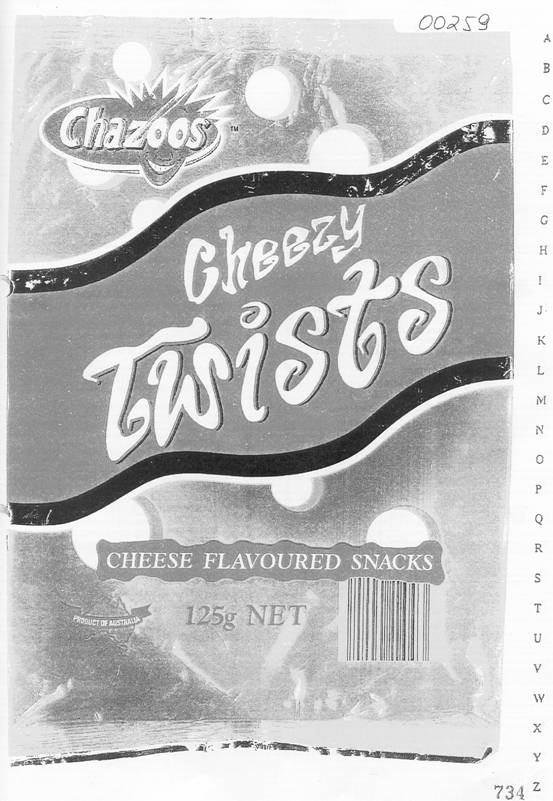
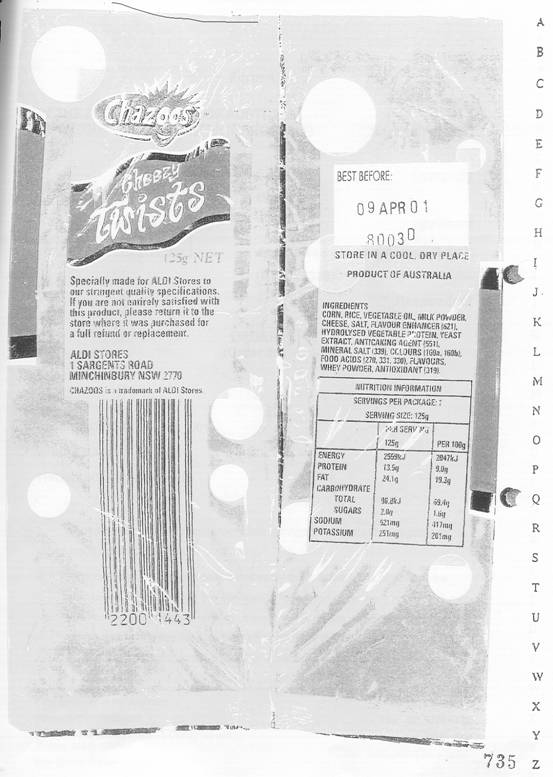
Trade Marks Act 1995 (Cth) ss 6 (“sign”), 41, 120
Top Heavy Pty Ltd v Killin (1996) 34 IPR 282 cited
James Watt Constructions Pty Ltd v Circle-E Pty Ltd [1970] 3 NSWR 481 referred to
Berzins Specialty Bakeries Pty Ltd v Monty’s Continental Bakery (Vic) Pty Ltd (1987) 15 FCR 402 referred to
JB Stone & Co Ltd v Steelace Manufacturing Co Ltd (1929) 46 RPC 406 (CA) referred to
Bass, Ratcliff & Gretton Ltd v Nicholson & Sons Ltd (1932) 49 RPC 88 (HL) referred to
Picot Ltd v Goya Ltd [1967] RPC 573 referred to
Kolotex Glo Australia Pty Ltd v Sara Lee Personal Products (Australia) Pty Ltd (t/a Hilton Hosiery) (1993) 26 IPR 1 referred to
The Shell Co of Australia Ltd v Esso Standard Oil (Australia) Ltd (1963) 109 CLR 407 referred to
Johnson & Johnson Australia Pty Ltd v Sterling Pharmaceuticals Pty Ltd (1991) 30 FCR 326 referred to
Unilever Aust Ltd v Karounos [2001] FCA 1132 referred to
British Sugar Plc v James Robertson & Sons Ltd [1996] RPC 281 distinguished
Wrigley’s (A’asia) Ltd v Lifesavers (A’asia) Ltd (1936) 37 SR (NSW) 9 referred to
Pepsico Australia Pty Ltd v Kettle Chip Co Pty Ltd (1996) 33 IPR 161 referred to
Sports Break Travel Pty Ltd v P & O Holidays Ltd (2000) 50 IPR 51 referred to
Australian Woollen Mills Ltd v FS Walton & Co Ltd (1937) 58 CLR 641 discussed
Wingate Marketing Pty Ltd v Levi Strauss & Co (1994) 49 FCR 89 referred to
Berlei Hestia Industrial Ltd v The Bali Co Inc (1973) 129 CLR 353 referred to
Marc A Hammond Pty Ltd v Papa Carmine Pty Ltd [1976] 2 NSWLR 124 referred to
Polaroid Corporation v Sole N Pty Ltd [1981] 1 NSWLR 491 referred to
Murray Goulburn Co-operative Co Ltd v New South Wales Dairy Corporation (1990) 24 FCR 370 (FC) referred to
S & I Publishing Pty Ltd v Australian Surf Life Saver Pty Ltd (1998) 88 FCR 354 referred to
Biogen Inc v Medeva Plc (1996) 36 IPR 438 referred to
Campomar Sociedad, Limitada v Nike International Ltd (2000) 202 CLR 45 referred to
Jones v Dunkel (1959) 101 CLR 298 referred to
R v Burdett (1820) 4B & Ald 95 (106 ER 873) referred to
Cooper Engineering Co Pty Ltd v Sigmund Pumps Ltd (1952) 86 CLR 536 referred to
Pianotist Company Ltd’s Application (1906) 23 RPC 774 referred to
Saville Perfumery Ltd v June Perfect Ltd (1941) 58 RPC 147 referred to
New South Wales Dairy Corporation v Murray Goulburn Co-operative Company Ltd (1989) 86 ALR 549 referred to
CA Henschke & Co v Rosemount Estates Pty Ltd (2000) AIPC ¶91-640 referred to
Mars GB Ltd v Cadbury Ltd [1987] RPC 387 referred to
Conde Nast Publications Pty Ltd v Taylor (1998) 41 IPR 505 referred to
Re London Lubricants (1920) Ltd’s Application (1925) 42 RPC 264 referred to
Unilever Australia Ltd v PB Foods Ltd (1999) 47 IPR 358 referred to
Blount Inc v Registrar of Trade Marks (1998) 83 FCR 50 referred to
Ocean Spray Cranberries Inc v Registrar of Trade Marks (2000) 47 IPR 579 referred to
Clark Equipment Co v Registrar of Trade Marks (1964) 111 CLR 511 referred to
Burger King Corporation v Registrar of Trade Marks (1973) 128 CLR 417 referred to
Big Country Developments Pty Ltd v TGI Friday’s Inc (2000) 48 IPR 513 referred to
Registrar of Trade Marks v W & G Du Cros Ltd [1913] AC 624 referred to
State Rail Authority of New South Wales v Earthline Constructions Pty Ltd (1999) 160 ALR 588 referred to
W D & H O Wills (Australia) Ltd v Phillip Morris Ltd (1997) ATPR 41-590 referred to
Mark Foys Pty Ltd v TVSN (Pacific) Ltd (2000) 104 FCR 61 referred to
Windsor Smith Pty Ltd v Dr Martens Australia Pty Ltd (2001) 49 IPR 286 referred to
Esso Australia Resources Ltd v Commissioner of Taxation (1998) 84 FCR 541 referred to
Biogen Inc v Medeva plc [1997] RPC 1 referred to
Members of the Yorta Yorta Aboriginal Community v Victoria (2001) 180 ALR 655 referred to
Designers Guild Ltd v Russell Williams (Textiles) Ltd [2000] 1 WLR 2416 referred to
Norowzian v Arks Ltd (No 2) [2000] FSR 363 referred to
Pro Sieben Media AG v Carlton UK Television Ltd [1999] 1 WLR 605 referred to
Cross on Evidence (6th Austn ed, 2000) cited
Shanahan, Australian Law of Trade Marks and Passing Off (2nd ed, 1990) referred to
Blanco-White and Jacob, Kerly’s Law of Trade Marks and Trade Names (12th ed, 1986) referred to
ALDI STORES LIMITED PARTNERSHIP v FRITO-LAY TRADING COMPANY GmbH
N 1189 OF 2001
HILL, LINDGREN & CONTI JJ
21 DECEMBER 2001
SYDNEY
|
| |
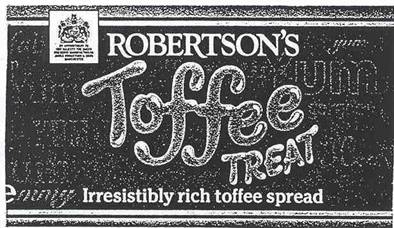
ON APPEAL FROM A JUDGE OF THE FEDERAL COURT OF AUSTRALIA
| BETWEEN: | ALDI STORES LIMITED PARTNERSHIP (PT 0022328) APPELLANT
|
| AND: | FRITO-LAY TRADING COMPANY GmbH RESPONDENT
|
| DATE OF ORDER: | |
| WHERE MADE: |
THE COURT ORDERS THAT:
2. The orders made on 24 July 2001 in proceeding N 180 of 2001 be set aside and, in lieu of those orders, it be ordered that:
(a) the application be dismissed; and
(b) the applicant in that proceeding pay the costs of the respondent to that proceeding.
3. The respondent pay the appellant’s costs of the appeal.
Note: Settlement and entry of orders is dealt with in Order 36 of the Federal Court Rules.
| IN THE FEDERAL COURT OF AUSTRALIA |
|
| N 1189 OF 2001 |
ON APPEAL FROM A JUDGE OF THE FEDERAL COURT OF AUSTRALIA
| BETWEEN: | ALDI STORES LIMITED PARTNERSHIP (PT 0022328) APPLICANT
|
| AND: | FRITO-LAY TRADING COMPANY GmbH RESPONDENT
|
| JUDGE: | |
| DATE: | |
| PLACE: |
REASONS FOR JUDGMENT
1 The appellant, Aldi Stores Limited Partnership (“Aldi”), appeals from the judgment of a judge of this Court which declared that it had infringed the respondent’s registered trade mark No. A166590 (“the trade mark”) and restrained it from distributing, supplying or offering to supply in Australia any cereal preparations which used a mark which his Honour found infringed the trade mark. His Honour also made consequential orders including orders involving recall and destruction of packaging held to embody an infringement of the trade mark.
2 The trade mark, which is registered in respect of goods in class 30, namely, “tasty preparations made from cereals, primarily for use as a snack and not being bread or cake”, is the word “Twisties”.
3 It is common ground that Frito-Lay Trading Company GmbH (“Frito-Lay”) is the registered owner of the trade mark and that the trade mark has over a long period of time in Australia been used as a trade mark in the marketing of snack food products.
4 Aldi has recently commenced operating in Australia a chain of grocery stores. It operates stores along similar lines in other countries. The goods it sells are displayed in cartons or boxes on pallets under generic names or its own brands at prices cheaper than the prices at which similar goods are sold in supermarkets or other outlets under other brands. One of the items it has developed for sale in Australia is an extruded, cereal-based snack with a cheese flavour. The product is manufactured for Aldi by a third party. It is sold in packaging on which the words “Cheezy Twists” appear. The manufacturing process does not, as such, involve twisting, but rather extrusion although, as his Honour held, the resultant product has a twisted appearance.
5 The product is sold in packaging the front and back of which are in the form shown in black and white in the annexure to this judgment, save that the packaging actually used is in colour.
6 The learned primary judge described the packaging in the following terms:
“The words ‘Cheezy Twists’ are prominently displayed on the front of the packet, at an angle and in an irregular font which is evocative of the shape of the product. The letters of the word ‘twists’ are larger than the letter of the word ‘cheezy’. The words are white against a red background. Above those words, and separated by an irregular silver band at an angle, is a blue logo including the word ‘Chazoos’, with a smiling face incorporated at the position of ‘oo’ against a gold background, with some white and yellow balls depicted on that background. Below the words ‘Cheezy Twists’ and separated by an irregular silver band at an angle, is the same gold background as above with similar white and yellow balls and the words ‘cheese flavoured snacks’ in white against a red background. The font of those words is regular and symmetrical and they are in a horizontal plane. There is a smaller version of this layout on the back, but there is no equivalent of the words ‘cheese flavoured snacks’. ‘Chazoos’ is stated on the back of the packaging to be a trade mark of ‘Aldi Stores’.”
7 The product is displayed in the store in such a way that the bottom part of the front of the pack cannot be seen as the potential purchasers walk down the aisle. Hence, potential purchasers see part of the front of a number of packs displayed in an opened carton including the words “Cheezy Twists” as described by the learned primary judge. The cartons have the words “Cheezy Twists” on the front and sides in a way which can be readily seen. The carton and manner of display are described by the learned primary judge as follows:
“The font of those words [Cheezy Twists] is regular and the words are on a horizontal plane. On the side, the logo including the word ‘Chazoos’ appears above the words ‘Cheezy Twists’. These goods are displayed in close proximity to other goods offered for sale by the respondent [Aldi] described as ‘Cheese Rings’ and ‘Cheese Balls’ as well as other products described as ‘Chicken Snacks’ and ‘Barbecue Snacks’. Each has a different coloured background for use on the display cartons. Red is used for ‘Cheezy Twists’, yellow for ‘Cheese Rings’, blue for ‘Cheese Balls’, green for ‘Chicken Snacks’ and a different colour red is used for ‘Barbecue Snacks’. The position, font and lettering of the description on the carton is similar in each case.”
8 The case for Frito-Lay was based solely on the provisions of the Trade Marks Act 1995 (Cth) (“the Act”). Unusually for this class of case, Frito-Lay did not seek to rely at all on the provisions of Part V of the Trade Practices Act 1974 (Cth). Hence no question arises as to any similarity in colour, font or get-up.
9 The issues which thus arose for decision before his Honour (and on the appeal) were, and are, therefore, whether the words “Cheezy Twists” in the way they appeared on the packaging involved those words being used as a trade mark within the meaning of s 120(1) of the Act and, if so, whether that use infringed the trade mark. Frito-Lay did not complain about the use of the words on the carton. There were two subsidiary issues which arose by virtue of the defence filed by Aldi. The first was whether, in accordance with s 122(1)(b) of the Act, Aldi used the words “Cheezy Twists” in good faith to indicate some characteristic of the product contained in the packet. The second, in accordance with s 122(1)(f) of the Act, was whether the Court should be of the opinion that “the person [Aldi] would obtain registration of the trade mark in his or her name if the person were to apply for it”. The defence said to arise under s 122(1)(b) was abandoned in the appeal.
10 Section 120(1) of the Act provides as follows:
“A person infringes a registered trade mark if the person uses as a trade mark a sign that is substantially identical with, or deceptively similar to, the trade mark in relation to goods or services in respect of which the trade mark is registered.”
11 The phrase “use of a trade mark in relation to goods” is defined in s 7(4) of the Act to mean “use of the trade mark upon, or in physical or other relation to, the goods…”. A definition of “deceptively similar” is provided in s 10 of the Act. That section states that:
“… a trade mark is taken to be deceptively similar to another trade mark if it so nearly resembles the other trade mark that it is likely to deceive or cause confusion.”
12 A trade mark is defined in s 17 of the Act as:
“… a sign used … to distinguish goods … dealt with or provided in the course of trade by a person from goods … so dealt with or provided by any other person .”
13 “Sign” is defined in s 6 of the Act to include “word”.
The judgment appealed from
14 It was the submission of Aldi before the learned primary judge that, while the word “Chazoos” was a trade mark appearing on the packet, the words “Cheezy Twists” were not used as a trade mark, but rather merely as a description of the product contained in the packet. It was argued that although extruded, the word “twists” was a fair description of the shape of the product, and compared with the use by Aldi of descriptive words for other cheese flavoured products of different shapes sold by it, eg “rings” and “balls”. Further, it was submitted, the product had a cheese taste and was thus properly described as “cheezy”, the substitution of “z” for “s” not being of significance. The process of manufacture was properly described, it was said, as a twisting process.
15 For Frito-Lay, it was submitted that the word “twist” was not an apt description of the product, which was produced by extrusion, not twisting. It was said that the context in which the words appear on the packaging, and particularly the use on the front of the package of the words “cheese flavoured snacks” assisted the conclusion that the use of the words “Cheezy Twists” was use as a trade mark. “Cheezy” was, it was submitted, an invented word, not to be found in the dictionary. Significantly, it was said, Aldi had set out to reproduce, so far as was possible, the precise product marketed under the trade mark, one of the best known marks in the savoury snack food market. The packaging was devised with an eye to the Twisties packaging. One version of the packaging was, indeed, rejected because it was too close to Twisties packaging. In designing the product and its get-up, it was said Aldi had its eye set firmly upon the market leader, Twisties. So, it was argued, it should be found that Aldi adopted the name “Cheezy Twists” and the get-up of the Cheezy Twists packaging, in order to appropriate part of the trade reputation of Frito-Lay and that hence it should be presumed that the use of the name was likely to deceive or confuse consumers and thus to constitute an infringement of the trade mark. The fact that Aldi had used both “Chazoos” and “Cheezy Twists” on the packaging did not mean that it could not use both as trade marks, or that “Chazoos” was a mark and “Cheezy Twists” a description of the product.
16 The learned primary judge found for Frito-Lay on both questions. In his Honour’s view, the words “Cheezy Twists” as they appeared on the packaging were used by Aldi as a trade mark and further there was a sufficient resemblance to the trade mark to make the use by Aldi of the words “Cheezy Twists” likely to deceive or cause confusion to the public.
17 His Honour’s conclusion that Aldi had used the words “Cheezy Twists” as a trade mark was reached as follows:
1. While the method of manufacture of both products did not involve twisting, the Aldi product was aptly described as a twist and was so described in the trade.
2. However, it was possible for there to be two trade marks used on packaging. In the present case the word and logo “Chazoos” was clearly a trade mark. The words “Cheezy Twists” were used separately and distinctly from the “Chazoos” word and logo mark, although complementary to it. In that context both the “Chazoos” mark and the words “Cheezy Twists” were used as trade marks.
3. Mr Joyce, the buying director of Aldi, had made a direct admission (of a relevant fact), namely, that the use of the expression “Cheezy Twists” on the Aldi packaging was “employed by [Aldi] in seeking to distinguish its goods in the eyes of the consumer from the products of other traders”. This admission was said to be consistent with the evidence of a Ms O’Regan as to the process by which the name “Cheezy Twists” was chosen. His Honour’s use of the “admission” is the subject of challenge by Aldi.
18 His Honour concluded that there was an infringement of the trade mark having regard to the following matters:
1. That the mark “Twisties” had been widely used over a long period of time and was one of the best-known marks in the snack food market.
2. That while the extruded form of the product had a twisted appearance and was fairly described as “twists” and such products were widely referred to in the trade as “twists”, neither that word nor the mark “Twisties” had been applied to similar products with different shapes such as rings or balls. Frito-Lay did not have a monopoly with respect to the word “twists”, which was not its trade mark and was descriptive. Hence, Frito-Lay could not prevent Aldi using the words “cheese twists”.
3. The Twisties product was the market leader in the field. Aldi (and those to whom it delegated responsibility for devising the packaging) chose the word “Cheezy” in conjunction with the word “Twists” in order to take advantage of the aural resemblance with the trade mark “Twisties”. The instructions were to reproduce, so far as possible, the precise product marketed under the mark “Twisties”. In these circumstances, there was a sufficient resemblance to make the mark “Cheezy Twists” likely to deceive or cause confusion. It followed also that Aldi did not use the “Cheezy Twists” mark in good faith to indicate any characteristic of the goods so as to permit Aldi to rely upon the defence under s 122(1)(b) of the Act.
19 Having found that Aldi’s use of the words “Cheezy Twists” was use as a trade mark, that the use infringed the “Twisties” mark and that it was not used in good faith to indicate a characteristic of the product sold, his Honour found that whatever s 122(1)(f) of the Act might mean, the defence could have no application in the present circumstances. It is from this judgment that Aldi appealed.
The submissions on the appeal
20 The submissions of Aldi on the appeal can be summarised as follows:
1. It was not open to the learned primary judge to find that there had been use of the words “Cheezy Twists” as a trade mark.
2. The admission by Mr Joyce concerning what Aldi sought to achieve when using the expression “Cheezy Twists” on its packaging was not relevant to whether the words had been used as a trade mark.
3. His Honour erred in holding that Aldi had set out to produce a product exactly matching Frito-Lay’s product “Twisties”. In this respect, it was submitted a blind sampling test had been conducted with the aim of producing a product that matched the quality and characteristics of what was determined to be the best extruded cheese product already on the market. That this happened to be Twisties, the market leader, was co-incidental.
4. That his Honour erred in finding that the use of the words “Cheezy Twists” was deceptively similar to the “Twisties” mark by reason of an aural representation of the “Twisties” mark. Particularly it was not to his Honour to find that the use of the words “Cheezy Twists” was deceptively similar to the registered mark “Twisties” for the purposes of s 120(1) of the Act by reason of that aural resemblance.
5. His Honour should have held, having regard to the proper construction of s 122(1)(f) of the Act that Aldi would have obtained registration of the trade mark “Chazoos Cheezy Twists” and accordingly had a defence to any infringement of the trade mark “Twisties”.
21 There is overlap in some of these submissions. Ultimately, however, it can be seen that they relate to three matters. The first involves whether his Honour erred in holding that there was use by Aldi of the words “Cheezy Twists” as a trade mark. The second involves whether such use as there was infringed the “Twisties” mark. The final matter relates to the defence under s 122(1)(f) of the Act rejected by his Honour. These three matters will be considered seriatim.
Use of “Cheezy Twists” as a trade mark
22 It is familiar law that a mark or sign (in this case the words “Cheezy Twists”) will be used as a trade mark if the use is such as to distinguish the goods of the person who uses it from those of other traders, so that it is a “badge of origin” of the goods. It will be so used if it indicates a connection in the course of trade between the goods and the person who applies it to the goods: Shell Co of Australia Ltd v Esso Standard Oil (Australia) Ltd (1963) 109 CLR 407 per Kitto J at 422-425, Mark Foy’s Ltd v Davies Coop & Co Ltd (the Tub Happy case) (1956) 95 CLR 190 at 198-200 per Williams J, Johnson & Johnson Australia Pty Ltd v Sterling Pharmaceuticals Pty Ltd (1991) 30 FCR 326 at 335 per Lockhart J, 342 per Burchett J and 347-8 per Gummow J and Koninklijke Philips Electronics NV v Remington Products Australia Pty Ltd (2000) 48 IPR 257 at 265-6. In determining whether the mark is a badge of origin, as Kitto J said in Shell at 422 (and as the case itself illustrates) context will be all important. That context includes a consideration of the way in which the word is displayed in relation to the goods or in advertisements of which complaint is made: see Mars GB Ltd v Cadbury Ltd [1987] RPC 387 at 402 per Whitford J and Johnson & Johnson at 347 per Gummow J.
23 Where the sign or mark is an invented word or invented combination of words, it will usually be easy to conclude that use on packaging or on the goods themselves is a trade mark use, although as the Johnson & Johnson case demonstrates some invented words might (while not yet having entered into the English language) themselves suggest a meaning, so that a particular use may not be a trade mark use. Where the word has or a combination of words have a clear meaning in ordinary use, the question will be much more difficult as the word or combination of words may either have taken on a secondary meaning indicating the origin of the goods or may simply convey an ordinary meaning (ie some message other than the trade origin of the goods): see Top Heavy Pty Ltd v Killin (1996) 34 IPR 282 at 286. It is well established that there is not a true dichotomy between words capable of being used as a badge of trade origin and words that are descriptive: see Johnson & Johnson at 347 per Gummow J and at 339 per Lockhart J.
24 In some ways the present case is the opposite of the Johnson & Johnson case. In that case, the question which arose for decision was whether use by Johnson & Johnson on its packaging of paracetamol products of the word “caplets” infringed the respondents trade mark “caplets”. Lockhart J was of the view that the word, although a made up word, had no meaning other than one that was descriptive of the character or quality of the goods. Accordingly, his Honour would have ordered rectification of the register to expunge the registration and it was unnecessary, therefore, for his Honour to consider whether there would otherwise have been an infringement. However, Burchett J was of the view that in the context in which Johnson & Johnson had used the word “caplets” it had not used the word as a trade mark. His Honour had regard to matters such as the type face and colouring of the lettering used. Relevant also was that the word “caplets” was a combination of familiar sounds which imparted the notions of capsule and tablet. Gummow J was of a similar view, indicating that in the setting on the package on which the word “caplets” was depicted, the word was not used to indicate a connection in the course of trade between the manufacturer and the contents of the package.
25 The question which here arises for decision may be formulated in the terms used by Gummow J in Johnson & Johnson at 351, altered to meet the facts of the present case, as follows:
Whether, in the setting on the package on which the words “Cheezy Twists” appear, those words possess the character of words which Aldi is using in relation to its extruded cheese snack food product, for the purpose of indicating or so as to indicate a connection in the course of trade between Aldi and the contents of the package. Do the words “Cheezy Twists” appear as a mark for distinguishing an Aldi product from other extruded cheese snack food products in the course of trade?
26 While the words “Cheezy Twists” are capable of describing the contents of the package, my view is that they do much more than that. Such description is found on the packet in any event in the words “cheese flavoured snacks”, which on no view of the matter were used as a trade mark. While it is no doubt true to say that the word “Chazoos”, with or without logo, is used as a trade mark, the present is a case where two trade marks are used, one a generic word used over a product range and the other used as a badge of origin in respect of a particular product.
27 It will have been observed that in making this finding I have not found it necessary to take into account the “admission” by Mr Joyce. The objective use of the words “Cheezy Twists” in the context of the packaging requires the conclusion that the words are used as a trade mark. Hence, it is not necessary to consider whether, if there were an admission, that admission would have a bearing upon the question whether there was use as a trade mark. Clearly, if the admission is relevant it supports the conclusion that there was use as a trade mark of the words “Cheezy Twists” on the packaging. However, I would wish to add some additional comments.
28 The admission came in the course of a lengthy cross-examination by senior counsel for Frito-Lay, during which the following exchange occurred:
“Q: And when you use that expression “Cheezy Twists” on the package you are seeking to distinguish your goods in the eyes of consumers from products of other traders? – Yes”.
29 There are some difficulties in treating that exchange as an admission binding Aldi. First, it is not at all clear to me that Mr Joyce had authority to bind Frito-Lay by an admission. Perhaps that is why later in the judgment the learned primary judge referred to the failure on the part of Frito-Lay to call executives involved in the making of the decision to use the name “Cheezy Twists” as leading to the more easy making of an inference adverse to that company. Second, there are other passages in the cross-examination which suggest that Mr Joyce may not have understood the question he was asked. For example, earlier Mr Joyce denied, subject to a qualification, that by displaying the words “Cheezy Twists” with such prominence Aldi was stamping its products with a badge of origin. He denied too that the word “cheezy” together with “twists” would help in distinguishing the Aldi “twists” from those of other traders. He asserted that the word “cheezy” had been chosen (as opposed to “cheese”) with the aim of targeting teenage boys, and as a “fun sort of trendy word” used to describe the flavour of the product. Finally, even if it was Mr Joyce’s view that the use of the words was use as a trade mark (or for that matter that it was intended that the words be used as a trade mark) I have difficulty in accepting that view as determinative of the matter, even if relevant.
30 Whether or not the principle discussed by Dixon and McTiernan JJ in Australian Woollen Mills Ltd v F S Walton & Co Ltd (1937) 58 CLR 641 at 657, to which reference will later be made, is relevant to the question whether a particular use is use as a trade mark or is really confined to the question whether a mark is likely to deceive or confuse is not a matter which needs to be decided in this case. There is no principle which operates to make use of a word other than as a trade mark a trade mark use, any more than there is a principle which could operate to convert use of a word as a trade mark into use otherwise than a use signifying the trade origin of goods. In most, if not all cases, the question whether there has been use as a trade mark will be determined by an objective examination of the use in the context in which it appears.
Whether the two marks “Twisties” and “Cheezy Twists” were deceptively similar
31 The learned primary judge placed considerable emphasis on two matters in finding for Frito-Lay on this issue. The first was his Honour’s view that the sound of the words “Cheezy Twists” had a close resemblance to the sound of the word “Twisties” in that the sound represented by the letter “y” in “Cheezy” was similar to the sound represented by the letters “ie” in the “Twisties” mark. Both marks were also in the plural. The second was the application of the passage to which reference has already been briefly made, from Australian Woollen Mills,to the facts of the case.
32 Putting to one side the second of these matters, I fail to see any real similarity between the two marks, accepting that both have the phonetic sound “ee”. First, that sound (and clearly the aural representation of a mark will be relevant) appears at the end of the “Twisties” mark (and with a plural “s”). Second, in relation to the Aldi mark the sound appears not in connection with the word “twist” but in connection with the word “cheese”, albeit spelled with a “z”. In my view the two marks are not so similar that the Aldi mark is likely to deceive or cause confusion. However, I do accept that questions such as this involve matters of perception, and that ordinarily an appellate court should not be quick to set aside on appeal a judgment merely because the question is one in respect of which perceptions might differ: see S & I Publishing Pty Ltd v Australian Surf Life Saver Pty Ltd (1998) 88 FCR 354. It is important, therefore, to consider the second basis for his Honour’s decision.
33 In Australian Woollen Mills, the appellant had sued alleging fraudulent passing off and, as well, infringement of its trade marks on the grounds that the respondent’s mark was likely to deceive or confuse. At first instance it was held that the two marks were on objective grounds not likely to deceive or confuse and there had been no fraudulent passing off. Both matters were at issue in the appeal, which was dismissed by a majority of the High Court (Evatt J dissenting). There was no issue, nor could there have been, that there had been use by the respondent of a trade mark. However, the majority was of the view both that there had been no conscious imitation of the appellant’s marks and that the respondent’s mark was not sufficiently similar as to be likely to deceive or confuse. However, in what technically is dicta (but emanating from the joint judgment of Dixon and McTiernan JJ, very persuasive dicta) it was said at 657-8:
“The rule that if a mark or get-up for goods is adopted for the purpose of appropriating part of the trade or reputation of a rival, it should be presumed to be fitted for the purpose and therefore likely to deceive or confuse, no doubt, is as just in principle as it is wholesome in tendency. In a question how possible or prospective buyers will be impressed by a given picture, word or appearance, the instinct and judgment of traders is not to be lightly rejected, and when a dishonest trader fashions an implement or weapon for the purpose of misleading potential customers he at least provides a reliable and expert opinion on the question whether what he has done is in fact likely to deceive. Moreover, he can blame no one but himself, even if the conclusion be mistaken that his trade mark or the get-up of his goods will confuse and mislead the public. But the practical application of the principle may sometimes be attended with difficulty. … But, in the end, it becomes a question of fact for the court to decide whether in fact there is such a reasonable probability of deception or confusion that the use of the new mark and title should be restrained.”
34 It is clear from the report that this comment was not made only with respect to the issue of fraud, but that it went, as well, to the trade mark issue whether the use of the mark might deceive or confuse members of the public. Nevertheless, it is also clear from what was said that their Honours regarded both issues as ultimately questions of fact to be decided by the Court. Their Honour’s were not seeking to enunciate a principle of law. While the presumption would not be lightly rejected, if there is no reasonable probability of deception or confusion then there can be no infringement.
35 The factual basis is the present case to which the comments in Australian Woollen Mills were said to apply arose from evidence adduced from a Ms O’Regan, who worked for an advertising agency responsible for developing packaging for products proposed to be sold by Aldi and from Mr Joyce to whom reference has already been made.
36 Ms O’Regan, who had, inter alia, responsibility for the development of packaging for a snack food range of products dealt with Ms Turner, a buying manager employed by Aldi. Ms Turner was not called to give evidence, nor were any other executives of Aldi. Ms Turner was no longer with Aldi, but it was not suggested that she would have been unable to give evidence. No attempt was made to impugn the credit of either Ms O’Regan or Mr Joyce who did give evidence.
37 Ms O’Regan’s evidence was that she was involved at the time Aldi was working towards the launch of stores in Australia in seeking, inter alia, to develop products for sale by Aldi. Her instructions were to obtain three concept designs from one of four design agencies nominated by her firm and agreed to by Aldi. She chose Brave Communications (“Brave”) as the most appropriate agency in relation to extruded snacks. Although that agency had no immediate conflict of interest it had done some work for Twisties in the past. Indeed this was one of the reasons she chose Brave. I should interpose that it was not suggested that Aldi chose Brave for the job. Indeed, Ms O’Regan’s evidence was that she did not discuss the choice of Brave with Ms Turner.
38 Relevantly she was told by Ms Turner that Aldi wished to produce and market extruded snack food products which included cheese and bacon balls and cheese rings. It seems that the decision to produce a cheese twist product came later.
39 It was part of Ms O’Regan’s instructions that Twisties was the brand leader for cheese twist products. Aldi wanted to market a product which would be directly competitive with Twisties and another, unnamed, private label. It is hardly surprising that Aldi wanted to produce a product competitive with Twisties. It was the market leader and the nature of the business which Aldi was to launch was such that it sold popular products under its own brand names, rather than proprietary brands. In this it contrasted with the traditional Australian retail supermarkets, which generally sell branded products. The task Ms O’Regan was given was to arrange the design for the packaging of cheese twists such that the product would appeal to the youth market, predominantly the male youth market.
40 It should not be thought that snack foods were the only products under investigation at the time. Confidential memoranda disclose similar packaging design briefs for a whole series of products from kitchen towels to packet soups in preparation for the proposed opening of Aldi stores in Australia.
41 Initially the brand name for the cheese twist product had not been decided. (The reference to “brand name” in the evidence would seem to be a reference to whether the product was to be marketed under the “Chazoos” label or an alternative label.) The product was referred to, in the briefing instructions, as “Cheese Twists”. The task was to give the product “personality”. What the evidence clearly demonstrates is that Aldi wished to produce a cheese twist product, being mainly a “male product for young teenagers”, a product which had to be “cool” and fit in with the teenage life style. At some stage at least the cheese twists were to be called “Ricketys Cheese Twists” rather than “Chazoos”. Three concept versions were prepared for each of the Ricketys and Chazoos labels. The Chazoos brand was ultimately settled upon.
42 Two of the first concepts prepared by the agency described the product as “Cheezy Twists”; a third, “Cheese Twists”.
43 According to Ms O’Regan, Brave came up with the name “Cheezy Twists” as an alternative to “Cheese Twists”. Ms O’Regan presented the three initial concept designs to Ms Turner without comment she said. Two of them, as I have indicated, used the words “Cheezy Twists”. Ms Turner expressed a preference for the name “Cheezy Twists”, but otherwise the subject of the name had not been discussed between them. Ms O’Regan said that she did not feel that there was any similarity between “Twisties” and “Cheezy Twists”. She thought the latter name would “help to add a funky, attractive air to the packaging” and help draw consumers to the Aldi product. However, she said her brief was to make the product stand out within the Aldi store, not directly to compete with other traders. The font used in the original concept designs was criticised by Ms Turner (based on advice from Frito-Lay’s patent attorney) and rejected as being too close to “Twisties”. A different font was chosen in an apparent attempt to suggest the twist shape of the product.
44 Mr Joyce said that he had not been involved in the design of the artwork for the packaging. He pointed out that at the time Aldi was about to launch some 500 products and was looking at many designs and many products. He said that Aldi stores developed products of high quality and if the quality of the products was equivalent to a particular product in the market which was a brand leader then that was the product Aldi was looking at. To develop quality products, Aldi looked at a number of products on the market, normally including the brand leader, and conducted, in the case of edible products at least, a blind sampling session, rating products by reference to quality. Aldi would then benchmark the products being developed against products considered to be of the best quality. He accepted that Aldi wanted a product that was as close to the shape, appearance and flavour of Twisties as possible and that Aldi wished to target the same market as that at which Twisties was targeted.
45 In my view while this evidence does show that Aldi wished to produce a cheese twist product of similar quality, appearance and flavour to the Twisties product, it does not lead to the conclusion that Aldi set out to appropriate the trade reputation of the product of a trade rival, Twisties, in the sense which would bring into play the presumption referred to in Australian Woollen Mills. In the context of the evidence relating to the proposed Aldi supermarket business and the commercial necessity for that company to sell under its own label for a large number of products, it is clear that Aldi set out to have manufactured for it (or to buy from manufacturers) products of the same or higher quality as market leaders which it could sell under its own brands, rather than under recognised brand names. “Cheese Twists” was an obvious choice for a snack food product to be sold by Aldi. Twisties was the market leader. There is no doubt that the evidence establishes that Aldi set out to produce cheese twists that rivalled Twisties for sale in the same market as Twisties were sold. But that is not to say that Aldi set out to appropriate the Twisties trade reputation for itself or to produce a product the display and ultimate sale of which would trade on the Twisties name. Given the nature of the Aldi concept, purchasers would be likely to know that the products sold only in Aldi stores would be Aldi brands. They may or may not be produced by the same company which produced the market leader. In fact, Cheezy Twists were manufactured by a third company, The Real McCoy Snack Food Co Pty Ltd. The manufacture commenced from late in the year 2000.
46 That Aldi did not set out to appropriate for itself the trade reputation of Twisties is reflected in the way the products were to be marketed in Aldi stores, that is to say by the display of only part of the front of a series of products on which the name “Chazoos” appeared, each product packaged in a package with a different coloured background and each identified as a particular product, namely, “Cheese Rings”, “Cheese Balls”, “Chicken Snacks”, “Barbecue Snacks” and “Cheezy Twists”.
47 In my view, the background circumstances in which the packaging was prepared detracts not at all from the impression gained by comparing the two marks. They are not substantially identical to each other, nor are they deceptively similar in the sense defined in s 10 of the Act.
The defences
48 In view of the conclusions reached, it is unnecessary to deal with the defence raised by Aldi to the alleged infringement in reliance upon s122(1)(f) of the Act.
Conclusion
49 I would allow the appeal, set aside the orders appealed from and in lieu thereof order that the application be dismissed and the applicant pay the respondent’s costs of it. The respondent should also pay the appellant’s costs of the appeal.
| I certify that the preceding forty-nine (49) numbered paragraphs are a true copy of the Reasons for Judgment herein of the Honourable Justice Hill. |
Associate:
Dated: 21 December 2001
| IN THE FEDERAL COURT OF AUSTRALIA |
|
| NEW SOUTH WALES DISTRICT REGISTRY | N 1189 OF 2001 |
ON APPEAL FROM A JUDGE OF THE FEDERAL COURT OF AUSTRALIA
| BETWEEN: | ALDI STORES LIMITED PARTNERSHIP (PT0022328) APPELLANT
|
| AND: | FRITO-LAY TRADING COMPANY GmbH RESPONDENT
|
| JUDGES: | HILL, LINDGREN AND CONTI JJ |
| DATE: | 21 DECEMBER 2001 |
| PLACE: | SYDNEY |
REASONS FOR JUDGMENT
LINDGREN J:
INTRODUCTION
50 I have had the benefit of reading the Reasons for Judgment of Hill J and am thankful to be able to adopt his Honour’s account of the factual background to the appeal, which raises three issues:
1. Did the primary Judge err in concluding that the appellant (“Aldi”) had used “CHEEZY TWISTS” “as a trade mark”?
2. Did his Honour err in concluding that “CHEEZY TWISTS” was deceptively similar to the registered trade mark “TWISTIES” of the respondent (“Frito-Lay”)?
3. Did his Honour err in concluding that Aldi had failed to make out the statutory defence provided in par 122(1)(f) of the Trade Marks Act 1995 (Cth) (“the Act”), that is, the defence that Aldi “would obtain registration of the trade mark in [its] name if [it] were to apply for it”?
51 I will deal with these three questions separately and in sequence.
1. Use of “CHEEZY TWISTS” as a trade mark
1.1 General
52 Subsections 120 (1) and (2) of the Act provide as follows:
“(1) A person infringes a registered trade mark if the person uses as a trade mark a sign that is substantially identical with, or deceptively similar to, the trade mark in relation to goods or services in respect of which the trade mark is registered.
(2) A person infringes a registered trade mark if the person uses as a trade mark a sign that is substantially identical with, or deceptively similar to, the trade mark in relation to:
(a) goods of the same description as that of goods (registered goods) in respect of which the trade mark is registered; or
(b) services that are closely related to registered goods; or
(c) services of the same description as that of services (registered services) in respect of which the trade mark is registered; or
(d) goods that are closely related to registered services.
However, the person is not taken to have infringed the trade mark if the person establishes that using the sign as the person did is not likely to deceive or cause confusion.”
Aldi used the words “CHEEZY TWISTS” in relation to goods in respect of which Frito-Lay’s registered trade mark “TWISTIES” was registered. It follows that subs 120(1) applies, that Frito-Lay is not obliged to rely on subs 120(2), and that Aldi is not entitled to the benefit of the defence provided by the concluding words of subs 120(2) (“the person is not taken to have infringed the trade mark if the person establishes that using the sign as the person did is not likely to deceive or cause confusion”).
53 “Sign” is “defined” widely in s 6 of the Act as follows:
“Sign includes the following or any combination of the following, namely, any letter, word, name, signature, numeral, device, brand, heading, label, ticket, aspect of packaging, shape, colour, sound or scent.” (latter emphases mine)
54 Frito-Lay’s case, which his Honour accepted, was that Aldi had used the words “CHEEZY TWISTS”, and not, for example, an “aspect of packaging”, as a trade mark. Section 6 provides that the expression “trade mark” has the meaning given by s 17. The relevant effect of s 17 and subs 7(4) is that Aldi used the words “CHEEZY TWISTS” as a trade mark if it used them in physical relation to its goods to distinguish those goods from the goods of others which were also dealt with or provided in trade.
55 Frito-Lay did not allege passing off or contravention of s 52 of the Trade Practices Act 1974 (Cth): the case was infringement of registered trade mark or nothing.
56 As can be seen from the annexure to the Reasons for Judgment of the members of the Court, the words “CHEEZY TWISTS” appeared in letters which were very large and distinctive in form within a waving banner in a prominent position across the face of the packets. Indeed, those words were the most prominent feature on the packets, and prominence is one factor which has been regarded as suggesting trade mark use: cf James Watt Constructions Pty Ltd v Circle-E Pty Ltd [1970] 3 NSWR 481 (Hope J) (“Barrier Beam”); Berzins Specialty Bakeries Pty Ltd v Monty’s Continental Bakery (Vic) Pty Ltd (1987) 15 FCR 402 (Jenkinson J) (“Pritikin”) esp at 407.
57 It is difficult in the light of these considerations to think that the purpose and role of “CHEEZY TWISTS” on the packets can be adequately accounted for as that of informing prospective buyers that the packet contains cheese-flavoured twists. Pointing clearly in the same direction is the appearance, in more modest and restrained “regular print” below the banner, of the indubitably descriptive words “cheese flavoured snacks”. Those words soberly inform the reader of the packet’s contents. This suggests that the expression “CHEEZY TWISTS” or “CHAZOOS CHEEZY TWISTS” purports to be the name, rather than descriptor of the particular product contained in the packet.
58 Unless constrained by any other consideration, on the basis of my impression, recounted in the preceding two paragraphs, I would not discern error in his Honour’s conclusion that “CHEEZY TWISTS” was being used on the packets as a trade mark.
1.2 Primary Judge’s use of expression “entirely descriptive”
59 Aldi submits as follows:
“The Trial Judge’s finding that the words ‘cheezy twists’ were entirely descriptive, means that the only possible use of a sign as a ‘badge of origin’ was the ‘aspect of packaging’. His Honour expressly found that the use of the trade mark emerged from the ‘particular distinctive form of the words on the packet and not to use of the words in any other form’, [11], ... . That is the relevant sign used as a trade mark was not the words themselves.”
The significance of the reference to “aspects of packaging” in this submission is to be found in the definition of “sign” in s 6 of the Act (set out at [53] above).
60 Aldi’s submission is to the effect that a word which, devoid of context (as typed on an application for registration of a trade mark) may be understood to be “entirely descriptive”, can never be used as a trade mark. I do not accept the submission. I will have occasion later to discuss in more detail what his Honour meant when he used the expression “entirely descriptive” (see [167]-[172] below), but it suffices for the present to note that it is well established that words which, devoid of any context or which in one particular context may be understood to be descriptive, may nonetheless be used as a trade mark: JB Stone & Co Ltd v Steelace Manufacturing Co Ltd (1929) 46 RPC 406 (CA); Bass, Ratcliff & Gretton Ltd v Nicholson & Sons Ltd (1932) 49 RPC 88 (HL) at 109 per Lord Macmillan; Picot Ltd v Goya Ltd [1967] RPC 573 at 578; James Watt Constructions Pty Ltd v Circle-E Pty Ltd [1970] 3 NSWR 481 (Hope J); Kolotex Glo Australia Pty Ltd v Sara Lee Personal Products (Australia) Pty Ltd (t/a Hilton Hosiery) (1993) 26 IPR 1 per Wilcox J.
61 Consistently with Aldi’s submission, the only words which could be used as a trade mark on a particular occasion are words which, devoid of any context (again, as typed on an application for registration of a trade mark, for example) can be immediately seen to be, at least in part, non-descriptive. This is not the law, and, as I will explain later, I do not think his Honour meant by the expression “entirely descriptive”, “inherently incapable of ever, in any context, being used as a trade mark”.
62 It has been said that general laudatory epithets and geographical terms are inherently incapable of ever being used as trade marks (cf In re Joseph Crosfield & Sons Ltd [1910] 1 Ch 130 (“Perfection”); Thomson v B Seppelt & Sons Ltd (1925) 37 CLR 305; Re Yorkshire Copper Works Limited’s Application [1954] 1 All ER 570; Samuel Taylor Pty Ltd v Registrar of Trade Marks (1959) 102 CLR 650), but the trend of modern authority seems to be against a priori categorisation, and bears out the well known dictum of Kitto J in The Shell Co of Australia Ltd v Esso Standard Oil (Australia) Ltd (1963) 109 CLR 407 at 422 that “context is all important”; see, also, for example, Picot Ltd v Goya Ltd [1967] RPC 573 at 578; Johnson & Johnson Australia Pty Ltd v Sterling Pharmaceuticals Pty Ltd (1991) 30 FCR 326 at 335-336, 339 per Lockhart J, at 347-348 per Gummow J; Unilever Aust Ltd v Karounos [2001] FCA 1132 (Hill J) at [46]. In any event, the expression “CHEEZY TWISTS” is not a laudatory epithet or a geographical term. The fact that for registration purposes a descriptive word can acquire a secondary meaning, namely, the denotation of a particular source, also signifies that a descriptive word can be used as a trade mark for infringement purposes. Finally, although “CHEEZY TWISTS” describes twists which are cheese-flavoured or cheese-coloured or cheese-textured (or two or all of these), the misspelling consisting of the use of “z” rather than “s”, itself suggests in a subtle way the possibility that the expression may be being used to do something more than just to describe.
1.3 Did the primary Judge find trade mark use of the words “CHEEZY TWISTS” or of aspects of packaging?
63 Aldi’s submission set out at [59] above raises the question whether, independently of his having described the expression “CHEEZY TWISTS” as “entirely descriptive”, his Honour may nonetheless have found trade mark use of aspects of the “CHEEZY TWISTS” packaging, and not of those words themselves. In my opinion he did not do so.
64 His Honour stated (at [11]):
“In my opinion, the words “Cheezy Twists” as they appear on the packaging are a sign used as a trade mark within the meaning of s 120(1) of the Act. They are presented in a distinctive form for which there is no counterpart in the evidence. ... Other uses of the words in other forms does not, in my opinion, derogate from this conclusion. ... It should be clear that this finding as to trade mark use relates to the particular distinctive form of the words on this packet and not to use of the words in any other form.” (my emphasis)
In this passage, his Honour plainly had in mind the possibility that the expression “CHEEZY TWISTS” might be used in various contexts, in some of which it might well be used not as a trade mark, but purely descriptively. His Honour was simply at pains to make it clear that his finding did not relate to contexts other than that on the packets.
1.4 British Sugar Plc v James Robertson & Sons Ltd [1996] RPC 281
65 Aldi relies heavily on the judgment of Jacob J in British Sugar Plc v James Robertson & Sons Ltd [1996] RPC 281 (“British Sugar”), a case to which, apparently, the primary Judge was not referred. In that case the plaintiff (“British Sugar”) had registered “TREAT” for “dessert, sauces and syrups; all included in Class 30”. British Sugar used that trade mark on “Silver Spoon Treat”, a sweet syrup in a range of flavours to pour onto ice cream. The defendant (“Robertson”) launched a sweet spread, labelled “Robertson’s Toffee Treat”, which it sold along with its range of jams and preserves.
66 The following passage and picture from Jacob J’s judgment (at 287) provides sufficient background for present purposes:
“The label is primarily dark mauve (with words such as ‘yum yum’, ‘fab’, ‘luscious’) faintly legible. The key wording on this background is ‘Robertson’s Toffee Treat’ coupled with a description ‘Irresistibly rich toffee spread’. ‘Robertson’s’ is in clear white capital lettering. ‘Toffee Treat’ is in a fancy script. ‘Toffee’ is at least twice the size of ‘Treat’. The word ‘New’ also appears in a flash. This is appropriate for the product has no exact equivalent in the market. An example of the most important part of the label is as follows:*
* The label reproduced here does not have the word ‘New’ in a flash on it - Ed [of RPCs].
The product was, when introduced, truly novel. In supermarkets it comes on the shelves containing jams and preserves. It is not presented on the same shelves as the Silver Spoon Treat syrups. Robertson’s see their product as primarily competing with other spreads (e.g. jams) and particularly chocolate spreads. I did not understand this evidence to be challenged.”
67 Unlike s 120 of the Australian Act, s 10 of the Trade Marks Act 1994 (UK), which implemented EC Directive 89/104, did not contain an express requirement that, in order to infringe, a sign must have been used as a trade mark. It provided, relevantly, as follows:
“(1) A person infringes a registered trade mark if he uses in the course of trade a sign which is identical with the trade mark in relation to goods or services which are identical with those for which it is registered.
(2) A person infringes a registered trade mark if he uses in the course of trade a sign where because –
(a) the sign is identical with the trade mark and is used in relation to goods or services similar to those for which the trade mark is registered, or
(b) the sign is similar to the trade mark and is used in relation to goods or services identical with or similar to those for which the trade mark is registered,
there exists a likelihood of confusion on the part of the public, which includes the likelihood of association with the trade mark.”
68 The circumstances of the present case would have fallen for consideration under subs (2) of this section and therefore the existence of a likelihood of confusion would have been a necessary element of infringement. But under subs (1) of the Australian s 120, the defence of use of the sign in a manner not likely to deceive or cause confusion (provided by the words at the end of subs 120(2)) is not available to Aldi. However, the relevant defences available to Aldi are set out in s 122, of which that provided in par 122(1)(f) is discussed later.
69 Jacob J concluded that there was no infringement under either subs 10(1) or 10(2) because Robertson’s goods were neither identical nor similar to those of British Sugar. But, against the possibility that he was wrong, his Honour went on to consider the defence provided by subs 11(2), which was as follows:
“A registered trade mark is not infringed by –
(a) the use by a person of his own name or address,
(b) the use of indications concerning the kind, quality, intended purpose, value, geographical origin, the time of production of goods or of rendering of services, or other characteristics of goods or services, or
(c) the use of the trade mark where it is necessary to indicate the intended purpose of a product or service (in particular, as accessories or spare parts)
provided the use is in accordance with honest practices in industrial or commercial matters.”
70 Jacob J said that in construing this section he would have regard to the purpose of a trade mark as formulated in the EC Directive, namely, “to guarantee the trade mark as an indication of origin”. His Honour stated (at 299):
“I am, of course, concerned with the word ‘Treat’ alone. I cannot see even a hint that anyone regarded this alone as a trade mark. Mr Young says no matter, once it is incorporated into a phrase which has trade mark significance, i.e. ‘Toffee Treat’ that is enough. If I accept that the whole phrase is indeed a trade mark, I think Mr Young must be right. Section 11(2) does not cover the case where a word, outside the context of the use, is descriptive if, in context, it is part of trade mark use for the defendant’s goods.
I turn to consider how the word ‘Treat’ is used here I have no evidence from the public in relation to this question. I have some evidence of internal thinking at Robertson’s but the most important thing of all must be my own impression from the label and all the surrounding circumstances. Looking at the label I think the average customer would not see ‘Treat’ used as a trade mark. It is true that it is written as part of a phrase ‘Toffee Treat’ but this is done in a context where the maker’s name is plain. It is of course the case that you can have two trade marks used together (‘Ford Prefect’), but whether the secondary word is used as a trade mark is a question of fact. If it is a fancy word, then obviously it is a trade mark because it could not be taken as anything else. But where it is highly descriptive I see no reason why a member of the public should take the mark as a badge of origin. And that is particularly so where the product is a new sort of product, as here. The public are apt to take the name of a novel product as a description rather than a trade mark, particularly where the name is not fancy but is descriptive or laudatory. I do not think Robertson’s use is as a trade mark.” (my emphasis)
Jacob J concluded that “TOFFEE TREAT” was not being used to distinguish the goods of the manufacturer, Robertson, that is, as a trade mark.
71 I do not find this conclusion persuasive against the primary Judge’s conclusion that “CHEEZY TWISTS” was being used as a trade mark in the present case. The two cases depend on their own facts. In British Sugar the word “treat” was an ordinary English word of general laudatory significance, and the name of the manufacturer (Robertson) appeared nearby to indicate the origin of the goods. In the present case, neither “cheezy” nor “twists” was an ordinary English word of general laudatory significance and Aldi’s name did not appear nearby to indicate the origin of the goods.
72 Jacob J next turned to the question of the validity of the registration of “TREAT”. Subsection 47(1) of the United Kingdom Act provided that a registration might be declared invalid on the ground that the trade mark was “registered in breach of section 3”. Subsection 3(1) provided as follows:
“The following shall not be registered
(a) signs which do not satisfy the requirements of section 1(1),
(b) trade marks which are devoid of a distinctive character,
(c) trade marks which consist exclusively of signs or indications which may serve, in trade, to designate the kind, quality, quantity, intended purpose, value, geographical origin, the time of production of goods or of rendering of services, or other characteristics of goods or services,
(d) trade marks which consist exclusively of signs or indications which have become customary in the current language or in the bona fide and established practices of the trade.
Provided that, a trade mark shall not be refused registration by virtue of paragraph (b), (c) or (d) above if, before the date of application for registration, it has in fact acquired a distinctive character as a result of the use made of it.”
Subsection 1(1) provided:
“In this Act a ‘trade mark’ means any sign capable of being represented graphically which is capable of distinguishing goods or services of one undertaking from those of other undertakings.” (my emphasis)
73 In a passage relied on by Aldi, Jacob J stated (at 302):
“I have already described the evidence used to support the original registration. It was really no more than evidence of use. Now it is all too easy to be beguiled by such evidence. There is an unspoken and illogical assumption that ‘use equals distinctiveness’. The illogicality can be seen from an example: no matter how much use a manufacturer made of the word ‘Soap’ as a purported trade mark for soap the word would not be distinctive of his goods. He could use fancy lettering as much as he liked, whatever he did would not turn the word into a trade mark. Again, a manufacturer may coin a new word for a new product and be able to show massive use by him and him alone of that word for the product. Nonetheless the word is apt to be the name of the product, not a trade mark. Examples from old well-known cases of this sort of thing abound. The Shredded Wheat saga is a good example: the Canadian case is The Canadian Shredded Wheat Co Ltd v Kellogg Co of Canada Ltd (1938) 55 RPC 125 in the Privy Council and the United Kingdom case The Shredded Wheat Co Ltd v Kellogg Co of Great Britain Ltd (1940) 57 RPC 137 in the House of Lords. In the former case Lord Russell said (at page 145):
‘A word or words to be really distinctive of a person’s goods must generally speaking be incapable of application to the goods of anyone else.’
It is precisely because a common laudatory word is naturally capable of application to the goods of any trader that one must be careful before concluding that merely its use, however substantial, has displaced its common meaning and has come to denote the mark of a particular trader. This is all the more so when the mark has been used in conjunction with what is obviously taken as a trade mark.
I do not consider that the evidence filed to support the registration was anywhere near enough to support the conclusion that when the mark was registered, it was distinctive. Yes it had been used for about 5 years in conjunction with Silver Spoon, but it was not proved that the public regarded it as a trade mark – a reliable badge of trade origin – on its own. Further the use was only for what was essentially an ice cream topping. It did not cover the full range of goods covered by the registration.” (my emphasis)
Plainly, there is no inconsistency between this passage and the conclusion of the primary Judge in the present case that Aldi would not have obtained registration of the bare words “CHEEZY TWISTS” because they are “entirely descriptive” (see [167]-[172] below). For that purpose, both Jacob J and the primary Judge were contemplating an application for registration of bare words (“TREAT” in one case and “CHEEZY TWISTS” in the other).
74 But is the passage set out above inconsistent with the primary Judge’s conclusion that Aldi used “CHEEZY TWISTS” as a trade mark on the packets? Again, I think not. The context in which those words appeared could, and in my opinion did, make it clear that they were there performing a trade mark function. Moreover, the deliberately and vaguely provocatively misspelt “cheezy” in “CHEEZY TWISTS”, coupled with the greater market appeal of that expression as contrasted with the more bland “cheese twists”, suggests that it had the potential to be used as a trade mark, even if, read in isolation on a form of application for registration of a trade mark, it would have been seen only as “entirely descriptive”.
1.5 Intention, admission and trade mark use
75 In its notice of appeal, Aldi complains that, in concluding that there was trade mark use, his Honour relied on Aldi’s intention to use the expression “CHEEZY TWISTS” on the packets to distinguish its goods in the eyes of the consumer from the products of other traders – an intention which he inferred from the testimony of Mr John Francis Joyce, who was at the time of the hearing, Aldi’s Group Buying Director in Australia, and Ms Philippa Jane O’Regan, who was at that time Business Director of Interface Advertising Pty Ltd (“Interface”), a company which was retained by Aldi as its “sole agency responsible for all [of Aldi’s] packaging development, marketing, communications and advertising”.
76 Whether Aldi used the words “CHEEZY TWISTS” as a trade mark, that is to say, by way of distinguishing its goods from the goods of others, raises the objective test whether they would be likely to be understood to do so by relevant readers and hearers in the circumstances in which the words were likely to be read and heard: cf Wrigley’s (A’asia) Ltd v Lifesavers (A’asia) Ltd (1936) 37 SR (NSW) 9 at 16 per Nicholas J; The Shell Co of Australia Ltd v Esso Standard Oil (Aust) Ltd (1963) 109 CLR 407 at 425 per Kitto J; Johnson & Johnson Australia Pty Ltd v Sterling Pharmaceuticals Pty Ltd (1991) 30 FCR 326 (FC) at 351 per Gummow J; Pepsico Australia Pty Ltd v Kettle Chip Co Pty Ltd (1996) 33 IPR 161 at 182, 187; Sports Break Travel Pty Ltd v P & O Holidays Ltd (2001) 50 IPR 51 at [14] per Burchett J.
77 In [11] of his Reasons for Judgment, the primary Judge said “I do not take into account on this issue [trade mark use] any intention that the respondent may have had to appropriate any part of the applicant’s reputation”. This was a reference to the passage from the Reasons for Judgment of Dixon and McTiernan JJ in Australian Woollen Mills Ltd v FS Walton & Co Ltd (1937) 58 CLR 641 (“Australian Woollen Mills”) at 657 set out in [90] below. His Honour was seeking to make plain that he did not regard the testimony of Mr Joyce and Ms O’Regan as expert opinion on whether the market would read “CHEEZY TWISTS” on the packets as a badge of origin.
78 The learned primary Judge stated (at [11]):
“Mr Joyce, the buying director of [Aldi], agreed that the use of the expression ‘Cheezy Twists’ on the packets was employed by [Aldi] in seeking to distinguish its goods in the eyes of the consumer from the products of other traders. This amounts to a direct admission of the relevant fact. The evidence of Ms O’Regan as to the process by which the name was chosen is consistent with that conclusion.”
The particular exchange in Mr Joyce’s cross-examination on which Frito-Lay relies is the following:
“And when you use that expression ‘Cheezy Twists’ on the package you are seeking to distinguish your goods in the eyes of consumers from products of other traders? – Yes.”
This purported to be a concession by Mr Joyce as to Aldi’s subjective intention. But in my respectful opinion, such a concession does not amount to an “admission of the relevant fact”. “The relevant fact” is that relevant readers and hearers would be likely to understand the nature and purpose of the expression “CHEEZY TWISTS” as it appeared on the packets, to be to distinguish goods of the maker from the goods of other makers, that is to say, as a badge of origin. A subjective intention to use a sign as a trade mark is not probative of the objective fact of use of it as a trade mark use (cf Wingate Marketing Pty Ltd v Levi Strauss & Co (1994) 49 FCR 89 at 192B-C per Gummow J), just as a subjective intention not to use a sign as a trade mark is not probative of the objective fact of non-use of it as a trade mark (cf Sports Break Travel Pty Ltd v P & O Holidays Ltd (2001) 50 IPR 51 (FCA/Burchett J) at [14]).
79 The view which I have just expressed makes it unnecessary for me to consider whether, as Aldi contends:
· Mr Joyce could not bind Aldi by the supposed admission of trade mark use;
· a fair reading of Mr Joyce’s cross-examination as a whole shows that the exchange set out above should not be properly understood as such an admission.
(It was not submitted that Mr Joyce’s testimony was admissible as expert opinion evidence on an ultimate issue: cf s 80 of the Evidence Act 1995 (Cth).)
80 The distinctive form of the words “CHEEZY TWISTS”, their prominent position within the waving banner across the front of the packets, and the use of the obviously descriptive expression “cheese flavoured snacks” just below the banner, and, far less significantly, the misspelling of “CHEEZY”, all of which were referred to by his Honour, lead me to conclude that he did not err in finding that in the use it made of them on the packets, Aldi used the words “CHEEZY TWISTS” as a trade mark.
2. Deceptive similarity of “CHEEZY TWISTS” to the registered trade mark “TWISTIES”
2.1 Was his Honour limited to considering deceptive similarity by reference to the visual form of “CHEEZY TWISTS” on Aldi’s packets?
81 Aldi submits that, since his finding of trade mark use related “to the particular distinctive form of the words on [the] packet and not to use of the words in any other form”, his Honour was required to apply the test of deceptive similarity to that particular visible form of “CHEEZY TWISTS”. On this basis, Aldi submits that the primary Judge erred by finding deceptive similarity in the aural aspects of “TWISTIES” and “CHEEZY TWISTS”.
82 That his Honour found deceptive similarity in the aural resemblance alone is clear. The relevant part of his Reasons is found at [19]-[21] and is set out at [90] below.
83 After noting (at [22] - also set out at [90] below) that Aldi had used the description “cheese rings” and “cheese balls”, “chicken snacks” and “barbecue snacks” rather than a creative corruption of any of those expressions, as well as certain aspects of the genesis of the “CHEEZY TWISTS” product, his Honour returned to the matter of the aural forms of “TWISTIES” and “CHEEZY TWISTS” as follows (at [23]):
“I should say that, in my opinion, the choice of ‘z’ rather than ‘s’ in the word ‘Cheezy’ is irrelevant as the sound is relevantly the same. The same may be said for the choice of font, layout and the like.”
In saying “[t]he same may be said for the choice of font, layout and the like”, his Honour meant that those visual aspects were irrelevant because his finding was that it was the sounds that were deceptively similar. (By its amended notice of contention, Frito-Lay contends that his Honour was entitled to reach his conclusion that “CHEEZY TWISTS” was likely to deceive or cause confusion “by reason of all aspects of similarity between the signs (including visual, conceptual and phonetic)”.)
84 I do not accept Aldi’s submission. Subsection 120(1) requires use as a trade mark of “a sign that is ... deceptively similar to the [registered trade mark]”, not use as a trade mark of a sign where that use is deceptively similar to the registered trade mark.
85 Section 10 of the Act provides:
“For the purposes of this Act, a trade mark is taken to be deceptively similar to another trade mark if it so nearly resembles that other trade mark that it is likely to deceive or cause confusion.”
86 Subsection 7(2) provides:
“To avoid any doubt, it is stated that, if a trade mark consists of the following, or any combination of the following, namely, any letter, word, name or numeral, any aural representation of the trade mark is, for the purposes of this Act, a use of the trade mark.”
87 On its face, subs 120(1) coupled with the provisions just set out raised before his Honour the question whether the expression “CHEEZY TWISTS” so nearly resembled “TWISTIES” in its aural or visual representations (or both), that the expression “CHEEZY TWISTS” was, in its normal use, likely to deceive or cause confusion. The terms of the legislation do not suggest that the inquiry is to be confined by reference to a particular finding of trade mark use by the alleged infringer, of the kind that was made in this case.
88 The authorities on the correct approach to the question of deceptive similarity support the construction I have just outlined: cf the discussion at [148]-[150] below, and such cases as The Shell Co of Australia Ltd v Esso Standard Oil (Australia) Ltd (1963) 109 CLR 407 at 414-416 per Windeyer J; Berlei Hestia Industrial Ltd v The Bali Co Inc (1973) 129 CLR 353 at 362-363 per Mason J (application for expungement); Marc A Hammond Pty Ltd v Papa Carmine Pty Ltd [1976] 2 NSWLR 124 (Wootten J) at 127-128; Polaroid Corporation v Sole N Pty Ltd [1981] 1 NSWLR 491 (Kearney J) at 497; Wingate Marketing Pty Ltd v Levi Strauss & Co (1994) 49 FCR 89 (FC) at 101-105 per Sheppard J, with whom, at 116, Wilcox J agreed, 124-130 per Gummow J. (In contrast, the defence provided by the concluding words of subs 120(2) (referred to in [52] above) is concerned with the actual use of the sign by the respondent.)
89 It follows that his Honour did not err in the first respect suggested by Aldi.
2.2 What were his Honour’s reasons for finding deceptive similarity?
90 It is next necessary to consider closely his Honour’s reasons for finding deceptive similarity in the aural representations of “TWISTIES” and “CHEEZY TWISTS”. Section 10 of the Act, set out at [85] above, refers to the notion of resemblance. Paragraphs [19]-[22] of his Honour’s reasons demand close attention. They were as follows:
“19. Guiding myself by reference to the well-known High Court authorities including Australian Woollen Mills Ltd v FS Walton & Co Ltd (1937) 58 CLR 641 (“Australian Woollen Mills”) (particularly at 658-659), Cooper Engineering Co Pty Ltd v Sigmund Pumps Ltd (1952) 86 CLR 536, The Shell Company of Australia Ltd v Esso Standard Oil (Australia) Ltd (1963) 109 CLR 407 (per WindeyerJ at 415-417), and Southern Cross Refrigerating Company v Toowoomba Foundry Pty Ltd (1954) 91 CLR 592 (per Kitto J at 595-596; per Dixon CJ, McTiernan, Webb, Fullager and Taylor JJ at 607-608), and bearing in mind the different context in which the statements of principles appear, I regard the sound of the words “Cheezy Twists” as having a resemblance to “Twisties” in that the sound represented by “y” in the respondent’s mark is similar to “ie” in the applicant’s mark and they are both, ultimately, in the plural.
20. As a judge of fact, I am persuaded that the resemblance is sufficient to make it likely to deceive or cause confusion within the meaning of s 10 of the Act because of the operation of a principle also referred to in Australian Woollen Mills (at 657):
‘The rule that if a mark or get-up for goods is adopted for the purpose of appropriating part of the trade or reputation of a rival, it should be presumed to be fitted for the purpose and therefore likely to deceive or confuse, no doubt, is as just in principle as it is wholesome in tendency. In a question how possible or prospective buyers will be impressed by a given picture, word or appearance, the instinct and judgment of traders is not to be lightly rejected, and when a dishonest trader fashions an implement or weapon for the purpose of misleading potential customers he at least provides a reliable and expert opinion on the question whether what he has done is in fact likely to deceive. Moreover, he can blame no one but himself, even if the conclusion be mistaken that his trade mark or the get-up of his goods will confuse and mislead the public.’
21. I am satisfied that the respondent, by its own servants and those agents to which it delegated responsibility for devising the packaging, chose the word “Cheezy” in conjunction with “Twists” in order to take advantage of the aural resemblance with the trade mark of the market leader in the particular category of goods.
22. ‘Cheese rings’ and ‘cheese balls’ were so described by the respondent. They were not described as ‘cheezy rings’ or ‘cheezy balls’, and chicken snacks and barbecue snacks were so described. They too were not described as ‘chickeny snacks’ or ‘barbecuey snacks’. The manufacturing instructions given by the respondent were to reproduce, so far as is possible, the precise product marketed under the trade mark ‘Twisties’. The evidence shows that those involved in devising the respondent’s current packaging were very conscious of the applicant’s trade mark and, indeed, one version of the respondent’s proposed packaging was rejected because it was too close to ‘Twisties’. Whether or not this consideration was limited to passing off rather than trade mark issues does not matter. The respondent had its eye firmly upon the market leader. No decision-maker from the respondent in relation to the adoption of the sign was called by the respondent and it is not at all clear when and in what circumstances the word ‘cheezy’ was chosen. Although the decision-makers may no longer be employed by the respondent, this does not amount to a proper explanation for failure to call them. The absence of evidence from these witnesses at least leaves the other inferences unanswered.” (my emphasis)
91 Did his Honour in these paragraphs express his own assessment that “CHEEZY TWISTS” so nearly resembled “TWISTIES” that it was likely to deceive or cause confusion or did he rely on “the Australian Woollen Mills presumption”? I have found this question difficult. After anxious consideration, however, I have concluded that his Honour went no further in describing his own impression than to find “resemblance” and that he relied, as he said he did, on a “principle” he found in the passage from the joint judgment of Dixon and McTiernan JJ in Australian Woollen Mills set out above for his conclusion that the resemblance was so near that “CHEEZY TWISTS” was likely to deceive or cause confusion. It will be recalled that the definition of “deceptively similar” in s 10 (noted at [36] above) consists of both elements: resemblance and a sufficiently near resemblance as to be likely to deceive or cause confusion.
92 His Honour’s use of the word “also” in the opening lines of his [20] does not signify that he relied on his own assessment “and also” Australian Woollen Mills. Rather, the location of the word “also” signifies that the “principle” which he was about to apply, like the “guidance” to which he had referred in the opening words of his [19], was to be found in that case.
93 On the other hand, the authorities which his Honour listed in [19] are all concerned, not with “resemblance” as such, but with how the question of the likelihood of deception or confusion is to be resolved by a Court. Indeed, it is difficult to conceive of any “guidance” which authority could give on the bare question of resemblance. In order to assess bare resemblance (likewise, substantial identity), one must compare the marks themselves: it is the requirement of likelihood of deception or confusion that makes this approach inadequate and expands the field of inquiry. But I think his Honour referred to those authorities to lay the basis for all that followed, including his invocation of the passage from Australian Woollen Mills.
94 Perhaps his Honour inadvertently misplaced the word “also”. Perhaps he meant to say:
“As a judge of fact, I am persuaded that the resemblance is sufficient to make it likely to deceive or cause confusion with the meaning of s 10 of the Act, also because of a principle referred to in Australian Woollen Mills (at 657) ...”
But against this possibility is the fact that this sentence is not preceded by a discussion of such matters as the price of the products, the outlets at which and the circumstances in which they would be likely to be bought and sold, and, most importantly in view of his finding of aural resemblance any reference to the role and impact of the speaking and hearing of the two trade marks in the market place – considerations of a kind usually and appropriately explored when the likelihood of deception or confusion is being determined. In my view, the reason why there was no discussion of such matters is that his Honour relied on his application of “the Australian Woollen Mills principle” to decide the issue of deceptive similarity.
95 This conclusion has two important consequences. First, since his Honour’s resolution of the present issue did not turn on his impressions or perceptions or his assessment of those of the market, the well established reluctance of appellate courts to set aside a decision of that kind (cf Murray Goulburn Co-operative Co Ltd v New South Wales Dairy Corporation (1990) 24 FCR 370 (FC) (aff’d (1990) 171 CLR 363) at 377; S & I Publishing Pty Ltd v Australian Surf Life Saver Pty Ltd (1998) 88 FCR 354 at 359-361; and Biogen Inc v Medeva Plc (1996) 36 IPR 438 at 452 per Lord Hoffman) has no application.
96 Secondly, in my respectful opinion his Honour misused the passage from the joint judgment of Dixon and McTiernan JJ referred to in Australian Woollen Mills. It always remains a possibility that a mark is not deceptively similar to a registered mark, even if the alleged infringer chose it because of a belief that it was. Dixon and McTiernan JJ were not suggesting that a finding as to the alleged infringer’s subjective purpose obviated the need for a finding on the objective question of likelihood of deception or confusion. His Honour’s omission to resolve this question for himself vitiates his conclusion on deceptive similarity.
2.3 Was his Honour entitled to draw the inferences of fact which would have supported “the Australian Woollen Mills presumption”?
97 I turn now to consider the question raised by his Honour’s application of Australian Woollen Mills: whether the evidence was capable of giving rise to the inference that Aldi chose “CHEEZY TWISTS” dishonestly and in an attempt to mislead consumers and take advantage of the trade or reputation associated with the trade mark “TWISTIES”. The presumption that a trader who intended to deceive the market succeeded is well recognised in trade mark, passing off and Pt V of the Trade Practices Act 1974 (Cth) contexts, but its seriousness and the need for caution before it is relied upon should not be underestimated, as all seven members of the High Court seem to have acknowledged recently in their joint judgment in Campomar Sociedad, Limitada v Nike International Ltd (2000) 202 CLR 45 (“Campomar v Nike”) at 63:
“... it is well established by the authorities referred to by the Privy Council in Cadbury-Schweppes Pty Ltd v Pub Squash Co Ltd [1981] RPC 429 at 493-494 that, where there is such a finding of intention to deceive, the court may more readily infer that the intention has been or in all probability will be effective. Nevertheless, the actual decision in that case, favourable to the defendant, is a reminder that even an imitation of one product by another does not necessarily bespeak an intention to deceive purchasers.”
98 In order to answer the present question, it is necessary to consider closely the evidence that was before his Honour.
99 No employee of Aldi was challenged in cross-examination with having chosen “CHEEZY TWISTS” with the intention mentioned. But none could have been, because Aldi did not call as a witness any person who had been employed by it at the time and who had been involved in the choice of “CHEEZY TWISTS”. By the time of the hearing, such persons were no longer employed by Aldi, although, so far as the evidence revealed, they were not unavailable to be called. His Honour commented adversely on Aldi’s failure to call any such witness at [22] of his Reasons (set out at [90] above), but whether he was justified in doing so depends on whether it was reasonable to expect Aldi to call such witnesses, a question which, in turn, depends on whether Aldi should have understood that Frito-Lay intended to suggest that Aldi had chosen “CHEEZY TWISTS” in order to take advantage of its perceived deceptive similarity to “TWISTIES”.
100 I will return to these questions below, after reviewing the evidence.
101 The relevant witnesses called by Aldi were Mr Joyce and Ms O’Regan, to whom I have referred at [75] above. Mr Joyce came to Australia in October 1999 from the United Kingdom where he had worked for “Aldi UK”. Following his arrival in Australia Mr Joyce was involved in setting up “Aldi’s Australian operations within the buying office” and he had the title “Buying Manager”. Aldi UK paid his salary until November 2000 when he became employed by Aldi Australia as “Group Buying Director”. It follows that throughout the period referred to below when the “CHEEZY TWISTS” product and packaging were being developed, Mr Joyce was on secondment from Aldi UK.
102 During the period mentioned, the staff in Australia’s “Buying Department” reported to Mr Bernard Waters, the Buying Director, who reported to the Managing Director. While a Buying Manager, Mr Joyce worked with Mr Chai Alexiou in preparing a product range plan for Aldi in Australia. From about February 2000, after installing a sampling kitchen, Aldi conducted regular formal sampling sessions, using buying team members as the testers. In [29] of his affidavit, Mr Joyce said:
“I used the products purchased at supermarkets to determine the market leaders in terms of quality. I was not then interested in the development of branding or design elements. My interest was purely upon the market, the key players and the quality of the available products.”
103 Following preparation of the product range plan, the Buying Director, Mr Waters, allocated commodity groups to each Buying Manager. Mr Joyce was not allocated the group which included chips and snacks: another Buying Manager, Ms Michelle Turner, was. But Mr Joyce was responsible for assisting other Buying Managers with product sourcing and additional training, and so he was aware of the general issues which arose in connection with most commodity groups in addition to his own. Moreover, from time to time Ms Turner would seek Mr Joyce’s advice and assistance concerning buying issues.
104 Each Buying Manager was authorised to brief Interface Advertising Pty Ltd (“Interface”) on the “design and positioning requirements for each product with[in] his or her commodity group”. Interface was responsible for “selecting, negotiating with, and retaining appropriate firms with design experience for the development of packaging for each of [Aldi’s] products”. Aldi had no direct contact with the chosen design firm. Aldi‘s Buying Manager would deal with either Ms O’Regan or Mr Simon Burrett at Interface.
105 Aldi also followed a practice of requesting Mr Helmut Albert Eichberger, a registered patent and trade marks attorney and partner of Cullen & Co, to advise it in relation to trade mark issues at the “concept stage” of the development of a new product.
106 According to Ms O’Regan’s affidavit, Interface commenced operations in about January 2000. At the time of the hearing Ms O’Regan was the “Business Director” of Interface. She reported to Mr Burrett, the General Manager of Interface, until 15 June 2001 when he resigned. As will appear below, Ms O’Regan dealt with Aldi’s Buying Manager, Ms Turner, in connection with the “CHEEZY TWISTS” product and packaging.
107 Mr Joyce’s evidence was that Ms Turner left Aldi at the end of 2000 and that Mr Waters did so in early 2001 (there was other (secondary hearsay) evidence that he had resigned earlier on 2 September 2000). Mr Joyce told his Honour he had last spoken to Ms Turner and Mr Waters the day before she or he resigned; that he did not know where Ms Turner was living or working; and that Mr Waters lived somewhere in Queensland but that he (Mr Joyce) did not know his address or whether Aldi had an address for him. Ms O’Regan’s affidavit testimony was that Ms Turner left Aldi in about December 2000 but that she (Ms O’Regan) ceased dealing with her at about the beginning of October 2000, from which time she dealt with Ms Kate Hall who had taken over Ms Turner’s position as the Buying Manager responsible for,inter alia,chips and snacks.
108 As will appear below, Aldi chose the name “CHEEZY TWISTS” in about June or July 2000, that is to say, when Ms Turner was the relevant Buying Manager and was reporting to Mr Waters as Buying Director.
109 Against the above background, I now proceed to consider the evidence of the process by which the name “CHEEZY TWISTS” was chosen.
110 In early March 2000, Aldi, through Ms Turner, gave Interface a “Design Brief” for “Cheese & Bacon Balls (bag)” and “Cheese Rings (bag)”, but not, at that stage, “Cheese Twists”. An extruded product known as “twists” was to be confirmed. Ms O’Regan consulted a design agency chosen by her for the purpose, Brave Communications Pty Ltd (“Brave”). On 10 March 2000 she went to Brave’s office and briefed Ms Kate Davidson, Brave’s Account Manager.
111 On 17 March 2000 Ms O’Regan went to Brave’s office to review the initial concepts. Ms Davidson gave her three packaging design concepts for each of the “Cheese Rings” and “Cheese Balls” products. They stated “CHEESE RINGS” and “CHEESE BALLS” in large distinctive letters in a prominent position on the packet with further descriptive words below, such as “tasty cheese snacks” and “the cheesyest the snackiest”.
112 On 19 March 2000 Ms O’Regan went to Aldi’s office and left Brave’s six concept designs with Ms Turner to review.
113 On 23 March 2000 Aldi gave Interface a revised Design Brief which introduced an additional product, namely “Cheese Twists (125gm bag)”. In respect of all products referred to in the Brief, Aldi instructed Interface that the “target competitor” was “Brand Leader - although look at private label”. In respect of the Cheese Twists, it identified the “Brand Leader” as “TWISTIES”.
114 On 31 March 2000 Ms O’Regan attended upon Ms Turner who gave her “feedback” on the design concepts for Cheese Balls and Cheese Rings. Although Ms O’Regan made notes of the comments for the benefit of Brave, she was unable to find those notes.
115 On 4 April 2000 Ms O’Regan relayed Ms Turner’s comments to Brave and gave Brave a “Packaging Brief Guide” in respect of a “Cheese Twists” product, asking that Brave “give some thought to a better name”. The Packaging Brief Guide identified the target user as “young teens for parties and occasions such as picnics, parties and the movies”. It identified the “personality” of the desired packaging as “wacky & twisted” and as “a real fun product – lively”. The Guide told Brave “No kidding anyone that it’s healthy so personality is to be quite strong”. According to her affidavit, Ms O’Regan gave Brave an oral instruction that the Cheese Twists were to be “more of a male product for young teenagers”, to be “cool” and to “fit with their lifestyle”.
116 On 11 April 2000 Aldi wrote to “C & M Snack Foods” (a trading name of Chips & Mixes Pty Ltd), a potential manufacturer of the product. In March 2001 C & M Snack Foods changed its name to “The Real McCoy Snack Food Co Pty Ltd” (for convenience, I will refer to it as “C & M Real McCoy”). Aldi advised it that Aldi had conducted a “blind sampling session” on 6 April 2000 comparing C & M Real McCoy’s “submissions with national brands, private labels, generic products and other submissions”. The list of lines “blind sampled” included “Cheese Twists”. Aldi set out the results of the blind sampling session relating to C & M Real McCoy’s submissions. Those relating to Cheese Twists were as follows:
“● rated very poorly in taste.
· very hard texture when eating.
· colour was very light compared to market leader but twisted shapes closest to market leader.
· Please resubmit samples based on matching market leader quality in taste & appearance.” (my emphasis)
Of course, these observations related to the product itself, not the packaging.
117 On 12 April 2000 Ms Turner sent a memo to Interface giving “Chazoos Cheese Rings” and “Chazoos Cheese Balls” as the “brand name” for the Cheese Rings and Cheese Balls products respectively, and “Ricketys Cheese Twists” as the “brand name” for the Cheese Twists product, and asking Interface to “incorporate this into the artwork”.
118 On 17 April 2000 Aldi applied for registration of the trade mark “CHAZOOS” in respect of:
“Flour and preparations made from cereals; snack foods in this class; extruded snack foods including extruded snack foods containing cheese or being cheese flavoured being goods in Class 30.”
119 At some time between 14 and 19 April 2000, Ms O’Regan received the “logo concepts” from Brave. Two of these named the product “Cheese Twists” and one of them named it “Cheezy Twists”. On 19 April Ms O’Regan presented them to Ms Turner, who stated, without giving reasons, that her preference was “Cheezy Twists”. Ms O’Regan prepared typed notes of Ms Turner’s comments for use with Brave. The notes stated:
“8. Cheese Twists
Apply Chazoos to Options A & B
Apply centre panel from Option A to Option B as well.”
Options A and B are not in evidence. Perhaps they had named the product “Cheese Twists” whereas Option C had named it “Cheezy Twists”.
120 On 20 April 2000, using the typed notes, Ms O’Regan communicated Ms Turner’s comments to Brave and told Brave to substitute “Chazoos” for “Ricketys” in the case of the Cheese Twists.
121 On 27 April 2000 Ms O’Regan went to Brave’s office “to review the three design concepts for each of the three products to which the logos had been added”. The words “CHAZOOS CHEEZY TWISTS” now appeared on all three design concepts for the Cheese Twists product.
122 On 10 May 2000 C & M Real McCoy wrote to Aldi (Ms Turner) enclosing sample products “for resubmission”. In relation to the Cheese Twists product, the letter stated:
“ ● Flavour profile altered to increase cheddar cheese note. Unable [sic –“.Note:Unable”?]to match market leader exactly due to unavailability of some cheese ingredient. An exact match can be achieved with this ingredient.
· Product colour matched to market leader.
· Base product softened but ‘crunch’ has been retained.” (my emphasis)
123 On 2 June 2000 Ms O’Regan told Brave that Mr Waters wanted to have the image of a face within the Chazoos logo.
124 On 7 June 2000 Ms O’Regan told Ms Turner over the telephone:
“Helmut [Eichberger] feels that the font in the original concepts is too close to ‘TWISTIES’.”
Mr Eichberger (to whom I referred at [105] above) made an affidavit and was cross-examined. He said that on 7 June 2000 he saw a problem with the artwork, including the font. The problem was that, according to his view, the get-up was too close to the “TWISTIES” packaging, with the result that Aldi might be sued for passing off. But he emphasised that he viewed the words “Cheezy Twists” themselves as being descriptive and not giving rise to a problem.
125 Brave prepared revised versions of the packaging and on 9 June 2000 Ms O’Regan presented them to Aldi.
126 On 14 June 2000 Ms Turner and Mr Waters signed a “Concept Artwork Sign Off” form for “CHEEZY TWISTS”.
127 On 15 June 2000 Aldi adopted a submission by C & M Real McCoy for a “standard line addition”, and observed of the product submitted, that it “[r]ated poorly although [its] shape [was] closest to market leader”.
128 On 20 June 2000 Mr Eichberger signed Aldi’s “Concept Artwork Sign Off” form.
129 On 23 June 2000 an Aldi “Product Advice Sheet” internal document named the new product as “Cheese Twists” within Aldi’s “product category” of “snacks – extruded”, and stated its “brand name” as “CHAZOOS”.
130 On 26 July 2000 Ms O’Regan instructed Ms Davidson of Brave to “go to the packaging application stage”.
131 In November 2000 C & M Real McCoy commenced manufacturing the product and on 25 January 2001 Aldi commenced selling it.
132 On 31 January 2001 Aldi received a letter of demand from Allen Allen & Hemsley, solicitors for Frito-Lay and The Smith’s Snackfood Company Limited (“Smith’s”). Smith’s was the exclusive licensee in respect of the “TWISTIES” trade mark pursuant to a licence agreement between Frito-Lay and Smith’s dated 25 August 1998.
133 On 1 February 2001 Aldi’s application to register “CHAZOOS” as a trade mark was accepted for registration (it was registered as trade mark No 832195 on 17 April 2001).
134 On 28 February 2001 Frito-Lay commenced the proceeding at first instance against Aldi.
135 I turn next to consider the cross-examination of Ms O’Regan and of Mr Joyce.
136 In cross-examination Ms O’Regan denied she gave Brave the task of designing a package which would convey the message the “TWISTIES” package conveyed, but said she instructed Brave to “design a pack that appealed to the youth market, dominantly males, between the ages of 12 and 16”, and that she was not aware if that was also a competitor’s target market. She said that Interface was advised during the briefing by Aldi that the brand had yet to be determined and that “Cheese Twists” was the descriptor of the product inside the packet. Ms O’Regan was cross-examined in relation to the use in her affidavit of the word “personality”. She explained that the word was used to determine the position of Aldi’s “Cheese Twists” in relation to its other products such as the “cheese balls” and “cheese rings”. Her cross-examination continued as follows:
“What is the personality of a package? – To be bright and bold and stand out.
When you say to stand out, it is something which serves to distinguish this product from other products? – Yes.
Something which helps to attract consumers to this product as opposed to other products? – Yes.
It is part of the brand of the product? – In the main context, yes, probably.
It is something which helps to distinguish the product from the product of other traders? – Possibly, yes.”
137 Later, the cross-examination dealt with the words “CHEEZY TWISTS” in particular. Ms O’Regan said that when Brave presented the words “CHEEZY TWISTS” she thought it “more funky” than “Cheese Twists” and therefore more appealing and attractive to the market segment at which the product was aimed. However, she agreed it was not necessary to use the word “cheezy” in order to tell the consumer what was in the product. She also agreed that the words “cheese flavoured snacks” appeared at the bottom of all of the various designs submitted by Brave and that those words performed the function of informing the consumer what was in the packet. Later she referred to “CHEEZY TWISTS” as “a funky and additional descriptor” and as something which would serve to make Aldi’s product “stand out from other products”.
138 Ms O’Regan said that it was Ms Turner of Aldi who told her that Aldi’s choice was “CHEEZY TWISTS” in preference to “Cheese Twists”. Ms Turner did not, however, tell Ms O’Regan the reasons for that preference.
139 Ms O’Regan holds a degree in Business Studies (Marketing) from De Montfort University, Leicester and a Diploma in Marketing from the Chartered Institute of Marketing. She had worked in both advertising agencies and design agencies in London and last arrived in Australia in December 1999. She had had experience in marketing virtually continuously from July 1996 up to the hearing. I think she was qualified to express the opinions she expressed and that the primary Judge was entitled to rely on them. But Ms O’Regan’s testimony was not evidence that Aldi chose “CHEEZY TWISTS” in order to take advantage of any similarity those words bore to “TWISTIES” so as to enliven the presumption referred to by Dixon and McTiernan JJ in Australian Woollen Mills in the passage which appears in [90] above.
140 Although Mr Joyce was not involved in the choosing of “CHEEZY TWISTS” he was able to give evidence touching Aldi’s response to Frito-Lay’s challenge in early 2001 to its use of “CHEEZY TWISTS”. In cross-examination, Mr Joyce said it had not occurred to him (when considering Frito-Lay’s complaint) that the words “CHEEZY TWISTS” “emblazoned” across the package in a large horizontal sweep served as a “badge of origin” of Aldi’s product. Rather, he said he thought the words were “explaining the product inside”. In relation to the word “Cheezy”, he said that it was “a fun word ... drawn particularly to aim at teenage boys ...”. He denied it had occurred to him that the words “Cheezy” and “Twists” together would help to distinguish Aldi’s “twists” from those of other traders. He explained that, when developing a product, Aldi conducted “blind sampling sessions”, and that, in this case, it happened that the product which scored highest was Frito-Lay’s “TWISTIES”, the market leader. He agreed that Aldi wanted a product close to the “TWISTIES” shape and flavour, but not just because “TWISTIES” was the market leader. Mr Joyce conceded that the “TWISTIES” product was a “fun product aimed at young children” and that this was the kind of product which Aldi also wished to create.
141 Mr Joyce denied that it was Aldi’s aim to produce packaging which conveyed the same messages to, and elicited the same responses from, consumers, as “TWISTIES” did, but he agreed that Aldi was aiming to match “TWISTIES” in terms of appearance, taste and cheese flavour, as well as to generate a “fun product aimed at young children”. He denied that Aldi was using the expression “CHEEZY TWISTS” knowing that it was similar to “TWISTIES” or that it would give rise to a likelihood of deception.
142 Finally, after Mr Joyce agreed that the expression “Cheese Twists” was apt to describe Aldi’s product, his cross-examination continued as follows:
“In your view if you are wishing to describe your product to consumers, “Cheese Twists” is a perfectly apt expression to do so? – Yes, probably.
Could you just answer this, please: you’re aware that on your product itself you have an expression “Cheese flavoured snacks”? – Yes.
And that is a description in your view of what’s inside? – Correct.
And prominently across the middle of your package in a fancy font you have the expression “Cheezy Twists”? – Yes.
And when you use that expression “Cheezy Twists” on the package you are seeking to distinguish your goods in the eyes of consumers from products of other traders? – Yes.” (my emphasis)
143 I have summarised above the potentially relevant evidence which was available to his Honour. In my respectful opinion, it does not provide a basis for an inference that Aldi chose the words “CHEEZY TWISTS” to take advantage of their resemblance to the word “TWISTIES”. The contemporary documentary evidence was that Aldi aimed to match the “TWISTIES” product itself as a result of its blind sampling and desired to have a “funky” product name which would appeal to a young teenage male market. As well, we know that Aldi took the advice of Mr Eichberger in order to ensure that it did not infringe the rights of competitors in the market place. Although I have rejected Mr Eichberger’s view that “CHEEZY TWISTS” was being used on the packets only descriptively, at least the seeking of, and acting upon, his advice, does not suggest a trader intent on choosing a deceptively similar mark.
2.4 Aldi’s failure to call witnesses
144 Next, it becomes necessary to consider [22] of his Honour’s reasons (set out at [90] above), and, in particular, Aldi’s failure to adduce testimony from Ms Turner or Mr Waters.
145 His Honour’s [22] may be seen to contain the following:
(a) the rhetorical question: Why “cheezy twists” but not “cheezy rings”, “cheezy balls”, “chickeny snacks” or “barbecuey snacks”?
(b) the observation that Aldi’s instructions were to reproduce as far as possible the precise product marketed as “TWISTIES”;
(c) the observation that those involved in devising Aldi’s packaging were conscious of the “TWISTIES” trade mark and that one version of packaging proposed for Aldi was rejected because it was too close to that of “TWISTIES”;
(d) the observation that, in the absence of testimony from a decision-maker from Aldi, it was “not at all clear when and in what circumstances the word ‘cheezy’ was chosen”, and that “[t]he absence [without explanation] of evidence from these witnesses at least [left] the other inferences unanswered”.
146 Jones v Dunkel (1959) 101 CLR 298 recognises that an inference may be drawn with greater confidence where a person able to put a true complexion on the facts relied on for the inference is not called in circumstances in which it was reasonable to expect him or her to be called. The “rule in Jones v Dunkel” does not operate to fill an evidentiary gap in the other party’s case. In the present case the relevant issue was the objective one, whether “CHEEZY TWISTS” was deceptively similar to “TWISTIES”, that is to say, whether it so nearly resembled “TWISTIES” that it was likely to deceive or cause confusion. This issue does not obviously make relevant, let alone cause to be expected, testimony from former employees of Aldi who chose “CHEEZY TWISTS”. There was nothing in the pleadings or affidavits which put Aldi on notice that Frito-Lay would rely on the “Australian Woollen Mills presumption” to establish the objective likelihood that “CHEEZY TWISTS” would deceive or cause confusion. So far as Aldi and its legal advisers could reasonably have been expected to understand, there was nothing which Aldi was “required to explain or contradict” (R v Burdett (1820) 4B & Ald 95 at 161-2 (106 ER 873 at 898), approved in Jones v Dunkel (1959) 101 CLR 298 at 321; and see the third principle associated with Jones v Dunkel discussed in Cross on Evidence (6th Austn ed, 2000) at [1215], pp 35-36). It is not sufficient to activate the “rule in Jones v Dunkel” that hindsight shows an area of potential evidence which would have been supplied if a certain witness or certain witnesses had been called.
147 For the above reasons, I do not think the primary Judge was entitled to find a deceptive similarity on the basis of the “Australian Woollen Mills presumption”.
2.5 My own finding on “deceptive similarity”
148 This leaves outstanding the question whether, in any event, “CHEEZY TWISTS” so nearly resembles “TWISTIES” that it is likely to deceive or cause confusion. This question raises matters of impression, perception and assessment, on which reasonable minds may differ, and which is “never susceptible of much discussion” (Australian Woollen Mills at 659 per Dixon and McTiernan JJ). But the area of discourse is not unprincipled. In Cooper Engineering Co Pty Ltd v Sigmund Pumps Ltd (1952) 86 CLR 536 (“Cooper Engineering”) at 538 the High Court described as expressing the proper approach to the question of “resemblance so as to be likely to deceive”, the following passage from the judgment of Parker J in Pianotist Company Ltd’s Application (1906) 23 RPC 774 (“Pianotist”) at 777:
“You must take the two words. You must judge of them, both by their look and by their sound. You must consider the goods to which they are to be applied. You must consider the nature and kind of customer who would be likely to buy those goods. In fact, you must consider all the surrounding circumstances; and you must further consider what is likely to happen if each of those trade marks is used in a normal way as a trade mark for the goods of the respective owners of the marks. If, considering all those circumstances, you come to the conclusion that there will be a confusion – that is to say, not necessarily that one man will be injured and the other will gain illicit benefit, but that there will be a confusion in the mind of the public which will lead to confusion in the goods – then you may refuse the registration, or rather you must refuse the registration in that case.”
149 Pianotist and Coopers Engineering were cases of opposition by the owner of a registered mark to an application for registration. In such a case normal uses of both marks within the scope of the registration, actual or sought, must be conceived of. But in an infringement action, we know the use the defendant has made of its mark. When a member of the Full Court in Wingate Marketing Pty Ltd v Levi Strauss & Co (1994) 49 FCR 89, Gummow J said (at 128C-129C):
“Where the comparison of the marks is necessary to determine whether that of the defendant is deceptively similar to the registered mark of the plaintiff, who sues for infringement, the primary comparison must be between the registered mark on the one hand and the mark as used by the defendant on the other. The comparison differs from that in a passing off action where the plaintiff points to the goodwill built up around the mark by reason of prior use and then points to the conduct of the defendant as leading to deception (or perhaps merely confusion) and consequent damage to that goodwill of the plaintiff.
...
... (i). The comparison is between any normal use of the plaintiff’s mark comprised within the registration and that which the defendant actually does in the advertisements or on the goods in respect of which there is the alleged infringement, but ignoring any matter added to the allegedly infringing trade mark; for this reason disclaimers are to be disregarded, price differential [has been] considered irrelevant ... [as have] the differences in use by the parties of colour and display panels, and ... the differences in the respective sections of the public to whom the goods were sold. (ii) However, evidence of trade usage, in the sense discussed above, is admissible but not so as to cut across the central importance of proposition (i). (iii) In particular, in making an aural comparison of the marks, whilst ordinarily one is concerned with what appears to be the natural and ordinary pronunciation, evidence in my view is admissible that those in the trade pronounce the defendant’s mark in a manner which otherwise might be thought to vary from the normal fashion. (iv) Evidence of cases of deception or confusion may be taken into account ... (v) Although, as Australian Woollen Mills ... itself decides, it is not decisive, evidence is admissible that the defendant’s mark was adopted with a view to ‘sailing costs to the wind’ ...”
150 And in Australian Woollen Mills, Dixon and McTiernan JJ said in a famous passage (at 658):
“But in the end it becomes a question of fact for the Court to decide whether in fact there is such a reasonable probability of deception or confusion that the use of the new mark or title should be restrained.
In deciding this question, the marks ought not, of course, to be compared side by side. An attempt should be made to estimate the effect or impression produced on the mind of potential customers by the mark or device for which the protection of an injunction is sought. The impression or recollection which is carried away and retained is necessarily the basis of any mistaken belief that the challenged mark or device is the same. The effect of spoken description must be considered. If a mark is in fact or from its nature likely to be the source of some name or verbal description by which buyers will express their desire to have the goods, then similarities both of sound and of meaning may play an important part. The usual manner in which ordinary people behave must be the test of what confusion or deception may be expected. Potential buyers of goods are not to be credited with any high perception or habitual caution. On the other hand, exceptional carelessness or stupidity may be disregarded. the course of business and the way in which the particular class of goods are sold gives, it may be said, the setting, and the habits and observation of men considered in the mass affords the standard. Evidence of actual cases of deception, if forthcoming, is of great weight.”
(See, to a generally similar effect, The Shell Company of Australia Ltd v Esso Standard Oil (Australia) Ltd (1963) 109 CLR 407 at 415, 416 per Windeyer J.)
151 In the present case it is not suggested that Aldi’s actual use of “CHEEZY TWISTS” on the packets was in any way abnormal. Therefore, the passage from Pianotist set out above is, with necessary adjustment, applicable. I must consider the visual and aural aspects of the words themselves in the circumstances of the market.
152 There was evidence before his Honour of the market circumstances in which “TWISTIES”, “CHEEZY TWISTS” and other snacks are sold. The affidavit testimony of Mr John Batistich, Smith’s Marketing Manager for Corn and Cereal Products, showed:
· that “TWISTIES” are offered for sale at the vast majority of the 45,000 retail outlets to which Smith’s distributed snack food products, comprising 30,000 outlets in the “Route Channel”, 5,000 outlets in the “Grocery Channel” and 10,000 vending machines at locations such as railway stations, bus stations, sports grounds, waiting rooms and licensed premises, and that the product was offered for sale in all of the supermarkets which were part of the major supermarket chains in Australia; and
· that, in the Grocery Channel, the “predominant buyers” are adult women who buy snack foods mainly for the household members.
153 There was also before his Honour affidavit testimony of Mr Joyce:
· that Aldi sells “CHEEZY TWISTS” through its own stores alone and does not stock goods bearing the brands of others unless it is “unable to obtain supplies of sufficient quality [of] various products at competitive prices”, in which case it “may consider stocking branded items”;
· that Aldi advertises in the local press and on in-store posters, hand-outs and over the local radio; and
· that Aldi’s store format has the following features:
“(a) wide aisles;
(b) limited size and range of products in each category;
(c) presentation of product within the outer case or tray as originally supplied by the supplier to ALDI;
(d) use of pallets to display volume lines, including extruded snack food products;
(e) development of case and tray sizing to suit pallet display;
(f) indication of products and prices using uniformly sized yellow price cards which are positioned above the relevant product, for example above a pallet; and
(g) use of advanced three dimensional scanning, which requires a bar code to appear on each surface of a product.”
154 There was before his Honour evidence of the appearance of packets of the cheese-flavoured snack foods of a significant number of manufacturers. This evidence demonstrates the prominence given on the packets to the product name, the apparently universal use of yellow in one shade or another (no doubt for cheese) and the use of other bright colours on the packets, the use of large stylised lettering in the product name, and the generally lively and bright appearance of the packets. In my opinion, it is within the monopoly conferred by the registration of “TWISTIES” to protect its use in large letters in a prominent position across the front of packets containing the product, against an eye-catching brightly coloured background.
155 But it must ever be borne in mind that the question is whether Frito-Lay’s registered trade mark “TWISTIES” has been infringed. That mark could be infringed only by a word or words: only a word or words could be deceptively similar to the word “TWISTIES”. Any deceptive similarity arising from get-up or aspects of packaging is to be disregarded. As ever, it must be recalled that the proceeding is one for infringement of trade mark alone, not one for passing off or contravention of Pt V of the Trade Practices Act 1974 (Cth): cf Saville Perfumery Ltd v June Perfect Ltd (1941) 58 RPC 147 at 175; New South Wales Dairy Corporation v Murray Goulburn Co-operative Company Ltd (1989) 86 ALR 549 at 589 per Gummow J; CA Henschke & Co v Rosemount Estates Pty Ltd (2000) AIPC ¶91-640 (FCA/FC) at [44].
156 The following aspects of the selling of both products are relevant:
· They are both inexpensive and therefore would not, unlike a motor car, for example, be chosen after a close study of all competing brands; and
· They are nearly always sold on a self-service basis, that is to say, the customer takes them, so that the aural representation of an associated mark is not as significant as it would be in the case of goods which the customer asks for orally (cf Mars GB Ltd v Cadbury Ltd [1987] RPC 387 (Whitford J) at 395; Johnson & Johnson Aust Pty Ltd v Sterling Pharmaceuticals Pty Ltd (1991) 30 FCR 326 (FC) at 347 per Gummow J). This does not eliminate the significance of the aural representation of the mark because a reader of it may simultaneously “hear” it in the mind. It does, however, reduce significantly the importance of the aural aspect, in my view.
157 “TWISTIES” is a single word. “CHEEZY TWISTS” comprises two words. “TWISTIES” contains a descriptive element and a “play” on the final syllable. “TWISTS”, taken alone, is descriptive and “CHEEZY”, taken alone, is chiefly descriptive, and there is a play on the final syllable of the first word.
158 The difference between the single and dual word character of the marks affords a clear visual distinction between them in my view.
159 “TWISTIES” is a memorable word with a long and well established reputation. “CHEEZY TWISTS” is not so memorable, being one of several dual word names of similar products in the market, of which the second word is “TWISTS” (there was evidence of “CHEESE TWISTS” (of the products of two other manufacturers, “No Frills” and “Farmland”) and “ASTRO TWISTS”).
160 The first syllable of “CHEEZY TWISTS” is “CHEE” and the first syllable of “TWISTIES” is “TWIS”. Each is the accented syllable in its mark and there is no resemblance between them. In Conde Nast Publications Pty Ltd v Taylor (1998) 41 IPR 505 (“Conde Nast”) at 511 Burchett J observed that the natural falling of the accent on the first syllable in “EUROVOGUE” emphasised that compound word as distinct from the registered trade mark “VOGUE”. To the extent that sound is relevant in the present case, the analogous argument has greater force because, in the case of “CHEEZY TWISTS”, the accented syllable is the first of two syllables in a separate word. In both Conde Nast and the present case, the first and accented syllable of the sign used by the alleged infringer bears no resemblance to the first and accented syllable of the registered mark.
161 The nearest resemblance between “TWISTIES” and “CHEEZY TWISTS”, both visually and aurally, lies in the “TWIST” element. But I do not think that in the sign “CHEEZY TWISTS” it gives rise to a likelihood of deception or confusion because the descriptive role of “TWISTS” there is so strong.
162 Although the “TWISTIES” product is in fact cheese-flavoured, the word “TWISTIES” does not denote “cheesiness”, whereas the expression “CHEEZY TWISTS” does.
163 The aural resemblance to which his Honour referred, that between the “y” of “cheezy” and the “ie” of “twisties” is between terminal syllables which tend to be slurred in English (cf Re London Lubricants (1920) Ltd’s Application (1925) 42 RPC 264 at 279). While the resemblance to which his Honour referred is clearly present, with respect I do not think it such as to give rise to a likelihood of deception or confusion.
164 Allowing for imperfect recollection and the fact that some consumers would not know that Aldi stores stock only Aldi brands, I am nonetheless not persuaded that “CHEEZY TWISTS” is deceptively similar to “TWISTIES”.
3. The defence under par 122(1)(f) of the Act
165 The above conclusion makes it unnecessary for me to deal with Aldi’s defence under par 122(1)(f) but the matter was the subject of extensive submissions and I make the following observations in relation to it.
166 Paragraph 122(1)(f) of the Act is as follows:
“In spite of section 120, a person does not infringe a registered trade mark when:
...
(f) the court is of the opinion that the person would obtain registration of the trade mark in his or her name if the person were to apply for it; ...”
167 In its amended defence, Aldi pleaded that if it applied for registration of “CHAZOOS CHEEZY TWISTS” as a trade mark, it would obtain that registration. Before his Honour and this Court, Frito-Lay contended that the “trade mark” referred to in par (f) is the registered trade mark – “TWISTIES” in this case. Accordingly, in its amended notice of contention, Frito-Lay contended that his Honour ought to have found that the par 122(1)(f) defence was not available because Aldi did not plead or establish that it would have obtained registration of “TWISTIES”. His Honour was able to resolve the case without deciding whether the expression “the trade mark” in par 122(1)(f) referred to the registered mark or, as Aldi contended, the mark being used by the alleged infringer (cf Unilever Australia Ltd v PB Foods Ltd (1999) 47 IPR 358 at [5]-[9]). Making the assumption, more favourable to Aldi, that par 122(1)(f) refers to the mark being used by the alleged infringer, his Honour held that Aldi would not have obtained registration of “CHEEZY TWISTS” (he held that Aldi used “CHAZOOS” and “CHEEZY TWISTS” on the packets as two separate trade marks, rather than as a single composite one – a view with which I respectfully agree).
168 There was extensive debate before us as to what the primary Judge meant by describing the words “CHEEZY TWISTS” as “entirely descriptive”. He so described them in the following passage when rejecting Aldi’s defence under par 122(1)(f):
“ ... it seems to me that any application now made by the respondent for registration of the mark ‘Cheezy Twists’ would be doomed to failure because the words are entirely descriptive, because the words are, in any event, deceptively similar to the registered mark ‘Twisties’, and on no view could a defence of honest concurrent user be established.”
In this passage, his Honour was referring to the grounds of rejection found in Division 2 of Pt 4 of the Act. The matters to which he referred are related to the following provisions of that Division:
· “entirely descriptive”: subs 41(4)-(6)
· “deceptively similar”: subs 44(1)
· no “honest concurrent user”: subs 44(3)
169 His Honour’s approach, previously recounted, to the question of deceptive similarity and intention to deceive in the context of subs 120(1) dictated his conclusions in respect of subss 44(1) and (3). Similarly, substantially for the reasons I gave above when dealing with his Honour’s treatment of those matters, in my opinion an application by Aldi for registration of “CHEEZY TWISTS” would not have been rejected under subs 44(1) because that expression is not, in my view, deceptively similar to “TWISTIES”. I will not discuss that ground of rejection further.
170 I turn now to the ground of rejection provided for in s 41 of the Act. Subsections 41(2)-(6) of the Act are as follows:
“(2) An application for the registration of a trade mark must be rejected if the trade mark is not capable of distinguishing the applicant’s goods or services in respect of which the trade mark is sought to be registered (designated goods or services) from the goods or services of other persons.
(3) In deciding the question whether or not a trade mark is capable of distinguishing the designated goods or services from the goods or services of other persons, the Registrar must first take into account the extent to which the trade mark is inherently adapted to distinguish the designated goods or services from the goods or services of other persons.
(4) Then, if the Registrar is still unable to decide the question, the following provisions apply.
(5) If the Registrar finds that the trade mark is to some extent inherently adapted to distinguish the designated goods or services from the goods or services of other persons but is unable to decide, on that basis alone, that the trade mark is capable of so distinguishing the designated goods or services:
(a) the Registrar is to consider whether, because of the combined effect of the following:
(i) the extent to which the trade mark is inherently adapted to distinguish the designated goods or services;
(ii) the use, or intended use, of the trade mark by the applicant;
(iii) any other circumstances;
the trade mark does or will distinguish the designated goods or services as being those of the applicant; and
(b) if the Registrar is then satisfied that the trade mark does or will so distinguish the designated goods or services – the trade mark is taken to be capable of distinguishing the applicant’s goods or services from the goods or services of other persons; and
(c) if the Registrar is not satisfied that the trade mark does or will so distinguish the designated goods or services – the trade mark is taken not to be capable of distinguishing the applicant’s goods or services from the goods or services of other persons.
(6) If the Registrar finds that the trade mark is not inherently adapted to distinguish the designated goods or services from the goods or services of other persons, the following provisions apply:
(a) if the applicant establishes that, because of the extent to which the applicant has used the trade mark before the filing date in respect of the application, it does distinguish the designated goods or services as being those of the applicant – the trade mark is taken to be capable of distinguishing the designated goods or services from the goods or services of other persons;
(b) in any other case – the trade mark is taken not to be capable of distinguishing the designated goods or services from the goods or services of other persons.”
171 In saying that an application by Aldi for registration of “CHEEZY TWISTS” would be doomed to fail because the expression was “entirely descriptive”, his Honour must have meant that somehow for that reason these provisions operated to produce the result that the expression would be assessed to be incapable of distinguishing Aldi’s product.
172 The primary Judge would have had in contemplation an application for registration which identified the mark of which registration was being sought as nothing more than the words “CHEEZY TWISTS”. It has not been suggested that registration would have been supportable on the basis that those words had acquired a secondary meaning. (Whereas “TWISTIES” was registered as long ago as 24 March 1964, “CHEEZY TWISTS” was used only from “at least January 2001” (to use his Honour’s words) and then only in Aldi’s own stores, down to the granting of the injunction by his Honour on 24 July 2001.)
173 A characterisation of the bare words, devoid of context, as “entirely descriptive” is consistent with what his Honour said when finding that Aldi had used “CHEEZY TWISTS” as a trade mark on the packets (see the passage set out at [168] above) and with his conclusion (expressed in an addendum to his Reasons) that the use of the words “CHEEZY TWISTS” on the carton or box was not a trade mark use, “having in mind the form of the words, the position where they appear and the evidence as to the form of display in the store”.
174 Subsections 41(2)-(6) of the Act are not straightforward. They were considered by Branson J in Blount Inc v Registrar of Trade Marks (1998) 83 FCR 50 (“Blount”), by Wilcox J in Ocean Spray Cranberries Inc v Registrar of Trade Marks (2000) 47 IPR 579 (“Ocean Spray”) and by Hill J in Unilever Aust Ltd v Karounos [2001] FCA 1132.
175 Subsection 41(3) would require the Registrar first to take into account the extent to which “CHEEZY TWISTS” is “inherently adapted” to distinguish Aldi’s product. The notion “inherently adapted ... to distinguish” was referred to in subs 26(2) of the Trade Marks Act 1955 (Cth). It was there differentiated from distinctiveness by reason of the use of the trade mark or other circumstances. In a passage in Clark Equipment Co v Registrar of Trade Marks (1964) 111 CLR 511 at 514 (cited with approval by Gibbs J in Burger King Corporation v Registrar of Trade Marks (1973) 128 CLR 417 at 425 and applied in this Court in, for example, Big Country Developments Pty Ltd v TGI Friday’s Inc (2000) 48 IPR 513 at 521), Kitto J stated, by reference to a passage from the speech of Lord Parker of Waddington in Registrar of Trade Marks v W & G Du Cros Ltd [1913] AC 624 at 634-635, that the question whether a mark is inherently adapted to distinguish must:
“... be tested by reference to the likelihood that other persons, trading in goods of the relevant kind and being actuated only by proper motives – in the exercise, that is to say, of the common right of the public to make honest use of words forming part of the common heritage, for the sake of the signification which they ordinarily possess – will think of the word and want to use it in connexion with similar goods in any manner which would infringe a registered trade mark granted in respect of it.”
This passage poses a negative test: in the circumstances described by Kitto J, a mark will not be inherently adapted to distinguish.
176 In my opinion, traders in extruded cereal-based snacks might well make honest oral use of the words “cheesy twists” to describe the cheese-flavoured twists of manufacturers other than Aldi. In its aural representation, “CHEEZY TWISTS” is not inherently adapted to distinguish Aldi’s product. Nor, in my opinion, is it in its visual representation: other traders as well as consumers might accidentally use the misspelt “cheezy twists” to describe such cheese-flavoured twists of other manufacturers, or not observe another’s misspelling.
177 I therefore conclude that “CHEEZY TWISTS” is not, to any extent, inherently adapted to distinguish Aldi’s product, although this is not to say that it might not become capable of distinguishing that product. And, in my opinion, this is all that the learned primary Judge meant when he used the expression “entirely descriptive”: he meant “not to any extent inherently adapted to distinguish”.
178 I proceed to apply subs 41(6) of the Act. It is not the case here that because of the extent to which Aldi used “CHEEZY TWISTS” before the filing date in respect of its hypothetical application for registration, the expression does in fact distinguish Aldi’s product: cf par 41(6)(a). In these circumstances par 41(6)(b) produces the effect that “CHEEZY TWISTS” must be taken not to be capable of distinguishing Aldi’s product from the products of others.
179 In the result, if it had been necessary for me to decide the matter, I would have agreed with his Honour that Aldi had not made out the defence under par 122(1)(f) in so far as that defence depended on the ground of rejection provided for in s 41 of the Act.
conclusion
180 For the above reasons the appeal should be allowed with costs.
| I certify that the preceding one hundred and thirty-one (131) numbered paragraphs are a true copy of the Reasons for Judgment herein of the Honourable Justice Lindgren. |
Associate:
Dated: 21 December 2001
| IN THE FEDERAL COURT OF AUSTRALIA |
|
| NEW SOUTH WALES DISTRICT REGISTRY | N 1189 OF 2001 |
ON APPEAL FROM A JUDGE OF THE FEDERAL COURT OF AUSTRALIA
| BETWEEN: | ALDI STORES LIMITED PARTNERSHIP (PT 0022328) APPELLANT
|
| AND: | FRITO-LAY TRADING COMPANY GmbH RESPONDENT
|
| JUDGES: | HILL, LINDGREN AND CONTI JJ |
| DATE: | 21 DECEMBER 2001 |
| WHERE MADE: | SYDNEY |
REASONS FOR JUDGMENT
CONTI J:
The Issues
181 In this matter I have had the advantage of reading the reasons for judgment of Hill J, and separately of Lindgren J, in each of which has been made the following principal findings:
(i) that the words CHEEZY TWISTS have been used by the appellant (“Aldi”) as an unregistered trade mark upon the packaging of its cheese flavoured snack food product, in addition to its registered trade mark CHAZOOS, and not merely as a description of its product contained therein; and
(ii) that nevertheless Aldi’s said unregistered trade mark CHEEZY TWISTS was not deceptively similar to the registered trade mark TWISTIES used for many years, and continued to be used, by the respondent (“Frito-Lay”) upon the packaging of its long established cheese flavoured snack food.
182 In the result, it became unnecessary for Hill and Lindgren JJ to reconsider the further finding of the primary judge that Aldi had failed to make out its further or alternative defence under s 122(1)(f) of the Trade Marks Act 1995 (Cth) (“the Act”), but nevertheless Lindgren J expressed his concurrence with the primary judge that Aldi could not succeed on that defence. I would join with Lindgren J in that finding, by reason of “the distinctive form of the words on this packet”, to adopt the description of the primary judge of CHEEZY TWISTS. I would also respectfully agree with the findings of both Hill and Lindgren JJ referred to in sub-paragraph (i) above, for the reasons which they have each given. Where I would depart from concurrence with Hill and Lindgren JJ in relation to their respective judgments on the appeal is their opinion as to the absence of deceptive similarity referred to in sub-paragraph (ii) of [1] above, which issue was the most controversial and critical arising both at first instance and on appeal.
183 I am indebted to Hill J and Lindgren J, and to the learned primary judge, for their respective reviews of a wide range of judicial authority bearing upon the doctrine of deceptive similarity of trade marks, and it is unnecessary for me to add to the same. However as already foreshadowed, I consider that the decision of the primary judge to the effect that the appellant’s CHEEZY TWISTS unregistered mark is deceptively similar to the respondent’s TWISTIES registered mark, within s 120(1) of the Act, ought not to be set aside, with the result that the appeal should be dismissed. My reasons for judgment will therefore be confined to the issue of deceptive similarity.
184 Since the relevant provisions of the Act have been extracted in either or both of the reasons for judgment of Hill and Lindgren JJ, I will not do likewise, other than to emphasise that there is included within s 7(2) of the Act the words “aural representation of the trade mark is… a use of the trade mark”, and the definition in s 10 of the Act contains the words “deceptively similar” and “… so nearly resembles… that it is likely to deceive or cause confusion”.
The Aldi packaging and product displays
185 It is common ground that Frito-Lay is the owner of the Australian Trade Mark TWISTIES, which is numbered A166590 and registered in respect of goods in Class 30, namely, “tasty preparations made from cereals, primarily for use as a snack and not being bread or cake”. Registration of TWISTIES as a trade mark was originally effected on 5 May 1961. Such mark has since been widely used throughout Australia over the ensuing period of time, the same having become one of the best known marks in the tasty and savoury snack food retail market. Cheese flavoured goods sold under such mark to consumers in Australia have become indeed the market leader for a long time, being goods having the particular shape of a manufactured form of extrusion process giving a twisted appearance. No other product has been associated with that mark. It is common ground that the Frito-Lay product reflects the description “twists”, as the primary judge duly confirmed, for the reason that although the manufacturing process cannot properly be described as a twisting process, the end result provides a twisted appearance. The word “twists”, as the primary judge further pointed out, is merely descriptive, and of course has been incorporated into the appellant’s designation of its said product CHEEZY TWISTS. Frito-Lay also makes other shaped products from the same kinds of cheese manufactured substance, such as rings or balls, but the latter are not sold under the mark TWISTIES.
186 Aldi recently commenced to sell its controversial product, which is a corn and rice based cheese flavoured snack food, in packaging which prominently displays the controversial words CHEEZY TWISTS, and which marginally less prominently, but nevertheless distinctively, displays in a bluish purple colour Aldi’s abovementioned trademark CHAZOOS, but it is such display of the words CHEEZY TWISTS on the packaging of its product that has given rise to the present litigation. I have inspected the original exhibits comprising, apparently in sequence of evolution, a series of coloured frames periodically considered by Aldi for the packaging of its intended cheese flavoured snack product until its adoption of the final form of packaging. Such evolution of packaging designs demonstrate to my mind relatively minor modifications stemming from that initially under consideration, apart from the latter day addition to the packaging of Aldi’s registered trademark CHAZOOS. What I found to be particularly significant was the adoption from the outset of Frito-Lay’s colour scheme for Aldi’s unregistered mark CHEEZY TWISTS comprising essentially white lettering against a bright red background. I use the expression “unregistered mark” because the same accords with the finding of the majority, as well as of the primary judge (see [1(i)] above). I bear in mind that the cause of action is confined to infringement of the trade mark TWISTIES, and does not extend to passing off in relation to packaging generally or as a whole, so that the adoption by Aldi’s packaging of colour schemes similar to those of Frito-Lay is strictly immaterial.
187 I would adopt the description of the primary judge as to the manner of display for sale in Aldi stores, of its product CHEEZY TWISTS, and of other Aldi packaged products usually displayed contiguously thereto, and the respective marks and colours of such packages, as follows:
“… The words ‘Cheezy Twists’ are prominently displayed on the front of the packet, at an angle and in an irregular font which is evocative of the shape of the product. The letters of the word ‘twists’ are larger than the letters of the word ‘cheezy’. The words are white against a red background. Above those words, and separated by an irregular silver band at an angle, is a blue logo including the words ‘Chazoos’, with a smiling face incorporated at the position of ‘oo’ against a gold background, with some white and yellow balls depicted on that background. Below the words ‘Cheezy Twists’ and separated by an irregular silver band at an angle, is the same gold background as above with similar white and yellow balls and the words ‘cheese flavoured snacks’ in white against a red background. The font of those words is regular and symmetrical and they are in a horizontal plane. There is a smaller version of this layout on the back, but there is no equivalent of the words ‘cheese flavoured snacks’. ‘Chazoos’ is stated on the back of the packaging to be a trade mark of ‘Aldi Stores’.
The display of the goods in the store is such that the bottom part of the front of the pack cannot be seen as the potential purchasers walk down the aisle. Thus, potential purchasers would see part of the front of a number of packs displayed in an opened carton, including the words ‘Cheezy Twists’ as described. Some would pick up the packet and look at it more closely. Some would examine both the front and back of the packet. The potential purchaser would see no competing products in the store. The cartons have the words ‘Cheezy Twists’ on the front and sides in a position which can be readily seen. The font of those words is regular and the words are on a horizontal plane. On the side, the logo including the word ‘Chazoos’ appears above the words ‘Cheezy Twists’. These goods are displayed in close proximity to other goods offered for sale by the respondent described as ‘Cheese Rings’ and ‘Cheese Balls’ as well as other products described as ‘Chicken Snacks’ and ‘Barbecue Snacks’. Each has a different coloured background for use on the display cartons. Red is used for ‘Cheesy Twists’, yellow for ‘Cheese Rings’, blue for ‘Cheese Balls’, green for ‘Chicken Snacks’ and a different colour red is used for ‘Barbecue Snacks’. The position, font and lettering of the description on the carton is similar in each case.”
188 The primary judge therefore made the following observation of significance in relation to the packaged products the subject of such contiguous displays and their respective marks:
“‘Cheese rings’ and ‘cheese balls’ were so described by the respondent. They were not described as ‘cheezy rings’ or ‘cheezy balls’, and chicken snacks and barbecue snacks were so described. They too were not described as ‘chickeny snacks’ or ‘barbecuey snacks’. The manufacturing instructions given by the respondent were to reproduce, so far as is possible, the precise product marketed under the trade mark ‘Twisties’.
I would respectfully agree with the primary judge that the change in traditional spelling from “cheese”, so used in relation to Aldi’s cheese flavoured rings and balls, to the invented paradigm “cheezy” conceived for the subject product in dispute, by the substitution of “z” for “s”, and the addition of the final letter “y”, being changes not made to any of the products contiguously displayed for sale in the Aldi stores, as demonstrated in the passage of his Honour’s judgment extracted immediately above, constitutes a relevant factor in favour of Frito-Lay’s case for infringement. A cognate factor is the circumstance that TWISTS and TWISTIES are both used in the plural, as the primary judge further pointed out. As stated by Windeyer J in The Shell Company of Australia Ltd v Esso Standard Oil (Australia) Ltd (1964) 109 CLR 407 at 416, “… the likelihood of deception must be judged not by the degree of similarity alone, but by the effect of that similarity in all the circumstances”.
Reasoning of the primary judge
189 In examining the reasoning for decision of the primary judge, it is not immaterial to observe that his Honour reserved judgment only for the duration of the weekend following the two preceding hearing days, during which a large amount of affidavit material had been read and documentary material tendered, and it is evident from what ensued on the following Monday, by way of delivery of a detailed judgment addressing more issues than are presently necessary for me to here undertake in the light of what I have recorded in [1-2] above, that his Honour was thereby equipped to speak from impressions so recently gained from the oral testimonies concerning, in particular, the evolution of the various packaging changes that occurred at the instance of Aldi before its choice of the ultimate design. The primary judge thus had the benefit of reasonably vivid impressions of the demeanours as well as the viva voce testimonies of the Aldi witnesses, none of whom could be described as having occupied the pinnacle of contemporary Aldi decision-making. As was pointed out by Kirby J in State Rail Authority of New South Wales v Earthline Constructions Pty Ltd (1999) 160 ALR 588 at 619 [89]:
“The true advantages of fact-finding which the trial judge enjoys include the fact that the judge hears the evidence in its entirety whereas the appellate court is typically taken to selected passages, chosen by the parties so as to advance their respective arguments. The trial judge hears and sees all of the evidence. The evidence is usually presented in a reasonably logical context. It unfolds, usually with a measure of chronological order, as it is given in testimony or tendered in documentary or electronic form. During the trial and adjournments, the judge has the opportunity to reflect on the evidence, and to weigh particular elements against the rest of the evidence while the latter is still fresh in mind.”
I would infer that his Honour adopted the course of delivering judgment so soon after the close of the evidence because of the commercial exigencies of the parties doubtless requiring an early determination of the issues.
190 The primary judge commenced his process of reasoning by the following acknowledgments and observations:
“In assessing the question of deceptive similarity, I agree that it is not appropriate to regard the applicant as having a right to the trade mark “twists”. Firstly, that is not the registered mark and secondly, as I have said, that is a descriptive word (cf s 24 of the Act). I agree that the applicant is not entitled to a de facto monopoly in the kind of goods described as “twists”. I also agree that there should be no inhibition upon using the word “cheese” to describe a cheese flavoured product. However, “cheese twists” is not the sign used about which complaint is made by the applicant. In considering the comparison, I must bear in mind s 7(2) of the Act, which provides that in relation to a word mark “any aural representation of the trade made is… a use of the trade mark.”
As earlier foreshadowed, his Honour formed the view at this point of his reasoning that he regarded the sound of the words CHEEZY TWISTS as having a resemblance to TWISTIES, in that the sound represented by “y” in Aldi’s mark was similar to “ie” in Frito-Lay’s mark, and that they were both used in the plural. In so doing, it is instructive to bear in mind the following observations by Shanahan, Australian Law of Trade Marks and Passing Off (2nd ed, 1990) at 177: “In comparing two word marks, it is necessary to judge of them by their look and by their sound. Thus two words may well be judged deceptively similar because of aural similarity, though easily enough distinguishable visually… In aural comparison, the marks should be considered in their natural and normal pronunciation, but keeping in mind the possibility that a word may be slurred or a name abbreviated…”.
191 His Honour expressed his satisfaction that Aldi, by its agents and apparently single employee, to whom had been delegated the task of devising the display of wording and colour scheme of the packaging, chose the word CHEEZY in conjunction with the word TWISTS in order to take advantage of the aural resemblance of the trade mark TWISTIES, which incidentally are also both set in white letters against the red background. I would infer that Aldi’s decision-makers perceived a degree of marketing impact or advantage to be forgone by the use of the mere description “Cheese Twists”, concerning which, it was always common ground, there could have been no legitimate complaint on the part of Frito-Lay. His Honour drew that conclusion in the context of the evidence before him to the effect that such employees and agents of Aldi involved in designing Aldi’s packaging of the subject product were conscious of the prominence of Frito-Lay’s trade mark TWISTIES, and of Frito-Lay’s market leadership of the extruded cheese flavoured snack product in the retail sector, whereas no such market prominence apparently existed in relation to Aldi’s “Cheese Balls” and “Cheese Rings” packaged products. His Honour recorded that one version of Aldi’s proposed packaging had been earlier rejected by Aldi because it was “too close” to TWISTIES, but the issue remained with the primary judge to determine whether the unregistered mark CHEEZY TWISTS was nevertheless close enough to the registered mark TWISTIES to constitute infringement thereof.
192 It was in the context of the foregoing summary of the judgment of the primary judge that his Honour thereupon concluded, by reference to four High Court authorities including Shell (to which I have referred in [8] above), that infringement of the relevant trade mark had occurred. Another of those four authorities was Australian Woollen Mills Ltd v F S Walton & Co Ltd (1937) 58 CLR 641, but significantly, the pages of the judgment to which his Honour referred in that particular context were 658-9, part of which I have extracted at [14] below, and not the preceding page 657 which should first be examined, since it addresses the notion of presumption to appropriate the trade or reputation of a trade rival, which is also potentially applicable to the circumstances of this case.
193 The following passage in the joint judgment of Dixon J (as he then was) and McTiernan J in Australian Woollen Mills at 657, which was also invoked by the primary judge in the course of his reasoning, is an appropriate place for my commencement of examination of relevant authority:
“The rule that if a mark or get-up for goods is adopted for the purpose of appropriating part of the trade or reputation of a rival, it should be presumed to be fitted for the purpose and therefore likely to deceive or confuse, no doubt, is as just in principle as it is wholesome in tendency. In a question how possible or prospective buyers will be impressed by a given picture, word or appearance, the instinct and judgment of traders is not to be lightly rejected, and when a dishonest trader fashions an implement or weapon for the purpose of misleading potential customers he at least provides a reliable and expert opinion on the question whether what he has done is in fact likely to deceive…. In the present case it has caused a prolonged and expensive inquiry into the states of mind, motives and intentions of three people whose combined judgment decided that the company should adopt the trade brand and description complained of. This in turn necessitated an investigation of the steps by which the picture was obtained, considered and adopted and what was said and done by a number of persons in relation to the subject….”
The finding of the primary judge identified in [11] above can scarcely be put in issue. The undisputed evidence is to the effect that Aldi’s product investigations identified Frito-Lay’s product as the most superior of its kind in the market in terms of taste, and TWISTIES had been for a long time the undisputed market leader. The inference open to the primary judge to draw was that it was the purpose of Aldi as a new participant in the Australian grocery market to appropriate part of the trade and reputation of Frito-Lay’s product TWISTIES. Such a purpose is not of course foreign to trade or potential trade competitors, and may be an entirely legitimate course to pursue. But it is a course potentially fraught with the danger of litigious challenge. Modern references to the foregoing dicta in Australian Woollen Mills at 657 frequently appear in particular in the context of proceedings for contravention of s 52 of the Trade Practices Act 1974 (Cth) alone, or in combination with proceedings for passing off: see for instance W D & H O Wills (Australia) Ltd v Phillip Morris Ltd (1997) ATPR 41-590 at 44,146, Mark Foys Pty Ltd v TVSN (Pacific) Ltd (2000) 104 FCR 61 at 76-77 [54], and Windsor Smith Pty Ltd v Dr Martens Australia Pty Ltd (2001) 49 IPR 286 at 293 [31]. And of course Australian Woollen Mills involved a cause of action for trade mark infringement. As appears from s 10 of the Act, trade mark infringement occurs where a sign is deceptively similar to a registered trade mark, to cite the statutory expression, so that there exists a measure of analogy between that cause of action and a cause of action based upon s 52 of the Trade Practices Act for misleading and deceptive conduct.
194 Of course the presumption spoken of in the passage cited above from Australian Woollen Mills at 657 is rebuttable, as the joint judgment of Dixon and McTiernan JJ proceeded to restate on the following page of the report at 658, viz:
“But, in the end, it becomes a question of fact for the court to decide whether in fact there is such a reasonable probability of deception or confusion that the use of the new mark and title should be restrained.
In deciding this question, the marks ought not, of course, to be compared side by side. An attempt should be made to estimate the effect or impression produced on the mind of potential customers by the mark or device for which the protection of an injunction is sought. The impression or recollection which is carried away and retained is necessarily the basis of any mistaken belief that the challenged mark or device is the same. The effect of spoken description must be considered. If a mark is in fact or from its nature likely to be the source of some name or verbal description by which buyers will express their desire to have the goods, then similarities both of sound and of meaning may play an important part. The usual manner in which ordinary people behave must be the test of what confusion or deception may be expected. Potential buyers of goods are not to be credited with any high perception or habitual caution.”
Such passage was adopted by Windeyer J in Shell at 415. To similar effect is the following passage in Blanco-White and Jacob, Kerly’s Law of Trade Marks and Trade Names (12th ed, 1986) at 447:
“It is clear that the tribunal ought not merely to look at the marks as they stand side by side, for, from the nature of the case, they will not be so put before any customer whom it is sought to deceive by means of either of them. He can only contrast the mark upon the goods offered to him with his recollection of the mark used upon those he is seeking to buy, and allowance must be made for this in estimating the probability of deception. Any other rule would be of no practical use. It has to be borne in mind that the ordinary purchaser has only ‘an ordinary memory’.”
195 The primary judge thereafter made the following findings, with an eye to the evidentiary presumption (albeit rebuttable) referred to in Australian Woollen Mills at 657 in the passage extracted in [13] above:
“I am satisfied that the respondent, by its own servants and agents to which it delegated responsibility for devising the packaging, chose the word CHEEZY in conjunction with TWISTS in order to take advantage of the aural resemblance with the trade mark of the market leader in the particular category of goods. ‘Cheese rings’ and ‘cheese balls’ were so described by the respondent. They were not described as ‘cheezy rings’ or ‘cheezy balls’, and chicken snacks and barbecue snacks were so described. They too were not described as ‘chickeny snacks’ or ‘barbecuey snacks’.”
“The manufacturing instructions given by the respondent were to reproduce, so far as is possible, the precise product marketed under the trade mark “Twisties”. The evidence shows that those involved in devising the respondent’s current packaging were very conscious of the applicant’s trade mark and, indeed, one version of the respondents’ proposed packaging was rejected because it was too close to “Twisties”. Whether or not this consideration was limited to passing off rather than trade mark issues does not matter. The respondent had its eye firmly upon the market leader. No decision-maker from the respondent in relation to the adoption of the sign was called by the respondent and it is not at all clear when and in what circumstances the word “cheezy” was chosen. Although the decision-makers may no longer be employed by the respondent, this does not amount to a proper explanation for failure to call them. The absence of evidence from these witnesses at least leaves the other inferences unanswered.”
I should interpolate to mention that Mr Joyce, the leading witness for Aldi, was seconded from Aldi’s United Kingdom operation, and for what it may ultimately matter, does not appear to have been an executive of the Australian established senior Aldi administration. It was doubtless for that reason that the primary judge made reference, in the passage cited above, to the absence of testimony from Aldi’s decision-makers. Such absence of testimony in support of Aldi’s choice of the CHEEZY TWISTS mark was significant in proceedings such as the present, when account is taken of the presumption, albeit rebuttable, whereof Australian Woollen Mills speaks in the passage extracted in [13] above.
196 After next referring to the circumstance of Aldi’s choice of “z” rather than “s” in the first word of the mark CHEEZY TWISTS, the primary judge set out the full text of s 122 of the Act, by reason of Aldi’s further defence of good faith, and of the qualification or otherwise of CHEEZY TWISTS to registration as a trade mark (being the s 122(1)(f) defence mentioned in [2] above), and his Honour concluded as to Aldi’s defence of having acted in good faith by its use of such mark, pursuant to s 122(1)(b), as follows:
“In my opinion, although “Cheezy Twists” can be regarded as descriptive of the goods, it follows from my finding concerning the motive and purposes of the applicant (sic) in using the word “Cheezy” that the sign is not used in good faith to indicate any characteristic of the goods. That function is performed on the packet by the description “cheese flavoured snacks” and would have been played (sic) by a description such as “cheese twists”. The respondent relies upon obtaining advice but did not tender that advice. It is apparent from what I have found that the applicant was “sailing as close to the wind” as it could and the fact that it followed advice which turns out to be incorrect is no demonstration of bona fides. The defence pursuant to s 122(1)(b) of the Act is not established.”
Such conclusions of his Honour in relation to Aldi’s unsuccessful s 122(1)(f) defence tend to spill over into the deceptive similarity element of Frito-Lay’s critical s 120(1) cause of action the subject of these proceedings (see again [3] above). Having had the benefit of observing and hearing the witnesses called by Aldi, and in particular Mr Joyce and Ms O’Regan, and taking into account the nuances of testimonies relating to abstract and impressionable issues addressed by witnesses for opposing parties engaged in rivalry activities in competitive market places, such as here involved, the primary judge was uniquely placed to determine his preference for some testimonies, and disinclination for acceptance of others, without necessarily making adverse findings upon credibility. In so far as what might be described as the prima facie evidentiary rule enunciated in Australian Woollen Mills at 657, may be applied in the circumstances of a case, it does not follow of course that the appropriation of the trade or reputation of a business rival, without more, is inherently unlawful, in the absence for instance of infringement of intellectual property such as a trade mark, or of deceptive or misleading conduct or of passing off. But in any evidentiary sense, at least a significant step along the path of establishing any such causes of action is thereby achieved in the task of establishing the likelihood of deception, once such rule can be shown to have prima facie operation.
My conclusions
197 The task of appellate review of the reasons for judgment of the primary judge by this Full Court must therefore take appropriate account of the inherently impressionist nature of his Honour’s critical findings, to which I have already referred, in its determination as to whether the Australian Woollen Mills presumption should have been held to have been rebutted, as Aldi would contend. The need for precaution on my part as a member of this Full Court needs no emphasis, not having the advantage of observing and hearing the oral testimony, and otherwise of experiencing the course of presentation of the evidence generally over two days. In Esso Australia Resources Ltd v Commissioner of Taxation (1998) 84 FCR 541 at 554, a Full Court comprising Lee, Heerey and Merkel JJ observed that “… even in cases where the primary facts are not in dispute and the trial judge’s evaluation of the facts does not depend on an assessment of the credibility of witnesses, there is nevertheless a need for appellate caution in reversing the trial judge’s evaluation of the facts”, and the Full Court referred with approval to what was said by Lord Hoffman (with the concurrence of the other members of the House of Lords) in Biogen Inc v Medeva plc [1997] RPC 1 at 45:
“The need for appellate caution in reversing the judge’s evaluation of the facts is based upon much more solid grounds than professional courtesy. It is because specific findings of fact, even by the most meticulous judge, are inherently an incomplete statement of the impression which was made upon him by the primary evidence. His expressed findings are always surrounded by a penumbra of imprecision as to emphasis, relative weight, minor qualification and nuance (as Renan said, ‘la vérité est dans une nuance’), of which time and language do not permit exact expression, but which may play an important part in the judge’s overall evaluation.”
The foregoing segment of the speech of Lord Hoffman has been applied by a Full Federal Court in S & I Publishing Pty Ltd v Australian Surf Life Saver Pty Ltd (1998) 88 FCR 354 at 360, which proceedings comprised passing off and misleading and deceptive conduct causes of action (an authority to which Hill J and Lindgren J have also drawn attention). The need for the caution which the speech of Lord Hoffman invokes was also recently acknowledged by Branson and Katz JJ in the course of their majority judgment in Members Of The Yorta Yorta Aboriginal Community v Victoria (2001) 180 ALR 655 at 703-4 [205]. The House of Lords has subsequently confirmed in Designers Guild Ltd v Russell Williams (Textiles) Ltd [2000] 1 WLR 2416 Lord Hoffman’s statement of principle enunciated in Biogen, the appeal in Designers Guild comprising breach of copyright litigation involving evaluations as to similarities and substantiality. In the speech of Lord Hoffman in Designers Guild, his Lordship at 2424 expressed his approval of the following passage from the judgment in the Court of Appeal of Buxton LJ in Norowzian v Arks Ltd (No 2) [2000] FSR 363 at 370:
“… where it is not suggested that the judge has made an error of principle a party should not come to the Court of Appeal simply in the hope that the impression formed by the judges in this court, or at least two of them, will be different to that of the trial judge.”
198 The reasons for the adverse findings of his Honour upon the motives and purposes of the Aldi representatives relevantly involved in the trade mark design and selection process, which I have set out in [15] above, coupled with the omission of Aldi to adduce testimony from the senior executives of Aldi in office at the time of relevant decision-making, to which the primary judge also referred, reflect appropriate applications of those principles enunciated in the joint judgment of Dixon and McTiernan JJ in Australian Woollen Mills in the passages extracted in [13-14] above. The impression gained by his Honour from what he discerned to be the existence of aural confusion of the registered mark TWISTIES with the unregistered mark CHEEZY TWISTS, being an aural confusion by no means dispelled, incidentally, by the content of Aldi’s packaging of its products displaying CHEEZY TWISTS in white colouring against a red background, require an affirmative application of Lord Hoffman’s statement of principle in Biogen. In my opinion, no error can be distilled in the primary judge’s finding that Aldi’s decision-makers intentionally sailed as close to the wind of the market leader as they thought they could do so with impunity, conscious of the commercial advantage thereby to be gained, but in so doing crossed over the forbidden line of trade mark infringement. As put by Robert Walker LJ in the breach of copyright case of Pro Sieben Media AG v Carlton UK Television. Ltd [1999] 1 WLR 605 at 613, “The judge’s conclusions… should not be disturbed unless they proceeded from some error of principle or are clearly unsustainable”, neither of which faults for my part am I able to distil from the judgment below.
199 At the risk of unduly protracting these reasons for judgment, I propose to extract some of the cross-examination of Aldi’s principal witnesses on the issue of infringement. Mr Joyce was Aldi’s primary witness in speaking to Aldi’s decision-making upon the packaging for CHEEZY TWISTS, he having responsibility, as he said, “for the whole buying department”. There is material from his cross examination from which the inference can be drawn that the mark CHEEZY TWISTS was selected by Aldi “for the purpose of appropriating part of the trade and reputation of a rival”, to adopt the expression used in the majority judgments of the High Court in the passage cited from Australian Woollen Mills extracted in [13] above, the product TWISTIES being of course at all material times not merely a rival product to Aldi’s CHEEZY TWISTS, but in fact the long established market leader. The cross-examination of Mr Joyce I have particularly in mind is as follows:
“You were confronted with this question whether to proceed on with your existing packaging or to modify the packaging. Now, did you yourself have a close look at your packaging to form your own view whether it was too close to Twisties?--- We had a look at the design and we had a look at the products.
When you looked at your own packaging did you ask yourself: Why are we using the word “cheezy twists” on this package?--- No.
Did you think to yourself that “cheezy” with a “zy” is not an ordinary English word?--- No.
Did you ask yourself whether that word could be found in the dictionary?--- No.
Did you ask yourself why cheezy twists was displayed with such prominence on your package?--- No.
Did you consider that by displaying it with such prominence you might be stamping your product with a badge of origin?--- No, with qualification. We design our products in a way and which use a particular design and we have made the decisions on certain designs and we have gone with it.
But I am asking about your state of mind this year when you were confronted with a demand by the Twisties people, did you look at your pack and think: We have cheezy twists emblazoned across this package in a large horizontal sweep and that serves as a badge of origin in our product?--- No.
What did you think the words were doing on the product?--- Explaining the products inside.
Why did you think the word “cheezy” was used as opposed to cheese?--- It’s a fun word, it was drawn particularly to aim at teenage boys, young boys or it’s a fun sort of trendy word, cheezy, it describes the flavour of the product inside the bag.
Were you thinking that by using the word “cheezy” together with twists that would help to distinguish your twists from those of other traders?--- No.
Did you ask whether any other traders describe their product as “cheezy twists”?--- No.
…
Could you just tell the court the entirety of the mental process you went through in deciding it was proper to keep using cheezy twists emblazoned on your package? Your mental process?--- We took advice from our legal people, took the advice that we were going to progress with the – in our opinion it was fair to proceed.
Anything else? Is that the entirety of the mental process you went through?--- Not entirely, no, because we did consider the two products side by side, but the consideration was quick and in my opinion no real need to debate on it.
…
Now, is it the case that in the Aldi philosophy Aldi tries to product products which are close to the market leaders in the various areas?--- Aldi stores, we develop products which have high quality and if the quality of the products is equivalent to a particular product in the market which is a brand leader then that’s the product that we’re looking at.”
As a judge of fact, the primary judge was entitled to treat much of Mr Joyce’s foregoing answers as unconvincing, as part of his Honour’s reasoning process which led to his conclusions which I have already extracted.
200 Further testimony in the proceedings tendered on behalf of Aldi germane to the issue of infringement was provided by Ms O’Regan, a person having overseas experience in marketing, and who became the Business Director of Interface Advertising Pty Limited, an organisation which undertook all packaging development, marketing communications and advertising for Aldi. It appears that she took instructions from and reported at least mainly to Ms Turner, an Aldi buying manager, who did not give evidence in the proceedings. Ms O’Regan selected Brave Communications for the purpose of providing design concepts for the packaging of extruded snacks. Her testimony under cross-examination included the following:
“Is it then the case that in early April you received the first concepts from Brave?--- For the Cheese Twists product?
Yes?--- Yes.
And on one of the concepts they describe it as Cheese Twists?--- Yes.
And on, I think, two concepts they describe it as Cheezy Twists?--- Yes.
And that was spelt “zy”?--- Yes.
Now what was your reaction when you saw the alternative artworks either Cheese Twists or Cheezy Twists?--- They’d answered the brief. They’d given us three different concepts and I presented all, I thought they were good concepts and my role was to present those on to the client.
Did you form a view that Cheezy Twists was a better name than Cheese Twists?--- I felt it was more funky but I didn’t have a preference at that stage.
It was more funky, more likely to appeal to the market the product was aimed to?--- Yes.
And more likely to give a distinctive character to the product?--- It made the product more flavoursome.
When you say “flavoursome”, you mean more attractive to the customer?--- Yes.
You didn’t think that you needed to use the word “cheezy” in order to tell the consumer what was in the product, did you?--- No.
Right from the very beginning, the words “cheese flavoured snacks” were at the bottom of the various designs?--- Yes.
They remained there all throughout?--- Yes.”
…
You believed you had complied with that requirement by the words, “cheese flavoured snacks”?--- Yes.
You then thought that with this Cheezy Twists that had come back as one of the Brave’s suggestions, that that was quite a funky name, yes?--- Yes, it was a funky and additional descriptor.
Quite a funky name?--- Yes.
Quite appealing and attractive?--- Yes.
…
You said to her, you have got a choice. Cheese Twists, which was the name you gave us, has been presented in a particular fashion. Correct?--- Yes.
You also told her that Brave had come up with an alternative name, Cheezy Twists?--- Yes.
You told her you thought that was a better name?--- I presented all three comments and I didn’t make comment on what I felt was better or stronger.
Ms Turner said to you, I think Cheezy Twists is a better name that Cheese Twists?--- She took preference to that design, yes.”
As I have observed above, Ms Turner did not give evidence in the proceedings.
201 It would appear that it was in the context of the testimonies of Mr Joyce and Ms O’Regan, including that which I have extracted that the judge at first instance observed that “The Applicant also relies upon admissions in the evidence of witnesses called for the respondent. It is also submitted that the respondent was seeking to take advantage of the reputation of the applicant’s product and that it is appropriate to assume that the respondent has succeeded in doing so”. Subsequently, after referring to what he described as “a good deal of evidence [led by Frito-Lay] to establish the use which has been made of the mark “TWISTIES” by it and its predecessors, his Honour said as follows:
“In my opinion it is relevant to know that the trade mark ‘TWISTIES’ has been widely used over a long period of time, throughout Australia, and that goods bearing the mark reach the consumer by the various channels which have been generally described in the evidence. It is also relevant to know that the mark is one of the best known of marks in the tasty or savoury snack food market and that goods sold under the mark are the market leader in relation to the extruded form of those goods. These facts assist in judging the motives and purpose of the actions of the respondent in devising and using the sign CHEEZY TWISTS on its packet.”
202 Hence as the judge of fact, his Honour was entitled to decline to accept Mr Joyce’s denials that he ever asked himself why the mark CHEEZY TWISTS was displayed with such prominence on its packaging, or that it was Aldi’s aim to produce a product which was as close to TWISTIES as possible in shape, appearance, taste and personality, or that Aldi used the expression CHEEZY TWISTS, knowing that it was a similar expression to TWISTIES, or that there was a likelihood of deception. The following concessions made towards the culmination of Mr Joyce’s cross examination upon Aldi’s use of the words “Cheesy Twists” in its internal records did not serve to assist Aldi’s protestations:
“Q Does Aldi use the expression ‘Cheese Twists’ [in Exhibit JFJ2 containing internal records of product shipped to stores] to describe this product? A. Yes.
Q Why is that product not described as ‘Cheesy Twists’ (presumably the cross-examiner used words with the intended spelling of “Cheezy Twists” on that document)? A. Within our central buying system computers we put the descriptive words for the name of the product.
…
Q In your view if you are wishing to describe your product to consumers, ‘Cheese Twists’ is a perfectly apt expression to do so? A. Yes, probably.”
203 Having read in addition to her viva voce testimony the affidavit evidence of Ms O’Regan, I would identify therefrom further support for the findings of the primary judge. She deposed in the affidavit to the circumstance that her firm arranged for the production of these packaging concepts; one to be described as “Cheese Twists” and the other two as “Cheezy Twists”. She accepted that Aldi did not need to use the word “Cheezy” in order to tell the consumer what was in the product package, and further that from the beginning of her involvement, the words “cheese flavoured snacks” were “at the bottom on the various designs”. She claimed that it was an employee of the concept producer who selected as the preferable name CHEEZY TWISTS, instead of “Cheese Twists”. No such person gave evidence in the proceedings.
204 In the result, I have been unable to identify error in the evidentiary summaries made by the primary judge in the course of his reasoning or in the expression of his conclusions, and in particular any error which would justify appellate intervention or review. I would therefore dismiss the appeal with costs.
| I certify that the preceding twenty-four (24) numbered paragraphs are a true copy of the Reasons for Judgment herein of the Honourable Justice Conti. |
Associate:
Dated: 21 December 2001
| Counsel for the Applicant: | T K Tobin QC with M Green |
|
|
|
| Solicitors for the Applicant: | Brophy Bridge & Mirow |
|
|
|
| Counsel for the Respondent: | J T Gleeson SC |
|
|
|
| Solicitors for the Respondent: | Allens Arthur Robinson |
|
|
|
| Date of Hearing: | 28 August 2001 |
|
|
|
| Date of Judgment: | 21 December 2001 |