FEDERAL COURT OF AUSTRALIA
Allen Manufacturing Company Pty Limited v McCallum & Co Pty Limited [2001] FCA 1838
INTELLECTUAL PROPERTY – Designs – Alleged infringement of registered design in respect of a door hinge – Whether accused hinge is an obvious imitation of registered design – Consideration of proper approach to that issue – Whether accused hinge is a fraudulent imitation of registered design – Appropriate test for fraudulent imitation – Personal liability of director of infringing company – Test to be applied.
Designs Act 1906 ss 20, 23, 30, 39.
ALLEN MANUFACTURING COMPANY PTY LIMITED, ALAN GEORGE HARPER v McCALLUM & CO PTY LIMITED
N 958 of 2001
WILCOX, FRENCH and DOWSETT JJ
20 DECEMBER 2001
SYDNEY
|
IN THE FEDERAL COURT OF AUSTRALIA |
|
|
N 958 of 2001 |
ON APPEAL FROM A JUDGE OF THE FEDERAL COURT OF AUSTRALIA
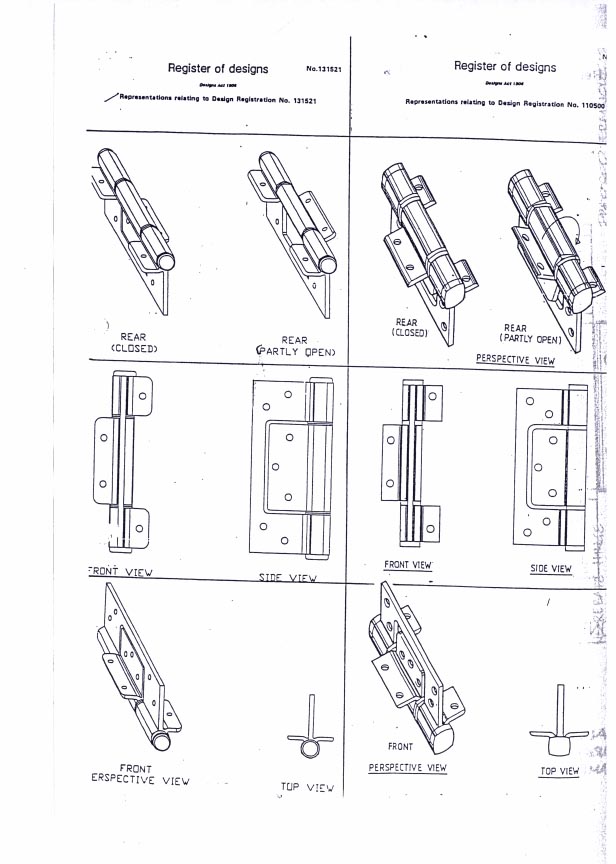
|
BETWEEN: |
ALLEN MANUFACTURING COMPANY PTY LIMITED FIRST APPELLANT
ALAN GEORGE HARPER SECOND APPELLANT
|
|
AND: |
McCALLUM & CO PTY LIMITED RESPONDENT
|
|
DATE OF ORDER: |
|
|
WHERE MADE: |
THE COURT ORDERS THAT:
1. The appeal be dismissed.
2. The appellants, Allen Manufacturing Company Pty Limited and Alan George Harper, pay the costs of the appeal incurred by the respondent, McCallum & Co Pty Limited.
Note: Settlement and entry of orders is dealt with in Order 36 of the Federal Court Rules.
|
IN THE FEDERAL COURT OF AUSTRALIA |
|
|
N 958 of 2001 |
ON APPEAL FROM A JUDGE OF THE FEDERAL COURT OF AUSTRALIA
|
BETWEEN: |
ALLEN MANUFACTURING COMPANY PTY LIMITED FIRST APPELLANT
ALAN GEORGE HARPER SECOND APPELLANT
|
|
AND: |
RESPONDENT
|
|
JUDGE: |
|
|
DATE: |
|
|
PLACE: |
REASONS FOR JUDGMENT
THE COURT
1 This is an appeal against a decision of a judge of the Court (Gyles J) upholding a claim of infringement of a design registered under the Designs Act 1906. The claim arises under s 30 of that Act which relevantly provides:
“30 (1) A person shall be deemed to infringe the monopoly in a registered design if he, without the licence or authority of the owner of the design –
(a) applies the design or any fraudulent or obvious imitation of it to any article in respect of which the design is registered;
(b) …; or
(c) sells, or offers or keeps for sale or hires, or offers or keeps for hire, any article –
(i) to which the design or any fraudulent or obvious imitation of it has been applied in infringement of the monopoly in the design; or
(ii) in respect of which the design is registered and to which the design or any fraudulent or obvious imitation of it has been applied outside Australia without the licence or authority of the person who was the owner of the registered design at the time when the design or imitation was so applied.
(2) If any person infringes the monopoly in a registered design, the owner of the design may bring an action or proceeding against him for infringement of the monopoly in the design.”
2 Gyles J announced his decision on 3 May 2001. On 31 May 2001 his Honour made orders granting the applicant before him, McCallum & Co Pty Limited (“McCallum”) the present respondent, injunctive relief against two respondents, Allen Manufacturing Company Pty Limited (“Allen Manufacturing”) and Alan George Harper (“Mr Harper”). Those respondents are the present appellants. Gyles J also ordered, pursuant to s 39 of the Designs Act, that the register maintained under that Act be rectified by expunging therefrom Registered Design No 131521, a design registered by Mr Harper.
3 Gyles J held Mr Harper was personally involved in Allen Manufacturing’s infringement of McCallum’s registered design. He made an order for an inquiry as to the quantum of damages suffered by McCallum as a result of the infringement and, in the alternative, for an account of profits and made consequential orders concerning provision of information.
4 Gyles J granted leave to appeal against these orders. The matter comes before us pursuant to that leave.
The facts
5 McCallum has carried on business since 1939. Originally it sold only door hinges, but soon expanded its product range to other items of builders hardware.
6 In 1990 the general manager of McCallum, James McLean, designed a door hinge with small wings that were designed to be attached to the front of the door-frame and to the door, permitting fixing in two directions. Mr McLean said in evidence he was not aware at that time of the existence of any other hinge that had such wings.
7 McCallum applied for Mr McLean’s design to be registered under s 23 of the Designs Act. The application included a statement of monopoly pursuant to s 20(4) of the Act in which monopoly was claimed “in the shape and/or configuration of a door hinge as illustrated in the accompanying representations”. There were six representations. The design was registered as Registered Design No 110500 on 12 March 1991. We will refer to this design as “the McCallum registered design”.
8 In April 1991 McCallum commenced to sell hinges that were manufactured substantially, but not completely, in accordance with the McCallum registered design. This hinge (“the McCallum hinge”) quickly became the best selling hinge in the McCallum range of hinges. The McCallum hinge was extensively promoted amongst commercial builders. It remains on the market.
9 Mr Harper was employed by McCallum as a sales representative between 11 April 1983 and 20 May 1986, before the creation of the McCallum design. On 17 March 1997 Mr Harper made application for registration under the Designs Act of a door hinge. His application also included a statement of monopoly. It was expressed in identical terms to that of McCallum’s; that is, “in the shape and/or configuration of a door hinge as illustrated in the accompanying representations”. As with McCallum’s application, there were six representations. The design was registered, as Registered Design No 131521, on 1 October 1997. The accused hinge (“the Allen hinge”) seems to follow this design.
10 Allen Manufacturing was incorporated in 1978. It has a paid up capital of $3. Two $1 shares are held by Mr Harper and one by Marjorie Ann Harper, who resides at the same address as Mr Harper. The two directors of the company, from the date of its incorporation until the present time, have been its two shareholders. It was admitted at the trial that Mr Harper controls the company’s day-to-day activities.
11 On 28 July 1998 Allen Manufacturing entered into an agreement with Nova Hardware Pty Ltd (“Nova”), a Victorian company, whereby it agreed to appoint Nova as distributor, in Victoria, Tasmania, South Australia, Western Australia and the Northern Territory, of a product described as “Model 7100 Heavy Duty Aluminium Hinge”. It is common ground this product is identical to the Allen hinge, the subject of Registered Design No 131521. Under the agreement, Nova agreed to pay a total of $15,050 to six identified suppliers of tooling and plastic component parts needed in connection with manufacture of the product. Allen Manufacturing agreed to defray that expense, by deducting $1.505 per unit from the agreed price payable by Nova in respect of 10,000 units of the product. The agreed prices ranged from $5.18 to $7.08 per unit depending on finish. Nova committed itself to an initial order of 7,000 units. The agreement was executed under the common seal of Allen Manufacturing, the common seal being countersigned by Mr Harper.
12 On 7 September 1998 Mr Harper granted to Reginald James Harper, of the same address, a licence to use the registered design for the Allen hinge, for the purpose of manufacturing and distributing goods, for a term of two years. On 6 November 1998 Reginald Harper sublicensed Mr Harper to use the design for the same purpose for a term of 22 months.
13 As the result of Nova’s activities, in 1999 McCallum became aware of the Allen hinge. It commenced this proceeding on 17 September 1999.
The evidence at trial
14 At the trial counsel for McCallum read affidavits made by three people: Mr McLean, who was not cross-examined, an independent shop fitter and Noel Wood, an independent industrial designer. Allen Manufacturing and Mr Harper provided no affidavit or oral evidence.
15 Evidence about similarity was given by Mr Wood. He prepared a document showing, at reduced scale, the representations included in each of the applications for registration. A copy of that document is annexed to these reasons.
16 Mr Wood identified the following visual similarities between the two designs:
“(a) overall the shape and proportions of the two designs are substantially the same;
(b) each has the peculiar feature of an inner leaf wing and outer leaf wings, at right angles to their respective faces;
(c) in both cases, the outer corners of the larger leaf are sharp right angles;
(d) each is a rectangular shaped hinge; each of the leaves and wings is rectangular;
(e) in each, the intersection between leaf and wing is relieved in an identical and non-obvious way;
(f) the number and disposition of the leaves is the same;
(g) the leaves and wings each have the same number of mounting holes, the holes on the wings and inner leaf are located in substantially the same positions.”
17 Mr Wood also identified some differences; “Sample B” being the Allen hinge:
“(a) the leaf wings of Sample B have curved corners, although still substantially rectangular, whereas the inner and outer leaf wings illustrated in the McCallum Design are sharp cornered rectangles;
(b) the fixing holes of Sample B are countersunk on one side. The McCallum Design illustrates plain holes only;
(c) the hole positions in the outer leaf depicted in the McCallum Design are mirror reversed to those in Sample B;
(d) the barrel of Sample B has six equal convex faces. The barrel of the hinge depicted in the McCallum Design has four equal convex faces;
(e) the McCallum Design illustrates the end cap as a continuation of the barrel shape, that is, four equal convex faces. The button on the end of the barrel of Sample B is circular in shape.”
18 Mr Wood expressed opinions that the two designs “are substantially identical in overall appearance” and the identified differences “are minor and subtle”. He said the two designs “are unusual because each includes the peculiar right angle inner and outer leaf wing, foreign to the generic no rebate hinge”.
19 During the course of the trial, the McCallum hinge was put into evidence. That hinge departs in some respects from the McCallum registered design. Those departures include three of the five differences (differences (b), (c) and (e)) between the McCallum registered design and the Allen hinge, as noted by Mr Wood (para 17 above). The only visible differences between the McCallum hinge and the Allen hinge are Mr Wood’s differences (a) and (d) and that the Allen hinge cylinder core is coloured black, though for the most part it is overlaid with silver metal, whereas the McCallum hinge is entirely made of silver metal.
The decision of Gyles J
20 Mr Wood’s evidence was not disputed. Gyles J said:
“ When I compare the Allen Hinge with the McCallum Registered Design the impression judged by my eye is of very close correspondence between the two. There are differences, namely:
1. the countersunk nature of certain of the holes;
2. the precise shape of the cylinder or barrel and the end caps;
3. the angle of disposition of the holes on the fixed outer leaf;
4. the position of holes on the wings;
5. perhaps a difference in the width of the wings.
However, to list the differences in this way tends to exaggerate them compared with the overall visual impression. As has often been said, there is a limit as to the ability or necessity to explain in words the impression of the eye.”
21 Gyles J then turned to the previous designs. He said:
“I see no such correspondence between the McCallum Registered Design and any one of the previous designs relied upon by the respondents, although there is some correspondence between parts of them. In particular, I see no earlier design which is what was described in the evidence as an ‘interfold hinge combined with wings’. This is the feature which distinguishes this design. This feature is found in the Allen Hinge, together with other features which may be common to both the McCallum Registered Design and the prior designs.”
22 There was discussion before us as to the correctness of his Honour’s statement that the earlier designs lacked an “interfold hinge combined with wings”. Counsel for the appellants, Ms Sophie Goddard, drew attention to registered designs 53234 (“the Meyers Taylor design”) and 48712 (“the Warlan design”). The drawings of these designs are of poor quality, but both designs seem to provide an interfold hinge. The Meyers Taylor design plainly has a single wing, but at the site of the interfold; not remote from it, as in the McCallum and Harper designs and the McCallum and Allen hinges. The Warlan design seems to have a pair of wings at the base of the cylinder. It has either (it is impossible to tell from the drawing in evidence) a single wing or a pair of wings at the top of the cylinder. To this extent, it may fairly be said that a basic idea of the McCallum design was anticipated by these earlier designs. However, the McCallum registered design is visually very different from them both. Consequently, although the words used by Gyles J might usefully have been qualified, it remains true that the feature that distinguishes the McCallum registered design is its novel treatment of the relationship between the interfold hinge and the wings.
23 Gyles J went on:
“The differences may be enough to avoid a conclusion that ‘the design’ has been applied to the Allen Hinge, but I am satisfied that it is an obvious imitation of the McCallum Registered Design even if the test is as high as ‘something reasonably approaching to identity’ ...
If this be wrong, then I am satisfied that the Allen Hinge is a fraudulent imitation of the McCallum Registered Design. Among the factual matters relied upon by the applicants to reach this conclusion were the following:
(1) the second respondent is a director and shareholder of the first respondent and controls the day to day operations of the first respondent;
(2) the second respondent is a former employee of the applicant and, it can be inferred, was aware of the applicant’s commercial activities;
(3) the applicant has sold its hinge since April 1991. It was very popular and became the best selling hinge in the applicant’s range. The packaging in which the hinge has been sold since 1991 makes reference to the McCallum Registered Design;
(4) the applicant promoted its new hinge and the registered design from mid 1991;
(5) none of the second respondent nor any officer of the first respondent has sought to give evidence in these proceedings to explain the coincidence of representations of the two registered designs, the coincidence of the overall similarities between the McCallum Registered Design and the Allen Hinge, and to establish any good design reason for the differences between the McCallum Registered Design and the Allen Hinge.
It is submitted for the respondents that it is necessary for the applicant to establish that changes have been made merely to disguise copying. The respondents deny that can be found here as, for example, there are functional reasons for some of the changes.
The points made by the applicant lead to a fair inference that the second respondent knew of the McCallum Registered Design and, for this purpose at least, the second respondent is the directing mind of the first respondent. It is also a fair inference that the first respondent intended to, and did, copy the McCallum Registered Design, including its unique combination of interfold hinge and wings. Whilst there may be functional explanations for some variations, the change in shape of the barrel and end stops seem to me to be to be designed to disguise the copying. These inferences may be more readily drawn because of the failure of the first or second respondent to call evidence.
These findings on infringement inevitably lead to the conclusion that the Harper Registered Design was not new or original as required by s 17 of the Act, and that the design had been published in the Commonwealth prior to the priority date within the meaning of s 28 of the Act. It follows that the Register should be rectified by expunging of the entry of registration of the Harper Registered Design.”
24 Gyles J turned to the question whether Mr Harper was under any personal liability in respect of the infringement he had found. He noted McCallum alleged Mr Harper had authorised the infringement by Allen Manufacturing. He said this is not sufficient; there is no concept of authorisation in the Designs Act, in contrast with the Copyright Act 1968 (ss 13 and 36) and Patents Act 1990 (s 13(1)). However, Gyles J observed that McCallum also pleaded that Mr Harper procured the infringement by Allen Manufacturing, “or was otherwise a party to the conduct and so a joint tortfeasor”.
25 After referring to the parties’ submissions about Mr Harper’s role, Gyles J noted “a divergence of opinion which has not been authoritatively settled” in relation to the relevant test. He thought three decisions of this Court supported, as the test, “whether the director ‘procured or directed’ the tortious conduct”. Those decisions are Microsoft Corporation v Auschina Polaris Pty Ltd (1996) 71 FCR 231 (“Auschina Polaris”, Lindgren J), Henley Arch Pty Ltd v Clarendon Homes (Aust) Pty Ltd (1998) 41 IPR 443 (Merkel J) and Microsoft Corporation v Goodview Electronics Pty Ltd (2000) IPR 578 (“Goodview Electronics”, Branson J). On the other hand, Gyles J noted, in Root Quality Pty Ltd v Root Control Technologies Pty Ltd (2001) 177 ALR 231, Finkelstein J concluded that, in the words of Gyles J, “a higher (although somewhat indefinite) standard was required”. Gyles J went on:
“If the procurement test, as explained by Lindgren J, is to be applied, there is no doubt that it is satisfied. It can safely be inferred that the second respondent actually authorised, procured and directed the acts of infringement, as submitted for the applicant, because of his control of the company.
If Finkelstein J is correct, the issue as to whether the second respondent made the infringement his own is not so clear. The submission for the second respondent that mere licensing is not enough is plainly correct (see Australian Tape Manufacturers’ Association Ltd v Commonwealth (1993) 176 CLR 480 at 498). So far as association with the company is concerned, it is difficult to distinguish this from any other ‘one person company’ case. I should say that this latter point did not trouble Lindgren J in Auschina Polaris (at 246G).
However, in my opinion, the combination of licensing, control of the company and the knowledge that I have found that the second respondent had of the McCallum Registered Design is sufficient to meet whichever test is correct. I do not regard the fact that the licensing is not direct as of assistance to the second respondent. In the absence of evidence from he and Mr Reginald James Harper, I would infer that at least one reason that back-to-back licences were entered into was in order that a direct connection could be denied between the respondents in the event of litigation. Whether that be so or not, I would infer that the successive licences were planned in advance. The fact that the licence to Nova Hardware Pty Ltd predates the other licences would bear that out. It is also to be noted that the second respondent signed that licence, and the sub-licence from Reginald James Harper, on behalf of the first respondent. The applicant has proved its case against the second respondent.”
Does the Allen hinge infringe the McCallum registered design?
(i) Obvious imitation
26 Ms Goddard argued there was no infringement. She submitted Gyles J was wrong in finding the Allen hinge was an obvious imitation of the McCallum registered design. She said that, in considering that issue, it was first necessary to consider the prior art; and the prior art “disclosed hinges … closely resembling the registered design”. Ms Goddard referred particularly to the Meyers Taylor and Warlan designs. She emphasised the width of McCallum’s statement of monopoly and said that, in the absence of any statement “that the essential features of the registered design were specifically an ‘interfold hinge combined with wings’, his Honour erred in disregarding the interfold prior art”. She submitted:
“… where a proprietor chooses to claim monopoly in the representations as a whole, the Court may determine the issue of infringement by reference to the whole design and must take into account all differences between the accused hinge and the registered design.
Thus, the consequence of the Respondent’s broad statement of monopoly is that the Appellants can rely on all differences between the hinge in suit and the registered design as featured in the representations. The wings are to be given no special weight.” (Original emphasis)
27 In reliance on Dart Industries Inc v Décor Corporation Pty Ltd (1989) 15 IPR 403, Ms Goddard submitted that, in contrast, McCallum “may only rely on the similarities in novel or original features. It cannot rely on the similarities between the features of the Allen hinge and the registered design which are not novel or original features when compared with the prior art”.
28 Ms Julia Baird, counsel for McCallum, argued the correct use of the prior art is “to inform the court of the state of knowledge at the time of registration, and in what respects the design was new or original, when considering whether any variations from the registered design which appear in the alleged infringement are substantial or immaterial”. This formulation comes from the speech of Lord Herschell in Hecla Foundry Co v Walker Hunter & Co (1889) 14 App Cas 550 at 555, quoted by Lockhart J in Dart Industries at 409. Ms Baird said the formulation does not require the disregard of any features which exist in the prior art.
29 It is desirable for us to set out the whole of Lockhart J’s comments (at 409) about prior art, omitting only his references to authority:
“The scope of a registered design must be determined with reference to the background of the prior art at the priority date and questions of infringement and novelty or originality are connected. …
Where novelty or originality is discovered in slight variations, there cannot be infringement without a very close resemblance between the registered design and the article alleged to be an infringement of the design. …
Small differences between the registered design and the prior art will generally lead to a finding of no infringement if there are equally small differences between the registered design and the alleged infringing article. On the other hand, the greater the advance in the registered design over the prior art, generally the more likely that a court will find common features between the design and the alleged infringing article to support a finding of infringement: …”
Jenkinson and Gummow JJ agreed with these observations.
30 It seems to us that, in considering the issue of obvious imitation, Gyles J acted in accordance with the principles articulated by Lockhart J. In para 4 of his reasons, he said “there is much that is common between the design depicted in these representations and both previous registered designs and door hinges which had been on the market”. So he obviously had in mind the evidence of prior art, including the Meyers Taylor and Warlan designs. Although he did not descend to detail, Gyles J evidently made a judgment that the differences between the McCallum registered design and the prior art were much more significant than the differences between the McCallum registered design and the Allen hinge. Whether or not he did so, that is our view. We think McCallum’s claim of obvious imitation is made out.
(ii) Fraudulent imitation
31 It will be recalled Gyles J said that, if he was wrong about obvious imitation, he was satisfied the Allen hinge is a fraudulent imitation of the McCallum registered design. Ms Goddard disputes that finding. She concedes his Honour was entitled to find, as a matter of probability, and especially as Mr Harper chose not to give evidence in the case, that Mr Harper was aware of the existence of the McCallum registered design. This concession is proper. Mr Wood’s document setting out the two sets of representations (para 15 above) strongly suggests Mr Harper saw the McCallum representations before he prepared the representations for his own design application. It cannot be coincidental that he chose the same six perspectives and gave them identical titles.
32 However, Ms Goddard says it is not enough for a party to show the opponent had access to his or her registered design; it is not even sufficient to show the opponent knowingly copied the registered design or that the accused article was deliberately based on that design. She cites two authorities: Malleys Limited v J W Tomlin Pty Limited (1961) 180 CLR 120 and Firmagroup Australia Pty Limited v Byrne and Davidson Doors (Vic) Pty Limited (1987) 180 CLR 483.
33 Malleys concerned a design in respect of a bottom for a toilet pan. The trial judge found that, disregarding a feature of the design called the “J” rim, the appellant’s design was an imitation deliberately and fraudulently based upon the respondent’s design; consequently, he found infringement. However, the High Court of Australia held the “J” rim could not be disregarded; when it was taken into account, the Court said at 128, “we are … forced to conclude that there is a substantial difference of a material kind between the shape of a pan bottom with a ‘J’ rim and one without a ‘J’ rim and that the design applied by the appellant in its manufacture was not an imitation of the registered design but a different design which embodied some of the features of the registered design. There is … no copyright in an idea and it was the respondent’s idea that the appellant took, not its design.”
34 Firmagroup was a similar case, this time concerning a combination handle and lock for shutter doors. The trial judge found that, knowing of the appellant’s product, the respondents manufactured and sold a product that adopted salient features of its design, but the result was distinct from the registered design. This finding was upheld on appeal. The High Court said at 487:
“The Act is concerned with shape and configuration, not function. Specificity of shape and configuration must be conveyed by a registrable design; features of a design which do no more than convey the idea of a general shape appropriate to the function which the article is intended to perform and which are consistent with a variety of particular shapes in articles copying those features are not amenable to protection by the Act.”
35 Ms Goddard submitted that Malleys and Firmagroup “have clearly confined the category of fraudulent imitation to cases of deliberate disguise or subterfuge in the design of the Defendant’s article”. However, it seems to us this is not their effect. Rather, they establish that even a deliberate copier may escape a finding of infringement. The position was accurately stated by a Full Court consisting of Sweeney, Fisher and Sheppard JJ in Turbo Tek Enterprises Inc v Sperling Industries Pty Ltd (1989) 23 FCR 331 at 349:
“The resolution of the two sets of submissions involves a judgmental exercise in which the Court must bring to bear its own evaluation of what results from a visual comparison. But in making up its mind the Court must give proper weight to the finding of fraudulent intention. That finding is not, however, conclusive … In other words, an infringer may succeed because, although he has fraudulent intention, he does make an article, the shape or configuration of which is distinctly different from that in respect of which a design is registered.”
36 The critical question, in the present case, is whether the shape or configuration of the Allen hinge is distinctly different from that of the McCallum registered design. In our opinion there can only be one answer to that question: it is not. This was the view taken by Gyles J, inherent in his finding that the Allen hinge is an obvious imitation of the McCallum design. It is also implicit in our decision to uphold that finding. In our opinion, the claim for fraudulent imitation is made out.
(iii) Conclusion
37 It follows that we agree with Gyles J that Allen Manufacturing has infringed the monopoly of McCallum in its registered design by applying, without McCallum’s licence or authority, a fraudulent or obvious imitation of that design to the Allen hinge: see s 30(1)(a) of the Designs Act. Accordingly, McCallum is entitled to relief against Allen Manufacturing pursuant to s 30(2) of the Act. The appeal by Allen Manufacturing must be dismissed.
Is Mr Harper personally liable?
(i) Authorities concerning the test of liability
38 As Gyles J observed the test to be applied to this issue “has been much discussed over recent years”. We see no point in reproducing that discussion.
39 The authorities were collected and analysed by Beazley J in King v Milpurrurru (1996) 66 FCR 474 at 494-500. Her Honour noted the existence of two lines of authority. One line supported what she called the “Performing Right Society test”: whether the director had “directed or procured” the company’s infringement. The other line supported “the Mentmore test”: whether the director had engaged in “the deliberate, wilful and knowing pursuit of a course of conduct that was likely to constitute infringement or reflected an indifference to the risk of it”. Beazley J expressed a preference for the Mentmore test, on the basis that the Peforming Right Society test did not “pay sufficient regard, either to the separate legal existence of the company, or to the fact that the company acts through its directors”: see 500. However, this preference had no immediate consequence; her Honour held (again at 500) that the appellants were not liable under either test.
40 In Auschina Polaris (at 239-247) Lindgren J also discussed the authorities at some length. As Gyles J recorded, he preferred the Performing Right Society test, as did Merkel J in Henley Arch and Branson J in Goodview Electronics. Also as Gyles J recorded, Finkelstein J expressed a different view in Root Quality. As we read his Honour’s judgment, he adopted the Mentmore test.
41 See also the decision of the English Court of Appeal in Standard Chartered Bank v Pakistan National Shipping Corporation [No 2] (2000) 1 Lloyd’s Rep 218 at 230-231 and 235.
(ii) Submissions
42 Ms Goddard submits we should adopt the Mentmore test. On that basis, she says, Mr Harper cannot be held personally liable; it is not enough that he was a director of Allen Manufacturing and was aware of McCallum’s registered design; there was no evidence that Mr Harper caused Allen Manufacturing to adopt a deliberate course of conduct with knowledge of, or indifference to, the risk that this conduct would infringe McCallum’s rights.
(iii) Conclusions
43 The difference between the two tests may be more apparent than read. We are not aware of any case in which it has been held that a director or officer of a company directed or procured the company’s infringing act, yet that person escaped liability because he or she did not deliberately, wilfully or knowingly pursue a course of conduct that was likely to constitute infringement or that reflected indifference to the risk of infringement. This may be because, in practice, an act of direction or procurement will generally meet the Mentmore test. It is notable that, in Mentmore itself, the Canadian Federal Court of Appeal declined (at 204) to “go so far as to hold that the director or officer must know or have reason to know that the acts which he directs or procures constitute infringement”. The Court declined to do this because that “would be to impose a condition of liability that does not exist for patent infringement generally”.
44 To the extent there is a real difference between the tests, each has eloquent supporters. One day it may be necessary, in a practical sense, to choose between them. But it is not necessary to do so in this case. We share the view of Gyles J that, on either test, Mr Harper must be held liable.
45 This is not a case in which the relevant person acted only as a director of the infringing company. Mr Harper had personal knowledge of the McCallum registered design. He applied, in his own name, for registration of design no 131521, the design for the Allen hinge. He personally granted the licence to use the design to Reginald Harper and personally took back a sub-licence from Reginald Harper.
46 One of the foundations of Finkelstein J’s decision in Root Quality was Said v Butt [1920] 3 KB 497, a decision of McCardie J in an action against a company director for procuring a breach of contract by the company. That decision was referred to by McTiernan J in O’Brien v Dawson (1942) 66 CLR 18 AT 34. In that case, as Finkelstein J noted in Root Quality at 262, Starke J said at 32:
“The acts of Doyle” [the company director] “were the acts of the company and not his personal acts which involved him in any liability to the plaintiff. But I would add that it does not follow that a director of a company would escape personal liability under cover of the company’s responsibility if he himself became an actor and invaded the plaintiff’s rights, as by trespassing on his land, or seizing his goods and so forth.”
47 In the present case, in entering into the agreement with Nova for the manufacture and sale of the Allen hinge, Mr Harper acted on behalf of Allen Manufacturing. However, that was only one step in a sequence of actions in which Mr Harper was personally an actor invading McCallum’s rights: by creating the Harper design and entering into licence and sub-licence agreements in relation to it. Mr Harper’s sequence of actions, including his actions on behalf of the company, were “the deliberate, wilful and knowing pursuit of a course of conduct” that was likely to constitute infringement or, at least, reflected an indifference to the risk of infringement. Mr Harper himself infringed McCallum’s monopoly in its registered design.
Disposition
48 In our view, all points raised on behalf of the appellants must fail. The appeal should be dismissed with costs.
|
I certify that the preceding forty-eight (48) numbered paragraphs are a true copy of the Reasons for Judgment herein of the Court. |
Associate:
Dated: 20 December 2001
|
Counsel for the Appellant: |
Ms S J Goddard |
|
|
|
|
Solicitor for the Appellant: |
Murphy & Maloney |
|
|
|
|
Counsel for the Respondent: |
Ms J Baird |
|
|
|
|
Solicitor for the Respondent: |
Price Waterhouse Coopers Lybrand |
|
|
|
|
Date of Hearing: |
28 November 2001 |
Document referred to in para 15 of Reasons for Judgment