

FEDERAL COURT OF AUSTRALIA
Pacific Gaming Pty Limited v Aristocrat Leisure Industries Pty Limited [2001] FCA 1636
COPYRIGHT – copyright in written specifications for electronic gaming machines – whether copyright infringed by competitor’s written specifications – whether finding of copying was available on the evidence – whether pairs of specifications were objectively similar – whether primary Judge applied the correct test to determine similarity – whether literal comparison required.
COPYRIGHT – whether data stored on competitor’s EPROMs reproduced written specifications in “a material form” – no finding that the data allowed the written specifications or a substantial part of them to be reproduced – whether evidence available to support such a finding.
Copyright Act 1968 (Cth), ss 10(1), 13(1), 14(1), 21(1A), 31(1)
Copyright Amendment (Digital Agenda) Act 2000, Schedule 2
Copyright Amendment Act 1984 (Cth), s 3(g)
SW Hart & Co Pty Ltd v Edwards Hot Water Systems (1985) 159 CLR 466, cited.
Computer Edge Pty Ltd v Apple Computer Inc (1986) 161 CLR 171, considered.
Clarendon Homes (Aust) Pty Ltd v Henley Arch Pty Ltd (1999) 46 IPR 309, cited.
Ibcos Computer Ltd v Barclays Mercantile Highland Finance Ltd [1994] FSR 275, cited.
Ancher, Mortlock, Murray & Woolley Pty Ltd v Hooker Homes Pty Ltd [1971] 2 NSWLR 278, cited.
Eagle Homes Pty Ltd v Austec Homes Pty Ltd (1999) 87 FLR 415, cited.
Data Access Corporation v Powerflex Services Ltd (1999) 166 ALR 228, cited.
Autodesk Inc v Dyason (No 2) (1993) 176 CLR 300, considered.
Blackie & Sons Ltd v Lothian Book Publishing (1921) 29 CLR 396, cited.
Autodesk Inc v Dyason (No 1) (1992) 173 CLR 330, cited.
Ainsworth Nominees Pty Ltd v Andclar Pty Ltd (1988) 12 IPR 551, followed.
Telstra Corporation Ltd v Desktop Marketing Systems Pty Ltd (2001) 181 ALR 134, cited.
Roland Corporation v Lorenzo and Sons Pty Ltd (1991) 22 IPR 245, cited.
J Lahore, Copyright and Designs (1996).
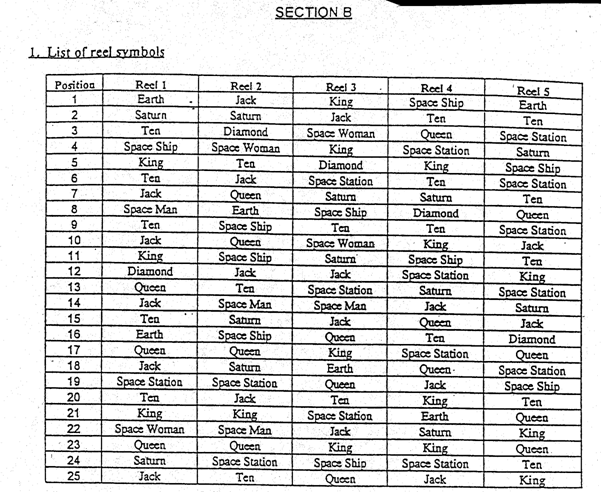
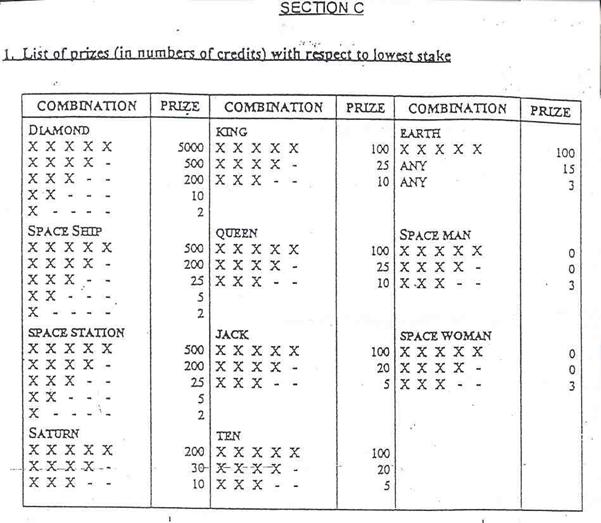
H Laddie, P Prescott and M Vitoria, The Modern Law of Copyright and Designs (1995).
Copyright Law Review Committee, Computer Software Protection (1995).
PACIFIC GAMING PTY LIMITED v ARISTOCRAT LEISURE INDUSTRIES PTY LIMITED
N 1204 of 2000
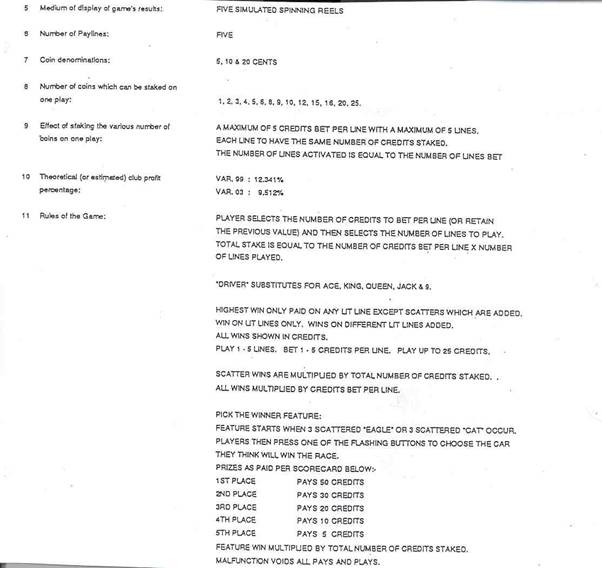
SACKVILLE, FINN & KENNY JJ
SYDNEY
26 NOVEMBER 2001
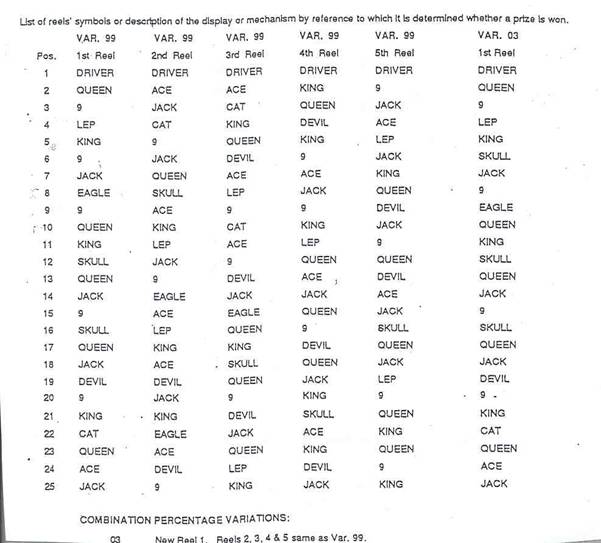
| IN THE FEDERAL COURT OF AUSTRALIA |
|
| N 1204 OF 2000 |
ON APPEAL FROM A JUDGE OF THE FEDERAL COURT OF AUSTRALIA
| BETWEEN: | PACIFIC GAMING PTY LIMITED APPELLANT
|
| AND: | ARISTOCRAT LEISURE INDUSTRIES PTY LIMITED RESPONDENT
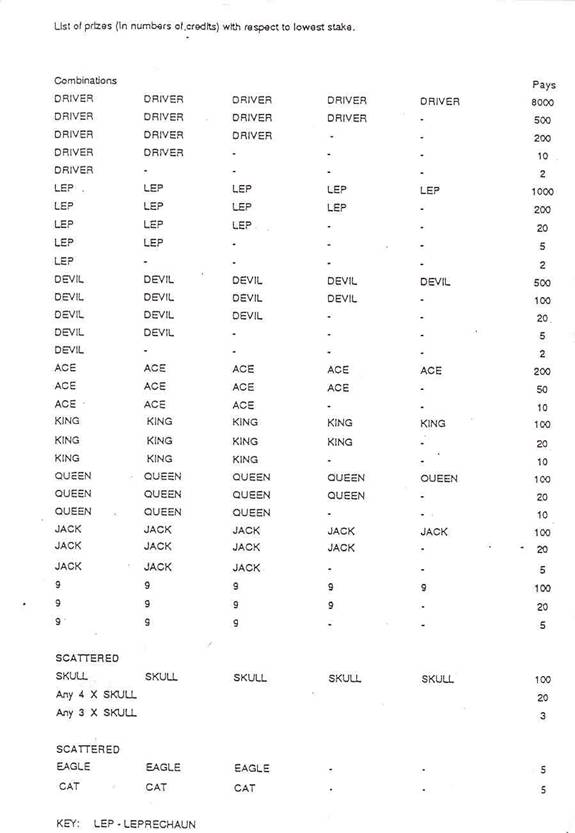
|
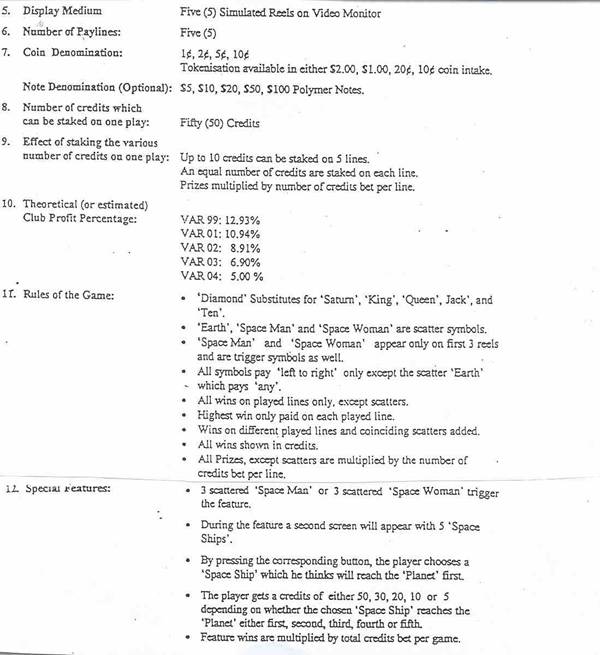
| DATE OF ORDER: | |
| WHERE MADE: |
THE COURT ORDERS THAT:
1. The appeal be allowed in part.
2. Orders 1(a)(ii), 1(b)(ii), 2(b), 3(a)(ii), and 3(b) (insofar as Order 3(b) refers to EPROMs), made by the primary Judge on 26 October 2000, be set aside.
3. The appeal otherwise be dismissed.
4. Any written submissions as to the costs of the appeal and the costs orders made by the primary Judge be filed and served within fourteen days.
Note: Settlement and entry of orders is dealt with in Order 36 of the Federal Court Rules.
| IN THE FEDERAL COURT OF AUSTRALIA |
|
| N 1204 OF 2000 |
ON APPEAL FROM A JUDGE OF THE FEDERAL COURT OF AUSTRALIA
| BETWEEN: | APPELLANT
|
|
| ARISTOCRAT LEISURE INDUSTRIES PTY LIMITED RESPONDENT
|
| JUDGES: | |
| DATE: | |
| PLACE: |
REASONS FOR JUDGMENT
THE COURT:
the proceedings
1 The appellant (“Pacific”) appeals by leave from a judgment of a Judge of this Court. The primary Judge found that the respondent (“Aristocrat”) had copyright in four written specifications prepared by it for games to be played on its electronic gaming machines. His Honour also found that Pacific had infringed Aristocrat’s copyright by reproducing a substantial part of Aristocrat’s written specifications in its own written specifications and in data in electronic form. His Honour granted injunctive and other relief in favour of Aristocrat. Leave to appeal was required because the primary Judge made orders for all issues relating to quantum to be tried separately from all other issues. Accordingly, the orders made by his Honour were not final in character.
2 As his Honour explained, the games which are the subject of these proceedings originate from mechanical gaming machines which have been in existence for many years and which are known as “poker machines”. Originally these machines had mechanical spinning wheels each with a number of symbols. The symbols comprised images of cards, such as Ace, King and Queen, and other pictorial or numerical images. The wheels were spun manually by a player pulling the lever (hence the name “one armed bandits”). When the wheels came to a standstill, a line of images was shown and the player could see whether a prize had been won.
3 His Honour further explained (at [16]-[17]):
“In more recent times these games have become electronic and more sophisticated with the aid of computer technology. The present day machines operate with data and software and the games are displayed on a somewhat larger video screen window which contains more images of the symbols used. Operation is by way of buttons rather than levers. No skill whatsoever is required to play the games although this may not be universally appreciated. The machines simulate the movement of reels by moving video images. The video screen window of the Aristocrat and Pacific games display rows of images and each row displays a mix of symbols. Each reel can contain up to at least seventy symbols but it is not necessary that each reel should contain the same number of symbols. Often on each machine there will be two rows of buttons. The top row determines the number of ‘credits’ (the size of the wager bet per line) and the lower row determines the number of pay lines which the player wants to bet upon. A ‘pay line’ is a line of symbols on which predefined symbols must appear in the required sequence in order to win a prize. Originally games had only one pay line on which prizes could be won, namely the centre line. That concept was then extended to five lines and such games are called ‘multi-line games’. The gaming machines in question in this case are multi-line games. There can therefore be a large number of winning combinations in respect of which rewards or prizes are given in the form of credits or otherwise. Game prizes are paid in credits, generally multiples of the unit amounts played. For example a player gambling 10 credits may win 100 credits on a particular combination, whereas a player gambling 20 credits will win 200 credits on the same combination.
Money is fed into the machine and the player is allocated credits. The player can bet these credits on any number of pay lines. Once the bet is determined the start button is pressed and video images of the reels appear to spin for a short period and then stop. When the images come to a halt it is possible to see whether any prize has been won. The prize details are pre-determined by a computer program. Machines vary as to the way in which symbols must be configured in order to secure a prize. For example, games can be played left to right along the pay lines, or right to left or in a variation of the two. This operation may be called the ‘basic game’ which is usually the main part of the game in terms of the prizes paid to players.”
4 In addition to the basic game, the games may include features. We shall return to these later.
5 Aristocrat designs, manufactures and sells electronic gaming machines. Pacific engages in similar activities. In its statement of claim, Aristocrat alleged that the written specifications for a number of its electronic gaming machines (the “Aristocrat Games”) were original literary works or original dramatic works in respect of which it held the copyright. Aristocrat pleaded that Pacific’s electronic gaming machines (the “Pacific Games”) and the specifications for the Pacific Games were a reproduction in material form of the whole or a substantial part of corresponding specifications for the Aristocrat Games as follows:
Aristocrat Games | Date of Specification | Pacific Games | Date ofSpecification |
| Top Gear | 16 September 1993 | Diamond in the Sky | 31 October 1996 |
| Enchanted Forest | 17 October 1994 28 February 1996 | Yellow Brick Road | 25 September 1996 |
| Tequila Sunrise | 18 June 1993 | Fortune Turtle | 1 May 1996 |
| White Tiger | 7 October 1993 15 November 1995 24 November 1995 | Lucky Lion | 22 December 1995 |
Aristocrat further pleaded that each of the Pacific Games embodied a “cinematographic film” and a “computer program” within s 10(1) of the Copyright Act 1968 (Cth) (“Copyright Act”) and that each reproduced in material form the relevant Aristocrat specifications.
6 The written specifications on which Aristocrat relied were lodged by it with the Liquor Administration Board of New South Wales (“LAB”). The LAB is established under Part IV of the Liquor Act 1982 (NSW). It is a statutory requirement that gaming machines be licensed and the specifications for games be approved by the LAB. The form of the written specifications required by the LAB was, at all relevant times, specified by that body.
7 The primary Judge held that
(a) each of Aristocrat’s written specifications was an original “literary work” within s 10(1) of the Copyright Act 1968, in that it was a compilation expressed in words, figures and symbols;
(b) Aristocrat’s written specifications were not “dramatic works” within s 10(1) of the Copyright Act;and
(c) each of Aristocrat’s literary works was infringed by Pacific making a reproduction of a substantial part thereof in
(i) Pacific’s written specifications for the equivalent Pacific Game;
(ii) the EPROMs (erasable programmable read only memory) containing instructions for the operation of each of the Pacific Games.
8 Pacific conceded before the primary Judge that the Pacific Games embodied cinematographic films. It was therefore not necessary for his Honour to decide that issue. Nonetheless he expressed the view that the Pacific Games did not embody cinematographic films.
9 The primary Judge made orders restraining Pacific from reproducing any of Aristocrat’s four written specifications, or a substantial part of them, in a material form, including reproducing the written specifications for the Aristocrat Games or manufacturing EPROMs for the Pacific Games. Pacific was also restrained from selling or distributing by way of trade any of the specifications, EPROMs, or artwork for the Pacific Games. Consequential orders were made for the destruction by Pacific of infringing game specifications, EPROMs and artwork. None of the relief granted by his Honour appears to have depended on Pacific’s concession that its games embodied cinematograph films.
10 On the appeal, Pacific did not challenge the primary Judge’s findings that copyright subsisted in each of the written specifications as a literary work, being a compilation expressed in words, figures and symbols. Nor did Pacific dispute the finding that the copyright was vested in Aristocrat. Pacific’s submissions were limited to a challenge to the primary Judge’s finding that Pacific had infringed Aristocrat’s copyright.
11 Aristocrat filed a cross-appeal which contested the primary Judge’s finding that its written specifications were not dramatic works and the apparent finding that Pacific’s Games did not embody cinematograph films. In the course of argument, Mr Franklin, who appeared with Mr Cobden for Aristocrat, accepted that the cross-appeal could not succeed unless Pacific’s appeal failed (that is, unless Aristocrat could support the primary Judge’s finding that Pacific’s written specifications infringed Aristocrat’s copyright in its written specifications). Mr Franklin also accepted that even if Aristocrat were to succeed on the cross-appeal, the orders would be no different from those that would be made in consequence of the appeal succeeding or failing (as the case may be). Further, the cross-appeal did not challenge the primary Judge’s costs order (which was the subject of a separate judgment). In these circumstances, Mr Franklin did not press the cross-appeal and we do not need to address it.
the legislation
12 It was common ground that the applicable legislation was the Copyright Act in the form it took at the time the proceedings were instituted, namely 7 October 1998. The following account refers to the legislation in the form it took on that date.
13 For the purposes of the Copyright Act, copyright, in relation to a literary work, is the exclusive right, inter alia, to reproduce the work in a material form: s 31(1)(a)(i). “Literary work” is defined in s 10(1) of the Copyright Act to include:
“(a) a table, or compilation, expressed in words, figures or symbols (whether or not in a visible form); and
(b) a computer program or compilation of computer programs.”
14 Copyright in a literary work is infringed if a person, without the licence of the owner of the copyright, does or authorises the doing in Australia of any act comprised in the copyright: s 36(1). An “act comprised in the copyright” is any act the owner has the exclusive right to do: s 13(1). This of course includes the exclusive right to reproduce the work in a material form. The doing of an act in relation to a literary work includes doing the act in relation to a substantial part of the work: s 14(1).
15 The expression “material form” is defined, in relation to a work or an adaptation of a work, to include:
“any form (whether visible or not) of storage from which the work or adaptation, or a substantial part of the work or adaptation, can be reproduced.”
“Computer program” means:
“an expression, in any language, code or notation, of a set of instructions (whether with or without related information) intended, either directly or after either or both of the following:
(a) conversion to another language, code or notation;
(b) reproduction in a different material form;
to cause a device having digital information processing capabilities to perform a particular function.”
the principles
16 The primary Judge stated concisely the principles governing Aristocrat’s claims of infringement of copyright. With two exceptions, Pacific did not submit that his Honour’s statement contained any error. The exceptions concerned the idea/expression dichotomy in copyright law and the question of reproduction of written specifications in electronic form. We shall return to these issues later. Most of Pacific’s complaints essentially concerned the manner in which the established principles of copyright law had been applied to the facts. It is nonetheless convenient to restate briefly the principles as to which there was no dispute.
17 In SW Hart & Co Pty Ltd v Edwards Hot Water Systems (1985) 159 CLR 466, Gibbs CJ (with whom Mason and Brennan JJ agreed) said (at 472) that the notion of reproduction
“involves two elements – resemblance to, and actual use of, the copyright work, or, to adopt the words which appear in the judgment of Willmer LJ in Francis Day & Hunter Ltd v Bron ([1963] Ch 587, at 614), ‘a sufficient degree of objective similarity between the two works’ and ‘some causal connection between the plaintiffs’ and the defendants’ work’. Lord Reid said in Ladbroke (Football) Ltd v William Hill (Football) Ltd [1964] 1 WLR 273, at 276):
‘Broadly, reproduction means copying, and does not include cases where an author or compiler produces a substantially similar result by independent work without copying. And, if he does copy, the question whether he has copied a substantial part depends much more on the quality than on the quantity of what he has taken.’
… In the same case, Lord Evershed said (at 283) ‘that what amounts in any case to substantial reproduction…cannot be defined in precise terms but must be a matter of fact and degree.”
See also Computer Edge Pty Ltd v Apple Computer Inc (1986) 161 CLR 171, at 186, per Gibbs CJ.
18 In Clarendon Homes (Aust) Pty Ltd v Henley Arch Pty Ltd (1999) 46 IPR 309, a Full Court of this Court pointed out (at 316) that the question of whether copying (that is, a causal nexus between the copyright owner’s work and that of the alleged infringer) is established is not the same as the question whether, once copying has been established, the whole or a substantial part of the copyright owner’s work has been appropriated. The Court continued:
“We accept that very often the two issues will overlap. But nevertheless they are discrete issues and the answer to one does not necessarily produce an answer to the other. For example, in order to prove that there has been a copying it is usual to attempt to show opportunity, that is access to the plaintiff’s work, and such similarities between the plaintiff’s work and the defendant’s work as makes independent creation by the defendant unlikely. Such similarities may or may not be substantial. They can include common error, sometimes deliberately inserted in the plaintiff’s work. Paradoxically, there will be occasions where dissimilarities may provide the basis for an inference of access and copying.”
The Court added this important observation:
“Further, in a case where there has been deliberate copying, the court will not look kindly on a defendant when the plaintiff seeks to establish that what has been copied is sufficiently objectively similar to the plaintiff’s work. In Blackie & Sons Ltd v Lothian Book Publishing Co Pty Ltd (1921) 29 CLR 396, Starke J said (at 404):
‘It is not for the court to make the way of the taker of copyright matter easy. It is a sound principle of copyright law that the court should not allow one man to take away the result ‘of another man’s labour, or, in other words, his property’, unless it is satisfied that the part taken is ‘so slight, and the effect upon the total composition was so small’, ‘as to render the taking perfectly immaterial’, or what is much the same thing, that the part taken is an unsubstantial part.’” [Citations omitted.]
19 Whether there has been copying is a question of fact. Where the objective similarities are sufficiently great and it has been shown that the alleged infringer had an opportunity to gain access to the copyright owner’s work the court will draw an inference of copying. As Jacob J said in Ibcos Computers Ltd v Barclays Mercantile Highland Finance Ltd [1994] FSR 275, at 296-297:
“It may then be possible for the defendant to rebut the inference – to explain the similarities in some other way. For instance he may be able to show both parties derived the similar bits from some third party or material in the public domain. Or he may be able to show that the similarities arise out of a functional necessity – that anyone doing this particular job would be likely to come up with similar bits…. The concept of sufficient similarities shifting the onus onto the defendant to prove non-copying is well recognised in copyright law. Thus Lord Wilberforce in L.B. (Plastics) Ltd v Swish Products [[1979] RPC 551, at 621] asked whether the inference of copying:
‘could be displaced by evidence from the respondents showing how in fact they had arrived at their design and that they had not done so by copying?’
Actually I think the proposition is not so much one of law as of plain rational thought.”
See also Ancher, Mortlock, Murray & Woolley Pty Ltd v Hooker Homes Pty Ltd [1971] 2 NSWLR 278, at 289, per Street J; Eagle Homes Pty Ltd v Austec Homes Pty Ltd (1999) 87 FLR 415, at 437-438, per Lindgren J.
20 In Data Access Corporation v Powerflex Services Ltd (1999) 202 CLR 1, at 32, a majority of the High Court endorsed the views expressed by Mason CJ in dissent in Autodesk Inc v Dyason (No 2) (1993) 176 CLR 300, at 305. Mason CJ said this:
“Whether a part is substantial must be decided by its quality rather than its quantity. The reproduction of a part which by itself has no originality will not normally be a substantial part of the copyright and therefore will not be protected. For that which would not attract copyright except by reason of its collocation will, when robbed of that collocation, not be a substantial part of the copyright and therefore the courts will not hold its reproduction to be an infringement. It is this, I think, which is meant by one or two judicial observations that ‘there is no copyright’ in some unoriginal part of a whole that is copyright.
As this statement makes clear, in determining whether the quality of what is taken makes it a ‘substantial part’ of the copyright work, it is important to inquire into the importance which the taken portion bears in relation to the work as a whole: is it an ‘essential’ or ‘material’ part of the work?
…in the context of copyright law, where emphasis is to be placed upon the ‘originality’ of the work’s expression, the essential or material features of a work should be ascertained by considering the originality of the part allegedly taken. This is particularly important in the case of functional works, such as a computer program, or any works which do not attract protection as ends in themselves (eg novels, films, dramatic works) but as means to an end (eg compilations, tables, logos and devices).” (Some citations omitted.)
THE SPECIFICATIONS
21 As the primary Judge noted, the documents of central importance to the case were the written specifications lodged by each party with the LAB. Each set of written specifications followed the form required by the LAB. Section A of the specifications had to provide information relating to the applicant and to the particular game under ten or eleven separate headings. Section B had to list the reel symbols displayed by the game and the order in which each symbol appeared on each reel. Section C had to list the prizes payable for different winning combinations, assuming the player makes the smallest bet possible.
22 The primary Judge reproduced section A of the written specifications for the Aristocrat Game “Top Gear” and referred briefly to the corresponding game, namely Pacific’s “Diamond in the Sky”. Both parties agreed that the comparison between Top Gear and Diamond in the Sky was the most favourable to Aristocrat of the four comparisons that had to be made. Nonetheless, having regard to the course of argument, it is convenient to reproduce sections A, B and C from the specifications for Top Gear and Diamond in the Sky.
23 After reproducing the text of section A of the Top Gear specifications, we shall explain the information conveyed in that section. This explanation is based in part on findings made by the primary Judge and in part on the accounts given by Ms Oldfield and Mr Olive (both mathematicians with expertise in the design of games to be played on electronic gaming machines) whose evidence the primary Judge accepted. The explanation is also intended to assist in understanding sections B and C of the written specifications and in identifying the similarities and differences between the two sets of specifications.
24 We have not reproduced section D of each set of specifications. Section D deals with such matters as non-resettable accounting meters and security features. Section D of the Top Gear specifications is quite different from section D of the Diamond in the Sky specifications.
TOP GEAR
Section A: The Text
25 Section A of Aristocrat’s Top Gear specifications identifies the name and licence number of the applicant (headings 1 and 2), the name of the game (heading 3) and the model to be used (heading 4). The balance of section A is as follows:
Section A: The Explanation
26 As already noted, a pay line is a line on which predefined symbols must appear in the required sequence in order to win a prize. “Symbol” refers to an image that appears on a reel. The symbols may be images or pictures relevant to the theme of the game, or they may be card symbols, such as Ace, King, Queen or Jack. In the case of Top Gear, the symbols include a racing car driver helmet, a skull, an eagle and a panther (or cat).
27 Heading 6 shows that Top Gear has five pay lines. The player can bet on more than one pay line (heading 9).
28 Each pay line in Top Gear has five symbols, reflecting the fact that the medium of display of the game’s results is five simulated spinning reels. The symbols on each reel of Top Gear are identified in section B of the written specifications.
29 The reference to “VAR 99” in heading 10 is an abbreviation of “Variation 99”. This is the description commonly used in the gaming industry for a version of a game with a return to player in the order of 87 per cent. “VAR 03” refers to a variation of the game which produces a different (in this case higher) percentage return to player. The information in heading 10 is expressed in terms of club profit percentage, but this is simply a result of the return to player percentage. Changes in the return to player percentage can be achieved by altering the frequency with which particular symbols appear in particular reels or by altering the number of symbols in a reel. In the case of Top Gear, section B shows that VAR 03 is achieved by changing the sequence of symbols in reel 1. The number of symbols in each reel is the same (25) in both VAR 99 and VAR 03.
30 The reference under heading 11 (“Rules of the Game”) to “SCATTERS” is to the “scatter” feature of Top Gear. A scatter feature gives a player a win whenever predefined symbols appear in a required sequence but on different pay lines in the window. The symbols do not need to appear on the same pay line in order to win a prize or to trigger a “feature”. The rule that “DRIVER” substitutes for certain card symbols refers to the role of the DRIVER as a “substitute symbol”: that is, one which is read by the machine as the same as another for the purpose of determining whether a prize is payable.
31 The “PICK THE WINNER FEATURE” is what is known as a “second screen feature”. This feature is triggered in the course of a basic game by a predefined combination of symbols. The combination causes the first screen (that is, the symbols displayed from the reels) to disappear and be replaced by the second screen feature. The second screen feature may contain an animated game which gives the player, at no extra cost, a chance to be awarded extra prizes. In the case of Top Gear the second screen feature is what the primary Judge described as an “animated drag race”. The drag race accords with the racing car theme of Top Gear. When the requisite configurations appear (three scattered eagles or three scattered cats), the first screen disappears and the new screen appears “in the form of a video depicting a somewhat jerky car race”. The player then presses one of the flashing buttons to select a car and, depending on where the car finishes in the race, is awarded a prize varying from fifty to five credits.
32 Ms Oldfield’s evidence was that game features are a very important part of the “feel” of the game, that is how it plays. In feature design it is important to determine how the feature is triggered, how often the feature pays, how much it pays and how often it “nearly” pays. These aspects of design can determine the attractiveness of the game to the gambling public.
33 The written specifications do not expressly identify the “feature hit rate”, that is the frequency, on average, that the feature of the game will occur. In fact, however, the feature hit rate of Top Gear is 144.68. This means that the second screen feature depicted in Top Gear comes up, on average, once in every 144.68 games.
34 The feature hit rate is different from (although it is relevant to the calculation of) the “hit rate”. The hit rate is the expected prize or win frequency for a game. In the case of Top Gear, the hit rate is 6.02, that is a player wins a prize, on average, every 6.02 games played.
Sections B and C
35 Sections B and C of the Top Gear written specifications are as follows:
TOP GEAR
SECTION B
section c
diamond in the sky
Section A
36 Section A of the written specifications for Pacific’s Diamond in the Sky game is reproduced below, omitting the first four headings:
Sections B and C
Sections B and C of the written specifications for Diamond in the Sky are as follows:
(We have omitted part 2 of Section B, which concerns differences in reel symbol layout between variations.)
a comparison
37 It will be seen that, like Top Gear, Diamond in the Sky has five reels, each containing 25 symbols. The evidence indicated that Pacific’s “standard” reels had 25 symbols. The symbols used in the two games are different, although there is some overlap in that both use the standard card symbols. Ms Oldfield’s opinion was that the Diamond in the Sky symbols perform the same functions (in the sense that the symbols operate in the same way pursuant to the rules of the game and in relation to the prizes payable for winning combinations), as those used in Top Gear. She prepared a table which identified the corresponding symbols:
Top Gear Diamond in the Sky
Driver Diamond
Leprechaun Spaceship
Devil Spacestation
Ace Saturn
King King
Queen Queen
Jack Jack
Nine Ten
Skull Earth
Eagle Space Man
Panther Space Woman
38 Within this framework some significant similarities can be seen between the two games as outlined in the respective written specifications. In the Diamond in the Sky game, the second screen feature is triggered by three scattered Space Men (corresponding to Eagles) or three scattered Space Women (corresponding to Panthers). The animated race involves five contestants, albeit spaceships rather than cars. The prizes for the second screen features are the same (that is, credits of 50, 30, 20, 10 or 5, depending on the success of the chosen spaceship). Ms Oldfield’s evidence was that it is unusual for a second screen feature to be triggered by more than one symbol in a game.
39 In Top Gear, the top paying symbol (the Driver) substitutes for five other symbols (Ace, King, Queen, Jack and Nine). In Diamond in the Sky, the top paying symbol (the Diamond) substitutes for five other symbols (Saturn, King, Queen, Jack and Ten). Diamond in the Sky has the same number of trigger symbols (Space Man and Space Woman) on each of the five reels as does Top Gear (the trigger symbols being Eagle and Panther). In each game there are no trigger symbols on reels 4 and 5. Diamond in the Sky has the same number of scatter symbols (Earth) on each of the five reels as does Top Gear (the scatter symbol being Skull), that is two on reel 1 and one on each of the other four reels. The number of Diamond symbols on each reel in Diamond in the Sky is the same as the number of Driver symbols on each reel in Top Gear.
40 The feature hit rate for Diamond in the Sky, according to Ms Oldfield and Mr Olive, is 144.68, the same as that for Top Gear. The identity of the feature hit rates presumably follows from, or is related to the fact, that each has the same number of symbols and trigger symbols on each reel. The hit rate for Diamond in the Sky is 5.94, compared with 6.02 for Top Gear. It is important to note that, although the specifications do not refer to hit rates, the calculations undertaken by Ms Oldfield and Mr Olive were based exclusively on the information contained in the specifications.
41 Ms Oldfield carried out an analysis of the prize tables recorded in section C of each specification. The analysis showed that for each corresponding pair of symbols, payouts are made for the same number of symbols. There are some differences in the credits paid for a particular win (for example, five Drivers pays 8,000 credits, while five Diamond pays 5,000 credits), but many are identical.
42 As might be expected, given that VAR 99 is an industry standard, the club profit percentage in Diamond in the Sky (12.93%) is similar to that in Top Gear (12.341%). Diamond in the Sky has four variations from the standard (VAR 01, 02, 03, 04), which provide for club profit percentages varying from 10.94% to 5.00%. Top Gear has only one variation (VAR 03), which provides a club profit percentage of 9.512%.
the primary judgment
43 The primary Judge first identified the issues and explained, in general terms, the nature of the games played on electronic gaming machines. He then set out an extract from section A of Aristocrat’s written specification for Top Gear and briefly referred to the contents of sections B and C and of the specification for Pacific’s Diamond in the Sky.
44 Next, the primary Judge addressed the evidence relating to the production of Aristocrat’s specifications. His Honour accepted the evidence of Mr Bennett, Aristocrat’s Game Design Manager, who was responsible for designing the Tequila Sunrise and White Tiger games. Mr Bennett explained the design process, including the choice of various features and of the symbols used in each game. He also explained the decisions that had to be made relating to the “balance” of the games, that is the optimum hit rate of each feature, and recounted the mathematical processes required to finalise the prize combinations and symbols distribution. Mr Bennett passed on the documents prepared by him to Aristocrat’s Department Administrator who drafted both an internal document called a “combination issue sheet” and the specifications sent to the LAB. The specifications replicated the words and figures produced by Mr Bennett. The primary Judge was satisfied that Mr Bennett’s work on the games was substantial and that each specification was an expression of individual and extensive work undertaken by him in the course of his employment with Aristocrat.
45 The primary Judge made similar findings in relation to Top Gear and Enchanted Forest, each of which had been designed by Mr Fong, another Game Designer employed by Aristocrat.
46 The primary Judge then considered whether the specifications were “literary works” within the definition in s 10(1) of the Copyright Act. His Honour made the following findings:
· there was sufficient work and effort, comprising the calculations, decisions, analysis and judgments made by Messrs Bennett and Fong, reflected in the expression contained in sections A, B and C of the written specifications, to give rise to copyright;
· the specifications for the Aristocrat Games embodied and were directly derived from the independent work of the games designers;
· the Aristocrat specifications were an expression of specific work and could be described as tables or compilations expressed in words, figures and symbols;
· the rules of the Aristocrat Games, as stated in the specifications, did not merely define a function or operation, but contained a visible and verbal description of the games;
· while the design of the symbols themselves may have accorded with industry standards, it was the choice of the reel strip lengths, the calculations and the arrangements of the symbols that made the specifications original;
· the list of prizes in section C reflected the independent calculations of the games designers who exercised skill and undertook work to achieve games with a particular “feel” or “balance”.
47 The primary Judge then rejected Aristocrat’s submissions that the written specifications could amount to “dramatic works” as defined in s 10(1) of the Copyright Act. He did so because they lacked the element of performance by characters, had no plot or script and involved “randomness” rather than a predetermined performance.
48 Next, his Honour noted that Pacific had conceded that its Games embodied cinematograph films as defined in s 10(1) of the Copyright Act. While it was unnecessary for him to decide the issue, his Honour offered some “observations”. He considered that the second screen features in Top Gear and Diamond in the Sky might be regarded as cinematograph films. However, the characteristics of the videos (the simulated races) did not derive from the calculations underlying the written specifications, but simply from the visual images of the two races. Thus no question of infringement of the features as films could arise. Nor did his Honour consider that the simulated spinning of wheels in the games could amount to a cinematograph film, since there was no element of progression or movement in the symbols themselves.
49 Finally, the primary Judge turned to the critical question raised on the appeal, namely that of infringement. His Honour stated the principles to be applied, as follows:
“The onus rests on Aristocrat to establish that there has been copying…[A]n infringement case would normally start by establishing substantial similarity combined with the possibility of access. Where these elements are established there is prima facie evidence of copying. Once a prima facie case is established a shift in the balance of persuasion takes place and it is for the defending party, Pacific, to rebut the applicant’s case. This can be done, for example, by establishing independent creation or some credible alternative explanation for the similarities. The Court must then decide looking at the evidence as a whole whether or not there has been copying.”
50 His Honour observed that Aristocrat relied on the proven access which Pacific had to Aristocrat’s specifications, evidenced by Pacific’s internal documents produced on discovery. His Honour quoted at some length from the documents relied on. He also noted that, with one exception, no explanation had been given by Pacific for not calling a number of persons referred to in the documents who could have explained both their role and purpose in analysing the Aristocrat specifications and how Pacific’s Games were designed. The primary Judge made these findings:
“This omission serves to support available inferences that not only did Pacific have access to, indeed sought out, the specifications and machines of Aristocrat but also that they had a detailed program of basing their games on the specifications of competitors including Aristocrat.”
51 The primary Judge found that, in addition to the documentation to which he had already referred, notations had been made by Mr Sellathamby, a mathematician employed by Pacific, suggesting copying of Aristocrat’s specifications. He further found that Mr Sellathamby, in his evidence, was unable to give any satisfactory explanation for the notations. The primary Judge considered that it was more likely than not
“that when Sellathamby was given specifications they in fact included the specifications of the Aristocrat [G]ames but he did not know their provenance.”
His Honour continued as follows:
“The documents I have referred to above establish that Pacific had access to the specifications of ‘Top Gear’, ‘Tequila Sunrise’ and ‘White Tiger’. I was not referred to a document that specifically established that Pacific had access to ‘Enchanted Forest’. However, given Pacific’s policy of collecting competitors’ games, including those of Aristocrat, and the evidence of similarity in relation to this game as noted below, I am satisfied that Pacific copied the specifications for ‘Enchanted Forest’ when it created ‘Yellow Brick Road’.”
52 The primary Judge accepted that to establish infringement it was necessary to consider the objective similarities between the two sets of specifications and assess the nature and extent of those similarities. The fact that there were some differences was not determinative. The question was whether any substantial part of the Aristocrat specifications had been copied, having regard to qualitative as well as quantitative aspects.
53 His Honour accepted the evidence of Ms Oldfield, who had calculated statistical characteristics of the games and had concluded that the “games in each case were substantially the same in significant important respects”. The primary Judge accepted that a chart, which had been prepared as an aide-memoire by Aristocrat’s legal representatives based on Ms Oldfield’s evidence (MFI 1), accurately summarised important similarities in the features. His Honour found that “there were significant similarities between each of the sets of games”. The similarities were such as to require an explanation from Pacific as to how this had come about. His Honour particularly noted Ms Oldfield’s evidence that both Enchanted Forest and Yellow Brick Road contained a similar design “weakness”, namely a large number of Queens on the first reel. No adequate explanation had been advanced by Pacific for this similarity.
54 The primary Judge also generally accepted the evidence of Mr Olive, who gave evidence similar to that of Ms Oldfield. Their evidence strongly suggested “substantial objective similarity between each pair of games”. The primary Judge preferred the evidence of Ms Oldfield and Mr Olive over that of Pacific’s expert mathematician, Mr Buchen.
55 The primary Judge noted that Mr Sellathamby, an employee of Pacific who had undertaken work on the Pacific Games, had given evidence of calculations he had undertaken. His Honour found that Mr Sellathamby’s task was largely mechanical and was based on specifications given to him by Mr Aoki, a Games Designer for Pacific. (Mr Aoki was not called to give evidence because he could not be located.) Mr Sellathamby’s role was not to create, design or formulate the games or specifications. His evidence did
“not give any support for a conclusion that the work of Pacific was original and not copied from the Aristocrat specifications”.
56 Finally, his Honour briefly addressed the question of whether Pacific’s computer programs embodied in the EPROMs infringed Aristocrat’s copyright in the written specifications. His Honour said this:
“[Mr Peterson, a computer systems engineer called by Pacific] argued that the EPROM did not contain instructions as to the operation of the game but said that it contained data. However, in cross-examination he agreed that the Aristocrat EPROM embodied software for each particular game and that it was this software which controlled specific characteristics of the game and the way in which it operated. He agreed that the game was controlled by the base software used in conjunction with the EPROM which made it game specific. He agreed that the game could not operate without the game specific software embodied in the EPROM.
As noted earlier, Pacific admitted that its games contained a computer program. Further, I am satisfied having regard to Peterson’s evidence and particularly the cross-examination, that the EPROM of Aristocrat and Pacific contained instructions necessary to make the game operate and that the EPROM in each case satisfied the definition of a ‘computer program’ in s 10 of the Act. I am satisfied that the Pacific EPROMs substantially reproduced the specifications of the Aristocrat Games.”
pacific’s submissions
57 Pacific challenged the primary Judge’s findings that it had a detailed program of basing its games on the specifications of competitors and that it had copied the written specifications for the Aristocrat Games. Mr Ireland QC, who appeared with Mr Webb for Pacific, submitted that the evidence rose no higher than demonstrating that both parties were highly conscious and aware of the competitive products on the market. Moreover, so he argued, the primary Judge had paid insufficient regard to the uncontradicted evidence of Mr Sellathamby that he had carried out detailed mathematical work which led to the preparation of Pacific’s written specifications. The finding that Mr Sellathamby’s task was a largely mechanical one based on specifications given to him by Mr Aoki was not reconcilable with the findings as to the originality of the work undertaken by Aristocrat’s games designers, Messrs Bennett and Fong.
58 Pacific next challenged the finding that in the case of each of the Pacific Games the source of the LAB specifications was Aristocrat’s LAB specification. According to Mr Ireland, the documentary evidence relied on by the primary Judge was insufficient to support the inference that Aristocrat’s specification was the source. Reliance was again placed on the evidence of Mr Sellathamby of the work he had carried out in relation to Pacific’s Games.
59 Pacific submitted that the primary Judge’s finding that its specifications infringed Aristocrat’s specifications was flawed. Mr Ireland contended that, although his Honour had recognised that it was necessary to consider the objective similarities between the two sets of specifications, he had never embarked on that task. Rather, he had relied on Ms Oldfield’s opinion evidence about the statistical characteristics of each pair of games. The primary Judge had never objectively assessed the literal similarity between the texts of each pair of specifications. Instead he had based his findings on a subjective assessment of the performance of the games described in the specifications and a similar assessment of the games produced by Pacific.
60 Finally, Pacific submitted that, even if its specifications infringed the copyright held by Aristocrat in its specifications, the primary Judge’s finding that the EPROMs in the Pacific Games reproduced Aristocrat’s written specifications could not stand. The argument was that a literary work cannot be reproduced by an electronic chip (EPROM). Mr Ireland pointed out that in Computer Edge Pty Ltd v Apple Computer Inc (1986) 161 CLR 171 (“Computer Edge”), the High Court had decided that, although a source code could be a literary work for the purposes of the Copyright Act, an object code (a sequence of electronic impulses stored in a silicon chip) was not a reproduction of the source code even if it was derived from the source code. The object code thus did not infringe copyright in the source code. Mr Ireland contended that this case was clearer than Computer Edge, because Aristocrat’s written specifications were one step further removed from the electronic form of the information than the source code the High Court had considered.
61 The Court subsequently invited the parties to make supplementary written submissions in relation to the finding that the EPROMs in the Pacific Games reproduced Aristocrat’s written specifications. We refer to the supplementary submissions later in this judgment ([100] ff). The focus of the supplementary written submissions was rather different from the earlier submissions made to the Court.
THE FINDINGS OF copying
the documentary evidence
62 In assessing the challenge to the primary Judge’s findings that Pacific had a detailed program of basing its games on competitors’ specifications and that it had copied the specifications for Aristocrat’s Games, it is necessary to bear in mind that the evidence at the trial demonstrated that LAB specifications were routinely available to competitors. Mr Franklin submitted that there had never been any issue about this and the proceedings had been conducted on the basis that Pacific could gain access, if it wished, to Aristocrat’s specifications. That submission would seem to be correct. In any event, Ms Oldfield (whose evidence was accepted by the primary Judge) said that LAB specifications could be obtained readily enough within the industry and, indeed, vendors of gaming machines had to provide copies of specifications to purchasers of the machines. Mr Bennett, whose evidence the primary Judge also accepted, said that it was routine in the industry to look at the specifications of opposition companies. It is clear, therefore, that if Pacific wished to gain access to Aristocrat’s specifications, it was a relatively simple matter for it to do so.
63 The primary Judge supported his findings by reference to a number of Pacific documents admitted into evidence. The first in time was a memorandum dated 2 January 1994 from Mr Masu of Universal Technous Ltd, a corporation within the same group as Pacific. The memorandum was written to Mr Sakamoto, then the Managing Director of Pacific. The memorandum (as translated) requested that specifications on “competing companies’ popular models” be collected. It suggested that
“we should get each of our members to produce sample programs for our competitors’ current popular models, based on their specifications, and together with analysing their computations, get the real feel of the games.”
The list of machines referred to in the memorandum included Aristocrat’s Tequila Sunrise, but it was clearly contemplated that specifications for other games would be collected and processed. As the primary Judge noted, the memorandum
“indicate[d] a lively interest in, and a proposal to carry out detailed analyses of, competitors’ gaming machines.”
64 On 14 March 1994, Mr Masu wrote to Mr Aoki, a Games Designer for Pacific. The memorandum stated that in the next month Pacific would be getting information on its competitors’ machines. Attachments to the memorandum included prize tables for Aristocrat’s White Tiger, Tequila Sunrise and Top Gear, containing information corresponding to that set out in Aristocrat’s specifications for these games. The material also included detailed breakdowns of these three games in relation to betting options, scatters, the number of reels and features.
65 A memorandum of 20 May 1994 from Mr Masu to Mr Aoki noted that the “talk is of buying systems and analysing their software”.
66 The primary Judge also referred in some detail to a 64 page document which, in translation, is entitled “Australia Game Development Process Standard Booklet”. According to Mr Sugita, the Managing Director of Pacific at the time of the hearing, the document was prepared in Japan by Universal Technous, probably during 1996. Although Mr Sugita said that the document did not form part of the operating procedures of Pacific in late 1998, when he took up his position, it was clearly open to his Honour to infer, as he obviously did, that the Standard Booklet accurately described operating procedures in 1996.
67 The first part of the process involved research and analysis “to understand what kind of games and systems are in demand”. The research and analysis included the creation of calculation sheets based on the specifications of calculation sheets of other companies’ games. The next stages of the process required decisions to be made as to which ideas to implement and the creation of a planning document including “naming, game characteristics, design systems etc”.
68 These documents, in our view, amply supported his Honour’s finding that Pacific had a detailed program of basing its games on the specifications of competitors’ games. That finding was reinforced, as his Honour observed, by the fact that key personnel within Pacific’s camp, including Messrs Masu and Sakamato, were not called to explain how the competitors’ specifications were used in how the Pacific Games were designed.
69 The primary Judge’s finding that Pacific had deliberately copied Aristocrat’s specifications was based partly on an inference drawn from Pacific’s policy of basing their games on the specifications of their competitors, but it was supported by other evidence. The additional evidence included the following:
· a notation made by Mr Sellathamby referring to Aristocrat’s Top Gear game in conjunction with calculations showing a hit feature rate of 144.68 for Diamond in the Sky;
· a notation made by Mr Sellathamby referring to White Tiger in the context of calculations for the counterpart Pacific Game, namely Lucky Lion;
· Mr Sellathamby’s inability to give a satisfactory explanation for sheets produced by Pacific which analysed White Tiger’s performance under the headings “win”, “cycle”, “times” and “rollover”; and
· Mr Sellathamby’s evidence that his calculations for Lucky Lion, Fortune Turtle and Yellow Brick Road were based on specifications given to him by Mr Aoki. Mr Sellathamby claimed that he did not know the provenance of the specifications.
70 Mr Ireland criticised the primary Judge’s reliance on the notations made by Mr Sellathamby. Mr Ireland pointed out that his Honour had not made a finding that Mr Sellathamby was to be disbelieved when he denied knowing the provenance of the specifications provided to him by Mr Aoki. It was inconsistent with the absence of any adverse finding against Mr Sellathamby, so Mr Ireland argued, to rely on the notations in order to support a finding of deliberate copying by Pacific of Aristocrat’s specifications.
71 We would interpret his Honour’s reasons as amounting to a finding that Mr Sellathamby, although unaware of the provenance of the specifications supplied by Mr Aoki at the time they were received, subsequently learned that some of the material had been taken from the specifications for the Aristocrat Games. Mr Sellathamby did not deny that the notations referring to the Aristocrat Games were in his handwriting. He claimed that the names “White Tiger” and “Top Gear” had been supplied to him by Mr Aoki, but that he (Mr Sellathamby) had not been consciously aware of specifications derived from those games. Doubtless his Honour found it difficult to understand how Mr Sellathamby could have failed to make the association between the Aristocrat Games and the specifications given to him. That his Honour experienced this difficulty is suggested not only by his observation that Mr Sellathamby could not adequately explain the notations, but his comment that the notations did not seem to be coincidental but rather pointed to copying. We interpret the latter comment as indicating that his Honour took the view that Mr Sellathamby was aware of Pacific’s practice of copying specifications.
72 Even if his Honour did not intend to impute to Mr Sellathamby knowledge of Pacific’s use of the Aristocrat specifications, he was nonetheless entitled to regard Mr Sellathamby’s notations as significant on the question of whether Pacific deliberately copied Aristocrat’s specifications. In the absence of some explanation as to how the notations came to be written by Mr Sellathamby, it was open to his Honour to regard them as suggesting that Mr Aoki and others within Pacific had deliberately copied Aristocrat’s specifications. Even if Mr Sellathamby himself did not make what one might have thought was the obvious connection between the notations and the Aristocrat specifications, his Honour was entitled to infer that Mr Aoki and others within Pacific were well aware of the connection and its significance.
DID PACIFIC DISCHARGE THE ONUS?
73 The decided cases make it clear that, although the questions of copying and objective similarity are discrete, the issues often overlap. The primary Judge found that the objective similarities between the Aristocrat and Pacific specifications were such as to shift the onus to Pacific to explain by evidence how the similarities came about. His Honour also found that Pacific had failed to discharge that onus. Pacific challenged the finding that the objective similarities were sufficient to shift the onus and it will be necessary to return to that issue. Pacific further submitted that, even if the onus had shifted to it to rebut the inference of deliberate copying, it had discharged that onus.
74 Mr Ireland submitted that Mr Sellathamby’s evidence showed that he had conducted detailed mathematical calculations in respect of the Pacific Games. These calculations were said to demonstrate that Pacific had undertaken substantial original work on its games which was consistent with the finding that Pacific had deliberately copied Aristocrat’s specifications. Indeed, Mr Ireland contended that Mr Sellathamby had undertaken exactly the same amount and type of mathematical work as had Messrs Bennett and Fong when they produced spreadsheets reflecting the design features of the Aristocrat Games.
75 In our view, it was well open to the primary Judge to conclude that Mr Sellathamby’s role was different from that of Messrs Bennett and Fong and that it was “largely a mechanical one based on specifications given to him by Aoki”. Aristocrat’s games designers not only undertook the conceptual work of selecting the features of each game, but carried out detailed calculations to determine such things as the feature hit rate, the design of the reel strips (including the number of each kind of symbol appearing in each reel) and prize distribution tables. Much of this work involved trial and error as well as computer assisted mathematical calculations.
76 His Honour found, on the basis of Mr Sellathamby’s own evidence, that he was not a games designer. Mr Sellathamby acknowledged in cross-examination that, in the language of the Universal Technous Standard Booklet, he had not participated in research and analysis, planning or calculation design for the Pacific Games. He accepted that his role was limited to the preparation of calculation sheets in relation to the written specifications provided to him by Mr Aoki. As we have noted, Mr Sellathamby claimed to have no knowledge of the source of those specifications and his evidence. Nor did his evidence include a detailed analysis of the form and content of each of the specifications with which he had been provided. But his evidence in chief showed that the specifications given to him by Mr Aoki included at least the special features, the rules of the game, the pay tables and the substitute symbols for each of the games. Mr Sellathamby’s evidence as to the work he actually undertook was somewhat vague, although it would appear that a good deal of the calculations related merely to variations of the Pacific Games (that is, variations other than the standard VAR 99). The absence of detailed evidence by Mr Sellathamby into the calculations undertaken did not assist Pacific in rebutting the inferences available from other evidence.
77 In these circumstances, given that the objective similarities between the four sets of specifications was sufficient to place the onus on Pacific to rebut the inference of deliberate copying, it was open to his Honour to find that any work carried out by Mr Sellathamby was largely mechanical. It was also open to his Honour to find that Mr Sellathamby’s evidence was not inconsistent with Pacific having deliberately copied a substantial part of each of the Aristocrat specifications.
OBJECTIVE SIMILARITY
was the right question asked?
78 Pacific submitted that the primary Judge’s assessment of the objective similarity of the four pairs of specifications was flawed. It was said that his Honour had failed to take the required literal comparison of the four pairs of specifications. Mr Ireland contended that his Honour’s failure to give “real attention” to the text of the relevant specifications was demonstrated by:
· the fact that the judgment did not reproduce the text of any of the specifications, other than section A of Aristocrat’s Top Gear specification;
· his Honour’s reliance on Ms Oldfield’s opinions, rather than on a close consideration of the text of each of the specifications; and
· the fact that Ms Oldfield had essentially compared the performance of articles described by the specifications (that is, the Aristocrat Games and the Pacific Games), not the detailed written specifications themselves.
79 Pacific’s submission is not entirely without force. A reading of Ms Oldfield’s affidavit reveals some confusing looseness of language. This is apparent, for example, from Ms Oldfield’s statement of the principal task she was asked to perform, namely:
“To analyse the following [four] pairs of games and to express an opinion as to whether any of the…Pacific games are copies of the corresponding Aristocrat games.”
Her affidavit does not make it clear that she is using “games” to mean the LAB specifications. Indeed, there are passages in her affidavit which show that the word is not used exclusively in this sense.
80 The judgment, with great respect to the primary Judge, tends to reflect the language used by Ms Oldfield. His Honour refers, for example, to the substantial objective similarity “between each pair of games”. This and similar passages, if read in isolation, might suggest that his Honour was not comparing the four sets of written specifications, but rather the functioning of the four sets of games. If this were the case, it would add strength to Pacific’s submission that the critical issue had not been addressed in the judgment.
81 It is, however, necessary to take account of all the evidence given by Ms Oldfield and Mr Olive and to read the judgment as a whole. In fact, as their evidence shows, Ms Oldfield and Mr Olive undertook careful and detailed comparisons of each of the four pairs of specifications. The comparisons included the features incorporated in each game, the rules of each game, the number and positioning of symbols on each reel, the function of each symbol, the prize tables and the overall and feature hit rates. As I have already noted, the hit rates for each game were not expressed in the written specifications, but Ms Oldfield’s calculations were based exclusively on information contained in the specifications. So, too, were the graphs she prepared that illustrated what she described as the “rhythm” or “feel” of each game. She explained these characteristics as referring to
“[t]he frequency and value with which the player [is] rewarded with prizes. The ‘rhythm’ of the game is very important and player expectations differ. Different game profiles suit different players. A game profile can be developed or calculated by grouping data into the nominated prize category. This grouping can help highlight the peaks and troughs in a game.”
82 We have set out earlier in this judgment the respective specifications for Aristocrat’s Top Gear and Pacific’s Diamond in the Sky. We have also summarised the evidence of Ms Oldfield and Mr Olive comparing the two specifications. That evidence shows, in our view, that there are, indeed, substantial and striking similarities between them. A careful reading of the evidence confirms that it is based on the information contained in each of the specifications.
83 In our view, his Honour appreciated the question he had to ask himself. He recognised that
“[t]o establish infringement it is also necessary to consider the objective similarities between the two sets of specifications and the extent and nature of those similarities”. (Second emphasis added.)
His Honour concluded that Pacific had infringed copyright by “copying Aristocrat’s specifications into the specifications” for the Pacific Games.
84 In our opinion, his Honour also appreciated that Ms Oldfield and Mr Olive had based their comparisons on the four sets of written specifications. His Honour accepted that the “comparison chart”, MFI 1, accurately summarised the evidence and showed that “there were significant similarities between each of the sets of games”. The chart, with the exception of a particular calculation by Mr Olive that his Honour ignored, recorded information contained in, or calculations based on, information set out in the written specifications. The primary Judge’s endorsement of MFI 1 suggests that his finding that there were “significant similarities between each of the sets of games” was intended to convey that there were significant similarities between each pair of written specifications. Similarly, the primary Judge’s acceptance of the evidence of Ms Oldfield and Mr Olive as to the “specific similarities in respect of the corresponding games” was intended to refer to the similarities between the two sets of written specifications.
85 It follows that, in our view, despite some looseness in language, the primary Judge undertook the comparison required in order to establish the objective similarities between the four pairs of written specifications. He was entitled to rely on the evidence of Aristocrat’s experts to make the findings he did. In doing so, he was not (as Mr Ireland submitted) merely acting on the subjective views of the experts as to the “feel” or “rhythm” of the games. In short, the primary Judge addressed and answered the question he was required to consider.
a literal comparison?
86 Mr Ireland’s submitted that, if the question of objective similarity were approached correctly, the only available finding was that Pacific’s written specifications did not reproduce a substantial part of Aristocrat’s written specifications. It is not entirely clear whether Mr Ireland intended to press this contention if, contrary to his principal submission, it were to be held (as we have) that the primary Judge compared each pair of written specifications.
87 We are prepared to assume that Mr Ireland did intend to press the submission. As we followed the argument, it depends on the proposition that a finding of objective similarity could only be made if the similarity appeared from a comparison of the textual similarities between the two sets of specifications. Mr Ireland was prepared to accept, for example, that there were functional similarities between the information contained in Aristocrat’s Top Gear specifications and Pacific’s Diamond in the Sky specifications. But, so he argued, there were obvious differences in the manner of expression of the rules, the textual description of the special features and the symbols identified in each set of specifications. He argued that copyright does not protect a mere idea, but only a reproduction in material form of the actual words or symbols used in the copyright work. It followed, so the argument ran, that the functional similarities could not be translated into an infringement by Pacific of Aristocrat’s copyright in its specifications.
88 This submission was not developed by reference to the decided cases. Nonetheless, it is true that in the field of copyright the authorities have frequently distinguished between an idea and a particular mode of expression of an idea. In Blackie & Sons Ltd v Lothian Book Publishing for example, Starke J said (at 400) that in the case of literary works:
“The object of the Copyright Act is not to accord protection to ideas but to the particular form of expression in which an author conveys his ideas or information to the world”.
89 More recent authorities have reiterated that the
“dominant principle of copyright law [is] that protection is given not for ideas, but only for the form of expression”.
Autodesk Inc v Dyason (No 2), at 303, per Mason CJ (dissenting), quoted with approval in Data Access Corporation v Powerflex Services, at 219, per Gleeson CJ, McHugh J, Gummow and Hayne JJ; see also Autodesk Inc v Dyason (No 1) (1992) 173 CLR 330, at 344-345, per Dawson J (with whom the other members of the Court agreed).
90 There are, however, dangers if the dichotomy is applied too stringently. Professor Lahore, Copyright and Designs, at [34 105] observes that the
“statement that there is no copyright in ideas, but only in the way in which they are expressed, has become one of the most quoted in copyright law and, it is submitted, one of the most misleading.”
Professor Lahore quotes the comments of Jacob J in Ibcos Computers v Barclay’s Finance at 291-292:
“The true position is that where an ‘idea’ is sufficiently general, then even if an original work embodies it, the mere taking of that idea will not infringe. But if the ‘idea’ is detailed, then there may be infringement. It is a question of degree. The same applies whether the work is functional or not, and whether visual or literary…”.
It should be noted that the aphorism ‘there is no copyright in an idea’ is likely to lead to confusion of thought. Sometimes it is applied to the question of subsistence of copyright (is there a ‘work’, and if there is, is it ‘original’?). Sometimes it is applied to the different question of infringement (has a substantial part been taken?). That is not to say that the expression has no use: for instance if all the defendant has done is to copy a general idea then it does not matter whether there is copyright in the plaintiff’s work, or whether the plaintiff owns that copyright.”
91 A similar approach is taken in Laddie, Prescott and Vitoria, The Modern Law of Copyright and Designs (1995), where the learned authors suggest, at 61, that, like all “pithy catchphrases” the proposition that there is no copyright in ideas and information, but only in the form in which they are expressed, is liable to lead to confusion. They suggest that copyright in a compilation work may be infringed by appropriating an undue amount of the material, even though the language employed be different or the order of the material be altered (at 76). The learned authors cite a number of authorities in support of that proposition: see at 76-78.
92 One of the authorities cited by the learned authors is Ainsworth Nominees Pty Ltd v Andclar Pty Ltd (1988) 12 IPR 551 (Fed Ct/Sheppard J). That case was very similar to the present. The applicant in Ainsworth Nominees (the present respondent under its earlier name) alleged that the respondent in that case had breached its copyright in specifications for a new poker machine called “Two Up”. The respondent had copied what was described as the “score table”, which showed the combinations of symbols that would yield prizes and the amounts of those prizes. Sheppard J held that the respondent’s use of the score table on its machines amounted to reproduction of a substantial part of the specifications (even though the copying related only to one of four sections). His Honour recognised that the respondent had changed the symbols referred to in the specifications, and had also changed the order in which the amounts of prizes had been stated. He held, however, that this did not matter (at 561):
“It is true that copyright is concerned with the protection of the form of language rather than of ideas, but the essential part of the applicant’s score table which the respondent made use of is retained and I therefore conclude that, notwithstanding the differences which exist between the respondent’s score table and [the applicant’s], the respondent’s score table does constitute the reproduction of a substantial part of it.
The question is one of fact and degree.”
93 We do not understand the approach of Sheppard J to be inconsistent with the dominant principle of copyright law endorsed by the High Court. Indeed, Mason CJ in Autodesk (No 2) warned against applying the distinction between ideas and expression too strictly (at 303).
94 In the present case, as in Ainsworth Nominees, Pacific altered the form in which the concept embodied in Aristocrat’s specifications were expressed. But when one makes the comparison, for example, between the Top Gear and Diamond in the Sky specifications, it can readily be seen that Pacific used essential parts of Aristocrat’s specifications and that the differences in expression are changes in form only. These differences, therefore, did not constitute a barrier to the primary Judge’s making a finding that Pacific had taken a substantial part of Aristocrat’s literary work.
95 We did not understand Mr Ireland to contend that, if this Court upheld his Honour’s finding that Pacific’s written specifications for Diamond in the Sky infringed Aristocrat’s copyright in the specifications for Top Gear, the finding of infringement in relation to some or all of the other three Pacific specifications should be set aside. The parties agreed that the comparison of the Top Gear and Diamond in the Sky specifications was the most favourable from Aristocrat’s point of view. Nonetheless, Mr Ireland did not invite the Court to consider each pair of specifications independently. As we followed his argument, it turned on whether the primary Judge had asked the correct question and applied the correct principles. In our opinion, he did.
pacific’s eproms: DID THEY INFRINGE?
96 As we have already noted, the primary Judge found that Aristocrat’s copyright in its literary works (the LAB specifications) was also infringed by Pacific reproducing a substantial part of them in the EPROMs containing data for the operation of the Pacific Games. On the appeal, Pacific challenged this finding.
97 The primary Judge’s observations on the issue have been set out at [56] above. His Honour’s finding apparently depended on the following reasoning :
(i) Pacific’s LAB specifications set out the rules for the Pacific Games;
(ii) Each Pacific Game contained a computer program (within the definition of “computer program” in s 10(1) of the Copyright Act);
(iii) Each program contained software that controlled the characteristics of the particular Game and gave effect to the rules set out in the specification relating to it; and
(iv) consequently, each program reproduced that specification and substantially reproduced the corresponding Aristocrat specification.
98 According to this reasoning, the computer programs in Pacific’s EPROMs were reproductions of Pacific’s written specifications and of a substantial part of Aristocrat’s written specifications. In the result, the primary Judge upheld Aristocrat’s case that Pacific had breached the exclusive right in its works conferred on it by s 31(1)(a)(i) of the Copyright Act, by reproducing Aristocrat’s specifications in its EPROMs.
99 We should note that Aristocrat could not rely on s 21(1A) of the Copyright Act, which was inserted by the Copyright Amendment (Digital Agenda) Act 2000 (Cth), Sch 2, since it was not in force at the relevant time. Section 21(1A) provides as follows:
“For the purposes of this Act, a work is taken to have been reproduced if it is converted into or from a digital or other electronic machine-readable form, and any article embodying the work in such a form is taken to be a reproduction of the work.”
Section 21(1A) was introduced into the Copyright Act in consequence of a recommendation by the Copyright Law Review Committee, Computer Software Protection (1995) (“Computer Software Protection”), par 6.55, Recommendation 2.04(e). Had it been in force at the relevant time, it might have had an important bearing on the present case.
The Parties’ Submissions
100 It is not altogether clear whether, at trial, Aristocrat’s claim was that the dataembodied in each Pacific EPROM, viewed as a literary work, was the infringing reproduction, or whether its claim was that the dataenabled the relevant specification to be reproduced from storage in the EPROM. On appeal, Aristocrat generally supported the approach of the primary Judge, who seems to have adopted the former approach. It did not seek to support the primary Judge’s finding on any different basis, as, for example, by reference to the definition of “adaptation” in s 10(1) of the Copyright Act. Aristocrat’s submissions did not direct detailed attention to the question whether the data stored on the EPROM could be used to reproduce the written specifications or the information therein. As will be seen, this is an important question.
101 In its supplementary submissions, Aristocrat contended that “the relevant inquiry was whether the information ‘burnt onto’ (stored in) [Pacific’s] EPROMs reproduced the compilation of data comprised in each of the copyright works” [emphasis in original]. Although an infringing reproduction must be in a material form, it need not be in the same form as the copyright work: cf Telstra Corporation Ltd v Desktop Marketing Systems Pty Ltd (2001) 181 ALR 134, at 167, per Finkelstein J. Aristocrat submitted that, on the evidence, the information stored on a Pacific EPROM necessarily reproduced the data “which is the subject of the compilation in the written specification[s]”. Aristocrat conceded that, on this approach, despite his Honour’s findings, little turned on whether Pacific’s EPROMs contained “computer programs” as defined in s 10(1) of the Copyright Act.
102 Aristocrat relied on the evidence in cross-examination of Dr C E Peterson, a computer systems engineer, and Mr M W Ashmore, a software engineer. Dr Peterson’s evidence was that, for each Pacific Game, Pacific used a base software program that was unique to it, in conjunction with information stored in an EPROM. He said this:
“There are several types of information burnt into EPROM. Some of it is the base game instructions and the other is data to give a game its particular characteristics, indeed its precise characteristics.”
The base program interpreted the data. He accepted that the data “agrees with the specification” and in that sense “reproduces” it. Precisely what Dr Peterson intended by his statement that the data “agrees with” the specification was not explored at trial. It remains unclear.
103 Mr Ashmore’s evidence in cross-examination was similarly imprecise. His evidence was that an Excel file was “a direct consequence of the specification”; that the game software was written from the Excel file; and the software would “reproduce in a different format … the information contained in the game specification”. As Pacific noted in its supplementary submissions, the question for the Court to determine was whether Pacific’s programs “reproduced in a material form” the relevant written specifications or a substantial part of them. It was not a matter that Mr Ashmore was able to admit on Pacific’s behalf. In any event, when read in full, his evidence did not go beyond that of Mr Peterson: that is, Pacific’s software was written from an Excel file that was a “consequence” of the specifications. Whatever this meant, it fell short of evidence that specifications, from which the game specific information stored in the EPROM derived, were capable of being reproduced from that information. Mr Ashmore’s evidence rose no higher than indicating that Pacific had created an Excel file, as the specifications required, and that a software program had been written from that file that resulted in the relevant game having the characteristics identified in Pacific’s written specifications.
104 Pacific contended that the reasoning adopted by the primary Judge (and supported by Aristocrat on appeal) was erroneous. It falsely assumed, so Pacific said, that the information (whether or not a “computer program”) contained in the EPROMs was necessarily a reproduction in material form of Pacific’s (and thus Aristocrat’s) specifications simply because the information made the Pacific Games behave in accordance with the rules in the specifications.
105 In challenging the primary Judge’s finding on the EPROMs, Pacific relied in part on the decision of the High Court in Computer Edge. The majority in that case held that a program in object code did not reproduce the source code; rather, the object code program was the result of action taken in conformity with directions in the source code. There was, so it was held, an absence of a sufficient degree of objective similarity between the ROMs and EPROMs on the one hand and the written source program on the other. Gibbs CJ observed (at 186):
Neither the silicon chips nor the electrical impulses that may be generated in them have the slightest resemblance to the written source programs. The Wombat ROMs and EPROM may well be reproductions of the Apple ROMs but they are not reproductions of the Applesoft and Autostart source programs. The ROMs and EPROM give effect to the same idea as that which is expressed in the source programs but do not resemble the source programs. It is established that a work which is manufactured in accordance with written instructions is not a reproduction of those instructions.
See also at 207, 209, per Brennan J; and at 212-213 per Deane J.
106 As Pacific ultimately accepted, Computer Edge did not decide that a database stored as electrical impulses (as in an EPROM) could never be a reproduction of a written database, although the majority’s reasons for judgment can perhaps be read as tending to support that proposition. Mr Ireland argued that the significance of Computer Edge was that the necessary objective similarity between a literary work and the allegedly infringing work in digital form is not demonstrated merely because the latter is developed from instructions or information in the former. In Computer Edge the source code was the literary work, while in this case it was Aristocrat’s specifications; in Computer Edge the allegedly infringing work was the object code, while in this case it was the data burnt onto Pacific’s EPROMs.
reasoning
107 For the purpose of this appeal the significance of Computer Edge has been somewhat diminished by the introduction into s 10(1) of the Copyright Act of an inclusive definition of “material form”: see Copyright Amendment Act 1984 (Cth), s 3(g); Roland Corporation v Lorenzo and Sons Pty Ltd (1991) 22 IPR 245, at 252, per Pincus J. . In relation to a literary work or an adaptation thereof, including a compilation, “material form” includes “any form (whether visible or not) of storage from which the work or adaptation, or a substantial part of the work or adaptation, can be reproduced”. The words “of storage” in the definition indicate that “the intention of the definition is to cover any way now known or hereafter devised for capturing a work so that it can be reproduced”: see Computer Software Protection, at par 6.86.
108 By virtue of the definition of “material form” in s 10(1), the creation of a digital copy of a written literary work (such as on Aristocrat’s written specifications) will amount to a reproduction of the work, provided the digital copy can be used to generate a form of the work (or an adaptation) or a substantial part of it (or the adaptation). In Roland Corporation v Lorenzo, for example, a manual was first created in digital form, by being keyed into a computer. It was held that the copying of a print out of the manual infringed copyright in the contents of the disk on which the manual had been stored in digital form. Pincus J observed (at 253) that the
“intention of the definition [of “material form”] appears to be to focus attention upon the content of that which is copyright, rather than the particular form in which it is embodied. A mere change in form (for example from digital to alphabetical expression) without any change in content gives a reproduction, not an original work.”
A fortiori, making a digital copy of a literary work stored in digital form ordinarily will be a reproduction in material form of the literary work.
109 Aristocrat relied on the decision in Autodesk Inc v Dyason (No 1). There the High Court considered the Copyright Act as amended in 1984, in reaching its decision that a substantial part of the Widget computer program stored on disk had been reproduced in a material form when a “copy” was embedded in an EPROM contained in the Auto Key lock. Dawson J (with whom the other members of the Court agreed) accepted (at 346-347) that the EPROM included in the infringing AutoKey lock constituted a form of storage from which the critical sequence of numbers in the look-up table contained in Widget C could be reproduced. This finding depended on evidence that, when the electrical impulses in the EPROM were expressed in binary notation, the binary notation was sufficiently similar to an expression of the copied program in decimal notation to conclude that the EPROM reproduced the copied program. Thus the Auto key lock had reproduced, in a “material form”, a substantial part of Widget C. In other words, the Auto Key lock could reproduce the relevant part of the copyright work, namely the sequence of numbers.
110 There is a material difference, between Autodesk Inc v Dyason (No 1) and this case. In Autodesk Inc v Dyason (No 1), the High Court accepted that the infringing EPROM was a form of storage from which a substantial part of the copyright work could be reproduced. There was no comparable finding in the present case. Nor was there evidence on the basis of which such a finding could be made.
111 The evidence in this case established that a Pacific Game complying with its specifications was produced by virtue of a base computer program that operated in conjunction with information in an EPROM. There was no evidence before his Honour that the game specific information in the specifications (for example, pay tables and rules of the game) was so embodied in an EPROM that the specifications could be reproduced in any form (whether visible or invisible). There was no evidence as to how information derived from Pacific’s written specifications was incorporated into the EPROMs; and nor was there any evidence concerning the format in which the information was stored in the EPROMs. Similarly, there was no evidence that would permit a comparison to be made of the expression of the information on the EPROMs, on the one hand, and the counterpart specifications, on the other.
112 The primary Judge did not make any express findings that the information stored in Pacific’s EPROMs permitted the specifications to be reproduced. It follows from what we have said, that there was no evidence that would have justified his Honour in making such a finding. For Aristocrat to succeed on a claim that the information embodied in the EPROMs substantially reproduced the relevant written specifications in a material form there would need to be evidence showing that the information stored on the EPROMs was capable of reproducing the copyright work (the written specifications) (or a substantial part of it). There was simply no evidence that the specifications or a substantial part of any of the specifications, could be reproduced in any form from the information stored on the EPROMs. Nor was there evidence that would enable a proper comparison to be made between the data stored on the EPROMs and the copyright works.
113 In its supplementary submissions, Aristocrat argued that there was:
[an] ineluctable inference, confirmed as a fact by the evidence of Ashmore and Peterson, …that the data on Pacific’s EPROM reproduces the data in Pacific’s written specifications. … For example, a critical element in the compilation of data stored on the specification is the reel strips. In written form, on the specification document, they are readable by the human eye. The data is stored in electronic form (not visible to the human eye) on the EPROM. However, from that form of storage the reel strips can be and are reproduced, after being read by the game computer using the base computer program, on the video screen of the gaming machine. The reel strips are seen in each window moving in their sequence. Also, at the end of each play, when the “reels” are stationary, a substantial part of the reel strips is reproduced.
In our view, the flaw in this submission is that it fails to draw a distinction between the functioning of the particular Pacific Game and the reproduction of the particular specifications relating to that game. As already noted, the evidence of Dr Peterson and Mr Ashmore established that the information in the EPROMs, together with the base computer program, had the capacity to provide the commands under which a machine would play the Game in conformity with the specifications relating to it. This of itself does not involve creating a reproduction of the written specifications in a material form: cf Data Access Corporation v Powerflex Services, at 39. There was no “ineluctable inference” that the information on the EPROMs reproduced, or was capable of reproducing, the written specifications from which they were derived.
114 For the reasons we have given, the appeal from the primary Judge’s decision that Aristocrat’s copyright in its written specifications was infringed by Pacific reproducing a substantial part of them in the EPROMs, must succeed. His Honour did not make the findings necessary to establish Aristocrat’s claims on this aspect of the case and the evidence did not permit him to do so.
conclusion
115 The primary Judge erred in granting Aristocrat relief in relation to the manufacture, sale or distribution of EPROMs for the Pacific Games. Accordingly, orders 1(a)(ii), 1(b)(ii), 2(b), 3(a)(ii) and 3(b) (insofar as it refers to EPROMs) should be set aside. Otherwise the appeal should be dismissed.
116 Our present inclination, since each party has enjoyed some measure of success on the appeal, is to make no order for costs in respect of the appeal. We shall, however, provide an opportunity for each party to file brief written submissions in relation to the costs of the appeal and to any variation in the costs order made by the primary Judge.
| I certify that the preceding one hundred and sixteen (116) numbered paragraphs are a true copy of the Reasons for Judgment herein of the Honourable Justices SACKVILLE, FINN & KENNY JJ. |
Associate:
Dated: 26 November 2001
| Counsel for the Appellant: | Mr J M Ireland QC with Mr R Webb |
| | |
| Solicitor for the Appellant: | McCabes |
| | |
| Counsel for the Respondent: | Mr A Franklin with Mr R Cobden |
| | |
| Solicitor for the Respondent: | Clayton Utz |
| | |
| Date of Hearing: | 27 & 28 August 2001 |
| Date of Last Written Submission | 25 October 2001 |
| Date of Judgment: | 26 November 2001 |


