FEDERAL COURT OF AUSTRALIA
Telstra Corporation Limited v Cable & Wireless Optus Limited [2001] FCA 1478
TRADE PRACTICES – misleading or deceptive conduct – interlocutory injunction sought restraining respondent from making representations in relation to mobile telephone services – advertising campaign using words “No Risk Switch” – whether serious question to be tried that advertisement misleading or deceptive – consideration of standard of ordinary or reasonable person – balance of convenience – public interest element.
WORDS & PHRASES – no risk
Trade Practices Act 1974 (Cth): s 52, s 53(g)
Campomar Sociedad, Limitada v Nike International Limited (2000) 202 CLR 45 referred to
Tobacco Institute of Australia Ltd v Australian Federation of Consumer Organisations Inc (1992) 38 FCR 1 applied
Farquhar v Bottom [1980] 2 NSWLR 381 referred to
CRW Pty Ltd v Sneddon (1972) AR (NSW) 17 applied
Eighth SRJ Pty Ltd v Merity (NSW SC, unreported, 25 March 1997) referred to
Trade Practices Commission v Optus Communications Pty Ltd (1996) 64 FCR 326 applied
Vodafone Pty Ltd v Hutchison Telecommunications (Australia) Ltd [2001] FCA 1155 referred to
TELSTRA CORPORATION LIMITED v CABLE & WIRELESS OPTUS LIMITED & ORS
V 1086 of 2001
GOLDBERG J
19 OCTOBER 2001
MELBOURNE
|
IN THE FEDERAL COURT OF AUSTRALIA |
|
|
JUDGE: |
|
|
DATE: |
|
|
PLACE: |
REASONS FOR JUDGMENT
1 The applicant (“Telstra”) has applied for an interlocutory injunction restraining the respondents (“Optus”) from making certain representations in relation to the mobile telephone services they offer to the public.
2 Telstra owns and operates two mobile telephone networks in Australia which are:
· a digital mobile telephone network based on the European developed Global System for Mobile (“GSM”) communications standard;
· a Code Division Multiple Access (“CDMA”) digital mobile network which was introduced in or about 1999 to replace Telstra’s analogue mobile telephone network.
There are other owners and operators of mobile telephone networks in Australia. Vodafone Pty Ltd and Optus own and operate digital telephone networks based on the GSM standard and Orange (the brand name for Hutchison) owns and operates a digital mobile telephone network based on the CDMA system. Each owner/operator supplies mobile telephone services to end‑user customers and, according to Mr Peter Burr, a Telstra manager, there are currently in excess of nine million consumer telephone connections in use in Australia. Prior to 25 September 2001, if an end‑user customer of one of the mobile telephone providers wanted to change from one provider to another provider the user could not transfer the number used on the former network to the new network. On or about 25 September 2001, mobile number portability (“MNP”) was introduced to the mobile telephone networks. MNP enables mobile telephone users to change mobile telephone service providers and retain their existing mobile telephone number.
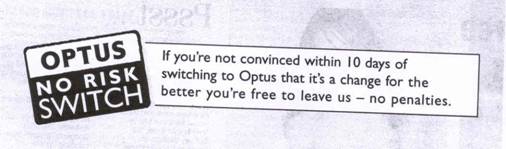
3 On 23 September 2001, Optus launched a new advertising and promotional campaign in relation to its mobile network which features prominently the words “Optus No Risk Switch”. The advertising and promotional campaign has been undertaken by way of newspaper and magazine advertisements, radio and television advertising and point of sale material and brochures at Optus shops and outlets. The campaign is due to run until the end of December 2001. The advertising is promoting a switch to the Optus mobile telephone network and in its initial phase, it featured a box with the words “Optus No Risk Switch” alongside which there appeared the following text:
“If you’re not convinced within 10 days of switching to Optus that it’s a change for the better you’re free to leave us – no penalties.”
In another form, the brochure or newspaper advertisement displayed the “Optus No Risk Switch” box and alongside the text there appeared:
“Move your current mobile number to Optus, and if you’re not completely happy after 10 days, you can leave us with no penalties.”
The boxes appeared in the following form:

4 Telstra submitted that this form of advertising was misleading and deceptive as mobile telephone users ran a risk at the point at which they changed from one mobile phone provider to Optus and again when they decided to terminate the change to Optus within ten days and revert to the prior mobile telephone provider or join up with another provider. At the first point of change, the mobile telephone users may incur termination or disconnection charges or penalties by the provider whose service was being terminated. At the second point of change, although it may be true that a change of mind within ten days after changing to Optus would not result in any financial charges or penalties from Optus other than the costs of the telephone calls made, such a change, according to Telstra, may well involve the person incurring further financial charges and penalties in re‑joining the network of the former provider because the same rates or charges which had earlier applied no longer applied.
5 In order to understand how Telstra contended that these charges or penalties may arise so that the user of a mobile telephone would run a risk of incurring charges or financial penalties if he or she responded to Optus’ marketing and promotional campaign, it is necessary to understand the interaction or interdependence between purchasing a mobile telephone handset and using mobile telephone services networks.
6 A person who wishes to purchase a mobile telephone handset and use mobile telephone services typically has three choices:
(a) to purchase a handset and thereafter decide to which network to connect;
(b) to purchase a handset and choose to connect to a network on a periodic basis such as from month to month;
(c) to purchase a handset as part of a package whereby the handset is purchased at a discounted rate and the person agrees to connect to a network for a specified period of time such as 12, 24 or 30 months.
7 According to Mr Burr, most new customers make the third choice because mobile telephone handsets generally cost substantially more if they are purchased separately than if they are purchased as part of a package, involving the purchase of a handset and connection to a network on terms and conditions which include a specified period, specified call charges and in some cases, the supply of other services. Typical terms and conditions of connection to a mobile network involve connection fees (which are sometimes waived), monthly access fees, specified call charges, a specified contract term and early termination charges if the connection is terminated prior to the contract term.
8 The providers of mobile telephone services such as Telstra, Optus and Vodafone offer call plans and packages with prescribed monthly access fees, a prescribed level of monthly call charges which are included in the monthly access fees and prescribed call rates. There are also establishment fees and service activation fees (which may often be waived).
9 Typically, terms and conditions of connection to a mobile network are set out in what the providers describe as plans. The terms and conditions of plans will vary according to the nature of the services provided, the volume of calls to be charged, the level of the access fee and the duration of the period for which the customer contracts for the plan. There is frequently a relationship between the monthly access fee and the charges for calls made in that the higher the monthly access fee, the lower the charge rate per call payable by the customer.
10 A mobile telephone user who is connected to a mobile telephone network and who has entered into an agreement with a provider of mobile telephone services for the supply of those services for a specified period, that is to say a person who has signed up with a provider for a particular plan, is at liberty to change or switch from that provider’s network to a network operated by another provider. However, if the user does so before the end of the period of the contract, the person will usually incur an early termination or disconnection fee. For example, a standard agreement for the supply of a digital mobile telephone service by Vodafone sets out a number of fees and charges which include an early termination fee of $220 in addition to the remaining months’ access fees and outstanding call charges. According to the agreement, this fee is incurred where a customer disconnects prior to the expiry of the agreed contract term. Telstra has similar charges in its contracts with its customers where a customer purchases a mobile telephone handset from Telstra and connects to its network and terminates the connection prior to the end of the contract term. Also, if a customer wishes to disconnect from the Telstra mobile telephone service and wishes to retain his or her existing mobile telephone number and use the same number with a mobile telephone service provided by another provider, Telstra charges a porting fee of $8.
11 Telstra submitted that where a customer of Telstra terminated his or her contract with Telstra, switched to Optus and then decided to return to Telstra, the customer would incur any charges payable to Telstra for a new connection. Telstra also contended that a customer returning to a former mobile telephone service provider might incur a level of charges and fees higher than applied to the customer at the time the customer switched to Optus in the following circumstances:
(a) if the customer, prior to the switch to Optus, had contracted for a call plan with certain rates and benefits, that plan might no longer be available for new connections when the customer returned from Optus;
(b) a returning customer might also lose benefits, such as bonuses, which only applied where there was continuity of the mobile service.
12 After Optus commenced its advertising and marketing campaign, Telstra wrote to Optus and advised Optus that it considered that the advertisements breached s 52 and s 53(g) of the Trade Practices Act 1974 (Cth). Telstra advised Optus that it considered that the overall impression created by the advertisements was false and misleading. The impression was that a mobile telephone user who chose to switch another mobile service provider to Optus:
· would not suffer any financial consequences or would not be financially worse off as a result of that switch;
· would not incur any financial consequences or would not be financially worse off, if the user left Optus within ten days to return to the user’s original mobile service provider, or to join a third mobile service provider.
Telstra informed Optus that it considered this overall impression to be false and misleading as users who were under contract with an existing mobile telephone services provider would suffer adverse financial consequences if they chose to switch to Optus and to leave Optus within ten days. These consequences would arise from the liability to pay a cancellation or an early termination fee and from the fact that the user may be unable to access all rates available under the previous call plan under which the user had contracted and would be required to reconnect the service to a new call plan with higher call rates.
13 Optus disagreed with Telstra’s view of the overall impression created by the advertisements and contended that the concept of the “No Risk Switch” only dealt with a user’s ability to leave Optus without penalties.
14 There was further correspondence in which the parties joined issue on the question whether the impression created by the advertisement was that the “No Risk Switch” related to, or should be taken as applying to, the risks involved in terminating an existing service and reconnecting to that service, or another service other than Optus after trying Optus for a period of up to ten days, or whether the risk related to the fact that there was no risk of any penalties or charges being paid to Optus when the switch to Optus was terminated within ten days. Optus maintained that the advertisements were not making any representations about penalties or charges, other than penalties or charges imposed by Optus.
15 However, Optus, without admission, was prepared to alter its advertising and marketing campaign in the following manner:
(a) the existing television advertisement which contained a reference to “Optus No Risk Switch” without qualification or explanation would not appear after 10 October 2001, and any future television advertisements would include a qualification to the effect that after a move to Optus, a person was free to leave with no penalties from Optus and with a note or warning that a person considering switching to Optus should check their obligations with their current supplier before switching;
(b) radio advertisements would no longer contain any reference to “Optus No Risk Switch”. From 12 October 2001, Optus’ radio advertisements would be broadcast in the following terms:
“At Optus World the switch is on.
Switch your mobile number and get the Nokia
8210 for FREE on the Optus Yes Rollover 33 plan.
Saving you $199.
And if you’re not convinced within 10 days that switching
to Optus is a change for the better, you’re free to leave – No penalties from Optus.
This offer is only for a limited time so make the Switch today.
Visit Optus World or call 133999.
Minimum total cost over 12 months is $396. While stocks last.”
(c) Print media advertisements would continue to display the “Optus No Risk Switch” box but immediately alongside it there would appear the text:
“Move to Optus and if you’re not convinced it’s a change for the better, within 10 days, you’re free to leave – with no penalties from us.”,
and immediately underneath the box there would appear the text:
“Optus always suggests that you check your obligations with your current supplier before switching.”
It would be displayed in the following form:

A copy of the advertisement is set out in Schedule A to these reasons.
16 Radio advertisements are no longer an issue, but the print media advertisements remain controversial. (Future television advertisements will need to be considered by reference to these reasons). Telstra maintained that, notwithstanding the introduction of the words “with no penalties from us” in the text beside the “Optus No Risk Switch” box and the suggestion that persons check their obligations with their current supplier before switching, the impression created by the advertisement, in respect of which the “Optus No Risk Switch” box was central, was that a person would not incur any financial risk or financial charge by changing from an existing mobile telephone services provider to Optus, either at that point of change or, if a person decided within ten days not to stay with Optus but to revert back to the original provider or another provider, at that second point of change.
17 The present application is an application for an interlocutory injunction. Accordingly, it is necessary to determine whether there is a serious question to be tried that persons may be misled or deceived by the advertisements, notwithstanding the addition of the text and words to which I have referred. Optus submitted that a reasonable consumer would not be misled or deceived by the advertisements, particularly because, as Mr Burr had said, most users of mobile telephone services had accepted plans involving contracts for specified terms and early termination fees if the connection was terminated prior to the end of the contract. Optus said that one should approach the impression created by the advertisements by reference to how the ordinary reasonable reader would understand the advertisement, and that the ordinary reasonable reader was a person of fair average intelligence. It was said that the words “No Risk” were, by themselves, so general as to be devoid of any specific content or meaning.
18 Optus relied upon the reasoning of the High Court in Campomar Sociedad, Limitada v Nike International Limited (2000) 202 CLR 45 for the proposition that in considering whether representations to the public at large were misleading or deceptive or likely to mislead or deceive, it was necessary to approach the matter at a level of abstraction by reference to ordinary or reasonable persons. The High Court considered that when analysing what might be the response of such ordinary or reasonable persons to the mass marketing of a product for general use, the Court should exclude “assumptions by persons whose reactions are extreme or fanciful.” (at 86)
19 Optus submitted that in Campomar, the High Court drew a distinction between cases where a representation was made specifically to a person, or to a particular person, and a case where a representation was made by way of mass advertising to the world at large. The Court said that in the latter case it was necessary to isolate by some criterion a representative member of the class so that an enquiry could be made, by reference to that class, why a misconception might arise if no injunctive relief was granted. The High Court adopted the criterion of ordinary or reasonable members of the class and excluded persons whose reactions might be extreme or fanciful. The High Court then formulated the question to be asked as follows (at 87):
“The initial question which must be determined is whether the misconceptions, or deceptions, alleged to arise or to be likely to arise are properly to be attributed to the ordinary or reasonable members of the classes of prospective purchasers.”
20 Optus submitted that I should adopt this approach and consider whether the advertisement was misleading or deceptive or likely to mislead or deceive by reference to its impact on ordinary or reasonable persons. It supported this submission by reference to the approach taken by Hunt J in Farquhar v Bottom [1980] 2 NSWLR 381 in considering whether matter complained of as being defamatory was capable of conveying to the ordinary reasonable reader the imputations relied upon as being defamatory. Hunt J said at 385‑386:
“I must be guided and directed by the test of reasonableness. I must reject any strained, or forced, or utterly unreasonable interpretation. … I must proceed upon the basis that the ordinary reasonable reader is a person of fair, average intelligence … who is neither perverse … nor morbid or suspicious of mind …”
21 However, the concept of looking at an advertisement through the eyes of an ordinary or reasonable consumer must also take into account that an advertisement published to the world at large is designed and calculated to be seen and read by a wide range of persons. Identifying the relevant class as ordinary and reasonable people conceals the fact that within that range will be included, in the words of Sheldon and Sheppard JJ in CRW Pty Ltd v Sneddon (1972) AR (NSW) 17 at 28:
“The shrewd and the ingenuous, the educated and the uneducated and the experienced and inexperienced in commercial transactions.”
22 The issue which arises for present consideration is whether there is a serious question to be tried that the advertisement with the “Optus No Risk Switch” box, albeit with the added text, is misleading or deceptive or likely to mislead or deceive. The nature of the words used are sufficiently general as to give rise to a number of interpretations or meanings. It is therefore necessary to recognise that the advertisements will be seen by a wide range of potential users of the Optus network in the community. That range will cover the astute, the informed, those who are sceptical and read the small print, those who are intelligent and those who are well informed. The range will also cover many who do not possess these characteristics and may not be alert to the issues involved in connecting to, and leaving, a mobile telephone network and also the less well informed and those with average intelligence.
23 These considerations bring to mind the approach taken to whether an advertisement might be misleading or deceptive by Hill J in Tobacco Institute of Australia Ltd v Australian Federation of Consumer Organisations Inc (1992) 38 FCR 1. At 49‑50, Hill J said:
“In Annand & Thompson Pty Ltd [v Trade Practices Commission (1979) 40 FLR 165] (supra), Franki J expressed the test to be (at 176):
‘… whether in an objective sense the conduct of the appellant was such as to be misleading or deceptive when viewed in the light of the type of person who is likely to be exposed to that conduct. Broadly speaking it is fair to say that the question is to be tested by the effect on a person, not particularly intelligent or well informed, but perhaps of somewhat less than average intelligence and background knowledge although the test is not the effect on a person who is, for example, quite unusually stupid.’
…
In the end, the question is not whether account is to be taken of the effect of the conduct upon the gullible, but whether the conduct in question is misleading or deceptive. The statutory question is best tested in a case such as the present, by reference to the effect of the conduct upon the class of persons who are likely to read and consider the advertisement, that class having the qualities discussed by Franki J. The extremely stupid, and perhaps the gullible, may well be excluded from the class of persons who read such advertisements in newspapers. Some members of the class may, in reading the advertisement, be misled by a misconception of their own, howsoever arising. Those persons will not have been led into error by the representation made in the advertisement.
However, as was observed by Sheldon and Sheppard JJ in CRW Pty Ltd v Sneddon (1972) AR (NSW) 17 at 28 (the context was the Consumer Protection Act 1969 (NSW)):
‘An advertisement published in a newspaper is not selective as to its readers. The bread is cast on very wide waters. The advertiser must be assumed to know that the readers will include the shrewd and the ingenuous, the educated and the uneducated and the experienced and inexperienced in commercial transactions. He is not entitled to assume that the reader will be able to supply for himself or (often) herself omitted facts or to resolve ambiguities. An advertisement may be misleading even though it fails to deceive more wary readers.’
Where, as in the present case, the advertisement is capable of more than one meaning, the question of whether the conduct of placing the advertisement in a newspaper is misleading or deceptive conduct must be tested against each meaning which is reasonably open. This is perhaps but another way if saying that the advertisement will be misleading or likely to mislead or deceive if any reasonable interpretation of it would lead a member of the class, who can be expected to read it, into error: Keehn v Medical Benefits Fund of Australia Ltd (1977) 14 ALR 77 at 81 per Northrop J and cf the approach taken by Mason J in Parkdale.”
The latter part of this passage was cited with approval by Ryan J in Telstra Corporation Ltd v Cable & Wireless Optus Ltd [2001] FCA 1238.
24 It is also important to bear in mind the observation of Sheppard J, at 4‑5:
“It is not appropriate to take part of an advertisement such as the one in question here and endeavour to ascertain in isolation the meaning of each of the critical words or phrases which is used. Rather an attempt should be made to measure the veracity of its message by reading it in context. One needs also to take into account the fact that many readers would not make a close study of the advertisement but would read it fleetingly and absorb its general thrust. On the other hand, others would be likely to read it more carefully. This would include persons directly touched by the problem.”
(see also George Weston Foods Ltd v Goodman Fielder Ltd [2000] FCA 1632.)
25 At this interlocutory stage, I consider that I should approach the matter by asking whether there is a serious question to be tried, that the advertisements with the “Optus No Risk Switch” box, albeit with the added text, are capable of conveying a meaning which will be misleading or deceptive or be likely to mislead or deceive by reference to the standard of the ordinary or reasonable person who nevertheless may fall into one or more of the classes of persons having the characteristics to which I have referred in par 22 above.
26 The layout of the current version of the print media advertisement is such as to draw attention to, and focus on, the box containing the words “Optus No Risk Switch”. Although the name “Optus” is contained within the box, it is printed in a different font to the words “No Risk Switch” and with a different background.
27 The “Switch” contemplated and invited by the advertisement is a change involving at least one but possibly two steps or stages. The first step or stage is to change from an existing mobile telephone services provider to Optus and, if the user decides within ten days that the change to Optus was not a change for the better, then a second switch or change might be to revert back to the former mobile telephone services provider or to connect with another mobile telephone services provider.
28 Optus submitted that the relevant question to ask was whether there was a serious risk of persons being mislead and deceived by advertisements containing the “No Risk Switch” box when it was clear from the integral connection between the box and the oblong box next to it that the reference to “No Risk” was a reference to there being no risk of penalties from Optus, and where it was further made clear underneath the box that there was a need to check with a current supplier before making the switch.
29 Optus submitted that unless the words “No Risk” were placed in that context they would, in the minds of consumers, be regarded as “pretty meaningless”. It was said that because the words “No Risk” are of very wide import, they convey nothing precise and are, at most, a pointer to some obviation of risk which is being offered and that that offer is being identified as being no risk of incurring penalties from Optus.
30 The expression “no risk” in the abstract may not convey any particular meaning, but I do not consider that it is meaningless and devoid of content. The Macquarie Dictionary includes within its definitions of “risk” a reference to “no risk” as being “an exclamation of reassurance or approval”. I consider that looked at initially, the expression “no risk” conveys a colloquial meaning that no problems exist or that no difficulties or adverse consequences arise.
31 Optus submitted that the addition of the words in the oblong box and the words underneath the box had the result that when a person read the words in the box, the person would be left with no conclusion other than that what was being advocated as being of no risk was what was explained in the oblong box, namely no risk of penalties from Optus. That may be the conclusion reached by a number of readers, but I consider that there is a serious question to be tried that the advertisement is open to the interpretation that a switch to Optus from another provider does not involve a mobile telephone user incurring any financial risk by switching. In my view, it is arguable that the advertisement is reasonably open to the interpretation that there is no risk in switching to Optus, that is to say one is not exposed to the chance of loss or cost if one switches to Optus. The first meaning of “risk” found in The Macquarie Dictionary is “exposure to the chance of injury or loss”.
32 Optus submitted that the construction placed upon the advertisement in its amended form by Telstra was an extreme or fanciful construction and one that would not be apparent to a reasonable user of mobile telephone services. However, I have to consider whether such a construction might reasonably be open upon a fair reading of the advertisement, albeit that other constructions, not leading to a likelihood to mislead or deceive, might also be open. I consider that there is a serious question to be tried that one construction which is reasonably open as to the interpretation of the advertisement, is that there is no risk in moving or switching from another mobile telephone services provider to Optus. It is arguable that at that point of time the impression created is that there will be a seamless transition from one mobile telephone service provider to Optus without the switch resulting in a financial cost or financial disadvantage for the user switching.
33 Although there is the explanation in the oblong box next to the “No Risk Switch” box, I consider that it is arguable that a reader might think that what the advertisement is saying is that there is no risk moving from one mobile telephone services provider to Optus and that, if you are not happy within ten days, you can leave Optus without Optus charging you any penalties. I consider that it is arguable that the nature of the “No Risk Switch” box and its juxtaposition to the wording in the oblong box creates uncertainty at the least as to the absence of risk or the obviation of risk on the initial move. The explanation in the oblong box explains the absence of risk at the end of the switch but does not deal with the absence of risk in the initial switch to Optus.
34 This uncertainty is exacerbated by the suggestion that persons should check their obligations with their current supplier before switching to Optus. Optus relied upon this suggestion as eliminating any finding that the “No Risk Switch” box is likely to mislead or deceive. However, a dominating feature of the advertisement is the “No Risk Switch” box and I do not consider that the suggestion made below the box is necessarily sufficient to dispel the dominant message, namely that there is no risk switching from one mobile telephone services provider to Optus.
35 I do not consider that it would be an extreme or fanciful interpretation of the advertisement, or the impression gained from it, that a person switching from an existing mobile telephone services provider to Optus can do so without suffering any financial or cost disadvantage. The text underneath the box containing the suggestion is not expressed to qualify or render conditional the assertion that what is being offered is a proposal which involves no risk in switching to Optus. The suggestion does not explain why the reader should check his or her obligations with the current supplier. At least, there is a serious question to be tried that the words in the suggestion do not dispel the impression that there is no risk in switching to Optus.
36 Although most users of mobile telephone communication services might have signed up on a plan which provides for a specific period of use and a termination charge for early termination, I consider that the range of persons to whom the advertisement is addressed (and to which I have referred in par 22 above) is such that there would be a considerable number who might not be alerted to the crystallisation of this charge if a switch is made to Optus.
37 I consider that there is a serious question to be tried that the box containing the words “Optus No Risk Switch” in the manner to which I have referred, albeit with the associated text to which I have referred, conveys the meaning that no risk is incurred in making a switch from one mobile telephone services provider to Optus, in the sense that no financial cost or charge is incurred or suffered at that point of time. I consider that there is a serious question to be tried that the advertisement would lead a user of a mobile telephone service into believing that it would be a costless change to Optus. However, I do not consider that a serious question arises that the advertisement is misleading or deceptive or likely to mislead or deceive mobile telephone users in relation to what will happen after they leave Optus within the ten day period. The whole thrust of the advertisement is to focus on the initial move or switch to Optus. I do not consider that the advertisement is reasonably open to the interpretation that anything is being said about what might occur after a user decides within ten days to leave Optus and disconnect from the Optus network without any penalties being charged by Optus. Nothing is conveyed in the advertisement as to the absence of risk other than up to the point at which one disconnects from Optus without penalty.
38 Optus submitted that if the advertisement was placed before an ordinary or reasonable person and that person was asked – what does it convey to you, the answer would be that Optus would not seek to charge any penalties. Optus submitted that if a further question was asked – do you regard yourself as relieved of obligations to the other supplier, the answer would be in the negative. However, I do not consider that that is necessarily the only question to ask. A more appropriate question might be – do you think there are any other risks involved in moving from your current mobile telephone services provider to Optus?
39 Optus appeared to rely on observations of Young J in Eighth SRJ Pty Ltd v Merity (NSW SC, unreported, 25 March 1997) to the effect that where an advertisement was intended to be no more than introductory puffery, the advertisement could not be regarded as making a statement of fact. However, I consider that the “No Risk Switch” box goes further than mere puffery and would be seen by persons reading the advertisement as making a definite statement as to a characteristic or consequence of switching from one mobile telephone services provider to Optus.
40 Optus submitted that to a reader of an advertisement, the words “No Risk” conveyed nothing more than that there was something which was being offered which was said to be beneficial which could not be understood, and which could not be acted upon, until further enquiry was made. I do not accept that submission. Although the further enquiry, by reference to the oblong box, demonstrates that Optus will not charge any penalties upon leaving Optus, having made the switch, it still leaves open, as I have observed earlier, the position at the point of time at which the switch is made from the erstwhile mobile telecommunications provider to Optus.
41 Prior to the introduction of MNP, the Australian Communications Industry Forum, at the direction of the Australian Competition and Consumer Commission, published the mobile number portability industry guidelines in or around April 2001. According to Mr Paul Kitchin, the Director Consumer Mobile Marketing in the mobile division of Optus’ business, all suppliers of mobile telephone services must comply with the guidelines. Mr Kitchin said that in order to comply with the guidelines, all existing and new Optus sales employees, in addition to Optus franchisees and Optus dealers and other agents, have received or will receive training, or will be given written directives from Optus, regarding the information which is to be passed on to consumers about MNP. Optus has prepared training materials for instructing sales staff when informing consumers about MNP. The training materials include the following instruction:
“A customer can port even when they are on contract with another carrier, but will remain responsible for all fees and charges owed to the original carrier.
Being under contract is not a reason to prevent a postpaid customer from porting. Provided the customer is aware of the costs and obligations that they may have with their current carrier and understand that they are responsible for payment of cancellation fees, they are free to port their MSN.
Our dealers, MAC representatives and OMD will be responsible for informing customers about their costs and obligations.”
42 The training materials also explain that a customer who wishes to port or transfer to Optus and retain the customer’s existing mobile telephone number must complete a customer authorisation form.
43 The customer authorisation form used by Optus for MNP includes the following customer acknowledgment printed in bold type below which the customer must sign:
“CUSTOMER ACKNOWLEDGMENT
I acknowledge that I have been advised by Optus Mobile that although I have the right to switch my mobile service to Optus Mobile :
· there may be costs and obligations associated with my existing service and the switching of this mobile service number to Optus Mobile
· there may be an existing contract with my current mobile service provider which may require me to pay them an early cancellation fee or termination payment to my current Mobile Service
Signature (Applicant) …………………………… Date: ………/………/………”
Mr Stuart Salier, Corporate Counsel employed by Optus Administration Pty Ltd, said that Optus sales employees, franchisees, dealers and agents have received or been given written direction from Optus requiring them to inform consumers that they may suffer financial consequences if they change from their existing carriers to Optus.
44 At this interlocutory stage of the proceeding, I am not satisfied that the instructions given to Optus personnel and the customer acknowledgment on the customer authorisation form are sufficient to dispel the conclusion that there is a serious question to be tried that the “No Risk Switch” box is misleading or deceptive, or likely to mislead or deceive readers of the advertisements. At the point of time at which the issue of obligations owed to a mobile telephone user’s existing service provider is raised by the training materials and the customer authorisation form, the user has commenced a journey to which he or she has been attracted by the opportunity of a “No Risk Switch” from the user’s present mobile telephone services provider to Optus. Although it might be arguable that in discussions with Optus staff the user might reflect upon the financial costs involved in terminating the existing service, much will depend upon the manner in which the matter is communicated by the Optus representatives. The difficulty with the customer acknowledgment form is that at the point of time at which it is about to be signed there is little time for reflection or recourse to the existing provider. In my view, it is open to doubt that, at the point of time when a customer is about to sign the authorisation form and the customer reads the customer acknowledgment, the customer will appreciate fully the significance and consequence of the acknowledgment having regard to what appeared in the advertisement.
45 In this context I would, with respect, adopt the observations in Tamberlin J in Trade Practices Commission v Optus Communications Pty Ltd (1996) 64 FCR 326 at 340:
“I am not persuaded that any or all of the post‑broadcast steps leading to signing of the contract would dispel the impression generated by the misleading message in the television broadcast in all or most cases. Once the impression is engendered by the advertisement, an interested viewer would normally be led to make further inquiries of Optus or its representatives. If this occurs, the viewer will probably be led to take those actions as the result of the attractive but misleading publicity set out in the television broadcast. The viewer is enticed into the marketing web by the advertisement; cf the comments of Beaumont J in Tec & Tomas (Australia) Pty Ltd v Matsumiya Computer Co Pty Ltd (1984) 1 FCR 28 at 38:
In my view, to induce the introduction of such a dealing is conduct which contravenes s 52, even if, ultimately, the consumer becomes aware that the equipment he is purchasing is not that of the Hattori Seiko group, the deception having occurred at an earlier stage: what is relevantly induced is the dealing or the negotiations, as distinct from the subsequent purchase itself.
While it is true that the Act is not intended to shield the reckless or careless viewer from his or her own pre‑existing confusion or preconception, many viewers will in practice, not make specific inquiries about whether mobile to mobile calls are within the exclusions. Nor, on the evidence provided, can it safely be taken, that in most cases, the representatives or sales staff of Optus will make clear the exclusions of mobile to mobile phones.”
I consider these observations apposite to the issues before the Court.
46 Telstra supported its submissions by reference to Vodafone Pty Ltd v Hutchison Telecommunications (Australia) Ltd [2001] FCA 1155 in which Allsop J granted interlocutory injunctions restraining the publication of certain advertisements relating to the costs of telephone calls. Optus submitted that his Honour had erred in the application of the relevant principles and that I should not adopt the same approach as his Honour. The issues which faced Allsop J were quite different from the issues presently before the Court and it is not necessary to enter into a detailed consideration of his Honour’s reasoning.
47 However, Optus submitted that the approach taken by his Honour would result in a finding of misleading and deceptive conduct whenever a mobile telephone services provider advertised the advantages of its product but did not make any mention of any consequent disadvantage. Optus supported this submission by tendering a number of Telstra advertisements which proclaimed the advantages of moving to the Telstra mobile telephone services network but which did not refer to any disadvantages in so moving. Counsel for Optus said that it was not contended that such advertisements were misleading or deceptive, because the advertisements said nothing about the charges which might be imposed by other mobile telephone services providers. However, there is a significant distinction between those Telstra advertisements and the Optus advertisements under consideration. The Telstra advertisements proclaim the advantages of moving to the Telstra network, but they do not make any affirmative reference to the fact that there is no risk in so moving. The issue which arises in relation to the Optus advertisements is not that they proclaim the advantages of switching to Optus; rather it is that they state that there is no risk in switching to Optus. It is the connotation and context of the expression “No Risk” which gives rise to the controversial issue.
48 Having determined that there is a serious question to be tried that the print media advertisement in its amended form is misleading or deceptive or likely to mislead or deceive, I turn to the balance of convenience. If a mobile telephone services user does switch to Optus and is misled in relation to the crystallisation of a termination or disconnection charge on switching to Optus, it will not be possible to identify such a person. According to Mr Burr, where an existing Telstra customer disconnects his or her service, it is not possible for Telstra to determine why that disconnection has occurred unless the customer specifically informs Telstra of the reason. Customers disconnect from mobile telephone communication services for a variety of reasons and it would not be possible to identify which customers had disconnected as a result of reading the “Optus No Risk Switch” advertisement. In such circumstances, not only would there be a loss incurred by Telstra as a result of Optus’ conduct, but also the customer himself or herself would probably have suffered a financial cost or charge which might not have been incurred had it not been for the form of the advertisement. To that extent, the granting of an injunction has a public interest element in the sense that it is protecting consumers. There is a risk of harm to the public if the advertisement continues in its present form.
49 Any injunction which is granted will cause a disruption to the advertising campaign presently being conducted by Optus. Optus has pre‑booked advertisements in various newspapers throughout the country until the end of November 2001. Those advertisements have either been prepaid or Optus is committed to paying for them. Mr Kitchin said that if Optus was required to retract or alter the scheduled advertisements it would be necessary to prepare replacement advertisements which would involve a lead time before they could be ready and which would also involve substantial expenditure. Any extra costs incurred by Optus as a result of any interlocutory injunction being granted will be covered by Telstra giving the usual undertakings as to damages to the Court. If any advertisement is to be published within a short period of time following the order I propose to make, I would be prepared to consider a form of order which would ensure that an inability to comply with the order, by reason of a printing deadline having been imposed, would not result in a breach of the injunction. Mr Kitchin also gave evidence as to the substantial extra costs incurred in reprinting catalogues, posters, brochures and fliers. Those extra costs would also be covered by the usual undertaking as to damages.
50 There is also the issue of the lead time required to prepare, print and make available alternative catalogues, posters, brochures and fliers. Although that lead time will result in a disruption to Optus’ advertising campaign I have to balance against that inconvenience and disruption the consequences which will or might follow from Optus being allowed to continue the advertisements without any further qualification. As I have pointed out earlier, I consider that there is a serious question to be tried that the advertisements are misleading and deceptive or are likely to mislead and deceive in circumstances where it will not be possible to identify the persons who will have been misled or deceived. I have, therefore, reached the conclusion that the balance of convenience is in favour of the grant of an interlocutory injunction. Although this will cause significant disruption to Optus’ advertising campaign and will result in it incurring substantial costs, I consider that the potential harm which may result from the continuation of the advertisements outweighs those considerations. I consider the nature of the serious question to be tried is such that it is desirable that the advertisements, in their present form, not be disseminated further. I am prepared to give Optus a reasonable time within which to arrange such communications as may be needed to ensure that the relevant advertising material is withdrawn from public display and dissemination.
51 I am therefore satisfied that, having regard to my findings as to a serious question to be tried and the balance of convenience, an injunction should be granted until the hearing of the proceeding or further order restraining Optus from advertising in a manner including the box “Optus No Risk Switch” as is presently proposed. I will hear the parties as to the form of injunction to be granted. I am not disposed to shut out Optus altogether from using the phrase “Optus No Risk Switch” so long as it is made clear in the advertisements that there may be costs and penalties involved in moving from an existing provider to Optus and that the reference to “no risk” is a reference to the fact that no penalties will be charged by Optus if a user leaves within ten days of signing up with Optus.
|
I certify that the preceding fifty-one (51) numbered paragraphs are a true copy of the Reasons for Judgment herein of the Honourable Justice Goldberg. |
Associate:
Dated: 19 October 2001
|
Counsel for the Applicant: |
C M Maxwell QC and C C Macaulay |
|
|
|
|
Solicitor for the Applicant: |
Malleson Stephen Jaques |
|
|
|
|
Counsel for the Respondents: |
G A A Nettle QC and J P Moore |
|
|
|
|
Solicitor for the Respondents: |
Minter Ellison |
|
|
|
|
Date of Hearing: |
12 and 15 October 2001 |
|
|
|
|
Date of Judgment: |
19 October 2001 |