

FEDERAL COURT OF AUSTRALIA
NGALPIL v STATE OF WESTERN AUSTRALIA
[2001] FCA 1140
NATIVE TITLE – application for determination – parties agreeing to terms of proposed determination – power of Court to make orders consistent with those terms if appropriate – discretion – relevant matters – orders made in terms proposed.
Native Title Act 1993 (Cth) ss 47, 47A, 87, 94A, 225
PALMER GORDON NGALPIL, SANDY COX, REX JOHN, PARAKU (GEORGE WALLABY), DAVID SKEEN, KILAMPI, BOXER MILGNER, IVY ROBERTSON, GRACIE LONG, CLANCY STURT, MONA GREEN, WIRRIMANU (ROBERT RALLAH), TOMATO GORDON, BESSIE DOONDAY, SPEELER STURT, VERONICA LULU, REGGIE CHUNGULLA, RAYMOND CHUNGULLA, BOXER JALARKU, LINDA YANDANALLI, CHAMIA NAPURULLA, NED COX YANPIEI and VIOLET CAMPBELL BARANGNALI v STATE OF WESTERN AUSTRALIAand PREMIER OF WESTERN AUSTRALIA, SHIRE OF HALLS CREEK, WIRRIMANU ABORIGINAL CORPORATION and BALGO HILLS ABORIGINAL COMMUNITY INC, ANGLOGOLD AUSTRALIA LTD, GLENGARRY MINING NL and GLENGARRY RESOURCES NL, PERILYA LTD, TANAMI GOLD NL and TELSTRA CORPORATION LTD
CARR J
20 AUGUST 2001
PARUKU (Lake Gregory) near MULAN
|
IN THE FEDERAL COURT OF AUSTRALIA |
|
|
WAG 160 OF 1007 |
|
BETWEEN: |
PALMER GORDON NGALPIL, SANDY COX, REX JOHN, PARAKU (GEORGE WALLABY), DAVID SKEEN, KILAMPI, BOXER MILGNER, IVY ROBERTSON, GRACIE LONG, CLANCY STURT, MONA GREEN, WIRRIMANU (ROBERT RALLAH), TOMATO GORDON, BESSIE DOONDAY, SPEELER STURT, VERONICA LULU, REGGIE CHUNGULLA, RAYMOND CHUNGULLA, BOXER JALARKU, LINDA YANDANALLI, CHAMIA NAPURULLA, NED COX YANPIEI and VIOLET CAMPBELL BARANGNALI Applicants
|
|
AND: |
STATE OF WESTERN AUSTRALIA AND PREMIER OF WESTERN AUSTRALIA First Respondents
SHIRE OF HALLS CREEK Second Respondent
WIRRIMANU ABORIGINAL CORPORATION and BALGO HILLS ABORIGINAL COMMUNITY INC Third Respondents
ANGLOGOLD AUSTRALIA LTD GLENGARRY MINING NL and GLENGARRY RESOURCES NL PERILYA LTD TANAMI GOLD NL Fourth Respondents
TELSTRA CORPORATION LTD Fifth Respondent
|
|
DATE OF ORDER: |
|
|
WHERE MADE: |
THE COURT NOTES THAT:
A. Pursuant to section 87(1)(b) of the Native Title Act the parties have filed with this Court a Minute of Consent Determination of Native Title which reflects the terms of an agreement reached by the parties in relation to these proceedings.
B. The terms of the agreement involve the making of a determination of native title in relation to the land and waters the subject of these proceedings pursuant to section 87(2) and section 94A of the Native Title Act.
C. The Applicants have yet to establish and nominate a prescribed body corporate which will perform the functions required by either section 56 or 57 of the Native Title Act.
D. The parties have agreed that the registered native title body corporate which will hold the native title in trust, or will perform the functions referred to in sections 57(3) and 58 of the Native Title Act as the case may be, may seek a variation of the determination of native title in this matter (as it relates to minerals and petroleum) in accordance with sub-sections 13(1) and (5) of the Native Title Act 1993 in the event that the ruling in the Federal Court in Western Australia v Ward (2000) 99 FCR 316 with respect to minerals and petroleum is, in High Court Appeals Registry Nos P59 of 2000 (State of Western Australia v Ward & Ors), P62 of 2000 (Attorney-General of the Northern Territory v Ward & Ors), P63 of 2000 (Ningmarmara & Ors v Northern Territory of Australia & Ors) and P67 of 2000 (Ward & Ors v Crosswalk Pty Ltd & Ors), overturned, set aside, remitted to the Federal Court or is otherwise found to be an incorrect legal ruling.
E. Subject to F. below, if the Applicants make such an application within 3 months of the delivery of the High Court decision, the parties to this consent determination will consent to that application being argued on its merits.
F. Upon such application being made, nothing in E. above or otherwise prevents any party from opposing a variation to the determination on the basis of the merits of such application.
Being satisfied that a determination in the terms sought by the parties would be within the power of the Court and, it appearing to the Court appropriate to do so and by the consent of the parties:
THE COURT ORDERS, DECLARES AND DETERMINES BY CONSENT THAT:
1. Native title exists in relation to the Determination Area, other than those areas referred to in paragraph 2 below. The Determination Area is the land and waters described in the First Schedule.
2. Native title has been wholly extinguished, and no native title exists, in relation to land and waters within reserves 41056 and 41065.
3. The communal or group rights and interests comprising the native title are held by those people described in the Third Schedule (“the common law holders”) who are known for the purposes of this determination as the “Tjurabalan People”.
4. Subject to paragraphs 5, 6, 7 and 8:
(i) the nature and extent of the native title rights and interests held by the common law holders in relation to the Determination Area are the right to possess, occupy, use and enjoy the land and waters of the Determination Area to the exclusion of all others, including:
(a) the right to live on the Determination Area;
(b) the right to make decisions about the use and enjoyment of the Determination Area;
(c) the right to hunt and gather, and to take water and other traditionally accessed resources (including ochre) for the purpose of satisfying their personal, domestic, social, cultural, religious, spiritual and communal needs;
(d) the right to control access to, and activities conducted by others on, the land and waters of the Determination Area;
(e) the right to maintain and protect sites which are of significance to the common law holders under their traditional laws and customs; and
(f) the right as against any other Aboriginal group or individual to be acknowledged as the traditional Aboriginal owners of the Determination Area.
(ii) the native title rights and interests are exercisable in accordance with the traditional laws and customs of the common law holders.
5. Notwithstanding anything in this determination:
(a) the native title rights and interests (in accordance with the decision of the Federal Court in Western Australia v Ward (2000) 99 FCR 316) include ochre but do not include other minerals and petroleum as defined in the Mining Act 1904 (WA), Mining Act 1978 (WA), the Petroleum Act 1936 (WA) and the Petroleum Act 1967 (WA); and
(b) the native title rights and interests only confer on the common law holders such rights in relation to flowing and subterranean waters as exist at law;
(c) nothing in this paragraph is intended to affect the rights of the common law holders (including any registered native title body corporate) under sub-sections 13(1) and 13(5) and the item “Revised native title determination application” in the table in sub-section 61(1) of the Native Title Act.
6. The nature and extent of other interests in relation to the Determination Area are those set out in the Second Schedule.
7. The native title rights and interests are subject to and exercisable in accordance with the laws of the State of Western Australia and the Commonwealth of Australia including the common law.
8. The relationship between the native title rights and interests in the land and waters described in paragraph 4 and the other rights and interests referred to in paragraph 6 (“the other rights and interests”) is that:
(a) the other rights and interests and the doing of any activity in exercise of the rights conferred by or held under the other rights and interests co-exist with the native title rights and interests except to the extent that the other rights and interests are inconsistent with the continued existence enjoyment or exercise of the native title rights and interests in which case the native title continues to exist in its entirety, but the native title rights and interests have no effect in relation to the other rights and interests to the extent of the inconsistency; and
(b) for the avoidance of doubt, the existence and exercise of the native title rights and interests does not prevent the doing of any activity required or permitted to be done by or under the other rights and interests and the other rights and interests, and the doing of any activity required or permitted to be done by or under the other rights and interests, prevail over the native title rights and interests and any exercise of the native title rights and interests, but do not extinguish them.
9. A representative of the common law holders of the native title rights and interests is requested to indicate within three months of the date these orders are made whether they intend to have the native title held in trust and if so by whom. That representative is invited to do so by:
(a) nominating in writing to the Federal Court a prescribed body corporate to be trustee of the native title; and
(b) including with the nomination the written consent of the body corporate.
10. If a prescribed body corporate is nominated in accordance with Order 9, it will hold the native title rights and interests, referred to in Order 1, from time to time comprising the native title in trust for the common law holders of the native title rights and interests.
11. If a prescribed body corporate is not nominated in accordance with Order 9, the native title rights and interests, referred to in Order 1, from time to time comprising the native title will be held by the Tjurabalan People (as defined in this determination) in respect of the Determination Area as the common law holders of the native title rights and interests.
12. If a prescribed body corporate is not nominated in accordance with Order 9 and native title is therefore held by the Tjurabalan People in accordance with Order 11, then the matter is to be relisted by the Registrar in order that the Court can consider the making of orders in accordance with section 57(2) of the Native Title Act.
13. Until such time as there is a registered native title body corporate in relation to the Determination Area, any notices required under the Native Title Act 1993 (Cth) or otherwise to be served on the common law holders may be served upon the Ngaanyatjarra Council Aboriginal Corporation, and such service shall be deemed to be sufficient.
14. There be liberty to any party to apply in respect of orders 9-13 on 7 days written notice.
15. There be no order as to costs.
FIRST SCHEDULE
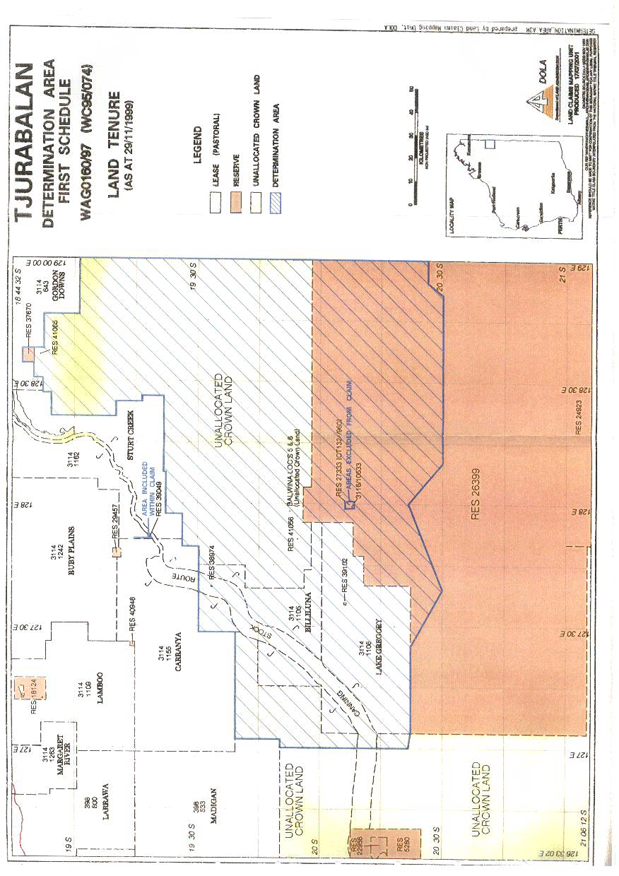
The Determination Area (which is outlined in blue on the plan annexed to this First Schedule) comprises all of the land and waters within the following two boundary descriptions, save for those areas described below as “Exclusions”:
Area 1
Commencing at the westernmost south western corner of pastoral lease 3114/643 (Gordon Downs) and extending generally easterly along the boundaries of that pastoral lease to its eastern most south eastern corner, then east to the Western Australia – Northern Territory border at latitude 19.18924 south, then southerly along the border to latitude 20.436899 south, then generally westerly passing through the following coordinate positions:
|
Latitude South |
Longitude East |
|
20.436900 |
128.905451 |
|
20.498567 |
128.855452 |
|
20.498578 |
128.167954 |
|
20.360245 |
128.001287 |
|
20.498581 |
127.649624 |
then north westerly to the southern boundary of pastoral lease 3114/1106 (Lake Gregory) at longitude 127.417971 east, then westerly along that boundary to the south western corner of the aforesaid pastoral lease, then westerly to latitude 20.360254 south longitude 127.001290 east, then northerly to the southern boundary of pastoral lease 398/533 (Madigan) at longitude 127.001283, then easterly and northerly along boundaries of that pastoral lease to the southern boundary of pastoral lease 3114/1155 (Carranya), then generally easterly and generally northerly along boundaries of that pastoral lease to the southern most south western corner of pastoral lease 3114/1162 (Sturt Creek), then generally easterly and northerly along boundaries of that pastoral lease back to the commencement point.
Area 2
All of the land comprising Crown Reserve 39049.
Exclusions
Excluded from Area 1 are all of the land comprising Reserve 27333 (C/T 1324/960) and all of the land comprising special lease 3116/10533.
SECOND SCHEDULE
The nature and extent of other interests in relation to the Determination Area are:
Reserves for the “use and benefit of Aboriginal inhabitants”
(a) Reserve 37670 for the “use or benefit of Aboriginal inhabitants” created in accordance with sections 41, 281(2) and section 14(2) schedule 2 of the Land Administration Act 1997 and vested in the Aboriginal Lands Trust created pursuant to section 20 of the Aboriginal Affairs Planning Authority Act 1972;
(b) Reserve 39049 for the “use and benefit of Aboriginal inhabitants” created in accordance with the Land Administration Act 1997 and vested in the Aboriginal Lands Trust created pursuant to section 20 of the Aboriginal Affairs Planning Authority Act 1972;
(c) Reserve 38974 for the “use and benefit of Aboriginal inhabitants” created in accordance with the Land Administration Act 1997 and vested in the Aboriginal Lands Trust created pursuant to section 20 of the Aboriginal Affairs Planning Authority Act 1972;
(d) Reserve 39102 for the “use and benefit of Aboriginal inhabitants” created in accordance with the Land Administration Act 1997 and vested in the Aboriginal Lands Trust created pursuant to section 20 of the Aboriginal Affairs Planning Authority Act 1972;
(e) Reserve 26399 for the “use and benefit of Aboriginal inhabitants” created in accordance with the Land Administration Act 1997 and vested in the Aboriginal Lands Trust created pursuant to section 20 of the Aboriginal Affairs Planning Authority Act 1972;
Pastoral leases
(f) Pastoral Lease No. 3114/1105 (“Bililluna”) created pursuant to sections 101 and 143 of the Land Administration Act 1997 and held by the Aboriginal Lands Trust;
(g) Pastoral Lease No. 3114/1106 (“Lake Gregory”) created pursuant to sections 101 and 143 of the Land Administration Act 1997 and held by the Aboriginal Lands Trust;
Existing mineral and resource interests
(h) The following exploration licences granted under the Mining Act 1978;
|
E 8001481 |
E 8001993 |
|
E 8001482 |
E 8001994 |
|
E 8001483 |
E 8001995 |
|
E 8001484 |
E 8002004 |
|
E 8001512 |
E 8002005 |
|
E 8001513 |
E 8002036 |
|
E 8001514 |
E 8002037 |
|
E 8001515 |
E 8002091 |
|
E 8001516 |
E 8002390 |
|
E 8001518 |
E 8002391 |
|
E 8001526 |
E 8002416 |
|
E 8001677 |
E 8002417 |
|
E 8001678 |
E 8002452 |
|
E 8001679 |
E 8002453 |
|
E 8001735 |
E 8002455 |
|
E 8001737 |
E 8002456 |
|
E 8001738 |
E 8002481 |
|
E 8001802 |
E 8002509 |
|
E 8001905 |
E 8002513 |
|
E 8001936 |
E 8002514 |
|
E 8001965 |
E 8002515 |
|
E 8001976 |
E 8002528 |
|
E 8001986 |
|
(i) Petroleum exploration permit EP 417 granted under the Petroleum Act 1967 (W.A.).
Telstra Corporation Ltd
(j) The interests of Telstra Corporation Limited:
(i) with respect to telecommunications facilities installed within the Determination Area which were created pursuant to the Post and Telegraph Act 1901 (Cth), the Telecommunications Act 1975 (Cth), the Australian Telecommunications Corporation Act 1989 (Cth), the Telecommunications Act 1991 (Cth) and the Telecommunications Act 1997 (Cth); and
(ii) under a Deed of Agreement dated 15 August 2001 between it and the representatives of the native title holders.
Other rights and interests
(k) Any other rights and interests validly granted by the Crown pursuant to statute or by any valid executive or legislative act, which are current at the date of this determination.
(l) Any other rights or interests held by or under the Crown by the force and operation of the laws of the State or the Commonwealth as may be current at the date of this determination, including the force and operation of the Rights in Water and Irrigation Act 1914.
(m) Rights and interests of members of the public arising under the common law as may be current at the date of this determination.
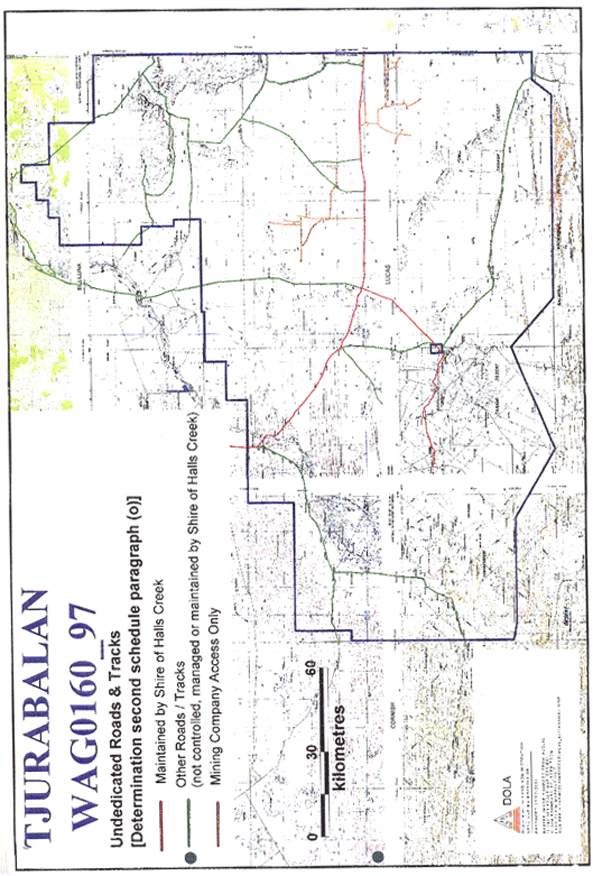
(n) A right of any employee or agent of the State, its agencies and instrumentalities, and of the Shire of Halls Creek, its employees and agents, to have access to the Determination Area (subject to the laws of the State and the Commonwealth) in the bona fide performance of their duties (for the avoidance of doubt, such rights include rights of the Shire of Halls Creek, its employees and agents, relating to the construction, maintenance, repair and use of the Tanami Track/Road, the Selby Hills Track/Road and the Balgo-Mulan Track/Road including periodical realignments and the gathering of sand, gravel and water as road-building materials from the Determination Area which are referred to in a Deed of Agreement between the Shire of Halls Creek and the Applicants tendered on 17 July 2001); and
(o) Rights of any person to have access to and enjoy (subject to the laws of the State):
(i) the Canning Stock route;
(ii) the Tanami Track/Road, Selby Hills Track/Road and Balgo-Mulan Track/Road controlled and managed by the Shire of Halls Creek as indicated in red on the map annexed to the Second Schedule; and
(iii) the other road and tracks indicated in green on the map annexed to the Second Schedule not controlled, managed or maintained by the Shire of Halls Creek, to the extent they are common law roads.
(p) (1) Without limiting the operation of any other paragraph in the Second Schedule, but subject to paragraph (p)(3), rights of the holder from time to time of the mining tenements described in paragraph (p)(2) of the Second Schedule to use (including by servants, agents and contractors) the existing roads and tracks indicated on the map annexed to the Second Schedule in order to have access to such tenement.
(2) The tenements to which paragraph (p)(1) applies are:
(i) the exploration licences listed in paragraph (h) of the Second Schedule;
(ii) any extension of term by operation of section 61(2) and section 67(2) of the Mining Act 1978 (WA), of any tenement referred to in sub-paragraph (i); and
(iii) any tenement granted as a replacement of or in substitution for any tenement referred to in sub-paragraphs (i) and (ii), including a tenement granted as a replacement or substitute which confers more extensive rights (but over no greater area) than the original tenement, but not including when the replacement or substituted tenement is a mining lease, general purpose lease or other tenement conferring similar rights or any fresh application for an exploration licence.
(3) Nothing in paragraph (p)(1) above allows any upgrade, extension, widening or other improvement to the road or track other than work done to maintain such road or track in reasonable repair.
(4) Nothing in this paragraph (p) derogates from the requirements of Part III of the Aboriginal Affairs Planning Authority Act 1972 (WA).
THIRD SCHEDULE
The common law holders known as the “Tjurabalan People” are those people who hold in common the body of traditional law and culture governing the Determination Area and who:
(a) are members of the Walmajarri, Jaru or Nyininy language groups; and
(b) have a common and inclusive cultural and geographic association with the Determination Area which includes: Gregory Salt Lake (Paruku) and Sturt Creek (Tjurabalan) and the adjacent portions of the Tanami Desert (Ngaluwan) and Gardiner Range (Lirrankarni).
|
IN THE FEDERAL COURT OF AUSTRALIA |
|
|
WAG 160 OF 1007 |
|
JUDGE: |
|
|
DATE: |
|
|
PLACE: |
REASONS FOR JUDGMENT
introduction
1 The matter before the Court today arises out of an application for a determination of native title made by Palmer Gordon Ngalpil, Sandy Cox, Rex John, Paraku (George Wallaby), David Skeen, Kilampi, Boxer Milgner, Ivy Robertson, Gracie Long, Clancy Sturt, Mona Green, Wirrimanu (Robert Rallah), Tomato Gordon, Bessie Doonday, Speeler Sturt, Veronica Lulu, Reggie Chungulla, Raymond Chungulla, Boxer Jalarku, Linda Yandanalli, Chamia Napurulla, Ned Cox Yanpiei and Violet Campbell Barangnali on their own behalf and on behalf of the Aboriginal people described in that application. I shall refer to the parties on whose behalf the application has been brought as the “Tjurabalan People”. The respondents are the State of Western Australia and the Premier of Western Australia (who is present in Court today), Shire of Halls Creek, Wirrimanu Aboriginal Corporation and Balgo Hills Aboriginal Community Inc, AngloGold Australia Ltd, Glengarry Mining NL and Glengarry Resources NL, Perilya Ltd, Tanami Gold NL and Telstra Corporation Ltd.
2 From time to time there have been other parties to this application, but from examination of the Court’s records I am satisfied that those whom I have mentioned are all of the remaining parties to the application.
3 The area under claim, which I shall call the “Determination Area” comprises land and inland waters in the area of Lake Gregory (known as “Paruku” to the applicants) and Sturt Creek, approximately 120 kms due south of Halls Creek in the Kimberley region of Western Australia. The claim area comprises nearly 26,000 sq kms with the Western Australia/ Northern Territory border forming its eastern boundary. The Tjurabalan People claim the right to possess, occupy, use and enjoy the claim area in accordance with their traditional laws and customs. The Determination Area includes two pastoral leases (each of which is held by the Aboriginal Lands Trust), five Aboriginal reserves, two reserves for repeater station sites now vested in Telstra Corporation Ltd (the fifth respondent) and several areas of unallocated Crown land (some very large and some quite small) including portion of the Canning Stock Route which lies to the west of where this Court is sitting today.
4 The original application was lodged with the National Native Title Tribunal (“the Tribunal”) on 22 March 1996 before the amendments to the Native Title Act 1993 (Cth) (“the Act”) made by the Native Title Amendment Act 1998 (Cth) came into force. The parties attempted mediation in September 1997 but unfortunately, at that stage, without success. Accordingly, on 18 December 1997 the Registrar of the Tribunal lodged the application with this Court for decision.
5 Various directions hearings took place in 1998 and on 4 August 1999 a minor amendment was made to the application.
6 In the meantime, it appeared that the prospects for resolving some of the issues between the parties had improved. An order was made for those issues to be referred back to the Tribunal for further mediation. Unfortunately that mediation was not immediately successful, but it may have been the catalyst for the eventual settlement which has occurred.
7 The Court made further directions with a view to clarifying the precise matters in dispute between the parties. Orders were also made which resulted in the filing of expert anthropological reports.
8 In the latter part of last year it became apparent that the prospects for a negotiated settlement of the application had again improved. In the applicants’ view they had improved to the extent that for that reason, and for another reason related to funding of the application, they requested that the matter not be set down for hearing. However, I thought that it was desirable to work towards a hearing date, at the same time encouraging the parties to continue with their settlement discussions. On 2 November 2000 I made detailed orders which included an order that the trial of the application commence on 16 July 2001.
9 On 14 March 2001 I made directions which included a direction that the parties attend before the District Registrar of the Court in the hope that he might assist in the mediation of the dispute. The District Registrar conducted several case management and settlement conferences. I am aware that the parties, their lawyers, the District Registrar and other Registry staff spent many hours and put a lot of effort into trying to settle the remaining matters in dispute. Their efforts were crowned with success.
10 When the case came on for hearing on 16 July 2001 I was told that the parties were close to settlement and, at the parties’ request, I adjourned the hearing to 17 July 2001 on which date I was informed that settlement negotiations had been successful and the parties had reached agreement. The agreement recognises that native title exists in relation to the Determination Area and that the Tjurabalan People are the common law holders of that title. The Tjurabalan People in turn, by the same agreement, recognise that others of the parties have certain rights and interests in respect of the land within the Determination Area. The parties have prepared a document which sets out the terms of their agreement. The document is signed either by the parties or by their legal representatives and has now been filed with the Court. The parties have asked the Court to make an order in accordance with the terms set out in their agreement and that is the matter which is before the Court here today.
power of the court
11 Section 87 of the Act relevantly provides that the Court may, if it is satisfied that such an order is within the power of the Court and if it appears to the Court to be appropriate to do so, make an order in, or consistent with, the terms of the written agreement of the parties without holding a hearing.
12 The Court has a responsibility to satisfy itself that it has jurisdiction to make an order in the terms sought, that all the statutory and other requirements have been met and that it is appropriate to make the order. As the application is for a determination of native title, in my view it is quite clear that the Court has jurisdiction and power to make the order sought. Section 94A of the Act requires that such an order must set out details of the matters referred to in s 225 of the Act. In my view, the proposed determination complies with the requirements of ss 94A and 225. The next question is whether it is appropriate to make the order containing the proposed determination.
13 In considering whether it is appropriate to make the order which the parties seek, I have had the benefit of reading two anthropological reports which have been admitted into evidence by consent. The first, in terms of preparation, was that of Ms Kim Doohan, prepared in November 1998. The second, dated 28 February 2001, was prepared by Dr Scott Cane. Both reports are very detailed and comprehensive. I was also provided with a most useful aide memoire prepared by Ms Amanda Paul, a consultant historian. I must say that I found these reports not only to be very useful in enabling me to discharge my statutory duties but also fascinating reading.
14 The Tjurabalan People comprise a community of about 950 people which is identifiable as such on several bases. The first basis is their common connection with a large area of land of which the Determination Area forms a part. Dr Cane describes a concept known to Aboriginal people as “Waltjirri” which he says has no real equivalent in the English language, other than perhaps our own notion of tradition. He says that Waltjirri is best understood as the foundation of Aboriginal tradition. Aboriginal people typically describe Waltjirri as their law. Waltjirri is a term used primarily by Walmatjeri and Tjaru members of the applicant group. Other Aboriginal people in the applicant group also use the term “Tingarri” to describe the Waltjirri. Dr Cane says (at page 37) that:
“Waltjirri is not a basis for land ownership as such, but a political and religious vehicle through which issues of land ownership are defined and managed within the broader social context.
. . .
People assert the utilitarian rights of occupancy, use and possession to (sic) land through the physical process of descent, but can argue various levels of control over that land through the metaphysical avenue of Waltjirri.”
15 The evidence is that the highest degree of connection is derived from what the Tjurabalan People refer to as the “Jurapalan (Tingarri) law”. Much of the evidence about this is confidential, so I do not propose to give any detail of what I have had the privilege of reading. However, I think that I can say safely that Jurapalan is a pivotal aspect of the applicants’ laws and customs. Ms Doohan (at p 20) describes Jurapalan as:
“… the cultural concept that gives definition to the Applicant group and the Application area.”
16 The spelling in English of various Aboriginal words varies from document to document, so it will vary in these reasons when published.
17 Another important basis for identifying the applicants as being the traditional owners of the determination area is language.
18 Dr Cane, after summarising much of the literature on this point, suggests that the determination area has “… a predominantly Tjaru core (across the Tanami desert or Ngaluwan) that is surrounded [by] a ring of shared country …”. Ms Doohan identifies three language groups as Jaru, Nyininy and Walmajarri as being the languages which the applicants speak.
19 Dr Cane includes the Walmatjeri and Nyininy language groups as being relevant, but also refers to the Ngarti and Warlpiri language group. I note that to the extent that the Tjurabalan People are identified in the proposed consent determination by language groups the three language groups Walmajarri, Jaru and Nyininy are referred to.
20 These are also the three languages referred to by the applicants in their notice to admit facts. None of the respondents disputes that fact and I think that it is appropriate for those three language groups to form part of the description of the Tjurabalan People. As I understand the evidence and the intention of the parties, an individual would not have to belong to all three groups in order to be included as a member of the Tjurabalan People. In fact it may not be possible for a person to do so. Accordingly, to remove ambiguity, I have with the consent of all the parties changed the reference to “and” in paragraph (a) of the Third Schedule to read “or”.
21 Dr Cane has established that the Tjurabalan applicants form “… a sequence of close relationships” which gives logical coherence to the Tjurabalan native title claimant group.
22 Ms Doohan’s report strongly suggests (and I accept the likelihood) that the Determination Area has been occupied by Aboriginal people for at least 22,000 years. Although no archaeological work has been carried out on the Determination Area, such work has been carried out in areas to the north, south, east and west. Archaeological research in the arid regions generally suggests that they have been occupied for at least 22,000 years. Dr Cane’s report suggests that occupation occurred very much earlier. As the Sturt Creek area has a relatively rich environment (i.e. long-lasting waters) it is reasonable to infer, and I do so infer, that its chances of being occupied by Aboriginal people for at least 22,000 years were even higher than the arid areas.
23 In that regard, I think that it is useful to incorporate into this judgment a paragraph from Ms Doohan’s report dealing with traditional land use patterns. I think as we look around us today we will better understand from this paragraph how Aboriginal people have managed to survive in this area for so many thousands of years. Their ability to survive in this environment is, I would suggest, a source of inspiration to all Australians of whatever colour or creed. It is an amazing story of life, survival and triumph. Ms Doohan says (at page 6):
“The traditional pattern of land use was to exploit the driest areas, which were normally inaccessible or incapable of supporting sustained occupation, immediately following heavy rainfall and then to gradually fall back on the long-lasting or everlasting waters as the country dried out [sources cited]. The main long-lasting waters were found in the waterholes and soakages along Sturt Creek and in the Lake Gregory region with other key waters at, for example, Yaruman (Ringer Soak), Kulajaru (Banana Springs), Nana Rockhole, Mt Brophy Spring and Yuju in the Lirrankarni area. The Ngaluwun area is virtually without water, and certainly without long-lasting water, making it an area that was only seasonally used, whereas the Sturt Creek and the Lake Gregory region, had a more constant and reliable source of water, plant, animal, fish and bird life."
24 In my view, the evidence strongly suggests that the Determination Area and surrounding lands were inhabited by organised communities of Aboriginal people at the time of sovereignty (1829) and for a very long time before that.
25 Both anthropological reports and the aide memoire describe the first European visits to the Determination Area. The first recorded non-Aboriginal people to enter the Determination Area were in the exploration party led by Mr Augustus C Gregory on the North Australia expedition of 1855-56. Mr Gregory and his party followed Sturt Creek for nearly 300 miles and then retraced their footsteps. His journals show that he was in this area between the 21 February 1856, reached the southern most part of what is now called Lake Gregory on 5 March 1856 and left the area around about 20 March 1856. So far as observing Aboriginal inhabitants was concerned, Mr Gregory records seeing eight Aboriginal people who in turn had been watching his party but who went into hiding when approached. The party found frequent traces of what they described as “natives”.
26 The records of subsequent expeditions and the history of the establishment of pastoral stations and the interaction between pastoralists and Aboriginal people strongly supports the proposition that Aboriginal communities comprising the ancestors of the applicants continued to occupy the Determination Area. The reports also show that these communities lived in accordance with traditions, procedures, laws and customs which connected them to the land. The evidence and the agreed facts show, in my opinion, that ancestors of the applicants possessed native title in respect of the Determination Area in 1829, that that connection has been maintained through the intervening period and is now maintained by the applicants.
27 As I have mentioned earlier, there are two pastoral leases and five Aboriginal reserves within the Determination Area. The pastoral leases over Bililluna and Lake Gregory stations, are held by the Aboriginal Lands Trust. I am satisfied that those leases are held on trust for at least some of the applicants and the other holders of the native title. Accordingly, any relevant prior extinguishment of the native title rights and interests which may have occurred by any of the acts referred to in s 47(2) of the Act is to be disregarded pursuant to that subsection. Similarly, I am satisfied that the five reserves are reserved expressly for the benefit of Aboriginal peoples and no question of extinguishment arises in relation to those reserves – see s 47A of the Act.
28 In terms of s 87 of the Act I am satisfied that an order in, or consistent with, the terms of the agreement in writing signed by or on behalf of the parties would be within the power of the Court and that it is appropriate for the Court to make an order in or consistent with those terms without holding a hearing. There remain fairly technical matters which need to be dealt with.
29 Under s 55 of the Act the Federal Court must, at the same time as it makes a determination of this type, make determinations about whether the native title is to be held in trust and if so by whom. Paragraphs 2 to 5 of the orders proposed by the parties set out a procedure which, in my view, satisfies the statutory requirements. That procedure was expressly accepted by Drummond J in Mualgal People v State of Queensland (1998) 90 FCR 303 and implicitly approved both at first instance and on appeal in Ward v Western Australia (1998) 159 ALR 483 and Western Australia v Ward (2000) 99 FCR 316. I respectfully follow those decisions and will make orders in the terms proposed.
30 The High Court of Australia has, earlier this year, reserved judgment in a series of cases, best identified by one of them which is known as State of Western Australia v Ward. The parties to the present application have incorporated into their agreement clauses which provide a mechanism relating to minerals and petroleum which may enable a variation to be made to the determination if the High Court overturns or sets aside the Federal Court’s decision in the Ward matter. I have examined those clauses and they seem to me to be an entirely appropriate way of reserving the rights of the parties pending the High Court’s decision.
31 Then there is one remaining dispute between the applicants and the first respondents which I have to resolve. It relates to confidentiality orders in respect of the anthropological reports (being exhibits A11 and A15). I have read the submissions made on behalf of the applicants and on behalf of the first respondents in relation to the proposed orders. Having read those reports, I fully appreciate the applicants’ concerns. The first respondents agree that it is necessary and appropriate to make orders protecting the confidentiality of the reports, but submit that the terms proposed by the applicants’ counsel are not authorised by the relevant statutory provisions.
32 I do not need to decide whether the proposed restrictions are authorised or not. The essence of the dispute is whether ultimate control of the use of these reports is to reside exclusively with the native title holders or their legal representatives, or whether that control is to be shared (i.e. in the sense that the applicants may consent to a particular use) by the applicants and the Court. In my view, it is in the interests of justice that, in the absence of consent from the applicants, the Court retains control over the use which may be made of these reports. I have formulated orders which basically follow those proposed by the first respondents, but into which I have built a provision that will require the giving of notice to the applicants and which recognises their right to be consulted. The confidentiality orders will be as follows:
1. Except with the consent of the applicants, or pursuant to an order of this Court, or pursuant to an order of a court of competent jurisdiction hearing a matter arising out of or involving the determination of native title in these proceedings:
(a) exhibits A11 and A15 (“the Reports”) are not to be copied or otherwise reproduced;
(b) the contents of the Reports are not to be revealed to any person other than a Judge of the Federal Court or a judicial officer of a court of competent jurisdiction, court staff, and counsel, solicitors, experts and officers of the parties to these proceedings;
(c) the contents of the Reports are not to be quoted, cited, or otherwise used in any manner for any purpose apart from these proceedings or proceedings before a court of competent jurisdiction of a kind referred to above or matters arising out of the determination of native title made in these proceedings.
2. Any party applying for an order of the type referred to in paragraph 1 above must, before making such application, give reasonable notice in writing to the applicants of their intention to make such application.
33 Finally, in accordance with a long common law tradition, I congratulate the parties on having reached an amicable settlement of this long-running matter. There will be an order in or consistent with the terms of the written agreement of the parties filed on 27 July 2001.
|
I certify that the preceding thirty-three (33) numbered paragraphs are a true copy of the Reasons for Judgment herein of the Honourable Justice Carr. |
A/g Associate:
Dated: 20 August 2001
|
Counsel for the Applicants: |
Mr M P O’Donnell |
|
Counsel for the First Respondent: |
Mr S J Wright and Mr G J Ranson |
|
Solicitor for the First Respondent: |
Crown Solicitor for the State of Western Australia |
|
Counsel for the Second Respondents: |
Mr M T Spillane |
|
Solicitors for the Second Respondents: |
Messrs Mullins Handcock |
|
Solicitor for the Third Respondents: |
Mr D J O’Dea |
|
Counsel for the Fourth Respondent AngloGold Australia Ltd: |
Mr G S Gishubl |
|
Solicitors for the Fourth Respondent AngloGold Australia Ltd: |
Messrs Jackson McDonald |
|
Counsel for the Fourth Respondents Glengarry Mining NL, Glengarry Resources NL and Tanami Gold NL: |
Mr M T McKenna |
|
Solicitors for the Fourth Respondents Glengarry Mining NL, Glengarry Resources NL and Tanami Gold NL: |
Messrs Hunt & Humphry |
|
Counsel for the Fifth Respondents: |
Mr J A Thomson |
|
Solicitor for the Fifth Respondents: |
Messrs Blake Dawson Waldron |
|
Date of Hearing: |
16, 17 July 2001 |
|
Date of Judgment: |
20 August 2001 |


