FEDERAL COURT OF AUSTRALIA
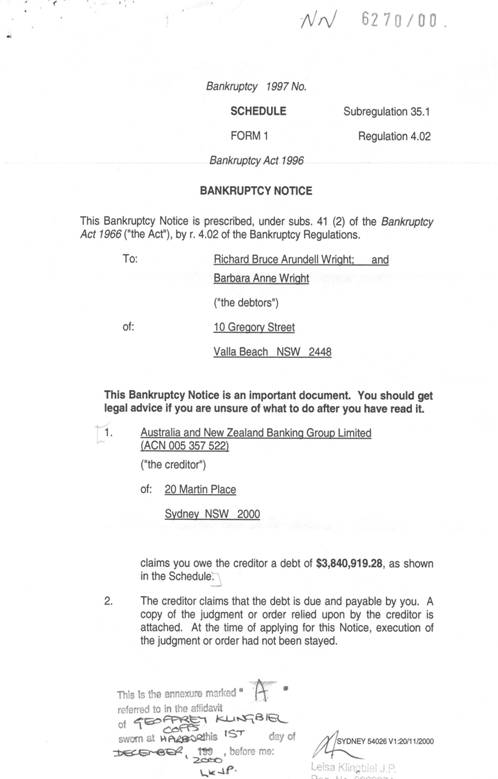
Wright v Australia & New Zealand Banking Group Ltd [2001] FCA 386
BANKRUPTCY– Bankruptcy notice – Bankruptcy Act provides that “notice must be in accordance with form prescribed” – Bankruptcy Notice irregular – where interest claimed pursuant to Local Courts (Civil Claims) Act 1970 – where provision for the name/identity of person applying for Notice left blank – where failure of person signing notice to identify whether he/she is creditor or the creditor’s agent – where failure to emphasise certain matters in the Notice by use of bold typeface – where use of “nor” rather than “or” in par 5(b) of Notice – where overstatement of interest claimed to be due – where additional information about other amounts continuing to accrue – where additional information given in respect of interest calculation - whether irregular Bankruptcy Notice was therefore invalid – natural and commonsense approach to construction of Bankruptcy Notice
Bankruptcy Act 1996
Fitzgerald v Masters (1956) 95 CLR 420 followed
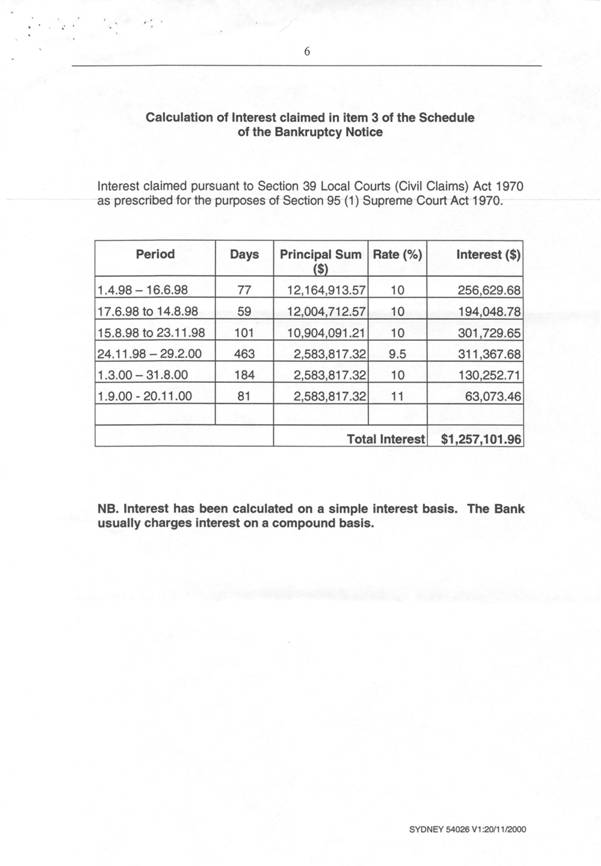
Wingadee Shire Council v Willis (1910) 11 CLR 123 followed
The Australian Steel Company (Operations) Pty Ltd v Lewis [2000] FCA 1915 discussed
Trustees of the Franciscan Missionaries of Mary v Weir (2000) 98 FCR 447 cited
Deputy Commissioner of Taxation (Vic) v Boxshall (1988) 19 FCR 435 followed
Farrugia v Farrugia (2000) 99 FCR 16 discussed
Meekin v Commonwealth Bank of Australia (1999) FCA 682 cited
RICHARD BRUCE ARUNDELL WRIGHT AND BARBARA ANNE WRIGHT V AUSTRALIA & NEW ZEALAND BANKING GROUP LIMITED
NO. N 8003 OF 2000
JUDGE: BEAUMONT J
DATE: 5 APRIL 2001
PLACE: SYDNEY
|
IN THE FEDERAL COURT OF AUSTRALIA |
|
|
BETWEEN: |
RICHARD BRUCE ARUNDELL WRIGHT AND BARBARA ANNE WRIGHT APPLICANTS
|
|
AND: |
AUSTRALIA & NEW ZEALAND BANKING GROUP LIMITED RESPONDENT
|
|
DATE OF ORDER: |
|
|
WHERE MADE: |
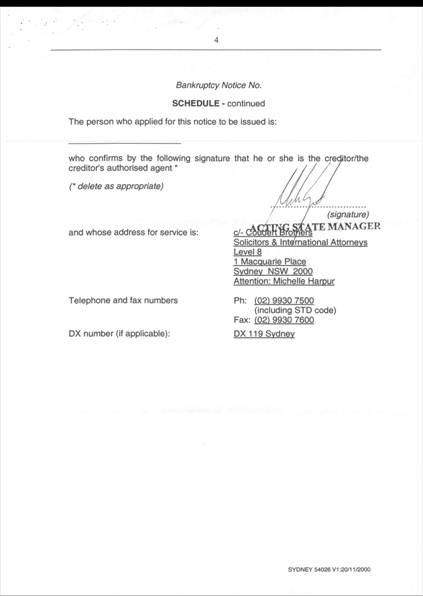
THE COURT ORDERS THAT:
1. The separate question be answered as follows:
“Question: Is Bankruptcy Notice NN6270/00 invalid by reason of any of the grounds alleged in Exhibit ‘A’?”
“Answer: ‘No’.”
2. The judgment debtors pay the judgment creditor’s costs of the separate question.
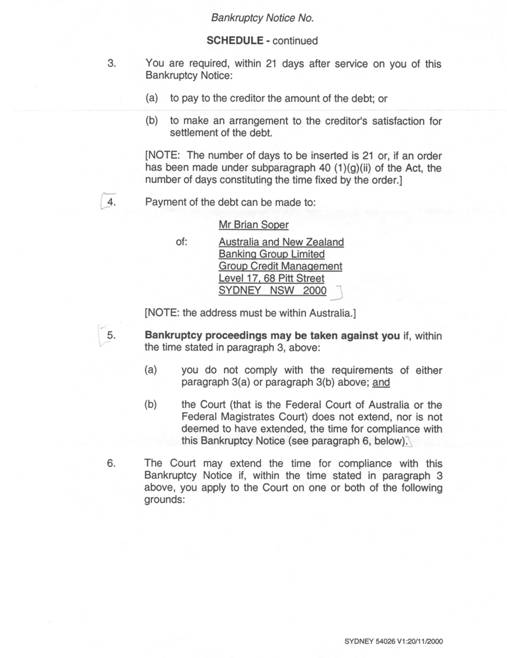
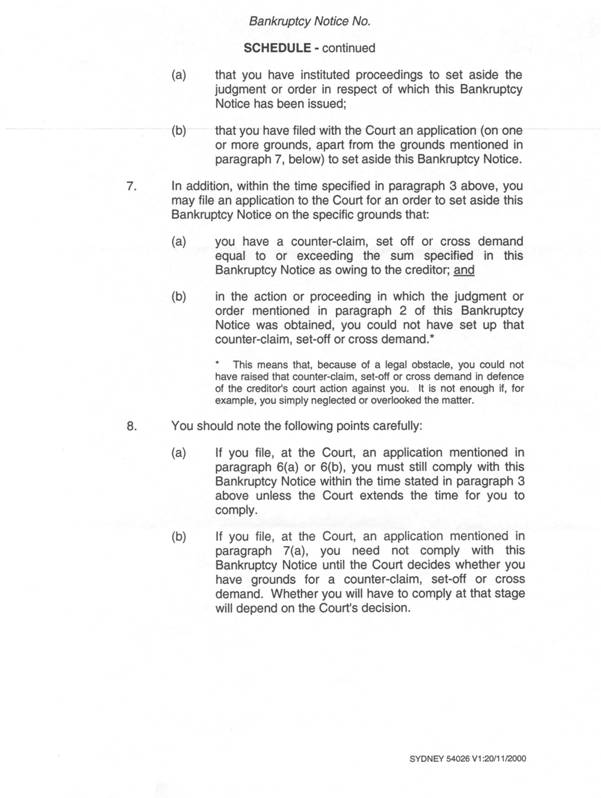
Note: Settlement and entry of orders is dealt with in Order 36 of the Federal Court Rules.
|
IN THE FEDERAL COURT OF AUSTRALIA |
|
|
BETWEEN: |
RICHARD BRUCE ARUNDELL WRIGHT AND BARBARA ANNE WRIGHT APPLICANTS
|
|
AND: |
AUSTRALIA & NEW ZEALAND BANKING GROUP LIMITED RESPONDENT
|
|
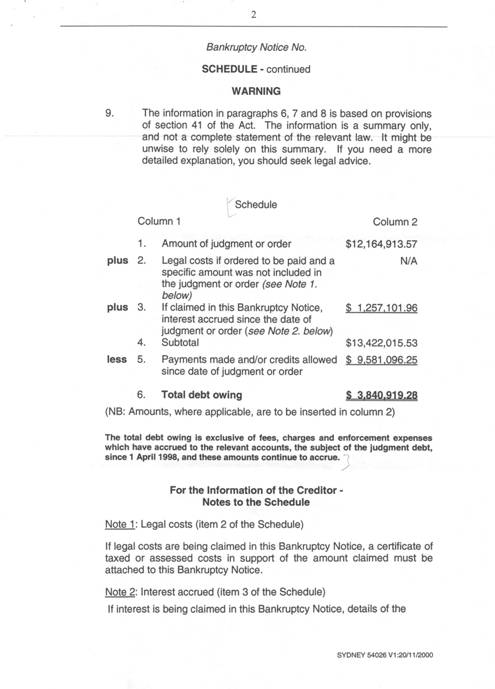
JUDGE: |
|
|
DATE: |
|
|
PLACE: |
REASONS FOR JUDGMENT
(ON APPLICATION TO SET ASIDE BANKRUPTCY NOTICE)
1 Before the Court is an application by judgment debtors to set aside a bankruptcy notice (“the Notice”), a copy of which is annexed to these reasons. The application is made on several grounds. Only some of these grounds have been argued at this stage. In each of the grounds relied upon, the judgment debtors allege that the Notice was irregular and thus invalid for the reason then advanced. It will be convenient to deal with them in turn as follows:
1. Specification of source of the judgment creditor’s right to interest
2 As will be seen from the annexure, in par 1 of the Notice it is stated that the judgment creditor claims that the judgment debtors owe it “a debt of $3,840,919.28, as shown in the Schedule”; and in the Schedule, the following relevantly appears:
“… 3. If claimed in this … Notice, $1,257,101.96
interest accrued since the date of
judgment … (see Note 2. below”
3 (Nothing turns on the wording of 3, above, or the amount claimed, for present purposes.)
4 It will also be seen that Note 2 was relevantly in the following terms:
“Note 2: Interest accrued (item 3 of the Schedule)
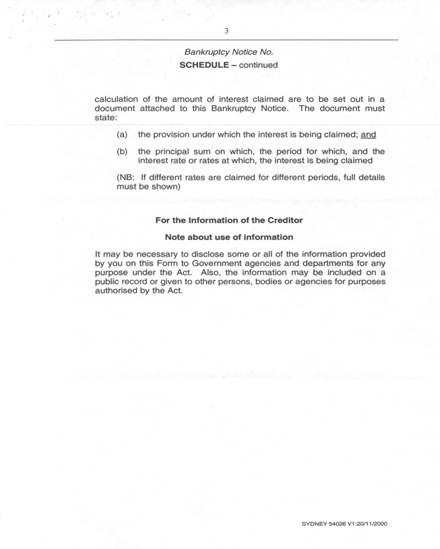
If interest is being claimed in this Bankruptcy Notice, details of the calculation of the amount of interest claimed are to be set out in a document attached to this Notice. The document must state:
(a) the provision under which the interest is being claimed; …
(b) ….” (Emphasis added)
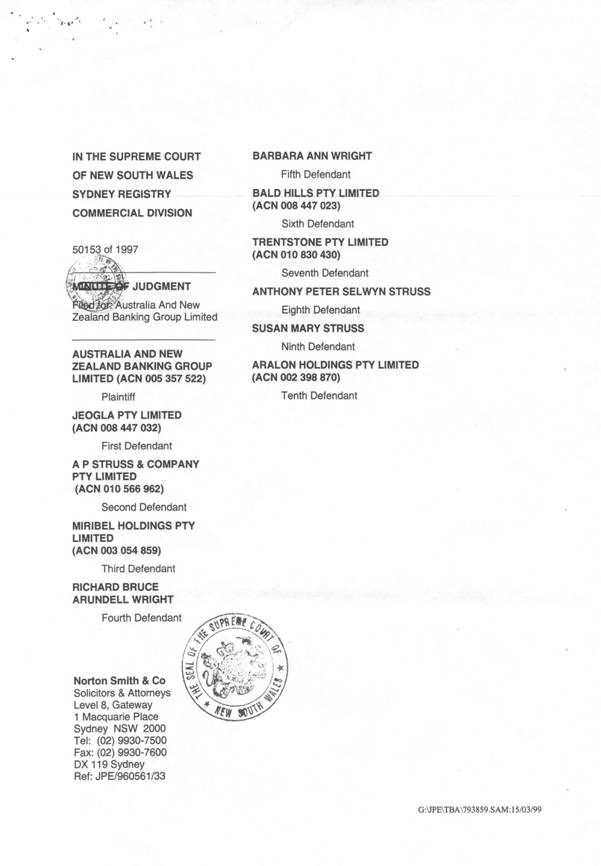
5 It will further be seen that the copy of the judgment relied upon and attached to the Notice is a judgment of the Supreme Court of New South Wales; and that the statement in the Notice of calculation of interest was prefaced with the following:
“Interest claimed pursuant to Section 39 Local Courts (Civil Claims) Act 1970 as prescribed for the purposes of Section 95(1) Supreme Court Act 1970.” (Emphasis added).
6 The judgment debtors contend, and the judgment creditor accepts, that the true source of the entitlement to interest here was s 95(1) of the Supreme Court Act 1970 (NSW) (“the Supreme Court Act”). It is there relevantly provided:
“95(1)Where judgment is given … for the payment of money, interest shall, unless the Court otherwise orders, be payable at the prescribed rate from the date when the judgment or order takes effect on so much of the money as is from time to time unpaid.”
7 Section 39 of the Local Court (Civil Claims) Act 1970 (NSW) (“the Local Court Act”) provides, relevantly, that unless a court otherwise orders, interest shall be payable on so much of the amount of a judgment debt as is from time to time unpaid (s 39(1)); and that such interest shall be calculated at such rate as may be prescribed by the rules (s 39(2)(b)). Part 13 r 3 provides that for the purposes of s 39(2)(b), the prescribed rate, relevantly, is “the rate prescribed for the purposes of s 95(1) of the Supreme Court Act 1970”.
8 The reference to the Local Courts Act in the Notice was obviously inapposite. It was equally obvious that it was intended that instead, reference was being made to the Supreme Court Act, as the only legislation capable of application here. Thus, by adopting a natural and common sense approach to the construction of the Notice, absurdities are avoided and actual intentions are given effect.
9 That such an approach is consistent with principle is shown by the decision of the High Court in Fitzgerald v Masters (1956) 95 CLR 420. In a written contract for the purchase of land, a clause was expressed to embody a set of conditions for sale “so far as they are inconsistent” (sic – emphasis added). It was held that, from the parties’ clear intention, for “inconsistent” must be read “consistent”.
10 Dixon CJ and Fullagar J said (at 426 – 427):
“There is a superficial difficulty in cl. 8, because it purports to incorporate a set of conditions so far as they are inconsistent with what has been specifically agreed upon. No real difficulty, however, is created. Words may generally be supplied, omitted or corrected, in an instrument, where it is clearly necessary in order to avoid absurdity or inconsistency. Here it would be indeed absurd to suppose that the parties, having expressed their agreement on a number of special and essential matters, should intend to incorporate by reference terms inconsistent with what they had specially agreed upon. What they must clearly have intended is to incorporate a set of general conditions except so far as they were inconsistent with what they had specially agreed upon, and cl. 8 must be read as if it said 'consistent' or ‘not inconsistent.’”
11 McTiernan, Webb and Taylor JJ said (at 437):
“It is trite law that an instrument must be construed as a whole. Indeed it is the only method by which inconsistencies of expression may be reconciled and it is in this natural and common sense approach to problems of construction that justification is to be found for the rejection of repugnant words, the transposition of words and the supplying of omitted words (cf. Norton on Deeds, 2nd. ed. (1928), p. 91). Many illustrations may be given of the circumstances in which these processes have been followed but to do so would add nothing to the rule that the intention of the parties is to be ascertained from the instrument as a whole and that this intention when ascertained will govern its construction.”
12 Their Honours went on to say (at 438):
“One might well think that if the parties had intended that the ‘usual conditions’ should govern their relationship in all matters to which their minds had been directed they would have been sufficiently interested to have ascertained what the usual terms, if any, were and that they would have modelled their agreement accordingly. It is, we think, abundantly clear that they had no such intention. So far as their minds were directed to matters associated with the sale and purchase of the property they declared the substance of their agreement in unequivocal terms and it would be quite inconsistent with this declaration to read cl. 8 literally. There is no doubt in our minds that the only way in which the provisions of that clause can be reconciled with the intention of the parties as disclosed by the agreement is to supply the word ‘not’ before the word ‘inconsistent’. The clause so read would be in a form not infrequently used by parties to an agreement to supplement express terms and that is what the parties clearly intended. The provision of the word ‘not’ in such circumstances is by no means foreign to the process of construction (cf. Butler v. Wigge).”
13 A similar approach was taken in the decision of the High Court in Wingadee Shire Council v Willis (1910) 11 CLR 123. There, a rate notice issued under a local government statute and served on 28 September, stated that at the expiration of thirty days from service the rates would be payable, but added (erroneously) – “the day on which such rates will be due and payable will be therefore 28th October”.
14 It was held that the fact that the rates were not payable until 29 October did not render the notice invalid.
15 Griffith CJ said (at 131):
“[E]ven in the days of the strictest rules of special pleading an error in a date laid under a videlicet [namely, that is to say] was not fatal, even on a special demurrer …. In my opinion the error in the added note … did not vitiate the preceding part of the notice, which was a sufficient compliance with the Statute.”
16 Barton J said (at 140):
“I am clearly of opinion that the evident error in inserting 28th October does not make the notice void. Utile per inutile non vitiatur. [the useful is not vitiated, or rendered invalid, by the useless.] The mention of the 28th is a mere videlicet, heralded by the word ‘therefore.’ It is a mere statement of a computation made by the officer, palpably in error, as is demonstrated by the prior part of the notice. It is obvious that a failure to pay on the actual expiration of the thirty days from service cannot be justified on such a ground. The express mention of the time available to the ratepayer governs the notice and counteracts what is plain to any observer as a mere slip in counting the days. It might and would have been another matter if the thirty days had not been specified and the ‘therefore’ had been omitted. The principle is in effect that stated by Bacon in his maxim, ‘præsentia corporis tollit errorem nonimis.’ [The presence of the subject takes away the effect of error in its name.]”
17 Isaacs J said (at 144):
“I think the notice given was substantially accurate. The reference to 28th October was self-explanatory as a mere calculation which, though perhaps one day short of accuracy, did not vitiate the main and mandatory portion of the notice. The mistake was evident, and could safely be ignored and corrected by the recipient. As in the analogous rating cases of Ormerod v. Chadwick and R. v. Stretfield, in which very similar questions were raised, it is a case of falsa demonstratio quae non nocet. [An erroneous description does not injure.]”
18 Higgins J said (at 147 – 148):
“… [T]he notice said truly that ‘on the expiration of 30 days from service of this notice’ the amount will be due; and the statement as to the 28th October was a mere videlicet; and even if the videlicet is wrong, the statement is right. The prescribed notice has been duly given to pay – the notice in the form and with the particulars prescribed (see sec. 146(1)). Errors such as this are not fatal to the rights of the Council. The maxims utile per inutile non vitiatur [the useful is not vitiated, or rendered invalid, by the useless], falsa demonstratio non nocet [an erroneous description does not injure], quicquid demonstratae rei additur satis demonstratae frustra est [if there be a sufficient description with convenient certainty of what was meant to pass, a subsequent erroneous addition will not vitiate it] (see Broom’s Legal Maxims, 7th ed., pp. 468, 470 471), all seem to apply. The error is such as the ratepayer could detect by an examination of the Act, or of the notice itself.”
19 However, in The Australian Steel Company (Operations) Pty Ltd v Lewis [2000] FCA 1915 a similar question to that raised here was considered. It was held, by a majority (Black CJ, Heerey and Sundberg JJ; Lee and Gyles JJ dissenting), that the notice was invalid because the statement in the notice made in response to Note 2 referred (as here) to the wrong statute.
20 It appears that the argument for the judgment creditors in Australian Steel was prepared to accept that any error, however obvious, could amount to a “defect” or “irregularity” in a bankruptcy notice. In my opinion, such a concession ought not to have been made. If it were right, it would mean, for example, that a notice would be “defective” or “irregular” because, instead of referring (correctly) to the “Bankruptcy Act 1966”, it referred (incorrectly) to the “Bankruptcy Act 1977” (sic); or if, instead of mentioning the “Supreme Court Act”, the notice referred to the “Supreme Act” (sic). Such obvious errors should, and would, be corrected by the natural and common sense approach mentioned. Any other approach would lead to an absurd, unacceptable result.
21 In Australian Steel, above, the majority (Black CJ, Heerey and Sundberg JJ) said (pars 3 – 6):
“In the present cases the notices all had the same defect. Each notice was founded on an order made in the Magistrates’ Court of Victoria and claimed interest from the date of the order to the date of issue of the notice. In a schedule attached to each notice the calculation of interest was set out and also, as is now required, a statement as to ‘the provision under which the interest is being claimed’. The notices stated that interest was claimed ‘pursuant to section 101 of the Supreme Court Act 1986 (Vic)’. However that provision did not apply to the orders founding the notices. Interest on Magistrates’ Court orders is governed by s 100(7) of the Magistrates’ Court Act 1989 (Vic). That section provides:
‘Every judgment debt carries interest at the rate for the time being fixed under s 2 of the Penalty Interest Rates Act 1983 from the time the order is made.’
Section 101 of the Supreme Court Act is as follows:
Every judgment debt carries interest at the rate for the time being fixed under s 2 of the Penalty Interest Rates Act 1983 from the time the judgment is given or, in the case of costs which are taxable by the taxing master, from the date of the order from the taxing master stating the result of the taxation or such other date as the Court orders.’
Generally speaking, costs in the Supreme Court are ordered to be taxed, whereas costs in the Magistrates’ Court are fixed at the time of the making of the order.
The Penalty Interest Rates Act 1983 (Vic) s 2 provides for the proclamation of interest rates from time to time. The applicable rate in the present cases was published in the Victorian Government Gazette No 7 of 19 February 1998 at 395. Thus in dollar terms the amount of interest payable on a judgment debt of a given amount over a given period will be the same whether the judgment is in the Supreme Court or the Magistrates’ Court.”
22 Here also, the amounts of interest are the same.
23 However, it will be seen that one significant difference between Australian Steel and the present case is that in Australian Steel the only reference made was to the Supreme Court Act, and no reference was made to the Magistrates’ Court Act at all; whereas in the present case, both statutes were mentioned. It follows that whilst in each case the error was quite obvious, in the present case, the reader’s attention is actually drawn to the Supreme Court Act. One other consequence of this is that in the ordinary process of interpretation, all that is required here is the omission of the words “Section 39 … purposes of …”, leaving the words (obviously correct) “Interest claimed pursuant to Section 95(1) Supreme Court Act 1970”.
24 The essential reasoning adopted by the majority (Black CJ, Heerey and Sundberg JJ) in Australian Steel was explained in pars 39 – 42 of their reasons as follows:
“Determining whether a requirement is made essential
Kleinwort Benson decides that a bankruptcy notice that does not contain a requirement made essential by the Act is not a valid notice. In Project Blue Sky Inc v Australian Broadcasting Authority (1998) 194 CLR 355 at 390‑391 McHugh, Gummow, Kirby and Hayne JJ, after discarding the elusive distinction between directory and mandatory requirements as a test of validity, said:
‘A better test for determining the issue of validity is to ask whether it was a purpose of the legislation that an act done in breach of the provision should be invalid. … In determining the question of purpose, regard must be had to ‘the language of the relevant provision and the scope and purpose of the whole statute’.’
In the light of this passage, it can be seen that a requirement is ‘made essential’ within the Kleinwort Benson principle when the enquiry as to purpose discloses the intention that an act done in breach should be invalid. See also Deputy Commissioner of Taxation v Woodhams (2000) 169 ALR 503 at 512‑513.
In 1996 Parliament chose to make a form to be prescribed by regulation the sole criterion of whether a bankruptcy notice complied with the Act, with the consequence that an act of bankruptcy would be committed in the case of non-compliance with such a notice. This being the will of Parliament, it is not for a court to treat the terms of the prescribed form as inherently less important than a requirement specified in the Act itself, so as to attract a more lenient view in the case of non-compliance. Valid delegated legislation (and there is no suggestion that the present regulations are otherwise) is binding law because that is what Parliament has willed. As Lindgren J said in Re St Leon; Ex parte National Australia Bank Ltd (1994) 54 FCR 371 at 378 (obviously in relation to a pre-1996 notice)
‘… the statutory requirement that a bankruptcy notice be in accordance with the prescribed form is itself a requirement made essential by the Act.’
This proposition is a fortiori [so much the more] since the 1996 amendments as the majority in Bendigo Bank, correctly in our view, pointed out (at par 19). Moreover, this is a case where the 1996 amendments resulted in ‘a framework built on by contemporaneously prepared regulations’, in which case the latter may be a reliable guide to the meaning of the former: Hanlon v The Law Society [1981] AC 124 at 194. The law now is that a bankruptcy notice has to contain substantially more information than it did prior to the 1996 amendments. The law now is not just that a notice shall have certain characteristics stipulated in the Act. The notice ‘must be in accordance with the form prescribed by the regulations’.
In our view the purpose of the requirement that the source of the creditor’s entitlement to interest be stated can only be to enable the debtor to verify that the amount claimed is in fact due. The same purpose lies behind the requirement that a copy of the judgment relied on be attached to the notice.”
25 Applying that “purposive” reasoning to the present case, the purposive test is satisfied in the present context: first, it is obvious from the copy judgment attached that it was a judgment of the Supreme Court; secondly, it is equally obvious from a common sense and ordinary reading of the response given to Note 2 that it was intended to refer to the Supreme Court Act and that the additional reference to the Local Court Act was plainly inadvertent, and should accordingly be ignored.
26 This is not, of course, to say that Parliament intended that no consequences at all should flow from careless drafting. It may be taken that Parliament is aware of the Court’s powers over costs in such matters.
27 Although it was argued for the judgment creditor that I should not follow the majority in Australian Steel because it was “clearly wrong”, I need not address the submission as, in my view, the wording there was materially different from the present case. In Australian Steel, the majority (Black CJ, Heerey and Sundberg JJ) said (par 44):
“Unlike Kirk, a provision founding the claim for interest was inserted in the notices under consideration here. But it was not the provision under which interest could validly be claimed. A debtor could not verify the interest entitlement asserted in the notice by resort to s 101 of the Supreme Court Act, even though it would produce the same amount of interest as resort to s 100(7) of the Magistrates’ Court Act would produce. That is adventitious.”
28 But the present case is different. In the case of both the Local Court and the Supreme Court, the rate is that prescribed under the Supreme Court Act.
29 In my opinion, the response given here to Note 2 did not invalidate the Notice. As has been noted, the amount of interest payable was the same under either statute.
2. The identification of the person applying for the issue of the Notice
30 The Notice, addressed to the judgment debtor, stated, in par 1, that:
“1. Australia and New Zealand Banking Group Limited
(ACN 005 357 522)
(‘the creditor’)
of: 20 Martin Place
Sydney NSW 2000
claims you owe the creditor a debt of $3,840,919.28, as shown in the Schedule.”
31 Paragraph 4 of the Notice stated:
“4. Payment of the debt can be made to:
Mr Brian Soper
of: Australian and New Zealand
Banking Group Limited
Group Credit Management
Level 17, 68 Pitt Street
SYDNEY NSW 2000”
…
32 The Schedule to the Notice included (p 4) the following:
“The person who applied for this notice to be issued is:
________________________
who confirms by the following signature that he or she is the creditor/the creditor’s authorised agent*
(* delete as appropriate)
[Signed]
…………………………
(signature)
ACTING STATE MANAGER
and whose address for service is: c/- Coudert Brothers
Solicitors & International Attorneys
Level 8
1 Macquarie Place
Sydney NSW 2000
Attention: Michelle Harpur
Telephone and fax numbers Ph: (02) 9930 7500
(including STD code)
Fax; (02) 9930 7600
DX number (if applicable): DX 119 Sydney”
33 (As mentioned, a copy of page 4 of the Notice is annexed to these reasons.)
34 It is submitted on behalf of the judgment debtors that the Notice is invalid because (1) the provision for the name or identity of the person who applied for the Notice is left blank; and (2) the requirement that the person signing the Notice identifies whether he or she is the creditor or the creditor’s agent, has not been complied with.
35 In my opinion, neither of these complaints constitutes a “defect” or “irregularity” in the Notice for essentially the same reasons given in considering ground 1; that is to say, it is necessary to read the Notice as a whole and in a natural, common sense way; and when this is done, and obvious errors and omissions ignored, par 4 would be read as stating that the person that applied for the issue of the Notice is the judgment creditor, Australia & New Zealand Banking Group Limited, and that this fact is verified by the signature of the Banking Group’s Acting State Manager. That being so, the requirements of par 4 were, in my view, complied with.
36 It was submitted for the judgment debtors that the decision of the Full Federal Court in Trustees of the Franciscan Missionaries of Mary v Weir (2000) 98 FCR 447 was inconsistent with the majority in Australian Steel. However, again I need not address this issue; once the Notice is read as a whole and in an ordinary common sense way, it appears that there is no “defect” or “irregularity” to deal with (cf. Deputy Commissioner of Taxation (Vic) v Boxshall (1988) 19 FCR 435).
3. The failure to emphasise certain matters stated in the Notice by use of bold, rather than regular, typeface
37 Paragraph 8 of the prescribed form of notice is in the following format:
“8. You should note the following points carefully:
(a) If you file, at the Court, an application mentioned in paragraph 6(a) or (b), you must still comply with this Bankruptcy Notice within the time stated in paragraph 3 above unless the Court extends the time for you to comply.
(b) If you file, at the Court, an application mentioned in paragraph 7(a), you need not comply with this Bankruptcy Notice until the Court decides whether you have grounds for a counter-claim, set-off or cross demand. Whether you will have to comply at that stage will depend on the Court’s decision.”
38 However, in the present case, the words “paragraph 6(a) … (b)” in par (a) and “paragraph 7(a)” in par (b) were in regular, not bold, typeface.
39 Regulation 4.02 provides:
“4.02(1) For the purposes of subsection 41(2) of the Act, the form of bankruptcy notice set out in Form 1 is prescribed.
4.02(2) A bankruptcy notice must follow Form 1 in respect of its format (for example, bold or italic typeface, underlining and notes).
4.02(3) Subregulation (2) is not to be taken as expressing an intention contrary to section 25C of the Acts Interpretation Act 1901.”
40 Under s 25C of the Acts Interpretation Act, where an Act prescribes a form, then, unless the contrary intention appears, strict compliance with the form is not required and substantial compliance is sufficient.
41 In Farrugia v Farrugia (2000) 99 FCR 16, Katz J, following Moore J in Meekin v Commonwealth Bank of Australia (1999) FCA 682, held that the use of regular instead of bold typeface in that bankruptcy notice is not substantial compliance with the prescribed form, as the practical effect of what is done does not substantially equate with the practical effect which the legislator sought to achieve; and that s 306(1) of the Act could not save the notice from invalidity because the notice failed to meet a requirement made essential by the Acts Interpretation Act; so that the notice was invalid.
42 However, as was acknowledged on behalf of the judgment debtors, Farrugia was the subject of adverse comment by the majority in Australian Steel.
43 Their Honours (Black CJ, Heerey and Sundberg JJ) said (par 47):
“The earlier decisions
In our opinion Kirk v Ashdown was wrongly decided and the result in Bendigo Bank is correct, although as will have been seen, our reasoning differs from that of the majority in Bendigo Bank. On the purposive approach we favour, the result in nearly all of the thirty or so post‑1996 decisions on the validity of bankruptcy notices (whether of Full Courts or single judges) would have been the same. Obviously the result would have been different in Kirk v Ashdown. It would also have been different in Farrugia v Farrugia [2000] 99 FCR 16, a decision of a single judge, where the words ‘This Bankruptcy Notice is an important document. You should get legal advice if you are unsure of what to do after you have read it’ were not in bold type as prescribed. Bold type was held to be an essential requirement, and the failure to use it rendered the notice invalid.”
44 In my opinion, once it is concluded that the bold typeface requirement is not essential, there is no reason why s 306(1) should not be applied. This conclusion is reinforced by the view of the minority (Lee and Gyles JJ) in Australian Steel.
45 In my view, in the absence of evidence of any substantial injustice, s 306(1) applied here, with the result that the departure from this inessential requirement did not spell invalidity.
4. The use of “nor” rather than “or” in par 5(b) of the Notice
46 In par 5 of the Notice the following was stated:
“5 Bankruptcy proceedings may be taken against you if, within the time stated in paragraph 3, above:
(a) you do not comply with the requirements of either paragraph 3(a) or paragraph 3(b) above; and
(b) the Court (that is the Federal Court of Australia or the Federal Magistrates Court) does not extend, nor is not deemed to have extended, the time for compliance with this Bankruptcy Notice (see paragraph 6, below).”
47 It is obvious that in par 5(b) the words “… nor is not deemed …” (emphasis added) should, on a natural, common sense approach, be read as “or is not deemed …” (emphasis added), as the prescribed form required. Applying the ordinary principles of interpretation explained in Fitzgerald v Masters, above, par 5 should, and would, be so read for present purposes. Accordingly, in my view, there was no “defect” or “irregularity”. Even if there was a defect, it was purely formal, and s 306(1) applied to it, in the absence of any suggestion of substantial injustice.
5. Overstatement of interest claimed to be due
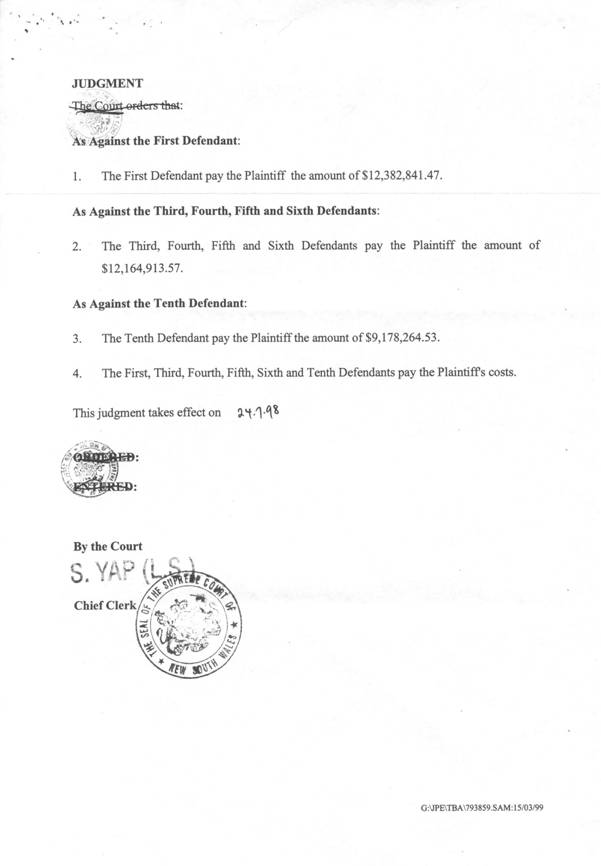
48 It is pointed out on behalf of the judgment debtors that the interest calculations made in the Notice commence from 1 April 1998, where the judgment only took effect from 24 July 1998, so that the Notice contains an overstatement of the interest claimed to be due.
49 However, as the judgment creditor has submitted, no notice, as required by s 41(5) of the Bankruptcy Act in such a case, was given. It follows, in my view, that the Notice was not invalidated by the overstatement.
6. Addendum following the statement in the Schedule of the total amount claimed
50 The Schedule stated the following:
“Schedule
|
|
Column 1 |
Column 2 |
||
|
|
1. |
Amount of judgment or order |
$12,164,913.57 |
|
|
plus |
2. |
Legal costs if ordered to be paid and a specific amount was not included in the judgment or order (see Note 1. Below) |
N/A |
|
|
plus |
3. |
If claimed in this Bankruptcy Notice, interest accrued since the date of judgment or order (see Note 2. Below) |
$1,257,101.96 |
|
|
|
4. |
Subtotal |
$13,422,015.53 |
|
|
less |
5. |
Payments made and/or credits allowed since date of judgment or order |
$9,581,096.25 |
|
|
|
6. |
Total debt owing |
$3,840,919.28 |
|
(NB: Amounts, where applicable, are to be inserted in Column 2)
The total debt owing is exclusive of fees, charges and enforcement expenses which have accrued to the relevant accounts, the subject of the judgment debt, since 1 April 1998, and these amounts continue to accrue.”
51 On behalf of the judgment debtors, it is submitted that the use of the words “these amounts continue to accrue” constitutes an assertion by the judgment creditor that the amount claimed is not the total debt, and that the correct debt is another figure, which cannot be calculated by reference to either the Notice, the schedule to the Notice or the attached judgment; that, in accordance with the reasoning of the majority in Australian Steel, the requirement to state the correct amount payable is an essential requirement of the Bankruptcy Act; and that it must follow that the sum of $3,840,919.28 is not the total debt owing.
52 I cannot accept the judgment debtors’ argument.
53 Again, in my view, the critical consideration is the application of an ordinary or natural, common sense approach to the language used in the Notice, read as a whole. When so read with that approach, it appears plain, I think, that, in order to comply with the Notice, the judgment debtors were required to pay (etc) the amount of “the debt”, being the sum of $3,840,919.28; and that the additional information provided was intended to, and did, make it clear that the claim to “the debt” did not include (“was exclusive of”) the other amounts claimed to be owing on other accounts, but not required to be paid in order to comply with the Notice.
7. Annotation with respect to interest calculation
54 Added to the claim for interest in the Notice (at p 6) was the following statement:
“NB. Interest has been calculated on a simple interest basis. The Bank usually charges interest on a compound basis.”
55 On behalf of the judgment debtors, it is submitted that, as in the case of item 6, above, this statement seems to imply that the amount specified is not the amount actually claimed as owing; but no means of ascertaining what is claimed to be actually due is provided by the Notice.
56 Again, for similar reasons to those given in respect of item 6, I have difficulty accepting the argument. In my view, the annotation is merely making it plain that the amount of interest claimed under the Notice is calculated on a simple basis, notwithstanding the judgment creditor’s usual practice to claim on a compound basis.
57 In my opinion, there was no defect or irregularity in this connection.
ORDERS
58 At the hearing before me on 13 March 2001, I ordered, by consent, that the following question be determined as a preliminary question:
“Question: Is Bankruptcy Notice NN6270/00 invalid by reason of any of the grounds alleged in Exhibit ‘A’?”
59 (Exhibit “A” consists of the judgment debtors’ solicitors’ letters of particulars dated 15 and 16 February 2001 specifying grounds 1 – 7, above.)
60 In accordance with the foregoing reasons, I will order that the question be answered: “No”, with costs of this issue. Any question of any application for any costs to be allowed for the preparation of the Notice is reserved for later consideration, if it arises.
|
I certify that the preceding sixty (60) numbered paragraphs are a true copy of the Reasons for Judgment herein of the Honourable Justice Beaumont. |
Associate:
Dated: 5 April 2001
|
Counsel for the Applicant: |
D J Durston |
|
|
|
|
Solicitor for the Applicant: |
Michelle Sillar |
|
|
|
|
Counsel for the Respondent: |
J E Thomson |
|
|
|
|
Solicitor for the Respondent: |
Coudert Brothers |
|
|
|
|
Date of Hearing: |
13 March 2001 |
|
|
|
|
Date of Judgment: |
5 April 2001 |